Serving Installers, Dealers and Integrators Across Canada
Edmonton tackles false alarms
Police looking for feedback ahead of potential bylaw update p. 7
Are your cameras really cyber-ready?
Experts outline what it takes to keep network cameras safe over the long haul p. 14
Q&A: Gordon Hebb, CANASA
The organization’s new national president outlines major goals ahead for his two-year term p. 22
Security integrators are offering AV products and installs to increase the suite of options they can bring to customers.
By Will Mazgay
Axis Canada’s Bob Moore takes on U.S. role • Lanvac set to expand with new Montreal headquarters
Edmonton Police seeking alarm bylaw change
Waging the cyber war Best practices in surveillance and cybersecurity may be at an all-time high, but there’s still no room to relax.
By Neil Sutton
EDITOR’S LETTER
FBy Neil Sutton
Reaching the summit
or an industry that was once described as guns, gates and guards, security has come a long way. Nowhere was this more evident than SP&T News’ annual Security Summit Canada conference, held June 13 in Toronto.
Not only is security embracing technology like cloud and mobile, it has become much more tightly woven into other aspects of enterprise life, including operations and HR. Security is also going head to head with other industries like telcos, building automation and dozens of consumer-facing businesses.
Security Summit opening speaker Steve Van Till, CEO of Brivo, commented on how competitive forces are creating more urgency for security providers to not only be the first to install sensors in a location, but have the staying power to remain there. He indicated that this is a crucial time for security to really take advantage of its expertise in access control, embrace mobile credentials and fully explore smart phones as an interface. As he put it, why wouldn’t you want to be on a device that commands so many eyeballs?
Aru Bala, president of ADT Canada, and our keynote speaker, spoke about security in the context of megatrends like the geo-political climate, the rise of IoT and 5G, and demographic shifts as Millennials and Gen Z move into prime positions as valued consumers. In terms of digital disruption that’s affecting almost every sector, he indicated that security is still behind, but the good news is it’s catching up. Security, as an industry, creates a wealth of data, but it’s not exploited to its full
potential, he said. Taking advantage of AI technology is going to help out in that regard.
A point of contention that seems to come up in practically every conversation I have with an alarm industry professional is the home security market penetration rate — usually quoted in the 20-25 per cent range. An encouraging sign from Bala is that he sees this as an opportunity. “In spite of all the competitive pressures, there is still a lot of room for us to grow,” he told Summit attendees.
Bob Harris, president of Attrition Busters, brought his enthusiasm to two sessions at Security Summit. Against the backdrop of megatrends and technological change, he said it’s often the smallest details that will have the greatest impact on your business. Thank your clients for their support. Make sure your technicians wear paper slippers over their boots when entering a customer’s premise. Find out what your competitors are offering and do it better.
Craig Campbell, CEO of Toronto-based Avante Logixx, was our last speaker of the day. Campbell has spent the better part of 25 years working in security (he started at 17). He sold portions of his security business, Total Security Management, several years ago and took a break from the industry. He came back recently, intrigued by the idea of building up another business. As he put it, “I was in the security business, now I’m in the investment business. But I only invest in security.” If that isn’t a ringing endorsement of the future this business, I don’t know what is.
Your Partner in Securing Canada Security Products & Technology News is published 8 times in 2019 by Annex Business Media. Its primary purpose is to serve as an information resource to installers, resellers and integrators working within the security and/or related industries. Editorial information is reported in a concise, accurate and unbiased manner on security products, systems and services, as well as on product areas related to the security industry.
Group Publisher, Paul Grossinger 416-510-5240 pgrossinger@annexbusinessmedia.com
Editor, Neil Sutton 416-510-6788 nsutton@annexbusinessmedia.com
Associate Editor, Will Mazgay wmazgay@annexbusinessmedia.com
Media Designer, Graham Jeffrey gjeffrey@annexbusinessmedia.com
Account Coordinator, Kim Rossiter 416-510-6794 krossiter@annexbusinessmedia.com
COO, Scott Jamieson sjamieson@annexbusinessmedia.com
EDITORIAL ADVISORY BOARD
Colin Doe, Veridin Systems Canada Anna Duplicki, Lanvac Victor Harding, Harding Security Services Carl Jorgensen, Titan Products Group Antoinette Modica, Tech Systems of Canada Bob Moore, Axis Communications Roger Miller, Northeastern Protection Service Sam Shalaby, Feenics Inc.
111 Gordon Baker Rd, Suite 400, Toronto, ON M2H 3R1 T: 416-442-5600 F: 416-442-2230
PUBLICATION MAIL AGREEMENT #40065710 Printed in Canada ISSN 1482-3217
SUBSCRIPTION RATES: Canada: $42.00 + HST/yr, USA: $74.00/yr and International: $84.50/yr Published
Annex Publishing & Printing Inc. disclaims any warranty as to the accuracy, completeness or currency of the contents of this publication and disclaims all liability in respect of the results of any action taken or not taken in reliance upon information in this publication.
NOW’S THE TIME TO TEAM UP WITH ADT
1 Join our ADT Authorized Dealer Program. Promote Canada’s #1 brand of home security products and services.
ADT o ers the largest and most innovative dealer program in Canada, with the tools, expertise, and credibility that only an industry-leading company such as ADT can provide. Join the hundreds of successful authorized dealers already growing their businesses and incomes with the help of ADT.
OR
2 Join our ADT National Acquisition Program to maximize the value of your security business.
If you’re a security business owner and considering retirement, or are simply looking to inject a better cash flow into your company, ADT’s National Bulk Acquisition Program is the solution for you. We o er attractive purchase multiples and have a highly experienced team dedicated to turnkey acquisitions.
THE CHOICE IS YOURS! And we’re here to help you.
Why choose ADT canada?
We take pride in providing 24/7 peace of mind to over 600,000 Canadians from coast to coast.
We are customer-service oriented, innovative and technology savy.
With over 125 years of experience and over 15 o ces in Canada alone, including three monitoring Centres, you can trust the experts. Take your business profits to the next level by joining forces with Canada’s #1 home security company!
Or contact one of our regional
March-André Nguyen, Business Development Manager, Eastern Canada 514.238.0003 MarcAndreNguyen@adt.ca
Joseph Salz, Business Development Manager, Central Canada 905.212.0752 josephsalz@adt.ca
Paul Hayre, Dealer Territory Manager, Western Canada 778.837.3733 phayre@adt.ca
LINE CARD
Axis Canada’s Bob Moore takes on U.S. role
Along-standing member of Axis Communications Canadian team is moving to the U.S. to take on a dedicated marketing role.
Bob Moore, country manager, Canada, recently accepted the position of director of marketing, Americas, which officially begins on July 1. His new role will see
him taking the lead in marketing initiatives related to Axis partners, business development, education, conferences and regional communications. Moore’s duties will also encompass Axis’s brand awareness and audience building.
“The broader role will mean a greater participation within the important trends impacting our
“We truly operate as one, no matter where we are in the world.”
— Bob Moore,Axis Communications
industry now and in the future — from cybersecurity, trust, artificial intelligence, automation and much more,” Moore said in an email to SP&T News
Moore joined Axis in 2005 as a regional sales manager and moved up the ranks to country manager for Canada.
During his time here, he participated broadly in the Canadian security community. A familiar face at the Canadian Security Association’s (CANASA) Security Canada conferences and events,
Lanvac set to expand with new Montreal headquarters
Montreal-based Lanvac recently announced it has purchased a new facility, also in Montreal, to accommodate growth and expand operations.
The wholesale monitoring firm currently operates five other central stations in Canada in addition to Montreal — Ottawa, Quebec City, Toronto, Halifax and Burnaby, B.C. The newest Montreal facility will be its seventh.
John Georgoudes, the company’s co-president, told SP&T News that the current location was “bursting at the seams,” necessitating the expansion. Lanvac’s existing station in Montreal is approximately 10,000 sq. ft.
The new location, which is a similarly sized, is approximately seven kilometers away. In addition to monitoring, it will also house the company’s accounting and administrative operations. Georgoudes said he will move his office there and the building will function as the company’s headquarters when completed. The new location will undergo renovations and is expected to be fully operational by the end of 2019.
“We are going to start moving July 1,” said Georgoudes. “I’m hoping that in the month of July, accounting and marketing will be settled in. By October, I’m hoping the construction will start and we’ll have monitoring and the data centre on the ground floor.” He added that having a second facility in Montreal is also useful in terms of providing a back-up should anything unforeseen happen to one location or the other.
Georgoudes indicated that an eighth station for Lanvac is also in the works as the company looks to expand its Toronto operations with a second facility there. “Toronto is going to be ready next year,” he said. “Toronto is going to be the eighth and then we’ll see what the market dictates.”
— Neil Sutton
he has also taken on several volunteer roles within the organization, including serving on the national board of directors, and as treasurer and president for the Central Ontario Council.
Moore has also contributed to SP&T News as a columnist, and served on the magazine’s editorial advisory board.
In his email note to SP&T, Moore said he can count many professional and personal accomplishments during his time here. Under his watch, Axis opened its
Canadian AES (Axis Experience Centre) in 2016 in Mississauga, Ont., and hosted eight Canadian partner events.
The surveillance market has also changed greatly since 2005, with Axis on the leading edge of the transition from analogue to IP-based cameras. “I remember integrators at ISC West 2005 lining up to understand the difference between analogue and digital,” recalled Moore.
Moore will operate from the U.S. going forward, but he will continue to keep his connection to Canada
“Axis has a great company culture and we truly operate as one, no matter where we are in the world,” he said.
“The Canadian Axis team will continue to focus on the needs of their region. I look forward to having a continued impact with Canada and all regions within the Americas in my new role.”
— Neil Sutton
Bill (left) and John Georgoudes, company co-presidents, Lanvac
Bob Moore, Axis Communications
Edmonton police seeking alarm bylaw change
Local CANASA president says monitoring firms can do their part and improve customer records management
To reduce the number of false alarms requiring a police response, the Edmonton Police Service (EPS) is seeking changes to the City of Edmonton’s Alarm Systems Bylaw, and is currently asking for feedback from permit holders through a brief survey.
The EPS says under the current bylaw, alarm permits have no expiry date, resulting in out-ofdate contact information. To rectify this, the EPS is proposing that alarm permits be renewed on an annual basis for a fee of $15 a year.
EPS spokesperson Carlos Cardoso, Manager, Police Information Check and Alarm Control Section, said that yearly renewals will be a big help because, “we have in our system 110,000 permits, and we can’t say which ones are valid and which ones aren’t.” He continued, “If you have your alarm permit and you pay your one-time fee, you move six times in the next year or two, we have no up-to-date information.”
Cardoso said he is encouraged by the fact that other police services that have implemented yearly permits have had reduced false alarm rates.
Patti Jones, president of the Northern Alberta council, CANASA, welcomed the proposal, but said the monitoring industry
hasn’t done a good enough job in setting up their customers and the police for success.
Regarding the administration of alarm holder contact information, Jones said, “Our perspective is that the ownership of maintaining and keeping information on emergency contacts really should be the responsibility of the monitoring stations and the companies themselves…That’s an awful lot of administration for them (EPS) to have to own on an annual basis.”
The EPS is also is proposing one free false alarm to be given to every permit holder, after which, escalating penalties will be in place. (No information on penalty fees was available at press time.)
This isn’t the first time the EPS has attempted to tackle false alarms. It took a significant step in 2016, when it brought in an enhanced call verification process. This means that police dispatch to an intrusion alarm won’t occur unless the following conditions are met:
1. A combination of an exterior breach (door/window breach, glass break, etc.) and interior motion alarm activations.
2. Contact with keyholder(s) to determine the alarm’s legitimacy.
“In general, we get about 6,300 calls per year to our 911 lines,” said Cardoso. “By doing the enhancement call verification, we narrow
it down to 1,800.” While such a reduction appears to be a success, Cardoso explained that 98 per cent of these are still false alarms.
Going forward, “We’re also looking at trying to encourage alarm companies to do their part on call verifications,” said Cardoso.
Jones agreed that alarm companies need do their part. “They (the EPS) need to be able to trust that when we’re calling, we’ve got the current information, we’ve called the keyholders, we’ve followed the current bylaw,” she said. “We want them to be able to spend their resources focused on those actual alarms that we’re pretty confident are legitimate.”
To help reduce false alarms, Jones said alarm firms can also
market watch
erage. It’s also crucial, according to Jones, that customers understand how to use their system properly. Lastly, firms can encourage customers to upgrade old systems to those with better coverage, or better yet, a system with video, to bring in a visual verification for intruders.
Jones said that alarm firms ensuring protocol is followed and false alarms are reduced will help maintain good relations between the alarm industry and police.
“We’ve had a really good relationship with the EPS at CANASA local council over the past couple of years,” she said, stressing that the relationship needs to be continually fostered, or else communication and co-operation between
LINE CARD Calendar
Applications
Texas
hotel
deploys RFID locks
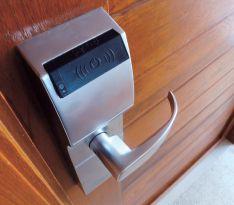
Delta Hotels by Marriott Dallas Allen has deployed VingCard Signature RFID locks from ASSA ABLOY Global Solutions.
The company says Altera Development, the owner of the luxury property in Allen, Tex., was assured of the product’s ability to conform to regional regulations and requirements.
“With the success that we experienced in installing VingCard Signature RFID door locks, we are fully confident in our hotel’s ability to provide guests and staff with the highest quality of security,” said Mike Kennedy, principal, Altera Development, in a statement.
The locks incorporate encryption technology to prevent the possibility of unauthorized keycard cloning and are mobile access ready. The locks also eliminate the risk of misreads and inadvertently erased keycard data, according to the company.
Appointments
• Montreal-based Genetec has appointed Francesco Serra as European VP of sales, Georges Tannous as director of Europe, Middle East and Africa Marketing, and Jakub Kozsak as regional sales manager for East Central Europe.
• Vidsys announced that the board of directors has promoted company vice-president of product innovation Maurice Singleton
Squirrel crossings caught on camera
According to a recent post on Milestone Systems’ official blog, the company has supplied its video management software (VMS) to the City of Longview, Wash., to help monitor traffic — squirrel traffic.
The city utilizes a system of bridges over busy streets to allow the furry creatures safe passage. The original “Nutty Narrows” squirrel bridge has been in place since 1963, with five more erected since then and a seventh to follow. The bridges are now monitored with video surveillance via the Milestone tools.
“The bridges are symbolic, but the squirrels actually use them, and we have cameras to watch live views,” said Keith Young, senior sales engineer with Milestone partner Last Mile Inc., according to the blog post. ”There are several in town, mostly around the lake. All of them are beautiful and ornate. It’s just kind of a fun thing about my town.”
as the new president of Vidsys.
• Biamp Systems LLC has appointed John Major as the company’s new vice-president of operations.
• Milestone Systems announced Michael Gaul has been promoted to senior manager, technical services for the Americas, overseeing technical support, professional services, and Milestone Americas IT operations.
Bee’ah, a public-private partnership company, is installing smart building technology into its new Sharjah, United Arab Emirates, headquarters. The Middle East sustainability venture, which has interests in environmental consulting, renewable energy, sustainable transportation and more, will utilize a variety of technologies from Microsoft and Johnson Controls. Upgrades planned include digital workspaces, back-office integration and smart visitor management. Johnson Controls will use its Digital Vault offering and will work with Microsoft to incorporate intelligent edge systems designed to optimize energy efficiency.
• Nortek Security & Control announced the promotion of Chris Lynch to manager, builder services. He was previously regional sales manager.
• Speco Technologies has announced that Adolph Salas has been promoted to national director of sales. Salas will be responsible for all manufacturer representative activities, ensuring the firm’s sales goals are met.
September 8-12, 2019 GSX Chicago, Ill. www.gsx.org
September 11, 2019 Security Canada Atlantic Moncton, N.B. www.securitycanada.com
September 17, 2019 ADI Expo Vancouver, B.C. www.adiglobal.com
Sept. 29 - Oct. 3, 2019 BICSI Fall Conference & Exhibition Las Vegas, Nev. www.bicsi.org
October 3, 2019
Canadian Security Honours Toronto, Ont. www.canadiansecuritymag.com/ cshonours
October 8, 2019 ADI Expo Ottawa, Ont. www.adiglobal.com
October 12-16, 2019 TMA Annual Meeting Napa Valley, Calif. www.tma.us
October 22, 2019 CANASA Monitoring Symposium Toronto, Ont. www.canasa.org
October 22, 2019 Monitoring Station Symposium Toronto, Ont. www.canasa.org
October 23-24, 2019
Security Canada Central Toronto, Ont. www.securitycanada.com
October 29-30, 2019
Securing New Ground New York, N.Y. sng.securityindustry.org
November 20, 2019 ISC East New York, N.Y. www.isceast.com
December 5, 2019 Focus On Healthcare Security Toronto, Ont. www.focusonseries.ca
UAE building outfitted with latest smart technology
Georges Tannous
John Major
Michael Gaul Maurice Singleton
Adolph Salas
Chris Lynch
LESSONS LEARNED
RBy Victor Harding
The four variables
Track these important measures if you want to know “theoretically” what your account base is worth
ecently, I tuned in to one of the best webcasts I have ever heard, given by Michael Barnes of Barnes Associates, a U.S. based security industry advisory firm.
The webcast, hosted by a U.S. magazine, addressed the four key variables by which owners, buyers, lenders and investors should value an account base. I have talked about these four variables over the years but have never completely understood the numerical underpinnings of each. Barnes may not have originated these variables, but he has articulated them in a very compelling way. If a buyer was being completely rational, how these four variables calculate would explain an account base’s value. However, most of the smaller deals in Canada today are being done without these four variables being calculated. Throughout this article I will be referring to Michael Barnes’ webcast “Minding Your Metrics: Insights into tracking value in an RMR-based business.” I recommend you view the webcast yourself if possible.
1. The Cost to Create a new customer or new RMR (Recurring Monthly Revenue)
The Cost to Create (CTC) is generally expressed as a multiple of the RMR that has been created. So, for example, over all in the U.S. last year, Barnes estimated the overall CTC to be about 29X RMR. If you consider that the average RMR on accounts being created these days is much higher than 10 years ago ($35/month versus $25/month) then each new monitoring customer in the U.S. alarm industry costs more than $1,000 to create. This CTC number that Barnes quotes is driven by three high cost scenarios: a) authorized dealer created accounts, b) telco created accounts and c) summer door-knocking accounts. Generally, commercial accounts cost far less to create (15-18X), which explains why people value them higher today. The lower the replacement cost for a lost account, the more attractive the account base is. Generally this high CTC for residential accounts today (26 to 32X RMR) is the reason why most independent alarm dealers don’t focus on the residential market.
2. The margin on the monitoring RMR and service revenue created
As Barnes talks about it, this variable com-
bines both monitoring and service revenue and their corresponding costs together to get at one combined gross margin. Typical margin numbers here vary between 50 per cent for smaller companies who might pay higher per unit monitoring costs and don’t make as much on service to 65-70 per cent for larger companies whose volume drives down their monitoring costs per account and who might charge higher rates for service. The example Barnes used in his webcast showed us a sample company whose margin on service and monitoring was 54 per cent.
I have always written that alarm accounts with higher rates are generally worth more than accounts with low rates. This rule of thumb is backed up by what Barnes says about this second variable. Run some numbers yourself and see how much more money drops to the bottom line on $30/accounts versus $20/accounts. You will never sell a $20 account again. Today, average RMR rates are climbing with the increasing use of cell services and interactive accounts, but the costs for these services are also a factor, so often the overall margin is lower. Including the margin on service in the overall calculation helps explain why buyers may not like accounts with lifetime warranty attached. It lowers the service margin.
Here is something that most of us don’t take into account — to do a proper calculation of this variable, Barnes says you should allocate some overhead from your operation and add these costs to the monitoring and service costs to get
a true margin. Barnes actually took 50 per cent of the total overhead of the sample company and added it to this calculation. This confirms what I have been saying for some time, which is that it does cost to manage an account base.
3. The attrition percentage on the base, or how long the RMR lasts
Most of us have been told for years that attrition is an important number to consider when valuing an account base. But few of us know how to go about calculating gross or net attrition or give attrition enough consideration when assessing an account base. The important issue is to know how long an account base will last and how much it will cost to replace the attrition. An important concept that Barnes introduces here is what larger U.S. buyers and investors are using more and more now, which is the concept of Steady State Net Operating Cash Flow (SSNOCF) or the cash flow that is generated in the business after it has replaced its attrition. Today, on these larger deals, the price is often expressed as a multiple of SSNOCF rather than a multiple of RMR. So, for example, a multiple of 38X RMR might equate to 10X SSNOCF. It is also important to note that lowering the monitoring, service or overhead cost factors in an account base after it has integrated into the buyer’s base can lower the multiple of SSNOCF it has to pay for an account base.
4. The RMR growth factor
This variable is often neglected in valuing an RMR base. The growth factor, if there is one, nets the total lost accounts or RMR against the total new RMR to hopefully come up with a positive number. In Canada, I don’t run into many dealers whose account base is actually growing. It stands to reason that companies that purposely push to grow their account base or RMR should be worth more but, Barnes makes the good point that this will only be the case if the investment in new accounts produces enough incremental cash flow to be worth it.
I suggest you check out Michael Barnes’ webcast and start to think about these four variables every time you are assessing an account base.
Victor Harding is the principal of Harding Security Services (victor@hardingsecurity.ca).
CAMERA CORNER
By Colin Bodbyl
Heat seeker
Surveillance offers some viable alternatives to smoke detectors when it comes to locating fires
When most people think of fire detection, they think of traditional smoke detectors that seem to false alarm every time someone burns a piece toast.
There are, however, other methods for detecting fires that many do not know of, one of which is surveillance cameras. Traditional sensors work well in home and office environments but outdoors or in large open spaces like factories or stadiums they are not a good solution. For these applications, integrators often look to specialized video surveillance cameras purpose built for fire detection.
There are several methods of detecting fires using a camera. The first is using video analytics designed to identify smoke in a scene. Smoke is typically the earliest sign of a fire as objects often smoulder and generate smoke before flames appear. For indoor applications, this technology can be very effective. Using smoke detection analytics outdoors can increase the likelihood of a miss, and in many cases, manufacturers do not recommend using smoke detection outdoors. Strong winds can quickly clear smoke from the air, making it difficult to detect. Other environmental factors, like poor lighting or fog, can further confuse the analytics.
“Flame analytics can be very effective.”
Another analytic for detecting fires that is less prone to the effects of wind and lighting is flame detection. Similar to smoke detection, flame detection analytics are designed to identify the unique appearance of flames in a scene. Since flames generate their own light and are less affected by weather, flame analytics can be very effective. The obvious downside is that the camera needs to have a line of sight to the flame. It is also possible that by the time a flame is detectable, the fire has grown significantly from the time it first began to generate smoke.
If smoke or flame analytics will not meet the requirements of a site, thermal cameras could be a better choice. The simplest way to understand thermal cameras is as a camera that detects the temperature of objects in a scene. Since thermal cameras can measure temperatures, they can also be set to trigger an alarm when objects heat up past a certain threshold. Not all thermal cameras are capable of measuring or alarming on high temperatures, so specific models need to be selected in order to monitor for fires.
As with fire and smoke analytics, thermal
cameras are not perfect. Thermal cameras also need a line of sight to the heat source in order to detect it. This can be particularly problematic in the case where an object like a house or building is on fire inside and generating smoke, but the outside of the facility has not warmed past the set threshold yet.
Combining any of the above solutions can be the best defence against fires, and many vendors do offer cameras that support combinations of the above three technologies. Whether using an individual technology above or some combination of the three, false alarms are to be expected. Not unlike the smoke detector in your home that cannot distinguish between smoke from the toaster and smoke from your furniture, fire detection cameras will also false alarm on anything that appears to be a fire. Hot machinery, exhaust smoke, and other innocuous activity can trick fire detection cameras into generating false alarms. Regardless of false alarms, however, video surveillance cameras can create an effective fire detection system, particularly in large open spaces where traditional smoke detectors simply will not work.
Colin Bodbyl is the chief technology officer of Stealth Monitoring (www.stealthmonitoring.com).
CANASA UPDATE
By Patrick Straw
New CANASA board and president
CANASA takes great pride in announcing a new board and president was recently installed at the Annual General Meeting in Montreal. Gordon Hebb of Wilsons Security Limited in Halifax, N.S., begins his two-year term as president. For the remaining board members and other information on how you can volunteer for our committees, please visit www.canasa.org.
CANASA Award Winners
CANASA also presented a number of awards in recognition of outstanding industry service at the Annual General Meeting. The winners:
• R.A Henderson Award for Outstanding Achievement: Carl Jorgensen
• President’s Award of Excellence: Richard McMullen
• National President’s Award: Ellery Demedash
• Regional Council President’s Award: Stuart Armour, Lisa Boyer, Brian Gibbs, Stephen Goodsip, Chris Izatt, Patti Jones, Robert Moore, Darron Parker, Denis Primeau and Joseph Rossano.
• Outstanding Contributor Award: Normand Fiset and John Georgoudes
• Honorary Member Award: Denis Bouchard, Don Budden, Neil Jones and Robert Leduc
• Regional Council of the Year Award: British Columbia Regional Council
CANASA 2019 Scholarship Award Winners
CANASA recently announced the winners of the 2019 scholarship program designed to benefit students and members to fund their education and careers in the security industry. The award winners are:
• Ariane Arcand (Quebec)
• Camille Arcand (Quebec)
• Jayden (SungChun) Jang (NSCC)
• MacKenzie Cynthia Kehl (Golden Horseshoe)
• Pascal Saint-Pierre (Quebec School)
• Halley Ritter (Prairie)
• Vishnu Sangar (BCIT)
• William Shami (British Columbia)
• Elizabeth (Edie) Wilson (Atlantic)
Security Canada Show Update
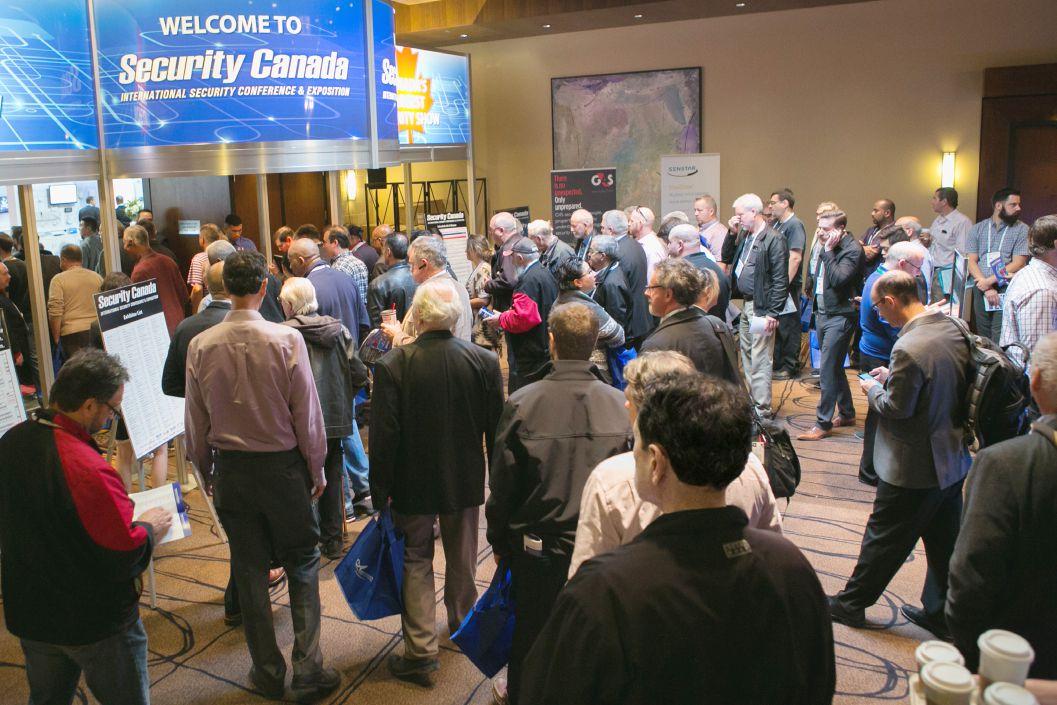
It’s been a terrific show season up to now with the first four shows attracting big crowds. The top security manufacturers took the opportunity to display and demonstrate the latest in security technology and products to the security professionals who attended the events in Laval, Que., Ottawa, Ont., Edmonton, Alta., and Richmond, B.C.
Next up is Security Canada Atlantic in Moncton, N.B. For all the information on attending, exhibiting or sponsoring a Security Canada event in Moncton in September, or in Toronto in October, please visit www.securitycanada.com.
Patrick Straw is the executive director of CANASA (www.canasa.org).
Patrick Straw
the
cyber war Waging
Best practices in surveillance and cybersecurity may be at an all-time high, but there’s still no room to relax
By Neil Sutton
When it comes to security camera systems, it might be fair to say that cybersecurity has moved from an afterthought to top of the agenda in the last few years, but that doesn’t mean anyone can sit back and say they’ve licked the problem.
Publicly acknowledged breaches, botnets and known vulnerabilities (some of them published on public websites) have changed the game for almost everyone in the security equipment business, whether they manufacture or program the tools, install them, or use them on an ongoing basis. There is a growing awareness that cybersecurity simply has to be a top consideration — and not only because the cameras themselves could be vulnerable to cyberattack. They could be the weak link in a network which could ultimately result in much greater damage, whether that means compromised data or a sullied reputation, or more likely both.
One of the first and biggest steps on this road to realization is acknowledging that today’s cameras are basically computers, with many of the same pros and cons.
“I would say, over the past three years, our customers’ knowledge and sophistication has changed pretty dramatically,” explains Brian Lipscomb, manager, advanced cyber solutions, for systems integrator Convergint Technologies. “In the early stages, it wasn’t as clearly understood that with security technologies, we are essentially installing computers on a wall. The difference between the camera and a laptop computer — they all carry the same pieces and parts and vulnerabilities.”
Around this understanding, a subset, or specialty within the overall security industry has developed: safe cyber practices that recognize that how a device is installed and maintained may be just as important as the
job it was designed to do in the first place.
German surveillance manufacturer Mobotix refers to this as the “Cactus Concept” — a set of guidelines the company publishes for the benefit of installers and end users. “The actual cyber protection guide that we offer is pretty thorough,” says Joe Byron, vice-president of sales, Americas, Mobotix. “I’ve been in the industry a while, and I’m not going to name names, but I think this is stronger than most out there, in terms of hardening our solutions.”
Byron elaborates that the Cactus Concept is both a mindset, in terms of best practices and white papers, but also a technology solution offered through product development and safeguards. The company provides some assurances, for example, by penetration testing some lines of its products via a third party.
It’s also a matter of choosing one’s partners carefully, adds Byron, invoking a Reagan-era catchphrase “Trust but verify.” He says the company aligns itself with technology and integration partners who share a simi-
Mobotix’s Cactus Concept: A set of guidelines for installers and end users and a philosophy that includes third party penetration tests of Mobotix products. (Image courtesy Mobotix)
lar mindset and “want to become an extension of our Cactus Concept.... We must be diligent about choosing the right technology partners to move forward with. It’s a dynamic process to stay up on these partners.”
Niall Jenkins, consulting associate director, security and building technology at research firm IHS Markit, says this best practices approach has become more common in the vendor world and many “now offer a program to improve the cybersecurity of their devices and software. Often this process starts with the training and education of their integrator and end-user partners.”
He says that vendors are more likely to offer encryption and consider how their products interoperate with others in the technology chain. “All of this activity is driving improvement in the cybersecurity of video surveillance products.”
Lipscomb also believes a number of technology vendors have stepped up their game in recent years and there is a realization that the stakes are much higher today. “They know that the products are creating additional threat footprints for our clients, so they’re putting a lot more effort into developing products that have inherent security capabilities,” he says.
“We must be diligent about choosing the right technology partners.”
— Joe Byron, Mobotix
Those clients are also changing and today, many of the decision makers, when it comes to installing security equipment, work for the IT department, not the security department.
Working with IT
“We almost inevitably work with IT departments across the board on every new or existing installation. I would put that at the 90th percentile or greater,” says Lipscomb. “For the past few years, it’s been the standard. It’s been more prevalent once we transitioned from analogue to digital…. Before that, you didn’t touch firewalls and switches and routers and those kinds of things. Now that occurs on virtually every installation.”
The end user might be more attuned to potential cyber vulnerabilities, but they still rely heavily on outside expertise. “What you find is that there’s this gap in the middle [between manufacturer and user] that we have to fulfill to keep systems operational,” says Lipscomb.
The situation becomes more acute when dealing with a smaller customer who might not have the in-house resources or budget of an enterprise user with a large IT department at their disposal. “Our educational processes are much more important in those environments. They’re getting it, but it takes them longer to get there and it takes them longer to get budget,” he says.
Large or small, almost everyone needs help
of some kind. Stanley Security, for example, offers a managed services program to help customers with their cyberhygiene issues on an ongoing basis. The company offers solutions for small and medium-sized businesses but also for enterprise customers that may own 250,000 cameras, says Lance Holloway, director of vertical technology for Stanley.
“There’s so much going on. It’s such a broad and fluid topic that I find that a lot of people that are not native to the IT world can get run over pretty quickly, or worse yet, they can get some false assumptions around if a single widget or device can take care of them when in reality they may need multiple layers of protection,” he says.
“The program for servicing, etc., starts with just basic password and firmware maintenance on all of your known devices and discovering, frankly, all the devices. There’s a couple of products that we can use that can basically find and detect security products and other IP devices on the network. And we usually do this in conjunction with another IT department or with transparent permissions. Some people are not happy with you putting something on their network that is going to begin sniffing out the network, because it behaves similar to an attack, so we need to make sure that’s done correctly.”
One of the biggest issues, says Holloway, is dealing with older equipment on the network — devices that a user may not even realize are still in the field and still potentially a weak link if not managed properly or removed.
“Once this report comes back, you may be aware of 100 devices that you put in last year, but there may be 30 more devices that one of your predecessors put in that are still out there. It could be a network video recorder still on Windows XP, which is actually more common than people would like to think,” says Holloway.
.
Reducing risk
Mountain View, Calif.-based software developer Viakoo builds “service assurance for IoT environments,” according to the company’s CEO Bud Broomhead. “We actually diagnose what the root cause of the problem is, then make a recommendation to the stakeholder as to how to fix it… Because it’s 2019, there’s a huge cyber
aspect to the equation now.”
Viakoo introduced a password checker three years ago. But today’s cybersecurity is more than just regular password and firmware updates, he says. It’s also about documentation. “What’s happening in the system, any changes that are made to the system, who made the change… who authorized it to happen, when did it happen…? There’s a whole piece around compliance that we address as well,” he says. “Part of delivering service assurance is capturing an historical record of what the state of the edge device was at any moment in time. We keep that historic record, so it’s used by forensic auditors.”
While technology, awareness and implementation may be much improved when it comes to cybersecurity, there is no auto-pilot mode. Ongoing vigilance seems to be the key to a much lower risk profile.
And while cameras may have taken the lion’s share of attention when it comes to cyber-awareness in security systems, they are by no means the only vulnerable area.
“For the past year or so, there has been a real awakening that operational technology (OT), like building controls systems, building automation systems, as well as physical security systems, all have similar vulnerabilities to one another,” says Lipscomb at Convergint. He estimates that between 50 and 75 per cent of OT devices are not patched regularly or properly maintained.
“It’s really a culture shift,” adds Holloway. An upside of IP systems is efficacy in terms of network deployment which “was very attractive. We could put those items out there and see the green lights come on and everybody was very happy and we could go home. Now, with the lights coming on, we’re only halfway there.”
An ongoing program of maintenance and support is required, he says, whether that comes from the end user or a professional services organization. “That regimen has to be put into place.”
Cybersecurity awareness is “the highest it’s ever been,” says Mobotix’s Byron, “but it doesn’t mean we should let our guard down. The sophistication of the technology working against us could be even stronger moving forward.”
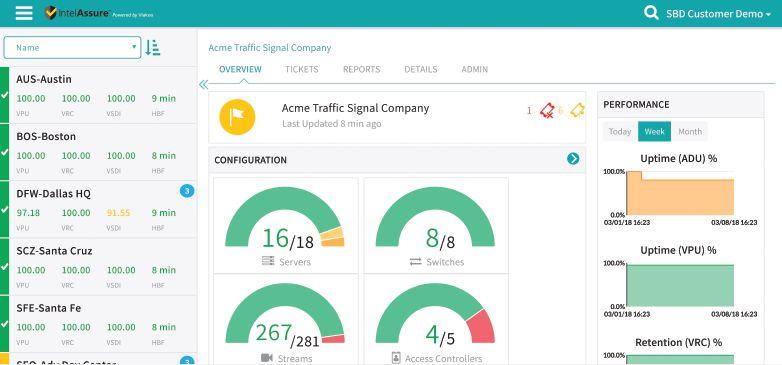
Screen image from Stanley’s service assurance tool IntelAssure, powered by Viakoo. (Image courtesy Stanley Security)
Add some sales volume
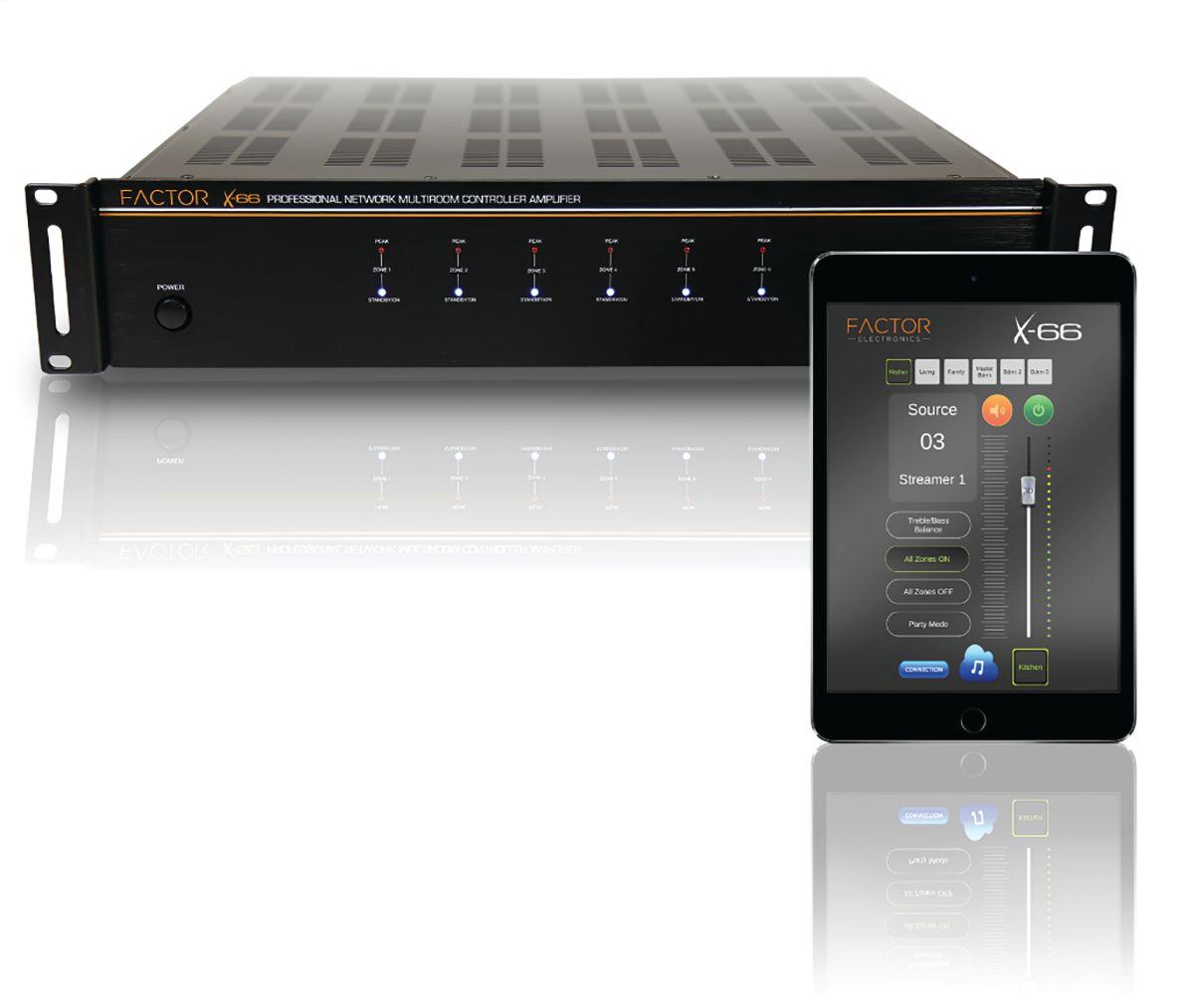
Security integrators are offering AV products and installs to increase the suite of options they can bring to customers
By Will Mazgay
For security dealers and integrators facing shrinking margins, it is increasingly important to have a broader offering of products and services. One way to expand these offerings is to provide audiovisual products and installations, and be able to tie AV systems into other home automation solutions.
A natural fit
Charlie Porritt, CEO of New Hampshire-based audio systems firm Russound, says margins and money have somewhat left the home solutions
industry. “People are looking for additional sales as well as recurring revenue on the alarm side — some of those dollars have come down as well,” he says. “So, when trying to get the maximum revenue per sale, it’s more than just getting that recurring revenue, but looking at saying ‘what else can we add into this sale while we are still here?’”
Electrical equipment giant Legrand sees security integrators as one of its primary target audiences for residential AV, according to Fritz Werder, vice-president and general manager, Residential AV Systems for Legrand’s AV division. He says, “If you look at some of the leading
security companies now, they’re not just security, alarm control through their interface. They may also integrate lighting and audio systems.”
Werder uses the example of Alarm.com, which integrates Legrand’s digital audio system into its security interface.
“A big part of why we see security installers doing AV products is because of that blending of the interface…The other thing I would say is there are security installers definitely seeing an opportunity to be able to sell a bigger basket of goods,” he says.
Werder continues, “In the case of new construction, they’re often working with builder partners and they get a chance to meet with homeowners, and if they’re responsible for doing the low voltage work on the security install, why not try to do the rough-in for home theatre, to do the TV mounts, do the cabling and the power for TVs, why not do the speakers?”
audio — for entertaining purposes — as opposed to reaching out to us to do the alarm system and then somebody else, now we can offer that whole package for that end user.”
Peter Garnham, president and CEO of PG Security Associates (PGSA), a Mississauga, Ont.-based manufacturer representative for AV firms and security vendors, says dealers and integrators from the security world have been dabbling in AV for some time now. He says, “A lot of people are migrating over because they’re leaving money on the table, they’re leaving projects out there that they can tackle.”
“There’s enough consumer demand looking for those types of [AV] products that dealer/integrators are being pulled into the market.”
— Peter Garnham, PG SecurityAssociates
He says there is also opportunity for security installers to win AV business in the retrofit market, as they are “going back out to homeowners where they’ve done security installations over the years and they may have a monitoring contract with them, and they’re looking for ways to maintain that relationship. So, they’ll come back in with optional products to try to upsell them on. Whether it’s wireless audio or other opportunities like that.”
Burlington, Ont.-based integrator A1 Security Systems has been offering Russound distributed audio for the past 10 years. Over the past two to three years, the company has introduced more home interactive services connected to its alarm systems, according to sales representative David Vaine.
He says, “It gives the end user more choices, to go with a single solution provider, that we can provide alarms, we can do the distributed
Garnham continues, “The average dealer out there, if they’re relying on security to bring the dollars and cents in, they’re not taking advantage. The majority of integrators out there, they’re putting in security, they’re putting in closed-circuit television, they’re putting in AV, degrees of home automation.… I think that there’s enough knowledge out there, and there’s enough consumer demand looking for those types of products that dealer/integrators are being pulled into the market.”
A whole home solution
Vaine says A1 Security uses the Russound audio system because of its ease of install. He says, “The technicians don’t need laptops when they go onsite. It’s more of an online portal, and most of the stuff is configured prior to going onto site. Technicians set it up here, and when they arrive to site, load it all up, plug the speakers in, and within minutes the client has access to the app, whether it’s their mobile device or their iPad or tablet.”
He says the firm has also recently started installing iPads on each
floor in custom homes. “So now the iPad not only controls the audio system, it also gives you the ability to control your alarm system, and any automation we have through the alarm system as well, whether it be controlling the lights, thermostat, garage doors.… It complements the intrusion system because it’s all one package, one service provider that provides that whole solution for them,” he says.
For integrators, providing this full suite of home automation amenities to a customer can require learning new skills and taking on new capabilities.
Legrand’s Werder cites one example: “As security and AV integrators get more and more requests around lighting or find themselves in more lighting projects, in most cases those require knowledge of electrical insulations or electrical certifications.” He says firms can gain this expertise through partnering, subcontracting or in-house training.
Another area where integrators require growing expertise to deliver automation solutions is in networking infrastructure, which Werder says has grown in importance as more security products have become IP-based.
He explains, “When you’re talking about IP cameras for example, or video doorbells, the foundation for performance of those security systems is the network. If you don’t have a reliable wired or wireless network in the home, you can’t be successful with those security systems.”
Werder continues, “The capabilities have continued to expand around remote network management to where installers or integrators are able to remotely control things away from the job site.”
He uses the example of rebooting cameras remotely as opposed to going to a job site, noting that solving these issues without having to do a truck roll is a huge boon to productivity. Werder also says that digital video recorders, security panels and other equipment can be housed using Legrand’s AV infrastructure products: “They can be stored and work with our infrastructure solutions.”
most cases, specific training is a necessary step to add these tools to their toolboxes.
Garnham, for example, provides training for Russound products and systems. “When I do a certification, call it a full day,” he says, while acknowledging that these intensive courses aren’t for everyone. “The problem with something like that is that integrators can’t find the time or don’t want to find the time to take advantage of that. So, they’d prefer to look at a short video clip to get up to speed.”
Garnham continues, “I think that what you’re seeing today, though, is manufacturers putting together YouTube video clips to show dealer/integrators how to do things. I’m seeing short video clips in the one to two to three minute range.”
“There are security installers definitely seeing an opportunity to sell a bigger basket of goods.”
— FritzWerder, Legrand
PGSA’s Garnham agrees that educating dealers and integrators on networking is becoming increasingly important. He says, “It’s just an understanding of how networks go together, how to attach products to them and how to troubleshoot them.”
Garnham continues, “It’s a whole new opportunity. Within the next 12 to 18 months, when the 5G networks are established and running, you’re going to see just a huge proliferation of products that people will be using in their homes.”
Learning the ropes
While offering AV and holistic automation solutions may be attractive to security integrators, in
Russound’s Porritt says, “People are busy and really can’t travel and do the days that they used to do in terms of training.” As a result, “we see a ton of people attending our webinars…We try to make sure we have training wherever and whenever people want.” He explains that the firm hosts about six to eight webinars a month and four to six short videos in the same time span.
A1 Security’s Vaine is the beneficiary of Russound’s training programs, and says he tries to make himself available for technical sessions for new product launches or similar events, along with the firm’s online sessions.
Vaine also explains that PGSA provides valuable product training and technical support. He says, “There haven’t been any issues or any questions that haven’t been answered the first time.”
Werder says Legrand provides training videos as well, from 15 minutes to an hour, along with live webinars every month across different product lines, covering topics like lighting, audio, shading and wireless networks. With respect to webinars, “dealers can sign up and
listen in, ask questions and engage on a live basis,” he says. The firm also engages in regional and in-the-field training, often partnering with distributors.
The Legrand executive explains that the level of training depends on the product. “We obviously don’t require someone to be certified to install a TV mount or a structured wiring enclosure, but things that are a little more complex like the luxury lighting solutions or shading, where there is a lot of nuance, we do require them to go through a certain set of training after hours as part of the dealer setup process.”
Werder says catering to the home automation market has definitely changed the way his business unit approaches training. “Before, you could talk mainly about your own products, and now a lot of our trainings are about how our products integrate with other systems, whether it’s voice control, or how our products integrate with control systems — you have to be able to now talk about how your products fit in to the broader ecosystems that are out there,” he says.
Selling fun
AV might just be one slice of the home automation pie, but for security dealers and integrators, it could be one of the most appetizing.
Porritt says AV can add a new dimension to home solution sales. “They start with the security system and then they add the dessert table, which is, we sell fun. There’s no fear in our sales.” This can be a refreshing change for dealers used to selling alarm systems, solutions designed for worst case scenarios.
As for Vaine, he appears to relish selling fun, and explains that when a customer mentions that they like to entertain, he’s more than happy to help with that. He says, “You can use Spotify through Russound, which is a great added feature, and if you’ve got a SiriusXM radio account you can integrate that as well. Listening to it while you’re sitting outside in the backyard, in the middle of the summer, it’s great for entertaining.”
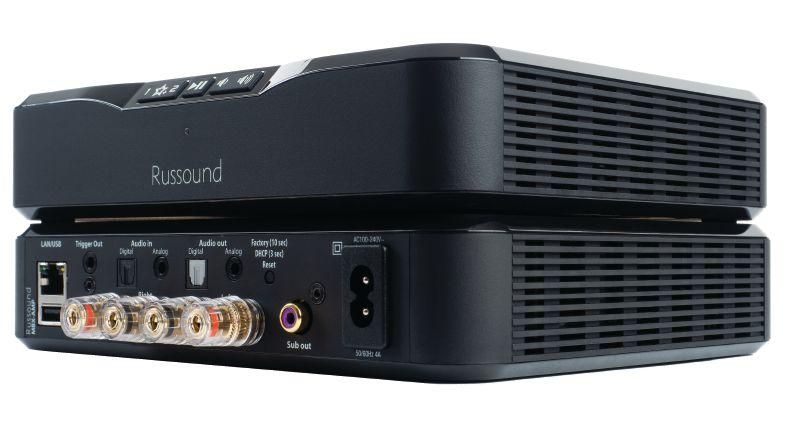
Russound’s MBX-Series of streaming audio solutions (Image courtesy Russound)
Product Previews Fire and Life Safety
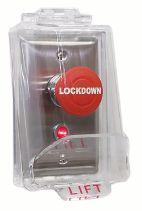
Clear protective cover
Camden Door Controls
Vandal and weather resistant, the low profile CM-CPC1 Clear Protective Cover is designed to protect any Camden flush mount, single gang, door activation device, including push/ exit switches keypads and key switches — without limiting the operation of the device. CMCPC1 heavy-duty polycarbonate covers protect the devices from rain, snow, water, dust and chemicals. They’re also a solution in vandal-prone applications. www.camdencontrols.com
Public safety software
Baron
Using basic weather information cross-referenced with proprietary algorithms and other data inputs, Baron’s Telematics for Public Safety can generate accurate road weather condition data. It enables organizations to access advanced weather forecasting tools, and the knowledge of scientists, mathematicians and meteorologists. Featuring an API that can work with any connected device, as well as Baron’s Road Weather technology, Baron Telematics for Public Safety is tailored to the unique challenges of public safety.
www.baronweather.com
Siren/strobes
STI
Synthetic smoke detector
Nortek Security and Control
STI’s new line of round and rectangular siren/strobes complement the existing Select-Alert mini controller series. The siren/strobes can be used with cabinets, mounted above doors, to the wall or the ceiling. The Select-Alert Sirens/Strobes are an effective way to alert to unauthorized use, theft or vandalism, as well as unwarranted exits and entries. Features include a round or rectangle shape and 32 selectable sounds with volume control.
INTEGRATOR
www.sti-usa.com
www.sptnews.ca for additional details. Deadline for entries: July 12, 2019
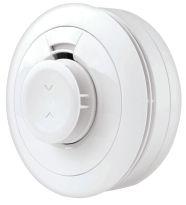
Nortek’s 2GIG Smoke Heat Freeze Detector is designed to recognize smoke from synthetic materials and decrease nuisance alarms from cooking. The detector uses advanced algorithms and a sophisticated optical chamber to recognize the difference in smoke particles created by synthetic materials versus normal cooking events. It triggers the alarm faster if the synthetic smoke is detected, which leads to fewer nuisance alarms.
www.2gig.com
Product Previews The latest in security technology
Smart phone access control
Farpointe Data
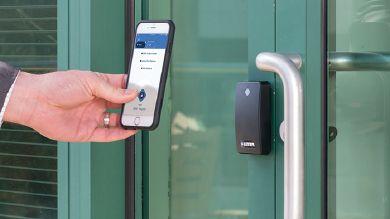
The Conekt mobile smart phone access control identification solution now integrates advantages that Apple iOS 12 delivers, such as 3-D touch, Widget and Auto-Unlock, into the Conekt Wallet App, version 1.1.0. The Widget lets the user make up to three mobile access control credentials as widgets. This allows quicker access to credentials supporting divergent building systems such as payroll, parking and cafeteria systems, directly from the smartphone’s home screen.
www.farpointedata.com
Guard tour system
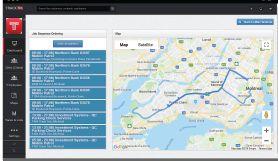
TrackTik Software
TrackTik Software’s mobile- and web-friendly guard tour system provides security managers with a custom-tailored, holistic view of their operations and security personnel on tour. From scheduling and interacting with security staff to incident reporting, TrackTik’s software offers a complete suite of tools. With a variety of checkpoint options, together with GPS tracking, TrackTik’s automated guard tour system creates a real-time picture of an organization’s guard tour operations. The guard tour system establishes permitted and restricted zones, and can assign protocols for specific locations. www.tracktik.com
Submetering solutions
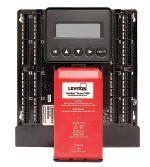
Leviton
The VerifEye Submetering Solutions Series 7000 and 7100 support all industry standard communications protocols and can monitor up to 48 independent, user-defined inputs on one meter board. The Series 7000 and 7100 support all industry standard communications protocols, including RS-485, BACnet MS/TP, BACnet IP, ModBus TCP and Ethernet. These solutions were engineered for real-time monitoring of current, voltage, instantaneous power, demand and energy consumption of each circuit in a panelboard.
www.leviton.com/VerifEye
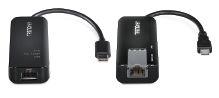
USB-C ethernet adapters
TRENDnet
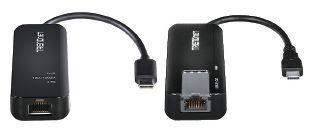
TRENDnet has launched the USB-C 3.1 to 5GBASE-T Ethernet Adapter (TUC-ET5G) and the USB-C 3.1 to 2.5GBASE-T Ethernet Adapter (TUC-ET2G). These adapters provide a simple way for users to upgrade their Ethernet connection to high-performance, multi-gigabit networking speeds. Users can transfer or download large files to a laptop or computer over a USB-C connection faster than previously possible. Both models support high-speed 2.5GBASE-T networking speeds up to 2.5Gbps, with a USB 3.1 connection interface to maintain fast and reliable network connectivity; the TUC-ET5G also supports the higher 5GBASE-T network speed, up to 5Gbps. www.trendnet.com
Facial recognition integration RealNetworks
SAFR for Security integrates SAFR, a facial recognition platform for live video, with leading VMSes to provide enhanced visibility and situational awareness. Available as a standalone solution or integrated with VMSes, SAFR provides 24/7 monitoring to detect and match millions of faces in real time, delivering a 99.86 per cent accuracy rate. When SAFR is paired with a VMS, the integrated experience includes video overlays within the VMS to identify strangers, threats, or tagged individuals in live video.
www.safr.com
Wireless sensors
ELK Products
ELK’s new 319 Series Wireless sensors are designed for use with compatible 319.5MHz wireless receivers. Each sensor is designed to maximize battery life and utilize commonly found batteries. These ELK one-way sensors are an economical option for any manufacturer’s controls utilizing a 319.5 MHz wireless receiver that adheres to the Interlogix protocol. It also provides flexibility when choosing wireless sensors for M1 controls as customers are not limited to ELK’s premium, twoway encrypted wireless. www.elkproducts.com/319wireless
Dual-sensor dome camera
Dahua Technology
Mobile readers LenelS2
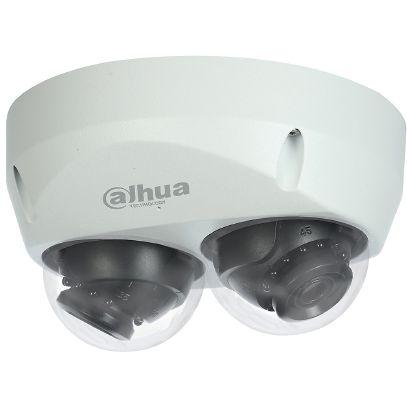
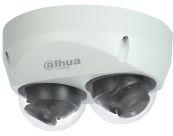
This Dual-Sensor Dome Camera (DH-IPC-HDBW4231FN-E2-M Series) functions as two individual cameras in one compact indoor/outdoor rated housing. Options include an RJ45 connector with a 2.8mm lens and an M12 D-coded Ethernet connector for an added level of stability in a mobile environment with a 2.8mm or 3.6mm lens. All options include EN 50155 shock and vibration certification. The camera has two independent, 2MP, STARVIS CMOS sensors with dual-stream encoding (per sensor) and the Dahua Intelligent Video System (IVS) analytics, including facial detection. www.dahuasecurity.com
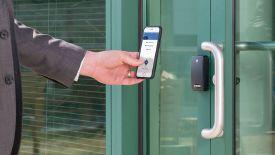
LenelS2’s BlueDiamond mobile readers now support iCLASS card technologies. BlueDiamond has also been enhanced to include a Phone as a Badge (PhaaB) feature, enabling hands-free access. LenelS2, in collaboration with 3millID and with LEGIC Identsystems, has enhanced the reach of BlueDiamond multi-factor readers with additional support for iCLASS card application data. The readers now support virtually all major card technologies, from standard 125kHz proximity card technologies to MIFARE, DESFire EV1 and EV2 and now iCLASS card technologies, as well as mobile credentials. www.lenel.com
result in little or no tax being payable by the seller on the proceeds of a share sale. When investigating tax matters for your business, please consult your professional tax advisor.
Alarm companies may also be motivated to acquire competitors in order to gain technical expertise that doesn’t exist within their own organizations. For example, companies may wish to acquire dealers with access control, CCTV or interactive services capabilities, which will allow them to enter these markets through an established, profitable platform.
Alarm accounts are typically quite sticky and competitors have met with only limited success in taking over accounts due to written 3 to 5 year, auto-renewing monitoring agreements. A competing dealer has to advertise or employ door knockers to locate a reasonable ammount of thes customers. This is an expensive and difficult barrier to overcome. When compared to the complications and expense of luring a customer out of an existing monitoring agreement and trust relationship with the installing dealer, dealers opt to solicit the many households
Sponsored Content
that do not have security systems or will attempt to acquire a competing dealer or their account portfolio. These customers are generally not motivated to incur the inconvenience associated with entering into a new relationship with a dealer and monitoring stations for small price reductions or other incentives, which could in any event, be matched by the incumbent dealer, resulting in considerable expense and no benefit to the competing dealer.
By adopting these and other attrition management strategies — together with internal administrative systems to track customers who have cancelled systems — the dealer is able to grow its account portfolio as a result of attrition.
Furthermore, the larger the account portfolio the greater the number of referral installations a well-managed portfolio will generate, thus resulting in a low-cost vehicle for internal growth. Enhanced system functionality and attrition management strategies combined with overall industry growth means the dealer is well positioned to profitably grow the business.
A dealer may also increase the value of his business by adopting account attrition management strategies. These strategies include corresponding and communicating with customers in order to provide them with additional information on the benefits of their system and reinforce the relationship and encouraging the customer to take advantage of cellular phone functionality in order to, among other things:
a) View their home remotely;
b) Moderate lighting;
The challenge for all but the largest players in the industry is the inability to finance internal growth or acquisitions, as traditional funders (such a banks and credit unions) are asset-based lenders and do not recognize the dealers’ most valuable asset — its account portfolio — as collateral for loans.
c) Change heating and cooling settings; and
d) General interaction with their system.
Leonard M Sudermann is the President and CEO of Securex Financial Corp. www.securex.ca
QA &
Gordon Hebb, National President, CANASA
By Neil Sutton
Gordon Hebb has more than two decades of security industry experience under his belt.
He has been a member of the Canadian Security Association (CANASA) for almost as long, participating at a regional level in Atlantic Canada since 2001 and also on the national stage as a member of CANASA’s board.
At CANASA’s AGM in April, part of the organization’s trade show event in Laval, Que., Hebb was voted in as national president and recently began a two-year term.
SP&T News spoke to Hebb via email to learn more about his plans for CANASA as president.
SP&T News: What is your day-to-day role in security?
Gordon Hebb: I joined Wilsons Security as vice-president of sales in 2017 following a successful 20year career in distribution. I began my career with SSI 2000 / Burtek fresh out of Electronic Engineering School, and then with Tri-ed / Anixter as the regional manager of Atlantic Canada. Wilsons Security is a Nova Scotia based security integration firm with four offices covering Atlantic Canada. Employing a dynamic team of 75 full-time employees, we focus on security solutions including access control, video surveillance, alarm and life safety systems for a wide variety of government, commercial, institutional and residential clients across Canada.
SP&T: How long have you been involved in the security industry?
GH: I have been involved in the security industry for over 20 years. I have held almost every position that the industry has to offer from the ground floor up. When I started, we still used VHS tapes. I even remember selling and supporting the first DVR
“We provide our members with the tools and services they need to succeed in today’s changing market.”
in Canada for our company. Now I can get video clips generated by video analytics of my kids coming home from school direct to my phone in real time.
SP&T: How long have you been involved with CANASA and what were your previous roles?
GH: I have been involved with the Atlantic Canada Regional Council since 2001 and with the National Board since 2009.
I have held several seats over my time with CANASA on both the Atlantic Regional Council and National Board, including president and vice-president of both; representative of the Atlantic region, vendor community and the security community at large at the national level.
I have also been actively engaged with the scholarship program as a representative for the Atlantic region; assisting with the expansion of the program to up and coming security professionals enrolled in security programs in British Columbia, Nova Scotia and Quebec. This program has grown since its inception in 2015 and we continue to explore opportunities to give back and bring recognition to the industry.
SP&T: How does the role of president function within the organization?
GH: The president of the National Board guides the organization toward its long-term goals through working with the many committees and regional councils to ensure that their programs support the continued growth of the security industry across Canada.
Ultimately responsible for the
forward progress of the organization, the national president oversees all initiatives, soliciting expertise and insight inside and outside the organization. Alongside the executive director, the president is also the go-to person for media engagement.
SP&T: What is the value of an organization like CANASA to Canadian security businesses and how will you engage them?
GH: Membership with CANASA means that you are a part of an organization that will not only contribute to the success of your business, but to the future of the security industry. We provide our members with the tools and services they need to succeed in today’s changing market.
Please visit www.canasa.org for details on these membership benefits such as an affinity program, discounts on the Alarm Technician Course, free contract templates, monitoring station resources, a false alarm by-law repository, and plenty of networking and tradeshow opportunities.
Members in Quebec also benefit from competitive pricing on RBQ and BSP bonds.
In addition to the benefits, CANASA member organizations are recognized by consumers as highly skilled, trustworthy and competent professionals.
Together, we are shaping the security industry. Some of our many initiatives to create positive change include lobbying for better regulations and promoting proper industry standards, which allows our members to stand out from their competition.
SP&T: What is CANASA doing well today, and what areas do you think still need improvement or updating?
GH: Over the last few years, CANASA has made great strides in improving relationships with Authorities Having Jurisdiction (AHJs), including police, fire and emergency services departments both nationally and locally.
In several regions, we’ve been consulted on changes to bylaws, verified alarm response and asked to lend our expertise on an advisory level by a number of municipalities. Members and leaders of the AHJ community have participated as attendees, keynote speakers and exhibitors at several of our events. In Q4 2019 our executive director, Patrick Straw, was invited to join an exclusive committee of Civilian Liaisons for the Canadian Association of Chiefs of Police (CACP). With these great strides we recognize that there is an opportunity to continue to improve on disseminating knowledge to the end user and to our communities. The association focuses on education and professional standards and we welcome discussion and feedback from all our peers in the security industry as well as AHJ professionals, our community members and security consumers on these matters.
SP&T: Is there one goal you’d like to accomplish by the end of your two-year term?
GH: My goal is to create awareness to all the members and non-members of CANASA on the key benefits you receive by being a part of this amazing organization. Being involved with CANASA is my way of giving back to the industry that has given me so much. I want to engage everyone in the industry to find a way to give back and get involved. The first step, in my opinion, is to become a CANASA member today.
35 years ago, the necessity to overcome any obstacle and the ultimate dream to fulfill our destiny was such, that reinforced our entire existence into fighting for something greater than ourselves.
Having to tame Scylla and Charybdis, we are thrilled to announce the acquisition of our 6th building.
A 10,000 sq. ft edifice intended to house our administrative, marketing and accounting departments while providing a “brother” monitoring station to facilitate the operations on Iberville. Nothing though would ever be possible without your loyal and continuous support, for which we are eternally grateful! A big Thank You to each and every one of you for believing in us, for helping us realize that not even the sky is our limit, and of course for being part of our #LANVAC family!