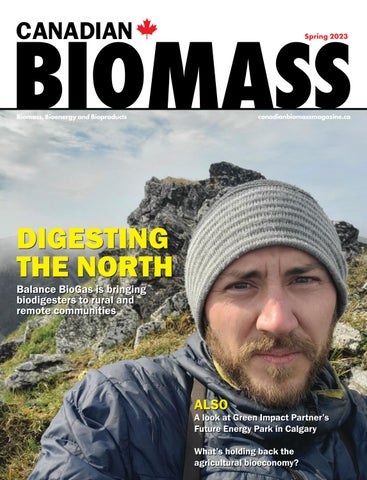
Balance BioGas is bringing biodigesters to rural and remote communities
ALSO
A look at Green Impact Partner’s Future Energy Park in Calgary What’s holding back the agricultural bioeconomy?
With an ANDRITZ Consignment agreement, you can rest easy knowing the inventory and logistics of your spare and wear parts, including repair and rebuild services, are under control. And with predictable pricing and parts you only pay for once you use them, “unscheduled” is no longer something that keeps you up at night.
Contact your ANDRITZ Territory Manager or scan the QR Code for additional details.
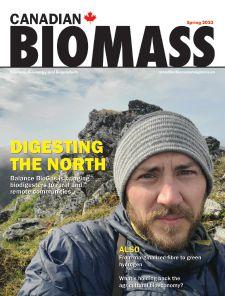
A Yukon company has developed small-scale biodigesters designed specifically to decarbonize rural and remote communities. Balance BioGas is commercializing its solutions along with a new dashboard tool.
8
Leading the agricultural bioeconomy
Murray McLaughlin, chair of Biomass Quality Network Canada, urges governments, industry and consumers to align on Canadian leadership in the agricultural bioeconomy.
12
Showing off
Canadian Biomass rounds up highlights from chipper and grinder manufacturers who debuted new technology and showcased tested biomass processing solutions at this year’s CONEXPO-CON/AGG in Las Vegas.
16
Fields of energy
The Future Energy Park in Calgary – a flagship project from Alberta’s Green Impact Partners – plans to marry mission with money to create North America’s largest carbon-negative renewable natural gas project.
BioGas owner and developer Jonathan Osborne,
TBiofuel for thought
Will we be left behind in the bioeconomy race?
ime for a quick Canadian history story?
In the 1950s, the Royal Canadian Air Force commissioned Toronto’s A.V. Roe Canada (known as Avro) to design and build the CF-105 Arrow. It was to be the fastest and among the most advanced jets of its time.
Tens of thousands were employed by the Avro Arrow project, and it drew top minds in scientific research and development. Eyes were on the Arrow and Canada as a world leader in aerospace. All lauded Canadian ingenuity.
In 1959, Prime Minister John Diefenbaker cancelled the Arrow program. I’ll skip the why details (you can read a great article on it in the Canadian Encyclopedia), but the immediate impact of the cancellation was a brain drain. Thousands were without work. Lead engineers and scientists left for aerospace projects in the U.S. or overseas.
suppliers and, no doubt, brainpower.
Canada’s bioeconomy projects are lagging. Some are shuttering, most notably Parkland’s renewable diesel complex in B.C. The company said rising costs, lack of market uncertainty, and the IRA favouring U.S. producers were to blame.
Yet, it seems Canada is not prepared to match the IRA. The feds are putting most of their eggs in the electrification basket. Electrification has a decarbonization role, no doubt, but biomass solutions for the short- and medium-term are critical if we’re to meet targets.
In this issue we wanted to highlight up-and-coming biofuels companies in Canada. I spoke with two at different stages of commercializing their solutions.
Volume 23 No. 2
Reader Service
Print and digital subscription inquiries or changes, please contact Angelita Potal, Customer Service Ph: (416) 510-5113 Fax: (416) 510-6875 Email: apotal@annexbusinessmedia.com Mail: 111 Gordon Baker Rd., Suite 400 Toronto, ON M2H 3R1
Managing Editor - Maria Church Ph: (226) 931-1396 mchurch@annexbusinessmedia.com
Contributors - Gordon Murray, Murray McLaughlin, Andrew Snook and Sarah Stadnyk.
Group Publisher - Anne Beswick abeswick@annexbusinessmedia.com Ph: (416) 410-5248 Mobile: 416-277-8428
Western Sales Manager - Tim Shaddick twshaddick@gmail.com Ph: (604) 264-1158 Fax: (604) 264-1367
Audience Development Manager - Serina Dingeldein Ph: (416) 510-5124 sdingeldein@annexbusinessmedia.com
Media Designer - Curtis Martin
President/COO - Scott Jamieson
Canadian Biomass is published four times a year: Winter, Spring, Summer and Fall. Published and printed by Annex Business Media.
Publication Mail Agreement # 40065710
While the Canadian Encyclopedia entry notes there is little evidence to suggest long-term negative effects on our aviation and scientific communities (seems arguable), I can imagine the blow to Canadians at the time. If nothing else, it illustrates the critical importance of our federal government’s hand in propping up an R&Dheavy industry.
For us in the bioeconomy, that’s all too familiar. Consistent and long-term policy support for industrial bioeconomy projects is pivotal to their success, we know this. The U.S. knows this. With their Inflation Reduction Act (IRA), the U.S. lumped in significant policy support for biofuels projects and is rapidly becoming a leader in R&D, drawing international
Green Impact Partners CEO Jesse Douglas said their company philosophy is to focus first on doing the right thing – designing projects for the environment and social perspective first – and then making it profitable. Despite the pull of market forces to the U.S., Douglas said they’re planning to keep the majority of their Canadian-made biofuel in Canada.
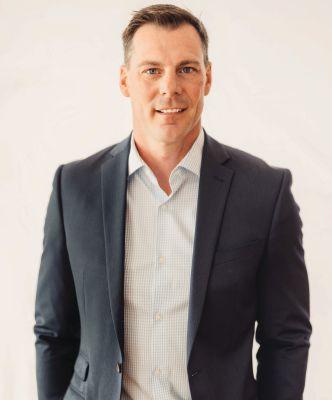
Balance BioGas CEO Jonathan Osborne echoed that sentiment. The Yukoner (on our cover) is firmly set on making northern waste-management solutions for the North.
Perhaps integrity is the new ingenuity, and we’ve got it in spades. •
Printed in Canada ISSN 2290-3097
Subscription Rates: Canada - 1 Yr $57.00; 2 Yr $102.00 Single Copy - $9.00 (Canadian prices do not include applicable taxes) USA – 1 Yr $121.50 CDN; Foreign – 1 Yr $138.00 CDN
All advertising is subject to the publisher’s approval. Such approval does not imply any endorsement of the products or services advertised. Publisher reserves the right to refuse advertising that does not meet the standards of the publication.
BIOMASS BOILERS AMONG FUNDED PROJECTS TO IMPROVE GRAIN DRYING
Canada’s Ministry of Agriculture and Agri-Food is funding 45 projects that will allow grain farmers to adopt more efficient drying technology, such as biomass boilers.
More than $22.2 million is being provided for the equipment upgrades and fuel switching initiatives through the Agricultural Clean Technology Program – Adoption Stream. To date the program has supported 99 dryer projects across the country.
Geerts Farms Ltd., in Kamsack, Sask., is among the program recipients. The 26,000-acre family-operated producer of canola, wheat and oats is receiving up to $2 million to purchase and install a new grain dryer and biomass boiler. The boiler is powered by locally sourced wood waste and will eliminate the farm’s current use of propane.
BIOINDUSTRIAL INNOVATION
CANADA, BIOENTERPRISE CANADA JOIN FORCES ON CLEANTECH
Canada’s clean, green, sustainable chemistry business accelerator and Canada’s Food & Agri-Tech Engine are collaborating to enhance support for cleantech innovators.
Bioindustrial Innovation Canada (BIC) has joined Bioenterprise Canada as a Knowledge & Development Partner.
The two organizations have signed a memorandum of understanding to help entrepreneurs and growth-oriented businesses with sustainable green technologies access more resources to support development and commercialization of their innovations.
BIC’s portfolio companies gain access to Bioenterprise’s national network of mentors, resources and funding while Bioenterprise members and partners across Canada can explore opportunities in the sustainable chemistry space through BIC’s national and international network.
STEEPER’S ALBERTA FORESTRY BIOCRUDE PLANT MOVES FORWARD
Steeper Energy and Invest Alberta have signed a memorandum of understanding to commercialize Steeper’s proprietary Hydrofaction technology within Alberta.
Steeper’s technology is a proprietary form of hydrothermal liquefaction (HTL) capable of converting a wide range of biowaste feedstocks to flexible renewable biocrude. The biocrude can be used directly or upgraded for use as a renewable marine, diesel, or aviation fuel.
Focused on use of third-generation biomass, Steeper’s first commercial plant in Alberta aims to use large volumes of forestry residue.
The company said in an April news release it is actively identifying potential commercial partners and evaluating project sites.
Emissions Reduction Alberta awarded Steeper $5 million in funding in 2021 to help establish their first commercial scale plant in Alberta.
WPAC WELCOMES ‘NOT PERFECT’ REDIII DEAL
The Wood Pellet Association of Canada (WPAC) is welcoming news of the European Parliament’s deal on the EU Renewable Energy Directive (REDIII).
In a message to members, WPAC executive director Gordon Murray said, while not perfect, there is a lot to be appreciated in the deal.
“Many of the points that were better for our sector and supported by the European Council were adopted in the final agreement and the most damaging points proposed by the European Parliament were rejected,” Murray noted.
Original proposals in the deal that were rejected include prohibition on the use of primary biomass and the enforcement of “no go” areas, he said.
LOAN FOR QUEBEC BIOREFINERY
The Canada Infrastructure Bank is providing a loan of $277 million to a joint-venture partnership between Shell, Suncor, Proman and the government of Québec that will enable construction of Canada’s largest biorefinery, based on Enerkem technology.
The $1.2 billion facility – Varennes Carbon Recycling – will include an electrolyzer which will supply clean hydrogen and oxygen to convert more than 200,000 tonnes of non-recyclable waste and residual biomass into biofuels with a capacity of up to 130 million litres annually.
WTaking centre stage
Wood pellets are going mainstream in the seismic shift toward clean energy
By Gordon Murray
ith the planet’s changing climate, governments across the globe have implemented ambitious climate goals which have caused a seismic shift toward clean energy. The landscape is changing, accelerating the use of clean energy. As a result, bioheat from wood pellets is also shifting from niche to mainstream. Wood pellets sourced from responsible producers in well-regulated countries like Canada are unquestionably sustainable and a part of the solution. We see that already from Canada’s North to the Maritimes to Europe and Japan, and now even India. To meet this demand will require good public policy, incentives to support domestic needs, and responsible use of a renewable and precious resource.
GLOBAL TRENDSETTERS
I recently attended the annual World Sustainable Energy Days event in Wels, Austria. Irene di Padua, director of policy at Bioenergy Europe, reported on global market trends and highlighted that the UK, South Korea and Denmark top the list in countries reaping the benefits of bioenergy from wood pellets. What really struck me, however, was the uptick in residential and commercial demand, which now makes up 48 per cent of wood pellet consumption. This growth is most apparent in Europe where they have seen demand grow by 18 per cent and boiler sales by a whopping 109 per cent. Di Padua puts it best: “2021 was an exceptional year for pellets, with increased production, consumption and sales of boilers and stoves.”
Today, nearly three quarters of the world’s renewable energy is from biomass. Bioenergy accounts for about 10 per cent of total final energy consumption and two per cent of global electricity generation. In the United States and the European Union, bioenergy accounts for 60 per cent of all renewable energy. In fact, over the past 20 years, bioenergy, is responsible for the most greenhouse gas (GHG) reductions, much in the form of bioheat.
Renewable energy is also considered indispensable to Japan’s pledged decarbonization strategy, and as part of its goal to
“Today, nearly three quarters of the world’s renewable energy is from biomass.”
become carbon-neutral by 2050 the country is accelerating its use of biomass. For the first time in history, Japan has surpassed the UK in pellet imports from Canada. India, too, recognizes the need to reduce GHG emissions and transition to clean energy. Significant opportunity exists in capitalizing on India’s domestic biomass production to support its ambitious climate change goals. I recently visited India on a trade mission. You can read my report, watch the video or see the presentation at www.pellet.org.
CANADA: OPPORTUNITY IS KNOCKING
At 2.8 million tonnes of annual consumption of wood pellets, North America lags behind Europe (35.6 million tonnes, incl. UK) and Asia (7.2 million tonnes). In Can-
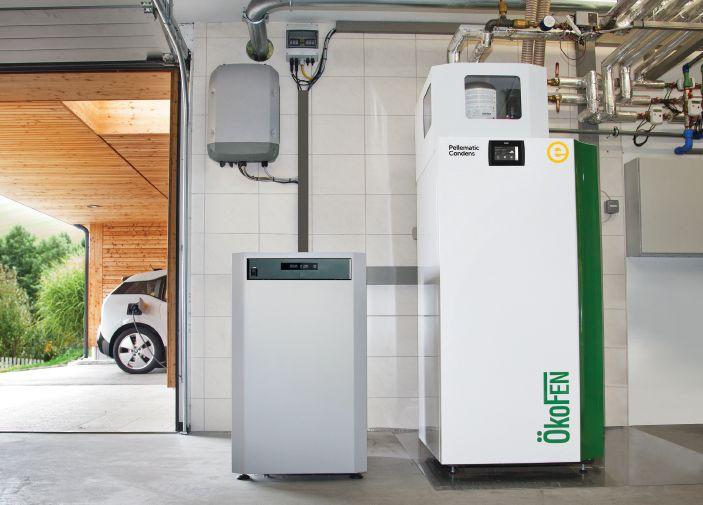
In Upper Austria, biomass heating systems – like this one from ÖkoFEN – account for 42 per cent of space heating and 18 per cent of energy used in manufacturing. Photo courtesy ÖkoFEN.
ada, in part, this is due to many of our provinces having access to hydro electricity and natural gas. But in some Maritime provinces and remote northern and Indigenous communities, energy poverty is a reality.
Canada is the world’s second largest producer of wood pellets; but more than 90 per cent of our pellets are exported. Why? Yes, we have work to do on promoting wood pellets to make Canadians more aware; but the fact is we see publicly funded incentives for competing products, like heat pumps and investments in far-off solutions like hydrogen, when the solutions are in the sawmill and harvest residuals across Canada’s forests.
There are examples of smaller markets leading the way on the use of bioheat. Take Upper Austria – about one-sixth the size of New Brunswick with 1.5 million people. According to Christiane Egger, deputy manager of the Energy Agency of Upper Austria, in her region, biomass accounts for 42 per cent of space heating and provides 18 per cent of energy used in manufacturing. The use of fossil fuels for heating is banned in all new home construction and heating system replacements – a key driver behind the 72,000 modern automatic biomass and 360 biomass district heating plants now operating in the region. Austria has succeeded in making biomass a mainstream fuel.
The good news is that significant inroads to biomass has already been made in Canada’s Maritime provinces and Northern and remote communities, and you can read about some of those projects on our website.
MAINSTREAM SHIFT NEEDS POLICY
Today, biomass is recognized by the Government of Canada as low-carbon technology, typically saving 90 per cent GHG emissions over fossil alternatives. It can contribute to the elimination of heating oil and natural gas heating in Canada and mitigate the effect of closing coal power plants by providing high efficiency, low carbon heat energy in replacement for fossil-derived electric heating.
But to reach its full potential, good public policy from the ground up and fair incentives from governments are needed.
In British Columbia we are already seeing the province’s commitment to reduce “waste” through projects funded by the Forest Enhancement Society of B.C. that will help get more fire-damaged wood and logging waste to the mills that need it.
The Government of Canada also recognizes the role of forest bioenergy in reducing Canada’s emissions under the 2030 Emissions Reduction Plan. Programs like the Clean Technology Investment Tax Credit are key to expanding clean technology solutions in places like New Brunswick and Nova Scotia, however, biomass boilers must be afforded a level playing field with other clean technologies like heat pumps.
Over the next decade, both these provinces’ electricity capacity is forecasted to drop by 50 per cent. Heat pumps alone will not solve the problem which will require the current fossil fuel grid to run the heat pumps. Including biomass from wood pellets is good for Canadians’ pocketbooks; it’s good for the environment; and it’s good for local economies.
We’ve also got work to do on removing trade barriers that restrict the importation of European boilers into Canada. Currently, we don’t make boilers in Canada, and we can’t import them as they are manufactured, so the only significant markets for our pellets is offshore, to be used in homes and businesses around the world as a sustainable source of renewable energy and heat. Canada’s wood pellet consumption is tiny by global standards, entirely due to the lack of access to modern highly automated wood pellet boilers. We’re making good progress on this front.
DOMESTIC OPPORTUNITIES
My recent trips to India and Europe have left me inspired. The benefits of bioheat are now accepted as mainstream and the focus is now on how to grow markets, improve technology and to continue to promote the benefits of bioheat. Here in Canada, we have work to do, but it’s also clear to me that there is a groundswell of support and increasing awareness of the potential of local bioheat solutions. •
Gordon Murray is the executive director of the Wood Pellet Association of Canada.
TLeading the agricultural bioeconomy
Governments, industry and consumers must align on Canadian leadership in the agricultural bioeconomy
By Murray McLaughlin
here is an increasing demand globally for bioproducts from biomass. At Biomass Quality Network Canada (BQNC) we have been focused on research and development to establish a certification program for quality ag-biomass and hope to have that in place over the next three years, assuming appropriate funding.
Canada is a country rich with innovation in the agricultural bioeconomy, but poor in implementation and commercialization to the point where we have fallen behind other countries. Canada has sustainably produced biomass in agriculture and forestry, but needs the sector support to get it commercially established into a global leadership industry position.
Science and technology play important roles in maximizing the economic contribution of biomass, and Canada has excellence in this area within our universities and colleges to keep us on the leading edge of bioeconomy development. Canada has the development technology to build a solid bioeconomy industry and the expertise to build international partnerships as we create the export part of the industry and business attraction.
In a workshop held in Ottawa on biohubs in 2020, participants from all regions had robust discussions on the opportunities and challenges of bio-hubs across Canada. Each region had distinct characteristics, but all areas of the country faced some of the same opportunities and challenges.
The bio-hub report went on to look at a SWOT (strengths, weaknesses, opportunities, and threats) process for Canadian bio-hubs. The strengths were: quality and quantity of available
biomass; sustainable management practices; established supply chains and infrastructure; a reputation of being environmentally responsible.
Of course, there is a flip side: the weaknesses. The major weakness identified is capital to support the establishment, and government structure with diverging priorities making change adaptation difficult.
In discussions around possible actions, many groups identified that one of the highest priorities for promoting bio-hubs in Canada would be to incentivize the use of bioproducts and biofuels, therefore increasing demands from consumers. Others focused on financial structures and another on regulation that prioritize procurement of biobased products. Almost all groups identified the need for co-operation and collaboration among partners, including all levels of government, to ensure success of bioeconomy clusters.
One of the key areas needed to build the future of biomass in Canada is a solid long-term national bioeconomy strategy supported by industry and governments, so we all go in the same direction – building the Canadian bioeconomy.
Canada’s agriculture, food and forestry industries are a well-kept secret – which is unfortunate and needs to change. A few provinces are developing their own strategies and at one time industry proposed the “biodesign strategy,” but it has been slow to be adapted. We need buy-in by all players across the country – governments, industries, and all Canadians – to take a leadership role in building the future for agriculture and the forestry bioeconomy. Canada should be a global leader based on
the many resources Canada has.
In agriculture and forestry, the biomass left in the fields, or straw, corn stover and other ag biomass that can be removed (50 per cent removal would produce close to 100 million tonnes a year that could be used to develop bioproducts). Yes, there is a cost to create new biomass opportunities, to create jobs today and for future generations. For building Canada into a global leadership player in the bioeconomy we need to create a national strategy acceptable to all players in Canada.
One challenge is educating Canadians about what biomass is. I hear the term waste often and quality biomass is far from waste. A farmer friend of mine reminded me once that there is no such thing as waste, just “underutilized resources,” which is exactly what forestry and agricultural biomass is – a resource –something that has real value.
Around the world the bioeconomy is being looked at as an essential part of the future in most countries. Canada is a large country from a land mass perspective and could and should be a leader in the use of biomass to bioproducts from forestry and agricultural biomass.
Let’s create the partnerships required to overcome the challenges and create the industries our biomass can create, starting with a national bioeconomy strategy supported by all. •
Murray McLaughlin, chair of Biomass Quality Network Canada, is the former executive director of Bioindustrial Innovation Canada and Sustainable Chemistry Alliance.
Digesting the North
Balance BioGas is bringing biodigesters to rural and remote communities
By Maria Church
Made in the North, for the North. That’s a selling point for Balance BioGas, a Yukon company that is developing small-scale biodigesters designed specifically for waste management and to decarbonize rural and remote communities.
Owner and developer Jonathan Osborne is in the initial stages of commercializing his digesters and introducing a proprietary dashboard tool that will allow communities to determine exactly what digester systems are needed and what they will gain through savings and carbon reduction.
The company’s first concept was a first-of-its-kind desktop biodigester, a 227-litre unit designed to convert one household’s organic waste into usable gas for cooking and heating. They are now scaling up their concept to introduce biodigesters to remote, 700-person resource camps as part of a close-loop waste management solution.
With a successful pilot project behind them, Balance BioGas is looking to commercialize its concepts and carve out its space as a Northern company making sustainable Northern energy solutions.
MAKING OF A DIGESTER DEVELOPER
Raised on an off-grid homestead in Haines Junction, Yukon –about 150 kilometres west of Whitehorse – Osborne is passionate about sustainable solutions for remote communities.
“I’ve been inspired by my parents’ love of nature and off-grid living,” he says. But growing up without readily available hot water might explain why he became a journeyman electrician, he’ll tell you with a laugh.
Osborne’s work as an electrician and his employment for various territorial government departments introduced him to the world of renewables. His first job with the Government of Yukon was in the branch managing unincorporated communities’ landfills and transfer stations and the territory’s recycling program.
“I was learning about the territory’s waste management process and systems, how everything was working. That’s where we realized that we needed to figure out how to use the energy you could capture in a digester, to do work and reduce waste being transported across the territory for processing,” Osborne says.
The Yukon branch, similar to its Canadian counterparts, spends well over 50 per cent of its yearly budget on transportation of municipal waste and recycling, to say nothing of the greenhouse gas emissions from the transportation and the wear on roads from the trucking involved. Individual or small community anaerobic digesters represent a solution to decentralize waste processing and reduce the need for waste transportation
while still diverting waste from landfills, Osborne argues.
The Yukoner’s foray into digester prototypes began with fellow developer, Devon Yacura, an environmental specialist with Ausenco Sustainability Inc. Prototype 1 more than 10 years ago was a mason jar and a pop bottle. In 2019, supported by Ausenco and government grants, Osborne and Yacura built a full-scale backyard biodigester for about $6,000.
MAKING OF A DIGESTER
Osborne and Yacura’s pilot project resulted in a 227-litre digester tank with a 100-litre pre-digestion storage tank. The entire digester is barley a metre tall, half a metre wide and deep.
To keep costs low, the duo scoured the Internet to source readymade parts that they could utilize for the digester. For example, their biogas scrubber is built from PVS piping and steel wool for about $25.
“We’ve done our research,” Osborne says. “We know H2S binds to metal shavings. It draws it out. You don’t need millions of dollars worth of scrubbing equipment to remove this substance.”
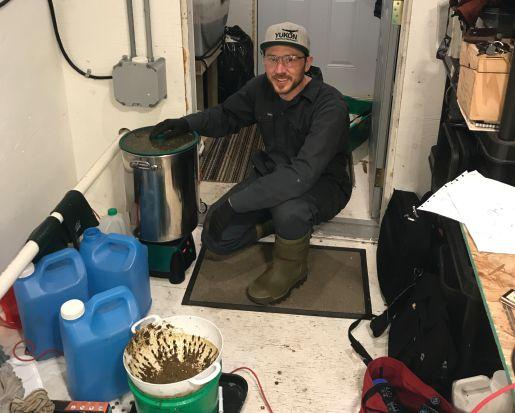
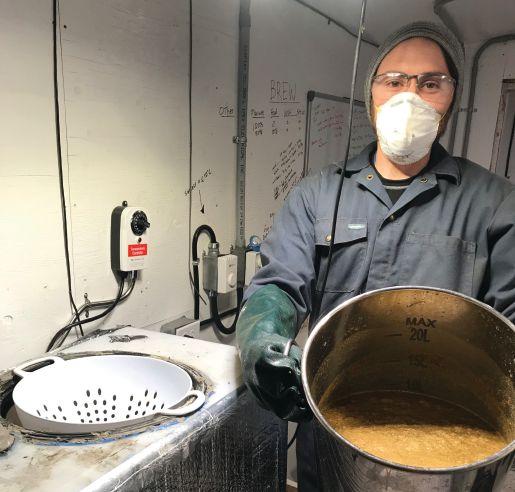
Balance BioGas owner and developer Jonathan Osborne feeds the desktop digester, a pilot project 227-litre unit designed to handle household organic waste. Photo courtesy Balance BioGas.
While cost control through repurposing mass-manufactured parts is one niche for the business, Osborne says the real focus for Balance BioGas is in getting the best use of the energy for each customer.
Osborne says there’s a common understanding in the digester world that scaling up is the solution to make the project valuable. “My challenge to that is that they’re not being clever enough with how efficient they are with the energy that they are capturing,” he says. Rather than offering customers a standard model focussed on either heat or electricity, losing energy from either process to optimize the other, Balance BioGas’ vision is to burn the methane in a method that offers the fullest value to each customer. The methane is collected, scrubbed and then burned in an incinerator first, then the waste heat from this process is used in a, boiler or a combined heat and power generator depending on the best use for the energy.
“We’re really focused on waste management and reducing the volume of what’s going to the landfill,” he says. “Closed-loop waste management approach has the largest spin-off effect and the largest value for the energy that you collect.”
With the working pilot project done and dusted, Balance BioGas is full-speed ahead on introducing biodigesters to Northern communities and camps. The company has a joint contract for a feasibility study to introduce their closed-loop waste management process to a proposed 700-person mining project in Northern Yukon.
“Our focus right now is this scale of opportunity. It’s incredibly valuable to the Yukon territory and the government of Yukon. The field up here is wide open, we’re just trying to be the first to move into the space to start implementing existing technology with a northern innovation approach,” Osborne says.
MAKING OF A DASHBOARD TOOL
Initial costs of the investigation into biodigesters can be cost-prohibitive for some communities. An integral component of Balance BioGas’s sales pitch is a first-of-itskind dashboard tool that can quickly determine a community’s waste needs and what size and cost of digester would be required.
The dashboard will also spit out the projected carbon reduction and energy savings.
“The vision of the tool is to be able to produce a high-level go-no-go based on the number of people that your system would be serving,” Osborne says.
The dashboard is being developed by Kaitlin Halickman, a business administration student at Yukon University. Her initial involvement with Balance BioGas began with a statistics class project that partnered students with local business.
“I wanted to calculate how much it would cost in electricity to run their prototype throughout the winter. It was very basic. I did that project and after that they asked if I wanted to do another project with them,” Halickman says.
The project ballooned into the vision for the dashboard tool, and Halickman was hired by Balance BioGas though a Mitacs internship program. She and Osborne are continuing to fine-tune the dashboard.
“It started off as an idea and we rolled with it and have been adding on more,”
Halickman says. “Even taking all the Environment Canada weather stats and putting that into the tool are small learning experiences along the way.”
The team expects with a bit more tweaking they will have the tool ready for customizable use in the coming months.
In the coming years, Balance BioGas will be looking to launch a community-scale pilot project to introduce their closed-loop waste processing system designed around a biodigester and incinerator. The next phase of the business will be to attract private sector investment to start rolling out these systems in communities and resource camps throughout northern Canada. While this is happening, they will be fine-tuning their desktop digester design, securing patents and getting it market-ready for households.
“There’s a huge amount of momentum behind us right now, which is really exciting,” Osborne says. “It’s a big space to fill, but if we use innovative thinking, there’s a lot we can do with it.” •
Combustible Dust Specialists
Showing off
CONEXPO-CON/AGG trade show offered attendees latest in biomass processing
By Andrew Snook
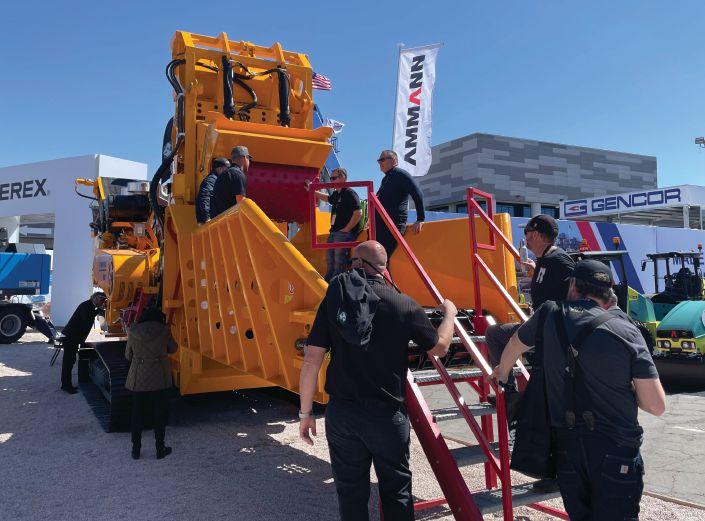
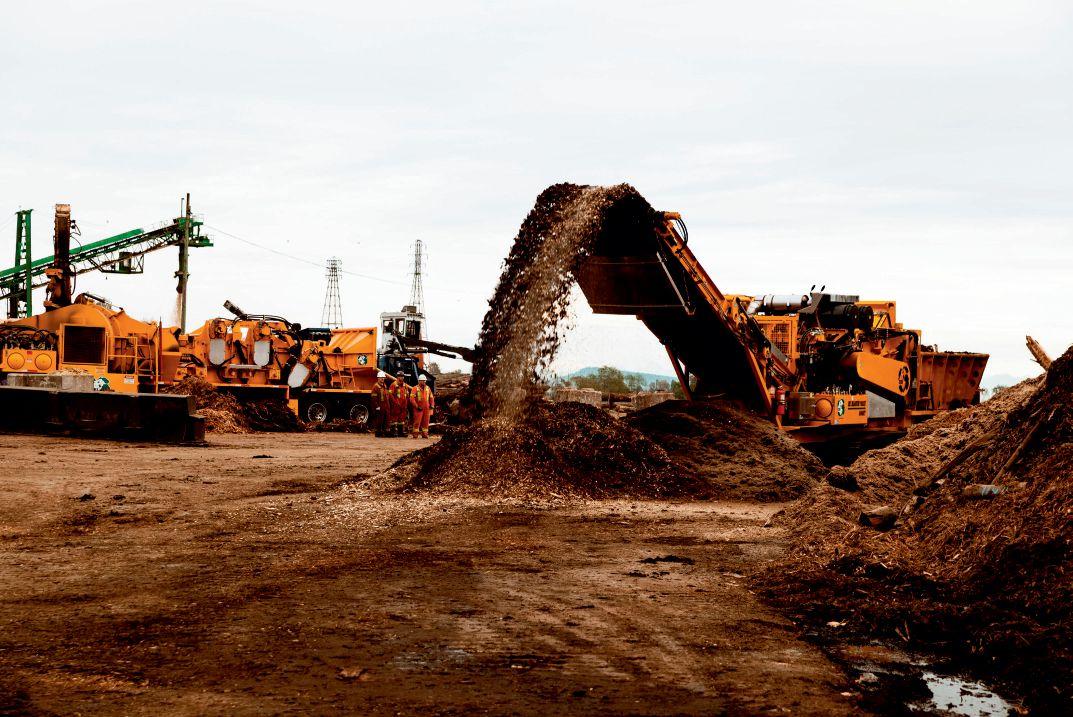
While the CONEXPO-CON/AGG show is known as North America’s largest construction trade show, companies active in the forestry and biomass sectors had plenty to see at the triennial event in mid-March.
This year’s edition drew a record 139,000 attendees to the Las Vegas Convention Centre to check out the latest technologies on display. The outdoor Diamond Lot showcased a variety of grinder and chipper options.
BANDIT INDUSTRIES
Bandit Industries displayed its 2290 Track Whole Tree Chipper at the massive trade show, along with their smaller Bandit 20XP Track Whole Tree Chipper.
While the latest version of the 2290 has been available for many years, it is one of the company’s most popular units. The 2290 is a 20-inch (in.) capacity chipper. This unit is built for land clearing and rightof-way clearing applications. The 2290 on display had a 525-hp John Deere engine.
“There are three main configurations the model 2290 track can be ordered with depending on each end user’s application. A standard unit without cab or loader, a loader only unit controlled by the radio remote, and then a cab and loader unit where the operator can operate all track and loader functions from a roomy operator’s cab,” says Jason Morey, marketing manager for Bandit Industries.
The 20XP offers the same capacity as the 2290, but in a more compact platform with smaller engine options. The unit on display at the show was equipped with a Cummings 350-hp engine.
“Those two models on display got a lot of attention and are great for land clearing operations and logging applications that
want a tracked unit instead of a tow-behind machine,” Morey says. “We were glad we had those two units there. It was nice to be able to show both units at the show.”
Both chippers featured Bandit’s patented slide box feed system, originally created by the company’s founder.
“The slide box feed system provides a substantial amount of pulling and compression power making the units easier to feed, reducing repositioning, and making the operator’s life easier,” Morey says.
All tracked units offered by Bandit are built using Caterpillar manufactured tracks.
“Another unique feature on all Bandit whole tree chippers is we have a five-year ‘GUTS’ warranty covering the Bandit fabricated components on the drum, disc, or feed system,” Morey adds.
ROTOCHOPPER
Rotochopper had a new prototype version of its B-66 L-Series Horizontal Grinder on display at the show.
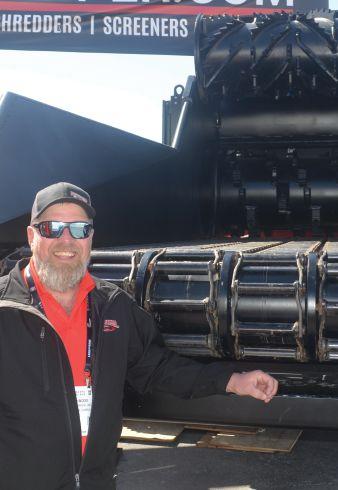
“We’ve made this one for orchards and land clearing,” says David Wood, sales manager for Western and Central Canada. “It has a shorter infeed table. It has the chain infeed instead of our slatted floor, and we’ve dropped the floor, so it has more exposed rotor. It’s increased our grinding time and capacity to the point we had to double the speed of the discharge belt to get rid of the product.”
Wood says the company is very excited about this latest version of the grinder, especially the traction it offers to help push product in past the infeed roller and into the rotor.
CBI displayed the third iteration of its 6800 horizontal grinder, the 6800CT, at CONEXPO-CON/AGG in Las Vegas in March.
Other features of the prototype are identical to the current B-66 L-Series Horizontal Grinder on the market. The unit has dimensions of 41 ft.-11 in. (length) by 11 ft.-1 in. (width) by 14 ft. (height) and has a weight ranging from 80,000 pounds (lb.) to 101,000 lb. It is powered by a diesel engine with horsepower ranging from 950 hp to 1,200 hp with a fuel capacity of 340 gallons and a microprocessor engaged HPTO clutch.
The unit’s control system features a digital operator interface, RotoLink remote monitoring system, StopWatch monitoring system and is remote control operated.
ASTEC
Astec exhibited its new Peterson 5710E Horizontal Grinder at CONEXPO-CONAGG. Many of the features on the company’s latest grinder stemmed from a customer advisory group event that Astec hosted to get important input into their latest machine.
“We listened to the feedback of the
customers in the field and what they wanted on the machine in the next generation. We had a group of Peterson customers, non-Peterson customers, 5710 owners, to give us that feedback,” says Derek Izworski, technical sales manager for Astec. “We raised the machine up quite a bit. The stance is better for the approach angles of the track going up and down slopes. The rotor diameter and screen area has been increased by eight per cent. The door to access the grate area has been increased by 20 per cent to allow serviceability.”
This machine offers a simplified and safer grate change while retaining Peterson’s unique Impact Release System for horizontal grinders.
“We pride ourselves on ground-level maintenance with the screen change, safety lockout points, maintenance with engine oils, batteries, we really pride ourselves on that safety aspect and not having to climb on the machine,” Izworski says.
This unit offers a large diameter rotor with 22 bits for efficient material fractur-
ing and reliable processing power. It offers a large screening area for more throughput with four customizable grates to make a variety of products for customers.
“The discharge belts have been raised to 16 ft. 10 in., so there’s a lot higher discharge to load trucks, higher stockpiles on the backside of the machine. And overall travel height has not changed from the previous model,” Izworski says.
The 5710E is built with a new fast coupling transportation dolly for ease of transport between jobs and has an overall lighter transportation wight of 88,000 lb. (machine only).
VERMEER
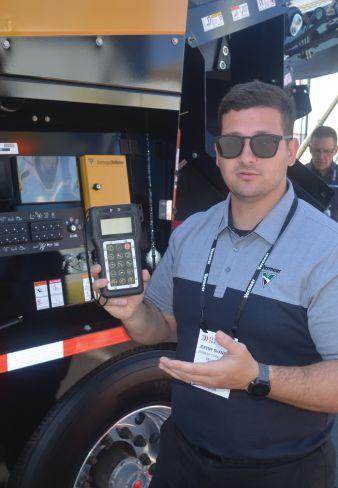
At Vermeer’s booth, versatility was a key feature on display for biomass professionals on the company’s HG4000 and HG6800 horizontal grinders.
“From a biomass industry standpoint, with these chip drums, an operator is going to have a lot of different wiggle room to play with on sizing,” says Ver-
Horizontal Chipper 4840
FEATURES:
• Extreme duty, uni-body frame
• High productivity
• Primary and secondary anvils
• High quality chips
• Oversize infeed - 39¼" wide Available in 2
Drop Feed Chipper
Whole
Log Chipper 6040
• Extreme duty
• Oversize infeed
• Powered feed works
• Large rear access door for easy &
meer product specialist Jeremy Shannon. “All of our blades on our chip drums can be spaced and sized at different levels. We also have an adjustable anvil on our HG4000, as well as our HG6800, where we can move that as close as an eighth of an inch to those blades. That way, we can either have a small bite or work all the way up to a big bite.”
Vermeer’s units also offer operators a wide range of screens. “You can have anywhere from rounds, squares, hexes, elongated, diamonds,” Shannon says.
The second generation of the HG4000 also has offers new features for operators.
“We moved from an FPT Fiat engine to a CAT C13B,” Shannon says. “This engine is going to produce at 536 horsepower for 50 per cent of its torque curve life. So, from a longevity standpoint, and from a warranty standpoint, this engine really performs very well.”
Vermeer has set up the HG4000 with the company’s new droop feature. “With the traditional grinder you set your droop setting, or your RPM setting, how aggressive you want the machine to be. And as materials coming through, those RPMs are bogging down depending on how hard the material is coming through. And a lot of times those old machines, when that
RPM drops down below that droop level, it’s taken a lot for that engine to kick back into groove and get back above that droop,” Shannon explains. “It’s more of a predictive setting. It’s constantly keeping that RPM level and its torque curve to stay upon that droop low. That way, that engine is not having to take those huge dips in RPM and stay more efficient,” Shannon says.
CBI
CBI displayed the third iteration of its 6800 horizontal grinder, the 6800CT, at the show. The 6800CT has the option of a CAT C27 1,050-hp engine or a CAT C32 1,125 hp or 1,200 hp engine.
“It’s the first of our 6800 series grinders to be able to accept 1,200 horsepower. We’ve upgraded a lot of the components to handle the extra horsepower. We’ve got bigger bearings, we’ve got a larger diameter shaft, and that’s what allows us to put the extra horsepower on the same chassis,” explains Jonathan Gilmour, regional sales manager for CBI.
The 6800CT version had the hog box opened up with a split hog box design, which allows for easier access to the rotor, the mill and for the changing of wear parts. Gilmour says the design also allows
David Wood, Rotochopper sales manager for Western and Central Canada, in front of their B-66 L-Series horizontal grinder.
Vermeer product specialist Jeremy Shannon explains features on their HG4000 and HG6800 horizontal grinders.
models 4840HT Sawmill and 48404HV Veneer (shown)
for easy screen changes.
Another popular feature of the machine is the ability to stand up at full height in the machine when changing tips. “The tips are held on by a single bolt, you can stand up full height in there while you’re changing tips. It’s a pretty comfortable job,” Gilmour says.
The 6800CT is 60 in. wide, right from the infeed right to the discharge, so there are no choke points. “That allows material to feed nice and easy the whole way through until it gets off the discharge belt,” Gilmour says.
This unit features high-strength rotors for enhanced protection. The 40-in. diameter by 60-in. wide upturn rotor has a forged, thick, high-strength core with 24 weld-on hammers. The offset helix pattern fits the full width of the rotor, distributing material across the hammers for more efficiency.
The unit is remote controlled and has transport dimensions of 11 ft.-1in. (width) by 12 ft. (height) by 43 ft.-2 in. (length)
and weighs approximately 86,500 lb.
CBI was also busy showcasing its digital set of solutions for its grinders. One is an app where the user can take a picture on their smartphone of a part and have that part number recognized, which can be a valuable resource for both dealers and customers, says Marco Piovano, director of Terex MP Digital Solutions.
Piovano discussed the MyTerex Customer Fleet App, a telematics solution accessed through the user’s smartphone. MyTerex gives the user remote access to machine information, notifications and performance dashboards. The MyTerex. com dealer and customer portal also allows the user to access documents, reports and digital solutions.
MORBARK
Morbark debuted its Next Gen 6400XT Wood Hog horizontal grinder with transport system at the show. The Morbak Transport Dolly designed for the Net Gen 6400XT was designed for simple trans-
portation. It features an independent airride suspension and remote-controlled front and rear hydraulic locks. A single operator is able to attach the transport dolly in a quick and efficient manner. This unit is designed to eliminate the need for a specialized Low-Boy trailer.
“The 6400XT is the best in its class for processing wood and organic waste with power and reliability,” stated Michael Stanton, vice-president of sales and marketing at Morbark. “The new Next Gen 6400XT, scheduled for fourth quarter 2023 release, builds on that legacy.”
The latest version of the Next Gen 6400XT is built with an enhanced frame design, which allows for the Transport Dolly attachment while keeping machine width to three metres.
Additional features include an automatic hammermill drive-belt tension system; and a PT Tech Hydraulic Torque Limiter, which provides driveline protection and ease of setting adjustments based on grinding application. •
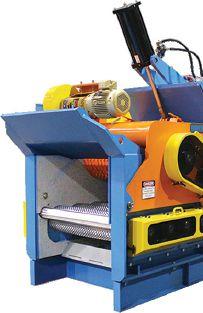
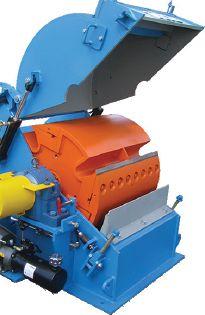
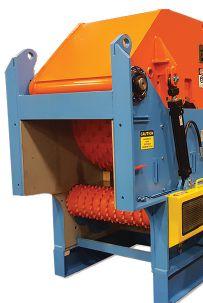
The CBI 6800 Horizontal Grinder has been specifically designed for land clearing companies and yard waste processors who demand high-volume throughput and maximum reliability. The first grinder ever made that can grind whole trees as fast as a 30″ chipper can chip – with a fraction of the prep and maintenance!
Fields of energy
Calgary project to turn low grade wheat into ethanol and RNG
By Maria Church
Green Impact Partners (GIP) has a plan to marry mission with money, aligning sustainability and emission-reduction goals with business operations.
CEO Jesse Douglas says the company is focused on doing the right thing first from an environmental and social perspective, then making it profitable.
“Our whole focus is: Are we doing as much as we can with the project that’s there, irrespective of how it performs financially? Then we say, ‘Now what can we do to make it financially viable to be good stewards of capital, as well,’” Douglas explains.
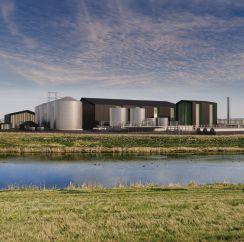
The Alberta-based developer is advancing the Future Energy Park in Calgary – a flagship project that will create North America’s largest carbon-negative renewable natural gas (RNG) and ethanol facility.
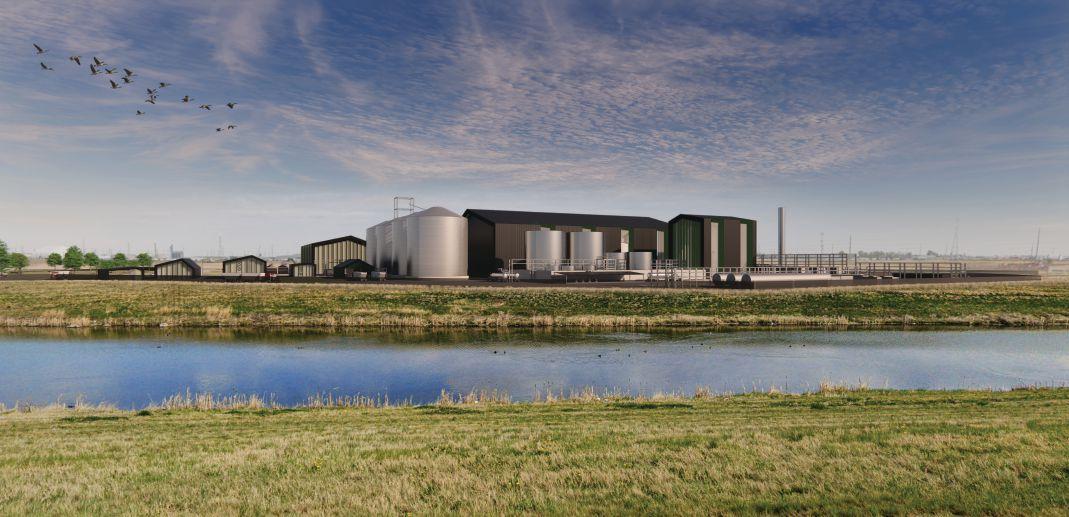
The facility in Southeast Calgary will turn non-food-grade wheat into fuels and cattle feed while sequestering carbon in a one-stop energy site, complete with ethanol plant, anaerobic digesters, RNG facility, co-generation plant, water treatment plant, and carbon dioxide capture facility.
Future Energy Park is specifically designed to be waste-free, meaning all primary products and most by-products have an end
use to utilize 100 per cent of the biomass going into its gates. As Douglas will tell you, at times that mission meant sacrificing easy profit streams, but they’re proving that doing “the right thing” can make financial sense, too.
COMPANY ORIGINS
GIP as a company is only a few years old, but Douglas – based in Edmonton – has been an entrepreneur in the energy, construction and cleantech space for more than 20 years.
“We started in early 2000s making investments into technology that would green-up oil and gas,” he says. “We invested in a lot of science experiments and we more stumbled onto renewable natural gas and its impact.”
Their goal of having of immediate environmental impact pushed them down the road of biofuels with carbon capture and storage (CCS). “Right now, biofuels are the only carbon-neutral or carbon-negative renewable fuel available,” Douglas says. Wind and solar, by comparison, have an initial carbon footprint from construction or continued impact from arable land use that cannot, currently, be recovered.
Future Energy Park’s facility in Southeast Calgary will turn non-food-grade wheat into fuels and cattle feed while sequestering carbon in a one-stop energy site. Photo rendering courtesy Green Impact Partners.
After many years of a “head start,” tweaking technology and working with farmers to firm up feedstock supply, GIP incorporated in May 2021 and the team hit the ground running with plans for the Future Energy Park in Calgary.
Since 2021, the company has also announced majority ownership stakes in onfarm manure-based RNG projects in Iowa and Colorado, and another dozen of their projects in Canada and the U.S. are nearing ground-breaking milestones. With a total staff of more than 100, the company generates over $200 million in annual revenue.
In February, the company welcomed London, UK-based Amber Infrastructure as a 50-per cent project-level equity owner in Future Energy Park, Iowa RNG and GreenGas Colorado, which will inject $545 million into the projects.
FEEDSTOCK TO FUEL
A short growing season and unpredictable weather on the prairies results in up to 13 per cent of wheat crops downgrading to non-edible residue each season. Future Energy Park is designed as a one-stop shop to convert all of that non-food-grade wheat biomass into useable products.
“We don’t want to be taking food for fuel. We’re taking grade three wheat and there’s a substantial source of that in the prairies, even just within 500 kilometres of our site there’s enough to service it,” Douglas says.
Wheat entering the facility will first be utilized in the facility’s ethanol plant. The feedstock will be crushed, separated, fermented and distilled to create fuel pumpready ethanol. The residuals from the ethanol production will then head to a tank farm for anaerobic digestion. Biogas is collected and piped into the RNG facility next door for upgrading to create pipeline-ready natural gas. Digestate from the tanks – a purely wheat-based product – will be dried and used as high-protein cattle feed.
The site includes a wastewater treatment plant to recycle water used during each process, and carbon dioxide created from the production of biofuels will be captured and compressed for sequestration.
Future Energy Park will be powered by a high-efficiency natural gas-fired cogeneration unit. Two gas turbines and two
Green Impact Partners CEO Jesse Douglas aims to prove that doing “the right thing” can make financial sense, too.
heat-recovery steam generators will produce power and steam for use throughout the facility.
GIP expects Future Energy Park to consume 900,000 tonnes a year of grade three wheat, producing approximately 3.5 million MMBtu per year of RNG and over 300 million litres of ethanol annually.
“We’re not using any new technology,” Douglas says. “We’re pushing ourselves to be more creative because we don’t want a waste source coming out of this. That’s consistent to what we do in all our projects.”
MISSION FOCUSED
Future Energy Park is looking at breaking ground this summer.
“We’re ready to start building and we’re excited,” Douglas says.
GIP is working with Alberta-based contractors for the design, engineering and construction, including PCL, Thermo Design Engineering, Propak Systems and EXP. Equipment contracts for the ethanol and RNG facilities and anaerobic digesters are mainly German manufacturers.
Once sold on the idea of the Future Energy Park, the City of Calgary was an encouraging partner, providing potential sites where they are hoping to grow their industrial zones, Douglas says. Calgary is also a good location from a values perspective as a place where the farming industry and energy industry co-exist.
Building on their momentum, GIP is
looking at other potential sites across Canada to construct similar wheat-to-energy sites. The prairies alone could sustain three.
“We think it’s an important show of how you can take the farming industry and marry it with the energy industry, and do renewables that are synergistic with both,” Douglas says. “We’re not competitive with any of them, and we’re helping them to decarbonize their existing footprint.”
DOMESTIC FUTURE FOR BIOFUELS
When it comes to the growth of biofuels in Canada, Douglas says our domestic policy pales in comparison to the U.S. The clean fuels industry is hyper aware of the advantages the Inflation Reduction Act (IRA) has given to U.S. producers. The ripple effect is to make Canadian investment less cost competitive.
“The IRA is a very well-designed program that is going to advance the U.S. beyond the rest of the world,” Douglas says. “The U.S. has put the world on notice that they want renewables and biofuels pieces to go there.”
Here in Canada, Douglas says he hasn’t seen indication yet the federal government plans to be competitive with the U.S. program.
“They are still primarily focused on electrification and wind and solar,” he says. “I think those are needed parts of our grid, but I don’t think they’re the ultimate solution. I think the belief that we can get off fossil fuels is preventing investment into synergistic technologies and better uses of fossil fuels.”
While market forces would drive most biofuels producers to U.S. customers, GIP plans to keep the majority of its biofuels in Canada.
“We’re focused on doing the right thing, but also challenging what the right thing is,” Douglas says. “Just because it’s renewable, doesn’t mean it’s the right thing to do. There are projects for us, using the same technology as Future Energy Park, where we can’t make them make ‘impactful’ sense. Sometimes they make a lot of money, but we can’t get them to what we would call, doing the right thing.”
“And I think what we’re proving is that we can do the right thing and also be profitable,” he says. •
Highlighting the value and safe use of digestate
BCanadian Digestate Management Guide is now available
By Sarah Stadnyk
iogas and renewable natural gas (RNG) are often the primary focus for outputs of biogas facilities as it can be monetized and sold to different markets. However, digestate is also a valuable output as a fertilizer or soil amendment. It is a nutrient rich product that contains virtually all the macro and micronutrients that were found in the original organic materials that went into the digester.
To bring attention to the value of digestate, the Canadian Biogas Association (CBA) developed a first of its kind document, the Canadian Digestate Management Guide, that summarizes best management practices in a Canadian context. Currently digestate producers and applicators follow provincial regulations and employ best management practices, however there isn’t a Canadian specific resource compiling this information. The guide was developed with input directly from stakeholders and subject matter experts to provide practical and useful information to maximize the benefits of using digestate products.
PRODUCING SAFE AND EFFECTIVE DIGESTATE
Canadian agricultural and industrial biogas facilities currently produce approximately 1.2 million tonnes of digestate annually across the country and most of this digestate is applied to farmland as fertilizer. A clear understanding of good digestate management practices builds confidence in production and use of digestate.
Digestate producers apply quality control at feedstock selection and digestate
production to ensure safety. In addition to safety during production, best management practices support effective use of digestate as a fertilizer or soil amendment.
DIGESTATE BENEFITS
Digestate is a renewable fertilizer that can lower greenhouse gas (GHG) emissions by reducing reliance on mineral fertilizers, diverting organic material from landfills, utilizing animal manure that would otherwise emit methane, and sequestering atmospheric carbon in soil as stable soil organic matter. Digestate also builds local self-reliance as it is produced locally at biogas facilities obtaining feedstock from nearby businesses and communities and reduces local farmers’ exposure to global supply chains and market conditions for essential crop nutrients. Digestate is a sustainable form of fertilizer as it completes the natural nutrient cycle by returning nutrients and organic matter to the soil.
DIGGING INTO THE GUIDE
The guide includes sections on producing digestate, digestate characteristics, best management practices, and the 4R principles of nutrient stewardship (Right Rate, Right Time, Right Place, Right Method).
The guide provides five examples of utilizing digestate adhering to the 4R principles of nutrient stewardship: digestate applied after wheat harvest with cover crop; digestate side-dress application into standing corn; digestate spring applied on growing wheat; digestate spring applied ahead of planting corn and split application or digestate and manure for organic
farming. The examples are provided to illustrate common digestate product utilization scenarios and considerations, including soil testing, plant nutrient requirements, and application techniques.
The CBA published the guide in March 2023 and intends this to be the first version allowing for periodic updates as the industry evolves. To complement the guide the CBA has also developed two brochures, Digestate 101 and Best Management Practices for Digestate, to break down key information to help communicate the value of digestate and common uses as a sustainable source of nutrients for farms. The Digestate 101 brochure is an excellent introductory tool to share with those looking to learn more about the product, the benefits, and composition. The Best Management Practices for Digestate Brochure is a resource the outlines how digestate can be a valuable part of a farm’s fertility program and introduces how the 4Rs of nutrient stewardship can maximize the value of digestate.
Both brochures are available on CBA’s farmingbiogas.ca microsite. A full copy of the Canadian Digestate Management Guide is publicly available on the CBA website, biogasassociation.ca.
Sarah Stadnyk, manager of business development and communications, is focused on outreach activities that raise awareness of the biogas and renewable natural gas sector for the Canadian Biogas Association. Her outreach activities raise awareness of the sector by highlighting biogas technology and developments to CBA members and stakeholders.
hurstboiler.com
STEAM BOILERS
Hurst announces AIA partnership for Online Specifications Tool
Hurst has just added to its list of accomplishments with the addition of a Fire-tube Boilers Specifications Section in the nation’s top industry specifications system, AIA Product MasterSpec®. Adding this tool to our arsenal of online specification capabilities enables architects and engineers all over the world to access, evaluate and specify our products easily, and save valuable time. Subscribers to MasterSpec® can pick and choose the Basis of Design content and documentation needed for their project and accelerate the process.
Hurst Boiler on MasterSpec®
In order to help designers with a specification description that fully explains our products and how they should be installed, among other details, Hurst has included complete product specification entries encompassing a broad spectrum of our Fire-tube Boiler Product Line. The Product MasterSpec® section, 235239 Fire-Tube Boilers, will now help designers quickly add necessary descriptions, specs and easily access CAD files and PDF drawings when specifying Hurst’s products, providing them with a tool that saves them time and money.
MasterSpec® offers more than 950 copyrighted sections, which allows designers, architects, and engineers to select expertly written specification content for thousands of products without having to waste time writing detailed explanations that already exist.