SOLUTIONS IN POULTRY LIGHTING SUPPLEMENT
SMART LIGHTING FOR HEALTHIER BIRDS, BETTER WELFARE AND MORE EFFICIENT BARNS
OPTIMAL LIGHT, OPTIMAL FLOCK
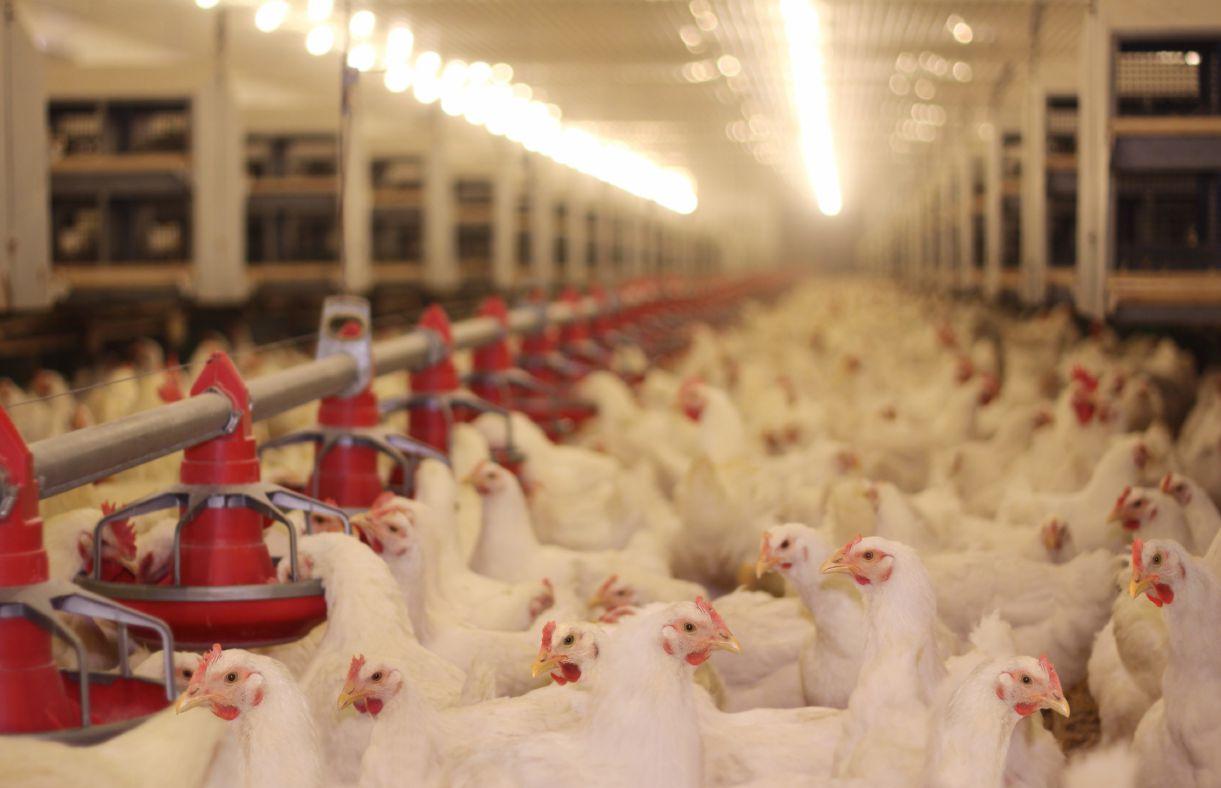
How light spectrums and progressive dimming contribute to a productive poultry farm.
If you’ve ever questioned how powerful the sun can be, just ask someone how they feel when sunshine breaks through after days of grey skies: you’ll almost always hear an enthusiastic response. Natural sunlight plays a vital role in both physical and mental health, enhancing moods, behaviours, wellbeing and biological functions for both humans and poultry alike – and while birds may not be able to express their feelings through words, light has proven to be an important key to the health and wellbeing of a flock.
“Light is one of the most important factors of life,” contends Bernard Harvey, president and general manager of CBM Lighting. “If you don’t have light, you won’t have life on earth.”
For more than three decades, CBM Lighting has been at the forefront of agricultural lighting technology, developing systems specifically designed for the unique needs of poultry operations to create ideal environments for birds to thrive. After releasing the first dimmable fluorescent tubes to the agricultural
market around 1997, the company launched LED lighting solutions for the agricultural industry in 2010.
This revolutionary spirit has been a hallmark of CBM since its founding in 1992. With expertise extending across the entire spectrum of poultry production, from broilers and breeders to layers and pullets, CBM Lighting offers a variety of products designed specifically for poultry barns.
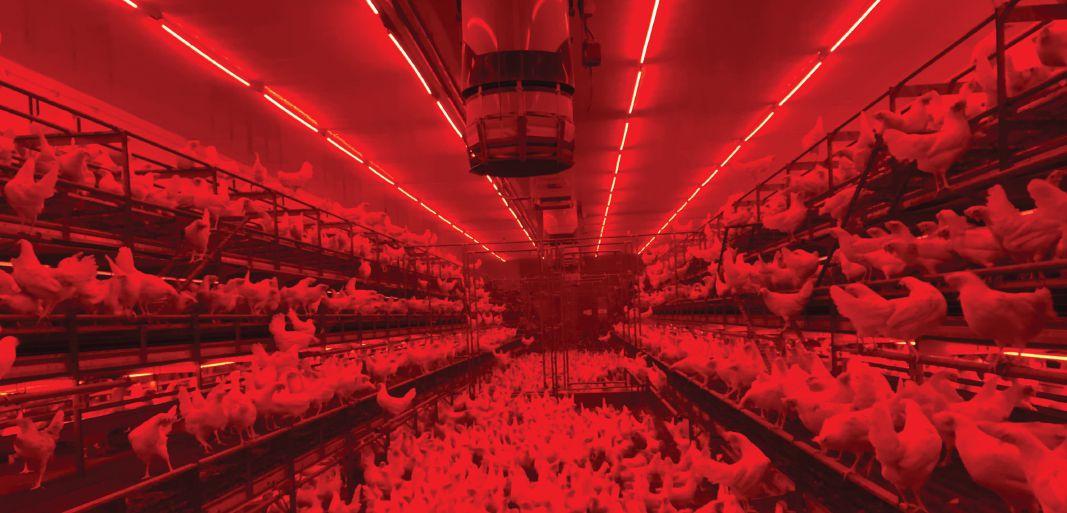
For broiler operations, CBM offers full spectrum technology that incorporates specific blue, green, and red wavelengths to optimize different aspects of growth and development. “The blue and the green at the beginning will have a better impact on muscle growth and bone structure, so the birds gain more strength,” Harvey explains, noting as they grow, the spectrum can be adjusted – for example, adding more blue light to help stimulate active behaviour and feeding, promoting increased muscle mass weight gain and uniform growth throughout the flock.
Harvey says producers will often see
lower mortality rates and a more profitable operation, thanks to a lighting program that reduces stress levels and contributes to an optimal environment. “You’ll have less mortality in full-spectrum environments, better feed conversion ratio, quicker weight gain and fewer days until birds reach their desired weight,” he notes, pointing to the research-proven positive impacts on the birds’ cellular immune system, potentially reducing the need for medication.
For laying operations, CBM recommends their 3000k, red-white technology, which gives producers noteworthy control over bird behaviour: increased red light can promote a calmer environment, minimizing stress and agitation, and encouraging animals to find the right laying area.
This effect stems from how birds process red light wavelengths, Harvey explains. “It’s a long wavelength that they cannot see, but it penetrates their pineal gland in the back of their head. Without even seeing red light, it has a calming effect on birds.”
CBM’s lighting systems feature progressive dimming capabilities that create a more uniform light distribution within poultry houses, Harvey adds. The company’s Stardim technology can dim from 0.2 per cent to 100 per cent, allowing producers to replicate natural sunrise and sunset conditions. This gradual transition reduces stress on the birds and creates a more comfortable environment. “When you’re in complete darkness and you go from zero to even 1 per cent, it seems like a lot of light,” Harvey notes, adding that the gradual dimming imitates
KEY SOLUTIONS
• CBM’s robust and dimmable LED product line has more than 30 years of trusted expertise.
• Different colour spectrums and wavelengths offer a tailored solution for optimal bird growth and development.
• CBM’s products are designed specifically for the poultry industry, prioritizing the animals’ well-being and producers’ need for quality and durability.
to dawn lighting and is done without any flickering.
CBM offers products for other applications, but Harvey emphasizes their poultry lights are designed for the specific needs of a poultry operation. “Our products are really designed for the poultry industry – they’re not a product that we sell for other industries and try to push it into the poultry industry,” Harvey says. “It’s really designed for poultry houses and giving the best performance inside of a poultry house.”
This purpose-built approach extends to practical considerations like durability and maintenance. “The lights are waterproof, they’re chemical resistant for cleanup and they can be washed,” Harvey says of the high-quality, long-lasting product. With a five-year warranty and an expected lifespan of 10 to 20 years, CBM’s lighting systems are a solid investment for poultry producers.
“Rather than walking through the barn every two weeks and changing light bulbs here and there, producers can focus on other things,” Harvey points out.
Through a specialized approach to poultry lighting, CBM continues to light the path to improved productivity, better welfare, and greater profitability for poultry operations.

dusk

From the Editor
BY BRETT RUFFELL
SHEDDING LIGHT ON BEST PRACTICES
Welcome to Canadian Poultry’s first-ever “Solutions in Poultry Lighting Supplement” – a focused deep-dive into one of the most underestimated tools in modern poultry production: lighting. At first glance, lighting may seem like a straightforward aspect of barn design. But as any experienced poultry farmer knows, it’s far more than flipping a switch. The right lighting strategy is essential for fostering healthy, productive flocks and for ensuring the long-term sustainability of farm operations. That’s why we’ve dedicated this special supplement to exploring the science, technology, and practical applications of barn lighting done right.
“Light is more than illumination. It guides bird behaviour, affects welfare, and influences your bottom line.”
From promoting regular feeding and drinking behaviours to supporting reproductive rhythms in layers, good lighting influences every part of a bird’s life. Mimicking natural daylight cycles reduces stress and aggression while enhancing bird welfare, flock uniformity, and ultimately, farm profitability. The benefits are especially clear
in precision systems that use LEDs and dimmers to fine-tune both light intensity and duration. These tools give farmers better control, improved energy efficiency, and even greater biosecurity by making it easier to monitor bird health.
But just as good lighting brings measurable gains, poor lighting can introduce serious challenges. Erratic schedules, harsh brightness, or outdated systems can disrupt natural behaviours, lead to stress and aggression, and result in uneven growth or reduced egg quality. Poor visibility doesn’t just affect birds – it hinders barn staff from detecting early signs of illness, costing valuable time and, potentially, bird lives.
This supplement brings together expert insights, research-based recommendations, and real-world applications. From understanding how birds perceive light, to implementing dimming strategies that reflect natural patterns, the articles inside offer practical guidance for any producer aiming to optimize their housing systems.
In short, light is more than illumination – it’s information. It guides bird behaviour, affects welfare outcomes, and influences your bottom line. We hope this special issue helps shine a light – literally and figuratively –on the powerful role that smart lighting plays in poultry success.
canadianpoultrymag.com
Reader Service
Print and digital subscription inquiries or changes, please contact Angelita Potal, Customer Service Rep.
Tel: (416) 510-5113
Email: apotal@annexbusinessmedia.com
Mail: 111 Gordon Baker Rd., Suite 400, Toronto, ON M2H 3R1
Editor Brett Ruffell bruffell@annexbusinessmedia.com 226-971-2133
Brand Sales Manager
Ross Anderson
randerson@annexbusinessmedia.com Cell: 289-925-7565
Account Coordinator
Julie Montgomery
jmontgomery@annexbusinessmedia.com 416-510-5163
Media Designer Curtis Martin
Group Publisher
Michelle Bertholet mbertholet@annexbusinessmedia.com
Audience Development Manager
Anita Madden amadden@annexbusinessmedia.com 416-510-5183
CEO Scott Jamieson sjamieson@annexbusinessmedia.com
PUBLICATION MAIL AGREEMENT #40065710
Printed in Canada ISSN 1703-2911
Subscription Rates
Canada - Single-copy $10.00
Canada – 1 Year $33.15
Canada – 2 years $56.61
Canada – 3 years $78.54 (plus applicable taxes)
USA – 1 Year $93.33 CDN
Foreign – 1 Year $105.57 CDN
GST - #867172652RT0001
Occasionally, Canadian Poultry Magazine will mail information on behalf of industry-related groups whose products and services we believe may be of interest to you. If you prefer not to receive this information, please contact our circulation department in any of the four ways listed above.
Annex Privacy Officer
privacy@annexbusinessmedia.com Tel: 800-668-2374
No part of the editorial content of this publication may be reprinted without the publisher’s written permission. ©2025Annex Business Media. All rights reserved. Opinions expressed in this magazine are not necessarily those of the editor or the publisher. No liability is assumed for errors or omissions. All advertising is subject to the publisher’s approval. Such approval does not imply any endorsement of the products or services advertised. Publisher reserves the right to refuse advertising that does not meet the standards of the publication.

ILLUMINATING SUCCESS IN POULTRY HOUSES
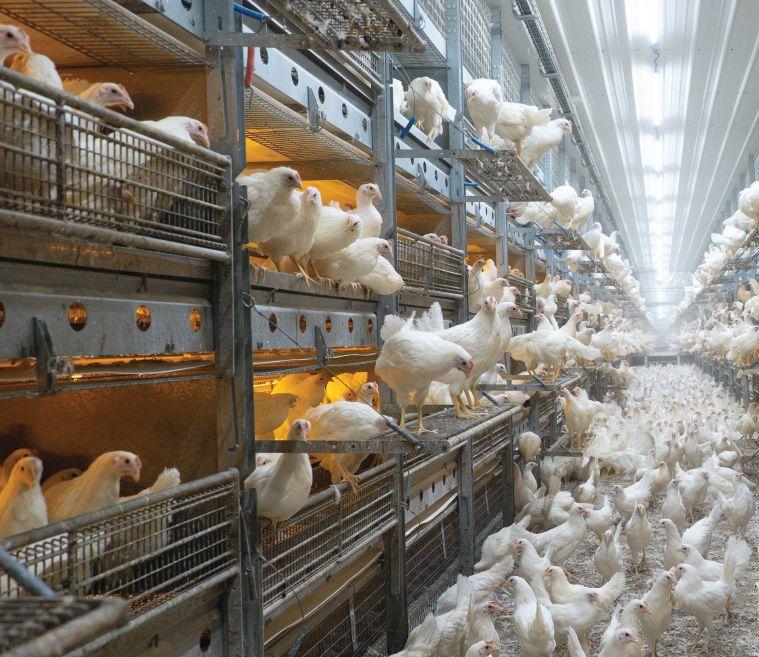
Precision lighting recommendations for poultry producers.
Lighting has become a powerful management tool for poultry producers – and as Dr. Ian Rubinoff, poultry veterinarian and director of sales at Hy-Line North America reflects, the advancements in lighting technology have come a long way.
“When I started 16 years ago, the first LED bulbs weren’t even in chicken barns,” Rubinoff recalls. “We’ve gone from incandescent to fluorescent to LED bulbs, representing a recent technological change that’s had a massive impact on the poultry industry.”
Like in other aspects of agriculture, there’s no silver bullet to the perfect solution. Rather, advancements in lighting have given producers detailed control over light duration, spectrum and intensity – each playing a vital role in the development and productivity of a flock.
For pullets, Rubinoff says, lighting management begins immediately. Initial high-intensity illumination of three to five
footcandles (fc) helps chicks locate water and feed. As birds mature, strategic dimming helps control development, with typical programs reducing light duration from 18 to 20 hours down to 10 to 12 hours by eight weeks of age.
“We dim and brighten lights for a couple reasons,” notes Rob Martens, a pullet producer and sales manager for Hy-Line North America’s Western Canada region. “Mainly, we use it as a tool to calm our birds down. We also use lighting to get birds used to light changes before they move into the layer barns.”
Light spectrum – the colour composition of light – is another critical management tool. Research suggests cooler lights (5000K) with blue-green wavelengths benefit pullet development, while warmer lights (2700-3000K) with sufficient red spectrum optimize egg production.
“Research shows the cooler end of the spectrum (bluegreens) help stimulate birds to
eat more,” Rubinoff explains. “This relates to wild birds sensing shorter, cloudier days in fall, triggering them to eat more to survive winter. We use the same principle with our pullets, triggering them to grow and gain muscle and body mass.”
When birds reach laying age, the red spectrum is increased to help stimulate egg production. This typically begins when birds reach target body weights of around 3 pounds for brown birds and 2.7 to 2.9 pounds for leghorns. Light duration increases by 30 minutes per week to a maximum of 15 to 16 hours.
Cage-free systems are managed a bit differently, Rubinoff advises, as sunrise and sunset protocols are critical. These carefully orchestrated light transitions help train birds to use nests properly and return to system perches at night. “Ultimately, we want birds to be up in the system at night and using the nests,” Rubinoff notes.
KEY SOLUTIONS
• Use cooler light (5000K) for pullets and warmer lights (2700-3000K for layers)
• Start dimming at four weeks of age, and adjust light intensity based on bird type
• Pure blue lights can be used to calm birds for movement or vaccinations
As producers target longer laying cycles to address challenges like avian influenza disruptions, lighting management becomes more important. Modern dimming systems allow precise control throughout a hen’s productive life. And with equipment constantly changing, it’s important to stay on top of new solutions.
“Lighting is a critical component in any house, and it can make all the difference,” Rubinoff concludes. “The amount, variety and bird may change, but we need to build on the foundation of what we know.”

Rob Martens Sales Manager, Hy-Line North America 604-556-6728 | rmartens@hylinena.com hylinena.com/lighting_tech
THE BRIGHT SIDE OF DARKNESS
Inspired by nature, gradient lighting is transformative for broiler welfare.
BY MELANIE EPP
It’s well known that light intensity, wavelength and duration affect broiler activity, feed and water intake, and productivity. Lighting also impacts animal welfare and mortality. However, research supporting current lighting guidelines has been limited.
A new study led by Seong Wook Kang at the University of Arkansas examined broiler lighting preferences and found that offering birds choice improves feed conversion, reduces fear response and lowers welfare concerns. Conducted at Tyson Foods’ Broiler Welfare Research Farm in Springdale, Ark., the study could have a global impact.
INSPIRATION FROM NATURE
Most commercial barns use uniform lighting. But in the wild, Red Jungle Fowl – ancestors of domestic chickens – live under uneven rainforest light. Kang wonders if non-uniform artificial light could improve broiler welfare and performance. His early pen trials in 2016 showed promise, prompting Tyson to offer its farm for a fullscale trial. Karen Christensen, Tyson’s senior director of animal welfare, partners closely on the research.
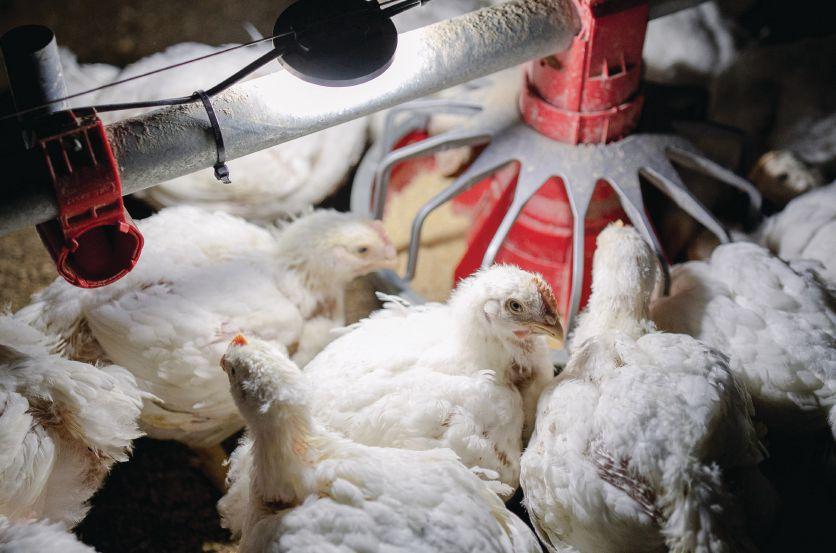
Broilers are diurnal – they eat when lights come on and rest when off. Kang begins by placing lights over feeders to stimulate eating. He notices birds move to dimmer areas afterward to rest.
TRIAL DETAILS
Birds can choose between well-lit areas for eating and shaded zones for rest. Kang evaluates behaviour, mortality, leg health, brain welfare genes and performance.
He observes more aggression and lower performance in bright-light houses. In variable-light barns, birds are calmer and more uniform. Dustbathing – a comfort behaviour – is more frequent, and leg-related culls drop 30 per cent.
“Before, the house was not exciting enough,” says Kang. “Conditions were too uniform. Providing different lighting conditions lets them choose where they want to go – bright or dark areas.”
Wider benefits include improved activity, footpad health, reduced fear response, and better feed efficiency.
Lighting costs also fall by 70 per cent.
REAL-WORLD IMPACT
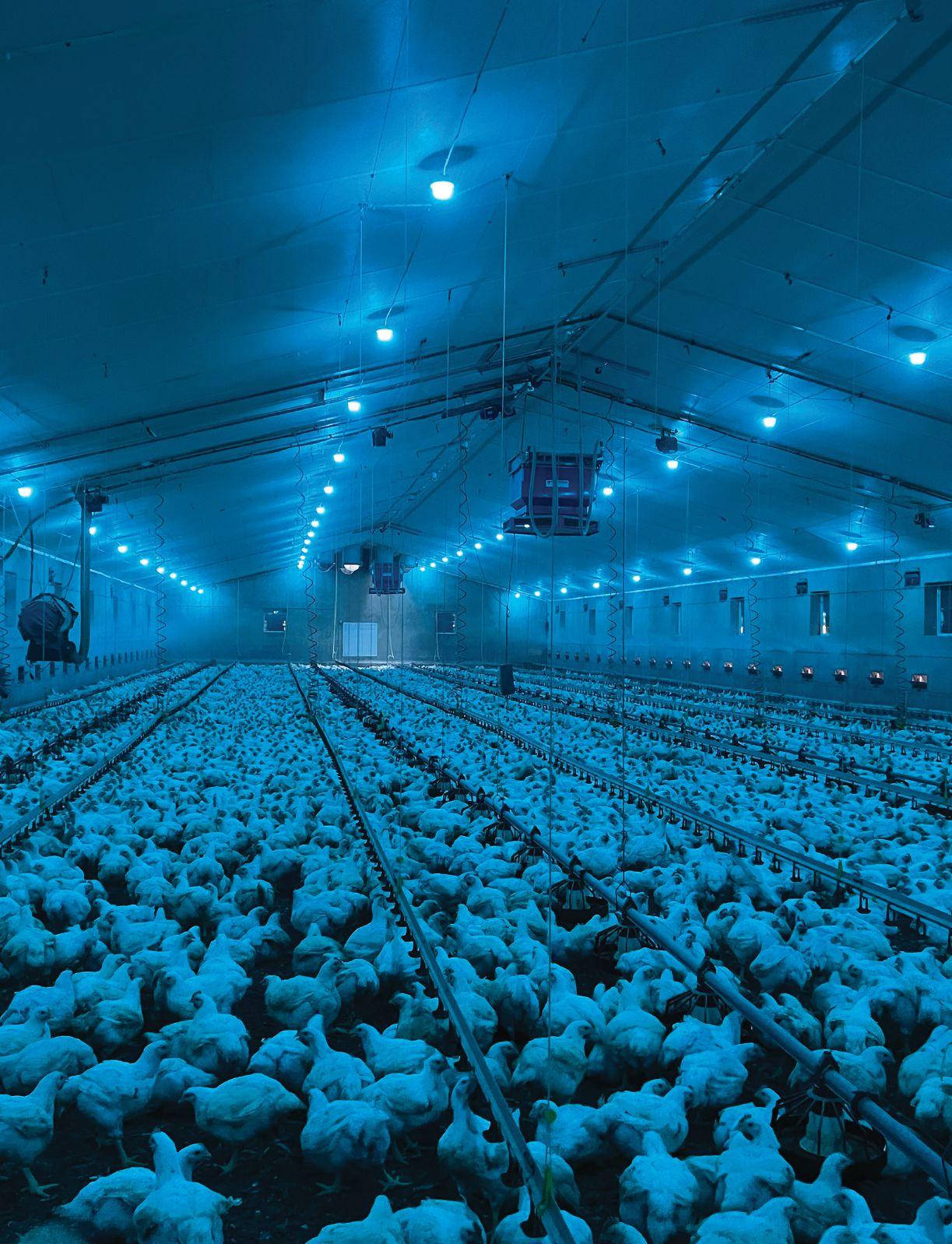
ABOVE: Moving lights from the ceiling to feed lines creates a gradient, where it’s brighter near feed pans but tapers to lower intensity lighting between lines.
Tyson Foods joined the study to help clarify inconsistent lighting recommendations. “That was really concerning to us... we absolutely wanted to make sure it’s right for the bird,” says Christensen. She observed calmer, more active birds under variable lighting.
“They’re playing in the transition area... moving to dimmer areas where they are resting and feeling safe,” she says. Feed efficiency improved, even with more movement.
To apply the findings, Tyson selected Optient lighting by ONCE (Signify), a durable modular LED system now being installed in 3,100 broiler houses.
“Optient is changing the game for the broiler industry,” says Gabrielle House, poultry scientist at Signify.
THE SCIENCE OF SIGHT
Research-driven lighting technology works with avian biology – not against it –to tackle hidden stressors.
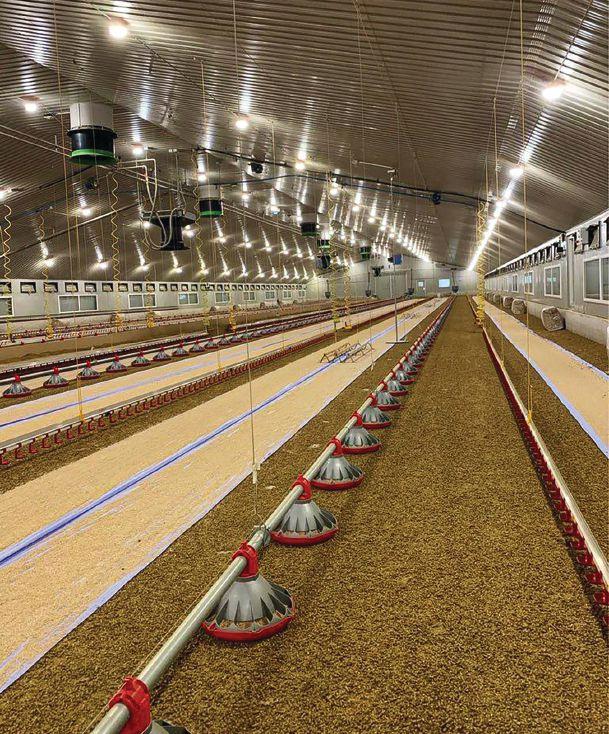
Proper lighting strategies in poultry barns can provide many benefits, including stress reduction in a flock. But a subtle flicker – one that a human eye may not pick up on – may have the opposite effect.
“Birds have an additional cone in their eye, which allows them to see a very different, much more dynamic range of light, making them much more sensitive to flicker,” explains Corwin Koch, CEO of Can-Neth Imports, a Canadian company with more than 35 years of experience serving North America’s agricultural industry.
For more than a decade, Can-Neth has partnered with HATO to bring cutting-edge lighting solutions to Canadian poultry farmers, keeping these challenges and others in mind.
“We did our due diligence when we looked for a lighting provider,” explains Corwin Koch, CEO of Can-Neth. “Two decades ago, barns were using incandescent bulbs; LEDs were just starting to grow, and research on how LEDs impacted animals was in its infancy.”
Now, the benefits of lighting systems are
founded in research, as are the lighting solutions from HATO – something that sets their products apart, Koch says. “HATO’s roots are in research, as the company started out specifically as an agricultural lighting business, rather than pursing the poultry market as an afterthought.”
This research-driven approach has led to innovations addressing the unique visual sensitivity of poultry.
“HATO light bulbs are DC, or direct current, which inherently do not have flicker,” Koch explains, noting that although many bulbs claim to be flicker-free, it’s not always the case, especially with alternating current or AC bulbs. “The more you dim, the more a wave length will change of an AC bulb, and its near impossible to stop flicker from happening.”
The company offers specialized lighting solutions tailored for different production stages and bird types. “Warm white is ideal for laying hens, and cool white promotes growth in broilers or rearing birds,” Koch says, referencing the customizable light spectrum with dynamic daylight simulation to provide a natural outdoor experience inside. HATO’s systems also include specialized colour options for specific needs, he adds: “Blue light will calm the birds, which is great for shipping birds and vaccinations, as it reduces stress and agitation on them.”
KEY SOLUTIONS
• 100% flicker-free operation and smooth dimming from 100-0%, supporting stress reduction and natural behaviours
• Tailored light plans consider spectrum, intensity and distribution for specific barn layouts and poultry types to optimize animal welfare and production
• Up to 60% energy savings compared to traditional lighting, with a lifespan of up to 50,000 hours
Beyond the biological benefits, HATO lighting systems are designed with practical farm management in mind. The systems can be independently controlled or integrate seamlessly with farm management controls if desired, and each installation comes with a customized lighting plan. “We take in dimensions of the barn, colours of the walls and desired brightness that the farmer wants,” Koch notes.
For farmers looking to upgrade their lighting systems, Can-Neth offers pre-wired options that can be easily mounted in place to simplify installation.
Like any infrastructure, lighting requires an investment, but the long-term savings and value are worth it to most producers, Koch says. “It’s important to look at the cost of acquisition versus the lifetime cost,” he advises. “Most of the bulbs for HATO will last 50,000 hours – four or five times as long as a conventional bulb. Their longer lifespan makes the investment more cost effective. When the bulb lasts four or five times longer, there’s the cost of changing those bulbs out. Over the life of the light, it ends up being more cost effective for the farmer.”