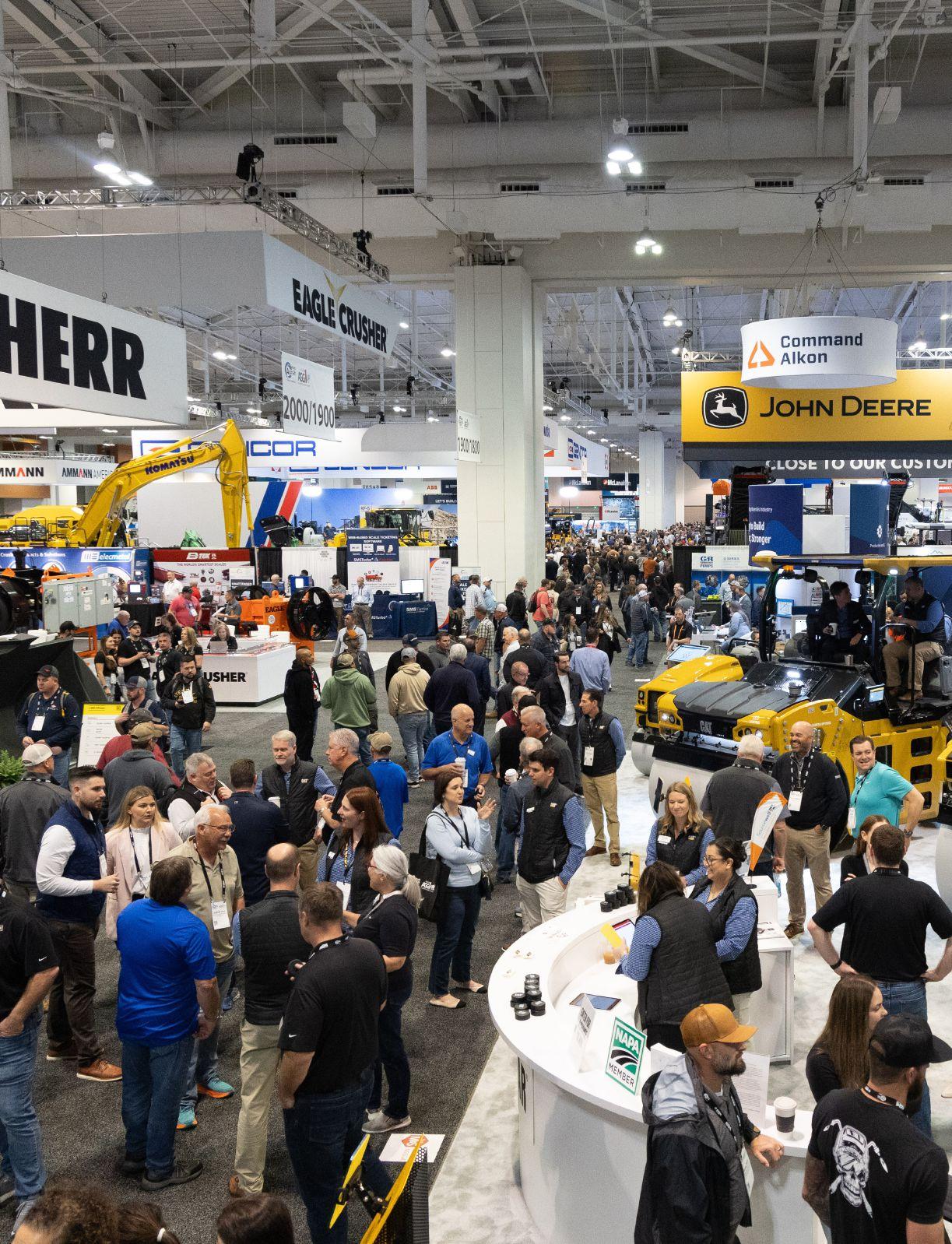
2024's World of Asphalt/ AGG1 sets records in attendance and exhibit space.
18 From tree trunks to turnpikes
Forestry by-product may help curb asphalt emissions. 22 Right sizing your truck fleet
Three different mid-size trucks to consider for your fleet.
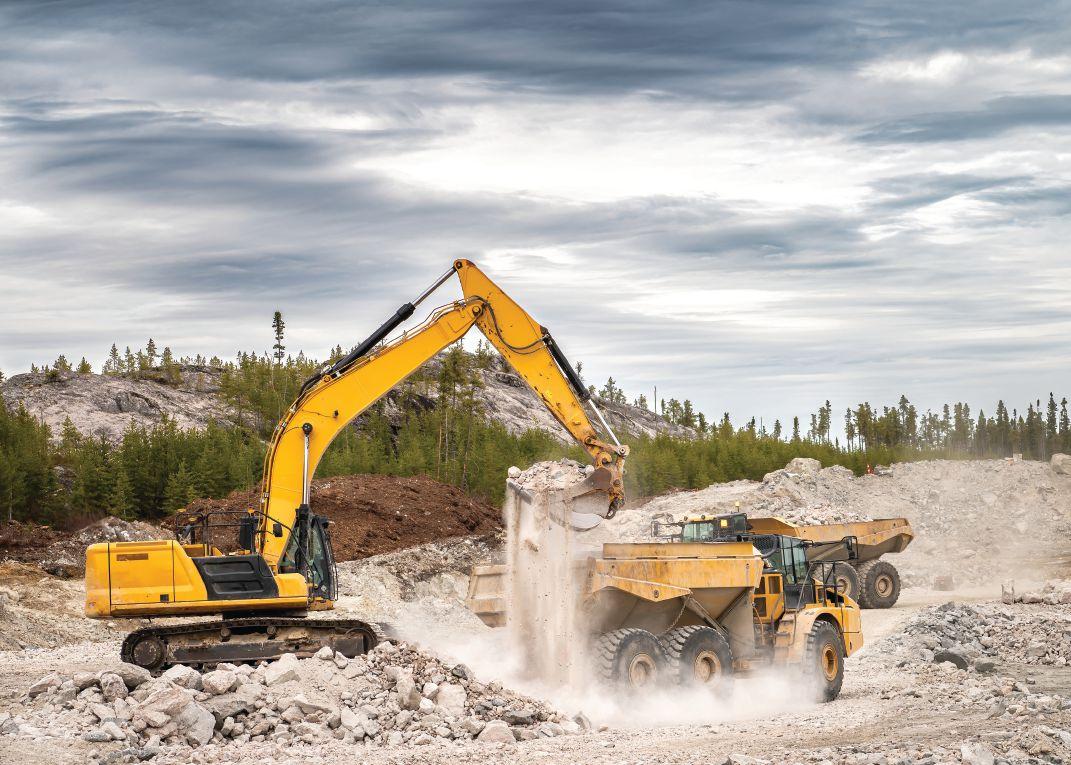
Exposure to construction dust and noise can be deadly, but symptoms often don't materialize until decades later.
The future is now
New technology for the industry promises to improve your operation's bottom line
My first thought when entering Nashville’s Music City Centre for the 2024 World of Asphalt and AGG1 Aggregates Academy & Expo?
This is a lot.
A lot of people. A lot of booths. A lot of space.
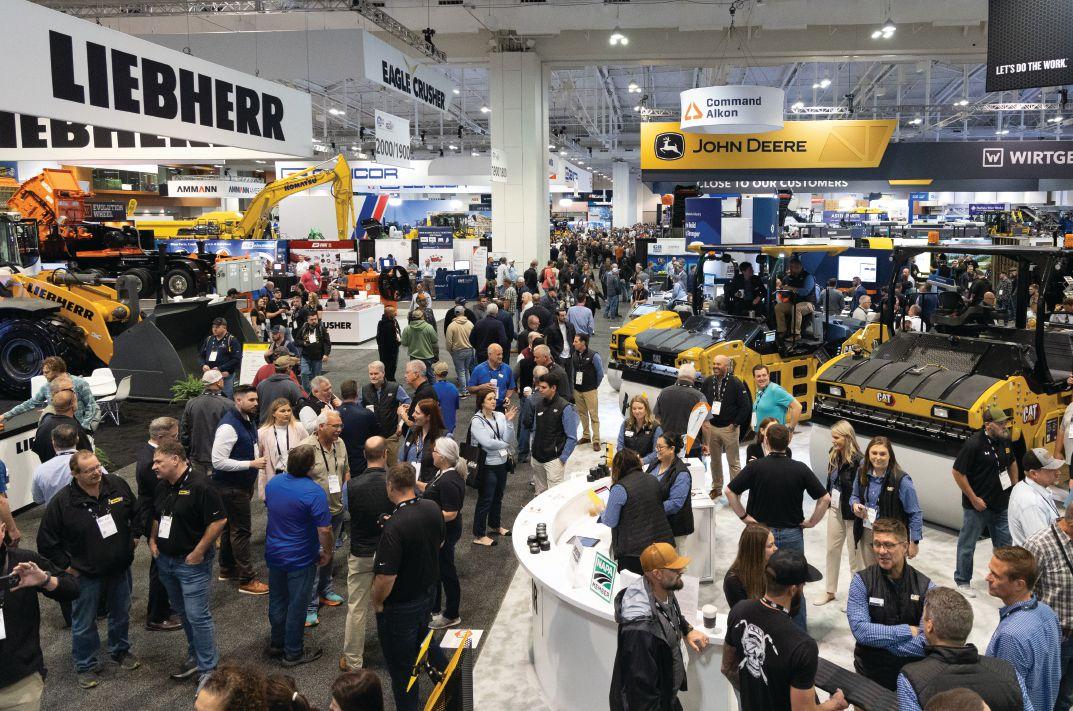
After all, with 440 exhibitors and nearly 16,000 attendees sprawled across 207,000 square feet of floor space, it was a tad overwhelming.
With everything from blasting to street sweeping, the show featured representation from the vast spectrum of the aggregate and roadbuilding industries.
Yet once I got my bearings, I began to see a trend that permeated the entire industry.
Tech.
Everywhere one looked, it was clear that this industry is no different than others when it comes to technology. The way we work and interact is changing rapidly.
Cloud-based software is keeping track of every detail you will need to know to ensure your business is running as smoothly as possible. It allows employees at all rungs of the company to examine every aspect of the operation.
Representatives from Wirtgen Group talked at length about the John Deere Operations Centre. It’s been available for the last decade in the agricultural centre and is now an important tool for those in the construction sector. It helps companies manage every detail of their operation – equipmentspecific information, fleet maintenance, resource management, costs, et cetera – as well as analyze what is happening to help improve future decision-making.
Yet new tech could also be found at the equipment level.
That was a highlight of Wirtgen’s 150 Fi compact milling machine, which can be controlled by less experienced operators due to the technology that runs it. As representatives of Wirtgen noted, machines
can really do more of the heavy lifting.
One of the more popular features at Astec’s booth was the augmented reality experience. The technology is still developing, but a quick demonstration showed exactly what it could do in the future.
Putting on goggles, one saw a 3D schematic of a plant on the exhibit floor. As explained to me, eventually the software can help in building and designing a plant to a customer’s specifications.
One day, technology such as this can also help with ongoing equipment maintenance, troubleshooting issues and a host of other options.
When seeing it, I was reminded of Apple Vision Pro, that company’s augmented reality experience, which was recently launched on the market. Many of the physical items that we require for work or life can be replicated in the virtual world – monitors, smart phones, laptops and much more. If you have not done so yet, go on YouTube and watch a few videos on Apple Vision Pro.
I’ll be honest, I often have split emotions around new technology. I am a sci-fi fan so when I see something new, there is a part of me that is extremely excited, even if I don’t know what it means or what it actually does. It’s new and it thrills me.
But there is another side of me, often the side that is responsible for spending money, that is hesitant to hop on board, via cash, with new tech.
Yes, it looks great. But I’m not sure I want to dole out the money for it just yet.
Leaving this year’s World of Asphalt/ AGG1, I am firmly on the excited side when it comes to the new technology on the way. I believe it will create efficiencies, improve workflow and is worth the investment. Of course, I may feel this way only because I am not the one ultimately responsible for handing over the money. Time will tell.
Reader
mlacey@annexbusinessmedia.com
www.rocktoroad.com
MIKE lacey
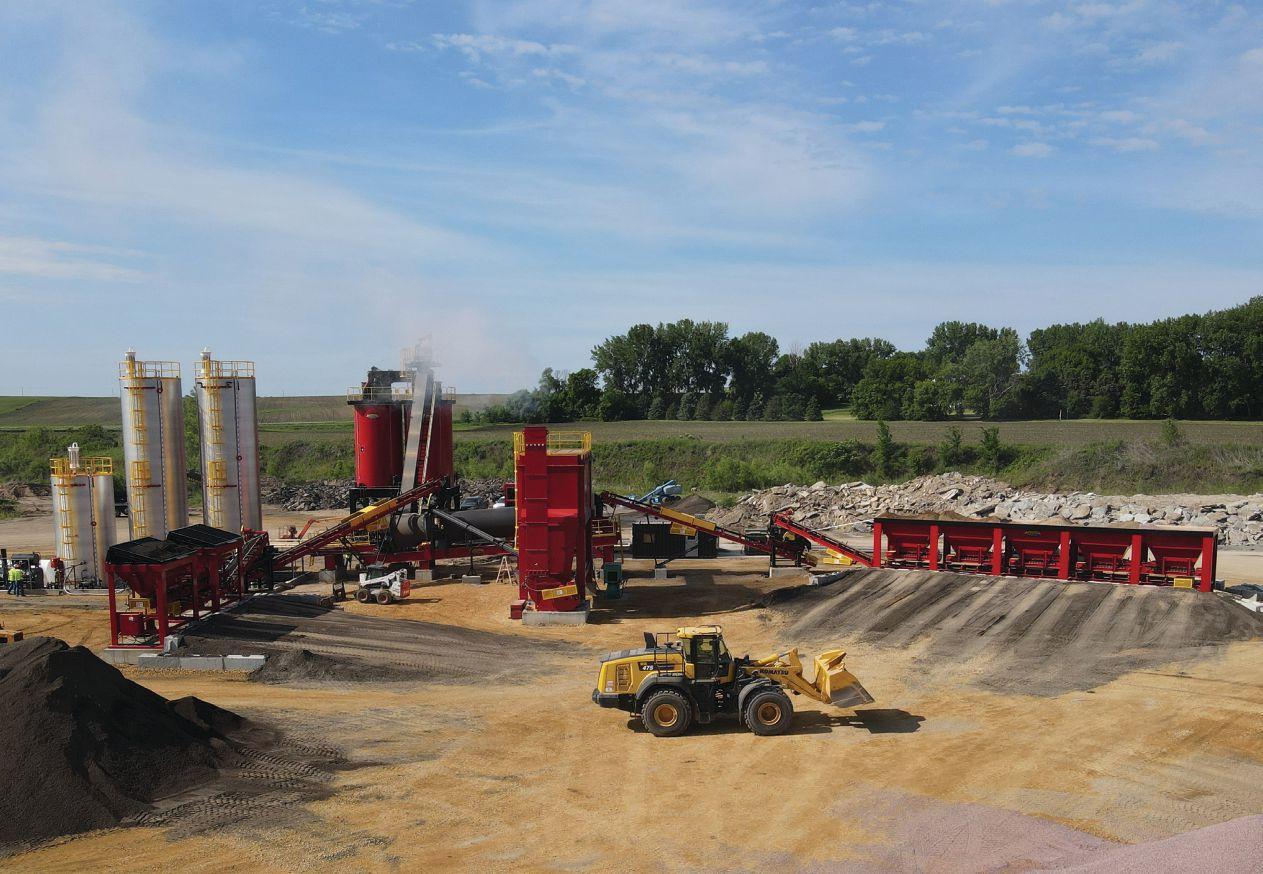
BUILT ON EXPERIENCE ASTEC SERVICE
Astec’s commitment to its customers extends beyond making the sale.
From the beginning, our service team has provided construction services for the equipment we build. Astec construction and relocation services for asphalt plants include plant and equipment installs, plant tear-downs and moves, silo repairs, and industrial piping and tank farm installs.
Efficient planning minimizes downtime, local regulations and permits also play a key role. Astec has an extensive history and experience with permitting and regulations. Safety, efficiency, and compliance are paramount throughout the process.
Scan QR code to see Astec’s Asphalt Service & Construction offerings.
OSSGA commends Ontario’s capital budget
The Ontario Stone, Sand and Gravel Association released a statement endorsing the Ontario government’s newly-revealed budget, which supports Premier Doug Ford and the Ontario government’s 10-year capital plan of investing more than $190 billion into developing the province’s infrastructure.
“Nothing gets built without aggregate,” said Michael McSweeney, executive director of OSSGA. “That applies to everything: transportation corridors, schools, hospitals, recreational facilities and houses. The aggregate industry is proud to provide the essential raw materials that bring infrastructure to life. We’re pleased the Ontario government
recognizes the pivotal role played by local pits and quarries as the foundation of the construction process, fostering a resilient and thriving Ontario.”
Ontario’s revealed budget highlighted a number of new projects that intersect with the aggregate industry. This includes roadbuilding initiatives such as new interchang-
Canadian Construction Association names 2024-2026 board chair
Francis Roy has been named 2024-2026
Chair of the Canadian Construction Association’s (CCA) board of directors. Roy succeeds outgoing Chair Brendan Nobes, who has led the association’s board of directors for the previous two years.
Roy is a 30-year veteran of the construction industry and is currently president and CEO of Quebec’s Groupe Humaco family of companies. As the president and CEO of Groupe Humaco, Roy oversees more than 200 projects annually across several branches including drywall, general contracting, real estate development and construction technologies.
Active across several other industry associations, Roy has also previously served as chair of the Association de la Construction du Quebec in addition to his board position with the CCA.
Addressing CCA members at the association’s Annual General Meeting, Roy shared that his focus over the next year is to cultivate an environment of collaboration and contribution.
es in Windsor and Ottawa, expanding Highway 7 outside of Markham from two to four lanes, extending Highway 7 from Kitchener to Guelph and the construction of highways including Highway 413, the Bradford Bypass and Northern Ontario’s highway network.
“Each of these projects calls for tens of thousands of tonnes of aggregate,” McSweeney said. “The aggregate industry is looking forward to working with the provincial and municipal governments, Indigenous Communities, and the public to ensure the close-to-market supply of high-quality aggregate to get these jobs done, and to lay the foundation for more homes in Ontario, faster.”
Nors Group acquires Volvo CE dealer for B.C. and Yukon markets
Nors Group, a Portugalbased renter and seller of construction, infrastructure, mining and forestry equipment, has purchased the entire stock of Great West Equipment, whose Volvo CE territory covers British Columbia and the Yukon.
With this transaction, which closed on March 1, Great West Equipment is officially a wholly-owned subsidiary of Nors Group.
Great West, who have been a Volvo CE dealer since 2002, is headquartered in Vernon, B.C. and has around 250 employees across 11 locations.
Nors services 17 countries across four continents.
It previously entered the Canadian market in March of 2020 with its purchase of the Strongco Corporation.
legal corner
Making sense of the owner/ contractor relationship
When is it OK for an owner to correct deficient work with an alternate contractor?
Encountering deficiencies on a construction project is not just routine, it is expected. Also expected is that the contractor responsible be afforded the opportunity to correct deficiencies. Failure to provide the opportunity to repair can cost an owner the right to pursue damages against the contractor.
However, this right to correct deficient work is not absolute. Where the contractor has fundamentally breached the contract, they may rightfully be denied the opportunity to correct and still be responsible for the cost of repairs sought elsewhere.
A review of recent court decisions can help assess whether an owner is justified in denying a contractor the opportunity to repair deficient work.
DENYING THE RIGHT TO REPAIR?
‘SIGNIFICANT DEFECTS’ ONLY
A contractor’s fundamental breach of a construction contract, amounting to a repudiation, justifies an owner denying the opportunity to repair deficiencies without jeopardising their entitlement to damages. Courts do not take the assessment of such claims lightly as a fundamental breach may entitle the innocent party to terminate the contract, claim damages and be discharged from the obligation to pay the contractor, including for work already performed.
Mere bad or defective work, or insignificant noncompliance, will not meet the threshold of a fundamental breach. The deficiencies must amount to the contractor failing or refusing to carry out their contractual obligations. This requires “significant” deficiencies going to the root of the contract and denying the owner the substantial benefit of the contract.
Ancillary deficiencies will not justify denying the opportunity to repair. In Newfore Inc. v. BCHQ Barton Holdings Inc., deficiencies in painting and cleaning “did not take away the very thing…contracted for, a renovated residential building,” and therefore were not fundamental breaches. While an owner would be justified in seeking damages, minor deficiencies on their own do not void the obligation to provide an opportunity to repair.
Establishing “sufficiently significant” deficiencies requires analyzing both the contract and the con-
tractor’s performance. The evidence used to support the claim that deficiencies have denied owners of the benefit of their contract is therefore critical.
Objective, independent expert opinions on the extent to which workmanship has fallen short of accepted industry standards is helpful in establishing significance. In Dezsi v. Walker (“Dezsi”), a contract for framing was found to be fundamentally breached after evidence of the standard installation of joist hangers and “normal” squeaking in floors was compared to the actual work and actual squeaking. The comparison emphasized the deficiencies in the installation and highlighted how the contractor failed to provide the very thing contracted for — properly installed framing.
Reference to the cost and work required to repair is also very helpful. This may be objective evidence of the repair work conducted by a qualified replacement contractor or recommended in an independent expert assessment such as in Graci v. New Steel Roofers Inc., where a roofing expert determined that a defective roof needed to be entirely replaced after a series of unsuccessful patchwork repairs. This expert assessment underscored the significance of the deficiencies as the owner was essentially left in their pre-contract position.
Failing to provide an opportunity to repair where the significance threshold was not met may instead leave the owner in breach. Owners are well advised to consult an expert early to assess the possibility of a fundamental breach.
POOR CONDUCT BY THE CONTRACTOR? TAKE THE HIGH ROAD
It is not unusual for the owner-contractor relationship to suffer following unsatisfactory work. This loss of trust often motivates parties to seek advice in forwarding a claim. A full understanding of the scope of the dispute, including the part potentially played by the owner, is essential.
Besides the “significance” threshold, an ownercontractor relationship incapable of proceeding is strong evidence that a contract was fundamentally breached. However, any such breakdown must be directly attributable to the contractor.
An owner who denies the opportunity to repair will not be penalised where the contractor does not intend to fulfill the contract. This lack of intention might be exhibited by a pattern of unwillingness or inability to remedy significant deficiencies, consistently failing to respond to opportunities to repair in a “timely and reasonable” manner or being careless and/or inattentive to an owner.
While not required to provide infinite opportunities to repair, it is best practise to provide some notice of deficiencies.
This failing was a key error for the owners in Beta Construction Inc. v. Chiu. In that case, not only was there no breach by the contractor (because the alleged deficiencies were not “significant”), but it was the owners themselves who breached the contract by, in part, failing to provide the contractor with a list of deficient items.
Despite a deteriorating relationship, owners should continue to comply with their obligations and co-operate with their contractor. This was evidenced in 2002759 Ontario Ltd. et al. v. Koropoeski
A LONG WAY TOGETHER
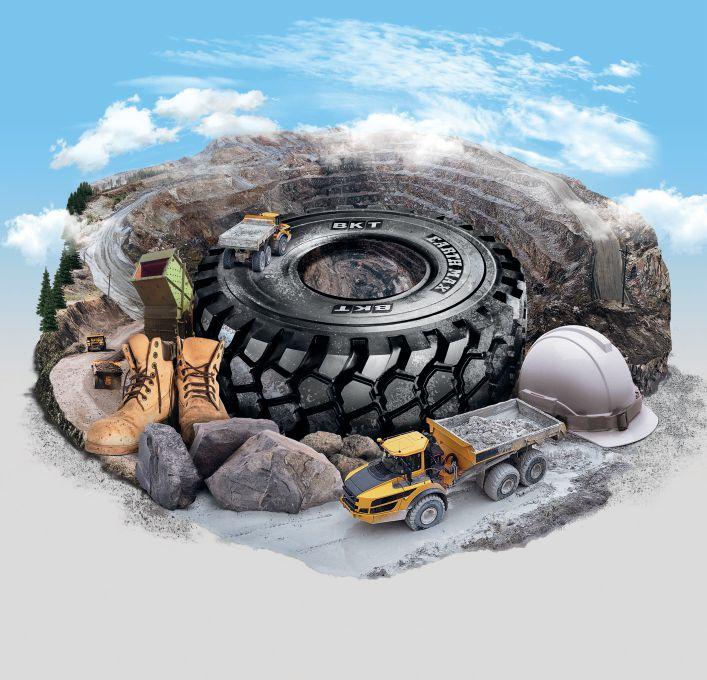
EARTHMAX SR 41
No matter how challenging your needs, EARTHMAX SR 41 is your best ally when it comes to operations that require extraordinary traction. Thanks to its All Steel radial structure and the special block pattern, EARTHMAX SR 41 provides excellent resistance against punctures and an extended service life. In addition to long working hours without downtime, the tire ensures extraordinary comfort.
EARTHMAX SR 41 is BKT’s response to withstand the toughest operating conditions in haulage, loading and dozing applications.
et al., where the owners were found in breach of contract by refusing to engage or collaborate with a willing and co-operative contractor to resolve or address deficiencies, despite at least some of those deficiencies being found significant.
PROCEEDING WITH REPAIRS? BE REASONABLE AND DON’T CRY WOLF
A termination of a contract can have significant financial repercussions for the offending contractor. As such, courts carefully consider all evidence to ensure the consequences are fair and proportionate to the harm caused.
Owners must mitigate damages because only those that are unavoidable are recoverable. The selected repair option must be reasonable and cost effective. In Dezsi, the owners were awarded only $45,000 of the estimated $550,000 claimed because they delayed necessary repairs in favour of finishing the project, resulting in an exponential increase in costs to fix the deficiencies. The Court found this unreasonable and refused to require the contractor to compensate the owners’ poor decision.
Terminating a contract, withholding payment and seeking repairs elsewhere because of a perceived fundamental breach is risky business. If an owner does not carefully consider the deficiencies, acting too hastily may result in their own breach of contract.
To mitigate this risk, owners should put the contractor on notice of any alleged deficiencies and provide at least one opportunity to repair. Owners should then engage an independent expert to assess the significance of the deficiencies.
Finally, while significant deficiencies may release an owner from the obligation to provide the opportunity to repair, there remains an obligation to act reasonably when engaging with their original contractor and when incurring costs of repairs sought elsewhere.
Jason J. Annibale is the Co-leader of McMillan’s National Construction and Infrastructure Group and a partner in the Advocacy and Dispute Resolution Group. Gemma Healy-Murphy is also a partner in both of these practice groups and Kaileigh Dunn is a student-at-law with the firm.
BY MIKE lacey
BIGGER AND BETTER
> A record number of professionals from around the world turned out for this year’s World of Asphalt and AGG1 Aggregates Academy & Expo.
Wirtgen Group used this year’s World of Asphalt and AGG1 Aggregate Academy & Expo for the North American debut of two new pieces of equipment. 2024's World of Asphalt/AGG1 sets records in
The show ran from March 25 to 27 in Nashville, Tennessee and set new records in both attendance and square footage.
More than 15,800 industry professionals took in the event, which broke the previous record of 11,400 set in 2022. Attendees were treated to a collection of equipment, products and services from across the aggregate and roadbuilding sector as more than 440 exhibitors were sprawled out across 207,000 square feet of space in Nashville’s Music City Centre.
As well, 120 education sessions took place over the event’s three days.
WIRTGEN GROUP
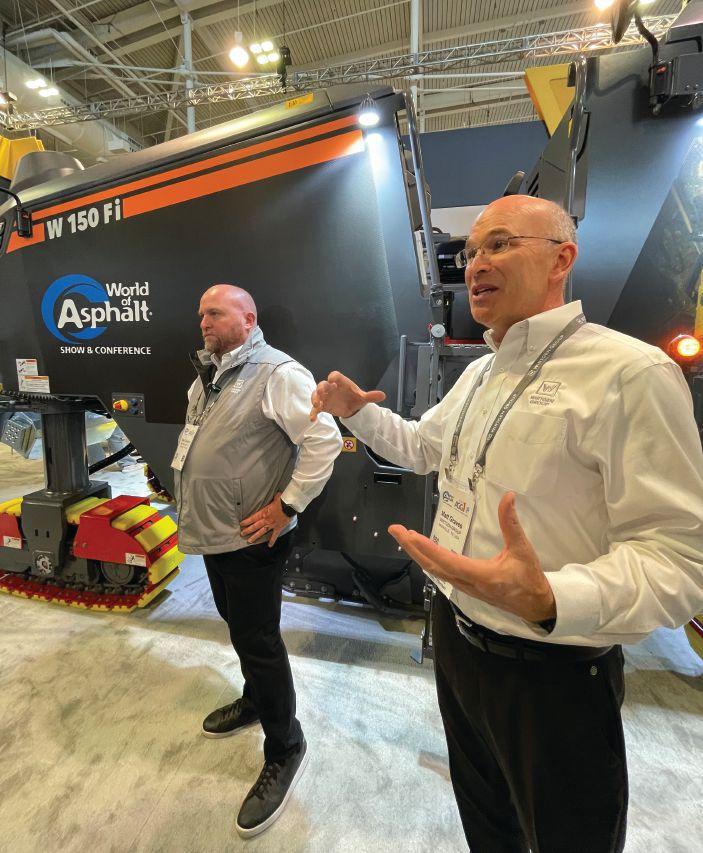
Compact Milling Machine W 150 Fi
Wirtgen states the compact milling machine W 150 Fi provides a higher milling performance with lower fuel consumption.
With a milling width of up to 1.8 metres, the W 150 Fi is designed for use on major construction projects with restricted space, such as inner-city locations.
“This has a 9L, 425 HP John Deere engine. Take that horsepower … and the F-series features, which have already been proven on the large milling machines, the mill assist operating system, all those features and benefits, and now we put it into the compact size machines as well. So we’re bringing everything and kind of downsizing it a little bit for what we’re doing,“ explains Tom Chastain, milling product manager with Wirtgen Group.
A key benefit of the W 150 Fi is the Mill Assist machine control system, which allows the operator, particularly less experienced operators, to get sustainable and efficient machine operations with high productivity. The machine will do much of the heavy lifting, he says.
“[We can] tell the machine, ‘hey, this is the drum we have, these are the teeth we’re running,’ Chastain explains. "The machine will do the rest of it for you. So, we take that guesswork out of the operation.”
As well, the basic and variable versions Multiple Cutting System (or MCS) allow the use of different milling drums with working widths from 0.6 metres to a maximum of 1.8 metres for greater flexibility and higher machine utilization rates.
“What we can also do with this machine is drop that entire five-foot housing, we can actually put a six-foot cutter underneath this machine, which turns the 150 Fi into the most compact, versatile, halflane milling machine on the market today, which no one else can do. We can turn this machine into a Swiss Army knife,” Chastain says.
Chastain notes the W 150 Fi also has Wirtgen’s Performance Tracker system, which uses a laser scanner to measure what is to be milled. Surface milling performance and milling volume are measured using GPS positioning and other sensors. This results in a more accurate calculation of the work completed on the project.
“At the end of the day, we can close out that job, what we get –– square yards, cube yards, square feet, fuel, water, cutting tool consumption –– we can even see how many tonnes we loaded into the trucks we loaded
that day. We see idle time, wash down, all that valuable job data that we need.”
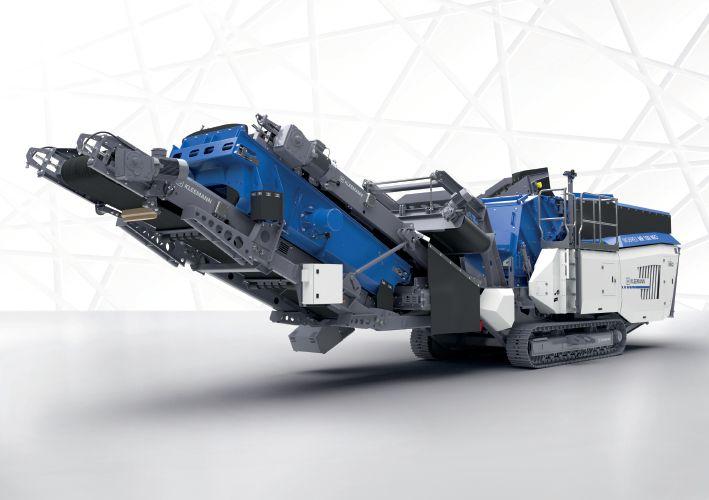
MOBIREX MR 100 NEO impact crusher Kleemann used this year’s show to announce it is bringing the MOBIREX MR 100i NEO mobile impact crusher to the North American market.
The NEO is the baby brother of the MR 110i EVO2. It has a crusher inlet of 40 inches by 30 inches, and a feed capacity of up to 276 US t/hr.
Kleemann notes because of its low transport weight, the NEO is a flexible machine that can operate in tight spaces on work sites and easily move to new locations. As well, the NEO can be used for different recycling applications, such as the processing of concrete, rubble and asphalt, to the processing of soft to mediumhard natural stone.
“[The NEO] comes in two drives: a
D-drive or an E-drive. D-drive is the diesel drive, the E-drive is the electric drive,” explains Matt Graves, director of marketing with Wirtgen Group.
“Because the diesel engine drives generators that drive all the systems, we can also typically put most of our crushers up to line power. So, almost everything in our crushing lineup can be set up where diesel generator gets shut off, we hook the generator to line power and then you’re off and running completely CO2 free.”
The NEO is currently available in Europe but will soon be for sale in North America.
Graves notes that much of Wirtgen’s equipment is developed in consultation with those working in the field.
“We go directly to the contractors as they’re working, bring our engineers in from Germany, bring our R&D people in from Germany, and have that conversation about how we can help you become more
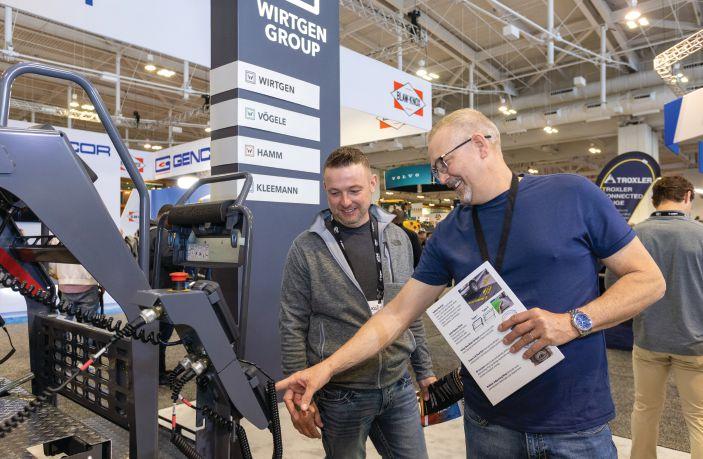
Wirtgen Group’s Matt Graves (foreground) and Tom Chastain discuss the Compact Milling Machine W 150 Fi. Photo: Mike Lacey
effective, more efficient, more sustainable. Smart, safe and sustainable. You’re hearing that a lot lately. That is something that has been core to our philosophy as a company for a long time.”
ASTEC INDUSTRIES
Astec Industries's booth highlighted some of the latest technology the company has coming to the market.
Vari-Frequency Screen Technology
Astec boasts that its new Vari-Frequency technology will eliminate screen cloth blinding.
According to Astec, the design uses supportive cables that prevent plugging and blinding, which will increase capacity, and decrease maintenance and cleaning costs.
“Anyone out there that has ever run a screen box of any type (and there are multiple types of screens out in the industry that have experienced the issue of blinding at some stage), this technology that we have on the lower deck helps reduce that blinding and eliminate it in most cases,” explains Stephen White, aggregate processing expert with Astec Industries.
Astec states the key highlights of the new technology are:
• Functionality is achieved through a deck that generates multiple vibrations throughout the length of the screen.
• Self-cleaning technology eliminates need to for manual cleaning.
• Does not require an external power source.
• Screen has common interface points with other low-profile screens for easy replacement.
The technology is expected to be available on the market later this year.
IntelliPac Moisture System
One of Astec’s more popular pieces of new technology at this year’s show was the IntelliPac Moisture System. Astec believes the system will revolutionize asphalt production as it offers an unparalleled look at aggregate moisture levels.
Advanced features also provide operators with real-time data and insights, which the company explains allow for precise adjustments that can result in significant cost savings.
“This is a fully integrated system to monitor your moisture control. This unit is doing it in real time. It also has a health
diagnostic to make sure that its running at the performance it needs to be,” explains Astec’s Aaron Schoolfield.
“It’s going to have control authority on your plant … So, when it sees the moisture change in value it will adjust accordingly.”
Those real-time moisture values provided by the system enable operators to make on-the-fly adjustments. Astec notes this level of visibility into aggregate moisture levels allows for a more precise addition of liquid asphalt cement to ensure optimal asphalt mix consistency. As well, operators can fine-tune burner operations based on real-time moisture values. This will improve energy efficiency and reduce costs.
The system also has comprehensive data logging so virgin aggregate moisture levels can be tracked and analyzed for historical trends.
The technology generated quite a bit of interest from those who attend the show.
“[There is] a long list of leads from first five hours of launch. The first few hours it’s been very popular,” says Schoolfield.
Operator Environmental Awareness System
Astec’s latest software will improve safety features during the operation of heavy equipment.
The Operator Environmental Awareness System software will stitch together different camera angles to provide machine operators with a 360-degree view of what is around their equipment. However, it also does much more.
“It will segment between if you’re looking at an obstacle or a person,” explains Astec’s Tim Lenger. “So, with that 360 view and being able to decide what’s a human and what’s not, it will allow the machine to back up to obstacles a little closer than it can now.”
Astec plans on having the technology on the market in the fourth quarter of 2024.
SmartEdge Joint Detection
Astec’s new laser technology was developed for the F-series Roadtec Pavers. SmartEdge will provide a precise 3D model of a concrete or asphalt vertical edge. This will allow for precision joint matching during paving, and ensure improved longitudinal joints and correct overlap.
HAVER & BOEKER NIAGARA
Haver & Boecker Niagara showcased its Rhino Hyde liners at this year’s show.
Haver & Boecker Niagara is a leading
manufacturer of screening, pelletizing and mineral processing plants and systems for the mining, aggregate and industrial mineral industries.
For use in quarries, Rhino Hyde liners can be employed in screening, material handling and hauling.
Rhino Hyde liners are constructed from thermoset polyurethane. The company states the liners boast superior abrasion resistance, durability and chemical resistance compared to alternatives like thermoplastic polyurethane, rubber or metal.
The liners are customized to the required size and tailored to suit each customer’s needs. They are available in multiple different styles and attachment systems including the classic Rhino Hyde Blue, magnetic, urethane-backed ceramic, polyurethane blades, belt skirting and weldable liners.
MASABA
Masaba showed off the latest version of its Magnum telescoping conveyor at this year’s show, with the new patented GEN2 track drive integrated into the machine to create improved engagement between teeth and drives.
The conveyor is available in singleor dual-tracked options, with this new updated track drive shipping standard on all units. The conveyor is configurable in multiple different axle drive systems, including folding axle, swing axle with hydrashift and swing axle with chain and sprocket drive.
Conveyors range between 100 and 195 feet, with custom-engineered options also available through Masaba.
The Magnum’s track drive also eliminates cable maintenance and the resulting issues with winch systems, including breakage and uncontrolled rollback. Further resilience is added through a load roller system designed for equal load distribution across all support rollers, minimizing stress on critical components.
Operators have access to the machine through Masaba’s programmable logic controller (PLC), which features an oversized colour touchscreen and allows users to select between four customizable programs for stockpile preferences.
METSO
Metso introduced the Nordberg HP350e cone crusher at the event. This is the latest unit in the Nordberg HPe crusher series. The Nordberg HP350e offers enhanced
performance, easier and safer maintenance, and a series of other improvements.
The first crusher in the HPe series, the Nordberg HP200e, was launched last year. Nordberg HPe series crushers will be also available as US compliant Nordplant Pre-designed Crushing Modules. These modules provide an all-in-one delivery with quick assembly for replacing crushing stations or in new quarries.
Metso also unveiled the first HPe series crusher on tracks for improved mobility. The Lokotrack LT200HPX is equipped with a Nordberg HP200e cone crusher and a two-deck pre-screen with up to 40 per cent higher capacity than the LT200HP.
Other Metso products introduced at AGG1 include:
• Several new wear part products, including new chamber solutions for the Nordberg HP Series cone crushers and Nordberg C Series jaw crushers.
• The Metso Metrics cloud-based telematics system, which provides 24-hours-a-day seven-days-a-week access to critical machine data from web-enabled devices. A new feature is Metrics Production Tracker, an optional add-on that provides mass flow information on the Lokotrack conveyor.
• Metso’s new TSE series screen is a highperformance horizontal screen used in a wide range of wet or dry applications in coarse or fine screening. The TSE screens can handle feed sizes up to 10 inches
and openings up to three inches. TSE’s design enables high energy elliptical motion up to 6G.
BRIDGESTONE AMERICAS
Bridgestone Americas used the event to debut its new V-Steel Z Traction construction tire, the company’s latest 25-inch product for loader and grader applications. The company states the new VZT’s advanced tread compounds were engineered to help improve heat, cut and tear. Compared to previous tires, the VZT is expected to increase total tire life by up to 15 per cent. The tire also has a new tread pattern design with nine per cent improved traction, with low-angle centre block and self-cleaning wide shoulder groovers for wet, muddy surfaces and challenging terrain.
The VZT is available in five sizes: 17.5R25, 20.5R25, 23.5R25, 26.5R25 and 29.5R25.
BOMAG
BOMAG unveiled its latest updates to its CR series pavers, including the introduction of the BOMAG CR 1030 T rubber track paver. It also featured two electric machines from BOMAG’s e-PERFORMANCE offering.
Next year’s World of Asphalt and AGG1 takes place in St. Louis, Missouri, from March 25 to 27.
With files from Jack
Burton
The MOBIREX MR 100 NEO impact crusher. Photo: Kleemann
The top trends and topics from 2024's World of Asphalt/AGG1 Academy & Expo INDUSTRY INSIGHTS
BY JACK BURTON
> 1. DRIVING FORWARD WITH DATA
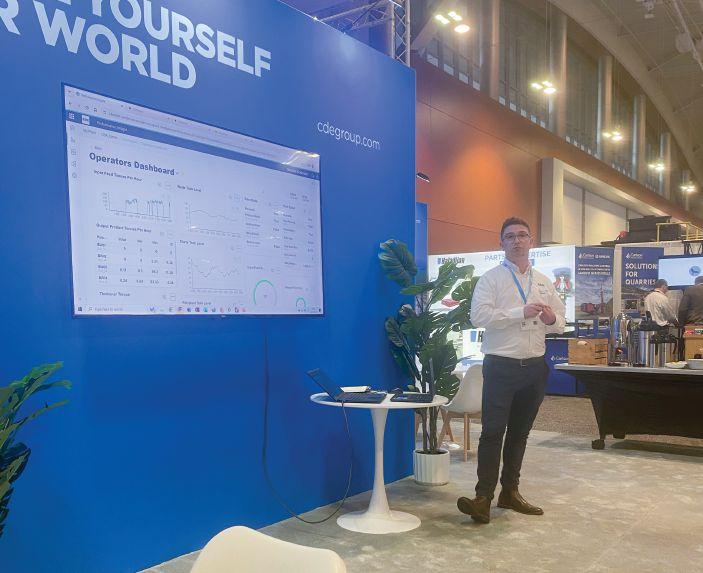
Nestled between the massive displays of equipment across the trade show floor were dozens of booths from providers tackling digitization across all aspects of the aggregate supply chain, from plant operations to on-site management. CDE was one major producer stepping into the software ring, with the processing plant giant spotlighting its new SmartTech software solution.
SmartTech is CDE’s new plant management app, designed to provide operators with precise, actionable data regarding performance and maintenance scheduling to increase productivity, efficiency and uptime. Sensors across the plant continuously monitor and track performance data on a range of variables, including material tonnage and flow rates, uptime and resource usage, to provide accessible health metrics from anywhere in the world. CDE’s process engineers then analyze data for any trends that suggest proactive maintenance or areas for optimization.
This technology also provides operators with greater control over maintenance and upkeep, with features allowing for the creation of checklists, repair and issue logs, photograph sharing and report generation. All of this data serves to support a maintenance process that’s carried out in the right way and at the right time, the company shared.
In addition to notifying managers when replacement parts are required, the SmartTech app also provides a platform for ordering these parts, though this feature is more than a vending tool: through a 3D plant rendering, users can see their facili-
CDE’s customer relationship manager, Andrew Bunting, offered a walk-through of the company’s new SmartTech plant management software.
ties and equipment mapped out part-bypart and order accordingly, whether that be a new motor or a replacement bolt.
Among the many emerging aggregates and construction software companies featured at World of Asphalt/AGG1 was CrewTracks. Launched in 2016, the CrewTracks platform features materials and production tracking for monitoring operational efficiency, and scheduling and daily reporting options for managing onsite workforces.
Casey Black, sales manager for CrewTracks, believes that this transforma-
tional wave of data-driven operations and solutions is only beginning its crest across the construction industry.
“The biggest thing to me is that everything is becoming more connected […] More historical information gives us a way to look back and find out what we did and didn’t do well, and how to increase optimization with each project,” he said. “More and more data is at the fingertips of companies, and we’re seeing that technology come closer to the forefront of the construction industry to help everyone be more efficient.”
2. AUTOMATING OPERATOR EXPERIENCE
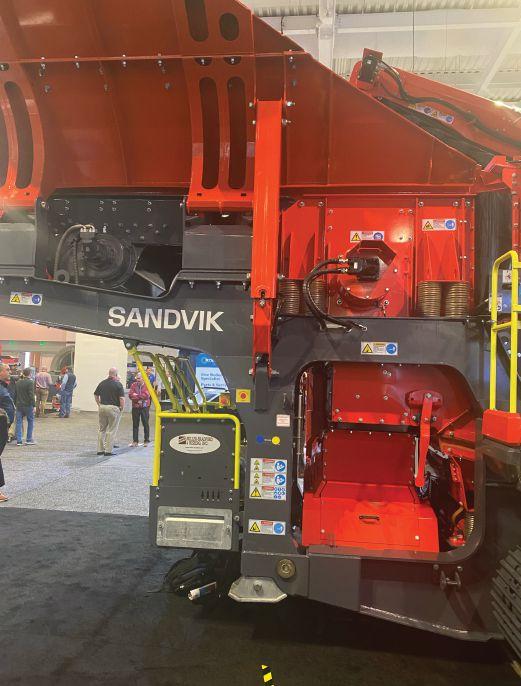
Sandvik had its QI353 tracked impact crusher on display, and while the machine hit the market in 2021, it features technology and design choices that Sandvik shared are a sign of what’s to come across the company’s future products.
The tracked impact crusher is designed to place choice at the centre of the operator experience, with all major functions and service points brought down to the operator level and high-pressure filters brought down to the grade level. However, central to this focus on operational choice is the debut of the Optik intuitive user experience automation system.
“It's the first time we've actually done this – for this machine, we stripped it all down and started from the ground up with a totally new system,” said Patrick Forrest, research and development director at Sandvik. “Really, I guess in simple terms, it just improved the user interface and the user experience on how to navigate your way through the system by bringing a lot more features and data down to the down to the panel.”
This automation system includes features such as a varying temperature system on the impactors and Sandvik’s telematics system, MyFleet, bundled standard on all shipped units. This streamlined ability to track and control performance is set to inform the company’s design philosophy moving forward, shared Forrest.
“It's basically giving the operator readout, but you can control everything from the panel, and then all of that data is kind of sent back over the over the web as well,” Forrest said. “Again, it’s a fully ground-up development for us, and it starts with the QI353.”
Already, these features and unified user interface system have been included across other models in Sandvik’s new Gen-3 series, along with their fully-electric and larger-sized UJ443 model. Automation has also found its way into the user experience design of the company’s cone crushers, with Sandvik’s 800i series featuring the ACS-c 5 automation and connectivity system.
3. THE CHANGING SAFETY MINDSET
Safety is always a key topic of concern across aggregate operations, but the picture of safety put forth by both exhibitors and presenters was one of an issue undergoing a continued evolution.
Victor E. Jayne, an industrial and safety specialist at Motion, spoke of the shifting priorities he has noticed over his 18 years with the company, and the new procedures and protocols that have risen in priority as the sector’s relationship to safety continues to shift.
“Safety has grown leaps and bounds in the last 10 years because everybody’s become more aware of it. Slip, trip and fall will always be the number one safety issue, but two things that have moved up the category list would be arc flash and lockouttagout,” Jayne said.
With this shift, Motion has acted accordingly, offering customers not only a range of safety products and lockout-tagout devices, but also refining their procedures to ensure workforces are protected, no matter the changes that need to be accommodated.
“At Motion, we offer all kinds of solutions where we partner with [companies] like Brady or Accuform, where we can go in and help write lockout-tagout procedures,” he said. “Our goal is, everybody who goes to work that day, we want to get them home safe in the evening.”
Part of these changes come from an overall shift in safety culture and hazard management mindsets.
In their presentation titled “Company Culture is the Foundation of Your Safety Culture,” Katie Woodhall, director of safety at Beaver Excavating and Ami Gignac, director of operations at GLC Minerals, shared the benefits of joining the trending shift away from a condition-based safety mindset and toward a behaviourbased perspective.
According to the presentation, 85 per cent of workplace accidents are a result of a person’s behaviour, with only 12 per cent being based on conditions. To align with this reality, a move toward prioritizing your workplace’s relationship and actions as related to safety, rather than just ensuring a compliant environment, is necessary.
“If you think about this shift, we lived in condition-based safety world forever,” said Woodhall. “When we started doing root cause analysis, what we found is that when you drill into it, it’s not an accident, it’s a human. The biggest shift that you will see when shifting your safety culture is to really talk about the human element of it.”
Recentering your organization’s safety philosophy around the humans that comprise your workplace rather than the environment create a shift toward preparedness and prevention, rather than reacting after these incidents have occurred.
“These condition-based safety programs, they’re going to be more focused on compliance, with all of your training based on regulations. But with that, you’re treating the symptom rather than the cause – it’s reactive.” Gignac said.
“Condition based is reactive, its after the fact, whereas behaviour based is proactive and about preventing these incidents,” Woodhall added.
Sandvik showcased their QI353 tracked impact crusher, with the design featuring a number of automation and operator experience features set to inform their future products.
association news
Dufferin Construction Company named Ontario Asphalt Paver of the Year
and Concrete Contract of the Year
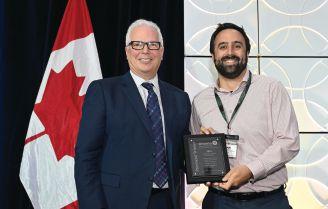
Dufferin Construction Company is the Ontario Ministry of Transportation’s Asphalt Paver of the Year and Concrete Contract of the Year.
The announcement was made during the 97th annual Ontario Road Builders’ Association convention and annual general meeting on Feb. 4 to 6 in Toronto. Dufferin Construction Company won Asphalt Paver of the Year for its 400-metre work on Highway 7 in Omemee, east of Slanted Road to the west limit of the hamlet.
Dufferin Construction was also named
Photo: Ministry of Transportation
Concrete Contract of the Year for its work on Highway 400, from south of Dunlop Street to north of St. Vincent Street in Barrie.
OSSGA recognizes Ontario’s finest
The Ontario Sand, Stone and Gravel Association (OSSGA) held its annual conference and AGM from Feb. 20 to 22 in Toronto. During the conference, the association recognized companies for outstanding work in a variety of areas.
Environmental Achievement
The Environmental Achievement Award recognizes OSSGA members that have developed and successfully implemented industry-leading policies, programs, projects or partnerships that make positive contributions to the environment.
GIP Properties Corp.: Godfrey Pit (County of Frontenac)
GIP Properties Corp. won this year’s award for the partnership between its Godfrey Pit and Queen’s University. The pit is leasing a portion of its site to the university’s Faculty of Engineering and Applied Science for $1 a year. The university is conducting research on geosynthetic liners used for waste containment. The Queen’s Environmental Liner Test Site (QUELTS) project will assess the liners’ ability to contain contamination in a real-world scenario where it is contending with environmental elements and tectonic activity.
OSSGA SAFETY AWARD
The Safety Innovation Award was also handed out at OSSGA's convention. The award honours innovations that improve the health and safety of employees, subcontractors and the public.
The annual awards are judged on the following criteria: quality of the materials supplied, workmanship, visual appearance of the finished work, and innovations used.
The following finalists for each award were also announced.
Asphalt Paver of the Year:
• J & P Leveque Bros.
• Pioneer Construction
• Thomas Cavanagh Construction Limited Concrete Contract of the Year Finalist:
• GIP Inc
New member of ORBA's board of directors
Lisa Laronde, president of RSG International, was named to Ontario Road Builders' Association's board of directors at the convention.
RSG International is a leader in road and infrastructure safety, with Laronde being the first woman to lead the organization. She also currently presides over the Canadian Association of Women in Construction (CAWIC) and has recently been recognized among Canada’s Top 100 Most Powerful Women.
Laronde expressed excitement at joining ORBA’s board of directors, and the responsibility that comes with currently being the only woman on the board.
“I believe this is an indication that the industry is changing,” said Laronde. “Although I might be the only woman on the board today, we must start somewhere. I have a voice, and I will use it. I think this is the beginning of something extraordinary.”
ORBA is also looking forward to the skills and perspective that Laronde is set to bring to their organization’s path forward.
“Lisa’s versatile skillset and experience will support the Association in implementing its strategic plan and advancing its members’ interests,” said said Walid Abou-Hamde, ORBA CEO.
CRH Canada Group Inc. Dufferin Aggregates, Acton Quarry
Dufferin Aggregates’ Acton Quarry commissioned a new portable plant in 2023. As part of the design, there were hydraulic cylinders that allowed employees to easily raise and lower the screens, providing easy access for maintenance. However, there was no way to
ensure the safety of the employee should there be a failure of the hydraulic system.
To improve safety, employees designed a blocking system that holds the screen in place, ensuring that a failure of the hydraulics would not result in movement of the screen deck.
Project team members were Carson Gandy, Darwin Rosales and Brett Yake.
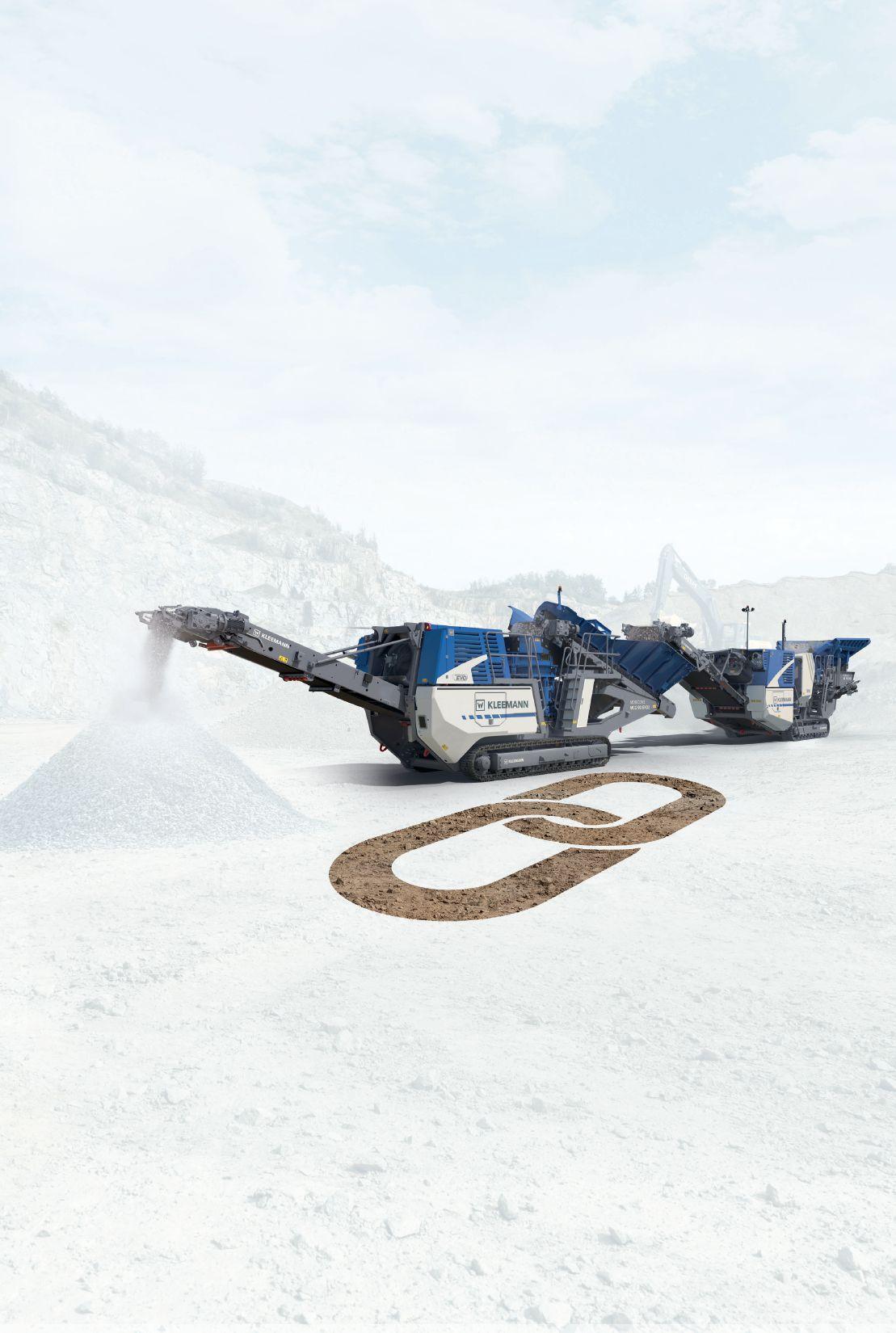
THE MOBICAT MC 1 10 EVO2 AND MOBICONE MCO 90 EVO2
TEAM PLAYERS THAT WORK TOGETHER INTELLIGENTLY AND STRENGTHEN EACH OTHER. In linked plant combinations, the MOBICAT MC 110 EVO2 jaw crusher and the MOBICONE MCO 90 EVO2 cone crusher really flex their muscles. SPECTIVE makes both plants easy and intuitive to operate. Also, an advanced drive concept ensures greater efficiency with lower consumption. Maximum throughput is achieved thanks to the material flow concept coordinated via line coupling across both crushing stages. Go for the perfect team!
www.wirtgen-group.com/evo2-line-kleemann
MC 110 EVO2
MCO 90 EVO2
BY JACK burton
FROM TREE TRUNKS TO TURNPIKES
A forestry by-product shows promise for asphalt
emissions becoming pulp fiction
> Preparing for Canada’s goal to reduce carbon emissions to net zero by 2050 requires key operational decisions from across the country’s many industries. Unique among them is roadbuilding, where asphalt provides both the backbone of the sector’s muchneeded infrastructure deliverables and an obstacle to curbing overall emission outputs.
A 2019 report from Natural Resources Canada found roughly 10 per cent of Canada’s current greenhouse gas emissions come from the extraction and upgrading of crude bitumen from oilsands, working out to roughly 70 million tonnes per year. Environment and Climate Change Canada reported that the asphalt industry in Canada emitted approximately 1.5 million tonnes of CO2-equivalent greenhouse gases in 2019.
A possible solution to asphalt’s emission impacts comes from Canada’s forestry sector, where one company has developed a potential tool in helping the roadbuilding industry meet these goals while continuing to build roads that stand the tests of time and traffic.
NO NEED TO KNOCK ON WOOD
Over the last five years, FPInnovations has harnessed, tested and proven the power of lignin, a by-product of pulp and paper processes, as not only a resilient and sustainable binding supplement in asphalt mixes, but a potential tool in paving Canada’s greener road forward.
Lignin, alongside cellulose and hemicellulose, is one of three components of wood; often removed alongside hemicellulose during the process of freeing cellulose fibres in the production of paper or tissue. Through this chemical separation method, known as the kraft process, a substance known as ‘black liquor’ is produced, with approximately seven tonnes of this substance removed for every tonne of pulp produced.
While the residual lignin components of black liquor are often burned by plants to cyclically power their operations, FPInnovations sought to further explore its applications. By using its patented LignoForce process, the company looked to further extract this material and fully harness its binding capabilities –and markedly lower emission rates – as a sustainable supplement to asphalt mixes.
“We did the lifecycle analysis, and the preliminary case study showed that lignin emits less GHG emissions than bitumen,” said Natacha Mongeau, a manager of business development at FPInnovations. “Specifically, about a 30 per cent reduction can be expected when lignin is added to the asphalt mix.”
FPInnovations tested lignin’s potential impact on asphalt mixes by creating two solutions. A dry mix was created by dispersing
the lignin throughout the asphalt mixture before adding the bitumen, while a wet mix was created by blending the lignin, bitumen and asphalt simultaneously.
The dry mix solution was tested on Laval University’s accelerated pavement testing unit, which subjected the hypothetical road to the equivalent of three years’ worth of heavy traffic. Conclusions from these trials showed both the performance and rutting reduction to be at least equivalent to traditional, wholly bitumenbased asphalt mixtures.
GROWTH MINDSET
This commitment to leveraging the tools of the forestry industry into sustainable solutions for a range of economic sectors has been a key focus of the last 20 years of FPInnovations’ centuryplus long existence, Mongeau said.
With more than 300 employees and a membership of more than 90 stakeholders from across the forestry sector, FPInnovations’ approach to its projects is informed by the goal of creating change, and in turn competitiveness, that extends well beyond the forestry sector and into the economy at large.
“In general, who we are and our ways of building our projects lies in making sure that we respond to the needs of our member companies and overall economic trends,” said Mongeau. “We see how it would help other industries to reduce their carbon footprint by switching from fossil-based materials to bio-sourced ones.”
FPInnovations’ lignin-asphalt blend exemplifies this overall
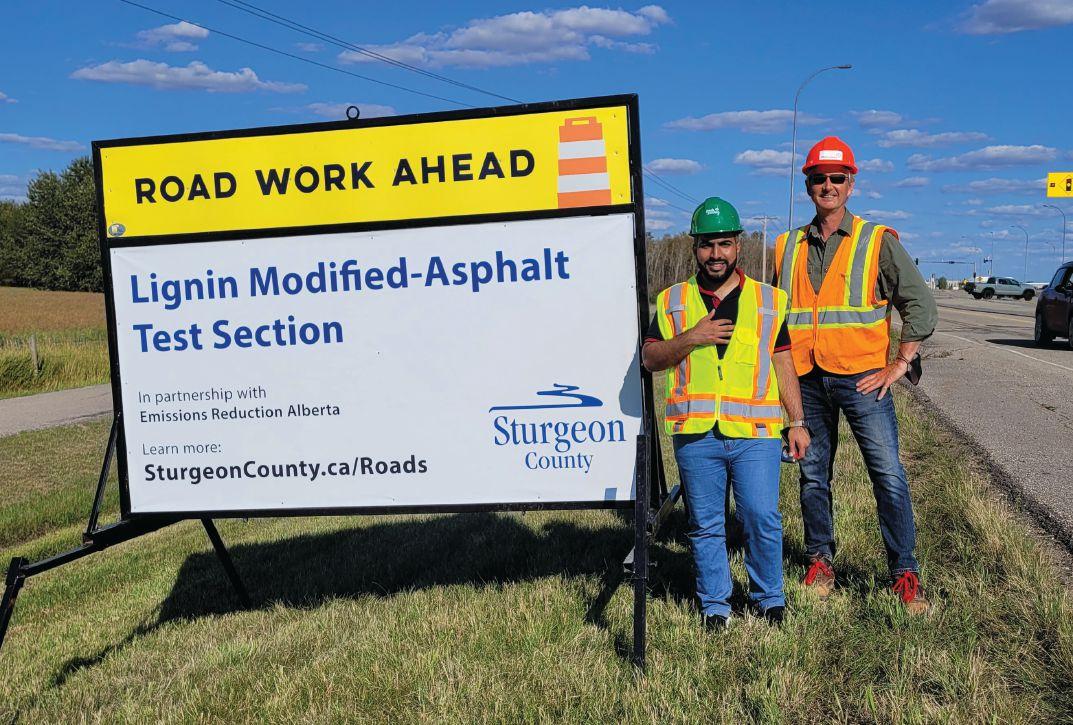
Municipalities from across Canada showed interest in FPInnovations’ lignin-supplemented asphalt solution, including Sturgeon County, Alta. (pictured), Edmonton and Victoria. Photo: FPInnovations
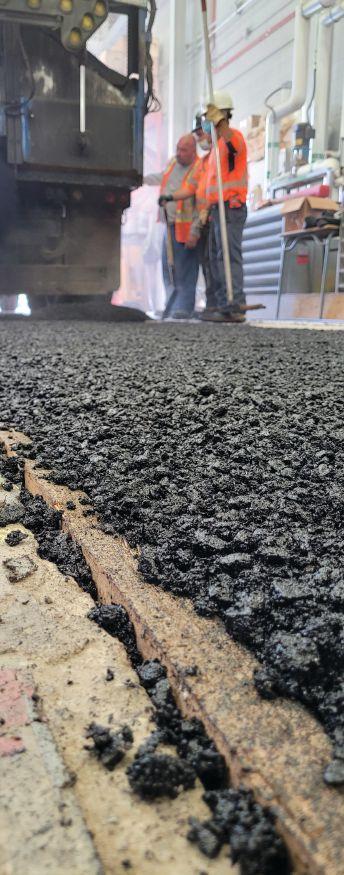
Testing on Laval University’s accelerated pavement testing unit subjected the hypothetical road to the equivalent of three years’ worth of heavy traffic, showing lignin-supplemented asphalt to perform equivalently with traditional mixtures.
organizational philosophy; looking beyond surface-level greenwashing practices and toward the need for a sustainable approach to building the transportation infrastructure critical to not only Canada, but the forestry supply chain that keeps FPInnovations’ sector moving forward.
“We've been involved in the vehicle infrastructure interface for a long time […] we're always evaluating the potential impact of new configurations on the design and performance of resource roads,” said Mongeau. “And now, if we look more particularly at the construction and materials of the roads themselves, bitumen is the one material that has the highest impact
on the carbon footprint of roadbuilding.”
Projects across Europe beginning to explore the impacts of lignin-supplemented asphalt mixes caught the attention of FPInnovations, who saw both the potential of the material in roadbuilding applications and, more importantly, the sizeable demand for the lower-emission solutions that it could bring to Canada’s growing transportation construction sector.
“If you look at the challenges for our industry to invest in lignin production, you need to ensure that you're going to have a large market where we could we see a high demand for large quantities of lignin,” said Mongeau. “We evaluated this project as
having pretty good potential, that would probably trigger enough demand for our industry to invest in the production.”
IN THE FIELD
Once FPInnovations had secured initial results illustrating the impact of lignin’s asphalt applications, the project attracted the attention of numerous trusted groups and stakeholders across Canada’s industries and governments, who helped move the project forward by testing the mix across the country’s road network.
While the European trials had confirmed the viability of lignin-supplemented asphalt, the main question that FPIn-
Despite its promise, “there is currently no lignin being produced in Canada,” according to Mongeau, though “creating demand for lignin could bring production back.”
Photos: FPInnovations
novations sought to answer was whether the roads it made with this mixture could sufficiently stand up to Canada’s more volatile weather patterns.
Initial lab work was performed in collaboration with École de Technologie Supérieure (ÉTS), with preliminary field testing occurring at Université Laval’s Chair i3C.
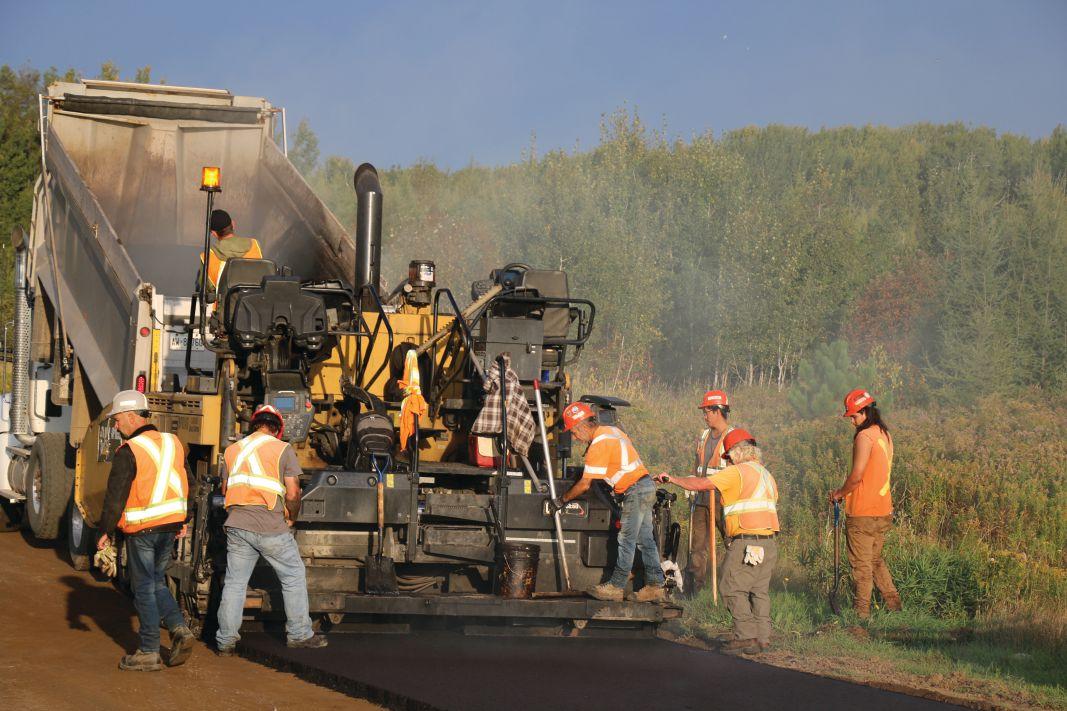
Once its utility was proven, the ligninsupplemented asphalt was used on-site by several asphalt paving companies across the country in their own roadbuilding projects, with participating contractors including Park Paving, Pioneer Construction, Eurovia and Quesnel Paving.
“They were the ones really trying to help us understand, ‘is this material workable in the road industry, and what is the level of substitution that can be managed?’” Mongeau shared.
Through this, the FPInnovations team were able to gather some direct feedback from these companies and their in-field workers, in addition to receiving on-site data measuring exactly how this material behaves in real-life applications.
The project also garnered interest across municipalities wanting to investigate the potential of greener paving solutions, including the City of Victoria, Sturgeon County, Alta. and Edmonton, who all either used this material across city works or offered feedback to FPInnovations on how this mix aligns with their own paving performance requirements.
To gauge the interest and appetite for
this solution industry-wide, one need look no further than the strong funding received from associations and government bodies across the country.
A range of sources contributed funding to this project, including Natural Resource Canada; B.C.’s Ministry of Forests, Lands, Natural Resource Operations and Rural Development; Ontario’s Centre for Research and Innovation in the BioEconomy; Nextfor; Quebec's Ministry of Forests, Wildlife and Parks; and Emissions Reductions Alberta.
“It was great to see a real collaboration across the industry, because they were all interested in seeing something new coming their way,” said Mongeau. “It was great to see a lot of openness to new ideas and innovation.”
From the trials to in-field testing, including examinations of wear and tear on stretches of road paved with this mixture in Quebec City and Thunder Bay, results were consistent in showing lignin-supplemented asphalt to be at least equivalent in performance to bitumen-only blends, with results even suggesting slight improvements in higher-temperature conditions.
INVESTING IN THE FUTURE
While FPInnovations found success in proving lignin’s capabilities as a sustainable asphalt supplement, issues on the supply chain side of lignin production in Canada have put things on hold when it comes to turning their findings into a
widely-accessible material solution.
“Unfortunately, there is currently no lignin being produced in Canada,” said Mongeau. “That's the biggest challenge that I would say exists at this moment, but creating demand for lignin could bring production back.”
Despite this, Mongeau hopes that the results of this project will motivate stakeholders from across both the forestry and roadbuilding industries to come together and invest in the future of producing this substance – and the solutions it brings –across the country.
“What’s needed now is a positive economic link between these two industries, to come together to support and invest in Canadian lignin production,” Mogeau said. “This is where we need to focus on when it comes to the next steps of making this happen, and making this available for the industry.”
Even with these challenges on the supply side, FPInnovations’ commitment to transforming resources from the forestry sector’s toolbox into solutions for other markets still shines through, with the company continuing to explore lignin’s role across various applications and sectors.
“The challenge with bioproducts is to get benefits and economics working together,” Mongeau shared. “Even when a new solution has been tested and we can demonstrate that it does have the right impact – it needs to be made available at the right price to make it appealing for the industry.”
Sudbury-based Pioneer Construction used FPInnovations’ lignin-modified asphalt in mixtures ranging from 10 to 20 per cent for paving projects across Quebec and British Columbia. Photo: FPInnovations
BY
Right sizing your truck fleet
Three different mid-size pickup trucks to consider for your fleet
Commercial work pickup trucks are the lifeblood of many industries. While many opt to get a full-size pickup truck, either as a 1500 or heavy dusty (2500 and above), for many, these trucks are either too big, too expensive, or not what they need. That is where mid-size pickups come in. While on the way out of favour a few years ago, they are now back with many new models on the market. We reached out to various OEMs to drive what they have available. What we have are three mid-size trucks that each come to the dance in a different set of clothes. The Ford Maverick is the smallest of the three trucks, and the only one which is a unibody. The Nissan Frontier is the most truck-like of the three and is a body-on-frame. The final truck is the GMC Canyon, and it is the one which is a body-on-frame but drives like a unibody.
FORD MAVERICK
While most of the pick-up truck attention and sales for Ford are the F-Series (F-150 and Super Duty), Ford does offer two pickup trucks that are in the smaller range. First is the long-running mid-sized Ranger, and second is the smaller Maverick. Both trucks are fit for purpose, as many companies do not need a full-size pickup truck to do the needed job, and these two are more of a right size option.
Having recently driven the smaller Maverick XLT with Tremor Off-Road Package, let's focus on that. The Maverick feels more like driving a SUV than a large pickup truck. This can be attributed to the fact it is a unibody, and not a body-on-frame (like larger trucks). For those who prefer a more refined drive, this truck delivers that.
For 2024 the biggest change is the standard engine now being the 2.0-litre
The Ford Maverick feels more like driving a SUV than a large pickup truck. This can be attributed to the fact it is a unibody, and not a body-on-frame like larger trucks.
Photo: Mario Cywinski
EcoBoost mated to an eight-speed automatic transmission, with the 2.5L hybrid mated to a CVT being the optional engine, and only available on front-wheel drive models. Basically, Ford has flipped things with which is standard, and which is optional.
The standard inline-four turbocharged engine offers 250 horsepower and 277 pound/feet of torque, while the inlinefour hybrid engine offers 162 hp (191 hp combined with hybrid system), and 155 lb/ft of torque. The hybrid system offers 94 kilowatts of power from its electric motor. While the hybrid is only available in front wheel drive, the turbocharged engine comes standard with all-wheel drive.
As a result of the Maverick’s smaller size, the engine never felt like it was struggling. Having driven both versions of the vehicle at different points in time, both felt responsive, and enough for the vehicle. The EcoBoost is obviously the more powerful option and does a better job while towing or with any payload, however, the hybrid is enough for most fleets.
Capability is one of the main aspects needed in a work truck, namely payload and towing. Looking at payload, both engine options offer 1,500 lbs of capacity (with the models featuring the Tremor OffRoad Package offering 1,200 lbs). Towing capability is 2,000 lbs, with the 4K tow
package on AWD EcoBoost models doubling that to 4,000 lbs.
The second-most important aspect of a pickup truck is the cargo capacity. The Maverick has a cargo volume of 33.3 cubic feet, an exposed cargo width of 53.3 inches, a pickup body length (floor) of 54.4 inches and a lift-in height of 30.1 inches on Hybrid models, or 30.5 inches for EcoBoost and models with the Tremor OffRoad package. Interior passenger volume is 100.3 cu/ft on the Hybrid, 98.3 cu/ft on the EcoBoost AWD or 101.5 cu/ft on models featuring the Tremor Off-Road Package.
Safety is also important, and the Mav-
erick comes with many of Ford’s Co-Pilot 360 technologies. Standard are auto high beams, pre-collision assist with automatic braking, and rearview camera. Optional are adaptive cruise control with stop and go, steering assist, lane centering, reverse sensing system, blind spot monitoring, lane departure warning, lane keeping and hill decent control.
The Lariat with Tremor Off-Road package I drove was equipped with many safety features and it gave the driver an added sense of security. For those workers who spend a lot of time of the road, getting the added safety features is a must,
as it gives both the company and driver more peace of mind.
The Maverick sees other smaller changes for 2024, with package, colour, and elimination of some stand-alone options.
GMC CANYON
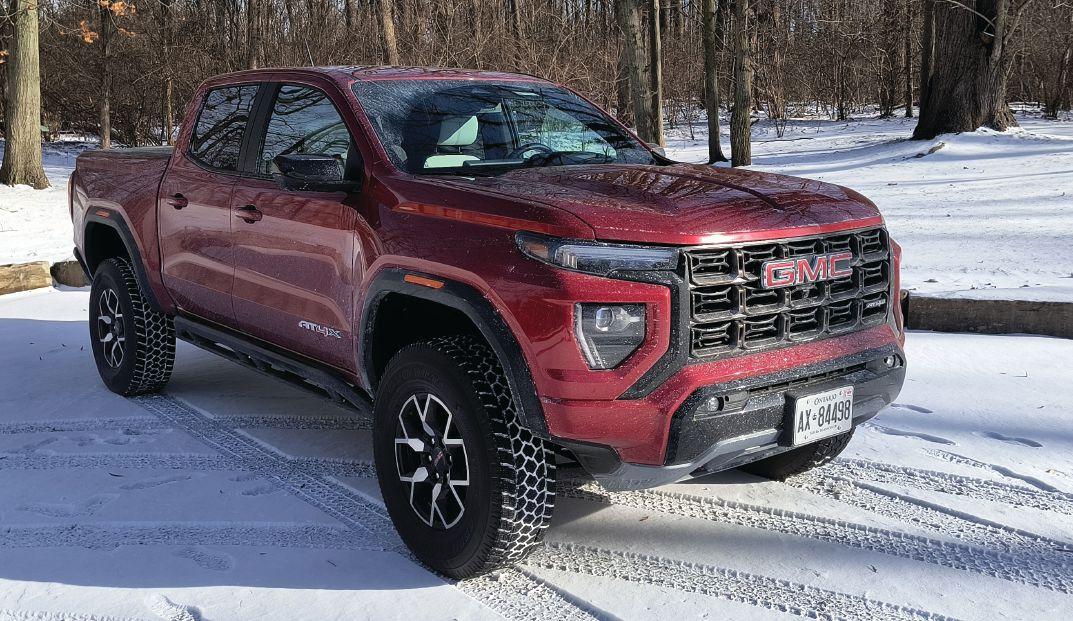
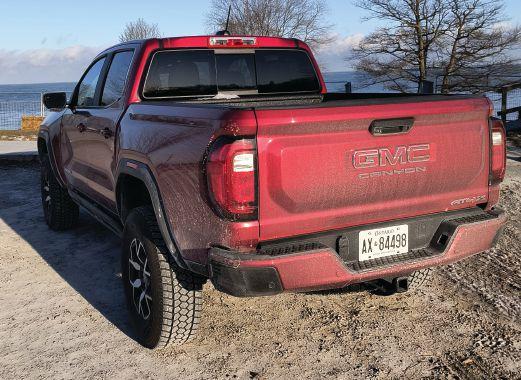
While Ford offers two mid-size/compact trucks that are of different sizes, General Motors does things differently. They have two trucks that are on the same platform, but with different badges and trim structures. The GMC Canyon and Chevrolet Colorado are both similar vehicles, with the GMC being looked at as the more ‘premium’ work truck. Having driven the Canyon AT4X recently, let’s look at it.
Like its larger sibling, the Sierra, the Canyon is a body-on-frame model. While many larger pickups that are body-on-frame can have a rougher ride, the Canyon is a very smooth ride. It is one of the smoothest riding mid-size pickups available. As a result, for a minute I thought that it was an unibody, before double checking to
see that in fact it is a body-on-frame.
The Canyon comes standard with a 2.7L turbocharged inlinefour engine offering 310 hp and 430 lb/ft of torque mated to an eight-speed automatic transmission. The engine comes with active fuel management and stop/start.
Of the three trucks, the Canyon has the best payload capacity, however, this is only for certain trims levels, as the range goes from 1,010 and 1,590 lbs. In terms of towing capacity, the GMC once again comes out on top with certain trims being at 7,700 lbs (other trims come with 6,600 and 5,500 lbs of capacity).
As the Canyon was in AT4X trim, the highest available, this was also the nicest-looking truck of the three. With the most refined interior, and best fit and finish.
The Canyon comes with standard automatic emergency braking, following distance indicator, forward collision alert, lane keeping assist and warning, and buckle to start; while available features include blind spot steering assist, rear cross traffic braking, rear park assist, and rear pedestrian alert.
One thing to keep in mind on the Canyon is that it has no physical headlight button or knob. The headlights are controlled with the centre infotainment screen. Maybe I am old, as I spent a good amount of time trying to find how to turn the lights on.
NISSAN FRONTIER
With the drop of the full-size Titan from the Nissan lineup, the mid-size Frontier is the only truck remaining in the company’s Canadian portfolio.
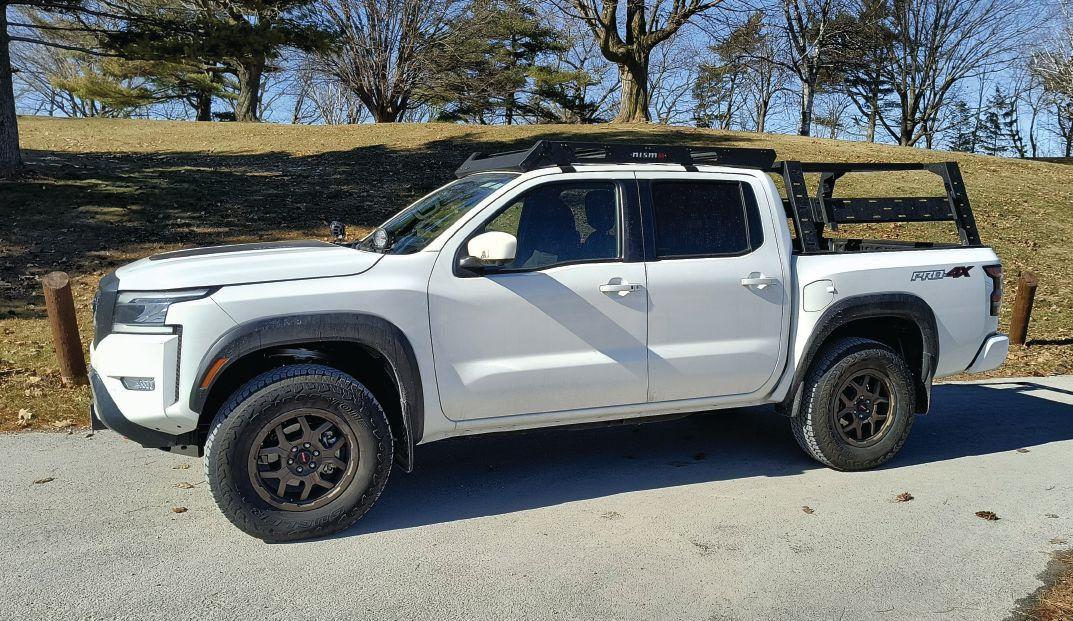
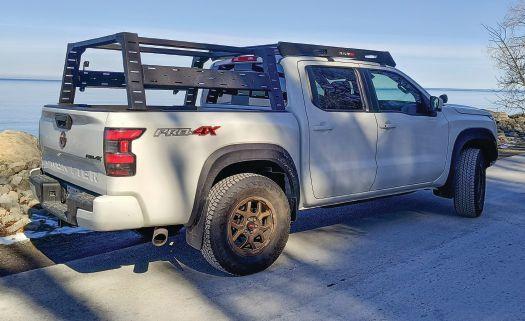
The vehicle that was tested was a Crew Cab Pro-4X with nearly $17,000 worth of Nismo accessories. Now most these were for off-roading, however, some can be used by fleets. They included
While the GMC Canyon and Chevrolet Colorado are both similar vehicles, the Canyon is looked at as the more ‘premium’ work truck.
The Nissan Frontier offers two bed lengths, with cargo bed volume of 40.1 inches (standard bed) or 49.2 inches (long bed with a spray-in bedliner).
roof rack, high overlanding rack, bronze truck wheels, high performance front and rear suspension kit, forged upper control arms, A-pillar light mounts and four-inch round lights, cat-back exhaust, and hood graphic.
Nissan offers a 3.8L V6 DOHC engine in the Frontier, outputting 310 hp and 281 lb/ft of torque mated to a nine-speed automatic transmission. It is the only one of the three with a sixcylinder engine instead of a turbocharged four. While the vehicle was slightly sluggish going up steep hills, that could be attributed to the accessories that were part of the vehicle. Under all other operation, it provided enough power.
Fuel economy is listed at 12.8 to 13.1 L/100km in the city, and 10.2 to 10.5 L/100km on the highway, depending on trim level. Obviously, these numbers will fluctuate depending on the payload, towing, or how many Nismo accessories you have.
As the most truck-like of the three vehicles that were driven, the Frontier also has the harshest ride. However, that is not to say it is not comfortable, it just feels more like a larger truck. It also offers a much larger towing capacity of between 6,170 and 6,220 lbs, depending on trim level.
The Frontier is also the only one of the three trucks to offer two bed lengths, with cargo bed volume of 40.1 inches (standard bed) or 49.2 inches (long bed with a spray-in bedliner). How much payload can you put into the bed? Anywhere between 1,050 and 1,200 lbs, depending on trim level.
Unlike so many other models on the market, the Frontier offers all its safety features as standard equipment. That includes lane departure warning, blind spot monitoring, rear traffic alert and automatic braking, adaptive cruise control and forward collision warning, and a rear sonar system.
OTHER OPTIONS
Many more options are available for those looking at a mid-size pickup truck. Toyota offers the Tacoma, which has been redesigned for 2024; Stellantis offers its Jeep Gladiator, which is based on the Wrangler SUV; Honda offers the unibody Ridgeline, which is more of a recreational truck as is the Hyundai Santa Cruz. What the mid-size truck segment shows is, unlike the larger 1500 level and above trucks, one size does not fit all. These trucks come not only in different sizes, payloads, designs, but most importantly, they come in different fit for purpose. Everything from a pure truck template to a recreational SUV with a bed template. And of course, everything in between.
Which truck is right for you?
ABOUT THE AUTHOR
Mario Cywinski has worked in the automotive industry for nearly 20 years, both as an automotive journalist and working for a local dealership. He is a member of the Automobile Journalist Association of Canada and has been a judge for the Canadian Truck King Challenge.
Photo: Mario Cywinski
DUST AND NOISE: MORE THAN A NUISANCE
BY GRANT cameron
Exposure to construction dust and noise can be deadly, but symptoms often don’t materialize until decades later
> Dust and noise are perpetual perils of the job for anyone in industries such as roadbuilding and aggregates, which encompass working around elements like sand, rock, gravel, stone and concrete.
They aren’t just a nuisance, though. Constant exposure over the years can lead to a myriad of diseases and adverse health effects.
For example, construction dust like silica and wood can accumulate in a worker’s lungs, damage tissue and eventually kill. Breathing dust over a long period can cause life-changing problems and diseases like asthma, cancer, silicosis and chronic obstructive pulmonary disease.
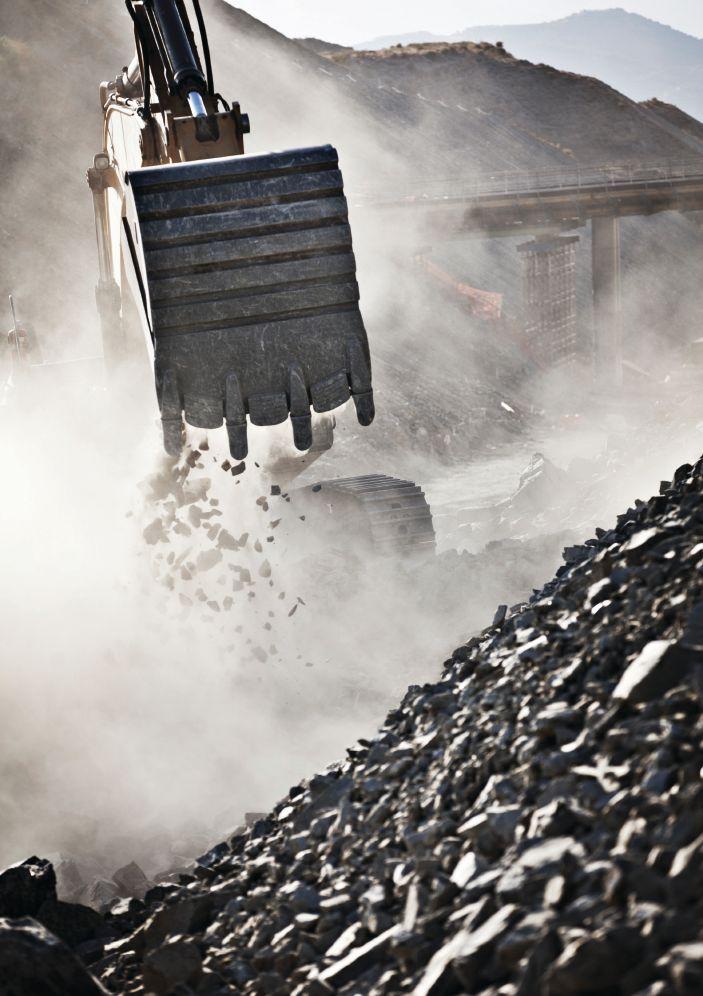
Exposure to harmful levels of construction dust – known as the silent killer – is linked to thousands of construction worker deaths every year. Even tasks that result in brief, multiple exposures to construction dust over a short period of time can cause occupational diseases and ill health.
Exposure to harmful levels of construction dust – known as the silent killer – is linked to thousands of construction worker deaths every year.
Photo: Larry Dallaire / iStock
Excessive noise, on the other hand, can also take a toll over the years. By the time an individual realizes they have a problem, it can be too late as the damage is permanent and can’t be undone. Hearing loss caused by noise is one of the fastestgrowing occupational diseases.
While the impact of traumatic injuries like falls or electrical contacts are usually immediate, occupational disease symptoms from dust and noise can show up decades later.
SILICA EXPOSURE CAN CAUSE LUNG DAMAGE
Mathew MacLeod, senior occupational health and safety specialist at the Canadian Centre for Occupational Health and Safety (CCOHS), says the health effects from exposure to dust and silica can take 10 years or longer to develop but permanent lung damage may occur earlier.
“If silica dust comes in contact with your eyes, it may cause slight irritation. Tearing, blinking and mild temporary pain may also occur,” he explains. “If inhaled over a long period of time, exposure to silica without proper protection can cause lung damage if the dust is breathed in.
“Symptoms can include shortness of breath, chronic cough and weight loss. The main health concerns include silicosis and lung cancer. Silicosis is a fibrotic lung disease caused by breathing in respirable crystalline silica over a period of time, which causes permanent lung scarring.”
Silica dust is fine enough to penetrate the gas-exchange region of the lungs, which damages them, resulting in the formation of scar tissue.
MacLeod says silica is a basic component of sand and rock, and is in concrete, cement, gravel, mortar, brick, fill, stone and many other elements.
“Working with these materials, and creating dust by crushing, dumping, hauling, grinding, cutting, dry sweeping, demolition and other activities can expose workers to airborne crystalline silica. Exposure can cause serious health effects when inhaled, including lung cancer and silicosis.”
Typically, says MacLeod, health effects are seen after long-term exposures to silica, but shorter-term exposures to high concentrations can also lead to negative health impacts.
NOISE-INDUCED HEARING LOSS IS COSTLY
Noise and excessive clatter are equally
concerning issues for workers in the roadbuilding and aggregates industries.
The World Health Organization considers noise-induced hearing loss to be one of the costliest occupational diseases both to society and the economy. In Ontario, the Workplace Safety and Insurance Board indicates that between 2009 and 2014, the annual costs for noise-induced hearing loss claims for all sectors exceeded $50 million a year. The costs of noise-induced hearing loss claims for the construction sector alone were close to $7 million per year.
“Noise is not just a nuisance, it can also induce psychological stress,” explains Sasha Brown, an occupational audiologist
at WorkSafeBC. “The constant barrage of loud sounds can be incredibly irritating, leading to heightened stress levels in individuals. Moreover, noise has the potential to distract individuals and mask important auditory signals, increasing the risk of accidents or failures to perceive critical warnings.”
Excessive noise can lead to permanent hearing loss and tinnitus. Additionally, it can induce stress and trigger physiological responses associated with stress, even at levels lower than those causing hearing impairment.
“Our biological response to noise is adaptive for alerting us to potential
Construction dusts like silica and wood can accumulate in a worker’s lungs, damage tissue and eventually kill. Photo: Sam Edwards / iStock
danger, and prolonged exposure to workplace noise causes physiological responses that are linked to cardiovascular conditions and hypertension.”
While a sudden loud explosion can cause immediate physical damage, resulting in permanent hearing loss, exposure to moderate noise levels over extended periods gradually leads to permanent hearing impairment, says Brown.
“The insidious nature of this progression means it may not be immediately noticeable but becomes evident when the damage reaches a point where communication is affected. Often, it is family members or close associates who first observe the signs, as individuals with noise-induced hearing loss may not fully grasp what they are missing.”
Over time, prolonged exposure to noise exhausts eventually kills the delicate hair cells in the inner ear. Once a hair cell dies, it cannot regenerate or be repaired, resulting in irreversible hearing loss.
Many who are affected by noise-induced hearing loss experience social isolation and withdraw from social interactions with family and friends because of increased fatigue due to the effort required for communication, says Brown.
“Furthermore, the increased effort to include those with hearing loss in conversations often has loved ones frustrated and inclined to exclude their family member or friend from discussions.
“Social isolation not only affects an individual’s personal life but also reduces their participation in economic activities such as dining out, and attending movies, concerts, and other events.”
MULTIPLE DUST CONTROL MEASURES ARE NEEDED
Mitigation measures can be taken to reduce both noise and dust, and therefore eliminate problems.
According to MacLeod, employers should develop a hazard control plan to protect workers that are potentially exposed to silica and put in controls based on the risk hazards in the workplace.
“This plan should be developed in consultation with the health and safety committee or representative, workers, and other individuals as needed, such as health and safety specialists.
“Workers have a shared responsibility to keep themselves and the workplace safe as well,” says MacLeod, “and should use and wear all required personal protective equipment, such as respiratory protection, and follow all safe work procedures they have been trained and instructed on.”
By law, employers must make sure workers are not being exposed to levels of silica, or any other airborne substance that is above the occupational exposure limit for their jurisdiction. There may also be other specific requirements outlined in the occupational health and safety legislation that workplaces need to follow to protect workers from silica exposure and other hazards.
MacLeod recommends that employers implement multiple control measures to protect workers and begin using the most effective measures first.
Although not often practical in roadbuilding, he says the most effective control is to eliminate the use of silica containing materials or using alternative materials that have lower concentrations of silica.
Engineering controls such as saturating material to supress dust generation are important, he says, as well as using local exhaust ventilation positioned on equipment or at the source of the dust.
Appropriate respiratory protection equipment needs to be
worn and controls also need to be in place to change how the work is done to minimize worker exposures, says MacLeod.
TRAINING PROGRAMS VITAL TO PROTECT WORKERS
For noise, Brown recommends proactive measures such as implementing proper hearing protection in noisy environments.
“While the ideal solution is to avoid exposure to hazardous noise levels altogether, this is not always feasible. In such cases, reducing the duration of exposure becomes crucial.”
Brown suggests PPE be used and regular annual hearing tests be conducted to detect any problems before they progress to significant loss.
Engineering controls are also crucial for reducing noise levels and can encompass measures such as installing mufflers, while administrative controls may involve scheduling tasks to minimize duration of noise exposure or co-ordinating noisy activities during periods of reduced worker presence.
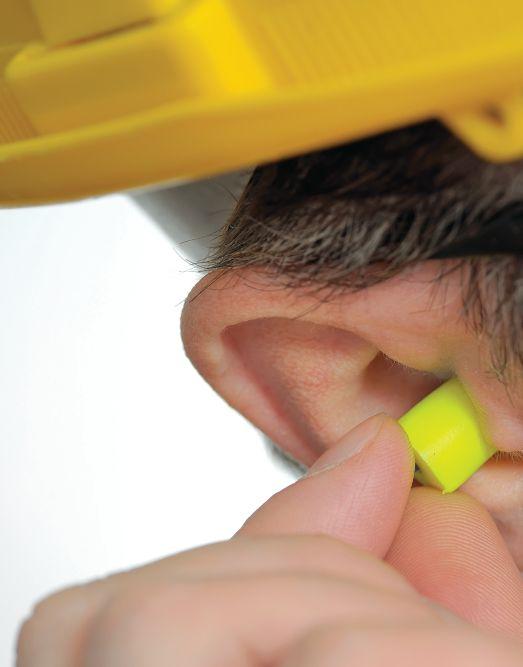
Brown says it is important to understand that hearing protection devices are not universally effective and must be tailored to individual needs. Earplugs, for example might not provide adequate protection if not worn properly. Therefore, employers should offer a variety of options and ensure workers receive proper training on how to wear hearing protection correctly.
Comprehensive training programs are also vital to educate workers about the detrimental effects of noise on their hearing and overall health, says Brown.
“By fostering awareness and understanding among employees, companies can cultivate a culture of proactive hearing protection and ensure compliance with safety measures.”
Damage from exposure to excessive noise is often permanent and is one of the fastest-growing occupational diseases.
Photo: mady70 / iStock
> MAY 12-15 CIM Connect
VANCOUVER, BC www.convention.cim.org
> JUNE 11-13 Canadian Crane Rental Association annual conference
WINDOR, ON www.ccra-aclg.ca/2024ccra-conference-windsor-on
> JUNE 20-22 CIQ Congress 2024 TORONTO, ON www.ciqs.org
> SEPT. 22-25 TACConf
VANCOUVER, BC www.tacconf.ca
> SEPT. 24-26 MINExpo
LAS VEGAS, NEVADA www.minexpo.com
> DEC. 4-6 The Building Show TORONTO, ON www.informaconnect.com/ the-buildings-show/
one more load Anything to declare?
Environmental Product Declarations are one way to evaluate the environmental footprint of a product
The environmental sustainability of building materials is becoming an increasingly important business consideration for the construction industry.
This market shift is driven by the heightened awareness of the public and governments who want to know the environmental impacts of the goods and services they buy. Much of the building and construction industry is just scratching the surface when it comes to evaluating the true environmental impacts of their products. Going forward, the environmental footprint of the sand and gravel industry will require in-depth environmental assessments of the products that they sell.
One means of evaluating the environmental footprint of a product is an Environmental Product Declaration (EPD) or following the requirements as set out in ISO14025. An EPD, like the nutrition label on a box of cereal or a chocolate bar, is a standardized measure of environmental parameters for a product. An EPD quantifies environmental information of a product to enable transparent and standardized comparisons between products fulfilling the same function. For the sand and gravel industry, an EDP would consider the extraction, manufacturing process, energy consumption, greenhouse gas generation, waste generation and other environmental factors. The EPD methodology is based on the Life Cycle Assessment (LCA) principles for environmental assessment to ensure credibility and consistency. As with most standards and public declarations, data is verified by an independent third party to be ISO compliant.
EPDs are primarily intended to facilitate businessto-business transactions. They may also benefit consumers who are environmentally focused when choosing goods or services. Environmentally-conscious consumers, through their purchasing decisions, are fueling a demand for more environmentally-favorable products. These consumers are currently making these decisions voluntarily. However, in the future, they may be required to compare associated embodied carbon or the environmental impact of products through EPDs when making their purchasing decisions.
Though not yet mandatory, many companies are implementing EPDs to improve their sustainability
goals, foster credibility, accountability and demonstrate a commitment to the environment to customers. For example, many architects use EPDs to select products when designing a building to meet developers’ sustainability goals and targets. Buildings which require LEED (Leadership in Energy and Environmental Design) are using EPDs as a key information resource to achieve their certification criteria. Consequently, an EPD can also be a great marketing tool for your product.
Every product and sales location has its own unique EPD. For example, the same product may be produced in three different pits, but the environmental footprint for each point of sale will be specific to a site. The development of on-site infrastructure, distance to market, the depth of stripping and the cost to reclaim a pit may be very different in each of those source pits. Consequently, the amount of energy, fuel or transportation associated with producing that product at that pit and energy required to get it to market may be very different in each circumstance. Similarly, different products, even at the same location, can require different inputs of materials and differing energy consumption to manufacture a given product. This means that each product will also require its own EPD.
EPDs are valid for a limited period, as the operating parameters at a facility change over time. Site infrastructure may be reconfigured, and extraction technologies and engine efficiencies will improve over time, and many energy grids are transitioning from a higher to a lower carbon footprint (fuel switching, transition to sustainable lower carbon generated energy sources such as solar or wind power generation), resulting in a lower environmental footprint over time and require updating.
With an increasing demand for sustainability and transparency, proactive producers should contemplate preparing their declarations ahead of time before their clients ask or require them.
William (Bill) Gowdy is a geologist and has 35 years of experience in the aggregate, geology, mining, reclamation, and exploration fields throughout Canada and overseas (USA, Indonesia, South Africa, Mexico, Panama).
BILL gowdy
THE POWER TO CHOOSE
Customize any ADM plant to your specific production needs with our standard components.
“Owning our ADM asphalt plant has been a real game changer. ADM focuses as much on service as on the sale of the plant, and the payoff has been well worth it.”
Trent Nielsen, President & Owner-Operator
Concrete
TAKE MOUNTAINS, MAKE RUBBLE. BLASTS BEFORE BREAKFAST. LOADERS HAULING TONS. FEED YOUR KLEEMANN BECAUSE IT’S HUNGRY. HAUL TONS AGAIN. STRIP OVERBURDEN. EXCAVATORS CALLING SHOTS. ADTS ON THE MOVE. OPS REPORTING STATS. NO TIME FOR DOWNTIME. GET THE GRAVEL GONE. CRUSH SOME MORE WHERE THAT CAME FROM. MOVE IT BEFORE THE SUN CALLS IT QUITS.