Does your
Does your

Does your
Does your

have sex appeal?
have sex appeal?

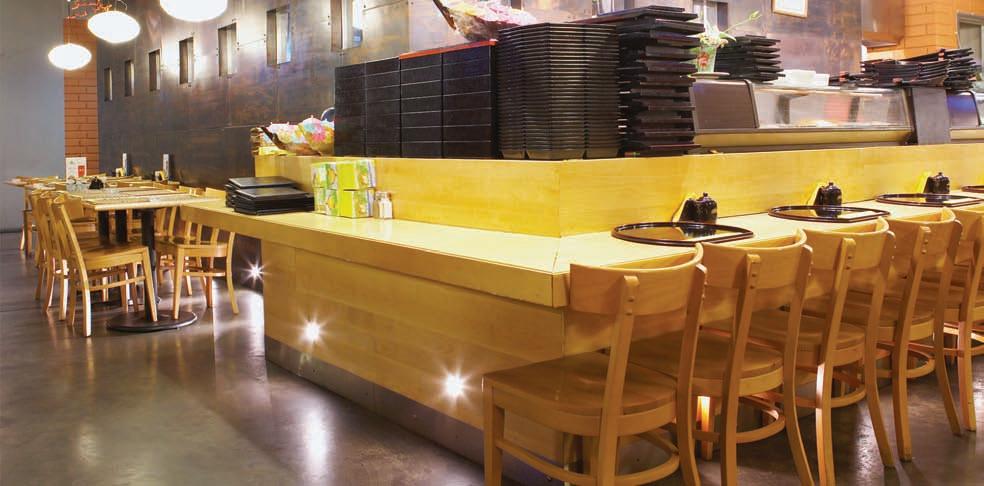
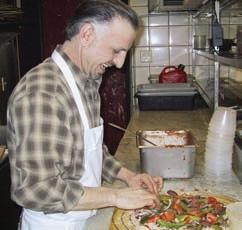

Quebec-based chain Mikes has launched a full-scale renovation project as they upgrade their locations to a new concept known as Trattoria Di Mikes.
Instead of reacting to change in the marketplace, pizzaiolos need to plan accordingly for economic fluctuations.
Dante’s Italian Restaurant focuses on providing the best, not the cheapest or fastest pie.
Understanding how each generation of worker thinks will lead to better communication in the pizzeria.

f you’ve been to the grocery store lately, you may … or may not … have noticed the subtle changes going on with a large number of consumer goods.
Food manufacturers and packaging companies have been working on the sly, retaining wizardry akin to a Vegas stage show with Penn & Teller. The products we are getting in these ever inflating times are shrinking.
And, no, we’re not looking at the rebirth of the chocolate bar sleight of hand known as the 100-calorie kick (for the subtle price of the full-size bar). What we’re seeing is the gradual reduction in actual product size without any of the “guiltfree pleasure” hype.
Everything from mayonnaise to frozen pizza is undergoing a shadowy reduction with less pomp and circumstance than a Kirstie Alley commercial. This is weight loss food companies don’t want you to notice.
The strategy has been employed for years, as manufacturers cope with the increased cost of ingredients, wary of passing along those hikes to consumers. Truth is, nothing scars consumers more than price hikes; and the manufacturers are well aware of this. So, complicated by the current economic conditions, they find themselves in a precarious situation. Dairy and wheat prices are at global record highs, distribution costs continue to soar with oil peaking beyond $100 per barrel.
In order to maintain profit margins, they simply reduce the end product’s overall weight. In glass packaging, such as mayonnaise jars, manufacturers reduced the overall size – or employed the “green” strategy and switched from glass to plastic. Did you keep track of the ingredient weight?
How about paper towels? Something every restaurant has in supply. While I’d hazard to say the vast majority of you have wholesale arrangements, the consumer product is, on average, 11 feet less per roll. And paper costs have increased.
Ted Marks, senior editor of Consumer Reports, recently told ABC News that the strategy boils down to “a con” and manufacturers are “ripping consumers off.”
Where does this put today’s pizzeria operator?
Once again, we have the advantage. We’ve lost market share to places such as the frozen food aisle and the “hot and fresh” pizza from the supermarket deli counter.
But the chances are if things are shrinking in toilet paper and mayonnaise, they’re also shrinking inside that cardboard pizza package. The fickle consumer still believes they’re getting the equivalent pizza to a large four-item from you, even though their packaged pizza has reduced cheese quantity, reduced sauce (tomato drought too), and Chinese wheat.
Who really pays attention to finish weight of a frozen pizza, anyway?
So, just as Jenny Craig had to dump dear old Kirstie (I guess she “shrank” too much for their packaging), it would be an appropriate time to talk your consumer into dumping the frozen food aisle. Why not do a little “pizza-a-pizza” guerrilla marketing and slap one of those cardboard deli pies on your wall, right beside your own masterpiece, and let the consumer see what they get for their money.
I suspect the only shrinking then would be their appetite for pizza made in a factory.
April/May 2008, Vol. 14, No. 3
Editor Cam Wood cwood@annexweb.com 888-599-2228 ext. 241
National Advertising Manager Christine Livingstone clivingstone@annexweb.com 888-599-2228 ext. 239
Sales Assistant Barb Comer bcomer@annexweb.com 888-599-2228 ext. 235
Production Artist Gerry Wiebe
Editorial Director Drew McCarthy dmccarthy@annexweb.com
VP/Group Publisher Diane Kleer dkleer@annexweb.com
President Mike Fredericks mfredericks@annexweb.com
Mailing Address P.O. Box 530, 105 Donly Dr. S., Simcoe, ON N3Y 4N5
PUBLICATION MAIL AGREEMENT #40065710 RETURN UNDELIVERABLE CANADIAN ADDRESS TO CIRCULATION DEPARTMENT, P.O. BOX 530, SIMCOE, ON N3Y 4N5 e-mail: cnowe@annexweb.com
Periodicals postage paid at Buffalo, NY. USPS 014-059, ISSN 1203-6838. Published eight times per year (Jan/Feb, Mar, Apr/May, Jun, Jul/Aug, Sept/Oct, Nov, Dec), by Annex Publishing & Printing Inc. U.S. Office of publication c/o DDM Direct.com, 1223 William St., Buffalo, NY 14240. U.S. Postmaster send address change to P.O. Box 1042, Niagara Falls, NY 14304
Printed in Canada ISSN 1203-6838
Circulation e-mail: cnowe@annexweb.com Tel: 866-790-6070 ext. 207 Fax: 877-624-1940 Mail: P.O. Box 530, Simcoe, ON N3Y 4N5
Subscription Rates
Canada – 1 Year $ 19.26 (includes GST - #867172652RT0001) USA – 1 Year $ 40.00
From time to time, we at Canadian Pizza Magazine make our subscription list available to reputable companies and organizations whose products and services we believe may be of interest to you. If you do not want your name to be made available, contact our circulation department in any of the four ways listed above. No part of the editorial content of this publication may be reprinted without the publisher’s written permission. ©2008 Annex Publishing & Printing Inc. All rights reserved. Opinions expressed in this magazine are not necessarily those of the editor or the publisher. No liability is assumed for errors or omissions. All advertising is subject to the publisher’s approval. Such approval does not imply any endorsement of the products or services advertised. Publisher reserves the right to refuse advertising that does not meet the standards of the publication. www.canadianpizzamag.com






Hello everyone! Mama Rosa here. What a smart bunch of pizzaiolos we have in Canada! I sure hope you are staying cool in those steaming hot kitchens. So, I hope you’re ready for this month’s trivia contest question. Remember, it’s easy – I’ll ask the question and you find the answer somewhere in this month’s issue of Canadian Pizza magazine. Then fax, mail or e-mail your answer to me. If I pick your name from the answer bag, you win!
Are you ready?
This month’s trivia question is: How long has the Paoletti family been operating Dante’s? Deadline is May 2, 2008 e-mail: mamarosa@annexweb.com
This monthʼ s trivia question: How long has the Paoletti family been operating Dante’s?

The Canadian Federation of Independent Business is renewing its call for Ontario to overhaul its apprenticeship programs in light of new research showing record levels of concern over the shortage of qualified labour.
The CFIB’s latest Help Wanted report showed that the national long-term vacancy rate rose to 4.4 per cent in 2007 from 3.6 per cent the previous year, meaning 309,000 jobs went unfilled. Ontario’s rate jumped to 3.5 per cent from 2.6 per cent. Long-term vacancies (four months or more) increased in every sector in Ontario, with the greatest need
being seen in construction, hospitality and primary industries. The problem is greatest for smaller businesses.
Ontario’s regulations require employers in certain trades to employ a number of journeypersons before they can qualify to train apprentices. The ratio can be as high as seven journeypersons to one apprentice. CFIB’s research shows close to a third of Ontario small businesses find these ratios are a major obstacle to apprenticeship training, which makes it even harder to address shortage of labour challenges.
Help Wanted is available online at www.cfib.ca.
Fax: 519-429-3094, Attn: Mama Rosa Mail: Mama Rosa, Canadian Pizza Magazine, P.O. Box 530 105 Donly Drive South Simcoe, ON N3Y 4N5
did you know?
The foodservice industry’s share of the total food dollar dipped to 39.4 per cent in 2007 from 39.7 per cent in 2006 due to weakness in Central and Atlantic Canada.
SOURCE: The Canadian Restaurant & Foodservice Association
Saputo Inc. has announced that it has instituted legal actions for defamation jointly with Lino Saputo against certain Canadian newspapers and their journalists in connection with the content of articles published on Dec. 12 and 13, 2007.
Lino A. Saputo, Jr., president and chief executive officer, stated: “Lino Saputo (Sr.) has worked honestly all his life to create one of Canada’s most prosperous businesses. We are proud of the development of the business and thank Quebecers and Canadians for their relentless support since 1954, without which this success would not have been possible. The newspaper articles contained false allegations about Lino Saputo (Sr.) and Saputo Inc. and we will not tolerate the dissemination of false and misleading information which is harmful to our name, reputation and business interests.”
A penal suit in defamation has also been instituted in Italy against the Italian weekly L’ Espresso and its journalists regarding articles published on Nov. 22, 2007.
The proceedings filed against certain Canadian newspapers and their journalists are blaming them for having acted recklessly and in bad faith by publishing information they knew or ought to have known was false and slanderous, in order to mar the reputation of Lino Saputo and Saputo Inc., more specifically by falsely associating them with organized crime.
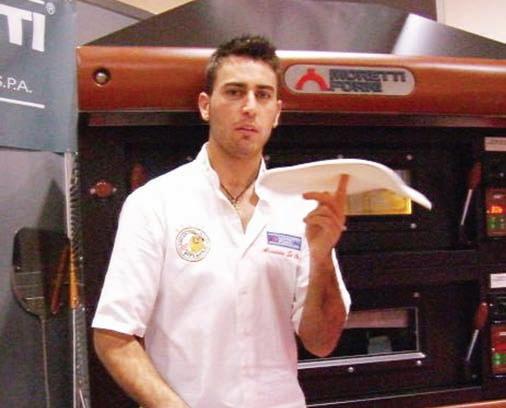
The 2008 CRFA show lived up to its billing as Canada’s largest hospitality event during its three-day run at the Direct Energy Centre March 2-4.
The show brought together the well-known HostEx and Canadian Food & Beverage shows for the first time, and featured more than 1,700 exhibit booths representing 700 of Canada’s most innovative food, beverage, equipment and service providers. Hundreds of new products – from trans fat-free oils and exotic chocolate to eco-friendly cleaners and compostable take-out containers – made their debut at this year’s show, which attracted nearly 12,000 industry professionals.
The 2009 edition of the CRFA show will take place March 8-10 at the Direct Energy Centre in downtown Toronto.
Boston Pizza’s 16th annual Valentine’s Day fundraiser broke an all-time record by raising $536,000 for charity.
Boston Pizza donated one dollar from the sale of each heartshaped pizza and paper heart sold to the Boston Pizza Foundation in support of its many charities including the Heart and Stroke Foundation of Canada, Kids Help Phone and the Juvenile Diabetes Research Foundation.
Since the Valentine’s Day fundraiser began in 1993, the Boston Pizza Foundation has raised $2,665,000 for charity through this promotion.
Boston Pizza sells more than 50,000 heart-shaped pizzas on Feb. 14.

Face it: The generation gap these days is more like a canyon. People under 30 and people over 40 do not see eye to eye.
The over-40 crowd wonders why the 25-year-old wants to be promoted to manager during his first week of employment (and leave at 4:55 p.m. daily). Meanwhile, the under-30 group believes a more seasoned coworker’s computer crashed simply because he is old.Garrison Wynn discusses the differences and the workplace.
FULL STORY ONLINE

People behave in contradictory ways during times of stress – like during a recession. Too many managers in too many companies become paralyzed by fear or indecision. Recessions are part of business cycles, just like growth periods. Thus, managing during a recession is part of a manager’s job – perhaps the most important part.
In this article, John L. Mariotti asks: “What should
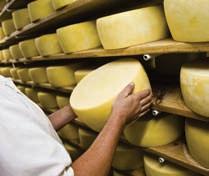
Outsourcing in the artisanal cheese world?
It may seem an unlikely course for a food niche so defined by its hands-on, back-to-the-farm ethic, but cheesemakers large and small are welcoming the opportunity to shift some of their burden.
FULL STORY ONLINE
CFRA WELCOMES EI
The Canadian Restaurant and Foodservices Association is applauding the federal government for announcing an end to the diversion of employer- and employee-paid Employment Insurance (EI) premiums to unrelated purposes. The government has done this by establishing a separate EI crown corporation.
FULL STORY ONLINE
managers do differently?”
The answer is “a lot,” but not “everything.” If as a manager, you have managed through recessions before, you may remember what to do, assuming you did the right things.
FULL STORY ONLINE
You may have noticed a shift in recent years in what it takes to satisfy customers.
In his latest piece, Jeff Mowatt discusses how customers are now making buying decisions less on the quality of an organization’s products and services, and more on the quality of the buying experience itself.
If you’re a business owner or manager, this trend offers both risk and opportunity. To ensure that your organization profits from this shift in customer loyalty, consider a recent history of buying behaviours …
FULL STORY ONLINE
FULL STORY ONLINE
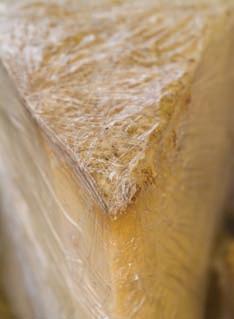
Specialty foods quickly lose their appeal when contaminated by dust, human hair, and packing material scraps. And no one is more aware of the potential disaster than those companies that charge premium prices for exquisite edibles.
www.canadianpizzamag.com
BY TIMOTHY TWYDELL
Sometimes even in the world of pizzaiolos, the old adage, everything old is new again, applies.
In a bold move, Mikes is closing its doors, renovating entire restaurants and reopening as a classical Trattoria Di Mikes.
Mikes is a Quebec-based pizza operation with 100 stores in four provinces. It is part of the Imvescor Group of restaurants, which includes the ubiquitous Baton Rouge Restaurants and Scores brands. Founded in Montreal, Que., in 1967, Mikes has been operated by Imvescor Group – a large multinational operation previously known as Pizza Delight – since 2000. Pizza Delight was founded in Moncton, N.B. They bought the Mikes brand for $14.5 million.
Today, Imvescor is a large conglomerate, with $200 million in sales annually and 800 stores. With the advent of Boston Pizza restaurants making inroads into Mikes’ traditional customer base, the company has decided to reinvent itself.
Mikes has always been a success story. They have successful dine-in restaurants and a solid base of take-out and delivery traffic. The refurbishing of stores is an attempt to create an affordable upscale dining experience, due in large part to the North American success of other “pizza” restaurants, which has cut significantly into the pizza market’s customer base.
Back to basics: with renovations on the horizon, Mikes streamlined its menus to focus on three main types of Italian dishes, already part of its regular fare. The new menu will offer pasta, pizza and Italian sandwiches – with a chef’s choice component to continue to
lure customers back time and again.
“The menu includes many of the delicious favourites that have made Mikes famous. You will also be pleased to discover several new recipes created by our executive chef Alain Demeule,” says company chief executive Terry Faulconbridge.
“But, of course, our pizzas are always the centre of attraction. In addition to the many varieties available in thin crust, as well as the traditional crust, we also serve up specialty pizzas, such as the increasingly popular Sunshine Pizza, an exclusive idea from Mikes‚ that pleases both young and old with its unique ‘sun’ shape.”
And when it comes to pasta, available in 10 different ways, Mikes’ Festa Pasta allows guests to create their own culinary masterpiece by choosing their own pasta, sauce, and favourite ingredient.
Added to the traditional dishes on the menu are several new inspirational Italian specialty recipes developed exclusively for Trattoria Di Mikes: Chicken Parmigiana and Chicken Marsala, Breaded Veal Cutlet with Cream and Lemon Reduction, Fresh Tilapia Fillet, and the famous Osso Bucco.
A moderately priced, well-chosen wine list will round out Mikes’ dining experience – with a plan to sell high quality wines at a lower price point than the competition. The wine cellar features wines from 13 regions of Italy.
Mikes’ senior leaders have made a firm commitment to these changes: Faulconbridge, CEO, and Yves Léveillé, vice-president of marketing, have undertaken this massive task. Their goal is to have 13 of the stores converted by 2008, 75 in total by 2010.
“Each restaurant takes three years to renovate. Most of the same staff is used but we suggest they hire some new staff. A training team goes in to train for about a week and a half. This is not just a facelift it is also an operational change,” says Faulconbridge.
The renovations are meant to create a warm and inviting atmosphere – the stores will be awash in warm colours – focusing on rich reds and burgundies, with soft background music gently lulling customers into a feeling of personal and gastronomic contentment. The brick interior façade is intended to create the aura of a quaint Italian village trattoria. The tables are tastefully appointed and potted plants are scattered throughout the dining room, to enhance the country feel.
The trademark for Mikes is the focal point of the diners’ attention when they first arrive.
“Greeting diners is the famous stone Mouth of Truth sculpture that adorns the portico of the Church of Santa Maria in Cosmedin, Rome. According to legend, this mouth was said to eat the hand of liars. The sculpture leaves a lasting impression of mystery. And its symbolism is a true mirror of our restaurant philosophy: the best moments of truth are those we spend with our guests,” states Ron Magruder, president and chief executive officer of Imvescor.
So far the reaction to the new restaurants has been very positive. The numbers are up and the renovations are continuing with – essentially brand new – stores opening weekly. The franchisees along with the company are working together to ensure the success of the new venture. •
BY DANIEL BURRUS
If you want to truly stand out in today’s marketplace and lead your company to new heights of success, you have to work smarter and not harder. For many leaders and managers, that’s easier said than done. Despite their best intentions, they get snarled in the glaring failures that derail business growth and stagnate profits.
In order for you to avoid the most common traps that stifle business growth, you have to be aware of the seven top failures and know the strategies to combat them. The following list will help you turn failure into success and enable your company to exceed growth projections.
1. Failure to anticipate. Most companies react to the changes that are taking place right now. They react to customers, react to the economy, and react to government legislation.
Instead of merely reacting, you need to anticipate future changes and plan for them. The fact is that you can anticipate a great deal in your industry. For example, are cellphones of the future going to have a high definition screen with high definition video? Most people think so.
In the future, will we have better bandwidth for both wireless and wired Internet connections? You’d be hard-pressed to find someone who says “no.” In the future, will we have more storage in our computers? Of course.
Apparently you’re certain about quite a few future events. Therefore, instead of being a crisis manager and reacting to change, anticipate changes so you can drive growth from the inside out.
To do that you have to spend one hour a week not thinking about the crisis of the moment, but rather thinking about the predictable opportunities that are waiting
for you. Make a list of all the things you’re completely certain about. Then look at your strategies and base them around that list.
Only then can you be more of an opportunity management organization.
2. Failure to communicate.
There is a big difference between informing and communicating. Informing is oneway, static and seldom leads to action. Communicating is two-way, dynamic and usually leads to action. Ironically, we have all these fantastic communication-age tools, but we’re using them in an information-age way.
Realize that the information age is not our friend; it’s our enemy in disguise.
Ask yourself, “In our organization, are we better at informing than communicating?”
For most people, the answer is “yes.” And if you can’t communicate internally with your staff, how can you communicate externally to customers and shareholders? This is not to say that you should stop informing people. However, you do need to tap into the true power of communication.
When you focus on maximizing twoway communications, you can create a communication-age organization and cause positive change much faster.
3. Failure to collaborate.
The majority of people tend to co-operate, which is very different from collaborating. Even though we often use the word “collaborate,” we’re really just co-operating, which is a lower level function.
Co-operating means, “I won’t get in your way and you won’t get in mine and we’ll work together when we have to.”
Such an approach provides results, but certainly not outstanding results.
Collaboration is when we put our heads together and ask ourselves, “How can we create a bigger pie for both of us?” Collaboration is based on abundance.
Co-operation is based on scarcity, meaning the pie is only so big and I want my piece bigger than yours.
Collaboration is about working together to create a bigger pie for everyone. That’s how you can get competitors to work with you and not against you.
Remember that today’s technologies allow us to collaborate in new and amazing ways. Make sure you’re using them properly.
4. Failure to innovate.
When asked when the last time they did something innovative was, most com-panies have to go back fi ve or 10 years to cite something meaningful.
Why? Because the majority of companies innovate once, come up with a great product or service, form a company around it, and then they let it ride.
They don’t continue to innovate and create new products and services. Instead they spend their activity asking themselves how they can be more effi cient … how they can do more with less … how they can reduce staff and overhead … how they can use technology better. Those are all good questions.
However, you also want to ask yourself how you can use technology and your people to create new products and services that will increase the sales of your old products and services.
The more time you devote to innovation, the more profi table and effi cient you’ll ultimately be.

5. Failure to pre-solve problems. Some people say that a problem is an opportunity in disguise. Nonsense. A problem is a problem. A problem is only an opportunity before you have it. Realize that most of the problems our customers and our company experiences are predictable.
In today’s world of rapid change, if you ask customers what they want and then give it to them, you’re missing the real opportunity.
Why? Because your competitors are asking the same question, getting the same answer, and providing the same solution.
Instead, you need to think a level higher and ask yourself and your customers, “What problems are you about to have?” Then you can develop new solutions based on the answers you receive.
At that point, you can base your product development on your customer’s future problems and deliver the product or service right when the problem is starting to hit.
6. Failure to de-commoditize. Any product or service can be de-commoditized.
Unfortunately, many companies tend to come up with something new, and then that’s their main product. Other people copy the product. Margins get thin. Sales slow down. And they end up competing on price.
The key is to take your product and put a service wrapper around it. Here’s an example: In the electricity industry, the utility provider has to ask ratepayers whether they can increase the price. To de-commoditize themselves, one electric company created what they called “digital electricity.” They told customers that if you’re a company that runs a lot of expensive computerized equipment and you don’t want the electricity coming into your office to ever turn off or fluctuate in current or voltage, then you need digital electricity, which will cost more. Many big companies signed up for the more expensive service.
In the near future, homeowners will have an interest because they will have multiple computers streaming audio and video in their home.
So this electric utility took a product
and wrapped a service wrapper around it so they could charge more. Therefore, look at your product or service and think of ways that you can wrap a service around it to add value.
But don’t stop there. Keep adding value to it every year so you never become a commodity again.
7. Failure to differentiate.
Too many companies become just like everyone else. They don’t continue to stand out. Even though they do strategic planning, it’s usually just financial planning in disguise.
True strategic planning needs to be more than numbers-based; it needs to focus on how you can differentiate from your competition instead of being and doing more of the same.
So how do you differentiate? Simple… you stop doing all the failures of business growth just discussed. You start anticipating, communicating, collaborating, inno-
vating, pre-solving problems, and de-commoditizing. Realize that you can infinitely differentiate your company if you’re only bold enough to try. Have the courage to do the things your competition isn’t doing.
Business growth doesn’t have to be a mysterious thing. When you know the failures to avoid and the strategies to combat them, you’ll be well on your way to creating an organization that continues to grow despite outside conditions.
So learn from these failures and rethink the way you do business. It’ll pay off for years to come. •
Daniel Burrus, author of six books including the international best seller, “Technotrends,” is one of the world’s leading technology forecasters and business strategists, who has established a worldwide reputation for accurately predicting technology driven trends and their impact on the world of business. For more information on the services and products provided by Daniel Burrus, please visit www.Burrus.com or call 262-367-0949.



























BY TIMOTHY TWYDELL
Drive through any major Canadian city and you will see rows upon rows of fast food restaurants along their main drags, all serving the same thin: the burger.
Once the pride of the local mom and pop restaurant, huge multinational corporations have swallowed up the quickserve staple and cheapened into a “drivethrough” discount.
The pizza industry seems destined to share this fate – once the bastion of the local trattoria, the pizza is sold in a manner that supports rapid consumption. This Italian favourite can now be ready in five minutes, carved from massive pies that have been congealing under heat lamps all day.
Hungry for more? There are two-forone deals, three-for-one extravaganzas, and buy-one-get-one-free deals, slices sold with bags of chips or massive party size pies.
The food we love is in danger of becoming another processed staple, sold the same everywhere, cheaply to the mass market.
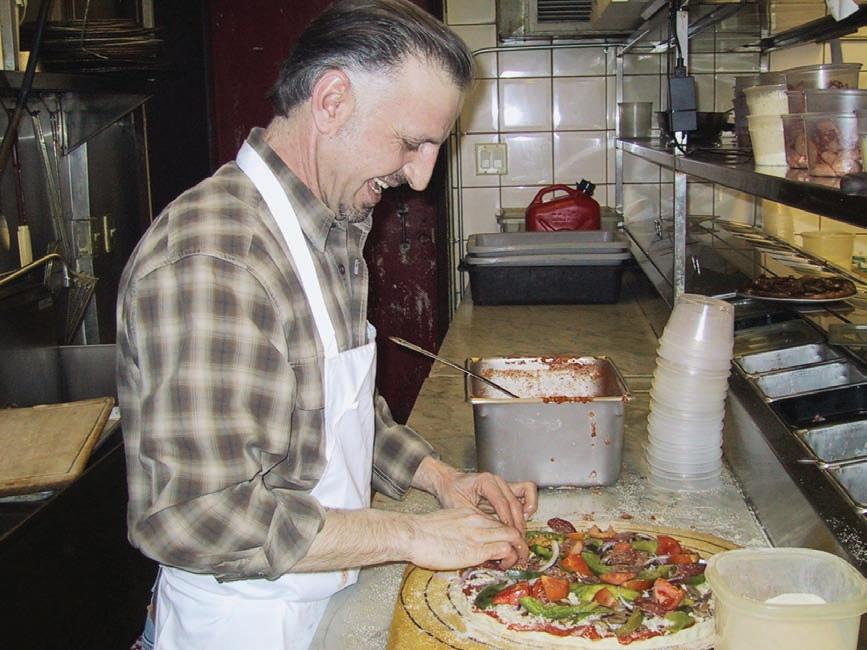
A small pizza parlour in Thornhill, Ont., is trying to make pizza a gourmet eating experience again. Dante and Diego Paoletti and various other Paoletti family members, have been running Dante’s Italian Restaurant for 32 years.
This is not your typical pizzeria. It is both a successful full-service restaurant and a high-volume carryout and
delivery operation.
Dante’s is famous for providing hot and fresh pizza to most of the Greater Toronto Area and beyond. This small, off-thebeaten-track operation enjoys a massive catchment area, bounded by Mississauga to the west, Scarborough to the east and as far north as Newmarket.
On a typical Friday night, 20 drivers deliver up to 250 pizzas.
Dante Paoletti describes how this massive task is accomplished: “The pizzas are cooked to order on a stone.”
The family owners of Dante’s remain committed to continue to use the age-old stone baking method, while most of their chain-based competitors employ a conventional conveyor oven.
“The pizzas come out of the oven boiling hot, and are too hot too eat. They are put into a heated pizza bag and drivers take one pizza per delivery. The average delivery time is 40 minutes,” says Paoletti.
Dante’s is a busy place but no matter how busy quality is never compromised. Dough is made fresh every day and discarded after four hours. The dough is used at the exact moment it rises to ensure the utmost quality and freshness.
The sauces are made daily from scratch. Meat is of the utmost freshness and looks and smells like meat. When ordering steak on pizza at Dante’s you get real sirloin sliced thick.
Dante’s full-service restaurant is also a hive of activity. Its décor is quaint, charming and quintessentially “old school Italian.”
In traditional old-world Italian style customers are treated like family – and without pretension. Service is friendly
and pizzas, pastas and Caesar salads are delivered with a friendly smile to your table. The dining room encompasses two rooms but is small and cozy. The tables are simply set, with pictures of Italy on the walls.
After 32 years in the pizza business Paoletti has seen a lot of changes.
“People are into healthy eating now. Where before it was all meat, now consumers want whole wheat pizzas (coming soon) and gourmet vegetable toppings.”
The restaurant offers an extensive list of vegetable toppings for the more sophisticated consumer and includes roasted eggplant, roasted yellow pepper and capers. One of Dante’s newest creations is a white pizza. The pizza has a combination of extra virgin olive oil and spices with parmigiana and mozzarella cheese.
He has advice for other pizza makers. “Never forget the enjoyment of
food. Remember consistency and above all else quality and freshness of ingredients is important. Be hands on throughout the process.”
Not content to own the gourmet pizza world Dante’s is branching out to supermarkets. As of this writing, they are in negotiations to supply major grocery stores with their signature homemade pasta sauces. The sauces are already available on site.
The success of Dante’s and their commitment to pizza is a shining example to pizzaiolos everywhere. In our fast-paced world of rapid volume consumption, it is possible to create a delicious, authentic pizza of the highest quality and deliver it hot and fresh to the door; it also possible to service a hungry dine-in clientele.
Perhaps in the future more pizza restaurants will take this model to heart and reinvent pizza as the item we all know it can be: something truly special and tasty.•

BY LAUREN STILLER RIKLEEN
Imagine overhearing a conversation at the workplace coffee machine between two middle-aged baby boomers that sounds something like this:
“I don’t know what to do about my son any more,” confides the first baby boomer to his colleague. “He is so confident, sociable and optimistic. Every time he hears an inspiring speaker, he wants to go out and work on a civic project. Then, when he’s home, he’s always looking for praise and encouragement for his accomplishments.”
His voice trails off with a tone of frustration.
His colleague nods with understanding.
“I know exactly what you mean. My daughter is very similar. And she is always plugged in. She doesn’t even talk to her friends directly; everything is done by text and instant messaging. Plus, her expectations at work are so unrealistic. She expects to be trained in all aspects of her position and given constant feedback regarding how she did in her assignments. I’m so afraid she will not succeed in the workplace.”
Another colleague who had overheard their discussion soon joined the two in their conversation. He immediately chimed in with a litany of complaints about his newest round of hires that he had personally recruited from the nation’s top graduate schools.
“I am pulling what little hair I have left out of my head,” he lamented. “If I am interrupted one more time by one of these kids asking me for clarification on the assignment I gave, I don’t know what I’ll do.
Suddenly, he glanced at the clock. “Well, I guess we’d better head home. It’s almost midnight.” With that the three departed the conversation and left the office.
Increasingly, baby boomers are expressing a frustration that signals growing generational conflict in the workplace. The complaints have a decidedly early 1960s ring to them, sounding like Paul Lynde, the beleaguered father in “Bye Bye Birdie” whose song became a generational anthem, asking, “What’s the Matter with Kids Today”?
Ironically, Paul Lynde was bemoaning the generation that is now leading America’s businesses and running the government.
So is anything really the matter with kids today? Or is it their parents? Young people now entering the workforce have been tagged with a multiplicity of nicknames: “gen Y,” “echo boomers,” and “millennials,” to name a few.
Born approximately between 1978 and the early 1990s, the millennials are the most diverse generation in history and the largest since the infamous baby boomers exploded into North

America’s consciousness. Millennials overshadow their immediate predecessors, gen X, because there are nearly three times as many members of the millennial generation.
Unlike their rebellious boomer parents, millennials tend to have stronger relationships with their parents through their teenage years. They are also used to being regularly praised and rewarded for their efforts at school and at play. They have been called the “Everybody Gets a Trophy” generation because of their parents’ insistence that their early sports experiences be collaborative and positive opportunities.
From these early days of shared rewards, constant media stimulation, and technological savvy, they became a generation accustomed to quick answers, a constant flow of information and new ideas, and immediate gratification.
These are the characteristics that the millennials bring into a workplace dominated by the baby boomer generation, whose own youthful experiences were markedly different. Teenage boomers demanded change through rebellion and revolutionary tactics.
For these two sizable demographic groups to co-exist in the workplace, they must learn to understand how their formative cultural experiences guide their behaviour and then find the common ground for a successful working relationship.
In reality, these are two generations that should have the capacity to work extraordinarily well together. They are smart, work at a fast pace, and can exhibit great passion about what they do. Their different styles and expectations are an outgrowth of their life experiences, and the culture in which they were raised.
How then, can the boomers and their “echo boomers” communicate better in the workplace? First and foremost, baby boomers need to stop complaining that the millennial generation is lazy and unwilling to work hard. In fact, the millennials enter the workplace accomplished and with high expectations.
Millennial workers, however, reject the notion of “face time” as a means of success, and expect clear assignments, regular feedback, and reward for their efforts. They will not stay for long if they do not understand the big picture and the opportunities that lie ahead.

By understanding these differences, boomers can stop focusing on the question in Paul Lynde’s lyrics: “Why can’t they be like we were - perfect in every way.” Rather, boomers can partner with the millennials to create a far more humane work environment.
Savvy baby boomers should recognize that the expectations of the millennials actually translate into the fundamentals of a better workplace. An organization that carefully trains all of its employees, sets clear goals and expectations, and provides regular feedback to ensure that individuals learn with each assignment is a model for success. Even more, if the workplace can recognize the strains on two-career parents by providing a flexible work environment, then it is going to be a magnet for the best and the brightest of the millennial generation.
The reality is boomers have much to learn from their younger workers. A generation whose defining characteristics include a willingness to collaborate and a focus on teamwork are qualities to be treasured.
What’s the matter with kids today? To paraphrase a famous line from a member of the generation that preceded the baby boomers: “Frankly, my dear, nothing.” •
Lauren Stiller Rikleen is the executive director of the Bowditch Institute for Women’s Success and works with law firms and business organizations to improve the retention and advancement of women in the workplace.


BY PETER KOEPPEL
The facts are amazing: Even though women still earn less money than their male counterparts (78 cents for every dollar a man gets), women make more than 80 per cent of the buying decision in all homes. No wonder advertisers strive to capture the attention of females. But what complicates matters for marketers is how women shop. Unlike men, women research items more extensively and are less likely to be influenced by ads. This means marketers need to fine-tune their advertising messages and be seen in marketing venues that women deem credible.
Today, companies are paying more attention to the style and form of their products in an effort to appeal to women, and marketers are shifting away from only running television ads in favour of promotional efforts in venues women trust, such as reviews in women’s magazines and spots on TV shows like Oprah and Extreme Makeover: Home Edition
Such activities prove that marketing today is getting more fragmented. What used to work in the past won’t necessarily work today. So in order to have your
product or service reach the female market – even if it’s not a female-oriented product – you need to view marketing a bit differently than you did a few years ago.
A recent article in Advertising Age magazine details how women spend their leisure time. In it, columnist Mike Vorhaus asked women of all ages to identify from a list of activities their favourite leisure activity. What he found in the female category impacts all advertisers who have a product that targets women – or who simply want to get a piece of the buying power that women possess.
According to Vorhaus’s research, in general, women ranked watching television as their number 1 leisure activity (23 per cent), followed by using the Internet (16 per cent) and playing free web-based games (10 per cent). Reading magazines (one of the top advertising mediums used by many marketers targeting females) only ranked in at 4 per cent. So if you’re an advertiser trying to reach women, you need to consider supplementing your television, radio, and print ads with new
advertising vehicles, such as online advertising, product placements on television shows, and banner ads on free gaming websites.
While women do tend to watch more television than men, they watch more daytime TV, which is a very cost-efficient time period to reach women since rates are lower during the day versus primetime. Additionally, some networks offer “female cluster” advertising packages, meaning your ad runs on multiple networks that are geared for women, such as Oxygen, WE, Style, etc. This is a very targeted and cost-efficient media vehicle for reaching females and one you need to consider employing in your TV media buys.
With all this said, it’s important to note that not all women have the same preferences – and the findings from Vorhaus’s research confirm this fact. He found that two age brackets of females emerge that have some interesting findings. These are the 12- to 17-year-olds and the 55- to 64-year-olds.
Teenage girls learn from their moms
the power they have when it comes to spending money. That’s why many marketers want to reach this prime market, with the hopes of developing lifelong customers. But how this group spends its free time greatly differs from the activities their mothers enjoy. For teen girls, using the Internet and talking on a home or cellphone tie for the number 1 leisure activity (19 per cent). Rounding out the top three are listening to music (17 per cent) and watching TV (11 per cent). For this group, reading magazines and newspapers only came in at 1 per cent, while playing free web-based games or console video games (something teen boys rank extremely high) came in at 2 per cent and 3 per cent, respectively.
Here’s an example of how teen girls spend their time: They’ll be on a social networking website like Facebook or Myspace looking at pages and pictures their friends posted. At the same time, they’ll be on the phone or instant messaging with those exact same friends, talking about the pictures and postings. So if you’re a marketer and want to reach this group, you’d better have an online advertising presence on these social network sites. And remember, even though this group doesn’t read traditional print media very much, they do read articles and view ads online. So be sure to supplement your television ads with radio spots and online messages, but save your video gaming advertising spots for the teen boys.
Older women offered some surprising findings. With this group, watching TV ranked as the number 1 leisure activity (22 per cent) – no surprise there. But coming in second and third position were playing free web-based games (18 per cent) and using the Internet (11 per cent). Things like reading newspapers or magazines and listening to music only ranked in at 7 per cent and 5 per cent, respectively.
Surprised that casual gaming ranked so high among mature women? Most people are, including marketers. What’s important to note here is that the majority of these women are playing free games such as solitaire, bridge, mah-jong, and black-
jack. Most are not playing violent or action-packed video games. So if you’re going to supplement your TV ads with some online ads at gaming sites, make sure your ad appears during games that older women are likely to play. It’s also important to note that seniors are one of the fastest growing segments on the Internet. They’re reading online articles, researching web pages for information, and simply logging on just for fun. Therefore, you need to make sure your web presence targets this market and not just the younger ladies.
With the tremendous buying power women have, all marketers need to target this group in order for their company to survive. Even companies that have traditionally targeted men, such as The Home Depot, are realizing that women hold and control the purse strings in the major-
ity of households. That’s why they now offer home improvement classes for women and show more women using power tools in their ads. They also do product placements on home decorating shows such as TLC’s Trading Spaces to gain credibility among female viewers.
So no matter what product or service you offer, remember to tailor your message and ad placement so that women see it, understand it, and trust it. By fragmenting your marketing approach and targeting your advertising message, you’ll reach more female consumers, which will ultimately improve your company’s bottom line. •


MODEL LD-626 Large Capacity DOUGHDIVIDER
12-Part Division 6-oz up to 26-oz each

36,18,9,6-Part Divisions 1-oz up to 26-oz each
MODEL SDR-42
Peter Koeppel is founder and president of Koeppel Direct, a leader in direct response television, online, print and radio media buying. He is a Wharton MBA, with over 25 years of marketing and advertising experience. Koeppel has helped Fortune 1000 businesses; small businesses and entrepreneurs develop direct marketing campaigns to increase profits. For more information on his company, please visit www.koeppeldirect.com or call 972-732-6110. MODEL JN Semi-Auto DIVIDER/ROUNDER
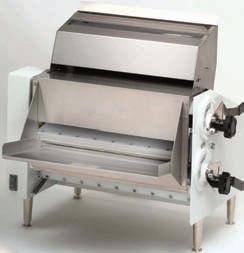
Front Loading - Two Pass DOUGH ROLLER
42 ounce dough capacity Dough up to 20” diameter
Take advantage of the strong Canadian dollar and add high quality Dough Dividing, Dividing/Rounding and Dough Rolling equipment from Dutchess. We’ve been producing the world’s finest dough working equipment for over 120 years.
For more information call: 1-800-777-4498
e-mail: sales@dutchessbakers.com Web site: www.dutchessbakers.com

Diana Coutu
In 2007, I took on the biggest job of my life. First, I became the project manager and then the general contractor of our bigger, better, brighter, ultimate-kick-butt pizzeria.
In the beginning I wasn’t sure that I could manage all of it. I mean, I am organized and good at communicating with others; however, I had never been a project manager or a general contractor and quite honestly I didn’t know exactly what they did.
Initially we interviewed several candidates for the PM position. After schlepping my five-inch stuffed project binder to several meetings and receiving proposals showing an obvious lack of knowledge for the project, we were not only insulted by the waste of our time but also mortified by the rampant incompetence displayed by most of the people we interviewed.
One guy was going to supply all our sinks as part of his proposal, only the floor plan clearly showed a standard threecompartment sink. Instead, he figured he could just install three single sinks: home laundry basin size sinks.
Even though he had assured us in a previous phone interview that he had experience building kitchens; he must have been totally unaware of the city’s strict bylaws and building codes for food establishments. His laundry sinks would never pass inspection. Good thing we were aware, and knew to continue our search for a good project manager.
But first, maybe I should back up a little in my story. We’d outgrown the capacity of our location a couple of years ago. Finding the perfect location to move our existing business to was challenging, to say the least. We are a busy pick-up and delivery location and need good access to
main roads, ample parking and a location indicative of our reputation.
In addition to all of the above, we needed to be less than 10 minutes away from our existing location.
By late April 2007, we were in the final stages of negotiating our lease at the new location. We went back and forth with our architect about the floor plan. We had finalized a great floor plan with excellent flow and several built-in efficiencies.
I had been really diligent in not allowing a “designer” to interfere with the layout or apply “styles” of decor. As part of a mastermind group, I have met many restaurateurs who let a designer take over a project and almost all of the time they were left with something that didn’t function as a full-service restaurant, and in some cases doesn’t even look like a nice place to be in. I wasn’t about to let that happen to us.
the floors and the walls that would be easy to clean and last longer than paint.
Finding the “who” to lead the buildout of our new store was proving to be exhausting. And at this last interview was the only one individual that we did like, except he was booked solid and couldn’t take our job; a decision we fully respected, however, the individual was kind and honest and told me flatly that we didn’t need a project manager.
We were building a 21st-century pizzeria using some of the latest and greatest equipment available
Now it was on to the build-out. We needed the floor plan to get accurate quotes and estimates for the build-out. Until you get all the estimates in you really have no idea what your budget needs to be. But it’s still important to get prices on things early – even rough estimates plugged into a business plan are better than no estimates.
In our case we started with a brand new unit, it still had a dirt floor. We really could start with a fresh canvas and create the best layout, every station, down to the smallest details, even strategically placing floor drains, and choosing materials for
After looking through my stuffed binder he told us that we’d actually already done the work. Besides, he said, it was obvious that no one knows pizza like we do. We were building a 21stcentury delivery and takeout pizzeria using some of the latest and greatest equipment available.
He said that he’d never seen a lot of the equipment in the binder and that because we were already pizza experts and we knew exactly what we wanted and, honestly, would be of little help.
It was true, we did know about the specifications of the project and the why’s more than anyone else. This gentleman said that a project manager would only add to the costs – 10-15 per cent of the entire budget. He suggested that we find a good general contractor to co-ordinate just the trades.
By June 2007 it was obvious that there wasn’t a candidate that we could trust to be in charge of our project. This was a very important decision; ultimately it would be our staff and ourselves who would pay dearest for things not being done
according to our plan.
When my husband and I talked about it, I told him that I thought I could do a better job than any of the candidates we’d interviewed. If there were going to be mistakes, I would rather be the one responsible for them. He agreed and gave me his full support.
While my husband wanted to help me in any way he could, we agreed that his job was to make sure that the existing store was running as efficiently as possible. We needed to make sure the business we had grown to the point of needing a bigger space was healthy and ready to grow again. That means training, product consistency and having a good staff. That also means knowing your numbers and counting the money.
We agreed that his priorities were at the existing store while mine lay in the new space that still had the dirt floor.
I’m certain there are many husband and wife teams that split up duties in order to get everything done. In many instances it’s best to; it’s only natural that you each have different strengths and talents. Use them to your advantage. Cohesion is imperative and clear written goals are the best way to communicate with others and keep on track.
I am extremely grateful that I have such a supportive and wonderful husband, and we have a solid relationship that has stood the test of time. He completely trusted me to choose the colours and materials that we’d use for the floors and wall surfaces of the new store. It helped that we’d been through it before for our home. I chose all the colours for the main floor and the rest of the house. He was pleased with the results then so he knew that I would create something nice with the focus on the practical.
I made a list of all the steps that were needed to get the buildout done. It wasn’t necessarily in the proper order at first but it was helpful to get myself organized. Then I created a spreadsheet and added time requirements to job completion. Some work needed to be done independently while other work could be completed simultaneously.
As we were starting with a dirt floor, there were steps that had two or more parts. For instance, the floor drains and the stacks had to be place before the cement floor could be poured, then the cement had to cure for 30 days before any floor finishes could be applied. Fifteen days after the cement was poured, the wall frames could go up.
Once that was done, the wiring could go in the framing in addition to any plumbing. The drywall could then be hung.
When your floor finishes are applied no other work can be completed. All other work stops when your floors are being laid and curing.
We decided on a hardwearing epoxy floor finish for the kitchen area, which needed a few days to properly cure. We had to re-schedule our tile floor job for the customer area because the epoxy job ran late.
This is actually pretty common in build-outs; when one job runs into another job’s time frame.
Next month, in the second part of my “epic” tale, we learn about gas lines, and why double-checking everything is sound advice. •

Michelle Brisebois
Wine aficionados (the insufferable snobs) would scoff at the concept that wine follows trends. The sales figures would beg to differ.
Especially since Yellow Tail Shiraz took North America by storm, consumers have been eager to embrace the trendy wines.
The restaurant industry should take notice because not only is wine consumption growing; it’s also growing amongst the millennial cohort (young adults) known to be solid food service customers and also known for embracing trends.
Restaurants should make sure their wine list is an active tool they leverage to increase sales. A strong wine list accompanied by some effective selling strategies can make a huge contribution towards a healthy balance sheet.
The Wine Market Council in the U.S. conducted research among sommeliers and wine buyers at restaurants including the 600 locations of the Olive Garden to high-end restaurants. Wine sampling proved to be very effective in generating sales of wine. The Olive Garden discovered that 40 per cent of customers who didn’t intend to order wine will order wine if given samples.
Offering wines in flexible portions from quartinos ( 250 ml) and mezzolitros (500 ml) to wines sold by the inch from bottles left open on tables; house wines; 1.5 oz. pours of luxury wines; or wine flights where a small portion of a different wine is served at each course and more generous 8 oz. pours at steak houses were all highlighted as being effective foodservice wine strategies.
Wine bars are popular, especially among women, who like the atmosphere. Organic wines and “green” marketing also appeal to consumers.
Wine itself is trendy and Canadians are embracing the grape in record numbers. Wine outpaced spirits for the first time in 2005 becoming the second most popular alcoholic beverage.
Increases in wine sales were especially strong in Newfoundland and Labrador, Alberta and Manitoba, according to Stats Can. Quebec consumers bought the most wine by far, accounting for 35 per cent of all sales in Canada.
Red wine is more popular than white, accounting for 60 per cent of the total wine volume sold. So exactly who are the cool kids when it comes to grape varieties these days? Well, it depends on who you ask but the numbers suggest the following wines make the “A list.”
Shiraz: This bold red is still very popular because it is fruit forward, peppery and associated with Australia. While Shiraz isn’t growing as briskly as it once was, the current growth is on a pretty generous base to begin with so the numbers are huge. Shiraz is great with barbequed fare, ribs, wings and pepperoni pizza.
Cabernet Sauvignon: Another bold red grown all over the world so you’ll have lots regions to choose from for your list. The wine-making style may result in a fairly high alcohol level so don’t recommend this with spicy hot foods – a nice peppery dish would be best. The tannins will be great with a creamy rose sauce or rare meat since they’ll cut through the protein and fat that coat the tongue.
Malbec: This is an emerging red varietal getting lots of buzz. Some are dubbing it the new “it wine.” Malbec appeals to white wine fans who want an alternative to the dryness or mouth-chomping tannins in Cabernet. It’s food friendly and would be great with red sauces and chicken with
barbeque toppings.
Pinot Grigio: It’s the same grape as Pinot Gris – only the wine-making style is different. Pinot Grigio is the more popular style perfected in Italy although many regions make a lovely wine. It’s light, crisp and easy drinking. It’s great with salads, seafood, chicken and white pizzas.
Riesling: Although Rieslings have been around for years, this wine is very food friendly. Also crisp but often a bit more floral than Pinot Grigio, Riesling is great with Asian food and Sushi. The Niagara region is especially good at producing top notch Rieslings for those customers who want to support the Canadian wine industry.
Unoaked Chardonnay: For years, fine wines have been heavily oaked. The trend is definitely moving towards less oak in both reds and whites as it allows the taste of the fruit to shine through more easily. Chardonnays shine with cream sauces and would be perfect with macaroni and cheese, fettuccini Alfredo.
Rose: Once associated with sickly sweet champagne, rose wine is posting doubledigit sales growth. The new rose wines are dry and light and the perfect transition from heavy winter reds to light summer whites. This is the perfect wine to go with that veggie pizza on your menu.
As more people become intrigued and educated about food and wine pairings, you’ll notice that wine trends will begin to more closely follow food trends. They’ll change more frequently than they used to but this is good because it keeps the category exciting.
Your wine list isn’t just an “add on” as a service to your patrons – it’s as important as the cheese on your pizzas. Tap into some wine trends, you’ll be glad you did. •

Karen Saunders
Awonderful, hardworking marketing tool is a giant postcard! With colourful eye-catching graphics on one side and your promotional copy on the back, it will grab attention faster than an e-mail, advertisement or sales letter.
A giant postcard, also called an oversized, jumbo, or #14 postcard is a low-cost, effective device for branding your business and creating prospect response. Start with a 6” x 9” or larger size postcard and print in full colour to make it stand out from the stack of white envelopes in today’s mail.
Find a printer who can print “variable data” and you can customize the postcard with your prospect’s first name in the design along with their mailing address. Who can resist reading a postcard with their very own name in the headline?
I recommend several mailings using the same brand, theme, or graphic to make a memorable impression in your prospect’s mind. Make your brand simple, unique and easily identifiable.
Remember, it takes repeated impressions – some say seven or nine times – before your prospect will buy. Mail out your postcard or series of postcards before and/or after an event such as a trade show or conference where you are exhibiting or before your own event.
On the front side, write a provocative statement, compelling question or catchy

headline directed to your target market. Add an unusual, colourful, or stunning graphic or photo. Check out online royalty-free stock libraries for low-cost photos and illustrations. If you lack creative talent, hire a graphic designer to prepare the file for your printer.
The copy on the backside of the postcard needs to be compelling, clear, clean and simple. No one will take the time to read a “textbook” of tiny type. Use bullet points if necessary to break up the text and turn it into an easy-to-use list. Highlight your contact information (phone number and/ or website) with a contrasting colour or bold font. Be sure to leave 5/8-inch margin of white space on the bottom end of the mailer side.
You may want the prospect to call you or contact you via e-mail. You can direct him/ her to your website for free offers. Then capture their e-mail addresses when they sign up for your free e-zine, newsletter or loyalty club offers. Be sure to follow up right away.
Don’t forget your call to action. Be absolutely clear with what you want your prospect to do next. This is the last line of text on the backside of the card, right above your contact information.•
Karen Saunders is the owner of MacGraphics Services, a unique design firm for today’s entrepreneur. Whether you outsource your promotional pieces or are a do-it-yourselfer, Karen takes the mystery out of marketing. Learn the top five mistakes that can cost you money by signing up for her free e-course, available for a limited time. To take advantage of this e-course and find out how easy it can be to attract more clients, visit www.macgraphics.net/ FreeStuff.php. You can also contact her at 888-796-7300, or Karen@macgraphics.net.

Most people dream of living a more successful life: They want a better job, a salary increase, more responsibility at work, and the respect of their peers. Unfortunately, few people are willing to take the needed risks to make their dreams a reality. Instead, they sit back and watch a select few climb the corporate ladder, while they wallow in self-pity and wonder why good things never happen to them.
The fact is that good things don’t just happen to anyone. Good things happen to those who take risks, thus making their positive outcomes possible.
For example, consider sports athletes. The truly great superstars of their game take risks every day. They risk injury during a game with daring plays. They risk getting yelled at by their coach when they make a split-second game decision. They risk complete failure and letting down their entire team when they follow their gut instinct and alter the play mid-game.
Sometimes their risks pan out, and sometimes they don’t. However, those who do take risks are the athletes who are household names.
BY GUERLINE JASMIN
The same is true in business. Every company has a handful of superstars or top achievers who rise among the ranks. And what usually separates these superstars from the masses of employees is the individual’s ability to take a risk. Granted, risk taking isn’t always easy, but it is doable if you follow some solid guidelines. Use the following risk-taking process to enable you to take smart risks and further your professional life.
1. Know what you want to achieve.
Before you take any kind of risk, you first have to know your ultimate goal. Do you want to be the company president within five years? Do you want a 30 per cent salary increase at your next review? Do you want to be promoted to management and get the corner office? Whatever your big dream is, state it clearly. Depending on your answer, you can work backwards to map out the steps you would need to take to get there.
For example, maybe to get a promotion or a salary increase you need to take a risk by volunteering for new projects. List out all the steps and risks you can think of.
Now you have a starting point of how you need to proceed to achieve the goal you’ve outlined.
2. Be aware of different risks.
As you’re likely aware, there are smart risks, and then there are stupid risks. A smart risk is calmly and professionally confronting your boss about an injustice that has transpired in the department. A stupid risk is vandalizing his car to make your point.
To be successful, you have to take smart risks. That means that before you take the risk you have to do your research. You have to find out what that risk entails so you can make an intelligent decision of whether it’s a good risk or a bad risk. A good risk has a high probability of success. If the odds are stacked against you, you probably won’t succeed. Therefore, you have to make sure you have the facts.
Once you know the facts you can make an informed decision. The key is to be prepared before you take a risk to make sure it’s something worthwhile and not something that’s going to set you back.
3. Don’t be distracted. Often, people let external conditions intimidate them and force them to back away from a risk. For example, perhaps you want to apply for a promotion at work. You mention something to a co-worker about your decision and learn that you’ll have a lot of qualified competition for the job. You do a little checking around and find out that these more-qualified people are indeed applying for the same promotion as you. Because of this information, you decide not to take the risk and not to go for the promotion. You let the competition intimidate you.
While knowing what external conditions you’re facing is important, you can’t let this information be your sole decision criterion for whether or not to take the risk. Instead, analyze the external conditions and figure out what makes you different or more likely to succeed. Focus on those positive qualities you bring to the table. Chances are your unique positive attributes will make all the difference.
4. Stop being a spectator.
Getting ahead in business is not a spectator sport. So just because you know what risks you need to take doesn’t mean you’ll achieve success. You now have to get involved and get your hands dirty so you can get where you want to go. Talk to your boss about that raise you want. Ask for more responsibility on the job. As you move forward, be prepared for rejection. Whenever you ask for something, there are only two answers: yes or no. Just because someone says “no” to you doesn’t mean you’re not worthy or that you’re not going to get where you want to go. That’s just part of taking that risk.
So take action and do whatever is necessary to make your goals a reality. Remember that a risk without action is merely a dream. Have the courage to take meaningful action steps today.
A Smart Four-Letter Word
Sometimes, despite our best efforts, our
REAL PEPPERONI... Never compromise when it comes to your pepperoni toppings. What would your pizza be without great tasting pepperoni? Sila believes in traditional values. These values are supported by quality – quality you can feel, taste and smell. We never compromise on the rich flavour of real pepperoni. For more info, call Viau Foods, Inc. 1-514-321-8260 or fax 1-514-321-8770.
ITALIAN SPECIALTY CHEESE... Salerno Dairy Products Ltd. Manufacturers and distributors of great tasting Italian cheeses and food products, invite you to contact their sales professionals. Each representative is motivated to ensure quality dairy products backed by service second to none.
For more information and quality products, call 1-800-263-6536 or 1-905-544-6281.
FOR ALL YOUR PIZZA NEEDS... Ricco Food Distributor. Your complete pizza supply distributor, serving southwestern Ontario. For further information and pricing details, call Don Windsor at 1-519-245-7081 or fax 1-519245-7126.
SPRINGER’S MEATS INC... Processors of quality fresh, smoked and cooked meats. We specialize in pepperoni, ham, back bacon, bacon ends, over 150 items. Serving the food service industry of southwestern Ontario. For details call 1-905-544-0782 or fax 1-905547-3107.
THE OVEN THAT CONSERVES ENERGY... Middleby Marshall’s PS 200 Direct Gas Fired Conveyor Ovens. Middleby’s ovens provide very efficient heat transfer to products. Energy is conserved as air is recycled from heater to product, with minimum flue or vent loss. For details Call Middelby Marshall 1-905-696-8252.

risks don’t pan out. Realize that failure is part of the risk-taking process. The key is to dissect your results so you can see what happened, learn from your mistakes, and then move on. When you move forward with knowledge, your next risk will usually turn out better.
No matter what you want in your professional life, you’ll likely need to take a risk or two to get there. And while the thought of taking risks can be scary, remember that the results are what will set you apart from the crowd. The more smart risks you take in your life today, the more positive results you’ll achieve in your future. •
Guerline Jasmin is president of Success Strategies Unlimited, a consultancy helping individuals and organizations achieve their highest potential. A passionate leader who helps others overcome adversity, Guerline has a master’s degree in human resource development, and is pursuing a PhD in education and leadership. She is author of the forthcoming, “How to Keep Your Past from Invading Your Present and Destroying Your Future.” To sign up for her free 12-week e-mail mentoring program, contact: info@ guerlinejasmin.com or visit www.guerlinejasmin.com.










D ELIVERY S IGNS E QUIPMENT M ARKETING




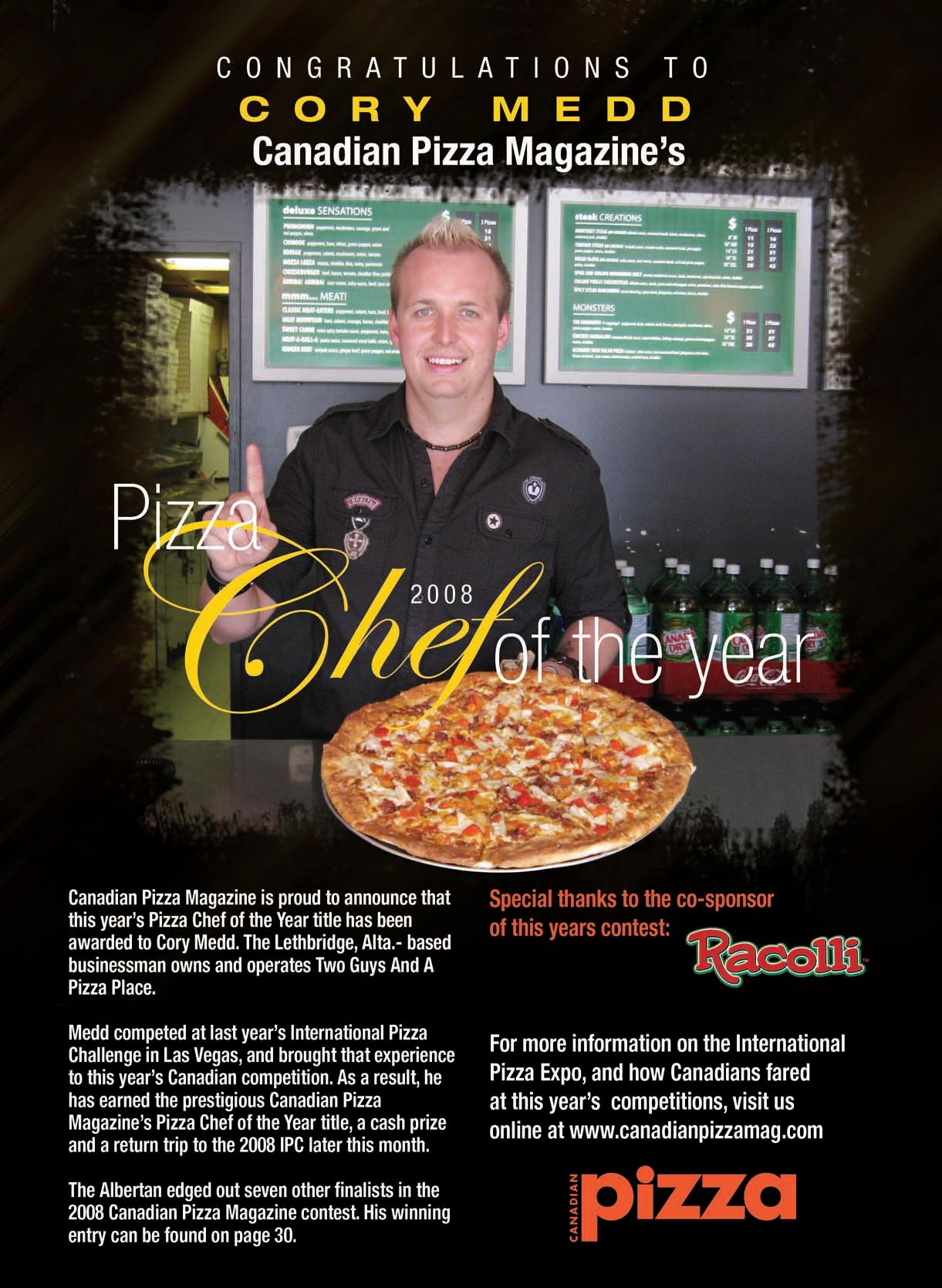
This year’s Pizza Chef of the Year title has been awarded to Cory Medd. The Lethbridge, Alta.-based businessman owns and operates Two Guys And A Pizza Place.
Medd competed at last year’s International Pizza Challenge in Las Vegas, and brought that experience to this year’s Canadian competition. As a result, he earned the prestigious Canadian Pizza Magazine’s Pizza Chef of the Year title, a cash prize and a return trip to the 2008 IPC.
The Albertan edged out seven other finalists in the 2008 Canadian Pizza Magazine contest.
The winning entry from Two Guys And A Pizza Place was their popular “Roadhouse.” Made on the foundation of a pizza crust from a 19th-century Italian recipe,
the pizza features chicken, Canadian bacon, red peppers and a creamy ranchstyle sauce. The pie is then topped with a Canadian mozzarella/brick combination, and then dusted with a medium Canadian cheddar. The final touch is a proprietary Italian-seasoned garlic butter rub.
According to Medd, the Roadhouse has been a top-seller for the past six years.
“When I asked our customers, staff and friends what pizza we should enter in the competition, about 95 per cent of them said ‘the Roadhouse.’ It has become the pizza we are known for,” said Medd.
“Our menu has about 50 interesting gourmet and classic pizzas … the Roadhouse has consistently been in the three top-selling pizzas, behind Hawaiian and pepperoni.” •

Our dough is made fresh daily, using a classic recipe from Italy. The origins are believed to date back to the 19th century. It is hand-cut and hand-rolled to give it a truly homemade gourmet taste and look.
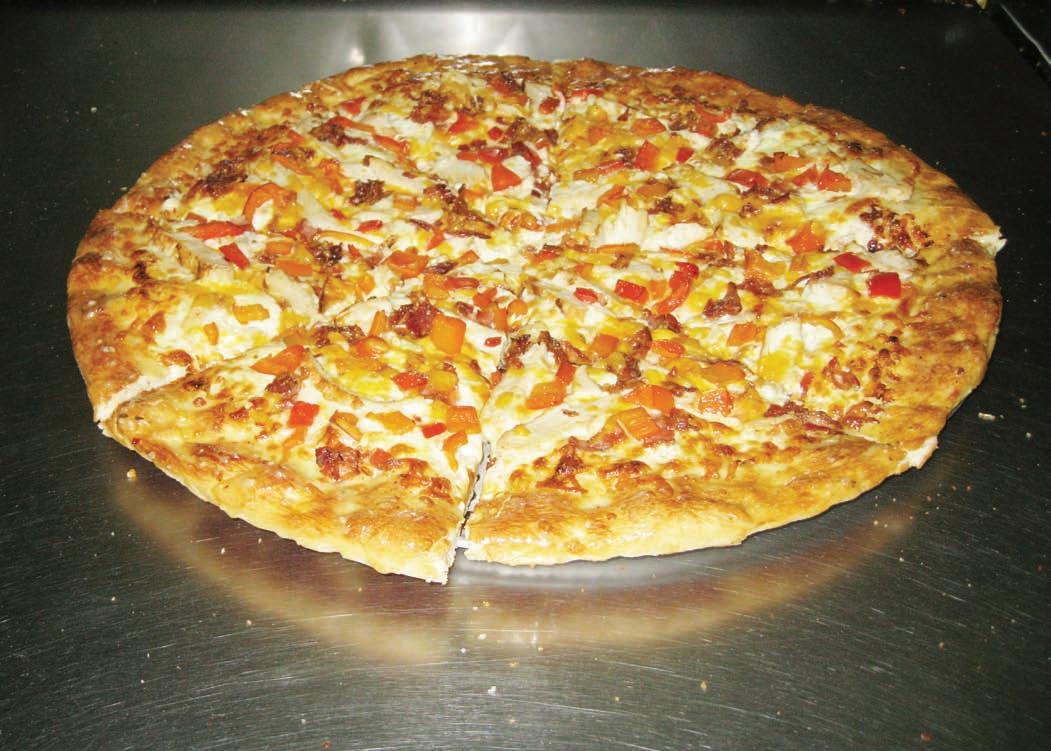
Creamy ranch sauce
We use a propriety cheese from Saputo. It is Canadian mozza/brick 80/20 – brick being 35 per cent milk fat for a golden colour and sharp taste.
White chicken, cut into strips Canadian bacon strips, cut into penny-size pieces
Hand-cut red peppers, in penny-size pieces
Topped with medium Canadian cheddar from Saputo
The crust is rubbed with an Italian-seasoned garlic butter, made from a secret, proprietary recipe.