ARTA isn’t just a Health Benefits provider for retirees. We have plans to meet the needs of OACETT members of all ages! Whether you’re actively working, retired, or semi-retired, as long as you are eligible to join ARTA, you qualify for coverage as a member of OACETT.
WHAT’S INSIDE
4 From the editor
Engineering better solutions by Michelle Malcolm-Francis
5 The first word
OACETT’s new frontier: Leading change, growth and opportunity by Micheal Mooney, C.E.T., AScT (B.C.)
20 Learning curve
Sheridan engineering technology students bring industry partner projects to life by Aravind Venkatapathy and Andy Alubaidy
21 Sign of the times
When screen tech is cleantech by Peter Saunders
6 OACETT in action
Sharing the latest news, happenings and announcements from your professional association and more!
28 New members
Recognizing new and certified members
30 Chapters at work
Events and news from OACETT’s regions and chapters
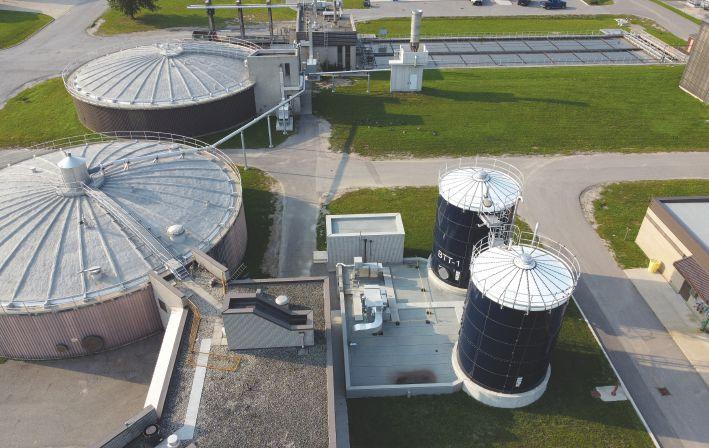
Heat pumps in the spotlight
Multi-unit residential building retrofits introduce low-carbon options by BF
Nagy
SEngineering better solutions
econd to summer, spring is one of my favourite times of the year. Between the warmer weather, longer days and outdoor activities, this season gives me so many reasons to smile.
Also, with spring’s warm-up and farewell to frigid temperatures, I’m always thrilled to give my thermostat a much-needed break and enjoy the comfort of better indoor temperatures.
For many people, it doesn’t matter what time of year it is; getting the right indoor temperature is tough, particularly in the winter and summer, when adjusting the thermostat to the perfect temperature may not be possible – especially for those with heating and cooling systems not operating effectively.
In various communities across Ontario, controlling indoor temperatures and reducing heating/cooling costs is a real problem, for which homeowners and property managers are looking for better solutions. In the City of Toronto, the Toronto Community Housing Corporation (TCHC) addressed this issue at one of its properties. On page 22, in “Heat pumps in the spotlight,” BF Nagy discusses how TCHC retrofitted a multi-unit residential building with low-carbon heat pumps to improve its residents’ comfort.
Low-carbon options are also a hot topic for other industries. In Canada, transitioning consumers from gasoline-powered vehicles to electric vehicles is top-of-mind for the auto sector. However, the technology’s viability and cost-effectiveness are still under development. Nonetheless,
recent hikes in gas prices have made purchasing an electric vehicle more attractive for buyers. On page 26, Andrew Couturier, C.E.T., explores “Electric vehicle adoption barriers in Canada,” and what it will take to get Canadians on the EV bandwagon.
These are two examples of how innovation and technology improvements benefit society. In this issue of The Ontario Technologist, you’ll read stories about technologists, companies and technology students shaping the future and contributing to innovation and change.
You’ll also read about the great strides OACETT is making with the Ontario Government thanks to its work with Counsel Public Affairs. We’re proud of our work as regulators, and so is the Office of the Fairness Commission (OFC). On page 9, read about how OACETT was the spotlight in OFC’s newsletter for our efforts to improve fair registration practices.
Members of the Council who served the Association from the 2021 – 2023 term ended on May 27, and OACETT welcomed a new Board of Directors under the new governance structure. We invited council members to share their thoughts and experiences about volunteering and serving their Association, and you’ll learn what they had to say on page 10.
Remember to read The Ontario Technologist’s Chapter at Work section to discover the exciting things your chapters are doing to connect, educate and grow the Association.
Have a fun and safe summer! Enjoy the issue.
OACETT is dedicated to excellence in the engineering and applied science technology profession in a manner that serves and protects the public interest.
The Ontario Technologist is published bi-monthly by:
The Ontario Association of Certified Engineering Technicians and Technologists (OACETT) 10 Four Seasons Place, Suite 700 Etobicoke, Ontario, Canada M9B 6H7 Tel: (416) 621-9621 • Fax: (416) 621-8694 www.oacett.org
Please direct all inquiries, submissions and subscription requests to OACETT at the above address.
The Ontario Technologist is published in conjunction with:
Annex Business Media
111 Gordon Baker Road, Suite 400 Toronto, ON M2H 3R1 Tel: (416) 442-5600 • Fax: (416) 442-2230
Letters regarding the journal should be addressed to the Editor at the Association’s address. Letters regarding the Association and other related subjects may also be addressed to the Editor for forwarding.
International Standard Serial Number (ISSN) 0380-1969. Publications Mail Agreement #40062764.
Return undeliverable Canadian address to: Circulation Department, 10 Four Seasons Place, Suite 404, Etobicoke, ON M9B 6H7.
The Ontario Association of Certified Engineering Technicians and Technologists, a self-governing, non-profit organization, maintains standards of excellence in the practice of engineering and appliedscience technology in Ontario. Founded in 1957, the Association became provincially legislated in 1984, and has statutory powers and responsibilities.
PRESIDENT Micheal Mooney, C.E.T., AScT (B.C.)
PRESIDENT-ELECT
Christopher van Dop, C.E.T.
PAST-PRESIDENT
Rosanna Baggs, C.E.T., rcji, CAPM
With OACETT elections taking place on May 27, 2023, we are unable to list the new Board of Director’s six regional representatives in this issue of The Ontario Technologist magazine. This information, along with the name of the student and young professionals representatives, will be updated in the July/August 2023 issue of The Ontario Technologist.
EX-OFFICIO MEMBERS:
Cheryl Farrow, MBA CAE
Daniel Liao
Heads of Technology Representative
Alex Lusty, LLB
Public Representative
DIRECTOR, FINANCE AND CORPORATE SERVICES
Arshad Zaver, CPA, CA
DIRECTOR, INSTITUTE OF ENGINEERING TECHNOLOGY OF ONTARIO
Barry Billing
DIRECTOR, PROFESSIONAL AFFAIRS, SERVICES AND GOVERNMENT RELATIONS
David Terlizzi
AOACETT’s new frontier: Leading change, growth and opportunity
s I transition from my role as president-elect to president, I have been reflecting on the nature of change. Is change something we passively experience, like the passing of seasons, or do we intentionally drive forward, or is it both? How does it impact our Association and us?
The past term of Council has seen our Association, with the support of its members, implement several important changes, including restructuring our governance model and implementing new election processes, all part of Bylaw 20, which was ratified by our membership at the 2022 Annual General Meeting.
Additionally, we have achieved the following:
1. Piloted new certifications, expanded program offerings for members;
2. Increased the frequency of senior leadership providing updates to the membership;
3. Engaged a government relations (GR) firm;
4. Developed a GR strategy enhancing our influence with the Ontario government;
5. Begun much-needed website updates;
6. Enacted financial changes to ensure long-term financial viability; and
7. Established new metrics to extend our strategic plan and reflect the progress we have made to-date.
I have likely missed items, but your Council has been very busy during the last-term and I am proud of each councillor’s leadership and dedication. Also, I would be remiss if I didn’t mention that the individual member engagement and contributions to these changes are also a testament to the strength of our Association and the passion each member and volunteer has for our profession.
Change, especially organizational change, can be uncomfortable, complex and a source of tension, but when approached thought-
fully, with intention and a focus on the long-term viability of OACETT, it becomes an essential element in revitalizing the lifecycle of our Association and leads to growth and renewal. Just as our members grow and evolve throughout their careers, so does your professional Association. This is especially true if we want our Association and certifications to remain relevant to industry and the needs of our members.
OACETT’s governance changes have also brought in some firsts and lasts. As I prepare to transition into my role as president, I will be the first president to chair the new Board of Directors in its new structure, and for many, transition also marks the last time they will sit on Council. I have been privileged to work with each of these Council members and would like to express my deepest gratitude for their service and contributions to our Association.
As I close my first address to you as your new president, I have an important consideration for you. Change is an essential part of the life cycle of our Association, but it should not be viewed as a rejection of what has come before, but rather an evolution as we continue to progress. We have the privilege of looking forward and making changes to build a more resilient Association, because of the strong foundation that has been built and the tireless efforts of all those who served our Association in past. As president I stand in honoured company and have the privilege to continue a tradition of service to our members. I look forward to the term ahead and thank you for your continued support and contributions to our Association.
If you have any questions or comments, please contact me at president@oacett. org.
Micheal Mooney, C.E.T., A.Sc.T. (B.C.), is president of OACETT.
Members on the move
Eric Bognar, C.Tech., recently became a senior engineering designer with P.R. Engineering. Bognar’s responsibilities include overseeing the engineering design department. This involves designing rock crusher machines from the ground up and designing parts for remanufacturing mining, aggregates, steel, pulp & paper and power generation. Previously, Bognar was with Brouwer Kesmac as a mechanical engineering designer for over five years.
Adi Malihil, C.Tech., joined the Bank of Montreal as a fraud analyst. His responsibilities include investigations to identify and assess potential financial crimes. He provides subject matter expertise in criminal risk and cybercrime, using an intelligence-based approach to detect and
research suspicious activities. Previously, Malihil was with TD Bank.
Andrew Monkman, C.E.T., has recently joined Raytheon ELCAN in Midland as the environmental health and safety manager and is responsible for regulatory compliance and enhancing the safety culture at both locations. Previously, Monkman was the EHS manager at Napoleon and currently is the vice-chair of OACETT’S Georgian Bay Chapter.
Bill Mundy, C.E.T., has become the utilities general manager at the City of Kenora. He is responsible for operations, maintenance, and capital project delivery for Kenora’s water and wastewater treatment plant operations and manages the solid waste and recycling programs. Mundy has
spent twenty-two years in water and wastewater treatment operations and design. Previously, he was with Halton Region as the superintendent of water treatment. Mundy is on the Ontario Water Works Association Treatment Committee and the executive committee of the International Ozone Association.
Olufemi Oyegbami, C.E.T., recently has become site supervisor of construction with Habitat for Humanity GTA. His responsibilities include acting as an ambassador for Habitat GTA with everyone on-site. Additionally, Oyegbami is responsible for supervising and coordinating subcontractors and vendors’ on-site activities daily to achieve goals set by management in building homes for hardworking lowincome Canadian families. Previously,
he was responsible for site inspection of construction with Hydro One. Oyegbami is on the professional committee for the Association of Science & Engineering Technology Professionals of Alberta and Habitat for Humanity.
Scott Rivard, C.E.T., has recently become the principal of Rivard Technical Services Group. With over fifteen years of experience in sustainability, energy efficiency, mechanical design and project management, Rivard has ventured into the world of entrepreneurship by launching his own design firm. Focused on helping homeowners, architects, and builders reduce the environmental and energy impact of residential projects, Rivard hopes to educate the residential market on the importance of electrification and reducing the impact that homes have on the environment. Previously, Rivard was a designer and project manager at Zon Engineering Inc. for over ten years. Rivard was OACETT’s Windsor Chapter chair and is an OACETT Young Professionals Committee member.
Rakib Talukder recently joined Van Dyk as a field service engineer. He is responsible for handling turnkey installation, service and maintenance of all complex machinery sold by Van Dyk in North America. In addition, Talukder troubleshoots, commissions, repairs and resolves any issues with associated equipment. Previously, he was responsible for automation and engineering implementation at National Energy Equipment.
WHAT’S NEW? We want to hear from other members who have recently changed jobs, received a promotion or an award, or completed an educational program. Make sure your fellow OACETT members read about it in The Ontario Technologist. Promote your success – send your submissions to the editor at editor@oacett.org.
Advertise with us…
Connect with the right people. Gain new customers. Grow your business.
To place your ad or for more information email: OTads@oacett.org
OACETT enhances profile with Ontario government
OACETT’s work with Counsel Public Affairs, our government relations firm, continues to bear fruit with OACETT member Clarence Walters, C.Tech., recapitulating his inspiring career story at an Ontario government press conference in March.
In the March/April issue of The Ontario Technologist magazine, we wrote about OACETT’s hosting Minister of Labour, Immigration, Training and Skills Development, Monte McNaughton, in our office to film the video for the Ministry’s “Better Life” campaign. The Minister interviewed Walters about his journey to getting his international credentials and experience recognized in the Ontario labour market and the role that OACETT played in facilitating that.
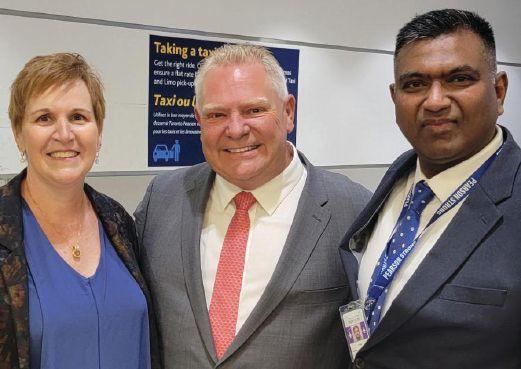
Walters had such a compelling story that he was invited to once again represent OACETT in the platform party for an announcement by Premier Doug Ford, Minister McNaughton and Minister of Finance Peter Bethlenfalvy at Toronto Pearson International Airport on March 28.
The Ontario government announced its additional investment of $21.6M over three years in its flagship immigration program to support doubling the number of skilled immigrants the province can welcome to tackle the labour shortage and fill in-demand jobs. This investment builds on the province’s recent Working for Workers Act 3, which introduced further measures to remove barriers facing internationally trained professionals who wish to work in regulated professions.
Walters, who also happens to work at the Greater Toronto Airport Authority, once again made OACETT and his employer proud and made mention of OACETT’s support for his professional journey. OACETT CEO Cheryl Farrow was also invited to the announcement. The photo op with the Premier will be another asset in opening the doors for further outreach to provincial ministries relevant to OACETT members.
And this isn’t our only good news regarding the government’s recognition of OACETT’s work to recognize internationally trained professionals. The March Newsletter of the Office of the Fairness Commissioner included OACETT in its Regulator Spotlight (bit.ly/3MW5Txr), highlighting our innovative practice in introducing the Internationally Educated Professional Practice Exam (IEPPE) as an alternative to Canadian work experience back in 2016. Eliminating this perceived barrier is now a requirement of Ontario regulators based on the government’s new Working for Workers Act, and OACETT proves it is possible. On page 9, read about steps OACETT took to eliminate the Canadian experience requirements for new Canadians in the engineering technology profession.
NEW CPD AUDIT BEGINS
The end of another year means the beginning of a new Continuing Professional Development (CPD) audit. This audit affects all members belonging to the 2020-2022 cycle. To see what cycle you belong to, check the OACETT Member Portal under CPD.
CPD is a mandatory component of OACETT membership. Check your email/mail to see if you have been selected.
OACETT CEO Cheryl Farrow, MBA, CAE (left) with Ontario Premier Doug Ford and OACETT member Clarence Walters, C.Tech., at the provincial government’s press conference that announced additional investments in its flagship immigration program to support skilled immigrants.
OACETT gets regulator spotlight in OFC newsletter
In March 2023, The Ontario Fairness Commission (OFC) newsletter highlighted OACETT for proactively adopting innovative approaches to improve fair registration practices.
In 2016, OACETT successfully eliminated its previous one-year Canadian Experience Requirements (CER) from its registration process in favour of a competency-based examination. OACETT’s Internationally Educated Professional Practice Exam (IEPPE) helps newcomers gain employment faster by administering the IEPPE exam for those who need Canadian experience.
Last year, legislation forced all Ontario regulators to stop making one-year Canadian work experience a mandatory requirement for certification. Many regulators have indicated difficulties in providing a solution to replace the Canadian experience. The OFC, in turn, has identified OACETT as a best practice and has recently mentioned the Association to various regulators. OACETT has shown there is an alternative to demonstrating Canadian standards and codes without the need for one-year Canadian work experience and provided the steps OACETT took to eliminate the Canadian experience requirement. Here is how OACETT developed the IEPPE and transformed the C.E.T. and C.Tech. qualification requirements for Canadian newcomers who want to become OACETT certified.
Task force
In November 2013, a task force (with members from industry and academia) was created to address the Ontario Rights Commission’s finding that Canadian experience requirements can constitute discrimination in employment unless proven otherwise.
Recommendation
Example of questions:
How OACETT put in motion the Internationally Educated Professional Practice Exam
• What challenges do new employees (either Canadian or internationally trained) have with respect to this aspect of workplace performance?
• Have you noticed any differences between the integration process of Canadian trained new employees and internationally trained employees with respect to this aspect of workplace performance?
New exam
In 2015, an Enhanced Professional Practice Exam (PPE) is proposed to substitute the one-year Canadian experience.
Employer interviews
With proper research and due diligence, OACETT’s Internationally Educated Professional Practice Exam (IEPPE) was created.
• The IEPPE has four sections: Law, Ethics, Practice, and Enhanced Practice
Ten industry employers were interviewed in 2015 to help understand what was needed to develop a supplementary manual, seminar and exam for internationally educated professionals (IEPs).
• The PPE is three and a half hours long
• Online 24/7 with a proctor overseeing by webcam
• 130 multiple choice questions
Enhanced section
The interview questions
Questions covered employee workplace performance:
• Understanding and applying legislation.
The enhanced section focuses on legislation and professional practice, workplace culture, health and safety, and includes additional questions.
• Understanding and applying health and safety regulations.
• Understanding Canadian workplace culture and cultural norms.
OACETT is proud to be ahead of the curve in introducing an option to one-year Canadian work experience for regulators and we hope our success in transitioning to a new process encourages other regulators to be changemakers.
OACETT Council members speak on serving their association
OACETT Council members have served the Association, providing direction and guidance and creating policies and regulations to advance its members and the profession. This year marks a transition that invokes not only saying goodbye to Council members who served the Association from 2021 – 2023 but the start of a new governance structure that will begin this May with a new Board of Directors (BoD) — built on a new robust governance model to keep OACETT strong and thriving.
In celebration and gratitude for what the 2021-2023 Council and previous Councils achieved, The Ontario Technologist (OT) asked Council members to share their thoughts and experiences about volunteering and sitting on Council. Here is what some of them had to say.
Ranjan Bhattacharya Heads of technology representative
OT What are you most proud of from your term on Council?
Ranjan: I am grateful to have been asked and was able to provide the postsecondary perspective on the Council’s agenda items. As major stakeholders of Council, it is important that context was presented and able to inform several decisions. I am also happy to have established so many great relationships with other Council members and the staff at OACETT. I look forward to interacting with them after my term is completed.
OT What would you tell others about the benefits of volunteering with OACETT?
Ranjan: Volunteering with OACETT provided an opportunity to learn more about a dynamic provincial or-
ganization focused on improving its membership’s value proposition and positively impacting industry and, to an extent, society.
It’s a great opportunity to develop new skills in leadership, relationship building, and governance. It allows individuals to gain recognition and build a profile in the community and industry. Serving on the OACETT Board can demonstrate your commitment to your field, your leadership skills, and your ability to work collaboratively with others.
Finally, there is an element of personal satisfaction/fulfillment that comes from positively impacting an organization.
OT What did you learn from volunteering on Council?
Ranjan: A better understanding of industry partners and what skills they are looking for in students and graduates. Also, great intelligence on emergent opportunities.
How well OACETT is regarded by its membership and reinforcement of the value proposition of the certification.
OT What advice would you give to a future volunteer?
Ranjan: Understand the director’s role. It is your primary responsibility to act in the organization’s and its stakeholders’ best interests. You should be familiar with the organization’s bylaws, policies, procedures, and any legal and regulatory requirements that apply.
Learn about OACETT. Take the time to learn about the organization’s mission, values, history, and culture. Understand its strengths, weaknesses, opportunities, and threats. Get to know the staff, volunteers, and other board members.
Prepare for meetings. Review the agenda and supporting materials before each meeting. Come prepared with questions, ideas, and feedback.
Be ready to engage in discussions and make informed decisions.
Build relationships with fellow board members, staff, volunteers, and stakeholders. Foster an environment of trust, respect, and collaboration.
Be committed to attending meetings, fulfilling your responsibilities, and contributing to the organization’s success. Take your role seriously and be willing to invest the time and effort required to make a meaningful contribution.
OT What skillset did you gain the most during your time on Council?
Ranjan: I enhanced my strategic planning skills with the development and roll out of the new governance model with Council becoming a Board. It was a comprehensive learning experience in setting OACETT’s vision, mission, and strategy. I look forward to following the organization’s journey and celebrating its success.
While on Council, I had the privilege of mentoring/coaching fellow members. This skillset translates very well to my “day job,” and participating on Council improved this aspect of my leadership practice.
OT What is the biggest takeaway from your volunteer experience on Council?
Ranjan: Before serving on OACETT Council, I had a cursory knowledge of the relationship between colleges and the organization. Having served for nearly six years, I better understand and appreciate how closely integrated both entities are. The colleges are a critical source of membership. OACETT provides students/ graduates access to a robust, extensive network of professionals and employers. OACETT can be a great career partner as graduates navigate their careers in a sector of rapid change and development.
Jose Catilo, C.E.T. IETO councillor, Toronto Region
OT What are you most proud of from your term on Council?
Jose: During my time on Council, we took a giant step in changing and modernizing OACETT and preparing it for the future and next generation of C.E.T.s and C.Tech.s.
OT What would you tell others about the benefits of volunteering with OACETT?
Jose: Volunteering with OACETT provides opportunities for networking, engaging other engineering disciplines, and learning new technologies and people skills.
OT What did you learn from volunteering on Council?
Jose: I gained in-depth knowledge of how OACETT operates and regulates its certifications and registration of the engineering technology profession.
OT What advice would you give to a future volunteer?
Jose: Volunteering allows the individual to explore their other talents beyond engineering technology.
OT What is the biggest takeaway from your volunteer experience on Council?
Jose: The experience of volunteering was very rewarding and fulfilling. I shared my knowledge of business operations and financial management and gained a lot of expertise in the daily activities of our great professional Association.
Reg Grieco, C.E.T. PASB councillor, Toronto Region
OT What are you most proud of from your term on Council?
Reg: I am proud to be part of creating OACETT’s new vision, mission statements, and three strategic priorities.
OT What would you tell others about the benefits of volunteering with OACETT?
Reg: When you volunteer for OACETT, you can discover skills you are not aware you have and develop others. By joining committees, you can contribute your ideas to the Association. You will meet many members and non-members and even find new friends.
OT What did you learn from volunteering on Council?
Reg: I learned the purpose of Council and how it functions in a not-forprofit organization. More specifically, I learned how OACETT runs.
OT What advice would you give to a future volunteer?
Reg: Look at what skills you already have that you can offer to your local chapter, the Board or committees. Consider your goals and how they can be achieved through volunteering. Also, consider the time commitment so you do not over-commit.
OT What skillset did you gain the most during your time on Council?
Reg: I would say the art of listening.
Jen Hazelton, C.Tech.
IETO councillor, Central Region
OT What are you most proud of from your term on Council?
Jen: I am very proud to have been the Education and Exam Subcommittee chairperson. We worked together as a team to meet our goals: to review and update the professional practice manual, internationally educated professional practice manual, technical exams, teaching modules, and practice exams to ensure all information was current and updated the wording to be inclusive. As a team, we rose to this challenge, and now the exam and materials are current and inclusive to all members.
CPD CYCLE
The start of the year ushers in a new Continuing Professional Development cycle. If you were certified in 2020 or were supposed to certify in 2020 and did not, your CPD cycle is January 1, 2021 –December 31, 2023.
You must complete four CPD activities including one mandatory activity in either technical knowledge or management/leadership. For more information visit www.oacett.org/cpd or email: cpd@oacett.org.
OT What would you tell others about the benefits of volunteering with OACETT?
Jen: The benefits of volunteering are that you can meet others with similar likes and interests in a setting that, although work-related, is social and fun. This, in turn, makes personal connections easier and more fluid.
Volunteering also allows you to network with others, which may offer you career opportunities. Getting involved with new things, such as public speaking or organizing events, will enable you to stretch yourself while still feeling supported by the other volunteers and staff within the group. It is a great feeling to accomplish something new and be successful because you are surrounded by like-minded individuals who also want you to succeed.
OT What did you learn from volunteering on Council?
Jen: I learned that every person you
meet has something to teach you. It can be something small, such as acknowledging others in a conversation without saying a word, or something bigger, such as tools for speaking in front of a group.
OT What skillset did you gain the most during your time on Council?
Jen: Advancement in communication is where I gained the most insight or skillset. During my time on Council, I learned to listen actively and respond clearly and precisely.
OT What is the biggest takeaway from your volunteer experience on Council?
Jen: The memories would be my biggest takeaway! With every event, meeting, or discussion, I will hold onto the good memories I have shared with fellow members of Council. I am very proud to have been part of a group of amazing individuals.
Salvadore Ingraldi, C.Tech.
PASB councillor, Horseshoe Region
OT What are you most proud of from your term on Council?
Salvadore: During my six years on Council, I am most proud to have successfully engaged with many other volunteers and members through various committees and teams as a guide and an active participant in making decisions that benefit OACETT.
OT What would you tell others about the benefits of volunteering with OACETT?
Salvadore: Volunteering provides an excellent opportunity to engage with all members, not just others on Council, but at all levels within the Association, and to work as a team for the betterment of OACETT members.
ROAD TO CERTIFICATION
Join OACETT for a webinar on the benefits of becoming a Certified Engineering Technologist (C.E.T.) and Certified Technician (C.Tech.).
WHY ATTEND?
• Learn how OACETT certification can boost your career — higher salary, networking, and marketability.
• Learn about CTEN.ca, OACETT's career site.
• Learn about OACETT certification requirements.
For more webinar information, visit www.oacett.org/Why-Join/Road_to_Certification.
QUESTIONS? Contact Trishia at ttedoldi@oacett.org.
WEBINARS DATES AT A GLANCE
COLLEGE STUDENTS: @ 12:00 p.m. Wednesday, July 5 Monday, July 17 & 31 Monday, August 28
INTERNATIONALLY EDUCATED
PROFESSIONALS: Thursdays @ 12:00 p.m. July 7, 20 Aug 3, 31
OT What did you learn from volunteering on Council?
Salvadore: During my time on Council, I learned how the OACETT organizational structure, and its overall strategies are developed and communicated to all OACETT members.
OT What advice would you give to a future volunteer?
Salvadore: I advise all future volunteers to use their passion for the industry to guide OACETT’s path over the next term. Become an active part of the decision-making process. You will find it to be as rewarding as I did.
OT What skillset did you gain the most during your time on Council?
Salvadore: As an outgoing member of Council, I will take with me enhanced communication skills and a passion for building teams among my peers. I
am confident these skills will be easily used in various situations.
Michel Jérôme, C.Tech.
PASB councillor,
Northern
Region
OT What are you most proud of from your term on Council?
Michel: My involvement in the development and implementation of the new governance structure is certainly something that I’m proud to have been involved in.
OT What would you tell others about the benefits of volunteering with OACETT?
Michel: Being a member for over 20 years has allowed me to network with people from many different industries. I have enjoyed volunteering, and helping to grow the organization has
been a very positive experience which has allowed me to create friendships that will last a lifetime.
OT What did you learn from volunteering on Council?
Michel: Volunteering on Council certainly opened my eyes and mind to how to be more strategic in my approach to business.
OT What skillset did you gain the most during your time on Council?
Michel: I gained more strategic thinking skills and became very thorough in reading Council documents. You can never be over prepared for a Council meeting.
OT What is the biggest takeaway from your volunteer experience on Council?
Michel: The collaboration from all members around the table and the selfless acts by volunteering speaks to the quality of the members of our Association.
LISTEN TODAY!
EPISODE 1
Host Louis Savard, C.Tech., conducts thought-provoking interviews with industry leaders, government officials, academia and influencers on hot topics relevant to the engineering and applied science profession.
From 3Ps to 3Cs: Building collaborative partnerships that drive student success
EPISODE 2
The ‘E’ Word: Understanding the Ethical Implications of New Technology
EPISODE 3
Understanding Passive House Technology
Listen to the podcast at www.oacett.org/publications/podcasts or on your favourite podcast app!
RVA partnership with OACETT boosts business goals
by Tracey Li
R.V.
Anderson Associates Limited (RVA) is proud to announce that it has joined OACETT’s 360 Partnership Program.
A long-time supporter of OACETT, RVA regularly hires, aids and promotes technicians and technologists who achieve C.E.T. and C.Tech. designations, which have been recognized as the gold standard in the industry by employers, governments, educational institutions, and the public in Ontario and across Canada.
OACETT members are involved in various roles and functions throughout the company, including project management, site inspection, technical personnel, and team leadership.
Terri Zimmer, human resources manager at RVA, who oversees the
company’s professional development program, says, “RVA’s mission to provide transformative engineering services makes it an ideal fit for OACETT’s partner network. One of
our goals, and what we bring through this partnership, is the ability to accelerate innovation and value for our people, clients, and communities. By enabling our staff to reach their full
OACETT 360 PARTNERSHIP PROGRAM
HELP STUDENTS SUCCEED
1
2
Women in Engineering Day: Shanell Roye’s journey to success
by Michelle Malcolm-Francis
International Women in Engineering Day is celebrated on June 23 every year worldwide to honour women in the engineering field, raising awareness of their career pursuits and how they are transforming the profession everywhere with their incredible achievements.
One of the women making her mark in the engineering world here in Ontario is Shanell Roye, an ambitious changemaker studying civil engineering at Humber College.
Like many women in the engineering profession, her love for building and construction began at an early age. While growing up in Jamaica, Roye worked with her uncle, an electrical engineer and successful business owner, during high school summer breaks, witnessing firsthand how he and his business partners creatively solved problems that arose in their projects.
“This experience, along with my physics teacher in high school, piqued my curiosity and fascination with the engineering field,” said Roye.
Even though she admired her uncle’s work, she was particularly drawn to the built environment and became highly motivated to turn her interest in construction into a promising career. After completing high school, Roye pursued her passion for civil engineering and graduated with honours from the reputable University of Technology in Kingston, Jamaica.
She gained valuable experience in the engineering industry as a project management associate working on various construction projects. Eventually, she assumed the project engineer role for a private contractor, awarded a government contract to construct detached units.
Roye told The Ontario Technologist that these experiences provided her with valuable exposure to key responsibili-
Shanell Roye, OACETT member ties, such as project planning, design, budgeting, scheduling, and coordination, all aimed at ensuring the seamless completion of the construction project.
In August 2021, she decided to relocate to Canada in pursuit of new opportunities, despite her positive career strides in Jamaica.
“I knew the opportunities in the engineering field were endless in Canada and would help me achieve greater career success,” she explained.
To unlock her path to career success in Canada, Roye enrolled and was accepted into Humber College’s esteemed engineering technology program, where she says she “gained comprehensive knowledge of various software utilized in the industry and Canadian codes and principles, among other pertinent courses.”
“My educational journey opened new avenues for my career growth, as I secured an internship with PCL Constructors Canada Inc., one of the largest construction companies in Canada.”
Based on the positive outcome of her internship with PCL, Roye said, “I gained invaluable real-world experience and was able to immerse my-
self in the latest technologies and best practices in the construction industry, particularly in scheduling and learning how to manage multi-million-dollar projects.”
Her educational journey at Humber College exposed her to the evolving engineering world in Canada and introduced her to OACETT, her professional Association. In 2022, she became an OACETT student member and joined the Women in Technology (WIT) Networking Group.
Roye, in conjunction with OACETT’s Trishia Tedoldi, manager of college and corporate partnerships, organized and supported an OACETT information session at Humber College on March 8, which coincided with International Women’s Day, aimed at creating awareness and fostering dialogue among aspiring students in engineering technology programs to learn about OACETT. During the event, she seized the opportunity to share her experiences with the students present,
offering support and encouragement to help them navigate challenges and pursue opportunities in their professional journeys.
Roye is committed to continuing this vital work by joining the OACETT Student Task Force, which prioritizes student engagement and effectively explores innovative ways to communicate and boost OACETT and WIT messages. She also actively collaborates with other organizations with similar goals of promoting Women in Technology and fostering diversity and inclusivity to create a collective impact.
As an advocate for women in STEMrelated fields, Roye is excited to inspire and empower more women to pursue STEM careers by sharing her story and promoting the diverse contributions that women can make in these industries. She also strives to create a supportive community that encourages and mentors women in various engineering technology jobs, providing networking opportunities and advocating
for gender equality in the workplace.
“By being actively involved in organizations like OACETT, I hope to contribute towards breaking down gender stereotypes and promoting inclusivity, diversity, and equality in STEM fields,” Roye said. “Women should have a voice in these fields to drive innovation, creativity and positive change in technology and engineering industries.”
In the next five years, Roye hopes to do just that and has set achievable goals to get her there. She aspires to be a project manager, contributing to complex and innovative projects, and expanding her expertise in emerging technologies, sustainable practices, and industry trends. She also is committed to continuing to impact the engineering industry through volunteering and promoting women’s representation in STEM fields – all significant feats that will help make our world a better place.
Michelle Malcolm-Francis is the editor of The Ontario Technologist magazine.
need from
the arrow beside your name next to the search symbol.
Calendar of Events
June 7 - 9
Water Canada Summit Delta Hotel, Ottawa watersummit.ca
June 26 - 29
Collision – Auto Tech, The Future of Transportation Enercare Centre, Toronto collisionconf.com
July 19 - 23
International Conference on Quality Engineering, Management and Control Toronto conferenceindex.org/event/ international-conference-onquality-engineering-managementand-control-icqemc-2023
August 20 - 23
Association of Municipalities Ontario Conference and AGM
RBC Place London and DoubleTree by Hilton, London amo.on.ca/2023-amo-conference
Sept 17 - 19
2023 CHES National Conference and Trade Show
RBC Convention Centre, Winnipeg, Manitoba Ches.org/conferences-andevents/2023-ches-nationalconference
Adam DeMeester: Part of the invisible glue of our heath-care system
by Dennis Furlan
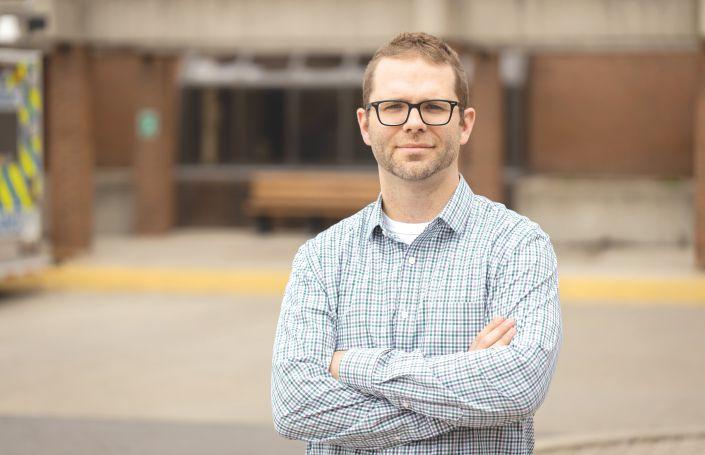
Engineering technology is, by definition, a technical field involving technical matters such as chemicals, circuitry, equipment and maintenance. However, at least one area in the field involves more than just technical proficiency or even working with people. It involves people’s health and well-being; Adam DeMeester, C.E.T., has been doing it for almost 15 years.
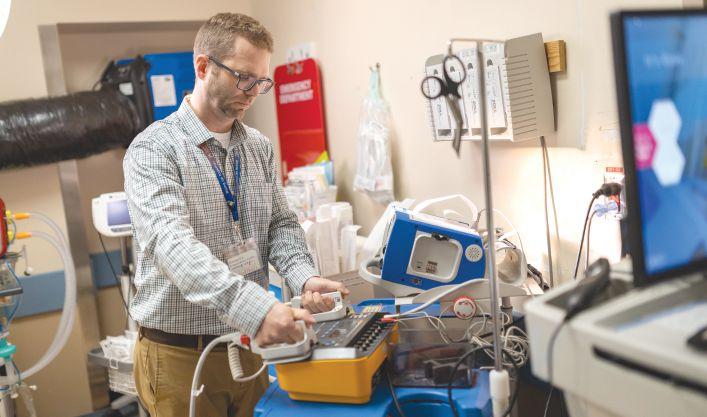
DeMeester is a biomedical engineering technologist working for the biomedical department at Hamilton Health Sciences (HHS), specifically working with a team of about six other biomeds at Hamilton General Hospital. In essence, these biomeds take care of the hospital equipment that save lives.
Helping people
In fact, it’s part of the reason why DeMeester entered the field. He says, “I always liked working with my hands. But, with biomedical engineering, you get to help people, too. And that’s one of the reasons why I enjoy my job.”
Indeed, it was during high school
when DeMeester was first introduced to the field. He was involved in a coop program and worked alongside a biomed for the first time. It was at this point that DeMeester knew what he wanted to do career wise.
He says, “I just fell in love with the work. It was in a hospital. It involved using technical skills to support the medical profession. I saw biomeds as a bridge between the clinical professionals and the equipment they used, and it’s a role I’ve served dutifully for a number of years now.”
As DeMeester describes it, biomeds are, in many ways, the invisible glue that helps a hospital serve its patients. He says, “You often don’t notice us, but we’re there maintaining equipment, repairing it, doing whatever it takes to ensure the technical side of health care is running properly.”
Many aspects of the job
However, there are times when biomeds interact with the patients, and that’s where DeMeester says people skills and training have to kick in. He says,
Adam DeMeester, C.E.T.
“Essentially all non-medical people in the health care system must abide by a code of conduct. But, whenever possible, we are friendly and welcoming to the patients. After all, that’s ultimately who we’re supposed to serve.”
But, of course, there is the technical side of being a biomedical engineering technologist, which involves inspecting, repairing, calibrating, maintaining, and installing medical equipment, and training users. It can also involve some bigger projects, and it’s in this area that DeMeester talks about some of what he and his team have done.
He says, “For about a year, I was a biomedical systems administrator for a project in which we integrated 300 medical devices, including ventilators, anesthesia units, and heartlung machines, into HHS’s new electronic medical record (EMR). It was a big job, but it was also the kind of
work we do that adds value to the system. I believe outsourcing some of these jobs would have cost a lot more. Keeping it in-house, and having the expertise to do it, is crucial.”
This project was one aspect of his job that was extremely important to
the hospital and its patients. It showed how critical biomedical technologists are to our health system and the engineering technology profession.
Dennis Furlan is a contributor with The Ontario Technologist.
Sheridan engineering technology students bring industry partner projects to life
In Sheridan College’s Faculty of Applied Science and Technology, the Mechanical and Electrical Engineering Technology (MEET) programs prepare students to apply engineering principles, methods and techniques to conceive, design, implement and operate value-added engineering products, processes and systems.
Professors invite industry partners to collaborate with students for MEET’s senior-level capstone courses. The culminating projects feature robotics, design, artificial intelligence, electronics, computer engineering, mechatronics and energy. The project provides students with a realistic experience to integrate and capitalize on the basic disciplinary material they learn and synthesize a new product, device or process.
Real-world projects involving industry provide tremendously rewarding experiences for Sheridan students. They can train and apply a user-focused process, work on a real-world problem, receive mentoring and feedback from professional engineers and experienced technologists and technicians, and gain access to company resources. In 2022, Sheridan’s MEET programs produced many successful and innovative research projects.
Automating bricklaying with Hatch Ltd.
Electrical technology students Camilo Perez, Abdullah Elqabbany and Daniel Clavijo, and mechanical engineering technology student Muhammad Ali Khan, came in third place for their capstone project automated robotic bricklaying, at the ASME/SME Student Manufacturing Design Competition. The team competed against several renowned post-secondary institutions, including the University of Southern California, Virginia Tech, West Virginia University and Purdue University.
The team aimed to develop a proof of concept for an automated bricklaying solution. They collaborated with Hatch Ltd. to develop a final solution that involved a sixaxis robot mounted on a track, a 3D-printed pallet and a 3D-printed fixture for the bricks. The proof of concept developed in collaboration with the Hatch team demonstrated the key components required for a solution to be scalable and viable for industrial applications. The Sheridan team’s project success is a testament to their hard work and innovative thinking in mechanical and electrical engineering.
Designing future workspaces with Microgreen Solar Corporation
MEET programs have partnered with Sheridan’s Centre for Advanced Manufacturing and Design Technologies to lead a manufacturing plant design project for Microgreen Solar Corporation’s current and future workspace.
Microgreen Solar Corporation is a leading provider of solar photovoltaic systems and lithium battery pack solutions for residential and commercial applications. They have many solar panels and energy packs that offer a complete off-grid solar system, as well as comprehensive engineering and design services to ensure that their customers receive the best possible system for their needs.
Students from the Mechanical Engineering Design program worked on planning and constructing a new production facility and restructuring the existing facility to optimize production efficiency. The project involved effectively integrating various design applications, virtual reality, equipment and product design, manufacturing process simulation and optimizing layout that maximizes efficient production of high-quality products at the lowest possible cost.
Aravind Venkatapathy and Andy Alubaidy are professors for the Faculty of Applied Science and Technology at Sheridan College.
Sheridan MEET students placed third at manufacturing design competition. Pictured from left to right: Abdullah Elqabbany, Camilo Perez, and Daniel Clavijo. Not pictured: Muhammad Ali Khan.
BY PETER SAUNDERS
When screen tech is cleantech
Have you ever struggled to read your smartphone’s screen outdoors on a sunny day? If so, you may be glad to hear about VueReal, a semiconductor fabrication start-up based in Waterloo, which was recently awarded $8.5 million from federally funded Sustainable Development Technology Canada (SDTC) and $2 million from provincial agency Invest Ontario to help scale up its capacity.
Launched in 2016, the company develops high-brightness ‘MicroLEDs’ for smartphones, TVs, notebook computers, virtual reality (VR), augmented reality (AR), instrument panels and other displays for the automotive, aerospace and medical sectors. According to Research and Markets, the market for these semiconductor devices, which reduce energy consumption compared to traditional light-emitting diodes (LEDs), is expected to reach US$11.5 billion by 2026.
The new round of federal and provincial funding supports VueReal’s $40-million investment in manufacturing, micropixel fabrication and printing technologies, which is expected to create 75 new jobs and boost innovation in ‘cleantech.’ The company anticipates employing 105 people in the Kitchener-Waterloo area.
“Canada’s universities and government research funds make it a prime location for developing cutting-edge and sustainable technologies,” says founder and CEO Reza Chaji. “VueReal has leveraged this ecosystem to develop its MicroSolid printing technologies, which enable the creation of smart surfaces for next-generation displays and sensor applications. We are proud to produce these advanced technologies in Waterloo.”
The investment in VueReal is the second for SDTC, which is mandated to foster the development and advancement of environmentally sustainable technologies.
“VueReal’s MicroLED technology will make screens not only brighter but also more energy-efficient, and the production process will create less waste,” says Leah Lawrence, SDTC’s president and CEO.
Indeed, the company’s approach is considered cleantech because it avoids the traditional large-scale depositing, removal and addition of materials, which consumes and wastes a lot of material, power, chemicals and water.
“We’re making LEDs and other wafer-level devices on a much smaller scale by turning them into a cartridge printed on a substrate,” Chaji explains. “We’re bridging what would usually be separate processes, provid-
ing a flexible platform that will allow small companies and research groups to come up with their own creative ideas for high-performance products.”
“Homegrown tech companies like VueReal are essential to the economy of the Waterloo Region,” says Mike Harris, MPP for Kitchener-Conestoga. “Ontario is proud to partner with them to help expand their operations.”
Further to this point, as part of its 2023 budget, the provincial government plans to launch a new OntarioMade Manufacturing Investment Tax Credit. This 10 per cent refundable corporate income tax credit aims to help local manufacturers reduce costs, hire employees, test new ideas and become commercially competitive on the world stage.
Peter Saunders is a regular contributor to The Ontario Technologist.
With VueReal’s microdisplay cartridge wafers, each die includes more than 6 million microLEDs. PHOTO COURTESY KW RECORD AND VUEREAL.
Heat pumps in the spotlight
Multi-unit residential building retrofits introduce low-carbon options
BY BF NAGY
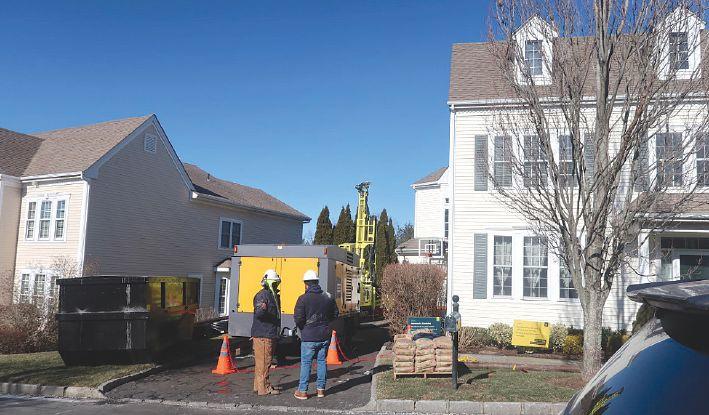
Many Ontarians adjust the thermostat if they feel too hot or cold. It was a little more complicated at 66 Walpole (and similar communities in Ontario towns) until the landlord, Toronto Community Housing Corporation (TCHC), made recent improvements.
There are bigger problems in the world than indoor temperature control, like extreme weather caused by climate change - heat waves, droughts, forest fires, floods and extreme storms. Solving some of these big problems and making 66 Walpole more comfortable involve the lowly heat pump, a technology that isn’t usually the lead story on the news.
That might be changing. Efficient, low-carbon heat pumps are becoming a hot topic. A heat pump mythbuster piece was posted recently on Twitter, and within 24 hours, it received more than half a million views and several publishing offers.
The Ukraine war has helped accelerate heat pump sales in Europe to 38 per cent in 2022, a four per cent increase from 2021. They are also becoming more popular in the rest of the world. New kinds of heat pump solutions are proliferating. They offer low-carbon, healthy, comfortable, low-cost heating, cooling, and hot water in businesses, houses and apartments.
Gradiant window heat pump. PHOTO: GRADIANT
Heat pump retrofits for multiunit residential
TCHC and the University of Toronto have worked with engineer and passive house consultant Rob Blakeney of Local Impact Design in Guelph, Ontario. Blakeney is a green building veteran with decades of experience who has won numerous awards.
He has recently developed a North American version of an exterior bolt-on mechanical pod for groups like TCHC for clean energy retrofits, using a heat pump, an energy recovery system, and a heat pump water heater. The idea is to provide a budget-friendly solution
to retrofit existing multi-unit residential projects while tenants remain in place. Similar pods are being developed in the UK and Europe to help governments grapple with decarbonizing existing homes affordably.
Despite being a strong advocate for passive house technology (and a board member for Passive Buildings Canada), Blakeney has noted that in many jurisdictions in Canada and beyond, the conditions only occasionally present themselves for a compelling investment payback on existing building retrofits using the full-on superinsulation approach.
Heat pump installation at the French Quarter condominium, Toronto.
PHOTO: THE ATMOSPHERIC FUND
The Aerobarrier building envelope sealing system by Aeroseal.
PHOTO: AEROSEAL
Heat
New thinking on retrofits
Last year, Blakeney wrote a paper noting that sealing a building envelope and swopping heat pumps for gas appliances or electric baseboard heaters offers the greatest carbon reductions and decent energy cost savings. However, the business case for complete envelope retrofit – adding insulation and new windows – is less compelling. By contrast, Blakeney sees air sealing as the lowest-hanging fruit. He has employed Aerobarrier, a relatively new technology he considers ‘a game-changer,’ to achieve impressive air tightness results. It’s a new waterbased, non-toxic, UL-approved product/ system from Aeroseal.
The system uses a modified blower door device to create negative pressure and another device to spray the product throughout the space. It finds and seals all the leak points, and once dry, the blower door can be used to verify the leakage reduction.
Heat pumps and single-pane windows
At 66 Walpole, where the windows are single pane, and the heating system was electric resistance baseboard heaters, 50 per cent of residents felt too cold in winter, and 70 per cent were too hot in summer. In a pilot test, The Atmo-
spheric Fund (TAF - Formerly the Toronto Atmospheric Fund) replaced the baseboard heaters in eight apartments with Mitsubishi M-series cold-climate ductless multi-split systems (22,000 –28,600BTU/h) with two or three indoor heads serving each suite. No other improvements were made, but after the retrofit, 80 per cent of residents were more comfortable in winter and 97 per cent in the summer.
“Now we’re installing heat pumps in all 127 units of the community,” says Keith Burrows, senior manager, lowcarbon buildings at TAF. “Walpole was designed some time ago, and we’re replacing electric baseboard heaters with mini-split heat pumps. These days most of our projects involve replacing gas systems with multi-split heat pumps, VRF or ground source heat pumps. Our mandate is to support projects that realize 40 per cent85 per cent emission reductions.”
New heat pump products “I’m excited that owners of buildings with gas are starting to see heat pumps as a viable option,” says Burrows. “And some of the new heat pump trends include C02 as a refrigerant, built-in thermal storage that permits involvement in demand response programs,
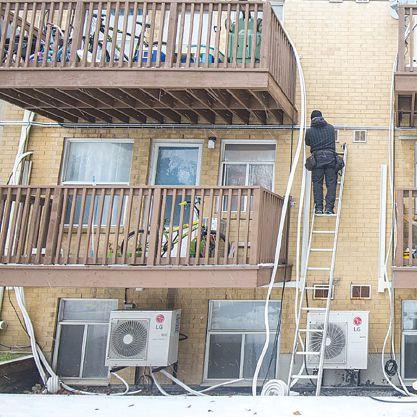
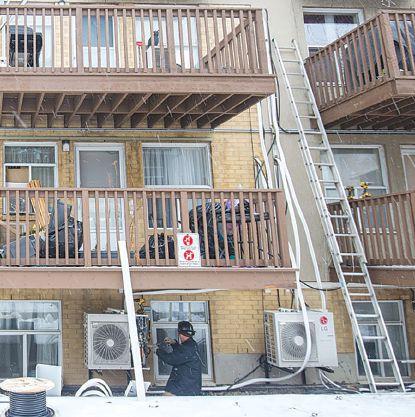
pump outdoor units at 66 Walpole in Toronto.
PHOTO: THE ATMOSPHERIC FUND.
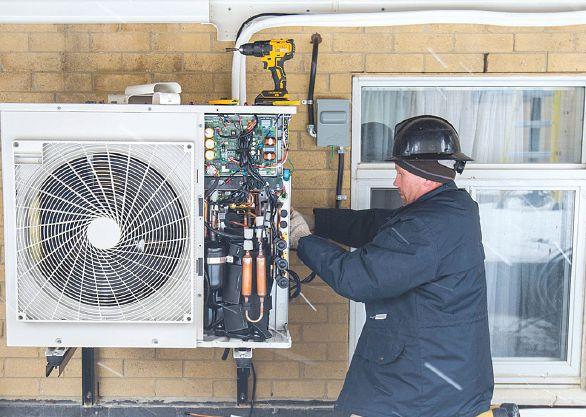
A technician installs the outdoor unit of a mini-split heat pump at 66 Walpole in Toronto. PHOTO: THE ATMOSPHERIC FUND.
and greater use of highly efficient air to water systems.”
Blakeney sometimes works with an Illinois company called BuildEquinox, which has created the CERV 2. It provides heating, cooling, ventilation, energy recovery, advanced controls and air filtration (Merv 13 and/or UV for viruses) in one box, with no outdoor unit.
Blakeney has also been developing compact unitized systems that can fit into the ceiling of a closet in a small suite, providing heating, cooling, and ventilation.
Dedicated HVAC systems allow more tenant control, improve air quality and make it easy to meet fire separation requirements.
In this case, the products are off-theshelf, but the system design is innovative. The ERV unit is the Panasonic WhisperWall FV-10VEC2 providing 50-70 CFM. The ducted heat pump is a Mitsubishi PEAD with a capacity of 9,000 to 18,000 BTUH, depending on the conditioning loads. Ducted units can be paired with an individual outdoor unit or ganged to a single outdoor unit.
Gradient Comfort in San Francisco has invented a 9000 BTU window heat pump, similar to window air conditioners. The mechanics hang below the window outside and inside, creating a
window shelf. It’s more efficient and quieter than old-style window air conditioners, and you can see through the window and open and close it.
Addison HVAC in Orlando, Florida, is promoting its new no-defrost heat pump, which saves energy and wear and tear because it detects outdoor coil temperature levels and uses a precise amount of hot discharge gas to prevent frost from forming.
The Minotair Pentacare-V12 compact air treatment unit is used in tight-envelope single-family homes and condo units in Ontario, Quebec and elsewhere. It controls ventilation, temperature, and humidity and provides MERV 13 filtration at 20-180 CFM of fresh air in air exchanger mode and 80-250 CFM of filtered air in recirculation mode.
One of the air-to-water systems that TAF is working on is a project in which a 151-suite condo development replaced a failing chiller with two large heat pumps that fed fan-coil units in each suite.
“It created a more efficient air conditioning system and it also displaced some of the gas heating, in the shoulder seasons especially,” said project engineer Mark Greenhill of Remy Consulting Engineers in Toronto/Burlington. “The heat pump has been running
throughout March, and the gas boiler has not come on.”
Ground source innovations “Air-to-water is surging, and so is geothermal,” says Jeff Hunter, president of the Ontario Geothermal Association. “With air to water, vapour is injected into a variable speed compressor achieving a COP of 2.2 at -25 °C. And there are new approaches with geothermal too. Ways to optimize the amount of loop that goes in the ground and controlling upfront cost. The world is moving away from gas.”
He says it’s notable that the Heating Refrigeration and Air Conditioning Institute (HRAI) is holding a symposium on heat pumps this year for its members, who are mostly gas system installers.
“But there are difficulties,” says Hunter. “We should be installing thousands of heat pumps every year – who is training the people to do it? Recessionary forces are coming, and gas may be ending, but North America is sending more gas to Europe than ever.”
Gas might be declining, and heat pumps may be having their day. However, one thing is for sure. Both methods remind us that it takes more than adjusting our thermostat to achieve the perfect room temperature in our homes.
Geothermal borehole and ground source heat pump installation in Connecticut. PHOTO: BF NAGY.
Electric vehicle adoption barriers in Canada
What it takes to get Canadians on the EV bandwagon
BY ANDREW COUTURIER, C.E.T.
In 2022, Canadian gas prices hit record highs – breaking two dollars a litre in Ontario – because of the oil and gas industry’s recovery from the COVID-19 pandemic, the 2022 Russian invasion of Ukraine and associated international sanctions, according to media outlets. In response, many consumers have strongly considered adopting an electric or hybrid electric vehicle (EV) to alleviate the cost at the pump and reduce dependence on the oil and gas industry.
However, the capital costs of an EV, amongst other factors, are a significant barrier to electric vehicle adoption. Multiple factors are present at the surface when evaluating the cost of an EV against an internal combustion engine vehicle (ICEV), including the manufacturer’s suggested retail price (MSRP), fuel, maintenance, and distribution. These are the costs paid by the purchaser of the vehicle and are likely the most well-documented as they impact most consumers. However, EVs’
social and environmental implications can also hinder electric vehicle adoption in Canada.
In a 2020 study, two sets of vehicles were examined to measure the quantification of positive benefits for consumers in purchasing EVs, starting with the capital costs – willingness to pay (WTP). The median WTP for a Hyundai Kona EV was 14 per cent greater than the ICEV equivalent, and the Mini-Cooper EV had a median WTP of 12.5 per cent over the ICEV equivalent. However, the Hyundai Kona EV MSRP was noted to be 58 per cent greater than the Kona WTP and 79 per cent more significant than the ICEV MSRP. The Mini-Cooper EV MSRP was 12.75 per cent greater than the median WTP and 26.8 per cent greater than the ICEV MSRP.
A significant contributor to the cost of EVs is the batteries, which sometimes represent a third of an electric vehicle’s total cost. Research is divided on the outlook of battery resource avail-
ability, with shortages of some materials anticipated while other materials are well within current estimations. Integration of electric vehicles has already been observed to impact the existing electrical infrastructure in the United States. A 2014 study noted that the annual incremental grid infrastructure upgrade costs required to accommodate peak inverse voltage are $2.7 million annually. A significant source of revenue generation for the transportation infrastructure is through taxes on gasoline. A 2015 study examined the effect of EV integration and observed an anticipated $250 million CAD annual revenue generation reduction over the next decade from gasoline tax losses. It was noted that implementing a method to recoup these costs from EVs may encounter political backlash and implementation challenges and negate EV incentives currently in place by provincial and federal governments.
One method to bridge the gap between consumer WTP and current EV prices is through governmental EV incentives. EV incentives can take various forms, such as rebates, sales tax exemptions, and tax credits. In Canada, the incentives for the Zero-Emission Vehicle (iZEV) program provides lease and
purchase incentives, with a purchase incentive of $2,500 for a vehicle with a battery below 15 kWh and $5,000 for a vehicle with a battery above 15 kWh. Some Canadian provinces, such as British Columbia, Nova Scotia, Québec, and Yukon, offer provincial incentives. A 2019 study measured the cost-effectiveness of EV subsidies in the United States. It determined that targeting incentives by income level, vehicle disposal, geography, and distance travelled can almost double the costeffectiveness. Further, it was noted that more significant subsidies for larger batteries result in greater battery electric vehicle adoption. At the same time, policies that do not discriminate by battery capacity result in greater adoption of plug-in hybrid vehicles. Social impacts also play a significant role in electric vehicle adoption. As the rate of EV adoption progresses, some individuals have displayed open opposition to the EV market. The term “ICEing” refers to an internal combustion engine (ICE) vehicle that does not require a charging system, parking in an EV charging spot. The ICEing trend emerged from the United States with repeated instances of large pick-up truck owners parking in Tesla super-
charging spots. It has been suggested that traditionalists who identify with powerful, loud, intimidating ICEVs may reject quieter, more reserved EVs as a source of pride or culture.
Many international organizations recognize the transition to EVs as a significant step towards reducing the impact of global climate change. In 2020, the Government of Canada released A healthy environment and a healthy economy: Canada’s strengthened climate plan to create jobs and support people, communities and the planet. This document acknowledges the Canadian zeroemission vehicle sales targets of 10 per cent by 2025, 30 per cent by 2030, and 100 per cent by 2040, and announces $287 million over two years for the iZEV program and a further $150 million over three years on charging and refuelling stations across Canada.
The Paris Declaration on ElectroMobility and Climate Change & Call to Action recognizes that limiting global temperature to below two degrees celsius will require at least 20 per cent of international road transportation to be electrically driven by 2030. Many automakers have also declared a transition to full EV development, with General Motors, Volvo, Mini Cooper, Ford (Eu-
rope), Volkswagen, and Jaguar all setting dates to achieve the goal before the 2040 deadline. Tesla, a global EV leader founded in 2003, currently only produces EVs and is the industry leader, commanding 25 per cent of global EV sales in 2020.
Through increased social acceptance through awareness and understanding of and exposure to EVs and the projected reduction in capital costs, the availability and acceptance of EVs will become increasingly possible, allowing greater access by marginalized and economically strained populations. As such, it may result in a positive feedback loop in which greater access to EVs contributes to greater exposure, encouraging integration and feeding back into access and exposure. As EVs become more accessible, the median WTP may increase with realized social and environmental benefits. Despite this, Canada must work to address the existing barriers to electric vehicle adoption for the nation’s overall environmental and economic well-being.
Andrew Couturier, C.E.T., is a project manager with Englobe Corporation in Ottawa.
Nico Cariati, C.Tech. Waseem Cheema, C.Tech. Alex Couture, C.Tech. Kuwar Dalal, C.Tech. Ashley Dennis, C.Tech. Patrick Devine, C.Tech. Charles Fromentin, C.Tech. Michael Gibb, C.Tech.
Tiffany Greco, C.Tech.
Brady Johnston, C.Tech.
Aju Parapillil Johny, C.Tech.
Brian Kamau, C.Tech.
Janusz Langowski, C.Tech.
Christopher Lassaline, C.Tech. Bryden Lloyd, C.Tech.
Jason Marcus, C.Tech.
Jeremy Marshall, C.Tech.
NEW MEMBERS
Anthony Mirabelli, C.Tech.
Jason Ngo, C.Tech.
Bruno Piccin, C.Tech.
Joshua Ritchie, C.Tech.
Shagun Shrivastava, C.Tech.
Gaganpreet Singh, C.Tech.
Harpreet Singh, C.Tech.
Christopher Sokol, C.Tech.
Francesco Spagnuolo, C.Tech.
Craig Spear, C.Tech.
Nicholas Van Dalen, C.Tech.
Alessia Ventrella, C.Tech.
Clinton Weiher, C.Tech.
Martin Wotherspoon, C.Tech.
Qingguo You, C.Tech.
Senlin Zhang, C.Tech.
Associate Members
Edgar Agudelo Acosta
Shiyan Alagaratnam
Alaa Albadin
Aswathi Ravi Aluparambil
Alexander Andrychuk
Nevin Augustine
Venkiteswaran
Balasubramanian
Karan Basi
Emmanuel Baysac
Jeremie Begin
Vincent Bore
Huda Bowaihl
Logan Bradshaw
Aulona Brahasani
Ricardo Bruno
Mustapha Bukenya
Daniel Cécile
Adenilton Chaves de Carvalho Junior
Long Hin Chi
Wai Man Ching
Courtney Clarke
Laura Code
Cristina Colantonio
Elaine Dalit
Phong Dang
Aaron Dare
Ashley De Dominicis
Froilan de Guzman
Deep Desai
Anthony DiCarlo
Sourabh Dileep
Andrew Dorr
Amber Ducheno
Colby Emon
Luigi Enrico Ferreira Burjato
Patrick Foley
Adam Gard
Nicholas Gatto
Jessica German
Pratik Ghori
Abelaash Giritharan
Matthew Gray
Joseph Greco
A.S.M. Habib
Kidist Habtemikael
Milad Hanna
Stephen Hayes
Kayleigh Hayes
Patrick Hebert
Mark Hill
Angela Hills
Christian Hodgson
Janet Hoffer
Zachery Hoover
Robert Hudspeth
Hassan Ismail
Janikka Jeyanathan
Yong Kung Jo
Shyam Khetani
Magda Kolat
Paul Kolenchery Jose
Kinal Lad
Mary Lagumen
Hin Lau
Mykhailo Leliseiev
Taylor Lerock
Kevin Ley
Tom Liszt
Nathan Littlejohn
Leslie Maina
Kai Maki
Michael Marsden
Kelby Martin
Gregory McCorquodale
Goran Mihajlovic
David Miro
Thomson Moase
Mohamed Ismail
Manan Monga
Salim Multani
Ka Long Ng
Johnson Nguyen
Leo Nguyen
Reynaldo Nuqui
Adam Opper
Gustavo Ortega Lajud
Leonard Papp
Kyle Paquette
Donghwi Park
Eliseo Pasaron
Mihir Patel
Prince Patel
Abdulhafeej Patel
Yashkumar Patel
Jyothis Peenickaparambil Johney
Dominic Piotrowski
Ahmad Qarizada
Abdulla Qasemzada
Kim Tuyen Quach
Deshawn Reid
Alan Ritcey
Jason Russell
Mandeep Singh Saini
Hammad Saleem
Christian Saunders
Sumit Shandilya
Mandeep Singh
Supneet Singh
Mohamed Skikkandar
Martha Skinner
Ethan Smith
Trent Smith
Katherine Smyth
Mark Staffen
Solanki Sureshkumar
Jonathan Thorne
Wilson Toong
Ngoc Tran
Taylor Van Velsen
Marie Ver
Benjamin Viau
Elizabeth Woods
Jonathan Burt Ivans Woomed
Carlos Zambrano
Severin Zindel
Existing Members in Road Construction
Certified Engineering Technologists
Nathan Casey, C.E.T., rcsi
Bruce Cooper, C.E.T., rcsi
Darni David, C.E.T., rcji
Christian Hodgson, C.E.T., rcsi
Mehendra Prasad, C.E.T., rcsi
Daniel Wafer, C.E.T., rcca
Evan Woodcock, C.E.T., rcji
Certified Technicians
Macgill Doner, C.Tech., rcji
Neil McCaffrey, C.Tech., rcsi
Manavdeep Singh, C.Tech., rcsi
Hardik Suhagiya, C.Tech., rcca
Hung That Viet Ton, C.Tech., rcji
Associate Members
Joseph Alford, rcji
Sohanit Bains, rcsi
Bryson Bennett, rcji
Siar Esckendari, rcca
Ty Hamilton, rcca
Sahil Kakkar, rcsi
Muhammad Khan, rcsi
Taj Khan, rcsi
Mumbanga Mokolo, rcsi
Marco Nicolosi, rcji
Mohd Oryia, rcji
Jay Siddhapura, rcji
Jasmine Staniforth, rcji
In Memoriam
Staff and members of OACETT send their sincere condolences to the family and friends of the following members. They are remembered.
James Erickson, C.E.T.
Tyson Jepson, C.Tech. David Watt, C.E.T.
Volunteer of the Month – February 2023
Jürgen Friedrich, C.Tech. York Chapter
OACETT member since 2011
Q: Tell us about yourself.
A: I’m a lifelong learner with over 15 years of progressive experience designing, costing, planning, and implementing solutions in telecommunications and personal finance. I also have seven years of experience assessing, analyzing, planning, and reporting on building renewal projects in the public sector.
I have a Bachelor of Science honours degree in computer science from York University, a mechanical engineering technology–building science co-op diploma from Seneca College, and a
LEED Green Associate credential from the U.S. Green Building Council. Also, I am a certified associate in project management and a certified technician and possess WELL accredited professional credentials. I have also completed Lean Six Sigma White, Yellow, Green, and Black Belt training.
Q: What volunteer roles have you fulfilled?
A: When I joined the York Chapter as a volunteer, I helped to set up the York Chapter domain name and email service and was part of the team that worked on the York Chapter 2021 National Engineering Month event. In June 2021, the chapter’s treasurer position became vacant, and I volunteered to fill the role and have served in this capacity ever since.
Q: What volunteer role was the most rewarding? And why?
A: Every volunteer role or team that I have been a part of has been rewarding. Everything a volunteer does helps to advance the chapter and OACETT forward.
Q: What do you enjoy most about being an OACETT volunteer?
A: I enjoy meeting other volunteers and members and hearing about their professional, educational, and personal experiences.
Q: What advice would you give to a prospective member and/or volunteer?
A: I would advise a prospective member or volunteer to attend some chapter events and continuing professional development sessions. Meet other volunteers and members, get to know them, and ask about their experiences. If you have a few hours a month, volunteer your time to help your chapter.
Volunteer of the month - March 2023
Mark La Fleche Toronto Central Chapter
OACETT
member since 1986
Q: Tell us about yourself.
A: I retired last year from the City of Toronto. I was a senior technical support specialist in technology services (formerly IT) in the data centre and network voices services area. I primarily worked on network and data communication services and infrastructure and supervised staff. In my last three years with the City, I inherited overseeing the data centre and some of its operations duties. I graduated from RCC School of Electronic Technology with a diploma in electronic engineering technology with honors in 1986. From there, I started to work for Dataline Investment Information as a field support specialist supporting services,
then for Rogers Network Services as a staff technologist, then for Toronto Police Service - radio and electronics unit, and finally for the City of Toronto.
Q: What volunteer role was the most rewarding? And why?
A: The most rewarding role was volunteering on the AGM committee in 1994. I was primarily on the registration committee and did a lot of work registering guests and organizing the tickets for the events
and dinners. This was very rewarding, especially since we received accolades for putting on an AGM that outperformed the previous year.
Q: What do you enjoy most about being an OACETT volunteer?
A: What I enjoy most as a volunteer are the friendships I have made over the years with the other volunteers in many chapters through organizing events, attending tournaments in different regions, and attending the AGM. The best part is meeting people at registrations at picnics, dinner dances, and golf tournaments. It was just fun to meet new people or see those who come out year after year.
Q: What is your most significant personal or professional achievement?
A: My most professional achievement was completing a major data centre renova-
tion, which I inherited as a job function. We had many roadblocks, constraints, and mistakes, but with the support of the team and individuals around me, we got the infrastructure ready for new equipment.
Q: What advice would you give to a prospective member and/or volunteer?
A: My advice is to come out to events and volunteer where you can. You may find an opportunity or develop skills that you never knew you had. You’re interacting with people who have similar backgrounds. We’re all engineering people, and our different disciplines will overlap. Also, as we move through our careers and life, we discover that we have other interests and challenges. Your chapter is where you can find support, or you can support someone else.
Eastern Region
Kingston Chapter
In February, the Kingston Chapter executives met to discuss upcoming events and 2023 business activities, including a tour of a wind turbine and a solar field installation, the Kingston Airport tower tour and other exciting events during May and June.
In March, the Kingston Chapter supported FLASF (Frontenac Lennox Addington Science Fair), offering a special award for “Best Display of the Practical Application of an Engineering Concept.” The award recipient received a $100 prize and an OACETT award certificate.
In addition, the chapter will be working again with LERT and WAFFLES robotic teams. The fish fry held on April 25 raised funds to support their activities.
Bruce Fudger, C.E.T., is Kingston Chapter chair: kingston-chapter@oacett.org.
Renfrew County Chapter
On March 4, the Renfrew County Chapter’s Women in Technology (WIT) hosted a technical brewery tour, tasting and networking event at the Whitewater Brewing Co. Sales manager Robin Pinkerton took chapter members through the process from raw materials sourcing and supply for hops grown in Western Quebec to Canadian barley. It’s truly a science! Many thanks to Wanita Champoux, the chapter’s WIT rep, for coordinating the event. OACETT, including Renfrew Chapter, works tirelessly to foster relationships with local businesses and support and buy locally, especially for companies that contribute to good environmental stewardship. Thanks Whitewater Brewing Co. for hosting the event! Learn more at https://whitewaterbeer.ca/.
Larry McHenry, C.E.T., is Renfrew Chapter chair: renfrewcounty-chapter@ oacett.org.
Renfrew County Chapter members at the
Ottawa Chapter
The Ottawa Chapter was an exhibitor at the Algonquin Centre for Construction Excellence Annual Networking Event on March 29. The “meet and greet” allowed industry professionals to network with students, alumni, faculty and industry professionals. The OACETT table received great traffic, providing visitors with information about the association, such as student brochures and The Ontario Technologist magazines.
Shawn Wessel, A.Sc.T., rcji, is Ottawa Chapter chair: ottawa-chapter@oacett.org.
Algonquin College students at the Algonquin Centre for Construction Excellence Annual Networking Event on March 29.
The Kingston Chapter executives at their February meeting. From left to right: Joshua Pullman, Scott Farmer, C.Tech., Richard Cork, C.Tech., Bruce Fudger, C.E.T., Ryan Klein, C.E.T., John Hoogwerf, C.E.T., and Rob Morton, C.Tech., rcji.
Whitewater Brewing Co.’s sales manager Robin Pinkerton shows event attendees hops grown in Western Quebec during the brewery tour.
chapter’s WIT technical brewery tour, tasting and networking event at the Whitewater Brewing Co.
Western Region
Windsor-Essex Chapter
Irene Zaborek, C.E.T. (left) and Whitney Jardine, C.E.T., Fellow OACETT, award winners at Professional Engineers Ontario Engineering
Irene Zaborek, C.E.T., received the Windsor-Essex County Technologist of the Year Award at the Professional Engineers Ontario Engineering Month Luncheon on March 31. The award recognizes and thanks an engineering professional who has contributed significantly to the advancement of the profession either in the technical, educational or community service field. Whitney Jardine, C.E.T., Fellow OACETT, received the Top 3 under 30 Award for Windsor-Essex County. The award recognizes the top three residents of Windsor or Essex County under the age of 30 years with a high potential for upward mobility in the engineering field.
Scott Rivard, C.E.T., is Windsor-Essex Chapter chair: essex-chapter@oacett.org.
Grand Valley Chapter
On March 5, Grand Valley Chapter Women in Technology hosted a brunch to celebrate International Women’s Day. This event was well attended and enjoyed by all at Foundry Tavern in Cambridge. Thank you to Patricia Espinola, C.E.T., for organizing this great event.
Northern Region Thunder Bay Chapter
On March 19, Grand Valley Chapter attended the Kitchener Rangers vs. Kingston Frontenacs hockey game. Chapter members, their families and local 360 Partnership Program members enjoyed an exciting game, with the home team coming out on top! The chapter executive looks forward to seeing members at more events this summer.
Mike Luyckx, C.E.T., is OACETT Grand Valley Chapter chair: grandvalley-chapter@oacett.org.
On March 3, the Thunder Bay Chapter held the Women in Technology Mixer & Social event at the Chanterelle. The event was sold out! There were amazing door prizes, and everyone had a great time. This event was open to all interested individuals who work, study, or support women in technology, architecture, engineering, interior design, construction management, and design. The Thunder Bay Chapter plans to organize the Women in Technology Mixer & Social every year, and we look forward to another great event in 2024.
Thunder Bay Women in Technology Mixer & Social attendees at the Chanterelle on March 3.
If you want to join the executive committee, contact chapter chair Gail Willis, C.E.T., to find out more. To stay connected, visit the OACETT Thunder Bay Facebook page, and follow the chapter on Instagram and LinkedIn.
We want to hear from you! Send your suggestions, comments, and thoughts to Gail at thunderbay-chapter@oacett.org.
Gail Willis, C.E.T., is Thunder Bay Chapter chair: thunderbay-chapter@ oacett.org.
Sault Ste. Marie Chapter
On March 12, OACETT and PEO members, families, and friends enjoyed an afternoon of skating, hot chocolate, and treats. A great time was had by all!
Gilbert Desbois, C.Tech., is Sault Ste. Marie Chapter chair: saultstemariechapter@oacett.org.
Month Luncheon on March 31.
OACETT members enjoying a meal at the International Women’s Day Brunch at Foundry Tavern.
OACETT recognized on the jumbotron at the Kitchener Rangers vs. Kingston Frontenacs hockey game.
Left to right: Benjamin Looby, C.E.T., Martin Roberts, C.Tech., and his brother enjoy the Kitchener win!
Horseshoe Region
Hamilton Chapter
On February 27, the Hamilton Chapter held their second annual virtual symposium, “Breaking Gender Barriers for Women in the Workplace.”
OACETT president Rosanna Baggs, C.E.T., rcji, moderated the four-panel presentation, which included Dr. Elizabeth Fabbroni Martin, Ph.D., associate dean, electrical and computer technology, Mohawk College; Gena Montgomery, C.E.T., new product development manager, Thordon Bearings Inc.; Lauren Morishita, director, diversity, equity and inclusion, Enbridge; and Lieutenant-Commander Marie-Sonya Sowa, Canadian Armed Forces.
Panellists discussed the biggest challenges for women in the workplace, which included steps workplaces are taking to reduce gender-based obstacles women face, such as flexible work, remote working and work-life balance. The panellists also talked about what they thought were the longterm impacts of gender barriers in the workforce and what steps they thought could be taken to improve and support young women entering the workforce in a male-dominated industry. The panel discussion is available for viewing at bit.ly/3L7p8Th. To access, enter passcode ^*T7PSz5.
On March 10, Robert DeWolfe, C.E.T., and Bill Stewart, C.E.T., Hamilton Chapter college liaison, participated in a symposium with the electrical technician students at Mohawk College’s Stoney Creek campus. Dr. Christine Boyko-Head, Ph.D., McKeil School of Business School of Creative Industries, liberal studies and communication, commented that their first online symposium had something for everyone.
DeWolfe and Stewart, veterans of the electrical field, provided wonderful stories about how it used to be while sharing their thoughts about the future. Students especially enjoyed
Hamilton Chapter executive members at their Annual Chapter Meeting at the Halton Nava Veterans Association, left to right: Mladen Ivankovic, C.E.T., vice-chair, Mark Jakubowski, A.Sc.T., chair, William Stewart, C.E.T., college liaison, Paul Wardell, C.Tech., treasurer, Christopher van Dop, C.E.T., vice-president, IETO, Makeda George, C.E.T., past-chair, Sal Ingraldi, C.Tech., PASB Horseshoe regional councillor, and Abdul Khan, A.Sc.T., IETO Horseshoe regional councillor.
hearing about how much money they will make!
Mark Jakubowski, A.Sc.T., is Hamilton Chapter chair: niagara-chapter@oacett.org.
Toronto Region
Toronto Central Chapter
Friday Night Drummers at George Brown College’s Black History Month event.
On February 21, the Toronto Central Chapter and George Brown College hosted an evening of learning, great music, and networking in conjunction with Black History Month.
Akrivi Nicolaou, C.Tech., is Toronto Central Chapter chair: torontocentralchapter@oacett.org.
Central Region
Durham Chapter
OACETT members at the Durham Chapter bowling event. Left to right: Shawn Noble, Kevin Hobe, C.E.T., Alex Minato, C. Tech., Wil Stonehill, C.E.T., Adam JacksonWyatt, C.Tech., Adam Lawrence, C.E.T., Oleksandr Kushnarenko, C.E.T., Ragu Somasunderam, C.E.T., rcji, Angel Pangilinan, C.E.T., rcji, Jan van den Berg, Bob van den Berg, C.E.T., and Graeme Williamson, C.E.T.
On March 1, Durham Chapter hosted an evening of bowling and networking. There was friendly competition with prizes awarded to those who achieved top scores!
Adam Lawrence, C.E.T., is Durham Chapter chair: durham-chapter@oacett.org.
OACETT 360 PARTNERSHIP PROGRAM OUR CERTIFICATION. YOUR SUCCESS.
OACETT is proud to launch its brand new 360 Partnership Program. The 360 PARTNERSHIP PROGRAM is designed to support business needs for a company like yours. From a high level, these are some of the great ways we can support you:
INCREASING YOUR BRAND EXPOSURE to a targeted audience. This includes government officials, college faculty and students, municipalities and other companies.
HELPING YOU RECRUIT TOP TALENT certified engineering technologists, applied science technologists and certified technicians who are OACETT certified.
Why choose OACETT? Here is what one of our supporters has to say about us.
“Whether engineers or engineering technologists, we build around all our staff and we commit to professional development. By supporting OACETT, we support our strategy to build our personnel’s expertise and their development.”
INCREASING YOUR ENGAGEMENT by connecting with more than 25,000 engineering technology and applied science professionals.
Loui Pappas, P.Eng., vice-president of business development, transportation, Morrison Hershfield