

THINKING OUTSIDE THE BOX
Seneca Polytechnic’s CITE building takes modern design for modern day learning to the next level














































WHAT’S INSIDE
Features
4 From the editor
Learning for the future by
Michelle Malcolm-Francis
5 The first word
Empowering youth: The critical role of technical education by
Micheal Mooney, C.E.T.
20 Learning curve
St. Lawrence College launches cybersecurity program by Brad
Barbeau
21 Sign of the times
Thinking small: Advancing quantum technologies by Peter
Saunders
Departments
6 OACETT in action
Sharing the latest news, happenings and announcements from your professional association and more!
32 New members
Recognizing new and certified members
35 Chapters at work
Events and news from OACETT’s regions and chapters

22 COVER
Thinking outside the box
Seneca Polytechnic’s CITE building takes modern design for modern day learning to the next level by Michelle
Malcolm-Francis

30
A very sharp eye from the sky
New technology that detects grape disease from the sky is the beginning of far bigger things by
Dennis Furlan

ELearning for the future
ducation is one of the most important things in our lives. Do you agree? It could be the difference between success and failure. More specifically, it can lead to better job opportunities, learning new things, increased earning potential, higher confidence, and many other benefits.
Whether learning a skilled trade, mastering a technical discipline or pursuing higher education, we must engage in practical or theoretical learning to pursue our career aspirations. And that’s what many of us have done.
If you’re like me, throughout your educational journey, you probably attended a high school and post-secondary institution with teacher-centred classrooms that provided limited opportunities for students’ engagement and interaction and next to no possibilities for diverse learning styles to meet individual needs. Over time, learning styles have evolved and are providing students with more varied learning experiences in unique learning environments that prepare them for success in the digital age.
Seneca Polytechnic is one of the schools embracing modern learning principles and incorporating practices that promote the design of contemporary learning environments and educational experiences that are engaging, inclusive, flexible, and effective in preparing their students for today’s workforce.
“Thinking outside the box,” The Ontario Technologist’s feature story on page 22, showcases how the college, in partnership with Perkins and Will, took a creative approach in building Seneca’s Centre for Innovation Technology and Entrepreneurship (CITE) at

Newnham campus to embrace many facets of modern design that align with contemporary learning preferences, technology integration and learner-centred practices.
Modern-day learning prepares students to work with new technologies as innovation is prevalent in many work environments. With companies making discoveries every day, workers must possess the skills necessary to participate in real-world initiatives that help to advance our world.
On page 30, “A very sharp eye from the sky” talks about a new technology that detects grape disease from the sky – one example of how technology is advancing and how technicians and technologists will be required to get involved in exciting innovation projects to better humanity.
Quantum technologies are also advancing, and technical experts are getting involved in the accelerated development of this crucial technology. On page 21, learn more about the emergence of quantum technology projects in Ontario’s own Waterloo Region, which focuses on exploiting the principles of quantum mechanics to develop new, cutting-edge technologies.
As companies and academia prepare for the future, so does OACETT. For example, on page 6, OACETT’s new Municipal Infrastructure Designations program is introduced. Also, inside this issue, get news on OACETT’s latest fireside chat, the revamping of OACETT’s Continuing Professional Development program, the Fletcher Foundation’s La Cité endowment fund and opportunities to apply for a Kallio and Generation Award, and other OACETT happenings.
Enjoy the issue!


OACETT is dedicated to excellence in the engineering and applied science technology profession in a manner that serves and protects the public interest.
The Ontario Technologist is published bi-monthly by:
The Ontario Association of Certified Engineering Technicians and Technologists (OACETT) 10 Four Seasons Place, Suite 700 Etobicoke, Ontario, Canada M9B 6H7 Tel: (416) 621-9621 • Fax: (416) 621-8694 www.oacett.org
Please direct all inquiries, submissions and subscription requests to OACETT at the above address.
The Ontario Technologist is published in conjunction with:
Annex Business Media
111 Gordon Baker Road, Suite 400 Toronto, ON M2H 3R1 Tel: (416) 442-5600 • Fax: (416) 442-2230
EDITOR
Michelle Malcolm-Francis editor@oacett.org
ART DIRECTION
Svetlana Avrutin
ACCOUNT COORDINATOR
Cheryl Fisher
SALES CONTACT
OTads@oacett.org
Subscriptions:
One year: $24 (Canada), $48 (U.S.A.), $96 (International). Please add 13% HST. HST Registration #107796658
©2024. The opinions expressed in this publication are not necessarily those of the Association. Neither The Ontario Technologist nor OACETT assumes any responsibility or liability for damages arising from any error or omission or from the use of any information or advice printed in this publication.
Letters regarding the journal should be addressed to the Editor at the Association’s address. Letters regarding the Association and other related subjects may also be addressed to the Editor for forwarding.
International Standard Serial Number (ISSN) 0380-1969. Publications Mail Agreement #40062764.
Return undeliverable Canadian address to: Circulation Department, 10 Four Seasons Place, Suite 404, Etobicoke, ON M9B 6H7.

OACETT member Claude Gauthier, C.Tech., rcsi, mii, is one of the first recipients to receive a Municipal Infrastructure designation following the Region of Peel’s involvement in the pilot program.
OACETT officially launches its Municipal Infrastructure Designations program across Ontario
by Kristen Frisa
Following a successful pilot program, OACETT has now finalized a new Municipal Infrastructure Designations program that includes voluntary designations for a Municipal Infrastructure Inspector (mii) and a Municipal Infrastructure Contract Administrator (mica).
The new designations were created to enhance the quality and value of non-transportation municipal infrastructure.
Officially launched on March 4, 2024, the Municipal Infrastructure Designations program is a voluntary certification program created to ensure municipal staff who perform inspection and contract administration for the province’s municipal infrastructure are able to do it responsibly and safely.
Eligibility requirements for the designations are:
mii
• minimum of two years’ experience working on municipal infrastructure projects PLUS formal academic training related to municipal infrastructure projects.
• completion of formal training courses related to municipal infrastructure for a combined total of 25 days.
mica
• minimum of three years’ experience working in a combination of inspection, project management, or contract administration roles.
• completion of formal academic training related to municipal infrastructure and contract administration for a combined total of 40 days.
• successful passing of an OACETT developed contract administration course (available fall 2024).
The municipal designations are modeled after OACETT’s Road Construction Designation program, provided in association with the Ministry of Transportation Ontario. Launched in 2001, the Road Construction Designation program requires mandatory certification of road construction contract administrative personnel.

Gauthier, C.Tech., rcsi, mii
and Marc Vaccari, C.E.T., rcca, mii, on-the-job at the Region of Peel, both new OACETT municipal infrastructure designation holders.
Why the new program?
The desire for this new program was motivated by the concern among municipal officials about the quality of projects and the availability of qualified persons to do that work. Contract administration and inspection of these projects are either done in-house or contracted out with no certainty that staff are properly trained.
Significant infrastructure investments are being made across Ontario, particularly in municipal infrastructure including water/wastewater systems and storm sewer systems, further emphasizing the need for the new designations.
Although they were originally modeled on the road construction designation program, the municipal designations are strictly related to non-transportation related municipal infrastructure. These designations are only available to certified OACETT members.
The pilot program
“OACETT worked with three separate pilot groups to maximize our understanding of what municipal needs were,” said Carol Warner, C.Tech., deputy registrar at OACETT. “This allowed us to identify whether there was a desire for these designations, the expected experience and knowledge requirements to obtain each of them, and whether they would be useful for career enhancement.”
The Region of Peel was the first municipality to try the pilot program. OACETT worked with Peel over many months to confirm that there was a need for these designations and gathered important information from the pilot group on what to consider when reviewing submissions from other pilot applicants.
“Being the first municipality in Ontario to partner with OACETT was an excellent opportunity for Peel. We are an industry leader!” said Cam Johnston, C.E.T., rcca, mii. “The new municipal designations will enhance infrastructure quality and ensure value for Peel’s residents and businesses.”
From the Peel pilot group, 11 municipal infrastructure inspectors received their mii designation.
After the pilot with Peel was completed, OACETT expanded the pilot to confirm whether the mii and mica designations would be successful with small- and medium-size municipalities and was fortunate to complete the pilot through further engagement with representatives from the Town of Halton Hills, and the cities of Barrie, Cambridge, Guelph, Kingston, and Richmond Hill.
Benefits of the designations
The municipal infrastructure designations are expected to boost public trust and build confidence in the qualifications that OACETT certified members hold. There is also expected to be decreased post-construction disruption to citizens and businesses as infrastructure has been verified to have been correctly installed and commissioned by mii and mica certified staff.
OACETT members who achieve the new designations benefit from the recognition that they have met the academic and experience requirements necessary to safely inspect and perform contract administration duties related to municipal infrastructure, and the possibility of future employment opportunities as a result.
OACETT certified members can complete the application process through OACETT’s member portal.
Kristen Frisa is a contributor to The Ontario Technologist.
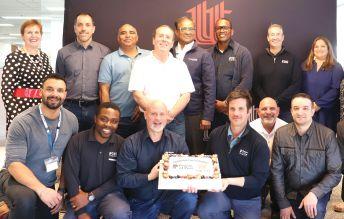
Region of Peel employees at the OACETT office celebrating their achievement as the first recipients of OACETT’s mii designations. PHOTO COURTESY OF OACETT
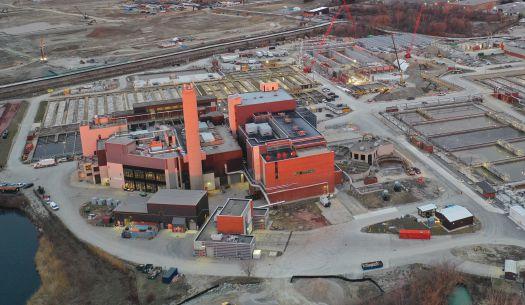
Region of Peel’s wastewater plant expansion.
PHOTO BY CLAUDE GAUTHIER
Claude
(left)
Celebrating 25, 40 and 50 years of membership!
This listing represents those who reached their milestone between December 15, 2023 and February 6, 2024.
25-year members
Michael Bender, C.E.T.
Russell Berrouard, C.Tech.
Larry Boston, C.Tech.
Gregory Botting, A.Sc.T.
Milan Brestovacki, A.Sc.T.
Mark Burel, C.Tech.
Christopher Burrell, C.E.T.
Luis Garcia Fuentes, C.Tech.
Judd Geronimo, C.E.T.
Christine Heavens, C.E.T.
Robert Hunt, C.E.T.
Sean Isley, C.E.T.
Hendrik Kuchlein, C.E.T.

Eric Lamain, C.E.T.
Stephen Loftus, C.Tech.
Julio Lopez, C.E.T.
Neal McColl, C.E.T.
Moranne McDonnell, C.E.T.
Joseph Nardi, C.E.T.
Sachin Rege, C.Tech.
Jeffrey Reid, C.E.T.
Adam Rigden, C.E.T.
Tenly Rodrigues, C.Tech.
Jose Simoes, C.E.T.
Peter Stroebel, C.Tech.
Tony Visconti, C.E.T.
Peter Walters, C.E.T.
Members on the move
Diarmuid Moloney, maintenance manager at QuickPlug, brings a wealth of expertise in mechanical engineering and millwright certification to his role. With a mechanical analysis background and automation and his recent completion of the Industrial Millwright Mechanic (433A) exam, Moloney is adept at diagnosing and providing solutions for equipment breakdowns. He oversees emergency repairs, preventative maintenance scheduling, and inventory management while ensuring adherence to
Kyle Wong, C.E.T.
Rachael Wusyk, A.Sc.T.
40-year members
Omar Abu-Hantash, C.E.T.
David Anderson, C.E.T.
Michael Caccamo, C.E.T.
Gordon Cavan, C.E.T.
Kwok Chan, C.E.T.
Gloria Flitton, C.E.T.
Geoffrey Holman, C.E.T.
Walter Mazzer, C.E.T.
Ihor Skotar, A.Sc.T.
Grant Taylor, C.E.T.
Wayne Walker, C.E.T.
David Wilmot, C.E.T.
Sam Zaffino, C.E.T.
50-year members
Clark Campbell, C.E.T.
Michael Chappell, C.E.T.
David Graham, C.E.T.
Ulrich Kuebler, C.E.T.
Jim Persad-Maharaj, C.E.T.
William A. Ranich, C.E.T.
John Sek, C.E.T.
safety protocols. Smith’s dedication to continuous learning and professional development, exemplified by his ongoing pursuit of a degree in mechanical engineering, makes him an invaluable asset to QuickPlug’s operations.
Andre Cousteils, technician at B.M. Ross & Associates, brings over a decade of experience to his new role, having previously held positions such as quality manager and product designer at Calhoun Superstructures, draftsman at Britespan, KBR and Superheat,
and project manager at Iron Bridge. Cousteils has five and a half years at his previous employer and over 12 years in the profession. He is an active member of professional committees such as Canadian Welding Bureau, American Welding Society and American Society for Nondestructive Testing. In his current role, Cousteils oversees drafting, design, calculations, and document management in the office while managing reporting, contract administration, measuring, surveying, and safety in the field at B.M. Ross.
NEW CPD AUDIT BEGINS
The end of another year means the beginning of a new Continuing Professional Development (CPD) audit. This audit affects all members belonging to the 2021-2023 cycle. To see what cycle you belong to, check the OACETT Member Portal under CPD.
CPD is a mandatory component of OACETT membership. Check your email/mail to see if you have been selected.
Sourabh Dileep, environmental field technician at Ausenco, brings a solid foundation to his new role, having completed co-op experiences, including one as a field technician with Pinchin Ltd. At Ausenco, he coordinates and manages various environmental field activities, including groundwater monitoring, soil sampling, and borehole drilling, while also overseeing data tabulation, interpretation, and reporting. Dileep’s responsibilities also include equipment operation and maintenance, report preparation, and project management tasks such as budget tracking and scheduling.
Corey Wyatt, C.Tech., is now the manager of quality management Systems at Northern Digital Inc. (NDI) in Waterloo. With a background in quality leadership at Stance Healthcare, where he served as continuous improvement/quality lead for four and a half years, Wyatt brings a wealth of expertise to his new role. As a senior member of the American Society for Quality and a certified manager of quality/organizational excellence, Wyatt is committed to upholding the highest quality standards at NDI. Wyatt’s responsibilities include managing quality systems and ensuring compliance with ISO 13485:2016 standards. Wyatt is proud to be part of NDI’s mission to advance medical technology and serve various applications, from surgical navigation to radiation therapy.
Kyle Wardell, engineering technologist in the planned capital department at Alectra Utilities, brings valuable experience to his new role, having previously worked at Milton Hydro and UTS Consultants. Wardell’s primary responsibilities include creating comprehensive work order packages for crews to upgrade overhead and underground hydro assets. These packages encompass permits, calculations, analyses, CAD drawings, bill of materials, and
estimated material and labour costs. Wardell’s dedication to professional development is evident through his active involvement with OACETT’s Hamilton Chapter as an associate member and his pursuit of the C.E.T. certification.
WHAT’S NEW? We want to hear from other members who have recently changed jobs, received a promotion or an award, or completed an educational program. Make sure your fellow OACETT members read about it in The Ontario Technologist. Promote your success – send your submissions to the editor at editor@oacett.org.


Fletcher Foundation increases Collège La Cité endowment fund
Thanks to Eaton Industries’ and OACETT’s Ottawa Chapter’s generous donations, Collège La Cité is now closer to securing its $40k endowment fund that will generate a $1,000 annual bursary in perpetuity for an engineering technology student who demonstrates academic excellence at their college every year.
In 2012, the Fletcher Foundation launched the 25 for 25 Building Forward Campaign to establish a minimum $40,000 endowment at each of the 25 colleges in Ontario by 2025. Collège La Cité is one of only two colleges remaining to achieve the 25 for 25 campaign goal, and many colleges have exceeded that amount.
In 2022, Fletcher Foundation president Cheryl Farrow initiated a “Push Campaign” with relevant OACETT chapters, the remaining colleges, alumni and local employers to wrap up the Building Forward Campaign. That year, Eaton Industries played a significant role in securing funds for Centennial College’s $40k endowment fund.
In 2023, Eaton Industries renewed its support with a further $5,000 donation, which topped up a $1,175 donation from the Ottawa Chapter for Collège La Cité. Together, these donations were matched, providing $12,350 in additional funds to the college, nudging them closer to their $40k target.
“We are incredibly grateful for the support Eaton Industries and the Ottawa Chapter have given to the Fletcher Foundation, which has helped us close in on our target for Collège La Cité,” said Bob Jameson, C.E.T., fellow OACETT, chair of the Fletcher Foundation. “We are fortunate to have donors like them.”
To donate to the Fletcher Foundation, visit www.oacett.org/about-us/fletcher-foundation.

ROAD TO CERTIFICATION
DATES AT A GLANCE W E B I NA R S
Join OACETT for a webinar on the benefits of becoming a Certified Engineering Technologist (C.E.T.) and Certified Technician (C.Tech.).
WHY ATTEND?
• Learn how OACETT certification can boost your career — higher salary, networking, and marketability.
• Learn about CTEN.ca, OACETT's career site.
• Learn about OACETT certification requirements.
To register for a webinar, visit: Students: www.oacett.org/student-road-to-certification Internationally Educated Professionals: www.oacett.org/iep-road-to-certification QUESTIONS? Contact Trishia at ttedoldi@oacett.org.
WEBINARS
COLLEGE STUDENTS:
Monday, May 6, 13 & 27
Monday, June 3, 10, 17 & 24 @ 12:00 p.m.
INTERNATIONALLY EDUCATED
PROFESSIONALS:
Thursday, May 2, 16, 23 & 30
Thursday, June 13, 20 & 27 @ 1:00 p.m.
OACETT begins process of revamping CPD program
by Barry Billing
OACETT’s registrar and the OACETT CPD subcommittee are currently working on streamlining OACETT’s Continuing Professional Development (CPD) program to remove ambiguity in what are acceptable activities.
In 2016, OACETT implemented a mandatory CPD program for its qualifying members, complemented by an audit process to ensure completeness. This program mandates participation in at least four eligible activities within a three-year cycle. Eight years after its initiation, aspects of the program have continued to prompt queries from OACETT members.
Proposals for the revised CPD program under consideration include:
• Removal of formal and informal activities
• Replacing activities with hours or credits
• Setting a specific number of hours or credits (to be determined) as the compliance requirement for each three-year cycle.
• Consolidating the existing four categories into two categories: active learning and passive learning.
• Placing greater emphasis on active learning – could constitute up to 100 per cent of your CPD submissions.
• Allowing passive learning but limiting it to a maximum of 50 per cent of your CPD submissions.
• Developing a CPD guidebook for information, instructions, and clarification on what is considered active learning and passive learning.
• Providing examples of what is and is not acceptable CPD on the OACETT website.
The CPD subcommittee is actively discussing these and other topics, aiming to finalize and announce the changes by the summer of 2024, with the new regulations expected to take effect January 1, 2025.
Members currently in the midst of a CPD cycle that extends beyond 2024 can rest assured that OACETT will still recognize their completed eligible CPD activities and will integrate them into the new framework. From January 2025, you will need to log your activities in terms of hours or credits rather than as activities.
Barry Billing is the registrar and director of registration and professional practice at OACETT.

qrco.de/beDQLP


YPC awards new scholarship to young professionals
by Ana Sierra, CAE
The Young Professionals Committee (YPC) continues to support the educational pursuits of OACETT’s student members, and it is proud to announce that it has awarded three students with much-deserved recognition and financial support to assist with the costs of their post-secondary education at one of the 24 colleges in Ontario.
This initiative is part of the overarching mandate of YPC to open opportunities for students and young professionals to build confidence, connections, and a solid community so that they can secure good jobs and make meaningful contributions to the engineering technology field.
The committee is pleased to see this initiative come to fruition and be a permanent addition to the YPC’s engagement offerings.
Since its inception, YPC has taken essential steps to engage students and young professionals through annual town halls, CPD offerings, chapter subsidies, member recognition events and most recently, the scholarship pro -


gram. When creating this initiative, the committee was mindful that cost is often a barrier to post-secondary education and that being a student can come with many financial challenges.
“We want students to know they can count on OACETT and this great professional community to support them in all career stages. Though the scholarship program’s financial aid
offers the most immediate and tangible support to recipients – and I say this from my own experience – the opportunities that come with being an OACETT member could prove just as, or even more, valuable for their careers. That is why we encourage all members, especially the younger generation (age 35 and younger), to get involved and tap into all the resources available through YPC programming and initiatives,” said Mladen Ivankovic, C.E.T., YPC chair and a member of OACETT’s board of directors.
The scholarship is open to all OACETT student members completing studies in an engineering technology discipline. The winners are chosen based on exceptional volunteerism with OACETT, their college, a company or a community organization. Applicants must also submit a short essay and reference letters.
Please join us in congratulating the inaugural cohort of scholarship recipients. Their ambition and willingness to go above and beyond give us hope for a brighter future!
Mladen Ivankovic, C.E.T., is YPC chair and a member of OACETT’s board of directors.
Liam Croft
Durham College
Mechanical Engineering
Year two

“I am honoured! Thank you to OACETT and the Young Professionals Committee.”
Liam Croft is a second-year Durham College Mechanical Engineering Technology CO-OP program student. He is passionate about experiential learning and community involvement and currently serves on Durham’s board of governors as a student governor. Croft is also the president of the Durham College Engineering Club and is a member of Durham’s Mechanical Engineering program advisory committee.
About the YPC scholarship
Introduced in September 2023, the YPC scholarship is a $500 award open to OACETT student members of any age who are enrolled in full-time studies in an engineering technology or applied science program at one of the 24 colleges in Ontario and who meet the following criteria:
• Have successfully completed their first year of studies;
Yan Lao Mohawk College
Civil Engineering
Year three
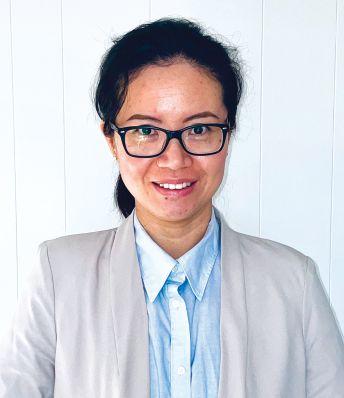
“This scholarship is truly a great encouragement for me and my family. Thank you for this wonderful opportunity!”
Yan Lao is a student in the Civil Engineering Technology Transportation program at Mohawk College. She has maintained an excellent GPA of 96 throughout her academic journey while actively engaging in program advisory committee meetings. She also serves as vice president for Mohawk’s ITE (Institute of Transportation Engineers) Canada Student Chapter. Her goal for the future is to further her involvement in the community and the transportation industry.
• Are dedicated volunteers with OACETT, their college, a company or a community organization. They must list their volunteer activities and have at least one letter of reference from an OACETT-certified member, college faculty and staff, or representatives from the company or community organization where they volunteer; and
• Write a 300–500-word essay on why they deserve to receive the scholarship.
Sukhraj Singh Algonquin College
Mechanical
Engineering
Year two

“I’m elated to be one of the three recipients of the YPC scholarship. I want to thank OACETT and the YPC committee for this recognition!”
Sukhraj Singh is in his second year of the Mechanical Engineering Technology program at Algonquin College. With a solid foundation in design and manufacturing skills, he is eager to see his unique ideas come to life. Singh is passionate about giving back to the community through volunteering and believes in making meaningful connections for personal and professional growth.
How to apply
The 2024-2025 YPC scholarship applications will be available this September. For more information about the YPC scholarship, visit https://www. oacett.org/members-area/young-professionals-committee or email ypc@ oacett.org.
Ana Sierra, CAE, is marketing specialist at OACETT.
Celebrating Largo Albert’s contributions to the mining industry
by Lionel Rudd, C.E.T.
Largo (Ladislaus) Albert, an OACETT member until he retired from Inco Limited, passed away at 94 late last year after devoting more than 74 years of service to Canada’s minerals industry.
Albert was born in Poland in 1929 and lived there until his family immigrated to Canada around 1939. His family settled in Atikokan (northwest of Thunder Bay), where his father worked on the railroad. Albert worked at the nearby Steep Rock Mine at 16 as an apprentice electrician and became a “first class” electrician at 20.
He later moved to Manitouwadge (near Marathon), where he became the chief electrician at the Willroy Mine. Around 1958, his community had a burgeoning interest in cable TV. With financial support from Willroy and Geco Mines, Albert spearheaded the introduction of cable TV to Manitouwadge, a remote community. Albert did the necessary technical research and calculations to demonstrate the feasibility of such a venture and eventually a cable TV system was set up. The quality of the reception was not always great because the community
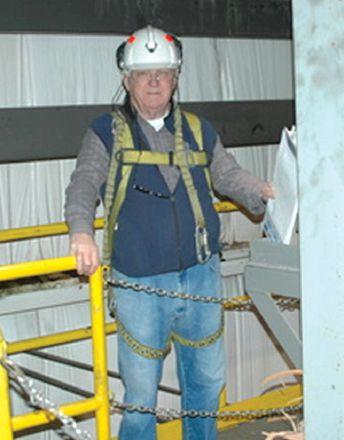
Largo Albert on-the-job as a senior hoist specialist.
Albert significantly contributed towards the safety and efficiency of our Canadian mines and doubtlessly elsewhere in the mining world.
was isolated, had basic technology available at best, and TV signal transmission was limited. Nonetheless, it worked, and the people of Manitouwadge were quite happy.
Albert later gained valuable electrical and mechanical experience working for companies such as Cominco and AMC Harrison.
In 1969, Albert joined Inco Ltd. (now VALE Ltd.) in Sudbury, a leading world mining corporation, and was their senior hoist specialist. He quickly became recognized as an industry expert in mine hoist plant and shaft conveyance systems. In the 1970s, Albert was certified by Logan Engineering as the only ‘expert’ outside the company in their specialized Logan Lilly Mechanical Safety Controller for mine hoists. Albert presented many courses on this topic to maintenance personnel in the mining industry.
In most cases, mine shafts (and hoists) are the only way ore can be transported to the surface for further processing. More than 12,000 tonnes per day is commonly hoisted. If there is a problem with the hoist or shaft, complete production ceases.


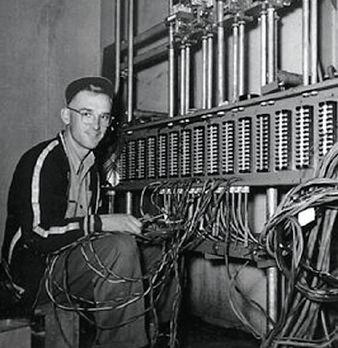
A vital component of the shaft design is the “fall arrest system.” This is a device that “arrests” or stops the conveyance (cage) in the case of a rope (cable) failure of a runaway speed. In miner’s parlance, the system is called “dogs.”
Albert devoted considerable effort to improving and testing the fall arrest systems in the mines at Inco and elsewhere. The elevator fall arrest system was invented by Elisha Otis in 1853. It was demonstrated at America’s first World Fair.
Alberts’s other achievements
Albert was the Ontario Mining Association hoist plant committee chairperson for 15 years until his retirement from Inco in 1992.
Calendar of Events
May 5 - 7
Ontario Water for The Future Conference and Trade Show
Niagara Falls Convention Centre weao.org/joint-owwa-weaoconference-may-5-7-2024/
May 6 – 7
Skills Ontario Competition
Toronto Congress Centre, Etobicoke www.skillsontario.com/calendar
He also authored and presented many technical papers for the Canadian Institute of Mining, Metallurgy and Petroleum (CIM), and was a CIM distinguished lecturer, a recipient of the CIM Donald J. McParland Memorial Medal and was made a Fellow and a life member of CIM.
Albert was also honoured when he received the CIM Distinguished Lecturer Award in 1982. Most of Albert’s teaching efforts centred on the safety aspects of hoists. He discussed and reviewed safety requirements for hoisting with various groups, including government inspectors.
His work with the Ontario Mining Association, the Canadian Standards Association and the International Organization for Standards was related to upgrading standards for increased safety of hoisting ropes and hoists. Albert also conducted a unique safety course about Lilly Controllers and Hoist Safety throughout North America. More than 800 people took the popular course sponsored by Inco for members of the Mines Accident Prevention Association of Ontario.
Albert significantly contributed towards the safety and efficiency of our Canadian mines and doubtlessly elsewhere in the mining world.
Lionel Rudd, C.E.T., is a retired member of OACETT.
CPD CYCLE
The start of the year ushers in a new Continuing Professional Development cycle. If you were certified in 2023 or were supposed to certify in 2023 and did not, your CPD cycle is January 1, 2024 –December 31, 2026.
You must complete four CPD activities including one mandatory activity in either technical knowledge or management/leadership. For more information visit www.oacett.org/cpd or email: cpd@oacett.org.
May 26 - May 28
CHES ON 2024 Conference
Blue Mountain Resort, Collingwood ron-durocher.squarespace.com/
June 17 - 29
Collision Technology Conference
Enercare Centre, Toronto collisionconf.com
A younger Largo Albert in the early years of his career.
CALL FOR APPLICATIONS: Generation Award and Kallio Award 2024
The Fletcher Foundation is calling for applications for the Generation Award and Kallio Award, two student awards dedicated to supporting learners enrolled in engineering technology and applied science programs at Ontario colleges. Applications are open until April 30, 2024.
Generation Award
The Generation Award is an annual $1,000 scholarship offered to a spouse, child or grandchild of an OACETT member. The scholarship applicant must be a full-time student attending an engineering technology or applied science program at an Ontario college. Apply now at https://bit.ly/generationawardapplication.
Kallio Award
The Fletcher Foundation has established the Kallio Award, which annually awards two $400 bursaries to support OACETT student members in writing the Professional Practice Exam (PPE) while they are in college. The bursary covers the cost of registration, exam preparation and the writing of the exam itself. The applicants must be full-time students registered in an engineering or applied science technology program in an Ontario college and must be student members of OACETT. Apply now at at https://bit.ly/kallioawardapplication.
Have questions? Please email fletcherfoundation@oacett.org.
OACETT 360 PARTNERSHIP PROGRAM



























To join or for more information, visit www.oacett.org or email 360partners@oacett.org.
PROXY
NOTICE OF ANNUAL MEETING OF MEMBERS
In accordance with Bylaw 20, Section 7, Subsection 7.1 and 7.2, notice is hereby given to certified members of the Ontario Association of Certified Engineering Technicians and Technologists of the annual meeting to be held:
Saturday, June 1, 2024 at 10:00 a.m. • Virtual Meeting
for the purpose of:
• election of the new Student Representative on the Board of Directors
• approval of 2023 year-end Financial Statements
• the appointment of auditors for the fiscal year 2024
• and other such business as may properly be brought to the attention of the said annual meeting of members.
Cheryl Farrow, CEO/Secretary
NOTICE TO: The voting (certified) members of the Ontario Association of Certified Engineering Technicians and Technologists. Registered members of the Association in good standing may exercise their voting rights under Subsection 7.7 of Bylaw 20 and, by means of proxy, appoint a person as their nominee to attend and act at the Annual Meeting of Members in the manner, to the extent and with the power conferred by proxy. Only voting members are entitled to complete a proxy form; nominees must also be certified members in good standing. The proxy form below will give your nominee permission to vote on all questions raised at the Annual Meeting. If you wish to limit your proxy to one or more questions, or to instruct your nominee as to the manner in which your vote is to be cast, you must so indicate in writing at the bottom of the proxy form. Please note that when the AGM materials are published, an electronic proxy will be available, allowing Certified members to cast their votes directly against the meeting motions. Certified members can choose to wait for this option to exercise their proxy if desired. A proxy holder may also be appointed electronically for any business that may arise at the meeting.
In accordance with Bylaw 20, Subsection 7.7: A proxy shall be in writing and shall be acted on only if it has been received at OACETT’s office (10 Four Seasons Place, Suite 700, Etobicoke, ON M9B 6H7) or with the Secretary of the Association, not less than forty-eight (48) hours prior to the day of the meeting or any adjournment thereof. A proxy shall expire at the close of the meeting for which it was intended, or at the close of any adjournment thereof. A proxy may be revoked by an instrument in writing executed by a Certified member or by their attorney authorized in writing and deposited either at the Head Office, at or with the Secretary of the Association at any time prior to the start of the meeting, or any adjournment thereof, at which the proxy is to be used. The proxy is revoked upon either of such deposits. If a Certified member who submits a proxy ultimately attends the meeting, the proxy will automatically be revoked.
Sincerely,
Cheryl Farrow, CEO/Secretary
ONTARIO ASSOCIATION OF CERTIFIED ENGINEERING TECHNICIANS AND TECHNOLOGISTS
PROXY
The undersigned Certified Member of the Ontario Association of Certified Engineering Technicians and Technologists hereby appoints
(if no other name appears, the OACETT president-elect) as the nominee of the undersigned to attend and act at the Annual General Meeting of Members of the said Ontario Association of Certified Engineering Technicians and Technologists electronic meeting on the 1st day of June, 2024 at 10:00 a.m. and at any adjournment or adjournments thereof in the same manner, to the same extent and with the same power as if the undersigned were present at the said meeting or such adjournment or adjournments thereof.
Dated at (city/town) , this _____________ day of _______________, 2024.
Name of Certified Member Membership Number of Certified Member Signature of
dated and signed by the voting member or their attorney, authorized in writing.
Another great chat by the fireside
by Cheryl Farrow, MBA, CAE
On Thursday, March 7, OACETT’s senior volunteer and staff leadership hosted members in our third Fireside Chat webinar.
The opportunity for transparency, dialogue and exchange with members is a priority for OACETT leaders. Seven hundred eighteen members registered for the event, and 468 were online at the peak.
President Micheal Mooney, C.E.T., kicked off the event by celebrating the launch of the Municipal Infrastructure designations on Monday, March 4, 2024, with 40 applications within the first three days and an overview of the key events planned for 2024, including the AI Summit on April 9, our upcoming Annual General Meeting(AGM) at 10:00 a.m. on Saturday, June 1, our upcoming Conference and President’s Awards Dinner at the Sheraton Toronto Airport, June 7–9, our annual Career Conference for Internationally Educated Professionals later in the fall, and the launch of an inaugural National Engineering and Applied Science Technology (NEAT) Week, November 2529, 2024, with a focus on profiling the contributions of certified technicians and technologists as distinct from professional engineers and the skilled trades.
Following these brief remarks, the floor was open to questions. Once again, there was an amazing level of engagement demonstrated by the sheer numbers of participants and the variety of questions asked. Common question themes included:
• Questions about the Continuing Professional Development (CPD) program – Registrar Barry Billing advised that the CPD subcommittee is currently working on clarifying the program and eligibility with plans to launch an updated system in 2025.
• Questions about the status of our government relations, particularly with respect to the BCIN –OACETT’s submission seeking exemption for OACETT certified members from some of the exams, went to the Ministry at the end of March.
• Questions about C.E.T. vs. P.Eng. and the changes within PEO that mean that the LET is the only remaining pathway for C.E.T.s to pursue limited licensure. OACETT will be working closely with PEO to ensure effective processing and profile of the LET, as well as communication with employers about the validity of the license.
There were so many questions that there wasn’t time to answer all of them, and written responses to the remaining questions will be posted on the website, along with a link to the recording of the webinar. We will have another shorter Q & A session as part of the AGM on June 1, and another Fireside Chat webinar will be scheduled for November. Watch your email for the invitation. We hope you’ll join us!
Cheryl Farrow, MBA, CAE, is CEO of OACETT.




St. Lawrence College launches cybersecurity program
St. Lawrence College (SLC) is pleased to launch a new part-time Cybersecurity program tailored for individuals seeking a flexible and accommodating way to acquire crucial skills in combatting cyber threats.
This graduate certificate program provides a wellrounded mix of theoretical knowledge and practical expertise in this growing field.
The program curriculum covers key areas within cybersecurity, including network security, information protection, ethical hacking, incident response, and risk management. Students will be equipped for the workforce with a comprehensive skill set directly applicable to the dynamic and evolving field of cybersecurity.
“One of the standout features of this program is its inherent flexibility, allowing participants to manage their studies alongside work or other responsibilities seamlessly,” said Daniel Liao, dean of the Faculty of Applied Science, Technology and Trades at SLC. “Recognizing the busy schedules of working professionals and the skills
shortage in the IT sector, the part-time delivery of the program accommodates the needs of workers in need of upskilling and their employers alike. With a combination of online and in-person classes, we’re providing a versatile and accessible learning environment.”
Hands-on learning is a prominent program feature, focusing on practical experience through labs, projects, and simulations. This emphasis ensures that students grasp theoretical concepts and gain valuable insights into addressing real-world cybersecurity challenges.
Admission requirements for the program involve a background in information technology or related fields. Additionally, consideration is given to relevant work experience, acknowledging the diverse paths individuals may have taken in their professional journeys.
For more information, email CYBERcoordinator@ sl.on.caor visit www.stlawrencecollege.ca.
Brad Barbeau is associate dean, Applied Science and Computing, at St. Lawrence College.
LISTEN TODAY!


HOST
Louis Savard, C.Tech., conducts thought-provoking interviews with industry leaders, government officials, academia and influencers on hot topics relevant to the engineering and applied science profession.
GUESTS
Kim Pickett, C.E.T., LET OACETT past-president and project engineer, Grounded Engineering
Eric Cowan, C.E.T. project manager, Vertex Environmental Inc.
EPISODE 8 Transforming toxic terrains: Ontario’s approach to brownfields
Host Louis Savard, C.Tech., discusses with OACETT past-president Kim Pickett, C.E.T., LET, and Eric Cowan, C.E.T., challenges and processes involved in transforming contaminated and underused industrial and commercial properties into safe and usable land. Learn about how sustainable remediation technologies are revolutionizing the clean-up process and reducing environmental impact.
Listen to the podcast at https://www.oacett.org/tech-takes or on your favourite podcast app!
BY PETER SAUNDERS
Thinking small: Advancing quantum technologies
You’ve heard of Silicon Valley, the high-tech industry hub in California—but have you heard of Quantum Valley? Currently emerging right here in Ontario’s own Waterloo Region, this research and development (R&D) hub aims to exploit the principles of quantum mechanics to develop new, cutting-edge technologies.
It’s all about thinking small. Quantum mechanics rely on the physics of sub-atomic particles, which exhibit ‘wave-particle duality,’ i.e. the characteristics of both waves and particles. Quantum technologies, in turn, are devices that can measure or control the properties of tiny atoms, sub-atomic particles and atom-like systems.
“Simply put, quantum mechanics allows us to do things that are impossible under classical rules,” said Mike Lazaridis—best known as the co-founder of Waterloo-based BlackBerry, formerly Research in Motion (RIM)—when he helped start up the Quantum Valley Ideas Lab (QVIL) several years ago.
QVIL is an independent research organization that seeks to accelerate the development of quantum technologies and their adoption by companies. The Federal Economic Development Agency for Southern Ontario (FedDev Ontario) was key in supporting the initial development of its facility, which connects researchers, engineers and other experts with the shared goal of commercializing quantum technologies.
In January, the provincial government promised to provide an additional $14.9 million through its ‘Critical Technology Initiatives’ program, which supports efforts to accelerate the use of certain technologies—such as robotics, 5G cellular networks and blockchain digitally distributed, decentralized, public ledgers—by Ontario companies.
The government feels quantum technologies could revolutionize the prov-

“Leaps in quantum technologies will improve competitiveness, fuel innovation and drive economic growth across Ontario.” – Vic Fedeli
ince’s communications, automotive, aviation and defence industries, among others, citing such current applications as transistors, solar cells and magnetic resonance imaging (MRI) scanners.
“Leaps in quantum technologies will improve competitiveness, fuel innovation and drive economic growth across Ontario,” said Vic Fedeli, provincial minister of economic development, job creation and trade. “Our government is proud to support QVIL and its researchers as they unlock technologies that will help companies become more competitive.”
With the additional funding, QVIL plans to expand upon its existing lab
infrastructure, offer co-op and internship programs to post-doctoral students and new graduates, develop intellectual property (IP) and continue specialized research in quantum sensing (i.e. studying the world by sensing dynamics in motion, magnetic fields and electricity).
Quantum sensing can significantly improve the accuracy and efficiency of diagnostic technologies. Potential applications include improved geological exploration and earlier cancer detection.
“This investment will lead to health care developments that will benefit patients and providers,” said Mike Harris, MPP for Kitchener-Conestoga.
“We are proud to be part of efforts to support the development, commercialization and adoption of quantum technologies and to grow the infrastructure and talent needed to advance Ontario’s leadership role in this critical sector,” said QVIL’s CEO, Nick Werstiuk.
Peter Saunders is a regular contributor to The Ontario Technologist.
Modern design for modern day learning
THINKING OUTSIDE THE BOX
Seneca Polytechnic’s CITE building takes modern design for modern day learning to the next level
BY MICHELLE MALCOLM-FRANCIS
Before the emergence of the 21st century’s digital revolution, many higher education facilities evoked the spirit and ideology of 1960s architecture –a period when enrollment increased dramatically due to the baby boom generation and more buildings needed to be built quickly to accommodate the massive spike in learners. In big cities and smaller ones, too, these traditional, simple, brick-andmortar, precast, murky concrete buildings stand and have shaped education-
al experiences throughout Ontario for decades. Most of us went to school in one or more of these buildings and sat in a chair desk within its four-walled classrooms with other pupils who did the same. Our desks were often lined in straight rows facing the front of the classroom, where our teacher stood or sat before a blackboard. These traditional “chalk and talk” classrooms still exist and have served their purpose over the years in producing students who contribute successfully to society. However, over time, the academic

To watch the full video, go to: https://bit.ly/ OACETTSenecaVideo
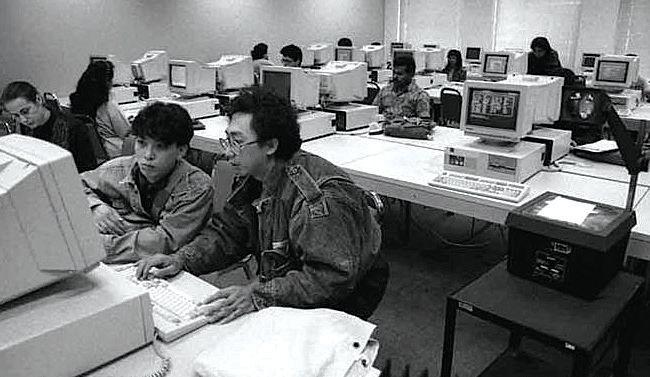
Seneca Polytechnic Newnham Campus in the 1990s. PHOTO COURTESY OF SENECA
PHOTO: © MRECO / ADOBE STOCK
Access videos on Seneca’s CITE building at www.oacett.org in The Ontario Technologist’s March/April 2024 digital edition.
world has introduced new interactive learning styles and building designs to accommodate modern learning needs impacted by the rise of technology and requirements to thrive in a contemporary workplace. Also, they have realized more than ever that colours, interactivity, accessibility, structures, collaborative spaces, and air quality in colleges and universities matters — encouraging them to push the envelope with their building designs, making their structures very different from the one-size-fits-all approach of the past and synchronizing content delivery,
functionality, interactiveness and design together, as one feeds off the other.
More often, schools, including colleges, are designing new spaces that embody active learning principles in their learning environments whenever possible, offering flexible, adaptable spaces to support modern learning needs. Seneca Polytechnic has done just that with the creation of its Centre for Innovation, Technology and Entrepreneurship (CITE) at its Newnham campus – a one-of-a-kind, stateof-the-art learning facility built to meet Seneca’s growing student population,
industry partnerships and community needs, support modern teaching methods and technologies and promote flexible, meaningful learning experiences.
Innovative learning spaces in the making
As the largest construction project in Seneca’s history and the biggest building on the Newnham campus, CITE, with 274,000 square feet of space over five storeys, is another “first” innovative project the polytechnic is proud to say is theirs since opening its doors in 1967. Over the years, Seneca has
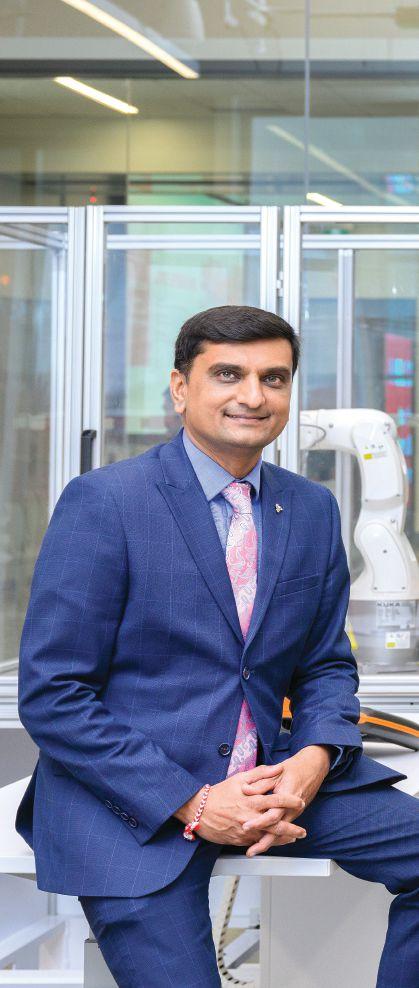
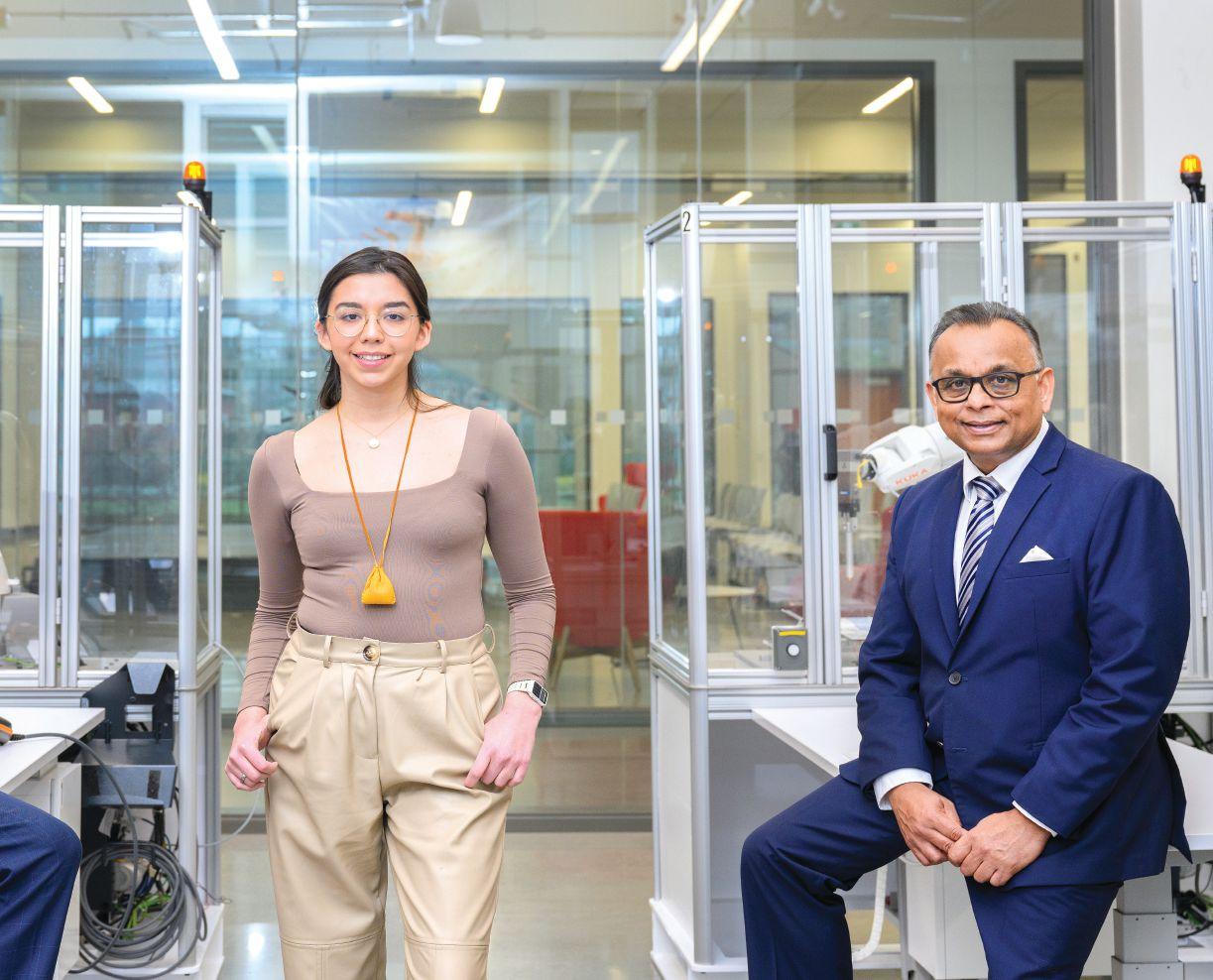
Seneca Polytechnic professor Dr. Rakesh Kantaria, C.E.T. (left), Seneca electrical engineering student Dairyan Hardy, and Ranjan Bhattacharya, dean of the Faculty of Applied Science and Technology in Seneca’s dynamic KUKA lab located within the state-of-the-art Centre for Innovation Technology and Entrepreneurship (CITE) building. PHOTO: NICK MENZIES
Why we built the CITE building
been recognized for its groundbreaking academic programs, early embrace of distance learning, leadership in continuing education, offering the first degree at an Ontario college, and many technological firsts. Now, they have CITE to add to their fold of innovative learning accomplishments.
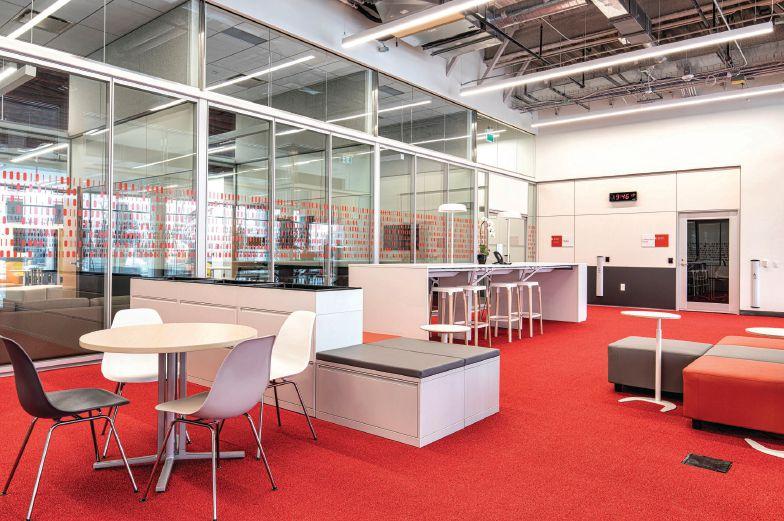
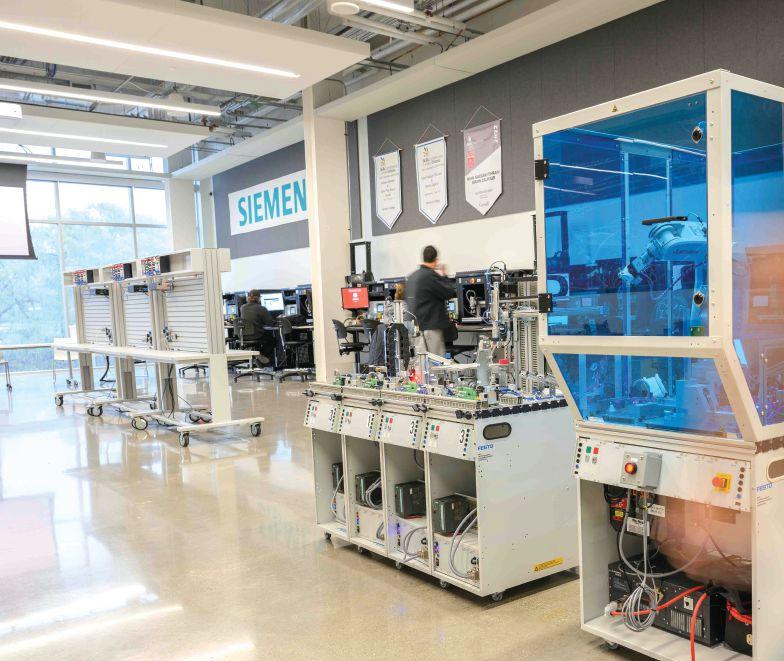
Under one roof, CITE brings together applied science and engineering technology-focused programs – which includes the CNC and KUKA robotics labs and a Siemens mechatronics lab and modular spaces for teaching and learning; HELIX – an innovation hub; the Innovation Gallery designed with common areas that support collaboration, events and student togetherness;
and a tribute to Indigenous history and heritage throughout the site. The contemporary design showcases Seneca’s commitment to sustainability, inclusivity, and industry partnerships and fosters a culture of innovation for their students, faculty, staff and community.
When The Ontario Technologist interviewed Andrew Frontini, design director and principal of Perkins and Will, the acclaimed architectural firm that designed CITE, he confirmed that when the firm designed the CITE building, they incorporated principles of living design, a framework of design around sustainability, health and well-being, inclusion, community and resiliency.
“Perkins and Will have designed many spaces for colleges and universities and watched attitudes towards teaching and learning shift and evolve, moving from a professor at the front of the space broadcasting outward to learners,” Frontini said. “We’ve moved toward students interacting with each other to teach themselves. We call this peer-based learning,” Frontini added. “The professor’s role changes towards facilitating access to information from various sources and coaching students as they interact and discover together. Studies have found this is a much more effective way of distilling the principles, not just recording and memorizing, but exploring themes.”
PHOTO: NICK MENZIES
Ranjan Bhattacharya, dean of the Faculty of Applied Science and Engineering Technology at Seneca Polytechnic, believes CITE is an example of what a new approach to designing a modern learning environment looks like with its ability to bring together applied research, commercialization, specialized training and an entrepreneurial incubator for both students and industry leaders. Also, according to Bhattacharya, the building actively demonstrates technologies in the engineering disciplines for which its students are being prepared, allowing students to engage with new technologies in their respective industries.


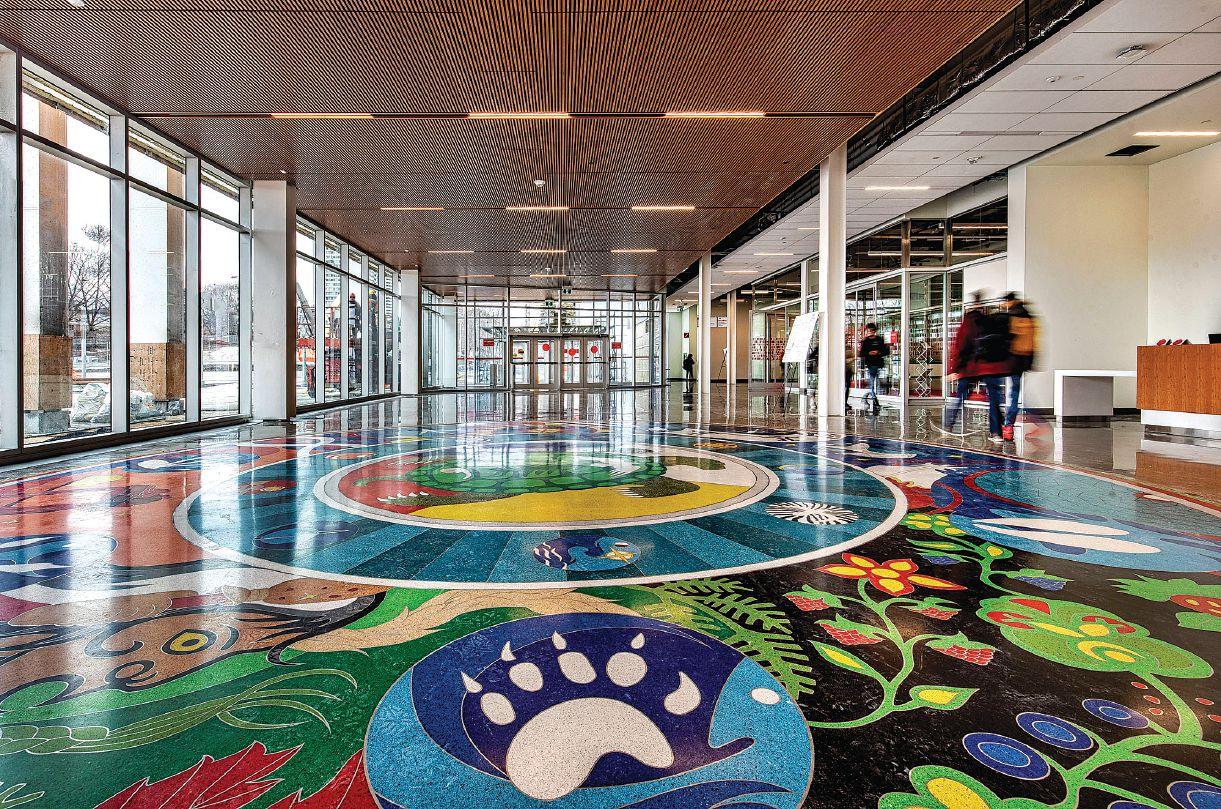
“Unlike Seneca buildings of the past, CITE was intentionally designed as a dedicated hub for fostering collaboration between students, faculty, and industry partners in these specific areas,” said Bhattacharya. “CITE’s emphasis on state-of-the-art facilities, interactive learning spaces, and industry-relevant resources sets it apart from traditional academic buildings, aligning with the evolving needs of a modern workforce and the growing emphasis on innovation and entrepreneurship in today’s economy.”
Inclusivity in design
He also shared that the building offers an ultramodern workplace for Seneca’s administrative departments in one location for the first time, and its focus on academic STEM programs is balanced with an expression of Seneca’s commitment to recognize the history and vibrant culture of the Indigenous Peoples of Canada. The design of CITE was developed in close consultation
with Seneca’s Aboriginal Education Council, incorporating Indigenous elements and showcasing Seneca’s commitment to entrepreneurial innovation and sustainable vision for the future inspired by an Indigenous worldview.
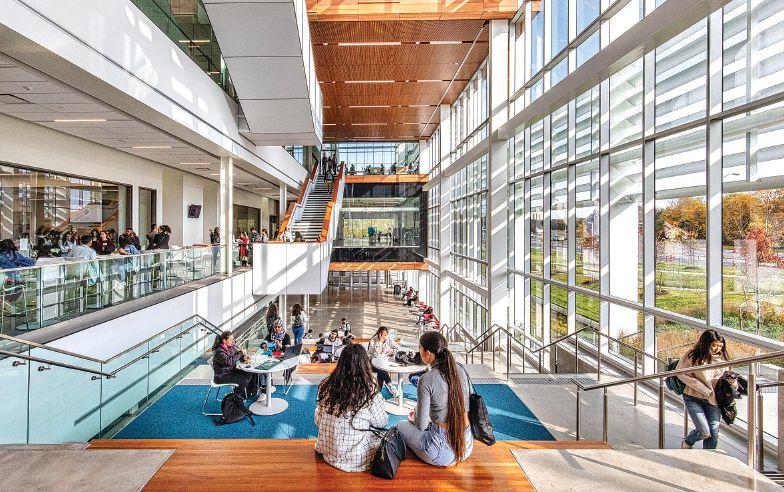
The Innovation Gallery, an animated atrium space, and other parts of the building (inside and out) are where various Indigenous design and graphic features come to life, especially, on the ground floor where the large terrazzo medallion known as the “Circle of Indigenous Knowledge” resides. The medallion symbolically invites individuals to join the circle of life and unity. It is an expression of Seneca’s celebration of Indigenous heritage, connecting students to Canada’s Indigenous history and the land that supports the modern structure of the building.
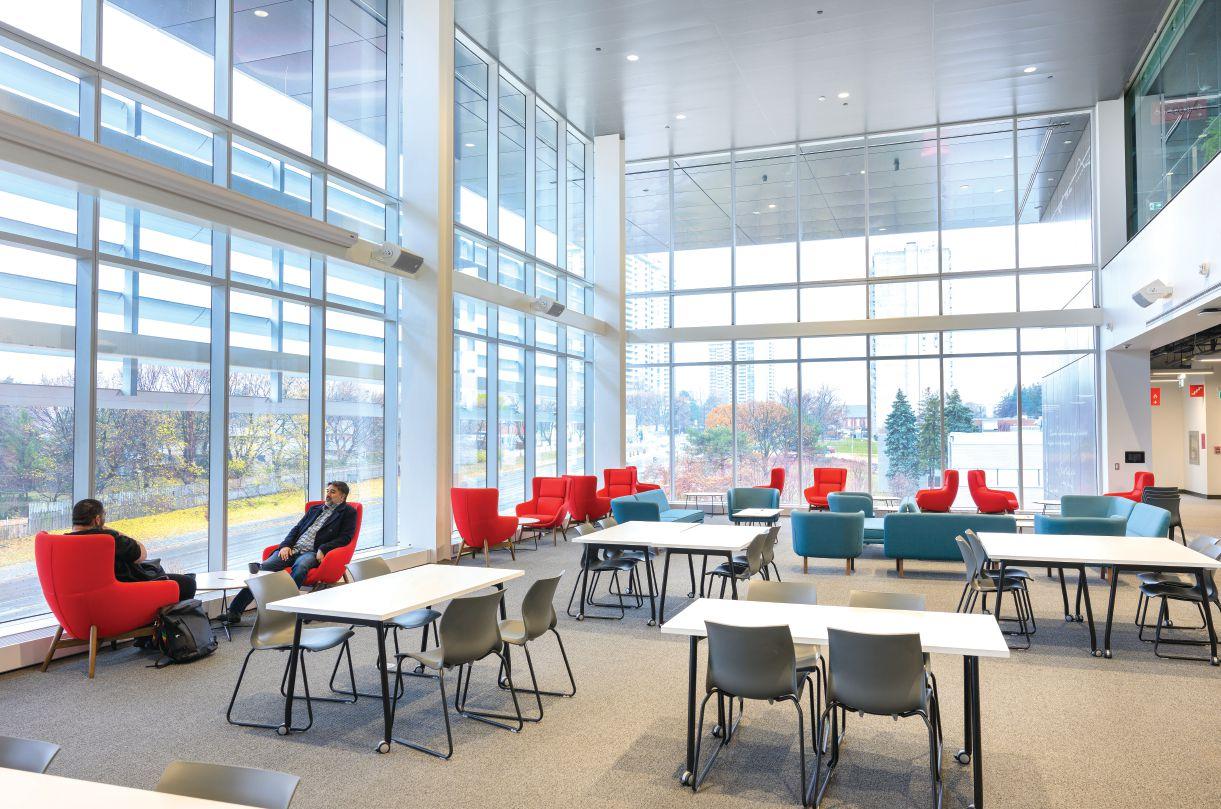
The transparent space is where culture and sharing the products of study and exploration meet the whole campus and public, especially
with its open architecture and connection to flexible, modular spaces, high-tech labs and adaptable classrooms – an actual demonstration of the connective flow of the building. This common area engages the sloping topography of the site and provides accessible platforms for its three different levels of student lounge and study space. It can also be converted into a display or event space for multiple purposes, including industry partner events.
Cutting-edge learning spaces
Like the Innovation Gallery, other parts of the CITE building’s design were anchored by the idea of connectivity and community and brought a series of unique parts of the building doing different things together. The Innovation Gallery, which runs the entire length of the building, connects into what Frontini calls the universal container, a highly adaptable and flexible space of classrooms that can di-
Inclusivity and the CITE
Designing flexible spaces
vide into four classrooms or one big classroom with systems disposed to support the adaptation or moving of partitions that are supportive of hightech learning experimentation.
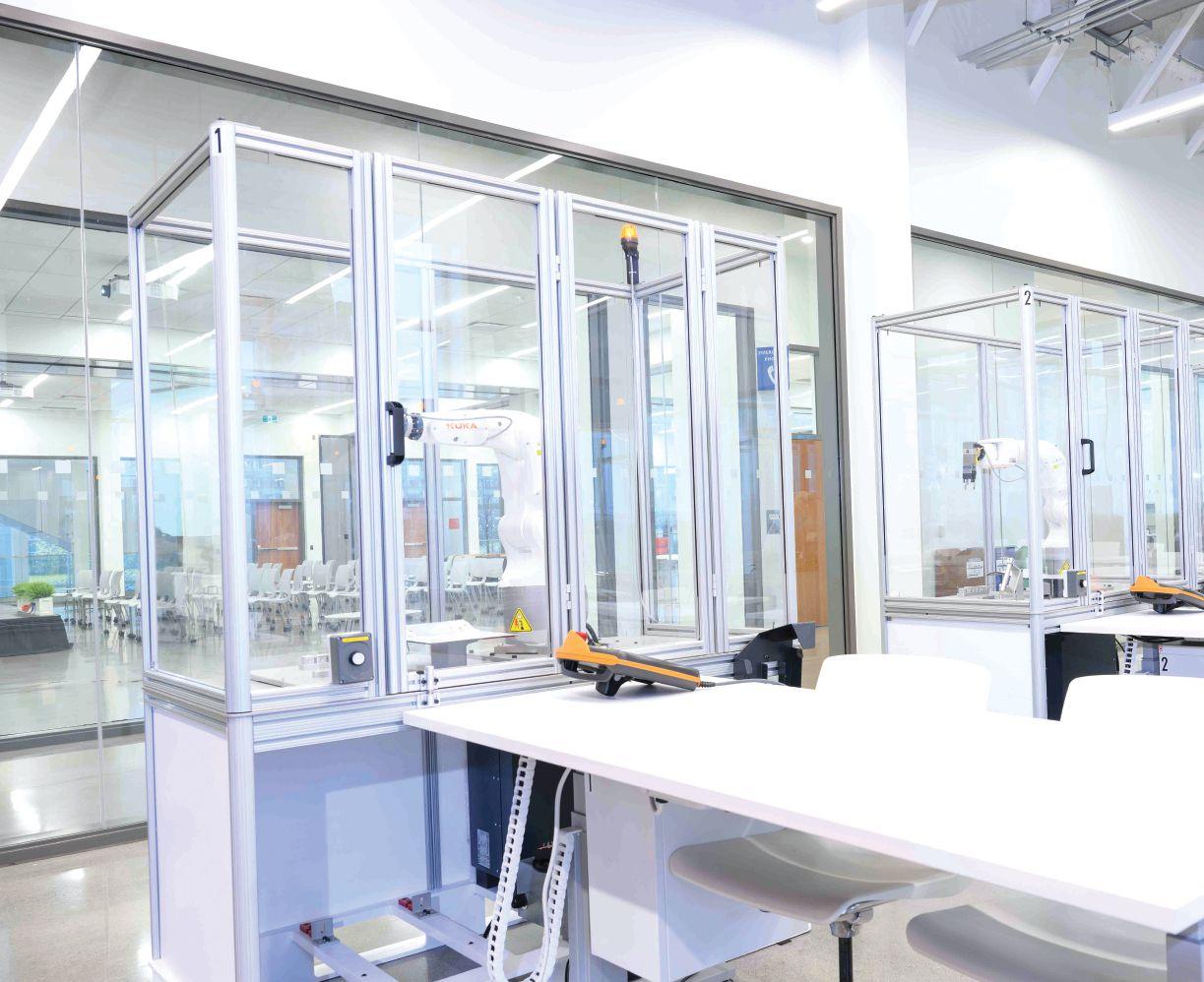
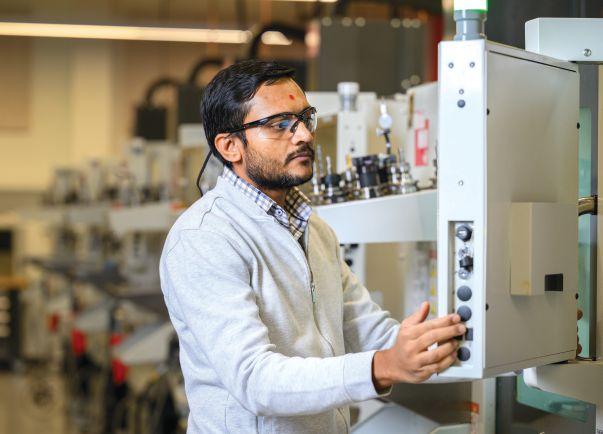
CITE also houses advanced engineering, IT, and robotics labs. These labs encompass a robotics lab, de-
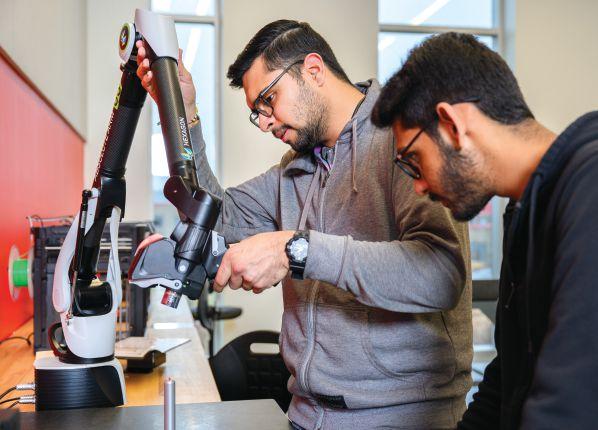
veloped in collaboration and consultation with KUKA Robotics, a Mechatronics Simulation and Demonstration Centre, established in partnership with Siemens Canada, and a motors and process control lab. These facilities offer students hands-on experience and exposure to
the latest technology, fostering a dynamic learning environment.
Seneca’s commitment and investment in hi-flex learning, fully equipped with the latest technology tools with a faculty member in the classroom, has provided students with the option of coming in physically to the school or

taking the class remotely with technology that provides a seamless experience for students.
Dr. Rakesh Kantaria, C.E.T., professor at Seneca Polytechnic, said the labs are equipped with specialized tools and hi-tech industrial equipment (from KUKA and Siemens) relevant to particular engineering disciplines. The course content intersects with the trendy equipment, giving students hands-on experience relevant to modern industrial facilities.
“By engaging in projects with practical applications, students gain
a deeper understanding of the relevance of their education to realworld challenges. This prepares them to transition seamlessly into professional roles,” Kantaria said.
“Our modern labs integrate different technologies, such as advanced software tools and digital platforms that teach students about the digital aspects of the engineering practice,” he added.
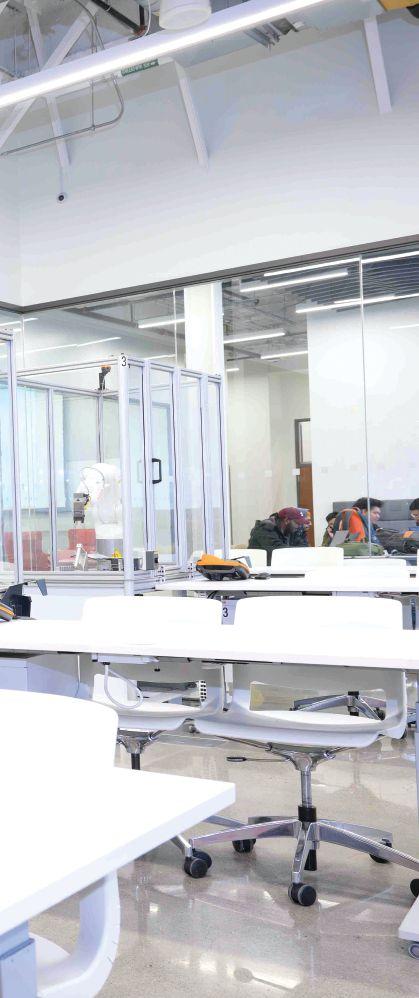
Dairyan Hardy, an electrical engineering program student, said, “CITE has big windows to let in plenty of natural light, including inside the lab
rooms.” She also mentioned how the CITE building has the best lab rooms on campus, especially the Siemens PLC lab, which she said is ‘spectacular’ with its MPS stations that simulate a real production line and allow her to code the PLCs. The other spacious, modern, high-tech labs also provide opportunities to simulate real-world scenarios and allows students to collaborate and innovate.
The labs’ movable furniture and accessible space allow students more room for experimentation and learning and provide more comfort while they study. Seneca’s partnership with KUKA and Siemens has also enabled students to graduate with industryrecognized certifications, increasing their employability.
“I’m taking robotics in the lab, and this gives me a certification from KUKA Robotics, the actual manufacturers of these robots,” said Hardy. “My professor is knowledgeable with real industry connections and gives me practical knowledge beyond the manual.” This practical experience, she said, with the certification will allow her to enter the workforce with the highest confidence.
Building with sustainability in mind
When asked which space is her favourite, Hardy said Computing Commons. “It’s the central hub where you can see everyone. I’ve been able to keep in close connections with the connections I’ve made her.” However, there is more than a feeling of well-being places like Computing Commons provide. It’s one of the many spaces in CITE built with sustainability in mind.
CITE utilizes cutting-edge technology to minimize environmental impact by curbing greenhouse gas emissions. “This not only contributes to the building’s sustainability but also offers students a real-world illustration of eco-friendly practices in contemporary architecture,” Bhattacharya explained.
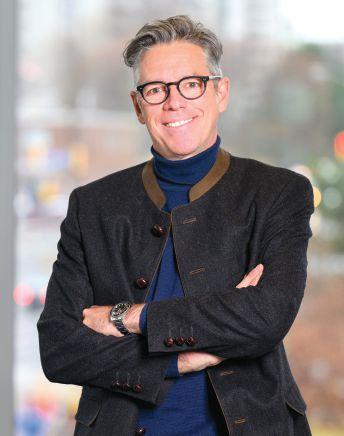
Andrew Frontini, the design director and principal of Perkins & Will — the architectural firm that designed Seneca’s CITE building.
According to Frontini, Perkins and Will made the materials that the building is made of a real focus in their design.
“We did a lot of research into solvents and adhesives and coatings which are used for fire retardant, etc. – things that are ultimately harmful to human health – and this building has been effectively scrubbed of those substances through the design specifications of products and the way we put together our documents to make sure that the indoor air quality is as good as possible, and the mechanical system also supports that.”
“Fresh air is brought in at a high rate, and then we’re using a heat recovery ventilator to capture the energy or latent energy or heat that’s in the air as we exhaust and bring in new, fresh air.”
INHABITAT news reported that Perkins and Will wrapped the building in glass to promote reliance on natural light rather than artificial sources to achieve LEED Gold standards. The report also mentioned how the building integrated solar array, stormwater management cisterns, locally sourced, recycled materials wherever possible and increased use of FSC-certified wood finishes for lowered embodied carbon.
The CITE &

Perkins and Will also had to consider the environmental or energy impact of so much glass, particularly in the Innovation Gallery, which runs along Finch Avenue. They had to balance the glazing ratio. Even though the windows seem very glossy, the building has only 30 percent windows relative to insulated solid walls.
The universal container on the building’s north side has more strategically punched windows, which allowed Perkins and Will to control daylight and the overall building in-
sulation. Looking collectively at the systems (heat recovery, the 100 per cent fresh air and materials) used to build the building, Perkins and Will achieved high-quality indoor air and exceptional levels of energy efficiency.
Perkins and Will’s creative approach to building modern knowledge infrastructure and Seneca’s passion for technology, educational advancement and culture have created a technologically advanced architectural masterpiece learners will appreciate now and for years to come.
Seneca Polytechnic’s CITE under construction. PHOTO COURTESY OF SENECA
NASA JPL detection of agriculture disease
New technology that detects grape disease from the sky is the beginning of far bigger things
BY DENNIS FURLAN
Imagine you’re a grape expert. You’re in a vineyard examining closely some grapes and vines for various diseases and conditions. You find nothing. But technology from the sky says you’re wrong. That’s what happened in recent research conducted by NASA’s Jet Propulsion Laboratory (JPL) in southern California in conjunction with Cornell University.
The researchers essentially slapped NASA’s next-generation Visible/InfraRed Imaging Spectrometer (AVIRISNG) in the belly of a research plane and then flew the plane to scan about 11,000 acres of vineyards in Lodi, California, which is in the heart of the state’s Central Valley, a major producer of premium wine grapes.
Not just research for its own sake
What the plane and the spectrometer were looking for were signs of a disease known as grapevine leafroll-associated virus complex 3, or GLRaV-3 for short, which is spread by insects and ends up causing vineyard damage, particularly for cabernet sauvignon, totalling about $3 billion annually. So, this isn’t just research for its own sake. The benefits of success in this area could be substantial.
The observations made in the air were then inputted into computer models designed to detect infection in the grapes and vines below. At the same time, members of the wine industry scouted more than 300 acres of the same vineyards on the ground to visibly detect any symptoms of disease and to collect vine samples for further molecular testing.
The results were fascinating and telling. The aerial method detected infected vines before and after becoming symptomatic, with the best models achieving an 87-percent accuracy rate. The consequences are significant.
Dr. Katie Gold is an assistant professor at Cornell University and senior author of this new research. She says, “Like humans, sick plants may not exhibit outward symptoms right away, making early detection the greatest chal-

lenge facing growers.” As a result, successful early detection of the disease could give growers a year to intervene and save the industry countless dollars in the process.
Hard work on the ground
This research also shows that science is often less about formulas and whiteboards and more about real-world intuition, learning and hard work. In 2020, the AVIRISNG was used to map methane leaks in California. That’s when Dr. Gold, a plant pathologist, and her team came up with the idea of using the technology to detect crop infection in the state’s vast array of vineyards.
Eventually, labour on the ground helped to carry out the research. Gold says, “Without the hard work of the growers, industry collaborators, and the scouting teams, none of what we accomplished would have been possible.”
However, it’s one thing for this type of research to benefit the wine industry in California. But the benefits for humanity can be even more staggering since the ultimate goal of this research is to use similar technology to detect disease in all crops around the world, thus not only saving the world from untold agricultural damage, but also helping to feed the world more productively and efficiently.
The Lodi Winegrape Commission sends thanks to NASA and its Jet Propulsion Laboratory for providing the technology that detects disease in grapevines and could potentially save the wine industry untold costs in lost crops.

Ramifications for the planet
Ryan Pavlick is a research technologist at NASA’s JPL. He says, “What we did with this study targets one area of California for one disease.” He continues, “The ultimate vision that we have is being able to do this across the planet for many crop diseases and growers worldwide.”
Fernando Romero Galvan, a doctoral candidate and lead author in this research, says, “I think these are exciting times for remote sensing and plant disease detection. “Scalable solutions can help growers make data-driven, sustainable crop-management decisions.”
It’s not that agricultural imagery mapping hasn’t been used in the past. For example, satellites have been used in this regard by NASA and other agencies for over 50 years, mostly for commodity and row crops. What has changed is the focus on specialty crops such as grapes and apples, which have been the focus of NASA Acres, a program created in 2023 to use satellite Earth observation to help secure the planet’s agricultural and food safety.
In fact, Gold has been a lead scientist for NASA Acres, which means that this current research using planes to detect vine disease will eventually evolve into using satellites to detect pests and diseases in specialty crops.
Grapes and apples are two high-value specialty crops that will benefit from this research, but other agricultural systems will eventually benefit.
Beyond vineyards
And it’s not just about agriculture. These new technologies are being used to engage in various detection capabilities from the sky and orbit to map all kinds of realities on the ground. For example, the authors of this current study have stated that the data will be used as part of NASA’s Surface Biology and Geology (SBG) study, which, in conjunction with machine learning, can help agricultural, biological, and geological decision-making on a global scale.
SGB is also a part of NASA’s Earth System Observatory, which will be the focal point of various new missions to gather information and guide efforts related to climate change, natural hazard mitigation, and fighting forest fires, among other global initiatives.
So, if you thought being able to detect grape disease from the sky was kind of cool, wait until this type of technology is used in all these other aspects of the human condition.
Dennis Furlan is a contributor with The Ontario Technologist.
NEW MEMBERS
December 2023
Certified Engineering Technologists
Aiswarya Alungal Girisan, C.E.T.
Shadi Alfares, C.E.T.
Lionel Bogues, C.E.T., rcji
Marco Panico, C.E.T.
Ravneet Saini, C.E.T.
Andrew Schenk, C.E.T.
Douglas Smith, C.E.T.
S M Abdus Sobahan, C.E.T.
Michael St.Germain, C.E.T.
Albert Tan, C.E.T.
Shane van Niekerk, C.E.T.
Certified Technicians
Marc Alexander, C.Tech.
Thaddeus Bassett, C.Tech.
Benson Chan, C.Tech.
Tyler Cook, C.Tech.
Thierry Croussette, C.Tech.
Lucas DeHaan, C.Tech.
Robert Dick, C.Tech.
Brittany Ford, C.E.T.
Shane Forrest, C.Tech., rcji
Euro Fuenmayor Sanchez, C.Tech.
Jebu Joseph, C.Tech.
Christian Labricciosa, C.Tech.
Gimuel Ledesma, C.Tech., rcji
Tomislav Les, C.Tech.
Dustin McTaggart, C.Tech.
Thinh Nguyen, C.Tech.
Jorge Pinzon Gomez, C.Tech.
Ramandeep Singh, C.Tech.
Jefin Sunny, C.Tech.
Associate Members
Omar Ahmed
Amer Alhakim
Stuart Balan
Jesse Beaudry
Thomas Bedour
Anamika Desai
Jordan Eras
Sahil Gaind
Ketankumar Gor
John Harrigan
Mohamad Hasne
Rachel Haverkamp
Wyatt Hughes
Loay Ikailan
Hitesh Jassal
Dilpreet Kaur
Youming Luo
Gregory MacRae
Tyler Manikus
James McHaig
Erik Pankratz
Adriano Paradiso
Pitcheswara Rao Koi
Garret Reid
Mohammad Reza Mozafari
Khamsehy
James Richard
Michael Robins
Jonathan Rodrigues
Ali Rostampour
Brian Sanders
Mihir Shah
Camille Snook
Seungil Song
Akash Soni
Matthew Sutton
Thomas Uler
John Van Erp
Derek Viskovich
Sarah Wells
Yue Zeng
Student Members
Keenau Balingit
Maguire Clay
Nicholas Companion
Zefferin Curtin
Daniel Dze Assandack
Gecelle Ann Gonzales
Jianzhong Guan
Zachary Hoffner
Brett Kajah
Granson Kish
Kristopher Kshonze
Sofin Lalani
Shawn Leadston
Stefan Manojlovic
Raymond Mullings
José Rafael Noriega Cedeño
Joshua Sattin
Nirmala Singh
Talha Syed
Pranjal Vaghela
Alfred Wong
Maria Zamora Astorga
Existing Members In Road Construction
Certified Engineering Technologists
Marko Rasheed, C.E.T., rcji
Certified Technicians
Michael Warren, C.Tech., rcji
Vikum Wegiriya, C.Tech., rcji
Associate Members
Curtis Bettiol, rcji
Logan Deric, rcji
January 2024
Certified Engineering Technologists
Abdulkadeer Dudhiyawala, C.E.T.
John Adriano, C.E.T.
Ajay Kumar Alagarsamy, C.E.T.
Shaymaa Al-ani, C.E.T.
Sarantuya Batbadrakh, C.E.T.
Benjamin Carnovale, C.E.T.
Franklin Chikosha, C.E.T.
Mandy Chong St-Amant, C.E.T.
Catlan Harrison, C.E.T.
Jamie Harth, C.E.T.
Curtis Hatfield, C.E.T.
Evan Heyes, C.E.T.
Marwan Jawhari, C.E.T.
Christian Jordan, C.E.T.
David Jorge, C.E.T.
Isher Kaur, C.E.T.
Michael Kong, C.E.T.
Scott Lasseter, C.E.T.
Maimaiti Maierdan, C.E.T.
Shawn McGarrity, C.E.T.
Justin O’keefe, C.E.T.
Kenneth Oliver, C.E.T.
Tracy Weatherdon, C.E.T.
Certified Technicians
Akshay Babu, C.Tech.
Olufemi Adeniji, C.Tech.
Yannis Batsos, C.Tech.
Alex Begley, C.Tech.
Mustapha Bukenya, C.Tech.
Eric Crawford, C.Tech.
Matthew Curry, C.Tech., rcca Navkaran Dhaliwal, C.Tech.
Hayder Ghulam, C.Tech.
Robert Hanley, C.Tech.
Jonathan Hifawi, C.Tech. Li Huang, C.Tech. Mutumbianganyi Kamunga, C.Tech.
Harpreet Kaur, C.Tech. Dennis Kiyingi, C.Tech. Olga Korsantia, C.Tech.
Mary Mable Ashna
Kuranganthara Sebastian, C.Tech. Benoit Labelle, C.Tech.
Vaibhav Lakhani, C.Tech.
Cody Long, C.Tech.
Ravi Prakash Magisetty, C.Tech.
Patrick McNamara, C.Tech.
Tri Dung Nguyen, C.Tech.
Benjamin Paric, C.Tech.
Laura Robert, C.Tech.
Alphone Infant Leo Santhiyagu, C.Tech.
Kahar Shaikh, C.Tech.
Alan Sigeta, C.Tech.
Richard Solis, C.Tech. William Stover, C.Tech. Ariel Talampas, C.Tech.
Krishna Thakkar, C.Tech.
Reiner Jan Tiburcio, C.Tech., rcji Bao Tran, C.Tech.
Stephen Turnbull, C.Tech.
Taylor Van Velsen, C.Tech.
Andrew Watts, C.Tech.
Wing Shing Yip, C.Tech.
Associate Members
Melhem Achkar
Adedeji Aderibigbe
Samuel Agbi
Qudus Akinwande
Dare Alaba
Lucas Almeida
NEW MEMBERS
RECOGNIZING NEW AND CERTIFIED TECHNICIANS AND TECHNOLOGISTS
Abdul Sajid Ansari
Milad Azadi
Raj Kumar Basnet
Kensonsun Bernade
Jerwin Bersalona
Thomas Bertin
Digish Bhattji
Matthew Bond
Mitchell Bothen
Rade Brezo
Terrie-Ann Broomfield
Andrew Brown
David Brown
Omar Carrillo
Alexandria Cupoli
Richard Daniel
Blair Daniels
Chinthaka Thilinda
Dasanayake Dasanayaka
Adikaram Mudiyanselage
Meda Walawwe
Dylan Davidson
Oliver Davis
Madalynn de Wal
Raymond Deasy
Steven DeGrow
Mansoor Delshadi
Paras Dhand
Stephen Dixon
Stanley Elltoft
Jenna Filice
Jeffrey Firsoff
Michael Firth
Ka Kiu Fung
Trevor Girard
Trevor Green
Noah Greer
Karl Gross
Matthew Grzebielucha
Curtis Gullison
Patrick Henke
Steven Henry
Beatriz Hernandez
Chenoa Hill
Mohammad Hodaei
Jon-Michel Iliadis
Ian Jackson
Sheldon Keats
Indica Keech
Raymond King
Ekue Kpodar
Dojun Kwon
Albert Lagumbayan
Brandon Lane
Caden Lannon
Branden Lavallee
Harrison Leitch
Nicholas Lidstone
Dawei Liu
James Luzuriaga
Abdullah Malik
Motaleb Matubber
Patrick Maybee
Reza Mazandarani
Don McLean
Hasib Moeen
Denise Anne Morales
Collin Mowers
Daryl Murray
Thananjayan Nagaratnam
Caren Netto
Dave Nicholas
HyeonDeok Noh
Omololu Odeja
Benjamin Okachi
Ikechukwu Okoronkwo
Jay Panchal
Dixit Patel
Neel Patel
Arsenii Pavlik
Jenny Rae
Johnson Raimi
Tejinder Rattu
Roxana Rodriguez Saez
Kevin Sanza
Rong Shi
Karminderbir Singh
Kevin Smith
Bhoomi Solanki
Yun Song
Jeremy St.Clair
Nevena Stankovic
Jieyi Tan
Carly Tessaro
Ojas Thakur
Eric Thornton
Phat Tieu
Gelick Varghese
Ryan Weir
Tyson Weppler
Braden Whelan-Ellis
Muhammad Zulqarnain
Student Members
Alex Agripa
Bardia Ahmadi
Chrispin Ajedipe
Habiba Akbari
Claude Akette
Joseph Akindipe
Lama Alayoubi
Mayerli Albarracin Mosquera
Noel Alberto
Quentin Allen
Melida Amores Mena
Ronel Ann John
Syed Asadullah
Muhammed Bangee
Samantha Barnes
Danushkumar Baskar
Aaron Bokma
Zean David Paul Bondad
Cameron Bondy
Samantha Bowman
Turner Brown
Kevin Jade Bueno
Devin Capaldi
Jaagrit Chawla
Mitchell Clark
Nischaykumar Dalwadi
Amit Das
Jordan Dash
Sterling Dean
William Dennison
Fenil Sureshbhai Desai
Kristine Domingo
Johnathan Donnelly
Steven Dudar
Trevor Duthie
Craig Dymond
Akintunde Edwards
Charuka Roshan Premasinghe
Egodawaththe Gedara
Keegan Englert
Owen Florence
Carter Folkes
Caleb Garrow - Ledoux
Haden Geneau
Bana Ghessesew
Keven Gilazgi
Esteban Gonzalez
Chris Graham
Liam Graham
Yousef Hasan
Matthew Hodgson
Tayler Hourtovenko
Sherzod Hurmatov
Dean Jackson
Nada Jaroud
Amisha Karki
Gabriel Keng
Tushar Krishnankutty
Amy Kroetsch
Andrew Kubes
Thomas Kuzmanovic
Keara Leibovitz
Ethan Leroux
Ka Ki Leung
Margaret MacLaren
Earl Melito
Gabriele Mennonna
Matthew Moerschfelder
Timothy Moreau
Colin Munro
Harshith Nagaraju
Ali Naimi
Chinju Nair
Nannam Nilnimitr
Jared Pennington
Jesse Phillips
Steven Pile
Aidan Pollard
Ashwin kumar Poovathil
Sudarsanan
Dex Prandovszky
Benjamin Pruner
Thivya Punniyamoorthy
Jaylord Ramones
Alvaro Reyes
Samantha Russo
Hassan Sadoon
Bruno Sahayaraj
Stuart Saidan
Ryanna Camille Santos
Abbygail Satura
Emma-Lee Scott
Akshay Sharma
Gurkanwal Singh
Randeep Singh
Reilly Smith
Olha Sobolta
Kalidas Suresh
Jacob Thomas
Michael Tripp
Keeyan Trotman
Jameson Tubig
Adam Tytel
Ashiq Varghese
Juhi Walia
George Wanjohi
Anthony Wheaton
Andrew Wren
Justice Wright
Tessa Wright
Existing Members In Road Construction
Certified Engineering Technologists
Jeremy Bieniarz, C.E.T., rcji
Silvio Da Silva, C.E.T., rcji
Certified Technicians
Michael Calbury, C.Tech., rcji
Navneet Kaur, C.Tech., rcji
Cassandra McMahon, C.Tech., rcca
Erik Stewart, C.Tech., rcsi
Associate Members
Aalokdeep Aalokdeep, rcji
Nazir Al Kilani, rcji
Bijaya Badal, rcji
Ronia Jose, rcji
Anish Kunwar, rcsi
Wasif Mohammed, rcji
The Ontario Technologist features writer BF Nagy passes away

With great sadness, we announce that our features writer, BF Nagy, has passed away following a sudden illness. For five years, Nagy wrote for The Ontario Technologist, providing provocative, interesting and insightful articles on various relevant topics that impact the world of engineering technology and applied science. Nagy enjoyed a dynamic career as a writer, photographer, director, journalist, marketing consultant and climate change warrior. His passion projects included his stage plays, a recent award-winning documentary, Ordinary Canadians and books The Clean Energy Age and Proven Climate Solutions. OACETT is grateful for his contribution to the engineering technology and applied science profession and will never forget his dedication to improving our world.
Ritesh Patel, C.E.T., rcji
Manuel Ron Lleras, rcji
Rominkumar Saliya, rcji
Jagjeet Singh, rcji
Akash Soni, rcji
Ardalan Taherkhani, rcji
Logan Warren, rcsi
In Memoriam
Staff and members of OACETT send their sincere condolences to the family and friends of the following members. They are remembered.
Hushtasp Bhumgara, C.E.T
Ian Brown, Associate
Richard Fortner, C.E.T.
Gary Morris, C.E.T.
Keith Smith, C.E.T
Michael Stempfer, Associate
Volunteer of the Month – November 2023
Paul Hayes, A.Sc.T.
Grand Valley Chapter
Q: Tell us about yourself.
A: I work at Shelley Automation as an automation product specialist and safety interlocking specialist.
Q: What volunteer roles have you fulfilled?
A: I started as a director and worked my way up to vice chair and then to chair of my chapter. I was chair for six-plus years as my peers pushed me to the top and held me there for that time. Outside of OACETT, I was also the chair of my kid’s parentteacher counsel, and I currently volunteer as a referee with the local old-timer’s hockey league.

Q: What volunteer role was the most rewarding? And why?
A: The most rewarding volunteer position was chair. Yes, it was the most work but also the most rewarding. I believe that good things come to those who work hard.
Volunteer of the Month – December 2023
Erin Banfield, A.Sc.T.
Near North Chapter
Q: Tell us about yourself.
A: I’m a civil engineering technology graduate from Cambrian College and am a contract administrator for SPECTOR Construction Administration Services in North Bay.
Q: What volunteer roles have you fulfilled?
A: I have been secretary, treasurer and a Women in Technology (WIT) representative.

My daughter has also joined OACETT as she works towards her diploma in Robotics and Automation at Conestoga College.
Q: What do you enjoy most about being an OACETT volunteer?
A: What I enjoyed most about volunteering within OACETT was the team of people I had around me. I work with very good people, and we had good times together. This continues today with our team here locally.
Q: What is your most significant personal or professional achievement?
A: The most significant achievement for me is the respect I have amongst my peers, both within OACETT and professionally. I guess this is something that comes with age!! LOL.
Q: What volunteer role was the most rewarding to you? And why?
A: I’ve really enjoyed organizing our WIT socials and seeing women in different aspects of technology come together.
Q: What do you enjoy most about being an OACETT volunteer?
A: I enjoy contributing to a community of people with like-minded goals.
Q: What is your most significant personal or professional achievement?
A: Development of my self-confidence personally and professionally - which volunteering with OACETT has been an integral part of.
CHAPTERS AT
Western Region
Grand Valley Chapter
The Grand Valley Chapter executive enjoyed a well-deserved get-together for the holiday season. The executive met at the Bauer Kitchen in Waterloo to enjoy a meal, socialize, and celebrate the hard work done during the previous year. They are planning events such as the Kitchener Rangers hockey game and various college outreach events. Thanks again to all the great volunteers in Grand Valley!
Mike Luyckx, C.E.T., is Grand Valley Chapter chair: grandvalley-chapter@ oacett.org.
Chatham-Kent Chapter
The Chatham-Kent Chapter organized a donation for The Outreach for Hunger over the past holiday season with the Real Canadian Superstore.
A total of $450 ($350 from the Chatham-Kent Chapter and a $100 gift card from the Real Canadian Superstore) were donated to the cause.
Marco Fernandez, C.E.T., is ChathamKent Chapter chair: chathamkent-chapter@oacett.org.
Horsheshoe Region
Hamilton Chapter
Trishia Tedoldi, manager, college & community partnerships, and Hamilton Chapter executives Ken Browne, C.E.T. and William Stewart, C.E.T., attended the “Meet the Grad” winter event at Mohawk College. The event, sponsored by Mohawk’s Building and Construction Sciences program, introduced students to potential employers and professional associations such as OACETT, Hamilton & District Heavy Construction (Hand) Association and Ontario Building Officials Association.
The OACETT team had the opportunity to meet and talk with many

Chatham-Kent Chapter donated to The Outreach for Hunger this past holiday season. Pictured from left to right: Mark Ceppi, C.Tech., Spencer Westerberg, Derrick Thibeault, manager, Real Canadian Superstore, Brenda LeClair, Chatham Outreach for Hunger, Marco Fernandes, C.E.T.
students and held a draw for two student memberships. The winners were Supreme Okereke, an architectural technology student, and Leo Rung Mendoza-Nguyen, a civil engineering technology student.
The guest speakers were Brandon McKay, an architectural technology 2023 graduate; Jack Ready, a civil engineering - transportation 2020 graduate; and Jonathan Gilkinson, a civil technology (Honours) 2018 graduate.
The firms represented at the “Meet the Grad” were: Alberici Constructors,
CJDL Consulting Engineers, Coreslab Structures, Cox Construction, DeFaveri Construction, DEI Consulting Engineers, Edison Engineers, Element Forensic Engineering, Fowler Construction, GD Vallee Consulting Engineers, Architects & Planners, GEI Consultants / GM Blue Plan, Hamilton & District Heavy Construction (HAND) Association, HDR Inc., JNE Group, MTE Consultants, Mohawk Alumni Association, Ontario Building Officials Association, PCL Construction, Ritestart Limited, RJ Burnside & Associates, RWDI Consult-
The Grand Valley Chapter executives at the chapter’s holiday party.
ing Engineers, SCS Consulting Group, StreamGo Water Solutions, Stubbe’s Precast, Toms + McNally Design, Three Season Landscape, Turkstra Lumber, WalterFedy Engineering Consultants, Walters Group, WitzelDyce Engineering, WSP Environmental Consulting, and Urbantech Consulting.
Mark Jakubowski, A.Sc.T., is Hamilton Chapter chair: hamilton-chapter@ oacett.org.
Toronto Region
Toronto West
OACETT Toronto West Chapter executive members continue to meet monthly in-person, virtually or hybrid.
They would like to congratulate all certified members from their chapter who recently achieved 10, 25, 40 or 50 years of membership.
The Toronto West Chapter strongly encourages its local members to support and participate in their chapter. The chapter’s members meet and network with other technology professionals and participate in local events that often help their careers

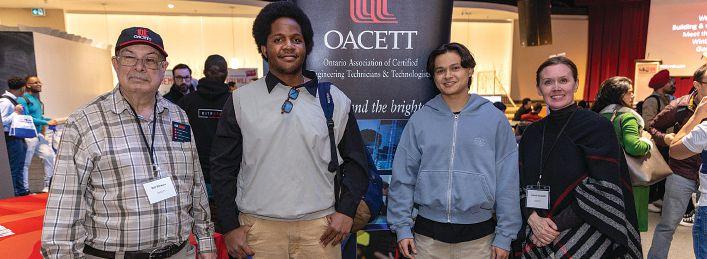
Left to right: William Stewart, C.E.T.; Supreme Okereke; Leo Trung MendozaNguyen; Trishia Teldoldi, manager, college & community partnerships, OACETT, at Mohawk College’s “Meet the Grad.”
or offer some fun. It’s one of the best networking resources around! The chapter also provides opportunities for professional development through its volunteer roles. For event information, visit https://www.oacett.org/ Upcoming-Events.
Jason Wattleworth, C.Tech., is Toronto West Chapter chair: torontowest-chapter@oacett.org.
Toronto Central Chapter
The Toronto Central Chapter continues to hold virtual monthly executive meetings to plan and hold events that support its members.
On February 15, the Toronto Central Chapter executive got together at the Dragon Pearl Buffet for a networking opportunity and to celebrate the Chinese New Year.
On March 20, the Toronto Central Chapter held its Annual Chapter Meeting at the Amsterdam Brewery. Volunteers to serve on the chapter executive for the next year were selected.
The chapter executive welcomes ideas for events at torontocentral-chapter@ oacett.org.
Akrivi Nicolaou, C.Tech., is the Toronto Central Chapter chair: torontocentralchapter@oacett.org.




CHAPTERS AT
Eastern Region
Kingston Chapter
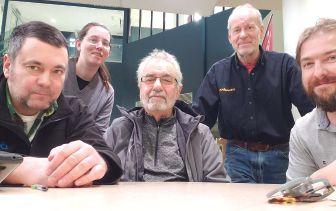
Left to right: Richard Cork, C.Tech., secretary Karina Bree, C.Tech., Joseph D’Agostino, C.E.T., chair Bruce Fudger, C.E.T., and Ryan Klein, C.E.T. at their January executive committee monthly meeting.
This spring, Kingston Chapter is gearing up for the highly anticipated Bridge Building Competition, a showcase of ingenuity and skill by St. Lawrence College’s civil engineering technology students.
Save the date for the pivotal Annual Chapter Meeting on April 17! They are eagerly seeking volunteers to bol-
Central Region
Georgian Bay Chapter
The Georgian Bay Chapter held its annual Barrie Colts Hockey Night at the Sadlon Arena on January 13. Nearly 75 tickets were sold to Georgian College students, PEO members and OACETT Georgian Bay Chapter members. All attendees enjoyed a fabulous game, cheering on the Barrie Colts against the Brantford Bulldogs. After the game, participants attended a networking event hosted by the chapter at Horsepower Sports Bar and Grill. Thank you to all who came out and the chapter executives who organized the event!
Tamara Lacroix, C.Tech., rcca, is Georgian Bay Chapter chair: georgianbaychapter@oacett.org.
ster their executive committee. Your involvement shapes the future - let’s make it happen together!
Bruce Fudger, C.E.T., is Kingston Chapter chair: kingston-chapter@oacett.org.
Renfrew Chapter
In April, the Renfrew Chapter will participate in and judge the Renfrew County Science Fair. The chapter will offer an award and provide financial sponsorship for the event. They will also help judge the competition and post pictures of the judges and students from the event.
Renfrew Chapter also plans to host a technical industry tour at Haley Magellan Aerospace Foundry in May. This exciting facility has delivered high-tech light alloy castings for military, aerospace and commercial applications since the 1930s. This tour will include a WIT event and lunch at Whitewater Breweries Cobden. The tour is limited to 15-20 people.
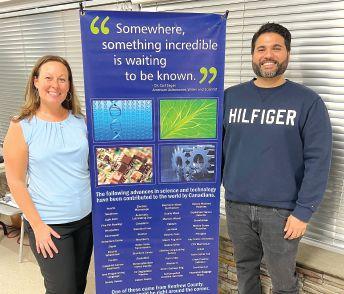
OACETT Renfrew 2023 Science Fair judges.
The chapter is working on an OPG Hydro facility tour at one of the Ottawa St. Lawrence Plant groups (dams).
Renfrew Chapter will assist the Ottawa Chapter with their Algonquin College (campus near Renfrew) college liaison efforts, as the local Algonquin Campus in Pembroke does not have any technical programs recognized by OACETT.
Larry McHenry, C.E.T., is Renfrew Chapter chair: renfrewcounty-chapter@ oacett.org.
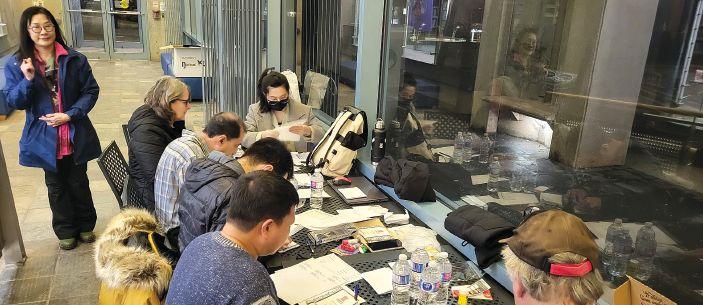
Phelia Kung, C.E.T. (standing), executives and volunteers write thank you cards to milestone members at Richmond Hill Central Library.
York Chapter
In early January, York Chapter chair organized a special evening with ten executives and volunteers at the Richmond Hill Central Library for handwriting cards to members who have been active members of OACETT for 10, 25 and 40 years.
York Chapter understands how important these milestones are to the membership who contribute their knowledge to the province.
Phelia Kung, C.E.T., is York Chapter chair: york-chapter@oacett.org.

CONNECT WITH OACETT MEMBERS
Recruit top talent on our CTEN job board and connect with more than 21,000 engineering technology and applied science professionals.
BRAND EXPOSURE
Increase your brand exposure to a targeted audience of government officials, municipalities, colleges, students, and other companies.
BOOST ENGAGEMENT
Engage with the OACETT network through ongoing events, chapter activities, and OACETT’s digital and traditional marketing channels.