4 From the editor
Shining a light on excellence and a greener future by
Michelle Malcolm-Francis
5 The first word
OACETT 2024 Conference a huge success by Micheal
Mooney, C.E.T.
20 Learning curve
Georgian College unveils VW Westfalia camper retrofit by Jenni
Thompson
21 Sign of the times
We’ve come a long way from ‘dig and dump’ by Dennis
Furlan
6 OACETT in action
Sharing the latest news, happenings and announcements from your professional association and more!
37 New members
Recognizing new and certified members
41 Chapters at work
Events and news from OACETT’s regions and chapters

Innovating for a greener future
OACETT Conference and President’s Awards Dinner 2024 highlights by Michelle Malcolm-Francis

35 Energy, who cares? by
Bob McDonald

ACETT’s Conference and President’s Awards Dinner is the one time of the year when we get to tout the phenomenal accomplishments of engineering technology and applied science professionals and companies, network on a grand scale and sharpen knowledge on relevant ‘hot’ topics impacting our members and Ontarians, all under one umbrella.
Keeping it real, you have a lot to be proud of. Whether it’s being engineering stewards, leading innovation, championing the student experience or giving back to the community or profession, applied science and engineering technicians and technologists are doing incredible things and the President’s Awards Dinner – at the conference on June 8 – shined a spotlight on your five-star achievements, showing why the fields of engineering technology and applied science are essential to Ontario’s economy and bolster so much positive change.
Our cover feature story, “Innovating for a greener future: OACETT 2024 conference highlights,” introduces 15 extraordinary individuals and organizations whose exceptional contributions to the STEM community earned them an OACETT Award or a Fellow OACETT designation — achievements that made the President’s Awards Dinner’s theme ‘a night to inspire’ a reality.
The environmental theme “Innovating for a greener future” was prominent throughout the conference, with at least two award winners celebrating achievements in this realm.
Keynote speaker Bob McDonald, a well-known science journalist, brought the conference’s theme front and centre with his presentation, “Energy, who cares?” His latest book The Future is Now and his feature article in this issue of The Ontario Technologist cover this topic extensively. McDonald has much to say about Canada and the world’s energy shift and paints an intriguing picture of a world powered by clean energy. Check out the article on page 35.
Keeping a bull’s-eye on the environment, the article “We’ve come a long way from dig and dump,” looks at how insitu remediation is being used to address environmental contamination.
Georgian College has made meeting the UN Sustainability Development Goals a priority, and their Volkswagen Westfalia retrofit project, which transforms this iconic camper van into an electric vehicle, is an example of their commitment. Read about the completion of the project on page 20.
As usual, there is much more to read. Missed OACETT’s Annual General Meeting in May 2024? We’ve got you covered. Read about what OACETT has worked on over the past year in the ‘Year in review’ report on page 10. Also, we’d like you to meet Liam Croft, the new student representative on OACETT’s board of directors. Get to know him, his student journey and his dedication to students. Enjoy these stories and more in this issue of The Ontario Technologist
OACETT is dedicated to excellence in the engineering and applied science technology profession in a manner that serves and protects the public interest.
The Ontario Technologist is published bi-monthly by:
The Ontario Association of Certified Engineering Technicians and Technologists (OACETT) 10 Four Seasons Place, Suite 700 Etobicoke, Ontario, Canada M9B 6H7 Tel: (416) 621-9621 • Fax: (416) 621-8694 www.oacett.org
Please direct all inquiries, submissions and subscription requests to OACETT at the above address.
The Ontario Technologist is published in conjunction with:
Annex Business Media
111 Gordon Baker Road, Suite 400 Toronto, ON M2H 3R1 Tel: (416) 442-5600 • Fax: (416) 442-2230
EDITOR
Michelle Malcolm-Francis editor@oacett.org
ART DIRECTION
Svetlana Avrutin
ACCOUNT COORDINATOR
Cheryl Fisher
SALES CONTACT OTads@oacett.org
Subscriptions:
One year: $24 (Canada), $48 (U.S.A.), $96 (International). Please add 13% HST. HST Registration #107796658
©2024. The opinions expressed in this publication are not necessarily those of the Association. Neither The Ontario Technologist nor OACETT assumes any responsibility or liability for damages arising from any error or omission or from the use of any information or advice printed in this publication.
Letters regarding the journal should be addressed to the Editor at the Association’s address. Letters regarding the Association and other related subjects may also be addressed to the Editor for forwarding.
International Standard Serial Number (ISSN) 0380-1969. Publications Mail Agreement #40062764.
Return undeliverable Canadian address to:
Circulation Department, 10 Four Seasons Place, Suite 404, Etobicoke, ON M9B 6H7.


The Ontario Association of Certified Engineering Technicians and Technologists, a self-governing, non-profit organization, maintains standards of excellence in the practice of engineering and appliedscience technology in Ontario. Founded in 1957, the Association became provincially legislated in 1984, and has statutory powers and responsibilities.
PRESIDENT
Micheal Mooney, C.E.T.
PRESIDENT-ELECT
Christopher van Dop, C.E.T.
PAST-PRESIDENT
Rosanna Tyrer, C.E.T., rcji, CAPM
CENTRAL REGION
Governance, Strategy and Policy Committee
Norman Sandberg, C.E.T.
EASTERN REGION
Finance and Audit Committee Chair
Brian Raymond, C.E.T.
HORSESHOE REGION
Diversity, Equity and Inclusion Committee Chair
Shelley Parker, A.Sc.T.
NORTHERN REGION
Registration and Professional Practice Committee Chair
Stephanie Pesheau, C.E.T.
TORONTO REGION
Member Engagement and Services Committee Chair
Roy Sue-Wah-Sing, C.E.T.
WESTERN REGION
Human Resources Committee
Member-At-Large
Samuel Nammari, C.E.T., P.Eng.
Young Professionals Committee Chair
Mladen Ivankovic, C.E.T.
Student Representative
Liam Croft
APPOINTEES
Daniel Liao
Heads of Technology Representative
Alex Lusty, LLB
Public Representative
EX-OFFICIO MEMBER
Cheryl Farrow, MBA, CAE OACETT Chief Executive Officer
DIRECTOR, FINANCE AND CORPORATE SERVICES
To be announced
DIRECTOR, REGISTRATION AND PROFESSIONAL PRACTICE
Barry Billing
DIRECTOR, MEMBER ENGAGEMENT, SERVICES AND GOVERNMENT RELATIONS
David Terlizzi
MESSAGE FROM OACETT PRESIDENT MICHEAL MOONEY, C.E.T.

t is great to have the timing of this article so closely on the heels of an excellent OACETT 2024 Conference and President’s Awards Dinner at the Sheraton Toronto Airport, giving me a chance to reflect on its success and offer some thank yous.
The theme of “Innovating for a greener future” is near and dear to my heart, especially since our profession plays a pivotal role in developing and participating in ecosolutions and services that comply with international net-zero goals and protect our environment in many ways.
I certainly had several takeaways from the conference sessions, whether it was Bob McDonald’s incredible story-telling style updating us on emerging technologies, our eco-solutions discussion panellists exploring a range of issues, or Dr. Karimi sharing his research into nanotechnology as it relates to electrification, or Sunday morning’s presentation on anaerobic digestion from the Azura Associates team.
Also, let’s not forget the fabulous return of our second-annual Technology Partnerships Showcase. We explored over a dozen exhibits on emerging technologies from our academic and corporate partners, including the TTC (Toronto Transit Commission) providing tours of one of their new electric buses. The exhibitors told me that they had never seen such an engaged and knowledgeable crowd, and the buzz in the room was palpable.
Just as significant were the opportunities to network with our colleagues from across the province. There was something for everyone at the welcome event at Woodbine Racetrack. There was dancing to 70s funk from the Supafonics, some fun blackjack and roulette tables for those seeking the casino vibe, a numerologist to help with a glimpse of the year ahead and some online
The theme of “Innovating for a greener future” is near and dear to my heart, especially since our profession plays a pivotal role in developing and participating in eco-solutions.
trivia. The weather also cooperated for an opportunity to sit and chat on the patio.
I was very proud to host the President’s Awards Dinner on Saturday evening, honouring our 12 award recipients and conferring three Fellow designations. Our emcee Sandy Jobin-Bevans had us in stitches again this year, and we were honoured to have the Associate Minister of Small Business, Nina Tangri, MPP, join us to provide greetings from the provincial government.
Thank you to my fellow board members, chapter representatives and the Member Engagement and Services Committee members who arrived in time for Friday’s meetings.
Finally, a huge thank you to the OACETT staff team for coordinating this amazing event for close to 300 members, volunteers and special guests. I know how much goes on in the background to ensure a smooth and professional presentation for those in attendance.
As you can see, if you could not attend, you missed an excellent and informative time in Toronto! Next year, OACETT will host its conference at Caesars Windsor from June 13 to 15, 2025. Mark your calendars now!
As always, if you have an idea or need assistance, don’t hesitate to get in touch with OACETT staff or me directly at president@oacett.org.
Micheal Mooney, C.E.T., is president of OACETT.

by Michelle Malcolm-Francis
OACETT held its 2024 Annual General Meeting (AGM) on June 1. The meeting brought members together with the Board of Directors to discuss the past year’s performance, provide an overview of OACETT’s goals for the coming year, and answer pertinent questions members may have.
This year, we had 916 registrations for the AGM, with an additional 356 electronic proxy votes submitted. Attendees were briefed on business activities OACETT pursued over the past year to advance the Association and learned of how the Association is addressing members’ needs across Ontario.
As part of his introductory remarks, president Micheal Mooney, C.E.T., acknowledged the past presidents in attendance, and introduced the OACETT Board of Directors and senior management team. He also thanked board member David Visentin for completing his one-year term as the student representative. Mooney then welcomed Liam Croft, the new student representative, who officially joined the Board on June 7. He then saluted the representatives from Ontario colleges, the government, our partner associations across Canada, and other affiliated associations that were present and thanked them for their continued support and collaboration.
Before president Mooney delivered his year-in-review report, he requested approval of some proposed updates to Bylaw 20. The bylaw updates included changes to fixing the length of the president’s term as president-elect in the definitions and create clarity to reflect the CEO’s role on both OACETT’s Board of Directors and the Fletcher Foundation’s Board of Trustees, as the CEO is a non-voting ex-officio member of OACETT’s Board. OACETT members approved the motion.
Next on the agenda was the president’s year-in-review update, which kicked off with Mooney saying, “It’s been a pleasure to lead our great association for the past year,” and how the year-in-review would serve as a reflection of some of the Association’s successes since OACETT’s last AGM. Here are some of the achievements Mooney highlighted.
Mooney said OACETT is ramping up its government relations activities and is seeing results from their ongoing contract with Counsel Public Affairs in generating introductions and discussions with crucial Ontario government elected and ministry officials. According to Mooney’s update, OACETT’s work with Counsel Public Affairs has increased awareness of the Association and its members’ subject-matter expertise. Presently, seeking mandatory self-
regulatory status with a defined scope of practice remains unrealistic until OACETT generates even greater awareness and has a different political climate.
Over the past year, OACETT has had several successful meetings with the Ministry of Municipal Affairs and Housing. At their invitation, OACETT will submit a proposal to seek exemption from some BCIN exams for appropriately qualified OACETT-certified members. OACETT also established excellent relationships with both the Ministry of Education and the Ministry of Colleges and Universities, establishing OACETT as a trusted source for subject-matter experts in technology curriculum review. For example, OACETT played a role in the insertion of new mandatory technology courses for Grades 9 and 10. OACETT’s leadership has also met with the Ministry of Labour, Immigration, Training and Skills Development. The productive

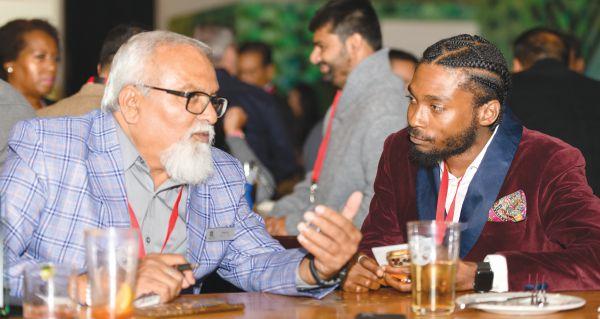
OACETT’s Internationally Educated Professional Career Event held last October in Toronto.
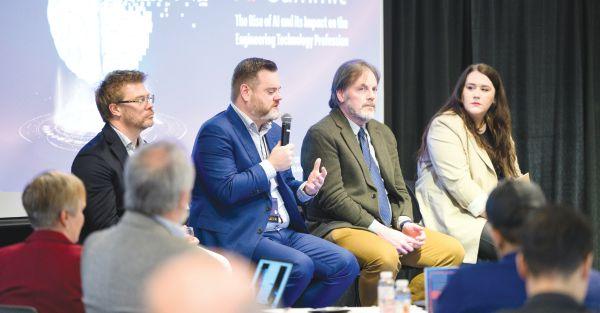
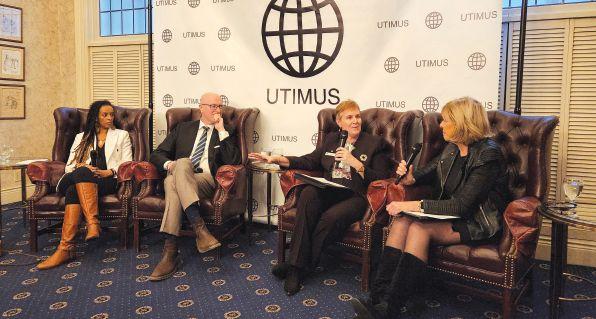
OACETT held an AI Summit in April. From right to left, panellists exchanged viewpoints of the future of AI in Ontario: Stephanie Oldfield, director of Policy & Digital First Branch, Ministry of Public & Service Delivery, Francis Syms, associate dean, Humber College, Faculty of Applied Science and Technology, OACETT president Micheal Mooney, C.E.T., and Joe Armstrong, president and CEO, Eraii Consulting.
meeting disclosed how much the ministry values OACETT as a source of best practice in effectively integrating internationally educated professionals into our certification programs and the Ontario workforce. Earlier this year, OACETT CEO Cheryl Farrow also met with the Ministry of the Attorney General to ensure that OACETT is on their radar as a key stakeholder in the engineering community. OACETT’s next area of focus is looking at opportunities to have OACETT-certified members recognized as qualified persons (QPs) in specific regulatory instances where we know our members have the expertise and are doing the work and simply require an engineer’s stamp and sign-off. This creates unnecessary bottlenecks. However, OACETT
needs your help to share those specific examples, particularly where they are aligned with the government’s key priorities. If you have specific examples of work that you are doing that currently only recognizes professional engineers or other regulated professions as QPs, other than in the Engineering Act itself, please send an email to govrelations@ oacett.org.
OACETT’s new smaller, nimbler, competency-based Board of Directors was constituted at the June 2023 board meeting and has been hard at work throughout the year, focusing on organizational priorities defined in OACETT’s strategic plan.
OACETT also launched brand-new committees in September 2023. The goal was to ensure that the Association provided more opportunities for members to become engaged with the governance of their Association. Judging by the 134 applications we received to serve in various volunteer roles, the interest is definitely there. OACETT’s new committees have been going gangbusters, ramping up work on several initiatives. There is also work to be done at the subcommittee level. For example, OACETT will be reconstituting its Awards subcommittee. One of their first tasks will be a review of OACETT’s provincial awards program to ensure relevance and inclusiveness.
OACETT was thrilled to launch its new website last summer. The new site is a significant improvement, featuring a user-friendly design that is more graphic intensive and an intuitive structure to help users easily understand how to join OACETT and become certified. If you have suggestions for making the site even better, don’t hesitate to reach out to your member engagement and services representative with your ideas.
The Registration and Professional Practice team, in cooperation with Confederation College and the Ontario Heads of Technology, is developing an asynchronous course on ethics and professionalism that will serve as preparation for OACETT’s professional practice exam and will be also eligible for college credits. The program is being piloted as we speak and is expected to be launched across the college system for early 2025.
In 2023, OACETT received 1210 new applications, including 601 students. Additionally, 646 associate members became certified, and 183 existing certified members reclassified to C.E.T.

OACETT introduced the new municipal infrastructure inspector (mii) designation. Claude Gauthier, C.Tech., rcsi, mii, (pictured) who works for the Region of Peel is one of first recipients of the designation.
Technology Professionals Canada (TPC) continues to flourish as a reunified national alliance. A key initiative they have undertaken is the advancement of a common national technologist certification. The favoured certification within the TPC operations committee and leadership council is Professional Technologist or P.Tech. This title focuses on the professionalism of certified members. This is obviously not a decision that OACETT will take without consulting with its members. In the event of any change, there would be a grandfathering period and no immediate requirement for any certified members to change the certification that they are currently using. However, at the national level, all the provincial associations agree that a common certification would go a long way to strengthening recognition and labour mobility and all the organizations have committed to specifically exploring a move to P.Tech.
Technology Accreditation Canada (TAC) is doing work in responding to the long-standing concern articulated by Ontario colleges that the TAC accreditation process is too duplicative of the colleges’ internal program review processes. A gap analysis is going to be conducted that will hopefully identify paths to a streamlined accreditation process that addresses that duplication and will pave the way for greater uptake of accreditation in Ontario.
During the AGM, OACETT CEO Cheryl Farrow, CAE, MBA, reported on the Association’s progress against the strategic plan, presenting OACETT’s progress in delivering against the three priorities: Careers, Chapters and Communities.
From the Careers perspective, OACETT launched on March 4 two new Municipal Infrastructure designations for inspectors and contract administrators, the first new designations for OACETT in over 20 years. With leadership from the Emerging Markets Committee of the former IETO, OACETT volunteers and staff have spent more than two years developing the standards and the processes to identify members eligible to be granted the new designations. A lot of very positive buzz was generated during the pilot process, working with seven municipalities of all sizes and from multiple regions across the province. In May, RPPC (Registration and Professional Practice Committee) granted the Municipal Infrastructure Inspector designation to 23 members, and 34 new applications are under review.
In August, OACETT will participate in the Association of Municipalities of Ontario conference to help promote the value of these targeted designations. Even if the designation does not apply to your role, it is an example of the work that OACETT is doing to enhance the profile of our profession.
In helpful preparation for the asynchronous PPE course with colleges project, OACETT’s exam and study materials were completely updated, driven by the need to align the content with the new governance model.
As previously mentioned, the new OACETT website, which includes an update of the CTEN job board, continues to provide solid opportunities for both our members and our employer partners.
OACETT continues to expand its CPD offerings, looking to cover as many disciplines as possible and identify partnerships that will help us to keep CPD affordable. OACETT’s recent AI Summit provided some excellent content that was available and relevant to all members at no cost.
Also, the annual Career Summit for internationally educated professionals continues to grow and to engage more partner agencies. In 2023, a very well-received speed-networking component was added to the in-person event and liked by all. Watch for information about the 2024 event in the early fall.
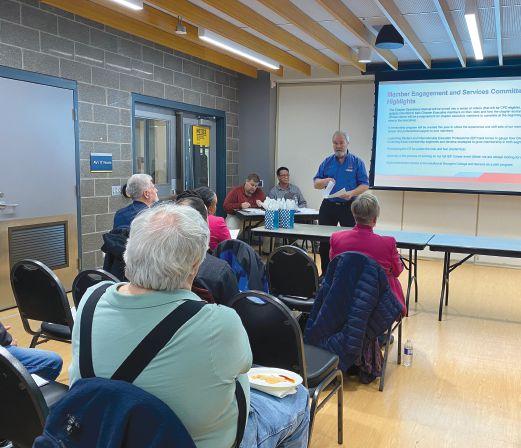
President-elect Christopher van Dop, C.E.T., provides update on OACETT activities at Peel Chapter’s Annual Chapter Meeting.
On the chapter front, OACETT continues to make a concerted effort to arrange for senior leadership participation at annual chapter meetings to update chapter members on what’s happening at the provincial level and allow them to bring ideas and concerns to OACETT’s leadership.
In fall 2023, OACETT launched a new Chapter Forum initiative, which provides an opportunity for chapter chairs and other chapter executives to dialogue with the Member Engagement and Services Committee (MESC) and staff team to discuss best practices, needs, and concerns. A second forum was held in January 2024, and in-person regional meetings took place this June at the OACETT Annual Conference.
One of MESC’s 2024 major work plan items is a review and overhaul of the chapter operations manual with a goal to make it more accessible and interactive in a video format. A more comprehensive orientation and training for new chapter executives is also being worked on.
OACETT has made ongoing progress in our work with our provincial counterparts through TPC. The Association also continues to host annual leadership summits with our key association partners in the engineering community in Ontario, namely Professional Engineers Ontario, the Ontario Society of Professional Engineers and the Association of Consulting Engineering Companies Ontario, to provide mutual updates, address areas of interest and,
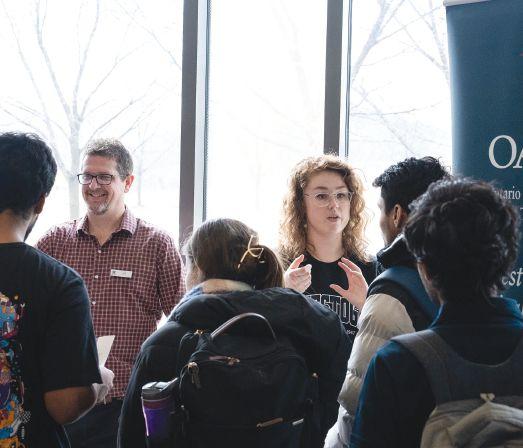
OACETT chapter executives promote OACETT membership and certification to college students.
where appropriate, discuss any issues that are impacting OACETT members.
The Association distributed a comprehensive member survey in June 2023 to help us understand member priorities and ensure the Association addresses at least some of them in its 2024 business plan. OACETT shared detailed findings in The Ontario Technologist’s November/December 2023 issue. Key commitments included establishing a mentorship program and hiring a dedicated resource to focus on enhancing our CPD offerings, both of which are part of this year’s business plan.
Significant progress has been made on a couple of OACETT’s KPIs. For instance, we launched the free student membership pilot and established a Diversity, Equity, and Inclusion Committee as part of our new governance model.
OACETT continues to provide strong leadership at the national level on all fronts, with their registrar becoming the chair of the newly reconstituted National Technology Registrars group. CEO Farrow is leading the planning for NEAT (National Engineering & Applied Science Technology) Week, and president Mooney has been a strong advocate for governance review at both TPC and TAC.
OACETT also aims to maintain its target of a minimum of 80 per cent of the members eligible to be certified, having achieved their credentials. With OACETT recently receiving a number of new applications, that figure is currently at 76 per cent. The Association has also just recruited many new members to the Admissions Subcommittee to assist with the pace of processing applications.

Hocine Boudhar, C.E.T., has recently taken on the role of supervisor of system design stations. Before this, he was an investment planning engineer at BC Hydro, overseeing four dams, including the largest in BC. Before BC Hydro, Boudhar spent seven years at Elexicon Energy as the lead asset management & planning technician. He is the vice chair of the Professional Advisory Committee for Centennial College’s Energy System Engineering Program. He recently received the 2024 Alumni of Distinction Award for contributing to the school and the industry. Additionally, Boudhar is an Engineer-In-Training and an active member of the PEO Scarborough Chapter.
Mark Kassel, C.E.T., has recently started a new position with Vertex Environmental Inc. as senior project manager in their dewatering division. With over ten years of experience designing, installing, and managing temporary groundwater control and dewatering systems across Ontario, Kassel is eager to leverage his expertise to assist clients with groundwater control and discharge issues. His role includes managing vacuum wellpoint, deep well pumping systems, sediment and contaminant discharge control and treatment, and navigating the related approval processes for development and infrastructure projects.
Wiebe Kroezen, C.E.T., has recently joined HFH as a sales/commercial project manager after leaving Tambro Construction Ltd. this past April. At Tambro, Kroezen began as a project coordinator in 1997, progressing into estimating and later becoming a project manager, a role he held for over 18 years. Some of his primary responsibilities include finalizing building designs, issuing contracts, and supporting site superintendents by ensuring timely contract issuance and resolving potential misunderstandings.
Dayel Peterson, C.E.T., has joined EnPowered as their program operations manager. Peterson’s role involves managing energy programs, developing bidding strategies for annual capacity auctions, managing customer submissions, and submitting performance data to validate portfolio performance. He also works with his team to develop strategies for success in a competitive market.
Diarmuid Moloney, C.Tech., a maintenance manager at QuickPlug, brings a wealth of expertise in mechanical engineering and millwright certification to his new role. With a mechanical analysis and automation background and his recent completion of the Industrial Millwright Mechanic (433A) exam, Moloney is adept at diagnosing and providing solutions for equipment breakdowns.
He oversees emergency repairs, preventative maintenance scheduling, and inventory management while ensuring adherence to safety protocols. Moloney’s dedication to continuous learning and professional development, exemplified by his ongoing pursuit of a degree in mechanical engineering, makes him an invaluable asset to QuickPlug’s operations. He recently passed OACETT’s Professional Practice Exam and became a Certified Technician.
Christopher Walker, C.E.T., assumed the role of training simulation specialist at Nav Canada in April. Before this, he worked as an NMDC technologist at Nav Canada and as a plant systems technologist at The Canadian Bank Note Company Ltd. In these roles, Walker provided technical guidance for implementing simulation and enhancing air navigation training systems. His responsibilities include monitoring, coordinating, and maintaining trainingspecific electronic systems to ensure they meet technical standards and training requirements. Walker volunteered in multiple capacities with OACETT’s Ottawa Chapter.
WHAT’S NEW? We want to hear from other members who have recently changed jobs, received a promotion or an award, or completed an educational program. Make sure your fellow OACETT members read about it in The Ontario Technologist. Promote your success – send your submissions to the editor at editor@oacett.org.
The end of another year means the beginning of a new Continuing Professional Development (CPD) audit. This audit affects all members belonging to the 2021-2023 cycle. To see what cycle you belong to, check the OACETT Member Portal under CPD.
CPD is a mandatory component of OACETT membership. Check your email/mail to see if you have been selected.
This listing represents those who reached their milestone between April 18, 2024 to June 24, 2024.
25-year members
Mike Abboud, C.Tech.
Anna Basile, C.Tech.
James Beckett, C.E.T.
Dale Bender, C.E.T.
Mark Bryans, C.E.T.
Joseph Cheung, A.Sc.T.
William Evans, C.E.T.
Shaun Foster, C.E.T.
Zeljko Peter Frey, C.E.T.
Mark Harrison, A.Sc.T.
Kujtim Haxhiaj, C.E.T.
Jeremy Horst, C.E.T.
Benjamin Howard, C.E.T.
John Jaques, C.E.T.
Daniel Langlois, C.E.T.
Parmjit Locham, C.E.T.
Sarah Lock, A.Sc.T.
Sal MacInnes, C.E.T.
Ian McCutcheon, C.E.T.
Adam McKinlay, C.E.T.
Milica Micic, C.E.T.
Steven Pozzobon, C.E.T.
Nadean Reichelt, A.Sc.T.
Ronnie Sebolino, C.E.T.
Alexander Serrano, C.Tech.
Thane Silliker, C.E.T.
Mitchell Tange, C.E.T.
Edward Villemaire, C.E.T.
Archie Yu, C.E.T.
40-year members
Jeffrey Berry, C.E.T.
Brad Allemang, C.E.T.
Ian Bergeron, C.E.T.
David Best, C.E.T.
Paul Bongers, C.E.T.
Karl Broll, C.E.T.
Glen Cameron, C.E.T.
Mauro Cesa, C.E.T.
Scott Chapman, C.E.T.
Sergio Cipriani, C.E.T.
Nick Dronyk, C.E.T.
Douglas Emery, C.E.T.
Frank Falcone, C.E.T.
Marvin Finkel, C.E.T.
Dean Gatien, C.E.T.
George Harron, C.E.T.
Andrew Henry, C.E.T.
Andreas Hofmann, C.E.T.
Robert Hutton, C.E.T.
Steven Lonz, C.E.T.
Harold Marsden, C.E.T.
Claude Martel, C.E.T.
Ronald Mayer, C.E.T.
Frank Paolo, C.E.T.
Guy Rogers, C.E.T.
Joseph Salottolo, C.E.T.
Daniel Schubert, C.E.T.
Franco Torlone, C.E.T.
Dale Valentine, C.E.T.
Ronald van der Steen, C.E.T., P.Eng.
Ronald Vance, C.E.T.
Gregory Wuisman, C.E.T.
Robert Bentley, C.E.T.
Jerry Domereckyj, C.E.T.
Pasquale Galle, C.E.T.
Howard Gram, C.E.T.
Jack Hellinga, C.E.T.
Paul Hilker, C.E.T.
William Klemp, C.E.T.
Raymond Lam, C.E.T.
David Law, C.E.T.
Mohamed Murji, C.E.T.
Tapio Saarinen, C.E.T.

Louis Savard, C.Tech., conducts thought-provoking interviews with industry leaders, government officials, academia and influencers on hot topics relevant to the engineering and applied science profession.
EPISODE 9


GUESTS
Doug Nix, C.E.T. Co-owner, Compliance Insight Consulting Inc.
Mayy Habayeb
Artificial intelligence program coordinator, Centennial College
The role of AI in modern engineering: Opportunities & challenges
In this episode of TECH TAKES Podcast, host Louis Savard, C.Tech., delves into the transformative potential of AI in revolutionizing work processes and industries.
Guests, Doug Nix, C.E.T. and Mayy Habayeb, explore the impact of AI on engineering tasks such as design optimization and testing and how automation enhances productivity and efficiency. They also discuss the importance of acquiring new skills to adapt to the evolving workforce shaped by AI technologies and touch on concerns such as inequality, privacy, safety, and bias arising from widespread AI adoption.
Listen to the podcast at https://www.oacett.org/tech-takes or on your favourite podcast app!
Association of Consulting Engineering Companies – Ontario (ACEC-Ontario) celebrated its annual Ontario Engineering Project Awards (OEPA) in May at the Liberty Grand, recognizing the Ontario consulting engineering community.
ACEC-Ontario’s member companies are vital to building a stronger Ontario. They provide essential expert advice and services to businesses and governments, helping to solve complex problems and make informed decisions, which, in turn, supports a thriving society. The OEPA program honours and recognizes the outcome of their efforts.
“The OEPA is really an evening about celebrating the industry’s impact on our communities across Ontario,” stated Andrew Hurd, executive director of ACEC-Ontario. “The top recognition of the night, the Willis Chipman award, went to Egis for their “Highway 21 Bayfield River Bridge Replacement” project. This project overcame multiple challenges and is integral to connecting the Bayfield community. This new bridge, spanning a waterway containing at-risk species, will meet the community’s future needs while minimizing environmental impacts. To top it off, this bridge is very aesthetically pleasing.”

The OEPA grants ten Awards of Distinction each year, designed to recognize consulting engineering excellence by member companies that have made remarkable efforts throughout the year.
The OEPA project awards have progressed to include further categories that represent Ontario’s changing landscape of consulting engineering work. The Sustainable Development Impact Award recognizes the project that best demonstrates the three pillars of sustainable development: society, environment and economy. This award was presented to WSP Canada Inc. for their “Port Lands

Share your ideas to further the Young Professionals Committee’s engagement!
Scan the QR code and complete a short survey for your chance to win a $100 Amazon gift card.

Flood Protection and Enabling Infrastructure – Road Design & Civil” project. The Internal Innovation for Philanthropy & Community Engagement Award recognizes contributions to local communities. This year, the honour went to GRIT Engineering Inc. for “Perth County Community Engagement” initiatives.
The congratulatory ceremony also included three award categories for projects deserving special recognition for the obstacles they had to overcome and the contributions they made to society. These new categories included the “Punching Above Weight Award,” “Carbon Impact Award,” and for the second year in a row, the “Humanitarian Award.”
ACEC-Ontario would like to thank all those firms that participated and submitted projects to be considered for the 2024 OEPA program.















by Kristen Frisa
Ahmed Muawiyah, C.Tech., has come a long way from where he began as a medical student and new immigrant to Canada 12 years ago.
After starting a diploma program in chemical engineering, Muawiyah switched to an electromechanical engineering program at Sheridan College and is now enjoying a growth trajectory in a career in his field. Muawiyah’s personal and professional growth is a testament to his focus, drive, and tenacity. Still, he credits much of his success to the support he got through his involvement with OACETT.
September 23
Ontario Energy Conference 2024 Marriott Downtown, Toronto Eaton Centre ontarioenergyconference.com/
October 2 - 3 2024 AME Conference Delta Hotel and Conference Centre www.ame-ont.com/events/2024ame-conference
December 4 - 6
The Buildings Show 2024 Metro Toronto Convention Centre, South Building Toronto informaconnect.com/thebuildings-show/

Muawiyah joined OACETT as an associate member after starting his career as an electrical designer. As a newcomer to Canada, he says the organization encouraged him to come out of his shell, network, and attend events that propelled his career forward quickly. “They got me out from behind a desk,” Muawiyah says. “Because of OACETT’s encouraging me to be more social, going out to events and not just immersing myself into the work, I was able to work on multiple levels.”
Further, the certification Muawiyah achieved through OACETT has helped him better understand his profession and put him in better favour with his employers. “My boss saw that I was getting my certification, which helped me secure a promotion to intermediate designer, Muawiyah says.
Besides the initiative that such certifications demonstrate, Muawiyah says they helped him get better at his job. “Certified technicians can execute projects quickly and efficiently,” Muawiyah says. He says getting these certifications is even more critical for engineering professionals who don’t have engineering degrees from a university.
Now, Muawiyah is a portfolio manager for all of Tetra Tech’s electrical distribution projects, overseeing work with Hydro One, Electra, and Toronto Hydro. He enjoys watching his teams work together to solve problems and deliver successful client outcomes. To help foster that feeling of teamwork, Muawiyah holds team-building events and luncheons.
Muawiyah now has the opportunity to lead his team through OACETT’s 360 Partnership Program, which helps companies support their employees in completing certification through the organization. “It helps encourage my team to further their education through OACETT,” he says.
Outside of his daily work, Muawiyah is well-rounded. His future career goals include video game design and political involvement. He is interested in growing his knowledge and experience in electrical engineering so that he can help businesses reach their goals.
Throughout his engineering career, Muawiyah says OACETT has always been integral to his success. He is eager to encourage students and young professionals to become more involved with OACETT’s offerings.
Kristen Frisa is a contributor with The Ontario Technologist.
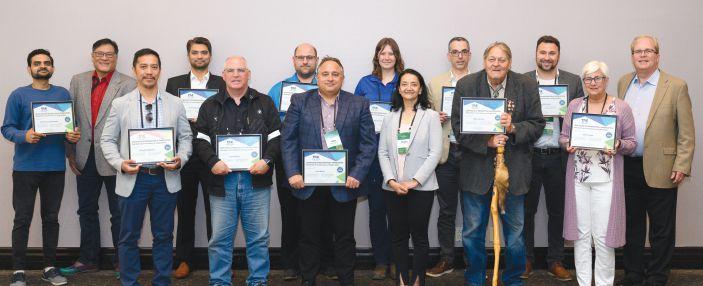
TAC auditors receive Certificate of Recognition and Appreciation.
Front row, from left to right: Michael Sayaman, C.E.T, Scott Martin, C.Tech., Piotr Bauer, C.Tech., TAC executive director Muktha Tumkur, MBA, P.Eng., Wayne Ryczak, C.E.T., Sharon Reid, C.Tech. Back row, from left to right: Maheshvarsinh Mahida, C.Tech., Derek Tsang, C.E.T., TAC Board chair and ASET representative, Chintan Bhavsar, Jason Gubbels, C.E.T., Rose Lauder, C.E.T., rcji, Sébastien Gervais, C.E.T., Andrew Monkman, C.E.T., Fellow OACETT, Bob van den Berg, C.E.T., OACETT representative on the TAC Board.
Technology Accreditation Canada (TAC) held its first TAC Auditor Event on June 8 at the OACETT 2024 Conference and President’s Awards Dinner.
During the event, TAC board chair and ASET representative Derek Tsang, and TAC board member and OACETT representative Bob van den Berg, C.E.T., presented each auditor at the meeting with a Certificate of Recognition and Appreciation. The session also provided a working opportunity to finalize TAC’s “frequently asked questions” and “best practices” for TAC auditors. All auditors will receive the new FAQs and best practices as they will serve as a living document.
TAC has over 215 ‘volunteer’ auditors across Canada, with nearly 65 in Ontario. These auditors play a critical role in allowing TAC to complete its accreditations.
Serving as an auditor is one way for provincial members to volunteer at TAC. To become a TAC auditor in On-
tario, an individual must be OACETT certified and then complete TAC’s online training. The final step in the training is for the individual to serve on an audit team as an “auditor in training.”
By partnering with other provincial professional associations, TAC intends to undertake such auditor events, ideally in person, across Canada. Given that TAC needs to manage its limited resources, many meetings will occur virtually.
A heartfelt thank you to TAC’s Ontario auditors for their time and dedication to TAC and the accreditation of engineering technology programs across Canada.
For more information: www.oacett.org adsouza@oacett.org
Nominate a certified member who has demonstrated one or more significant achievements/contributions in the engineering technology or applied science field. We welcome self-nominations. Deadline: Nov. 29, 2024 at 4:30 p.m.
by Michelle Malcolm-Francis
At the end of the OACETT 2024 Annual General Meeting, Bob Jameson, C.E.T., Fellow OACETT, chair of the Fletcher Foundation, delivered a report on the significant headway the Foundation has made over the past year to enhance learning outcomes of technology students and support their educational financial needs.
The Foundation is pleased to report that they have increased financial support for engineering technology and applied science students for important educational opportunities through the Matching Donation Program with OACETT, which will continue until 2027.
Every donation received in 2023 from an OACETT member, or chapter went towards the Fletcher Foundation’s Matching Donation Program, tripling the impact of every gift. Thanks to their collective kindness, more than $72,000 was raised through all sources of funding including the matching dollars.
Last year welcomed a brand-new fundraising program, and two fundraisers from 2022 became annual campaigns to raise money for the Fletcher Foundation. At the OACETT 2023 Conference, the Fletcher Foundation debuted its first 50/50 draw and showed the power of promoting in-person and the value of giving to the Foundation amongst a group of people who care. The Holiday Virtual Silent Auction and Giving Tuesday also fared well in their second year as fundraising sources. Altogether, these fundraising initiatives raised nearly $7,000, showing how much OACETT members care about the next generation of technicians and technologists.
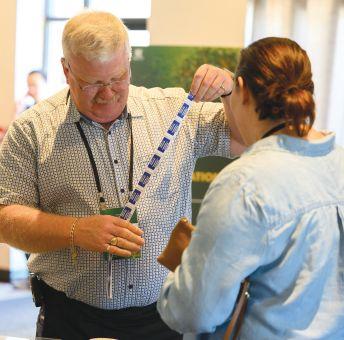
Last year, the Fletcher Foundation established the Norman Kallio Bursary Award, thanks to a legacy gift of nearly $25,000 received from long-time member Norman Kallio, who sadly passed away in 2019. The Foundation has put his planned gift to work by supporting two OACETT student members per year who have demonstrated financial need in writing the OACETT PPE exam while studying at an Ontario college. Two $400 bursary awards will be given annually.
The Fletcher Foundation is now administering the Kiani Foundation Engineering Technology Endowment, which funds an annual $1,000 bursary to support individuals with demonstrated financial need applying for full-time studies in an engineering or applied science technology program at an Ontario college. This endowment will give preference to applicants from under-represented populations within
the engineering and applied science technology profession.
In celebrating the Fletcher Foundation’s achievements and donations, it would be remiss to not mention the $5,000 donation received from Eaton Industries and the $1,100 donation from OACETT’s Ottawa Chapter that enhanced Collège La Cité’s endowment fund, nudging them closer to their $40,000 target for the Foundation’s OACETT Technology Award “25 for 25” endowment project, which has a goal to have a $40,000 award endowment at all Ontario colleges. Only two colleges remain to reach this goal and La Cité is one of them. Every year we get a little closer thanks to you.
The OACETT Engineering Technology Award continues to benefit engineering technology and applied science students across Ontario. The recipients of this award are selected by criteria established by each college, but the overarching one is demonstrated financial need. These endowed bursaries also recognize academic achievement and support future promise in the technology profession.
The Fletcher Foundation is working with Collège La Cité and Lambton College to establish endowments that will fund a $1,000 bursary at their institution, enhancing their award. All other Ontario colleges have achieved the target of a $40,000 endowment to fund an annual award in perpetuity.
Last year, the Fletcher Foundation’s Enhancing Educational Experience
Grant Program, which supports innovative initiatives designed to enhance the educational experience for students in OACETT-eligible programs in Ontario colleges, awarded grants to Georgian College and Collège La Cité. Georgian College launched the Solar EV Charger and VW Westfalia retrofit projects, allowing students to actively convert their lessons into real-world solutions, grooming them to become the next wave of tech innovators.
With the Volkswagen (VW) Westfalia retrofit project, students from various programs worked together to transform an iconic 1972 VW Westfalia camper van into a modern-day electric vehicle showpiece that will serve as a mobile learning lab. In this project, students not only honed their technical skills but also developed an appreciation for blending historical integrity with modern innovation.
Collège La Cité utilized its grant to purchase a Haas desktop mill for its mechanical engineering students. The Haas desktop mill is state-of-the-art equipment considered the gateway to revolutionizing how the college trains the next generation of technicians and technologists in CNC machining and precision fabrication – vital in the future of mechanical engineering and technology.

This year, we look forward once again to helping even more students acquire the learning outcomes they need to increase their career opportunities.
The Foundation also continues to sponsor the Generation Award, presented annually to a child, grandchild, or spouse of an OACETT member enrolled in a post-secondary engineering technology or applied science program. In 2023, Alec Nielsen, a student member of OACETT, received the Generation Award. Nielsen is currently enrolled in the civil engineering technology program at Durham College and is looking forward to a career in civil engineering. Every year, the Foundation accepts applications for this award until May 31. Please visit the Fletcher Foundation page on the OACETT website (www.oacett.org) for information on how to apply.
Thank you to the Fletcher Foundation Board of Trustees, Steve Barnes, C.E.T., Fellow OACETT, Ken Browne, C.E.T., Andre Tardiff, C.E.T., Nate Simpson, C.E.T., and our newest trustees Cam Johnston, C.E.T., rcca, mii, and George Shaparew, C.E.T., for bringing their passion, insight, experience, and re-
sources to the table. Many thanks to the Foundation’s president, Cheryl Farrow, for taking the Foundation forward and building up momentum for our various campaigns. And thank you to the many other OACETT staff members whose hard work provided important support for the Foundation.
The Fletcher Foundation looks forward to another great year of success working to increase our support of learning outcomes and experiences of engineering and applied science technology students in Ontario. And the Foundation would like to acknowledge one final time the kind contributions of OACETT members and others who give to the Foundation. With your support, helping these students reach their full potential is possible. Thank you!
Over the past year, the Fletcher Foundation has made it more convenient to donate. Visit the Fletcher Foundation’s page on OACETT’s website and click the donation button or donate via OACETT’s member portal and try the Foundation’s new round up feature on the portal. No donation is too small to make a difference.
Michelle Malcolm-Francis is the editor of The Ontario Technologist magazine.
by Kristen Frisa
Liam Croft was always passionate about design. He wanted to know how things worked and was fascinated by aerospace, robotics, and electronics. Mechanical engineering offered several different paths he could follow, and it was an excellent educational choice for Croft, who figured out that a career in engineering technology would lead him in the right professional direction.
Croft is studying mechanical engineering at Durham College after beginning his engineering education at Western University. Croft speaks highly of his time at Western, where he started his education toward earning a Bachelor of Engineering. “That experience added tremendously to my later education at Durham,” Croft says.
However, when the class structures and education landscape changed because of the pandemic, he switched to Durham, where he has taken much away from the more hands-on approach to learning. He is a big proponent of learning by doing and participating in co-op education with a focus on design engineering.
Croft has thrived at Durham College, partly because of
the supportive faculty and broad choice of experiential learning opportunities.
Croft has become quite involved in student leadership while completing his education. Last January, Croft was voted onto Durham College’s board of governors, where he represents the students at the governance level. He also participates as president of the Durham College Engineering Club, which works to support engineering-minded students, technicians, and technologists through social and educational events.
Croft acts as a student representative on the Mechanical Engineering Program Advisory Committee, allowing him to work with local industry partners to shape the program’s future and address any concerns within it. He also works with the college’s experiential learning hub as a co-op ambassador, helping promote co-op education advantages to new and current students.
Most recently, Croft was voted onto OACETT’s Board of Directors as a student representative. In this new role, he hopes to increase student membership in OACETT.

WEBINARS DATES AT A GLANCE W E B I NA R S
Join OACETT for a webinar on the benefits of becoming a Certified Engineering Technologist (C.E.T.) and Certified Technician (C.Tech.).
WHY ATTEND?
• Learn how OACETT certification can boost your career — higher salary, networking, and marketability.
To register for a webinar, visit:
• Learn about CTEN.ca, OACETT's career site.
• Learn about OACETT certification requirements.
Students: www.oacett.org/student-road-to-certification
Internationally Educated Professionals: www.oacett.org/iep-road-to-certification
QUESTIONS? Contact Trishia at ttedoldi@oacett.org.
COLLEGE STUDENTS: Monday, Sept. 9, 16, 23 Monday, Oct. 7, 21 & 28 @ 12:00 p.m.
INTERNATIONALLY EDUCATED PROFESSIONALS: Thursday, Sept. 5, 12, 19
Thursday, Oct. 3, 10, 17, 24 & 31 @ 1:00 p.m.
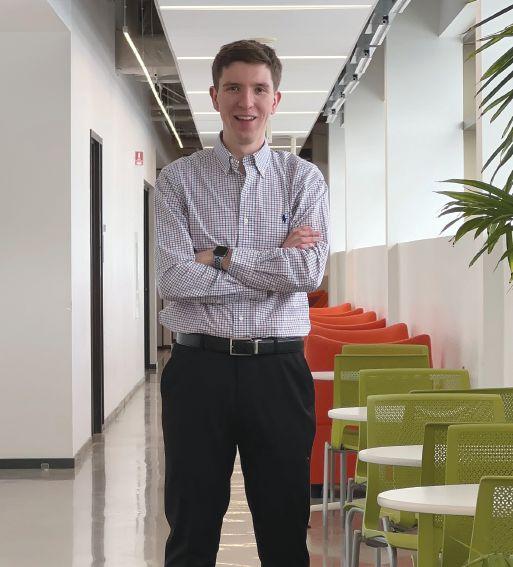
“OACETT has incredible benefits for students. I’d like to spread the word about how valuable that membership is for students and the importance of getting certified.”
“OACETT has incredible benefits for students. I’d like to spread the word about how valuable that membership is for students and the importance of getting certified,” he says.
This new role will also allow him to reach out to students and leadership of mechanical engineering programs at other institutions to learn from what they’re doing well and how their programs are structured. Eventually, he’d like to develop a network of studentled organizations that can organize engineering-related events like competitions.
While Croft has a rough idea of his plans after he completes his program in the spring of 2025, he’s careful not to plan too closely. “I’m a big believer in being prepared to take things on and being prepared for opportunities as they come,” he says. One thing he’s sure of, though: Croft intends to continue to learn and grow, sharing his experiences with others along the way.
Kristen Frisa is a contributor with The Ontario Technologist.



BY JENNI THOMPSON
Georgian College students steered a major project to retrofit a 1972 Volkswagen Westfalia camper van as an electric vehicle, officially unveiling the final product on June 8 at the Georgian College Auto Show.
Artemis Denstedt, a mechanical engineering technology student, was one of more than 30 students who participated in the collaborative project, which spans multiple academic areas, including engineering and technologies, interior design, and others.
“As an engineering student, one of my favourite things is to see my designs come to life. I’ve been working on this for six months, and it finally works - I’m so happy,” she said. “We spent a weekend in the lab to get the vehicle running, and when we first heard that motor whir, we erupted into applause. We were just so ecstatic and relieved that it worked. It’s been very rewarding.”
The project also aligns with Georgian’s commitment to the United Nations’ Sustainable Development Goals, which caught the interest of Scott McCrindle, professor of computer studies, one of several faculty members who worked with the students.
“One of the biggest impacts that we face in terms of the climate crisis is the greenhouse gas generation from the transportation sector, so this project is important because it shows how, using off-the-shelf technologies, we can convert existing vehicles and platforms to cleaner, more robust, more powerful, simpler, better ways of powering our commutes,” he said.
The project’s funding comes from the Automotive Business School of Canada, Volkswagen Canada, the Ontario Motor Vehicle Industry Council, the Fletcher Foundation, and Ideal Supply. Faculty members also received support and training from electric vehicle kit supplier EV West at its affili-

and
ate non-profit, Electric Vehicle Training Center.
• Drives 100 kilometres on a single charge.
• It has a pop-up camper, table, and bench that folds flat to make room for a poster bed.
• It has 120 horsepower - double what its original engine had.
• It will eventually have a J1772 plug for charging, but that may be switched to a North American Charging System plug.
• It has a three-phase KC motor.
• It has six Tesla batteries24 volts each.
• It’s rated for about 3,000 watts.
• It has a HyPer nine-high voltage controller.
• It still has a transmission, which most electric vehicles don’t have. This means the driver can still use the gear shifter.
“I’m really proud of what we’ve done. I’m blown away,” said Hunter Moore, a mechanical engineering technology student who was a project team lead and did everything from helping remove old cabinetry to making room for the new battery and motor. “I was
able to help mentor other students to help them put that connection between theoretical and practical. To explain these concepts to them - heat transfer for the brakes, suspension, etc. – I could show how their math translates to the car. That helped me get a deeper understanding of the topics I was learning in class, too.”
Nine Honours Bachelor of Interior Design students also created plans to redesign the vehicle’s interior in a vintage theme. Now that the VW is complete, it will be used more as a marketing tool for the Georgian experience than for long-distance driving.
“The amount of collaboration and teamwork has been incredible,” said Rebecca Sabourin, dean of Engineering and Environmental Technologies at Georgian.
“This revitalized van is not just a vehicle; it embodies our commitment to sustainability, innovation, and the preservation of automotive heritage. By integrating state-of-the-art electric powertrains and innovative battery management systems, we have transformed a vintage icon into a symbol of the future of transportation.”
Jenni Thompson is the media relations officer at Georgian College.
BY DENNIS FURLAN
There was a time when environmentally contaminated land was frequently dealt with using the dig-and-dump method, which literally means digging up the land and dumping it at a landfill. Luckily, a newer method exists that more efficiently addresses contamination.
It’s called in-situ remediation, which addresses land contamination by literally injecting it with a substance designed to deal with the contaminants on site. The substance can be chemical in nature, microbes, or anything that deals explicitly with the contamination situation on a property, which can be industrial, commercial, or even residential.
“Yes, we inject amendments at a site with the end goal of breaking down or stabilizing contaminants so the property can be approved environmentally for redevelopment or to reduce risk of spreading contamination further,” says Eric Cowan, C.E.T., project manager at VEI Contracting – a Kitchener-based company that specializes in in-situ remediation.
The time it takes to get to the point of being able to produce four quarterly samples varies, depending on the type of contamination involved. Sometimes, it can take a few months after the injection is complete; other times, it’s longer.
In addition, the form of the injection can vary, depending on factors such as the substance being injected and the condition of the land. Cowan says, “Well, yes, it’s almost like using a needle to inject treatment chemicals into the ground, but more specifically, we use two types of injection methods.”
“First, there is a temporary injection where we have a drill rig go to the site, hammer down the rods to the target depth, attach a port on top, inject, for example, the chemical from the mixing tank, then remove the rods, and we’re done.
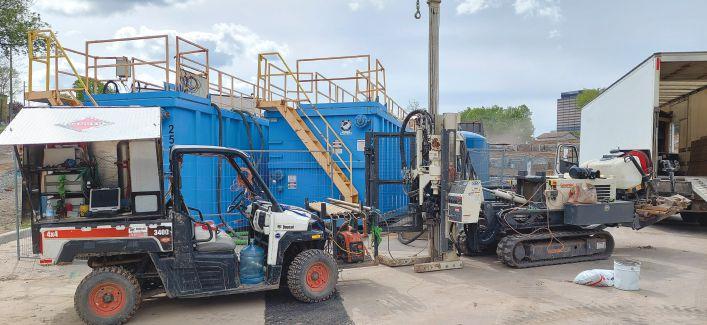
The membrane interface probe (MIP), which is part of VEI’s high-resolution site characterization (HRSC) tooling, detects groundwater contaminants in real-time and is used to map out groundwater contaminant plumes in assisting with in-situ remediation.
“And then there’s the more permanent type of injection mechanism, which is not unlike a water well. You have a slotted two-inch PVC pipe that you install at a predetermined depth, attach the port, and make the injection; the only difference is that you repeat this over time. Again, a more permanent set-up.”
To add to the complexity, Cowan says that on some sites, multiple injection locations are made almost beside one another. He says, “You can have about a metre and a half spacing between each injection point, often overlapping each other, but that would be the best way to deal with the contaminants on that particular site.”
However, Cowan quickly points out that the process is much more complex than simply injecting a site, waiting a bit, and then getting approval. He says, “There is so much that goes into the injection design. There is a wide variety of potential contaminants, and the geology, geochemistry, and hydrogeology all impact the extent of the environmental engineering involved.”
In fact, design is one part of Cowan’s job as a project manager, the other
part is the hands-on management of the project on-site. Asked what he loves about the job, he says, “It’s always changing. You never know how the field will evolve and the work with it.”
For example, Cowan says that much of VEI’s current work involves gas stations, with the obvious potential for petroleum contamination, and drycleaning sites, which can leave behind significant amounts of chlorinated solvents. But the future might be an altogether different challenge.
Cowan points to what are referred to as forever chemicals, or PFAS (per- and polyfluoroalkyl substances), which are substances that don’t break down any time soon. He says, “This is probably a new frontier in environmental contamination. If we can find a way to address these chemicals, I think we’d all be much better off.”
We’ve come a long way from digging and dumping our problems elsewhere. However, the challenges of environmental contamination constantly evolve, and so will the people tasked with handling it.
Dennis Furlan is a contributor with The Ontario Technologist.
OACETT Conference and President’s Awards Dinner 2024 highlights
BY MICHELLE MALCOLM-FRANCIS

OACETT has a long history of holding lively, informative annual conferences, and this year’s event proved no different. In fact, the Annual Conference and President’s Awards Dinner, held from June 7 – 9 at the Sheraton Toronto Airport, was one of their best, with close to 300 delegates engaged in well-rounded professional development experiences, schmoozing opportunities, and unforgettable celebratory moments.
The conference theme, “Innovating for a greener future,” underscored the critical importance of implementing sustainable solutions to reduce our carbon footprints, why pressing forward with alternative energy technologies is necessary for addressing our global environmental challenges, and the role of innovation in achieving ecological sustainability. The diverse group of dynamic speakers, industry experts, and college partners made sharing this crucial information possible and effectively communicated plausible ways industries in the engineering and applied science field could generate cleaner energy for future generations.
Several of the conference sessions and events tied in the environmental theme, including keynote speaker Bob McDonald’s presentation “Energy, who cares?”, the eco-solutions panel discussion, speaker Dr. Shahram Karimi’s talk on “The Future of Energy Storage: The role of Nanotechnology and Emerging Technologies,” and the Technology Partnerships Showcase. Also Sunday’s speakers from Azura Associates introduced delegates to anaerobic digestion fundamentals.
The President’s Awards Dinner, in its second year of a new format, didn’t disappoint. June 8 was indeed a night to inspire, with twelve exceptional Provincial Honours and Awards recipients and three new distinguished Fellow designation honourees celebrated for their outstanding volunteer and career achievements – all of whom have contributed to advancing the profile of the profession of engineering technology and applied science.
By the end of the fully packed three-day conference, technicians and technologists were left with lots of information to digest, plenty of sparked conversations, and so much to remember.
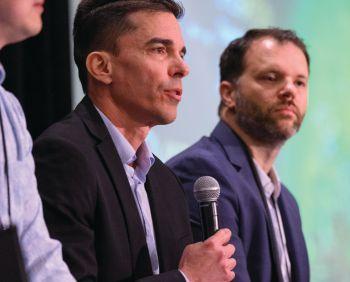



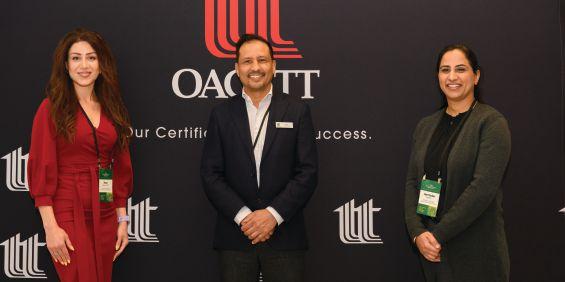
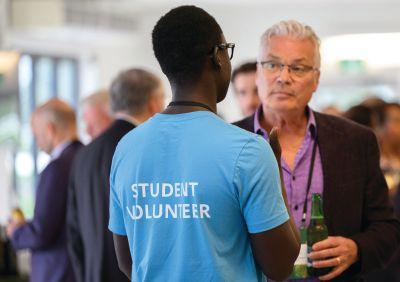



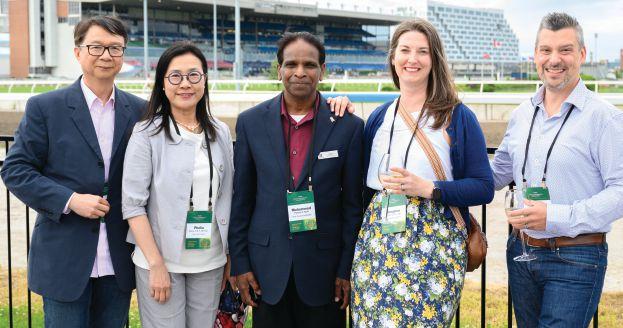
The conference’s enthusiastic momentum began on its Welcome Night on June 7 at the iconic Woodbine Track Clubhouse.
OACETT’s president Micheal Mooney, C.E.T., opened the event by welcoming everyone and saying a few words about how the Association strives to provide experiences that entertain and foster meaningful connections and opportunities for networking.
“It’s important that the OACETT community is built on a foundation of collaboration, innovation, and mutual support. Events like the conference and gala reinforce these values and strengthen our bonds,” he remarked.
Before the fun-infused night began, during Mooney’s remarks he highlighted the many things attendees could expect throughout the weekend that would expand their knowledge on clean energy and emerging technologies and give them opportunities to network with like-minded professionals.
Roy Sue-Wah-Sing, C.E.T., chair of the Member Engagement and Services Committee, presented a big cheque for $1,000 to the London Chapter, Grand Valley Chapter and Renfrew Chapter. These chapters are the recipients of this year’s 3Cs Chapter Engagement Award which acknowledges the extraordinary work of chapters that go above and beyond to further the Association’s goals in conjunction with their community, local colleges or corporations while promoting awareness of OACETT. Congratulations!
Sue-Wah-Sing also congratulated the Women in Technology (WIT) conference bursary recipients Noor Sahyon, C.E.T., Niagara Chapter WIT chapter representative and Amrinder Sandhu, Peel Chapter secretary and WIT representative. By receiving the bursary, Sahyon and Sandhu were able to experience the conference, from begin to end.

On June 8, the conference’s professional development sessions explored the transformative measures organizations and individuals have taken or can take to create a greener future, recognizing the critical role alternative energy sources and innovative technologies are playing in achieving this goal. President Mooney’s opening remarks stressed the importance of stewardship, which echoed in the conference’s theme – and encouraged technicians and technologists to make an impact in the fight against climate change.
“We need to solve many pressing environmental and climate challenges, and people like you, talented technicians and technologists, are a key part of that formula. Whether it is the wildfires ravaging many provinces, diminishing sea ice, 100-year storms suddenly happening more frequently, or the many environmental challenges faced by northern communities, your expertise and guidance are required to help our province and country overcome these challenges.” – OACETT president Micheal Mooney.
Each session explored various facets of green technology, and with the help of Ontario’s top colleges, companies, and professional organizations, relevant issues were discussed, and conversations were had about how technicians and technologists can contribute to the solution. Here is what the delegates learned at a glance.
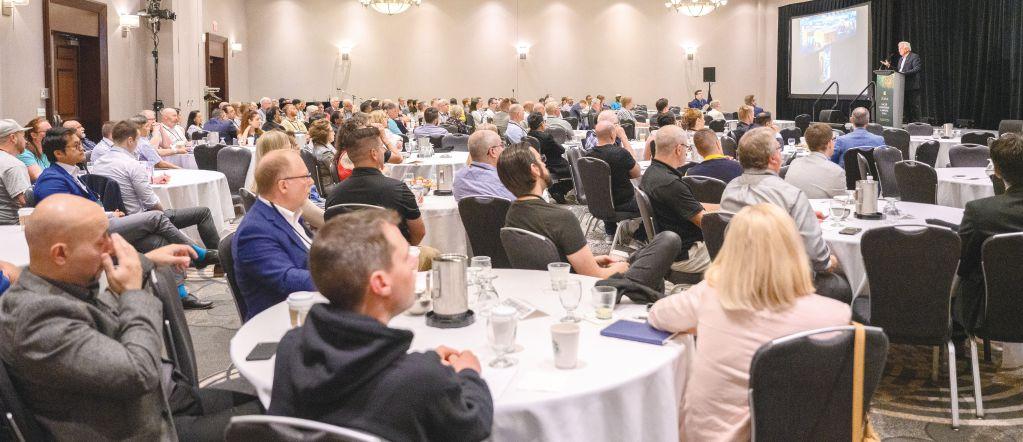
Keynote speaker: Bob McDonald, one of Canada’s bestknown science journalists and host of CBC Radio’s awardwinning science program, Quirks & Quarks.
Bob McDonald’s keynote address focused on his book The Future is Now, which looks at solving the climate crisis with today’s technologies. McDonald says climate change forces us to rethink our energy use and the realistic alternatives to a clean energy future. According to McDonald, the carbon crisis is not all doom and gloom, as many technological solutions are ready to reinvent how we use and source energy. These include making key improvements to existing technologies, implementing newer innovations, and finding new applications for existing technologies. He is optimistic that Canada and the world can find solutions to help curb climate challenges, and he believes technicians and technologists will be involved in producing new energies in a big way.
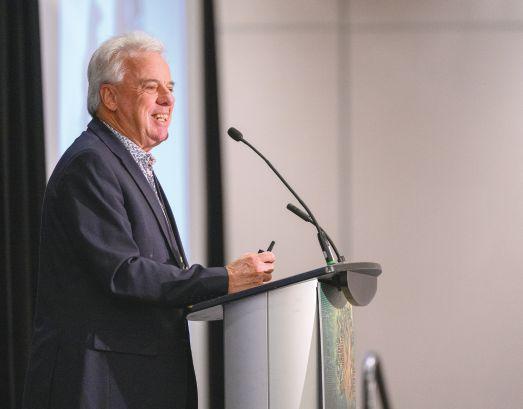
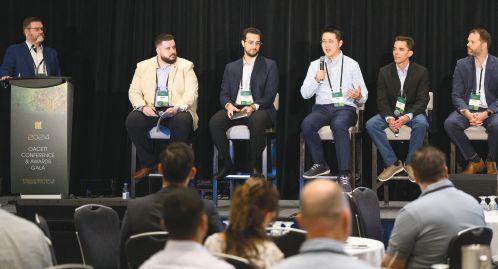
Innovative strategies for a greener Ontario: Insights from the 2024 OACETT eco-solutions panel
Speakers: Pablo Fernandez, manager, rail safety & technical training, Operations Training Centre (OTC) People Group, Toronto Transit Commission (TTC); OACETT board member and Young Professionals Committee chair Mladen Ivankovic, C.E.T., engineering services technician, Burlington Hydro; Andrew McGillis, senior vice president, engineering, Hydrostor; Kareem Nakhla, business development director, GridBeyond; and Jason Niu, manager, marketing & communications, PowerON Energy Solutions.
Moderator: Micheal Mooney, C.E.T., OACETT president. The conference featured an informative eco-solutions panel session, which brought together industry leaders to discuss tangible strategies and technologies to decarbonize Ontario’s economy.
Panellist Mladen Ivankovic, C.E.T., kicked off the session by describing Burlington Hydro’s initiatives to support sustainability, including incentive programs and grid modernization efforts. He highlighted the utility’s role in integrating renewable energy sources into the existing infrastructure to reduce the carbon footprint. Panellist Kareem Nakhla provided a consultant’s perspective on meeting federal and provincial decarbonization goals. He identified vital trends influencing progress and outlined the significant hurdles industries and municipalities face in transitioning to sustainable energy solutions.
Panellist Jason Niu shared insights into PowerON Energy Solutions’ work in fleet electrification. He explained how the company’s technology services promote sustainability and reduce emissions through innovative projects, including infrastructure for electric commercial fleets.
Panellist Pablo Fernandez updated conference attendees on the TTC’s ambitious bus electrification initiative. He discussed the progress, environmental impact, and challenges related to maintenance training and technical knowledge required to transition to electric buses. Finally, Andrew McGillis touched on Hydrostor’s Advanced Compressed Air Energy Storage (ACAES) system, emphasizing its potential to enhance energy storage options.
The panel addressed several key questions, including policy changes necessary to accelerate the adoption of sustainable energy practices and the importance of government support in incentivizing investments in ecosolutions. They also discussed strategies to gain public support for eco-friendly initiatives and the critical skill sets needed for young professionals in the sustainability sector, including how OACETT’s highly skilled members play a significant role in this new push to decarbonize the economy.
future of energy storage: The role of nanotechnology and emerging technologies
Speaker: Shahram Karimi, PhD, MBA, P.Eng.
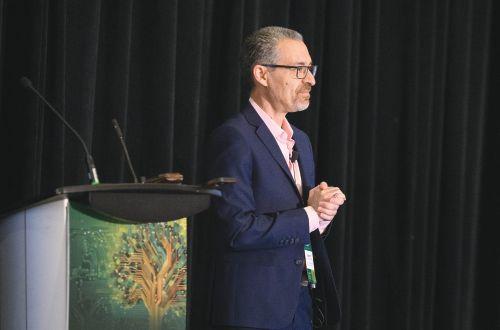
Dr. Karimi spoke on energy storage strategies to transition toward sustainable energy systems. He said the state of energy storage reflects a dynamic landscape shaped by technological advancements, policy initiatives, market dynamics, and environmental imperatives. His discussion touched on battery technologies, a prominent trend rapidly evolving in sustainable energy systems. He told delegates battery technologies have spurred the widespread adoption of battery energy storage systems (BESS) across various sectors, including transportation, residential, commercial, and grid-scale applications. Dr. Karimi also mentioned how integrating energy storage with renewable energy sources like solar and wind has emerged as a critical strategy to address the intermittency and variability of these sources. Energy storage systems facilitate grid stability, improve reliability, and enable the efficient utilization of renewable energy, contributing to decarbonization efforts and climate change mitigation. In addition to battery technologies, he discussed other energy storage technologies, including pumped hydro, compressed air, and thermal energy storage. He indicated that each technology has its strengths and limitations, making a diversified approach to energy storage essential for optimizing performance and resilience.
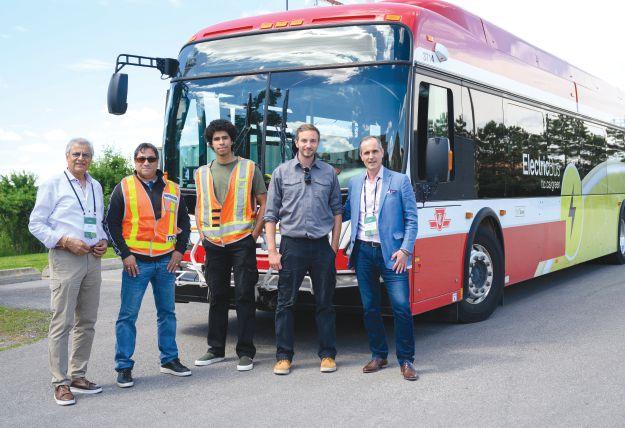
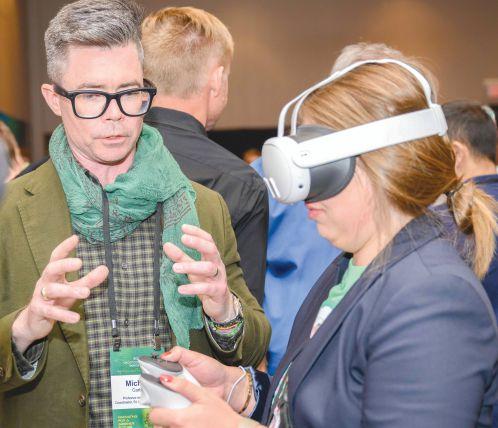
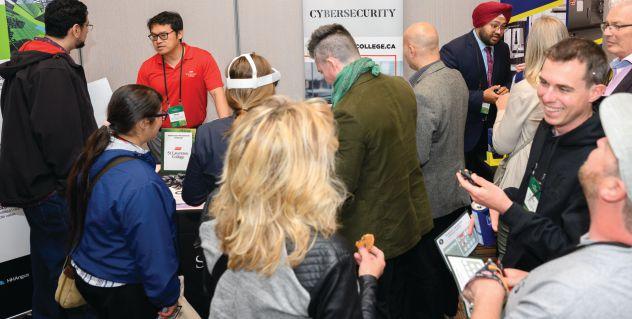
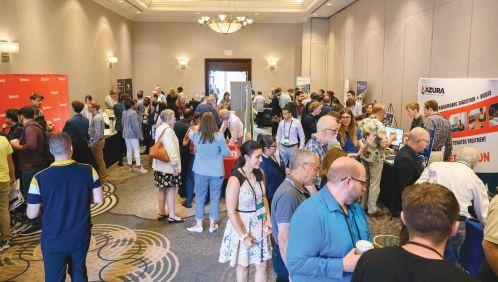
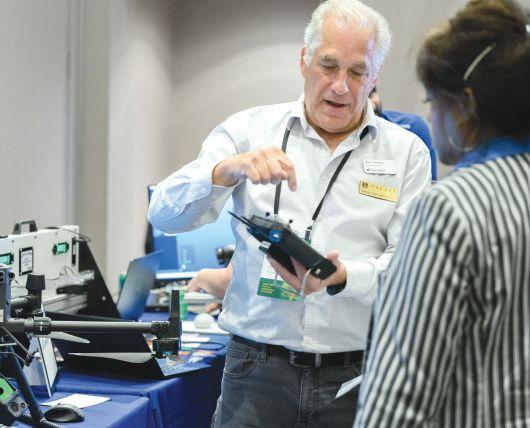
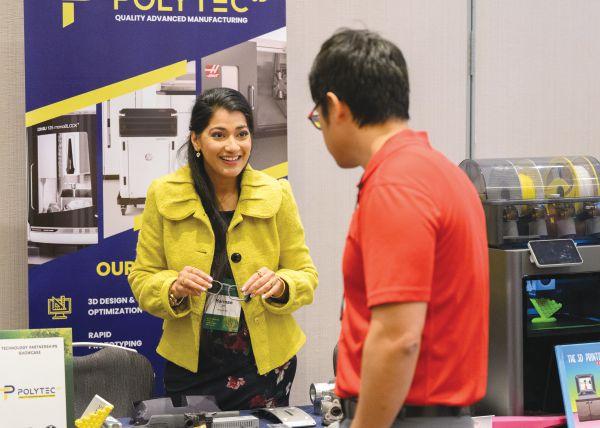
On June 8, the Technology Partnerships Showcase, in its second debut, served as another excellent platform for highlighting the unique technologies, projects and products moving us toward a greener future. Close to 300 delegates checked out ‘cool’ innovative technologies from 13 Ontario colleges, companies and municipalities that are making or could make a positive impact in communities and industries far and wide, especially relating to sustainability, green infrastructure, clean energy, smart manufacturing and cutting-edge drone, 3D printing and virtual reality technologies.
OACETT CEO Cheryl Farrow opened the muchanticipated showcase, making OACETT members and other attendees aware of the excellent opportunity the showcase provides for them to expand their knowledge on environmental practices and other innovations shaping our world.
Expanding on her message, Farrow said, “This is more than a purposeful opportunity to network and learn about the innovative projects, products and technologies various colleges, companies, and municipalities have been involved in to stay up-to-date or ahead of ever-changing technological advancements. It is also an opportunity to see how technicians and technologists are advancing our profession, how colleges are highly engaged in innovation to ensure their students are workforce-ready and how we are all navigating new frontiers as we explore many technological nuances at such a rapid pace.”
Farrow then mentioned the partners participating as exhibitors in the Technology Partnerships Showcase. “Today, we have representatives from Georgian College, Humber College, Seneca Polytechnic, St. Lawrence College, Azura Associates, the City of St. Catherines, Clearesult, Digital
Water Solutions, HH Angus, Polytec3D, PowerOn, the TTC and Virtualware Canada, all partners and allies of OACETT, who are sharing their exciting innovations and technologies to help you increase your awareness of technological advancements happening in our industries, municipalities and Ontario colleges.”
The Technology Partnerships Showcase demonstrates the importance of partnerships and the power of sharing knowledge and creating informative engagement.
OACETT has a successful track record of working with the industry, colleges and government and supports their strategic efforts in finding innovative ways to grow the profession and our Association. In her final comments, Farrow said, “Having all these partners and allies here today shows how much our business relationships are thriving and moving forward positively.”
Delegates who participated in the showcase completed passports and were entered into a draw to win exciting prizes. They also earned OACETT required CPD.
Thank you to all the participants and the OACETT partners who participated in this action-packed, interactive event.
PROFESSIONAL DEVELOPMENT SESSION - JUNE 9
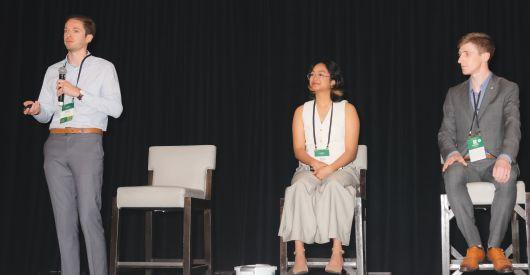
From left to right: James Arambarri, MASc, Trisha Aldovino, Peter Quosai – all from Azura Associates.
Speakers: Trisha Aldovino, James Arambarri, MASc, Peter Quosai, MASc – all from Azura Associates.
Topic: Azura Associates trio James Arambarri, Peter Quosai and Trisha Aldovino delivered a presentation that focused on the fundamentals of anaerobic digestion, including the following:
• How anaerobic digestion is used as a technology for waste management and energy production.
• The mechanical and biochemical steps that waste goes through to produce biogas.
• Methods for analyzing digester performance and optimization.
Azura Associates’ anaerobic digestion practice focuses on food industry wastewater and waste-to-energy applications. They have served municipal source separated organics (SSO), agri-food, on-farm, and market digesters processing food and other organic waste. Also, they have extensive background in the treatment of complex and recalcitrant organic and inorganic waste.
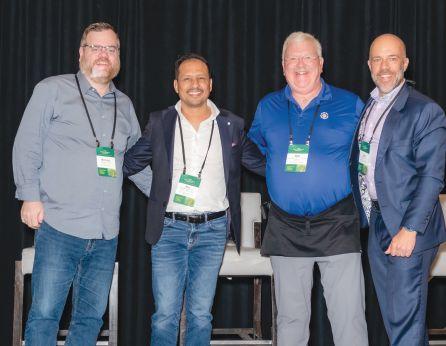
Sue-Wah-Sing, C.E.T. (second from the left) wins the Fletcher Foundation’s 50/50 Draw. He is pictured with president Mooney, C.E.T. (far left), Fletcher Foundation chair Bob Jameson, C.E.T., Fellow OACETT, (second from right), and Fletcher Foundation trustee Nate Simpson, C.E.T. (right).
During the conference, the Fletcher Foundation held a 50/50 draw to help increase funds for their grant and bursary programs that boost learning outcomes for engineering technology and applied science students at Ontario colleges. With the kind support of the conference attendees, the Foundation raised over $3,000. The lucky winner of the draw was MESC chair Roy Sue-Wah-Sing, C.E.T., who, in turn, donated most of his winnings back to the Fletcher Foundation. Congratulations, Roy and thank you for your generosity!
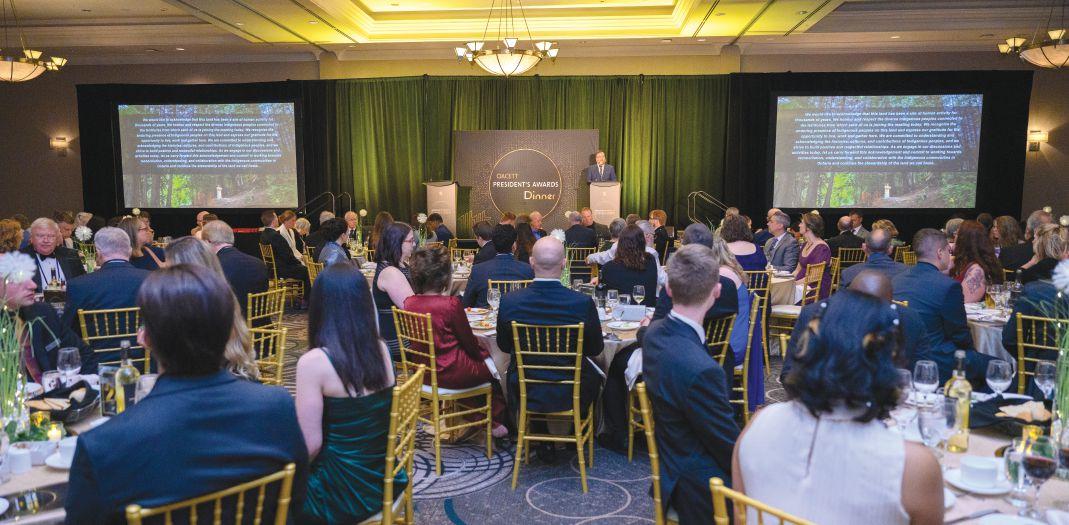
Sandy Jobin-Bevans graced the President’s Awards Dinner stage for the second year in a row on June 8 as the evening’s emcee. Jobin-Bevans, an alumnus of Second City who oozes humour, wit and charisma, entertained OACETT members and special guests, hosting the profession’s most illustrious evening of the year – a celebration of excellence in engineering technology and community service.
The evening was inspiring, with three distinguished Fellow OACETT designation recipients and 12 awardees honoured for impactfully shaping the profession and given welldeserved accolades for their outstanding volunteer service and career achievements. Throughout the night, the 300-plus guests listened to a myriad of success stories that aroused feelings of pride, encouragement and determination.
In celebrating the honourees, President Mooney acknowledged the significance of the awards dinner.
He said, “What better way to build awareness and celebrate outstanding career achievements and volunteerism than at this evening’s awards dinner?” Nights like this enhance awareness and understanding of the profession and help to ensure OACETT certifications and designations remain front and center with all key stakeholders, he added.
He then mentioned how technicians and technologists do their part, and how the 12 award and Fellow OACETT recipients have each contributed, in their own way, to advancing the engineering and applied science technology profession, industry, and society.
In the spirit of recognizing the profession’s accomplishments, Mooney also praised OACETT for its incredible year of innovation and change, which included the first year of OACETT’s new governance structure and getting volunteer members up to speed with the new set-up and processes and ramping up our government relations activities with Counsel PA, which included becoming acquainted with key
ministries. He also mentioned that OACETT has had several successful meetings with the Ministry of Municipal Affairs and Housing regarding the exemption of BCIN exams for appropriately qualified OACETT-certified members, held a well-attended summit on the impact of artificial intelligence on the engineering technology profession – and will be releasing a best practices document for industry and government based on strategic discussions from that event and the Association’s post-event survey.
The partnership with Counsel PA is paying off, and having the Honourable Nina Tangri, Associate Minister of Small Business, attend the awards dinner and bring greetings is proof of OACETT’s efforts to build relationships with the Ontario government.
“Many of these achievements would not have been possible without our partnerships and connections, which are vital to OACETT’s professional growth. This includes the companies and college partners who displayed at our Technology Partnerships Showcase, those who have sponsored our Conference and Awards, and those who are joining us tonight at this dinner,” he commented. “We understand how important it is to remember that partnerships are essential for continued growth and ensuring associations like OACETT continue to provide cutting-edge services to their members.”
CEO Farrow applauded the remarkable journeys of the honourees and the meaningful difference they have made in the lives of so many people.
“Your unwavering commitment to excellence, compassion, and leadership sets you apart, and I am confident that you will continue to be significant contributors to the greater good of Ontario and, of course, to OACETT!”
She closed her remarks by thanking the conference sponsors and The Personal, the sponsor of the President’s Awards Dinner.

Derek Gruchy
C.E.T., Fellow OACETT Program coordinator, School of Fire Protection, Seneca Polytechnic Member since 2011
Derek Gruchy has significantly contributed to championing the student experience in the Seneca Polytechnic fire protection engineering technology program.
Since 2006, Gruchy has taught courses such as fire dynamics, fire protection fundamentals, human behaviour during fire emergencies and combustion chemistry, preparing students for a career in fire protection.
In 2009, he became the program coordinator for the fire protection engineering technology program, responsible for course curriculum, program reviews and maintaining program standards to meet industry expectations. As a program coordinator, Gruchy provides his students with the knowledge and skills the fire protection industry considers essential. He is credited for establishing the Fire Protection Student Association and the program’s career fair, boosting student opportunities when they graduate.
Gruchy authored the Fire at the Muskoka Heights Retirement Home case study for Seneca Polytechnic. He has experience in life safety analysis, exposure risk determination, building and fire code interpretation, and suppression system design.

Andrew Monkman
C.E.T., Fellow OACETT Health & safety manager, Give and Go Foods Member since 2007
Andrew Monkman has dedicated his career to environmental stewardship. His advanced skills, knowledge, and experience in health, safety, and the environment have made him a respected expert in mitigating risks to people, property, and the environment.
Monkman has worked for several different local municipalities. In the manufacturing industry, he currently holds the role of health & safety manager at Give and Go Foods, where he ensures compliance with local laws and regulations, reduces the company’s carbon footprint, develops
safety procedures and training, conducts engineering safety reviews on equipment, designs and sources sustainable products, and continues to be an environmental health and safety steward in the community and industry.
Monkman strongly believes that as leaders, we have a responsibility to give back to the profession and community, including volunteering with local charities and mentoring new professionals. He volunteers as an auditor with Technology Accreditation of Canada and is currently the chair of OACETT’s Georgian Bay Chapter.
C.E.T., Fellow OACETT National sales manager, Panamax Canada Member since 1986
Bruce Fudger is a resolute OACETT volunteer with 13 years of service. His volunteer career has involved two-plus consecutive terms as Kingston Chapter chair, and six concurrent years as chapter treasurer. During his leadership terms, Fudger was committed to bringing OACETT members together and providing them with educational opportunities through meaningful events, including a tour of Panamax Canada (his employer).
Fudger has been supportive of Kingston-area student robotics groups and has driven the integration of St. Lawrence College students and graduates into his chapter executive. He also arranged many speaking engagements, pool tournaments, exclusive institutional tours, and represented the chapter at regional meetings and OACETT’s Annual General Meetings. He also collaborated with Professional Engineers Ontario members on model bridge-building projects in eastern Ontario.
In 1991, Fudger launched and continues to manage the Canadian branch of Panamax US (Power Protection Industry). Fudger was concurrently employed (2016-2019) at Hydroclave Systems Corp. while managing Panamax Canada. He is also a former member of the Recruiters Guild of Canada.
For more information, scan QR code.

Sreerekha Bakaraju, C.Tech.
Software engineer • Member since 2004
In recognition of outstanding authorship of three feature articles: Introduction to Requirement Analysis, Importance of Writing Test Matrices in the Testing Phase and Big Data Analytics.
Sreerekha Bakaraju wrote three articles on software development requirements, test matrices and big data in 2023. In her article “Introduction to requirement analysis,” published by projectmanagementplanet.com, Bakaraju introduced requirement analysis, one of the phases of the software development life cycle and provided details about its value and importance.
In the article “Importance of writing test matrices in the testing phase” published in Software Testing Magazine, she gave an overview of writing test matrices in the testing phase. The article provided an overview and summary of test cases and explained how software testers can use a test matrix approach to ensure the traceability from requirements to testing.
In Medium, Bakaraju’s piece on “Big data analytics” summarized the analysis process of big data and its usage. She discussed how big data is different from conventional data and how it consists of different types (structured, unstructured, and semi-structured). She also revealed a variety of tools used for big data and discussed the various uses of big data.


Savanaugh Fraser, C.E.T., rcji Technical coordinator, projects and maintenance, Niagara Parks Commission • Member since 2016 In recognition of her exceptional commitment to community service and volunteerism.
Savanaugh Fraser is a long-standing volunteer committed to making our world a better place. She has provided unwavering support to soup kitchen programs and food banks, canvassed for the March of Dimes,
and collected for hat and mitten programs. In recognition of her extraordinary efforts, she received the Lieutenant Governor General Community Service Award for her selfless commitment to volunteer activities.
Her involvement in fundraisers for organizations like Children’s Miracle Network, the Humane Society, and Cocomutt Shak Dog Rescue increased her awareness of community needs, which encouraged her to donate food and supplies to her local animal shelter and camp out in a bus in Seaway Mall to raise funds for children. Fraser has also brought rescue dogs from the Dominican Republic to Canada and united them with new Canadian families. She is also involved in Lions Club International, where she helps build emergency preparedness plans for the community.


Christopher Moran, C.E.T.
Engineering design group, Hydro Ottawa (retired)
Member since 1988
In recognition of his dedication to the community and health of the St. Lawrence River.
Christopher Moran’s environmental stewardship with the Great River Network (GRN) has supported remediation and restoration actions of the St. Lawrence River’s shoreline and aquatic life.
In 2021, Moran became GRN’s co-lead on an ambitious study to improve the St. Lawrence Seaway ship traffic and water level fluctuation in Lake St. Lawrence, approved and partially funded by Fisheries and Ocean Canada.
The two-year project provided new information about the relationship between wave cycle science, shoreline erosion, and aquatic habitat quality.
Moran and his team collected baseline data to characterize nearshore fish communities and aquatic habitat quality. In addition, wave forces, water turbidity and their connection to shoreline erosion and ship traffic were studied using in-water instrumentation, video capture of ships transiting the Seaway, and drone flights. The study results offered a unique opportunity to assess the impact of ship-induced riverbank erosion on fish habitat and the resident fish community and have established the need and plan to stabilize vulnerable shorelines, minimize soil erosion and nutrient flow into the river, and improve the aquatic habitat along the shores of the upper St. Lawrence River.


Diana Olivar, student member St. Lawrence College, Environmental Technician Program Member since 2022
In recognition of her outstanding volunteerism in the engineering technology and applied science fields.
Diana Olivar is at the forefront of environmental research and an emerging leader in water systems and environmental sustainability stewardship.
In 2022, she was accepted into the Water Innovation Lab Great Lakes 2022 volunteer program in Sault Ste. Marie, where she explored water systems monitoring technologies, fisheries and habitat monitoring strategies, high-resolution mapping, data management, sustainable development goals and network development.
Currently, she dedicates her expertise to the St. Lawrence River Institute of Environmental Sciences in Cornwall where she volunteers with an organization to support the Institute’s efforts in enhancing the health of the St. Lawrence River and other freshwater ecosystems. Specifically, her volunteer work on the Institute’s Eel Recovery Research Project has been instrumental in the assessment and determination of American eel habitat characterization in the upper St. Lawrence River, particularly in relation to the challenging migration pattern of eels through hydro dams in the region.
Olivar is also an active volunteer with the City of Cornwall’s Adopt-A-Street program, Salvation Army’s Christmas Kettle Campaign, and is an environmental technician student representative on the St. Lawrence College Program Advisory Committee.


Zachary Cutt, C.E.T. Research and development group leader, Innovation Automation Inc. Member since 2013
In recognition of exceptional contributions as a young professional to the science and technology profession.
Zachary Cutt, a research and development group leader at Innovative Automation Inc., led a team to develop the RoboTape™ system, a patented robotic head and payout system for applying foam, attachment and felt tapes—a game changer in the tape industry.
Like many transformative technologies, this unique product development started as an idea and a challenge for Cutt. He was tasked with automating a predominantly manual tape application process that was strenuous, inconsistent, and repetitive. Taking on the challenge, he and his team worked to design, prototype, evaluate, improve, and finally patent a slim and versatile tape application head that can tackle tape applications with complex geometry and contours on various parts.
The success of RoboTape™ generated great interest in the taping industry, which resulted in a new RoboTape™ system for 3M™. Cutt continues to work with Innovative Automation Inc. to develop new products that will allow the company to compete further in the international marketplace.


Kyla Farmer, C.E.T., mii
Infrastructure engineering technologist, Town of Halton Hills Member since 2019
In recognition of exceptional contributions as a young professional to the science and technology profession.
Kyla Farmer has demonstrated continued professional excellence throughout her career, exemplified by her steadfastness and dedication at work, educational pursuits, and peer recognition.
Farmer works for the Town of Halton Hills as an infrastructure engineering technologist, where she is responsible for various projects, including bridge and culvert rehabilitation and replacements, asset management initiatives, pre-engineering contracts and large-scale data projects. She is heavily involved in implementing regulatory compliance projects such as the new Consolidated Linear Infrastructure Environmental Compliance Approval requirements and excess soils regulations. She is also an active participant in stormwater management and stormwater management quality projects, including the joint Region of Halton and Town of Halton Hills Total Phosphorous Offset Program.
Farmer is an active member of the corporate data strategy working group committee, and a member of the Town’s joint health and safety committee.
Since joining the Town of Halton Hills in 2016, Farmer has received two promotions and, in 2023, Farmer became a part-time professor at Conestoga College in the Project Management Graduate Program, utilizing the experience she has gained through her employment and career as a C.E.T.


Stuart Evans Professor, School of Fire Protection, Seneca Polytechnic
In recognition of exceptional contribution to the training and education of engineering technicians and technologists.
Stuart Evans has been a devoted, committed educator for over 50 years with Seneca Polytechnic’s Fire Protection Engineering Technology program. Over the years, he has held various academic roles, including program coordinator and professor, all the while remaining constant in his love and passion for Seneca students.
Currently, Evans is a mathematics professor at Seneca. Math is a subject that students are eager to take once they meet Evans. This is because he has a way of making them want to do well and not disappoint him. He is also known to go above and beyond what is required and dedicates extra time outside standard classroom hours to help students, discuss career options and ensure students stay focused on their goals.
Over the years, he has grown the Fire Protection Engineering Technology program by connecting with students on a personal level. From fire chiefs to business owners, he has also built long-standing relationships with industry, impacting and leading to the success of Seneca graduates.

Professor, School of Electronics and Mechanical Engineering Technology, Seneca Polytechnic Member since 2022
In recognition of exceptional contributions to the training and education of engineering technicians and technologists.
For over twenty years, Dr. Rakesh Kantaria has dedicated his teaching career to the advancement of engineering technology education in countries worldwide and has contributed to shaping the future of more than 5,000 students.
Kantaria has an outstanding teaching record as a professor with the Faculty of Applied Sciences & Technology at Humber College and Centennial College’s School
of Continuous Education. He has also served as a sectorspecified instructor and an instructor and chair with the Toronto District School Board (TDSB).
Kantaria has taught and developed various curricula in engineering technology, including electrical, computer, and electromechanical courses, and created multiple resources to make online teaching practical and interactive using the latest teaching software.
With support from professional associations like OACETT and the Institute of Electrical and Electronics Engineers, Kantaria has organized workshops, seminars, and conferences to boost student development.
As part of the TDSB newcomer support program, Kantaria has also helped more than 300 new immigrants from various communities and nationalities understand the process of obtaining higher education, certification, and other skills that will assist them with starting their lives in Canada.


Aneetha Vairavanathan, P.Eng. Professor, School of Fire Protection, Seneca Polytechnic
In recognition of exceptional contribution to the training and education of engineering technicians and technologists.
Aneetha Vairavanathan, a committed, enthusiastic, and proactive educator since 2015, is a professor at Seneca Polytechnic’s School of Fire Protection. From day one, she has significantly advanced learning materials to maximize student learning and engagement.
Vairavanathan has revised many fire protection engineering technology courses and transitioned some of the most fearsome courses into some of the most loved by students by adding more hands-on learning experiences and interactivity into the courses. For instance, Vairavanathan included live fire demonstrations to show the impact of various building construction techniques and the importance of the Code in the learning building code course.
She conducted an extensive program review to improve the overall experience of students in Seneca’s Fire Protection Engineering Technology program, and since the review’s completion, student satisfaction has dramatically increased in every course she teaches.
Vairavanathan also performs many outreach activities, including bringing a building with a working fire alarm panel and devices she designed with her to events like Skills Ontario, Ontario College Fair and community events.

In recognition of the Advance Compressed Air Energy Storage product to ensure renewable and cost-effective energy alternative to support a net-zero future.
Hydrostor, a leading developer of utility-scale energy storage facilities, successfully commercialized the world’s first fuel-free (adiabatic) Compressed Air Energy Storage (CAES) technology that eliminates emissions, increases efficiency, and provides location flexibility.
With the completion of the Toronto Island Demonstration Facility in 2015, Hydrostor developed the world’s first gridconnected adiabatic-CAES facility with Toronto Hydro. The facility demonstrated the technology and provided an ongoing testbed with a potential long-term role as reserve power for Toronto Island. The facility also demonstrated ACAES’ ability to play a significant role in the long-duration energy storage market globally.
Since the successful demonstration of the Toronto Island facility, Hydrostor, in partnership with NRStor Inc., completed the Goderich A-CAES facility in Goderich, Ontario, in 2019. Entirely fuel-free, the plant produces zero greenhouse gas emissions and helps enable a cleaner, more affordable, and more flexible electricity grid.
Also, Hydrostor has built their own hard-rock cavern. This technology stores heat generated during battery charge (compression) and uses it during battery discharge (expansion), eliminating the need to burn natural gas. The result is a flexibly sited and low-impact battery that ensures 100 per cent emission-free renewable energy can be delivered any time or during periods of low wind, without sacrificing reliability and security.
In recognition of its commitment to investing in technology innovation and digital transformation to advance power system resilience and reliability.
London Hydro is committed to digitally transforming its power system for normal and emergency operations. They have developed a multi-year plan to implement the upgraded distribution system with customer satisfaction and power system resiliency and reliability considered the top priorities.
With extreme weather events occurring more frequently, London Hydro focused its investments on distribution automation and grid monitoring technologies and systems—especially since recovering and restoring the grid expeditiously to normal operation following extreme weather events increases the likelihood of meaningful impacts on customers and improves system reliability trends.

Areas of investment included distribution automation, digital tools, operational technology resiliency and redundancy, expansion of automated H.V. switches and reclosers, monitoring of downtown underground spot network using EATON solution leveraging fibre optic backhaul networks, and improvements to high-voltage equipment protection coordination using wireless technology.
London Hydro’s goals for customers included improved overall system reliability and customer satisfaction, access to real-time information and objective investigation to resolve customer complaints using power quality records and data captured using existing power quality capable metering points. The investments across London Hydro’s distribution system have been positive for customers and helped to position them as a leader in grid visibility and control.
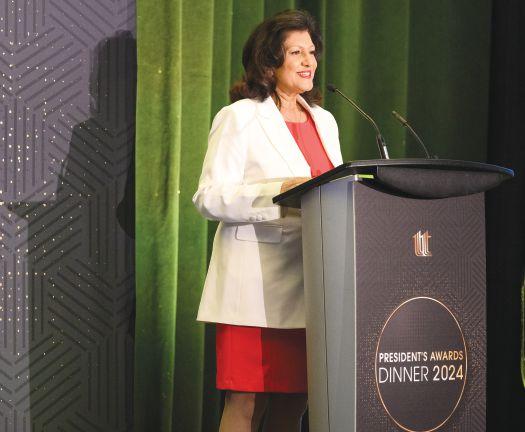
Honourable Nina Tangri, Associate Minister of Small Business, brings greetings to attendees and congratulates awardees, proof of OACETT’s growing relationship with the Ontario government.


Stephen Morley, C.E.T., Fellow OACETT Operations project manager, CSA Group Member since 1990
In recognition of his long-standing contributions and leadership in the advancement of OACETT and the profession.
Stephen Morley has exceptionally served OACETT since 1999. He started his involvement with OACETT through the Georgian Bay Chapter, serving as chair and gradually progressing to president of OACETT in 2013.
Morley also significantly served OACETT as its nominating committee chair and bylaw review committee chair from 2015 to 2017. Between 2018 and 2024, he was the OACETT representative on the Technology Accreditation Canada (TAC) Board and actively participated in the Canadian Technology Accreditation Board (CTAB) and TAC amalgamation.
While Morley served on OACETT’s Council as presidentelect, president and past president, he worked for CSA Group, often bringing him to Europe to manage their operations. During this period, he had many cross-country meetings and persuasive conversations to engage the six remaining provinces in a new accreditation model. Ultimately, in 2014, Morley, as president of OACETT, joined presidents from ASTTBC, ASET, SASTT, TPS and the TAC chair as signatories of the Unanimous Members Agreement that officially made TAC an enterprise.
More recently, Morley conducted a detailed review of the International Engineering Alliance (IEA) Graduate Attributes and Professional Competencies, completing a thorough assessment and developing a gap analysis between IEA requirements and the Canadian Technology Standards for the Dublin and Sydney Accords. TAC required the review as a submission to the IEA.
Throughout Morley’s volunteer leadership roles, he has exemplified passion, accountability, integrity, respect and innovation, all of which OACETT and TAC deeply admire in their volunteers.










BY BOB MCDONALD
We all care about energy. It is involved in every aspect of our lives, from the alarm that wakes you in the morning, the hot water for your shower, heat to cook breakfast, fuel for transportation to work and school, power for machinery, communication technology, the drive home, dinner and entertainment before bed. It took energy to make the clothes we wear along with every artificial object we lay our hands on. It has driven the industrial revolution, turned humans into a super-species, enabled us to inhabit every environmental niche and even brought us to the moon so we could look back on our little blue planet from a distance.
Now, a new green industrial revolution is upon us, and the good news is that all the technology needed to produce energy without carbon emissions already exists. We know how to capture nature’s free energy, and there is no shortage of it. The sun shines as much energy onto the Earth in one hour as humanity uses a year. It blows on the wind, bubbles out of the ground, and literally grows on trees. All we have to do is gather it and put it to practical work.
We have the technology to do it. Wind turbines are now almost the height of the Eiffel Tower, while new solar materials can be incorporated into building architecture, so you won’t even know they are there.
In the same way that the stone age didn’t end because we ran out of stone and the steam age didn’t end because we ran out of steam, the fossil fuel age is morphing into clean energy production, not because we will run out of oil, but rather because cleaner technology has come along.
Each time a new, life-changing technology comes along, detractors resist change, claiming the old ways are better. There is a joke about how many baby boomers it takes to change a lightbulb. It takes three, one to change the bulb and two to reminisce about how good the old one was.
Arguments against green technology, such as the resources needed to make batteries, wind turbines that kill birds or solar panels covering land that should be used for food, are all valid. But when we compare those costs to what we have been doing for the past century and a half, they are minimal. Consider the total cost and emissions involved in manufacturing the
gasoline you pump into your vehicle in Canada. One route starts in the far north, drilling for natural gas with methane emissions. The gas is piped to northern Alberta, where it is burned to heat sand and extract oil. The oil, mixed with a chemical brew to make it flow more easily, is piped to refineries, some in Alberta and others more than 3,000 km away in Texas. Along the way, pumping stations powered by natural gas provide pressure to keep the oil moving over long distances.
At the refinery, more heat is added to distill the crude oil into different products such as diesel, gasoline and heating fuels. Those fuels are then shipped back to Canada through pipelines, rail or truck and distributed to filling stations. Carbon emissions are involved every step of the way.
When you come along for a fill-up, you run the gas or diesel through a combustion engine that only extracts about 20 per cent of the energy in the fuel to turn the wheels and throws 80 per cent away as waste heat along with an assortment of greenhouse gases and pollutants that are blown directly into the atmosphere for the life of the vehicle. On average, a combustiondriven vehicle produces its own car-

bon weight every year. Imagine all the cars and trucks you see jamming our roadways thrown up into the sky, and that is the amount of carbon we deposit into the atmosphere annually.
Manufacturing a battery does indeed have environmental impacts from mining, but once the battery is in the car, the vehicle does not emit pollution.
There is an argument that going green will weaken the economy. In fact, the green sector is a rapidly rising sector of the economy, providing new, high-tech jobs, and the cost is coming down. Solar power is now cheaper than coal, while fuel prices continue their upward spiral.
The changeover to clean energy is a technical evolution in action, where the technology slowly evolves into a better form. We have done it before with other systems. When I was a kid, the telephone was attached to the wall; all it did was talk. Now, it is in my pocket, and I can do more things besides talk than I am even aware of. I listened to music on a record player that used vinyl discs. Later, they were replaced by reelto-reel tape recorders that could store hours of music. Those bulky machines, the size of a small suitcase, eventually shrunk down to cassette players, and compact discs came along with clear digital sound. Finally, the mp3 player’s moving parts were removed and evolved into an iPod; now, I can listen to music on my phone through noisecancelling headsets.
The evolution in communication technology and how we listen to music didn’t come about because we needed better telephones and recorders. The technology improved, and we all bought into it. We have improved many aspects of our lives, but energy production and combustion technology have not changed much in over a century.
We have been extracting coal oil or natural gas from the ground and setting it on fire. Boom, instant heat. It is convenient, portable, versatile and incredibly energy-dense. No wonder we have become so dependent on it. But that combustion needs to be completed, and therein lies the problem. A hydrocarbon is a long chain of carbon atoms with hydrogen atoms attached like bulbs on a string of lights. When it is burned, the hydrogen comes off to provide the energy while the carbon remains behind. The leftover carbon forms soot or combines with oxygen in the air to make carbon dioxide, a greenhouse gas.
One solution, that doesn’t put the oil industry out of business, is to extract the hydrogen and leave the carbon in the ground. Hydrogen is a clean fuel that only produces water as a product. Or we can find other ways to get energy from fossil fuels without compromising the atmosphere. That’s a challenge for future chemists and engineers.
When it comes to engineering technology professionals, they will be involved in every stage of the energy transformation. But it will take more
than just technology. Four elements must come together: science, engineering, the government and the public. The first two are already in place. We know how to capture clean energy. Governments have contributed some, but more support is needed through tax breaks and infrastructure, such as charging stations for EVs. The public is slowly catching on, but misinformation is still circulating, causing confusion and the natural fear of change.
Real change will come from the ground up, where one person invests in solar panels, charges their electric car from their house, and drives for free. Then, the neighbours will want to get in on the game, and the idea will spread.
The urgency to transform how we produce and use energy is growing as wildfires, heat domes, droughts, and disappearing glaciers are in our faces. Climate change is no longer a thing of the future. We have spent decades pointing to the problem of a changing atmosphere; now is the time to point to solutions and get on with them.
My latest book, “The Future is Now,” available on Amazon, explores this topic in full detail. It focuses on solving the climate crisis with today’s technologies.
Bob McDonald is one of Canada‘s best-known science journalists, bringing science to the public for more than 40 years. In addition to hosting Quirks & Quarks, the awardwinning science program, McDonald is also a science correspondent for CBC Television’s The National and Gemini-winning host and writer of the children’s series Heads Up! He also hosted The Great Canadian Invention, Wonderstruck, and the seven-part series, Water Under Fire. McDonald is also an Officer of the Order of Canada.
RECOGNIZING NEW AND CERTIFIED TECHNICIANS AND TECHNOLOGISTS
April 2024
Certified Engineering Technologists
Mohammad Abdullah, P.Eng., C.E.T.
Belay Abegaz, C.E.T.
Mark Assal, C.E.T.
Melanie Belair, C.E.T.
Brandon Dickson, C.E.T.
Andrew Eves, C.E.T.
Spencer Gauthier, C.E.T.
Siva Priya Gita, C.E.T., rcji
Jonathan Hifawi, C.E.T.
Mitchell Jalak, C.E.T.
Josef Kloepper, C.E.T.
Kenneth Madduma, C.E.T.
Ravi Prakash Magisetty, C.E.T.
Sean McBride, C.E.T.
Angela McCauley, C.E.T.
Candice McPhail, C.E.T.
Pierre Ngombe, C.E.T.
Meghan OBrien, C.E.T.
Lateef Ojikutu, C.E.T.
Bahram Razmpoosh, C.E.T.
Darren Robertson, C.E.T.
Oluwatobi Sanusi, C.E.T.
Gagandeep Sharma, C.E.T.
Nimarta Singh, C.E.T.
Ben Syvret, C.E.T.
Ion Trifan, C.E.T.
Sumitra Yudha, C.E.T.
Brian Zingula, C.E.T.
Certified Technicians
Fláviò Alficò, C.Tech.
Kambiz Atabaki, C.Tech.
Didier Bampili, C.Tech.
Chintankumar Bhavsar, C.Tech.
Mathieu Brouillette, C.Tech.
Matthew Cavasin, C.Tech.
Precious Cerezo, C.Tech.
Knishk Chawla, C.Tech.
Kacey Cooper, C.Tech.
Valerie D’ambrosio, C.Tech.
Richard Daniel, C.Tech.
Kevin Dixon, C.Tech.
Michael Edwards, C.Tech.
Jonathan Elliott, C.Tech.
Zachary Ellis, C.Tech., rcji
Nolan Empringham, C.Tech., rcji
Alana Hawton, C.Tech.
Trevor Hood, C.Tech., rcji
Colin Hopper, C.Tech., rcji
Zachary Koomans, C.Tech.
Peter Koutroulis, C.Tech.
Mackenzie Kretz, C.Tech.
Julie Lalonde, C.Tech.
Eh Klay Law, C.Tech.
Robert Leighton, C.Tech.
James Luzuriaga, C.Tech.
Jaswinder Mahi, C.Tech.
Kristine Marsh, C.Tech.
Adam Matthews, C.Tech.
Andrea Mattice, C.Tech.
Ryan McCullough, C.Tech.
Mohammed Mohammed, C.Tech., rcji
Norina Paolucci, C.Tech.
Meet Patel, C.Tech.
Hasan Rana, C.Tech.
Brendan Robertson, C.Tech.
Reynald Santiago, C.Tech.
Carlo Scaramuzza, C.Tech.
Matthew Sharp, C.Tech.
Yun Song, C.Tech.
Daniel Stinson, C.Tech.
Duy Tran, C.Tech.
Anthony Vandenbroek, C.Tech.
Divyesh Vekariya, C.Tech., rcji
Christopher Viccica, C.Tech.
Jasson Villeneuve, C.Tech.
Yevhenii Voloshyn, C.Tech.
Jordan Waldt, C.Tech.
Jeremy Walton, C.Tech.
Tyson Weppler, C.Tech.
Robert White, C.Tech.
Associate Members
Peyman Aarafi
Adnan Abou Alway
Richard Addai
Hasin Ahnaf Kafi
Akshay Akshay
Ali Ali
Owen Allan
Moh’d Almasri
Benjamin Arbon
Htet Aung Myin
Joni Azar
Daniel Ball
Narayan Batliwala
Jagandeep Batra
Ryan Michael Baya
Temitope Bello
Ranvir Bhullar
Malcolm Borges
Cole Brazier
Andrew Bullock
Lincoll Casalla
Steven Chachel
Pik Shan Kathy Chan
Yu Chen Chang
Christopher Chiasson
Eunseon Cho
Jihye Choi
Charles Cohen
Michael Collins
Awil Dahir
Yousif Dhaif
Raj Dhanani
Paolo DiPietro
Spencer D’Souza
Mitchell Dysselhof
Ben Gammie
Robert Geniole
Branko Georgievski
Masoud Gholami
Brendan Green
Malachy Griffin
Parsa Hajjarian Kashani
Clayton Hanna
Tariq Hassan
Martin Hepburn
Scott Hutchison
Ilan Ilizarov
Amir Iranmanesh
Anton Ivanaj
Akshaykumar Jani
Rahul Himanshubhai Jani
Romana Jannat
Houman Javid
Bipin Jha
Mitesh Kachhadiya
Saira Kashif
Michael Kirkopoulos
Jim Kozina
Nijesh Kumar
Ajay Mukeshbhai Lakhani
Maria Leji
Nelson Llera Maloloy-on
Alexander Martin
Krunalkumar Mavani
Jignesh Mayavanshi
Peter McIsaac
Andrew Menezes
Shiraz Akhtar Mohammed
Joseph Monighan
Kartik Munshi
Aaron Naphan
Andrew Newman
Benjamin Okachi
Chelsea Paesano
Matthew Panciuk
Jerosalem Paraan
Aakash Parmar
Nilay Parmar
Meet Patel
Mircea Pilca
Pratyaksh Rajput
Terrance Ramsden
Mandy Reyes
Mitchell Roloson
Chiragkumar Rupapara
Ravi Saini
Nima Salary
Julius Cesar Sanchez
Sukhwinder Singh Sandhu
Mark Scholl
Mirmasoud Seyyedhamzeh
Burak Sezgin
Obaid Mohammed Hashim
Shaikh
Sungbin Shin
Jaspreet Singh
Keyur Solanki
Charles Springall
Krunal Sutariya
Brenda Taggart
Aditya Tamang
Patrick Sergio Tatchemeu
Tenzin Tsewang
RECOGNIZING NEW AND CERTIFIED TECHNICIANS AND TECHNOLOGISTS
Deep Udwadia
Kelly Van Bakel
Kenneth Venus
Samjith Paul Vijaya Paul
Nirmala
Rohit Virdi
Gregory Wagner
Jeremy Warenzek
Dallas Yuile
Student Members
James Adeleye
Hussam AL Taraji
Radwan Aletri
Geljana Alinj
Sameer Aljabawi
Gouled Arte
Yetunde Ayoade
Benjamin Bailey
Shanaz Baksh
Dhruv Bhatiya
Romil Bhatt
Nathen Brites
Daniil Bryzgalov
Mu-Hsuan Chien
Daniela Chinchilla Espinoza
Robin Dhiman
Matthew Dickson
François Doucet
David Espeleta Rios
Cody Eveleigh
Camila Figueroa
Joshua Fongsamouth
Abhishek Harikumar Prameela
Jaymen Heuff
Faraz Hoda
Gislain Hotcho
Camden Hynnes
Dhavalsinh Jadav
Diya John
Alex Joseph
Dattesh Jp Wala
Johnpaul Kiggundu
Thomas King
Jack Koebel
Sidharth Kombanthanath Soman
Bienfait Kongolo
Amy Kravcik
Binu Kurunnappillil Joy
Emilene Labalan
Ricardo Larios Cuevas
Chukwuebuka Mabu
Mansi Mahida
Dina Malasaga
Mohammed Adil Mashadi
Alexandra Mateo
Ryan McDonald
Tessa-Jade Miller
Mariano Mina
Zahra Moghimi
April Joy Nalam
Abdul Baiju Nazeer Subaida Beevi
Muhammad Aftab Nazir
Cassey-Lee O’Connor
Albert Okyere
Nnanna Onwuka
Alexander Oostveen
Stephen Owor
Mario Paes
Saran Pandian
Jatinkumar Pandya
Dhruvkumar Patel
Het Patel
Priyank Patoliya
Dinesh Phuyal
Ronald Joe Polo Cortegana
Rudra Prajapati
Aiyman Qazi
Hariprasad Rajasekharan
Smit Ramani
Wade Reinhardt
Josiah Rupke
Lovelie Saint Jean
Vraj Shah
Ovais Shaikh
Ayush Sharma
Hashmitha Shivakumar
Samyam Shrestha
William Sims
Kiersten Singh
Tushpal Singh
Vishaldeep Singh
Nicholas Smeyers
Hughroy Staple
Chloe Stewart
Dante Strangis
Sravan Surendran
Liam Swann
Zeinab Teimoori
Emily Trimble
Quoc An Truong
Thuy Van
Ganga Sri Vedaiyan
Dawei Wang
Min Wang
Mehmet Ali Yurt
Mohammad Zulfiqar
Existing Members in Road
Construction
Certified Engineering Technologists
Rabindra Bhowmik, C.E.T., rcji
Natalie Bourcier, C.E.T., rcsi
Pankaj Deo, C.E.T., rcsi
Henry Mallari, C.E.T., rcji
Dustin Porter, C.E.T., rcca
Certified Technicians
Madhab Baral, C.Tech., rcsi
Drake Bourque, C.Tech., rcsi
Megan Fricker, C.Tech., rcca
Craig Kennedy, C.Tech., rcsi
Roman Melnikov, C.Tech., rcsi
NimitKumar Raval, C.Tech., rcsi
Milos Simic, C.Tech., rcsi
Wilder Singh, C.Tech., rcca
Casey Slumkoski, A.Sc.T., rcji
Associate Members
Suleiman Alawad, rcsi
Sehajdeep Singh Anand, rcji
Joni Azar, rcji
Pawan Bhatt, rcji
Sudipta Das, rcsi
Jenna Filice, rcji
Haroon Khalid, rcji
Adam Khan, rcji
Leslie Lawson, rcsi
Leslie Lawson, rcsi
Peter McIsaac, rcca
Shane McKnight, rcji
Ata Nalbandi Aghdam, rcji
Aijaz Qureshi, rcsi
Ravi Saini, rcji
Charankamal Jit Singh, rcji
Devinder Singh, rcji
Keyur Solanki, rcji
Emma Stephenson, rcji
Krunal Sutariya, rcji
Shawn Talbot, rcji
May 2024
Certified Engineering Technologists
Eric Batson, C.E.T.
Christopher Clarkson, C.E.T.
Shahzaib Dhanani, C.E.T.
Mahmoud El-Kahlout, C.E.T.
Jonathan Greenwood, C.E.T.
Paige Harrison, C.E.T.
Luke Hietkamp, C.E.T.
Luana Jo, C.E.T.
Wonjoon Ko, C.E.T.
Junxun Li, C.E.T.
Nicholas Morrisseau, C.E.T.
Pradeep Paudel, C.E.T.
James Ross, C.E.T.
Emmanuel Sekoni, C.E.T.
Arun Thirupathisivam, C.E.T.
Alexander Yarmoluk Jr, C.E.T.
Certified Technicians
Minas Abajian, C.Tech.
Domenic Barranca, C.Tech. Matthew Chan, C.Tech. Connor Chartier, C.Tech.
Charles Cohen, C.Tech.
Mark Cormack, C.Tech.
Madalynn de Wal, C.Tech. Olivia Dinsmore, C.Tech.
Myles Douglas, C.Tech.
Gonçalo Ferreira, C.Tech.
Aidan Fitchett, C.Tech., rcji
Meagan Fullerton, C.Tech.
Adriana Granes, C.Tech.
Brian Gulin, C.Tech.
Jeffrey Keast, C.Tech.
Cody Kuepfer, C.Tech.
Brian MacMillan, C.Tech.
Jordan Martin, C.Tech.
Ethan McCaw, C.Tech.
Christopher Mitchell, C.Tech.
Diarmuid Moloney, C.Tech.
Gavin Mossman, C.Tech.
Alexander Murphy, C.Tech.
Johnson Nguyen, C.Tech.
Vijaykumar Patel, C.Tech.
Carlos Peralta, C.Tech.
Carolanne Proper, C.Tech.
Jaspreet Rai, C.Tech.
Habtamu Reda, C.Tech., rcji
Mackenzie Schultz, C.Tech.
Tanatsiwa Sibanda, C.Tech.
Nicolas Simard, C.Tech.
Harmaneet Singh, C.Tech., rcsi
Emma Stephenson, C.Tech., rcji
Carly Tessaro, C.Tech.
Alan Torres Alvarado, C.Tech.
Benjamin Van Der Werff, C.Tech.
Hayden Vella, C.Tech.
Hunter Yovanovich, C.Tech.
Associate Members
Mohamed Abdi
Temidayo Abdussalam
Andy Abur
Moses Agboola
Sirous Ahmadi
Shahidul Alam Mohammed
Kunal Amin
John Carlo Arellano
Gouled Arte
Gutu Ayana
Sonal Banskota
Neil Bennett
Sahil Bishnoi
Kuldipkumar Bodar
Eduardo Brizola
Sabin Chand
Brendan Choma
David Consuegra Tamayo
Sherwin Cordero
Rohit Dabas
Reno D’Agostino
Harsh Desai
Thanh Sang Do
Christy Doolittle
Ashley Elhami
Mohammad Faisal
Andrew Gabrielli
Keyang Gao
Hassan Ghulam
John Glavin
Kayla Gonsalves
Jesse Gosnell-Mowat
Kristina Hall
Jeremy Hamer
Rizwan Heer
Saif Jalil
Syed Waseem Jamal
Youssef Jeryous Fares
Julie Jose
Yasmine Khaddaj
Jason Kobold
Isaac Kondoh
Dinesh Kumar
Darian Kusik
Philippe Lafleur
Joel Lazenby
Brandon Leon
Jun Liu
Darsh Lodaliya
Guramrit Manes
Varaprasad Marupally
Joshua McGeough
Daniel Menezes
Javier Antonio Montenegro
Gallardo
Maxwell Moore
Changhyun Nam
Abram Neufeld
Tyler Nichol
Olubayo Tunde Oladeni
Ravi Oli
Luke Oluka
Parth Padya
Ram Pangeni
Piyush Paras
Hoi Ting Jenny Park
Ankur Patel
Devangkumar Patel
Dharmik Patel
Het Patel
Abhishek Pathania
Atish Pereira
Armin Pourhoseini
Johnathan Purkis
Rahul Rahul
Imtiaz Rehman
Evan Rivett
Leonardo Rohde
Ali Saeedpour
Gagandeep Singh Saini
Sajin Sam
Tej Sangani
Colin Sauve
Jessica Sciascia
Ali Selman
Kyle Serafini
Mark Shaddick
Khyati Shah
Amir Shaikh
Gregory Sheppard
Qaiser Shiraz
Katherine Shirriff
Gurdeep Singh
Jagdeep Singh
Kamalpreet Singh
Manpreet Singh
Ranjyot Singh
Sultan Singh
Surinder Singh
Agam Sodhi
Mohit Solanki
Paul Nicholas Sotelo
Leonard St Michel
Brendan Strongman
Sunil Sujakhu
Ernest Tabah
Fadi Tamro
Patterson Tarini
Asadullah Timory
Davis Tom
Thanh Tran
Jean Claude Tshibaka
Kaiden Villemure
Timothy Wakibi
ChiLung Yeung
Canberk Yilmaz
Ting Chih Yu
Student Members
Mohammad Abuamarah
Moazam Ali
Yegee Bae
Bander Bakalka
Kyan Barnido
Nirmal Bhatt
Susan Bhattarai
Kathleen Rose Bonagua
Brenda Boutin-Lacelle
Willow Bramwell
Nidhi Chaudhari
Dylan Cole
Aaron Crang
Sanjay Dallakoti
Abdul Rahman Doidary
Serkan Ekingen
Marco Facchini
Yhony Gamarra Vargas
Mclaurence Garcia
Rossana Garcia
Illya Gavrylenko
Barron Gin
Declan Gombay
Haylie Graham
Santi Guga
Ashley Hladish
Seunga Jung
Ramandeep Singh Kalsi
Mujtaba Kamani
Aung Ko Ko Kyaw
Sofia Lancheros
Damian Long
Isaac Marshman
Durgesh Shrawan Maurya
Abner Medina
Edgar Montanchez Montesinos
Joel Stephen Omenai
Samuel Ovbiebo
Arbaz Patel
Abdulrazak Pirzada
Idan Poleshuk
David Qian
Sohaib Sabir
Prabhjot Singh
Pinitnun Siripanjana
Mohammadtaha Soveini
Chetaseya Shripal Vaishnav
Joshua Valcourt-Gagnon
Vishnu Venugopalan
Desiree Veri
Minghao Yu
Alexandrie Zebadua-Trujillo Mori
Existing Members in Road Construction
Certified Engineering Technologists
Gregory Delong, C.Tech., rcji
Lucas Maines, C.E.T., rcca
Keith Pratt, C.E.T., rcsi
Certified Technicians
Erin Higgins, C.Tech., rcca
Vaibhav Lakhani, C.Tech., rcji
Associates Members
Mohamed Abdi, rcji
Moazam Ali, rcji
Benjamin Bailey, rcji
Awil Dahir, rcji
Aaron Dare, rcji
Parsa Hajjarian Kashani, rcji
Amir Iranmanesh, rcji
Rahul Himanshubhai Jani, rcji
Yasmine Khaddaj, rcji
Dinesh Kumar, rcsi
Philippe Lafleur, rcji
Ajay Mukeshbhai Lakhani, rcji
Varaprasad Marupally, rcji
Shane McKnight, rcsi
Jerosalem Paraan, rcji
Piyush Paras, rcji
Chirag Parmar, rcji
Nirav Raval, rcsi
For more information about OACETT’s 360 Partnership Program, email: 360partners@oacett.org.
David Romanchik, rcji
Jaskaranjit Singh Semar, rcji
Vishal Shira, rcji
Muhammad Sial, rcji
Kamalpreet Singh, rcji
Navjot Singh, rcji
Ranjyot Singh, rcji
Michael Smirnov, rcji
Deep Udwadia, rcji
Mohammad Zakaria, rcsi
New Municipal Infrastructure Inspectors
Jason MacNeil, C.Tech., rcsi, mii
Roman Melnikov, C.Tech., rcsi, mii
Richard Monaghan, C.E.T., rcji, mii
Palakkumar Patel, C.Tech., mii
Austin Thorne, C.Tech., mii
Staff and members of OACETT send their sincere condolences to the family and friends of the following members. They are remembered.
Donald Fretz, C.E.T.
Eamon Kerrigan, C.E.T.
William McArthur, CST
Henry Smid, CST
George Ward, C.E.T.
Julius Valuks, C.E.T.
Sachin Yadav, P.Eng., C.E.T.

James Way, C.E.T. Toronto West Chapter, vice chair
Q: Tell us about yourself.
A: I have worked for 25 years at the Toronto Transit Commission (TTC). My first position was as a quality control inspector, and my current position is as a senior safety assurance officer. I graduated with a diploma in civil engineering technology from Cabot Institute in St. John’s, NF, a Bachelor of Applied Science in Industrial Technology from Bemidji State University in Minnesota, and a Master of Engineering from the University of Toronto.
Kyla Farmer, C.E.T., mii Grand Valley Chapter, WIT representative
Q: Tell us about yourself.
A: I’m a graduate of Mohawk College’s Civil Engineering Technology Advanced Diploma Program. I’m a Certified Engineering Technologist (C.E.T.) and Project Management Professional (PMP). Additionally, I hold a Municipal Infrastructure Inspector (mii) designation.
Q: When did you begin volunteering? What volunteer roles have you fulfilled?
A: I first volunteered with OACETT in 2021, serving on the Young Professionals Committee (YPC) until March 2023. In April of
Q: When did you begin volunteering? What volunteer roles have you fulfilled?
A: I began volunteering with the Toronto West Chapter in 2000. I have been chapter chair, vice chair, and secretary, and served on OACETT’s Government Relations Committee.
Q: What volunteer role was the most rewarding? And why?
A: I enjoy all my roles. I

2023, I began volunteering at the chapter level for Grand Valley Chapter. I currently serve as the Women in Technology (WIT) representative and as a chapter executive. In addition to these roles, I also recently began handling the chapter’s social media outlets.
Q: What volunteer role was the most rewarding? And why?
A: Volunteering at the
especially enjoy interacting with members of the Toronto West Chapter. They are great people. Also, I immensely enjoyed serving on the Government Relations Committee. It was a chance to promote OACETT and represent our organization. That role pushed me to grow and get out of my comfort zone.
Q: What do you enjoy most about being an OACETT volunteer?
A: I like networking and hearing other members’ concerns and ideas, especially from the executives in the Toronto West Chapter. I get to represent OACETT proudly.
chapter level, specifically as the Women in Technology representative, has been the most rewarding volunteer role I have had the pleasure of serving in. It’s allowed me to meet many phenomenal and talented women studying or working in engineering. Engaging, encouraging, and supporting fellow (and future) Women in Technology has been an incredibly positive experience. My work in the WIT representative role feels very impactful and meaningful.
Q: What is your most significant personal or professional achievement?
A: Since childhood, I have dreamed of being a teacher, and in 2023, I realized that lifelong aspiration. Working
Q: What is your most significant personal or professional achievement?
A: My most significant professional achievement was setting up the supplier quality control process and lab at the TTC and obtaining certification status with OACETT. My most important personal achievement was getting married to my lovely wife, Jacqueline and when our daughter Barbara was born.
Q: What advice would you give a prospective member and/or volunteer?
A: Don’t be afraid to volunteer! What are you waiting for? It’s fun, you get to meet great people, and it helps you become a better person, both personally and professionally.
with students and fostering a positive learning environment is one of the most rewarding things I have ever done. I’ve learned so much through teaching, and I hope to continue doing it for many years to come.
Q: What advice would you give a prospective member and/or volunteer?
A: Don’t be afraid to get involved and don’t discount the impact you can make as a volunteer – particularly for young professionals or recent graduates. Getting involved when you’re new to the industry can often feel daunting, but I assure you that your voice does matter and that you will find purpose and a place within OACETT regardless of your experience or age.
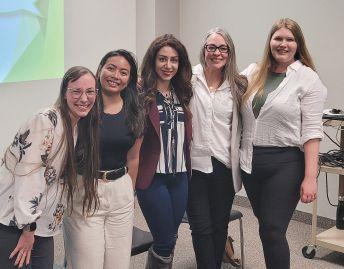
Pictured from left to right: Jessica Brownlee, C.E.T., Erycka Barcelon, C.Tech., rcji, Noor Sahyon, C.E.T., Jennifer McKenna and Lindsay Taylor.
On April 18, the OACETT Niagara Chapter and Niagara Urban Stewards (NUS) collaborated to host a panel discussion on “Finding your fit in STEM.” The event delved into the intricacies of navigating careers in science, technology, engineering, and mathematics (STEM). Throughout the discussion, panellists explored a wide range of topics, including discovering your passion within STEM, the influence of factors such as mentorship and networking, the importance of continuous learning and professional development, strategies for maintaining work-life balance, and the role of diversity and inclusion in shaping the future of STEM careers. Reflecting on the event’s success, attendees expressed appreciation for the opportunity to learn from industry experts and connect with peers who share a passion for STEM. Many left the session feeling inspired and motivated to pursue their career aspirations with renewed determination and clarity. Future events and initiatives aimed at empowering and inspiring the STEM leaders of tomorrow are eagerly anticipated.
Kevan Peters, C.E.T., is Niagara Chapter chair: niagara-chapter@oacett.org.
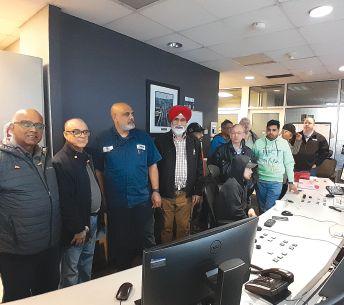
Pictured left to right (front): Ashok Bose, C.E.T., Rasheed Khan, A.Sc.T., presenter Josh, Karmjit Gill, C.Tech., Peter Huang, Paras Bajaj, C.Tech., Kishore Myneni, Micheal Muro, C.E.T. Left to right (back): Tenly Rodrigues, C. Tech., Rene Karavas, C.E.T. and Bruce Reesor. Seated: Control Room Operator.
Thirteen enthusiastic members of the Peel Chapter braved the rains for a special tour of the Automated People Mover (APM) system at Toronto Pearson Airport. The tour commenced with a unique ride on the APM, a cable liner shuttle boasting two fully automatic train systems with distinct guideways and drive mechanisms and serving three stations at Toronto Pearson Airport, including Viscount Station, Terminal 3 Station, and Terminal 1 Station, which also connects to Pearson Station and the Union-Pearson Express train service. Highlights of the tour included insights into the elevated structure supported by piers, the cable-propelled system driven by 750 kW electric motors, and the intricate control system managed from the central control room using Siemens S7 PLC technology. Special thanks to Clarence Walters, C.E.T., for orchestrating the enlightening tour.
Anil Kolassery, C.E.T., is Peel Chapter chair: peel-chapter@oacett.org.
Sean Morrison, professor and coordinator at Mohawk College’s Avionics Mount Hope Campus, demonstrated the Virtual Maintenance Trainer for starting a Boeing 737NG jet engine. Mohawk’s lab, equipped with ten stations, stands out from facilities typically having one or two.
Morrison explained jet engine operations, comparing them to internal combustion engines but with simultaneous intake, compression, ignition, and exhaust stages. He detailed single-spool and dual-spool engine configurations, emphasizing their reliability, efficiency, and maintainability benefits.
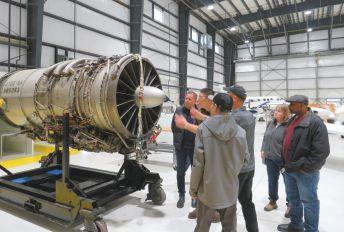
Morrison explaining the Boeing 737NG jet engine to Hamilton Chapter members.
Participants paired up to start engines using checklists and the trainer. Morrison highlighted starting procedures, including the sequence of starting the right engine first for passenger safety. He discussed the auxiliary power unit supplying air to the engine start valve and the activation process from the flight deck.
After successfully starting the engines on the trainer, Morrison covered engine indicators and potential operational issues. Participants also viewed an actual engine, appreciating its value and applications. The session concluded with hands-on experiences operating small planes and a helicopter, offering practical insights into aviation operations.
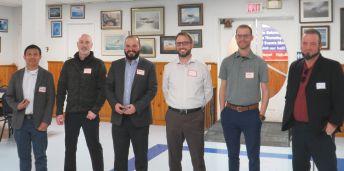
Pictured are the 10-year milestone recipients acknowledged at the chapter’s Annual Chapter Meeting: Carlo Busquit, C.Tech., Dustin Stevenson, C.E.T., Niko Barlas, C.Tech., Mark Elliott, C.E.T., Kevin Kernaghan, C.Tech., and Erik Stewart, C.Tech.
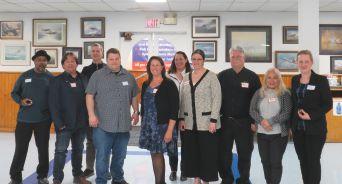
Meet Hamilton Chapter’s 25-year milestone recipients, left to right: Frankie Golaub, C.E.T., James Coughlin, C.E.T., Christopher Payant, C.E.T., Jeffrey Hines, C.E.T., Melissa Kosterewa, C.E.T., Shelley Parker, A. Sc.T., N. Lorraine Large, C.E.T., Robert Losier, A.Sc.T., Maria Regina Goze, C.E.T., and Yvonne Bruce, C.E.T.
The Hamilton Chapter Annual Chapter Meeting occurred on April 4 at the Royal Canadian Legion in Stoney Creek. OACETT president-elect Christopher van Dop, C.E.T., greeted attendees on behalf of OACETT and outlined ongoing and upcoming initiatives. Shelley Parker, A.Sc.T., an OACETT board of director and vice president at Metering Alectra Utilities, delivered the keynote address titled “Opportunities for technicians and technologists through electrification and the great energy transition.” Her insightful presentation covered electrification’s shift from fossil fuels to renewable energy sources like solar, wind, and hydro, federal policies toward achieving net-zero electricity by 2035, and
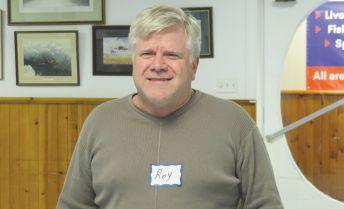
40-year milestone recipient, Roy Behrendt, C.E.T.
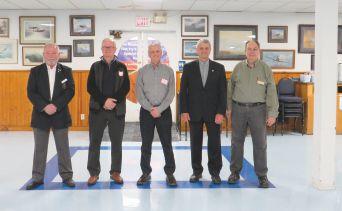
50-year milestone recipients, left to right: Robert DeWolfe, C.E.T., John Malda, C.E.T., Camill Theroux, C.E.T., Victor Lesnicki, C.E.T., and William Stewart, C.E.T.
the infrastructure challenges ahead. Parker emphasized the importance of upskilling technicians and technologists, urging them to enhance their knowledge, soft skills, and adaptability in rapid change. The chapter also recognized members celebrating mile -
stones ranging from 10 to 50 years, with van Dop presenting recognition pins. The chapter also acknowledged four 60-year members, highlighting their contributions to the profession. The meeting concluded with a review of the past year’s activities, financial statements, and the election of the new chapter executive.
The annual electrical design project presentations and judging took place at Mohawk College’s Stoney Creek Campus on April 16 and 17. Supported by the OACETT Hamilton Chapter, the event featured judges from various companies, including Alectra Utilities, ArcelorMittal Dofasco, and Gerrie Electric. Twenty teams, each comprising of five to six members, presented their projects, which focused on relocating the woodworking shop’s machinery to a new manufacturing facility. Evaluation criteria included technical merit, subject knowledge, and presentation skills. Mohawk College faculty members Glenn Kinaschuk, Dr. Christine Boyko-Head, and Fred Dierks organized the event and received support from Ganimete Nuredini and April Speare.
Mark Jakubowski, A.Sc.T., is Hamilton Chapter chair: hamilton-chapter@ oacett.org.

Pictured left to right: Paul Wardell, C.Tech., William Stewart, C.E.T., Kyle Wardell, Glenn Kinaschuk, OACETT board of director Mladen Ivankovic, C.E.T., Dr. Christine Boyko-Head, and Robert DeWolfe, C.E.T., at the Mohawk College’s annual electrical design project presentations.
CHAPTER NEWS, UPDATES AND EVENTS
On April 6 at St. Lawrence High School in Cornwall, Earle DePass, C.E.T., and Lloyd Chaput, C.E.T., Fellow OACETT, served as judges for exhibits crafted by junior and high school students and welcomed educational institutions within Stormont, Dundas, and Glengarry counties and the City of Cornwall.
On the same day, Sébastien Gervais, C.E.T., and Dominic Lessard, C.Tech., joined several other community members, including local dignitaries and delegates, in presenting awards to the deserving winners during the ceremony. Notably, several students who showcased their projects at the Cornwall Science Fair competed at the CanadaWide Science Fair.
On April 6, Cornwall Chapter executives participated in the Spring Open House at St. Lawrence College’s Cornwall campus. The chapter’s college liaison rep, Michael Gallinger, C.Tech. and Dale Phippen, C.E.T., met faculty, current students, and hundreds of prospective new students and their parents. They promoted OACETT, showing the Association’s videos and talking about their respective career histories, and educated individuals about OACETT and the benefits of certification and CPD. They also held a contest to estimate the number of glass marbles in a container, and the winner received an OACETT-branded tumbler. Phippen later joined the Environmental Technician Program coordinator (and other program staff and current students) in a chemistry lab setting on the campus to give prospective students insight into the program’s curriculum, live program demos, career prospects, and how OACETT membership and certification can enhance career advancement and networking capacity.
Rejean Fortin, C.Tech., is Cornwall Chapter chair: cornwall-chapter@ oacett.org.
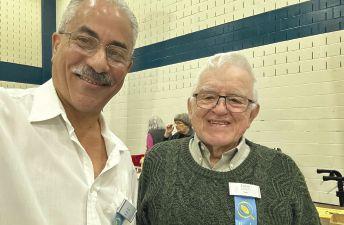
as judges.
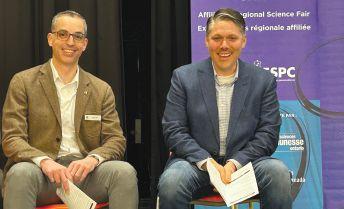
Sébastien Gervais, C.E.T., and Dominic Lessard, C.Tech., preparing to award winners at the
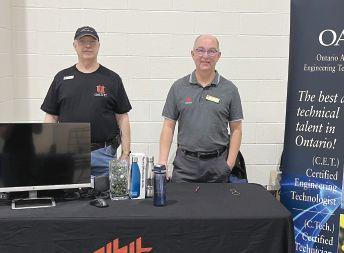
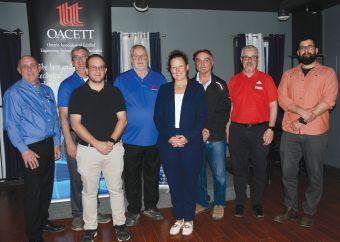
Pictured from left to right: Richard Bolduc, A.Sc.T., vice chair, Michael Behm, C.Tech., treasurer, CNL chapter member Michael Desalvo, Jack Van Gemeran, C.E.T., college rep, Justine Loader, C.E.T., OACETT MESC rep, chair Larry McHenry, C.E.T., Mark Behm, C.Tech., executive member, and chapter member Tyler Anderson, C.E.T.
meeting minutes, aiding in succession planning at the chapter level.
Michael Desalvo, a Canadian Nuclear Laboratories (CNL) employee in the technician and technologist union was among the attendees. Internal communications were established with CNL leadership in response to the APEO elimination of LTD licenses, potentially attracting lapsed CNL technicians and technologists to the chapter membership.
Following the meeting, Dayna Musclow, C.Tech., assumed the role of WIT representative, and the chapter discussed plans to align the Haley Tour with a WIT luncheon.
The Renfrew Chapter convened at Karras Way Restaurant in early April to conduct their Annual Chapter Meeting. Justine Loader, C.Tech., MESC representative for the eastern region, attended the meeting to address pressing issues and gather input to communicate back to OACETT’s leadership. The chapter suggested that cloud-based records for chapters would facilitate better management of financials and
Future initiatives proposed by the chapter included hosting a BBQ at Petawawa Point for Algonquin students during the summer, with a renewed focus on students in new programs such as environmental and wastewater technicians at Algonquin College’s Pembroke campus. The chapter discussed the possibility of OACETT accreditation for Algonquin’s Radiation Technician Program at Pembroke.
Loader proudly represented the Renfrew Chapter at the science fair. She participated in the judging process alongside the committee for the
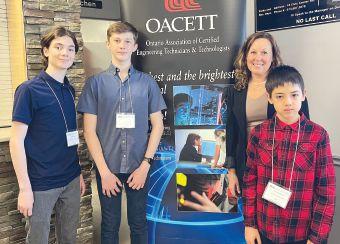
Justine Loader, C.E.T., stands alongside OACETT Renfrew Awards winners Logan Lynde (winner), Joey MacKinnon (runner-up), and Mark Wendland (runner-up).
OACETT Renfrew Awards, recognizing outstanding competitors. The Renfrew Chapter annually contributes funds and prize money to support the fair.
Aidan Leach, the Regional Fair coordinator for the Renfrew County Regional Science Fair facilitated the event. OACETT sponsored an award for the best example of a project aligning with OACETT engineering disciplines.
The winners of the OACETT awards were Logan Lynde from Valour School for “Using AI to Recognize Intoxication,” Mark Wendland from Mackenzie Community School for “Mental Math Arcade (Game),” and Joey MacKinnon from Rockwood Elementary School for “Robotic Reorganizing.”
Logan Lynde, a grade 9 student, developed a project using AI technology to recognize intoxication through the eyes. Joey MacKinnon, an eighth-grade student, designed a robotic sorter capable of detecting and sorting colours. Mark Wendland, also in Grade 8, created the Mental Math Arcade software, integrating graphics with mental math exercises to enhance user engagement.
The Renfrew Chapter extends its gratitude to all sponsors and the fair’s leadership for their contributions to fostering young talent in engineering and technology.
Larry McHenry, C.E.T., is Renfew Chapter chair: renfrew-chapter@oacett.org.
On International Women’s Day, OACETT’s Thunder Bay Chapter and the Lakehead Chapter of Professional Engineers Ontario hosted the annual Women in Technology and Engineering Mixer, bringing individuals together with shared interests and inspiring younger generations by highlighting the supportive community within the technology field. The mixer proved immensely successful, with a turnout exceeding 90 attendees, including pioneers, colleagues, mentors, allies, and students. Attendees enjoyed networking opportunities, delectable appetizers, and engaging activities tailored to support students during the exam season. A keynote speaker, deeply passionate about women’s issues, shared personal insights and experiences as a private mentor, adding to the event’s impact.
Finley, A.Sc.T., is Thunder Bay Chapter chair: thunderbay-chapter@oacett.org.
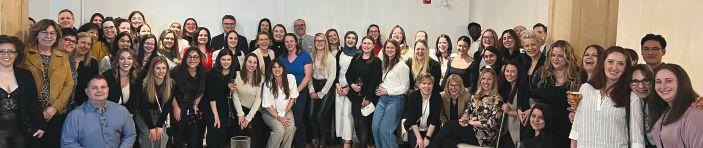
Toronto Central Chapter members volunteered as judges for the 2024 Toronto Science Fair at the University of Toronto Scarborough on March 24 and the York Region Science & Technology Fair of York University on April 6. There were over 275 science fair projects across the two events, covering a range of student interests in science and technology and allowing them to share their research in discovery and innovation and a chance to be selected to go to the Canada-wide Science Fair. The chapter sends kudos to these young minds as we encourage, recognize, and celebrate their participation and contributions.
The chapter hosted “Women & Wealth: Take an active role in your financial well-being,” — a free in-person presentation on April 11 at CIBC Square. Topics included investing, retirement, and estate planning. The chapter also sponsored Seneca Polytechnic School of Electronics and Mechanical Engi-
neering Technology (SEMET) Technical Project Winter Showcase’s top two awards on April 18. Students from the electronics, electromechanical automation, and computer engineering technology programs presented their projects at the event. Thank you to all the students at the showcase this semester, whose projects and presentations were innovative and inspiring. Congratulations to the winners of the SEMET Technical Awards for Outstanding Achievement in their categories: Andrea and Breej, for their TPJ452 project “Numberpad and Facial Recognition Door Lock;” Dairyan, for her TPJ655 project “Paranormal Pulse Ghost-Hunting Kit;” and Matt and Andres (who also won Best in Showcase), for their TPJ653 project “Manufacturing Parts Vending Machine.”
The chapter executive welcomes ideas for events at torontocentral-chapter@ oacett.org.
Shalevia Briscoe, C.Tech., is Toronto Central Chapter chair: torontocentralchapter@oacett.org.
London Chapter Annual Chapter Meeting attendees.
The London Chapter held its Annual Chapter Meeting (ACM) at the Best Western Plus Lamplighter Inn and Conference Centre on April 10. Highlights included a visit from presidentelect Christopher van Dop, C.E.T., chapter elections, and a CPD presentation by guest speakers.
Peter Nicholas, C.E.T., the chapter chair, welcomed attendees and gave the opening remarks. President-elect van Dop, C.E.T., updated members on OACETT initiatives. Guest speakers Mark Bruder and Emily Soscia presented on the Noventa Energy Transfer Project in Downtown Toronto and The Well, showcasing future energy generation possibilities.
The meeting also saw excitement during the budget review and the election of new member volunteers to the chapter executive committee, promising an eventful year ahead for chapter activities and leadership.
Peter Nicholas, C.E.T., is London Chapter chair: london-chapter@oacett.org.
Pictured from left to right: Mark Ceppi, C.Tech., Shervin Reyhani, C.E.T., Marco Fernandes, C.E.T., Darren Verasammy, P.Eng. (CDP presenter), Andrew Morrison, C.Tech., Spencer Westerberg, Frank Vyskocil, C.E.T., Steve Edwardson, C.E.T., and Alex Bultje, C.E.T.
The Chatham-Kent Chapter held its Annual Chapter Meeting, dinner & CPD event on April 3. During the gathering, Desmond Verasammy, C.E.T., delivered a CPD-approved presentation titled “The Secret Sauce to Your Engineering Career.”
Marco Fernandes, C.E.T., is Chatham Chapter chair: chathamkent-chapter@ oacett.org.
The Grey-Bruce Chapter executive hosted a “Hike and Snacks” event on June 15 at Inglis Falls Conservation Area in Owen Sound. The event entailed an hour-long hike along the naturally scenic Bruce Trail through conservation lands, up the escarpment to the top of the Inglis Falls on the Sydenham
Members Lukas Heathers, C.E.T., rcji (left) and Rose Lauder, C.E.T., rcji (second from right) at the Grey Bruce Chapter’s “Hike & Snack” event on June 15 at Inglis Falls Conservation.
Grey-Bruce Chapter members at the top of Inglis Falls.
River, followed by snacks and beverages at the Harrison Park Inn. The event was well attended, and the weather cooperated beautifully, offering ideal warm and sunny conditions. Jovial networking and camaraderie followed over a selection of après-hike refreshments. Special thanks to local executive members Adrienne VanDyk, C.E.T., Rose Lauder, C.E.T., rcji, and associate member Kristopher Robinson for organizing the event.
Matthew Aston, C.E.T., is Grey Bruce Chapter chair: greybruce-chapter@ oacett.org.