Recognizing Canada’s Top 10 Under 40 + OH&S Professional of the Year Lifetime Achievement Award Community Leader Award
The winners of our Top 10 Under 40 and OHS Canada Honours awards will be featured in the July/August 2021 issue of OHS Canada.
By Marcel Vander Wier
COVID-19 safety is not subjective
It’s not quite rocket science — the spread of the novel coronavirus that has locked down much of the world through this past year does not discriminate.
COVID-19 has been a contentious issue for many since the first lockdown began in March of last year. Safety measures implemented have been politicized, criticized and even defied by many across Canada.
Cities and towns across our the nation have been the sites of anti-mask rallies and freedom marches, many spurred by the extreme duration of lockdown measures mandated by our federal, provincial and municipal leaders.
In January, Canada crossed the 700,000 case threshold, and the number of deaths associated with the virus ticked past 18,000.
No doubt, this pandemic has tested our collective resolve as a global community.
Alongside the death toll, many have lost businesses or endured strained mental health as a result of isolation and extended school closures.
The needs and coping mechanisms of every individual vary — citizens and families are getting by in different ways and I understand the disparity in that respect.
But what I cannot endorse is the deliberate flaunting of public health rules by a select few — specifically when it comes to workplace safety.
Deliberate flaunting of public health rules is cause for concern as Canada endures an extended pandemic.
From my vantage point, the vast majority of businesses are doing their part, adjusting operations to help stop the spread and maintain capacity in our provincial health-care systems.
But some have openly defied — and have found public support in doing so. A now-infamous Toronto barbecue establishment comes to mind.
For their part, Canadian politicians have done their best to convey public health advice simply and steadfastly.
Wear a mask. Wash your hands. Watch your distance.
Manitoba Premier Brian Pallister took it a step further prior to Christmas: “If you don’t think that COVID’s real — right now, you’re an idiot.”
I feel for our leaders making the tough calls through this season.
Look — I get it. If your region hasn’t been particularly hard-hit by this virus, the drastic lockdown measures can seem extreme and frankly unnecessary.
Living in west Toronto, I know of my fair share of cases and have seen just how effective the public health measures are in curbing the spread.
Watching the good work done in the province of Prince Edward Island has also been eye-opening. Their December “circuit-breaker” lockdown worked to near perfection.
If not for public health guidance, this situation could look much uglier than it already does. One needs only to look at the death toll south of the border to see that.
COVID-19 safety is not subjective. The quicker we collectively understand and respect this, the sooner things will return to normal.
EDITORIAL ADVISORY BOARD
Paula Campkin: chief safety officer, Energy Safety Canada
Marty Dol: president and founder, HASCO Health & Safety Canada
Cindy Moser: director of communications, Institute of Work & Health
Natalie Oree: prevention consultant, SAFE Work Manitoba
David Powers: EHS director (Atlantic), Sysco Canada
Richard Quenneville: senior director of corporate services, T. Harris Environmental Management
Maureen Shaw: lecturer and presenter
Dylan Short: managing director, The Redlands Group
NATIONAL SALES MANAGER Ross Anderson 289-925-7565 randerson@annexbusinessmedia.com
GROUP PUBLISHER Paul Grossinger pgrossinger@annexbusinessmedia.com
COO Scott Jamieson sjamieson@annexbusinessmedia.com
Printed in Canada ISSN 0827-4576 (Print) ISSN 1923-4279 (Digital) PUBLICATION MAIL AGREEMENT #40065710
SUBSCRIPTION RATES
Published six times per year – Jan/Feb, Mar/Apr, May/Jun, Jul/Aug, Sep/Oct, Nov/Dec Canada $100/yr plus tax USA $130/yr (100 USD) Foreign $214/yr ($164.50 USD)
Occasionally, OHS Canada will mail information on behalf of industry related groups whose products and services we believe may be of interest to you. If you prefer not to receive this information, please contact our circulation department in any of the four ways listed above.
All advertising is subject to the publisher’s approval. Such approval does not imply any endorsement of the products or services advertised. Publisher reserves the right to refuse advertising that does not meet the standards of the publication.
In the News
Premier Ford issues stay-at-home order, second state of emergency in Ontario
(CP) Ontario issued an order requiring residents to stay at home starting Jan. 14, except for essential activities such as accessing health care or shopping for groceries.
Premier Doug Ford also declared another state of emergency in response to surging COVID-19 infection rates across the province. The order is expected to remain in place for 28 days.
The new measures include restricting the hours of operation for non-essential retail stores, such as hardware stores, to between 7 a.m. and 8 p.m.
Based on the advice from the chief medical officer of health, schools in Windsor-Essex, Peel, Toronto, York and Hamilton will remain closed for in-person learning until Feb. 10, Ford said.
Health experts urge more preventive action to curb aerosol spread of COVID-19
(CP) Hundreds of scientists, doctors and other health experts — including occupational health specialists from across Canada — are calling for more aggressive measures to stop airborne spread of COVID-19.
They say provincial prevention messages “continue to be deficient” when it comes to infection threats posed by shared indoor spaces.
Their concerns are detailed in an open letter addressed to Canada’s Chief Public Health Officer Dr. Theresa Tam, federal Health Minister Patty Hajdu and provincial premiers and medical officers.
The experts want public health messages to more strongly warn of the risk posed in closed spaces, especially with winter forcing more people indoors.
Dealing with seasonal affective disorder: tips for employers
8Quebecers need to be jolted into recognizing the seriousness of the COVID-19 pandemic, Premier Francois Legault said Jan. 6, before announcing a provincewide 8 p.m. curfew for four weeks.
Seasonal affective disorder (SAD) is a type of depression caused by seasonal changes and reduced sunlight, most commonly affecting people during the fall and winter months.
In the winter, people tend to stay indoors more, get less exercise and see less daylight. These factors alone are enough to affect their well-being.
Add a pandemic, lockdown restrictions and reduced social interaction on top of this and mental health could seriously suffer.
For businesses, poor mental health among staff could become an additional challenge through the COVID-19 pandemic.
Employers should be proactive in preparing for the winter months and addressing any issues that arise, according to Hope McManus, head of health and safety at OH&S consultancy firm Peninsula Canada in Toronto.
As the seasons change, employers should consider how this might affect their workplace and staff, she said.
For workers that spend most daylight hours at work, it can be hard to catch any sunshine during the week.
To combat this, employers can
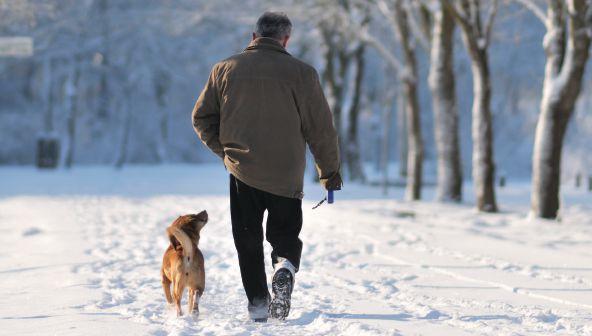
encourage employees to use their lunch breaks to get some fresh air and exercise outdoors, said McManus.
Some workers might find extra daylight time very valuable and employers can offer a bit of flexibility with breaks.
For example, employees can be offered the opportunity to take a longer lunch break and to stay later at work to make up their usual number of hours.
Working at home during the pandemic might be a challenge for some employees, especially if work was their main reason to leave their house.
Staying indoors every day can have a negative effect on mental health, said McManus.
“While employees should be following government guidelines on social distancing, employers can encourage workers to use their breaks to go outdoors for some fresh air,” she said.
“When your home is also your workplace, leaving the house during the day to get some sun can provide a much-needed break… Employers should keep in mind that their remote workers well-being should remain a priority even though they are out of office.”
Ontario workers now required to wear masks indoors at all times
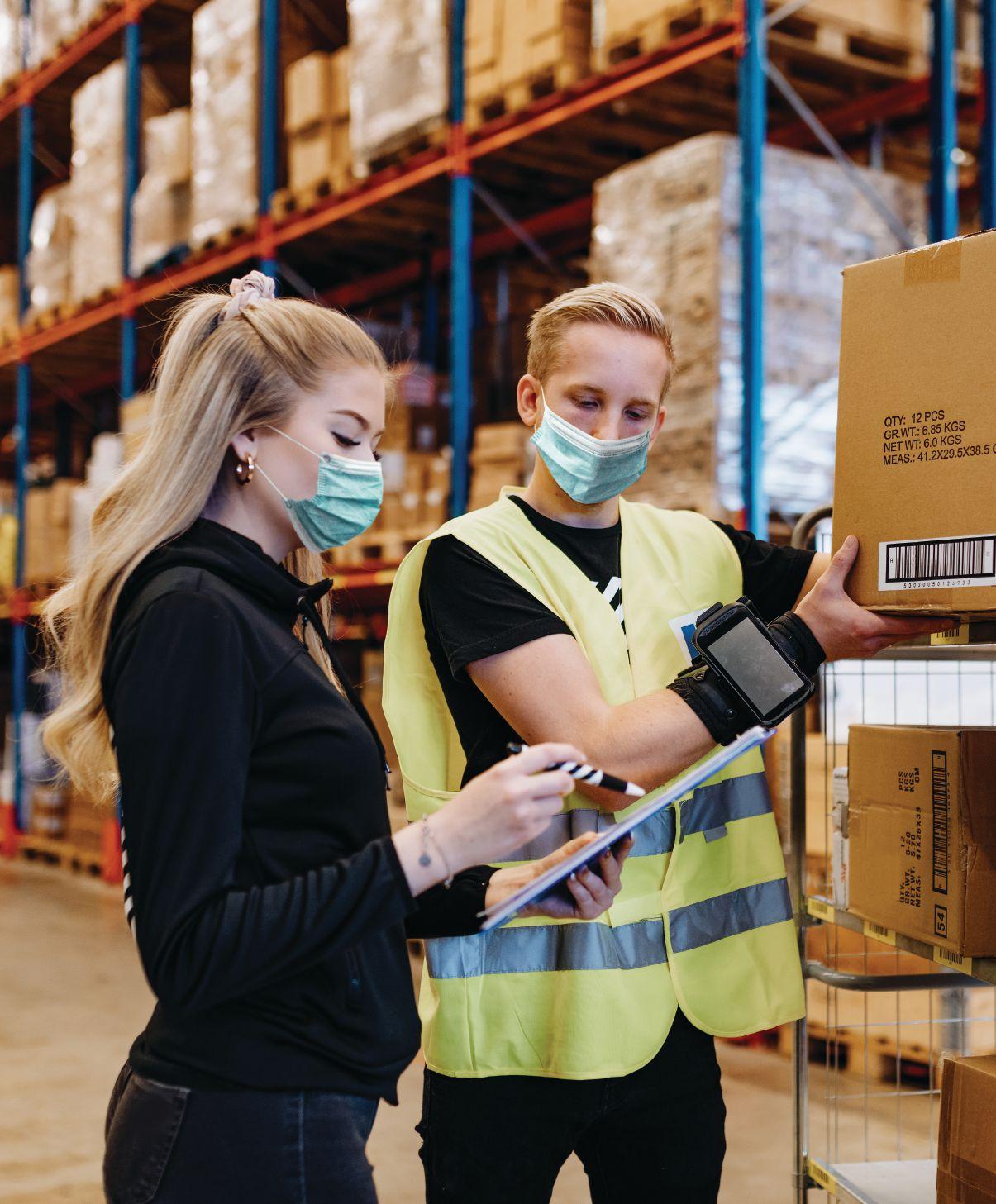
(CP) A growing number of infections can be traced back to workplaces, including in manufacturing, warehouse and shipping facilities, according to Ontario data on active outbreaks by setting.
Provinces,
health units offer varying guidance on mask usage at work.
Ontario declared a second state of emergency on Jan. 12, amid rising COVID-19 case counts, and tightened rules around masks in workplaces among other measures.
More than 10,000 workers have contracted COVID-19 due to work-related exposures, statistics from the Ontario Workplace Safety and Insurance Board show.
One of the issues that appears to be fuelling workplace infections is the lack of clarity or consistency surrounding mask-wearing rules in workplaces in Canada.
Across the country, each province and in some cases individual health units or workplace safety boards offer varying guidance on masks at work.
It’s a patchwork that can be confusing. Multiple business operators say they want to stick to the rules and keep workers safe, but have found the regulations unclear.
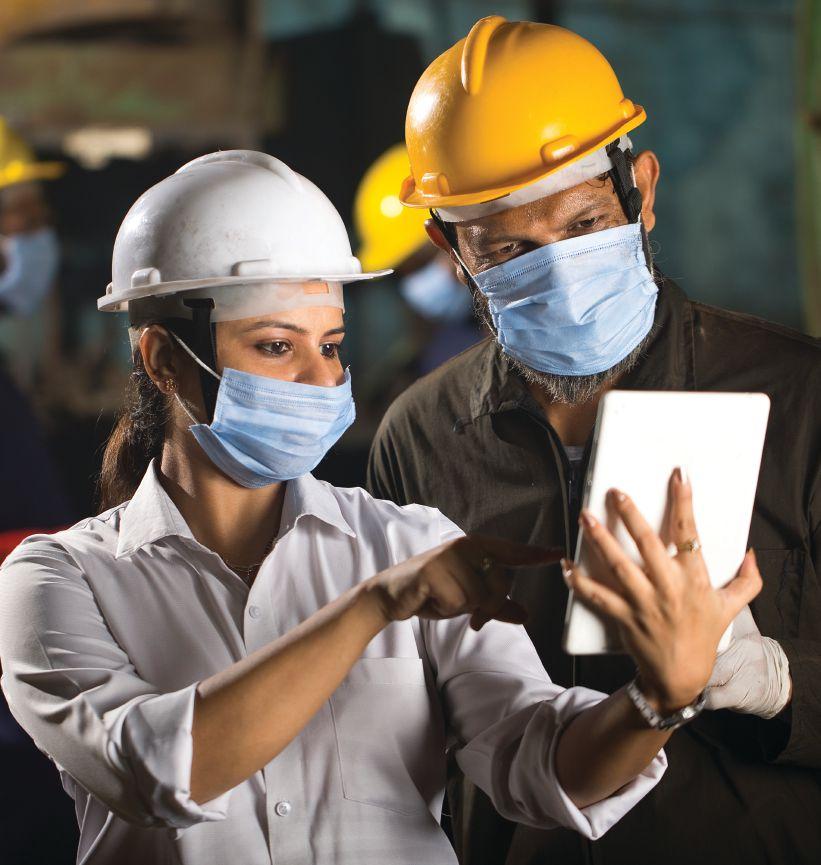
In response to the “alarming and exceptional circumstances,” the province said individuals are now required to wear a mask or face covering in the indoor areas of businesses at all times.
Ontario is also stepping up enforcement measures. Provincial workplace inspectors are expected to focus on areas of high transmission, including break rooms, and issue tickets to those not wearing a mask indoors.
Yet, other provinces continue to only require masks in workplaces where employees are interacting with the public, or if two meters of distance cannot be maintained between workers.
In Nova Scotia, for example, the provincial mask requirement applies to spaces the public has access to — not private spaces.
“We encourage business owners/ employers to set their own policies for private spaces,” Health Department spokeswoman Marla MacInnis said in an email.
Nova Scotia tightens border with New Brunswick following spike in cases
(CP) The province of Nova Scotia is tightening its border controls with New Brunswick because of the rising number of COVID-19 cases in the neighbouring province.
Premier Stephen McNeil and Dr. Robert Strang, chief medical officer of health, announced that beginning Jan. 9 at 8 a.m., people entering Nova Scotia from New Brunswick will be required to isolate for two weeks.
700,000
New Brunswick residents arriving in the province will have to complete a check-in form and immediately begin their 14-day isolation period unless they are exempt from the order.
People who regularly cross the provincial border for work are exempted and are eligible to receive a travel pass from border officials.
Permanent residents of Prince Edward Island and Newfoundland and Labrador are not subject to the order if they drive through New Brunswick with zero or minimal stops.
B.C. state of emergency extended again
(CP) British Columbia has again extended its state of emergency in response to the COVID-19 pandemic nearly 10 months after it was first declared.
The Ministry of Public Safety said the extension until Jan. 19 will allow officials to use powers under the Emergency Program Act.
A joint statement from Health Minister Adrian Dix and provincial health officer Dr. Bonnie Henry on Jan. 5 said there have been eight more deaths along with 428 new cases of COVID-19 across the province. More than 950 lives have been claimed in B.C. as a result of the virus.
More than 28,000 B.C. citizens have received a COVID-19 vaccine.
In January, Canada’s national case count of COVID-19 surpassed 700,000.
New COVID-19 obligations in place for Toronto workplaces
(Sherrard Kuzz) The City of Toronto’s Public Health unit has issued a letter of instruction to all employers in the city permitted to be open under the Reopening Ontario Act. The letter requires every employer to take additional measures to reduce the spread of COVID-19.
The physical measures reiterate public health guidance currently in place for Ontario workplaces. These include regular sanitizing, distancing, HVAC review, physical barriers, and more. However, there are some new reporting and other measures of note, identified below.
To the extent any measure conflicts with other applicable provincial legislation or directive, the provincial requirement prevails.
As soon as an employer becomes aware of two or more cases of COVID-19 within a 14-day period in connection with the workplace, the employer must immediately notify Toronto Public Health and also notify the Ontario Ministry of Labour, Training and Skills Development or other relevant government authorities.
The employer must then co-operate with infection prevention and control personnel from the city, including allowing entry into the workplace for inspection and implementing enhanced measures and recommendations.
(CP) Suncor Energy Inc. says it is standing down mine operations at an oilsands site in northern Alberta following the deaths of two workers. A dozer hit a light-vehicle truck, killing its two occupants at the Fort Hills mine north of Fort McMurray at about 5:30 p.m. on Dec. 28. The driver of the dozer was not injured.
Five worker deaths in one week prompt standdowns in Ontario
A deadly week on Ontario construction sites has industry groups imploring contractors to redouble their focus on health and safety, and one labour association demanding immediate government action. The spate of incidents left five workers dead across southern Ontario in midDecember.
Two workers were killed and four injured in a partial building collapse in London Dec. 11. Another was killed Dec. 15 on a Ontario Tech University construction site in Oshawa. And in Toronto, two workers died in separate incidents — one on a downtown job site Dec. 14, the other on a Scarborough roadwork project Dec. 17 after being stuck by a vehicle.
Groups such as the Infrastructure Health and Safety Association (IHSA) and the Ontario General Contractors Association (OGCA) called for builders across the province to
pause for safety standdowns.
“Now is the time to reinforce safe work procedures and the practice of performing risk assessments on all your tasks, regardless of whether they are new tasks or existing ones,” the chairs of the IHSA said in an open letter.
“With efforts focused (rightfully) on the topic of COVID-19, including its impact on our personal lives, upcoming holidays, increased levels of spread, and the rollout of the vaccine to fight this coronavirus, it is understandable how attention can be diverted from everyday risks and hazards in the workplace.”
“It is up to all workplace parties to work even harder to increase attention to performing work in the safest manner possible,” the letter added.
The OGCA said all contractors should hold meetings with both their management teams and workers to reinforce jobsite safety as the top priority.
COVID-19 vaccine rollout underway across Canada
(CP) A COVID-19 vaccine from Pfizer has arrived in Ontario and Quebec, with the first inoculations rolling out Dec. 14 in Toronto, Montreal and Quebec City.
Canada is set to receive 249,000 doses of the drug from the U.S. pharmaceutical giant and its German partner BioNTech by the end of the month and four million total doses — enough to vaccinate two million people — by March.
Here’s what we know about today’s vaccinations and Pfizer’s product:
Who is getting vaccinated first?
Five front-line workers were the first Ontarians to receive the vaccine at one of Toronto’s hospitals on Dec. 14.
Ontario had 6,000 doses delivered over the weekend and plans to vaccinate approximately
2,500 more health-care workers. Each person who is vaccinated needs two doses 21 days apart.
In Quebec, residents of long-term care homes in Montreal and Quebec City will be the first to receive the shots, followed by staff.
How does the vaccine work?
Pfizer developed its vaccine with a novel technique of using messenger RNA (mRNA), which essentially teaches our cells how to make the coronavirus’s spike protein and trigger an immune response if we become infected with the virus in the future.
Pfizer’s vaccine uses a synthetically-produced mRNA that’s packaged in a fat, or lipid, coating. When injected into the arm muscle, the lipid hooks onto cells and dumps the mRNA there. It’s then translated into protein to make the antibody.
International guidelines published on COVID-19 safety
The COVID-19 pandemic has turned the world of work upside down and employers are faced with challenges never seen before.
Recognizing the need for comprehensive yet generic guidance on protecting staff while continuing to function effectively, ISO occupational health and safety experts quickly got to work, delivering in record time, according to a news release.
While the average ISO International Standard takes three years to develop, the newly published ISO/PAS 45005, “Occupational health and safety
management – General guidelines for safe working during the COVID-19 pandemic” was developed in just three months in response to the urgency of the situation.
ISO/PAS 45005 brings together international best practice on how to manage the health and safety of employees and stakeholders during the pandemic and is intended to complement any existing national guidelines and regulations, the release states.
Experts from 26 countries worked to produce the guidelines.
Masks now mandatory at drive-thrus across New Brunswick
(CP) New Brunswick has added another COVID-19 rule: masks are now mandatory at drive-thru windows.
The December change states that as most drive-thru interactions occur within the two-metre zone, masks are required for workers and any occupants of the vehicle who will be within two metres of the drivethru window.
The change applies to yellow, orange and red zones, meaning it currently applies provincewide.
A January weekend inspection blitz of big-box stores in the Greater Toronto Area found a compliance rate of just over 70 per cent, in terms of COVID-19 protocols.
Luc Erjavec, vice-president, Atlantic Canada for Restaurants Canada, said the organization is supportive of the change, while noting the change is really more about educating customers since masks were already required by staff.
“It’s a minor inconvenience for 30 seconds to a minute and not too much to ask,” he said.
While he has heard some opponents say it’s a violation of their privacy because they are in their own vehicle, he said he hopes they can start to see it as protecting those serving them.
Man charged after investigation into noose at Toronto construction site
(CP) Police have arrested and charged a man after an investigation into reports of nooses found at a hospital construction site in Toronto.
Toronto police say workers found two nooses when they arrived at the site in June. They say the construction site at Michael Garron Hospital was not accessible to the public.
Police say a 34-year-old man from Toronto has been charged in relation to one of two nooses found. The man faces three counts of criminal harassment and one count of mischief interruption of property.
Legal View
By David Reiter
Reviewing the year that was in OH&S law
2
020 was an interesting year in the world of occupational health and safety. Workplaces struggled to stay open amid lockdowns, health concerns and an economic slowdown — and many courts were closed for much of the year.
A s a result, dramatic shifts in the OH&S legal landscape were few and far between.
Nonetheless, there were some notable developments: COVID-19 propelled workplace hygiene to the forefront; the Supreme Court confirmed that corporations are not protected against cruel and unusual punishment; and the question of whether control needs to be exercised before contracting parties become employers to sub-contractors continues to be a source of uncertainty.
As 2021 begins, it’s worth taking another look back at the year that was.
Effect of COVID-19 pandemic
COVID-19 changed a lot in 2020, but not occupational health and safety.
In that respect, it only highlighted what we already knew — namely, employers must take all reasonable precautions to protect their workers’ health and safety.
And, if precautions hold a promise of protection, even without scientific certainty, they should be taken.
Nowhere was this more clearly seen than through the example of masks.
In July, the Ontario Labour Review Board decided the case of Inovata Foods Corp. v. Ontario. It involved the appeal of an order that required workers to wear masks.
O n appeal, the argument was made that there wasn’t conclusive proof that masks actually prevented COVID-19 transmission.
However, in upholding the order, the board explained that employers have to take preventative measures, even where cause and effect cannot be proved with scientific certainty.
The question is whether the precaution
promises a potential benefit. If it does, it reasonably ought to be taken. To do otherwise could leave workers unnecessarily exposed.
T his is known as the precautionary principle and — at least in the context of COVID-19 — it is the law of the land.
A s such, recognizing the uncertainty that comes with the novel coronavirus, 2020 made it clear that businesses must implement all precautions that hold out a realistic potential for benefit, including new emerging minimal standards such as the development and implementation of workplace safety plans and sanitization, isolation/quarantine and contact-tracing protocols.
Cruel and unusual punishment
As we closed out 2019, I commented on a case which was then headed to the Supreme Court: Quebec (Attorney General) v. 9147-0732 Québec Inc.
It centred on whether minimum fine provisions against corporations contravened the constitutional guarantee against cruel and unusual punishment.
The case was decided in November, and
in it, the court held that the purpose of the protection was to prevent violations of human dignity, which corporations cannot possess. As such, the protection cannot extend to companies.
While the point may seem obvious, the potential implications are far-reaching.
Recalling that deterrence is a key sentencing objective in OH&S prosecutions, absent this protection, the door — arguably — has been opened wider to the prospect of significant fines that for all intents and purposes could amount to corporate capital punishment.
That is, fines that are so large that they could bankrupt offender companies.
While the sentencing doctrine of proportionality may in some cases act as a restraint, several cases suggest that because deterrence is a paramount consideration, restraint may be illusory.
As such, this is a case that businesses should be keeping in mind as we move into 2021.
Control and employers
Up until 2019, the law related to who is an employer for OH&S purposes had been clear for nearly 30 years. One was an employer if one had the ability to control a worksite.
However, as 2019 ended, that law was set — possibly — to change.
The Greater Sudbury decision had made its way to the Ontario Court of Appeal, and it was poised to decide whether it was the act of exercising control over a worksite, or the ability to exercise that control, that defined who is an employer for OH&S purposes.
Unfortunately, the hearing was postponed due to COVID-19. As such, and given that it is expected to decide when and how businesses are the employer of their subcontractors’ workers, it remains the case to watch from an OH&S perspective as we move into 2021.
On a practical level, it will very likely to decide how companies manage subcontractor relationships going forward
Safety Leadership
By Lisa McGuire
Strong focus on health, safety will move us forward in 2021
On March 11 of last year, occupational health and safety suddenly became a hot topic in every business when the World Health Organization declared the COVID-19 virus a global pandemic. Many organizations, including our own, had to scramble to understand the risks and adapt.
While the pandemic will eventually end, the lessons learned will live on.
In 2021, employers will continue to pivot to address new information and changing restrictions to keep workers safe and operations running.
While we see light at the end of the tunnel with the arrival of COVID-19 vaccines, it shouldn’t shift focus away from workplace health and safety.
Beyond critical front-line medical workers, Canadians have been introduced to the important roles other essential workers play in sustaining our economy and supply chain — from grocery store workers and infrastructure employees to production staff manufacturing crucial goods such as food, medicine and toilet paper.
As we rethink our assumptions around offshore production and supply, the health and safety of our essential workforce has become an important ongoing consideration — not only in caring for our people, but in ensuring our economic sustainability.
So, what’s changed?
COVID-19 has shifted the world of workplace safety in profound ways. The focus on employee safety will continue to grow as global regulations change in response to the evolving pandemic.
Cases are still on the rise in many parts of Canada, and companies must stay alert
to prevent outbreaks. Even with the rollout of a vaccine, the return to “normal” will take time.
The pandemic has many organizations questioning long-standing norms about the way we work and how we safeguard and care for the health and well-being of staff.
Health as a corporate priority
One of the greatest impacts for OH&S as a result of COVID-19 has been a new emphasis on the health in health and safety.
In manufacturing and other sectors, employers have had to address the very real issue of communicable disease prevention in the workplace beyond annual flu shot campaigns.
The pandemic has also highlighted the responsibility companies have to protect the mental health and wellness of workers.
There is a growing need to provide supports that address the impact of fear and anxiety on workers’ ability to report to work or focus on the job.
We have also seen a shift away from detection towards prevention in health and safety efforts. The potential impact of an outbreak in the plant created new urgency for employers to identify and address hazards before someone is injured or made ill.
Developing COVID-19 safety plans to comply with provincial requirements necessitated getting back to basics to re-evaluate everyday tasks for risks and hazards.
While the pandemic will eventually end, the lessons learned will live on. A continued focus on exposure control plans and the prevention of workplace infections will have benefits for industry well beyond COVID-19.
Effect on retention, recruitment
Employees are demanding more of their employers.
The impacts of the pandemic, along with the social and economic challenges of 2020, have many workers re-evaluating what they look for in a workplace.
It is easier to attract and retain employees when they can clearly see the company’s commitment to safety. Workers who believe their company cares for them — and who see proof of that care through action — will be more willing to contribute to its success.
When evaluating potential employers, workers are looking for:
• flexibility
• safe worksites
• m ental health supports and mental wellness programs
• continuous health and safety training particularly for OH&S professionals
• virtual learning opportunities. Companies that build and maintain effective systems to protect workers — their most valuable resource — will be better positioned to succeed in the economic recovery ahead.
Into 2021 and beyond
As we move into a post-pandemic “normal,” the most successful companies in navigating the recovery will be those that:
• find ways to help workers feel valued for the hard work they are doing adapting to the many changes imposed by COVID-19
• communicate safety investments and successes and celebrate them as a team
• demonstrate that the CEO and other leaders believe that safety comes first
• create safe spaces for front-line staff to connect about potential safety issues, near misses and other concerns
• e mpower employees at all levels to build a strong safety culture
• p artner with j oint h ealth and s afety committees in ongoing safety success
• c ontinuously seek to make the workplace safer for everyone
Threats to business continuity and success in a sustained crisis challenge our core beliefs and values.
Your workers are watching to see how you respond. Put their safety in the forefront to meet the crisis together.
Lisa McGuire is the CEO of the Manufacturing Safety Alliance in Chilliwack, B.C.
Neurosafety
By Theo Heineman
The missing link in safety management
The most recent statistics from the Association of Workers’ Compensation Boards of Canada (AWCBC) show that in 2017, 951 workplace fatalities were recorded in Canada — an increase of 46 from the previous year. Among these deaths were 23 young workers aged 15 to 24.
Add to these fatalities the 251,508 accepted claims (up 10,000 from the year prior) for lost time due to a work-related injury or disease — and the fact that these statistics only include what is reported to and accepted by the compensation boards — and there is no doubt that the total number of workers impacted is even greater.
Construction was the deadliest industry with 217 fatalities, followed by manufacturing at 160. Trades, transport and equipment operators made up the most dangerous occupations, totalling 486 deaths.
Mental health and workplace wellness
The Mental Health Commission of Canada reports that one in five Canadians experiences a mental health problem or illness each year, which equals 500,000 employees unable to work every week. Stress and trauma are cited as the primary causes.
It was further reported that:
• Psychological health problems cost the Canadian economy approximately $51 billion per year — $20 billion of which results from work-related causes.
• Forty-seven per cent of working Canadians consider their work to be the most stressful part of daily life — and this data was gathered prior to the pandemic.
Scientific studies show that productivity, creativity and profits directly correlate to the level of well-being experienced by employees in an organization.
Despite the combined efforts and expense of industry stakeholders to reduce serious workplace injuries, why can’t industry seem to make significant headway?
Understanding neuroscience
Neuroscience is the study of the brain and nervous system.
The principles of neuroscience not only apply to health, safety and human performance in the workplace, but may very well be the missing link at the root of why organ-
izations struggle to create lasting change.
Every year, organizations invest billions in performance-based training that fails to produce the desired results.
W hy? A primary reason is the inability to produce the sustained change required to have a lasting impact on human behaviour.
True and lasting change requires becoming aware of how the brain works and creating deep-seeded habits and beliefs that rest mostly in the unconscious mind.
Let’s talk about stress. The stress response is a primitive survival mechanism intended for short-term duration.
For example, when a deer outruns a wolf, 15 minutes later it goes aback to grazing.
When humans regularly turn on the stress response — in reaction to production demands, information overload or pandemics — and can’t turn
it off, to the body, it’s just like constantly being chased by a “wolf.”
Stress hormones like adrenaline and cortisol continually coursing through the body catabolize and harden tissues and arteries, causing symptoms like stiff muscles and high blood pressure.
In the short term, the body’s immune system is suppressed, resulting in more employee sick days and absenteeism. Over the long term, the body wears out and genes are downregulated for greater likelihood of illness and disease.
The alarming fact is many people are living in an environment of stress for a majority of the time.
Fallout of living in stress
A person living in stress is living in survival mode. They are in self-preservation and, just like an animal, will naturally want to fight, run or hide.
Theo Heineman, CRSP, CHSC, is a certified NeuroChangeSolutions consultant in Winnipeg.
When in stress, blood is sent from the forebrain to the hindbrain, causing it to fire incoherently. In other words, the brain isn’t working optimally.
As a result, workers are more likely to:
• b ecome aggressive, selfish and reactive
• become narrow focused
• make errors in judgment
• take shortcuts
• e xperience injuries and incidents.
They are less likely to:
• communicate and co-operate
• perceive hazards and risk
• see possibility and solutions.
Emotions create chemicals in the body.
E motions like anger, frustration or stress send a signal to the midbrain to release about 1,500 chemicals down the nervous system and into the body.
True and lasting change requires becoming aware of how the brain works.
When people are constantly firing negative thoughts and emotions — just like a person who becomes addicted to caffeine or nicotine — they can get addicted to the emotions (chemicals) of anger and stress without realizing it.
That means people can become addicted to a job or a person they don’t even like.
The reverse is also true. Positive emotions produce specific chemicals in the body like serotonin and dehydroepiandrosterone (DHEA).
Some of the benefits of positive emotions include an im-
mune system boost and increases to mental cognition, creativity and focus — to name a few.
This is why it is said that “laughter is the best medicine.”
Shifting culture away from bad habits
W hat about “bad safety habits” that safety professionals everywhere are perpetually at odds with?
Habits are the recurring, often unconscious and automatic patterns of thoughts, behaviours or feelings that are acquired through frequent repetition.
Like water running down a mountain and carving valleys in the rock, the long-term repetition of habits creates hardwired neuro connections in the brain.
By the age of 35, the vast majority of people are operating from their unconscious mind (habits) and very few from their conscious mind.
To break a habit, people need to become conscious of their unconscious thoughts, beliefs and emotions. They need to consciously override the body’s desire for the comfort of the old known habit and do it long enough so that old connections in the brain are pruned and new neuro connections — or new beliefs and habits — are formed.
So, what is safety culture? Culture is the shared beliefs, habits, attitudes and ways of doing things (hardwired neuro networks in the brain) of a group of people.
With this understanding of what a habit i s, does it make sense why changing habits and evolving workplace culture are difficult?
If we don’t understand how the brain and nervous system contribute to stress and habits,
then producing sustained change will be hard, if not impossible, because change requires altering neuropathways in the brain.
It also takes energy and effort. Understanding and applying how neuropathways in the brain are created, sustained and impact human performance provide a doorway to radical shifts in safety performance and culture.
The good news is, there is a science to teach people how to manage stress, as well as how to move from old habits to new ones. Using the understanding of the neuroplastic nature of the brain, a formula can be applied to allow employees to
learn new ways to think, act and feel — in short, create a new mindset towards workplace safety and wellness.
True leadership is teaching others to look within to make changes.
When employees feel valued, empowered, in alignment with an organization’s mission and believe they are meaningfully contributing, the natural outflow is engagement and a renewed commitment to the organization’s goals.
This results in less sick leave taken, improved employee safety and morale, reduced turnover and, ultimately, improved financial results for the organization.
21_0242_CN_OHnS_JAN_FEB_CN Mod: January 12, 2021 8:43 AM Print: 01/22/21 8:53:14 AM page 1 v7
ORDER BY 6 PM FOR
Person of Interest
featuring Melanie Gruneir
COVID-19 on the hospital’s front lines
Since March 2020, organizations across Canada have been grappling with new health and safety protocols as a result of the COVID-19 pandemic.
Melanie Gruneir, CRSP, is a workplace safety manager at Toronto Western Hospital, part of the University Health Network (UHN).
Responses have been edited for length and clarity.
OHS Canada: How has the UHN adjusted its operations as a result of the pandemic?
Melanie Gruneir: Much like other health-care organizations, UHN’s operations have been and continue to be impacted by the COVID-19 pandemic. As Ontario went into lockdown during the first wave, the organization continued to provide the necessary care to our patients, but in a decreased capacity for some services.
The Incident Management System was launched to streamline the implementation of measures to support the safety of both patients and staff. Additionally, resources were allocated to support the procurement of necessary items such as patient care equipment and personal protective equipment (PPE).
In addition to providing care for our patients, the province asked UHN to manage a number of long-term care facilities. UHN staff volunteered to be redeployed to these long-term care facilities to help support the care of their residents.
Throughout the different waves of this pandemic, UHN has continued to be nimble and pivot as necessary, to ensure our patients come first, all the while ensuring that staff safety is not compromised.
OHS: What protocols have you implemented to protect staff and patients?
MG: UHN has implemented many protocols over the course of the pandemic to protect our staff and patients.
Infection, prevention and control measures have been developed for PPE
use, the provision of safe patient care, and the prevention of the spread of COVID-19.
The respiratory protection program has been one area of focus for the UHN Safety Services – Workplace Safety team during the pandemic.
At the end of Jan. 2020, as it was unclear whether COVID-19 was spread via the airborne route, our team set up blitz N95 respirator fit testing to target staff who had not been fit tested in the past or who had invalid records, to ensure staff were protected.
Due to supply chain issues with certain types of N95 respirators, we have had to recall many staff to ensure that they have a valid fit test on a respirator that UHN has in good supply.
Our team has been involved in the review of a number of new N95/KN95 respirator brands to supplement our current models. As well, elastomeric half facepiece respiratory protection and powered air purifying respirators were trialed for use in different areas within the organization to help conserve UHN’s supply of disposable N95 respirators.
To ensure the safety of staff and our fit testing team, we adjusted our internal infection control protocols for the program.
Physical distancing measures were implemented and the use of a scheduling software began, to prevent staff from waiting in lines for their fit tests.
We updated the cleaning protocols for our fit test equipment and the PPE requirements for our fit testing team members.
OHS: As the pandemic continues, are there any areas of heightened concern for your employees?
MG: Throughout the pandemic, our staff have had concerns with regards to the risks of exposure to COVID-19 while on the front lines and the risk of bringing the virus home to their families.
Currently, as the community spread of the virus is increasing, we are seeing an increased number of staff members being exposed to or acquiring COVID-19. This is resulting in staffing pressures across the organization.
In addition, as the community cases rise, there are heightened concerns surrounding the increase in patient cases that we will see in the hospital environments and the system as a whole.
Plans have been developed to continue to ramp up capacity to provide care to COVID-19 patients. Staff and patient safety is a priority when developing and implementing these plans.
OHS: What health and safety lessons have you learned during this time?
MG: I have learned that the communication of risks and the safety measures being implemented to mitigate these risks is key to building trust and ensuring staff are informed of these safety measures to protect themselves and their patients.
UHN’s leadership team has made many efforts to ensure that staff are provided with timely information about safety measures, along with providing staff the opportunity to pose questions about issues that are of concern to them.
Additionally, I am reminded at how creativity can play an important role in the design and implementation of control measures for the protection of staff and patients. There has been a lot of innovation with respect to the protection of workers that has been sparked by this pandemic.
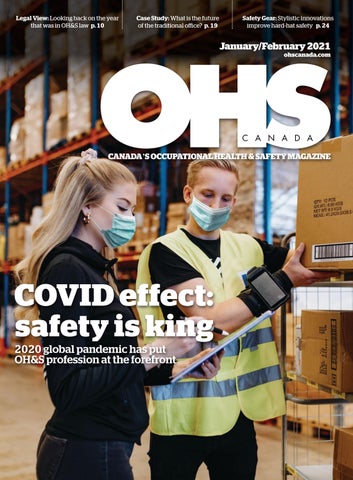
COVID effect: safety is king
2020 global pandemic has put OH&S profession at the forefront
By Jack Burton
It may finally be a new year, but the overwhelming changes that 2020 brought to everyday life are here to stay — at least for some time longer.
Though the list of what has been fundamentally changed by the COVID-19 pandemic grows each day, the workplace is certainly near the top.
Whether employees suddenly find themselves working from home, or from behind Plexiglas, the workplace transformations across nearly every industry have all occurred out of an increased need to focus on health and safety.
It follows then, that the occupational health and safety industry finds itself in a position that’s
unique, unprecedented, but most of all, unexpected.
The increased focus on health and safety has been so major that even industry professionals couldn’t have entirely anticipated it.
“A year ago, I’d have laughed at people who said ‘I predict the surgeon general of the United States is going to come on YouTube and show you how to cut a T-shirt into a mask,’” said Wagish Yajaman, manager of specialty services at Workplace Safety and Prevention Services in Mississauga, Ont.
No matter how outlandish the idea of a government-mandated mask tutorial may have seemed just 12 months ago, Yajaman sees it as a prime example of finding “what’s achievable and available in protecting people” — a philosophy that OH&S professionals have been bringing into workplaces since the first wave of COVID-19.
Infectious disease control
“The days in which it was believed ‘that safety is just common sense’ and ‘anybody can do safety’ are over.”
pandemic, where workplaces can no longer overlook the beneficial intricacies of occupational health and safety, especially regarding infection and source control.
“I think that there’s simply a lot of workplaces where infectious disease control hasn’t necessarily been thought of in the past,” said Ian Culbert, executive director of the Canadian Public Health Association in Ottawa.
Among these affected workplaces, Culbert highlights “any workplace that was marginal to begin with”—such as the meat-packing industry — as occupational environments that “became the perfect breeding ground for COVID.”
It’s these workplaces — and the outbreaks that their safety shortcomings have led to — that have, according to Culbert, “put a spotlight on those potential problem areas during normal times, because they’re even more significant problem areas during COVID.”
OH&S at the forefront
The unanticipated ease and volatility with which these workplace outbreaks occurred illustrate that not only are the safety needs of the workplace changing, but with it, the importance and demand of the OH&S professionals who help create that safety.
Much of the industry in 2020 has been informed by a set of circumstances created by the current Whether employees suddenly find themselves working from home or from behind Plexiglas, the workplace transformations across nearly every industry have all occurred out of an increased need to focus on health and safety.
– David Johnston, BCRSP
“The days in which it was believed ‘that safety is just common sense’ and ‘anybody can do safety’ are over,” said David Johnston, president and CEO of the Board of the Canadian Registered Safety Professionals in Mississauga, Ont.
“I don’t foresee the roles and responsibilities of OH&S pros changing as much as I see more employers begin to recognize that OH&S is, in fact, a profession… supported by specialized education, knowledge, skills and credentialing, similar to other professions such as lawyers, engineers (and) accountants,” he said.
While the circumstances of the pandemic are certainly negative, the increased need for the skill sets of OH&S professionals across workplaces has been a positive for the industry at large.
From Johnston: “What I hear from many other OH&S professionals is that they found them -
selves very much in demand and at the forefront of protecting workers and responding to the many unknown and changing risks presented by COVID-19.”
This elevated demand for the unique solutions of workplace health and safety professionals under the pandemic is an occasion Johnston believes the industry has certainly risen to.
“While we have heard of some workplaces having COVID-19 outbreaks, I have yet to hear of an organization that employs a credentialed OH&S pro in a leadership position that had an outbreak,” he said. “It just doesn’t happen.”
The essential role that the occu-
pational health and safety industry has played in the COVID crisis through 2020 hasn’t just created safer workplaces. Johnston also believes that safety successes indicate the increased demand for OH&S won’t be dissipating anytime soon.
“Now that the value of an OH&S pro has been made manifest,” he said, “the demand for qualified and competent OH&S pros has increased substantially and I believe this trend will continue.”
Focus on safety impacts workforces
To what degree, exactly, has the industry made its value and
While the circumstances of the pandemic are certainly negative, the increased need for the skillsets of OH&S professionals it has created across workplaces has been a positive for the industry at large.
purpose evident throughout 2020 and the pandemic?
The Institute for Work & Health (IWH) in Toronto conducted a number of studies measuring the various avenues where an increased focus on occupational health and safety has impacted overall workforces — and the results are evidently positive.
IWH president and senior scientist Cameron Mustard said that in the second wave, essential service industries, excluding health care, saw a six per cent infection rate.
Mustard credited this figure with “the often-substantial adjustments to work practices implemented by employers, often developed in consultation with workers.”
IWH also found that an emphasis on occupational health and safety during the COVID-19 pandemic promotes positive mental health amongst workforces.
One study surveyed more than 10,000 workers over the first wave
of the pandemic, with Mustard describing that “on-site workers who felt they had access to the safety equipment and protocols needed to protect them from COVID-19 were the least likely to report symptoms of anxiety and depression.”
In contrast, on-site workers who felt none of their COVID safety needs were in place were most likely to report mental health symptoms, with Mustard claiming their distress to exceed even the demographic of “those who were working at the start of the emergency, but had since lost their jobs.”
Rapid state of change
While the chaos of COVID has provided the occupational health and safety industry with a number of opportunities to further optimize workplace safety, that very same chaos has also created an en-
vironment where the available information and protocols change on a near-daily basis.
“What was talked about at the beginning of the pandemic, the middle of the pandemic, and now, has evolved,” said Yajaman. “So how do you now not confuse people with what’s being provided in policy and government direction?”
The answer to that question seems to rely on three pillars, according to Yajaman — speed, accuracy and timeliness.
“Those are basically the three terms that, whenever something arises, we look at,” he said. “It has to be fast, it has to be accurate, and it has to be done in a timely basis so that people have better information to reduce confusion and provide a better understanding of the issue.”
Fulfilling all three of those qualities isn’t something that needs to be achieved by workplace safety professionals alone.
In fact, Yajaman sees pandemic-necessitated collaboration between industries as one of the more significant positive changes the health and safety world underwent in 2020.
“This classical thinking that, ‘Oh, health and safety, it belongs with this group of people, under this jurisdiction, under this ministry,’” he said. ”Suddenly it’s like, wait a second — maybe not?”
The shift into this new paradigm of collaborative networks between industries is filled with possibility.
“Instead of finding differences, now we’re looking at commonalities, and how we can share information, how we can all benefit from it, rather than looking at what would belong on what side of the line,” said Yajaman.
“I think (the pandemic) has destroyed all of that, and I hope it doesn’t get rebuilt.”
What is the future of the traditional office?
Safety will be at the forefront of future business decisions, experts say
By Meagan Gillmore
Flexible plans and a firm understanding of what workers require to do their jobs well are key to making in-person office work succeed throughout the remainder of the COVID-19 pandemic and beyond.
Offices are not dead, said David Zweig, an organizational behaviour professor at the University of Toronto.
Workers “might not be 100 per cent back to the office,” he said. “But I think there is going to be a push to have much more presence in the office than what we currently have, or can have now.”
Working from home has not resulted in the massive decreases in productivity that many managers feared, but some workers find it difficult to collaborate with colleagues while working remotely. This means office spaces need to accommodate in-person individual and group work.
Darren Fleming, CEO and broker of record at Real Strategy, a commercial real estate consulting firm in Ottawa, said offices may need to reduce their space — perhaps by 25 per cent — but there’s still a significant number of workers who would like to work from
the office for at least part of the week, alongside those who are unable to work from home.
“We anticipate that there will be some peak times, rather business or social, that people need to be in the office,” he said.
Preparing for sudden changes
The pandemic has drastically increased the pace of change for occupational health and safety, said Andrea Jacob, an occupational health and safety specialist with the Canadian Centre for Occupational
Health and Safety in Hamilton, Ont.
Typically, companies have several months to update their policies and practices before a regulatory change, she said. Throughout the pandemic, government orders and advice has changed swiftly, with little notice.
“The pace of change is just a major change itself,” said Jacob. Some jurisdictions require companies to have specific health and safety plans for COVID-19.
“A good thing to incorporate into that control plan is daily checks for
“Instead of annual health and safety training, workers might need weekly or daily updates or reminders.”
– Andrea Jacob, CCOHS
your jurisdiction to see if any changes have been made.”
Regional classifications can impact how offices operate, and workplace leaders should also stay up to date on industry specific regulations. Some health-care workers, for example, work in offices, Jacob pointed out.
Employers will need to communicate with employees regularly about occupational health and safety — even those who are working from home.
“Instead of annual health and safety training, workers might need weekly or daily updates or reminders,” said Jacob. “The pace of that has definitely increased. Employees and clients need to stay informed about what the current requirements and safety precautions are.”
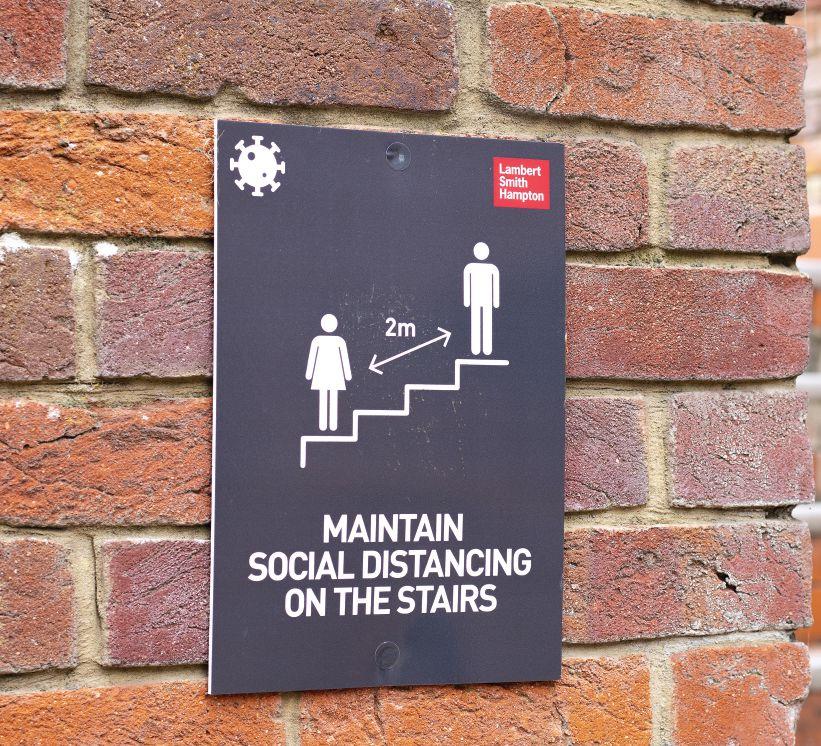
These precautions could include adjusting schedules so offices don’t get too full; having employees work in cohorts; and directing traffic within the office — for example, designated one stairwell for walking upstairs and another for going downstairs, she said.
Companies need to have a plan about how to respond to changes in their organization. This means “managing change carefully, instead of just jumping into a choice,” said Jacob.
Potential hazards and benefits of actions need to be considered.
For example, the pandemic has increased the amount of cleaning required at offices. But not all
cleaning products are the same.
Part of managing the change in cleaning frequency is considering if fragrances or dyes in some products could be harmful to workers, said Jacob.
Rethinking office space
Office layout and furniture need to be re-evaluated as businesses ad-
just to not having all employees at the office for a standard 40-hour workweek.
Staggered schedules could result in smaller office spaces with more shared workstations. However, Zweig predicts there will be a “reckoning” with the trend of open-concept offices.
“That’s not a good approach,” he said, noting it can make it harder for teams to meet, and sometimes for workers to find a place to sit that’s conducive to the tasks they need to complete. It also isn’t very suitable to a pandemic.
Workspace layout “isn’t a one-sizefits-all” solution, said Zweig, noting that when it comes to offices, business leaders should consider adopting an “activity-based work” mindset.
In this model, physical spaces
become a “palette of resources” that workers can take to do their tasks. Offices should have a number of rooms that can be used for both team meetings and personal offices, according to Fleming.
And because meetings will likely have fewer people, these spaces can be smaller and used for individual offices when there are no meetings, he said.
“The social contract between the employee and the employer is going to change a little bit,” said Fleming. “Before, when your boss expected you to be there from 8:30 to 4:30, there was a lot more reason for the employee to expect that his or her seat was going to be dedicated to them.”
“Once you get two or three days a week when you work from home,
Re-evaluating office space
New health and safety precautions could include designating one stairwell for walking upstairs and another for going downstairs.
then it’s not going to make any sense.”
Companies should invest in furniture that can be moved easily — such as wheeled tables or sitting areas that can be quickly reconfigured — or can change to meet the needs of different workers, like desks with adjustable heights. There should be plenty of space for mobile devices, and meeting rooms should be equipped to accommodate workers who attend meetings via videoconferencing, he said.
Purchasing new furniture may be a significant expense at the beginning, said Fleming, but if companies downsize their office space, the amount they save in rent could balance out the cost.
People management
Alongside all of this, managers need to be careful to manage employees’ expectations and general happiness.
People are naturally territorial, said Zweig. “Once we have a space, in our mind it’s our space… We do things to make sure we (keep) that space our own.”
Some workers may become unhappy if they notice their colleagues have designated spaces to work, and they don’t, he said.
For shared environments to work, everyone needs to take ownership of tasks like cleaning, said Fleming.
“In a shared space, the onus has got to be on the person leaving the space, as well as the person sitting down, to clean everything.”
If there are constant struggles about who will wash the dishes in the sink or empty the dishwasher, then a workforce likely isn’t ready for a shared work environment, he said.
They may also need a worker designated to make sure cultural standards are being maintained, similar to the way librarians make
sure everyone can use a library the way they need, said Fleming.
“There is somebody with organizational authority who is there to enforce the cultural behaviour,” he said, noting that specific person needs to have enough seniority that they’re confident reminding senior staff of the company policies.
Regardless of approach, employers and managers need to remember workers’ needs. Remote work showed the need to be flexible with workers and not to base productivity solely on the amount of time workers are in front of their computer screens.
“We have to change the performance metrics,” said Zweig. “We should be looking at: Are they getting things done? Are they performing well? Are they meeting deadlines? That should be the performance criteria, not if they’re sitting at a computer for eight hours straight. Hopefully with this experience, there’ll be more acceptance of that.”
Fleming cautioned companies against making sweeping generalizations about what workers will want. Employee engagement and consultation is critical before making changes.
“With any human population, you can’t just unilaterally say, ‘This is the new way that we’re going to do everything,’ and find that everyone will be universally pleased,” he said.
Making a change mandatory — especially without asking employees for feedback — can often increase employee stress, or cause them to leave, said Fleming.
Those in decision-making positions are encouraged to “have a discussion and find out who (workers) are as individuals and what their needs are as individuals.”
Meagan Gillmore is a freelance writer in Toronto.
Federal supports through COVID-19: Did they work?
Navigating relief for businesses during a pandemic – and beyond
By Meagan Gillmore
Federal government relief programs for businesses hard hit by the COVID-19 pandemic — while uneven at times — could prepare the way for future workplace supports.
Job losses have dominated the news cycle, along with infection numbers. Ottawa addressed the job shortage in the government’s Nov. 30 fall fiscal statement.
“The economic shock of the COVID-19 pandemic caused Canada’s working-age employment rate to go from record highs to record lows in a matter of weeks,” Finance Minister Chrystia Freeland said.
Her speech also called the “sudden economic contraction” the greatest since the Great Depression, with more than 30 per cent of the workforce losing their jobs entirely or having their hours significantly reduced.
“About 4.4 million Canadians (have regained) their job or lost hours as of October,” she said. “Still, 636,000 jobs still hadn’t recovered by October and 433,000 workers had less than half the hours they worked before the pandemic. And more Canadians could lose work because of the resurgence of COVID-19.”
Freeland’s address further acknowledged how re-entry into the workforce will become more difficult over time, noting the added challenges women, young workers and racialized workers face.
Small business running on ‘fumes’
Renewed restrictions during the 2020 holiday season, a time many businesses count on to help them balance their books, left many organizations — especially smaller-to medium-sized ones — running on “fumes,” said Dan Kelly, president of the Canadian Federation of Independent Business (CFIB).
“A strong wind could blow down some of these businesses, so locking them down a second time will be enough to kill them,” he said.
Even businesses that remain open have seen a drop in business because more people are following
Rethinking support
The pandemic may change how governments view providing sick days and financial supports for family caregivers.
health orders and staying home, said Kelly.
People won’t shop in stores if they’re worried about their health, said Karl Littler, senior vice-president of public affairs at the Retail Council of Canada.
“Public confidence not only in the economic circumstances, but also in the health-care environment, is pretty critical.”
Assessing federal supports
Littler called the Canadian Emergency Wage Subsidy (CEWS), under which eligible businesses receive money to use for their employees’ salaries, “the crown jewel” of the federal relief benefits for businesses.
According to the federal government, a quarter of private-sector workers benefited from the program in August, with most applications coming from businesses with 25 employees or less.
“It’s unfortunate that it took COVID to really bring to light the challenges that many workers face.” – Hassan Yussuff, CLC
In November, the government announced it was extending the CEWS until June 2021. The maximum subsidy will be 75 per cent from Dec. 20 to March 13. Businesses receive different amounts of assistance, depending on how much revenue they’ve lost.
Other relief efforts didn’t receive as much praise. The Canadian Emergency Commercial Rent Assistance (CECRA) program, which helped businesses pay rent, was a “complete disaster,” said Kelly.
Only landlords could apply; many didn’t. It’s successor, the Canada Emergency Rent Subsidy (CERS) allowed tenants to apply directly and expanded which businesses are eligible. In addition, businesses who have been negatively impacted by public health orders can receive another 25 per cent in rent support from the Lockdown Support program.
The government promised in November to keep the CERS and Lockdown Support running until June 2021.
“The initial round of programs were a very blunt instrument,” said Littler, calling some of the thresholds or ceilings for receiving support “unfair and seemingly unequitable.”
“The new ones are a lot more rational even if they’re somewhat less generous,” he said. “They’ve gotten better at designing their programs in the 2.0 version.”
Re-imagining support for workers
The pandemic may yet change how governments view providing sick days and financial supports for family caregivers.
The Canadian Recovery Sickness Benefit (CRSB) provides $500 weekly for eligible workers who lose at least half of their scheduled work because they have or might have COVID-19, are self-isolating because of COVID-19, or have an underlying health condition that
increases their risk of contracting COVID-19.
Support lasts for a maximum of two workweeks.
“It’s unfortunate that it took COVID to really bring to light the challenges that many workers face on a day-to-day basis,” says Hassan Yussuff, president of the Canadian Labour Congress (CLC).
“Across the country, this has been a real vacuum on the policy front, because many jurisdictions don’t have clear legislated legal protection for workers to get sick days from their employer,” he said.
This means many work while sick, possibly infecting their colleagues. “If you’re not able to bargain for it, you don’t have access to it.”
Workers cannot receive paid leave from their employer for this same time.
Reconfiguring sick leave, EI
David Macdonald, senior economist at the Canadian Centre for Policy Alternatives, called the benefit the “best worst solution to sick leave in Canada.”
Businesses may decline to provide their employees with paid sick days if they know the federal government has this, he said. “However, it does put this idea of a more general sick leave on the table in Canada. And that is a piece that might survive (after the pandemic).”
The Canada Recovery Care Benefit (CRCB) might open the door to people receiving employment insurance (EI) even if they quit their jobs, said Macdonald.
Under the benefit, eligible workers can receive $500 a week for up to 26 weeks before Sept. 25, 2021, if they can’t work because their children under the age of 12 or family member who needs supervised care is sick or self-isolating because of COVID-19, or if their school or regular programs have been cancelled due to COVID-19.
“EI is based on the premise that you can’t quit — if you quit, you get no EI,” said Macdonald, noting people are often “forced” to stay in bad jobs because they don’t receive support if they choose to leave.
“With the caregiver benefit, you can quit, as long as it’s related to a closure of school or daycare. It does open up the door a little bit,” he said.
“It should be a legislated requirement for employers to provide flexibility for people to have a leave for family care,” added Yussuff, noting he hopes governments address this after the pandemic.
Once this benefit ends, workers will be “back into a place where workers will be in extreme hardship if they have to take time off and they’re not compensated if they’re sick or have to take care of a loved one,” he said.
Employer-provided reliefs
Some of the most effective relief for workers may not come from governments, but from employers themselves.
“There’s no new trends that have started because of COVID,” said Leah Nord, senior director of workforce strategies and inclusive growth at the Canadian Chamber of Commerce. “COVID has accelerated them — work from home, upskilling or re-skilling.”
Providing flexible work hours for people when they’re working from home is one way to help workers take care of their family and work responsibilities, she said, noting this can especially benefit women who often do more household labour.
“You have to maintain business operations,” Nord said, while acknowledging the responsibilities workers have beyond their jobs is crucial.
Retaining workers is a key way that businesses can prepare for a rebound.
“Try to hang onto as much of your talent as you can,” said Kelly.
“COVID will end, and if you’ve gutted your workplace and you’ve lost all of your talent, it’s going to be way harder for you to bounce back quickly.”
Meagan Gillmore is a freelance writer in Toronto.
Safety Gear
By Meagan Gillmore
Head safety meets style
Recent style innovations for hard hats have also improved workers’ safety.
“Before, a hard hat was a hard hat — there wasn’t a lot to be done with it,” according to Brandon Griffin, national sales director for MSA in Canada.
With the company for 15 years, Griffin said in the past year, there’s been a considerable increase in different styles and a desire to make sure the hard hat is the most appropriate for the job and the worker.
“ We’re really seeing a big trend of people not just ordering a hard hat for all the different variations in their facility; they’re buying the right helmet or the right hat for the job,” he said.
The increased popularity of comfortable styles in head protection means workers are also more likely to wear their PPE, said Stephanie Rudolph, application engineer with 3M Canada.
“In order to ensure that workers are being properly protected, we want to make sure that they’re actually wearing their head protection,” she said. “Making sure that it actually fits them comfortably will increase (those) chances.”
From hard hats to helmets
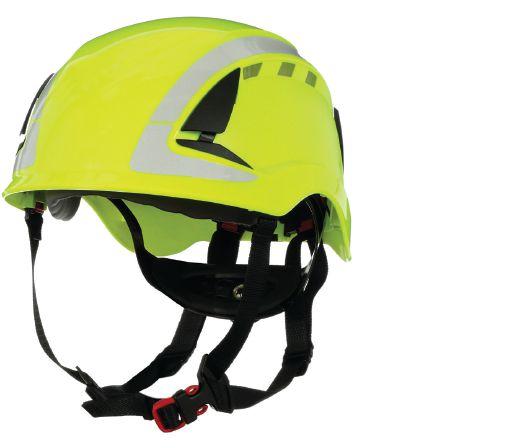
3M will launch its SecureFit Safety Helmet X5000 Series helmet in Canada in the first quarter of 2021. The climbing style helmet is made with patented pressure diffusion technology in the suspension, said Rudolph.
T his technology allows the suspension to adjust to the wearer’s head, reducing pressure along the front and increasing comfort.
The helmet also has a chin strap, which increases its stability and security.
MSA has launched its own climbing style helmets.
Climbing helmets are good “for working at heights, or working in confined spaces, or working in any of those areas
where you would have the potential of a hard hat leaving your head,” said Griffin.
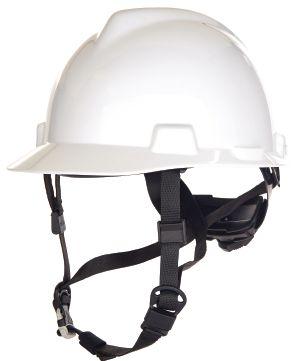
“V-Gard H1 is definitely a very exciting product for us,” he said. The helmet comes with accessories for hearing protection and face protection. It also has a chin strap.
Griffin said there’s been a greater interest in North America for chin straps.
“ That’s where, in my opinion, someone’s starting to take what was a conventional construction hard hat and turning it into a helmet,” he said.
MSA sells chin straps separately from hard hats “to help people take that conventional hard hat and use it in different or potentially more practical ways.”
Increased visibility
There’s also an increase in the colours for hard hats and helmets.
Many customers want head protection with high-visibility colours, such as orange or yellow, said Griffin.
3M makes some hard hats with reflective strips applied in strategic places, and also sells the straps separately so customers can apply them on their own.
This “draws more attention to make sure that the person’s head is visible, as well as the rest of their body,” said Rudolph.
Colours aren’t just used for safety and style — some organizations design their helmets for branding or communication, added Griffin.
Designs range from “organizations that will put the logo on the front and standard safety slogans on the back, which is very, very powerful,” he said.
“ We saw some additions of COVID logos reminding people of distancing, washing their hands.”
The pandemic has influenced the design of hard hats or helmets in other ways, too.
Workers across industries need to be able to wear hard hats or helmets and masks or face shields at the same time.
“Face and eye protection has become a big thing in areas where maybe you wouldn’t have seen it in the past,” said Griffin.
“ We’ve always had visors, we’ve always had attachments to our hard hats that people could wear for impact protection
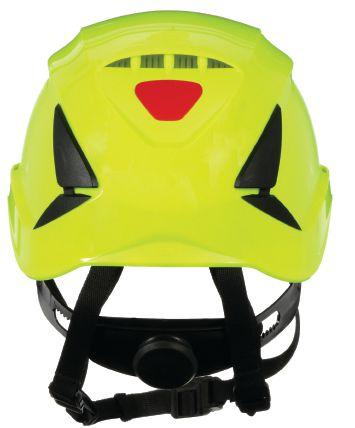
3M makes hard hats and helmets with built-in red patches that fade to white the more they are exposed to UV radiation. When the patch on the SecureFit helmet (pictured) turns white, the shell needs to be replaced.
in the field… During COVID, we came out with frameless barriers: you didn’t need the frame and all the other attachments to put it on.”
MSA also has easy-install frames created specifically for V-Gard hats, he said.
Many manufacturers have face shields that attach to hard hats and helmets.
The increased use of face shields and masks has made the need for equipment compatibility between products “more and more evident,” said Rudolph.
Rudolph and Griffin both said that they can’t guarantee that products from different companies will work together properly. Having products that fit with each other can increase safety and ensure consistency, Griffin acknowledged.
Powered air purifier respirators
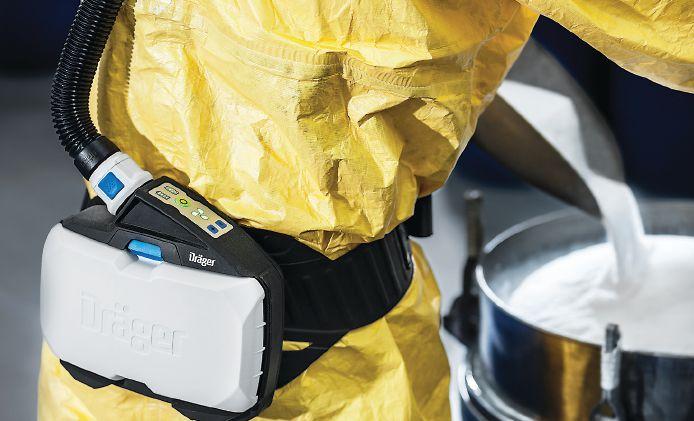
Draeger Safety Canada Ltd. manufactures respirator headsets called powered air purifier respirators (PAPRs) that come attached to hoods or helmets.
“ The PAPR does all the work of filtering out the contaminants and then providing the filtered air within the helmet or the hood set,” explained Zohaib Khan, product manager for respiratory equipment at Draeger.
The company’s X-plore 8000 comes in two options — a respirator attached to a hood or a respirator attached to a helmet.
The hood can fit over other helmets and hard hats, as well as religious head coverings. The hoods are not tested for ANSI standards for head protection; however, the helmets used in X-plore 8000 do meet ANSI standards for head protection.
“Concern about head protection is always there,” said Khan. “Now, because of COVID, we have the added concern of filtering out particles that can potentially have COVID bacteria in them. More and more customers are moving from N95 masks towards PAPR because it provides them with the helmet along with the PAPR or the blower unit itself. It’s more efficient.”
Cleaning, maintenance
The pandemic has emphasized the importance of cleaning personal protective equipment regularly.
D irt needs to be removed before disinfections are applied, said Rudolph, noting that suspensions must be cleaned, as well as hats or helmet shells.
R udolph recommends water-based bleach products that have a chlorine concentration of 0.5 per cent or isopropyl alcohol-based cleaning products that have a concentration of 60 to 70 per cent. Heath authorities can give more specific guidance about which products to use
E quipment should be carefully and thoroughly inspected after each use to see
if there’s any potential hazards, like fraying or loose stitching in suspensions. If a hard hat or helmet has become discoloured, that may be a sign that the hard hat or helmet has been exposed to too much UV radiation. This could cause it to become brittle and, as a result, offer less protection, said Rudolph.
3M makes hard hats and helmets with built-in red patches at the back that fade to white the more they are exposed to UV radiation. When the patch becomes white, the shell needs to be replaced. (The SecureFit helmet has a UV patch.)
Products need to fit the users correctly, and regular inspections are a key time to ensure proper fit and comfort.
“Everything we talk about goes back to getting the right hat for the job,” said Griffin.
M SA has standard-sized, small and large shells which fit different suspensions. “ The suspensions are ultimately carrying the majority of the weight from a safety standpoint, he said.
“Ensuring that that suspension is properly fitting on your head, ensuring that you have the proper spacing between the shell and the suspension if you ever do take an impact, is very, very important,” said Griffin. “The fact that we can accommodate a small and a large shell is very important.”
Draeger’s X-plore 8000 is available in two options — the powered air purifier respirator (PAPR) can attach to a hood or a helmet.
Meagan Gillmore is a freelance writer in Toronto.
MSA sells chin straps separately from hard hats “to help people take that conventional hard hat and use it in different or potentially more practical ways.”
CCOHS Corner
The Canadian Centre for Occupational Health and Safety
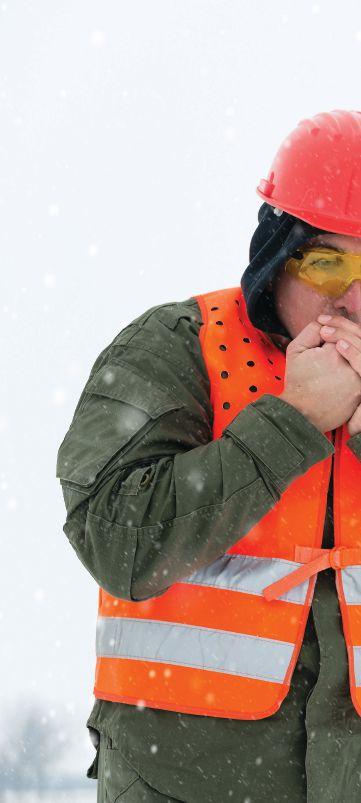
Protecting outdoor workers from winter hazards
The mornings are frosty, and the afternoon air doesn’t just nip at your nose, it seems to bite at it (along with any exposed skin, for that matter).
As the sun goes down, the evenings get even colder, and act as a reminder that while the days are short, the season is long.
Are your workers prepared for winter weather?
According to the Government of Canada, more than 80 people in Canada die each year from over-exposure to the cold, and many more suffer injuries resulting from trench foot, immersion foot, hypothermia, frostnip and frostbite.
That’s why it’s important to keep workers safe from the hazards of the cold — including the hazards we can’t visibly see.
C onsider wind chill, for example. Described as the cooling sensation caused by the combined effect of wind and temperature, wind chill increases the rate that the body loses heat.
T hink of those times when you’ve been outdoors in the winter on a sunny yet blustery day.
W hile the sunshine can make your body feel up to 10 degrees warmer, the wind can take away your body’s protective boundary layer (a thin layer of air close to the skin that the body uses to keep itself warm).
Once taken away, the body uses up more energy to protect itself
with another boundary layer, but as the wind keeps blowing it away, the skin temperature drops, and we feel colder.
To work safely, these challenges have to be counterbalanced by proper insulation, like layered protective clothing and by physical activity.
Managers can also control workers’ exposure to the cold with a work/rest schedule.
When it comes to working conditions like wind chill and extreme temperatures, prevention is key — if a worker must be outdoors, consider the following tips to keep them safe.
Dress in layers
Layers are important for a variety of reasons. Wearing good quality clothing with high insulating properties will help trap air to create a warm boundary layer around the body.
In addition, having several layers gives you the option to open or remove a layer if it gets wet or you become too warm.
Properly layering your clothing will help you stay warm and dry. Each outer layer should be larger than the inner layer, which prevents the outer layer from compressing the inner layers and decreasing the insulation properties of the clothing.
The inner layers should be able to wick moisture away from the skin to help keep it dry. Look for materials like polyester or polypropylene, which can be found in
pieces like thermal underwear. A ny additional layers should provide enough insulation for the weather conditions.
For example, look for a jacket with the ability to close off and open up at the waist, neck and wrists, and venting abilities in the underarm area. This helps to control how much heat is retained or given off.
Hats on (even with hard hat)
A large portion of body heat is lost from the head, and ears are a common location for frostbite or frostnip if exposed.
Wearing a hat is important for workers to keep warm, and there are many types available.
If a worker is required to wear a hard hat, ensure they have an appropriate winter liner and the headband is readjusted to protect the worker.
Frigid lows, but toasty toes
Feet can be one of the first body parts to feel the impact of cold
weather. Wearing the right sock, or the right combination of socks, can help feet stay dry and warm.
Consider wearing a pair of thick socks that will help insulate the foot. Or, if two socks are preferred, consider layering with a moisture-wicking inner layer, and a thicker outer sock for insulation.
Once the socks become damp, their insulation properties begin to decrease.
Wearing boots on the job? Pair your boots with the appropriate thickness of socks.
If the socks are too thick, the boots may be too tight, squeezing the foot, leading to decreased blood flow and losing the insulating properties of the sock.
If the socks are too thin, the boots will fit loosely and may lead to blisters.
Prepare and check-in
Before going outdoors, it’s important that workers are ready for their assigned work and the weather conditions.
Winter tip
Encourage workers to bring an extra pair of socks with them to work. This will allow them to change socks if their feet get damp or wet.
Make sure that workers are warmed up with the proper attire and encourage them to stretch to help prevent the risk of injury from cold muscles.
Regularly check in with workers to see how they are feeling, and if and how they are being impacted by the temperature.
To support workers, employers can adjust the pace or rate of work if needed, and provide instructions for re-warming, dressing properly for the weather, and what to do at the first sign of injuries like cold stress, frostbite and hypothermia.
What to do about the ‘what ifs’
If a worker is out in the cold for too long or is not adequately protected from the elements, he may be at risk for mild to severe injuries or conditions like frostbite or hypothermia.
Typically occurring on the fingertips, toes, nose, ears, cheeks, and chin, frostbitten skin can appear white and waxy, and leaves the
area feeling numb. If a worker has frostbite, seek medical help right away.
Don’t rub or massage the area, and don’t warm the area until you can ensure it will stay warm. Remove any wet clothing and replace with dry clothing or blankets to warm the person slowly, avoiding direct heat to the affected area, which may burn the skin.
If a worker has been in the intense cold without adequate protective clothing, their body’s core temperature starts to fall. The sensation of cold followed by pain in exposed parts of the body is one of the first signs of hypothermia. Seek medical attention immediately if you suspect a worker is showing signs and symptoms of hypothermia, like the interruption of shivering, diminished consciousness and dilated pupils. Those suffering from hypothermia may not be able to notice their own symptoms.
Stay safe throughout the season
No matter the season or the temperature, safety comes first.
Employers should always monitor the conditions and take every reasonable precaution to protect the health and safety of their employees. It’s not just the law; it’s the right thing to do.
When it comes to the cold, implementing a work/warm-up regimen, scheduling outdoor work for warmer days, and providing annual refresher training on the signs and symptoms of cold-related illness will help outdoor workers stay healthy and safe on the job.
The Canadian Centre for Occupational Health and Safety (CCOHS) promotes the total well-being — physical, psychosocial and mental health — of workers in Canada by providing information, advice, education, management systems and solutions that support the prevention of injury and illness.
Showcasing the latest OH&S products available in Canada. Email mvanderwier@ohscanada.com to have your product listed.
PIP tethers secure tools, prevent dangerous drops
Dropped objects when working at heights are no joke.
Hold gravity accountable with PIP Canada‘s new line of tool lanyards, tool connector attachment points and tool tethering accessories that meet ANSI/ISEA 121 standards and help ensure that a simple slip doesn’t result in serious injury to co-workers or innocent bystanders, nor damage to equipment or tool loss.
These products are designed to securely attach to tools to help prevent dangerous drops while providing the user with freedom of mobility and unimpeded functionality of the tool.
Rousseau motorized platform moves heavy loads safely
The R-Go Motorized Platform by Rousseau Metal Inc. provides opportunity for safe and effortless transportation of heavy loads.
Ergonomic and safe, it can reduce musculoskeletal disorders (MSD) and help to retain employees by improving their well-being at work.
It includes anchoring zones for installing an existing R cabinet or other types of equipment.
Made in Canada, this product can climb slopes of up to six degrees. It’s motor runs for 20 kilometres on battery.
Lightweight Honeywell gear protects workers from arc flash
Honeywell has announced a new line of next-generation arc flash garments for electricians, utility workers and engineers to wear when working in commercial, industrial and utility environments.
The Pro-Wear Plus gear from Honeywell Salisbury provides workers with improved fit, breathability, moisture management and comfort when working in challenging environments.
The new professional-grade gear features lightweight design, soft fabrics and optimal fit that incorporated end-user feedback.
The PPE is offered in 8-100 Cal/cm2 ratings, which can be purchased separately or as part of a kit. The 40 Cal/cm2 premium garments feature an exclusive design and are light and breathable.
Comfort reigns in Tingley’s new Flite shoes
The Flite Safety Toe Work Shoe by Tingley Rubber is noted for its comfort.
The footwear is lightweight, self-insulating, chemical resistant and liquid proof — and the composite safety toe won’t set off metal detectors.
Cleated outsoles spit out debris for slip resistance, and the shoes hold superior grip on dry or wet surfaces — indoors or out.
Alongside all-day comfort, the shoes feature: no laces to contaminate or cause tripping risk; easy donning thumb pockets and heel kick for hands-free doffing; and cushioned insoles that absorb shock and wick moisture.
Pure Safety Group introduces Guardian Retractable HLL
Pure Safety Group has introduced the Guardian Retractable HLL (horizontal lifeline). Available in North America, the HLL is for use in either fall arrest or fall restraint applications.
During a fall, the lifeline will deploy an extending metal energy absorber designed to reduce peak loads to anchorage structures. The new HLL can also be used as part of a fall restraint system, which prevents the worker from reaching the leading edge of a fall hazard.
The main component of the HLL is a 60-foot galvanized cable horizontal lifeline, which is extremely durable yet portable, and designed for temporary use. When it has been involved in a fall, its energy absorber clearly indicates that to the user.
Also of note: a single-direction tensioner handle that prevents accidental releases and folds down to lay flat along the unit, secured by a magnet to prevent work interference, and handy carry handle.
HEMCO acid cabinet stores corrosive chemicals
HEMCO‘s acid storage cabinet is specifically designed for the storage of corrosive chemicals.
The moulded one-piece Fiberglas liner inserts directly in the cabinet and is sealed on all edges for ease of cleaning. Interior features include a containment lip on the front bottom edge to hold spills.
The front access doors have air inlet vents, are lined, and the edges are sealed. The shelf is removable for larger container storage. No metal is exposed to corrosive vapours.
MSA’s V-EDGE PFL allows for unhindered work at heights
Designed specifically for leading edge and foot-level tie off, MSA’s V-EDGE PFL (personal fall limiter) allows employees to work comfortably and unhindered with it’s low-profile case and energy absorber design.
This PFL connects quickly and easily to a full-body harness. The leading-edge cable is engineered for use in overhead and foot-level tie-off points, and where hazards are a concern.
With a stainless-steel housing built to last in the toughest environments, this PFL can help save time and money on costly replacements.
Plantiga partners to build AIpowered occupational footwear
Plantiga Technologies, an AI-powered human movement intelligence company in Vancouver, has announced a product development partnership with Original Footwear, a manufacturer of occupational and tactical footwear for military, law enforcement and first responders.
Under the collaboration, Plantiga’s in-sole sensors that detect and quantify changes to functional movement patterns will be integrated into Original Footwear designs.
“This partnership will advance the operationalization of real-world kinetic data and improve our injury prediction models while accelerating time-to-recovery for users,” said Quin Sandler, founder and CEO of Plantiga.
Magid neck gaiters prevent germ spread
Neck gaiters by Magid can keep workers safe and comfortable while restrictions are in place due to COVID-19.
“Many employers struggle with mask compliance due to comfort issues and fogging safety glasses, especially in hot environments,” said Sarah Anderson, director of product management at Magid.
Recent advances in cooling fabric technology have produced gaiters, towels and other garments that cool down as low as 30 degrees below body temperature in less than a minute when activated with water.
Magid’s neck gaiters keep workers comfortable and cool and can be worn as a single, double, or even triple layer over the nose and mouth.
Zoneworks unveils employee separation barriers
Zoneworks by Rite-Hite has developed EZ Employee Separation Barriers for workers who cannot socially distance more than six feet.
There are two basic types of these customizable barriers — a floor-unit model and a table-top unit.
The durable free-standing workstation partitions separate employees who work next to each other on a plant floor or in an office setting. Each separation panel is made from clear PVC, which is framed by a black, powder-coated tube and attached to a one-inch welded steel-tube base for stability.
Time Out
Acrobats hurt in circus accident reach $52.5M settlement
(AP) — Eight acrobats severely injured when the rigging suspending them by their hair plummeted to the floor during a circus performance in Rhode Island in 2014 have reached a US$52.5 million settlement with the ownership and management of the arena where the circus was held, their lawyer confirmed Dec. 21.
A metal clip that held the acrobats six metres above the floor snapped, causing the women to suffer broken bones and spinal injuries.
Police officer one of five dead following U.S. Capitol riot
(AP) — A police officer has died from injuries sustained as President Donald Trump’s supporters stormed the U.S. Capitol on Jan. 6.
A statement from police said that officer Brian Sicknick was injured “while physically engaging with protesters” during the riot. He is the fifth person to die because of the melee.
Three top Capitol security officials have resigned over their failure to stop the shocking breach.
Police chief condemns conduct of officer who ticketed driver questioning mask use
(CP) — Winnipeg police chief Danny Smyth said an officer who gave a ticket to a couple who questioned why he wasn’t wearing a mask during a traffic stop acted inappropriately.
One-third of Ontarians not following COVID-19 guidelines
In announcing the second state of emergency during the COVID-19 pandemic, Ontario Premier Doug Ford said one-third of citizens continue to ignore public health advice. A stay-at-home order was issued Jan. 14.
On Dec. 8, a woman who was a passenger in the vehicle recorded a video while the officer gave the driver a warning about the infraction.
“I just have a question,” the woman asks in the video posted on social media. “Why are you not wearing a mask and you are yelling? That’s not good. That’s not safe.”
In the video, the officer says he’s not within six feet of the couple and is standing outside. The officer proceeded to give the driver a $298 ticket.
Minks test positive for COVID-19 on B.C.
farm where workers sick
(CP) — A COVID-19 outbreak at a British Columbia mink farm likely spread from eight workers to some of the animals, says the province’s chief veterinarian.
Test results from five mink samples taken from a farm in Fraser Valley have come back positive for the virus that causes COVID-19 in humans, Rayna Gunvaldsen said Dec. 9.
The animal samples were gathered after workers at the farm, which has about 15,000 mink, tested positive for COVID-19, she said.
Gunvaldsen said the farm was placed under quarantine, prohibiting the movement of animals and materials from the property. The quarantine order was made to prevent the spread of the virus, she said.
Board of Canadian Registered Safety Professionals
Conseil Canadien Des Professionnels
En Sécurité
Agréés
The BCRSP is a self-regulating, self-governing organization certified by BSI Management Systems to ISO 9001. The CRSP certification is accredited by the Standards Council of Canada to ISO/IEC 17024. www.bcrsp.ca
Congratulations to the newest CRSP/PSAC and CRST/TSAC certificants!
The following individuals have been granted certification as a Canadian Registered Safety Technician (CRST)/Technicien en sécurité agréé du Canada (TSAC)
Ahsen Akbar CRST
Laura Elizabeth Campbell CRST
Dharmadeep Hansraj Dharsandia CRST
Samantha Elliott CRST
Calum Frame CRST
Craig Goetz CRST
Jamie Green CRST
Swade Kristopher Hall CRST
Jadon Clay Hammill CRST
Hollee-ann Heal CRST
Chad Hehr CRST
Robert Joseph Hurley CRST
Malissa Jabbour CRST
Amberly Dawn Janiten CRST
Alyssa Marie Janousek CRST
Jason Lamb CRST
Lee Lawrence CRST
Christopher Lung CRST
Lee William Martin CRST
Gautam Rajendra Nambiat CRST
Marius Normore CRST
Janice Lynn Nyvoll CRST
Manley Osbak CRST
Absalom Roy Pierce CRST
Hayley Pocock CRST
Stephanie Riutta CRST
Chris Hugh Ryan CRST
Jennifer Simpson CRST
Qing Chun Su CRST
Jim Tepsa CRST
Ripson Thekkumpuram Jose CRST
Joshua Titus CRST
Katelyn Versteeg CRST
Alana Elise Wetering CRST
Cara Whiteside CRST
Adam Tyler Wilcox CRST
The following individuals have been granted certification as a Canadian Registered Safety Professional (CRSP)®/Professionnel en sécurité agréé du Canada (PSAC)®
Abdulganiyu Abbas CRSP
Dina Abusitta CRSP
Adebowale Adebiyi CRSP
Babatunde Oluwasayo Adesugba CRSP
Rajesh Kumar Airee CRSP
Moira Anderson Bell CRSP
Bufford Ang CRSP
Chioma Achinike Azundah CRSP
Soha Baddour CRSP
Nicholas Bains CRSP
Nawid Bakhshi CRSP
Shazard Gerard Bansraj CRSP
Himani Basra CRSP
Kelsey Beaton CRSP
Bartlet Ray Beckman CRSP
Mehdi Beheshti CRSP
Nathaniel J Benkhe CRSP
Saima Aslam Bharwana CRSP
Lindsay Bowie CRSP
Russell Brackenbury CRSP
Ronald Edward Breadmore CRSP
Alexander David Brett CRSP
Lucas Burnett CRSP
Robert Butchike CRSP
Nadeem Anwer Butt CRSP
Olgha-Sana Candeloro CRSP
Hannah Canning CRSP
Vipin Chhabra CRSP
Hemalatha Chidambaram CRSP
Rodney Carman Cook CRSP
Karen Corr CRSP
Jacqueline Dawes CRSP
Corryine De Souza CRSP
Casey Lee Deacon CRSP
Billy Dickenson CRSP
Glenda Caroline Durrer CRSP
Otibho Stephanie Isimeme Edeoghon CRSP
Mei Feng CRSP
Aaron Fernandes CRSP
Marc Franco CRSP
Alexandre Friedrich CRSP
Harlan Futrell CRSP
Negin Ghanavatian CRSP
Brian Greer CRSP
Darren Guenther CRSP
Christopher Harrington CRSP
Dustin Hickey CRSP
Jody Hlady CRSP
Jennifer Grace Hodge CRSP
Evelyn Hogan CRSP
Jasmayr Hujan CRSP
Eslam Ismaeel CRSP
Melissa Charlotte Laura Jones CRSP
Alireza Khodashenas CRSP
Manasi Koushik CRSP
Lori Krueger CRSP
Pui Ling Lam CRSP
Jackie Wing Yiu Law CRSP
Valerie Leung CRSP
Jason Kingsway Longarty CRSP
Colin Michael Longpre CRSP
Cristina Lopez Garcia CRSP
Deborah Low CRSP
Daniel Andrew MacLeod CRSP
James Manners CRSP
Riane Marrs CRSP
Timothy Mark McAuliffe CRSP
Stephen A.E. Melendy CRSP
Sohail Asghar Mirza CRSP
Ian Nearing CRSP
Melissa Joy Nikkel CRSP
Pauline O’Farrell CRSP
Henry Ifeanyichukwu Okwesa CRSP
Anthony Olubunmi Oyeyi CRSP
Mandip Parmar CRSP
Patricia Pavlides CRSP
Trevor Donald Penton CRSP
Robinson Peroza-Guerrero CRSP
Papun Pramanick CRSP
Abdul Qadoos CRSP
Roshan Ramkrushna Rajas CRSP
Deanna Renyk CRSP
Gerald Santhia CRSP
Steven G Schoolcraft CRSP
Jaspreet Singh CRSP
Risky Berdin Sordilla CRSP
James Todd Staudinger CRSP
Majdi Sultan CRSP
Brittni Thomson CRSP
Janaina Lopes Rodrigues Torres CRSP
Oleksandr Udovyk CRSP
Charles Alan Verbeke CRSP
Trent Whalen CRSP
Erin Williamson CRSP
Marlys Wilson CRSP
Yaxin Yang CRSP
Tara Zukewich CRSP
Double your rebate.* Celebrate & save today!
*Limited time offer. (Conditions apply)
Trade-in or trade-up to double your rebates on high-quality 3MTM DBI-SALA® and 3MTM Protecta® Fall Protection.
Trade-in your current fall protection equipment and get double your rebate on new purchases until June 30, 2021. Harnesses, SRLs, lanyards—almost anything you need—including over 1,200 products to choose from. There’s never been a better time to upgrade your gear.
If you already use 3M Fall Protection equipment, you can trade-up to get double your rebates on gear with more features and benefits.
It’s time to assess your equipment and make the switch to 3MTM DBI-SALA® and Protecta® Fall Protection and save with this limited time offer.*
* Some restrictions apply. 3M reserves the right to discontinue or change this program at any time, without warning. 3M and its agents are not responsible for incomplete applications. 3M reserves the right to deny and/or disregard any request deemed to be false or fraudulent. This Trade in, Trade up Program may not be combined with any other promotions. 3M’s use of information submitted in your Trade in, Trade up Program registration will be treated in accordance with our Privacy Policy. 3M will double the rebate on qualifying product purchases with order dates from September 14, 2020 through June 30, 2021. All terms, conditions and requirements of the 2020 3M Fall Protection Trade-in, Trade-up Program continue to apply. Visit 3M.ca/fallprotradeup for full Terms and Conditions. Calculate your rebate at 3M.ca/FallProTradeup