January/February 2020
January/February 2020
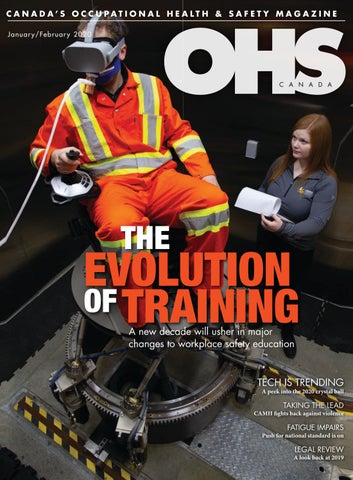
A new decade will usher in major changes to workplace safety education
A peek into the 2020 crystal ball
TAKING THE LEAD CAMH fights back against violence
FATIGUE IMPAIRS Push for national standard is on LEGAL REVIEW
A look back at 2019
The BCRSP is a self-regulating, self-governing organization certified by BSI Management Systems to ISO 9001. The CRSP certification is accredited by the Standards Council of Canada to ISO/IEC 17024.
The following individuals have been granted certification as a Canadian Registered Safety Technician (CRST)/Technicien en sécurité agréé du Canada (TSAC)
Kevin Ryan Andersen CRST
Chalena Biggar CRST
Melissa Ashley Campbell CRST
Sean Conaboy CRST
Peter Jay Cooke CRST
Wesley Cressman CRST
Natalya Danyliw CRST
Oliver Patrick Ennis, CRST
Emily Hagan CRST
Melissa Rose Halladay CRST
Justin Hayunga CRST
Sandra Hoffer CRST
Heather Lynn Jones CRST
Daniel Kempling CRST
Tamsen Lahnalampi CRST
Terry Laventure CRST
Grant LeDrew CRST
Chikoko Mwale CRST
Vikizitha Moyo CRST
Adam Pham CRST
Kirsten Alyssa Pliszka CRST
Amelia Katherine Reid CRST
Emma Rice CRST
Alexander Satenstein CRST
Carolyn Smith CRST
David John Smith CRST
Kirk Stelmaschuk CRST
Johnathan Alexander Stevens CRST
Bradley Studham CRST
Gokul Suresh CRST
Candace Denise Tattrie CRST
Sean Scott Thomson CRST
Ross Waugh CRST
Jeri Wolfe CRST
The following individuals have been granted certification as a Canadian Registered Safety Professional (CRSP)®/Professionnel en sécurité
Mohammad Abdoli-Eramaki CRSP
Muhammad Khalid Abdul Ghafoor CRSP
Akeem Ajibade CRSP
Tikvah Jae Allarie CRSP
Tien An CRSP
Diana Anderson CRSP
Leah Anderson CRSP
Ermin Arnautovic CRSP
Aimee Arsenault CRSP
Stefan Aubron CRSP
Sanamjeet Aujla CRSP
James Ayaeze CRSP
Olaniyi Olatayo Bamigboye CRSP
Bessie Bassey CRSP
Ryan Beaudry CRSP
Christopher Benedetti CRSP
Danila Bertoli CRSP
Aparna Bhat CRSP
Gilles Boisvert CRSP
Pierre-Luc Boivin CRSP
Alexander Bondar CRSP
Roy Bradfield CRSP
Derek Brandt CRSP
Charmaine Bungay CRSP
Andreane Chenier CRSP
Venus Choi CRSP
Eric Chudzinski CRSP
Scott William Robert Coghlan CRSP
Ronald Coleman CRSP
Bernice Michelle Cooke CRSP
Kendra Nichole Corrigall CRSP
Travis Crawford CRSP
Maria Cuomo CRSP
Adelino Manuel Da Costa CRSP
Darrell Dalton CRSP
Liliana Derech CRSP
Noreen Donnelly CRSP
Donald Nelson Dow CRSP
Jesse Draper CRSP
Mohammod Dualeh CRSP
Tarra Dubreuil CRSP
Kyra Duncan CRSP
Stuart Elle CRSP
Wyatt Evans CRSP
Mohamed Fahda CRSP
Kelly Fausak CRSP
Ryan Feindel CRSP
Linette Fetter CRSP
Akoum Fidelis CRSP
Vern Frentz CRSP
Michael Galvin-Rigley CRSP
Scott David Gardner CRSP
Frank Allen Garrett CRSP
Reena Ghai CRSP
Gerry Gill CRSP
Alexander Giordano CRSP
Andrew Goodwin CRSP
Sunita Govindsingh CRSP
Christopher Grotke CRSP
Georgina Grzinic CRSP
Cory Hagen CRSP
Peter Hamel CRSP
Michael Hammer CRSP
Mary Hanratty CRSP
Christopher Thomas Hansen CRSP
Krista Hansford CRSP
Carrie Harilstad CRSP
Michele Hebert CRSP
Jennifer Heroux CRSP
Lawrence Hill CRSP
Chris Hillman CRSP
Jason Hoard CRSP
Robert Hochkievich CRSP
Andrea Hunter CRSP
Gareth Igloliorte CRSP
Aaron Ingram CRSP
Abdulrahman Jandal Alrifai CRSP
Jesus Antonio Jaramillo CRSP
Sheena Jensen CRSP
Michael Jones CRSP
Ron Jones CRSP
Dillon Kallicharan CRSP
Kristina Kean CRSP
Adil Khrushed CRSP
Alyssa Kilar CRSP
Ilona Klimczak CRSP
Amanda Krenbrink CRSP
Raeann Lacusta CRSP
Karen Alberta Lalonde CRSP
Stuart Lamb CRSP
Stephen Lane CRSP
Dominic Laporte CRSP
Terry Lawson CRSP
Tammy Cicely Levesque CRSP
Keeley Levitt CRSP
Patricia Lindsay CRSP
John Loff-Peterson CRSP
Kevin Lunge CRSP
Devon MacKenzie CRSP
Ashley Makayev CRSP
Ganapathi Bhat Manchi CRSP
Michael Mancini CRSP
Heather Marx CRSP
Craig McAuley CRSP
Peter McBride CRSP
Tammy McCabe CRSP
James McDonald CRSP
Jaclyn Meekes CRSP
Talal Mhanna CRSP
Maria Middelveen CRSP
Christopher Milosh CRSP
Philip Murphy CRSP
Connie Myshak CRSP
Ken Nastrom CRSP
Richard Nelson CRSP
Ty Nemeth CRSP
Jennifer Nesbitt CRSP
Ram Kumar Neupane CRSP
Carrie Ng CRSP
Ezatollah Nouryousefi CRSP
Gavin Oakes CRSP
Robert Glen Oliver CRSP
Erin O’Reilly CRSP
Jerri Parkinson CRSP
Corey Pearce CRSP
Dalvir Perhar CRSP
J Tyler Peters CRSP
Suzanne Plett CRSP
Joelle Reid CRSP
Nicole Reid CRSP
David Robichaud CRSP
Jennifer Ruszkowski CRSP
Albert Sawatzky CRSP
John Edward Scarlett CRSP
Kenneth Schamber CRSP
Kumakshi Sharma CRSP
Sonia Sharma CRSP
Kelsey Jane Sheptak CRSP
Rina Shewchuk CRSP
David Skahen CRSP
Michael Spring CRSP
James Stefanishion CRSP
Craig Stewart CRSP
Heather St-Hilaire CRSP
Shauna Rae Swanson CRSP
Ivana Tepavcevic CRSP
Dennis Thideman CRSP
Callum Alexander Tolley CRSP
Jacqueline Tolsma CRSP
Megan Tonn CRSP
Clare Margaret Tooley CRSP
Charles Ugwu CRSP
Luis Enrique Urbina Rivas CRSP
Stacey Van Egmond CRSP
Michael VanRuyven CRSP
Annette Vaugeois CRSP
Paulina Maria Vegt CRSP
J Vignesh CRSP
Steven Webber CRSP
Darcy Webster CRSP
Anders Wheeler CRSP
Megan Lucy Maria Whiffen CRSP
Cherienne Whitson CRSP
Carrie Williams CRSP
Kwaw Asiedu Yeboah CRSP
Melody Zeitel CRSP


The future of workplace hazard education lies in virtual and augmented reality, as more organizations turn to
for
MARCEL VANDER WIER
A 2014 incident proved to be a watershed moment for Toronto’s mental-health hospital in its efforts to protect workers from harm.
MARCEL VANDER WIER
A report by the CSA Group proposes a national standard for the far-reaching issue of fatigue, from which no workplace is immune.
ZENA RYDER
ALAN QUILLEY

If you’re anything like me, seeing the year 2020 stamped on the front of this magazine is still a little startling.
We’ve outlasted Marty McFly’s exploits into the future — and then some. And much like the bold predictions of the Back to the Future trilogy, the world we now live in is firmly tech-driven, featuring hoverboards, drones and exploits in virtual reality.
Trust me, when even my 74-year-old father is using his personal tablet to surf the local Niagara news, technology is here and it’s here to stay.
I find it fitting then, that our first issue of the new decade dives deep into technology usage within the health and safety industry. Training is one area expected to endure a major overhaul. And while it will take time for virtual reality to seep into every part of the profession, it’s highly apparent that traditional classroom learning centred around lectures will one day be a thing of the past.
That’s a good thing — especially with my fellow millennials starting to fill up the working ranks of most Canadian companies.
Then there’s the greater tech takeover of the safety profession, including heavier usage of drones and wearable PPE. CRSP Christopher Hurley’s column on page 10 states it outright: Adopting more technology should be a New Year’s resolution for all OHS professionals.
Here in the OHS Canada newsroom, we’re taking the tech plunge. Our new podcast channel “Safe Zone” launched in January with our first episode exploring — what else? — data sharing within the safety profession.
Wider adoption of this innovative practice could kick-start a new era in safety, where organizations partner to share data and statistics to better forecast the risks facing workers. Data sharing is just one great example of how tech can assist safety professionals in their never-ending pursuit of worker protection.
Implementation of technology isn’t problem-free, however. If you’re a baseball fan such as I am, you were likely floored to find out just how far the Houston Astros took technology usage in recent years as they used all available opportunities to steal pitch signs and win games.
The first major sporting story of the decade clearly shows there’s a firm line between an innovative mindset and breaking the rules.
The lesson is that ethics need to remain front of mind as you consider opportunities to implement technology as a competitive advantage. Human rights, privacy stipulations and other workplace rules of play must be adhered to.
It does not mean you can continue closing your eyes to avoid widely available solutions such as wearables simply due to fear of the unknown.
While safety professionals may be late adopters to 21st-century technology, the time has arrived. Your first implementation doesn’t have to be virtual reality. But your next round of safety training could include an e-learning opportunity.
Welcome to the future.
Marcel Vander Wier
Vol. 36, No. 1 JANUARY/FEBRUARY 2020
EDITOR MARCEL VANDER WIER 416-510-5115 mvanderwier@ohscanada.com
MEDIA DESIGNER MARK RYAN
ACCOUNT CO-ORDINATOR CHERYL FISHER 416-510-5194 cfisher@annexbusinessmedia.com
CIRCULATION MANAGER JAY DOSHI 416-442-5600 EXT 5124 jdoshi@annexbusinessmedia.com
NATIONAL SALES MANAGER ROSS ANDERSON 289-925-7565 randerson@annexbusinessmedia.com
GROUP PUBLISHER PAUL GROSSINGER pgrossinger@annexbusinessmedia.com
COO SCOTT JAMIESON sjamieson@annexbusinessmedia.com
Printed in Canada ISSN 0827-4576 (Print) ISSN 1923-4279 (Digital)
PUBLICATION MAIL AGREEMENT #40065710
CIRCULATION
Tel: 416-422-5600
Fax: 416-510-5140
Mail: 111 Gordon Baker Rd., Suite 400, Toronto ON M2H 3R1
SUBSCRIPTION RATES
Published six times per year – Jan/Feb, Mar/Apr, May/Jun, Jul/Aug, Sep/Oct, Nov/Dec Canada $100/yr plus tax USA $130/yr (100 USD)
Foreign $214/yr ($164.50 USD)
Occasionally, OHS Canada will mail information on behalf of industry related groups whose products and services we believe may be of interest to you. If you prefer not to receive this information, please contact our circulation department in any of the four ways listed above.
Annex Privacy Office privacy@annexbusinessmedia.com
Tel: 800-668-2374
No part of the editorial content of this publication may be reprinted without the publisher’s written permission © 2020 Annex Publishing & Printing Inc. All rights reserved. Opinions expressed in this magazine are not necessarily those of the editor or the publisher. No liability is assumed for errors or omissions.
All advertising is subject to the publisher’s approval. Such approval does not imply any endorsement of the products or services advertised. Publisher reserves the right to refuse advertising that does not meet the standards of the publication.


$908M
Total amount that Canadians spent on recreational cannabis in the first year of legalization, which works out to $24 per person.
Source: The Canadian Press
30%
Amount of Canadian workers identifying with a specific diversity group — including visible minorities and LGBTQ — who have experienced at least one incident of workplace discrimination.
Source: Boston Consulting Group
14,000
Number of Canadians killed by opioids over the last four years, while more than 17,000 have been hospitalized for opioid-related poisoning.
Source: The Canadian Press
1. Faro, Yukon: Parsons, the company managing construction at the Faro mine remediation site, and superintendent Len Faber, who also serves as mayor of the remote mining town, have been charged for allegedly trying to intimidate workers, hindering safety officers and failing to maintain a safe workplace.
Source: Yukon News
55%
While many organizations have relaxed employee policies in the last decade, more than half of senior managers still frown upon the use of foul language, though 19 per cent have loosened policy.
Source: Accountemps
2. Lower Mainland, B.C.: A trucker suffered a leg injury in November, following an incident in which his loaded log transporter met a service truck on a forest service road. As the two vehicles attempted to pass one another, the trailer rolled off the road, pulling the tractor with it. The logs spilled and the tractor trailer rolled several times before coming to rest against several trees.
Source: WorkSafeBC
3. Scugog, Ont.: Oshawa tow-truck driver Todd Burgess was killed Nov. 7 while attempting to winch a car out of a ditch along Highway 12 near Port Perry, Ont. On the first snowy day of the season, a car lost control and struck him while he was working on the shoulder. Prior to his funeral, a convoy of tow trucks drove a stretch of the 401 highway — the Highway of Heroes — in his honour.
Source: The Canadian Press, CBC
4. Fredericton: Derek Lister, a professor emeritus at the University of New Brunswick, was one of 120 new appointments to the Order of Canada on Dec. 27. The country’s highest honour came for his “contributions to nuclear energy research and improvements to occupational safety.” Much of Lister’s early research studied how radiation fields built up around out-reactor components at nuclear plants, followed by strategies to control and reduce the fields to minimize exposure to plant personnel.
Source: Government of Canada, Derek Lister
5. Charlottetown: The P.E.I. Agriculture Sector Council won a Canadian Society of Safety Engineering (CSSE) award on Sept. 24 for providing an OHS “Train the Trainer” suite of programs to ensure all farm workers receive quality safety training. The national award was in the category of Special Project.
Source: P.E.I. Agriculture Sector Council
The safety threat presented by snakes in the developing world is very real. As many as 600,000 people are killed or permanently disabled each year.
Source: Asclepius Snakebite Foundation

By Marcel Vander Wier
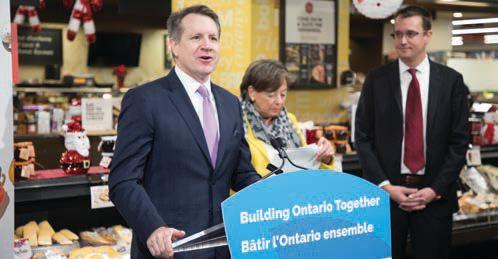
Ontario will reward its safest employers with an estimated $140 million for excellence in occupational health and safety, as part of a new program unveiled on Nov. 22.
The program — Supporting Ontario’s Safe Employers — will formally recognize employers who successfully implement health and safety programs. The financial rewards will come in the form of Workplace Safety and Insurance Board (WSIB) rebates over a three-year period.
“We know that good health and safety practices save lives,” said Monte McNaughton, Minister of Labour, Training and Skills Development. “But they also save money. This program is a reflection of that fact.”
“Our government wants to do everything it can to make workers safer and help businesses save money.”
According to the Ontario government, research has shown that organized, systematic approaches to health and safety increase worker participation in workplace safety practices, encourage ongoing improvement and help reduce workplace injuries and illness.
Similar programs in Europe and Japan have resulted in a decline in workplace accidents, stated a government news release.
The program is open to any employer in Ontario, regardless of size or sector. Led by the Office of the Chief Prevention Officer, this ministry program was developed based on feedback from labour, employers and other stakeholders.
The WSIB is also building on the program by launching a Health and Safety Excellence program in an effort to promote continual health and safety improvement within workplaces.
While the provincial program recognizes employers who have already implemented a health and safety management
TORONTO (CP) — The unintended release of an Ontario-wide alert about an “incident” at the Pickering Nuclear Generating Station on Jan. 12 has sparked a provincial investigation into how such an error could happen.
The province’s solicitor general said the error occurred during a routine
system, the WSIB’s program will encourage employers without an existing program to develop one.
“Our new Health and Safety Excellence program gives them a road map to improve health and safety, whether they’re just getting started or want to optimize processes they already have in place,” said Elizabeth Witmer, chair of WSIB in Toronto.
The program offers a comprehensive approach to workplace health and safety meant to streamline improvements for Ontario businesses, whether they’re just starting out or want to optimize processes that are already in place, said a WSIB news release.
Consisting of 36 topics, businesses can proceed at their own pace, earning rebates and other recognition as they go. Concluding the program makes businesses eligible for the Ontario government’s accreditation program.
“(It’s) part of an overhaul of our premium rates to give businesses the data they need and incentives to make a clear business case to invest in health and safety improvements,” said Tom Teahen, WSIB’s president and CEO.
training exercise being conducted by the Provincial Emergency Operations Centre (PEOC).
The PEOC — which is responsible for co-ordinating the provincial government’s response to major emergencies — conducts exercises testing the system twice daily, but there was no intention to notify the public, Solicitor General Sylvia Jones said in an interview.
The investigation will examine the sequence of events that led to the alert being sent out and what contingency measures should be in place. Jones said she expects the results of the probe to be made public.
The alert was pushed to cellphones across the province at about 7:30 a.m., and Ontario Power Generation (OPG), which oversees the Pickering plant, sent
out a tweet about 40 minutes after the emergency alert saying it was a mistake. A follow-up alert was sent to cellphones nearly two hours after the original notification, and about an hour after the OPG tweet.
Jones said it took so long to send a second alert because the province felt it needed to “trust, but confirm” that there really was no impending disaster.
The original alert warned people within 10 kilometres of the facility east of Toronto of an unspecified incident, but it went to residents all across Ontario.
Terry Flynn, who teaches crisis communications at McMaster University, said there’s a danger that this type of error will erode public trust.
“Whether it’s a nuclear plant or it’s a community flooding event, these systems are designed to help people make decisions that protect their health and safety,” he said. “When we have continuous problems in these systems, then we have a lack of trust and people begin to ignore them. So that’s the biggest fallout from this scenario.”
The health and safety of construction workers will soon become more visible in Vaughan, a city located north of Toronto.
As of March of this year, construction contractors working with the city will have to have registered for a Certificate of Recognition (COR) from the Infrastructure Health and Safety Association (IHSA) to be eligible for the procurement process.
In December, city council endorsed the program as a component of the city’s bidding process for construction contracts.
The IHSA is designated to certify contractors in Ontario’s construction industry who demonstrate their health and safety management system through this structured audit process.
Council’s support reflects a commitment to enhancing safer communities through supporting prevention and awareness, according to a news release.
Companies looking to work with the city will be required to provide a copy of a valid certificate or an equivalent Ontario Health and Safety certification in order to win the bid.
HALIFAX (CP) — A foreman and the company that employed him are facing charges under Nova Scotia’s Occupational Health and Safety laws in relation to the falling death of a young labourer at a Halifax worksite.
Halifax police had earlier charged supervisor Jeff Scott Gooch with criminal negligence causing the death of 22-yearold Brandon Alcorn in the March 13, 2018 incident.
Provincial investigators are now also alleging Gooch, 37, and Insulated Panel Structures of Waterdown, Ont., failed to put in place fall-protection measures or provide Alcorn with training.
“failed to take every reasonable precaution to protect the health and safety” of an employee and didn’t provide necessary fallprotection training or ensure the safety gear was used.
Gooch is also accused of knowingly giving an occupational health and safety officer false information two days after the young man fell while working on the roof of a Kent Building Supplies store that was under construction.
His violations allegedly occurred on four different days, including the day Alcorn fell and suffered a fatal head injury.
MONTREAL (CP) — In December, the Quebec Court of Appeal rejected a request to suspend the central elements of the province’s secularism law.
In a 2-1 ruling, all three judges acknowledge the law known as Bill 21 is causing harm that may be serious and irreparable to teachers who wear the hijab.
But the majority concludes Quebec’s use of the notwithstanding clause means the law should not be suspended.
Bill 21, adopted last June, prohibits some public sector workers — including teachers, police officers and prison guards — from wearing religious symbols.
A national Muslim organization, a civil liberties group and a university student who wears the hijab were seeking to have the law suspended while their full legal challenge is heard. They presented evidence that people are already being denied employment because they wear religious symbols.
The documents provided by the Nova Scotia Labour De partment say the company is charged with failing to ensure necessary fall-protection training, failing to have a written fall protocol and failing to ensure fall-protection gear was used.
The summary provided by the department alleges Gooch
A new approach to preventing fatalities and serious workplace injuries was introduced in Canada’s prairie province in December.
The Fatalities and Serious Injuries Strategy is the product of WorkSafe Saskatchewan, which is a partnership between the Saskatchewan Workers’ Compensation Board (WCB) and the Ministry of Labour Relations and Workplace Safety. It tackles high-risk industries and associated tasks.
“Safety needs to be a priority in every workplace and across all industries,” said Labour Relations and Workplace Safety Minister Don Morgan.
“Workplace injuries and fatalities are absolutely unacceptable and leave a devastating impact on loved ones.”
The strategy will focus on priority industries and occupations, where the greatest number of injuries to workers are reported. Approximately 2,400 Saskatchewan workers are seriously injured each year. From 2010 to 2018, the WCB reported 354 fatalities.
The three-year strategy outlines targets to reducing the number of injuries and the actions that will be taken to achieve these numbers.
The four priority areas are asbestos exposure, work-related motor vehicle crashes, firefighter cancer exposure and falls from heights.
“Workplace safety is everyone’s responsibility and this strategy looks to build on the work that is already taking place to reduce serious injuries and fatalities,” said WCB board chairperson Gord Dobrowolsky.
“If we are to be successful, we need to collaborate with a wide range of stakeholders so workers go home safely each day.”
The Alberta government no longer requires a joint health and safety committee (JHSC) to be present at each worksite, according to a news release issued Dec. 13.
Employers will now only be required to have one committee, regardless of the number of worksites open.
“We have heard that the current rules around health and safety committees are not working,” said Alberta Labour Minister Jason Copping.
“The new rules for health and safety committees will support healthy and safe workplaces while reducing administrative burdens.”
Employers are still responsible for ensuring healthy and safe worksites, he said.
Completion of a government-approved training course is mandatory for worksite health and safety committee co-chairs and worker representatives.
According to the release, JHSC committees are required in Alberta when an employer reaches 20 staff.
Employers with five to 19 workers must have a worker health and safety representative.
Worksites with multiple employers where work lasts 90 days or more are required to have a site-specific committee or representative, depending on the number of workers.
PORT COQUITLAM, B.C. (CP) — A union representing Canadian railway workers is renewing calls for safer work conditions after a locomotive engineer died Dec. 3.
Teamsters Canada Rail Conference says the Canadian Pacific Railway employee was 56 years old and had 32 years of experience.
He is the 10th member of the union to die on the job in two years.
“Our hearts go out to the locomotive engineer’s family and everyone who worked with him,” Teamsters Canada president Lyndon Isaak said in a statement.
“The rail industry is in crisis. We have lost 10 of our sisters and brothers over the past 24 months. It’s 10 too many.”
Six of those who died worked at Canadian Pacific, the union said.
The death of a worker in May 2018 has netted a $250,000 fine for a lumber mill in Chapleau, Ont., a community located northwest of Sudbury.
Rayonier A.M. Canada Industries pled guilty after a worker was killed while operating a loader with fork attachments.
A victim fine surcharge of 25 per cent was also imposed by provincial court on Jan. 8, according to a news release.
The incident occurred May 25, 2018, when a worker was removing wood bundles from the mill’s kiln and placing them in the yard.
While the incident had no eyewitnesses, it is believed that a load of wood had been placed in the yard and that the worker had reversed the loader, then gotten out of the machine to place three small wood pieces known as crossers on the pile, so as to create a space between the original bundle and the bundle to be placed on top of it.
Two crossers were placed, and it is believed that the worker was in the process of placing a third when the loader rolled forward and pinned the worker, who died as a result of injuries incurred.
Inspection of the machine revealed no mechanical defects. However, it was determined that the brake actuator had been modified by the addition of a spring which made the parking brake easier to release.
A Ministry of Labour investigation also revealed that the forks of the loader had not been lowered securely to the ground and that the machine had been parked on sloped ground.
In addition, no wheel chocks had been applied.
Rayonier A.M. Canada Industries pled guilty to failing as an employer to ensure that a vehicle left unattended shall be immobilized and secured against accidental movement.
Safety was a central issue during a recent strike at Canadian National Railway. Teamsters Canada said the latest incident underscores the need for governments and the industry to work toward preventing railway tragedies.
The man who died was from Mission, B.C., the BC Coroners Service says.
Canadian Pacific spokesman Andy Cummings said the company is offering counselling to the family and other employees.
WINNIPEG (CP) — Three Manitoba liquor-store workers were assaulted and one was taken to hospital in what the province’s Crown corporation calls an unprovoked attack.
It happened in Winnipeg Nov. 20 and prompted Manitoba Liquor and Lotteries to temporarily close the store while it set up a new secure entrance where customers will have to show photo identification before entering.
Thefts at Manitoba’s government-run li-
quor stores have been increasing and the corporation’s CEO, Manny Atwal, says liquor stores have been “under siege” now for more than a year.
Atwal says other stores will also eventually be fitted with secure entrances, and the thefts are a part of a larger societal issue that needs to be addressed by retailers, governments and others.
Loss-prevention officers and liquorstore workers are being told not to physically stop thieves.
Since last year, videos have been posted online of groups of people walking into stores, filling bags and simply walking out.
“Our employees … should not have to come to work every day wondering how many times somebody will threaten them, or how many times someone will try to harm them or harm one of our customers,”
Atwal said.
“This has to stop.”
Some 10 to 20 liquor thefts are reported every day in Winnipeg alone, the city’s police force said.
Follow us on Twitter @OHSCanada
Stay on top of North America’s premier safety events at ohscanada.com/events.
Western Conference on Safety 2020
Location: Vancouver
Date: April 6-7, 2020
www.wcs.pacificsafetycenter.com
Workplace Health & Safety Conference
Location: Halifax
Date: April 20-21, 2020
www.eiseverywhere.com/ehome /475012/home
Mining Health & Safety Conference
Location: Sudbury, Ont.
Date: April 21-23, 2020
www.workplacesafetynorth.ca/node/2458
Crane Safe 2020
Location: Mississauga, Ont.
Date: April 28-29, 2020
www.cranesafesummit.com
Partners in Prevention (PIP) 2020
Location: Mississauga, Ont.
Date: April 28-29, 2020
www.PartnersInPreventionConference.com
BY CHRISTOPHER HURLEY

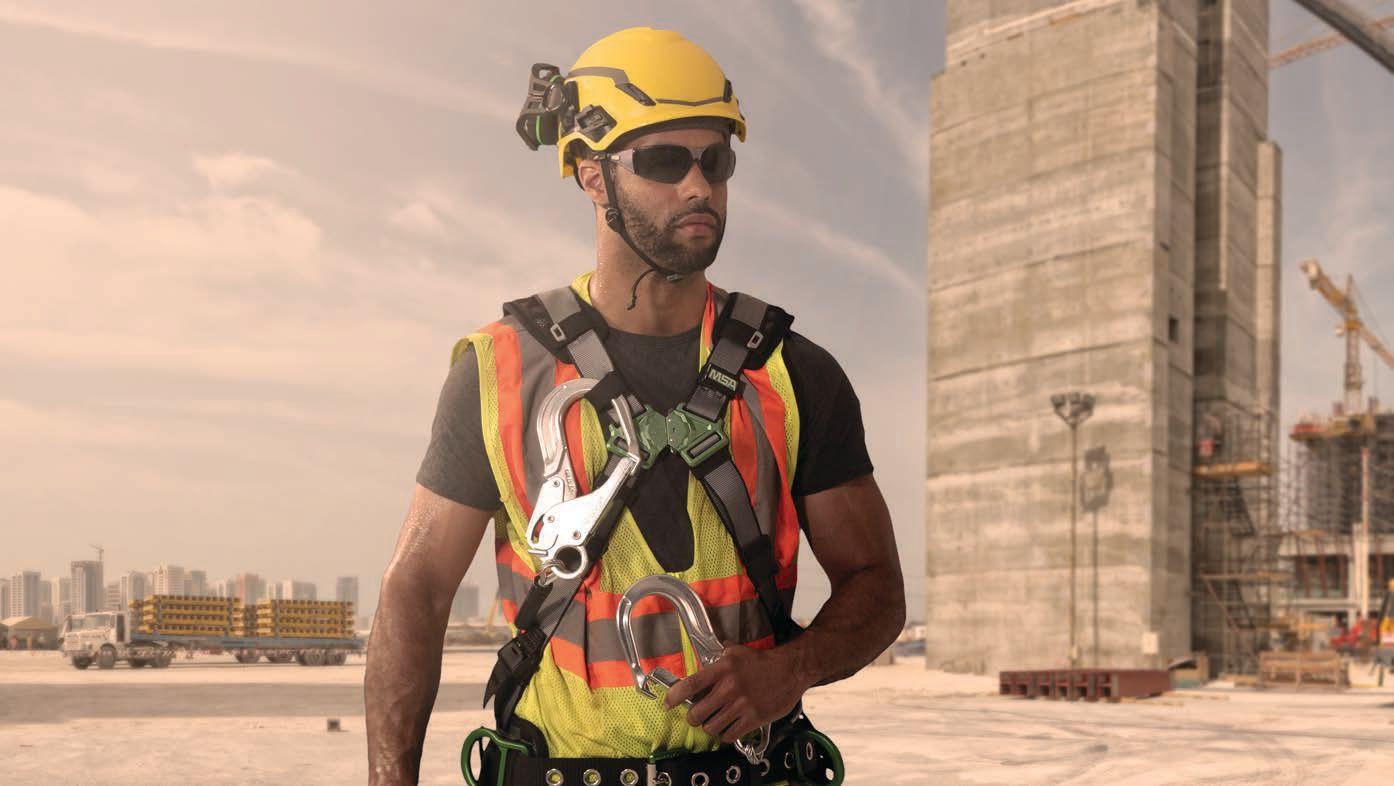
When embarking on a new year and a new decade, it’s always prudent to take a look around and see what’s coming down the pipe.
If you’re like me, surprises are rarely good news. As a safety professional, being nimble and adaptable to changes in your environment is critically important.
No surprise, technological changes continue to be the biggest trend to watch in 2020 and beyond.
Think about it — 10 years ago, Twitter was still a relatively unknown service, the Apple App Store had just opened, and automobile lane-assist and crash-warning systems would have sounded like something straight out of Star Trek.
Technological changes are generally significant, so you need to be ready.
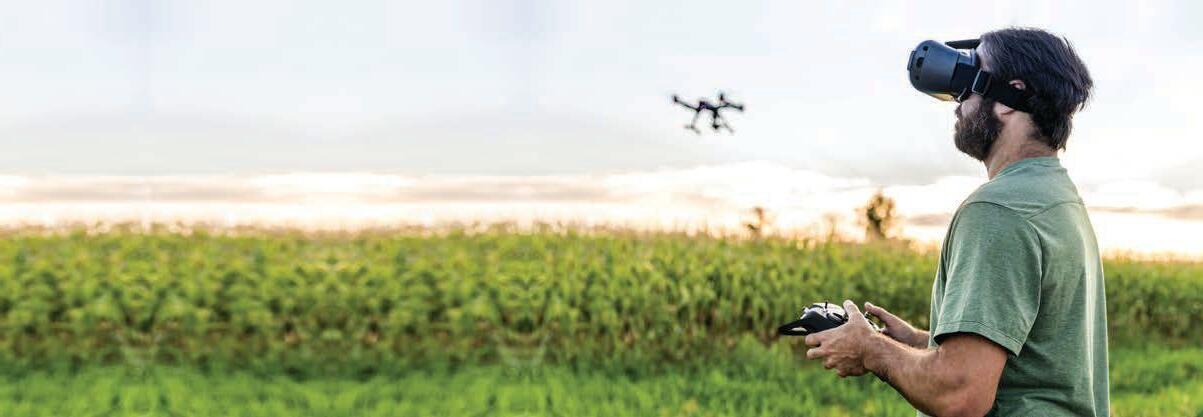
The idea of drones delivering packages in almost-instant fashion is exciting for many. But for safety geeks, the possibilities for drone usage in safety roles are limitless.
From the delivery of emergency medical equipment to remote work camps, to preventative inspections of high-risk locations (think bridges and towers), drones can eliminate hazards to humans in a way we’ve never been able to before.
For those that have teams working outdoors — safety training, Transport Canada rules and application-specific procedures will require some homework prior to putting this great asset to work.
Let’s also remember that because these units maneuver with spinning blades, they require maintenance, handling and employee touches.
If you think the risks are insignificant, consider Trevor Bauer, the Cleveland Indians pitcher who had a chunk of his finger taken off during some routine maintenance of his personal drone during his club’s 2016 playoff run.
It will be interesting to see how wearable PPE (personal protective equipment) plays out over the next decade.
As much as complying with heat- and cold-stress guidelines will generally set you up for an incident-free day, it’s not a perfect strategy as every individual responds to extremes differently.
Individual metabolism, pre-existing medical conditions — even choice of breakfast — could have major impacts on someone working in extreme conditions.
But imagine managing a blast furnace in a steel mill and having access to information tied to wearable PPE that can provide real-time crew biometrics for assessing heat or cold stress. Instead of looking at someone to assess if they have heatstroke, you’ll actually know that they are suffering symptoms that need attention.
Having an alarm condition set to sound once the whole crew is showing signs of heat- or cold-related stress is just incredible from a preventative measures perspective.
Wearable PPE will face some hurdles, however, as individuals may take exception to an employer having this level of medical information.
Computer-based training has been around since Windows 3.1. The blue screen of death never actually killed someone, but it has certainly caused its share of bad sweats and racing heartbeats.
Today, virtual reality is taking safety training to a whole new level — it’s not just for airplane pilots anymore.
Being able to immerse an employee in a pseudo-hazardous situation or an emergency response scene will allow a practice-makes-perfect approach to many scenarios that in the past were impossible to replicate.
And it can be done using your facility and your specific hazards, all without having to spend a Hollywood-sized budget.
Planning and pre-work will not only ensure your company is ready for the changes, but also that you are protecting your people as best as you can.
If you’re an old dog and still pushing back on tech advances, remember that Generation Z is now entering the workforce and has never known a life without constant technological connection.
Tech is here to stay. OHS professionals need to jump on board now or risk getting pushed off.
Christopher Hurley is the founder of Safety Services Canada, a consulting firm located in Caledonia, Ont.
BY DAVID REITER

2019 was another banner year in occupational health and safety (OH&S) law. As we start the new year, it’s worthwhile to look back at three key cases from 2019, as their impacts are likely to be felt as we move into 2020.
This case was released Jan. 18, 2019. It involved two directors of a closely held corporation who had sent an epileptic employee up on an elevated platform without fall-arrest equipment. The worker suffered a seizure and fell to his death. The company and its two directors were charged, and on conviction, the directors each received 25-day custodial sentences.
The directors’ custodial sentences were replaced on the first appeal with fines as the appellate judge found that custodial sentences had traditionally been imposed in the OH&S context rarely — and usually only for frequent and willful offenders; and the criminal-law principle of restraint required sentencing courts first to look at the adequacy of non-custodial, before turning to custodial sentences.
At the second appeal, the Court of Appeal exhaustively reviewed sentencing in the OH&S context and made it clear that deterrence of others must be the paramount consideration in these matters.
It held that the criminal-law principle of restraint cannot apply with the same force as it does in criminal cases, and moral blameworthiness (such as the level of negligence involved) can operate only to increase a sentence, but its absence cannot act to mitigate one.
Arguably, this decision opened the door to an increase in custodial sentences in OH&S cases moving forward, and its impact will likely be felt as more fatality cases make their way through the courts.
For more than 27 years, the law has provided that workplace parties who hire subcontractors are — for the purposes of determining OH&S liability — the employer of their subcontractors’ workers. However, that foundational point may have started to change with this June decision.
The case centred on a fatality that occurred on a roadrepair project that had been subcontracted out by the City
of Sudbury. The city was charged as an employer, but was acquitted because it had not exercised meaningful control over the work — that was done by the subcontractor.
The city’s acquittal — which relied on including an element of meaningful control in the analysis — was upheld by the Superior Court on June 6, 2019.
The Ministry of Labour (Ontario) took great issue with the introduction of an element of control to the question of who is an employer in OH&S law. Not surprisingly, it sought leave to appeal the issue, which was granted as a matter of public interest on October 28, 2019, in Ontario (Labour) v. Sudbury (City), 2019 ONCA 854.
The decision could mark a seismic shift in the way that OH&S liability is assessed on future projects.
On Dec. 19, counsel for 9147-0732 Québec Inc. filed its certificate attesting to record in the case for which leave has been granted by the Supreme Court of Canada, and to which the Director of Public Prosecutions of Canada, the Attorney General of Ontario and several civil liberties associations have been granted leave to intervene.
The case involves a mandatory minimum fine that was imposed on 9147-0732 Québec Inc. for carrying out construction work without a licence.
At the second level of appeal, the Quebec Court of Appeal determined that s.12 of the Charter (the right to be free from cruel and unusual punishment) could apply to corporations, and therefore the proportionality of the impact of the minimum fine on the offender had to be considered constitutionally.
The matter was sent back for trial, but as leave has been granted, the matter will now be heard by the Supreme Court this year.
Depending on how the Supreme Court rules, sentencing courts’ consideration of general deterrence as the paramount point in the sentencing process could — in some cases — end up being restrained, with effect.
If that happens, it could mark the slowing of a trend that has been developing in regulatory sentencing law over the past decade in cases such as Metron Construction.
Stay tuned.
David Reiter is a partner with Aird and Berlis in Toronto.
with Monica Szabo (BCRSP) and Trevor Johnson (CSSE)
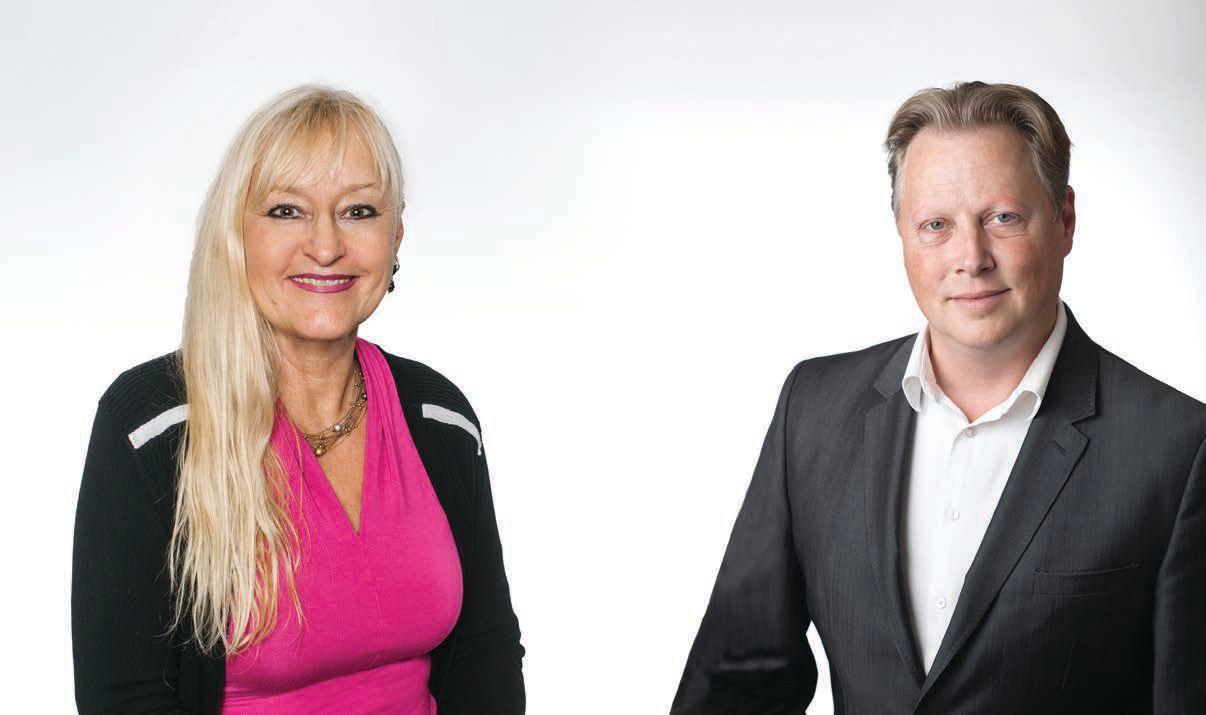
The two chairs of Canada’s national safety boards open up about their roles and desires for the occupational health and safety profession. Responses have been edited for length and clarity.
Q. Can you explain the mandates of your respective organizations (BCRSP/CSSE)?
A. Located in Mississauga, Ont., the Board of Canadian Registered Safety Professionals (BCRSP) sets certification standards for the occupational health and safety profession. Through the Canadian Registered Safety Professional (CRSP) and Canadian Registered Safety Technician (CRST) certifications, we enable OHS practitioners to demonstrate their expertise.
A. Located in Toronto, the Canadian Society of Safety Engineering (CSSE) is the governing body for the Certified Health and Safety Consultant (CHSC) certification and offers nine professional-development courses. With a network of 40 chapters, the CSSE provides an opportunity for members and potential members to connect in their communities.
Q. What unique perspectives do you bring to your respective boards?
A. With over 25 years of experience in occupational hygiene and safety, I bring senior leadership experience, ensuring a focus on broad strategic goals and also field-level experience — which helps me ensure the board keeps in mind the needs of our certificants. I was a member of the board about a decade ago and believe that the historical knowledge I bring has benefited our board and helped us recognize our previous achievements as we continue our efforts to move the safety profession forward.
A. I have been actively involved with the CSSE for over 20 years in various capacities at the committee, chapter and national level. I also bring experience in governance and management. I feel that we as a board have collectively moved the CSSE towards a more sustainable structure and outlook over the past few years. We have taken the vision of the strategic plan and are building a new structure for the CSSE to prosper and grow in the future.
Q. What type of effort is your board making at the national and global levels?
A. Nationally and globally, the BCRSP is active in promoting the value of certification and recognition of the OHS professional. We have collaborative relationships with the CSSE and recently we signed an agreement with the Women in Occupational Health and Safety Society
A. This is a two-pronged approach. First and foremost, we are a member-driven society. We have to ensure that there is member value from experienced leaders right down to our smallest chapter level. We have initiated a member value proposition task force to focus on exactly
(WOHSS). Through these partnerships we seek opportunities to collaborate and advance the profession.
We are also engaged in conversations provincially with various government and organizational bodies on the potential for the regulation of the occupational health and safety profession — including discussion on the national framework for the practice of OHS in Canada. The main purpose of this framework is to define a system of organization to ensure co-ordinated efforts as the regulatory conversation takes place across the country.
Globally, BCRSP’s certifications are recognized through several memoranda of understanding — including with the Board of Certified Safety Professionals, the Institution of Occupational Health and Safety, the Australian Institute of Health and Safety (formerly SIA), and the National Examination Board in Occupational Safety and Health.
B CRSP is also an active member in the International Network of Safety and Health Professional Organisations (INSHPO) and a signatory to the Singapore Accord which commits us to recognition of the INSHPO global capability framework as a resource.
that and also to ensure that we are receiving feedback on our efforts.
The second prong is our outreach and our partnerships with like-minded organizations, nationally and internationally. We are active partners in International Network of Safety and Health Practitioner Organisations (INSHPO) who have developed the global capability framework that professionals can use to assess their capabilities and has since been adopted by Canada’s post-secondary educational institutions as a basis for curriculum.
Another initiative is our partnership with the Centre for Safety and Health Sustainability (CSHS). We are spreading the word that companies cannot be sustainable without caring about and for their workers.
By being involved in initiatives like these, we are bringing value to our membership and the companies and industries in which they work. We are ensuring that Canada’s voice is heard and our input is used to develop new standards and engage companies and governments to improve the working environment for workers at home and abroad.
Q. What do you think is the most pressing issue in occupational health and safety today?
A. From a certification perspective, there are several issues that we have been discussing, including the impact of changing technology on the role of the OHS practitioner, the impact of changing demographics in the workplace, a shortage of qualified OHS practitioners and an increased recognition of the value that qualified OHS practitioners bring to the workplace.
There is also interest and discussion in the certification world around micro-credentialing, specialization, value proposition and transportability of credentials. Collaboration and communication between certifying and membership bodies in the health and safety arena — especially within Canada — is critical to ensure our chosen profession remains current, valuable and viable.
A. On one hand, it’s compliance — not only the poor performance, but also our focus upon it. Our OH&S systems and approaches are not aligned with how we now work as a society. Our focus is on lagging indicators instead of leading ones. We need to get better at communicating that safety is a value addition to our organizations, not a cost on our budget and a reactive crisis management tool.
The second is that OH&S is not represented in the current corporate structure of senior management or at the board of director and governance levels. We need to get influence and have a presence there if we are going to be able to move from strict compliance to systems where we add strategic value.
A. The CRSP Examination Blueprints are revised at least every five years, as the BCRSP has always been responsive to the changes coming in the profession and ensuring the certification competencies include emerging issues. The most recent revision includes a competency around new and emerging technologies to ensure we are tackling the changes that will be taking place in the workplace.
In the last revision of the continuous professional development (CPD) program — which is a mandatory requirement for certified individuals — we also increased emphasis on activities such as mentorship in order to encourage certified professionals to actively engage in supporting other practitioners in their career development.
A. I am working to engage leaders in discussions about the value and importance of human capital and OH&S within their organizational strategic plans for sustainable and successful companies. Our entire board is focused upon providing member value and education that will allow them to be key players in this new environment. We are also part of a national framework initiative, partnering with the BCRSP in developing OH&S into a true profession. This is a journey and a conversation that we are taking across the country to our membership and stakeholders. Hopefully it will entrench the value of OH&S into corporate governance structure and encourage today’s students ahead of a lifetime career in the profession.

Each year, workplace violence and harassment incidents severely impact workers and workplaces across Canadian sectors and organizations.
Incidents include hitting, kicking, biting, spitting, throwing objects, oral or written threats, sexual harassment, bullying and verbal abuse that can inflict physical or psychological harm — or both.
In Canada, approximately one in five violent incidents occurs at work, often leading to injuries and lost-time injury claims, according to a report released in December by the CSA Group in Toronto.
“Workplace violence and harassment is a significant concern for employees, companies and government alike,” says Mary Cianchetti, president of standards at CSA Group.
“While much has been done to address this issue, more can and should be done to protect workers now and in the future.”
Research included within “Preventing Violence and Harassment in Canadian Workplaces” is meant to identify the extent of workplace violence and harassment across Canada, the availability of guidance resources, gaps in effective prevention and mitigation strategies and the need for national standards or other guidance.
This research focused on four sectors — education, health care, government and emergency services, as well as service sectors — as workers in these industries experience the highest rates of workplace violence and harassment.
A literature review and stakeholder input demonstrated that violence and harassment in the workplace is a serious and growing problem.
The industries studied face specific concerns and challenges such as violence against workers from patients, clients, residents, family members and work colleagues in the health-care sector; violence from students in the education sector; and violence and harassment — including sexual harassment — in the government and emergency services sector and service sectors.
The research also identified several gaps in addressing workplace violence and harassment:
• a lack of practical guidance, adequate infrastructure and
staff resources, especially in smaller organizations
• a lack of sector-specific guidance on workplace violence and harassment program components
• a need for proactive leadership and accountability structures within organizations
• a need for leadership at all system levels across sectors
• the requirement for a positive and supportive organizational culture where workers are consulted and participate in prevention efforts.
A comprehensive approach to prevent and mitigate violence and harassment — recognizing the challenges specific to each sector — is effective and essential, according to the CSA Group.
Prince Edward Island’s Workers Compensation Board (WCB) welcomed a new chair in December.
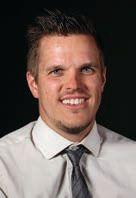
James MacPhee (pictured), a longtime accountant in Montague, P.E.I., will serve a three-year term. He replaces outgoing chair, Stuart Affleck.
In October of last year, the Island board launched a new app to help workers access health and safety information in collaboration with the Canadian Centre for Occupational Health and Safety (CCOHS).
The new app provides mobile access to the Occupational Health and Safety Act alongside relevant, up-to-date information on 20 common health and safety topics. A web version provides users with a consistent look and feel when navigating on a computer.
“The new mobile app provides quick and easy access to key information that will help keep Island workplaces safe,” says Cheryl Paynter, CEO of the board.
“This means that wherever employers and workers are working, they can find information on health and safety requirements at their fingertips.”
Current app topics include: confined spaces, duties of employers and workers, fall protection, impairment, noise, violence in the workplace and working alone. Each topic links to related resources, such as summaries, legislative interpretations, prevention updates and hazard alerts.
The PEI Guide to OHS Legislation app is free and can be downloaded through the App Store or Google Play.
“With changing workforces and advances in technology, it is important to continue to offer new ways to access safety information and resources,” says Gerry Culina, CCOHS manager of general health and safety services.
“We were pleased to work with WCB PEI to develop their new mobile app and website.”
Employers need to begin treating obesity as a chronic disease and move it out of the lifestyle category within health plans, says Obesity Canada in Edmonton.
Organizations should also offer meaningful obesity services and coverage that move beyond diet and exercise programs, the charitable organization says, citing its “ACTION: Awareness, Care, and Treatment in Obesity Management Study,” released last year.
The study compiled data from online surveys conducted in 2017, which included responses from 2,000 individuals, 395 health professionals and 150 employers who provide private health benefits. Results were published in the journal Clinical Obesity in October 2019.
Half of employers believe they are an important partner in obesity management, while 49 per cent think adults with obesity are not motivated to manage their condition, according to the study.
In addition, 63 per cent of employers believe their workers could manage their weight if they set their mind to it.

“Weight bias and discrimination are deeply ingrained among health-care providers and employers, and this is preventing people from accessing meaningful obesity care,” says Dr. Arya Sharma, scientific director for Obesity Canada.
“The current science tells us that obesity is a chronic disease just like diabetes, heart disease or cancer, and yet we are in effect still telling people who have it that they did this to themselves and that they don’t deserve to be supported.”
The study was designed to investigate barriers to obesity management from the perspective of obese people, healthcare professionals and employers.
“(It) is yet another piece of evidence that supports what those of us living with obesity have known our whole lives — that antiquated, unscientific attitudes toward obesity shut us out of the treatments and supports that those living with other chronic diseases take for granted,” says Lisa Schaffer, chair of Obesity Canada’s public engagement committee.


The disease affects 26 per cent of Canadian adults — more than diabetes, heart disease and high blood pressure, according to Sharma.
“The disparity between how well these conditions are supported compared with obesity should be a wake-up call to all three surveyed groups,” he says.
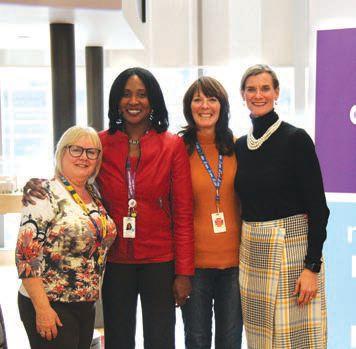
The Women in Occupational Health and Safety Society (WOHSS) signed a pair of strategic partnership agreements on Nov. 27 in Toronto.
Going forward, the group will collaborate with the Board of Canadian Registered Safety Professionals (BCRSP) and the Association for Workplace Tragedy Family Support — operating as Threads of Life.
“We recognize the value of forming collaborative partnerships in order to advance our vision of building a better future for women in occupational health and safety,” says Paula Campkin, WOHSS chair. “We are stronger when we work together.”
“Through collaboration, we have a profound opportunity to positively impact health and safety in Canadian workplaces.”
The partnership agreements were formalized during a WOHSS event hosted at Matthews, Dinsdale and Clark LLP.
The BCRSP is the certification body of Canadian OHS professionals, while Threads of Life is dedicated to supporting families following a workplace fatality, life-altering injury or occupational disease.
“BCRSP and WOHSS both recognize the need for collaborative efforts to support the advancement of the practice of occupational health and safety, and we look forward to ongoing collaboration with the WOHSS,” says Monica Szabo, chair of the BCRSP.
Incorporated as a not-for-profit society in 2017, WOHSS is a grassroots organization dedicated to supporting women working in OHS in Canada. It supports women through education, mentoring, resources and connection.
With over 200 members across Canada, WOHSS welcomes women and men at all stages of their careers.
Ever wonder what other OH&S types are thinking? Find out by making our website poll a regular stop.
Should work-related mentalhealth issues such as stress and burnout be recognized as occupational illnesses in Canada?

BY MARCEL VANDER WIER
The long-awaited future of workplace safety training will arrive this decade — if not this year.
Developments in virtual reality and augmented reality are causing more organizations to engage in technology for training, according to Stephen Sayle, CEO of SayleGroup, a technological safety company in Halifax.
“Safety in general — and safety training specifically — has been very traditionally based and has frankly not really caught up with technology like a lot of other sectors have,” he says. “Safety training is still predominantly
lecture-based, PowerPoint-driven safety manuals and binders.”
“We’re just at the cusp of seeing a step change in adopting technology.”
Opportunities in virtual reality and augmented reality allow trainees to be immersed in hazardous environments to learn practical skills long before they’re ever put into a real-life situation, says Sayle.
The popularity of gaming and rise of the millennial and Gen-Z workforce are providing the momentum for this shift in training style.
“We have this huge influx of youth
and the next generation who are hungry for that experience and they only communicate with technology. So (that’s) the gap that we’re trying to bridge,” he says.
“We’re trying to take the subjectmatter expertise from the seasoned veterans and get it into the digital medium for the next generation.”
What will be created is a Netflix-style library with customizable training modules for large organizations, says Sayle.

“The end user would only need to have the glasses — which are continually coming down in cost — and then they subscribe and (are) able to take a crane safety course in virtual reality,” he says.
“The sky’s the limit. You can recreate any incident, any safety safe-work practice. You can be immersed in those environments, sitting in the comfort of your own home.”
And wearable tech stretches past virtual and augmented reality, says Marty Dol, founder and CEO of HASCO Health and Safety Canada, a training company based in Toronto.
“We’re going to get to the point where people are wearing devices that will alert them perhaps to a potential injury for manual material handling… because of the way the person’s moving and bending. It could identify additional training modules based on that.”
And while “Big Brother syndrome” may still need to be overcome in order for full adoption to be achieved, wearable tech could benefit all sectors when it comes to monitoring fitness, fatigue and vital signs and then recommending personalized training, he says.
“Virtual and augmented reality and things like that — that is what’s taking hold right now. Training workers how to operate or do a dangerous task, and doing that in a fully virtual world.”
SayleGroup is currently establishing a tech-based marine safety program in the area of off-shore energy and commercial fishing. Virtual vessels and drill rigs are being created alongside programming on confined-space entry, working at heights and peopleoverboard rescue situations. Elements include online courses, field-hazard assessments and virtual reality, says Sayle.
“Individuals can get immersed in the virtual environment at their own location,” he says. “The instructor can then monitor the student’s progress, and they can throw curveballs at them — they can test their competency with hazard identification.”
So far, clients are “giddy with excitement” to see this project come to life, says Sayle.
“Their words are: ‘This is a gamechanger for training, compared to traditional manuals, slide decks and lectures in a classroom,’” he says. “It’s still a bit cutting edge, but it is becoming more mainstream.”
Augmented reality — in which a computer-generated image is layered over a user’s view of the real world — is the next step, says Sayle.
“That’s where the worker puts the glasses on in real-time while they’re on the jobsite. And through the glasses, they can see the equipment, the safety features, the hazards, the maintenance instructions.”
Enhancements to training will eventually go even further, he says, citing opportunities in artificial intelligence where individual workers’ performance is measured for improvements, and possible hazards are predicted based on data.
“That’s where I think the next level is going to go.”
Safety training has long been classroom-oriented with students required to pore over pages of legislative requirements — not the most effective methodology, according to Linda Tapp, president of Safety FUNdamentals in Madison, N.J.
“People tune out instantly when someone just stands there and goes through slides or talks at them,” she says. “People don’t want to sit there and just listen for hours.”
Group interaction, e-learning and other tech opportunities are providing a blended approach that may change safety training for good, says Tapp.
“Everything we do is getting more based on technology — everything in our house and everything in our cars and our work — and I think it’s just the natural progression… You can do it without technology, but it’s better with technology.”
E-learning opportunities haven’t always been viewed favourably in safety circles, says Pascale Swanson, lead instructional designer for Worksite Safety in Dundas, Ont.
“Recently, it’s becoming a little bit more favourable to do those types of courses. But you still do get the standard in-class courses that are very common, as well. So, it’s a little bit of a mix with the old style and the new style.”
E-learning can be situation dependent, she says. It may work well for basic training, but a course on forklift safety, for example, could require a blended approach.
Safety training largely remains driven by legislative requirements, with many courses including refresher opportunities for certification purposes, says Swanson.
“The bulk is compliance, but we do get a lot of interesting requests for some specific things that are more at arm’s length from the regulations,” she says.
In the past decade, OHS professionals have begun to differentiate between certification and competency, with a move away from traditional training towards competency assurance, says Sayle. Ideally, safety training should include certificates and competency verification.
“You could have an individual that has all kinds of training certificates, but they’re not competent to do their job,” he says. “And likewise, you could have a seasoned, experienced veteran who does not have safety certificates, but is extremely competent to do their job safely.”
The most-effective training applies to workers’ day-to-day activity and is followed up with visual reminders, says Tapp. Rather than turn to training as a cure-all, employers experiencing accident issues may want to evaluate performance-management issues instead.
“Training is used to fix everything and it’s not the answer a lot of the time,” she says. “That’s really hard for a lot of people to hear.”
Moving into a new decade, safety training will trend towards a more holistic mentality of wellness — both on and off the job, says Dol.
“Wellness training programs will continue to shake up traditional training programs,” he says, noting that tech will play a major role, as digital devices can now remind sedentary workers to stretch periodically.
“That’s going to probably be the way of the future.”
Training topics like WHIMS (Workplace Hazardous Materials Information System) will always remain necessary, but personalized courses on topics such as psychological safety and specific noise hazards will become more mainstream, says Swanson.
Going forward, personalized learning needs will be met through induc-
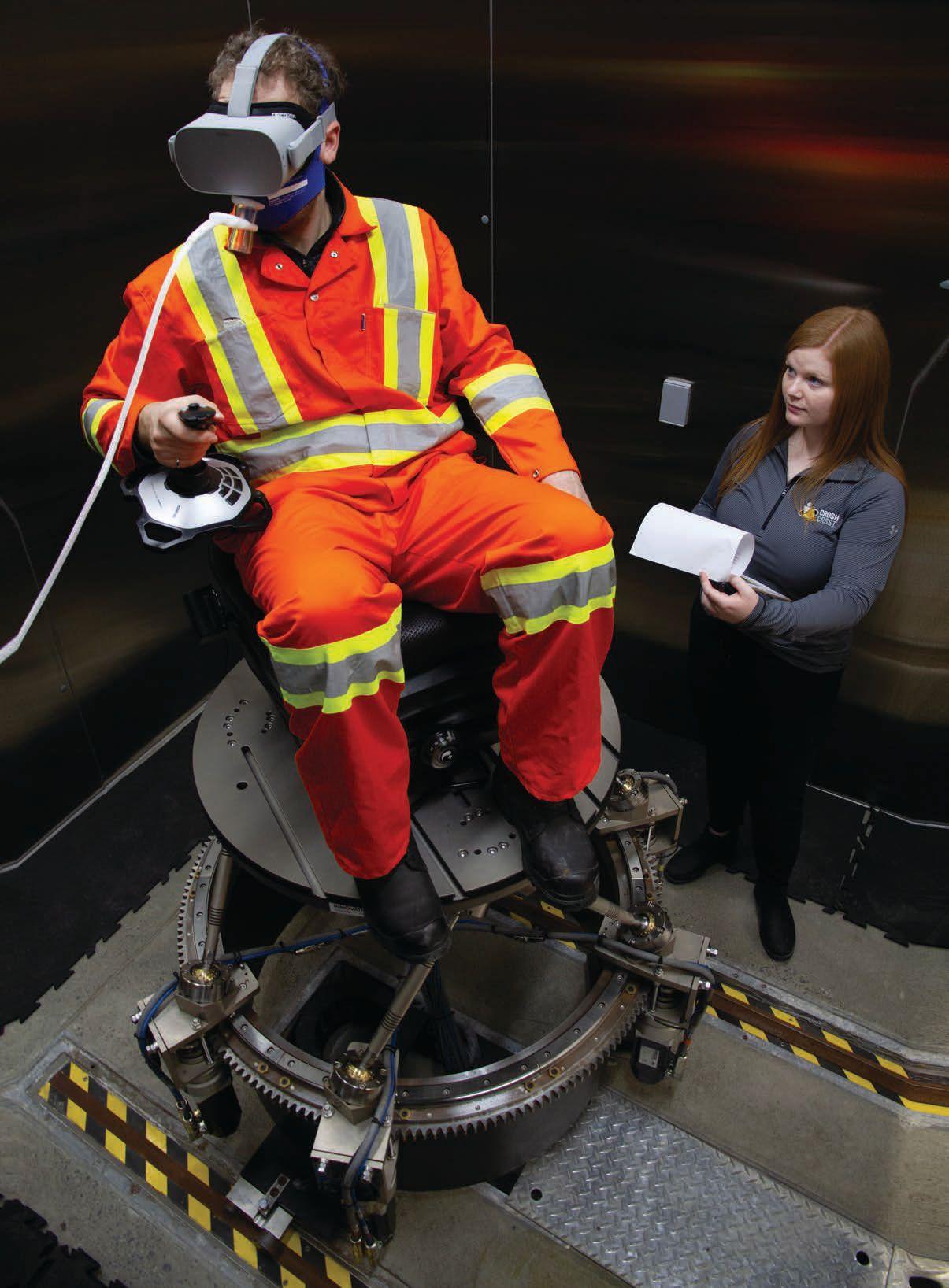
A made-in-Canada workplace simulator is a prime example of where the future of safety is heading.
Unveiled in December at Laurentian University’s Centre for Research in Occupational Health and Safety (CROSH) located in Sudbury, Ont., the machine combines robotics and virtual reality inside of a laboratory chamber to recreate various scenarios, such as underground mining situations.
The simulator is able to recreate precise workplace conditions, enabling the testing of equipment, systems and workers, says Dr. Alison Godwin, assistant professor at Laurentian.
“What we’re able to do is custom build and design the simulator to do what our clients need us to do,” she says. “Coming up with innovative solutions for industry — things to make the equipment better, the workflow better — those are the questions we can answer.”
The machine exposes users to heat stress and vibration exposure while testing for fitness, fatigue and situational awareness. The robotic chair simulates vibration, while the virtual reality eye-tracker component assists users in experiencing practical safety issues.
The environmental chamber can range in temperature from 40-below to 40 degrees Celsius, while a breathing apparatus allows for other occupational fitness quantifiers.
It is the only facility of its kind in the world, according to the university.
tive and immersive learning, she says.
“The idea with inductive learning is that learners actually use their prior knowledge as context for discovering the course content,” says Swanson. “So rather than sitting back and having someone talk at them or clicking through screens on a computer, they’re actually discovering it by sort of being put in the middle of a situation.”
“They have to react to it,” she says. “If they miss something, they’re taught in the standard sense, and if they found the hazard or they knew what to do next, it’s a much shorter version of the information.”
It is important for employers to remember that training is simply one component of a successful health and safety culture, says Swanson.
“You can send all your workers for training, but if… there isn’t a focus on safety, you’re not going to get the same sort of effect.”
Marcel Vander Wier is the editor of ohs canada
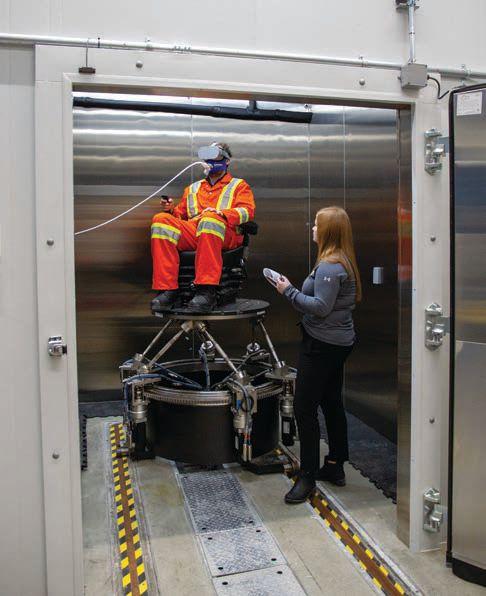
Unveiled in December, CROSH’s workplace simulator recreates workplace environments and conditions in a standardized laboratory setting. Wesley Young and Margaret Kanya-Forstner demonstrate its capabilities in Sudbury, Ont.
BY MARCEL VANDER WIER

Adevastating incident on a cold Toronto night in Jan. 2014 proved to be a watershed moment for the Centre for Addiction and Mental Health (CAMH) in its efforts to combat violence against workers.
A registered practical nurse was attacked from behind in a hallway by a patient who had a history of violence and was not following the prescribed medication plan. A co-worker who intervened was also injured and as a result, both workers suffered physical and psychological injuries. They never returned to work.
“There was blood all over the walls,” according to Nancy Pridham, president of the Ontario Public Service Employee Union (OPSEU) Local 500. “(The nurse) was beaten with a fire hose — the end of a metal fire hose — and kicked repeatedly.”
“My member was actually pulling her back into the nursing station, screaming ‘She’s dead! She’s dead!’” added Danielle Latuilippe-Larmand, president of the Ontario Nurses’ Association Local 54.
“At that point, we realized that there was a lack of knowledge around health and safety,” she said. “The scene was cleaned up. Pictures were not taken. The MOL (Ministry of Labour) was not contacted and it was a critical injury where the nurse was unconscious — severely beaten unconscious.”
The aftermath of the incident was wide-ranging.
The patient was charged by police and convicted for assault. CAMH was fined $80,000 by the MOL for failing to develop and establish measures and procedures including safe-work practices to protect workers on night shift.
And it was the moment CAMH began the road towards
solidifying its occupational health and safety practices in this area.
The two years previous included a number of violent episodes at CAMH, and both unions were attempting to work towards change, said Pridham.
“I don’t believe that there was any will in the organization… at that time,” she said. “There was no will to tackle the issue of violence. In fact, Danielle and I were told repeatedly that we were stigmatizing our patients.”
The violent incidents were not unique to CAMH, however, said Pridham.
“It was happening everywhere,” she said. “These are not calm, casual incidences we’re speaking of. These are incidences of extreme violence.”
“We started to raise the issues here… and that resulted in other people coming along.”
In 2014, there was not a lot of strategy on managing mental-health violence, admitted Bridgette McKenzie, manager of health, safety and wellness at CAMH.
“(The 2014 incident) forced us to make changes — not only to how we view mental health within the organization, but also having the right people at the table,” she said. “CAMH was a catalyst in getting a lot of the other hospitals on board in managing mental health.”
The Toronto hospital’s joint health and safety committee (JHSC) required senior leadership buy-in and decisionmakers at the table, said McKenzie.
And in 2015, this transition began to happen.
“That was one of the best things that happened to us,” said Pridham, noting that JHSC meetings finally became meaningful. “We had real leadership at the table who were willing to carry out and undertake recommendations that have been made at the table, and there was some real investment in occupational health and safety.”
In partnership with then-provincial Labour Minister Kevin Flynn, CAMH CEO Catherine Zahn also ordered that all incidents of near misses, first aid, time lost and medical aid be reported to the MOL on a go-forward basis, said McKenzie.
“It was a lot of work for the health, safety and wellness department,” she said. “But we started seeing a lot of changes because then staff knew that something was being done, that the Ministry of Labour was aware of all the incidents that were occurring.”
“We did that for a period of time, so that staff would know there was a true buy-in from leadership, that we were serious about making changes within the organization.”
Alongside full transparency into the organization’s incidents, further practical steps included encouragement from CAMH and affiliate unions that all worker members of the JHSC become certified at no charge to them.
Annual inspections were completed and JHSC members began to wear tags identifying their certification when visiting units. A poster campaign was initiated to broadcast safety tips; an annual Safe and Well day was launched; a wellness centre was established to provide staff therapeutic opportunities alongside a cope line for real-time therapeutic assistance.
“There was real recognition that the psychological trauma of both witnessing and hearing about repeated violent episodes was actually impacting the membership greatly,” said Pridham.
Best practices achieved
In July 2016, the Ministry of Labour’s ruling came down on CAMH for the Jan. 2014 incident, including a major fine.
The decision spurred change — from proper lighting to flagging previous and current risks of patients to having nurses work in pairs, said McKenzie.
De-escalation techniques were refreshed. An external group was brought in to complete total-risk assessments with all of the subsequent recommendations ordered for implementation by Zahn.
Meetings became more transparent under the urging of senior leadership, said Pridham. “We gave people a voice, which was really magic… People felt safe.
In 2017, a violence committee was formed at CAMH, and momentum took off from there — so much so that some employees began to balk at some of the increased protections, said Latuilippe-Larmand.
“People get used to doing business the way they’re used to. And when you ask them to do it differently, sometimes people see it as ‘Oh, you’re just being silly,’” she said. “It changed the culture.”
The shift in mindset and partnership between all parties
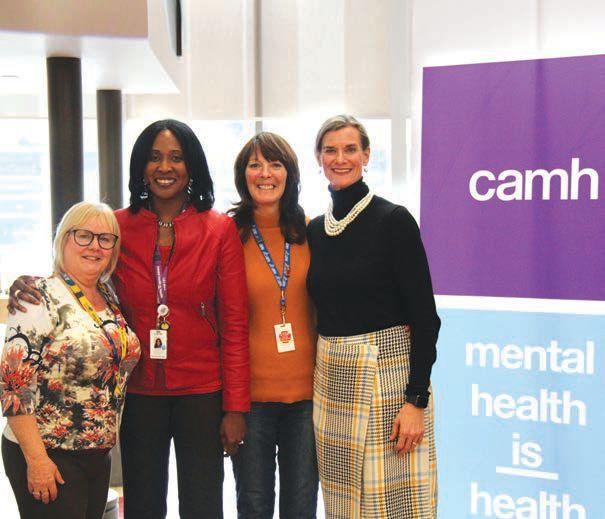
Danielle
54), Bridgette McKenzie
Nancy Pridham (OPSEU Local 500) and Carrie Fletcher (CAMH) have worked tirelessly over the past number of years to protect workers at the Centre for Addiction and Mental Health in Toronto.
was critical as CAMH moved towards workplace safety, said Carrie Fletcher, vice-president of people and experience at the hospital.
While CAMH couldn’t always do everything the unions requested due to budget restraints, a transparent, give-andtake relationship paved the way, she said.
“It’s having that open, honest relationship that you can say, ‘Guys, we simply don’t have the money for this… so, how are we going to come up with some creative solutions to make this happen? Or what are we going to need to pull from?’ That’s where the partnership is key at the end of the day.”
“It’s the shift in mindset that you can work together,” said Fletcher. “It doesn’t need to be adversarial, and we’ve seen that even spill over into our labour relations.”
While the two sides haven’t always agreed, renewed trust has continued to be the foundation, she said.
“Union people have got to figure out how to compromise, as well,” noted Pridham.
CAMH’s OHS team has been much more involved in workplace violence situations since 2016, said McKenzie.
“There was a time where things would happen and I’d hear after the fact,” she said. “Now, it’s about collaboration; it’s about partnership. We’re being more proactive as opposed to being reactive.”
The results tell the story, said Fletcher. CAMH has experienced decreases in violent events for six straight quarters.
And while violent episodes will always be a threat, the organization has worked hard to be proactive on this issue.
“It’s not that the violent patients are going to go away, but the manager’s response, or the leadership response in the organization needs to change,” she said. “You need to listen to your workers, and you need to take action to make them less afraid.”
Follow us on Twitter @OHSCanada
CSA Group issues call for national standard to combat far-reaching safety issue
BY ZENA RYDER
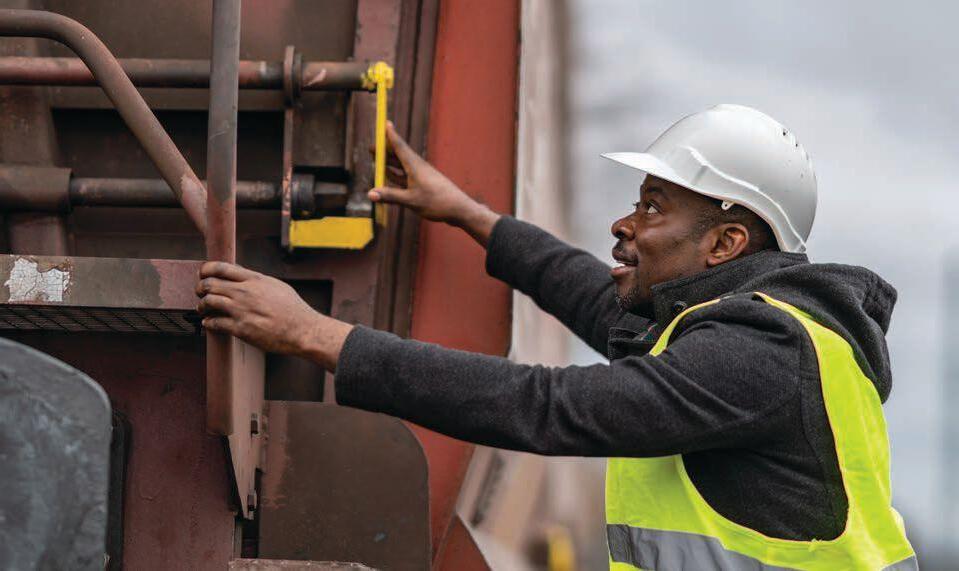
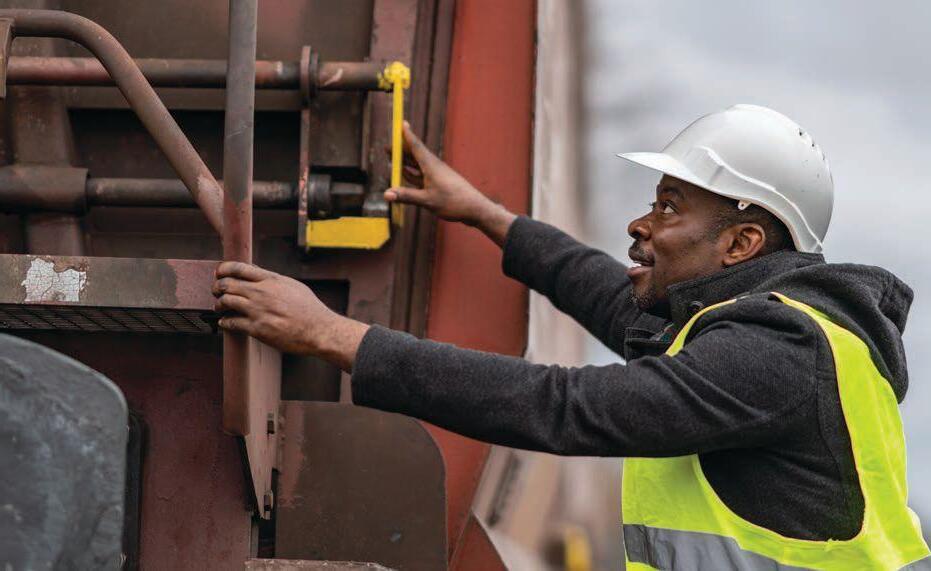
If you feel sleepy at the office, you stretch and make some coffee. No harm done. Your drive home is when you — and those around you — face the greatest risk.
In 2011, nearly a fifth of Canadians nodded off while driving, according to the Traffic Injury Research Foundation.
“As a society, we have a fatigue problem,” says Mike Harnett, president of Solaris Fatigue Management in Vancouver. “Canadians are frequently not getting enough sleep.”
As many as one in three adults ages 35 to 64 are getting less than the recommended seven to nine hours of sleep per night, according to the Public Health Agency of Canada.
Multiple factors contribute to fatigue, including health conditions, insufficient or poor-quality sleep, work demands and lack of adequate breaks during a shift.
“The risks of any workplace hazard are multiplied when workers are fatigued,” says Harnett.
Fatigue problems are far-reaching and no workplace is immune. However, it’s impossible to know exactly how serious the problem of workplace fatigue is, she says.
In part, the uncertainty is because there’s currently “no consensus on the definition of workplace fatigue,” according to a 2019 report by the CSA Group in Toronto.
“Workplace Fatigue: Current Landscape and Future Considerations” calls for a national standard on workplace fatigue, suggesting the possibility that workplace impairment standards might address the issue along with other types of impairments such as stress or drugs.
Aside from providing a cross-industry definition of workplace fatigue, a standard would outline how organizations with varying resources could tackle fatigue risk management, the report states.
Fatigue factors greatly within the transportation industry.
The daily freight rail schedule is unpredictable, says Eric Barker (pseudonym), a locomotive engineer with CN Rail. (OHS Canada is protecting Eric’s identity to prevent repercussions at his workplace.)
The unpredictability makes it hard for workers to ensure they get enough sleep before shifts, he says.
Even if it would be safer to stop and nap during a shift, there’s a built-in incentive to keep a train moving — CN Rail pays engineers and conductors by distance travelled, according to Barker.
Furthermore, regulations don’t allow engineers and conductors to nap, even if their train is stationary for an extended period, he says.
“CN rules say you’re not allowed to nap,” says Barker. “You’re not even allowed to assume the position of sleep. And cabs have cameras and voice recorders in them so management can monitor engineers and conductors.”
Despite Barker’s comments, safety remains a core value at CN Rail, according to spokesperson Jonathan Abecassis.
“Any employee that feels fatigued or has safety concerns has a duty to report it and use alternative means to complete the assigned task safely. CN and the rail industry are currently in the process of revising the work/rest rules to ensure that they reflect the latest science- and fatigue-management practices.”
Fatigue is also an issue in the trucking industry. Federal regulations prohibit more than 13 hours of driving time in a day. Time off is also regulated. However, truckers’ paper logbooks are easily falsified.
After the 2018 bus crash involving the Humboldt Broncos, the federal government created new rules that come into force in 2021. Federally regulated carriers must fit their trucks with electronic tamper-resistant black boxes that record drivers’ time behind the wheel.
Fatigue also factors into emergency medical departments, says Dr. Jeffrey Eppler of Kelowna General Hospital.
Decision-making worsens when a caregiver isn’t wellrested or if it’s the time of day when humans are wired for sleep, he says.
“Empathy and compassion are dialled down in the mid-
dle of the night,” says Eppler. “Unfortunately, getting sick or injured after midnight increases a patient’s risk. But people are going to get sick or injured at 4 a.m., and all we can do is mitigate the risks as best we can.”
Eppler always naps at least three or four hours before a night shift. He also impresses upon staff the importance of sleep, telling them it’s a “sacred responsibility to be wellrested” before coming to work.
Restricting shift length is necessary, but it isn’t a simple fix, he says.
“There can be unforeseen consequences of restrictions on shift length. For example, suppose someone leaves the hospital at the end of their 24-hour on-call period. The new person who comes on might not know the patient and their situation, which can lead to worse outcomes. On that occasion, going over the 24-hour limit might lead to better outcomes.”
But restrictions on shift length alone are not enough to improve outcomes, says Harnett, noting it’s also essential to have in place “a formal and well-documented protocol” for shift handovers to minimize the risk of medical mistakes.
When compared to alcohol consumption, being awake for 21 hours is akin to consuming three glasses of wine in one hour, according to the Canadian Centre for Occupational Health and Safety.
And just as one glass of wine can still have a detrimental effect on performance, lower levels of fatigue have detrimental effects, too.
The National Transportation Safety Board found that significantly more mistakes are made after 11 hours awake.
The effects of fatigue include lowered concentration and ability to focus, impaired risk assessment and judgment, as well as slower reaction time.
Still — as every workplace is different — no simple solution exists, says Harnett, noting the responsibility for managing fatigue must be shared.
“Employers are responsible for maintaining a safe work schedule, promoting a healthy workplace culture around fatigue, keeping work demands within reasonable boundaries and ensuring an environment that doesn’t exacerbate fatigue,” she says. “Employees are responsible for doing their best to make sure they show up fit for work each day. They need to manage any sleep disorders or health issues and prioritize getting enough sleep.”
If safety professionals want to improve workplace culture regarding fatigue, Harnett recommends appealing to the business impact of fatigue in order to get management on board.
“As well as being good for employees, there’s a solid business case for managing workplace fatigue,” she says.
Zena Ryder is a freelance writer in Kelowna, B.C.




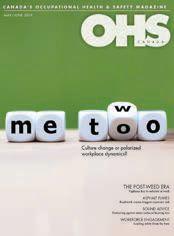
By Grant Cameron
The protective safety apparel industry is one that’s competitive and constantly changing. With advances in technology and new demands from consumers, companies in the space must adapt or be left behind.
It seems this year will be no exception.
A number of manufacturers are testing and introducing innovative materials in 2020 to improve on their existing safety products, while others are taking a stab at new and non-traditional markets.
Lighter, more comfortable apparel that’s both breathable and highly visible appears to be a universal theme amongst manufacturers.
Sustainability and environmental responsibility are also high on the radar.
Ensuring that protective safety apparel is a good fit for women within the workforce has not been missed.
“We have focused on PPE that fully takes women’s needs into account,” says Pete Holdcroft, director of user experience design at Honeywell Safety and Productivity Solutions in Bracknell, U.K.
“This is beyond just selecting the right colours for the female worker, but customizing women’s fit and design for high-risk, technical activities. Something as small as a safety boot that is too wide can be a safety risk.”
Expectations for PPE design and comfort are rising and workers want apparel and gear that is more comfortable, he says.
With that in mind, Honeywell will soon be introducing a clothing line that is about half the weight of current products and is looking into lightweight safety footwear.
Honeywell is also working on a new safety harness which has elastic webbings for freedom of movement and visually highlights the upper part of the gear so it can be donned more quickly.
Sensors are also being embedded in some of the company’s PPE items so as to enable constant monitoring of a worker’s vital signs.
The company has also rolled out a new range of CoreShield gloves that are made from specially-engineered materials to provide enhanced protection.
The gloves have a colour-coding system on the thumb crotch that makes it simple for users to identify the correct cut-protection level. They are light enough that users can operate panels on various industrial machines and smartphones without taking them off.
Superior Glove Works in Acton, Ont., also recently announced a family of gloves for various industries featuring PinchGuard — a technology that protects fingertips from workplace crush and pinch hazards.
U.S. manufacturer Magid has introduced an ultra-lightweight impact glove for jobs that require cut-resistance. They are designed to absorb impact but are flexible enough to prevent hand fatigue.
Lakeland Industries continues to work on new technologies, says national sales manager Randy Hillmer in Calgary.
“Historically, Lakeland’s biggest strength has always been in the disposable and limited-use market… but we are also looking at new opportunities.”
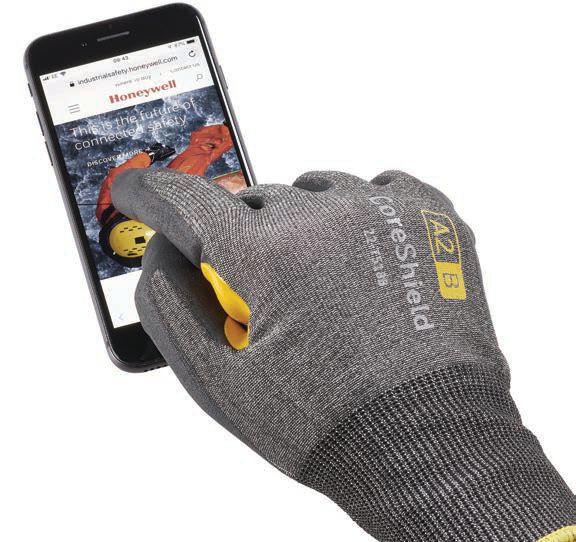
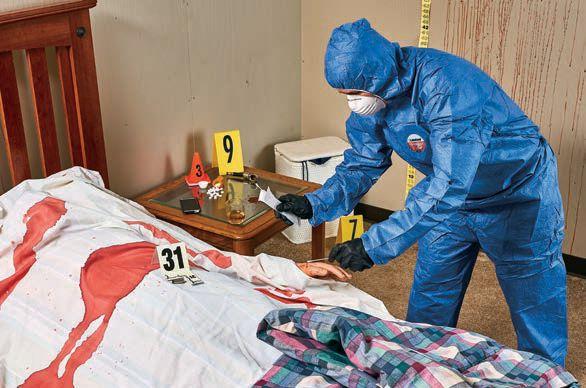
(ABOVE) Lakeland Industries’ MicroMax VP coverall protects users from contaminable fluids and is ideal for emergency response personnel. (BELOW) Honeywell, left, and 3M have focused on highly visible PPE.
A popular product for Lakeland is the MicroMax VP coverall which is specifically designed to protect personnel when the risk of blood, body fluids, bloodborne pathogens and viral contamination are greatest. They are ideal for use by emergency response personnel at crime-scene cleanups and in crime labs.
The company has been doing a lot of woven products for industries in the U.S. — such as the Tecasafe Plus FR Coverall that provides arc-flash and flash-fire protection — and will soon be rolling out two new protective garments that have one layer that wicks away moisture and another that acts as an insulator.
“The concept of layering in this case has two purposes,” says Hillmer. “One is moisture management so we can limit heat stress. If I take two layers of protective fabric — two layers is better than one.”
At 3M Canada, which makes products and protection for a variety of industries, the focus has been on developing reflective material to make products like firefighter coats and turnout gear more visible.
“We often work directly with our customers to make sure our products meet their specific needs,” says Tasha DiLoreto, content marketing supervisor, personal safety division at 3M Canada in London, Ont. “3M asked firefighters what they wanted in a reflective trim for enhanced visibility on their turnout gear, and they told us what was important to them.”
Head protection has been the focus at MSA.
The company has introduced a futuristic-looking VGard H1 safety helmet for workers in construction, logging and other industries. The lid features a four-point chinstrap, ratchet suspension for range of motion, a sweatband with wicking fabric, push-button accessory attachment rail and a rescue whistle integrated into the chinstrap buckle.
Customization and comfort are elements that have progressed the most in the evolution of industrial head protection, says Mackenzie Peters, product group manager for industrial head protection at MSA in Cranberry, Pa.
“The latest safety trends in design are aimed at appealing to a broader audience — think different sizes, shapes, colours and options to keep people more comfortable, and thereby help keep them safe,” he says.
“Put simply, if a helmet is more comfortable, workers are more likely to wear it, thereby ensuring compliance. And then if you give the ability for a wearer to customize it, they feel a sense of ownership and greater pride.”
MSA has seen a demand for more modern-looking helmets from millennials entering the trades.
The company has had many unusual design requests over the years, says Peters, and has produced everything from helmets for the Joshua Tree tour by U2 to helmets for the movie Jurassic World, according to Peters.
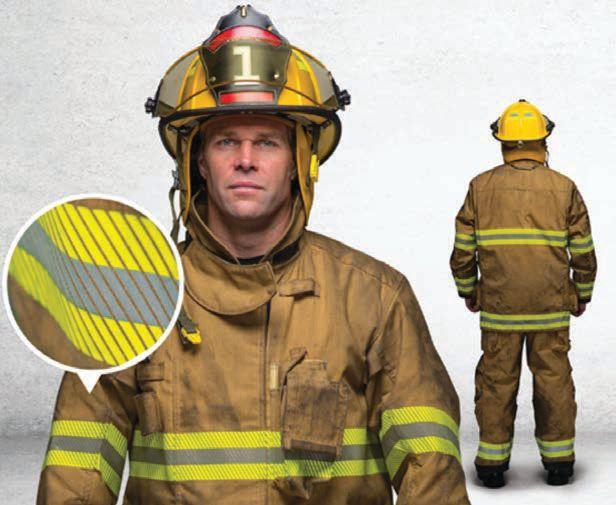
As a result, 3M launched its Scotchlite Series 5600 Fire Coat Comfort Trim for fire-service PPE. The material is designed to enhance visibility in low light and nighttime conditions when illuminated by a light source.
“We work closely with all partners in industry to listen to their requirements,” says DiLoreto. “One of our ultimate goals in developing materials is to help bring workers home safely at the end of their day.”
“But the designs that have had the most impact on us have been the ones we’ve done in response to a disaster or tragedy,” he says.
“From 9/11 to various hurricane recovery efforts, designing a custom hat for workers to wear while they rebuild their towns — and their spirit — is just one way we give back.”
Grant Cameron is a freelance writer in Burlington, Ont.
By Marcel Vander Wier
Workplace accidents happen every day across Canada.
In 2018, employers racked up 264,438 lost time claims, according to the Association of Workers’ Compensation Boards of Canada.
And so, while accident prevention is a necessary pursuit, employers and safety professionals also need to be aware of steps to take post-accident.
A total of six steps must be considered following a workplace incident, according to David Reiter and Cynthia Sefton, partners with Aird and Berlis in Toronto, presenting at a Workplace Law Summit in November.
Employers should also remember that an injury doesn’t need to occur in order for the Occupational Health and Safety Act to be breached, says Sefton.
Issues that come to light through inspection or complaint can also lead to charges, she says.
Ministry of Labour, Training and Skills Development (MOL) officers in Ontario are “very good” at their jobs, says Sefton. “You’re not going to pull the wool over anyone’s eyes.”
Showing respect and considering them as partners in prevention can go a long way, she says. “It’s based on trust; do they trust what you’re telling them?”
When a workplace accident has occurred, medical assistance is always the first priority, says Sefton.
A designated person should secure the scene, ensuring emergency assistance is administered and everyone is accounted for — it is a practical and immediate requirement, she says.
“That person doesn’t need to have all the answers, but he or she should know where to get the answers.”
It is important that the scene is not tampered with, says Sefton. “The only basis on which you can move or tamper is to save someone (or prevent unnecessary damage to equipment or property).”
A plan should be prepared in advance to determine who was present and what they were doing at the time of the incident, she says.
Resisting the urge to speculate is critical, says Sefton. “Don’t arrive at conclusions, and for goodness sake, don’t put them in tweets or emails… Be careful what you create.”
Communicating in person is recommended as much as possible, she says.
Once the accident scene is secured, attention must be turned to delivering applicable notices within required time limits. Reporting scenarios differ, based on incident severity, says Reiter.
A fatality or critical injury requires immediate notification be sent to the MOL, followed by a written report within 48 hours.
Prosecution will be looking for appropriate timing and report content — it makes for an easy charge, he says.
“The real question that they’re asking themselves (is): ‘Was there an attempt to hide the accident or incident?’” says Reiter. “That’s the worst kind of charge because it’s completely avoidable.”
It is important to consider if the accident has any connection to worker safety — notice is not always necessary, he says.
Erring on the side of caution is always the best bet, according to Reiter.
“You’re going to build credibility with the Ministry of Labour and the inspectors when they show up.”
Next will come the investigation, says Sefton.
All available records — policies, procedure, training records, quality assessments and audits — must be assembled, as investigators will want to know if the company took any steps to prevent the accident. Having them ready when the MOL arrives is best, she says.
Records should be easy to assemble, says Sefton. “If you can’t find it, it didn’t happen.”
Marking records with a date stamp is also important, as investigators will want to know when policies and procedures were put in place, she says.
The MOL has the power to compel documents and interview workers, while a fatality will spur a search warrant, says Sefton.
“These things are not taken lightly by the ministry or the police.”
It is best to rely on legal counsel, as defence lawyers will want to ensure no preliminary conclusions are reached, she says.

Incident reports should also only be created when necessary, says Sefton.
“Consider as a business why you’re creating this incident report,” she says. “If it doesn’t have a meaning, don’t do it… Meaningless documents end up coming back to bite you.”
When ministry investigators arrive, confusion often ensues as officers have near-unlimited powers over the process, says Reiter.
“There is no right to silence,” he says. “No one has the right to refuse to talk to the ministry.”
Investigators can compel people to co-operate with the investigation, arguing that those who do not may be obstructing the process.
But once investigators cross the “proverbial Rubicon” and determine charges will indeed be laid, search warrants will be required, says Reiter.
Employers must ensure they do not obstruct, hinder or delay investigations, he says.
However, it is important that supervisors are briefed on what was said by employees during interviews with investigators, especially if an employer representative is not permitted to sit in on the interview.
Debriefs need to be completed as soon as possible to ensure the information shared was accurate, says Reiter.
Employees may want to prep employees prior to the
interview to ensure they are not speculating or guessing on possible accident causes or operational failures.
Following the immediate aftermath of the accident, employers need to address operational and safety improvements in a timely manner, says Sefton.
The direct issue should be addressed, but so should any others uncovered during the investigation, she says.
“If there’s a safety issue, we recommend that you fix it. Because the worst thing that could happen is that the same thing happened over again while you’re being charged with the first incident.”
Repairing an issue is not necessarily an admission of guilt, says Sefton.
“If you don’t fix it, have a reason why you aren’t fixing it,” she says. “Don’t have it show up (in) every health and safety committee meeting over the next three years. That shows indifference.”
“If something is desperately in search of a solution, solve it.”
When implementing solutions, it’s important to monitor the effectiveness of the change and ensure employees are trained on any new processes.
It is common to see charges from multiple authorities stemming from a single accident, says Reiter.
The line between regulatory and criminal penalties is becoming blurred in recent cases such as Ontario (Labour) v. New Mex Canada Inc., 2019 and R. v. Fournier, 2018 — both of which dealt with workplace fatalities.
The Court of Appeal has laid down the law when it comes to penalties towards employers, he says. “Jail is appropriate.”
“All you have to show if you’re prosecuting a criminal manslaughter conviction is that there was an illegal act; that the death of the human was caused by that act; that the illegal act was objectively dangerous; (and) that a reasonable person would’ve foreseen the risk.”
Any violation against the Occupational Health and Safety Act would likely check all four boxes, says Reiter.
Practical steps to prevent this scenario include: identifying hazards, reviewing procedure to ensure adequacy, training staff, and then monitoring and enforcing.
“If you have someone violating your procedures, don’t let it slip,” he says. “Don’t have a culture that’s not safe.”
For employers, it’s important to be alert to how employees are behaving, says Sefton.
“Don’t close your eyes, because when the really bad thing happens, it’s going to come out that you should’ve paid attention to it.”
Marcel
Vander Wier is the editor of ohs canada
Follow us on Twitter @OHSCanada


By Alan Quilley
Irecently had an opportunity to speak to a crowd of people considered leaders in safety management.
My topic for my keynote session was focused on the need for us to manage safety logically. In fact, I’ve coined the phrase to mean exactly what it says.
Safety management needs to be approached systematically and logically. By that, I am suggesting that safety efforts need to follow the evidence to produce results. Otherwise we should do something other than what isn’t getting us the outcomes we want.
This year, I’m going to intensify the focus on managing safety logically.
Every company that tries to manage their safety excellence through implementing Edwards Deming’s “Plan – Do – Check – Act” (PDCA) cycle of continuous improvement is approaching safety management logically.
Employee and contractor engagement is always reported to be high on the list of reasons for success when it comes to the safe production of goods and services.
None of the leaders in safety mentioned doing safety to employees as a factor in their success. In fact, in my 40-plus years in the safety management business, I have never observed that to be a factor in excellence.
Most of us should be spending at least some of our time thinking and learning about how we engage employees in their own safety. Not because it’s the new buzz phrase or because books on engagement and emotional intelligence are highly popular right now.
It is because we’ve historically seen overwhelming evidence that doing safety to people has failed in significant ways. Passive safety — like any kind of passive activity — doesn’t produce the same quality results that high engagement can.
Engagement is a key feature of successful enterprises and is essential to ensuring your safety culture is empowered by the considerable knowledge of your entire employee population.
Every competent teacher will tell you that to gain the confidence that students know what they’ve been taught requires engagement.
Safety guru Dan Petersen famously said: “Paper doesn’t save people; people save people.”
Our ability to engage people passionately and with sincere interest is guaranteed to get better outcomes, rather than inflicting safety onto people by overwhelming them with an endless number of written policies and procedures.
Barking orders to “comply with the rules” will never work as well as engaging the people who have to comply in the development of said rule.
People tend to comply with rules they have made with more understanding and commitment than an edict from head office.
So, let’s start off the new year by demanding more safety logically than safety emotionally Safety logically generally includes these important and interconnected tenets:
1) Do safety with people and not to people.
2) Don’t jump to a safety solution because it’s quick. Efficient and effective should be the desired outcome of any solution.
3) Use evidence to support what you do to enhance safety. You need data to make good decisions. You can see safety if you look. When done correctly, PDCA will give you a great deal of that evidence.
4) Measure what you do — not what doesn’t happen to you.
5) Stop relying on auditing! If you need an auditor to tell you what you are doing… you don’t know what you are doing.
6) Acknowledge efforts to create safety over those that just celebrate non-injury outcomes. Low injury rates are great. Knowing why you have them is better.
7) Recognize the need for the psychosocial aspects of your safety efforts. Employees are complex and our understanding of their needs, wants, fears and aspirations is essential to their well-being and the well-being of our organizations.
8) B e patient. Change takes time — quick fixes rarely last. A new normal for your organization happens slowly.
9) Stay connected and informed on what is new and what should be considered.
10) Keep learning what works and let go of what doesn’t.
So, what are you waiting for?
Search “emotional intelligence” and/or “employee engagement” and start reading. You don’t really think someone is going to deliver that information to you like a pizza, do you?
In 2020, let’s explore these 10 “Safety Logically” ideas together. It may require that we let go of some long-believed myths. But that’s all right. They aren’t doing us much good anyway!
Follow us on Twitter @OHSCanada
Alan Quilley is the president of Safety Results in Sherwood Park, Alta.
Recent OHS Canada articles have caught the attention of our readership. Would you like to share a comment? Send your letters to OHS Canada or comment on any of our stories online. Comments are subject to editorial approval.
Re: Dangling Edmonton window-washer rescued from swinging scaffolding (Website News, Oct. 28)
New Canadians starting small firms under the umbrella of others often know little of OHS rules.
This practice is promoted by those seeking inexpensive options in the workplace. We see this in all basic labour fields without trade requirements or proper overview.
Dale Allen
Re: Toyota worker’s suicide ruled workrelated after harassment (Website News, Nov. 19)
It’s not uncommon to work long hours in the manufacturing industry.
North America is no different. In oil and gas, many workers put in an average of 60-plus hours for two weeks at a time. Granted they have a turnaround, but prolonged exposure to work can be an adaptation.
Harassment on the other hand is frowned upon in North America. We have learned that positive reinforcement can increase mental health and can improve productivity.
Bill Osborne
Re: Ontario government unveils program rewarding safe employers (Website News, Nov. 22)
I wonder if WSIB looked west in Canada’s backyard past the OntarioManitoba border for a similar and fairly
successful program — like the Partnership in Injury Reduction (PIR) program?
The WSIB program looks to be very similar.
Cameron Schreiber
Re: Too often, it’s still ‘safety second’ (Nov/Dec 2019 issue, Editorial)
Great post. It brings to light that some employers are truly winging it out there when it comes to health and safety practices. That being said, I have incredible examples of fantastic approaches from many clients, some that have won awards. Then there are those inbetween these two extremes.
I’d like to propose that employers train employees to a standard of care, and then become reliant on the “common knowledge” they all share about safety expectations. Attaining common knowledge could be the starting point where we lean less and less on “common sense.”
Health and safety training solves only a lack of skill or knowledge, rather than supporting a common “sense” or “feeling” that something is not safe, or not right in some way (or vise-versa).
Common sense is great, just don’t rely on it when it comes to health and safety expectations at work.
Marty Dol
Re: Does Quebec’s unique winter-tire law make roads safer? (Website News, Dec. 2)
Winter and all-season tires are becoming obsolete. Especially for those still running all-seasons all year, buy allweather tires instead.
They are not a compromise. They are totally different than all-seasons and a fairly new option.
Better than some winter tires for ice and snow, you can leave them on all year (no new rims or tire pressure



sensors needed) and they are rated to last 100,000 kilometres.
The cost of changing tires twice a year and storage can equal the tire cost over the life of the tire. All-weathers are far less expensive.
Once original equipment manufacturers put all-weathers on their cars originally and people find they are fantastic in the snow, they will likely stick with only all-weathers.
Bob Braan
Re: Edibles add new wrinkle to safety landscape (Nov/Dec 2019 issue, Hot Topic)
Workplaces and behind the wheel are no place for impairment.
But with that being said, impairment comes in many forms.
Cannabis has a negative stigma to it because it has been illegal for so long. Complete zero-tolerance policies are absolutely absurd — compare the actual statistics of impairment-related vehicle accidents, and the leading cause of impairment is medication that you can get over the counter.
Alcohol, cannabis, Tylenol Cold/ Flu or lack of sleep — they all impair judgment, figures a test for general impairment. Cannabis has been legal for over a year and the sky hasn’t fallen, nor will it with edibles.
Safety-sensitive employers give the employees trust and training to do their job to the best of their abilities. Why can’t they do the same when it comes to impairment?
Have some trust in us.
Brad Lester
Would


PHOTO: TWITTER/@SKSAFETYCOUNCIL
SASKATCHEWAN — A video posted on Twitter in August by the Saskatchewan Safety Council (@SkSafetyCouncil) ended up gaining attention for its awkward lesson on the importance of vehicle inspections. As first reported by Narcity, the two-minute video follows a young couple through several date scenarios and ends with their vehicle’s lights going out just as the man was going to pop the question to his girlfriend. The amateur videography garnered its share of unique responses from viewers, including the following from @dirk_mike99: “Wow.. hopefully this was Less than free to make.” The video, which was posted multiple times by the safety council’s account, has collected more than 266,000 views to date.
MONTREAL — A Canadian police officer is seeking compensation after being shot at with live rounds during an active shooter drill in April 2014. During the drill, another officer directed two live rounds in Valérie Guay’s direction. She was unhurt but suffered panic attacks following the incident. Guay pleaded her case to Quebec’s workplace health and safety board (CNESST) to have it considered a workplace accident after she developed post-traumatic stress disorder (PTSD), according to the CBC.
GERMANY — A 26-year-old worker has died, four years after falling into a coma due to his eating a sandwich laced with poison. The accused — identified as 57-year-old Klaas O. — was sentenced to life in prison for peppering his coworkers’ lunches with mercury and other substances, though he has appealed the verdict. He was arrested in May 2018 after surveillance video showed him sprinkling powder on a colleague’s sandwich. Two other workers suffered kidney damage as a result, according to the Associated Press.
OTTAWA — Overfilled morgues have led to bodies being left in uncommon places at health-care facilities in the nation’s capital, according to the Canadian Press. Workers have walked into conference rooms to find bodies left there until space opened, says Lou Burri, president of CUPE Local 4000. Area hospitals conduct autopsies, but bodies can sit for weeks or longer before they are claimed. In 2018, 473 bodies went unclaimed.
SUDBURY, ONT. — Software company Sofvie says it has found a link between moon patterns and workplace accidents. Data from 2017 and 2018 suggests incidents are more common during the full moon, according to the company in Sudbury, Ont. “We started analyzing data from 2017 and 2018 and it matches up very well,” chief innovative officer Gus Minor told TimminsToday.com. “I wouldn’t say it’s a direct correlation, but they happen to cross each other a lot.” The company also found that workplace accidents tend to spike during a change in seasons.
GEORGIA — A Steak ‘n Shake worker who called in sick to work during U.S. Thanksgiving because he was “intoxicated” showed up anyway and demanded money while holding a gun to a colleague’s head. According to the Gainesville Times, 20-year-old Kentarias Gowans is charged with aggravated assault. Gowans briefly raised the gun towards officers before dropping it. He was arrested after a brief struggle during which a stun gun was used.

ONT. — An emergency alert concerning the Pickering Nuclear Generating Station sent in error Jan. 12 caused a massive spike in iodide medication orders in Ontario, according to the Canadian Press. More than 32,000 orders were placed in the two days following the false alarm. There are normally between 100 and 200 orders per month, according to Ontario Power Generation. The pills help protect the thyroid gland and reduce the risk of cancer if radioactive iodine is released into the air during a nuclear emergency.
Follow us on Twitter @OHSCanada
Discover the 3M™ Secure Click™ Respirator Platform
Featuring the world’s first quad-flow cartridge system designed for easier breathing.
Discover the 3M™ Secure Click™ Respirator Platform
Discover the 3M™ Secure Click™ Respirator Platform
Featuring the world’s first quad-flow cartridge system designed for easier breathing.
Featuring the world’s first quad-flow cartridge system designed for easier breathing.
Hear it.
Hear it.
Hear it.
Work with the confidence, provided by the all-new 3M™ Secure Click™ connection, that filters and cartridges are installed properly.
Work with the confidence, provided by the all-new 3M™ Secure Click™ connection, that filters and cartridges are installed properly.
Simply align the connections and push to hear a click.
Work with the confidence, provided by the all-new 3M™ Secure Click™ connection, that filters and cartridges are installed properly.
Simply align the connections and push to hear a click.
Simply align the connections and push to hear a click.
Feel it.
Check it.
Greater breathability and comfort provided by
Feel it.
Greater breathability and comfort provided by the world’s first quad-flow cartridge system.
Check it.
Check it.
Help increase worker confidence that the respirator is being worn properly with the easy, one-touch, user seal check.
Help increase worker confidence that the respirator is being worn properly with the easy, one-touch, user seal check.
Help increase worker confidence that the respirator is being worn properly with the easy, one-touch, user seal check.
Say it.
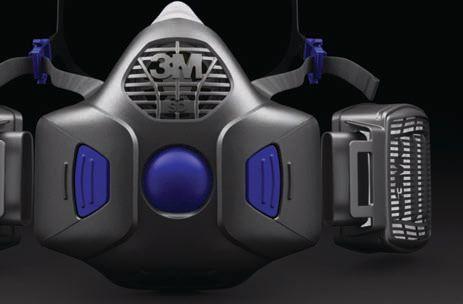
Speaking diaphragm designed to help provide easier communication
Speaking diaphragm designed to help provide easier communication while working.
Speaking diaphragm designed to help provide easier communication