tHe BeAker: laying Behaviour in Furnished cages By Karen Dallimore
behaviour studied
HouSiNg: une Fenêtre sur le Futur en se lançant dans la construction d’un nouveau poulailler, Mathieu Poirier a voulu créer une vitrine attrayante sur la production d’oeufs d’aujourd’hui et de demain
Par André Dumont
coVer PHoto By: Jack Hamilton, New Life Mills
Unique preservation program
FROM THE EDITOR
by KrISty nuddS
opportunity Knocked
according to the genome institute at the university of Washington, the chicken genome —or more precisely that of its ancestor, the red Jungle Fowl — has been described as the “premier non-mammalian vertebrate model organism and was the first genome to be sequenced of an animal that represents a significant component of the world’s food supply.”
David W. Burt of the roslin institute noted the importance of sequencing the genome in a 2005 Genomic Research article, where he wrote “many features of the chicken genome and its biology make it an ideal organism for studies in development and evolution, along with applications in agriculture and medicine.”
in fact, the chicken has played an integral role in research for more than 100 years. Burt notes that the chicken has been a popular model organism for understanding the fundamentals of biology, being ideally suited for the study of vertebrate development because the embryo is readily available and thus easily manipulated.
Prior to the sequencing of the chicken genome, the molecular development of limbs, the discovery of B cells and tumourcausing viruses are just three examples of the chicken’s contribution to biology.
Although selective breeding has allowed the poultry industry worldwide to achieve exponential growth in the last 80 to 90 years, selecting for traits coveted by consumers and agri-business (fast growth, increased breast yield and egg production) has had some unintended consequences, such as an increase in metabolic and skeletal disorders, and reduced disease resistance.
Poultry breeding companies are, of course, utilizing the chicken genome in their quest to eliminate such undesirable
traits but knowing gene sequences is only part of the equation. understanding how genes function and how they affect certain traits is key.
that’s why the preservation of genetic material is critically important. So-called “heritage breeds” represent a vital source of genetic variability, but live populations are costly for research institutions to maintain. Facing a funding shortfall, the Poultry research centre (Prc) at the university of Alberta developed a unique funding model to maintain its heritage lines and received an added bonus — the opportunity to engage consumers and teach them about poultry science and farming (see page 20).
the Prc launched its “Adopt a Hen” program in 2013 and expanded it for this year. the program has supporters pay to “adopt” a hen from one of its five heritage breeds, and in return supporters receive a dozen eggs every two weeks. New this year was the addition of chicks being available for sale at local Peavey Mart locations in the edmonton area.
A huge success, “what started as a money recovery project has really turned into a community outreach program,” says Dr. Valerie carney, an adjunct professor with the Prc
it’s not surprising that the program was met with great interest from other universities in North America when carney presented the program at the recent Poultry Science Association Meeting in texas. Having a sustainable method of preserving valuable genetic resources while teaching and cultivating an interest in the poultry industry — it doesn’t get much better than that. n
Lubing Breeder and Pullet Nipples are the Combination for Success!
Pullet Nipple - OptiGROW Nipples with easy 360 degree triggering start your birds off to success from day one. OptiGROW nipples can be used with or without LitterGuard cups.
Breeder Nipple - Designed specifically and solely for breeders, the high-flow Breeder Nipple is constructed totally from stainless steel to withstand the aggressive behavior of breeder birds.
Contact your local Lubing Distributor for more information on our Proven Breeder Package or visit our website at www.lubingusa.com. J. Dean Williamson Ltd.
Tel: (519) 657.5231
Fax: (519) 657.4092
Fax: (403) 337-3590 Les Equipments Avipor
Tel: (450) 263.6222
Fax: (450) 263.9021 Specht-Canada Inc. Stony Plain, Alberta
Tel: (780) 963.4795
Fax: (780) 963.5034
B Professorship in Welfare What’s HATCHING HATCHING
urnbrae Farms has gifted $500,000 to the university of guelph to establish the Burnbrae Farms Professorship in Poultry Welfare, a tenure track position in the Department of Animal and Poultry Science. Dr. Alexandra Harlander will assume this position and will serve the poultry industry with her insights on animal welfare and behavior in all poultry species.
will support the adoption of new practices, the design of systems that are best suited for the hens’ welfare and the implementation of new technology to improve the quality of life of laying hens on the farm.
Dr. alexandra harlander
the professorship will support egg farmers and increase the capacity for the ongoing research of laying hen behaviour and housing. the main objective of the research is to solve problems associated with alternative non-cage systems and to better understand the behaviour and biology of the laying hen. this research
Margaret Hudson, President of Burnbrae Farms, said in a release “the university of guelph has played a significant role in the support of animal welfare and behavior, and the research they conduct is unmatched. this professorship will help increase its capacity and will be unique in its outreach efforts to farmers, the general public and retailers.”
the professorship, also partially funded by the Poultry industry council and the canadian Poultry research council, will focus on research, teaching, industry service and educating farmers, retailers and consumers. consumers’ prefer-
ences continue to drive the demands of retailers and the specialty egg market in canada. Professor Harlander is an associated faculty member of the campbell centre for the Study of Animal Welfare, an internationally recognized centre of excellence, and will work to balance on-farm productivity and poultry welfare, with the needs of the general public.
“Burnbrae Farms’ commitment to the industry, animal welfare and consumers is evident in its support of this innovative position,” said rob gordon, Dean of the ontario Agricultural college of the university of guelph in a news release. “We need champions to communicate with farmers, retailers and consumers. this position will focus on working with the entire value chain to enhance production systems and approaches, and educate on the issue of poultry welfare and behaviour.”
Photo by
Ag Minister seeks Civil Code amendment
Quebec’s new agriculture minister Pierre Paradis says new legislation is in the works that will redefine the status of an animal in the province’s civil code and improve its protection, and clean up the province’s bad reputation as one of the best places to be an animal abuser.
“i want to go as quickly as possible,’’ Paradis told the canadian Press. “it’s among my legislative priorities.’’ once the civil code is amended, cats, dogs and other animals will no longer
Egg Farmers Awarded
James and Brenda Mcintosh are the 2014 recipients of the ed Mckinley Poultry Worker of the year award. the award is presented yearly to outstanding individuals in the poultry industry by the Poultry industry council (Pic).
the award was presented August 21 in Seaforth, ontario at the Huron county Summer Barbecue for Zone 5 egg and Pullet Farmers and families.
keith robbins, executive Director, Pic said, “James and Brenda Mcintosh are to be commended for their generous one million dollar contribution to the university of guelph ensuring poultry nutrition research and education will be available for future generations of poultry farmers.”
be considered as “personal property” but as living, “sentient” creatures. that is a formula that has already been adopted by several european countries.
He said he has reached an agreement in principle with Justice Minister Stephanie Vallee that would give animals more status before the courts than inanimate property such as a chair or table. the change in status means the courts will consider pain and suffering when imposing penalties or fines on abusers. While recognizing the sentient nature of an
animal will not give it the same type of rights as for humans, it will increase the obligations on owners and breeders toward their charges.
Paradis noted competitors could squeeze Quebec out of the market if it doesn’t treat its animals better.
“We’re right in the middle of a free-trade deal with europe and we will be affected if we do not adjust,’’ he said.
in June, Paradis announced the establishment of a 24-hour, seven-days-aweek tipline where people could report animal abuse.
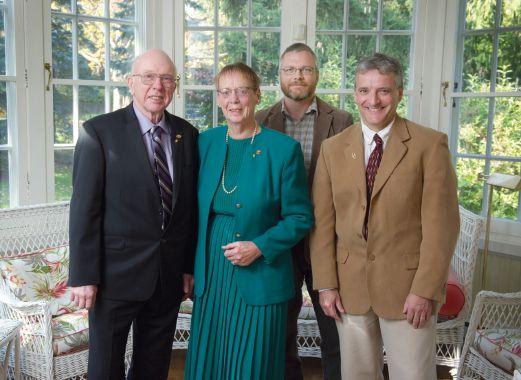
James and brenda mcIntosh (right), shown here with andy robinson, chair of the Department of animal and Poultry science; and robert Gordon, dean of the ontario agricultural college last year.
James Mcintosh earned an undergraduate degree from ontario Agricultural college in 1959, and a master’s degree in poultry nutrition in 1961. it was at the university of guelph that he met Brenda, and together they founded Mcintosh Poultry Farms ltd. in Seaforth. the family’s contribution to the sector exempli-
OctOber
october 7-9, 2014 Poultry service Industry Workshop the banff centre, banff, alta. www.poultryworkshop.com
october 19-23, 2014 asia Pacific Poultry conference icc Jeju, Jeju, Korea. www.appc2014.org
october 29, 2014 canadian Poultry sustainability award and symposium hanlon convention centre, guelph, ont. www.cPsustainability.com
december
December 10, 2014
Prairie livestock expo (formerly hog and Poultry Days)
Victoria inn hotel & convention centre, Winnipeg, man. www.prairielivestockexpo.ca or email: info@prairielivestockexpo.ca
January 2015
January 27-29, 2015 International Production and Processing expo (IPPe) World congress center, atlanta, georgia. For more information, visit: www.ippexpo.com
fies the poultry worker of the year characteristics.
Poultry industry council is a not for profit charity that develops and funds research extension and education programs for the poultry industry within ontario. it is supported by the ontario feather boards, industry organizations, and by both corporate and individual members.
We welcome additions to our Coming Events section. To ensure publication at least one month prior to the event, please send your event information at least eight to 12 weeks in advance to: Canadian Poultry, Annex Business Media, P.O. Box 530, 105 Donly Dr. S., Simcoe, ON N3Y 4N5; email knudds@annexweb.com; or fax 519-429-3094. Please write ‘Event Submission’ in the subject line.
What’s
HATCHING HATCHING
Chickens Reveal Birth Defect Clues
new discoveries in chicken genetics and biology are shedding light on the basis of craniofacial abnormalities in both birds and humans.
the research was made possible by information from the chicken genome sequence and a stock of rare chicken lines kept at the university of california Davis.
the researchers focused on a mutation of the gene named talpid2, known to be associated with a number of congenital abnormalities, including limb malformations and cleft
lip or palate.
they found that talpid2 — like other limb and craniofacial mutations found in both humans and chickens — is related to the malfunction of “cilia,” tiny, hairlike structures on the surface of cells of the body. cilia play a vital role in passing along signals during development.
When a gene mutation interferes with the normal structure and function of the cilia, it sets off a chain reaction of molecular miscues that result in physical abnormalities, in
chickens or in people.
Now that this new information is available, the talpid2 mutation can be expanded as a model for studying similar congenital abnormalities in humans, including oral-facial defects. the findings also are significant for production of poultry and livestock, which are likewise vulnerable to genetic mutations that cause similar physical abnormalities.
the findings appear in the August issue of the journal Development.
hemp Greatly Increases omega-3 content N
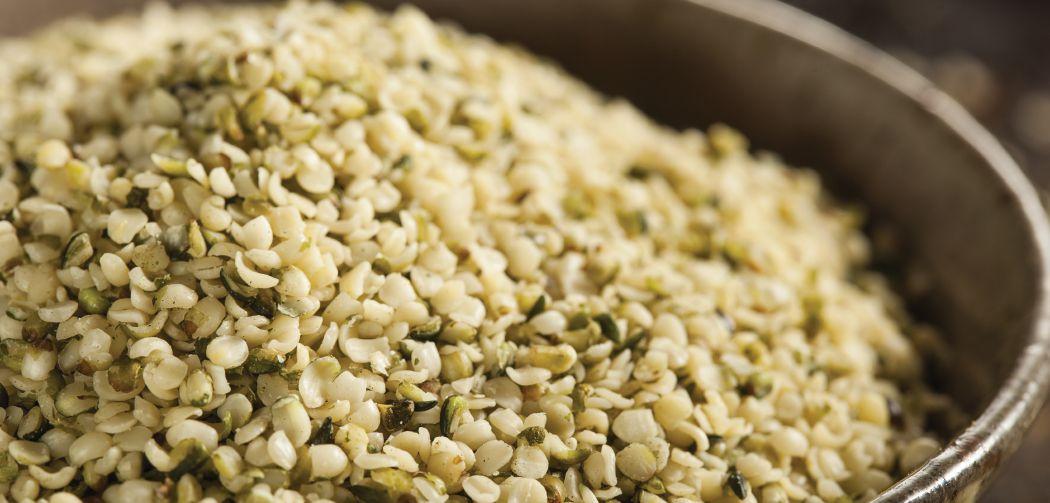
aturally Splendid enterprises recently announced the results of a study conducted at the university of Manitoba that showed an increase of over 637 per cent in the natural omega content of eggs from chickens that consumed the exclusive HempomegatM plant-based omega product when compared to chickens that consumed a current commercial feed product. Addi-
tionally, the study concluded that chickens that consumed HempomegatM not only had substantially higher omega content in their eggs but also showed an increase of over 372 per cent in the omega content of the chicken thigh meat itself as well as lower levels of saturated fats. this study was conducted by Dr. James House at the university of Manitoba on
behalf of Boreal technologies inc. the purpose of the study was to examine the efficacy of HempomegatM when incorporated into poultry feed rations and to identify to what degree HempomegatM could increase the natural omega levels found in eggs laid by chickens that consumed varying levels of the exclusive plant-based omega product.
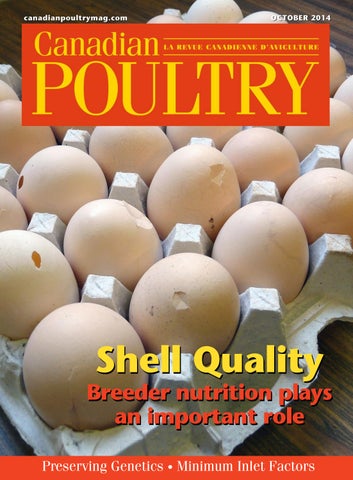
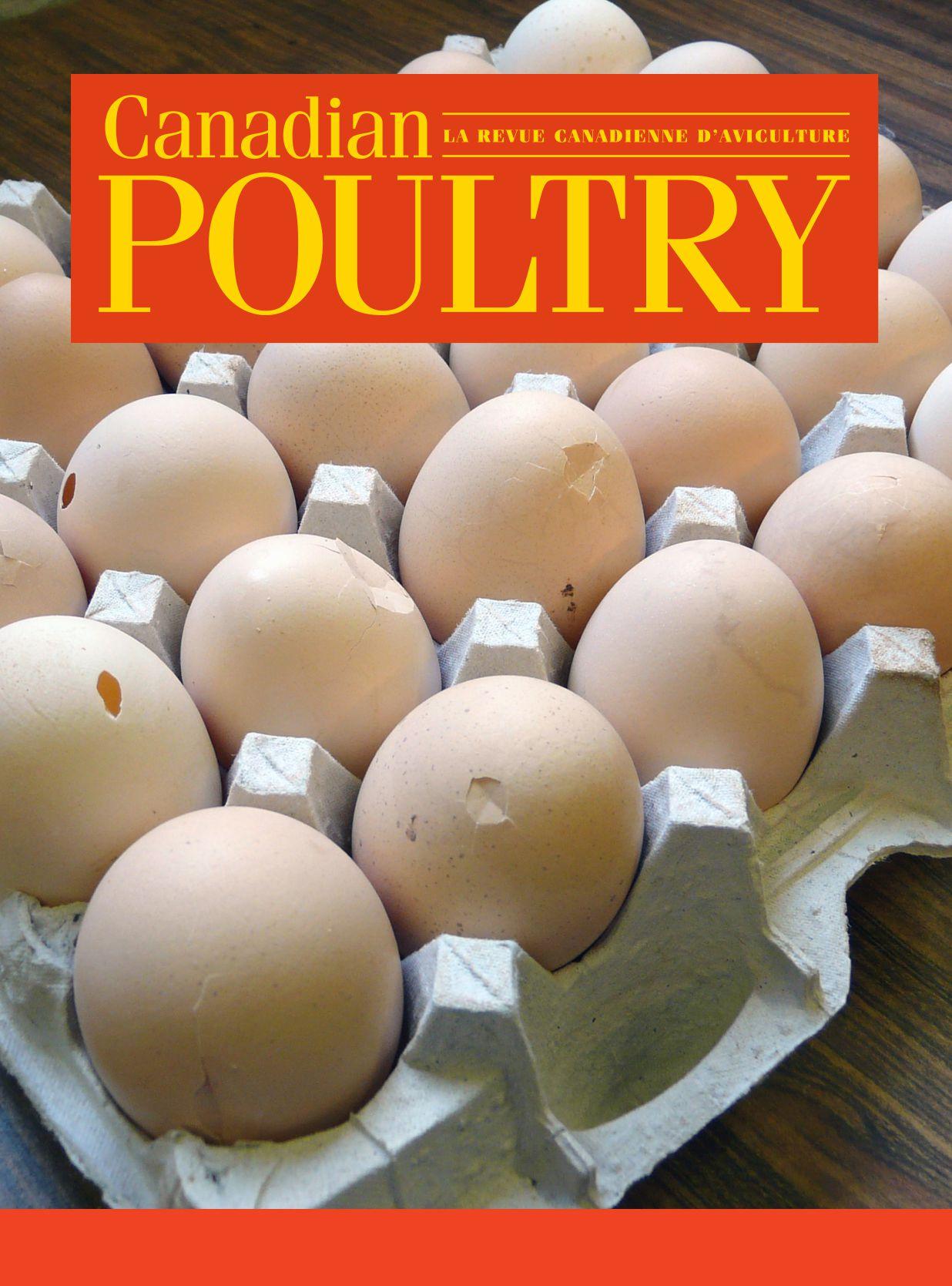
shell Quality Impact of breeder nutrition
by Lisa Hodgins M.Sc. Monogastric Nutritionist,
New Life Mills, A division of Parrish & Heimbecker, Limited
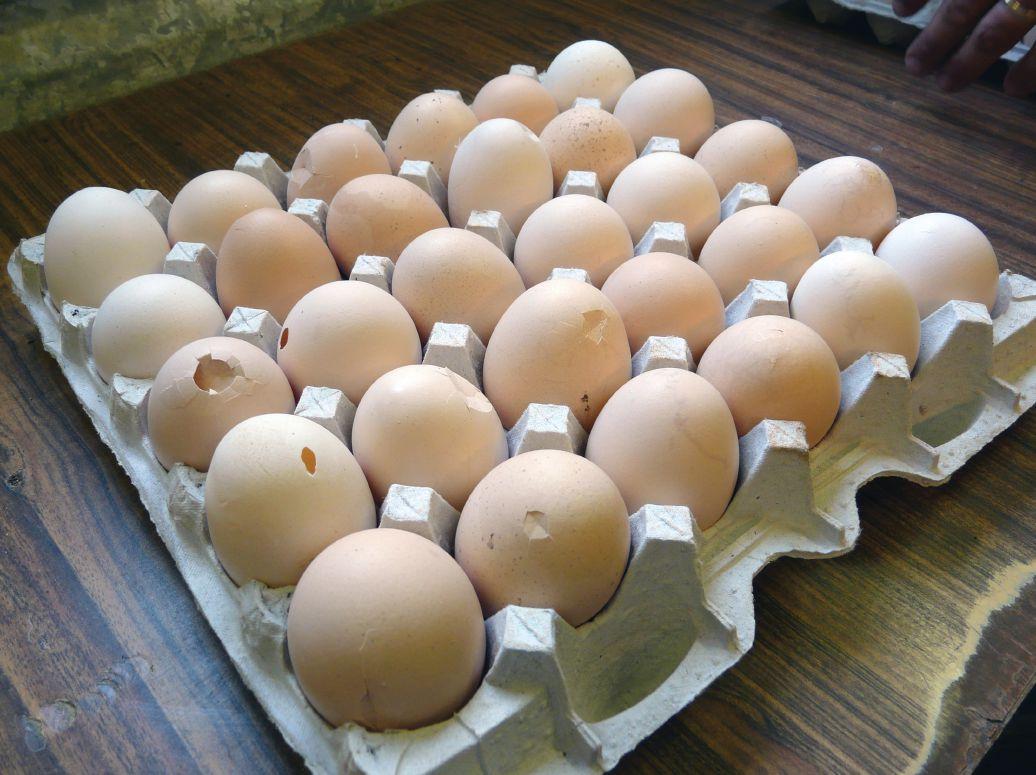
maintaining shell quality in a breeder flock is a major focus for nutritionists and producers alike. Poor shell quality can lead to large economic losses as a result of a decrease in the production of settable eggs per hen. While there are many factors that influence shell quality, nutrition plays an important role in preventing cracks and other defects that may result in an egg being deemed unacceptable as a settable egg.
calcIUm
calcium is the first nutrient producers and nutritionists focus on when shell quality starts to deteriorate. Broiler breeder hens require about 4-5 grams of calcium per hen per day to maintain calcium balance and produce a good shell on their eggs. in today’s commercial breeder operations, hens are often fed a pelleted feed. A typical breeder ration balanced at 3.2% calcium with hens consuming 168 grams per bird results in the total intake of 5 grams of calcium per hen (168x0.032) and meets their daily requirement for calcium. the hiccup with this feeding strategy is that hens are typically fed early in the morning, and, as a result, they consume their calcium requirement before the egg is actually in the shell gland forming a shell. in mash and pelleted feeds, coarse limestone or oyster shell should be included in the diet. it is not incorporated into the pellet per se, but added to the feed after it has been manufactured. this will supply a component of the total calcium from a coarse source which is absorbed into the blood stream at a much slower rate.
Shell quality can be improved by broadcasting coarse calcium (limestone, oyster shell) in the afternoon onto the litter. this provides the hens’ with access to a calcium source at a time
of day when the shell is actually forming, thereby improving shell quality. Broadcasting involves tossing handfuls of limestone/oyster shell out onto the shavings throughout the barn once a day. At the same time, it is important to avoid excessive use of limestone/oyster shell as we do not want it to build up in the litter if the hens do not consume all of it. too much calcium can reduce shell quality, as it is known to cause pimpled and soft-shell eggs. Hens can safely be fed one gram per bird in the afternoon by way of broadcasting.
VItamIN D
Vitamin D plays a role in the function of calcium absorption and transport to the shell gland. Diets low in Vitamin D can cause shell quality to deteriorate because it reduces the absorption of calcium. Breeder diets are balanced with about 3,000-3,500 iu/kg of added vitamin D, which will meet the needs of the breeder hens. When shell quality does deteriorate, it is common practice to provide additional vitamin D in the form of Hy-D (25(oH)D3). Hy-DtM is a potent form of vitamin D that is highly available to the bird and promotes increased calcium absorption, thereby improving shell quality. Hy-DtM may be added to the feed or drinking water. consult your nutritional advisor prior to supplementing Hy-DtMor other vitamin D3 products, as excessive intake can be harmful to the hens and shell quality.
Phos P hor U s
Phosphorus is another mineral that plays a role in shell quality. the correct calcium-to-phosphorus balance is critical in maintaining shell quality because the need for phosphorus is linked to the need for calcium. Phosphorus levels that are too high can cause shell quality to deteriorate because
LISa hOdgInS
the new life mills monogastric nutritionist discusses the important role of nutrition on the shell quality of breeder eggs
the high levels of phosphorus induce a calcium deficiency. When phosphorus levels are too low, we also see shell quality deteriorate because calcium metabolism is impaired. Nutritionists work diligently to ensure that the optimal level of phosphorus is provided in a diet. As a result, supplementing with additional phosphorus sources is not recommended without the direct involvement from your nutritionist.
t race mIN erals
Deficiencies in trace minerals such as copper, manganese and zinc may result in thinner, wrinkled or translucent shells. these nutrients are provided in your complete feed and are usually supplemented through the addition of a cocktail of different forms (oxide, sulfate, complexed trace minerals). in situations where shell quality is deteriorating, it is not uncommon to add additional trace minerals to the feed in the complexed form because they are known to have the highest biological availability.
eGG sI ze
As the breeder hen ages, egg size increases. However, the total amount of shell that covers that large egg stays the same. consequently a bigger egg, with the same amount of shell automatically means thinner shells and more opportunities for that egg to be damaged. to address this, we sometimes use a phase feeding strategy to manipulate the diet to help control the size of the egg.
egg size can be manipulated by adjusting the level of protein, amino acids and linoleic acid in the diet. research has
concluded that by reducing the total sulphur amino acids (methionine and cystine) the rate at which egg size increases can be slowed. if we can keep the eggs on the smaller side (65-68 grams), there is less surface area to cover, resulting in thicker shells that are less vulnerable to damage.
c o N cl U s I o N
Shell quality problems can appear in any flock. However, nutritionists working with producers are able to manipulate various aspects of the diet in order to conquer the problem or at least minimize the impact. this can be accomplished through adjustments to the calcium level in the feed, the
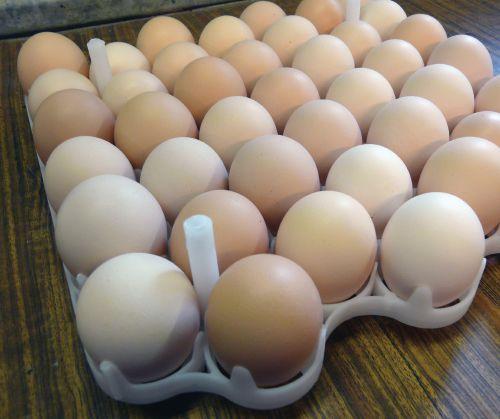
eGGs that are UNaccePtable (aboVe) aND accePtable (beloW) as settable. Poor shell QUalIty caN leaD to larGe ecoNomIc losses DUe to the Decrease IN ProDUctIoN oF settable eGGs
Nutrition
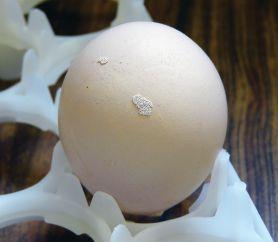
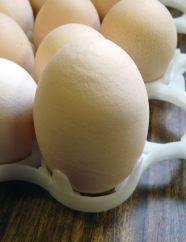
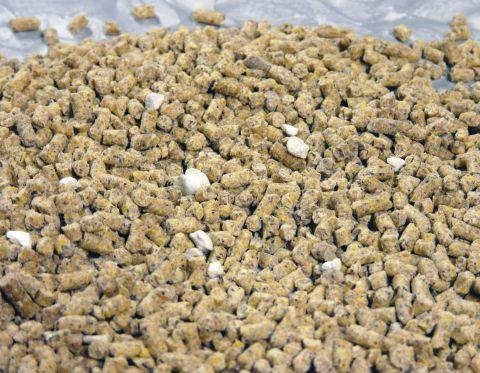
(toP leFt): aN eGG WIth PImPlING DUe to excessIVe calcIUm INtake; (toP rIGht): larGe eGGs haVe thINNer shells that caN be more easIly DamaGeD; (bottom): PelleteD FeeD WIth coarse lImestoNe INcorPorateD
calcium source, vitamins, trace minerals and through controlling egg size. the producer, with his/her nutrition team, can develop a strategy to achieve the best shell quality possible to maximize the number of settable eggs and hatch the healthiest and best quality chick possible. n
IF eGGs are kePt oN the smaller sIDe (65-68 Grams), there Is less sUrFace area to coVer, resUltING IN thIcker shells that are less VUlNerable to DamaGe
AgriInvest
A Smart Investment for Managing Farm Risk
AgriInvest helps you manage income declines on your farm and supports investments that help mitigate risks. To benefit from AgriInvest for the 2013 program year, you must:
• submit your 2013 AgriInvest form by September 30, 2014*
• open an AgriInvest account at a participating financial institution and make your deposit by the deadline date shown on your Deposit Notice.
*Note: Applications will be accepted until December 31, 2014, but will incur a 5% per month reduction in the maximum matchable deposit.
Learn more at agr.gc.ca/agriinvest or call 1-866-367-8506.
Get online with My AAFC Account!
My AAFC Account provides convenient and secure access to your AgriInvest account information online.
To sign up for My AAFC Account, go to agr.gc.ca/myaccount.
Agri-investissement Un investissement judicieux pour la gestion des risques à la ferme
Agri-investissement vous aide à gérer les baisses de revenu de votre exploitation et à faire des investissements pour atténuer les risques. Pour participer à Agri-investissement pour l’année de programme 2013, vous devez :
• produire votre formulaire d’Agri-investissement pour 2013 au plus tard le 30 septembre 2014*
• ouvrir un compte Agri-investissement dans une institution financière participante et y faire votre dépôt avant la date d’échéance indiquée sur votre avis de dépôt.
*Remarque : Les demandes seront acceptées jusqu’au 31 décembre 2014, mais une réduction de 5 % par mois sera appliquée au dépôt maximal donnant droit à la contribution de contrepartie.
Pour obtenir plus de renseignements, allez à agr.gc.ca/agriinvestissement ou téléphonez au 1 866 367 8506.
Inscrivez-vous à Mon dossier AAC en ligne!
Le site Mon dossier AAC offre un accès pratique et sécurisé en ligne à l’information sur votre compte Agri-investissement.
Pour vous inscrire à Mon dossier AAC, allez à agr.gc.ca/mondossier.
Housing a Window into the Future
mathieu Poirier’s new layer house is to be a showcase of today and tomorrow’s egg production
BY A NDR é D UMONT
It had been ten years since Mathieu Poirier had joined his father Jean-claude on the farm, and he felt it was time to modernize the family business. egg production in the next 30 years is certainly going to be very different from the past 30 years. At 33 years of age, Poirier prefers to be ahead of upcoming trends.
Built over last winter, the new layer barn is entirely equipped with enriched battery cages. But Poirier did not only want to be prepared for future animal welfare regulation. He built his barn with another goal on his mind: keeping consumers on the side of local egg farmers.
located just outside the village of Saint-Bonaventure, near Drummondville, the new building uses contrasting red and grey siding to create a contemporary look on the outside. Poirier chose the colours, drafted a plan and took it to an architecture technician.
“i wanted something nice,” he says. “i wanted the result to be different (from other farms) and it wasn’t much more expensive.’’
it was also the right time to have a graphic design firm create a new logo for la Ferme des Poiriers.
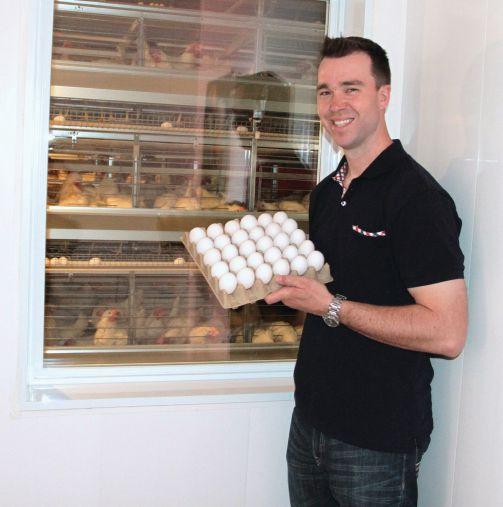
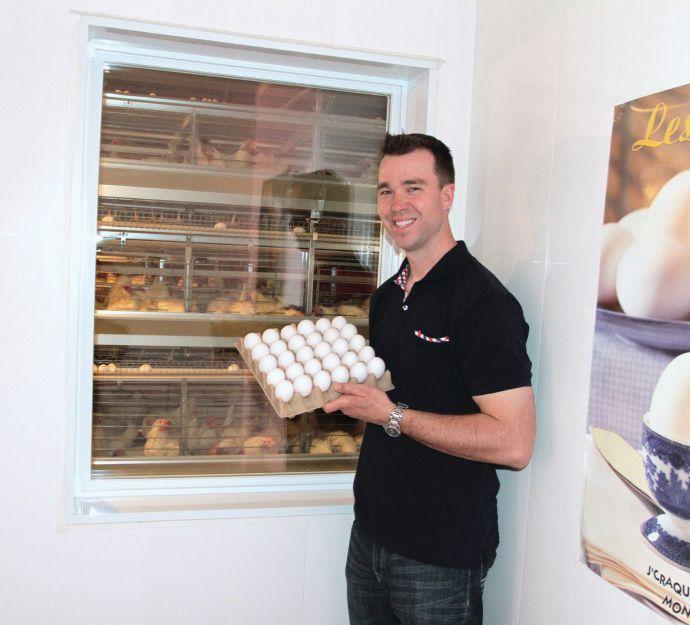
the visual impact is not only meant to stand out among other poultry operations. Poirier wants to make a good impression when visitors drop by to see how eggs are produced. the hen house has a large window that offers a peek into
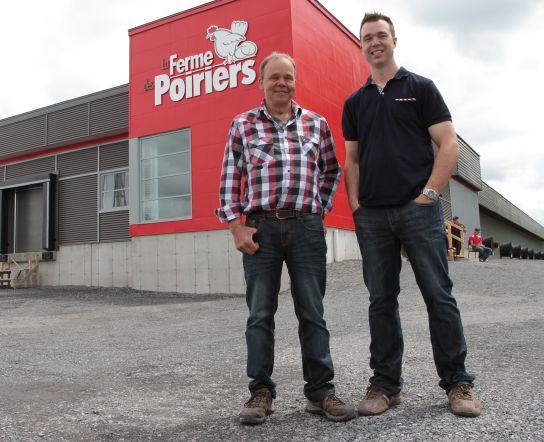
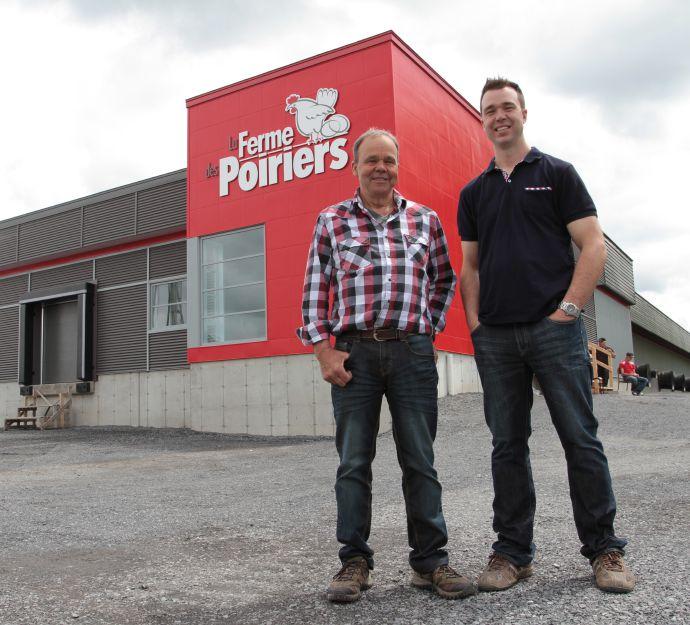
mathieu Poirier (right, shown here with his father Jeanclaude) felt it was time to modernize the family business
the birds’ living environment. the window is located at the end of a hallway. Visitors can have a look without having to go through biosecurity, since they don’t enter very far into the building.
As an ‘’ambassador’’ for the Fédération des producteurs d’oeufs du Québec (Quebec egg growers’ union), Poirier regularly hops onto the centre d’interprétation de l’oeuf, a trailer housing real layers in real conventional cages used to educate the public.
‘’this window for visitors is like a treat for us,’’ Poirier says. ‘’People want to know how egg production works. kids want to see the birds. With my new enriched cages, i am not at all ashamed of showing how the birds are treated.’’
300 F eet, 6 t I ers
Built in the 1970s, the two older layer barns had become too small and outdated. Quota from growth allocations had to be rented out and if it was not brought back to the farm, the Poiriers
Now available in Canada, POULVAC®
Bursaplex is the unique innovative antigen-antibody complex vaccine with simple, safe, and efficacious protection for broiler chickens against infectious bursal disease, regardless of maternal antibody level. WITH ONE SINGLE DOSE IS
Housing
would eventually be forced to sell it or give it up. the farm was also losing its two most loyal employees. in a new construction, everything would be simpler for future workers.
the new construction houses six 300-feet rows of cages, six tiers high, with a walkway between tiers three and four. to allow for two age groups at the same time, the barn is split in two, each side with three rows of cages, for a total capacity of 62 000 layers.
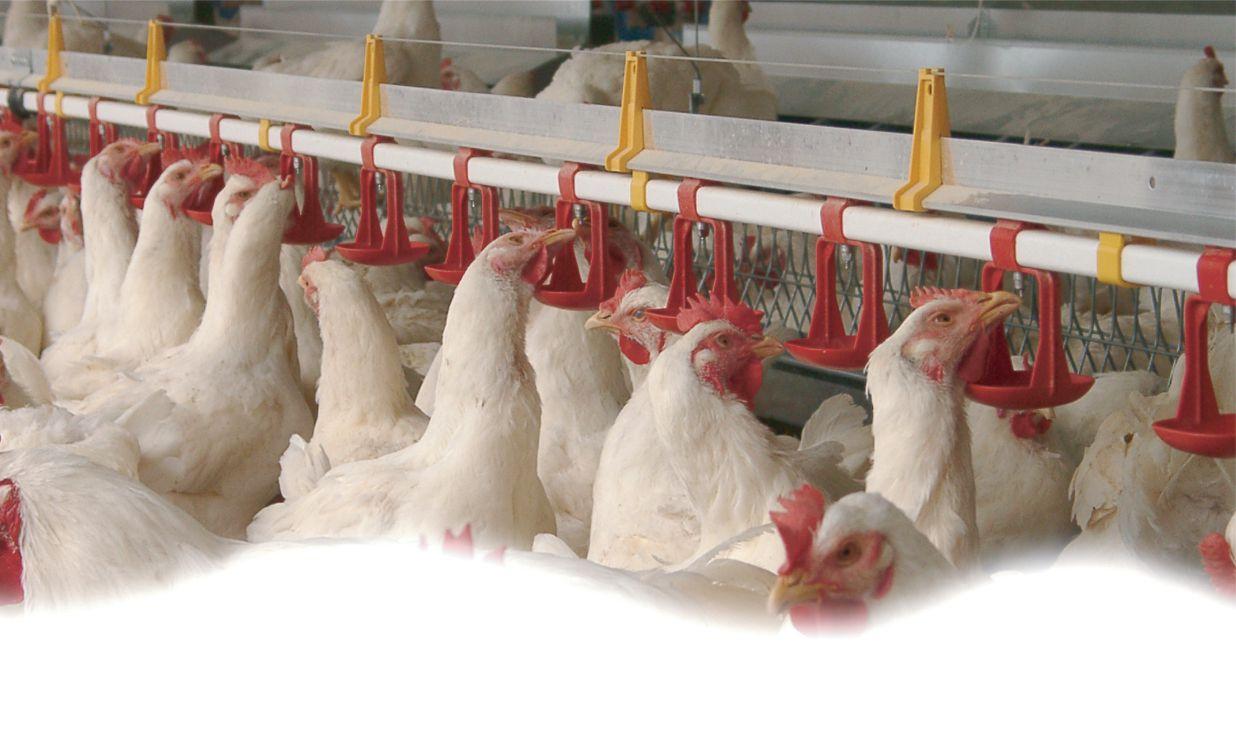
the enriched cages are Hellmann’s model eu 24-241. they have a middle partition that splits cages in two sections, each holding a maximum of 24 birds. ‘’research shows that when you have more than 30 or 40 birds in cage, they start picking at each other. that’s why we have middle partitions,’’ says Johann Benner, who oversees canadian sales at germany’s Hellmann Poultry.
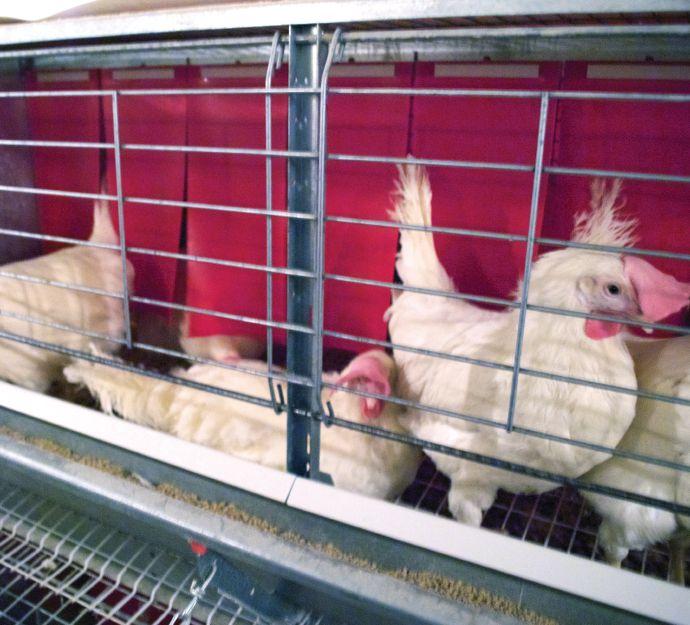
cages have two parallel perches, high just enough for eggs to roll under them. they also boast curtains around a nesting area located close to the front, to minimize egg movement.
Feeding troughs follow the whole length of the cages in front. they are rigid enough to be used as a ladder. these sturdy troughs are standard at Hellmann, Benner says.
A supplementary feeding system may be added along the central partition. ‘’if one day regulation changes and we need to add trough space, it will be possible,’’ says Stéphane chouinard, Hellmann distributor for Quebec and eastern ontario.
the barn is ventilated with an air mixer, providing 25 cfm of fresh air directly to the birds in their cages and bringing manure water content down to 35 or 40 per cent. Air may also come from lateral air intakes in the summer, or be filtered and recirculated in the winter.
the facility also has a new water treatement system that will greatly improve water quality from the older now-demolished houses.
Hot water heating pipes were inserted in the cement floor, but only under the alleys between the cage rows. ‘’We wanted to reduce our construction cost, because we didn’t know if heating was needed,’’ Poirier said. He expects to heat during cold waves, in order to reduce feed costs.
tW o DIFF ere N t meals
the Poiriers also grow 100 acres of corn and soybeans, which provide for 20 to 25 per cent of the birds’ feeding needs. the feed is mixed on location, with advice from Shur-gain experts. the new barn has four feed silos: two for each layer age group. they will be used to introduce Shur-gain’s ecolay tandem, a new program that provides layers with two different feeds, one for the morning and one for the afternoon. recipes vary according to the needs of the birds’ metabolism during the day.
construction at la Ferme des Poiriers is not yet over. For more than 30 years, the family has raised its own pullets. the old barn currently housing the pullets is not convenient to raise two age groups, to go along the new layer barn. Before the end of the year, pullets will also have a brand new home. n
mathIeU PoIrIer haD thIs WINDoW INstalleD For VIsItors to haVe a Peek INsIDe the layer barN
CPRC Update yeast is Not least
yeast-based products can help chickens mount a faster, stronger immune response to disease challenge and may offset the need for traditional antimicrobials used in poultry production. that’s the finding of a new study coming out of the university of Manitoba.
Dr. Bogdan Slominski is head of a long-standing research program at the university looking at the effects of novel feed ingredients and enzyme technologies on animal health. in the current study, he and his team analyzed corn/ wheat distiller’s dried grains with solubles (DDgS) and a number of yeastbased products and tested several for their ability to promote the health of broiler chickens. Here’s what they found:
Not all are createD eQUal
yeast products generally are rich sources of specific nutrients and nucleotides (the basic structural units of DNA). there is evidence that many of these products, when fed to poultry, can stimulate the immune system and help set up conditions in the gut that favour beneficial bacteria and exclude certain pathogens. Dr. Slominski’s group set out to see which products offered the most benefit. After analyzing eleven products, the researchers decided only four had properties that warranted further study: brewer’s yeast from DDgS production, Hi-yeast 751 (nucleotides), Maxigen Plus (a nucleotide- and yeastrich product available from canadian Bio-Systems inc.), and yeast cell Wall (ycW; components of the yeast organism released upon enzymatic treatment). the researchers applied their expertise and found that the biological activity of several products could be improved by pre-treating them with enzymes. Animal trials were performed during which broiler chicks were fed antibiotic- and coccidiostat-free diets supplemented with DDgS or selected
yeast-based products. Birds were fed from day one to day 21-28 depending on the trial. growth performance and immune status of the birds were examined and compared to that of birds fed diets supplemented with conventional antimicrobials. the researchers noted that live brewer’s yeast in the feed can result in decreased body weight gain and feed efficiency; it is therefore recommended that brewer’s yeast be inactivated (killed) before including it in poultry rations. Both live brewer’s yeast and ycW negatively affected development of the small intestine of the chicks. Hi-yeast 751, on the other hand, appeared to promote intestinal development. overall, the selected yeast-based products did not significantly improve the growth performance of broilers in these trials. However, it is worth noting that the birds did just as well on diets containing yeast products as they did on diets containing antibiotics and coccidiostats in the absence of disease challenge.
ImmUNIty caN be eNhaNceD
Beyond growth performance, the researchers looked at the ability of yeast-based products to affect immune function. results indicate that yeastbased products do not stimulate the innate immune system of broiler chickens under non-challenged conditions. this property could be beneficial for the birds because immune system activation in the absence of a microbial challenge comes at a cost in terms of productivity and growth performance. When birds were challenged with Clostridium perfringens (a bacterium associated with necrotic enteritis), yeast products were just as effective as traditional antibiotics at minimizing the birds’ reaction to the infection, but were not as good as antibiotics at reducing C. perfringens counts in the gut. the researchers conclude that traditional antimicrobials more effec-
tively protect birds from gram-positive bacteria such as clostridium and that yeast-derived products are more effective against gram-negative bacteria such as Salmonella.
What’s Next?
Dr. Slominski continues to explore the use of yeast-derived products and enzyme technology in poultry nutrition. He heads up a project in the current Poultry Science cluster that, in collaboration with canadian Bio-Systems inc., may lead to industry application of new enzyme/yeast supplements that offset the need for traditional antimicrobials.
Funding for this research was provided by cPrc, Poultry industry council, Natural Sciences and e ngineering research council of canada (NSerc), and canadian Bio-Systems inc.
staFF aNNoUNcemeNt
in case you haven’t heard, esther ouellet joined the ottawa office as research Administrator. Ms. ouellet has a wealth of knowledge and experience that will be a great asset to the organization. Her contact information and a brief biography are on our website.
For more details on any c P rc activities, please contact the canadian Poultry research council, 350 Sparks Street, Suite 1007, ottawa, ontario k1r 7S8, phone: (613) 566-5916, fax: (613) 241-5999, email: info@cp-rc.ca, or visit us at www.cp-rc.ca. n
The membership of the CPRC consists of Chicken Farmers of Canada, Canadian Hatching Egg Producers, Turkey Farmers of Canada, Egg Farmers of Canada and the Canadian Poultry and Egg Processors’ Council. CPRC’s mission is to address its members’ needs through dynamic leadership in the creation and implementation of programs for poultry research in Canada, which may also include societal concerns.
Genetics Preserving heritage chicken Genetics
Uofa’s unique “adopt a heritage chicken Program” brings needed funding
BY D ONNA F LEURY
heritage chickens are important for breeders and industry to protect valuable genes and traits over the long term. Heritage poultry breeds are breeds that existed prior to the 1950s and represent an important bank of genes for traits like disease resistance, unique egg and meat flavour profiles and increased stress tolerance and vigor. However, many heritage breeds are rare and increasingly threatened with extinction.
the university of Alberta’s Poultry research centre (Prc) has held heritage chicken strains since 1986. the rare breeds and random bred strains were partly obtained from the Agriculture canada research Station in ontario and partly from Dr. crawford’s experimental flocks at the university of Saskatchewan. Dr. roy crawford maintained these breeds as an unselected population since 1965, however, when he retired, these breeds found a new home at the Prc in edmonton. like other institutions and organizations, recent budget constraints and physical space have put pressure on the Prc heritage chicken program. “there were more strains earlier on, but some difficult decisions have had to be made along the way due to space and budget concerns,” explains Dr. Valerie carney, Adjunct Professor, Poultry research and extension Specialist, Alberta Agriculture & rural Development. “Some of the original
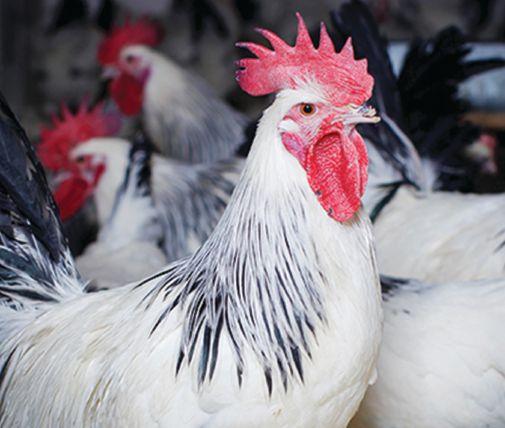
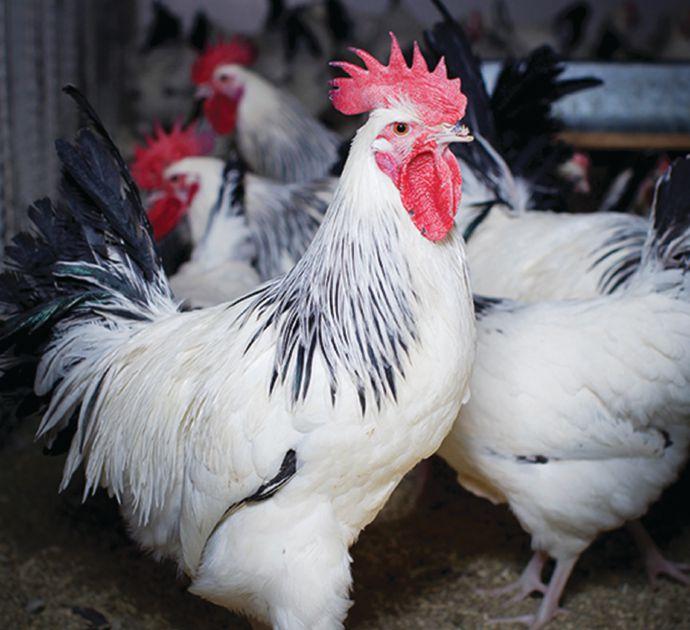
supporters pay $75 to “adopt” a heritage chicken such as the light sussex, and receive eggs on a bi-weekly basis
lines have been transferred to other institutions or eliminated over the past several years. the remaining heritage flocks are valuable and are like an insurance policy for industry,” says carney. “our current commercial lines only represent about 50 per cent of the genetic variation, so without these heritage flocks, a lot of variation would be lost. As consumer
demands change or new market opportunities open, having access to the range of traits is valuable. one of the most reliable ways of preserving these heritage lines is by keeping live populations. there is research underway with cryopreservation techniques, however the methods are not yet fully reliable and should form only a portion of conservation techniques.” .
UNIQUe ProGram
Because these heritage flocks are costly to maintain and with budget cuts to provincial universities, the Prc flock came under the spotlight. Prc needed to find a creative way to cover the costs of maintaining this flock of 1,500 birds, which were costing about $75,000 per year. Prc received funding from the Alberta livestock and Meat Agency (AlMA) to assist with a market research and development project to identify opportunities.
“We worked closely with our commercial industry partners to ensure that any strategies developed were in harmony with the commercial markets,” emphasizes carney. “the egg industry for example has recognized that consumers would like to have a choice in the type of eggs they want to buy and have developed markets to address that choice. We were looking for creative ways to help fund the cost of keeping the birds at the same time as providing value to supporters. our innovative
Genetics
“Adopt a Heritage chicken Program” was created to do that.”
ProGram a sUccess
in 2013, the Adopt a Heritage chicken Program was launched to promote the conservation of unique genetic lines of poultry at the university of Alberta. the program’s goal was to develop a community of supporters for the heritage chickens program. through the five-month pilot, “Adopt a Hen’” program supporters paid $75 to adopt a hen and received local, free-run, nest-laid eggs every other week from the Plymouth rock, light Sussex, New Hampshire, White leghorn and Brown leghorn flocks. the pilot project, which started with 200 supporters and another 600 on the waiting list, was very successful and has been expanded in 2014.
“We conducted a survey of our supporters to find out the main reasons
they were interested in adopting a hen,” explains carney. “over 80 per cent said they wanted to support the heritage stocks. other top reasons were knowing where their eggs came from and supporting locally grown food sources.” the program has expanded in 2014 to 400 supporters, with another 400 on a waiting list. About 80 per cent of the original 200 supporters returned in 2014. the duration of the program has been extended to 10 months. Supporters pay $150 to adopt a hen and they receive a dozen eggs every other week.
“the biggest win for the program is it has allowed us to engage with an audience that we would never likely be able to connect with otherwise,” says carney. “We have built a relationship with our supporters and have their trust. it has enabled us to engage them in learning about commercial egg and poultry production and to understand what it means to raise
Remarkably Clean
Virkon
chickens. What started as a money recovery project has really turned into a community outreach program.”
For their 2014 Prc annual meeting, Prc expanded the invitation to include the Heritage chicken program supporters to participate in “the science behind the henhouse doors” day. carney notes that
Genetics
supporters come to the university regularly to pick up their eggs. However, because of biosecurity requirements, they are not allowed to come into the unit. this raises a lot of questions, so the day was a way to engage with supporters and help them understand how much science goes into the poultry industry. Prc researchers
Meet Fast Food’s Royal Family
gave presentations and graduate students presented posters. in 2014, a new component was added where supporters were able to buy chicks hatched from the program. in collaboration with Peavey Mart at three locations near edmonton, 300 chicks were sold to supporters. “the program was a huge success and we expect to continue,” says carney. “With the whole movement to urban poultry production, this has given us an opportunity to educate people about backyard poultry biosecurity, practical production care and best practices. the chicks had to be preordered and supporters had to agree to the terms and conditions of the program. When they picked up their chicks at the store, researchers and students were there to provide more information and answer questions.”
the Prc Student club members have also been very involved in the project and are interested in becoming more engaged with the Prc. “one of the things we are considering is to develop ‘student-led agriculture’ where university students can become more actively engaged in managing these breeding programs,” explains carney. “this would allow students to gain hands-on training with the birds. We hope to move forward on this concept and are working on some funding strategies.”
At the recent Poultry Science Association Annual Meeting in the u.S., carney gave a presentation on the Adopt a Heritage chicken program and received a lot of interest from other canadian and u.S. universities and institutions. “We are working on funding to develop a package that would assist other institutions start a similar program,” explains carney. “We have put a lot of effort into developing this program with the blessing of our commercial industry and learned a lot of things along the way that would be valuable to others. We believe it can be a sustainable and collaborative strategy to maintain our heritage flocks at the same time as engaging with community and increasing the understanding of our commercial poultry industry.” n
For more information on the program, visit: www.heritagechickens.ca
ventilation minimum Inlet system Design
modular inlets are ideal, but setting up inlets correctly can be a money-saver
B Y sHAw N C ONLEY
William Arthur Ward wrote, “ t he pessimist complains about the wind; the optimist expects it to change; the realist adjusts the sails.” A poultry farmer could replace the word “sails” with “inlets”, and have a great piece of advice for ventilating poultry barns. inlet type, placement, quality, quantity, and management are massive factors in the profitability of a poultry operation, altering energy costs and flock performance. in the past, barns had intake fans to blow the air in, air cannons (PVc pipe run into the barn along the ceiling) to (hopefully) direct the air where we wanted it to go, sliding doors with fins built in, and most commonly (and still commonly used) —continuous baffle inlets. Most operators have graduated from the days of intake fans and air cannons, and those that haven’t know that they are not ideal methods to ventilate. But, the continuous inlet lives on. A brand new baffle inlet isn’t the worst ventilation method, although it still leaves a lot to be desired. it is very difficult to direct air properly and get the flow required to shoot the air to the center of the barn or further with a 200 – 500’ x ¼” opening. even at the right static pressure, the air doesn’t have enough mass to maintain momentum. on top of this, it is nearly impossible to get a consistent opening of ¼ or ½”, and the issue of air momen-
inlet type, placement, quality, quantity, and management are massive factors in the profitability of a poultry operation, altering energy costs and flock performance
tum is pretty much out the window when using variable speed exhaust. the end result, generally, is that heaters run too much, dropping air onto the floor creating wet litter and drafting of birds. What can we do to prevent these problems? installing the proper inlet system can make the job a lot easier. there are a couple of excellent options, but we can start with the least expensive suggestion, which is a simple modification to your continuous baffle that has
worked great in many buildings. For example, by simply cutting a 4’ opening in the baffle every 16’ in a 40’ wide barn with a 12” opening, enough air can be supplied for minimum ventilation (about four to five cFM per square foot of floor space, assuming 500 cFM per square foot of inlet opening). As always, i recommend to run timer fans instead of variable speed, and ensure that only enough inlets to match the fans in use are allowed to open at about 1.5 – 3”
the rIGht DesIGN
l 75-85 % efficiency
l great savings of heating costs
l dry self cleaning airfilters, no water
l no freezing of the unit
l 3-step heat exchange
l cross flow recuperator
www.hybridturkeys.com
Partner of Choice
Our commitment and dedication to the Canadian turkey industry has spanned the last 60 years. Today, the lasting relationships we have developed, ongoing investments in research and the performance of our products are assurances that Canadian turkey farmers will continue to benef ifit from the advantages Hybrid Turkeys has to offer:
> a network of trusted Canadian distributors
> aff iliations with agricultural research institutions
> a team of global technical experts
Partnering for your success.
while maintaining around a 0.1” Wc of static pressure. this might mean only using a third to a half of your sidewall inlet capacity in the initial stages. in the case of all inlets, it is best to run them on static pressure control, as opposed to manually opening inlets or pre-setting percentages because wind and weather can greatly influence the static pressure from moment to moment or day to day. the second, and more ideal solution, is to add modular sidewall and/or ceiling inlets to the system, or in the case of new construction, install only those two types with no baffle inlets. As general guidelines, in a tunnel ventilated barn, we want to get to about 5 or 6 cFM per square foot of floor space with the sidewall inlets, 3 or 4 in a cross-ventilated or curtain barn, and 6 to 7 in a brooder barn. ceiling inlets added into any system should have a capacity of about 1 to 1.5 cFM per square foot because they will only be used for the initial stages of ventilation with young birds or cold weather for bigger birds. the biggest advantage of adding the ceiling inlets is the capability to run more air through the barn without utilizing heat, especially on sunny, cold days. choosing the right inlet and laying them out in the building is the next step once the cFM capacity of the system is established. the first consideration is obviously going to be making sure it will fit in the space available. For wall inlets, it is easiest to install 44.5” x 12” inlets, but in a curtain barn, it may be necessary to install a 44.5” x 8” to fit above the curtains, or a drop down inlet in the ceiling at the wall. the drop down inlet is hinged at the corner of the wall and ceiling, and the air supply is through the overhang outside over the top of the wall plate. the airway is blocked in to keep hot attic air from entering the inlet. if the barn has 24” stud spacing, it is not economical to build a header for so many inlets; in that case we would actually use a 22.5” x 12” unit. regardless of the size of the inlet, the one consistent characteristic is that with the existing technology, a curved european style door is the best way to go. No matter
how open the door is, the tendency of the air will always be to travel toward the ceiling as long as the static pressure is adequate. the tendency with a flat door inlet is for the air to follow the direction the door is pointing toward, even if it is away from the ceiling. Just a couple other notes on sidewall inlets: it is always recommended to use a counterweight at the end of the line opposite the actuator. this will ensure that all the inlets in the zone open equally, and if steel rod is used instead of aircraft cable, the inlets should remain even as the rod will not stretch. Also, inlets that actually are spring loaded closed seem to have the best control. ideal placement is as close to the ceiling as possible, or in the case of a barn where baffles are also installed, as close to the bottom of the baffle as possible.
ceiling inlets are great for broiler barns, turkey brooders, or any other barn used for brooding. the style is not quite as important. Whether a twoway or four-way inlet is used, the air travels well along the ceiling, and puts the cooler attic air in the right place to mix with the hot air by the ceiling. i recommend the use of actuated units rather than gravity controlled because the static pressure can be metered, all inlets will open together, and when the attic gets hot, the system can be set up to close them and move to the sidewall inlets, and vice versa.
What it all comes down to is that modular inlet systems are the way to go, but there are some important considerations when setting them up. From choosing the right style, quantity, and quality, to running static pressure control and using counterweight, everything counts. its well worth the time and cost to make changes like this, and it will almost unfailingly result in better bird performance. n
BROILER SIGNALS
A P RA ct I c AL Gu I d E t O B ROILER F O cu SE d M ANAGEMEN t
Broiler Signals follows the life cycle of these fast growing animals and points out issues specific to each developmental stage.
Broilers are fast growing animals that need constant care. There is no time for correcting mistakes; mistakes mean high costs. The prevention of mistakes is therefore crucial.
Proper management starts with recognizing signals in practice. For broiler-keepers, this means being alert when in the poultry house, watching and listening to the animals, paying attention to their environment and their behaviour as individuals and as a group. This usually provides important information about their animals’ health, well-being and production. This information helps poultrykeepers to improve their economic results, the well-being of their animals and their own.
The Beaker laying behaviour
investigating how hens perform nesting behaviour in furnished cages
BY K AREN D ALLIMORE
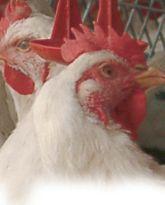
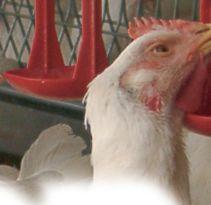
an attractive nest site is one of the reasons for using furnished cages for laying hens, but what does the hen consider attractive?
to help answer that question, Michelle Hunniford, a PhD student at the university of guelph, is investigating how hens perform nesting behaviour in furnished cages at the Arkell research Station in guelph, ontario.
two of her most recent studies have compared some of the variables, such as group size and space allowance, as well as a hen’s previous rearing experience, to see what affects nesting behaviour in furnished cages.
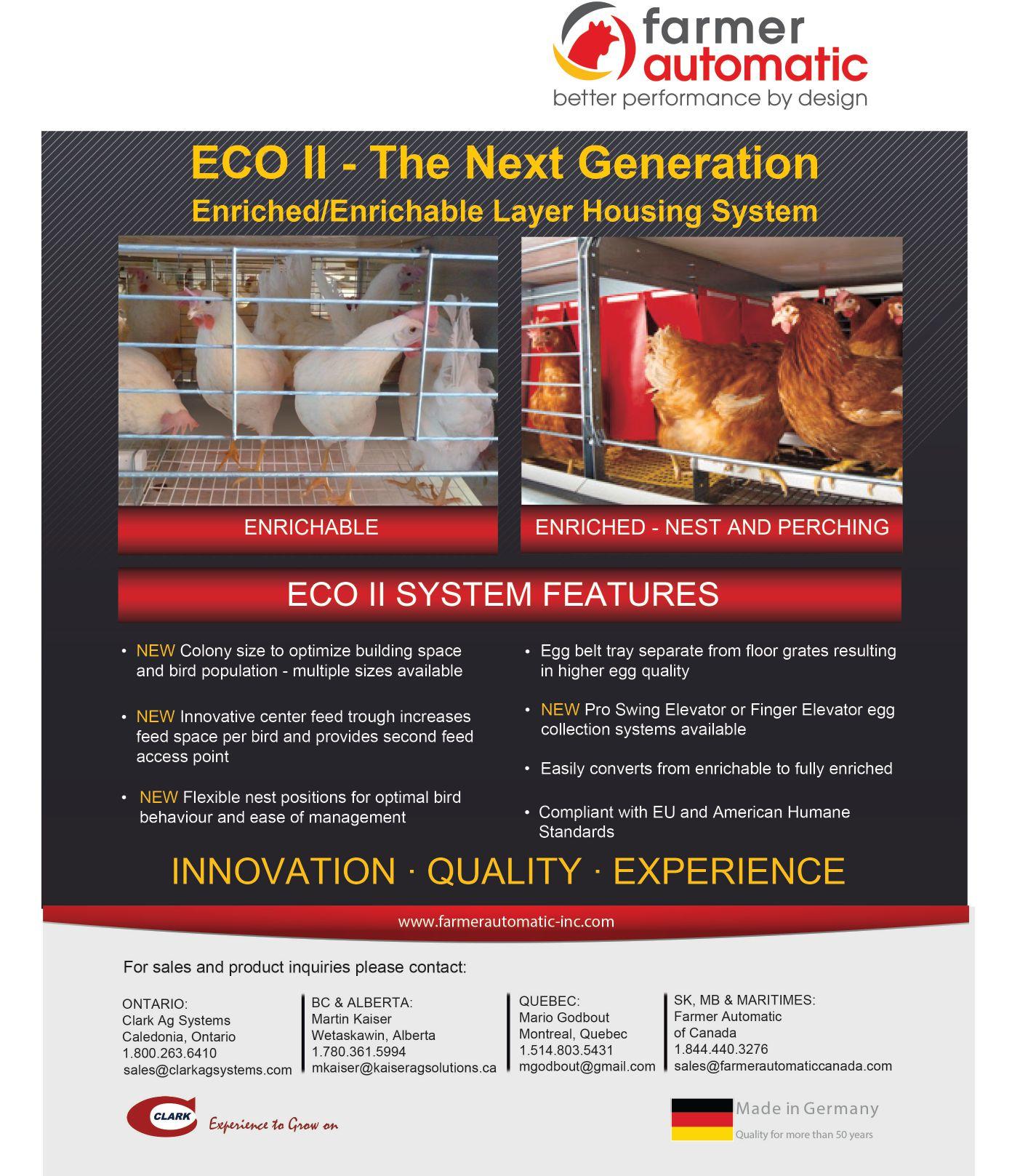
in her first experiment, Hunniford used lohmann lSl-lite hens to examine the impact of cage size and space allowance. the hens were divided into 12 large commercial and 12 small custom-built Farmer Automatic furnished cages, each fitted with a nest area (large nest: 5,664 cm2; small nest: 2,816 cm2) with red plastic curtains and a yellow plastic mesh floor, and a 42 cm2 smooth red plastic scratch mat at the opposite end of each cage.
Working under the supervision of Dr. tina Widowski, the egg Farmers of canada research chair in Poultry Welfare, Hunniford also looked at the behaviour of birds kept at different space allowances in large and small cages, comparing low (520 cm2/bird) versus high (720 cm2/bird) space allowance in both small and large cages.
How would competition for nesting space or floor space be reflected in where they laid their eggs?
rearing experience
influences the nesting behaviour of laying hens and their ability to settle more quickly into a new environment
the location of lay, whether in the nest area, scratching area, or somewhere in between, was recorded between 21 to 70 weeks of age, and the time of lay was monitored for eight days at 54 weeks of age. the hens’ disposition was measured by recording the number of occurrences of displacements, aggressive pecks, threats and fights.
the results indicated that hens did respond differently to different-sized cages.
in the small cages, 91.7 per cent of hens used the nesting area compared to 77.2 per cent in the large cages. Most of the remain-
ing eggs were laid in the scratch area. Hens in the smaller cages with low floor space allowance were more aggressive than the other groups, which Hunniford suggests may be because hens in smaller cages were more competitive for nesting space. Also, the birds in larger cages may have perceived the scratch area as an attractive alternative nest area because it was fitted with a wire partition which added more corners into the cage.
Hunniford did conclude that increasing the absolute size of a curtained nest area in a larger cage might not provide the most
Past exPerIeNce key
attractive nest site for hens.
greater than 30 per cent of the hens in large cages laid their eggs between 8 and 9 a.m., while those in the small cages laid between 7 and 10 a.m. this difference may indicate a lack of available nest space in the small cages, causing hens to delay laying their eggs. More pecks and threats were recorded between 8 and 8:30 a.m., which coincided with peak laying time.
the number of eggs laid in a nest is often used as an indicator of how well the hen accepts the nest, but is this truly the case? Since the hens in the smaller cages were more aggressive yet laid more eggs in the nests, the results also raise questions about using the number of eggs laid in a nest as an indicator of hen welfare.
Hens that show more settled pre-laying behaviour — less walking, more time sitting at the laying site, and showing less aggression — may give a better indication of animal welfare than where they lay
The Beaker
their eggs.
“it is not enough to record egg location and make the conclusion that high nest use correlates with good welfare. the same behaviours associated with poor welfare (i.e. aggression) were also in the cages with the highest nest use. this suggests that behaviour is a very important component that must be taken into account when assessing welfare.”
in her second experiment, Hunniford compared hens reared in standard brooding cages with those reared in a pulletrearing aviary (Farmer Automatic Pullet Portal) to investigate the effect of rearing environment on egg-laying preferences.
Hens that were reared in standard cages preferred laying in the nest versus the scratching area (89.6 per cent versus 81.3 per cent) but showed more of what Hunniford called “unsettled pre-laying activity” — walking, searching and nest area entries — prior to week 20 of lay when
compared to the aviary-raised birds. this behavioural difference had diminished by peak lay at week 32.
Hunniford concluded that rearing experience influenced the nesting behaviour of laying hens and their ability to settle more quickly into a new environment. “this result was somewhat unexpected,” says Hunniford. “it shows that we still have a lot to learn about how rearing environment impacts the behaviour and spatial awareness of adult laying hens.”
in the next phase of her research, Hunniford will investigate which nest site design is preferred by hens by testing different enclosure and surface material conditions. the overall objective of this research project is to help determine optimal design parameters to support nesting behaviour in furnished cages. Her work is supported by grants from egg Farmers of canada and the ontario Ministry for Agriculture and Food. ■ n
MERCK’S GOING GREEN
Housing Une Fenêtre sur le Futur
En se lançant dans la construction d’un nouveau poulailler, mathieu Poirier a voulu créer une vitrine attrayante sur la production d’oeufs d’aujourd’hui et de demain
PAR A NDR é D UMONT
cela faisait dix ans que Mathieu Poirier avait rejoint son père Jeanclaude en production d’oeufs. il était temps de moderniser l’entreprise familiale. la production d’oeufs des 30 prochaines années sera très différente de celle des 30 dernières années. Pour notre producteur de 33 ans, il était préférable de se mettre en avance sur les tendances.
le nouveau pondoir construit au cours de l’hiver 2013-2014 ne contient que des cages enrichies. Mais Mathieu Poirier n’a pas seulement voulu devancer la réglementation. il a conçu son poulailler en gardant en tête l’importance de conserver dans son équipe le plus important joueur : le consommateur.
Situé à la sortie du village de SaintBonaventure, près de Drummondville, le nouveau bâtiment affiche un look résolument contemporain, avec sa tôle grise et rouge. Mathieu Poirier a choisi ses couleurs, dressé un plan et fait appel à un technologue en architecture. « Je voulais avoir quelque chose de beau, ditil. Je voulais faire différent des autres et ce n’était pas beaucoup plus cher. » l’occasion était aussi tout indiquée
FeNêtre sUr l’aVeNIr
mathieu Poirier a fait installer une fenêtre, pour que les visiteurs puissent voir les poules et leurs conditions d’élevage.
pour faire concevoir un nouveau logo pour la Ferme des Poiriers, avec l’aide d’une firme de design graphique. la facture visuelle ne sert pas qu’à se distinguer des autres entreprises avicoles. Mathieu Poirier veut faire bonne impression lorsque des visiteurs débarqueront voir sa production. le nouveau poulailler est équipé d’une grande fenêtre, qui laisse voir les poules dans leur environnement de ponte. la fenêtre en question est au bout d’un corridor sans issue, de sorte que les
visiteurs n’ont pas à se soumettre aux contrôles de biosécurité.
« Je suis ambassadeur pour la Fédération des producteurs d’oeufs du Québec », déclare fièrement Mathieu Poirier. À ce titre, il monte régulièrement à bord du centre d’interprétation de l’oeuf, cette remorque abritant un minipoulailler qui se déplace pour sensibiliser le public.
« cette fenêtre, c’est un peu une gâterie qu’on se paie, dit l’éleveur. Parfois, des gens veulent voir comment ça marche,
In growout after growout, results prove that Ziggity Systems with Max3 drinkers consistently produce not just great but exceptional performance in every category. That’s because Max3 delivers all the hygienic water birds need to thrive and stay healthy without oversupply that causes wet litter and all of its related problems. More ways to improve performance
Reduce management time and make correct pressure adjustment easy with PressurePro.
Visit www.ziggity.com www.ziggity.com/pressurepro
J-Lock drinkers
les enfants veulent voir les poules. Avec les nouvelles cages enrichies, je ne suis pas du tout gêné de montrer comment les poules sont traitées. »
les poulaillers construits dans les années 1970 étaient devenus trop petits et désuets. le quota des augmentations annuelles était loué et il fallait le rapatrier pour éviter de le perdre. De plus, la ferme perdait ses deux employés les plus fidèles. Dans une construction neuve, tout serait plus simple pour les futurs employés. le nouveau bâtiment fait 400 pieds de long et compte six rangées de 300 pieds de cages sur six étages. il est séparé en deux sections de trois rangées pour pouvoir gérer deux lots distincts. un marchepied a été installé entre les troisième et quatrième étages. la capacité totale est de 62 000 pondeuses.
il s’agit de cages enrichies Hellmann, modèle eu 24-241. elles disposent d’une partition centrale, de sorte que chaque
Housing
section de cage abrite un maximum de 24 poules. « la recherche démontre que dès qu’il y a plus de 30 ou 40 poules dans une cage, les dominantes s’en prennent aux dominées, qui perdent leurs plumes », explique Johann Benner, le responsable du marché canadien chez le fabricant allemand.
les cages comptent deux perchoirs parallèles, juste assez hauts pour qu’un ?uf puisse rouler en dessous. elles ont aussi des rideaux pour isoler le nid de ponte, qui est situé à une extrémité, à l’avant de la cage, pour minimiser le déplacement des oeufs.
les mangeoires s’étirent sur toute la longueur de la cage à l’avant. elles sont si solides qu’on peut y grimper. il s’agit d’une caractéristique standard chez Hellmann, affirme Johann Benner.
À l’arrière, il y a la possibilité d’installer un tuyau qui alimente une autre mangeoire. « Si un jour les normes changent
et ont doit accorder plus de longueur de mangeoire à chaque poule, on pourra en rajouter », affirme Stéphane chouinard, distributeur pour Hellmann au Québec et dans l’est de l’ontario.
la ventilation du bâtiment à l’aide d’un mélangeur d’air assure 25 cfm d’air frais pour les poules, ce qui fait aussi sécher le fumier jusqu’à environ 35 à 40 % de contenu en eau. l’apport d’air peut provenir directement de l’extérieur par les entrées linéaires sur les murs, notamment en été, ou être filtré et recirculé en hiver.
le bâtiment dispose aussi d’un système de traitement de l’eau, ce qui devrait assurer une meilleure qualité d’eau que dans les bâtiments anciens, aujourd’hui démolis.
Des tuyaux pour chauffage à l’eau chaude ont été insérés dans le plancher de béton, seulement sous les allées entre les rangées de cages. « on a voulu diminuer nos coûts d’installation, parce qu’on ne savait pas vraiment si on avait besoin de chauffage, explique Mathieu Poirier. Je prévois m’en servir pour économiser sur la consommation de moulée lors des grands froids. »
l’entreprise familiale exploite aussi 40 hectares en maïs et soya, de quoi assurer de 20 à 25 % des besoins alimentaires des poules. elle dispose de sa propre moulange. la préparation de la moulée est suivie par Shur-gain.
le nouveau poulailler compte deux silos à moulée pour chacun des deux groupes d’âge de pondeuses, pour un total de quatre. ils serviront à mettre en place le programme Écoponte tandem de Shur-gain, pour offrir à chaque groupe une moulée du matin et une moulée de l’après-midi, qui devraient combler avec plus de précision les besoins du métabolisme des poules.
le projet de construction n’est pas tout à fait terminé. Depuis plus de 30 ans, les Poirier élèvent leurs propres poulettes. le bâtiment où sont logées les poulettes actuellement permet difficilement d’élever deux lots d’âge différent, pour fonctionner avec le nouveau poulailler. D’ici la fin de l’année, la relève logera dans un tout nouveau bâtiment. n
HERE’s THE POINT
by LeSLIe baLLentIne
Farming in a Fermentation tank
meat, dairy and eggs are getting bad press these days. everyone from the Food and Agriculture organization of the united Nations to Bill gates has declared animal proteins unsustainable, at least as we currently produce them. Plant-based alternatives to eggs, and meat could be good for the environment, backers argue, because they could reduce the consumption of animal products, which requires large amounts of land, water and crops to produce. they could also benefit people’s health, especially in heavy meat-eating countries, they are humane, and would reduce disease threats such as avian flu, they say.
Meat analogs have been in supermarkets for years. turkey producers have been competing against faux turkey, a vegetarian substitute for holiday meals, for nearly two decades. these early versions of meat substitutes have never really taken-off in the marketplace though. that may be about to change.
Food scientists say the biggest challenge in creating a convincing meat alternative is the texture. With extensive processing it is now possible to manufacture a fairly convincing substitute using different grains, fungi and plants.
gates has invested in Beyond Meat®, a columbia, Missouribased start-up that has made faux chicken strips and beef crumble now available in canada at Whole Foods. other investors include the twitter co-founders and the Humane Society of the united States. the company website declares that “Beyond Meat is real meat, made from 100 per cent plant protein.” california-based Hampton creek Foods has begun a start-up called Beyond eggs®. No relation to Beyond Meat, the company claims these engineered “eggs” from plant proteins are a “cheaper, healthier, safer, cleaner alternative.” the company, which also has the backing of gates along with a co-founder of yahoo and PayPal co-founder Peter thiel, has commercialized two food products — an egg-free mayonnaise, coming soon to Walmart and cosco, and a powdered “egg” product for baking that sells at 18 per cent less than the real thing. the firm is now developing a scrambled egg substitute that is reportedly very close to real eggs in both texture and taste.
want to create a whole new model that makes the (old egg production) system obsolete.” As he explained it, producing emulsified plant products cuts out the need for grain to be transported to feed to birds for them to then produce eggs and will reduce carbon and waste emissions as a result.
For whatever reason, the desire to replace animal proteins with proteins derived from plants is spreading, although the market is still minuscule. Mintel, a market research firm, reports that sales of meat alternatives grew eight per cent from 2010 to 2012, when sales hit uS$553 million. But there is also another approach: growing meat in laboratories instead of fields and barns. Dubbed “test-tube meat” by the media, this technology has been fronted by investors ranging from google co-founder Sergey Brin to PetA (People for the ethical treatment of Animals). in 2013, the world’s first in vitro meat burger was taste-tested with much media fanfare and mixed reviews.
For whatever reason, the desire to replace animal proteins with proteins derived from plants is spreading
researchers working on the technology, still hugely expensive, face plenty of technical hurdles too. Similar to those used in a modern pharmaceutical factory, bioreactors are used to grow meat from stem cells and theoretically would reduce the number of animals needed to feed people. Another start-up in columbia, Modern Meadow, is in fact already trying to commercialize “test tube meat.” Also partially funded by Peter thiel, co-founder of PayPal, the process would extract stem cells from muscle tissue of cows, pigs or chickens, and culture them. the growth medium currently being used, derived from fetal animals, is expensive and would push the cost to about $240 per pound of meat, according to a Trends in Biotechnology report.
reactions to the idea cross the spectrum, with the “yuck-factor” cited as the biggest barrier. Some animal activists nix the idea because it still involves using animals and environmentalists question the degree of environmental value it offers. Farmers aren’t keen on the idea either.
in 2012, Hampton creek Foods founder Josh tetrick said, “We
Here’s the point: with today’s consumers looking aghast at “unnatural” food products, now is the time for animal agriculture sectors to take back some of that bad press and promote real food. n
“We worked with FCC to expand our business.”
When you talk financing with FCC, we’ll listen
Ready to expand? We learn how you want to grow, then create a financing package that helps you do it. Work with the leading lender to agriculture, agribusiness and agri-food in Canada. Let’s talk business.
fccfinancing.ca
Dion Wiebe, President, Rossdown Natural Foods, Abbotsford, B.C.