Production: America’s Egg Powerhouse our contributor André dumont takes us on an exclusive tour of a 1.3-million-layer iowa complex
By André Dumont
18
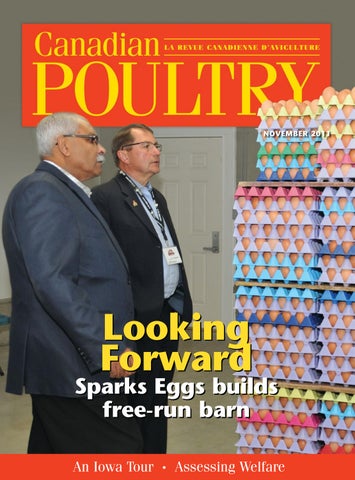
Production: Looking Forward Sparks builds innovative, free-run barn that is the largest in canada
By Kristy Nudds
26
in thE BArn: Water Pressure tips for achieving optimal pressure levels
By the Technical Team, Ziggity Systems Inc.
28
Production: Au pays des géants notre collaborateur André dumont rentre d’un voyage en iowa, l’état qui produit le plus d’oeufs aux États-unis. Suivez-le en visite exclusive d’un complexe de 1,3 million de pondeuses.
By André Dumont
32
Pic uPdAtE: Assessing Welfare, Part 2 results from the recent WAFL conference, with a focus on layers
By Kimberly Sheppard, Research Co-ordinator
30
rESEArch: ddGS inclusion in Layer diets recent university of nebraska research shows that levels can be as high as 15 to 25 per cent
By Nathan May, Poultry Science Association
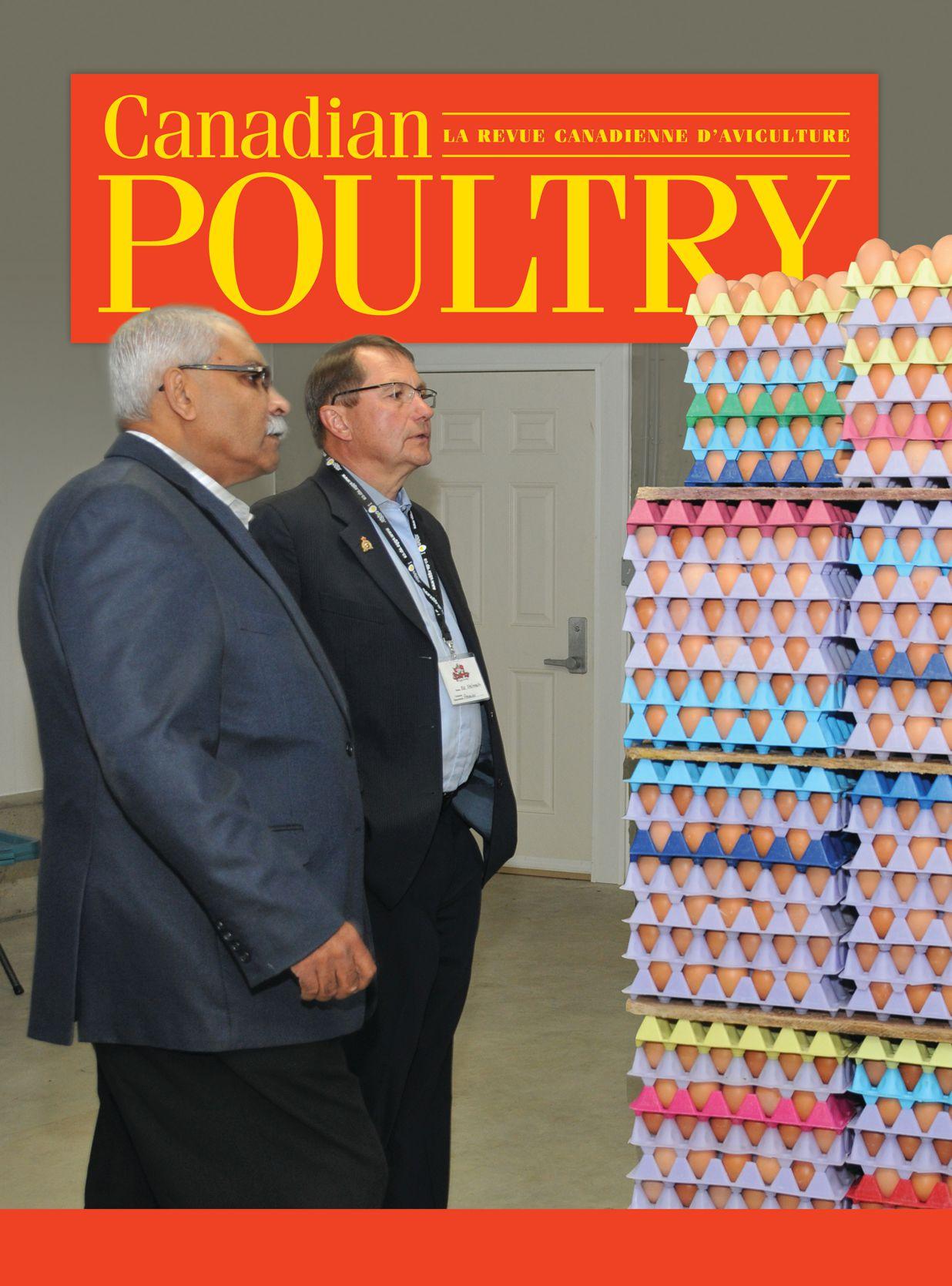
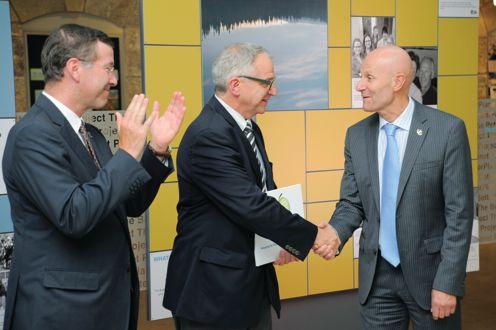
on thE covEr: Meb Gilani and former Alberta premier Ed Stelmach at an open house for Sparks Eggs’ new free-run barn.
FROM THE EDITOR
by KrISty NuddS
unmet deadline Poses Questions
Much to no one’s surprise, the ban on the use of cages to house laying hens in the European union (Eu) will not be fully met by the mandated date of Jan. 1, 2012, as set out in the Eu Welfare of Laying hens directive (1999/74/Ec).
this directive, outlined in 1999, allowed a considerable amount of time for egg producers in Eu countries to phase out the use of so-called battery cages in favour of a more welfare-friendly form, the enriched cage. Germany has taken the directive one step further by only allowing colony-type cages after 2012.
despite the generous timeline and reaffirmation by the European commission that the deadline date was not to be extended, as many farmers had hoped, it is estimated that nearly one-third of Eu hens will still be reared in non-compliant housing by the Jan. 1, 2012, deadline. So what went wrong?
the problem of non-compliance is multifaceted, according to Patrick cloudemans of vencomatic, who spoke about the European road to housing layers in aviaries at the recent Poultry Service industry Workshop (PSiW), held in Banff, Alta. non-compliant farms are primarily located in the southern and eastern Eu states (in particular, Spain, italy and Poland). Much of the problem involves differences in culture; some Eu countries place a higher value on welfare than others. cloudemans says that consumers in the northwest Eu are more conscience-driven, whereas consumers in the southern and eastern countries are more influenced by price.
Price differentiation also exists for eggs produced in more welfare-friendly systems in the northwest, as consumers have shown they are willing to pay. these measures do not exist in other countries, so there is no incentive for producers to invest in new systems. Also, some of the countries that
have few compliant producers have been greatly affected by the economic downturn, and banks are less willing to finance large investments.
compliant countries such as the u.K. are alarmed by the volume of non-compliant eggs and have posed some valid questions. Most important of these: how, and will, compliance be monitored? With more than 400 million pounds invested in new rearing systems, u.K. poultry producers fear that eggs imported into the u.K. will undermine and distort the market.
At an Eu parliamentary meeting in Brussels in early october, a reuters report said the Eu health and consumer commissioner John dalli indicated that countries missing the ban will face legal action. however, just what this “legal action” will involve is yet to be outlined, and compliant countries want the commission to draft effective, strong measures to curb the potential for trade in illegal eggs. in an article from Foodnavigator.com, dalli is quoted as saying that the European commission would allocate “limited resources” of its inspection services to “make the issue a priority.” he adds that a “political” solution must be found, and that he is pushing to contain eggs not produced according to the directive within the territory where they are produced, and restrict their use to processing. however, he does not know if this is allowable under Eu rules.
What, then, is “allowable”? According to what is laid out in the directive, member states are responsible for compliance. But nowhere do the words “penalty,” “punishment” or “fine” appear. Where is the incentive for member states to comply, if their producers still have a market and no penalty for non-compliance is clearly outlined? n
November 2011
Vol. 98, No. 11
Editor Kristy Nudds – knudds@annexweb.com
888-599-2228 ext. 266
Associate Editor
Jim Knisley – jknisley@kwic.com
Publisher/Sales Manager
Marilyn White – mwhite@annexweb.com
519-429-5193
888-599-2228 ext 237 • fax: 888-404-1129
Sales Assistant
Mary Burnie – mburnie@annexweb.com 519-429-5175 • 888-599-2228 ext 234
Production Artist
Gerry Wiebe
Group Publisher
Diane Kleer – dkleer@annexweb.com
President Mike Fredericks – mfredericks@annexweb.com
Mailing Address
P.O. Box 530, 105 Donly Dr. S., Simcoe, ON N3Y 4N5
Publication Mail Agreement #40065710
RETURN UNDELIVERABLE CANADIAN ADDRESSES TO CIRCULATION DEPT., P.O. BOX 530, SIMCOE, ON N3Y 4N5.
e-mail: jmatheusik@annexweb.com.
Printed in Canada ISSN 1703-2911
Circulation
e-mail: jmatheusik@annexweb.com
Tel: 866-790-6070 ext 207
Fax: 877-624-1940
Mail: P.O. Box 530, Simcoe, ON N3Y 4N5
Subscription Rates
Canada – 1 Year $ 24.00 (with GST $25.20, with HST/QST $27.12)
GST – #867172652RT0001
USA – 1 Year $ 60.00 USD
Occasionally, Canadian Poultry Magazine will mail information on behalf of industry-related groups whose products and services we believe may be of interest to you. If you prefer not to receive this information, please contact our circulation department in any of the four ways listed above.
Got Lubing? Contact your local Lubing Distributor for more detailed information about our innovative products or vist our website at www.lubingusa.com
With more than 60 years of experience developing innovative products for poultr y producers worldwide, Lubing has established a reputation of leadership by introducing new, cutting-edge technologies to the poultry industry.
Our innovative products are produced with the most modern manufacturing capabilities giving our customers a profitable advantage in productivity.
Curve Conveyors
Handle up to 60° angles
Belt Conveyors
Lengths up to 2,000 ft.
Transfer Tables
Les Equipments Avipor
Cowansville , Quebec
Tel: (450) 263.6222
Fax: (450) 263.9021
Glass-Pac Canada
St. Jacobs, Ontario
Tel: (519) 664.3811
Fax: (519) 664.3003
Carstairs, Alberta
Tel: (403) 337-3767
Fax: (403) 337-3590
Specht-Canada Inc.
Stony Plain, Alberta
Tel: (780) 963.4795
Fax: (780) 963.5034
J. Dean Williamson Ltd.
London, Ontario
Tel: (519) 657.5231
Fax: (519) 657.4092
Rugged Construction - Built to last
Dirty Egg Returns
Superior design - Reliable performance
Nipple Drinking
Ideal water flow from pullets to layers
HATCHING HATCHING
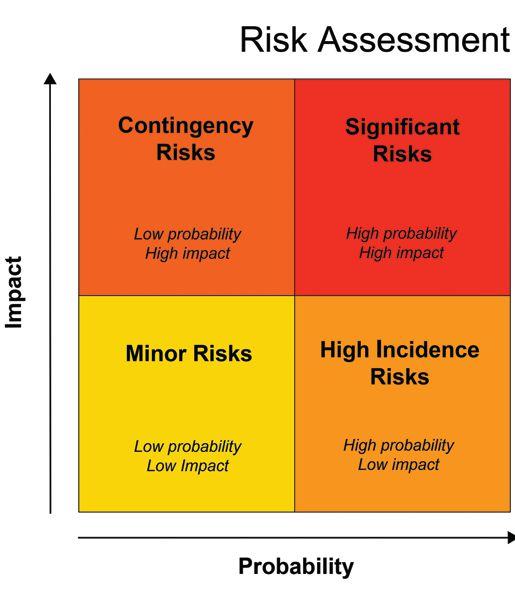
A Risk Assessment on Animal Health Released
nimal health risk assessment in canada appears to be meeting the majority of the livestock and poultry industries’ needs with regard to importation and international trade obligations, according to a recent report from the council of canadian Academies’ Expert Panel on Approaches to Animal health risk Assessment entitled “healthy Animals, healthy canada.”
But the group believes more can be done.
the panel is recommending a more integrated, multidimensional approach to better serve the broader goals of animal health risk assessment and support the risk-based decision-making process, the report said, adding that instituting such a system could be costly if it is not properly implemented.According
to the panel, a systematic, transparent, prioritization process – for both the extent and range of risk assessments – needs to be in place. risk assessment organizations in canada [e.g., the canadian Food inspection Agency (cFiA), the Public health Agency of canada] should work to align and integrate processes to ensure efficiency, transparency, communication, integration, and continuity, the group states, adding a robust and effective risk assessment process will help to ensure the health of canada’s animal populations and help to protect human health.
the panel also believes there should be greater stakeholder involvement. “risk-based decisionmaking and subsequent risk communication and management could benefit from a greater engagement of stakeholders in establishing risk assessment questions, scope, and consequences, and from improved access to expertise and knowledge among risk
assessment practitioners.
“Animal health risk assessment in canada is built on a solid foundation of knowledge and expertise,” the report also states, adding that the cFiA plays a major role in carrying out animal health risk assessments in canada with systematic risk assessments within a structured risk analysis framework.
Although many of the risk assessments done by the cFiA are carried out for the purposes of international trade – most often related to importation requests – they should go beyond animal health, the panel reports, concluding that integrating human health and environmental consequences into animal health risk assessments would improve the assessment’s applicability and utility as many risks to animal health have broader economic, ecological, and social implications.
For more information, visit: http://www.scienceadvice.ca/ en/assessments/completed/ animal-health.aspx.
Calgary Residents Crying Fowl
Residents of a southeast calgary neighbourhood are suing a Lilydale chickenprocessing plant, alleging it has prevented them from being able to enjoy their properties.
Ecojustice lawyer Barry
robinson says residents allege they have lived for years with disruptive noise and foul odours coming from the Lilydale plant and, in some cases, chicken parts on their properties.
he also points out that a 2009 ammonia leak from the plant forced residents from their homes.
La Coop fédérée
Acquires Agrico
La coop fédérée has announced the acquisition of Agrico canada Ltd., an independent business specialized in the distribution of crop production inputs. the financial terms of the agreement have not been disclosed. upon concluding this transaction, La coop fédérée takes ownership of the ontario company through the acquisition of the business’ head office as well as its
three distribution centres, including a major port in hamilton and two regional centres in St. thomas, ont., and oak Bluff, Sask. the agreement also allows La coop fédérée to obtain a stake in 11 retail companies located in ontario, Manitoba and Saskatchewan.
For employees of Agrico, the acquisition should not bring about any major changes since the company’s mission and orientation will remain the same.
“the acquisition of Agrico canada Ltd. will make it possible for our sector to pursue its development and to
Maple Lodge Launches Natural Product Line
Maple Lodge Farms recently launched its new May Family Farms brand with a lineup of chicken deli meats made with only natural ingredients.
the new brand was developed in response to consumer requests for healthier and
robinson says his clients want Lilydale to stop trucks from leaving the plant at night, limit odours and secure chicken waste bins so the parts don’t end up all over the neighbourhood.
residents are also seeking damages for the 2009 ammonia leak.
A Lilydale spokesperson says the company has broken no laws and will defend itself against the claims.
The Canadian Press
improve its competitive positioning in terms of input distribution in the field of crop production,” says the chief executive officer of La coop fédérée, claude Lafleur.
“Furthermore, this wide ranging transaction will allow La coop fédérée to consolidate the ontario market and to reduce costs in Quebec, since it will now have a stronger hold on the market and be able to benefit from a judicious use of its commercial and harbor facilities along the seaway,” added Lafleur.
La coop fédérée is the Quebec federation of agricultural co-operatives.
Laurent Souligny is a 2011 inductee into the canadian Agricultural hall of Fame. Souligny was nominated by the Egg Farmers of canada for his significant contributions while chairman of the organization and his tireless work on behalf of the egg industry in canada.
Ernest Gasarabwe was recently promoted from a position of technical service representative to a position of regional accounts manager, Eastern canada for Pfizer Animal health. in his new role, Gasarabwe will continue to support customers using the Embrex inovoject System in Eastern canada. he will also support Pfizer Animal health’s poultry biological line in Eastern canada.
gluten-free deli meat options and the May family, who have owned and operated Maple Lodge Farms for more than 50 years, responded. the new May Family Farms brand line launched with 11gluten-free chicken deli meats. they are currently available at major grocery chains across canada.
the new products are made from a recipe of chicken breast and different spices and flavours ranging from smoked flavour to shawarma.
Ron Davidson has been appointed as director of government and media relations for the canadian Meat council, canadian Poultry and Egg Processors council and Further Poultry Processors Association of canada. davidson has held senior positions in canada and abroad with the departments of Agriculture and AgriFood canada and Foreign Affairs and international trade canada during which key responsibilities included international market development, international trade policy and technical barriers to trade, including sanitary and phytosanitary regulations and standards.
lAuRENt sOuligNy
ONtARiO
ERNEst gAsARABWE
RON dAVidsON
Omegazyme certified in u.s.
An enzyme supplement for poultry and swine feeds developed by canadian Bio-Systems inc. (cBS inc.) has earned organic certification status from the u.S. department of Agriculture (uSdA).
HATCHING HATCHING
omegazyme is designed to support omega-3 enriched egg and meat products. An equivalent cBS inc. product is marketed in canada as Superzyme-oM.
“uSdA organic certifica-
tion for omegazyme is an important recognition of the safety and efficacy of this product for another layer of the marketplace,” says owen Jones, president of cBS inc. “omegazyme is part of canadian Bio-Systems’ focus on offering producers a natural way to profitability.”
omegazyme is designed for poultry and swine diets that use high levels of oil seeds and meals along with cereal grains.
tFc donates $62,000
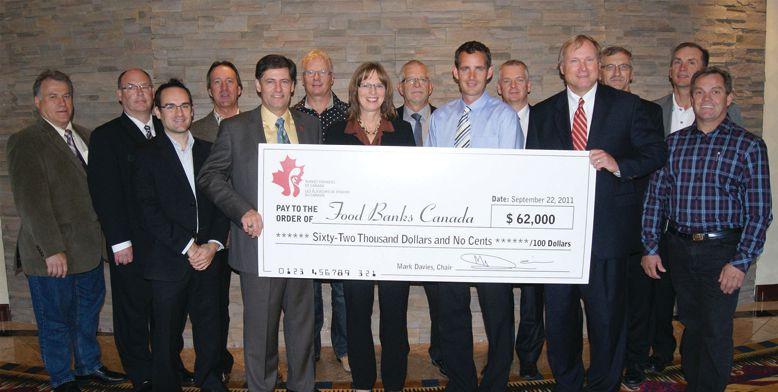
T(l to R): d young, Nova scotia; g. Martin, FPPAc; M. Boulay, Quebec; B. Mailloux, Ontario; M. davies, tFc chair; W. goodsman, saskatchewan; Katharine schmidt, Food Banks canada; W. Kroeker, Manitoba; s. Heppell, British columbia; M. Pépin, cPEPc; B. Meagher, Food Banks canada; R. Meijer, Alberta; d. Hart, cPEPc; B. cyr, New Brunswick.
he turkey Farmers of canada (tFc) board of directors presented a cheque for $62,000 to Food Banks canada at its general business meeting held Sept. 22 in toronto.
it’s hoped the third annual donation of more than $50,000 will assist thousands of canadian families. the funds were distributed in September to many rural food banks across canada, targeting those most in need. Selected food banks purchased whole turkeys or turkey parts for their community that were distributed at thanksgiving.
“We wanted to continue our partnership with Food Banks canada,” said tFc
JaNuary
January 24-26, 2012
International Poultry Exposition
Georgia World congress center, Atlanta, Ga. For more information, visit: www.ipe11.org.
marCH
March 13-15, 2012
Midwest Poultry Federation Convention Saint Paul river centre, Saint Paul, Minn. For more information, visit: www. midwestpoultry.com.
aprIL
April 11-12, 2012
The London Poultry Show
Progress Building, Western Fair Entertainment centre, London, ont. For more information, visit: www. poultryindustrycouncil.ca.
JuNE
June 10-12, 2012
chair Mark davies. “We know that the holiday period is a time when families come together to celebrate, yet many families are struggling.”
Since 2009, tFc has donated $50,000 to Food Banks canada annually. the turkey Farmers of ontario, Manitoba turkey Producers and turkey Farmers of new Brunswick also contributed funds in 2011, raising the overall total donation to $62,000. in addition, a number of provincial turkey boards make contributions to food banks in their regions throughout the year by participating in local food drives and donating turkeys during the holiday seasons.
CPEPC Convention Fairmont le Manoir richelieu, La Malbaie, charlevoix, Que. For more information, visit: www. cpepc.ca.
We welcome additions to our Coming Events section. To ensure publication at least one month prior to the event, please send your event information at least eight to 12 weeks in advance to: Canadian Poultry, Annex Business Media, P.O. Box 530, 105 Donly Dr. S., Simcoe, ON N3Y 4N5; e-mail knudds@annexweb.com; or fax 519-429-3094.
Careers in Ag Rewarding
Recent Farm credit canada (Fcc) survey results about potential careers in agriculture paint a challenging picture of the industry.
canadian consumers who took the survey chose “weather-dependent,” “struggling,” “under-recognized,” “underpaid” and “essential” when asked to choose the top five words from a list associated with the agriculture industry. Producers surveyed chose nearly identical words.
“it’s obvious that both farmers and consumers recognize that there are challenges associated with agriculture,” says Fcc President and cEo Greg Stewart. “it’s surprising that the words chosen did not focus on opportunities. there are so many success stories in agriculture and related industries that counter this perception.”
At the same time, a national Fcc vision Panel survey showed that optimism among producers remains high. results
show that 80 per cent of producers would recommend a career in agriculture to a family member or friend.
on the other hand, only 21 per cent of consumers would consider a career in agriculture, and only 27 per cent would encourage someone else to pursue it. the survey results show that, although farmers recognize the challenges inherent in the industry, they still would encourage others to get involved in it.
University of Guelph Recognizes PIC Contribution to Research and Education
university of guelph president and chancellor dr. Alastair
summerlee presents Pic executive director tim Nelson (centre) with a plaque to recognize Pic’s contribution to research and education.
tye Burt, of the Better Planet project, looks on.
By Tim Nelson, PIC Executive Director
the university of Guelph, as part of its Better Planet project, has recognized the Poultry industry council (Pic) for the funding it has contributed to dr. Michele Guerin’s appointment to the ontario veterinary college (ovc) as a poultry epidemiologist. the funds were raised as part of the nine-year collaboration between the university, the ontario Ministry of Agriculture and Food (oMAFrA) and the Pic – a partnership known as the Poultry Program team (PPt). dr. Guerin was the last member of the PPt to be
appointed. other members include: dr. Shayan Sharif, dr. Gregoy Bedecarrats, Mr. Al dam and dr. Babak Sanei, who has recently moved to Scotland. the purpose of the PPt was to raise awareness of the industry at the university by nominating and supporting individuals working in poultry research and education. the industry raised significant funds to support this initiative.
A little over half of these funds were allocated to salary support and the balance directly funded research and education initiatives at the university. the work of the PPt includes, but is not limited to, Marek’s and Ai research (Sharif), lighting research (Bedecarrats), disease baseline studies (Guerin), iBh research in broiler breeders (Sanei) and valuable extension and education work through the production of fact sheets and producer updates (dam). recently, thanks to the efforts of drs. Bedecarrats and Guerin, the industry and the university got a lot closer through the newly formed Poultry clubs at
oAc and ovc, and the results of this collaboration can be seen in the biosecurity video circulated in this edition of Canadian Poultry. the recognition “plaque” can be viewed on the newly completed donor wall at rozanski hall at the university of Guelph. the Pic would like to thank the following PPt contributors:
• Gray ridge Farms
• Burnbrae Farms
• Maple Leaf Foods
• Egg Farmers of ontario
• Merial (now Merck Animal health)
• chicken Farmers of ontario
• ontario Broiler hatching Egg and chick commission
• turkey Farmers of ontario
• intervet (now Merck Animal health)
• clark Ag Systems
• new Life Mills
• P&h Foods
• Floradale Feed Mill
• Fleming Feed Mill
• J M Schneider
• Wallenstein Feed & Supply Ltd.
NEW PRODUCTs PRODUCTs
Cantrell streamlines Gizzard Inspection system
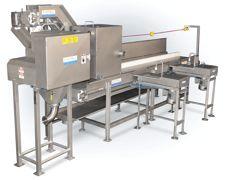
cantrell has improved its GiS 2000 Gizzard inspection System by streamlining the conveyors and making the peeler station detachable and portable.
cantrell’s new GiS 2000 has one conveyor instead of two, making the processing of gizzards quicker in addition to eliminating possible room constraints. the peeler station is portable and can be removed
or installed quickly depending on the processing job.
For more information, please contact cantrell at (800) 922-1232 or (770) 536-3611, or visit: www.cantrell.com.
FarmManager For Layers
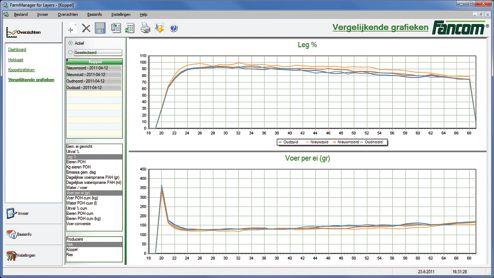
Fancom recently launched FarmManager For Layers™, a management software program for layer producers. FarmManager For Layers registers the key performance indicators in the layer house and presents a clear overview of the prevailing situation. the program underwent trials at two sites in Europe. one of the test locations was Zonnefarm run by the Lith family in Sterksel. Even though they have only been using the program for a short time the advantages are already apparent: “FarmManager For Layers gives me a simultaneous overview of the situation on my three locations, that saves time. the dashboard helps me to focus and get a good picture of what is happening in
Chore-Time’s New ELT Interface
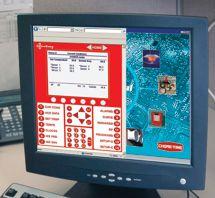
chore-time’s chorEtronicS® Ethernet
my layer houses. i only need to zoom in to a particular situation for a closer investigation if i see a red light. this gives me the chance to intervene before my production starts to run risks.” the program continually monitors online indicators such as: laying percentage, egg weight, egg mass, feed consumption, feed per egg and feed conversion rate. the program combines all the latest data from the climate, feed, weighing and counting computers in the house and compares the information with the index figures according to the standard, the farm average or the average of the group. the program uses a clear dashboard and helps the user focus and keep a good overview.
the producer can adapt his strategy to achieve the optimal balance between feeding, climate and egg production for maximum production figures at minimum cost, with healthy animals and a minimum burden on the environment.
For more information, visit www.fancom.com, or visit your local Fancom dealer.
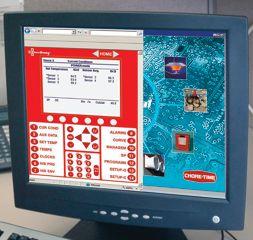
Local talk (ELt) interface converts information from chorE-tronicS 2 controls into a webfriendly format for viewing control settings and house conditions or for making changes. it permits authorized users to view chorE-tronicS 2 control information via a web display of the control screen using a web browser on Java-compatible computers and mobile devices. Authorized users can also use the ELt unit in place of a phone line and modem to view data from chorE-tronicS 1 or 2 controls using chore-time’s c-central™ Professional Software. With the ELt option, a grower can remotely monitor his or her farm and make adjustments to control settings as needed. Further, a grower can respond to an alarm and determine exactly what is happening within the house in order to plan and make the appropriate corrective action.
For more information, visit your local choretime dealer or www.choretimepoultry.com.
Production America’s Egg Powerhouse
our contributor andré dumont takes us on an exclusive tour of a 1.3-million-layer complex
b Y A NDR é D UMONT
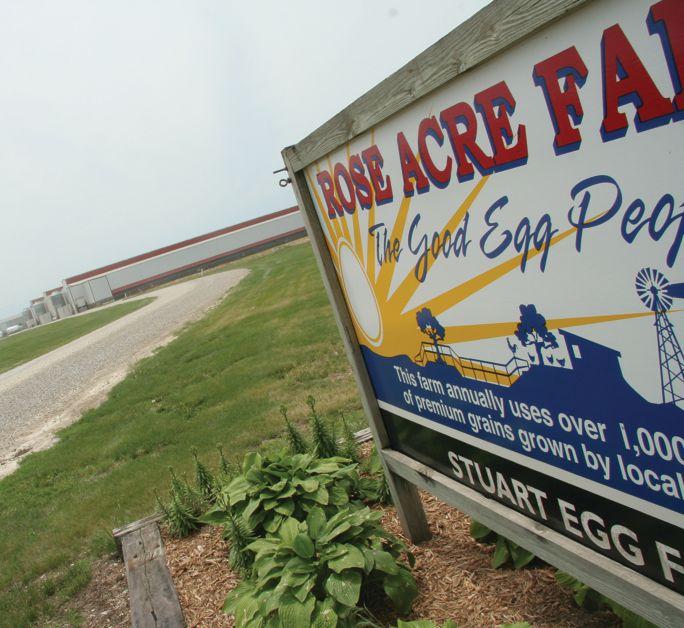
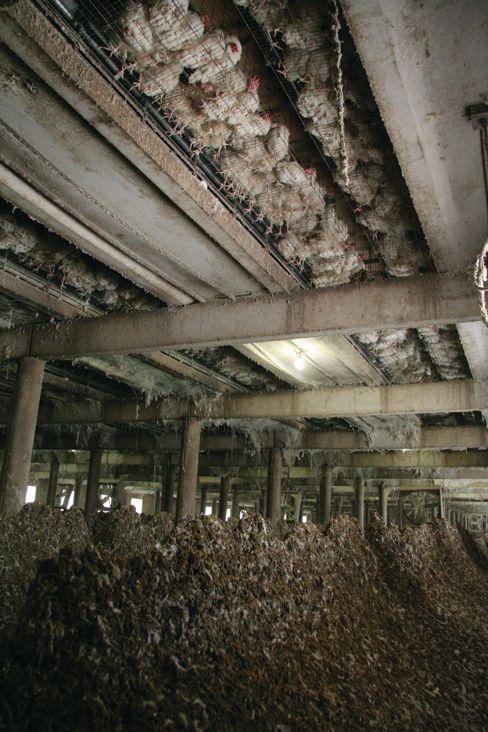
Standing in one of the manure pits at a 1.3-million-layer egg farm can be quite the experience. Picture this: ten 595-footlong rows of eerie-looking, irregular mounds of manure that seem like termite nests aiming for record heights.
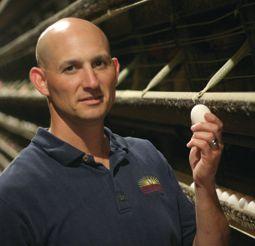
i am at ground level, under house 5 at rose Acre Farms’ egg production complex in Stuart, iowa, 40 miles west of des Moines. complex manager and iowa Poultry Association president Andrew Kaldenberg, the association’s executive director Kevin vinchattle and i enjoy a conversation, while standing under some 220,000 hens.
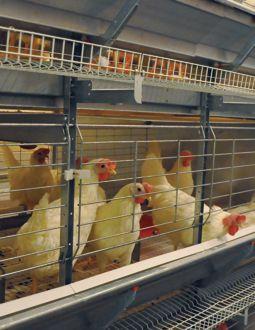
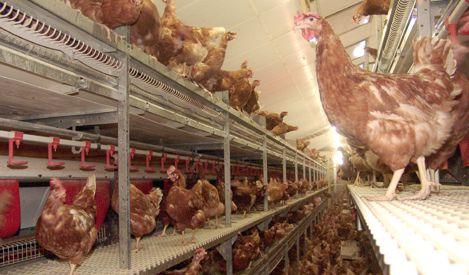
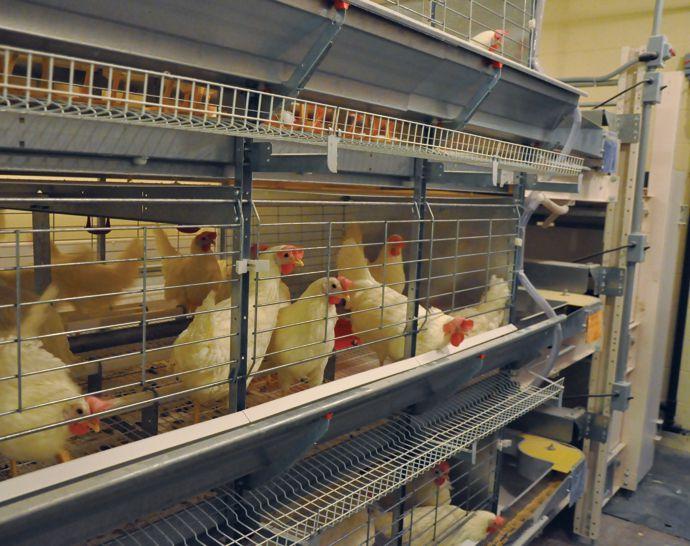
three of the six houses at the Stuart complex are built according to the same concept: layers are housed in 10 double rows, five tiers high. A scaffolding on wheels is used to access the top two tiers, namely when checking for mortality. the excrement from the layers falls 20 feet below, directly into the pit. tiers two to five are lined with boards that are scraped several times a day, and the manure falls into the pit down below. the building is 100 feet wide, 595 feet long. At the pit level, both sides are lined with huge fans, which draw air from side openings in the roof, providing the hens with fresh air and also helping to dry the manure. the pit is emptied once a year, for farmers to use the manure in what could very likely be the same fields that
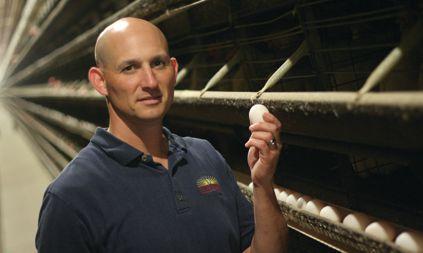
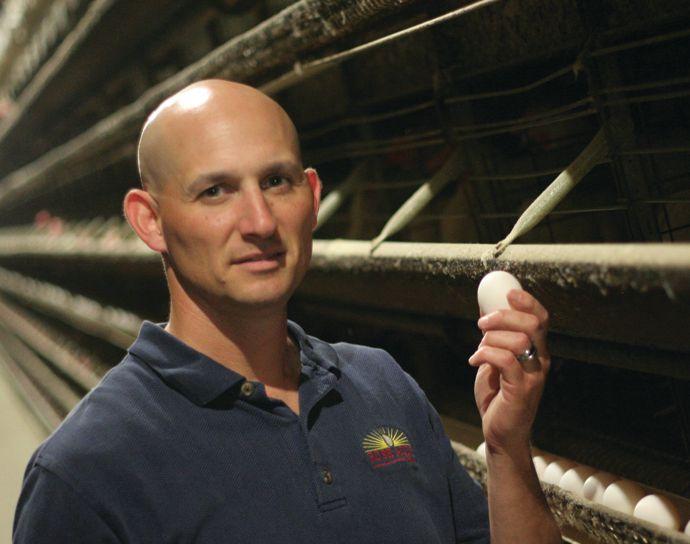
rose acre Farms houses 1.3 million layers in stuart, iowa. it is managed by andrew Kaldenberg, who also serves as president of the iowa Poultry association.
produce the grains for the hens’ ration.
For my hosts, there is nothing unusual about the size and breadth of this facility. rose Acre has similar complexes in indiana, Missouri, illinois, north carolina and Georgia, some housing more than two million layers. iowa is by far the united States’ most important egg-producing state, with complexes of
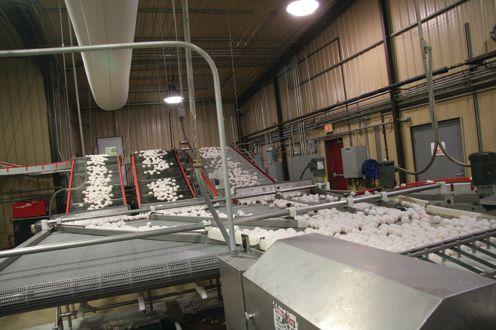
up to four million layers. in Stuart, rose Acre packs more that 750 cases of 360 eggs per day. the inhouse processing plant has a capacity of a little more than 295 cases per hour (that’s 102,600 eggs per hour!).
Eggs travel on conveyor belts from all six houses, merging into a single flow of eggs as they descend towards the
1.3 MilliON Eggs
Real Results
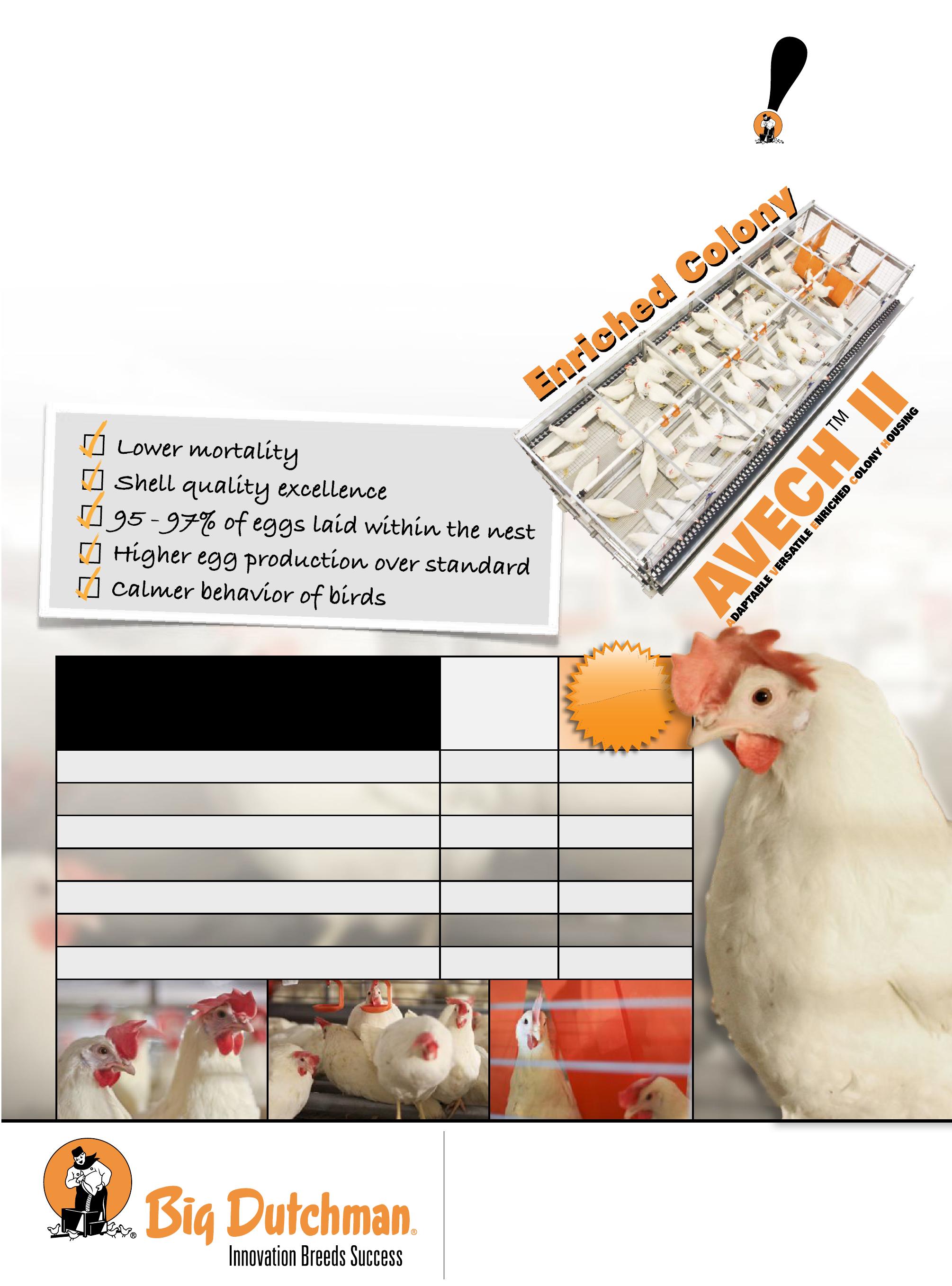
For a fully enriched future, get the “real results” and proven performance from the AVECH™II Enrichable and fully Enriched systems.
With over 50 million birds living and thriving in the AVECH™II, you get the peace of mind that comes from investing in a system that has a consistent and proven track record.
Customers are experiencing real results from installed and working AVECH™II systems:
Production
cleaning station. the eggs are inspected, cleaned, graded and sorted in an in-line process where employees never touch them. “When a customer buys our eggs at the store, he or she is the first human being to handle them,” says Kaldenberg.
Eggs can be separated in up to 12 different grades, before being packed in cases of 30 dozen. All are sold as table eggs. very few are marketed under the rose Acre Farms brand. Most of the eggs from Stuart leave in cases bearing the brand names used by clients, who are large supermarket or convenience store chains.
the Stuart plant employs about 55 workers, including a few part-timers. Kaldenberg says he has no problem finding enough workers. When applicants are not in sufficient numbers, he advertises jobs.
on their applications, candidates must certify that they are entitled to work legally in the united States. A great number of applicants are turned away for providing false identification papers. human resources at rose Acres are also able to conduct a quick computerized check on every applicant’s identity.
Workers are paid above minimum wage. “it’s hard to find good workers,” Kaldenberg says. “the work here is nice,” he adds, referring to the clean and safe working conditions employees are offered.
Big, yet local
Even with such large-scale production, “family-owned” and “local” are part of the vocabulary. rose Acre Farms’ egg production was started by the rust family in indiana in the 1930s. today, Lois rust and her children are board members and are all involved in specific aspects of the company. the company has its own hatchery and breeds all of its pullets.
Feed at the Stuart complex comes from rose Acre’s own nearby feed mill. “All our corn is bought from local farmers, some of them delivering straight to the mill,” Kaldenberg says. Prices paid for premium quality corn are posted and produc-
ers are welcome to sign contracts for immediate or scheduled deliveries.
Local farmers are also the ones benefiting from the layers’ manure. rose Acre sells it in bulk to a local co-operative, which resells it to farmers as part as a commercial fertilizer program.
“We know where our manure goes. Most of it goes to local farmers who sell us their grain,” Kaldenberg said.
in these times of high fertilizer prices, demand is strong for chicken manure. Kaldenberg says he has a waiting list for his. “it’s a very good product,” vinchattle adds. “You got some organic matter in there, and it increases soil tilth.”
While feed and manure are taken care of in a 50-mile radius, eggs do travel a little more. rose Acre sells all over the u.S. and exports as far as hong Kong.
Producing millions of eggs weekly at one location does provide for some economies of scale. But now, with corn prices reaching beyond $7 uS per bushel, tight management is even more critical.
“there is no price support for egg production,” vinchattle
in The Three mosT recenTly builT houses in sTuarT, The manure PiT is locaTed beloW The layers. The manure is dried by The same venTilaTion sysTem ThaT Provides Fresh air To The birds.
The in-house Processing PlanT can handle 8,500 dozen eggs Per hour and The eggs may be seParaTed inTo as many as 12 diFFerenT grades.
The feed conversion leader.
Production
says. “it’s the marketplace that tells our farmers what they are getting for a dozen. then it’s up to them to produce efficiently enough so they can make a profit on that.”
“Everything else has gone up, but the price of eggs is no different now than 15 years ago,” says Kaldenberg. “For $1, consumers still get 12 healthy eggs containing 13 vitamins, protein and minerals.” n
Your input costs are at record levels—and we know you need better flock performance.
Hybrid delivers.
Industry-wide, our birds show signifi cantly lower feed conversion, period.
Visit www.hybridturkeys.com
Can you afford not to buy Hybrid?
In next month’s issue, André Dumont will tell us how Andrew Kaldenberg handles biosecurity and activists infiltrating his farm, and Kevin Vinchattle will offer his take on last year’s salmonella egg recall from another Iowa farm.
With only a few more than 80 egg producers, iowa is by far the most important egg-producing state in the united states. its 57 million layers produce about 14.25 billion eggs per year (2008 usda data). That’s more than double size of the canadian flock and twice as many layers as ohio, the second largest u.s. egg-producing state. The other egg superpowers in are indiana, Pennsylvania and california.
“if iowa were a country, we’d probably rank 10th or 11th in the world,” rose acre complex manager and iowa Poultry association president andrew Kaldenberg says.
in order to produce 15.4 per cent of the country’s eggs, iowa egg farmers purchase about 57 million bushels of corn and 28.5 million bushels of soybean per year. most of the feed comes from iowa’s 23 million acres of cropland or from neighbouring states. There are close to 3,000 hatchery, production and processing workers in the egg industry in iowa.
i owa, an Egg g iant
Production looking Forward
sparks eggs builds innovative, free-run barn that offers labour and cost efficiencies in addition to better bird welfare
Sparks Eggs, the only independent egg grader and processor operating solely in Alberta, recently built what its president Meb Gilani believes is the largest free-run barn in Canada. With a capacity for 50,000 layers, the barn, near Westlock, was designed with labour efficiencies and the future in mind.
Gilani says the barn was a result of the “combined thinking” of Gilani, his son Muneer (the “long-term planner”) and Ken Severson, a former egg producer and Hy-Line International employee who has been Sparks’ business development manager for the last several years. Severson is also the facility’s namesake. Gilani says it “was only fair” to name it the Severson Free Run Barn to honour the energy and time Severson spent planning the facility. “He talked us into doing it right,” he says. “We also thought that if it was named after him, it would be run correctly,” he says with a laugh.
Looking at the industry in the long term, Gilani says he and Severson asked quite a few producers that supply the company with eggs if any of them would be interested in producing free-run eggs. Not finding any interest, the company decided to take it on themselves.
In addition to considering animal welfare, biosecurity and cost efficiencies, the labour shortage in the province also played a significant role in choosing the design of the operation, says Severson. “We’re a small company with a large
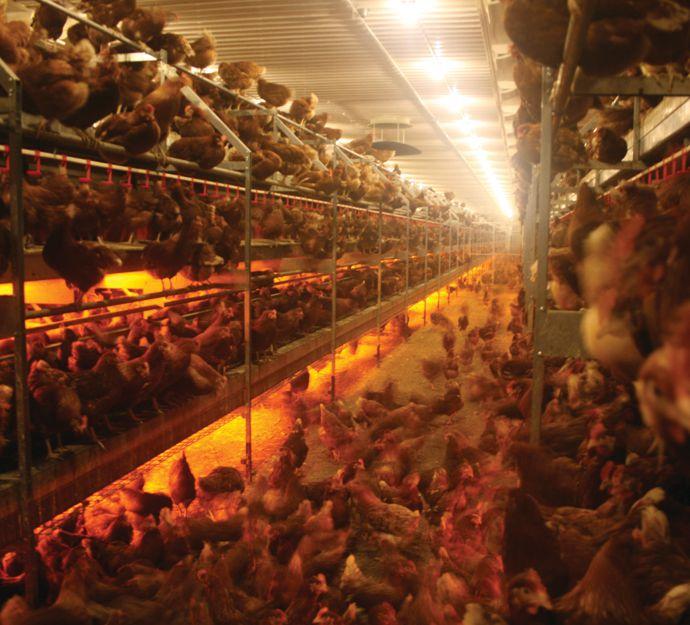
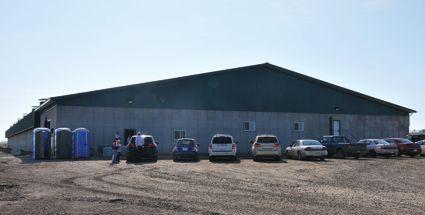
The aviary barn built by sparks eggs has a unique concrete structure and a capacity for 50,000 layers and 25,000 pullets.
number of birds, so we were looking to decrease the manpower required to build and run the facility.”
Barn Design
Severson says the Sparks Eggs free-run facility is modelled after facilities he had heard about, and subsequently visited, in Montana that were constructed primarily using concrete.
The barn floor and walls are constructed from poured-in-place concrete, which,
although uncommon, has numerous benefits, says Severson. Concrete is more durable, has a longer life span, and greatly decreases the risk of contaminants entering the barn because it is highly rodent resistant, he says. Poured concrete, instead of blocks, does not have thermal breaks, so the barn has an “unbroken thermolayer” for increased energy efficiency. The 10-inch outer walls also contain two-inch-thick Styrofoam with an R28 value.
Infrared heating was chosen and this
cONcREtE AViARy
Egg Farmers of Ontario conducted consumer research and we learned many Ontarians are interested in getting to know what motivates our egg farmers.
It is our pleasure to show consumers what inspired Ontario egg farmers by introducing them to eight, of the 400 farm families in Ontario, featured in our “Who Made Your Eggs Today?” campaign.
The egg farm families include:
• Harry Eisses – Innisfil, Ontario
• Scott Graham – St. Marys, Ontario
• Marcel Laviolette – St. Isidore, Ontario
• Dianne McComb – Lucan, Ontario
• Chris Mullet Koop – Jordan, Ontario
• William & Diana Schenk – Wyoming, Ontario
• Hubert Schillings – Oshawa, Ontario
• Luke & Sandra Van Aert – Watford, Ontario
Consumers are invited to meet these Ontario egg farmers and their families. Each is featured in print, radio and online advertisements as part of this campaign.
At www.eggfarmersofontario.ca, there is detailed information about each farm family including photo galleries, favourite recipes and videos. Each farmer also provides answers to frequently asked questions such as “What is an Omega-3 egg?”
To get to know the eight farm families featured in the campaign and get answers to questions like “How do you make the perfect over easy egg?” visit www.eggfarmersofontario.ca
Hubert Schillings is a second generation egg farmer from Oshawa, Ontario. He also serves on Egg Farmers of Ontario’s Board of Directors.
Phone: (905) 858-9790
Fax: (905) 858-1589
Website: www.eggfarmersofontario.ca
Marcel Laviolette is an egg farmer in St. Isidore, Ontario. Marcel tells us what an Omega-3 egg is in his online video at www.eggfarmersofontario.ca.
Production
required the ceiling of the barn to be higher than average, he says. The roof is metal and is white to reflect as much of the sun’s rays as possible. Despite this, there is some solar gain of heat in the summer months so insulation was placed under the roofing tin to keep incoming air as cool as possible.
Ventilation is achieved using chimney fans and inlets on the ceilings. The system was installed by Envirotech Ag Systems Inc. and sales manager William Vis says the Fancom chimney system has an air measurement system known as Exevent ™, which prevents over-ventilation when cold or windy conditions are present, thereby helping to reduce heating costs. The device further saves electrical costs because it can accurately take a fan’s rated capacity down to three per cent of its total, and if conditions are stable enough that a natural updraft can provide the required ventilation rate, the fan motor will shut off, he says.
The barn is divided into “bird” and “people” areas. There are three bird areas – two for the layers (one on the north side of the barn, the other on the south side), and one for pullets in the middle. The pullet-rearing area is its own structure and is fully enclosed by concrete walls, separating it from the layer areas. On each side where the pullet area meets a layer area are several small doors at floor level to allow the pullets to enter the laying area when they reach maturity. They decided to use this design, says Gilani, because it does not require additional labour or handling of the birds.
The people areas are on the east and west sides of the building and consist of hallways, a front office, two washrooms with showers, the egg-packing room and the cooler. Cameras have
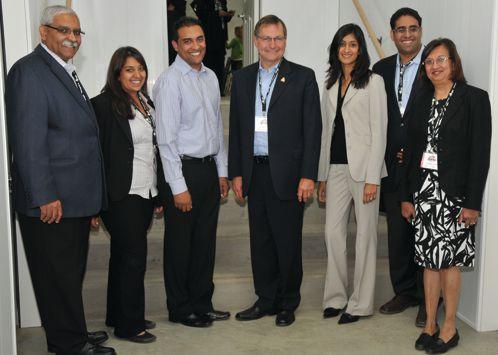
(l To r) mahebub (meb) gilani, his daughTer ashiFa, son aly, The honourable ed sTelmach, daughTer-inlaW rubina, son muneer and WiFe zeenaT.
Production Production
been set up in the layer areas so that the birds can be viewed on the computer in the front office by anyone, and there is a viewing window for observation of the pullets.
the aviary
The pullets are raised in Vencomatic’s Jumpstart pullet-rearing system, and the layers are housed in the company’s Bolegg Terrace aviary, the first multi-tier aviary the company has installed in Canada. The layer and pullet areas can house up to 25,000 birds each, which allows for continuous production.
Each layer area has three rows of the Bolegg Terrace, and each is 300 feet long. Each row consists of three tiers, with the nest boxes on the second tier. Each tier has a manure belt underneath, and the birds have full access to the full floor area (i.e., underneath the system) in addition to the tiers. Shavings are laid in the aisles to provide a scratch area and partitions made of wire that run from floor to ceiling divide each layer area into three sections to prevent crowding and provide more management control, says Dave Waldner, manager of the farm.
The system is built for very few floor eggs and works best if the pullets are trained using an aviary training system such as the Jumpstart, says Waldner. The Jumpstart has winchable
water and feed lines that can be raised incrementally as the birds’ age. When first placed, these lines are just above a “table” (also winchable) in the middle of the floor. At first the chicks are “caged in” to the system, which also consists of additional “tables” that are, at first, positioned vertically to form walls. As the birds age, sections of the wall can be lowered horizontally, offering different height platforms onto which the birds can jump.
Waldner, who has been working with layers most of his life, says the system is “very interesting” and “if you know how to grow a bird in a cage, you don’t know how to grow a bird in an aviary.”
He’s learned “not to make more than one move at a time, as it takes the pullets about a day to catch up.” After the first week, the middle table is lifted and the lowest side tables come down, and the goal is to have the birds off the floor and onto the table areas when the lights go out, so that when moved into the layer aviary they lay eggs in the nests, not on the floor. It all works with lighting, he says. First, the lights at the sides of the room go out, which brings the birds towards the centre, and then the overhead lights dim, which gives the birds time to jump up and settle in, he says.
The first day he did this, he went to the viewing window with
Production Production
a flashlight and found that there were about 40 to 50 birds on the floor, but by the second day there was none. “I wouldn’t have believed it if I hadn’t seen it; it was amazing.”
Managing birds in an aviary takes “a lot more skill and attention,” Severson agrees. “You’re dealing with bird behaviour,” he says. He recommended using the Tetra Brown, a European breed with a calm disposition.
He too stresses lighting is key. “Don’t feed when the lights first come on in the morning, so that the birds can lay eggs without distraction,” he says. He says they have also learned to make sure that there is lots of feed left at the end of the day, to further encourage the hens to go to the nests to lay in the morning.
All lights in the barn are LED lights from Vencomatic. The overhead lights on the ceiling are Glolamps, and the lighting under each tier is tube lighting with LED bulbs. “The entire barn is run on a 20-amp breaker,” says David Thompson, president of Vencomatic North America. The lights themselves only consume seven amps, and it only takes 110 volts to light the whole system, he says. They are on timers and dimmers, and are able to go from to zero to 100 per cent in progression, and then go down again, giving a true sunrise to sunset, he says.
Lighting is used to bring the hens off the floor at night, just as it is in the pullet barn. The lights are dimmed in a gradual
progression in 20-minute intervals, beginning underneath the bottom tier and each successive tier, and finally the ceiling. The nests are closed about two hours prior to lights off, but Waldner says this can be manually overrun if some birds remain in the nest.
Severson says they have learned a lot from the first flock, which was placed in July. The biggest challenge was “system” eggs – those laid outside of the nest– so you must be diligent and pick them up quickly in the beginning, he says.
“From a management perspective, training the pullets correctly to move up and down the system and keeping the most uniform environment with respect to temperature, lighting and distribution of equipment is critical to running a successful aviary,” says Vencomatic’s Thompson.
Each tier has a manure belt underneath, and the manure is collected and held in a manure shed separate from the barn. The pullet area does not have a manure belt, so it is truly “all in, all out.” When the pullets are moved into a laying area, the manure is removed using a tractor and pushed through a door onto the main manure conveyor belt.
The eggs are taken from the layer areas on belts into the egg room, where they can be packed. Employees working in the egg area have a separate entrance and have no access to the barn areas.
Sparks Eggs held two open houses in August to show the barn. The first open house was for producers and industry representatives, while the second was for former Alberta premier Ed Stelmach and invited guests. Stelmach is also a past agriculture minister for the province and has known Gilani for many years. “He is interested in innovation and wanted to see what we’ve done,” he says.
Gilani says there is a shortage of eggs in Alberta, so he is not deterred by the fact that the facility will produce more free-run eggs than the market requires, as they will be sold primarily as table eggs. “You can’t be shortsighted,” he says. “You have to look at the industry in the long term.” n
To view photos of the pullets in the Jumpstart system, visit our website. To view a video of birds in the Bolegg Terrace, visit: http://www.youtube.com/watch?v=oyXX9UU4MNU
sParKs business develoPmenT manager Ken severson Was insTrumenTal in designing The barn, Which is named aFTer him.
In the barn Water Pressure
Tips for achieving optimal pressure levels
bY THE T ECHNICAL T EAM , Z IGGITY sY s TEM s, I NC
One of the most important and misunderstood jobs a producer must perform in the poultry house is to maintain the correct pressure in the watering lines.
Water coming to the poultry house usually has a pressure of 20 to 40 psi (1.4 to 2.8 Bar). That is simply too high. Pressure this high can damage the system, causing drinkers to leak and spray water. Also, the birds cannot activate the trigger pins on the drinkers with pressure this high.
That is why all enclosed watering systems have pressure regulators. A regulator allows the producer to decrease the pressure in the drinker line to a level that will provide the birds with all the water they need to thrive, but not too much that the system will over-deliver water and wet the litter.
This article offers nine tips that will help producers achieve the optimal water pressure for systems and flocks.
1. No two flocks are the same. What worked well for one flock can produce disastrous results for the next. The pressure in the system must be managed to reflect the conditions in the poultry house.
2. Manufacturer guidelines are not precise rules. Most manufacturers of enclosed nipple-type watering systems issue guidelines on the pressure settings to use. These, however, are just recommendations, and each producer must manage according to observed conditions, not according to specific preset pressure settings.
3. Litter conditions are key. Litter
achieving a level of water pressure that will allow birds plenty of water to thrive, and avoid problems related to over-delivery and wetting of the litter, is key.
readings are the most reliable method for determining the correct pressure setting. The litter beneath the drinkers should be dry and friable. That means when you grab a handful of litter and squeeze, the litter should clump together briefly and then fall apart. If it remains in a clump, the litter is too wet and the water pressure is probably too high. If it will not clump at all, the litter is too dry and the water pressure is probably too low.
4. High water pressure doesn’t mean more water consumed. The higher the water pressure, the more water the drinkers will discharge, but that does not mean more water goes to the birds. Birds can only consume so
much; if you keep raising the pressure the excess water goes into the litter.
5. Warm weather requires more water delivery. As the weather warms, your birds will drink more, requiring increased water pressure. The reason for the increased consumption is to help the birds regulate their body temperatures. Birds do not have sweat glands and will pant to blow off excess heat. The panting causes water loss through the lungs.
6. Cold weather requires less water delivery . Conversely, birds consume less water in cooler weather. Leaving the water pressure at warm-weather levels causes an over-delivery to the drinkers. This results in wet litter and significant problems that accompany that condition.
OPtiMAl PREssuRE
If the water pressure is too high, the birds cannot activate the trigger pins.
7. Broilers consume more water as they age. the system requires constant adjustments to water pressure as birds mature to ensure they get all the water needed without an oversupply.
8. Delivering more water cannot force a bird to eat more.
bird to eat more simply by turning up the water pressure. A bird can consume only the water it can hold in its beak. Any excess will result in spillage and wet litter.
9. Pressure may not be even throughout the house. the line is level, the pressure in the line is constant throughout
installed in each drinking line to help even out the pressure in the house.
Production
Au pays des géants
notre collaborateur andré dumont rentre d’un voyage en iowa, l’état qui produit le plus d’oeufs aux États-unis. suivez-le en visite exclusive d’un complexe de 1,3 million de pondeuses.
b Y A NDR é D UMONT
Entrer dans l’une des fosses à fumier d’une ferme avicole de plus d’un million de pondeuses est une expérience qu’on n’oublie pas. imaginez : dix rangées de 585 pieds de long de monticules de fumier qui ressemblent à des termitières s’élançant en hauteur.
Je suis au rez-de-chaussée du poulailler no 5 au complexe de rose Acre Farms de Stuart, en iowa, à 40 milles à l’ouest de des Moines. Me voilà sous quelque 220 000 poules, en compagnie d’Andrew Kaldenberg, gérant du complexe et président de l’iowa Poultry Association, et de Kevin vinchattle, directeur général de l’association.
trois des six poulaillers au complexe de Stuart sont construits selon le même concept : les poules sont hébergées sur
1,3 MilliON dE PONdEusEs
andrew Kaldenberg est le président de l’iowa Poultry association et le gérant du complexe de stuart de rose acre Farms.
dix rangées doubles de cinq étages de cages. Pour accéder aux poules des deux étages supérieurs, notamment lors des vérifications pour la mortalité, on utilise un échafaud sur roues.
Les poules de l’étage du bas voient
leurs excréments tomber 20 pieds plus bas, directement dans la fosse. Sous les cages des étages deux à cinq se trouve un contreplaqué, lequel est raclé plusieurs fois par jour pour faire tomber le fumier dans la fosse.
l’ i owa, un géant de la production d’oeufs
avec seulement un peu plus de 80 producteurs, l’iowa est de loin l’état qui produit le plus d’oeufs aux États-unis. ses 57 millions de pondeuses donnent environ 14,25 milliards d’oeufs par année (données du usda, 2008). c’est plus de deux fois plus de pondeuses que dans tout le canada et le double du nombre en ohio, le deuxième état
producteur d’oeufs aux États-unis, après l’indiana, la Pennsylvanie et la californie. « si l’iowa était un pays, nous serions probablement 10e ou 11e au monde », souligne andrew Kaldenberg, gérant de complexe chez rose acre Farms et président de l’iowa Poultry association. Pour produire 15,4 % des oeufs du pays, les producteurs de l’iowa achètent
annuellement 57 millions de boisseaux de maïs et 28,5 millions de boisseaux de soya. la plupart de ces grains proviennent des 23 millions d’acres en culture de l’iowa ou d’états voisins. l’industrie des oeufs en iowa emploie 3000 travailleurs dans les couvoirs, les poulaillers, la classification et l’empaquetage.
L’édifice fait 100 par 595 pieds. Les deux côtés de la fosse sont ponctués d’immenses ventilateurs. ceux-ci tirent l’air d’ouvertures latérales dans le plafond, rafraîchissant ainsi les poules avant de servir à sécher le fumier. La fosse est vidée une fois par année, le fumier ayant de bonnes chances de se retrouver dans
Production
les champs où sont produits les grains qui composent la ration des poules.
Pour mes hôtes, il n’y a rien d’inhabituel à l’ampleur de ces installations. rose Acre Farms possède des complexes semblables en indiana, au Missouri, en illinois, en caroline du nord et en Georgie, certains d’entre eux
INTEGRATED
AUTOMATION SYSTEMS FOR POULTRY FARMS
CLIMATE CONTROL
FEEDING SYSTEMS
BIOMETRICS
DATA MANAGEMENT
LIGHTING
EGG COUNTING
FLOWCONTROL
hébergeant plus de deux millions de pondeuses. L’iowa est de loin l’état qui produit le plus d’oeufs aux États-unis, avec des complexes pouvant compter jusqu’à quatre millions de pondeuses.
À Stuart, rose Acre empaquette environ 750 caisses de 360 oeufs par jour. Le poste de mirage, de tri et d’emballage est d’une capacité de 295 caisses à l’heure (102 600 oeufs par heure!).
Les oeufs des six poulaillers voyagent sur des convoyeurs à bande, puis convergent à leur descente vers la station de lavage. Les oeufs sont ensuite mirés, inspectés, classifiés et empaquetés dans une chaîne en continu sans jamais qu’un employé les touche. « Quand vous achetez les oeufs au magasin, vous êtes le premier être humain à les manipuler », dit Andrew Kaldenberg.
Les oeufs peuvent être séparés et empaquetés simultanément en 12 différents calibres, de l’extra large au petit. tous sont vendus comme oeufs de table. très peu d’entre eux sont mis en marché sous la marque rose Acre Farms. La plupart des oeufs de Stuart partent dans des caisses affichant les marques des clients, qui sont des chaînes de supermarchés ou de dépanneurs.
Le complexe de Stuart embauche 55 travailleurs, dont quelques-uns à temps partiel. Andrew Kaldenberg affirme n’avoir aucune difficulté à trouver suffisamment de travailleurs. Quand les demandes d’emplois se font rares, il affiche les postes disponibles.
Sur leurs demandes d’emploi, les candidats doivent attester qu’ils ont le droit de travailer légallement aux Étatsunis. un grand nombre de ces candidats seront rejetés d’emblée, sur la base de leurs faux documents ou à la suite d’une vérification électronique de leur identité.
Les travailleurs touchent un peu plus que le salaire minimum. « c’est quand même difficile de trouver de bons travailleurs », dit Andrew Kaldenberg. « Le travail ici est agréable », ajoute-t-il en allusion à la propreté et la sécurité des lieux.
Continued on page 40
Assessing Welfare (Part 2) PIC Update
results
from recent WaFl conference, with a focus on layers
bY
K IM b ERLY sHEPPARD , R E s EARCH C O - ORDINATOR
in october’s issue, we brought you an overview of the recent 5th international conference on the Assessment of Animal Welfare at Farm and Group Level (WAFL), which was held at the university of Guelph and hosted by u of G’s campbell centre for the Study of Animal Welfare. Sponsored by the Poultry industry council, the conference had close to 300 delegates from more than 20 countries in attendance, presenting and discussing the most current knowledge on assessment and auditing of the welfare of animals in groups. the october issue focused particularly on broiler welfare assessment. Laying hen welfare was also well covered, and here we bring you some of the conference highlights of that work.
the latest research
the welfare of laying hens has received considerable attention in canada recently. in March 2010, the Manitoba Egg Farmers announced a policy that moves away from conventional cages, and requires all egg farmers who build new facilities or undertake a major retrofit after 2018 to install enriched cages or another housing system that supports the Five Freedoms. in May 2011, Egg Farmers of canada named a brand new academic chair in Laying hen Welfare, dr. tina Widowski, at the university of Guelph. in the February 2011 issue of Canadian Poultry , we heard about daniel Martel and his son Stéphane, who have inaugurated Quebec’s largest layer barn equipped with enrichable cages. Major
new housing systems for layers are emerging that fulfil behavioural needs and allow more space, but there are still many questions about how the systems perform and how hens perform within them.
changes toward improving layer welfare are happening across canada in a short span of time – including policy changes.
When policy changes come into play, the outcomes of these changes require evaluation for optimization. Evaluation involves characterizing the level of animal welfare within any system. different approaches may be used to accomplish this, and in Europe, qualitative evaluations of welfare are getting a lot of attention. dr. F. neijenhuis of Wageningen ur, Livestock research, has been working on a method of characterizing “animal discomfort” to evaluate trends across years on a national level for evaluation of animal welfare policy and prioritization of policy. this project was carried out in response to Europe’s Welfare Quality® project, which comprehensively assesses
animal welfare on-farm, but which is not yet implemented for policy evaluation. in the context of this study, “discomfort” is defined by the researchers to mean when an animal fails to have positive experiences (e.g., fulfilment of behavioural needs, “natural behaviour”), or has negative experiences (e.g., elective surgeries such as beak or toe trimming, chronic stress), and refers to those forms of physical and mental health that can be established and substantiated scientifically. Poultry were analyzed in the years 2007 and 2011 (in addition to cattle, pigs, mink and horses).
to analyze discomfort, three categories were used for severity, duration, and share of the population experiencing a given item, for between 10 and 40 items per species. Per species, two to
EVAluAtiON NEEdEd
PIC Update
five experts reached consensus on scores. Multiplication of the three figures identified items causing severe discomfort of longer duration for a large part of the population. For poultry, the researchers conclude that low-stimulus surroundings and restricted space cause the highest discomfort, and that this is quantifiable for any given country over time. this method is useful, says neijenhuis, because when repeated, for each item differences in severity, duration, and/ or proportion of the population can be identified, providing an overall indication of a trend in level of discomfort for the species. ultimately, neijenhuis hopes that this type of information can be used in Europe for evaluation of animal welfare policy and prioritization of policy.
how shoulD we keep our BirDs?
Egg farmers are now well aware that new systems are available and emerging for housing laying hens – systems that can provide more space and stimulation and fulfil behavioural needs. But there are still many questions about how the systems perform and how hens perform within these systems. What are the real benefits to the birds? What are the welfare tradeoffs, if any?
Examining conventional cage design is one approach for identifying factors to take into account when designing systems that optimize hen welfare. dr. ruth newberry of Washington State university and her research team have been using an epidemiological approach to examine relationships between cage design, feather cover and feather cleanliness of commercial laying hens. they obtained data on feather condition of White Leghorn hens in 167 commercial houses distributed across all regions of the united States, using a five-point scale for feather cover and a four-point scale for feather cleanliness. From each house, systematic data on cage dimensions and other aspects of the housing environment were also gathered.
Feather cover was significantly greater in houses with frequent waste removal, cup drinkers or plain nipple drinkers
rather than nipple drinkers with drip cups, incandescent rather than fluorescent lights, greater floor space allowance per hen, less feeder space per hen, lower cage floor slope, and lower cage height and in which hens had cleaner feathers. Feather cleanliness was greater in houses without evaporative cooling, with the
hy-Line W36 strain of White Leghorns, with shallower cages, and with taller cages.
the study shows that multiple aspects of cage design and management affect feather cover and cleanliness, sometimes in unexpected ways. Knowing just which factors come into play is useful for
Improve Performance
CLEAN • CLEAN • CLEAN
disinfecting and pest control
KILL
SURFACE & AIRBORNE PATHOGENS
PIC Update
design of new systems, conventional or enriched. this study reminds us that within any given housing systems there are a myriad of design features, and those that appear to be minor details can actually have dramatic effects.
the flip-side of conventional cages for hen housing is the free-run or aviary system, where hens have the run of an entire poultry house and/or multiple tiers within that house. Welfare and behaviour within these systems is being investigated by dr. Parsons and his research team at the university of iowa. they assessed use of a litter area in a multi-tier aviary, in relation to changes in welfare assessment parameters. use of the litter area was video-recorded, and a subset of birds was selected from each section within the house chosen for welfare assessment and behaviour observations. clinical scoring of bird health related to plumage, parasites, injuries and disease.
Approximately 154 per cent of birds went to the litter throughout the day, meaning that some birds visited more than once and indicating that litter is a valuable resource. Movement of the hens to and from the litter was affected by time of day and section of the house. it was also found that some welfare assessment parameters, such as keel bone injuries, changed over time within the same group of hens – more research is needed to determine risk factors.
Bone breakage within laying hen flocks presents a considerable welfare concern because of the potential for pain and effects on behavioural patterns. Although the risk for bone breakage at end of lay and depopulation is well known, it is less well known that there is also a risk for fractures during lay, particularly in extensive systems (i.e., free-run or aviary) due to impact against objects within the environment.
Gemma richards of the university of Bristol has been using radiography (X-ray technology) to assess keel bone fractures and assess fracture healing in live birds. twenty-four Lohmann brown birds with varying degrees of keel fracture were taken from commercial facilities and housed in experimental facilities, and were X-rayed regularly over six weeks. Eighty per cent of birds entering the
PIC Update
study with “new” fractures had healed after 35 days, and five birds incurred new breaks despite their original fracture status. richards says that this technique provides valuable insight into the nature of keel bone fractures and the process of fracture healing in layers.
Another concern with moving to new housing systems involving larger groups is feather pecking. Elske de haas at Wageningen university in the netherlands has been assessing fearfulness, stress and feather damage in commercial laying hen parent flocks. Laying hen parent stock farms vary in flock size, stocking density and management practices, says de haas, which can affect birds’ ability to cope with fear and stress and their propensity to feather peck. Furthermore, genetic origin can affect fearfulness and feather pecking.
de haas investigated whether farm conditions and genetic background affected behaviour and stress physiology of parent flocks of two commonly used commercial hybrids, dekalb White and iSA Brown. Group size was either less than 6,000 or more than 6,000, but with similar stocking densities. the researchers assessed feather damage, fecal corticosterone metabolites and fearfulness by using a novel object test and a human approach test.
the results of this study did not show a relationship between hybrid and farm conditions on fear and feather pecking for the breeds studied, although dekalb White flocks approached a novel object sooner. however, a large variation in fecal corticosterone metabolites was found between farms, indicating effects of management on the ability to cope with fear and stress. de haas stresses that, especially in parent stocks, high fearfulness and chronic stress should be avoided to maintain production and welfare. A possible route of improvement, says de haas, can lie in improving human-animal interaction, as a negative response to a human in a test setting may indicate fear of the farmer in general.
overall, improving laying hen welfare involves careful consideration not only of which housing system to employ,
CPRC Update Evaluating Research Funding
We often do not think about the reasons behind our actions and this may be the case with poultry research. i t helps us understand our investments if we think about why we are making them. r esearch activities can be viewed as a continuous process that consists of major categories based on the following, simplified diagram:
ensures that innovations resulting from research activities are adopted by, and benefit, industry at the earliest possible time to maintain and increase sector economic viability. t he return on the research investment will be larger for innovations that are “taken to market” faster.
research path to application by end users?
Primary research asks the basic question “can this be done?”
Applied research asks the question “how can we do it?”
Innovation asks the question “does it make sense for the end user?”
Application is the point at which the research result impacts the end user.
t here are many steps within each research category that create the final result. n ot every project will make it through the research process from idea to application. i nvestigation at any point could determine that the assumptions behind the research project cannot be supported and the research process will stop. h owever, it is important to realize that good research that does not support an assumption is not a failure because it has added to our body of knowledge and might help refine the direction of future research. Failure to support an assumption frequently leads to a new line of investigation based on the results of the initial research.
o ne of the main objectives of organizations that fund research should be to ensure that discoveries move through the research stream to application as quickly as is feasible. t his
t he poultry industry understands that some research activities will not increase productivity and/or profit, but are conducted to protect the society in which we live and work. r esearch in these areas is often designed to lessen the cost of meeting regulations and societal expectations. t he best examples of this type of research are environmental and food safety research projects. Farmers and others in the poultry industry bear the added costs of meeting society’s expectations and regulations around the environment and food safety as part of their commitment to producing c anadian poultry products within a sustainable system.
t he goal of any industry-related research activity is ultimately to benefit the end user. c P rc has been active for almost a decade and has funded 55 projects. i t is time to take a look at our impact on the c anadian poultry sector.
• Are c P r -funded research projects reaching the end user?
• i f so, what are the paths they take and timelines to move along the research path to application?
• i f results are not reaching the end user, why aren’t they?
• What can c P rc do to facilitate the flow of research results through the
t hese questions, and others, are easy to ask but they are not as easy to answer. Many industry innovations are an accumulation of a range of research completed in various places by many researchers. h ow has c P rc funding fed into this development process? What impact has our funding had on the end result? Although these questions may be difficult to answer, we have to take a hard look at what we have done and plan to do in the future. i t is c P rc ’s responsibility to get the maximum return from industry’s investment in research.
to that end, c P rc is conducting an evaluation of the impact of our research funding, how we conduct our funding program and what we can do to facilitate moving research from idea to action as efficiently as possible. t he process will involve both industry representatives and researchers. r esults will be reported in this magazine and through other means as they become available. o ur goal is to enhance the value of research to our industry and this project will provide valuable information for our future activities. n
The membership of the CPRC consists of the Chicken Farmers of Canada, the Canadian Hatching Egg Producers, the Turkey Farmers of Canada, the Egg Farmers of Canada and the Canadian Poultry and Egg Processors’ Council. CPRC’s mission is to address its members’ needs through dynamic leadership in the creation and implementation of programs for poultry research in Canada, which may also include societal concerns. CPRC’s contact information is available at www.cp-rc.ca.
Research ddgs inclusion in layer diets
recent university of nebraska research shows that levels can be as high as 15 to 25 per cent
b Y N ATHAN M AY, P OULTRY sCIENCE Ass OCIATION
High corn and soybean prices have made the search for ways to decrease poultry feed costs more important than ever. dried distillers grains with solubles (ddGS), byproducts of ethanol production, have shown potential as an alternative source of energy, protein and amino acids in poultry diets.
however, the inclusion level of ddGS in layer diets has been limited to five to 10 per cent. But university of nebraska researchers drs. Mahmoud Masa’deh, Sheila Purdum and Katherine hanford have recently shown that inclusion levels as high as 15 per cent, and possibly 25 per cent can be incorporated without having a negative effect on feed intake, egg production, or other key metrics. improved yolk colour has also been observed at the higher inclusion levels.
the research team’s study comprised two egg production phases, during which diets were formulated to include 0, 5, 10, 15, 20 or 25 per cent corn ddGS. the only difference between the diets in Phase 1 (week 24-46) and Phase 2 (week 47-76) was that in Phase 1, the diets were formulated on a fixed lysine and tSAA (total sulfur amino acids) level. during the second phase, the diets were designed to keep lysine and methionine at a fixed level, but the tSAA levels were
dried distillers grains with solubles (ddgs) have been shown to have no adverse affect on egg production and can improve yolk colour.
allowed to increase due to higher cysteine levels in ddGS.
the researchers found that neither feed intake nor egg production were affected by dietary ddGS concentration in either phase of the study. in Phase 1, the researchers observed that increases in ddGS levels correlated with a roughly linear decrease in egg weight. however, this negative correlation was not observed in Phase 2 of the study.
According to the study’s authors, differences in amino acid levels and
potential bioavailability as well as changing amino acid balance in Phases 1 and 2 could have been the reason for the reduction in egg weight only during Phase 1. the authors found no differences in haugh units due to ddGS levels in either production phase. in addition, the authors observed a linear increase in the retention of nitrogen and phosphorus with increasing levels of ddGS; the output per kilogram (as measured in the hens’ excreta) of these elements, however, decreased linearly as ddGS
FEEd ByPROduct
increased. this result is opposite to what was reported by other researchers, whose work focused on broiler chicks.
one difference the researchers consistently found throughout the study was that egg yolk colour increased linearly with increased dietary levels of ddGS, reaching its greatest roche colour fan score of 7.2 in eggs from hens fed the diet containing 25 per cent ddGS. According to the authors, this indicates that xanthophylls in the ddGS were “highly available.” they also point out that the xanthophyll content of dried distillers grains with solubles is approximately three times that of corn by weight (34 mg/kg vs. 10.62 mg/kg, respectively). this finding may be useful for producers selling eggs in markets where there is a consumer preference for increased yolk pigmentation.
Subsequent studies will also look
at the impact of replacement rations containing ddGS for pullets. results of this study were published in a recent issue of Poultry Science (“dried distillers Grains with Solubles in Laying hen diets”; Poult. Sci. 2011 90: 1960-1966.
“dried distillers grains with solubles have previously been shown to be a valuable and, especially given current prices of corn and soybean meal, affordable ingredient in poultry diets. current usage levels of ddGS in poultry diets typically range from five per cent up to 10 per cent. What our recent study has shown is that growers can safely explore levels of ddGS in their diets for laying hens up to 15%, and perhaps as high as 25 per cent, with no negative effects on feed intake, egg production, or other key metrics, and with improved yolk colour at the higher levels,” said dr. Purdum, one of the study’s authors. n
PIC Update
Continued from page 35
but also of the management of the system and the breed of bird used within the system. Furthermore, what seem to be minor details within any housing system can actually have a dramatic impact on behaviour, welfare and production, and interactions of these details can also come into play.
As with all animal welfare issues, questions are never simple, and answers are often not clear-cut. As canada moves forward with egg production, the new and varied hen housing systems will need to be carefully studied, and their design and management modified as issues are identified.
the next WAFL conference will be held in France in 2014, and an abundance of new information will presented there, to continue to help inform our decision making, guidelines and policies. n
Powerful Performers from the Feeder Technology Leader
Continued from page 30
ÉconoMie rÉgionale
Même dans une production d’une telle ampleur, des mots comme « entreprise familiale » et « production locale » font partie du vocabulaire.
La famille rust a démarré une production d’oeufs à grande échelle et fondé rose Acre Farms dans les années 1930, en indiana. Aujourd’hui, Lois rust et ses enfants en sont les administrateurs, chacun étant responsable d’un aspect de l’entreprise, qui possède aussi ses propres couvoirs, élevages de poulettes et meuneries.
La moulée pour le complexe de Stuart provient d’une meunerie de rose Acre Farms à proximité. « tout notre maïs est acheté de producteurs locaux, certains livrant leurs grains directement à notre meunerie », dit Andrew Kaldenberg. une
Production
prime est payée pour du maïs de qualité supérieure et les producteurs sont invités à signer des contrats pour livraisons immédiates ou réparties sur une période donnée.
Les producteurs de grandes cultures de la région sont aussi ceux qui profitent du fumier des poules. rose Acre le vend en vrac à une coopérative locale, qui la revend aux producteurs dans le cadre de leurs programmes de fertilisation commerciale. « nous savons où aboutit notre fumier, dit Andrew Kaldenberg. La plupart va chez des producteurs locaux qui nous vendent leur grain. »
Si la moulée et le fumier ne voyagent que dans un rayon de 50 milles, il en est tout autre pour les oeufs. rose Acre Farms vend partout aux États-unis, et aussi loin qu’à hong Kong.
il y a des économies d’échelle à produire des millions d’oeufs par semaine, mais avec un prix du maïs qui
va jusqu’à dépasser les 7 $uS le boisseau, une gestion serrée est plus nécessaire que jamais.
« il n’y a aucun mécanisme de support pour le prix des oeufs, dit Kevin vinchattle. c’est le marché qui dicte à nos producteurs ce qu’ils touchent pour une douzaine. c’est à eux de produire suffisamment efficacement pour qu’ils arrivent à en tirer un profit. »
« tous les autres prix ont monté, mais celui des oeufs est le même aujourd’hui qu’il y a 15 ans, fait valoir Andrew Kaldenberg. Pour 1 $, le consommateur obtient toujours 12 oeufs sains, contenant 13 vitamines, des protéines et des minéraux. » n
Le mois prochain : Andrew Kaldenberg nous parle de biosécurité et des militants des droits des animaux. Kevin Vinchattle nous donne son point de vue sur le rappel d’oeufs contaminés à la salmonelle sur une autre ferme de l’Iowa l’an dernier.
K. MILLER REALTY, BROKERAGE Each office is Independently Owned And Operated 220 BROAD ST EAST, DUNNVILLE, ONTARIO N1A 1G2 Phone 905-774-7624 or Toll Free 1-888-718-8445 Fax 905-774-5960
WiNDHAM CeNTre – brOiLer FArM: One barn operation. 40 x 352 x 2. Ziggity nipple drinkers. Chore-Time equipment. Sprinkler mist system. 55 kw generator and alarm system. Natural gas heaters. 12 acres on paved road.
LiTTLe briTAiN - brOiLer breeDer FArM WiTH 14256 H.e.M.S. Split flock. 2 barn operation. Barn 1- 275 x 40 x 1, Barn 2- 305 x 40 x 1. Solar wall Vencomatic Nests, Roxell Feeders, Fancom Computer, Bird weighting. Box heaters. Lubing drinkers. Automatic generator, 105 kw. New well. Pullet quota of 8257 produced off site. Year round production. 50 Acres, 45 workable tiled loam soil. New 3+1 Bdrm brick home.
LArGe POuLTrY OPerATiON: Presently set up for Turkey. 3 barn operation. 88,000 sq ft of growing area. Suitable for other poultry. Standby generator and all farm & barn equipment. Modern 3+1 bdrm home. All on 50 acres of land located near Acton, ON.
Jack Huitema, broker of record (res.) 905-774-8291 jack-huitema@coldwellbanker.ca www.coldwellbanker.com
Feed Additives, Distributors and their Salespeople
ALL THINGs CONsIDERED
by JIm KNISLEy
a dickensian spectre and the WTo
For the last 10 years the frequent flyer miles have been piling up for leaders of canada’s poultry industry. the Wto doha round presented a real threat to supply management and the leaders had to be at meetings to represent the industry and attempt to influence politicians and trade officials.
now, finally, an end is in sight. But, and this is a big but, there are lawyers involved, and politicians who hate to admit failure.
charles dickens would understand the perils of involving lawyers. And if the Wto’s doha round continues beyond its december ministerial meeting it may be time to open Bleak House and tremble.
in Bleak House, dickens writes a fictional account of a court case, Jarndyce and Jarndyce. the case concerns the fate of a large inheritance. it drags on for generations.
“Jarndyce and Jarndyce drones on. this scarecrow of a suit has, in course of time, become so complicated that no man alive knows what it means,” dickens wrote.
the lawsuit is resolved near the end of the novel after legal costs consumed the entire estate and all that was left were bale upon bale of legal papers.
doha may be headed the same direction.
Swiss info recently wrote about the start of construction of a new wing at the Wto headquarters in Geneva and expanded the story into a discussion of doha.
is fiction. But a case in india has been reported as lasting more than 175 years.
it began in 1823, when an estate was bequeathed to seven sons. it first went to court in 1833, when a case to try to stop the sale of some land began. After 22 years, a lawyer was appointed to oversee the property and the case continued and continued. over the ensuing years boundaries have changed and much of the land in dispute is now in Bangladesh.
Although the doha round is only a decade old it seems some are determined ensure it drags on.
take the cairns Group. its recent meeting in Saskatoon resulted in a statement that was pure boilerplate. in fact, it was worse than that, it was essentially a recitation of principles laid out at the group’s founding many years ago.
“cairns Group calls for freer trade, reduction of subsidies” was the headline. this was, as i recall, virtually the same headline that came out of the first meeting and the same headline has emerged every year since.
the group wants to jump-start the Wto’s doha round. the plan seems to be to spend the next few months talking to other countries (this is a new strategy?) in the hope that making the same old arguments will produce a different result.
Doha, like Jarndyce, has slid from folly into farce
“doha as it was initially planned is probably dead,” said cédric dupont, professor of international relations at the Geneva-based Graduate institute. “Lamy is clearly shopping for ideas on what to do next and the indication is that the organization is at a loss where it wants to go,” said dupont.
But doha may continue despite the futility of the exercise.
“Most Wto staff are lawyers. it’s an organization to enforce existing agreements not designed to strike deals. So will members say forget negotiation within the Wto and just enforce agreements? that would be difficult for them to accept.”
in other words doha could grind on and on. As in Jarndyce, generations will pass, paper will pile, no one will remember what it’s about and it will end only when there is no money left.
You may think this far-fetched and point out that Jarndyce
Even an optimist would conclude that the chances of a breakthrough are slim. the Americans, for example, have given up.
“one thing is clear: What we are doing today in the doha negotiations is not working. that is not a value statement, but a simple assessment of the facts. After 10 years, we’re deadlocked,” u.S. Ambassador to the Wto Michael Punke said recently.
“the first thing that is really critical is that all members of the Wto admit right now that what we’re doing isn’t working,” Punke said.
Wto members are in deep disagreement on the extent to which rich countries should cut farm subsidies and tariffs on farm and manufactured goods and the extent to which developing countries should open their markets in agriculture, manufacturing and services.
Karel de Gucht, the Eu commissioner for trade, told the European Parliament: “the prospects for reaching concrete negotiating results in the short term look rather bleak.” n