MOVE OVER CEMA...
Egg Farmers of Canada has arrived!
We’ve chosen a new name that we believe better reflects who we are.
Egg Farmers of Canada didn’t make this change alone. We did research with Canadians to find out what they think about the national organization representing egg farmers. In so doing, we found that people wanted us to highlight the fact that we’re farmers, we’re Canadian, and we’re dedicated to quality.
So, we listened and got cracking. The result: a new name, new logo and new tagline—all of which are showcased here. We’ve also changed our Web address to www.eggs.ca, so be sure to drop by for a visit and see what’s new!
It’s with great enthusiasm that we begin this next chapter in our history.
Laurent Souligny
Chairman, Egg Farmers of Canada
Egg Farmers of Canada
Tel: (613) 238-2514
Fax: (613) 238-1967
info@eggs.ca

L’OCCO
FAIT PLACE AUX PRODUCTEURS D’ŒUFS DU CANADA!
Nous avons choisi un nouveau nom qui, nous le croyons, reflète davantage qui nous sommes.
Les Producteurs d’œufs du Canada n’ont pas été les seuls à contribuer à ce changement. Nous avons mené des recherches auprès de tous les Canadiens afin de savoir ce qu’ils pensaient de l’organisation nationale qui représente les producteurs d’œufs. Ce faisant, nous avons découvert que les gens veulent que l’on fasse davantage ressortir le fait que nous sommes des producteurs, que nous sommes des Canadiens et que nous sommes dédiés à la qualité.
Nous avons écouté nos consommateurs et nous avons craqué. Le résultat : un nouveau nom, un nouveau logo et une nouvelle signature qui sont affichés au haut de cette page. Nous avons aussi modifié notre adresse Web à www.lesoeufs.ca. Veuillez la consulter pour voir ce qu’il y a de neuf!
C’est donc avec enthousiasme que j’entrevois le prochain chapitre de notre histoire.
Laurent Souligny Président, Les Producteurs d’œufs du Canada
Les Producteurs d’œufs du Canada
Tél. : (613) 238-2514
Téléc. : (613) 238-1967
info@lesoeufs.ca

FROM THE EDITOR
BY KRISTY NUDDS
Entrants Needed
Our cover story (see page 10) this month demonstrates something that the poultry industry in Canada is lacking: new entrants into the quota system.
Without doubt there are “new” producers each year, but they are few and far between, and likely have an economic advantage that allows them to purchase quota, land and barns. Often, such fortunate new producers are those that have left the other supply-managed sector –dairy – and thus have the capital required. Or, they are a family member of someone who already has quota.
I realize there are many who acquired large debts and didn’t see a cash flow for many years in order to enter the business, but I fear those days are gone, or they will be for several years to come. Given the recent bank crisis in the United States and leaders around the world putting in motion measures to protect banking industries outside of the U.S. in a desperate attempt to stave off a deep recession (dare I say a depression), banks will not be so eager to extend, or even offer, credit.
Such economic turmoil will undoubtedly make it even more difficult for new entrants into the industry. It will also impact existing producers wishing to purchase additional quota, expand barn space, and purchase and/or upgrade equipment.
This will only add to what I see as an existing problem. As an industry, we must be careful not to dwindle in numbers.
The primary reason for this is maintaining the supply management system. In a democracy numbers count. The more people who are involved, the more clout you carry.

The Conservative government has pledged support for supply management; however, its behaviour, which could be considered harassment, towards the Canadian Wheat Board (CWB) in the last two years makes me wonder how strong this support is, or how long it will last.
The CWB does not operate in the same manner as poultry marketing boards; however, they have two things in common: they get a fair price for commodities grown by Canadian farmers, and are strongly supported by the farmers they represent.
The CWB is seen by Stephen Harper as a monopoly, and his two federal agriculture ministers have worked ever so hard to see it crumble. Fortunately, his government has not been successful, but with a majority government in place, the tables could turn.
The CWB is fortunate with respect to farmer numbers, which reach the tens of thousands. It’s easier to plead a case for many than it is for few.
If supply-managed industries continue to consolidate, both with respect to quota holders and the businesses that serve them, they can be left vulnerable. Lobbying to protect what is viewed by critics of supply management as a decreasing group of large (with respect to quota) farmers could very well lose its lustre in years to come. ■

November 2008 Vol. 95, No. 11
Editor
Kristy Nudds – knudds@annexweb.com
888-599-2228 ext. 266
Contributing Editor
Jim Knisley – jknisley@kwic.com
Publisher/Sales Manager
Marilyn White – mwhite@annexweb.com
888-599-2228 ext 237 • fax: 888-404-1129
Sales Assistant
Mary Burnie – mburnie@annexweb.com
888-599-2228 ext 234
Production Artist
Brooke Shaw
Editorial Director
Drew McCarthy – dmccarthy@annexweb.com
VP/Group Publisher
Diane Kleer – dkleer@annexweb.com
President Mike Fredericks – mfredericks@annexweb.com
Mailing Address
P.O. Box 530, 105 Donly Dr. S., Simcoe, ON N3Y 4N5
Publication Mail Agreement #40065710
PAP Registration #9850
RETURN UNDELIVERABLE CANADIAN ADDRESSES TO CIRCULATION DEPT., P.O. BOX 530, SIMCOE, ON N3Y 4N5.
e-mail: cnowe@annexweb.com.
Periodicals postage paid at Buffalo NY. USPS 009-324, ISSN 1703-2911. Published monthly by Annex Publishing and Printing Inc. US Office of publication c/of DDM Direct.com, 1223 William St. Buffalo NY 14240. US Postmaster send address change to PO Box 611 Niagara Falls NY 14304.
Printed in Canada ISSN 1703-2911
Circulation e-mail: cnowe@annexweb.com Tel: 866-790-6070 ext 207 Fax: 877-624-1940
Mail: P.O. Box 530, Simcoe, ON N3Y 4N5
Subscription Rates
Canada – 1 Year $ 25.44
(includes GST – #867172652RT0001)
USA – 1 Year $ 60.00
From time to time, we at Canadian Poultry make our subscription list available to reputable companies and organizations whose products and services we believe may be of interest to you. If you do not want your name to be made available, contact our circulation department in any of the four ways listed above. No part of the editorial content of this publication may be reprinted without the publisher’s written permission. ©2008 Annex Publishing & Printing Inc. All rights reserved. Opinions expressed in this magazine are not necessarily those of the editor or the publisher. No liability is assumed for errors or omissions. All advertising is subject to the publisher’s approval. Such approval does not imply any endorsement of the products or services advertised. Publisher reserves the right to refuse advertising that does not meet the standards of the publication. We acknowledge the financial support of the Government of Canada, through the Publication Assistance Program and the Canada Magazine Fund, toward our mailing and editorial cost. Nous reconnaissons l’aide financière accordée par le gouvernement du Canada pour nos coûts d’envoi postal et nos coûts rédactionnels par l’entremise du Programme d’aide aux publications et du Fonds du Canada pour les magazines. www.canadianpoultrymag.com
Great productssell.
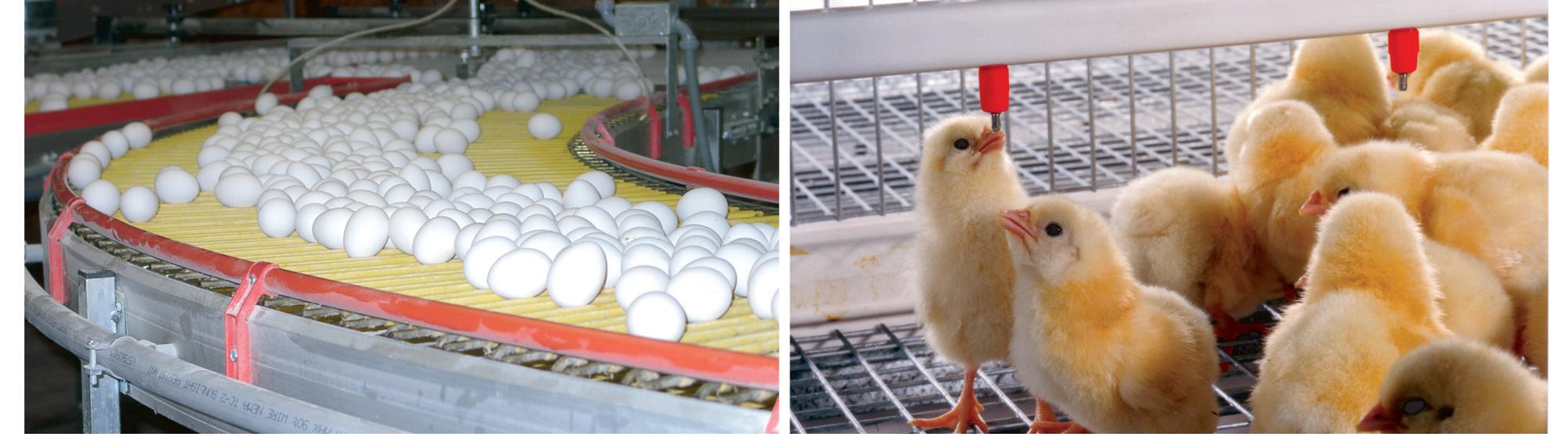
More than 142 miles of chain sold worldwide in 2006/2007.
More than 29 million nipples sold worldwide in 2007.
Glass-Pac Canada
St. Jacobs, Ontario
Tel: (519) 664.3811
Fax: (519) 664.3003
Carstairs, Alberta
Tel: (403) 337-3767
Fax: (403) 337-3590
J. Dean Williamson Ltd. London, Ontario
Tel: (519) 657.5231
Fax: (519) 657.4092
Les Equipments Avipor Cowansville, Quebec
Tel: (450) 263.6222
Fax: (450) 263.9021
Specht-Canada Inc.
Stony Plain, Alberta
Tel: (780) 963.4795
Fax: (780) 963.5034
WHAT’S HATCHING HATCHING
Faster Genetic Test for Flu Virus
The U.S. government approved a new genetic test for the flu virus that will allow labs across the country to identify flu strains within four hours instead of four days.
The timesaving test could be crucial if a deadly new strain emerges, federal health officials said. The new test also could help doctors make better treatment decisions during a conventional flu season.
The new test was developed by the Centers for Disease Control and Prevention and Applied Biosystems Inc. of Foster City, Calif. The Food and Drug Administration approved the test kit Tuesday, and state health labs are expected to start using it this fall.
CDC officials celebrated it as a potential lifesaver,

especially if the nation is hit by a pandemic of bird flu or some other mutant influenza.
“We’ll now be able to detect influenza in the community faster, which allows us to take steps more quickly to protect and save lives,” CDC director Dr. Julie Gerberding said in a prepared statement.
The CDC is requiring labs to buy Applied Biosystems equipment to run the test, and the CDC will provide the necessary chemicals. About 20 to 30 state labs should be up and running by the end of the year, CDC officials said.
Until now, the tests used by different states varied.
“Now we have all the states able to do this rapid method,” said Pete Shult, who oversees infectious disease testing at Wisconsin’s state laboratory.
“It’s good to use the same method so the results will translate from state to state, and CDC can better understand what’s happening,” he added.
Six state labs evaluated the new test and found it to be as good as the “gold standard” traditional viral culture method, said Shult, who was involved in that review.
The test correctly detected the most common flu viruses about 99 per cent of the time. It also picked up some viruses that the older test missed.
Shult and others said the new method’s main selling point is its potential against a dangerous new pandemic.
“The bottom line, for us, is that it will allow us to more rapidly detect introduction of a new strain,” said Rosemary Humes, senior adviser for scientific affairs at the Association of Public Health Laboratories.
But the test could be handy for conventional flu, too, said Dr. Doug LoweryNorth, an Emory University emergency physician who does flu research.
Canola Proteins
BRITISH COLUMBIA
AVancouver-based company with Winnipeg roots has made a breakthrough in the American market by isolating proteins in canola that could potentially replace eggs in mayonnaise and find their way into countless other foods and beverages.
Burcon NutraScience Corporation, which has a research and development arm in Fort Garry, Man., says the proteins have received the seal of approval from a panel of
international experts, allowing them to be considered generally regarded as safe for human consumption in the United States.
Burcon president Johann Tergesen says the nod from the U.S. Food and Drug Administration is a major advancement in the commercialization of the world’s first food-grade canola proteins, which the company has named Puratein and Supertein.
The proteins have yet to
2008 Poultry Service Worker
ALBERTA
John Deshoux was named the Poultry Service Worker of the year at the recent Poultry Service Industry Workshop (PSIW) held in Banff, Alta.
Deshoux began his career in poultry with his late wife June, when they took over her family’s hatchery in Westlock after her father’s death in 1972. They also later
became broiler producers and in 2002, Clark Hyline (now Pinnacle Nutrition and Genetics) purchased the business goodwill and retained John as an employee, and he has worked as a serviceman for them since then.
He was nominated by former CTMA chairman Richard Ruchkall, who said “John is a person of truly unending
ACA Receives Loan
The Nova Scotia government has loaned $3.5 million to the province’s sole remaining poultry processor, ACA Co-operative, headquartered in Kentville in the Annapolis Valley.
The provincial government statement says the loan will help ACA maintain its 650 jobs with an annual payroll of over $25 million. ACA also accounts for a further 650 spin-off jobs.
Founded in 1943, ACA is now the fourth largest farmer’s co-op in Atlantic Canada with a poultry processing plant, breeder barns and hatchery, egg processing unit, retail fuel and farm equipment divisions, and an outlet store.
It is Nova Scotia’s only surviving chicken processor since the closing of the Maple Leaf plant last year in nearby Canard; ACA also slaughters
receive regulatory approval in Canada.
A unique feature of one of the Burcon canola proteins is that it can be dissolved into highly acidic beverages, such as fruit juices, sport energy drinks or soda pop.
The other protein can be used as an emulsifier, ingredient binder or thickening agent suitable for use in mayonnaise, salad dressings, baked goods, protein bars and meat substitutes.
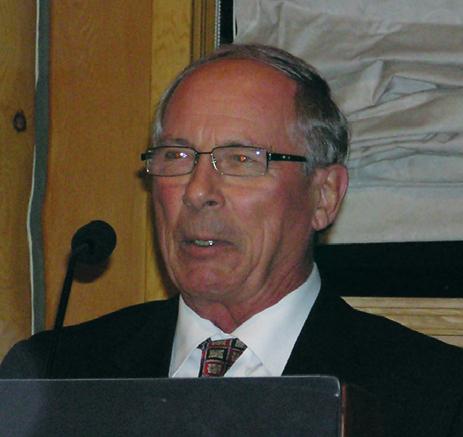
honesty, integrity and service” and someone who is always working on bettering the industry and educating producers. John does “what he said he would do, just plain old serviceman 101,” said Ruchkall.
JANUARY 2009
January 28-30, 2009
International Poultry Expo/International Feed Expo, Georgia World Congress Center, Atlanta, Ga. Registration now open. For more information, e-mail expogeneralinfo@poultryegg. org; visit www.internationalpoultryexposition.com or telephone 770-493-9401.
FEBRUARY 2009
February 3-5, 2009
Canadian International Farm Show, International Centre, Toronto, Ont. For more information, visit www. masterpromotions.ca/canadian-farm-show.asp, telephone 1-888-454-7469 or e-mail info@masterpromotions.ca.
February 19-20, 2009
Atlantic Poultry Conference, Old Orchard Inn, Greenwich, N.S. The conference will feature speaker Dr. Temple Grandin and ventilation and alternative energy workshops; additional speakers and topics will be available soon. For more information, contact conference chair Dr. Bruce Rathgeber, e-mail brathgeber@nsac.ca, visit www.nsac.ns.ca/apri; or write Atlantic Poultry Conference, 25 River Road, P.O. Box 550, Truro, N.S. B2N 5E3.
most of the turkeys produced in the province and processes about 25 per cent of its eggs.
ACA CEO Sue Payne says the provincial loan will provide her co-operative with a new line of working capital at a time when credit is tight due to the current economic downturn.
The new loan will enable ACA to undertake, she says, “new marketing initiatives.”
We welcome additions to our Coming Events section. To ensure publication at least one month prior to the event, please send your event information at least eight to 12 weeks in advance to: Canadian Poultry, Annex Publishing, P.O. Box 530, 105 Donly Dr. S., Simcoe, Ont. N3Y 4N5; e-mail knudds@annexweb.com; or fax 519-429-3094.
NOVA SCOTIA
HATCHING HATCHING
IPE Expo Education Program
The program committee met recently to develop the agenda for the Poultry Education Program at the 2009 International Poultry Expo and International Feed Expo sponsored by U.S. Poultry & Egg Association and the American Feed Industry Association.
IPE/IFE 2009 is scheduled Jan. 28-30 at the Georgia World Congress Center in Atlanta. The poultry education sessions will be held Thursday, Jan. 29, from 8 to 10 a.m.
“The committee has recommended an agenda that will address vital issues facing
today’s poultry and egg operations,” said program chairman Donnie King, Tyson Foods, Springdale, Ariz.
The program includes Social Responsibility in the Poultry Industry; Food Safety; Animal Welfare; Employee Relations Environment; Community Relations; Affordable Food; Industry Economic Outlook; A CEO’s Perspective; Overall State of the Market Exports; and Input Cost.
For more information about the 2009 International Poultry Expo and International Feed Expo, go to www.ipe09.org.
DNA Technology Breeding Project
The recently formed alliance between multi-species breeding company Hendrix Genetics and the broiler breeding company CobbVantress, Inc., is to become the first in the world to implement genomic selection in poultry breeding.
The USDA has agreed to provide $US2.5 million towards a $US10 million large-scale field evaluation of DNA selection technology in chicken breeding.
The use of this new technology is a breakthrough in animal breeding. The selec-
tion of pedigree stock through analysis of DNA from the whole genome will provide accurate and rapid results, enabling significant genetic improvement. Such progress – hard to realize using traditional breeding methods – will now be feasible for disease resistance, animal health and welfare traits.
The field evaluation began on Oct.1, 2008 and will run for a period of four years. A consortium of leading universities and institutes in a number of countries will also be involved.
PEOPLE IN THE NEWS
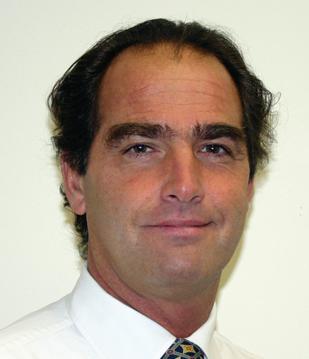
Diamond is pleased to announce that Stan Drouen has joined its team as director of sales and marketing for the Americas. Stan will oversee the outside sales team throughout North and South America, while working a part of the U.S. territory himself. He will also be overseeing the inside sales team. Stan brings with him to Diamond more than 20 years of experience in sales management in capital equipment markets serving food processing and packaging industries.
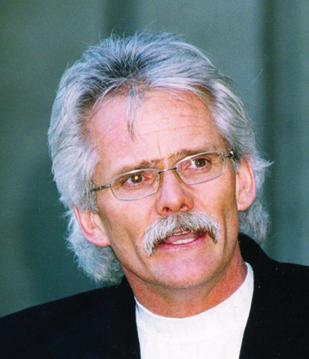
Bob Friesen resigned from his position as president of the Canadian Federation of Agriculture (CFA) to pursue a career in federal politics. He ran as a Liberal candidate for Charleswood-St. JamesAssiniboia (Manitoba) riding in the recent federal election.
The directors of Maple Lodge Farms Ltd. are pleased to announce the appointment of Michael Burrows as the company’s new chief executive officer. Burrows brings more than 25 years of business experience, mostly in consumer packaged goods, to his new role. Most recently, he was the president and chief executive officer of E.D. Smith Income Trust and E.D. Smith & Sons Ltd.

BOB FRIESEN
MICHAEL BURROWS STAN DROUEN
Production
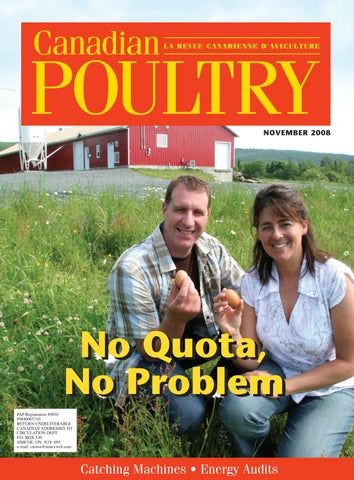
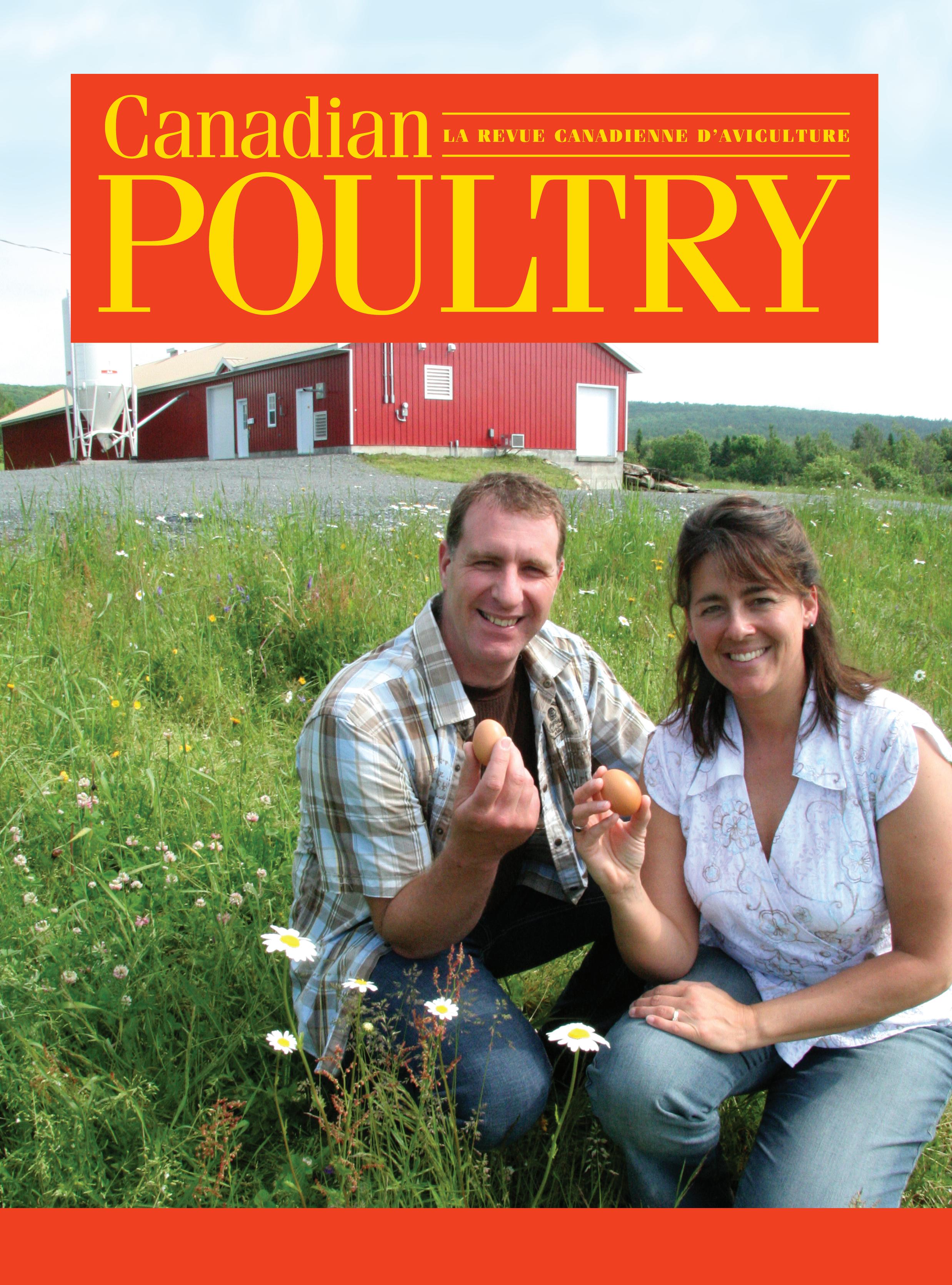
No Quota, No Problem
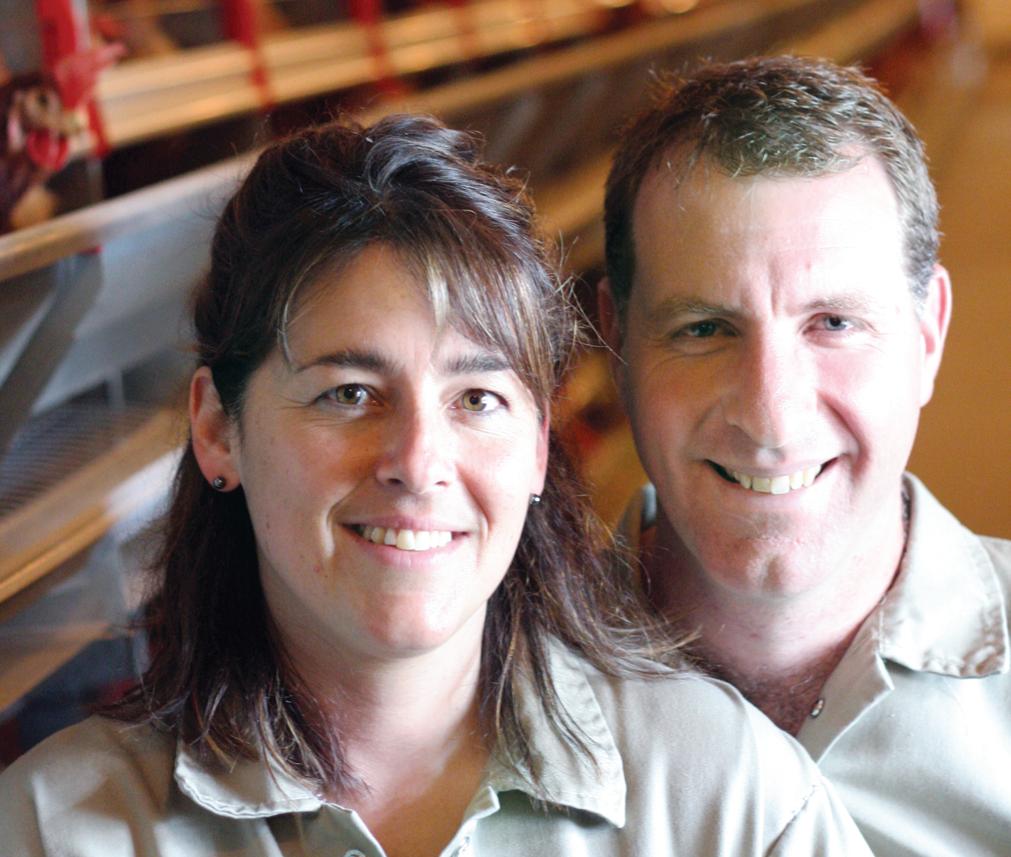
Joanne LaBranche and Patrick Côté have realized their dream
BY ANDRÉ DUMONT
Joanne LaBranche and Patrick Côté just couldn’t believe their eyes. The weekly agriculture newspaper La Terre de chez nous was announcing a new program offering a free lifetime quota loan for 5,000 layers. “We looked at each other and said: ‘This is for us. We have to apply, ’ ” Joanne says.
That was in 2006. Twelve years earlier, Joanne and Patrick had abandoned the idea of going into egg production because of high start-up costs. They now decided to direct all their efforts into preparing for the contest put forward by the Fédération des producteurs d’œufs de consommation du Québec (FPOCQ –Quebec Egg Farmers).
It was a summer with very few outings for Justin, 10, Anthony, 12, and Philippe, 14, as their parents were often busy visiting poultry farms and crunching numbers in front of a computer screen.
The business plan was finished a few days before the deadline. After putting so much effort into their application, Joanne and Patrick were convinced they’d be among finalists. “Our application was clear and concise. Everything was there, exactly as requested,” Joanne says.
The good news came on Oct. 27, 2006. The couple became the first beneficiaries of the FPOCQ’s Start-up Assistance Program for new producers. They were to become egg producers, without having to invest in quota.
“We felt very, very privileged,” says Patrick, who was a poultry representa-
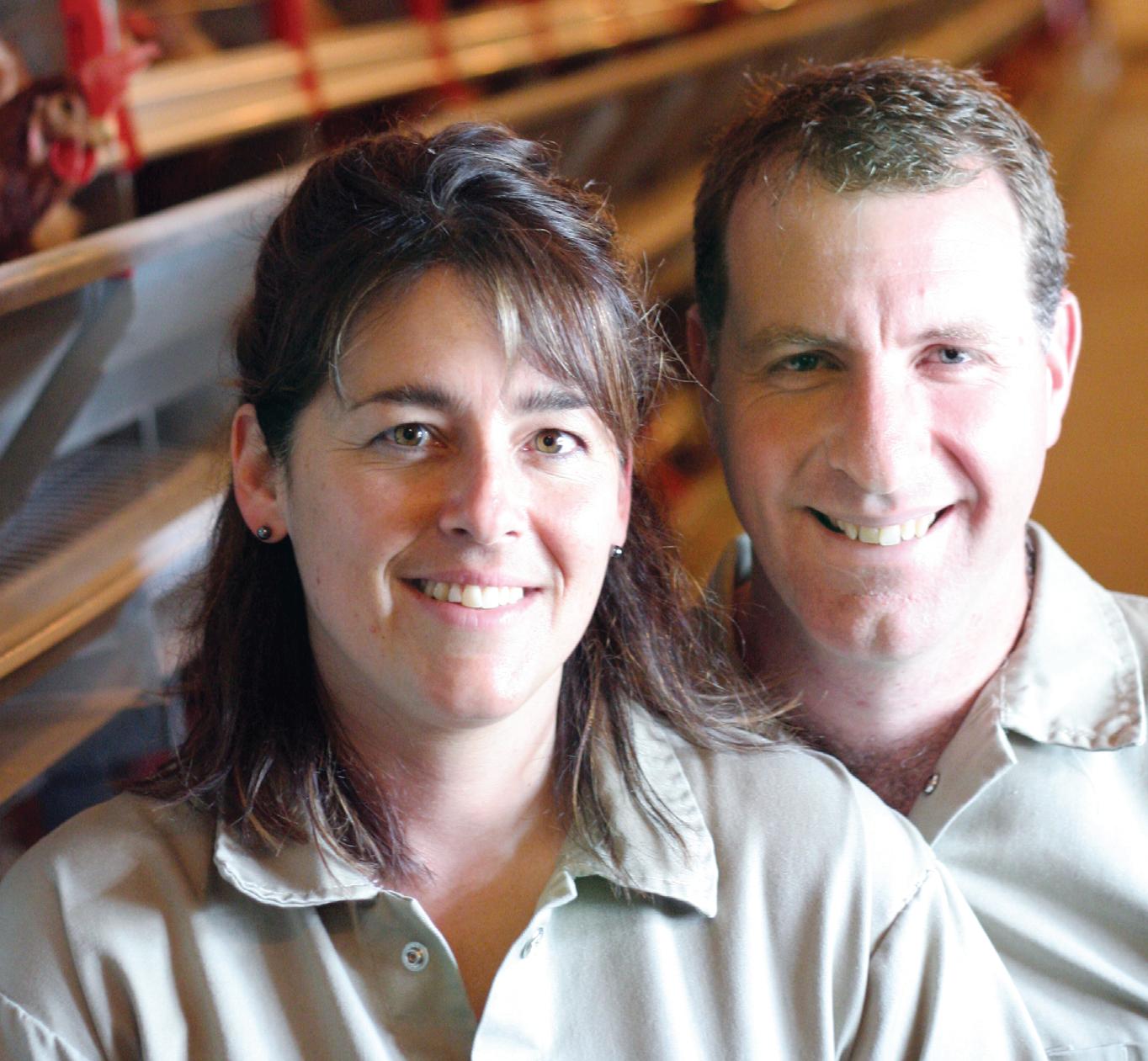
EGGCITING OPPORTUNITY
Joanne LaBranche and Patrick Côté took advantage of FPOCQ’s start-up program that allowed them to get into egg farming without buying quota.
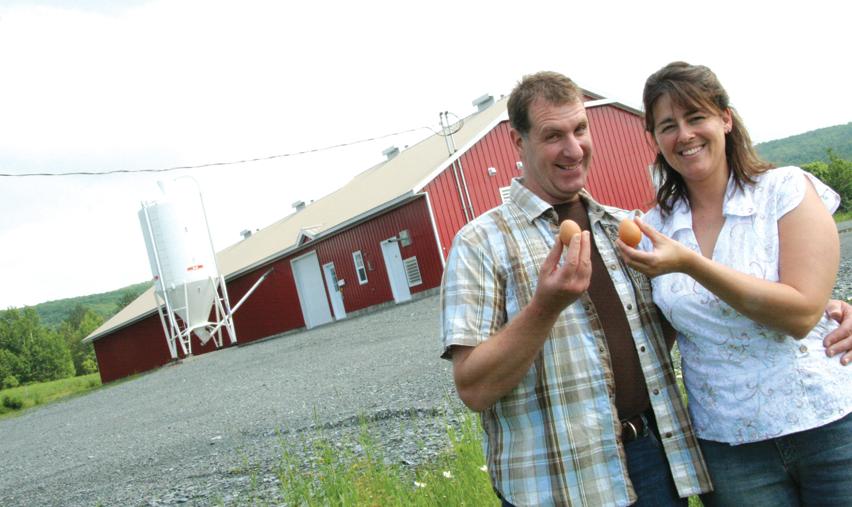
tive for the Coopérative fédérée de Québec before buying a hog farm with his wife in Kinnear’s Mills, near Thetford Mines, in 1994.
Joanne and Patrick decided to build an 8,640 layerhouse with new equipment only. The building currently houses 5,550 (some rented quota was added). Egg revenues complement those from their
5,000-hog-per-year swine operation.
If their application stood out from the lot, they say, it’s because they have complementary experience. Joanne holds a degree in business administration and is also a Certified Management Accountant (CMA). She handled the financial side. Patrick used his experience and contacts in the poultry industry to gather
up-to-date technical data. The couple also relied on its past experience bringing a hog operation to high performance levels.
Joanne and Patrick refuse to see themselves as the happy winners of a lottery jackpot, even though the egg quota they use is worth several hundred thousands of dollars. “People don’t see all the work
Start-up programs in Quebec
Eggs
The Fédération des producteurs d’œufs de consommation du Québec (Quebec Egg Producers) offers one free lifetime quota loan for 5,000 layers every year. This quota is only transferable to one’s children. Regions with lower egg production density are advantaged.
Chicken
Les Éleveurs de volailles du Québec (Quebec Poultry Producers) give 50 m2 or 100 m2 of broiler quota to any new producer aged 18 to 40 who has never owned more than 150 m2 of quota over more than five years.
To get 50 m2, the applicant must purchase 150 m2 or own 20 per cent of the farm. To get 100 m3, the applicant must purchase 300 m2.
The free quota comes from a reserve in which les Éleveurs de volailles du Québec put five per cent of the fiveyear average of annual new quota allocations to Quebec by Chicken Farmers of Canada each year.
Milk
The Fédération des producteurs de lait du Québec (FPLQ – Quebec Milk Farmers) offers a five-kilogram quota loan to young producers joining an existing farm. After five years, the quota must be reimbursed at a rate of one kilogram per year. The FPLQ also offers a limited number of 10-kilogram quota loans towards new milk farms.
Production
we put into this,” Patrick says. “There were 32 other candidates and I’m sure they worked just as hard as we did.”
Even with the free quota, starting up was no joyride. Investing more than $400,000 at the same time the Quebec hog industry was entering a crisis was a nerve-wracking experience. From Day
1 of construction to the first egg pay, finances were stretched to the limit.
This was no risk-free investment, Patrick says. If for any personal reason, the egg production must stop, the quota goes back to the FPOCQ. An empty 8,640-layer henhouse with no quota to sell along with it isn’t worth much, he
• Exceptional Performance
• Exceptional Performance
• Reduced Feed Costs
• Reduced Feed Costs
• Utilize Home Grown Grains
• Utilize Home Grown Grains
• Ensure Long Term Viability
• Ensure Long Term Viability
says. However, the loaned quota is transferable to the next generation. Patrick and his wife hope at least one of their three sons will take over one day.
The FPOCQ’s start-up program was founded to address a concern for the accessibility of egg farming to newcomers. Even though many of the current 103 egg farmers in Quebec have children willing to take over, one hard fact remains: the availability and price of egg quota makes it nearly impossible to start a new production.
Producing eggs had long been excluded in Joanne and Patrick’s plans to diversify their farm. “For anyone with financial means similar to ours, it’s simply impossible to start,” Patrick says.
In 2006, FPOCQ members decided to use part of the federation’s quota reserve to help start up one new layer farm every year. The decision was not unanimous, because the program excludes existing farmers’ immediate family members, while others didn’t see the point in starting a new farm with so few hens.
“Quebec egg producers have always been visionaries,” says FPOCQ president Serge Lefebvre. “If we want to keep our number of producers stable, we have to make space for new ones.”
The program addresses both the problems of egg farm concentration in specific regions and the slow but steady erosion of the number of egg farmers throughout the province. In 2007, the free quota loan was awarded to Nicholas Tremblay, who will build his henhouse in Saguenay-Lac-Saint-Jean, a region where there are only four other egg producers.
The FPOCQ is also in the process of setting up a centralized quota exchange system. This will make quota more accessible to those who received help to start and now want to expand, Lefebvre says.
For now, quota prices remain very high. But will that be the case in the future, when new quota allocations to Quebec will allow the FPOCQ to help more than one new producer get started every year?
The deadline for application in 2008 was June 30. The name of this year’s winner was announced in October. ■
Production
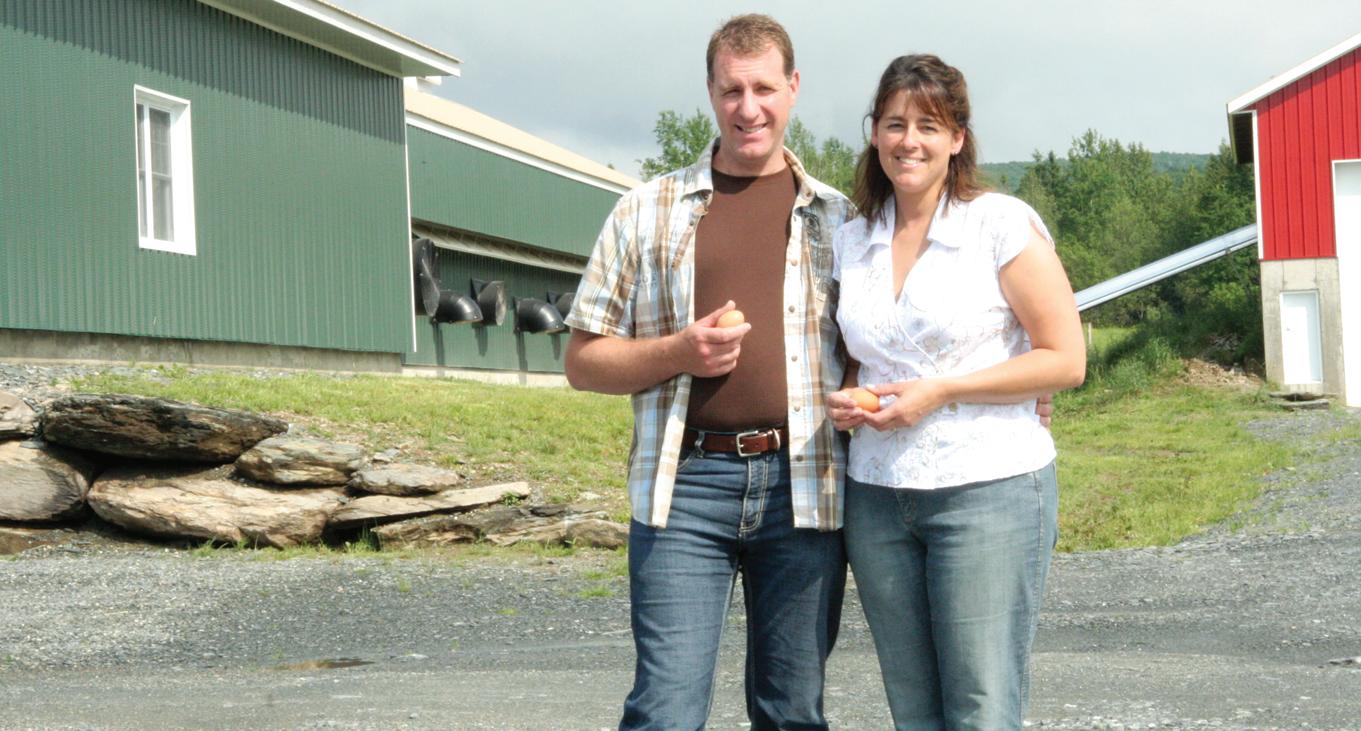
LaBranche and Patrick Côté spent months preparing their application to acquire quota.
How the Program Works
Applicants to FPOCQ Start-up Assistance Program for new egg producers must comply with the following criteria: be between 18 and 40 years of age
• intend to start a new egg production in which they will be fully involved
• live in Quebec and be permanent residents of Canada
• have a college-level education in agriculture or management
• have at least one year of work experience on a farm
• complete a business plan approved by a financial institution, covering financial,
• technical and environmental aspects demonstrate that the project meets environmental regulations
• have never owned quota in any agriculture production under supply management
• or been a shareholder of a farm using quota be an immediate family member of someone holding egg quota or owning a
• layer farm
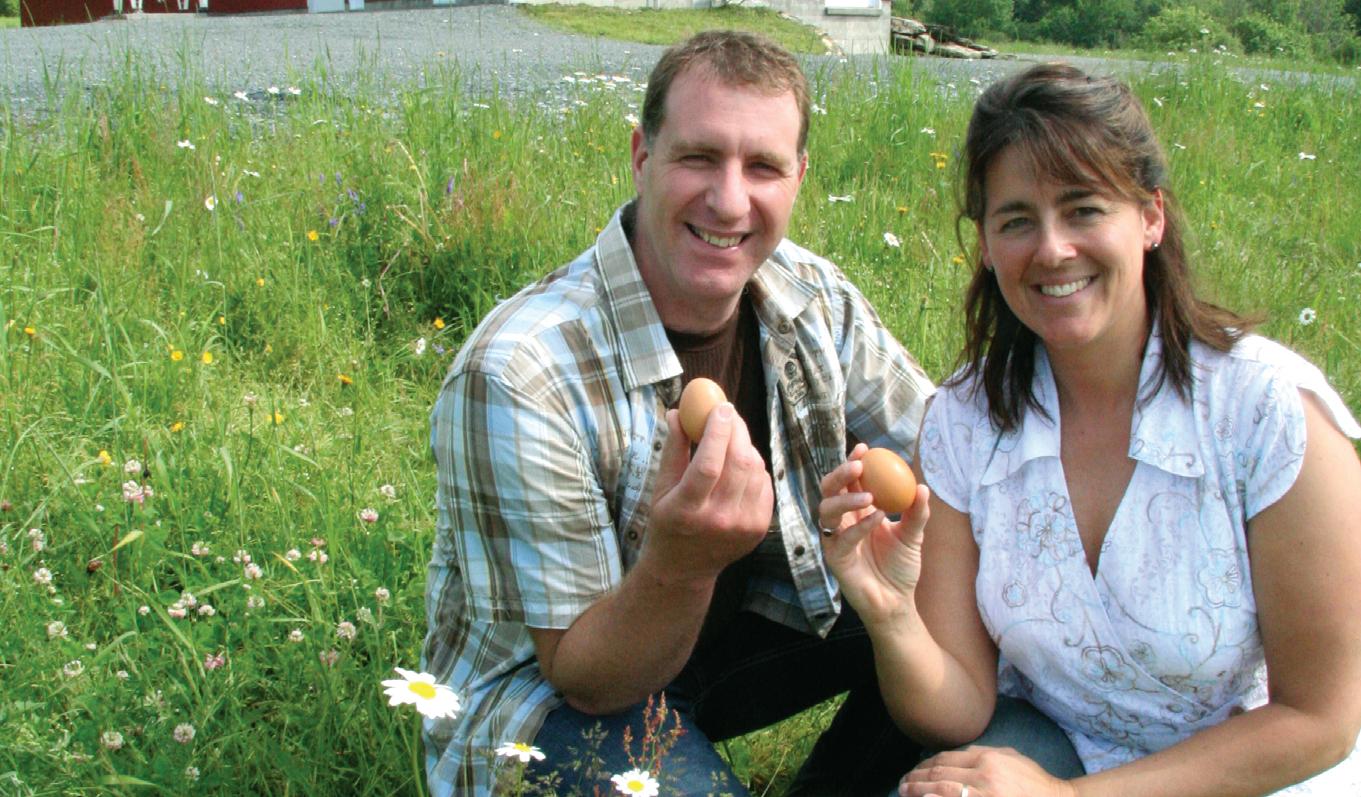
“We felt very, very privileged,” says Patrick.
Joanne

Biosecurity without compromise What if you could
disease-causing pathogens …without exposing your animals, your employees or your family to disinfecting solutions containing harsh chemicals,** …or placing an added burden on our already-fragile environment?
Production Catching Machines Fill Gap in B.C.
Klaas Korthius has imported Ciemme Apollo 60 catching machines
from Italy
BY DAVID SCHMIDT
Catching remains the most labour-intensive aspect of broiler production. It is also considered among the least desirable of jobs in the poultry industry. Given that, it is no surprise finding enough good help is becoming more and more difficult.
That is one reason veteran poultryman Klaas Korthius imported several Ciemme Apollo 60 catching machines from Italy.
“I brought the first machine into Canada, Aug 24, 2007, and put it into use two days later,” Korthius says, noting he now has two machines operating in B.C. and one in Saskatchewan.
While three Alberta producers have purchased the Ciemme for use on their own farms, Korthius notes his machines are the first in Canada to be used on multiple farms. “We try to do one farm/night with each machine.
We have now operated the first machine for 950 hours without any difficulty.”
The Ciemme Apollo is not the first automated catching machine in Canada. That honour belongs to the EZ Load system from England, which B.C.’s Sunrise Poultry has been using for over a decade.
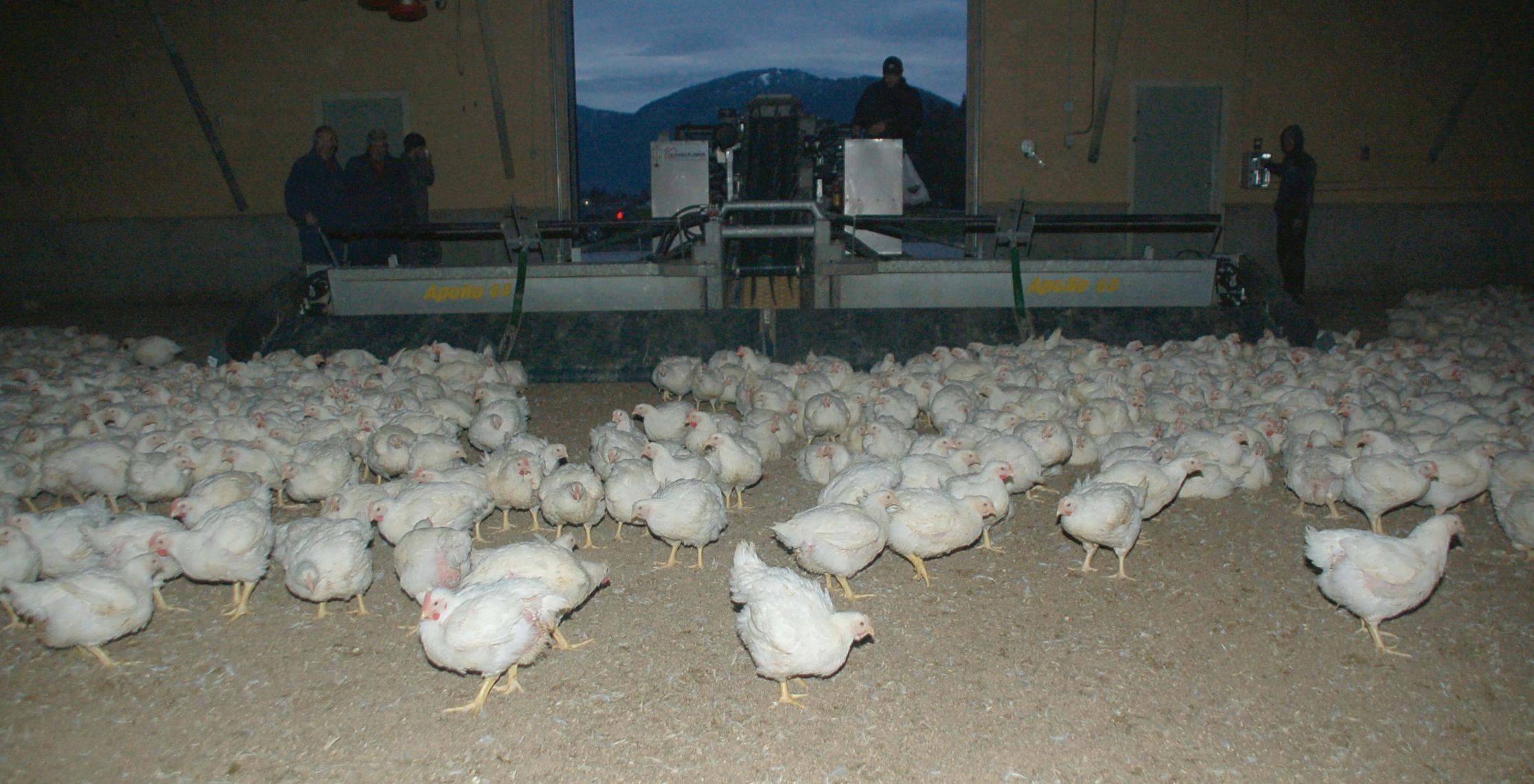
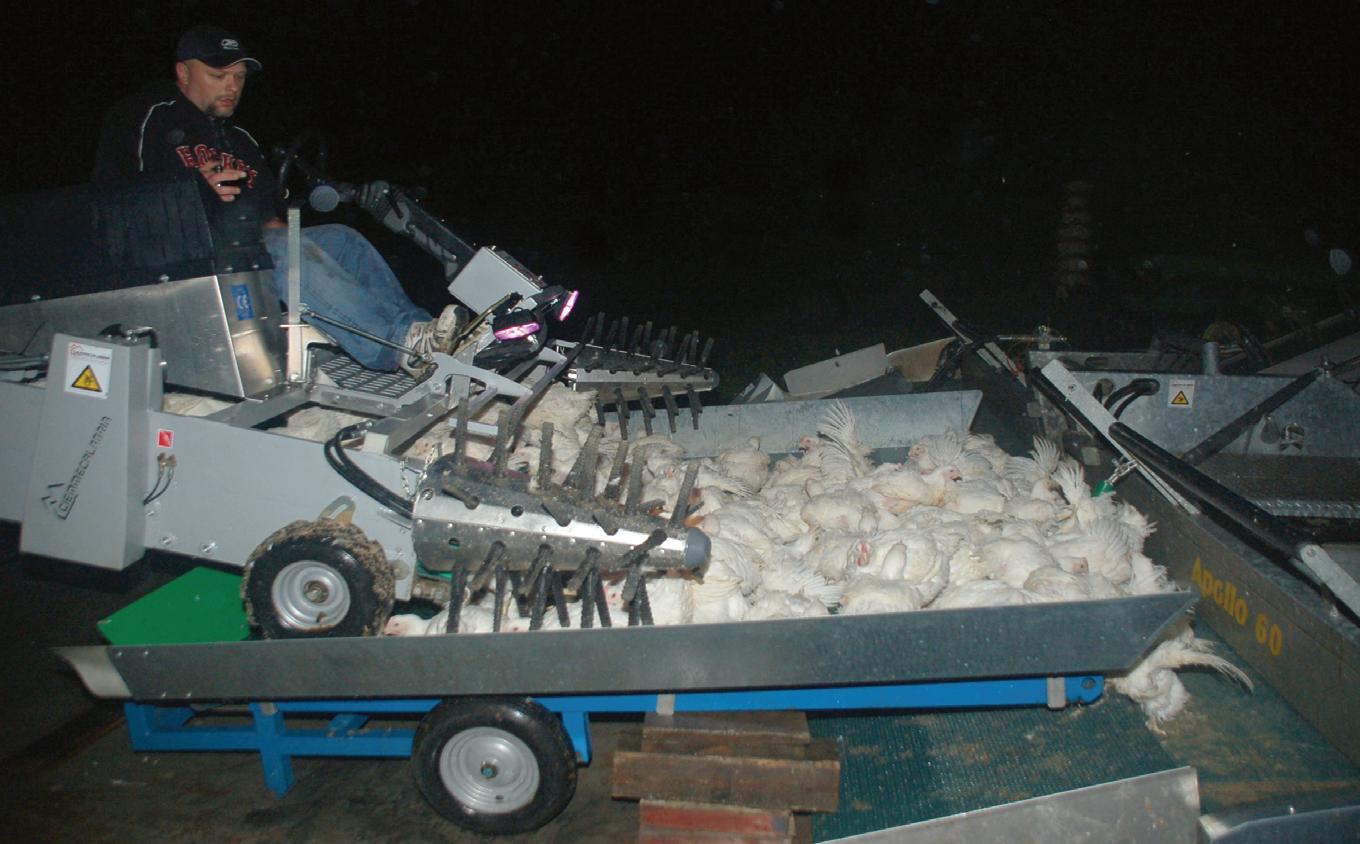
While the EZ Load system uses a long “arm” with a sweeping motion to go through the barn and sweep in the chickens, the Ciemme Apollo looks and acts more like a forage harvester or combine.
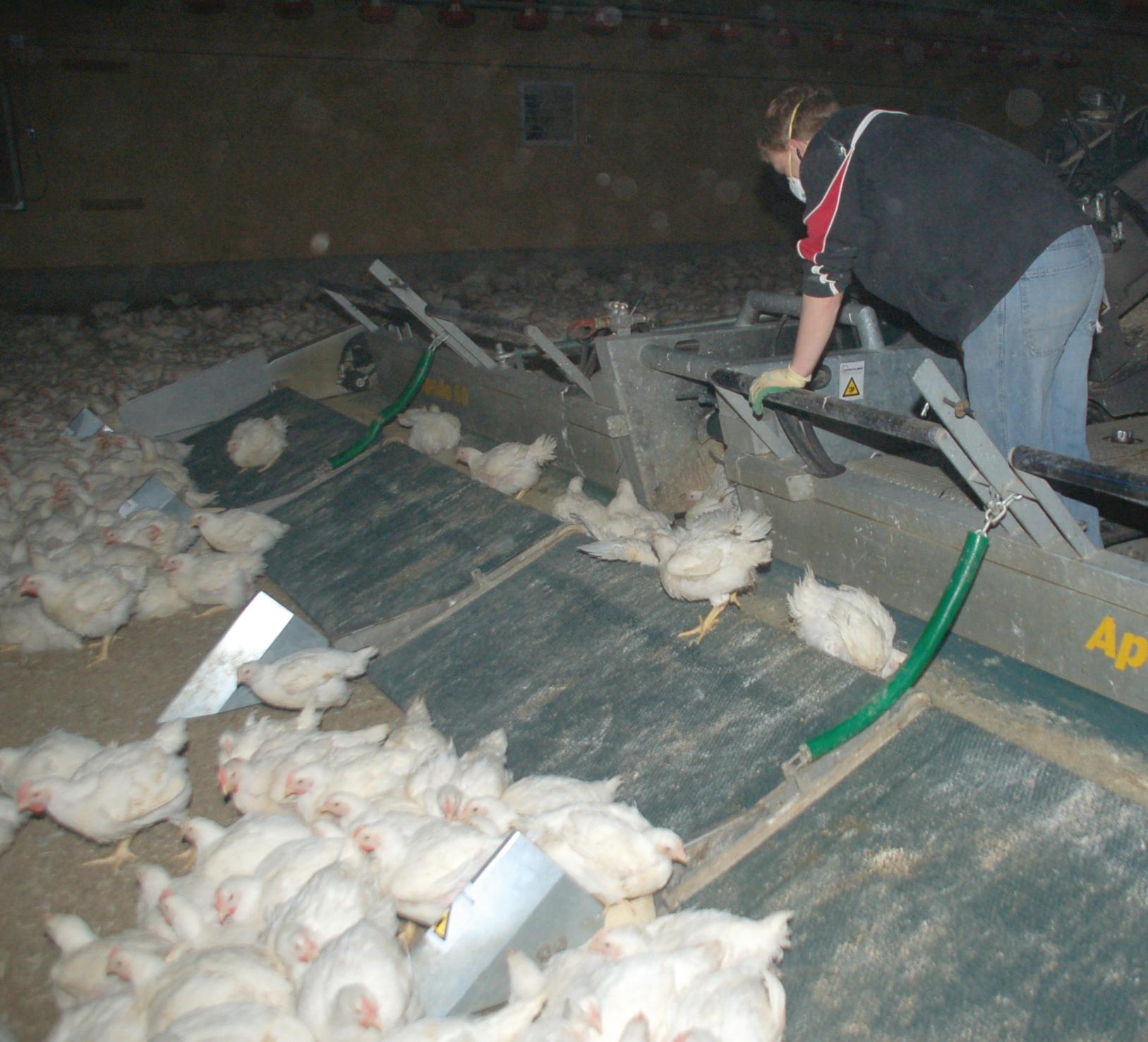
The Apollo 60 catching machines from Italy and the rest of the system can be operated by as few as three people.
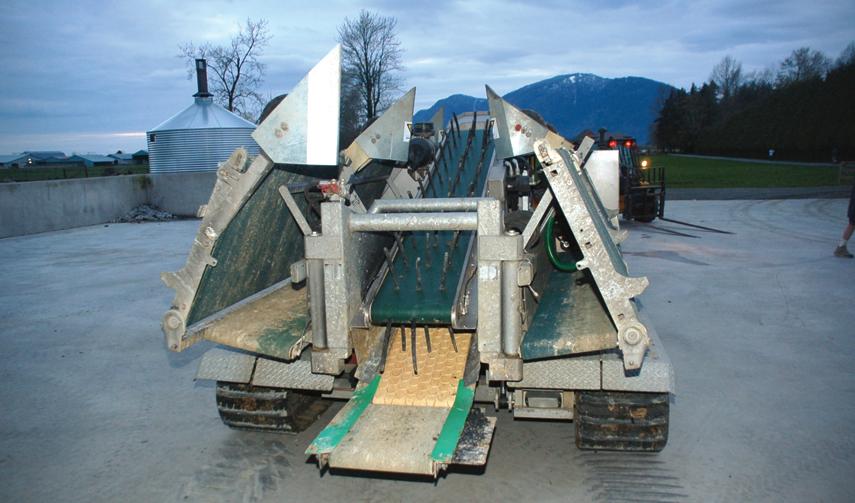
Because the machine is track-mounted, it easily traverses both sawdust and straw-based litter. The track mounting also allows it to move straight down a barn without a full-time driver. Designed to be towed on a trailer, once unloaded the harvest head is unfolded to open up to a 20-foot width. Korthius has ordered a second 10-foot-wide head to allow the
machine to be used in barns with narrower entries and/or narrower spaces between the posts.
A tiny light bar is located just under the head, which itself rides only centimetres above the surface. The bar provides just enough light to cause the chickens immediately in front of it to stand up. They are then whisked up the belt and
LABOUR SAVER
Defer principal payments for up to 12 months with our new
We understand that you may need new farming equipment at any time. That’s why we’re ready to help. With the new TD Canada Trust Interest Only Term Loan, you can finance up to $500,000¹ for equipment purchases today and pay the principal later. You make

Visit
interest-only payments for up to 12 months, which means lower monthly payments, helping to improve your overall cash flow.
We offer competitive rates, and no set-up fee is required.² Plus, loans can be amortized up to 10 years based on the useful life of the equipment.
Production
onto a cross conveyor. The conveyor deposits the birds into a chute that then fills the catching trays, which are mounted on a trailer. The chute moves up and down and from side to side so each of the individual trays can be filled. The whole system is fully computerized so the system stops momentarily as each tray is filled and the operator moves the chute to the next tray. The trailer holds three modules and the modules are rotated so one is in the fillable position, a second in the empty position and the third loaded tray ready to be removed. By the time the machine gets to the far end of a 200-foot barn, the forklift operator is moving pretty quickly to keep up with removing the filled modules and bringing in the empty trays.
The entire system can be operated with as few as three people: one to walk alongside the machine to supervise the system, a second to operate the chute and a third to move the modules in and out.
“The machine can do up to 7,000 birds/hour,” Korthius notes. While that is similar to the output of a crew of 10 top manual catchers, he notes the machine doesn’t tire. “Unlike a catching crew which often sees its production drop in half by the end of a shift, the machine is still doing 7,000 birds/hour at the end of the night.”
Even though over 100 birds/minute are almost literally flying through the machine, Korthius says the machine is
actually better for the birds than manual catching.
“A European study showed 38 per cent better leg grading and 11 per cent better wing grading with the Apollo than with manual catching.”
While the 6,250 kg weight of the machine prohibits its use on upper floors and the width of the catching head precludes its use in small barns, Korthius worked with Ciemme to create a lighter eight-foot-wide, ATV-style catcher to be used in concert with the Apollo. When used in barns with smaller openings the ATV drives into the barn, scoops up the chickens (the catching head works very similarly to the head on the main machine), then delivers them to the main machine, which is still used to fill the trays.
The portable catcher is also light enough to be raised by a forklift and used on an upper floor (if the opening is wide enough). Korthius has also developed a special conveyor that collects the birds from the catcher, in turn feeding them to the main machine. If the main machine can fit into the lower floor of the barn and the upper floor is equipped with drop slots, the conveyor can be inserted into the drop slots, reducing the travel required by the portable catcher.
Chilliwack, B.C., chicken grower Gerry Mammel says the machine has been used at his farm several times and he continues to be impressed with how well it works. ■
Transferring chicken from the portable catcher to the Apollo 60.
The catcher operates like a forage harvester and can catch and load up to 7,000 birds an hour.
Commodities
Financial Turmoil Affects Commodities
Grain and oilseed prices are well off their recent highs and more volatility is expected
BY JIM KNISLEY
It’s not just about supply and demand anymore when it comes to grain and oilseed prices. The turmoil in world financial markets is also affecting prices and demand.
In its September Pool Return Outlook for 2008-09 the Canadian Wheat Board said forecast prices for wheat and feed barley have fallen as the financial volatility spreads from banks and mortgages to commodities.
“The global grain trade is closely linked to international financial markets for currency, credit, and other commodities. Recent extraordinary events are creating high levels of volatility and uncertainty in all markets. These events are also having a negative impact on global economic growth and are changing the buying behaviour of grain customers. These conditions are expected to take some time to stabilize and have the potential to significantly impact overall pool returns,” the CWB said.
“The recent sharp decline in commodity prices, as well as the extreme day-to-day volatility, reflects as much the impact of U.S. and global financial market developments as it does actual world supply/demand fundamentals for commodities,” Patricia Mohr, Vice-President, Economics, and Commodity Market Specialist at Scotiabank, said.
Darrel Good, extension economist at the University of Illinois writes: “On a daily basis, prices have been influenced by changes in the value of the U.S.
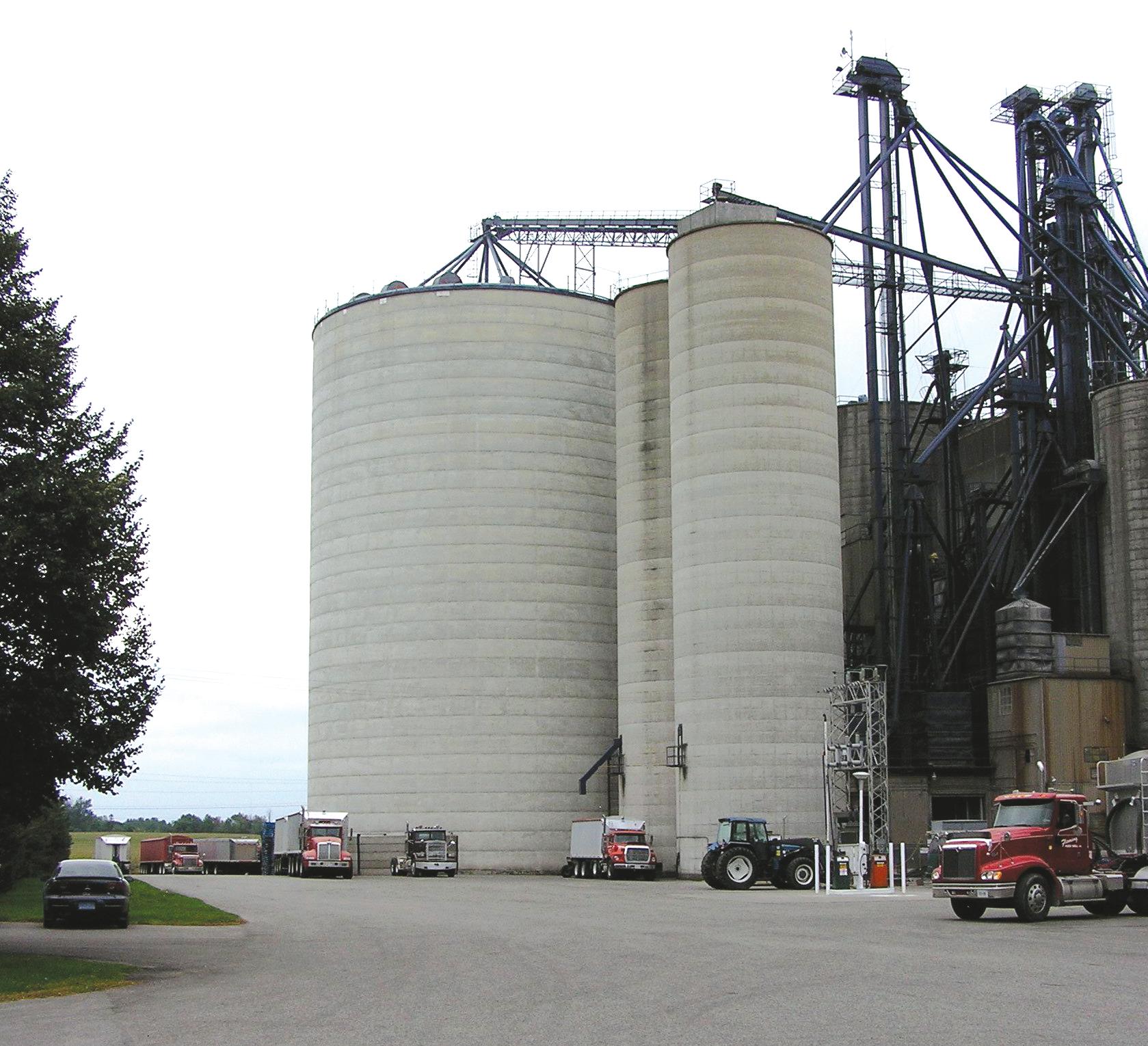
dollar, changes in crude oil prices, export news, weather and production expectations, and developments in the financial markets.”
The economic conditions are also reflected in the Baltic Dry Index, which measures demand for ocean-going bulk carriers. In recent weeks the index has plunged. The BDI hit a record high of 11,793 in May, and is now below 4,000.
Tighter credit, rising interest rates and volatile currency markets are also having an impact. Add to this shifts in supply and demand and the result is rapidly falling grain prices.
Leading the way is wheat. The International Grains Council (IGC) is predicting a record world wheat crop of 676 million tonnes. But much of the
Feed prices have been taking more twists and turns than a roller coaster.
European and Ukrainian production is lower quality and is pressuring corn and other feed grains.
The IGC projects total world corn production will come in at 771 million tonnes this year down from 787 million tonnes last year. It expects trade to drop to 87 million tonnes from 100 million tonnes, but closing stocks to fall to 109 million tonnes from 127 million tons at the end of the 2007/08 crop year. However, the IGC forecasts wheat supplies at the end of the 2008/09 crop year will rise almost 25 per cent to 153 million tonnes. ■
WILD RIDE
Layers Robustness of Laying Hens
Is it all about genes, environment or early-life experiences?
BY L. STAR, H.K. PARMENTIER, J.J. VAN DER POEL, AND B. KEMP, WAGENINGEN UNIVERSITY, THE NETHERLANDS
SUMMARY
Immune competence and physiological parameters (production and endocrine) during various environmental stress conditions were studied in purebred layer lines at various ages.
Our purpose was to establish the contribution of genetic background, environment and early-life experiences to the so-called “robustness.” Next to egg production, levels of innate and specific immune competence depended on genotype. Within breeds, however, innate immune competence was related with survival. Comparable response patterns to climatic and immune stress were found within breeds, but breeds differed in response levels towards these stressors. The response levels could not be influenced by early-life experiences. Our data suggest that robustness mainly depends on the capacity to respond to stressors within a genetic background, and that the maintenance of different fitness strategies within a selected purebred may favour coping with different environments on the long term.
INTRODUCTION
There are a limited number of internationally operating poultry breeding
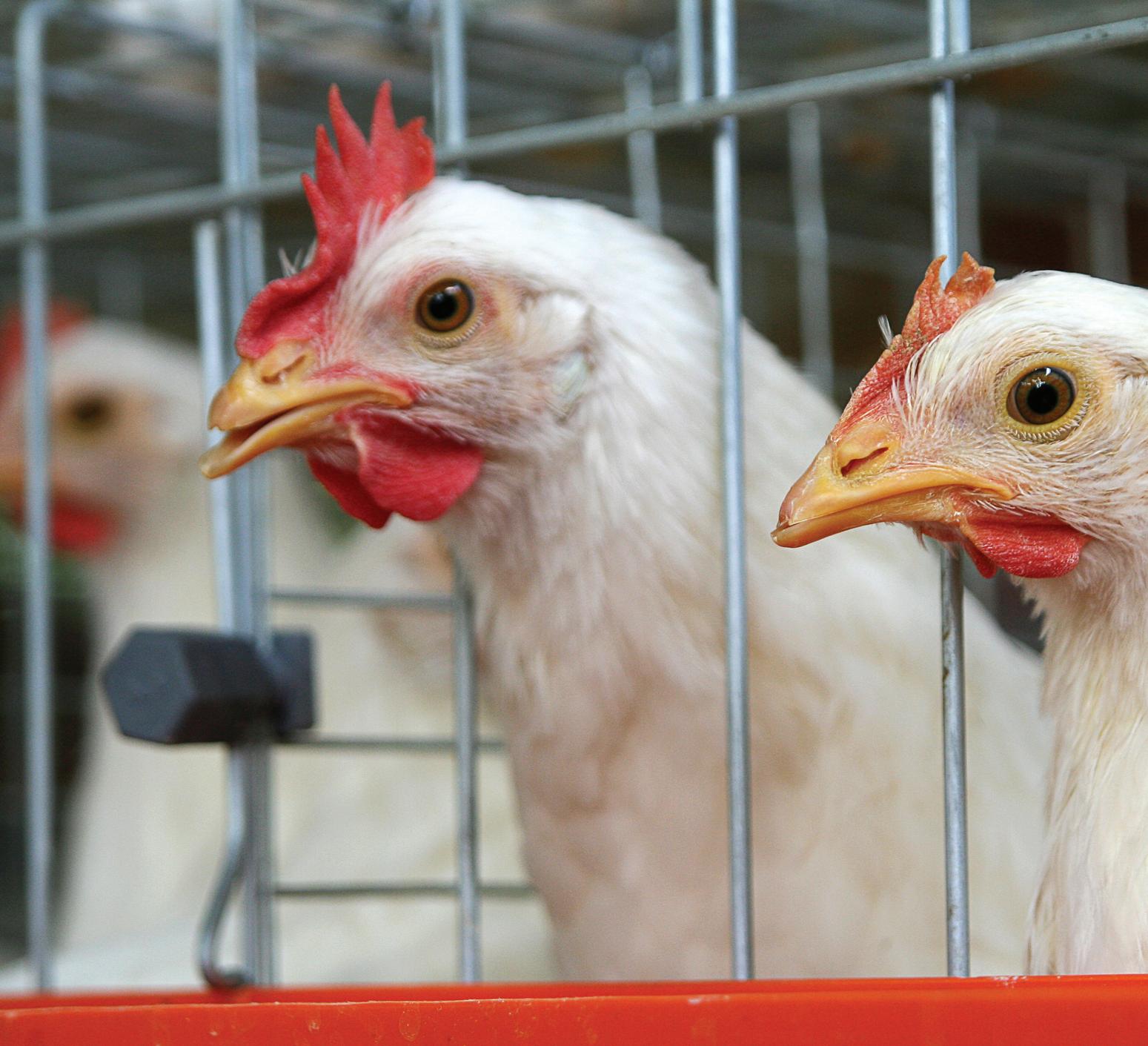
Genetic background plays a role in how hens cope with stress. TOUGH ENOUGH?
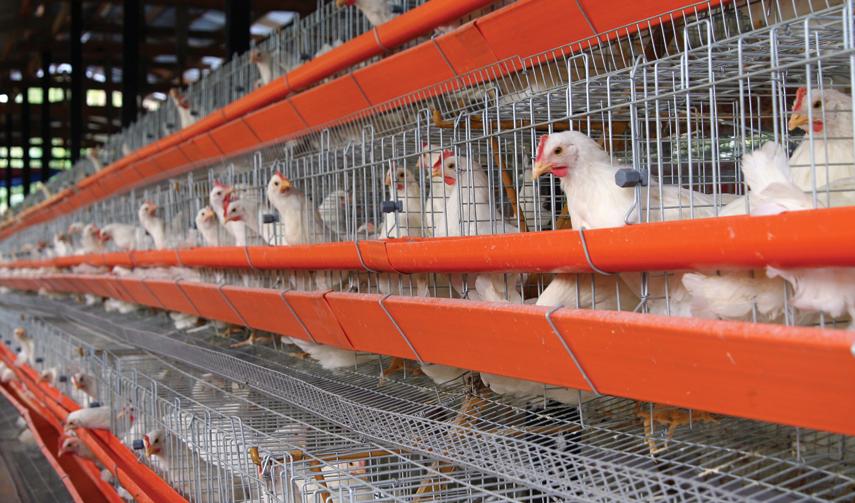
companies that provide laying hens worldwide. For these companies, it is favourable to have animals that can function under a wide variety of environmental conditions. In addition, robustness is a term that is rapidly becoming a main interest in animal production. 1
Robustness can be defined as an animal under a normal physical condition
that has the potential to keep functioning and take short periods to recover under varying environmental conditions. Robustness of an animal probably depends on genetic potential, environmental influences, and early-life experiences, and robustness can be evaluated in terms of physiological, behavioural, and immunological traits (Figure 1).
Egg Farmers of Ontario A Legacy of Research
Egg Farmers of Ontario (EFO) has a long-standing commitment to hen health and egg research. Since 1964, EFO has contributed more than $3 million to research leading to improvements in farm management, biosecurity and egg production.
Changing with the Times
Research in the egg industry has evolved from addressing immediate industry needs to a variety of proactive studies that enhance the industry’s future.
• Feeding and nutrition have become more ef cient.

• Research into the hen’s reproductive system, while still not complete, has led to discoveries that have enhanced the well-being and production of laying hens.

• Support from EFO and other industry groups is vital in order to continue research in the egg industry.
Health and Disease
EFO has supported research projects at the University of Guelph for many years in the eld of virology. Projects include:
• Control management of viruses causing inclusion body hepatitis (IBH) and improved diagnosis for infectious bronchitis (IB); and
• Identi cation of virus types that exist on Ontario farms and investigating responses to conventional vaccines.
EFO has also supported various research into Marek’s disease.
• Marek’s disease causes high mortality, mostly in young hens.
• Researchers at McGill University and the University of Guelph are investigating speci c DNA sequences that may be used to improve resistance to Marek’s disease.
Moving Forward
By working with industry partners, such as the Poultry Industry Council, EFO’s contributions continue to lead to better disease management and improved poultry health. Through advances in egg and hen research, farmers reap the bene ts of improved farming practices and consumers bene t from a better quality egg.



Egg Farmers of Ontario (EFO) is dedicated to continuing innovation in egg production and improving farm practices, hen health and egg quality.


Every year, EFO sponsors several research projects that are designed to increase the ef ciency of egg production.

Egg Farmers of Ontario 7195 Millcreek Drive Mississauga, Ontario L5N 4H1
Phone: (905) 858-9790 Fax: (905) 858-1589
Website: www.getcracking.ca
Layers
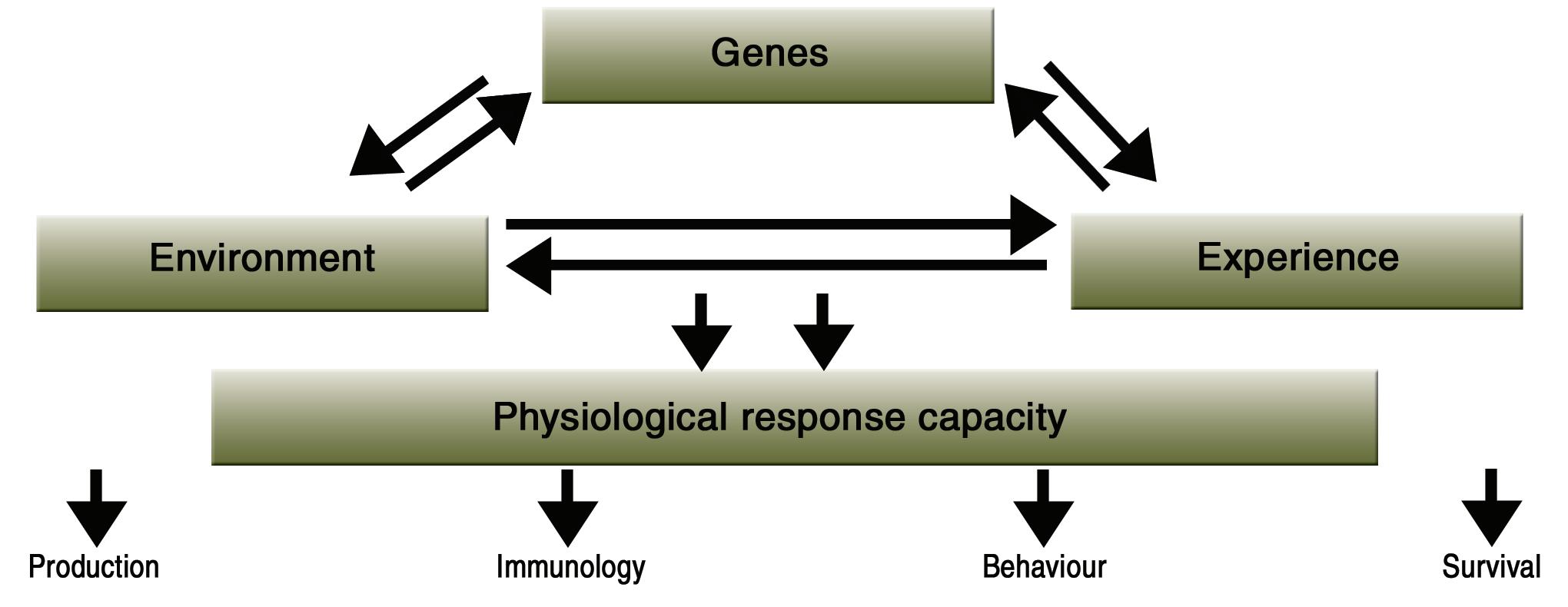
Figure 1. Robustness of an animal is influenced by genetic background, environment and early-life experiences, where production, survival, behaviour, immune and physiological parameters can be used as read-out for robustness.
Three experiments were performed to establish the importance of genetic potential, environmental influences, and early-life experiences on the robustness of laying hens. Results of these experiments will be described briefly. Thereafter, a discussion will follow on robustness in relation to genetic potential, environmental influences, and early-life experience. The discussion will end with a suggestion of which parameter or trait is of interest for implementation into a breeding goal for robustness.
RESULTS
2a. Genetic potential
A population of 1,063 laying hens was used to establish natural antibody (NAb) levels and haemolytic complement activity. Within this population 12 purebred layer lines (Hendrix Genetics, Boxmeer, the Netherlands) could be distinguished: six White Leghorn lines (W1, WA, WB, WC, WD, and WF) and six Rhode Island Red lines (B1, B2, B3, BA, BB and BE).
Differences between layer lines in levels of natural humoral immune competence were established, but most importantly, the data suggests, regardless of line, levels of Nab were related to the probability of surviving the laying period.2
2b. Environmental influence
From the former experiment (2a), four of the 12 lines (WA, WB, WF, and B1) were selected, based on a profile of high or low natural immune competence and a high or low survival rate. These lines were exposed to the following environmental stressors: heat (climatic stress), lipopolysaccharide (LPS, hygienic stress), or combined exposure to heat and LPS.3-5 Hens were able to cope with single or combined heat stress and LPS challenge. The lines had similar response patterns, but differed in response levels, suggesting that some lines were better able to adapt to stressors than others.
Lipopolysaccharide and heat stress initiated sequential responses over time, with an earlier effect of short-term LPS exposure (within the first and second week) and a later effect of long-term heat exposure (within the second and third week), indicating that heat stress and LPS challenge acted like two independent stressors.
2c.
Early-life experience
From the former experiment (2b), one line (B1) was selected. Hens of this line were not able to maintain a high hen-day egg production during heat stress. Effects of early-life experience with heat stress on adaptability to the same stressor in
later-life were studied (Star et al., submitted). The data suggest that early-life heat stress exposure did not affect adaptability of laying hens to heat stress in later-life.
DISCUSSION
Comparable response patterns to climatic and immune stress were found within breeds, but breeds differed in response levels towards these stressors. Line B1 had, for instance, a strong reduction in feed intake, body weight, and henday egg production during heat stress compared to lines WA, WB, and WF. The response levels of line B1 could not be influenced by early-life experiences. Hester et al. concluded from their studies that, from criteria used to evaluate stress (e.g., physiological and immuno-logical parameters), egg production and mortality provided the best evidence for adaptability to stress.6-8 Our data also suggest that some lines are better able to cope with environmental stressors than other lines based on egg production and mortality. Line B1 had a high mortality rate under commercial circumstances and showed a decline in hen-day egg production by exposure to high temperatures.2 Line WA had a decline in hen-day egg production at the end of the laying period (60 to 69 wk of age) under commercial

circumstances (unpublished data) and had more problems with keeping up production under heat stress than the other White Leghorn lines. Line WB and WF were able to maintain a high hen-day egg production under heat stress. However, line WF was a better survivor under commercial circumstances than line WB (Star et al., 2007a), which makes line WF a more “robust” line. Our data suggest that robustness mainly depends on the capacity to respond to stressors within a genetic background, and that the maintenance of different fitness strategies within a selected purebred may favour coping with different environments on the long term.
The conclusion about robustness as discussed above is, however, based on line difference. For the final goal of these experiments it was important to find traits on individual level that could be implemented into a breeding goal. In future livestock systems it is necessary that breeding goals should not only be defined in terms of production, but that

Layers
they should also include traits related to animal health and welfare. Therefore, the findings described in the first experiment (2a) are of interest and probably most important for robustness. Regardless of line, low levels of NAb binding to keyhole limpet haemocyanin (KLH) were detected in chickens that did not survive the laying period (Figure 2a).
Recently, we have established a similar relation between NAb binding to KLH in a crossbred line (Figure 2b). In the same crossbred population we have estimated a heritability of NAb binding to KLH of 0.23, indicating that selection for NAb levels is possible. In practical – commercial – context, however, selection for this “robustness” trait must be in balance with selection for production traits.
ACKNOWLEDGMENTS
This research is part of a joint project of Institut de Selection Animale, a Hendrix Genetics Company, and Wageningen University on “The genetics of robust-
Scott’s Nutrition of the Chicken, 4th Edition
ness in laying hens” which is financially supported by SenterNovem. ■
REFERENCES
1. Knap, P.W. (2005). Australian Journal of Experimental Agriculture, 45 :763 -773.
2. Star, L., Frankena, K., Kemp, B., Nieuwland, M.G.B. and Parmentier, H.K. (2007a). Poultry Science, 86:1090 -1099.
3. Star, L., Nieuwland, M.G.B., Kemp, B. and Parmentier, H.K. (2007b). Poultry Science, 86:1894 -1903.
4. Star, L., Van den Anker, I., Kemp, B. and Parmentier, H.K. (in press). Poultry Science.
5. Star, L., Decuypere, E., Parmentier, H.K. and Kemp, B. (in press). Poultry Science.
6. Hester, P.Y., Muir, W.M. and Craig, J.V. (1996a). Poultry Science, 75 :1315 -1320.
7. Hester, P.Y., Muir, W.M., Craig, J.V. and Albright, J.L. (1996b). Poultry Science, 75 :1295 -1307.
8. Hester, P.Y., Muir, W.M., Craig, J.V. and Albright, J.L. (1996c). Poultry Science, 75 :1308 -1314.
Nutrition of the Chicken is the classic text covering all aspects of nutrition and metabolism of meat and egg-laying birds.
This new edition represents a total update and revision of all the important aspects of nutrition and metabolism covered previously, together with new chapters on Digestion, and Natural Toxins. The reference material reflects the most recent research conducted in all areas of poultry nutrition and metabolism of the major nutrients. The Chapters on Energy, and Proteins and Amino Acids cover in detail the most recent methods of quantitation and partitioning for maintenance and production. The classical sections on Vitamins and Minerals have been extensively modified to cover all aspects of potential interactions and antagonisms together with consequences of simple or induced deficiencies.
#0969560044
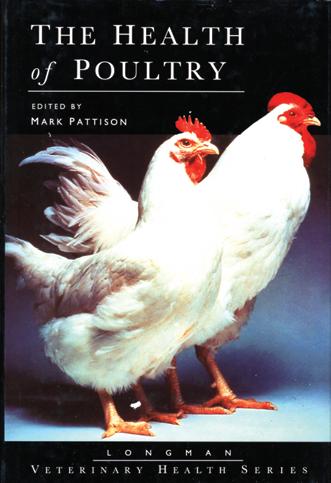
The Health of Poultry
The Health of Poultry, by Mark Pattison, is a unique book describing the overall concepts of poultry health with the emphasis on creating the right conditions and environment to minimize the occurance of disease. By demonstrating the interrelationships between husbandry, medicine and nutrition the author shows how to prevent diseases and to maximize the genetic potential made possible with modern breeds of poultry. Each of the main poultry species - chicken including breeder and broiler, turkey and duckis dealt with in separate chapters that explain the principle of disease control with the emphasis on preventive medicine. All aspects of care are drawn together to provide guidance on devising a rigorous health regime that is controlled by proper management. Chapters on hatchery, nutrition, environment, and housing examine topics such as planning, ventilation, hygiene, quality control and medication.
Item #0582065798


Energy
Energy Audits
Helping farmers save energy
BY DAN WOOLLEY
Anew program initiated by the Nova Scotia Federation of Agriculture to help its farmers save energy has just hired its first two energy auditors.
Julie Bailey, a graduate chemical engineer with a master’s degree in agriculture, is one of the two new energy auditors. She says the objective of the farm energy audit program is to provide expertise and support for farmers who want to conserve energy.
As energy auditors, Bailey and her colleague, Rick Hoeg, will inventory onfarm energy use, principally electrical uses, but they will also look at fuel oil and propane use on the farm. She is also looking at adding a component to the inventory to look at on-farm diesel and gasoline use.
As for poultry producers, Bailey, as part of her master’s thesis, surveyed 700 Nova Scotia farms. “I found that the average Nova Scotia farmer spent $11,000 annually on their energy bill. The average dairy farm, however, was twice that and the average poultry and hog operation was three times that (approximately $32,000).”
Based on her research, she estimates poultry and hog producers can save at least 15-percent on their yearly electrical bills. Bailey recommends: “Poultry producers pay attention to your control systems and lighting as they can provide a significant payback.”
The Nova Scotia EcoTrust for Clean Air and Climate Change is helping the NSFA sustain the energy auditing

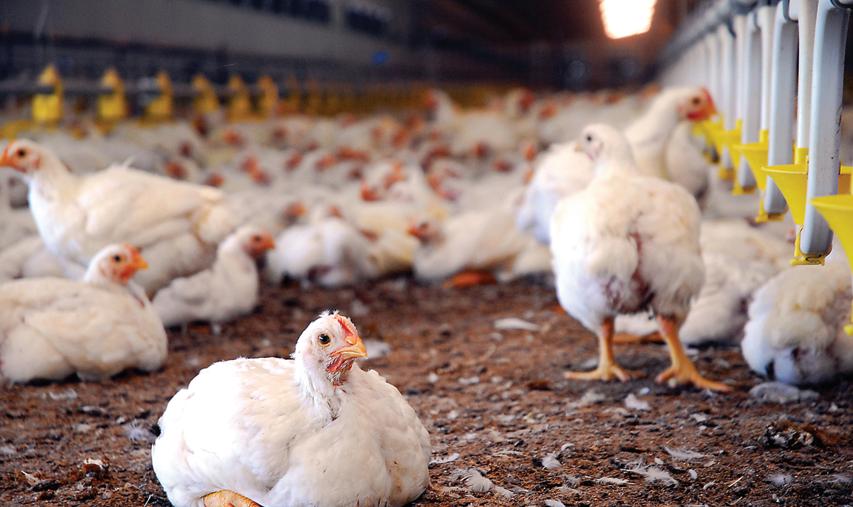
An average Nova Scotia poultry producer could cut energy costs by about 15 per cent often by doing something as simple as switching to energy-efficient lighting.
system for farmers with funding. Bailey found through research for her thesis, published in 2007, that the average Nova Scotia farm emits about 48 tonnes of GHG (greenhouse gases) annually and she also discovered that 78 per cent of Nova Scotia farmers are interested in adopting energy-saving measures, but she adds, “I also found that 90 per cent of
Nova Scotia Farms weren’t using renewable energy technology. Surprisingly, I even found that 42 per cent of Nova Scotia farms were still not using energyefficient lighting.”
The energy audit program, Bailey notes, is voluntary for farmers. “I have 13 farms participating right now. I have
Continued on page 38
ENERGY ABUSE
CPRC Update
The Canadian Poultry Research Council (CPRC) provides funding for research projects under a number of themes.
Below are summaries of the final reports for two of these projects:
MANAGING BROILER BREEDERS
The laying performance of commercial broiler breeder chickens can vary widely. Careful management decisions are required, especially during sexual maturation, to maximize egg production. Drs. Frank Robinson and Robert Renema, and their team at the University of Alberta have undertaken a large research program on broiler breeder physiology and are working towards a better understanding of the impact of various management decisions on breeder performance.
Protein intake
One aspect being examined within this program is the interaction between protein intake and reproductive efficiency. An experiment was set up during which pullets were fed either a standard breeder ration during their growth phase, or one that was either 20 per cent higher or lower in crude protein. The HIGH or LOW protein rations were fed over different time periods and various measures of body and reproductive development were taken throughout the experiment. The different diets had only minor effects on the developing birds and resulted in no change in the number of eggs laid. These results suggest that feeding a high protein diet during the growth phase may not be necessary for proper reproductive development. This is a significant conclusion and suggests that other management decisions are likely to have greater impact on breeder flocks.
Timing of feed restriction and photostimulation
In a related trial, chicks were full fed for either one or three weeks. Growth curves thereafter were designed to merge the two groups by 10 weeks of age. As expected, the 3WK group initially gained much more weight, but upon being feed restricted virtually matched the other group in all respects, including apparent reproductive development, by the end of the 16-week trial. Flock uniformity was better for the 1WK group, presumably due to a smoother transition into feed restriction and less competition for feed from aggressive birds. The pullets were photostimulated at 17, 19, 21 or 23 weeks. As expected, stimulating birds later resulted in delayed onset of sexual maturity, but these birds matured more quickly. Flocks stimulated later came into lay most consistently and had larger early eggs. These results suggest that more mature birds can better respond to photostimulation cues.
The importance of body size
Data were also collected on two commercial breeder flocks from hatch to end of lay. Chick size had little correlation to production traits, while measurements at nine weeks were more predictive of the birds’ performance later on. On average, lighter
hens were less productive, while hens that were too heavy tended towards more double-yolked eggs and other reproductive problems.
Next steps
The many data produced during this project are being analyzed in the context of the overall breeder physiology program. In light of the relatively small impact of changing protein levels, future work will concentrate on the effects of varying energy intake and age of photostimulation.
Funding for this project was provided by CPRC, Alberta Agricultural Research Institute and Aviagen.
WORKPLACE EXPOSURES OF POULTRY BARN WORKERS
There are relatively few data available on the exposure of poultry workers to environmental contaminants. The purpose of this study was to log the amount of time poultry workers spend on various activities on farm and to measure their exposure to environmental contaminants such as ammonia, respirable dust and CO2. Exposures were compared between layer and broiler operations throughout production cycles at different times of the year.
During an earlier study, the tasks of poultry barn workers were recorded during their workshifts and personal exposures were monitored with Personal Environmental Sampling Backpacks to measure contaminant exposure during the work tasks they conducted.
Ammonia, CO2 and dust
These studies suggest that ammonia exposures for poultry workers do not exceed the 25ppm Time Weighted Average Threshold Limit Value (TLV) set by the American Conference of Governmental Industrial Hygienists (the TLV of a chemical substance is the level to which it is believed a worker can be exposed day after day for a working lifetime without adverse health effects). Similarly, measured CO2 levels did not exceed the 5,000ppm TWA-TLV. Because of the high dust levels, the authors do recommend that poultry workers use N95 or comparable respirators while working in their barns to reduce their exposure to and mitigate adverse effects from respirable dust in the layer barn and broiler barn environment.
Funding for this project was provided by CPRC, the Natural Sciences and Engineering Research Council and Agriculture and Agri-Food Canada.
For more details on any CPRC activities, please contact Gord Speksnijder at The Canadian Poultry Research Council, 483 Arkell Road, R.R. #2, Guelph, Ont., N1H 6H8, phone 289-251-2990, fax 519-837-3584, e-mail info@cp-rc.ca, or visit us at www.cp-rc.ca.
The membership of the CPRC consists of the Chicken Farmers of Canada, Canadian Hatching Egg Producers, Canadian Turkey Marketing Agency, Egg Farmers of Canada and the Canadian Poultry and Egg Processors’ Council. CPRC’s mission is to address its members’ needs through dynamic leadership in the creation and implementation of programs for poultry research in Canada, which may also include societal concerns. ■
Non-invasive Tests of Stress in Laying Hens
BY TIM NELSON, EXECUTIVE DIRECTOR AND KIMBERLY SHEPPARD, RESEARCH CO-ORDINATOR
Issues of animal welfare and assurance of care are areas of growing public interest. Assessment of laying hen welfare is often based on behavioural observations or physical indications of abnormal behaviour such as feather loss due to feather pecking. It is well recognized that the assessment of animal welfare should involve, as far as possible, a comprehensive approach that includes physiological measures of biomarkers indicative of stress. Having such comprehensive assessment strategies in place can aid the industry in making objective decisions about the welfare of poultry in any given system.
A commonly used biomarker of stress in all species is the measurement of corticosteroid hormones. In avian species, the hormone measured is usually corticosterone. This is difficult to measure via blood sampling, however, since the sampling itself requires handling the birds, which stresses them. It is difficult to validate corticosterone levels in alternative sample media such as feces or eggs for the same reason, since these must be compared to circulating levels in the blood to determine if they accurately reflect circulating corticosterone levels. To date, the appropriateness of eggs and excreta to assess stress levels in birds has not been fully validated.
To overcome this problem and validate these measures, Dr. Nigel Cook at Alberta Agriculture and Rural Development, and his research team, utilized a method to collect blood without handling the birds.
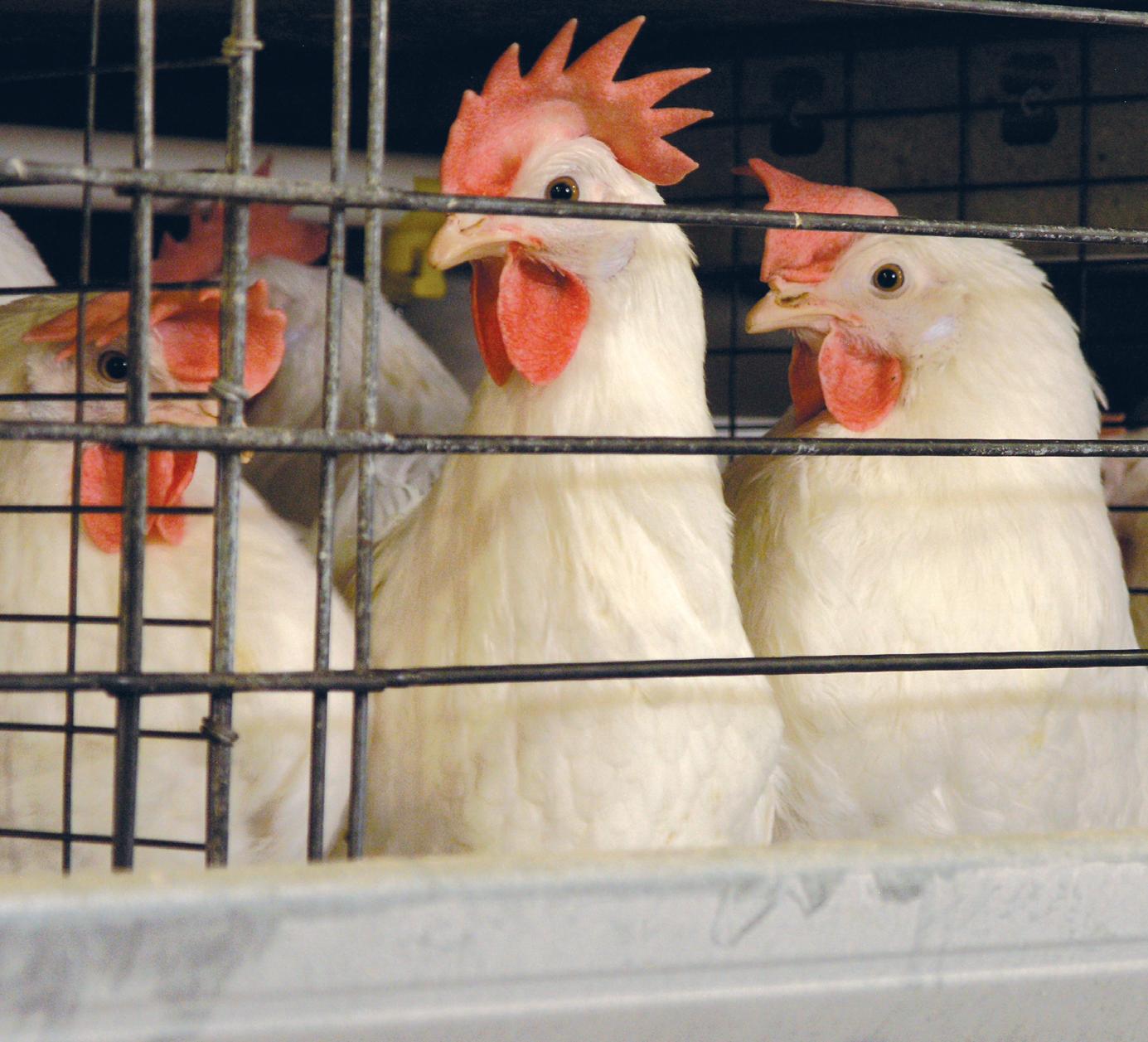
They inserted a catheter, which allowed for blood collection from birds that are able to move freely within their cages, undisturbed.
The first step was to determine if corticosterone levels could be captured in eggs and excreta over time. Compared to the amount of hormone in the excreta (99 per cent), very low amounts of administered corticosterone were found in the eggs (less than one per cent), suggesting measurement of stress hormones in eggs might pose technically challenging. The corticosterone was present in the feces up to at least 48 hours postinjection of corticosterone.
A second experiment was designed to compare corticosterone levels in blood, albumin, yolk and excreta. Birds were
MEASURING STRESS
Dr. Nigel Cook and his team are trying to determine effective non-invasive methods to test stress in laying hens.
stressed by either holding them or by injecting them with a small amount of hormone that stimulates the adrenal cortex. Overall, measurements of corticosterone in the eggs and feces did not reflect the blood levels stimulated by the hormone, suggesting that these are not appropriate for use in measuring acute stress. However, the levels in the eggs and excreta closely matched overall daily adrenocortical activity, and may be

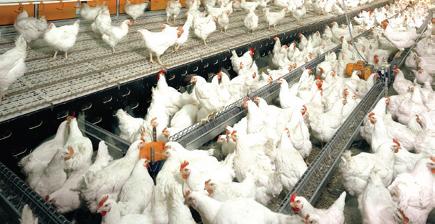




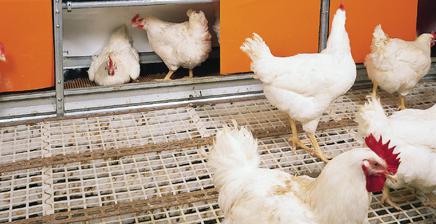


While producers such as yourself, and our competition, are trying to understand the challenges involved in designing, building and converting houses into Alternative Layers, we’ve been doing it. In fact, there are MILLIONS of Big Dutchman Alternative Layers globally. Let our Production Specialists, full-time personnel that understand production management requirements, show you how using our extensive product line can help you to get off the fence.


Making a world of difference one client at a time. +1 616 392 5981 • e-mail bigd@bigdutchmanusa.com www.bigdutchman.com
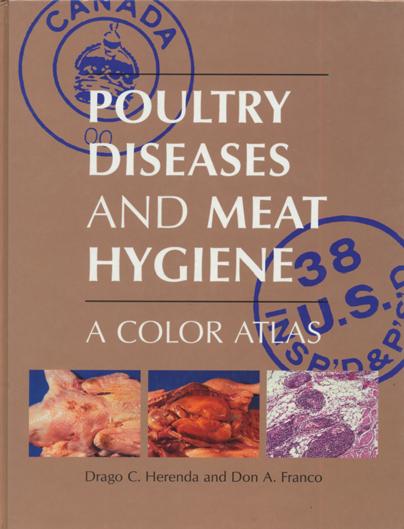
POULTRY DISEASES AND MEAT HYGIENE
Item#: 081382463X
Price: $152.60
Offers an easy-to-understand baseline pathology reference that presents all information needed in North American slaughterhouses and poultry production operations to identify and diagnose pathological problems and evaluate the suitability of poultry carcasses (chicken, turkeys, ducks, and geese). Included are 405 full-colour photographs of lesions, supported by descriptive findings, 31 additional illustrations, and additional data.
1938 - 2008

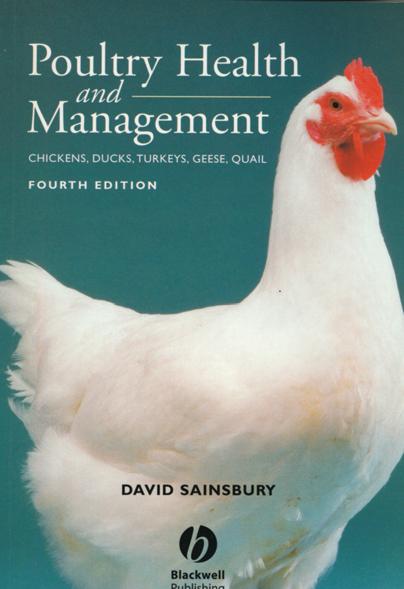
POULTRY HEALTH AND MANAGEMENT: CHICKENS, DUCKS, TURKEYS, GEESE, QUAIL
Item#: 0632051728
Price: $79.49
This fourth edition discusses systems that are environmentally and welfare friendly; and there is more emphasis placed on hygiene and vaccines in disease control and the role of molecular biology and cloning. New material also includes the advances in management, with special reference to feeding, drinking, lighting, and egg collection; and advances in genetics, developments in housing, and nutrition. A comprehensive section regarding the increasingly restrictive legislation concerning the safety of poultry products and public welfare is included.
PIC Update
appropriate for measures of long-term, chronic stress. To read more, please visit www.poultryindustrycouncil.ca.
FEATURED RESEARCHERS
protein and polypeptide mass profiles that may be indicative of disease, stress and pain.
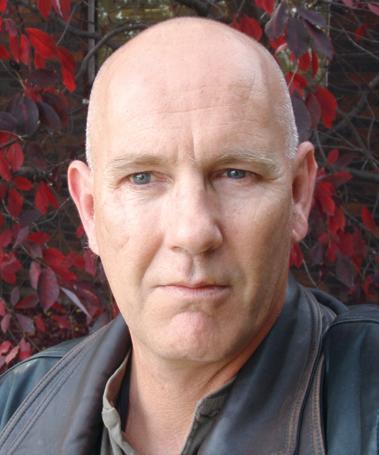
Dr. Nigel Cook did his undergraduate studies at Portsmouth University, U.K., where he majored in biology. Upon graduating in 1980, he took the position of Biomedical Scientist at the Tenovus Institute for Cancer Research, Cardiff, U.K. There he completed a PhD in 1992 entitled: “The Stressor: Response Paradigm: An Assessment by Salivary Steroid Analysis.” This was a study of the stress responses of humans and the relationship of stress to disease states.
He then moved to Canada and took the position of Research Scientist with Agriculture and Agri-food Canada studying stress responses of livestock, and in 2002 became Research Scientist in livestock welfare with Alberta Agriculture, where he remains.
Dr. Cook’s research interests are in the discovery, development and application of biomarkers of stress, pain and disease in livestock species. The research program focuses on minimally invasive sampling methods and the analysis of stress-related hormones, e.g., cortisol and corticosterone. Also, the proteomic profiling of blood and saliva samples for the identification of
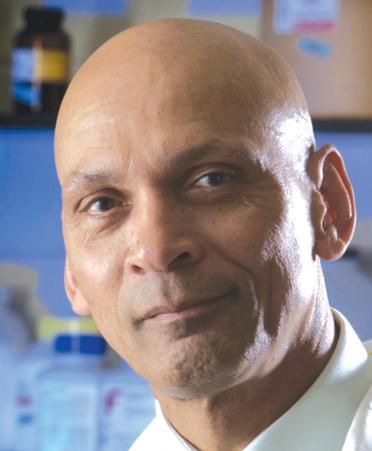
Carlton Gyles is Professor emeritus in the Department of Pathobiology, University of Guelph. He is a 1964 graduate of the Ontario veterinary College who has conducted research on E. coli in poultry, pigs, cattle and humans over the past 40 years.
PIC PICKS
Golf Day
Did you make it to the golf tournament? It was a great event with more than 200 players, a beautiful day and fabulous prizes. If you’re thinking about playing with us next year, don’t wait too long to book because next year we don’t clash with Poultry Day at the Outdoor Farm Show so we expect to be sold out (and we can’t book a bigger course). The tournament will be held on Wednesday, Sept. 9, 2009, so book now.
Annual Meeting
Our annual meeting took place on Oct. 7 and went well. The meeting was preceded by an update of our research endeavours for the year. About 40 people turned up and gave some terrific feedback on how we can improve what we’re doing at PIC to
A new approach to immunization against E. coli infections in broilers
Avian pathogenic E. coli (APEC) are common in barn dust. Following inhalation by chickens, the bacteria are often eliminated by the clearance mechanisms of the respiratory system. However, in the presence of other immune challenges caused by viruses, Mycoplasma, ammonia, or dust, APEC can establish in the respiratory system and disseminate throughout the body. This results in respiratory/septicemic disease. This diseaae occurs commonly in two- to four-weekold broilers and is a leading cause of economic loss. A vaccine against APEC would provide industry with a tool to manage this problem, improving both animal health and profitability.
Dr. Carlton Gyles and graduate student Haitham Ghunaim at the University of Guelph have been investigating four different antigens for their ability to induce protection in broilers against E. coli respiratory/septicemic disease. The researchers injected the antigens into broilers and collected serum contain-
ing the antibodies produced in response. When the antibodies were injected into broiler chickens it was found that antibodies against three of the four antigens tested protected the birds from APEC respiratory challenge. They then tested the three successful antigens further by two methods: i) vaccinating broiler breeders and assessing their chicks for protection after challenge with APEC, and ii) vaccinating broiler chicks and later challenging them with APEC.
Their findings? Vaccinating the broilers breeders did not lead to a protective effect for their chicks in this study. For the directly vaccinated chicks, one antigen (PapG) was effective in eliciting protective antibodies against E. coli. This finding indicates that PapG is a promising vaccine candidate for a vaccine against respiratory/septicemic disease due to E. coli in broilers.
To read more on this study, please visit www.poultryindustrycouncil.ca.
CARLTON GYLES, UNIVERSITY OF GUELPH
PIC Update
make it more relevant to you and more powerful in terms of tackling some pressing industry issues.
Funding
This year the PIC has more than $2 million worth of new projects under management. More than half of that money is coming from external (to industry) investors: the Agricultural Adaptation Council and the Ontario Ministry of Agriculture, Food, and Rural Affairs (OMAFRA). Between them, these investors are contributing over $1 million – many thanks to them. This external funding is a major bonus to industry and when we calculate the income from other provinces and institutions we are now receiving $6.40 for every $1 invested by Ontario producers and industry.
Board Members
Canadian Poultry Magazine and Intervet Canada present the Great Canadian
Great Canadian FLY THE COOPGetAway
Congratulations, you have found Brewster!
Record the page number and issue date where this ad is located on the contest ballot located at the Intervet insert in the centre fold of this magazine. Complete the remainder of the information on the ballot, attach a first class stamp and mail to: Great Canadian “Fly the Coop” Get Away Contest, c/o Canadian Poultry Magazine, Annex Printing and Publishing Inc., P.O. Box 530, 105 Donly Drive South, Simcoe, Ontario, Canada N3Y 4N5. Good Luck!
JUNE 2008
Amy Bouwmeester – Rockton, Ontario
JULY 2008
Barb Cowan – Auburn, Ontario
AUGUST 2008
Danny Gilbert – Burtts Corner, New Brunswick
SEPTEMBER 2008
Mike B. Hofer – Hodgeville, Saskatchewan
Prizes sponsored by Intervet Canada, 250 Water St., Whitby, ON, L1N 9T5
At the annual meeting retiring members were re-elected. We welcome back Stephen Halley (Intervet – ScheringPlough), Mike Terpstra (RBC), Charlie Elliott (Masterfeeds) and Brian Baynton (Alltech) as board members. These guys do a great job of keeping the PIC working on delivering research and education for industry – for absolutely no reward. Many thanks to all of them and the other members Rick Bennet (KL Products), Helen Anne Hudson (Burnbrae Farms), Ed McKinlay (McKinlay Farm) and Kevin Weeden (Weeden Environments) and to the feather board representatives for the coming year: George Campbell (TFO), Bob Guy (OBHECC), Vic Slobodian (EFO) and Murray Opsteen (CFO).
Thompson Steps Down
We said goodbye to Kevin Thompson, who has served on the PIC board for a number of years and helped steer PIC through some turbulent times – thanks for your valuable input, Kevin.
Research Facilities
This month, discussions about the new research facilities at Elora (the Guelph 2050 initiative), get underway between Industry, OMAFRA and U of G –watch this column for updates. ■
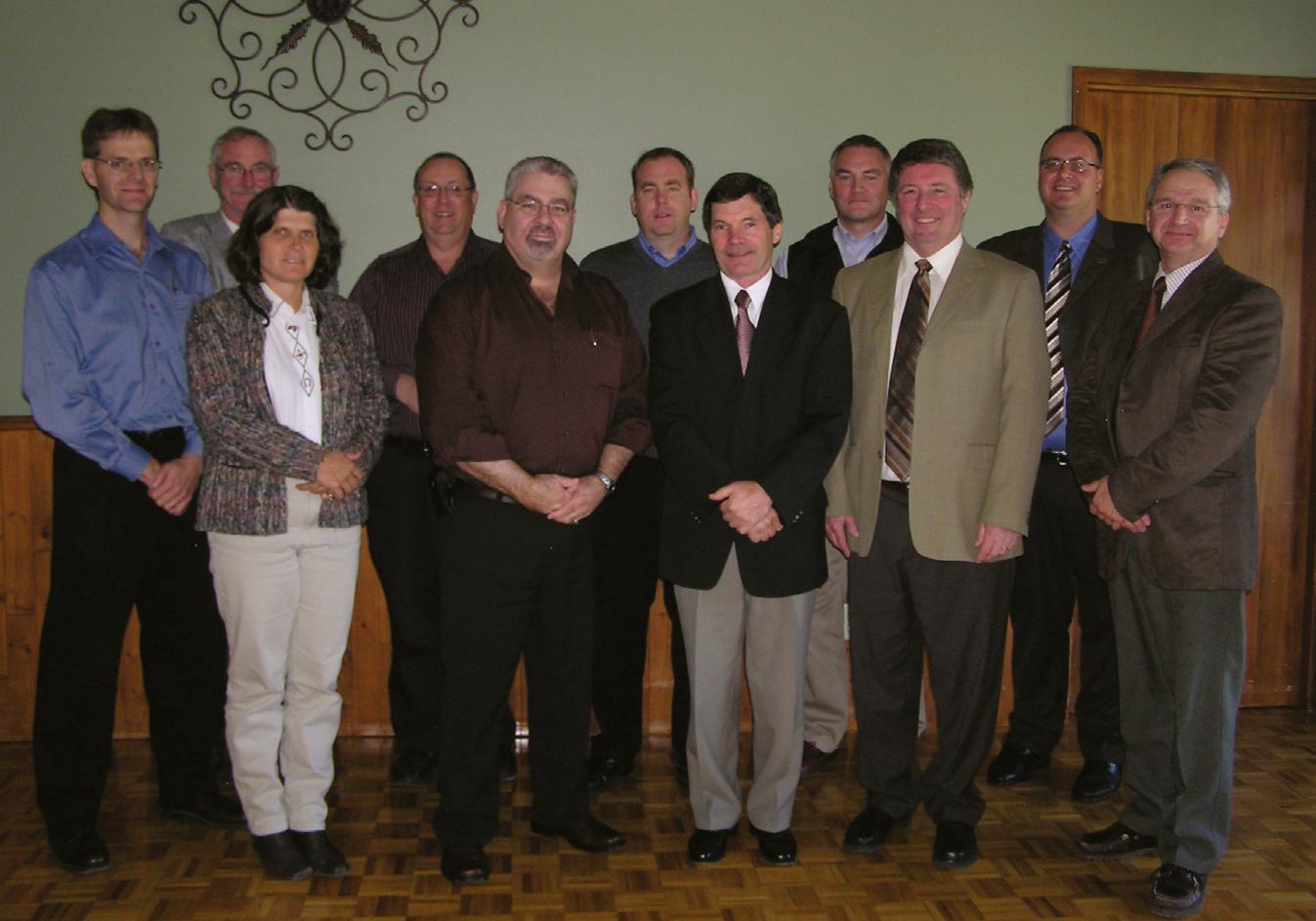
The PIC Board of Directors (left to right): Mike Terpstra, George Campbell, Helen Anne Hudson, Charlie Elliott, Rick Bennett, Stephen Halley, Ed McKinlay, Brian Baynton, Bob Guy, Murray Opsteen, and Tim Nelson. Missing from the photo are Kevin Weeden and Vic Slobodian.
CUSTOMER SATISFACTION ACROSS CANADA



...“The strength and durability of the system told me that this was going to last more years than I had left in the business. ... As we got into the reality of using the system, I knew we had made the right decision.”
Al Dyck, Harman Poultry Farm, Prince Albert SK


...“My Hellmann Cage System is awesome. An excellent system to work with on a daily basis.”
Doug Pauls, Highplain Farms, Niverville MB



...“With the Hellmann Cages I am getting results I cannot believe. Uniformity in the mid 90’s...Feed conversion also improved dramatically (5.9 kilos/bird). The Hellmann troughs keep the feed in the troughs and not on the floor.”
Gerard Hoftyzer, Londesboro, ON


... “With 94% uniformity, excellent feed conversion, very good air quality; all accomplished with minimal labour inputs; I am extremely pleased with my decision to purchase Hellmann Pullet Cages.”
Paul Overmars, St. Andrews, Nova Scotia

Maritimes
Contact: Herb Jansen
Phone: (902) 680-1267
Fax: (530) 430-2020
e-mail: janse17@attglobal.net
Manitoba, Saskatchewan & British Columbia
Contact: Greg Olson
Phone: (306) 260-8081 or (306) 492-2266
Fax: (306) 492-2265
e-mail: gaolson@sasktel.net
Eastern Ontario & Quebec
Contact: Stephane Chouinard
Phone: (450) 266-9604
Fax: (450) 263-2638
e-mail: stef@greenfarmline.com
Alberta
Contact: Len Mandel
Phone: (403) 308-7288
Fax: (403) 320-5866
e-mail: doubledd@shaw.ca
Western & Central Ontario
Contact: Jack Lepelaars
Phone: 1-866-767-2986 or (519) 348-8483
Fax: (519) 348-9271
e-mail: jack@newtechag.com
U.S.A.
Contact: Jim Currie
Phone: (519) 868-1882 or (519) 453-3913
Fax: (519) 453-3996
e-mail: hellmannpoultry@bellnet.ca
Production Le poulet biologique, une affaire de valeurs
Patience et persévérance
portent enfin leurs fruits à la Ferme Bio-Rard, où la production de poulet biologique a pris son envol grâce à un nouveau partenariat
PAR ANDRÉ DUMONT
Après cinq ans de hauts et de bas, d’essais et d’erreurs et des milliers d’heures et de dollars investis par conviction, l’avenir sourit enfin à la production biologique de la Ferme Bio-Rard. Depuis février dernier, 1200 poulets certifiés quittent la ferme à chaque semaine.
« Ça commence à valoir la peine, affirme Mario Bérard. Pendant les premières années, on ne faisait pas nos frais. » L’entreprise qu’il a fondé avec son épouse Karine et ses enfants Annie et Donald pour gérer en commun le volet biologique de leurs fermes avicoles a enfin trouvé le partenaire idéal. Les poulets de la Ferme Bio-Rard, à l’Ange Gardien, en Montérégie, sont abattus à la Ferme des Voltigeurs, de Drummondville, qui les met en marché dans son réseau de disbributeurs.
La production biologique ne faisait pas partie des plans de carrière de Mario Bérard.
Son élevage de poulets et sa meunerie conventionnels connaissaient une belle croissance quand il y a cinq ans, sa fille Annie, au terme de ses études, propose de diversifier la ferme familiale en y ajoutant un volet biologique. Son frère Donald est tout aussi emballé par l’idée.
DE
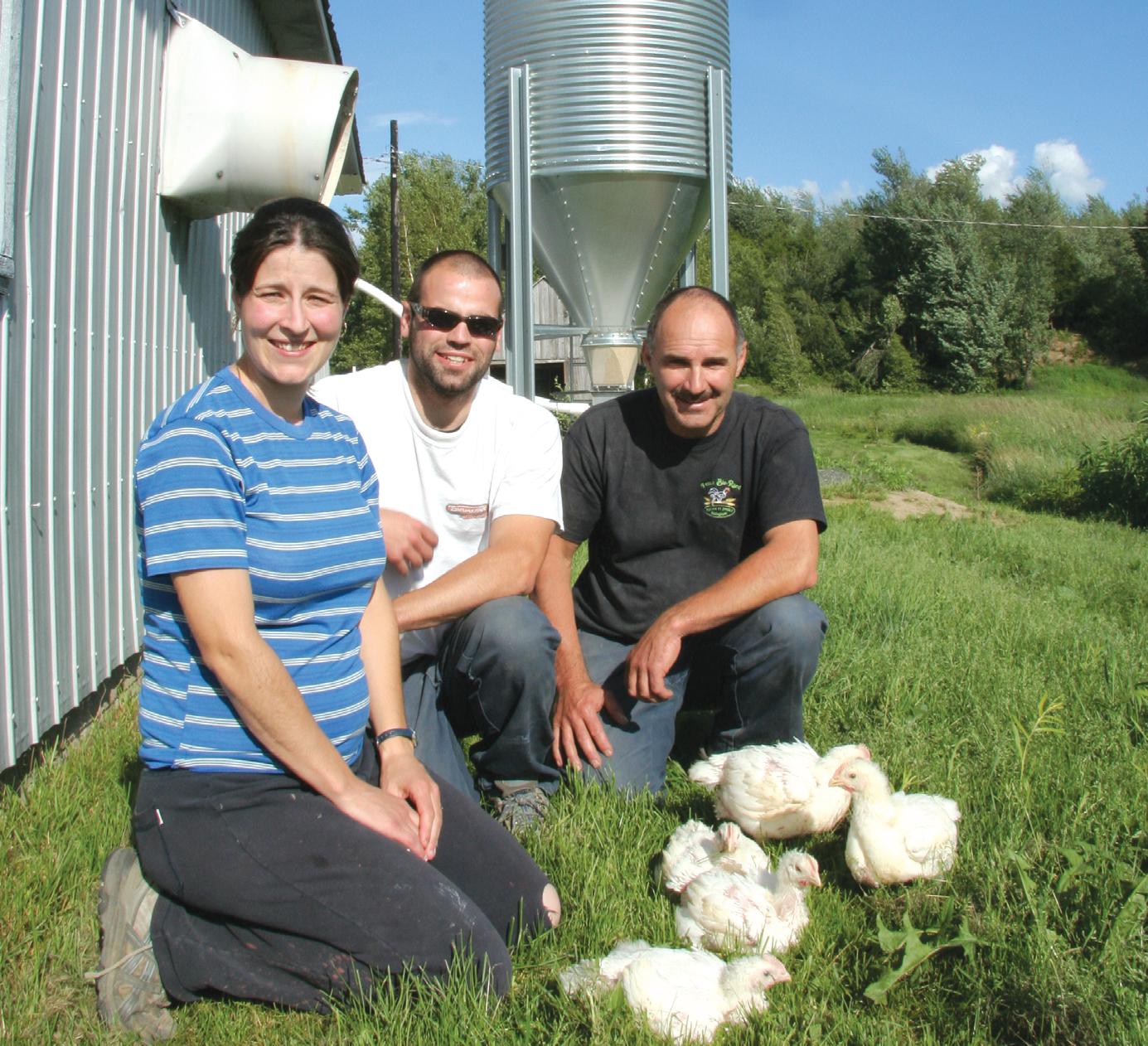
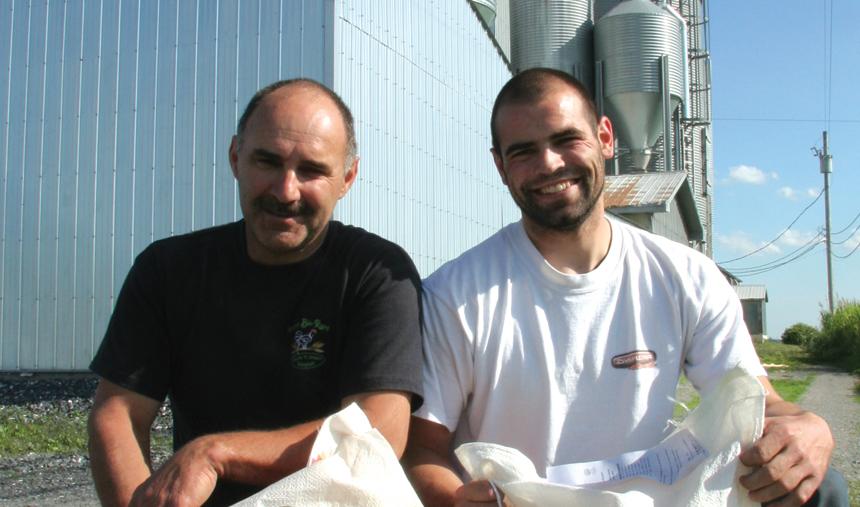
Annie, 28 ans, et Donald, 26 ans, ont convaincu leur père Mario de se lancer avec eux en production de poulets biologique.
Visiblement, Mario Bérard avait sous-estimé l’impact des valeurs que son épouse et lui avaient inculquées à leur enfants. Depuis des années déjà, le recyclage et le compostage des déchets domestiques est pratique courante à la maison. La récupération est même imposée aux employés de la ferme. Dans les champs, des bandes riveraines et des
haies brise-vents font partie du paysage depuis plusieurs années.
« Si tout le monde faisait les mêmes petits efforts que nous, cela ferait une véritablement différence pour l’environnement », affirme Mario Bérard. « Je suis un planteux d’arbres, dit son fils Donald. Je crois qu’en agriculture, nous devons réduire l’utilisation d’herbicides et d’engrais. »
UNE AFFAIRE
VALEURS
Photos courtesy André Dumont

Systems
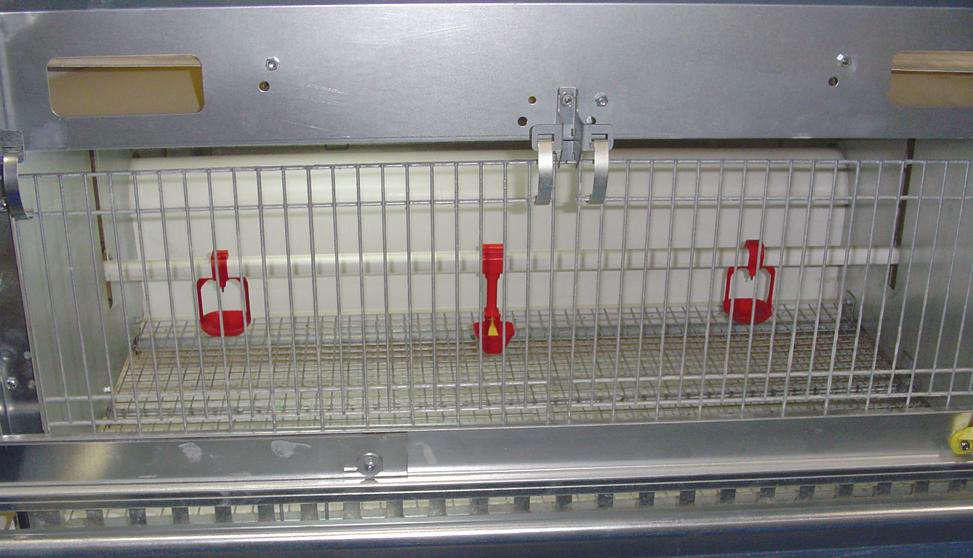
MELLER PULLET CAGES
Meller brings you a world class pullet cage system proven in thousands of installations around the world, with features such as revolving belt manure removal roomy cages, solid galvanized dividers and adjustable front gate. Chain feeder or self propelled feed carrier with proportioner augers are available.
MELLER LAYING CAGES
Egg producers across the country have increased the efficiency of their operation with Meller Cage Systems, the Egg-Ease Egg Saver and faster egg collection. Sliding doors open the full width of the cage and the horizontal bars prevent feed spillage.
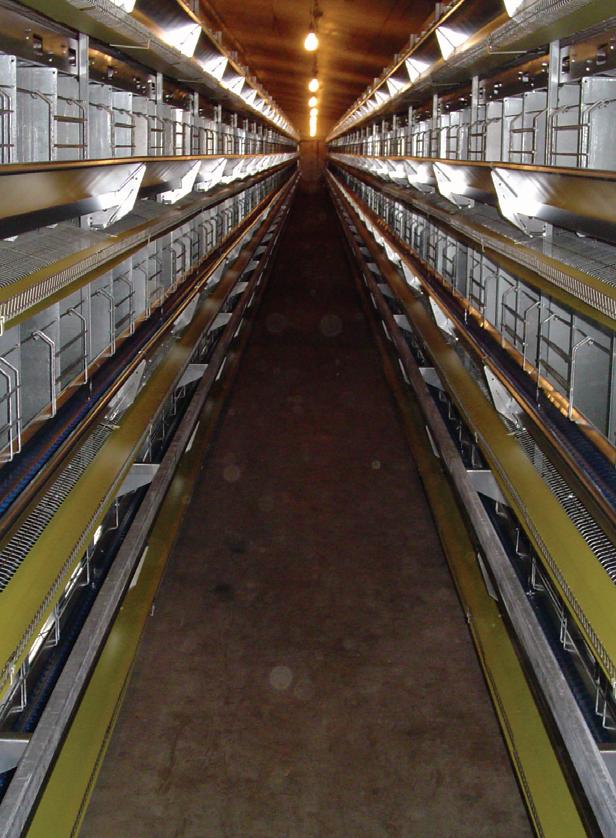
L’aventure biologique a débuté il y a cinq ans, par la remise en état d’une meunerie devenue trop petite pour le marché conventionnel que dessert Mario Bérard. La meunerie abandonnée reprend vie pour desservir les éleveurs biologiques de mouton, poulet, dindons, porcs et bovins laitiers.
Production
« Notre premier client n’a acheté qu’une seule poche! », se rappelle Donald. Ce n’est qu’aujourd’hui que la meunerie affiche une certaine rentabilité. Les prix offerts aux producteurs de céréales biologiques se sont raffermis, leurs productions sont en croissance et la demande pour les moulées est supérieure à l’offre.
Parallèlement, la Ferme Bio-Rard se lance dans l’élevage de poulets biologiques. On met à contribution des poulaillers à un étage sur une ferme que Donald vient d’acquérir. Ici aussi, le démarrage impose son lot de défis.
« Nous avons dû apprende la technique. C’est très différent du conventionnel », soutient Mario. Les bâtiements sont modifiés pour offrir plus de lumière naturelle aux poulets et on leur aménage des parcs extérieurs. La régie est modifiée pour qu’ils profitent d’une plus faible densité et d’une alimentation biologique, sans antibiotiques
Après environ quatre ans d’expériences, les gains de poids sont maintenant plus uniformes et les taux de mortalités ont beaucoup chuté. « Il n’y a pas de recette miracle », affirme Donald en parlant des contraintes en santé animale. D’après lui, si d’autre éleveurs disent ne pas réussir à produire sans antibiotiques, c’est tout simplement parce qu’ils s’attendent à des taux de réussite élevés à chaque lot. Les producteurs biologique ont une meilleure tolérance aux pertes, croit-il.
« Plus tes animaux sont performants, plus ils sont vulnérables aux maladies », rappelle Mario. Les poulets de la Ferme Bio-Rard grandissent en 50 à 60 jours. Quand le temps le permet pendant l’été, ils sortent au grand air. Par contre, Donald et Annie croient que c’est plutôt la faible densité dans le poulailler et la moulée de meilleure qualité qui fait une différence. « Ce qui pollue le plus, ce sont les herbicides et les pesticides utilisés dans les champs », affirme Annie.
C’est plutôt du côté de la commercialisation que les Bérard se buttent aux plus grands obstacles. Ils ont tout essayé : vente à la ferme, dans des kiosques à des expositions, aux marchés Atwater et Jean-Talon à Montréal. « C’est beaucoup de travail, dit Annie. Notre force, c’est plutôt la production. »
En février dernier, leur distributeur principal tombe en difficultés financières. Des lots de poulet biologique risquent de se voir écoulés dans la filière conventionnel. Après des mois à subir des commandes en dent de scie, on
songe carrément à abandonner la production biologique.
C’est alors que le partenariat avec la Ferme des Voltigeurs voit le jour. « Nous avons une belle entente. C’est une ferme familiale aussi et ils ont déjà leurs réseaux de distribution », explique Mario. Depuis, leur poulet se retrouve chez les détaillants aux côté du poulet de grain de la Ferme des Voltigeurs, sous l’étiquette « Poulet biologique Ferme des Voltigeurs, élevé par la ferme Bio-Rard ».
Avec trois poulaillers qui peuvent être utilisés pour la production biologique, la Ferme Bio-Rard est capable de produire
des volumes suffisants pour absorber les frais de transport et d’abattage. De plus, la production peut suivre l’évolution de la demande, puisque les Bérard peuvent aisément attribuer à leur production biologique une partie du quota que chacun détient, qui leut permet d’élever entout environ 200 000 poulets à la fois. « La Ferme des Voltigeurs peut annoncer à tout le monde qu’elle offre du poulet biologique ! », dit Donald.
Les Bérard n’en sont pas rendus à envisager la construction de nouveaux poulaillers biologiques. Pas question non plus d’abandonner la production
Web Exclusives
Canada Publishes Special Agricultural Safeguard Price and Volume Triggers
The Government of Canada has given notice of the volume and price triggers that will be used to operationalize the World Trade Organization (WTO) Special Agricultural Safeguard (SSG) for Canada’s supplymanaged products.
The Special Agricultural Safeguard is a provision that allows additional duties to be triggered automatically when import volumes rise above a certain level, or if prices fall below a certain level.
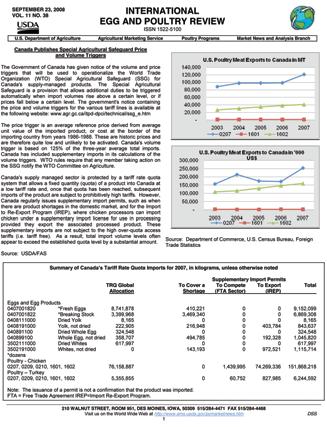
The full report is available on our website under Web Exclusives.
WTO Releases New Edition of World Tariff Profiles
The 2008 edition of World Tariff Profiles presents a comprehensive and updated compilation of the main tariff indicators for the WTO’s members as well as for other countries and customs territories. World Tariff Profiles provides detailed data on the bound and applied tariffs of WTO members. Information on each country’s market access is presented in summary tables — allowing crosscountry comparisons — and in country pages.
The full report is available on our website.
conventionnelle, puisque la plupart de leurs bâtiments ont trois étages. Avant d’investir davantage en production biologique, le marché devra faire ses preuves. On dit qu’il croît de 20 % par année, mais les risques sont encore élevés, prévient Mario.
Productions conventionnelle et biologique continueront donc à se cotoyer, sans contradiction dans l’esprit des propriétaires de la Ferme Bio-Rard. « Parce qu’on fait du biologique, on pense un peu plus en fonction de l’environnement, dit Mario. On ne change pas le monde, mais on ne contribue pas à le déteriorer! » ■
NEW PRODUCTS
Phyzyme XP TPT
Danisco Animal Nutrition has recently received the Canadian Food Inspection Agency’s (CFIA) approval of its highly thermostable phytase product – Phyzyme XP TPT – into the Canadian livestock feed market.
New Thermo Protection Technology (TPT) developed by Danisco ensures that the phytase maintains efficacy after exposure to feed conditioning and pelleting temperatures of up to 95 C (203 F). TPT applies to the phytase enzyme a coating which delivers unrivalled protection from the high temperatures that typically occur during the feed pelleting process, while rapidly releasing the enzyme activity in the animal’s gut, without compromising animal performance.














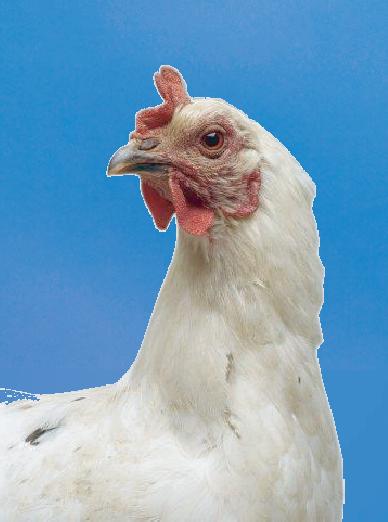





Kaitlin Hamilton (Ontario)
Continued from page 24
already done site visits for the energy inventory and I am currently completing the energy efficiency reports.”
Once she has inventoried a farmer’s energy use, Bailey will then compare it to the farmer’s actual energy bill to see
Energy
“if they are using more energy than what they think they are using.”
This comparison will reveal if their energy-consuming equipment is functioning properly, she says, adding: “It is also a learning exercise for them to pinpoint their actual energy use and it also ensures their inventory is correct.

“We are looking at adding another component to look at what renewable energy sources would be applicable to the farms we review. This is beyond what is usually done in an energy audit.”
Her colleague, Rick Hoeg will also be making recommendations on the alternative use of things like chicken litter in conserving energy, she notes.
They will also be looking at developing information “benchmarks” on various farm types.
“There isn’t a lot of information on certain farm types, unlike dairy,” says Bailey.
“I can compare Nova Scotia dairy farmers to Ontario dairy farmers or New York dairy farmers as to the actual litre of milk produced per kilowatt hours.”

Multiple
Proven
Non-corrosive
Cost-effective

Benchmarks, she adds, will enable comparisons between large and small farms and “help highlight efficient and inefficient farms … as well as target those for improvement and those to learn from.”
Besides funding for the energy audits there will also be money for “special projects such as fact sheets on renewable energy. We would also like to do some technical demonstrations.”
Bailey will also try to add to the energy audit an estimate of the payback to the farmers for energy conservation with funding in the Farm Investment Fund of up to $1,000 to defray the cost of an energy consultation fee.
She says there is also 50 per cent funding for several specific on-farm technologies and the FIF will also offer 50 per cent funding for renewable energy systems.
Federal funding for energy upgrading for businesses is also available to farmers and it can cover up to 25 per cent of the cost of energy-saving initiatives, Bailey says, noting there is also 40 per cent funding for solar air and solar water heating systems.
She would also like to see more farmers participate in the federally and provincially funded Energuide Program. “For Nova Scotia it costs $150 plus tax for the initial audit and it qualifies you for up to $6,500 in grants, and they just announced a $5,000 interest-free loan component.” ■
Thanks for waking up to Ontario eggs.

Human Impact Increasing interaction with hens improves productivity
by L.E. Edwards1, P.H. Hemsworth1 and G.J. Coleman2
Extensive studies in the livestock industries have shown marked between-farm variation in the fear responses of farm animals, including poultry, to humans.1 Furthermore, studies have found a negative inter-farm correlation between fear of humans and the productivity of laying hens; this relationship was considered to be mediated by a stress response.2 Such negative correlations indicate that high levels of fear of humans may be an important factor limiting the productivity of laying hens.
Studies in the dairy and pig industries have shown significant relationships between the stockperson attitudes and behaviour towards animals and the fear responses and productivity of animals. Similar work in the broiler industry found no relationship between stockperson attitudes and behaviour, but did find evidence for the existence of relationships between stockperson behaviour, bird behaviour and bird productivity.3 The existence of relationships between human and animal variables in the livestock industries indicates that the opportunity exists to modify stockperson attitudes and behaviour in order to improve livestock welfare and productivity, and such opportunities may also exist in the poultry industries.
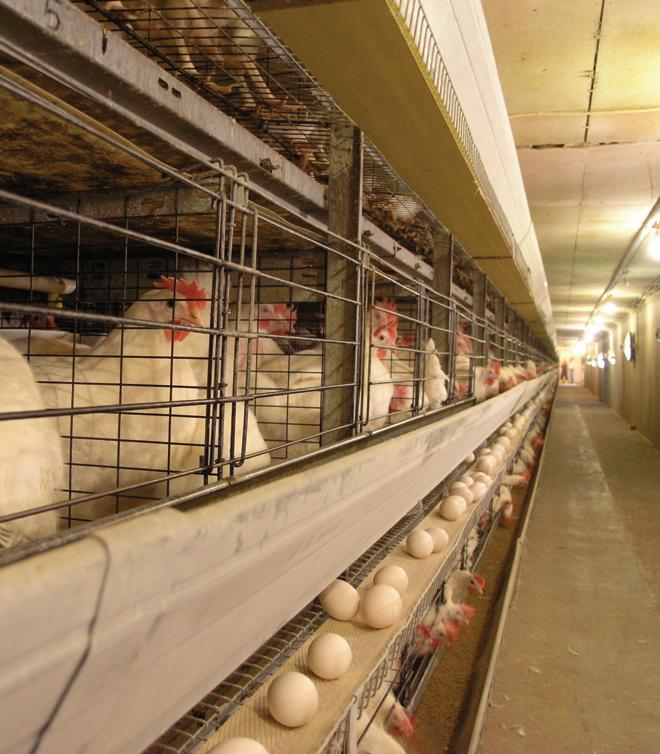
TALK TO THE ANIMALS
This study found that increased stockperson interactions were associated with lower fear of humans in laying hens and increased productivity.
Since earlier studies, new strains of laying hens have been introduced to the Australian industry, and the use of fully enclosed environmentally controlled sheds has increased. In addition, Barnett’s work did not measure the attitudes of the stockpeople, nor observe stockpeople interacting with the hens, although an estimate of time spent working in the sheds was provided by the stockpeople themselves. Due to the observed behavioural differences in hen strains and the more intensely controlled environment of the fully enclosed laying sheds, which reduces the amount of stockperson labour required, the present impact of human-bird relationships is
unknown.4 The aim of the present study was to explore the relationships between stockperson attitudes and behaviour and bird fear in today’s egg industry.
MATERIALS AND METHODS
Data were collected at 29 laying sheds on 21 commercial egg farms located in Victoria and New South Wales, Australia, and Ohio, U.S., over a two-year period. Each shed was visited for three days, and during this time data were collected on the attitudes and behaviour of stockpeople working in that shed, and the fear of an unfamiliar human displayed by the hens. The human observation data from five farms is still being collated and thus the results from 24 laying sheds are presented in this paper.
Individual stockperson behaviours were recorded for the main stockperson managing each shed over a two-day period. The total amount of time that the stockperson spent in different areas of the shed and the total number of stockperson interactions with birds (tactile, close visual and auditory contact) were recorded during bird inspections, as bird inspection was a common task performed in every shed. From these observations the following stockperson behaviour variables, adjusted for aisle length, were calculated: time spent in the aisle, time spent stationary in the aisle, close approach to birds, contacting the cage, feeder or egg belt, hand in cages, incidence of noise and total number of husbandry activities that occurred in the aisles without cage approach. Frequency of the above behaviours was recorded using a 5-s bout criteria interval. Speed of movement was calculated using the duration of time spent walking and the length of the aisle, producing the average speed of movement along the aisle. The individual stockperson data were used for analysis of the attitude-behaviour data, while the total behaviour data for all stockpeople in each shed were used for the analysis of
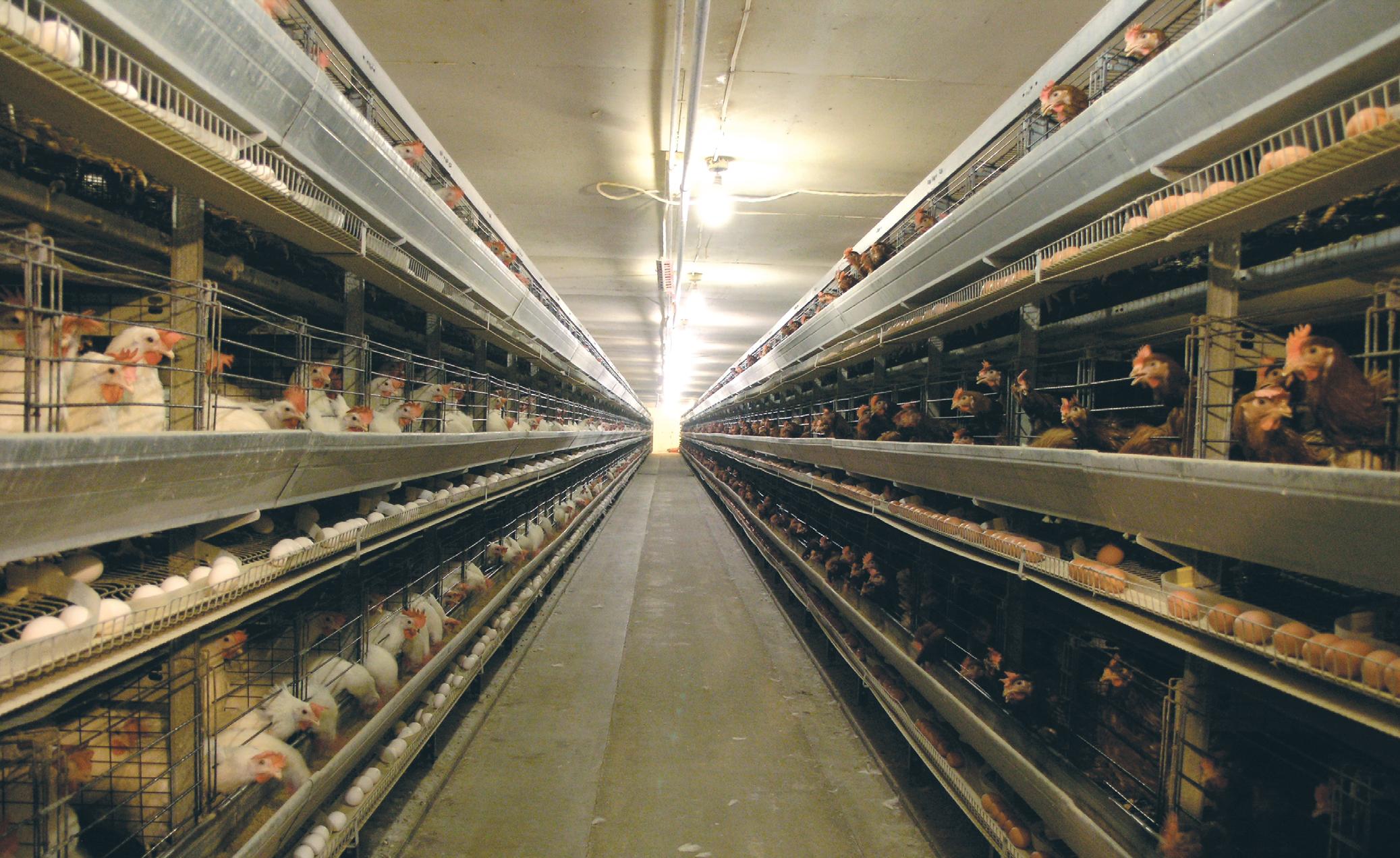
the stockperson and bird behaviour data, using shed averages.
The attitudes of individual stockpeople were assessed using an attitude questionnaire, which was composed of three sections: beliefs about working with laying hens, beliefs about the characteristics of laying hens and beliefs about interacting with laying hens. Due to the large number of questionnaire items, separate Principal Components Analyses were used to reduce the number of items in each section to a manageable number by identifying a small number of components, or groups of variables, that were statistically interrelated. The seven resulting variables accounted for between 39 and 48 per cent of the variance in responses, and all item groups obtained a Cronbach alpha score greater than 0.62. The questionnaire data were converted to scores and arbitrarily labelled to represent the group of questionnaire items that formed each component.
The level of fear of humans in laying hens was assessed by measuring the withdrawal response of birds to an unfamiliar human using the Approaching Human Test (AHT)5. During the AHT, the experimenter moved directly in front of the focal cage for 5 seconds and then stepped away for another five seconds. This procedure was repeated twice over a 20-second period. During each five-second period, the experimenter counted the number of birds with heads extended through the front of the cage and the maximum number of birds that moved their head into the front 5 cm of the cage, and made a point count of the number of heads still at the cage front at the end of each fivesecond period. This test resulted in a large number of variables, and a Principal Component Analysis was used to reduce the number of variables studied from 12 to two. These two resulting variables accounted for 81 per cent of the variance in the avoidance response. These data were converted to scores and labelled as the variables “FORWARD SCORE” and “HEADS OUT SCORE.” A high score for either was considered to indicate less avoidance or low fear of humans. Shed averages of these scores were used in analysis.
RESULTS
Birds in sheds in the U.S. displayed significantly greater (P < 0.01) avoidance responses than those in the Australian sheds, and stockpeople in the U.S. spent significantly less (P < 0.04) time in the sheds and interacted less with their birds. Thus, country was controlled for in partial correlations conducted to examine the correlations between stockperson attitudes, stockperson behaviour and bird behaviour.
Four of the seven attitude scores correlated with the individual stockperson behaviours observed during routine bird inspections and the main correlations between two of the scores and stockperson behaviours are reported in Table 1 as an indication of these attitude-behaviour correlations. Agreement by stockpeople with the statements in the attitude score labelled – DILIGENCE – which consisted of statements reflecting the importance of keeping a regular work routine, a thorough routine, and ensuring that the birds’ requirements are met, was positively correlated with the stockperson behaviour variables “TIME IN AISLE,” “TIME STATIONARY,” “CAGE APPROACH” and “CAGE ENTRY” during inspection of the birds by the stockperson. Agreement by stockpeople with the statements in the attitude score “NEGATIVE ASPECTS OF THE JOB,” which consisted of statements reflecting dissatisfaction with the job, was positively correlated with the stockperson behaviour variables “SOM” and more “NOISE” by the stockperson during inspections.
Several stockperson behaviours were correlated significantly with bird behaviour. The variable “NOISE” was negatively correlated with both the “FORWARD SCORE” (r = -0.57, P = 0.01) and the “HEADS OUT SCORE” (r = -0.46, P = 0.03), indicating that birds showed greater avoidance of the experimenter in sheds where there was a higher incidence of noise.
The “HEADS OUT SCORE” was positively correlated with the variables “VISUAL CONTACT” (r = 0.55, P = 0.01), “CAGE APPROACH” (r = 0.43, P = 0.04) and “CAGE CONTACT” (r = 0.43,
THE STUDY FOUND THAT U.S. PRODUCERS SPEND LESS TIME WITH THE BIRDS AND THE HENS ARE MORE ANXIOUS.
Relationships
TABLE 1. Partial correlations (r), controlling for country, between some stockperson attitude and stockperson behaviour variables (df = 19).
P = 0.04), indicating that birds showed lower avoidance of the experimenter in sheds where there was an increased frequency of human activity.
DISCUSSION
The results of the present study provide evidence of relationships between stockperson
attitudes, stockperson behaviour and bird fear. Stockpeople who scored highly on the attitude score “DILIGENCE” (that is, agreed with the statements on the importance of diligence) tended to spend more time working in the aisles during inspections, whilst stockpeople who scored highly on the attitude score “NEGATIVE ASPECTS OF THE JOB” tended to move more quickly and

make more noise during inspections. On farms where there was a lower incidence of noise and a higher incidence of human activity in the aisles the birds displayed low fear of humans. These results suggest that selection or training of stockpeople on poultry farms should target diligence and job motivation. This may lead to improved stockperson behaviour and reduced bird fear. These results also are consistent with similar work conducted in the pork and dairy industries, in which stockperson attitudes were correlated with stockperson behaviours, which in turn were correlated with animal fear.6,7
Fear is an undesirable emotional state of suffering that may reduce the welfare of intensively farmed poultry, and thus these relationships between stockperson attitudes, stockperson behaviour and bird behaviour have implications for bird welfare.8 As shown in other livestock
Continued on page 50

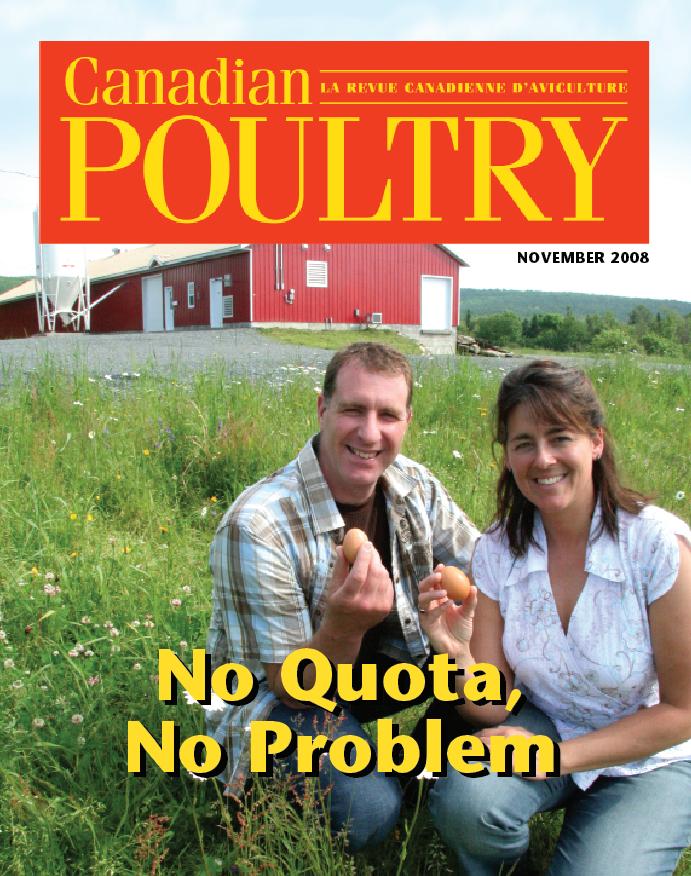
PLEASE CHECK ONE:
❑ Poultry Producer or Employee
❑ Government, Libraries, Schools, Universities
❑ Hatchery, Hatchery Employees
❑ Fancy or Show Poultry
❑ Wholesale Produce and Processors, Further Processing
❑ Equipment Manufacturers
❑ Drugs, Laboratories, Vaccine Companies, Chemical
❑ Veterinary and Lab Technicians
❑ Feed Manufacturers, Feed Additives, Distributors and their Salespeople
❑ Other (please specify)


Grading Trends in Egg Grading
Further automation and software features will dominate the future egg grader market while service makes the difference
BY PAUL BUISMAN, PRODUCT MANAGER MOBA B.V. BARNEVELD, THE NETHERLANDS
After a constant race for more capacity and functionality, modern egg graders are now coming to a point where food technology is gradually being introduced. Technology that is well known in other industries (e.g., the meat industry) was for several reasons not yet applicable in shell egg grading equipment. With the increasing demands for food safety, this is changing rapidly.
Together with food technology, other means to improve consumer safety are becoming more important. Reliable traceability systems that are accurate on the egg even in machinery that processes more than a million eggs per day is within reach. Last but not least, the overall quality awareness makes that more and more critical that handling be done by dedicated equipment, reducing risks of cross contamination and subsequently ensuring a controlled grading and packing trajectory until shipment from the egg packing station, eliminating chances for human errors.
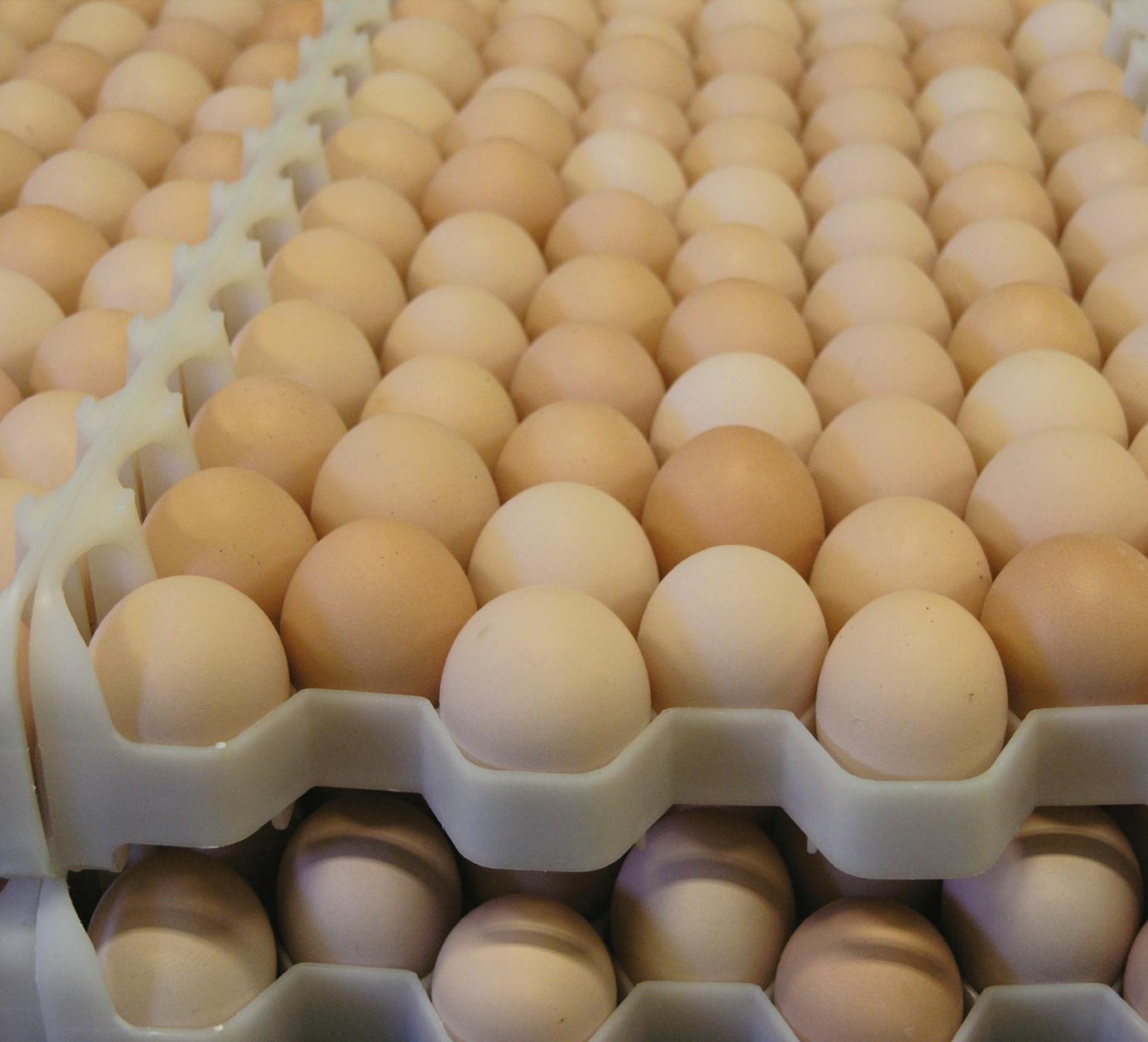
Technology for shell grading equipment is changing rapidly to meet food safety demands.
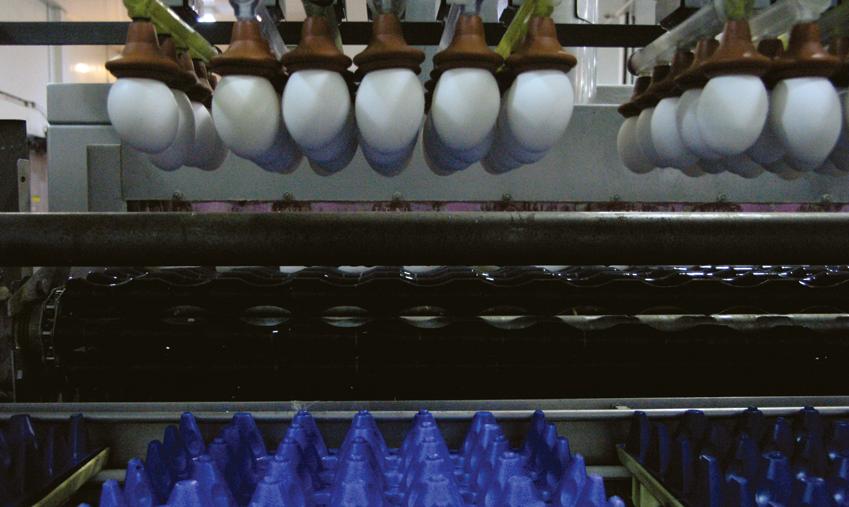
INTRODUCTION
It is a clear trend that egg grading is a business of ongoing consolidation. The number of egg grading corporations as well as the number of physical packing stations is dramatically decreasing in the western world. In many European coun-
tries, the number of egg packing stations is only between 10 per cent and 20 per cent of what it was 15 years ago. It is all the result of relatively low egg prices in a world of continuous inflation. Margins on eggs are getting smaller by the day and one of the ways to compensate this is to simply process more eggs.
For a layman it might seem that
FOOD SAFETY









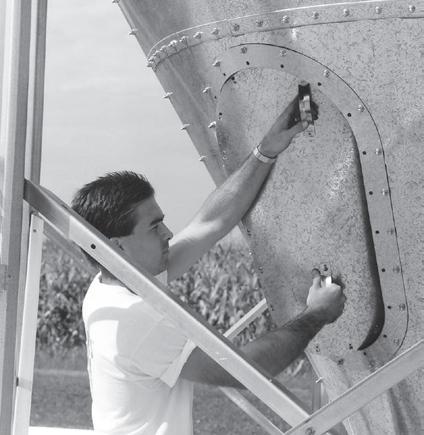
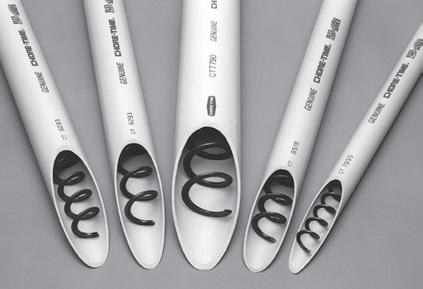
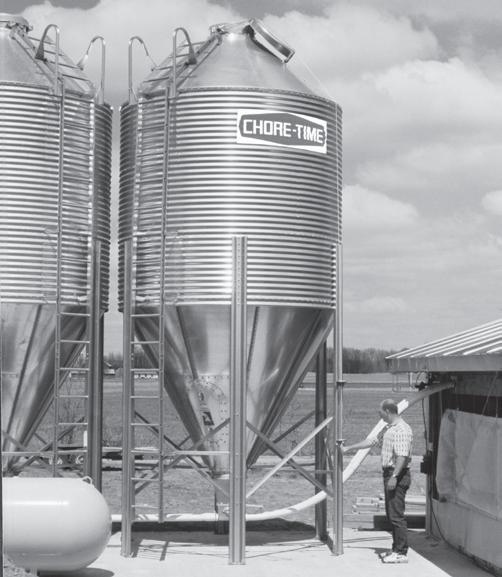
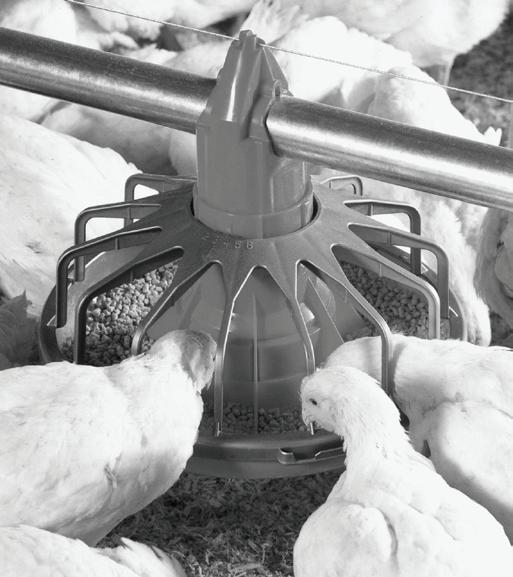
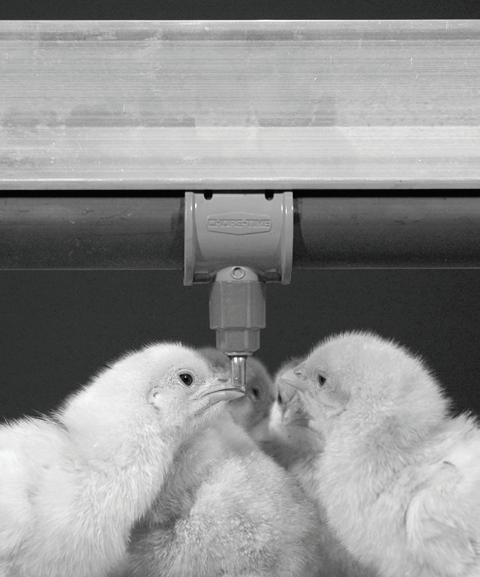


SolarWall
Exacon Inc.is pleased to announce that we have been appointed the Exclusive “Agricultural” Distributor for SolarWall in Ontario
• SolarWall has been installed on hundreds of agricultural and live-stock buildings, reducing heating costs by up to 30%. The system, which uses the sun to pre-heat incoming fresh air, also dramatically improves air quality and decreases humidity. There are many reasons to consider SolarWall for your new or existing buildings:
• SolarWall provides thirty years or more of free heat.
• SolarWall means more fresh air can be brought into the building improving air quality without increasing heating costs.
• SolarWall is maintenance free and has no moving parts.
• SolarWall is cost effective - As of September 1, 2008 there is a federal contribution of $70.00/m2 of solar panel area and a matching $70.00/m2 contribution from the Ontario provincial government.
• SolarWall also contributes to cooling a building in the summer by shading the existing outside wall from the sun.
Call Exacon or an authorized SolarWall dealer near you for additional information and to obtain a free quote.
Grading
for exactly these reasons, egg-grading equipment is just getting bigger in its capacity, but when one looks in more detail into this market, remarkable and interesting changes are taking place right now!
MARKET CHANGES AND REQUIREMENTS
Product diversification: For a certain part of the world (so called new markets) the just produce more eggs requirement is still valid. One can think of countries where labour is still relatively cheap but the need for high-speed, high-quality equipment is quickly rising. Where the rest of the world is a saturated replacement market, these emerging markets like Russia and China are making huge steps in implementing brand new highcapacity equipment.

In many of the saturated markets, another clear trend is product diversification. More specialized products on the shelf of the supermarket create possibilities like branding of certain eggs. Special eggs, appealing to consumer health, food safety and animal welfare, together with marketing through a wide variety of nice egg packs, changed eggs from a standard commodity to specialized products. This larger variety opens up chances for better margins on some of the products. Because of the wider range of products, the product flow within many packing station has become less uniform and thus less easy to record and track in case of problems. On the other hand, packing stations must see to it that no mixup of the different and reliable. That is exactly the reason for integral quality management being so high on the agenda of all packing stations throughout the world.
It is therefore no surprise that egg graders are regarded as potential dangers for cross contamination. For example, salmonella: it is widely accepted that horizontal contamination is the major cause of an egg becoming infected with salmonella bacteria. In many cases the egg already came in contact with manure or egg liquids from broken eggs in the housing or transport system, but an
Grading
egg-grading machine that handles hundreds of thousands of eggs can become a potential danger as well.
ULTIMATE FOOD SAFETY, NOT YET FOR TABLE EGGS
The ultimate goal is, of course, to provide the industry with equipment that is capable of repairing an infected egg. There is technology available to do so, but it is either very controversial, such as using gamma radiation, or impractical for large volume egg grading, that is by pasteurizing eggs in the shell. The problem is that the range between the temperature of pasteurizing the eggs and the temperature at which albumen starts to coagulate is very small.
This makes that system’s need to expose eggs to a very well controlled temperature close to the point of coagulation for a longer period of time. Systems doing so for table eggs either by heated air or water proved to be impractical, expensive and only suitable for limited volumes of eggs. Today, real disinfection of table eggs is therefore not in reach, but given the fact that cross contamination is mainly caused by horizontal transmission, a lot can be done in order to prevent this as much as possible within egg graders by following the next steps in prevention.
METHODS FOR IMPROVING FOOD SAFETY
Step 1: Avoid the buildup of substrate. Egg liquids, in particular, egg yolk, is a perfect substrate for micro-organisms. It is, therefore, a must to get leaking eggs out of the grading process as quickly as possible. This needs to be done by technology that avoids the chance of spilling the liquid over other eggs, even before the leaking eggs are rejected. Traditional rollers used to transport eggs are replaced by systems where each individual egg is carried by its own sets of rollers (double rollers) or by roller types that where the surface that is in contact with the eggs is very limited (spiral rollers). Leaker detection is best achieved by vision systems and sophisticated imageprocessing computers.


Step 2: Clean rollers. A cleaning brush that cleans the rollers during production is common practice, but improved modern versions are able to get rid of dirt and liquid during production while the brushes can be cleaned and disinfected after production by cleaning in-place systems using detergents and disinfectants. Modern graders also combine this with cleaning in place systems for rollers.
Step 3: Make the system easy to clean. This step is so obvious that its importance is often overlooked.
Step 4. Make sure the surfaces of the eggshells and rollers are disinfected. This can create a sort of clean zone in the egg grader. Although ozone treatment can be effective if egg and equipment can be exposed for a longer period (think in at least minutes), today’s common practice is a light ultra-violet treatment. With highly efficient lamps exposure times are a matter of seconds, which is a much more practical solution for high-speed egg grading.1
Step 5: Place as much equipment above the egg flow as possible. Again, very obvious, but not an easy task for the engineering teams. Delicate equipment that needs to be in contact with the eggs, such as crack detection systems, weighing equipment and grippers to transport the eggs, are best placed above the egg flow and constructed in such a way that dirt falls off immediately. Use of plastics with low adhesive properties helps a lot.
Step 6. Clean and disinfect the egg packing lanes. Risks occur where eggs are placed in consumer packs after grading.
Two things are necessary here: first, liquid must fall down in bins rather than spread over other eggs, conveyers and catching devices, and second, units that touch eggs must be cleanable and disinfectable.
CONCLUSION
In conclusion, we can say that there is no super-one-step concept for food safety regarding eggs and egg grading, but it is a series of little measures that together become a powerful prevention system.
Grading
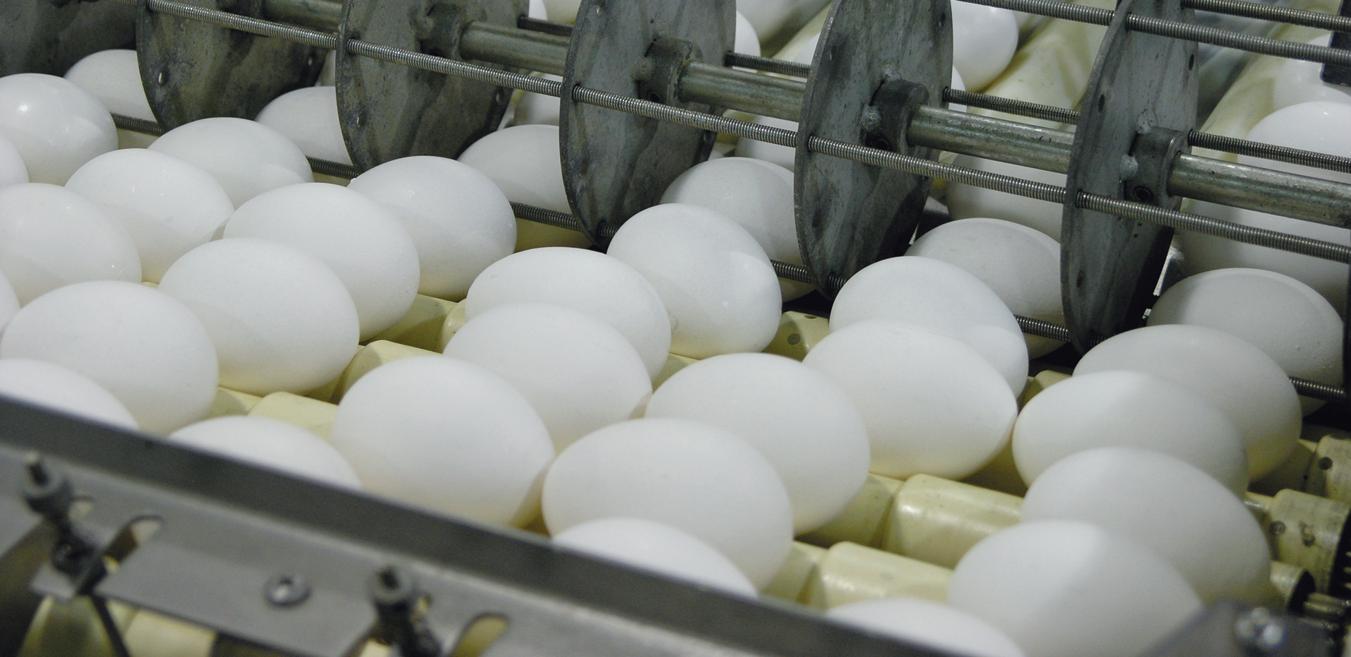
Food safety is a series of little measures that together become a powerful prevention system.
On top of just cleaning, exact knowledge about the total logistics, constant checking of critical steps in both operational and in maintenance processes have become keys to success. Many people associate HACCP programs with cleaning procedures, but anticipating for food safety is the whole package; from the initial packing station design plan to the daily operational procedures.
The egg-grading industry is rapidly migrating from a totally agricultural type of industry towards true food processing. Big players in industry recognize the complexity and see the advantage of guiding their customers in this process. There are even commercial mottos for such a process: From machine builder to solution provider. This slogan fits in many ways and expresses exactly what the customer base is asking for: a one-stop shopping address for making the first plans for a packing station and providing reliable after sales support for many years, no matter where or when.
There is also the trend to do the final packing of consumer packs into cases, crates, shippers or display pallets automatically. This is not only driven by labour costs but also by the problems of getting a good, reliable, motivated workforce.
An interesting phenomenon is that in some cases the lack of human handling after the grading machine results in fewer hairline cracks. There are situations known where this was over one per cent.
The latest grader software is able to
control the output quality of the grader very accurately, creating more room to make even better use of all incoming eggs. Anyone can imagine how much money can be earned by packing one per cent more into consumer products by smart usage of software algorithms. Service makes the difference; in projects where automation plays such an important role, exactly the last and most critical step in such a project is the after sales service. This is regarded to be so important, that without investing in a global service network, selling equipment in areas where because of distance and/or time differences, adequate s ervice is more difficult to arrange, is virtually impossible. In general,the eggindustry-only companies who heavily invest in global service networks, are able to survive. The more people rely on technology, the more important it becomes to rely on a service structure that offers unconditional help if needed. ■
REFERENCES
1. K. De Reu1*, K. Grijspeerdt1, M. Heyndrickx1, L. Herman1, M. Uyttendaele2, J. Debevere2, F.F. Putirulan3 and N.M. Bolder3 Publication: The effect of UV irradiation on the bacterial load of shell eggs.
Koen de Reu, Ministry of the Flemish Community, Agricultural Research Centre, Department of Animal Product Quality and Transformation Technology, Brusselsesteenweg 370, 9090 Melle, Belgium







Relationships
Continued from page 42
industries, training and selection programs targeting these key stockperson attitudes and behaviour may provide opportunities to improve bird welfare in those situations in which human-animal relationships are less than optimal.9 The implications of bird fear on bird productivity require rigorous examination.
Authors:
1Animal Welfare Science Centre, University of Melbourne, Parkville, Victoria, Australia, 3052.
2Department of Psychology, Monash University, Clayton, Victoria, Australia, 3800.
Acknowledgments:
The financial and technical support of the Australian Poultry Cooperative Research Centre, the University of Melbourne, Cooper Farms, Ohio State University and the Department of Primary Industries for this research is gratefully acknowledged. ■
REFERENCES
1. Hemsworth, P.H. and Coleman, G.J. (1998) Human-livestock interactions. The stockperson and the productivity and welfare of intensively farmed animals, Oxon, CAB.
2. Barnett, J. L., Hemsworth, P.H. and Newman, E.A. (1992). British Poultry Science, 33, 699-710.
3. Cransberg, P.H., Hemsworth, P.H. and Coleman, G.J. (2000). British Poultry Science, 41, 272-279.
4. Craig, J.V., Craig, T.P. and Dayton, A.D. (1983). Applied Animal Ethology, 10, 263-273.
5. Hemsworth, P.H., Barnett, J.L., and Jones, R.B. (1993). Applied Animal Behaviour Science, 36, 197-210.
6. Breuer, K., Hemsworth, P.H., Barnett, J.L., Matthews, L.R. and Coleman, G.J. (2000). Applied Animal Behaviour Science, 66, 273-288.
7. Hemsworth, P.H., Barnett, J.L., Tilbrook, A.J., and Hansen, C. (1989). Applied Animal Behaviour Science, 22, 313-326.
8. Jones, R.B. and Waddington, D. (1992). Animal Behaviour, 43, 1021-1033.
9. Hemsworth, P.H. (2003). Applied Animal Behaviour Science, 81, 185-198.

• Phone (519) 428-3471 • Fax (519) 429-3094

Info Market Group Lacombe
BROILER BREEDER FARM
Good location with 18,658 units broiler breeder quota. 1 grower barn and 2 layer barns. Newer home with 6 bedrooms.
EDMONTON AREA
10 acre broiler farm with 36,600 units broiler quota. 3 Barns and insulated and heated shop. Beautifully renovated log home with 5 bedrooms.
BROILER BREEDER FARM

27778 bird layer farm for sale. 6-1/2 year old layer barn. 1-1/2 year old pullet barn on 160 acres.
Kirwin Custom Spraying Ltd.
• High pressure hot water washing
• Spraying for mite control
• Painting agricultural buildings
• Serving SW Ontario and vicinity 1-800-923-4488 519-475-4868
FOR SALE
Diamond 8400 Egg Grader
• electronic scales
professionally reconditioned recently
• 12 wide
• 6 packers
• crack detector
• stainless washer
• 8400 loader
• triple basket carriage
• (can be expanded to 16 packers) dirt detector optional
• all the software and hardware has
• been updated capacity of 200-300 x 15dz/hr but can
• be expanded to 800 x 15dz per hr easily fits on 2 tractor trailers
• Contact: 613-240-7612 or eggdude@xplornet.com
FOR SALE
Moba Mopak55 (eggpacker) Six years old, handles 25,000 layers. Please contact: 506-852-1233 or ronaldoabourgeois@hotmail.com

60 acres with 2 barns (50’ x 300’ and 44’ x 289’), 9126 + 1300 units annualized quota. Vencomatic & Van Gent nesting & egg gathering systems. 1230 sq. ft. bungalow with 5 bedrooms.
If you are looking to buy or sell a poultry farm, Andries is an experienced Ag Realtor.
Bus: (403) 782-2114 Mobile: (403) 391-6260 www.centralalbertafarms.com
EMPLOYMENT
1 hour south of Calgary, 50 minutes north of Lethbridge in Vulcan, Alberta. 3 bedroom house, shop, etc.
Very clean operation.
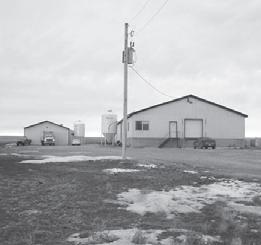
Buy a going concern for the same price as quota compared to other provinces. Call Leo: 403 863-6405 or 403 938-2032 leobrass@telusplanet.net

FARMS AND RANCHES FOR SALE! Info Market Group GMAC Real Estate Coaldale, AB 1-866-345-3414 www.canadafarmandranch.com
POULTRY FEED SALES CAREER OPPORTUNITY
Join the Sales Team of this successful and expanding Fraser Valley feed producer.
The Ideal Candidate will have:
• 2 plus years Poultry Feed Sales experience (broilers, layers, and/or turkeys),
• agriculture degree/diploma with animal science or agriculture business specialty or extensive poultry experience,
• working knowledge of business software including excel (spreadsheets), word etc.,
• a passion for sales and service and the appropriate skills to achieve success.
The Rewards: a compensation package that includes annual salary of $55,000 - $75,000, annual performance bonus, vehicle allowance, a generous benefit package, and moving assistance.
To explore this career opportunity in confidence, contact: Bill Walsh at 604-669-1203 or e-mail: bill.walsh@adecco.ca.
REAL ESTATE

K. MILLER REALTY, BROKERAGE
Each office is Independantly Owned And Operated
220 BROAD ST EAST, DUNNVILLE, ONTARIO N1A 1G2
Phone 905-774-7624 or Toll Free 1-888-718-8445 Fax 905-774-5960
BROILER BREEDER FARM WITH 19010 H.E.M.S.: 1 Barn operation. Vercomatic nests. Plasson & Cumberland Nipple Drinkers. Chain feeders for Hens. Pans for Roosters. Bird scales. Plastic slats. Auto Ventilation from cross to tunnel. Birds out Fall 2008. Back in Feb. 2009. 75 KW Generator. 5 Bdrm brick home. 2nd home on property. Call Jack.
50 ACRE BROILER FARM - 2 BARN OPERATION: Barns have new steel, insulation checked and replaced where necessary. All equipment set for broilers. Barns have new vents and controls. Generator building. 3 bdrm brick bungalow completely updated. Large pond for water. Call Jack.
WANTED: Broiler Farm in Woodstock area.
GRIMSBY AREA: 10 Acres on paved road. 32,000 sq ft of barns with auto generator. 40 x 60 x 2 driveshed used as retail outlet. 3 bdrm century brick home, pool. Call Jack
19,959 H.E.M.S.: 4 barn operation. Split flock. Jensen Nests. Nipple Drinkers. Chain Feeders. 4 Barns – 30’ x 300’. Generator. 3 bdrm Home. Call Jack.
MODERN POULTRY FARM: 2 barn operation. Auto ventilation, feeding system, nipple drinkers. Standby generator. Drive shed. 4 bdrm, 2 bath home. 48 acres sandy loam soil. Tiled. Paved Road. Call Jack.
NIAGARA AREA: 45,000 sq. ft. of barns, small acreage, 3+2 bdrm home, natural gas heat. Nipple drinkers, pan feeders, radiant tube heaters. 14,000 Quota available at market price. Indoor pool and paved road location. Call Jack.
EXECUTIVE FARM ON 30 ACRES: Brick 4 bdrm, 4 bath home. Hardwood floors and ceramic, full finished basement with 2nd kitchen. 2 car garage-workshop and large barn rented long term at $800.00/month. Paved road. Priced at $599,000.00 Call Jack.
QUOTA: 8,000 H.E.M.S available. Call Jack for details
FARMERS FARM: 1000 Head finishing barn. Total Slats. Auto Sort. Chicken barn set up for Partridge. Sold on weekly schedule. Workshop 30’ x 110’. 3 bdrm home all on 50 acres of land. Call Jack
Jack Huitema, Broker of Record (res.) 905-774-8291 jack-huitema@coldwellbanker.ca
Richard Vyn, Broker (res.) 519-674-2434 rvyn@ciaccess.com
Ross Emerson, Sales Rep. (res.) 905-899-1056 remerson@sympatico.ca www.Coldwellbanker.com.

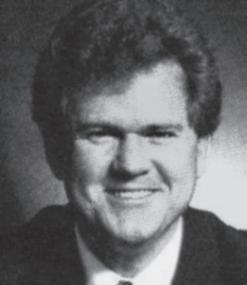

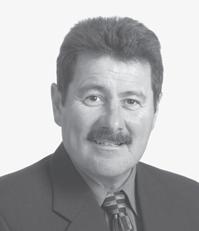
ALL THINGS CONSIDERED
BY JIM KNISLEY
Beware of Sharks
In Lewis Carroll’s Through the Looking Glass, Alice is a mere pawn threatened by the Red Knight. But all is not lost as the White Knight comes to protect her.
After a brief, furious and futile struggle the Red Knight rides off. Alice looks at her protector and notices many strange things not the least of which is a mousetrap on the horse’s back. When Alice asks if there had ever been any mice on the back of the horse the knight said no, but if any came he was ready.
Then the knight proudly pointed out the anklets around the horse’s feet. After Alice asked what they were for the knight explained they were to guard against shark bites.
The anklets, even though the knight had never come across any sharks, were even more important than the mousetrap. If sharks ever did attack the knight would lose his horse and you can’t be a knight without a horse.
“You see, it’s as well to be provided for everything,” the White Knight said.
While this may all seem silly, George Bush and the U.S. financial system would have been much better served if they had been ready for everything rather than prepared for nothing.
While the U.S. President, Congress and regulators were standing back, eyes upraised, praising the wonders of the unfettered free market, the mice scampered about stealing the food from the saddlebags and then the sharks attacked. Bush and company are now busy trying to pick up the pieces and stitch together a horse that they can ride into the sunset.
When he published the book in 1871 Lewis Carroll wasn’t writing about today’s financial system, but he may as well have been.
For years, the mice have been scampering around the U.S. peddling mortgages to anyone with a pulse. For the mice the commissions made for a banquet. The mortgages were then passed on to Wall Street where the sharks took over. The mortgages were sliced and diced, repackaged and peddled as sound, safe, secure investments.
more houses went on the market. House values fell and everyone was in trouble and it was big trouble.
Not only were people losing their homes, but some of Wall Street’s finest had been using the fancy mortgage backed securities to bolster their balance sheets and as security on other loans.
In Washington, D.C., no one had a clue because no one was watching. It was an article of faith that the free market worked best with little regulation and myopic oversight.
Unlike the White Knight they weren’t ready for anything, let alone being ready for everything.
Now, with the damage done and even Bush admitting everything has fallen apart the U.S. government is printing or borrowing – yes borrowing because the U.S. government was already running an annual deficit of almost half-a-trillion dollars and is carrying a national debt of almost $12 trillion – about one trillion dollars. And that is not a typo: it is trillion with a “t”.
If all of this didn’t have worldwide impact it would be easy to mutter about Bush’s folly.
The least of the impacts is that China which has been lending the U.S. billions and billions of dollars and getting gratuitous advice on how they should run their economy, in return are able to say with confidence, “We know best.”
Even the Swedes, who effectively dealt with a banking crisis, are offering advice to the Americans.
It’s as well to be provided for everything
The whole thing worked like a giant ponzi scheme. As long as there were people out there who could be talked into buying a house they couldn’t afford with no down payments and low introductory interest rates that they could afford, everything was fine. House values kept rising, cheap money kept flowing and the mortgage brokers kept taking in their thousands in commissions while Wall Street booked hundreds of millions in paper profits.
Then, suddenly, there were more houses than buyers. Mortgage interest rates rose, people couldn’t pay the increased costs and
More important are the worldwide financial impacts. Even if the U.S. puts together a program that stops the bleeding, future anemia is a threat. Credit is already tightening and could get tighter. Interest rates will likely rise and inflation could become a greater problem. A recession seems all but certain.
This is especially worrisome for Canada. It is often said that when the U.S. catches a cold, Canada gets pneumonia. What happens when the U.S. gets pneumonia?
Some of the effects are already evident. Manufacturing plants are closing and well-paid jobs disappearing. There are even some oil sands projects that have been sent back to the drawing board.
And all of this is happening because the U.S. government decided the U.S. financial system didn’t need protection even though they knew the waters were treacherous.
While the White Knight may have been foolish to protect his horse from shark attack, that pales in comparison to the negligence of free marketeers who headed into shark infested waters and took no precautions, not even a mousetrap. ■



This is just one of the challenges that Danisco can help you solve.
Using new Thermo Protection Technology, Phyzyme XP TPT phytase is heat stable up to 95°C. This highly effective new generation phytase is at least 20% more effective than traditional phytases in improving the digestibility of phosphorus and other nutrients contained in many feed ingredients.
Thermo Protection Technology enables Phyzyme XP TPT to be included before pelleting in the majority of feed manufacturing processes.
TPT
To find out more please contact
Halchemix Canada Inc
Tel: 1-800-540-4756
halchemix@halchemixcanada.com www.halchemixcanada.com
John Van Oort
Tel: 403-701-2445
john.vanoort@danisco.com www.danisco.com/animalnutrition