BANDIT CHIPPERS WILL INCREASE THE QUALITY OF YOUR CHIPS.
AVAILABLE WITH NEW SCREENING SYSTEM!

BECAUSE SIZE & QUALITY MATTER.
Available with new screening system and microchip drum!
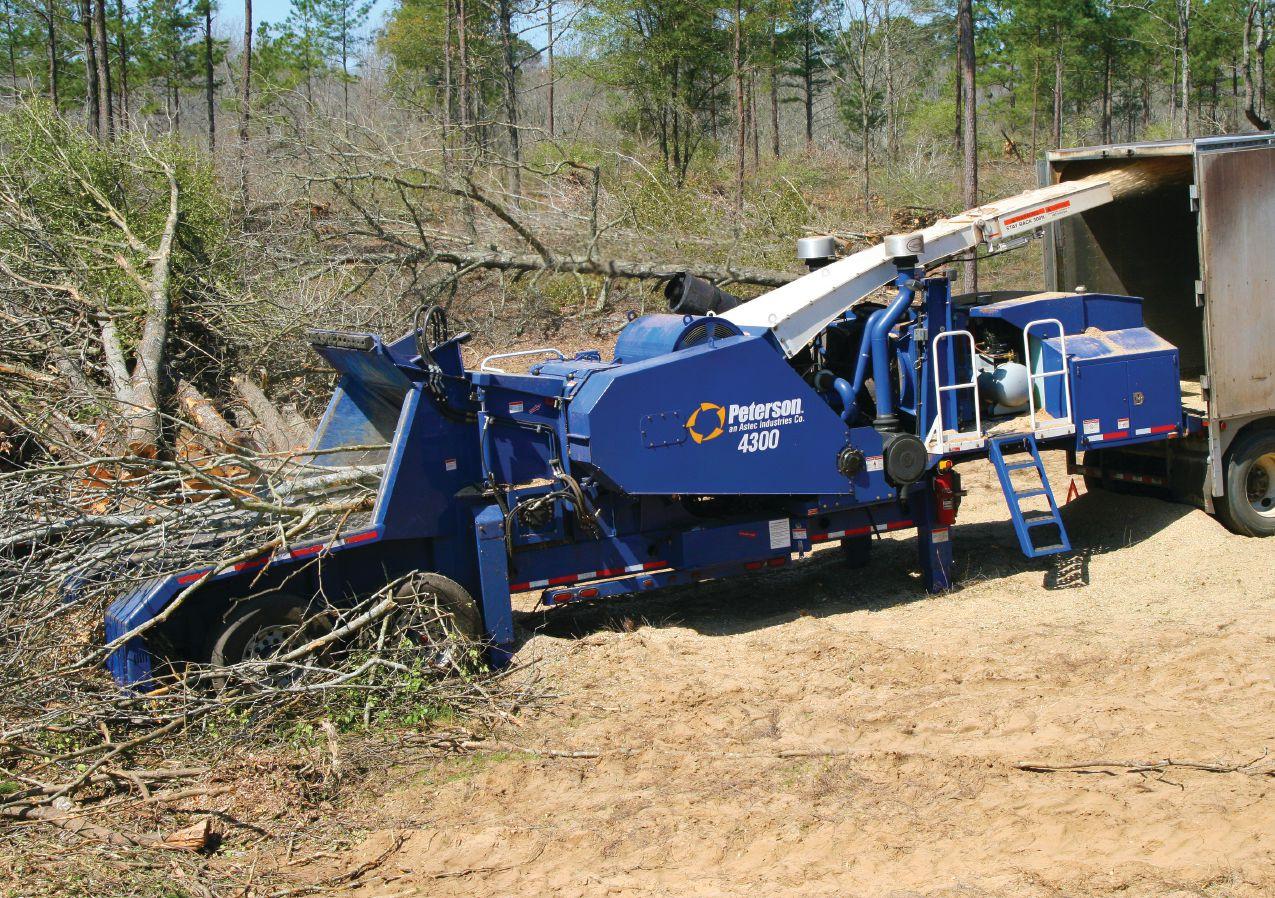
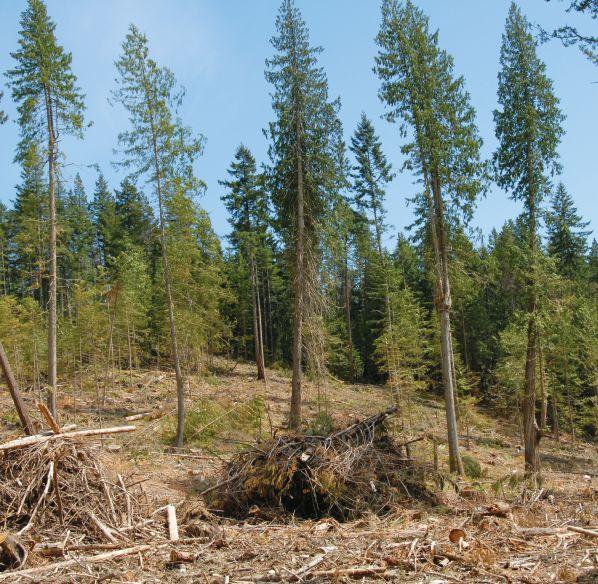
The demand for biomass energy is growing. Size and quality are important to the power plants. Bandit whole tree chippers are known for producing high quality chips. Bandit chippers can produce a microchip 1/4”, 3/4” standard or 1-1/2” maxichip. Our unique card breakers remove oversized pieces, providing you with the exact chip you need, every time. Combined with Bandit’s legendary ruggedness and unstoppable production, it’s no surprise these machiens are #1 in the woods. So let Bandit take you to the top of the biomass market: call your local Bandit representative to schedule a demonstration today!
Beast® Horizontal Grinders Track Carriers
Whole Tree Chippers
BIOLOGICAL GREENHOUSE GAS MANAGEMENT CALL FOR EXPRESSIONS OF INTEREST
The Climate Change and Emissions Management (CCEMC) Corporation has CAD $40 million in available funding for innovative projects that will reduce or avoid greenhouse gas emissions, or enhance carbon sequestration, through the use of biological organisms such as plants, animals or microbes.
The scope of this EOI includes projects that:
> Discover, develop and/or deploy transformative practice change in the forestry, agriculture, municipal waste handling and/or energy sectors,
> Develop or modify bio-processes,
> Replace non-bio-based feedstocks with bio-based feedstocks,
> Develop and manufacture novel bio-products,
> Use biological organisms or bio-based materials to reduce emissions in non-biological industrial systems.
The maxiumum contribution to a single project is CAD $10 million. For more information and to apply, please visit ccemc.ca

SUBMISSION DUE: FEBRUARY 21, 2014
Proposals must be submitted online through the Climate Change Information Management System at CCEMCadmin.ca
CANADIAN BIOMASS
20 Pellet PoWer
A Belgian power station that converted from coal to wood pellets proves to be hungry for Canadian wood.

12 Green energy makes cents
A hospital in the Bas-Saint-Laurent region of Quebec reaps the economic rewards of its conversion to biomass.
16 Up and running
With four years of construction behind it, Kyoto Fuels is finally producing biodiesel.
23 Pellet logistics
Fibreco provides pellet producers with logistics solutions for moving pellets to Europe and Asia.
25 Grinder spotlight
The newest grinder offerings in Canada provide more flexibility and customization than ever.
29 WPAC conference highlights
Canadian Biomass attended the WPAC conference in Vancouver in mid-November and reports on the most memorable moments.
30 CanBio conference highlights
Canadian Biomass reports on the news from the recent CanBio conference.
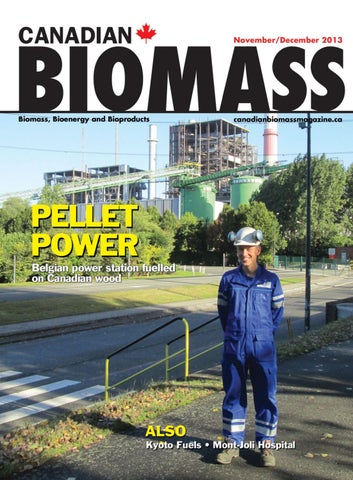
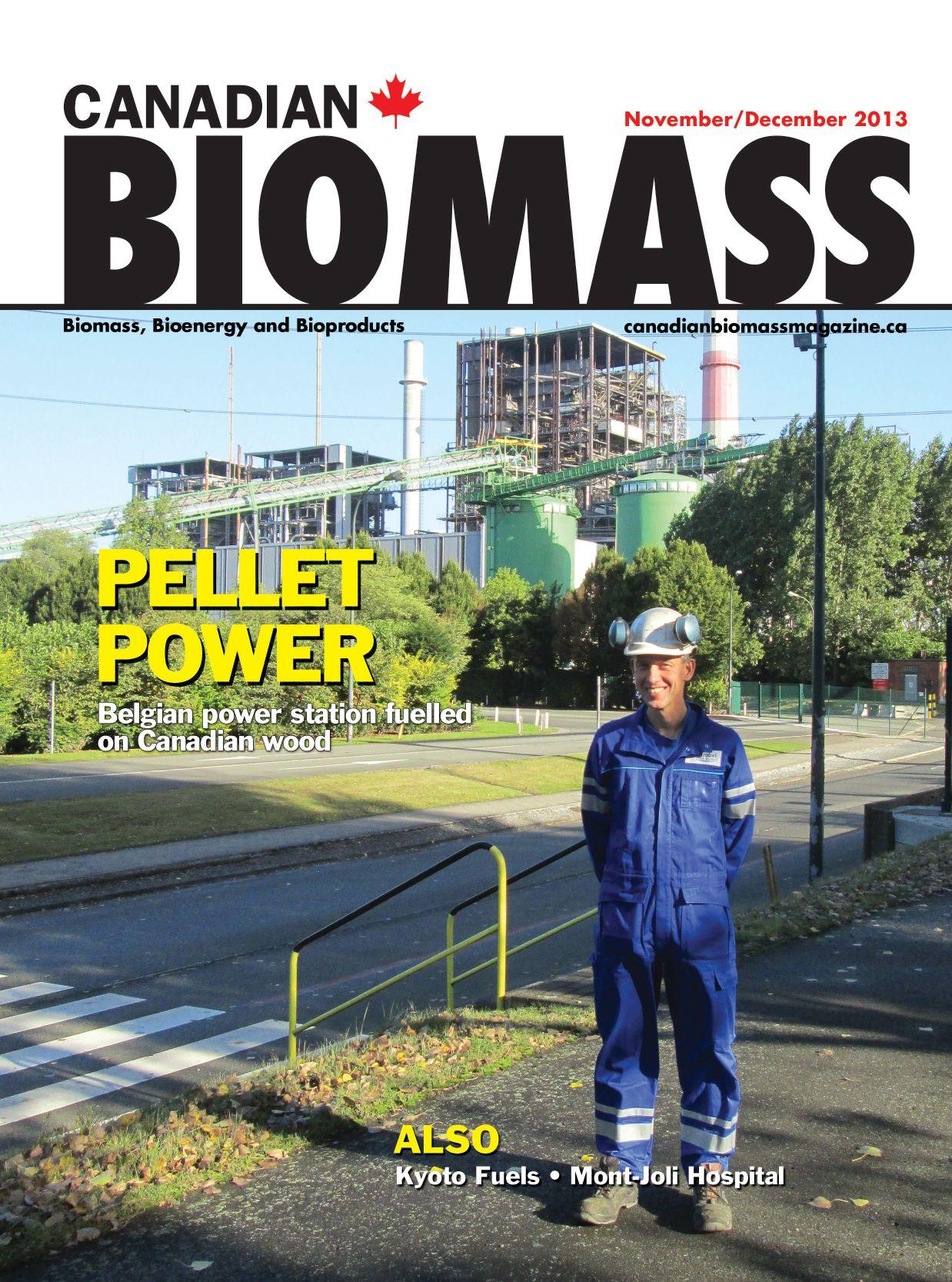
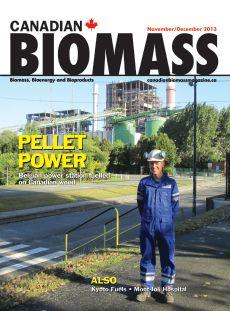
Rodenhuize Power Station, a biomass fuelled plant in Belgium, is one of the largest consumers of Canadian wood pellets. Cornelis Stevense provided Canadian Biomass with a
on page 20.




tFuture pellet markets
he WPAC Conference and AGM in Vancouver provided an incredible amount of optimism for a Canadian pellet market looking to further establish itself as a global producer.
The strongest market for Canadian pellets remains the United Kingdom. The U.K. Back Biomass Program, which was supported by both WPAC and the U.S. Industrial Pellet Association (USIPA), has helped to establish a strong demand for biomass power. England’s expansion plans could see its demand increase upwards of 20 million tonnes of pellets, including an expected 10 million tonne demand from Drax and Eggborough alone, part or all of which could be provided by Canadian producers if they are able to compete with the U.S. southeast.
mean a boom for Canadian producers. That would be a welcome sight as the European Union works out its sustainability criteria and Canada continues the slow expansion of the domestic market. If the EU is successful in making wood pellets a strong factor in sustainable energy initiatives moving forward, then the demand from European countries could cause a need for exponential growth of wood pellet supply in North America. Also, it is tough to predict if the Canadian pellet demand will continue its snail-like pace, or if demand can be pushed higher, faster.
Volume 6 No. 6
Editor - Amie Silverwood (289) 221-8946 asilverwood@annexweb.com
Associate Editor - Andrew Macklin (519) 429-5181 amacklin@annexweb.com
Contributors - Scott Thurlow, Treena Hein, Gordon Murray, Guillaume Roy
Editorial Director/Group Publisher - Scott Jamieson (519) 429-3966 ext 244 sjamieson@annexweb.com
Market Production Manager
Josée Crevier Ph: (514) 425-0025 Fax: (514) 425-0068 jcrevier@annexweb.com
National Sales Manager
Ross Anderson Ph: (519) 429-5188 Fax: (519) 429-3094 randerson@annexweb.com
Quebec Sales
Josée Crevier Ph: (514) 425-0025 Fax: (514) 425-0068 jcrevier@annexweb.com
Western Sales Manager Tim Shaddick - tootall1@shaw.ca Ph: (604) 264-1158 Fax: (604) 264-1367
Media Designer - Brooke Shaw
Canadian Biomass is published six times a year: February, April, June, August, October, and December.

The Netherlands and Denmark are key European markets to watch. Like the Danish government, which is currently revising its energy plan, the Netherlands has worked with both WPAC and USIPA to explore adding wood pellets to its energy mix.
Wood pellet demands may continue to expand in southern European countries, particularly in Italy. Canada has already seen solid exports to that country, but speakers at the WPAC Conference suggested there is an appetite for increased exports to supply the pellet market for residential heating.
There remains the possibility of expansion of pellet markets to countries in southeast Asia. Japan is the third-highest import market for Canadian wood pellets, and there have been limited exports to Korea. Although both countries look to regional producers of wood pellets before importing from Canada, significant growth in demand in either market could
The continuing challenge for pellet producers in Canada, regardless of international demand for wood pellets, is fibre. Fibre access continues to be a struggle nationwide as forest residues often remain in the forest and fibre supply from sawmills isn’t enough to meet demand. In B.C. alone, it is estimated that there could be as much as eight billion cubic metres of unutilized biomass. Capitalizing on a portion of that volume would allow for significant industry growth for the wood pellet industry. There is no question that a series of challenges could interfere with the expansion of Canada’s wood pellet market. But now more than ever it seems there is no short supply of potential export markets for anyone that can supply wood pellets at today’s prices. That’s one good sign for the continued development of the wood pellet industry. • Andrew Macklin, associate editor amacklin@annexweb.com

Published and printed by Annex Publishing & Printing Inc.
Printed in Canada ISSN 2290-3097
Circulation
Carol Nixon e-mail: cnixon@annexweb.com P.O. Box 51058 Pincourt, QC J7V 9T3
Single Copy - $9.00
(Canadian prices do not include applicable taxes) USA – 1 Yr $60 US; Foreign – 1 Yr $77 US
Occasionally, Canadian Biomass magazine will mail information on behalf of industry-related groups whose products and services we believe may be of interest to you. If you prefer not to receive this information, please contact our circulation department in any of the four ways listed above.
No part of the editorial content of this publication may be reprinted without the publisher’s written permission ©2013 Annex Publishing & Printing Inc. All rights reserved. Opinions expressed in this magazine are not necessarily those of the editor or publisher. No liability is assumed for errors or omissions. All advertising is subject to the publisher’s approval. Such approval does not imply any endorsement of the products or services advertised. Publisher reserves the right to refuse advertising that does not meet the standards of the publication.

BIOMASS update
Viridis energy oPens mercHant diVision correction

Viridis Energy Inc. has formed a wholly owned subsidiary, Viridis Merchants Inc., to arrange transactions between buyer and sellers of alternative energy, including wood pellets.
The company has hired commodities trading specialist Jesse Harte as managing director, Wholesale Division of Viridis Merchants. Doug Middleton, who currently manages the U.S. brokerage business for Viridis, has been appointed managing director, Retail Division of Viridis Merchants. Christopher Robertson, Viridis’ CEO, will also serve as presi-
dent of Viridis Merchants.
“The wood pellet industry represents a classic merchandising opportunity in its early stages. Viridis intends to expand its brokerage business, which currently utilizes several third party producers, to include locational differentials, supply and demand imbalances and aggregation opportunities to increase its overall participation,” said Robertson. “In addition to brokering transactions between buyers and sellers, Viridis intends to augment its production capacity, currently approaching 200,000 tons per year from its Okanagan Pellet and Scotia Atlantic Biomass Companies, with third party suppliers’ products of equal quality to develop additional brands in the residential market.”
In the September/October edition of Canadian Biomass, Gordon Murray’s column on page nine, Table 1 stated that the annual log harvest in B.C.
was based at 2.45 bdt/m3. In fact, that figure should have been stated as 2.45 m3/bdt. We apologize for any confusion this error may have caused.
fort st. James biomass ProJect secures funding
Fort St. James Green Energy LP, whose Fort St. James biomass project was one of four approved by B.C. Hydro in 2011, recently announced that it has secured funding to move forward with the project.
Project operators announced that a group of five banks have come together to provide the $175 million in debt financing needed to move construction forward on the 40-megawatt, $235-million biomass power plant project.
The Fort St. James project was one of four awarded by B.C. Hydro as part of a program to use mountain-pine-beetle-killed timber in British Columbia’s interior. Set to come online in early 2016, the Fort St. James plant is expected to produce enough power for approximately 26,000 homes and will employ over 20 full-time staff. Under the 30-year agreement with B.C. Hydro, the utility provider will pay an average of $115 per megawatt of electricity.
Port Hawkesbury biomass Plant officially oPens
The Port Hawkesbury biomass plant has officially opened its doors as part of the Port Hawkesbury Paper site in Point Tupper. The biomass plant has been operating at full capacity since July.
The biomass-fuelled
cogeneration plant, owned by Nova Scotia Power, will use approximately 650,000 tonnes of biomass per year. That volume will provide 60 megawatts of power, enough to provide power for around 50,000 homes.
The biomass power at Port Hawkesbury will provide between nine and 12 per cent of Nova Scotia’s renewable energy target. The government set the target for total renewable energy at 25 per cent of all electricity consumed by the
Greenleaf Power buys Quebec cogen plant
Greenleaf Power has confirmed its purchase of the St-Félicien Cogeneration Power Plant from Enel Green Power. Enel has owned the 21-megawatt power plant in St-Félicien, Quebec since its inception in 2001.
The acquisition of the St-Félicien plant marks the first renewable energy power plant owned by Greenleaf Power outside of the United States. The addition of the
end of 2015, with an increase to 40 per cent renewable energy by 2020.
The biomass plant has created approximately 30 fulltime jobs, with an additional 200 indirect jobs created as a result of the plant’s operations.
St-Félicien facility gives Greenleaf Power close to 145 megawatts of renewable energy assets.
The plant, located approximately 300 kilometres north of Montreal, supplies enough power for approximately 23,000 homes thanks to a long-term distribution agreement with the Government of Quebec.
Financial terms of the deal were not disclosed.
Feed and Production Continuous
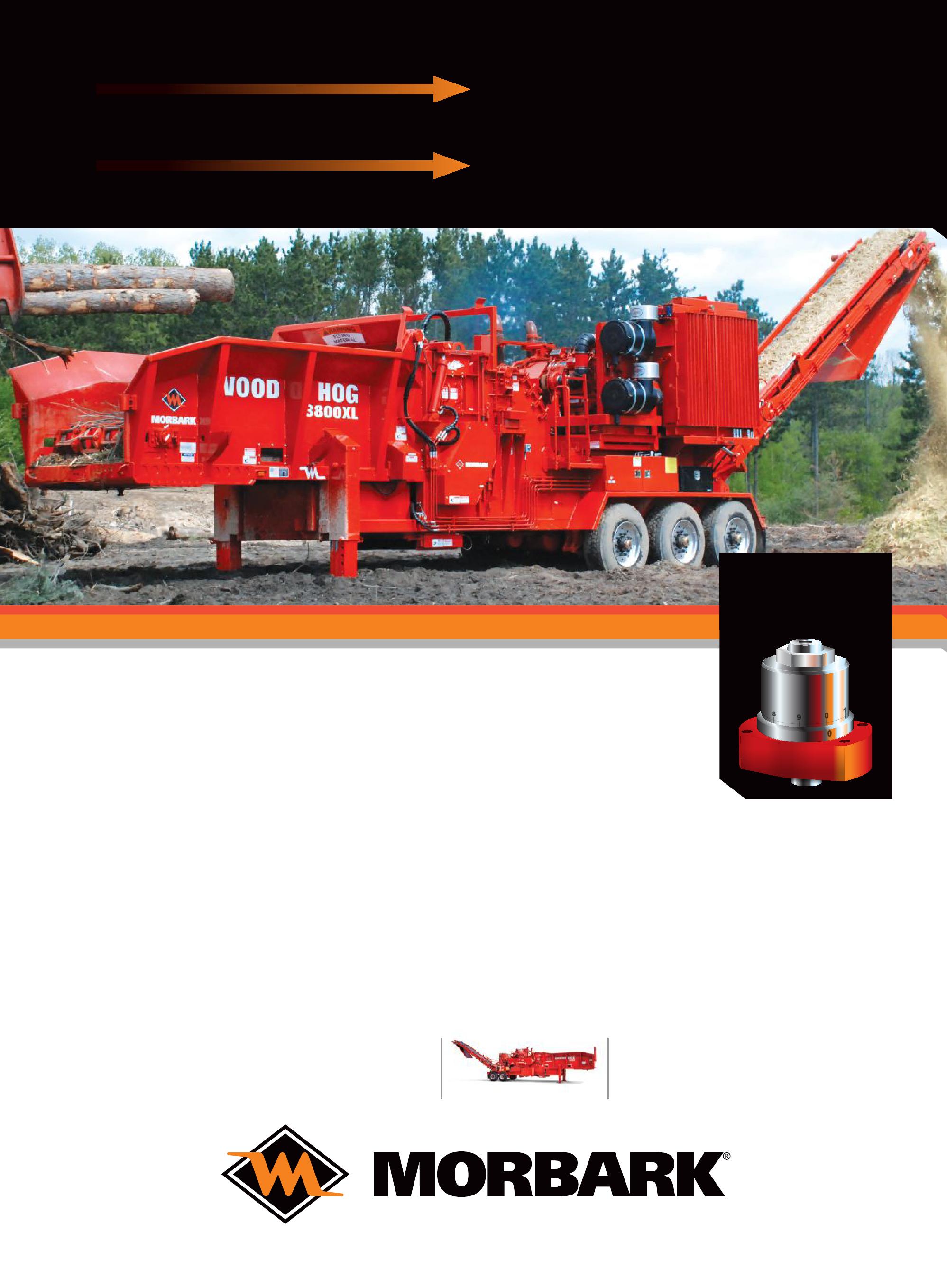
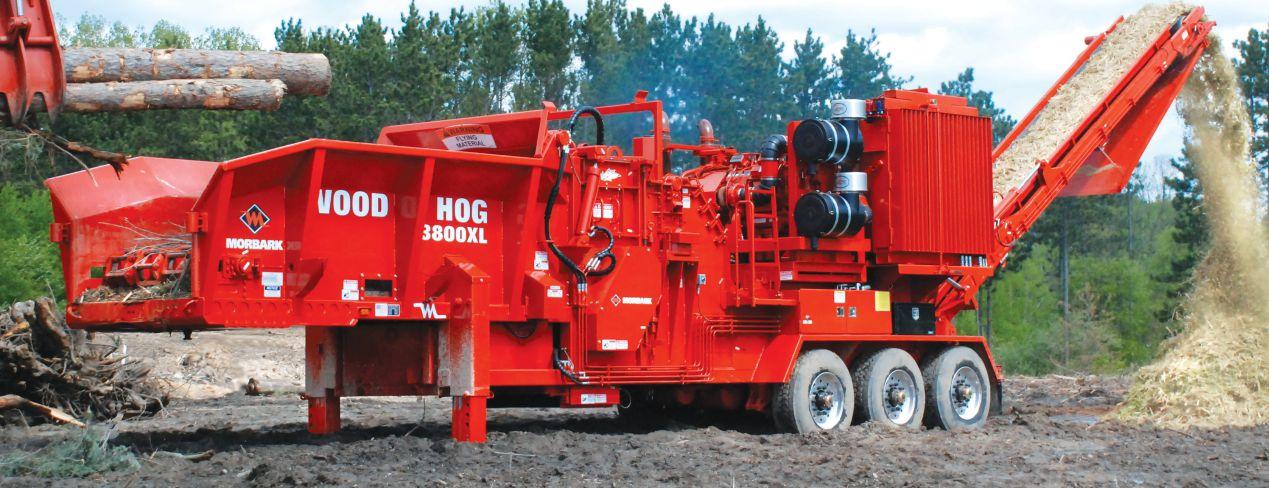
We’ve designed the new Morbark ® 3800XL Wood Hog to be the best horizontal grinder on the market. It will dramatically increase your production capacity and operating efficiency, so you can fill your pockets as fast as it fills your trucks.
• More Productive – A larger, more aggressive hammermill and independent drive motors on the feed-wheel and belt-chain result in a continuous feed with higher production, greater fuel efficiency, and a more consistent end product.
• More Convenient – The Morbark Integrated Control System allows you to maximize production and keep the belt full with just an occasional tweak of your thumb. And you can conveniently service the grates and hammers while standing up, with plenty of headroom and space to work.
• More Reliable – The 3800XL is protected from foreign objects by the best solution available: an externally adjustable breakaway torque limiter that releases instantly when overloaded without stalling the engine; this significantly reduces potential damage and decreases downtime.
The Morbark® 3800XL Wood Hog is part of a full line of heavy-duty industrial grinders from the leader in the industry. Learn more about our machines, extensive product support, and independent dealer network at www.morbark.com.
Voicing opposition

PThe wood pellet sector must monitor the progress of government initiatives that may limit fibre supply.
By Gordon Murray
hilosopher George Santayana famously said, “Those who cannot remember the past are condemned to repeat it.”
British Columbia’s forests are owned mostly by the Province: with about 95 per cent being in public ownership. Approximately 80 per cent of forests are under “volume-based” tenures, where a tenure holder is typically one of many
having rights to a specific volume of timber within a timber supply area. The remaining 20 per cent of forests are under “area-based” tenures – in First Nations woodland licences, tree farm licences, community forest agreements or woodlot licences.
The Social Credit party governed B.C. during the 1980s. In 1983, Premier Bill
Bennett and the B.C. Council of Forest Industries met secretly to hatch a plan to convert volume-based forest licences to area-based tree farm licences. While it took some time for the plan to materialize, by 1988-89, the government began encouraging the industry to submit applications to roll over their forest licences into tree farm licences. However, the government was met with public outrage at what was perceived to be a massive giveaway of the public’s resource. Then-provincial forest critic and MLA for Prince Rupert, Dan Miller, called it “privatization on a massive scale” and warned: “Never before in the history of the province has this kind of giveaway been contemplated.”
The Socreds were forced to hold a series of public meetings throughout the province, and Forests Minister David Parker was not only forced to disclose to the public the names of the 54 companies involved in the 122 applications, but also to release a “secret” map showing their areas.
Unrelenting opposition from First Nations, hundreds of community and environmental organizations, academics, professionals, forestry workers, the NDP opposition, and the general public resulted in a media backlash, stopped the roll-
over process, and ultimately precipitated the defeat of the government and the ultimate disintegration of the Social Credit party in September 1991.
Now, a quarter of a century later, the Liberal party is in power in B.C. and embarking on the very same initiative. After being lobbied by B.C.’s largest forest companies, the Liberals are now working to enable them to convert their volume-based forest licences to area-based tree farm licences. Premier Christy Clark has instructed Forests Minister Steve Thomson to pursue this as a high priority. So why does this matter to the wood pellet industry? The answer is simple. Just five companies dominate control over B.C.’s public forests – Canadian Forest Products, West Fraser Timber, International Forest Products, Tolko Industries and Western Forest Products. Converting volume-based forest licences to area-based tree farm licences will increase the power and control of these five companies and has the potential to further deteriorate the pellet sector’s ability to access the low-quality fibre it needs as feedstock.
How did the government come to resurrect this old initative? It started on May 16, 2012, when B.C.’s Legislative Assembly appointed a Special Committee on Timber Supply to “examine and make recommendations with respect to mid-term timber supply for British Columbia resulting from the pine beetle epidemic-related loss of timber supply in the central interior, and to conduct consultations on this issue with the public and local governments, including communities and First Nations, by means the Special Committee considers appropriate...”
Major firms, such as West Fraser Mills Ltd., lobbied the Special Committee to
recommend the expansion of area-based tenures, arguing that this would enable harvest levels to increase and that they would do a better job of forest management. The Special Committee agreed and included this along with its other findings and recommendations in its report to the legislature in August 2012.
In February 2013, the government introduced its proposal concerning areabased tenures in Bill 8. However the bill’s passage was interrupted by a May 2013 provincial election. Following re-election, Premier Christy Clark instructed Forests Minister Steve Thomson to get on with the job of expanding the area of forest under area-based tenures. The government argues that area-based tenures will, “create an incentive for licence holders to make enhanced silviculture and infrastructure investments that will improve the midterm timber supply.”
Conversions of volume-based replaceable forest licences to area-based management are to be guided by the following principles:
• clear public benefit
• return of a portion of the allowable annual cut (AAC) to government to support – among other things – development of the bio-energy sector
• commitment to higher standards of forest management
• tenure that supports sufficient AAC
• the AAC and management of the residual timber supply area will not be unduly impacted
• a fair and balanced exchange of rights and opportunity
• support of existing government forest tenure commitments
• no undue impact of existing forest tenure holders
• protection of Aboriginal interests and existing land-use plans
The application must be available for public review and comment for at least 60 days, and the applicant must submit the results of the public review process and show how public concerns have been addressed before submitting to the minister for decision.
The wood pellet sector must carefully monitor the progress of this initiative and respond vigorously to any proposed conversions. This may present an opportunity for pellet producers to offer support for conversions in exchange for secure access
to residual fibre. This could help the pellet industry to reach its full potential. If proposed conversions do not provide for the needs of the pellet sector, then we must protest in the strongest possible terms.
Whether the government’s second attempt at this legislation will move forward remains to be seen. We will see if the government is serious about its commitment to its publicly stated guiding principles. The voices of opposition were heard loud and clear in the lead-up to the
provincial election. Now that the election is in the rearview mirror, we will soon see if the government will continue to listen or if it will repeat the failure of the last government that tried this. •
Gordon Murray is executive director of the Wood Pellet Association of Canada. He encourages all those who want to support and benefit from the growth of the Canadian wood pellet industry to join. Gordon welcomes all comments and can be contacted by telephone at 250837-8821 or by e-mail at gord@pellet.org.
Maximum production. Low operating cost. The Bühler RWPR-900 is the ideal pellet mill for your biomass applications. The RWPR was designed with massive roll bearings to withstand the extreme pressures of biomass pelleting. To ensure ease of operation the pellet mill is equipped with a simple V-belt drive system with minimal moving parts. This top of the line pellet mill provides an effective and effi cient pelleting solution. For more information please visit www.buhlergroup.com.
Bühler Inc., PO Box 9497, Minneapolis, MN 55440, 763-847-9900, buhler.minneapolis@buhlergroup.com, www.buhlergroup.com








Innovations for a better world.
Heavy Duty Pellet Mill
Maximum Production.
Flexible controls optimize process
Low operating costs. Rollers, dies and other wear parts are designed for maximum performance and longevity to increase uptime and profi tability.
Safe operation. A combined overload shear pin and belt slip monitor protect the pellet mill from overloads or foreign material entering the die.
Green energy makes cents
Mont-Joli hospital converts to biomass.
By Guillaume Roy | Translated by Amie Silverwood
Howcan a business reduce its carbon footprint while investing in long-term development? For Mont-Joli hospital, in the Bas-Saint-Laurent region of Quebec, biomass heating has proven to be the ideal solution that allows administrators to save $200,000 a year and eliminate 2,783 tons of CO2 while contributing to the local economy.
Green energy makes economic sense. Converting from an oil furnace to a biomass boiler worked out well for the health and social services centre at the Mont-Joli hospital.
“The hospital has a long-term vision in mind. Until recently, the hospital was heated with an oil furnace that emitted lots of pollution and greenhouse gases. We asked ourselves if we could do something to improve our carbon footprint. Several options were considered but choosing biomass was the most interesting because there were already local suppliers, it was easy enough to support the local economy by buying from local stock, and the Ministry of
Natural Resources and Wildlife through the Energy Efficiency Office (AEEQ), provides grants for these types of projects,” explains Nadia Drapeau, the technical project co-ordinator at the Mitis health and social service centre.
In December 2012, a biomass boiler with 2000 kWh of power installed in a building next to the hospital relieved the building’s reliance on fossil fuels. An electrical furnace allows for heating during maintenance hours. The conversion required $2.3 million, with a $1.1-million grant from AEEQ. The new system will have a five-year payback through annual savings of $234 000. On top of the financial savings biomass technology will provide, 2,783 tons of CO2 emissions will be prevented – an equivalent of taking 1,400 cars off the road each year.
Biomass was an appealing option because it would allow the hospital to support the local economy while taking advantage of available grants.
bas-saint-laurent: tHe future world caPital of biomass
Heating?
Seven major biomass heating projects are already on line in the Bas-Saint-Laurent region of Quebec. If four more projects are realized, the region will have the highest density of biomass heat per square kilometre in the world, according to Renaud Savard, president of Gestion Conseil PMI, a green energy consultant based in Amqui that specializes in biomass heating.
It all started in 2007, when the Coopérative forestière de la Matapédia (CFM) was provided with a grant to build a rural lab to study the viability of woody biomass. “The rural lab allowed us an economical means to secure raw materials. We already worked in the forest, so we were able to integrate it into our operations,” explains Simon Roy, General manager for CFM. It all had to be done from scratch: the harvesting, the skidding and the biomass chipping, he says.
The Amqui hospital pilot project (1,500 green tons) provided the necessary incentive to test the operation from the forest to the burn. “We were able to harvest the biomass and do our testing since we had to deliver a standardized grade, moisture and ash content. We had to meet those objectives economically,” Roy adds.
“It’s great to have a long-term plan but it’s even better to make it economically viable,” Drapeau comments.
In order to bring the project from concept to reality, planners took advantage of lessons learned from a similar project in the region. “A biomass boiler at Amqui hospital was already providing heat so we were able to work off their experience and work with Gestion Conseil PMI, who was very supportive in the preparation of our biomass project,” Drapeau explains.
For several years, Gestion Conseil PMI, a green energy consultant based in Amqui, has specialized in biomass heating. The company has developed a solid reputation in this field in Quebec. Among other projects, it worked on the Maria and Montmagny hospitals’ HVAC systems in Quebec’s Causapscal Amqui region.
“Several clients have contacted us to help them convert to biomass since, with the grants, it’s the most economical form of energy,” explains Renaud Sauvard, the manager of the firm. With a $40 grant for each ton of carbon saved over 10 years, it represented more than $1.1 million dollars in grants for the Mont-Joli hospital.
Biomass considerations
In 2011, the Mitis health and social science centre launched a request for proposals for biomass suppliers. “We wanted to know right off the bat about the biomass grades and suppliers that would be viable in our region,” Drapeau recalls. It was the Coopérative forestière de la Matapédia de la St. Florence (CFM) that won the contract to supply 3,000 green metric tons of biomass annually.
News of the hospital’s plans to convert was generally well received but some locals had concerns. “We had a city council meeting. We
Since then, a heat network was set up in Causapscal (504 green tons), a boiler room at SEREX, a forest research and wood product expert (115 green tons), and the Coopérative forestière de la Matapédia Ste. Florence (75 green tons). Recently, the boiler at Mont-Joli hospital (3,000 green tons) was installed and several other projects are planned for the near future. The present total of CFM’s deliveries adds up to 5,200 green tons at 35 per cent moisture content annually.
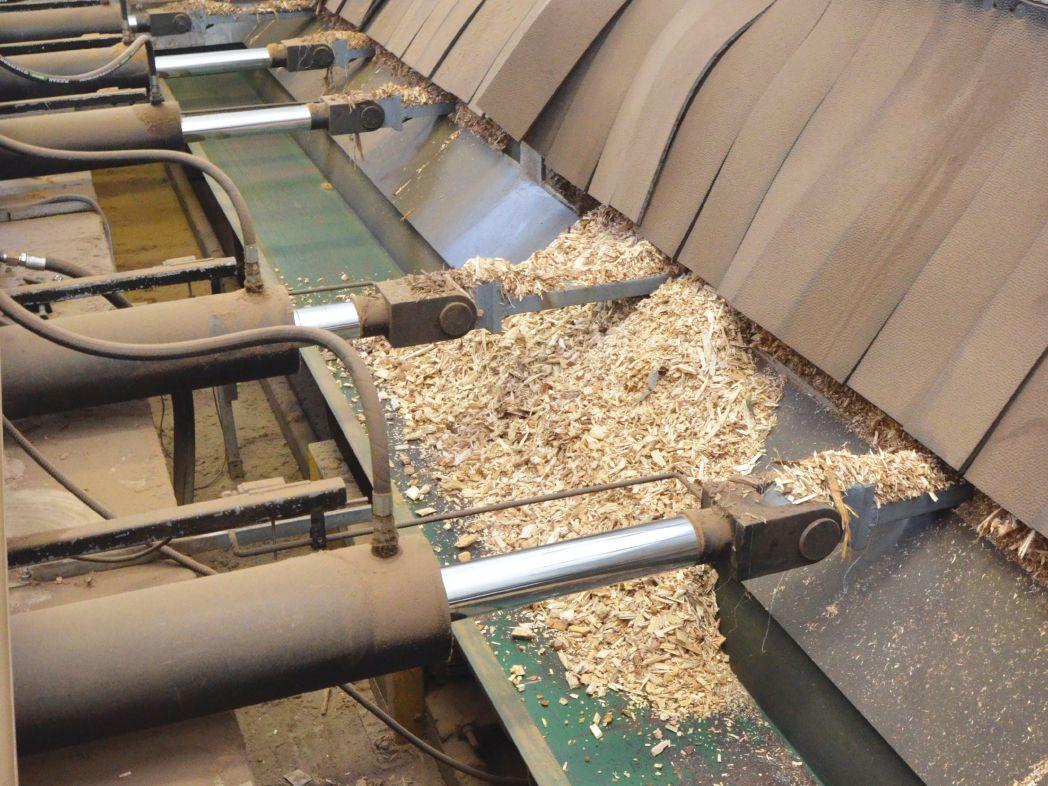
Though CFM currently delivers around 5,000 tons of biomass to its clients annually, “we could easily supply up to 35,000 tons,” Roy says. The company recently purchased a Kesla c645 chipper that can chip 30 tons of wood an hour in the forest or stockyard. “The chip size is easily adjusted, with different screens allowing us better control over the grade of our product,” Roy explains.
Potential biomass investors are patiently awaiting a planned reorganization of the Energy Efficiency Office program that provides funding for the use of woody biomass. This change is expected to take effect in the coming months.
“We’re developing a packaging centre, a consulting firm, engineering offices, a lab and a training centre to create an industrial cluster based on biomass for the region,” Gestion Conseil’s Savard explains. “It should all be in place in four years. It’s great for the region since it will create economic ripples throughout the community.”
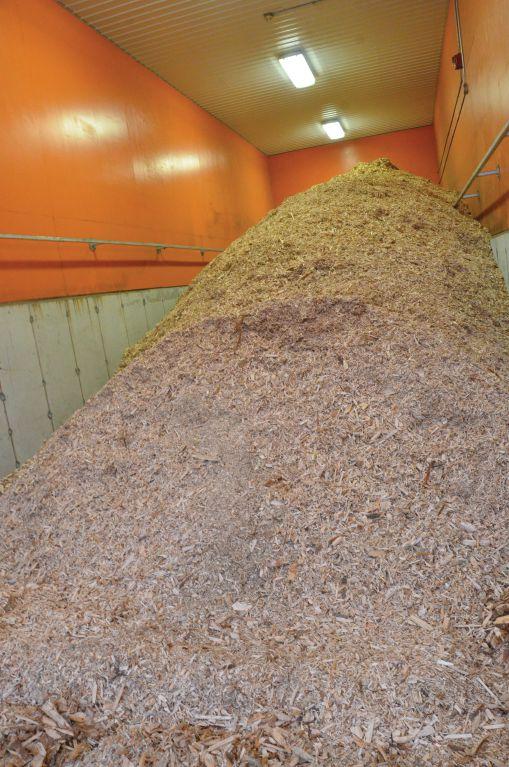
Forty-five tons of biomass can provide four days of heat from the biomass boiler during the coldest days of winter.


were asked to explain the project since there were concerns about emissions and pollution coming from the smoke stacks,” says Drapeau. “When we explained that only steam would be emitted and that we were complying with the Ministry of the Environment’s requirements, the project was very well received.” Biomass emission targets are set at 150 mg/m3 of particles while typical residential chimneys produce more than 400 mg/m3
comBustion expert took controL It was Combustion Expert, a company based in Trois-Rivières, that won the request for
The new system will have a five-year payback through annual savings of $234,000.
proposals on the design, manufacturing, installation and maintenance of the hospital’s biomass project. The company specializes in biomass heating so it was able to take control of the whole process, except for the manufacturing of the heaters, which was subcontracted by the Groupe Simoneau from Boucherville.
The model chosen for this product was WX, an industrial-calibre combustion chamber that is able to respond to the hospital’s energy needs, explains Francois Laroche, marketing co-oordinator at Combustion Expert. “This system can make use of greener material. It tolerates up to 58 per cent moisture content without losing efficiency.” The furnace can burn even the greenest biomass, with some loss of efficiency. For the Mont-Joli hospital, CFM delivers biomass that is at a 30 per cent moisture content.
“We’re very proud that the Mont-Joli biomass installation has worked well from the get-go,” Laroche stresses.
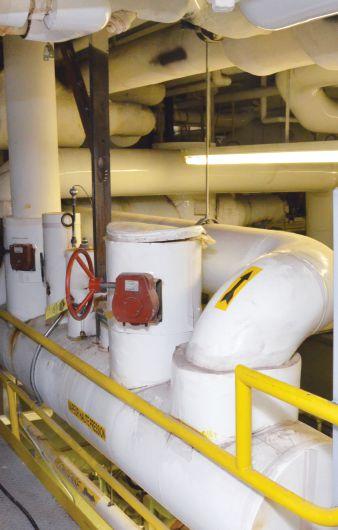
Nadia Drapeau agrees that the project was off to a good start from December 2012. Adjustments were necessary only to the frequency of biomass shipments. Two warehouses that hold 45 tons of biomass can provide around four days of heating during the cold winter months while the hospital used to have a reservoir with 113,000 litres of oil that could provide heating for more than a month. •
FEBRUARY 19 AND 20, 2014

FEBRUARY 19
›‹ Match making session with overseas buyers
›‹ Lunch with keynote speaker Jacques Demers, Canadian senator and hockey legend
›‹ Conference market trends
›‹ Exhibit hall
›‹ Ice breaker cocktail
FEBRUARY 20
›‹ Conference equipment environmental issues and sustainability panel discussions
›‹ Exhibit hall
www.quebecwoodexport.com, events tab
Info: John W. Arsenault, jarsenault@quebecwoodexport.com
Hosts: www.quebecwoodexport.com
Up and running
After four years of construction, Kyoto Fuels starts producing biodiesel.
By Andrew Macklin
KelSey
Prenevost and his team at Kyoto Fuels will never forget the significance of September 28, 2013. With four years of construction behind it, Kyoto Fuels was finally producing biodiesel.
The success that followed that day, the first of three days that would ultimately produce a combined 260,000 litres of commercialgrade biodiesel, has given Kyoto Fuels plenty of reasons to be optimistic about the company’s future in the biofuels industry.
starting from scratch
When Kyoto Fuels president and CEO Kelsey Prenevost began investigating the viability of a biofuels business in Alberta, he looked for partners that could complement his strong knowledge of the biotechnology sector through his work with Agriculture and Agrifood Canada and the Canadian Food Inspection Agency.
Enter Jeff Arsenych and John Koliasha, whose experience with the petroleum fuels and transportation industries respectively, provided the vital expertise to help push a biofuel project forward. A fourth member was added to the management team in the early stages, Robin Tams, who possessed a strong knowledge of both the financial and sales markets.
With a management team in place, the decision had to be made about which part of the biofuel sector Kyoto Fuels would attempt to infiltrate. According to Prenevost, that decision was easily made.
“We recognized that biodiesel had the highest return on environment that was available, not just return on investment,” explains Prenevost. “For the amount of energy that we put into making a litre of biodiesel fuel, we get the best return energy-wise.”
Next came the decision of where in Alberta to put the plant. As members of the team began to investigate what types of feedstock they wanted to use in the production process, the location of the plant became clear.
“Our original plan was to only use animal fat in our biodiesel production,” says Prenevost. “Lethbridge, and our site, is almost equidistant between the two biggest animal processing facilities in
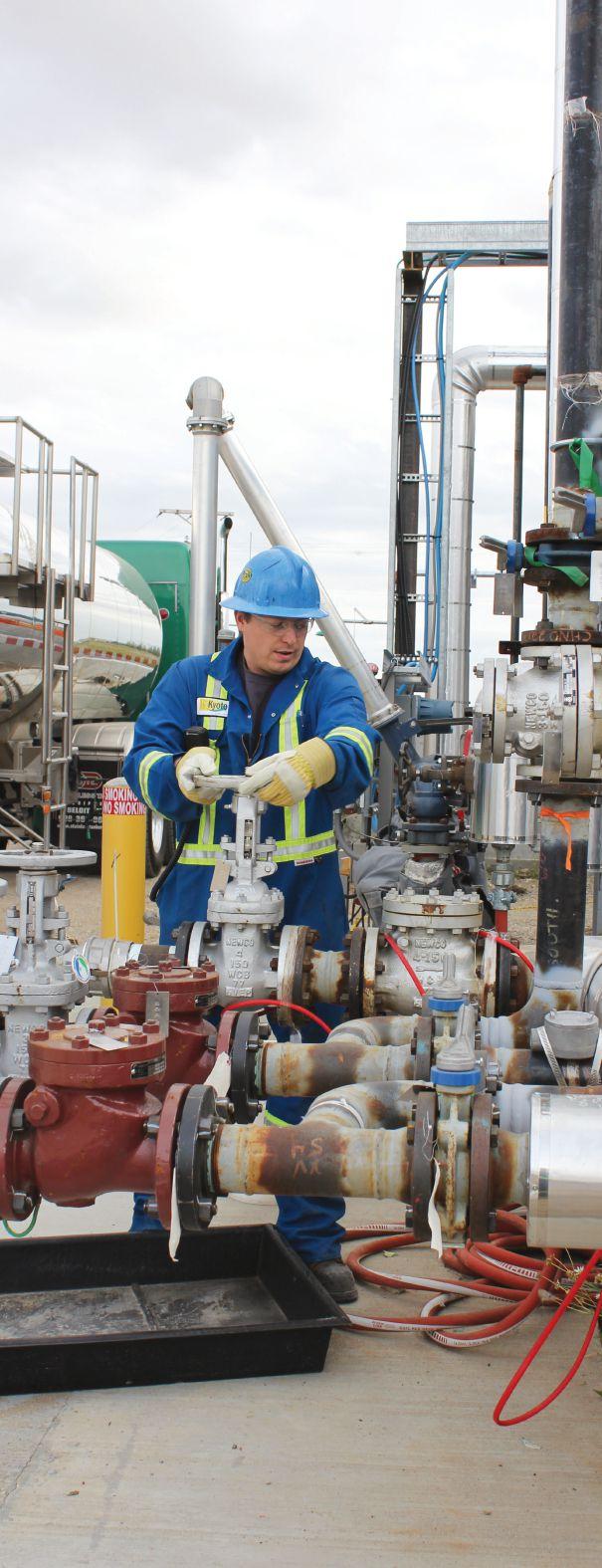
Kyoto Fuels staff continuously tested the equipment throughout the construction process.
Canada: one in Brooks and one in High River.”
The proximity to two plants would allow Kyoto Fuels to play on both, which it was assumed must happen to obtain the best price for feedstock for the plant. The proximity to the CanadaU.S. border also was a factor since the company understood that the American biodiesel market could have a potentially significant role in its operation.
The next hurdle to overcome was funding. Through a campaign to get local investors on board, Kyoto Fuels was able to raise close to $20 million, approximately half of the overall project cost, and enough to get the preliminary stages of the plant off the ground. The government of Alberta also came through with $10 million in grants, and the remaining money was obtained through major lenders.
Construction of the plant involved a partnership with Seattlebased Primus Biovision, which helped Kyoto Fuels design and assemble the plant using Kyoto’s biodiesel technology. The company hired Integrated Industrial Solutions (IIS) of Forest, Ont., to operate the plant and manage Kyoto’s 30 employees contracted through IIS.
focus on production
With all elements of the operation in place and construction of the Lethbridge plant completed, Kyoto Fuels is finally able to focus on the core of its business: producing high-quality biodiesel.
Based on the early results from Kyoto Fuels’ early testing, the company expected the commissioning of the plant, which began with the late September start of production, to last only six weeks. Surprisingly, even the early batches produced were at a high enough quality to be sold commercially.
Part of the reason for such a short commissioning phase for Kyoto Fuels is that many of the improvements to the process were integrated during the construction phase. That created some delays in the original construction, but building in those improvements during the original construction is now seen as beneficial to the commissioning process. As a result, the company believes that it will be at full production by the end of 2013.
The biodiesel being produced at the plant is meeting the ASTM+ standard for biodiesel, higher than the ASTM standard expected in much of the North American market. According the Prenevost, “that is the buyer expectation in Canada, ASTM+, not ASTM like in the U.S. We have demonstrated that we can meet that standard during test runs. Also, producing ASTM+ allows access to all North American markets.”
Currently, Kyoto Fuels is meeting that standard by using vegetable oils for feedstock. The Kyoto Fuels plant was built to be able to process multiple feedstocks, including vegetable oils and animal fats. The decision was made to start by using vegetable oils, mainly canola oils, for several factors, including the abundance of canola oil sources available.
“We have been buying canola oil from various suppliers,” says Prenevost. “There is lots of availability this year thanks to a bumper crop.”
The plan is that the company will eventually switch from using vegetable oils to using animal fats once its technology for producing biodiesel has been fully demonstrated at 100 per cent capacity. But the company is not likely to switch entirely to using animal fats, since some customers prefer biodiesel produced from
Boiler Feed Systems

Ruggedly built and dependable pneumatic and mechanical boiler fuel feed systems by Jeffrey Rader®, a brand of TerraSource™ Global, combine the best of our storage, reclaim, conveying, and feeding equipment.
We work closely with our customers to ensure that our designs meet the storage, metering, and feed rate requirements of the boiler, whether it’s feeding 100% biomass or co-firing biomass with coal.
vegetable oils. Because tallows have a higher freeze point, that option is not available for some of Kyoto Fuels’ market. Also, the company has identified that some markets it hopes to penetrate want only canola-based biodiesel.
That market is primarily Canada, where the majority of the company’s business is focused. Prenevost believes that Canada’s biodiesel market is underserviced, a major reason the company is focusing on the domestic market. Its proximity to Canada’s big oil producers also plays a major role in that decision, as the low cost of transportation from Lethbridge has the potential to make up for cost differences from competitive biodiesel suppliers.
There is a demonstrated demand for biodiesel in Alberta, with the province in need of 120 million litres a year in order to meet the on-road use requirements that resulted from Canada’s two per cent renewable fuel mandate. Nationally, the demand is five times that amount at 600 million litres according to Prenevost, opening the door for further penetration in domestic markets.
Because of the recognized need for more biodiesel production here in Canada, Kyoto Fuels is already in the process of planning for a second biodiesel production plant. The company has purchased a piece of land for the second facility, at an undisclosed location, but construction timelines will depend on the success of its production


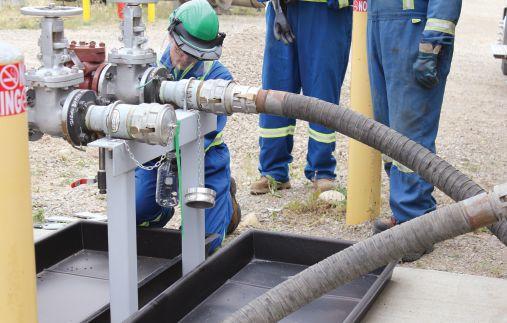
A sample of biodiesel is collected during the commissioning phase in order to test the quality of the fuel.
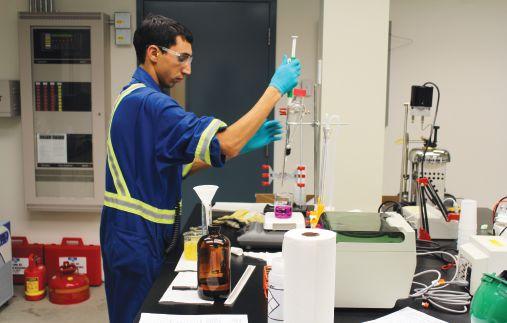
In the lab, a researcher tests the quality of the biodiesel produced at Kyoto Fuels’ plant in Lethbridge, Alta.
at the Lethbridge plant. The ideal timelime would be to have the second plant built within the next two years, but nothing has been set in motion just yet.
Kyoto Fuels is also eyeing global expansion. The company has the opportunity to work with a company in South America to construct biodiesel plants in countries and regions that would highly benefit from the environmental impact of biodiesel as a renewable fuel source.
piLLars of success
According to Prenevost, the environmental impact of biodiesel production has been a driving force for pushing the business forward.

Based on his research, he estimates that the reduction in greenhouse gas emissions as a result of Kyoto Fuels’ biodiesel production will be equivalent to the removal of 35,000 cars from the road.
The environmental impact of the Kyoto Fuels operation is one of the pillars of its motto, along with the quality of the company’s product, and the health and safety of its production. In the four years since construction began, Kyoto Fuels has yet to have any time lost due to workplace safety issues.
Combined with its ability to make ASTM+ quality biodiesel, it appears Kyoto Fuels’ model for a successful biodiesel operation is working. •
Processing Systems for Bioenergy
Liberating
Untapped Energy
A worldwide leader in size reduction technology for bioenergy, Vecoplan works with individual customers to design, engineer, manufacture and implement technologically advanced, material specific, and application specific shredding, ferrous and non-ferrous removal, size and density separation, screening and classification technologies and extremely efficient conveyor and bulk material handling, metering, storage and unloading technologies.
Contact Vecoplan today to learn more about our existing systems or to arrange a visit to one, or several, of our installations.
Phone: (336) 252-4774
Seattle-based Primus Biovision assembled the biodiesel plant for Kyoto Fuels, and was also involved in helping Kyoto Fuels design the facility.
Kyoto Fuels employs a staff of 30, which is contracted through Integrated Industrial Solutions.


Pellet power
A Belgian power station is hungry for Canadian wood.
By Gordon Murray
rodenhuize
Power Station (RPS), a 240-megawatt biomass fuelled plant located in Ghent, Belgium, is one of the largest consumers of Canadian wood pellets.
Formerly a coal power station, the plant was converted in 2011 to operate entirely on wood pellets. RPS is a joint venture between Electrabel (a subsidiary GDF SUEZ that owns 73 per cent) and Ackermans & van Haaren (owning 27 per cent). The project cost an estimated €125 million – about $170 million Canadian.
Dave Patterson of B.C.’s Forestry Innovations Investment and I attended the European Biomass Conference in Brussels in June 2013 as part of a mission to educate Europeans about Canada’s sustainable forest management practices and to promote Canadian wood pellet exports. As part of the conference, we joined a site visit to RPS where our tour guide was senior plant operator Cornelis Stevense.
According to Stevense, “This power station was originally developed as a coal-fired power plant with three boilers that used gas, heating oil and coal to generate electricity. Two boilers have since been decommissioned and the plant now operates with a single boiler and cooling tower. The plant was modified in 2005, at which time it began co-firing coal and wood pellets, and again in 2010-11 when the plant was converted to completely replace coal with wood pellets.”
RPS receives wood pellets by ship at the Port of Ghent. The Port is located 30 kilometres inland from the North Sea on the Ghent–Terneuzen Canal. This man-made canal was constructed between 1823 and 1827 on the initiative of the Dutch king when Belgium and the Netherlands were a united country. Over the years, the canal has been enlarged so that today it is 200 metres wide and 32 kilometres long, has a draft of 12.5 metres, and is capable of accommodating ships of up to 92,000 gross tonnage. The canal is more than sufficient for a Panamax-class vessel.
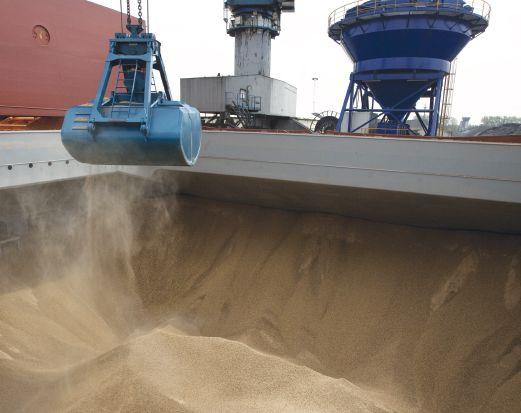
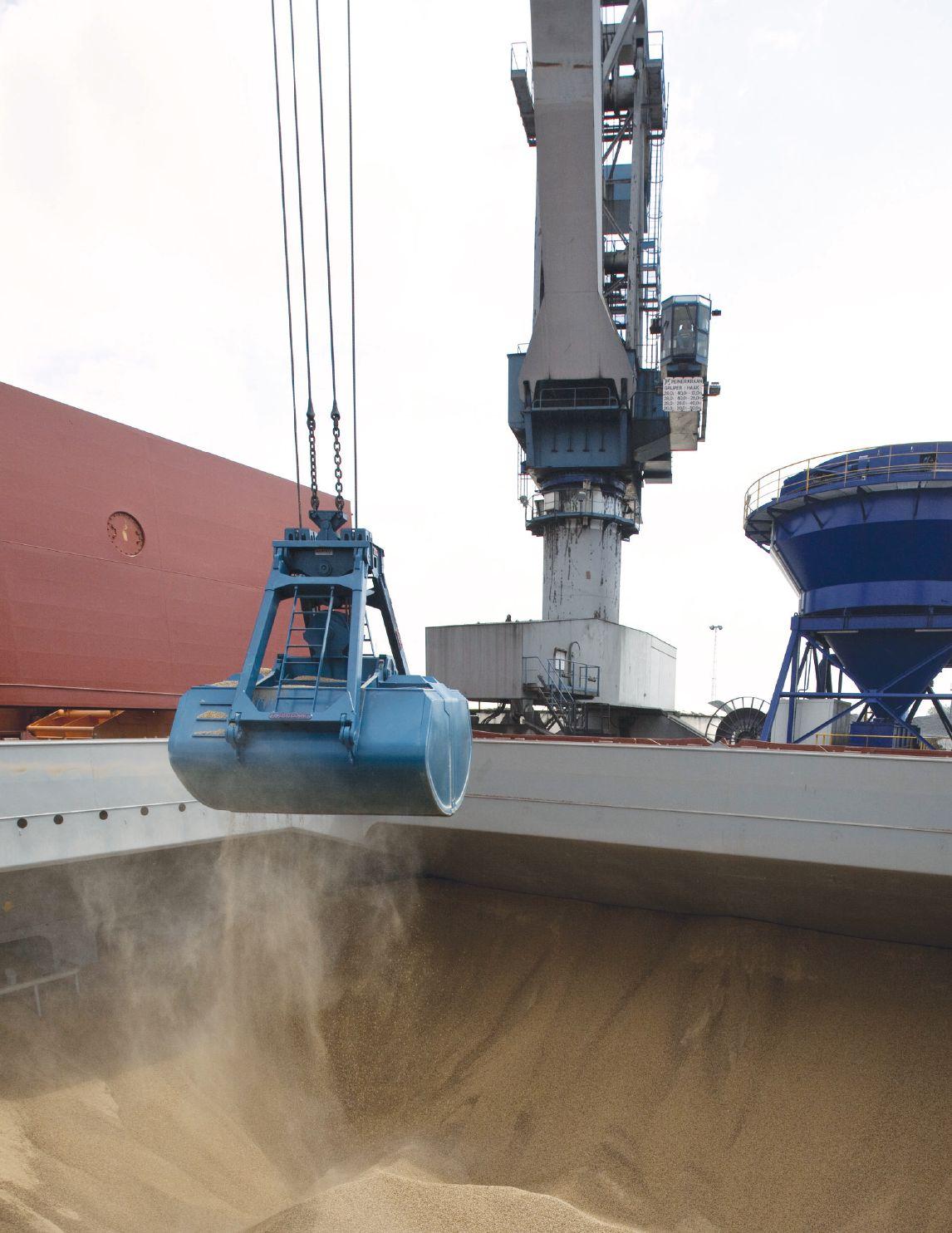
Wood pellets are unloaded at the dock with the use of a Vigan Engineering vacuum ship unloader, and stored in a 700-metre-long warehouse with a 100,000-ton capacity. The pellet storage and handling system includes a dedusting installation, sprinkler, spark and smoke detection and humidity measurement equipment.
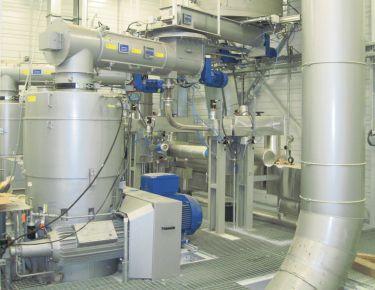
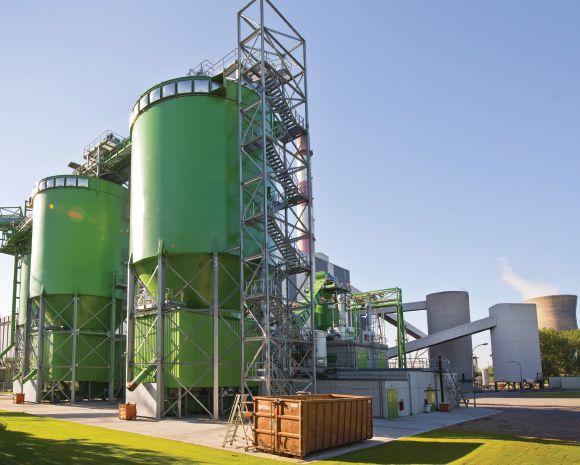
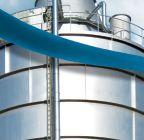
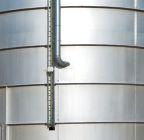
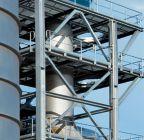
Wood pellets are conveyed from the warehouse to three storage silos, each with 2,000 cubic metres of storage capacity. Pellets pass from the silos to the processing area where they are sifted, transported to hammer mills, and ground to a fine dust. The wood dust is then blown by air through pipes to the burners. There are four hammer mills per
LEFT MAIN: Canadian wood pellets are shipped to Rodenhuize Power Station through the Port of Ghent.
INSET: Pellets pass from the silos to the processing area where they are sifted, transported to hammer mills, and ground to a fine dust.
COMPREHENSIVE PRODUCT & SERVICE PROGRAM FOR THE WOOD PELLET INDUSTRY
With 50 years of experience in the wood processing industry we offer a complete air filtration program for all production areas of wood pellet mills. Our product line includes customized systems for air extraction, dust collection, pneumatic conveying, air filtration and dryer exhaust gas cleaning.



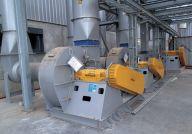
Wet and Dry Electrostatic Precipitators | Cyclones | Bag Filters | Pneumatic Conveying Systems | Fans | Rotary Valves
Scheuch Inc.
2351 Huron Street, Unit 1, London, Ontario, N5V 0A8, Canada
Phone: +1 (519) 951-7700 I Fax: -7711 office@scheuch.ca www.scheuch.ca
silo (12 total), each hammer mill feeding two burners. Additional air is added to the outer ring of each burner to aid combustion, and the wood dust is burned inside the boiler’s combustion chamber. The boiler is designed with three burner levels and each silo feeds a single level. Each level has eight burners for a total of 24 burners in the boiler.
The inside of the boiler contains tubes full of water. Heat from the 24 burners turns the water into steam. Pressure from the steam is used to turn a 300-megawatt capacity turbine, which then turns the generator to produce electricity. Spent steam passes though a cold-water condenser, is then turned back to water, which re-enters the boiler in a continuous cycle. Cold water from the condenser is heated by the steam, so is circulated through a single cooling tower. According to Stevense, “We lose almost no water in the process, just a little from evaporation in the cooling tower. So we replenish that from the river.”
The absence of people is noticeable. RPS operates 24 hours a day with three eighthour shifts. Each shift requires just three people to operate the plant: a senior opera-









tor whose job is to manage the fuel supply; an operator who controls the power plant; and a production leader to oversee the operation. In addition there is a maintenance team that rotates between RPS and other power stations in Electrabel’s fleet.
The Belgian power mix includes wind, solar, nuclear, and thermal electricity. According to Stevense, electricity demand fluctuates with the weather, i.e., in response to demand for heat and air conditioning. When electricity demand drops off, wind, solar and nuclear energy are given priority. This means that there are times when RPS operates below capacity or even has to shut down. Stevense says, “Although the plant is rated for 240 megawatts, we usually operate at about 225 megawatts. We can go as low as 125 megawatts if we have to. And if we do shut down, it takes us about 10 hours to get back up to full capacity when we restart.”
“The plant consumes about 800,000 tons of wood pellets annually, producing at about 35 per cent efficiency. When operating at full capacity, the plant uses about 125 tons per hour, or 3,000 tons per day,” Stevense adds.
RPS sources wood pellets from Europe,





the United States and Canada – including 225,000 tons annually from Pacific BioEnergy’s pellet plant in British Columbia, in which Electrabel is a joint venture partner.
Electrabel requires each wood pellet supplier to undergo a strict independent audit and certification process to ensure that wood pellets are produced from sustainably sourced fibre and that each supplier’s wood pellets reduce greenhouse gases compared to fossil fuels by at least 60 per cent. The switch to wood pellets from coal has enabled RPS to reduce CO2 emissions by about 1.6 million tons annually, while continuing to provide enough power for 420,000 homes in Belgium.
RPS is a great example of a successful coal to biomass thermal power plant conversion. Together, Electrabel and Ackermans & van Haaren have made a huge investment in helping Europe advance toward reaching its 20 per cent GHG reduction target by 2020. As Canadian pellet producers, RPS is a major consumer of our product. And we can expect more of the same from GDF SUEZ Group. The company aims to supply green energy to one million Belgian families by 2015. That’s a lot of wood pellets! •
Pellet logistics
Making ocean transport easier at the Port of Vancouver.
By Andrew Macklin
thelogistics of moving wood pellets from remote locations across Canada to export markets in Europe and Asia has never been easy. Many locations lack the necessary rail structure, road network, or water access to be able to efficiently move pellets overseas.
But with the pellet market driving forward in Canada, transportation companies have begun working together to build better systems for handling material and for transporting it from the plant to the consumer.
“We’ve gotten better as an industry in terms of logistics,” explains Kerry Lige, president of Fibreco. “I think historically each of us in the chain tended to look inward in terms of our little operation.”
Co-operation in the logistics chain has allowed companies like Fibreco to see steady growth in annual exports. In 2012, Fibreco exported 1.6 million tonnes of pellets and 500,000 tonnes of wood chips. Situated in the Port of Vancouver, Fibreco provides overseas shipping for Pinnacle Renewable Energy, Premium Pellets, and Pacific Bioenergy’s wood pellet plants across British Columbia, as well as wood chips from sawmilling operations across the province.
gLoBaL peLLet markets
Shipments of pellets from B.C. producers remain focused on European markets despite the recent announcement of the first shipment from Fibreco to South Korea. “The pellet business is fundamentally European driven,” says Lige. “Specifically the electricity business in the U.K.”
The same cannot be said for Fibreco’s chip exports. Much of the chip volume is sent to the Asian market, with Japan the primary customer.
“In the chip business, our customers are primarily in Japan,” says Lige. “For most of those customers, the chips are for the paper business. We export the wood chips for the purpose of manufacturing
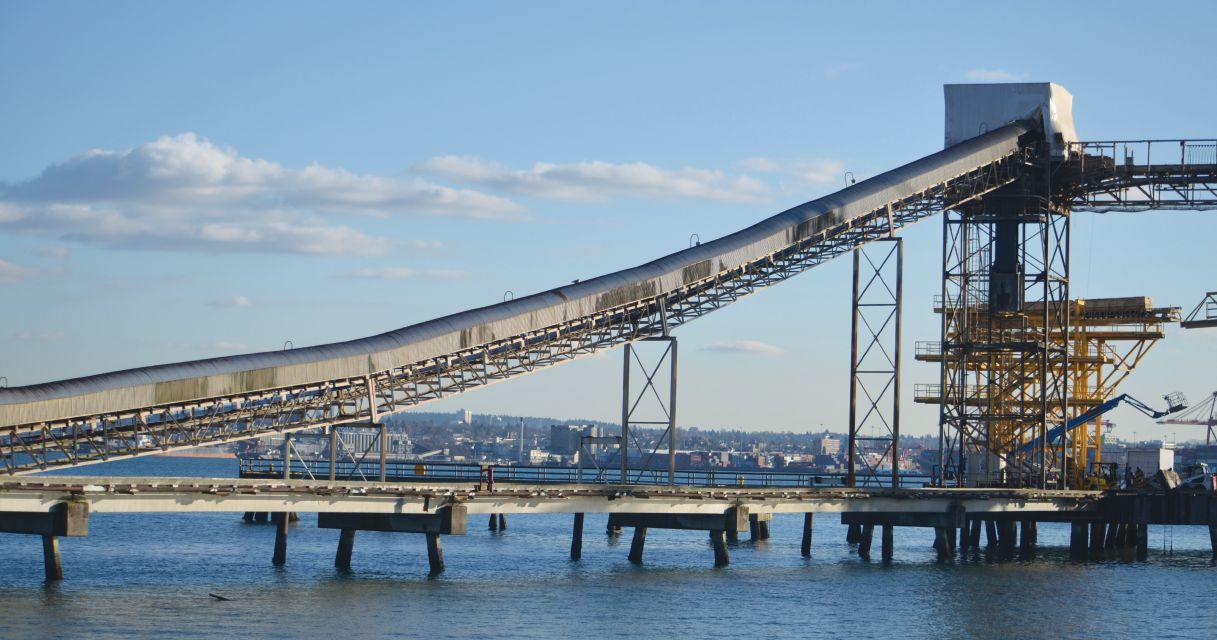
TOP: The conveyor system leading to the dock allows Fibreco to load the cargo holds at a rate of approximately 1,000 tonnes per hour.
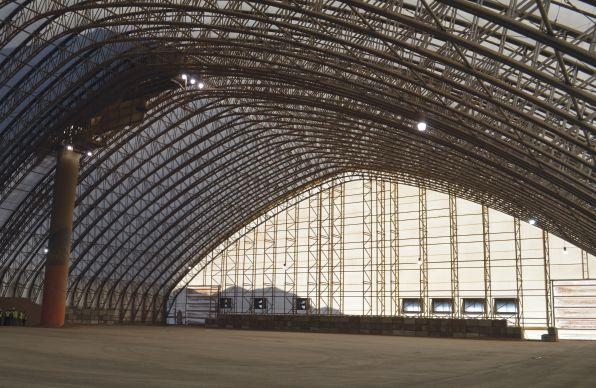
ABOVE: Pellets are stored inside the pellet shed at Fibreco before being loaded for shipment.
pulp, newsprint. There is some biomass chip that we send over to Japan for some of the electrical companies but that is a small portion of the wood chip business.”
fiBreco’s operation
Pellets and chips arrive at Fibreco by rail cars, each of which holds a capacity of 95 tonnes. The company has the capacity to
dump approximately 13,000 tonnes per day on average using a specially designed rotational system that flips the wood chip car in order to collect the contents into a storage hold before it is moved to temporary storage.
The chips are stored outside in the open air, while the pellets are moved into storage silos and sheds throughout a conveyor sys-
YOUR BULK BAG
PELLET
tem. The silos and sheds are equipped with dust and smoke suppression systems for fire prevention, and the air inside the shed is exchanged four times an hour to create safe working conditions for the staff.
Once a pellet ship is ready to be loaded, the pellets are pushed inside the shed area using Cat and Komatsu wheel loaders equipped with an air filtration system and a modified WBM blade. Ships are general bulk carriers, loaded with 10,000-50,000 tonnes of chips or pellets depending on the order, with one to two ships loaded per week at the Fibreco dock. For loading the ships, Fibreco uses a straight chute with a shirt to contain the materials, loading at a rate of close to 1,000 tonnes per hour. As for chips, dedicated wood chip carriers up to 35,000 tonnes are loaded at 1,000 tonnes per hour via an articulating spout powered by 2,100 horsepower of pneumatic air to achieve optimum compaction.
According to Henry Zea, the assistant terminal manager at Fibreco, trimming the hatch is the most difficult part of loading: it’s important to find an effective way to fill the corners of the hold when dumping the materials in the centre of the hatch. An inefficient system can significantly slow down loading times, waste manpower, and ultimately lose significant revenue for the company. Fibreco has experimented with different systems for better material distribution during the loading process and continuously looks for greater efficiency in this area of its operation.
Improving the logistics chain is also a priority for Fibreco, something that has come a long way in recent years. Rather than chastising other parts of the chain, like trucking and rail, they are now working together to create a more efficient process for their customers. Fibreco has had an MOU in place with CN Rail for three years and information is exchanged more freely than in years past.
“We need to support each other as part of the logistics chain,” says Lige. “We find solutions together that we didn’t in the past.”
That co-operation is providing stronger, more efficient, and more cost-effective systems for moving wood pellets and wood chips from B.C. to customers worldwide.
Five hundred thousand tonnes of wood chips are shipped from Fibreco each year, with most of that volume going to Japan for use in manufacturing paper.
Grinder spotlight
The latest designs and features from grinder manufacturers.
By Treena Hein
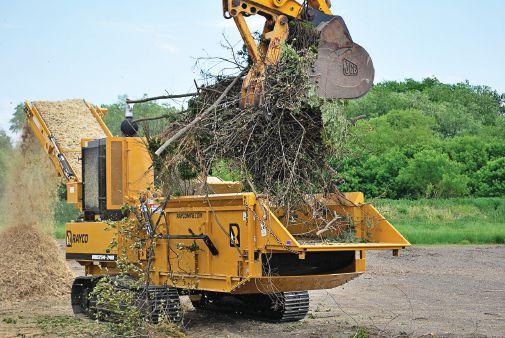
Rayco calls its RH1754 grinder “an economical solution for producing high-quality mulch.” This horizontal grinder is now available in a self-propelled version that rides on a heavy-duty steel track undercarriage. This adds another element of versatility to the RH1754, making it easier to move the machine around. The 240-horsepower track version of the RH1754-240 weighs just 20,500 pounds and is just under eight feet wide. A wireless radio remote allows each track to operate independently, providing precise control.
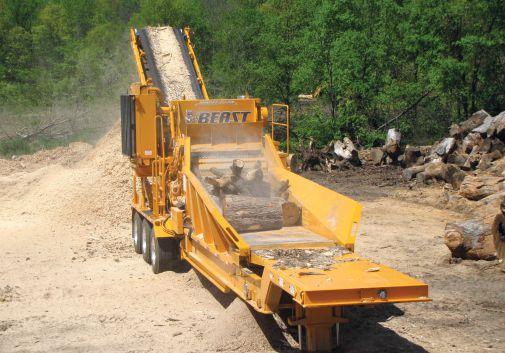
Bandit Industries offers four towable, four self-propelled, and four electricallypowered Beast recyclers/horizontal grinders. They range in size from 16-inch to 45-inch capacity with engines over 1,000 horsepower. All Beast recyclers/ horizontal grinders can be outfitted as electric units, further enhancing the capability and efficiency of these amazing machines. The new XP-Series Beast recyclers/horizontal grinders feature over 35 specific enhancements
looking
for a new grinder in the near future? The newest grinder offerings in Canada provide more flexibility and customization than ever. New features to boost manoeuvrability are now available, as well as much more compact versions of popular models. Many manufacturers are now offering electric-powered options as they are becoming increasingly popular among customers. Here are the latest descriptions and pictures of what’s new and hot on the grinder market, heading into 2014.
in eight different categories. Highlights include revised augers for easier removal and cleaning, replaceable wear plates in mill housings, larger engine options and revised in-feed designs.
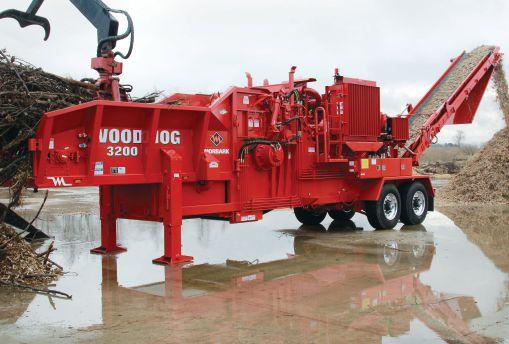
Aimed at wood and green waste recycling applications, Morbark’s new 3200 Wood Hog is a compact and aggressive unit. It’s a smaller, lighter and more affordable grinder that has all the benefits of their larger grinders. The 3200 can handle green waste, re-grind, sawmill residue, pallets and logs up to 14 inches in diameter with ease. Available as a tracked unit for greater mobility or with electric power, the 3200 can be built with Morbark’s most popular options.
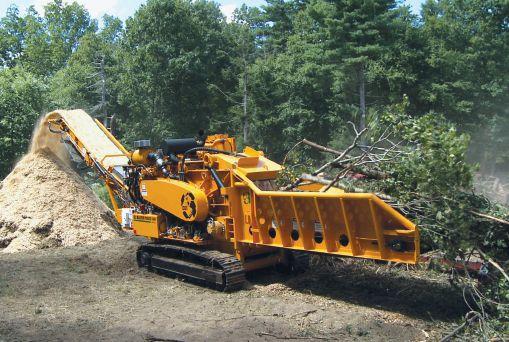
CBI introduces the Magnum Force 5800, a mid-sized upswing grinder designed to meet specific size constraints and built without compromising strength or performance. Decreasing headaches from load
restrictions and permitting was one of the primary design goals of the 5800. The offset helix rotor, anvil, screen designs and dimensions remain similar to the CBI 6800 to retain its superior grinding performance; however, the rotor width is decreased to produce a machine with a total width under 2.55 metres and weight of 64,850 pounds.
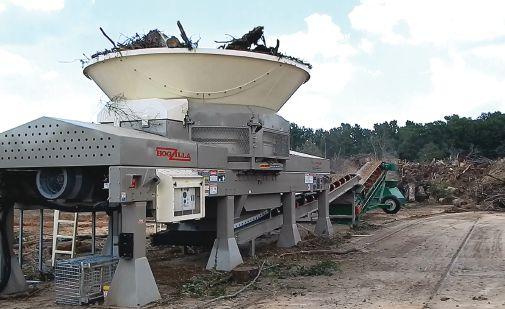
As the cost of diesel fuel continues to rise, electric-powered wood grinders have become the grinder of choice for an increasing number of grinding professionals, according to HogZilla. A HogZilla electric-powered grinder such as the TC-1664SE has no engine to maintain, allowing more hours of operation per week. With no transportation concerns, a larger, wider and heavier HogZilla can be attained, along with a larger throw restraint and stacking conveyor. The TC1664SE can come with a stationary tub guard, 16-foot tub and custom enclosure.
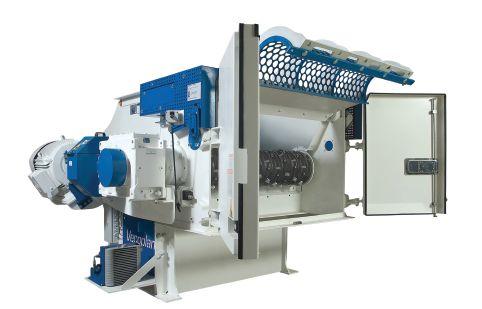
The VAZ 1600, one of Vecoplan’s New Generation shredders, incorporates a wide range of innovations that improve performance, increase durability and decrease maintenance time. These features and options include direct drives, double sidewalls, reversible counter knives, hydraulic swing-up screen carriages, rotatable screens, and externally adjustable counter knives. Direct drives increase torque, eliminate drive belts, lower maintenance costs and decease machine base widths. Externally adjustable counter knives allow you to maintain optimal cutting tolerances quickly and easily.
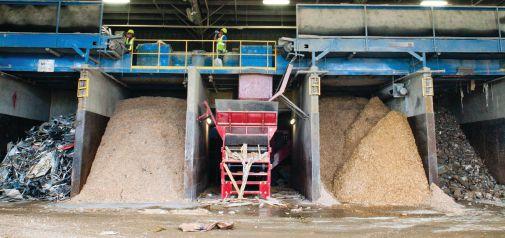
standard features and options for
optional trailer filling system, a Rotochopper electric grinder can now fill multiple bunkers or trailers, without repositioning any equipment. Optional wear packages dramatically lower operating and maintenance costs for highly abrasive feedstocks. An expended selection of rotor and tooth styles provides enhanced versatility to process a wide range of biofuel fibre sources.
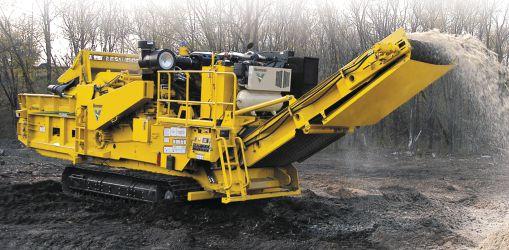
The Vermeer HG6000 line of horizontal grinders is specifically designed to provide the production, versatility and intelligence needed to meet the demands of your jobsite. These grinders self-propel into the most remote jobsites on 20-inch (51-centimetre) or 24-inch (61-centimetre) double grouser track pads. They have a high ground clearance and sealed rollers that help keep material from building up in the track system, as well as state-of-the-art wireless remote technology that allows operation of the machine from up to 300 feet (91.4 metres) away.
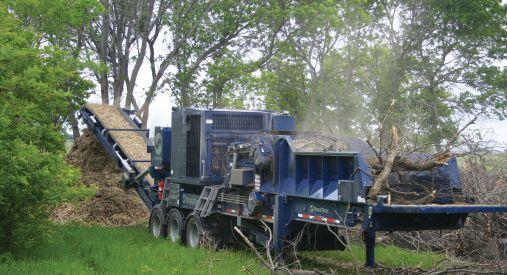
Industries manufactures a complete line of industrial tub and horizontal wood waste grinders, including the 5064 Horizontal Grinder pictured here, along with a 12-inch wood chipper.
DuraTech’s tub grinders have tubs that range in size from nine to 12 feet, with horsepower ranging from 325 to 1050. Their horizontal grinders are available in horsepower ranging from 475 to 1050. The versatile 2009 Tub grinder is now available with electric motor drives. A 400-horsepower, soft-start main drive motor as well as a 75-horsepower motor to power the hydraulic system are available in various voltages.
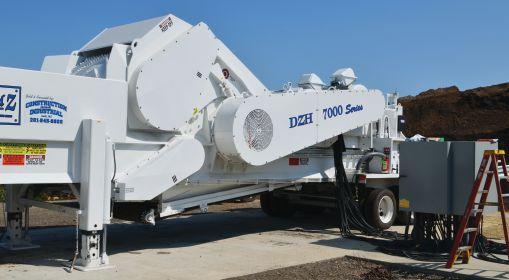
Diamond Z manufactures a complete line of tub and horizontal grinders, including diesel, electric, track and wheel mounted options for both. The
New
Rotochopper electrically powered grinders help minimize the costs of grinding and handling wood fibre fuels. With an
DuraTech
grinders range in size from 43,000 pounds to the largest track-mounted grinder in the world at 180,000 pounds. They offer horizontal grinder models, from the compact DZH4000 to the largest track-mounted DZH 7000TKT Series. This picture shows the new Diamond Z DZH7000E electric grinder, with dual 700-horsepower electric motors driving the mill and a 250-horsepower hydraulic drive totalling 1650 horsepower, making this the world’s highest horsepower mobile electric horizontal grinder.
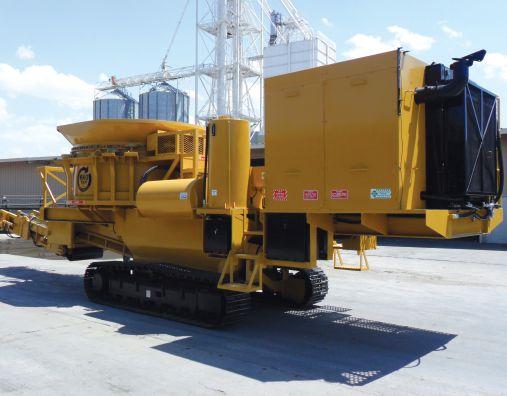
W.H.O. Manufacturing Company now introduces its track grinder to the North American market. These grinders have been in operation in the
Japanese market for the last six years. The grinders feature Caterpillar engines and track systems, reversing conveyors, 90-degree tilt tubs, full remote control for tub operation, grinder movement, and a radial stacking conveyor. The new track grinders are available in 10-, 12- or 13-foot diameter tubs with engine power ranging from 350 to 950 horsepower.
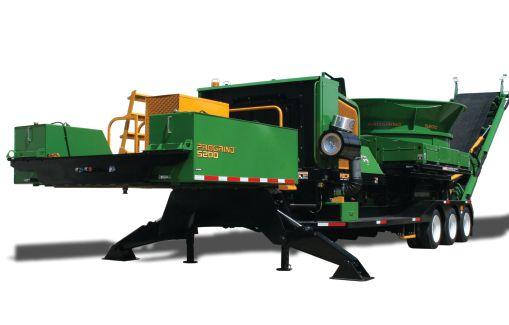
Replacing model 5100, Precision Husky calls its PG-5200 grinder the most powerful, easy-to-use tub grinder in the industry. It was designed with innovative features and advanced technologies to give customers the power and production needed to tackle the most demanding grinding operations. New features include the PT Tech totally enclosed wet hydraulic clutch, individually controlled auger motors with 20 per cent increase in rotation speed, Flexxaire automatic reversing, hydraulic actuation, variable pitch radiator fan and many others.
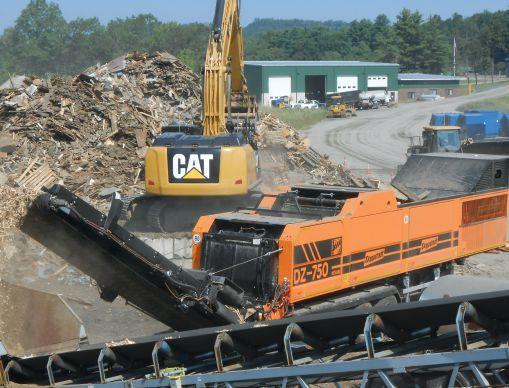
Doppstadt’s DZ 750 grinder gives customers the best of both worlds. The unit boasts a slow-speed shredder on the front end and a high-speed grinder on the back end, all in one self-contained unit, allowing for the efficient production of a finished product from even the roughest of in feed materials. The large permanent magnet removes foreign materials before they can enter the high speed grinder for extra protection. Pre-shredding is carried out by the sound single-shaft principle and the hydraulically controlled shredding comb. Grinding is carried out by a fast-running flail drum with free-swinging tools. This combination can process even the most difficult materials in just one process step.
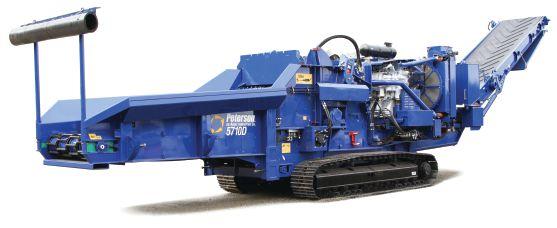
Peterson calls its new 5710D horizontal grinder the latest in a long line of innovative products from Peterson. With extensive input from existing Peterson customers, the redesigned 5710D features the latest in horizontal grinder technology. Powered by a 1050 HP Tier IV CAT diesel engine, the 5710D features a new hopper design as well as an optional transportation dolly to make moves between each job site easy.

Sustainable fibre?
Staff Report
thefuture of Canada’s pellet industry looks very bright, but only if access to sustainable fibre can be established.
That was the overall sentiment expressed by experts from across the North American and European wood pellet markets at the sold-out Wood Pellet Association of Canada’s (WPAC) Conference and AGM in Vancouver.
WPAC executive director Gord Murray has been a longtime advocate of creating a long-term plan for sustainable fibre resources in B.C. During his opening presentation, he once again spoke to the need for fibre security for the wood pellet sector in the province, stating that it was the number 1 priority of WPAC for the upcoming year.
That sentiment spread to presentations from other provinces, starting with André Bédard of Granules LG in St-Félicien, Que. Owner of two pellet plants in Quebec, the company has the capacity and desire to produce 200,000 tonnes of pellets per year. The company has worked hard in the past few years to establish European markets for its pellets, but faces an unsecure fibre supply in its home province as well. With pellet production in Ontario rapidly expanding across the next few years, securing fibre in Quebec will be key if Granules hopes to compete for contracts with European buyers looking to Eastern Canada. Logistics is also a challenge for northern producers like Granules LG.
In Nova Scotia, the rise of Port Hawkesbury Power and a limited volume of sawmill residues make fibre security difficult for the recently restarted Scotia Atlantic Biomass. The former Enligna site is now producing pellets for export to European companies, but its ability to grow from the current production capacity will depend primarily on the availability of quality fibre from within the province.
Access to a sustainable fibre supply will dictate Canada’s ability to produce for expanding markets according to Dr. William Strauss, president of FutureMetrics. Strauss estimates that global pellet consumption is expected to rise by 22 million tonnes by 2020. Two pellet power plants in the U.K. alone, Drax and Eggborough, represent a need for 10 million tonnes per year, with expansion of the Drax capacity possible
within that same time frame.
One of the countries that could seize part of that market is Russia.
Arnold Dale, vice-president of bioenergy with the Ekman Group, gave delegates an insider’s look at the growing Russian pellet industry. Of particular interest is the use of smaller, shallow draft vessels to move large volumes of raw material great distances to Russia’s larger pellet mills. “Rail is a cost-effective way to move raw materials, no doubt, but we’re seeing fibre moved great distances very cost effectively using these smaller vessels in Russia.”
Dale noted that studies from Jaakko Pöyry predict massive volumes coming out of eastern Rus-
sia to meet this demand as well, but the pellet trader views those predictions with a healthy dose of skepticism. “I know the guys at Poyry, and they are smart people, so they must know something about what’s going on. Russia has massive volumes of fibre, but the infrastructure just isn’t close to being there.”
The 2013 WPAC AGM and Conference drew over 300 participants in all, spanning a buyers’ breakfast, sold-out Fibreco tour and UBC pellet workshop on Monday; bustling receptions on Monday and Tuesday evenings; conference on Tuesday; and conferences and more tours on Wednesday. Stay tuned for details on a possible repeat for 2014. •
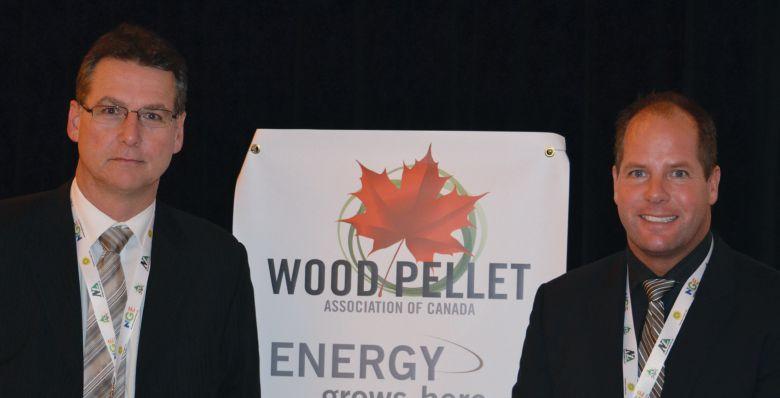
Brad Bennett, left, of Pacific Bioenergy was elected as the new president of WPAC taking over the role from Rob Tarcon, right, of Premium Pellets.
A national wish list
By Scott Jamieson
ScottThurlow, the president of the Canadian Renewable Fuels Association, came armed with a shopping list of requirements to push the biofuel sector forward. Topping the list was a national bioeconomy strategy.
“The United States has one, although not without its challenges,” Thurlow told the 110-plus delegates at the CanBio conference. “Europe has had one for years. Canada does not, and it’s a priority for our members moving forward.”
Thurlow would also like to see the monetization of carbon in Canada, so that industries helping to dramatically reduce the economy’s carbon footprint, such as the bioenergy sector, get the credit they deserve, and that such efforts receive in other jurisdictions. He also noted that as the automotive industry strives to make the significant fuel consumption reductions required of it by legislation in the U.S. and elsewhere, it will require gasoline with increasingly higher octane levels. “The best way to
achieve those higher levels is through ethanol blending. We’ll need to develop the fuelling infrastructure to allow for that higher ethanol level.”
Yet perhaps the most important step to increasing renewable fuel manufacturing in Canada, especially second-generation biofuels like cellulosic ethanol, is additional strategic investments to manage the massive capital required for commercialization.
“I don’t like to talk subsidies when you see the return on investment that the biofuel industry has already shown in Canada; I prefer to talk strategic investments. And when you look at the strategic investments Canada has already made in the oil and gas sector, it makes those in the biofuels sector look like rounding errors.”
Thurlow added that some challenges are outside our control in Canada. A major impediment to developing cellulosic ethanol in Canada is the flow of corn ethanol from the U.S. He noted that 40 per cent of the ethanol consumed in Canada is currently from the U.S. “It’s cheap, and

Exclusive additional discount for Canadian Biomass readers. Get a further 10% off the conference fee. Quote the discount code “CB10” when booking.
as far as the market is concerned up here it is indistinguishable from cellulosic ethanol.”
Still, despite that and the ongoing need to reduce pre-treatment costs, Thurlow remains confident in the industry’s future, both through increased demand for this high-octane blending tool as well as the potential for value-added products in the biorefinery model.
today’s Bioenergy
Joining Thurlow on the executive panel was Ken Shields, CanBio chair and Conifex CEO. Conifex runs two large sawmills in northern B.C., producing upwards of 350 million board feet per year in lumber. The company recently secured financing for its $100 million combined heat and power (CHP) project being constructed at a shuttered Abitibi-Bowater pulp mill in Mackenzie, B.C. Shields explained how the investment fit into the company’s growth plans, and some of the lessons they learned along the way.
“One of the big benefits of projects like these is the creation of greater and more stable employment opportunities in remote communities like Mackenzie. In our case we’re looking at reducing our lumber costs by $40 per thousand board feet by adding this asset, which moves us up to the next quartile in lumber productivity. That means that the next time U.S. housing slows down, we’re in a much more solid position to keep running.”
Yet despite that, he notes that the tenure system in provinces like B.C. are still in their infancy when it comes to bioenergy and the bioeconomy. Not only are bioenergy producers like Conifex’ separate division 100 per cent dependent on the main resource commodity

they stem from, but there is still a relaxed attitude toward underutilized fibre in most of Canada.
“I’d guess that 100,000 tonnes per year of fibre are not being captured for each sawmilling operation like ours in the B.C. Interior. Growth in the bioeconomy will require a change in our approach to tenure in Canada.”
financiaL chaLLenges
Following the executive panel was a bioeconomy financing panel that addressed the hurdles to funding large commercial projects, especially those relying on new technologies. Jeff Passmore of Passmore Group Inc. suggests co-developing with partners that can help with financing and share the risk; looking at brownfield sites from old industries rather than developing greenfield infrastructure from scratch; and extracting multiple streams from the resource, with the highest-value product taken first.
“If we look at the oil refinery model developed over the years, you’ll see a small fraction of the volume produced driving a large part of the revenue. They make their money off the petrochemicals, not the gasoline.”
Finally, Passmore noted that Canada is blessed with some significant government support that projects should look to, or get help in, accessing.
CanBio also used the occasion to launch its new logo, as well as explain its new focus on cross-association collaboration.
PRINCE GEORGE, CANADA
BATTELLE DEVELOPS MOBILE BIO-OIL CONVERSION PLANT
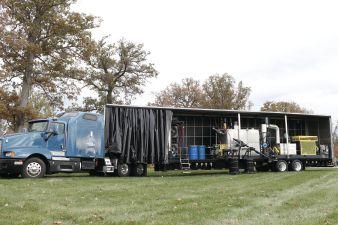
Battelle engineers and scientists have developed a mobile device that transforms unwanted biomass materials such as wood chips or agricultural waste into valuable bio-oil using catalytic pyrolysis. As currently configured, the Battelle-funded unit converts one ton of pine chips, shavings and sawdust into as much as 130 gallons of wet bio-oil per day.
This intermediate bio-oil then can be upgraded by hydrotreatment into a gas-diesel blend or jet fuel. Conversion of the bio-oil to an advanced biofuel is a key element of Battelle’s research. Extensive testing of the bio-based gasoline alternative produced by Battelle suggests that it can be blended with existing gasoline and can help fuel producers meet their renewable fuel requirements.
An alternative use of Battelle’s bio-oil is its conversion to a bio-polyol that can be substituted in chemical manufacturing for polyols derived from petroleum. Battelle’s bio-polyols have been validated by a third-party polyurethane producer as a viable alternative.
Battelle is evaluating this one-ton-per-day system at its West Jefferson, Ohio, facility. The pilot-scale system is the culmination of the company’s second-stage development of the mobile pyrolysis technology.
Currently, Battelle experts are using mainly pine waste in the unit, although

the machine can be modified to use other types of agricultural field residue known as stranded biomass, including corn stover, switchgrass and Miscanthus.
Because of its small size, the pyrolysis unit is installed on the trailer of a flat-bed 18-wheel truck, making it mobile and thus transportable to the waste products. This feature makes it ideal to access the woody biomass that is often left stranded in agricultural regions, far away from industrial facilities.
The Battelle bio-oil created by the mobile pyrolysis unit is similar to naturally occurring fossil oils harvested from underground. The hydrotreated, upgraded fuel from machine meets the Renewable Fuel Standard (RFS) set by the United States Environmental Protection Agency.
BANDIT RELEASES ChIPPING DRuM FOR BEAST XP-SERIES RECyCLERS
Bandit Industries now offers a chipping drum option that replaces the traditional Beast cuttermill. Designed for companies that want to chip exclusively with their Beast, the new drum essentially converts the Beast into a whole-tree chipper. A variety of screens can be paired with the drum, creating a screened end product that can be tailored to meet various specifications for nearly any biomass energy application.
Chipping drums can be ordered on new Model 2680XP, 3680XP and 4680XP Beast Recyclers, or retrofitted to older units.

EVENTS BOARD
February 19-20, 2014 • CANADIAN WOOD PELLET HEATING CONFERENCE Montreal, Que. http://www.quebecwoodexport. com/en/events
March 3-4, 2014 • GROWING THE MARGINS CONFERENCE London, Ontario http://www.gtmconference.ca
AD INDeX


April 9-10, 2014 • EUROPEAN BIOMASS TRADING 2014 CONFERENCE London, England argusmedia.com/Events/Argus-Events/ Europe/Argus-Euro-Biomass
Established 1973 World’s Toughest
Industrial CCTV Camera
The industry standard for Sawmills, Pulp/Paper Mills, Panelboard Plants and Wood Biomass Refineries
April 9-11, 2014 • NORTHEAST BIOMASS HEATING ExPO Portland, Maine nebiomassheat.com
• 560 TV Lines
• 2 9, 4 3, 6, 8, 12, 16 mm lenses
• All Weather, Extreme Environment
June 3-5, 2014 • WORLD BIOENERGY 2014 Jonkoping, Sweden www.elmia.se/en/worldbioenergy
• Heavy Gauge Di-Cast Metal Alloy & Titanium Components
• Tri-Axial Mounting System
• –60°C to +60°C
June 11-13, 2014 • INTERNATIONAL BIOENERGY CONFERENCE & ExHIBITION Prince George, B.C. www.bioenergyconference.org
• –76°F to +140°F
• Waterproof, IP68 Rating
• Vibration Resistant
Available from leading electrical wholesalers throughout North America

July 27-29, 2014 • 2014 PFI CONFERENCE Orlando, Florida pelletheat.org
TECHNOLOGIES Inc.
Canada – Ph 604-569-3240 • US – Ph 269-966-2900 www opticomtech com 1-888-410-2447
Established 1973 World’s Toughest Industrial CCTV Camera
The industry standard for Sawmills, Pulp/Paper Mills, Panelboard Plants and Wood Biomass Refineries
• 560 TV Lines
• 2 9, 4 3, 6, 8, 12, 16 mm lenses
• All Weather, Extreme Environment
• Heavy Gauge Di-Cast Metal Alloy & Titanium Components
• Tri-Axial Mounting System
• Waterproof, IP68 Rating
• Vibration Resistant

• –60°C to +60°C [–76°F to +140°F]
Available from leading electrical wholesalers throughout North America
TECHNOLOGIES Inc.
Canada – Ph 604-569-3240 US – Ph 269-966-2900 www.opticomtech.com 1-888-410-2447

Canadians must seize opportunity

ICanada has an abundance of biomass that can be converted into renewable fuels and products.
By Scott Thurlow
n recent years, Canada’s energy planning has become increasingly important – at times dividing sectors, governments and public opinion. Our resource sector is and will continue to be the backbone of our country, economy and national identity. However, many of the fuel products we produce, export and depend on, come with a cost to our environment. The challenge of capitalizing on our natural resources while protecting our environment is one of the greatest concerns facing our country. It is also an unparalleled opportunity.
Biofuels use is the best way to seize this opportunity. Renewable fuels can power our vehicles, diversify and extend our fuel pools, and protect our planet for generations to come. In Canada, we have built a billion-dollar domestic biofuels industry. Around the world, the global economy is also promoting expanded biofuels use and innovation with many jurisdictions introducing robust policy supports, program incentives and carbon pricing.
This presents a critical juncture for Canadian biofuels producers. Canada must compete with other resource-rich countries for fast-growing markets and scarce capital. And we must do it now.
getting the most out of canada’s Biomass
Advanced fuel technology can make more bio-based products from a wider variety of feedstocks, including agricultural residue and solid waste.
Biofuels technology is the best platform for commercializing advanced renewable fuels and products. Canadian biofuels producers are integrating emerging technologies into their existing production platforms and making a wide variety of value-added
outputs. For example, technologies exist to:
• Extract and refine corn oil to produce industrial lubricants, personal care emollients and nutraceuticals;
• Fractionate corn germ and bran to produce high-protein functional food ingredients;
• Extract “green hydrogen” through advanced anaerobic digestion processes; and
• Produce isobutanol from grain starches for use as a “drop-in” advanced biofuel or as a bio-based alternative for isobutene for the manufacture of rubber.
We also have several Canadian biofuels facilities co-locating with new, first-of-kind biofuels projects and opportunities. By leveraging existing technology and infrastructure, the ethanol and biodiesel plants of today are poised to become the biorefineries of tomorrow.
These are new renewable fuels and products, derived from new feedstocks, being produced using new technology and processes.
In terms of building Canada’s bioeconomy, the question is not “if” we can get there – but how we can get there sooner.
a reaL, Bio-Based economy
Developing new, bio-based products takes ingenuity. Successfully bringing them to market requires investment and capital funding. The most important step to increasing renewable fuels manufacturing in Canada is strategic investments to manage the massive capital required for commercialization. Factor in the intense competition for attracting investment in the global marketplace, and time truly becomes of the essence.
This is why the CRFA is urging government to develop and implement a national bioeconomy strategy for Canada. This strategy should include:
• Capital funding targeted at the growing bioeconomy and commercializing sustainable bio-products;
• Tax programs that favour the use of sustainable bio-based products;
• Programs that support research, development and commercialization of new products from the traditional biofuels platform; and
• Fair recognition for the greenhouse gas reductions that renewable fuels and co-products generate.
our choice, our future
Canada is blessed with a natural abundance of biomass. We have the industrial and refining capability to transform our biomass into a suite of renewable fuels and valuable co-products. All that remains is making the right decisions to translate this vast potential into a profitable reality.
Canada’s established renewable fuels industry remains focused on capitalizing on these opportunities to further diversify Canada’s energy supply. After all, this is what our industry has been built on. Now is the time to remember that and to take the steps necessary to bring us to the next logical step, a real bio-based economy for Canada.
The reward will be a cleaner, more prosperous tomorrow – for all of us. •
W. Scott Thurlow joined the CRFA as President in April 2012. Trained as a lawyer, Scott specializes in federal and provincial regulatory policies, including health, environment, energy and chemical management. He is also an expert on the laws governing legislative processes, lobbying and elections in Canada.
The Largest Biomass Conference in North America

100% of the exhibitors positively rated the quality of the entire conference
96% of exhibitors made valuable contacts
94% of exhibitors would recommend this conference
“I will go again next year & I will get more sales directly from contacts made at this conference.”
– Justin C. Miller, Scott Equipment
“Great show to attend. Excellent opportunity to network with industry execs and professionals as well as catch up on industry topics and developments.”
– Matt Weidner, Weidcom
“This is a ‘must attend’ event if you are developing biomass to energy projects. All the burning issues were covered in the conference and the important equipment providers have an expo booth.”
– Guillermina Perez del Castillo, Abengoa
Grinder + Hammermill
Rotochopper multi-stage grinding systems offer singlepass simplicity for producing animal bedding and short fiber fuels. Wood waste goes into the primary grinder and comes out of the in-line hammermill at finished specifications—no additional handling or hassle.
• Most uptime
• Cleanest operation
• Easily integrated into picking lines

• Unmatched particle size control
• Lowest cost per cubic ton
In-Line Hammermill