Highlights from the first Agritechnica in four years. | 8
Changing the game
Extracting ammonia from manure. | 10 The manure crystal ball Experts weigh in on how to get more manure onto fields in 2024. | 14
MARCH/APRIL 2024 Vol.22, Issue 2
From surf to turf
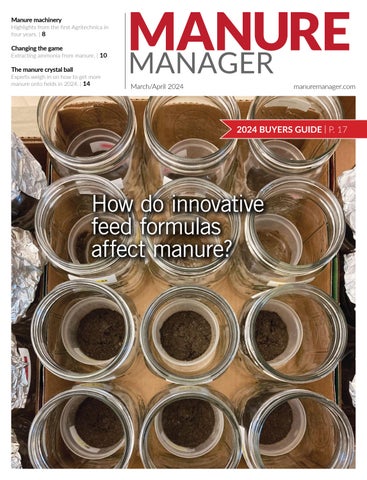
Researchers say seaweed additives in feed may reduce emissions from cows, but how do they affect manure?
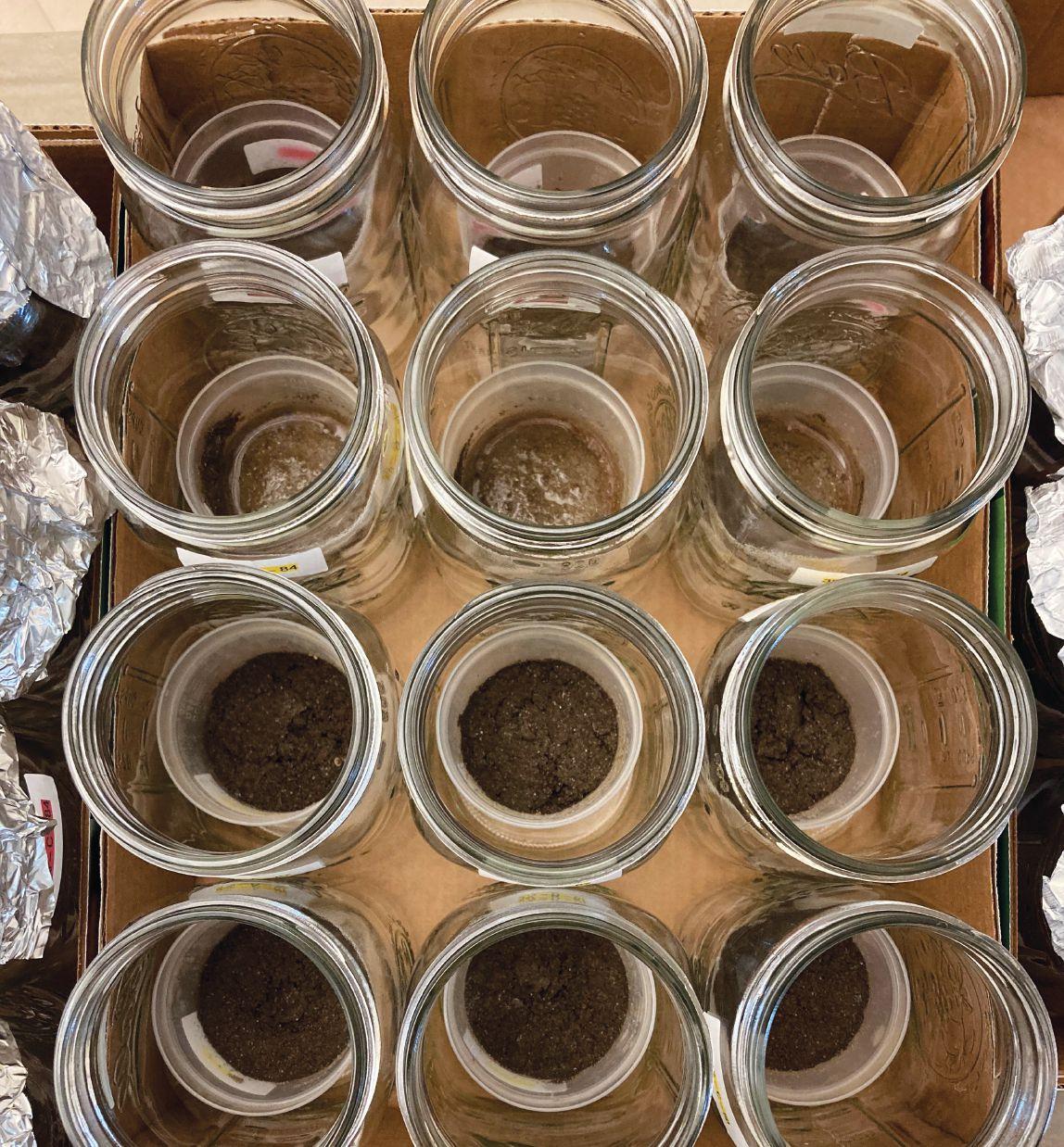
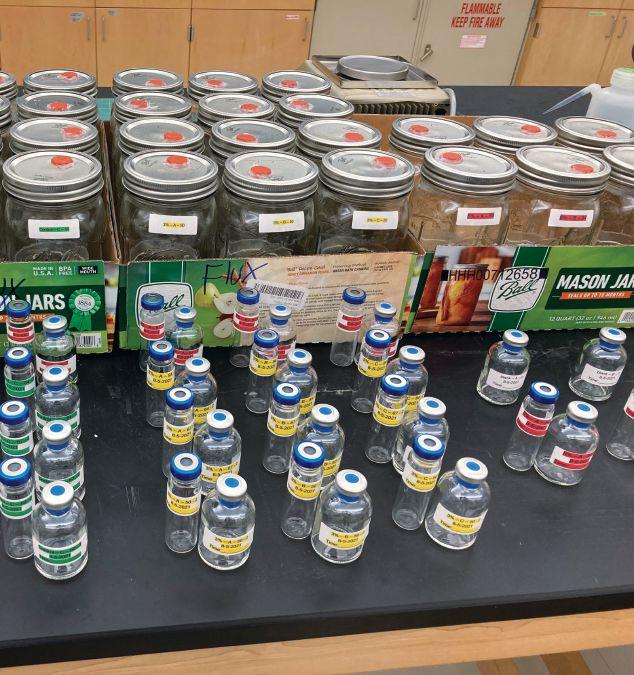
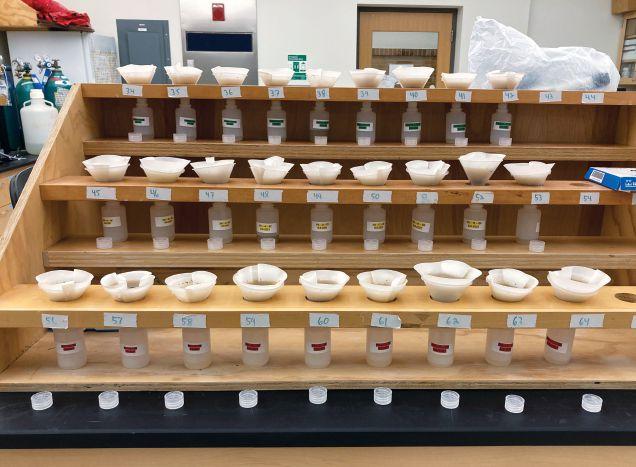
Samples of manure from cows with various levels of seaweed in their diets.
Manure machinery The latest and greatest at Agritechnica, which returns after four years.
BY CHRIS MCCULLOUGH
Changing the game
A Wisconsin team looks at a new process for removing the ammonia from manure. BY
JAMES CARELESS
The manure crystal ball Experts weigh in on what they think the biggest challenges will be for the manure industry in 2024. BY
JAMES CARELESS
Photo by Kyle Arndt.
Doing the right thing
When I’m not assembling the pages of Manure Manager, I’m heading up content for another agriculture publication, Drainage Contractor Drainage publishes two print issues per year and has been reaching contractors across North America for more than 50 years. Last week, as part of my Drainage duties, I attended the Land Improvement Contractors of America (LICA) Annual Convention in Virginia Beach, VA – where I found myself talking about manure (both manure itself and Manure the magazine) quite a bit.
I’ve been asked by many people if it’s difficult editing two magazines with seemingly little crossover. While I’ve never gotten to run a story in both magazines, the one subject that always brings the two together is soil and water quality. Nutrient leaching in waterways leads both the land application of manure, and subsurface drainage to be under intense scrutiny.
store their manure and contribute positively to their environments don’t make mainstream headlines. Aside from industry publications (like us!) manure is often written about in a sensationalist manner, which means the squeaky wheels get the grease.
But people don’t do the right thing just to be seen doing the right thing. They do the right thing because we only have one planet. Healthy soil and water means better growing seasons, higher profit margins and an easier pathway to feeding our growing world.
Still, it’s important to highlight the positives where we can – and I’m pretty sure no one can do that job quite like an industry magazine. In this issue, we highlight groundbreaking research on removing ammonia from manure (page 9), and look at how increasingly popular seaweed additives (which are thought to cut down on greenhouse gas emissions from cows) affect the manure being excreted by those cows (page 24). In the spirit of spreading the word about manure, we also talk
Manure Manager will mail information on behalf of
and services we
may be of
to you. If you prefer not to receive
information, please contact our circulation department in any of the four ways listed above.
“Healthy soil and water means better growing seasons.”
But what also serves to unite the two publications more than anything is the sense of being misunderstood by the public. The noble concern of environmentalists can often manifest in the “blame game,” and can unfairly characterize farmers – and manure applicators, drainage contractors –as indifferent to our climate, when that’s far from the truth. That’s why so many manure applicators have shown interest in improving their nutrient stewardship over the years.
The fact is, farmers who apply manure responsibly, follow all guidelines about where and how to
to a panel of experts on page 14 to discuss how we can get more manure on farm fields in 2024.
We also have guest columns from Minnesota, Michigan and New York State, an update on the latest tech overseas and much, much more.
Manure Manager knows that applicators and farmers across the continent already see themselves as stewards of the land – and we work to enhance and celebrate that through all of our print and digital content.
Recent study results published in Soil Ecology Letters state that antibiotic resistant bacteria (ARBs) might be controllable in some soil types through the application of manure.
The series of studies was conducted by the Institute of Environment and Sustainable Development in Agriculture a the Chinese Academy of Agricultural Sciences.
ARB was investigated in different soil types
BY
following manure application. Previous work indicated that manure application led to more antibiotic resistance genes in red soil compared with back soil and fluvo-aquic soil. As such, soil types were determined to be a factor worth investigating.
Results showed that manure control is an effective way to reduce the risk of soil ARB. More details on appropriate methods for specific soil types can be found in the Soil Ecology Letters publication.
WATERWAY ASSESSMENT FINDS P LEVELS LOWERING, N LEVELS UNCHANGED
A December assessment from the U.S. Environmental Protection Agency (EPA) has found that the country’s rivers and streams are facing difficulties associated with nutrient runoff. The assessment is based on samples collected in 2018 and 2019, as it takes several years for the agency to compile the results and release the report. This is the
THE NUMBERS
78 Percentage of manure that is applied to crops in the U.S. on the same farm where the manure is produced. (1)
14 Percentage of manure that is applied to crops in the U.S. that is purchased from other farmers. (1)
13%
third report of its kind. Compared to previous years, phosphorus levels are slightly lower, while nitrogen levels remain almost exactly the same. Nationally, 28 percent of river and stream miles were reported to be in good biological condition. However, almost half were in poor condition – excess nitrogen levels were found in 44 percent,
Approximate amount of large corn farmers in the U.S. who apply manure as a nutrient source.(1)
and phosphorus in 42 percent. Excess riparian vegetation cover was found in 27 percent of river and stream miles. The roughly half of river miles that are in poor condition result in affected habitats for snails, worms, beetles and other bottom dwelling species, and a third of river miles had poor conditions for fish.
“The NRSA found that the percentage of
river and stream miles in poor biological condition could be reduced by 20 percent if excess nutrient levels could be reduced from poor to good or fair,” said the report. Methods to prevent or lessen runoff include building buffers between farmland and waterways, creating new wetlands to filter pollutants and applying less fertilizer.
50%
Approximate amount of small corn farm owners in the U.S. who apply manure as a nutrient source. (1)
44%
Corn farmers in Ontario who selfidentify as following 4R nutrient stewardship practices.(2)
8 Percentage of manure that is applied to crops in the U.S. that is obtained for free. (1)
3 to 5
Recommended number of years one should go between soil field tests to ensure proper nutrient/ manure application rates.
45% Canola farmers in Western Canada who self-identify as following 4R nutrient stewardship practices.(2)
FCC unveils new 4R incentive program
Farm Credit Canada (FCC) has unveiled a new Sustainability Incentive Programthat will support crop producers who follow Fertilizer Canada’s 4R Nutrient Stewardship program using AgExpert. The program encourages producers to adopt 4R best management practices to help protect the environment without compromising their competitiveness.
The program was announced earlier this month at the Western Canadian Crop Production Show in Saskatoon, giving producers time to participate in
the program as soon as the 2024 crop year.
“This program brings together the innovation, science, and expertise growers can leverage to meet the growing demand for food produced in a profitable and sustainable way,” said Justine Hendricks, FCC president and CEO, in a statement.
“We see an opportunity to reward FCC customers who follow Fertilizer Canada’s 4R Nutrient Stewardship Program. Streamlining the data management and verification
World Pork Expo returns to Des Moines
The National Pork Producers Council will return to Des Moines on June 5 and 6 for the 2024 World Pork Expo.
The World Pork Expo, which has been a tradition since 1988, attracts approximately 10,000 pork producers and industry professionals every year. Exhibition space exceeds 300,000 square feet, and the 2023 edition saw nearly 400 North American companies on-site as exhibitors and sponsors.
The goals of the Expo include spreading education and business insights, connecting producers and professionals with new technology and providing opportunities for networking and camaraderie. “Producers come to Expo to reconnect with their peers, to share and exchange ideas,” said Scott Hays, National Pork Producers Council president and Missouri pork producer, in a statement.
process through AgExpert creates a simple way for producers to implement climate smart agricultural practices and create the best outcomes for their operations.”
“Before planting, producers will work with their 4R designated agronomist to plan their crop year and then follow the practices outlined by Fertilizer Canada’s 4R Nutrient Stewardship program throughout the crop cycle,” said Curtis Grainger, FCC director of sustainability programs. “Using AgExpert, agronomists can
verify producers have followed the 4R plan, then following the crop year, producers can use that verification to apply for the Sustainability Incentive Program.”
Fertilizer Canada’s 4R Nutrient Stewardship is a framework of best management practices that follow the right source of fertilizer at the right rate, right time, and right place. Using these practices help producers increase production, farmer profitability, and enhance environmental protection.
For more information including on eligibility, visit fcc.ca.
UPDATED IOWA P-INDEX CALCULATOR AVAILABLE
A new version of the Iowa Phosphorus Index (P-Index) calculator is now available for free use. The tool assesses the potential for phosphorus moving from fields based on soil and field characteristics, as well as management practices. It is targeted toward anyone requiring information about phosphorus in soils and the risk of that phosphorus reaching surface water, including landowners and land users, service providers and manure management plan writers. The updated version of the calculator incorporates newer soils and their related characteristics.
OFA
emphasizes importance of incineration
The Ontario Federation of Agriculture (OFA) has provided comments on ERO 019-8075: Proposed changes to how verification certificates are issued for incinerators regulated under Ontario’s Nutrient Management Act. OFA said incineration “must remain a viable option” for deadstock in the ag sector, which currently has a shortage in deadstock collectors.
The statement added that there is a need for incinerators to meet existing health standards. “However, we believe that whatever certification or verification process is developed, it must not add responsibilities or costs to the farmer.”
MANURE MACHINERY highlighted at Agritechnica
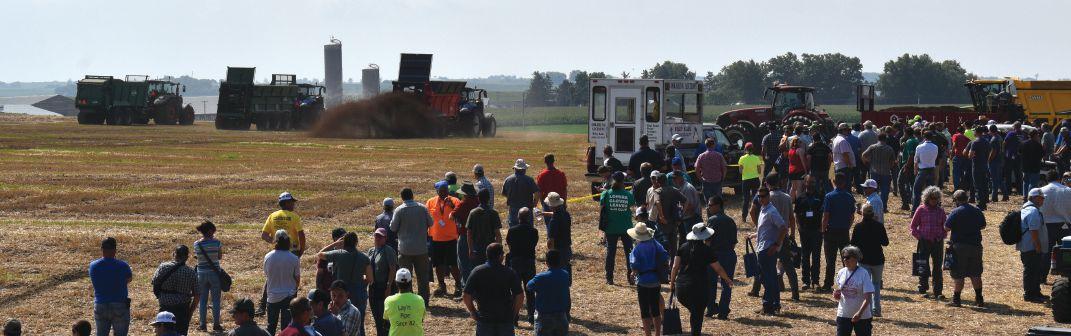
Farm equipment designed to make handling and spreading manure easier featured among the thousands of stands at the world’s biggest agricultural machinery show, Agritechnica, in Germany.
The first Agritechnica hosted since 2019 unveiled the latest in trailers, tractors, wagons and more.
BY CHRIS MCCULLOUGH
While a huge emphasis was on autonomous technology, other manufacturers launched machinery that are designed to help lower emissions kicked up by the agricultural industry. Held at the end of 2023, the show provided a total of 24 halls of farm machinery and technology for the record 470,000, who returned to the biannual event for the first time since 2019.
In total, 2,812 exhibitors from 52 countries supported the show organised by the DLG, German Agricultural Society. The next Agritechnica will take place from November 9 to 15, 2025.
Here are a few highlights of the show.
KRAMPE PROBODY 760 TRAILER
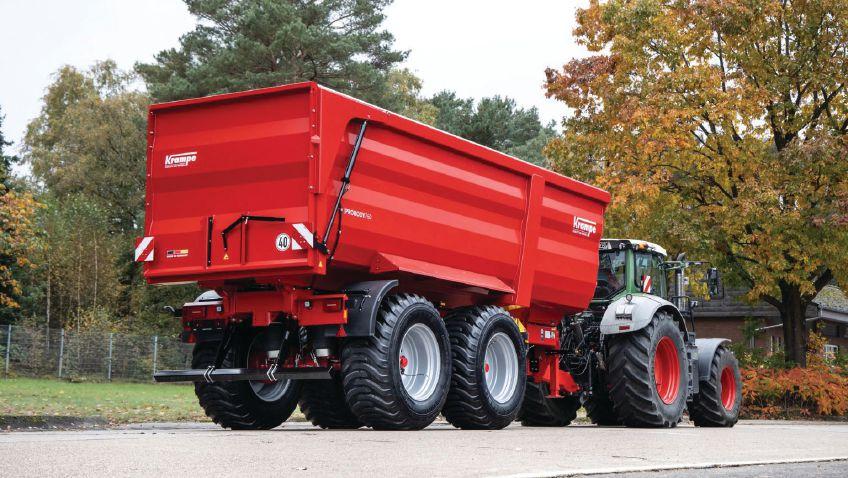
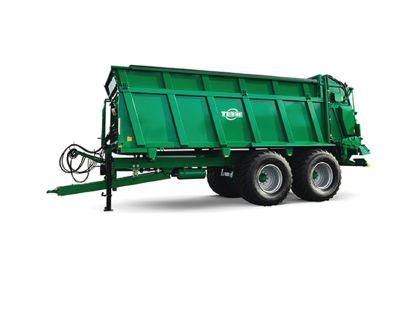
If you want to shift farmyard manure, or any other commodity, Krampe’s new ProBody 760 trailer will do the job. This trailer can haul 24 tonnes at
LEFT
The new Krampe ProBody 760 trailer can haul up to 24 tonnes at 40km/hr.
40km/hour and has a body capacity of up to 40 cubic metres, using extension sides. The normal grain body itself is 2m tall, 2.32m wide and is 8m long, while loading height is 3.57m. The inclined front wall increases the loading volume while maintaining manoeuvrability and overall length. A large inspection window provides an easy view into the body. The angle of the front wall facilitates load sliding, ensuring faster and safer unloading.
Chassis is made of large-volume rectangular tube 300 x 150 mm, has a suspended, height-adjustable drawbar for low hitch position with flanged 80mm ball head coupling.
JOSKIN 12M SLURRY BOOM
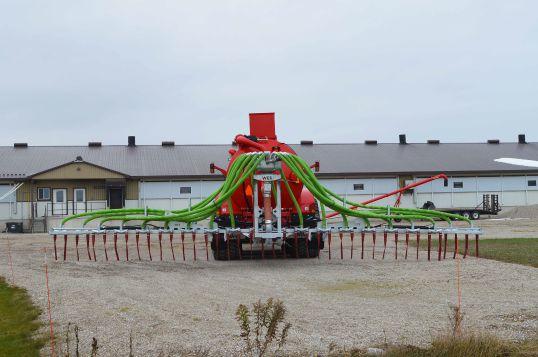
Joskin showed its new high performance 12m slurry boom in its Start range. Whereas the previous 12m model had a single macerator to distribute the slurry into the 44 hoses, the new version is now equipped with two Scalper macerators and four additional hoses.
In total, there are now 48 hoses, with a 25cm row spacing, compared with 28cm previously. While the
presence of two macerators ensures a better slurry distribution, it also increases the working speed since there is a higher flow of slurry at the tank outlet.
This model is also equipped with gauge wheels on both sides of the boom. These improvements can be found on both the Pendislide Start version with skids and the Penditwist Start version with line hoses.
SLURRYKAT FARMLINE 10.5M TRAILING SHOE
Northern Ireland-based SlurryKat displayed its new Farmline 9m and 10.5m trailing shoe. The new 9m model weighs 600kgs and the 10.5m model is 636kgs. Both the 9m and the 10.5m models exhibit unique inverted booms in the transport position.
The extra width for the new models was achieved by adding a novel flip-over end section on the side arms, which is operated by a hydraulic cylinder.
With flip-up shoes on the central and outer sections, this makes it easier for the operator to make headland turns. Also, the machine does not need to be folded up to reverse, all the operator has to do is flip up the shoes, carry out the manoeuvre, then drop the shoes and work away.
STEYR HYBRID CVT TRACTOR
Steyr’s new Hybrid CVT tractor, based on the 180hp Steyr 6175 Impuls CVT platform, featured on the stand. Power is boosted to 260hp by the electrically powered front axle, which also features a newly-developed independent suspension.
The combination of higher power in a lighter package is made possible primarily because of the combination of hydromechanical CVT drive to the rear axle and the hybrid module on the front axle, both of which can be combined with an intelligent 4wd clutch.
The E-CVT function means the tractor is powered purely hybrid-electrically at up to 75kW and a low 1,100rpm, enhancing comfort with non-constant PTO loads such as big square baler work, and maintaining ground speed via electric drive, with no mechanical connection with the engine.
CASE IH QUADTRAC 715
Case IH showcased its new Quadtrac 715 tractor, rated at 715hp. At the heart of this machine is the FPT Cursor 16 engine, which delivers up to 778hp at maximum power. Together with increased torque, improved engine power, an 11 percent larger fuel tank and other improvements, Case IH says this
beast will deliver high productivity.
Maximum pump flow rate is 428l/ min and it has the 16 speed Powerdrive transmission for smoothness in the field.
Only available in tracked Quadtrac format, the new tracks are 305mm longer, giving more ground contact offering enhanced power transfer, greater traction, and reduced compaction.
FARESIN PF1.14 ELECTRIC WAGON
Faresin revealed its first all-electric Leader PF 1.14 self-propelled mixer wagon with 14 cubic metres capacity.
The machine is powered by a 91kW, 210Ah lithium iron-phosphate battery integrated with Farmatics telematics for remote control, which is installed in the rear engine compartment. Traction power is provided by a 51kW electric motor positioned in the rear axle, which also transmits motion to the front axle via a cardan shaft. The system has two gears that allow travel up to a maximum speed of 20 km/h.
The Leader PF Full Electric has four drive and steering wheels that allow three types of steering. It is also equipped with a hydropneumatic suspension that can be adjusted in height via a control in the cab, allowing comfortable and safe driving.
A 45kW electric motor supplies power for all types of mixes thanks to the eight mixing speeds. In addition, a special cleaning function allows the auger to completely discharge the mixture inside the mixing tub.
MF 9S SERIES TRACTORS
Massey Ferguson launched its 9S tractor series of six models ranging from 285hp to 425hp. This new range replaces the outgoing MF 8700S series. All six models are powered by an updated six-cylinder, 8.4-litre AGCO Power engine, with Engine Power Management (EPM) offering up
ABOVE
to 30hp extra for all models, except the flagship 9S.425.
Models start with the MF 9S 285 at 285hp with a max EPM power of 315hp, while torque output is 1,250Nm at 1,500rpm at max power, and rises to 1,400Nm at 1,500rpm with EPM.
Updates to the engine include a new turbocharging design with a single advanced turbo replacing the twin turbo system. The 660-litre fuel tank is 10 percent larger than previous models, while the engine is also designed to run on HVO fuel.
The new models are fitted with MF’s renowned Dyna-VT continuously variable transmission that offers new power management to deliver additional power and torque compared with previous models.
KRONE LEMKEN VTE AUTO VEHICLE
Krone and Lemken joined forces to present their VTE automatic towing vehicle with a Krone mower attached. All implements on this vehicle are automatically re-adjusted by means of high-quality sensor systems to ensure that optimum working quality is always achieved.
Power is supplied by a diesel MTU four-cylinder engine that delivers 230hp to a generator, which then supplies electrical power to both axles and the power take-off.
A standardised interface connects the towing vehicle with the attachment device and ensures continuous data exchange in real time. In this manner the data recorded on the attachment device and forwarded to the towing vehicle is continuously compared with previously defined values.
In case of deviations, changes are made automatically to the setting of the attachment device. In extreme cases of malfunctions or damage, the unit is stopped. •
The Case IH Quadtrac 715 tractor.
CHANGING the game
Innovative electrochemical process recovers ammonia from manure
BY JAMES CARELESS
Ammonia losses are a problematic byproduct of manure.
In its gaseous form, concentrated ammonia can cause everything from acute eye and airway irritation to chronic asthma-like symptoms, decreased lung function – and in extremely high doses, death.
Gaseous ammonia can also be transformed to nitrous oxide, a greenhouse gas, while its deposition can acidify soils, damage and weaken plant life, and contribute to algae blooms in surface water.
Not surprisingly, the livestock industry is seen as a major source of ammonia emissions due to its output of animal manure. Although it is possible to reduce the amount of ammonia produced in livestock manure by adjusting the animals’ diets, there remains a need to mitigate the ammonia that is lost from manure to the atmosphere. This is why an innovative electrochemical process developed by researchers at the University of WisconsinMadison (UW-Madison) could prove to be a game-changer for manure management, and – by extension – the entire planet.
Their work was recently published in the journal Nature Sustainability under the name ‘Electrochemical ammonia recovery and co-production of chemicals from manure wastewater’, with an online posting date of December 8, 2023.
HOW THE PROCESS WORKS
Dr. Song Jin is a professor in the chemistry department at UW-Madison. He is leader of the team that has developed this new ammonia recovery process, which is still in its laboratory testing phase.
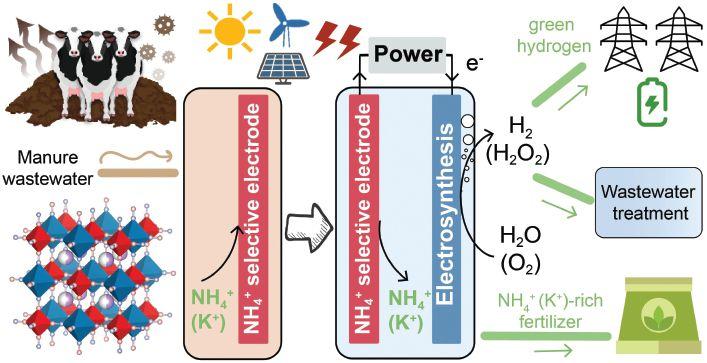
electrical current is applied to the electrode, causing it to release the ammonium and potassium ions into the solution. Once the solution has been evaporated away, the nutrients are left behind in dry form –ready to be used as nitrogen and potassium-rich fertilizers.
That’s not all: When the ammonium ions are released, “we can perform other chemical reactions on the other electrode in the solution to make products that are also useful and valuable,” says Jin. “One of the demonstrations we did here was to make hydrogen gas, which is a fuel. The other demonstration made hydrogen peroxide, which is a disinfectant that can be used to treat wastewater and do other things. These are very useful byproducts.”
In a single cycle, researchers found that up to 50 percent of the ammonia within the liquid manure could be recovered by this process. A second cycle brought the extraction level up to 85 percent. That’s no small achievement, and one that represents a significant reduction in manure-generated ammonia being released into the environment.
ABOVE
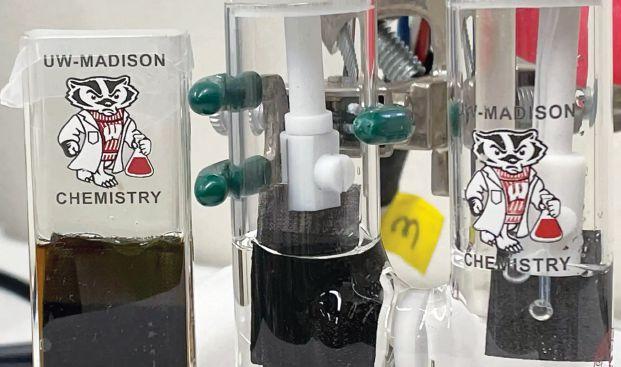
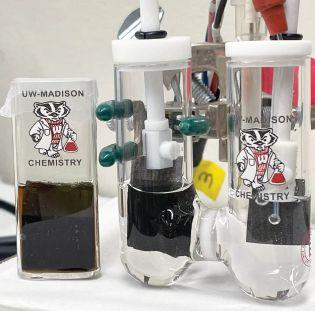
The lab setup providing proof-ofconcept of ammonia recovery and chemical production strategy.
Here’s how the process works. A sample of dairy manure wastewater is put together with a ‘porous battery electrode’ – specifically an ion-selective potassium nickel hexacyanoferrate (KNiHCF) electrode – that is capable of oxidizing organic materials within the manure mixture and absorbing the ammonium and potassium ions present in the manure liquid. “It essentially works like a battery electrode,” says Jin. “The spontaneous electrochemical reaction that occurs between the battery electrode and the organic matter in the manure drives the uptake of ammonium and potassium ions into the materials.”
Once this electrode has been saturated with ammonia and potassium ions, it is removed from the first container and inserted into a second container filled with a clean salt solution. An
AN INSPIRED DISCOVERY
The inspiration for the electrochemical approach to ammonia removal came from fellow team member, Dr. Mohan Qin, an assistant professor with UW-Madison’s Department of Civil and Environmental Engineering. “She was the one who pointed out that people are interested in recovering ammonia from manure, that the current membrane-based processes to do so are inefficient and costly,” says Jin. “This motivated us to develop and test this new process.”
The fact that this electrochemical process extracts potassium as well as ammonia is an added bonus. That’s not all: “It was also surprising that we were able to just spontaneously oxidize the organic matter in the manure,” he says. “We were not planning for that at the beginning, but we accidentally found out that this was happening once the process was underway. That’s actually not a bad thing at all, because if you don’t have this spontaneous action, you would have to run another complete electrochemical process on the uptake side driven by electricity. With this spontaneous oxidation reaction, we can skip that step and simplify the process.”
POSITIVE IMPLICATIONS
The ability to extract ammonia and potassium from liquified
An illustration demonstrating the process through which ammonia is recovered.
manure has many positive implications for livestock manure producers, in specific, and the planet overall.
The first implication is potential profit for the livestock industry. Assuming that this laboratory process can be scaled up to an industrial scale, manure can become a source of revenue for livestock producers. For instance, a preliminary estimate by professor Fikile Brushett, a team member from the Massachusetts Institute of Technology (MIT), shows that a 1,000-dairycow farm could potentially earn up to $200,000 a year out of this process.
Dr. Rebecca Larson is a professor in UW-Madison’s Nelson Institute for Environmental Studies and a member of the research team. Her research indicates that this process could reduce ammonia losses to the atmosphere of this same herd by up to 50 percent, with potential revenue streams for this operation.
Larson also sees electrochemical ammonia recovery as a natural complement to manure digesters. “There’s been concerns expressed about digesters mineralizing nitrogen and losing more ammonia afterwards,” she says. “You could certainly pair these two together, so that one could offset the other.” Moreover, in such a pairing, some of the biogas being produced could be used to power both systems. This would be a ‘green’ option that could make such facilities more acceptable to adjacent property owners.
A further benefit of this ammonia/ potassium extraction process is reducing the impact of manure by increasing options for end use management when nutrients are extracted. This could improve management during land application and reduce impact on nearby groundwater, plus flowing water in streams, rivers, and lakes. In turn, this process would reduce the effects of ammonia and potassium pollution on plants, marine ecosystems, and ultimately people.
GOING INDUSTRIAL
The laboratory-based electrochemical ammonia recovery process is not yet ready for prime time. The biggest challenge that Jin and his teammates have to overcome is scale: equipment, electrical sources and
infrastructure need to be there – but the process still must remain affordable and easy to install, run and maintain on a farm.
Of course, all of this will take money. The current research into this process is being funded by a National Science Foundation (NSF) grant (CBET2219089). But since NSF grants are focussed on bankrolling fundamental science and engineering research, other
This being the case, “we’re open to additional funding partners, even maybe business partners if there’s enough interest,” says Jin. “We are certainly open to starting a company to look at some of those practical things and develop a commercially viable process. As for our research, we have even more ambitious goals for this project. What we just published is just a preliminary step. We are aiming to further reduce the carbon dioxide emitted by digesters and other farming processes into useful chemicals and integrate that with ammonia recovery.” •
GUEST COLUMN
Innovations in dairy manure and GHG research: A comprehensive approach
Cornell University and the New York dairy industry are working together to understand how dairy manure can impact a farm’s greenhouse gas (GHG) emissions and determine which strategies farmers can use to reduce their footprint, while maintaining profitable farm businesses that meet additional sustainability goals including air and water quality, soil health and biodiversity. With New York’s ambitious Climate Leadership and Community Protection Act and the dairy industry’s aggressive goals for environmental sustainability, Cornell is uniquely positioned as a leading research university and Land Grant Institution to study and develop innovative strategies and work with farmers to identify which of these will work in the northeast.
the effects of feed additives on enteric methane emissions over extended periods of time as these products interact with animal genetics, diet composition, and potential microbial adaptation.
“Managing cattle diets can reduce ammonia emissions.”
There are three important GHGs associated with agriculture - carbon dioxide, methane and nitrous oxide. When it comes to manure, however, we focus on methane and nitrous oxide. Methane on a dairy farm is primarily produced directly from the cow herself (enteric) and from the anaerobic storage of livestock manure. While nitrous oxide emissions occur in animal housing and during the handling and land application of manure and other associated field practices related to growing the forage and grain crops fed to those animals.
THE COW
Cows produce enteric methane during the digestion process. As fermentation of feed takes place in the rumen, the byproducts of carbon dioxide and hydrogen are converted to methane by microbes (methanogens). Cows then release that methane by burping it out. There are feed additives that are designed to inhibit this process and therefore reduce enteric methane produced by the cattle. Cornell is currently in the process of building a state-of-the-art facility to investigate
Precision feeding is another strategy to reduce not only methane from the cow, but also nitrogen in her manure. By feeding rations that are more energy efficient, you can reduce excess energy fed and thereby keep more of that energy for the animal’s needs. This also means less is lost to byproducts like methane. Likewise, managing cattle diets for optimized protein and amino acids can reduce ammonia emissions and manure nitrogen, both of which can ultimately become nitrous oxide. The Cornell Net Carbohydrate and Protein System (CNCPS) is a cattle nutrition model that predicts feed utilization, animal performance and nutrient excretion for dairy and beef cattle using knowledge about feed composition, digestion, and metabolism in supplying nutrients to meet requirements. CNCPS is currently used to formulate diets for about 70 percent of the dairy cattle in the U.S. Version 7 of CNCPS has been in development for 13 years and evaluated internally on high producing lactating dairy cattle. Upon its release, nutritionists will be able to formulate more precise diets that maintain productivity while reducing N intake, excretion, and methane intensity. When implemented correctly, these diets can provide greater milk component yield, enhance energetic and N efficiency, and reduce the cost of the diets. Further, the model predicts enteric methane production with good accuracy while conducting diet formulation, allowing herd level methane inventories alongside nitrogen efficiency planning.
MANURE STORAGE AND HANDLING
To maintain compliance with the Clean Water Act and state and local regulations in the U.S., the number and volume of liquid manure storages has increased significantly in the last 20 years.
While this is a clear benefit for water quality by reducing the need to spread manure during inclement weather that is conducive to runoff, these storages also create anaerobic conditions that result in methane gas production from the carbonaceous solids in livestock manure. Cornell’s Pro-Dairy Dairy Environmental Systems specialists are hard at work quantifying the impact of the GHG emissions from storages and are also researching and designing solutions. They are monitoring GHG emissions, sampling manure and building scale model storages to investigate potential additives and manure treatments that claim to reduce methane emissions from storages. The good news is that they have already identified some strategies that farms can do today to reduce the GHG footprint of their manure storage and handling. They are currently working to quantify the benefits of practices like separating manure solids before storage, reducing manure stored during the warmer months, covering separated liquids and flaring the methane captured by the cover, anaerobic digestion and biogas production, oxygenation and acidification.
MANURE APPLICATION AND CROP MANAGEMENT
Once manure is out of storage and being used as a soil amendment and nutrient source, the GHG focus for manure during field application shifts to nitrous oxide. In addition to reducing the need for importing fertilizer (and the associated GHG emissions from that), maximizing nitrogen availability of manure applied to cropland will reduce losses to the environment. Getting manure incorporated or injected as quickly as possible and applying it as close to (or during) crop utilization will reduce ammonia emissions significantly, but we are still learning what the ultimate impact is on nitrous oxide.
In collaboration with the Soil Health Institute and researchers seven other research institutions, Cornell University is part of a project looking specifically at GHG emissions from manured field crop systems, called Dairy Soil & Water Regeneration: building soil health to reduce greenhouse gases, improve water quality and enable new economic benefits. This project funded through the Foundation for Food & Agriculture and matched by industry
For more info visit huskyfarm.ca or call 1-800-349-1122
Trailing shoe booms from 6m to 30m in width. BlackBird trailing shoe booms in stock Summer 2024. Various incorporation options available. Contact us for more info on tank sizing options.
partners is led by the Dairy Research Institute. The project team is collecting data for six years to study soil health and manure management and its effects on greenhouse gas emissions, water quality and agronomic factors such as yield and forage quality.
By engaging in research on real dairy farms across the U.S. (in New York, Vermont, California, Wisconsin, Idaho and Texas) we will address research gaps about the GHG emissions from manured field crop systems, not just individual practices. This work is designed to engage and inform dairy producers by helping them select management alternatives that work for the crops, the environment and the farm’s bottom line while utilizing one of their most valuable resources: manure. •
If you want to see more innovation in the northeast around the sustainable use of manure, don’t miss the 2024 Manure Expo being hosted by Cornell Pro-Dairy and University of Vermont Extension on July 1718 in Auburn, NY! Visit ManureExpo.com for more information.
THE MANURE crystal ball
What can the manure management industry expect in 2024?
BY JAMES CARELESS
What trends affected the manure management industry in 2023, and are likely to affect it in 2024? How will the market value of manure change this year, and what ‘must have’ technology will manure managers need to have at their disposal?
To find out, Manure Manager picked the brains of three experts. They are:
• Christine Brown, a field crop sustainability specialist at the Ontario Ministry of Agriculture Food and Rural Affairs (OMAFRA).
• Dr. Robb Meinen, assistant research professor and director of the Pennsylvania Nutrient Management Education Program, state extension specialist – nutrient and manure management, at Pennsylvania State University.
• Kirsten Workman, senior extension associate (nutrient management and environmental sustainability specialist) at Cornell University’s CALS Pro-Dairy. Here is what they told us.
Manure Manager: What trends dominated the manure management field in 2023?
Kirsten Workman: Maximizing nitrogen from manure, utilizing manure in no-till and cover cropped systems, GHG emissions from manure and water quality protection.
emissions from agriculture and Ontario government policies will continue to include improving soil health.
Workman: Trends such as sustainability and public perception will continue to drive improvement in environmental management. I see equipment manufacturers continue to develop tools that help farmers and applicators do a better job while still being efficient with time and labour in their manure applications. I also see the technology around manure treatment, separation and nutrient partitioning evolving quickly in the next few years.
Robb Meinen: Work conducted in the past few years that explores manuresheds is helping researchers and agencies understand large-scale views of nutrient mass imbalances. Manuresheds are areas of cropland needed to assimilate manure nutrients produced from animals in an area. They can exist on different scales, from a single farm to multi-state regions and can include manure nutrients from all animal species in an area.
ABOVE
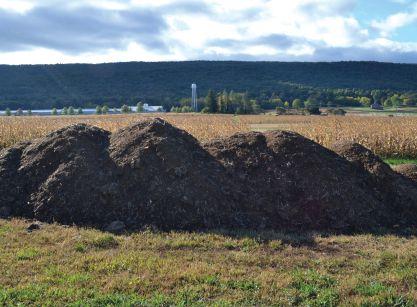
Solid manure that can be applied to either the field on the farm where it was produced, or a nearby farm.
Christine Brown: High fertilizer prices and a focus on reducing nitrous oxide GHG emissions through better nitrogen management resulted in an increased interest in improved manure nutrient (especially nitrogen) utilization. This, combined with some cost share opportunities, has helped with advancing more technology to help with in-crop application and compaction reduction. Funding opportunities have increased the application of manure, compost and other organic amendments to non-livestock farms where they are also interested in the soil health benefits from manure.
MM: What trends do you see evolving in 2024?
Brown: I think those trends will continue through 2024. S-CAP (Sustainable Canadian Agricultural Partnership) funding opportunities will continue for farmers. The Canadian federal government will focus on reducing methane and nitrous oxide
One of the things we point out with manuresheds is that smart expansion of animal industries places new animal operations in areas where cropping systems currently use commercial fertilizer that can be replaced by manure nutrients. In the big picture this can be encouraged, or coupled with, relocation of feed mill capacities that make delivery of feed nutrients to the new farms more economic from the supply chain side.
MM: How do you see the market value of manure/nutrients changing in 2024? Overall, can those with manure expect to get more money/value out of their manure?
Meinen: The value of manure is appreciated now more than ever. As a result, I expect manure’s demand and value will remain high in 2024 and beyond.
Workman: I think co-products of manure management will improve the financial value of manure; energy, separated solids, and so forth. If fertilizer prices spike again, I can see non-livestock farmers valuing manure more and trying to acquire it from their livestock producing neighbors. Carbon markets may play a role from reductions in methane emissions from storages as well.
Brown: Fertilizer prices have come down since last year which will affect how much people are willing to pay for organic amendments. Industry is talking more about the 4R around all
nutrients including manure and following those principles will help improve manure value. Fuel, equipment, and labour will affect application costs and could limit application to fields further from the source. Reducing the water content of liquid manure will help to improve the value.
MM: What are the new demands on farmers and nutrient managers in terms of technology? What are increasingly seen as “essentials” to keep up? Are there any spaces that people are watching re: investments in equipment?
Workman: GIS (geographic information systems) and precision agricultural technology are becoming more and more important, especially as we pump more manure as opposed to trucking it. As a result, injection, constituent sensing, and pumping/hoses are all areas of future investments for farmers/applicators — anything that helps farmers maintain their field-based conservation practices while also maximizing the nutrient value of their manure. Most larger dairy producers are also being approached by alternative energy developers and weighing decisions about digestion, RNG, methane reductions, separation/treatment, covers, et cetera.
Brown: Equipment is expensive, and farmers are often interested in seeing how new technology/equipment will work on their farm before making the investment. I think farmers are looking to custom manure applicators more often to apply manure at the right time and with better placement or new technology.
Meinen: I think it is essential for anyone purchasing new manure handling equipment to carefully weigh the costs of technology with the benefits they will realize with its implementation. A large part of this is to school yourself.
Technology is taking us to places we only dreamed of a few years ago. Variable rate application based on gridded crop yields and soil conditions can be accomplished as a result.
However, investing in this type of technology is not for everyone, since it probably takes a certain number of acres and a certain number of years for the investment in technology to pay for itself. For this reason, I think we’ll see professional manure handlers lead the way in technology investment. That is a good thing since we know professionals work across many acres and farms, making the real-world impact of new technologies more impactful.
MM: Are new workers entering the manure application field at a sustainable rate? Do applicators feel they have enough support?
Workman: Like all parts of agriculture, attracting labor is very challenging. The long hours are not well-received by new workers who might not be familiar with the seasonality of the work, such as the long days and being weather-dependent.
Brown: Labor shortages have limited some custom applicators from meeting the demand. More support could probably be provided through labour policies, or thorough access to the same funding opportunities as farmers are eligible for, i.e. equipment modifications.
Meinen: I have led certification of commercial manure haulers and brokers in Pennsylvania since our program’s inception over 20 years ago. In the past few years, I have noticed that the number of newly certified individuals has been low. This indicates that less people are entering the professional
manure handling industry.
We know that we are not producing less manure, so this also is indicative that existing professional companies are stable and servicing long-term animal operation customers. I cannot say if the average manure business is growing but I know of several that have. The ones that come to mind are those that provide a fair service, meet nutrient management planning requirements of the farm, and provide economic, agronomic, and environmental benefits that meet the farm’s goals.
MM: Currently, manure is only applied to approximately nine percent of U.S. cropland. Over the last two years, experts have sworn manure would take off in popularity due to the war in Ukraine causing fertilizer prices to rise. But has that happened?
Brown: Fertilizer prices have gone down in the past six months. In Ontario there are fewer livestock farms, but the remaining farms on average are bigger. Other organic amendments from AD to compost to biosolids and “processed
STOP GETTING PUSHED AROUND
hydraulic suspension
The smooth hydraulic suspension cushions shock loads while the responsive steering system really takes the load off your tractor during cornering.
biosolids” that are CFIA registered are being applied to cropland that otherwise doesn’t have access to livestock manure. In the past few years, the demand for these products has been higher than supply. I’m not sure what [percentage] of Ontario cropland gets manure/organic amendments, but I think it is substantially higher than 10 percent Meinen: Farms will apply the nutrient that makes the most economic sense. Those decisions involve more than just the price of nutrients –availability of supply, opportunity to apply nutrients in a desired time window and equipment availability.
Liquid manure nutrients are more expensive to transport than solid, so the radius of lands that will receive manure from our liquid systems – especially dairy and swine – will always have an economic limit that is lower than the radius associated with dry manure products.
For liquid manures, injection technologies can help to get manure onto more acres. Manure injection greatly reduces nitrogen volatilization, which means the farm retains a higher percentage of applied manure nitrogen in the soil. In turn, this means that the same volume of manure can be used on more acres when applying at a balanced manure nitrogen rate. This should reduce fertilizer purchase and decrease the extra amount of phosphorus applied to that soil.
Because prices went back down relatively quickly, I think nonlivestock producers who may have been interested were able to go back to fertilizer. However, as instability continues, I can see crop producers going back to manure again. If there are two years in a row of high fertilizer prices that could really tip the scales. In my work in Extension, this is an area of focus to help distribute manure nutrients over more cropland acres. We need to make sure our work showing the yield benefits, soil health and nutrient/economics are well-communicated to that audience.
MM: Finally, what other factors do you expect to affect manure management
Public pressure about contaminants such as microplastics and [Per- and Polyfluorinated Substances]. Public perception continues to be a challenge. We shouldn’t take it lightly and we need to educate the public on the benefits of good manure management. •
MANURE MANAGER
2024 BUYERS GUIDE
AGRI-KING, INC.
18246 Waller Rd., Fulton IL 61252 USA
Tel: 815-589-2525
Toll free: 800-435-9560
e-mail: info@agriking.com
Website: agriking.com/pit-king
Follow us on
AGRIMENT SERVICES INC.
1289 NC 241 Hwy, Pink Hill NC 28572 USA
Tel: 252-568-2648
e-mail: agrimentservices@yahoo.com
Website: agrimentservices.com/products Follow us on
Description: Agriment Services, Inc. was founded in 1994 to administer technical assistance to livestock producers as they cope with the ever changing regulatory process. Agriment Services is a waste management consulting firm prepared to confront the needs of the livestock producer with over 30 years’ experience in the field of animal waste management.
Our Team Can Help with Following Concerns: Farm Sales (#1 Swine Farm Sales Firm in NC) Compliance and Inspection Programs
New Producer Programs
New Possible Revenue Streams for Renewable Energy Programs
Sludge Removal Programs
Help to Make Informed Decisions about your farm
Basic monitoring and record keeping for swine and poultry facilities
22 King Street South, Suite 300, Waterloo ON N2J 1N8 Canada Tel: 226-646-4449
Toll free: 877-298-7288
e-mail: dave.ellis@azuraassociates.com
Website: azuraassociates.com
Follow us on
Description: Uncover why your digester has challenges. At Azura Associates, we make your digesters operate as they should. We have over 30 years of hands-on experience in anaerobic digestion and industrial wastewater treatment. Azura is a highly experienced technical execution, regulatory compliance, and industrial & commercial advisory firm. Azura’s expert team of bioprocess engineers help our clients achieve stable biogas production, generate consistent revenues, and navigate dynamic regulatory environments. Our services include:
• Commercial dispute and litigation support Get clear, actionable, and independent advice from the bioprocess experts at Azura Associates.
BAZOOKA FARMSTAR
800 E. 7th St., Washington IA 52353 USA
Tel: 319-653-5080
Toll free: 800-775-7448
e-mail: marketing@bazookafarmstar.com
Website: www.bazookafarmstar.com
Follow us on
BKT TIRES
55 York St., Suite 401, Toronto ON MSJ 1R7 Canada
Tel: 905-641-5636
e-mail: alan.eskow@bkt-tires.com
BOERGER, LLC
2860 Water Tower Place, Chanhassen MN 55317 USA
Tel: 651-226-6539
e-mail: mja@boerger.com
Website: www.boerger.com
Follow us on
Description: Company Overview:
Established in 1975, Boerger is an independent, family-owned company with a presence in over 65 countries. Boerger specializes in providing reliable Rotary Lobe Pumps, Separation Technology, Solid Feeding, and Liquid Manure Technology for the agriculture and biogas sectors.
Featured Products:
The Boerger Bioselect for Efficient Manure Separation:
• Low Life-Cycle Costs
• Turnkey from a Single Source: Separator, Pump(s), Control Unit, Stationary or Mobile Skids
• Patented Profile Auger with Counter Bearing for No Auger Screen Contact
• Continuously Variable Dry Matter Content
• Largest Separator in the Market - up to 600 gpm
• Designed for Agriculture (Bedding) and Biogas (Digestate) Markets
Boerger Rotary Lobe Pumps:
• Flows up to 7,500 gpm
• Pressures p to 180 psi
• Viscosities to 1,000,000 cP
• Low Shear and Gentle Solids Handling
• Reversible Operation
• Dry Running Capability
• Solid Passage Capability
BROADCASTER CONTROL SYSTEMS
196679 19th Line, Lakeside ON N0M 2G0 Canada
Tel: 519-349-2778
Toll free: 855-386-9679
e-mail: sales@sunovaworx.com
Website: www.sunovaworx.com
Follow us on
Description: Our line of Broadcaster Remote Engine Controllers offers a wide range of features for single or multi-pump operations. Depending on your pumping operation, our team can configure the right system for you. Multiple communication methods allow us to provide the pump operator with the best communication possible. With Broadcaster Control Systems you get a cost-efficient system catered to your needs.
CENTRISYS/CNP
9586 58th Place, Kenosha WI 53144 USA
Tel: 262-654-6006
e-mail: info@centrisys-cnp.com
Website: www.centrisys-cnp.com
Follow us on
Description: Centrisys/CNP, based in America’s dairyland, specializes in dewatering manure. Our innovative DT Series decanter centrifuge is customized specifically for the manure industry, optimizing profitability and environmental goals. Our centrifuges address water quality and phosphorus emission for specific manure operations, maximizing performance.
CLAAS
8401 S 132nd St., Omaha NE 68138 USA
Tel: 402-249-1085
e-mail: stephanie.cowdrey@claas.com
Website: claas.com
Follow us on
CANIMEX
285 St-Georges, Drummondville QC J2C 4H3 Canada
Tel: 819-816-8612
e-mail: boisvertka@canimex.com
Website: www.groupecanimex.com
Follow us on
Description: Elevate Manure Management with Over 50 Years of Expertise! Since 1969, our specialized power transmission products have set the standard in the manure industry. Robust, efficient, and eco-friendly, they are designed for the unique challenges of sustainable agriculture. Join a global network that trusts our innovation and quality. Transform your agricultural practices with us today! The Mechanical and Electrical Division of Canimex remains THE reference for original equipment manufacturers (OEMs) of power transmission components. We are always at the forefront of market trends through R&D, and our partners benefit from our expertise with innovative products and procedures. Our vision is to bring the most optimized and complete solutions in the Agriculture, Snow & Ice, Industrial, Construction, Municipality, E-mobility, Mining, Marine and many more markets. We make the mechanization and electrification processes easy for you so that you can bring life to all your projects.
Description: CLAAS offers a wide variety of technologically advanced tractors, combines, forage harvesters, balers and hay tools; built to deliver optimum performance in the field. These products are designed by a dedicated engineering staff at different manufacturing factories around the world. The family-owned company’s global headquarters are located in Harsewinkel, Germany and its North American sales and combine manufacturing facilities can be found in Omaha, Nebraska. The biggest area of company growth over the last 20 years has been its tractor line. While the flagship XERION tractor line is manufactured in Harsewinkel, the rest of the tractor lines are built in Le Mans, France, in a highly automated facility. The largest tractors in the CLAAS line are imported into North America where they can be found on farms throughout the US and Canada.
CORNELL PUMP COMPANY
16261 SE 130th Ave., Clackamas OR 97015-8948 USA
Tel: 503-653-0330
e-mail: manure@cornellpump.com
Website: www.cornellpump.com
Follow us on
DAGAZ ENVIRONMENTAL INC.
704 9th Ave. NW, Moose Jaw SK S6H 4H9 Canada
Tel: 306-263-3221
e-mail: info@dagazenv.ca
Website: www.dagazenv.ca
Follow us on
DODA USA, INC.
255 16th St. S., Saint James MN 56081 USA
Tel: 507-375-5577
e-mail: ethan@dodausa.com
Website: www.dodausa.com
FORT EQUIPMENT, LLC
3216 Wabash Road, Fort Recovery OH 45846 USA
Tel: 567-644-5927
e-mail: greg@fortequip.com
Website: fortequip.com
Follow us on
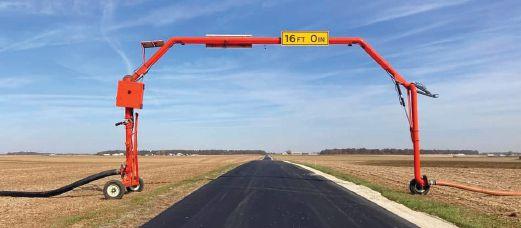
Description: Fort Equipment manufactures the Pipe Bridge for pumping manure across the road where ever it’s convenient for the pumper.
307 200th St., P.O. Box 337, Whittemore IA 50598 USA
Tel: 515-884-3031
e-mail: fernando@greenfieldspreading.net
Website: www.greenfieldspreading.com
HARVEST QUEST
1650 County Rd. 470, Okahumpka FL 34762 USA
Tel: 440-477-5539
e-mail: mark@harvestquest.com
Website: harvestquest.com
HOMAN INC.
6915 Olding Rd., Maria Stein OH 45860 USA
Tel: 419-925-4349
e-mail: dale@homaninc.com
Website: www.homaninc.com
Follow us on
Description: We are a construction and equipment company located in wc Ohio and se Indiana. We specialize in feed, manure and grain equipment. We are an Artex, GEA, Patz and Bazooka Farmstar dealer. We service and install everything we sell.
Description: Step into a greener, more profitable future with Livestock Water Recycling’s First Wave and PLANT systems. With over a decade of successful installations and the world’s first methane avoidance verification, LWR is the market leader in data-driven resource recovery and nutrient optimization. By processing your manure immediately from the barns, you can significantly reduce lagoon capacity while seizing opportunities in both the carbon credit market and the booming biogas sector. LWR’s dedicated team of ManureExperts leverages insights from over 2 million analyzed data points to help you unlock the real value trapped inside manure. Join the growing community of forward-thinking producers who have embraced on-farm manure processing and are now reaping the benefits of smart manure. To grow MORE crops and produce MORE food using less money and fewer resources, choose Livestock Water Recycling for profit-driven sustainability. LWR - Making you MORE on your manure Since 2015!
LSM PUMPS
875 N Michigan Ave, Ste 3950, Chicago IL 60611 USA
Tel: 281-771-8045
e-mail: info@lsmpumps.com
Website: www.lsmpumps.com
METAL 360 INC.
41008 Rd 29 E., Blumenort MB R0A 0C0 Canada
Tel: 204-355-7634
e-mail: info@metal360.ca
Website: www.metal360.ca
Follow us on
NEVADA LIMITED
203 Glover Road, Hawera NV 4610 New Zealand
Tel: 642-141-5371
e-mail: info@nevadagroup.co.nz
Website: nevadagroup.co.nz
OXBO
100 Bean St., Clear Lake WI 54005 USA
Tel: 715-781-0039
e-mail: c.schaben@oxbo.com
Website: oxbo.com/oxbo-nutrientapplication
Follow us on
Description: Oxbo knows nutrient application, delivering on the 30-year TerraGator legacy in a modern, advanced line of applicators. The proven TerraGator chassis design–known for reliable performance and robust components–inspired the Oxbo AT product line. The AT line features better usability, better design, and next generation productivity and driver comfort. Backed by unmatched product support, the Oxbo ATs are designed to get your product on or in the ground as efficiently and effectively as possible. Oxbo ATs are the most productive nutrient applicators. If you want to keep applying, you want to run an Oxbo. Each AT features the most reliable, more productive components to keep Oxbo equipment in the field, applying valuable nutrients, in tight application windows. At Oxbo, we are Optimizing farming together.
NEW LEADER MANUFACTURING
1330 76th Ave. SW, Cedar Rapids IA 52404 USA
Tel: 319-363-8281
e-mail: marketing@newleader.com
Website: www.newleader.com
Follow us on
Description: Because precision agriculture can only be as precise as your spreader. Wherever accuracy and productivity are important, you’ll find New Leader spreaders. Our precision application equipment is designed for situations where the precise placement of nutrients is essential. Because we’ve made your precision our mission, you’ll see the results in every application. Our success rides on yours.
NORTH PEACE APPLIED RESEARCH ASSOCIATION
Box 750, Manning AB T0H 2M0 Canada
Tel: 780-836-3354
e-mail: extension@npara.ca
Website: www.npara.ca
Follow us on
PRESS TECHNOLOGY & MFG., INC.
1401 Fotler St., Springfield OH 45504 USA
Tel: 937-327-0755
e-mail: dberner@presstechnology.com
Website: presstechnology.com
Follow us on
Description: Press Technology & Mfg., Inc. (PT&M) is a USA based manufacturer of industrial liquid/solids separation equipment. Our screw presses achieve the highest discharge solids in the industry. Please contact us for your manure dewatering needs.
PUCK ENTERPRISES
1110 100th St., Manning IA 51455-7512 USA
Tel: 712-655-9200
e-mail: jmelby@puck.com
Website: puck.com
Follow us on
R BRAUN INC.
209 N. 4th Ave., St. Nazianz WI 54232 USA
Tel: 920-773-2143
e-mail: abraun@rbrauninc.com
Website: www.rbrauninc.com
Follow us on
Description: Full service agricultural business specializing in custom manure equipment, manure management, powersports, ventilation, barn equipment, and repairs.
REDHAND LTD
160 William St., Boissenvain MB R0K 0E0 Canada
Tel: 204-534-7382
e-mail: redhandpaul@hotmail.com
RJ MILLER HOSE SOLUTIONS LLC
411 Westview Dr., Atkinson IL 61235 USA
Tel: 309-502-1258
e-mail: rjmillerhose@gmail.com
Website: www.rjmillerhosesolutionsllc.com
Follow us on
Description: RJ Miller Hose Solutions is dedicated to the manure pumping industry with over 40 years of experience in our field. Our mission is to provide our clients with only the best products in the pumping industry. Our services are offered all over the United States and we operate 7 days a week. We look forward to working with you and help develop the most efficient solutions for your operation!
SEAHOLD, LLC
14500 Las Palmas, Unit 54, Bakersfield CA 93306 USA
Tel: 661-747-5151
e-mail: tom.hintz@seahold.com
Website: www.seahold.com
SMART TURNER PUMPS INC.
392 Hardy Rd.,
Brantford ON N3R 7X5 Canada
Tel: 647-962-0379
e-mail: pmastine@smartturner.ca
Website: www.smartturnerag.com
TRIDENT TNZ LLC
446 Harrison St., #81D, Sumas WA 98295 USA
Tel: 604-330-2500
Toll free: 800-799-3740
e-mail: info@tridenttnz.com
Website: tridenttnz.com
Follow us on
Description: Trident provides leading manure treatment solutions for livestock producers and is an expert in circular resource recovery for dairy farms. Trident systems recover valuable resources like water, nutrients and organic biomass from manure, boosting operational efficiency and sustainability. Trident also offers a full line of solid-liquid separators incl. rotary screens, screw presses and more.
TRIPLE K IRRIGATION
12930 Ingall Hwy, Morenci MI 49256 USA
Tel: 517-458-9741
e-mail: jeff@triplekirrigation.com
Website: www.irrigationsupplyparts.com
Follow us on
TROOP EQUIPMENT
230 Troop Rd., Cochranville PA 19330 USA
Tel: 484-880-6022
e-mail: dtroops@epix.net
Website: www.troopequipment.com
TUBELINE MANUFACTURING
6455 Reid Woods Dr., Elmira ON N3B 2Z3 Canada
Tel: 519-669-9488
Toll free: 888-856-6613
e-mail: sales@tubeline.ca
Website: www.tubeline.ca
Follow us on
US SCREEN CO.
745 Industrial Ave., Wellington OH 44090 USA
Tel: 440-647-4444
Toll free: 855-964-2662
e-mail: office@us-screen.com
Website: us-screen.com
Follow us on
Description: US Screen Co combines over 85 years of experience in the manufacturing and distribution of wedge wire screens and related products for processing industries. With a specialization in Screw Press Screens, US Screen Co is able to manufacture and sell replacement parts for all brands of separators. Made here in America’s heartland, we stock what you need to keep your process running.
201 Edgewater Dr., Suite 285, Wakefield MA 01880 USA
Tel: 339-900-8080
Toll free: 800-343-3276
e-mail: info@yokohama-oht.com
Website: yokohama-oht.com
Follow us on
ZIMMERMAN MANUFACTURING LLC
19252 300th Rd., Cantril IA 52542 USA
Tel: 660-945-3130
e-mail: gunther@zimmermanmfg.com
Website: www.zimmermanmfg.com
Follow us on
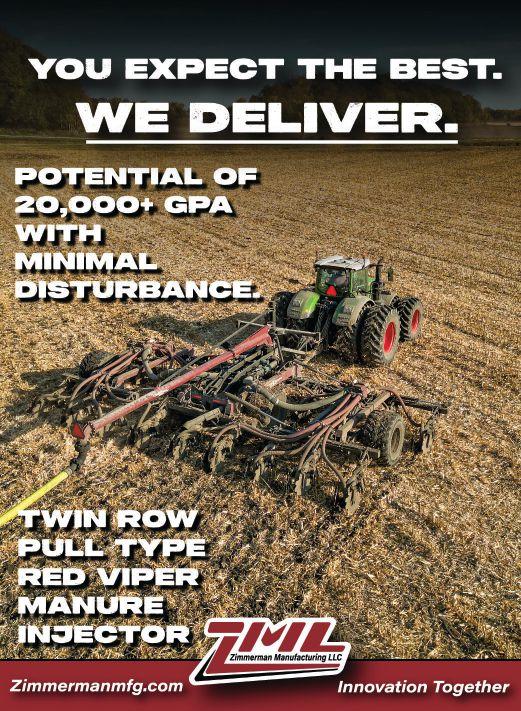
Description: At ZML we build custom high-quality, dependable Manure Injection, Strip-Till, Side Dress, Anhydrous, Fertilizer band, and Hay Ground Injection units with related accessories designed to meet client-specific needs and requirements. If you are in the market for farm equipment that’s a step above the cookie-cutter variety, look no further than Zimmerman Manufacturing LLC.
EQUIPMENT, SUPPLIES & SERVICES
ACCESSORY EQUIPMENT
Broadcaster Control Systems
Canimex
Homan Inc.
Husky Farm Equipment Limited
Metal 360 Inc.
Nevada Limited
Oxbo
Redhand Ltd
RJ Miller Hose Solutions LLC
Triple K Irrigation
Vertical Till Injector
WER
APPLICATION METHODS
Agriment Services Inc.
Bazooka Farmstar
Broadcaster Control Systems
GEA Farm Technologies
Homan Inc.
Husky Farm Equipment Limited
Metal 360 Inc.
Nevada Limited
New Leader Manufacturing
Oxbo
Puck Enterprises
R Braun Inc.
Redhand Ltd
RJ Miller Hose Solutions LLC
Smart Turner Pumps Inc.
Vertical Till Injector
WER
Zimmerman Manufacturing LLC
BARN MANAGEMENT
GEA Farm Technologies
Homan Inc.
LSM Pumps
Nevada Limited
R Braun Inc.
Valmetal Group
ENERGY
Doda USA, Inc.
EQUIPMENT & TECHNOLOGY
Agriment Services Inc.
Bazooka Farmstar
BKT Tires
Boerger, LLC
Broadcaster Control Systems
Canimex
CLAAS
Cornell Pump Company
Dagaz Environmental Inc.
Doda USA, Inc.
Fort Equipment, LLC
GEA Farm Technologies
GreenField Spreading & Sales, Inc.
Homan Inc.
Husky Farm Equipment Limited
Kubota Canada
Lanco Spreaders
LSM Pumps
Metal 360 Inc.
Nevada Limited
New Leader Manufacturing
Oxbo
R Braun Inc.
Redhand Ltd
RJ Miller Hose Solutions LLC
Smart Turner Pumps Inc.
Triple K Irrigation
Troop Equipment
Tubeline Manufacturing
Valmetal Group
Vertical Till Injector
WER
Yokohama Off-Highway Tires America, Inc.
Zimmerman Manufacturing LLC
NUTRIENT MANAGEMENT
Agriment Services Inc.
Broadcaster Control Systems
Centrisys/CNP
Dagaz Environmental Inc.
GEA Farm Technologies
Nevada Limited
Smart Turner Pumps Inc.
REGULATIONS, COMPLIANCE AND SOLUTIONS
Agriment Services Inc.
Azura Associates International Inc.
Centrisys/CNP
Dagaz Environmental Inc.
Troop Equipment
RESOURCES AND SUPPORT
North Peace Applied Research Association
SAFETY
Dagaz Environmental Inc.
SERVICES
Azura Associates International Inc.
Canimex
Centrisys/CNP
CLAAS
Dagaz Environmental Inc.
Homan Inc.
Nevada Limited
R Braun Inc.
SeaHold, LLC
Smart Turner Pumps Inc.
STORAGE, PROCESSING AND HANDLING
Agri-King, Inc.
Agriment Services Inc.
Boerger, LLC
Canimex
Centrisys/CNP
Dagaz Environmental Inc.
Doda USA, Inc.
GEA Farm Technologies
Harvest Quest
Homan Inc.
Livestock Water Recycling
LSM Pumps
Nevada Limited
Press Technology & Mfg., Inc.
R Braun Inc.
Trident TNZ LLC
Troop Equipment
US Screen Co.
Valmetal Group
Includes meal voucher and 2-day expo pass
REGISTER NOW FOR DAY ONE TOURS & EXPO PASSES
TOUR REGISTRATION
$20 - $30 USD
2-DAY EXPO PASS ONLY $10 USD
1-DAY EXPO PASS ONLY $5 USD
Early bird registration rates end june 15.
DAY ONE – JULY 17
8:00 am Biogas & bedding tour
8:00 am Water quality tour
8:15 am, 9:15 am, 10:15 am Patterson Farm tours
8:30 am Soil health tour
11:00 am Expo grounds open
12:00 pm PUCK Pump School
1:00 pm Agitation demonstrations
2:00 pm Separation demonstrations
3:00 pm Safety school
6:00 pm Evening networking BBQ
DAY TWO – JULY 18
7:30 am Expo grounds open
8:00 am – 10:00 am Education sessions
10:30 am Solid manure demonstrations
2:00 pm Liquid manure, dragline and injection demonstrations
4:30 pm Spill response and restoration demonstration
Education Session Sneak Peek
• Johne’s disease management: Findings and farmers perspectives
• LEAN systems approach to farm safety
• Biochar to suppress emissions from manure applications
• Manure practices for greenhouse gas mitigation and climate resiliency
• Manure tech decision support tool: applications and optimization for dairy and swine
• In-season manure application to growing crops
• Mitigating tiled field risks with manure management and BMPs
• Rainfall simulation project – how different manure sources impact erosion, P runoff and N percolation
• Success stories from the New York Watershed Ag programs And more! Visit the website to see the full agenda.
FROM SURF to turf
Adding seaweed to a cow’s diet reduces methane production – but what about the manure quality?
BY JACK KAZMIERSKI
Recently published research has analyzed the benefits of adding seaweed to feed consumed by dairy cows. The study looked at the impact seaweed supplementation has on enteric methane emissions (methane produced within the cow’s intestines), as well as whether the addition of seaweed to feed affects the quality of the manure produced by these cows, and in turn, the impact that could have on crops. Their initial findings are very encouraging.
Research was conducted during 2021 and 2022, with final results published in late 2023. “Seaweed feeding trials have been going on in the livestock industry for a while now,
ABOVE
feeding primarily red algae species of seaweed to ruminant animals in order to reduce their enteric methane emissions,” explains Dr. Kyle Arndt, research scientist at the Woodwell Climate Research Center. “So as we deal with the climate crisis, it’s been discovered that certain species of seaweed can reduce and inhibit methane emissions from these animals.”
What sets this apart from many other seaweed studies, Arndt says, is that he and his colleagues set out to look at the full lifecycle effects, to see how manure produced by seaweedfed cows would affect soil samples.
“We took soils from different
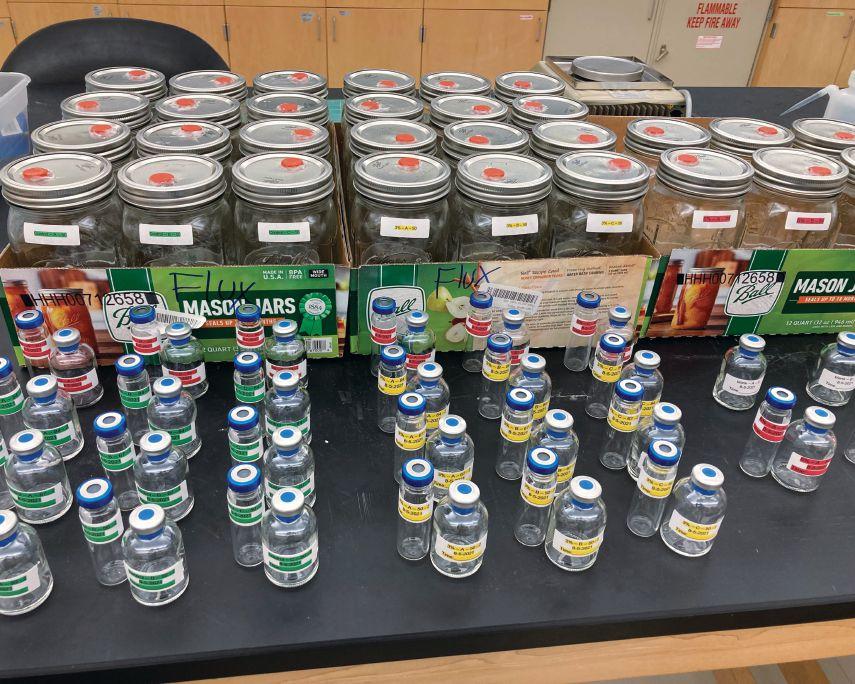
Closed jars to sample gas emissions at the Woodwell Climate Research Center.
pastures, mixed it with the manures that came from these animals and wanted to see how the nutrient cycling, greenhouse gas emissions, decomposition, and all the biogeochemistry downstream interacted,” he adds.
28-DAY TRIAL
Cows were fed a diet with seaweed for a period of two months. Thereafter, researchers conducted a 28‐day soil and manure incubation trial, utilizing manures collected from these dairy cows. In addition to a control group, which consumed a diet with no seaweed supplementation, the study included two additional groups: cows that received a three percent and a six percent (by dry‐weight) seaweed supplement to their feed. A larger percentage of seaweed was not attempted, simply because of the dietary needs of these animals.
(GWC), the second was a bit drier (50 percent GWC), and the third was more saturated (84 percent GWC).
Going into the study, the research team wasn’t expecting to see a big impact on soil samples. “I didn’t think we would see much, just because the dry weight inclusion of the seaweed –three percent and six percent – is so low. It’s a small percentage of the feed,” explains Arndt. “So given that’s it’s such a small part of their feed to begin with, I assumed we wouldn’t really see many downstream results.”
Dr. Nichole Price, senior research scientist and director at the Bigelow Center for Seafood Solutions explains. “The upper limit of how much seaweed you include in a cow’s diet is driven by the nutrition demands of the animal,” she explains. “So you can’t replace too much of [the regular feed]. The other issue was iodine, and six percent was the most we could include in the diet without running into excess of iodine issues.”
Three soil moisture treatments were tested. The first had a field moisture capacity of 67 percent gravimetric water content
That said, “not seeing many results” is actually a good thing, when it comes to this study. “If you don’t see any negative consequences of adding seaweed to the feed, and you still see a reduction in enteric methane emissions, then it’s still a successful strategy,” adds Arndt.
REDUCTION IN METHANE
As far as methane emissions go, the results of this research proved to be very impressive. “I think some perspective on the amount of methane emissions reduction is important to have,” says Price. “Depending on the seaweed species and the bioactive compounds, you can have an 80 to 90
ABOVE
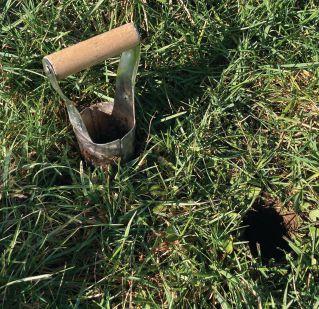
A tulip corer, which was used to collect the samples as part of the research project.
percent reduction in enteric methane emissions.”
This is great news, if you look at this study through a greenhouse gas emissions lens. However, if you’re looking at this study through a “quality of manure” lens, you might be asking a number of questions. “What we’re seeing from the dairy industry is a concern that there’ll be some residues of that bioactive compound coming through in the manure,” explains Price. “That can be good if you’re worried about methane emissions from a lagoon, I suppose, but you’d be concerned about how it interacts with soils and crops, or how it might impact the performance of anaerobic digester systems.”
These concerns, Price adds, were the reason for this new research. “There are a lot of folks in the milk production industry who are paying attention to these sustainability approaches,” she adds, “and they certainly want to avoid any unintended consequences by applying something that’s so effective in ruminant animals.”
IMPACT ON SOIL
ABOVE
KCI extractions for inorganic nitrogen.
Arndt says that researchers came up with a few unexpected findings. “Surprisingly, we found a reduction in CO2 emissions from the soil/manure mixtures,” he says.
In brief, researchers published the following results: “We found that manure from seaweed‐fed cows reduced emissions of carbon dioxide and had similar emissions of methane and nitrous oxide [when compared with] the control [group]. Higher moisture levels increased CH4 emissions and nitrous oxide emissions with CH4 emissions trending higher in seaweed supplements. Inorganic nitrogen turnover varied more based on moisture levels than seaweed supplements, as did the magnitude of methane and nitrous oxide emissions. Total carbon and nitrogen mostly decreased except in the three percent seaweed supplementation, which increased carbon and nitrogen, with a drop in [carbon and nitrogen] in the 50 percent GWC group.”
“The differences we saw with the various moisture levels was not surprising,” Arndt adds, “and that’s based on the behaviour of the different bacteria on microbial life that make those different gasses. So the saturated soil had higher methane emissions because that’s an anaerobic process, while the [drier (50 percent GWC)] soil had the highest nitrous oxide emissions.”
As far as nutrients go, Arndt says there was no negative impact. “It didn’t harm the quality of the manure to act as a fertilizer. Based on our findings, the manure is similar in quality... Seaweed supplements may partially reduce climate impacts of manures from cows fed seaweed supplements, or at least not cause harm or impact manure quality.”
“No harm is good news,” Price adds. “The manure will do no harm, and it may do some good. How much more good, we don’t know yet.”
NEXT STEPS
Arndt says that more research is needed. Although researchers don’t know how crop growth would be impacted, if at all, Arndt says the nutrient profiles of the manure from the seaweed-fed cows was unchanged. “It gives us hope that this manure would
behave like manure from cows that were not fed this diet.”
Inorganic nitrogen did drop a bit, when compared with manure from cows that were fed a regular diet. “But there was no difference [when compared with] the manure from cows who had the three percent seaweed diet,” he explains. “However, once the manure was mixed with the pastures, there was no difference in the cycling and the total nutrient use.”
OTHER SEAWEED SPECIES
In addition to studies involving actual crops and plants, Price says more research has to be done with other species of seaweed. “This was a trial with one species of seaweed, prepared one way, with two inclusion levels,” she says. “There are hundreds of species of seaweed that could be used, and then thousands of species of micro algae that could be used. So we are really only scratching the surface of what’s possible.”
In addition, Price explains how other variables can impact manure quality. “Depending on how any of those strains or species are reared, or grown, and then processed, you can alter their biogeochemical profiles and the amount of bioactive compounds,” she explains. “So I would say this is the start to a long series of experiments that we’re planning in order to figure out where you can optimize performance and reduce any sort of unintended consequences.”
Price says plans are in the works for another study, which will begin in March 2024, looking at another species of seaweed.
As stated before, researchers are really only scratching the surface of all the possibilities at this point, and we’re still far from the point where we know which seaweed options are best, or how to make seaweed supplementation easy and financially viable for dairy farmers.
“Right now, it’s easy for a farmer to buy kelp meal, but that won’t reduce enteric methane emissions,” explains Price.
“It isn’t easy yet for a farmer to buy seaweed to reduce enteric methane emissions, but that’s the overarching goal of our research program. •
ON TRACK
New Holland unveils new SmartTrax system
New Holland has launched the new T9 SmartTrax system with PLM Intelligence. Featuring advanced oscillating roller wheels and vibration-dampening mount suspension in the track system, the tractor is marketed on the basis of elevated ride quality and preventing uneven wear during field-tofield transportation. To ensure ease of daily maintenance, clear track system hubcaps have been integrated, providing straightforward access to critical components. The new track system
Nokian unveils new sizes for Tractor king, Hakkapeliitta
The Nokian Tyres Tractor King line of products has expanded to include three new sizes: 600/65R28 for the front axle, 710/70R38 for the rear axle and 800/70R38 for rear.
The largest of the new options is the 800/70R38, which the company says raises the load-bearing capacity to a greater level. It carries a
also streamlines maintenance and optimizes tension by eliminating manual adjustments with its automatic trac tensioning system.
Available for agricultural use on five model year 2025 T9 models – T9.520, T9.580, T9.615, T9.655 and T9.700 – that range from 475 to 645 rated horsepower, the SmartTrax system ensures performance in a variety of terrains while enhancing overall operational performance and preserving the integrity of the field environment.
Ken Paul, product marketing manager for high horsepower tractors says the new tractor is “more than an enhanced track system… it’s a commitment to farmers built on the basis of innovation, efficiency, capability and versatility.”
Weltec develops new user control interface
Weltec Biopower’s control system for biogas plants has received a general update focused on new functionalities and a user interface upgrade. The previous control system sections previously known as LoMos an CeMos will also merge under the new name WB Control, which can be used for small and large industrial operations.
The web-based software contains a customizable dashboard for data overviews and comprehensive monitoring of plant data. Diagrams and reports can be created individually according to defined values and summarized into regular overviews, allowing agitators to be controlled individually.
The new user interface enables numerous business evaluation options, such as trend analyses and other graphical evaluations of individually defined values such as consumption data or production figures. Data can be provided as proof for authorities, banks and external experts.
Newly integrated function FellowFeed measures the target filling level of the gas and automatically adjusts the feeding quantities if required. Another new function, GuidoFill provides operators with a tool that supports the correct filling of their solid matter feeders with a mixture of input materials. On the basis of job lists, pumping and feeding processes can be precisely timed and displayed using the filter function. Overviews of gas management and water distribution allow other material flows in the system to be monitored.
load index of 183. Being a wider rear tire offers increased traction and durability. Nokian has also more recently added two new sizes for its Hakkapeliitta TRI M+S all-season tires. The range now includes sizes commonly fitted to HHP tractors, 710/70R42 and 600/70R30. Marketed as an all-season contracting tire, the line aims to lower noise level and vibrations compared to typical lugpatterned tires.
GUEST COLUMN
SARAH FRONCZAK AND JENNA FALOR | Michigan State University Extension
Manure, compaction and cover crops
Soil compaction is when pressure decreases the spaces between soil particles. When soils lose pore space, they have a reduced ability to hold water and air which is essential for plant growth. In many cases, when there is a compaction issue at a certain depth or on the sidewall from planting the plant root’s ability to grow is affected. Limited pore space also reduces water’s ability to infiltrate the soil and properly drain, which can lead to ponding issues or additional runoff, an increase plant injury from soil applied herbicides, yield reductions and other issues which last years.
Most soil is susceptible to compaction. Compaction can be caused or exasperated by many factors including equipment traffic and size, tillage practices and field conditions. Sandier soils are less susceptible to compaction but can become compacted, while heavier soils are much more likely to become compacted due to their smaller particle size. Compaction can happen at distinct levels: surface crust, surface, tillage pan, subsoil.
HOW DO I PREVENT COMPACTION IN MY FIELDS?
Manure itself can help alleviate compaction issues in the long term as it helps build soil organic matter and soil structure. However, application can cause compaction when not managed correctly. Manure is often applied in the fall and spring (except for into hay fields, following wheat)
and for the field.
Traffic control limits agricultural machinery traffic to designated areas, rather than across a whole field year after year. This restricts compaction to zones, while the seedbed remains undisturbed. According to the Natural Resources Conservation Service (NRCS), to accomplish controlled traffic the following must be accomplished:
• Ensure that controlled traffic lanes are designed and used to avoid concentrated flow that may result in gully erosion.
• Limit wheel/track traffic to no more than 30 percent of the soil surface.
• The same tracks must be used for all high load traffic continually.
• Use a Geographic Positioning System (GPS) to guide field operations and wheeled/track traffic when the designated traffic lanes are obscured.
• Once the tram lines or traffic pattern is established, do not till deeper than four inches.
WHAT CAN I DO IF MY FIELD HAS SOIL COMPACTION?
Certain things can help the overall soil structure, including cover crops, building organic matter, changing management practices to avoid working the field when wet, controlled traffic and thoughtful equipment choices.
“Manure can help alleviate compaction in the long term.”
when fields are sometimes wetter than other seasons in Michigan. Avoiding trafficking saturated fields is the best way to prevent compaction.
Some best management practices to reduce the incidence of compaction in fields, according to Linda Schott at the University of Idaho, include making mindful equipment choices, using reduced tire pressures, and using traffic control.
Bigger tires are great, but if the contact area has not increased compaction is still a risk. Tire volume needs to be managed to get more contact area to reduce compaction. One way to do that is with a central inflation system and knowing the recommend pressure for your tires for the road
Soils are resilient and can repair themselves if left to their own devices; however, this typically means a fallow period. We can help them repair themselves by changing our management practices to help them develop in a way that is more favorable to rebuilding that soil structure. When choosing cover crops, it is important to choose the right type of rooting system. In extreme cases of compaction, such as after construction activities, a pass of deep tillage may be needed before planting. A deep-rooted crop such as oil seed radish or cereal rye helps break up compaction deeper into the soil profile, while cover crops with a more fibrous root system such as oats and buckwheat will help break up crusting toward the top. Either way, getting living roots in the soil helps to create organic matter and pore space when they are terminated and decompose. •
MANURE MINUTE
The nitrogen cycle and manure
Nitrogen is a vital nutrient for plant growth, and it’s often the nutrient that gets the most attention when it comes to fertilizers. Fortunately, manure happens to be an excellent source of nitrogen. Understanding how manure nitrogen behaves after application is important in order to know how best to manage manure.
NITROGEN FORMS IN MANURE
There are two forms of nitrogen in manure: inorganic and organic. The inorganic form is immediately plant available, while the organic form is not. Broadly, inorganic N refers to all forms of nitrogen that are immediately plant available, including ammonium and nitrate. For the most part, however, manure does not contain nitrate. So, the plant-available part of manure N is nearly all ammonium.
Organic N is tied up and needs to be broken down by a process called mineralization in order to become plant available. This breakdown of organic N is what makes estimated available nitrogen in year two tricky. Mineralization is driven by soil microbes, and the speed at which they work is heavily influenced by the environment; and we all know how fickle the weather and environment can be!
Besides mineralization, the other major N transformation that happens in the soil is nitrification. This is when ammonium is
where ammonium is lost to the atmosphere as a gas when manure is left sitting on the soil surface. If you’re working with a high-ammonium manure, such as swine manure, you could lose up to 50 percent of your total nitrogen to volatilization in just four days. Luckily, there’s a pretty easy way to minimize volatilization loss: incorporate manure into the soil. Getting the manure below the soil surface through tillage or injection will greatly reduce volatilization loss.
Once in the soil, ammonium is going to pretty much stay put. However, if ammonium converts to nitrate (through nitrification), it can be lost more easily. Nitrate readily dissolves in water and will travel wherever water will. That means it can be lost downward through the soil profile (leaching), through tile drainage, or across the landscape as runoff. In addition, nitrate can be lost to the atmosphere as a gas (denitrification). As you can see, to prevent N loss, it’s worthwhile to keep it in the ammonium form and not let it transform into nitrate. The nitrification process can be slowed down by applying when soils are cool – below 50°F is generally recommended. But keep in mind that even in cold soils, nitrification still happens, just much much more slowly. You can also avoid nitrification by applying manure to an actively growing crop or to soil that will soon have crops planted. If plants take up and use the ammonium, it won’t have the time to become nitrate.
“Ammonium can convert to nitrate once in the soil.”
converted to nitrate. Remember that manure supplies ammonium and not nitrate, but ammonium can convert to nitrate once in the soil. This is also a microbially-driven process that’s dependent on environmental factors.
NITROGEN LOSS PATHWAYS
Of all the nutrients in manure, nitrogen is most easily lost to the environment. It’s important to keep N where you put it so that you don’t lose valuable nutrients and cause nutrient pollution. When manure is applied, volatilization is the first type of loss you need to worry about. That’s
TESTING MANURE FOR NITROGEN
While there are nutrient tables out there for nearly every type of manure, those are just estimates and we recommend sampling your manure for nitrogen as well as other nutrients. Actual N content of manure can vary based on a whole host of management factors including feed, housing type, and storage system. Remember that not all of the N is immediately usable by the plant. So, instead of using total nitrogen to calculate application rates, you’ll want to multiply by the availability factor. Each state or region has its own recommended availability factor for each manure type, so be sure to use your local recommendations. •
looking for six women making a difference in Canadian agriculture. Whether actively farming, providing agronomy or animal health services, or leading research, marketing or sales teams, we want to honour women who are driving Canada’s agriculture industry.