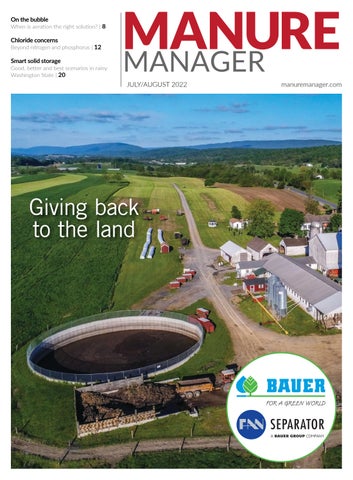
Storage, sustainability and more Manure storage and management can play a big part in the sustainability of your operations.
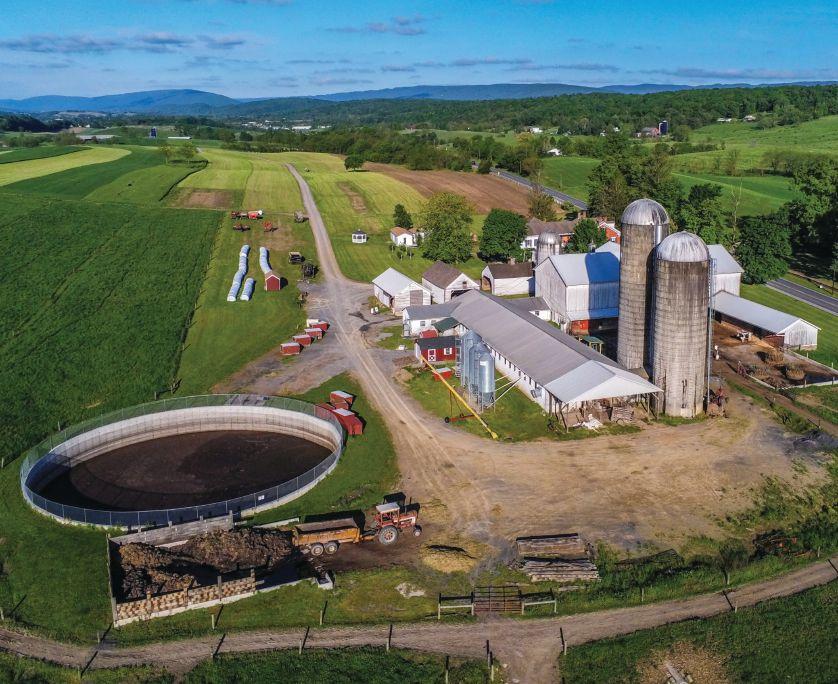
Nature-friendly nutrient management in Pennsylvania. See page 16. Photo by David Graybill
On the bubble The age-old treatment solution of aeration has had a few modern updates – is aeration right for you?
BY RONDA PAYNE
Chloride concerns Nitrogen and phosphorus leaching is already a concern, but what about chloride?
BY JAMES CARELESS
Smarter solid storage In rainy Washington State, what is the most ideal storage solution for dry manure?
BY JACK KAZMIERSKI
On the road again
Picture your ideal road trip. For me, the snack of choice is baby carrots. The weather is a mix of sun and clouds. My music of choice is, unfortunately, showtunes.
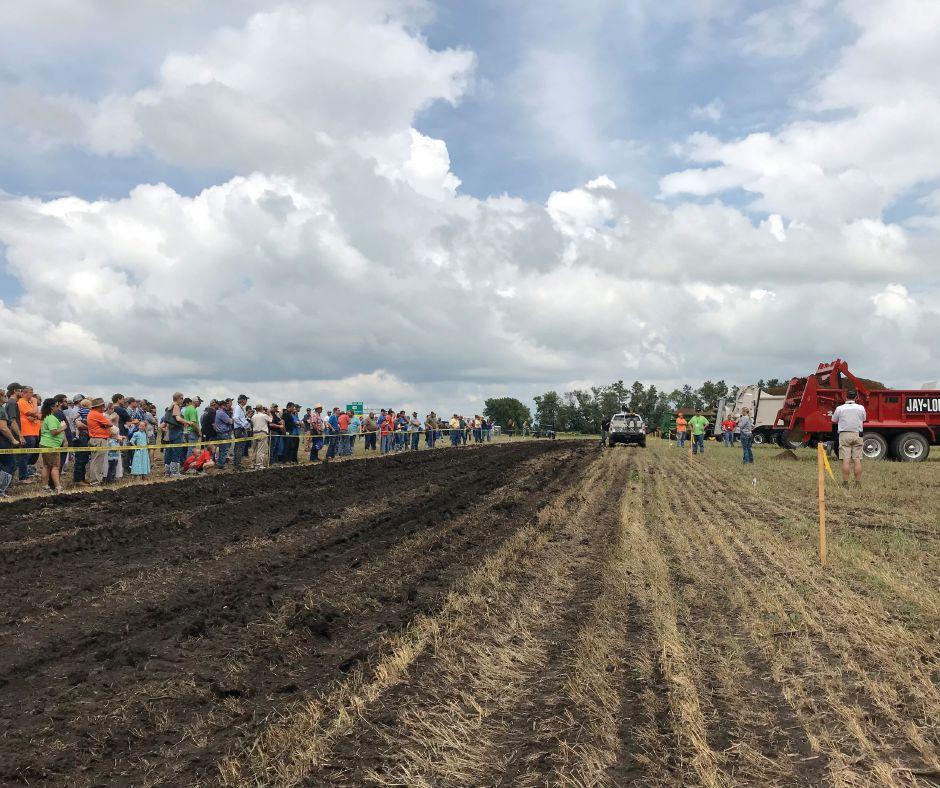
When a trip is that perfect, the destination almost doesn’t matter. But our upcoming road trip is to the first in-person North American Manure Expo since 2019 – an extra-sweet trip. For some of us on the team (like me), this is our first in-person Expo, so the excitement is that much more palpable and the questions are plentiful: what will the tours be like? Who will I finally get to meet in-person after two years of Zooming? Which demos will leave us dirtiest? How long will it take before my colleagues become sick of the Come From Away soundtrack?
It’s an exciting time in ag; it’s the first full summer free of significant COVID restrictions and most events have been able to go ahead as scheduled. And besides the return to live events, there’s reason to feel positive if you’re in the manure business. Headlines
inflation at a 40-year high and energy costs on the rise, not to mention challenges caused by severe weather, those doing the planting have struggled with costs this year
And manure application businesses have to work extrahard to meet the challenges of high demand – and, as we recently discussed, some are having trouble retaining employees. Steve Gloor, past president of OPACA, said talent retention in the industry has always been difficult, but it’s accelerated since 2020. “Some walk away,” he told one of our reporters. “People just get tired of the long, long hours.”
Manure application is rewarding for the applicator and the grower. But there are times when it will be harder than others.
On one hand, we’ve emerged from the darkest days of the pandemic ready to shake hands and enjoy each other’s company over a drink again. And increasing demand for manure is something to celebrate. On the other hand, growers and applicators now face a whole new
Growers and applicators now face a whole new set of challenges.
around the world tell the story of a sunny outlook for manure – given rising fertilizer prices, manure has been identified as a potentially hot product for this growing season. And speaking of growing, many North American growers are anticipating higher demand for certain products –for example, Canadian commodities have been identified by some firms as a potential area for growth, given the current conflict in Eastern Europe. But that doesn’t mean it’s smooth sailing all summer long. With
set of economic and environemntal challenges, while still trying to recover from the last two years.
I know that when I walk the grounds at the Expo, I will hear many excited and happy conversations. I know I will also hear a lot of concerns.
It’s important to be realistic. This year will bring both challenges and rewards. Nothing will ever be perfect – even a good, old-fashioned road trip. That doesn’t mean the trip’s not worth taking.•
merci. gracias. danke. grazie. bedankt. obrigado.
PLATINUM
Vietnam, U.S. collaborating on ASF vaccine
There could soon be a solution to African swine fever virus in hog herds.
African swine fever virus is not novel and is harmless to humans, but has nevertheless hurt farmers in Asia in recent years, as well as in Europe and Central America. China and other key buyers banned imports of pork from Germany in late 2020 after cases were confirmed among wild animals in the country, and some countries have seen higher pork prices following the onset of outbreaks.
A new development could mitigate the effects
of the disease thanks to a partnership between scientists with the USDA Agricultural Research Service (ARS) and the Vietnam ministry of agriculture. In April, scientists with the ARS announced that its vaccine candidate had passed a key test required for regulatory approval. Researchers have said the vaccine provides immunity in pigs for up to six months.
Now, the government of Vietnam has announced that it will produce the vaccine for the U.S., and is looking to export the vaccine.
AAFC invests $15M to help curb GHG emissions
Agriculture and Agri-Food Canada have confirmed an investment of more than CAD $15.2 million under the Agricultural Clean Technology (ACT) program to support farmers adopting clean technologies. In total, 47 projects across Canada will be funded.
Under the program, farmers and agribusinesses will have access to funding to
develop and adopt technologies to reduce greenhouse gas emissions. The funding is focused on three priority areas: green energy and energy efficiency, precision agriculture and bio economy solutions.
Of the $15.2 million, $2.3 million will be dedicated to five projects in British Columbia. One of those recipients is Vancouverbased Terramera
CAAIN announces $5 million for new smart farm program
The Canadian Agri-Food Automation and Intelligence Network (CAAIN) has launched a $5 million call for funding focused on encouraging the expansion of a national network of smart farms.
Kerry Wright, CAAIN CEO, said in a statement that CAAIN is currently supporting a smart farm project which “has shown tremendous promise in three distinct areas. First, it validates the use of advanced agricultural technology. Second, it demonstrates the functionality of that equipment to farmers, who can then evaluate the potential return on investment for themselves in a realworld farm setting. Third, it is connected to three post-secondary institutions. They, as a result, now have the tools needed to train the next generation of agriculture industry professionals.”
Inc., which received $2 million through the ACT Research and Innovation Stream. Terramera is currently working to provide more precise measurement of soil carbon.
“Soil is critical to food production and farming,” said Karn Manhas, founder and CEO of Terramera in a statement. “Improving soil health and carbon in soils helps lower
costs of inputs while improving outputs and nutrition, which means higher profits for farmers. This is a key opportunity to strengthen our economy, and our food security as a nation. In addition, improving soil health sequesters carbon, which can help turn back the clock on climate change, while increasing water retention in soils, and the resilience of farms.”
The newly expanded initiative, says Wright, would help encourage the nationwide adoption of emerging ag tech.
This is the fifth funding call CAAIN has launched in the past two years. Wright acknowledged that smart farm projects are “complex,” and that the complexity, coupled with tight submission timelines, “might challenge the small and medium businesses we are mandated to encourage. That’s why this smart farm program is what’s referred to as ‘continuous intake,’ which means we’re inviting applicants to submit proposals according to their schedules, rather than ours.”
When added to the approximately CAD $26 million CAAIN will provide to the 24 successful applicants of its first three competitions, as well as the $5 million expected to be used to support its beef and pork primary processing program, this smart farm competition pushes CAAIN’s funding commitments to roughly $36 million. Details are available online at caain.ca.
A true end-to-end solution for greenhouse gases.
Turning agricultural waste into renewable natural gas (RNG) is a win-win for farms: it generates an additional source of income and also mitigates the methane emissions from livestock manure. Clean Energy is a one-stop shop for the development, operation, financing, marketing, and distribution of RNG. With 550+ fueling stations nationwide, including 127 in California, we provide the shortest path from farm to fleet.
OLD METHODS get some fresh air
Could your operation benefit from intermittent aeration?
BY RONDA PAYNE
Manure management has grown by leaps and bounds in the last few decades – and no one can argue against the benefits of many of those updates. However, while new solutions are innovative and attention-getting, experts say not every solution is the ideal solution for every farm, and that sometimes things from the past are worth revisiting.
For example, anaerobic treatment is currently a much-talked-about topic – digesters are seen as a big growth opportunity and a way to create renewable energy. But aerobic treatments, such as intermittent aeration, are not without their
ABOVE
benefits – and for some farm owners, they can be a better choice depending on the circumstances.
The key is knowing what those circumstances are.
Christine Brown, field crop sustainability specialist with the Ontario Ministry of Agriculture, Food and Rural Affairs (OMAFRA) and Dave Bray, environmental specialist with OMAFRA have seen how intermittent aeration can deliver significant benefits to farm practices. It was during their search for tour stops for the 2021 North American Manure Expo that they came upon the intermittent aeration technology. After becoming curious about its
Intermittent aeration commonly runs for several hours at a time, several times per day and can cost CAD $5 to $7 per day.
benefits, they included it as a tour stop.
A short while after the Expo, the team found a producer who had been using this process for about seven years. Upon gaining even more insight to the longerterm benefits to the process and wanting to share those with others, the greater look into intermittent aeration manure treatment began.
“Aeration is beneficial to farmers for several reasons, but it depends on the needs of the farmer,” says Bray. “Aeration can reduce [or] eliminate the need for agitation of the manure prior to land application. This saves time and money.”
He adds that the practice of aerating manure also helps to create a more uniform method of distributing nutrients while within storage so that when it is applied to the fields, it allows for a more even application of those nutrients onto the land. Plus, nutrient availability (and therefore crop uptake of nutrients) may be enhanced by the microbial activity aeration contributes to.
And while anaerobic digestion has been hailed as a sustainability solution, there are potential environmental benefits to aerobic treatments as well. “Research in Europe suggests that aeration can reduce methane emissions,” Bray also notes.
JUST WHAT IS AERATION?
In the most simplistic explanation, aeration is the process of mixing manure with air to encourage bacterial growth.
Stirring a manure pile isn’t exactly a new concept. It’s a practice as old as animal husbandry itself. However, what is relatively new is the timed injection of air through a series of rotary valves to create an intermittent process. This keeps the manure in a liquid state and helps it break down as bubbles of oxygen are forced in and rise up through the slurry. Intermittent aeration doesn’t create the nitrogen volatilization that constant aeration would lead to.
As oxygen is supplied on a continuous basis, it allows aerobic bacteria to digest or breakdown the organic matter within the manure to make nutrients more readily available to crops when spread on fields. This is quite different from anaerobic digestion where oxygen is used up quickly and volatile organic compounds (VOCs) are produced at significant levels. This leads to greater methane, CO2 and undesirable odors.
“Pipes on the floor of the manure storage release the air which aerates the manure and maintains the aerobic state,”
ABOVE
Aeration offers the benefit of a more consistent product for application.
says Bray. “There are a couple of different systems in place, but the basics are the same.”
“The intermittent aeration system is still relatively new in North America, but is popular in Europe and therefore is worth investigating,” adds Brown. She and Bray point to brands such as the EasyFix slurry management system, which is one of the options currently available on the market. Another is the Dairy Power manure management
system. These systems are both slightly more common in European countries.
WHY CHOOSE AN INTERMITTENT SYSTEM
Brown notes five main reasons to consider an intermittent aeration system. First and foremost is the reduction of odor both around the barns (as well as drifting to neighbors) and during application.
“[This] makes this system great for dairy farms that surface apply manure immediately after hay harvest during summer months,” she says.
Plus, this provides an additional, significant benefit for farms that are in a rural/urban fringe area.
Second, as previously noted by Bray, manure that is agitated through aeration is always ready for application so there’s no need to agitate prior to spreading. This results in saved time, less equipment and less labor.
Third, which Bray also mentioned, the application of manure (and therefore its nutrients) is far more uniform when using intermittent aeration practices.
Fourth is the benefit to the
A LONG WAY TOGETHER
WHEREVER YOU ARE, BKT IS WITH YOU
BKT provides you tires that are reliable and safe, sturdy and durable, capable of combining traction and reduced soil compaction, comfort and high performance.
BKT: always with you, to get the most out of your agricultural equipment.
environment. There is less methane loss which improves greenhouse gas emissions from livestock and dairy farms.
And fifth, the intermittent aeration processing of manure is an aerobic practice and allows those desirable microbial populations to grow and flourish so that they can break manure down similarly to a composting approach.
While it can be assumed that this means a quicker take up of nutrients by crops the processed manure is applied to, assumptions can be dangerous and there is a need to look further into the bioavailability of nutrients to crops.
“[This] would result in a more natural or balanced manure,” says Brown. “Questions about speed of nutrient availability to crops need investigation with field trials.”
ONGOING RESEARCH TO DETERMINE VIABILITY
“There is still some work to do to evaluate these systems,” she says. “But from a greenhouse gas perspective, an intermittent aerations system could be compared to anaerobic digestion.”
This knowledge that the intermittent aeration system can be on the same level as anaerobic digestion systems in terms of reducing greenhouse gases is an important distinction as anaerobic digestion generally costs more. It may make aerobic systems, like intermittent aeration, more attractive.
“Farmers we spoke to thought that the cost to run the system was low [electricity], low maintenance and provided cost savings over the long term – no need to agitate the storage prior to land application,” says Bray.
Brown notes that system costs must be compared looking at the lifetime of the manure storage and consideration of elements like ongoing water transportation, equipment needs, labor costs for manure applications, proximity of application fields from the storage areas and any maintenance costs. Obviously different manures will also have different results.
“And the end product – digestate –has a nutrient composition that makes it a great fertilizer, but more difficult to manage because of very high water content and proportionately higher ammonium N compared to organic N, combined with high pH,” says Brown of the anaerobic systems. “[It has a] higher volatilization potential than manure from
ABOVE
[an] aeration system, unless digestate is injected.”
THE PROOF OF AN INTERMITTENT AERATION SYSTEM IS IN THE USE
The system itself is relatively simplistic and despite aerobic processes being as old as dirt, new options make use of modern technology like other manure processing methods. The compressor is connected to a clock and at intervals, air feeds through to the valves. This is then distributed through the system and a pneumatic rotary valve system alternates through the ports so that only two or four (in a larger storage) ports are jetting air through the slurry at any one time. Because the ports alternate, air is distributed throughout the manure pit evenly, ensuring liquidity and agitation.
“We’ve got several farmers in Ontario that have installed these aeration systems,” Brown says.
A big reason for their adoption of the system was reduction of odors.
Simon Signer of Sigview Dairy Farms says his system runs approximately three hours at a time, three times per day to create eight to ten minutes of air time per nozzle that’s pushing air through the manure. The cycles are set to allow for minimal disruption but also one cycle when someone is in the barn who can listen and be sure things are working properly.
“It’s improved air quality in the barn
which is going to help with the health of the animals and the quality of life that they have,” he says. “For operating costs, it’s a very simple system, it’s very few moving parts.”
He adds that even if a repair is required, there isn’t any harm in shutting things down for a week or two.
In North Perth, Ontario, Dave Van Den Braak farms with his daughter at Van Den Braak Farms. Together, they built the aerobic intermittent aeration system into their site when they put in a new barn. It didn’t require much in terms of added resources for installation. In fact, Van Den Braak says it was quite an easy process and the payoffs have been considerable.
“We decided to install this aeration system, basically it’s a new concept for North America, the biggest advantage to me is agitation time,” he says. “The pit is always ready to empty. Everything is consistent. The first load is as good as the last load.”
He thinks the economic benefit is huge, noting that for him, it’s about CAD $5 to $7 a day to run along. This combines with all the other benefits of reduced odors, speed and affordability of application and uniformity of nutrient application.
If it’s time to consider a new method for manure processing, looking to the past, with a dash of technology, may be exactly what makes the most sense. •
David Bray learned more about intermittent aeration systems while on the hunt for Manure Expo tour locations.
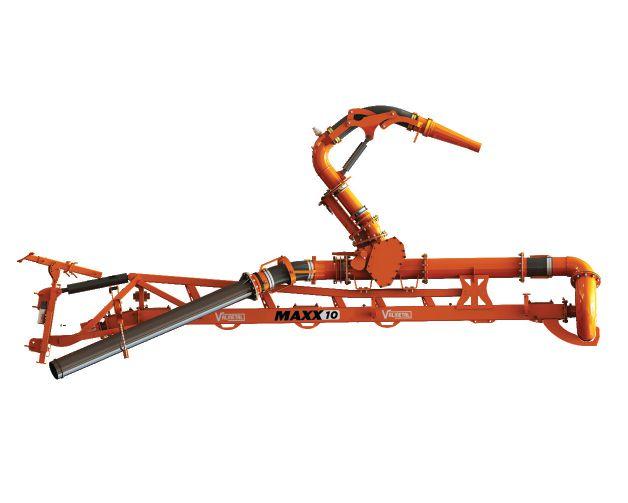
Bazooka releases upgrade option for Renegade
Earlier this year, Bazooka Farmstar released the Renegade agitation trailer to its new agitation product category.
Since then, the company has released a 10-inch loadstand boom upgrade option which allows users to agitate, pump and load liquid manure with one piece of equipment. The loadstand integration takes the 40-foot portable loadstand out of the equation for safer and easier travel between job sites and a quicker setup once on-site.
In addition, the trailer accommodates infinite, optional remote control fobs that control the agitate and fill functions, so crew members never have to leave the cab until the job is done.
AgCo releases new pit monitoring system
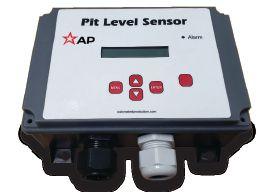
AgCo’s equipment manufacturing division, AP, has released a new monitoring system, the Pit Monitoring Stick.
The Pit Monitoring Stick serves as an alternative to traditional systems that calculate manure levels, such as measuring tape or sticks. The new system combines a controller, pressure sensor and stick to give producers realtime data on manure levels and remaining space. Such data will allow producers to make more optimized decisions around agitation or pumping based on how much storage space is left.
It also provides insights on changes in storage levels, both week-to-week and month-to-month, and can help detect excessive soaking and large water leaks. It can be integrated into other AP systems or used as a standalone system.
Yokohama adds new flotation radial tire
Yokohama has unveiled the new Alliance 590 flotation radial, which features three layers of steel belts under a cut-resistant tread compound for the heavy tankers, wagons and pullbehind sprayers used on farms and construction sites.
The layered steel belts also enable the tire to maintain a flat, even footprint for improved grip and lower rolling resistance. The non-directional tread pattern features heavy, deep blocks with open channels that enhance grip and ensure good self-cleaning.
Capable of speeds up to 40 mph, the Alliance 590 may be operated at low inflation pressures to minimize soil compaction.
The tire is available in the following sizes:
• 560/60R22.5
• 600/55R26.5
• 650/55R26.5
• 650/60R26.5
• 600/60R30.5
• 650/65R30.5
• 710/50R30.5
• 750/60R30.5
BKT introduces new construction and farming range
BKT has introduced the new FL 695, an agro-industrial product specifically designed for trailers in construction and farming transport applications.
The FL 695 is a radial tire designed for durability. It has a strong casing with multi-ply steel layers providing protection against pictures. The tire is made from a special compound that contributes to increased cut resistance. Its tread design is composed of a center-block pattern to increase stability and resistance in all conditions, while handling heavy loads.
The tire is available in size 650/55 R 26.5.
CNH Industrial acquires Specialty Enterprises
Case IH parent company CNH Industrial has acquired Wisconsin-based Specialty Enterprises. Specialty is a manufacturer of aluminum spray booms designed for agriculture applications. Its main manufacturing facility is located in Wautoma, WI. The company began a supplier relationship with Case IH in 2020.
The acquisition is part of Case IH’s long-term strategy for its sprayer product lineup, said CNH Industrial in a release. “This acquisition strengthens our in-house capabilities and allows us to retain key strategic personnel to ensure continuity in this vertical integration,” said Scott Harris, global Case IH president.
IS CHLORIDE a concern?
Assessing the real impact of manure-leached chloride on soil and water quality
BY JAMES CARELESS
What impact does chloride leaching from livestock and poultry manure have on the rural landscape? That’s a question that researchers at the University of Minnesota hope to answer.
A three-year study, entitled “Assessing the implications of chloride from land application of manure for Minnesota waterways,” is led by principal investigator Melissa Wilson (department of soil, water and climate), along with coinvestigators Erin Cortus (department of bioproducts and biosystems engineering) and Pedro Urriola (department of animal science) with support from graduate students including Matthew Belanger. Together, the team is working to measure the levels of chloride leachate in the state. The study began in 2021.
“The main purpose of this study is to see to what extent manure-based chloride moves through the soil profile and is leached out of the soil profile, and then comparing that to commonly used synthetic KCL fertilizers that are used in Minnesota,” says Belanger. “We want to know how much is leached out into the groundwater and surface waters, and to what extent does the storage in the soil profile change as well?”
In completing this study, the researchers will categorize their data based on species, geographical region, and correlating manure characteristics, quantify the movement of manure-based chloride in Minnesota fine clay and sandy soils, and evaluate the leaching risk potential based on manure types, chloride concentrations and soil characteristics. This study’s data will aid in the development of statewide standards for acceptable chloride leachate levels, plus strategies to manage this substance.
while rising chloride levels in groundwater resources can degrade the quality of some drinking water sources. Additionally, research has suggested that elevated soil chloride can lead to nutrient release from sediment and soil, induce manganese and iron reduction, and increase the dissolution of phosphorus and toxic trace metals.”
METHODOLOGY
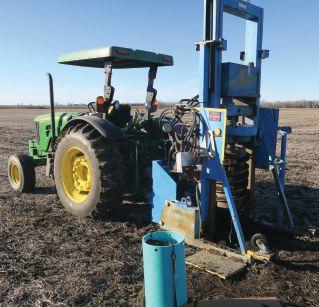
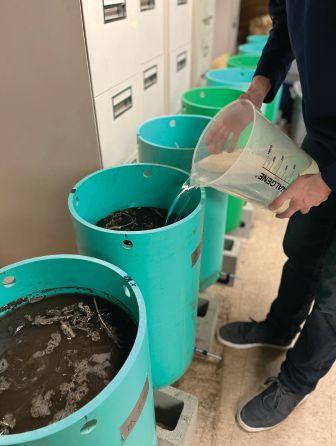
The chloride study team is extracting 48 intact soil core samples from across Minnesota to gather their data. These samples are 12 feet deep and 12 inches in diameter. They are being taken to a laboratory and treated with liquid livestock manures, solid turkey manure or synthetic KCL fertilizer.
“Over the course of three weeks, we are simulating three two-inch rain events and letting the water percolate through these treated soil samples,” says Belanger. “And then we are collecting the leachate and evaluating how much chloride and other nutrients are in it. This provides us with an affordable way to do representative field tests in the lab. And then we can scale that up into the field if that makes sense.”
ABOVE
The chloride study team is extracting 48 intact soil core samples from across Minnesota to gather their data.
The need for these standards is very real, because “chloride accumulates over time in water resources, including surface water and groundwater, which makes it somewhat different compared to nitrogen and phosphorus management,” says Alycia Overbo, PhD candidate at the University of Minnesota. Overbo, who has previously undertaken research on the subject, adds, “There are no feasible or affordable ways to remove chloride from water bodies in the environment. Yet elevated chloride levels in surface waters can have detrimental effects on aquatic ecosystems and vegetation,
“With a lab-based study, we just have a little bit more control over the factors that we want to study,” adds Cortus. “Using intact soil cores provides a nice model of what would happen in a field.”
RESULTS SO FAR
Although the University of Minnesota study has two more years to run, previous research by Overbo has already been able to draw some conclusions about chloride leachate’s impact on soil and water sources.
A case in point: “Through our previous research, we learned that livestock manure is an important source of chloride in Minnesota,” says Overbo. “We estimated that livestock in Minnesota contribute 62,600 tons of chloride to the environment per year, compared to 209,900 tons from wastewater treatment plants, 221,300 tons from fertilizer, and 403,600 tons from road salt. Since livestock manure contributes significant amounts of chloride to the environment on an annual basis, this tells us that manure is an important source of chloride to consider in local settings.
“Areas with sensitive groundwater resources or chloride impairments may want to examine local chloride loading from manure application and encourage practices that can reduce chloride leaching.”
“Our research has been focussed on Minnesota, but our findings are relevant to areas outside of Minnesota with similar agricultural activity,” she adds. “Researchers in Illinois also conducted a chloride budget for their state and found similar results, indicating the importance of livestock and manure application as chloride sources.”
MANURE MANAGERS NEED TO MONITOR CHLORIDE LEACHING
Based on the data she’s seen to date, says Overbo, “Chloride may not be the number-one concern for the manure management industry, but it should definitely be on the radar. In Minnesota, the number of chloride impairments is increasing, and they are not limited to urban areas. We are seeing elevated chloride levels in some surface waters and groundwater resources in more agricultural, suburban, and mixed land-use areas of the state. Solid manure [in particular] has high chloride concentrations, and liquid manure still has concentrations one to two orders of magnitude above what is naturally found in the groundwater, so manure
application definitely has the potential to impact groundwater and receiving surface waters.”
To address chloride leaching caused by manure sources, “Implementing best practices to prevent contamination of groundwater and surface water is key, since chloride can’t readily be removed from these water resources,” she says. “Testing manure and sampling groundwater downgradient can be very helpful in understanding the local impacts of manure application on groundwater. Research in Minnesota has shown that chloride levels can be particularly high in groundwater downgradient from earthen-lined basins, but that manure storage with synthetic liners helps limit chloride leaching into downstream and downgradient resources.”
The bottom line, says Overbo, is that even though chloride leaching is not as talked about as nitrogen or phosphorus, it is a concerning environmental problem, one the industry (and others) should begin tackling the issue sooner than later. Even halfway through the current study, the team agrees there are adverse impacts to chloride leaching.•
ABOVE
Soil samples are treated with liquid livestock manures, solid turkey manure or synthetic KCL fertilizer.
Now with NO Grease Covering Arm Assembly
Now with NO ClozingGreaseArm Assembly
TURNING MANURE INTO HIGH QUALITY BEDDING
WASTE WATER TREATMENT
TURNING LIQUID GOLD INTO ENRICHED BEDDING
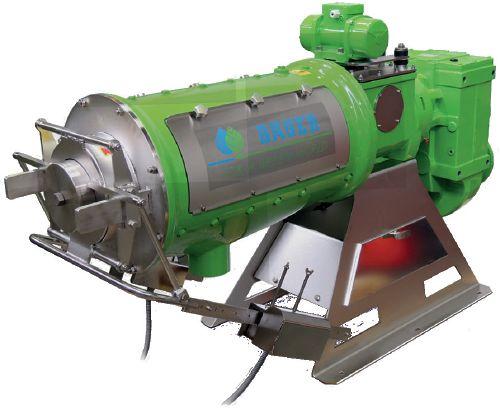
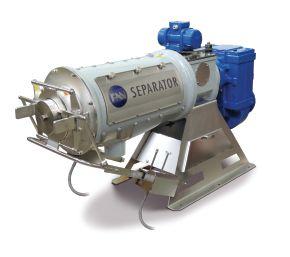
FAN PRESS SCREW SEPARATOR
• Saves money
• High-quality bedding made from manure
• Easy to maintain
• Low energy consumption
MAGNUM
CSPH
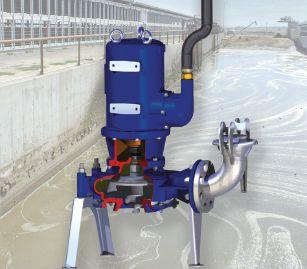
Submersible motor pump gear unit design
Fan produces bedding material with a dry matter content of up to 38% in solids.
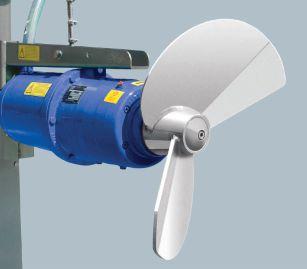
MSXH Submersible motor mixer
CALL THE FAN/BAUER BOYS:
East: Jim Dewitt, 1-630-750-3482, j.dewitt@bauer-at.com
West: Jeff Moeggenberg, 1-630-334-1913, j.moeggenberg@bauer-at.com
Sales Director: Ray Francis, 1-219-229-2066, r.francis@bauer-at.com
Parts/Operations: Rob Hultgren, 1-800-922-8375, r.hultgren@bauer-at.com
BAUER NORTH AMERICA INC.
107 Eastwood Road, Michigan City, IN 46360, 1-800-922-8375, bnasales@bauer-at.com
PUTTING RESOURCES to good use
How David and Marie Graybill conserved nutrients the smart way on their Pennsylvania dairy farm.
BY JULIENNE ISAACS
David Graybill grew up milking his family cows by hand. But it wasn’t until 2000 that he and his wife, Marie, officially became dairy farmers and owners of Red Sunset Farms near Mifflintown, PA.
Prior to that, they’d taught agriculture, shop and science courses at a nearby high school, says Graybill. Then, in 1998, his uncle offered them the chance to farm on his rented land. It was a dream come true.
“We’ve been at it for 22 years,” says Graybill.
The Graybills’ dairy farming story has taken an unexpected turn or two. Earlier this year, the family dispersed
ABOVE
their herd. It was an extremely difficult, if necessary, decision, and they would have liked to reach the “magic” number of 25 years in the dairy business, says Graybill. But they’re still cropping their 400acre farm, and every year they reap the benefits of the farm’s many conservation practices, especially with regards to their manure management.
This year was no exception.
“[This spring] we emptied our entire [manure] storage onto our corn ground. The corn will start taking up those nutrients right away,” he says. Over those 22 years, the Graybills
Considering the Graybills’ recent investments in manure storage and barnyard upgrades, the decision to sell their animals this year was a difficult one.
“came a long way,” as Dave puts it, in terms of how they handled manure.
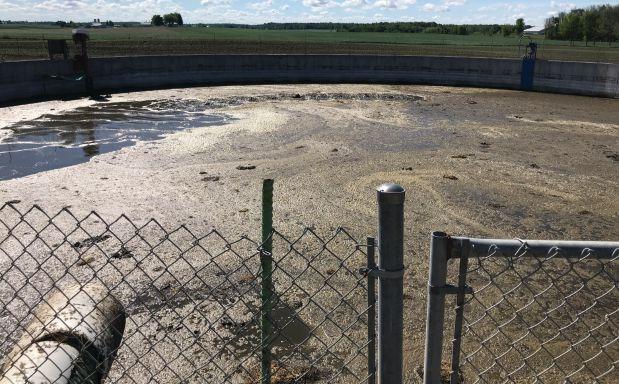
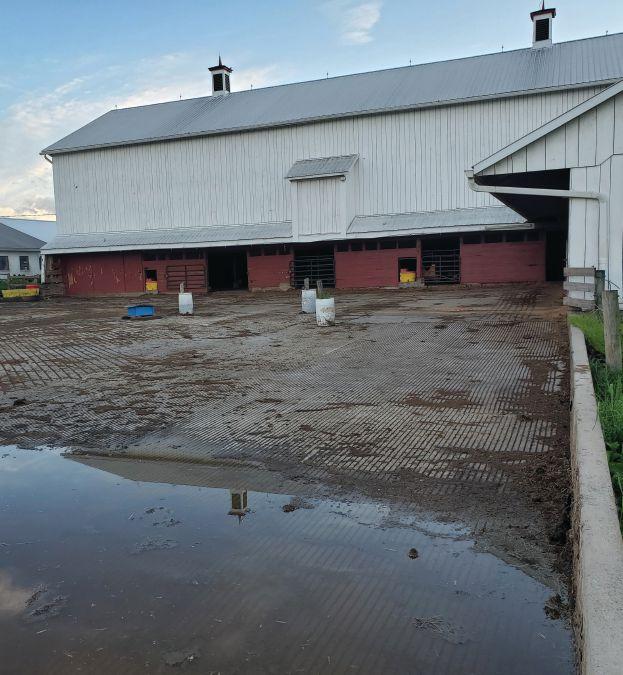
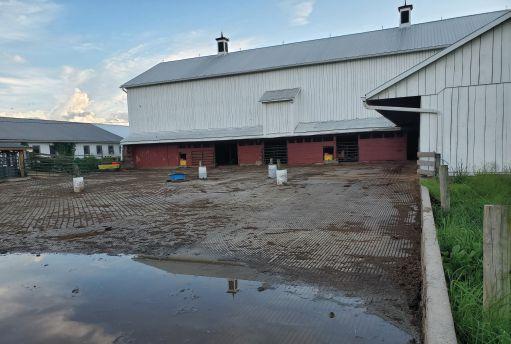
Around 2010, with nitrogen costs spiking, the Graybills started looking into how they could implement nutrient cost savings on the farm. In 2015, with the help of an National Resources Conservation Services (NRCS) costsharing grant, they built a manure storage facility, including a manure transfer pump and holding tank with year-long capacity. They put in a concrete barnyard with brown water collection and a sprinkler system.
The project cost time and money, says Graybill, but paid off sooner than expected, when nutrient costs rose once again during the COVID-19 pandemic. The system ensures not a single drop of nutrientrich water is wasted.
some of what was being done with them,” he says.
Early on, the family switched to zero-tillage, and added in grassed waterways, which they were careful to protect with a spray management program that helped avoid those areas of the field.
“If you put the manure on a daily haul, you only get 15 percent, in a good scenario you get 25 percent of the nutrients. So [prior to this] we were wasting 75 percent of the nutrients,” he says.
CONSERVATION PRACTICES
The new storage facility is just one of the latest in a list of at least 30 conservation practices the Graybills have implemented.
When they took over from David’s uncle, the farm already had contour strips to manage erosion. “We just had to enhance
They also began cover cropping. On what Graybill calls the farm’s “good ground,” they grow corn and beans; when they grew silage corn, they’d follow it with wheat and then soybeans the following year. On the farm’s lighter soil, they have an oats/ wheat/barley/soybeans rotation with a cover crop following the beans. “The ground is shallow with no extra water in July and August. Right now I’ll get a good crop of barley, and I’ll get more bushels per acre by putting out barley. This also improves soil health,” he says.
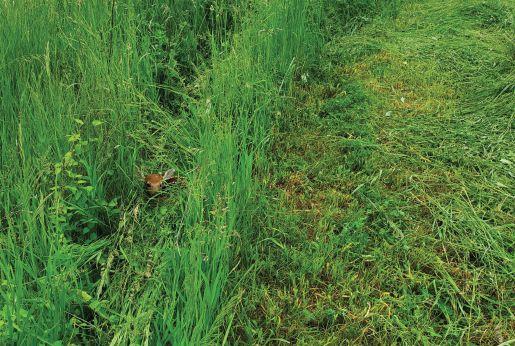
NCRS was very instrumental in helping the Graybills implement several conservation practices; one such project was an acre-sized wildlife plot planted to native wildflowers.
“The red clover kept coming back, and wildlife loved it because we went through a drought and the clover was the one thing that was growing really strongly in the spring and fall,
ABOVE
David, Marie, Heidi and Corey Graybill have seen their farm evolve in many different ways.
and the deer kept it mowed off like it was a yard,” says Graybill.
But the biggest change was the transition from “daily haul” to year-round manure storage.
“When we started farming in 2000, the manure had to be hauled every day. The cows are standing in that stall 16 hours a day, the manure is falling in a gutter and going out into a manure spreader,” explains Graybill. “It had to be hauled every day because there was no storage on the farm.
“On a sunny day in the springtime when there was no corn planted on the ground, that worked, but after the corn was planted there was no place to haul the manure except the ground where you just took hay off. When you spread manure outside of when the crop needs it, loss of nitrogen, and possible erosion downstream of phosphorus and potassium, that loss of nutrients was a huge thing.”
NRCS covered 75 percent of the $100,000 project, which was expected to pay for itself within seven to eight years, says Graybill. “In terms of infrastructure, the payback is slow, but this year nitrogen tripled in price. We just bought nitrogen at $1000 a tonne. I just pumped around 600,000 gallons out of the pit the other day. That [represented] a lot of money,” he says.
Perhaps the greater investment was time, says Graybill. For dairy farmers, time is money, and the project took nearly five years from start to finish, with Graybill doing a great deal of the subcontractor work himself. It can be tough to justify that kind of investment, he says.
But the payoffs weren’t simply financial. Graybill says it felt good to be able to say that he fed and took care of his cows and also captured their nutrients for later use.
ABOVE
Graybill barnyard.
Other benefits arose from upgrading the farm buildings and barnyard, including a dramatic reduction in odor, and benefits to animal health and value. The farm had never had many best management practices implemented around the farm buildings, says Graybill.
“Part of the barnyard was still dirt when we moved in, and that dirt became mud when it rained, and when animals are walking in mud or manure that’s four to six inches deep, it’s hurting the rate of gain. With livestock, it [matters] whether the animals can keep on growing all the time,” he explains. “I kept track of how many pounds per day they put on.
The
ABOVE
After the Graybills put in an acre of wildflowers, they began to get regular animal visitors.
They needed to be putting on a pound and a half per day on average, and if they weren’t gaining that weight there was something wrong.”
The Graybills put concrete and spoutings on the barnyard to keep water clean and enhance the collected manure; rainwater was piped off to a sprinkler system. Red Sunset Farm sits atop vertical red shale, and springwater would come up in areas of the barnyard that weren’t concreted. The upgrades helped move that springwater to another area of the farm.
FUTURE PLANS
Considering the Graybills’ recent investments in manure storage and barnyard upgrades, the decision to sell their animals this year was a difficult one. But it had to be done, says Graybill.
Seven years ago, he shattered his left wrist in a farm accident. At that time, he probably would have sold the herd if prices had been decent. He couldn’t artificially inseminate cows with his left arm for more than a year. “I knew it was going to slow me down,” he says. When his landlords put part of the land–which the Graybills had used for forages–into a commercial solar lease and cattle prices doubled, the Graybills knew it was time to sell. “As soon as I couldn’t get that forage for the dairy herd, I knew the writing was on the wall,” he says.
It wasn’t easy. But Graybill likes to say he’s officially a crop farmer now. And he has another growing herd: bees. “We have 30-some hives that we overwintered and I’ll probably double or triple that honeybee operation. We sell honey here on the farm and I sell honey bees and queens and nucleus hives.”
Graybill started beekeeping the year he broke his wrist. Now, he’s got the time to see that business grow. Even with the dairy herd gone, he shows no signs of slowing down: he sits on several farm boards, including Pennsylvania Farm Bureau’s State Board environment and executive committees, the Agriculture Workgroup for EPA’s Chesapeake Bay Partnership, and others.
As a longtime educator, Graybill knows how important it is to speak up about what matters to him and his family, and the farmers in his region. “You have to talk to one person at a time and explain to them how important it is that ag is producing all the food that you’re going to eat today,” he says. •
Finding the “Cadillac” of manure storage systems
Balancing practicality, affordability and eco-friendliness for dry storage in Washington State
BY JACK KAZMIERSKI
In 2019, the American Farmland Trust (AFT) received $310,000 in funding from the United States Environmental Protection Agency (EPA) in order to evaluate the effectiveness of on-farm conservation practices as they relate to the storage of solid manure.
AFT, Discovery Farms Washington, King Conservation District and Whatcom Conservation District worked together on this study. The funding was administered through the Washington State Conservation Commission.
“Although the project officially started in 2019, due to a number of complications, including the COVID-19 pandemic, we actually installed the manure management practices in the fall of 2020, and we began collecting data from October of 2020 through to May of 2021,” explains Addie Candib, Pacific Northwest regional director, American Farmland Trust.
Washington State has a long tradition of dairy
ABOVE
farming, adds Candib, “But our target audience for this project was not the large-scale dairies, because they tend to have very robust systems in place [to manage their manure], namely manure lagoons. Our target audience for this research project was those small farms and farmsteads, where they have a handful of livestock.”
Two farms were chosen for this study: one with six alpacas, 65 sheep, 12 goats, 100 chickens, and 40 ducks; the other with two horses. “That’s really where we saw the gap,” Candib adds. “It was in supporting those smaller [farms].” Both farms are located in King County, WA, in a part of the country that typically sees a lot of rain.
Scarlett Graham, conservation research specialist, Whatcom Conservation District explains why manure storage is particularly challenging in this climate. “We tend to have a long wet season, and then a very dry summer,” she says. “The rain usually starts in earnest in
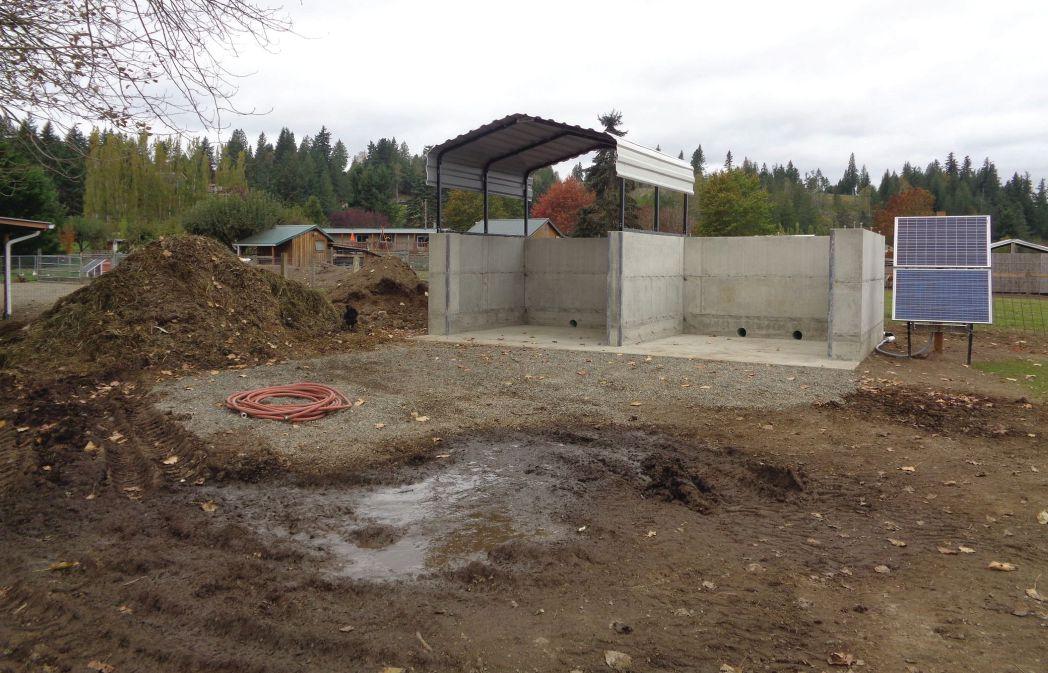
Storing dry manure in two cement bins with a roof was considered the “Cadillac” of storage solutions in this study.
October, and it usually goes until about May with the highest rainfall being in the wintertime. We can get over 35 inches of rain between October and March, and then in the summertime, we can get zero. So we definitely have this need in the wintertime for people to have a place to store their manure because there’s really no agronomic reason to be putting it on their fields when it’s very dark and very wet. Then, in the springtime, they want to be able to access that manure and put it out into the fields.”
Improper storage during the wet months can result in runoff and leaching of manure nutrients. Candib says this is as significant a problem in this part of Washington as it is in other parts of the country. “It’s a pretty sensitive ecosystem, we get a lot of rain and we have criticallyendangered species living in our riparian areas,” she explains. “Primarily, it’s salmon that we’re concerned about.”
for our region.”
The initial goal of this manure management study was to come up with empirical data that could be used to prove to farmers that the way they store their manure during the rainy season could have a major impact on the ecosystem. “We set out to provide a better understanding of how manure management can make a difference,” adds Candib.
Many of the farmers who raise livestock in the area simply put the manure into a pile on the ground, says Candib, adding that the King Conservation District team often recommend the ideal storage system, which can result in pushback from the farmers.
It’s a big investment, especially if you’re a new farmer and you don’t have extra capital.
One way to deal with this problem is to support livestock owners by helping them make better manure management decisions. “But you can imagine that if you’re a small farmer raising livestock, and someone comes and says, ‘You should really be managing your manure this way or that way,’ and that it’s going to take time and money to make changes, you’re going to want to know why,” explains Candib. “You’re also going to want to see the data that proves that this is going to make a difference. What we found is that this data wasn’t there
“We started calling it the ‘Cadillac’ version of a manure management system. This is where you have three bins made of concrete, and a roof across the entire structure,” explains Candib. “But that’s a big investment, especially if you’re a new farmer, and maybe you don’t have a lot of extra capital. Or if you don’t own your land, if you’re leasing your land, and you have a limited ability to make long-term investments in the property. Or if you’re just getting started with livestock, and you’re thinking, ‘I’m going to try this out for a couple of years. I don’t really know if this is for me.’”
With all the scenarios mentioned above, where the “Cadillac” solution might not be possible, the goal of this study was to find a solution that would be a better alternative to simply
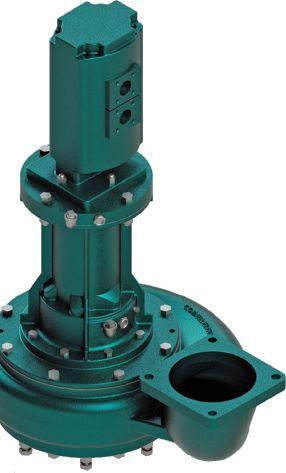
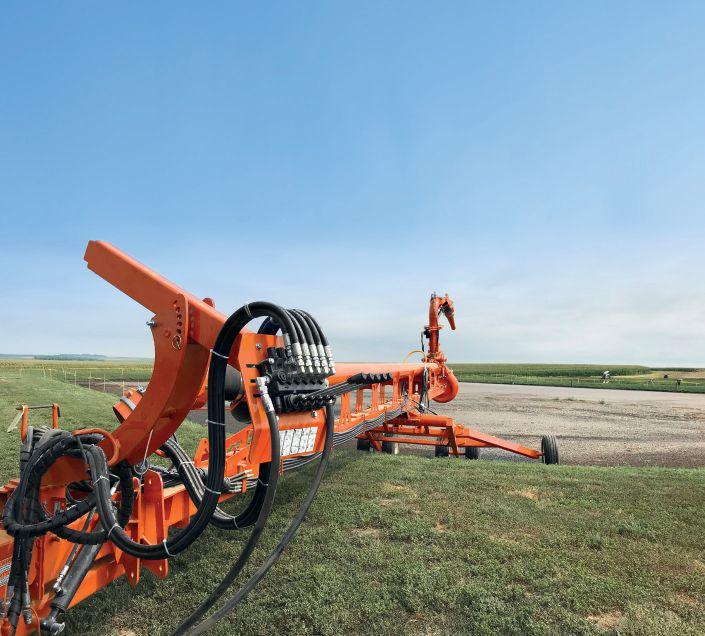
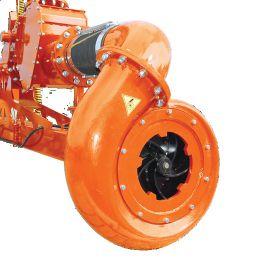
THE NEW NNWH PUMP SERIES TO OUR OUTSTANDING LINE
8” and 10” discharge sizes
Hydraulically-driven
Operated in lagoon or pit
Fits in tight spaces
Semi-open style impeller
Cutter plate rips up straw and other stringy material
Pump resists plugging
storing the manure in a pile on the ground.
“We were really trying to answer the question, ‘What would happen if the farmers did something better than simply putting the manure in a pile on the ground, but not as expensive as a threebin system?” adds Candib.
With this plan in mind, the study looked at four ways to store/manage manure. Besides the aforementioned pile on the ground, and the “Cadillac” model with cement bins and a roof, the
better solutions included a pile on the ground covered with a tarp, and a pile on a cement slab, but without a roof or tarp as a cover.
SAMPLES AND ANALYSIS
According to the report published by AFT, the two piles on cement slabs (slab covered and slab uncovered) were assessed for runoff via collection of stormwater leachate (combination of stormwater precipitation and/or manure leachate from the piles) via six-inch PVC
pipes built into the back of the manure bunker slabs. The water samples were sent to a laboratory for analysis of fecal coliform, total kjeldahl nitrogen, nitratenitrite, total phosphorus, salinity and/or total suspended solids.
The two treatments on dirt surfaces (dirt covered and dirt uncovered) were assessed for leachate losses below the piles via monthly 12 and 24-inch profile soil sampling. The samples were sent to the laboratory for analysis of fecal coliform, total nitrogen, nitrate-nitrite, total phosphorus and/or salinity.
MAJOR TAKEAWAYS
At the end of the study, organizers came to a number of conclusions. Candib explains, “The key takeaways [are] that the covered manure, whether it was on a permeable or impermeable surface, had less runoff and less leaching. Manure that was on the concrete slab – sounds obvious – but it had no leaching. The concrete slab can be engineered to contain stormwater and generally reduce the runoff.
“When we looked at the stormwater runoff, the composition of the manure was reflected in the stormwater runoff. So if that manure was really high in nitrogen or phosphorus, we would see that in the stormwater. So there’s a direct correlation between the type of manure, the management of the manure and
ABOVE
what’s in the runoff.
“And then, I think this is a really key takeaway for farmers or landowners: manure that’s covered is drier, it achieves a greater temperature, and the end result is a better product with more nutrients.”
It’s clear from this study that manure management makes all the difference. Covering your manure, whether with a roof or a tarp, is going to have less impact on the ecosystem, and it’s also going to create a better composting product. In addition, says Candib, “Storing manure on an impermeable surface, whether that’s a concrete pad or a tarp, whenever possible, is going to reduce nutrient loss and leaching into the soil on the groundwater.”
PHASE TWO
Due to the impact of COVID-19, as well as a number of setbacks along the way, the study wasn’t able to provide as much data as the organizers had hoped. “The two study sites are still active, and we’re going to start sampling this season,” explains Laura Redmond, landowner incentive program coordinator, King Conservation District. “We need a more robust data set, which is why we’re continuing. We do have funding secured,
and phase two is going to start ramping up here in the next couple of months.”
Candib offers more insight to some of the challenges they faced throughout the study period. “This was designed to be a two-year research project,” she explains. “But because of COVID delays, we only had one year of data collection, and in that first year, we experienced some real hiccups. For instance, the treatments that we had on dirt at both sites, because of our lack of knowledge about the sites, ended up being saturated by standing
water on the ground. So that invalidated those findings, and we had to move those piles halfway through the study.
“We also ended up having a very dry spring, and so we ended up with a lot less data than what we had hoped for. But I think we all recognize that this was a great start. More data is really needed to refine these findings, and be able to speak with competence. We can offer these generalities, but if we’re going to drill down into the details about specific nutrients, we need more data.” •
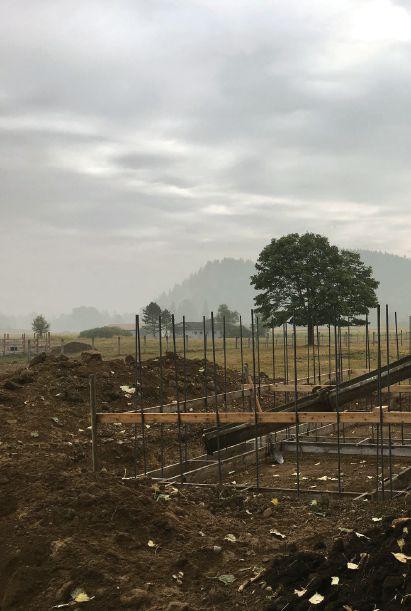
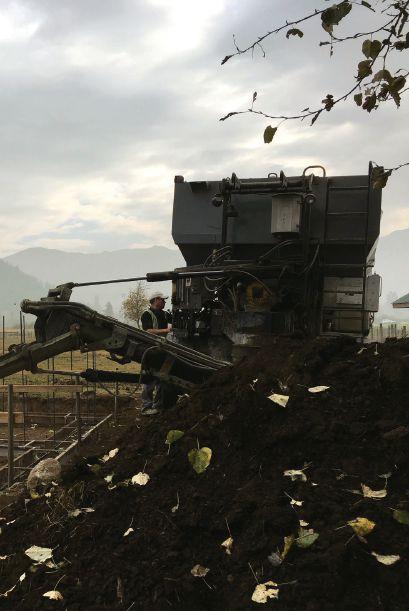
Construction process on dry manure storage solutions at Discovery Farms.
Statistics Canada releases 2021 Census of Agriculture
Statistics Canada has released its 2021 Census of Agriculture, giving insights into the current state of Canada’s farming industry.
There was a moderate decrease in the total number of farms in Canada, with 189,874 farms total (a decrease of 1.9 percent from 2016, and a 3.2 percent decrease in total farm area). However, for livestock, the number of heads reported for livestock categories had a modest increase from 2016.
Some figures indicated that large farms are leading the charge when it comes to Canada’s farm sector growth. For example, in 2021, farms reporting at least CAD $2 million in sales represented 51.5 percent of Canada’s total farm operating revenues. This compared with 41.5 percent in 2016.
The report shows that livestock inventories and acreage for prominent crops have either remained stable or seen modest increases, indicating a solid weathering of the challenges posed by COVID-19.
Grain and oilseed farms continue to make up the largest proportion of farms in Canada. In 2021, there were approximately
65,135 of these types of farms, accounting for 34.3 percent of total farms. Beef and feedlots followed, comprising 20.9 percent of farms. These two sectors also totalled 82.7 percent of total farm area. A full recap of the Census is available on ManureManager.com
MANURE MINUTE
Small but mighty: Weed seeds in manure
Weed seeds in manure can be problematic when they result in overgrown, weedy fields after manure application. And seeds are in no short supply; a survey found fresh manure on dairy farms had an average of 75,000 seeds per ton. But luckily there are some measures one can take to reduce the viability of those seeds.
First, don’t assume animal digestion will take care of the problem. Though it will reduce weed seed viability, simply feeding the material to livestock will not eliminate all seed. Grass and softcoated broadleaf seeds are more easily destroyed in digestion than hard-coated seeds. In one study conducted on rumen animals, such as cattle, 27 percent of hard-coated seeds remained viable after digestion. The gizzard digestive system of poultry is highly effective at destroying weed seeds, and only 3.5 percent of hard-coated seeds fed to ducks were recovered and found viable in a similar study.
So what can you do to reduce weed seed viability beyond the gut? In general, heat is the enemy of weed seed survival. The benchmark for good seed mortality is 140F (60C) sustained for three days. Hot temperatures that fall below that mark or a shorter duration will still kill some seeds, but not as thoroughly. How you subject the seeds to heat is up to you, but below are a few suggestions.
MINIMIZE WEED SEEDS IN MANURE BY COMPOSTING
What if ensiling isn’t feasible? What if your manure is already contaminated with weed seeds? In those cases, composting is a very effective method for killing weed seeds – more effective than ensiling.
Internal heat generated by properly composting manure will kill most weed seeds –even the hard-seeded ones. The key word here is “properly.” As I always say, aged manure is not composted manure. Proper composting requires active management and must be monitored and aerated for correct weed-killing conditions to develop.
Even under the most diligent composting, some seeds survive.
MINIMIZE WEED SEEDS IN FEED AND FORAGE BY ENSILING
What goes in, must come out. Therefore, killing seeds before they get to the animal is a good strategy. One way to do that is to ensile the feed (if appropriate for the feed type). The fermentation and heat generated during ensiling is quite effective for killing weed seeds. One study found that just one month after seed-contaminated haylage was stored, viability of the toughest seeds dropped by 41 percent; and in corn silage, the drop was even greater at 60 percent. Logically, seed viability continues to decrease as silage storage time increases. Eight weeks of ensiling was shown to kill up to 87 percent of viable seed; and when feed went through both ensiling and rumen digestion, the seed mortality increased to 89 percent.
Temperature and moisture are the two most crucial elements for seed mortality in compost. Studies have shown that sustaining the compost at that benchmark of 140°F for three days can reduce weed seed viability 90 to 98 percent, so long as a minimum of 35 percent moisture is maintained. Another study found that overall duration was important and that it took between 21 and 50 days of composting for best results. Even under the most diligent composting program, there can be seeds that survive. It is theorized that, since manure is not a uniform product, this mortality escape is due to cooler pockets that do not sustain high temperatures for long enough. Therefore, just because manure has been composted does not necessarily mean it is totally free of weed seeds.
SCOUT FIELDS THAT RECEIVE MANURE CONTAINING WEED SEEDS
Remember, even if the feed was ensiled and the manure was composted before spreading, it’s still possible for weed seeds to remain viable. A 98 percent reduction in viability seems sufficient, but even low seed survival rates can be problematic. It’s a numbers game: two percent survival of 75,000 seeds would leave 1,500 viable seeds remaining per ton. Applied at eight tons per acre, that would increase the weed seedbank by 12,000 seeds per acre! Therefore, it is crucial to scout fields that receive manure to head off any severe weed infestation.•
Qualities of a good employee
GEA alley scraper system never takes a day off,doesn‘t park in your way, cleans up after itself, and is willing to work any shift. Everyone needs to recharge their batteries, GEA alley scraper system DOESN‘T!
These are qualities that are common to most employers. Scan the QR code to learn more about how it applies to GEA Alley Scraper.
• Autonomy
• Good priority management
• Performance
• Team player
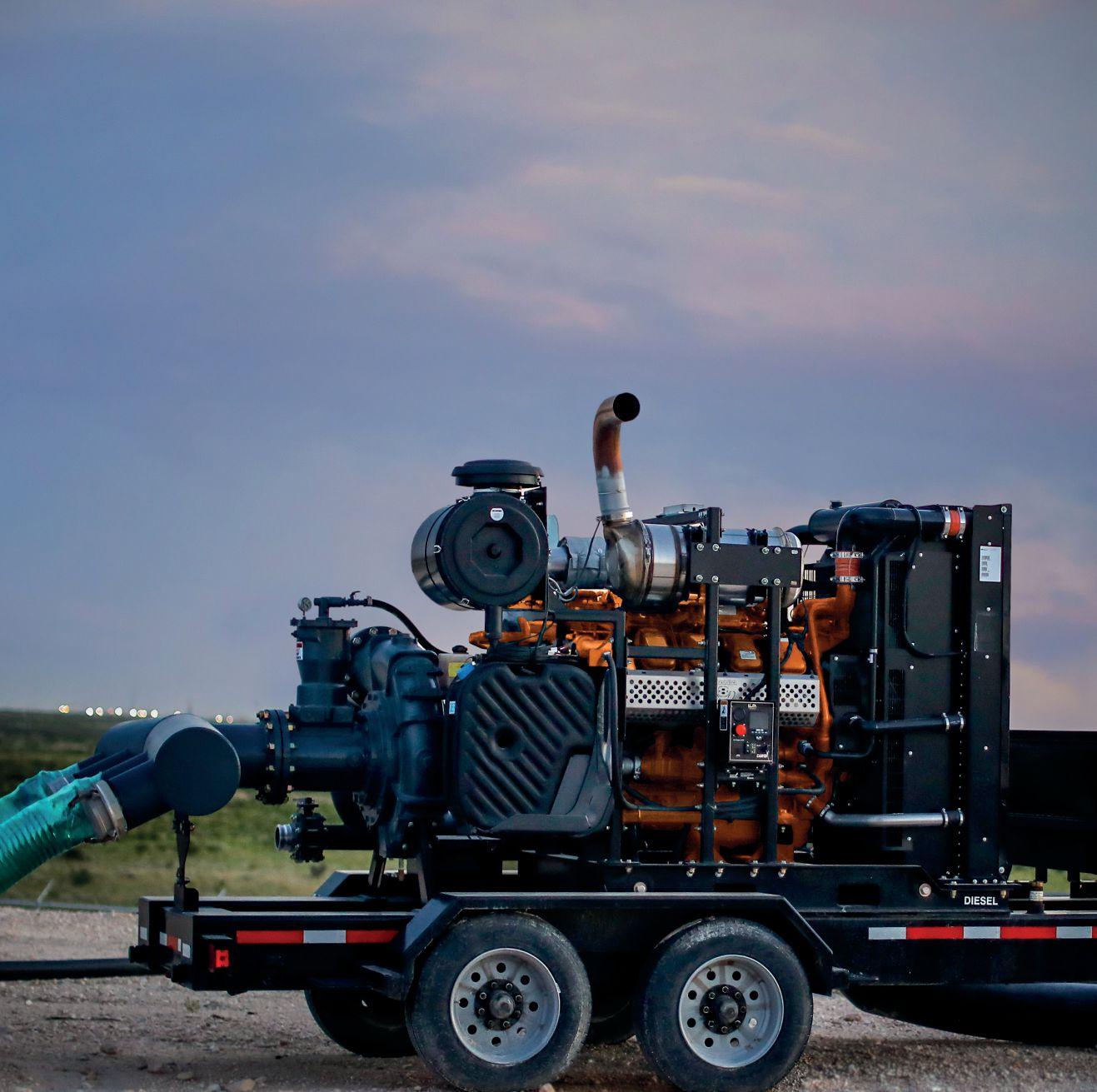
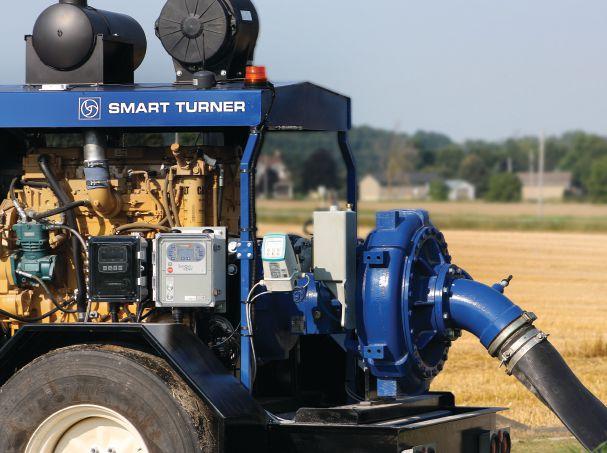
The new HD pumps are built to pump manure, built to run smoother to save fuel, run at a lower rpm with larger and wider impellors to reduce engine wear and plugging issues.