Municipal digester projects are embraced in some areas, but not so much in others. What has helped key projects find success?
An appetite for manure
Black
BY BREE RODY
It makes no scents
An unlikely collaboration results in a breakthrough that could reduce odors from manure.
BY RONDA PAYNE
Possibilities and limitations
Manuresheds can help get manure from where it is to where it’s needed. But what are the limitations?
BY RICHARD KAMCHEN
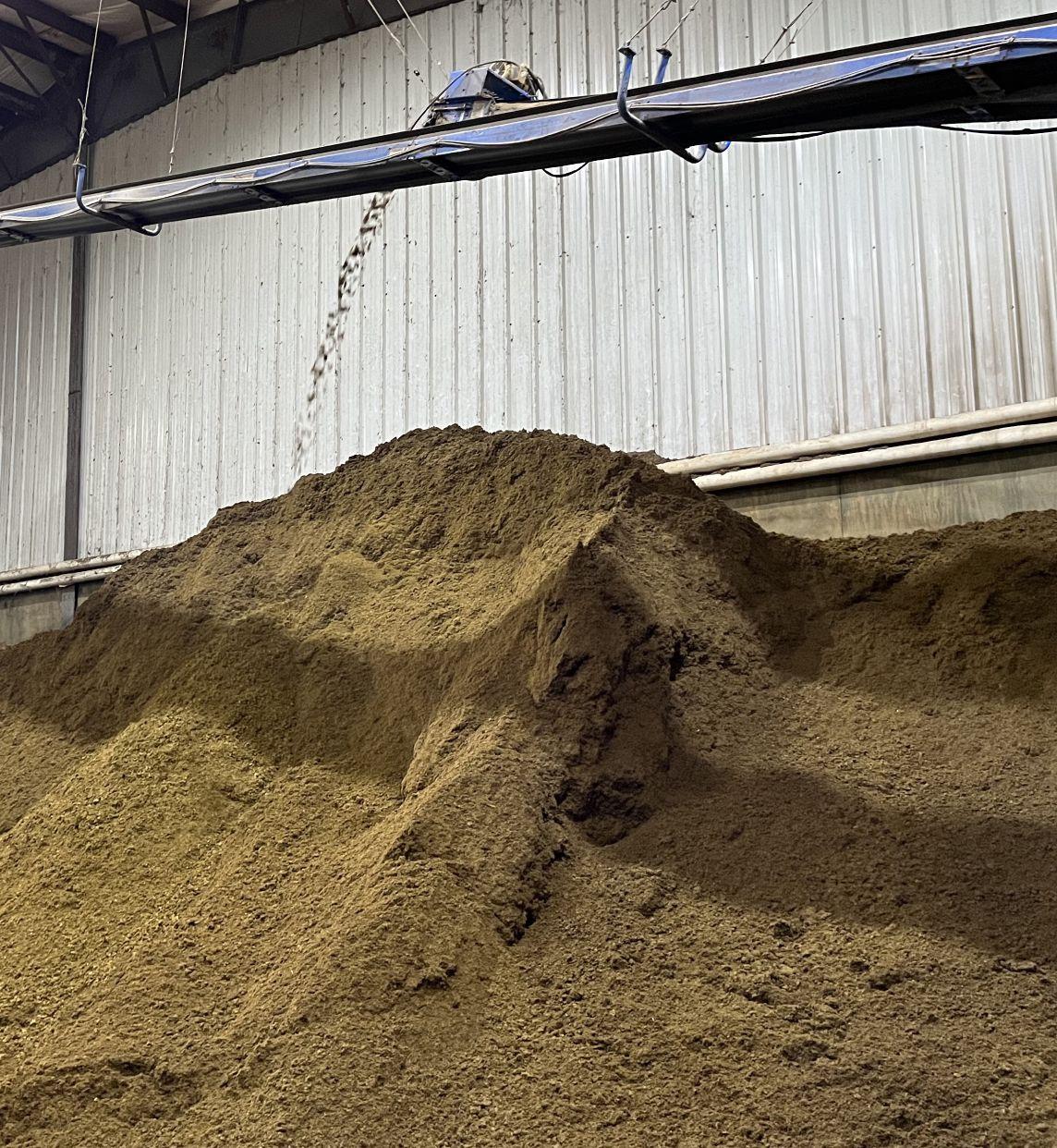
Digestate is generated from an anaerobic digester. See page 8. Photo by Rebecca Larson
The new innovation conversation
Time for an embarrassing story. A few months ago, while visiting family, I looked at an old photo album. I came upon a particularly interesting picture, but couldn’t make out all the faces in the crowd. I placed my thumb and index finger on the picture and proceeded to try to zoom in.
Yes, like I was on a touchscreen phone.
Assuming most people got their first smartphones around the height of the Blackberry or the introduction of the iPhone, smart mobile technology has been a part of our daily lives for about 15 years now. Cars now come standard with on-board computer screens. For two years, technology helped us play Scrabble and have movie nights with our friends and family in other states. And although we are still working out some of the kinks and determining best practices and use cases, AI is undoubtedly dominating the cultural discourse. Essentially, tech that was once considered fanciful or frivolous in our own lifetimes is now considered so
The big question with innovation has always been “what can we do with this?” But with the technology already here, and their use cases already largely agreed upon, there are more important questions remaining. For example: “What should we evaluate before investing in this?” “How quickly until this pays off?” “What does ROI on this even look like?” “What are the implications of this?”
Take, for example, digesters. In my very first innovation issue, our cover story was about a Connecticut digester. That story – which went on to win a gold Canadian Online Publishing Award – still framed digesters as the future. But it’s now time to talk about digesters as part of the present. Instead of simply discussing digesters as a theoretical solution, in this issue we discuss the nitty-gritty reality of digesters once they’re on the ground and in the community – including why some are well-received and some aren’t.
We also discuss the innovation involved in manuresheds – the
“It’s time to accept that innovation is the present.”
normal that, well, some of us try to pinch real pictures to zoom in.
Perhaps that’s why it now feels like a different tone is required when talking about innovation. In previous years – this is my fourth innovation issue – I’ve tended to discuss innovation as though it is a theoretical and faraway thing. But it’s 2024. It’s time to accept that innovation is the present. All the things we dreamed up and wrote thinkpieces about and watched SNL skits about are here now.
complex but necessary process of moving manure from where it is, to where it’s needed. Manuresheds have been in practice for some time, but given that manure is still applied to less than 10 percent of American crop fields, their necessity has become all the more urgent – and pros are optimizing on the ground.
If you haven’t already, it’s time to discuss innovation as though it’s a matter in the present and not the future.
+ Low Life-Cycle Costs
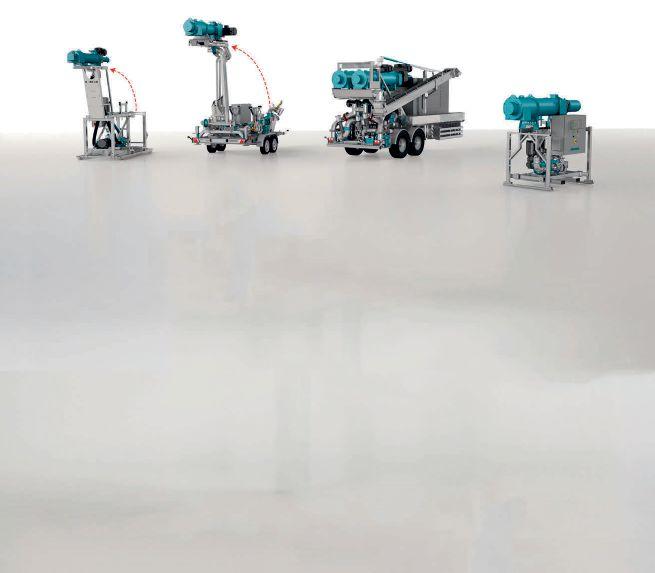
+ Turnkey from a Single Source: Separator
Pump(s)
Control Unit
Stationary or Mobile Skids
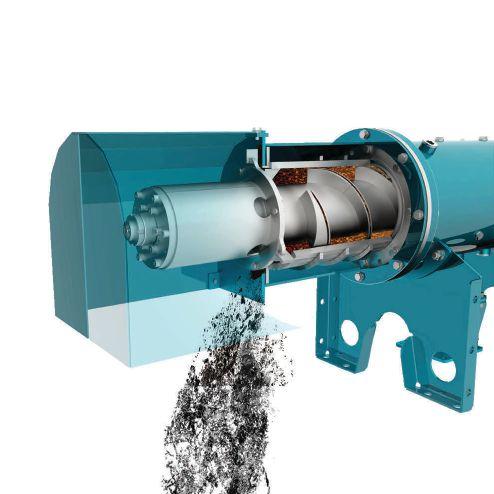
+ Patented Profile Auger with Counter Bearing for No Auger Screen Contact
+ Continuously Variable Dry Matter Content
+ Large Capacities
844-647-7867 www.boerger.com
•
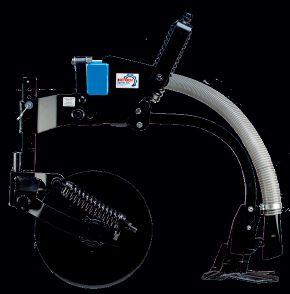
• Adaptable to any toolbar
• Swivel coulters reduce side loads
• Rugged design
USDA livestock risk management program growing
Marcia Bunger, administrator for the USDA’s Risk Management Agency says its Livestock Risk Protection coverage (LRP) has grown significantly.
“LRP grew by 250 percent in two years,” said Bunger in a statement, adding that about 27 million head of cattle are insured.
Livestock risk management programs are not new – USDA’s Risk Management Agency was created more than 20 years ago. In 2019, the agency increased
premium subsidies and subsequently created tiered rates.
These are created with the goal of reducing losses from livestock price declines. Some factors have led to general price drops in the fall – these factors include environmental risks, disease risks and an overall softening economy. Such factors are likely contributors to the significant growth in popularity over the last two years.
VERMONT ALLOWS EXEMPTIONS TO WINTER SPREAD BAN
Vermont is one of several states in which all manure spreading in the winter is banned.
While this year’s ban remains in effect, Vermont governor Phil Scott signed an executive order instruction the state’s agricultural and natural resources agencies to outline appropriate best management practices that will allow farmers
to spread manure while still protecting the environment.
In a Dec. 15 statement, the Vermont Agency of Agriculture, Food and Markets (VAAFM) issued a statement confirming the ban, but clarifying that farmers may apply for an exemption “for emergency situations occurring because of the historic wet weather
Vermont experienced in 2023.”
A flash flooding event that occurred on July 10 and 11 caused more than two weeks of damages across the Northeast and MidAtlantic resulting in 13 fatalities and $2.1 billion in damage.
For farmers, this meant severe limitations when they were able to complete various
planting, harvesting and post-harvesting activities. Many farmers were forced to spread manure over a longer period of time,
“Years like this one, with natural disasters and severe weather conditions, can upend our standard restrictions and create the need for emergency exemptions,” the agency’s news alert read.
ManureDB goes live for producers and applicators
Researchers from the University of Minnesota have seen a multi-year project come to fruition. The new ManureDB database resource is officially live at http://manuredb.umn. edu.
The goal of ManureDB is to provide those with manure management plans a more current and up-to-date view of manure book values. Book values refer to approximate nutrient concentrations in manure,which can vary based on diet, environment and other factors. Knowing accurate values allows manure managers to create best practices for
manure land application and execute better agricultural modeling. However, current book value sare estimated to be several decades old, and
thus may not reflect current production practices. Indeed, recent lab data from the Midwest indicates that nutrient data has changed compared
to published Midwest Plan Service book values. These changes may be prompted by differing animal diets, treatments, housing and more.
Through ManureDB, producers and applicators can access information and comparison of different manure types. As of September 2023, ManureDB includes 422,032 samples from 49 states, 13 labs, more than 65 animal types and 18 organic amendments. The team anticipates growth in the datasets, and has provided additional information on how to submit data from your lab.
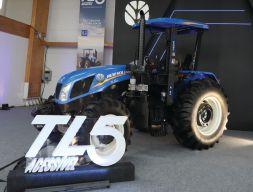
New Holland introduces accessible tractor
In 2022, Brazilian farmer Fernando Dalmolin suffered an accident, leaving him with lower limb disabilities.
Dalmolin collaborated with New Holland Agriculture’s Curitiba, Brazil plant to develop the TL5 Accessível tractor, an accessible tractor designed specifically for people with lower limb disabilities.
According to the 2019 National Health Survey, published by the Brazilian Ministry of Health together with the Brazilian Institute of Geography and Statistics, Brazil has 17.3 million people over the age of two with some type of disability (8.4 percent of this population), with 7.8 million having physical lower limb disabilities. Of the total number of people with a disability in Brazil, 2.9 million live in rural households.
First presented as a concept tractor at Rural Coopavel and Expodireto Cotrijal in 2020 – two of the main agricultural fairs in the country – it met with both public and press acclaim. The final product has been created in partnership with the inclusive mobility company Elevittá, Arteprima and Senai from São Leopoldo (RS).
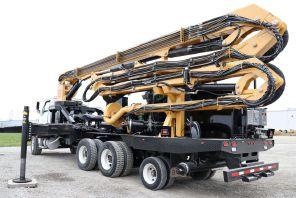
Bazooka debuts new Infinity Boom truck
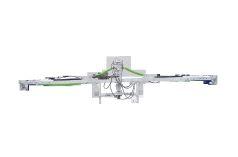
Bazooka Farmstar has unveiled its new Infinity Boom Truck. With an 85-foot four-section steel boom, the Infinity provides reach and flexibility for accessing tricky locations. The expansive
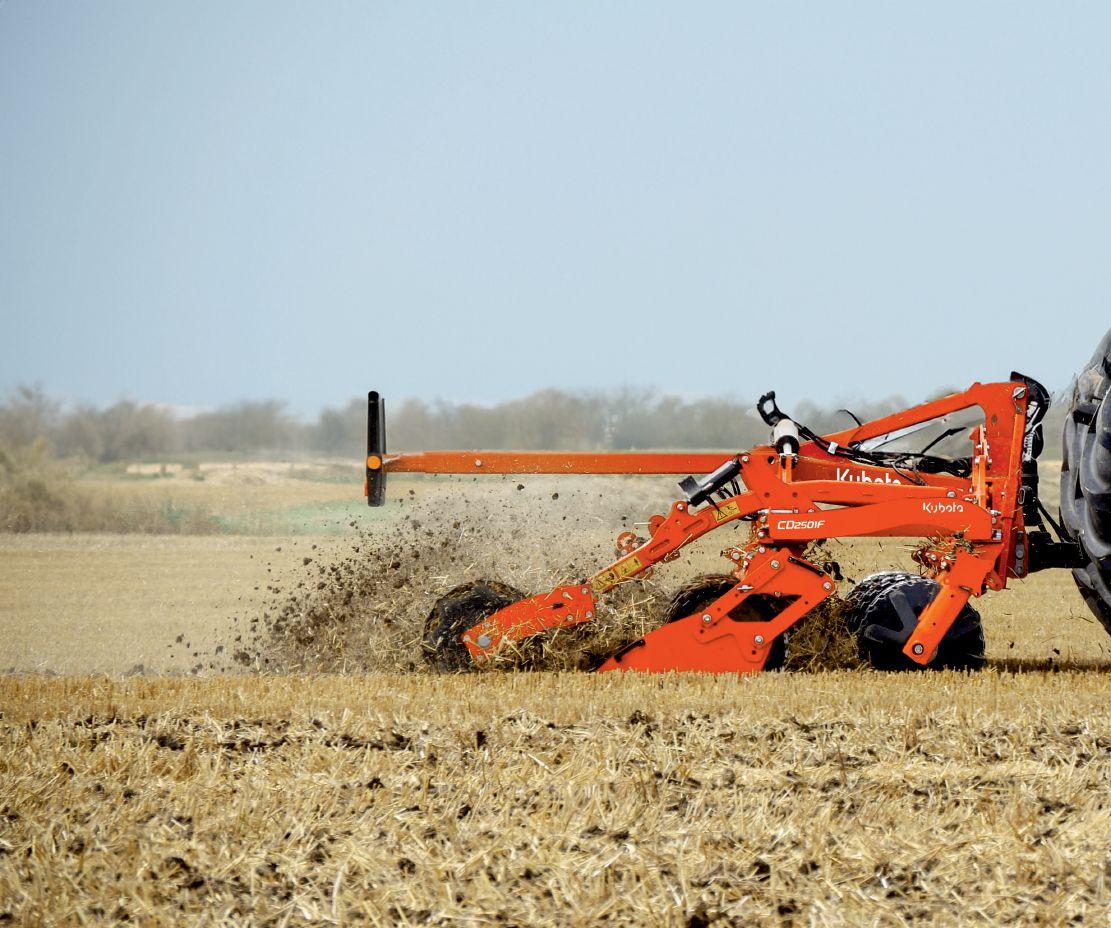
ADAPT TO ANY TASK
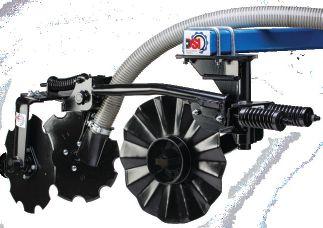
From manure incorporation to precision cultivation, the Kubota CD High-Speed Compact Disc effortlessly transitions between tasks. Its versatility ensures you can tackle every aspect of your agricultural needs without missing a beat.
Easily digestible
Why some communities embrace digesters, and others don’t.
BY JAMES CARELESS
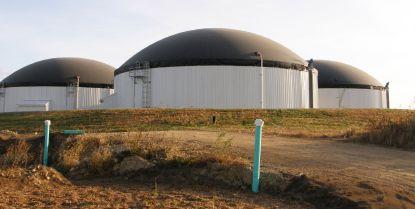
Anaerobic manure digesters have been hailed as a positive step for the livestock farming industry.
“A digester is essentially a big artificial stomach that allows naturally occurring microbes to continue digesting manure, producing biogas – mostly methane gas – that can be used for energy,” says Daniel Ciolkosz, associate research professor with Penn State Extension’s Department of Agricultural and Biological Engineering. As such, digesters harvest a natural byproduct of manure waste, and harness it for good.
But not everyone is a fan of digesters – including some local residents who live close to proposed digesters, who worry about odors. Others include activists who want to reduce reliance on animal agriculture (and thus manure processing) altogether.
THE PROS OF DIGESTERS
The biggest ‘pro’ in favour of digesters is that they harvest the methane produced by manure and use it to either generate electricity through burning –
ABOVE
heating water that drives steam turbines that generate power – or supplement the supply of natural gas being distributed to homes and businesses.
“The process behind harvesting methane from manure is pretty simple,” says Rebecca Larson, a professor and extension specialist with the University of Wisconsin’s Nelson Institute for Environmental Studies. “The microorganisms that are already in the manure degrade organic compounds naturally. “With a digester, that process is just contained in a tank or other vessel to allow you to capture biogas, which is a byproduct of that microbial breakdown.”
“Digestion is a good way of capturing carbon from the manure, which is in the methane,” says Wei Liao, professor and director of MSU Anaerobic Digestion Research and Education Center (ADREC) in Michigan State University’s department of Biosystems and Agricultural Engineering. “This reduces the amount of manure remaining after the digestion process.”
“Pros also include providing a new income stream
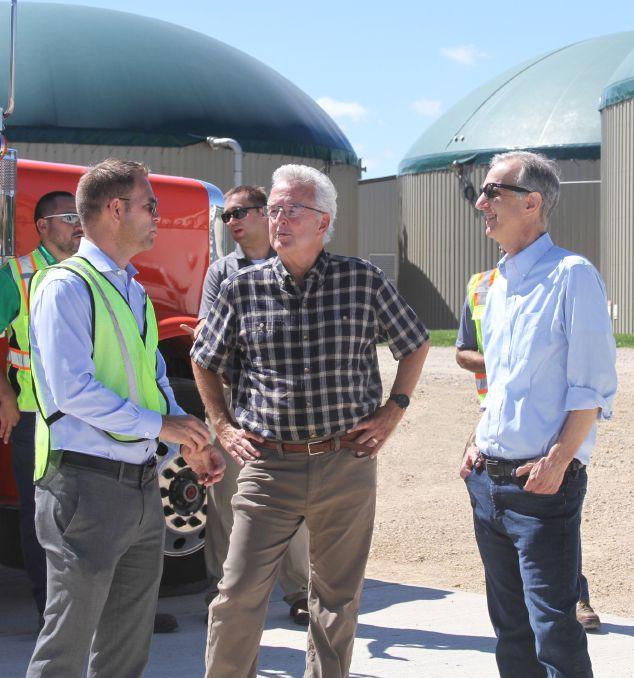
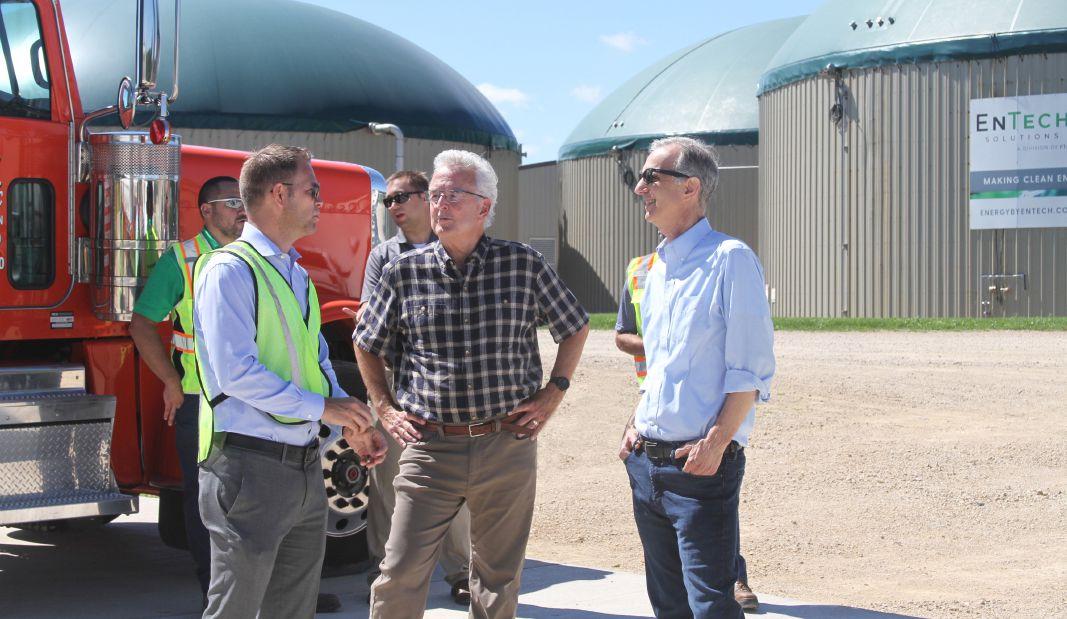
Local officials in Dane County, WI attend the opening of the EnTech Solutions digester, which has been viewed as a rousing success.
for a farm, and reducing odors from manure,” Ciolkosz says. This is because the odous that are generated during the manure degradation that produces methane are captured in airtight tanks, rather than vented to the atmosphere in open fields and manure piles.
That’s not all digesters can do. Harmful pathogens like E. coli bacteria in manure are considerably reduced when this process is used to extract methane. Meanwhile, the solid portion of the digestate may be sold as a nutrient-rich soil conditioner. The liquid portion may be treated and used for washing or flushing purposes, or further purified for other farm water needs. If animal and food waste are added to the digester during the methane production process, the resulting solid digestate can still be used as fertilizer.
Digesters can also help protect groundwater quality, which is why the concept was embraced by Wisconsin’s Dane County in 2011. Today, the county has two community digesters – one in Vienna, and the second in the town of Springfield. In 2022 alone, these digesters combined processed more than 105 million gallons of manure, and the separation systems following the digester removed 231,000 pounds of phosphorus. This resulted in reduced phosphorus runoff and improved water quality in the county, plus provided it with extracted phosphorus that can be applied to the ground where needed.
“The two Dane County digesters are very unique because the county requires phosphorus removal as part of its efforts to keep area lakes clean from toxic algae blooms during the summer,” says Dane County executive Joe Parisi, the elected official in charge of the county’s executive branch. “Both project operating agreements are enforced by the county, requiring phosphorus removal utilizing advanced technology systems. The EnTech digester uses a nutrient concentration filtration system purchased by Dane County that dewaters manure and discharges millions of gallons of clean water into a nearby stream. This means less phosphorus-filled manure and digester byproduct being spread on fields sensitive to runoff in the watershed. As well, both projects turn digester-produced methane into renewable natural gas.”
DISSENTING OPPOSITION
Dairy production is a big industry for Dane County. This is why establishing community digesters has been such a boon to this region. To date, “Dane County has not identified any disadvantages to using dairy digesters,” says Parisi.
But digesters do have their ‘cons’. According to Ciolkosz, they include cost, installation and logistics. Running digesters properly require skilled workers and the money to pay them. Feedstocks, temperature and pH must also be managed carefully to produce consistent quality biogas. Digesters need heat to operate so colder climates can make the process more difficult and less efficient. Meanwhile, financial incentives, revenue from energy production and market demand vary between counties and areas. Then there’s the availability of sufficient manure and other feedstocks: The closer the manure sources and other organic materials are, the greater the economic return. “For a producer installing a digester, it’s a lot of risk to take on,” says Larson.
Then there’s what some might call the NIMBY (Not in My Back Yard) factor. A case in point: Rimrock Renewables has won approval from the Alberta Ministry of the Environment and Protected Areas (AEP) to build the Rimrock Biodigester Facility next to the Rimrock Cattle Company Ltd. feedlot about 5.5 km west of High River. Manure that is currently stored on the feedlot
will be transferred 200 m – 300 m to the biodigester facility where it will be digested. This approval was granted despite opposition from some residents who expressed concerns about property values and odor. Addressing such resident concerns effectively – along with ensuring that digesters have adequate odour-management capabilities – is a must for such projects. To make this happen, “communication is the key,” says Ciolkosz. As well, visiting existing farm digesters is a great way for community members to see how they actually perform, and thus better assess whether a digester would be compatible with their community or not.
When engaging or communicating on the project, focus on the specific community concerns. Work with the community to identify and address concerns. Ensure transparency and include the community in the development process. Finally, encourage community members to get informed and engaged in local and regional municipal planning, and in the approval process for digestion facilities.
This was how officials handled the introduction of digesters in Dane County, to everyone’s benefit. “Dane County’s successful digester development strategy implementing innovative programs and technologies resulted in cleaner lakes, reduced costs for dairy farmers, taxpayer savings and a reduction in harmful climatechanging emissions,” says Parisi. “This has resulted in alleviating community concerns and gaining community acceptance.” •
For an expanded version of this story, check out the Feb. 28 edition of the Manure Manager e-newsletter. Subscribe to our eNews here.
AN APPETITE for manure
An entomologist shares insight into manure’s part in sustainable feed.
BY BREE RODY
Manure’s value as a soil amendment is undeniable.
But nevertheless, not everyone adopts manure application, even with the commercial fertilizer market as rocky as it is. The figures differ slightly across sources, but most research shows that manure is applied to 10 percent or less of U.S. cropland. As such, the natural result is more manure being produced than being applied.
That, of course, doesn’t mean manure is being wasted. Increasing adoption of manure application is an obvious goal; however, moving manure to where it’s needed is more complicated than most realize (for more on manuresheds, see our feature on Page 14). Thus, there are always additional uses for manure being explored – composting, bedding and renewable energy are just some of the other productive and practical uses of manure.
Another potential use? Feed.
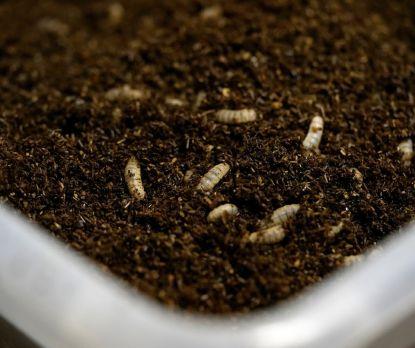
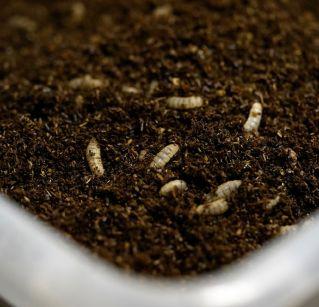
No, livestock is not going to be chowing down on manure anytime soon. Instead, a team at Texas A&M University and Mississippi State University is looking at using black soldier flies (BSF) to transform manure into sustainable protein to fuel livestock.
“Understanding the need for sustainability is part of my DNA,” says Jeff Tomberlin, professor, AgriLife research fellow, presidential impact fellow and Center for Environmental Sustainability through Insect Farming director at Texas A&M. Tomberlin, one of the leaders on the project. As an entomologist, Tomberlin doesn’t regularly work with manure, admitting it’s a “fringe area” for him. But he has always known the potential of the BSF, and in his quest to do more, pushed himself into this area.
It was around the time that more of the farming community was beginning to see a degree or urgency in terms of being more conscious of taking care of the planet. But rather than take a scolding approach, Tomberlin says a collaborative approach that recognizes mutual interests is best. “Anything we can do in terms of diversity of income for farmers and provide stability is a good thing.”
What had not been tested at the time was industrializing it. “Can we make it more efficient, can we make it faster, can we make it more economical?”
The current study is looking solely at dairy manure. Currently, the hands-on research and data collection is occurring. The second and third year of the three-year project will look at data analysis and release. “We’ll look at everything from the ability of the insect to digest the waste and at what level and in combination with different microbes… and we’ll also be looking at the microbiome to see if there’s any pathogen associated with the waste, because we want to decrease the likelihood of pathogen movement.”
The team will be evaluating the speed of the insects converting the waste and how much of the waste is being converted to the biomass, how large the insects get, whether or not pathogens are present and levels of volatile emissions.
There are, nevertheless, limitations or regulations that can make implementation of insect feed at scale difficult. However, Tomberlin says the data gleaned from this research is exactly what is needed to increase adoption of insect feed, but a goal is also to find those in industry “to champion the idea.”
He adds that currently, cost of production of insect feed is “not where it needs to be” compared to feeds like alfalfa or soybean, but adds that research will help expand profit margins. “We’re doing [the project] at industrial scale. We’re not looking to translate [smaller scale] work to industrial scale.”
Ideally, says Tomberlin, it could work with small-scale dairy farmers and industrial alike – and small-scale dairy farmers could find themselves in an adventitious position, if the project is successful. “The more small-scale farmers you have doing it… if some succeed and some don’t, the variability associated with production is not as significant, versus if it’s one place that does it. If that place stops, it’s zero production. So I think this could be implemented at a small farmer scale, where you’re then lookingat a co-op production where you can consolidate production to meet demands.” •
Going into the study, Tomberlin and other experts already knew that the BSF would be able to digest manure. “What we know about its history is it’s commonly associated with animal waste –poultry manure, et cetera,” he says. It was first tested as a feed for rainbow trout, and studies found it did not affect the flavor of the trout.
For an expanded version of this story, check out the next issue of The Trough or in the Feb. 28 edition of the Manure Manager e-newsletter. Subscribe to our eNews here.
It makes no scents
Collaborating on a treatment to create an odorless soil amendment.
BY RONDA PAYNE
One of the most challenging aspects of having livestock is finding the best ways to make use of the resulting manure, not to mention dealing with the potential complaints of neighbors about the smell of that by-product which can take years to break down.
Octogenarian Harold Steves, a longtime farmer and councillor for Richmond, BC, has been trialing new technology to make manure odor-free and quickly available for planting on his heritage seed and cattle farm, thanks to a chance meeting with Chinese researcher Xinhua Song of Shanghai.
“He came over from China and he was arranging to go to the Prairies,” says Steves, noting Song felt Prairie farmers seemed the most likely to be willing to explore his blend of bacteria, yeast and other organisms which neutralize odor and accelerate manure decomposition but seems to retain nutrients as the manure dries to a powdery, soil-like amendment.
In a positive coincidence, Song’s son Marco was attending UBC and lived in Richmond. On a walk, father and son saw Steves’ farm (known simply as
ABOVE
that: Steves Farm) and the manure pile from his six Belted Galloway beef cattle. Father and son decided to introduce themselves along with the potential of exploring the manure-converting technology. After the meeting, Song cancelled his trip to Saskatchewan. “Basically, he said it’s a process he’s been using in China for many years,” says Steves. “He wanted to introduce it to North America, so I said ‘okay, let’s take a look at it’.”
It takes just a few weeks to transform the manure. A mere blink of an eye compared to traditional composting.
THE PROCESS
Simplicity is key, but there is effort required (as is the case for anything in farming).
“When we cleaned the barn out, we dumped [the manure] on the concrete and sprinkled these materials, the bacteria and microorganisms, on top of it and then dumped more manure on top of that, let it sit for a couple of days and then turn it over.”
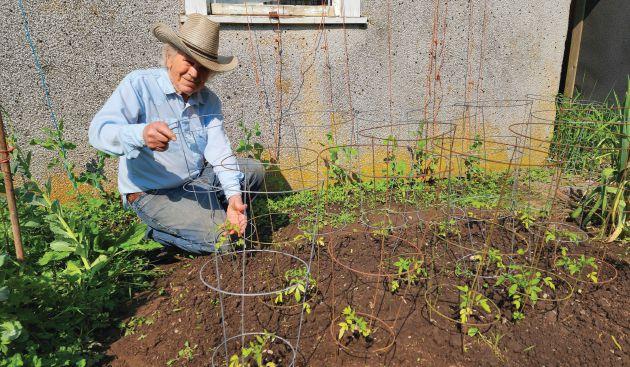
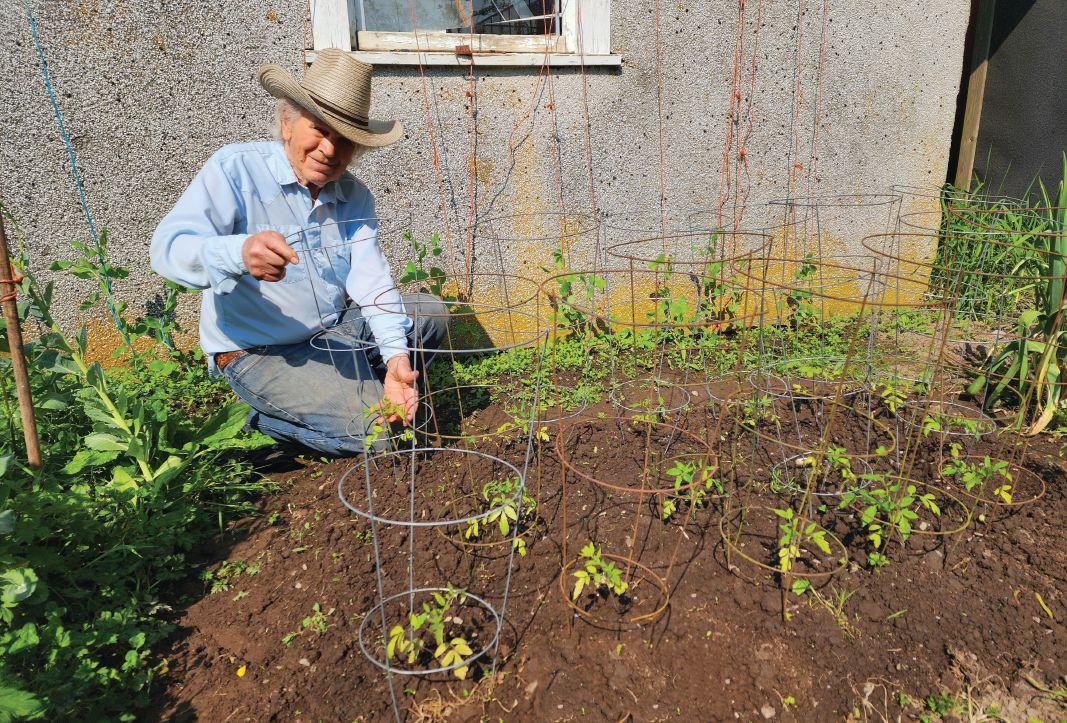
Richmond’s Harold Steves with his tomato plants, which were added to his garden using the affected soil. Steves described “excellent results” in the tomatoes.
PHOTO COURTESY OF HAROLD STEVES
After the small amount of Song’s powder was initially sprinkled within the manure, the pair added water and covered it with plastic. Every four days another bucket of water was added, and the pile was turned.
“It heats up to a tremendous temperature and that kills the weeds and destroys any bad things that might be in the manure,” says Steves. “Then basically, you put it out in the sun and dry it out. It ends up being powdery. You can pick it up in your hands. It’s granular. No odor. No sticky stuff.”
It takes about four weeks before the transformed manure is set out in the sun to achieve the desired end result – a dry, odoroless soil-like powder. He says it is labour intensive because water needs to be regularly applied and the manure needs to be turned, but feels those things can be managed with the right tools.
“There are ways,” says Steves. “Put it in a barrel and turn the barrel. That would do it too. There’s composting machines.”
On the first turn of the manure, just a few days after starting, Steves was surprised to already see a visible transformation. Steves says Song put the resulting matter through a sieve before packaging it for future use.
SCIENCE TO PROVE THE BENEFITS
“When he came last spring, all the garden had already been planted, but we added a bed of beans and a bed of tomatoes using this soil,” says Steves. “We had excellent results with both the beans and the tomatoes. We’re going to do a more scientific approach next spring.”
The tomatoes at Steves’ farm were planted closer together because they pair trusted the nutritional value of the amendment to fulfill the plants’ needs. The tomatoes continued to produce healthy fruit much longer than the plants that didn’t have the manure applied. But proof is needed.
The plan is to carve out a garden area to use the treated manure in spring when Song returns to Canada. But, the results are already promising. Data from an independent Canadian lab on the soil from those beds of beans and tomatoes found the amendment safe and having higher nutrient values than traditionally composted manure.
Steves plans to introduce the project to local post-secondary schools with agriculture and horticulture programs as a potential option for organic growing.
“It’s not good to be putting too fresh of manure on when you plant,” says Steves.
“But with this, you put it right along when you plant. We don’t really put any organic fertilizer on the garden until we plant the plants.” Plants are planted directly into the amendment.
To support the research, samples were taken from the beds that will be planted in the spring to allow for before-and-after comparisons. “All I know is that it works. It’s logical, but we have to prove it.”
Song has told him the mixture kills bad bacteria, supports good bacteria and helps to activate some of the soil’s beneficial organisms like earthworms and probiotics leading to enhanced plant productivity when used.
A DESIRE TO CHANGE THE WORLD
Steves may not fully understand what goes into Song’s formula, nor do the two understand each other’s language clearly –they spoke through Song’s son, Marco and using online translation tools. But Steves is knowledgeable about farming and soil.
He’s a fourth-generation farmer and has a background in agricultural, plant and animal sciences.
The Steveston farm is about two acres of class one soil and 15 acres of marsh pasture, surrounded by the dike trail and residential lots. The garden area is about four thousand square feet.
“I volunteered our garden where we grow seeds for sale and that’s why we have so many different varieties,” he says. “We’re not growing vegetables to eat.”
Marco says that while the two may have challenges communicating, their shared values paved the way.
“They both like agriculture,” says Marco, noting plans for 2025 will begin soon.
Steves says Song has told him the mixture would be no more expensive than traditional fertilizers, breaks down manure faster and is organic. They hope this technology can improve soil health across North America, and plan to try the mixture on poultry manure this year. •
For an expanded version of this story, check out the March 13 edition of the Manure Manager e-newsletter. Subscribe to our eNews here.
A LONG WAY TOGETHER
V-FLEXA
No matter how challenging your needs, V-FLEXA is your best ally for agricultural trailers, tankers and spreaders. This latest-generation product features VF technology, which enables the transport of heavy loads both in the fields and on the road at lower inflation pressure. V-FLEXA is a steel-belted tire with a reinforced bead that provides durability, excellent self-cleaning properties and low rolling resistance even at high speeds.
V-FLEXA is BKT’s response for field and road transport with very heavy loads avoiding soil compaction.
POSSIBILITIES and limitations
Manuresheds are a helpful concept, but there are still gaps to fill.
BY RICHARD KAMCHEN
Manuresheds offer nutrient redistribution solutions that can provide farmers with economic and environmental benefits, but challenges remain to get manure to croplands that need it and prevent overapplication on fields near livestock.
The term “manureshed” helps to illustrate the amount of cropland that’s needed to utilize the manure nutrients produced in a specific area, or if a given regional area is a nutrient source or sink, explains Curtis Dell, a research soil scientist with the USDAAgricultural Research Service.
Robb Meinen, an assistant research professor at Penn State, says the manureshed concept allows for defining regional nutrient mass balance challenges and creating solutions.
Under the concept, animals create a nutrient ‘source’ and the cropping area is a nutrient ‘sink’. “The sink area can be associated with a single farm, and a farm-level nutrient management plan would be a familiar tool that would help many people understand the concept,” says Meinen.
Manuresheds, however, can also be large regional areas where many farms combine to create a large nutrient source. “This allows us to look at regional nutrient imbalances and explore things that can help to redistribute nutrients from places where they are in excess to places where they can provide agronomic value that is currently not supplied by manure,” says Meinen.
He notes manureshed management is widely practiced even if people don’t realize it.
MANURE REDISTRIBUTION
Determining the manureshed is a first step to estimating the amount of manure nitrogen (N) and phosphorous (P) that’s produced by a farm, county, or region, and then determining the amount of land needed to safely assimilate that amount of N and P, Dell explains.
have excess P from a long history of manure application.
“Often those fields have sufficient P for crop growth without added fertilizer or manure, but N fertilizer might still be needed if no manure is applied,” he says.
REDISTRIBUTION CHALLENGES
Actually redistributing manure to where it’s needed is a lot more complex than it sounds, and there are no easy solutions, says Meinen.
For instance, some regions have nutrient sources from several animal species. That’s the case in Pennsylvania, where manureshed associated with swine, poultry and dairy industries overlap.
“All sources of nutrients should be considered. Manure properties are important as nutrients are easier to transport with solid manures than liquid manures.” Cropping systems are also a very important component.
Meinen also says that getting manure on a higher percentage of cropland is a major challenge with no single solution.
“I view it as a big puzzle where each piece is essential to the final product,” says Meinen.
“If the specific manureshed has excess N or P, then the people managing that manure will need to evaluate how to get that manure redistributed to fields that need the nutrients,” he says.
Where livestock farms have enough crop acreage to use all the N and P the animals excrete, the manure will likely stay on that farm. It’s only when the farms have an excess of N and P is that farm going to look to find other locations to use the manure, Dell says. Redistribution of manure has the potential to offset a lot of purchased phosphorus P, but less so on purchased nitrogen N, he notes. Dell points out that soils on livestock farms often already
DATA GAP
One of the biggest limitations to implementing manureshed nutrient balances is obtaining complete data, according to Dell.
“For our research articles, we used data from the USDA National Agricultural Statistics Service. However, that data is only available at the county level.”
Consequently, those calculations aren’t as sensitive as they would be if data from individual farms were available, Dell says.
He adds that individual farms would likely have the data on manure N and P production and the nutrient uptake by their crops that is needed to calculate the N and P balance for the individual farm/manureshed, but farmers may lack the time needed to make those calculations, and would need training on doing them correctly.
“However, nutrient management planning does use some approaches to estimate the nutrient balance that are similar to what is done to estimate the balance for a manureshed, just at the level of the individual farm,” Dell adds.
He says that the process of doing the calculations for the manureshed is pretty straight forward, but precision of the analysis could be greater if data was available at a finer scale.
PHOTO COURTESY OF ROBB MEINEN
Dealer Opportunities in Some Areas
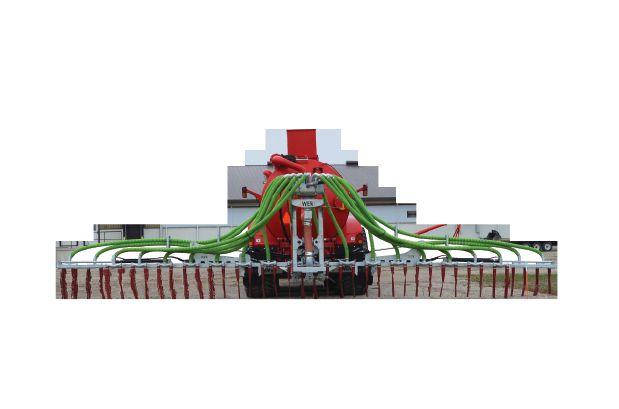
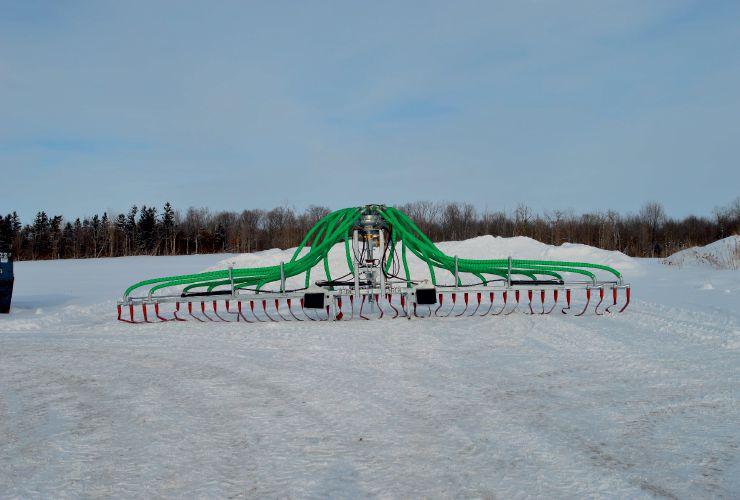
Dribble Boom by WER TIDAL-WAVE
TANK MOUNT
DRIBBLE BOOM
• Available in 30’ and 40’
• Full galvanized frame
• WER Distributer
• Rear hitch (max towing 5000 lbs)
Drag-Line Systems & Accessories
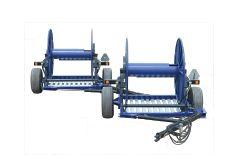
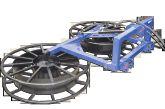
20 HOSE COILER SYSTEM
20 X 6” Hose Capacity. Lead & trailed units can be operated in unison or independently.
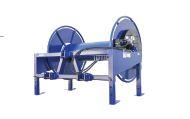
TPH COILER
Use as a stand alone unit, or as an addition to a developing drag line system. (3 models available).
HOSE MOVER
The telescopic hyd width adjustment provides a large surface radius when moving hose.
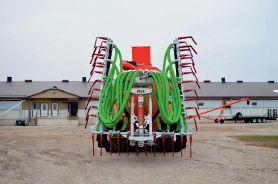
DRAGLINE DRIBBLE BOOM
• Available in 30’/40’/60’
• Full galvanized frame
• WER Distributer
• C/W ball blow-out
• Rear hitch (max towing 5000 lbs)
INLINE CHOPPER
Improve productivity by reducing blockages in the drag line system and reduce pump repairs.
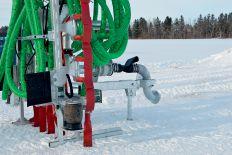
DISTRIBUTOR
The high grade chopping system, and auto-reverse function, ensure an obstruction free distribution.
SPREAD BOOM
Maximize Efficiency with better spread. Heavy duty construction & galvanized frame.
“However, the manureshed may be best suited as a bigger picture concept that is most helpful for informing policy makers. Other existing nutrient managing planning tools may remain as the preferred approach to determine nutrient balances on individual farms.”
FUNDING MISFOCUS
A large challenge Meinen sees is that many of conservation professionals are caught up in Best Management Practice (BMP) funding and are missing some big picture challenges associated with nutrient mass imbalances.
At a conference he attended, he observed that conservation decision-makers were so focused on the distribution of current BMP funding that discussion missed addressing nutrient mass imbalances.
He understands that funding is not only necessary but is a huge part of the puzzle, and that BMP implementation is helping many farms maintain sustainability.
“My point is that we need to keep an eye on the big picture issues – and manureshed exploration allows us to do that.”
TARGET FUNDING
Meinen has some thoughts about how funding could better directed.
He explains that agencies have developed programming for targeted impaired watersheds, and that this funding prioritizes conservation BMPs in manure source areas.
“Instead, some funding should target watersheds where nutrients are needed,” he says. “Simply, an incentive for a farm to replace fertilizer nutrients with manure nutrients in a region where manure nutrient sources are lacking would help to develop networks of nutrient transport that can exist into the future.”
Similarly, Meinen lauds the usefulness of encouraging smart expansion of animal industries into manure nutrient sink areas, which he says would help to limit the growth of manure nutrients in existing source areas. “There is great opportunity to look at manureshed concepts to find new ways to encourage nutrient redistribution within the system we have.”
Meinen says some of the funds directed toward BMP also need to shift toward programming that encourages nutrient relocation.
LOOKING AHEAD
Meinen reports great work that’s ongoing in the BMP implementation realm in his area, the Chesapeake Bay Watershed: “It is essential work, and I am seeing greater cooperation between producers, agencies, and funders than I have experienced in my career.”
But as he looks ahead, he’s convinced the next frontier in balancing agricultural production and conservation is tackling nutrient mass balance challenges. He believes solutions must come from two directions – top-down and bottom-up.
“Top-down solutions might involve policy that opens doors for innovation or provides grant funding that encourages targeted programming for nutrient mass balance shifts,” Meinen explains. “Bottom-up solutions start with farm level implementation such as use of liquid manure injection or solid manure brokering.”
MANURE MINUTE
Manure and minimum tillage: It’s a balancing act
In the manure management world, we’re constantly telling you to incorporate your manure into the soil; get it under the soil surface as soon as possible after application or you could lose up to half of your total nitrogen. This advice directly contradicts soil health advice which advocates for minimum soil disturbance. Both recommendations are correct, and manure use and soil health are complements, not contradictions; so, what is a producer to do?
WHY DO WE RECOMMEND MANURE INCORPORATION?
We’re trying to minimize volatilization and nutrient stratification. Volatilization occurs when the ammonium form of nitrogen in manure converts to ammonia gas and is lost to the atmosphere. Volatilization is minimized when the manure is incorporated into the soil and not left on the surface. Most of this loss happens within the first 24 hours of application, and after four days we consider nearly all the ammonium form nitrogen to be gone. Remember, manure contains two forms of nitrogen: organic N (not immediately plant-available) and ammonium (is immediately plant-available). That means not all the manure’s nitrogen will be lost – the organic N will stick around – but the form that plants can immediately use will mostly be lost to the atmosphere. That organic N can eventually be used by plants after
lodging from lack of a good, deep anchor. Another concern is nutrient pollution from runoff and erosion of the soil surface. Nutrient stratification is not just a manure challenge, it affects commercial fertilizer applications as well.
WHAT SHOULD PRODUCERS DO?
There’s no easy answer here, and those with success in both manure management and soil health will understand that it’s a balancing act and it all boils down to what works for your operation. Fortunately, minimum tillage systems often already have factors working in their favor to minimize the consequences of volatilization and nutrient stratification. Many no-till fields have ample crop residue and remaining roots which helps hold surface-applied manure better than the bare soil of conventional tillage. Just as healthy soil improves rainfall infiltration, liquid manure applied to the surface will find its way into the soil easier than in fields with degraded soil structure due to excessive tillage. Also, even if nutrients are concentrated at the surface, runoff and erosion of those nutrients are less likely in systems with good soil structure and cover.
Liquid manure applied to the surface will find a way into the soil.
it is broken down by microbes, in a process called mineralization.
Nutrient stratification is the layering of nutrients in the soil. Without the soil mixing that tillage provides, nutrients tend to accumulate heavily in the first couple inches of the soil which stimulates root growth near the soil surface. In general, plant roots seek out and grow toward the components they need to live such as water and nutrients. And so, if soil water is not a limiting factor where the root would mine deeper to find moisture, root growth will tend to remain shallow. And a shallow root system may lead to root
If an operation isn’t strictly no-till, minimum disturbance injection and tillage are options to get the best of both worlds as any small amount of incorporation will help retain ammonium, and even a small reduction in soil disturbance can improve soil health. Though keep in mind that soil type and moisture will impact how much soil is turned up and disturbed, even with minimum disturbance tools.
Remember that going no-till is not a blackand-white decision. Some operations choose to do both no-till and conventional till, sometimes within the same field, depending on the ammonium content of the manure, soil type and moisture, and proximity to sensitive features like tile intakes or streams. Every producer and operation must consider all factors and make the best decision for their manure management and soil health goals while balancing finance and environmental protection considerations. •