How have manure application programs adapted to COVID-19’s challenges? | 8
Changing minds
A collaborative water quality project in Wisconsin is bringing farmers together. | 10
Demystifying spring applications Best practices help with quick decisions | 14
January/February 2021
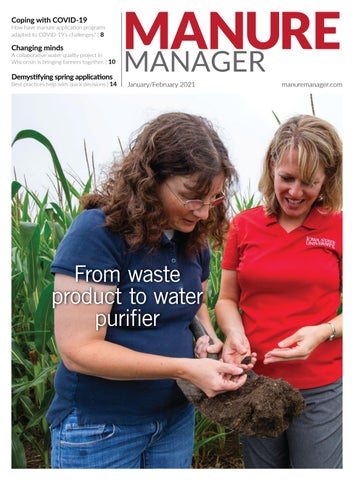
Waste product to water purifier
An Iowa State University research project will study the impact of poultry manure on water quality and soil health.
Coping
How
BY MARK HALSALL
BY ALEX BARNARD
Demystifying
Understanding
BREE RODY
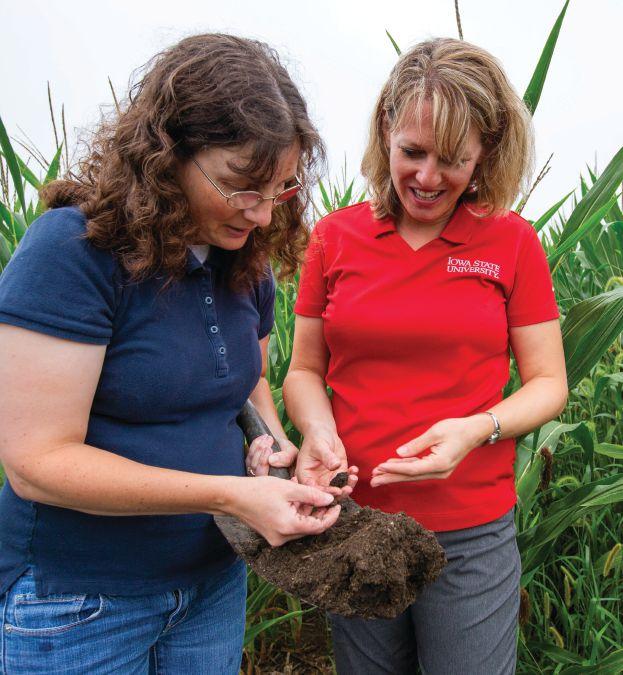
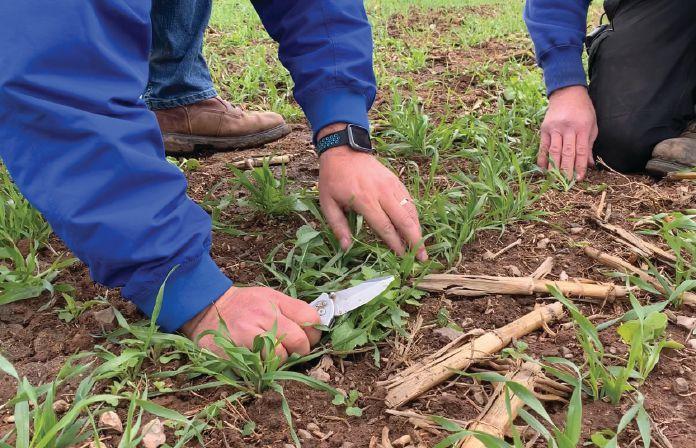
Iowa State University researchers discuss soil health. See page 18. Photo by Chris Gannon.
Innovation is a year-round theme
In late November I joined the agriculture team at Annex Business Media. Together with Stefanie Croley and Alex Barnard, I have spent the last several months getting acquainted with the world of manure (as well as agricultural drainage). I’ll admit, I had no idea what to expect.
I can safely say I never imagined that the first issue I saw go into production would be on innovation. As a city slicker who spent five years reporting on the advertising and media industry, I’ll admit I had a singular definition of what “innovation” meant. My previous work saw me visiting (or, as of 2020, virtually beaming into) Toronto skyscrapers to discuss programmatic ad delivery and addressable TV with ad agency executives, where the word “innovation” is thrown around to describe virtually anything that was new.
Now, I haven’t just virtually beamed into farm fields; I’ve connected with labs, classrooms and major manufacturing hubs to
your own farm and asking what you can do to better the world around you, to keep a good relationship with your neighbor, to engage with your community.
Whether it’s getting creative to accommodate the economics and logistics of spring application (page 14) or some of the new tech that’s rolled out this season (page 6), the industry has a long history of adaptability – and what is that if not innovation?
Indeed, if the industry weren’t already inherently innovative, it wouldn’t currently be rolling with the punches thrown by COVID-19 (see Mark Halsall’s story on page 8 on how certification bodies have responded to the pandemic). In fact, producers and applicators are not only figuring out how to thrive in these trying times, but also innovating to solve non-COVIDrelated problems (yes, it’s hard to remember, but those still exist).
On page 18, we look at a new research project in Iowa that explores how manure and other soil
“The industry has a long history of adaptability – and what is that if not innovation?”
learn all the ways in which manure management is evolving.
Innovation isn’t just “what’s new” – although there’s plenty of that. Innovation is flexibility. Innovation is creative workarounds. Innovation is using existing tools in new ways to solve pervasive problems. Innovation is looking beyond just
amendments affect water quality and soil health, a sign that the industry is always forward-looking and proactive. But of course, you already knew that.
While this might be our annual innovation issue, the content within it should be a sign that manure is innovative year-round. •
mburnie@annexbusinessmedia.com Media Designer CURTIS MARTIN Editorial Director, Agriculture STEFANIE CROLEY (226) 931-4949 (888) 599-2228 ext. 277 scroley@annexbusinessmedia.com
Mail: 111 Gordon Baker Rd., Suite 400, Toronto, ON M2H 3R1
Occasionally, Manure Manager will mail information on behalf of industry-related groups whose products and services we believe may be of interest to you. If you prefer not to receive this information, please contact our circulation department in any of the four ways listed above. Annex Privacy Officer privacy@annexbusinessmedia.com Tel: 800-668-2374
All advertising is subject to the publisher’s approval. Such approval does not imply any endorsement of the products or services advertisted. Publisher reserves the right to refuse advertising that does not meet the standards of the publication.
Lakeland College adds agtech degree program
Lakeland College in Vermillion, Alta., is offering Canada’s first-ever degree program in agricultural technology. The post-credential program launches in fall 2021 and will see students graduate after two years with a bachelor’s of agricultural technology.
Besides in-class education, the program will involve experiential learning practicums off-campus, as well as on-site work on the campus’s studentmanaged farm, sponsored by New Holland. Areas of study for the students include crop and livestock farming, smart agriculture as a management system (including data analysis and use of tools such as robotics and AI), and hardware and software platforms. Courses include emerging technologies in ag, economics of precision agriculture and others.
The overall aim of the program is to bridge the gap between emerging technologies and agricultural management and production systems. Michael Crowe, Lakeland College’s vice-president of academic and research, said in a statement that while there’s an increasing amount of ag tech available, it is nonetheless imperative that students understand how to make the most of it.
“Few people have an in-depth understanding of how to use [the technology] and the information it collects, or how to integrate that information into their commercial farm operations and agriculture businesses,” Crowe said.
Applications are currently open. For more information, visit lakelandcollege.ca.
CORNELL UNIVERSITY LOOKS TO MANURE FOR HEAT
New York State’s Cornell University is in the midst of an ambitious initiative to reduce its carbon footprint by 200 percent by 2035. Now, manure will play a part in that goal.
The university will develop a system to
use manure to meet its heating demands during the winter.
While the institution has already been developing a project to heat the campus through geothermal energy, investigators have discovered that
converting cattle manure from the school’s 600cow dairy farm into energy would make the operation much more economical for the relatively long, cold winters of Ithaca, NY.
Besides providing energy for the campus,
the energy can also be injected into the natural gas grid for New York State. It will produce an estimated 909 million liters of renewable natural gas (RNG) per year, allowing Cornell to meet 97 percent of its peak heating demand needs.
BY THE NUMBERS - ACCORDING TO THE USDA’S 2007 CENSUS
ESTIMATED NITROGEN
from agricultural animal manure (in kilograms)
Texas 699,431,000
Iowa 398,551,000
California 327,287,000
Nebraska 314,619,000
Kansas 293,838,000
U.S. (averaged) 123,496,000
Estimated kilograms of manure nitrogen per acre of farmland:
Texas: 5.4
Iowa: 12.9
California: 12.9
Nebraska: 6.9
Kansas: 6.3
U.S. (averaged): 9
ESTIMATED PHOSPHORUS from agricultural animal manure (in kilograms)
Texas 206,361,000
Iowa 144,981,000
Nebraska 96,219,000
Oklahoma 87,463,000
Kansas 84,863,000
U.S. (averaged) 36,939,000
Estimated kilograms of manure phosphorus per acre of farmland:
Texas: 1.6
Iowa: 4.7
Nebraska: 2.1
Oklahoma: 2.5
Kansas: 1.8
U.S. (averaged) 3
Trident introduces new modular treatment system
Abbotsford, B.C.-based resource recovery specialist Trident’s new modular manure treatment system will allow dairies to remove nearly all suspended solids in their lagoon streams, while recycling large amounts of clarified water.
Treatment capacity for the system is designed for anywhere from 250 to 3,500 cows per unit.
The containerized module measures 40 feet and includes process equipment pumps, conveyance equipment and controls. The system can be integrated with primary separation. According to Trident, the system will provide a benefit to sand separation or flush systems, while cutting land application costs.
New Leader introduces its latest three-in-one spreader
New Leader Manufacturing (NLM) has added a new three-in-one pull-type spinner-spreader to its line-up.
The NL600 is a multi-purpose, multi-season spreader for growers and custom applicators alike. The design allows operators to spread compost, fertilizer and BioSul at higher rates and faster speeds, thus maximizing their time in the field and making the most of their investment in the equipment.
John Rathjen, director of product
Brandt expanding in many directions this winter
Agricultural company Brandt has had a busy start to the year.
In December, the company announced an expansion to its Pleasant Plains, IL, manufacturing facility worth $1.5 million. The 40,000 square-foot expansion will enable the company to store additional finished manure, both dry and liquid, and more raw materials, thereby increasing the facility’s storage capacity by more than 30 percent.
Brandt tells Manure Manager that the build is in response to an “unprecedented demand” for its specialty nutrition products.
Chandra Roberts, marketing director for Brandt specialty formulations, says the company has seen accelerated organic growth throughout the last 10 years. “The market has seen an uptick
in micronutrients in general. Growers understand how new technology is improving crop quality, yield and ROI. They understand the timing and are using micronutrients at different stages throughout the growing season.”
The expansion is expected to be completed this season. In the meantime, Brandt has also bolstered its sales, operations and management teams; as of mid-January, its hires include several new discovery and innovation team members and a new territory manager, plus seven new management and VP-level promotions.
Additionally, it’s expanding its global footprint further; the company recently announced that its specialty nutrition products would become available in the U.K.
ASABE to recognize seven Case IH innovations
development at NLM, said in a statement that this tech is especially relevant for professionals because of the increasingly tight application windows they face every year.
“By increasing their spreadable acres per day, growers and custom applicators can save time, achieve better cost-per-acre and get their nutrients down in these diminishing application windows.” For more on how applicators can deal with tight application windows, see page 14.
Illinois-based manure management firm Newtrient has completed its agreement with the NRCS to expand its tools and solutions to improve the environment. Between 2018 and the end of 2020, Newtrient worked with various partners to complete the project, creating market-based approaches to addressing water quality challenges in Vermont and Wisconsin. The project was funded by an NRCS co-operative agreement award.
For Vermont, the project aimed to enhance the capacity of the state’s Farm Phosphorus Reduction Planner (PREP) model to evaluate farm-specific approaches to quantify phosphorus reduction potential based on various factors.
In Wisconsin, the work consisted of completing a number of reports to evaluate the concept of a clearinghouse to facilitate participation in Wisconsin’s water quality trading platforms.
The American Society of Agricultural and Biological Engineers (ASABE) will present seven AE50 awards to Case IH in February 2021 for outstanding agricultural innovations. The recognitions spotlight the success of Case IH’s full line of agronomic solutions. The award-winning innovations include:
• AFS Connect Steiger series tractor;
• LB436 HD large square baler;
• Case IH fertilizer applicators and air carts with 24-row air pack system;
• MultiControl Armrest;
• Axial-Flow 250 series combines with sieve pressure visualization;
• Category 3/4n 3-point hitch quick coupler; and
• Fast Riser 6100 front-fold planter (Brazil).
ASABE annually distinguishes the 50 most significant product innovations in engineering and technology for agricultural, food and biological systems. The honor recognizes products that save producers time and reduce cost and labor, all while improving user safety. The awards will be presented at the virtual ASABE Agricultural Equipment Technology Conference (AETC) in February.
Clean Energy ® can help you diversify your farm revenue and drastically reduce greenhouse gas emissions at the same time. We’re the leading provider of renewable natural gas for the transportation industry. Together, we can maximize the value of your manure by turning it into an ultraclean fuel that powers even the heaviest vehicles. Contact Clean Energy today to learn more.
www.cleanenergyfuels.com/RNG
Coping with COVID-19
The pandemic has had a significant impact on manure application training programs across North America. How have they adapted to the unique challenges posed by the coronavirus?
BY MARK HALSALL
The people who apply manure on farmers’ fields aim to do so in a way that protects the natural environment and provides a sustainable future for agricultural operations. This requires some training, which – prior to March 2020 – was widely available through different manure management courses offered by jurisdictions across North America.
“Was” being the operative word. The pandemic has led to many manure management and applicator courses being cancelled or postponed. Even though mass vaccinations are on the horizon, the picture for 2021 is still far from clear. Some programs were able to switch gears successfully in response to COVID-19 social gathering restrictions and develop online options for manure handling training.
Officials in three jurisdictions in the United States and Canada discuss how the situation has unfolded in their areas.
ONTARIO
Manure handling in Ontario falls under provincial legislation. It requires some farmers and others who manage manure, fertilizers and other nutrients to follow a set of rules and regulations that govern things like application rates, separation distances from wells, surface water and groundwater, and how to prepare a
nutrient management plan.
Under Ontario’s Nutrient Management Act, those who operate manure application businesses must have a prescribed materials application business (PMAB) licence; those who apply manure must have a nutrient application technician licence; and those who receive, store or deliver manure need to hold a broker certificate.
All of these require completing a one-day course and passing an exam at the end of it (the PMAB licence and broker certificate course are offered over two days and usually people take both).
The Ontario Ministry of Agriculture, Food and Rural Affairs (OMAFRA) administers the licencing and certification for the nutrient management program, while the University of Guelph, Ridgetown Campus developed the course materials and carries out the training.
Matt Wilson is the nutrient management lead for OMAFRA. He said the manure-handling courses concentrate on the regulations set out in the Nutrient Management Act.
“We say right up front in the course that there are going to be other things that you need to get trained on to actually do the application work,” he said.
One measure OMAFRA was able to take in
PHOTO
response to COVID-19 restrictions was to extend the date for licence renewals to April 30, 2021, so that fewer people would need to take the manure management courses and exams in 2020.
Manure management courses in Ontario are normally spread across the province, with each region having at least one in-person course scheduled per year. But that changed with the pandemic.
Fortunately, the team at the University of Guelph, Ridgetown Campus was able to respond swiftly and put together a virtual training option in surprisingly little time, according to Wilson.
“That’s really helped, obviously, when we weren’t allowed to bring people in to take a course. They could do it online,” Wilson said.
“Ridgetown has been very accommodating. They’ve done their best to make sure everybody that needs to take a course can do that. They actually put together a course people could do over the phone if they didn’t have access to the internet or if they weren’t comfortable using it, like some Old Order Mennonites here in Ontario who just don’t use technology,” he added.
Wilson said the plan for 2021 is to continue to offer the manure management instruction online. He noted that while the exams for the courses were administered online in 2020, the situation “was not ideal.” The hope for the coming year is to offer in-person exams in a fashion that follows all social distancing protocols.
IOWA
In Iowa, state law requires all commercial manure operators, as well anyone who hauls, transports, or land-applies manure from a confinement feeding operation with more than 500 animals, be certified. (Producers with smaller animal feeding operations may spread manure without being certified, but still need to conform to manure land application and separation distances.) Manure application businesses are also required to hold a business licence. Each type of manure applicator is required to take a two- or three-hour training course or get recertified every year. The courses, which were developed by Iowa State University Extension and Outreach (ISUEO) in co-operation with the Iowa Department of Natural Resources (DNR), are normally offered in January and February and are held at about 70 different county offices around Iowa. A half-dozen dry manure applicator certification
workshops are held each February in various locations around the state.
Manure applicators can also get certified by arranging to watch the certification video in a county extension office at a later date or by calling their local DNR field office to schedule time to take the test.
Since 2015, an e-learning option featuring expert speaker videos has also been available for manure applicators who prefer to receive the training online.
According to Rachel Kennedy, ISUEO program coordinator for the manure application training program, the inperson workshops, certification videos and online courses cover a broad range of material including:
• DNR rules for certified manure applicators and manure land application procedures and separation distances;
• Water quality, soil management and nutrient management issues;
• Safety issues; and
• Biosecurity issues.
The impact of COVID-19 on the manure application certification program in Iowa was limited in 2020 due to the fact that all the scheduled in-person training sessions took place in the first two months, just prior to the pandemic.
Kennedy said in December that in-person manure applicator training courses would proceed as planned in January and February 2021. Participants would be required to follow all ISUEO guidelines for face coverings and social distancing.
“Online is [also] an option for everyone,” she said. “We are working with DNR so we can continue to train our applicators in a safe environment.”
NEW YORK
In New York, dairy farms with more than 300 milking cows are required to have a Concentrated Animal Feeding Operation (CAFO) permit, which requires at least one manure application decision-maker to get manure applicator training during the five-year term of the permit.
Commercial manure applicators who operate their own business outside of a farming operation are encouraged to get the training, but are not currently required to do so.
Karl Czymmek, a senior extension associate with the Cornell University PRODAIRY program in Ithaca, N.Y., developed the first version of the course in 2008 at the request of a dairyman to help farm
staff develop a general understanding of the environmental issues and concerns at the farmstead and in fields.
Czymmek said that, over time, this evolved to focus more heavily on land application of manure and was made a requirement for some farm staff on CAFO farms in CAFO permits issued in 2017.
Since then, almost 750 manure applicators across the state have received the training in live sessions. Czymmek noted that even though commercial manure applicators in New York aren’t required to take the course, many of them have.
Czymmek said his two-hour course is designed to educate manure handlers on all permit requirements related to protecting water quality and keeping manure in the soil on farm fields and not moving off-site.
The course addresses issues of human health and safety and examines how to reduce risk, as well as how to react in the event of a spill resulting from a truck accident or other problems that might arise during manure applications.
“I think farms that are managing large or even small volumes of manure need to know what they would do if there was a spill,” Czymmek said. “It’s absolutely a core part of managing manure.”
Czymmek noted the impact of COVID-19 on the training program wasn’t that great, since many people had already received the training required by the five-year CAFO permit before the coronavirus hit.
Czymmek also developed and distributed a video of the training session prior to the pandemic. “Many farms and CAFO planners have the recording and it can be viewed by anyone who missed a live session as well as new farm staff,” he said.
“When the permit made training necessary, my initial goal was to make sure I took care of as many of those people that I could as early as possible in live sessions, and I’ve been able to do that,” Czymmek said, adding the manure application training video offers another option for meeting the permit requirements.
While he doesn’t have any training sessions on his docket so far for 2021, Czymmek is open to the idea of presenting the course to manure applicators in New York in a webinar format through a platform like Zoom, if a request comes in over the next few months.
He’d also consider delivering the course in person to small groups of manure applicators if asked to do so, as long as necessary COVID-19 protocols and precautions can be met. •
Making changes and changing minds
A collaborative project to improve water quality in Wisconsin’s Lower Fox River is bringing farmers together to learn from each other.
BY ALEX BARNARD
Dan Brick is not afraid to try new things.
Brick currently operates Brickstead Dairy, which has been in his family since 1848. It’s located about 20 miles south of Green Bay in northeastern Wisconsin – close to a lot of water.
Most of the manure produced by Brickstead’s 1,000-head dairy herd is used on their 1,200 acres. The land on which Brickstead Dairy sits is along the Fox River, which leads to Green Bay and eventually into Lake Michigan. So it’s no surprise that water runoff is a concern.
Brickstead doesn’t currently compost or process their manure before applying it. “But that’s definitely something we are working towards,” Brick says.
“We keep on getting closer and closer to our goal – to be able to separate those nutrients so we can apply a high nitrogen product for our corn.”
Brick adds that they’d like “to be able to utilize [the manure] through the growing season, or to be able to make it more of an asset, instead of a liability.”
The farm has focused more on water runoff recently. “We’ve got a water collection system for all our leachate water coming off our feed pad area, we’ve built a 3 million-gallon pond to collect all that water,” Brick says of a newer measure installed on the farm. “The goal is to be able to utilize that water for a growing crop or for an irrigation system.
“The nutrients are very minimal in that water,” he adds. “But we’re trying to be compliant with the permit we have from the Wisconsin [Department of Natural Resources], and also turn that into an asset that we can utilize on a growing crop.”
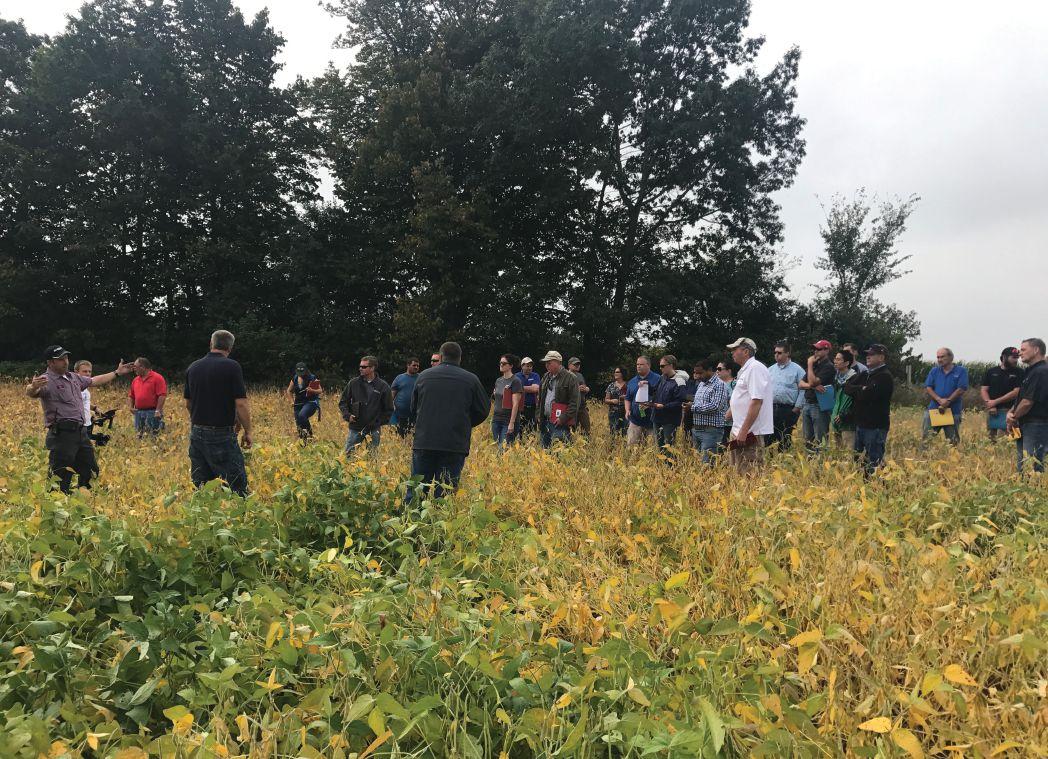
ABOVE
Dan Brick (left) speaks to a group during a Lower Fox Demonstration Farm Network field day in 2017 at Brickstead Dairy in Greenleaf, WI.
LOWER FOX DEMONSTRATION FARMS NETWORK
Brickstead Dairy is one of the original farms in the Lower Fox Demonstration Farms Network. The project was initiated in 2014 through the Great Lakes Restoration Initiative (GLRI), which is the Network’s primary source of funding. It’s a partnership between the Land and Water Conservation departments of Brown and Outagamie counties, the National Resource Conservation Service (NRCS) and the University of Wisconsin-Madison Division of Extension, in addition to the seven member-farms.
The Network’s main purpose is to confront water quality issues from nutrient runoff in the Lower Fox River, the bay of Green Bay and Lake Michigan. But collaborators have managed to create something more than simply improving water quality.
“[The project started from] this concept of peer-to-peer learning –having farms in the demo farm network serve as a hub for information and how to adopt practices,” says Whitney Prestby, who joined the Network in 2016 as a natural resource educator with the University of Wisconsin Extension.
“Where we are, from a climate standpoint, [we have] cold winters, not a lot of growing days, [and] fall rapidly turns to winter, depending on the year. Up until [the Network started], there weren’t a lot of farms adopting cover crops or no-till practices,” she says, as these conditions and the region’s heavy soil left many farmers believing these practices weren’t practical.
The Network started off modestly, but continues to grow each year.
“There were four original farms. They agreed to take 200 acres, work with the agronomist involved in the project, and try to adapt cover crops and no-till on those 200 acres,” Prestby explains.
“We’ve added three more farms here in the Lower Fox – two farms are at 100 percent cover crops and no-till; for the other farms, that’s their goal. Additionally, we have four other demo farm networks in eastern Wisconsin and [are] adding a fifth in there.”
Prestby is excited to see the concept working, but notes they have more work to do. “Obviously, the idea is to not just work with these seven farms or to have the practices contained
to just these farms, but rather to see the practices spread throughout the watershed.
“The farms involved in the demo farm network are the ‘early adopters’ in our watershed. They’re the people willing to try these practices and learn from their mistakes.”
As of 2020, the project entered phase two. “Moving into year seven, we’re really focusing on that next level of adopters, those middle adopters: farmers who’ve been attending our
events and who have shown interest in trying cover crops and no-till on small acres,” Prestby says.
“The goal is to have these farmers feel like this is worth the investment – whether or not they need to change their equipment or invest in cover crop seed in the fall to make sure they’re covered year-round.”
The Network’s organizers plan to take the lessons they’ve learned through working with the first round of farms and help the next level of adopters and
MAKE YOUR DAIRY EXTRAORDINARY
FEATURES AND BENEFITS:
• Oil bath bearings - self cooled and lubricated, needs no water flush
• Disintegrator tool - for hoof blocks and other solids
• Heavy duty seal and bearing systemlonger life in severe service
• Ductile iron casing and bearing housingheavy castings for long life
• Heat treated cast steel wear parts - for longer life in abrasive grit service
• Most parts readily available from stock for expedited delivery
APPLICATIONS INCLUDE:
• Digester Feed
• Digester Mixing
• Small Pit Recirculation
• Tanker Loading
• Flush Water
• Feeding Heat Exchangers
• Manure Transfer
• Separator Feed
ABOVE
farmers in the watershed. Any farmers interested in joining the Network can follow the Network on Facebook at @FoxDemoFarms to see the concepts put into practice before committing.
“They can come to field days and get to learn from these farms about what’s working, what’s not working, and how they can adapt these practices on their farm,” Prestby says.
She adds that the Network is focused on “setting [new farmers] up for success and working with them.”
EARLY ADOPTER
Beneficial agricultural practices are something that runs in the Brick family, but over the past 12 to 15 years, Brick says those efforts escalated.
“We were losing a lot of nutrients, we were losing a lot of soil – we needed to do something different,” he says.
When Brickstead began adding more cattle to their herd – but not more land – and growing more forage and corn silage, rather than grain, this led to more manure and more tillage each year.
“We had to adapt with [those changes], because the things we were doing weren’t working anymore, as far as being able to keep cover on the fields,” Brick says.
Brickstead was initially recruited to the Network because they were already using practices the project wanted to promote.
Brent Petersen, demonstration farm project manager and agronomist with the Brown County Land and Water Conservation Department, happened to drive by Brickstead and recognized cover crops on the fields.
“[The] first time I met [Petersen] was when he pulled in the driveway to talk about the demo farms,” Brick says. “[He] asked if I’d be part of the demo farms, which I didn’t really know at the time what it was going to entail – and I don’t know if anybody really knew what it would entail at that time. But [they were] just trying to get together [farms] to demonstrate what cover crops could do to help hold on to nutrients on the soil.”
“The original plan was to set aside 200 acres of our farm and do some different practices, [like] using cover crops so we could show everybody what cover crops had done,” Brick continues. “Well, we were already using cover crops, and I felt it would be very
Brickstead Dairy has planted cover crops on their fields following corn silage harvest for years.
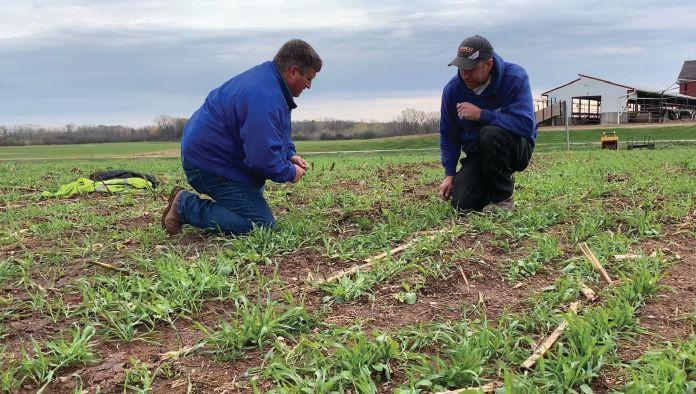
ABOVE
Brent Petersen (left) and Dan Brick examine a field of cover crops at Brickstead Dairy.
difficult to just set aside 200 acres. And I thought, ‘If it’s going to work, we’re going to go all in.’ So, we started to convert the farm completely over to a 100 percent cover crop, 100 percent notill operation.”
The Network has helped with “trying the different practices, but also it’s a way we, as a group, can all collaborate and work through some issues,” Brick says. “Find out what practices did and maybe didn’t work, that we could all learn from it, and [then] we don’t have two or three farms making the same mistake that one already did.”
CHALLENGES
The successes the Network has achieved don’t mean it’s easy to adopt these practices or keep them going.
“The group of farms we have are mainly dairy producers, where we’re dealing with a lot of manure,” Brick says. “Trying to grow cover crops, trying to grow corn silage and also dealing with the manure issue – being able to get the manure on there and get it into a minimal till or no-till system definitely has been the biggest challenge.”
The corn silage Brick prefers to feed his cows takes 106 to 110 days to maturity, which makes the tight window for harvest, manure application and seeding cover crops even tighter.
“We’re taking that silage off, and it’s … a very small window when we can harvest that silage,” Brick says. “So that means, if we got four or five inches of rain two days before that, we have to go in there and get it off. It could be a complete mud mess and a lot of compaction.”
Brick knows that compaction is a big factor in water infiltration and the amount of runoff created, and finds other ways to balance it out in order to “get the water to go down through the soil profile instead of across the field and into the waterways, into the rivers.”
“After we get that silage off to get the manure on there, it could be very, very wet,” he says. “So, another thing that we’re working on is being able to utilize the manure all year-round, so we don’t have a huge amount of manure in the fall to go put on [the fields].”
“But the challenge is getting the equipment that we need to [minimize] disturbance of manure applications, finding out what type of equipment works best before we go out and spend
$150,000 on a piece of equipment and then realizing that one doesn’t work,” Brick adds.
This is where being part of the Network can help – the farmers involved can discuss what has or hasn’t worked for them in trying to adopt cover cropping and no-till, including which equipment will do the trick.
“It’s been a slow process – we’re making progress every year with the demo farms,” Brick says. “We’re all learning as we go, and we’re trying to take on these issues and come up with different strategies to be able to make sure that we can do better next time.”
Prestby notes that this attitude is a hallmark of the first farms to join the Network. “They get excited to learn more and [think about] how to do it better next time,” she says.
Incorporating these beneficial practices is not as simple as making the choice to do so, nor is the path forward linear. It’s a balance of sticking with practices that are good in the long-term and what the farm needs each year.
“There’s got to be a lot of planning involved in it,” Brick says. “Even this past year, we had a very wet fall [in 2019], so we did have to do tillage for this year. We can’t sit down and say we’ve been a no-till farm for six or seven years – we’ve practiced no-till, but we end up having to do some tillage here and there to be able to do that.”
“Each farm is definitely different and they have their different goals and what they’re trying to achieve with these practices,” Prestby says. “There are lessons that have been learned that can be generalized from farm to farm, but it really does come down to having motivated farmers and a really great group of partners and agronomists who are willing to sit down with farms and work with them – and their crop consultants and everyone that’s involved in their farms – to think about how to adapt these practices so they fit that individual farm’s needs.”
LOOKING FORWARD
With the Network entering phase two and looking to add more farms, the project is set to push even farther for beneficial ag practices and improved water quality.
“Our goal is to continuously learn and continue to serve as that learning hub for farmers in the watershed, but
with the ultimate goal of getting these practices across all of the acres in northeast Wisconsin,” Prestby says.
She explains it’s an inspiring project of which to be a part. “These practices are mutually beneficial to the environment as well as to the farmer. We’re asking farmers to make some big changes, but they’ve been well-received because [the farmers] are starting to recognize the benefits of improved soil structure and having improved infiltration rates on their fields. And that ultimately is going to help reduce the erosion and reduce the nutrient sediment loss.”
Brick notes that the Network has made major progress beyond what can be physically determined, most notably in changing the mindsets of farmers, equipment dealers and manure applicators about how they operate.
“Some things are hard to measure,” Brick says. “Everybody looks at the water, and [they say], ‘Well, it’s still green.’ But the biggest challenge of anything is changing people’s mindsets, and I think we’ve done that.” •
Is Your Digester/Biogas Developer Breaking Promises?
Don’t get burned in the Renewable Natural Gas (RNG) “gold rush” by developers failing to do their homework
• Honest feedback on why an RNG project will/won’t work
• We partner with developers that have a record of success
info@novillarng.com
Demystifying spring manure application practices
Understanding spring manure application best practices will help make those quick decisions.
BY BREE RODY
It’s a deceptively simple question: “When does spring start?”
Despite March 21 marking the official start of the season, the more nuanced determinants –temperature, precipitation, soil conditions – change from year to year. The arrival of spring, nebulous as it may be, is anything but leisurely for manure applicators. For most, it means being on high alert, waiting to pounce and capitalize on the exact right time to begin spring application. It’s a double-edged sword – the start of the season is unpredictable, but with such a small window for application, lying in wait for too long can lead to disaster.
“It’s basically a ‘seat of your pants’ situation,” says Chris Yungblut, territory manager for JBS Equipment. JBS, which exclusively sells equipment for dry manure application, specializes in producing machines that can haul large amounts of product while applying as little pressure to the ground as possible. Yungblut says spring is a time
ABOVE
when applicators need as many options available to them as possible due to those small windows. Apply too early, he says, and “you could get into situations where you’re causing more damage than it’s worth, where it’ll sometimes take five to 10 years before that damage is reversed.”
Between applying early, applying fast and working odd hours, spring application is filled with good intentions. But the actual conditions can scuttle the best-laid plans.
Here are some debunked myths and misconceptions about spring application, helping applicators make the most of this finicky season.
MYTH: PLANNING FOR SPRING APPLICATION SHOULD START NOW
With the air still crisp and the ground still frozen, now seems like the perfect time to start planning for spring application, right?
Wrong, says Robert Meinen, senior extension
While there are certainly best practices to follow in spring manure applications, each year will present its own different set of challenges for applicators to manage.
EFFICIENT SOLIDS LIQUID SEPARATION
ORGANIC FEED SYSTEMS BIOSELECT
+ Solid Liquid Separation
+ With Structure
+ Without Chemicals POWERFEED
+ Feeding and Transfer of Organic Waste
+ Closed Loop System
+ Process Control
+ Energy Efficient
associate at Pennsylvania State University Extension. “Here [in Pennsylvania], we have farms that have accumulated manure all winter long,” he explains. “So your considerations actually need to start in the fall. Think of it as nutrient placement instead of application: can we properly place our nutrients in the fall to maximize our storage options throughout the winter? We’ve been in situations where we’ve gotten to the end of March and we just could not get on the field. Our manure storage got higher than we were comfortable with.”
Meinen says, from a storage perspective, some degree of planning should have started in October or possibly even September, for the sake of minimizing risk.
MYTH: ONCE YOU KNOW WHAT TO EXPECT, YOU CAN FALL INTO A COMFORTABLE RHYTHM WITH SPRING APPLICATION
No matter how “seasoned” you are at application, there may never be a natural rhythm to spring application. The “seat of your pants” mentality plays true year after year.
“The window of opportunity is so short,” Meinen says – not just in terms of the days on the calendar, but even the time of day when application is most effective. “There might be six hours within a 24-hour period where the ground is firm enough for us to travel. It might be two days out of a week when the soils aren’t saturated from a rain or snow melt. It might be that one week in early May when we haven’t had rain, but the soil temperature has increased enough. That can be hard, because you’ve got a farmer saying, ‘I want you here now, because it’s going to rain next week.’”
Besides adjusting schedule expectations, equipment adjustments may need to happen. While some companies specialize in machines that are built to minimize compaction – one of the most crucial aspects of spring application –most applicators still find themselves in precarious positions regardless of what type of machine they own.
“While part of your planning involves looking at your weather forecast and knowing what it’s going to do, you also have to look at how much your equipment weighs and how much it holds,” says Erica Rogers, environmental management educator at Michigan State University Extension. “If you have to
absolutely spread that day, you might have to go out with some lighter loads. Flotation tires can sometimes help out with that, and I know some applicators who will even take air out of their tires.” While not everyone does it, Rogers says she’s seen it used as a way to get away with carrying a little more without compromising safety too much.
MYTH: SAFETY CONCERNS ARE THE SAME YEAR-ROUND
There’s no shortage of safety concerns when it comes to manure application. “There’s always general manure gas safety issues anytime you’re agitating manure,” says Sarah Fronczak, environmental management educator at Michigan State University Extension. “But hauling manure can be a very monotonous practice.” Fronczak warns that the rhythm of application can leave haulers less focused on the safety risks.
There’s no shortage of safety concerns when it comes to manure application.
Pair that with the odd hours spring work requires, and there are some very real risks that are unique to the time of year, Meinen says.
“I talk to a lot of haulers who say, ‘I’m going to start working at 2 a.m., and as soon as the sun hits the field I’m done,’” Meinen says. “It’s pretty common in a scenario where a custom operator is providing that service to a farmer who wants to minimize the risk of damage to his soil. The best option is to get it on the field when the soil is frozen.” But that also means long, odd hours, sometimes overnight work: all situations where Meinen says the worker is more prone to accidents. “You’re tired, you’re facing sleep deprivation. A lot of things come into play with that type of scenario, and it can be very stressful for the operators.”
In the Midwest and Northeast, Fronczak says, road conditions are also horribly unpredictable at this time of year. “In Michigan, we might see 60 degrees one day and then the next, we have three feet of snow. Road conditions can get very dicey, very quickly. When you get big pieces of equipment on the road, that
presents a different scenario than other manure safety issues we talk about.”
MYTH: IT’S ALL OR NOTHING
Despite talks of tight windows and pulling all-nighters to get the job done, in some areas, Fronczak and Rogers argue there are options to do a split application. Fronczak says she sees application most typically split into three parts, often in a knife application method.
“The idea is that you take the nitrogen, which would have typically been put on in one shot, and apply it when the plant needs it the most. You’re spreading it out and not losing it,” Fronczak says. “Only a minimal amount is going into the environment, so you’re getting more bang for your buck.”
The flexibility to do this will depend on storage capabilities, but in Michigan, where permit farms are required to have at least six months of storage, it makes sense. Rogers adds that this isn’t as feasible for smaller farms, but for commercial farms that are designed for such storage, it’s much more cost-effective.
MYTH: YOU’RE DESTINED TO BICKER WITH NEIGHBORS
Manure application isn’t typically associated with positive neighborly relations, but Rogers says there’s more that can be done than one thinks.
A study out of Pennsylvania State University found that social and psychological factors can play a major role. “There are, of course, some very real smells,” Rogers says. “But the study found that essentially, if a neighbor has a good relationship with the farmer, they tend to notice less odors than those who don’t. And if a farm is more aesthetically pleasing and cleaner, the neighbors notice the odor less.”
Rogers recommends the simple act of approaching neighbors. “Tell them, ‘We’re going to be spreading this season, are you going to be having any parties?’” Other recommendations include incorporating manure in order to mask the odor slightly, or planting tree lines to eliminate the sight of manure heaps. “People smell with their eyes,” she adds.
Spring application is still complex –there are a lot of dos, a whole lot of don’ts and a surprising number of “depends.” As Yungblut puts it, “you’re pretty much at the mercy of the gods.” But experts agree that the more you can get under your control ahead of time, the less turbulent it will be. •
looking for six women making a difference to Canada’s agriculture industry. Whether actively farming, providing agronomy or animal health services to farm operations, or leading research, marketing or sales teams, we want to honour women who are driving the future of Canadian agriculture.
FROM WASTE product to water purifier
An Iowa State University research project will study the impact of poultry manure and cover crops on water quality and soil health.
BY J.P. ANTONACCI
Chickens in Iowa may have a part to play in restoring the oxygen-deprived waters of the Gulf of Mexico. Research out of Iowa State University suggests that integrating poultry manure into agricultural management plans has a positive effect on water quality while also producing healthier soil and higher crop yields.
“The research shows a number of important benefits from using poultry manure,” says principal investigator Michelle Soupir, associate professor of agricultural and biosystems engineering at Iowa State University.
A 20-year research project that began in 1998 found that using
ABOVE
poultry manure in agricultural management plans led to improved soybean yields and more particulate organic matter in soil, as well as lower nitrate levels compared to commercial fertilizers like UAN (urea ammonium nitrate) in drainage water. These findings pointed to new and profitable uses for a sometimesoverlooked agricultural product.
“When the study began, (poultry) manure was viewed as more of a waste product, and some of the treatments (in the study) really reflected that. One of the treatments was essentially twice the recommended manure application
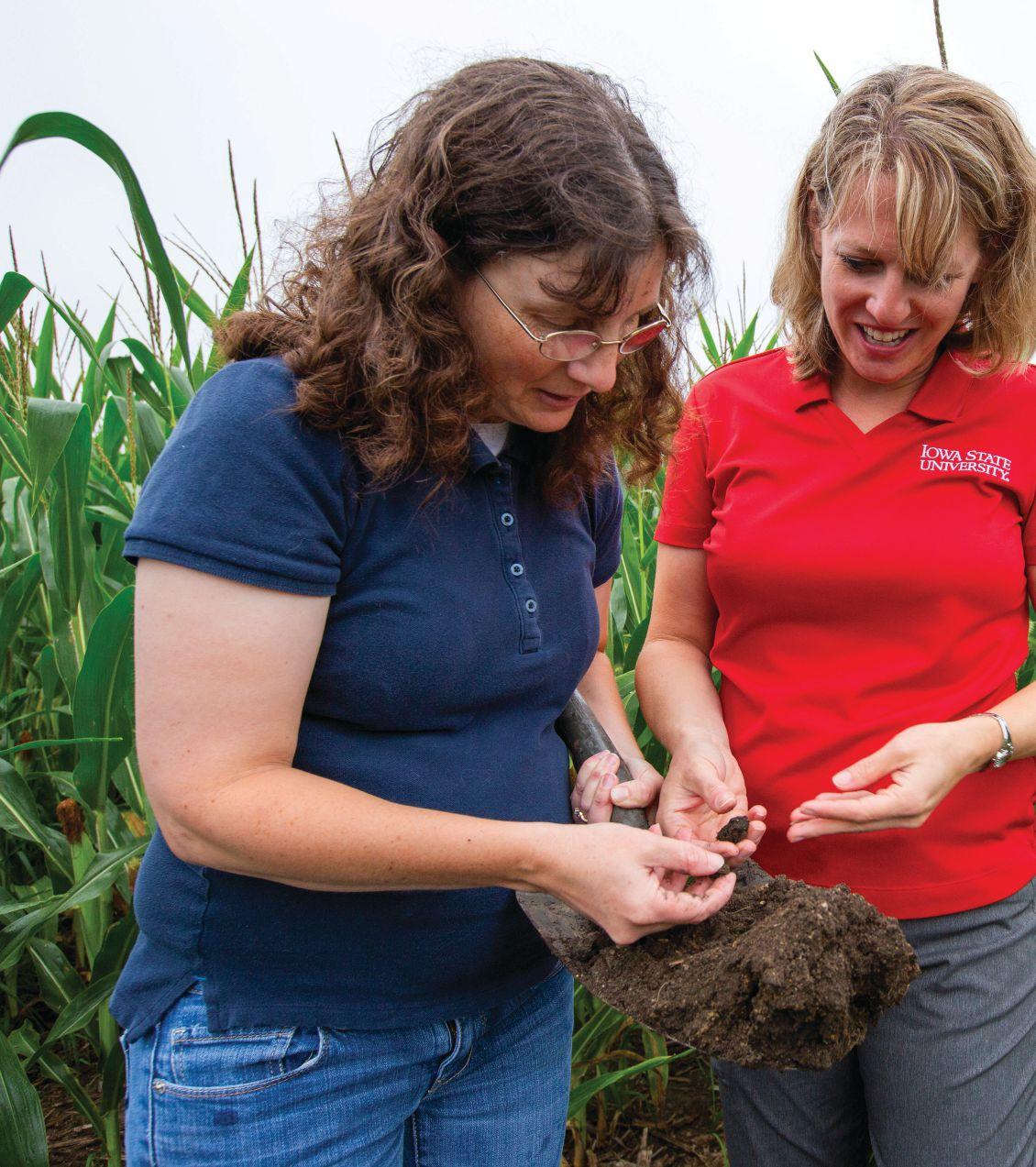
Michelle Soupir is leading a six-year research project at Iowa State University looking at the effects of poultry manure application on soil health, water quality, and crop yield.
PHOTOS COURTESY OF CHRIS GANNON, IOWA STATE UNIVERSITY.
rate,” Soupir says. “So it’s been really interesting to see over time how our thoughts about manure management have changed.”
In collaboration with the Iowa Soybean Association’s Research Centre for Farming Innovation, Soupir’s team will broaden the scope of the original study over the next six years. Researchers will test different nitrogen management strategies, including manure application timing and fertilizer mix, use of reduced or strip tillage and use of cover crops, working on 27 half-acre plots at the university’s research farm near Ames, IA. They will track corn and soybean yields while analyzing environmental data from soil and drainage water samples to further understand the benefits of increasing the use of poultry manure in grain farming.
The study includes nine different fertilizer and cover crop treatments that will be applied to the tile-drained plots, which are separated by tile barriers to prevent cross-contamination of the drainage samples. Some plots will only receive chemical fertilizer as a control, while others will be treated with either poultry manure or a combination of poultry manure and commercial fertilizer.
“Each treatment will be applied in triplicate to ensure reproducibility and
statistical power,” the project proposal reads.
Soupir says the research to date does not suggest farmers replace commercial fertilizer with poultry manure altogether, but rather consider a combination of the two that promotes environmental resilience while ensuring soils retain the necessary nutrient balance. The new project builds on lessons from the 20-year study, such as reducing how much phosphorus-rich poultry manure is employed. Some plots may only receive manure every few years, with UAN providing a nitrogen top-up.
“We’re looking at it from the perspective of only applying the amount of poultry manure that’s beneficial for crop growth. And we want to try to prevent the buildup of any extra phosphorus in the soil,” Soupir says. “Soil health is something that everyone’s on board with.”
Since poultry manure is a solid, it can be tilled in during the spring with UAN, or applied in the fall and either lightly tilled or left on the surface. Soupir notes that using solid manure adds carbon to the soil and reduces the runoff of nutrients like nitrogen – which contributes to oxygen-deprived oceanic “dead zones” – and phosphorus, a major cause of algal blooms in freshwater.
“We have to worry about both –phosphorus locally and then nitrogen more downstream,” she says.
Poultry manure helps soil retain water by increasing particulate organic matter, which boosts resilience against erosion, drought, and other extreme effects of climate change. Reducing erosion is a particular boon to farmers, since nutrients like nitrogen remain in the soil for the next growing season, rather than being pushed into drain lines and eventually swept out to sea.
“There’s a big emphasis on water quality here in Iowa related to the dead zone in the Gulf of Mexico,” Soupir says. “We have been able to show some lower nitrate levels in the drainage water when we do manage the manure properly. That’s really good news.”
To further combat soil erosion, the next phase of the research project will integrate winter cereal rye as a cover crop to keep “living roots” in the soil to store nutrients and reduce surface runoff. Researchers will monitor yields to see if the use of cover crops has any effect.
The project uses poultry manure since there is no shortage of it in Iowa, a state that produces one out of every six eggs in the United States.
“Eggs are on trend,” says Kevin
ABOVE
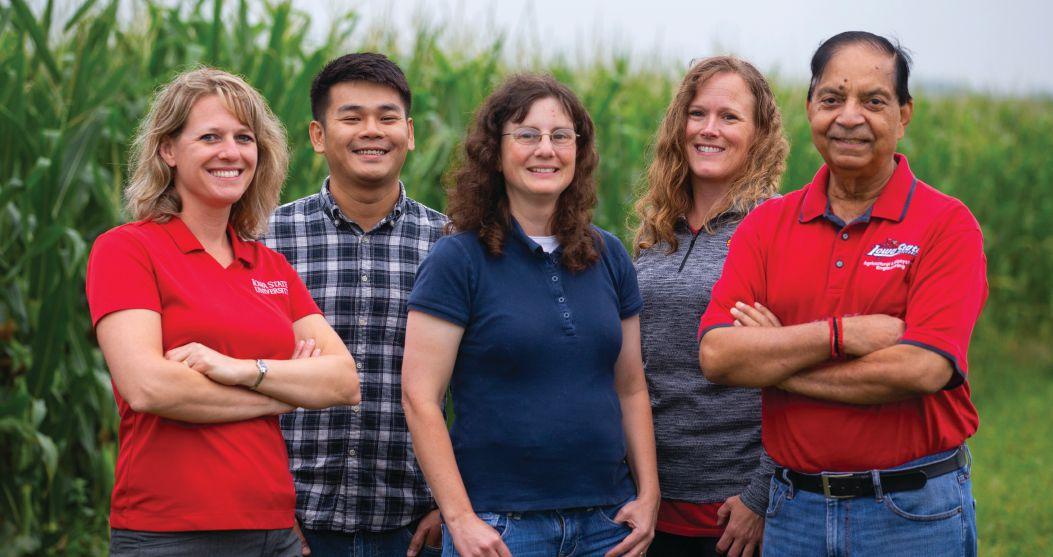
Michelle Soupir (left) and the team of Iowa State University researchers in the department of agricultural and biosystems engineering involved in the long-term study on the impacts of fertilizing cropland with poultry manure. The team included (from left) research associates Ji Yeow Law, Leigh Ann Long and Natasha Hoover, along with agriculture and life sciences professor Rameshwar Kanwar, who initiated the 20-year project.
RIGHT
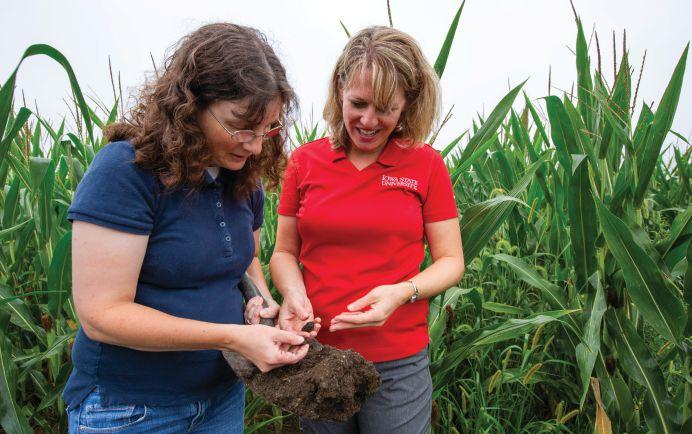
Leigh Ann Long, research associate, and Michelle Soupir discuss soil health and aggregate stability.
Stiles, CEO and executive director of the Iowa Poultry Association and Iowa Egg Council. “Egg consumption continues to grow. All the research is pointing towards the favorable benefits of eggs in the diet.”
Stiles says before the pandemic, there were 58 million laying hens in Iowa, the top egg-producing state in the country. That number has decreased as food service sales slumped thanks to COVID-19, but Stiles expects a rebound and “continued strong growth” in egg consumption going forward.
The egg council will provide $67,000 in annual funding to the new study after being the principal backer of the initial research project. “We are excited. To our knowledge, this is the first and only study of its kind,” Stiles says. “We certainly value the partnership that we have with Iowa State and really are proud of the research team that they have there to do this kind of work.”
Stiles credits board members for their
foresight in funding the research. “I think what we’ve learned since then, and the way it’s valued today, certainly has even enhanced that image and has made poultry manure a more desired product than it was even 20 years ago,” he says.
Using poultry manure in agriculture isn’t a new idea, but Stiles hopes that quantifying its nutritional and environmental benefits will expand the
market for a product that Iowa’s poultry farmers can supply in abundance.
“If we can demonstrate that value in the contribution that it makes to enhancing the soil and the soil quality, I think that’s only advantageous to our farmers,” he says, adding that poultry association members are also keen to see if manure produced by chickens who live cagefree behaves differently than that from
chickens raised in conventional housing.
Soupir says farmers are embracing the idea of using poultry manure in their fields, with some adding it to sandy soil to build up the organic matter. “There’s been pretty positive reception by the farm community,” she says. “That’s why poultry manure can be bagged and sold, because there’s enough demand for it. This is something that’s really changed.”
A set of best management practices for poultry manure should come out of the first few years of the study, which
will allow farmers to lean on the findings of the Iowa State University team rather than having to reinvent the wheel.
“A lot of farms aren’t measuring their soil health,” Soupir says. “They will measure their soil nutrient levels so they know how much [fertilizer] to apply. They also don’t do a lot of water quality monitoring. I mean, there’s more being done across the state than there probably ever has been. But it’s definitely not common for a local landowner to measure the nitrate levels in their drain
lines on a weekly basis like we will.”
Part of the educational component of the research will be convincing farmers not to add extra nitrogen fertilizer on top of poultry manure “just to be sure,” because the original study found that doing so reverses the soil health and water quality benefits, as well the economic gains.
“We know it happens,” Soupir says, adding that farmers need to “trust the process.”
Researchers will test out management plans that incorporate poultry manure every couple of years, or supplement with UANs in the spring so that phosphorus doesn’t build up in the soil. “I think some of those approaches could be pretty popular with farmers, because then they have the insurance of the commercial fertilizer if they feel they really need it,” Soupir says.
Last year saw the Iowa State team survey the new research site’s 27 plots and locate existing drainage tiles that will serve as barriers to “hydraulically isolate each of the plots,” Soupir says. Team members also did “really extensive soil sampling [to] get information on the baseline condition of each of the plots.” In the spring, the group will install additional drainage tile to each plot for sample collection and analysis through the fall.
“The long-term outcome of this study would be to inform manure management and cover cropping management to optimize crop yield and environmental benefits,” Soupir wrote in the proposal. “Our hope is that these efforts will lead to fewer impaired waters, protected public health and more sustainable agricultural systems.”
Stiles says it is “really helpful” to the industry to now have “more than 20 years of validated research to substantiate the value of poultry manure.” Soupir notes appreciatively that it was rare for a commodity group to fund a long-term study, and says she is excited that research into how best to apply poultry manure on Iowa’s farms will continue.
She expects it will take the full length of the current six-year study before researchers see appreciable changes in soil health and crop yields. Improvements in water quality should register more quickly.
“The vision is that we can do at least six years of these management strategies, and then probably revisit these treatments and see if we want to update,” she says. “As we’ve seen, things have changed as far as how we’re doing things and what questions we want to answer.” •
BKT adds to the V-Flecto line
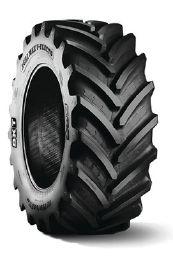
Global tire giant BKT is expanding its line of Agrimax V-Flecto tractor tires. It has already rolled out a new VF 710/70 R 42 size, which will soon be followed by three new sizes:
• VF 750/70 R44
• VF 710/75 R38
• VF 710/55 R38
V-Flecto is now available in 22 different sizes.
The Agrimax V-Flecto tires were first launched in 2017. BKT’s main ambition with the line is to improve tractor performance across all types of terrain and allow users to maximize loads and reduce soil compaction. The tire makes use of narrow rim option technology, conforming to standards set by the European Tire and Rim Technology Organization (ERTRO). This makes it possible to use standard rims with the tires, instead of dedicated rims.
Puck introduces telescoping agitation boom
In December 2020, Puck announced the launch of its most compact and versatile agitation trailer to date: the Long Reach Agi. Designed for the evolving needs of nutrient applicators and liquid transfer operators alike, Long Reach Agi is fitted with the industry’s first-ever telescoping boom.
Designated as Agi 1708 X, this piece of equipment can mix a wider variety of pits and slurry stores without the need to crane in an agitation boat. The boom has a length of 50 feet once its two stages are fully extended, with a maximum slurry store clearance height of 25 ft. and a mixing reach of up to 25 ft. The boom’s telescoping functionality mean an overall compact trailer design and machine footprint. When retracted, the two boom stages contract to a length of just 15 ft.
The boom turret can rotate 105 degrees. Agitation nozzles have 180 degrees of movement and independent hydraulic gate valves. The tailer’s outflow gate makes the process of switching from agitation to transfer mode easy and doesn’t require operators to shut down the engine. An auxiliary hose reel is mounted to the trailer for added hose availability, if needed.
Nokian Ground King line now includes 20 sizes
Nokian first introduced its Ground King tractor tire with Hybrilug pattern in 2019. It can now give results on both soft field and in fast road transports. To match, the Nokian Ground King tire range is steadily growing – with the total of 20 sizes available from this January.
When the Ground King tire was merely a design, Nokian focused on improving the tread pattern, to combine the best properties of lug and block tread patterns. Since the tire has been released to the markey, Nokian shifted that focus to expanding the size range available and performance. During the last quarter of 2020 as well as beginning of 2021, the Nokian Ground King tire family is expanded to cover 20 sizes – enough to make the new versatility available for most common medium and high-power tractors.
ON TRACK
Case IH Puma series tractors updated for 2021
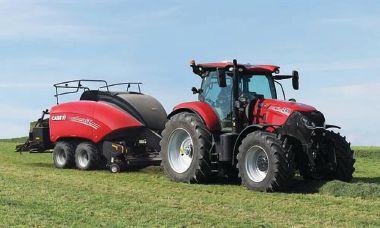
Case IH has launched updates to Puma series tractors – models 185, 200, 220 and 240 – to enhance efficiency, comfort and convenience. From an updated hood with new styling to increased service intervals and enhanced drivability, the new features and advancements aim to improve the operator’s experience and boost productivity.
Updates to the Model Year 2021 Puma series tractors include:
• Increased service intervals to maximize efficiency and uptime;
• Redesigned hood with enhanced LED work lights to provide a uniformly lit work area, helping the operator safely tackle after-hour jobs;
• Drivability improvements for the optional CVXDrive continuously variable transmission;
• In-cab cool box feature for enhanced comfort;
• Redesigned optional front hitch;
• Low-mount wiper for maximum visibility in any conditions; and
• Longer service intervals, efficient power.
As well, Case IH Selective Catalytic Reduction (SCR) technology improves horsepower, engine responsiveness, fuel economy and durability, all while lowering emissions. With the latest advancements, 2021 Puma models 185, 200, 220 and 240 achieve longer service intervals without sacrificing production: 750 hours for engine oil and 1,500 hours for transmission fluid.
By selecting the target speed, the CVXDrive continuously variable transmission automatically adjusts to deliver the desired speed to match load conditions. It offers smooth power transfer through varying conditions without torque interruption.
Updated Puma models 185, 200, 220 and 240 are now available to order. Model Year 2021 Puma 150 and 165 tractors with updates including longer service intervals and refreshed styling will be available in March.
Rashi Akki on Fort Hill Farms’ new digester
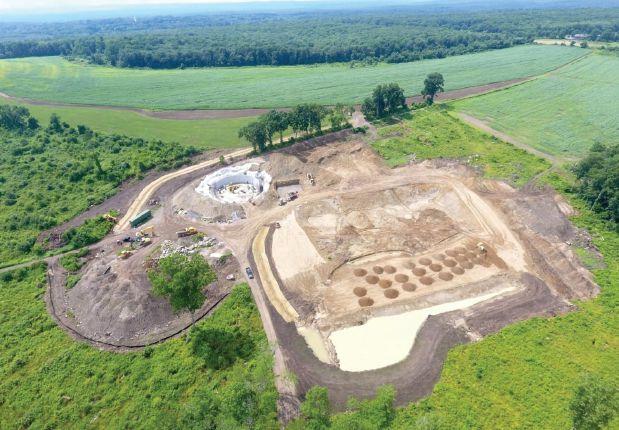
Connecticut-based Fort Hill Farms is inching closer to the completion of its new biogas dairy digester. The project, a result of a partnership between Fort Hill, Live Oak Bank, the Connecticut Green Bank and Ag-Grid Energy, will allow the farm to produce an estimated 550 kW (737.6 HP) of electricity annually, while reducing 25,000 tons of organic waste.
Although digesters of various kinds are increasingly common, this is still the first dairy digester system in Connecticut. Manure Manager caught up with Rashi Akki, CEO of Ag-Grid Energy, to discuss not only the details of Fort Hill’s new initiative, but also the state of the industry for digesters.
Pennsylvania-based Ag-Grid has installed a number of digesters across the northeastern U.S. in recent years, but Akki says this one has been a long time coming.
The relationship goes way back – Fort Hill, which has been long invested in sustainability, has been working with Ag-Grid to establish its microgrid operations since 2016. Akki says that at times it feels like this project is “slugging along.”
Being the first in the state poses some challenges, she says. Pointing to an example of a recent build in Massachusetts, she says the process was much quicker because there are already digesters there.
“The first [project of its kind] always takes a little longer.” But more importantly, she says, it was about high standards for the company. “I wanted to make sure I was learning from our most recent projects before installing the one in Connecticut. So, a little bit of [the slow pace] was on my part.”
This digester is somewhat unique, she says, because it also incorporates food waste.
Akki notes that Fort Hill Farms, as well as the majority of Connecticut farms, would not be eligible for renewable natural gas (RNG) digesters. “You need 4,000 to 5,000 cows to even consider RNG,” she explains, noting that most farms in Connecticut simply don’t have that scale. But the moment one mixes in food waste, she says, the operation can become more efficient to create energy for the municipal electric sector.
“Every bit of the process [with digesters] supports the farms,” Akki says. But as digesters become more common – and more in-demand – that’s not necessarily resulting in them becoming more affordable.
Quite the opposite.
“They are becoming even more expensive,” she says, noting that the capital required to install a digester has become an even bigger undertaking. There are, however, more government programs to help. She says a 30 percent tax credit is “the only way we can get these programs to expand out.” After a safe harbor agreement, she says, the company is usually allowed 40 years to build a project. So far, the company has been able to build three out of four projects it has safe harbored. Without that, she says, it’s way less economical to see those projects through to completion.
Q&A: How the USDA’s agricultural air quality task force has evolved
In the 25 years since the USDA agricultural air quality task force was first formed, it has evolved to address the most pressing challenges in balancing air quality and agricultural practices.
BY BREE RODY
Since 1996, the U.S. Department of Agriculture (USDA) has operated a task force to address the relationship between agricultural practices and air quality. So far, 11 different iterations of the task force have been formed, and over the years the scope of their work has evolved. However, the mission has remained the same: to develop a better understanding of the relationship between agriculture and air quality, and to help develop practices to mitigate and reduce negative impacts.
This past month, the USDA reauthorized the task force, appointing 26 members to serve on this term’s task force. The term runs from Jan. 4, 2021 to 2023.
Manure Manager caught up with Diane Gelburd, deputy chief of science and technology with
the USDA’s Natural Resources Conservation Service. Gelburd discusses how and why the task force’s work has evolved, what the current challenges are and how producers can get involved. Interview has been edited for clarity and length.
Tell us about the background of forming the task force:
The task force was actually first authorized under the Federal Ag Improvement and Reform Act of 1996. At the time, the concerns were related to some of the lack of credible scientific information on the agricultural effects on air quality, particularly related to airborne particulate matter [like] PM10 emissions, with large, inhalable particles. The task force
PHOTO
was authorized to try and ensure that agriculturalists could address air quality concerns based on credible data. The mission has always been to advise the spectre of agriculture on air quality and the relationship between [the two] based on sound scientific findings. Part of it was also to ensure co-ordination between various federal agencies in terms of air quality, in particular the USDA and the Environmental Protection Agency.
I was the designated federal official for the task force in the early 2000s, then moved onto some other positions, and came back two years ago into this deputy chief position, which has many responsibilities including the task force, and we were able to get the task force reauthorized.
How has the work of the task force evolved over the last 25 years?
Because the task force is renewed every two years, there’s been about 11 different iterations. In the beginning, they were addressing particulate matter issues and matters related to that. They provided guidelines on the development of methodologies on things like animal feeding operations.
But one of the things that is really significant from an operations perspective is that in 1996, we had no conservation practices specifically addressing air quality. Now we have 170 different practices. Since the establishment, we now have four primary conservation practices to address ag quality air issues. We have also revised 47 other practice standards to include consideration for air quality, and we are also able to provide some financial assistance to producers under our various programs to help them address and improve air quality.
In addition, we now have an air quality initiative that provides assistance to particular air quality resource concerns. We have $37 million provided to address those concerns – that just shows how important it has become.
Who makes up the task force?
With the fresh reauthorization, we have 26 members now. Membership varies depending on the applicants we receive, but currently, our members represent 17 states of varying geography and various viewpoints and perspectives on air quality.
Of our current batch, we have six agricultural producers, nine agricultural air quality scientists, four representatives
from the environmental health and regulatory community and seven agricultural industry representatives, whose expertise is associated with several animal species, commodity crops, atmospheric chemistry, carbon and nitrogen emission and more. So it’s a very broad representation of interests and expertise for making recommendations to the secretary. And there’s a number of major air quality concerns that we will probably be dealing with in the near future.
What are some of those concerns?
Obviously, we are dealing with climate change, as well as carbon and nitrogen emissions, and carbon sequestration. I think carbon sequestration is going to be one of the biggest ones.
What should people know about producers’ relationship with the environment?
Producers care greatly about air quality, and about all of our resources, because they can’t sustain their operations without having a high-quality environment. Their operations, their livelihoods and their
own personal lives depend on having clean air and clean water, as well as protecting wildlife. They’re constantly looking for ways to improve it.
We have actually been working with producers in the USDA through what’s been called the Ag Innovation Agenda to encourage innovative technology to actually help address and reduce the environmental footprint associated with agriculture. You’ll find that a lot of producers are going the extra mile to improve not only air quality but many other aspects of the environment.
If producers want to get involved or follow the work of the task force more closely, what can they do?
We meet two to four times a year, and all of our meetings are public meetings. So, they are welcome to listen in to the meetings, to participate and provide comments at these meetings. We also welcome questions at any time. The designated federal official who manages the task force is Greg Zwicke, so they’re welcome to contact myself or Greg anytime at diane.gelburd@usda.gov or greg.zwicke@usda.gov. •
A LONG WAY TOGETHER
WHEREVER YOU ARE, BKT IS WITH YOU
BKT provides you tires that are reliable and safe, sturdy and durable, capable of combining traction and reduced soil compaction, comfort and high performance.
BKT: always with you, to get the most out of your agricultural equipment.
Designed using the best core features and flexible options from both Broadcaster 1 and Broadcaster 2, including multiple built-in safety features, this user-friendly, economical new system will simplify and improve your operations.
The all new Broadcaster 1+ allows you to stay in constant cellular communication to monitor and control single- or multi-pump systems from anywhere worldwide, using your phone, tablet, or desktop. Stay connected. Stay in Control.
The nitrogen cycle and manure
Nitrogen is a vital nutrient for plant growth, and it’s often the nutrient that gets the most attention when it comes to fertilizers. Fortunately, manure happens to be an excellent source of nitrogen. Understanding how manure nitrogen behaves after application is important in order to know how best to manage manure.
NITROGEN
FORMS IN MANURE
There are two forms of nitrogen in manure: inorganic and organic. The inorganic form is immediately plant available, while the organic form is not. Broadly, inorganic N refers to all forms of nitrogen that are immediately plant available, including ammonium and nitrate. For the most part, however, manure does not contain nitrate. So, the plant-available part of manure N is nearly all ammonium.
Organic N is tied up and needs to be broken down by a process called mineralization in order to become plant available. This breakdown of organic N is what makes estimated available nitrogen in year two tricky. Mineralization is driven by soil microbes and the speed at which they work is heavily influenced by the environment; and we all know how fickle the weather and environment can be!
Besides mineralization, the other major
“It’s important to keep nitrogen where you put it.”
N transformation that happens in the soil is nitrification. This is when ammonium is converted to nitrate. Remember that manure supplies ammonium and not nitrate; but ammonium can convert to nitrate once in the soil. This is also a microbially driven process that’s dependent on environmental factors.
NITROGEN LOSS PATHWAYS
Of all the nutrients in manure, nitrogen is most easily lost to the environment. It’s important to keep N where you put it so that you don’t lose valuable nutrients and cause nutrient pollution. When manure is applied, volatilization is the first type of loss you need to worry about. That’s where ammonium is lost to the atmosphere
as a gas when manure is left sitting on the soil surface. If you’re working with a highammonium manure, such as swine manure, you could lose up to 50 percent of your total nitrogen to volatilization in just four days. Luckily, there’s a pretty easy way to minimize volatilization loss: incorporate manure into the soil. Getting the manure below the soil surface through tillage or injection will greatly reduce volatilization loss.
Once in the soil, ammonium is going to pretty much stay put. However, if ammonium converts to nitrate (through nitrification), it can be lost more easily. Nitrate readily dissolves in water and will travel wherever water will. That means it can be lost downward through the soil profile (leaching), through tile drainage, or across the landscape as runoff. In addition, nitrate can be lost to the atmosphere as a gas (denitrification). As you can see, to prevent N loss, it’s worthwhile to keep it in the ammonium form and not let it transform into nitrate. The nitrification process can be slowed down by applying when soils are cool – below 50 F is generally recommended. But keep in mind that even in cold soils, nitrification still happens – just much more slowly. You can also avoid nitrification by applying manure to an actively growing crop or to soil that will soon have crops planted. If plants take up and use the ammonium, it won’t have the time to become nitrate.
TESTING MANURE FOR NITROGEN
While there are nutrient tables out there for nearly every type of manure, those are just estimates. We recommend sampling your manure for nitrogen as well as other nutrients. Actual N content of manure can vary based on a whole host of management factors including feed, housing type and storage system. Remember that not all of the N is immediately usable by the plant. So, instead of using total nitrogen to calculate application rates, you’ll want to multiply by the availability factor. Each state or region has its own recommended availability factor for each manure type, so be sure to use your local recommendations. •
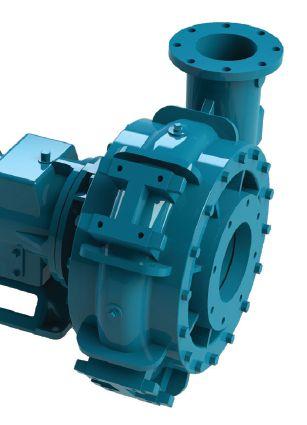
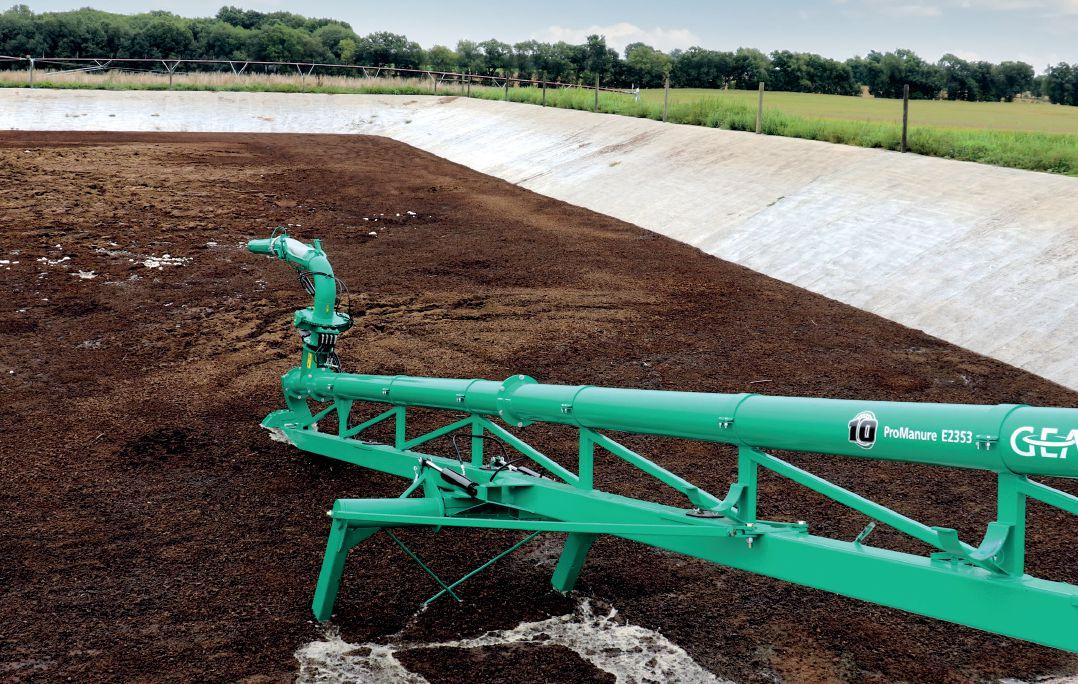
ProManure E2353
Lagoon Super Pump
For Professionals with a little dirt on their boots
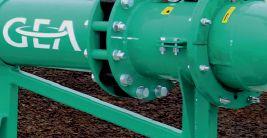
In an industry where every minute counts and time is limited continuously by labor availability, weather, field-fitment, and equipment reliability, finding the right equipment becomes paramount. The GEA ProManure E2353 pump has been designed to overcome these challenges, unlike any GEA pump before.