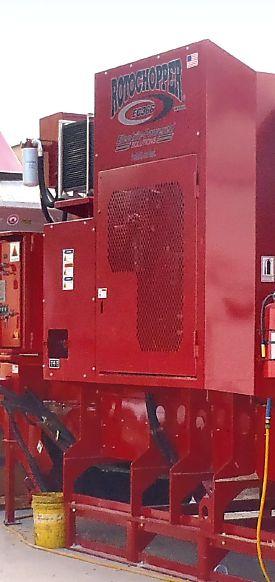
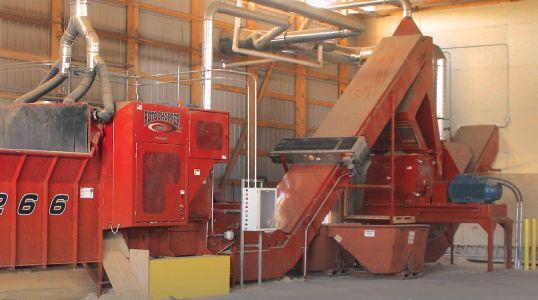
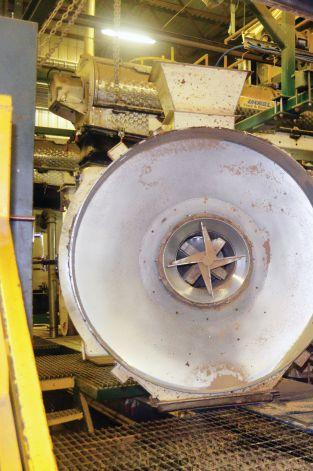
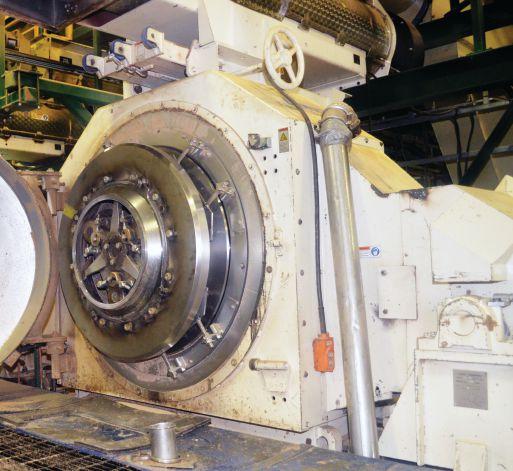
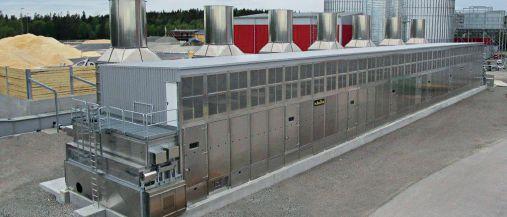
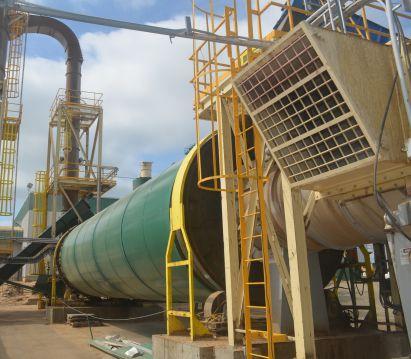
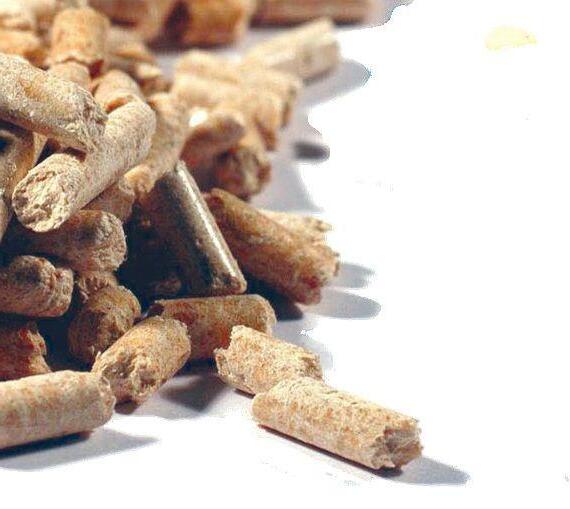
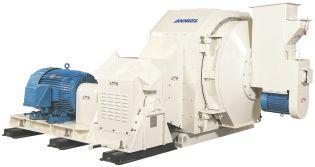
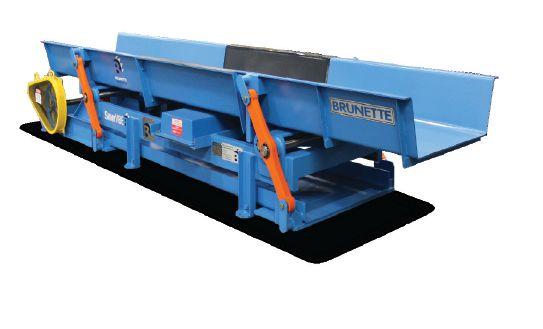
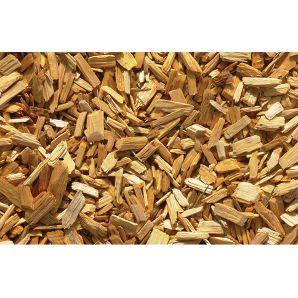
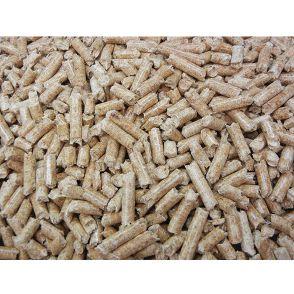
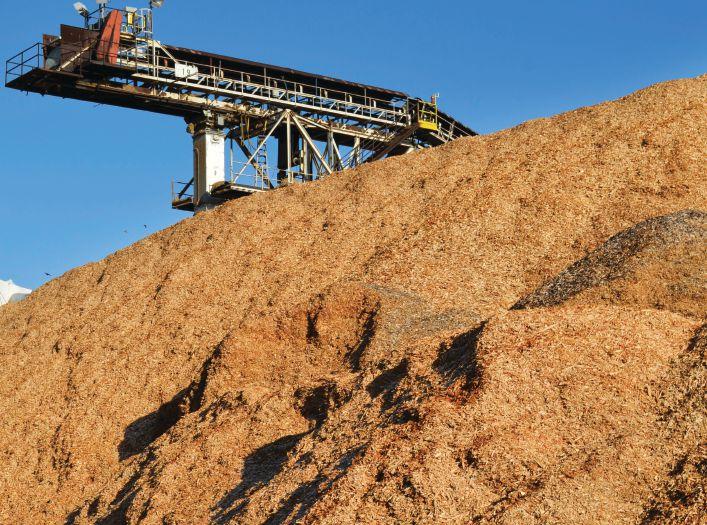
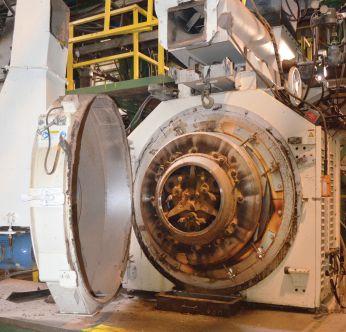
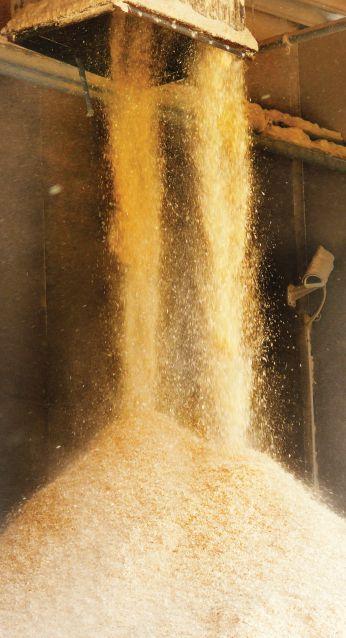
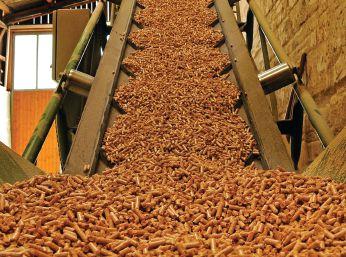
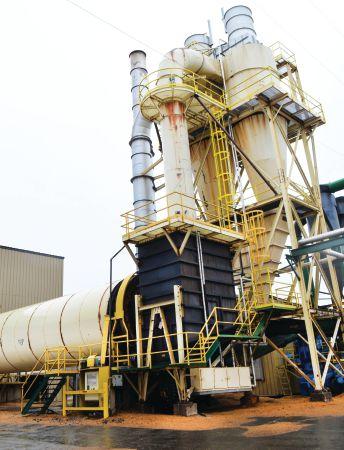
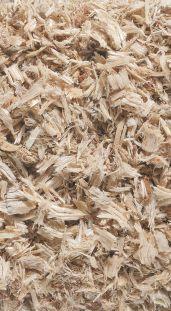
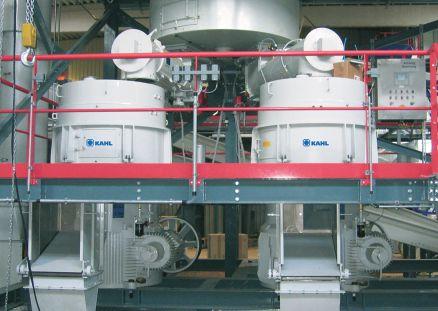
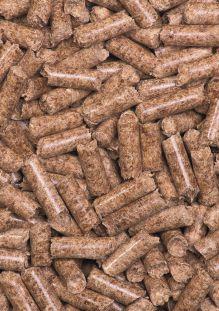
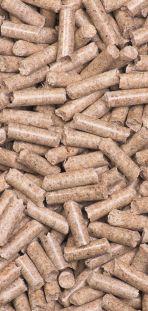
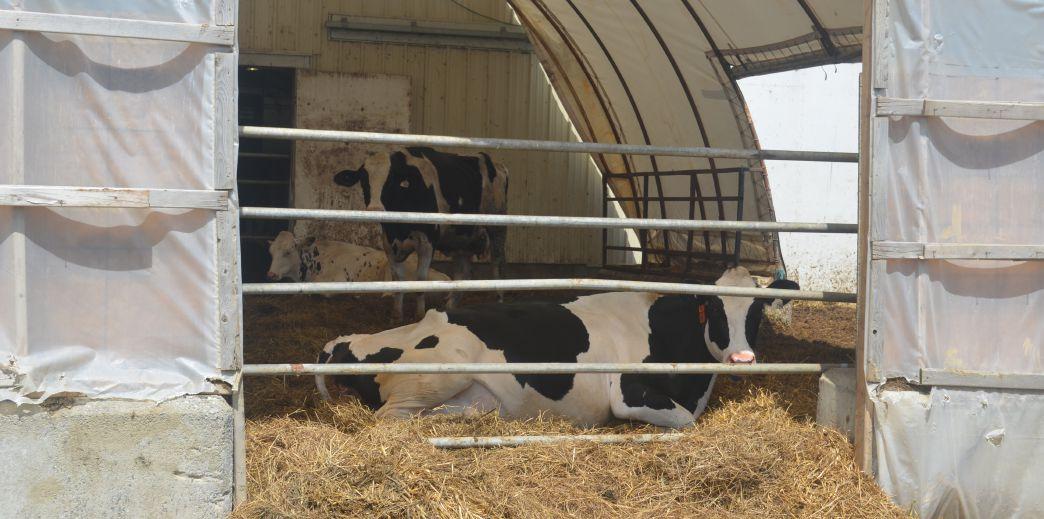
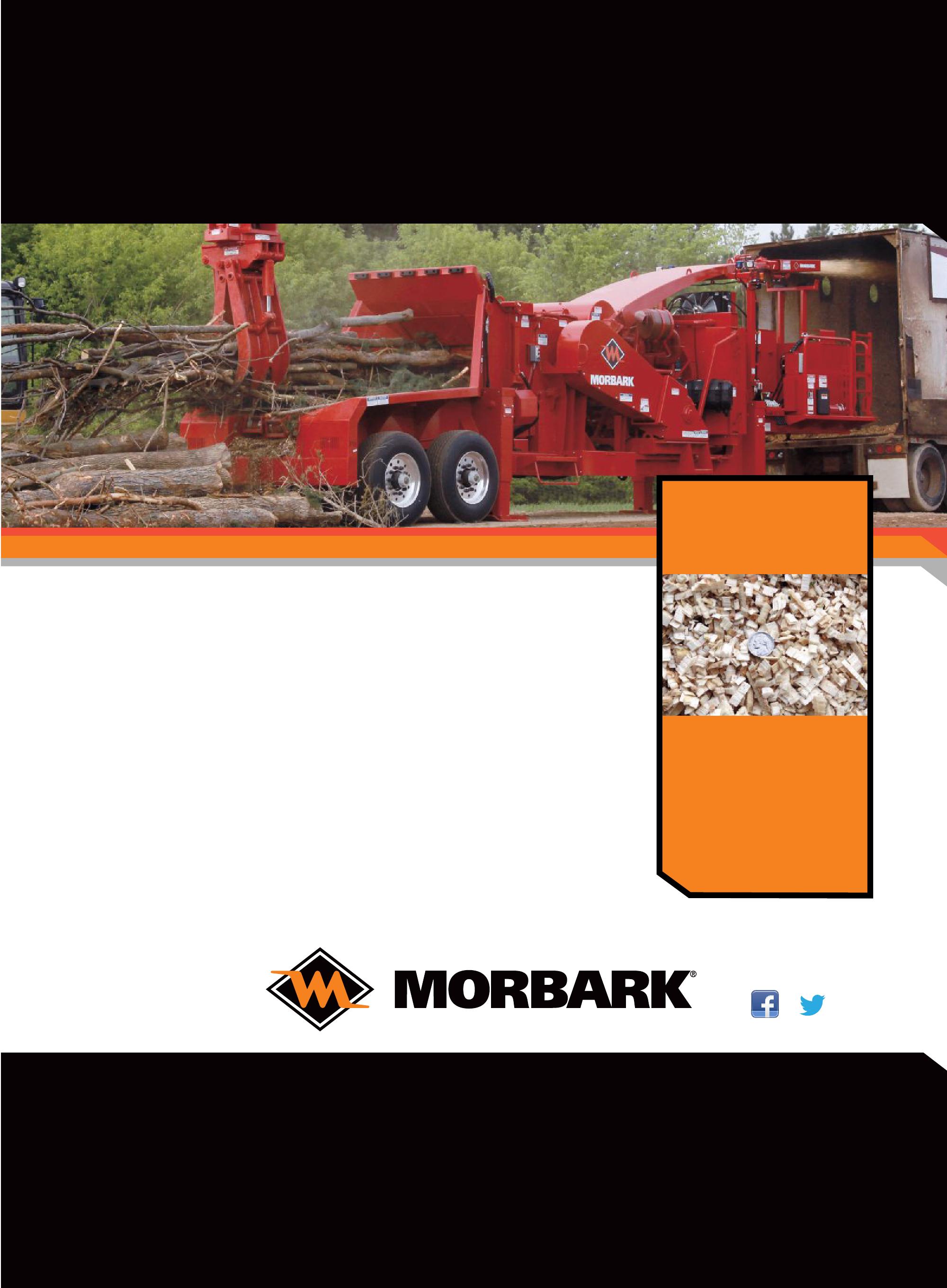
Rotochopper multi-stage grinding systems offer singlepass simplicity for producing animal bedding and short fiber fuels. Wood waste goes into the primary grinder and comes out of the in-line hammermill at finished specifications—no additional handling or hassle.
• Most uptime
• Cleanest operation
• Easily integrated into picking lines
• Unmatched particle size control
• Lowest cost per ton
How can a Rotochopper grinding system maximize the value of your wood waste? Contact us today to learn more.
CANADIAN BIOMASS
10 DOUBLING DOWN
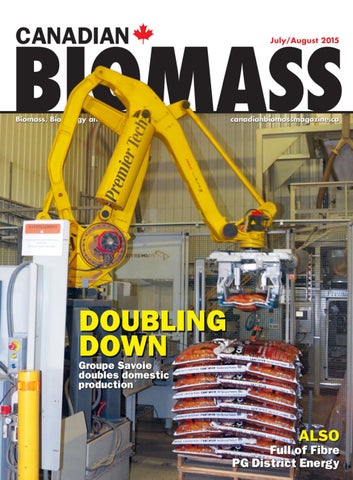
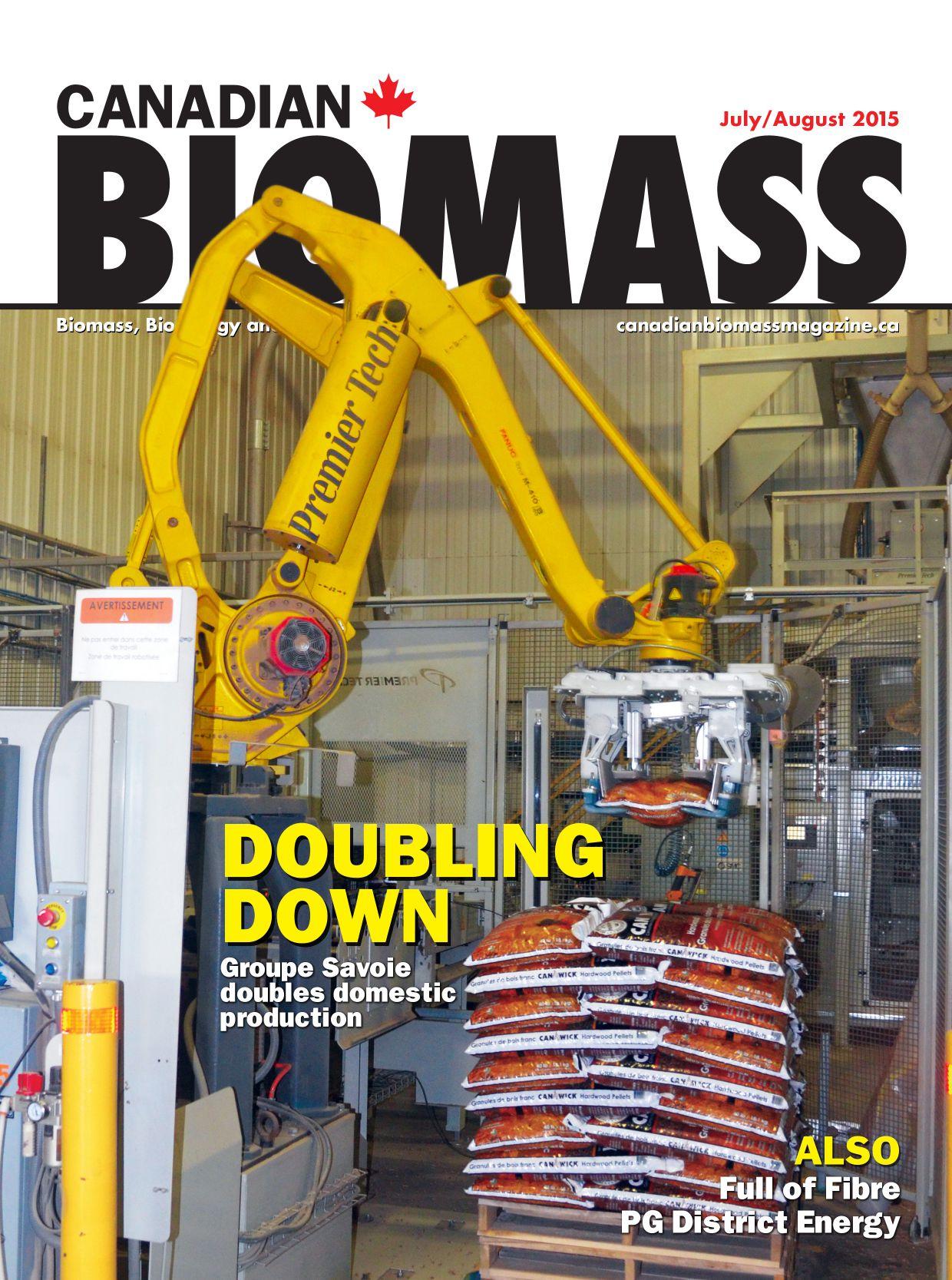
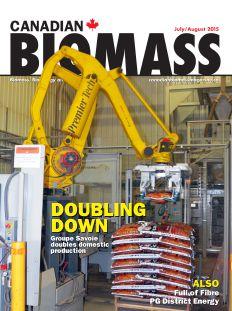
Groupe Savoie works to keep up with current demands by doubling its production of domestic wood pellets.
14 Full of fibre
A Nova Scotia harvester finds value in cutting wood for both biomass and sawmill operations in the region.
17 Green Energy
The City of Prince George works with local wood products companies to provide fuel for its biomass-driven district energy system.
20 Pellet Gear Buyers’ Guide
Our annual Pellet Gear Buyers’ Guide provides you with information on all of the suppliers of pellet production equipment for the Canadian wood pellet industry.
27 Atlantic Biorefinery Conference
A look back at the highlights from this year’s Atlantic Biorefinery Conference held in Edmundston, N.B.
“The City of Prince George is helping clear the air in the city with help from its biomass-fuelled district energy system…” Read the full story on page 17.
The demand for wood pellets for domestic use in Atlantic Canada has increased so much that Groupe Savoie is doubling its production. Find out more on page 10.
IAn emissions benchmark
Where does bioenergy fit into the new global emissions targets?
n early June, the G7 countries declared that they would work towards decarbonization by 2100.
It was a bold announcement from seven of the world’s most powerful countries, which seem to finally be taking the warnings of a UN report on climate change released in late 2014 that the impact of climate change would be manageable in greenhouse gas emissions were reduced to zero by the year 2100.
That same report, and the subsequent news coverage that followed, focused on renewable energy from wind and solar, nuclear power plants and underground carbon capture. Yet little of the discussion centers around the role of biomass and biofuels and how they play a role in this future global energy reliance structure.
profanity-laced denials of the claim. Of course, those same people will have never bothered to check the science behind Strauss’ claim.
But some governments are starting to listen, and are introducing legislation in support of the carbon neutrality of burning wood waste for energy. One of the most recent examples is the passing of Senate Bill 752 in Oregon which, in section 3a states: (3)(a) Except to the extent necessary to implement the federal Clean Air Act (P.L. 88-206 as amended), the air pollution laws contained in ORS 468A.025, 468A.030, 468A.035, 468A.040, 468A.045 and 468A.300 to 468A.330 do not apply to carbon dioxide emissions from the combustion or decomposition of biomass.
Volume 15 No. 4
Editor - Andrew Macklin (905) 713-4358 amacklin@annexweb.com
Editor - Andrew Snook (905) 713-4301 asnook@annexweb.com
Western Sales Manager Tim Shaddick - tootall1@shaw.ca Ph: (604) 264-1158 Fax: (604) 264-1367
Director of Soul/COO - Sue Fredericks
Media Designer - Chris Springle
Canadian Biomass is published six times a year: February, April, June, August, October, and December.
Published and printed by Annex Business Media.
Printed in Canada ISSN 2290-3097
Circulation
So then why is it that bioenergy, one of the strongest current solutions for curbing GHG emissions in many countries around the world, is not more prominently suggested as part of the long-term solution?
I would suggest that it is because many world energy leaders have not adopted the stance on biomass that many of us in the industry believe in, a position that has been solidified time and time again by industry leaders like Bill Strauss of FutureMetrics. That is, of course, that biomass is indeed carbon neutral.
I didn’t realize how much backlash such a view would generate until I was tweeting at an event that Strauss was speaking at last year. I had tweeted the fact that Strauss was showing the audience that woody biomass was carbon neutral, and several environmentalists and outside observers responded to the tweet with
(b) As used in this subsection, “biomass” means:
(A) Nonfossilized and biodegradable organic materials that originate from plants, animals and microorganisms and that are products, byproducts, residues or wastes from agriculture, forestry and related industries;
This recent example has provided a building block to move forward with a provincial or federal push for similar legislation. Asking someone to be the first is always the most difficult, getting someone to follow suit is less so.
I’m sure you have heard all of this before. And I know, it isn’t that simple. But if we are truly to meet the targets set forth by the G7, then someone needs to step up with some ideas. Why not biomass? •
Carol Nixon e-mail: cnixon@annexweb.com P.O. Box 51058
Pincourt, QC J7V 9T3
Single Copy - $9.00
(Canadian prices do not include applicable taxes) USA – 1 Yr $60 US; Foreign – 1 Yr $77 US
Occasionally, Canadian Biomass magazine will mail information on behalf of industry-related groups whose products and services we believe may be of interest to you. If you prefer not to receive this information, please contact our circulation department in any of the four ways listed above.
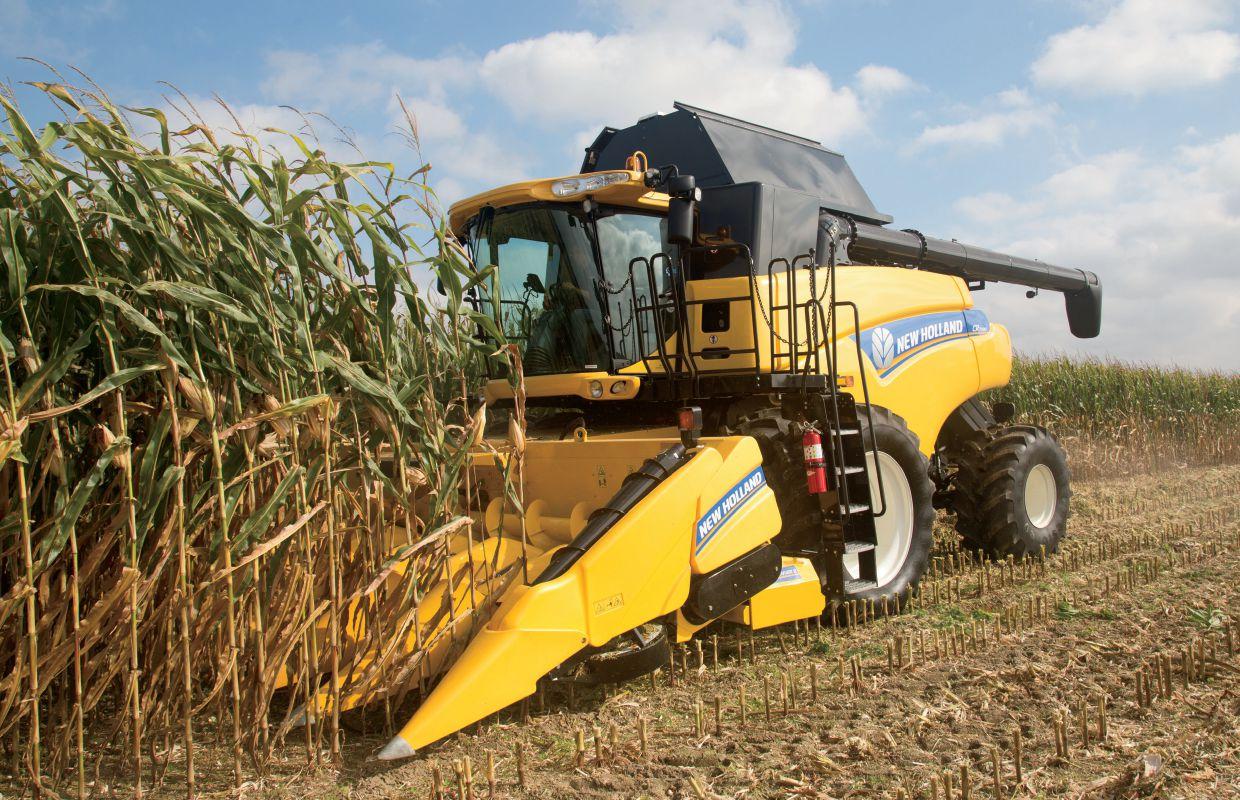
When you use the Cornrower™ attachment with your New Holland CR combine and chopping corn head, you windrow corn stover at the same time you harvest, eliminating extra trips through the eld and associated labor and fuel costs. That’s SMART for your bottom line. The Cornrower™ attachment “catches” stalk material under the chopping corn head, creating a uniform windrow, then the CR combine drops high-energy chopped cobs and husks on top—without dirt or rocks that spoil your corn stover, and without hindering combine performance or maneuverability. Find out how you can save with the New Holland Cornrower. Learn how to farm smart at nhSMART.com/clauson
BIOMASS update
TEREX ACQUIRES NEUSON ECOTEC
Terex Materials Processing, a business segment of Terex Corporation, recently announced the acquisition of the assets related to the Environmental Technology product lines of Neuson Ecotec GmbH (an Austrian company). This acquisition marks further expansion of the Terex Environmental Equipment (TEE) business
unit, closely following the purchase of the assets of Continental Biomass Industries (CBI) in April.
TEE, part of the Terex Materials Processing segment, has been serving the wood, biomass, and recycling industries since 2011.
The acquisition of the Neuson Ecotec Environmental Technology products will add
PINNACLE ESTABLISHES PELLET TRANSPORT RECORD
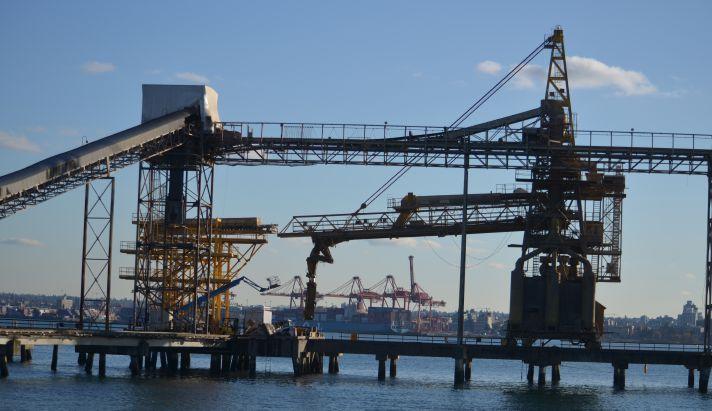
Pinnacle Renewable Energy Inc. announced the first full loading of wood pellets into a Panamax class vessel. The first full shipment was loaded at the company’s Westview Terminal in Prince Rupert, B.C. on June 2, 2015. It represents the largest load of wood pellets ever shipped according to Pinnacle officials.
Panamax vessels are purpose-built to utilize the maximum capacity of the Panama Canal. The vessel will carry almost 60,000 tons of wood pellets to Drax Power in the U.K.
The use of Panamax class vessels will allow Pinnacle to fully optimize its marine logistics between B.C. and ports in Europe. The larger load will also allow receivers to improve discharge efficiency on arrival.
“Pinnacle is excited about its leadership in the use of Panamax’s for wood pellets,” said Vaughan Bassett, Pinnacle’s senior vicepresident of sales and logistics. “They are presently an underutilized class of vessel, so this additional cargo option will suit ship owners, shippers and receivers alike.”
The M/V Popi S was chartered by Grieg Star Shipping in Norway and has a DWT of 80,400 tons. She will take 34 days to sail between Prince Rupert and Immingham, U.K.
Premier Tech announces investment
Premier Tech recently announced a $45.9-million investment in innovation, alongside Denis Lebel, Minister of Infrastructure, Communities and Intergovernmental Affairs. The announcement follows the signature of an $8.3 million dollar refundable contribution agreement between Canada Economic Development and Premier Tech.
chipping, shredding, screening, and composting products that will accelerate development of a global dealer network while adding a facility in Linz, Austria that can support production requirements in continental Europe. Terex is not acquiring the Forestry division of Neuson Ecotec GmbH, which will transition to Neuson Forest after closing.
COCHRANE
The Neuson Ecotec products that Terex is acquiring will now be part of a global portfolio of distribution-oriented products that will soon be rebranded as Terex Ecotec. Terex will bring these products to market through a network of dealers and with the support of Terex resources and infrastructure around the world.
POWER SHUTS DOWN OPERATION
Cochrane Power officially stopped generating electricity for Ontario’s power grid after failing to obtain any further extensions, or come to a new agreement, with the Ontario Electricity Finance Corporation (OEFC).
Sarah Charuk, director of communications for Northland Power, confirmed that the plant officially stopped operating as of midnight on May 11, due to the termination of its current agreement with the OEFC. However, this does not mean Northland Power has given up.
Northland was granted an extension to May 11 from the agreement’s original end date in January 2015, so Cochrane Power and the Independent Electricity System Operator (IESO) would have additional time to negotiate a new long-term agreement.
However, the Minister of Energy directed the IESO to suspend all negotiations until the IESO had developed a strategy for power generators such as Cochrane Power across the province. The minister directed the IESO to deliver that strategy in June, and then recently amended that to September, which is well past the May 11 expiry of Cochrane Power’s agreement, according to a recent statement from Northland Power.
Cochrane Power uses wood chips to generate electricity, which are sourced from the waste material of local mills, such as Tembec’s Cochrane facility and the recently opened Rockshield Engineered Wood Products factory.
Premier Tech’s new three-year Innovation, Research and Development (IR&D) program, named IDEE – Innovation and Development for Elevating Exportations – will allow the company to accelerate the technological and commercial progression of its three groups through 24 distinct IR&D initiatives.
ATLANTIC BIODIESEL UP AND RUNNING
Atlantic Biodiesel officially opened its state-of-the-art renewable fuel facility located in the Niagara Greenbelt in Welland, Ontario.
“This is an important day for Atlantic Biodiesel and for the greater Welland community,” said Michael Paszti, Chief Operating Officer of Atlantic Biodiesel. “Our world class facility is up and running. We are excited to be a part of this community and to support the local economy. We are making a commitment today; where we are able to, we’re going to source locally.”
The new Atlantic Biodiesel facility is one of the largest biodiesel facilities in North America and produces 170 million litres (45 million gallons) per year of renewable, clean-burning biodiesel and 15 million litres (4 million gallons) per year of high-grade glycerin. The facility is strategically located within close proximity of rail infrastructure, providing for storage and shipping ability to a range of North American markets.
“The City of Welland is thrilled to welcome Atlantic Biodiesel to the community,” stated Welland mayor Frank Campion. “The facility will bring approximately 25 direct jobs and significant indirect business to the area. Every job is valued and needed in our community. I strongly encourage the federal, provincial, and local governments to join me in supporting this local company as they work to bring jobs and economic prosperity to Welland.”
“Tomorrow the real work begins,” said Paszti. “We are committed to the long-term sustainability and success of our facility and we are proud to be part of Welland’s economic renewal.”
TEMBEC BRINGS COGEN PLANT ONLINE
Tembec relates some of the challenges of bringing the company’s new turbine online in its quarterly report for the period ending in March 2015. Total construction cost for the cogen project at the company’s Temiscaming pulp and paper complex in Quebec had reached $272 million by the end of March 2015, versus the expected construction cost of $273 million. The cogen project is now producing green electricity for the provincial grid.
Commissioning of the turbine began in early January 2015, at which time the company generated its first electricity sales. In late January, Tembec successfully met the commercial-in-service test set forth in the power purchase agreement and began selling electricity at the higher green power rate.
During February, Tembec began the firing of pulp mill residual liquor in the new boiler, which forms part of the cogen system. The quarterly report states: “A significant amount of effort and resources were dedicated to ramping up the volume of liquor burned and optimizing the exhaust gas scrubber
system and related equipment. The commissioning work occurred during a period of very cold temperatures and necessitated the purchase of a significant volume of natural gas, which offset the energy cost benefit of firing the liquor in the month of February.”
During the month of March, boiler, scrubber and turbine operating efficiency continued to improve, Tembec reports. At that time, the cogen system was approaching targeted levels of performance and provided a net energy cost benefit of $2 million in the month. Based on boiler and turbine operations to date, the company expects to attain the $28 million of projected annual energy benefits.
The company had also set a target of $7 million per year in operating and maintenance cost reductions due to the new boiler and cogen system, but notes that during the March 2015 quarter, the Temiscaming site continued to periodically operate the old boilers and was required to maintain them on operational readiness when not in operation.
NEWPRO LOOKS TO WOOD PELLETS
Newpro is looking to convert its particleboard facility in Smithers, B.C. into a wood pellet manufacturing plant.
The company recently presented its proposal to Smithers Town Council. Smithers Mayor Taylor Bachrach said he was excited about the potential employment the plant could bring, but he is also concerned about local air quality. Newpro’s particleboard production facility stopped operating in January 2014.
“In 2013, the economics of foreign exchange on the particleboard world was such that it didn’t make economic sense to continue to operate the plant,” Newport’s Aaron Sinclair told local radio station CJFW.
Newpro stated that the new wood pellet plant would bring considerable improvement in air quality compared to the particleboard plant. A full consultation report will be submitted to the Ministry of Environment by August 3.
NEWPRO, or Northern Engineered Wood Products Inc., is a privately owned company that operates two particleboard mills in western Canada. The mill in Smithers, BC mill produced an average of 46 million square feet (3/4” basis) of particleboard per year from 1980 to January 2014. NEWPRO’s Wanham mill produced its first particleboard in February 2001, and is currently producing approximately 75 million square feet (3/4”) per year
For more news on new biomass, bioenergy and bioproduct projects in Canada, visit: canadianbiomassmagazine.ca
NThe new Dutch marketplace
Draft SDE+ Regulation could reopen Dutch market for Canadian pellets
By Gordon Murray
ot so long ago, the Netherlands was Canada’s largest market wood pellet export market. But when the former MEP subsidy scheme expired, Dutch wood pellet co-firing ceased, as did wood pellet imports. Canadian producers have not shipped any meaningful volume to the Netherlands since 2011. Fortunately other markets have since flourished. Growth in the UK, Belgium, Italy, Korea, and Japan has been remarkable.
However, optimists now see new hope for the Netherlands pellet market. But with that hope comes challenges.
In 2013, the Dutch government, the energy sector, and environmental organizations negotiated a new Dutch Energy Accord which included the new Support Sustainable Energy Production (SDE+) program intended to subsidize up to 25 petajoules (PJ) of electricity annually (equivalent to 3.5 million tonnes of wood pellets). Energy companies can sign subsidy agreements within the period 2015 to 2023 and once signed, the agreements run for eight years for co-firing plant and twelve years for steam plants.
The Accord provided that biomass was to be subject to sustainability criteria that were to be negotiated by the energy sector and environmental organizations. The Dutch Social Economic Council (SER) led the negotiation. After intense negotiations the parties reached an agreement. The agreement consisted of a number of issues to be captured in a new SDE+ regulation and additional arrangements between the parties that are recorded in a separate covenant.
In late June, along with personnel from the Canadian embassy in The Hague (Khawar Nasim and Judith Baguley) and BC Forest Innovation Investment (Dave
Patterson), I attended several meetings with the Dutch government and their energy sector. Our objectives were to try to gain a better understanding of the new Dutch wood pellet sustainability requirements for co-firing, to promote Canadian wood pellet sustainability, and to ensure that the Dutch market would be open to Canadian wood pellet imports.
The Dutch have now released a draft of their new SDE+ Regulation that sets out mandatory biomass sustainability criteria. Of particular relevance to Canada, wood pellets made from sawmill residues are not subject to sustainable forest management (SFM) criteria, but are subject to an evaluation of greenhouse gas balance, verification of legality and chain of custody. Pellets made from round wood are subject to SFM criteria, greenhouse gas balance, evaluations of carbon debt and indirect land use change, maintenance of soil quality, legality, and chain of custody.
Canadian pellet producers can easily comply with the sustainable forest
management criteria set out in the SDE+ Regulation. Canada has among the most sustainably managed forests in the world, and pellet producers can verify the sustainability by using chain of custody certification. However, all is not as rosy as it might seem at first glance.
Apart from the SDE+ Regulation, Dutch energy companies – Nuon, EON, GDF Suez, and Essent – signed a covenant with Dutch environmental organizations – Greenpeace, Netherlands Nature and Environment, WWF, Friends of the Earth, and Foundation for Nature and Environmental Federations – on May 18, 2015 regarding how biomass co-firing is to work in the Netherlands.
Relevant covenant provisions include:
• Co-firing will be restricted to 25 PJ of biomass.
• Co-firing will be restricted to coal power plants built in the 1990s or later.
• Despite the provisions in the SDE+ Regulation, the parties agree that sustainability has to be achieved though FSC or equivalent certification
Challenges still remain, but ports could be soon filling ships with pellets headed for the Netherlands.
• The energy companies will promote and implement FSC certification of small forest owners in North America.
• The energy companies have agreed that in future, if it is found that they have not complied with the covenant, the environmental organizations may ultimately pursue a remedy in civil court in Amsterdam.
• An expert group will determine which certification schemes are considered to be equivalent to FSC. So far, the expert group has been unwilling to consider PEFC at the international level and has also been unwilling to consider Canada’s CSA forest certification standard.
• Criteria that are essential to FSC have to be met in full. This would seem to include FSC’s requirement to conform to the International Indigenous Peoples Convention, even though Canada is not a participant in that convention.
The Dutch government is doing its own assessment of forest certification schemes and has been adamant that FSC will not be the only accepted scheme. PEFC endorsed schemes and SBP will also be acceptable. However, Dutch environmental organizations are equally adamant that FSC should be the only acceptable certification scheme and appear to have stacked their expert committee with individuals biased in favour of FSC. The energy companies’ response to this apparent bias has been weak.
The new SDE+ subsidy system is intended to replace the MEP system and re-establish co-firing in the Netherlands. Unfortunately, protracted negotiations between Dutch energy companies and environmental organizations have delayed its implementation. Two energy companies applied for SDE+ co-firing subsidies in 2015 but were unsuccessful because the annual budget had been already taken up for wind energy projects. The next opportunity to apply won’t be until 2016.
This means that the earliest we could see any new co-firing in the Netherlands would be in late 2016 at Essent’s Amer 9 plant, which has already been converted for biomass. Nuon, EON, and GDF Suez all have biomass conversion projects in the pipeline, but no investment decisions will be take until the results of the 2016 round of SDE+ subsidy applications are
known. If any of them are successful, they will have to complete their conversion projects within three years to retain the SDE+ subsidy. This means that the next wave of co-firing plants will not come on line until 2018 at the earliest. So far, American pellet producers are telling us that the requirements for FSC or equivalent certification agreed to in the covenant may make it impossible for them to ship to the Netherlands. If this supply is not available, then the Dutch energy companies may conclude that there is too much supply risk to justify going ahead with biomass conversions at all, which would obviously result in eliminating the potential Dutch pellet market to Canada as well.
If the Dutch wood pellet market does become re-established, Canada will be able to meet the sustainability requirements by shipping pellets made from sawmill residuals. However, there is still doubt as to whether Canadian pellets made from SFI or CSA certified round wood would be acceptable due to the preference for FSC. For the short term this won’t be a problem because producers will be able to send pellets made from round wood to other export destinations, accounting for the round wood volumes using a mass balance approach.
However, this mass balance approach may not hold for the long term if energy companies and environmental organizations in other countries decide to adopt a similar covenant as the Dutch. Certainly their success in the Netherlands will embolden environmental organizations to achieve the same in neighbouring European countries.
We will soon see how determined the Dutch government is to meet its obligations under the European Renewable Energy Directive and whether the new SDE+ subsidy scheme and regulation provide sufficient incentive for Dutch energy companies to begin co-firing once again. Only then will we know if the Netherlands will re-establish itself as a leading market for wood pellets. •
Gordon Murray is executive director of the Wood Pellet Association of Canada. He encourages all those who want to support and benefit from the growth of the Canadian wood pellet industry to join. Gordon welcomes all comments and can be contacted by telephone at 250-837-8821 or by e-mail at gord@pellet.org.
Doubling down
Groupe Savoie doubles domestic pellet production
By Andrew Snook
W henGroupe Savoie opened its wood pellet plant in Saint-Quentin, N.B., five years ago, the company was producing 42,000 tonnes of wood pellets per year. Approximately 90 per cent of that production was being shipped overseas for industrial use in the U.K.
Since the inception of the plant, the European industrial grade pellet market has continued to be Groupe Savoie’s biggest customer. However, this year’s long, harsh winter created a shortage of residential grade domestic pellets for heating applications and left homeowners across New Brunswick scrambling for pellets. This left some homeowners frustrated at the fact that some companies were continuing to generate pellets to fulfill contracts overseas, while residents were experiencing a shortage on the domestic side of the business. This is despite the fact that pellet companies’ overseas contracts would have been negotiated long before one could know that a harsh winter was approaching and that ash contents for residential grade pellets in Canada differ from industrial grade pellets being shipped overseas.
In an effort to fill the gap and help avoid future shortages close to home, Groupe Savoie decided to dedicate a percentage of its industrial production to producing more residential grade pellets. The company will now have a fifty-fifty split between domestic pellet production and exported industrial pellets.
On a typical day, the plant runs seven days a week, 24 hours a day. The company currently produces 70,000 tonnes of pellets annually for use domestically and overseas, and plans to produce an additional 20,000 tonnes, or more, after the plant completes the installation of its new burner.
The company is almost completely self-sufficient with its raw materials – sawmill and harvesting residuals.
“We only purchase a small amount of softwood sawdust,” says Jonathan Levesque, Groupe Savoie’s vice-president of marketing and development.
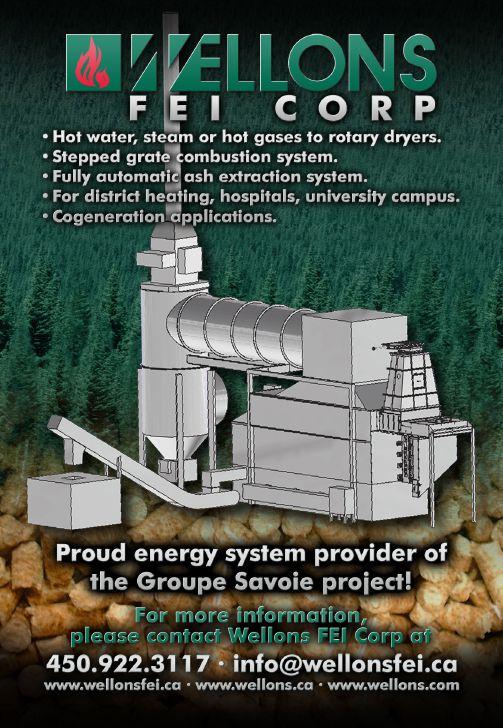
The plant was shut down this past June for the installation of a new Wellons FEI burner, which can generate upwards of 55 million BTUs of heat.
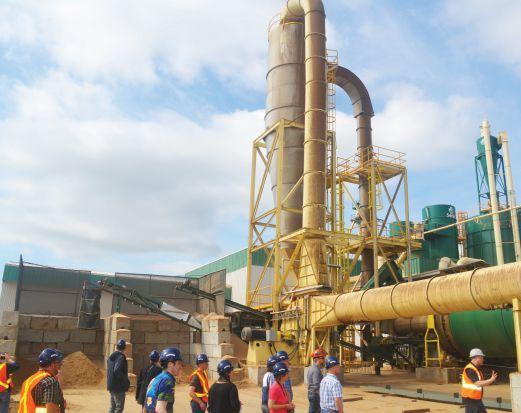
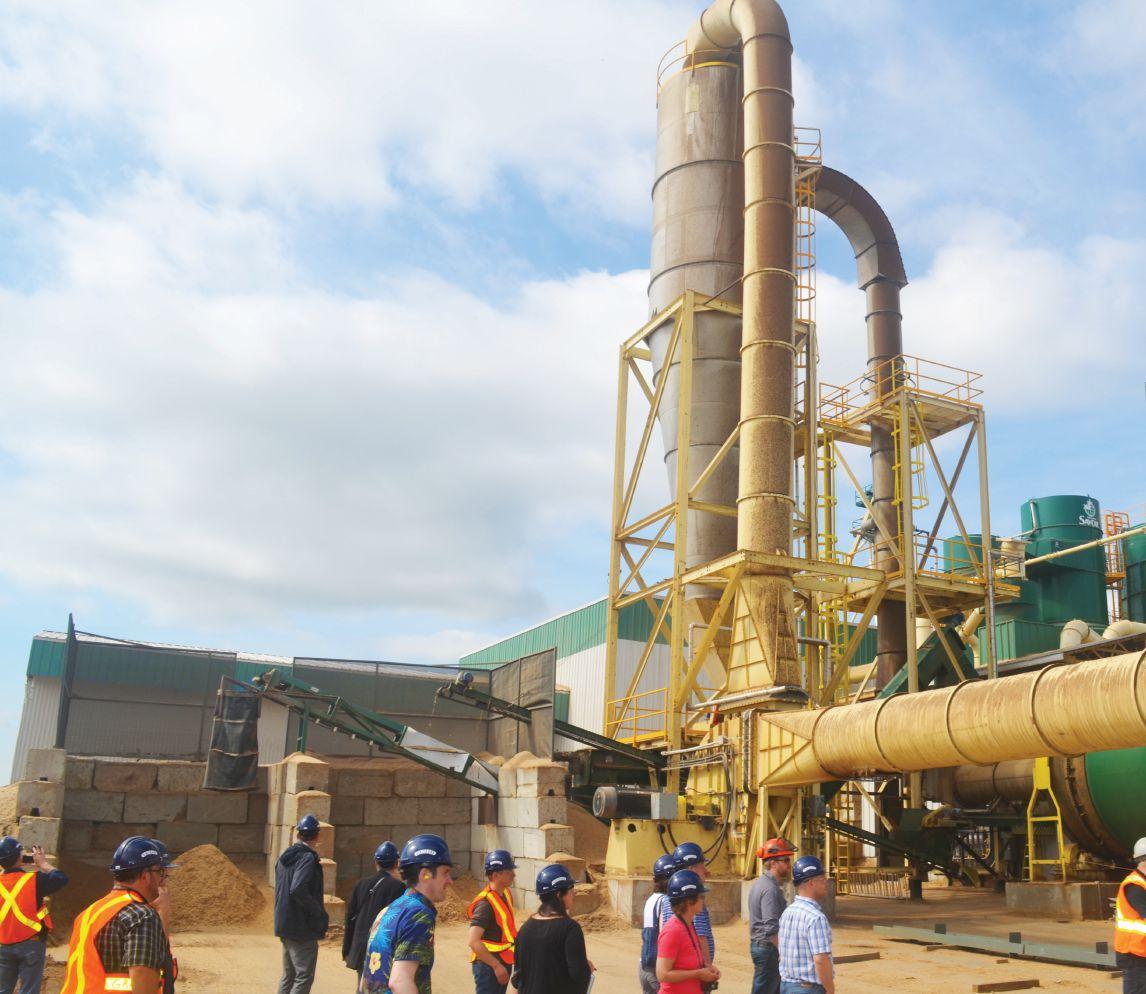
LEFT MAIN: Groupe Savoie’s vice-president of marketing and development, Jonathan Levesque, shows a group of conference attendees around his company’s pellet plant operations in Saint-Quentin, N.B.
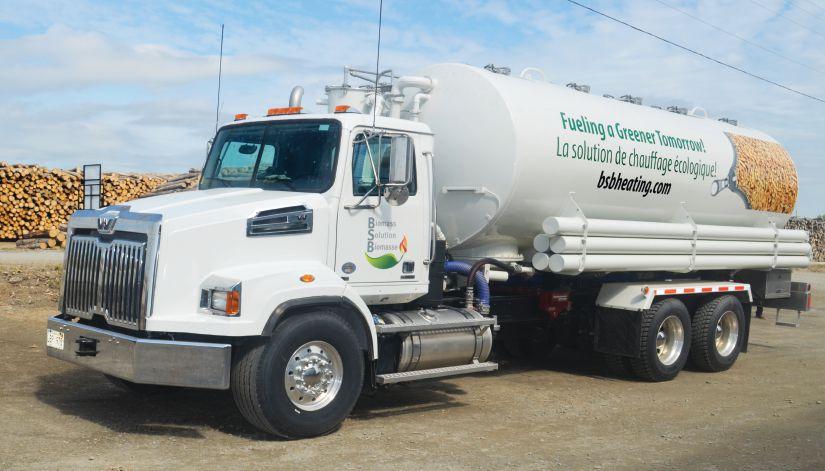
BOTTOM LEFT: To assist with the company’s domestic market, Groupe Savoie invested in a Western Star 15-ton capacity, vacuum delivery truck for delivering pellets across the province.
BOTTOM RIGHT: The plant currently produces 70,000 tonnes of pellets annually for use domestically and overseas with plans to produce an additional 20,000 tonnes.
“Over the years we did some modifications to improve production, and right now the bottleneck of the plant is the burner,” explains Levesque.
PELLET PROCESS
The wet fibre begins its journey from the yard courtesy of either the company’s 644K series John Deere wheel loader, which is dedicated solely to pellet plant operations, or one of the company’s Volvo L90 or L110 series wheel loaders, that are used as backup when the John Deere is up for maintenance or is too swamped to keep up with production. Here, the wood chips are loaded into bins and are sent to one of the plant’s three Wellons FEI walking floors – one for feeding the bark to the burner, one for providing hardwood and another for mixing in small amounts of softwood to aid in binding the hardwood, depending on the grade of pellet being produced.
“That way we can control the mix for whatever is needed for the pellet recipe,” explains Levesque.
A MAJOR PLAYER
Groupe Savoie is a major employer in New Brunswick, employing more than 600 people with the majority of its operations in northern New Brunswick, where it has felling rights over a vast expanse of hardwood forest.
The company’s industrial facilities include two sawmills, a pallet plant, a component plant, a pellet plant and dry kilns in St-Quentin, N.B.; a component plant and a dry kiln in Kedgwick, N.B.; a pallet production and recycling plant in Moncton, N.B.; and a sawmill in Westville, N.S
The biomass from the forest isn’t separated after it is chipped, which can create some challenges.
“This is tricky to pelletize because you don’t know the amount of hard maple, birch and aspen,” says Levesque.
To help with the process, Groupe Savoie keeps track of the recipes it uses
KEEPING ON TRUCKIN’
Another investment the company made recently for its pellet business is the purchase of a Western Star 15-ton capacity, vacuum delivery truck to service its domestic market across the province.
“This is the first real vacuum delivery truck in Canada,” says Levesque. “It’s basically a grain truck to blow grain, but this one is designed to handle pellets more gently.”
The truck features a vacuum system that has neutral pressure when it delivers pellets to silos and hoppers, reducing potential breakage of the wood pellets upon delivery. The truck’s tank system was built in Maine.
“We want to supply customers via a ‘milk run’ style,” says Levesque.
and where the biomass is coming from.
The wood fibres are then sent through an Oliver destoner, and into a screw conveyor to the plant’s MEC dryer. Once in the dryer, the fibre runs the length of the dryer three times for a “triple pass,” then goes into the drying cycle, where the water from the wood is converted into steam
Efficient drying of biomass
Stela low temperature belt dryer
• 93 years of history, 45 years of experience in manufactoring drying plants
• more than 450 belt dryers in more than 60 countries all over the world in the most various sizes
• lowest emissions rates, energy-saving air technology
• dryers for produktion capactiy of 5.500.000 t/a pellets supplied
• no need of wet electrostaticfilters (WESP) to achieve low emisson values
and exhausted out a stack through the use of a fan, while the remaining dry fibre goes into a Schutte Buffalo hammer mill.
“The hammer mill is basically making wood flour, really tiny pieces,” says Levesque. “Ninety-nine per cent is under four millimetres and the majority of it is two millimetres.”
After the wood fibres leave the pellet mill, they are sent to one the plant’s three Andritz pellet presses, which use extrusion wheels that pressurize the fibre into its wood pellet form.
Each press can generate approximately four tonnes per hour.
The pellets are then screened to remove unwanted fines and dust; and are sent to the cooling tower to reduce the chance of pellet breakage during the handling phase. Afterwards, they are sent to the company’s Premier Tech bagging line, where a Fanuc robot stacks the bags of pellets on skids and they are wrapped and ready to be shipped.
In an effort to fill the gap and help avoid future shortages close to home, Groupe Savoie decided to dedicate a percentage of its industrial production to producing more residential grade pellets.
DUST MANAGEMENT
To manage dust in the pellet operation, the company decided to place the hammer mill in a separate building, away from the rest of the operation.
“The risk factor has been put outside,” explains Levesque. “We haven’t had any issues in the past five years. We have a detection system in place.”
Groupe Savoie installed a Flamex spark detection system for its pellet plant operations.
“If there’s a spark, the spray system acts
right away,” says Levesque. “And if the spray system doesn’t extinguish the spark, there’s a deluge on top that will flood the whole system. It may have gone off two or three times in the past five years, but we’ve never had any major issues. A well-designed pellet mill will significantly reduce the risk of a fire.”
With Groupe Savoie doubling its domestic pellet production, the province’s wood pellet-consuming residents will be better prepared to battle the next harsh winter that comes to New Brunswick. No matter what the frigid temperatures might be next year, these residents are likely in for a much more comfortable and warmer winter. •
To learn more about pellet plants in Canada, visit: www.canadianbiomassmagazine.ca
Full of Fibre
Milltown provides fibre for complete supply chain
By Andrew Macklin
Driving
down a bruised and battered logging road shortly after spring weight restrictions had been lifted in Nova Scotia, a peculiar site of stacked logs emerges around the bend. Massive piles of separated logs, each with a different size, shape, species or quality form a long row down the winding road.
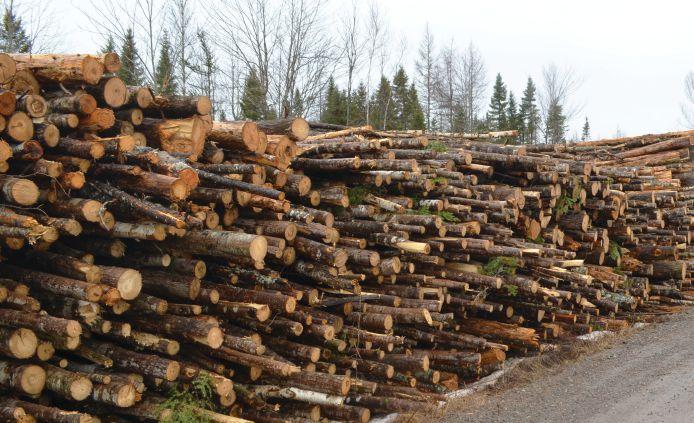
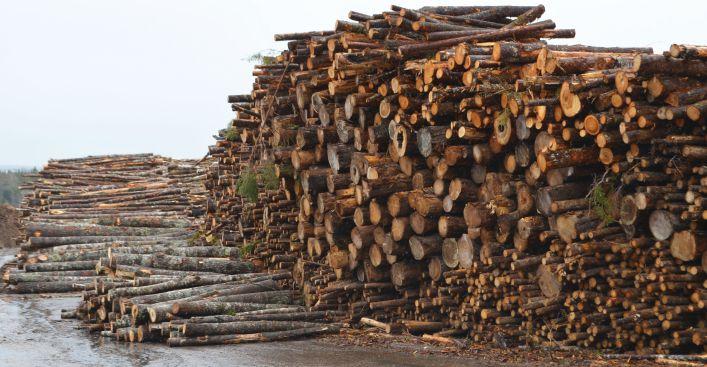
The nine stacks, the results of a selective cutting in the forests east of Stewiacke (65km north of Halifax), represent the different customers that each of the stacks are provided for. The logging trucks for each customer are then able to pull up along the side of the road, load the contents of the stack into the logging truck, and make the journey back to the mill. The lineup on the road includes stacks of hardwood and softwood for area sawmills supplying the Canadian and American lumber markets, as well as biomass operations like the nearby Scotia Atlantic Biomass Plant in Middle Musquodoboit.
For many of the Nova Scotia biomass plants, including the Scotia Atlantic pellet plant and Nova Scotia Power in Port Hawkesbury, one of the forms of biomass being supplied is cut-to-length wood from the forest, which is then chipped onsite.
IN THE WOODS
During the visit to the woods, I caught up with Charlie Baird, a local contractor for Milltown Forestry Services who, along with his team, was working on a tract of land in need of selective cutting. Despite being well into the spring months in Nova Scotia, the snow in the forest was still knee-high in some spots, the harsh reminder of one of the worst winters on record in the province, one that forced Baird and his team to spend most of the winter digging the harvester into the snow and cutting blind based on constant variations in the deep snow.
Selective cutting in the forests east of Stewiacke, N.S. includes cutting wood for lumber production, pulp and paper and pellet production.
Your global equipment supplier for the biomass industry
ANDRITZ is one of the world’s leading suppliers of technologies, systems, and services relating to equipment for the biomass pelleting industry. We offer single machines for the production of solid and liquid biofuel and waste pellets. We have the ability to manufacture and supply each and every key processing machine in the pellet production line.
The area in question had been hit hard by Hurricane Juan, which ran ashore in Nova Scotia as a Class 2 hurricane in late September of 2003.
Baird talked about the forest in question, which was riddled with dead fir and biomass wood. The team was removing those stems from the property, along with other trees as part of the selective cut, primarily leaving the hardwood to continue to grow.
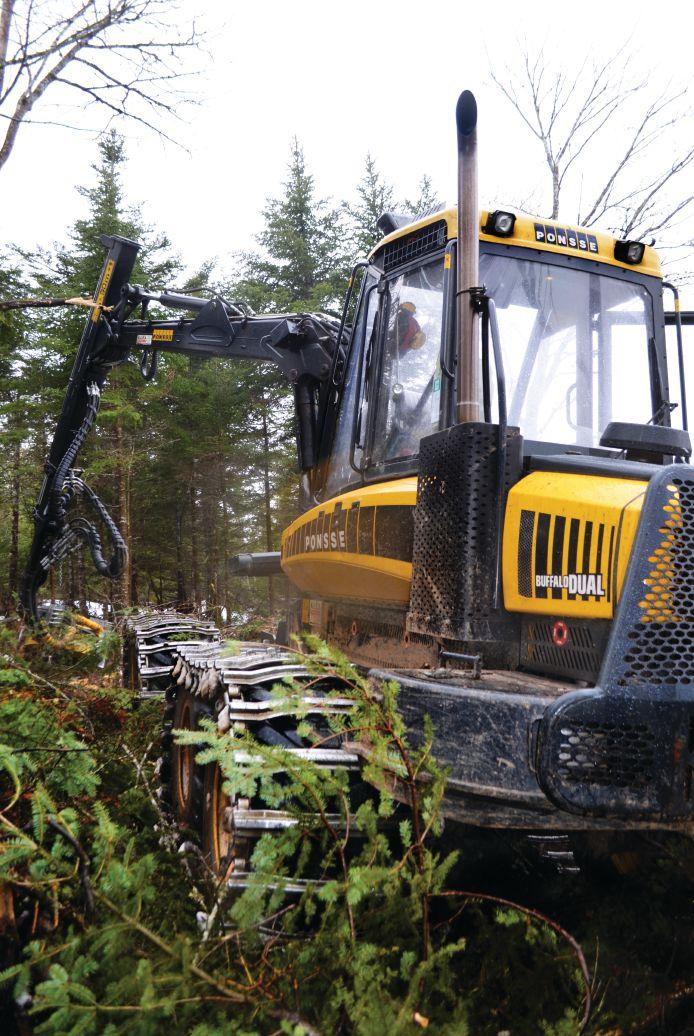
Selective thinning takes efficient equipment, which is exactly the reason why Baird invested in a Ponsse BuffaloDual when he needed to purchase a new harvester recently. Supplied by ALPA Equipment, the BuffaloDual is a harwarder, a unique combination of harvester and forwarder in a single unit. The harvester converts to a forwarder by putting a rack on the back of the machine, which allows guys like Baird to cut the wood and move the stack to the roadside without needing a second machine.
That flexibility helps Baird and his team build the separate stacks on the roadside as harvesting continues in the forest, which build in another layer of efficiency when removing stems for so many different end users. For an operation that cuts close to an equal supply of stud, pulp and biomass logs in the forest in its thinning operations, those efficiencies have a significant impact.
But the price being paid for fibre didn’t seem to be the biggest issue hampering Baird’s work. “Our biggest issue is keeping wood moving,” Baird said. “April weight restrictions are hurting the operations. They’re not high enough.”
Weight restrictions cut the flow of wood, both for lumber producers and biomass operations, for up to two months in the province. According to the province’s website, the axle weight restrictions are:
(a)Maximum single axle weight of 6,500 kg except single-drive school and passenger buses, public utility service trucks and fire-fighting trucks;
(b)Maximum tandem or triple axle weight of 12,000 kg per axle grouping;
(c)Maximum tridem or tridem equivalent axle weight of 18,000 kg per axle grouping;
(d)Maximum gross vehicle weight of 12,000 kg for single-drive school and passenger buses, public utility service trucks and fire-fighting trucks that exceed 6,500 kg on a single axle
ANDRITZ Feed & Biofuel A/S Europe, Asia, and South America: andritz-fb@andritz.com USA and Canada: andritz-fb.us@andritz.com
www.andritz.com
And the bottom line is difficult in thinning operations, especially ones that include the lower value pulp and biomass logs. In Nova Scotia, stud logs are sold to the mill for as much as three times more than the stems being sent to biomass operations. When asked, Baird called the pricing “bearable” considering the cost of doing business.
Those restrictions are put into place in early-to-mid March, and run for eight-week periods that can end in the latter part of May in some cases. The roads in Nova Scotia are not built to handle the load of filled logging trucks during the spring thaw, when roads are filled with so much moisture that they take on material properties that more resemble sponges than roadways.
But as the winters get harsher, the margins get thinner, and the cuts more selective, harvesters like Baird will continue to fight the elements, and the regulations, to try to make sure the fibre from the forest hits the road to the right customers.
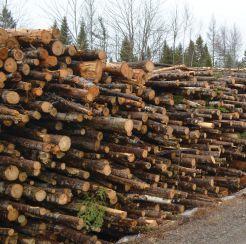
On the side of the road, the logs have been stacked by the end user, with stud, pulp and biomass logs all divided into separate files.
Green Energy
Prince George goes green with biomass-fuelled DES
By Andrew Snook
TheCity of Prince George is helping clear the air in the city with help from its biomass-fuelled district energy system (DES), originally thought up in 2000 and eventually fully commissioned in 2012.
The DES, fuelled mainly by existing sawmill residues from the Lakeland Mills sawmill, generates hot water used for domestic hot water and space heating in several of the larger buildings in the city’s downtown, including the Prince George Civic Centre, City Hall, Prince George Coliseum community arena, Four Seasons Leisure Pool, Prince George Public Library, Two Rivers Art Gallery, RCMP building and the Wood Innovation and Design Centre.
Approximately 96 per cent of the total energy used in the DES system is supplied by waste heat generated by burning hog fuel from Lakeland Mills, with the remaining power coming from two 2.5MW natural gas back-up boilers that are used when the mill shuts down for maintenance, or if the system requires additional heat during harsh winter months.
“Currently, we have a 5MW capacity for thermal energy,” says Todd Angus, engineering assistant, Utility Plants, with the City of Prince George. “On the coldest days this past winter, we never went above needing more than 2MW, so we’ve got plenty of capacity.
The DES displaces 36,400GJ per year of natural gas previously being burned in the buildings’ individual boilers, which corresponds to a reduction in carbon dioxide emissions of 1,820 tonnes of CO2 emissions per year, according to Angus.
In addition to the direct savings generated by the DES, Lakeland Mills now no longer needs to haul a large portion of its biomass from its River Road location to offsite locations. As a result, truck traffic was reduced by approximately 45,000
kilometres per year, resulting in approximately 70 tonnes per year in particulate matter reductions.
“Overall, it’s a much more efficient and sustainable solution,” says Greg Stewart, president of Sinclar Group Forest Products.
The total cost of the project was just approximately $15.5 million. Over $10 million of the costs were funded by a variety of grants, including the Municipal Rural Infrastructure Fund Grant ($5.33 million); Green Municipal Fund ($800,000); and the FCM Grant Community Works Fund – Gas Tax Grant ($5.36 million). The remaining funds required were borrowed by the City of Prince George.
HOW IT WORKS
After the residuals are collected through various points of the sawmill operations at Lakeland Mills, the hog fuel is fed into the mill’s energy system. This part of the process has been done for decades at the
The new addition is that the hot oil from the original energy system and heat from an electrostatic precipitator (ESP) –installed to capture the heat created from the flue gas and reduce particulate emissions – now transfers to a glycol loop that travels along a pipe bridge to Lakeland’s energy transfer system (ETS) building. This building is equipped with glycol-tohot water heat exchangers and metering to provide the heat energy required by the DES. The system then transfers thermal energy to the buildings’ space heating and domestic hot water systems through the use of each building’s energy transfer station (ETS).
The system design for the DES was created by the city with help from FVB Energy Inc.’s Vancouver office.
The City of Prince George installed approximately 5,350 metres of
mill to heat the kilns and the sawmill itself.
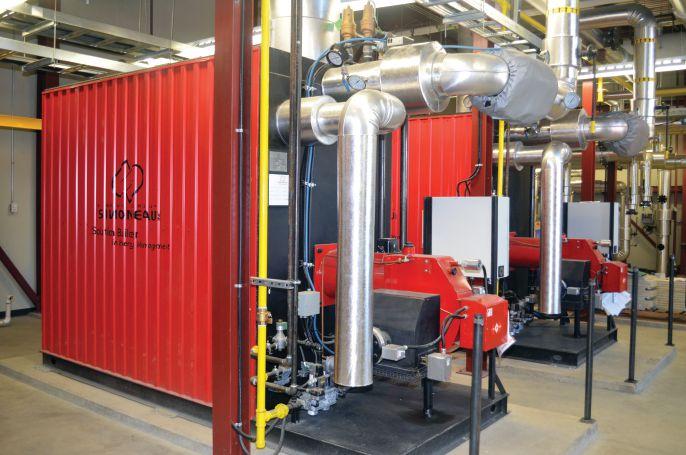
The DES system’s backup boilers are fuelled by natural gas and are designed to only turn on to top up the hot water coming from Lakeland Mills during the coldest winter weather or during routine maintenance. They have a combined capacity of 5-MW.
underground supply and return insulated steel hot water pipe – at an average depth of 1.25 metres – connecting Lakeland Mills to the downtown buildings that are hooked up to the DES system. The return pipe carries cooler water back to the Lakeland DES Interface or ETS.
“Lakeland is sending us anywhere from 90°C to 105°C hot water that goes into the system,” says Angus.
Water that enters the backup plant from Lakeland is fed through two 50 HP Bell & Gossett base mounted end suction pumps controlled by a variable frequency drive that sends hot water over to the eight buildings currently hooked up to the DES – with one pipe feeding hot water to the eight buildings and another pipe returning hot water returning to Lakeland Mills.
“There’s a loop from Lakeland to the Peaking Back-up Centre, and then a loop out to the buildings,” explains Angus. “At each building there are two heat exchangers at the energy transfer stations. Most buildings have space heating and a domestic hot water system. The Coliseum, which is an arena, doesn’t need space heating so it’s only domestic hot water; and the library only uses the DES for space heating, since it has on-site domestic hot water.”
The ESP that was installed at Lakeland allows the mill to meet a contractual emission guarantee of 20 mg/nm3 at eight per cent O2 during the life of the heat supply agreement.
To ensure everything runs smoothly, a software program was created that allows
maintenance staff to observe all the points in the DES, including the back-up plant, Lakeland Mills and all eight customers.
SAVING THE SUPPLY LINE
When the tragic accident occurred that destroyed the mill in the spring of 2012, Lakeland Mills was forced to outsource the sawmill residuals required to run the DES. Luckily, they were able to find a partner willing to do an equivalent fibre swap fast enough that the DES was not functionally affected by the tragedy.
“We were very fortunate we partnered with Canfor,” says Stewart, “When the mill went down, Canfor stepped in and provided the hog fuel.”
BIGGEST CHALLENGE
Stewart says that on the implementation end of the operation, the only new technology added to mill’s system was the ESP – and that install went quite smooth.
He says the real challenge is about trying to understand the objectives of your partners and making sure all parties have the right terms and an understanding.
“We have one objective as a business and they have another as a city,” says Stewart.
Stewart believes partnerships like the one that exists between the City of Prince George and Lakeland Mills can definitely be worthwhile.
“From my perspective it’s been a great partnership with the city,” he says. “It’s a project I would encourage other companies to look at.” •
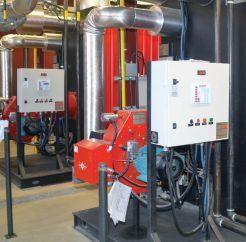
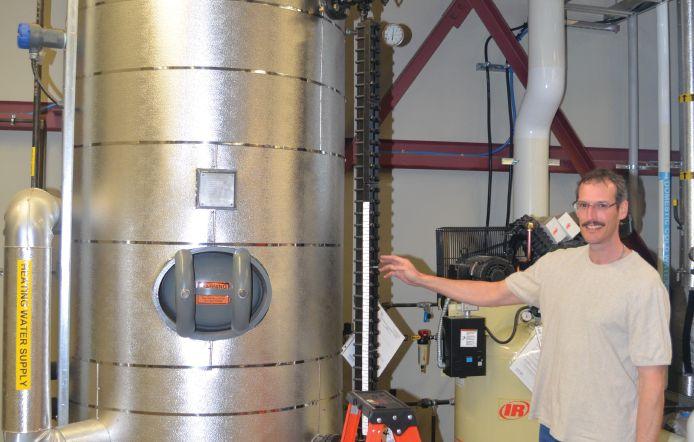
Todd Angus, engineering assistant for the Utility Plants department of the City of Prince George points out a pressure vessel at the Peaking Backup Energy Centre, used to regulate system pressure between 50-55 psi.
Biomass Producers: Bandit Builds Your Bottom Line.
MultipleChip SizeOptions
Biomass use r s requi r e a variety of produ c t sizes . That ’s w h y Ban d it ’s larger eq u ipment easily produ ce s th e sized p r od u ct to b est fit y our spe c ifi c market , from ¼ - inch chi p s t o 2 - inc h chips .
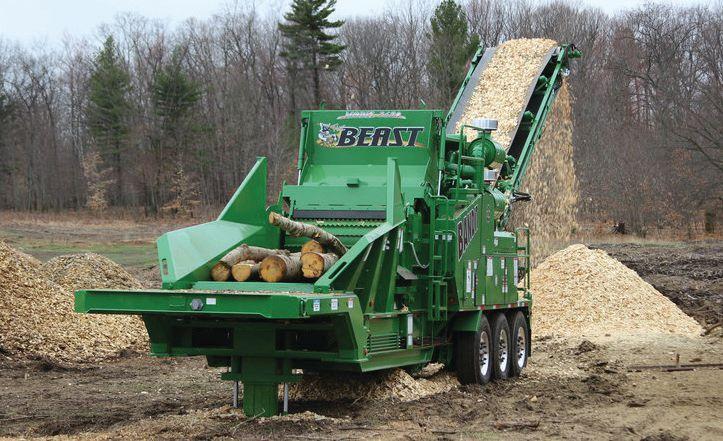
Man y Beast® recyclers from Bandit are alread y producing desirable, profitable biomass fuel from wood and agricultural waste all over the world We kno w size and quality of the end product is critical That’s why we offer man y setup options for your Beast to produce the product you need With four models to choose from, portable or sta tionary, you can find a Beast to fit your a pplication.
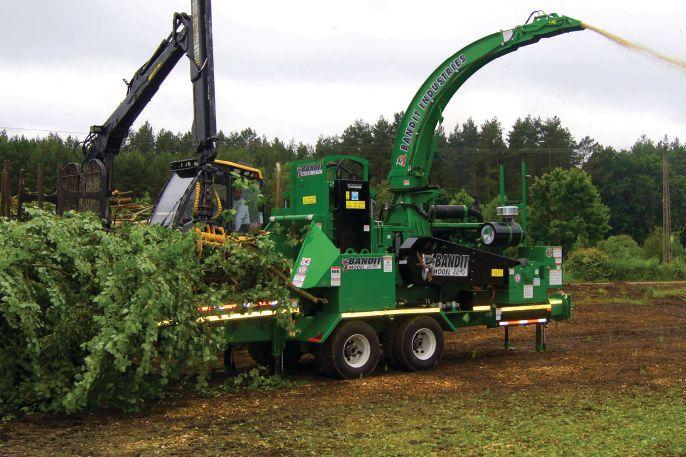
Bandit whole tree chippers produce the highest quality chips with the best fuel economy in the industry, a veraging 3 tons of chips per gallon of fuel. And with Bandit’s new Clean Feed System you can increase your yield by up to 5 percent while elimina ting the mess belo w the infeed. Choose from six portable models, from 22-inch to 36-inch diameter ca pacities.
Pellet Gear BUYERS’ GUIDE 2015
Welcome to the Canadian Biomass Pellet Gear Buyers Guide
The following information has been compiled to provide readers interested in developing or updating a wood pellet manufacturing facility with a reference tool of the major manufacturers and service providers for this industry in Canada. From fibre to pellet, the listing is a comprehensive source for equipment involved in the
pelletizing process.
The Canadian Biomass Pellet Gear Buyers Guide is organized into two sections. The first section is an alphabetical listing of companies that provide the relevant products or services for each of the following categories: dryers, pneumatic conveying, hammermills, pellet mills, screens
and coolers, fire/spark detection and suppression technology, bagging and palletizing, dies and rolls, quality control equipment and services, building contractors and engineering firms and Canadian ports for pellet exports. The second section is an alphabetical listing of all the companies, with contact information for each.
Looking for ways to optimize your pellet plant operations? Well, look no further!
Canadian Biomass Magazine has teamed with FutureMetrics president William Strauss and world leading expert in pellet plant operations John Swaan to bring you a webinar focused on optimizing production at pellet plants through the use of audits.
Strauss and Swaan will take you through a virtual tour of a pellet production facility with comments at each stage in the process about typical operational and safety issues that result in higher costs and lower output.
FutureMetrics operations audit/analysis is based on a visit, where company experts spend two to three day on site. They do a complete front to back walk through and interview operators and managers; and review the process flow, the equipment and layout, and provide detailed reports with recommendations for improving safety, productivity and profit margins.
Gain insight into the advantages of pellet plant audits and enjoy a Q&A with industry experts. And all of this for only $25!
Plants
John Swaan
Atlantic Biorefinery Conference
Tours, discussions headline annual conference
By Andrew Snook
Technology
tours were the highlight for many of the 120 people who registered to take part in the first-ever Atlantic Biorefinery Conference, which took place from May 27 to 29 in Edmundston, N.B.
Attendees were treated to tours of bioproduct producing facilities, including a tour by Groupe Savoie, a major employer in northern New Brunswick.
Groupe Savoie employs more than 600 people with the majority of its operations in northern New Brunswick, where it has felling rights over a vast expanse
of hardwood forest. The company’s industrial facilities include two sawmills, a pallet plant, a component plant, a pellet plant and dry kilns in Saint-Quentin, N.B.; a component plant and a dry kiln in Kedgwick, N.B.; a pallet production and recycling plant in Moncton, N.B.; and a sawmill in Westville, N.S.
The company’s tour consisted of its CHEP pallet manufacturing facility and its pellet plant operations in Saint-Quentin, N.B.
Groupe Savoie began its pellet production in 2010, producing 42,000 tonnes of pellets per year, with the majority being shipped to the U.K. for
industrial purposes. The company currently produces 70,000 tonnes of pellets annually for use domestically and overseas, and plans to produce an additional 20,000 tonnes, or more, after the plant completes the installation of its new burner.
Groupe Savoie recently decided to double its domestic pellet plant production and offer a fifty-fifty split between domestic pellets for residential use and exported products for industrial applications, and shut down the pellet plant in June so it could install a new burner to reduce a bottleneck in the production process, according to Jonathan
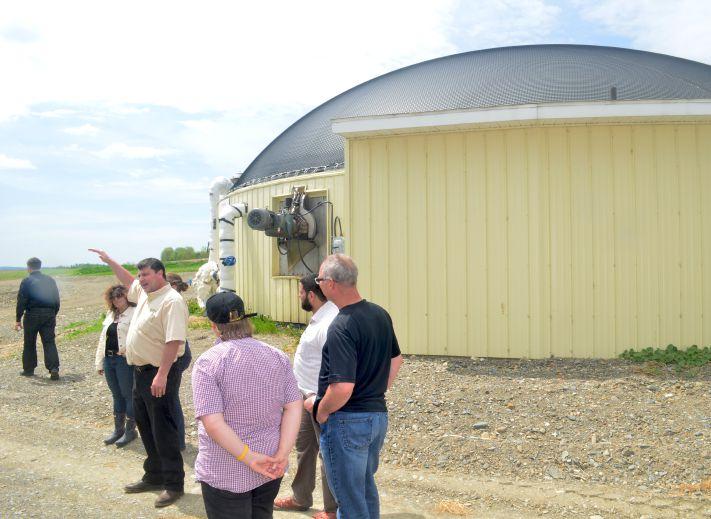
LaForge Bioenvironmental’s 1.6 MWh anaerobic digester operates on a dairy farm with approximately 90 cows, and is fuelled by a combination of cow manure and organic waste from regional food processors converting it to electrical energy, heat and liquid organic fertilizer.
Levesque, the company’s vice-president of marketing and development.
The company’s decision to increase domestic production stemmed from a shortage of available wood pellets for domestic heating last winter. To assist in the domestic side of the business, the company also invested in a vacuum delivery truck.
Another stop during the technology tours was in Saint-André, N.B., where attendees were able to tour LaForge Bioenvironmental’s commercial biogas production plant.
The facility operates a 1.6 MWh anaerobic digester on a dairy farm with approximately 90 cows, and is fuelled by a combination of cow manure and organic waste from regional food processors converting it to electrical energy, heat and liquid organic fertilizer.
Attendees also got to listen to a variety of presentations during the conference from professionals within the biomass industry, including how to become eligible for the Scientific Research and Experimental Development program, a federal tax incentive program for research and development in Canada that will lead to new, improved or technologically advanced products or processes.
A Canadian-controlled private corpo-
ration can earn refundable investment tax credits of 35 per cent, up to the first $2 million of qualified expenditures for SR&ED carried out in Canada, and 20 per cent on any excess amount, according to the “Opportunities New Brunswick” section of province’s website.
The topic was presented by Remi Fortin of Raymond Chabot Grant Thornton, an accounting firm out of Que.
Fortin explained that there are five criteria that must be met to become eligible for the SR&ED program. The criteria are:
• Was there a scientific or a technological uncertainty – an uncertainty that could not be removed by standard practice?
• Did the effort involve formulating hypotheses specifically aimed at reducing or eliminating that uncertainty?
• Was the adopted procedure consistent with the total discipline of the scientific method, including formulating, testing, and modifying the hypothesis?
• Did the process result in a scientific or a technological advancement?
• Was a record of the hypotheses tested and the results kept as the work progressed?
Other highlights from the conference included tabletop exhibits, poster abstracts and an industry-research connector social event. •
Complete Senergy Systems’ Kevin Shiell discusses LaForge Bioenvironmental’s 1.6 MWh anaerobic digester with a group of conference attendees during one of the technology tours.
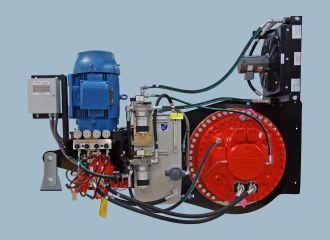
BOSCH REXROTH HYDRAULIC DRIVE SYSTEM
The Hägglunds TADS hydraulic drive system from Bosch Rexroth is a powerful, self-contained drive package for applications and systems where space is limited.
The Hägglunds TADS is a completely self-contained, easy-toinstall system and comes with either internal splines or a hollow output shaft with a compression coupling that easily mounts directly to a machine’s drive shaft. Flexible shaft couplings and associated alignment problems, extra long hoses or lines, and control lines between conventional power unit and motor are eliminated.
Small footprint
Hägglunds’ way of using hydraulics to produce rotation delivers a number of benefits. For example, our direct drive system eliminates gearboxes and the need for heavy pedestal foundations, which shrinks installation costs and saves valuable floor space.
Easy to service
The compact open design affords easy access for routine maintenance.
Power when needed
TADS delivers maximum torque from zero speed with infinite start, stop and reverse, which will not damage the system. This feature can add an all-new level of productivity for some applications, in particular apron feeders, belt feeders, belt conveyors, and infeed conveyors in the bulk material handing industry.
The Hägglunds TADS unit features extremely fast hydraulic pump compensators that can reduce the wear and lengthen the life of any machine. Load-sensing and power-limiting tools enable operators to intelligently sustain peak levels of operation that outperform other systems–boosting machine uptime and helping reduce total cost of ownership.
April 11-14, 2016 • International Biomass Conference & Expo Charlotte, N.C. biomassconference.com
May 24-26, 2016 • International Wood Biorefining Week Stockholm, Sweden svebio.se
For full event listing, visit www.canadianbiomass.ca
Forest fire fuel
Can forest fires fuel the pellet industry?
By Nicolas Mansuy, Biomass Analyst - Natural Resources Canada
While Western Canada is an international leader in exporting wood pellet to the Europe market, Eastern Canada remains a minor player despite its abundance of wood residues from natural disturbances. Like the vast areas of forest killed by the mountain pine beetle outbreak in British Columbia, cohorts of dead trees left standing after severe wildfires may offer a great opportunity to develop the pellet industry in Eastern Canada. Although disturbed forests testify to
ecological, and economic constraints.
Despite the high spatial and temporal variability of burned area, this study highlights the large quantities of biomass from fire-killed stands available as ecologically sustainable feedstock for pellet production. Between 2002 and 2011, the average annual amount of biomass available from fire-killed stands was estimated up to 750,000 ODT/year (calculated by harvesting the stem only), which is eight times higher than the amount available from harvesting residues (branches only), with around 90,000 ODT/ year estimated for the same period.
This type of feedstock was seen as a promising resource for the deployment of bioenergy at the global scale over the next 50 years.
the extent of nature’s strength, they also prompt the question as to whether forest waste can be transformed into something valuable for society.
In this new study published in the journal Applied Energy, my research investigates the potential amount of biomass from salvage logging of fire-killed stands along with harvesting residues from clearcut to supply pellet plants in Eastern Canada (North Shore Area in the province of Quebec). This region has been particularly chosen given its large amounts of under-exploited biomass, and also because of open ports on the Atlantic, which offer shorter transportation distances to Europe (6,000 km versus 16,000 from Vancouver). Various supply scenarios were optimized to fulfill different pellet plant capacities under various operational,
In our optimized scenarios, we showed that under current market conditions (wood chips fixed at $90/ODT), biomass both from harvest residues and fire-killed stands could fulfill on average between five per cent and 66 per cent of a 50,000 ODT/ year plant. With a wood chip price at $120/ODT, 100 per cent of the production capacity of a 50,000 ODT /year plant and a 100,000 ODT/ year plant could be met. In the same optimist scenario 83 per cent of the production capacity of a 300,000 ODT/ year plant could be met (more scenarios are available in the paper).
Ecological constraints related to the need to protect sensitive sites and prevent recovery operations on them, and operational constraints related to the capacity of the machinery to recover biomass from a given site, have little impact on the supply of biomass from fire-killed stands. However, important regional variations exist in
terms of potentials and constraints, which would need to be taken into account when designing bioenergy industrial networks.
Pellet production based on feedstock from naturally (and then randomly) disturbed stands could make supply chains more risky in terms of long term stability and logistics, compared with intensive silviculture, for instance. One option when dealing with uncertainty and risks for potential supply breakdowns is to develop flexible integrated supply chains that could rely on multiple feedstock sources, where traditional forest products and waste streams are integrated to optimize biomass flow and uses.
While climate change is predicted to increase the occurrence of natural disturbances in the boreal forest biomes and the resulting standing deadwood, the Intergovernmental Panel on Climate Change (IPCC) stated recently that this type of feedstock was seen as a promising resource for the deployment of bioenergy at the global scale over the next 50 years.
As European countries are becoming more severe regarding the ecological sustainability of biomass harvesting, Canada has strong opportunities in optimizing the supply chains of this under-utilized feedstock and becoming a leader in the green economy. •
The information presented is from Sustainable biomass supply chains from salvage logging of fire-killed stands: A case study for wood pellet production in Eastern Canada, which originally appeared in the journal Applied Energy. The research was a collaborative effort between researchers at Natural Resources Canada and the FORAC research consortium at Laval University. For more information, email Nicolas.Mansuy@rncan-nrcan.gc.ca
Maximize Profits with the Morbark® MicroChipper
95% ½" Minus
Create micro-chips vital to the pellet mill market with the Morbark ® Whole Tree MicroChipper.
• Productive – Morbark’s exclusive enhanced Advantage 3™ drum creates uniform micro-chips, while the mechanically driven chip accelerator fully loads your truck.
• Practical – The operator-friendly, slide-in forestry grate system reduces oversized chips for a consistent, high-quality end product.
• Profitable – With high production of micro-chips per gallon of fuel used, the Morbark 40/36 MicroChipper allows you to reduce costs and maximize profits.
The Morbark ® MicroChipper is a new addition to our full line of heavy-duty Whole Tree Chippers from the leader in the industry. Learn more about our machines and our extensive product support network at www.morbark.com .
In customer tests, up to 95% of the micro-chips produced passed through a ½" grate, and an average of 65% passed through a ¼" grate.