










Firefighters honed their aircraft rescue skills at special training day P.7


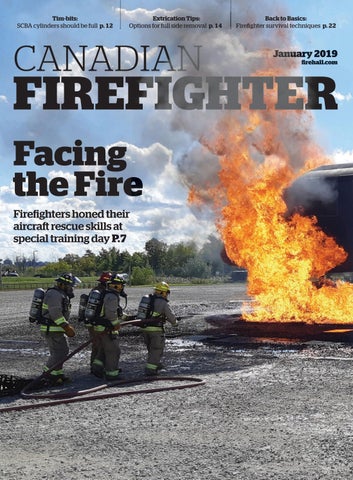
Firefighters honed their aircraft rescue skills at special training day P.7


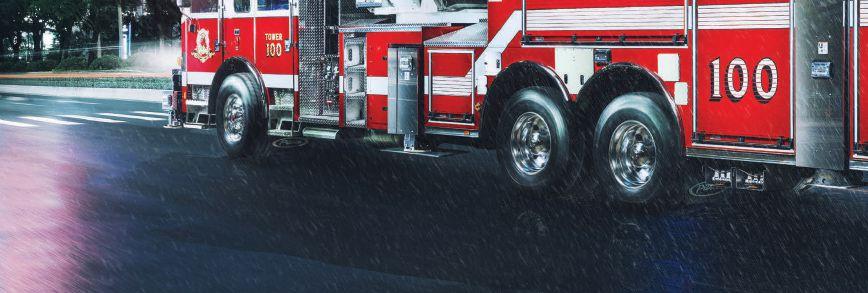

Up to 20 ° below grade operation with a 50° scrub area at a mere 20’ set-back from the building

Short rear overhang minimizes tail swing
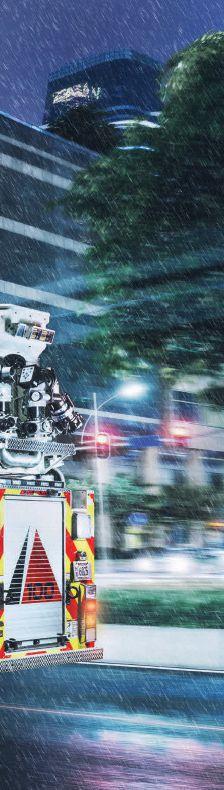
Overall length of only 41’3”










04 | From the editor
Learning the ropes
20 | Between alarms
Compassion fatigue often goes unrecognized
26 | Fit for duty
How strong should you be?
27 | Front Seat
Questions are key to learning
28 | Dispatches
Rekindling the spark

By Grant Cameron
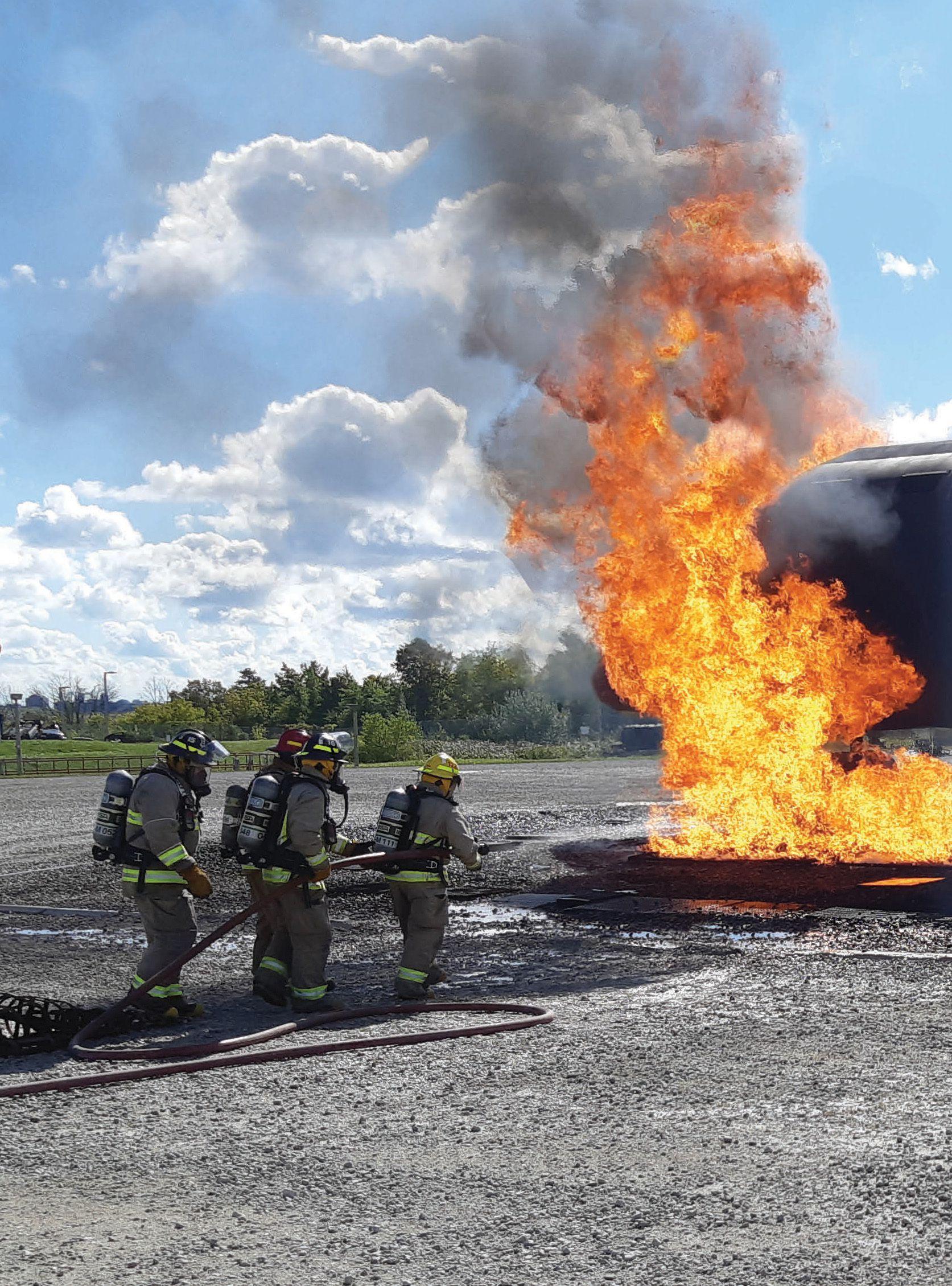
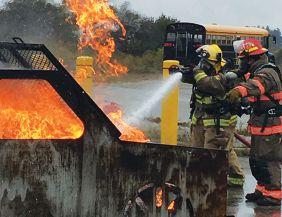
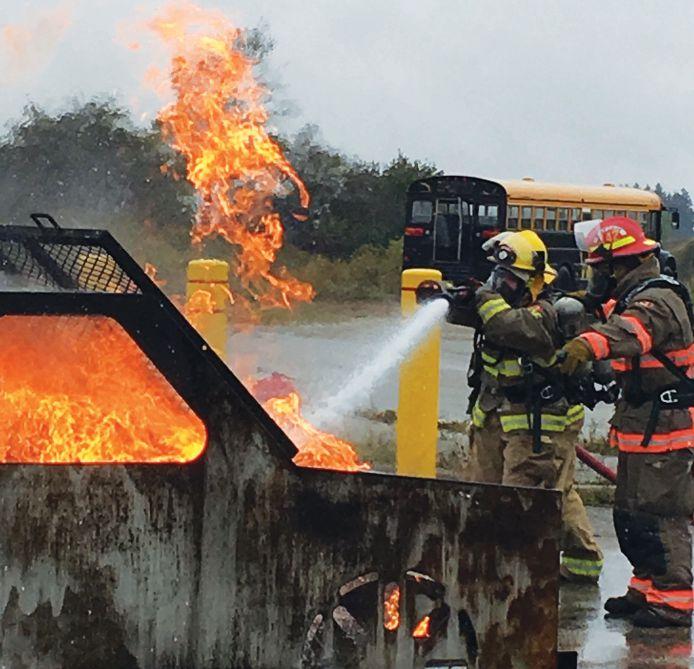
We watch, a group of us, as four firefighters in full turnout gear and self-contained breathing apparatus pull a single line towards a bright orange and yellow inferno just a few metres away.
The fire is licking at the cockpit of a burned and very blackened aircraft fuselage on the ground.
The firefighters move in unison, slowly and cautiously. They open the nozzle and point it at the ball of fire. Seconds later, the blaze is under control.
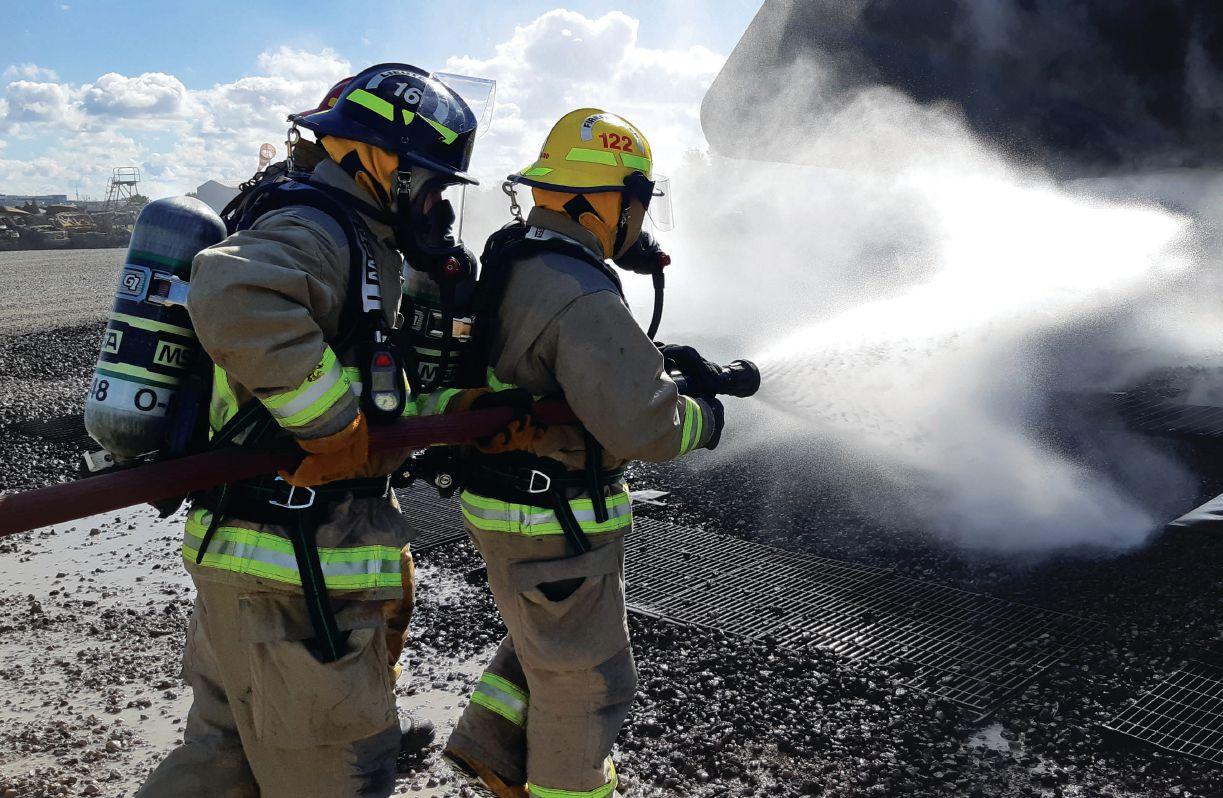
The scene was all part of a mock disaster exercise that was staged at a Firefighter Training Day and Career Expo a few months back at the Fire & Emergency Services Training Institute (FESTI) in Mississauga, Ont.
The event was presented by Canadian Firefighter magazine. We have a story and photos on pages 7 to 9.
Firefighters from across Ontario and some from Quebec attended the Training Day, including Jason Clark, a captain and volunteer firefighter who writes our Front Seat column for Canadian Firefighter.
I had plenty of opportunity to wander the grounds of the sprawling FESTI campus, adjacent to Pearson International Airport, and see firefighters training in various scenarios.
The aircraft fire and rescue
scenario was a highlight of the day. It gave firefighters an opportunity to find out what it’s like under such circumstances.
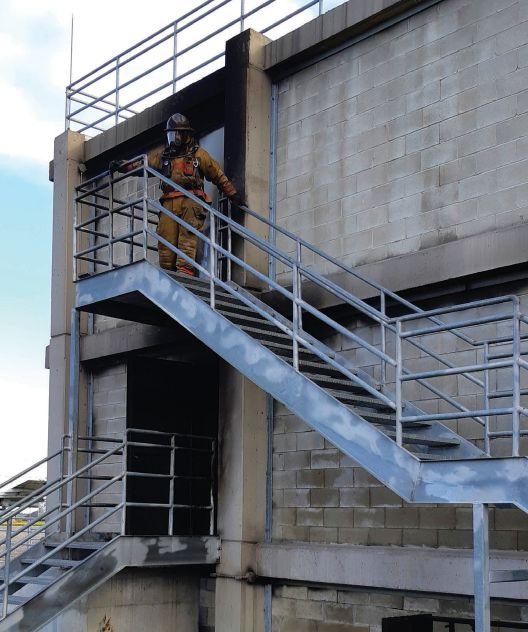
In another area, firefighters practised live-fire search-andrescue techniques inside a smokehouse while other groups worked on auto extrication and forcible entry p rocedures. It was deadly serious business.
The firefighters were atten-
“At the Career Expo, prospective firefighters were given an inside look at the fire service, from those in the know.”
tive. They were involved. They were engaged.
They participated. They asked questions. Above all, they learned.
Each firefighter had signed up for specific hands-on training, intending to acquire new skills or, alternately, hone their expertise in a specific area.
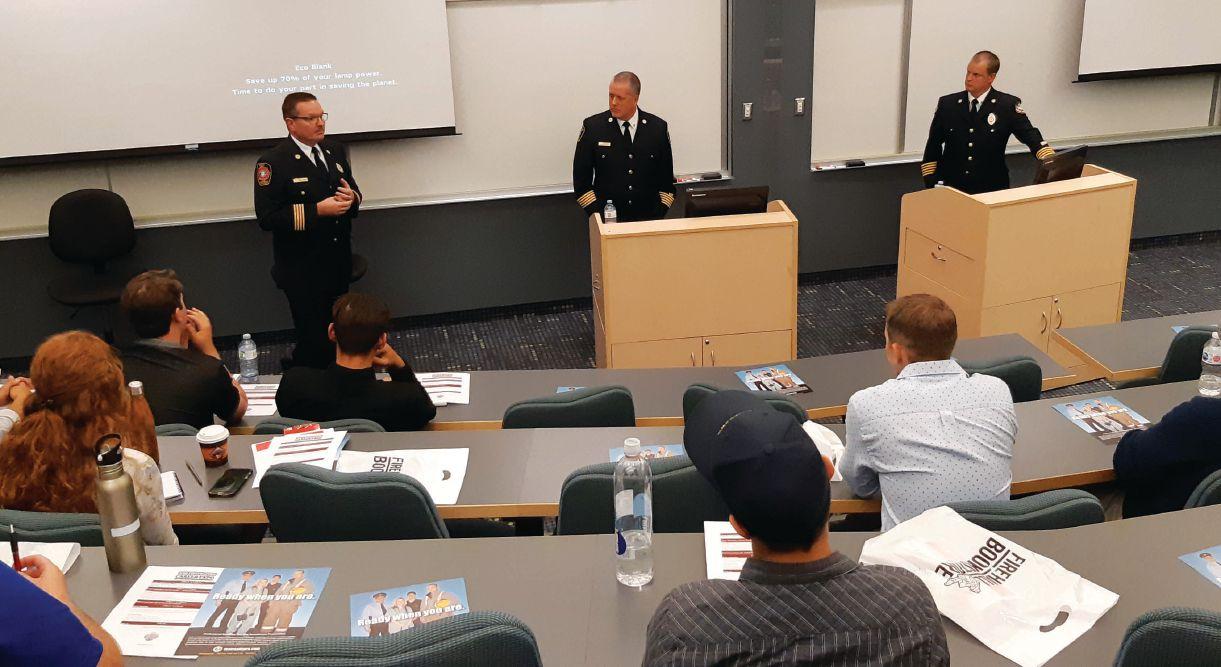
Inside, at the Career Expo, prospective firefighters were given an inside look at the fire service from those in the know.
They learned how to go about seeking a job as a firefighter, what skills fire chiefs ar e looking for, what’s required once they’re on board and how to move up the ranks.
Special thanks go to On -
tario Association of Fire Chiefs executive director Richard Boyes, FESTI Deputy Fire Chief Dave Lane, Cambridge Fire Department Chief Neil Main, Milton Fire Department Chief Dave Pratt and firefighter Kory Pearn of St. Thomas, for helping out at the Career Expo.
Highlight of the Career Expo, in my opinion, were mock interviews conducted by Lane, Main and Pratt. A few brave souls stepped forward to be interviewed in front of the class and, afterwards, were offered some guidance.
The sessions were a great learning experience for potential recruits, giving them a taste of how they should conduct themselves and what it will be like when they get to the interview stage.
As an added bonus, those at the Career Expo were able to mingle with firefighters during their lunch break and learn more about the industry.
As we know, firefighting is one of the most challenging, fast-paced, rewarding professions around. We also know it’s a highly competitive field, with thousands applying for jobs every year.
Standing out from the crowd isn’t easy. The Career Expo, however, certainly gave prospects a leg up.

January 2019 Vol. 42, No. 1 cdnfirefighter.com
EDITOR
Grant Cameron gcameron@annexbusinessmedia. com 416-522-1595
ASSOCIATE EDITOR Jayson Koblun jkoblun@annexbusinessmedia.com 519-410-0600
ASSOCIATE PUBLISHER Adam Szpakowski aszpakowski@annexbusinessmedia. com 289-221-6605
ACCOUNT COORDINATOR Wendy Serrao wserrao@annexbusinessmedia.com 416-510-5232
CIRCULATION MANAGER Beata Olechnowicz bolechnowicz@annexbusinessmedia.com
MEDIA DESIGNER Alison Keba
GROUP PUBLISHER Martin McAnulty fire@annexbusinessmedia.com
PRESIDENT & CEO Mike Fredericks
MAILING ADDRESS
P.O. Box 530, 105 Donly Dr. S., Simcoe, ON N3Y 4N5
SUBSCRIPTION RATES
For a 1 year subscription (4 issues: January, April, July and October):
Canada — 1 Year $14.00 + tax
2 Year $22.00 + tax
3 Year $39.00 + tax
GST # 867172652RT0001)
USA — $24.50 USD Foreign — $30.00 USD
CIRCULATION lmalicdem@annexbusinessmedia.com Tel: 416-510-5187
Fax: 416-510-6875 or 416-442-2191 111 Gordon Baker Rd., Suite 400, Toronto, ON, M2H 3R1
ANNEX PRIVACY OFFICER
Privacy@annexbusinessmedia.com
Tel: 800-668-2374
ISSN 1488 0865
PM 40065710
Occasionally, Canadian Firefighter will mail information on behalf of industry-related groups whose products and services we believe may be of interest to you. If you prefer not to receive this information, please contact our circulation department in any of the four ways listed above.





The Ontario Association of Fire Chiefs (OAFC) is applauding the provincial government for passing legislation that will allow full-time firefighters to volunteer as firefighters in their communities.
Bill 57 amends the Fire Protection and Prevention Act to, among other things, enhance protections for volunteer firefighters engaged in double-hatting and address collective bargaining and interest arbitration in the sector.
The Canadian Agricultural Safety Association (CASA), in partnership with G3 Canada Limited, announced that 10 Saskatchewan fire departments are getting new grain-rescue equipment. G3 donated $25,000 towards the purchase of the equipment for the departments.
Receiving equipment are Leader and District Fire Department, Humboldt Fire Department, Melville Fire and Rescue, Churchbridge Fire Rescue, Eston Volunteer Fire Department, Caronport Fire and Rescue, RM of Swift Current Fire, Estevan Fire Rescue Services, Beechy and District Fire Hall and Nipawan Fire Department.
The City of Saskatoon, Sask., is suing an American fire hydrant manufacturer, saying its hydrants led to contamination of water in the Aspen Ridge neighbourhood in 2018. The city is requesting at least $1 million from Mueller Water Products in Atlanta. Wolseley Canada Inc., the distributor, is also named in the suit. The allegations have not been tested in court and Mueller Water Products did not reply when asked for comment.
Saskatchewan firefighters will now be able to make a claim with the Workers’ Compensation Board for prostate, skin, breast, cervical and ovarian cancer.
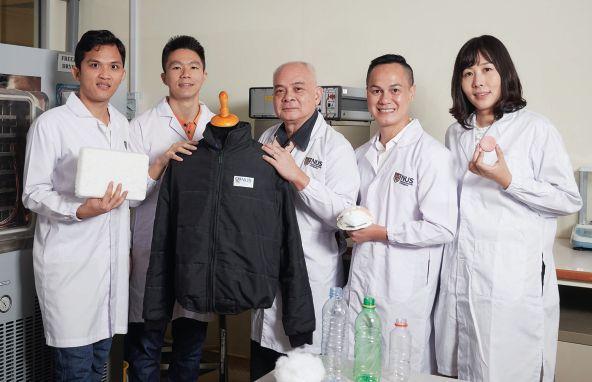
National University of Singapore (NUS) researchers are turning plastic bottle waste into an ultralight material with potential fire-service applications.
professor Hai Minh Duong and professor Nhan Phan-Thien from the department of mechanical engineering at NUS faculty of engineering.
An independent report about fire service in Halifax Regional Municipality says more firefighters, more stations and more investment are needed to meet response time standards.
Plastic bottles are commonly made from polyethylene terephthalate (PET), which is the most recycled plastic in the world. The PET aerogels developed by the NUS-led research team using plastic bottle waste are soft, flexible, durable, extremely light and easy to handle. They also demonstrate thermal insulation and strong absorption capacity.
These properties make them viable for a wide range of applications, such as for heat and sound insulation in buildings, oil spill cleaning, and also as a lightweight lining for firefighter coats and carbon dioxide absorption masks that could be used during fire rescue operations and fire escape.
The work was achieved by a research team led by associate
The technology to produce PET aerogels was developed in collaboration with Dr. Xiwen Zhang from the Singapore Institute of Manufacturing Technology under the agency for science, technology and research.
Existing firefighter coats can be bulky and they are often used with other breathing and safety equipment. This can take a toll on firefighters, especially during extended operations.
When coated with fire retardant chemicals, the lightweight PET aerogel demonstrates superior thermal resistance and stability. It can withstand temperatures of up to 620 Celsius, but weighs only about 10 per cent of the weight of conventional thermal lining.
Future firefighters learn the ropes while current firefighters hone and sharpen their skills
By Jayson Koblun
Canadian Firefighter magazine held its 2018 Firefighter Training Day and Career Expo on Sept. 29 at the Fire & Emergency Services Training Institute (FESTI) in Mississauga, Ont., where current firefighters were given an opportunity to expand their skills and potential recruits learned what it takes to become one of the family.
Roughly 130 career and volunteer firefighters attended Training Day to expand their skill sets or hone techniques on a specific aspect of fire suppression. Six “HOT courses” were offered: patient packaging and triage, live-fire rescue, forcible entry, firefighter survival, auto extrication and aircraft rescue fire fighting for municipal and rural firefighters. Patient packaging and triage focused
on instructing firefighters in medical skill sets through the use of both theoretical and practical skill stations.
Live-fire rescue refreshed firefighters’ skill sets through intense, hands-on skill stations focused on str uctural fire fighting.
Forcible entry started in the classroom then moved to the training ground where participants split into two groups and worked on skill development. Students worked at a forcible-entry prop, learning to breach inward and outward swinging doors. Each firefighter had the opportunity to complete both breaches. They practised forcible-entry skills using a chain saw and a rescue saw.
Firefighter survival focused on teaching firefighters how to keep themselves and their partners safe during internal fire fighting operations.
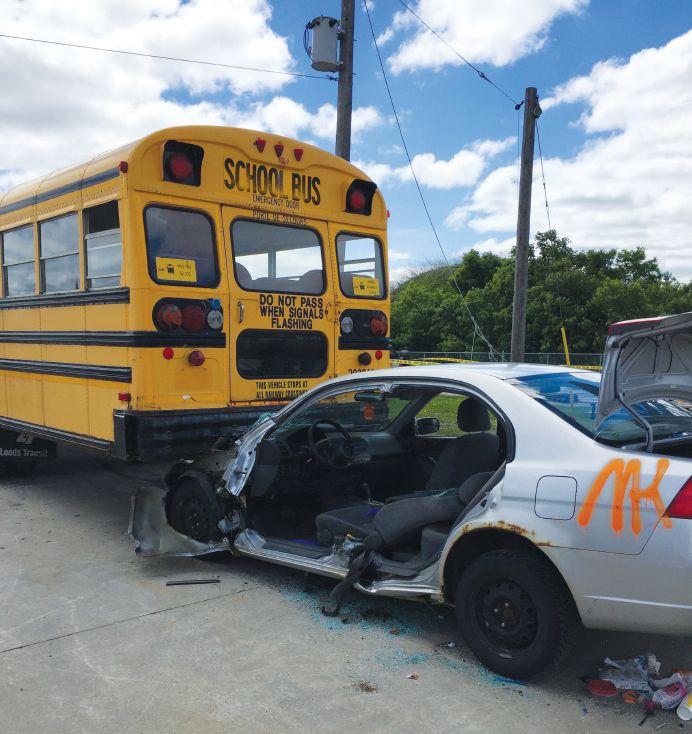
Auto extrication was staged at FESTI’s spacious auto-extrication area.
The course focused on developing skill sets needed to safely and successfully mitigate a variety of challenging scenarios, including multi-vehicle collisions and extrication in volving hydro poles and heavy equipment such as buses and tractor trailers.
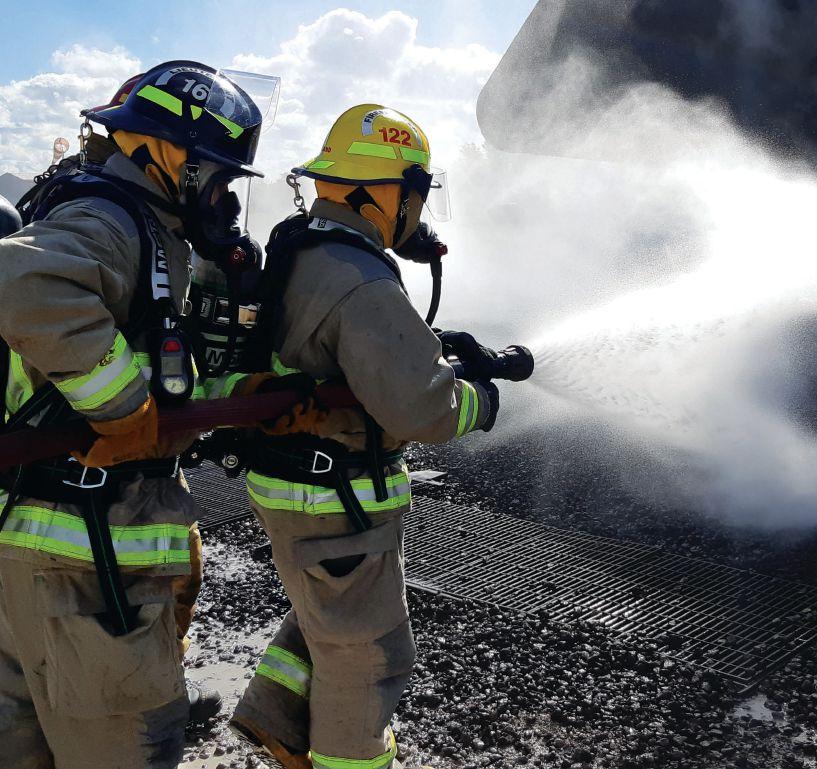
Aircraft rescue fire fighting for municipal and rural firefighters offered fundamental knowledge and skill training needed to perform basic aircraft rescue fire fighting if called to respond to an aircraft emergency. The program consisted of theoretical and practical components. The theory instruction was presented by certified ARFF instructors and covered: response procedures, full turnout gear and SCBA, fire control, rescue operations, fire extinguishment, interior fire fighting, overhaul, and introduction to aircraft rescue fire fighting vehicles. The session focused primarily on developing hands-on skills by responding to multiple live-fire scenarios using both large and small aircraft mock-ups.
During the courses, students practiced: how to position apparatus, how to conduct exterior and interior search and rescue, handle specific handline operations, communicate on the fire ground, and how to extinguish wheel, auxiliary power unit, three-dimensional and engine fires.
A team of trained industry professionals was in charge of leading and teaching the students. The team consisted of: Capt. Randy Fleming who began his firefighting career with the Flamborough Volunteer Fire Department in 1994, Division Chief Rob Lenders who star ted his career with the Canadian Armed Forces (CAF) in 1985, Capt. Daniel Beaudoin who started his firefighting career with the CAF in 1981, Capt. Theresa Marinier who started her medical career with the CAF in 1990, Capt. Jean-Francois R ousseau who enrolled in the CAF in 1993, and Capt. Shawn Mainville who attended Lambton College for Fire Science Technology in 2003 and graduated on the Dean’s Honours List in 2006.
At the end of the day, students received certificates of achievement from Canadian Firefighter magazine to show they completed the courses they’d signed up for.
The Career Expo taught individuals who are considering becoming a firefighter how to be better prepared for tests and interviews and deal with the stresses of being a firefighter. About 40 attended.
The individuals attended a series of learning sessions, spent time networking and learned resume-building tips. They also attended mock interviews conducted by Chief Neil Main of Cambridge Fire Department, Chief Dave Pratt of Milton Fire Department and Deputy Fire Chief David Lane of FESTI.
“Someone may spend thousands of dollars on school, training and equipment and not know that their vision isn’t up to firefighter standards until it’s too late,” Richard Boyes.
Three individuals volunteered to participate in the mock interviews and questions were asked by Kory Pearn, a firefighter from St. Thomas. Afterwards, the chiefs gave each individual a rating. After each question, the chiefs explained what the participants did correctly or slipped up on.
Some of the questions asked by Pearn were: What do you think a firefighter does on a typical day? How will your work experience, skills and pastimes help you in the fire service? Share an example of a time you had difficulty getting along with someone and how you worked through that experience.
The session topics covered were: how to think like a fire department, why candidate testing is import-
ant, what a day in the life of a firefighter looks like, where the fire service is headed and how to succeed in it, and hiring opportunities and recruitment. A panel of chiefs also discussed firefighter expectations.
Richard Boyes, executive director of the Ontario Association of Fire Chiefs, took time to discuss the steps firefighter hopefuls should consider before committing to spending the money and time trying it out. He also reviewed new testing standards and how recruits should be prepared for tests.
Boyes spoke on the importance of candidate testing and shared questions that firefighters should ask themselves before spending money on school or training, such as: Do I even have sufficient eyesight to be a firefighter? Can I handle the sight of blood and dead bodies? Am I prepared for the mental strain this career will put on me and those close to me?
As Boyes noted, “Someone may spend thousands of dollars on school, training and equipment and not know that their vision isn’t up to firefighter standards until it’s too late.”
Or, he said, “they thought they could handle some of the gruesome details of the job, but were mistaken.”





By Jayson Koblun
Post-traumatic stress syndrome (PTSD) is finally an issue being talked about more often within the fire service, but what do we know about pre-post-traumatic stress syndrome?
Program specialist and former Fire Chief Joe Casey spoke at the 2018 Fire Service Women Ontario professional development symposium and annual general meeting at the Delta Waterloo Hotel in Waterloo, Ont., on Oct. 26.
Casey was diagnosed with PTSD in 2005 and shared some of the struggles he’s faced ever since, such as painful memories, nightmares, awkward conversations with co-workers and more. He attributes a lot of what led to his diagnosis to experiences he went through as a firefighter and fire chief such as seeing deaths, accidents, severed limbs, changes in a colleague’s behaviour and other emotionally disturbing or distressing incidents.
“Post means after – meaning that the emotional scarring and trauma shows up after an event – after you’ve seen the dead body or after you’ve witnessed something distressing and that causes stress,” said Casey.
He also defined a disorder as, “any disruption to regular bodily structure and function.”
But what about the trauma and distressing events that took place before he entered the fire service?
Casey labelled those experiences as things that led to his “pre-post-traumatic syndrome.”
“I was diagnosed with PTSD in 2005 after what we thought was a heart attack – when, in actual fact, I had lived a life full of traumatic and distressing experiences that made me pre-disposed to PTSD way before the
diagnosis,” he said.
Casey went on to explain some of the experiences that contributed to his pre- and post-traumatic stress such as growing up with an alcoholic and abusive father, seeing his parents’ dysfunctional marriage lived out, then watching his brother battle and eventually succumb to cancer, and a few other life experiences that live up to the definition of distressing, traumatic and disturbing. They were all things that led him to his official diagnosis of PTSD in 2005.
“Let’s face it, though. Myself and most of you all here have gone through similar situations prior to ever joining the fire service,” said Casey.
He said he wanted to share his story because he wants PTSD to continue to be addressed and talked about within the service and to see more people diagnosed and helped, but also so people are more comfortable addressing the things that happened prior to any official diagnosis.
During a question-and-answer-period after his presentation, Casey said there have been people in his life and line of work that have looked at him in disbelief and told him that his experiences don’t count as PTSD, or that other people out there have had it much worse.
And, his response to that is often one that includes anger, sadness and remorse. He’s angry that people don’t believe him, sad that people like himself are getting ignored and remorseful that there are people in his line of work that simply don’t get it.
Casey said he has a lot of family support – support in the sense that his wife and children all acknowledge his condition and do what they can to help.
Casey said his wife is unable to be his pillar of strength completely because it’s not something she is able to empathize with.
“She cares, she loves me, she wants me to be okay, but I can’t talk to her about my feelings and what I struggle with all the time because she hasn’t gone through it herself and doesn’t necessarily get it,” said Casey. “She cares about me and loves me, but she isn’t my ‘go-to’ in this situation.”
Casey said that it is hard at times to not have his spouse as his go-to support system, but suggests that everyone diagnosed with PTSD should reach out to friends, family, colleagues and anyone around them who can be a listening ear and support system to them.
He also suggests taking time out of the day to decompress, de-stress and find a way to relieve yourself of the day’s emotional and disturbing experiences.
This year’s symposium was the organization’s 8th annual event and carried the theme “Empowered Together.” There were several other guest speakers as well as hands-on training courses and in-class sessions.
Speakers spoke on topics such as hiring, what to do when you doubt yourself, responding to electrical emergencies, social media tactics and more.
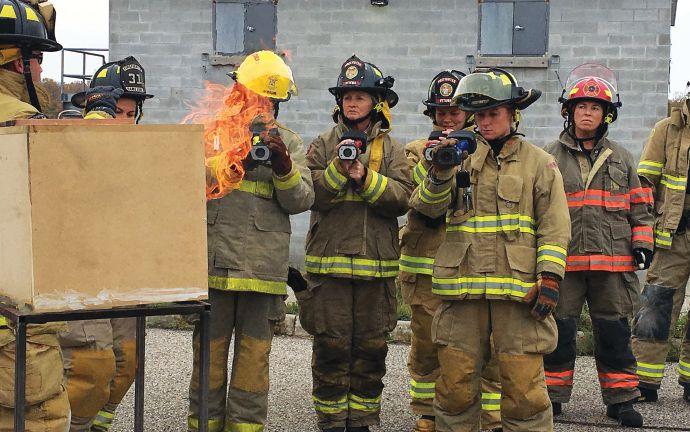
One of the courses was aimed at women who are thinking about changing careers and becoming a firefighter. The day-long course provided women with an opportunity to gain exposure to firefighter training.
By Tim Llewellyn

Hopefully, every fire department has some kind of written policy or standard practice that requires regular, documented apparatus and equipment inspections.
I’m not talking about annual professional maintenance. I’m talking about the daily or w eekly checklist inspections performed by firefighters. In the fire departments that I’ve been involved with, these “ truck checks” serve as a way to ensure that the apparatus and all of the equipment on them are service-ready.
One item that I feel is most important to check is the self-contained breathing apparatus (SCBA). Properly functioning SCBAs are vital to many fire department incidents. An SCBA that is not ser vice-ready can make a negative difference in a life and death situation.
Here are the basics that I look for when conducting a check of an SCBA:
• Are the straps fully extended and not twisted?
• Are any components missing, worn or broken?
• Does the unit have adequate power in the battery pack?
• Is the bypass valve open or closed?
• Is the main high-pressure air line connected securely to the cylinder?
• And, most importantly, is the cylinder filled to its maximum, optimal, full pressure?
Some departments that
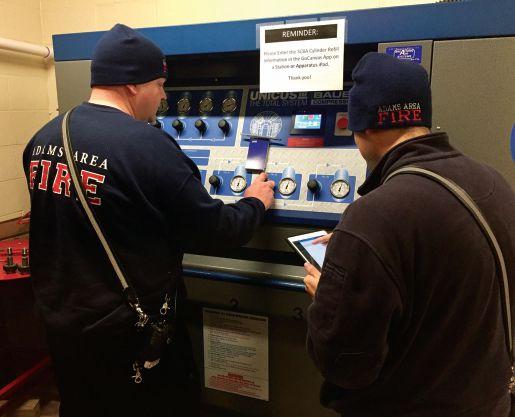
use 4,500-pounds-persquare-inch (PSI) cylinders are in the mindset of filling up or topping off the cylinders when pressures fall below 4,000 PSI. Other departments that use different SCB A cylinder pressure types usually have a similar range of acceptable pres -
a call and you don’t want to run out.” I would like to see this same mentality and energy applied towards SCBA cylinder pressures.
The working duration of an SCBA cylinder is dependent on many things such as workload or exertion, relative fitness of the user, the presence or absence of any SCBA facepiece seal compromises, any other leaks in the unit and, most importantly, the beginning cylinder pressure.
filled structure, the additional 300 to 400 PSI in our cylinder would allow precious moments of clean air to br eathe before the RIT team arrives. It could mean life or death for us or them.
But seriously, how much time will 300 to 400 PSI actually provide? It can’t be that much, right? Allow me to introduce you to the “500 Drill.” The 500 Drill was presented to me in my formative fire service years by a group of great instructors, mentors and friends from the Pittsburgh (PA) Bureau of Fire. The 500 Drill occurs after any regular SCBA training and is typically one of the last events for the session.
sures. As long as the cylinders are within the defined range, they are okay to be in service on the fire apparatus.
I’ve been in places where a significant amount of emphasis and energy is placed on the amount of fuel in the fir e trucks. Some places say, “The fuel level in the apparatus shall be maintained at full at all times. You never know how long the truck will be on
I tr uly believe that if we want to give our customers the best service possible, we need to ensure that our SCBAs give us the opportunity to solve problems. If an extr a 200 to 300 PSI could allow us to finish the search of a room or search another bedroom or to make sure a hose would stretch down another hallway, we would win.
Put another w ay, if things go bad for us or if we get trapped or lost in a smoke-
Train on any topic, whether it be hose advancements, searches or car-fire simulations and ha ve the firefighters do it “on air,” breathing from their SCBAs. Once all objectives of the drill are met, have each firefighter continue to breathe down or bleed off their cylinders until only 500 PSI remains. When each cylinder’s pressure is at 500 PSI, tell the firefighters to stop the air flow to let everyone catch up. Lots of quarter-service or one-third service alarms will be sounding, so hearing protection should be considered.
With everyone’s cylinder at 500 PSI, start some kind of continuous movement, group activity and start a stopwatch. Play dodgeball, basketball, freeze tag or start some kind of specific fire-service training. A self-rescue search maze is great to throw in here to
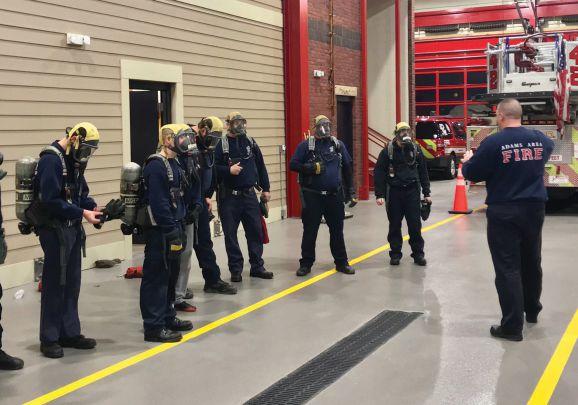
practice firefighter survival skills under an actual “low-air situation” kind of stress.
The main goal of the 500 Drill is to get firefighters to understand how much time and movement and work can be done on 500 PSI in an SCBA cylinder.
Instruct each firefighter to continue his or her assigned activity until their low-air alarm stops sounding. Once the alarm stops, have each firefighter come to a resting position and continue breathing. Do not shut off the regulator or remove the mask at this point.
There will be air remaining for breathing after the alarm stops. Have the firefighters count their breaths until the cylinder is completely empty and the mask “sucks” to their faces. Once this occurs, coach them to calmly remove the regulator from the mask and breathe normally. Mark the time for each firefighter. Once every firefighter has completed this, discuss with the group the amount of time for each and have everyone state how many breaths they took after the low-air alarm stopped.


I truly believe that if we want to give our customers the best service possible, we need to ensure that our SCBAs give us the opportunity to solve problems.
Unless they have done this before, every firefighter will be surprised at how much air remains after the alarm stops. Ask them to imagine how a firefighting effort would have been different if their SCBA cylinder pressure started out at 4,000 PSI instead of 4,500 PSI. Apply it to a real-world scenario.
The take-home message for the 500 Drill is that 500 PSI matters. Lots of work and movement can occur on 500 PSI. Lots of searching and firefighting and self-rescue can occur on 500 PSI. SCBA cylinders should be full at all times.
I encourage each of you to try the 500 Drill at your departments and see for yourselves how much 500 PSI matters.





















By Chad Roberts

Chad Roberts is a firefighter in Oakville, Ont. He is a member of the Oakville extrication team and competes and trains across North America. Contact Chad at chadroberts12@gmail.com.
In past articles, I have stressed the need for more than one plan for every extrication scene. Every call we go to will inevitably be different with different vehicles involved. Different speeds, directions, occupant load and even weather can lead us to the fact that there is very little about our scenes that will be the same.
So, when choosing our plan we must remember that our plan B is always worth going to when things go awry.
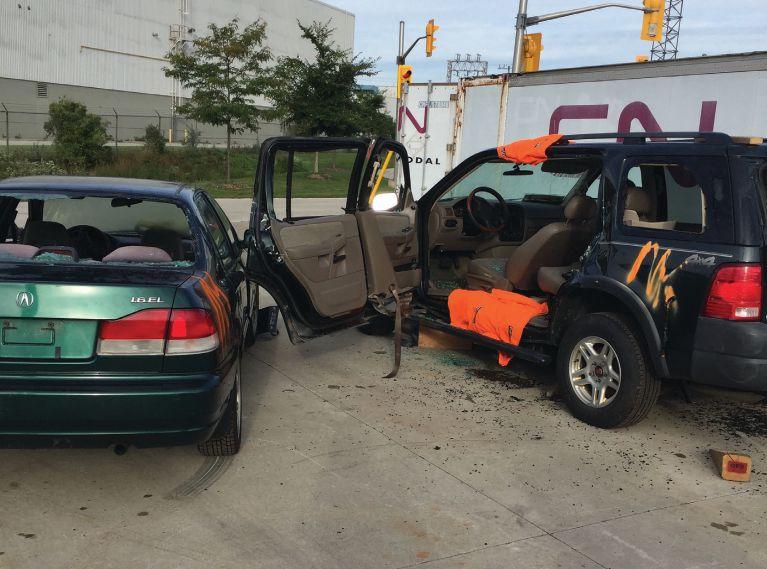
In this article, though, I would like to address a focused initial assessment when doing a “full-side removal” of a passenger vehicle.
There are many different variations of the full-side removal. There is the simple “step-by-step, separate door” removal and finally cutting out the B post. There is also the “full-side, fold-down” and the “B pillar rip.”
All of these have relatively the same result. But, what is truly best? The answer is not so clear. And, in order to choose the right option, we must quickly compile various amounts of information from our accident scene to make the proper choice. By not doing this we can find ourselves in a dead end, possibly inflicting more pain on our patient, or even contradicting further operations such as the “dash roll.”
For continual assessment to truly be successful, it should not just be on the shoulders of the incident commander (IC) or the rescue sector captain. It needs to be a concerted effort by all those on scene. The IC must have a look at things like point of impact, metal intrusion into the passenger area and placement of the patient to get a really good idea of how to go about doing a side removal.
The IC must also make sure the medic or firefighter in charge of patient care enters the vehicle in a timely fashion in order to get a good look at the level of intrusion and patient entrapments. This is truly the most important information
that must be processed in order to choose the proper plan.
And, finally, the input from firefighters operating the tools from the outside will have a vantage point on how things
Like anything else in the fire service, there are many different ways to accomplish similar tasks
really are going. The reaction of the tools with crushed metal can be a make or break point as to whether the original plan is working or a different version of a full-side removal must be done.
So, let’s start with the most basic option of the full-side removal. This can be accomplished by first removing the front and back door separately and completely. Once this is done, the B post can be removed entirely to create a large void in the side of the vehicle.
Although this may not be the most technically appealing option and can take a little more time removing each door individually, it can serve as a valuable option. Leaving the B pillar until the end will allow you the final option of doing a dash roll with the ram if you find the patient’s legs are trapped. If not identified early enough and the B pillar is removed, you will be stuck with doing a dash lift with the spreaders,
which may not always work depending on the degree of frontal intrusion. I will write about this in my next article. This is where communication and quick observation by your interior patient-care firefighter are key to advise whether the B post will be needed for the ram push. Another option for side removal is what most in our industry refer to as the “B pillar rip.”
This is accomplished by forcing open the rear door. At the bottom of the B post a cut is made. Using the spreaders, one arm is placed along the rocker channel and the other is placed against the bottom corner of the back door. By spreading at these points, it will cause our first bot tom B pillar cut to tear along the bottom rocker channel and subsequently detach, leaving the B post only attached at the roof.
From here, you can finally cut the top B post, removing the back door, B post and front door all in one piece. It is very important to note that cutting the top of the B post before the bottom will not only take away the strength needed for the rip to occur, but will also cause the
In order to choose the right option, we must quickly compile various amounts of information from our accident scene to make the proper choice.
loose top of the B post to drive into your patient’s head.
The front door can be removed at the hinges or merely tied back if time is of the essence. This large opening created is the same as our first option, but merely requires fewer cuts. Although less time -consuming, this move does require more technical skill and, much like the first option, a realization of patient placement and entrapment.
Simply stated, if there is a significant amount of side impact intrusion it may be more beneficial to go with our final option, the B post lay down. The reason is that this option will afford less of an opportunity for the door or material impacted to be pushed back on our patient by removing it down and away from the patient.
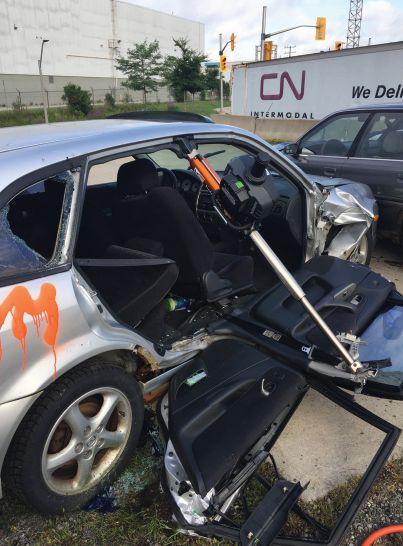
To complete the lay down, the back door must be forced at the Nader pin similar to the B pillar rip, but in this operation the front door is to be forced simultaneously at the hinges, leaving the front and back door attached only at the B pillar. From there we cut the top of the B post, and use the spreaders inserted into this cut to force the B pillar and doors down towards the ground. Once the spreader is maxed out, the ram can be brought in to finalize the B pillar push all the way to the ground.
While all of these options provide a similar result, it must be remembered that there is no one best method for a side removal. However, with proper interior patient entrapment size-up, and a good look at outside vehicle impact intrusion, we can make a better decision on what is best for the patient.
Lik e anything else in the fire service, there are many different ways to accomplish similar tasks. By breaking methods down into what they tr uly achieve, we can begin to appreciate each method individually for what we need at each scene.
Nick Halmasy is a registered psychotherapist who spent a decade in the fire service. He is the founder of After the Call, an organization that provides first responders with mental health information. Contact Nick at nhalmasy@afterthecall.org.
By Nick Halmasy
You find yourself sitting between Jack and Jill. Both have just returned from sick leave. Jill was injured on a tough call. Jack was told he had a disorder.
Both sought and received help and are now back on the job.
So, how is it that Jack and Jill were diagnosed differently – and does it really make a difference?
Diagnostically, there is nothing called post-traumatic stress injury (PTS-I) within the Diagnostic and Statistical Manual of Mental Disorders, known as DSM-5, the tool that is used to determine whether someone receives health coverage in Ontario.
The policy on the Workplace Safety and Insurance Board website says, “The first responder must ha ve been diagnosed by a psychologist or psychiatrist with PTSD as described in the DSM-5.”
Back at the fire hall, is it better to call Jack’s situation a disorder or an injury? And, to what end does changing the current language bring?
Does this suppor t our folks by giving them a more stigma-free language to use, or does this only further the stigma by emphasizing the singular diagnostic path we have been using?
Having been a frontline firefighter, I can see the need for balance in making mental w ellness challenges more acceptable within the fire service.
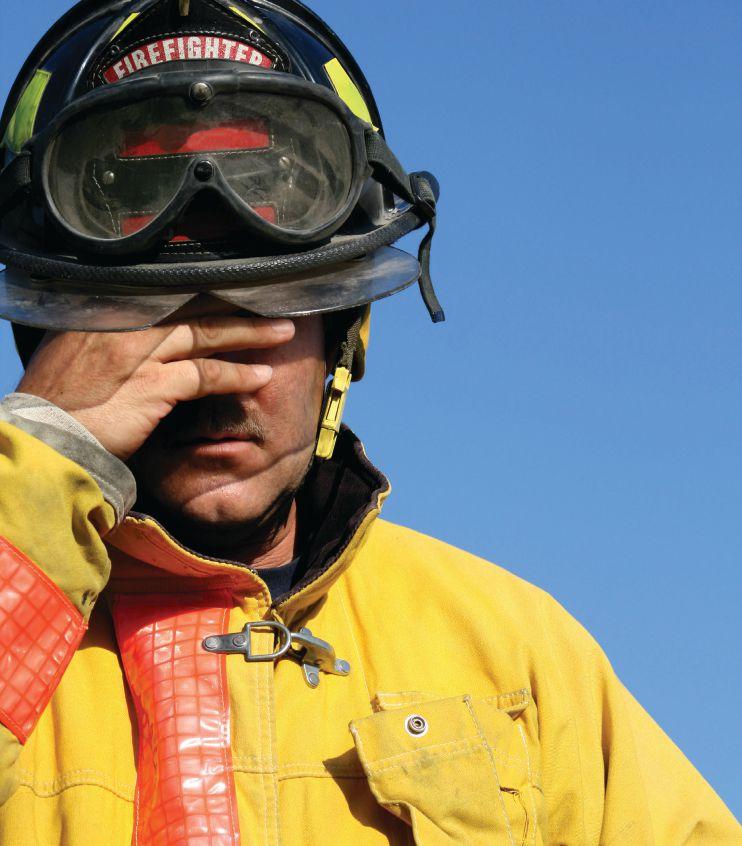
Through the work we have done so far, I believe that we are leagues ahead of where we were, even just a few short years ago.
And, as someone who currently engages with frontline firefighters, establishing a link between the role and help through a common language is vitally important.
So, the question becomes: Is PTSD diagnostically and functionally different than other disorders, so much so that we can
identify it differently?
If PTSD holds exclusive rights to actual structural brain changes and therefore is different from other disorders, the term injury certainly makes sense.
If, however, other disorders exhibit the same structural change and therefore mimic PTSD in its physical impact on the brain, we need to critically investigate the purpose of renaming it.
There is plenty of research that
If PTSD holds exclusive rights to actual structural brain changes and therefore is different from other disorders, the term injury certainly makes sense.
identifies physical changes due to PTSD. For example:
• The hippocampus shrinks: This is a structure that is vitally important in the formation of memories. And, along with other structures, it is part of a system that works to consolidate information into long-term memory. Researchers continue to try to specify exactly which parts of memory it’s involved in, but it looks to localize episodic memory such as remembering time and space which helps us remember, for example, what we ate last.
• Increased activity in the amygdala: The amygdala is our emotional headquarters and a part of memory development. Increased activity here means heightened emotional r eactions, like a heightened fear response which is associated with PTSD.
• Ventromedial prefrontal cortex shrinks: This area is the control area at the front and centre of your brain. Major decision-making and judgment are impaired when this structure is damaged. Adding to the severity, it becomes difficult to manage negative emotional experiences.
The problem is that such changes also occur in other disorders. For example: Hippocampus shrinks have been found to occur in schizophrenia and psychosis, Alzheimer’s disease, depression and obsessive-compulsive disorder. Increased activity in the amygdala has been found to occur in anxiety, depression and insomnia while Internet gaming disorder may shrink the amygdala. Ventromedial prefrontal cortex shrinkage has been found to occur in depression, stress, schizophrenia and obesity.
We are presented with diagnostically difficult evidence. The brain responds similarly to multiple different disorders. In fact, the brain responds with physical changes to stress itself.
Brain structures change in response to external and internal stressors. Some critical analysis, grounded reasoning and careful consideration are needed towards making this shift because we
may be creating more stigma in the process.
The important thing is that we open the dialogue on the issue of PTSD and that individuals be able to reach out for support.
We’ve made strides to overcome much
of the initial barriers for people to speak up and speak out.
People now understand the importance of psychological, emotional and peer suppor t and are seeking support and help.
They’re also coming back to the hall.
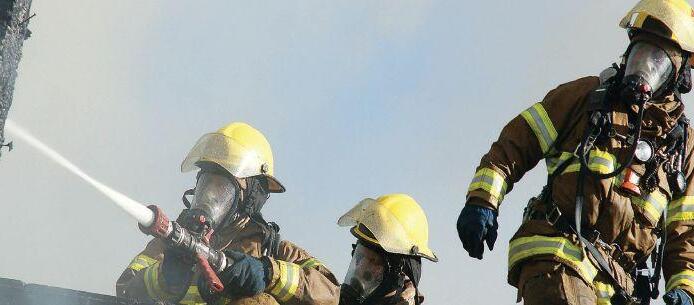











Volunteer fire departments are finding it difficult to attract recruits
By Peter Simpson
You discover a fire has started in the kitchen of the home you shar e with your spouse and children. Before you have time to gather your thoughts, the fire spreads quickly up the walls.
You call 911.
The fire intensifies. Soon, the flames have reached the attic and dense smoke is billowing out the eaves.
Your family huddles a safe distance from the inferno as you await the arrival of the fire trucks.
You wait, and wait, then wait some more.
Meanwhile, your home, keepsakes, photos and everything you hold dear is being reduced to ashes.
Eventually, firefighters arrive to flow water on what’s left of the flames. Another basement saved.
For the time being, at least, that response -delay scenario happening in Lunenburg County, N.S., is unlikely, thanks to the mutual aid arrangements shared by fire departments throughout the county, where numerous departments are quickly paged out to support neighbouring firefighters at a fire scene.
A massive fire in downtown Bridgewater, N.S., in October 2017 that destroyed five businesses is a fine example of effective and cohesive inter-depart-
ment co -operation. More than 140 firefighters from 12 departments fought the overnight blaze.
But what if no one at all answered the pages? The fact is, every one of Lunenburg County’s 659 firefighters are volunteers who are not compelled to respond to emergencies of any kind.
Thankfully, last year a good number of those firefighters did respond to 1,079 calls, including fires, motor vehicle collisions, medicals and assorted other e mergencies, says Municipality of the District of Lunenburg (MDOL) fire services co -ordinator Chris Kennedy. They answer the call because they
want to help protect their community’s residents and properties.
Not counting the towns, the sprawling municipality is home to more than 24,800 residents.
However, with all the pressures and responsibilities of everyday life, including myriad family and business commitments and a wide range of recreational pursuits, it is becoming increasingly more difficult for fire departments to retain and recruit firefighters, particularly young men and women.
Look around most fire halls these days and you will see a lot of grey hair. Many firefighters are from the baby boomer generation. And, it is not unusual to find folks in their 60s and 70s and even older.
There are some younger firefighters, with some departments offering junior programs. In N.S., there are many young men and women today who cut their firefighting teeth in the junior program.
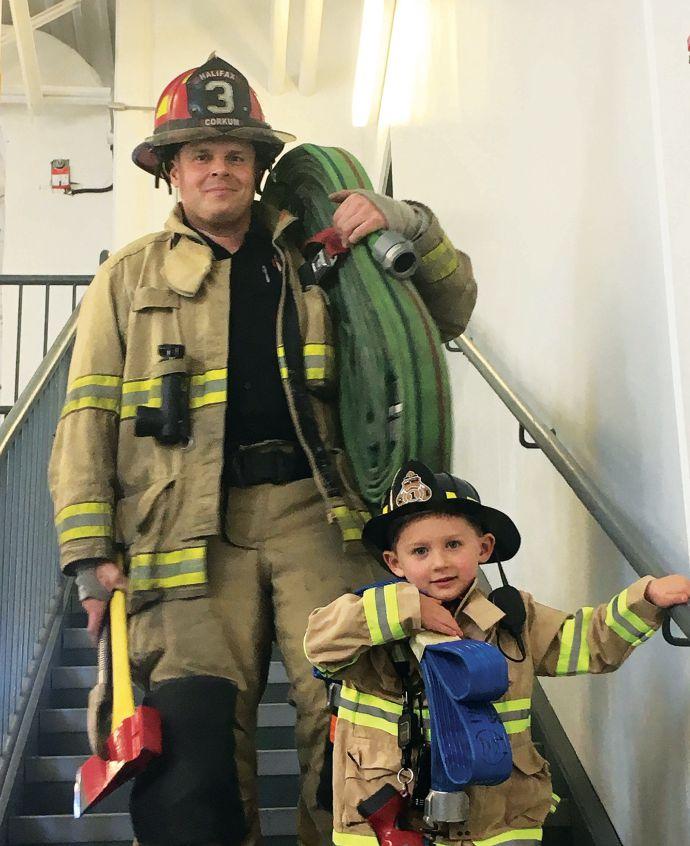
Mark Feener, 36, and Kevin Corkum, 39, were juniors together. Feener is now the chief of the Dayspring and District Fire Department, while Corkum is a full-time captain with Halifax Regional Fire and Emergency and volunteers with Dayspring. Their young sons are likely to volunteer, too.
The fire service is in the blood of the Feener and Corkum families. Wilfred Feener, Mark’s father, has served his community for 52 years and counting, Frank Corkum, Kevin’s father, has answered the call for 39 years. Both men answer more calls than most firefighters in Lunenburg County and are always
5is how many businesses were destroyed in the downtown Bridgewater, N.S., fire
involved in the action.
Cody Mosher also volunteers with Dayspring and has served in Riverport as well. Mosher and his wife have a 16-month-old daughter. Mosher, 31, started as a junior and is now a red-tag firefighter, meaning he can be called on to don breathing apparatus and fight interior structure fires.
“Volunteering builds a sense of pride in your community and I believe in helping my community, whether it is through the Lions Club or fire department,” said Mosher. “I chose the fire department because it’s the most enjoyable to me, and I get to drive some pretty cool trucks.”
Mosher’s most memorable firefighting experience was helping to battle the Bluenose Mini Mart fire in December 2012, an inferno that razed six apartments and two businesses.
“I was there for 48 hours. It was tough work, but it was the best learning experience of my life,” he said.
In an effort to assist fire departments in their retention and recruitment programs, the MODL has committed resource dollars and staff time to determine what would be the best course of action for the 24 fire departments in the county.
Kennedy, a volunteer firefighter for 25 years, including terms as deputy chief and chief of the Hebbville Fire Department, earns his living as MODL fire ser vices co-ordinator.
“Volunteering in a fire department is rewarding. You don’t have to be an interior attack firefighter. Many other support roles are just as important and are not physically demanding,” he said.
“Volunteering builds a sense of pride in your community and I believe in helping my community, whether it is through the Lions Club or fire department. I chose the fire department because it’s the most enjoyable to me, and I get to drive some pretty cool trucks.” - Cody Mosher
“There is a great camaraderie among the firefighters, and lots of training opportunities are available for volunteers. The training can be as rigorous or moderate as the volunteer wants.”
Not to mention complimentary licence plates, federal and provincial tax credits and the knowledge that, nationally, firefighting topped a recent Reader’s Digest list of respected and admired vocations.
Following the devastating Bridgewater fire, Mayor David Mitchell reflected on the efforts of his town’s volunteer firefighters and those from neighbouring departments.
“When you think about it, these men and women from small communities help other small communities,” he said.
“ They don’t question it, they just go. I get emotional just thinking about it.”
To learn more about opportunities in volunteer firefighting, contact your local fire department.
By Arjuna George
Arjuna George is chief of Salt Spring Island Fire Rescue in B.C. He has served on the department since 1997. Contact Arjuna at ageorge@ saltspringfire.com.
The world is full of organizations that continually put the well-being and safety of people above its own and the fire service definitely fits into this category when it comes to caring.
This heavy responsibility can begin to weigh on responders, deteriorating their attitude for compassion towards people and life. This condition is called “compassion fatigue” and it is a prominent concern for our organizations and our society.
The term compassion fatigue was first coined by Dr. Charles Figley at Tulane University in New Orleans, Louisiana. He described it as the “cost of caring” for others in emotional pain.
Our firefighters are seen as helpers in our communities, ready to respond at a moment’s notice with compassion and a caring attitude. This very act of helping makes us very vulnerable to owning pain of others and becoming numb to the trauma.
Over the years as a fire service we have made significant strides forward in the journey of destigmatizing mental health and post-traumatic stress disorder of responders, but compassion fatigue tends to goes unrecognized in many until it is too late.
The fire service consumes many of our lives and brings so much pride and sense of purpose. Many see the fire service as a calling, as it brings true meaning to life, but it can also devour the energy of our bod-
ies if not managed, creating several health concerns.
We either know or may be someone that lives and breathes the fire service, but winds up burnt out and disgruntled. They put every waking hour into the fire service by volunteering for this a nd that, responding to all calls, and giving 24/7.
As time passes, this type of responder may find it difficult to treat others around them with compassion and empathy. This form of compassion fa-
fatigue is the inability to turn work off. With today’s technology we are connected day and night. Every time our pager goes off after hours we are back on. Every time an email comes in we are back on. This lifestyle can begin to wear you down bit by bit and, many times without you even being aware of the impact. This always-on work ethic ensures that y ou never have true downtime.
I personally have noticed premature signs of compas -
This lifestyle can begin to wear you down bit by bit and, many times, without you even being aware of the impact
tigue may ruin relationships, f riendships and a cohesive workplace.
As a solution, many recommend to find a balanced work life. But, how can you truly balance work and life when there will always be one that weighs more?
Jeff Bezos, founder and CEO of Amazon, prefers the motto, “Work-life harmony,” as a better viewpoint. He suggests the word “balance” tends to imply a strict trade-off. Work-life harmony identifies a more fluid and lenient mindset.
But how do you know when you are on the verge of burnout and compassion fatigue? A key sign of compassion
sion fatigue and burnout in myself. I love what the fire service stands for, what we do to protect our community, and I want to be the best I can be at it all, but it comes with a price – a price that can be lifechanging. The price for many could be a growing dissatisfaction of the profession and a sense of resentment towards people and the service.
If you are in the fire service for even a short while, the effects of compassion fatigue will likely be recognized. Those that recognize any of the signs of compassion fatigue or more serious post-traumatic stress should address them before they
transform into a more serious problem. Compassion fatigue can, over time, erode our physical and emotional well-being if we do not find methods of rejuvenation.
A good way to refuel and recharge your compassion batteries is self-care. Self-care may include other hobbies or a getaway. What I really enjoy is a social media blackout, where I go away and unplug from today’s fast-paced lifestyle. By finding your own specific method to unplug you will find better quality home life and work life, a true harmony of both.
If you have some of the following signs, you may be heading for compassion fatigue:
• anger and criticism
• increased isolation
• fatigue and poor sleep routine
• emotional instability
• short temper
• apathy towards people and work
• unhealthy lifestyle choices and substance abuse
• a sense of personal responsibility for emergency-scene outcomes
• unexplained health issues
Over time, compassion fatigue can lead to burnout, where firefighters feel low job satisfaction. Adapting to the stress we witness from work exposures requires resiliency and tools such as mindfulness and self-awareness. These attributes provide elite athletes and combat soldiers the strength to de-stress. We, as firefighters, can learn from these and embrace new ways
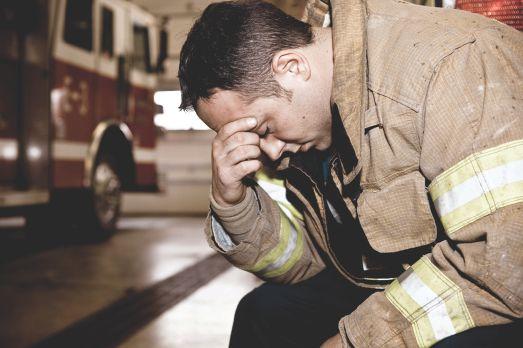
of dealing with trauma.
Mindfulness and meditation should be viewed as tools for health, not as hocus pocus. You cannot argue that being in the now, present and aware, is a bad thing. It can only make you sharper and more agile to work. Everyone has daily life stressors that impact their mental h ealth and sense of caring. Compound this with the duties of an emergency responder and the stress multiples.
My philosophy at Salt Spring Island Fire Rescue is to foster and encourage the “happiest fire department.” This may sound corny to some, but if you consider what a happy work environment could change, it is worth considering.
Happy is not necessarily having fun. The work we do is not always fun. But, if we come into it with a positive, happy attitude we will be better able to serve.
By growing the culture of happiness, staff will be better at self-care, more engaged in training, more satisfied with their work, have happier home lives, and provide better customer service. If we nurture a happy life and workplace har-
mony, we will have the strength and tools to forge through the tough times and still have the strength to truly care for others and ourselves.
To combat the negative side effects of continuous caring, consider re-examining your lifestyle. Do you take enough breaks to feel rejuvenated? Do you spend quality time outside of work? Do you eat healthy? Do you take care of your mind and body? All of these life-altering lifestyles will help better protect you from becoming fatigued and ultimately burning out.
If you are a firefighter, you are part of something so important in today’s society. You have a true purpose and a desire to serve. Your health and well-being are paramount to be able to sustain the high level of care and compassion the fire service is known for. Between alarms, consider ways you can instill some basic self-care, how you can build resiliency to what life and the fire service throws our way. Our communities depend on us being healthy and response-ready, and this means our physical as well as our mental readiness.
By Mark van der Feyst

Mark van der Feyst has been in the fire service since 1999 and is a full-time firefighter in Ontario. He teaches in Canada, the United States and India and is lead author of Residential Fire Rescue. Mark@FireStarTraining.com
In our last issue, we began our look at self-contained breathing apparatus (SCBA) emergencies and the four different categories that they fall into. To recap, these four categories are:
• reduced profile maneuvers
• entanglements
• equipment failures
• out of air situations
We are going to look at the first category, which is reduced profiling. The situation we need to think about here is that a firefighter is in trouble – the individual has realized that he or she is either lost, trapped, injured or caught in a rapidfire development. The Mayday has been called and the firefighter is trying to get out of the building or to an area that is tenable.
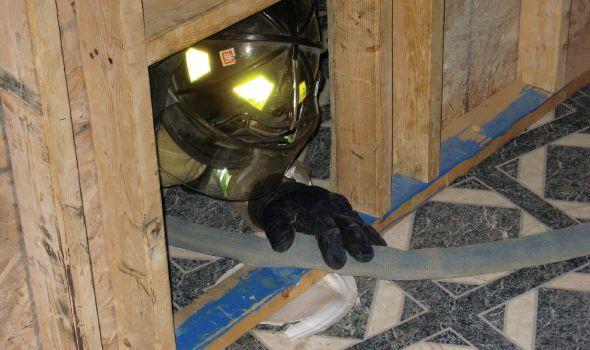
To do this, the firefighter may have to navigate through openings that are not designed or allowable for passage. This is where the reduced profile maneuver comes into play.
The reduced profile will be dictated by the size of the opening that is available for the firefighter to get through. The opening can be any size that is not designed for human traffic or passage – a restricted opening.
How will a firefighter know the size of the opening that he or she is encountering? The firefighter will need to feel around the opening with both hands to get a three-dimensional perspective. Why two hands as opposed to one? Because our brains compute and process everything that we see in three dimensions.
If the firefighter only uses one hand to feel the opening size, the individual will only get a two-dimensional perspective. But, with both hands, the firefighter will get a three-dimensional perspective.
When the firefighter requires more of a reduced profile, he or she may need to partially remove the SCBA
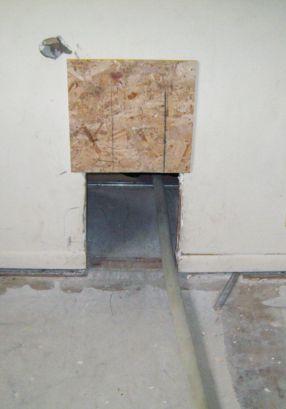
14” x 14”
A good-size opening to train with is a 14-by-14-inch square opening. The width of the opening simulates the space between two studs in a wall.
Once the opening size has been determined, there are three ways in which a firefighter can reduce his or her overall profile: loosen/adjust the SCBA straps and harness, partial removal of the SCBA, and full removal of the SCBA.
Of the three options, full removal of the SCBA presents the most risk to the firefighter because the entire SCBA is coming off the firefighter’s back and is only being secured by one hand on one strap.
When the firefighter wants to gain a little bit more of an advantage, the individual can loosen the straps on his or her shoulders and at the waist belt of the SCBA. By doing this, the SCBA can be freely
moved around on either side of the firefighter, allowing the individual to move it where they need to fit through a small opening
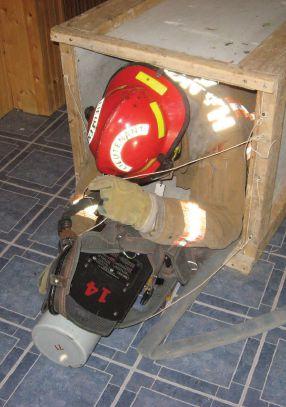
When the firefighter requires more of a reduced profile, he or she may need to partially remove the SCBA. This will involve loosening all the straps so that they are fully extended – shoulders and waist belt. This needs to be done so that when the firefighter goes to put the SCBA back on, the individual will have no issues fitting his or her arms back through the shoulder straps and trying to re-connect the waist belt.
It is very easy to slip off the SCBA without fully extending all the straps – but trying to put it back on with the straps retracted will not be very easy.
Once the SCBA straps are loosened, the firefighter will take one of the shoulder straps off and slide the SCBA around to the side of his or her body, leaving one shoulder strap on. The side that is taken off is the side that does not have the regulator hose on it. This will allow the firefighter the ability to still breathe without compromising his or her SCBA by having no slack in the regulator hose. Once a firefighter gets through the small opening, he or she will put the SCBA back on.
When a firefighter encounters a small opening, the individual will need to remove the SCBA completely from off his or her back. The steps from the previous method apply here with the added step that the firefighter will take off both shoulder straps.
Once the SCBA is off, the firefighter should point the SCBA with the cylinder valve going through first. By doing this, it gives more slack to the regulator hose and will not tug on the facepiece.
The key point is to maintain a firm grip on the strap that has the regulator hose. When a firefighter does not have a firm grip on the regulator side strap and has the cylinder pointed in the wrong direction, it adds to the overall risk. If there is a hole in the floor in front of the firefighter or at the top of stairs, the SCBA will fall through and the firefighter will lose it and the facepiece.
Once through, a firefighter will don the SCBA the same way he or she always does, tightening the shoulder straps as a minimum. I mention this because taking the time to tighten the waist belt may be the time that you need to get out and the shoulder straps are going to keep the SCBA on, not the waist belt.
These techniques need to be practised often so that confidence and comfort are built up for the firefighter doing all three of them.
Learn the skills and earn the credential you need to advance your emergency services career by taking our bachelor of applied business: emergency services degree program. You can continue working while taking this online program. You’ll study topics such as:
• Accounting principles • Capital budgeting
• Crisis communications
• Human resource management
• Team leadership
• Strategic business planning
next cohort starts in January 2020.
By Patrick Mathieu
The winter months, when we find ourselves spending a little bit more time inside, are the perfect opportunity to take on a new project.
I don’t mean just checking items off the ever-growing “honey-do” list. I mean getting in the kitchen and trying something new, something satisfying.
Although I spend a great deal of time in the kitchen all year, for me the winter months are a great opportunity to try something new, write recipes and perfect some old ones.
These are the days when you might try your hand at making fresh pasta or homemade sausage, baking a pie with a homemade crust, or just leafing through a cookbook until you find something that catches your eye and then whipping it up.
As much as I love summer, the
Beef Bone Broth
INGREDIENTS
3 pounds beef bones and pieces
2 tablespoons white vinegar
1 large onion, peeled and halved
1 large carrot, peeled and chopped
2 celery stalks, chopped
3 bay leaves
1 teaspoon whole peppercorns
3 quarts filtered water
A lot of times the extra effort required to go into a recipe is entirely worth it

Patrick Mathieu is an acting captain at Waterloo Fire Rescue in Ontario and author of Firehouse Chef: Favourite Recipes from Canada’s Firefighters. Contact Patrick at stationhousecateringco@yahoo.ca.
late fall and winter months just might be my culinary favourite, with comfort foods, low and slow braises, long-roasting, deep and complex flavours and satisfying dishes that just might take all day to make.
If you find you have some quality time inside this winter, give the following kitchen projects a try.
Weekend roasts should be a thing, a family-centred meal that is deeply satisfying to make and eat. You can also set yourself up for success for weeknight meals as well. Try my recipe for the perfect prime rib. I love this recipe for lots of reasons. Prime rib slow and low roasted to medium-rare perfection is just the starting point. Hopefully, there is some leftover roast for some peppered beef stroganoff, but, most importantly, you have some bones to

1. Arrange a rack in the middle of the oven and heat to 400°F. Place the bones in a colander, rinse under cool water, and pat dry with paper towels.
2. Arrange the bones in a single layer on a rimmed baking sheet. Roast until golden-brown, about 30 minutes.
3. Transfer the bones to a 6-quart or larger slow cooker. Add the water and vinegar and stir to combine. Cover and let sit for 30 minutes. Turn the slow cooker to the high setting and bring the broth mixture to a simmer.
4. Check the slow cooker occasionally,
skimming off any foam that collects on the surface the first hour and adding additional water as needed to keep the ingredients covered. Keep the broth at a simmer on high for 24 hours.
5. Add the carrots, onions, celery, bay leaves and peppercorns and continue to simmer on the high setting for 12 hours more, adding more filtered water as needed to keep the bones covered. The broth is done when it is a rich golden-brown and the bones are falling apart at the joints.
6. When the broth is finished, strain and cool the bone broth as quickly as possible. Set a strainer over a large pot or even a stand mixer bowl and line it with cheesecloth if desired. Carefully strain the bone broth into it. Discard the spent bits of bone and vegetables.
7. Prepare an ice bath by either filling a sink or basin with cold water and ice and set the pot of broth inside the ice bath. Stir regularly until the broth is cooled, about 15 minutes. Transfer the broth to airtight containers or jars. Refrigerate or freeze.
make bone broth. Bone broth is unlike regular stock that uses bones just for flavour. Bone broth uses a super-long cooking time – 36 hours to be exact – to extract as much flavour and nutrition out of the bones as possible. The difference between homemade bone broth and storebought stock is immense. It can be immediately seen in colour and consistency, but also in taste and nutrition. Don’t let the long cook time intimidate you. All the work is done in a slow cooker and the recipe makes a large enough batch for some broth to be frozen for future uses. Bone broth can also be made with chicken, turkey or fish, so save all of those carcasses in a freezer bag in the freezer until you are ready.
Bake a
I remember the first time I made my family’s favourite sugar pie from scratch. It felt as though my grandma was smiling down on me. There is something rewarding in getting a pie crust just right.
I find few meals as comforting or winter-worthy as braised dishes. Braising is a technique that creates super-flavour dishes that are mostly hands-off and are really foolproof by combining both wet and dry heat. You can create restaurant-quality short ribs, pork shoulder and lamb shanks and make yourself a weekend hero in the kitchen. Follow the four simple rules of braising: sear your meat, sauté your vegetables, de-glaze the pot and braise it all.
Making fresh pasta isn’t difficult and requires just a handful of ingredients, but it has weekend project written all over it. Once you have fresh homemade pasta, it is really difficult to go back to the dry stuff. Try my recipe for homemade pasta and top it with your favourite sauce,
slow-simmered tomato and meatball, or a hearty creamy mushroom ragout. Make a double batch of fresh pasta and freeze some for weeknight meals when time isn’t on your side.
Search out an Intimidating Recipe and Make It.
It’s time to flex some cooking muscle. Find a recipe that might intimidate you or seem too time-consuming for weeknight eats and dive right in. On a weekend, when you might have a little extra time on your hands, attempt things like making a layered birthday cake, trying an international recipe, baking some bread, making a lasagna, or getting the entire family together to make some pierogis. A lot of times the extra effort required to go into a recipe is entirely worth it. Get the family involved and make a day out of it.
About 2 1/2 cups unbleached all-purpose flour Kosher salt
4 eggs
About 1 tablespoon olive oil
1. Place the flour in a large mixing bowl. Make a well in the centre. Break the eggs into the well and add the oil. With a fork, lightly beat the eggs and oil, gradually mixing them with the flour. When the dough becomes too thick to work with the fork, continue with your fingertips and then your hands. Do not use too
We all look forward to our weekends or when we have nice long breaks from work. It is a perfect time to enjoy family, catch up on some cleaning or a TV show, or get outside and enjoy the great outdoors. But why not challenge yourself in the kitchen with a day-long – or two – project?
As firefighters, we are always looking to better ourselves, and the winter months
much flour. A few tablespoons may be left over, or there may not be quite enough, depending on the humidity level and the size of the eggs.
2. Knead the dough on a floured surface for about 10 minutes. The dough will become smooth and elastic. If the dough is sticky, dust it lightly with flour and continue kneading.
3. Let stand for 30 minutes before rolling. If rolling the dough by hand, use a pasta rolling pin and roll it very thin. Cut in 1 cm strips for fettuccine.
4. If you have a pasta roller or machine, follow the manufacturer’s instructions for rolling and cutting. Congratulations you just made homemade pasta.
and blustery days are a great opportunity to take your cooking game to the next level. Give some of these projects a try and, as always, let me know how they turn out.
You can message/tag me on Instagram @stationhouse_ or Twitter @StationHouseCCo.
Eat well and stay safe.

By Sherry Dean
Sherry Dean is a career firefighter/engineer with Halifax Regional Fire & Emergency Service. She has more than 20 years of experience in fitness and training. Contact Sherry at deansherry@bellaliant.net.
It is important to balance your overall fitness, but strength is an important aspect of fire fighting. So, how strong should a firefighter be? That’s a question which has many answers depending on your expected performance on the fire ground.
You should be more than capable to carry out your tasks without risk to you or your crew and that means some type of strength training.
Genetics influence your strength to some capacity. Your anatomy, including muscle and tendon compliance, and muscle composition which is the amount of fast or slow twitch fibres you have, all influence strength. How well and how often you strength train also impacts how strong you will become. Other factors to consider include gender, age, height and athletic background.
An easy way to define strength is force over a period of time. Training for strength is different than training for power. Although there are times when fire fighting demands power, it is much more common for tasks to last a longer period of time which lends itself more towards strength training.
It isn’t enough to simply lift. You must lift with good form and at correct intervals to improve your strength. Lifting with poor form can lead to injury and will not develop your stabilizing muscles well enough to allow y our optimal strength. More is not better. Overtraining can lead to muscular atrophy. Muscles need rest in order to recover.
Strength standards are guidelines that allow you to compare your strength against a larger group of lifters. The problem with using
standards is that a lot of them simply use body weight as a measure of comparison. Age and height are not typically compared. It is easier to find gender comparisons now, but many standards consider one measure only.
The back squat, deadlift, overhead and bench press are common lifting benchmarks. For bodyweight exercises the pull-up, push-up and plank are often used. Other standards may include Olympic lifts or other bodyweight exercises like sit-ups, but the standards used will depend on the organization. Using a standard can be a good reference, but remember there are a number of factors to consider. A better measure may be to compare your own results.
Periodization incorporates cycles of training performed over a specific period of time. The approach is intended to help athletes improve and reduce the probability of injury and over-training. Training regimes are based on increasing and decreasing volume and intensity through planned cycles.
Periodization is used by a lot of lifters, but there are a lot of different kinds of periodization and it can become confusing if you don’t know what you are comparing. Some training cycles are meso or micro, short periods of time in week(s), yet some are macro and occur over a year or even years.
Traditional periodization is linear. This style gradually increases volume and intensity over a nu mber of weeks in an annual training plan. This allows the lifter to build strength at a slow steady rate each workout. This is an excellent method for new lifters to build a good foundation of strength.
Undulating and non-linear
periodization rely more on constant change. These approaches use frequent manipulation of volume, intensity, frequency and exercises. T hese changes can occur every week or every workout depending on the type. This training approach is good for intermediate lifters or athletes with long seasons who need to avoid burnout.
It isn’t enough to simply lift. You must lift with good form and at correct intervals to improve your strength.
Block periodization cycles typically fall over a meso cycle (two to four weeks) and traditionally use very specific intensities to assist athletes to improve a distinct quality. There are different phases in block periodization: foundation phase (accumulation), goal phase (transmutation), recovery phase (restoration), and a taper or performance phase (realization). Don’t get too hung up on the terminology, just understand there are very specific targets over a series of blocks. This type of periodization is gaining popularity, but tends to be more popular with experienced athletes who have a solid foundation of technique and strength. This doesn’t mean block periodization shouldn’t be used by novices.
There is a plethora of information available to assist you with choosing the correct periodization. Some of the most popular include Jim Wendler’s 5/3/1 and 5 x 5 training, but there are plenty of options. The best idea may be to talk with an experienced athlete and give one a try. Adaptations can be made to assist you with your personal goals.
Not all firefighters are six foot three inches tall and 225 pounds and we don’t all have to squat 350 pounds or bench 250 pounds, but we should be able to carry hose, manage hydraulic tools and lift ladders without risk.
Having a good strength training program to help us improve or maintain our strength fitness is a good tool. Set reasonable goals, maintain good form and don’t be afraid to take a new approach at an old program. Please work hard and stay safe.

By Jason Clark
Jason Clark has been a volunteer firefighter in southwestern Ontario since 2007. Having recently made the transition to captain from firefighter, he has a new perspective on riding in the front seat. Contact Jason at jjdclark@rogers.com
It isn’t a secret that there are many different personality types in the fire service. There are members in the service that choose to take a leadership role and there are those that choose to take a supporting role.
Some fire personnel go with the flow and some demand more from their role and will push the envelope to become better firefighters.
A few people come to the station for the t-shirt or to pad their resume, and that is part of the life cycle of hiring and recruitment.
However, many firefighters come to answer the calls and wear the gear, to do the job as a team and make things better for the department and improve the level of service for the community.
These firefighters come in ready to learn and ask questions and gain the knowledge and training to pave their way to become great emergency responders.
I have crew members that will come in and put in their time and give the department 100-per-cent effort and do what is tasked of them.
I also have crew members that will question everything from why training topics are done at certain times of the year to why we put certain pieces of equipment on a specific truck or even in a cabinet.
All valid questions, in my opinion, as some learn by wanting to know the “why” behind a subject.
I have no problem answering questions or sourcing out answers to the best of my ability and knowledge. If I don’t know an answer, I’ll do my best to find out the information and pass it on. The information may be found in a user manual, standard operating procedure or guideline, or from a chief officer or senior member. I also have no issues asking questions, and have learned there is a right time to question an order or task and a time to hold that question for a later place and time.
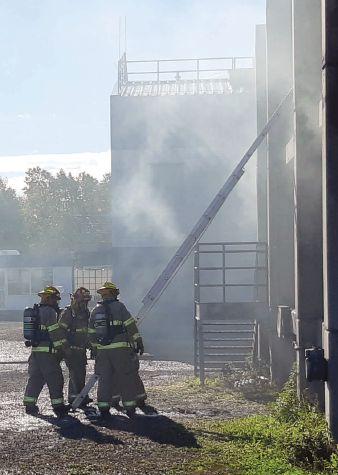
Both firefighters and officers should have the sense to ask questions when the time is right or if something doesn’t seem to make sense
We responded to an alarm sounding call at a commercial warehouse a few years back and when the second truck that was due arrived on scene we had no outward signs.
I brought my crew off the truck and went to the door to access the alarm panel and speak with the first due truck officer.
One of my chiefs was speaking with the keyholder and I walked past them. As I was approaching the front door, my chief yelled at me to mask up before I went in with the crew.
I thought this was a bit over the top for an alarm sounding call, so I yelled back something to the effect, “Why do you want us to mask up, the alarm panel is right there?”
The awkwardness of my question couldn’t have been exposed in a more timely fashion when an employee came out the front door wearing what resembled a Class C hazmat setup with a res-
pirator, toting a machine that was being u sed to fumigate the building for insects.
My question was unnecessary, as the chief had more information than I did.
For those who are new to their role as a formal leader in the fire service as a company officer, you will be questioned on various topics in the service or in your station.
Sometimes the motives and intentions of the person asking the question can be valid. There are also times when the question could be to test your knowledge or how much you’ve prepared for the role you are in.
I was 29 years old when I became an acting captain and started to ride up front. One of my biggest fears besides not being able to perform as a leader was not being knowledgeable and looking unprepared.
I encourage everybody to ask questions at any level in their fire service career.
Questions start conversations that can lead to information that allows us to become better fire service members. Questions can also expose weaknesses in the tactics of our pre-plans in reference to the “what-if” scenarios.
As officers, this forces us to stop and think of why it is done a specific way and ponder whether there may be a better way to accomplish the goal at hand.
There is an intention behind every question asked. It could be to gain knowledge, start a conversation or even test someone’s answer or preparedness.
Both firefighters and officers should have the sense to ask questions when the time is right or if something doesn’t seem to make sense.
We all need to learn from those questions and always remember to pass the needed information on to y our crew members.
When we do respond, we may be sitting in different seating positions, but we are all going to the same call.
By Jennifer Grigg
Jennifer Grigg has been a volunteer with the Township of Georgian Bay Fire Department in Ontario since 1997. Contact Jennifer at jhook0312@yahoo.ca.
Rekindle. What does that word mean to you?
The dictionary defines it as a verb, to revive something that has been lost, as in “he tried to rekindle their friendship.”
Readers that follow my column may remember that I’d left my fire department back in March, citing that I thought I was getting too old, maybe too soft (mentally and physically) and it was time to let the younger generations step up. But the bottom line is that I couldn’t stay away and my chief and new deputy graciously agreed to have me back. Seems there’d been a rekindle of sorts.
I returned just in time to attend the annual live-fire training at the fire college. Seemed like the perfect refresher for me. It’d been many years since I’d done live-fire training, so what a great way to jump right back in.
Here’s the kicker, though. As brave as I felt the day I signed up for the training, I admit to being challenged by rising anxiety the two days beforehand. I’ve shared my experience with anxiety and depression in past columns and I’m proud of my ability to overcome those issues, but moderate anxiety still trips me up the odd time. For those that have never experienced it, anxiety doesn’t mean that you can’t do something, it just means that you may have to push through a lot of mental crap to get there. In severe cases, however, it will prevent people from doing things.
Ninety per cent of the time I experience no anxiety, but certain circumstances will still trigger it, like going to the fire college to do training I haven’t done in over a decade and having had a negative experience in the past. Both of these were true in my case.
The point here is that I persevered and was pleasantly surprised by my effort, ability and enthusiasm that I demonstrated that day.
Apparently, I hadn’t forgot-
also a captain. My husband and the mutual friend were both instructors for live fire and I was one the 20 students, who were a mix of experienced firefighters and officers.
One of them expressed frustration at the need for repeated explanation and guidance of the tasks that we, as students, were assigned. It was a sentiment that I heard from other instructors that day as well. Being one of the students, I automatically went on the
I couldn’t stay away and my chief and new deputy graciously agreed to have me back
ten everything after all. Maybe a thing or two slipped my mind, like when answering command’s request for a PAR, the correct response is NOT. In case anyone has forgotten, the correct response includes your personnel count, lowest air reading, and location. Oh, and a painful reminder, wear your gloves when changing your cylinder. Also, don’t expect any sympathy from your husband on the fire ground because he’ll be the first one to tell you, “If you’d had your (expletive) gloves on, it wouldn’t have happened.” No favouritism there.
Speaking of my husband, who is a captain on a different department, we were discussing live fire on the weekend with a mutual friend who is
defensive, offering explanations of our behaviour.
I said, “C’mon, is it reasonable to expect us, many of wh om have not been to the college to do live-fire training scenarios since our last volunteer firefighter module, in my case Mod E, which was about 15 years ago, to remember everything?”
Part of me was already questioning what I’d just said because I’m a believer in taking responsibility and initiative.
I myself am a book nerd and I read every chapter in the 6th edition of the essentials that was referenced in the training day information we’d been given.
I also fired a bazillion scenario questions at my husband in an attempt to get myself up
to speed on skills that had been stored somewhere in the back of my mind. Use what you’ve got, right? My rekindled spark continued to grow.
Others may not have cracked the essentials at all, and quite possibly had no need to. I, on the other hand, have always been a bit of an oddball when it comes to the fire world because I’m not the typical Type A personality. I’m more like a Type Z personality, if that were a thing. I know that I learn best by reading, asking questions, watching a demo and then trying things out.
If you know your learning style, you can adapt and overcome challenges easier. If you’re an officer, knowing the learning style of your firefighters can make a huge difference for both of you.
In all actuality, the live-fire training day was a refresher and it was set up so that our morning evolutions were practice for the same afternoon e volutions. The expectation was that the instructors would provide guidance on what we’d missed or done incorrectly in the morning, and then we, in theory, would perform them in the afternoon without hiccups. When all was said and done, it was an awesome day. It had a profound effect on me because I’d overcome a lot to get there, and I deeply admired the instructors’ dedication to helping the “students” refresh their skills and make us all better firefighters.
I’m thankful that the spark has been rekindled and, at 47, I’m a stronger firefighter than ever.














By Sean Kingswell
The word “professional” means doing something as a livelihood, while the word “athlete” means exercising physical ability in many forms.
Therefore, simply put, professional firefighters are professional athletes. There are differences, of course, in terms of pay and the tasks involved.
An important distinction is that the average length of an athlete’s career is three to six years while we are shooting for 30 or more.
So, who needs to take care of their body more?
The consequences of being a firefighter are, of course, a lot more significant. Professional athletes and firefighters are similar in the areas of teamwork, passion, being prone to injury, working in the public eye, working with an audience and certain expectations from society.
A very important difference is that athletes get a fair amount of their conditioning while working on the skill sets, in the form of practices. But, not many fire departments can conduct drills often enough or hard enough while firefighters are on duty.
Athletes also get more than ample opportunity to warm up, while firefighters go from cold to hot with no physical prep time.
The athlete part applies to both professions. Both are physical. The success of efforts is based in many ways on physical ability and, of course, skill sets.
For a “professional,” being physically capable and having good skill sets isn’t about being able to execute something, it is about being able to execute well.
The average length of an athlete’s career is three to six years while we are shooting for more
Agility,
strength and flexibility are important traits for firefighters
Sean Kingswell is an experienced professional firefighter, personal trainer, fitness coach and the creator of the FIRESAFECADETS program. Contact Sean at firesafecadets@gmail.com.
NHL hockey player Sidney Crosby doesn’t need to practice slap shots, but he does because he wants to be perfect when he takes one. He also works out because he expects a lot of himself as a professional.
I am not implying that firefighters should be at the physical level of a pro athlete, just that they should be responsible to be their most fit and professional selves possible.
Having had the pleasure of training many athletes, I know there is sometimes a common misunderstanding about them. Many people will label a certain sport with a certain perceived physical attribute or ability.
Though different sports do require different strengths than o thers, there is one underlying concept that applies to all, and that is athleticism. Athleticism as a mix of being able to execute a wide variety of tasks, which includes both biomechanically and physiologically.
Strength often gets perceived as the top attribute for fire fighting and it is important. That being said, extreme absolute strength is not the most important attribute for fighting fires. Firefighters are rarely expected to lift an obscenely heavy object on their own. So, we do need strength, but we also need strength endurance. We need to be able to be strong over time.
Picture carrying a patient down multiple smoked-filled floors of an apartment building. This will last a lot longer than a one-rep max.
The strongest person in a crew is not always an asset if their cardio is not good.
Obviously, a huge and very important part of what we do is “on air,” and if we can not stick around
long enough to execute the task then we are a liability to our crew and our customers.
Knowing how to improve our cardio is important. Steady-state cardio is not always going to improve your cardio perfectly for the jo b of fire fighting. Good body composition helps to improve cardio. Unwanted weight means we are carrying an additional load on our body and heart.
Being flexible is certainly part of our athleticism. Being flexible can help prevent injury. In addition, good flexibility can help improve strength.
Mobility is tied to flexibility and can have a bearing on good biomechanics and practical ability. For example, good shoulder mobility can be crucial for fishing for an SCBA strap or swimming through wall studs in an RIT scenario.
ABC, or agility, balance and co-ordination, should also be part of a firefighter’s athletic development. All have a direct bearing on the ability to perform work effectively and to prevent injury.
Co-ordination is important and also includes hand-eye and foot-eye co-ordination. Agility can be really important in our ability to move in different firefighting scenarios. Two specific areas that firefighters should also make sure they include in their training are stairs and groundwork.
Some studies indicate that stair climbing is the toughest part of our job. My experience is that interior fire fighting or rescue, while crawling and on air, is the toughest and ar guably the most dangerous. Groundwork can be improved in the gym. Both of these areas need to be done well.
Please look at yourself as a professional and as an athlete and, in doing so, make sure you are training like a pro and training like the occupational athlete that you are.






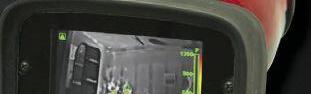















Easy-to-remove harness allows for cleaning and gross decon to help reduce contamination.
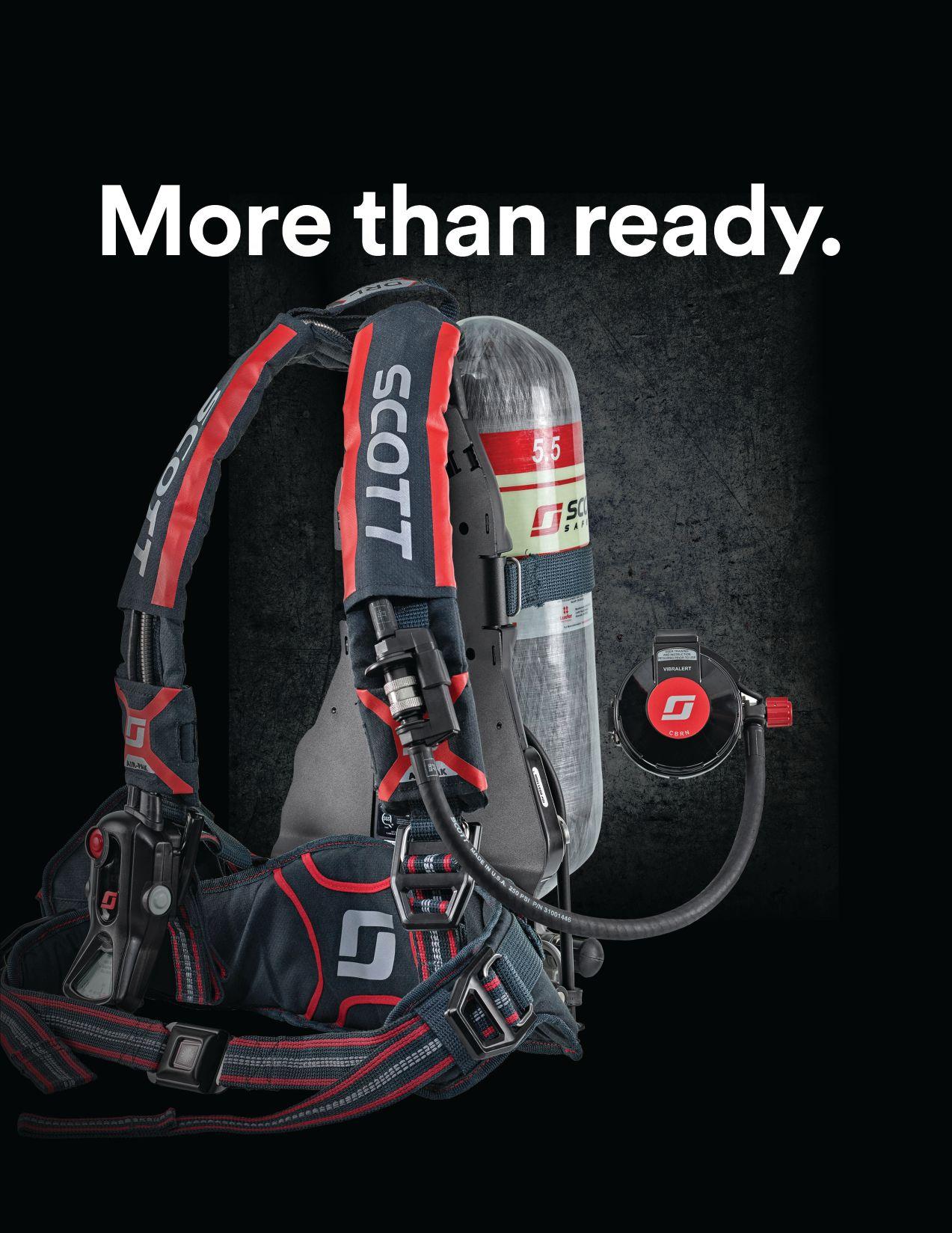
Combines the peace of mind of reliable breathability with an ergonomic harness.
ePAR capability provides simple incident accountability through Monitor Pro