Jack and Debbie Froese have made the much talked about ‘gate to plate’ a reality
By David Schmidt
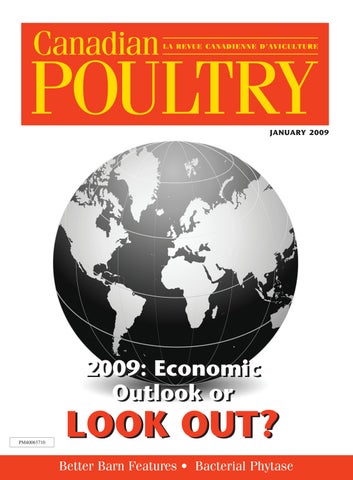
ECONOMICS: 2009: Economic Outlook or LOOK OUT?
After the excitement of 2008, 2009 should be calmer, says TD report.
By TD Economics, special report
26
PIC UPDATE: Effect of Nutrition on Meat Quality
The quality of poultry is receiving a lot of attention from researchers these days
By Tim Nelson, Executive Director
and Kimberly Sheppard, Research
Co-ordinator
30
FEED TECHNOLOGY: New-Generation Bacterial Phytase
The latest in phytase technology also ensures excellent heat stability for added confidence
By Dr. Janet Remus, Technical Services Manager
– Danisco Animal Nutrition
36
HOUSING: Better Barn Features for Poultry
A ventilation engineer’s perspective on making a poultry building the best it can be By
Harry Huffman,
P. Eng. Agricultural Engineer 40
IDEAS: Needed: A Time For Leadership
Donald McQueen Shaver looks at the major issues and proposes ways to address them By
Donald McQueen Shaver, O.C., D.Sc.
FROM THE EDITOR
BY KRISTY NUDDS
Focus on Quality
The University of Guelph recently published a study on how consumers have changed their eating habits after the listeriosis outbreak that occurred this summer and early fall.
What wasn’t known prior to the study was how the outbreak and subsequent recall of meat products had affected consumer confidence and purchasing habits.
Using what’s known as the “Guelph Food Panel” – a panel of 2,000 participants between the ages of 20 and 69, a “representative” sample of the population of the city of Guelph – researchers from the university’s International Food Economy Research Group (InFERG) surveyed consumers regarding their awareness, concerns and changes in consumption patterns following the outbreak.
One of the researchers, said that before the recall, consumers on average did not consider the potential risks of ready-to-eat meats to be significant. However, following the outbreak and recall, the proportion of consumers who said they never consume ready-to-eat meats increased by 33 per cent, and the proportion of those who said they never consume ready-toeat meat products in fast-food restaurants/outlets increased by 47 per cent.
The panel also examined “behaviour-related” attitudes, and the results were as follows:
• 30 per cent have stopped buying readyto-eat meats from Canada;
• 27 per cent now eat less often at restaurants and fast-food outlets;
• 52 per cent are paying more attention to food labels;
• 32 per cent are cooking more food at home;
• 30 per cent are taking more time in food preparation.
Interestingly, 75 per cent of those
surveyed said they still consider readyto-eat meats safe to eat. Also, despite apparent changes in behaviour, most consumers remain confident in Canada’s food safety system. Nearly 70 per cent of the consumers surveyed said that their perception of the safety of meat in general, of food products and food as a whole has not changed since the outbreak and recall occurred.
While this latter result is positive news, the study results overall are a staunch reminder that quality should be a key focus for food production.
In comparison with pork and beef, poultry made up a minimal proportion of the recall in question. However, poultry products are a significant proportion of ready-to-eat products in deli cases in supermarkets as well as fast-food restaurants. That’s why it’s imperative that consumer confidence in meat is maintained.
On the agendas of many of the upcoming conferences and meetings for the poultry industry (as well as the red meat industries) in North America this winter, I’ve noticed that producing for quality is on the schedule. This is not only essential for keeping consumer faith, but as the world suffers through a massive economic downturn, consumers will be keeping the purse strings tight. Money will be spent wisely on food, and quality for the money will definitely be top of mind.
The responsibility of producing quality food products isn’t solely on the shoulders of the food industry. In fact, it’s been shown time and time again in studies such as the one discussed earlier that farmers have the best image with consumers and are seen as the “gatekeepers” of food safety and quality. Let’s not let them down. ■
January 2009 Vol. 96, No. 1
Editor Kristy Nudds – knudds@annexweb.com
888-599-2228 ext. 266
Contributing Editor
Jim Knisley – jimk1@sympatico.ca
Publisher/Sales Manager
Marilyn White – mwhite@annexweb.com
888-599-2228 ext 237 • fax: 888-404-1129
Sales Assistant
Mary Burnie – mburnie@annexweb.com
888-599-2228 ext 234
Production Artist
Kelli Kramer
Editorial Director
Drew McCarthy – dmccarthy@annexweb.com
VP/Group Publisher
Diane Kleer – dkleer@annexweb.com
President
Mike Fredericks – mfredericks@annexweb.com
Mailing Address
P.O. Box 530, 105 Donly Dr. S., Simcoe, ON N3Y 4N5
Publication Mail Agreement #40065710
PAP Registration #9850
RETURN UNDELIVERABLE CANADIAN ADDRESSES TO CIRCULATION DEPT., P.O. BOX 530, SIMCOE, ON N3Y 4N5.
e-mail: cnowe@annexweb.com.
Periodicals postage paid at Buffalo NY. USPS 009-324, ISSN 1703-2911. Published monthly by Annex Publishing and Printing Inc. US Office of publication c/of DDM Direct.com, 1223 William St. Buffalo NY 14240. US Postmaster send address change to PO Box 611 Niagara Falls NY 14304.
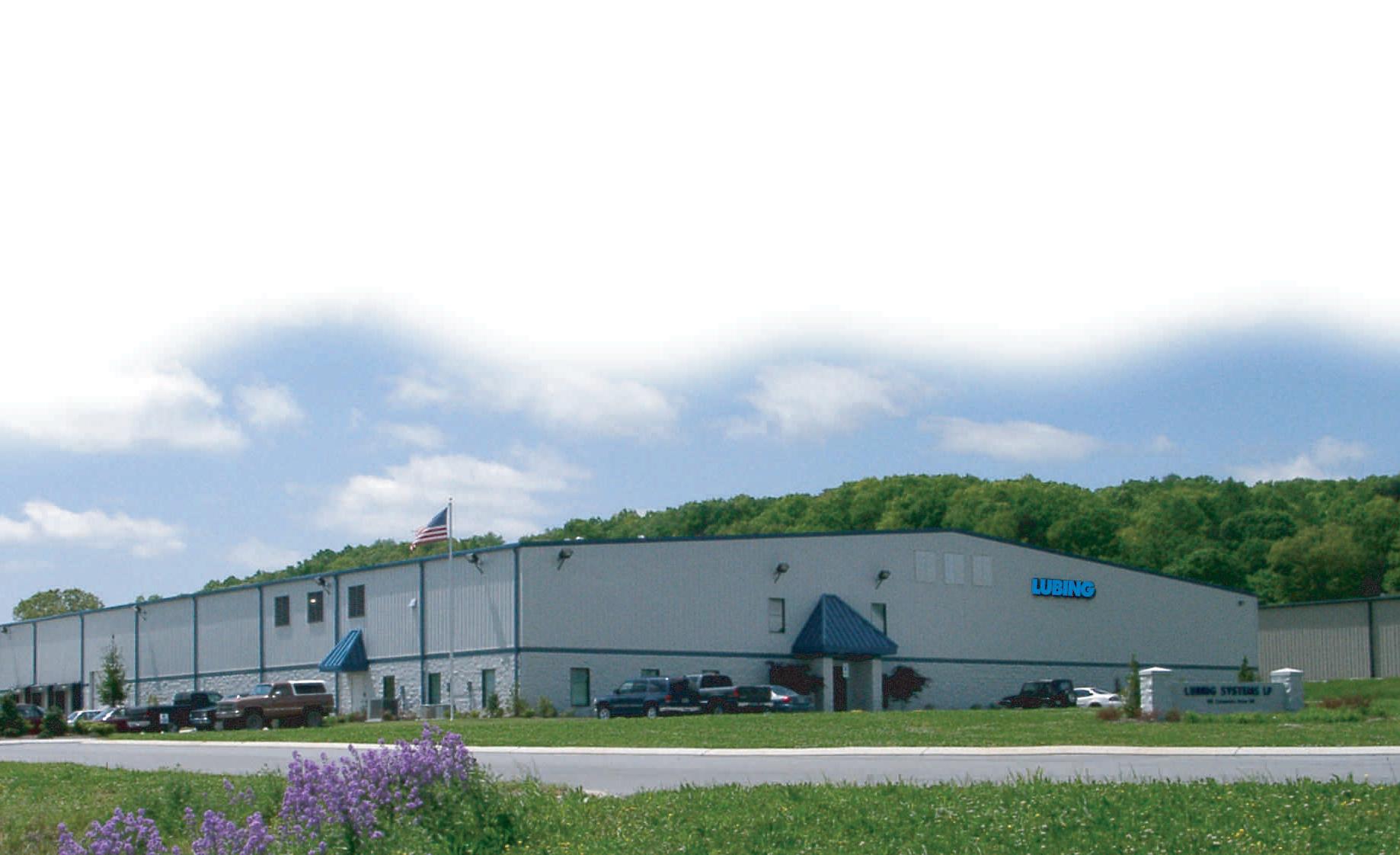
Innovative products, modern manufacturing, high-tech engineering and customer service are at the heart of our company.
The product design process begins in our engineering department with 3-D modeling where samples are produced for testing with our very own Rapid Prototyping Machine.
We inventory, manufacture and assemble the majority of our products in our 52,500 square ft. facility. In order to keep up with demand a 35,000 square ft. expansion is in progress to house our 8 injection molding machines and extrusion line.
Lubing is definitely Moving Forward... Faster.
O Safety of Organic Product Testing WHAT’S HATCHING HATCHING
rganic food is all the rage, but despite popular opinion it’s not automatically safer than conventionally grown foods. A team from several institutions led by University of Arkansas System Division of Agriculture food and poultry scientists has been awarded a three-year grant for nearly $600,000 from the U.S. Department of Agriculture’s National Integrated Food Safety Initiative grant to do food safety research in natural and organic poultry.
Steven Ricke, a professor in the UA Food Science Department and the Center for Excellence in Poultry Science, serves as the project leader with Phil Crandall, a professor in Food Science, and Frank Jones, associate director for Extension in Poultry Science.
The term “organic” is strictly defined by the USDA
National Organic Program to include poultry raised with no antibiotics, fed 100 per cent organic feed and given access to outdoors. The USDA definition for “natural” for meat and poultry products specifies no artificial ingredients or added colour and only minimal processing. USDA has also proposed voluntary standards for “naturally-raised” livestock to be raised without antibiotics and not fed animal byproducts.
Organic poultry currently accounts for no more than two per cent of the total poultry market, but it is the largest share of the organic meat market and is growing by leaps and bounds. Between 1997 and 2003, sales of organic broilers increased from about 38,000 to 6.3 million birds.
The meteoric rise in popularity of organic poultry has prompted a need for a comprehensive study of how to ensure its safety, Ricke said.
Organic and natural poultry are currently produced and processed in smaller facilities than is conventional poultry. “However, small production is
usually not integrated, providing less opportunity for the control of product quality, including food safety, as in large-scale, integrated production,” Ricke said. “Almost no university research has focused on small-scale poultry production systems or their food safety issues.”
Ricke and his team leaders will co-ordinate 13 research specialists on four teams from the U of A, Texas A&M University, West Virginia University, Cornell University, Purdue University and along with Dr. Anne Fanatico of the National Center for Appropriate Technology.
Among the expected results of the project is a plan to write guidelines for Good Agricultural Practices – a recognized collection of principles for production and processing – for food safety on natural and organic poultry farms. The guidelines will focus on developing plans that are relevant to plants of particular sizes. Ricke said a set of Good Agricultural Practices will play a critical role in ensuring safety.
Manitoba’s government and IBM have road-tested a pilot system to digitally trace food from the farm to the grocery cart, on their way to developing a provincial traceability program.
IBM Canada served as a project manager and consultant for the pilot and worked with the province and more than 16 supply chain partners, including beef and pork producers, animal feed ingredient producers, feed manufacturers, farmers, processing plants, truckers and a retail grocery chain.
‘Digital Passport’ for Food Cooking With
Eggs
Winners of Egg Farmers of Ontario’s “Eggspress” Yourself 2008 Student Recipe Contest have been chosen after competing in a “Cook-off” held at George Brown College in Toronto. Finalists from seven Ontario colleges competed in two categories – “Just the Good Stuff” (open to appetizer and dessert recipes) and “Real in the Kitchen” (recipes prepared in 20 minutes or less with a maximum of five ingredients). The contestants’ dishes were judged by a panel of four industry food experts and an Egg Farmers of Ontario (EFO) representative.
The “Egg-spress” Yourself 2008 Student Recipe Contest ran from September 29th to Oct. 26, and was open to full-time students currently
“Now that the proof of concept has been completed, we can look at implementing a traceability program that will help to assure the quality and safety of all consumer goods and also ensure that consumers – locally and across the country – feel confident in the products they consume,” Agriculture Minister Rosann Wowchuk said in a release.
The project tracked data about product movement, animal history and characteristics, processing history and transportation data throughout the complete value chain.
Using Global Traceability Network (GTNet) software
from Norwegian traceability firm TraceTracker, the pilot project showed it’s possible to securely, accurately gather and crunch data about a piece of meat from a variety of sources and share that information, at any step in the process, the province said.
GTNet allows trading partners to exchange “critical” product information so they can communicate key messages to customers and consumers. Ultimately, the province said, the system also can be used to provide messaging that can help reinforce consumers’ confidence in food products they buy.
enrolled in a culinary certificate or diploma program at an Ontario college or culinary school. Culinary students were challenged to create egg recipes that are creative, simple and delicious. All recipes submitted had to include at least one large egg per serving.
The winners of the contest are:
“Just the Good Stuff”
First prize -Christopher Stecko (pictured above right), George Brown College, Poached Egg with Guacamole and Asparagus
Susan Dimma, Liaison College in Kitchener, Green Eggs and Naan; Third prize – Line Lefebvre, Algonquin College, Divinity Eggs
“Real in the Kitchen”
First prize – Sarah Hess(pictured above left), Liaison College in Kingston, Gratin of Fresh Berries; Second prize – John Vetere, George Brown College, Mini Grilled Cheese ‘n Egg Sandwiches; Third prize – Jennifer Politi, Fleming College, Strawberry Dessert Omelette
COMING EVENTS
JANUARY 2009
January 28-30, 2009
International Poultry Expo/International Feed Expo, Georgia World Congress Center, Atlanta, Ga. Registration now open. For more information, e-mail expogeneralinfo@poultryegg. org; visit www.internationalpoultryexposition.com or telephone 1-770-493-9401.
January 28-30, 2009
Managing Excellence in Agriculture Conference , Sheraton Fallsview Hotel and Conference Centre, Niagara Falls, Ont. For more information, visit: http://www.farmcentre. com/EventsAnnouncements/ Events/ManagingExcellence/2009; or tel: (866) 492-1171
FEBRUARY 2009
February 3-5, 2009
Canadian International Farm Show, International Centre, Toronto, Ont. For more information, visit www. masterpromotions.ca/canadian-farm-show.asp, telephone 1-888-454-7469 or e-mail info@masterpromotions.ca.
February 19-20, 2009
Atlantic Poultry Conference, Old Orchard Inn, Greenwich, N.S. Program information is now available, visit: http://www. atlanticpoultryconfernce. com. For additional information, contact conference chairs Dr. Bruce Rathgeber ,e-mail: brathgeber@nsac.ca, or Mr. Peter Swetnam, e-mail: pswetnam@xcountry.tv; visit http://atlanticpoultryconference.com; or write: Atlantic Poultry Conference, 25 River Road, P.O. Box 550, Truro, N.S. B2N 5E3.
Tempura; Second prize –
WHAT’S
Small Wind Turbine Guide
To help with individuals interested in off-grid power generation, including farms and commercial operations, the Canadian Wind Energy Association has released an information guide for those considering purchasing such systems. In response to growing demand from consumers, the Canadian Wind Energy Association (CanWEA) has released a new 16-page “Small Wind Purchasing Guide” for off-grid, residential, farm and commercial applications. In keeping with CanWEA’s environmental print policy, the document is available in electronic format
at www.canwea.ca and www. smallwindenergy.ca.
The Guide, developed in partnership with the Pembina Institute and eFormative Options LLC, provides step-by-step information to assist individuals, farmers, community leaders and small business owners in selecting and purchasing a small wind system. The Guide covers a wide range of small wind, including “mini” systems (0 to 5 kW) intended primarily for battery charging, “small” systems (1 kW to 10 kW) intended for residential use, and larger systems (10 kW to 300 kW) for business and community applications.
Pilgrim’s Pride Bankrupt
.S. chicken producer Pilgrim’s Pride is filing for Chapter 11 bankruptcy protection. Company spokesman Ray Atkinson says Pilgrim’s Pride is reorganizing and not liquidating its assets. He says the company will keep operating.
The Pittsburg, Texasbased company sought the
MARCH
March 5-7, 2009
Atlantic Farm Mechanization Show, Moncton Coliseum Complex, Moncton, N.B. For more information, e-mail: info@farmmechshow.com; tel: (506) 8569898; or visit: www.farmmechshow.com
March 17-19, 2009 Midwest Poultry Federation (MPF) Conference, Saint Paul RiverCentre, Saint Paul, Minn. For more information, e-mail: lara@midwestpoultry.com; tel: (763) 682-2171; or visit: www. midwestpoultry.com
APRIL
April 8-9, 2009 Poultry Industry Conference and Exhibition (the London Show), Progress Building, Western Fairgrounds, London, Ont. For exhibitor information, contact Sharon Pook (x..222) or Lena Lindberg (x. 228), tel: (519) 438-7203. Registration information will be closer to the show date.
bankruptcy protection in a filing with the U.S. Bankruptcy Court for the Northern District of Texas on Dec. 1, 2008.
The company has been saddled with debt due to the acquisition of its rival Gold Kist Inc. and has had to extend its temporary credit line three times since September.
We welcome additions to our Coming Events section. To ensure publication at least one month prior to the event, please send your event information at least eight to 12 weeks in advance to: Canadian Poultry, Annex Publishing, P.O. Box 530, 105 Donly Dr. S., Simcoe, Ont. N3Y 4N5; e-mail knudds@ annexweb.com; or fax 519429-3094.
CUSTOMER SATISFACTION ACROSS CANADA
...“The strength and durability of the system told me that this was going to last more years than I had left in the business. ... As we got into the reality of using the system, I knew we had made the right decision.”
Al Dyck, Harman Poultry Farm, Prince Albert SK
...“My Hellmann Cage System is awesome. An excellent system to work with on a daily basis.”
Doug Pauls, Highplain Farms, Niverville MB
...“With the Hellmann Cages I am getting results I cannot believe. Uniformity in the mid 90’s...Feed conversion also improved dramatically (5.9 kilos/bird). The Hellmann troughs keep the feed in the troughs and not on the floor.”
Gerard Hoftyzer, Londesboro, ON
... “With 94% uniformity, excellent feed conversion, very good air quality; all accomplished with minimal labour inputs; I am extremely pleased with my decision to purchase Hellmann Pullet Cages.”
Jack and Debbie Froese make ‘gate to plate’ a reality
by David Schmidt
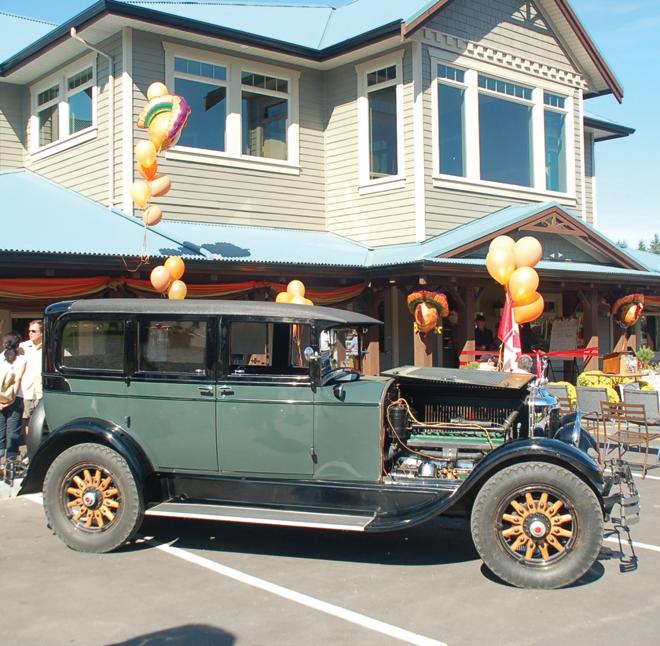
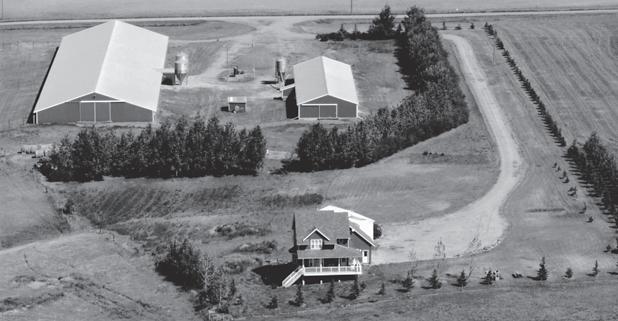
Sixteen years after making their first foray into specialty turkey production, Jack and Debbie Froese of Aldergrove, B.C., have realized a dream. In mid-September, they held the grand opening of the new JD Farms Turkey Deli & Bistro in Aldergrove.
When the Froeses bought the farm in 1979, it was an egg production unit but Jack, who was raised on a poultry farm, was more interested in meat than eggs so they soon switched from producing eggs to growing turkeys.
Despite the switch, Froese noted “we weren’t making enough money so we wanted to differentiate our turkeys from the rest of the market.”
AN INSTANT CLASSIC
This vintage car added decor to the grand opening of the new Turkey Deli & Bistro at JD Farms in Aldergrove, B.C.
To do that, they decided to produce “specialty” turkeys, defining specialty as turkeys receiving no animal byproducts and no antibiotics. They created their own labels and did their own marketing, sending most to stores in Vancouver and the Fraser Valley. They also converted their garage into a small plant to produce handmade turkey sausages fronted by a small shop where they sold the sausage as well as whole and cut-up turkeys and turkey parts.
In their first year, the Froeses sold only 900 specialty turkeys. But they persevered and sales increased steadily. This year they expect to sell 26,000 turkeys in stores all over the province, including their own which “just got too small.”
That prompted the Froeses to build a large new plant and store at the corner of their property. While brand new, it has the look and feel of an old country market.
“We’ve taken another step into agri-tourism,” Froese said. “We provide good quality food and invite people to get it at the farm. People want to buy food locally and that’s really helping us.”
He says people are not only more interested in food, they are also asking more questions about how and where it’s produced and processed, especially in light of recent food recalls. “Customers are not only asking us more questions, there’s a shift in what they’re asking.”
JD Farms is part of the Circle Farm Tour, “another way to connect” with the public. “More and more people are making a day of it. They’re coming out and touring all the farms.”
Started in small-town Agassiz just five years ago, the Circle Farm Tour is now a major initiative involving six Fraser Valley communities, including Aldergrove-Langley. Slick brochures with self-guiding tour maps lead urbanites to eight to 12 direct marketers and other agri-tourism destinations in each of the participating communities.
Langley district mayor Kurt Alberts complimented the Froeses’ efforts, calling their new deli “one example of the growth in value-added agriculture.”
While most everyone celebrated during the grand opening, there was a clear reminder the property is still a farm. Jack and Debbie were surrounded by their three children but missing their son-in-law, who was in the barn fixing a feeder that had broken down that morning, a situation all too familiar to farmers everywhere.
Rather than expand their own production to meet the growing demand the Froeses now depend on two other growers to supply most of their turkeys. In fact, 75 per cent of their turkeys are now grown by Patrick Huestis (president of the BC Turkey Association) and Dan Kampen (president of the Fraser Valley Egg Producers Association).
“We’re licensed as a broker by the BC Turkey Marketing Board, which allows us to buy live turkeys from growers,” Froese explains, adding JD Farms is currently the only operation with such a licence.
Huestis, Kampen and Froese’s own production unit are all subject to independent audits to ensure “we meet our own standards.”
VARIETY OF PRODUCTS
The turkeys are custom-killed at a nearby processor and trucked back to JD Farms for packaging as whole birds (“we expect to sell about 2,000 through our store at Thanksgiving”) or further processing. JD Farms now produces 10 varieties of turkey sausage, a range of cut-up turkey parts and such deli fare as lasagna and other pastas, soups, roasts and even hams, all made with turkey.
“Our product is very lean, we use no fillers in our sausage,” Froese says.
Only open since July, the new store has been an instant success. “Our on-farm sales doubled when we opened the new store,” Froese notes.
While he would like to double total sales to more than 50,000 turkeys/year in the next five years, turkey is a supplymanaged commodity and the BC Turkey Marketing Board’s “assurance of supply” provisions could limit how much turkey JD can obtain. “We will do what we can within the rules,” Froese states. ■
DEBBIE AND JACK FROESE SPEAK TO DIGNITARIES IN FRONT OF A LARGE CROWD ASSEMBLED FOR THE GRAND OPENING OF THEIR NEW TURKEY DELI & BISTRO AT JD FARMS IN ALDERGROVE, SEPT. 13. ON HAND FOR THE OPENING WERE (L-R) LANGLEY MAYOR KURT ALBERTS, MLA RICH COLEMAN AND MP MARK WARAWA.
“We will do what we can within the rules,” Froese states. ■
JACK AND DEBBIE FROESE WIELD SOME GIANT SCISSORS AS THEY CUT THE RIBBON ON THEIR NEW TURKEY DELI & BISTRO AT JD FARMS. ALSO IN THE PICTURE WERE LANGLEY MAYOR KURT ALBERTS, ALDERGROVE-LANGLEY MLA RICH COLEMAN AND LANGLEY MP MARK WARAWA.
Web Exclusive
Ontario Needs to Get Tough on Food Safety: Report
Ontario needs to be more vigilant about food safety violations at meat and dairy plants, many of which have been flagged for potential problems, the province’s auditor general warned in a report early last month.
The government isn’t doing enough to check up on provincially regulated slaughterhouses and meat-processing plants that were cited for major sanitation violations, Auditor General Jim McCarter wrote in his annual report.
The province has also renewed licences for some dairy plants and milk distributors before an inspection was even completed or received, his report found.
“Consumers in Ontario would have a higher level of comfort if the deficiencies that we pointed out in our audit were corrected by the Ministry of Agriculture and Food,’’ he said after releasing his report.
“It would lessen the risk.”
The Auditor General’s Report is available on www.canadianpoultrymag.com
Blog
DDGS
and Poultry Diets
By Mojtaba Yegani
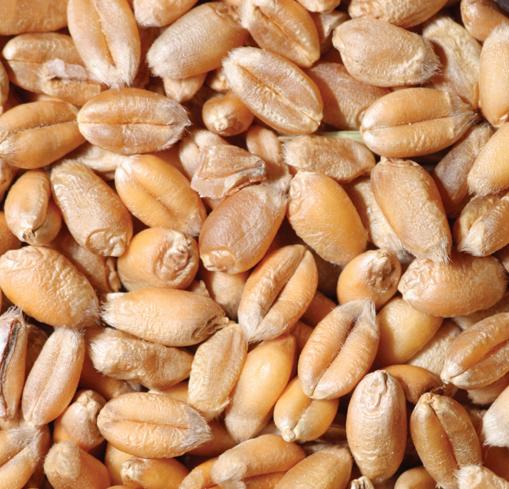
Distillers dried grains with solubles (DDGS) is a byproduct of the ethanol industry in which the starch component of cereal grains (corn, wheat, barley, rye, and sorghum) undergoes a fermentation process and is converted to ethanol and CO2 .
There has been a considerable growth in the biofuel industry in Europe and North America (including Canada) over the past few years. The government of Canada strongly supports the expansion of this industry and at the same time, it has been providing funding for research on the usage of DDGS in the animal industry. On the other hand, according to a survey conducted by Hormel Foods, six out of 10 Americans (61 per cent) said that corn-based ethanol is at least partly responsible for higher food prices.
DDGS can be used as a feed ingredient in poultry diets including broilers, laying hens, and turkeys (1) although the majority of these studies have been done on corn DDGS. Currently, there is an increasing tendency to work on wheat and other grains as source of DDGS in Canada. Dr. Eduardo Beltranena of Alberta Agriculture and Rural Development and Dr. Doug Korver of University of Alberta have been conducting research projects investigating potential benefits of using DDGS (of different sources) in poultry diets.
Although DDGS is a good source of certain nutrients for poultry, the main concern is variation in nutrient composition (crude protein, amino acids such as lysine and methionine, fat, fibre, minerals) and also availability of these nutrients to the birds, which may limit use of DDGS in poultry diets. Grain composition and ethanol production procedures are two major contributing factors to this variability.
The full story is available on our website.
BUYERS GUIDE
Our Buyers Guide is the only reference tool to bring the entire Canadian Poultry industry together in one directory.
DIGITAL MAGAZINE
To sign up for a free trial of Canadian Poultry magazine, digital version, please go to www.canadianpoultrymag.com.
E-NEWSLETTER
To sign up for our bimonthly e-newsletter, visit www.canadianpoultrymag.com. It’s free!
NEW PRODUCTS
Check out new product listings on www.canadianpoultrymag.com. Latest products include the latest hatching technologies from Pas Reform and new monitoring tools from DeltaTRAK.
POLLS
Recently we asked the question: “Do you think the poultry industry in Canada will be affected by the current global economic crisis?”
74.4 per cent answered yes, 23.3 answered no, and 2.3 per cent were undecided.
reliability profitabilitytraceability
It’s what you need in a feed additive and Alltech delivers on all three counts.
Through 28 years of research-driven product development, we’ve created a range of natural products that support optimal animal performance — products that are proven reliable, traceable and profitable...naturally.
For more information on our products contact Alltech Canada at 1-800-285-8617
CPRC Update
BEYOND 2008
The end of 2008 marked another year of growth for the Canadian Poultry Research Council (CPRC). Activities were, and continue to be, on the rise as the CPRC implements its strategic plan to address its members’ needs. Below are some highlights of 2008 with a few notes on where we are going in 2009 and beyond.
RESEARCH FUNDING
As highlighted in the 2007 Annual Report (the first official such report for CPRC), presented at the Annual General Meeting in March 2008, the CPRC has committed over $1 million in support of 20 research projects. Seventeen of these projects are grouped into national research programs that are consistent with agreed priorities. These priorities are set during regularly scheduled national workshops with academic, government and industry representatives (next one in 2010). Request for letters of intent are sent to researchers in April of each year. Each of the priorities receives focus on a rotating basis. The remaining three projects are funded under CPRC’s ad hoc policy, which is designed to address acute or emerging needs that may fall outside the priority areas. Two new projects got underway in 2008, with a further 6 under review by potential partners. It is a prerequisite for CPRC funding that a project secure matching funds from another partner(s) before it releases funds. This process ensures that industry dollars granted through CPRC are matched or “leveraged” to the greatest extent possible. Increasing leveraging is a major focus for the CPRC.
SCHOLARSHIP SUPPLEMENT
Each year, the CPRC awards a supplement to a student working in some aspect of poultry science and who is also a holder of a scholarship from the Natural Sciences and Engineering Research Council (NSERC). The 2008 supplement was awarded to Megan MacDonald at the University of Alberta. Details of Megan’s work, as well as that of students awarded the supplement in 2006 and 2007 were detailed in the September 2008 issue of the “CPRC Update” and are posted on the CPRC website. The scholarship supplement is designed to help attract the best and brightest students to the poultry sector, rather than pursue studies in other sectors. Part of CPRC’s mission is to help ensure the future prosperity of our industry through training new scientists and industry professionals. The supplement is one way to attract new young individuals to our sector. Details of how to apply can be found under “Updates” on the CPRC website.
WELFARE CLUSTER
The CPRC, in conjunction with Agriculture and Agri-Food Canada (AAFC), agreed to facilitate the development of a cluster of poultry welfare and behaviour expertise in Canada. The University of Guelph, through a transparent review
process, was chosen as the most appropriate location. At press time, final touches were being made to an agreement between AAFC, the University of Guelph, Poultry Industry Council and CPRC to co-locate an AAFC research scientist at the University. This scientist will work alongside the many welfare and behaviour experts already at Guelph. Efforts are also underway to establish a Chair of Poultry Welfare Research in Canada. If successful, these efforts will result in an additional, fulltime position at Guelph that will include not only aspects of research and student training, but also a coordination role to help ensure that researchers across the country working in various related fields are aware of, and working to address, industry’s concerns relating to poultry welfare and behaviour.
FUNDING WORKSHOP
Last month’s CPRC Update summarized the “Funding Poultry Research in Canada” workshop held in October. A full report has since been released and posted on the CPRC website. A major outcome of the workshop was a consensus among participants that CPRC should take on a greater role as the national coordinator and voice for Canadian poultry research. The CPRC is currently examining its capacity and will further define its role in 2009.
LOOKING TO THE FUTURE
All of the above activities are consistent with CPRC’s strategic plan. The Plan was formalized at the end of 2007 and developed through 2008. It is centred on maximizing the impact of Canada’s poultry research investment. In keeping with the theme of its strategic plan and the message from the participants of the recent workshop on “Funding Poultry Research”, the CPRC will be undertaking a greater leadership role at the national level with respect to many aspects of Canadian poultry research. Efforts will be made to improve communication and collaboration among the various organizations that support poultry research in Canada. We will keep you apprised of these efforts in future updates. For more details on any CPRC activities, please contact Gord Speksnijder at The Canadian Poultry Research Council, 483 Arkell Road, R.R. #2, Guelph, Ontario, N1H 6H8, phone: (289) 251-2990, fax: (519) 837-3584, email: info@cp-rc.ca, or visit us at www.cp-rc.ca.
The membership of the CPRC consists of the Chicken Farmers of Canada, Canadian Hatching Egg Producers, Canadian Turkey Marketing Agency, Egg Farmers of Canada and the Canadian Poultry and Egg Processors’ Council. CPRC’s mission is to address its members’ needs through dynamic leadership in the creation and implementation of programs for poultry research in Canada.
Feed costs!
When feed efficiency matters most.
Cobb products will reduce your feed cost through outstanding feed efficiency and lower nutrient density diets.
Cobb products will help keep feed costs from slipping through your fingers.
Economics 2009: Economic Outlook or LOOK OUT?
After the excitement of 2008, 2009 should be calmer, says TD report
EXCERPTS TAKEN FROM TD ECONOMICS SPECIAL REPORT
It was only this past spring that world crop prices were soaring because of concerns about global food shortages, there was growing excitement about the use of food as a source of fuel and a surge in speculative financial investment in commodity futures markets.
Now, food supply fears have eased considerably and growing worries about the global financial and economic landscape have dampened expectations for both world food consumption and investment in commodities, Derek Burleton told poultry producers at the Poultry Industry Council’s innovation conference in November.
After this roller-coaster ride, farmers must be wondering if more thrills and chills lie ahead in 2009.
“In the very short term, the risk to agriculture prices continues to be tilted to the downside as financial markets remain unsettled and worries about the economy stay in the forefront,” Burleton, director of economic analysis for the TD Financial Group said in a special report.
However, by mid-2009 he said prices should regain their footing.
A year ago TD issued a report that said while there would be short-term swings in prices agriculture’s long term looked bright.
“Notwithstanding the flurry of events over the past year, we stand by that assessment,” he said.
To some extent, the shift in global
DAMPENED EXPECTATIONS
The risk to agriculture prices continues to be tilted to the downside as financial markets remain unsettled and worries about the economy stay in the forefront.
crop prices reflected movements in supply-demand fundamentals. After two straight annual declines in output and rising demand from emerging markets, the world entered 2008 facing critically low grain and oilseed stocks.
“If that wasn’t enough, ambitious government mandates for grain-based ethanol and biodiesel production contin-
ued to drive a wedge between global supply of crops and their traditional uses in feeding both households and livestock.”
Then world crop production responded to prices. Seeded acreage rose, especially in wheat and with good weather world wheat output grew 12 per cent.
In almost one fell swoop, global inventories were restored. Other major crops
This is just one of the challenges that Danisco can help you solve.
Using new Thermo Protection Technology, Phyzyme XP TPT phytase is heat stable up to 95°C. This highly effective new generation phytase is at least 20% more effective than traditional phytases in improving the digestibility of phosphorus and other nutrients contained in many feed ingredients.
Thermo Protection Technology enables Phyzyme XP TPT to be included before pelleting in the majority of feed manufacturing processes.
TPT
To find out more please contact
Halchemix Canada Inc
Tel: 1-800-540-4756
halchemix@halchemixcanada.com www.halchemixcanada.com Visit us at IPE booth 3256
also enjoyed strong yields. Barley output is expected to grow 12 per cent and canola yields are the highest on record.
On top of the improved yields, agricultural commodities were not immune to growing worries about the impact of a global economic slowdown on consumption.
But while changes in expectations about fundamentals have been a major factor at work in crop markets, fingers have also been pointed at speculators and the trend in the U.S. dollar as key culprits behind the massive moves in prices.
Economics
represent an “overshoot,” with prices undergoing a firming trend throughout the remainder of 2009 and into 2010.
For one, most crop markets are heading into this period of global downturn enjoying relatively well-balanced supply-demand conditions. Even then, demand for food tends to be less sensitive to deteriorating global income gains than other commodity areas. A bigger threat is on supply rather than demand, as ongoing credit problems globally could dampen sales of machinery, fertilizer and other inputs, thus impeding next year’s output.
In this environment, we see the risks to agriculture prices tilted to the downside, as global economic and financial headwinds continue, the report says. As has been the case of late, most vulnerable to further selling are crop prices, which despite the clearing off of much of the speculative froth built up in 2007-08, remain especially prone to further liquidation of commodity positions by hedge funds and other institutional investors.
Livestock prices – notably hogs –have less scope for declines since they are already at low levels.
Still, there are several reasons to suggest that any further weakening in crop prices from current levels will likely
2009 Highlights
US$ crop prices not expected to retest recent highs any time soon, but should remain above their fiveyear averages in 2009.
A weaker C$ should help to cushion Canadian farmers from the impact of lower US$ prices. Farm incomes will be further supported by a simmering down in energy, global transportation and fertilizer costs.
Credit crunch expected to ease over the next 12 months.
Despite benefiting from an easing in cost pressures, Canadian livestock producers face another challenging year in 2009.
Above all, we continue to see longer-term support for agricultural prices still at play. For several decades, crop prices globally had been falling in real inflation-adjusted terms as the contribution of rising productivity on global supply outstripped the impact of gains in demand.
However, even discounting the major up and down in prices in 2007-08, a pickup in global consumption growth visà-vis productivity has reversed the longterm decline in real crop prices.
TD Economics forecasts the economies of China and India to expand by 8.5-9 per cent and 6-6.5 per cent, respectively, in the 2009-10 period. This growth will continue to benefit both crops and livestock sectors.
Ethanol and biodiesel production will also grow and continue to underpin crop demand in the United States, Canada and elsewhere next year and over the longer haul.
From a Canadian perspective, the growing ethanol industry is a mixed blessing. While ethanol provides support to prices received by crop farmers, it raises the cost of livestock feed. Canada has traditionally grown more feed corn than demanded by livestock producers, with the surplus then shipped abroad. But with a growing amount of domestic production of corn used in the ethanol process, the country now records a corn trade deficit, which places prices on a higher import basis.
With tightening global credit conditions and slowing economies around the world to lead to a slackening in red meat demand over the next few quarters, the hog and cattle markets are not expected to buck the continued downtrend in prices in the near term. However, we see some significant upside once the global economy begins to gain traction later in 2009 and into 2010. The outlook is for tightening supplies, reflecting in part the recent weakness in financial returns in the industry, the Canadian federal government’s Cull Breeding swine program and new U.S. legislation on country-oforigin labelling (COOL).
These factors are expected to have a major negative impact on Canadian exports to the United States.
OUTLOOK FOR CANADIAN FARM INCOMES IN 2009
The most recent data cover 2007, when realized net farm income rose to $1.7 billion. While this was double the 2006 level, it remained below the levels of $2$3 billion recorded earlier in the decade.
For 2008, the picture is decidedly mixed. So far, only figures on farm cash receipts for the first and second quarters of the year have been released. And by that count, Canada’s farm sector is poised to turn in a stronger showing this year. During the year’s first half, total receipts shot up by 11 per cent year over year, as a 31per cent surge in crop receipts more than offset a four per cent decline in livestock.
But crop prices have retreated significantly since mid year, but so has the Canadian dollar, partially shielding Canadian farmers.
Also driving revenues is crop production which was generally favourable. Total wheat production is expected to rise 36 per cent in 2008, with canola and barley up 14 per cent and two per cent. Meanwhile cattle and hog production lost ground this year. In the hog industry,
Economics
Canadian inventories fell by about 11 per cent as of October. Cattle inventories, which are reported semi-annually were down four per cent.
The greatest uncertainty surrounds
input prices and how much profits were reduced by rising costs.
Forecasting whether the cost or revenue side will win out in 2008 is a tough call, TD says in the report.
In TD’s view, total net realized farm income will come in moderately higher than last year – in the $1.5-$2 billion ballpark, Burleton said.
A look ahead to the net income picture for 2009 also contains significant cross-currents, according to the report.
TD expects:
• Canadian dollar to remain soft – next year, the loonie will continue to trade in the range of 80-90 U.S. cents, lower than its recently over-valued levels of 95-100 U.S. cents. While unambiguously positive for Canadian farmers from an output-price perspective, a weak currency raises the cost of U.S.made inputs, such as farm machinery.
• Energy prices falling out of the stratosphere – crude oil prices are now trading at less than half of their recent peak of US$147 per barrel. While the price of crude should be supported by a pickup in global economy later next
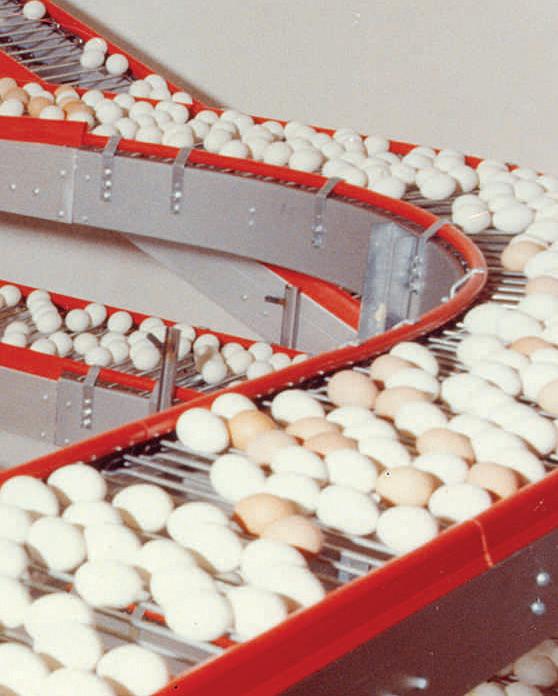
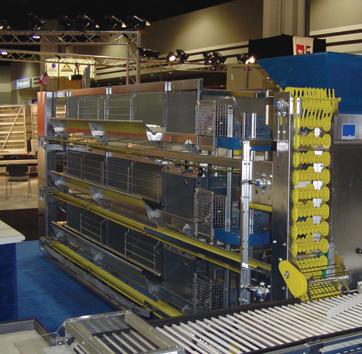
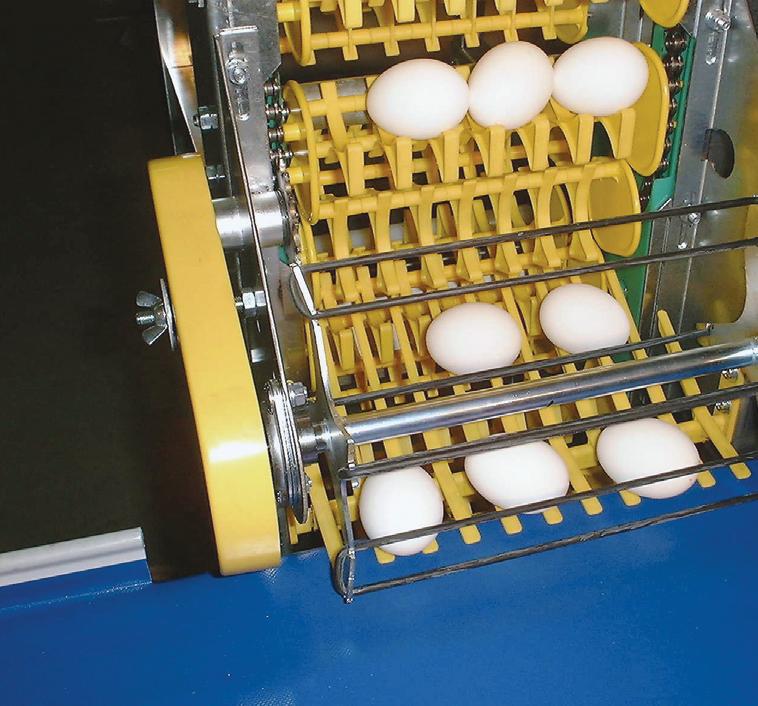
The egg elevator with variable speed egg belts has no transfer wheels. The egg cup is designed to insure that eggs from any tier always enter an empty basket. The egg elevator can be equipped for overhead cross conveying or below the floor, or with a table in front of each row.
Canadian Poultry Magazine and Intervet/Schering-Plough Animal Health present the
Economics
Great Canadian “FLY THE COOP” Get Away Contest
Congratulations, you have found Brewster!
Record the page number and issue date where this ad is located on the contest ballot located at the Intervet insert in the centre fold of this magazine. Complete the remainder of the information on the ballot, attach a first class stamp and mail to: Great Canadian “Fly the Coop” Get Away Contest, c/o Canadian Poultry Magazine, Annex Printing and Publishing Inc., P.O. Box 530, 105 Donly Drive South, Simcoe, Ontario, Canada N3Y 4N5. Good Luck!
AUGUST 2008
Danny Gilbert
– Burtts Corner, New Brunswick
SEPTEMBER 2008
Mike B. Hofer
– Hodgeville, Saskatchewan
OCTOBER 2008
John Beischlag – Jarvis, Ontario
NOVEMBER 2008
Hardy G. Wipf, Warner, Alberta
Prizes sponsored by Intervet/Schering-Plough Animal Health 250 Water St., Whitby, ON, L1N 9T5
SolarWall
• SolarWall has been installed on hundreds of agricultural and live-stock buildings, reducing heating costs by up to 30%. The system, which uses the sun to pre-heat incoming fresh air, also dramatically improves air quality and decreases humidity.
There are many reasons to consider SolarWall for your new or existing buildings:
• SolarWall provides thirty years or more of free heat.
• SolarWall means more fresh air can be brought into the building improving air quality without increasing heating costs.
• SolarWall is maintenance free and has no moving parts.
• SolarWall is cost effective - As of September 1, 2008 there is a federal contribution of $70.00/m2 of solar panel area and a matching $70.00/m2 contribution from the Ontario provincial government.
• SolarWall also contributes to cooling a building in the summer by shading the existing outside wall from the sun.
Call Exacon or an authorized SolarWall dealer near you for additional information and to obtain a free quote.
year, we see prices averaging a more manageable US$65-75 in 2009.
• Fertilizer prices should come down –While prices of nitrogen and phosphate fertilizer are expected to continue easing in tandem with crop prices over the first half of 2009, potash prices are likely to remain extremely elevated due to labour strikes and weak world production levels. Overall, however, crop farmers should see some reprieve in this all-important cost area.
• Transportation costs slackening – the easing in global growth is expected to take pressure off international freight costs, as evidenced by the steep drop in the Baltic Dry shipping index in recent months. This trend is likely to remain intact in 2009.
• Cost of credit – the global credit crisis has put upward pressure on the cost of availability of credit worldwide. While Canada has not been hit to the same degree, the impacts have been observable in the higher pricing of debt faced by banks and other large players, including many in agricultural sector, in the commercial paper market. In light of this stress, dealer finance programs are under threat, further limiting credit availability. The strains on credit markets are expected to recede as 2009 progresses, supported by efforts by world central banks and governments to boost liquidity, backstop inter-bank lending and lower shortterm interest rates.
Putting it all together, the mix of still relatively high crop prices, a weak currency, and a simmering down in most cost pressures bode well for a further improvement in total farm income in 2009.
That said, there remain several clouds on the horizon.
Even with a Canadian dollar at 80-90 U.S. cents, many Canadian meat processors are still uncompetitive. What’s more, COOL is not likely to be the only challenge on the trade front facing Canada’s farm sector.
There are concerns the U.S. government could turn increasingly protectionist, the TD report says. ■
Great Canadian FLY THE COOPGetAway
Food Outlook: World poultry production to increase
BY THE WORLD FOOD AND AGRICULTURE ORGANIZATION
Global poultry meat production in 2009 is projected to rise to 94.6 million tonnes, three per cent higher than in 2008. Growth is expected in virtually all regions, except for North America. Poultry production in the United States is forecast to decrease by one per cent, in response to poor export prospects in 2009. By contrast, large production gains are anticipated in all the other major producing countries; i.e., Argentina, Brazil, Canada, China, Colombia, India, Indonesia, the Islamic Republic of Iran, Malaysia, Mexico, Russian Federation, Thailand and Turkey.
Despite the resurgence of avian influenza (AI) in parts of the European Union, India and the Republic of Korea, the poultry production outlook in 2009 remains positive in those countries.
Competitive prices with respect to other meats and consumer preference for white meat still favour poultry meat. High feed prices tend to raise poultry meat unit costs and prices by a smaller extent than is the case of pigmeat or beef from cattle raised in intensive production systems.
Trade in poultry meat for 2009 is forecast to rise by two per cent to 10.6 million tonnes. Much of the import growth is expected to be driven by China, including the Hong Kong, SAR, where consumers are substituting broiler meat for higher-priced pigmeat. Saudi Arabia is anticipated to record a six per cent increase, following a recent cut of import tariffs for frozen poultry, aimed at controlling food inflation. Rising demand for leg quarters and mechanically separated chicken by the processing industry is also set to raise imports by Mexico.
Deliveries to the European Union, which has become a net poultry importer since 2007, may rise slightly in 2009. By contrast, they may decline in the Russian Federation and in Ukraine.
As for poultry meat exports, expectations of falling imports by the Russian Federation and strong competition from Brazilian exports in the markets of China and Japan are dampening the United States’ export prospects. Overseas sales from Brazil are now anticipated to grow by more then four per cent, to almost 3.8 million tonnes, given competitive pricing. ■
PIC Update Effect of Nutrition on Meat Quality
The quality of poultry is receiving a lot of attention from researchers these days
TIM NELSON, EXECUTIVE DIRECTOR AND KIMBERLY SHEPPARD, RESEARCH CO-ORDINATOR
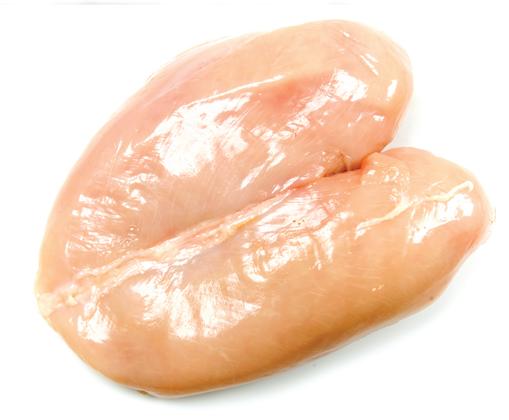
Poultry meat quality is receiving considerable attention recently due to the emergence of problems associated with poor water holding capacity, poor texture, and pale colour. Meat with these characteristics is termed PSE (pale, soft, exudative). According to several studies, the estimation of PSE in broilers ranges between five and 30 per cent in commercial operations, posing problems for both value-added processing and consumer satisfaction. Although the direct cause is known to be attributed to protein denaturation (a process in which a protein’s structure is altered, causing the protein to become biologically inactive), the ultimate cause of PSE meat is not clear. In order to manage the problem, the industry needs information on what factors contribute to it.
Major factors in the development of PSE meat are thought to include a variety of stressors pre-slaughter and genetic selection for fast growth, leading to muscle abnormalities and meat quality defects. However, studies have demonstrated that genetic selection for fast growing birds have no important effects on broiler breast meat quality. Nutrition also comes into play, and the severity of PSE meat may be modulated by nutrition or possibly feed formulation.
Feeding strategies designed to maximize growth and yield could affect breast meat functional properties such as colour, pH, water holding capacity and shear force. Since PSE meat is a growing problem in the industry, there is potential for great economic loss in whole-muscle and further processed products due to high cooking loss, decreased water holding capacity, and texture problems.
Dr. Mirko Betti and his research team at the University of Alberta have been investigating the impact of a range of dietary energy and protein levels on poultry meat quality. Parameters analyzed included colour characteristics, myoglobin content, ultimate pH, water holding capacity (moisture uptake and drip loss), cooking loss, emulsification capacity and tenderness (shear force).
Their findings? Results indicated that
FACTORS AFFECTING QUALITY
and his research team at the University of Alberta have been investigating the impact of a range of dietary energy and protein levels on poultry meat quality.
dietary and protein levels did not have a commercial impact on breast meat physical and functional properties or on morphology characteristics. By contrast, processing variables such as sex and slaughter age were more important in affecting broiler breast meat characteristics. Female broilers had a lower water holding capacity than male, while older birds had a lower ultimate pH and a lower tenderness than younger birds. To read more, please visit www.poultryindustrycouncil.ca.
Dr. Mirko Betti
PIC Update
FEATURED RESEARCHERS
Bill Van Heyst has been with the School of Engineering at the University of Guelph for seven years where he is currently an Associate Professor in Environmental Engineering. His current research is heavily focused on air quality issues arising from agricultural operations including air emissions from deadstock disposal,
ammonia release from soils after manure applications, and particulate matter and ammonia releases from livestock housing operations. Prior to joining the University of Guelph, Dr. Van Heyst spent five years with a leading air quality consulting firm in Mississauga, with the last two years as Principle of Environmental Consulting.
PIC PICKS
Innovation Conference followup: As a result of feedback from you, the participants, we’re doing some new things with the conference in 2009. For starters it will be held at Niagara Falls in the Sheraton Fallsview Hotel on Nov. 9 and 10, and will start a little later – at 10:30 a.m. – to allow folks to get there.
Size Fractioned Particulate Matter Emissions From a Broiler House in Southern Ontario
Recent studies reporting on the air emissions from poultry facilities suggest that the Canadian inventories developed with particulate matter (PM) emission factors (EF, which are used to estimate the rate at which a pollutant is released into the atmosphere) are substantially underestimated. These studies were conducted on poultry confinement houses in different countries with varying climates and management practices that may not be representative of a Canadian setting. In order to develop regulations applicable within the Canadian environment, work must be carried out on Canadian poultry farms.
Bill Van Heyst and his research team at the University of Guelph have been conducting research to determine the extent of daily and seasonal variations of PM emissions from a broiler house in Southern Ontario. They used a methodology that provides continuous PM emission rate measurements, with the aim of estimating the annual emissions of size fractionated PM for the broiler sector in Canada, based on the extrapolation of the experimental results.
The researchers found that emissions of PM from a broiler house gradually increase as the bird’s age. This is a result of increases in both house ventilation rates and indoor PM concentrations over the duration of a broiler production cycle. In addition, there is a diurnal pattern in PM emissions that is mostly related to the change in PM release caused by variations in bird activity from the light/dark cycles used in the house. Contrary to studies in other countries, the size fractionated PM emissions from this study are not seasonally dependent.
Overall, this study has provided insight into the similarities and differences in PM emissions generated by the Ontario poultry sector, in comparison to poultry production in other countries.
It was also found that PM EF’s are much larger than those used to develop the current inventories for Canadian poultry production. Thus, the current Canadian poultry housing PM emission inventories may be substantially underestimated and a more accurate estimate may be obtained by using the EF’s developed in this study.
To read more, please visit www.poultryindustrycouncil.ca.
BILL VAN HEYST, UNIVERSITY OF GUELPH
PIC Update
The industry dinner will be on the night of Nov. 9. We’ve block booked some rooms at an amazing rate of $95 for a double (a little more if you want views of the Falls), which is amazing value and so leaves you no excuses for not bringing your partners to this, the only cross-sector industry dinner – a great investment.
Staying with investment, on the Canadian Poultry Blog (blog by the way is a bad name for a place on the Internet where you can have your say), University of Alberta PhD student Mojtaba Yegani (who does research work with Dr. Doug Korver), asks the question “why is it so hard to get research money from industry?” Let me try and help.
Industry funding for research is not about giving money to a good cause and hoping for the best. It’s about managed investment in work by individuals, organizations and institutions that will give the best return on that investment. When investing in anything from a cup of coffee to a new car the purchaser wants to be as sure as he/she can be that there’ll be a satisfactory outcome from his or her purchase. In our case the satisfactory outcome industry is buying is not a research report (we have lots of those); what we’re buying is something that will help make a positive difference for our industry.
In order for this to happen industry must understand
what it wants and why, and then must articulate this in a manner that can be interpreted by researchers and translated by them into targeted, relevant research programs that produce outputs that will in turn deliver outcomes the industry is looking for. This requires more work by industry and a lot more work by researchers. Lists of priorities are no use to either party, as the priorities will be interpreted differently by different individuals.
In Ontario we have an outcome-driven Research and Education Strategy developed by industry and managed by the PIC. The challenge now is for researchers to provide work they can demonstrate will help us achieve the outcomes that are clearly articulated in the strategy.
Is it hard to “get money from industry for research” as Mr. Yegani suggests?
This year (2008), PIC granted a record $845,000.00 in research funding (a 90 per cent increase over our traditional average). This was as a direct result of receiving project proposals that addressed our priorities and promised to deliver results that would help us achieve our objectives.
The answer to Mr. Yegani’s question is therefore relatively simple. If researchers want to receive industry funds they need to be selling something we want to buy. ■
At CPSI we take pride in being a solution driven company.
www.brianspoultry.com
We are a Proactive, industry leader that provides long-term commitments to our Customers.
We offer over 30 years of experience with a network of crews in various provinces.
We are always looking to expand our network, so whether you operate in British Columbia, Nova Scotia or any point in between, give CPSI a call!
full page pg 29
Vetoquinol
Feed Technology New-Generation Bacterial Phytase
The
latest in phytase technology also ensures excellent heat stability for added confidence
BY DR. JANET REMUS, TECHNICAL SERVICES MANAGER – DANISCO ANIMAL NUTRITION
New-generation bacterial phytases will undoubtedly play an increasing and vital role in helping poultry producers face the challenges of coping with the increasing costs of feed ingredients.
Numerous research centres and universities have compared Danisco’s new-generation bacterial Phytase (Phyzyme® XP) with a traditional fungal phytase in broiler, layer and pig feeds. The results of their trial work demonstrate that the new product is more effective than fungal phytase.
PROVEN HEAT STABILITY
As a consequence, according to current feed ingredient prices, by using the matrix values for calcium, phosphorus, energy and amino acids, the new-generation bacterial phytase can reduce feed costs by around $20.00 per tonne of feed – a saving of least $7.50 per tonne more than when using traditional fungal phytases.
While the economic justification for poultry producers to use the new-generation phytase is clear, the key requirement for feed manufacturers is proven enzyme heat stability. This avoids the potential complications associated with
post-pelleting liquid enzyme application systems, enabling enzymes to be added ahead of the conditioning/pelleting process.
Danisco’s new Thermo Protection Technology (TPT) applies a coating to the phytase, which provides protection against the high temperatures that typically occur during pelleting and conditioning. Phyzyme XP TPT is a free-flowing, dust-free granulate that maintains its phytase efficacy even after exposure to pelleting temperatures of up to 95 C (203 F). Phyzyme XP TPT can therefore be confidently used in the vast majority of feed
A new-generation bacterial phytase can reduce feed costs and has been shown to be more effective than fungal phytases. REDUCE FEED COSTS
manufacturing processes globally.
The heat stable properties of Phyzyme XP TPT have been well demonstrated by the Technological Institute at Kolding in Denmark. A series of independent trials investigated the effect of TPT coating on the heat stability of the new-generation phytase.
Phytase
Feed Technology
1 - New generation phytase
Processed at
• Inlet steam pressure 2 bar (29 psi) • Conditioning time 30 seconds
• Danisco phytase: 6 tests per temperature Technological Institute, Kolding, Denmark
Figure 2 - New generation bacterial phytase vs traditional fungal phytase
Phytase
pelleted feed compared to non
The coated product was included in feed prior to conditioning and pelleting at temperatures of 90 C (194 F) or 95 C (203 F), with a conditioning time of 30 seconds. Relative to unprocessed mash feed, 99 per cent of the phytase activity remained after conditioning and pelleting at 90 C and 96 per cent at 95 C, as illustrated in Figure 1.
These results were better than those obtained from another commercially available traditional phytase. Approximately 25-30 per cent more phytase activity was lost when using the traditional phytase product after conditioning and pelleting at these high temperatures, reducing the overall level of phytase activity to 73 per cent and 67 per cent respectively, as illustrated in Figure 2.
The results of the trials at Kolding confirm those of other investigations to compare the heat stability of the coated new-generation phytase with three other commercially available phytases. These showed that the new-generation product retained approximately 20-55 per cent more phytase activity at 90 C (194 F) and approximately 25-65 per cent more phytase activity at 95 C (203 F).
N =
Table 1 - Coated phytase is as effective in the animal as uncoated phytase
While the high temperature processing studies have shown superior performance of the thermo-protection technology during feed processing, it is important that the coating does not hinder phytase release within the bird’s gut. Trials in broilers have confirmed that the TPT coating releases the phytase effectively in the bird’s gut. Broiler studies conducted by the Agricultural Development and Advisory Service (ADAS) in the U.K. and the University of Manitoba found no significant differences in liveweight gain, feed conversion ratio (FCR) or tibia ash in broilers fed either uncoated or coated phytase (Table 1).
PROVEN FEED MILL STABILITY
N.B. Both uncoated and coated phytase were added to mash diets reduced in both phosphorus and calcium Broilers – 21 days
The heat stability of this new-generation phytase has been confirmed in seven commercial mill tests in Canada. Feed
and processed at
Figure
Feed Technology
temperatures up to 93 C (199 F), steam pressure 12-40 psi and up to one minute conditioning time. Relative to unprocessed mash feed, on average, 82 per cent of the phytase activity remained in the pelleted feed, with phytase levels remaining above the guaranteed minimum levels recommended by Danisco.
In today’s challenging and increasingly competitive market, poultry feed producers can benefit from this advance in phytase technology. Phyzyme XP TPT can confidently be used in most pelleting and conditioning processes, thereby eliminating the need to use liquid application systems for pelleted feed.
For further details about the products and services detailed in this feature, please contact Andrea Barletta, Global Marketing Director, Danisco Animal Nutrition. Tel: +44 (0) 1672 517777 or e-mail: andrea.barletta@ danisco.com ■
DR. JANET REMUS, WHO HAS AN M.SC. AND PHD FROM THE UNIVERSITY OF MISSOURI, IS DANISCO ANIMAL NUTRITION’S REGIONAL TECHNICAL SERVICES MANAGER FOR CANADA AND THE U.S.
❑ Poultry Producer or Employee
❑ Government, Libraries, Schools, Universities
❑ Hatchery, Hatchery Employees
❑ Fancy or Show Poultry
❑ Wholesale Produce and Processors, Further Processing
❑ Equipment Manufacturers
❑ Drugs, Laboratories, Vaccine Companies, Chemical
❑ Veterinary and Lab Technicians
❑ Feed Manufacturers, Feed Additives, Distributors and their Salespeople ❑ Other (please specify)
Housing Better Barn Features for Poultry
A ventilation engineer’s perspective on making a poultry building the best it can be
BY HARRY HUFFMAN, P. ENG. AGRICULTURAL ENGINEER
To ensure a new poultry building is the best it can be from a production point of view, a farmer needs to consider the many options and variations available and assemble a team of professionals to help him achieve this goal. These professionals will include a structural engineer, an agricultural engineer or consultant with ventilation design expertise and a respected building contractor. All of these professionals should have experience within the poultry building industry to avoid a number of common design and construction mistakes that can affect bird performance and the longevity of the structure. I am writing this article with my “ventilation” hard hat on.
If the land is reasonably level and allows an orientation choice, then the side of the building to be used for air intake needs to be considered. If the air intake is located on the south or particularly the west side of the building, then the sun can preheat (or over-heat) the incoming fresh air depending on the season. Alternatively, an air intake located along the east or north-facing wall will be cooler during hot summer conditions. If some passive solar heating is desired for the incoming winter air, then the air intake should
be located along the east or south facing sidewalls.
Many buildings are oriented to limit prevailing wind pressures on the exhaust fans. But the wind can blow from any direction and needs to be addressed regardless of building orientation. Good weather hoods should be installed on all cold weather fans (at least stage 1 and 2 ventilation). Similarly, the air intake needs to be adequately protected from wind with a continuous hood and wind stop.
While an interior service or utility room is a little more economical than a small attached structure, it very often interferes with good cross-flow ventilation as well as full width tunnel ventilation. The ideal location for an exterior, add-on service room is at the front corner of the building along the sidewall housing the exhaust fans. If it must be located within the main
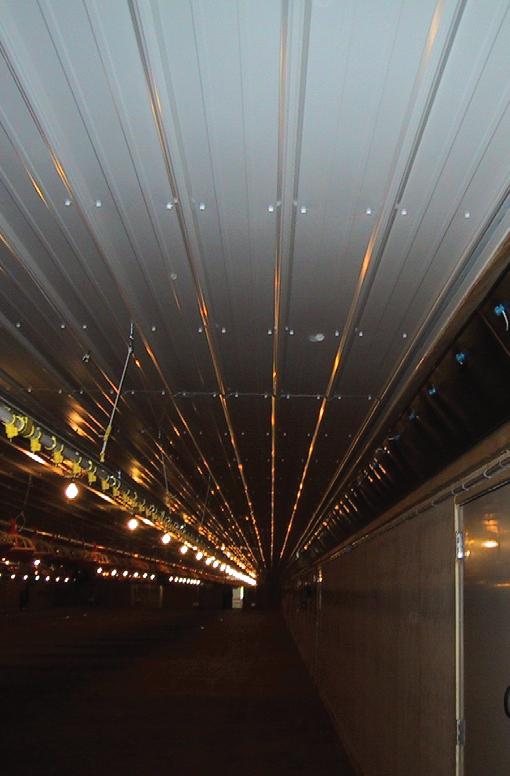
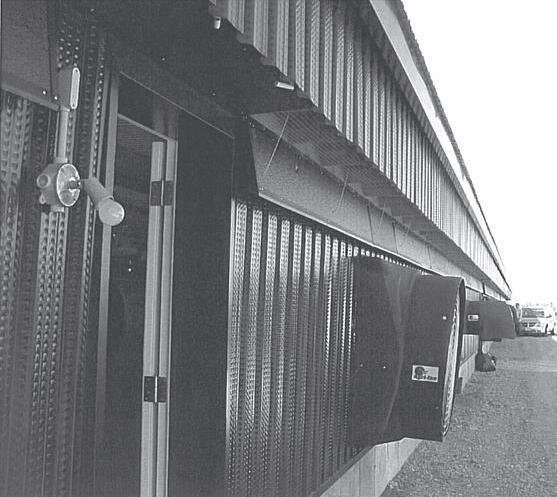
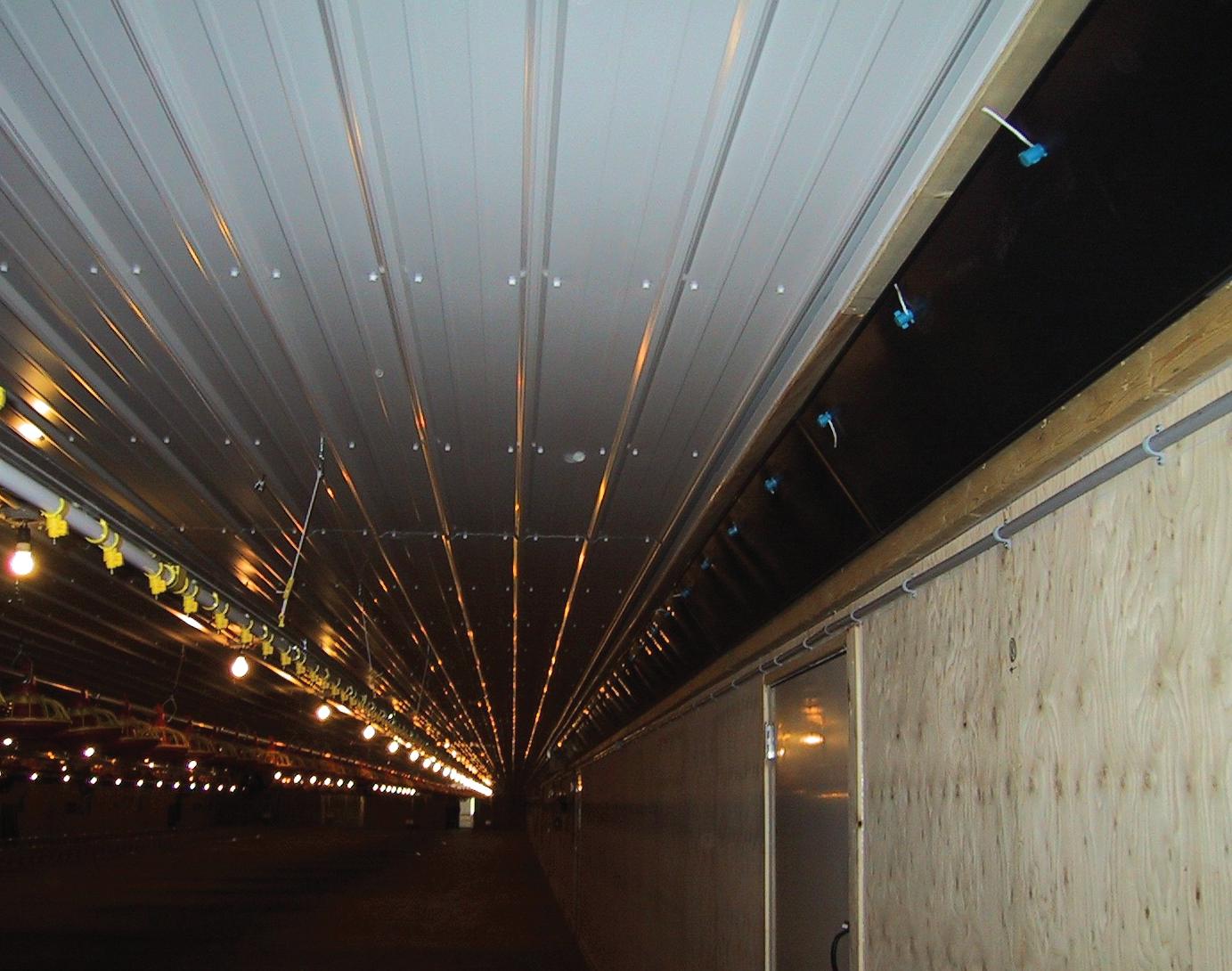
The metal ceiling liner with ribs is causing major obstruction to incoming airflow.
structure, then it should be situated at the front corner on the exhaust fan side.
Buildings up to 40 feet wide ventilate reasonably well regardless of the ventilation system choice. However, wider buildings need to consider ventilation options that enhance air movement across the entire width of the building. This may include an air inlet along both sides of the building or a double-baffle board along one side to ensure adequate airflow over all of the birds. Tunnel ventilation is a good summer time option to increase the air speed over the birds and help reduce heat stress.
DESIGN FLAW
Kaitlin Hamilton (Ontario)
Housing
Regardless of building width, all poultry barns with floor housed birds should be equipped with internal air circulation fans to ensure good air mixing and air distribution during the three cooler seasons. These fans will eliminate temperature differentials and stratification as well as ensuring all birds receive some fresh air. Additionally, internal air circulation helps dilute the carbon dioxide concentration at floor level, which along with water vapor is produced by the birds’ respiration. Lastly, these circulation fans help transport a consistent sample of mixed barn air to an operating point of exhaust.
All poultry buildings should be insulated and sealed extremely well. Most poultry buildings require supplementary heat during cold weather (year round for brooding) and therefore all controllable heat losses should be minimized. Interestingly, the largest heat loss in all poultry buildings is through the exhaust fans (60%+). This fact makes it essential to size and manage the exhaust fans appropriately to control heating costs.
The air intake opening into the building must be sufficiently large to handle the maximum ventilation capacity at a low static pressure level such that the proper air circulation pattern can be created and maintained year round. A good rule of thumb is to allow 2 square feet of opening for
every 1000 CFM (cubic feet per minute) of ventilation fan capacity. This net opening must not be compromised with a weather hood and/or bird screening which restricts the airflow before it even reaches the air intake.
The incoming airflow needs to be jetted across the ceiling at approximately 800 to 1000 feet per minute to establish the desired air circulation pattern and ensure good mixing with the room air. This requires the air inlet baffle board to be installed at an angle ranging between 30 and 60 degrees to the ceiling and wall intersection with 45 degrees being ideal. If the baffle board angle falls outside the acceptable range, the incoming airflow will not flow across the ceiling properly.
The most common type of ventilation problem created during barn construction and equipment installation is an obstruction to airflow across the ceiling surface. An obstruction is anything placed directly in the travel path of the incoming air stream, which causes the air to become turbulent and/or deflect down into the room air space. These obstructions take many forms and are caused by the building contractor and a variety of trade’s people.
Typical obstructions include: A ribbed ceiling liner installed with the ribs at right angles to the required airflow as shown
Continued on page 47
Ideas Needed: A Time for Leadership
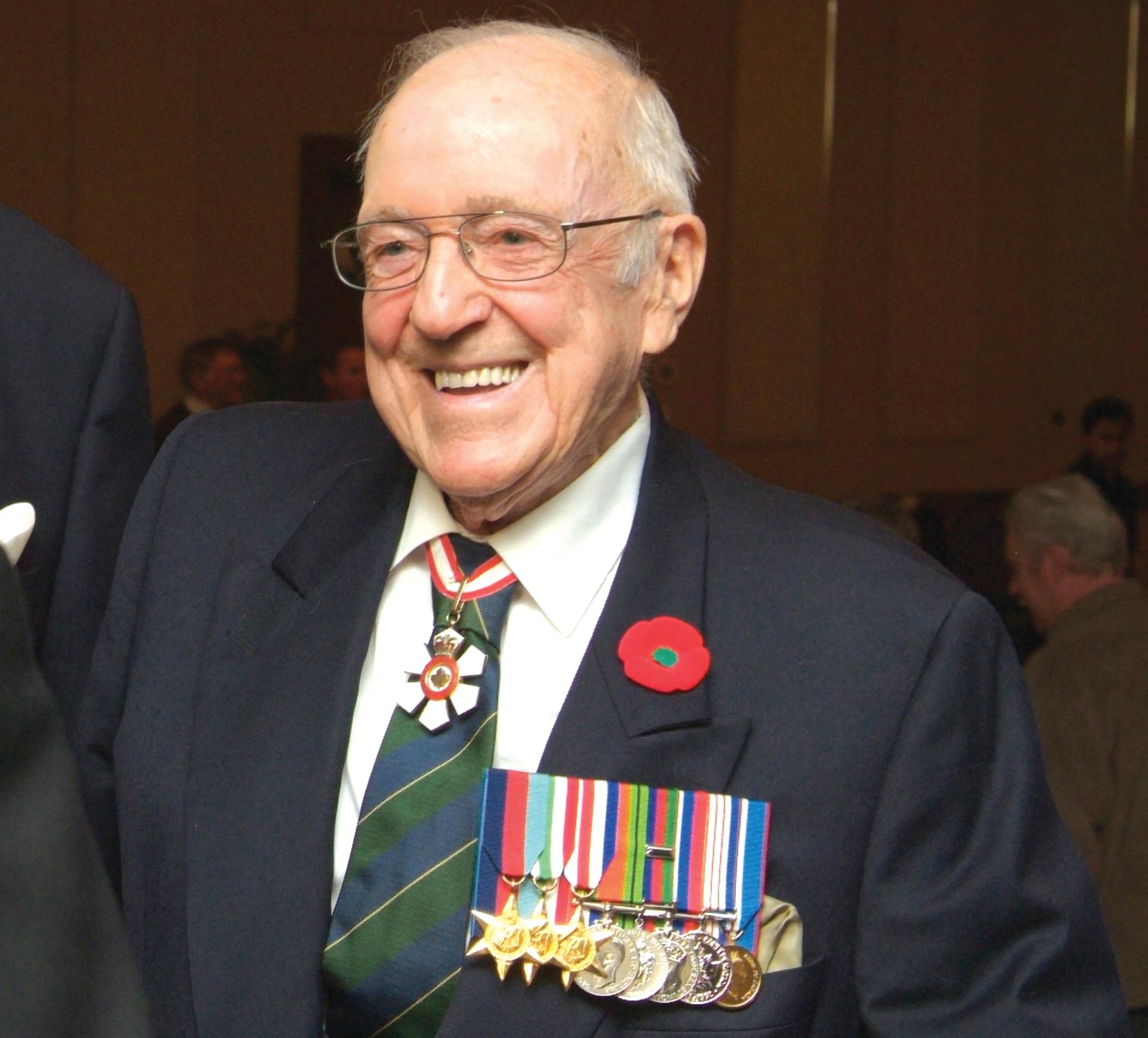
Donald
McQueen Shaver looks at the major issues and proposes ways to address them
BY DONALD MCQUEEN SHAVER, O.C., D.SC.
Keynote address given on Remembrance Day at the Poultry Innovation Conference
In this address, I wish to red flag some worrisome issues domestically and internationally, and hopefully make positive suggestions.
Professor Roger Buckland, former Dean at Macdonald College, often exhorted Canadian agriculture to speak with one voice and said that failure to do so contributes to our declining political clout. I agree with him, even though we know such issues as ethanol from corn has two distinct and opposing interest groups: those who feed corn versus those who grow corn.
I believe the poultry industry requires a national entity in place, that provides strong, visionary leadership, on a wide front, and that is generously funded for the long term. The powerful Teacher’s Pension Plan, has shown the way, but has no monopoly on this process. Complementary to such an approach, individuals should consider supporting an adequate annual fee, as well as a dedicated bequest response.
In Canada today, we have little scope for the study of poultry science. We accept that situation, at our peril. As a youth, I rode a bicycle to the Ontario Agricultural College (OAC) every summer, so that I could attend the popular short courses that were offered. If we can’t maintain three or four poultry science
graduate programs at universities across the country, perhaps we should look at an American compromise that offers two six-week summer sessions at select universities, with credit transferable to the students’ home university. This would be a means of ensuring a steady supply of graduates with some of the specialized training, our industry needs.
A very few of our Canadian institutes hold select pure lines in small populations. What better investment for the industry than to fund the continuing performance enhancement of these lines in adequate population numbers per line, and in accordance with professional protocols, adjusted to the major implications of climate change? Involvement of our scientific institutions in the industry realities of an altered environment,
the poultry industry to look ahead and take on the major challenges facing the industry and the country.
would encourage instruction that is relevant and spur the recruitment of new candidates, in all disciplines.
I suggest that with an increased funding budget in place, our objectives for Canada’s scientific institutes include the early synthesizing of new meat, layer and turkey so-called pure lines, as security for the future. It makes infinite sense and is simply good citizenship to reinvest in biodiversity, for an industry that has been so generous to all in this hall.
Donald McQueen Shaver called on
WORDS OF WISDOM
Ideas
A few precious pockets of pure lines exist here and there in foreign countries of which I am aware, they have evolved in sub optimum conditions of nutrition and disease exposure – and must not be permitted to vanish. Biodiversity ins the lifeblood of our industry.
Some will wonder why I belabour this point. It is from personal experience as a primary breeder. Even my most enduring competitors went through the occasional experience of their trade name products permanently declining in performance, for no reason that was ever determined.
Shaver had a key male line that was instrumental in helping establish our international reputation, this line literally disintegrated in one generation. We would have been ruined had there not been a Plan B. In this instance, a replacement male line of equal merit, in a large pedigree population. The switch was immediate and our commercial product didn’t miss a beat.
Keen competition has always encouraged primary breeders to serve the industry well, and today’s highly professional breeders are no exception. However, every industry benefits from wise self-insurance. My message is that the public research sector must be better funded, so that it comes out of semiretirement and fully participates in the global drive to generate and maintain a high degree of biodiversity.
When I was a boy, the OAC strain of Barred Rocks were world renowned, as were White Leghorns from Agassiz in British Columbia. Canada needs a return to that degree of lustre, on the part of our remaining public poultry institutes.
The poultry industry, more than most, is in for the long haul. We efficiently produce foods that are nutritious, and hence ideally suited for a vital role in sustainable food production. We have managed to utilize almost everything but the cackle! I suggest to you that it is now time to involve ourselves collectively, in the function and transformation of its supporting infrastructure. Particularly much increased and strategically located storage capacity for feed ingredients.
•
•
•
Generate New Income Daily
Ideas
ASPECTS OF INTERNATIONAL TRADE
As a wandering chicken breeder in the 50s and 60s, I had both product and technology that was eagerly sought by the Communist regimes. If they were to get value from my visits, they had to take me down the back concessions, and into the hinterland, were I saw first hand, their faltering system, warts and all.
I was in China first in 1958-59, long before it was popular to trade there. We provided key meat and layer lines. I didn’t return until after the Cultural Revolution, when I found our so-called Cornish were laying almost like Leghorns and vice versa! In those revolutionary times, the senior geneticists had never lasted even a year in their post, so there was no continuity and soon, few breeding programs worth of the name.
Perestroika in Russia probably had its beginning in Canada. Alexander Yakovlev, the longtime Russian Ambassador to Canada in the ’70s and ’80s, was considered to be almost a dissident at home, and this was a reason he was banished to Canada. He brought three agricultural delegations to our farms at Eugene Whelan’s suggestion. Each time the delegations were led by the current Minister of Agriculture – one of whom was Mikhail Gorbachev. At the subsequent dinners in our home, I practised identifying the Secret Police, who really ran the tours. Usually these folks were also professional imbibers. Whelan had noticed this same relationship. Yakovlev and Gorbachev couldn’t find a way to talk privately. Whelan obliged with a barbeque at his farm, then being a generous host to the entourage, and suggesting to Messrs. Yakovlev and Gorbachev that there was spectacular 10-foot-high corn in the centre of the neighbouring field. In they went and managed a 20-minute conversation, without the Secret Service. Shortly thereafter Gorbachev became leader and Yakovlev was withdrawn to become number three in Moscow.
FOOD PRODUCTION
We do not have a healthy agricultural industry generally, worldwide.
ATLANTIC POULTRY CONFERENCE 2009
Wednesday, February 18, 2009
10:00 am General Meeting of APC Committee
PRE-CONFERENCE SEMINAR Salon D
1:30 pm Seminar Registration Refreshments
2:00Livestock/Poultry Care Seminar & Q&A
Temple Grandin – Colorado State University
3:00Tradeshow Registration
Exhibitor Booth Set-up
8:00Reception “Chicken Roost” Fireside Lounge – Entertainment
Thursday, February 19, 2009
8:00 am Registration & Trade Show Opens
Refreshments Sponsor:
8:50 WELCOME Salons A,B,C,D
Bruce Rathgeber – AAFC, APC Coordinator
Peter Swetnam – CPANS, APC Coordinator
9:00What Agriculture Means to Canada
Jim Dalrymple – Livestock Tech Services
WORKSHOP: Salons A,B,C,D
Controlling Poultry House Environment
Facilitator: Brian Power – ShurGain
9:30 am Ventilation Basics
John Feddes – University of Alberta
10:00 Dealing with Moisture/Ammonia/Heating
Carlyle Bennett – Manitoba Agriculture
10:30 BREAK
11:00Housing, Environment & Bird Condition
John Feddes – University of Alberta
11:30Setting Your Controller
Doug Martin – Thevco & Norsol Electronics
12:00 pm LUNCHEON: Acadian/Blomidon Rms
Chicken & Turkey Session Salon D
Facilitator: Peter Swetnam – CPANS
1:00 pmDecreasing Chick Size Variability
Martin Zuidhof – Universtiy of Alberta
Old Orchard Inn, Greenwich, NS
1:30 Cost Efficient Feeding Practices
Chet Wiernusz – Cobb-Vantress
2:00 What Do Customers Want?
TBA
Egg & Breeder Session Salons A,B,C
Facilitator: Ted Corkum – ACA Cooperative Ltd.
1:00 pm Eggs: Does Size Matter?
Paul Patterson – Penn State University
1:30 The Future of Cages
Michelle Jendral – NSAC
2:00 Feeding to Reduce Environment Impact
Paul Patterson – Penn State University
2:30 pm BREAK
WORKSHOP: Salons A,B,C,D
Investing in Poultry’s Future
Facilitator: Michelle Jendral – NSAC
3:00 pm
Expectations from Restaurants & Retail
Temple Grandin – Colorado State University
4:00 Filling The Poultry Human Resource Gap
Martin Zuidhof – University of Alberta
4:20The Future of Poultry Research
Helen Anne Hudson -– PIC, CPRC Director
4:40Prioritization of Poultry’s Future
Cheryl Phillips – AgraPoint
5:15
POULTRY’S FUTURE RECEPTION Fireside Lounge ******* Research Poster Presentations*******
7:00
BANQUET: Meal, Auction & Draws
ENTERTAINMENT:
Auctioneer – Jim Taylor
Comedian – Jeff Irwin
After Hours: —–———— Fireside Lounge — Cash Bar
Friday, February 20, 2009
7:00-8:15 am BREAKFAST - Blomidon Room
WORKSHOP: Salons A,B,C,D
Energy Options & Opportunities
Facilitator: Alex Oderkirk – AgraPoint
8:30 Food vs Fuel vs Feed
Douglas Auld – University of Guelph
9:00Bio-Fuel Options
John Houck – Fox Creek Consulting
9:30Fuels for Heating Poultry Housing
Tom Costello – University of Arkansas
10:00 BREAK
10:30Renewable Energy
Mark Richards – Second Source Power
11:00The Future of Agriculture
Jim Dalrymple – Livestock Tech Services
11:30 CONFERENCE WRAP-UP
Bruce Rathgeber – AAFC, APC Coordinator
Booth Space Registration, 2009 Before Feb 1 -
Early Departure
Contacts:
Peter Swetnam
E-mail: pswetnam@xcountry.tv Tel: 902-582-7544
Bruce Rathgeber
E-mail: brathgeber@nsac.ca Tel: 902-893-6654
Lyn Cox Email: lcox@nsac.ca Tel: 902-893-6657
For a sector that supplies the staff of life, how can this be?
In the past, we have frequently responded to market demand by overproducing and flooding the market. This becomes a cyclical morass, which destroys agriculture in impoverished countries, and creates growing numbers
Ideas
of “second class” citizens in the developed countries, who eventually give up and leave the land.
I believe there will soon be diminished emphasis on a globalized food supply system. At issue will be food safety and the division and hence security of supply.
Consolidation of food processing at fewer and very large locations can be a risky strategy, on many fronts. Into economy of scale, must be factored both food safety, and security of supply. We have seen the need for this recently, with the listeria outbreak.
Canadian-based canning facilities have been steadily closed – this year for example, western Ontario’s peach producers scrambled to find canners in the U.S. who would take their crop – which in all probability will be reimported to Canada.
These are not examples of sound Canadian food security. Unlike Europe, North America has experienced no recent wars on its soil, to sharpen an awareness of the need to be substantially food self-sufficient. Canadians need to produce and process more of the food we consume, government must guarantee a sound processing infrastructure to support such a policy, through grants and subsidies.
Close to 70 per cent of the food consumed in Canada is produced at distances as far away as China, yet statistics Canada shows that 44 per cent of Canadian farmers lost money in 2006. A clear indicator of why our farmers are leaving the land. Transport costs and attendance carbon footprint, will eventually dictate that very little of the food we consume, will originate beyond a 1,000-km haul.
By population, China is the world’s largest state; it wants not just more food, but a greater variety and higher quality. With 43 per cent of the active population working the land, the Chinese are concentrating on increasing variety and productivity. Rural poverty is severe, compounded as in the emerging world generally, by corruption, overzealous police, a poor educational system, and little medical care.
The Chinese government is determined to keep a firm grip on the country’s food supply. They plan to grow their own food and thus control local prices. They will not permit foreigners to own seed development and production businesses within China – this field
Ideas
of activity they have reserved for themselves, and focused government research funding is flooding in. Their challenge is to provide 20 per cent of the world’s population with adequate food, on into the future, from only seven per cent of the world’s arable land. This will require crops with much improved yields. They are confident they can accomplish this themselves, and not become dependent on foreign science with its attendant royalty fees, and intellectual property issues.
Until hurricane Ike swept through Cuba, more than half of Havana’s food supply was produced in the city’s backyards, and sold in scores of markets around the city. This is reminiscent of the Victory Gardens so successful during the Second World War – and a potential future food supply, with which we all should involve ourselves.
CLIMATE CHANGE/SUSTAINABILITY
Today, the world we populate is dominated by issues of universal significance – climate change, population growth, migration, terrorism and regional economic disparity, on a grand scale.
I am old enough to remember the economic model of 1939-50 when we experienced a revolution in our societal and
economic attitudes. Confronted by the spectre of being subjugated by a totalitarian regime, we concentrated on survival and winning. Cuts were made in resource use and consumption, whilst we mounted and enormous industrial effort, building tens of thousands of tanks, fighters, bombers and ships. Food was rationed and scarce, but we ate a healthy fare. There were extensive energy restrictions. Yet public acceptance of curbed consumption was nurtured by having inspired leaders emerge. We desperately need a 21st-century Churchill.
We seek sustainable economic growth, this automatically implies a lowering of expectations.
When I was born, the world’s population was 1.9 billion, today it is 6.7 billion, in 40 years it is projected to exceed 9 billion. In the period 1970-2003, the Food and Agriculture Organization (FAO) shows this growth per species – ruminants 50 per cent, poultry 186 per cent, whilst in these same years, human population grew 53 per cent.
In a world of declining supplies of finite resources, we are in need of enhanced scientific discovery. Funding this should be on of our most compelling pursuits, much as we regard support for a favourite charity. We must strive mightily to eliminate waste through utilizing all byproduct, and do so in a manner that requires minimum energy. In short, our
discoveries need to provide solutions without unintended consequences.
Politicians are adept at shirking leadership responsibility. Few are well informed on this issues involved with sustainable economic growth. In the developed countries we delay putting in place an essential new direction, because countries like Brazil, China, India, aren’t making significant CO2 reductions. Surely the wealthy countries have an obligation to lead by example and take actions dictated by the scale and time frame of the problem.
Not everyone is sitting on their hands. Japan from Spring 2009 will require carbon footprint labels on food, drinks, detergents and electrical appliances. Breweries will show on their labels how much carbon dioxide is emitted by machinery used to plant and harvest hops and barley, then during the brewing process, distribution, and when the cans or bottles are recycled. The Prime Minister asks the Japanese consumer to lead a “global CO2 reduction revolution.”
While most governments continue to postpone actions to deal with the clear consequences of climate change, you and I are not excused from individually involving ourselves in achieving progress through renovating homes and workplaces, for reduced energy consumption. Assuring a sustainable supply of potable water, will entail a rethink of how we utilize this ultimate lifeline.
It is important if we are to enlist rank and file participation in reducing carbon emissions across everyday activities, that we do so as part of a broader understanding of all the implications. GDP growth is largely responsible for the standard of living that has evolved in the developed countries. The energy resources that made this steady growth possible, left the compounded carbon footprint, which we now struggle to contain and ameliorate.
We experience a great sense of relief when there are reports of massive oil and gas reserves in the Artic, promising a world supply for up to another 50 years – thus we have a reprieve. We fail to understand that the climate change crisis confronting us, requires that we
Ideas
rapidly decrease our rate of consumption to arrest and stabilize climate change. It is our survival on this planet that is at stake – not maintaining the status quo.
There isn’t an alternative presently known to man, that will safeguard the well-being of our grandchildren, short of immediate, co-ordinated reductions in C) CO2 emissions, to levels that will assure human survival. The economics of the so-called marketplace alone, will not be able to accomplish this, for it is truly a Churchillian undertaking. We can achieve timely downsizing, given that standard of leadership.
The last thing we can afford is reluctance to recognize that climate change is having far-reaching consequences. We cannot continue sleep-walking toward the precipice.
If we are to build a more sustainable economic system, we must legislate a less reckless financial sector. Neo liberal capitalism may create wealth, but not attempt is made to distribute this wealth with any degree of fairness, much less honesty. One would like to see the emergence of both a moral and a financial/economic attitude toward the irreversible trends shaping our future. Instead, we have apparently accepted a “CEO mythology,” replete with excessive salary, bonuses and stock options, pus a golden parachute on separation. There is a lot wrong with a social order that condones such a shame on the part of corporate boards.
Deregulated capitalism has been proven to be bankrupt and while capitalism is not dead, the free market concept of Thatcher and Reagan, is terminally ill. Never in the history of capitalism, have we seen such massive state economic intervention, as in the past six weeks. The financial turmoil we are experiencing, may help condition us to deal urgently with the pending climate crisis, where the sciences, creativity, innovation, and co-operation, will be key.
I propose for Canada, the establishment of a senior cabinet post responsible for all of Sustainable Economic Development, including the administration of a Sustainable Commission, and the implementation of the Commission’s recommendations, as
approved by Parliament.
This permanent Commission (with phased, rotating membership) to report direct to parliament. It would consist of 20 members, and be largely scientific in its orientation.
Canada’s low participatory electoral system has “imposed” on our politicians at the most, a four year time horizon, the usual interval between elections. On the other hand, the Sustainable Commission’s mandate requires it to identify and prioritize issues for urgent solutions over the next 20-30 years. In my opinion, its members must be non-partisan; to maintain focus and ensure achievable timelines, for we understand that research benefits take time.
The objectives of the Commission would be to establish scientific validation priorities for the vital elements in sustainability, so we understand both the benefits and the down side of proposed actions before they become government policy. Initially, the Commission should develop three to five agendas for action, each covering a 10-year duration. Canada cannot succeed in isolation, but can set an example by charting a new curse for ourselves, and being prepared to share our findings freely with other countries. With our vast landmass, the issue of global climate change can only be appropriately addressed with Canada’s active participation. We should be a catalyst for focused change.
Our industries and our way of life, will be required to adjust to an energyconstrained future, we are embarking on a second industrial revolution.
I believe that many of today’s urgent challenges can be met with solutions we already know about, or can quickly adapt and fine tune. At question is what are you and I going to do to enlist and support committed, qualified, political leadership – prepared to set the course, budget wisely, then ably navigate through these tumultuous times? I have not been speaking doom and gloom, but rather, have we the will to inform ourselves about the real pressing issues that will transform our future – and to do so soon enough, to exert a positive influence over humanity’s fate? ■
Housing
Continued from page 38
in Figure 1. Applying appropriate ceiling strapping will allow the ribbed material to be installed parallel to the airflow and not cause any interference.
An electrical conduit running lengthwise on the ceiling for wiring light fixtures, air inlet actuators, fan motors and feed line motors create an excellent airflow deflector.
A water line attached to the ceiling surface. Ideally all piping should be kept at least 4-feet and preferably 8-feet from the air inlet.
A gas line suspended from the ceiling. A longer hanger can be used to provide 4 inches of clearance over the line for the incoming air jet to travel unhindered.
Very often the air inlet actuator is located at the front end of a long side air inlet such that the control cable runs the whole length of the inlet baffle board. This results in a cable length that can often be 200-feet or more. These long cables tend to stretch over time and temperature changes will alter their length. This means that the air inlet baffle board does not open and close uniformly along its length and requires ongoing adjustment. A simple correction is to ensure that the cable actuator gets positioned midway along the inlet baffle board to reduce the cable length by half. An ideal maximum pull length would be in the range of 100-feet or less.
You should consider the installation of some form of evaporative cooling to reduce the negative effects of heat stress during hot weather. Both low and highpressure systems have proven to be quite effective in reducing heat stress when properly managed.
Lastly, it makes sense to use durable materials for both constructing the building and equipping it. All poultry buildings should last at least 20 years without any major repair. Of course, regular maintenance and an on-going rodent control program are essential to keep the building in good repair.
Your team of professionals can help you construct a poultry facility that will perform well for the birds and you. Be sure to use their expertise and avoid building mistakes into your new facility. ■
• (can be expanded to 16 packers) dirt detector optional
• all the software and hardware has
• been updated capacity of 200-300 x 15dz/hr but can
• be expanded to 800 x 15dz per hr easily fits on 2 tractor trailers
• Contact: 613-240-7612 or eggdude@xplornet.com
FOR SALE
Moba Mopak55 (eggpacker) Six years old, handles 25,000 layers. Please contact: 506-852-1233 or ronaldoabourgeois@hotmail.com
FARMS AND RANCHES FOR SALE!
Info Market Group GMAC Real Estate Coaldale & Taber, AB 1-866-345-3414 www.canadafarmandranch.com
Turkey Farm near Three Hills Excellent turn key operation 20 acres m/l fenced & cross fenced. Two barns: 8,000 sq ft Brooder Barn & 32,000 sq ft Grower Barn. Two storey 3-year old home with 4 bedrooms & 3 ½ baths. 217,680 kg of Turkey Quota. Some equipment included
K. MILLER REALTY, BROKERAGE
Each office is Independantly Owned And Operated 220 BROAD ST EAST, DUNNVILLE, ONTARIO N1A 1G2 Phone 905-774-7624 or Toll Free 1-888-718-8445 Fax 905-774-5960
Thinking of Selling?
Would you like your farm advertised at the Canadian International Farm Show. Give us a call, we will be in attendance at the show. February 3-5, 2009.
52 ACRE BROILER FARM: 1 Barn – 20,000 sq ft. 3 Bdrm home. Driveshed. 16,500 quota. Auto generator. For more details call Jack.
BROILER BREEDER FARM WITH 19010 H.E.M.S.: 1 Barn operation. Vercomatic nests. Plasson & Cumberland Nipple Drinkers. Chain feeders for Hens. Pans for Roosters. Bird scales. Plastic slats. Auto Ventilation from cross to tunnel. Birds out Fall 2008. Back in Feb. 2009. 75 KW Generator. 5 Bdrm brick home. 2nd home on property. Call Jack.
50 ACRE BROILER FARM - 2 BARN OPERATION: Barns have new steel, insulation checked and replaced where necessary. All equipment set for broilers. Barns have new vents and controls. Generator building. 3 bdrm brick bungalow completely updated. Large pond for water. Call Jack.
GRIMSBY AREA: 10 Acres on paved road. 32,000 sq ft of barns with auto generator. 40 x 60 x 2 driveshed used as retail outlet. 3 bdrm century brick home, pool. Call Jack
EXECUTIVE FARM ON 30 ACRES: Brick 4 bdrm, 4 bath home. Hardwood floors and ceramic, full finished basement with 2nd kitchen. 2 car garage-workshop and large barn rented long term at $800.00/month. Paved road. Priced at $599,000.00 Call Jack.
www.coldwellbanker.com
Info Market Group Lacombe
Poultry Diseases, 6th Edition
Now in its sixth edition, Poultry Diseases is once again fully revised with the addition of vital new material. It remains the standard reference work on health and disease for those involved in the poultry industry, government and veterinary education. Following a familiar structure, readers of the sixth edition gain concise but major reviews on current knowledge of general and disease-specific topics discussed over 45 (5 new) chapters in seven sections. With a large international team of contributors led by an authoritative editor team and a Foreword by Professor Frank Jordan, the 6th edition of
Poultry Inspection: Anatomy, Physiology and Disease Conditions
Following the success of the first edition, this Second Edition has been extensively updated and augmented, to better reflect the requirements of its readers. The author has replaced a large number of the diagrams with labelled photographs and expanded the Anatomy section to allow a clearer and better understanding of the subject. The Diseases of poultry section has also been updated and now includes photographs of some of the conditions following a basic introductory explanation of the disease process and the body’s response. The Parasites section has also been improved by the addition of photographs.
ALL THINGS CONSIDERED
BY JIM KNISLEY
Let’s Try Pragmatism
For the past several decades efficiency has been on Olympus. It has been worshipped in economic texts, managerial tracts and preached from podiums in inspirational seminars.
It has become the be all and end all. The mantra “If we can just become a little more efficient” has become the modern, morning recitation.
Excuse my skepticism, but I’m beginning to wonder if efficiency is all it’s cracked up to be or if pursuing efficiency to the exclusion of all else isn’t a mistake.
For example, a recent analysis of the Prairie cattle industry has noted that in the last several decades the industry has become much larger, capturing economies of scale, the small packing plants are gone, wages have fallen dramatically in real terms and the producers are making less money for much more work.
That doesn’t seem particularly efficient.
In my industry – the newspaper industry – the last three decades has seen computers replace typewriters, hot lead type disappear and more recently the introduction of black box technology that allows pages to be set on a computer screen and transferred directly to a high-speed press and then onto paper. We’ve even gone paperless with entire publications now available only on the World Wide Web.
There is no doubt that electronic publishing matches the traditional definition of efficiency. It’s fast, cheap and hits a universal market. There is only one problem – no one is making any money at it. The rule of thumb in U.S. publishing is that 90 per cent of their readership is online and generates 10 per cent of the revenue. The print product has only 10 per cent of the readership but generates 90 percent of the revenue.
Developing countries were also directed by the International Monetary Fund and consultants from developed nations to get rid of even tiny subsidies for fertilizer and tear down tariff barriers that protected local producers. In exchange, they got subsidized grain from do-what-I-say-not-what-I-do-developed nations and faced tariff barriers when they tried to sell to those developed countries.
On the grain front, the market-driven changes were supposed to boost crop yields. They appear to have accomplished this in the wealthier countries where farmers can afford the newest seeds and pesticides and pour on the fertilizer. But in poorer nations none of that holds and global crop yields rose less in developing countries between 1990 and 2007 than they had in the preceding, protectionist 20 years.
The bad old days of policies aimed at ensuring food security may have been economically inefficient, they may have diverted resources from potentially more productive uses, but when things went bad at least there was locally produced food around that they could afford.
The problem with efficiency, at least as used by economists, is that it is a soulless exercise that works well on paper, but not so well on the ground. What we likely need is a broader goal that includes efficiency, but also other goal-oriented factors such as security and sustainability. In effect, we are looking for something that will work in good times and bad and does no harm.
In these times we need a pragmatic course that will get us through the economic turmoil.
As far as the efficiency of the paper product: there are far fewer people, more machines and yet it seems to take longer to get it from the desktop to the street. This is supposedly more efficient, but newspapers are less profitable than they’ve been in more than a century.
Then there is the whole worldwide food system. The drive for trade and Ricardian efficiency has been relentless. Everyone was to specialize and do what they did best. Grain reserves were deemed inefficient – especially in developing countries – and dumped on world markets.
Setting reserves aside for a rainy or droughty day was seen as a waste. Agriculture was steered to the just-in-time system that prevails in manufacturing.
In a word we are looking, or should be looking, for pragmatism. Figure out what the goal is and the best way to get there. Forget all the pet prescriptions and cast aside ideological determinism. Knowing the answer before the question is asked or having the solution before you know the problem is impractical, inefficient and gets in the way of progress.
It is also a major problem for our politics. We have become almost tribal in adherence to a particular party and specific philosophy. Barack Obama, for one, is convinced that partisanship makes government less effective.
In his book The Audacity of Hope, Obama writes: “it’s precisely the pursuit of ideological purity, the rigid orthodoxy and the sheer predictability of our current political debate, that keeps us from finding new ways to meet the challenges we face… .”
In recent weeks Canadians have seen “the rigid orthodoxy and the sheer predictability” and it failed us. In these times we need a pragmatic course that will get us through the economic turmoil and parliamentarians that can deliver it. ■