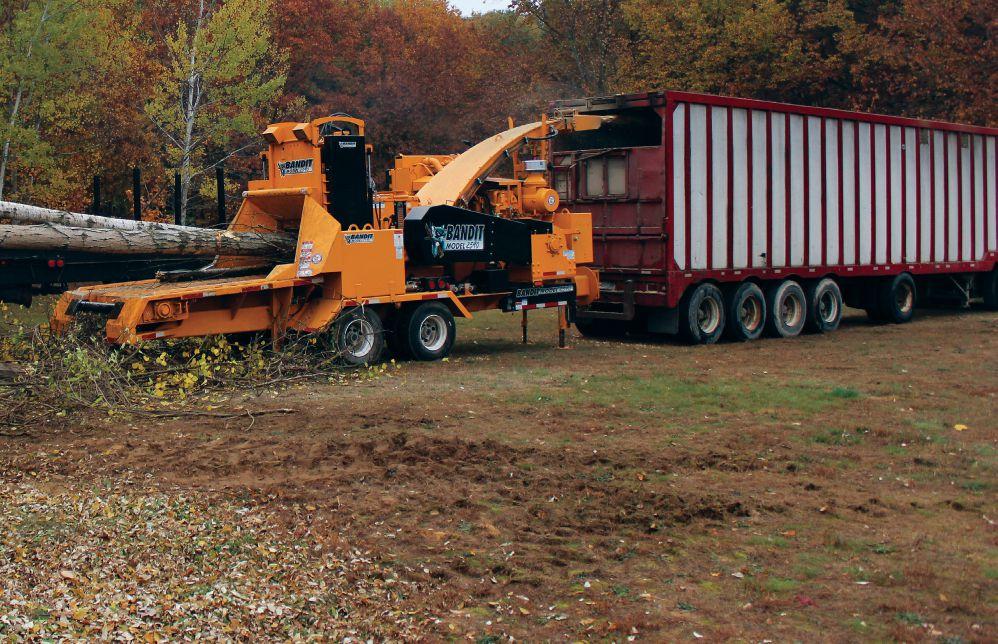
Chip sizes from 1/4-inch to 2-inches or uniform ground material
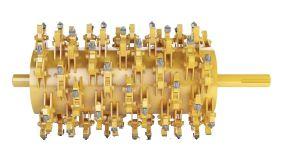
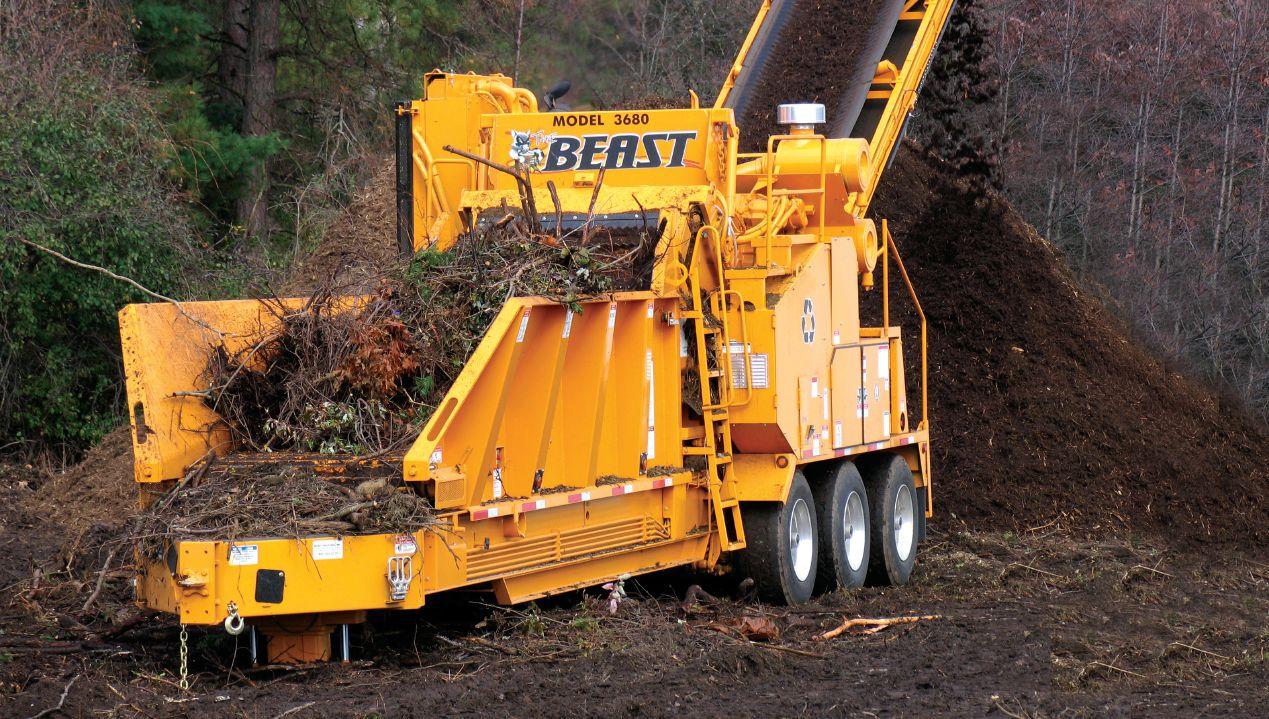
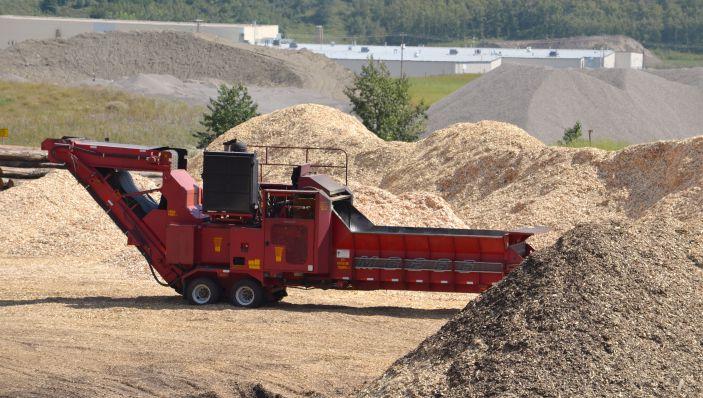
The Beast® produces unmatched uniformity when it comes to ground material. The patented cutter mill or optional whole tree chipper drum delivers a downward cutting or chipping action, sizing material on the first pass, saving money on costly regrind. Choose from four models of The Beast with self-propelled, towable or electric options.
Bandit whole tree chippers can produce chips from ¼” to 2” with unmatched uniformity. Bandit whole tree chippers throw better using less energy, so fuel consumption per ton of chips will be a 1/3 less than the competition.
And Bandit’s patent-pending Clean Feed System does not discharge chips on the ground, increasing yields by as much as 5 percent. New electric options for whole tree chippers are perfect for sawmills and chip mills. Choose from six models, towable, self-propelled and stationary.
Contact us and lets us show you why your next whole tree chipper or The Beast recycler should be a Bandit®. 1-800-952-0178 or visit us online at www.banditchippers.com
THE BEAST® 60 TooTH CUTTERMILL
THE BEAST® CHIppER DRUM
THE BEAST® 30 TooTH CUTTERMILL
Pinnacle Renewable Energy Inc. opens the doors on its Lavington pellet mill, operating in partnership with Tolko Industries.
of the Industry
Canadian Biomass magazine’s exclusive industry report, with analysis of the year that was and a close up look at what to expect in 2016.
Building up biodiesel
Our exclusive look inside Canada’s newest and largest biodiesel production plant: Atlantic Biodiesel in Welland, Ont.
Biomass for Alberta
The move to end coal power generation could open the door for more biomass in Alberta.
IBCE Preview
Our first look at what you can expect from this June’s International Bioenergy Conference and Exhibition in Prince George.
A radiant residence
One of Canada’s newest small-scale bioenergy systems is keeping residents warm in a retirement facility in New Brunswick.
ILucky Number Seven
Lavington creates a new Pinnacle benchmark
t looked for a while as if the NIMBY groups might get the better of them.
But Pinnacle Renewable Energy Inc. persevered in its pursuit of its latest pellet mill and now construction is complete in Lavington.
NIMBY opposition to the plant was well-documented in the local news outlets, with newspapers and radio/TV outlets throughout the Okanagan Valley reporting regularly on the opposition to the plant. A community organization called Lavington Is For Everyone (LIFE) was one of the primary groups in opposition, citing pollution, traffic, fire/explosion risk and noise concerns that would be a result of the new operation.
friendly” mill.
In the construction of the Lavington mill, Pinnacle implemented new technologies that improve emissions from the mill, such as cyclofilter technology to remove particulate from external emissions as well as low temperature, low emissions bed dryers. The company also enclosed its main mill processes, reducing the noise produced and reducing the wood dust that can blow from the mill site onto adjacent properties.
There were also mounting concerns over the legwork done by the Ministry of Environment in ensuring that concerns were met from a dust and emissions standpoint. Many of those in opposition of the plant cited the assessments done by MoE as having serious flaws and that construction of the plant had to be halted until concerns were addressed.
All the while, the team at Pinnacle waded through a sea of red tape in order to get construction moving, working with WorkSafeBC on the design to create the safest design possible.
It is easy for many of us to shrug off the concerns of community groups as mindless chatter from people who didn’t think before buying a property near industrial properties or along high traffic routes. But in the case of the Lavington mill, the NIMBY fight for environmental protections has provided a valuable positive: a model for an “environmentally-
The result of all of the measures put in place, some of which were influenced by environmental and community input, is a high-output mill on a small footprint with substantially improved standards for dust collection/ suppression, emissions control and safety.
Sure, there are always going to be some community concerns that you can’t do much to address. Some of the fibre will have to be trucked to the site, provide truck noise and vehicle emissions that will impact those residents living within a close radius of the plant.
But what has been accomplished by Pinnacle in the design of the Lavington mill should be noted by the industry as we look for new ways to create positive efficiencies in current and future mill designs.
After all, we are creating a fuel that is meant to be an environmentally-friendly alternative to dirty energy like coal. The least we can do is find ways to create a production design that also carries that same consciousness.
CANADIAN
Volume 16 No. 1
Editor - Andrew Macklin (905) 713-4358 amacklin@annexweb.com
Editor - Andrew Snook (905) 713-4301 asnook@annexweb.com
Occasionally, Canadian Biomass magazine will mail information on behalf of industry-related groups whose products and services we believe may be of interest to you. If you prefer not to receive this information, please contact our circulation department in any of the four ways listed above.
All advertising is subject to the publisher’s approval. Such approval does not imply any endorsement of the products or services advertised. Publisher reserves the right to refuse advertising that does not meet the standards of the publication.
BIOMASS update
BIOAMBER ACHIEVES CERTIFICATIONS
BioAmber Inc. announced that its Sarnia production plant, jointly owned with Mitsui & Co., has received ISO 9001, ISO 14001, OHSAS 18001 and FSSC 22000 certifications. These certifications were granted by accredited certification bodies following audits of the Sarnia plant in
Q4 2015.
By achieving these certifications BioAmber has demonstrated its commitment to enhancing customer satisfaction through the implementation of an integrated management system. BioAmber has put in place processes that ensure continual improvement and conformity to customer, statutory and regulatory requirements.
“Obtaining these certifications within four months of start-up is a remarkable
achievement and a testament to the operational excellence practiced by our Sarnia team,” said Jean-Francois Huc, BioAmber’s chief executive officer. “These certifications demonstrate that BioAmber Sarnia is a reliable and professional supplier of bio-based chemicals. They also position us as an industry leader in the fast growing field of sustainable chemicals production,” he added.
“These certifications are the culmination of three years of preparation and implementation and are the result of hard work by our Sarnia team,” said Fabrice Orecchioni,
BioAmber’s chief operations officer. “They validate the robustness of the management system we have put in place to ensure that we consistently deliver high value to our customers. This integrated management system is the foundation of our ambitious operational excellence plan driven by lean manufacturing principles. These certifications are important for existing and prospective customers, and they send a clear signal about our ability to produce reliably, safely and efficiently. This is a significant operating milestone and further evidence of our ability to execute,” he added.
COMMISSION APPROVES LYNEMOUTH COVERSION
The European Commission has concluded that U.K. support for the conversion of Lynemouth power station from coal to biomass complies with EU state aid rules. The Commission found that the project will further EU environmental and energy goals without unduly distorting competition.
In December of 2014, the U.K. notified plans to subsidize the conversion of the coal-fired Lynemouth power plant to biomass. The plant would be able to generate 420 MW of electricity running exclusively on wood pellets. The U.K. government intends to support the project in the form of a premium paid on top of the market price of the electricity generated (a so-called “Contract for Difference”). The project will receive aid until 2027 and, according to U.K. estimates, will generate about 2.3 TWh of low-carbon electricity per
Two Maine bioenergy plants closing
The biomass and forest industries in central Maine has taken a hit with the announcement that Covanta Holding Corp. will close two biomass plants in the coming months.
The company will take its two plants in West Enfield and Jonesboro offline by the end of March. The company is citing current low energy prices as the cause for the closures. The two plants are responsible for approximately 24.5 MW hours of electricity, enough power to meet the demands
year. The plant is due to use approximately 1.5 million tonnes of wood pellets per year.
The Commission opened an in-depth investigation in February of 2015 to assess whether the terms and conditions of the U.K. support, and in particular the financial calculations and estimates regarding key cost parameters, would avoid overcompensation. In light of the comments received from interested third parties as well as detailed technical information submitted by the U.K., the Commission is now satisfied that the submitted parameters are robust and present no risk of overcompensation.
The Commission’s investigation also did not find any evidence of market distortion in the global wood pellets market. Finally, it is satisfied that the measures will not lead to undue distortions of competition in the market for other wood-based products.
of 50,000 homes.
The Professional Logging Contractors of Maine has estimated that the closures could impact up to 2,500 jobs in the state, as the logging industry has been supplying the two plants with low-value fibre and forestry residues for years. The PLC is unsure whether or not those fibres will be in demand elsewhere in the region.
DIACARBON ADDING PELLETIZER FUNDING FOR MANITOBA BIOMASS PROJECTS
Diacarbon Energy Inc. continues to ramp up production at its Merritt, B.C. plant, announcing its plans to add a third pelletizer this year.
Canadian Biomass magazine learned of the planned upgrade from Diacarbon President Jerry Ericsson during a recent visit to the plant.
Currently, Diacarbon has two pelletizers in place, which allows the company to produce up to 50,000 tonnes of pellets per year. The addition of the third pelletizer will increase capacity production at the plant to 75,000 tonnes.
plant in 2015. Diacarbon uses sawmill residues from an adjacent sawmill for the creation of pellets.
The plant was previously owned by Highland Pellet Manufacturing Ltd. The company had multiple delays getting the plant running and, in February of 2012, was served with a notice of claims from an Ontario company that
it owed over $1.6 million to.
The Manitoba and Canadian governments are looking to help the prairie province kick coal.
The two tiers of government have announced they will provide up to $500,000 in funding for 12 biomass fuel projects across the province.
“There are renewable energy resources readily available for use as biomass energy sources,” said Ron Kostyshyn, Manitoba’s Minister of Agriculture, Food and Rural Development. “By increasing our capacity to make and use green energy we are reducing carbon emissions in Manitoba while promoting the growth of new industry.”
Among the proposals selected to receive funding are two projects to convert a coal-fired heating systems to biomass and funding for new equipment for Southeast Pallet and Wood Products in Blumenort, Man. which will allow the company to double its annual biomass processing capacity.
The company began production of white wood pellets at the Merritt, B.C.
Be sure to watch for our feature story on Diacarbon Energy’s Merritt, B.C. pellet plant in the March/April edition of Canadian Biomass.
RENTECH MAKING PROGRESS
In late November, Rentech provided a progress statement regarding its Northern Ontario pellet mill projects, providing optimism that both plants would be operating full-time in the very near future.
The Atikokan facility achieved record production of approximately 1,850 metric tons of pellets for the week ended November 14th. The plant’s design capacity is 110,000 metric tons per year, or 2,115 metric tons per week. The announcement of a week at 87 per cent production versus capacity marked a very positive step forward in getting the Atikokan mill fully operational.
The Wawa facility resumed pellet production mid-November, having been offline to modify the log in-feed system and complete the most critical phase of its conveyer replacements. Wawa has been operating at approximately 30 per cent of design capacity since coming online, and is again shipping pellets to the port of Quebec, for delivery to Drax.
Rentech officials expect to complete the second phase of conveyance replacements at Wawa in the first quarter of 2016, with the goal of operating at full capacity in the second half of the 2016.
The program is funded partly through Manitoba’s Coal Tax, and like other biofuel programs across the country aims to promote the growing industry as well as reduce emissions.
ARTERRAN EYES COMMERCIAL-SCALE PRODUCTION
The team at Arterran Renewables is closing in on the establishment of their first commercial-scale biomass operation.
The company has developed a process for transforming manure, municipal solid waste, wood and agricultural waste into a carbon neutral, renewable solid biofuel. The end product possesses the same beneficial characteristics of thermal coal, but without the CO2 emissions or pollution that coal has. The fuel is said
to have an energy density of 10,000 to 12,500 Btu per pound depending on the feedstock.
The company is currently working with a municipality in British Columbia on a plot of land that would allow the company to erect thermal reactors for the production of the biomass.
Arterran recently won the Startup Canada 2015 award for sustainable development, and was nominated for the Governor General’s Innovation Awards.
Wrong Analysis, Right Conclusion
HMixed messages in legal analysis of biomass
By Gordon Murray
alifax-based East Coast Environmental Law’s (“ECELAW”) purpose is to encourage innovative and effective environmental laws in Atlantic Canada. In December 2015, ECELAW released the report Forest Biomass Energy Policy in the Maritime Provinces: Accounting for Science, written by lawyer Jamie Simpson. Simpson’s purpose is to evaluate Maritime provincial government policies regarding forest biomass energy.
Simpson displays an anti-business sentiment. He is critical of Nova Scotia Power Incorporated (NSPI) for seeking project approval from Nova Scotia Utility and Review Board (NSUARB) in order to mitigate the risk of a $208.6 million capital project, as if NSPI should have made that investment without any assurance of a financial return. Moreover, he criticizes NSUARB for agreeing with NSNPI that by investing in biomass energy, Nova Scotia would be able to reduce its reliance on intermittent wind energy in favour of dispatchable biomass energy. Presumably, Simpson would have the province totally reliant on wind so that the first time a high pressure cold weather front hit Nova Scotia, stopping all the wind mills, the province’s citizens could all freeze to death.
Simpson argues that biomass carbon accounting is fundamentally flawed. His first point in this regard is that increasing biomass demand will cause land use change due to pressure to grow biomass fuels, changing land from high carbon storage to low carbon storage, i.e. by converting old growth forests to energy crops. This risk is laughable.
There will never be a situation in the Maritimes where society would allow conversion of an old growth forest to energy crops. Moreover, energy crops are usually grown on marginal, underutilized farmland, which actually improves carbon storage.
His second point is that removing fibre to be burned for energy will reduce carbon storage because if it isn’t removed, the fibre can be stored in wood products that will continue to store carbon, or the fibre will simply be left in the forest. This is erroneous because wood products are made from expensive higher quality logs. Fibre is only used for bioenergy as a last resort, when it can’t be used for any higher value purpose. In the case of fibre left in the forest, it will eventually rot and release the same volume of carbon into the atmosphere as if it had been used for energy.
Third, Simpson is concerned about time delays due to carbon accounting, but cites only a single report – Manomet’s controversial 2010 Biomass Sustainability and Carbon Policy Study as his sole source, ignoring the many other published reports with differing conclusions.
His fourth point is that biomass harvesting may reduce forest productivity by removing nutrients, and by causing erosion and compaction. It is indeed true that if 100 per cent of all biomass is removed from the forest, it would result in a loss of nutrients. But this is a highly unlikely scenario. In practice, professional foresters in Atlantic Canada take care to ensure that sufficient woody debris is left in the forest, and that harvesting practices are conducted so as to
prevent soil erosion and compaction. The report makes six recommendations for the Maritime provinces:
• Introduce a minimum efficiency requirement for biomass energy projects to qualify as renewable;
• Introduce a similar minimum efficiency requirement for biomass energy projects to qualify for feed-in tariffs;
• Require biomass energy facilities to report efficiencies attained, biomass fuel consumed, and the source of the biomass fuel;
• Restrict or prohibit whole-tree harvesting in all forestry operations to reduce impacts on forest biodiversity;
• Introduce forest harvesting requirements on Crown lands and implement incentives on private lands to maintain or increase forest carbon storage levels; and
• Introduce province-wide policies for no net carbon loss from land-use change through the inclusion of forest carbon modelling and full life cycle analysis of biomass energy systems.
ECELAW obviously wishes to ensure that biomass harvesting in the Atlantic provinces is done sustainably; that carbon benefits from biomass energy are maximized; and that the provinces obtain value for financially supporting bio-energy.
Despite finding significant flaws in the report’s analysis and conclusions, wood pellet producers generally agree with most of the report’s recommendations. •
Partners in Production
Pinnacle partners with Tolko on Lavington pellet project
By Andrew Macklin
Anopportunity lost can often become an opportunity gained, especially when the right minds collaborate on a solution.
With the closure of Domtar’s sawmill digester in Kamloops in 2013, a large surplus of sawmill fibre was created in the Okanagan region of the B.C. interior. No longer was there an economically and environmentally viable use for the massive tonnage of residuals being created. A new solution for the fibre was desperately needed.
Enter Pinnacle Renewable Energy Inc., Canada’s largest wood pellet producer. Pinnacle recognized the situation that had been created, and clearly, the production of wood pellets using all of the available fibre was an attractive option that met both the economic and environmental needs for the residues.
While exploring the opportunity for pellet production using the fibre resources, Pinnacle recognized a natural partner they could work with in the region. Tolko Industries is firmly established in the Okanagan region, with several sawmills.
In discussions with Tolko, it was discovered that the optimal logistics equation was created by positioning the project adjacent to Tolko’s Lavington sawmill, located just 15km east of Vernon. The additional acreage would be enough to house a full pellet plant based on the size of operation that the collective wisdom determined to be the best fit for the region, and had the prerequisite rail access to the port of Vancouver through CN.
In January 2015, following months of deliberation with community groups and permitting approval from the Ministry of Environment and District of Coldstream, Pinnacle and Tolko officially announced that they were proceeding with the construction of the plant.
The partnership involves a 75-25 split between Pinnacle and Tolko respectively.
“Tolko is the largest fibre supplier to the project, therefore it only made sense for them to participate in the economics associated with the project,” says Scott Bax, senior vice-president of operations for Pinnacle. “They are a highly professional, well-
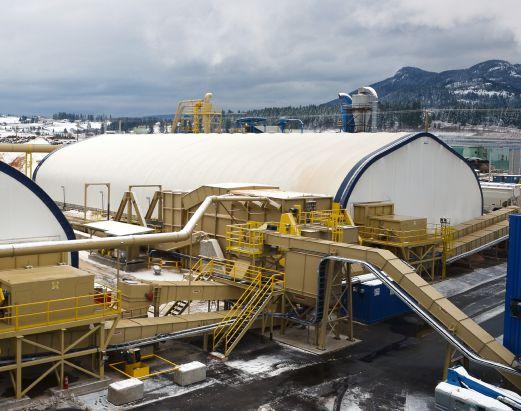
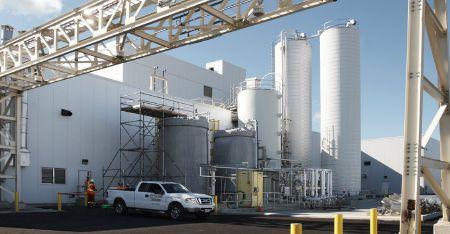
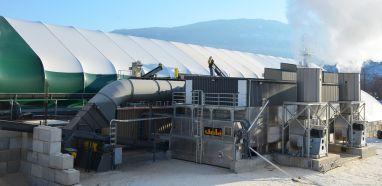
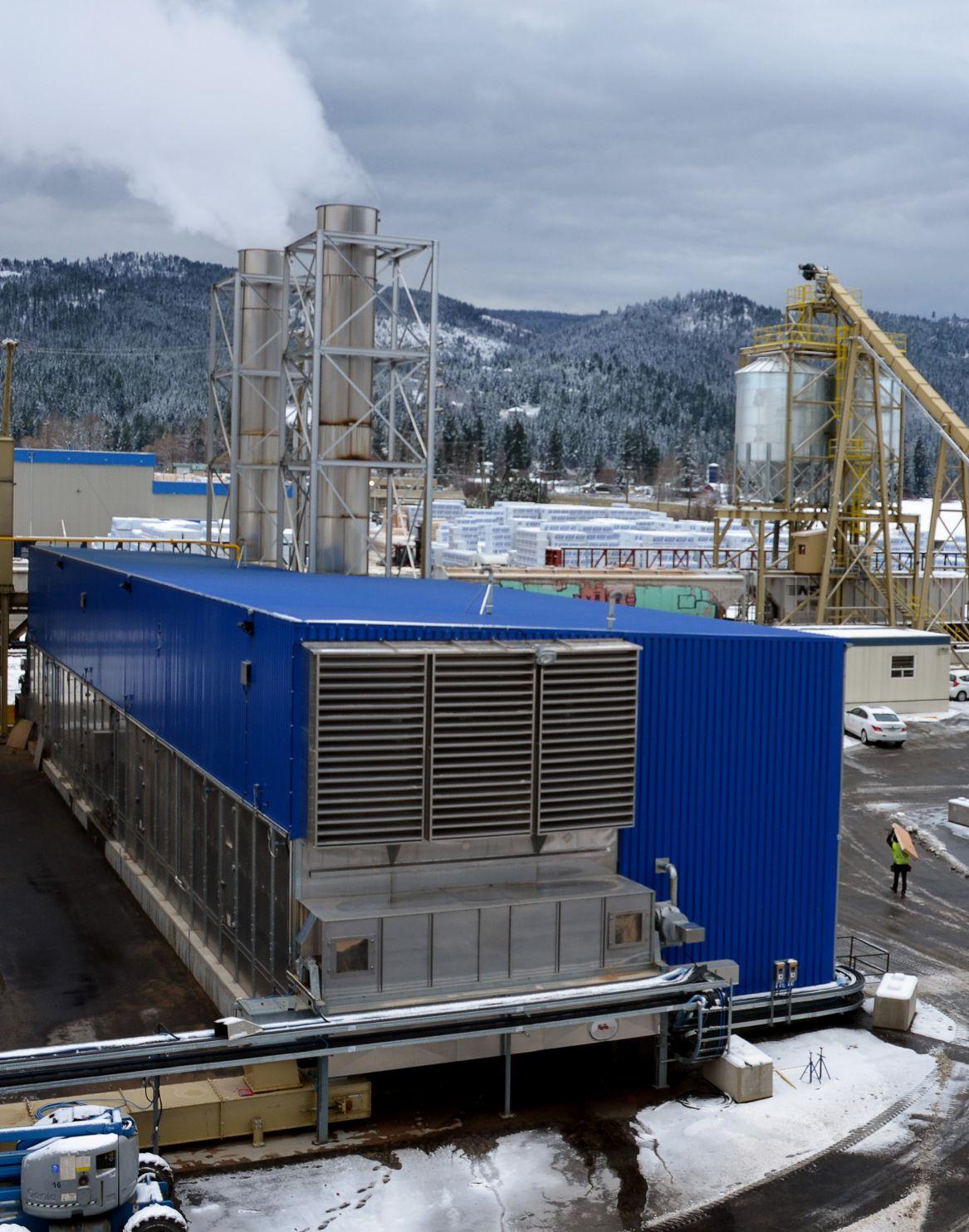
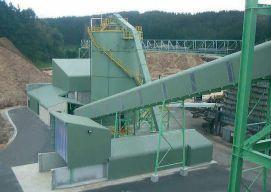
LEFT MAIN: Pinnacle conveys residues directly from the adjacent Tolko sawmill for use in pellet production.
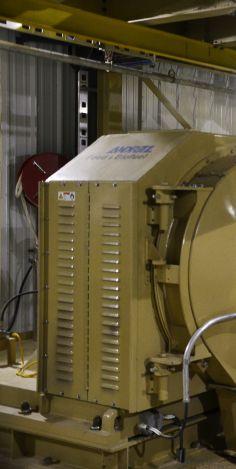
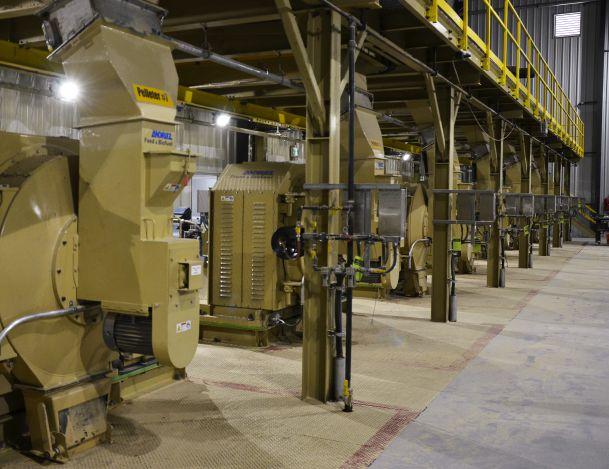
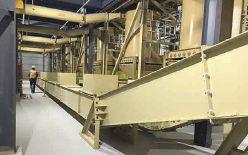
INSET: The pelletizing equipment installed at the Lavington plant is enough to produce 700 tonnes of pellets per day when running at capacity.
run organization who are also a source of a large percentage of the raw material, so the opportunity to work together was a natural fit.”
Bax estimates that upwards of 30 per cent of the overall fibre to be used at the Lavington Pellet Limited Partnership plant is supplied by the Tolko mill next door. The remaining fibre is sourced from throughout the Thompson Okanagan Region of B.C., which encompasses an approximate radius of 150km.
DOING THINGS DIFFERENTLY
With six pellet plants throughout B.C. (Lavington is the seventh), Pinnacle has learned many lessons on how to optimize pellet production. At Lavington, the company worked to incorporate new features in its mill design, setting new standards for critical elements like dust control, emissions, noise reduction and site safety.
While no scientific measurements were being recorded in the community of Lavington at the time of initial project proposal, the area was assessed by the British Columbia Ministry of Environment as being near or potentially exceeding one of the three provincial air quality objectives that related specifically to
the annual average PM2.5 concentration. Given this situation, a joint strategy was developed to upgrade the emission control equipment associated with the existing Tolko Lavington planer mill as part of the integration of pellet plant into the overall operation. In November of 2015, the first round of emission testing was completed by an independent third party with the results demonstrating an 83 per cent reduction from the previously existing permitted emissions. “This project has been a great success on many fronts, with respect to the emission test results, we are pleased to provide scientific evidence affirming a dramatic improvement in the local air quality to those local residents who expressed concerns about the project,” said Leroy Reitsma, president and COO of Pinnacle Renewable Energy Inc.
The Lavington plant represents the first use of two new technologies to improve the emissions from pellet production. First, the plant has incorporated the use of low temperature, low emissions bed dryers. These dryers use a significantly reduced temperature in combination with higher airflows to remove more moisture from the fibre than typical rotary dryers. Secondly, the company has introduced cyclofilter technology that reduces the amount of fine particulate emissions associated with both pneumatic conveyance and pellet cooling.
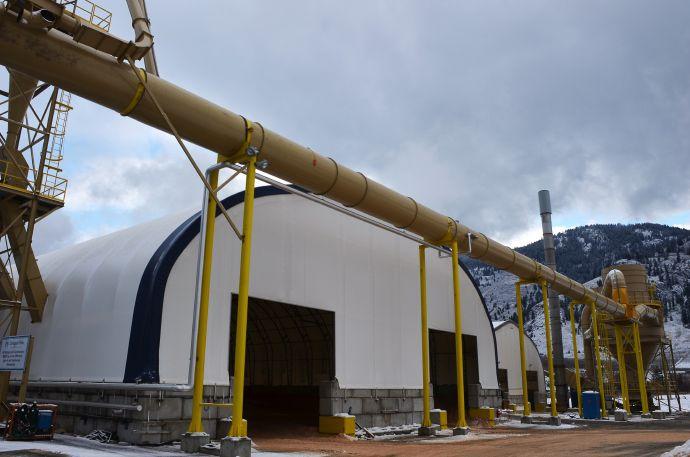
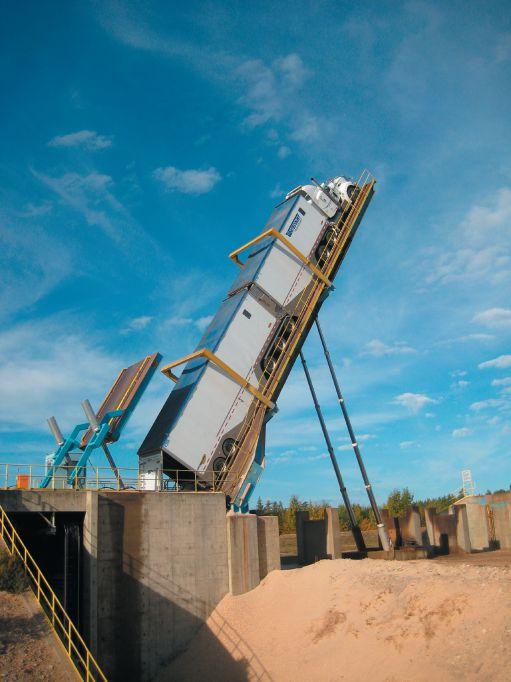
Areas of potential fugitive dust emissions and noise generation were also closely scrutinized. The result is a safer work environment that features the enclosure of all processing equipment, a fully enclosed conveyance system, primary fibre storage in tent enclosures, paved road and plant surfaces, a treed perimeter, and a full enclosed truck tipping system. All of this was achieved while engineering in the ability to remove panels and create access for safe entry and maintenance.
THE MILL PROFILE
Trucks enter the mill through a two-lane access road on the western side of the property. The trucks travel to the far end of the property to the weigh scale before proceeding to the truck dumper. The dumper is situated between the Megadome shavings and sawdust tents, which house both wet and dry fibre.
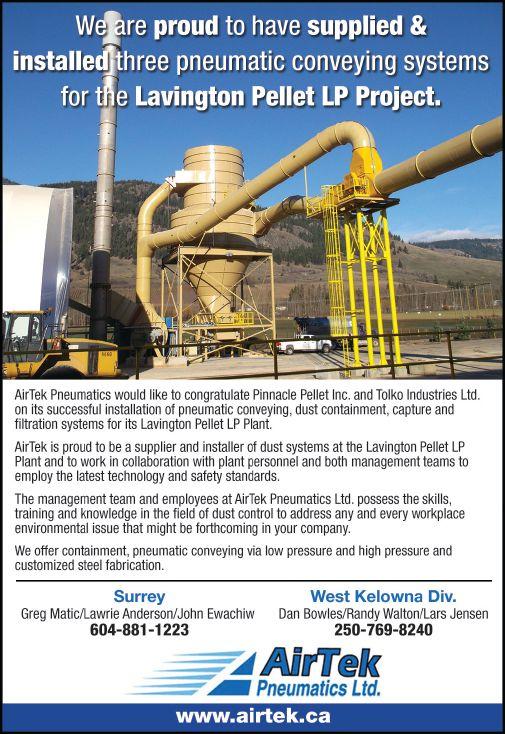
The plant’s pneumatic system, installed by Airtek Industries, feeds into the cyclofilter technology from Rodrigué Metal.
Regardless of whether the fibre is obtained by truck or conveyed from the Tolko sawmill next door, the fibre is separated by fibre type, shavings and sawdust, and conveyed into the appropriate storage tent. A system of conveyors from Continental Conveyors move the fibre throughout the plant, including from the storage domes to the bed dryers, supplied by Stela Luxhuber of Germany. The belt dryers dry at a temperature of around 100C as compared to a rotary dryer, which has a typically inlet temperature of around 500C.
Both the pellet plant pneumatic system, and the upgrades to the Tolko Lavington fibre delivery system, is supplied by Airtek Pneumatics in Kelowna. The systems were installed to NFPA standards, in accordance with B.C. regulations. Sub-suppliers including Rodrigué Metal who manufacture the cyclofilter technology, Northern Blower who provided the industrial fans, Baum Pneumatics who supplied the airlocks and Clarke’s Sheet Metal Inc. who supplied the abort gate and backdraft dampers.
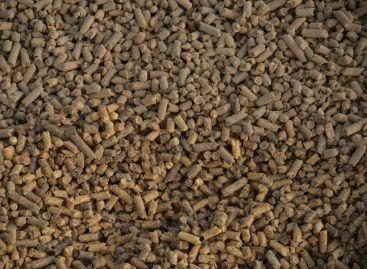
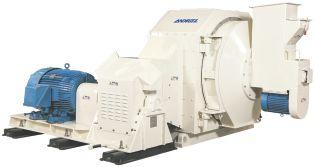
The hammermills were supplied by Bliss Industries, which reduce the particle size of the material prior to the seven Andritz pelletizers, which extrude a small, sleek wood pellet that can be sold to both domestic and international markets.
The site provides limited pellet storage, however, the two 100ton storage silos are situated directly over the train tracks for efficient transfer to a series of railcars ready on site. Once the cars are loaded, the pellets travel just over 300km to Fibreco, where they are accumulated in advance of shipment.
EFFICIENT CONSTRUCTION
Pinnacle began construction of the Lavington mill in early February of 2015 following a design review with WorkSafeBC, a first for the pellet industry in B.C. With the organization’s feedback, construction of the mill was done quickly and efficiently, with just nine months from groundbreaking to the first batch of pellets produced. The project was completed with no lost time due to injury, on time and under budget.
The business case was based on a 12-month ramp up to 700 tonnes per day equating to annual production volume of approximately 260,000 tonnes. During the commissioning phase in October and November, the plant exceeded expectation with several days above the business case capacity. However, the company is quick to recognize that winter conditions will challenge the plant in the coming months.
While the 260,000 tonnes per year production is in line with current fibre availability in the region, the company has built the plant with the capacity to add equipment for increased production. Based on the construction, Pinnacle is in a position to add a hammermill, two pelletizers and a baghouse.
The Lavington mill has provided a valuable addition to the forest industry in the Okanagan Region, giving mill operators a home for residues from lumber production. And in the process, the company has set a new standard for dust and emissions control in Canadian wood pellet production. •
Continental Bulk Handling
State of the Industry
Analyzing the health of biomass markets entering 2016
By Andrew Macklin
If2015 showed us anything it was that there is enormous opportunity for the future of the biomass industry in Canada.
This year saw major developments in biochemical production, a solid boost in the domestic pellet market, the growth of overseas opportunities and a political drive towards clean, renewable energy. At the same time, it continued to show great uncertainty in the form of policy development, continued challenges with access to fibre and the fragility of domestic wood pellet demand.
ATLANTIC CANADA
The bitter cold that swept through Atlantic Canada during the first four months of 2015 was a welcome sign for pellet
producers throughout the east. Pellet stove sales were brisk, and demand for wood pellets for residential use grew to an alltime high. Companies like Groupe Savoie in New Brunswick saw domestic pellet sales soar, while plants like Scotia Atlantic Biomass in Nova Scotia found the sudden need to provide resources domestically.
The spring thaw brought continued fibre transport issues, especially in Nova Scotia, where weight restrictions on many of the province’s secondary highways meant no fibre transport to mill. While harvested with equipment already in the forest continued to cut trees in many parts of the province, stems sat roadside until the ground was solid enough to retrieve the fibre supply.
There is still right-priced fibre issues throughout the region, with not enough fibre supply coming into most regional pellet
TOP STORIES OF 2015
Here are the most-read online industry stories of 2015 at canadianbiomassmagazine.ca.
Most read news story
Wood pellets in demand (2015 Industry Report)
Most read wood pellets story
Whitesand Waiting
mills to allow them to run at full capacity. Despite this, there was solid growth, especially in New Brunswick and PEI, of smallscale bioenergy projects. Driven by government support, PEI has already announced seven additional installations coming online in early 2016.
Rumours of renewed efforts to establish pellet operations continued to surface in Newfoundland, even though there has been little progress on plant development since Rentech won harvesting rights of the 280,000 cubic metre supply formerly used to supply the Abitibi-Bowater mill in Grand Falls-Windsor in April of 2014.
As the year wrapped up, a warm start to winter put a severe damper on the domestic pellet demand that boosted the region to start the year.
QUEBEC
This past year started well and ended poorly for the majority of pellet producers in Quebec.
A banner year for domestic pellet demand started 2015, as a cold winter led to strong sales for wood pellets in Quebec. As a result of the winter weather, and in anticipation of another cold winter to start 2016, many pellet producers found themselves running their production close to capacity for the year. Two plants, Granules LG in St-Félicien and Energex in Lac-Mégantic, made significant upgrades to their operations in order to keep production running around the clock.
For two plants, 2015 was a year to forget. A fire at Granule Boreal in Amos in April destroyed the company’s 50,000 tonne/ year plant, and the owners of the plant chose not to rebuild the operation. For Trebio in Portage-du-Fort, continuing fibre supply issues are causing the plant’s production to decrease substantially, with current production running at around 25 per cent of its original capacity. The fibre shortfall has come largely as a result of not enough accessible fibre in the Pontiac region, as well as competition from the restarting of Pembroke MDF.
The use of bioenergy continues to grow in the province, with many communities exploring new options for its integration. Near the end of 2014, Quebec had over 30 projects in the planning stages and several have broken ground and are progressing.
With the uncertain future of Trebio, and the warm start to winter, the pellet market in Quebec sits in a precarious position in 2016.
ONTARIO
Without question, it was a big year for Ontario in the biomass, biofuel and bioenergy industries, with three highly anticipated projects completing construction and one other nearing the finish line.
Most read biofuel story
Enerkem begins commercial production at Edmonton plant
Most read bioenergy story
Conifex completes 72 hour run test
Most read R&D story
Carlsberg developing wood based beer bottle
In southern Ontario, BioAmber made its biochemical breakthrough with the opening of its bio-succinic acid plant in Sarnia. Despite plummeting oil prices, the plant is providing a cost-competitive alternative to petroleum-based succinic acid, but without harmful emissions. It is the first commercial-scale plant of its kind in the world and provides a model for other biochemical producers to follow in 2016 and beyond.
One of North America’s largest biodiesel plants now resides in southern Ontario, as Atlantic Biodiesel officially started production in Welland (see page 18 for our feature story). The plant, which did its first official pour in October, is expected to produce upwards of 170 million litres of biodiesel per year, as well as 15 million litres of high-grade glycerol, for consumption in the Canadian and U.S. markets.
In the northern part of the province, the highly-anticipated renovation of Ontario Power Generation’s Thunder Bay Generating Station marked the first facility in the world to burn advanced biomass. The renovation from coal to biomass burning cost just five million dollars to complete. While there is no current fuel provider in North America, there is already talk that the provincial government could be looking to financially support a domestic producer for the fuel.
Also in the north, Rentech looks to be back on track after a series of equipment struggles at its Wawa pellet plant. The Atikokan plant is already producing pellets for its contract with OPG, while the first major shipment from the Wawa plant took place at the end of the year.
THE PRAIRIES
Weather was also at play in the prairie provinces, especially Saskatchewan, where dry weather cut canola output. The estimated cutback was about 15 per cent versus output from 2014.
Also hurting ethanol production in the region was the official phase out of the Saskatchewan Ethanol Fuel Program. The Program, which began in 2002, originally provided a 15 cent/ litre incentive for blending Saskatchewan-produced ethanol with petroleum fuel resources. As of April 1st, that incentive was removed as a result of the program review completed in 2013.
Manitoba remained quiet on the biomass/bioenergy front in 2015. The province continues work with small-scale operations for conversion to bioenergy, including agricultural operations. Manitoba is the only province in 2016 with an election, so it will be interesting to see how much work is done to bring bioinitiatives to the forefront during the campaign.
ALBERTA
The official startup of Enerkem’s waste-to-ethanol facility was one
of the biggest headlines in 2015, capturing global attention in the process. The Edmonton-based plant will produce upwards of 130 million litres of cellulosic ethanol per year, generated from 90 per cent of the community’s non-recyclable solid waste.
The Enerkem/City of Edmonton model provides an ideal solution for clean fuel resources and MSW management while also providing a non-food base alternative for ethanol production.
BRITISH COLUMBIA
As the fight for fibre continues in the province, the wood pellet production capacity continues its steady increase.
This year saw the development of Pinnacle Renewable Energy’s seventh pellet production plant, with full construction and the start of production at its Lavington mill in partnership with Tolko Industries (see page 10 for our feature story). The mill, which fills a gap left by the closure of the sawdust digester at Domtar in Kamloops, will produce upwards of 260,000 tonnes of pellets per year for sale to Pinnacle’s growing international clientele.
There are also significant upgrades being done to pellet
The small-scale bioenergy market continues to grow, with significant gains in Atlantic Canada and the Northwest Territories.
plants within the same region of the new Pinnacle plant, with expansion underway at both the Viridis Energy West plant in West Kelowna and the Diacarbon Energy plant in Merritt.
Speaking of Diacarbon, their takeover of the Merritt plant, formerly the Highland Pellet Company facility, will involve both the production of white pellets and torrefied pellets, as work continues on its torrefaction capacity in 2016.
The much-anticipated Mackenzie bioenergy project is now operational following an equipment issue that delayed startup. The plant, adjacent to its sawmill operation, is generating a net of 230GWh, enough power for 24,000 homes and will generate upwards of $25 million in revenue for Conifex. There are several wood pellet projects in development stages throughout the province as we enter 2016, including the Canfor projects in Chetwyn and Fort St. John, which were both at or near completion at the end of the year. Iberdrola has already broken ground on its two bioenergy projects in the province, so added
REGISTER NOW
NETWORK WITH PRODUCERS
WHAT THEY SAID
We asked representatives from three Canadian industry associations whether they thought 2016 would be a good year for their respective sector. Here is what they said:
JIM GREY
CHAIR, CANADIAN RENEWABLE FUELS ASSOCIATION
2016 will be a year of opportunity for Canada’s renewable fuels industry. We are well positioned to support provincial and federal governments as they develop cap and trade systems and work to meet aggressive greenhouse gas emission reduction targets stemming from COP21. Our products already reduce carbon emissions by 4.2 megatonnes in Canada every year – the equivalent of removing nearly one million cars from our roads – and more can be done.
capacity for the industry will come online in the year ahead.
THE TERRITORIES
The Northwest Territories is seeing a surge in biomass activity thanks to strong support from the government.
There are now 22 biomass heating projects in the NWT, with additional projects being built across the territory. The use of biomass is providing an approximate 35 per cent energy savings over traditional energy sources such as heating oil and diesel.
The recent formation of a biomass association in the NWT is helping to drive biomass and bioenergy initiatives forward. While logistics constraints still plague the region, the first local pellet operation is in the design phase, which should help to grow pellet supply even into difficult-to-reach parts of the territory.
INDUSTRY OUTLOOK
COP21 in Paris provided some much needed optimism for the biomass industry in Canada going into 2016. A federal government focused on climate change initiatives is a welcome sign for the industry, and in turn, will hopefully lead to new policy development. The raising of ethanol and biodiesel blend percentages, financial support for community growth of bioenergy and district heat assets and investments in second and third generation biomass for coal replacement would be logical places to start.
We should see some positive development in provincial policies as well. Alberta’s commitment to focus on renewables should provide bio-friendly policy development in 2016. In Ontario, we could see incentives thrown the way of an investor that can copycat or mimic the fuel provided to OPG by Arbaflame. In B.C., it looks like the work put forward by WPAC and others could lead to legislation that helps make more fibre available for biomass producers.
There are also positive signs that there will be more demand for pellet exports. For starters, the conversion of Lynemouth in the U.K. means new demand for upwards of 1.6 million tonnes of pellets per annum. Progress made with sustainability targets in the Netherlands, market access work done in South Korea, a slew of energy projects needing wood pellets in progress in
DR.
DONALD L. SMITH CEO AND SCIENTIFIC DIRECTOR, BIOFUELNET
2016 is likely to be a positive year for biofuels in Canada, especially towards the latter part of the year. Although the price of oil is likely to remain low, we expect that there will be improved policy tools that support initiatives and industries that aim to mitigate climate change.
GORDON MURRAY EXECUTIVE DIRECTOR, WOOD PELLET ASSOCIATION OF CANADA
I am optimistic about 2016 for the wood pellet industry, although a positive start to the year will depend on whether or not it gets colder in Quebec and Atlantic Canada. With lots of new volume coming online in 2015 and the possibility of lots of new energy projects needing pellets in both Europe and Asia, 2016 could be a really good year for Canadian pellet exports.
Japan and a potentially cold year in Italy could also open up new opportunities for pellet producers.
In all reality, the success of 2016 will be dictated by who steps to the plate following COP21 and what those efforts to reduce emissions look like. Should Canada follow through in dropping emissions nationwide, the domestic future of the biomass industry, including wood pellets, bioenergy, biofuels and biochemicals, could reach heights not yet seen before. •
Efficient drying of biomass
Stela low temperature belt dryer
• 93 years of history, 45 years of experience in manufactoring drying plants
• more than 450 belt dryers in more than 60 countries all over the world in the most various sizes
• lowest emissions rates, energy-saving air technology
• dryers for produktion capactiy of 5.500.000 t/a pellets supplied
• no need of wet electrostaticfilters (WESP) to achieve low emisson values
Building up biodiesel
Atlantic Biodiesel opens 170 million litre production plant
By Andrew Snook
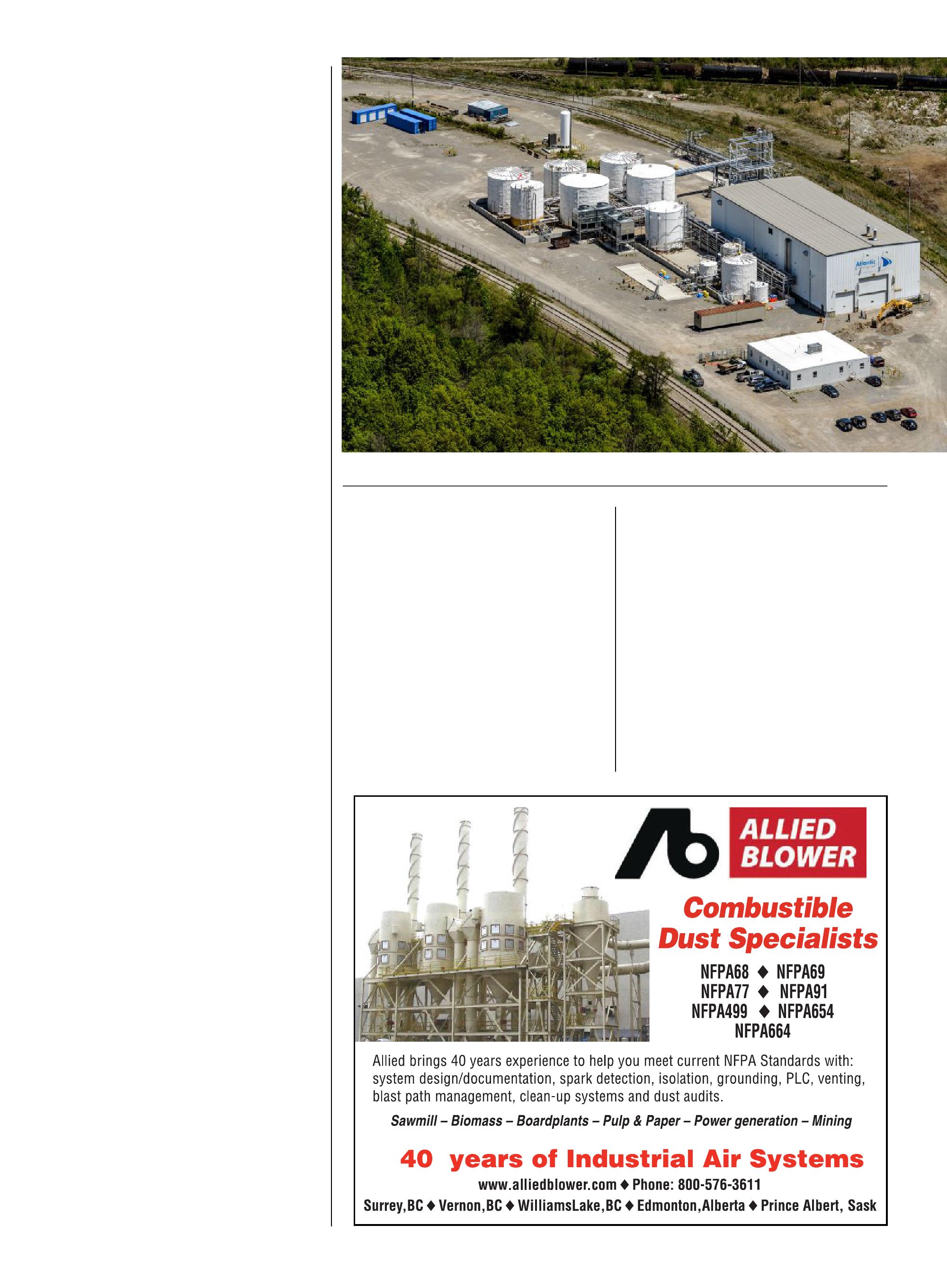
Whenthe ownership of the $50-million
biodiesel plant in Welland, Ont. changed hands in early 2015, the future of the facility was uncertain. The previous owners, Great Lakes Biodiesel, built the facility in 2013 but the plant closed in 2014 after falling into receivership and was taken over by Luxembourgbased Heridge SàRL, which was a major debt holder of the company. The new owners were left with a biodiesel plant they originally never had any intention of running. To make matters worse, the plant never operated at full capacity for prolonged periods of time and required millions of dollars in maintenance and repairs.
Fast-forward to August 2015, millions of dollars in equipment repairs and replacements later, and the company, reborn as Atlantic Biodiesel, was online producing its first order of biodiesel fuel. Once the plant is operating at maximum capacity, it will have an annual production capability of 170 million litres of low-cloud point biodiesel suitable for cold weather applications, and will also produce upwards of 15 million litres of high-grade, kosher-certified glycerin.
So how did this transformation happen? Enter Michael Paszti,
chief operating officer for Atlantic Biodiesel. Paszti, a veteran within the industry, was hired for his previous experience in the biodiesel sector. He commissioned the first Canadian commercial-scale biodiesel plant in 2005 while working for Rothsay, at the time a division of Maple Leaf Foods Inc. The Montreal-based facility had the capacity to produce 50 million litres of biodiesel annually.
“They brought me in because of my experience in the industry to bring this facility back online,” he says. “We basically built this business from the ground up again.”
The company started doing major repairs and maintenance work in February 2015.
“There was some damaged equipment we replaced,” Paszti recalls. “We repaired a storage tank and a distillation column, and we replaced all the heat exchangers in the facility. There were millions of dollars of upgrades – everything from IT, the infrastructure and the lab. The fundamental process is the same but a lot of individual pieces of equipment have been swapped out either because of repairs or improvements.”
The biofuel facility’s renewal is also helping renew the economy of Welland, Ont. The manufacturing base of the city
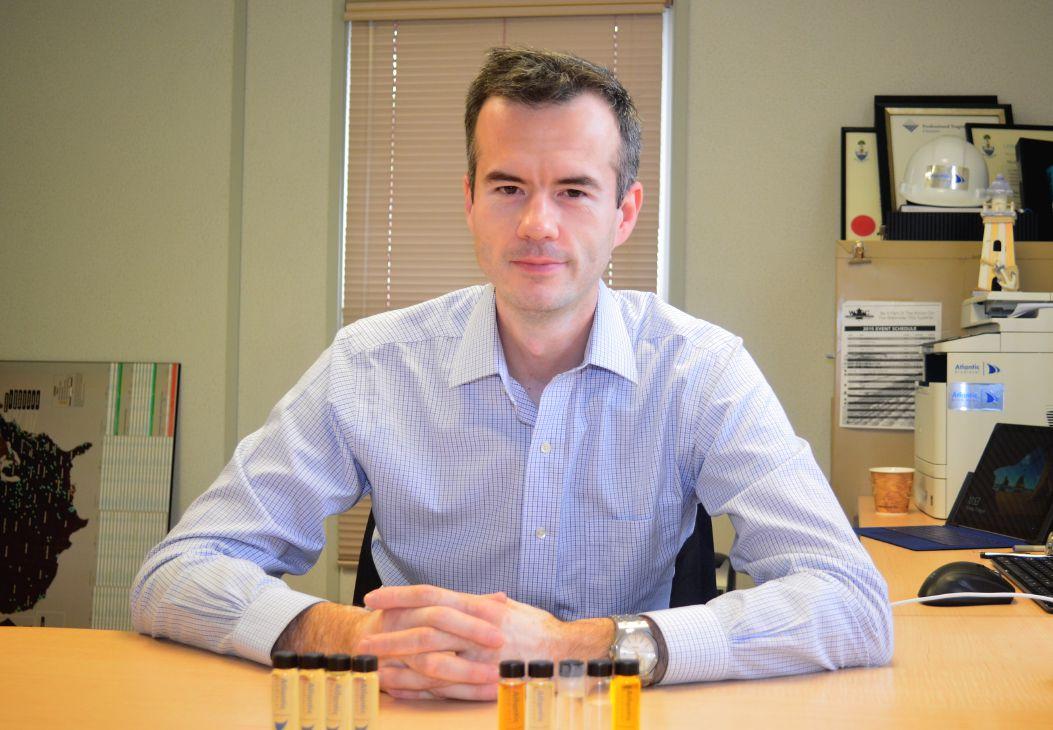
Michael Paszti shows the inputs (vegetable oil, alcohol and catalyst on the right) and outputs (high performance biodiesel on the left) of the production process at Atlantic Biodiesel.
has all but left the area, leaving many in the community without employment. The operation of the biodiesel plant and its potential for growth are bright sparks for a community that’s seen more than its share of setbacks in recent years. One reason Welland was chosen for the facility’s location was the logistical advantages offered by the site, which is built on a former rail yard.
“We can spot about 70 railcars which is more than an order of magnitude more than your typical biodiesel plant,” Paszti explains. “We’re close to the U.S. market and close to the Canadian market when it finally matures. We have a great labour pool because of the manufacturing that used to go on here. You get great value and everything you need is right here.”
There are currently 30 full-time employees at Atlantic Biodiesel but that number has the potential to increase dramatically with the company’s expansion plans. The company is considering purchasing an abandoned John Deere property to establish spin-off businesses. If this plan materializes it could mean upwards of another 200 jobs brought back to the Welland area.
KOSHER IS KING
The feedstock for Atlantic Biodiesel consists of kosher canola and soy crops. They were selected for the company’s biodiesel process because of their purity and availability.
“Those are the most common oil seeds in North America and it just so happens that canola makes the best quality biodiesel,” Paszti says. “We were able to procure Canadian canola and that’s what we have on order and what we have in our tanks. It’s a matter of availability. It doesn’t hurt that these crops are highly sustainable and the biodiesel you make from them has outstanding emissions, as well as greenhouse gas reductions versus petroleum diesel.”
The biodiesel production process at Atlantic Biodiesel generates a unique by-product, crude kosher glycerin, which accounts for about 10 per cent of the overall production of the plant.
“We are a very unique facility in that we produce kosher glycerin,” Paszti says. “Kosher glycerin is especially valuable because it is the gold standard for glycerin used in North America, and glycerin goes into just about every processed food product, cosmetics, industrial chemicals and pharmaceuticals. It’s a very useful
Atlantic Biodiesel uses a continuous-flow process that is highly efficient, enhancing the plant’s environmental credentials.
molecule and it’s all-natural. It has a sweet taste to it so it’s a good sugar substitute but it also gives certain properties to food – it retains moisture, makes things soft… it’s a very useful chemical.”
To produce kosher glycerin you need kosher feedstock, and everything that comes into the plant needs to be kosher, otherwise the plant loses its kosher status.
Kosher status is a huge competitive advantage for Atlantic Biodiesel because the vast majority of biodiesel plants operating do not have kosher certification and cannot obtain the certification, Paszti
explains. Kosher certification is all about quality control.
“Other than certain things not being allowed – pork, for example – you just need to know about what’s going in and you have to control it against contamination. That means all our feedstock has a kosher certification and whoever produced it had control over what went into it, where the crops came from, and that there was no foreign contamination. We keep those records right until the end to prove that our glycerin is kosher.”
Examples of what would make the
glycerin not kosher are if animal fat or used cooking oils were introduced to the process or if feedstock or glycerin containers were to be unsealed.
“It’s quality control, plain and simple,” Paszti says.
MADE FOR THE U.S.A.
For biodiesel, the market is, and will be for the near-term, the U.S. because that is where the most support and demand is for the product, Paszti says.
ATLANTIC BIODIESEL
PRODUCT SPECIFICATIONS (TYPICAL)
Cloud Point: -2ºC
CSFT: 100s
Feedstock type: Canola and/or soy oil
GLYCERIN PRODUCT SPECIFICATIONS (TYPICAL)
“Government policy has ensured an abundant market and because of the way their petroleum complex is set up, it allows for independents and users to access biodiesel more easily,” he says. “For example, you have large truck stops that are huge consumers of biodiesel in the U.S., and a lot of independent distributors that are willing to use biodiesel. In Canada, there’s a lot more reluctance to use it.”
The big petroleum companies own more of the supply chain in Canada and are more reluctant to use biodiesel, Paszti says.
Challenges for growing biodiesel in the Canadian market include a lack of infrastructure put in place by petroleum companies for blending biodiesel, as well as the mandates in Canada lagging behind their U.S. counterparts; and mandates drive renewable fuels.
“On the positive front, Ontario has a greener diesel mandate and 2015 is the first year that it’s in effect with the mandated amount ramping up over the next two years,” says Paszti. “We see some demand in Canada, but there’s still the issue of U.S. demand and U.S. subsidies… so we anticipate that all of our product will go to the U.S., for the time being.”
That said, the average biodiesel blend rate is currently two per cent, and there is a ton of room for the biodiesel market to grow.
“That’s barely your foot in the door,” Paszti says. “I’ve got years of experience running fleets of heavy duty trucks in Ontario and Quebec on blends of anywhere from two to 100 per cent biodiesel successfully. Even at a three percent blend rate, that’s more biodiesel than the entire country can produce, so there’s a huge potential to grow this market in Canada... I think long-term you’re talking about a very costcompetitive fuel that meets all your targets on greenhouse gas emissions and meets all your environmental targets.” •
For more stories on biodiesel production in Canada, visit www.canadianbiomassmagazine.ca.
Over the three days of the conference, held at the centre of one of the largest biomass fibre baskets in the world, there will be many opportunities to learn more about the industry in British Columbia as well as the latest global trends in fibre supply, sustainability, products, technology, policies and other drivers of the future bioeconomy.
Biomass for Alberta?
By Andrew Snook
With a new government in place in Alberta under Premier Rachel Notley, the biomass industry may have an ally to help grow the domestic side of the sector.
Notley recently released her government’s climate change strategy for Alberta, which includes the phase-out of coalfired electricity, a carbon tax, a cap on oilsands emissions and increased investment in wind power. The government is looking to significantly increase its use of renewable energy throughout the province and achieve 30 per cent renewable energy by 2030.
With the phase-out of coal-fired electricity planned throughout the province, through increased use of renewable power and natural gas, it is unclear if biomass will have a role to play –like in the form of advanced wood pellets used by the Ontario Power Generation for converting coal-fired plants in Atikokan, Ont. and Thunder Bay, Ont., for example. Renewables are expected to replace
about two-thirds of coal-generated electricity in the province with a heavy investment in wind power – with natural gas providing base load reliability. However, biomass has not been ruled out as part of the province’s renewable energy strategy.
“Our government recognizes Alberta’s bioenergy production and the benefits it provides to communities and the economy,” said Ryan Cromb, assistant director for Alberta Energy Communications. “However, it is still too early to tell what mix of renewables we are moving towards within our targets.”
Cromb added that Alberta’s Climate Leadership Plan does list biomass for heating as one way small-scale generation can take on a larger role in meeting Albertans’ energy needs.
The carbon tax that the province plans on rolling out is expected to raise $3 billion a year, which will be invested into various renewable energy sectors and consumer rebates to help cover increased energy costs. •
Your global equipment supplier for the biomass industry
ANDRITZ is one of the world’s leading suppliers of technologies, systems, and services relating to equipment for the biomass pelleting industry. We offer single machines for the production of solid and liquid biofuel and waste pellets. We have the ability to manufacture and supply each and every key processing machine in the pellet production line.
ANDRITZ Feed & Biofuel A/S Europe, Asia, and South America: andritz-fb@andritz.com USA and Canada: andritz-fb.us@andritz.com
www.andritz.com
Prince George Bioenergy
Looking ahead to IBCE in June
Staff Report
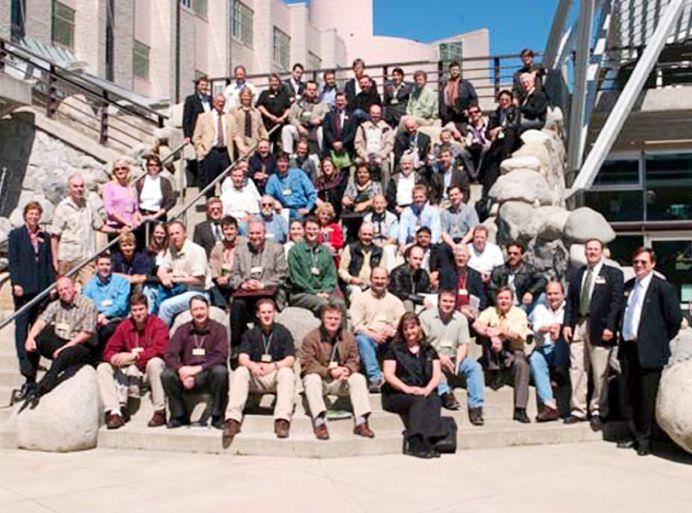
Wayback in 2004 when the International Bioenergy Conference and Exhibition was first launched, a mere 105 delegates and a dozen exhibitors ventured onto the campus of the University of Northern British Columbia in Prince George. to talk about this relatively new industry.
At the time, the bioenergy sector in Canada amounted to little more than a few cogeneration facilities bolted onto pulp and paper mills and a handful of pellet plants scattered around B.C.
But there was potential. Growing interest from the research community, government and industry. And fibre. Lots of it. Not only was Prince George at the centre of what was being referred to as the “Saudia Arabia of biomass,” but there was a government-imposed timeline to shut down all beehive burners, those convenient furnaces that got rid of all the wood waste from sawmilling operations. They were literally giving away fibre at the time.
Fast forward 12 years. Fibre is at a premium, and is fetching solid prices. Some of the largest pellet manufacturers in the world are located in B.C. Bioenergy is making way for bioproducts and the concept of the new biorefinery.
So what can you expect to find at the 7th International event, June 15-17 in Prince George, B.C.?
Content has always been king, so the conference organizers are busy putting together another top-flight lineup of speakers.
That includes one of the foremost thought leaders on energy and climate change: Jeff Rubin, former chief economist with CIBC World Markets. Author of three books on energy, the economy, and now climate change, Rubin doesn’t always get it right. But he gets it right
Delegates at the first International Bioenergy Conference and Exhibition in Prince George in 2004.
more than he gets it wrong.
Rubin will be joined by one of the bioenergy industry’s global thought leaders, Dr. William (Bill) Strauss, of FutureMetrics among other endeavours. Michael Weedon of the BC Bioenergy Network, Bob Cleaves from the U.S. Biomass Power Association and Gordon Murray, head of the Wood Pellet Association of Canada, will be joined by other association heads on an opening Executive Panel. Key biomass regions will be represented, including Doug Hooper of the Alberta Bioenergy Producers Group and Adam Sherman of the Vermont Biomass Energy Resource Centre. John May from Stern Brothers and Jeff Passmore will kick off the finance and investment panel.
A number of enhancements have been added to the event. A pre-conference tour will take visiting delegates
through the province from Vancouver to Prince George for a tour of bioenergy and forestry facilities. The popular International Partnerships Forum and business-to-business meetings will take place the day before the main conference again. And this year two technical workshops will round out the value-added components of the event: WPAC will be putting on a pellet safety workshop, and the National Research Council will host a half day technical workshop.
This year also marks the second time an industry leader will be awarded the Founders’ Award in Bioenergy Excellence. Nominations are open, so consider nominating one of your colleagues.
For more information on the 7th International Bioenergy Conference and Exhibition, go to:
www.bioenergyconference.org. •
A radiant residence
Seniors at Les Residences Jodin keeping warm with biomass
By Andrew Snook
Seniors
living at Les Residences Jodin nursing home are keeping warm this winter thanks largely in part to the installation of two hot water biomass boilers.
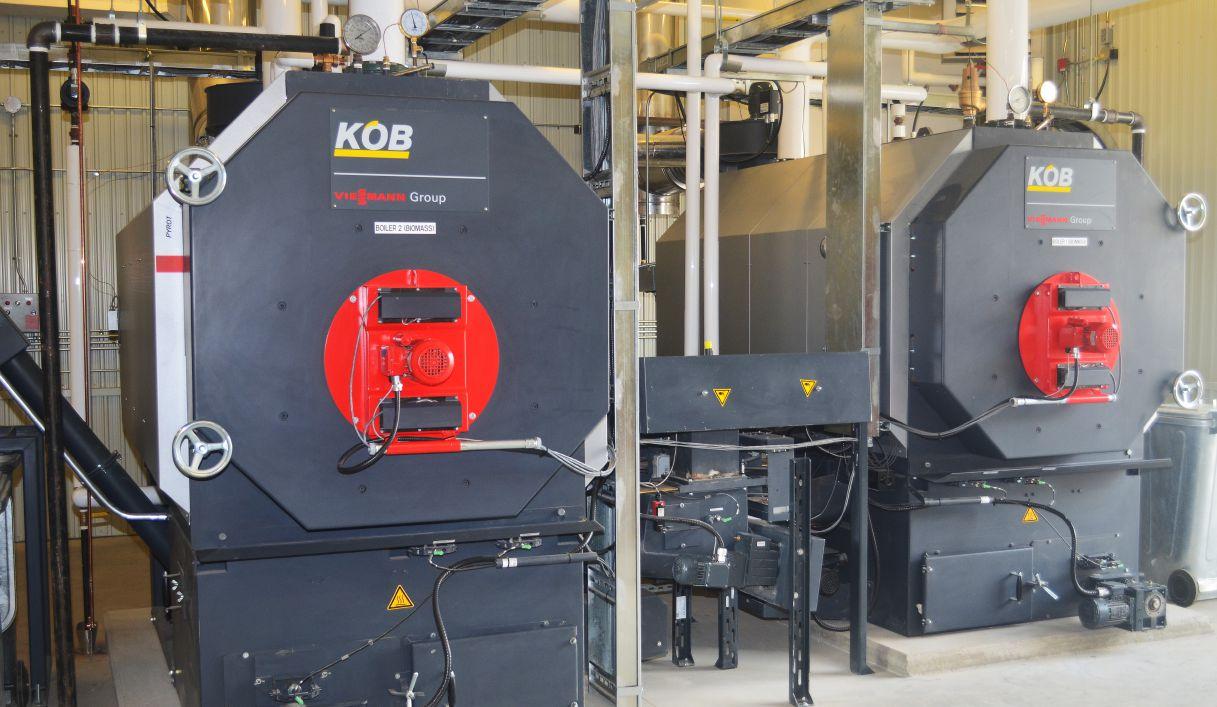
The nursing home, which was recently built for residents in the Edmundston, N.B. area is equipped with 186 beds and was constructed at a cost of approximately $48.5 million. Residents were moved into the facility this past summer. The entire facility is heated using a radiant heating system equipped with two Viessmann biomass boilers that produce upwards of 1.8 million BTUs of heat.
To complement the biomass boilers, which generate the primary heat for the facility, two 4-million BTU Viessmann oilfired boilers were also installed to make sure the heaviest heating
demands for the facility are met in the wintertime.
“For most of the year they won’t burn any oil,” says Daron Thomas of Thomas Industrial Sales, the company that supplied the biomass heating system. “From a combustion efficiency point of view, they run at about 87 per cent efficiency.”
Wood pellets for the biomass boilers are delivered by Saint-Quentin, N.B.-based Groupe Savoie every three weeks to the nursing home’s on-site 60-ton pellet silo that fuels the boilers. The pellets are fed to the boilers via two wood pellet augers.
“It’s fully automatic,” Thomas explains. “Once the system decides to turn on, it feeds itself, runs the augers, measures the combustion efficiency and gets rid of it’s own ash. Once the pellets get burned, sensors activate to communicate that the pellets have burned and run another auger that drives the ash up to an ash can.”
Two Viessmann biomass boilers were installed to produce the primary heat for the radiant heating system at Les Residences Jodin, a nursing home in Edmundston, N.B.
Our competitors say we’re old and slow to change. That our machines are ugly. That we’re not on the cutting edge.
We say, “Yup.”
“Old” means we’ve been around for over 100 years—and we’ll be here for 100 more.
“Slow to change” means we don’t do fads. Oh, we’ll turn on a dime to make changes that our customers need. But fads? Nah. We’d rather protect your investment.
“Not cutting edge” means we’re proven. We build what works and we stick with it.
And “ugly”? Well. You don’t need to be pretty to make a damn good pellet mill.
Every few weeks the ash from the biomass boilers is removed and transported to local farmers who spread it on their farmlands as a conditioner.
Once the heat is generated in the hot water boilers it is sent to two 1,500-gallon buffer tanks where it is stored. The water in the buffer tanks is then pumped through a pair of Bell & Gossett pumps at a flow rate upwards of 1,100 gallons per minute and travels through 147,000 feet of in-floor PEX piping that generates radiant heat for the entire facility.
“It’s the biggest [radiant system] we’ve ever done,” says Sylvio Landry of George’s Plumbing and Heating, the mechanical contractor that was chosen to provide the mechanical work for the project.
Thomas says the provincial government’s decision to opt for biomass boilers was likely a combination of interest in energy savings and a desire to be “more green.”
“The province has a green energy plan and they realize by burning wood pellets they grow local jobs, which isn’t the case with any other type of energy,” he says. “They knew this could be a good application.”
LOST IN TRANSLATION
Landry says reading the instructions for the installation of the boilers ended up being one of his biggest hurdles to overcome.
“Some of the manuals were in German,” he says while laughing.
This was due to the installation being a new kind of project in Canada, Thomas explains, stating that Viessmann, which is
headquartered in Germany, has since been working on translating all of its manuals for use in North America. Fortunately for the mechanical contractors, Thomas and his associate Terry Thibodeau are well versed in the installation of Viessmann equipment and were able to answer any questions put forth by Landry and his team.
COMMUNICATION IS KEY
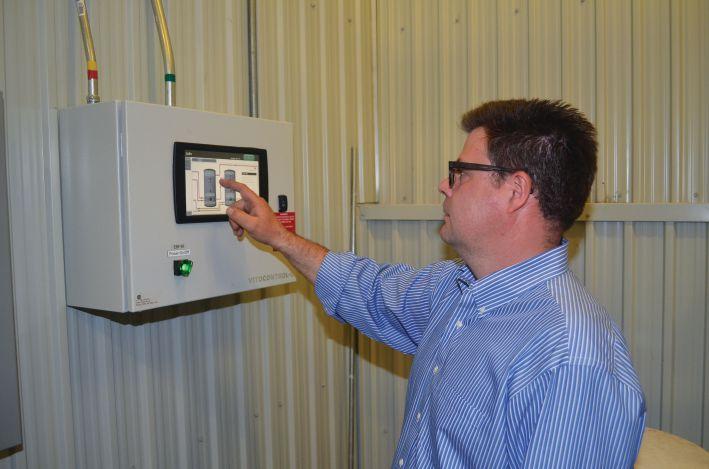
A Viessmann master control communicates via a local operating network (LON) control module to all four boilers and runs the boilers as required, monitoring the temperatures in the buffer tanks and communicating this information to the building management team.
“If I wanted to look at a boiler’s history I could go in and take a look at what is happening, look at the temperatures, the actual return temperatures – how much energy that it’s adding, and any faults that may arise,” Thomas explains.
The system is web-enabled so the operator can log in from a smartphone or tablet and make any necessary changes.
“This system is fairly elaborate because it’s a seniors’ home and the operators need to ensure there’s the proper amount of heat,” Thomas says.
Although Les Residences Jodin nursing home is currently the largest biomass boiler installation Thomas has performed in Eastern Canada to date, he says these types of mechanical systems will soon be commonplace throughout the region. •
Daron Thomas of Thomas Industrial Sales checks out the master control panel for the new radiant heating system at Les Residences Jodin.
WEST SALEM SUPER SHREDDER
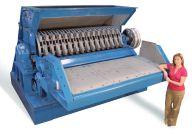
WSM’s Biomass Super Shredder allows processing of a wide range of incoming green feedstock (pulp chips, micro-chips, in-woods chips, sawdust, shavings, and hogged wood) for improved drying and sizing for pellet manufacturing.
The WSM Biomass Super Shredder is specifically designed to deliver high capacity and high speed milling of green fiber at rates from 10 to 75 tph. Available in rotor diameters of 42”, 48”, and 60” and rotor lengths from 36” to 88” long, these massive machines typically operate with 150–1000 HP. Features include modular and adjustable tooling with either rigid or swing hammers with replaceable inserts; large screen area with modular sizing screens to allow adjustment to product sizing; and heavy duty housing with interior wear liners and pivoting case access for long life and ease of maintenance. When combined with a WSM pre-screen, processing rates can reach up to 100+ tph.
WSM offers complete infeed and outfeed options to help supplement fiber supply.
EVENTS BOARD
March 14-17, 2016 • World Bio Markets 2016 Amsterdam, Netherlands www.greenpowerconferences.com
April 5-7, 2016 • Argus Biomass 2016 London, England www.cofi.org/convention/annual-convention
April 11-14, 2016 • International Biomass Conference & Expo Charlotte, N.C. www.greenpowerconferences.com
MARTIN ENGINEERING VIBRATING SUBFLOOR
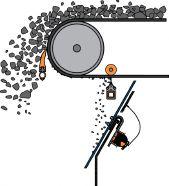
Martin Engineering offers an innovative solution that prevents carryback released by secondary conveyor belt cleaners from sticking to the rear slope of the discharge chute.
If left to build up, material can encapsulate secondary cleaners and deposit harmful carryback onto the return side of the belt, fouling idlers and pulleys. The Martin Vibrating Dribble Chute uses material disruption to cause tacky sludge and fines to fall from the chute wall and back into the main discharge flow. By addressing these issues, operators can experience a reduction in maintenance hours, equipment replacement and downtime, lowering the overall cost of operation.
Prompted by customer requests, Martin engineers observed that the majority of the buildup released by secondary cleaners collected at the rear of the chute mouth, where a sloped surface can trap carryback.
Comprised of three parts, a low-friction polyurethane dribble sheet, a steel mounting bracket and a powerful vibrator, the combination of mechanical disruption and the slick surface prevents material from adhering and feeds it back into the main discharge flow. When the unit is mounted into the existing chute-work, it often extends the rear configuration closer to the belt, increasing the amount of material captured and further reducing spillage.
RC CRANE ATTACHMENTS
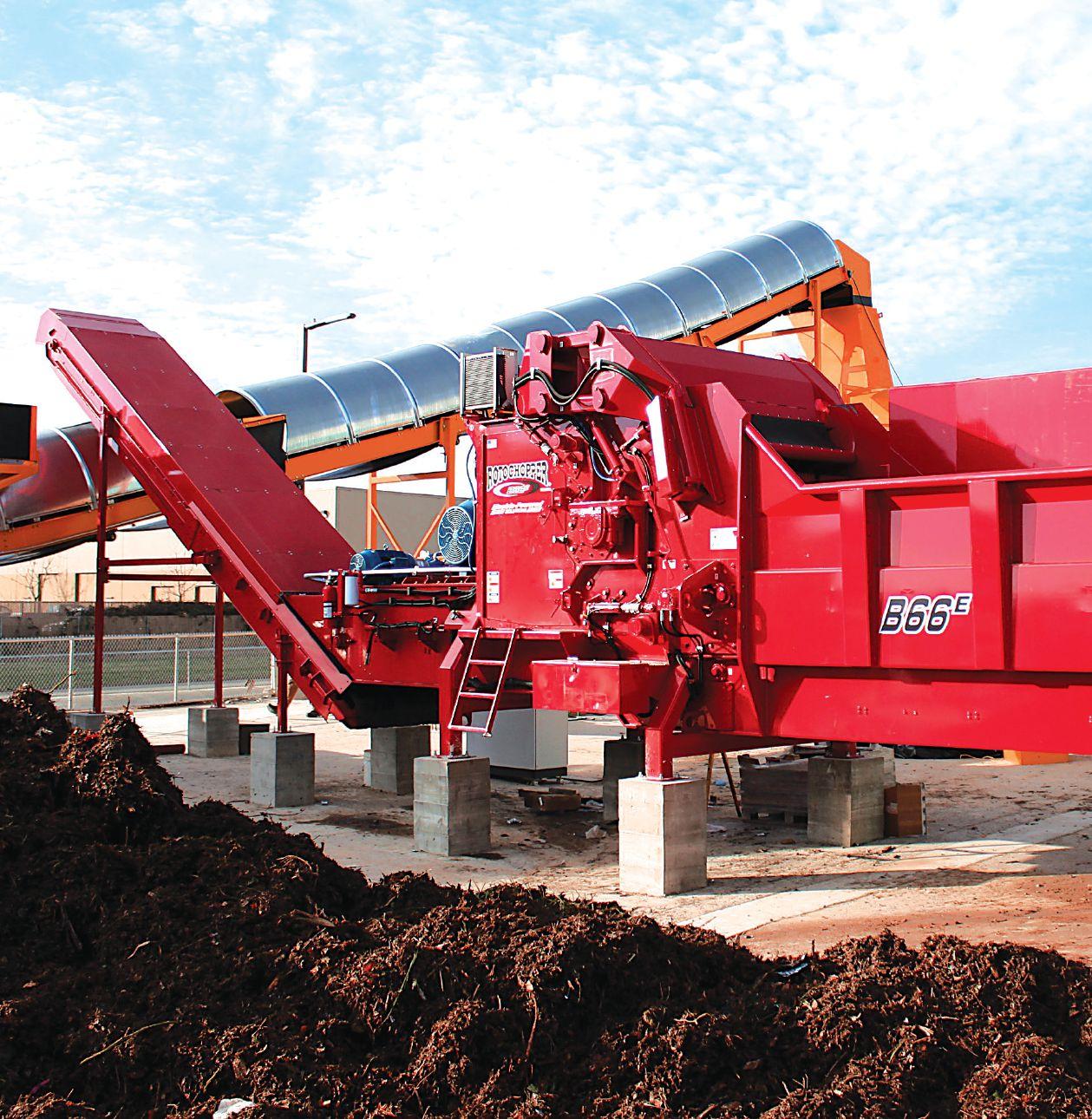
Rotochopper and KeyKnife launched the KeyKnife chipper knife package, which allows horizontal grinder owners to chip and grind with a single machine.
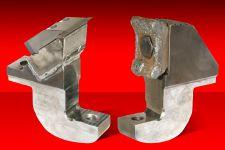
The chipper knife package is a bolt-in option that works with the standard patented replaceable mount rotor for the Rotochopper B-66 and B-66 E. This chipper knife system makes it simple to diversify into chipping applications without a complex conversion kit or a second machine.
To switch from grinding to chipping, the operator does not need to swap the whole rotor drum or assemble a complex overlay onto the grinding rotor – the operator simply swaps the grinder tooth mounts with chipper knife mounts.
A single operator can switch from grinder teeth to chipper knives quickly and easily:
• No rod pullers or other specialized tools required (just a torque wrench)
• No need to swap rotors, re-align sheaves, or re-tension drive belts
• Just two bolts per knife mount and two bolts per knife clamp
This system utilizes patented Key Knife technology to minimize knife replacement costs. Key Knife chipping inserts are indexable (reversible). By simply loosening the knife clamp bolts, the operator can flip the knife to utilize a second chipping edge. A Key Knife insert uses significantly less steel than a traditional chipper knife, making handling and replacement easier. The chipper blade on each mount is much narrower than traditional chipper knives, helping to minimize the maintenance costs that can result from rocks, metal, and other
A Future for Biomass
ISustainable biofuels, bioenergy have a place in Ontario
By Dianne Saxe, Environment Commissioner of Ontario
started my legal career in the public service, and this role, as Environmental Commissioner is a chance to make a difference on issues that I think matter most.
For all Ontarians, there is a need to educate people on the role of the Environmental Bill of Rights. The fundamental idea behind the Environmental Bill of Rights (EBR) is that environmental decisions are too important to be left to just government.
The Ontario EBR was the first
government does not; the government doesn’t always have the ability to know the latest and best about everything.
The universities have really knowledgeable professors and graduate students (often working with the private sector) who are doing wonderful work in areas that are relevant to the areas of environment, energy and climate change (my three mandates. Why not have them submit an Application for Review based on good, solid facts resulting from research done at the school? That is something I want to encourage.
“I am counting on leaders in your sector to continue to develop new approaches and technologies.”
instrument of its kind in the world to recognize that mandate and to give it concrete mechanisms for action. They are not perfect… but they’re not bad. It gives people an opportunity to contribute ideas, facts and information that the government might not be aware of. It is also a chance to put important issues on the government’s policy agenda.
The biomass sector has been built on innovation. I am asking the universities to look at what they’ve got in their research. What are they doing that is relevant to public policy? They might very well know things that the
I am especially interested in low-carbon fuel options and what companies can do to encourage innovation. There are a lot of different ways to think about transportation fuels. Leaving aside whether or not current vehicles can run based on strengthened biofuel blending percentages, right now, is ethanol’s climate impact (all things considered) lower than gasoline? I have seen analyses that say yes and some that say no. If it were completely clear that technology had advanced so much that ethanol was not only compatible with the cars, but it also didn’t increase emissions and had a net climate benefit, then I think governments would be in a different position. But those three things, at least, would need to be proven before it would make sense to look at increasing the blending percentages.
On the woody biomass front, the impacts associated with entire lifecycle
of the fuel feedstock and final product must be considered, because it is the cumulative or whole range of impacts that matters to regulators and citizens.
Humans have burned wood to cook and stay warm for a very, very long time. Lots of rural communities continue to heat with wood. It can be done very sustainably if the wood is grown, harvested and transported appropriately. Of course, we have to consider localized impacts of odour and particulates
We have harvested forests in Ontario every year as part of our economy since European settlement and before, and there are costs and consequences to that, for sure. The question becomes how should we use biomass? From the point of view of burning wood and pellets, for all kinds of heat and energy generation, it has enormous potential if it is done sustainably.
I am counting on leaders in your sector to continue to develop new approaches and technologies. I think we will, see ever more support for the sector as long as innovation continues, and real environmental benefits result. I am convinced, that in the near future there will be even greater opportunities to build more and more biomass use into our lives. •
For more information on government policies on biomass, visit www.canadianbiomassmagazine.ca
Nothing beats the rock solid reliability of a slow-speed shredder for contaminated wood waste. And nothing beats the throughput and end product control of a Rotochopper grinder. Put them together, and you have a streamlined system for turning contaminated wood waste into products.
• Consistent uptime
• Unmatched versatility and particle size control
• Lowest cost per ton or cubic yard
How can a Rotochopper shredder, grinder, or multi-stage system maximize the value of your waste materials? Contact us
Maximize Profits with the Morbark® MicroChipper
95% ½" Minus
Create micro-chips vital to the pellet mill market with the Morbark ® Whole Tree MicroChipper.
• Productive – Morbark’s exclusive enhanced Advantage 3™ drum creates uniform micro-chips, while the mechanically driven chip accelerator fully loads your truck.
• Practical – The operator-friendly, slide-in forestry grate system reduces oversized chips for a consistent, high-quality end product.
• Profitable – With high production of micro-chips per gallon of fuel used, the Morbark 40/36 MicroChipper allows you to reduce costs and maximize profits.
The Morbark ® MicroChipper is a new addition to our full line of heavy-duty Whole Tree Chippers from the leader in the industry. Learn more about our machines and our extensive product support network at www.morbark.com
In customer tests, up to 95% of the micro-chips produced passed through a ½" grate, and an average of 65% passed through a ¼" grate.