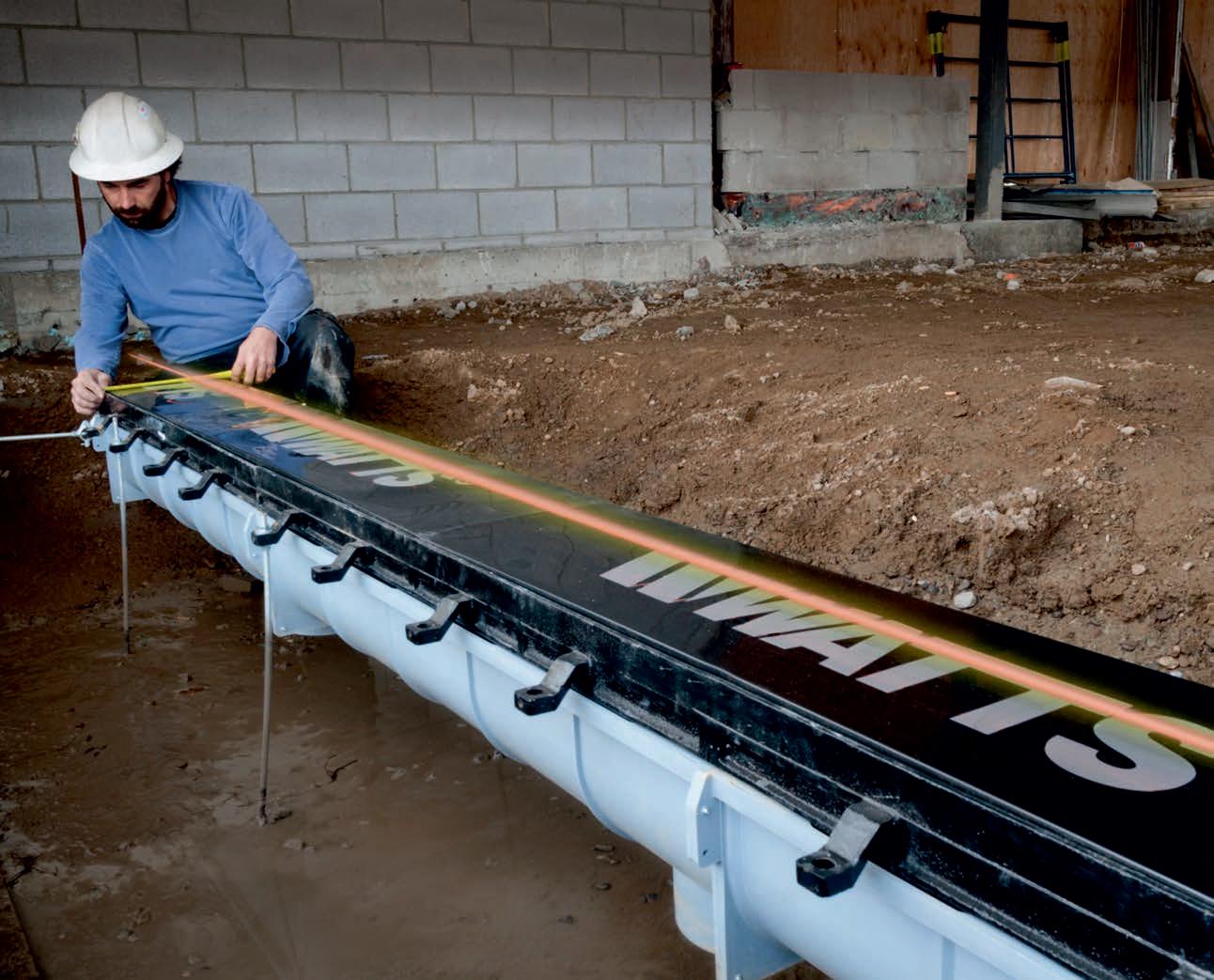
SMALL FIXES MAKE WAVES INBATHROOM RENOMARKET WHENTOUSEA 3-PIPE BUFFER TANK CONFIGURATION

SMALL FIXES MAKE WAVES INBATHROOM RENOMARKET WHENTOUSEA 3-PIPE BUFFER TANK CONFIGURATION
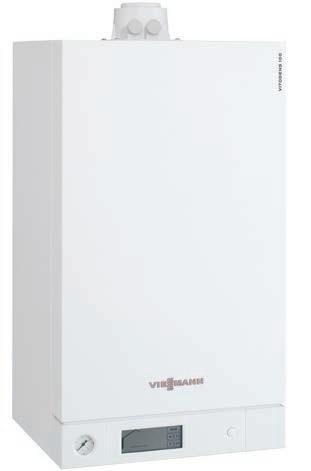
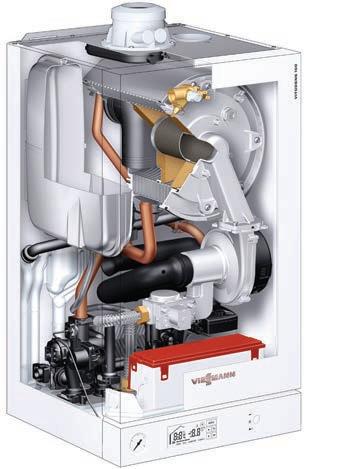
Easy start-up and operation
Easy to service
Quality and reliabilityMade in Germany
On-demand DHW
Simple installation and space saving design
Ideal for apartment units and houses with one DHW draw


20
HYDRONICS: BALANCING MAKE THE RIGHT CHOICE
An overview of new valves, as well as traditional balancing valves, and their application in hydronic and plumbing systems. By Kevin Freidt and Mark Olson
26
HVAC: BALANCING RESIDENTIAL DUCT SYSTEM
BALANCING: WHAT’S IN YOUR TOOLBOX?
Efficient, even heating is an unknown idea for many consumers–technicians and installers should aim to rectify that. By Ian Mcteer
32
INDOOR AIR QUALITY RADON CANADIANIZED
Passive systems show promise as mitigation system of choice for colder climates. By Jillian Morgan
58
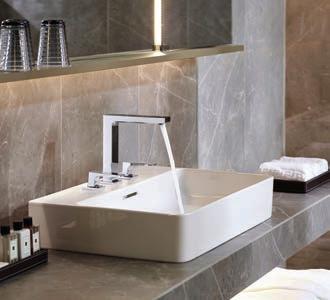
BATHROOM SHOWCASE A BREATH OF FRESH AIR
In loo of full renovations, small fixes make waves. By Jillian Morgan
62 MANAGEMENT
TEAM BUILDING ON A WHOLE NEW SCALE
Work on a sustainable volunteer development project proved to be life changing. By Steve Goldie
74
DESIGN
THE HYDRAULICS OF HYDRONICS: A BALANCING ACT FOR INDIVIDUAL ZONES
If a designer is only doing a handful of calculations, what kinds of inefficiencies are being designed into systems that will shackle the building and its owner for life?
By Robert Bean
80
HYDRONICS
LESSONS LEARNED
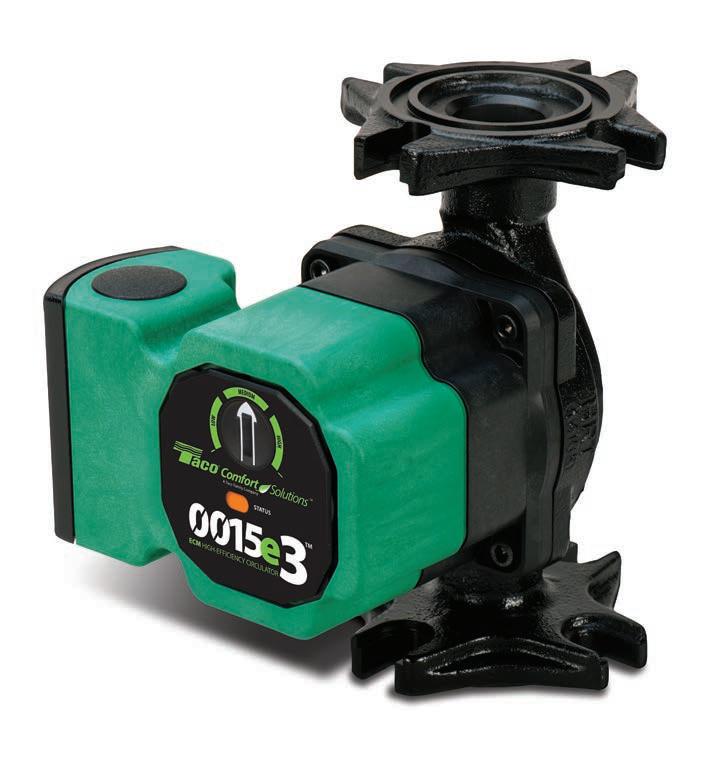
When to use a three-pipe buffer tank configuration.
By John Siegenthaler
84
ELECTRICITY 101
CRACKLE, BUZZ AND POP
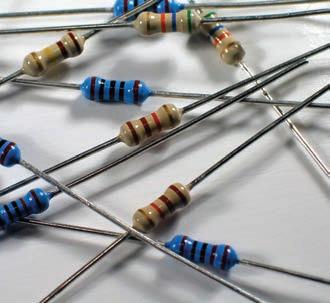
What you need to know about resistance.
By Curtis Bennett
88 FINANCE
RULES CHANGE FOR TAXATION OF INVESTMENT INCOME
The Department of Finance has decided it is being cheated by an element of the system it created. By Hank Bulmash
WHAT TO DO ABOUT THAT PESKY R-22 CHILLER–PART I
The crucial pieces of information you need to determine the best choice for R-22 replacement.
By Dave Demma
DON’T GET CAUGHT IN THE WEED(S): CANNABIS AND THE WORKPLACE
Cannbis legalization presents challenges new and old for employers, but leveraging legal tools can make for a smoother transition. By Diane Laranja
97
PLUMBING
THE CASE FOR RAINWATER HARVESTING
Is this age-old practice an area of potential growth for contractors?
By Robert Waters
100 CONTROLS BEYOND THE BASICS
What are the keys to optimal radiant system performance?
By Mike Miller



AFTER AN ICE STORM IN THE SPRING we were without power for four days at our cottage. This was more a case of falling through the cracks at Hydro One than the severity of the storm but it did prompt a discussion about power vulnerability and the possible purchase of a generator.
I have since become the owner of a 10kW generator–not at home in the city but at the cottage (the logic or illogic of this is a topic for another day). This was a substantial investment, not so much for the equipment, which seemed pretty dear in comparison to a furnace or boiler, but for permits, Hydro One disconnect and connect fees, every inch of cable, digging, and so on. While I wouldn’t call it nickel and diming, I would call it a far cry from any quote or invoice I have received for a HVAC or plumbing job.
Everything necessary for the installation was itemized and costed on the generator quote, until finally the astounding total was presented. And who could protest: we were getting so much (47 lines worth) for that astounding total.
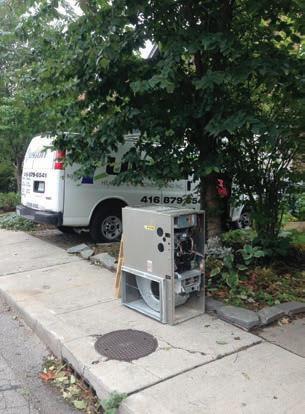
How many customers do you have whose equipment is nearing the end of its life? It is better for everyone if replacements are done when it is 20C rather than -20C
How could we transfer that sales modus operandi to mechanical and plumbing jobs? It should not be difficult–just as it is hard to go without electricity for any length of time, it is also difficult to have no heat in the event of a furnace or boiler breakdown. The flooded basement, which happened because the customer did not want to spend a grand or two to retrofit in a backflow valve, is messy and costly.
Selling customers on being proactive rather than reactive may take a shift in focus and a leap of confidence. After talking to the generator dealer, I came to the conclusion that selling prevention and preparedness is far more lucrative than selling the fix.

Editor
The graphics gremlins were at work in HPAC ’s August 2018 print edition. In Mike Miller’s article Figures 2 and 3 were incorrect. Figure 3 in Rob Waters’ solar heating article was also incorrect. The correct figures are showing online in the digital edition and in the Articles section at www.hpacmag.com.
HPAC MAGAZINE
111 Gordon Baker Road, Suite 400, Toronto, ON M2H 3R1
TEL: 416.442.5600 FAX: 416.510.5140 www.hpacmag.com
EDITOR
ASSISTANT EDITOR
ASSOCIATE PUBLISHER
ACCOUNT MANAGER
MEDIA DESIGNER
ACCOUNT COORDINATOR
CIRCULATION MANAGER
PUBLISHER
VICE PRESIDENT
PRESIDENT & CEO
Kerry Turner (416) 510-5218
KTurner@hpacmag.com
Jillian Morgan (416) 510-5201
JMorgan@annexbusinessmedia.com
David Skene (416) 510-6884
DSkene@hpacmag.com
Vince Naccarato (416) 510-5118
VNaccarato@hpacmag.com
Emily Sun
esun@annexbusinessmedia.com
Kim Rossiter (416) 510-6794
krossiter@annexbusinessmedia.com
Urszula Grzyb (416) 442-5600 ext. 3537 ugrzyb@annexbusinessmedia.com
Peter Leonard (416) 510-6847 PLeonard@hpacmag.com
Tim Dimopoulos (416) 510-5100 tdimopoulos@annexbusinessmedia.com
Mike Fredericks
PUBLICATIONS MAIL AGREEMENT NO. 40065710
Heating Plumbing Air Conditioning (established 1925) is published 7 times per year by Annex Publishing & Printing Inc. HPAC Magazine is the leading Canadian business publication for the owner/manager of mechanical contracting businesses and their supply partners.
ISSN: 0017-9418 (Print) ISSN 2371-8536 (Online)
Contents Copyright © 2018 by Annex Publishing & Printing Inc. may not be reprinted without permission.
SUBSCRIBER SERVICES:
To subscribe, renew your subscription or to change your address or information please visit us at www.hpacmag.com.
Subscription Price per year: $43.00 (plus tax) CDN; Outside Canada per year: $84.50 US; Elsewhere: 1 year $92.50; Single copy Canada: $5.00 CDN. Heating Plumbing Air Conditioning is published 7 times per year except for occasional combined, expanded or premium issues, which count as two subscription issues.
MAIL PREFERENCES: From time to time we make our subscription list available to select companies and organizations whose product or service may interest you. If you do not wish your contact information to be made available, please contact us via one of the following methods: Tel: 416-442-5600 ext. 3552, Fax: 416-510-6875 or 416442-2191; E-mail: blao@annexbusinessmedia.com; or by mail: 111 Gordon Baker Rd., Suite 400, Toronto ON M2H 3R1
Annex Privacy Officer Privacy@annexbusinessmedia.com Tel: 800-668-2374
HPAC Magazine receives unsolicited materials (including letters to the editor, press releases, promotional items and images) from time to time. HPAC Magazine, its affiliates and assignees may use, reproduce, publish, re-publish, distribute, store and archive such unsolicited submissions in whole or in part in any form or medium whatsoever, without compensation of any sort.
NOTICE: HPAC Magazine, Annex Publishing & Printing Inc., their staff, officers, directors and shareholders (hence known as the “Publisher”) assume no liability, obligations, or responsibility for claims arising from advertised products. The Publisher also reserves the right to limit liability for editorial errors, omissions and oversights to a printed correction in a subsequent issue. HPAC Magazine’s editorial is written for management level mechanical industry personnel who have documented training in the mechanical fields in which they work. Manufacturers’ printed instructions, datasheets and notices always take precedence to published editorial statements.

Proud member of:



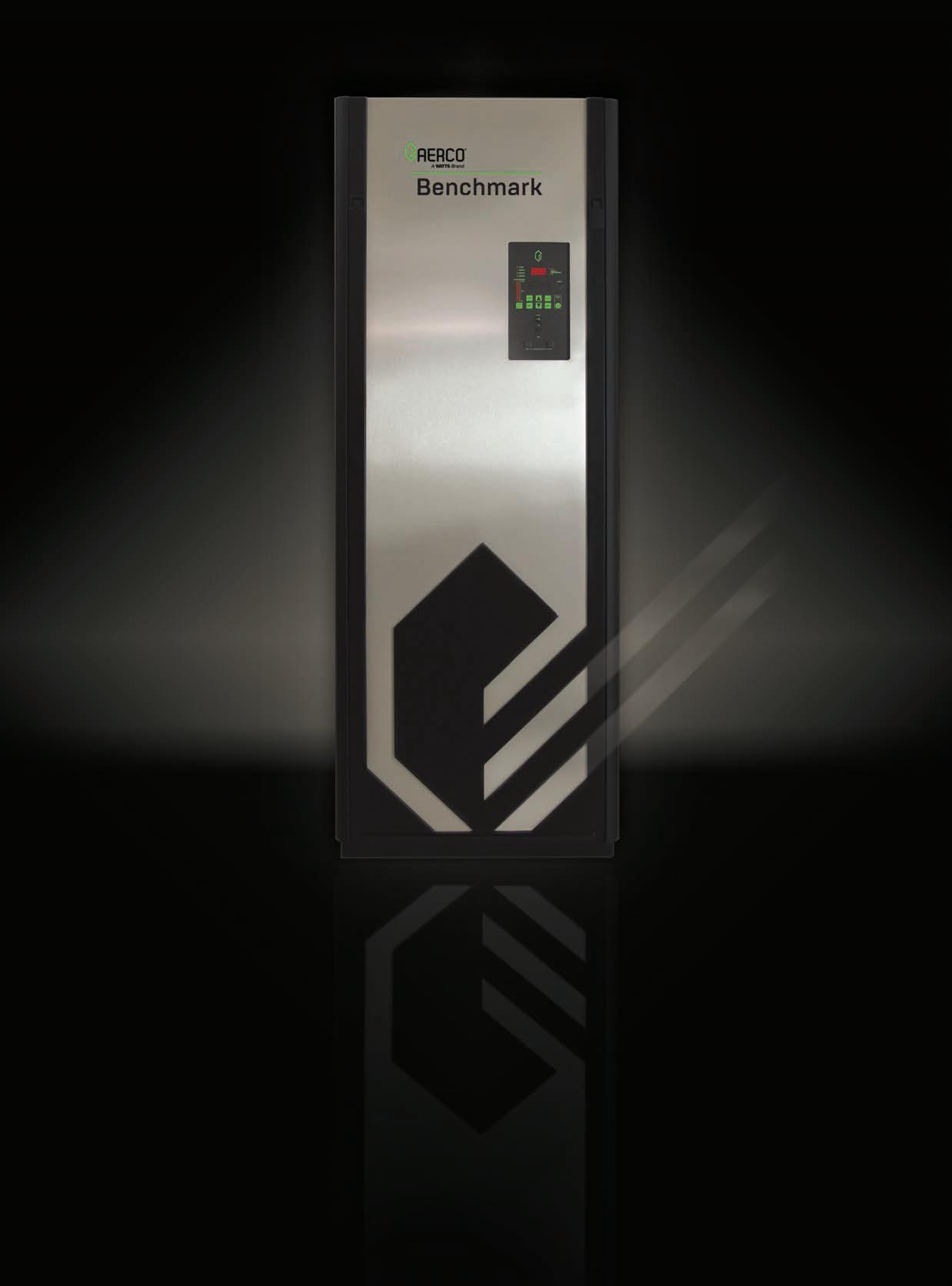
Optimize Your Hydronic System for Maximum Efficiency and Savings
AERtrim
Peak Performance
AERCO’s patented O2 Trim technology self-adjusts the combustion process to deliver optimal O2 levels keeping your boiler operating smoothly at peak performance.
Dual Returns
Maximum Efficiency
Enables design and application flexibility — increases efficiency up to an additional 7%.
onAER
Predictive Maintenance
A pro-active tool detailing comprehensive unit performance so you can ensure your system operates optimally reducing costly unscheduled maintenance.
Morguard Investments Limited has brought a decades-old structure in downtown Vancouver, BC into the 21st century.
The retrofit of Robson Central, a former library, focused on reducing energy consumption and maintaining comfort throughout its 24 hour a day, seven day a week operating cycle.
“Morguard’s team and Robson Central’s tenants worked together to overcome different challenges,” said Tom Johnston, vice president of property management, western region, at Morguard. “The key aspect to making the planned approach successful was the tenants’ openness to collaboration.”
Located in the city’s shopping district on the corner of Robson and Burrard streets, the building is home to Bell Media/CTV, the Globe and Mail and several retail tenants.
The addition of variable speed drivers, a direct digital control system and innovative software analytics to the more than 60-year-old building allowed Morguard to achieve a 20 per cent reduction in energy consumption over the course of 2017.
At 130,000-square-feet, it reached an energy-spend of 5.42 equivalent kilowatts per hour (ekWh) per square foot (sf), down from 68.6 ekWh/sf in 2016.
Heating and cooling for the building is provided by air handling units (AHUs) distributing conditioned air through duct systems with variable air volume (VAV) and fan-powered terminals to ceiling diffusers and floor grilles.
A central steam-to-water heating system supplies hot water through a piping system to heating coils in AHUs and reheat-coils in VAV and fan powered terminals supplying perimeter areas.
A base building chilled water plant supplies chilled water through piping systems to cooling coils in the AHUs. A second chilled water plant supplies chilled water to supplemental air handling units in the areas occupied by a single tenant.
“In terms of the ventilation system, five AHUs provide the base heating, cooling and ventilation for the building,” Johnston said. “These air handling units have economiser dampers, heating and cooling coils, supply and return fans with variable speed drives for variable air volume operation and cooling with outside air. The base air handling units supply both interior and perimeter spaces.”
Mechanical systems–down to the zone level of the building–are controlled by a direct digital control (DDC) system, installed by ESC Automation. Modern Systems installed the
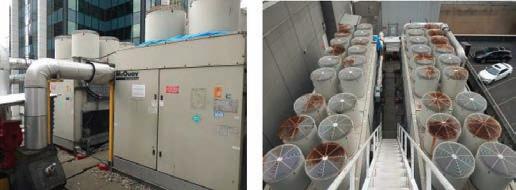
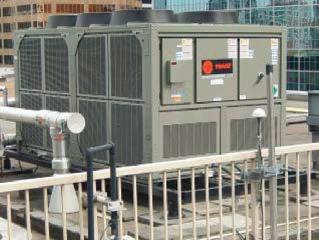
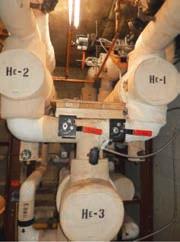
replaced, in 1995.
Morguard also introduced a single building management system (BMS) platform and tailored software analytic rules, reports and features, including the Golden Standard, which is being used to monitor all changes made to the BMS and alert users of differences between current energy usage and set standards.
“This feature provides a dynamic update of indicators, creating opportunities for improvement and better use of resources,” Johnston said.
The building was also recommissioned entirely to improve operation of all equipment and systems, undergoing an investigation by the company to identify problems and systems integration issues.
“[The retrofit] was successful thanks to the installation of submeters for all tenants [and] training provided by our consultant to all our tenants, so they could be able to access to the building’s system to control their zones, and the installation of base building equipment to provide accurate data and monitoring utility usage,” Johnston said.
Despite the challenges of retrofitting a heritage building home to major tenants, Morguard earned a LEAP (Leadership in Environmental Advancement Program) award in June from the Healthcare of Ontario Pension Plan for the building’s reduced energy consumption.
“The LEAP award received in 2018 from the Healthcare of Ontario Pension Plan encourages us to keep innovating and pursuing energy efficiency throughout all our operations,” Johnston said. www.morguard.com


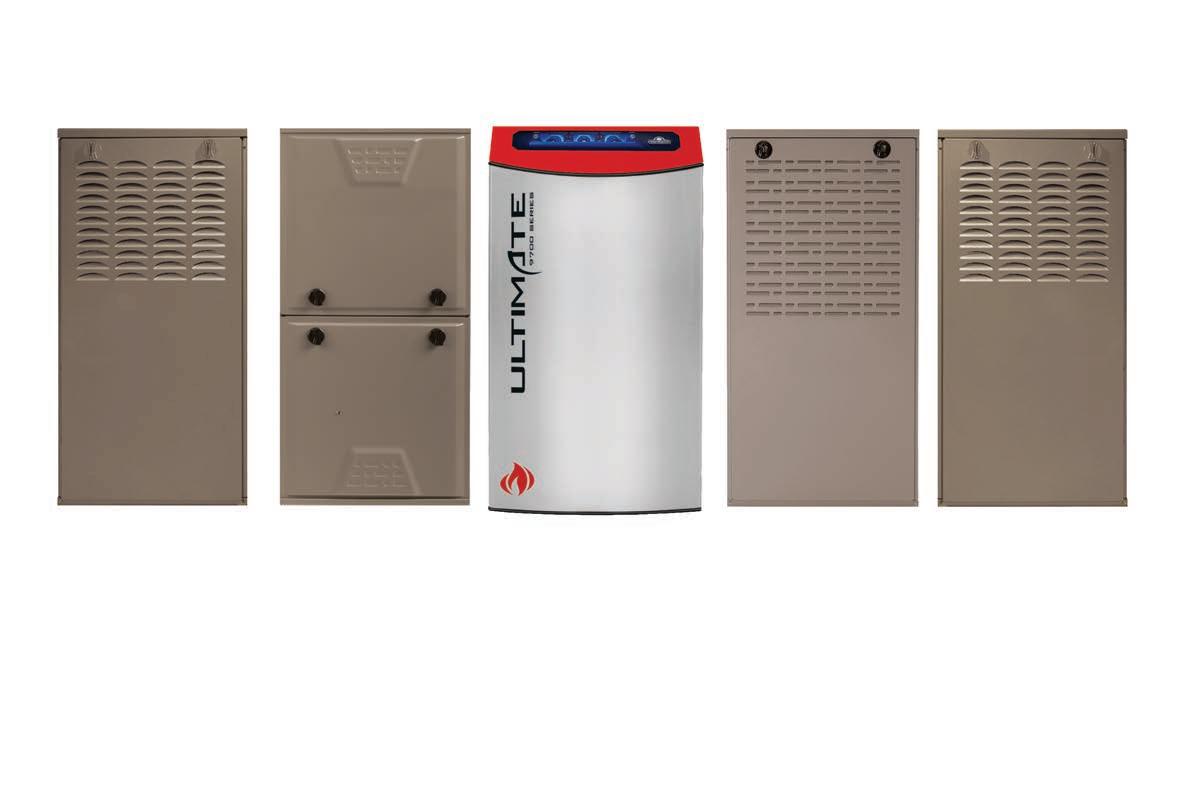
napoleonheatingandcooling.com

The 2019 AHR Expo will return to Atlanta, GA for the first time in nearly two decades, to be held at the Georgia World Congress Center from January 14 to 16.
Clay Stevens, show manager, said HVAC/R is a key economic driver for the state, with the U.S. Department of Labor projecting 20 per cent growth in the coming years.

The exposition attracts over 60,000 attendees and 2,100 exhibitors from 35 countries.
“We come to the show to check the pulse of the industry, and to get an opportunity to build relationships with new and existing customers in the U.S.,” Kevin Bergin, director of Aspen Pumps Inc., said at the 2018 show. “This show lets us see how people are thinking about the year ahead. Based on the [2018 show], we’re seeing a lot of confidence.”
The 2018 expo drew record crowds and reported a positive economic outlook among exhibitors. Exhibit space for the 2019 show is sold out.
AHR will be held in conjunction with the ASHRAE Winter Conference. The conference is comprised of eight tracks, including refrigeration, HVAC/R fundamentals and applica -
tions, systems and equipment and common system misapplications, among others.
Grant Imahara, former host on Discovery Channel’s Mythbusters, will kick off the conference’s opening plenary session with a keynote talk. www.ahrexpo.com www.ashrae.org
BACKS APP THAT CONNECTS HOMEOWNERS WITH CONTRACTORS
HeyBryan, an app for Android and iPhone that connects home service providers to homeowners, has partnered with HGTV’s Bryan Baeumler.
Set to launch in fall 2018, the app enables users to find vetted, qualified home service providers for general handyman services, electrical, plumbing and appliance repair.

All taskers are subject to background checks and payment is processed through the app.
Homeowners can review and rate home service providers directly through the app, and contractors who consistently earn high ratings and positive reviews can earn certification.
Interested contractors can sign up at www.heybryan.com/ become-tasker.
Mayors of Toronto, Montreal and Vancouver have signed on to a global agreement comprising 19 cities to meet net-zero carbon standards by 2050.
Led by the C40 Cities Climate Leadership Group, the Net Zero Carbon Buildings Declaration requires cities to: establish a roadmap to reach net zero carbon buildings; develop a suite of supporting incentives and programmes; and report annually on progress.
The pledge is part of the World Green Building Council’s Net Zero Carbon Building Commitment for Businesses, Cities, States and Regions.
Leading up to the Global Climate Action Summit, which was held in San Francisco, CA, C40 urged cities to step up their climate action and ambition–the declaration is one of the city commitments under that initiative.
Of the 19 cities, 13–including Montreal, Toronto and Vancouver–will take extra steps as part of a commitment to owning, occupying and developing only assets that are netzero carbon by 2030.
These steps include evaluating current energy demand and carbon emissions from municipal buildings, and identifying opportunities for reduction; establishing a roadmap to reach net zero carbon municipal buildings; and reporting annually on progress.
“We are excited to be signing the C40 Net Zero Carbon Emissions Declaration along with other major cities around the world,” said Vancouver Mayor Gregor Roberston.
“Vancouver’s Zero Emission Building Plan will not only reduce GHG emissions from new buildings by over 60 per cent but is also driving our green economy with a 53 per cent increase in green building jobs since 2010.”
The commitment also includes a pledge to work with regional governments and the private sector, and calls on national governments for equal action.
Other cities that signed the declaration include: Copenhagen, Johannesburg, London, Los Angeles, New York City, Newburyport, Paris, Portland, San Francisco, San Jose, Santa Monica, Stockholm, Sydney, Tokyo, Tshwane and Washington D.C. www.c40.org www.worldgbc.org
Continued on p12
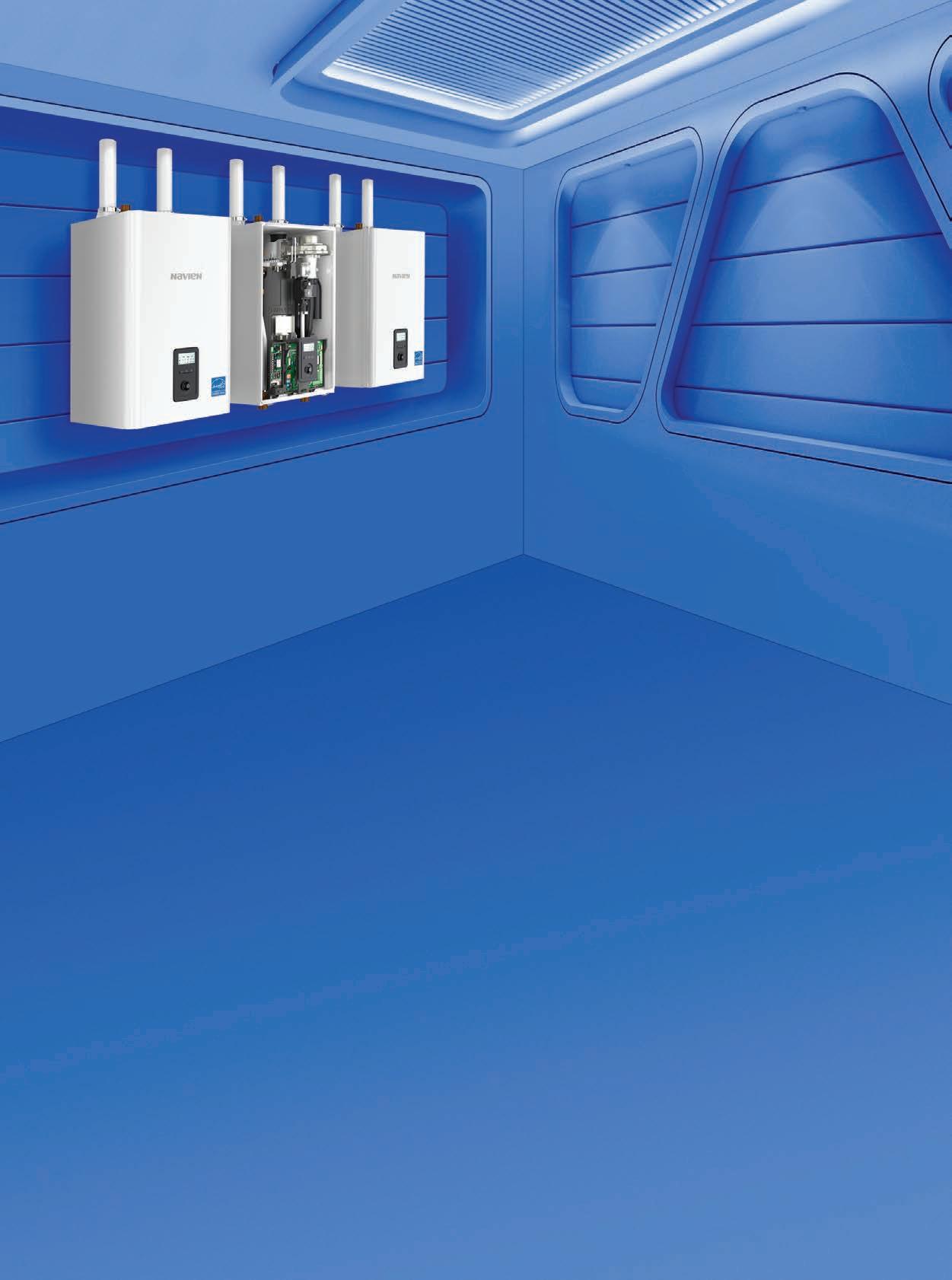
Navien...the condensing leader brings you the future of fire tube boiler technology


Out of this world quality — built from top to bottom with in-house designed and manufactured Navien parts. Also, our state-of-the-art robotic laser welding and automated assembly systems assure the highest level of quality.
Patented stainless steel heat exchanger with a one-piece combustion chamber eliminates high stress point welds that are prone to corrosion.
AFUE 95.0% Energy Star 2018 most efficient rating.
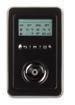
Advanced user interface controls with intuitive text display and innovative click wheel simplifies boiler setup.
Optional add-on NaviLink Wi-Fi remote control system.
Cascading up to 16 units and common venting up to 8 units.
Field gas convertible, NG or LP.

Built-in hardware to connect a boiler pump, 3 zone pumps or 3 zone valves integrated into the unit. No need to add extra zone panels.


10:1 Turn Down Ratio reduces excessive boiler cycling, saves money and energy.
To learn more visit NavienInc.com

ASHRAE has published a resource for building professionals designing efficient and grid-responsive buildings.
Titled “Building Our New Energy Future,” the guide aligns with ASHRAE’s 2018-19 society theme of the same name.
The resource was developed in collaboration with the American Institute of Architects, the National Institute of Building Sciences, and the U.S. Department of Energy’s National Renewable Energy Laboratory.
Topics include distributed energy resources, electric vehicles and buildings, the Internet of Things, smart grids and buildings, the future of utilities and high-performance building design.
Strategies to communicate about prioritizing loads, storing versus using energy, and advances in renewable energy are provided throughout. It also shares new practice areas and business opportunities for building professionals that will emerge.
Electronic versions of the resource can be downloaded at www.ashrae.org/about/leadership/ashrae-president.

France Daviault will take over as executive director of the Canadian Apprenticeship Forum. She is replacing Sarah WattsRynard, who was in the role with the association for eight years.
Daviault most recently served as vice president of the Automotive Industries Association of Canada, where she oversaw association operations and industry programs.
She also held the title of executive director of Heavy Duty Aftermarket Canada, in addition to leading the communications team for the Canadian Council of Motor Vehicle Administrators.
Daviault has her Certified Association Executive designation from the Canadian Society of Association Executives, and has been a guest lecturer at numerous symposiums. www.caf-fca.org
The City of Vancouver will replace its aging fire hall No. 17 with a newly constructed building designed to Passive House Standards. Construction is expected to start November 2018.
Along with a small group of projects, the hall is part of the Canada Green Building Council Zero Emission Building standard pilot, which aims to use green building performance standards to reduce greenhouse gas emissions from commercial buildings.

Set to open in 2019, the fire hall project aims to reduce heat loss from the building by over 70 per cent. It will use a geo-exchange system and generate on-site renewable energy using solar photovoltaics. At twice the size of its aging predecessor, it will include provisions for a training hall with four drive-through apparatus bays, a full size hose/training tower and a training yard, as well as accommodation for a two-crew operation. The hall will be built to a post-disaster standard and serve as an emergency hub and a secure location for city IT services. Construction will begin in November 2018.
The project received a grant and loan from the Federation of Canadian Municipalities’ Green Municipal Fund to go beyond a zero emissions standard and increase on-site renewable generation to achieve a net zero energy standard. www.nrcan.gc.ca
Tens of thousands of building industry professionals are set to converge on Toronto starting November 28th for the 30th anniversary of The Buildings Show. The three-day annual event will include some 1,500 exhibitors, featuring a range of products and services, as well as numerous educational workshops.
About 30,500 professionals walk the floor and network with colleagues at the event each year.
This year’s show caters to five distinct market sectors. It includes Construct Canada, the HomeBuilder & Renovator Expo, STONEX Canada, the World of Concrete Toronto Pavilion, and PM Expo. It will cover both the north and south buildings of the Toronto Metro Convention Centre.
Contractors can expect to see a wide range of new building products in all sections of the show and gain access to the latest industry know-how at dozens of learning sessions. Seminars will run throughout the first two days of the show.
Be sure to stop by booth 4928 and visit with HPAC's staff. www.thebuildingsshow.com

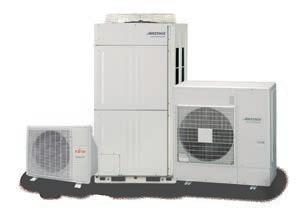
When everything’s on the line, it’s important to have the right team at your side. That’s why so many professionals put their trust in Fujitsu and its award-winning line-up of solutions. A partnership with Fujitsu means access to ductless products, VRF, unitary products, and first-class training and support that positions your business to succeed every single day. Fujitsu...hands down, the perfect choice.
Visit fujitsugeneral.com

The Mechanical Contractors Association of Canada has launched a program for young professionals in the mechanical construction industry.
The YEP! program, unveiled at a midyear board meeting, aims to connect young professionals from across Canada by providing industry exposure to and increasing awareness of the provincial, zone and national mechanical contractor associations.
YEP! will also create networking opportunities and support career development.
For more information, contact Ariel Shortt at ashortt@mcac.ca or 613-2320492. www.mcac.ca
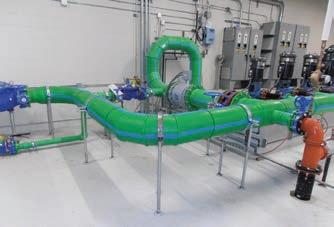
The Plastics Pipe Institute, Inc. (PPI) has created two new groups within its Building and Construction Division (BCD): the Geothermal Steering Committee and Polypropylene Pressure Pipe Steering Committee. Geothermal ground source activities
will be the focus of the BCD. BCD's first publication related to polypropylene pressure pipe, PPI TN-57 Proper Integration of Copper Tubing and Components with PP-R Piping Materials for Plumbing Applications, was published June 2018. www.plasticpipe.org
Trimble has completed its acquisition of Portland, OR-based Viewpoint. With this purchase, Trimble will offer a central workflow platform for construction management. Viewpoint will focus on general, specialty and heavy civil contractors, and link project data into the owner-facing e-Builder suite. www.trimble.com
Continued on p16

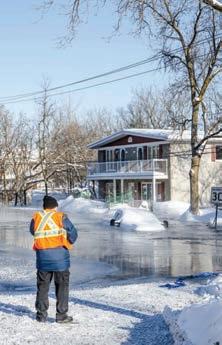
Water damage coverage introduced in B.C. and N.S.
British Columbia and Nova Scotia homeowners can now be insured for storm surge damage under The Co-operators Group, a national insurance co-operative.
The water damage coverage is intended to protect homeowners against common causes of water damage, including: overflowing lakes, rivers and creeks, sewer or septic backup, heavy rain and storm surge.
The flood risk model used by The Co-operators incorporates data on factors that help predict areas at risk of flooding.
Read more on the impact of water damage in Ian McTeer’s “Water, water, everywhere,” online and in HPAC December 2017 at www.hpacmag.com www.cooperators.ca
PCL Construction has partnered with Microsoft to develop smart building solutions, including Job Site Insights (JSI).

JSI is a cloud-based smart construction platform built on Microsoft Azure, a cloud-computing platform that includes Power BI and the Azure IoT suite, as well as analytics and artificial intelligence capabilities.
The platform is designed to visualize the construction site and map devices to space, equipment, assets and people through the use of artificial intelligence and machine learning technologies.
“Smart Building solutions are important to our clients, enabling building operators to gain valuable insights, and it’s an exciting area to be involved in,” said Mark Bryant, CIO of PCL.
Through the partnership, PCL hopes to develop solutions to improve building features, including heating and cooling, among other aspects. www.pcl.com www.microsoft.com


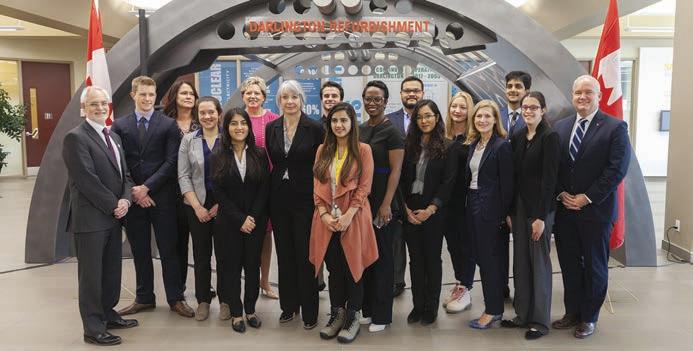
A $6.6 million program by Electricity Human Resources Canada (EHRC) to
improve job readiness for post-secondary students has launched.
The Empowering Futures program is designed to create up to 1000 new jobs for students in the electricity sector over
the next four years. Available to postsecondary STEM and business students across Canada, the program offers up to $7,000 in co-op wage subsidies to electricity and renewable employers.
Funded by the Government of Canada’s Student Work-Integrated Learning Program, Empowering Futures aims to encourage and support industry employers, especially small- to mediumsized companies, to hire co-op students and provide them with an opportunity to gain valuable experience in a real work environment.
www.electricityhr.ca



Introducing a bright new solution from Delta –solar electronic faucets and flush valves. Our products efficiently harvest power from natural, artificial, ambient and even occupancy lighting, which makes them perfect for any number of applications. We’ve combined the sustainability of solar power and the reliability of batteries into thoughtfully designed products that are backed by Delta Faucet quality. deltacommercialfaucets.ca




An overview of new valves, as well as traditional balancing valves, and their application in hydronic and plumbing systems.
BY KEVIN FREIDT AND MARK OLSON
Several manufacturers have introduced new balancing valve technologies into the market. Familiarity with these new valves, as well as traditional balancing valves, will assist you in selecting the correct one for specific hydronic and plumbing system applications.
Manual (a.k.a. pressure-dependent) balancing valves with two ports for measuring differential pressure across an internal orifice have been industry workhorses for decades. They are sometimes called “static” balancing valves because once adjusted there is no movement of parts inside the valve. There are two types of manual bal -
ancing valves: the fixed orifice (FO) type and the variable orifice (VO) type. Orifice refers to the portion of the valve located between the two ports used to measure differential pressure.
In a FO valve there is no change in internal geometry between the differential pressure ports–the orifice remains fixed while the valve is being adjusted.
A direct relationship exists between pressure drop across the ports and flow rate. That relationship is governed by the following formula:
Where: Q is flow rate (in gpm), Cv is the flow coefficient of the orifice between the ports, ΔP is the pressure drop across the ports in psi.
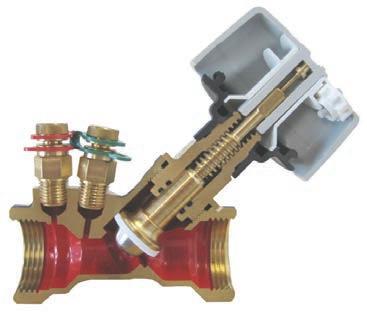
For example the manufacturer’s published Cv value for the valve in Figure 1 is 6.4. If the ΔP across the ports is measured as 0.3 psi, then the calculated flow rate is:

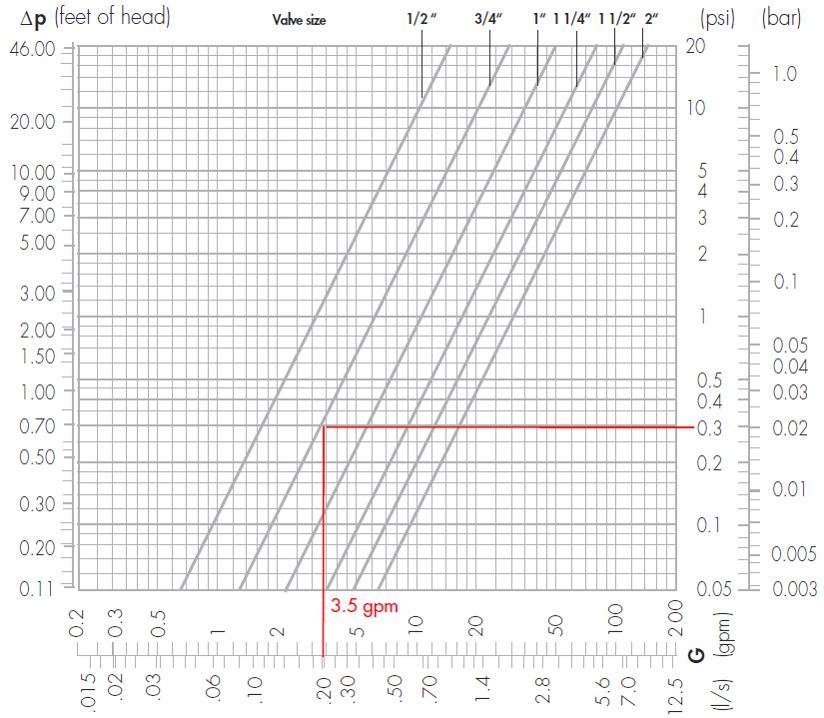
valve shown in Figure 1. The red lines show how the previously calculated flow is determined.
To eliminate the need of installers doing this calculation, manufacturers plot the relationship on wheels or charts to allow fast determination of flow rate. Figure 2 shows a chart for the
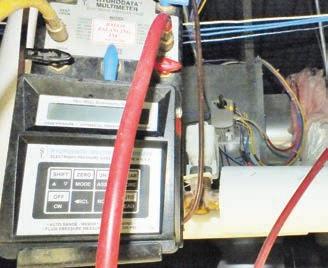
Special instruments are used to measure differential pressure across FO and VO balancing valves. Figure 3 shows a FO balancing valve connected to a digital manometer using small hoses. Some manometers can be programmed to directly convert the differential pressure measured across a valve to a flow rate reading.

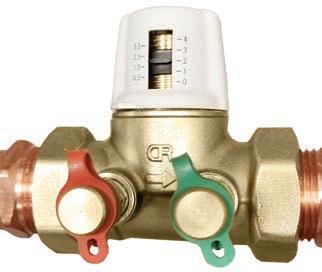
The second type of manual balancing valve is called a variable orifice (VO) valve. Figure 4 shows an example. As the contractor turns the knob to adjust flow the geometry of the orifice between the pressure ports varies.
Notice that the internal adjustment member of the valve is positioned between the pressure ports. Thus the Cv value of the orifice changes as the valve is adjusted. This makes the procedure for determining flow rate more involved than with a FO valve.
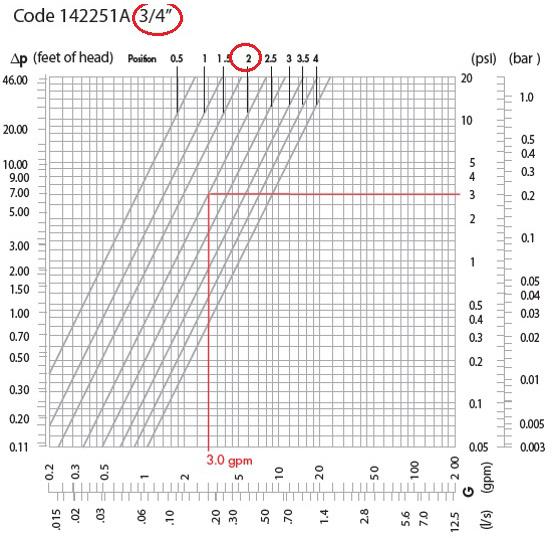
Manufacturers publish a family of
curves for each size valve. Each curve relates to a specific knob position. Figure 5 shows the family of curves published for the valve shown in Figure 4. The red lines illustrate how a knob setting of 2 combined with a measured differential pressure of 3 psi, indicates a flow rate of 3 gpm.
If this flow measurement of 3 gpm was the first one conducted, and 5 gpm is the desired flow rate for the circuit, the contractor might choose to open the valve to position 3 or 4, determine the new flow rate, and through simple interpolation determine the
knob setting that should result in a flow rate close to the target value of 5 gpm. This process would be repeated, as necessary, until the target is attained.
Balancing a circuit with traditional manual balancing valves is an iterative “trial & error” process. Furthermore because circuits are hydraulically coupled, adjusting flow in one circuit affects flow in the other circuits. A system with 10 circuits can require 60 or more readings and adjustments to achieve the desired flow rates.
Accurate balancing requires skill and
Continued on p22
experience. Various test, adjusting and balancing organizations exist in North America to train and certify balancing professionals.
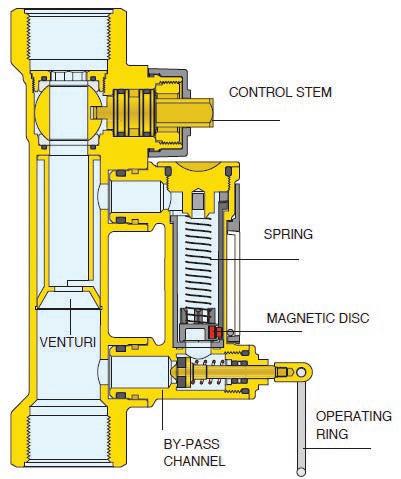
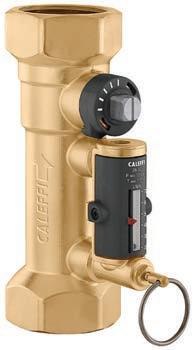
A variation of the FO valve that was introduced in North American a few years ago does not require ΔP readings, and instead uses a built-in flow meter. The flow rate is directly read by the balancing technician. This type of valve is generally more expensive than traditional manual balancing valves, but can simplify balancing, reduce balancing labour time significantly, and eliminate errors. Figure 6 shows an example.
Within this type of valve a bypass channel connects to both sides of a venturi. To set the flow rate the balancing technician pulls the ring on the bypass valve which allows flow through the bypass channel. A spring/disc mechanism travels within this bypass channel, its position relative to flow rate. The disc is magnetic and attracts a small steel bead located within an external sealed glass cylinder. The cylinder graduations are calibrated so that the bead location indicates the valve’s flow rate.
To set flow rate, the balancing technician simply rotates the control stem with a wrench while viewing the meter until
reaching the target value, then releases the ring. Circuit flow can be set in a fraction of the time required for traditional manual balancing valves. Furthermore, common sources of error such as incorrectly calibrated instruments, misinter-


TECHNOLOGY
- Helps reduce overall power demand during peak periods;
- Longer lasting and more reliable, at comparable cost;
- Less stress on electrical components.
60 IMP. GALLONS

- Oversized magnesium anode rod;
- Double coating of blue cobalt glass enriched with zircon;
- Brass drain valve.
40 | 60 IMP. GALLONS
preting pressure readings, incorrectly interpolating logarithmic charts, and incorrectly interpolating adjustment knob positions can be eliminated.
In DHW recirculation systems, the calculated branch flow rates required to maintain a minimum temperature at the farthest fixture are frequently so low that they are difficult or impossible to read using traditional manual balancing valves that rely on differential pressure. For a given flow rate the differential pressure across a VO valve is greater than that of a FO
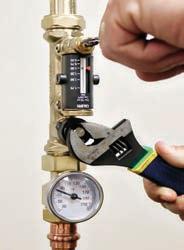
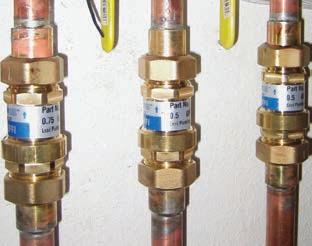
valve–seemingly giving the advantage. But an offsetting factor is having to interpolate based on adjustment knob position. Because of these advantages, direct reading manual balancing valves are becoming more common in DHW recirculation applications. Figure 7 shows an example of one on a DHW return riser. Notice the minimum graduation of ½ gpm. This is a commonly specified circuit flow rate, and low enough that it is often difficult to accurately set using a traditional differential pressure type balancing valve.
Continued on p24

With its small footprint, patented features, and superior stainless steel body, the new Zurn Wilkins 475ST Backflow Preventer Series replaces competitors models without repiping and lasts without fail. We solve smarter to make it easy for you and safe for those who use it.
Figure 8 shows a type of balancing valve type often referred to as an automatic (that is pressure independent) balancing valve. Unlike a manual balancing valve, an automatic balancing valve has internal parts that move as differential pressure across the valve changes. Because of this these valves are sometimes referred to as dynamic balancing valves.
Other balancing valves technologies now exist that also have moving parts. They include thermal balancing valves and pressure independent control valves. These valves are also automatic. So the simple descriptor of “automatic” is no longer sufficient. We like to refer to the valve type shown in
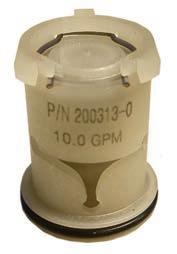
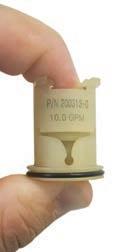
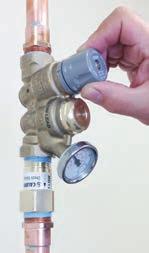
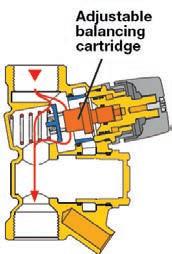
Figure 8 as a pressure independent (PI) balancing valve (to differentiate it from a thermal balancing valve).
Unlike a static balancing valve, a PI balancing valve controls flow rate within a circuit to a fixed value as long as the pressure drop across the valve is within a specified working range. It does so using a cylinder-piston-spring cartridge assembly within the valve. As differential pressure across the valve
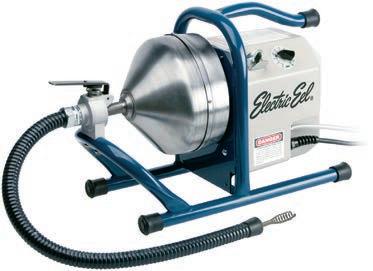

Variable Speed Motor Feature gives operator maximum cable control and exceptional cleaning power from 75 to 350 RPM with constant torque.
• Professionally designed to clean 3/4” to 2-1/2” diameter drain lines up to 50 Ft.
• Standard unit features a hand tighten Jacobs Chuck. The CT is also available with a 2-way auto cable feed that keeps hands off rotating cable as it advances and retrieves cable with the push of a lever, and helps keep work area clean.
• Balanced, heavy-duty steel tubular frame allows for 2 position operation.
• Rugged stainless steel cable drum will not rust and resists denting.
• Holds up to 50’ of 1/4” cable, 50’ of 5/16” cable, or 35’ of 3/8” cable.
increases from 0 to the minimum value of the working range, flow increases proportionally.
Up to this condition the piston within the valve has not yet moved. However, as differential pressure continues increasing, the piston begins compressing against the spring (Figure 9), reducing the “characterized” flow aperture area and keeping flow at rated value. This regulation process continues as pressure increases to the maximum differential pressure value of the working range. As long as differential pressure falls between the min and max values (that is the “working range”), the flow rate through the circuit stays at rated value. In a multi-branch system, pressure independent valves maintain a stable flow rate within each branch as flow in other branches cycle on and off or modulates.
Because PI valves are supplied with a calibrated flow rate setting, configured at the factory, they are essentially pre-balanced. The circulator simply needs to be sized so that the pressure drop across the valves is within the working range.
Several designers prefer PI valves over manual valves to simplify commissioning. This holds for plumbing applications as well, and thus low-lead rated PI balancing valves are available.
An intriguing type of balancing valve is known as a thermal balancing valve (TBV), which is offered by two or three
manufacturers in North America. We expect more manufacturers to begin production of these valves in the near future.
A TBV modulates flow rate within a circuit in order to maintain a fixed temperature at the valve. In recirculating domestic hot water (DHW) plumbing systems this is significant because unlike hydronic applications where balancing is intended to control heat transfer, in recirculating DHW systems balancing is done to ensure adequate water temperature at the fixtures. TBVs are a temperature solution for a temperature problem.
Both fixed temperature and field adjustable temperature types are available. Figure 10 shows a contractor adjusting a field adjustable type within a circuit return riser.
In a thermal balancing valve an internal thermostatic cartridge expands and contracts in response to the water temperature passing through the valve. When cool water is passing through, the valve is fully open. As water temperature rises, the valve begins to close down until the temperature reaches the user-set value. At this position the valve allows minimal flow, just enough for ongoing temperature sensing.
If the entering water temperature begins to decrease, which occurs when there is minimal DHW demand, or from
water heater draw down, the valve begins to open allowing higher flow through the branch.
This continual expansion/contraction action of the TBV ensures water temperature control within each recirculating branch over a wide range of DHW demand. When combined with a variable speed circulator operating in constant pressure mode, TBV valves can result in sizable pumping energy savings too.
Whether embarking on a new hydronic or plumbing system project, accurate flow balancing is paramount to achieving design objectives. The balancing technologies mentioned here offer solutions for specific balancing requirement(s). The key is in selecting the right one for the job. <>
Kevin Freidt is director of product management and technical support with Caleffi North America. He has a BS Mechanical Engineering Technology and is LEED accredited v2.0. Mark Olson is general manager of Caleffi North America, Inc. Olson has a master of science in engineering, applied mechanics and a bachelor of science in engineering, industrial and operations engineering. To see other articles by this author visit www.hpacmag.com.

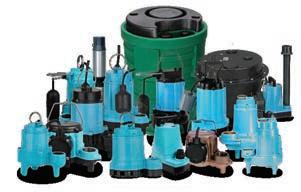
You need
You provide answers to customer challenges, and for more than 75 years the Little Giant® brand has provided the dependable, water-guzzling solutions. When you combine our passion with yours, together we help prevent unnecessary damage to their valuables by eliminating unwanted water collection before it starts.
Efficient, even heating is an unknown ideal for many consumers–technicians and installers should aim to rectify
BY IAN MCTEER
In Stephen King’s novel, The Colorado Kid, one character realizes that “sooner or later, everything old is new again.” As I wrote earlier this year, several of the so-called dangerous hydrocarbon and toxic refrigerants of the pre-Thomas Midgley Jr. days are new again in the guise of “natural refrigerants.”
When the post-war residential housing boom started in earnest, some sociologists, philosophers, architects and others derided the vast wastelands of “ticky-tacky” box houses seemingly plopped into the landscape around major cities as mind-numbingly anti-human prisons for unwitting wage slaves. “Little boxes on the hillside/ little boxes made of ticky tacky/ little boxes/little boxes all the same,” went the song made famous by folk singer Pete Seeger in the 1960s. Because the plain-Jane ticky-tacky label turned into a sales impediment, residential buildings took on several cosmetic enhancements: the back-split, the side-split and the multilevel building designs became popular. Forced by some municipalities to provide off-street parking, the room-overthe-garage design seems to dominate many subdivisions now.
Looking forward to 2020 and beyond, in the age of efficient, energy saving designs, the ticky-tacky house is back. Now called “dumb boxes” the former “boxes all the same” are lauded for being “the least expensive, the least carbon intensive, the most resilient, and
that.
have some of the lowest operational costs compared to a more varied and intensive massing,” according to Torontobased architect Lloyd Alter in a recent article published on TreeHugger.com.
“Every time a building has to turn a corner, costs are added. New details are required, more flashing, more materials, more complicated roofing. Each move has a corresponding cost associated with it. Every jog, bump and twist is ultimately a potential leak and thermal bridge,” according to Alter.
The dumb box design of yesteryear was also easy to heat even though insulation proved to be afterthought for some builders and poor quality windows ensured terrific ventilation. Most often, the furnace or boiler was in the dead centre of the basement with equal length trunks and short perimeter runs making even heating happen without much in the way of system balancing being necessary.
With the proliferation of the “split” and multi-level designs coupled with the demand for more useable space, the basement took-on a fresh, new name: the unfinished recreation room. Furnaces were moved “out of the way” and the notion of central heating seemed to be lost forever.
The ductwork associated with exotic residential building designs, although worthy on paper, far too often did not work well in reality. It became very difficult to provide even heating in build -
ings equipped with single-zone, single-stage forced warm air systems.
To make matters worse, central air conditioning installations started to proliferate in the 1980s. Highly prized compact evaporator coils dramatically reduced airflow, especially in duct systems attached to low static belt-driven blowers. Regardless of pulley size or motor horsepower, yesterday’s furnaces simply could not provide adequate airflow.
Then, government mandated higher efficiency forced air furnaces were often simply mated-up to existing plenums containing those horridly restrictive evaporator coils. Fortunately those coils are gone, but today’s AHRI matched and rated air handlers, furnaces, evaporator coils and outdoor units are too often shoehorned into
yesterday’s ductwork. Efficient, even heating is an unknown ideal for many consumers; it is amazing how many people simply accept that a house will always have uncomfortable rooms.
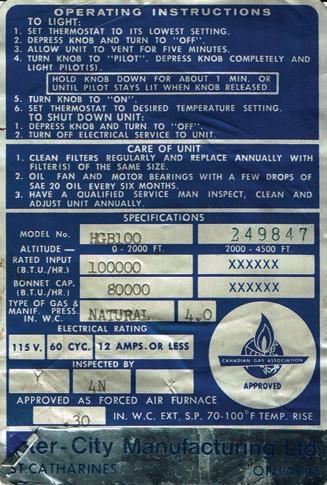
Any toolkit contains, apart from quality tools, an appreciable amount of knowledge, training and understanding. These tools belong to sales people, installers and technicians. Any given contractor, wishing to sell a high-efficiency variable speed gas furnace, either twostage or modulating, must understand that the consumer is expecting monetary savings and better heating. Take a look at Figure 1, the rating plate from a 1970s era gas furnace.
Taking 80 per cent AFUE at face value and assuming the duct system was sized so that the furnace would run at an 85F temperature rise, the CFM requirement could have been calculated using the temperature rise method: CFM = Btu/hr output/1.08 x temperature rise. Thus, CFM = 80,000/91.8
CFM = 874
Looking at the blower chart provided for the new, lower input replacement fur-
nace, let’s say the minimum CFM requirement will be 1260 cfm. Using the fan laws, calculate the new static pressure remembering the manufacturer stated efficiency numbers (verified by AHRI) are based on a maximum total external static pressure of 0.5 in. w.c. Thus,
SP2/SP1 = (Q2/Q1)2
Where:
SP1 = original static pressure taken from the rating plate (0.3 in.)
SP2 = new static pressure
Q1 = original air flow as calculated by the temperature rise method
Q2 = new airflow as determined by the manufacturer’s blower chart
Thus,
SP2/0.3 = (1260/874)2
SP2 = 2.08 x 0.3
SP2 = 0.6 in. w.c.
The new static pressure is already one-tenth more than the rated static pressure before an evaporator coil and possibly a cabinet-style air filter accessory are installed into an unverified duct system. The total external static pressure (TESP) could ultimately hit one-inch or more.
A PSC blower equipped furnace will simply unload, meaning a lower volume of air will be delivered throughout the
system creating limit tripping and evaporator coil icing service calls. The ECM equipped furnace should be able to move the needed airflow but there are several penalties to consider: higher power consumption by the motor, condensate blowing off the evaporator coil coupled with poor drainage and a lot of velocity noise leaving the end-user thoroughly unimpressed. Unless a major duct renovation will be included in this retrofit, it might be the time to consider other HVAC options, such as, retrofitting with a cold climate heat pump, or a small duct high velocity system.
Of course, technicians must know how to use system tools and be able to understand the data derived from taking careful measurements. However, residential duct systems often suffer from what I call the “if you build it” syndrome: just plop a duct in front of a fan and the air will go wherever it is needed, so the myth goes.
Residential forced warm air systems are expected to deliver comfort using smooth bore galvanized duct and pipe
Continued on p28
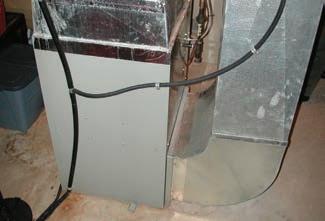
(sometimes too much flex pipe) on the delivery side and a mixture of wooden stud/joist spaces and jumper ducts on the return side. Joist spaces containing pipes, wires and bridging are not conducive to airflow; thus far too many residential systems do not have adequate return air.
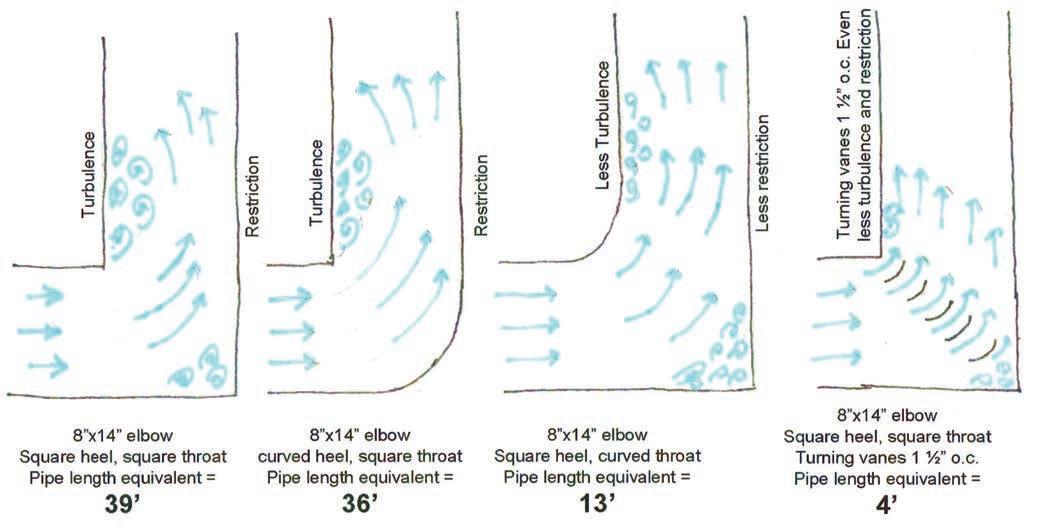
As air moves through a duct (see Figure 2), friction is created by the moving air rubbing against the sides of the duct. Friction loss, caused by this rubbing action, results in static pressure loss exacerbated in wooden ducts due to the roughness of the wood surfaces compared to galvanized metal or aluminum.
Dynamic losses, caused by turbulence, are usually much greater than friction loss. Rapid changes in airflow direction resulting from the, admittedly necessary, use of offsets, risers, elbows, transitions and other fittings means less air at the delivery point. Thus, excessive friction and dynamic losses add-up to more energy needed to move the “pounds of conditioned air” about the building.
Know that residential duct systems often contain compact fittings built to be as short as possible making for tight radius turns. Once equivalent lengths are factored-in, it is easy to understand why the master bedroom on the second floor is 300 equivalent feet away from the furnace. Why would air, trying to take the path of least resistance, want to go there?
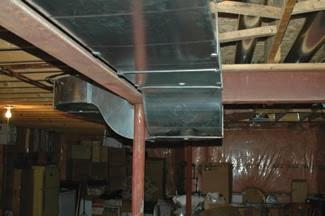
Two “S” offsets combined with two short radius elbows without turning vanes make for more turbulence that
could easily prevent the appropriate amount of conditioned air from finding its way to the master bedroom (see Figure 3).
Know that the building envelope itself is a “duct” that connects the supply ductwork to the return ductwork. Suppose any particular master bedroom contains two 6-in. supply ducts. There is only one 8 in. x 30 in. sidewall return air for the second floor in the hallway outside the room. What happens to even heating when the non-undercut bedroom door is closed: why would enough air flow into the bedroom when there is no place for it to go? What if the return air is pulling too much from a room creating depressurization? The system must be balanced to prevent such problems.
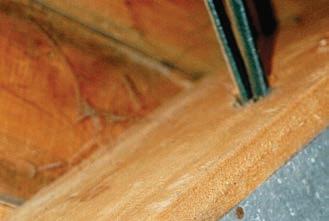
Know that dust and dirt clinging to the edge of joist lining and around holes for electrical wiring drilled though wooden joist return air ducts is an indication the return side is taking air into the system wherever it can–probably not enough from the master bedroom (see Figure 4). Dust, dirt, animal hair and other delights find a way into return air ducts; as the air slows down heavier particulates drop out leaving mounds of debris that must be cleaned out regularly, especially at retrofit time. All supply and return ducts must have sealed joints to minimize air leakage. Know that many retrofits, done years ago, were ducted improperly leading to early equipment failure. For example, when the manufacturer specifies extra return air ducting for maximum airflow, simply enlarging the size of the drop
duct then choking it down at the furnace entrance is a guarantee of poor performance (see Figure 5 ).
There are many excellent test, adjust and balance (TAB) tools available at reasonable cost for HVAC sales people, technicians and installers. The question is, which one(s) should I use? Once the new furnace or air handler has been started, bulk airflow must be determined and there are several ways to determine how much air is flowing in the main trunk ductwork.
• Temperature rise method using Type K insertion thermocouple probes and an electronic thermometer. Apply data to the formula CFM = Btu/hr output/1.08 x ∆T. Know that you should not accept nameplate furnace efficiency. It is best to do a combustion analysis to get the real AFUE number. Remember that the 1.08 factor is air density dependent and fluctuates with altitude. This is not a recommended method during hot summer weather!
• Measure the pressure drop over a known accessory such as an air filter or wet or dry evaporator coil using a dual input manometer and static pressure sensing tips. However, you MUST have the accessory manufacturer’s airflow chart in order to relate measured ∆P to actual CFM.
• Summertime start-up using a smart refrigeration manifold: using measured refrigeration system parameters, it is possible for the smart manifold to calculate overall system





































The KeepRite® ProComfort™ Deluxe 19 Air Conditioner and ProComfort™ Deluxe 18 Heat Pump with SmartSense™ Technology quietly deliver steady comfort, higher efficiency, and savings in a more compact design, thanks to the variable-speed inverter. The air conditioner delivers a superior rating of up to 19 SEER and the heat pump features ratings up to 19 SEER and 11 HSPF for optimal home comfort levels. They are easier to sell, easier to service, and easier to install.
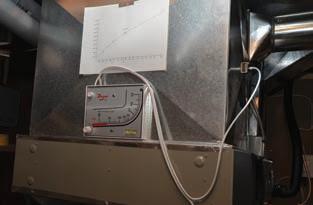
Pressure Drop Method: determining bulk airflow An Inclined manometer and static pressure tips are used to measure the pressure drop over a system accessory such as a cabinet-style in-line air filter. Requires a manufacturer-derived table of values for this accessory. Note: when an ECM fan motor is involved, be sure it is not ramping-up to overcome system restrictions.
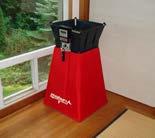
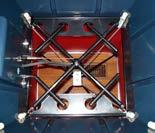
A flow hood can be used for supply and return airflow measurements, however, back pressure can confound readings. Fairly expensive, rather delicate equipment requiring periodic recalibration, flow hoods may not be useful for the residential contractor.
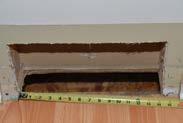
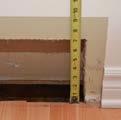
The 16 in. x 8 in. return air grille is covering an opening that is only 14 in. x 7 in. Is it appropriate to use the free area opening data supplied by the grille manufacturer? Do you even know the name of the manufacturer? I used the actual opening area of 98 square inches divided by 144 = 0.681 square feet as the free area factor for my meter. Sometimes the bottom plate of the partition is not fully cut-out creating an undesirable restriction.
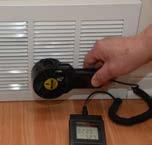
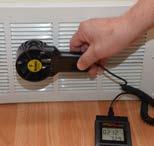
Run the blower at the highest airflow requirement according to the AHRI rated system requirements. It is not unusual to have a higher heating airflow requirement for high efficiency gas furnaces and heat pump air handlers equipped with electric heat kits. Use the vane anemometer on each return air grille, in this case the meter is set to average a traverse across the grille.
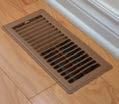
A 4 in. x 10 in. floor register from an unknown manufacturer. Some vane anemometer tools require the duct/pipe size along with the manufacturer’s “Ak” factor, others simply want the free area in square feet. If the manufacturer’s data sheet says the free area is 27 square inches, then the factor I used in my meter was 27/144 = 0.188.

Suppose you are lucky enough to have the approved heating plan for this building and suppose, during testing at the appropriate fan speed, this outlet is delivering 83 cfm instead of the 68 cfm noted on the plan. It should be a simple matter of adjusting the volume damper down inside the sheet metal boot to chokeoff a bit of air allowing more air to go elsewhere. Sometimes the damper won’t move; sometimes it breaks off as you try to adjust it; sometimes it is too loose and the adjustment won’t hold; sometimes it is not accessible from below for repair/replacement; and many times there is not a damper at all.
performance targets. If the targets are met, then the system bulk airflow is adequate.
• Pitot tube and dual input electronic manometer or inclined manometer is probably the gold standard for accuracy but they require a traverse due to the small intercept area of the tube tip. Manufacturer’s TESP charts are required to determine bulk airflow. Residential system turbulence can cause measuring inaccuracy.
• Hot wire anemometer measures the wind chill of a heated bead reporting out air velocity converted to CFM using the formula CFM = Area of the duct x velocity. Again, a traverse is needed.
• Vane and mini-vane anemometers using a blade that rotates in proportion to airspeed are probably best used for measuring airflow at grilles and registers.
Starting-up new high efficiency equipment into any duct system could be a challenging and time consuming exercise. Once system bulk airflow has been verified, it is time to see where all that air is going. If the end user was promised better heating and cooling (especially in the master bedroom) your balancing toolbox containing not only great tools but all your accumulated wisdom will surely be put to good use.
Spend some time at Robert Bean’s healthyheating.com website and look for his article entitled Integrated Design Illiteracy: The Root of All Evil in Architecture. I think Bean’s view of how to make building occupants comfortable will convince any reader that tomorrow’s “dumb box” housing cannot come along soon enough. <>

Ian McTeer is an HVAC consultant with 35 years experience in the industry. He was most recently a field rep for Trane Canada DSO. McTeer is a refrigeration mechanic and Class 1 Gas technician.




Passive systems show promise as mitigation system of choice for colder climates. BY
JILLIAN MORGAN
As uranium begins its cyclical decay chain in Canadian soil, homes on the surface act like a suction cup and draw in its deadly byproduct: radon.
Odourless, colourless and tasteless, radon gas is just one domino in a radioactive cascade that enters structures new and old across the country, contributing to more than 3,300 lung cancer deaths per year.
“It’s the worst thing no one’s ever heard of,” said Anne-Marie Nicol, associate professor at Simon Fraser University’s Faculty of Health Sciences in Burnaby, BC.
As a public health researcher, much of Nicol’s work focuses on environmental carcinogens, specifically radon–the second leading cause of lung cancer in Canada.
“We’ve kind of shrugged this off as a smoker’s condition, but if fewer people are smoking we’re realizing there are other things that cause lung cancer as well,” said Nicol.
The latest technologies in radon remediation and mitigation offer a means to end the reign of this silent killer in homes and buildings, as long as the HVAC contractors behind those structures stay in the know.
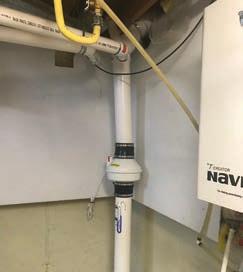
Canada is the world’s second largest producer of uranium–its soil so rich in the metal that there is always a measureable amount of radon in the air.
Outside, it dissipates and mixes with other gases, so concentrations drop to relatively harmless levels, ranging from 10 Becquerels–a measurement of radioactivity–per cubic metre (Bq/m³) to 30.
Inside, however, those levels can vary drastically from one structure to another.
Radon exists, on average, three to four days in an indoor environment before it decays, at which point it gives off radioactive alpha particles in addition to progeny, or “radon daughters.” The metal progeny “stick” to the sensitive lining of the lungs, further decaying and emitting radiation.
“People call radon radioactive, but it’s actually the decaying process that causes the problem,” Nicol said.
In 2007, Health Canada reduced its guideline for radon in indoor air from 800 Bq/m³ to 200. Comparably, the World Health Organization recommends a 100 Bq/m³ baseline, and the U.S. standard sits at 150.
“I’d like to see the action level dropped,” said David Innes, sales director at Radon Environmental Management Corp.
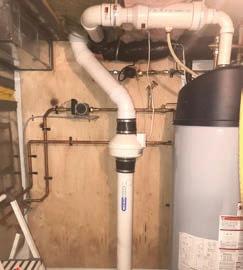
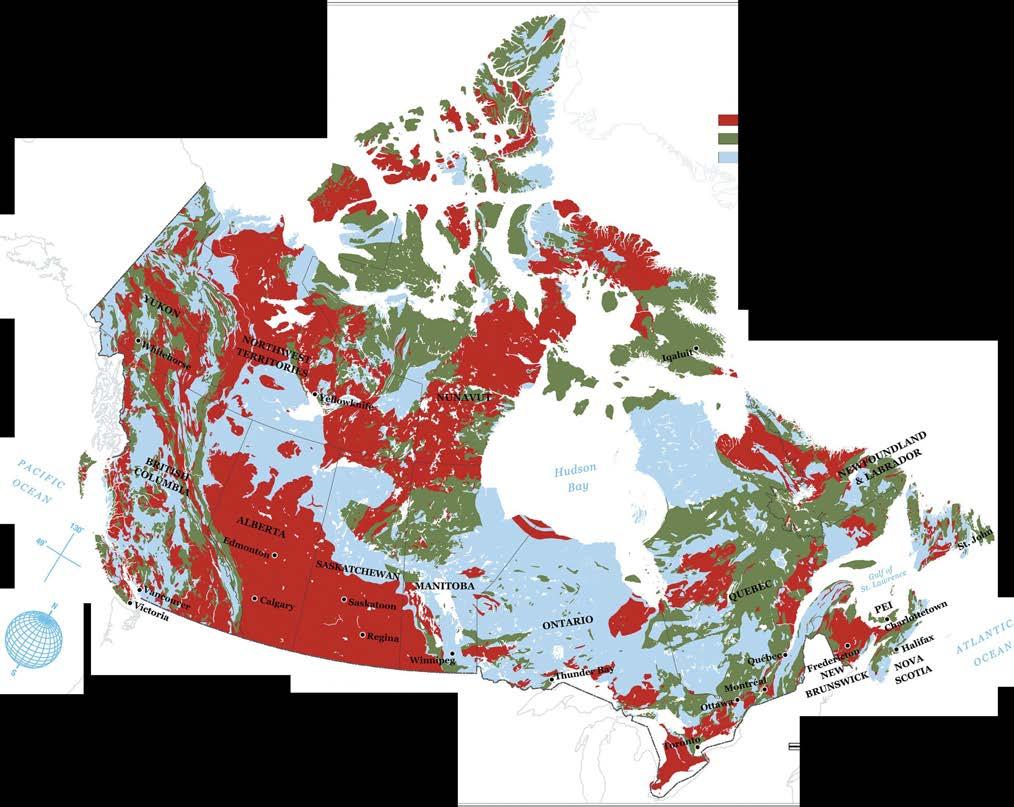
Headquartered in Vancouver, BC, Radon Environmental–an environmental and building science company–published the first geology-based radon map of Canada in 2011.
“There was some level of radon awareness in Canada the late 1970s and early 1980s, and it seemed through a government change it just fizzled away. I don’t really have an explanation of why that’s the case but I can say the U.S. is, in my opinion, about 30 years ahead of Canada in terms of radon awareness.”
In 2017, the company partnered with Airwell Technologies to tackle the emerging threat of radon in water, namely from private wells. The jointly released product “off-gasses” radon-contaminated water before it enters a home.
“Dissolved radon can be released into the indoor air through agitation from household use, so showering, dishwashing, etcetera, but generally the contribution of dissolved radon from ground water is a small percentage of the overall airborne radon found in most homes,” said Kelley Bush, manager of radon education and awareness at Health Canada.
Still, there’s a hypothesis that drinking radon-contaminated water could
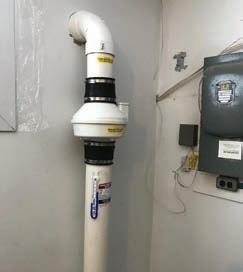

“impact different parts of the stomach and gastrointestinal system, and possibly bladder,” Nicol said.
“A lot of the things that are done to reduce radon in homes and buildings are the result of how our buildings are built and designed or renovated,” she added. “Raising awareness in [trades] people that what they’re doing is contributing to cancer prevention is really important.”
In 2014, Health Canada and the non-profit Canadian Association of Radon Scientists and Technologists formed the Canadian National Radon Proficiency Program (C-NRPP).
C-NRPP offers courses in radon mitigation for accredited contractors, including how to install passive systems and active systems–the latter, more generally used strategy known as active soil depressurization (ASD).
ASD involves connecting a pipe, or “radon stack,” to the foundation floor slab of a home, while an attached radon fan continuously discharges soil gas to the outdoors via the stack’s exit. In the U.S., that stack typically passes through a living space and discharges above the roofline, with the fan located in an uninhabited area, such as an attic. But for America’s
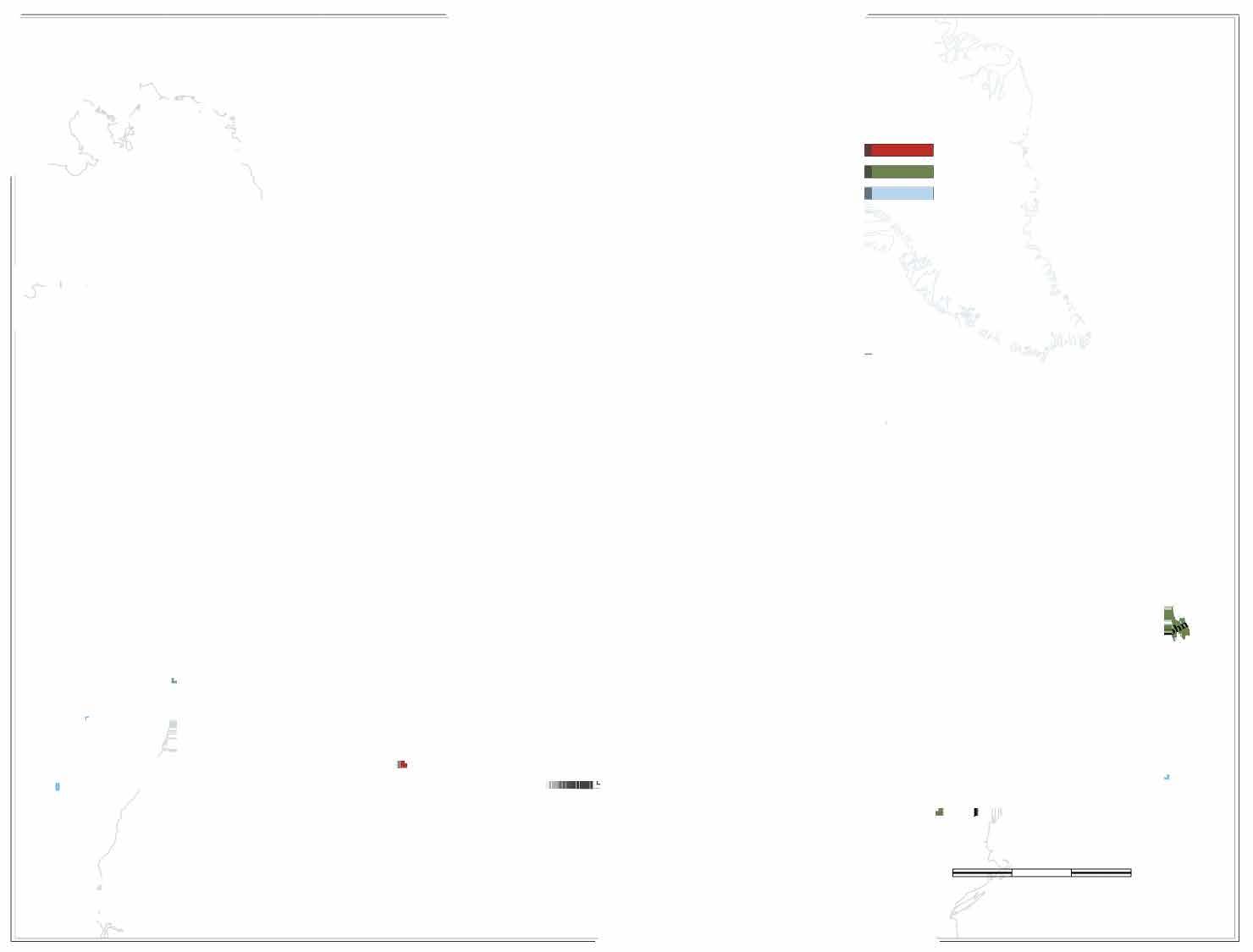
Relative Radon Hazard*
Zone 1 -High
Zone 2 -Elevated
Zone 3 - Guarded
northern neighbour, this configuration presents challenges.
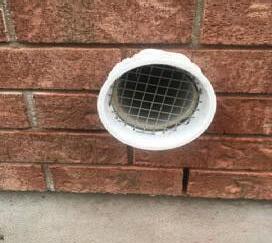
According to monitoring by the National Research Council, soil gas inside the stack sits between 80 and 100 per cent humidity. When temperatures dip well below zero for extended periods of time, ice or snow blockage at the system’s exit is more likely. For this reason, ASD systems in Canadian homes typically exit at the sidewall near ground level, with the fan located in a basement.
“Those strategies are not new, they’re actually very commonly used but we didn’t quite understand their performance and impact in Canada,” said Liang Grace Zhou, senior research officer with NRC’s Intelligent Building Operations Unit and lead for all radon control research projects.
Despite its effectiveness, the Canadianized ASD system can lead to other problems, such as radon fan leakage into habituated areas, introduction of unwanted air and the dispersion of high radon concentrations just above the grade.
In a search for alternatives, NRC has undertaken studies on passive systems, which do not use a fan and instead naturally draw soil gas through the pipe and discharge it outdoors above the roofline via the stack effect. Continued on p34
Between September 2017 and March 2018, the organization conducted a test on this system in four Ottawa homes. It monitored indoor radon concentration, as well as airflow, air speed, temperature, RH and pressure within the stack, in addition to pressure from the sub-slab area.
Within the first year, radon levels dropped 40 to 90 per cent.
“This is a solution for Canada,” Zhou said. NRC plans to conduct another field study on passive systems this year in B.C., since the province’s building codes require homes in high-exposure zones to install a full passive stack.
With a push to net zero energy readiness by 2030, NRC has also developed a semi-detached zero energy ready house in Ottawa, which will be used to study alternative radon control systems.
In other building types, such those with a larger footprint, ventilation can alleviate high radon levels, though this requires a slightly different protocol, Zhou said.
“In the commercial environment, there are many forms of HVAC equipment that in some cases can be manipulated to abate the radon entry,” said Rob Mahoney, owner of Radon Works, an Ottawa-based radon control company.
“Bottom line, there is no such thing as zero radon, any standard structure will have a measureable amount.”
Homeowners test for radon using certified devices, or hire a C-NRPP certified measurement professional. Contractors interested in C-NRPP certification can visit www.c-nrpp.ca/how-to-become-certified.
Radon levels in a home can vary from day to day, so Health Canada recommends occupants take long-term measurements–between three to 12 months in duration, ideally during the heating season.
Long-term measurement devices approved by C-NRPP, and recommended by Health Canada, include alpha track and electret ion detectors. The program also approves continuous radon monitors that record real-time measurements.
C-NRPP-listed radon measurement devices can be found here: www.c-nrpp.ca/approved-radon-measurement-devices.
“In Ontario, we have Tarion Warranty, which guarantees a home to be less than 200 Bq/m³, but unless the occupant tests it goes unnoticed, just like the crack in the foundation behind the finished wall,” Mahoney said.
Despite a slew of C-NRPP approved radon monitoring devices, few homeowners test, so data on radon concentrations in homes and buildings is unstable. Other challenges are presented too, with the rise of green structures that are virtually airtight, meaning newer homes typically have higher levels of radon.
“As codes change, due to product innovations and energy costs and sometimes even common sense… We solve one problem but create another,” Mahoney said.
Each November, the Take Action on Radon network, led by the Lung Association and Scout Environmental with support from Health Canada, hosts Radon Action Month. The campaign aims to raise awareness about the dangers of radon and encourage homeowners to test. This is especially timely as levels can rise in the winter months when homes are sealed up.
Health Canada is also in the early stages of an epidemiological study to find indicators that the body is responding to what it terms, “chronic, low-dose exposures,” Bush said.


“Radon is a very challenging health risk issue to get people to pay attention to,” she added.
“You can’t see it, you can’t smell it, you can’t taste it, so you don’t really believe it’s there… It doesn’t get you angry or worked up because its naturally occurring, its everywhere in the ground, its in every single home and building, so its challenging.” <>


BMO Centre, Halls B & C, Stampede Park, Calgary
Wednesday, November 7 10 a.m. to 6 p.m.
Thursday, November 8 10 a.m. to 5 p.m.
CIPHEX West returns to Calgary, AB where more than 200 exhibitors will be on hand. Produced by the Canadian Institute of Plumbing & Heating (CIPH), the CIPHEX West trade show is a one-stop event for contractors, wholesalers, engineers, building managers and other industry professionals looking for new products and technologies. Attendees will have the opportunity to see the latest product offerings in the plumbing, hydronics, heating, ventilation, air conditioning, refrigeration and water treatment sectors. In addition to the 30,000 square foot industry showcase, delegates may participate in seminars dealing with the most pressing issues facing the industry.
The popular New Product Showcase returns in 2018. Exhibitors were invited to participate in this juried competition. Winners in the various product categories will be selected by a panel of industry experts and announced on the first day of the show.
Taking place at CIPHEX West, the Canadian Hydronics Conference, which is presented by the Canadian Hydronics Council, includes workshops by HPAC contributor John Siegenthaler.
CIPH’s Calgary Region is hosting the CIPHEX Industry Dinner on November 6. Two-time World Curling Champion John Morris (Johnny Mo) is speaking at the event.
Delegates will have access to the Buildex Calgary exhibit hall with their registration.
www.ciphexwest.ca www.buildexcalgary.com

Time: 10:30 a.m.–11:30 a.m.
Fee: $35
Speaker: Rick Proulx, business development director, Reliance Worldwide Corporation (Canada) Inc.
Hot water delivery temperature has been an issue for many years in Canada leading to a National Code implemented in 2010, ensuring protection to the homeowners from scalding and legionella bacteria. This session will cover Codes and applicable product standards, National and Provincial Legislation and compliance as well as the responsibilities of plumbing officials and contractors.
Time: 11:45 a.m.–12:45 p.m.
Speaker: G. Edward Van Giesen, national sales manager, RainCycle (A Watts Company)
Fee: $35
Rainwater harvesting systems are used more and more in commercial buildings to offset potable water demands and to reduce storm water outflows. Despite an ever-increasing number of rainwater systems going into service in North America, design consistency remains elusive. This is typically due to the designer’s unfamiliarity with best practices and frequent exclusion of key components.
Two key factors that contribute to the success of a rainwater system are early planning and analysis of the system as a whole. While the concept of capturing rainwater is simple enough, there is not one consistent definition as to what constitutes a rainwater system. This ambiguity in system design and planning leads to huge disparities in material and installation costs. As a result, many projects are value engineered.
The session will start with a brief intro on system design and will be followed by an in-depth presentation focusing on the key components. The presenter will analyze inlet pre-filtration, storage options, sizing methods and disinfection strategies. The session will focus on the why’s, how’s and where’s of inlet filters and critical filtration/treatment options.
Time: 1:00 p.m.–2:00 p.m.
Fee: Free Speaker: David Innes, director of sales, Radon Environmental Management Corp

Radon is responsible for thousands of lung cancer deaths each year. It affects indoor air quality in all buildings. The exposure risk can be prevented during construction and in the way we maintain our homes and workplaces. Changes to building codes with respect to radon will be covered along with prescriptive measures and performance options. Attendees will also learn about typical radon detection methods used throughout the world. The presentation will also cover current mitigation methods and their inherent pitfalls along with a section on using ventilation as a mitigation method. Case studies will be presented.
Time: 2:15 p.m.–3:15 p.m.
Speakers: Erwin Quejano (l), design department supervisor, and Rudy Feddema, senior design & technical support, HeatLink Group Inc.

Fee: $35
Learn the key components for designing and installing a hydronic snow melting system including: snowmelt application; snowmelt system components; manifolds to PEX; snowmelt controls; proper installation of PEX and snow/ice detector to ensure system works as per design; and schematic diagrams.
Time: 3:30 p.m.–4:30 p.m.
Speaker: Tyler Gamble, commercial product applications manager, Canature WaterGroup
Fee: $35

With an increasing number and more severe droughts due to climate change, water conservation awareness is at an all time high. Water softeners are traditionally thought as water wasters and in some parts of the world, their use is heavily regulated due to the elevated waste volumes, and wastewater issues they can produce. New ways of thinking regarding the design and operational use must be considered so that the added benefits of soft water don’t conflict with current water conservation strategies. This presentation will show how a shift in thinking about water softeners can reduce the amount of water and salt consumed during softener operation, and therefore increase the operational efficiency of the softener.
Continued on p40


Time: 10:30 a.m.–11:30 am
Fee: $35
Speaker: Tim Callander, regional sales manager, SJE Rhombus

This session will provide easy to understand explanations of following schematics and using a voltmeter. The troubleshooting portion is a step-by-step method of moving through a pumping station to determine the source of the problem: electrical services; controls/ alarm circuits; floats; and motors.
Time: 11:45 a.m.–12:45 p.m.
Fee: $35
Speaker: Rick Mayo, residential trainer–Western Region, Taco Comfort Solutions
Insights will be offered on domestic hot water (DHW) recirculation including: DHW and health concerns; mixdown fluid temperatures; DHWR piping options; alternative DHWR control strategies; and near heater piping details.

Time: 1:00 p.m.–2:00 p.m.
Fee: Free
Speaker: Sidney Manning, chief plumbing & gas administrator/inspector, Government of Alberta
This session will go through code updates as we look towards the 2020 version of the National Plumbing Code of Canada, including topics such as water reuse, rainwater harvesting, legionella and more. Bring any questions or concerns you have about radon, hydronic heating, energy efficiency, etc. Ever wonder why plumbing or gas code is written the way it currently is? Ever have a code question no one else could answer? This is the session you need to attend.
Time: 2:15 p.m.–3:15 p.m.
Fee: $35
Speaker: Steve Gibbs, product manager, trainer, radiant designer, Roth Industries
This session will include: a discussion of heat transfer; rationale for wall and ceiling radiant (supplemental heating and cooling, floor limitations and radiant cooling options); and installation methods for wall radiant and ceiling radiant. Attendees at this session will learn how radiant walls and ceilings can be a comfort solution and how to identify common indicators were wall or ceiling radiant can be used. The instructor will also provide an overview of installation methods.and how to identify common indicators where wall or ceiling radiant can be used.
Time: 3:30 p.m.–4:30 p.m.
Fee: $35
Speaker: Luis F. Orellana, bid & spec-business development manager, Rosenberg Fans Canada Ltd.
This session will cover what an ECFan is, how it works, a comparison between AC and EC Motor energy use and controllability. The speaker will clarify energy usage of commercial ventilation systems in Canada, as well as retrofitting outdated AHU, MUS and other ventilation systems. Attendees will learn how to identify energy saving opportunities with ECFans and they will be instructed on how to size a retrofit application using the correct tools.
Continued on p42



NOVEMBER 7
Modifying Existing Hydronic System for Lower Water Temperatures
Time:
7:30 a.m.–Continental breakfast
8:00 a.m.–11:30 a.m. Workshop Fee: $109
Instructor: John Siegenthaler, P.E., Appropriate Designs

The performance of many contemporary hydronic heat sources such as modified condensing boilers, solar thermal collectors, heat
pumps, and biomass boilers is significantly improved when they are combined with low temperature distribution systems. This session explains how to modify those systems to lower their required operating temperature, making them more compatible with modern (and future) heat sources.
Time: 12:30 p.m.–1:30 p.m. Fee: $35
Instructor: William Werthman, senior technical advisor, Legend Valve & Fitting, Inc.
Dry panel systems can be a good option for many installations; you just need to know when to use them. This learning lab will cover the differences between wet and dry panel systems, when dry panel systems should be installed, control
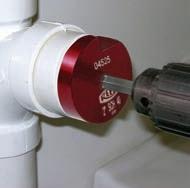
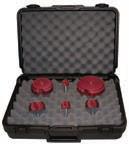
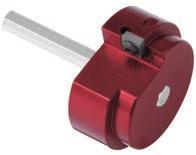
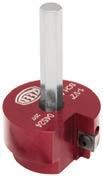
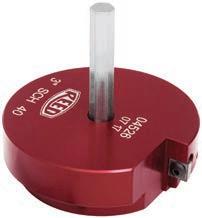
• Clean leftover pipe and solvent cement residue from PVC, CPVC or ABS fittings.
• Reduce labor time and materials costs by reusing the fittings.
• Available in 7 sizes and fit into standard 1/2" drills.
strategies, and combination systems. If you are looking to add radiant cooling to your service offerings this session is the place to start.
Time: 4:45 p.m.–5:45 p.m. Fee: $35
Instructor: Matt Wiesenfeld, program manager, Canadian Hydronics Council
You will leave this non-technical session armed with new ideas and tools to increase hydronic sales. It is all about selling with more confidence.
Time: 7:30 a.m.–Continental breakfast 8:00 a.m.–11:30 a.m.–Workshop
Fee: $109
Instructor: John Siegenthaler, P.E., Appropriate Designs
Modern hydronics technology can be used to create very sophisticated and elaborate systems. While the original designer understands how the system should be installed and commissioned, the person who installs and maintains the system over its service life may not. Service contractors do not want to deal with the resulting incorrect installations and “orphan systems.”
Experience has shown that this is all too common with hydronics systems, and represents an impediment to further market acceptance of hydronics technology. This session describes proper system documentation including piping schematics, electrical control schematics, descriptions of operation, initial controller settings, and installation details. You will also learn about relatively inexpensive software tools for creating proper documentation.


If you missed the 2017 Summit you missed all the new products and services from:
• ADEY • ADP • Aermec • Amtrol • Amvic • AquaHeat
• AquaMotion • Aquatherm • Armstrong • Axiom
• Bacharach • Bardon • Belimo • BoilerMag • Bosch
• Caleffi • Calefactio • Cash Acme • CB Supplies
• Centrotherm • Chemfax • Conbraco • Dahl • Danfoss
• Desco • Eco-King • EVO • Grundfos • HBX • HeatLink
• Heat Sheet • Hydronic Heating Technologies • IBC
• InsulTarp • Legend • Lochinvar • Maxxon • Navien
• NEXT • NTI • Nudura • Redmond Williams • REHAU
• Rinnai • Roth • Salus • Smith’s • Sinus • Spirotherm
• Taco • Tamas • Unico • Transom • Thermo 2000
• Uponor • Utica • Viega • Viessmann • Webstone
• Weil McLain • Wolseley • Wilo • Xylem • Z-Flex So don’t
A.M.T.S. Limited 325
ACO Systems 103
ADEY Innovation LLC ........................... 724
Aimco International 455
Allied Engineering Company 637
American Society of Plumbing Engineers 814
Anvil International Canada 204
Aqua-Tech Sales & Marketing Inc 736
Armstrong Fluid Technology 508
Arndt Motor & Pump 828
Arzel Zoning Technology, Inc .............. 826
Attersall Marketing Ltd 721 Bibby-Ste-Croix
Blanco
Bosch
Boshart Industries Inc
Bradford White Canada Inc.................. 536 Brady 434
Canadian Hydronics Council 436
Canadian Institute of Plumbing & Heating 337
Canadian Water Quality Association 416





Fantech
Fernox
Flexmaster
FLIR
Formadrain
Franke
G.F.



O,P,Q,R
Onex
Ratech
ServiceTitan
Sioux
SJE
Slant/Fin
Snap-In
Spectrum
Sporlan
Reliance




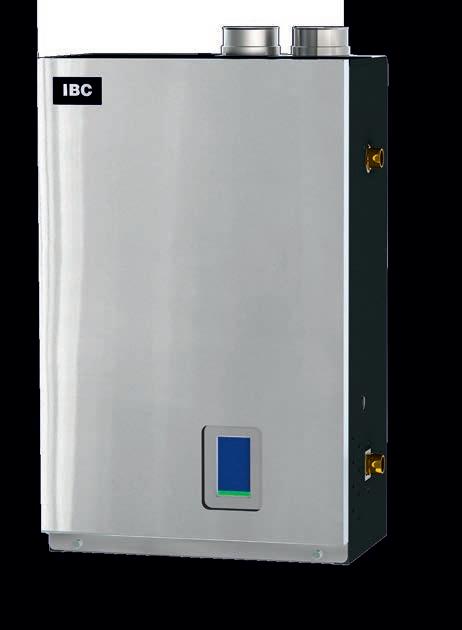
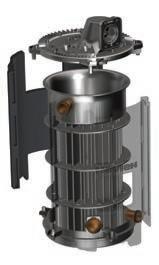
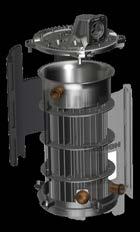
The high-efficiency condensing NFB boiler from Navien is suited to residential and light commercial heating applications. This wall-hung fire-tube boiler comes in two sizes: the NFB-175 and NFB-200. The top and bottom heat exchanger sections are form-pressed and not welded. The heat exchanger cylinder design allows water to flow all the way to the top of the combustion chamber to eliminate the need to insulate that part of the combustion area. The bottom of the heat exchanger has a non-metallic base. www.navieninc.com

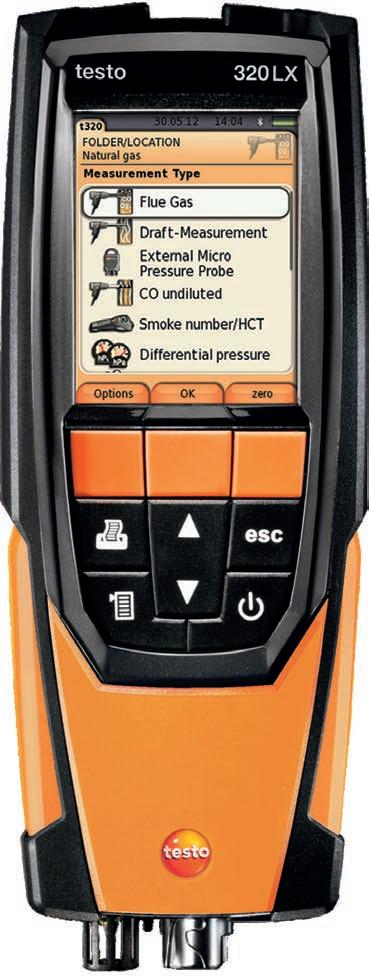
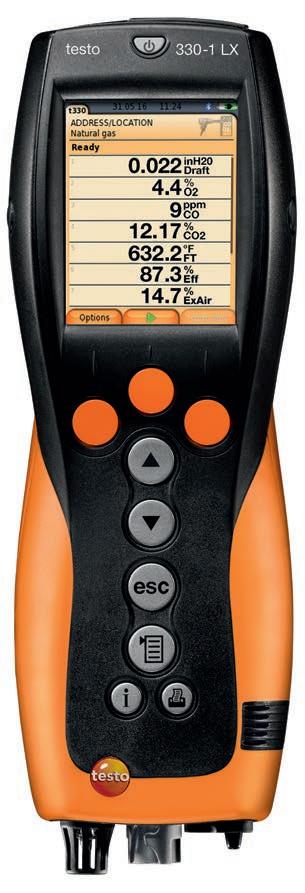
The DC710 flue gas analyzer can operate remotely via Bluetooth using a Smartphone or tablet and the TPI app, which provides on-site reports. Features include a 24-hour real-time clock, magnetic or hook monitoring and a rugged, sealed housing. The device measures CO and temperature differential and calculates CO2, CO air free, excess air and combustion efficiency. www.tpicanada.com
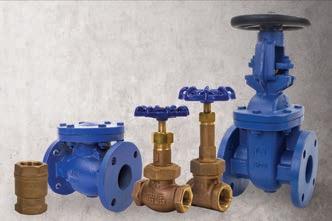
NCI’s commercial valve line includes bronze gate, globe and check valves; cast iron gate, globe, check valves and butterfly valves; and cast iron butterfly valves. The line has CRN numbers for all provinces and territories. Pressure ratings include Class 125, Class 150 and Class 300. www.ncicanada.com
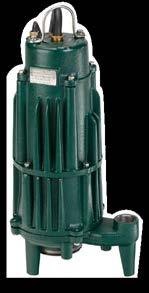
Zoeller Company’s Shark Series includes, residential, commercial and municipal grinder pumps designed for standard and hazardous duty applications with unidirectional & reversing operation options from ½ HP to 7-½ HP. These pumps feature Zoeller’s dual and multi-vane bladed angled cutters which shres difficult wastewater materials to a 1⁄8 in. particle size. www.zoellerpumps.com
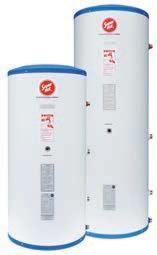
Allied Engineering has released new models in its EPJ indirect tank line-up. The 79 and 119 U.S. gallon single coil indirect tanks, along with its 40 and 56 U.S. gallon models, are constructed of 444 stainless steel that has been passivated and pickled. The casing has been designed using polypropylene plastic for scratch, dent and rust resistance. www.alliedboilers.com
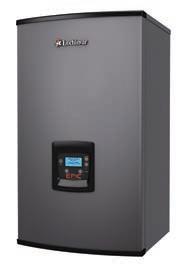
Aqua-Tech and Lochinvar have introduced the EPIC fire tube boiler and fire tube combi boiler for residential applications. Four boiler models range from 80,000 to 199,999 Btu/hr and three combi models range from 110,000 to 199,999 Btu/hr. In addition to 10:1 turndown and 95 per cent AFUE, the boiler and boiler combi are equipped with Lochinvar’s Smart Control and feature an intuitive setup wizard. Control technology with pre-heat and domestic hot water response enables it to deliver hot water almost instantaneously during frequent use cycles. www.aquatech-canada.com
The West Country Pump and Filtration reverse osmosis commercial system features a powdercoated steal frame with stainless steal faceplate; multistage pump; stainless steel membrane housing; 20 in. Big Blue-5 micron sediment filter cartridge; permeate flow meter; recycle meter; low-pressure switch; and more. Available upgrades include an auto flush system, dual probe TDS meter, code-line fibreglass membrane housings and an anti-fouling system.
www.westcountrypumpandfiltration.com
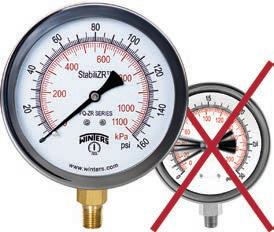
Winters StabiliZR dry gauges come with a dampened movement that eliminates pointer flutter caused by vibration and pulsation. This simplifies pressure reading. Gauges can be serviced without the need to drain and then refill the case with fill fluid.
www.winters.com
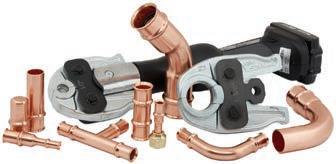
ZoomLock flame-free refrigerant fittings from Parker join copper tubing in HVAC/R applications for pressures up to 700 psi (48 bar). Specially designed crimping tools allow technicians to connect the deburred tube ends into the fitting, which has o-rings inside, and press the assembly into place for a leak-free seal. It requires no brazing or adhesives, just the crimping tool and the fitting. www.zoomlock.com
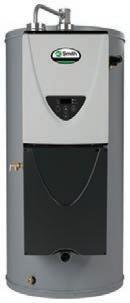
A. O. Smith TX1
Integrated Tankless on Tank commercial gas water heater offers the on-demand benefit of tankless with dump load benefit of a storage tank. Features include 185F maximum temperature set point for high temperature applications; PermaGlas Ultra Coat liquid slush glass lining; 96 per cent thermal efficiency and ENERGY STAR qualified; and 119 gallon capacity with 199,000 Btu input. www.hotwatercanada.ca
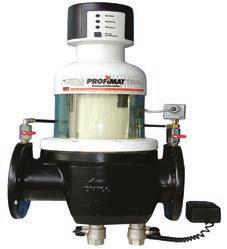
Judo Profimat is an automatic, selfcleaning strainer for domestic water and cooling towers. It removes grit/debris and automatically backflushes itself so that the debris does not build up. The strainer uses very little water to flush, has no consumable parts, and is available in sizes from ¾ in. to 8 in. pipe. It always provides full flow of filtered water, even during backwash cycle. www.watertiger.net
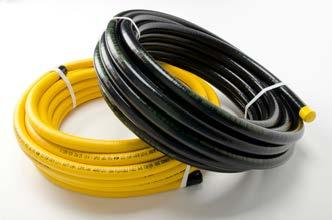
The WARDFlex corrugated stainless steel tubing (CSST) system eliminates multiple service points at turns and connections. It is designed to provide reliable flow from gas meters to appliances, giving professional contractors an alternative to black-steel pipe and other CSST products. www.wardmfg.com
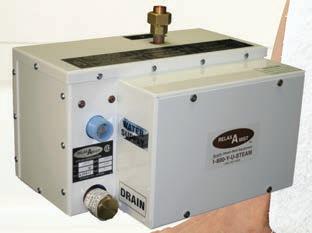
Relax-A-Mist steam generators from Leisure Baths Ltd. are offered in four residential sizes from 3,000 to 9,000 watts. Maximum cubic ft. calculated for steam room are 90, 175, 260 and 275 respectively. The steam generators can be installed up to 25 feet away from the steam room. The quick touch timer can be mounted either inside or outside the steam room while the time and temperature control with remote must be installed inside the steam room to read the temperature. www.relax-a-mist.com
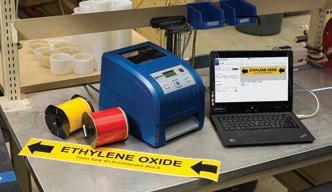
Brady’s BBP30 sign and label printer comes with the Workstation app for pipe marking. This entry-level printer features drop-in consumables with auto setup and no calibration or sensor adjustment. It is compatible with many B30 series tapes and labels for safety and facility labeling applications. www.bradycanada.ca
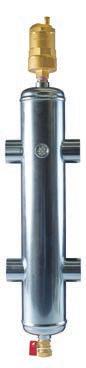
The Calbalance hydraulic separator from Calefactio eliminates the need to install automatic air vent and air and dirt separator. It is equiped with a Calvent automatic air vent and is offered with a drain valve. It has a zinc plated steel housing and is provided with a wall bracket. Maximum operating pressure is 150 psi and maximum operating temperature is 100C. Adapted fluids are water and glycol solutions at 50 per cent. Pre-formed insulation is optional. www.calefactio.com
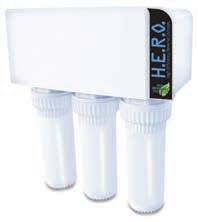
Canature WaterGroup has introduced the Aqua Flo high-efficiency reverse osmosis system. The system is designed to offer a 99.9 per cent recovery rate by collecting purified water in the storage tank and recycling the rinse water back for use throughout the house rather than sending it to the drain. The system also flushes the membrane with pure RO water every time the tank is full to ensure that high total dissolved solids water never creeps through the membrane during low pressure times. After this flush, the controller de-pressurizes the membrane. www.canaturewg.com
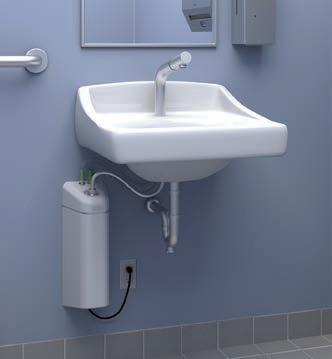
Franke's Ozo-flo faucet provides an infection control tool to improve hand hygiene and help fight the spread and transmission of bacteria from hospital sink wastes. It employs electrochemical water disinfection to turn water into a safe but effective oxidant. There are no consumables or chemicals added to the water. This faucet is a complimentary product to Franke’s Medi-flo basin. When installation costs or space requirements do not allow for the sink to be installed, customers can change the existing faucet to yield many of the same benefits of Medi-flo. The sensor operated hands-free faucet has a 5 litreper-minute flow rate. A 24VDC plug-in transformer is included. www.franke.com
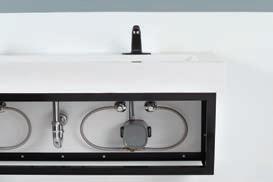
Sloan has revamped the Optima commercial faucet line to standardize components, saving time on labour, saving money on replacement parts and speeding up service time. Features include control access below deck and an IR sensor. Choose from brushed nickel, polished brass, polished chrome or brushed stainless finishes. The faucets are available in 4 or 8 in. mounting, centreset or single hole. www.sloan.com
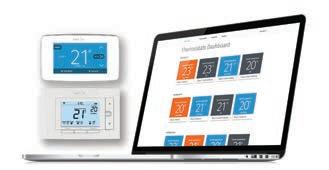
The Sensi wi-fi thermostat from Emerson works with HVAC systems in most facilities, up to 2H/2C for conventional and 4H/2C for heat pump systems. It offers automatic staging for heat pump/gas furnace without the need for outdoor sensor or additional equipment and automatically switches between heating and cooling within the set range. No c-wire is required for most installations. A built-in level simplifies mounting. There is a step-by-step guide in the app to connect to Wi-Fi. Smart alerts notify customer of extreme temperature or humidity levels. www.emerson.com/sensimanager
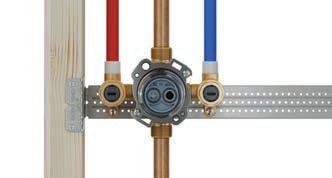
The Treysta tub and shower rough-in valve body from Gerber accommodates standard, back-to-back and thin wall installations. Intuitive open and close stops allow for easy maintenance. It is fully compatible with Danze by Gerber shower trim kits. It includes rough-in, plaster guard and pressure-test cap, and
has horizontal F1807 inlets and IPS/ sweat outlets. Features include intuitive quarter-turn service stops and a forged valve body. It is designed for use with all "TC" series tub/shower trim kits without a diverter on the valve. www.gerberonline.com
SpeedClean, has released of a Dry Steam Coil & Surface Cleaner, which uses the power of high temperature steam to clean coils and other surfaces. The compact and lightweight design allows technicians to transport the cleaner to every job site. The 265-degree steam combined with 65 PSI pressure penetrates deep into coils, cracks and crevices. It is suited to industry applications ranging from air handlers, mini-splits, condensers and exhaust vents to commercial kitchen ducts, freezer seals, classrooms, labs and more. It weighs 16.5 lbs. and is 13 in. x 13 in. x 19 in. (H x W x D). www.speedclean.com
Victaulic has launched QuickVi SD Installation-Ready system, a plain end pipe joining technology designed for use on carbon steel commercial and industrial HVAC systems sized 2 in./DN50 and down. The couplings and fittings are installed with common hand tools and feature no loose parts. In a maintenance or retrofit situation, the joints can be disassembled and reinstalled. The gasket is designed not to seal until the coupling or fitting is mechanically secured on the pipe during initial installation. The products can be used on Schedules 10 through 80 carbon steel pipe, with a maximum working pressure of 300 psi/2068 kPa/21 bar and up to 250F/120C (with the EPDM gasket). www.quickvicsd.com
Unified Alloys offers seamless and welded stainless steel pressure pipe, fittings and flanges. Piping products include stainless steel 304/L, 304/H, 316/L, 316/H, 317/L, 321/H, 347/H, 310, 410; Duplex 2205, Super Duplex 2507, Alloy 254 (6 Moly); Nickel Alloys 20, 200, 400, 600, 625, 800, 825, C276; and Chrome Moly P5, P9, P11, P22, P91. www.unifiedalloys.com
The Vitotrans 300 is designed for commercial applications requiring high volumes of DHW. Its module works in conjunction with a heating boiler and employs a plate heat exchanger to heat the required water. Used as an extension to any hot water heating system, the on-demand design of the Vitotrans 300 provides a consistent flow rate for systems with varying load requirements. It accurately provides five to 180 gpm of DHW when combined with a DHW buffer tank. www.viessmann.ca
Mainline Backflow Products bladder seals work in conjunction with shallow burial backwater valves to provide contractors and homeowners with easier and cleaner access to the valve. The seals also integrate with vapour barrier systems to protect against radon gas. Other benefits include sealing against groundwater flooding and sealing against bug/insects. www.backwatervalve.com


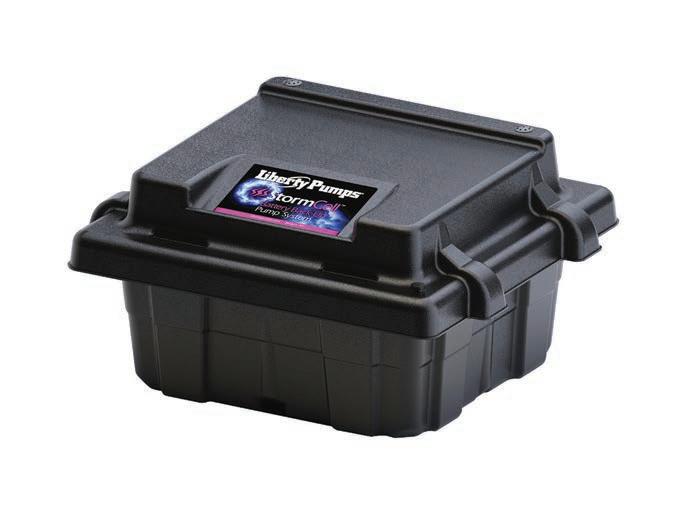

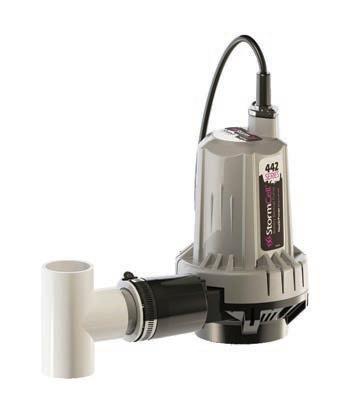
The new StormCell® series of battery backup pumps from Liberty feature advanced professional-grade chargers, energy e icient pumps for longer run times, and optional NightEye® wireless technology for remote monitoring through your smart device.
• Available in both standard and wireless connected models
• Professional-grade chargers (10 amp and high-output 25 amp)
• Single and dual battery systems
• Energy efficient DC pump (manufactured in the U.S. by Liberty)
* Model 442-25A, StormCell® Group

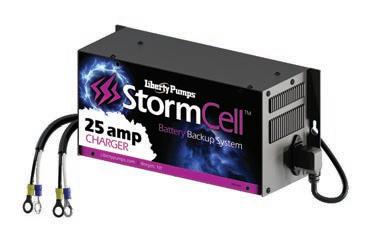

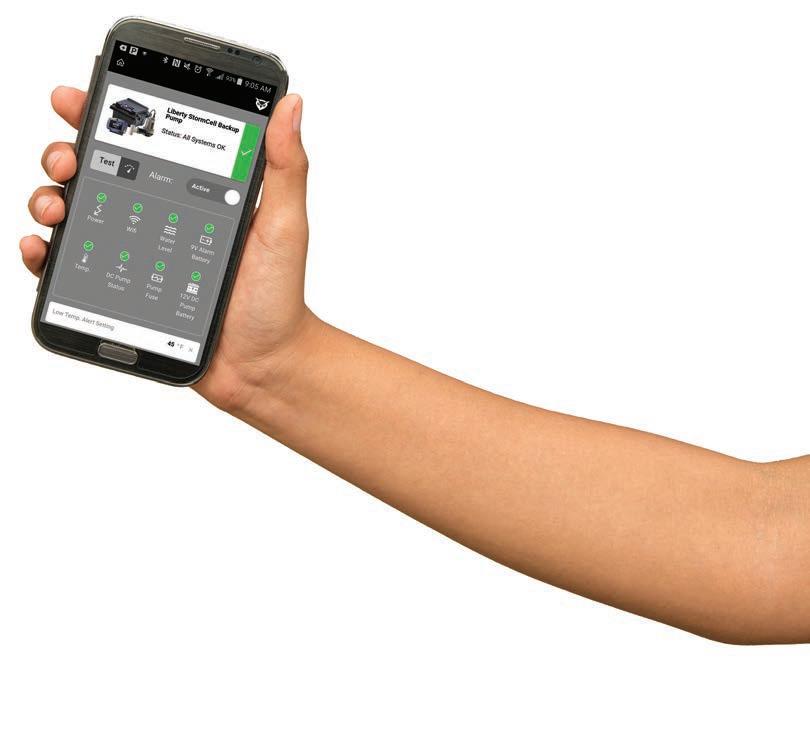



The ECO-0550 geothermal heat pump and backup boiler control from HBX Control Systems is designed to operate equipment in a 2- or 4-pipe, single or dual tank hydronic heating and cooling system. The control can accommodate heat pumps, a backup boiler and reversing valve for complete system coverage and extensive flexibility. It allows for outdoor reset or will maintain a set tank temperature. A built in Wi-Fi communication protocol allows users to remotely monitor/adjust parameters and to receive alarm notifications using the HBX mobile app. A setting called EcoSwitch saves on energy consumption. www.hbxcontrols.com
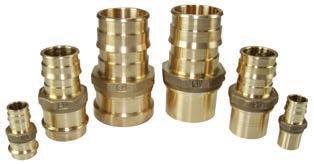
Uponor offers the ASTM F1960 PEX expansion adapters to copper press, allowing faster transitions from copper to PEX. Available in lead-free (LF) brass for potable plumbing applications, these adapters are suited to PEX expansion systems in sizes from ½ in. to 3 in. www.uponor.ca
Triple-Thread Talon
PTFE pipe thread compound is a triple lubricating, all-purpose, nonseizing, VOC free, industrial grade thread sealing compound for all types of metal and plastic threaded connections. The compound contains graphite, ceramic microspheres, and virgin PTFE for optimal sealing. An anti-galling compound enables disassembly after years of service. It is non-toxic and non-combustible. www.lyncar.com
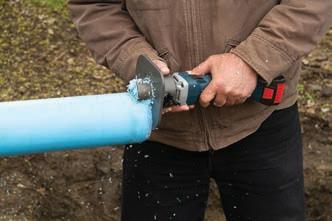
Reed’s portable pipe beveler with cordless power deburrs and bevels plastic pipe 2-in. and larger diameter. The lightweight tool may be used on most PVC glued joints and some sizes of bell and gasket joints. Adjustable for bevel length, the RBIT1 router bit evenly cuts a 15° external bevel up to 5⁄8 -in. long. The RBIT2 router bit creates 12° bevels up to 1-in. long. To eliminate damage to the gasket, a pipe bevel is required when installing into a pipe bell. www.reedmfgco.com
Coleman’s central HC20 heat pump and AC20 air conditioner
Echelon Series are offered in 2 to 5 tons with up to 20 SEER. The heat pump performs to -21C. Charge View built-in touch screen displays the system overall condition, including the system pressures and refrigerant charge without the need to attach additional gauges or sensors. Features include a sound reduction system; high efficiency inverter scroll compressor; and a factory installed, solid core liquid line filter-drier. Complete online technical training sessions are available. www.colemanac.com
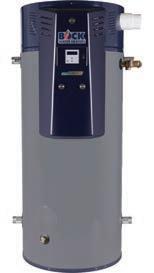
thermal efficiency. An automatic ICCP corrosion protection system eliminates the need for sacrificial anodes. It is available in 99, 100 gallon or 125 gallon capacities and operates on natural gas or propane. Maximum power vent length is 240 ft. in PVC, CPVC or ABS venting. The tank fits through a 36 in. door.
www.bockwaterheaters.com
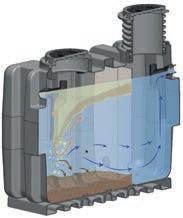
Five models (500-, 750-, 1000-, 1300- and 1500-gallon) are offered in Mifab’s SuperMax range of H.D.P.E. gravity grease and oil interceptors. They have each passed the ASME A112.14.3, ANSI Z1001 and CSA B481 Standards. The 500-gallon model has also passed the PDI G-101 Standard, 100 GPM flow rate. Models are all listed with I.A.P.M.O. Key features are: a ribbed body design for structural strength to withstand earth load forces when buried; generic 24 in. diameter corrugated pipe for extensions; and corrosion resistant H.D.P.E. material. www.mifab.com

The Bock OptiTherm modulating condensing ultra low NOx commercial gas water heater is available with maximum inputs from 125,000 to 500,000 Btu/hr. A Modulating Blue Flame Submerged Burner optimizes
Moen Commercial’s modifications to its M•Power below-deck sensor-operated lavatory faucets include an improved AA alkaline battery life and improved programming selections. A field-enabled sentinel flow option eliminates stagnant water in the supply lines every 24 hours after the last use; the metering flow time can be adjusted to fit any market–from a minimum of 10 seconds, for an educational environment–up to a maximum of three minutes for healthcare environments. A no-spout model, when paired with a laminar flow spout, can add increased sanitary protection. Platforms include singlemount, 3-in. centreset and gooseneck. www.moen.ca

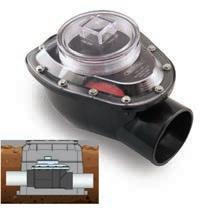
The Check-Flo normally open backwater valve from RectorSeal has a large, clear access cap and a clear lid. A stainless steel flapper hinge ensures the flapper rotates freely and a repelling magnetic levitation system is designed to prevent the flapper from sticking. It is certified to CSA B181.1-2015 and ASME A112.14.12003 (R2008). www.rectorseal.com
The Tribeca tub shower from Mirolin has generous shelving, armrests and a sloped lumbar support. A built-in minimalist grab bar is in a coordinated colour. The tub shower is available in left/right configuration and has an above floor rough-in. It measures 60 in. x 32 in. x 88 in.
www.mirolin.com
Ratech Electronics has introduced 5⁄8 -in. diameter micro camera. It is tiny enough to inspect kitchen sinks and toilet p-traps. Made for 1 in. to 4 in. pipe inspections, it manoeuvres around bends and turns smoothly. It is adaptable to any Ratech pipe inspection camera system. The camera has four LED lights for a superior colour picture. www.ratech-electronics.com
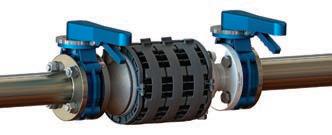
The ADEY MagnaClean DRX magnetic dirt filter provides a cost-effective and compact solution for removing debris and black iron oxide sludge from commercial hydronic heating systems. Its design allows it to be installed in-line or side-stream and in either a vertical or horizontal orientation. The filter consists of an external magnetic belt with dozens of neodymium magnets, wrapped around a precision-engineered, stainless-steel canister. It is available in 2-in. (with 48 magnets), 3-in. (64) and 4-in. (80) pipe dimensions. www.adey.com
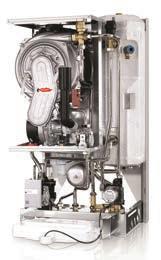
Dual-Tech condensing combination boilers provide high efficiency central heating and meet a larger demand for domestic hot water. Features include on-board indirect fire d storage tank, combi-tech coaxial heat exchanger design with an integrated indirect fir ed storage format, dual-coil stainless steel heat exchanger and 10-1 modulation. It is Wifi ready and is designed to offer continuous one-hour flow rates ranging from 221 to 267 GPM. www.radianthydronics.com
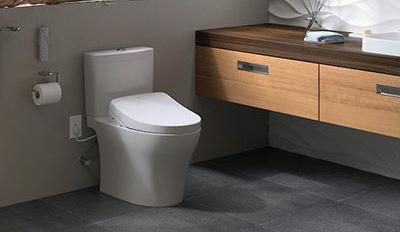
Toto has added the Aquia IV One- and two-piece ultra high-efficiency dualflush toilets with its DynaMax Tornado Flush Technology and rimless bowl design. These one-and two-piece toilets enable users to select the level of water used each time the toilet is flushed: 1.0 gpf for solid waste or 0.8 gpf for liquid. TOTO’s seeks always is to optimize water conservation, while setting a high bar in quiet world-class flushing
performance. The flush technology cleans the entire bowl and rim with 360degrees of cyclonic rinsing action. The smooth CeFiONtect nano-technology glaze prevents particulate matter from adhering to the bowl’s surfaces. www.totousa.com
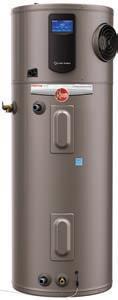
Rheem’s Professional Prestige hybrid electric water heater has a 3.50 EF. It delivers hot water at a rate of 67 US gallons first-hour delivery for 50-US gallon model, 75 gallons FHD for 65-US gallon model and 89 gallons FHD for 80-US gallon model. The water heater has an ambient operating range of 37F to 145F and is designed to meet the Northern Climate Spec (Tier 3). Features include an LCD Screen with built-in water sensor alert with audible alarm and integrated EcoNet wifi-connected technology. www.rheem.com
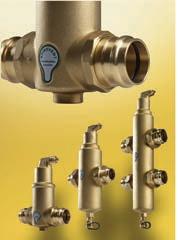
Spirotherm has added press connections to its entire brass product line, sizes ¾ in. through 2 in. The Spirovent air eliminator and combination air/ dirt eliminator, use the patented Spirotube coalescing medium to eliminate the free air, the entrained air and most of the dissolved air from the system. The Spirovent Quad combines the advantages of the Spirovent Air/Dirt Eliminator with the functionality of a hydraulic separator. www.spirotherm.com
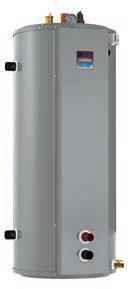
Turbomax instantaneous indirect domestic water heater features Thermo 2000's patented technology to produce instantaneous hot water at a high efficiency rate and to help reduce the accumulation of scale deposits that diminish the efficiency of traditional water heaters. www.thermo2000.com

MASTER IS NOW EXPANDING WESTWARD WITH A SERIES OF OPENINGS TO COME IN 2018 AND 2019 IN ALL FOUR WESTERN CANADA PROVINCES
ALL CONVENIENTLY LOCATED EXPERIENCED AND KNOWLEDGEABLE STAFF LARGE INVENTORY FEATURING RENOWNED BRANDS DAVIES SUPPLY GROUP
Superior Radiant Products has introduced the SRP Stealth, a condensing system classified as a Category IV radiant tube heater. The patent-pending design of this positive vented infrared heater utilizes a microchannel flue gas heat exchanger along with a single canopy over SRP’s twin 100 per cent parabolic reflectors to achieve thermal efficiencies up to 93 per cent. The model THE14N heater provides optimal comfort with SRP’s two-stage technology allowing quick recovery on the high fire 135,000 Btu/hr and economical steady operation on the low fire 85,000 Btu/hr. www.superiorradiant.com.
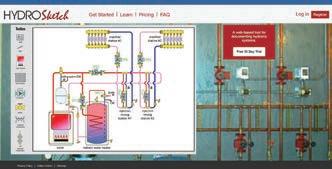
HydroSketch is a cloud-based software tool from Appropriate Designs, in collaboration with Capraro Technologies, Inc. It is designed for those who have had little if any previous experience with computer drawing software.
HydroSketch comes preloaded with symbol libraries (based on the textbook “Modern Hydronic Heating” 3rd Edition, by J. Siegenthaler) for both piping and electrical components. Users may also create their own custom component symbols. The software comes with basic system templates that can serve as starting points for further system layouts. www.hydrosketch.com
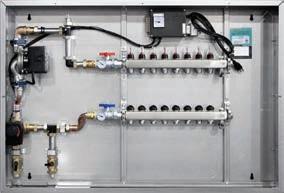
Tamas Hydronic’s three-way mixing manifold panel is offered with a mixing control and actuators, and features a plug and play design for simplified installation. The panel features a compact design and customization options from various mixing devices, pump sizes, loop actuators and manifolds. The panels are also available in various enclosure materials, sizes and with snowmelt control. www.tamashydronic.com
ServiceTitan is a mobile, cloud-based software platform designed to help home services companies streamline operations, improve customer service, and grow their business. This end-toend solution includes CRM, intelligent dispatch, custom reporting, marketing automation, mobile solution for field techs, and accounting integration with Intacct and QuickBooks. www.servicetitan.com
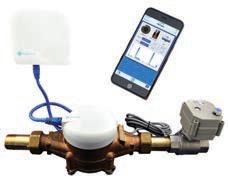
Water Hero is a Wi-Fi-based water monitoring and shutoff system analyzes minute-by-minute water consumption data collected from the water meter and sends real time alerts to the homeowner’s cell phone notifying them of water leaks. The water can be shut off remotely from a cell phone or if there is no response, the system will shut off the flow at a predetermined time. The system also provides temperature monitoring, which can be set up to send alerts for low or high temperature situations. www.waterheroinc.com
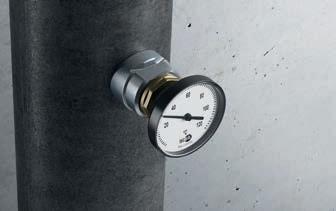
The MegaPress press-in branch connector from Viega is a way to create branches from main runs or to install instrumentation onto existing piping. It installs onto 1 ½ in. through 4 in. and 6 in. ASTM Schedule 10 or Schedule 40 carbon steel pipe and has a ¾ in. FPT outlet. The connector can be installed on partially drained systems and is approved for use in hydronic heating, cooling water applications, compressed gases and other due to a variety of sealing elements.
www.viega.com
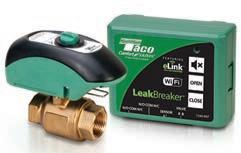
The Taco LeakBreaker protects against flood damage from water heater leaks. It consists of a control unit and a valve with actuator and sensor. This resettable, testable device can be installed on any style water heater to shut-off the incoming water supply, preventing additional water flow to a damaged water heater. The multi-color LED light and audible alarm lets you know the status of LeakBreaker. It is available with and without eLink capability. eLink uses Wi-Fi to communicate with the cloud, enabling status alerts to be sent directly to the users.
www.taco-hvac.com

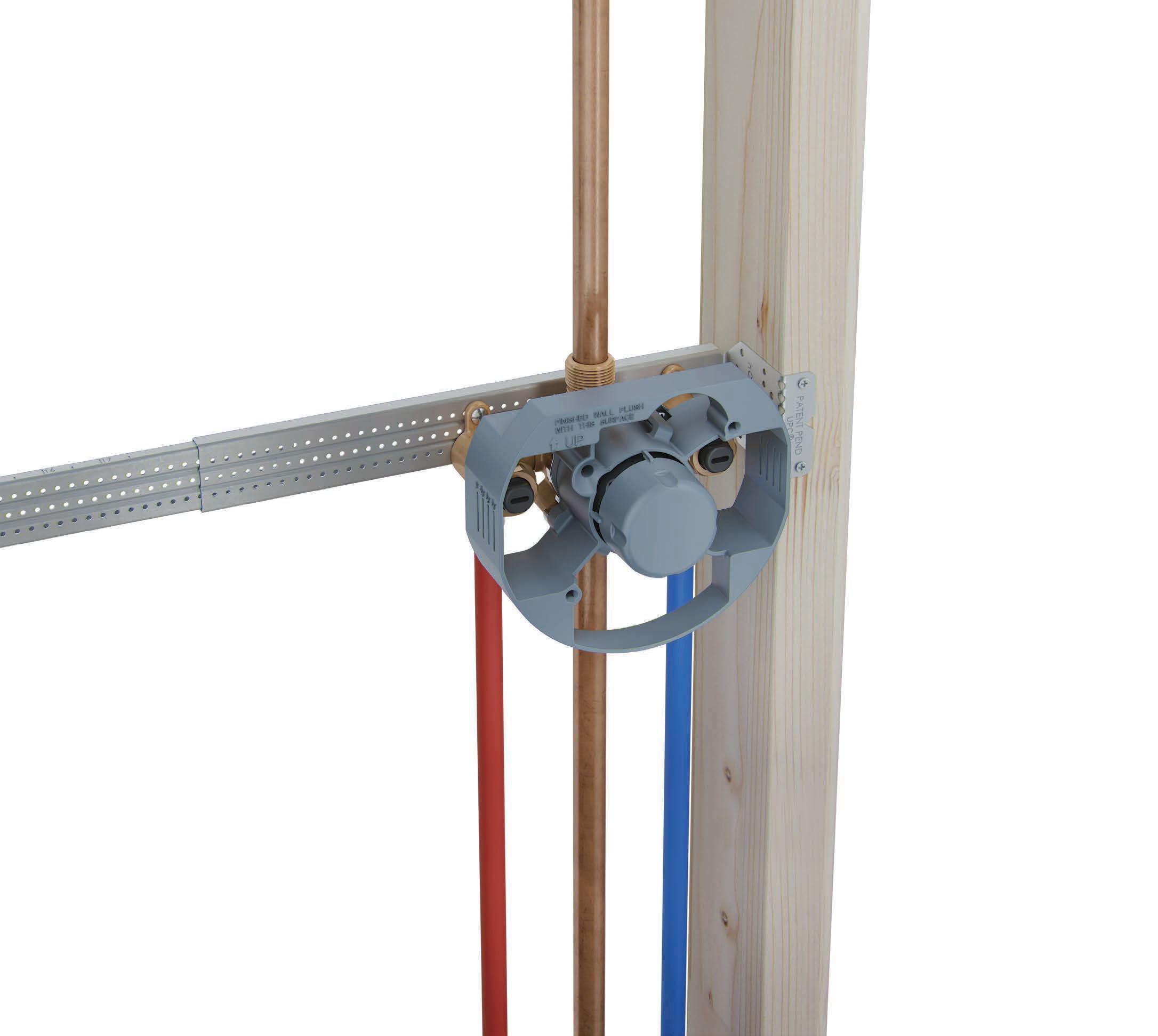
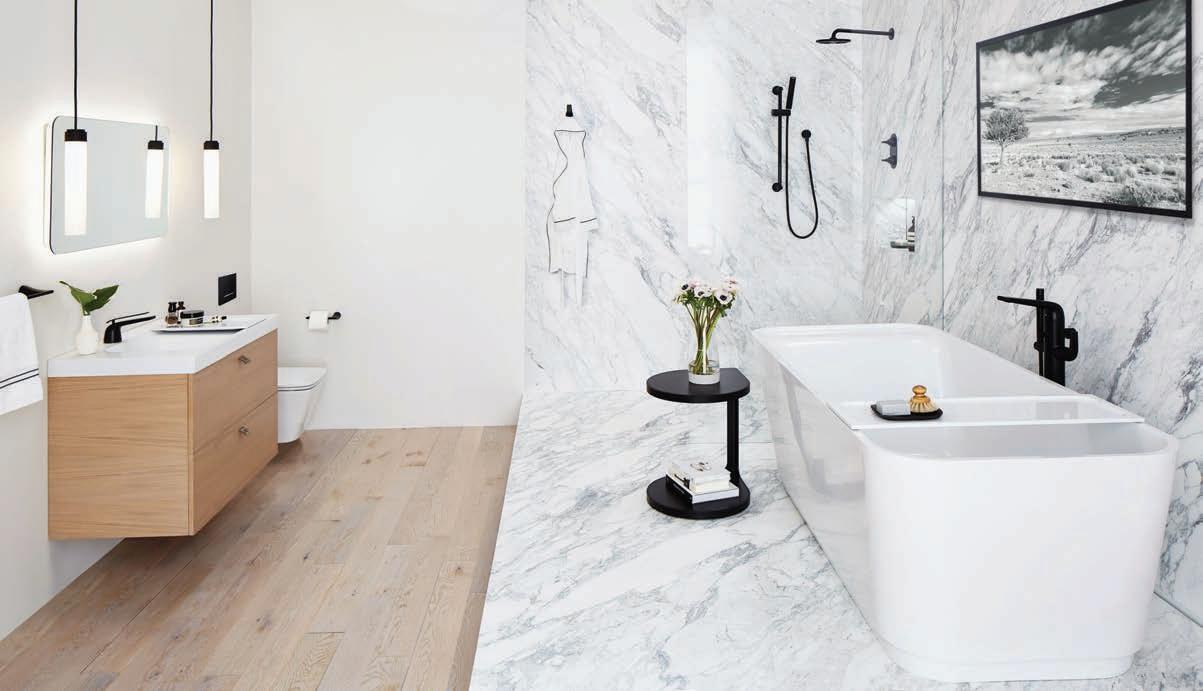
In loo of full renovations, small fixes make waves.
BY JILLIAN MORGAN
More than a fresh coat of paint, small-scale renovations have the potential to transform a bathroom or powder room–making a costly and daunting overhaul unnecessary.
Opting for these simpler fixes, nearly half of Canadians plan to undertake a home renovation before the year is out, with the bathroom coming in third for the country’s top planned projects, according to the annual CIBC Home Renovations Poll.
“Canadians continue to see the value of investing in their homes, but they’re taking a very practical approach by focusing on lower-cost projects this year,” said Edward Penner, executive vice-president of CIBC Personal and Small Business Banking.
On average, Canadians plan to spend roughly $11,000 this year on renovations–down from $11,800 in 2017–with Ontarians spending the
most and Albertans the least. The poll also found that the vast majority of homeowners 55 and older plan to renovate as opposed to sell. Even more, almost half of those homeowners prefer to hire a contractor than do the work themselves.
“People want their bathrooms to be their personal spas, where they can destress and relax after a long day of work,” said Kenana Al Yakobi, Pfister Canada channel manager for Spectrum Brands Inc. “With our living spaces becoming smaller, that space needs to be used efficiently but still provide that luxurious look and feel.”
A mix of contemporary and traditional design, modern finishes and technology advancements with a focus on customization and comfort offer an opportunity to leverage these small changes for a big impact.
“From a plumbing point of view, updating just the lavatory faucets on the sink can give the room a breathe] of fresh air,” Al Yakobi said. “Changing the finish… and keeping core furniture and til -
From DXV, the Modulus collection includes bath faucets, shower trims and accessories in a matte black finish.
Crosswater London’s Waldorf freestanding bathtub, part of a collection that includes faucets, shower valves, tub sets, showerheads, a back-to-wall bathtub, basins, a toilet and accessories.

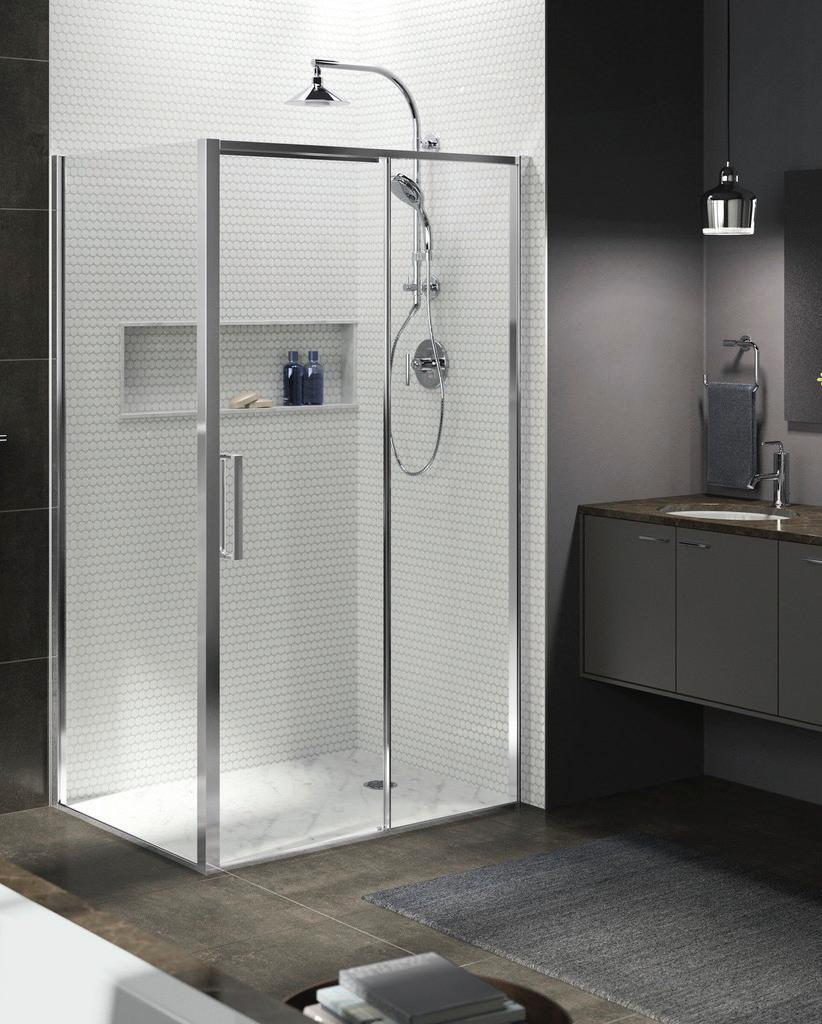
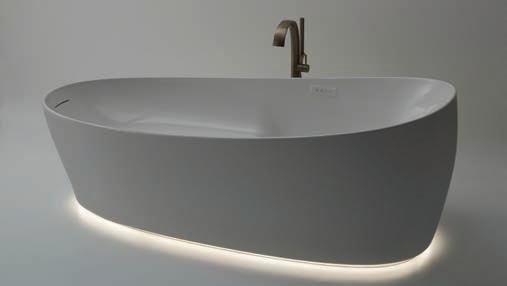
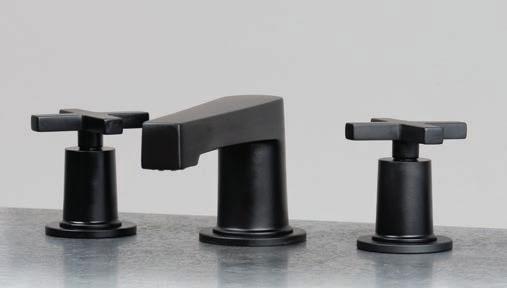
Available
ing the same can materially change the look, feel and style of a bathroom.”
Sleek fixtures that opt for geometrical and rectangular lines–such as those seen in the Metropol collection by Hansgrohe, a Masco brand, and Crosswater London’s Waldorf collection–are a growing trend, along with single-handle faucets.
“A single handle lavatory faucet provides quick and easy temperature control and, with the right product, can become the focal point in a bathroom desperate for a design pick-meup,” said Maria Bosco, director of product marketing at LIXIL Canada Inc.
Pairing upgraded lavatory hardware with accessories of different shapes and sizes can brighten a space and take the small-scale upgrades one step further, according to Brad Campeau, business development manager at Masco Canada.
“We’re also seeing designers and homeowners incorporate mixed metal finishes to add a level of sophistication and warmth to their spaces,” Campeau said. “These trends nod to contemporary design techniques often seen in European spaces.”
Inline with a focus on the lavatory, powder rooms are a growing area of concentration, Al Yakobi said, since these rooms can be more easily–and cost-effectively–refreshed.
Moen’s M-Pact common valve system is one product that aims to simplify these small-scale renovations. The system allows plumbers to upgrade the trim's style or swap out fixtures without replacing the valves.
“The faucet is also the most used item in the bathroom, so the look of the fixture can essentially set the tone for the entire space,” said Garry Scott, vice president of marketing and e-commerce at
Continued on p60
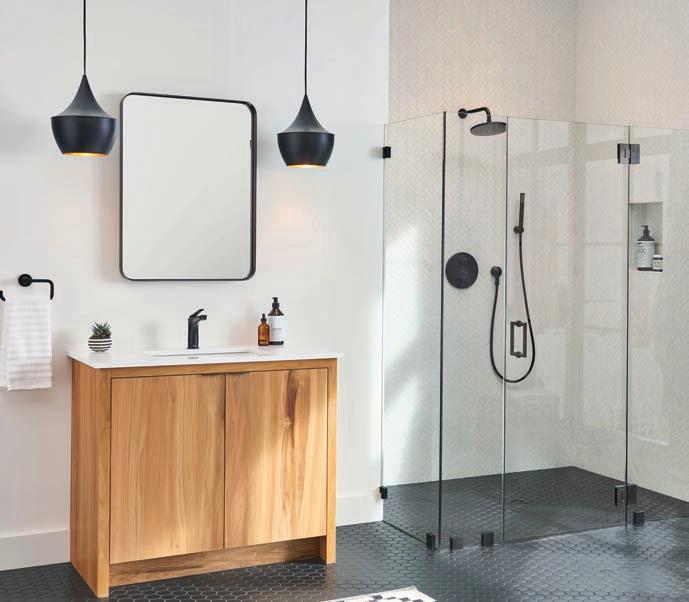
Moen Canada. Though, the bath and shower are not taking a back seat.
“Upgrade the showerhead or shower system with a product that performs well and allows the user to benefit from multiple shower patterns,” Bosco recommends. “A rain pattern provides a luxurious shower experience, while a massage spray will invigorate the entire body, and a concentrated spray will wash out the shampoo or clean the shower stall with ease.”
Kohler’s HydroRail-R arch shower column kit is one product that offers this technology, along with American Standard’s Spectra+ Touch or eTouch showerheads, which allow the user to
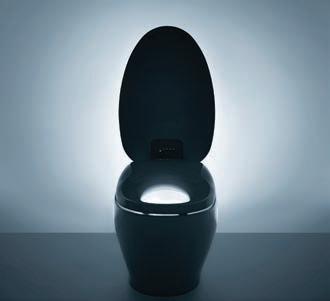
change spray patterns by touching the showerhead or using a remote.
“Black is becoming the second hottest finish to chrome, due to its neutral statement yet impactful change,” Al Yakobi said. “The other colour gaining momentum in upper scale renovations is brushed gold. Elegance with a refined sense of pop that the long standing second most popular brushed nickel finish does not offer due to its muted feel.”
She added that brushed gold fixtures add dimension and depth to muted and cooler paint colours common in modern spaces, while matte black fix-
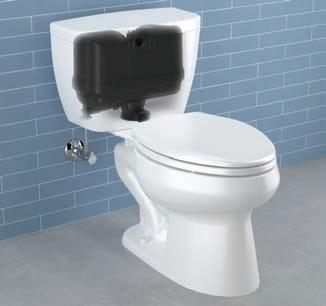
Pressure-assisted toilets from Sloan feature Flushmate technology, designed to reduce backups or clogs. They offer flush volumes at 1 gallon per flush (gpf), 1.28 gpf, and 1.6 gpf in standard and ADA-compliant models. They have a three-point tank mounting system and an insulated tank.
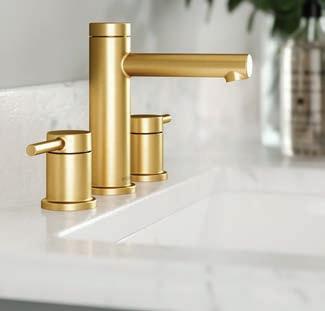
Pictured, Moen’s Align faucet features a single-hole mount and aerated flow. It offers 3 8 -in. compression fittings and maximum flow rate of 1.2 gallons per minute.
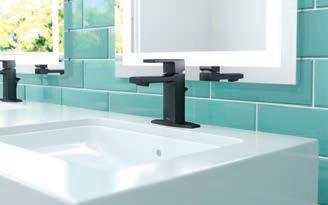
tures contrast the colourful tile designs currently on-trend.
“Moen’s brushed gold finish was developed to work well with a multitude of lighting and hardware finishes commonly found throughout the bath, including a range of different golds, ensuring the brushed gold fixtures harmonize with the rest of the home’s décor,” Scott said.
“Consumers are becoming more adventurous in regards to experimenting with colour, especially gold,” he added. “In the past, gold fixtures have been associated with traditional design, but now, the finish is also being incorporated into homes with a modern aesthetic, for a fresh take on a classic finish.” <>

The An Oasis at Home: Bathroom Inspirations brochure from Geberit North America features 28 pages of bathrooms in different styles using the company’s in-wall installation systems and bath waste and overflows, as well as technical information, including dimensions for the in-wall systems and flush actuator plates.

































































































Work on a sustainable volunteer development project proved to be life changing. BY STEVE
GOLDIE
Considering how much time the average person spends at work, it helps when you are part of an organization that looks beyond the bottom line and outside the confines of its real estate and holdings. This requires a people centric management strategy, which strives not simply to be a successful business enterprise, but also seeks to be integral to customers, each and every employee, and the communities we live, work and play in, both locally and globally.
I experienced this first hand earlier this year when I, along with a group of co-workers, travelled to Ecuador on a trip with the Me to We organization–an opportunity facilitated by our employer.
Me to We is an innovative social enterprise, part of a family of organizations with the lofty goal of making the world a better place, and inspiring as many of us as possible to be more community minded, to make us think less about the individual “me” and more about the collective “we.”
One of the ways in which they seek to accomplish this is through offering individuals, families, or groups the opportunity to travel and work on a sustainable volunteer development project. Our group travelled on one such trip to Ecuador, which is one of three locations where Me to We has partnered with communities and operates these types of trips. The trips are available to individuals, families, organizations and businesses, with the vast majority of those participating being student groups.
Our group of 15 consisted of 12 employees, our company’s principal owner, his son and his son’s friend. We were a diverse group, ranging in age from 13 to 57 and included both inside and outside sales people, warehouse employees, a driver, three people from a somehow over represented quotations department, three teenagers, one grandfather, several middle-aged men and one brave young woman, an underrepresented gender in the group.
Some of us had known one another for many years, while others were barely more than strangers. None of us quite knew what we were in for and all of us were excited for the adventure that lay ahead, unanimous in our desire to work hard at whatever we would be asked to do.
So, off we flew to the second highest capital city in the world, Quito. Our ultimate destination would be the Me to We

village located on the Napo river, the largest tributary river to the Amazon. First however, we would be spending three days travelling to various regions of Ecuador in a comfortable tour bus with our guide Rocco educating us about the history, geography, peoples and culture of this incredibly beautiful and diverse country.
Ecuador is in fact the most biodiverse country in the world by square footage. There are mountains and the highest concentration of active volcanoes in the world, as well as vast jungles and river basins, coastal regions and the Galapagos Islands.
Together we travelled hundreds of miles of winding moun -

tain roads, we went rock climbing together and we filled three white water rafts and rode the rapids together. We pushed ourselves, some beyond their previous comfort zones, flying down into a vast river canyon on zip lines, only to find out upon arrival that the only way out was to scale the sheer rock face hundreds of feet back up.
We repelled together down beautiful mountain waterfalls, and we dined together sampling delicious local cuisine. Our diverse group started to become a team as new friendships formed and existing ones deepened.
After three days filled with a lifetime’s worth of adventure, it was time for phase two of our great adventure. We boarded the tour bus once again and Pedro expertly negotiated the narrow twisting mountain roads. The roads in Ecuador may well have been the most precarious adventure of all–we were grateful for Pedro’s skill.
Several hours later we arrived at the Napo River where we boarded a long motorized canoe, the standard mode of transit in this region, and travelled about 20 minutes down the river to the Me to We village, Minga Lodge. Minga is an ancestral word from the Quechua language of the Incas, the indigenous people of this part of South America. It refers to a concept of community cooperative efforts.
A minga is an initiative whereby friends, neighbours and community members come together to build or achieve something that will benefit the community as a whole. It is an apt and obviously intentional name for the Me to We village, which exists to bring people together from all over the world with the objective to improve the lives of the people in the many villages in and around them.
Me to We has a multi-faceted approach to the work they do in all the countries they work in, a five-pillar approach as they call it. These five pillars are education, water, health, food and opportunity and are designed to combat and the five pri -

mary causes of doing this work.
Minga Lodge is one of nine We Villages that Me to We operates globally, and one of three where it operates the volunteer tourism programs such as the one we participated in. The organization seeks to work collaboratively with the local people and communities to develop the five pillars.
The education goes both ways, as visiting individuals and groups do not simply parachute in, do some good work, then fly home feeling good about themselves. The goal is to get immersed in the local life and culture and to become more aware and educated by working together on whatever local improvement projects are going on at that moment. In the end, participants are energized and inspired to take the minga philosophy back home.
Me to We has been active in this region since 2012 and so far it has built many schoolhouses and health clinics. Most significantly, it has provided a safe drinking water system, something local politicians had been unable to do for decades.
The region is made up of numerous villages, many of which had projects in progress. In our case, we worked everyday in the village of Bellavista–a short motorized canoe ride up the river. We helped build a communal kitchen for the village school, as well as washrooms for individual homes in the village.
The first day we had breakfast as scheduled at 8 a.m. at the Minga Lodge before travelling to Bellavista for a 9 a.m. start. Some of us dug eight foot square and five feet deep holes for the bathrooms. Others cut and bent rebar for the concrete foundations of the communal kitchen.
Unlike building sites in North America materials such as sand and stone for concrete are not ordered and delivered by dumptruck in Bellavista. They are dug, loaded in sacks and transported by canoe and wheelbarrow. It was physically demanding and exhausting work, especially in the hot humid
Continued on p64
weather of the Amazon rainforest. Without exception, our group worked diligently and with no complaints. After day one, we voted unanimously to have breakfast one hour earlier each subsequent day in order to get to the village earlier to work longer and harder. The local children became more and more comfortable and welcoming, excitedly shouting “ola!” from all corners of the village, and happily hitching rides in the wheelbarrows we pushed back and forth.
I was very proud to be a part of such a dedicated team that worked through heat exhaustion, vomiting, diarrhea and the like, and greatly exceeded the expectations of the Me to We team members. We worked each day until noon, returning to the Minga Lodge for welcome showers and lunch and each afternoon we had different cultural experiences. We met with local farmers and heard
their stories. One told us of how he had fought for years to get clean water as he had lost his 13-year-old daughter in 1997 as a result of unsafe drinking water. One day we met with a local Shaman who explained local customs and beliefs and we got to try our hands at using the traditional hunting spears and blow dart guns. We also met with the women’s group who worked to make bracelets sold in Me to We stores, part of the opportunity pillar, which is specifically targeted to give economic opportunities to women.
Sadly, I do not have space or the right words to fully tell the story of our great adventure, grub eating, chocolate making and tasting, and on and on I could go. I do know that we went out as a group of people who worked for the same company, and we came home as a close knit family, forever changed
The Franklin Electric Inline 1100 SpecPAK TM Pressure Boosting System connects easily to nearly any commercial, industrial, or multi-residential plumbing configuration to provide an easy-to-size water pressure boosting solution. Contractors simply determine how much water is required to be boosted to the desired constant pressure output, and the system comes properly packaged. The pump itself, the Inline 1100, is a quiet, all-in-one constant water pressure system that contains the pump, motor, and drive in a compact package.
Franklin Electric/Little Giant www.littlegiant.com

by what we observed, endured, learned and accomplished together.
I am grateful for each and every member of our team, enriched by the guides and local people we met, and very thankful to be working for someone with the vision and generosity to make such a trip possible. If you ever have an opportunity to participate in your own minga do not hesitate to jump right in–you will not regret it. <>

Steve Goldie learned his trade from his father while working as plumber in the family business. After 21 years in the field, he joined the wholesale side of the business in 2002. His expertise is frequently called on to troubleshoot systems and advise contractors. He can be reached at sgoldie@nextsupply.ca.
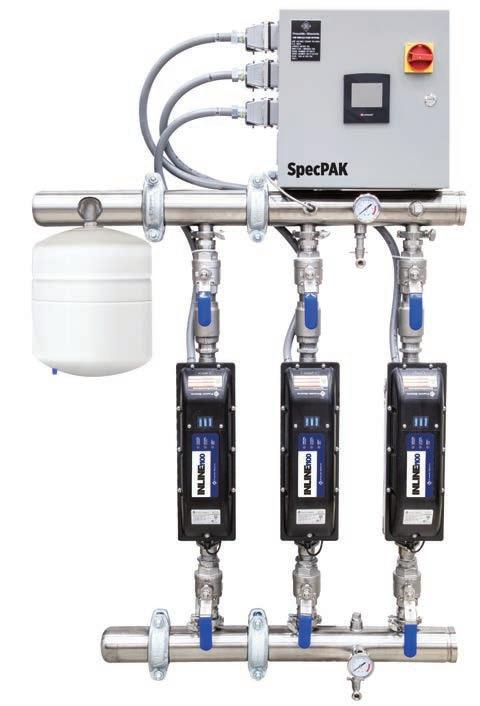
Viessmann Canada’s first annual 2018 Ride for Comfort charity motorcycle ride raised over $25,000 in support of STARS air ambulance of Calgary, AB.
STARS–the Shock Trauma Air Rescue Society–is a nonprofit helicopter air ambulance that provides emergency medical transport for the critically ill and injured.
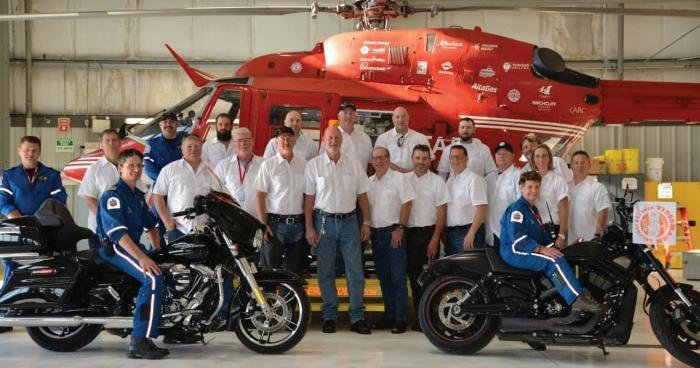
The beginning of Viessmann Canada’s 2018 Ride for Comfort charity motorcycle ride, attended by industry friends, at the STARS air ambulance hangar.
The motorcycle tour included 17 riders. It departed Calgary on July 19, 2018, making a stop in Banff, AB and at several locations throughout British Columbia.
Special stops included a visit to Fink Machine in Enderby, BC for a tour of a Viessmann wood biomass district energy system, as well as Burrowing Owl Winery in the Okanagan Valley, BC, which features the company’s solar thermal collectors. www.viessmann.ca
BACK AT THE HELM AFTER VANDEWIEL MOVES ON

John White, Jr., Taco Comfort Solutions CEO, will resume his role at the company following the departure of Wil VandeWiel. VandeWiel took over as CEO in January 2017 with the mandate to expand Taco’s presence in Europe.
“With Taco well on its way to meeting those goals, Wil has decided that he would like to pursue other opportunities and I have accepted his decision,” White said.
Taco also announced that John White III and Benjamin White have been named vice presidents of the company. www.taco-hvac.com
As part of its fall promotional campaign, Testo, Inc. is offering customers the opportunity to receive a free video borescope with the purchase of a 320 or 330 series combustion analyzer.
The offer is valid for purchases from September 1, 2018 through December 31, 2018, with redemption accepted through January 31, 2019.
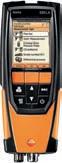
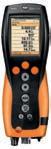

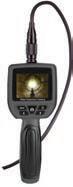
The video borescope is a high-resolution video inspection camera capable of saving images and recording video on an external memory card. The borescope can be used on heating and refrigeration technology, engines and turbines.
Testo’s 320 and 330 combustion analyzers are designed for tuning and troubleshooting on residential and commercial applications. The analyzers include pre-calibrated userreplaceable sensors and full-colour graphic displays. www.testo.com/promo
Ahead of its planned spinoff from Honeywell, Resideo Technologies, Inc. announced the selection of its chief financial officer (CFO) and board of directors.
Former Ferroglobe PLC CFO Joseph Ragan will serve as executive vice president and CFO of the company. Roger Fradin, retired 2017 vice chairman of Honeywell, will take over as chairman of the board.
Mike Nefkens, president and CEO of Honeywell Homes, will take over as president and CEO of Resideo following the spinoff, expected to be complete by the end of the year.
Products from Resideo–a combination of the words “residence” and “presidio,” meaning fortress – will go to market under the Honeywell Home brand as part of a long-term licensing agreement with the company.
Resideo, an independent company, will include a network of 110,000 contractors, 3,000 distributors and 1,200 original equipment manufacturers.
ADI Global Distribution has more than 200 physical locations in nearly 20 countries, in addition to a network of more than 100,000 contractors. It will retain its name and remain as a freestanding distribution business of Resideo. www.resideo.com
Continued on p68
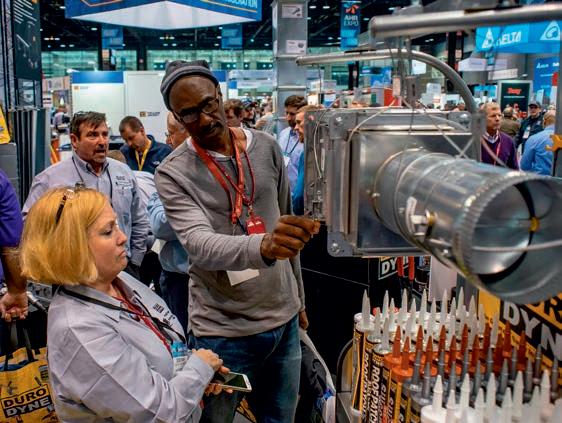
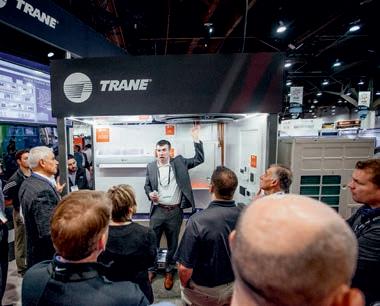

†
†

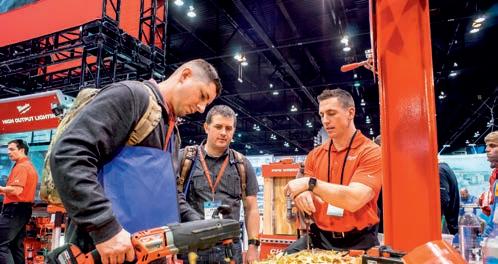
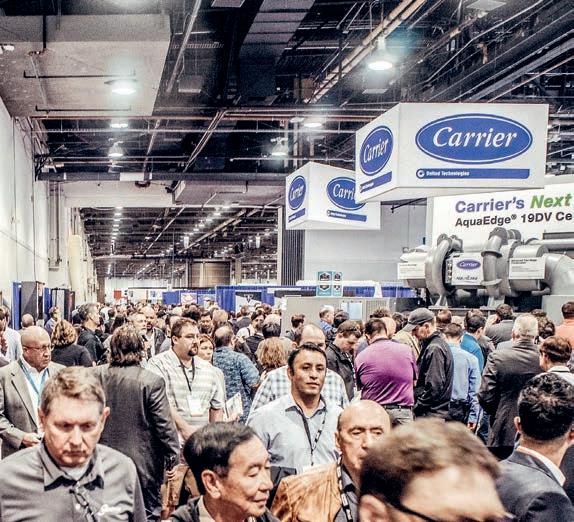
Noble has purchased the assets of Orangeville, ON-based Brampton Plumbing, Heating and Industrial Supplies Ltd.
When the transaction closes, Brampton Plumbing, Heating and Industrial Supplies will operate under the Noble banner.
The acquisition is part of Noble’s strategy to expand its business in “key markets across Ontario.” The company also opened a new location in Vaughan, ON earlier this year and will be opening a new location in Brantford, ON this fall.
Noble Brantford will be located at 576 Elgin Street, Unit C. www.noble.ca

DiversiTech Corp. has completed its acquisition of HVAC/R tools supplier hilmor nearly two years after the brand, along with Irwin and Lennox, was purchased by Stanley Black & Decker for $1.95 billion.
The acquisition is one of 10 undertaken by DiversiTech in the past two years.
“Several key hilmor personnel, including all current hilmor sales reps, will be joining the new business under DiversiTech,” said Bud Sjogren, chief sales and marketing officer at DiversiTech.
Contractors and wholesalers with questions are encouraged to contact their DiversiTech or hilmor regional sales manager. www.diversitech.com www.hilmor.com
Inside Daikin’s Owatonna, MN facility. The company said it explored other site options outside of the U.S., in different regions of the U.S. and in different Minnesota locations.
Daikin has set it sights on a 300,000 square-foot warehouse in Southern Minnesota, north of Faribault, MN.
The company, which currently has two U.S. plants in Faribault and Owatonna, MN, respectively, will receive a $750,000 Minnesota Investment Fund loan and a $1.6 million Job Creation Fund rebate grant from the state to renovate the building into a manufacturing facility.
The funding, to be received after Daikin meets investment and hiring requirements, will allow the $40.3 million factory to come online in 2019.
Will Fort, vice president and general manager of operations at both Minnesota plants, will spearhead the development of this new factory. www.daikin.com
Emerson has completed $8 million in upgrades to its Rushville, IN plant. The company invested $13 million in the plant since 2013, with a series of upgrades completed since 2015.


Those upgrades include the addition of Okuma machine centres with an auto-load system; a switch to cellular assembly with various compressor sizes on one line; and installation of a new parts washing process.
Future projects include the introduction of metrology equipment for targeted equipment replacements. www.emerson.com
Continued on p70
2018-04-10 9:20 AM


Wolseley Canada Inc. has acquired Calgary, AB-based sales and distribution company James Electric Motor Services Ltd.
All 64 James Electric employees will join Wolseley, in addition to the company’s president, Rick James, who will continue in his current role.
Specializing in pumps and motors, James Electric will continue to operate under its brand for the foreseeable future. www.wolseleyinc.ca www.jameselectric.ca

Other topics for the series are yet to be released.
Ellen Rohr, president of Zoom Drain and Sewer, LLC, will host an exclusive business development video series on Bradford White’s For the Pro website.
Titled Ellen’s Corner, the video series will cover topics such as developing a business plan and pricing services.
Rohr is the author of the Bare Bones Business Basics series and founder of Bare Bones Biz, a venture capital and consulting company. Her advice is focused on making business growth less complicated.
“Ellen’s passion for our industry and desire to help plumbing and heating professionals grow their business is completely aligned with our own philosophy here at Bradford White,” said Carl Pinto, director of marketing at Bradford White Corporation.
The company’s For the Pro site, launched in 2017, provides training and troubleshooting videos to Bradford White contractors. www.forthepro.bradfordwhite.com

Danfoss is celebrating the 75th anniversary of the world’s first radiator thermostat, invented by its founder Mads Clausen in 1943.
"The first prototype… was tested in my father's office,” said Jørgen Mads Clausen, chairman of the board at Danfoss.
“The actual marketing began in 1952, when the radiator thermostat was launched as a device that saves money and makes centrally heated rooms more comfortable, and from there on it just took off,” added Clausen.
Since its invention, approximately 350 million thermostats have been produced on the company’s production line. The latest version, Danfoss Eco–an intelligent radiator thermostat–has earned the company a Red Dot award and a Danish Design Award. www.danfoss.com
AQUATHERM ADDS DESCO TO DISTRIBUTION ROSTER
Etobicoke, ON-based Desco Plumbing and Heating Supply is the latest distributor for Aquatherm polypropylene-radom pipe.
“We are seeing the demand for Aquatherm growing in our markets,” said Jon Leeson, Desco vice-president and general manager. “We are confident that the Desco team will be able to help support Aquatherm’s future success in Ontario.”
Aquatherm also launched its latest training initiative, which consists of three programs: Aquatherm Training Professional (ATP), a Trainer Refresh course, and sales training for the company’s reps and distributors.
ATP is a replacement for the company’s Master Training program, which ended in June. The three and a half-day course will be offered at the company’s North American headquarters in Lindon, UT.
The one-day Trainer Refresh and one-day sales training will be conducted locally/in the field.
Course materials for the socket and outlet, butt fusion and electrofusion courses have been updated to reflect the changes made in the ATP course. www.desco.ca www.aquatherm.com
a professional regular season hockey game in Canada or the U.S.A.

When IPEX introduced the first ULC S636 certified PVC & CPVC flue gas venting systems in 2007, we dedicated ourselves to earning your confidence. We continue to provide training seminars, installation manuals, and an expansive certified product range with a coast-to-coast distribution network. IPEX is committed to supporting you with the most complete product line to get the job done on-time and to the finished quality you expect.
















8
DON’T MISS OUT – CIPHEX West is Co-Located with BUILDEX Calgary in 2018!
BUILDEX is pleased to offer complimentary BUILDEX trade show access to all CIPHEX West delegates. Transforming business-to-business interaction. BUILDEX is Western Canada’s event for education, information, and networking in the Construction, Renovation, Architecture, Interior Design and Property Management industries.

Anthony Tippins has been named president of CoolSys Energy Solutions. As the founder of Axiom Energy Solutions, acquired by CoolSys, Tippins will lead the energy solutions business. Prior to establishing Axiom Energy Solutions, Tippins was the president, COO and a founding partner at Aztec Energy Partners.
Lixil Canada Inc. has named Gina Flinton senior director of marketing for American Standard, DXV and Grohe brands. Prior to this role, Flinton has worked at Whirlpool, Canadian Tire and Mattel. As senior director of marketing, she will manage and develop marketing strategies for all three brands in Canada.


WaterFurnace International, Inc. has hired Bruce Cole as vice president of residential sales and marketing. Prior to this role, Cole served as vice president of global sales at Tuthill Corporation. In that role he oversaw profit and loss, e-business development and sales management.
Fujitsu General America, Inc. has named Karim Yasin director of product management for North America. Yasin is responsible for the support and expansion of commercial and residential portfolios. He has 14 years of experience in the HVAC industry.



Regis Saragosti has been named North American CEO for SFA Saniflo. He served as the CEO of Saniflo USA for more than 10 years. In this new role, Saragosti will oversee national sales representatives, advertising and marketing, online sales and new products, among other responsibilities. Saniflo’s Canadian arm also appointed Alexandra Motts to the position of national sales manager.
Taco Comfort Solutions has appointed Jeffrey Bredeson to president of its Tennessee-based subsidiary, Hydroflo Pumps. Prior to this position, he served as vice-president of sales for Taco’s wholesale and commercial HVAC solutions.

Weil-McLain Canada has hired Simon Sorouri as commercial sales applications engineer. In partnership with the company’s sales network, Sorouri will focus on applications for Weil-McLain’s stainless vertical firetube boiler among engineers and large commercial contractors in the Greater Toronto Area.




Christopher and Stephen Schroeter will take over the family business at Napoleon as co-CEOs. Sons of the company’s founders, they have worked at Napoleon for 18 and 15 years, respectively. Most recently, Christopher served as senior vice president of operations, research and development, while Stephen held the title of senior vice president of sales, marketing and administration.
The Canadian Institute of Plumbing and Heating (CIPH) has hired Natalie Petra as program manager. Petra will be responsible for overseeing activities of the institute’s Pipe, Valves and Fittings Council, Education and Training Council, Membership Committee and Canadian Water Systems Council.
Ron Retaleato has been named national sales director of Crosswater London for the North American market. He will continue to maintain his existing sales territory in the U.S. southeast. Retaleato joined Crosswater London in August 2017.



William Christensen, formerly chief marketing officer, has been appointed to the position of CEO at REHAU. The company also tapped Kurt Plattner to take over as chief financial officer. Plattner previously held the title of head of treasury, controlling and finance at the company’s head office in Muri, Switzerland.
DiversiTech Corp. has appointed Franco Daino to the position of vice president, product line and marketing. In the newly-created position, Daino will be responsible for overseeing the company’s product development and executive functions, including product management, engineering, marketing and pricing. Prior to joining DiversiTech, he held the title of vice president and general manager of Fypon.

If a designer is only doing a handful of calculations, what kinds of inefficiencies are being designed into systems that will shackle the building and its owner for life? BY ROBERT BEAN
Solving comfort and energy problems in hydronic systems most always comes down to the hydraulics. It is the field verification of differential pressure specifications in zones and distribution networks and ensuring it is all done using the least amount of electrical energy.Balancing is one of the few tried and true methods for commissioning an existing or new system to perform as calculated.
Balancing is all about ensuring the design zone flow occurs under design conditions so the operation of a control valve or circulator does not create unbalance somewhere else in the system. At less than design conditions, the fluid temperature should be adjusted down or up so that control valves remain open.
When valves do close the differential pressure controlled circulator or pressure bypass valve will deal with the pressure fluctuation and by doing so ensuring overflow or underflow does not occur.
Herein lies an important statement: control valves do not open to give heating or cooling, they close to prevent overheating and overcooling. Thus balancing is done with control valves open as if the system were under maximum load… as per the design.
If you do not ignore (or heaven forbid assume) the details, there are essentially 48 steps in the evaluation of hydraulics for a hydronic system. Yes 48 and that does not include the design of the heat terminal unit. Such a detailed analysis will likely come as a shock even to seasoned designers who think there might be just a handful of steps.
The following are the necessary lineby-line steps from my spreadsheet tool for specifying service, control and balancing valves, and circulators. A case study is presented at the end and for guidance notes are provided to help you create your own tool.
The first steps are to convert loads into flows, establish temperature profiles and determine expansion rates of pipes. Line 1 is self-explanatory (if you have not been trained in doing load calculations begin there).
Both line 2 and 3 are used in the line 8 flow calculation and are often defaulted to 8.34 lb/gal and 1 Btu/lb•°F, which when multiplied by 60 min/hr result in the rule of thumb value of 500. Perhaps you have been taught to determine flow by dividing the load (Q) by (500* ∆t). Now you know where the 500 is from. As long as you are using water at approximately room temperature it is
reasonably accurate. But for other temperatures and mixes such as water/glycol you need to use the proper values obtained from fluid vendors. That is why I teach students to avoid using rules of thumb because such a habit can come back and bite you in the butt.
Line 4 will come typically from the manufacturer’s or industry design nomographs. To enable efficiency in the heating and cooling plant this value should be the highest in cooling (that is >55F) and the lowest in heating (that is <90F). Values lower and higher than recommended will be parasitic on the potential system efficiency, which resides with the building forever, so work really hard to get these values right (see HPAC December 2016, The effect of heating coil performance on boiler efficiency and system complexity, www.hpacmag.com).
Many software programs and designers allow a default of 20F ∆t (line 5) to carry through the flow (Q) calculations in line 8, unaware that the consequences include failure to optimize the heat terminal units for plant efficiency, the circulator for power efficiency, and piping and control systems for distribution efficiency.
For example, most fan/coils can easily handle a 30F ∆t, radiant heated industrial storage facilities can use 40F ∆t, radiant cooled offices less than 8F ∆t and small zones such as radiant heated bathrooms and kitchens installed in a thin pour less than 6F ∆t. Selecting the ∆t is an important strategic element with consequences and
4
5
6
tr = ts - (0.5 * ∆t), establishes operating efficiency for the heat pump, boiler, solar system etc.
7 supply fluid temperature ts °F ts = ts + (0.5 * ∆t), establishes target temperature for control system
8 zone flow Qz-n gpm Qz-n= q/(60min/hr * p * cf * ∆t), sum of all zone flows is used for selecting circulator
9 length of supply + return lines for the zone Lz-n ft combined run out distance to each heat terminal unit (ex. radiant manifold, fan/coil, panel radiator etc.) includes allowance for fittings
10 start up or fill temperature (lower of the values) tf °F temperature of the fluid at start up (typically slab
11 supply fluid temperature ts °F temperature of fluid at operating conditions (= line 7)
13 coefficient of expansion a
14 expansion length (per zone) le in.
le = Lz-n/100 * (∆texp /10 ) * a use this value to select and specify expansion methods to prevent physical stress in piping systems and noise
15 distribution pipe size ddist in. specified by designer for acceptable velocity and head per 100 ft, ex.: 1.5 to 5 fps & 1 to 4fthd/100ft of pipe. Ideally flow should be laminar in distribution pipes
16 inside loop diameter of distribution piping di-dist in. from piping manufacturer
should be thoroughly considered rather than accept the defaults.
Remember anytime the ∆t is doubled, the flow is reduced by 50 per cent, the pressure goes down by 75 per cent and the power goes down by 87 per cent. If I were concerned by long term power use I would sure want my designer to be looking at this stuff. There is very little guidance about this subject in the manufacturer’s manuals but it is in the ASHRAE Handbooks and is covered in my Integrated Design Course.
In addition, when multiple ∆ts of different values are used, the designer will need to calculate the weighted re -
turn temperatures from mixed flow. This is described in industry manuals.
By selecting an acceptable ∆t (line 5 above) the return (line 6) and supply (line 7) temperatures below become set. Their importance is described in the notes.
Line 14 is rarely calculated but it is a must if piping stresses, which show up as annoying sounds, are to be controlled (see HPAC August 2018, www. hpacmag.com).
The next set of calculations move the design from a thermal analysis to a hydraulic analysis. Line 15 is also where the philosophy of sustainability kicks in. If your mission is to create the lowest
cost system, then you are going to be selecting small diameter, high velocity systems. That approach might serve you as a competitive, “cost is everything” bidder, but such a philosophy permanently handcuffs the building and its owner with higher than necessary energy use.
Heat transfer from a pipe is in part a function of its flow characteristics. Laminar flow will transfer less heat than turbulent flow. Smaller pipes (line 16) selected for low cost will have higher velocities (line 17) and higher head losses, require more horsepower and have a higher probability of being in turbulent
Continued on p76
18 ft of head per 100
∆p/100 = 0.2083*((100^1.852)/ (150^1.852))*((Q^1.852)/ (di^4.8655)), Hazen Williams formula, good practice is 1ft hd to 4ft hd per 100 ft of pipe
20 # of radiant loops qtydesigner specified, less loops = longer loops = greater hd but lower manifold costs.
21
23 radiant pipe size drad in specified by designer for acceptable velocity and head per 100 ft, ex.: 1.5 to 5 fps & 1 to 4fthd/100ft of pipe. Ideally the flow should be turbulent in all heat terminal units
24 inside loop diameter of radiant pipe
25 velocity in radiant piping vrad fps v = ( 0.4085 · Qloop ) / di2 check for good practice, ex.: 1.5 to 5 fps
26 ft of head per 100 ft for radiant piping ∆p/100 ft hd /100ft
∆p/100 = 0.2083*((100^1.852)/ (150^1.852))*((Q^1.852)/ (di^4.8655)) see: Hazen Williams formula
27 length of longest radiant loop in the zone Lrad ft from the piping schematic
28 differential pressure in longest radiant loop ∆prad ft hd
∆prad=Lrad/100ft * ∆p/100ft (include allowance for manifold) if other heat terminal unit insert head loss through device at design flow rate. Shorter loops should be balanced for flow to the highest head loop
flow and thus potential for greater parasitic heat transfer. Larger pipes (line 16) with greater cost will have lower velocities (line 17) and lower head losses (line 18), require less horsepower and have a higher probability of being in laminar flow and thus potential for lower parasitic heat transfer. When selecting pipes, do so using good practice as noted in the comments. An exception exists: there are cases where short lengths of pipe can be at the upper end of acceptable velocities with aggressive pressure drops. So long as the pressure drop in these short sections does not affect the overall circulator selection it is acceptable to let these cases stand as designed.
Line 19 is the head loss for the fluid travelling from the prime manifold to say the radiant manifold and back again. It does not include the radiant tubing and manifold but does include an allowance for the fittings. For simple systems designers can use 50 per cent of the line loss as losses for fittings with rea
sonable accuracy. For compact systems use the fitting equivalent method described in industry handbooks.
Line 20 through to line 28 are for establishing the flow rate and pressure drop through the heat terminal unit (HTU). In this case I am giving an example of a radiant floor system where the flow rate per loop is used to establish the head loss through the longest loop. If it were a fan/coil or section of baseboard one would use the flow rate for that equipment.
Line 29 is the round trip head losses for the zone–without the losses for the service, balancing and control valves. With multiple zone systems, the circulator will be selected based on the combined flow rates served by the circulator (line 8) at the highest differential pressure required from the number of zones served by the circulator (line 43).
Line 30 is simply a conversion of the zone piping and HTU head loss from feet of head (ft. hd.) to psi. The reason for this is valve pressure differentials and selection requires the use of the valve’s
31 service valve, Cv Vscv Cv from manufacturer, typically a full port valve with
33 differential pressure in zone w/o control & balancing valve
34 authority multiplier B -
35 desired differential pressure in control valve ∆pVcntrl’ psi
36 Cv required for control valve Vcntrlcv Cv
+
1.0 = 50%, 0.66 = 40%, 0.43 = 30%, specified by designer, the higher the value the better the control but the higher the pressure drop and greater the load on the circulator, minimum is 30%
∆pVcntrl’ = B * ∆pzone’, note pressure drops across control valves exceeding 3 to 4 psi are considered aggressive, check actuator torque, adjust ∆t, B, pipe dia or lengths if necessary to reduce ∆p
flow coefficient (Cv) and this calculation is always done in psi.
Lines 31, 32 and 33 establish the required pressure differentials in the zone with the service valve but without the control and balancing valve.
Lines 34 through to line 38 are the “DNA” for control and balancing valve section theory. This is not taught in most trade and technician curricula, which is a shame as it is not that complicated. The short strokes are–having no pressure drop across a control valve is no different than trying to use your garden hose to water a large flowerbed without having your thumb for back pressure. By placing your thumb over the end of the hose you have flow control. No back pressure, no control.
So how much pressure differential (control) do we need to have so the valve has authority over the zone? Between 30 per cent and 50 per cent of the zone head loss should be in the control valve (line 34). This is true for all applications except those using on/off valves. In the case of on/off valves the Cv should be picked to have at least 1 psi (2.31 ft. hd.) pressure drop. It is beyond this article to get into valve characteristics but designers should know you should never use on/off valves on any fin/tube heat terminal, which employs a fan such as fan convectors, force flows and fan/coils. I know
it is done all the time but it is one of the reasons for two of my favourite sports: system cycling and valve hunting.
For high temperature low mass fan assisted systems only modulating equal percentage valves should be used and the logic of valve authority described here should also be followed. Doing so will linearize the systems so that (for example) at 50 per cent flow there will be 50 per cent output.
Modulating linear characteristic valves should be used on medium temperature medium mass systems such as thin pours, baseboards and panel radiators. On/off valves (and modulating) are fine on heavy mass systems including swimming pools, storage tanks and concrete radiant systems.
Control enhancement is always encouraged through the use of weather compensation (indoor/outdoor controls). To determine the necessary pressure drop across the control valve (line 35) it is simply a matter of selecting an appropriate authority value (line 34) and multiplying it against the head loss of the zone (line 33). Line 36 converts the required pressure drop into a valve Cv. Once you know what Cv you need, you can pick from the manufacturer’s product offering.
And so we finally get to the principles of using balancing
40 balancing valve, differential pressure required
42 total hd, HTU/ RFH, SR, SV, BV, CV
43 total hd, RFH, SR, SV, BV, CV
psi sum of the pressure drops (psi) through the distribution piping + heat terminal unit/radiant floor heating + service valve + balancing valve + control valve
ft hd
sum of the pressure drops (ft of hd) through the distribution piping + heat terminal unit/ radiant floor heating + service valve + balancing valve + control valve. The greater of the head losses amongst all the zones is for circulator selection
44 valve authority check (N/A using on/off valves) B’B’ = ∆pVcntrl” + ∆pVb’ / ∑∆pzone’ this value should be equal to or greater than 30%
If the circulator has to overcome 20ft due to the worst case scenario then adjust piping diameters down to increase velocity and head losses in the best case scenarios. By doing so you balance out the systems whiles reducing costs.
Adjusting one or more of the following will affect the differential pressure and balance of a multi zone system:
• Changing enclosure design which affects the load and thus the flow
• Change the delta t which affects flow and thus velocity and delta p
• Relocate the radiant manifold or heat terminal unit which changes the distribution pipe Distance and thus the pressure differential
• Change the diameter of the distribution piping which will affect velocity and pressure drop
• Change the control valve authority
valves. In the perfect world designers would be able to find the correct Cv each and every time but rarely does this happen. Any shortage in pressure differential needs to be made up with resistance dialed in by the balancing valve. This is described in lines 39, 40 and 41.
If you can find the right Cv an argument can be made to not install a balancing valve. It has been my experience such practice is riding a little close to the sun. Sans a discussion on pressure independent control valves (PICV) (an entire article on its own), there is no margin for error with such an approach.
Finally, we get to the place where the total head loss is determined in line 42 and 43. The highest of these, amongst all the zones served by the circulator, will be used along with the sum of all the flows (line 8) in the selection of the circulator.
Line 44 is simply a check to ensure that your choice in valve authority meets with your preference.
Once you have added up all the flows and selected the zone with the greatest head loss you must then select a circulator for the highest efficiency and lowest annual power consumption. This step is very important and is an integral part of calculating the distribution efficiency
(see John Siegenthaler HPAC August 2018 article, www.hpacmag.com).
Table 1 shows the key results from three solutions for three zones in a radiant heated industrial building. To demonstrate the theory of control valve authority I have used modulating valves.
The first solution is based on using typical default values. The second solution tweaks the Zone 3 ∆t in line 5 to illustrate a means of increasing flow so the ∆p is more closely matched with zone 2 and 3. It also demonstrates the relocation of manifolds resulting in
LineDescription
Zone 1Zone 2Zone 3Zone 1Zone 2Zone 3Zone 1Zone 2Zone 3
1zoneload100000900008000010000090000800001000009000080000
5differentialtemperature20.0020.0020.0020.0020.0018.0030.0030.0030.00 8zoneflow9.998.997.999.998.998.886.666.005.33
9lengthofsupply+returnlinesforthezone200.00100.00100.00200.0050.0050.00200.00100.00100.00
16insideloopdiameterofdistributionpiping1.241.241.241.240.860.861.0540.860.86
33differentialpressureinzonew/ocontrolvalve6.274.283.436.275.995.884.154.043.24
34authoritymultiplier0.430.430.430.430.430.430.430.430.63
35desireddifferentialpressureincontrolvalve2.691.841.482.692.572.531.791.742.04
36Cvrequiredforcontrolvalve6.096.636.586.095.615.594.984.553.73
37Cvfrommanufacturer9.009.009.009.009.009.006.306.304.70
38actualdifferentialpressureincontrolvalve1.231.000.791.231.000.971.120.911.29
39differencebetweendesiredandactual1.460.840.691.461.581.550.670.830.76
40balancingvalve,differentialpressurerequired1.460.840.691.461.581.550.670.830.76
41balancingvalve,Cv(exception:seebelow)8.269.799.648.267.177.138.156.586.13
43totalhd,RFH,SR,SV,BV,CV20.7014.1511.3420.7019.7719.4113.7213.3412.21
45circulatorflow26.9827.8717.99
46circulatorhead20.7020.7013.72
47circulatorefficiency61%61%58% 48circestannualkWh/yr522kWh/yr538kWh/yr364kWh/yr
TABLE 1 Key results: three solutions for three zones in a radiant-heated industrial building
shorter distribution lines (line 9, zone 2 and 3). I have also reduced the pipe size in zones 2 and 3 on line 16. This was done to show that if the second solution zone 1 ∆p establishes the circulator selection, you may as well try to reduce capital costs where possible without compromising performance. In this case using less pipe of a smaller diameter for zones 2 and 3. Both the first and second solution have almost identical circulator requirements with the same efficiency and annual power use.
What is not to like about any of that? Such an exercise should be mandatory on every system design. However in the drive to reduce design costs typically only first solutions are used, which results in inefficiencies, higher than necessary capital and greater operating costs. None of it is congruent with the philosophies of sustainability.
Further there is a segment of the market that undervalues, hides or gives away its design fees in order to sell equipment and does not validate calculations through commissioning. Another segment competes for fees without selling equipment. To minimize risk of losses and improve profits this segment tries to do the least amount for the highest fee.
TABLE 1 .indd 1 2018-10-03 3:19 PM
At this point there is a big opportunity to improve boiler efficiency, reduce capital costs and lower annual power use for a small sacrifice in electrical efficiency. Note that in the third solution the ∆t is increased to 30F. This is possible since it is an industrial building where workers are wearing safety boots and coveralls and will have a high metabolic rate. They won’t know or care about the less than ideal thermal efficacy of the floor surface.
Look what happens to the flow on line 8 when the ∆t is bumped up. The
larger ∆t also means we will have a lower return temperature enabling us to extract a higher efficiency from the heating plant. We can now also reduce the distribution piping size in zone 1 and get lower ∆ps across all zones. Because the ∆ps are lower we can use a smaller service valve, control valve and balancing valve.
Since everything is lower notice the circulator selection on line 45 and 46. Notice how the power use has dropped almost 30 per cent for a small efficiency penalty of three per cent (from manufacturer’s software). Further reductions would be possible if the client would consider improving the enclosure performance to reduce the heating loads in line 1.
The entire exercise of going through balancing calculations exposes the potential to optimize systems to improve the efficiency of the heating and cooling plant, and lower capital costs while reducing power use (third solution).
Using this one case study you can hopefully appreciate the impact these approaches are having on society’s energy systems and resource utilization when hundreds of designs are done each day. The world of design needs to be revamped if the industry is to deliver buildings that can be called sustainable. The balancing calculation is just one way of drawing attention to this matter. <>

Robert Bean is a Registered Engineering Technologist in building construction (ASET) and a Professional Licensee (Engineering) in HVAC (APEGA). He is president of Indoor Climate Consultants Inc. and director of www.healthyheating.com; a past ASHRAE Distinguished Lecturer; recipient of ASHRAE’s Lou Flagg Award and ASHRAE Distinguished Service Award; and a member of ASHRAE technical committees 2.1 (Physiology & Human Environment) 6.1 (hydronics), 6.5 (radiant), 7.04 (eXergy) and SSPC 55 (thermal comfort). Bean is also the author of numerous industry courses and seminars covering the building sciences, indoor environmental quality, energy, and radiant-based HVAC systems.
When to use a three-pipe buffer tank configuration. BY
When it comes to thermal storage tanks, there are many shapes, sizes and pressure ratings available, ranging from tanks that resemble (or are) domestic water heaters to larger ASME-certified pressure vessels.
In most hydronic thermal storage applications, it is desirable to maintain temperature stratification within the tank–that is hottest water at the top, coolest water at the bottom. Good stratification improves the “quality” of thermal energy available from the tank, relative to that available from a full mixed tank.
A thermal storage tank, left undisturbed, will naturally stratify. The temperature range from top to bottom will depend on several factors, including:
1. The height to diameter ratio of the tank
2. The thermal conductivity of the tank walls
3. The insulation used on the tank
4. Conductive/convective heat loss through piping connected to the tank
Thermal stratification should be maintained within the tank while heat is being added from the heat source(s), as well as when heat is being extracted by the load(s). The degree to which this happens depends upon the temperature rise across the heat source, and the temperature drop across the load circuits.
Ideally, the water returning from the load to the thermal storage tank should enter the tank at a “strata” that’s at the same temperature as the returning water. This minimizes buoyancy induced mixing within the tank. Flow should also enter the tank horizontally and gently, again to minimize mixing within the tank.
The latter can be accomplished by keeping the flow velocity entering the tank no higher than two feet per second, and connecting the piping to the side of the tank rather than the top or bottom.
What’s difficult is attempting to maintain a match between the temperature of water returning from the load, and the water temperature within the tank at the connection point. The temperature returning from the distribution system is going to change from when the load starts operating to when warm water makes its way through the load and start flowing back to the tank. The return temperature is also going to change as the supply water temperature changes.
JOHN SIEGENTHALER
Outside of North America, some European designers have attempted to create “smart” return systems using multiple return valves as shown in Figure 1. These designers tend to also sell motorized valves.
A controller measures the return water temperature and the temperature stratification within the tank. As the returning water temperature varies, the controller opens one valve to allow water back into the tank where the internal temperature–either measured or inferred–is closest to the returning water temperature.
While this might be a control engineer’s delight in terms of hardware and algorithms, it adds expense and complication.
Another approach is to use a “stratification lance” within the tank. Water returning from the load enters an isolated chamber at the bottom of the storage tank and slowly rises through a polymer tube with lots of holes along its height and up the centreline of the tank.
In theory, the water rises due to buoyancy until it matches the temperature of the water in the tank. It then flows out of the central tube and into the tank with minimal disturbance of stratification. The holes are covered by small plastic flaps, which are designed to close to prevent circulation between the water in the central tube and water in the tank when the tank is at rest. As a result, there are no inflows or outflows.
While I am confident this approach has validity, I am not as confident in a more than 20 year life expectancy for the polymer tube, or the plastic flaps covering the holes on this lance, especially if that tank is exposed to water temperatures approaching 200F.
My proposition to the challenge of maintaining reasonable stratification within the tank is three-fold:
1. The hydronic industry needs thermal storage tanks with at least one generously sized mid-height connection point, as shown in Figure 2. This would be in addition to connections on the upper and lower sidewalls. A mid-height connection point offers the designer options as to where the return piping from a load can be connected to the tank.
If the mid-height connections are not needed for piping, they can be used for temperature sensors, thermometers or other instrumentation. These connections can also be plugged if they are not needed.
supply to load
"inlet" valves (only 1 open at at given time) return from load
I would rather specify a tank with extra connections than try to “shoehorn” the design around a tank with not enough connections, or with connections in the wrong location on the tank.
2. All connections other than those specifically intended for an air vent or drain valve should have generously-sized connections. This allows use of larger pipe sizes near the tank to reduce inlet flow velocity and help maintain temperature stratification. I suggest a minimum of two-inch FPT treaded connections on tanks intended for residential and light commercial applications. Tanks for commercial applications should have a three-inch pipe, minimum, on all in-flow and out-flow connections. Large connections can always be reduced to fit smaller piping using relatively inexpensive bushings.
3. Designers need to assess the likely temperature drop of load circuits, then lay out piping that returns water from those loads into the tank at a level where the temperature in the tank is about the same as the incoming water.
If the load is likely to produce a “wide” temperature drop it can be returned to the lower sidewall connection. If the load will have a small temperature drop, it could be returned to the mid-height connection. If the load is small with a low Btu/hr heat transfer and operates with a minimal temperature drop, it could even be returned to the upper sidewall connection of the tank. These options are illustrated in Figure 2.
This concept is easy to understand, but not as easy to execute. The complication is that the return water temperature from any given load will vary as that load starts and operates. The temperature profile within the tank is also going to vary as heat is removed and when heat is added from one or more heat sources.
In practical terms, it is likely the load with the deepest con-
sistent temperature drop will tend to set up a corresponding temperature profile within the tank. It makes sense to connect that load over the full height of the tank. A load with perhaps half that temperature drop, but the same supply temper-ature requirement, could then be piped over the upper half of the tank, assuming there’s a connec-tion port at that location.
An example of where returning water from the load to higher connections on the tank makes sense is when a typical indirect water heater is supplied from the system’s thermal storage tank.
The internal coils in many North American indirect water heaters are, in my opinion, too small for efficient heat transfer at coil inlet temperatures below 180F. While it is possible that some thermal storage tanks can reach these high temperatures, it is usually the exception, especially with heat sources such as solar thermal collectors. Still, there is energy available for domestic water heating when thermal storage temperatures are as low as 125F, assuming domestic hot water delivery temperatures of 115 to 120F.
Heat can be transferred from thermal storage to the indirect tank as shown in Figure 3
A differential temperature controller monitors the difference between the temperature in the upper portion of the thermal storage tank and the water temperature in the lower portion of the indirect tank. When the temperature of the “source” sensor in the thermal storage tank is at least 15F or more above the temperature of the sensor in the lower portion of the indirect tank, a circulator turns on to move heat
Continued on p82
from the former to the latter. When the thermal storage temperature is 10F or less above the indirect tank temperature, the circulator turns off. The “on” and “off” differentials can be adjusted based on the heat transfer performance of the coil heat exchanger and the position of the sensor in the indirect tank (e.g., lower placement of the sensor may allow for slightly lower “off” differential).
The issue I have experienced with this setup is that the rate of heat transfer from the coil heat ex-changer in the indirect water heater drops off consid -
erably as the thermal storage tank temperature decreases. This results in minimal temperature drop across the coil. If the water leaving the coil is then returned to the lower connection on the thermal storage tank, it is likely to be significantly warmer than the water in the tank at this location. This induces buoyancy differences, which tend to break up tank stratification.
One way to reduce this effect is by bringing water back into the upper portion of the tank–no lower than the midheight connection and possibly even to the upper sidewall connection. The lat-
ter is the better choice if the DHW load is small and the thermal storage tank can adequately supply space heating at lower water temperatures.
Although this is still not an ideal solution, it is an improvement over returning the water to the lower connection on the thermal storage tank.
In the future we may see improved methods for returning water from heating loads to thermal storage with minimal disruption of stratification–perhaps an intelligent device that can “unload” return water over the full height of the tank, so that it flows into a “strata” at the same temperature. The device will have to be robust to survive the environment within the tank for many years. Put your thinking hats on for this one.<>

John Siegenthaler, P.E., is a mechanical engineering graduate of Rensselaer Polytechnic Institute and a licensed professional engineer. He has over 34 years experience in designing modern hy-dronic heating systems. Siegenthaler’s latest book is Heating with Renewable Energy (see www.hydronicpros.com for more information).
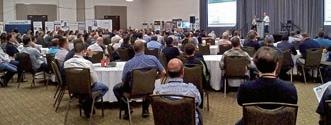


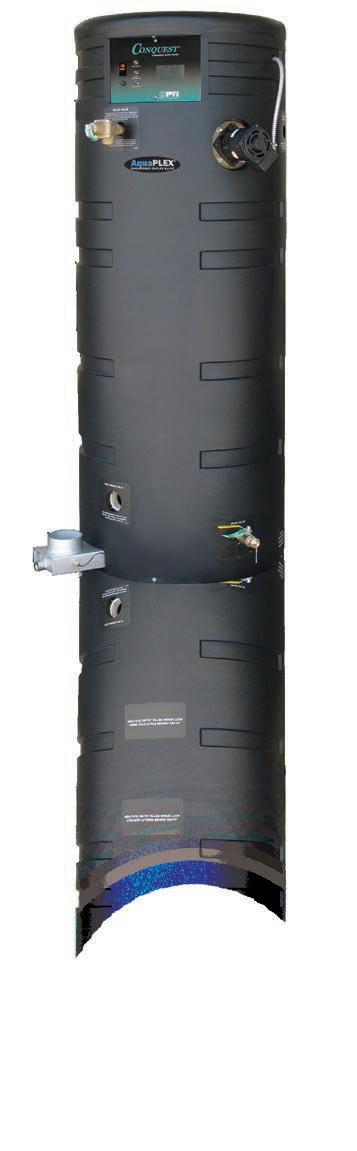
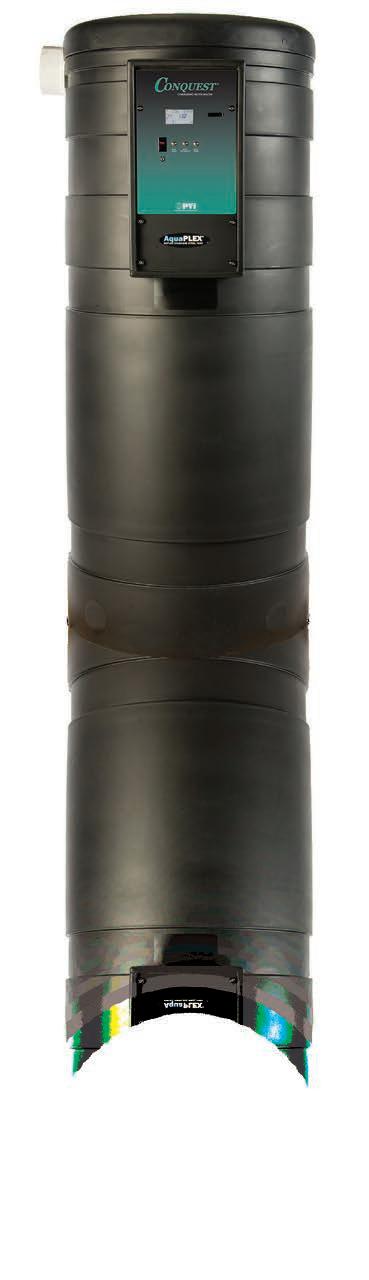
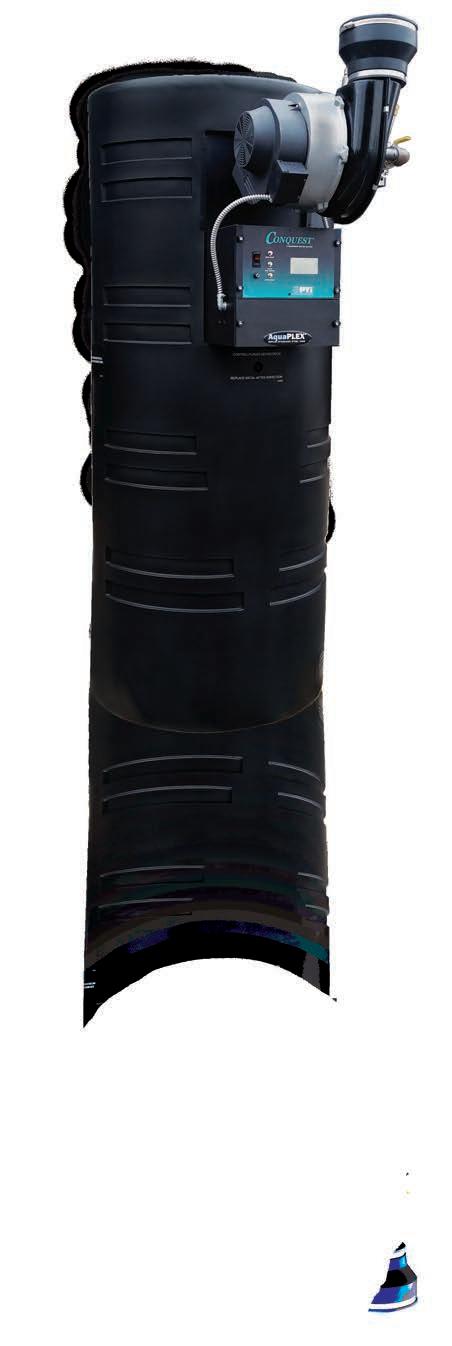

What you need to know about resistance. BY CURTIS BENNETT
There are some facts about thermistors and resistance that cause confusion. Luckily that lines up with our topics on electricity. How you wonder? Once again it is all physics. V = I R, where the R is resistance. A story will help to illustrate the topic.
I always knew what I wanted to be when I was finished school. I was ridiculously interested in electronics from a young age. After finishing high school I attended the Southern Alberta Institute of Technology (SAIT). After my first year there I figured I was a computer scientist. We had been taught a ridiculous amount of information and I thought at that point I knew everything. It turned out that even the basics can be forgotten very easily.
My family ended up gathering at my grandparents that summer. We were going to be sitting out on the patio and my
grandma asked me if I could hook up all the speakers they had outside to the new stereo they had purchased. Speakers in the front and speakers in the back all needed to come to one stereo.
This sounded easy. I started to hook everything up all the while throwing the very basics about resistance right out the window. I took one wire from here, one wire from there, tied them all in and turned on the stereo to test. They all were working and sounding good for about 30 seconds before there was some crackling, then buzzing, then pop and then nothing. The first chance I had to show my family I was this awesome electronics guy went straight down the tubes.
I rushed inside to see what was going on. At first I thought the wires had come out of the terminal blocks because I had so many in there, only to have that very distinctive smoke smell lingering in the air and no power on the stereo. I had burned out the new stereo.
What went wrong? Let me articulate how I hooked up all the wires. There were only two speaker terminals on the back but I had eight speakers to hook up. So what did I do? I took four speakers and twisted all the wires together and put them on one side and then did the same on the second side. Easy right? Easy, yes, right, no! This takes us to our first lesson: resistance and parallel and series circuits.
What do speakers have to do with resistance? Speakers are rated in impedance and without getting into a whole bunch of physics equations, it is resistance at a certain frequency. For
our purposes we will just say that speakers have a resistance. The symbol for resistance is the omega or the Ω. In the case of these speakers, which were home speakers, the resistance is usually 8Ω while car speakers usually use 4Ω.
Each time you connect resistors in parallel, if they are the same resistance you essentially half the total resistance. If we had two 8Ω speakers and put them in parallel we would end up with 4Ω. If you connect resistors in series you add the resistance together. So if we had two 8Ω speakers and put them in series we would have 16Ω.
These are vastly different numbers. In my case I put four speakers in parallel. That put the total resistance down to 2Ω. When the resistance values are the same the math is simple but here is the actual formula for parallel resistance: 1/(1/r) + (1/r) + (1/r) + (1/r).
If we put the 8Ω speakers in there we can see how we came out to two ohms. 1 divided by 8Ω = 0.125Ω so we put this in our formula and we get 1/(0.125 + 0.125 + 0.125 + 0.125) = 1/0.5, which equals 2Ω. The problem with putting 2Ω into the stereo is the components that drive the speakers are rated for a certain driving power and when you lower the resistance too much things heat up and factory smoke comes out.
Was there a way that I could have done this properly? Yes there was by using a parallel series circuit. Sorry, more math coming. To connect the wires correctly I would have needed to put two sets of the speakers in series. What that would do is add the resistance together: 8Ω + 8Ω = 16Ω. That does not look right either but stay with me here. Then we take the other set that we put in series and we put that in parallel with the first and voila! 1/(1⁄16) + (1 16) = 8 Ω. Math wins again.
What does resistance have to do with mechanical contracting and plumbing? Lots. To start with you have all heard the term thermistor. We use them all over the place. A thermistor is a resistance device where the resistance changes based on temperature. It is a handy device and used in about 100 per cent of boiler rooms. Every time you hook up a “sensor” to the boiler, or put a “sensor” in a DHW tank you are hooking up thermistors.
What did you learn here? Have you ever needed to take an
average reading of temperatures on a room, or had more than one tank you needed to average out the temperatures in. Do not kid yourself–it happens all the time.
To take an average you need to use four thermistors. Take two sets and put them in series and then take those two set in series and put those in parallel with each other. Then you can put those four thermistors wherever you want and they will give you the average of those four thermistors.
Resistance also crops up in continuity tests, more commonly known as the “beep test.” The wording bugs me but I understand why people call it that. This test is used all the time while installing and/or troubleshooting a system. What it is essentially doing is checking for a short or an open circuit.
A short in electrical terms is a direct connection between two points and open is when the two points do not have any electrical connection. What the beep test tells us is that the two points you are testing are connected and have a very low resistance, usually below 100Ω. Most meters have this handy little test that, in a lot of cases, will be one of the first things you are asked about by someone in tech support. After the test you do have to power it up properly.
If wires can have a resistance then when we hook the wire up to the thermistors we are adding resistance to that thermistor. Does this affect the reading? It does affect the reading of that thermistor but not as badly as you might think. Yes wire has a resistance but it is a clearly defined number. Meaning that wire gauge determines the resistance per foot you need to add in.
Let’s do a little experiment. Most manufacturers that use thermistors say do not use more than 1000 feet of wire to connect the thermistor to the control. One thousand feet of 18-2 sensor wire has about 6.5Ω of resistance on it going one way. We actually need to double it because we are adding the wire in series to both sides of the thermistor as we are going out to the thermistor then back to the control. Thermistors have a rating on them, 10kΩ, 5kΩ, 2kΩ or otherwise–what that means is the curve is specified so at 25C the resistance equals that amount. So a 10kΩ thermistor is Continued on p86
10,000Ω at 25C.
Using the term 10k thermistors loosely can sometimes get you into trouble as there are multiple curves when it comes to thermistors but for this purpose we will generalize. So, if we had a temperature on that thermistor of -5F (-20C) the resistance of the thermistor would be around 100,000Ω and if we added our (6.5Ω X 2) from our wire you can see that the wire resistance really will have no effect on the temperature reading at -5F. It goes from 100,000Ω to 100,012Ω.
If we go in the other direction and put the thermistor in 190F (88C) then the thermistor will make 1000Ω of resistance, and if we add on the wire resistance the total is 1012Ω you will see it does have more effect but still not much. At that point it will not even throw the reading out by one degree.
When measuring resistance on your handy dandy meter one major thing to remember is there can be no power on the line or the reading will not work. You cannot measure resistance with power on the line. That does not mean AC power necessarily. This can be any voltage, even the control putting DC voltage on that part. Word to the wise: power down before reading resistance.
It is also good practice to disconnect the wires from the con-
trols or whatever device they are attached to because there could be other resistors in parallel or series on the circuit board in the device, which will vastly skew your results. <>

Curtis Bennett C.E.T is product development manager with HBX Control Systems Inc. in Calgary, AB. He formed HBX Control Systems with Tom Hermann in 2002. Its control systems are designed, engineered and manufactured in Canada to accommodate a range of hydronic heating and cooling needs commonly found in residential, commercial and industrial design applications.
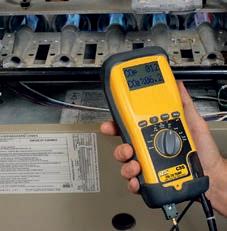
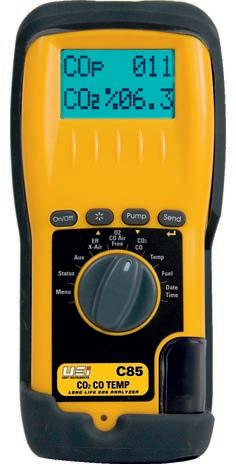
Trusted Combustion Analyzers
For residential or commercial applications, proven solutions to match your job.
-Day Turnaround on Annual Service Up-front pricing means no surprises. For a standard, paid-for service received Monday we’ll ship it no later than Wednesday.
Company Offering Award-Winning Technology
HVAC professionals have benefitted from UEi’s EOS technology for over 10 years.
NO Oxygen sensor. This lowers cost-of-ownership with one less sensor to maintain. Over the lifespan of an analyzer this saves hundreds of dollars. 3
Oxygen Sensors to Replace




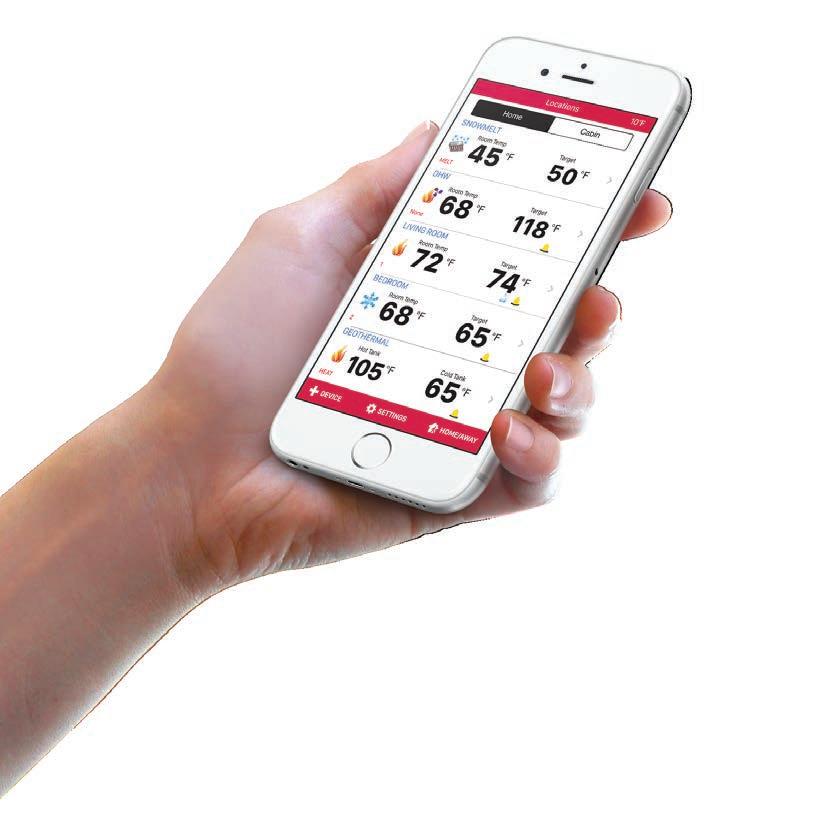
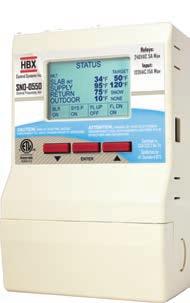
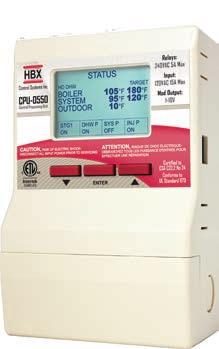
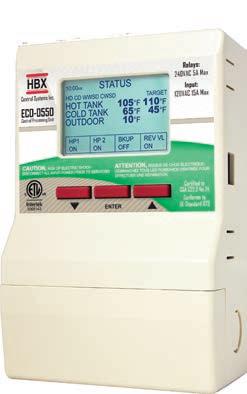
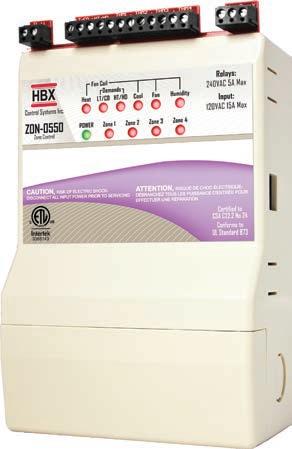
BY HANK BULMASH
You may recall last summer’s furor when the Minister of Finance announced changes to the tax regime of Canadian Controlled Private Corporations (CCPCs). In addition to increasing taxes on private companies, those changes would have imposed a costly compliance burden on taxpayers. The government seemed genuinely taken aback when it ran into nearly universal opposition.
Business groups were unanimous in their antagonism–as were professional organizations, doctors, dentists, architects, engineers, the Law Society and CPA Canada. Even Liberal MPs eventually joined the chorus for amending the government’s position.
The government’s response was announced in its March 2018 budget. It addressed the Finance Department’s major concern that companies eligible for the small business tax rate were supposedly using the existing rules to obtain tax benefits on investment income. While the new rules contained in the budget are less draconian than the original plan, they still increase the tax burden on investment income earned by CCPCs. However, along with the bitter medicine on investment income, the government also produced some sugar to help the amended legislation go down.
A CCPC is a private corporation which is controlled by Canadian residents. A corporation will not qualify as a CCPC if it is controlled directly or indirectly by a public corporation or non-residents, or a combination of the two.
As of January 1, 2018, small business corporations have their tax rate reduced to 10 per cent federal tax rate on the first $500,000 of qualifying active business income. The rate will be further reduced to nine per cent as of 2019. Those numbers are just the federal tax. The provinces tax small business income as well. For example, Ontario’s small business rate is 3.5 per cent for 2018 for a quite low composite 2018 tax rate of 13.5 per cent.
Along with the rate reductions, the government has sharpened the focus of the low tax rate towards helping only small businesses. Access to the small business rate is reduced once a business (or an associated group of companies) has $10 million of taxable capital employed in Canada. The small business rate is eliminated altogether once a company or associated group has $15 million of taxable capital.
In addition, once a company accumulates a sizable investment portfolio, its opportunity to use the low tax rate will be phased out. For every dollar of investment income a company earns in excess of $50,000, its small business limit of $500,000 will be reduced by $5. That means if a company earns $80,000 of investment income, its business limit will be reduced for the $30,000 of excess investment income. The reduction will be $150,000 ($30,000 x 5 = $150,000) to $350,000. That means, when investment income equals $150,000, the $500,000 small business limit will be reduced to zero.
The 2018 budget brought in a major change to how investment income
earned in a corporation is taxed. When governments originally introduced the low small business rate for corporations, they wanted to ensure that the low rate was applied only to active business income–not investments. The goal was to encourage the growth of Canadian small business with a tax preference. However, no government wanted to extend that tax preference to investment income.
To that end, investment income earned in corporations is taxed at the maximum personal rate. For example, the combined federal-provincial rate in Ontario is just over 50 per cent. When your company earns $10,000 in investment income, the tax on that income is about 50 per cent. If your personal tax rate is, say 40 per cent, you will end up paying a penalty of 10 per cent by earning investment income in the corporation.
That penalty is very punitive. In fact, it is more punitive than the government intends. The mechanism for avoiding a significant tax penalty is embodied in a tax principle called tax integration. The idea behind integration is that a taxpayer should be indifferent between earning investment income in a company or personally meaning the tax should be the same whether you earn investment income personally or in a corporation.
The mechanism the Tax Act employs to attain integration is the dividend gross up and refundable tax system. The acronym for refundable tax is RDTOH (Refundable Dividend Tax On Hand).
When a company pays tax on investment income, a portion of that tax goes into the RDTOH account. When dividends are paid out, the company gets a
“Now the Department of Finance has decided it is being cheated by an element of the very system it created.”
tax credit based on the amount on the RDTOH account. For example, let’s say your company earns $100 in investment income. The tax on that would be about $50. At the same time about $31 goes into the RDTOH account. A year later, you decide to pay a dividend of $81 to the shareholders. Why $81? Because the company has an after tax amount from its investment income of $50 plus it will get a dividend refund equal to 38 per cent of any dividend paid. Paying an $81 dividend will generate a dividend refund of $31. The $31 dividend refund will reduce the RDTOH account to zero. After paying personal tax on the dividend of $81, the after tax amount retained by the taxpayer will be roughly (although a little less) than what he would have retained if he had made his investment personally.
That is how the system worked for a long time. Now the Department of Finance has decided it is being cheated by an element of the very system it created.
The payee must classify dividends paid to the taxpayer as eligible dividends or non-eligible dividends. The tax is lower on an eligible dividend. Most dividends paid by public companies are eligible and
have about a 39 per cent maximum tax rate. Non-eligible dividends are subject to a maximum tax of about 47 per cent. The idea is there should be a lower personal tax on dividends coming from business income on which full tax has been paid. So if you receive a dividend from the Royal Bank–the dividend will be eligible. RBC does not qualify for the small business rate. It is too big.
Private companies that earn more than $500,000 per year in active business income pay tax at two rates. On the first $500,000 of active business income, they pay tax at the low rate. But for active business income in excess of the $500,000 limit, they pay tax at the full business rate, which is about 25 per cent instead of about 15 per cent. Dividends from that income pool are eligible and taxed at the low rate.
If you get a dividend from your family company, JonesFamilyCo, and your company paid tax at the low business rate the dividend will be non-eligible. And your personal tax will be higher. What about investment income earned by JonesFamilyCo? Tax on that was paid at the highest rate. No win there.
Dividends paid from small company investment income are also non-eligible.
But what if JFC pays an eligible dividend from its fully-taxed active business income. In that case the dividend would be eligible. Not only would the dividend be eligible (and taxed at the low rate) but it would generate an RDTOH refund in the company. So the company could get a refund of the high tax paid on investment income while it paid a dividend from its high-tax, active business income pool.
The Finance Department has decided it does not like that. And so the 2018 budget has brought in changes. From the beginning of tax years starting in 2019, a company will no longer be permitted an RDTOH refund on eligible dividends. That means when a shareholder receives a dividend paid from a company’s investment income, in order for the company to receive a refund from the RDTOH account, the dividend paid must be a high-tax, non-eligible dividend. This rule will not apply to dividends paid by a CCPC funded by eligible dividend income it has received. Those dividends will generate an RDTOH through an amendment to the RDTOH system.
There are transitional proposals to set up this new RDTOH system. RDTOH will be split into two accounts, eligible and non-eligible RDTOH. Eligible RDTOH will track just refundable tax paid on eligible dividends received.
These new rules come into effect in 2019. You can still obtain a deferral in 2018 if your corporation has both a general rate income pool (GRIP) account and a balance in its RDTOH account. To see if that makes sense for you, you should discuss the issue with a professional advisor. <>

Hank Bulmash, CPA, CA, MBA, TEP, is CEO of Bulmash Accounting Professional Corporation in Toronto, ON. He can be reached at hank@bulmash.ca.
The crucial pieces of information you need to determine the best choice for R-22 replacement.
BY DAVE DEMMA
While there have not been any widespread shortages of R-22 to date, the price has certainly been reflective of a reduced supply. With a complete ban on new R-22 (either imported or manufactured) beginning January 2020, the supply will continue to reduce. That likely means continued increases in price.
So, what are the options for those R-22 chillers still in use? Certainly, replacing an older R-22 chiller with a new, more efficient chiller is always desirable but it is not always practical in a budgetary sense.
Let’s review the procedure for undertaking a refrigerant conversion for R-22 chillers starting with the refrigerant selection. Part II in HPAC December 2018 will address the conversion procedure.
Table 1 is a list of the available R-22 replacements. There are essentially four main building blocks for all of these refrigerants; R-32, R-125, R-134A and R-143A.
There are many R-22 replacement choices available and each has its plusses and minuses. Just as there were no perfect replacements for R-12 or R-502, there is no perfect replacement for R-22. And while the term drop-in seems to be
freely used in reference to R-22 replacements, there are no replacements that you can simply drop-in in place of R-22 and walk away without any further concern.
The fact is there is no single R-22 replacement that has properties identical to R-22. Since each refrigerant has its own particular set of thermodynamic properties, it stands to reason that each refrigerant will have its own specific capacity compared to R-22, mass flow rate compared to R-22 and efficiency compared to R-22.
The following are three of the crucial pieces of information in determining the best choice as a replacement for R-22.
1) System capacity with new refrigerant (compared to R-22): This is pretty self-explanatory. If you have a 75-ton chiller and the particular application requires all of that 75 tons to maintain the design temperature, then a reduction in capacity would not be acceptable. Typically, the capacity for the R-22 replacement should have a capacity that is fairly close to the original system capacity with R-22.
2) Refrigerant mass flow rate with new refrigerant (compared to R-22): This might not be quite so self-explanatory, but still important in terms of complexity and expense of the conversion. The thermodynamic properties will determine what the refrigerant mass flow rate will be in a given ap -
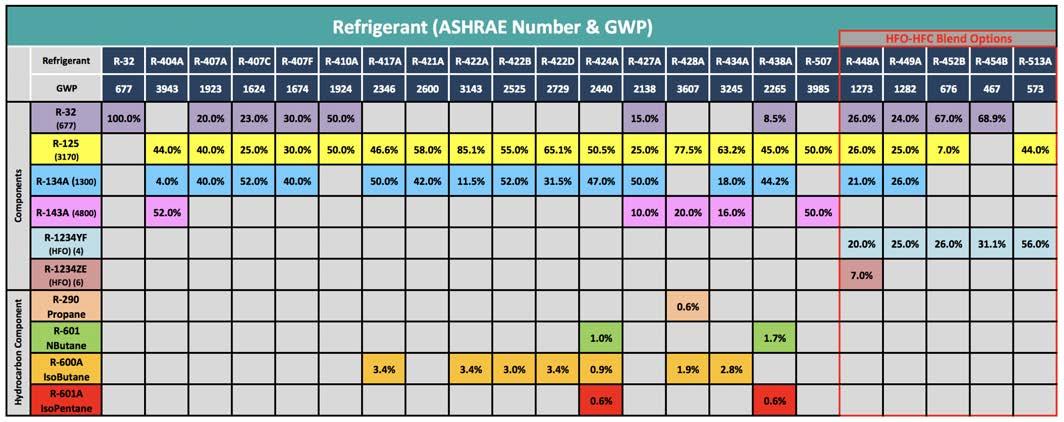
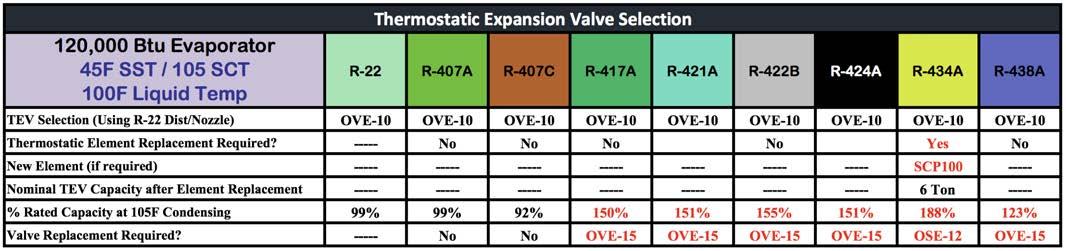
plication. TEV capacity is based on physical dimensions of the valve pin and port, system conditions and thermodynamic properties of the refrigerant.
If the mass flow requirement of the replacement refrigerant is significantly greater than the mass flow requirement for R-22, than the existing R-22 TEV would have insufficient capacity for the replacement refrigerant.
Table 2 shows a Thermostatic Expansion Valve (TEV) selection for a 10-ton AC application with R-22. An OVE-10 was selected, and it is operating at 99 per cent of its rated capacity at the design condition.
The table shows eight R-22 replacements, and how the R-22 TEV selection fares with each of the new refrigerant possibilities.
With R-407A and R-407C having similar mass flow rates to R-22, the original R-22 TEV selection is very suitable for application with both refrigerants. The others on the chart do not fare so well. Each has a greater mass flow requirement than R-22, resulting in the original R-22 TEV being undersized for each. The most notable capacity deficiency is with R-434A. In addition, the manufacturer of R-434A states that their refrigerant requires a TEV element that is compatible with R-502 (R-404A).
Certainly, there is no problem using any of these refrigerants as a replacement for R-22. But the TEV replacement adds cost and complexity to the conversion.
A note regarding chillers with electronic expansion valves (EEVs): while there is no compatibility issue regarding the use of the R-22 EEV with any of these R-22 replacements, it is important to investigate whether the EEV controller was programmed with the ability to operate with the refrigerant you’re planning on using. This might be the determining factor in which refrigerant is chosen. Worst case scenario is that the controller was only programmed to be used with R-22. This would then require replacing or upgrading the controller, or forgoing the conversion.
3) System efficiency with the new refrigerant (compared to R-22): This is often overlooked. However, a refrigerant that has a reduced efficiency compared to R-22 will result
in increased electrical consumption. This should also be a consideration, as operating expenses accrue every month.
In addition to the factors listed above, the following might be secondary factors, which would be considered:
• Pressure-Temperature relationship of the conversion refrigerant
• Has compressor manufacturer evaluated compressor performance and wear with conversion refrigerant
• Oil requirements of the conversion refrigerant
• Environmental concerns (GWP of the conversion refrigerant)
• Price and availability of the conversion refrigerant
Table 3 shows the more common R-22 replacements, showing capacity relative to R-22, mass flow relative to R22, and efficiency relative to R-22 when applied in a comfort cooling application.
Looking over this list of replacements, with the parameters listed, it becomes easier to make an educated choice. For example:
• R-404A shows to have good capacity compared to R-22. However, with a 42 per cent greater mass flow requirement, a TEV replacement will be required. In addition, it has a nine per cent reduction in efficiency.
• R-417A shows to have a good mass flow requirement compared to R-22, meaning that a TEV replacement will not be required. But a 14 per cent capacity loss would likely not be the best choice.
• R-407C show a slight increase in capacity compared to R-22, very close mass flow requirement compared to R-22, and a minor three per cent drop-in efficiency. In addition. R-407C has been out of patent for several years. It is widely distributed and reasonably priced. As such, the industry has seen R-407C as the more common replacement for R-22 in comfort cooling applications.
There is a considerable amount of misinformation regarding the pros and cons of various R-22 replacements. It is best to
read the fine print to have the necessary information to make the best choice for a replacement.
For instance, in referring to Table 1 (Chemical composition of R-22 replacements), these replacements can be categorized in many ways, one important distinction is those refrigerants that have a hydrocarbon component (which allows the refrigerant to be used with mineral oil), and those that do not have a hydrocarbon component (which requires the use of POE).
One refrigerant manufacturer states this in its Conversion Guidelines: A lubricant change may not be required, but POE is always recommended for optimal performance. Confirming oil quality is important. Check the oil for moisture, acidity, and metal shavings or sediments. If the oil does not meet the desired specification, a complete oil change using POE is recommended. Systems with complex piping schemes or receivers could impede proper oil return so adding or changing over to POE is recommended. And oil change to POE is also recommended for systems designed to lubricate compressor bearings by pulling oil from the bottom of the oil sump, such as with Danfoss SM scroll and Trane 3-D compressors.
The fact is the refrigerant in question does not have a hydrocarbon component in its chemical composition. While there “might” be some systems with short and simple piping runs (package AC units) where one could get away with using mineral oil, this practice is not recommended by compressor manufacturers.
Another refrigerant manufacturer states: Because R-**** is a close match for R22 with similar cooling capacity, energy efficiency, pressures & low glide, it is suited for use in new equipment by Original Equipment Manufactures where it has significant advantages over R-****. Owing to the fact that R-**** is compatible with
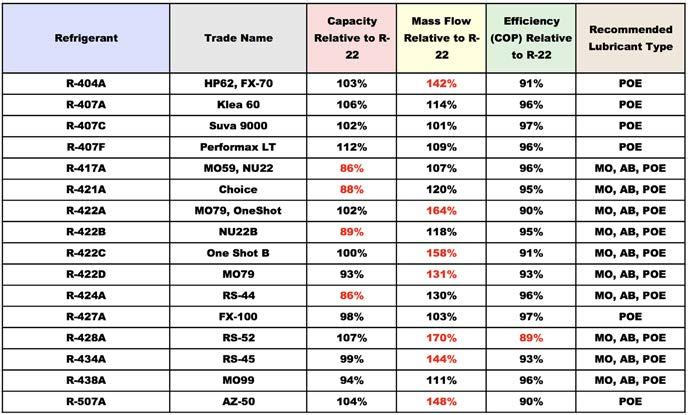
mineral & alkylbenzene lubricants, it is suitable for use as a Drop-in replacement for R22 in systems which contain an expansion device.
From this marketing blurb, one would think they had stumbled upon the Holy Grail of R-22 replacements but for the fine print: For the same duty R-**** has a higher volume flow rate than R22 which may require OEMs to increase appropriately the sizes of liquid lines to optimize performance, notably the following:
(1) Capillary tube: the length may need to be decreased, the diameter increased or a combination of both.
(2) Expansion valve: recommendation is to that the TX valve is sized to accommodate a mass flow 40% greater than R22. The bulb in a TXV typically used in a R502 system should be used.
(3) Liquid line: the diameter may need to be increased. On large systems with remote air-cooled condensers the liquid return line from the outlet of the condenser to the inlet of the receiver may also need to be modified.
However, OEMs should also note that the liquid viscosity of R-**** is significantly lower than that of R22 (see physical properties table) so that only modest changes to the liquid lines and expansion devices may be required.
To optimize system performance with R-****, evaporator and/or condenser capacities may need to be altered in some cases. The addition of a liquid/suction heat exchanger may also improve overall performance.
In systems where oil return could be an area of potential concern, e.g. containing a liquid receiver, flooded evaporators or long & complex pipelines, the replacement of up to 25% of the oil charge with a POE is recommended starting with an initial 10% followed by increments of 5% until the oil level stabilizes & returns to normal.
No additional commentary besides the red highlights is required, only to point out that with all of the “which may require” warnings, this particular refrigerant is anything other than a drop-in replacement for R-22.
Do your own research and read the fine print.<>

Dave Demma holds a degree in refrigeration engineering and worked as a journeyman refrigeration technician before moving into the manufacturing sector where he regularly trains contractor and engineering groups. He can be reached at ddemma@uri.com.
Cannabis
legalization presents challenges new and old for employers, but leveraging legal tools can make for a smooth transition.
BY DIANE LARANJA
Effective October 17, 2018, recreational cannabis became legal in Canada. It is not surprising many employers fear the cognitive and psychomotor effects its use will present in the workplace.
Cannabis is a generally impairing substance. Its effects can include diminished cognitive functions, such as memory loss, confusion and loss of concentration, as well as diminished psychomotor abilities, such as delayed reactions or response time. These effects can significantly impact an individual’s ability to work safely and effectively.
The effects of cannabis use are problematic given an employer is obligated to take every precaution reasonable in the circumstances to protect the health and safety of a worker. Occupational health and safety legislation in British Columbia explicitly requires a worker to not be impaired at work, and Yukon statutorily requires an employer to not allow workers to be in the workplace while impaired.
Although there are no statutory provisions in the other provinces and territories’ occupational health and safety legislation that specifically address substance use in the workplace, it is arguably incumbent on an employer to implement an appropriate policy to deal with cannabis (and other substance use) as part of its due diligence requirements. In all jurisdictions, an employer should therefore take every reasonable precaution to minimize the risks caused by workers who are impaired or potentially impaired at work by cannabis.
Workers should also be adequately informed, instructed, and supervised on this policy.
An addiction to or medical authorization to use cannabis is protected by applicable human rights legislation. Because of an employer’s occupational health and safety obligations, many are inclined to enforce a “zero-tolerance” policy for cannabis use. It should be noted, however, that an employee’s reported use of cannabis may trigger an employer’s duty to accommodate pursuant to applicable human rights legislation.
Medicinal use of cannabis has been authorized since as early as 2001. Since this time, physicians have been permit-
ted to authorize patients to use cannabis for a variety of therapeutic or medicinal purposes. Further, an addiction to cannabis is recognized as a protected disability under human rights legislation. These human rights protections must be considered alongside an employer’s health and safety obligations.
Accommodating an employee’s cannabis use presents a wide range of considerations and concerns. However, accommodation is not a limitless exercise. An employer is not obligated to incur undue hardship in order to accommodate an employee’s disability, which includes undue health and safety risks. Instead of an illusory concern, an employer must be prepared to establish that there are demonstrable health and safety concerns resulting from the specific employee’s cannabis use that constitute undue hardship. So in order to assess the potential health and safety risks that cannabis use may present, an employer is entitled to know (and should know) the limitations that the employee’s disability or authorized cannabis use may have on his or her ability to work safely and effectively. This includes information regarding the dosage, tetrahydrocannabinol (THC) concentration level, timing and method of consumption in order to determine the potential impairing effects.
Employers increasingly view drug testing as an effective tool to detect and combat problematic cannabis use by employees. In some cases, drug testing can certainly serve this important objective.
Across Canada, however, testing for cannabis raises difficult privacy and human rights issues that ought to be considered. Drug testing remains only justified in safety-sensitive workplaces and only in certain circumstances.
An employer may demand a drug test if: (a) the employer has reason to believe that an employee is impaired at work, (b) the employee was involved in an accident or “near-miss,” and the employer’s preliminary investigation does not identify an obvious reason for the incident (such as a mechanical failure), or (c) the employer and employee develop an appropriate returnto-work protocol after the employee’s rehabilitative efforts.
Random drug and alcohol testing is the most controversial form of testing. In order to justify random drug testing, the
employer must first demonstrate that there is a general substance use problem in the workplace and that the random drug testing will adequately address this workplace issue.
An employer should ensure that the method of testing properly detects impairment or likely impairment. If an employer is unable to establish that an employee is actually impaired while at work with the testing method that it implemented, then an adjudicator may not find that the test was justifiable or that the employee committed any wrongdoing.
Although it remains limited, the science and capability in detecting impairment when it comes to cannabis use continues to improve. Employers should work with the appropriate providers to ensure they are using the proper and updated forms of testing.
With its legalization, an employer can–and is expected to–limit or restrict the use of cannabis in the workplace. For example, the Ontario Smoke-Free Ontario Act, 2017, which is currently paused for further review, would prohibit individuals from smoking or holding lighted medical cannabis in a number of places, including in an “enclosed workplace” or “enclosed public place.” It would also require an employer to:
• ensure compliance with the restrictions on smoking or holding lighted medical cannabis in enclosed spaces;
• provide notice to employees of the restrictions;
• post signs throughout the workplace;
• ensure that there are no ashtrays or similar equipment in the enclosed workplace or area (other than a vehicle in which the manufacturer has installed the ashtray); and
• ensure that employees or persons who do not comply with these requirements are removed from the space Corporations who fail to abide by these obligations may be fined up to $100,000 for a first offence, and up to $300,000 for subsequent offences. Individuals may also be fined up to $1,000 for the first offence, and up to $5,000 for subsequent offences.
The Ontario Cannabis Act, 2017, which is also paused for further review, would prohibit individuals from consuming recreational cannabis in a workplace within the meaning of the Occupational Health and Safety Act (OHSA) (as well as other specified locations, such as a public place). The OHSA’s definition of a “workplace” includes “any land, premises, location, or thing at, upon, in or near which a worker works.”
Another example is found in Alberta, where its Bill 26: An Act to Control and Regulate Cannabis, which will soon be brought into force, will prohibit smoking cannabis in any location where smoking tobacco is also prohibited. This would include workplaces.
There is also British Columbia’s Cannabis Control and
Licensing Act, which is currently in its third reading, and will prohibit smoking and vaping cannabis in a “fully or substantially enclosed” workplace. Nova Scotia and New Brunswick have each enacted their own Cannabis Control Act. Both state that smoking cannabis is prohibited in a place that is set out and defined in the respective province’s Smoke-free Places Act for tobacco.
It can be seen and expected that after recreational cannabis is legalized, an individual cannot consume recreational cannabis in the workplace. It should be noted for the reasons above, however, that if an employee requires medical cannabis, the employer should consider their obligation to accommodate a disability under the applicable human rights legislation.
There can be no doubt that the legalization of cannabis will bring about a slew of challenges for employers.
In order to prepare for these challenges, employers should consider creating or appropriately revising written drug use policies. The objective of a drug (and alcohol) policy should be to educate workers, including supervisors and managers, and to clearly outline how the use of cannabis will be addressed.
A drug (and alcohol) policy should:
• Identify the objective of the policy and acknowledge your and an employee’s obligations under the applicable human rights legislation.
• Outline clear expectations regarding fitness for duty, workplace use, possession, and sale of impairing substances. This includes what a worker is expected to do and what a worker is prohibited from doing.
• Inform employees of any investigations or justifiable drug testing that may occur and in what circumstances.
• Provide information on support resources, such as access to an employee assistance program, and accommodations that are available to employees with a disability. This should include the contact information of a designated representative who will handle requests or needs for accommodation.
• Advise employees of the disciplinary consequences for violating the drug (and alcohol) policy and workplace rules regarding substance use in the workplace.
Developing appropriate workplace drug use policies, and the legal tools available to employers will help to maintain safe workplaces moving forward. <>
Diane Laranja is a lawyer with Filion Wakely Thorup Angeletti LLP, which is a management-side employment and labour law firm in Toronto, Ontario. Laranja can be contacted for more information or assistance at 416.408.5565 or dlaranja@filion.on.ca.
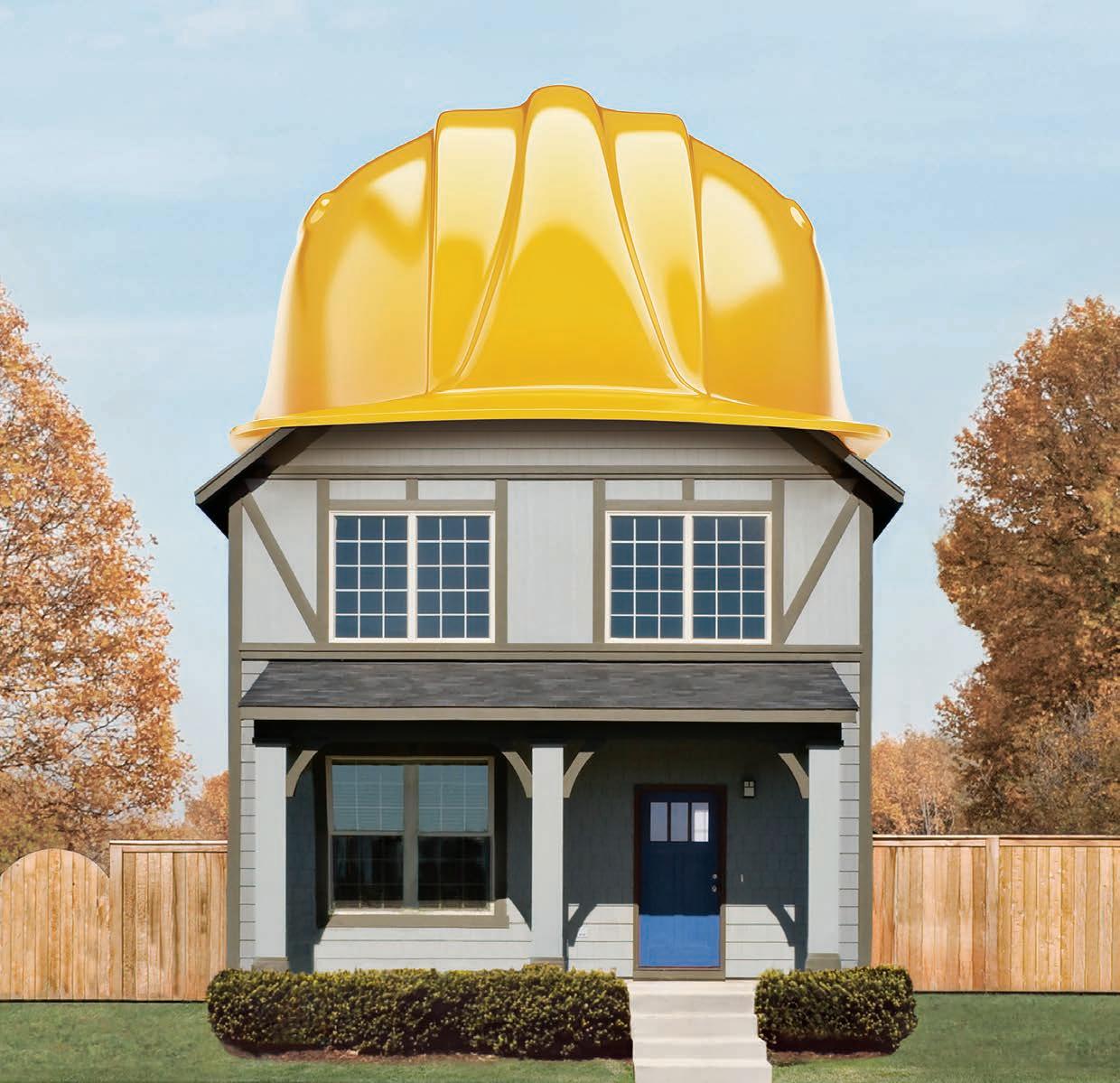
EDUCATIONAL OPPORTUNITIES ACROSS CANADA
The Heating, Refrigeration and Air Conditioning Institute of Canada (HRAI) offers a variety of residential and commercial courses. The Small Commercial Heat Loss & Heat Gain Calculations course is developed for HVAC technicians and designers. This three-day course instructs participants in proper calculation of small commercial heat gains and heat losses, and applies to buildings of up to three storeys and 600 sq. metres per storey. For scheduling opportunities, tel. 800.267.2231 ext. 237, or e-mail amantei@hrai.ca. www.hrai.ca
CEC’s National Seminar Program offers over 160 seminars. Areas of interest run from supervisory training, estimation, project management, commissioning, safety, leadership and communication, productivity, business management, and service, to name a few. Where applicable the courses have been Gold Seal Accredited. The majority of listed programs are ½ day to two days in duration. To determine if a seminar has been scheduled in your area, tel. 613.232.5169. www.constructioneducation.ca
The Canadian Hydronics Council (CHC) has partnered with NAIT and British Columbia Institute of Technology to provide course blocks toward CHC certification for hydronic system designers and installers. At NAIT students can register for online or paper-based learning and have nine months to complete each block. www.ciph.com
TECA’s Quality First training programs are developed by the industry, for the industry, setting minimum standards for the residential and light
commercial heating, ventilating and cooling trade in BC. Courses provide contractors with the information they need to install equipment that operates safely and comfortably at rated efficiencies. www.teca.ca
Since 1997, over 30,000 representatives of industrial, commercial and institutional (ICI) organizations have enrolled in the Dollars to $ense energy management workshops. In 2016, the material was completely remodeled and updated; it is now presented in 30 modules, which can easily be used as building blocks for organizations that have limited resources or that wish to focus on specific topics. www.cietcanada.com
Under agreement with AGSHP, HRAI will be providing IGSHPA training courses for geothermal heat pump system designers and installers in Ontario. The courses are in support of the recently established GreenON Low Carbon Technologies Incentive Program requirements, using IGSHPA certified trainers. The IGSPHA Accredited Geothermal Installer course covers ground-source heat pumps systems, while IGSPHA Certified Residential Geothermal Designer course will train attendees on how to properly design a residential geothermal heat pump. For details contact Angie Mantei at 800.267.2231, ext. 237 or e-mail amantei@hrai.ca. www.hrai.ca
Canada Green Building Council is offering this four-hour course as part of its Green Professional Skills Training (GPRO) program. It teaches the basics of sustainability and provides an overview of the essential strategies and work practices that make buildings more efficient. www.cagbc.org
It is an commonly used in harvesting is making range of below your areas) to this water to rainwater; and rainwater for incorporated in and everything from locations). that local
Is this age old practice an area of potential growth for contractors? BY
ROBERT WATERS
Canada is a country with vast fresh water resources. In most areas of Canada you are never far from a lake, river or underground aquifer. The Great Lakes alone are the largest system of fresh surface water on the earth, holding roughly 18 per cent of the world’s supply.
With all of this fresh water close at hand why would anyone in Canada need to collect rainwater? It turns out there are many compelling reasons to install a rainwater harvesting system that have to do with both environmental protection and smart economics. The market for rainwater harvesting systems in Canada is growing steadily, especially in certain regions across the country that now experience water scarcity on a seasonal or ongoing basis.
Not all areas of the world are as blessed with water as Canada, and the rainwater harvesting industry is very well established in other parts of the world. The purpose of a rainwater harvesting system is to collect rain and store it for later use and it is an ancient practice that goes back thousands of years.
Australia, Germany, Japan and the southern USA are just a few examples of areas with very strong rainwater harvesting markets, utilizing new modern methods and materials. In Queensland, Australia, rainwater harvesting is mandated for all new homes, and the State of Texas now requires installations for large government buildings.
Local harvesting of rainwater has several environmental benefits. It is less
Is rainwater harvesting a common practice?
energy intensive than desalination and water recycling, and reduces the energy consumption and GHG emissions linked with treating and pumping water from a municipal water plant. Rainwater is a renewable and sustainable water source that is almost pH neutral, chlorine free, naturally soft with no minerals, and is often cleaner than groundwater.
Rainwater harvesting is becoming an accepted practice in a number of countries for a variety of reasons. In Canada, the 2010 National Plumbing Code of Canada permits the use of rainwater for toilet and urinal flushing as well as subsurface irrigation.4
Internationally, many jurisdictions have already widely accepted rainwater harvesting practises. In South Australia, almost 50 per cent of the population lives in houses equipped with a rainwater tank. Rainwater harvesting is mandated for new homes in Queensland. In the southwestern United States, rainwater collection is common, and the State of Texas requires rainwater harvesting for large government buildings. In Germany, Belgium and Japan, rainwater collection is encouraged to reduce runoff going into the stormwater infrastructure. The following table provides a brief look at permitted provincial and international rainwater uses.
4. Depending on the level of treatment, rainwater can be used for all indoor and outdoor applications. Further or more limited uses may be permitted in your jurisdiction and should be confirmed prior to system installation.
In some older urban areas the collection of rainwater can help to reduce the potential for basement flooding by decreasing the amount of rainwater leaving the property and entering storm sewers.
There are also big economic benefits to installing a rainwater harvesting system. By collecting and using water on site, there can be substantial reductions in municipal water and sewage charges. In some cases using rainwater can allow building owners to avoid watering bans in times of drought.
Rainwater is most commonly used for non-potable applications. Indoors this will be for toilet and urinal flushing and laundry, while outdoors it will be used for irrigation and gardening. Rainwater can also be used as potable drinking water, but this use will depend on whether it is permitted by local plumbing codes. Additional water treatment equipment, such as fine particle filters and UV sterilizers, will need to be added to ensure water is safe to drink, and that it does not smell or have a bad taste.
According to Environment Canada, “Less than three per cent of municipally-treated water is actually used for drinking. The rest goes down the drain, down the toilet, or on our gardens.” This shows there is a huge potential for non-potable rainwater applications.
The rainwater harvesting industry in
Canada consists of two primary market segments: residential systems and commercial industrial systems. A system can be as simple as a rainbarrel placed below a downspout, up to large-scale systems with massive underground storage tanks, distribution systems and water treatment systems.
In Canada there is a rainwater industry association called the Canadian Association for Rainwater Management (CANARM). CANARM is made up of over 200 individuals, including manufacturers, installers, designers and regulators.
Benjamin Morrison works for Cleanflo Water Technologies and he is the current president of CANARM. According to Morrison, the commercial/industrial market in Canada is growing rapidly. Commercial systems are now becoming very economically attractive. This has a lot to do with changing regulations regarding water, sewage and storm water management being introduced in many dense urban areas.
“Municipalities used to bury the cost of water in the tax base, but this is no longer the case in most areas,” says Morrison. “Almost all urban water supplies in Canada are now metered, which has led to water and sewage costs going up significantly.”
In some areas storm water must be managed on-site, which also adds costs. Other factors driving growth in rainwater systems include urban sprawl in many areas, which is leaving many municipalities scrambling to supply adequate amounts of potable water while dealing with an aging infrastructure that cannot keep up with demand.
According to Morrison, all of these factors have led to commercial systems being in “the sweet spot” for rainwater harvesting systems. “Large commercial systems provide the biggest return on investment as they typically have large roof areas combined with large non-po -
Post-storage treatment
table water demands,” notes Morrison.
Rainwater is relatively clean; however, its quality can be affected by environmental pollutants, such as: lead and cadmium from industrial activities (smelters, refineries); pesticides from agricultural activities; hydrocarbons from freeways; contaminants from the catchment surface (roofing) materials; and wind-deposited debris, leaf litter and animal waste on the catchment surface.
Many systems are being installed to service primarily non-potable toilet flushing loads and the savings can be very significant. There can be thousands of dollars of savings on a company’s water and sewer bill if all of the water normally used for toilet flushing is provided by a rainwater harvesting system. This leads to systems that have very attractive paybacks.
A rainwater harvesting system consists of the following basic components: a collection surface, distribution piping, pre-filters, a storage tank and a distribution system. Almost any type of roofing material can be used to collect the rain, however some types of roof material cannot be utilized if the water is to be used for potable use. Metal roofing is a good choice due to its reduced water-loss potential and longevity.
The rainwater will be collected by the eavestrough and downspouts and delivered by a properly-sized piping network to the storage tank. The pipe must be a UV-resistant material and must be sloped properly. Due to the po -
tential for contaminants such as leaves, twigs, dust, and pollen getting into the rainwater, pre-filtration prior to storing the water is essential. Depending on the project, the pre-filtration system could consist of gutter guards, downspout filters, first flush devices and pre-tank filters.
Rainwater storage tanks can be located above or below ground. Common tank materials include: polyethylene or polypropylene, concrete, fibreglass, or galvanized metal with a liner. The tank size can range from hundreds of litres to tens of thousands of litres. The size will depend on many factors which include: the size of the roof area, the local annual rainfall, the size of the water load, the tank’s location, and whether the system is seasonal or year round. Plastic tanks are most common for residential above ground installations for seasonal applications. Above ground tanks are popular when the water will be used for irrigation systems that will be emptied for the winter, or systems that will be installed entirely indoors. Concrete tanks are typical for below-ground systems and are commonly used for year round systems and
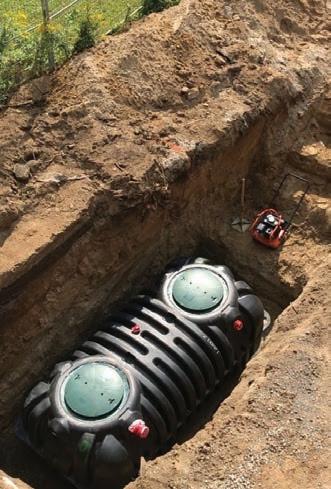
larger commercial systems.
Tanks should always have an allowance for overflow during times of heavy rain or low water usage. In some cases the tank may also be equipped with an automatic municipal water feed to topup the tank during times of low rainfall or overconsumption.
To distribute the collected rainwater, a pump, and sometimes a pressure tank, is required to pressurize the water up to normal household pressure, and move the rainwater to where it is needed. If the water is going to be used for potable use, then additional water treatment equipment would also be required.
The 2010 National Plumbing Code of Canada permits the use of rainwater for toilet flushing as well as irrigation. There are some jurisdictions, such as Guelph, ON and Nanaimo, BC that are actively promoting rainwater harvesting, and both of these cities have developed best practices guidebooks. Guelph is one of the only jurisdictions that currently has an incentive program for rainwater harvesting systems. The incentive provides
$0.50 per litre of tank storage up to a maximum of $2000.
Many jurisdictions have been slow to embrace rainwater systems due to the lack of a comprehensive rainwater standard. Code officials responsible for inspecting these systems have cited a need for more detailed design parameters to ensure systems are designed and installed in a way that protects the health and safety of users.
These concerns may not be the case much longer as a new comprehensive standard, CSA B805-18/ICC 805-2018 Rainwater harvesting systems was released in 2017. This standard applies to the design, materials, installation and operation of rainwater harvesting systems for potable and non-potable applications. CSA B805 will make it easier for jurisdictions to confidently accept and approve rainwater systems on a much wider scale.
Morrison is excited about the standard, as he feels it will help tremendously in increasing the awareness and confidence in rainwater systems. He feels there is a good chance that CSA B805 will be adopted in the 2020 National Plumbing Code of Canada.
Like most new industries the rainwater industry is also challenged with a poor public awareness about the benefits, a lack of product knowledge about what equipment is available and problems with getting systems designed and installed properly. From my perspective, this seems very similar to the challenges faced by the radiant floor heating business in the late 1980s, and the current problems facing the solar thermal industry.
Morrison feels CANARM can help to overcome these challenges. “CANARM wants to pick up the gap in rainwater system training, and provide designers and in-
stallers the knowledge that they need to be successful,” says Morrison. He feels that the rainwater harvesting business requires a multi-disciplinary skill set.
“Proper design and installation requires knowledge of hydrology, mechanical and structural engineering, plumbing and electrical, instrumentation and controls skills and water treatment knowledge,” notes Morrison. With this array of knowledge requirements, he is seeing some specialist companies in the U.S. and Canada tackling this market by providing a sole source design/build rainwater system.
You just have to read the news lately to see that water issues are a growing concern in many areas of Canada. Droughts, forest fires and ground water protection have been dominating the news headlines and will continue to be pressing regional issues.
Southern Ontario, which is highly dependent on groundwater supplies, has seen an expanding population put increased pressure on this resource. This region has also seen large increases in water and sewer charges, and added storm water regulations in recent years. These factors are driving interest in rainwater harvesting systems in this area, and bode well for the future of this industry.
Will it be long before we see rainwater harvesting systems become mandatory in some areas? Only time and the changing climate hold the answer to that question. <>

Robert Waters is president of Solar Water Services Inc., which provides training, education and support services to the hydronic industry. He has over 30 years experience in hydronic and solar water heating. He can be reached at solwatservices@gmail.com.
BY MIKE MILLER
Controls play an integral role in ensuring today’s hydronic radiant systems operate as energy efficiently as possible while still providing ultimate comfort to the consumer. Every system should, at the very least, be employed using outdoor weather compensating controllers or even better yet, controllers that will also be able to increase efficiency and comfort by adding indoor temperature feedback into the control system’s algorithm. This technology has been around for over two decades. If you want a refresher on this topic, check out an article I wrote in HPAC January/February 2012 (see www.hpacmag.com/digitalarchives).
In addition to the basics, there are other things to consider to ensure optimal radiant system performance. First and foremost, of course, would be a proper heat load analysis of the building and zones within. All radiant manufacturers have software available so you can do the analysis yourself, have it provided by a distributor, or most
manufacturers offer heat load analysis as a paid service.
The heat load analysis will also provide you with a suggested number of loops required per zone, the individual estimated loop lengths and the desired flow through each of those loops. An example of flow requirements in a very small residential structure can be seen in Figure 1.
Balancing the loops for flow based on loop lengths is a very important practice to eliminate warm and cold spots on the floor surface. Perhaps you have seen radiant installations where warm and cold spots were a reported issue? If the tubing was installed with even spacing throughout, more often than not, the major contributor for this complaint is the lack of balanced flow through the loops. Best practice would suggest that each loop is balanced automatically if all loop lengths are kept the same. While this may be doable on paper, in practice, it is unlikely to be attainable unless it is a large, square or rectangular commercial structure.
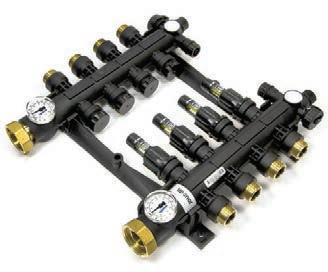
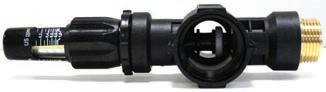
Figure 2 (top) Engineered polymer manifold with balancing valves with flow indicators as part of the manifold. (bottom) Single loop balancing valve with flow indicator.
Applications with single manifold for zoning using loop actuators
In order for the loops to be balanced in a non-perfect (on paper) system or field installation where a single manifold is used for zoning using loop actuators, there are two control options:
1. Use manufacturer recommended balancing valves
Most radiant manifold manufacturers provide a means of loop balancing right at the manifold and for each loop connected. The means of balancing can be right inside of the manifold itself, either found on the supply header with an adjustable stem adjusted by means of an allen key, or through added balancing valves that often come with a flow indicator as seen in Figure 2
Another option is to add an external balancing valve that is typically installed on the supply header of the manifold on each loop. Manifold loop actuators are then added to the return connections for each loop to allow for the loops to be split into different zones.
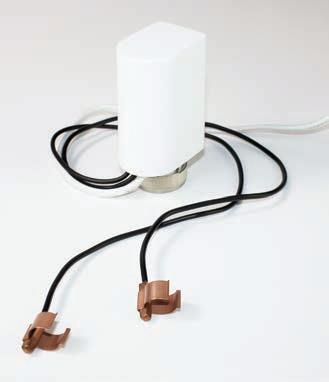
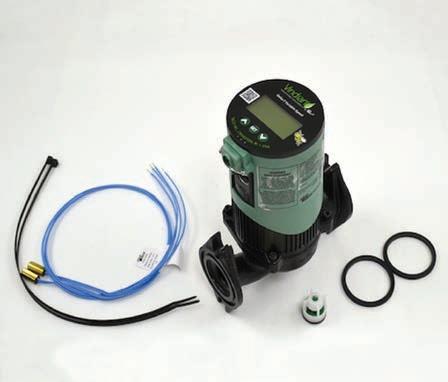
There is a manifold loop actuator available now with a set of supply and return sensors that can be strapped to the supply and return tubing for each loop. See Figure 3 for an example. The loop actuator comes pre-programmed with a 7C differential that will allow the loop to be modulated to maintain that deltaT. Just like any other actuator, a thermostat calls it into operation when the zone is calling, but rather than to just go fully open or fully closed, upon a call for heat, this actuator will modulate to maintain the deltaT, thus automatically balancing each loop to the right amount of flow needed. This kind of technology pretty much eliminates all of the guesswork whereas in option 1, the flow rate is an ‘estimate’ based on the calculated ‘estimated’ loop lengths. Granted, being close to the estimate will suffice most of the time.
Both of these options above work well with manifolds used for zoning of multiple rooms connected to the same mani-
fold. But what if a complete manifold is used to supply heat to a single zone?
Option 1 will still be required and desired, unless all loop lengths are equal or pretty close to that. It is still an option to increase efficiency of the radiant system by controlling the deltaT across the manifold itself. This can be done by zoning with pumps that have a supply and return sensor and will modulate to maintain a desired deltaT across the manifold, as shown in Figure 4. The mechanical for that pump is shown in Figure 5. You could have multiple manifolds in a system–this setup would be duplicated for each.
If a pump does not have the control logic and capability within, an external deltaT controller can be added that will control the speed of the pump either through a modulating signal of 0-10Vdc, or, by changing the frequency and voltage provided to it, using a triac.
In larger commercial applications where multiple manifolds are used for the
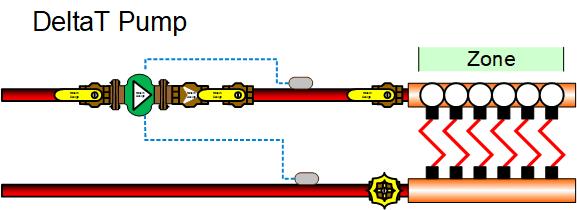
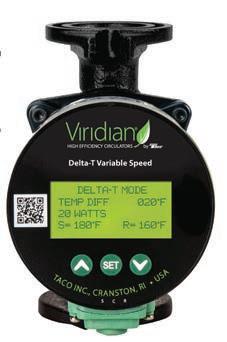
same zone and where the flow rate required is greater than what can be achieved with a pump with the modulating logic built in as in the last example, modulating for each manifold can be achieved by installing larger two-way modulating valves on the supply to each of the manifolds. Each would have its own deltaT Controller with supply and return sensors. Then a larger system pump could be used that modulates based on Pressure Differential (deltaP). Some light commercial pumps have this technology already built in and in many cases come with ECM motor technology.
Larger commercial pumps utilize drives that come with external pressure differential sensors, or more modern pumps nowadays operate with a technology where deltaP operation is achieved without the use of external deltaP sensors (see HPAC February 2015 for more details on this technology).
Aside from the wired technology discussed here, wireless has been around for some time and major advances have been realized. It is expected to replace wired radiant slab controls in the not too distant future. Keep an eye out for an article focusing on wireless technology available for radiant systems. <>

Mike Miller is director of sales, commercial building services, Canada with Taco Inc. and a past chair of the Canadian Hydronics Council (CHC). He can be reached at hydronicsmike@tacocomfort.com.
November 7-8
The Calgary tradeshow will feature a full conference program and product showcase. It will be co-located with BUILDEX Calgary and the Canadian Hydronics Conference. www.ciphexwest.ca
November 14
To be held at the Hilton Mississauga in Mississauga, ON, the conference is intended for the solar energy industry www.solarontarioconference.ca
November 28-30
The 30th anniversary of the Buildings Show will be held at the Metro Toronto Convention Centre in Toronto, ON. www.thebuildingsshow.com
ASHRAE Winter Conference
January 12-16
The 2019 ASHRAE Winter Conference will be held in conjunction with the AHR Expo at the Georgia World Congress Center in Atlanta, GA. www.ashrae.org
CCOHS Forum: The Changing World of Work
March 5-6
This national event will be held in Winnipeg, MB at Delta Hotels by Marriott. www.ccohs.ca
November 7-8
With a focus on Partnering for Innovation, the 2018 conference will be held at the Vancouver Convention Centre in Vancouver, BC. www.passivehousecanada.com
November 11-13
AHRI will hold its annual meeting at the JW Marriott Tuscon Starr Pass Resort and Spa in Tuscon, AZ. www.ahrinet.org
December 1-4
The HVAC/R conference will be held at the JW Marriott Austin in Austin, TX. www.hardinet.org
Supporting Women in Trades Conference
November 7-8
The Canadian Apprenticeship Forum inaugural Supporting Women in Trades Conference will be held at the Halifax Marriott Harbourfront in Halifax, NS. www.caf-fca.org
Greenbuild Conference and Expo
November 14-16
The green building event will take place at McCormick Place in Chicago, IL. www.greenbuild.usgbc.org
and Energy
December 3-5
To be held at the Hyatt Centric French Quarter in New Orleans, LA, the event will showcase new ACEEE research. www.aceee.org/conferences/2018/ chee
AHR Expo
January 14-16
AHR Expo returns to the Georgia World Congress Center in Atlanta, GA for its 2019 show. www.ahrexpo.com
ISH
March 11-15
The ISH trade fair will be held at the Messe Frankfurt in Frankfurt, Germany. www.ish.messefrankfurt.com
National HVAC/R Educators and Trainers Conference
March 3-5
The conference for HVAC/R instructors will take place at the South Point Hotel in Las Vegas, NV. www.escogroup.com
SMACNA Annual Convention
October 20-23
The convention will be held at the JW Marriott Austin in Austin, TX. www.smacna.org
This highly successful trade show and conference will take place on September 19, 2019 at the International Centre in Mississauga, ON. Stay tuned for more details. Check modernhydronicssummit.com for updates.








1 Professionally-installed aftermarket accessories and alterations shown. Installations or alterations to the original equipment vehicle (or chassis) as manufactured and assembled by General Motors are not covered by this warranty. The body company, assembler, or equipment installer, is solely responsible for warranties on the body or equipment and any alterations to any of the parts, components, systems, or assemblies installed by GM. Examples include, but are not limited to, special body installation or conversion (such as recreational vehicles), the installation of any non-GM part, cutting, welding or the disconnecting of original equipment vehicle or chassis parts and components, extension of the wheelbase, suspension and driveline modifi cations and axle additions. General Motors is not responsible for the safety or quality of design features, materials, or workmanship of any alterations by such suppliers.
2 Services and connectivity vary by model, conditions as well as geographical and technical restrictions. Requires active OnStar service and data plan. Data plans provided by AT&T or its local service provider. Not compatible with all devices. Go to www.gmtotalconnect.ca to fi nd out which phones are compatible with the vehicle. Bluetooth is a registered trademark of Bluetooth SIG, Inc. 3 Whichever comes fi rst. Coverage begins on the date the vehicle is delivered and ends at the expiration of the applicable coverage period. Your vehicle’s Warranty Booklet contains conditions, limitations, restrictions and exclusions and coverage periods pertaining to the warranties and the Owner’s Manual contains important information which may impact you maintaining your warranties. See your Warranty Booklet and Owner’s Manual for details. 4 Read the vehicle’s owner’s manual for more important feature limitations and information. 5 Visit onstar.ca for vehicle availability, coverage maps, details and system limitations. Services and connectivity vary by model and conditions as well as geographical and technical restrictions. 4G LTE service available in select markets. Requires active connected vehicle services and a data