SMART BUILDINGS COLLABORATIVE APPROACH TO CONSTRUCTION


SMART BUILDINGS COLLABORATIVE APPROACH TO CONSTRUCTION
OPTIMIZING CLIENT COMFORT THIS SUMMER MAINTENANCE CALLS
SPRING START-UPS IN A COVID WORLD 2021 SERVICE VEHICLE REPORT EFFICIENCY, POWER AND CONVENIENCE


12
WHAT ABOUT COOLING?
Every hydronics professional should be ready with an answer to this longstanding question.
By John Siegenthaler
18
HVAC COOL CUSTOMERS
Follow these steps to maintain the optimal performance of your residential clients’ cooling equipment.
By Ian McTeer
24
HVAC

SPRING START-UPS IN A COVID WORLD
The third episode of 30 Mechanical Minutes features a discussion on HVAC maintenance calls in 2021 with HPAC’s Ian McTeer and Gary McCreadie from HVAC Know It All.
By Doug Picklyk
27
AN OUNCE OF PREVENTION
The enduring value of maintenance programs for the refrigeration cycle. By Dave Demma


38
SMART BUILDINGS: AT THE INFLECTION POINT
Market segment offers general contractors and subtrades opportunities for growth and a new, collaborative approach.
By David Kennedy
6
8 NEWS
Net Zero community coming to the Ottawa area will include a district energy
30
HEAT PUMPS
BUILDING A CASE FOR HEAT PUMPS IN COMMERCIAL HEATING
Recent compressor technology innovations are driving sustainability benefits for heat pumps in largescale operations.
By Drew Turner
50
PLUMBING
62
44
DIGITIZING HEALTHCARE DELIVERY
The new Cortellucci Vaughan Hospital provides a case study in collaboration and smart construction.
By Doug Picklyk
56
SERVICE VEHICLE REPORT E-VOLUTION
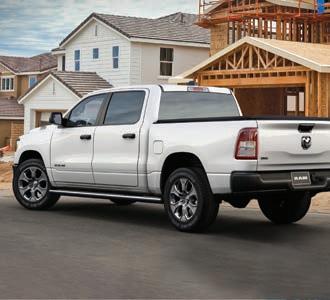
Despite more talk about electric vehicles, for now service truck and van updates in 2021 focus more on fuel efficiency and convenience features.
By Jil McIntosh
PERSPECTIVES ON PIPING
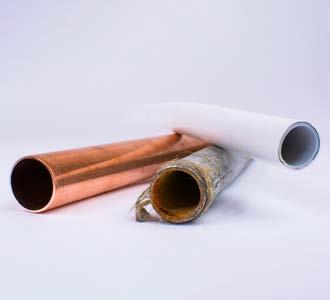
Tracing back to the history of the trade, piping materials have evolved and while many materials still stand the test of time progress has led to a broader range of residential solutions.
By Steve Goldie
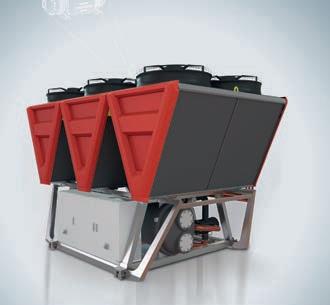




A revolutionary water heating system design and application approach that features greater BTU input for quick reaction, an optimized storage buffer for extra power when needed, the bene t of high water turnover, and exclusive duplex stainless steel AquaPLEX® construction for unmatched performance and longevity. Learn more about PVI’s Dynamic Water Heaters at pvi.com.






OptiSize® will help you select an optimally-sized water heater for your next project
IN WHAT COULD BE SEEN AS A WIN FOR THE ENTIRE PLUMBING AND HVAC INDUSTRY, on April 19th the federal government unveiled its first budget in over two years and included programs that address skilled trade employment and investments in energy efficienct technology. With COVID-19 cases rising nationwide, the Feds acknowledge the country needs to overcome the pandemic first and then focus on rebuilding stronger and smarter.
On the employment front, the budget includes $470 million over three years to establish a new Apprenticeship Service. The Service would help 55,000 first year apprentices in construction and manufacturing Red Seal trades connect with small and medium-sized employers.
Employers would be eligible to receive up to $5,000 for all first-year apprenticeship opportunities to pay for upfront costs, doubled to $10,000 for employers who hire people from underrepresented groups.
The government will also spend $960 million over three years towards a new Sectoral Workforce Solutions Program to fund training in areas where employers are looking for skilled workers.
In addition, Budget 2021 will provide $4.4 billion to the Canada Mortgage and Housing Corp. to help homeowners complete deep home retrofits through interest-free loans of up to $40,000.
In conversations I’ve had with the owners of small HVAC service outfits, any incentives that help drive home-owner investment in new high-efficiency equipment is a good thing, and enlarging the pool of workers in the trades is always number one or two on the list of wants.
Two other victories I’d like to shine a light on are the winners of this magazine’s first ever Sweet Heat contest. Launched in early December last year, the installation contest called on hydronic contractors from across Canada to share photos of recent projects and explain the challenges and creative solutions they used. With 31 entries received, the contest was divided into two categories: commercial and residential.
The final judging was performed by HPAC writers and hydronics industry experts John Siegenthaler and Robert Bean.
The winners and first-runners-up were announced during the final session of the 2021 Modern Hydronics Summit, held online March 30 and 31.
Congratulations to Riverdale Plumbing in Toronto for taking first place in the residential category for a large house project in Toronto, and to the runner-up, Denrite Mechanical of Sturgeon County, Alta.
Grand Mechanical Solutions of Brantford, Ont. was the runner-up in the commercial category, and the winner was Rambow Mechanical of Kelowna, B.C. for a residence building at the University of British Columbia Okanagan campus. Profiles of these two winners and more insight into their winning projects will appear in the next issue of Modern Hydronics, found within the August 2021 issue of HPAC.
These winning entries are prime examples of building better and smarter. With the aid of new federal financial incentives and a growing workforce, we anticipate an even greater range of contest entries in years to come. <>
Doug Picklyk, Editor
Reader Service
Print and digital subscription inquiries or changes, please contact
Urszula Grzyb, Audience Development Manager
Tel: (416) 510-5180
Fax: (416) 510-6875
Email: ugrzyb@annexbusinessmedia.com
Mail: 111 Gordon Baker Rd., Suite 400, Toronto, ON M2H 3R1
EDITOR
ASSOCIATE
PUBLISHER
ASSOCIATE EDITOR
MEDIA DESIGNER
ACCOUNT COORDINATOR PUBLISHER COO
Doug Picklyk (416) 510-5218 dpicklyk@hpacmag.com
David Skene (416) 510-6884 dskene@hpacmag.com
Logan Caswell (416) 728-6209 lcaswell@hpacmag.com
Emily Sun esun@annexbusinessmedia.com
Kim Rossiter (416) 510-6794 krossiter@hpacmag.com
Peter Leonard (416) 510-6847 pleonard@hpacmag.com
Scott Jamieson sjamieson@annexbusinessmedia.com
PUBLICATIONS MAIL AGREEMENT NO. 40065710
Heating Plumbing Air Conditioning (established 1925) is published 7 times per year by Annex Publishing & Printing Inc. HPAC Magazine is the leading Canadian business publication for the owner/manager of mechanical contracting businesses and their supply partners.
ISSN: 0017-9418 (Print) ISSN 2371-8536 (Online)
Contents Copyright © 2021 by Annex Publishing & Printing Inc. may not be reprinted without permission.
SUBSCRIBER SERVICES:
To subscribe, renew your subscription or to change your address or information please visit us at www.hpacmag.com
Subscription Price per year: $44.00 (plus tax) CDN; Outside Canada per year: $112.00 US; Elsewhere: 1 year $123.00 (CDN); Single copy Canada: $5.00 CDN. Heating Plumbing Air Conditioning is published 7 times per year except for occasional combined, expanded or premium issues, which count as two subscription issues.
MAIL PREFERENCES: From time to time we make our subscription list available to select companies and organizations whose product or service may interest you. If you do not wish your contact information to be made available, please contact us via one of the following methods: Tel: 416-442-5600 ext. 3552, Fax: 416-510-6875 or 416442-2191; E-mail: blao@annexbusinessmedia.com; or by mail: 111 Gordon Baker Rd., Suite 400, Toronto ON M2H 3R1 Annex Privacy Officer Privacy@annexbusinessmedia.com Tel: 800-668-2374
HPAC Magazine receives unsolicited materials (including letters to the editor, press releases, promotional items and images) from time to time. HPAC Magazine, its affiliates and assignees may use, reproduce, publish, re-publish, distribute, store and archive such unsolicited submissions in whole or in part in any form or medium whatsoever, without compensation of any sort.
NOTICE: HPAC Magazine, Annex Publishing & Printing Inc., their staff, officers, directors and shareholders (hence known as the “Publisher”) assume no liability, obligations, or responsibility for claims arising from advertised products. The Publisher also reserves the right to limit liability for editorial errors, omissions and oversights to a printed correction in a subsequent issue. HPAC Magazine’s editorial is written for management level mechanical industry personnel who have documented training in the mechanical fields in which they work. Manufacturers’ printed instructions, datasheets and notices always take precedence to published editorial statements.

Proud member of:


www.hpacmag.com
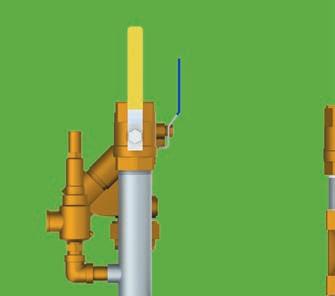

Introducing SmartPlate EV. With its ultracompact 24" x 32" footprint, vertical piping connections and capacities up to 4500 MBH and 300 PSIG, the SmartPlate EV indirect water heater gives you greater design flexibility for standard and high-pressure systems. It also easily integrates with AERCO’s Benchmark boilers and smart Edge Controllers for a powerful combination system. Join the EVolution. SmartPlate EV. 24 x 32










Rendering of the Zibi community
The federal government together with the Federation of Canadian Municipalities (FCM) has announced a $23 million investment towards the construction of the new district energy (DE) system for Ottawa-Gatineau’s carbon-neutral 34acre Zibi waterfront development.
The National Capital Region’s first net-zero community, the Zibi Community Utility (ZCU) DE system (an equal partnership between Hydro Ottawa and Zibi) will leverage locally-generated hydroelectricity, river-coupled cooling from the Ottawa River and waste industrial heat from the local Kruger Products industrial plant.
All buildings at Zibi will be interconnected through a hydronic loop that will deliver heating and cooling energy generated at the central plant, to be located in the lower level of a 15-storey residential building. The design is based on low temperature (+/-40C) heating water temperatures.
The fully-operational DE system is scheduled to be completed this year, with the entire Zibi community build out slated for 2032. zibi.ca/zcu
The federal government stepped-up its clean-energy initiatives during its spring budget with the announcement of interest-free loans to help Canadians with energy efficient home improvements.
The new funding will build on the 1-million free energy audits and up to
The 2021 Modern Hydronics Summit, held online March 30 and 31, filled two afternoons and attracted 871 attendees with hydronics enthusiasts logging in from across the country.

In total there were nine educational sessions, including keynote addresses from John Siegenthaler on reducing water temperature in existing hydronic systems. Other session topics included: air-to-water heat pumps, snow and ice melt solutions, buffer tanks, energy metering and more. During each scheduled session attendees engaged with speakers via public text chat, and the overall feedback on the event was very positive. John Siegenthaler noted: “Kudos to HPAC for pulling this virtual conference off so well. Wish we had something like this for hydronics in the U.S.”
In addition, winners and first-runners-up of the first ever Sweet Heat installation contest were announced at the Summit. Launched late last year, the contest called on hydronic contractors in Canada to share recent installation photos and explain the challenges and creative solutions used. With 31 entries received, the contest was divided into two categories—commercial and residential. The final judging for the contest was performed by Siegenthaler and Robert Bean.
In the commercial category the runner up was Grand Mechanical Solutions of Brantford, Ont., and the winner was Rambow Mechanical of Kelowna, B.C. For the residential category, runner up was Denrite Mechanical of Sturgeon County, Alta., and the winner was Riverdale Plumbing of Toronto. The two winning entries will be featured in the Fall edition of Modern Hydronics, included within the August issue of HPAC magazine.
700,000 grants valued up to $5,000, announced in the 2020 Fall Economic Statement.
Budget 2021 proposes to provide $4.4 billion on a cash basis ($778.7 million on an accrual basis over five years, starting in 2021-22, with $414.1 million in future years), to the Canada Mortgage and Housing Corporation (CMHC).
The interest-free loans worth up to $40,000 will help homeowners and landlords undertake retrofits identified through an authorized EnerGuide energy assessment. In combination with grants announced in last Fall’s Economic Statement, the loans will help eligible participants make more costly retrofits.
Also included is a dedicated stream of funding to support low-income homeowners and rental properties serving low-income renters.
The program is expected to be available by summer 2021. More than 200,000 households can take advantage of this opportunity.
Recommendations include:
• Replacing oil furnaces or low-efficiency systems with a high efficiency furnace, air source heat pump, or geothermal heat pump.
• Installing a high-efficiency water heater or on-site renewable energy like solar panels. canada.ca
Continued on p10




Advanced technologies and innovative designs are fused with industry-leading manufacturing expertise in Lync’s complete, cost-effective water technology solutions. Our expertly engineered, fully integrated and assembled systems minimize planning, design and installation time while maximizing your return on investment. Learn more at lyncbywatts.com.
Fully designed and assembled solutions from one source






Commercial Heat Pumps, Water Heating Solutions, Water Quality Solutions


























The ASHRAE Epidemic Task Force updated its statement on the airborne transmission of COVID-19 in buildings: “Airborne transmission of SARS-CoV-2 is significant and should be controlled. Changes to building operations, including the operation of heating, ventilating, and air-conditioning systems, can reduce airborne exposures.”
The statement replaces an April 2020 statement which indicated airborne transmission was “sufficiently likely,” and airborne precautions should be taken. At that time, both the World Health Organization (WHO) and the Centers for Diseases Control (CDC) contended that the virus transmission was by droplet and fomite modes, not airborne. Both organizations have since acknowledged the risk of airborne transmission indoors.
“This may seem like a small step, but we feel it is important to leave no doubt about our position, given the muted support for ventilation and filtration as important tools in the effort to stop the pandemic, from some organizations that should be leading more strongly,” said ASHRAE Epidemic Task Force Chair William P. Bahnfleth. ashrae.org/COVID-19

BOREHOLES COMPLETED FOR ONTARIO’S LARGEST GEOTHERMAL CONDO TOWER
According to Camrost Felcorp Inc., the developer of the Exchange District mixed-use community in downtown Mississauga, the drilling of 186 geothermal boreholes which will provide the en -

The U.S.-based Air Conditioning, Heating and Refrigeration Institute (AHRI) has released a report that examines fire safety issues related to mildly-flammable A2L refrigerants.
The study, undertaken in cooperation with UL and the Firefighter Safety Research Institute (FSRI), compared A2L (lower flammability) with A1 (no flame-spread) refrigerants in real-world situations.
The project included five fire scenarios designed by fire service professionals. In summary the refrigerant reactions delivered similar results in most scenarios. Both A1 and A2L refrigerants generated hydrogen fluoride (HF) gas in quantities considered hazardous without PPE, and in most scenarios there was not a significant relative difference in HF gas generation between the A1 and A2L refrigerants used in the investigation.
For a complete look at the study including refrigerants used visit ahri.org.
ergy source for two towers in the development has been completed. The development will include condominium towers, a rental residence and hotel.
The project will bring geothermal energy to the rental tower, as well as the planned boutique hotel structure, and 650 suites in the 66-storey EX3 condo tower, the tallest residential development in the province to feature a geothermal-based solution.
The developer is partnering with Diverso Energy, a geothermal energy service provider, on the heating and cooling solution, and also announced a partnership with Mitsubishi Electric to use the company’s water-source variable refrigerant flow (VRF) system in the development.
theexchangedistrict.com
Right Time Group of Companies, a residential HVAC contractor group founded in 2014 and headquartered in St. Catharines, Ont., has acquired Atlas Service Company Inc. based in Oakville, Ont. and owned by CEO Roger Grochmal since 1986.
AtlasCare is the fifth acquisition completed by Right Time Group, and the first since the Group itself was acquired by
San Francisco-based private equity firm Gryphon Investors in December 2020. Right Time is intent on developing a national footprint through acquisitions or partnerships with residential HVAC replacement contractors.
“Right Time is very pleased to welcome AtlasCare to the Right Time family. We have long been impressed by the business that Roger Grochmal and his son, Michael Grochmal, have built at AtlasCare and are excited about this partnership,” said Right Time CEO Jeremy Hetherington in a company release.
“AtlasCare has a long history and a strong culture, and when it came to entrusting that legacy to a buyer, Right Time was the natural choice,” said Roger Grochmal in the release.
Right Time now operates out of 12 Canadian locations across Ontario, Manitoba, and B.C. right-time.ca <>

914 registrations and an astounding 871 actual attendees - with all 10 provinces represented – it was truly a national event!
9 sessions (6 concurrent) averaging 260 attendees. Total number of session visits was 2598. Within the sessions there was a total of 614 “chats” between the attendees and speakers!
27 exhibitors took a chance on this new virtual event and they were rewarded with an average of 99 visits per booth adding up to 2673 total booth visits in just 8 hours!
The Summit concluded with the announcement of the two winners of HPAC’s inaugural Sweet Heat Competition. Check out the winners and learn more about their installations in the August issue of HPAC!
Thank you to our sponsors and exhibitors!



















You should be ready with an answer to this long-standing question. BY JOHN SIEGENTHALER
The versatility of modern hydronics technology allows designers to create systems that are specifically designed to the needs and constraints of almost any building. While best known for space heating, most modern hydronic systems for residential buildings also include provisions for heating domestic water.
Still, for decades, one of the shortcomings of smaller hydronic systems has been the inability to cool buildings. This missing link has undoubtedly swayed prospective clients away from hydronic systems, defaulting to ducted forced air because it provides both heating and cooling. Many of those decisions were made without factoring in the differences in comfort between these competing distribution systems.
The inability of smaller hydronic systems to provide cooling is changing as the future of energy supply moves away from fossil fuels and toward electricity.
This transformation is taking place in the two largest global markets for hydronics: Asia and Europe. In Germany, a bastion of hydronics technology, incentives aimed at reducing fossil fuel usage have allowed electrically-powered heat pump sales to overtake boiler sales in each of the last three years. And in China, air-to-water heat pump sales now exceed two million units per year.
For decades the trends in hydronic heating in these markets, especially Europe, have influenced market trends in North America. Examples include PEX tubing, condensing boilers, panel radiators and high efficiency circulators. If history is an indicator, the North American hydronics market is likely to see a major
increase in the projects opting for heat pumps rather than fossil fuel boilers.
This transformation will bring the ability to provide chilled water cooling, and that’s a “big deal” in my opinion. It now allows hydronic heating pros to offer clients who increasingly look for cooling in new building construction, a solution that’s not a completely separate system, or one installed by a different contractor.
One approach that I like to promote is multiple heating zones in combination with single zone cooling. The heating distribution system could use the same type of heat emitter in all zones, or it could use a combination of emitters.
An example would be radiant floor, wall or ceiling heating in some areas combined with panel radiators in other areas. Ideally, all heat emitters would be sized for the same supply water temper-
ature. This keeps the system simple by eliminating the need for mixing.
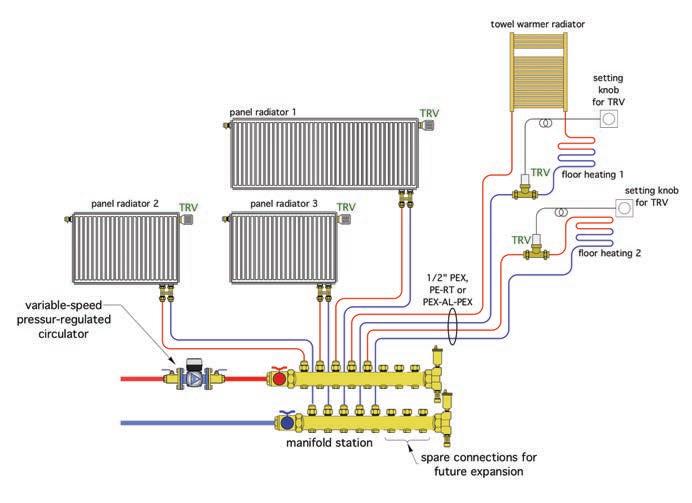
Figure 1 shows a combination of heat emitters, all served by homerun circuits of ½-in. PEX, PE-RT or PEX-AL-PEX tubing from a common manifold station.
Flow to the manifold station is handled by a variable speed pressure-regulated circulator set for constant differential pressure. Each emitter is equipped with a non-electric thermostatic radiator valve. That valve is built into the panel radiators. The only thing needed to make each panel radiator into an independently controlled zone is to screw a thermostatic operator onto that valve.
The other two circuits show a combination of radiant panels and a towel warmer. Flow through these circuits is controlled by an external thermostatic valve equipped with a remote adjustment dial. That dial is typically mounted to a wall at normal thermostat height.

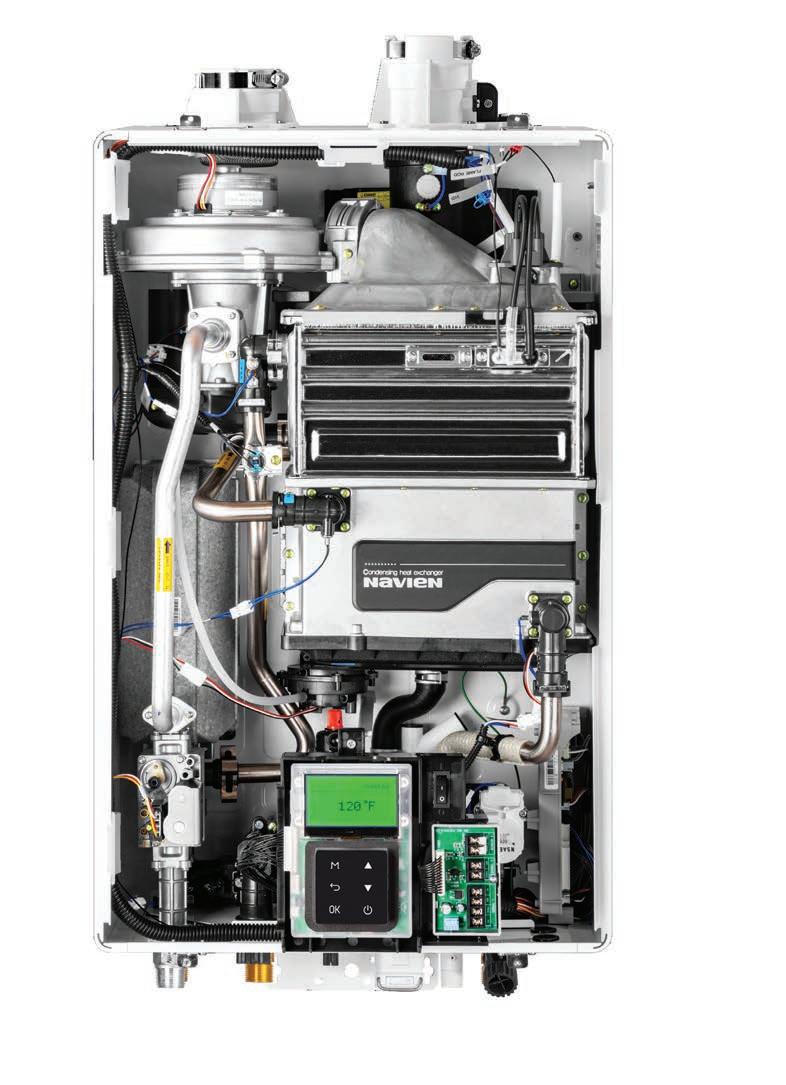
Durable dual stainless steel heat exchangers 2'' PVC up to 75 feet and 1/2'' gas up to 24 feet
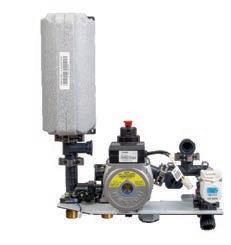

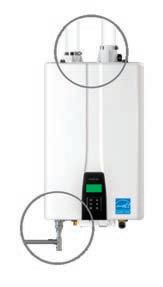
Optional NaviCirc TM - easy to install with no recirc return loop needed
Continued from p12
This combination of thermostatic valves provides five independently controlled heating zones. As these valves open, close, or modulate flow, the variable speed circulator senses the “attempt” to change differential pressure, and immediately adjusts motor speed to cancel out that attempt. This allows the flow in each homerun circuit to remain stable regardless of what zones are active.
The manifold station is shown with extra connections. This allows future emitters to be added with relative ease. It’s a relatively inexpensive up-sell that most clients would accept and see as professional forethought on your part.
Now, Figure 2 shows a low ambient air-to-water heat pump as the sole source of heating (and cooling) energy.
The heat pump is equipped with a variable speed inverter drive compressor. This allows it to modulate both heat output and cooling capacity down to about 40% of peak rating. The compressor speed changes based on maintaining user-specified leaving water temperatures for heating mode and cooling mode operation.
In most systems this allows the heat pump to supply an air handler sized to the building’s cooling load without use of a buffer tank—provided the air handler’s capacity is not smaller than the minimum cooling capacity of the heat pump, and there is only one zone of cooling.
Since the heat pump is a “split system” there’s no need to protect the outdoor unit from freezing, and thus the system can operate with water rather than an antifreeze solution.
The diverter valve directs flow leaving the heat pump to the heating or cooling portion of the system. It should be configured with its normally-closed port, which is usually designated as “A,” supplying the heating portion of the system, leaving the normally open port, which is usually designated as “B,” to supply the cooling mode.
The “A” port should only open when the heat pump is operating in heating mode. This allows the diverter valve to prevent reverse thermosiphoning through what could otherwise be an unblocked piping path between the upper and lower portions of a buffer tank (to be discussed later). It eliminates the need for a check valve to prevent reverse thermosiphoning.
The air handler would supply a ducted distribution system. Since this portion of the overall system is for cooling, the ideal arrangement would put the outlet registers in the ceiling or high on the walls. This allows the cooled air to mix with room air without creating drafts.
In cold climates it’s best to install the air handler in conditioned space. This eliminates the possibility of freezing water in the air handler’s coil during winter. It also reduces the potential for energy-wasting convective air flow through the air handler
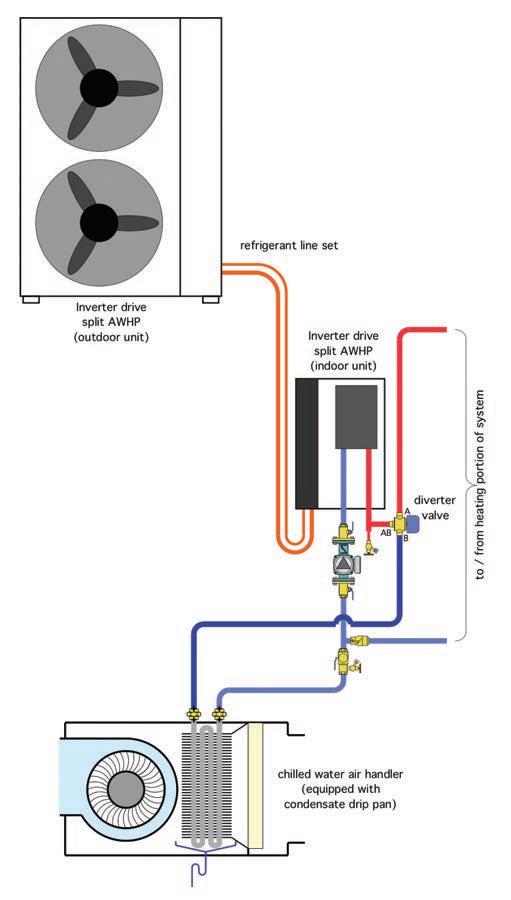
and ducting due to temperature stratification in the building.
If the air handler has to be mounted in unconditioned space some means of freeze protection is required. The possibilities include draining the coil during winter, using antifreeze in the system, building an insulated “dog house” enclosure around the air handler, or installing heat tracing cable and hoping that no long duration power outages occur.
I’m not a fan of any of these if they can be avoided.
Even small, residential air handlers can generate several gallons of condensate when operating on a humid day. Be sure to pipe up a condensate drain.
The final subsystem is a reverse indirect tank that provides buffering for the space heating zones, which typically have heat transfer requirements much smaller than the minimum
Continued on p16

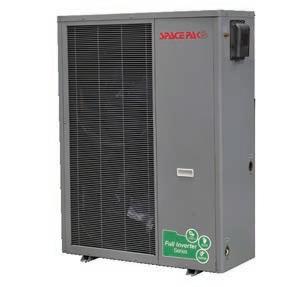
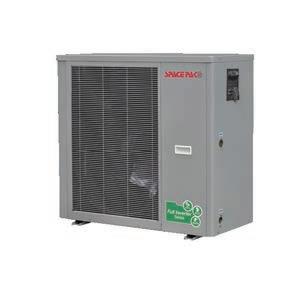
Solstice - SIM
Inverter Monobloc
SIM-036 (3 ton)
Heating Capacity Range: 13,200 - 38,700 Btu/h*
Cooling Capacity Range: 1 - 3 tons*
COPs: up to 5.01*
*Using AHRI 550/590 Test Criteria
SIM-060 (5 ton)
Heating Capacity Range: 25,400 - 70,600 Btu/h*
Cooling Capacity Range: 1.5 - 5 tons*
COPs: up to 4.67*
*Using AHRI 550/590 Test Criteria
Standard Features
• Reliable Mitsubishi Inverter Compressor
• User Friendly Touch Screen Control
• Monobloc Design (No On-Site Refrigerant Charging)
• Low Ambient Cooling
• Freeze Protection
• Low Amp Draw with Ultra Quiet Operation
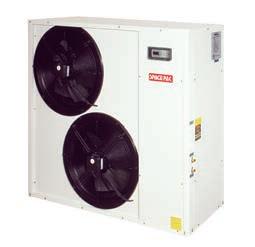
Solstice - Extreme Low Ambient Heat Pump
LAHP-48 (4 ton)
Heating Capacity: 64,500 Btu/h*
Cooling Capacity: 40,000 Btu/h*
COPs: up to 3.18*
*Using AHRI 550/590 Test Criteria
Standard Features
• Reliable EVI Copeland Compressor
• Simple Piping and Pumping with Easy Zoning
• Modulating Fans for Higher Efficiencies
• Monobloc Design (No On-Site Refrigerant Charging)
• Low Ambient Freeze Protection
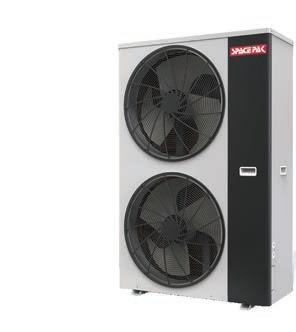
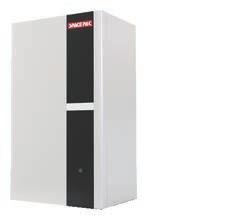
Solstice - SIS Inverter Split System
SIS-060A4 (5 ton)
Heating Capacity Range: 20,500 - 71,500 Btu/h*
Cooling Capacity Range: 2.5 - 5.2 tons*
COPs: up to 3.09*
*Using AHRI 550/590 Test Criteria
Standard Features
• Reliable Panasonic EVI Inverter Compressor
• Simple Indoor Piping Similar to Wall Hung Boilers

• Designed for High Performance in all Temperature Ranges
• Extreme Low Ambient Heating Performance to -20°F
• SIS System Includes both Indoor and Outdoor Units
• Split Design Provides the Flexibility to Eliminate the Use of Glycol in the Hydronic Loop
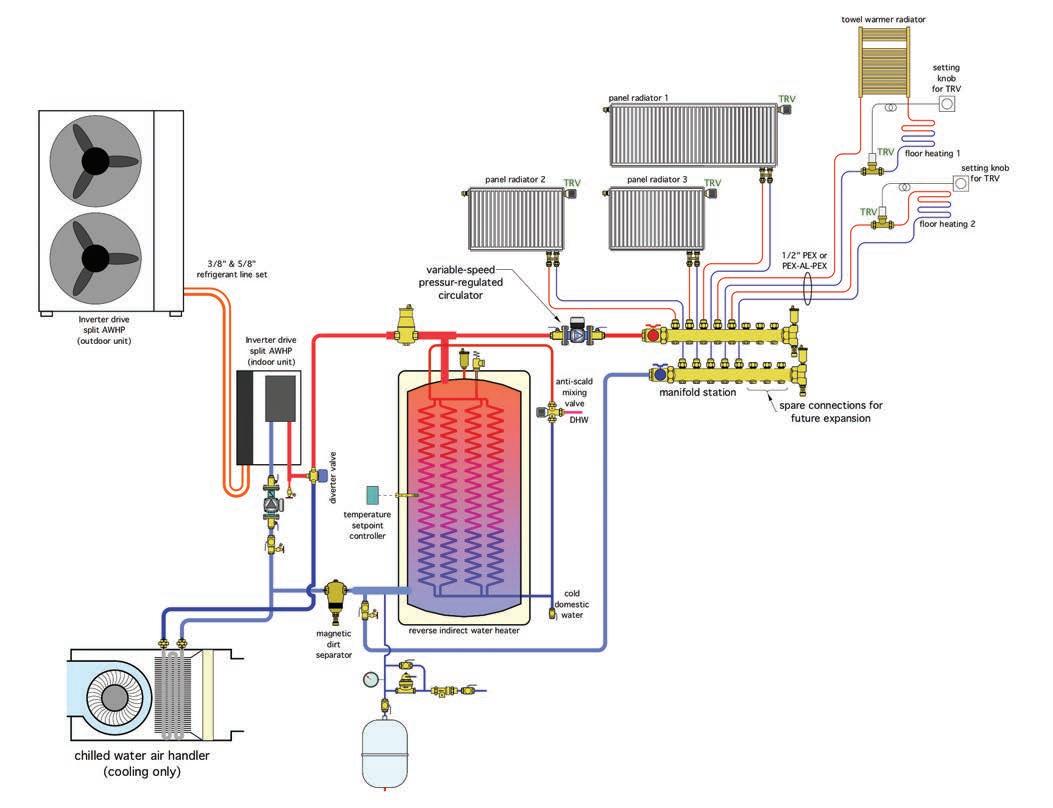
heating capacity of the heat pump. (Figure 3.) The tank piping is configured around one currently available reverse indirect. It’s a “two-pipe” configuration, which allows for “direct-to-load” heat transfer at times when the heat pump is running at the same time there is a space heating load.
One shortcoming of a two-pipe tank configuration is that a portion of the flow returning from the space heating load can pass through the heat source when it is not operating. This reduces heat transfer from the tank to the load. It also increases extraneous heat loss to the mechanical room, and lowers the mixed water temperature supplied to the space heating load.
The latter occurs due to the two flow streams, one passing through the tank
and the other through the heat source, recombining upstream of the space heating circulator.
This can be prevented by ensuring that the “A” port of the diverter valve is only open when the heat pump is in heating mode.
During heating mode operation the temperature of the buffer tank is monitored by a setpoint controller. When the sensor at the midpoint of the tank drops to some minimum value the heat pump is turned on. This happens regardless of any demand for space heating.
The goal is to keep the water in the tank’s shell warm enough to provide on-demand domestic water heating whenever there’s a draw at a fixture.
Once turned on, the heat pump continues to operate until the tank sensor reaches some upper limit. That limit should be several degrees lower than the safety high limit setting programmed into the heat pump’s internal controller. This is where a tradeoff needs to be made. The lower the temperature at which the buffer tank is maintained, the higher the heat pump’s coefficient of performance (COP). However, for tank temperatures below about 115F, the domestic water will only be “preheated” rather than fully heated.
Preheated domestic water will require a temperature boost prior to use. That boost could come from an electric on-demand tankless heater or multiple smaller-capacity electric heaters located close to each fixture group.
It’s also possible to base the buffer tank temperature on outdoor reset control. The warmer the outdoor temperature the lower the buffer tank temperature. This keeps the water in the tank just hot enough to provide the building’s heating load, but a greater temperature boost is required for domestic water leaving the tank.
The “optimal” temperature control for the tank must factor in the energy used for both space heating and domestic hot water, the COP of the heat pump operating over a range of both water temperature and outdoor temperatures, and the cost of electricity used for direct resistance heating.
Based on simulations I developed it appears the best seasonal heat pump COPs are achieved when the buffer tank temperature is based on outdoor reset, with the “top off” energy to bring DHW to its final delivery temperature provided by electric resistance heat.
During cooling mode the heat pump monitors its leaving water temperature, and adjusts compressor speed to maintain a suitable setpoint, typically in the range of 45 to 50F.
To ensure DHW availability, the system would give priority to maintaining the temperature in the reverse indirect tank. When the tank needs heating, the heat pump temporarily switches from chilled water to heating mode.
The air handler blower can be kept on, as the time required to boost the temperature of the buffer tank during warm weather should be minimal because the heat pump is operating at high heating capacity. When the tank reaches its upper temperature the heat pump switches back to cooling.
Most heat pumps have a built-in time delay on compressor operation when switching modes, or when a signal attempts to restart the compressor right after it was turned off. This allows the
large differential pressure present across the compressor to dissipate prior to an attempted start.
I encourage you to “read up” on air-towater heat pumps. Their ability to provide cooling as well as heating and DHW is a viable and cost-effective solution to a question that’s been asked by many prospective clients desiring hydronic heating: “But what do I do about cooling?” Informed hydronic pros are now ready with an answer. <>

John Siegenthaler, P.E., is a licensed professional engineer and has more than 40 years experience in designing modern hydronic heating systems. His latest book is Heating with Renewable Energy (see www.hydronicpros.com for more information).

Follow these steps to maintain the optimal performance of your residential clients’ cooling equipment. BY IAN
McTEER
As another cooling season begins, I’m thinking back to the late 1980’s when I worked for an HVAC contracting firm as an installer and service technician. The company expected me to identify and sell new systems whenever appropriate. I did manage to sell several new cooling systems despite my limited sales skills, but more often potential customers dismissed my central cooling arguments as nothing more than an unnecessary expense: “It’s only hot for a few days, so we’ll use a fan and keep the windows open,” was a typical objection.
Times have changed. More than 30 years later, it is hard to find a house without central cooling in southern Ontario and many other locations across Canada. Canadian summers, although short, are often ridiculously hot and humid. If
you look at a chart of cooling load hours as published in ACCA Manual J, Torontonians endure a mere 700 cooling load hours compared to Miami, with over 7,700 cooling load hours.
Interestingly, Miami’s summer outside design dry bulb temperature is only 2F higher than Toronto’s (89F compared to 87F) and only a 5F higher wet bulb temperature (77F versus 72F). But therein lies a big problem for HVAC service technicians: early season start-up often means attempting to verify proper cooling system operation when the cooling unit may be completely unloaded.
While residential cooling systems installed in Miami run under load almost 90% of the time, identical equipment installed in Toronto may run in cooling mode less than 10% of the time.
Therefore, given the brevity of our
cooling season combined with unsuitable weather conditions often prevalent at start-up, technicians may have to rely on service history, accumulated data and minimum environmental conditions to be sure a given unit will cool effectively and efficiently all summer.
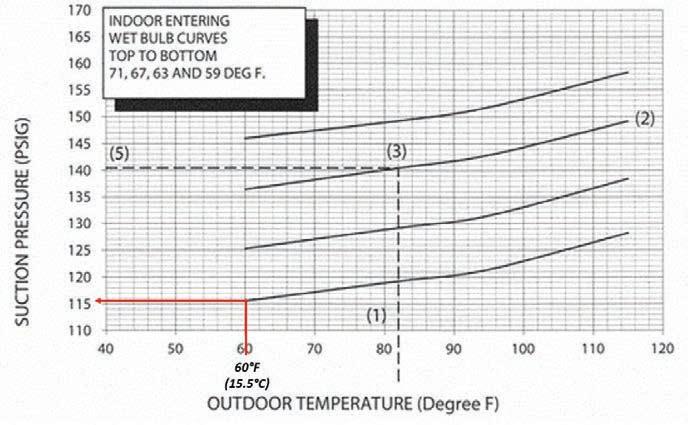
Figure 1 (below) is a manufacturer’s chart indicating 60F dry bulb outdoor air temperature entering the condenser and 59F wet bulb air entering the evaporator are the min. operating conditions.
On a chilly spring day, the refrigeration system may not respond as expected (in this case 116 psig suction pressure) indicating the system may not be ready for a July heatwave. Without sufficient load on the evaporator, too many technicians are liable to alter the refrigerant charge or to replace system components thought to be problematic when the real issue is simply no load.
Soon service vans will be loaded with replacement filters, refrigerant, coil cleaner and replacement parts such as run capacitors, contactors and motors.
Residential HVAC service departments will have a baseload of equipment service histories and commissioning data related to their own installations. Technicians should familiarize themselves with all collected data including any notes from previous service calls before venturing forth.
Amid the enormous variety of installed equipment in the field, technicians must understand the individual manufacturer’s instructions for determining proper performance especially under minimal load conditions.
Contractors selling maintenance plans as a component part of a new installation have the best opportunity to ready an HVAC system for the rigors ahead. Many a service contractor will altruistically adopt orphaned equipment often consisting of a sub-par in -
system deficiencies like poor heat distribution that may or may not fit the spring tune-up protocols of clean, inspect and test.
If cleaning a blocked evaporator coil has little effect on improving air flow to the master bedroom, then another service call should be scheduled to investigate that common problem.
After the customer interview, check for a communicating or smart thermostat controlling the system. Look for stored faults or alert codes especially reoccurring faults such as flame failure, open limits and communication errors. How were past issues resolved and why have one or more reoccurred?
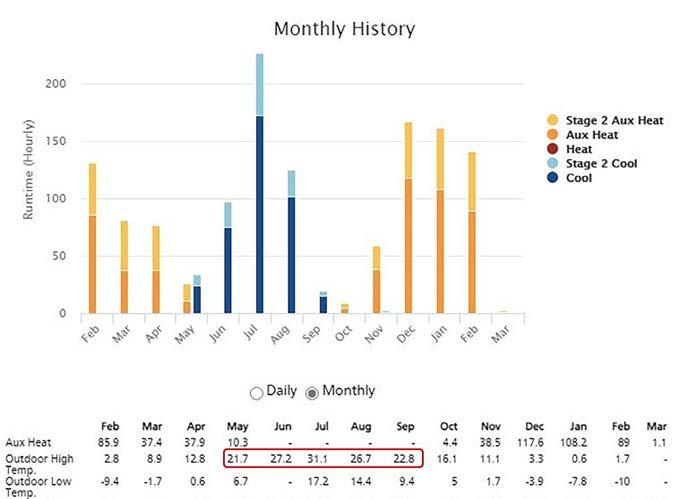
Such faults provide clues as to what maintenance is required. See if the thermostat has a monthly record of operating hours; plenty of clues to be found there. In Figure 2, a graphical display of my HVAC needs is presented for the year 2019. In my case, during the summer I keep the room at 75F (24C) although the system will operate in dehumidification mode when the RH exceeds 55%.
Notice that I used a total of 34 hours of cooling capacity (mostly first stage) in the month of May, while the heat and humidity of July caused the system to run a total of 227 hours, just 54.4 hours in second stage. To my point, the system ran a total of 504 hours in 2019, or roughly 6% of the time.
stallation combined with little or no maintenance creating an entirely different start-up experience for a consumer not used to HVAC repair bills.
A residential start-up routine should have several moving parts: a conference with the end-user, a visual inspection of the entire system, cleaning
components and replacing consumable items, then testing and data collection.
Data collected from an end-user interview consists of asking questions related to unusual occurrences such as different noises, problems during the heating season, odours or water leaks. The homeowner might reveal severe
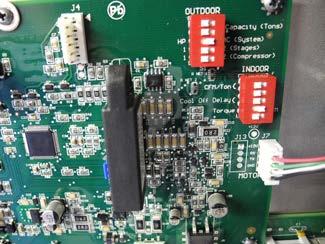
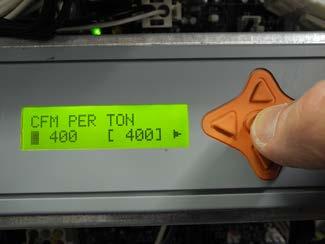
Disconnect power to the air handler then visually inspect the unit looking for signs of refrigerant leaks, water leaks, loose wiring, blower wheel condition, and evaporator coil cleanliness. Be sure DIP switches, interface settings, and motor wiring taps are set-up correctly to coincide with outdoor unit capacity or the AHRI certified rating.
During the air handler inspection, the test of any maintenance contract might come to the bare coverage as
Continued on p20
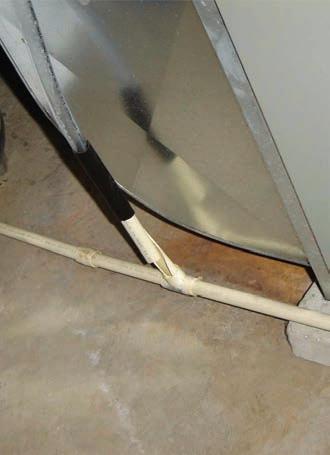
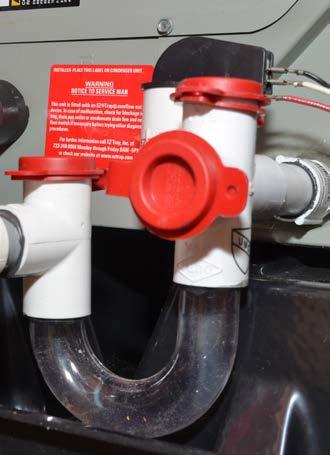
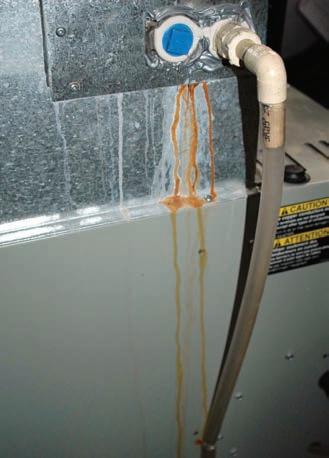
the time and materials needed to thoroughly clean an evaporator coil, blower wheel, secondary heat exchanger, drain assembly and to verify settings could easily run into several hours, not normally part of the contract.
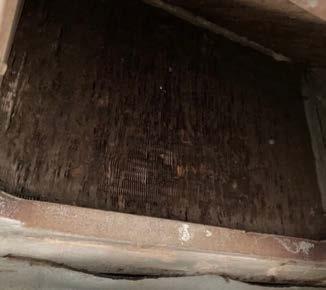
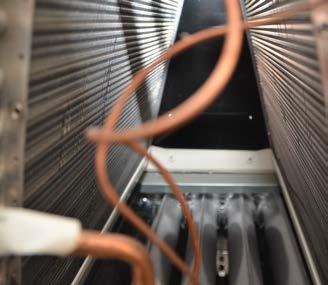
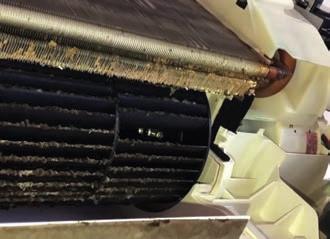
Depending on the manufacturer, there might be numerous settings to verify when servicing an orphaned unit with no service history (see Figure 3, previous page). As the images in Figure 4a and 4b show, (also previous page) evaporator coils must be inspected and cleaned where possible.
The condensate drainage system must be ready to handle condensate (Figure 5, above). Some drains are too small or use non-standard components. Blow out the drain lines, clean condensate pumps and test operation. Always inspect the blower wheel in conventional air handlers and mini
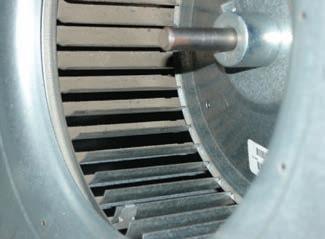
splits (Figure 6, below). The indoor head may have to be removed for cleaning, or the coil may be cleaned in place if the blower wheel is clean. Be sure to clean or supply a new air filter.
Some indoor tune-ups could turn into overhaul or system replacement situations. Apprise the customer and leave a quote for additional services.
Once the myriad of vital components has been inspected, settings verified and necessary cleaning completed, reapply power. Observe the furnace control board for any flashing fault codes. Older boards will not remember faults: check for codes before deenergizing.
Some units have a user interface containing stored faults, recover and analyze data concerning faults. Check for voltage at the control board Line H and Line N connections as well as low voltage transformer output.
Put the indoor unit into operation in a test mode (if available) or “fan on” mode listening for anything unusual. Verify voltage at the board and test the fan motor amperage. Be sure to record this data.
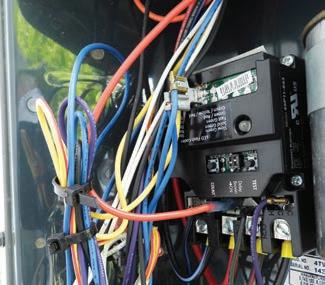
With all power sources disconnected from the outdoor unit, begin inspection of key components including the outdoor coil, refrigerant line set, signs of refrigerant leaks, electrical connections, condenser fan motor and blade, and cabinet integrity. Clean outdoor units of rodent nests and bug intrusions. Consider offering a contactor upgrade such as Emerson’s Sure Switch (Figure 7, next page) featuring totally enclosed contacts providing brownout and short cycle protection.
Visually inspect components such as capacitors and look for copper tube rubs, pinched wires and high voltage connections If the compressor has a starting capacitor, inspect all electrical connections and capacitor integrity. If any starting components must be replaced, use only manufacturer approved components.
All electrical connections, low and

high voltage, indoor and out must be inspected for damage, overheating, and tight connection. Low voltage spade connections are often overlooked. Remember to check inside the outdoor disconnect box for debris, corrosion and loose connections, critter infestations, etc.
Once the clean and check is complete, restore power and start the system to operate at 100% capacity, use thermostat test mode if so equipped. Allow the system to operate for a minimum of 15 minutes at the appropriate test load parameters before taking system data.
The following information is the minimum requirement to establish a yearover-year performance history:
• Temperature of the air entering the indoor coil: dry bulb and wet bulb.
• Temperature of the air leaving the indoor coil: dry bulb and wet bulb.
• Temperature of the air entering the outdoor coil: dry bulb.
• Suction Pressure.
• Suction Line Temperature.
• Head Pressure.
• Liquid Line Temperature.
• Discharge Line Temperature.
• No Load Volts.
• Full Load Volts.
• Full Load Amps.
• Lock Rotor Amps.
• Crankcase Heater operation, if equipped.
Note: premium units, typically featuring inverter drive compressors, have on-board or other methods of displaying much of the above data; it should be downloaded and archived.
Using this collected performance data, a technician can make objective judgements as to the system’s capabilities during the cooling season ahead.
So far, I have not mentioned airflow, the most important parameter of all.
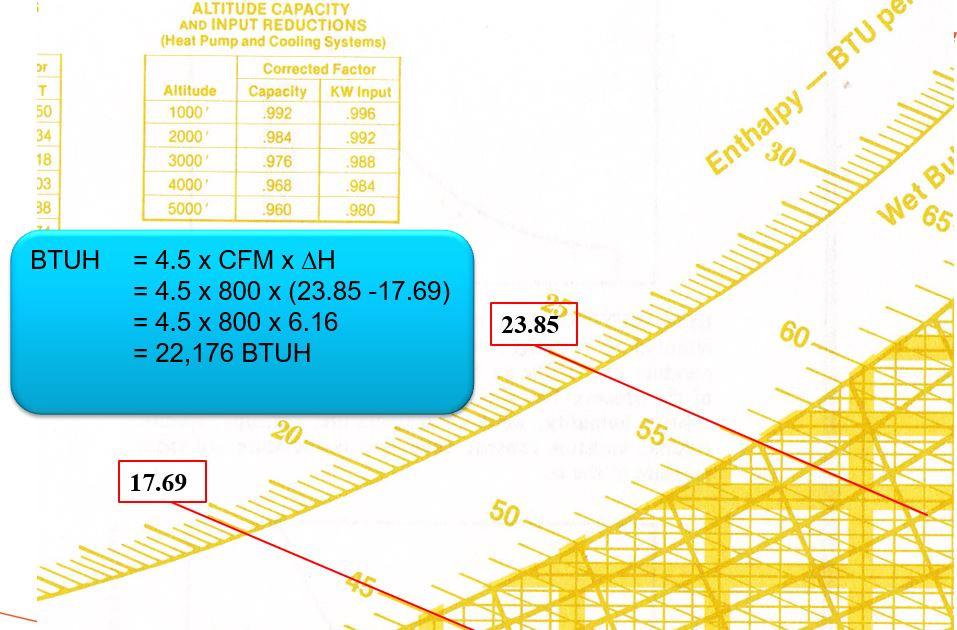
When analyzing entering and leaving wet bulb data, total Btu/h of the system can be determined to a reasonable degree of accuracy provided the actual system airflow is known—guessing or pluggingin nominal values is not allowed! Do a temperature rise test, or measure air pressure drop across the air filter or evaporator coil provided the numbers obtained coincide with the chart provided by the device manufacturer. Once an accurate measure of airflow has been recorded, use the following formula to determine system Btu/h: for this example, a cooling unit with a nominal AHRI rated cooling capacity 23,850 Btu/h is being evaluated (Figure 8).
Btu/h
Suppose an entering wet bulb is 56F and the leaving wet bulb is 45F. Use a psychometric chart to convert 56F Wb to 23.85 Btu/pound of air and 45F Wb to 17.69 Btu/pound. Airflow is measured at exactly 800 cfm. How does this measured value compare with the manufacturer’s chart for system performance at a given outdoor temperature? Is the value close enough?
Assuming, at seasonal start-up, the collected values mirror a manufacturer’s performance data chart and industry standards, this information should be recorded on a copy of the job ticket and left with the equipment; the HVAC system also owns this data, in my view. Whether a residential service call entails simple maintenance, or an unfortunate breakdown, or leads to a potential system replacement opportunity, having reliable performance data included in the service history eliminates vexatious guesswork and assumptions leading to faster, more accurate customer service. <>

Ian McTeer is an HVAC consultant with 35 years of experience in the industry. He was most recently a field rep for Trane Canada DSO. McTeer is a refrigeration mechanic and Class 1 Gas technician.

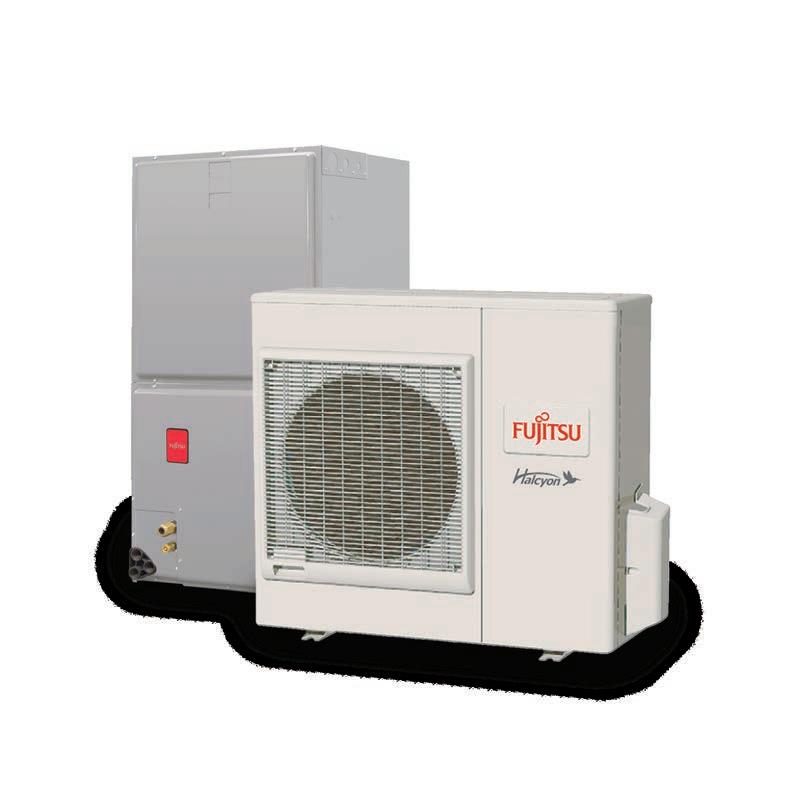
Introducing the Infinite Comfort Series. Now, offer your customers ultra-efficient, multi-position air handling units from Fujitsu General.



• Revolutionary side discharge outdoor condensing units are highly efficient and save space allowing for multiple installation options
• Quiet operation - indoor as low as 25dBA and outdoor as low as 53dBA
• Units range in size from 24,000 to 48,000 BTU/H
• Adaptive fan motor speed control assures optimum comfort
• Longer line length - 160ʹ (24k & 30k BTU/H) and 230ʹ (36k & 48k BTU/H)
• Excellent energy ratings (19 SEER and >10 HSPF) equal big utility rebates For more information, please visit www.FujitsuGeneral.com
The third episode of 30 Mechanical Minutes features a discussion on HVAC maintenance calls in 2021 with HPAC ’s Ian McTeer and Gary McCreadie from HVAC Know It All.
On Wednesday, April 7th HPAC Magazine hosted its third free 30 Mechanical Minutes educational webinar, this edition focusing on HVAC maintenance calls for the upcoming cooling season.
Entitled, ‘Spring Start-ups in a COVID World,’ the live webinar session was sponsored by Navac. Hosted by HPAC editor, Doug Picklyk, the webinar featured regular HPAC contributor Ian McTeer and Gary McCreadie from HVAC Know It All.
The discussion opened with a focus on best practices when kicking off a Springtime HVAC maintenance call in 2021. “Having never experienced being in the service industry under such conditions as COVID-19, I can understand it must be very challenging for technicians in the field,” acknowledged McTeer. “I always thought the very first thing the technician needs to do is to talk to the homeowner find out how the system's been working—were there funny noises, unusual odours or failures during the heating season? Because some heating issues can lead to cooling problems. One of the oldest rules of thumb: if you can’t heat a building you’ll never cool it.”
He also says that new smart thermostats should be your next stop. “Go into
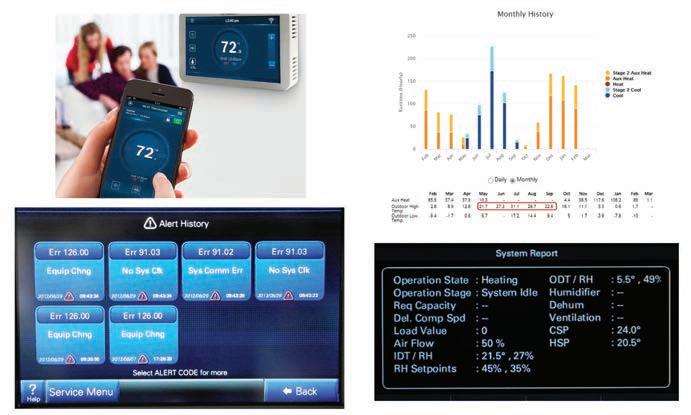
Ian McTeer shared images of data collection examples possible with new smart thermostats and connected appliances
the information section and see if you can find anything on cycle rates, alerts, or any type of codes that haven been generated. Make note of those and essentially you’re off and running.”
While many A/C service technicians often want to start with the outdoor units, McTeer believes that’s a mistake, because any measurements you get outside could be skewed if the indoor system is not working properly. So he says, “Go find the air handler first.”
McCreadie addressed the Spring maintenance call from a commercial technician’s perspective. “Customer communication is number one as far as I'm concerned, because the customer knows their equipment, not always the best, but they know when odd things are happening.”
He starts a maintenance call with his senses, looking at filters, coils, fan blades and contactors. “I always like to start without any tools in my hand, just
having a visual of the unit.”
Next comes verifying power, making sure the line voltage into the machine is correct and making sure that control voltage is correct. “Then you need to know if the blower is working, because without proper airflow the A/C side of things is not is not going to work properly.”
The talk then moved to the topic of the pandemic, indoor air quality, and how technicians can address these issues with homeowners and facility managers.
“In my estimation, the main job of the filter is to help to keep the equipment clean,” says McTeer. He’s heard people urging MERV 13 filtration, but in his opinion that is too restrictive for the average residential HVAC system.
“I think a good solution for a homeowner who insists on better filtration would be to go with a bypass HEPA system,” said McTeer. He also mentioned


HPAC Magazine’s HVAC specialist, Ian McTeer, is an HVAC consultant and retired field service representative with over 35 years of experience in the industry. He was a field rep for Trane Canada and is a refrigeration mechanic and Class 1 Gas technician. He resides in eastern Ontario.
Gary McCreadie is a Toronto-area licensed refrigeration and gas technician and an online sensation with a very active social media presence—bringing both education and entertainment to the HVAC industry. Starting on Facebook, McCreadie now has a massive following on all social media channels (Twitter, Instagram, Facebook, YouTube) as the HVAC Know it All. He also has his own website, App and a regular podcast. hvacknowitall.com
other solutions such as bipolar ionization devices and UV-C lights, but there are concerns with the effectiveness of all these options.
“I haven’t had any customers reach out and ask about air
purification devices,” says McCreadie. “They are very polarizing in the industry at the moment, and as Ian was mentioning, there’s some industry people that that are looking down upon them at the moment.
“The three main factors of indoor air quality are humidity, ventilation and filtration, and if you can deal with all three things you could probably get away with having good air quality in your home or building.”
He agrees that MERV 13 isn’t something you can just install and walk away. “You need to take a baseline and see if there are any changes to the system.” He described a recent job in a server room where he did a baseline with a MERV 8, then put the MERV 13 in and did some readings. “There was a bit of an air loss but not enough that I was scared to let it stay in the system. We’ll go back in two to three months when it’s loaded to take another reading. If it can’t survive the resistance of that filter then we’re going to have to think about doing something else—stepping up the airflow or going back to the MERV 8.”
As for indoor air quality ventilation, McCreadie noticed a “big difference” in his own home’s air quality with an HRV running. “I think more commercial buildings should start implementing HRV/ERVs as well, because I think it’ll really help with air quality.”
Continued on p26

For McCreadie, items like pulleys (or sheaves) and bearings on a blower system can often get overlooked on a maintenance call. “If the pulleys start to wear the belts are going to start to sit deeper and become worn faster.” He also checks the shafts of blower wheels and motors, moving them back and forth and making sure there’s no play, because if the fan doesn’t run nothing else works properly
For McTeer, it’s the technicians who service all makes and models that have a tougher time and are more likely to miss things. “I think what often gets overlooked is technicians take some data, but they don’t necessarily compare it with the manufacturer’s data for expected performance under the conditions that they’ve measured on that particular day. And the other thing that gets
missed is that data just doesn’t get recorded or left behind so other technicians can use it in the future.”
“If the pulleys start to wear, the belts are going to start to sit deeper and become worn faster.”
A lot of the buildings McCreadie takes care of have building automation systems, and he finds the trend logs include very valuable information. “I’ve used these trend logs to actually troubleshoot an issue and then go to the machine and just verify that my diagnosis was correct.”
And on the residential side, more ap -
pliances have the ability to communicate data, and some newer units have pressure transducers in them now so you don't even need to hook up gauges anymore, you can just read a DC voltage off a control board, notes McTeer. “I really like that stuff, but I think most of the appliances in the market are not there yet.”
McTeer and McCreadie also answered listener questions on filters for ductless mini splits, crank case heater alternatives, duct cleaning and preparing a compressor to move it.
To view the entire recorded webinar visit hpacmag.com/tech-pulse. <>

You’re in an unpredictable business, but the quality of the pumps you install shouldn’t be. Generations of plumbers and HVAC professionals have trusted our hard-working, reliable pumps to get the job done right the first time. Make a Big Impact on your next job with Little Giant.
“You can pay me a little bit today … or you can pay me a lot more later on.”
As funny as that statement might sound, this was a common phrase amongst the technicians I worked with, and it was representative of that faction of equipment owners who never wanted to invest in a preventative maintenance program.
I would liken that sentiment to the owner of an expensive car who refuses to have his/her car serviced on a regular basis. Sure, if the car isn’t abused, you might cheat the odds and go for a few years without a serious breakdown. But mechanical parts and devices all share a common fate—they wear, and they will fail at some point in time. That point comes sooner with a lack of maintenance.
In most climates the typical air conditioning system will be idle for some portion of the year. This is not to suggest an idle system will be subject to some type of failure before the weather warms up, but performing a spring equipment check will ensure that when the heat arrives, the system is working properly.
There are several items that should be included in the typical preventative maintenance checklist:
• Extra resistance in electrical connections or points of contact can lead to excessive voltage drop, which can cause voltage drop, overheated wiring/melted insulation, occasional

fires, and ultimately motor failures. All electrical connections should be checked for tightness, and motor contactor contacts should be inspected to verify that they’re not excessively burned/pitted. If so, the contactor should be replaced.
• Motors outfitted with sealed bearings do not require field lubrication. Motors not utilizing sealed bearings should be lubricated periodically, in accordance with the manufacturer’s recommendations.
• Technicians cannot assume that homeowners, or building owners, are replacing air filters on a regular basis. These should be checked, and replaced if necessary.
• Check thermostat setting and calibration.
• Inspect condensate drain, and drain pan. Verify that drain is clear, that drain pan is clean, and treat with algaecide.
• Inspect ducting for air leaks, and repair as necessary.
• Start system, check operating pressures, compressor amperage, condenser and evaporator fan motor amperage.
In addition to the above-mentioned checks, there are two additional checks which can have a huge impact on system efficiency, performance, system energy consumption and equipment longevity.
As has been stressed in this column over the years, the purpose of the vapour-compression refrigeration cycle is to transfer heat from the refrigerated (or conditioned) space to the refrigerant, and eventually to some location outside of the refrigerated (conditioned) space. The two heat transfer surfaces which facilitate that process are:
1. Evaporator, which allows the heat content of the air in the space to be transferred to the saturated refrigerant flowing through the evaporator tubes, and
2. Condenser, which allows the heat absorbed in the space (plus the heat added during the compression process) to be rejected outside the space.
It goes without saying that the proper selection of equipment and components is essential to provide the design temperature in the refrigerated (conditioned) space. It should also go without saying that the two heat transfer surfaces need to operate at peak efficiency to maintain the design temperature in the refrigerated (conditioned) space.
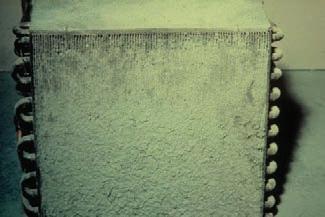
The number one killer of evaporator and condenser capacity and efficiency
is dirt, debris or anything else that would inhibit airflow through the fin-tube construction of both the evaporator and condenser.
A study by the U.S. EPA (Environmental Protection Agency) some years ago found that a relatively small film of dirt (0.042-in. thick) on a heat transfer surface resulted in a 21% loss in heat transfer efficiency.
This condition has to be one of the easiest to detect. All it requires is visual inspection. Cleaning a heat transfer surface is relatively easy as well. A brush to remove the larger film, chemicals that aid in the cleaning process, CO2 to blow the debris out of the fins, or for larger outdoor condensers a garden hose.
Now, if this is one of those equipment owners that doesn’t want to pay for the maintenance, here are the potential issues:
Dirty Evaporator:
• The dirt and debris blocks the air flow path, which results in a reduction in air flow through the fin-tube bundle. Since the ability to transfer heat from the air to the refrigerant flowing through the evaporator tubes is proportional to air flow, the air flow reduction results in a reduction in heat transfer. The evaporator is no longer capable of removing the heat necessary to maintain the desired temperature in the space. The equipment will undoubtedly operate for longer periods of time, resulting in higher power consumption (and higher electric bills). If the equipment has greater capacity than the design load, the space temperature will likely still be maintained. If the equipment is marginally sized to begin with, it’s doubtful the space temperature will be maintained at the desired level.
• The thermostatic expansion valve (TEV) will vary the refrigerant mass flow entering the evaporator in response to the superheat condition at the outlet of the evaporator. TEVs have the ability to throttle down during lower load conditions, but there is a limit to how far they can throttle down and still maintain a superheated condition at the evaporator outlet. If the air restriction is severe enough, causing a severe reduction in load, the TEV could reach a point where it’s incapable of maintaining a superheated condition at the evaporator outlet. This can result in some amount of liquid refrigerant flowing to the compressor inlet, causing damage to the compressor.
• As mentioned above, the reduced load condition will cause the TEV to throttle closed in an effort to maintain the superheat setpoint. This results in a reduced refrigerant mass flow. If the evaporator is located below the compressor, a minimum refrigerant suction vapour velocity is required to bring the oil back to the compressor. As the TEV
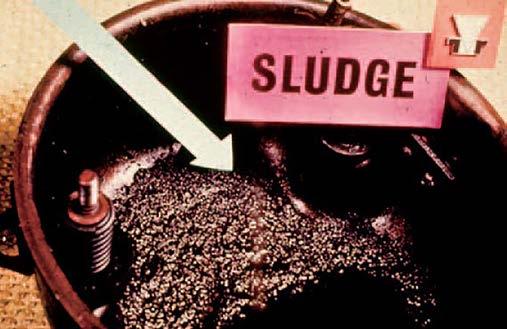
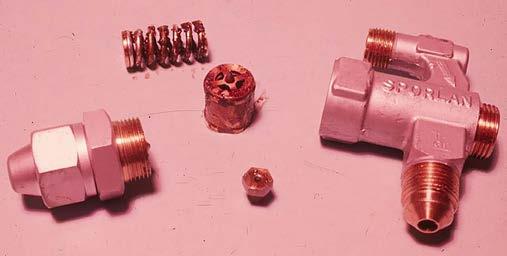
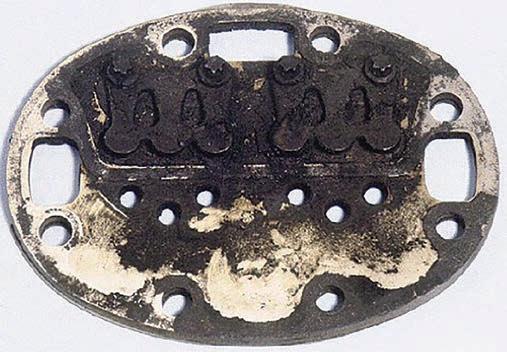
throttles closed, the reduction in mass flow will result in a lower suction vapor velocity. At some point, the velocity may reduce to the point where the oil is no longer able to return to the compressor. Smaller condensing units with hermetic or scroll compressors are not equipped with a safety switch that will turn the compressor off during a low oil level condition. Again, there is potential for compressor damage/failure.
• A similar reduction in air flow through the condenser fin-tube
bundle reduces the condenser capacity. The result is a system that operates at an elevated condensing pressure. This increases the compression ratio, which reduces compressor capacity. Viewing the Btu capacity of a Copeland M/N 2DA3075E-TFD at varying condensing temperatures illustrates this:
40F SST and 90F SCT 120,000 Btu
40F SST and 100F SCT 113,000 Btu
40F SST and 110F SCT 104,000 Btu
40F SST and 120F SCT 97,000 Btu
40F SST and 130F SCT 90,000 Btu
• Elevated operating temperature from reduced compressor capacity will affect the oils’ ability to properly lubricate. Between 310F-330F mineral oil will lose the lubrication film between piston rings and the piston cylinder, resulting in ring wear. In addition, the higher compression ratio exerts a greater force on the piston wrist pin bearing and connecting rod bearings. Extended periods of operation under this condition will reduce compressor life.
• Compressor oils will begin decomposing at elevated temperatures (350F for mineral oil, and 400F for POE). As the temperatures for mineral oil and POE rise above their respective decomposition thresholds, the oil will begin to polymerize; a process which results in the oil molecules combining into larger and larger molecules. The oil is first transformed into a dark thick oil, then a sludge, and finally a solid powder. Not only does this reduce the lubricating ability of the oil, it also has the potential to plug up strainers, filterdriers, smaller orifices in control valves, lubrication ports in the compressor, all with destructive and costly results.
Now, the next time your customer tells you that they just can’t afford to have you perform any preventative maintenance on their equipment, you can
confidently rehearse why he/she absolutely cannot afford to forego maintaining their equipment. But, in the event that your powers of persuasion are insufficient to change their mind, remem -

ber the phrase: “You can pay me a little bit today, or you can pay me a lot more later on,” with the added caveat, “But please remember that I tried to warn you.” <>
Dave Demma holds a degree in refrigeration engineering and worked as a journeyman refrigeration technician before moving into the manufacturing sector where he regularly trains contractor and engineering groups. He can be reached at ddemma@uri.com.

Recent compressor technology innovations are driving sustainability benefits for heat pumps in large-scale operations.
BY DREW TURNER
Many organizations are working to identify ways to reduce their dependence on carbonrich fossil fuels. Their goal: to reduce their emissions of the greenhouse gases implicated in climate change, while, hopefully, also decreasing their energy costs and bolstering their organizational reputation.
For many organizations, heat production is their largest application of energy, space heating for buildings being among the largest components of that output, so efforts to reduce carbon emissions has recently led organizations to consider replacing fossil-fuel fired furnaces and boilers with electricdriven options.
Electric heat pumps most commonly consist of equipment based upon constant speed positive displacement screw compressor technology, and while efficient, often offer an ROI payback period that is somewhat longer than many organizations require to justify investment. Further, the more efficient heat pump technologies, based on operating temperature limitations, have previously required changing out demand-side equipment to enable operation at significantly lower heating temperatures.
There is a new compressor technology emerging specifically geared for heat pump applications that enables gains in efficiency while eliminating many of the limitations. These oil-free magnetic bearing centrifugal compressors are currently involved in test projects and modeling suggests that when
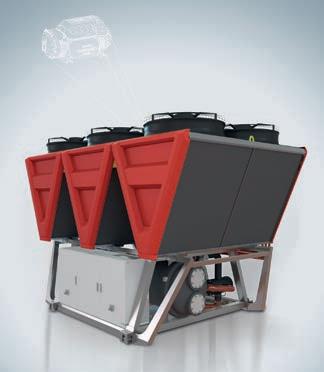
used in electric heat pump applications can provide up to 40% greater energy efficiency compared to constant speed positive displacement screw compressor-based heat pumps. When compared to variable speed positive displacement screw compressors—a more efficient heat pump technology— modeling suggests that a 10-15% reduction in energy costs can be realized.
These comparative improvements can increase over time because oilfree, magnetic bearing centrifugal compressors maintain performance over the long term, whereas positive displacement screw compressor-based heat pumps can degrade as much as 10% in the first five years and 20% within the first 10, driven by a combination of the mechanical degradation of the sealing process as well as oil-driven heat transfer degradation.
In short, this is an innovation that will be of interest to heat pump designers,
manufacturers, energy management consultants, and any commercial or industrial facility interested in decreasing its carbon footprint, increasing energy efficiency and reducing heating costs.
And oil-free magnetic bearing centrifugal compressors are not an unknown technology. They borrow foundational elements from well-proven technology in air-conditioning / chilling / cooling applications.
The heart of most electric temperature conditioning equipment—both heating and cooling—is the compressor.
Several types of compressors are used in HVAC applications, all fitting in the categories of either positive displacement or dynamic (centrifugal or axial) technology. In positive displacement versions energy is used to generate pressure and the refrigerant is squeezed to add energy to it. In the centrifugal/dynamic versions, refrigerant is thrown, increasing kinetic energy. The latter is frequently more efficient, driven by the inherent advantages of dynamic compression and the aerodynamic design optimized to the targeted temperatures.
Further, due in part to the kinetic forces in a centrifugal/dynamic compressor, it is possible to move a higher volume of low-pressure refrigerants. These as a rule have lower global warming potential (GWP), while at the same time they also have a limited flammability risk.
One choice to be made in designing a compressor is whether to specify oil-lubricated or oil-free bearings. As suggested, in oil-bearing versions some amount of oil will leak into other areas of the system over time. This oil becomes held up in the heat exchangers, from which it has to be returned to the compressors. Inevitably, and more frequently today with heat exchanger tube enhancements, some of this oil becomes entrained in the enhancements and degrades tube heat transfer performance, resulting in a drain on capacity and energy efficiency.
Additionally, with screw compressors there is mechanical degradation of the compression sealing process that occurs due to the metal-to-metal contact, which can erode the clearances, allowing high-to-low pressure leakage and creating further capacity and efficiency degradation.
Heat pump designs mainly follow one of three setups: air-toair, air-to-water, and water-to-water. Air-to-air and air-to-water heat pumps extract heat from ambient air, because they extract heat from what can be very low temperature ambient air they may offer lower efficiency and capacity.
A water-to-water heat pump would generate greater benefits as operating temperature limitations at the lowest ambient conditions are no longer a concern. The setup logistics of a water-to-water heat pump, however, can be more ambitious and require a larger upfront investment.
Operating water-to-water heat pumps at a central location and piping the thermal energy to a series of buildings in a “district heating” model could provide the greatest immediate benefits. While district heating is more common today on university, hospital, and corporate campuses where related buildings are in close proximity, the use of this technology— with its high efficiency and scalability—can be considered the “holy grail” for all those who truly desire to minimize their carbon footprint and energy usage.
Operators seeking to reduce their carbon footprint and lower operating costs are looking at their heating strategies. The advent of new generation compressors in electric heat pumps may be a game changer. As these compressors continue to generate results in commercial demonstrations, the time is ripe for early adapters to consider the possibilities. <>
This article was adapted from the white paper, “The growing role of electric heat pump technology in reducing emissions, minimizing carbon footprint, and decreasing energy costs in commercial heating applications”. Drew Turner is the global marketing manager – oil-free solutions with Danfoss. He can be reached at drew.turner@danfoss.com.


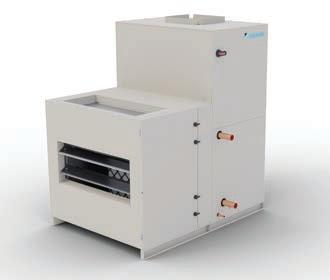
Daikin Industries has added a new vertical configuration to its PreciseLine air handlers, which are designed to improve indoor air quality. The new vertical configuration gives engineers and contractors additional flexibility. Systems can be equipped with MERV 13 filters, capturing particles as small as 0.3 to 1 micron. Direct-drive fan technology eliminates the possibility of rubber particles from entering the airstream. www.daikinapplied.com/products/air-handlers/preciseline
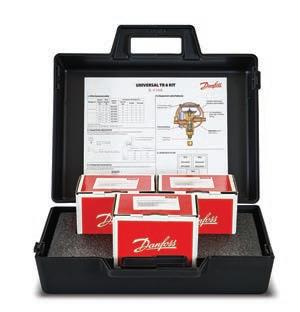
The Danfoss Universal TR6 Expansion Valve Kit, designed for aftermarket use, comes packaged with everything needed for installation. The valve adapts to 90% of HVAC systems. The kit is available in seven models that cover OEM air conditioner and heat pump designs, from 1.5 to six tons in systems that employ either R-22 or R-410A. With two kits available, service technicians will be prepared for nearly any job that requires a TXV.
www.danfoss.com/tr6
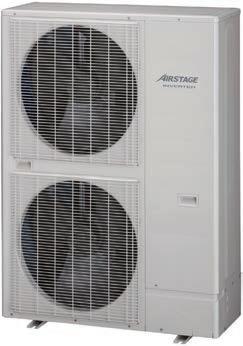
Fujitsu General America has released singlephase J-IV and J-IVs Airstage VRF heat pump systems offering heating capacity at an outdoor ambient temperature of -15F. The J-IVs offers efficiency levels up to 19.7 SEER, while the J-IV offers up to 19.8. New enhancements include the ability to reduce electrical circuit breaker sizes, base pan heaters, and durable metal fan guards. fujitsugeneral.com
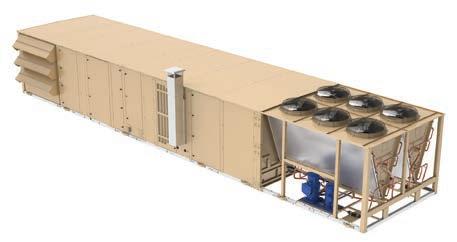
YORK Sun Premier commercial HVAC rooftop units are now available in 25-80 tons capacity with faster installation and simplified start-up. The units feature start-up wizards, a 5.5-in. OLED display and numeric keypad that can be upgraded to a full-colour touchscreen. A RTU Toolkit app provides access to unit-specific information and technical support by scanning the unit’s QR code. Options include various airflow path configurations, IEQ options such as UV lights, and modulating options. Remote monitoring allows technicians to interface with units without getting out of the truck. www.york.com/sunpremier

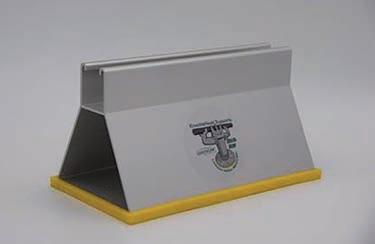
Green Link Engineering’s MetalHead is strong and durable support system for pipes and other rooftop equipment. The aluminum extrusion design with a triangular base, topped with a built-in strut channel can connect with standard strut hardware can be used for securing large pieces of mechanical equipment. MetalHead is engineered with 100 mil aluminum sidewalls with a hard-anodized surface, allowing the base to withstand a 10,000-lb. vertical compression over a 47 sq. in. footprint.
greenlinkengineering.com
Automated Logic released its latest OptiFlex BACnet building controllers for the WebCTRL building automation system (BAS). Both models include Ethernet, serial, and USB ports for easy network connectivity. The controllers Include on-board input/output (I/O) points for HVAC equipment such as rooftop units, fan coil units, chilled beams, exhaust fans, unit vents, air curtains and variable air volume (VAV) boxes.
www.automatedlogic.com

• Industry Best Domestic Hot Water Delivery from a Combi Floor Boiler:
First minute delivery of 6+ gpm at a 70˚ rise Continuous delivery of 5.2 gpm at a 70˚ rise
• Industry Only Smart Heating Technology. The FT Series combi boiler with smart technology will supply abundant space heating while simultaneously supplying endless domestic hot water.
• FAST Hot Water Delivery. Combi boiler features a unique, integrated domestic hot water mini-indirect tank that contains up to one gallon of stored hot water for immediate response.
• Easy Installation. Built-in low loss header, front and side access panels, flexible venting options, top connections and fits into tight spaces.
• Ultra-High 95% AFUE Efficiency. The FT Series’ modulates with a 10:1 turndown for additional savings.
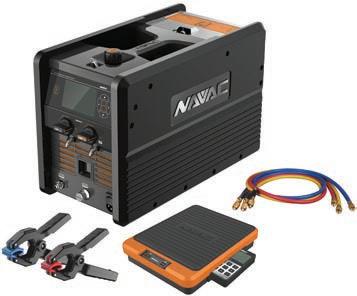
NAVAC is now offering a smart refrigerant charger that features a digital manifold gauge and a precision wireless electronic scale. The digital manifold gauge features pressure and temperature displays as well as calculated super-heat and sub-cooling data. Features such as a brushless DC-driven vacuum pump and wireless temperature probes round out the NRC62D’s multifaceted capabilities. navacglobal.com
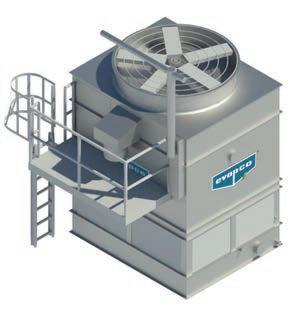
EVAPCO added new resources for engineers, specifiers and facility managers, as the company’s Building Information Modelling (BIM) files now allow for greater planning in the life cycle of buildings. The new 3D models include a full spectrum of products from evaporative to dry cooling towers, closed-circuit coolers and evaporative condensers. EVAPCO’s files include platforms, ladders, super-low sound fans, connection locations, airflow clearance requirements, and an easier toggle format. www.evapco.com/resources
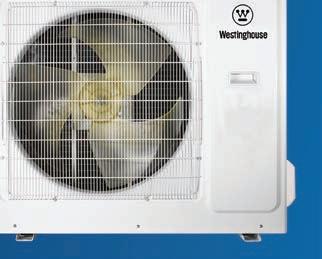
Westinghouse has added a new single zone 36,000 Btu/h wall mounted model to its line of mini-split heat pump systems. Like the other models in its line-up, the 36,000 Btu/h model includes a variety of features typical in high-end models, including a base pan heater, wireless remote control, front LED display and five indoor fan speeds. www.WestinghouseAC-USA.com
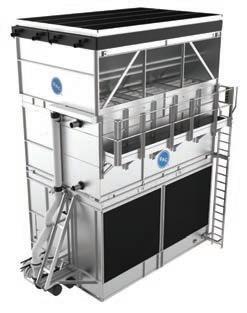
Baltimore Aircoil Company introduced the HXV Hybrid Cooler for evaporative and dry cooling applications. The unit delivers cooling while maximizing water savings. Maintenance access to the cold water basin, prime surface coil, and the fan drive system, and operators can inspect the spray distribution system while the unit is in operation. Also includes uninterrupted operation with multiple fans, optional redundant pumps and a variety of operating modes. Dry coil provides natural plume abatement when running wet. www.baltimoreaircoil.com
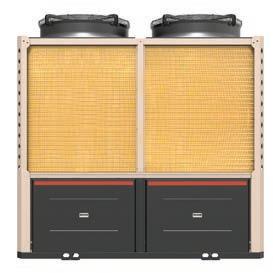
Mestek Boiler Group introduced an inverter driven air-towater heat pump for commercial applications. Sold under the RBI and Advanced Thermal Hydronic brands, the new heat pump delivers both heating and cooling capacities. Benefits include low ambient performance (-20F), user friendly touch-screen controls, inverter compressors and C-fin heat exchangers and built-in redundancy. www.mestek.com
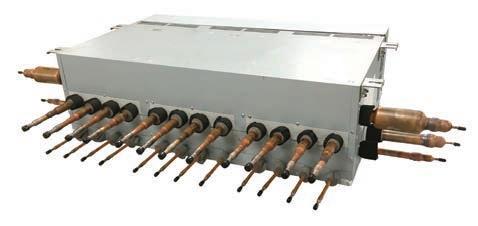
Two larger refrigerant branch units are now available from Fujitsu to simplify installations and expand the heat recovery capability of VR-II series Airstage VRF systems. The new units manage simultaneous heating and cooling in heat recovery systems and can serve between eight and 12 zones. The units offer flexible piping options, and their compact size means they can be accommodated in a variety of floor plans, elevations and design changes. They require no drain pan. fujitsugeneral.com




Market segment offers general contractors and subtrades opportunities for growth and a new, collaborative approach. BY DAVID
It is still relatively early days for Canada’s smart building market. Most projects continue to take the conventional route, employing HVAC, electrical, lighting, security and other such systems in their separate silos. But early adopters have begun to look at buildings not as a jumble of interdependent systems, but as the system as a whole, capable of integrating subsystems to improve energy use, guide automation and optimize the wide array of connected components.
Smart building discussions have been ongoing in the construction industry for at least 20 years, according to Sam Boyajian, vice-president of integrated building technology at Modern Niagara. For 15 of those 20, however, it was little more than talk, with owners not typically ready to take the plunge, he said during a panel discussion with three industry experts hosted by On-
KENNEDY
Site, HPAC and Electrical Business magazines this March.
“Now,” he says, “I would argue that the owners and the developers have sort of leapfrogged the engineering community, and now they’re starting to pull the rest of us along because now they’re demanding it.”
“We’re at a bit of an inflection point,” Boyajian adds.
In Canada, governments building hospitals have been among the first movers, partly because smart building systems offer the most discernible benefits to larger facilities.
Certain forward-looking private owners are also beginning to embrace smart buildings, Colin Flock, vice-president of operations for EllisDon’s facilities services division, says. More are expected to follow as early adopters quantify the energy savings and other benefits offered by their smart buildings.
“In the next 10 years, it’ll just be a different landscape, Flock says.
Erica Brabon, the director of energy and sustainability for the facility services division at Black & McDonald also expects adoption in the building market to move quickly, though what will be considered “smart” a decade from now will be a moving target, she says.
“Smart building initially was the connectivity, the energy efficiency and being able to trend and capture all this data,” Brabon says. “But now, over the past year, expectations have changed. We might want to track occupancy patterns, we might want to track indoor air quality, people might want assurances that the air changes per hour in their space have been achieved.”
The opportunities for contractors are considerable, though they will need to be comfortable with quickly evolving technology and a moving set of goal posts.


Technology adoption in construction, particularly of cloud-based software, has gone through step change between 2020 and 2021, largely due to the pandemic. While many GCs and subs are already using sophisticated tools for overseeing their projects, those behind the curve will likely need to catch up to enter the smart building market.
“If you’re not using them already, I would say that that could create a lag in the types of projects that you’re working on,” Brabon says, adding that Black & McDonald gets a major boost from employing technologies that bridge the construction and operations phases.
“It’s a huge benefit to us playing both of those roles… to be able to take advantage of some of the technologies or cloud-based tools that are used during construction, to make for a very easy hand-off into operations, to better understand what the facility use requirements are, how we can change that and update that over time,” she says.
“The software’s out there, and the partnerships are out there... It’s more of a cultural thing in the contracting community. My only piece of advice is don’t double down on the status quo. This is happening, and that’s just the way it’s going to be.”
– Sam Boyajian, Modern Niagara

Among other examples, Brabon points to photo tagging, which takes much of the manual work out of progress updates, as a key piece of technology that is streamlining work on-site and simplifying integration when subsystems of smart buildings are forced together.
Boyajian does not see the technology curve as being overly steep for contractors, but says the slow-to-change mentality of some in construction can put up barriers.
“The software’s out there, and the partnerships are out there, and the folks that do this for a living are out there,” he says. “I think it’s more of a cultural thing in the contracting community. My only piece of advice is don’t double down on the status quo. This is happening, and that’s just the way it’s going to be.”
To tackle smart buildings projects, all three panellists also stress the need for a collaborative approach.
From a GC perspective, Flock says putting together the partners and trade groups that understand the technology, as well as the end goal, is vital. “You’re no longer mechanical and electrical, you’re like one team building a system,” he says.
Flock oversaw the Oakville Trafalgar Memorial Hospital’s transition from the construction phase to the operations phase. Now, roughly six years into operations under EllisDon, the relatively early smart hospital has provided the contrac-
tor with a range of takeaways for improvements during both phases. During commissioning in particular, Flock says, better information will help the company find efficiencies in the future.
“Although the commissioning is slightly more complicated with a smart building because you do have that integration piece, and you’re treating the building as a system, you do have a lot more data,” he says. “So from a GC perspective, or if you’re managing a sub, you don’t just rely on these tick box exercises of ‘Yes the system works,’ you actually have proof and you have data and you can collect that data over a longer period of time.”
Greater scheduling and budget certainty is another area smart buildings are leading the way.
“You can look at certain indicators along the way to predict even things like project schedule, project budget that normally would be maybe guesswork in the past,” Brabon says. “Now you can look at updated progress reports that are happening in real-time, versus material insight, versus progress made to date, to predict how the project will progress along the way.”
Meanwhile, for Boyajian, the ultimate cost-saving is delivering a building that comes close to running itself – that means fewer trips to smooth out problems and performing less maintenance. To get to this stage, he says, contractors need to focus on integration.
Continued on p40
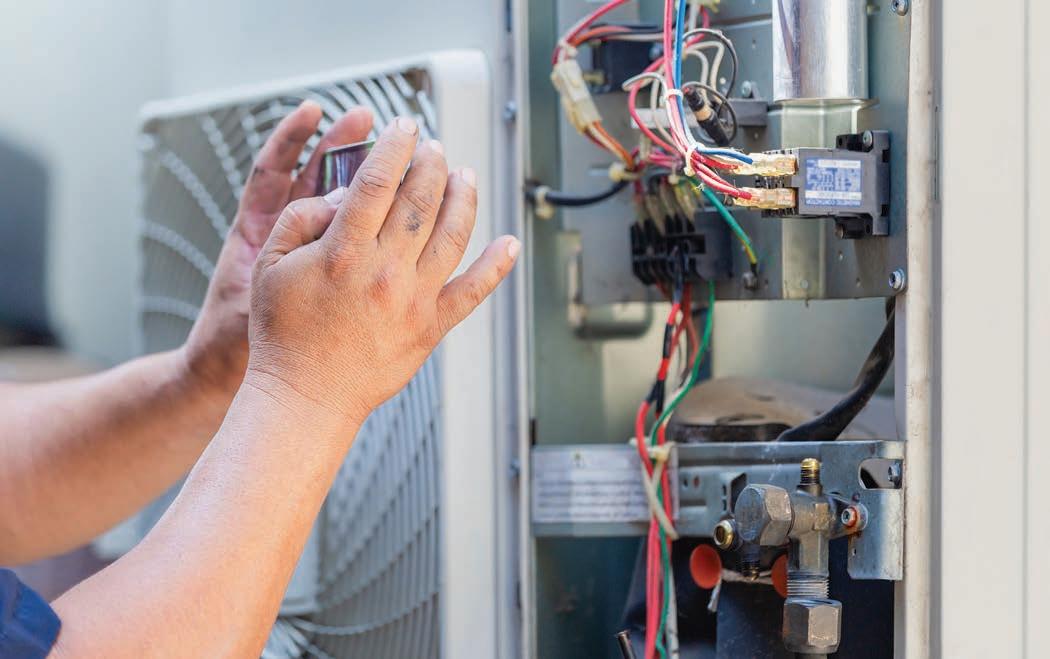
“A lot of the times where a smart building ends up disappointing the people that are moving into it, it’s not because the technology can’t do it, it’s not because it wasn’t designed properly, it’s because there’s that extra step that never existed before,” he says. “Now we need to actually sit down and say, when this happens in this system, that happens in that system. That last step of integration, if you skip that, basically what you have is a really fancy building that does nothing any different than it would have if you built it the other way.”
Flock agrees, noting the integration of building systems is “critical.” Coupled with integrating the systems at the end of the construction process, he adds, is handing off the prodigious amount of data to the operations team, which is waiting to pick up the baton and begin running the smart systems the way they were designed to be used.
Generating actionable data from the
“You’re treating the building as a system [and] you do have a lot more data. So, from a GC perspective... you don’t just rely on these tick box exercises of ‘Yes the system works,’ you actually have proof and you have data and you can collect that data over a longer period of time.”
– Colin Flock, EllisDon

host of connected components and sensors is one aspect of smart buildings that continues to evolve.
“It’s an unbelievable amount of data,” Flock says, adding that owners are continually trying to figure out which heaps of data they actually need and what they are able to do with it.
“In the case of the Oakville hospital, it’s coming on six years since substantial completion and we’re still finding information that we’re collecting that we can use for something else,” he says.
Platforms that use data for predictive maintenance, fault detection and remote diagnostics, among other areas, are maturing quickly. And in many ways, building systems are simply catching up with advances elsewhere.
“You can order a pizza and you know exactly where the guy is on your street before he gets there,” Boyajian says, “and yet you call your HVAC contractor and they probably will show up and you have no idea who’s coming, or when they’re coming.”
“Smart building initially was the connectivity, the energy efficiency and being able to trend and capture all this data. But now, over the past year, expectations have changed. We might want to track occupancy patterns; we might want to track in-door air quality.”
– Erica Brabon, Black & McDonald
With smart buildings and a “hard push” toward making use of the data they can provide, Boyajian anticipates this uncertainty becoming a thing of the past sooner rather than later. But he acknowledges the industry still has considerable ground to make up.
“As an industry right now, we’re the kid with the cell phone that takes 700 pictures and doesn’t delete any of them,

and you only really needed one of those pictures,” he says.
“So, I think we need to figure out having the mountains of data is great, you’ve got to do something with it, you’ve got to figure out what’s useful, and sometimes sifting through the mountain of data is harder than sifting through 10 data points.”
Quantifying the scale of the data

pileup, Brabon says some clients get excited about interval data, wanting updates as frequently as every 15 seconds.
“Well, a system doesn’t change that much in 15 seconds,” she says. “So do we really need that, and then again what are we going to do with it?
"Their excitement about data is there, but I think that we have to decide now what we’re going to do with the data and make sure that we’re getting the value out of it and not just keeping and storing it.”
In time, the panellists anticipate machine learning will be picking up the slack by filtering out unnecessary information, but currently, as in the rest of the developing market there is more work to be done. <>
David Kennedy is the editor of On-Site magazine.
What are the impacts of COVID-19 on a building’s energy usage while managing IAQ and reoccupying facilities?
Some of the measures Yorkland can assist with:


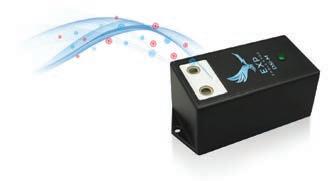
• smart IAQ sensors with algorithms to develop an IAQ Index/score based on TVOC, PM, CO2 and humidity levels
• needle point bipolar ionization for air purification
• real time occupancy data through Smart People counting sensors integrated to IAQ control
• critical environments including room pressurization monitoring and control
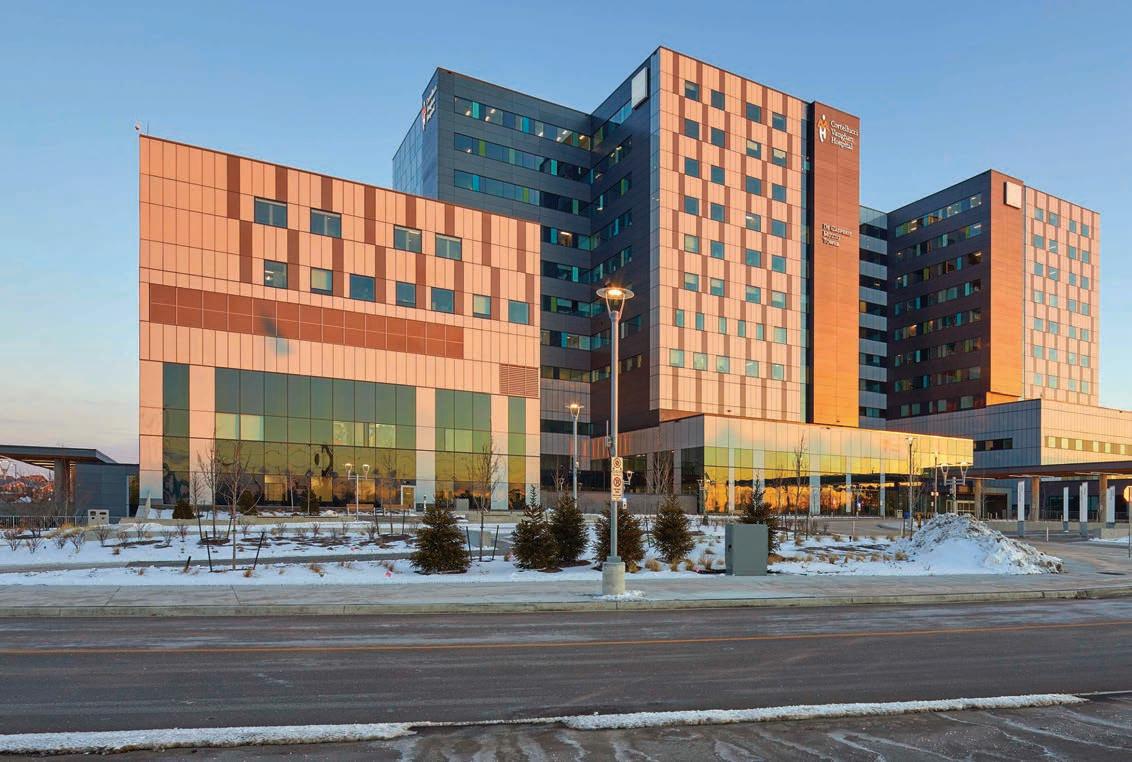
The new Cortellucci Vaughan Hospital provides a case study in collaboration and smart construction. BY
DOUG PICKLYK
Nowhere has the trend towards optimizing digital integration within a building been more realized than in the healthcare sector, where large public-private-partnerships provide the scope and resources to combine leading-edge clinical technology with intelligent mechanical and electrical services to provide the ultimate in patient-centred care.
At the same time, these billion-dollar projects enable general contractors and their trade partners to flex new muscles and incorporate the best of new building techniques to provide workflow and scheduling efficiencies.
The new Cortellucci Vaughan Hospital is the first hospital built in the City of Vaughan—located immediately north of
Toronto—and it is the first all-new hospital constructed in Ontario in more than 30 years.
In late October, 2016, Infrastructure Ontario and Mackenzie Health awarded the Plenary Health team a contract valued at approximately $1.3 billion to design, build, finance and maintain the 1.2 million-sq. ft. hospital on a 40-acre greenfield site, with a completion target of 2020.
The design/build team for the project was led by PCL Construction, a group very familiar with P3 healthcare projects in the province. Their primary construction partners included Modern Niagara on the mechanical side and the Plan Group on the electrical.

The client, Mackenzie Health, identified their Smart Vision for the hospital early on. “Smart devices, or smart technology and applications, are integrated into our everyday lives with smart phones for example, so we asked ‘How can we bring this technology into the hospital environment and give that kind of experience to our patients and also to our physicians and clinicians?’” says Felix Zhang, Chief Technology Officer with Mackenzie Health.
Achieving the vision would require a high level of integration, combining the hospital’s IT network with the building systems. Together with PCL and experts in information, communication, and automation technology (ICAT), the client was able to design and develop the converged network backbone that props up the completed hospital.
“The P3 model requires a lot of collaboration on the front end,” notes Andre Bohren, construction manager with PCL who oversaw the Cortellucci Vaughan Hospital (CVH) project. “We really do have to build our partnership with our mechanical and electrical contractors, and in this case an additional third-party on the IT side (Compugen).”
Because connectivity and intelligence is integrated with so many of the different devices and systems in a hospital setting, a high level of team work early on in the design was required to ensure the physical infrastructure would be in place to connect all the pieces together.
“The level of collaboration was very high on this project due to the fact that the smart hospital vision touched all of the major systems,” adds Steve George, construction director (ICAT) with Plan Group. Focus group meetings were held weekly during the design phase and all stakeholders including the hospital and PCL along with the trades were included in order to understand all of the inputs and outputs involved in the converged network.
“In terms of the base infrastructure of this building, it’s not that different from other P3s in concept, but then we do have all this integrated mechanical that’s also speaking more to the client’s front-end system, which make this a bit smarter than other builds,” notes Bohren.
“There’s more user interfaces, like through patient iPads that can control lighting, the blinds, room temperature and more, and that’s more ‘smart’ than I’ve seen on past projects,” he adds.
Peter Cole, district building systems manager with PCL, has been working on hospital P3 projects for over 10 years, and he’s witnessed the evolution of digital integration leading to today’s ICAT sophistication. “Ten years ago we were just touching on network design. We put
a network in a hospital and we called it IT, and then it grew into ICT [information and communication technology], and then all of the sudden they added the automation.”
Bohren recalls the first major hospital project he worked on and installing copper lines for fax machines. “And that was supposed to be one of the more advanced hospitals trending towards paperless. Fast forward three or four hospitals later, and this is the most I’ve ever seen in terms of a hospital venturing into paperless and a userfacing system to this degree. Thats what’s unique at CVH compared to other hospital projects I’ve been involved with in Ontario.”
Today a smart build requires digital technology at all stages, and PCL has built a lot of capability around Autodesk’s BIM [building information modeling] technology for collaboration on design documentation. The trade partners can access the 3D BIM model, and then they can pull out and add pieces where required.
According to Mark Sayers, construction manager for Modern Niagara and another industry veteran who has worked on P3 hospitals with these partners in the past, this was the first major project incorporating 3D modeling early on. The construction team took the design-level 3D drawings from the architect and consulting engineers and added the construction level of detail. “That whole process, especially with it being done using the same software model, was unique. It’s now becoming more standard in the industry, but definitely at the start of 2017, it was the first job I was involved with that did that,” says Sayers.
PCL also uses the Autodesk BIM 360 field system for communicating progress. “And we’ve layered on PCL’s own
Continued on p44
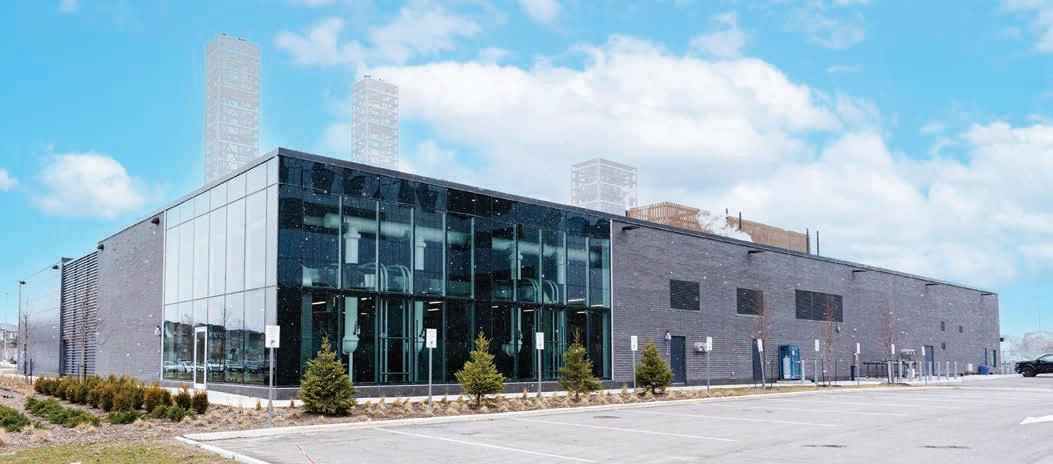
services with a [Microsoft] SharePoint backbone and it gives us a seamless window into those things. I’ve got to say, the collaboration piece in these tools, quality checking, progress photographs, is all shared in real time,” says Bohren.
PCL also has an online delivery tool used to communicate with the client in terms of scheduling deliveries on-site to optimize time, and they use a cloudbased PDF system for collaboration on document review so everyone can do their shop drawing reviews in real time together.
Sequentially, one of the first elements completed on-site was the Central Utility Plant (CUP), a structure that houses the mechanical room along with power distribution and back-up generator. Typically utility plants are positioned in the penthouse or midway up a building, the CUP was constructed on ground level outside of the main building, providing multiple smart benefits. “We were able to start building the CUP in advance and in parallel, and start adding in critical systems such as generators, boilers and the major electrical distribution, all while we were still putting up the building,” says Bohren.
Commissioning on the CUP was also started well ahead of the main building.
“It was a real advantage for us,” says Sayers from Modern Niagara. “We usually have to wait for the entire building to be built before we can start working on the plant, and then it becomes a critical path item at the back end of the schedule.
“And with it being in its own building it became a unique feature. The architect incorporated glass into the chiller room, so you can look from the hospital and see right into the chiller room, and I haven’t seen a project where a mechanical facility has been featured like that. Usually it’s a back of house item that only mechanical contractors get excited over.”
From the client’s perspective, building the CUP outside of the main building saved on valuable real estate inside the hospital allowing more room for patient care, and it also isolated any noise or heat generated at the plant.
Another element placed outside the main building is the hospital’s data centre. The brains of the hospital information systems and an essential piece of the building’s operations, the data
centre was positioned close to the CUP, convenient for connecting with power and cooling sources.
Mackenzie Health elected to go with a prefabricated solution that consists of two identical container-like enclosures that were built and completely outfitted at a factory in Southwestern Ontario and then transported to the site.
“We were involved in the planning of the data centre with the supplier based on a specific set of specifications from the client, and we did regular inspections in the factory as it was being built,” says Steve George with Plan Group. Once on-site the team performed some finishing work from an electrical and IT standpoint, including connections to all of the main electrical feeders. The enclosures have their own self-contained uninterruptible power supply (UPS) and backup cooling systems. The enclosures are twinned, and for additional redundancy they are connected by a fiber network to a data center located within another Mackenzie Health hospital in nearby Richmond Hill.
Smart benefits of positioning the modular data centre outside of the building, aside from space savings inside, include flexibility for future expan -
Continued on p46
Empowering your teams to tackle 2021 starts with getting the field and office on the same page. See how Procore can help you connect everyone on your project—from executives and finance staff to crews performing work on the jobsite.
procore.com

Stay profitable by tracking quantities of material installed while on site. Monitor labour and material costs in real time from the office.
Capture critical data and collaborate in real time from field to office with mobile RFIs, Submittals, Budgets, Checklist, and more.
Avoid costly mistakes and ensure equipment is safely and correctly installed the first time around with mobile quality assurance and inspections tools.
sion or even downsizing. “Right now everyone's talking about cloud services, and who knows 10 or 20 years down the road we may leverage more cloud services and may not require a huge outside data centre anymore,” says Zhang from Mackenzie Health. “It’s much more cost-effective to do that if it’s outside of the building.”
For construction efficiencies, contractors like PCL seek opportunities to incorporate modular elements into buildings. This project included some 290 prefabricated patient washroom pods, each around 100 sq. ft. and weighing approximately 5,000 lbs.
“There was an early collaboration with the design team and our trade partners to figure out how to streamline the washroom designs, reducing the number of variations required,” says Bohren.
Once the pods were designed, the trades worked in PCL’s controlled factory environment. There are obvious scheduling benefits, working in parallel to the main build and not having to wait for slabs to be poured and the building enclosed. Once delivered, the trades also performed the final connections on-site.
Another example of an off-site modular project included the pre-assembly of all the large chilled water, heating water and condenser water pipes onto structural steel pipe racks. This was performed in Modern Niagara’s fabrication facility. The pipe racks were then shipped on trucks and lowered into a tunnel connecting services from the CUP to the hospital.
PCL and its partners hit important milestones along the construction path and achieved substantial completion of the project in August 2020, amidst the COVID-19 pandemic.
The high level of collaboration among
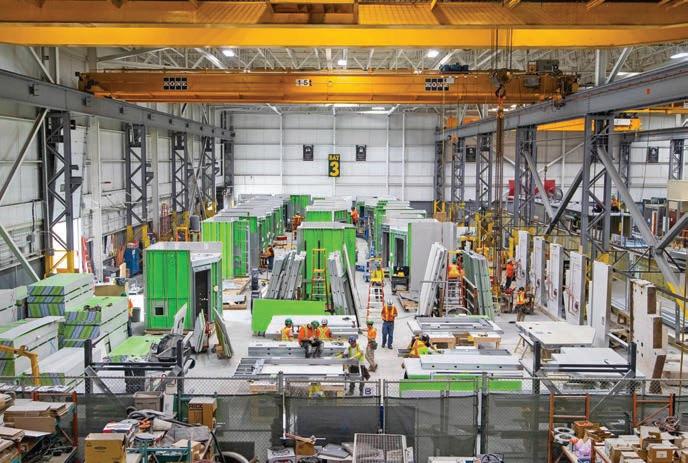
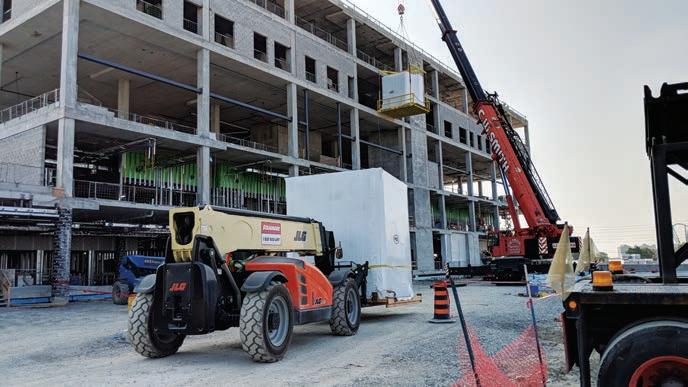
all partners, that began at the onset of the project and continued throughout, proved critical when the pandemic was first announced.
Safety precautions were implemented on-site, and there were no COVID outbreaks. And after close to 4 million worker hours completed throughout the project there was not a single loss time incident.
“That speaks a lot to the professionalism of the skilled people we had working on the project, and the safety culture on the project,” says Bohren.
Officially opened on February 7,
2021, the hospital is currently supporting Ontario’s fight against COVID by providing critical and acute care support. Once the pandemic is over, the health care facility will serve as a fullservice community hospital with the capacity to operate 350 beds with shell space to add more floors of additional capacity.
According to Felix Zhang of Mackenzie Health, the greatest reward he has experienced so far has been the high level of positive feedback from the patients—fulfilling the ultimate goal of the organization’s smart vision. <>


Meeting the future needs of connected buildings, Belimo has developed intelligent controlled devices improving the installation, data transparency, and extensibility with no need for infrastructure changes. With digital connectivity, you can control, service, and optimize your building more efficiently.
Belimo is empowering building operators in a connected world. Small Devices, Big Impact.

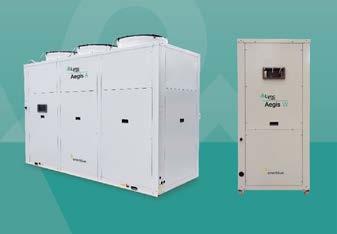
Watts Water Technologies has introduced Lync, a new brand in the company’s broad portfolio offering pre-assembled domestic hot water system solutions for commercial and industrial markets.
Lync’s initial offerings include: water heating solutions; water quality solutions; and Aegis branded air source and water source CO2-powered commercial heat pump water heaters.
Watts has also acquired The Detection Group (TDG), a provider of wireless water security solutions, currently active in over 400 commercial buildings across the U.S. lyncbywatts.com thedetectiongroup.com
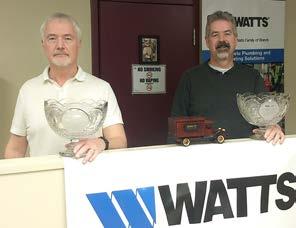
Peter and Chris Brown of Walmar Mechanical Sales based in Nepean, Ont., received the Watts Lifetime Achievement Award. The honour was announced virtually during the 2021 Watts National Sales Meeting. Both have worked to help build a backflow program in conjunction with the City of Ottawa among other achievements. Walmar Mechanical has been a Watts authorized sales representative for three generations and represents Watts in the Ottawa area.
DiversiTech, an aftermarket manufacturer and supplier of engineered components for residential and light commercial HVAC/R, has merged with Fresh-Aire UV, manufacturer of indoor air quality (IAQ) products/technology for residential, commercial, industrial, agriculture, healthcare and other specialized markets.
“The IAQ product range will bolster our core offering and further strengthen our value proposition to our HVAC/R distribution partners,” said Andy Bergdoll, DiversiTech CEO in a company release. diversitech.com freshaireuv.com
TOTO GC touchless faucet
Silver in the bathroom category. Embedded with Amazon Alexa, the Moxie showerhead + wireless speaker features a full-coverage spray with a portable speaker via Harman Kardon.
And the Flo by Moen Smart Sump Pump Monitor won Silver in the Kitchen category. The device provides continuous monitoring of sump pumps and sends alerts when potential failures are detected. kbis.com
Mestek, Inc. has announced the purchase of the baseboard assets from Slant/Fin, a manufacturer and provider of hydronic baseboard radiation.
The Slant/Fin Baseboard brand will become part of the Mestek portfolio of brands that specialize in HVAC systems for industrial, commercial and residential customers across North America.
The annual Kitchen & Bath Industry Show (KBIS), North America’s largest trade show dedicated to kitchen and bath design, was a virtual event this year and the show held its yearly Best Of KBIS Awards program.
Following are three plumbing-related products that scored Best Of awards this year:
In the bathroom category, the TOTO GC touchless faucet won Gold. The faucet is powered by TOTO’s new EcoPower self-generating hydropower technology (no hardwiring or routine battery replacement). An internal turbine generates power for the sensor faucet’s touchless operation.
The Kohler Moxie showerhead + wireless speaker with Amazon Alexa took
“Slant/Fin baseboard is a proven product with a very loyal following of customer partners and falls seamlessly within our corporate philosophies,” said Tim Markel, president of the Mestek’s distributor products group, in a company release. “We are very excited for this opportunity to continue the hydronic baseboard legacy of two respected industry icons and take great pride in both the past accomplishments of these organizations and look forward to continuing on with the Slant/Fin Baseboard brand.” metek.com
Through the first months of 2021 the Canadian Institute of Plumbing and Heating (CIPH) has been recognizing members for their dedication and service with its Lifetime and Outstanding Service Awards. The association has also introduced a new award to recognize manufacturer and master distrib -
uter members: the Golden Leaf Award.
The CIPH LifeTime Service Award, recognizing 40 or more years in the plumbing and heating industry, was recently awarded to: Pierre Berthiaume of Deschenes; Joe Campagna of Bartle & Gibson; Brent Cornelissen of OS&B; Steve Henry, of Wolseley; Thanh Hua of Canplas Industries; John Levandier (retired); Brad Powell of EMCO; Harald Prell of Viessmann; and Rick Thomas of Crane Supply.
CIPH’s Outstanding Service Award for individuals with 25 or more years with a CIPH company and at least five years of volunteer service on a CIPH board, council or committee, has been presented to: Sean Giberson, of TACO; John Hammill, of Moen; Dan Milroy, Equipco; Drew Molnar of InSinkErator; Marco Varnier of EMCO; and Mike Wills of Wolesley.
The new annual Golden Leaf Award award will honour a CIPH member (manufacturer/master distributor) who best supports the efforts of sales agencies. The Award was a request from the CIPH Manufacturers’ Agents Council and was approved by the CIPH Board of Directors in 2020. The new award will be presented to a member that exclusively utilizes manufacturers’ agents and has: worked to develop and maintain a positive working relationship with manufacturers' agents; promotes
RWC Canada announced Dougie McDowall as their new business solutions manager in the West. McDowall brings large amounts of knowledge and experience within the plumbing wholesale and contractor networks. He will add his knowledge and enthusiasm to help deepen RWC’s roots in Western Canada covering Manitoba to British Columbia.

the industry and has a positive influence; establishes and maintains an efficient information network; works closely with agents to ensure customer satisfaction; and supports and has been actively engaged in CIPH. ciph.com
From steel manufacturer to an international digital company, Germany-based Rittal is celebrating its 60th anniversary in 2021. The HVAC/R industry is most familiar with Rittal enclosure cooling solutions for IT data centres. Over its history Rittal developed the enclosure into an entire system. Last year the company celebrated 25 years in Canada. rittal.com <>

NIBCO has appointed Ashley Martin as executive vice president. Martin will also continue her previously held role as corporate officer and executive leadership team member. In her new role she will be responsible for maximizing operating performance and achieving financial goals. She joined NIBCO in 2012 and has held numerous roles.
Elizabeth McCullough, general manager, trade shows at the Canadian Institute of Plumbing & Heating (CIPH) will be retiring June 30th. McCullough has been with CIPH for 24 years, involved in various CIPH programs and shows including MCEE, CIPHEX West and CMPX. Sarah Clarke has been promoted to the role of trade show manager with CIPH.

Tracing back to the history of the trade, piping materials have evolved, and while many materials still stand the test of time progress has led to a broader range of residential solutions.
BY STEVE GOLDIE
The word plumber, as most of you likely are already aware, comes from the Latin words plumbum for lead or plumbarius meaning worker in lead. Lead is one of the earliest known metals discovered and used by the human race, dating back to at least 3,000 BC. The ancient Romans used lead for water lines and lining baths. As a name for those of us who work in the pipe trades, “plumber” dates as far back as the 12th century. The relationship of the plumbing industry to lead is pretty firmly established, which is somewhat ironic considering even trace amounts of the heavy metal are forbidden in all materials and components used in water piping systems today.
One could be forgiven for assuming lead was so prevalent in ancient days because there was not much else to choose from, however then, as now, choices as to what to use were made
based on multiple factors. Have a look at this passage I found from a report written in 1917 and published in an engineering and construction journal of the day:
“Lead is in many respects the most satisfactory material to use for service pipes. Its pliability and its comparative freedom from corrosive action make it almost ideal from a mechanical standpoint. The cost of lead pipe of sufficient thickness safely to withstand the pressure is more than the cost of many other materials used for service, but in a paved street the greater duration of life probably more than compensates for the extra cost, and in places where the streets are occupied by other pipes and conduits the ease of getting over and under these obstructions with a flexible pipe is a great advantage.”
The writer assesses the suitability of lead based on its strength, pliability,
corrosion resistance and flexibility, all qualities that make it well suited to the application, in this case as a water service line.
The writer even acknowledges cost, judging the higher cost of lead (compared to steel at that time) to be worth it due to the life expectancy.
These are very similar to the criteria by which we would evaluate materials we use today. The one thing that is conspicuously absent here is any mention of health and safety concerns, which is exactly the reason lead is no longer an option today. This is somewhat curious since the health impact of high lead levels was already known in 1917. Fortunately, today all materials for use in plumbing systems have to meet minimum codes and performance standards as determined by various testing agencies.
Does this mean we have less choice? Not at all, when it comes to piping and plumbing materials our industry is continually evolving and there have probably never been more options.
The oldest cities in North America, such as Philadelphia, New York, Boston and Montreal, once had water-mains constructed from bored out trees, mostly elm. Hollowed out logs were used as early as 500 years ago for both water distribution piping as well as
Continued on p52
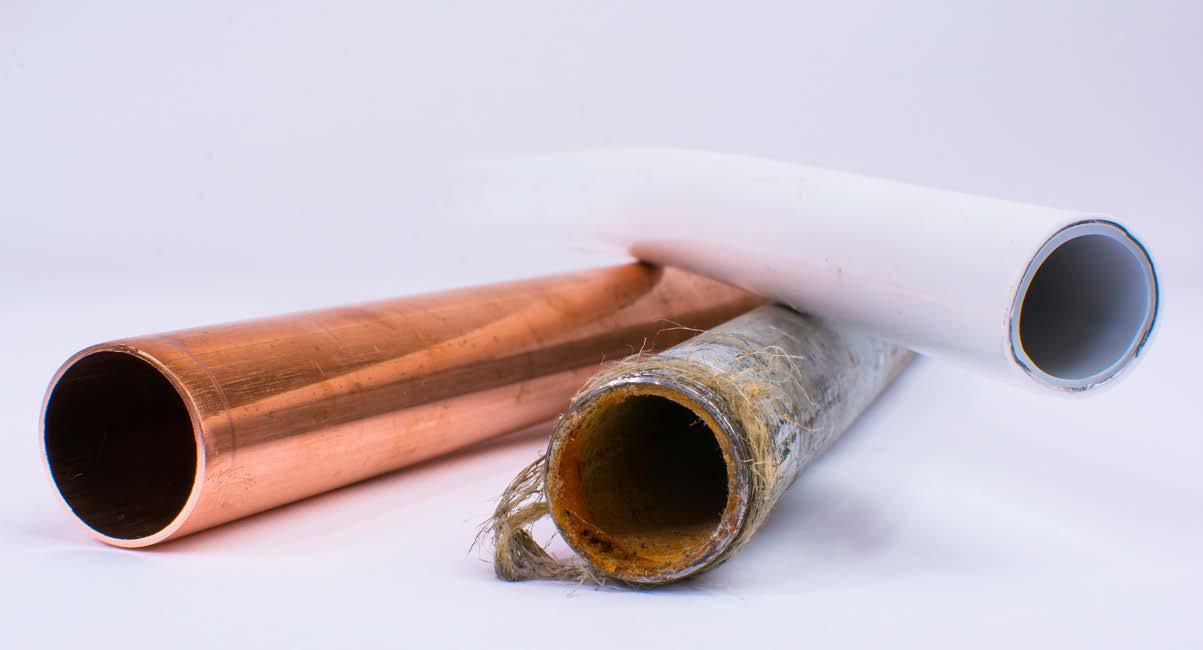
From parking garages to hospitals to high buildings, more and more mechanical contractors and engineers are switching to a long-lasting DWV solution.
As an integrated solution, System 15® and System XFR® meet all code requirements for noncombustible buildings. As a complement to System 15 and System XFR, MJ GreyTM Mechanical Couplings provide an alternative to solvent welding when working in cold weather conditions, from heights in a scissor lift or a bucket.
Drain-GuardTM Double Containment Systems provide safe transport of sanitary or storm drainage in critical areas. Should a leak occur, people, equipment and valuable property will be protected from possible harm.
DWV Systems by IPEX provide the required rugged reliability with all the added benefits:
• Lightweight, Easier to Install
• Corrosion Resistant, Less Maintenance
Contact us to learn more about our complete DWV systems. ipexna.com | 1-866-473-9462
• Overall Project Savings
• Unsurpassed Technical Support
sewage lines. In time wood logs gave way to clay, cast iron, copper, steel and lead. The latter half of the 20th century saw the introduction and massive growth of many different plastics in all industries, including plumbing.
Each option has its own advantages and limitations. Each application has its own particular requirements and challenges, and each customer has his or her own expectations. Our job is to understand and balance these, and present the best option in each case.
Thinking about this reminds me of a scene from the movie Moonstruck. It has little to do with the main plot, but it is the moment I remember most.
In this scene, the character Cosmo Castorini, (portrayed brilliantly by Vincent Gardinia) is a New York City plumbing contractor. He is presenting a young professional couple with an estimate to re-pipe their aging bathroom.
They initially balk at the seemingly exorbitant quote, but Cosmo is unfazed, he expects this kind of response. He looks at them with a grave seriousness and says: “There are three kinds of pipe. There’s the kind of pipe you have (galvanized) and that’s garbage, and you can see where that’s gotten you. Then there’s bronze, which is pretty good, unless something goes wrong, and something always goes wrong. Then, there’s copper, which is the only pipe I use. It costs money. It costs money because it saves money.”
Cosmo delivers his pitch not just with his words but also with hand motions as skilled and precise as a symphony conductors’. He is well practiced and very effective, and the husband quickly agrees to go along with Castorini’s recommendation.
Moonstruck was released in 1987, and back then as a young plumber I also
This lead water distribution pipe was discovered amidst the ruins of Pompeii in Italy. Plumbing of this time (around 0 BC) was truly plumbous and poisonous. This is how the World Health Organization (WHO) describes the dangers of lead poisoning: Too much lead can damage various systems of the body including the nervous and reproductive systems and the kidneys. Lead accumulates in the bones. Children are particularly vulnerable to the neurotoxic effects, and even low levels of exposure can cause serious and irreversible neurological damage.
would have recommended copper as the best choice of material for a residential re-pipe. Today there are far more than the three types of pipe Cosmo described. To name just a few, you could offer copper, Chlorinated polyvinyl chloride (CPVC), polypropylene or any number of brands of crosslinked polyethylene (PEX). Personally I would now choose PEX. Does that mean it's is better than copper, CPVC or others? Not necessarily, I just believe when you look at all factors, for a residential job, PEX comes out on top. Is there one material that comes out on top for all applications? The answer is no, or it depends. As I have said, each material has its own characteristics which need to be matched to the application. Some have better resistance to harsh chemicals, some have higher temperature ratings, some are more flexible, and some are more rigid. Flexibility is desirable when choosing a material for an underground water service, but for drain pipes, which need a steady and consistent slope for drainage, a rigid pipe is more desirable.
Some materials stand the test of time
better than others. In 1994 archeologists excavating the remains of a 4,500-year-old Egyptian pyramid unearthed a fairly intact and intricate copper drainage system. Although the pyramid and the surrounding temples were crumbling, the copper piping survived, how is that for longevity?
Others such as lead and tree trunks come and go. What will never go away is the need for well designed, installed and maintained plumbing systems, and the well trained, experienced and educated tradespeople who work on them.
As always, your local wholesaler will be happy to hook you up with additional and more detailed information to help you make the best decisions for your business and customers. <>

Steve Goldie learned his trade from his father while working as a plumber in the family business. After 21 years in the field, he joined the wholesale side of the business in 2002. His expertise is frequently called on to troubleshoot systems and advise contractors. He can be reached at sgoldie@nextsupply.ca.


In addition to our popular sectional cable drain cleaning machines, our complete line also includes continuous cable drum machines, high pressure water jetters, gasoline powered municipal sewer cleaners, and pipeline inspection camera systems.
This complete line of drain and sewer cleaning tools is the industry standard for highest quality and professional design.
We manufacture a wide variety of continuous and sectional cables which can be adapted to most major brands of drain cleaning equipment. Utilizing the industry’s highest quality components, such as certified music wire and galvanized aircraft wire, our cables are designed for maximum flexibility and longer life. A special heat treating process relieves stress on cables for superior performance.
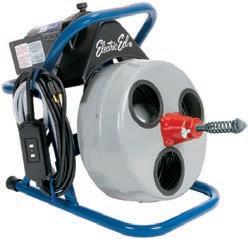
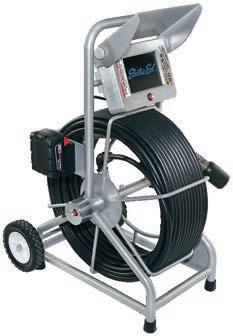

The PC441-10A sump pump combo system from Liberty Pumps is a complete pre-assembled primary pump and backup. Falling between the base level 441 and higher-end 442 systems, it includes a 10-amp charger. The high output 12V battery operated pump systems come drop-in-the-pit ready to provide uninterrupted pumping in the event of a power outage or main pump failure. Primary pumps are available in 1/3 or ½ hp and connect to a 1-½-in. discharge. libertypumps.com
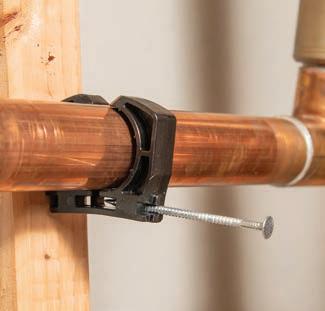
Oatey has new Full Clamp pipe clamps featuring updated installation and removal features. The clamps are built with push-on installation technology, including a lead-in edge that automatically opens the clamp. With a patented removal wedge and notch, clamp removal is also quick and simple. The clamps provide pipes complete stand-off from the surface, and 360-degree pipe protection allows tubes to expand and contract. Notched nail slots also allow for strain relief and better nail alignment. oatey.com
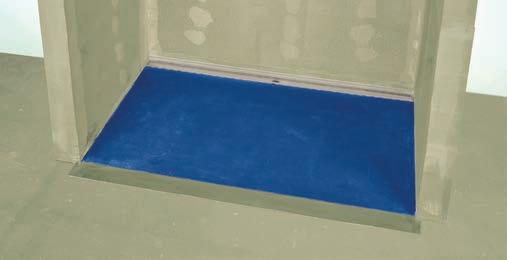
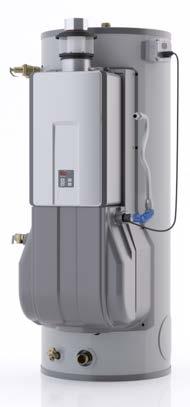
Rinnai’s non-condensing Demand Duo R-Series commercial hybrid water heating system connects to existing 6-in. B-Vent for quick replacements of standard-efficiency atmospheric tanks. The system features part-tank and parttankless design. Sold in 80- or 119-gallon tank options, a 36-in. Swivel-Flex Gas Line creates efficiencies and reduces install time with a preinstalled electrical junction box and duplex outlet. The digital controller allows management of building recirculation without having to purchase an additional aquastat. rinnai.ca
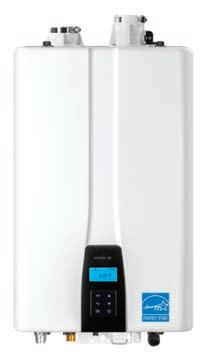
Navien high efficiency condensing NPE-2 series of tankless water heaters are offered in four Standard (NPE-S2) models up to 199,900 Btu/h and three Advanced (NPE-A2) models up to 199,900 Btu/h. Features include a turndown ratio up to 15:1, EZNav multi-line control with built-in software and Setup Wizard, 2-in. PVC venting length up to 75-ft., vent installation detector, cascade up to 32 units and common venting up to 12 units. navieninc.com
Infinity Drain offers a standard 30 x 60-in. stainless steel shower base for residential and commercial bathrooms. With over 42 options for center or linear drains in a variety of drain placements, five finishes and seven styles, the shower bases can integrate for either curb or curbless (barrier free) showers. Made from 16 gauge stainless, they arrive factory flood-tested and ready for installation with drain, pre-sloped floor and primed for tile installation. infinitydrain.com
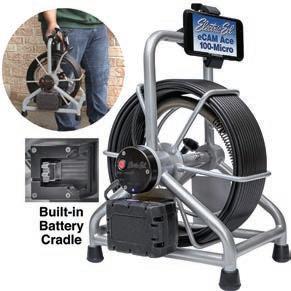
The Electric Eel eCAM Ace 100-Micro pipeline inspection camera now comes standard with a battery cradle that accepts a Milwaukee M18 or equivalent battery. Video is streamed directly to any mobile device which can be used as a monitor. Weighing 15 lbs., the compact portable unit performs inspections in pipes ranging from 1-1/2-in. to 3-in. diameter and up to one hundred feet in length. electriceel.com
•

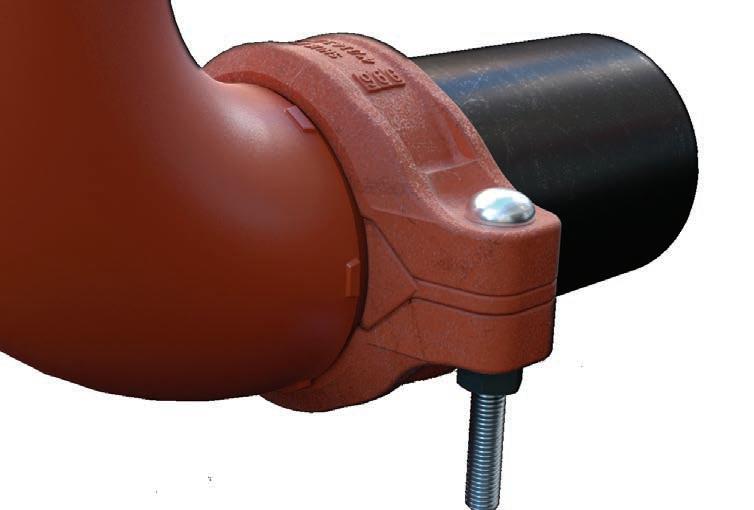
Innovative Design Features
• 1-Bolt Design Saves installation time over conventional Couplings
Integrated Wedge ensures Gasket Compression and prevents pinching

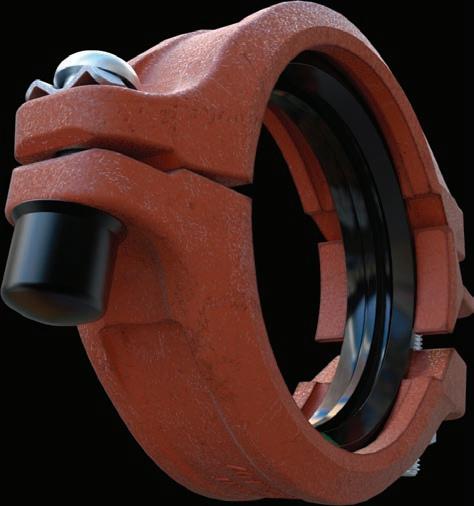
•
Quick Install Gasket
• Pipe Stop: Ensures the Gasket is properly located in the connection, and assists in vertical installations
Gap Seal: The Gasket design is optimized for any sort of installation
Additionally, our Quick Install Gasket design ensures Gasket-to-Pipe contact from the moment you install it
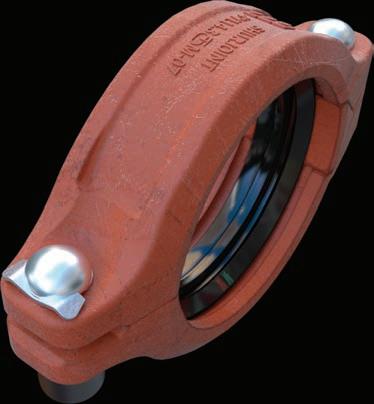
Despite more talk about electric vehicles, for now service truck and van updates in 2021 focus more on fuel efficiency and convenience features.
BY JIL MCINTOSH
You can’t do a day’s work without a vehicle, and you need a vehicle that’ll also do a day’s work and then some. There are numerous truck and van choices for 2021, from minor updates to all-new, and we’ve rounded them up to help you determine which ones are right for you. <>
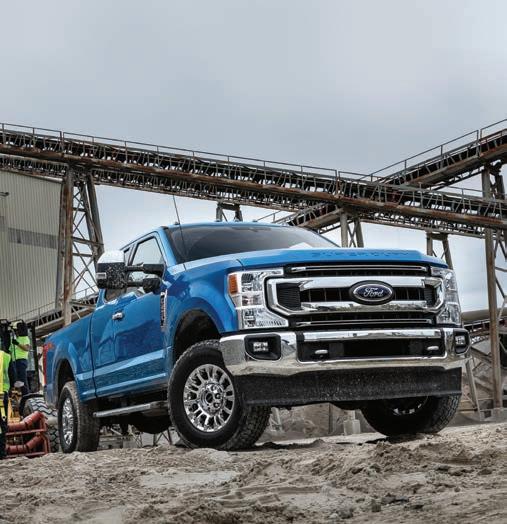
The F-150: is all-new for 2021 and includes an available gaselectric hybrid system. It can run on gasoline, electricity, or a combination, and switches automatically depending on driving conditions. It makes 570 lb-ft of torque, and rather than a stand-alone model, the system is an option on all trims.
F-150 engine choices are a 3.3-litre V6 and 5.0-litre V8; 3.0-litre V6 Power Stroke diesel; and turbocharged “EcoBoost” 2.7-litre V6 or 3.5-litre V6. The turbo 3.5-litre is the hybrid system’s engine also. Cab choices are regular, supercab, and supercrew.
Available features include an interior work/lunch table, flat-folding front seats for lunchtime naps, and tailgate with built-in clamp pockets and rulers. A 2.0-kilowatt onboard generator is available; while the hybrid has a standard 2.4-kilowatt unit, or optional 7.2-kilowatt generator, all with plugs inside the bed.

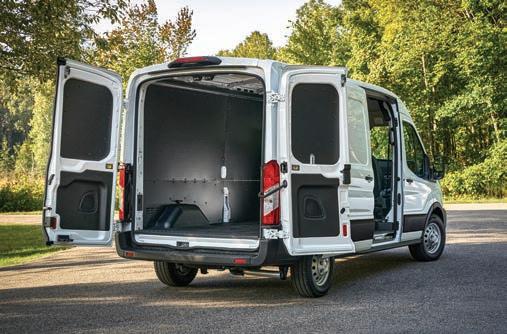
The super duty – F250, F350, and F450 – carry over from 2020 with minor trim changes, and with three cab configurations. Engine choices are a 6.2-litre V8, 7.3-litre V8, or 6.7-litre Power Stroke turbodiesel making 1,050 lb-ft of torque.
The full-size Transit van now has better rear-area access between the front seats, and the overhead shelf is optional should you prefer more headroom.
A crew van is available with an extra row of seats. Transit comes in three lengths and three roof heights. Engine choices are a naturally-aspirated or turbocharged 3.5-litre V6, and all-wheel drive is available.
The smaller Transit Connect is unchanged for 2021. It comes in two wheelbase lengths, and with 2.0-litre four-cylinder, or 2.5-litre four-cylinder that’s available with a compressed natural gas/liquefied natural gas (CNG/LNG) fuel prep package.
The mechanical-twin Chevrolet Silverado and GMC Sierra are largely unchanged for 2021, but the Silverado now has the available multi-flex tailgate from the Sierra. This gate-within-a-gate has six functions, including two-tier loading, cargo stop, or bed step.
Both trucks come in regular cab, double cab, and crew cab, and with five engine sizes: 4.3-litre V6; 5.3-litre V8; turbocharged 2.7-litre four-cylinder;
6.2-litre V8; and 3.0-litre inline-six turbodiesel. Some have fuel-saving cylinder deactivation, either active fuel management (AFM) that shuts the same ones off each time, or dynamic fuel management (DFM), which uses various patterns.
The Silverado and Sierra heavy-duty trucks come in 2500 and 3500 configurations, in three cab sizes, and like their competitors, with available 4x4 and dual rear wheels. Engine choices

For 2021, the Sprinter brings back its 2.0-litre four-cylinder turbodiesel engine, making 288 lb-ft of torque. Other choices are a turbocharged four-cylinder gasoline engine, or 3.0-litre V6 turbodiesel making 325 lb-ft of torque.
The Sprinter comes in 2500, 3500, 3500XD (heavyduty) and 4500 configuration. As a cargo van, it comes in three lengths, and with standard or high roof; while the five-passenger crew van comes in two lengths with high roof. Four-wheel drive is available on specific models. The Metris, in rear-wheel-drive only, is the market’s only midsize van. It has more capacity than a compact van, but it’s able to get into sites like underground garages where a full-size might not. For 2021, it gets styling updates, a new nine-speed automatic transmission, and new available features including emergency front braking and digital rearview mirror. The cargo version comes in two lengths, both powered by a turbocharged 2.0-litre gasoline engine.

are 6.6-litre V8 gasoline, or 6.6-litre Duramax turbodiesel with 910 lb-ft of torque.
The Chevrolet Express and GMC Savana are the market’s oldest van designs, but there’s something to be said for longevity. Both come in 2500 or 3500, and both in regular or extended wheelbase. Engine choices are a 4.3-litre V6, 6.6-litre V8, or 2.8-litre Duramax four-cylinder turbodiesel.
This is Nissan’s last year in the trades. It is discontinuing its vans, and will stop selling the Titan and Titan XD pickups in Canada at the end of the 2021 model year. All vehicles have a five-year/160,000-km comprehensive warranty on almost everything, and Nissan Canada confirms dealers will stock replacement parts until at least mid-2031.
The Titan and larger Titan XD come in crew cab and 4x4, with a 5.6-litre V8 engine. The advertised 413 lb-ft of torque is only on premium fuel, and drops to 394 on regular-grade.
The full-size NV van comes in 1500, 2500, and 3500 configuration, and has two roof heights. Depending on the configuration, engine choices are a 4.0-litre V6 or 5.6-litre V8. The compact NV200 van uses a 2.0-litre four-cylinder engine, mated to a continuously-variable transmission (CVT).
Continued on p58
The Ram 1500 carries over for 2021 but with some new available features, including a head-up display, trailer reverse control, and digital-camera rearview mirror.
The 1500 comes in quad or crew cab, and engines are a 3.6-litre V6, 5.7-litre V8, or 3.0-litre EcoDiesel V6. A mild hybrid called eTorque is standard on the 3.6-litre, optional on the V8. It improves fuel economy by assisting on acceleration, the truck can’t run on battery alone.
As a lower-priced alternative, the lastgeneration Ram from 2018 is still built and sold as the 1500 Classic. It comes in three cab configurations, and with either the gasoline V6 or V8, depending on the model, but without eTorque.
The heavy-duty Ram 2500 and 3500 are unchanged for 2021. They come in regular, crew, or mega cab, and with a 6.4-litre V8 or available 6.7-litre Cummins inline-six turbodiesel that

makes 850 lb-ft of torque. As with the Ram 1500, the 2500 can be optioned with an air suspension, although its weight cuts into the payload.
The Ram ProMaster is the only fullsize van with front-wheel drive, which makes for a lower step-in height. For 2021, it gets standard crosswind assist; blind-spot monitoring and emergency front braking; and a digital-camera rearview mirror. It comes in 1500, 2500, and 3500 configuration; three wheelbases; regular or extended body; and two roof heights, all with a 3.6-litre V6 gasoline engine.
The smaller Ram ProMaster City is unchanged other than minor trim additions. It’s powered by a 2.4-litre four-cylinder making 178 horsepower, mated to a nine-speed automatic transmission.
The Tundra is unchanged for 2021, other than new appearance trim packages. It comes in double cab or crewmax, and in 4x4 only. Both are powered by a 5.7-litre V8 that makes 381 horsepower and 401 lb-ft of torque.























Best-in-class max. available payload of 7,850 lbs*
Max. available diesel towing of 37,000 lbs**



Best-in-class‡ max. available payload of 3,325 lbs
Best-in-class† max. available towing of 14,000 lbs



When you’re building a business, you need the best. The 2021 Ford Super Duty is a powerful business partner. Designed with productivity in mind, the all-new Ford F-150 – with its available Tailgate Work Surface comes ready for the worksite, and its class-exclusive^ available Pro Power OnboardTM offers exportable power on demand to help keep you running until the job’s done.




Continued from p58


While it likely won’t be your primary vehicle, a midsize truck could be the right size for lighter-duty service calls.
The Chevrolet Colorado and GMC Canyon are the only trucks available with two- or four-wheel drive. They come in extended cab or crew cab, and with 2.5-litre four-cylinder; 3.6-litre V6; or a 2.8-litre four-cylinder turbodiesel with towing capacity of 7,700 lbs.
Ford offers its Ranger in supercab or


supercrew, in 4WD only, with a turbocharged 2.3-litre four-cylinder that makes 310 lb-ft of torque, and towing capacity of 7,500 lbs.
Toyota’s Tacoma comes in access or double cab, in 4WD only, and with a 3.5-litre V6 mated to stick-shift or automatic transmissions.
Nissan presents an all-new 2022 Frontier, arriving in the summer of 2021, in king cab or crew cab, in 4WD

only, and carrying a 3.8-litre V6 with towing capacity of 6,490 lbs.
Ram doesn’t make a midsize truck, and with its removable roof and doors, the Jeep Gladiator is more lifestyle than work machine. You might think that of the SUV-based Honda Ridgeline too, but it’s surprisingly useful. It’s AWD only, with a 3.5-litre V6, with considerable storage including a locking trunk in the bed.
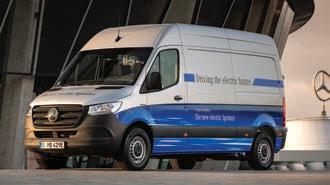
All-electric fleet vehicles are coming, and while they’re not here yet, some of the major manufacturers are very close. Whether they’ll work for you depends on a variety of factors, including price, payload, range, and charging facilities.
Mercedes-Benz already sells its allelectric eSprinter van in Europe and plans to bring it to Canada, possibly by 2023. It’s expected to have three battery options, but no specifications are available yet. Ford says the 2022

E-Transit will arrive later this year, with three lengths and three roof heights, plus chassis cab and cutaway, and with 317 lb-ft of torque and an estimated range of up to 203 km. It will also offer a 2.4-kilowatt onboard generator.
General Motors plans to build elec -

tric delivery vans in Ontario, the first is a light commercial van the EV600, expected to start in late 2021. Actual production dates are hazier for electric commercial vehicles from other manufacturers or start-ups, including Tesla, Rivian, Bollinger and Lordstown. <>
Jil McIntosh is an automotive writer and reviewer with a specialty in trucks and commercial vehicles. McIntosh writes for numerous outlets including the National Post and AutoTrader.ca, and is a member of the Automobile Journalists Association of Canada (AJAC). Her work can be found at WomanOnWheels.ca.
May 12-13
The first annual Retrofit Canada Conference will take place in Vancouver providing a prominent platform for key players in the energy efficiency, sustainability and retrofitting sectors to meet, network and exchange ideas. retrofitcanadaconference. energyconferencenetwork.co
Ventilation 2021
August 15-18
Held every three years, the 13th International Industrial Ventilation Conference for Contaminant Control is taking place in Toronto at the Sheraton City Centre. ashrae.org/conferences
June 15
The 89th CIPH AGM will be held virtually on Tuesday, June 15, at 1:00 pm ET. The meeting will include Honorary Life Membership Award presentations and a keynote address “National Affairs: Politics from Coast to Coast” by Chantel Hebert, columnist with the Toronto Star ciph.com
September 14-15
The conference will bring hydronics industry professionals together in Saskatoon to connect in person and share knowledge and business building ideas.
ciph.com/page/chc2021
June 26-30
The conference, scheduled for Phoenix, Arizona will go online and provide the latest insights from experts in the built environment with actionable and innovative content to support HVAC/R and building systems professionals. ashrae.org/conferences
September 22-24
The conference will address the practices of energy modeling and building performance simulation using simulation tools, software development, and future research and applications. ashrae.org/conferences
BuildEX Vancouver
September 29-30
BuildEX Vancouver and IDS Vancouver join forces at the Vancouver Convention Centre to explore the future of design, construction and property management. buildexvancouver.com
November 3-4
Western Canada’s plumbing, hydronics, heating, ventilation, air conditioning, refrigeration and water treatment show is being held at the Pacific National Exhibition in Vancouver. ciphexwest.ca
December 1-3
This annual show brings together renovators, contractors, designers and property managers to the Metro Toronto Convention Centre for a three-day trade show and conference. thebuildingsshow.com
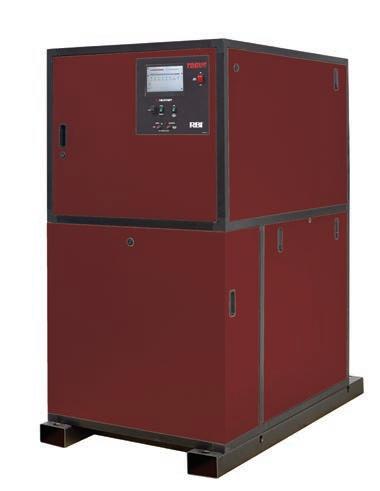
TORUS WATERTUBE BOILERS & WATER HEATERS
• 1250 - 4000 MBH
• 97.5% AHRI Certified (Boiler)
• 98% AHRI Certified (Water Heater)
• 4 Pass Double-Row Heat Exchanger (H & HLW)
• 316L Stainless Steel
• Variable Volume, Full Flow & Primary/Secondary
• Full Modulation
• HeatNet 3.0 Control w/ Remote Monitoring
• Touchscreen Programming and Diagnostics
• Modbus, LonWorks and BACnet BMS Integration
• Low NOx & CO
• Category II and IV (up to 160’)
• PVC/CPVC, Polypropylene & Stainless Steel Vent Approved
KN-SERIES / KN-SERIES PLUS
• +96% AHRI (KN-Series Plus)
• 90% AHRI (KN-Series)
• 25-Year Heat Exchanger Warranty
• Cast-Iron Primary Heat Exchangers
• Variable Volume
• Tru-flow Air/Fuel Delivery System
• Full Modulation
• 20 - 100° Delta T’s
• Vent up to 100’
• Fits Through Standard Doorway
• NG/LP/Dual Fuel
• HeatNet Control Platform
• 7” LCD Touch Screen Display
• HeatNet 3.0 Control w/ Remote Monitoring
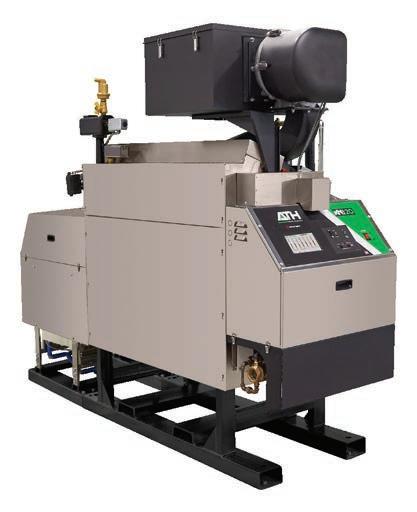
• Easy Maintenance & Installation www. rbiwaterheaters .com 25-YEAR Heat Exchanger WARRANTY