Media Designer Svetlana Avrutin savrutin@annexbusinessmedia.com
Audience Development Manager Urszula Grzyb ugrzyb@annexbusinessmedia.com 416-510-5180
Group Publisher Anne Beswick abeswick@annexbusinessmedia.com 416-410-5248
COO Scott Jamieson sjamieson@annexbusinessmedia.com
PUBLISHED BY ANNEX BUSINESS MEDIA 105 Donly Drive South, Simcoe, ON N3Y 4N5
Hatchery International is published six times a year by Annex Business Media. The authority for statements and claims made in Hatchery International is the responsibility of the contributors. Reference to named products or technologies does not imply endorsement by the publisher.
Subscription rates (six issues) Canada: $37.00 Within North America: $48.00 CAD
Outside North America: $62.00 CAD
To subscribe visit our website at www.hatcheryinternational.com
PRINTED IN CANADA ISSN 1922-4117 Publications Mail Agreement #PM40065710
RETURN UNDELIVERABLE CANADIAN ADDRESSES TO 111 Gordon Baker Rd., Suite 400, Toronto, ON M2H 3R1
The advertising deadline for the Mar/April issue is Jan 13. Don’t miss the opportunity to be part of this exciting aquaculture publication. For more information, or to reserve space in the next issue, call our advertising department at +1.250.474.3982 jthain@annexbusinessmedia.com
Next Editorial Deadline
The editorial deadline for the Mar/April issue is Jan 13. Contact Jean Ko Din at jkodin@annexbusinessmedia.com for details. Material should be submitted electronically with prior arrangement with the editor.
FROM THE EDITOR
Charging ahead to 2023
It is easy to let ourselves be overwhelmed with the challenges that lie ahead for the industry in this new year. Many of these challenges are outlined in our cover story –war, inflation, supply shortages, value chain breakdowns, recession, extreme weather, and of course, climate change.
I realize that I don’t have to tell you about these problems. You are the ones who are facing these challenges day in and day out. But I think that our hope as writers is to be able to unite the industry’s voice to the same cause. It may be an overwhelming challenge to tackle as just one local hatchery, but maybe we, at Hatchery International, have a role to play in sharing experiences of the many in hopes of expressing a united cause. After all, a problem shared is a problem halved; or perhaps, even more exponentially portioned across the world.
Even as our writers looked to industry leaders to talk about their outlook for the year ahead, you’ll notice that everyone who was quoted in the cover story is driven by optimism and a sense of mission. But they are also pragmatic.
I hope that our pages continue to search for solutions for these problems. In this issue, we share some new ideas being explored in the hatchery world.
In addition to our industry outlook, we also have an in depth feature story about an
ADVERTISERS' INDEX
JEAN KO DIN
Alaskan hatchery turned research institute that is conducting important studies in support of the shellfish industry in the United States.
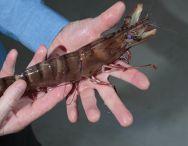
We also have a short story about developing quality broodstock for the Philippines’ black tiger shrimp industry.
And a Kenyan startup is also making headway to support a more streamlined coordination between local fish farmers and the food production value chain.
On the technical side, we also have our regular columnists share advice that can be implemented to your system and operations.
This issue’s Recirc in Action column from the researchers at the Freshwater Institute shares a new study on the potential of incorporating peracetic acid into the decontamination processes at a facility.
And, Ron Hill’s Hatchery Hack column introduces some fundamentals behind plumbing and the role it plays in the running of a facility. The column identifies some common challenges to old infrastructures, and hopefully, help hatcheries that are looking for an upgrade.
These are only some ideas that we were able to fit in the pages of this issue. The goal is to continue identifying ongoing industry problems and sharing new ideas to solve them. I’d love to hear your ideas at jkodin@ annexbusinessmedia.com.
Russian production growth might be partly faked
Production figures shared by government agencies for the Russian aquacultural industry might not fully correspond to reality, the Russian newspaper, Kommersant, reported.
There seems to be disparities between declared production and actual sales. In 2021, Russian fish farmers declared production of 130,000 tonnes of salmon, while the sales of farmed salmon ranged between 50,000 to 60,000 tonnes, as estimated by Herman Zverev, president of the Russian union of fishermen, Varpe.
Roman Vityazev, chairman of the Far East union of mariculture organisations, said seafood production in his region, according to official statistical data, expanded from 6,900 in 2016 to 57,000 in 2021. However, this growth was accompanied by a moderate rise in sales from 1,300 to 2,100 tonnes.
The report suggests one possible explanation for this phenomenon could be associated with a lack of control over production performance at the Russian farms. On the other hand, fish farmers have clear incentives to exaggerate their production figures. Kommersant explained that the Russian federal agency for fisheries, Rosrybolovstvo, might terminate a rent contract with a fish farmer, if it fails to increase production.
In 2021, Russian aquaculture production reached 356,600 tonnes, 8.5 per cent up compared the previous year. The industry saw its output nearly double during the previous decade. By 2030, the Russian government expects this figure to reach 500,000 tonnes. In addition, the production of salmon should jump from 120,000 tonnes to 250,000 tonnes.
Rosrybolovstvo is said to be working on an electronic traceability system to make the Russian fish industry more transparent, but there is no clarity as to when it might be introduced.
Kenyan startup secures grant from GSMA climate resilience fund
Aquarech, a Kenyan aquaculture platform, is among eight agritech startups awarded grants from the GSMA Innovation Fund for Climate Resilience and Adaptation.
The grant aims to accelerate the testing, adoption and scalability of digital innovations that enable the world’s most vulnerable populations to adapt to, anticipate and absorb the negative impacts of climate change.
Aquarech founder, Dave Okech, says the funding will be the catalyst for the platform to achieve vertical coordination between “our game-changing technology, fish farmers, and fish traders, increasing their climate resilience.”
The GSMA is a member of the Adaptation Research Alliance, a global collaborative effort to increase investment and research capacity for effective adaptation to climate change.
Successful projects receive an equity-free grant of between £100,000 and £250,000 (US$119,00 and $297,000) to scale their innovation over a 15- to 18-month period.
Other agritech startups selected for the grant include Bakhabar Kissan in Pakistan, BENAA in Egypt, CoAmana, Crop2Cash and Hello Tractor in Nigeria, GeoKrishi in Nepal, J-Palm in Liberia, Komunidad in Philippines, Lersha in Ethiopia, and Simusolar in Tanzania.
– Bob Atwiine
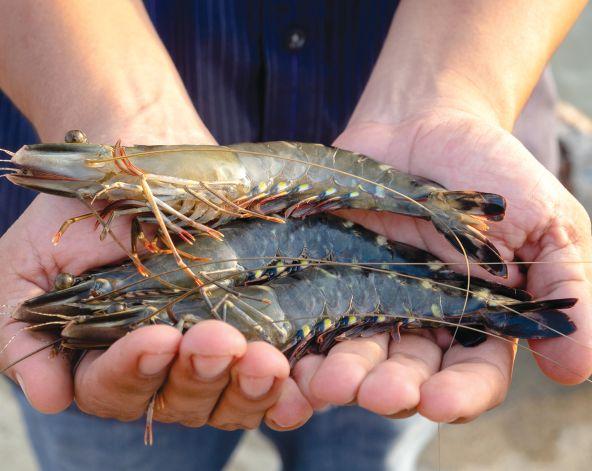
Hatchery stocking of black tiger shrimp to help revive Philippine industry
After reaching highs and lows, all fronts are being covered to revive the Philippines’ premium black tiger shrimp (Penaeus monodon) industry.
The latest development saw the delivery of broodstock in November 2022 at the recently established Shrimp Broodstock Rearing Facility at the Southeast Asian Fisheries Development Center/ Aquaculture Department (SEAFDEC/AQD).
Stocking the facility with 330 black tiger shrimp broodstock is expected to boost its capacity to produce seeds and, eventually, broodstock throughout the year, Chief Dan Baliao said in a press statement. Post-larvae produced at SEAFDEC/AQD facilities are high-quality and disease-free. Utilization of greenwater technology prevents the production of luminous bacteria in the grow-out ponds.
SEAFDEC/AQD received a mandate from the Philippine government in 2018 to revive the industry, resulting with the program, Oplan Balik Sugpo (Revival of the Shrimp Industry). The goal is to “help revive the tiger shrimp industry in the Philippines through the production of high-quality post-larvae from the hatchery and implementation of environment-friendly strategies for grow-out culture in ponds.”
The program is a joint undertaking by SEAFDEC/ AQD and the Philippine Department of Agriculture-Bureau of Fisheries and Aquatic Resources.
Hatchery owner in Cebu, Imelda Gesalan, told Hatchery International that the program provides another option for hatcheries. Her hatchery, for instance, sources broodstock from the wild. “I am willing to be a partner of Oplan Balik Sugpo,” she said.
At the peak of its black tiger shrimp production in the early 1990s, the Philippines was ranked among the global top ten. Production volume, however, contracted, even before the decade ended. This was caused by production methods that compromised the environment and caused shrimp diseases prevalent up to the present.
At its peak in 1994, Philippine black tiger shrimp production was at 90,426 metric tons. Decline was posted the following year at 88,815 tons. As of 2020, it had drastically dropped to less than half of the 1994 volume.
As part of the program’s biosecurity protocols, weak or sick post-larvae are eliminated through disease surveillance using polymerase chain reaction screening. Transport time must also be considered as it has been establsihed that transport time over six hours of seeds from hatchery/ nursery to pond can increase the chances of disease outbreak.
– Ruby Gonzalez
Smarter, stronger, more economical drum filters
Water filtration has never been so easy
The Hydrotech Drum Filter Value series focuses on reduced maintenance, increased component quality and simplified operation – all to give your plant maximum filtration performance at a minimum operational cost.
Contact us!
Call +46 (0)40 42 95 30 or visit www.hydrotech.se
ANA_Aqua Ultraviolet _NovDec22_CSA.indd 1
Alutiiq Institute makes strides in shellfish
Alaskan hatchery turned research institute is a hub for shellfish production and research
By Nancy Erickson
It’s been said good often arises from the ashes of tragedy.
When the oil tanker, Exxon Valdez, ran aground in Prince William Sound in March 1989, it spilled 11 million gallons of crude in the ocean. The oil slick covered 1,300 miles of Alaska’s coastline and killed hundreds of thousands of seabirds, otters, seals and whales, resulting in one of the largest environmental disasters in U.S. history.
From the billions in settlement monies paid by Exxon Shipping Company arose organizations and institutions dedicated to restoring the damaged environment and gaining first-hand knowledge of the state’s unique marine ecosystem.
One such institution is the Alutiiq Pride Marine Institute (APMI) in Seward, Alaska.
Built by the State of Alaska’s Department of Fish & Game from criminal settlement funds resulting from the Exxon Valdez oil spill, the centre initially opened as the Alutiiq Pride Shellfish Hatchery with the purpose of recovering the Alutiiq tribes’ subsistence resources and producing oysters and clams for the aquatic farm industry. As the research focus broadened, the centre rebranded into the APMI.
APMI is a division of Chugach Regional Resources Commission (CRRC), an intertribal consortium of seven Alaska Native Villages in the Prince William Sound and Lower Cook Inlet region. The Alutiiq people, also known as Sugpiaq, are a southern coastal Alaskan Indigenous people inhabiting the majority of
Following several weeks of nurturing in
PHOTO: SOUTHERN DIPPER PRODUCTIONS
“We do much more now than just hatch oysters,” said Jeff Hetrick, mariculture director. “We’ve raised red and blue king crab, geoducks, clams, oysters, littleneck clams and sea cucumbers, to name a few. We’ve also cared for salmon, halibut, herring and octopus for research projects.”
“We provide juvenile shellfish seed and kelp string with partners statewide,” he added. “We’re presently raising abalone and sea cucumbers for Southeast Alaska projects, and clams for our tribal communities’ enhancement projects. All our research is applicable statewide.”
Shellfish populations have been on the decline for many years, according to Hetrick. Researchers at APMI are exploring reasons for the decline and at the same time, taking steps to provide harvest opportunities for member tribes.
“Having control over the whole life cycle, from spawning to harvest, allows us to complete the life history of culturally important species in our region, such as littleneck and butter clams as wells as cockles,” explained Hetrick.
New species to Alaska have also been identified. APMI staff has recently been focusing on a soft-shell clam (Mya arenaria) due to the species’ ability to thrive in the current environment and also because of its fast growth in the hatchery and on local beaches.
“This growth may prove to be an adaptation strategy for the loss of hard-shell clams and offer a potential mariculture species for Alaska,” said Science Director Dr. Maile Branson.
Another exciting project APMI researchers spawned this year is the culturally significant black katy chiton (Katharina tunicata), locally known as “bidarkis.”
this region. The villages’ strong cultural ties and rich understanding of natural resources and marine systems in the Chugach region allows insight to a deep knowledge base generally not readily accessible to other aquaculture facilities.
More than a hatchery
Located at the head of Resurrection Bay, a walk through APMI’s doors reveals a lot more than researchers propagating shellfish for aquatic farmers.
Chitons are marine molluscs with oval shapes and shells divided into eight dorsal plates. These chitons have traditionally been an important subsistence food for more than 100 years to Alaska natives in the communities of Port Graham and Nanwalek in Kachemak Bay on the southern tip of the Kenai Peninsula. However, concern has been growing among community members who have observed a decline in the size and total number of animals in the previous 10-15 years.
Little is known about the life history of chitons. APMI researchers hope to develop techniques to produce them in the hatchery and outplant on beaches, tracking their growth, survival and reproductive capacity so community members in remote tribal villages can continue to subsist on a species of their preference since time immemorial.
Another recent project involves developing
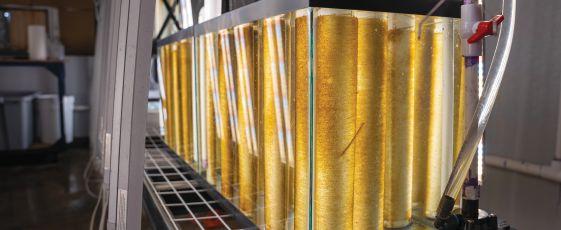
an APMI lab, tubes of budding kelp string appear ready for outplaning to aquatic farms.
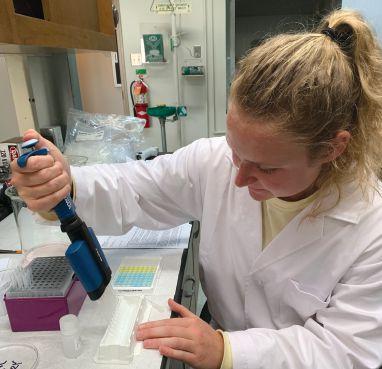
APMI staff biologist, Annette Jarosz, runs an Enzyme Linked Immunosorbent Assay for the detection of shellfish toxins. Ingestion of shellfish containing the toxin can be potentially fatal.
PHOTO: MAILE BRANSON
techniques for raising blue and red king crab juveniles. APMI staff were integral in the Alaska King Crab Research, Rehabilitation and Biology (AKCRRAB) Program, working with National Oceanic and Atmospheric Administration (NOAA) and Alaska Sea Grant, amongst other key partners, culminating in over five years of data studying growth, behaviour, predator interaction and habitat preference of juveniles once released. Researchers are optimistic the data will be used for improving localized populations, said Dr. Branson.
The future of crab enhancement research had been on hold for several years awaiting legislation from the State of Alaska allowing shellfish enhancement, which passed in 2022.
“We’re waiting for the Department of Fish & Game to propose regulations so we know what it will take to move ahead,” Branson added. “We’ve been laying the groundwork for a project that would involve a local juvenile crab release in 2024.”
Keeping oceans healthy
From direction of CRRC’s board of directors, researchers at APMI began sampling and processing dissolved inorganic carbon in 2013 as a measure of ocean acidification through APMI’s Ocean Acidification Research Lab – the first near-shore station in Alaska at the time, but now part of a worldwide network.
Seawater in Resurrection Bay is continually monitored as a baseline and the Native communities in the Chugach region, as well as other partners around the state, continue to send water samples to APMI to determine acidification levels.
“Our tribal leadership felt the need to expand our shellfish enhancement projects into seafood safety and impacts climate change has on coastal residents’ food sources,” said Hetrick.
With that directive, Branson was added to the staff and expanded the science program to include Chugach Region Ocean Monitoring (CROM), incorporating a full
suite of sampling including water chemistry, nutrients, phytoplankton, paralytic shellfish poisoning and harmful algae monitoring.
Alaska has specific species of planktonic algae that produce toxins that can be harmful to people, animals and surrounding ecosystems. These toxins can cause severe health problems when ingested and can be fatal. The APMI web site provides real-time data to the public to help determine the risk level for recreational and subsistence harvest of shellfish and other marine organisms.
“The key to all CRRC and APMI programs – CROM included – is the engagement of residents in our communities who collect the data and submit samples,” said Hetrick.
Kelp farming
Kelp farming is gaining in popularity among regional fishermen looking for opportunities during their off-season.
APMI is assisting with startup logistics by growing “seed” to outplant in their ocean-based kelp farms – experimenting with sugar, ribbon and bull kelp.
“We produced seed string for 10 research sites and five commercial farms in 2022 and expect demand to double or more every year for quite a while,” Hetrick said. “We know we can grow the string in the hatchery, but we’re now in the scaling and efficiency mode to insure we can meet the demand as it arises.”
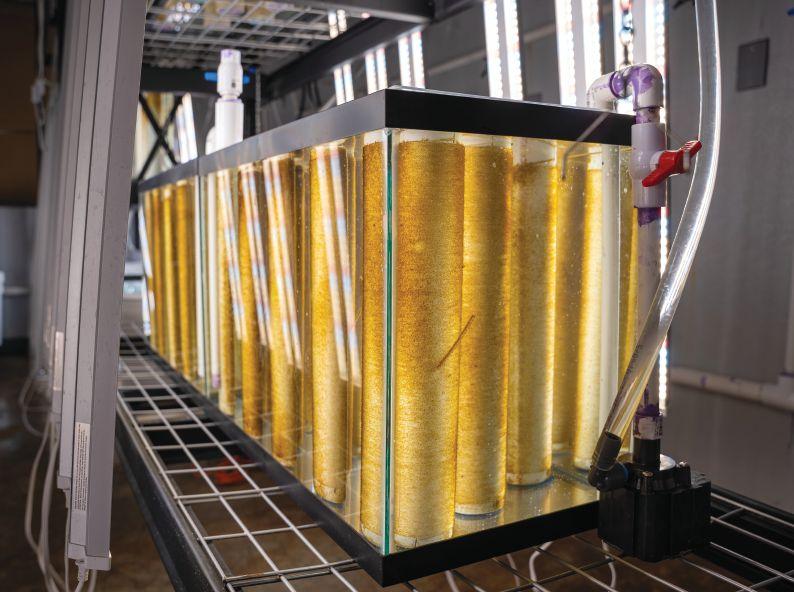
Inside one of APMI’s modules is a series of two-by-15-inch plastic pipe wrapped with 200 feet of nylon twine inoculated with kelp spore solution. The string is monitored and controlled with temperature and light until plants germinate and are ready for shipment to farmers or test sites. At the site, the string is unraveled onto grow lines suspended between buoys approximately seven feet below the surface and monitored for six to seven months until harvest in the spring.
“It takes a lot of time and care to tend to the seed string for a couple of months but it is very
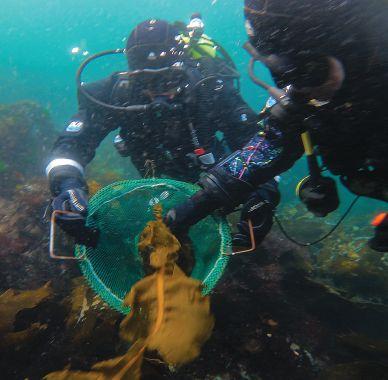
Divers harvest kelp on the ocean floor for the collection of sorus tissue. The tissue holds a cluster of plant reproductive bodies, which will be used in creation of kelp in the laboratory.
PHOTO: BIRDS EYE VIEW ADVERTISMENT
rewarding to see kelp grow on the string,” said Michael Mahmood, APMI production manager.
Sights on the future
Alaska’s mariculture industry is growing and ripe for expansion and investment.
NOAA’s National Marine Fisheries Service estimates U.S. aquaculture is likely to grow at least 250 per cent over the next 10 years. NOAA posits the growth could be even higher, as stated in the report, “An Approach to Determining Economic Impacts of U.S. Aquaculture.”
APMI has doubled its staff in Seward over the past year and will continue to grow as new opportunities and challenges arise with the expansion of mariculture in the state and changing ocean conditions.
“We see ourselves continuing to be a leader in shellfish research in Alaska and North America, not only with hatchery technology but in clam enhancement and restoration,” said Hetrick.
2023 outlook
Looking ahead at what’s in store for the industry around the world
The past few years have been challenging for the hatchery industry around the world. Contending with a global pandemic, supply challenges and labour shortages have changed the face of hatcheries for many.
Although there is still uncertainty, the road is definitely getting clearer. The questions remain: Do further changes/challenges lie ahead? And how will the hatchery sector adapt?
In this industry outlook, Hatchery International explores the industry prospects for 2023, where our writers from around the world share their expectations for the industry in North America, Europe, Russia, Southeast Asia and Australia.
North America
Climate seems to be issue #1, #2, and #3 for hatcheries in North America.
For U.S. shellfish growers, who represent more than 80 per cent of marine aquaculture’s value, concerns have been intensifying.
In 2018, a group of seven leaders formed a partnership with The Nature Conservancy to create the Shellfish Growers Climate Coalition. It now has 250 members.
Oyster hatcheries are witnessing the impact of higher temperatures,
declining water quality, and weather extremes. Losses occur in oyster larvae production and “seed is just not performing as well as it used to. That’s something that really needs to be addressed,” said Chris Sherman, CEO of Massachusetts-based Island Creek Oysters, one of the coalition’s founding members.
Hatchery managers are also keeping a close eye on water quality. “If water becomes more acidic over time, it could be detrimental to larvae production. This is because the calcium bicarbonate in oyster shells can degrade,” said Natalie Ruark, the nursery manager at Hoopers Island Oyster Co. on Maryland’s Chesapeake Bay.
Because so many hatcheries are in low-lying areas, sea level rise is also something to watch, added Stephanie Wiegand, hatchery manager at Hoopers Island. If flooding makes it hard to reach a hatchery, daily monitoring of larvae and water quality can suffer.
But a step forward in counteracting the impact of climate change is the creation of the Northeast Oyster Breeding Center, a collaboration between NOAA and the USDA.
“There’s a lot of excitement there, and partially in the context of climate change. The idea is to use genetic techniques to improve oyster lines to be more adapted to local conditions,” said David O’Brien, deputy director of NOAA Fisheries Office of Aquaculture.
Canadian salmon hatcheries had a close call with Mother Nature this fall, when Hurricane Fiona hit Atlantic Canada, where leading Atlantic salmon producers like AquaBounty, Cooke Aquaculture, and Mowi have operations. Although there was no damage this time, the potential looms for extreme weather events to disrupt power supplies and damage infrastructure.
That has already happened for the Pacific Region Salmonid Enhancement Program, a Canadian government initiative to conserve and restore Pacific salmon stocks. Last year, in British Columbia, floods washed out water intake pipes and basins at one hatchery. This year at another facility, a drought made it necessary to sandbag a river to redirect water to intakes.
- Lynn Fantom
Europe
It would be easy to deliver a doom and gloom verdict on the industry’s prospects for 2023, weighed down by rising energy costs, labour shortages and a consumer base, which is rapidly running out of cash.
Talking to producers, however, there are still plenty of upbeat attitudes and ambitions on display, largely based on the drive and optimism which brought many of these people into our industry in the first place.
The truth is probably somewhere in between these two extremes. Russia’s invasion of Ukraine changed everything at both a human and economic level in 2022. While we all hope the human tragedy will cease in the year ahead, the economic legacy of the past 10 months will be with us for a considerable time to come.
Soaring energy prices dominate the immediate economic impact of Russia’s war, adding sharply to production costs for hatchery enterprises, RAS and traditional. Some businesses, of course, already have well-developed solar and wind power alternatives to call on – options which will help to soften cost pressures in 2023.
“The key is to target the ratio of energy per kilogram of fish produced,” said Andreas Mäck, CEO of InfiniteSea, a Yellowtail kingfish RAS-based producer based in Völklingen, Germany. “The problem in the past with RAS systems is that many have been operating under capacity but still have high energy costs to bear. If you can realise your capacity target, however, then the importance of energy costs starts to sink.”
InfiniteSea is currently in a redevelopment phase with the aim of ultimately producing a high-capacity 800 tonnes of Yellowtail kingfish and Yellowtail amberjack. Having recently faced an 11-fold increase in energy costs, albeit from a very low base, Mäck is determined to get the future production/cost ratio of the business right. He’s also extremely upbeat about the 2023 market for Yellowtail kingfish, commenting that both demand and prices look good for the coming year.
Also optimistic is Alastair Barge, managing director of Otter Ferry Seafish in Scotland, despite agreeing that the recent increase in power costs has “certainly sent shock waves through the land-based sector.”
“Sometimes a shock is quite good for focusing the mind,” he said. “Aquaculture, like any business, is about managing change, of course, and Otter Ferry has a 50-year history of managing change.”
In other words, 2023 won’t necessarily be easy, but producers in Europe are ready for the fight.
- Colin Ley
Russia
Russia has approved a new plan for the development of the fish farming industry in the next decade, setting targets to boost production and move away from critical dependence on imported technologies and raw materials.
Under a renewed strategy for the development of the agro-industrial and fisheries complexes published by the Russian government in September, Russian fish farmers are expected to see their output growing from 350,000 tonnes in 2021 to 618,000 tonnes in 2030.
In the new version of the strategy, the long-term goals remained unchanged, even though the Russian fish farming industry still finds itself in a tough situation, owing to sweeping western sanctions that disrupted the supply of aquafeed, broodstock and technologies.
Over the past few decades, cage farming has been the backbone of Russian aquacultural development. However, the growth potential in this field is nearly exhausted, said Vladimir Mazanov, executive director of the National Association of Industrial Aquaculture Enterprises, who believes that to secure further growth, the industry needs more farms employing RAS technologies.
For instance, in Karelia republic, almost all lakes and ponds suitable for cage farming are already used for growing fish, according to Mazanov, who explains that some water bodies do not fit for this purpose due to a lack of road infrastructure. RAS farms will also help the Russian aquaculture industry mitigate the strong dependence on imported broodstock.
In general, Mazanov said he is confident that both the production and the range in the Russian aquacultural industry will grow in the next years. To fuel this growth, he pointed out, the most favourable conditions for investments must be secured for fish farmers.
Over the past several years, some farmers tried to assemble RAS units independently. Only a few engineering companies specialize in creating RAS installations in the country. The largest western companies, such as Aquamaof and AKVA group, even in the previous years, were not interested in the Russian market since they focus primarily on servicing large farms, while most Russian RAS have low production capacity, said Mazanov.
In the new reality, Russian fish farms will have to rely mostly on self-assembled RAS installations, though it is likely that new companies
providing ready sets of equipment will emerge on the Russian market in the next years. However, the quality of self-assembled installation used to be questionable even before sanctions wiped out almost all European equipment from the Russian market. According to market participants, Russian farmers are expected to rely increasingly on Chinese equipment in the coming few years.
Southeast Asia
Year 2023 has been heralded as a milestone for aquaculture. This is when aquaculture is expected to overtake capture fisheries.
The projection augurs well for Southeast Asia, which is a global powerhouse in fish production. Of the 15 major global fish producers, half of the ten-member countries of the Association of Southeast Asian Nations are considered major producers, according to 2019 Eumofa elaboration of Eurostat and FAO data.
In aquaculture production, Indonesia was ranked second, Vietnam, fourth; Philippines, seventh; Myanmar, ninth; and Thailand, tenth. China was at the top of the list.
After a slight dip in consumption for fish in 2020 due to the COVID-19 pandemic, steady but slow uptick had been noted in 2021. Fish consumption is expected to steadily increase throughout the decade, overtaking demand for meat, based on forecast commissioned by the OECD-FAO.
Optimism generated by such projections, however, is inclined to tempered by other scenarios. While Covid has started to be managed,
the ongoing Russia-Ukraine war presents the threat of recession. This was implied by a hatchery owner when asked by Hatchery International about his views on increased fry production in 2023.
“Not much, if the world economy or those of some countries are not improving,” said Suthi Mahalao, owner of Boonsawang Farm in Thailand, which has seabass hatchery and grow-out operations. They export fry to countries such as Vietnam, Malaysia, Singapore, Taiwan, Australia and Israel.
In terms of species diversification, the Southeast Asian Fisheries Development Center/ Aquaculture Department (SEAFDEC/AQD), based in the Philippines, is taking the lead.
In the Philippines, where milkfish and tilapia are still the dominant farmed species, the coming release of a new species by SEAFDEC/AQD is expected to create an impact.
“Snubnose pompano, scientifically called Trachinotus blochii, will be available for culture commercially,” said Dan Baliao, chief at SEAFDEC/ AQD. “It’s a widely-sought endemic marine species in the Philippines and the life cycle of which has already been completed in SEAFDEC/AQD. Milkfish and tilapia are still the dominant farmed species in the country.”
“Commercial release of slipper lobster and round scad for aquaculture will eventually be available to interested parties in Southeast Asia. But with “rigorous research and verification program”, this is likely to go beyond 2023,” the agency stated.
- Ruby Gonzalez
Australia
The three years prior to 2023 were under the in fluence of a La Niña weather cycle in Australia.
In combination with two consecutive negative Indian Ocean Dipole (IOD) patterns, it brought unprecedented rainfall across the whole continent. While this has been devastating for agricultural crops and low-lying urban areas, the aquaculture sector, on the whole, rode out the conditions in reasonable shape and the cooler, more stable water temperatures have certainly been welcomed in some sectors.
According to the Bureau of Meteorology, there are signs the IOD is moving to neutral as is the El Niño-Southern Oscillation (ELSO).
As a world leader in performance-improved barramundi genomic development, Victoria-based MainStream Aquaculture supplies 30 per cent of world’s commercial seedstock, including 75 per cent of the domestic market. From their climate-controlled hatcheries in Victoria and Queensland, they are able to spawn around the calendar to cover their diverse clients’ stocking timetables.
Managing director and CEO, Boris Musa, is confident about the coming year. “Post-Covid, a number of farms are restocking in anticipation of stronger market conditions. Our forward orders are solid,” he said.
Murray Cod Australia is the country’s largest warm water finfish hatchery. Chairman Ross Anderson said, “While higher than
average rainfall this season has certainly causing some inconvenience, this year’s spawning season well advanced and current larvae numbers indicating a better than average season, we are confident of reaching or exceeding our hatchery production targets for the 22/23 season.”
Shellfish Culture is the country’s leading shellfish hatchery. Scott Mactier, general manager of breeding and R&D, said, “While 2023 has been an exceptionally challenging year for the oyster industry around Australia with heavy flooding along most of the NSW coast, QX outbreaks in Port Stephens and biotoxin setbacks in Tasmania, we are very optimistic about the period ahead.”
“Pacific Oyster seed demand is strong across Tasmania, SA and NSW for both triploid and diploid oysters. NSW in particular is ramping up its Pacific Oyster production and demand for seed is booming. From a mature oyster perspective, market prices are increasing with an overall drop in production, largely in NSW,” Mactier added.
It seems the Australian hatchery sector is bullish about their prospects for 2023. The salmonid and prawn sectors tend to integrate their hatchery operations, consequently, their prospects for 2023 are balanced to their production requirements and the local and off-shore demand for finfish and seafood is strong.
- John Mosig
HATCHERY HACK by Ron Hill
Problems with old plumbing
Behind every tank, every filter, and other water systems in a hatchery is the plumbing. Plumbing is so fundamental to aquaculture that it is rarely thought about in its own right. The plumbing choices, including material, sizing, run location, and setup are decided based on the needs of the facility at the time of installation, but the choices can have long-lasting effects on a hatchery. Aging plumbing presents new problems for technicians in a number of ways.
Inherited plumbing
Fundamental errors in plumbing installation will quickly destroy the viability of a system or hatchery, much to the detriment of the fish and organization involved. Thus, major plumbing issues are
often resolved very early on in the life of facility or are avoided by good engineering and design. The effects of initial plumbing choices come into play as the facility ages. Staff and management working at the facility will inevitably identify changes, upgrades or replacement that need to be made to improve operations and viability. The plumbing choices from the initial build, the inherited plumbing, must be worked with or replaced.
This scenario of working with inherited plumbing comes into play on a large scale when a facility is sold or acquired by a new company. Companies that purchase, modernize, or repurpose old facilities, often run into confounding and expensive issues adapting old plumbing choices to their needs. The new company decides
to update the technology, change species (thereby changing the operational needs), or otherwise install improvements, and finds that to do so, there is a large and unexpected expense for plumbing associated with the project, and/or the large parts of the facility must be shut down because there is no way to bypass or isolate the area of concern from the larger system.
Inherited problems
Inherited plumbing problems can transform what was planned out to be a simple job into an expensive headache. Aging pipes can be a risk of failure at points where the pipe or fittings may have weakened. Water hammer, exposure to UV, strain from bending, age, and a variety of other factors combine to expose weak points over time. Proper inspection of the plumbing can identify points of failure precipitated by cracks and pin hole leaks.
In many cases the integrity of old piping is sound, but a myriad of other problems come with inherited plumbing. More likely to fail than the piping are old valves that fail to open or close fully from wear and fouling. Antiquated plumbing fixtures or a lack of fixtures can be
a huge headache. Some systems are plumbed such that there are no bypasses, in some cases no shut-off valves for certain sections. This means, large portions of the system may have to be emptied and turned off to service one system or tank. Work in one area becomes a major interruption for a larger area. Antiquated plumbing material choices or engineering can also cause major headaches as project managers must decide how and where to attach modern plumbing to “creative” antiquated plumbing and at what cost.
Installing plumbing in hard-toaccess or hard-to-reach areas is necessary and often frustrating. Repairing or working on hard-toreach plumbing is much more frustration because the plumbing needs to be cut off, changed/replaced, and fastened into placed, without proper access. Many facilities have concrete systems, such as troughs and raceways, older facilities are generally heavy on concrete use. Supply pipes and drainpipes are often found encased in concrete or running under a concrete floor. Concrete offers much protection to the pipes and gets them out of the way, eliminating their footprint. Plumbing decisions placed in or under concrete are, however,
Proper plumbing, in itself, has good life while plumbing being abused in a fish hatchery may not.
literally set in stone. Any changes or repairs that need to happen to the pipes begins with a jackhammer and ends with pouring concrete.
New systems to old
When building a new system or new sections onto an old system, keep future repairs in mind and expect that staff will need to access the plumbing at some point. Add as many valves and bypasses to the inherited and new plumbing, as is practical and financially reasonable, to be able to isolate different systems such as tanks and filters. Bypasses allow water to be diverted around a system like a filter so water can be drained from the filter allowing maintenance or repairs performed without interrupting the water flow downstream of the filter. If an old system like a filter is being replaced, build a bypass into the plumbing to allow the filter to be isolated.
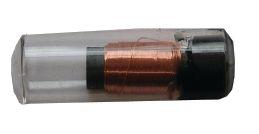
PIT TAGS & SCANNERS
Extra ports are always a good idea when installing water lines into a new area. A tee-fitting near the pump or water source with a valve closed valve often comes in handy down the road as a great port to hook up a new idea, without having to cut something new into the line or stop the water.
Downtime
When doing maintenance or making changes on systems that have to be shut down and the water turned off, do as much as possible to improve and repair the system during the shutdown event. Make all the repairs and maintenance necessary as well as add valves and bypasses. When removing or working with inherited plumbing assess its viability and integrity and, where feasible, remove everything that has failed or is suspect and replace it with new easier to work with and better to access materials. Downtime has significant financial cost; thus, the time must be used to maximum effect.
Exposed plumbing is always nicer for technicians and for flexibility, but under concrete is the right way for some builds and systems. Strategically choosing how much concrete to use and utilizing plumbing trenches with grating can increase flexibility and access while also maintaining protection and reducing plumbing exposure. Anything that is to be run through concrete or underground, should be carefully managed to ensure it is designed and installed right the first time because changes and corrections start with a lot of jackhammering.
Carefully managing and assessing old plumbing is the key to utilizing what exists and adding new systems. Deciding what to keep, what and where to add new plumbing is essential to a successful project, as well as to maintain the viability and integrity of the system long term.
Assessing the toxicity of peracetic acid to early Atlantic salmon life-stages
By Natalie Redman
Ubiquitous bacterial and fungal pathogens that reside in land-based recirculating aquaculture systems (RAS) and egg incubation systems can cause elevated mortality in juvenile fish populations under substandard environmental conditions. However, the availability of environmentally friendly, food-safe disinfectants that can be used to reduce these pathogens without harm to fish or RAS biofilters is limited. While several approved disinfectants, such as hydrogen peroxide and ozone, have proven to be effective, the need for safer, lowcost alternatives would be welcomed by the land-based aquaculture industry. Peracetic acid (PAA), for example, is an antimicrobial disinfectant sold commercially as a stabilized mixture of acetic acid, hydrogen peroxide, and water. PAA is extremely active against microorganisms at low concentrations and it poses minimal threat to the environment, as it rapidly degrades in water and is not known to produce toxic by-products. Due to its novelty
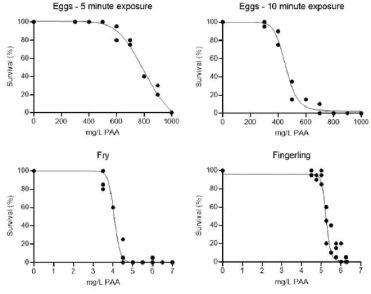
FIGURE 1. Early juvenile life-stage Atlantic salmon mortality curves during toxicity experiments: (i) eyed eggs, 5 min exposure (top left), (ii) eyed eggs, 10 min exposure (top right), (iii) fry stage (bottom left), and (iv) fingerling stage (bottom right). (Redman et al., 2022)
for use in aquaculture applications, there has been minimal research regarding PAA’s applicability for use in RAS and egg incubation systems in the United States. Thus far, PAA has only been registered for surface disinfection by the US EPA when fish are absent from tanks. Therefore, an important step in assessing PAA’s suitability as an aquaculture disinfectant was to evaluate its toxicity to various fish life stages by determining its 24-hour LC50 value – the concentration at which approximately 50% mortality occurs within 24 hours. The toxicity of PAA to early life stages of Atlantic salmon had not been assessed until The Conservation Fund’s Freshwater Institute (FI) conducted the research summarized herein. A comprehensive article describing this research was first published in the journal, Aquaculture Research (Redman et al., 2022).
Design and methodology
Three juvenile Atlantic salmon life stages were selected for the PAA toxicity experiments: eyed eggs, fry (0.16-0.18 g), and fingerlings (i.e., early parr; 16.3 ± 0.7 g), and a commercial PAA product VigorOx SP-15 (PeroxyChem) (15% PAA and 10% hydrogen peroxide) was selected to create the PAA doses that were tested at each life stage. To characterize the source water for each toxicity trial, samples were collected once before PAA application during each experiment. Subsequent water quality testing was carried out in FI’s Water and Environmental Chemistry Lab and at the USDA-ARS Stuttgart National Aquaculture
Research Center. This research was reviewed and approved by FI’s Institutional Animal Care and Use Committee.
Atlantic salmon eggs
Disease-free-certified salmon eggs were received from a commercial supplier and maintained in heath tray stacks within an incubation system that recycled 99.8% of the water. Makeup water for the systems was sourced from a contained freshwater spring located on the property. Nine PAA treatments (0, 300, 400, 500, 600, 700, 800, 900 and 1000 mg/L PAA) were administered for 5 and 10 minutes each in 1L glass jars by diluting the PAA stock solution. Twenty eggs were added to each jar containing the treatment. Egg mortality was assessed 24 hours after the initial dose through visual observations of egg colour change (i.e., very pale orange or white) and via use of a salt flotation solution (105 g/L NaCl) technique as described by Leitritz and Lewis (1980).
Fry
and fingerlings
Atlantic salmon fry were stocked in challenge trough compartments, with each trough divided into nine 35L sections containing an individual water inlet and double standpipe drain. The troughs received water pumped from a 9.5 m3 RAS containing a 5.3 m3 culture tank stocked with larger Atlantic salmon. Twenty fry were stocked into each trough compartment required for the experiment. The troughs were maintained as flowthrough systems during a 24-hour acclimation period and then adjusted to static baths during PAA treatment periods. Nine PAA treatments (0, 3.5, 4, 4.5, 5, 5.5, 6, 6.5 and 7 mg/L PAA) were tested in triplicate. Each compartment remained in a static bath state for 24 hours after the PAA treatment was administered. The LC50 value for fry (0.16-0.18g) was determined 24 hours after the initial dose via visual observations of mortality. Atlantic salmon fingerlings (16.3 ± 0.7 g) were assessed using the same setup and procedure described above. Nine PAA treatments (0, 4.5, 4.75, 5, 5.25, 5.5, 5.75, 6.0, and 6.25 mg/L PAA) were tested in triplicate, and mortality was assessed after 24 hours.
Toxicity results
Toxicity Relationship Analysis Program (TRAP) version 1.30a and the Trimmed Spearman-Karber (Erickson, 2015; Hamilton et al., 1977; Hamilton et al., 1978) techniques were used to calculate LC50 values and the results of both were reported by Redman et al. (2022). Because the resulting LC50 values were similar between approaches, calculated values from the more accessible TRAP software are reported in this article.
After exposure for five minutes, no mortality was observed at lower PAA concentrations; however, no surviving eggs were observed in the 1000 mg/L PAA treatments. When eggs were exposed to various PAA concentrations for 10
mins, significant mortality occurred at lower concentrations and no surviving eggs were observed in the 800, 900, and 1000 mg/L PAA treatments. The determined LC50 values for the 5 and 10-min treatments were 781.5 ± 12.7 (mean ± SE) mg/L and 485.0 ± 12.3 mg/L PAA, respectively. The NOEC (no observed effect concentration), the concentration at which there were no discernable negative effects, was 500 and 300 mg/L PAA for the 5- and 10-minute egg treatment groups, respectively.
Twenty-four hours after various PAA treatments were administered, no surviving fry were observed in the 5.0, 5.5, 6.5, and 7.0 mg/L PAA treatment groups. The 5- and 10-minute LC50 values for fry were 4.0 ± 0.04 and 4.1 ± 0.10 mg/L PAA, respectively. Twenty-four hours after various PAA treatments were administered, no surviving fingerlings were observed in the 6.25 mg/L PAA treatment group. The LC50 values for fingerlings were 5.3 ± 0.03 and 5.3 ± 0.06 mg/L PAA, respectively. Mortality curves for all experiments are illustrated in Figure 1.
Important water quality findings
Water quality profiles for each trial are shown in Figure 2. Research has shown that the degradation and disinfection efficacy of PAA is affected by water chemistry. For example, Liu et al. (2014) observed that higher DOC increases the rate of PAA degradation. Given that the present fry and fingerling toxicity trials were carried out during separate weeks, RAS water quality varied slightly between studies. For example, DOC was lower during the fingerling toxicity experiment compared to the fry toxicity study, which may have coincided with slightly slower PAA degradation and a slightly higher LC50 value for salmon fingerlings. Additionally, the RAS nitrate-nitrogen concentration was higher during the fry toxicity experiment than it was during the fingerling toxicity experiment, and this difference may have influenced LC50 values. In addition to variations in water quality,
aConcentrations are expressed in mg/L unless otherwise noted. bBoyd (1979), Engstrom-Hed (1971) and Tucker (1989)
FIGURE 2. Water quality profiles for water used during the Atlantic salmon egg, fry and fingerling PAA toxicity experiments. (Redman et al., 2022)
the relative size differences between life stages likely contributed to increased PAA tolerance in fingerlings, resulting in higher LC50 values compared to fry.
Concentrations are expressed in mg/L unless otherwise noted.
Implications for RAS
These findings support the development of PAA as a disinfectant that could potentially be used by the Atlantic salmon land-based RAS industry. It is important to note that the PAA concentrations that were deemed safe for Atlantic salmon fry and fingerlings may negatively impact beneficial nitrifying bacteria that thrive in RAS biofilters; therefore, additional research is required to understand the holistic effect of these PAA treatment doses in RAS. In addition, future research should consider the limitations of this study, and should aim to include, among other things, consistent RAS water chemistry across experiments
when expanding on these findings. Results of PAA application will vary based on RAS water chemistry profiles, and therefore it is imperative that aquaculturists consider their system’s specific water quality profile when developing PAA treatment regimes.
1. Erickson, R. J. (2015). Toxicity Relationship Analysis Program (TRAP), Ver 1.30a. EPA/600/C-11/ 002 U.S. Environmental Protection Agency.
2. Hamilton, M.A., Russo, R.C., & Thurston, R.V. (1977). Trimmed spearman-Karber method for estimating median lethal concentrations in toxicity bioassays. Environmental Science & Technology, 11, 714-719; correction 12,417 (1978).
3. Hamilton, M.A., Russo, R.C., & Thurston, R.V. (1978). Trimmed Spearman-Karber method for estimating median lethal concentrations in toxicity bioassays. Environmental Science Technology, 12, 417.
4. Leitritz, E., & Lewis, R. C. (1980). Trout and salmon culture: Hatchery methods (Vol. 164). UCANR Publications.
5. Liu, D., Steinberg, C. E., Straus, D. L., Pedersen, L. F., & Meinelt, T. (2014). Salinity, dissolved organic carbon and water hardness affect peracetic acid (PAA) degradation in aqueous solutions. Aquacultural Engineering, 60, 35–40.
6. Redman, Natalie, et al. “Assessing the toxicity of peracetic acid to early Atlantic salmon Salmo salar life-stages.” Aquaculture Research 53.14 (2022): 5097-5104.
Aquatreck signs research agreement with Biodetect
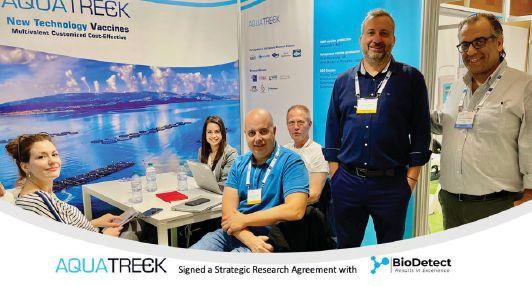
Aquatreck Animal Health S.L, a fish vaccine company established in 2019 in Pontevedra, Spain, signed an exclusive research agreement with Biodetect, a diagnostic lab based at the University of Patras, with the aim to launch a series on novel diagnostic services for the aquaculture sector focusing on pathogen epidemiological mapping in the fish farm environment.
“We are delighted to grow AQUATRECK capacity through research alliances and we are convinced that with the addition of the BioDetect team, we will be able to provide the industry with novel insights into the epidemiology of fish pathogens and health monitoring,” said Panos Christofilogiannis, director of Aquatreck.
According to the companies, the research collaboration aims to make the epidemiological mapping of fish diseases more efficient by using novel diagnostic tools to increase the predictability of the onset of fish diseases and the improved planning of the farm vaccination plans. In addition, it will provide an early warning system to identify emerging pathogens in the farm environment and mobilise specific research on new vaccine production for pathogen containment strategies.
“We have developed novel methods for monitoring fish pathogens in the farm environment and we are excited to have Aquatreck as our strategic ally to fast track the process to bring novel diagnostic services to the aquaculture industry,” said George Tsiamis, director of BioDetect. www.aquatreck.com • www.biodetect.gr
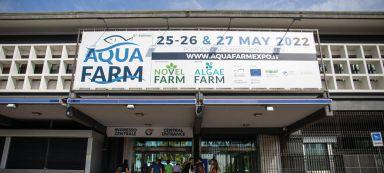
Pordenone Fiere to host AquaFarm 2023
The sixth edition of AquaFarm is set to take place Feb. 15-16, featuring an exhibition on aquaculture, shellfish farming and sustainable fishing of the Mediterranean basin and Southern Europe, organized by Pordenone Fiere in co-operation with API (Italian fish farmers association) and AMA (Mediterranean fish farmers association).
The conference program is complemented by special events and workshops organized by European-funded research programs, featuring Italian and international institutions, universities and companies.
“The next edition marks the beginning of a new phase... setting the stage for a sector that is crucial for the short-, medium- and long-term future of the planet,” said Renato Pujatti, president of Pordenone Fiere. www.aquafarm.show
Ocean Tracking Network receives $38.5 million in funding from the Canada Foundation for Innovation
The Ocean Tracking Network (OTN), headquartered at Dalhousie University, has been awarded a grant of C$38.5 million (US$28.6 million) from the Canada Foundation for Innovation’s Major Science Initiatives Fund, bringing the total amount awarded to OTN for its 2017-2029 funding cycle to C$65.6 million (US$ 48.8 million).
The fund supports the operating and maintenance needs of Canada’s research facilities. It includes an investment of more than C$628 million (US$467 million) to support 19 national research facilities at 14 institutions across the country.
OTN is a global aquatic research, data management and partnership platform — collaborators around the world are using OTN’s global infrastructure and analytical tools to document the movements of more than 300 keystone and commercially and culturally valuable aquatic species in the context of changing ocean and freshwater environments.
“The amount that remains undiscovered about the ocean and the species that call it home is vast. As the impacts of climate change ripple through the waters that surround us, it is becoming increasingly urgent to address this knowledge gap,” said Alice Aiken, Dalhousie’s vice-president, research and innovation. “With support from CFI, OTN’s cutting-edge research, technological innovation and global partnerships are helping to build the knowledge we need to revolutionize our understanding and stewardship of aquatic species around the world.”
With the funding awarded, OTN will be able to:
• Grow and maintain OTN’s headquarters, infrastructure and operations
• Continue to meet the growing demands of its Canadian and international user communities
• Bolster communication of data and outcomes in support of Canadian and international science and sustainable management of shared aquatic resources
• Facilitate leading-edge research with Canadian-made technologies
• Support the UN Sustainable Development Goals www.oceantrackingnetwork.org
• Recirculation System Design, Supply and Construction.
• Commercial Farms, Hatcheries, Aquaponics, Research Labs, Public Aquariums, Live Holding Systems – we do it all!
• Representing leading RAS equipment manufacturers.
Learn about Chilean aquaculture through its production facilities, stores and anecdotes.
Guided by Christian Pérez-Mallea
greetech.cl/en/contact/ contacto@greetech.cl
SELECTION
FOR SELECTION FOR PREMIUM QUALITY & PREMIUM QUALITY & PERFORMANCE PERFORMANCE
MORE THAN 25 YEARS OF
MORE THAN 25 YEARS OF SELECTION IN SELECTION IN RAINBOW TROUT RAINBOW TROUT