6 Leading Edge Aviation talent forecasts and industry action
8 On the Fly NLAF recipients, Twin Otter Classic, 500 Airbus jets for IndiGo
12 Alternative Approach China’s growing position in building airliners
14 Drone Report Transport proposes new BVLOS rules
28 ATAC Report Lobbying for aviation on Parliament Hill UPFRONT BACK
35 Marketplace
38 On final Summer of scheduling changes
FEATURES
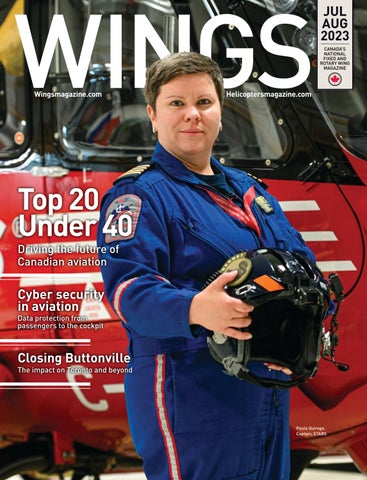
16 TOP 20 UNDER 40
From top: A look at China’s plane building sector, including the new C919. P. 12. Buttonville prepares to close. P. 33
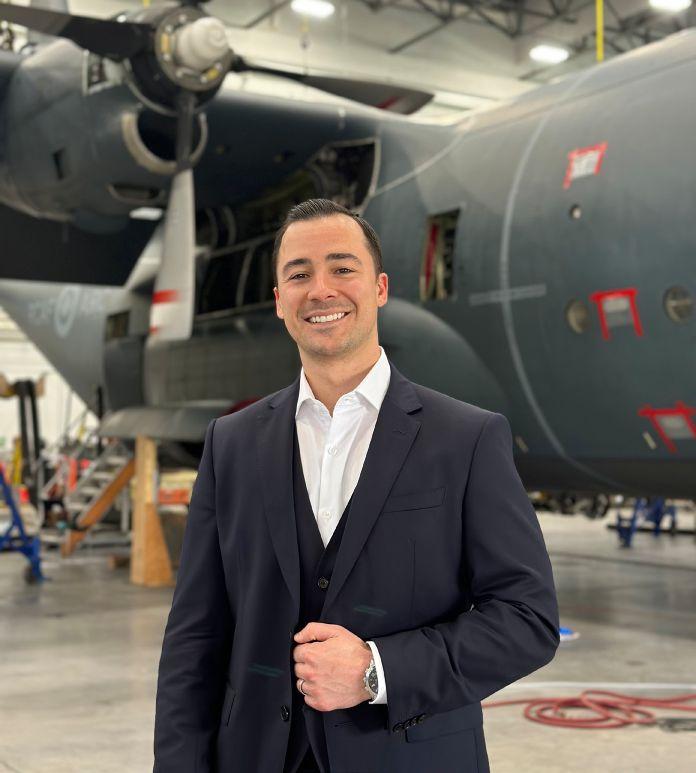
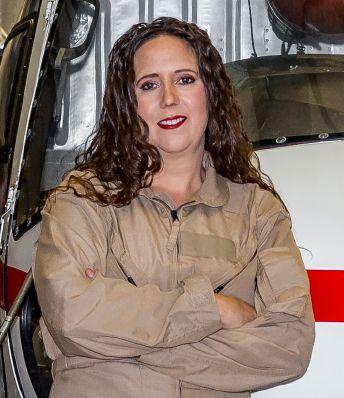
Driving the future of Canadian aviation and aerospace: Kimberly Atkinson, David Beaudin, Ibrahim Chokr, Brandon Dimonte, Phillip Dixon, Maxime GadboisGodin, Benjamin Gauthier, Neena Gill, Saeed Golzar, Spencer Gossen, Becky Grimsrud, Cassandra Hepp, Ashwin Jadhav, Stephen Lee, Mandeep Mangat, Jade Marshall, Joe Persicone, Paula Quiroga, Alisha Sohpaul, Zoey Williams BY
JON ROBINSON
30 AVIATION CYBER SECURITY
From passengers to the cockpit, how air operators can begin securing your aviation data ecosystem BY PHIL LIGHTSTONE
33 BUTTONVILLE AIRPORT CLOSURE
How the pending shutdown of a busy regional airport will impact aviation in Greater Toronto and beyond BY PHIL LIGHTSTONE
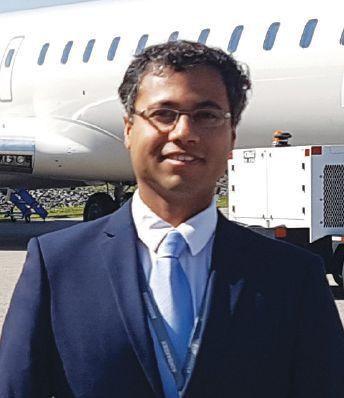
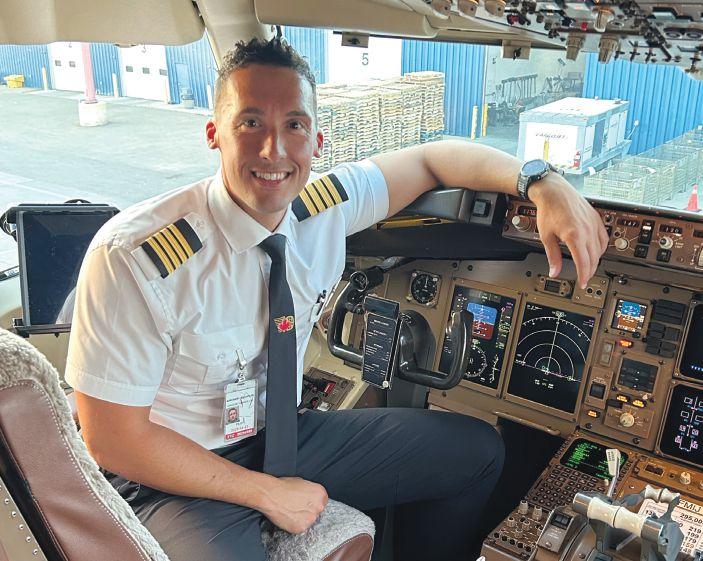
Ibrahim Chokr is the Chief Pilot for Air Inuit’s 703/704 Operations. P.16
Vol. 64, Issue 4
READER SERVICE
Print and digital subscription inquires or changes, please contact Serina Dingeldein, Audience Development Manager Tel: (416) 510-5124 Fax: (416) 510-6875 sdingeldein@annexbusinessmedia.com Mail: 111 Gordon Baker Rd., Suite 400, Toronto, ON M2H 3R1
EDITOR Jon Robinson jrobinson@annexbusinessmedia.com 647-448-6188
FLIGHT DECK
David Carr, John Gradek, Scott Henderson, Kendra Kincade, Phil Lightstone, Carroll McCormick, Steven Sitcoff
NATIONAL ACCOUNT MANAGER Mena Miu mmiu@annexbusinessmedia.com • 416-510-6749
PRESIDENT/COO Scott Jamieson sjamieson@annexbusinessmedia.com
WINGS MAGAZINE
P.O. Box 530, 105 Donly Dr. S., Simcoe, ON N3Y 4N5 Tel: 519-428-3471 Fax: 519-429-3094 Toll Free: 1-888-599-2228
PUBLICATION MAIL AGREEMENT #40065710
Published six times per year (Jan/Feb, Mar/Ap, May/Jun, Jul/Aug, Sep/Oct, Nov/Dec) by Annex Business Media
SUBSCRIPTION RATES
Canada – 1 Year $ 34.50
(plus GST - #867172652RT0001)
USA – 1yr -$ 78.50 CDN (USD $60.50)
International – 1yr - $90.50 CDN (USD $69.50) Occasionally, Wings magazine will mail information on behalf of industry-related groups whose products and services we believe may be of interest to you.
If you prefer not to receive this information, please contact our circulation department in any of the four ways listed above.
All advertising is subject to the publisher’s approval. Such approval does not imply any endorsement of the products or services advertised. Publisher reserves the right to refuse advertising that does not meet the standards of the publication.
Annex Business Media brands focused on Canadian aviation and aerospace include Wings, Helicopters and UAV Canada, as well as the Careers in Aviation Expo and Directory, Aerial Firefighting Guide and the MRO Directory. Annex is the publishing partner of Canadian Owners and Pilots Association, providing essential news and market content through COPA Flight, COPAnational.org and Canadianplanetrade.ca.
Exciting horizons ahead.
At the WestJet Group, you’ll discover opportunities to grow your roots with established and respected airlines. We offer an exciting career with stability and development. Under our wing, you can count on flexible scheduling and competitive wages to set you up for the long-haul.
If you’re ready to elevate your aviation career in a diverse and inclusive work environment—come fly with us.
• WestJet 737 First Officers
• WestJet Encore Q400 First Officers
• Licensed Airline Maintenance Engineers
See these and more opportunities at westjet.com/greatjobs
Talent forecasts and action
Canadian operations build out next generation hiring
CAE on June 20 released at the Paris International Air Show its 2023 Aviation Talent Forecast, which anticipates a global need for 1.3 million new aviation professionals to join the industry as pilots, Aircraft Maintenance Technicians and cabin crew over the next 10 years to support the expected growth of the commercial and business aviation markets. The study estimates a need for 1.18 million individuals to be recruited and trained for the commercial aviation industry, and 106,000 people for business aviation, to fill vacancies due to retirement and attrition, and the expected expansion of the aviation industry.
“With a need for 1.3 million people by 2032, CAE’s Aviation Talent Forecast is a call to action for the industry to promote careers in aviation to the next generation, reach out to underrepresented communities, and develop innovative support programs to expand the pool of talent needed for the continued growth and safety of our industry,” said Nick Leontidis, CAE’s Group President for Civil Aviation.
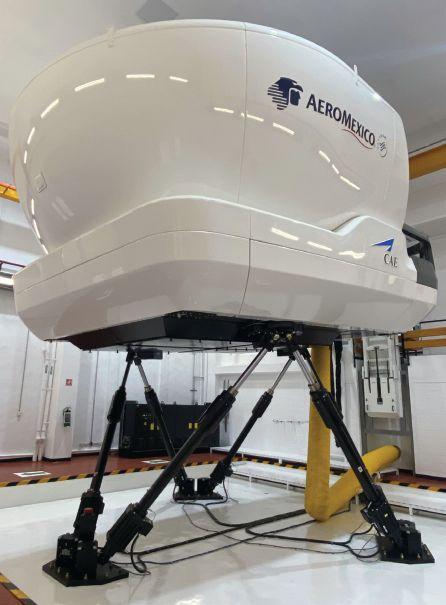
Over the past few months, the industry has seen greenfield steps in meeting this now continuous call to action. First, Chorus Aviation on March 28 announced the launch of Cygnet Aviation Academy, based in Kingston, Ontario, describing it as a first of its kind academy in Canada in terms of flight training with direct access to career opportunities. Cygnet, in collaboration with CAE, is designed to provide an all-in-one, 20-month program to train future pilots on modern aircraft, flight training devices, and full flight simulators, allowing cadets to earn an Integrated Airline Transport Pilot License (iATPL) and acquire an airline specific type rating.
CAE’s Aviation Talent Forecast estimates 1.18 million more people will need to be trained for commercial aviation in 10 years.
In mid-June, IMP Aerospace & Defence introduced its new IMP Academy, which is set to offer training beginning this fall from two locations, including IMP Aerospace in Enfield, Nova Scotia, and Cascade Aerospace in Abbotsford, British Columbia. The IMP Academy will offer a tuition-free,
TOP DATA BURSTS… in this issue
1. The new Twin Otter Classic 300-G has garnered 45 aircraft agreements. P. 9. 2. Argentinean Air Force and Army will operate six Bell 407GXi helicopters. P.10. 3. Comac reports orders for more than 1,200 C919s . P.12. 4. Roughly 200 aircraft are seeking a new home with pending Buttonville closure. P.33 . 5. Airlines face a max fine of up to $250,000 for violating air passenger protection rights. P. 38.
By Jon Robinson |
programs
four-year “earn and learn” apprenticeship program for those aspiring to achieve a highly technical career as Aircraft Maintenance Technicians.
The IMP Academy curriculum, provided by the Canadian Council of Aviation and Aerospace and already accepted by Transport Canada, will provide the foundation for the course content. IMP Aerospace explains the academy will offer a complimentary four-week Introduction to Aerospace Skilled Trades course. Interested candidates can apply to become apprentices at the academy. Successful applicants will be offered employment at IMP Aerospace & Defence, which holds a workforce of more than 2,400 professionals across the country, in addition to free enrollment in the Aircraft Maintenance Apprenticeship Program. This program includes four levels of structured computer-based training conducted in classroom settings. These levels, explains IMP Aerospace, are complemented by practical skills development in controlled work environments.
CAE describes the Aviation Talent Forecast as a tool for stakeholders across the aviation ecosystem which analyzes the upcoming talent demand for pilots, and for the first time in this report, for aircraft maintenance technicians and cabin crew worldwide. The report includes details on how many people will be needed in each region, reasons for the high demand, and how to attract talent.
In May, Wings, in partnership with platinum sponsor WestJet, continued our primary action plan to engage the next generation with industry at the annual Careers in Aviation Expo at the airline’s Toronto Pearson maintenance hangar. It was our largest-ever careers event with more than 550 people in attendance, including more than 42 leading exhibitors. | W
GOOD TO GO.
Vision | To be globally recognized as a superior provider of aviation maintenance by being a forward-looking employer. Notre Vision | Être reconnu mondialement comme un fournisseur supérieur de maintenance aéronautique en étant un employeur tourné vers l’avenir.
ON THE FLY
THE LEAD RECIPIENTS OF NORTHERN LIGHTS
AERO FOUNDATION’S 2023 ELSIE AWARDS PROGRAM
The Northern Lights Aero Foundation announced its 2023 recipients of the Elsie Award program, designed to recognize Canadian women who have made a significant contribution to aviation or aerospace. The awards program, named after aviation pioneer and human rights activist, Elsie Gregory MacGill, is organized in seven categories. “Once again, eight incredible women are being recognized by our organization,” said Kathleen Lang, President, Northern Lights Aero Foundation. “We look forward to celebrating their accomplishments at our new, larger venue, The Pearson Convention Centre.” The 2023 gala awards dinner is scheduled for October 21, 2023, at the Pearson Convention
Centre in Brampton, Ontario, with tickets going on sale in July.
The 2023 recipients include: Business Award, Cathy Press, CEO of Chinook Helicopters; Education Award, Dr. Joana Rocha, Professor, Department of Mechanical and Aerospace Engineering, Carleton University; Engineering Award, Heather Beaton, Fellow, Aircraft Design & Development Engineering, Bombardier; Flight Operations Award, Kristin Long, Captain and Standards Pilot, WestJet Airlines; Government Award, Major Catherine Cabot, aerospace engineer, Canadian Armed Forces; Trailblazer Award, Glenna Sharratt, flight operations consultant; Rising Star Award, Alisha Sohpaul, Airworthiness Inspector, Transport Canada; Rising Star Award, Yasna Taieb, Inflight Operations Manager, Jazz Aviation.
COMMERCIAL
WESTJET TO MERGE SWOOP, SUNWING INTO MAINLINE BUSINESS
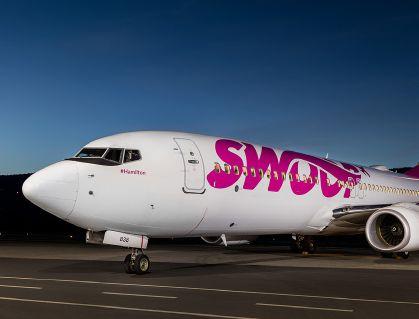
The WestJet Group outlined plans to wind down its Swoop subsidiary by late October 2023 as it folds the budget airline’s operations, including 16 narrow-body 737s, under its main banner. The move comes five years after Swoop was launched as new low-cost carriers were entering the Canadian market. The integrate also comes
after pilots with WestJet and Swoop ratified a new collective agreement that brings them onto a level pay scale, providing them with a 24 per cent hour pay increase over four years. The company said no layoffs are expected from the integration.
WestJet also announced it would integrate Sunwing Airlines under its mainline banner. “We are confident that the future integration of Sunwing Airlines into the WestJet Group, following that of our ultralow-cost carrier Swoop, will significantly enhance our ability to provide affordability and choice to our guests,” said Alexis von Hoensbroech, CEO, WestJet Group. “The integration of all jets from Sunwing Airlines, Swoop and WestJet into one fleet will provide us with the scale to enhance our collective operational resilience.”
Sunwing Airlines will not be integrated into WestJet before 2024 and remains business as usual. The tour operator business, Sunwing Vacations and WestJet Vacations together will continue to operate independently under their existing and respective brands, as integral parts of the WestJet Group. Both Sunwing Vacations and WestJet Vacations will significantly expand vacation offerings to more communities across its network. WestJet explains it will leverage the ultra-low fare products introduced by Swoop across Canada through the entirety of its 180 aircraft.
“Competition amongst air carriers in Canada has never been healthier and after a challenging three years, aviation is back, with passenger traffic doubling in Canada since March 2022,” said von Hoensbroech. “The integration [into] the WestJet Group will enhance affordability.”
Cathy Press in 1998 took over leadership of the family business Chinook Helicopters, which provides rotary- and fixed-wing flight training out of Abbotsford, BC.
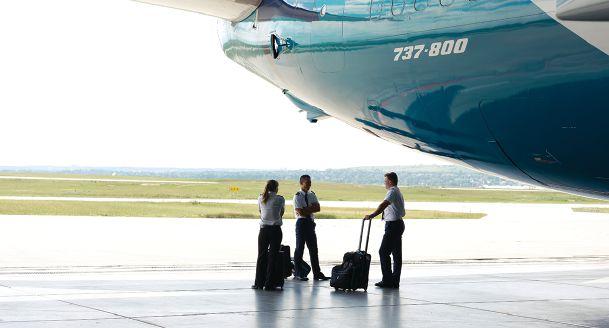
Swoop operates a fleet of 16 Boeing 737-800 Next Generation aircraft.
DE HAVILLAND UNVEILS TWIN OTTER CLASSIC 300-G
De Havilland Aircraft of Canada on June 19 at the Paris International Air Show introduced the DHC-6 Twin Otter Classic 300-G, which at the time had garnered purchase agreements and letters of intent totalling 45 aircraft. This includes a deal with Jetcraft Commercial which signed a purchase Agreement for 10 Classic 300-G aircraft to serve as its launch customer. The Classic 300-G is described by De Havilland Canada as the fifth generation of the Twin Otter aircraft, joining the current Series 400. The company says work on the Classic 300-G will create 80 and 91 permanent production jobs in Calgary, Alberta and Victoria, British Columbia, respectively.
In addition to its new cabin interior and G1000 NXi flight deck, the Twin Otter Classic 300-G’s 400-500 lb basic weight reduction means more payload and/or longer range capability. “The G1000 NXi will bring wireless cockpit connectivity, enhanced situational awareness, visual approach capability, and our fully integrated GFC™ 700 autopilot with envelope protection to the Classic 300-G aircraft,” said Carl Wolf, Garmin Vice President of Aviation Sales and Marketing, De Havilland Canada. Jetcraft Commercial is the commercial aircraft division of global aviation trading firm Jetcraft, supporting airlines and operators with buying, selling, leasing, marketing and financing aircraft.
“We believe that the DHC-6 Twin Otter Classic 300-G represents the best in-class commuter aircraft solution,” said Raphael Haddad, President of Jetcraft Commercial. “This versatility enables the aircraft to operate into areas where regional aircraft cannot go and provide air connectivity there.
AIR CANADA LAUNCHES NON STOP, YEAR ROUND SERVICE BETWEEN TORONTO AND YELLOWKNIFE
Air Canada is launching non-stop, yearround service between Toronto and Yellowknife that it says will help support both tourism and business in the region. The route, which will fly three times a week, is expected to start service in December. The Montreal-based airline says customers will also be able to seamlessly connect from Yellowknife to flights by its partner airline Canadian North.
Mark Galardo, Executive Vice-President
of Revenue and Network Planning, says flights will be timed for easy connections through Toronto to elsewhere in Eastern Canada, the U.S. and sunny destinations. Caroline Wawzonek, Minister of Industry, Tourism and Investment for the Northwest Territories, says in the release that the route marks a significant increase in air transport options that will increase opportunities for the region. Air Canada already flies twice daily between Yellowknife and Vancouver and has daily service between Yellowknife and Edmonton.
AIRBUS WINS RECORD ORDER FOR 500 JETS FROM INDIA’S INDIGO
India’s IndiGo airline is buying 500 passenger jets from European planemaker Airbus in a record-setting order that underscores surging demand for air travel fueled by the country’s economic growth. IndiGo, India’s dominant carrier, is buying the narrow-body A320 aircraft in what the companies said was the single biggest purchase agreement in commercial aviation history, which would likely amount to tens of billions of dollars. Executives from both companies announced the deal on the opening day of the Paris Air Show.
New Delhi-based IndiGo’s order surpasses another mammoth deal signed months earlier by Air India for 470 aircraft from both Airbus and U.S.-based rival Boeing. Airbus explains Indian airlines are racing to tap surging demand for travel from the nation’s growing ranks of middle-class consumers. The A320 jets that IndiGo is buying are typically used on short-haul routes. The latest agreement would establish IndiGo’s position as the world’s biggest A320 Family customer. “It is difficult to overstate the significance of IndiGo’s new historic order for 500 Airbus A320 Family aircraft,” said Pieter Elbers, CEO of IndiGo. “An order book now of almost 1000 aircraft well into the next decade, enables
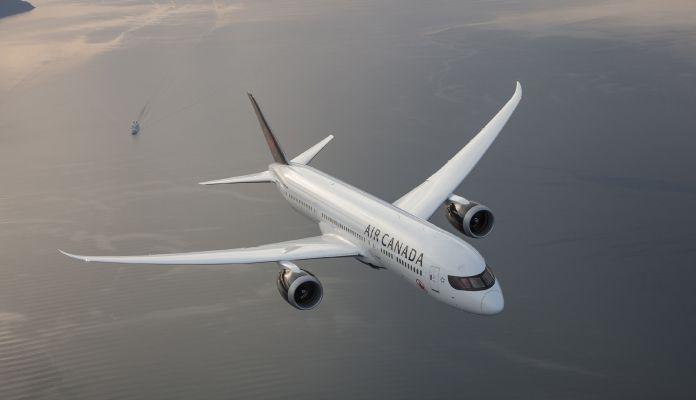
Air Canada on April 15, 2022, flew more than 100,000 customers in a single day for the first time since early in the pandemic.
IndiGo, India’s largest airline by market share, placed a firm order for 500 A320 Family aircraft.
IndiGo to fulfil its mission to continue to boost economic growth, social cohesion and mobility in India.”.”
Since its first A320neo aircraft was delivered in March 2016, IndiGo’s fleet of A320neo Family aircraft has grown into one of the world’s largest with 264 aircraft in operation (162 A320neo, 79 A321neo, 21 A320ceo and two A321 freighters).
HELICOPTERS
ARGENTINA DEFENSE ACQUIRES SIX BELL 407GXI HELICOPTERS
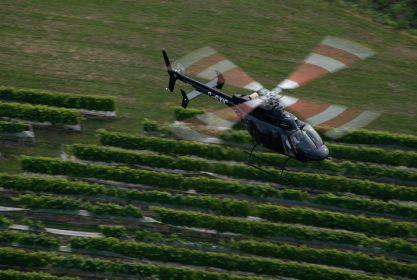
The Argentinean Air Force and Army will operate six new Bell 407GXi helicopters under a $43 million purchase agreement executed between the Ministry of Defense of Argentina and the Canadian Commercial Corporation. The six helicopters will be built by Bell Textron Canada based in Mirabel, Quebec, and ultimately assist in Argentina’s search and rescue missions. “The Bell 407GXi is a proven platform in highaltitude environments and will be pivotal to Argentina’s Military Search and Rescue operations,” said John Ramos, Managing Director, Latin America, Bell Textron. “All six Bell 407GXis will be outfitted in a utility configuration critical to rescue missions
than 1,000 aircraft to Canadian customers. “This announcement is a testament to the long-standing partnership of Bell and CCC to deliver Canadian-built helicopters to customers around the globe,” said Steeve Lavoie, President of Bell Textron Canada. “The Argentinian MOD will be well-served by the unmatched reliability and performance of its new Bell 407GXi fleet, and our team is delighted to enable their search and rescue mission.”
WESTSTAR TO INTRODUCE LEONARDO TILTROTOR IN SOUTHEAST ASIA
Leonardo and Weststar Aviation Services of Malaysia celebrated development agreements and a sustainability milestone during the Langkawi International Maritime and Aerospace Exhibition. Weststar will introduce the AW609 tiltrotor in Malaysia through the operation of one aircraft under a lease contract. The AW609 program, explains Leonardo, is the world’s first multirole tiltrotor designed to obtain civil certification. The partnership with Weststar will mark the entry of this all-new type aircraft in Southeast Asia.
SUSTAINABLE AVIATION
OTTAWA UNVEILS $350 MILLION FUND TO SUPPORT GREEN TECH IN AEROSPACE
François-Philippe Champagne, Minister of Innovation, Science and Industry, at the Paris Air Show announced an investment of $350 million to support Canada's new Initiative for Sustainable Aviation Technology (INSAT) aimed at accelerating the green industrial transformation of the aerospace industry. This investment, via the Strategic Innovation Fund, will establish a pan-Canadian, industry-led aerospace network focused on funding collaborative research and development projects with companies of all sizes across the Canadian supply chain, from coast to coast to coast. Projects will focus on four key technology areas: hybrid and alternative propulsion; aircraft architecture and systems integration; transition to alternative fuels; and aircraft support infrastructure and operations.
in Argentina’s mountainous terrain.”
Founded in 1986, Bell Textron Canada is now represented by 1,400 employees across the country providing service and support for customers around the globe. Bell Textron Canada is responsible for Bell’s current commercial production line, including the Bell 505, Bell 407GXi, Bell 429 and SUBARU Bell 412EPX. To date, the company has built more than 5,600 commercial helicopters and delivered more
Founded in 2003, Weststar, described as a regional offshore helicopter transportation services provider, now operates more than 35 AW139, AW169 and AW189 helicopters out of its bases in Malaysia, Indonesia, the Kingdom of Saudi Arabia, Namibia, Mauritania, Gabon, and the Republic of Congo. It is one of the world’s largest commercial operators of Leonardo helicopters. Weststar will use the AW609 for a range of missions in the country, with Leonardo supplying initial training and maintenance support, as well as working with the operator for aircraft demonstration purposes.
The investment is in direct response to the recommendation stemming from consultations led by the Aerospace Industries Association of Canada involving over 450 industry representatives and other stakeholders nationwide. The aerospace industry is one of the most export-driven sectors in Canada, contributing close to $27 billion and more than 210,000 jobs.
“Our government is committed to making Canada a leader and a strategic partner of choice when it comes to sustainable aviation,” said Champagne. “[This] $350 million investment to support the Initiative for Sustainable Aviation Technology will help drive and accelerate the green industrial transformation of Canada’s aerospace industry.”
The Bell 407GXi’s Garmin G1000H NXi Flight Deck enhances situational awareness and reduces pilot workload.
The AW609 program, explains Leonardo, is the world’s first multirole tiltrotor designed to obtain civil certification.
TEXTRON UNVEILS PLANS FOR CESSNA CITATION ASCEND JET
Textron Aviation on May 22 introduced the newest Cessna Citation business jet in the 560XL series, called the Cessna Citation Ascend. Unveiled on the eve of this week’s European Business Aviation Convention and Exhibition (EBACE), Textron explains the Citation Ascend is designed to bring an entirely new cockpit, improved performance and a more luxurious cabin to the midsize business jet market. Currently under development, the aircraft is expected to enter into service in 2025.
The Cessna Citation Ascend will offer Garmin G5000 avionics with features like autothrottle technology to reduce pilot workload and provide flight-envelope protection; three 14inch high-resolution displays with splitscreen capabilities; standard dual flight management systems; synthetic vision to render obstacles like mountains or terrain; cockpit voice and data satellite transceiver to make satellite calls from the cockpit; new Garmin weather detection and avoidance technology; and second Iridium data radio and CPDLC to support customers with more direct routing between North America and Europe (optional).
The Citation Ascend will offer Pratt & Whitney Canada PW545D engines designed to deliver better fuel efficiency, increased thrust and longer time-onwing. The engines use new materials and technology, explains Textron, including a more efficient high-pressure compressor, an enhanced single stage high-pressure turbine module.
AIRPORTS
OSHKOSH CORP. TO ACQUIRE AEROTECH BUSINESS FROM JBT
Oshkosh Corporation entered into a definitive agreement to acquire the AeroTech business from JBT Corporation in an US$800 million all-cash transaction.
AeroTech is a provider of aviation ground support products, gate equipment and airport services to commercial airlines, airports, air-freight carriers, ground handling and military customers. Oshkosh states AeroTech owns many of the most trusted brands in the air transportation industry with systems in the field that serve approximately 75 per cent of air travellers at U.S. airports and load approximately 70 per cent of the world’s overnight express packages.
Oshkosh explains AeroTech’s products are closely aligned with its technology focus areas, including electrification, autonomy and active safety and intelligent, connected products. With AeroTech, Oshkosh will enter the air transportation support market. The acquisition is expected to be accretive to Oshkosh’s growth and margins and deliver recurring revenue from its aftermarket parts and services offerings.
QUEBEC TO SPEND $66M ON NUNAVIK AIRPORT PROJECTS, AIR INUIT INVESTS IN FLEET
The government of Quebec will spend close to $66 million over the next two years on 18 airport-related projects across Nunavik. Some of the work includes: Replacement of the fencing at the Akulivik airport; replacement of visual aid tools for navigation in both Aupaluk and Kangirsuk; and replenishment of the movement area and replacement of navigation visual aids at the Kangiqsujuaq airport. In a government release about the investment plan, Ungava MLA Denis Lamothe said the $65.9 million that will be spent “greatly improves the security and facilitates mobility in the region.”
Air Inuit then in July announced the ratification of an agreement for the acquisition of three Boeing Next-Generation 737-800 aircraft to be added to its fleet as part of its mission to provide world-class passenger and freight service to the people
of Nunavik, its network and beyond. The aircraft will be customized using Air Inuit's combi configuration solution to provide safe and comfortable passenger service and reliable freight delivery simultaneously.
“The addition of these aircraft to our fleet enhances our capacity to efficiently transport passengers and deliver essential cargo to the communities we serve,” said Christian Busch, CEO of Air Inuit. “Acquiring these modern aircraft also supports our airline's goal of reducing carbon emissions and doing our part in the fight against climate change.”
Air Inuit estimates that by eventually replacing the Boeing 737-200 aircraft currently in service, fuel emissions will be cut by nearly 40 per cent. The three Boeing Next-Generation 737-800 aircraft will be fitted with main deck cargo doors to meet requirements at hubs across Nunavik and beyond, which in turn service each of the communities of Air Inuit’s network.
MRO
AVIANOR INVESTING $70 MILLION INTO MIRABEL CENTRE OF EXCELLENCE
Avianor, a company owned by DRAKKAR Aerospace & Ground Transportation since 2019, which has specialized aircraft maintenance, repair and overhaul and cabin integration for more than 25 years, announced the launch of the construction of its Center of Excellence for the A220 aircraft at Montreal-Mirabel International Airport (CYMX). Scheduled to open in fall of 2024, the Center of Excellence represents an investment of more than $70 million in infrastructure, digitization and equipment, including a government loan of $9 million. The new 105,000-square-foot hangar will create more than 100 maintenance jobs. Avianor currently employees approximately 225 people.
“The A220 Center of Excellence represents an extremely decisive and significant milestone for Avianor and all our customers, community, partners and suppliers,” said Hugo Brouillard, Avianor’s Vice President and Chief Operating Officer.
As a result of the investment, Avianor will have four additional maintenance lines to accommodate the A220 aircraft and potentially other types of narrow-body aircraft programs, for a total asset of seven maintenance lines in service. | W
Textron Aviation expects the Cessna Citation Ascend to enter into service in 2025.
By David Carr |
Building airliners in China
Milestones for China’s aviation industry as the global landscape shifts
The first real crack in Airbus and Boeing’s global duopoly has started to form. Where it will lead is clear: China is building a homegrown commercial aerospace industry, first by supplying domestic airlines with made-in-China jets.
China broke into the commercial market in June 2016 with the entry into service of the Commercial Aircraft Corporation of China (Comac) AJR21, a 78-passenger, rear-engine-mounted regional jet. The anticipated breakthrough, however, came this May when China Eastern Airlines launched the Comac C919 on its Shanghai Beijing route, the world’s fifth busiest.
There is a world of difference in assembling passenger jets, as Airbus is doing in the port city of Tianjin, and making them. In 1969, the European consortium of aerospace companies that made up Airbus understood that to compete with Boeing, McDonnell Douglas and Lockheed it had to build a jet that filled a market gap. Which it did with the A300, the world’s first twinengine wide-body; followed by the A320, with its revolutionary fly-by-wire design.
China has been more conventional. The 164-passenger C919 is comparable to smaller versions of the A320 and Boeing 737 family. Despite Beijing’s desire to reduce the country’s dependence on western technology, more than 40 per cent of the airplane consists of components from North America and Europe, including avionics, communications systems, landing gear and CFM International LEAP engines. China is developing a turbofan jet engine it says will power the C919 by 2025.
Aero Engine Corporation of China also plans to develop engine technology for a future wide-body aircraft, although work on the Craic CR929, a joint venture between Comac and Russia’s United Aircraft, has stalled in large part due to Russia’s invasion of the Ukraine. Russia was noticeably absent on promotional material for the widebody at this year’s Paris Air Show. Whereas Airbus built a consortium with aerospace expertise from established companies like France’s Aerospatiale and Britain’s Hawker Siddeley (a favoured subcontractor that designed and manufactured
Airbus in March 2013 delivered its first A321neo assembled in Tianjin to china's Juneyao Air.
wings for the A300), Comac started from scratch. It has been a long and expensive process, which highlights the difficulty of challenging the Airbus-Boeing duopoly. China has poured an estimated US$72 billion into the C919, which has taken 15 years to develop and it is a generation behind the A320neo and 737 Max. In contrast, the A300 took five years from launch to entryinto-service in 1974. China still does not have a self-sufficient commercial airplane industry and is vulnerable to western sanctions as tensions grow over Taiwan. But all that would be missing the point. China has shown the world it can build large, modern, comfortable commercial airplanes.
For now, the numbers are small. China Eastern Airlines, the country’s second largest airline by fleet size, ordered five C919s. The airline operates 372 A319, A320 and A321 aircraft and 202 737s, with orders for 261 neo and 47 Max versions.
Comac is reporting orders for more than 1,200 C919s from 32 customers, including state-backed airlines and Chinese leasing firms. The OEM expects to produce 150 aircraft a year by 2028, taking a substantial bite out of domestic market share for
single-aisle aircraft, once supplied exclusively by Airbus and Boeing. “We will probably go from a duopoly to a triopoly, at least on the single-aisle, by the end of the decade,” Guillaume Faury, Airbus’ chief executive said at an industry event in 2021.
Over 600 of the A320 family of jets, including the A320neo, have rolled off the Airbus assembly line in Tianjin since it opened in 2008. Same year the C919 was launched. Airbus recently announced a second line that will double output, already expected to increase from four aircraft a month to six by end of year.
Airbus, the world’s largest commercial aircraft builder was all over rival Boeing in the single-aisle category at this year’s Paris Air Show, including a record-breaking order from India’s IndiGo for 500 A320 jets. Comac is offering nothing that foreign airlines cannot already buy from Airbus and Boeing off the shelf, with longer range and better fuel economy. The OEM also lacks a global support network. But China will become the world’s single largest market for commercial aircraft by 2041, by which time Comac should have established a legacy, narrowed the technology gap, and launched a wide-body. Airbus was widely dismissed when it launched at the 1969 Paris Air Show. The aerospace world is paying closer attention to China. | W
By Scott Henderson |
Exploring BVLOS horizons
Transport proposes new drone rules to help foster commercial value
In late June 2023, Omar Alghabra, Canada’s Minister of Transport, proposed changes to drone rules for Beyond Visual Line-of-Sight flights. This includes elimination of the requirement to obtain a Special Flight Operations Certificate (SFOC) for lower-risk Beyond Visual Line-of-Sight (BVLOS ) flights and medium-sized drone operations within visual line-of-sight (VLOS). Such drone flights are currently approved on a case-bycase abasis which can be time consuming.
Only two summers ago, Transport Canada (TC) issued Calgary’s Canadian UAVs the first commercial special flight operations certificate to fly BVLOS in unrestricted airspace. Eliminating this requirement is an important step toward streamlining drone services. Most of the drone sector’s economic value is tied to operations that require BVLOS capabilities, notably package delivery and disaster management.
Lower-risk BVLOS operation means the drone is flown at low altitudes, away from populated areas and aerodromes. It is easy to come up with five examples of lowerrisk BVLOS with medium-sized drones to demonstrate freeing up drone operations in some of Canada’s largest industries. Agricultural monitoring with drones of a farmer’s field or wildlife tracking. Energy companies use drones to inspect pipelines and powerlines across long distances and follow a predefined path to avoid air traffic or populated areas. Drones being used for land surveying and mapping typically fly over less populated areas.
The proposed changes to the Canadian Aviation Regulations (CARs) also include a new class of pilot certification for lowerrisk operations, new drone pilot medical standards, and changes to fees, among others. These revisions will increase Canada’s competitiveness in a global drone market is currently valued at more than US$29 billion and projected to increase by 38 per cent to more than $55 billion in 2030, according to a study published in March 2023 by Contrive Datum Insights.
TC is working to fulfill many of the objectives listed in its Drone Strategy published in 2021 with input from industry. “The proposed regulations, with a focus
Proposed changes to CARS includes a new pilot certification for lower risk operations.
on mitigating safety risks while also supporting economic growth and innovation, would provide direct benefits to Canadians and unlock significant economic opportunities.” said Alghabra.
If implemented with risk mitigation like automated detect-and-avoid systems, BVLOS can be safer than VLOS operations, as it reduces the need for humans to be close to dangerous environments like wildfires or disaster zones. With a proper BVLOS strategy, there will be an increase in demand for associated technologies like enhanced GPS, onboard sensing, communication links, and advanced flight control systems which will stimulate innovation.
Canada is one of the first countries to propose comprehensive regulations for routine BVLOS drone operations. TC in January 2019 published its first set of commercial VLOS rules for drones weighing less than 25kg. Over the past few years, by emphasizing certification, registration and regulatory compliance, TC has developed and enforced rules to ensure safety and privacy while facilitating growth and innovation.
The integration of geofencing software, for example, prevents drones from entering
restricted areas. There has also been innovation in providing compliance help to drone operators, such as apps to manage compliance requirements like flight logging, airspace notifications and equipment management.
The requirements for certification and registration can create barriers to entry for hobbyists and small businesses. Strict regulations can inhibit innovation as companies may be less likely to develop new technologies. The enforcement of drone regulations can be resource intensive as monitoring and tracking operations is more difficult due to the widespread growing use of drones.
TC has stated that some provisions of the regulations would come into force upon publication in Canada Gazette, Part II, which is anticipated in fall 2024, while others would come into force on April 1, 2025. Canadians and members of the aviation industry are invited to provide feedback on the proposed regulations through Canada Gazette, Part I, over a 90-day consultation period.
Now is not the time to stay silent. The aviation industry should continue to collaborate as Transport Canada works on creating the best possible drone regulatory environment for commercial success. An effort that must provides maximum safety and maintain Canada’s competitive advantage in this rapidly growing industry. | W
TOP 20 UNDER 40
LEADERS DRIVING THE FUTURE OF CANADIAN AVIATION AND AEROSPACE FROM COAST TO COAST
BY JON ROBINSON
In the annual Top 20 Under 40 program, Wings recognizes inspiring young leaders influencing the direction of Canadian aviation and aerospace. Presented here alphabetically, these leaders, who were all under the age of 40 at the time of nomination, were initially put forward through an online submission process lasting over several months. Wings then determined this year’s 20 honourees based on their demonstration of leadership, innovation, influence, achievement and dedication to their organizations and the Canadian aviation industry.
KIMBERLY ATKINSON Director, Owner Experience, AirSprint, Calgary, AB
Kimberly Atkinson, 37, grew up intrigued by the world of private aviation with a father who was a pilot in the sector. A graduate of the University of Guelph’s Hospitality program, Atkinson focused the early part of her career on the hotel industry, where she was a part of Accor North America’s Sales Team of the Year and an Ottawa Tourism Star of the City Nominee. She brought a fresh perspective to the private aviation sector 11 years ago when she returned home
to Calgary to join Take Flight Group’s flight coordination team.
In November 2013, Atkinson was promoted to Manager of Flight Coordination at Take Flight Group, where she stayed for the next eight years. In May 2021, she moved to AirSprint Private Aviation as Director of Owner Experience. With offices in Toronto, Montréal and Calgary, AirSprint maintains the largest fractional fleet of private aircraft in Canada, a collection of Embraer Praetor 500, Embraer Legacy 450/500, Cessna Citation CJ3+ and Cessna Citation CJ2+ jets.
Since joining AirSprint, Atkinson has expanded the company’s Owner Services team by more than 25 positions to ensure aircraft owner experiences remain at the forefront. She regularly engages with owners and third-party vendors to gather feedback and insight, which she uses for future enhancements to AirSprint’s services.
What excites you most about aviation?
The growing representation of women in the aviation industry in Canada. When I became a part of the AirSprint family a couple of years ago, I was encouraged to see a significant number of females on the flight line and in top-level positions, and I love being a part of a company that supports initiatives like Girls Can Fly and Girls in Aviation Day.
DAVID BEAUDIN Manager, Ground and Building Services, HUB FBO, Saint-Hubert, QC
David Beaudin, 38, landed his first job in the aviation industry as a ramp agent for HUB FBO at the Montreal Saint-Hubert Airport, CYHU, which is set to remain among Canada’s fastest growing airports over the next few years. Since joining HUB, Beaudin progressively climbed the company’s ladder to reach his current position, critical to everyday operations. He has been instrumental in helping the relatively young
KIMBERLY ATKINSON, AIRSPRINT.
EXCELLENCE IN GAS TURBINE OVERHAUL
OUR HELICOPTER PROGRAM SPECIALIZES IN MRO SERVICE FOR THE FOLLOWING ENGINE LINES:
• GE T700/CT7
• Pratt & Whitney Canada PT6T & PW200
• Rolls-Royce M250 & RR300
• Safran Arriel 1 & 2
company build operational efficiencies. Procedures introduced by Beaudin allow HUB to provide its clients with savings in everything from time to fuel. Beaudin has helped HUB FBO create and maintain important business relationships with some of Canada’s most important companies like WestJet, Air North, Air Creebec and Pratt & Whitney. With his operational knowledge of CYHU, Beaudin communicated with Porter Airlines surrounding its plans to develop a new terminal at the airport capable of serving more than four million passengers annually (2024 timeline). Beaudin also collaborates with NAV Canada and CYHU authorities to create safe escorting procedures. HUB is a key facility for Quebec located less than 15 minutes from downtown Montréal with a 47,000-square-foot hangar building and 80,000-square-foot ramp space situated just off a 7,800-foot runway.
Why is your company unique to work for?
HUB FBO is unique because we are a small company that is able to achieve great success due to the high level of professionalism of all team members. Our impeccable reputation over the years is attributable to the quality of service that we provide to every customer who comes to our installations here at Montreal Saint-Hubert airport, day in and day out.
IBRAHIM CHOKR
Chief Pilot, 703/704 Operations, Air Inuit, Montréal, QC Ibrahim Chokr, 30, began his aviation journey in 2011 with studies at the Centre Québécois de formation aéronautique. In 2015, he began working as a flight instructor for ALM par avion and, during the same period, he taught aviation classes to professional drone pilots with Exo Drone. Chokr in 2016 then transitioned to Exact Air of Saint-Honoré, Quebec, as a flight instructor and, in 2017, was named Chief Flight Instructor.
In 2018, Chokr joined Air Inuit as a First Officer on the Dash 8. After a year, he was promoted to Captain and flew a range of aircraft types like the Twin Otter, King Air 100 and King Air 350. In addition to flying for Air Inuit, he spent nearly three years as a Ground School Instructor and served as Training Captain on the Twin Otter and King Air 350. In October 2021, Chokr transitioned to the role of Assistant Chief Pilot for 703/704 Operations at Air Inuit and, a year later, was promoted to his current position as Chief Pilot for 703-704 Operations, managing a team of more than 60 pilots. In 2021, Chokr completed a short undergraduate program in Aviation Management at Université du Québec à Chicoutimi and he
is currently working toward a certificate in organizational leadership at HEC Montréal.
Why is your company unique to work for?
Working as a pilot for Air Inuit is a challenging yet rewarding experience. We have the opportunity to serve Inuit communities directly, playing a crucial role in keeping them connected. To do so, we navigate through some of Canada’s most remote locations and experience extreme weather conditions like freezing cold temperatures, blizzards and white-out conditions.
BRANDON DIMONTE
Manager, OPS Modernization, Air Canada, Mississauga, ON Brandon Dimonte, 39, has helped to manage nearly every department involving Air Canada’s frontline teams at Toronto Pearson Airport, such as customer service, ramp, baggage, tow, manpower, gate planning and connection performance, as well
as the airline’s critical Toronto Operations Centre. With his vast airport experience for the airline, Dimonte was instrumental in providing support to colleagues who had transitioned into new roles during the pandemic resource amalgamation.
Dimonte is also an Emergency Response Field Team Director for Air Canada and each year helps to lead airport emergency response training for frontline departments. He played an important role in the response of the 2015 crash of AC624, a domestic passenger flight from Toronto Pearson to Halifax Stanfield International. During heavy snow and poor visibility, the Airbus A320-211 landed short of the runway and was severely damaged, with 26 people being injured. This experience provided Dimonte with new perspectives and tools to develop innovative training methods, as well as a new approach for the positioning of emergency kits and documents for quicker emergency response.
Why is your company unique to work for?
There is nothing more unique than being your country’s flag carrying airline. Seeing the Canadian Maple Leaf, not only in our red rondelle, but across the tail of every one of our aircraft is something I have always been proud of.
PHILLIP DIXON Engineer, StandardAero, Summerside, PE
Phillip Dixon, 33, after graduating from Dalhousie University with a Bachelor of Engineering in Materials Engineering, joined StandardAero Summerside in July 2013 as a Repair Process Engineer. In this role, he provides support for the various processes
IBRAHIM CHOKR,
utilized by the Pratt & Whitney Canada (P&WC) authorized facility, including welding, electroplating, heat treatment and chemical cleaning and stripping. This support includes troubleshooting issues, implementation and validation of new products or repairs, and ensuring that processes comply with necessary standards.
Dixon has undertaken a number of major projects over the past decade, including: Full review of shop-facing process control procedures for all repair processes performed; complete restructuring of the electroplating process shop; creation of a reference document for programming of vacuum furnace equipment, as well as conducting training for operators, plus auditing of the existing furnace programs; and the implementation of a water treatment process for the cleaning department, which has improved cleaning chemical life, reduced the risk of corrosion, and decreased the risk of heater failure.
What drew you into aviation?
I have always had an interest in taking a close look at the materials that make up the various things around us. After receiving my degree in Materials Engineering, I was looking for an opportunity that would allow me to continue taking that close-up perspective, and aviation offered the perfect environment for that with fine tolerances, alongside a wide variety of materials and processes that go into maintaining an engine.
his career at Air Inuit when he was only 16 working the ramp with clear dedication, loading and unloading aircraft, driving forklifts, de-icing and helping customers with a high degree of professionalism. His work ethic and positive attitude made for his quick advancement within Air Inuit, moving from Ramp Agent to Cargo Supervisor to Base Manager, culminating in his current position as Manager for Air Inuit’s Ground Operations.
Named to his current position in 2019, Gadbois-Godin has demonstrated strong problem-solving skills and leadership to
promote Inuit focused implementations, that serve the communities of Nunavik and to propose creative solutions to sometimes very complex problems. In addition to managing the day-to-day operations of the company’s ground operations, with a team of managers and supervisors, Gadbois-Godin has a long-term vision to continuously improve processes for the airline’s challenging Northern Canada-focused operations.
What is your best aviation memory?
During my first 12 years at Air Inuit, based in my hometown of Kuujjuaq, I held several
MAXIME GADBOIS-GODIN Manager, Ground Operations, Air Inuit,
Montréal, QC
Maxime Gadbois-Godin, 32, started
Call Levaero Aviation, your nearest Authorized Pilatus PC-24 Sales Centre for further information on +1 905 6722000.
MAXIME GADBOIS-GODIN, AIR INUIT
different positions from ramp agent to station manager. The overall time spent in Kuujjuaq was amazing for several reasons, including the colleagues and friends that I met through the years; the evolution of the Air Inuit fleet and the many challenges that came with it; and helping out local and regional customers from a frontline perspective.
BENJAMIN GAUTHIER
Labour Relations Advisor, Air Transat, Montréal, QC
Benjamin Gauthier, 28, developed a passion for aviation at age 16 after his first commercial flight to Cuba in 2007. His aviation career began in the airport sector at Québec City Jean Lesage International Airport, CYQB, where he worked as an Occupational Health & Safety intern. He then joined the airline sector of aviation when he moved to Montréal in 2019 and has now been at Air Transat for more than four years. He started off at Air Transat in occupational
health and safety where he was in charge of managing all the different types of claims for employees across Canada. He was then promoted to the talent acquisition department where he was solely in charge of the recruitment process for all of the airline’s pilots and was also responsible for the employment equity file.
Since the pandemic, Gauthier has evolved toward a Labour Relations Advisor position for the human resources team where he works on different types of files ranging from harassment investigations, sensitive administrative and disciplinary files, and advising managers about complex workplace issues on a daily basis. He also has also been involved in collective bargaining. Gauthier notes he was one of the fortunate team members to have keep his job through the pandemic (beyond a short six-week layoff) to help with the company’s two operational shutdowns and restarts.
Gauthier was recently awarded the Quebec Lieutnant Govenor Youth Medal for his efforts outside of work, including his participation with Force Jeunesse or the CPHR Foundation. He was recently elected to the board of the CPHR Order (HR Association) of Québec, one of the youngest board members ever. During his free time, Gauthier continues his studies (basically full time) to obtain his Bachelor of Laws (LL.B). He completed a Master’s degree on the subject of diversity and inclusion; and continues to advocate for inclusion within the aviation industry at large.
What is your favourite aviation memory?
July 23, 2020 – The moment Air Transat took off again after almost four months of a historical shut down due to the pandemic. I still remember the joy and excitement that employees had to see the blue star back in the sky again.
NEENA GILL
Vice President and General Manager, StandardAero Helicopters, Winnipeg, MB
Neena Gill, 37, joined StandardAero in May 2007 as a summer student, while studying for her Bachelor of Commerce (Honours) degree at the University of Manitoba’s I.H. Asper School of Business. After four months, she was hired by StandardAero as a part-time Planner/Buyer. In January 2009, Gill was appointed as an Engine Sales and Leasing Specialist, where she assisted with the sale, lease, purchase and disposal of StandardAero’s engine assets. In this role, Gill worked with external and internal customers, preparing quotes, approving rental engine maintenance cost estimates, and finalizing rental/exchange engine sales agreements.
In August 2009, after completing her BComm (Hons) degree, Gill was appointed as Senior Accounting Clark, a role which set the stage for her future progression within the company. Her duties in this position included preparing monthly financial dashboards, performing general ledger account reconciliations, and assisting with internal and external audits. While in this role, Gill achieved her Certified Management Accountant (CMA) designation through CMA Manitoba’s two-year Strategic Leadership Program. She was also a recipient of the Robert Half Team Achievement Award for the highest academic standing in Manitoba on the CMA Board Report and Presentation.
In March 2012, Gill was appointed as Controller of StandardAero’s Turboprop and Fleets (TPAF) Business Unit, achieving one of the fastest career advancements within the accounting specialization in the company’s history. Gill directed the operations of the approximate $200 million TPAF business unit, managing full cycle
accounting, budgeting and business case analysis for 10 different product lines and legal entities across four countries, while also acting as back-up to the TPAF VP/GM during periods of absence. In April 2023, Gill was appointed to her current role of StandardAero’s Helicopter Business Unit, where she is responsible for a business which supports 3,000 operators in over 85 nations, across five different engine families and 11 airframes, supported from 10 locations in four nations worldwide.
What is your favourite aviation memory?
One of the biggest achievements of my career was being hired on as Controller of the Turboprops business unit when I was just 25. This was a huge accomplishment for me as I had just been in the analyst role for under two years and giving me this role was a true leap of faith by the leadership team of the time. I was given the opportunity to further prove myself and learn how to run a business very early in my career.
SAEED GOLZAR
Founder and CEO, Airble Aviation, Richmond, BC
Saeed Golzar, 33, founded Airble Aviation
in 2019 with the goal of providing an online marketplace that facilitates seamless access, optimization and promotion of charter flights, both one-way and roundtrip. The company’s business strategy, allowing otherwise empty flights and seats to be promoted and occupied, also helps to prevent the creation of new charter flights, thus eliminating emissions, which continues to grow as one of aviation’s most public challenges.
Golzar started his career as a pilot and
has more than a decade of commercial and private flying experience, including time as a First Officer on ATA Airlines’ EFIS equipped A320 and MD-83. He also holds a Master's degree, Business Administration and Management, from Shahid Beheshti University
As CEO of Airble, Golzar is leading a team of 12 young Canadians who built a Canadian-made Uber of the Air for the first time ever. To date, Airble has been privately funded by Golzar. Airble has not raised any external funds and is currently in the process of seeking investment to assist in customer acquisition and further product development. Today, Airble has 14 Canadian air operators on the platform representing 38 aircraft across the country. Airble also has more than 10,000 active users and plans to soon expand into the United States based on requests by passengers and U.S. air operators.
Why is your company unique for work?
The possibilities of showcasing areas of Canada that are unknown to the public through aviation. Promoting local operators and different geographic heights to new clients. The excitement of building a single commit platform and app in Canada by Canadians.
The world’s largest independent MRO provider
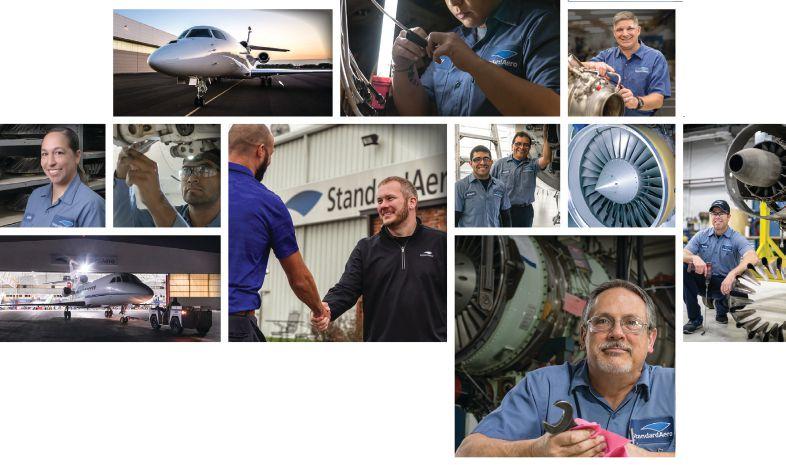
With over a century of proven excellence, StandardAero has built a reputation as the industry leader and best place to work. Serving the most discerning clients and maintaining premier aircraft, the global StandardAero family takes pride in offering extensive MRO services and customized solutions through trusted service partnerships with our customers.
Phil Dixon and Neena Gill embody the customer focus which is a hallmark of StandardAero’s 7,000 employees. We are proud to see them included in Wings’ Top 20 Under 40. Congratulations to Phil, Neena and all of this year’s winners!
SPENCER GOSSEN, IMP ELECTRONIC SYSTEMS
SPENCER GOSSEN
Vice President and General Manager, IMP Electronic Systems
Hammonds Plains, NS
Spencer Gossen, 33, is a senior executive at IMP Aerospace & Defence, which has long served as one of the Canada’s leading ISS providers and aircraft parts manufacturers. He originally started working at the company in high school as a labourer/sweeper before attending Dalhousie University to study Commerce. After graduation, Gossen joined KPMG as an auditor and attained his designation as a Certified Public Accountant. Following a three-year tenure at KPMG, he moved across the country to join IMP’s Cascade Aerospace business in Abbotsford, BC. He quickly became a manager at Cascade Aerospace, where he assumed a pivotal role in overseeing all aspects of the manufacturing and maintenance side shops.
Gossen saw an opportunity to return home to Nova Scotia when an opening as Director, Material Operations, became available at IMP Aerospace. In that position, Gossen was responsible for procurement, control and distribution of all inventory for internal programs, as well as the administration of facility services contracts. He managed a workforce of more than 100 employees and
had bottom line responsibility.
For the past three years, Gossen has been the Vice President and General Manager of IMP Electronic Systems, which is an operating unit of IMP Aerospace & Defence. Based in Hammonds Plains, NS, the facility services space, air, land and sea sectors with wire harness design and manufacture, electronics equipment repair and overhaul, and equipment calibration. The workforce behind IMP Electronic Systems grew 30 per cent in the last two years and now includes more than 120 people. He’s put the facility, which opened in 1977, through an extensive revitalization program, which included updating the IT systems, renovations to various aspects of the property, and enhancements to the management system.
“Locally, we provide essential support to DND’s Cormorant Search and Rescue fleet, recognized as a world leader in flying rates for AW101 helicopters,” explains Gossen. “Additionally, we played a significant role in the electrical manufacturing of De Havilland’s CL-215 aerial firefighting aircraft, an endeavour that holds even more significance with the recent wildfires in our home province of Nova Scotia. Globally, we have contributed to the manufacturing effort on the Armoured Combat Support Vehicles, of which 39 units were donated to Ukraine, which has been fighting for its sovereignty for the last 18 months.”
Why is your company unique for work? I consider myself fortunate to be part of such an exceptional team and to engage in projects for world-class customers, influential industry partners, and dedicated government officials. I look forward to many more years in this dynamic industry, embarking on new and exciting projects alongside a fantastic team at IMP and a remarkable group of industry stakeholders.
BECKY
GRIMSRUD Base Manager and Pilot, Delta Helicopters, Fort St. John, BC Becky Grimsrud, 39, grew up without direct exposure to aviation, which of course is the opposite of a common thread found among many leaders in the industry. The idea of becoming a helicopter pilot popped into Grimsrud’s head on the same day that she passed her motorcycle road test, at age 19. Two years later in the Spring of 2005, she started flight training and has been a fixture of the aviation industry ever since, with the exception of one year off after Highland Helicopters shut down. Grimsrud tried her hand at an office job, but very quickly realized aviation is where she belongs. Today, she manages the Fort St. John base for Delta Helicopters, founded in 1972.
Grimsrud has now accumulated more than 4,300 hours while starting a family and raising two daughters (now 10 and almost 12). In addition to flying, Grimsrud spent three years as a Quality Assurance Manager for Flight Operations (from 2012 to 2015), as well as two and a half years as a City Councillor (2008 to 2021). She volunteers with numerous local non-profits, including helping to host Elevate Aviation’s 2023 Cross Country Tour leg at North Peace Regional Airport, CYXJ, in Fort St. John. She also helped with the organization’s Cross Country Tour in 2019, before the pandemic. Grimsrud is also a member of the Whirly
Girls and the International Society of Air Safety Investigators. Grimsrud in 2016 was awarded a scholarship to take a five-day Crew Resource Management Instructor course, through Whirly Girls and Oregon Aero. She has since taught the course to a number of pilots and local parattack crews. Fort St. John is one of only two Parattack bases in Canada. Grimsrud remains heavily involved with her community, volunteering and engaging in politics.
Why is your company unique?
What I most appreciate about Delta is being given the opportunity to innovate at my base within the obvious company and regulatory parameters. It’s a fairly large company with significant resources, but it still feels like a family.
CASSANDRA HEPP
Lead Aircraft Maintenance Engineer, HeavyAero Maintenance Centre, Olds, AB Cassandra Hepp, 27, is among the relatively few women Aircraft Maintenance Engineers in Canada, a number estimated to be at around three per cent, which has propelled her to become one of the industry’s most ardent advocates to promote more female representation in the field. She has spoken to many students to describe the challenges and opportunities of being an AME. Hepp since 2019 has volunteered with Elevate Aviation, which provides a platform for women and underrepresented groups to succeed through careers in aviation. Hepp was one of eight recipients of the 2022 Elevate Aviation Inspire Award. As an AME with M1 and M2 licences, Hepp has worked for several major Canadian operations, including Flair Airlines, Canadian North and Summit Air,
in addition to her apprenticeship at WestJet Encore. Her career has taken her all over Northern Canada and she has gained an appreciation for the importance of aviation in remote regions. She spent more than two years as a base engineer in Resolute Bay with Canadian North and her apprenticeship took place in the Nunavut community of Fort Smith. She worked for a few years in Yellowknife, followed by rotational work in Iqaluit. In these challenging remote environments, Hepp excelled under the pressure of travelling as an AME with specific aircraft to ensure its safe operation. She has reached communities like Grise Fiord and Alert, which is the most northern inhabited place in the world at 83 degrees north. Hepp joined HeavyAero in January 2023.
Why is your company unique to work for?
Coming from a mostly line maintenance background into heavy maintenance this year has been a steep learning curve, but I am having so much fun. I have completed tasks at HeavyAero that I haven’t done during the past eight years in my career. I know my future is so bright with HeavyAero, and they value me as an employee. I have so much support from the leadership team and that is very important to me.
ASHWIN
Vice President, Business Development, e-Fuels, Twelve, Montréal, QC
Ashwin Jadhav, 38, in March 2023 joined Twelve, a chemical company headquartered in Berkeley, California, that makes everyday products from non-oil alternatives. He oversees sales and commercial strategy for Twelve’s sustainable aviation
JADHAV
fuel (SAF) products, a critical sector as the aviation industry, under ICAO’s guidance targets net-zero emissions by 2050. Jadhav explains, that with battery technology, hydrogen-propulsion and other enablers at low Technology Readiness Levels, SAF is an immediate and potentially widespread solution. His team focuses on the SAF powerto-liquids sub-segment, which Jadhav says shows tremendous potential due to higher carbon reduction, reliance on renewable sources, and abundant feedstock (carbon dioxide). Captured CO2 can be turned into carbon-neutral fuels
Twelve aims to play a key part in scaling this technology. Jadhav recently completed large-volume deals and added airlines like Etihad and Air Canada to the Twelve portfolio. He brings more than 15 years of aviation experience, including prior leadership in new engine sales for Pratt & Whitney Canada. He has also led commercial strategy and forecasting for the Q400, CRJ Series, and C Series (now Airbus A220) aircraft at Bombardier and held leadership roles at the International Air Transport Association in Montréal. Jadhav serves on the board of Muskoka Airport, CYQA, in Ontario.
What is your favourite aviation memory?
My years with Bombardier before its divestiture were my most memorable. With the launch of the C-Series, we had ventured into uncharted territory in the single-aisle aircraft market and were up against the world’s largest OEMs.
STEPHEN LEE Manager, Structures Engineering,
Voyageur Aviation, North Bay, ON Stephen Lee, 37, started his career in aviation in 2009 as a Structural Design Engineer and has since earned his Professional Engineering license in Ontario and is working toward becoming an authorized person
within Voyageur’s Design Approval Organization. He currently leads a team of several structural engineers, helping to initiate innovative modification projects for both civil and military aviation, focused on national security and defense, environment and natural resources, and air medical transport.
Lee’s first assignment after joining Voyageur was to help design elements of a missile defence system installation for a customer aircraft. He has since accomplished successful designs and gained Supplemental Type Certificates for a variety of aircraft modifications to serve the public’s interest, such as enabling scientific research and improving patient transport with The British Antarctic Survey and Ambulance New Brunswick, respectively. He led a project that converted a Dash 8 to a smokejumper configuration, which meant collaborating with a foreign air operator and various regulatory and airworthiness bodies to achieve a capacity not seen before on this Canadian aircraft type. Lee is co-chair of Voyageur’s Employee Resource Group with a mandate to foster a culture of diversity and inclusion.
Why is your company unique to work for? Voyageur Aviation delivers innovative solutions to customers with unique aviation requirements. In my position, this translates to supporting the development of modification STCs for aircraft in a variety of interesting special mission roles, for customers that span the globe – be it maritime surveillance in the east coast of Canada, environmental research in Antarctica, or smokejumper operations in Alaska – all from our facility in Northern Ontario.
MANDEEP MANGAT
GM, Aircraft Maintenance, Air Canada, Surrey, BC
Mandeep Mangat, 38, has helped lead the management of Air Canada’s airframe
maintenance in British Columbia since July 2022. Managing day-to-day activities including planning, scheduling and estimating of maintenance jobs, Mangat has developed new processes and also proactively started building relationships with MROs to diversify Air Canada’s landscape of aircraft maintenance facilities.
Mangat previously spent more than two years from 2018 to 2020 with the flag carrier out of Windsor, Ontario, at CYQG, as site manager for airframe maintenance. He began his aviation career with Cascade Aerospace as an Aircraft Maintenance Engineer, where he spent more than five years, before joining Aveos Fleet Performance and then venturing out on his own as a technical consultant, which brought him into contact with Air Canada from 2016 to 2018. In July 2020, Mangat joined Conair Aerial Firefighting for two years as an Enterprise Resources Planning Specialist.
What drew you into the world of aviation?
Growing up in Richmond, BC, near YVR airport, I was constantly exposed to the sights and sounds of airplanes taking off, landing, and flying overhead. The regular exposure gave me both a sense of familiarity and curiosity about airplanes. The technology advancements, complexity, and sophistication of aircraft has always been fascinating to me. I find the ability to travel long distances quickly and efficiently to be both exhilarating and liberating.
JADE MARSHALL Quality Manager, PAL Technical Services, Winnipeg, MB
Jade Marshall, 30, cultivated an interest in aviation in her early teens, earning her Glider and Private Pilot licenses through the Air Cadets program. While she loved flying, Marshall decided to attend the College of the North Atlantic’s Aircraft Maintenance
Engineering Technician program. She joined PAL Technical Services shortly after graduation as an Avionics Apprentice.
Marshall earned her AME E license and started to take on crew leadership at her home base in St. John’s, NL, and later Winnipeg, MB. Her roles at PAL pivoted many times, demonstrating her ability to adapt to the circumstances and challenges around her. Marshall has played key roles in PAL’s maintenance departments, including heavy maintenance, modifications, fixed wing search and rescue, including modification of Dash 8s for The Department of Fisheries and Oceans, and inaugural type training for Canada’s C-295.
Marshall in 2021 took on the role of Heavy Maintenance Manager for PAL’s new MRO location in Winnipeg. She has since built a permanent production and support staff for that base, which includes a team that is comprised of 40 per cent women. Marshall, with the growth of the Winnipeg base, recently accepted the position of Quality Manager for the YWG Heavy program.
Why is your company unique to work for? Building and maintaining fully equipped aircraft for Intelligence, Surveillance and Reconnaissance, air ambulance services and special mission capacity offers a unique and exciting look into aerospace that I didn’t know existed before working at PAL.
JOE PERSICONE
Boeing 757/767 Line Check Pilot, Cargojet, Hamilton, ON Joe Persicone, 39, is the youngest Boeing 757/767 Line Check Pilot, Line Training Captain and Type Rating Instructor at Cargojet, a scheduled cargo airline with its main operational base at Hamilton International Airport and more than 1,650 total employees. Persicone has more than 10,000 flight hours with the majority on Boeing airplanes. Previous to Cargojet, he worked for Air Canada, as a First Officer on the 767 and as a 737 MAX Sim instructor, and Sunwing Airlines, as a Line Training Captain on the Boeing 737 NG/MAX.
Prior to his 705 airline experience, Persicone worked for Kenn Borek Air flying Twin Otters around the world. He was involved in unique private and public sector science programs across the Arctic, including some in support of the Polar Continental Shelf program, NASA, and world record attempts. He also flew floats in the Maldives. Persicone holds a diploma in Aircraft Mechanics and is working toward his Bachelors in Management. He also volunteers his time as a warbird pilot with the Edenvale Classic Aircraft Foundation. He
has served on the board of directors for the Borden Flying Club and is actively involved with various non-profit organizations such as the EAA, COPA, IAC and the College of Professional Pilot’s of Canada. Persicone in his spare time is restoring a Pitts Special S1D in his garage.
What drew you into aviation?
We fly all around the world to places like Japan, England, Brazil and many others in between. I could be flying a domestic flight to Vancouver one day and then doing a new Captain’s line check or ETOPS training the next. Flying for Cargojet has given me a tremendous amount of opportunity to grow as a person and a pilot.
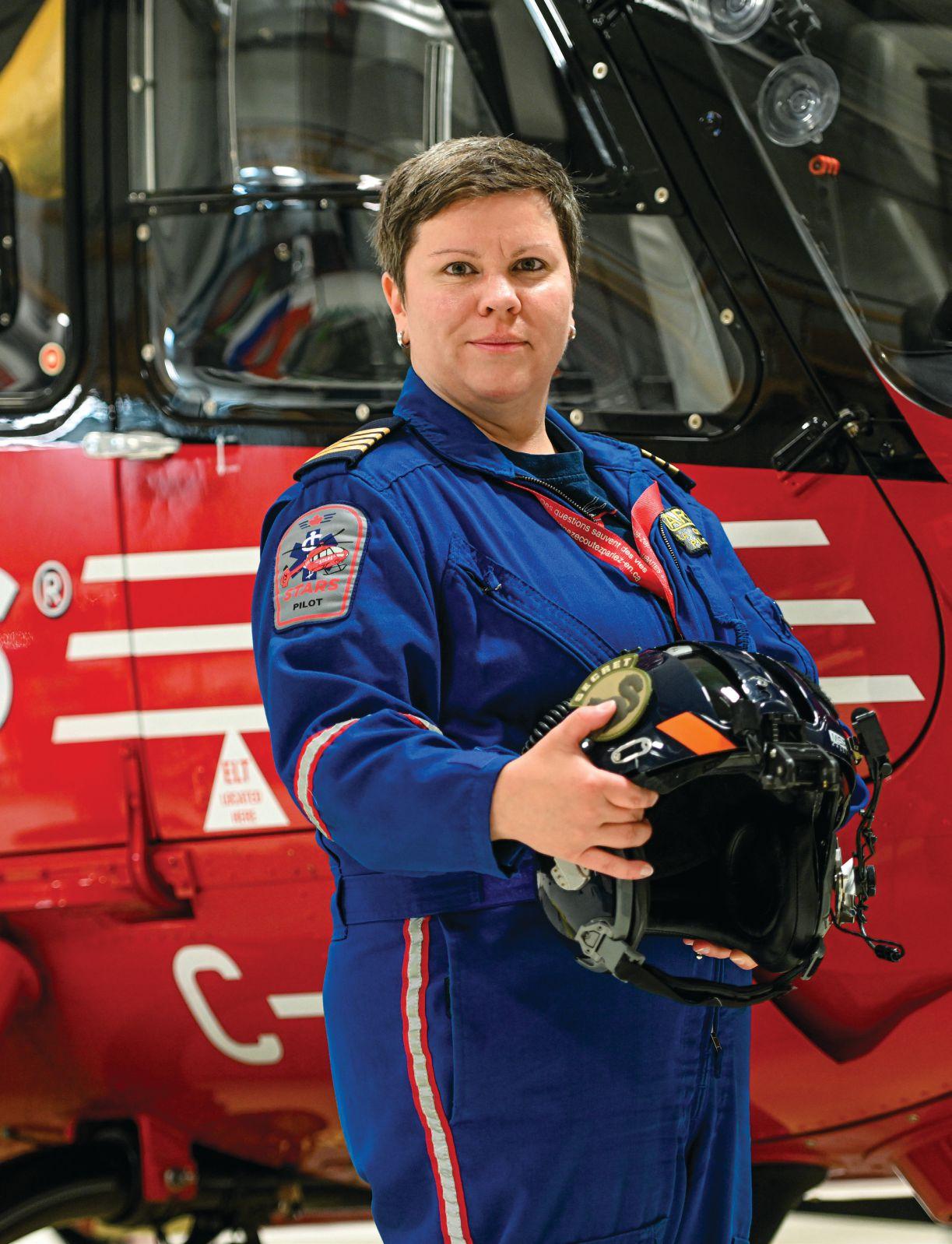
PAULA QUIROGA
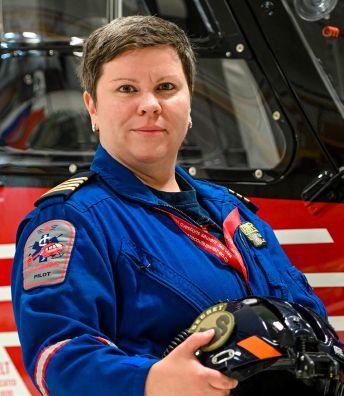
Captain, STARS, Grande Prairie, AB
Paula Quiroga, 38, is a dedicated and highly skilled pilot who has made significant contributions to the field of air ambulance
services. As an aircraft Captain, she has flown numerous critical missions, often in challenging weather conditions and in remote areas. Her expertise has helped to save countless lives. In addition to her work as a pilot, Quiroga routinely fills in as manager at the STARS Grande Prairie base. In this role, she has been responsible for overseeing the day-to-day operations of the base and ensuring that the team is effectively working together to provide the highest level of care to patients.
No one in Quiroga’s family was involved in aviation, so she did not have any direct exposure to it as a child, but she remembers catching the passion for aviation at age 16 during a canoe trip when a float plane flew overhead and landed on the same lake. Quiroga would go on to earn her helicopter pilot’s licence at age 18.
At STARS for more than seven years now, Quiroga began flying for the organization on aircraft that were manufactured in the 1980s. In March 2023, STARS took delivery of its tenth Airbus H145 helicopter, marking the completion of its initial fleet renewal that began in 2019. Powered by two Safran Arriel 2E engines, the H145 is equipped with full authority digital engine control and Airbus’ Helionix digital avionics suite. These customized aircraft for STARS are now among the most advanced emergency medical service helicopters in the world.
Why is your company unique?
Working for STARS has been an amazing opportunity for me and the most meaningful flying that I have done. What I love most is the team aspect of it. Every time that we launch for a mission, we go together as a team – Two pilots, a nurse and a paramedic. We are there to help people on their worst
JOE PERSICONE, CARGOJET PHOTOS:
day, by safely transporting them to the appropriate hospital while the medical crew provides critical care.
Civil Aviation Safety Inspector, Airworthiness, Transport Canada, Surrey, BC
Alisha Sohpaul, 28, has held multiple management roles in her relatively short 10-year aviation career. A licensed M1 and M2 Aircraft Maintenance Engineer, she is dedicated to helping to pave a path for other women to realize their full potential. At age 22, Sohpaul became the Person Responsible for Maintenance (PRM) of the AOC at Kisik Aerial Survey.
She was the youngest and the first female at Jazz Aviation to step into the Line Maintenance Supervisor and Maintenance Controller positions. In 2021, at age 26, Sohpaul became the PRM of Iskwew Air's Aircraft Maintenance Organization (AMO). Sohpaul also co-founded the non-profit Hangar Queens as the first female AME network in Canada.
Earlier this year, Sohpaul started a new role at Transport Canada and is now completely off the tools and overseeing a variety of AMOs from the regulator’s perspective. In June 2023, Sohpaul was named as a recipient of the 2023 Northern Lights Aero Foundation’s Elsie Awards program, in the Rising Star category, which is designed to recognize Canadian women who have made significant contributions to aviation and aerospace.
Sohpaul volunteers with Canadian Women in Aviation and Elevate Aviation and has been VP of the Pacific Aircraft Maintenance Engineering Association. She also serves on the BC
ALISHA SOHPAUL
Aviation Council’s Youth Engagement committee.
Favourite aviation memory?
Becoming the Person Responsible for Maintenance at Iskwew Air was a big career highlight for me. Not only was I running a female-led maintenance department but I also built the Aircraft Maintenance Organization from the ground up.
ZOEY WILLIAMS
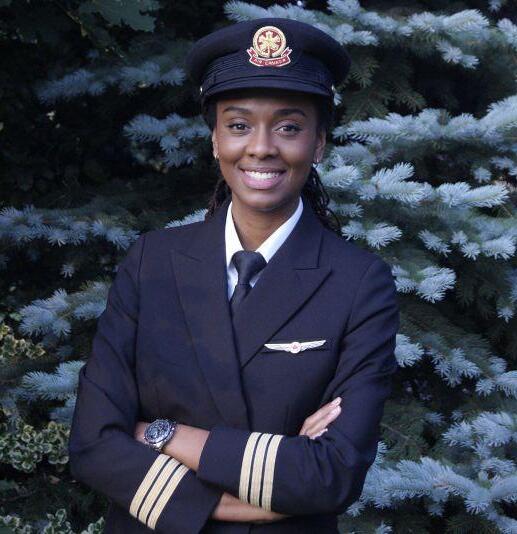
First Officer, Air Canada, Mississauga, ON
Zoey Williams, age 26, began flying at age 15 and spent her early years in aviation in a range of roles from fueling aircraft to flight dispatch and flight instruction. Inspired by her father, a pilot for Air Canada, to grow as a role model for other young women of colour, Williams attained an Advanced Diploma in Aviation Flight Management, a Bachelors in Aeronautics and
Aviation Management, and a Masters in Business Administration specializing in Aviation and International Business. Williams, who earned her
at age 21, gained commercial experience in the north flying with Wasaya Airways on the Beechcraft 1900D before joining Sky Regional out of
Mississauga as a First Officer on the Embraer 175. In 2020, Williams reached the majors after being hired at Air Transat to earn her type rating on the A321. After the pandemic, Williams returned to the skies as a First Officer with Flair Airlines on the 737 before returning to Air Transat on the A321.
In 2022, Williams was hired as the first black female pilot at Air Canada and in early 2023 became a First Officer on the Boeing 777. She continues to build her role as an advocate for diversity and inclusion as a board member of the Urban Pilots Network, where she is Scholarship Director. Williams was also awarded Jazz Aviation’s Pathway Award for Professionalism and Diversity.
Why is your company unique? The 777 is wonderful to fly and being at the controls of an aircraft over 300,000 kilograms that flies around the globe is nothing short of amazing. | W
ATAC’s Canadian Aviation Conference and Tradeshow is the premier national gathering offering Canada’s best networking, learning, and sales opportunity for operators, suppliers, and government stakeholders involved in commercial aviation and flight training in Canada.
TUESDAY, NOVEMBER 14 TO THURSDAY, NOVEMBER 16 FAIRMONT QUEEN ELIZABETH HOTEL MONTREAL, QC
For more information contact: Debbie Simpson, Tradeshow Manager 613-884-7728 tradeshow@atac.ca www.atac.ca
ATPL
PHOTO: ISEL WILLIAMS
ATAC LOBBYING PARLIAMENT HILL
ATAC has been actively lobbying Parliament Hill over the past two months. In addition to its annual Aviation Day-on-the Hill Networking Reception with some 40 Members of Parliament (MP) and Senators attending, private meetings were held with members of the House Standing Committee on Transport, Infrastructure, and Communities and members of the Senate Standing Committee on Transport and Communications.
Key aviation issues that were discussed with MPs and with Senators include the following:
AIR PASSENGER PROTECTION REGULATIONS (APPR)
APPR amendments are needed to enhance accountability to ensure all stakeholders share in the responsibility, not simply the carriers. Airports, CATSA, CBSA, US CBP, NAV CANADA, ground service providers, in addition to airlines are all involved in the travel continuum, and all impact the travel experience. The concept of shared responsibility needs to be a key element of air passenger service protection. All should share in the responsibility when passengers are aggrieved.
FATIGUE MANAGEMENT REGULATIONS
Fatigue Management is a key element of an airline’s responsibilities towards its personnel and passengers. However, the more stringent regulations implemented last December for the smaller air operators are significantly impacting all segments of the industry, especially those serving remote and northern communities in Canada.
Introducing a new regulation at this juncture, which mandates an immediate 30% increase in the number of pilots required to maintain the same level of service, indicates a disconnect with reality or a total disregard for sustaining air services to Canada’s remote regions. There could not be any worse timing for imposing regulations that exacerbate the biggest threat that our industry has faced outside the pandemic.
ATAC is asking the government to immediately suspend all Flight Crew Fatigue Management Regulations for a period of no less than 18 months. This would allow industry and the department the time required to develop a useful FRMS and to increase pilot staffing to levels needed to continue to offer Canadians the high quality of service they have grown accustomed to.
SUSTAINABLE AVIATION FUEL
The government has determined that Sustainable Aviation Fuel (SAF) should account for 10% of fuel usage by 2030. ATAC has raised concerns with the lack of commitment by the government regarding the required infrastructure and financial support for an adequate SAF supply throughout Canada. In addition, there seems to be little concern on behalf of the government that the use of SAF could increase fuel costs for carriers by 600%. This can only trickle down to the customer and increase the cost of flying significantly in this country. Environmental policies must be supported financially by their promoters, something that the Canadian Government hasn’t done in decades insofar as aviation goes in this country.
AERONAUTICS ACT AMENDMENT
For the past twenty years, ATAC has been advocating for the necessary and long overdue amendments to the Aeronautics Act in order to catch up with the safety data put in place by the US FAA in the late 1990s. Amendments providing adequate levels of data protection are required in order to improve commercial aviation safety through a protected regime of data analysis and sharing. An amendment to the Aeronautics Act that enshrines safety data protection must absolutely be implemented as soon as possible.
TRANSPORT CANADA LEVEL OF SERVICE
Transport Canada Level of Service is another major concern of the aviation industry that was discussed with MPs and Senators. The drastic drop in Transport Canada’s level of service is resulting in significantly increased service delays. Responses to service requests have slowed to a crawl, taking much longer than aviation service standards set by the department itself.
The government must own up and improve this crippling level of service by providing more resources to the sector, instead of consistently cutting Transport Canada’s budget.
The MPs and Senators who participated in this networking campaign displayed a deep understanding of aviation matters and were keenly interested in hearing industry’s proposed solutions to the many issues raised. ATAC looks forward to a continued mutual commitment with the legislators to ensure a safe, world-leading and sustainable Canadian air transport industry.
McKenna President and CEO
John
Air Transport Association of Canada
THE AVIATION CYBER THREAT
PREPARING FOR AN ATTACK ON SENSATIVE DATA
BY PHIL LIGHTSTONE
The impact of September 11th illustrated how vulnerable airline cockpits were to armed intruders executing a simultaneous coordinated attack against multiple aircraft. But the 911 threat was not new. During the 1970s and 1980s there were a rash of aircraft hijackings, which brought about the implementation of armed sky marshals riding with the passengers. The latter half of the last century saw attacks against the aviation sector focusing on the physical side of the aviation ecosystem. The advent of the Internet, however, with ubiquitous connectivity to business and most people, has allowed cyber criminals (also known as Blackhatters) to be able to create chaos without leaving the comfort of their home or office. I say that with all seriousness, in that cyber crime is not only organized but institutionalized. Cyber criminals can begin their career through acquiring commercially available cyber tools on the dark web. No longer is there a requirement for a blackhatter to be a technically competent and sophisticated individual with deep IT/ IS (information technology and information systems) skills.
Looking at the end-to-end aviation ecosystem, we should consider the cyber security challenge from passenger to cockpit, understanding the security lifecycle posture securing all elements of infrastructure, data and applications. Many of these systems can be compartmentalized, but the aviation industry is seeing more data integration points passing information between diverse systems (global distribution systems). An example would be the integration between the ticketing and reservation systems to passenger manifest and flight management systems. From a cyber security perspective, we should consider and understand the weakest link in that connected ecosystem. Cyber attackers may not necessarily target your company’s cyber front door but may be able to jump onto your protected networks (backbones) and servers through vulnerabilities in third-party systems that have integration points onto your network. An example might be a HVAC company’s connection point to a Building Management System (BMS). That HVAC’s corporate infrastructure could be the weakest link which is exploited to obtain access to your aviation systems. Not far from the truth. In 2013,
Target fell victim to a cyber attack using the same methodology and vulnerabilities.
USA Today reported “Retail giant Target will pay an $18.5 million multi-state settlement, the largest ever for a data breach, to resolve state investigations of the 2013 cyber attack that affected more than 41 million of the company’s customer payment card accounts. The states’ investigation of the breach determined that cyber attackers gained access to Target’s computer gateway served through credentials stolen from a third-party vendor in November 2013. Using the credentials to exploit weaknesses in Target’s system, the attackers gained access to a customer service database, installed malware on the system and captured full names, phone numbers, email addresses, payment card numbers, credit card verification codes, and other sensitive data.”
Large corporations, such as the airlines, have the revenue streams to support the investment into cyber-security ecosystems (process, people and technologies). Typically employing a Chief Security Officer (CSO), larger corporations understand the threat and deliver resources to attempt to mitigate the threat (not an if, but a when). Smaller organizations within the aviation industry may be hard pressed to align cost budgets to deliver an edge-to-edge cyber security solution, inclusive of real-time threat detection and remediation. Fortunately, there are many cyber security consultants who act as outsourced CSOs. However, management must understand the threats, probability and their infrastructure weaknesses (and potential remediation costs) balanced against the capital and operating expenditures to ensure that the threat is not realized. Could you imagine if a major airline’s reservation system was compromised through a ransomware attack.
From an aircraft system’s perspective, data is transmitted across a local area network using data transfer protocols such as ARINC 429 (which was first published in 1977). During a time when cyber security was something discussed on StarTrek, not much thought was given to securing the traffic transferred by the Mark 33 Digital Information Transfer System (AIRINC 429) as it traverses between aircraft and avionics systems. In the 1990s, few criminals were thinking about over the air capture of aircraft data. Fast forward to the 2020s, aircraft are becoming more and more connected through satellite, cellular and WI-FI networks.
David Senf, National Cyber Security Strategist, Bell Canada, reports that the cyber security threat model needs to incorporate all aspects of the ecosystem with connection points which laterally move across connected ecosystems. End-point
CCX Technologies of Kanata, Ontario, launched SystemX Aviation focusing on protecting critical data, systems and networks onboard aircraft while improving an aircraft’s cyber security posture.
attacks such as email links (bad links), bad attachments, embedded malware and others, provide an opportunity for end user credentials to be compromised. As a result, all end points should be monitored (a must). Understanding points of weakness and interconnected data flows must include cloud-based environments and the security architectures delivered by cloud outsourcers such as Amazon (AWS) and Microsoft (Azure). You should confirm that the cloud servers and applications are properly configured, operating systems patched and administrator passwords routinely changed (avoiding vector compromise). Bell Canada like all big telecommunication providers have national security practices and Security Operations Centres (SOC) to monitor impending cyber attacks and filter out false positives.
Chris Bartlett, President of CCX Technologies of Kanata Ontario, saw the emerging aviation cyber security risk,
developing a hardware and software platform focusing on securing the ecosystem, starting from within the aircraft. In 2017, Bartlett formed CCX with the mission to secure ARINC 429 communications (and others). This led to the development of the SystemX aviation security platform. CCX focuses on three areas: Cyber security focused hardware and software for for OEM and Defence platforms; Engineering Development kit comprised of hardware, software and a lab environment; and ongoing security maintenance. CCX launched SystemX Aviation focusing on protecting critical data, systems and networks onboard aircraft while improving an aircraft’s cyber security posture. Their cyber security solution can be integrated directly on CCX Technologies hardware, in the cloud, or on dedicated third-party servers. Typically, the system includes its AP-250 Cyber Security Appliance, SystemX Secure Server, and a set of DataPHYs to collect
data from the network. The system is designed to operate over low bandwidth satellite and terrestrial communication links while airborne. In addition, SystemX Aviation provides data monitoring and collection, configuration via remote access, and advanced firewall capabilities. CCX’s software is available for licensing, along with a development system so that third parties can add their own custom applications on top of the existing platform. Essentially, CCX has developed proprietary hardware (the AP-250) which provides connectivity to both IP (think Wi-Fi) and ARINC technologies. The system provides a complete Intrusion Detection System for Avionics Data, including ARINC 429/717, CAN bus, MIL-STD-1553 and ARINC 664 AFDX (requires additional DataPHY hardware).
The SystemX Avionics Intrusion Detection System can monitor avionics data bus traffic for unexpected anomalies, either due to adversarial cyber activity or
operational issues. When discovered, these anomalies are logged in a secure database and can be presented to the aircrew and/or operators on the ground, who can initiate a response to the potential cyber security treat. Essentially the CCX technology creates data samples which are forwarded to algorithms that are configured as rule sets. While a set of security algorithms is supplied by CCX, the system allows for OEMs to create their own rule sets and algorithms for specific aircraft configurations. The algorithms can generate alerts based on current and historical data. The system provides a real-time view into avionics activity which can be used to better control air operations, reduce the likelihood of rerouting, groundings, and delays, increase operational oversight, and increase overall fleet safety.
The question you should be asking yourself, both personally and professionally, is not have I been the victim of a cyber security attack, but when will I
Reach your Aviation Goals
Learn from the Experts
For over 30 years, AeroCourse has been a leader in advanced aviation training in Canada. We provide advanced aviation training and develop and publish manuals and workbooks both hard copy and digital to assist pilots gain the knowledge they require for their IFR and ATPL. We offer IFR and ATPL seminars, IFR online courses, and hold specific advanced aviation courses inconjunction with airlines, colleges and flight schools. Our instructors are professional pilots and flight examiners with thousands of hours experience. We pride ourselves on high quality materials and training.
become a victim. Cyber security crime has been on the increase over the past 50 years, but recently has become both more organized and commercialized. In the latter half of the past century, IT/IS crimes were focused on data theft leading to credit-card fraud and the sale of confidential data to bad actors. Fast forward to the first half of this century, the result of becoming a victim has dire consequences (both financially and reputationally). As with MROs, AMPs and licensed avionics technicians, cyber security professionals are in high demand and short supply.
Typical cyber security threats that can be mitigated include: RF Spoofing (GPS, ADS-B, etc); hardware tampering; Malware; Supply-chain attacks; remote zero days; and social engineering. If you’re wondering about all the lingo, you should chat with your Chief Security Officer (CSO). If you don’t have a CSO, there are several third-party consulting companies which offer outsourcing services.
Some generic cyber security tips include: Create and update a cyber security plan; use strong passwords; secure your computers and servers; set social networking profiles to private; secure
The skills, dedication and expertice of our instructors set them apart. They have an incredible knowledge base and have broad expeience,
A LOOK INSIDE THE CLOSURE OF BUTTONVILLE
UNDERSTANDING THE IMPACT ON AVIATION IN GREATER TORONTO AND BEYOND
BY PHIL LIGHTSTONE
The Toronto Buttonville Municipal Airport, CYKZ, announced on May 31, 2023, that it would be closing on November 30, 2023. A month following the announcement, nothing has changed. The airport is still on target to tender its operating certificate to Transport Canada. At that time, the runways will be closed and marked with XXXs.
With the announcement in 2009 that the airport was for sale, Buttonville saw a roller coaster ride as tenants like Air Partners Inc. (a maintenance shop) and aircraft owners terminated their tenancy agreements and moved to other airports, notably Oshawa Executive Airport (CYOO). Interestingly, Air Partners and many aircraft moved back to Buttonville opting for location (and the convenience of their personal commutes) over certainty.
This time around, Buttonville’s management not only provided the communication in writing but also indicated a date. While
there are many rumors floating around as to what caused Cadillac Fairview not to renew the operating lease with TorontAir, but without interviewing the Cadillac Fairview folks directly, it’s difficult to narrow the gap between fact and fiction.
It is true that the airport was under media scrutiny with several accidents which not only made the television newscasts, but also some notable YouTube videos of aircraft flying through the fence at the end of runway 33 and ending up on 16th Avenue, narrowly missing traffic. There is the video of a student pilot landing on runway 33, only to go off the runway, drive across the taxiway, ramp and hit a hanger.
These high-profile events, while seldom in nature, created unneeded and unwanted attention to the airport. They fed the flames of residents who would prefer the airport to close. Sadly, some local politicians fell in line with their constituents rather than aligning
Adam Strombergsson-Denora of Ottawa standing in front of his 1946 Piper Ercoupe at Buttonville Airport.
to the view of airports being mission critical infrastructure (not unlike fire, ambulance, police stations and hospitals).
Some Buttonville aircraft owners took a view of “hope for the best but plan for the worst” and began their due diligence to find a new home for their aircraft or place of business. Air Partners was able to rent the hangar at Oshawa that they had before its move back to Buttonville. Aviation Unlimited will move its maintenance operation to the hangar it built in Oshawa. Leggat Aviation will be moving to Oshawa as well. Canadian Flyers International College (a flight school) will be moving its operations to Lake Simcoe Regional Airport (CYLS).
Hangars which were listed for sale at Oshawa, Brampton and Burlington were sold within three weeks of the announcement.
With roughly 200 aircraft seeking a new home, hangar space at the seven airports within a one hour drive of Buttonville
have been completely rented. With supply and demand out of equilibrium, a re-adjustment of hangar rent occurred in June 2023. A ripple effect of this readjustment has impacted existing tenants at Oshawa.
One Canadian Owners and Pilots Association eFlight readers (let’s call him Joe) reported that his month-to-month hangar lease had been terminated by the owner, advising that he required the space to store business related items. Joe moved his aircraft to a tie-down, while he searched for another hangar.
Markham Airport (CNU8), the closest to Buttonville was slated to close in 2020, with the then current tenant’s leases terminated and the small number of aircraft moving to other regional airports. During Q2 of 2023, the Royal Canadian Air Cadets returned to Markham to resume their glider training.
There are currently no publicized plans to re-open the Markham airport to other aircraft. The Oshawa Executive
Airport (CYOO) reports in an email to the aircraft owners on the wait list, “At a minimum, we will be able to accommodate all requests with a paved tie-down spot and this will include the addition of new tie-down locations being installed on the airport’s main apron located immediately in front of the airport terminal building.”
Brampton Airport (CNC3) is building 10 new hangers which were offered for sale at $225,000 using a lottery system to pick the new owners (they had 20 people on the list). They have 15 to 20 tie-downs available for monthly or annual rent. The Toronto Island Airport (CYTZ) StolPort FBO has a new heated hangar opening in October 2023, with plans to create new tie downs.
StolPort’s letter of offer to a few Piper Cherokee owners sees the monthly heated hangar rate at $1,750, plus automotive parking of $250 (plus HST). Burlington Executive Airport (CZBA) is building 10 free standing 44 x 40-foot hangars (unheated, uninsulated, serviced with hydro only) at a price of $190,000 (plus HST) and an annual land lease cost of $6,160. Burlington’s hangars should be available by the end of 2023.
Holland Landing (CLA4) is a small airport, with a 1,980-foot runway and limited parking.
Lake Simcoe Regional Airport (CYLS) located about a one hour drive north of the Greater Toronto Area is also at capacity. They have 40 aircraft with apron tie-downs with no plans to build more ramp space. The region has been seeing more requests from commercial operators to build large hangars at the airport with the management team evaluating a few proposals.
Peterborough (CYPQ) Airport is the home base for Seneca College’s flight school, a 7,005foot runway with all the usual services with the exception of an on-site restaurant. The Lindsay/Kawartha Lakes Municipal Airport (CNF4) has three new private hangars being built, with two expected to be completed by the end of July 2023. Craig Logan, Airport Manager
of CNF4, reports that the airport has room for 15 more aircraft tied down on the apron (at $65 per month plus HST) with currently 50 to 60 aircraft operating out of Lindsay Airport. To date, Lindsay has 10 aircraft coming from Buttonville. It has been reported that a few FBOs located at Pearson (YYZ) have increased their hangarage rates by 67 per cent. An unused airport, Downsview (CYDZ) is closed to both General and Business Aviation.
Th impact of the airport closure extends to the Buttonville Flying Club (COPA Flight 44, buttonvilleflyingclub.com). The Buttonville Flying Club (BFC) was founded in 1959 and has over 225 members, monthly meetings, annual golf tournament, awards banquet, summer barbecues and fly outs.
Members of the BFC routinely meet on Saturday and Sunday mornings, over coffee and muffins promoting, comradery, safety discussions and have a seat need a seat protocol for aviators and enthusiasts looking for an aircraft ride. With the closure of the airport, the Buttonville Flying Club’s executive are discussing the future of the flying club and mechanisms to maintain the aviation comradery, education, safety practices and social aspects of the flying club.
As of July 2023, less than 20 per cent of Buttonville aircraft tenants have found new accommodations for the aircraft. With limited parking at the seven airports close to Buttonville, the approach of “hope for the best, but plan for the worst” will help minimize risk, but like musical chairs, you do not want to be without a chair when the music stops.
Transitioning to a new chapter in one’s aviation career based upon an airport closure is always fraught with speed bumps. Maintaining a positive mental outlook will help Buttonville tenants transition to a new paradigm and surroundings. On the positive side, the transition will provide an opportunity to meet new people, make new friends and expand your aviation experiences. | W
Stephen Lee Manager, Structures Engineering
OUR MISSION IS TO BE THE BEST TO WORK FOR
The world’s largest independent MRO provider
With over a century of proven excellence, StandardAero has built a reputation as the industry leader and best place to work. Serving the most discerning clients and maintaining premier aircraft, the global StandardAero family takes pride in offering extensive MRO services and customized solutions through trusted service partnerships with our customers.
Phil Dixon and Neena Gill embody the customer focus which is a hallmark of StandardAero’s 7,000 employees. We are proud to see them included in Wings’ Top 20 Under 40. Congratulations to Phil, Neena and all of this year’s winners!
www.standardaero.com
Summer of scheduling changes
Canadian airlines brace for a new enviornment as U.S. considers reform
The U.S. Government Accountability Office recently issued a report on the causes of flight disruptions before and after the pandemic. The report also outlined the challenges airlines faced responding to these flight disruptions. The report was the result of requests made by the U.S. Congress to examine key changes in the passenger airline industry resulting from the pandemic.
For those of us who experienced the chaotic Canadian aviation environment last summer – especially those who used Toronto Pearson and Montréal Trudeau – it is difficult to forget passengers waiting in queues for hours, mishandled baggage and unprecedented flight delays. For an industry with extensive regulatory oversight provided by the federal government, it has been interesting to contrast Canada’s parliamentary efforts to address flight disruptions with the those made by U.S. Congress.
Canada’s Standing Committee on Transport, Infrastructure and Communities held a meeting on August 19, 2022, to hear Omar Alghabra, Minister of Transport, voice his concerns about flight delays and cancellations. The meeting focused on the need to better protect air travellers’ rights.
This focus on passenger rights continues to this day. At the end of April, Alghabra announced reforms for the Canadian Transportation Agency’s appeal-handling process and the Canadian Transportation Act. Airlines will be required to handle claims and provide a response to complaints within 30 days. The amendments, which are currently tabled in the House of Commons as part of a budget implementation bill, will affect the penalties air carriers face for violating air passenger protection rights. In particular, the amendments will increase the maximum fine for violations to $250,000 and charge carriers with the regulatory cost of complaints. The GAO’s analysis and recommendations are much more detailed.
The U.S. Department of Transportation recently initiated passenger protection regulation development similar to the ones Canada has had in place since 2019. However, the Department of Transportation has yet to address specific compensation levels
It might be time to seriously consider establishing a distinct civil aviation authority.
for passengers who experience flight delays – provisions that have already been adopted by Canada and are similar to those in effect in the European Union.
An intriguing element of the GAO report is its review of the U.S. Department of Transportation’s awareness of airline scheduling practices and how such practices have impacted flight delays and cancellations. The report states the Department of Transportation has authority to “regulate unfair and deceptive practices of airlines, which includes unrealistic scheduling practices.”
The Department of Transportation defines unrealistic scheduling as “the scheduling of flights that airlines cannot generally and reasonably be expected to fulfill.” The report concludes how various stakeholders, including several airlines and worker unions, published unrealistic flight schedules.
The Department of Transportation indicated it will make an effort next year to build and sustain its oversight and analysis of airline scheduling practices. This will ensure airlines maintain realistic schedules and minimize the impact of flight disruptions on passengers. It is critical that effort
be made to provide fair and meaningful compensation in a timely manner to air passengers that have been subjected to airline delays and cancellations. But it is equally – if not more – important to address the underlying causes of such disruptions.
Effective oversight of published airline schedules must be provided. Canadian air travellers should be able to trust an airline’s published schedule – especially as air travellers often purchase tickets long before their flight. Should Transport Canada step into this oversight role? It might be time to seriously consider establishing a distinct civil aviation authority, separate from Transport Canada.
Canadians’ patience with the actions of various organizations in Canada’s aviation sector has been wearing thin. At the same time, rumblings of a return to regulation is starting up in the U.S. airline industry. Canada’s experiment with deregulation occurred close to 40 years ago, but airline scheduling oversight might be one of several areas ripe for similar scheduling reforms in the face of airline disruptions. | W
John Gradek is a Faculty Lecturer and the Program Co-ordinator, Global Aviation Leadership Program, McGill University. This article was originally published by The Conversation.