PHOTO:
COMING THIS SPRING
COMING THIS SPRING
Greater Vancouver
Presented by
Conference topics will include, but are not limited to:
• New products impacting the aerial fire-fighting sector
• Available support services
• Aircraft innovations
• Crew Resource Management
• Governmental regulations and procedures
• Opportunities and challenges, domestic and international
Showcase how your company is leading aerial fire fighting in Canada through our printed program:
• A commissioned article written by a WINGS or HELICOPTERS freelancer on a chosen topic
• Provide your own Sponsored Content at a lessor advertising rate
• Sponsored Content packages include a 4-week presence on the homepage of Wingsmagazine.com or Helicoptersmagazine.com, as well as social media, eblast and enewsletter distribution (with full CASL compliance) A one-day conference designed to provide rotary-wing and fixed-wing operators with critical business information on aerial fire fighting
BY KRISTIN KOZUBACK
Seven words perfectly describe the theme for this year’s 17th Annual Unmanned Canada Conference and Trade Show in Ottawa: Innovating Canada by Air, Land and Sea. The directors at Unmanned Systems Canada / Systèmes Télécommandés Canada (USC-STC) chose these seven words because they encompass the spirit of potential and opportunities to innovate every sector of our economy.
USC-STC is referred to as Canada’s national drone industry association, yet we strive to be a reliable source of information and inspiration for everyone working in the rapidly evolving industries of aerial, ground and marine unmanned, remotely piloted and autonomous vehicle systems.
Since people enter the drone world from various paths – some are pilots or aviation enthusiasts, while others are business owners, policy experts, STEM teachers or students – a main goal of USC-STC is to facilitate connections that help people succeed.
This mandate will be at the forefront of UC19Ottawa and Beyond, which is working title of this year’s USC-STC Annual General Meeting on October 29, when will will set the stage for our largest annual event to connect people with the experts and information they need at
UC19Ottawa, running from October 30 to November 1. We will share USC-STC’s new strategic plan for 2020-2025 and updates from various committees.
USC-STC Board Chair Mark Aruja and our Policy Committee will discuss new RPAS regulations providing clarity, stability and capacity to focus next on building frameworks for Beyond Visual Line of Sight (BVLOS) operations and RPAS Traffic Management (RTM).
The new Women in Drones and STEM Committee will share plans to gather and celebrate 120 Canadian women profiles of success, starting with a UC19Ottawa networking breakfast and followed by an inspiring conference panel of female trailblazers from the training, business, aviation and education sectors.
The Awards and Student Competition Committees will share results of the first ever National Unmanned Ground Vehicle (UGV) Student Competition autonomous snowplow challenge and the 11th Annual UAV Competition’s solar panel challenge, plus winners of the Student Technical Papers and various USC-STC awards.
Our Membership and Marketing Committees are focused on revamping the organization’s website, industry directory, and Member benefit plan.
The RPAS Safety Standards
Committee will talk about the national Flight Safety Events Management Platform and outreach activities to infuse ‘the flight safety culture’ in all operators and organizations.
Plus, the Training and Accreditation Committee will share past work and future plans to co-host webinars with Transport Canada and industry groups regarding regulatory changes, safety education, best practices and quality assurance standards for training organizations and flight reviewers.
Each day of the UC19Ottawa conference focuses on a unique theme critical to innovating Canadian businesses, industry, and the public sector. Day 1 conference content centres around the theme of industry growth and economic opportunity; Day 2 highlights the many, varied
paths forward; and Day 3 is filled with inspiring innovators and future opportunities.
This year’s conference also includes three high-level panel topics to introduce the challenges, opportunities and new technologies associated with this year’s overall conference theme of Innovating by Air, Land and Sea. The New Mobility Panel will discuss dramatic changes coming to the mobility and logistics sector through innovations in passenger-carrying and non-passenger Connected and Automated Vehicles. The group will focus on the changing landscape of mobility, transportation and logistics today.
Our Drone Countermeasures Stream includes two panel sessions exploring the technological aspects and commercially availability of systems to detect, disrupt and mitigate unwanted or nefarious drones. In the third panel discussion theme, called Saving Lives, Saving Time, we have assembled an expert group of firefighters, paramedics, HAZMAT teams, police officers, and technicians to discuss training, on-scene and post-incident uses of drones for natural disasters, and accidents and emergency situations in BVLOS and RPAS applications
For more information visit uc19.unmannedsystems.ca or follow us @UnmannedCanada.
DAY 1 // WEDNESDAY, OCTOBER 30
7:00 AM 5:00 PM REGISTRATION
7:00 AM 5:00 PM B2B MEETINGS
7:00 AM 8:00 AM BREAKFAST
8:00 AM 5:00 PM EXHIBITOR MOVE-IN
8:00 AM 8:15 AM Plenary Conference Welcome Glenn Martin, Executive Director, USC-STC
8:15 AM 8:30 AM Plenary Chairman Welcome Mark Aruja, Chairman of the Board, USC-STC
8:30 AM 9:00 AM Plenary Keynote Speaker Vic Fedeli, Ontario Minister of Economic Development, Job Creation and Trade
9:00 AM 10:00 AM Plenary 2019 RPAS Operations
100 Pilots and Counting: Dan Juhlin, RPAS Operations Manager, Government of Alberta Moderated by Dennis Nazarenko, LOOKNorth
BVLOS Operations in the Niger Delta: Mike Meakin, Technical Solutions Engineer, Kongsberg Geospatial
UAVs in Public Safety – Where are we today and what’s the future?: Romeo Durscher, Director of Public Safety Integration, DJI
Transport Canada Operational BVLOS Program – 2019 Flight Ops and Future Plans: Marty Rogers, Chief RPAS Operations, Transport Canada
London Drugs – Medical Deliveries: Zahid Aslam, eCommerce Manager, London Drugs
Fostering Growth of an Industry – LOOKNorth’s Experience: Paul Adlahka, Executive Director, LOOKNorth
10:00 AM 10:30 AM BREAK
10:30 AM 11:30 AM Plenary New Mobility Panel Status and Roadmap for 5G in Canada: Eric Smith, Canadian Wireless Telecommunications Association
Moderated by Barrie Kirk, Executive Director, Canadian Automated Vehicles Centre of Excellence PodZero: Aurrigo Canada
Status and Roadmap of Transport Canada's CAV Regulations: Andrew Phillips, Manager, Motor Vehicle Safety, Transport Canada
CAA Research and Education related to CAVs: Jason Kerr, Senior Director, Government Relations, Canadian Automobile Association
11:30 AM 12:00 PM Plenary Q&A
12:00 PM 1:30 PM LUNCH
1:30 PM 3:00 PM Breakout Session I – part 1 Track 11A/B – Operator Forum
Breakout Session II – part 1
Track 12A/B – Training Forum
Polish RPAS Industry Overview: Dariusz Weschner, President, Polish Chamber of Unmanned Systems
Six Months of Regulations – Howgozit: Mike Campbell, Principal, CKMM Photographic
Moderated by Mike Campbell, CKMM Photographic Building a Fit-for-purpose SMS for UAV Operations: Ron Campbell, Aviation Advisor, SGS Aviation Compliance
Key Legal Issues Facing the RPAS Industry: Kathryn McCulloch, Partner, Dentons Canada LLP
Flight Reviews and Standardization: Grant Caswell, Owner, Caswell Aviation
Transport Canada Update: Frank Brzobohaty, RPAS Task Force
Moderated by Kerry Moher, FreshAir Educators UAV Competency-based Learning Practices for First Responders: Paul St. Onge, Collège La Cité
Drones in Education – Introducing High-tech to Schools: Matt Johnson, President and CEO, M3 Drone Training Zone
Breakout Session III – part 1 Track 13A/B – Drone Countermeasures
1:30 PM 3:00 PM Breakout Session IV – part 1 Track 14A/B – Data Analytics and Image Processing
Drone Detection and Mitigation – There isn’t and won’t be a perfect solution: Dr. Peter Jones, Version 2.0
Case Study – Providing Detection for Abbotsford Airshow 2019: Brian Fentiman, CTO, Blueforce UAV Consulting
Drone Detection and Classification with an AI Machine Learning Scheme: Dr. Iraj Mantegh, National Research Council
Automated Spotting and Monitoring of Right Whales with Real-time Unsupervised Learning: Alan Parslow, President, DeepVision
Pushing the Boundaries of RPAS and Digital Decision Making in Offshore Oil and Gas: Trevor Bergman, CEO, Aerovision Canada
Application of RPAS for Automation of Migratory Bird Counting: Brendan Ooi, Carleton University
Moderated by Dave Domoney, BlueForce UAV Consulting
Moderated by Michael Baran, Practice Lead Defence and Aerospace, BeckerCarroll
3:00 PM 3:30 PM BREAK
3:30 PM 5:00 PM Breakout Session I – part 2 Track 11B – Operator Forum
USC Flight Safety Program: Anne-Sophie Riopel, USC, Flight Safety Officer, and Co-Founder, Exotactik
RPAS Flight Safety: NAV CANADA
Lessons Learned from an RPAS Accident Investigation: Tzuki Friedman, Director Engineering, SkyX
Challenges and Lessons Learned – First Year of RPAS Operations: Dorothy Voyageur, CEO, Voyageur Technologies
Moderated by Mike Campbell, CKMM Photographic
Breakout Session II – part 2 Track 12B – Training Forum
Building Your Future Workforce: Scott Lawson, Air Cadet League of Canada
Moderated by Kerry Moher, FreshAir Educators Case Study – AUVSI Trusted Operator Program: Ron Campbell, Aviation Advisor, SGS Aviation Compliance
Curriculum for RPAS Test Pilots and Flight Test Engineers: David Cooke, Chief Pilot, Cooke and Associates Inc.
Breakout Session III – part 2 Track 13B – Countermeasures Track Drone Countermeasures – Evolving with the Threat: Rick Whittaker, CEO, Airshare l Moderated by Dave Domoney, BlueForce UAV Consulting Drones – Threat from Above: Kieran Gubbins, CTO, IDS North America
Breakout Session VI – part 2 Track 14B – Data Analytics and Image Processing
5:30 PM 8:00 PM RECEPTION & TRADE SHOW OPENS
DAY 2 // THURSDAY, OCTOBER 31
7:00 AM 5:00 PM REGISTRATION
7:00 AM 5:00 PM B2B MEETINGS
7:00 AM 8:00 PM TRADE SHOW
7:00 AM 8:00 AM BREAKFAST
8:00 AM 10:00 AM Plenary Transport Canada RPAS Task Force
Dronesteria! – The Risks and Technology Solutions: Mark Espenant, R&D Project Manager, DRDC Centre for Security Science
Powerful Drone Imagery Processing and Analytics with ARCGis: Pierre Bilodeau, Industry Manager, Defence and Security
Ground Control Points for RPAS Mapping – A Review and Assessment of Best Practices: Dr. Frederique Pivot, Athabasca University
Real-world Challenges of AI in Vision Applications: Dany Longval, Vice President of Sales, Teledyne Lumenera
Moderated by Michael Baran, Practice Lead, Defence and Aerospace, BeckerCarroll Therrien
10:00 AM 10:30 AM BREAK
10:30 AM 11:00 AM Plenary Transport Canada
RPAS Task Force
Keynote Presentation: Michael Keenan, Deputy Minister, Transport Canada Chair: Felix Meunier, Head, RPAS Task Force Global Regulatory Update VLOS sUAS regulations update; statistics and observations BVLOS Way-ahead Airport Incursions: David Sheppard, Assistant Vice President, Operational Support, NAV CANADA
RPAS Traffic Management; RTM Action Team and Introducing the National RTM Roadmap; TC and NAVCanada
Chair: Felix Meunier, Head, RPAS Task Force
11:00 AM 11:30 AM Plenary International Regulations and Standards: John Walker, Vice-Chair, JARUS Industry Stakeholder Consultation Body and Chairperson ISO TC20 SC16 UAS Committee
11:30 AM 12:00 PM Plenary
12:00 PM 1:30 PM LUNCH
ASSURE, the FAA’s Center of Excellence for Research – How to get involved: Stephen Luxion, Associate Director, ASSURE
12:00 PM 1:00 PM WOMEN IN DRONES/STEM LUNCHEON AND PANEL
DISCUSSION: Everyone is invited to this year’s luncheon to hear from four trailblazers in our sector: Kate Klassen (private pilot, aviation/RPAS trainer, USC-STC Training and Accreditation Committee Lead); Erika Carrasco (Field LLP lawyer and partner specializing in emerging technologies, drones, autonomous vehicles and cyber tech); Nilani Thanapal (electrical engineering/computing sciences student, University of Ottawa Team Captain for National UGV Student Competition); and Sylvie Lemay (ATC RPAS Specialist at NAV CANADA).
Moderated by Clare Beckton, LLB, Executive in Residence, Centre for Research and Education on Women, Carleton University
1:30 PM 3:00 PM
Breakout Session I – part 1
Track 21A – RTM/ UTM Enabling BVLOS
Realizing Fully Interoperable Nationwide UTM Systems: Steve Willer, Business Development Manager, AirMap
Moderated by Eugene Hoeven, President, EHA Management Consulting Method of Tracking Mode A/C Transponders with Passive Receivers: Dr. Yake Li, Seamatica Aerospace
Provision of UTM Services – Lessons learned from an International Perspective: Laurent Huenaerts, VP and General Manager, Unifly
Data and Software – The Fuel for Urban Skyways: Ayaan Haida, Lead Engineer, Air Matrix
Beyond BVLOS – The Age of the Autonomous Drone: Niall McCallum, Systems Specialist, SkyX
Canadian Plans for Integrating UTM & 4G Capabilities: Lindsay Mohr, Air Market, and Denis Niles, Telus
Breakout Session II – part 1
Track 22A/B – BVLOS Use Cases: First Responders
Breakout Session III – part 1
3:00 PM 3:30 PM BREAK
3:30 PM 5:00 PM Breakout Session I – part 2
Track 23A – BVLOS Use Cases: Industrial Inspections and Surveying
RPAS for Fire Services: Michael Hoffman, Studio Eh Productions
Moderated by Philip Reece, CEO, InDro Robotics How Thermal Imaging is Helping Public Safety Agencies Save Lives: Brett Kanda, UAS BD Manager, FLIR Inc.
Operational Concept for sUAS in Nuclear Emergency Response: Richard Fortin, Geological Survey of Canada, Natural Resources Canada Fire Service Applications: Scott Wilkinson, Winnipeg Fire Academy
BVLOS Operations for Forest Survey Data Capture and Analytics: David Loydon, Terra Sense Analytics Ltd.
Urban BVLOS for Municipalities to Reduce Costs and Taxes: Chris Healy, INFlight Data
Canopy Nitrogen Weight Retrieval using UAV-based Images in Wheat and Corn Fields: Hwang Lee, University of Western Ontario (student paper)
Cross-border Bridge Inspection Utilizing RPAS at the Ogdensburg-Prescott International Bridge: Brendan Ooi, Carleton University (student paper)
Moderated by Michael Cohen, CEO, Industrial Skyworks
Breakout Session II – part 2
Breakout Session III – part 2
Track 21B – The Way Forward for UTM. Addressing the Challenges to Realizing BVLOS Operations (Panel Discussion)
Track 22B – BVLOS Use Cases: First Responders (Panel Discussion)
Track 23B – BVLOS Use Cases: Industrial Inspections and Surveying
5:30 PM 8:00 PM RECEPTION AND TRADESHOW
Paige Cutland, Vice-President, Sales and Marketing, Kongsberg Geospatial
David Sheppard, NAVCanada, Assistant Vice President, Operational Support
Denis Niles, Senior R&D Lead for Autonomous Vehicles and RPAS, Telus
Christian Ramsey, President, uAvionix Corporation
Shawn Sparling, Vice-President of Sales, Nokia
Ryan Johnson, Program Manager, Operations and Standards, RPAS Task Force, Transport Canada
Frank Matus, Director Digital Aviation Market Development, Thales
BVLOS and First Responder Operations: Mike Nolan, Chief, Renfrew County Paramedics
Moderated by Eugene Hoeven, President, EHA Management Consulting
Moderated by Philip Reece, CEO, Indro Robotics Policing Applications:Nate Ormsby, Ontario Provincial Police
Mike Slatter, Deputy Chief, Hastings-Quinte Paramedic Services
Spectral Analysis of the Magnetic Field Generated by a Brushless Direct Current Electromagnetic Motor and the Implications for UAV-Borne Aeromagnetic Surveying: Callum Walter, Queens University (student paper)
Using UAS to Track Endangered Bison in Northern Alberta: Jeff Voyageur, UAS Division Manager, Voyageur Technologies
Drones for Non-destructive Testing: Courtland Penk, Osprey Integrity
Moderated by Michael Cohen, CEO, Industrial Skyworks
DAY 3 // FRIDAY, NOVEMBER 1
7:00 AM 3:00 PM REGISTRATION
7:00 AM 5:00 PM B2B MEETINGS
7:00 AM 5:00 PM TRADE SHOW
7:00 AM 8:00 AM BREAKFAST
8:00 AM 10:00 AM Plenary Federal Procurement RCAF RPAS Procurement Update: Major Jason Furlong, Directorate of Air Requirements
Moderated by Marc Moffatt, CED Alma RCN RPAS Procurement Update: Commander Chris Taitt, Director, Naval Requirements 2
United States Navy/USMC Procurement: Robert Ernst, Chief Engineer, Tactical Unmanned Systems, NAVAIR
Industrial and Technological Benefits Program: Henrique Santos, Deputy Director, ITBs, ISED
Denean Tomlin, ITB Manager, Peraton Canada
USC Awards Presentation
10:00 AM 10:30 AM BREAK
10:30 AM 11:30 AM Plenary SATCOM: What You Need to Know Panel
12:00 PM 1:30 PM LUNCH & TRADESHOW
1:30 PM 3:00 PM Breakout Session I – part 1 Track 31A – Electrification Panel
Breakout Session II – part 1 Track 32A – Enabling BVLOS
Breakout Session III Track 33A – Research Initiatives, Nova Scotia
3:00 PM 3:30 PM BREAK
3:30 PM 5:00 PM Breakout Session I – part 2 Track 31B – Electrification Panel
Roland Renner, VP Business Development, Hunter Communications
Moderated by Andre Dupuis, President, SSCL Solutions Sunil Chavda, Director, New Satellite Systems Development Telesat
Ali Safieddin Safavi-Naeini, Director, Centre for Intelligent Antenna and Radio Systems (CIARS), University of Waterloo
Campbell Marshall, Vice President, International Market Development and Public Policy, Omnispace
The Challenges of Electrification: Adrian Sfetcu, Bell Helicopter
Breakout Session II – part 2
Moderated by Eric McCalla, Assistant Professor Dept of Chemistry, McGill University Improving your Battery Performance: Kostya Khomutov, CEO, GBatteries
Fuel Cell technologies for RPAS: Thomas Jones, Director UAV/Aerospace Technology, Plug Power
Development of a Robust pilot Control Handover System: Salman Shafi, Carleton University Moderated by Jordan Cicoria, Aerium Analytics Quantitative Air-to-Air Collision Risk Assessment: Dr. Siu O’Young, Seamatica Aerospace
Evaluating Parachute Recovery Systems: Josh Ogden, CEO, Aerial Vehicle Safety Solutions
RPAS Software Certification: John Mannarino, President, Mannarino Systems and Software Inc.
R&D Activities to Support TC Regulatory Framework development: Charles Vidal, National Research Council, and Carlos Ruella, Transport Canada
UAS Training and Research: Dr. Jeremy Laliberte, Carleton University
Aerial Robotics: Inspection and Maintenance Contact-based task deployment for UAS: Charles Vidal, Research Engineer, National Research Council
Unmanned Landmine Detection System: Alan Rezazadeh and Shahab Moeini, Southern Alberta Institute of Technology
Drone Flight Management Systems – Enabling One too Many: Dr. Steve Eisenhawer, Chief Scientist, Periculum Labs
Resolving the Conflict between Ship Design and UAV Launch and Recovery Deck Limits: Dr. Bernard Ferrier, Head, Dynamic Interface Lab, NAVAIR
Our Journey to Safe and Legal Drone Operations Over People: Avi Lozowick, Vice President, ParaZero Drone Safety Systems
Aerial Robotics – Inspection and Maintenance Contact-based Task Deployment for UAS: Charles Vidal, Research Engineer, National Research Council
Risk Analysis of BVLOS Flight Trials – Development of the LOOKNorth Testbed: Bill Jefferies and Dennis Nazarenko, LOOKNorth; Mike Hoodspith, Periculum Labs.
Track 32B – BVLOS and Beyond From SFOCs to Routine Operations – Lessons Learned from VLOS Operations: Tzuki Friedman, CTO, SkyX
Obtaining BVLOS Approvals using a DAA System in Five Countries: Alex Harmsen, CEO, Iris Automation
SATCOM Integration – Lessons Learned: Mariah Murray, VP Operations, AVSS
Canada Post: Jamie Gomes, Manager, Program Management and Innovation
Moderated by Ken Whitehead, Southern Alberta Institute of Technologye
Moderated by Sean Adams, 3 Points in Space Media
Moderated by Jordan Cicoria, Aerium Analytics

Government and industry buyers, manufacturers, software developers, logistics coordinators, entrepreneurs, systems integrators, investors, drone solution providers, and recruiters. You have three days to connect with experts from across the unmanned, remotely piloted and autonomous vehicle systems industry at the UC19Ottawa Trade Show. Talk with leaders from Canada’s two federally approved UAS Test Ranges at CED Alma and Foremost Alberta to learn how their facilities, expertise and connections can help you test, demonstrate and prove your products. Meet USC-STC’s BVLOS Testbed Project Partners LOOKNorth, defence procurement specialists Peraton, and almost 30 other exhibitors this year.
This year, USC-STC is pleased to offer the UC19Ottawa Event App. It’s a powerful tool for tracking the speakers and schedule, connecting with others, finding contact info, using social media to share your insights, interactive polling, and much more. All registered speakers, exhibitors, sponsors and delegates of UC19Ottawa received a personalized verification code from our conference organizers to enable profile updates, exploring the app content and setting B2B meetings. Get the app at https://crowd.cc/s/3fnt2.
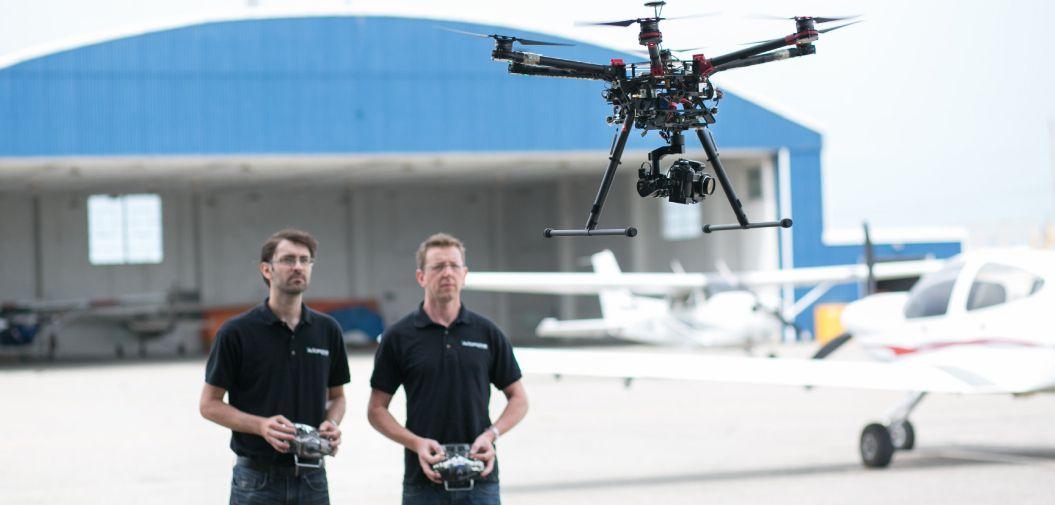

Each year Sponsors play a critical role in supporting our association’s work to host world-class events which connect USC-STC members and the broader unmanned and remotely piloted vehicle systems to people and resources they need to succeed.
We are thrilled to recognize these UC19Ottawa Sponsors who stepped up before October 1st to confirm their support for this year’s event. All registered participants can find Sponsor contact information in the UC19Ottawa Event App. and at UC19.unmannedsystems.ca.

We are thrilled to recognize LOOKNorth as our UC19Ottawa Platinum Sponsor. LOOKNorth is a national Centre of Excellence for advancing research and the commercialization of Canadian remote sensing innovation at home and on the world stage – particularly as they apply to northern and remote regions. LOOKNorth recognizes the impact of the RPAS as an important and growing element of the remote sensing sector and seeks to act as a catalyst for growth in the Canadian UAS industry, whether it pertains to the regulatory process, technology validation or capacity building.
LOOKNorth partnered with USC-STC to manage the National BVLOS Testbed Project which has a clear focus: to accelerate the commercialization of Unmanned Aerial Systems (UAS) or drones for Beyond Visual Line of Sight (BVLOS) operations. Learn more from Dennis Nazarenko (moderating the RPAS Operations Panel on Day 1 of UC19Ottawa) or stop by their exhibitor booth to share your appreciation for their support and to learn more about upcoming project opportunities.

GOLD SPONSOR
Peraton Canada Corp. (formerly Harris Canada Systems Inc.) is a leading provider of In-Service Support/Integrated Logistics Support (ISS/ILS) to the Canadian Armed Forces (CAF). As Peraton’s Industrial and Technological Benefits (ITB) Manager and a member of their Business Development Capture teams, please connect with Denean Tomlin, who is also presenting on the Procurement Opportunities Panel on Day 3 of UC19Ottawa.

ANNEX BUSINESS MEDIA BRONZE SPONSOR
Annex Business Media is the largest B2B publisher in Canada with more than 60 media brands focused on industries such as construction, agricultural, emergency services and first responders, and manufacturing. The company’s aviation and aerospace media properties include WINGS, HELICOPTERS and UAV Canada.

CED ALMA CENTRE
D’EXCELLENCE SUR LES DRONES BRONZE SPONSOR
The Unmanned Aerial System Centre of Excellence / Centre d’excellence sur les drones (CED) in Alma, QC, has been supporting BVLOS operations since 2012 with its unmatched 120,000 km2 airspace, testing and maintenance facilities, and expertise in training, research and UAS operations. This member-driven organization hosts one-day UAS Tech Demonstrations to facilitate industry connections and enable companies to showcase new technologies at their UAS Test Range approved by Transport Canada.
CED Alma will continue growing and advancing the industry in 2020 under the Qualia project and plans to inject $2.4 million for infrastructure development. Connect with Marc Moffat and the CED Alma team in their booth and at the Day 1 evening Networking Reception they are hosting in the Exhibitor Hall, and through various panel presentations during UC19Ottawa.
BREAKFAST SPONSOR
AERIUM Analytics is a Canadian Remotely Piloted Aircraft Systems (RPAS) Service provider with a strong focus on complex operations and geospatial intelligence. Their fleet of RPAS includes commercial-grade fixed-wing, quadcopter, and flapping-wing
units, enabling them to provide a variety of standalone or package services in sectors such as wildlife management data processing and analysis, and enhanced data visualization.
LUNCHEON
L3Harris Technologies is an agile global aerospace and defense technology innovator, delivering end-to-end solutions that meet customers’ mission-critical needs. The company provides advanced defense and commercial technologies across air, land, sea, space and cyber domains. L3Harris has approximately $17 billion in annual revenue and 50,000 employees with customers in 130 countries.

EVENT
M3 Aerial provides RPAS services and a range of Basic and Advanced RPAS Ground School and Flight School training across Canada. The founder of M3 Aerial, Matthew Johnson, will share his combined experiences as a former math teacher, Captain in the Canadian Forces, and trainer for 800+ Canadian RPAS pilots in his presentation at UC19Ottawa called “Drones In Education, Introducing High-Tech to Schools.” Connect with him to learn more about the ways secondary and postsecondary teachers and professors have been utilizing drones to encourage STEM programs by providing enhanced learning opportunities in the classroom.
EVENT PARTNER
Mannarino Systems & Software Inc. provides safety-critical systems, software and airborne electronic hardware engineering services to the aerospace, defense, space, simulation, power generation and rail industries.
Mannarino is highly specialized in the design, verification and validation of critical systems and software including Full Authority Digital Engine Controls (FADEC), avionics, Health & Usage Monitoring Systems (HUMS), Ground Support Equipment (GSE) software, aerial

refueling systems, Unmanned Aerial Vehicles (UAV) and industrial engine controls.
Mannarino is hosting a RPAS Software certification workshop Oct. 29 at the Westin Ottawa before the USC-STC Annual General Meeting. The event is free, but registration is required.
InDro Robotics provides a full range of remotely-piloted unmanned aerial, water and land robotic vehicles, as well as mission-specific sensor packages for the rapidly growing industry of drones. Their team of seasoned drone and manned aviation pilots, engineers and industry specialists work closely with regulators and airspace authorities to ensure to provide innovative yet compliant solutions.
Whether customers need data collection or surveys, training for first responders or complex flights such as aerial deliveries and Beyond Visual Line of Sight (BVLOS) missions, InDro Robotics develop and deploy reliable solutions. Learn more about InDro Robotics from Philip Reece, moderating two BVLOS presentations at UC19Ottawa.

AirMatrix builds highways in the sky for urban drone use around the world. With millimeter precision and system control in real time, AirMatrix gives increased safety to enterprises and local governments. Watch for Ayaan Haider, Lead Engineer, after their presentation this year, called "Data and Software – The Fuel for Urban Skyways."

Rheinmetall Canada is a proud member of Germany's Rheinmetall Group, Europe’s foremost supplier of army technology and a longstanding partner of armed forces. As an internationally recognized systems integrator, Rheinmetall Canada creates technologically advanced, fully customized solutions for the global defence and security market.
Please make time to connect with these industry leaders at Unmanned Canada 2019. Check the Sponsor page at uc19.unmannedsystems.ca as more champions are coming onboard prior to the show. Thank you to these organizations who stepped up to ensure that we have a strong foundation of support to provide delegates, speakers and exhibitors with three solid days of networking and educational opportunities.
By Kristin Kozuback, USC-STC Board of Directors
Don’t miss these three featured panels at UC19Ottawa that introduce challenges, opportunities and new technologies associated with this year’s theme, Innovating Canada by Air, Land and Sea.
• The New Mobility Panel: Innovations in sensing technologies, passenger-carrying and non-passenger Connected and Automated Vehicles (CAVs) are changing the ground transportation, mobility and logistics sectors.
• The Drone Countermeasures Stream: Two panel sessions explore technological aspects and commercially available systems to detect, disrupt and mitigate unwanted or nefarious drones.
• The First Responder BVLOS Panel: Firefighters, paramedics, HAZMAT teams, police officers, and tech experts will discuss training, as well as on-scene and post-incident uses of drones for natural disasters, accidents and emergency situations in the BVLOS and RPAS applications for first responders.
Moderator: Barrie Kirk, CAVCOE/CAVI and USC-STC
Dramatic changes are coming to the ground mobility sector over the next 5 to 10 years. Both passenger-carrying and non-passenger. Connected and Automated Vehicles (CAVs) will become more common and will change the face of mobility – from public transport to private vehicles to logistics – in Canada and around the world. CAVs will have an impact on our lives, society, cities and the economy in the 21st Century that will be as broad and substantial as the impact of cars in the 20th Century.
Barrie Kirk is a well-known keynote speaker, broadcaster and consultant on the subject of CAVs. He is the CEO of the new Canadian Automated Vehicles Institute (CAVI), formerly known as the Canadian Automated Vehicles Centre of Excellence. Barrie is also on the Board of Unmanned Systems Canada/Systèmes Télécommandés Canada and championed USC-STC’s first annual Unmanned Ground Vehicle (UGV) Student Competition this May in Ottawa.
He works hard to connect innovators, investors, and regulators together to move these new technologies forward for the benefit of all Canadians.
Barrie has assembled a New Mobility panel that will address the opportunities and challenges as we enter the CAV era. The UC19Ottawa panelists include:
• Kelly Daize of Invest Ottawa, who will describe the new Ottawa L5 AV test track (which is very impressive);
• Eric Smith of the Canadian Wireless Telecommunications Association (CWTA) will describe the status of 5G, the new cellphone standard and the road map moving ahead because connectivity is critical to all forms of CAVs; and
• Invited speaker Aurrigo, a UK-based company currently running a pilot project at Heathrow Airport, will describe moving containers to and from aircraft using CAVs;
• The Canadian Forces will describe their plans for the Next Generation Fighting Vehicle (NGFV), which will have autonomous capability; and
• Transport Canada will describe the Federal role in regulating ground-based CAVs and keeping Canadians as safe as possible. This panel will be a plenary session on Day 1 of UC19Ottawa from 10:30 am to 12:00 pm on Wednesday, October 30th.
For more information about these UC19Ottawa panelists and topics, please contact our panel Moderator, Barrie Kirk (P.Eng., Executive Director at CAVCOE, CEO at Canadian Automated Vehicles InstituteCAVI, and Director with Unmanned Systems Canada) at 1-613-2711657 or barrie.kirk@unmannedsystems.ca.
Moderator: Philip Reece, InDro Robotics and USC-STC Drones are rapidly becoming critical tools for first responders to better prepare for emergencies, respond to incidents, document scenes or record evidence, and assess the impact of natural disasters and accidents. For almost five years, panel moderator Philip Reece from InDro Robotics has been training and equipping first responders from the private and public sector to use drones and Remotely Piloted Aircraft Systems (RPAS) for training exercises and on active scenes.
Philip has assembled an expert panel from various disciplines to share case studies, best practices and lessons learned by using drones to gain an aerial advantage. He summarizes the importance of this plenary session at UC19Ottawa and this emerging sector:
“First responders and industry experts on this panel will share insights into how the frontline utilizes RPAS technology to train for every eventuality and enhance situational awareness on active scenes. Many presenters are already working together to share data and resources to help others innovate their operations today, but more importantly, they’re working to help shape a national framework to enable Beyond Visual Line of Sight (BVLOS) missions for other first responders, businesses, industry and institutions across Canada.
“We owe a huge thank you to Transport Canada, NAV Canada, many regional authorities, industry partners and the LOOKNorth/ Unmanned Systems Canada Testbed Project Team who are pulling together to make a difference in getting first responders the tools they need to save time and save lives.”
Learn how drone technologies are used by first-responder teams before, during and after disasters, accidents and incidents such as earthquakes, floods, hazardous material spills and structural fires. The UC19Ottawa First Responder panel includes firefighters, paramedics, emergency response experts, police officers, and technology experts sharing insights on a wide range of topics, including:
• Brett Kanda, UAS Business Development Manager from FLIR Inc., will focus on how thermal imaging and drones are helping public agencies save lives;
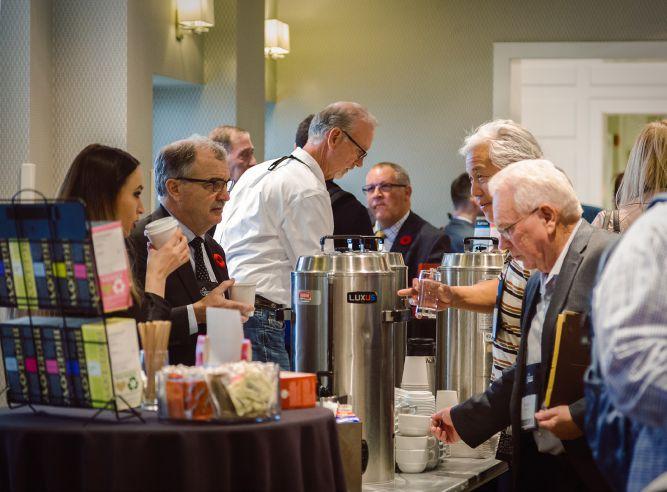
• Richard Fortin from the Geological Survey of Canada/Natural Resources Canada will focus on operational concepts for small UAS in Nuclear Emergency Response;
• Michael Hoffman from Studio Eh Productions will focus on RPAS applications the Fire Services;
• Nate Ormsby of the Ontario Provincial Police will focus on policing applications of UAS/RPAS;
• Mike Slatter, Deputy Chief for Hastings Quinte Paramedic Services, will focus on First Responder Best Practices in UAS.
• Scott Wilkinson, Winnipeg Fire Academy, will focus on Fire Service Applications; and
• Mike Nolan, Chief Paramedic and Director of Emergency Services for Renfrew County Paramedics, will focus on BVLOS and First Responder Operations.
Not attending UC19Ottawa? Check out the feature story published by DJI, the world’s largest drone manufacturer, about Winnipeg Paramedic & Fire Services using their aircraft to battle two separate industrial fires within a two-week period.
These BVLOS and RPAS Use Cases for First Responders will presented in the afternoon of Day 2 of UC19Ottawa on October 31 from 1:30 pm to 3:00 pm.
For more information about these UC19Ottawa panelists and topics, please contact our panel Moderator Philip Reece, President and CEO of InDro Robotics and Director with Unmanned Systems Canada at 1-844-GO-INDRO (1-844-464-6376) or philip.reece@ unmannedsystems.ca
Drone Countermeasures Stream
Moderator: David Domoney, BlueForce UAV Consulting
Rapidly advancing technologies and the proliferation of more affordable and accessible consumer and pro-sumer models is speeding the adoption of drones by the public and private sector
Many tasks that traditionally have been expensive, risky or difficult to complete can now be done more efficiently by responsible, professionally trained drone operators. Drones are quickly moving beyond applications for the 3Ds of ‘dull, dirty and dangerous’ work into 5D tasks that also require ‘distance or data-rich work.’
Yet with every new innovation comes safety challenges and increased risks to people and property.
Drones are rapidly being adopted to address 5Ds across the private and public sector to complete ‘dull, dirty, dangerous, distance and
data-rich work.’ Tasks that generally have been very expensive and difficult to complete from aerial surveys to wildlife monitoring to media production can often be done more efficiently by responsible, trained operators of these Remotely Piloted Aircraft Systems (RPAS).
The risks and downside of the evolution of these new technologies?
Some drone operators may use drones for nefarious purposes, while others may not know or respect bylaws, temporary airspace restrictions, airspaces basic aviation regulations. This puts the aviation industry, infrastructures, and the travelling public at risk.
Two panels at UC19Ottawa will provide key insights into the evolving sector of Drone Countermeasures. The first panel will focus on the challenges and evolving solutions to detect and disrupt drones using various forms of technology. The second panel will discuss commercially-available systems that can help infrastructure managers, event organizers, security teams, correctional facilities and airport authorities with the detection and mitigation of unwanted or nefarious drones.
The first session of UC19Ottawa Drone Countermeasures includes three panelists:
• Dr. Iraj Mantigh from the National Research Centre (NRC) will be speaking on Drone Detection and Classification using an Artificial Intelligence Learning Scheme;
• Brian Fentiman from Blueforce UAV Consulting will present a real-life case study focused on detecting and monitoring airspace intrusions for the 2019 Abbotsford Airshow using the Aeroscope detection system; and
• Mark Espenant from Defense Research and Development Canada (DRDC) will share Canadian insights about recent Drone Detection Technologies and challenges facing various Correctional Facilities.
The second panel features three Canadian companies that offer commercial products available to assist with the detection and mitigation of unwanted drones:
• Dr. Peter Jones will speak about Version 2.0, a Radio Frequency (RF) detection system that will detect the RF signature of a number of commercial drones available for purchase;
• Kieran Gubbins from IDS North America will be speaking on their radar-based systems that detect motion and provide real-time video and tracking of objects in motion; and
• Rick Whittaker will talk about AirShare’s Interceptor-UX, a nonlethal kinetic solution dubbed ‘the world’s friendliest guided missile to safely and cost-effectively remove drone threats.’ Learn about their system that releases a cloud of latex-like countermeasures which foul the propulsion system of offending drones, bringing them safely to the ground via parachute.
Both Drone Countermeasure streams will be presented in the afternoon of Day 1 of UC19Ottawa on October 30. For anyone tasked with the protection of people or property, these are must-see panels. For more information about these UC19Ottawa panelists and topics, please contact our panel Moderator David Domoney, President and CEO of Blueforce UAV Consulting at 1-306-450-5677 or david. domoney@blueforceuav.com.
Author: Kristin Kozuback, MEd., CSP is a Director at Unmanned Systems Canada who also works at InDro Robotics
By Jon Robinson
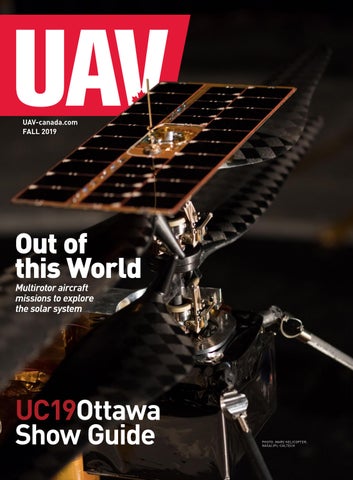
NASA in July 2019 selected a new mission to send a multirotor aircraft called Dragonfly to Saturn’s moon Titan as part of its New Frontiers program, which sets priorities for solar system exploration. New Frontiers already includes the New Horizons mission to Pluto and the Kuiper Belt; Juno to Jupiter; and OSIRIS-REx to the asteroid Bennu. Dragonfly is expected to launch in 2026 and arrive at Titan in 2034.
This marks the agency’s second planned rotorcraft mission, including its Mars Helicopter test vehicle that will be part of the Mars 2020 Rover mission, scheduled to launch in July 2020 – arriving at the Red Plant in February 2021 under the current timeline. This is an optimum – cost-saving –launch window based on the relative posi-
tions of Mars and Earth, perhaps best illustrated by the fact that NASA in mid-February 2019 started aero-braking procedures to reposition its MAVEN spacecraft, currently orbiting Mars, in preparation for the arrival of the 2020 Rover. MAVEN is designed to study Mars’ atmosphere from above and the Mars Helicopter demonstrator is preparing to operate within the atmosphere. Determining the viability of planetary exploration by rotorcraft only hints at the importance of the Mars 2020 Rover mission, which aims to search for the potential of life on Mars.”
The highest point of MAVEN’s elliptical orbit, according to NASA, will be reduced from 6,200 to 4,500 kilometres above the planet’s surface to serve as a data-relay satellite for the Mars 2020 Rover mission. This
increases potential coverage of the rover’s landing site, Jezero Crater, with orbits of Mars increasing to 6.8 per Earth day versus 5.3 previously. Described by NASA as an atmosphere-sniffing spacecraft, MAVEN –Mars Atmosphere and Volatile Evolution, built and operated by Lockheed Martin – will continue its primary mission to study Martian climate evolution. Based on geological features, such as riverbeds and other obvious liquid-driven erosion, scientists believe Mars has lost 99 per cent of its atmosphere due to planetary shifts and solar wind.
“Getting our helicopter into an extremely thin atmosphere is only part of the challenge,” said Teddy Tzanetos, test conductor for the Mars Helicopter. “To truly simulate flying on Mars we have to take away two-
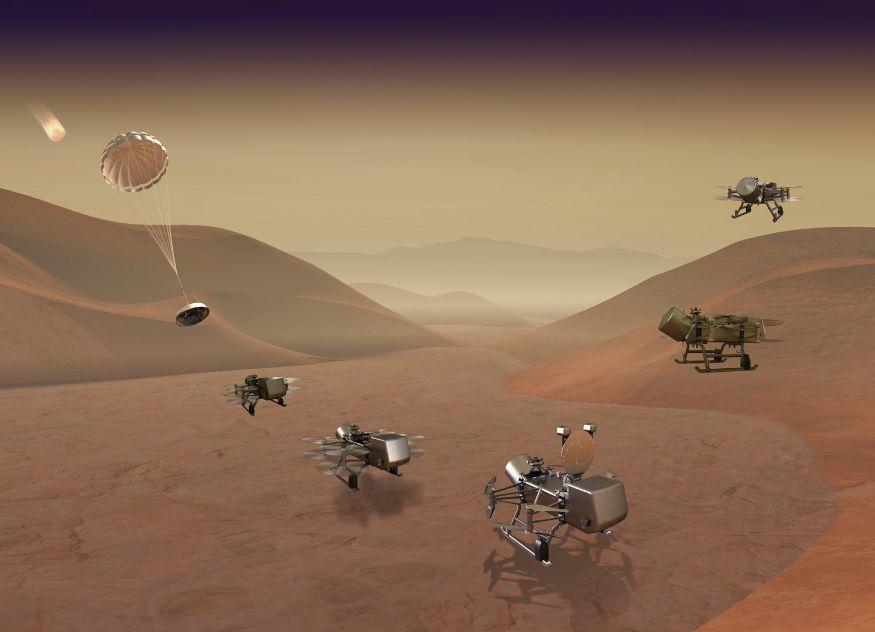
NASA expects Dragonfly will eventually fly more than 175 kilometers (108 miles) – nearly double the distance travelled to date by all of the Mars rovers combined
thirds of Earth’s gravity, because Mars’ gravity is that much weaker.”
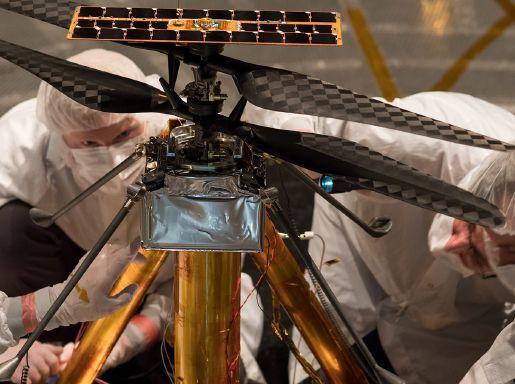
The Mars Helicopter, which will be stowed in the belly pan of the Mars Rover, weighs approximately 1.8 kilograms (four pounds) with a fuselage that NASA describes as about the size of a softball. It employs twin, counter-rotating blades rotating at almost 3,000 rpm, a rate that is about 10 times faster than a helicopter on Earth in order to bite into the Martian atmosphere. Dragonfly, however, will be able to take advantage of Titan’s thick atmosphere as the first multirotor to fly on another plant. It is expected to be equipped with eight rotors, allowing it to fly like a large drone, and powered by plutonium-238, a radioactive material –not the type used in nuclear weapons or reactors – that produces alpha particles. Used for NASA’s deep-space exploration vehicles, these ionizing particles, which can be shielded by material as thin as a piece of paper, are used to turn heat into voltage.
ies will then be charged, tests performed, and controllers on Earth will command the first flight on another planet.
NASA is planning for a 30-day flight test campaign with up to five flights of incrementally farther distances, up to a few hundred metres and durations as long as 90 seconds. On its first flight, NASA explains the helicopter will make a vertical climb to about three metres, where it will hover for around 30 seconds.
The second-largest moon in our solar system, Titan has a nitrogenbased atmosphere like Earth, but it is approximately four times as thick. It’s clouds – and rain – are primarily comprised of methane, as other organics form in Titan’s atmosphere and fall like light snow. This environment leads to complex organics and lakes of liquid hydrocarbon (including a subsurface ocean), energy and water similar to elements that may have sparked life on Earth.
NASA describes Titan as an analogue to the very early Earth, hoping the moon – larger than planet Mercury – can provide clues to how life may have arisen on our planet. During its 2.7-year baseline mission, NASA explains Dragonfly will explore diverse environments from organic dunes to the floor of an impact crater where liquid water and complex organic materials key to life once existed together for possibly tens of thousands of years.
Dragonfly will explore this region in short flights, building up to what NASA describes as a series of longer, leapfrog flights of up to eight kilometers, with the ability to take samples from compelling areas along its route. NASA explains, Dragonfly will finally reach the Selk impact crater, where there is evidence of past liquid water, organics and energy, which together make up the recipe for life.
“With the Dragonfly mission, NASA will once again do what no one else can do,” said NASA Administrator Jim Bridenstine. “Visiting this mysterious ocean world could revolutionize what we know about life in the universe. This cutting-edge mission would have been unthinkable even just a few years ago, but we’re now ready for Dragonfly’s amazing flight.”
Dragonfly will take advantage of 13 years’ worth of Cassini data –from the historic, now ended Saturn mission (1997 to 2017) – to choose a calm weather period to land, in addition to a safe initial landing site at the equatorial Shangri-La dune fields.
“Titan is unlike any other place in the solar system, and Dragonfly is like no other mission,” said Thomas Zurbuchen, NASA’s associate administrator for science. “It’s remarkable to think of this rotorcraft flying miles and miles across the organic sand dunes of Saturn’s largest moon, exploring the processes that shape this extraordinary environment.”
The Mars Helicopter will be deployed a few months after landing on Mars as the rover finds a suitable location to place it on the ground. NASA explains the rover then will be driven away from the helicopter to a safe distance and begin to relay commands. Its batter-
The helicopter will need to survive and function in cold temperatures, including what NASA pegs as nights reaching as low as minus 90 degrees Celsius (minus 130 degrees Fahrenheit). The Mars Helicopter contains a heating mechanism to keep it warm during Martian nights, in addition solar cells to charge its lithium-ion batteries.
To put the planned helicopter demonstration into perspective, NASA explains a helicopter on the Martian surface is already at the Earth equivalent of 30,480 metres in altitude – with the altitude record for a helicopter flying on Earth at about 12,192 metres. “NASA has a proud history of firsts,” said Bridenstine. “The idea of a helicopter flying the skies of another planet is thrilling. The Mars Helicopter holds much promise for our future science, discovery and exploration missions to Mars.”
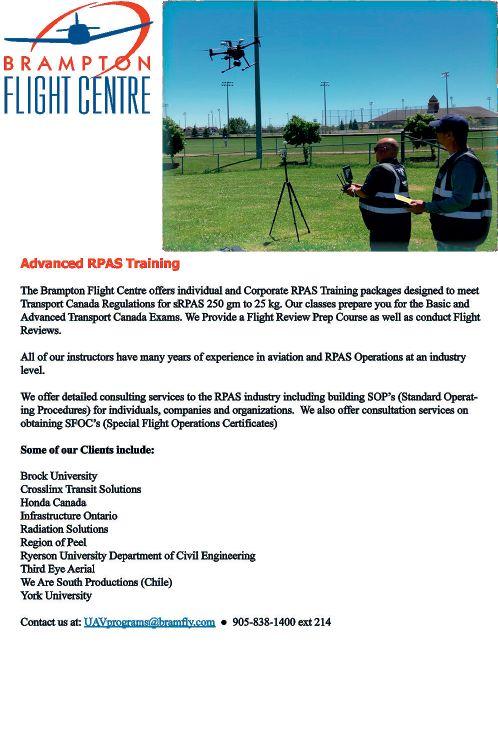
The Brampton Flight Centre offers individual and Corporate RPAS Training packages designed to meet Transport Canada Regulations for sRPAS 250 gm to 25 kg. Our classes prepare you for the Basic and Advanced Transport Canada Exams. We provide a Flight Review Prep Course as well as conduct Flight Reviews.
All of our instructors have many years of experience in aviation and RPAS Operations at an industry level.
We offer detailed consulting services to the RPAS industry including building SOP’s (Standard Operating Procedures) for individuals, companies and organizations. We also offer consultation services on obtaining SFOC’s (Special Flight Operations Certificates).
Some of our Clients include:
• Brock University
• Crosslinx Transit Solutions
• Honda Canada
• Infrastructure Ontario
• Radiation Solutions
• Region of Peel
• Ryerson University Department of Civil Engineering
• Third Eye Aerial
• We Are South Productions (Chile)
Contact us at UAVprograms@bramfly.com
• York University HE_UAV_Bramption_Oct19_EJS.indd 1