I like to stay ahead of my aircraft. So if I’m 40 miles out with weather rolling in, I’m listening to what’s happening in front of me. AWOS. Pilot chatter. A quick check with flight service. Sometimes, there’s a lot to decipher. But I need to hear it clearly. Because when I do, I feel confident. Prepared. In the moment. And that allows me to just
Better sound can make all the difference, especially where you go. Which is why, with 30% greater noise reduction than conventional noise reducing aviation headsets, the A20 headset lets you hear more of what you need to hear. While proprietary cushions and minimal clamping force let you fly comfortably for hours. Meets or exceeds TSO standards. Take them for a 30-day, risk-free Test Flight.
MATT NICHOLLS is editor of Helicopters
t the conclusion of our recent successful Careers in Aviation Expo (CIA) in Ottawa at the Canada Aviation and Space museum, I took some quiet moments to tour and marvel at the many achievements of Canadian aviators.
The museum, like other venues across the nation, offers a treasure trove of aviation, aerospace and space achievements too impressive to properly quantify. Displays spanning the years from early aviation to bush flying to military aircraft and space flight help underscore the achievements of Canadian aviation and aerospace leaders and the companies they work for.
My ever-so-brief tour also helped reaffirm the importance of why we created our CIA Expos in the first place. Our 2015 events in the GTA, Ottawa and Calgary were created to ignite the passions of students and air cadets across the nation and educate them on the various career options available in this dynamic industry.
Why is this so important? As much as the exhibits at Canada’s various aviation and aerospace museums highlight Canada’s achievements from the past, they also remind us of the important developmental and leadership position we hold on the global stage today –and the numbers tell the story.
Canada’s aerospace industry, for example, is an important contributor to the Canadian economy in terms of employment, innovation, productivity, research and development, GDP and trade. With more
Finding a Solution
Helping to Ignite the Careers of Young Aviators
aviation and aerospace in the years ahead. With a large contingent of retiring workers in a variety of disciplines, new strategies will be needed to keep the pipeline strong.
Of course, replacing highly-skilled workers and meeting future demands for new aviation and aerospace personnel is certainly not unique to Canada. It’s a global issue and is underscored in a new report by the Aeronautical Repair Station (ARSA) and the Aviation Technician Education Council (ATEC) in the United States.
The report notes that in the face of expanding global markets and increased demand for a highly-skilled, government-certificated labour force, businesses must overcome the looming retirements of more experienced employees, skill gaps, regulatory limitations on training programs and – most importantly – data sources that are inadequately designed for defining the problem. Educationally institutions, governments and industry must also forge collaborative partnerships to help gain traction on this issue.
We all share a responsibility to educate future generations in choosing careers in aviation.
than 700 companies employing some 172,000 Canadians, it contributes $28 billion to the GDP on an annual basis. Canada also ranks third in global civil aircraft production activity, first in global productivity and fifth in GDP and revenues.
When you factor in the vast number of helicopter and fixed wing operators nationwide, driving the economic engine, keeping the blades turning to drive key industries such as oil and gas, manufacturing, mining, construction and more . . . it’s truly awe inspiring.
Finding skilled, competent, driven and passionate young aviators to keep the industry soaring is one of the biggest challenges facing
“This report is all about defining a problem: the desperate need for more qualified, well-trained men and women to funnel into aviation careers,” Ryan Goertzen, president of ATEC and the Spartan College of Aeronautics and Technology said. “We all have a passion for aviation, of course, but first and foremost we have a responsibility to our students. We know we’re giving them valuable skills and preparing them for success in a number of technical fields, but for us true success is getting our graduates employed in the aerospace industry. The report provides a refreshing perspective and offers strategies to help replenish a diminishing skilled workforce, topics many of the panelists from the various institutions, associations and businesses featured at our CIA Expos in Hamilton and Ottawa wholeheartedly endorsed.
“We all share a responsibility to educate future generations in choosing careers in aviation,” Mike Whitter, professor of aircraft x-maintenance at Canadore College in North Bay, Ont., noted. “It’s indeed a collaborative effort and events like this help bring students and industry together. It’s nice to see companies like Wings and Helicopters take a leadership role in this area.”
Driving the future success of the industry through learning and career enrichment. It’s indeed a shared responsibility, but also a privilege and an opportunity – one that will help fuel Canadian aviation, aerospace achievement and success for years to come.
Ottawa
• More than 10,000 industry suppliers and government customers;
• 400 exhibitors and 120,000 sq. ft. of indoor and outdoor display space;
• More than 30 international defence delegations;
• Confirmed Ministerial keynote speakers such as the Minister of National Defence and the Minister of Industry; and
• B2B/B2G networking events.
2015 Looks Like a Challenge: GAMA
It’s said that a helicopter is a collection of rotating parts going round and round and reciprocating parts going up and down – all of them trying to become random in motion.
“The civil helicopter market isn’t unlike that,” aviation analyst Brian Foley said. “Some parts are already shaking loose.”
The General Aviation Manufacturers Association (GAMA) reported that civil helicopter unit deliveries were down 25 per cent year-overyear in 2014, with a combined value down eight per cent. Even the number of used equipment transactions was down 5.7 per cent in 2014 versus 2013 according to data provider AMSTAT. “And that was before the relatively recent one-two punch of lower oil prices and a stronger U.S. dollar which could further soften the market,” Foley said.
Priced in U.S. dollars, which has seen its value soar against other currencies, helicopters appear an average of 20 per cent pricier in markets outside the U.S. than a year ago. That’s coupled with lower oil prices which act as a twoedged sword – helping the budget-conscious small helicopter market but hitting the big-ticket offshore oil and gas segment that accounts for a significant portion of the industry’s overall value. This is the much larger concern.
Oil companies’ capital budgets are lower this year as they seek to conserve cash in the face of market uncertainty. There will be a corresponding decline in the utilization of offshore helicopter fleets used to transport their workers to rigs, and a subsequent drop in demand for new ones. “It will be a domino effect,” noted Foley. “Once demand drops to fly oil crews to offshore platforms, operators will reassess their fleet requirements which in turn cause lessors and manufacturers to manage their order books for deferrals and cancellations.”
The order books won’t decline overnight, but will do so gradually as deliveries near and progress payments come
due over the coming months. It won’t be until that time the customer will decide whether to take, defer or outright cancel the order.
A problematic aspect of any slowdown in oil and gas sector would be in the pre-owned market. This equipment is often specialized and can be difficult to repurpose for another role other than oil and gas transportation.
Fortunately, there are other segments that do better in a low oil price environment although they don’t contribute as much delivery value as the big offshore machines. Buyers of small piston and single-turbine helicopters such as law enforcement, newsgathering and private individuals tend to
be very cost-conscious. Thus any reduction in their cost of operation, of which fuel is a meaningful component, is viewed as a positive. This, coupled with municipalities having improved tax revenue bases will have a positive effect, although demand could be somewhat offset by a slew of cheap military surplus machines on the market. The U.S. corporate sector will be in a better buying mood by virtue of higher stock prices and stronger balance sheets.
In the end, 2015 will be a volatile, challenging market for the civil helicopter industry with consolidation a possibility across all aspects of the business.
The General Aviation Manufacturers Association (GAMA) expects 2015 will tough on the industry. (Photo courtesy of Airbus Helicopters)
Ornge Seeking to Renew its Fleet
Ontario’s air transport service provider, Ornge, has announced it is in the process of reassessing its fleet. Ornge issued a Request for Information (RFI) for helicopter fleet renewal in mid February, a process it indicated is part of its three-year strategic plan.
The medical transport operator has been under severe scrutiny over the past few years following a prolonged scandal under former president and CEO Chris Mazza. Mismanagement, safety concerns and questionable aspects of its AW139 fleet and much more has plagued the province’s Mississauga-based operator.
As part of its three-year strategic plan, however, Ornge has been assessing whether the organization has the most effective and efficient aircraft for its mission moving forward.
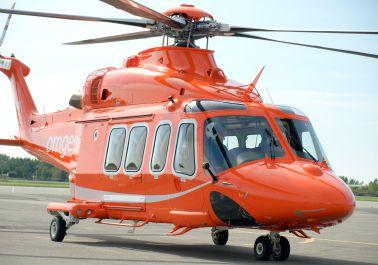
Ontario’s medical transport provider, Ornge, is deciding what helicopter it needs for the job. (Photo courtesy of Ornge)
While the organization asserts the current Ornge fleet of helicopters is safe and meets high standards for patient care, the RFI will allow Ornge to analyze whether the current AW139 model helicopters are the optimal aircraft to serve patients, or whether other alternatives exist that would provide enhanced patient care and better value for money.
Hamilton CIA Expo Educates, Excites
So what does it take to make your mark in the world of aviation and aerospace? It’s all about having a flexible, hardworking, “can do” attitude while being as resilient and proactive as possible. And if you really want to make your mark, copious quantities of passion for your chosen field goes a long way.
This was the overriding message conveyed by a selection of industry experts during Wings and Helicopters third annual Careers in Aviation Expo Feb. 7 at the Canadian Warplane Heritage Museum in Hamilton. Some 160 air cadets, high school and college students and career seekers descended on the iconic site for a fast-paced day of learning, education and more.
The day-long event feature four educational panels including helicopter and fixed wing pilots of varying disciplines; education and flight training; various aviation professional such as TSB inspector, air traffic controller, aviation sales, marketing and more; and maintenance and aerospace opportunities and educational paths.
The day also featured networking opportunities for young adults, as panelists and exhibitors shared key industry information with young aviators. Topics of discussion ran the gamut, including cost of education for an aviation education, what skills students need to succeed in their given field of choice, hot trends in the industry, challenges students might need to anticipate and overcome, opportunities for women in aviation, composite technology and the skills needed to work with new materials and more.
“Passion will take you a long way,” Helicopters Association of Canada
president and CEO Fred Jones said. “Flexibility and the ability to adapt to changing circumstances are also skills that help you deal with the complexities of such a career.”
The CIA Expo in Hamilton was just one of three careers events Wings and Helicopters team will be hosting in 2015.
On Saturday, February 21, the team descended on Ottawa for its second event of the year at the Canadian Aviation and Space Museum. On Saturday, April 11, the team sets up in Calgary at the Calgary Aero Space Museum. For more information, please go to http://www.careersinaviation. ca/expo/.
HELICOPTERS MAGAZINE P.O. Box 530 105 Donly Drive South Simcoe ON N3Y 4N5
Tel.: 519-428-3471 Fax: 519-429-3094
Toll Free: 1-888-599-2228
Website: helicoptersmagazine.com
EDITOR MATT NICHOLLS email: mnicholls@annexweb.com 416-725-5637
MEDIA DESIGNER ALISON KEBA
CONTRIBUTING WRITERS
RICK ADAMS, DAVID CARR, BRIAN DUNN, PAUL DIXON, WALTER HENEGHAN, FRED JONES, JAMES MARASA, CARROLL MCCORMICK, COREY TAYLOR
NATIONAL ACCOUNT MANAGER MENA MIU email: mmiu@annexweb.com 905-713-4351
Helicopters Magazine is an associate member of the following Canadian aviation associations:
Young adults seeking to break into aviation need plenty of passion to succeed. (Photo by Jim Stubbington)
COLUMN
The Time is Now
Threat and Error Management Critical Tools in the Safety Toolbox
ost of us in aviation and indeed, those who have followed the evolution of remedial flight safety measures over the years, are quite familiar with crew resource management (CRM) training. Driven by unmanageable levels of “pilot error” or “human factors,” causal factors in aviation accidents, the advent of training programs that focused on crew behaviour rather than individual pilot behavior have their genesis in a landmark NASA sponsored conference in 1979.
Beginning with “cockpit” resource management, the first CRM training programs focused on cockpit leadership, cross cultural compatibility in the cockpit and presented studies of how pilots “really” behave behind closed doors at the front of the airplane. CRM has morphed into much more than those early seminars. Comprehensive training programs and seminars are now available and they can be much more than just a half day of “charm” school and videos. In fact, today’s CRM involves more than just the cockpit with the better courses addressing the interactions of all operational employees including engineers, dispatchers and managers.
Many EMS programs address the pilot-engineer-dispatcher-medic-doctor-nurse dynamic as well with their Air Medical Resource Management programs. It is heartening to see the CRM concept employed so broadly throughout aviation. This training has also migrated from being strictly the domain of the scheduled air carriers to being delivered at all levels of civil aviation, albeit in a diminished
in fact are a bit stale. It is not uncommon, in my experience, to have an operator that delivers the “same old, same old” every year; part of a rote solution to annual training.
Further along this line is the introduction and whole hearted embracing of the next generation of PDM or CRM training – Threat and Error management, (TEM), a paradigm that was developed by the University of Texas Team Research Project, and first published in 1999 by Helmreich, Klinect and Wilhelm. The new model is an outcropping from a widespread, longitudinal study of data gathered from line operations safety audits (LOSA) with several major airlines. These LOSA studies revealed that there were as many as 3.3 “threats” per segment and as many as 2.5 errors committed by the flight crew, again per flight segment.
TEM is all about accepting that pilots and crewmembers WILL commit errors, every day, on every flight segment. Many current CRM/PDM courses dance around this notion, teaching about the theoretical human factors that lead to accidents. TEM says: “We will face threats and we will err. The threats will take the form of both expected (weather, icing, crosswinds on approach, tight landing areas etc.) and unexpected (aircraft system malfunctions, sudden change of plans etc.) And we will experience these errors through deliberate non-compliance, procedural and communication errors, proficiency errors or operational decision errors. And knowing that these types of errors are bound to occur, we need to be taught the tools to trap these errors to avoid undesirable consequences.
Threat and Error management is all about accepting that pilots and crew members WILL commit errors.
’’
format for some single engine, single pilot operations.
Unfortunately, our industry is missing a great opportunity to enhance pilots’ decision-making skillsets by not fully embracing CRM training. Transport Canada mandates pilot decision-making (PDM) training for the non-airline operations in the context of low visibility operations but perhaps this mandate could be more stringent. Full airline type operations under part 705 have a requirement for approved CRM programs – maybe it is time to drive this requirement deeper into the industry? I fear that many of the courses and training currently available are not as effective as they could be, and
I love the language of TEM – and of the discipline to expect threats to our well-being on every flight segment, to develop a consciousness around them and to proactively develop coping strategies to avoid undesired consequences.
From the report: “Training must recognize the inevitability of error. It should concentrate on the management of threat and error. It also needs to focus on strategies to reduce the consequences of errors and to mitigate undesired states.” In a nutshell, TEM needs to be added to current PDM and CRM training and fully embraced by training departments throughout the industry. We need all the tools available to help reduce our industry accident rates.
Walter Heneghan is the Vice President for Health, Safety and Environmental Protection with the Summit Air Group of Companies, Ledcor Resources and Transportation, based in Edmonton and throughout Western Canada.
WALTER HENEGHAN
PAUL DIXON
How do we get good at what we are trying to do in life?
The short answer is something along the lines of “never stop improving.”
One of the most important lessons we can learn is that we can’t know it all (whatever “it” may be) and that we generally can’t do it all by ourselves. The CHC Safety & Quality Summit each Spring is a gift for those who want take that next big step forward in their lives and their career; it’s a series of master classes interspersed with a lively networking session.
Don’t believe me? Just look back over the banquet keynote speakers of recent years and it’s hard not to be impressed: Chris Hadfield, Simon Sinek, Chesley Sullenberger, Fred Baldwin, Eugene Cernan and Al Haynes. Hadfield and Cernan have gravitas as astronauts, while Sullenberger and Haynes gained celebrity status through two brief moments in the spotlight, US Air 1549 and United 232. Fred Baldwin was a U.S. Navy pilot over Vietnam and air boss on a carrier, where the flight deck has been described as the most dangerous place in the world to work.
Each could talk about their personal experiences as pilots, as leaders and as people who had hung at the very edge of adversity and survived. Sinek was the outsider, the leadership guru who asks you to start with “why” in everything you do, the purpose, cause or belief that inspires you to do what you do. This is something Hadfield, Sullenberger, Baldwin, Cernan and Haynes exemplified in everything they did.
The Decision is Yours
Taking a
Leadership Position on Safety
points on Total Quality Management, which became the foundation for the rebuilding of the Japanese industry. The basic tenet of Deming’s 14 points is continuous improvement and focuses on training, education and the importance of involving everyone in the organization. CHC follows a path of continuous improvement. You can read elsewhere in this issue (see, “Go Further, Do More,” pg. 12) about the implementation of its Operational Flight Planning System (OFPS) and how that process switched from a top-down to bottomup process by including operational pilots from the beginning.
We learn best when we understand the consequences of not succeeding, to put it bluntly, by confronting failure and feeling fear. Fear of failure can be a great teacher all by itself, but only if you do not deny it or ignore it. It is only when you acknowledge the possibility of failure that success is possible. What we call accidents are anything but. Read enough Transportation Safety Board and National Transportation Safety Board reports and it’s the same thing almost without exception – someone either did something or failed to do something that directly caused the accident and their decision to act or not was based on not understanding the consequences.
At last year’s event, Hadfield spoke about the brainstorming that went on amongst his mission team, where they spent months doing nothing but talking about all the things that could possibly go wrong and what the solutions might be, something that the crews on every space mission have done – visualizing failure and working towards success. They understood the consequences, but unfortunately in the case of Challenger and Columbia, it was a lack of foresight by others in the decision making chain that resulted in disaster.
Fear of failure can be a great teacher all by itself, but only if you do not deny it or ignore it.
The most common approach to facilitating change in behaviour is to tell to people “do this” without much emphasis on “why.” That’s the basis of our primary and secondary education systems and, for decades, it carried over into the workplace, where most training or instruction was delivered in a top down way – “do this” became “do this or else.” This is how we were taught in school and through into our adult years as the instructions became less formal. It works, but only up to a point. In the adult world, it becomes “you must do this” with the added emphasis of “or else.”
More than 60 years ago, W. Edwards Deming created his 14
The fact is, you have to be able – or willing – to recognize problems before they have a chance to get out of hand. Denial is easy, because why would you fix a problem you don’t have? We learn not just by opening our minds, but also by being open to those around us. The CHC Safety & Quality Summit is an opportunity to swim in a larger pool and create new networks. It’s about people talking to people about how to change norms and drive innovation by building trust and broadening relationships. We follow the lead of people we know and trust in deciding to change or modify our behaviours. Change requires effort and the decision to make that change is very much a social process, not something we do in isolation. We can only get better if we strive to be the best at what we do.
Paul Dixon is freelance writer and photojournalist living in Vancouver.
Having just attended the RoundUp mining show in Vancouver, and confirmed the dearth of upbeat news from the marketplace, I have been pondering the question, “Are things getting better”? Unfortunately I ran across a good friend, who is also a client and a cheerful fellow, who assured me that things would definitely be getting worse. If that prediction has any legs at all I think it’s time to accentuate the positive and try to make the best of a difficult situation.
The helicopter business has always gone through cycles, and these cycles generally tend to parallel or lag slightly behind the price of various commodities. When metal prices go up, exploration activity goes up and therefore more helicopters are required. Oil and gas exploration is a little more complex because of the way budgets are set, but it still follows the basic pattern. With current oil prices at a decade low (but 100-year average!), natural gas recently plunging, metal prices depressed and new ways of investing impacting the Junior Mining Companies’ ability to raise funds, is there even a glimmer of good news? The short answer is, yes, but it will take some work to capitalize on the opportunity.
The current downtrend has reduced the demand for helicopters in Canada, and by extension the number of pilots and engineers required. This is bad in some ways, but I think it’s generally agreed that the rapidity with which our industry grew over the last decade and a half was unsustainable. Year after year of unprecedented
Watching the Markets
Confronting Challenges and Finding Solutions in Downturn
Workers and/or a willingness to offer signing bonuses and big paydays. Even with all of that, many companies were still shorthanded during the peak season. The further impact from this for many operators was the disproportionate effect on the Light Helicopter market.
For the first 50 years or so of the helicopter industry, there was a graduated scale of remuneration based on the more experience one gained, the “bigger” the helicopter one flew and the higher the wages one earned. The majority of pilots started in a Bell 206 or a Hughes 500 (except for the pioneers who started in Bell 47s!) and worked their way up the scale of larger helicopters and higher wages.
The current client demands for many year’s worth of experience (measured in hours) even in the basic jobs, means that there really isn’t a sliding scale anymore between helicopter types, except in certain circumstances. While this is good in some ways, as wage disparity for equal work isn’t something to aspire to, it essentially hurts the profitability of the smaller aircraft. Wages are a far larger cost for commercial helicopter operations than the Direct Operating Cost of the components, so if the revenue generated is double or triple between helicopter types, yet the wages remain more or less on par, the larger aircraft provide a far greater chance of profitability. Of course if one were to read many of the comments posted on online forums, one could conclude that operators simply need to charge more and fly more and all will be well. It’s easier said than done, but we can dream.
There won’t be any way to create a homegrown solution to the pilot shortage if somebody doesn’t bend.
economic growth caused many people to believe that things would never stop and when you combine Alan Greenspan’s “irrational exuberance” with wiling bankers, almost anyone could buy their own helicopter in the not too distant past. Helicopters require crew, and since crews require experience, a vicious cycle was occurring within the industry. Clients’ standards exacerbated this cycle by moving the experience goalpost further and further until now many want at least 2,000 hours PIC time for the most basic of tasks.
Just a couple of years ago the only way that many companies were able to flesh out their rosters was with Temporary Foreign
This downturn has eased pressure on filling seats with the experienced pilots the clients are demanding. Conversely, it is creating tremendous pressure on helicopter rates as clients are slashing budgets everywhere across the board. This should be an opportunity to offer clients breaks on helicopter rates if they will simply rationalize their demands and accept pilots who don’t measure up to their prescriptive hourly requirements but are fully competent for the tasks at hand. This would provide clients with better rates, while enabling new pilots to gain muchneeded experience to advance their careers and earn higher rates of pay. There won’t be any way to create a homegrown solution to the pilot shortage if somebody doesn’t bend.
Corey Taylor is VP, Global Business and Product Development for Great Slave Helicopters. This is his inaugural column for Helicopters
COREY TAYLOR
Survival Research
RDC seeking better understanding of helicopter escape and water survival
n an offshore helicopter ditching or crash, passengers and crew face two time-critical dilemmas: getting out of the aircraft, then surviving the sea.
A significant number of accident deaths are not from impact injuries, but rather are by drowning, either because people cannot exit the submerged aircraft or, if they manage to do so, they aren’t able to apply life-sustaining techniques long enough to be rescued. In the UK Civil Aviation Authority’s CAP 1145 report on ditchings and water impacts from 1976-2012, nine accidents were deemed survivable. Of 38 fatalities in those accidents, “31 failed to escape from the helicopter . . . the main cause of death was drowning.” Six of the seven who escaped “then perished in adverse sea conditions before they could be rescued.”
In the Cougar 491 crash in 2009, 55 km off St. John’s, N.L., 17 of the 18 souls onboard died inside the aircraft. Two life rafts were empty. One woman was floating dead on the water. Only one passenger – an experienced sailor – escaped and survived.
Research underway at Falck Safety Services Canada (FSSC) in Mount Pearl, N.L., is taking a scientific look at two heretofore unexplored subjects:
• The force required to open a push-out window
• The effect of wave patterns on sea survival skills training
The projects are sponsored by the Research & Development Corporation (RDC), a crown corporation whose mandate is arm’slength investing with potential long-term economic benefit for
his attempt to escape through such a window after the helicopter crashed, filled with water, and inverted: “As soon as my head was covered with water, I looked down and pulled the tab on the window, and it just came to bits in my hand. So I hit it with my elbow a couple of times. Nothing. And then I punched it – I think I punched it three times – and all of a sudden it went pop and away it went."
Regulations say exits should not require “excessive force” to open, but the amount of force is not defined, according to project director, Michael Taber, Falck senior research scientist and an adjunct professor at Brock University. “What’s excessive might be different for you and me and for someone else.”
You can train and train and train, but how do you respond in the actual environment? ‘‘ ’’
Newfoundland and Labrador, where the offshore oil and gas industry represents about 30 per cent of GDP.
The projects are co-funded by the industry’s Petroleum Research Newfoundland and Labrador organization, which includes backing from Chevron, Exxon Mobil, Husky Energy, Statoil, and Suncor. The first study focuses on the force required for a passenger to push a pop-out window, which is not considered an “emergency exit” by regulation but which may be a “supplementary” egress option.
Paul Sharp, a 23-year veteran rig scaffolder who survived the August 2013 North Sea Super Puma crash that killed four, described
Using an S-92 aircraft and a specially designed “force plate” with four force transducers, FSSC’s research team will measure how much force it takes 50 people of various anthropometries (body dimensions) to open a window. Using the data to create a baseline math model, the researchers will repeat the force plate tests in a Survival Systems Ltd. simulator which can be immersed in a pool and rotated to 90-degree, 120-degree, and full 180-degree inverted positions for evaluation of both dry and wet conditions. Passengers face an additional dilemma in helicopters with hydraulic crash-attenuated seats (or “strokers”), which can descend several inches from their original position, potentially reducing the leverage a person has to push on a window. The second project will use a computer-controlled “wave ball” from Belgium’s Wow Company in a 60- by 40-foot pool to generate five simulated wave patterns of different magnitudes, including one-metre waves, slow-roller waves, 80 kph winds, driving rain, sea spray, “confused seas,” and sound effects. The purpose is to analyze how offshore workers best acquire and retain water survival skills such as keeping their airway clear and proper positioning in the water.
“You can train and train and train, but how do you respond in the actual environment?” Glenn Janes, CEO of RDC, asks. “Is that training innate or, if it’s not, how do you make it as close to innate as you possible? It’s one thing doing it in a simulated world and practicing – it’s very different when you’re put under the stresses and strains of the real world.”
Rick Adams is Chief Perspectives Officer of AeroPerspectives, an aviation communications consultancy based in the south of France, and is Editor of ICAO Journal. He has been writing about technology and training for 30 years.
RICK ADAMS
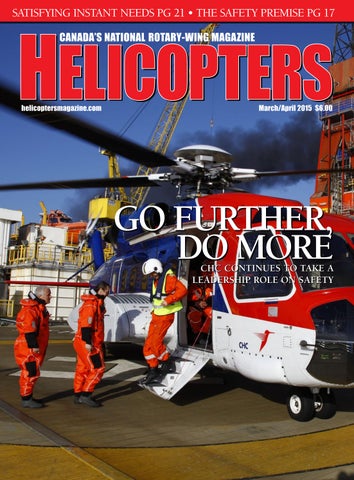
Go Further, Do More
CHC Continues to Take a Leadership Role on Safety
BY PAUL DIXON
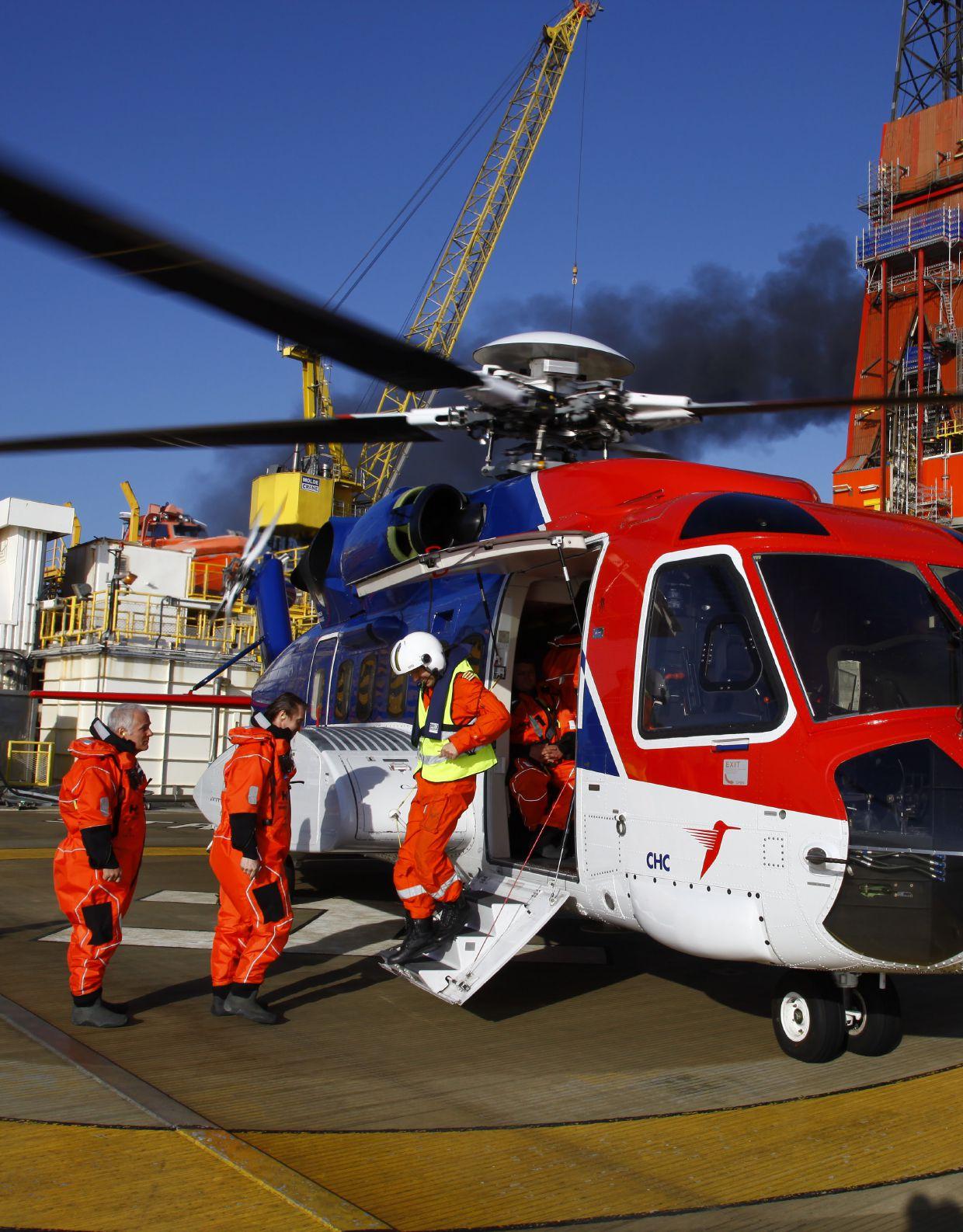
Safety and innovation has been CHC’s mantra for years, as articulated in the company’s corporate mission statement, to “go further, do more and bring everyone home safely.” Greg Wyght has been pursuing one simple vision for a long time – let the pilots focus on their number one priority, flying the aircraft safely.
Wyght, now vice president of systems operations and responsible for CHC’s world operations centre in Dallas, Texas told Helicopters in a recent conversation, “I’ve been on a mission for years, from before the Summit started, to get the administration duties and paperwork out of the cockpit and get our pilots’ heads up, flying the aircraft, as opposed to heads down doing calculations regarding fuel and payloads.” Now, CHC is poised to complete the final leg in linking its far-flung operations into one global operating unit, establishing and maintaining the highest possible operating standards for crews and aircraft.
It has been a long and winding road as CHC has grown to its place as the largest commercial helicopter operator in the world. From a single Bell 47 more than 65 years ago the company today operates more than 250 helicopters in 28 countries on six continents. Not the easiest road to navigate over the years with the challenges inherent in change management and the uncertainty of planning for the future in an often volatile and unpredictable business environment. At the same time, CHC has taken a leadership role in the industry, joining with their major competitors such as Bristow,
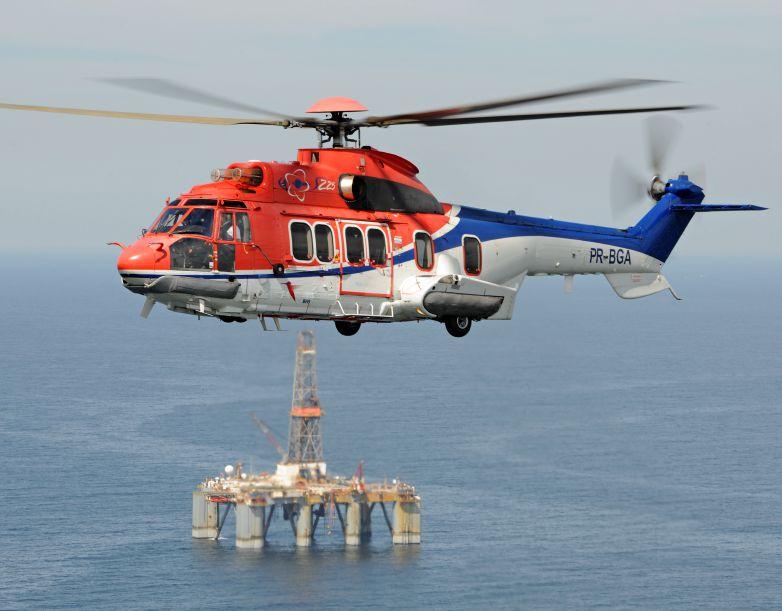
Babcock, Era and PHI in creating HeliOffshore – an initiative to further enhance offshore flight safety that will have global implications.
The CHC Safety & Quality Summit grew from a seed planted by Wyght in 2002, when 35 CHC employees met in Prague, Czech Republic to build one common safety standard across CHC’s worldwide operations. As the seed sprouted, Wyght was appointed VP of safety and quality in 2004 with the mandate to create a common Safety Management System (SMS) standard across the organization. That was the start of the Safety Summit, but it quickly grew to
Further,
include the entire spectrum of aviation flight safety, accident prevention, quality assurance and occupational health and safety. As others became aware of what was going on, they wanted in and CHC, to its credit, was quick to transform the Summit from an in-house program to an international event that often sells out well in advance.
With its robust SMS in place, CHC then took the first step to eliminating paperwork in the cockpit by introducing the EFB (Electronic Flight Bag) beginning in 2012. Partnering with Appareo and using an iPad, the first phase was the digitization of the paper manuals that would have been carried in the aircraft. Once that was in place, the next step was adding the Jeppesen plates which quickly became an indispensable feature for pilots. Once the EFB had been fully approved, the paper manuals and heavy flight bags were history. There is small saving in weight without the bag, but the most important thing is the time line on updates which can now be done electronically, across the world to all bases at the same time. Before, the need to print, collate and ship new manuals or updates to existing manuals could mean weeks before staff in the field actually saw the updates.
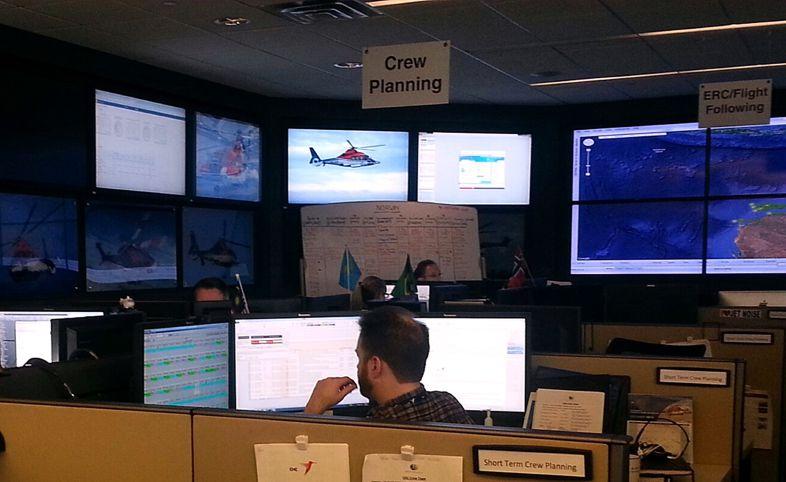
In 2012, CHC announced the creation of a global operations centre in Dallas, under the direction of Wyght, to be modelled on the 24/7/365 employed by commercial airlines. The Dallas ops site would consolidate crew planning and scheduling, maintenance, technical support, global flight following and other functions.
In Wyght’s conversation with Helicopters, he detailed the growth of the operations centre over the past two years. “The actual OC that we have is not very big (compared to a commercial airline OC),” he said. “Crew planning and everything related to that side is about 20 people, while the maintenance support side has a few more, maybe 24. Then outside the actual OC, but co-located in the building, are
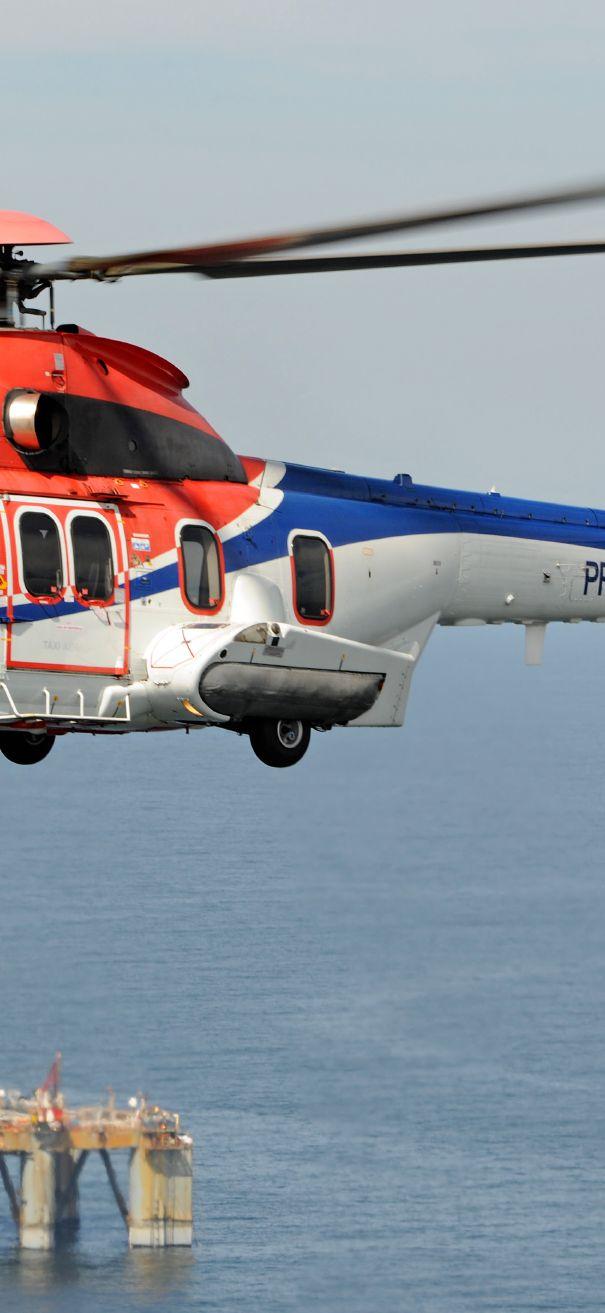
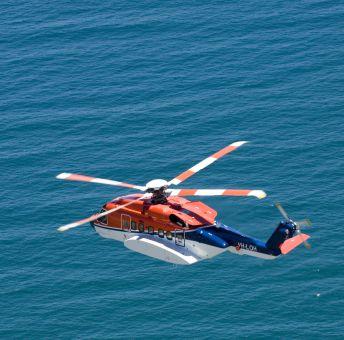
LEFT: CHC continues to make enhancements in safety to vastly improve organizational efficiency. (Photo courtesy of CHC)
BELOW LEFT: CHC’s involvement in the newly formed HeliOffshore initiative with rivals Bristow, Babcock, Era and PHI illustrates its leadership. (Photo courtesy of CHC)
BELOW: CHC’s impressive Safety & Quality Summit continues to be an industry mainstay. (Photo by Paul Dixon)
about 50 more people in HR, recruitment, procurement and IT support. All of these people have global roles and its more efficient with them co-located.”
Maintenance for all bases around the world is monitored from Dallas, right down to moment-to-moment serviceability of individual aircraft, technical support issues and aircraft on ground (AOG). There are global calls every morning, for serviceability and maintenance issues, but also for crew planning.
Long-term crew planning deals with crew allocation, deciding what crewmember goes to which base on what aircraft. That is now integrated into global training planning to maximize the efficiency in the use of simulators. The training plans that dovetail right into the crew plan are done in Dallas, and then delivered to the base for the day-to-day implementation.
While the original plan may have been to consolidate global control in the Dallas OC, as with a major airline control centre, it quickly became that this was not the best case as Greg Wyght recalls. “We realized that the best way of running the business is what we jokingly call “glocal” – it’s global yet it’s local. We leave operational control with the local management team and we leave them to respond to the local customers. The regions know their business and they know their customers very well.”
The operations centre has become a service provider to the bases and under agreements with each of the regions is expected to deliver services meeting or exceeding expectations based on key performance indicators. “This is a much better model,” Wyght says, “where we have learned to deliver a hybrid service that gets the highest global standard, but is nimble and quick like a local company would operate.”
Refinement is part of any new endeavour and Wyght’s safety and quality footprint is no exception. One of the most positive things, he
notes, is learning something from one region and being able to pass the information on across the organization. An example that really surprised him was how an apparently small change in scheduling could have a huge impact in human terms and the financial implications. When global rostering started working with global training and crew training requirements, it was realized that by making minor changes in training schedules, crews would not be away from home as long. This tiny schedule adjustment, gave crewmembers more time at home and, on a corporate level, it meant crew would be available to fly instead of being stuck in transit. Currently in Australia, they are running a trial where crew schedules are directly connected to the fatigue management system, allowing management oversight of pilots and ensuring that schedules are within regulatory and fatigue management guidelines.
Now, the EFB is becoming part of the Operational Flight Planning System (OFPS) that is being rolled out at European bases. OFPS integrates AIMS crew planning software and operational flight planning software, which will be presented on the EFB.
Wyght describes OFPS as the next step in the evolutionary chain. Pilots will do their flight plan on a desktop and it will automatically sync to the EFB. When the pilots walk out to the aircraft with the EFB in hand they have their flight plan, their payload information and their fuel calculations – it’s all integrated into the OFPS system. If they get asked to fly to a different rig or change their routing, they can quickly change the routing with a few clicks and their fuel burn and fuel requirements are quickly recalculated. When they lift off they simply click a button on the EFB and it records the time of engine start, time of taxi, time of departure and time of landing.
And when they get back to base, they sync the EFB with the system and all of those times are downloaded, so their flight and duty times are managed automatically. The aircraft technical logs are updated with the accurate flight times right away and even the invoicing system is integrated with that so it puts out an accurate invoice.
By March 2015 all European bases will be on OFPS. “That is a significant change for any aviation company,” Wyght says. “We’re not just changing to an operational flight planning system, we’re also changing to a consistent global model where in multiple AOCs we have the exact same operational flight planning system”.
The benefit of the global operations concept was amply demonstrated by a short notice request from a customer for an off-shore operation in Malta. No spare aircraft or air crew were available on short notice, but the ability of the Dallas OC to see the entire global operation at a glance enabled them to come up with a solution. Working with the regions, initially the job started on an AOC out of the U.K., then for the long-term it was transited to a Cayman Islands AOC. The pilots and engineers for the aircraft came from five different regions.
Wyght recalls what happened when their type technical pilot from the Netherlands went to audit the operation. “He sent me a note saying that our global harmonization was really starting to pay off. Pilots from five different regions flying the same aircraft and they are all following the exact same standards, the exact same calls, using the same checklists, pulling the same power, flying at the same speed. Doing everything exactly the same. That for me is the benefit of having common flight standards, common training and common crew planning, giving us the ability to pull this together and deliver to a customer where it wasn’t possible before. Without question we could not have done this two years ago. It was a huge feeling of success for us in Dallas that we were able to put this together.”
Wyght has another example, in Surinam. “For safety reasons we had to switch to a different type of aircraft. Our crew planning, training group and flight standards group were able to switch that over to a completely different aircraft and get the contract started on time.
As the OFPS comes on line, Greg Wyght wants it clearly understood that the success of the implementation has been in no small amount due to the pilots on the front line.
“We developed the system and then engaged a subject matter expert from each region in Europe, the four Air Operating Certificates,” he says. “We drew on them to review what was needed in an operational flight planning system.
"They did an enormous amount of work to give their colleagues a safer cockpit, putting in a tremendous amount of time, even on their days off. They were living and breathing the OFPS. Then when we came to trial the system we implemented the OFPS at bases in Humberside and North Denes in the U.K. and Den Helder in the Netherlands in a three-month trial in conjunction with the Civil Aviation Authority, after which the crews came back with over three hundred changes, some of which took weeks to implement because of the complexity of integrated software. I was really impressed with the passion, collaboration and sense of professionalism in making this the best system in the industry.”
Rethinking the flight operations process has helped CHC become safer and far more efficient. (Photo courtesy of CHC).
Wyght added that at the beginning of the implementation, there was a bit of pushback from the users – to be expected in any change management process – which required a bit of a push from above.
But as the implementation went ahead the full potential could be seen by the users, the push very quickly changed to pull as the pilots took ownership of the process and a
sense of pride in what was being created. What it illustrates is that growth is more than simply about becoming the biggest –and maturity is measured in more than just years. Growth in many dimensions is a constant, the direct result of what Wyght describes as CHC’s relentless focus on continuous improvement, never content with the status quo.
• Ever want to fly planes? Build or fix them? How about work in business aviation at a fixed based operator, navigate planes or investigate accidents and help to enhance aviation safety? Maybe the thought of flying a helicopter in the far north or some other exotic locale gets your blood boiling? Or how about flying with the military – feel the need, the need for speed?
• to Build or in at fixed accidents to safety? Maybe thought of in north Or –for
• Wings and Helicopters magazines can help get your aviation or aerospace career ready for take off with our Careers in Aviation Expo.
• Helicopters can take Careers
• Our impressive lineup of speakers will help guide you on your career path and answer any questions you have to help in career preparation as well as provide valuable insight on what career options are out there, what employers are looking for in new recruits, what to expect in the job market and so much more.
• impressive will you career answer to as well as provide valuable insight on what career options are out there, for new in job much
The Safety Premise
Flight Safety Foundation Continues to Raise the BAR
BY MATT NICHOLLS
In the quest to raise global helicopter safety standards, there are individuals and organizations that go above and beyond to ensure the global accident needle is inching toward the “zero” mark.
And while the global helicopter industry has not yet hit the desired mark of reducing accidents by 80 per cent by 2016 as sought by the International Helicopter Safety Team (IHST), the Flight Safety Foundation (FSF) is doing its part to raise safety standards, reduce accidents and save lives.
The FSF is an international non-profit organization designed to provide impartial, independent and expert safety resources for a variety of aerospace fields. Sporting a membership of more than 1,000 organizations and independent aviators from 150 countries across a broad range of industry sectors, the FSF is in a unique position to identify global issues, set priorities for the industry and create safety tools that organizations and independent aviators can use to enhance their own safety envelopes.
The FSF also works to bridge cultural and political differences that may arise within various nations’ regulatory structures, in turn harmonizing the objectives of industry and bringing a cohesive vision to key safety issues. A trip to the FSF’s Web site
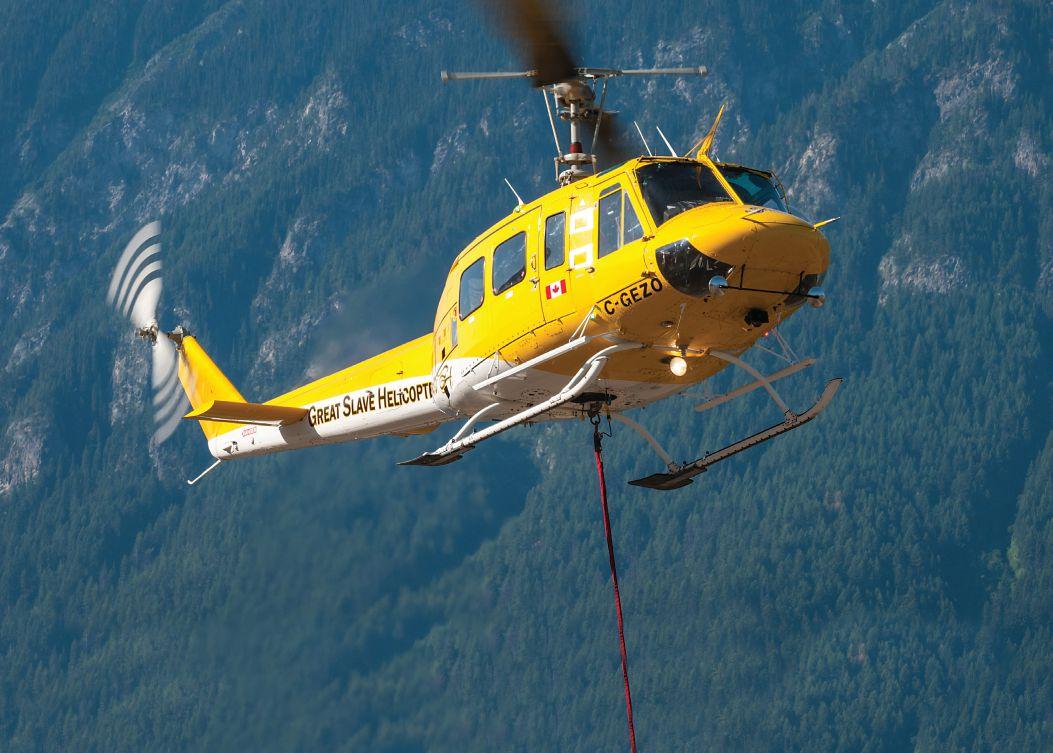
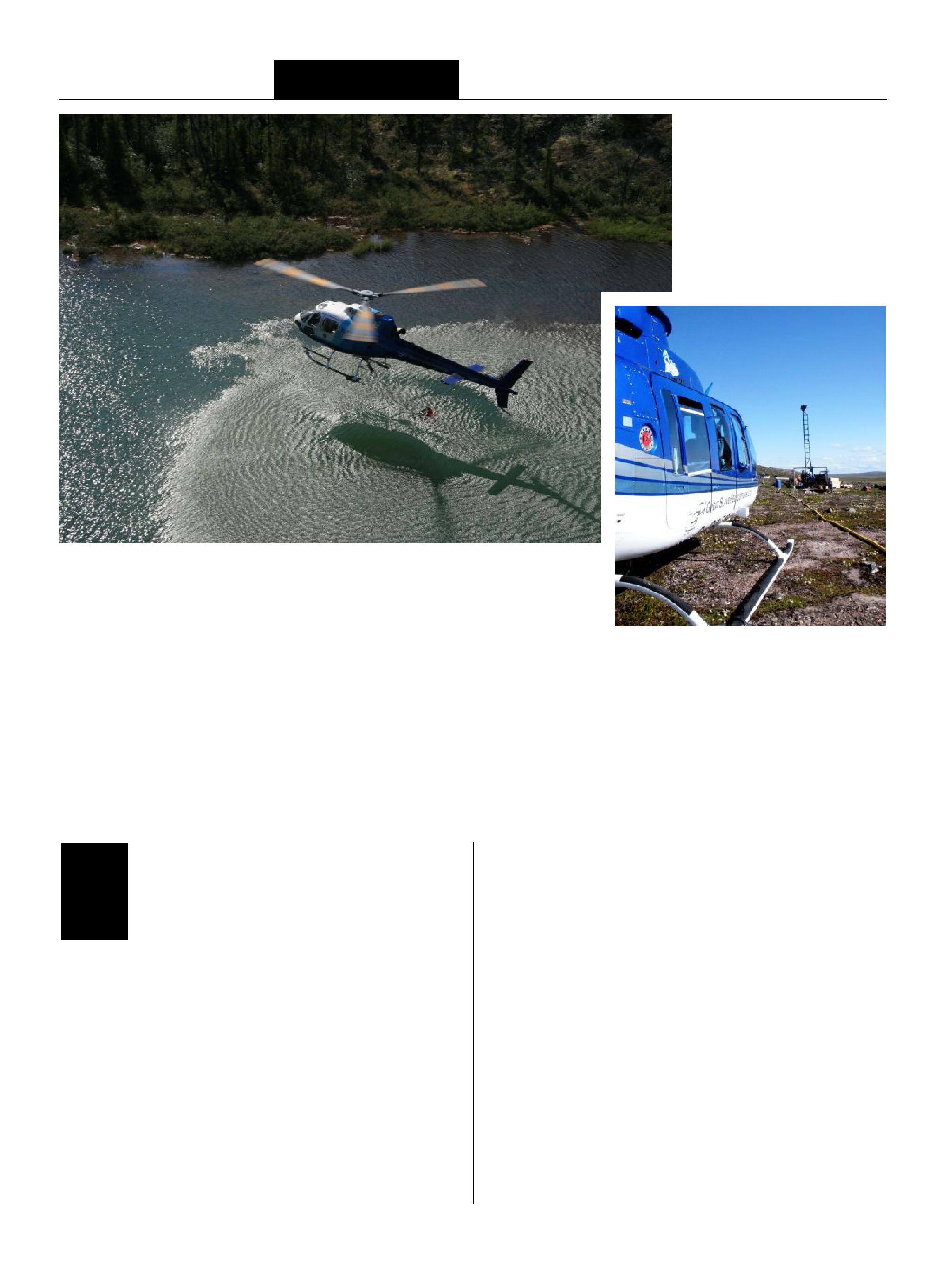
LEFT: The BARS program was originally developed to meet the needs of the mining and resources sector. Great Slave Helicopters helped in its development. (Photo courtesy of Great Slave Helicopters)
BELOW: The beauty of BARS is there are many free tools available for operators. (Photo courtesy of Great Slave Helicopters)
(www.flightsafety.org) offers helicopter operators a wide variety of safety tools they can use in their individual organizations, from free safety reports and publications on topics such as Ground Accident Prevention (GAP), Treat and Error Management (TEM), to key safety initiatives and more.
As VP, global programs and managing director of the foundation’s Basic Aviation Risk Standard (BARS) program, Greg Marshall works tirelessly with various helicopter operators and various OEMs to enhance global safety standards and develop tools for safer operating practices. Marshall is also the driving force behind the FSF’s BARS program, designed to provide a global aviation safety assessment and audit protocol.
BARS is a risk-based model framed against the actual threats posed to aviation operations, particularly those that occur within challenging and remote environments. Created five years ago, it directly links these threats to associated controls, recovery and mitigation measures as opposed to outdated and prescriptive formats previously used within a number of industries.
And while the program was originally developed to meet the needs of the mining and resources sector – for example, Great Slave Helicopters (GSH), based in Yellowknife, N.W.T., has been a key
contributor to the BARS program – it is also used by other organizations that use aviation to support their activities. These include government, humanitarian and other aid agencies. Through BARS, individual aviators and organizations can undergo an audit process that ensures their operation meets the stringent BARS standards, or simply tap into an extensive array of safety and risk assessment tools that can help them improve, enhance or develop safety processes.
“The beauty of the BARS program is you don’t have to do an audit to take advantage of BARS,” Marshall told Helicopters. “The BARS standard is freely available on our website. You can download that, as an aircraft operator, and use it as you wish without having to undergo a BARS audit at no expense.”
Interested parties can also choose to pay for the audit process, which enables their operation to be BARS registered. Last year was a particularly successful one for the BARS program. Some of the highlights:
• Version 5 of the BAR Standard and the accompanying BARS Implementation Guidelines documents were released after undergoing a comprehensive review followed by a complete re-write by professional technical writers
• An independent review of the policies and procedures of the BARS program was undertaken by an independent audit company, KPMG. It is believed to be the first time anywhere that such an independent review has been undertaken
• A dedicated BARS Standard for Offshore Helicopter Operations and a Flight Crew CBT framework were born. This year will see the introduction of enhancements to the program with a variation to an existing category that many aircraft operators may find advantageous
DEVELOPING A NEW STANDARD
Within the onshore resources sector, a number of companies had their own aviation standards, derived from various sources that they would apply individually. BARS was developed to try to overcome the variability of these standards and resulting audits by coming up with one industry agreed standard. And that standard wasn’t developed by the FSF; it was developed by the industry involved in the onshore sector. So, the basic aviation standard was developed, implemented and has evolved over that five years. The FSF is currently on version five of the standard and hopes to introduce a new version in 2016, though it may come out in later 2015.
“The interesting thing about the offshore and onshore world is with offshore, there are probably six key players that have developed over the years their own standards, they have their own departments and their own people that they employ or contract aircraft to and work towards those internal standards.” Marshall said. “What you have is a situation similar [to] the onshore world, where you have multiple audits of a number of operators. Some operators were having audits conducted significant numbers of times per year on behalf of different clients.”
When developing the new BAR Standards, the FSF found a number of smaller oil companies don’t necessarily have their own aviation standards – or they use other guidelines that are in place – but there was nothing that was specifically in place that was dedicated to them. So, the FSF set about establishing a discreet offshore helicopter operations component to complement the original BARS.
“In doing this, we procured the services of an industry subject matter expert to help us with its development. The resulting BARS Offshore Helicopter Operations is currently in draft form and is in circulation in the industry for comment,” Marshall said. “And of
Rethinking the flight operations process has helped CHC become safer and far more efficient. ( )
course, we are receiving comments and suggestions from different quarters. But generally, it is being received very positively.”
The idea behind the new offshore standards, Marshall said, is not to go out and say to the big players that this should replace what they are doing internally – it’s really tailored and catered for those organizations that don’t have a standard.
“I had discussion with an offshore organization recently and we were talking about this and coordinating some efforts in this regard,” he said. “The offshore standard helps to address a couple of issues that were raised by the U.K. CAA last year with regards to CAP 1145. It shows a synergy in standards and auditing. So, you have one standard to which an aircraft auditor can be auditing against. One of the other recommendations out of that Cap was for the industry to look at a pool auditing system. And BARS already does that, it has been doing it for five years. The BARS Offshore Helicopter Operations Standard would help this as well.”
A COLLABORATIVE EFFORT
One of the impressive things about the BARS program is it was designed and supported by resource sector organizations from around the world, giving it not only relevance on a number of critical levels but credibility as well. Marshall is quick to point out that an immense amount of thought and care went into the development of the program, and improvements and enhancements are ongoing.
“There is a tremendous amount of expertise in those organizations that have contributed to the standard,” Marshall said. “One of the things with our standard is we have a technical advisory committee that is comprised of representatives of those organizations and we meet every six months. The sole purpose of that is to come up with improvements to the standard, which adds prudence to the program, which includes establishing and developing new initiatives, whether
New Safety Initiatives Include IIMC Training
One of the newest projects for the Flight Safety Foundation (FSF) is its work to establish a framework for the inadvertent entry into IMC. “This is a factor in a number of accidents,” said Greg Marshall, VP, global programs and managing director of the Flight Safety Foundation’s Basic Aviation Risk Standard (BARS) program. “We have seen, particularly in the highlands of New Guinea or in mountainous areas, particularly in South America, weather changes can happen in an instant. One of the major mining companies had an accident a few years ago in the highlands of New Guinea, which killed all 12 people on the helicopter. The crew was boxed in and had nowhere to go and they hit a mountain ridge.
“We are in the process of developing an IIMC training framework that will become available on our website. It’s a free training framework that anyone can pick up and adopt to their organization – they can adopt it entirely as they see fit.”
The goal is to have the framework ready to post on the FSF website in the next six months.
that be training or the development of tool kits or what have you. Our competency-based training framework is one example which we are working with at the moment.”
Collaboration, of course, is a key competent of improving global safety standards and, ultimately, reducing accidents, incidents and
saving lives. The recent establishment of HeliOffshore with major global players in the international offshore community is testament to that. At times, however, operators can work in a vacuum and fail to share information that would benefit the industry as the whole. The BARS process is a strong indicator that shared processes work.
“I think we are all committed to the same thing, but I think in some cases there are some things being developed in isolation so, you think when it pops up, where did that come from,” Marshall said. “The manufacturers are doing a great job because they are very much
an opportunity to collaborate.”
So, with all of the safety tools that the FSF offers the helicopter community, does Marshall feel individual operators are doing enough to take advantage of them? Are they doing enough to enhance their own safety standards?
There is a tremendous amount of expertise in the organizations that have contributed to the standard. ‘‘ ’’
aligned and though there is a competitive nature with the big OEMS, they are absolutely aligned in terms of safety. The problem exists within subsectors of the industry. There is often a problem of communication here. One person is developing one thing that someone else is already developing.
“I think in the case of us developing the BARS for Offshore Helicopter Operations, we publicized the fact we are doing it, we highlighted it at industry conferences, and then we find another standard is being developed in a parallel way. That was done because they didn’t know we were developing the BARS Offshore. So there is
“Partly, yes,” Marshall said. “The organizations that come on board with us will say we have the minimum requirement to provide services, but they recognize it should be the BAR Standard that they strive for and should be auditing against that. And, you know, it doesn’t matter where you are in the world, if you are an aircraft operator in Africa or North America or South America, if they are audited to the BAR Standard they are audited to exactly the same standard in exactly the same manner and the report is objective.”
The beauty of the BARS program, Marshall added, is you don’t have to do an audit to take advantage of BARS. As noted, the BARS standard is freely available on the FSF website and can be downloaded as an aircraft operator. A BARS audit is not necessary for aircraft operators to take advantage of the opportunity to develop safety improvements of their own systems without any cost.
“We have a very good product and it is subject to further review and amendment," Marshall said. "It is a continuous improvement by nature. That’s what BARS is all about it. And we will take constructive comments from any quarter if we can improve the standard for the industry as a whole.”
Rethinking the flight operations process has helped CHC become safer and far more efficient. (Photo courtesy of CHC)
Satisfying Instant Needs
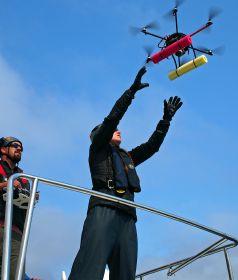
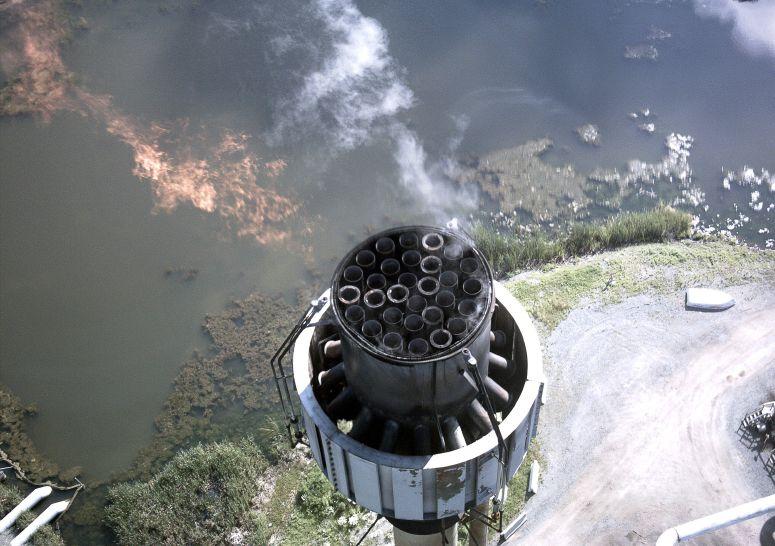
LEFT: Flare stack inspection by a UAV saves time and money – and maximizes site safety as staff stays on the ground. (Photo courtesy of ING Robotic Aviation)
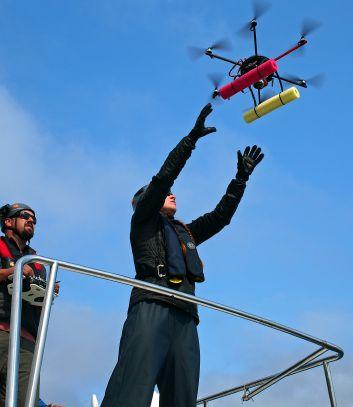
BELOW: Hexacopter take off – Dr. Holly Fernbach launches “Mobly”, the UAV with Dr. John Durban at the controls. (Photo courtesy of NOAA Fisheries)
UAV Technology Can Help Produce Information More Efficiently
BY PAUL DIXON
While the world’s attention is fixated on high-flying, multi-million dollar military drones waging war half way around the world, their more humble civilian cousins have been hard at work across Canada as the unmanned aerial vehicle (UAV) market is booming.
Canada is emerging as a world leader in the commercial application of UAV technology, driven by an industry that has worked with Transport Canada to create regulations that reflect the real world potential (see, “New UAV regulations for commercial use”). UAVs are providing services and a level of quality that was simply not available by other means in a wide range of commercial applications, from real estate, agriculture, industrial inspections and wildlife biology to name but a few. And while the majority of Canadian helicopter operators have yet to incorporate UAVs into their fleets for various projects, they certainly offer intriguing options for future use.
The Canadian military has employed UAVs, or drones as they are popularly known, in a range of deployments outside Canada. ING Robotic Aviation of Montreal provided civilian technicians to the Canadian Army in Afghanistan and on board Royal Canadian
Navy frigates on anti-piracy patrols in the Indian Ocean. Today, ING is using that experience to provide services to a wide range of domestic markets. Charles Vidal, ING’s chief technology officer, says that after reaching out to the oil and gas industry, the company has had two or three teams working in the field all fall demonstrating what is possible with a UAV.
With its Responder multi-rotor equipped with a FLIR infrared cameras, the company can detect hydrocarbon leaks from a wide range of sources. “We can map a square kilometre in 20 minutes,” Vidal says. “Flare stack inspection is straightforward with the UAV. The team sends the UAV up equipped with a HD digital camera or FLIR, capture the data and return to the ground where technicians can review the data moments after it is captured. Previously, inspections had to be planned weeks in advance utilizing a commercial crane that would lift technicians above the stack for a visual inspection. Now, with everybody staying on the ground, the job just became much simpler, not to mention the safety factor.
UAVs can also be used to assist in animal management studies. For example, just outside Churchill, Man., ING has been assisting polar bear researchers, giving the scientists an aerial view that is not possible with aircraft or helicopters and at a fraction of the
cost. At a height of less than 100 metres, the bears are oblivious to the UAV above them and the high-definition photos taken from directly overhead give scientists a new slant on their subjects.
On Alberta’s Rocky Mountain slopes, grizzly bears are the target of PhD candidate Adam Erickson. The abbreviated title of his PhD is “The Future of Forests for Grizzly Bears in Alberta” for which he
is trying to forecast what future forests in the region will be based on recent forest conditions. “The tools we use”, he says, “are not only great for collecting data, but also for creating models. We’re measuring the impact of climate change and the impact of human activity on forest change.”
Erickson, who was a member of UBC’s team at the 2014 Unmanned Systems Canada Student Competition, says that while he has built a number of fixed-wing and multi-rotor UAVs, he has been using a multi-rotor for this particular project. While his project is primarily concerned with bear habitat, Erickson realizes that the same data could be applied in forestry.
“For forest companies, their primary use of UAV information would be forest inventory and economic assessment. Spectral information should give some indication of the quality of the wood and some indication of tree stress and other things that would help them grow better trees in the future.”
DOWN ON THE FARM
In Manitoba, helping farmers grow better crops is what led Terry Moyer to employ a UAV in his job as a regional sales agronomist with Richardson Pioneer, western Canada’s largest handler of grains and oil seeds. The UAV adds another dimension to the year-round services Richardson Pioneer offers to enable farmers to make decisions that will allow them to maximize their returns.
After looking at a range of UAVs, Moyer chose the senseFly eBee Ag fixed-wing UAV for its small size, ease of operation and durable construction. Different camera options offer NIR, red-edge, RGB or multispectral sensors, which ensure the capture of a wide range of data. Historically, the only option available was satellite
DTI is still the only private consulting group to have developed and taught the SMS and QA disciplines to BOTH the regulatory government agencies (ie. Transport Canada, U.S. DoD, NASA) and to the private enterprises that they govern.
Over 300 Canadian Aviation Certificate holders have consulted with DTI in a myriad of ways, including:
• Attending workshops
• Company Specific training
• QA, SMS, MCM, MPM and FOQUA manuals building
• Corrective Action Plan assistance
Workshops currently scheduled in the following locations this spring:
• Calgary
• Edmonton
• Vancouver
• Toronto
• Winnipeg
• And more…visit our website for complete list of locations.
A shot from above: an overview of the B.C, Legislature building in Victoria. (Photo courtesy of Victoria Aerial Photography & Survey)
imagery, but it is expensive and the resolution is nowhere near what the UAV can provide. Satellite resolution is five metres per pixel versus five centimetres for the UAV.
The UAV is also quick to produce data; information can be made available to the farmer within minutes of its capture versus waiting days for satellite imagery. It makes for a different decision point, and as Moyer points out, “then you’re going to make a different decision four or five days later than you would have made that day armed with that information.”
Now, with a UAV, Moyer can meet a farmer in the morning, fly the UAV over the property, download the data onto his laptop literally in the field and present the client with a DVD of the data he needs by noon.
For Moyer, the biggest benefit of the UAV is the ability to validate what is happening “out there on the field.” It can be used to validate a product inquiry or an injury claim where a question is raised about using the wrong product, identify a misapplication or even decipher if a rate of application was wrong. Did a fungicide work or not? “It’s very powerful information,” he says. “The images are incredible, you can see the individual lines in the field and you can see what is happening out there.”
In one instance, Moyer describes a canola field that had been broken into three strips. Within those strips, three different varieties of canola are being tested for lodging. Lodging is a condition where the plant does not stand upright due to a number of factors such as root rot, excess nitrogen, insect damage, wind, rain, hail etc. In the image of the canola plots, the lodging was caused by disease, specifically root rot and later Blackleg. These two diseases are noticeable in the field on foot, but when seen from the air, it
New UAV regulations for commercial use
While it has been legal to fly a UAV for commercial purpose in Canada since 2008, Transport Canada (TC) introduced new regulations for unmanned aerial vehicles and systems last November. And while it has been legal to fly a UAV or UAS in Canada since 2008 with a special exemption, the new regulations should make things more streamlined for commercial use. Highlights of the new regulations:
• For aircraft weighing 2 kg or less (about the weight of six cans of soda), you don’t need to request permission to fly
• For aircraft weighing between 2.1 kg and 25 kg (about the weight of an adult German Shepherd dog), you don’t need to request permission to fly. However, you must notify TC via a form, which includes the UAV model and serial number, description of the operation, and intended geographical boundaries.
In both new exemption situations, of course, you must meet a set of common-sense safety conditions such as keeping at least nine kilometres from airports and at least 150 metres from people, animals, buildings, structures and vehicles; flying no higher than 90 metres above the ground; avoiding restricted airspace such as military bases and prisons, and so forth.
By Canadian law, the working group’s recommendations to TC are publicly available. – With files from Rick Adams
was more clearly outlined.
“From that picture,” Moyer says, “we determined to grow the one variety that did not lodge and this correlated to 15 to 20 bushels better yield per acre when harvested. Without a detailed aerial image, you get part of the story and a lot of unanswered questions. The image gives you the whole picture. ‘Ground truthing’ the image to determine the root cause of the final yield is just data. The summary is the image. It backs up and validates the research data we have and the pictures really are worth a thousand words.”
In dry land farming, with no irrigation,
excess moisture is a threat and adequate drainage is key.
Now, using the UAV, Moyer can take bare soil imagery at the beginning of the year and at the end of the year, create an elevation map and show the grower where the sinks are and where the high spots are. This allows him to link the drainage up with his regular equipment.
DO NOT DISTURB THE WHALES
The Vancouver Aquarium has been studying killer whales on the Pacific Coast for more than 40 years. In 2014, researchers from the aquarium joined forces with
colleagues from the UA National Oceanic & Atmospheric Administration (NOAA) to introduce a custom-build hexacopter to their studies. “Mobly” as they dubbed their “highly mobile” assistant, gave the scientists a window on the lives of killer whales that they had never had before.
The observation of killer whales in the wild has taken place from boats and at a distance. To date, attempts to use fixed-wing aircraft and helicopters for research purposes have been less than satisfactory.
Helicopters are expensive and altitude requirements make high-quality photos and video difficult. Mobly, by contrast, by all indications goes unnoticed by the killer whales as it hovered barely 30 metres overhead.
On his blog, Lance Barrett-Lennard, Vancouver Aquarium’s senior marine mammal scientist reported on the first day’s flight, “Mobly performed like a dream –steady, stable, and quiet. The images of the whales were stunning.” The scientists were trying to answer a fairly simple question –“are the whales getting enough to eat?”
The subjects of their investigation are the Northern Resident killer whales of British Columbia, which are listed as “threatened” under Canada’s Species At Risk Act. These killer whales eat salmon and some of the salmon runs they rely on are much smaller than they use to be, to the point where several of the salmon runs are actually endangered as well. Like Adam, Erickson’s grizzly research, the potential impact of the data gathered could be much wider than initially hoped as new windows are opened.
Looking down from 30 metres above, researchers can acquire more detail on the physical well-being of the whales, which is a very strong indicator as to how much they are getting to eat and their relative health overall. Previously, researchers had to rely on whale mortality from one year to the next to gain insight into their world. Mobly provided thousands of high-resolution photos and video over the 13-day missions, giving the research team a real-time view of the whales in their habitat that was never been available before.
In his blog, Dr. Barrett-Lennard expressed his joy at seeing these animals that he has studied for 25 years from a new perspective, “I did not expect how beautiful they are. They are stunning animals. To seem them in this new perspective is awesome.”
THE VIEW FROM ABOVE
David Carlos of Victoria, B.C, is offering new perspectives to customers through his company, Victoria Aerial Photography and Survey. A licensed pilot, he had, at one
time, aspirations of becoming a commercial pilot, but life intervened until he discovered the world of UAVs. Investigating further, he determined that he would need a multi-rotor, which turned out to come with a steep learning curve.
“When you first buy them, they tell you it’s easy to fly”, he says, “but that’s not true. I had many crashes while I was learning.” Carlos persevered and his first paid job was two years ago when he was asked if he could shoot video of a sailboat on the water.
The in-your-face perspective of a sailboat running before the wind would have cost thousands of dollars with a helicopter, but the cost with a UAV is a small fraction of that. That’s not to say UAVs will replace helicopters – they simple won’t. But savvy operators could use them for certain tasks and possibly save a bundle.
Real estate agents, for example, are using video shot from UAVs as the latest marketing tool, especially in high-end markets. Carlos is working with a developer who wants a series of precise photos shot on the site of a proposed high-rise development to capture the view from each suite in the building so they can be incorporated into the sales package. A local private golf club ordered a video of the course, giving members a golf ball’s view of their course.
The BC government used Carlos and his DJI Phantom to inspect the roof of the provincial legislature in downtown Victoria, as a test to determine if the HD camera could provide the data required. The building is more than 100 years old. Using the UAV saves potential damage to the roof from human feet and eliminates the risk of workers falling.
Carlos has become such a passionate advocate for UAVs that he is offering threeday training programs for would-be UAV operators – UAV Basic 101. He crams a lot into three days, including actually flying on the last day. In his mind, he says there are three components to operating a UAV –knowledge, experience and the actual UAV. And while choosing the actual model of UAV to buy is up to you, he wants give out the basic knowledge required to operate it safely with some experience in a controlled environment.
UAVs are certainly coming in force, and these are just a few examples of how Canadians are putting them to work now, and in the process, reinventing aviation by providing services that were simply not previously available. Looking into the future, it’s tempting to say the sky is the limit, but the reality is, it’s much lower than that.
MARKETPLACE MARKETPLACE
BY PHIL CROUCHER
One problem with helicoptering is that there are virtually no flying clubs, at least of the sort that exist for fixed wing, so pilots get very little chance to swap stories, unless they meet in a muddy field somewhere, waiting for their passengers. As a result, the same mistakes are being made and the same lessons learnt separately instead of being shared. Even when you do get into a school, there are still a couple of things they don’t teach you, namely that aviation runs on paperwork, and how to get a job, including interview techniques, etc. – flying the aircraft is actually less than a third of the job. This book is an attempt to correct the above situations by gathering together as much information as possible for helicopter pilots, old and new, professional and otherwise, in an attempt to explain the why, so the how will become easier.
Photo by Bill Campbell
COLUMN
FRED JONES
arly in my career, I was working in the Sudbury, Ont. area flying line-cutters. The customer had asked me to stay at a small motel near Capreol, a small community north of Sudbury about 15 miles from the camp.
Each morning, they wanted me to arrive in the camp at 7 a.m., and put the cutters out, and then pick them up at 5 p.m. before returning to Capreol for the night. While the customer had made a reservation at the motel for me, and provided me with instructions how to get there, they hadn’t really provided me with any specific guidance about where the helicopter should be left overnight.
Fortunately, Capreol is not a big place, and it didn’t take me long to find the motel from the air. As I flew by, I can remember thinking that the other guests in the motel probably wouldn’t thank me for my 6:30 a.m. start each day, so I went about looking for somewhere nearby to stage the helicopter out of. It had to be walking distance from the motel, but it also had to be reasonably secure, so I wouldn’t lose any sleep worrying about the machine.
I spied an isolated farmhouse just off the main road, with a large backyard opening on to one of the farmer’s fields. After doing a bit of a recon, I lined up for the approach to land. I also wondered briefly whether I would be greeted with open arms, or a shotgun. As I idled in their backyard before shutting down, I could see four family members gathering on the back porch of the house. I shut down
A Backyard Helicopter
Industry needs to find ways to cultivate the passion of youth
There were two young children in the family – one was an infant girl, and the other was a boy about seven years old, named Jeff. Over the dinner table, he couldn’t stop asking questions. He was so excited at the idea of a helicopter in his back yard, he could barely contain himself.
He absolutely insisted that I provide him with a tour of the machine, that night – which I was happy to do. I explained why we did our DI the night before, and what sort of problems the inspection was intended to identify. I explained to him the importance of keeping the machine clean so that you could see small problems, before they became larger problems. He sat in the front of the helicopter at the controls and his eyes were as big as saucers.
After dinner, I profusely thanked the family and headed for the hotel. The next day there was a little bit of morning fog as I walked up the driveway to the backyard at 6 a.m., but sitting on the stairs of the backyard deck was Jeff, to help me with the pre-flight inspection and see me off. In fact, Jeff was there every morning for three weeks, to help me with the pre-flight.
Jeff was also there when I arrived back at the farm each night to help me put the machine to bed for the night. He learned the names of the different parts of the helicopter, and was quick to tell me if I missed something. He couldn’t get enough.
On the last day of my tour, I offered the family a ride, and Jeff occupied the front seat. The family was grateful, but Jeff was overthe-moon.
In fact, Jeff was there every morning for three weeks, to help me with the pre-flight. ‘‘ ’’
the machine and quickly walked toward the house, where I introduced myself. I explained my circumstances, and indicated that I was looking for somewhere to park the helicopter each night. I said that I would happily pay them for the opportunity to use their backyard as my private heliport for three weeks.
I was also careful to explain that my departure each morning would have to take place at about 6:30 a.m. They didn’t seem to mind. They absolutely refused to take any money, and they welcomed me like a family member. They invited me in for dinner that night.
We need to take the time to introduce the younger generation to our industry. Its kids like Jeff that are the next generation of helicopter pilots and engineers and operators.
We need to cultivate that passion. I can’t say that I really appreciated the significance of these events at the time, but as I look back, I realize that for many of us, the fuel of our industry is our passion for the business and the people in it.
For many of us, it is our love of flying that got us in to the business and sustains us through the difficult times.
Fred Jones is the president/CEO of the Helicopter Association of Canada and a regular contributor to Helicopters magazine.
RECOGNIZING THE NEXT GENERATION IN THE CANADIAN AVIATION AND AEROSPACE INDUSTRY!
Canada is full of young, skilled and knowledgeable people who are driving the aviation and aerospace industry forward. From pilots and AMEs to ground crew and business managers, they are the best and brightest in our industry. Join us as we celebrate the future of aviation and aerospace in Canada.
WHO CAN BE NOMINATED?
Anyone in the aviation or aerospace industries who is under the age of 40 as of December 31, 2015. Equipment and technology suppliers as well as operators are welcome.
ALL NOMINEES SHOULD:
• Demonstrate a strong work ethic
• Show leadership and initiative
• Actively seek new opportunities for training and education
• Be involved in industry association or broader industry initiatives
NOMINATIONS ARE NOW OPEN
To nominate someone to be recognized as one of the Top 20 under 40, visit www.wingsmagazine.com or www.helicoptersmagazine.com and click on the “Top 20 Under 40” link to complete a nomination form.
Nominations close on May 1st, 2015
The Top 20 Under 40 will be featured in the July/August 2015 issue of WINGS Magazine and the July/August/September issue of HELICOPTERS Magazine.
Customer satisfaction is a top priority of Airbus Helicopters.
With over 30 years’ of experience, supporting rotary wing aircraft Benoit Marcoux heads a dedicated team of licensed Technical Experts, Customer Service Representatives and MRO specialists all committed to guaranteeing you have the level of service you should expect from an Airbus Helicopters customer center.
Airbus Helicopters Canada is fully committed to ensuring the technical expertise, parts and full spectrum of services are in place to support all your missions.