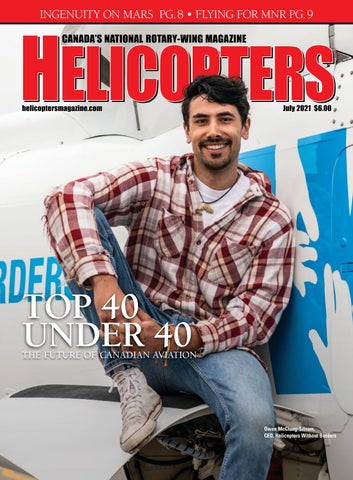
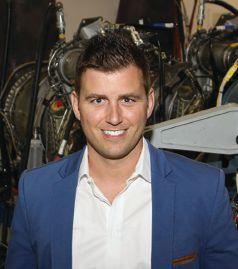
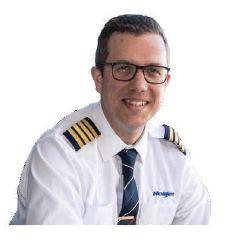
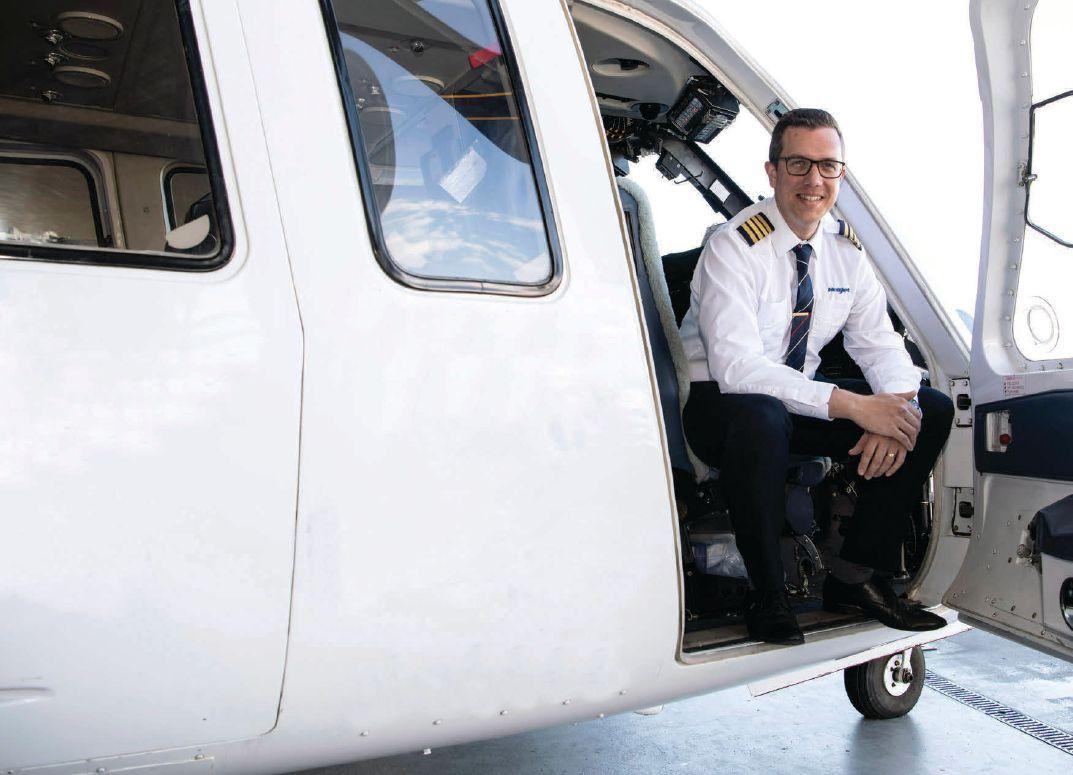
Owen McClung-Sitnam, CEO, Helicopters Without Borders
Cover Story
– Top 40 Under 40 pg 10
10 Top 40 Under 40
The 2021 Top 40 Under 40 program, helping to celebrate the resiliency of aviation through its most difficult period in history, includes 11 leaders with a direct impact on vertical lift:
Christopher Albig, StandardAero
Farah Alibay, NASA Jet Propulsion Laboratory
Kyle Ferguson, Helijet International
Missy Hinds, Silver King Helicopters
Jarrod Manson, SKYTRAC Systems
Cameron Mazurek, StandardAero
Owen McClung-Sitnam, Helicopters Without Borders
David Morgan, Celtic Air Services and Axair Aviation
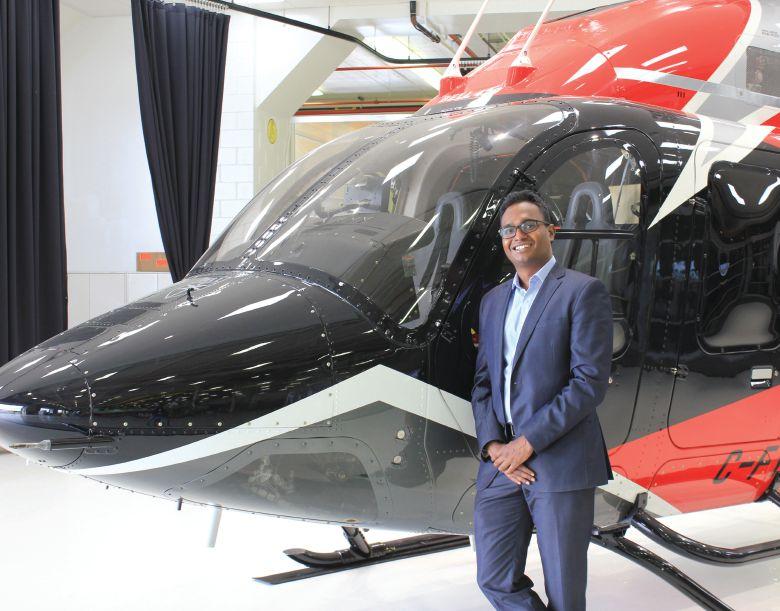
Thuva Senthilnathan, Bell Textron Canada
Bentley Thistlethwaite, Heli-Lynx Helicopters
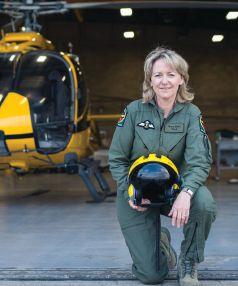
Joelle Thorgrimson, Royal Canadian Air Force
July 2021 Volume 42: Issue 3
Perseverance and Ingenuity on Mars. pg 8
On the Fly Forest expands with H125 8 Vertical on Mars New frontiers by Ingenuity
9 Flying forward MNR pilot reaches goals
26 Stronger together Fatigue regulations impact
Top 40 Under 40 recipient
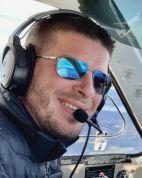
Owen McLung-Stinam, CEO and co-founder of Helicopters Without Borders. (Photo: Larry Goldstein)
Flying forward pg 9
Where there's a will there is a way... I found my way. ‘‘ ’’
– Mary Ellen Pauli
(Photo: NASA/JPL-Caltech)
(Photo: Katelyn Malo Photography)
Thuva Senthilnathan helped lead the development of the Electrically Distributed Anti-torque system at Bell Textron Canada.
JON ROBINSON, editor
mong a range of important drone programs to be introduced in Canada since the start of this year, two recent initiative are set to foster the adoption of Remotely Pilot Aerial Systems (RPAS) in the country.
This includes the NAV Drone app introduced by NAV Canada at the start of June and, in May, the introduction of a robust new drone pilot membership program by the Canadian Owners and Pilots Association (COPA), which already holds by far the largest membership base in Canadian aviation at more than 15,000 people.
The drone or RPAS community in Canada has grown significantly over the past few years. Borrowing statistics gleaned by contributor Phil Lightstone, there were 59,242 registered drones in Canada as of April 30, 2021, and 54,047 basic drone pilot certificate holders, as well as 5,406 advanced operations pilot certificate holders. As of January 2021, there were 1,782,479 drones registered in the U.S., reports Lightstone, who quotes an executive from Altohelix estimating that the annual sales of unregistered drones in Canada to be around $40 million.
In releasing the NAV Drone app, NAV Canada adds more intrigue to the growth of drones in the country, noting that from June to December 2020, it received nearly 16,000 RPAS flight authorization requests, a 54 per cent increase over the same period in 2019. The not-for-profit company, which provides air traffic
Drone growth in Canada
space. This is a key function of the NAV Drone app (with a Webbased browser version also available), which is designed to help drone pilots and operators safely and legally fly their remote aerial systems in Canada. NAV Drone is part of NAV Canada’s national strategy for air traffic safety and technological innovation in Canadian airspace.
NAV Drone allows users to submit drone flight authorization requests from a mobile device. To this end, NAV Drone is the only app that can provide drone pilots and operators with permission to fly in NAV Canada controlled airspace. Its interface allows users to visualize where basic and advanced drone pilots can fly and to also update and manage flights.
Aiming to bridge the gap between traditional and remote aviation, COPA on May 14 introduced new membership options to include Canada’s growing drone pilot community, noting how the technology is transforming Canada’s economy through a range of missions like disaster management, search and rescue, infrastructure, photography and imaging and product delivery, in addition to recreational use. COPA’s membership program includes insurance options, regulatory support and future plans for RPAS scholarships for both new pilots and professionals transitioning out of traditional aviation roles.
From June to December 2020, NAV
Canada received nearly 16,000 RPAS flight authorization requests, a 54% increase over the same period in 2019.
control, airport advisory services, weather briefings and aeronautical information services for more than 18 million square kilometres of Canadian domestic and international airspace, says it expects this trend to continue as a growing number of companies and individuals find new uses for drones in Canada, outlining a need to ensure safe operation for all types of aircraft in the country’s air-
Transport Canada is also building more RPAS framework, including its recent unveiling of proposed fees for both low-risk drone operations beyond visual line of sight and for operations within visual line of sight with heavier drones. In early May, Transport launched a new advisory committee called the Canadian Drone Advisory Committee (CanaDAC) to serve as a national forum for a range of RPAS industry stakeholders to provide input and ultimately inform priority policy and regulatory areas of focus.
This new committee will convene for at least two years and bring together up to 35 leaders and subject matter experts, explains Transport Canada, from a range of sectors with ties to the drone sector. Membership for the committee was determined through an internal nomination process based on its need to ensure overall objectives of diversity and representation are met, including economic, environmental and social impacts. | H
Get a free set of Bose Sport Earbuds or a SoundLink Revolve II Bluetooth® speaker (an up to $199.95 USD, $249 CAD value) when you purchase a Bose aviation headset between July 18 and August 7. Plus, get 10% off each additional A20 or ProFlight Series 2 headset purchased.
With over 30 years of experience engineering and developing noise cancellation technology, Bose offers two premium aviation headsets: The Bose A20 is designed for a wide range of aircraft, including high noise cockpits while the ProFlight Series 2 is optimized for jet aircraft and quieter environments. Both headsets feature Bose advanced noise cancellation for clear, reliable communication, and a comfortable experience for pilots.
ORDER YOURS A T BOSE.COM / A VI A TION.
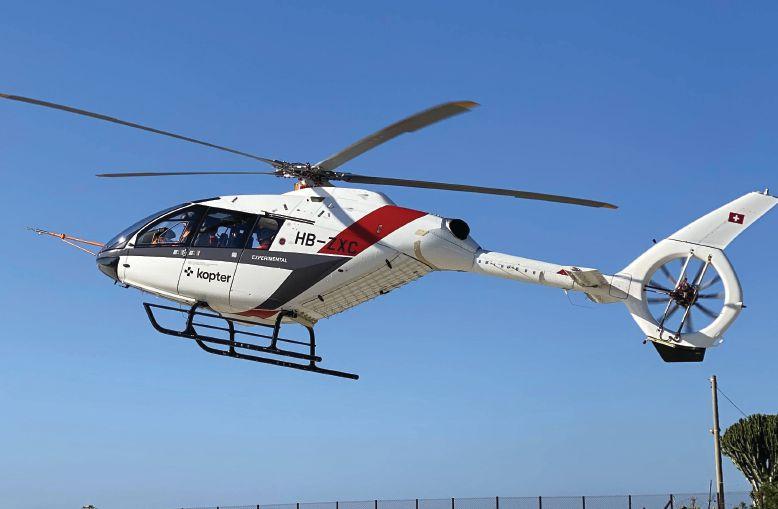
Leonardo rebrands Kopter SHO9
One year after acquiring Kopter Group AG, Leonardo officially adds the SH09 single-engine helicopter into its portfolio as the rebranded AW09. The AW09 will continue to be developed in Switzerland with the contribution of joint LeonardoKopter teams. The third prototype (P3) has now logged in excess of 40 flight hours in Switzerland since mid-January in its newest configuration. This includes enhancements in the main rotor head, gearbox, an extended rotor mast and a new design of the flight controls, combined with the modern Garmin G3000H cockpit. The AW09 next prototype, PS4, is expected to fly this year, followed by the PS5.
The rebranding of the
AW09 is designed to combine the identities of both Leonardo and Kopter. The AW09 complements Leonardo’s existing product range, allowing the company to increase its share in the single-engine market. The com-
FOREST HELICOPTERS EXPANDS AIRBUS FLEET WITH H125
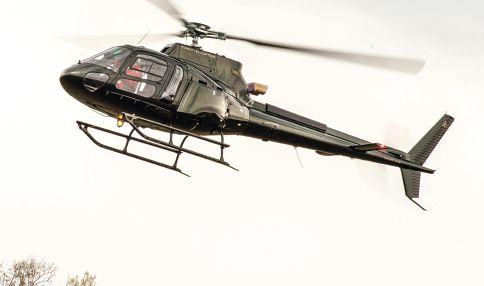
Airbus Helicopters Canada delivered a new H125 to long-time customer Forest Helicopters based in Kenora, Ontario. This is the second H125 in Forest’s fleet, which also includes five other helicopters from the H125 family.
The new H125 missions will include aerial construction, powerline maintenance, and fire suppression. Established in 1997, Forest Helicopters has primarily served the needs of customers in Northwestern Ontario, and has operated in other provinces and territories of Canada supporting various missions. More than 1,400 H125s are currently in-service worldwide and
pany explains the AW09 addition will pave the way for further advancements in vertical flight. Kopter is set to become an incubator of new technologies for Leonardo, contributing to the development of new hybrid and electrical propul-
sion systems. It will also play an important role in the framework of Leonardo’s “Be Tomorrow” 2030 strategic plan, which aims to be in the leading position on the civil rotorcraft market and modern air mobility.
plans to use the new Airbus
and
for
are used in a variety of missions. In addition to its power and versatility, the H125 features dual hydraulics, dual channel engine FADEC, a crash-resistant fuel system, and glass-panel cockpit displays that reduce pilot workload.
Leonardo officially adds the Kopter SH09 single-engine helicopter as a full member of its product range by rebranding it as the AW09. (Photo: Kopter)
Forest
H125
aerial construction, passenger transport, utility work
firefighting missions.
(Photo: Airbus Helicopters)
Wheatley named VP and GM of StandardAero helicopter business unit
Peter Wheatley has been appointed Vice President and General Manager of StandardAero’s helicopters business unit, located in Winnipeg, Manitoba. In his new role, Wheatley will be responsible for managing StandardAero’s range of support services for the helicopter segment, including OEM-authorized engine maintenance repair and overhaul (MRO), airframe support, dynamic component repair (DCR), crash resistant fuel systems and avionics installations.
Based in Winnipeg, Manitoba, Peter Wheatley has been with StandardAero for 17 years in a range of engineering and executive roles.
Wheatley has 17 years of experience with StandardAero and moves to this new role from his former position as Director of Engineering for the Helicopters business unit, within StandardAero’s Components, Helicopters and Accessories (CH&A) division. He previously served as Director of Sales Operations for the company’s Airlines & Fleets division, prior to which he served in various production, engineering, quality and customer program roles within StandardAero.
Following the company’s acquisition of Vector Aerospace in 2017, Wheatley led the transition of StandardAero’s Rolls-Royce M250/RR300 engine lines to help establish the company’s Helicopter Engine MRO Center of Excellence.
Robinson delivers 13,000th helicopter
Robinson Helicopter in April delivered its 13,000 helicopter to SKY Helicopters of Dallas, Texas. The delivery of the S/N 14438 revealed a brand-new colour scheme and is equipped with the latest in R44 options; a Lithium-ion battery, heated
seats, and a 4K cockpit video camera. The aircraft also includes a well configured glass panel featuring Garmin’s 700L TXi, GTN 650Xi navigator, and a Genesys HeliSAS Autopilot.
SKY president Ken Pyatt wanted a new generation R44 to round-out the company’s
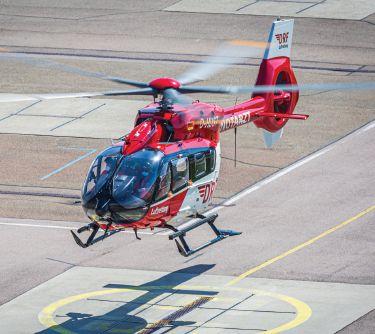
Airbus in cooperation with operator DRF Luftrettung performed the first retrofit of a fourbladed H145 into the helicopter manufacturer’s new five-bladed version. The helicopter is deployed to the Villingen- Schwenningen station, where it will replace the H145 with four rotor blades currently in use. The process involved in the retrofit was developed in cooperation with the manufacturer Airbus Helicopters at its site in Donauwörth, as part of this first conversion.
It will now serve as a template process for all other retrofits. The upgraded H145 can fly with a higher capacity at the same performance level in comparison to its predecessor, enabling the crew to react quickly to spontaneous emergencies, as they can then take extra medical staff with them. In addition, the fifth rotor blade means the helicopter flies more smoothly, explains Airbus, making it
fleet. “We purchased this R44 for our Part 135 air taxi and tour operations,” said Pyatt in a statement. A dealer since 1996, this latest acquisition puts SKY’s Robinson fleet at 27. Robinson Helicopter Company was founded in 1973, manufacturing civil helicopters.
HELICOPTERS MAGAZINE
Reader Service
Print and digital subscription inquiries or changes, please contact
Shawn Arul, Audience Development Manager
Tel: (416) 510-5181
Fax: (416) 510-6875
Email: sarul@annexbusinessmedia.com
Mail: 111 Gordon Baker Rd., Suite 400, Toronto, ON M2H 3R1
Website: www.helicoptersmagazine.com
EDITOR JON ROBINSON email: jrobinson@annexbusinessmedia.com
MEDIA DESIGNER CURTIS MARTIN CONTRIBUTING WRITERS
DARIYA BAIGUZHIYEVA, DAVID CARR, FRED JONES, KENDRA KINCADE, CARROLL MCCORMICK, JESSE ROGERSON
NATIONAL ADVERTISING MANAGER
MENA MIU email: mmiu@annexbusinessmedia.com 416-510-6749
GROUP PUBLISHER, VP SALES MARTIN MCANULTY email: mmcanulty@annexbusinessmedia.com
COO SCOTT JAMIESON email: sjamieson@annexbusinessmedia.com
RETURN UNDELIVERABLE CANADIAN ADDRESSES TO ANNEX BUSINESS MEDIA, 111 Gordon Baker Rd., Suite 400, Toronto ON M2H 3R1 email: subscribe@helicoptersmagazine.com
Published four times a year by Annex Business Media Printed in Canada ISSN 0227-3161
SUBSCRIPTION RATES
Canada - 1 year $31.50 USA- 1 year $74.00 CDN funds Foreign - 1 year $82.00 CDN funds plus applicable taxes www.helicoptersmagzine.com/subscribe
Helicopters Magazine is an associate member of the following Canadian aviation associations:
more comfortable for patients being transported. On top of the rotor blades and the rotor pylon, other helicopter parts will be exchanged or renewed as part of the conversion, leading to additional improvements. These include modifying the main transmission, exchanging batteries and software updates. | H
DRF Luftrettung took over its first type H145 helicopter with a five blade rotor in December 2020. (Photo: Airbus Helicopters)
COLUMN
Vertical lift on another world
NASA’s Ingenuity helicopter opens up new frontiers
History has been made on Mars: NASA’s Ingenuity helicopter achieved the first powered and controlled flight on another planet. Ingenuity is a small, lightweight, dronelike helicopter that was carried on the Perseverance rover. They launched from Earth together in July 2020 and landed on Mars on February 19, 2021.
Ingenuity’s sole mission is to demonstrate that flight on another planet is feasible. In the early morning of April 19, Ingenuity spun up its rotors, climbed to a height of three metres where it hovered for about 30 seconds, performing a rotation while doing so, and then safely landed back on the surface of Mars. And just like that, humans can now fly on other planets. This technological demonstration will help scientists create new missions to Mars and other places in the solar system using not just rovers, but helicopters as well.
Whether you’re on Earth or Mars, in order to achieve flight, you need to generate lift. On Mars, the atmosphere is just one per cent the pressure of Earth’s, which makes generating lift much more difficult. The surface gravity on Mars is about 40 per cent of Earth’s. These conditions, and more, were painstakingly tested on Earth before launching to Mars. NASA engineers designed Ingenuity with this in mind. Its rotor blades are 1.2 metres long. That is very large in comparison to its mass, which is just 1.8 kilograms (roughly the weight of a laptop). The rotors also spin much faster than would be required on Earth to lift the same amount of mass.
At the time of Ingenuity’s groundbreaking flight, Mars was about 290 million kilometres away from Earth. At that distance, it takes light – and thus, communications – about 16 minutes to get to Mars, and another 16 minutes to get back to us. This delay makes it impossible to have a human fly the helicopter live, because any command you give Ingenuity is going to take 16 minutes before it gets there, and by that time, the helicopter could be face down in the dirt.
That means Ingenuity needs to be able to make flight decisions on
its own. When Ingenuity spins up its rotors and starts to lift off from the ground, it must react to wind gusts, temperature changes or any other random environmental concern in order to achieve a successful flight.
Ingenuity was deployed to the surface of Mars by Perseverance on April 3, where it performed its first technological demonstration: surviving the night. The temperature on Mars can plunge to -80C at night; the helicopter needed to prove its on-board battery and heating systems were up to the challenge.
Next, Ingenuity performed a variety of pre-flight tests to evaluate all the systems and ensure flight readiness. However, during a highspeed spin test on April 9, Ingenuity’s computer systems identified a possible problem and shut the helicopter off. Ingenuity sent back data, and NASA engineers determined that a software fix was needed. Shortly thereafter, the helicopter performed and completed the highspeed spin test. Now that Ingenuity has proven that it can fly, it will be directed to do a few more test flights before its mission ends.
Achieving flight on another planet means that our approach to planetary exploration will change. When we first started exploring Mars, we used landers that are unable to move after they’ve landed. Then in 1997, the Pathfinder mission deployed the Sojourner rover, a technological demonstration of roving capabilities. The success of the Sojourner rover was later seen in the deployment of the twin Spirit and Opportunity rovers, and more recently in Curiosity and Perseverance.
Now, with the success of Ingenuity, what will Mars exploration look like moving forward? Helicopters will be able to study locations that even rovers cannot, like the side of a cliff, up a particularly steep hill, or within a field of really large rocks that the rover cannot navigate. A helicopter will be able to go much farther than the tens of kilometres a rover can. With helicopter missions, scientists will be able to cover hundreds of kilometres of Martian surface. With that type of capability, our understanding of Mars will grow. And it’s not just limited to Mars. At this moment, a mission to Saturn’s largest moon Titan is currently being developed. It is called Dragonfly and will launch towards Titan in 2026 or 2027.
Titan has an atmosphere that is about 60 per cent thicker than Earth’s. Using four rotors, Dragonfly will be the first science mission to use flight as its primary mode of transportation. It will fly across Titan learning about its chemistry and possible habitability.
What Ingenuity is doing right now will help inform the engineers of Dragonfly how to build their spacecraft. It’s incredible to see how much technology has changed in just over a century. What will the next century look like? | H
This article was originally published by The Conversation. Jesse Rogerson is an Assistant Professor, Division of Natural Science, York University.
JESSE ROGERSON
Photo: NASA/JPL-Caltech
COLUMN Flying forward
How a retired MNR pilot found a way to follow her dream
As a young girl, Mary Ellen Pauli dreamed of being a pilot but she didn’t know it was possible until reading about Amelia Earhart. Fast-forward to the future, Pauli was inducted into the Canadian Bushplane Heritage Centre’s Women in Aviation exhibit where her display is next to Amelia Earhart’s.
Pauli, 63, is a retired helicopter pilot and a former business owner. Growing up in northern Quebec near a seaplane base, Pauli saw planes landing and taking off every day. Her father, brother and brother-in-law were pilots and when she expressed interest in flying, her father didn't support it and said she’d never get employed. Her brother also died in a plane crash when she was young.
Pauli's mother told her, "Where there’s a will, there’s a way" and that saying stuck with her. “It was the question of money, it wasn’t there. When I finished Grade 11, I went to work at the helicopter company, which made it even more tempting to fly,” Pauli says. “Where there’s a will, there’s a way. Well, I found my way.”
When work started on the James Bay hydroelectric project, she signed up for one of the jobs and saved money for flying courses in Fredericton, NB. When Pauli got there, she says the manager was shocked as he didn’t expect her to show up and there were only accommodations for men.
Later, Pauli worked for Trans-Quebec Helicopters and as a base manager for Trans-Canada Helicopters in Timmins. When the base closed, she went back to work at the James Bay project and later ended up at the Ministry of Natural Resources (MNR).
Discrimination against women in aviation is still present and there are still challenges but it’s getting better, Pauli says, adding there are many organizations supporting women in aviation and aerospace. “Don’t let anyone dissuade you. You just keep moving ahead … and just continue on that path and it will happen,” she says. “It doesn’t
matter if you don’t have money, I didn’t have money.”
In her 31 years working for the MNR, her responsibilities varied from dealing with forest fires, doing wildlife surveys and forest inventory to collaring caribou, geese and tranquillizing polar bears.
That's when she encountered her survival instincts. One time, a polar bear cub charged her. Another time, a polar bear came to their tent camp and took off the whole front of her helicopter. “Those were exciting times. Like I say, survival instincts,” Pauli recalls jesting.
For her help rescuing a stranded family in 2008, Pauli received the Governor General of Canada Certificate of Commendation. Throughout her career, she was also awarded the Lewis P. Currie Award from the Downtown Timmins Business Improvement Association, the Northern Lights Foundation Award, which she says is close to her heart, and the Elsie MacGill award that recognizes women who made outstanding contributions to aviation and aerospace.
Pauli’s vision to create something for Timmins, similar to what she’d seen in southern Ontario or in Europe, led her to run Christopher’s Coffee House on Pine Street South. It was challenging running the business so after seven years, she sold the place. Nonetheless, she says she really enjoyed it and had some great times there. Pauli's interests and passions are diverse, varying from interior design, medicine and law to music and sports. Nowadays, Pauli volunteers with the Timmins and District Hospital Foundation, Porcupine Music Festival and Timmins Symphony Orchestra. She was involved with the Timmins Ski Racers, chaired the Timmins Slalom Derby and raised money for the ski hill.
She learned how to ski and play the violin along with her two children because she wanted to have music and sports in her family life. It's never too late to learn something new, Pauli says, as she was about 38 years old when she picked up the violin.
“I’m proud of my children because they’re nice people. I believe their successes stem from that,” she says, adding she’s also proud of her husband, her career in aviation, her brother and father, her friends as well as her community and all the organizations she’s been a part of.
Pauli says she’d like to contribute to the community in some other way but she hasn’t yet figured out how. If the community wants to grow and be well-rounded, people need to support it, she adds.
“I’m just that kind of person that when I see a need, I just jump right in there and, ‘How can I help?’ That’s how I got involved with any of these organizations,” she says. Despite the challenges and prejudice, she's experienced in her life, Pauli says it's important to just forge ahead. “There are too many things to be afraid of in life. And if you're not forging ahead, you're thinking about all those things you're afraid of.” | H
Dariya Baiguzhiyeva is a Local Journalism Initiative reporter covering diversity issues for Timmins Today.
DARIYA BAIGUZHIYEVA
Photo: Katelyn Malo Photography
TOP 40 UNDER 40
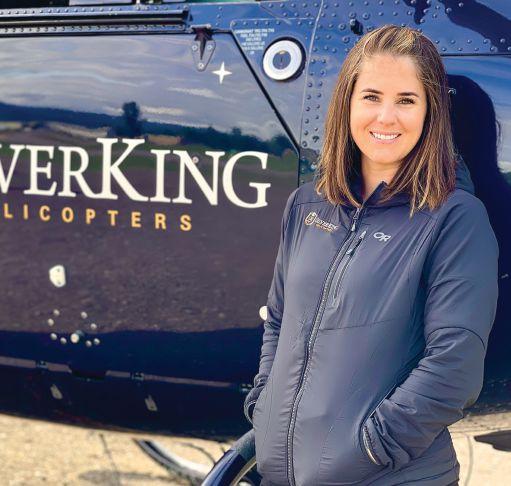
Owen McClung-Sitnam (Ieft) launched Helicopters Without Borders operations in January 2021. Chris Albig (below) helps lead IT systems integration at StandardAero’s key Winnipeg operation and across its network.
Top 40 Under 40
Leading the future of Canadian aviation and aerospace
BY JON ROBINSON
The annual Top 40 Under 40 program, presented by Helicopters and Wings, focuses on young leaders who are driving Canada’s aviation and aerospace industries. These 40 influencers are chosen based on a demonstration of leadership, innovation, achievement and community involvement. This year our team expanded the program to celebrate perseverance during the COVID19 pandemic. In this edition formated for Helicopters, we first focus on 11 of the Top 40 recipients who are most directly involved in the progress of vertical lift.
CHRISTOPHER ALBIG
IT Integration Project Manager, StandardAero, Winnipeg, MB
Albig, age 39, joined StandardAero’s Winnipeg operation, at age 17, when both his father and brother worked at the facility. He started as a parts cleaner and quickly became a PT6 Engine Technician, for nine
years, before becoming an Inspector and then Production Manager for the CF34/ CFM56 business unit. During that time, he earned a Certificate in Management from the University of Manitoba.
Albig in 2017 joined StandardAero’s IT team as Business Systems Lead, returning to school for a Business Analyst designation from Red River College. He enhances existing applications and built new ones to realize higher utilization rates. He also serves as an IT liaison with other business units across the globe. In May 2021, Albig was appointed to his current position to oversee the technology integration of StandardAero’s acquisition of Signature Aviation’s Engine Repair and Overhaul business, ensuring the transition to StandardAero systems occurs without disruption.
FARAH ALIBAY
Flight Engineer, NASA Jet Propulsion Laboratory, Pasadena, CA
Alibay, age 33, has worked on three primary
Mars missions, including as Integration Lead for NASA’s Ingenuity technology demonstrator. Ingenuity arrived on Mars in February 2021 and was deployed to the surface – under Alibay’s supervision – by the Perseverance rover in early April.
Ingenuity on April 19 achieved humankind’s first powered flight on another planet, hovering for 30 seconds at an altitude of three metres as predetermined by its controllers, watching 285 million kilometres away. Alibay coordinates the Perseverance and Ingenuity teams to ensure both missions run smoothly. This includes planning where the two vehicles are with respect to each other, timing missions, and planning all imaging activities, amid a range of critical measures and movements.
Born in Montreal, Alibay, moved to Manchester, UK, as a teenager and would study aerospace engineering at the University of Cambridge. She then pursued a PhD at Massachusetts Institute of Technology and in 2012 began what would
2ND ANNUAL
AERIAL FIREFIGHTING VIRTUAL CONFERENCE
ATTENDANCE IS FREE WITH REGISTRATION
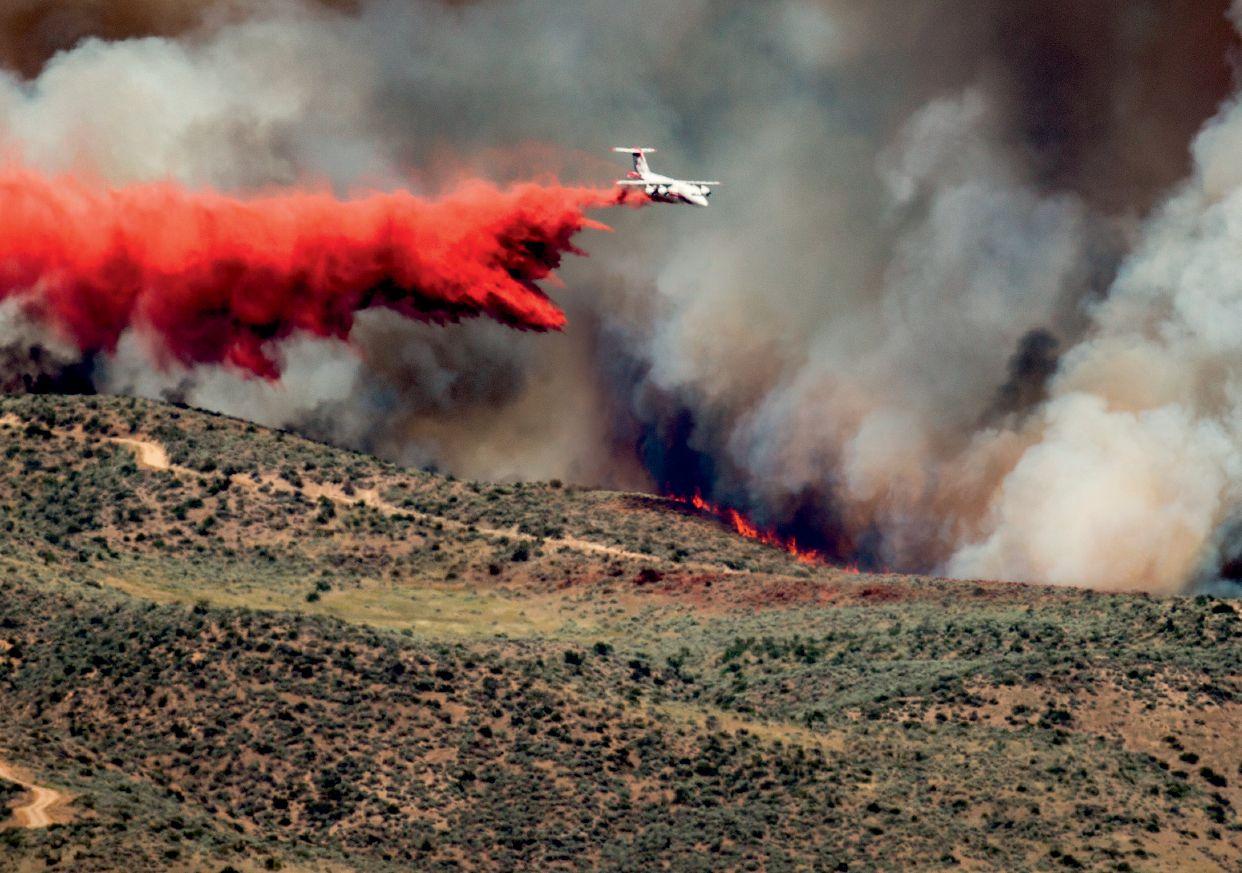
The Aerial Firefighting Virtual Conference is designed to provide rotary- and fixed-wing operators, as well as their clients and fire agencies, with critical business information about the sector.
The one-day interactive program, including both Live and On Demand Sessions, will provide expert insight on new products and services impacting training, procurement, and operational strategies, as well as sector trends, challenges and opportunities in aerial firefighting.
SPONSORSHIP AND EXHIBIT OPPORTUNITIES
Partner with our dedicated events team and industry-leading Virtual Conference platform to showcase your services and technologies to North America’s aerial firefighting sector.
Share a demo, dynamically update your exhibitor display with new products and services, and answer questions from attendees live via chat or video. Platinum, Gold and Silver packages are available with a range of cost-effective options for promotion and lead generation.
TOP 40 UNDER 40
become three NASA internships, including two at Jet Propulsion Laboratory (JPL), which she joined full time in 2014 after earning her PhD. Alibay has also worked on NASA’s Mars Cube One mission and Insight, in addition to concept studies for future exploration.
KYLE FERGUSON
Lead Captain, Scheduled Service, and Officer, Air Navigation, Helijet International, Vancouver, BC Ferguson, age 34, earned his commercial helicopter license at age 21 and began working as a base pilot and helipad inspector in Ontario. In 2011, he joined Canadian Helicopters in Afghanistan for a year as a Loadmaster and was then hired by Helicopter Transport Services to fly the CTV News helicopter in Toronto. He then joined Niagara Helicopters, where he would become Chief Pilot at age 25.
Ferguson in 2014 completed his IFR rating and moved to Vancouver to work with Helijet, the world’s largest helicopter airline. In his current position, he supervises flight crews as a Standards Captain and also serves as Line Indoctrination Captain, onboarding new pilots and preparing them for flying in low-level IFR airspace. He monitors the daily needs of flight crews and is responsible for maintaining airline documents, including standard operating procedures, which he has rewritten extensively. As a company Aviation Safety Officer, he works closely with the Safety Team within Helijet’s SMS system.
Ferguson also recently added responsibility as Officer, Air Navigation, creating and maintaining the company’s IFR route structure, Standard Instrument Departure Procedures, and GPS Based Approaches. He regularly liaises with NAV Canada to ensure a safe and efficient low-level operation within the Vancouver Flight Information Region.
MISSY HINDS
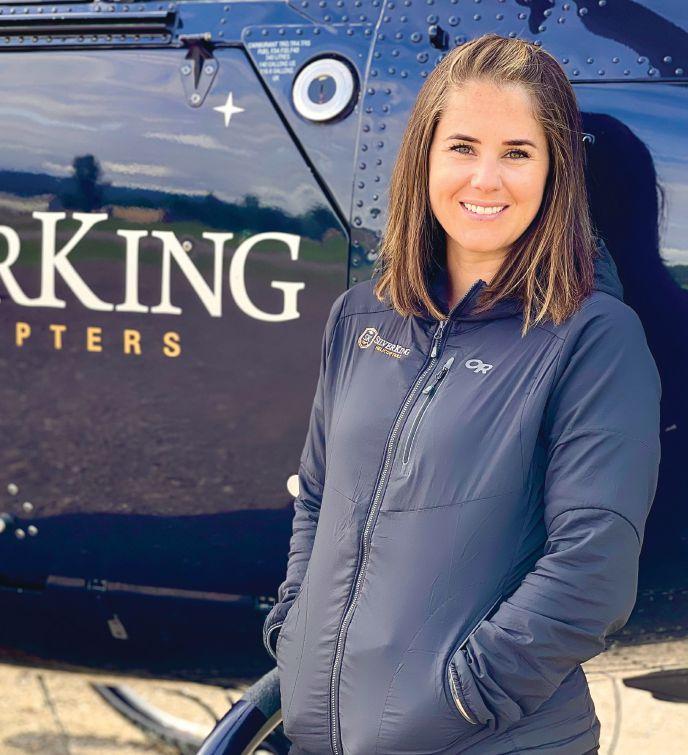
Chief Financial Officer and Co-owner, Silver King Helicopters, Smithers, BC, Hinds, age 37, started Silver King Helicopters with her life and business partner just over 10 years ago with one leased helicopter, as well as a “fantastic engineer” and friend who happened to live just down the street. Today, Silver King
owns and operates nine A-Stars and positions itself as specializing in precision vertical reference tasks flying in BC’s challenging North Coastal mountains. Silver King now brings diverse and high-time experience to the sector, with a robust Safety Management System that includes a safety and incident reporting program. “We have nothing to hide in our business model. We welcome auditors. We welcome Transport into our business – quality and adhering to the standards is very important to us,” Hinds says.
Prior to starting Silver King, Hinds had built a successful career as a contractor in real estate appraising, which helped in formulating a solid business plan in the capital-intensive rotary world. “We aim to be the best and we’ve been very fortunate in bringing on people who are some of the best in the industry. We do not take on pilots with less than 3,000 hours and they all have to excel in drill moving and mountain flying before they even set foot in our helicopters.”
JARROD MANSON
FDM Program Manager, SKYTRAC, Kelowna, BC
Manson, age 32, graduated from Farnborough College of Technology, and joined SKYTRAC in 2014 progressing through roles like Software Test Lead and Client Services Coordinator. He is now the youngest member of SKYTRAC’s management team and recently led the development of its key Flight Data Monitoring (FDM) technology. In this role, he managed a global team of flight data analysts, software developers and embedded hardware specialists working within a range of sectors like aerial firefighting, offshore oil and gas, EMS and SAR.
Manson also enables aerial firefighting fleet operators with SKYTRAC’s Operational Loads Monitoring System. He played a key role in SKYTRAC’s acquisition of Latitude Technologies, which required amalgamating two disparate FDM departments. “We enabled various synergies, obtained profitability and implemented a series of processes to ensure our projects get completed in a timely manner, at a rate significantly higher than held by either of the FDM departments on their own. This year alone, we have onboarded 31 aircraft.”
In May 2021, Manson was tasked with leading SKYTRAC’s GADSS program, an initiative outlined by ICAO to establish an aircraft-tracking time interval of 15 minutes for all planes with a take-off mass of 27 000 kgs or 45,000 kbs when flying over oceanic areas. The complex technology, being ushered in following the Malaysia Airlines Flight 370 tragedy, is built around an autonomous distress tracking concept.
CAMERON MAZUREK
Director of Engineering, Facilities & Maintenance, StandardAero, Winnipeg, MB Mazurek, age 33, recently took on a role expansion to include enterprise-wide responsibilities and process-related engineering disciplines. He now holds technical authority for more than $40 million in capital infrastructure projects. This role expansion also allows Mazurek to leverage StandardAero’s enterprise-wide technical networks, which connects more than 100 multi-disciplinary staff – in areas like thermal, NDT, metrology and plating, among others –across more than 40 sites.
Mazurek continues to realize results in substantial cost- and riskreduction for capital infrastructure projects, focused on capturing value at operating locations and during expansion, acquisition integration phases, and energy reduction initiatives. He focuses on providing positive and action-oriented team environments to promote collaboration, problem solving and collective sharing of lessons learned. To this end,
Farah Alibay, Flight Engineer, NASA Jet Propulsion Laboratory, Pasadena, California.
he has helped to develop a transparent system for the retention of critical organizational knowledge across the global technical team.
“One of one of the rewards of being in the technical functional support group [is that] We are right in the middle of dealing with change,” he says. “Our operations teams rely on us to support and enable change in their respective areas, to increase their readiness to take on the work coming in to our shops. This lets them focus on perfect execution of the day to day, where we get to take a step back and help apply the evolution of technology into our business.”
OWEN MCCLUNG-SITNAM
CEO and Co-founder, Helicopters Without Borders, Vancouver, BC
McClung-Sitnam, age 28, became one of the youngest helicopter pilots to achieve his ATPL in Canada and the United States at 21 years old. He holds several type endorsements and has accumulated more than 3,000 flight hours, primarily in Alberta and BC. Working wildfires and EMS instilled in him a passion for the power of community support through aviation, which has also been a pillar of Helijet, cofounded in 1986 by his father, Danny Sitnam.
McClung-Sitnam dreamed of flying for the United Nations and World Food Program missions, but by the time offers came in, including some from Nigeria and Haiti, he had already signed onto new domestic contracts. At age 26, he began working on initial concepts for a humanitarian-focused, not-for-profit helicopter company, while also working toward his MBA at Royal Roads University. Helicopters Without Borders (HWB) was incorporated in 2019, but McClungSitnam and its directors determined instead that the not-for-profit needed Canadian charity status to be truly effective in the capitalintensive rotorcraft sector. HWB then earned charity status in early 2021 to become the first such entity in Canada focused on helicopters, airplanes, RPAS and eVTOL.
Fundraising through private donors began immediately and, in early 2021, HWB partnered with First Nations and Indigenous governments to deliver vaccines, doctors, PPE and supplies to some of the hardest to reach communities in Western Canada. As part of its industry-inclusive mandate, HWB is now contracting helicopter and fixed-wing air services from aviation operators in BC. To save costs in the
initial start-up of HWB, McClung-Sitnam is serving as principal pilot and operations organizer on all flight missions.
DAVID MORGAN
President and CEO, Celtic Air Services and Axair Aviation, Port Hastings, NS Morgan, age 39, developed his career with a range of commercial operators like CanJet Airlines, First Air, Nolinor Aviation, Human Logistics, and he has most recently held a VP position with Chrono Aviation. In 2017, he took the step to branch out on his own by starting Celtic Air Services at Allan MacEachen Regional Airport in Port Hawkesbury, Cape Breton.
The FBO supported a significant increase in international air traffic for the airport and region, which was becoming a preeminent golf destination, in addition to the island’s traditional tourism position. “Hundreds of business jets were coming in here when there was very little service available and we just thought the airport was ripe for development,” Morgan explains.
After developing the FBO, Morgan added a helicopter platform to Celtic Air to accommodate tourism growth. In late-2020, he acquired a small Quebec charter company called Axair Aviation to diversify Celtic’s services. “Atlantic Canada has very few small charter companies and we always thought that we should have a way to develop our own traffic… the airfield is here, the hangar, the fuel, and the customer service team, so it’s become about building a vertically integrated company.”
Cameron Mazurek, Director of Engineering, Facilities & Maintenance, StandardAero, Winnipeg, MB.
TOP 40 UNDER 40
THUVA SENTHILNATHAN Program Manager, Commercial Development Programs, Bell Textron
Canada, Montreal, QC
Senthilnathan, age 32, completed his Bachelor of Engineering at McGill University in 2012 and joined Bell’s Mirabel facility, where he would fulfill an ambition to help lead the future direction of aviation and aerospace technology – instilled in him at the age of 12 after seeing a documentary on Discovery. His path at Bell began as an Airframe Design Engineer before moving into roles such as Production Supervision and Program Management.
Senthilnathan in 2015 was selected for the Bell Front Line Leadership program. That same year, he received the Bell Spot Award for the BEIMS Migration project where he was involved in the project management, testing and implementation of ENOVIA 2013X, which impacted more than 300 users alone at the Mirabel Site. In 2016, Senthilnathan completed a high-visibility project for the Canadian Coast Guard (CCG) on time and on budget. In 2018, he was promoted to Engineering Manager and tasked with directing a team to develop, build and fly the Electrically Distributed Anti-torque (EDAT) system on a twin-engine 429 testbed, which is likely to one day change the face of Bell and very possibly the entire vertical-lift industry.
EDAT is composed of four small fans within a tail rotor shroud in an offset two-bytwo pattern. Each of the rotors contains four blades, which are powered by separate motors with the electrical energy provided through generators driven by turbine engines. This design effectively reduces noise and offers lower operational and maintenance costs compared to an aircraft with a conventional tail rotor. “The great thing about this project is that it changed our mindset, our mentality for what we thought was possible,” Senthilnathan says. “One of our values at Bell is to make the impossible possible and, in this project, we were really able to do that.” The EDAT team in 2019 completed its first flight and Senthilnathan, along with three colleagues, received the Lawrence D. Bell Pioneer Award for Innovation. He also completed his MBA at McGill in the same year. Senthilnathan was promoted to the position of Program Manager with a mandate to build entirely new business and revenue streams for Bell.
BENTLEY THISTLETHWAITE
PRM, MD-M, Heli-Lynx Helicopters, Stoney Creek, ON Thistlethwaite, age 39, comes from an aviation family with his father and uncle working in the industry. He spent his childhood in Papua New Guinea before coming to Canada at around age 14 and would graduate from Canadore College’s Aircraft Maintenance Technician program in 2002. He pursued his apprenticeship with Brampton Flying Club until Heli-Lynx afforded him the opportunity of moving into the rotary-wing sector.
Then, as a new company focusing on maintenance and completions of light Eurocopter aircraft, Heli-Lynx provided Thistlethwaite with a range of experience from avionics and painting to structural repairs, component overhauls, composite repairs, major STC incorporations and maintenance. Now under new ownership, HeliLynx’s focus remains on being a leader of premium completions and maintenance. Thistlethwaite oversees all production and AMO operation, including off-site prepurchase inspections and aircraft imports/ exports, drawing on his experience as a skilled AME, college instructor and many years as a manager.
“We are completely transparent with customers, in what we're doing and what it costs, and giving them options,” Thistlethwaite says, explaining why he feels Heli-Lynx is a unique company. “We want them to see the value in what they are spending and the quality workmanship that we can provide.” With multiple type endorsements, A&P license and Minister’s Delegate qualification, Thistlethwaite plans to start his rotorcraft flight training.
JOELLE THORGRIMSON
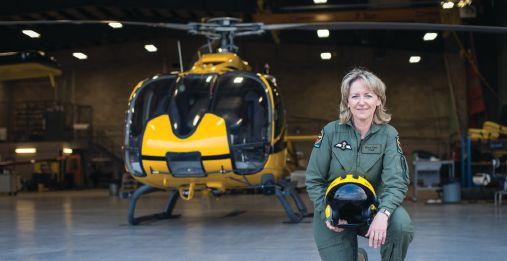
Captain, Royal Canadian Air Force, Cold Lake, AB Thorgrimson, age 32, was posted to CFB 4 Wing Cold Lake in mid-2019 as a Medical Officer, before taking on her current role as a Flight Surgeon. 4 Wing holds Canada’s primary fighter jet fleet, as well as a rotary-wing SAR squadron, and a range of tactical and maintenance squadrons, as well as Canada’s world-class tactical fighter force training.
From Kenora, Ontario, Thorgrimson is a role model as a Metis person who is developing her expertise in aerospace medicine, supported by a BScH in astrophysics, MSc in quantum physics and completion of medical school and residency at the Northern Ontario School of Medicine.
“The military was the best avenue for me to pursue that goal and, in between medical school and residency, I earned my pilot’s license, which was a lifelong dream,” she explains, noting how rewarding it has been to serve in the military, which recently included a training mission in a CF-188 Hornet fighter, reaching 48,000 feet and pulling 7 Gs. Thorgrimson is currently working toward her CPL. Among a range of community involvement, including previous work with the Metis Nation of Ontario, Thorgrimson is the Director of the Canadian Society of Aerospace Medicine, a Board Member of the Federation of Medical Women of Canada, and Vice Chair for The Ninety-Nines, Sleeping Giant Chapter.
SANTIAGO
ARDILA Captain, Pacific Coastal Airlines, Vancouver, BC Ardila, age 25, discovered his passion for aviation at age six during a flight from Colombia to Canada, as his family immigrated to Vancouver. Just days after his 12th birthday, he joined 746 Squadron of the Royal Canadian Air Cadets and in 2013 earned his Private Pilot Licence (PPL). He became a Squadron Leader helping the next generation of Air Cadets, and continued to serve as a C182 tow pilot.
Working on his Degree at the University of the Fraser Valley, Ardila in 2016 started an internship as a Marketing Research Analyst with Vancouver’s TrainingPort.net. He completed his Commercial Pilot Licence (CPL) and Multi-IFR with Abbotsford’s Coastal Pacific Aviation and then landed his first professional pilot work with Pacific Coastal Airlines headquartered at VVR, becoming a Captain a little over one year ago, flying the Beechcraft 1900. “One of the things I love about Pacific Coastal is the ability to fly such a unique and great airplane out here on the coast,” Ardila says.
EMILY BRIDGES
Manager,
Engine
Programs, StandardAero,
Summerside, PE Bridges, age 33, began her career in the rail
sector overseeing a relationship with Bombardier, eventually becoming Planning and Production Manager to coordinate multiple facilities. Bridges in 2016 joined StandardAero’s Summerside facility, initially as a Customer Service Analyst, preparing account reconciliations and developing finance and customer dashboards for pay-by-the-hour programs. She worked with a third-party to build a VMAX customer community, automating tasks within Salesforce.
Bridges in 2019 was promoted to Program Manager to oversee StandardAero’s VMAX portfolio and other pay-by-the-hour programs. She is responsible for customer communications and ensuring the company meets customer commitments, identifing cost saving opportunities. In May 2021, she was promoted to her current role to lead a management team of six, including three people in PEI, one in Winnipeg, and three in Europe, with each responsible for four or five major customers, but ultimately working together to meet all needs.
LIANA BUESSECKER
Quality Assurance Supervisor, Cascade Aerospace, Abbottsford, BC
Buessecker, age 24, developed a passion for aviation through her parents who both worked for Canadian Airlines and subsequently Air Canada. Buessecker became an avid traveller and at age 17 volunteered at an orphanage in Cusco, Peru, where she would often spend free time sitting on a slope above the airport, observing how aircraft approach and depart at high altitudes. She studies aviation mishaps and disasters, motivated to improve aviation safety.
After graduating from SAIT’s AME program, and working for a local charter operator, Buessecker began an apprenticeship with Jazz Aviation in Vancouver and became a licensed AME. When she was laid off, because of the COVID-19 downturn, she returned home and joined the Calgary Flying Club to earn her PPL. “My instructor [Erin Sinclair] is an incredible pilot and she was very devoted to helping me learn,” Buessecker explains, who also received her float and night ratings, and continues toward a CPL. At the end of 2020, Buessecker joined Cascade Aerospace in Abbotsford as a Quality Assurance Supervisor/Auditor.
ALLISON COUCH
Corporate Pilot and Aviation Safety Manager, Coywolf Aviation, Toronto, ON Couch, age 30, two years ago left her job as a flight attendant with Emirates to follow her dream of becoming a pilot. In April, she completed the last day of Multi-Crew
Cooperation training, effectively wrapping up her Integrated Airline Transport Pilot Licence program with Brampton Flight Centre. “It is a strange time to have completed my training in the midst of a global pandemic, but I’m staying optimistic about the future,” Couch says. “I’ve been so fortunate to get a taste of real world flying on the Pilatus PC-12 NG.”
In addition to her five years with Emirates, based out of Dubai, Couch gained
TOP 40 UNDER 40
experience with Skyservice, Ornge and a Pratt & Whitney internship. Couch earned a Master’s degree in Aviation Management from Griffith University. She is involved in a range of programs promoting inclusivity in aviation, including The Ninety-Nines, Northern Lights Aero Foundation, Women in Aviation International, Elevate Aviation and the Urban Pilots Network.
SHELLY DE CARIA
Senior Director, Community Relations and Sales, Canadian North, Kanata, ON De Caria, age 36, joined Canadian North in 2013 and in May 2020 moved into her current position, leading the airline’s initiatives to support the well-being of the communities it serves, primarily focused on Indigenous peoples. Her lived experience as an Inuit beneficiary from Kuujjuaq, Québec, provides De Caria with insight into how the airline can develop its platform and programs. This became more critical with the recent completion of the integration of Canadian North and First Air following their 2019 merger.
At Canadian North, she developed a unique partnership with Canada Goose to distribute fabrics to northern craftspeople, which they can then use to make warm clothing for their families and preserve traditional skills. In addition to serving as a role model for Inuit women, De Caria is a member of the airline’s Women in Leadership group and also works closely with northern organizations supporting mental health, youth sports and suicide prevention.
SHARON CHEUNG
Director, National Programming, Canadian Owners and Pilots Association, Ottawa, ON Cheung, age 28, leads the national programing of Canada’s largest aviation association with more than 15,000 members. This includes helping to build a new safety program, connecting almost 1,500 pilots each month, and the recent launch of COPA’s drone pilot membership program, including insurance and regulation support.
Cheung joined COPA at the start of 2021 from NAV Canada, where she managed national stakeholder relations initiatives relating to RSC NOTAM, RPAS, space-based ADS-B, CFPS, level of service and airspace changes and aircraft noise. At NAV Canada, she received a President’s Award for supporting the deployment of Established on RNP-AR at Calgary Airport, a transformative separation standard and global first. Cheung is currently developing an inclusive mentorship program for pilots of all backgrounds, as well as a leadership summit to re-engage the large COPA Flight – local club – network.
MEGAN EVERS
Manager, Charter Operations, Canadian North, Calgary, AB Evers, age 32, was born into the world of aviation with her parents owning a skydiving drop zone at Pitt Meadows Airport. She attended the Business Aviation program at the University of the Fraser Valley, working toward a CPL. With school wrapping up, Evers took her first aviation job flying skydivers in a Cessna 206 and Cessna 182 in Beiseker, AB. She joined Canadian North in 2015 as a Charter Specialist followed by roles as Charters Account Manager (2016); Manager, Security & Emergency Response
(2017); and Manager, Imperial Oil & Charter Sales (2020).
In her current role, Evers leads Canadian North’s charter operations, which on a typical day carries 2,000 to 3,000 passengers. Evers played a key role in the Canadian North/First Air merger, supporting the harmonization of charter procedures. “There's just a great appreciation for all of the people who are in the background, making things happen,” Evers says, noting work is underway to bring on two 737-700s.
CHRIS FOLEY
Director of Maintenance, AirSprint, Calgary, AB Foley, age 37, graduated from SAIT in 2004 and began his AME apprenticeship with AirSprint, founded four years earlier. AirSprint today holds Canada’s largest fractional fleet of private aircraft. Foley was licenced with M1 and M2 ratings in 2007 and added to his skill set in roles like AME Crew Chief, Production Coordinator and Western Maintenance Manager.
Since 2015 has led the strategic direction of AirSprint’s maintenance department, implementing a range of processes and adopting new technologies. He played a key role in adding the Cessna Citation CJ3+ and Embraer Legacy 450 to AirSprint’s fleet. The Legacy 450 was a new aircraft type and category for AirSprint – and also the first of its kind in Canada. Earlier this year, Foley oversaw AirSprint’s first conversion of a Legacy 450 to a Praetor 500. The company’s Citation fleet now holds 11 jets with the June 2021 delivery of its fifth CJ3+, joining eight Embraer Praetor 500s/Legacy 450s.
NICK FRASER
Manager, Customer Service, StandardAero, Summerside, PE Fraser, age 37, joined StandardAero Summerside in 2004 as a Financial Analyst. In 2008, he became Parts Distribution Manager for the facility, responsible for over-the-counter part sales and the service centre network. In 2011, he was appointed Customer Service Manager to serve as the primary point of contact for customers during the engine maintenance process.
Fraser worked with commercial and military customers requiring the creation of financial forecasts, cost estimates and summary condition reports. In 2018, he was at the centre of the company’s sales process as Customer Product Manager. In 2020, Fraser, who earned his Six Sigma certification, was promoted to Manager, Customer Service, responsible for the supervision of the eight members of the CSM team plus the management of Summerside’s customer relationships as they relate to the entire engine MRO cycle.
DANIEL GUSTIN
First Officer, Air Transat, and Co-founder, Canadian Flight Trainers, Oakville, ON Gustin, age 30, was eager to get back flying for Air Transat as vaccinations increased and the company redrew its plans for a busy 2022 winter schedule. Gustin formalized his passion for teaching and aviation with the co-founding of a ground school provider called Canadian Flight Trainers (CFT), which focuses on online, accessible, and practical training for pilots preparing for their PPL, CPL or Instructor Rating, among others.
Gustin, who recently completed his first year in the Master in Education program at the University of Windsor, is intent on changing
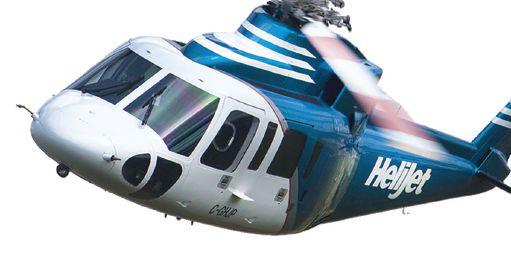
Our friend, Kyle Ferguson received his Commercial Helicopter pilot’s license at age 21. After gaining extensive rotary wing operations and flight experience nationally and internationally, Kyle moved to Vancouver in 2014 where he joined Helijet, the world’s largest helicopter airline. He has advanced rapidly within the company where he is now the Lead Captain for scheduled services, with all the responsibilities that come with that position – in addition to lots of flying. In his spare time, overachiever Kyle participates as an active member of the Vertical Flight Society, involved in Helijet’s work as part of the Canadian Advanced Air Mobility Consortium.
Kyle is keeping his eye – and Helijet’s – sharply focused on the present and future of the industry.
Congratulations from the gang here at Helijet International, Kyle!
Kyle Ferguson Lead Captain – Scheduled Airline Officer, Air Navigation Helijet International
TOP 40 UNDER 40
the way ground school is taught, by encouraging students to learn instead of just studying to pass exams. CFT aims to fill a gap between the theories of aviation and the safe practical application of skills. Gustin has been flying for more than 15 years since earning his PPL. He is one of a just a few dozen Class 1 Aerobatic Instructors in Canada, while also holding a Class 1 Instructor Rating on his ATPL, and serving as an A330 Simulator Instructor with Air Transat.
KRIS HANUS
President and CEO, Vmo Solutions, Halifax, NS Hanus, age 38, founded Vmo Solutions just over 11 years ago to develop flight operations software tailored to regional carriers. He earned his PPL as a teenager and built a successful and varied commercial pilot career, working with operators like V. Kelner Pilatus, Air Labrador, Trans Capital Air, Provincial Airlines (PAL), and eventually became a 737 First Officer with Sunwing.
Hanus from an early age also held a keen interest in computing and often found himself working closely with flight operations and IT at the airlines where he worked, helping to overcome technical challenges or sourcing software. He recognized a gap in the market for modern operational control software that is suited to leaner organizations with varied operation types. Hanus put flying on hold and built the first version of Vmo’s Web-based operational control software, called OC, which was was first implemented by PAL Airlines and later rolled out to other carriers across Canada. Vmo is nearing the completion a major version upgrade to OC, implementing new tools like payload predictions and past performances, as well as new interfaces.
STACEY JACKSON
First Officer, WestJet, Calgary, AB Jackson, age 37, engaged aviation at an earlier age through Air Cadets, where she earned both her Glider qualification and PPL. In the early part of her career, she piloted scheduled flights to many different Caribbean islands, specializing in perilous approaches to St. Barths and Saba. Jackson also flew for the United Nations, providing critical resupply and refugee evacuation flights throughout Afghanistan and South Sudan during its military coup in 2013/2014. She also piloted medevac flights in northern Ontario. Serving today as 737 First Officer with WestJet, Jackson spent the past two years revitalizing the Upper Canada Chapter of Women in Aviation, International.
Jackson is a recent graduate from Embry-Riddle Aeronautical University (BSc 2016 and MSc 2020) and uses her education to develop human factors training programs and contributing to improvements in human performance and aircraft accident investigation, analysis and prevention across Canada, as well as on a global scale through the International Federation of Air Line Pilots Association (IFALPA), where she also contributes to the President’s Committee for Diversity and Inclusion, as well as the IFALPA Female Pilots Working Group and Accident Analysis and Prevention group. Jackson is set to begin her doctoral research in this area in August 2021.
THOMAS KING
AME, Enterprise Airlines, and Co-founder, Northport Aviation, Oshawa, ON King, age 34, began his aviation career with Enterprise Aviation at Oshawa Executive Airport, joining the maintenance department to
help with its build of a Cessna 150 now used by the Durham Flight Centre. King privately earned his AME Licence, in addition to his PPL, as he continued to gain hands-on experience with Enterprise. He then started working full time as a mechanic travelling the globe for Enterprise on its geographic survey Baslers (Turbine DC-3).
After returning to the Enterprise hangar, King became type rated on the Falcon 20 for Air Nunavut and overhauled small piston engines for Enterprise’s flight school. In 2019, King cofounded Northport to develop a federally regulated airport just north of Port Perry on Lake Scugog. The team at Northport works on private planes and seasonal float changes, annuals, amid a range of general aviation needs. King is also working on his own projects like the build of a Cessna 170B and an experimental Super Cub.
TIMOTHY KROEKER
Vice President, Maintenance, Calm Air International, Winnipeg, MB Kroeker, age 33, was recently promoted to lead Calm Air’s maintenance operation. He has been working with Calm Air for 11 years, joining as an AME before becoming Reliability and Engine Manager, where he created a massive reliability program, essentially from scratch.
Kroeker was then promoted to Director of Maintenance Programs where he oversaw the implementation of Maintenance Operational Control to Calm Air. In early 2021, Kroeker took on his current role overseeing a team of around 100 people in the department. “We’re investing a lot of time into my team and helping them grow on their journey,” Kroeker says.
CAROLINE KOLASA-SCOTT
Captain, Air Canada, Vancouver, BC Kolasa Scott, age 39, holds more than 20 years of experience in aviation, working in a variety of roles before starting her dream job in 2019 as a Captain at Air Canada, flying the Airbus A320. She completed her flight training in both BC and Ontario. Her piloting experience also includes flying the Piper Navajo Chieftain, King Air B100, Cessna 208 Caravan, Beech 1900C and D, and Dash 8.
Kolasa-Scott actively shares her vast pilot experience as a mentor. In addition to providing discovery flights for Air Cadets, she continues to help lead the West Canada section of The Ninety-Nines as Scholarship Chair and has also served with the BC Coast Chapter. Kolasa-Scott has provided support through the BC Aviation Council, Canadian Women in Aviation and Elevate Aviation. She earned a Master of Science degree in Aeronautics from Embry-Riddle University in 2019.
KARL LOKEN
Stores Duty Manager, YYZ Hub, Air Canada, Mississauga, ON
Loken, age 32, began his career in 2007 with Air Georgian and, after a range of post-secondary programs, joined Sky Regional Airlines in 2013 as Lead Materials Coordinator, helping to build the young airline’s Stores & Material Control department at YYZ for the Embraer 175 transition from Air Canada. Loken at age 25 then joined Emirates in Dubai to help develop its
Materials Management Department within a new $120 million Emirates Engine Maintenance Centre, which supports the powerplant repair and overhaul for GE90 and GP7200 engines. Through Emirates he also completed a Master’s degree in Aviation Management.
Loken in 2018 returned home as Stores Duty Manager for Air Canada’s YYZ Hub, managing the logistics and supply footprint within the largest freestanding, uninterrupted commercial hangar span in Canada (Bay 5), built at a cost of $90 million. In 2020, his role at Air Canada expanded to include serving as Acting Regional Manager, SCM Operations at YYZ, as he oversaw a team of around 120 staff (pre-pandemic). Loken is also working toward his CPL and Multi-IFR rating. He has been a member of the Urban Pilots Network since 2007, serving on its board since 2019.
FRANCOIS-LUC JUTRAS
General Manager, LUX Ground Services, St. Hubert, QC Jutras,age 32, came to aviation from the banking industry, and, two years ago, helped develop the terminal operations of LUX Ground Services, a new Fixed Base Operator under parent company Chrono Aviation, itself a relatively young charter airline founded in 2012. LUX began its operations out of Montreal St. Hubert, YHU, with full ground handling, passenger and customs services, and partnerships with both Avfuel and WorldFuel. The FBO has now expanded to Mont-Joli, Port-Meunier and recently Quebec City Airport. The St. Hubert location also just completed a 45,000-square-foot hangar. LUX has tripled its number of employees, even in this difficult environment, and is now looking to expand in three provinces. LUX is also working with YHU authorities to become a designated airport and to attract commercial airlines in the short term.
JOSHUA MARTIN
BE20 Training Captain, Keewatin Air, and First Officer, WestJet Encore, Winnipeg, MB Martin, age 30, discovered aviation through his father, who, as an RCMP officer serving in Yellowknife, regularly accessed remote areas via airplanes. Martin at age five remembers joining him for a flight on a Twin Otter and being
hooked. After flight school, Martin dispatched at Keewatin for about a year before joining the flight line and becoming a First Officer with 200 hours – “diving right into the deep end” – and within a year and a half was upgraded to Captain, providing essential medevac services. Martin recently joined WestJet Encore to take a new direction in his career, but after being furloughed, because of the pandemic, came back to Keewatin to keep flying in a capacity he loves.
JIMMY OLIVER
PT6A Delivery Supervisor, StandardAero, Summerside, PE Oliver, age 34, began his career at StandardAero Summerside in 2006 as a PT6A Assembly Apprentice. Three months later, he was promoted to technician and, in 2008, started to lead his own build team.
The world’s largest independent MRO provider
With over a century of proven excellence, StandardAero has built a reputation as the industry leader and best place to work. Serving the most discerning clients and maintaining premier aircraft, the global StandardAero family takes pride in offering extensive MRO services and customized solutions through trusted service partnerships with our customers.
Christopher Albig, Emily Bridges, Nick Fraser, Cameron Mazurek and Jimmy Oliver embody the customer focus which is a hallmark of StandardAero’s 6,000 employees, and we are proud to see them included in Wings’ Top 40 Under 40. Congratulations to Cameron, Christopher, Emily, Jimmy, Nick and all of this year’s winners!
BIGGER. BETTER. BOLDER
TOP 40 UNDER 40
Oliver in 2009 was promoted to a Class 3 technician within the PT6A Final Assembly department and, in 2011, was selected to join the engine test group, where he learned how to test engines on the facility’s dynamometer test cell.
Two years later, Oliver was promoted to Lead Hand within the PT6A Delivery department, becoming the facility’s youngest Lead Hand at the time. Oliver in 2015 was promoted to PT6A Delivery Supervisor, working closely with the engineering department to troubleshoot any issues that arise during the PT6A delivery process. In addition to being a certified PT6A Engine Assembly Technician (Class 3, MRT Technician), Oliver has also completed AS9110B auditor training and Dale Carnegie leadership training.
SAURIN PATEL
Lead Hand, General Aviation, PropWorks Propeller Systems, Winnipeg, MB Patel, age 25, completed the AME program at Red River College in 2017. He landed his first aviation job as a baggage handler with Calm Air, but soon moved to Aero Recip, which provided the opportunity to work on engines, assemblies, testing and in the stores department. At the end of 2018, he joined PropWorks, which focuses on overhauling propellers and governors. “We have customers from all around the world, so I’ve been able to work on a range of propellers,” Saurin says. “They also do composite work which is the future of aviation, so I get great hands-on training.”
Saurin in 2020 was promoted to his current role and he now supervises six technicians with responsibilities for all aspects of propeller overhaul, as well as training new employees. Saurin also returned to Red River College to take its Business Analyst program on a part-time basis.
NISHANT RAO
Manager, Analysis and Aviation Business Development, Nieuport Aviation, Toronto, ON Rao, age 30, found his passion for aviation living in four countries and travelling to 32 countries before the age of 18. He graduated from UBC in 2014 and landed his first aviation job in mid-2015 with Edmonton International as an Air Service Development Analyst. At the start of 2016,
Rao move to Toronto and began a Pricing Analyst role with Porter Airlines, before joining Nieuport in July 2019 as Manager of Business Development. At Nieuport, which owns the Toronto City Airport (YTZ) Passenger Terminal Building, Rao focuses on working with airlines to create strategic connections and business opportunities.
In July 2020, he spearheaded a major pricing and capacity study to understand the impact of pricing structures on airline activity levels as it relateds to Nieuport and Toronto. Rao also developed a five-year aeronautical forecast to estimate passenger demand at Toronto City Airport from 2021 to 2025. He is Chair of Nieuport’s Environmental, Social and Governance Committee.
DAVID SADE
Vice President of Operations, Chrono Aviation Group, Ottawa, ON Sade, age 37, graduated from Georgian College’s aviation program in 2009 and completed his Master in Aviation Management with Griffith University. Sade began his career at Cargojet and had an internship with the Ottawa International Airport as a Response Centre Coordinator before joining First Air as a Flight Operations Quality Assurance Coordinator in 2011. Sade in 2013 joined Nolinor Aviation, taking on a number of roles from Assistant Director of Flight Operations and Director of Scheduled Operations to Technical Writer. He joined Transport Canada in 2017 as a Civil Aviation Safety Inspector.
In 2018, Sade joined Chrono Aviation, at the time an up and coming charter airline, founded in 2012, with a diverse fleet ranging up to 737-200 aircraft. The entrepreneurial leadership of Chrono and its scope of 702, 703, 704, 705 and part 129 operations was well suited for Sade’s scope of aviation knowledge. Chrono now is ramping up 737-800 aircraft to gain a range and payload advantage in an increasingly competitive market.
BARDIA SALIMKHANI First Officer, Wings Over Kississing, and President, Steinbach, Flying Club, Steinbach, MB Salimkhani, age 28, completed his Bachelor of Arts in Aviation at Providence University College, in Otterburne, Manitoba. In 2020,
he completed his Multi Rating and Group 1 IFR at Harv’s Air Service in Steinbach; and in March 2021 became a First Officer with Wings Over Kississing, where he began working as a Flight Booking Agent in 2019. Salimkhani is currently flying a King Air 100 to communities in northern Manitoba and Ontario.
For the past two years, Salimkhani has also served as President of the Steinbach Flying Club (SFC), which he joined in 2017. The initiatives and programs under his leadership have allowed SFC to more than double its membership, with three new aviationrelated businesses establishing operations at the airport, CJB3. The airport remained relatively active through 2020 with a 17 per cent increase in traffic and fuel sales when compared to 2019. Today, the most notable project he is focused on is a proposed eightacre expansion of the airport hangar, maintenance and related flight services.
JOHNATHAN SAWICKI Manager, Safety and Environment, Sunwing Airlines, Mississauga, ON Sawicki, age 30, completed his Bachelor of Management and Organization with a specialization in Commercial Aviation Management at Western University in 2012 and that same year joined Sunwing Airlines as Safety Coordinator. He progressed through the airline’s safety department with ever greater roles before becoming Aviation Safety Manager, at age 25, and, in April 2021, was appointed to his current position.
Sawicki is a member and volunteer with the National Gay Pilots Association and is recognized as one of Canadian aviation’s leaders in promoting LGBTQ2+ inclusion. In 2018, he was a founding member of Sunwing Airlines' employee-led diversity and inclusion committee You Are You! at Sunwing (Y.A.Y!), which has since rebranded and expanded as Sunwing’s Global Diversity, Equity, and Inclusion Committee and encompasses all of the company’s global entities.
DAVID SCHMIDT Senior Manager, Aerostructures
Engineering, Cascade Aerospace, Vancouver, BC Schmidt, age 35, completed seven years of
TOP 40 UNDER 40
post-secondary education at Carleton University with a Bachelor of Engineering and a Master of Applied Science, focusing on Aerospace Engineering. This included the opportunity to serve as an engineering intern with Viking Air assisting with flight testing and certification of its Turbo Otter conversion. Schmidt joined Cascade in 2011 and has been a key member on a number of marquee programs, including: C-130 operational and maintenance training simulators for the Canadian Air Force; C-130 avionics upgrades for the Mexican Air Force; auxiliary external fuel tank modification for a Q400; and, most recently, an avionics upgrade on Viking Air’s CL-415 and CL-215T aircraft.
Schmidt has also led all flight test programs at Cascade since 2013, flying as a flight test engineer and/or coordinating the test team as Flight Test Director. In April 2021, he was promoted to his current senior management role within engineering and now oversees a team of 20 engineers, carrying out all aspects of mechanical design, including prototype development, structural substantiation, production liaison, and in-service support for legacy products.
ANNA JULIA SIRGHIUTA
Customer Experience Specialist, PortsToronto, Toronto, ON Sirghiuta, age 28, founded Georgian Skies nearly four years ago while she was at Georgian College, pursuing a career in aviation after earning a Bachelor’s degree at the University of Toronto, while also working as a Flight Attendant with Air Canada Rouge. The initial mandate of Georgian Skies focused on supporting women in their pursuit of careers in Canadian aviation, but the group expanded to focus on greater inclusion and equality, aiming to provide direct peer support for anyone on campus who felt different.
The college recognized the group’s importance by awarding Sirghiuta with its Changemakers Award. Georgian Skies continues to build itself as a mentoring program, which now stretches outside of the campus to support diversity across the aviation industry, with the college also committing to continue the program when school returns to more normal conditions. The Georgian Skies executive was taken over by a new cohort of students, but Sirghiuta remains involved in helping to steer its important work for diversity and inclusion. In late
2018, she joined PortsToronto as a Customer Experience Specialist.
RYAN VAN HAREN
Founder, Cardinal Aviation, and Chief Pilot, Onni, Pitt Meadows, BC
Van Haren, age 36, founded Cardinal in 2018, as he worked full time as an Air Traffic Controller, to promote proficiency and safety among GA pilots. His 11 years of commercial flying experience and seven years of ATC provided a unique perspective to share with clients of all skill sets. Cardinal is now a fulltime operation with a team of more than 12 pilots, coaching on everything from piston aircraft to Turbine TBMs.
Van Haren started his career by flying Twin Otters for Kenn Borek in the Canadian Arctic, followed by work with Northern Thunderbird (B350 and B1900) and Helijet (Learjet for medevac) before moving to corporate jets with Onni for three years, which was then followed by NAV Canada as a Terminal Radar Controller. Van Haren also helped start the not-for-profit BC General Aviation Association.
In May 2021, Van Haren rejoined Onni to serve as its Chief Pilot and Aviation Manager, which includes the opportunity to fly a Gulfstream GV. “I’m honestly more excited about running the department and creating a collaborative and forward-looking culture than I am about the airplane,” Van Haren explains.
JAMES WONG
Vice President, Cargo, and Sales, Menzies Aviation (Canada), Toronto, ON Wong, age 39, graduated from SAIT’s avionics program and he also earned a Bachelor of Business Administration, which followed his earlier pursuit of aviation through the Air Cadets, earning his PPL at age 16.
Wong joined WestJet where he worked in progressive roles for the next 10 years, eventually becoming Manager of Operational Performance in 2016. After then working with clearGRID, focusing on flight operations for data collection and analysis, Wong joined Menzies Aviation in mid-2019 as Station Manager for its YVR base. He soon took on responsibilities for
business development in Canada, leading 100 per cent growth of airport operations in Canada and significantly increasing Menzies’ partnership portfolio. Wong also collaborated with the company’s Americas business by supporting its air cargo interests. In his current dual role, which he took on in November 2020, Wong is a key leader in providing global airport logistics services for Menzies.
Wong is a member of the Toronto University Health Network Impact Board and is a pilot with the rank of Captain in the Royal Canadian Air Force CIC, committed to the ongoing development of Canadian youth in the Air Cadets program. He is also a small business owner with a focus on training of motorcyclists across Alberta.
AMR YOSRY
First Officer, Calm Air International, Thompson, MB Yosry, age 30, immigrated to Canada from Egypt in 2010 and earned his Bachelor of Mechanical Engineering in the field of Aerospace and Propulsion in 2016. During this time, he started flight training and completed his licences with Cargair Flight Academy to become a commercial pilot in 2017, which is the same year he joined Collins Aerospace as a Certification and Airworthiness Program Engineer. In this role, he was embedded with Bombardier in Montreal to help with certification programs on its business aircraft.
“Seeing how everything was integrated was a massive opportunity to witness from an engineering and flying prospective,” Yosry says.
Yosry has now been at Calm Air for close to two years, leveraging the company’s extensive program designed to train lowhour pilots, joining the company as soon as he reached 250 hours. He moved from Montreal to Thompson, Manitoba, where the airline holds one of its key bases as a gateway to the north. He is flying the ATR 42 and 72, with most of his time spent on the latter larger aircraft for its ability to carry up to 15,000 pounds of cargo. “We fly in very rough and remote areas and having that experience at a young age is huge,” Yosry explains, thinking like a pilot, describing the advantages of working with Calm Air, flying into the Arctic with gravel and icy runways, sometimes with landing weights close to 45,000 pounds in low visibility. | H
COLUMN
Together we are stronger
Just when you thought it was safe to go back in the water
Iknow that many of us have been so preoccupied with the COVID-19 pandemic, and its effects, that it’s hard to focus on anything else. The distribution of vaccines in Canada and the United States seems to be proceeding reasonably quickly at this point, and we are seeing signs of life in some markets.
You might understand how someone could forget that there are other regulatory issues percolating away in the background. One of those issues is the new Fatigue Management Regulations, which are scheduled to come in to force for our industry segment on December 12, 2022.
Well, heads up – It’s time to focus on the regulations, again. “But these regulations have been passed into law, with an in-force date of December 12, 2022. What’s the point?” you say? Well first of all, spending more than 30 years as a lobbyist in Ottawa has taught me “It’s never-over-til-its-over.”
In spite of my own painful experience during the flawed consultation process on these new regulations, I believe that there is still value in opposing the new regulations. Helicopter Association of Canada (HAC) has achieved a number of concessions during the consultation process, which concluded about five years ago. These concessions include the exclusion of Aerial Work Operations from the applicability of the new rules; the exclusion of helicopters from the sector-limits that are applicable to CAR 705 operators; and the inclusion of split duty
continue the fight to oppose them. To be clear, these new regulations, will be devastating for our industry in their current form.
Applicability of any regulation is always key understanding its effect. These new Fatigue Management Regulations will not be applicable to Aerial Work operations, which is a good thing, to be clear, but we all know that any given pilot may switch between CAR 702 and 703 operations multiple times in the same day. Unless the flight crew member is exclusively dedicated to CAR 702 operations, the crew member will have to comply with the new, more conservative regulations.
I urge you to consider that impact of the new regulation on your operations – particularly as it relates to Tour Lengths; the absence of the zeroing provisions; and the new Cumulative Duty Hour provisions in the new regulations.
Transport Canada will soon start to focus on implementation issues for affected industry segments. Please also take a moment to consider the “stacking effect of the new regulations” in your operation. or example, consider the combined effect of the new cumulative Duty Hour limits when combined with the new 14-day tour length; or the new cumulative flight time limits when combined with the new Cumulative Duty Day limits. Bluntly put, for medium-to-high flying jobs, operations may be so constrained, it could be necessary to doublecrew a single-engine aircraft in deployed operations.
In conclusion, the pandemic has been hard on our industry and the new rules will make matters worse. We have argued they have gone way too far. I have often said, “As the industry goes, so goes its industry association. HAC has seen a drop of roughly 25 per cent in operator membership and associate revenue in its 2021-2022 membership year, beginning September 1, 2021.
The pandemic has been hard on our industry and new Fatique Mangement Reglations will make matters worse. ‘‘ ’’
provisions, to name a few.
The recent change of Federal Transport Ministers and a looming Fall election may present some opportunities for HAC to influence the course of these regulations insofar as our industry segment is concerned. There are a number of tools that Transport Canada could use to make this occur, if there is a will to do so from the government.
A number of members have contacted HAC to ask whether they should be proceeding to modify their Fatigue Management software to contemplate the new regulations. Like any good lawyer, I consistently respond “That depends”. It depends largely on us and our resolve to
Only with the assistance of our members can we hope to influence the final impact of these regulations. We’d like to take the opportunity to thank the operators and associates who have renewed their memberships this year, and we would like to urge those operators and associates who have not renewed – or who are not members – to contact HAC to join/rejoin without delay. Does the level of support that HAC receives from its operators and associates affect our ability to influence change? Absolutely. Together we are stronger. | H
Fred Jones is President and Chief Executive Officer of the Helicopter Association of Canada.
FRED JONES
RELY ON.
It’s no surprise the H145 is the helicopter of choice for rescue missions. Whatever mother nature throws at you, it can bring help to where it’s needed. Compact and versatile, it provides outstanding ight performance under the most extreme conditions. Reliability. We make it y.