








JON ROBINSON, editor
Joby Aviation in December 2020 reached an agreement to acquire Uber Elevate as part of a larger transaction that sees the parent company of the latter, Uber Technologies, invest another US$75 million into Joby. Uber previously made an undisclosed US$50 million investment in Joby as part of a Series C financing round in January 2020. Full financial terms of the acquisition were not disclosed, but the transaction speaks to the ongoing push to develop vertical-lift aircraft with revolutionary electrification – hybrid or full – propulsion.
Joby is developing a four-passenger, plus pilot, eVTOL, with the goal of operating an air-taxi service as early as 2023. Founded in 2009 and headquartered in Santa Cruz, California, Joby has raised US$820 million in investment to date and employs more than 500 people. The company projects building an electric aircraft that reaches 150 miles on a single charge with a top speed of 200 mph.
A key part of the transaction will see the two parent companies Joby and Uber integrate their respective services into each other’s apps, with the goal of integrating ground and air travel for future customers. Established in 2016, Uber Elevate played a significant role in laying the groundwork for a potential aerial ride-share market by bringing together regulators, civic leaders, real estate developers and technology companies around a shared vision. Several technology plans, including eVTOL aircraft, hardware and software, were announced at what were initially annual Uber Elevate conferences.
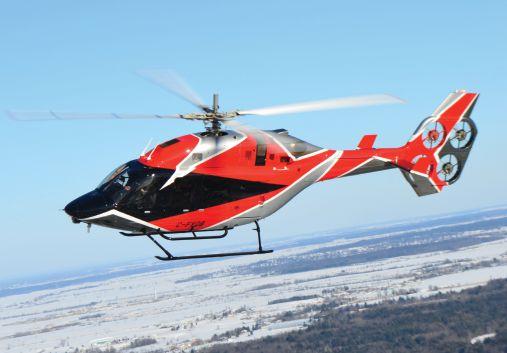
Bell’s Mirabel facility is also pushing the envelope of Remotely Piloted Aircraft Systems, which in January included running flight tests for the first alternate configuration of the company’s Autonomous Pod Transport (APT). The testing was conducted on December 11 at Mirabel in collaboration with ARA Robotics. Bell explains the alternate platform operates with the same architecture and propulsion system of its tail-sitter aircraft but utilizing a different airframe. The purpose of the project, according to Bell, was to explore variations in the design and evaluate changes in performance, autonomy and user interactions. This technology demonstrator is co-funded by the Canadian Technology Demonstration Program (TDP). The Canadian government is also playing a significant funding role in EDAT development, as both programs collectively complete hundreds of test flights to mature the platforms in preparation for commercialization.
Airbus Helicopters in January updated in-flight tests being performed on board its Flightlab demonstrater, described as a platformagnostic flying laboratory dedicated to maturing new technologies. Airbus explains Flightlab provides an agile and efficient testbed to quickly test technologies that could later equip Airbus’ current helicopter range, and even more disruptive ones for future fixed-wing aircraft or eVTOL platforms.
Uber Elevate played a significant role in laying the groundwork for a potential aerial ride-share market.
Pushed by the attention afforded to Uber Elevate, most major helicopter manufacturers moved from watching the eVTOL revolution to building their own platforms for vertical-lift electrification. Nowhere has this been more evident than in Mirabel, Quebec, where Bell Textron Canada is playing a lead role in the transformation.
In December 2020, this effort was showcased with the public debut of its Electrically Distributed Anti-Torque (EDAT) system (see page 12), which will not be market-ready for several years, but at the same time serves as a precursor to the hybrid-electric potential in commercial-grade helicopters.
Airbus intends to leverage its Flightlab demonstrator to explore autonomy and other technologies aimed at reducing helicopter sound levels and improving maintenance. Flightlab tests actually started last April when the demonstrator was used to measure helicopter sound levels in urban areas and to particularly study how buildings may affect people’s perception. First results show that buildings play an important role in masking or amplifying sound levels, explains Airbus, and these studies will be instrumental when the time comes for sound modelling and regulation setting, especially for UAM initiatives – from where the electrification of vertical lift is sure to be driven.
Flightlab tests this year will include an image-detection solution with cameras to enable low altitude navigation, the viability of a dedicated HUMS for light helicopters, and an Engine Back-up System. Testing will continue in 2022, explains Airbus,. to evaluate a new ergonomic design of intuitive pilot flight controls intended to further reduce pilot workload, which could be applicable to traditional helicopters as well as other VTOL formulas such as UAM. | H

Airbus’ new five-bladed H145 helicopter has received its certification from Transport Canada Civil Aviation (TCCA), following both European (EASA) and American (FAA) certification in 2020. The first five-bladed H145 delivery in Canada is scheduled to take place in mid-2021 to STARS Air Ambulance, with an additional order from a multimission operator being placed at the end of last year.
This Type Certification covers the full range of capabilities, including single-pilot instrument flight rules (IFR) and single engine operations (Cat.A/VTOL), along with night vision goggle
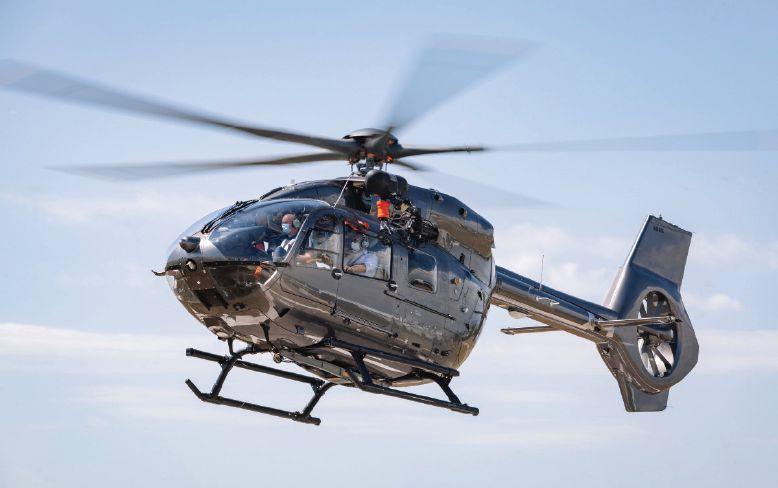
capability. This latest version of the H145 family adds a new, innovative five-bladed rotor system to the multi-mission H145, increasing the useful load of the helicopter by 330 lbs (150 kg).
The new bearingless main rotor design, explains Airbus, will also simplify maintenance operations, further improving the bench-
mark serviceability and reliability of the H145, while improving ride comfort for both passengers and crew.
Particularly well suited to high-altitude environments, the H145 set its skids down during a test campaign on the Aconcagua, the highest mountain in the Southern hemisphere, further
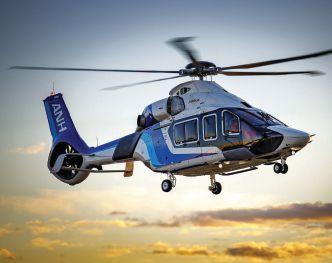
All Nippon Helicopter’s H160 performed its first flight test, a 95-minute flight at the Marseille Provence Airport, paving the way for the aircraft’s entry into service in Japan. ANH deploys a helicopter fleet comprising six AS365s and five H135s for electronic news gathering for the TV stations across Japan. This H160 will replace one of its AS365s.
The H160 was granted its Type Certificate by the European Union Aviation Safety Agency (EASA) in July 2020, with the certification from the Japan Civil Aviation Bureau (JCAB)
expected in early 2021. Upon delivery of the helicopter, specialized equipment installation and customization will be performed at Airbus Helicopters’ Kobe facility, before its entry into service.
Japan’s electronic news gathering market is a mature market with 87 helicopters dedicated for such missions today. Close to 70 per cent of these helicopters are manufactured by Airbus, with the H125, AS365, H135 and H155 platforms commonly used by the operators. With the imminent introduction of the H160, which is equipped with additional safety
proving its capabilities even in harsh conditions. Powered by two Safran Arriel 2E engines, the H145 is equipped with full authority digital engine control (FADEC) and Airbus’s own Helionix digital avionics suite. It includes a high performance 4-axis autopilot, increasing safety and reducing pilot workload.
features from the Helionix’s accrued pilot assistance, this helicopter will bring added leverage to the operator.
Bell Textron Inc. received the Supplemental Type Certificate (STC) for the Installation of QuantiFLY, a new aircraft communication unit (ACU) powered by Truth Data, offering a low-cost, lightweight, and fully automatic flight data monitoring (FDM) solution currently available for the Bell 407GXi and Bell 429. Bell developed QuantiFLY with Appareo and FDM analytics to enable operators to affordably use the data from QuantiFLY to be actionable and drive safety. The device utilizes cellular (4G LTE / 3G GSM) on the ground data transmission to offboard aircraft fight parameter and maintenance data via cloud for processing and analytics. Bell worked with Microsoft to build on its Azure cloud infrastructure to route data securely around the world. The data is then uploaded to Bell’s MissionLink, an off-board data platform that delivers intuitive analysis to customers. Bell collaborated with Truth Data on this project to provide a scalable flight data analysis platform and benchmarking capabilities to better identify safety issues and reduce operator risks. Coupled with QuantiFLY, this provides a completely automatic FDM service. Network regulatory and certifications include Verizon Network, Vodafone, CE, IC, FCC, RCM. QuantiFLY is offered as an aftermarket kit forward or retrofittable for legacy and new aircraft, analogue and digital through Aeronautical Accessories. QuantiFLY equipment features: Dual-core ARM cortex A9 processors, 512 MB DDR3L RAM, 32 GB eMMC standard storage, LTE CAT 4 cellular radio with 3G/2G fallback, Bidirectional communication, Bidirectional communication, 100BASE-TX 10/100 ethernet, Discrete I/O, RS-422, ARINC 429 RX (up to 10 Hz), Inertial measurement unit and GPS, Secure boot, Low power mode, Ultra-Low power sleep mode, and weighs less than two pounds.
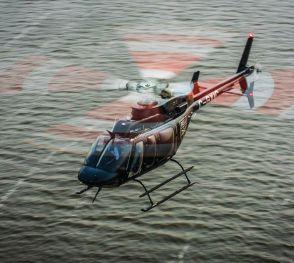
QuantiFLY is a new aircraft communication unit (ACU) powered by Truth Data for fully automatic flight data monitoring. (Photo: Bell)
HELICOPTERS MAGAZINE
Reader Service
Print and digital subscription inquires or changes, please contact Jay Doshi, Audience Development Manager
Tel: (416) 510-5124
Fax: (416) 510-6875
Email: jdoshi@annexbusinessmedia.com
Mail: 111 Gordon Baker Rd., Suite 400, Toronto, ON M2H 3R1
www.helicoptersmagazine.com
EDITOR JON ROBINSON jrobinson@annexbusinessmedia.com
MEDIA DESIGNER GERRY WIEBE
CONTRIBUTING WRITERS
DAVID CARR, KATHY FOX, FRED JONES, KENDRA KINCADE, CARROLL MCCORMICK, NATIONAL ADVERTISING MANAGER MENA MIU mmiu@annexbusinessmedia.com 416-510-6749
ACCOUNT COORDINATOR BARB VOWLES bvowles@annexbusinessmedia.com 416-510-5103
GROUP PUBLISHER, VP SALES MARTIN MCANULTY mmcanulty@annexbusinessmedia.com
COO SCOTT JAMIESON sjamieson@annexbusinessmedia.com
The Leonardo AW139 intermediate twin-engine helicopter will be the new Presidential Transport helicopter in the Republic of Colombia. The aircraft, in a special VVIP configuration, is expected to be delivered in spring this year and will be operated by the Colombian Air Force.
The supply of this helicopter will make the Colombian Air Force the first military customer of the type in the country and will expand the existing AW139 fleet in Colombia. The model has already proven successful for civil transport operations supporting the oil-and-gas industry, with five units in service used by prime operator Helistar S.A.S. The Presidential AW139 will feature an eight-seat configuration in the largest cabin in its category, including a self-defence suite that is typically integrated into other helicopters in the head-of-state transport roles.
Leonardo states the selection of the AW139 VVIP in Colombia confirms the company ’s leading role in the world’s VIP multiengine helicopter market with a 40 per cent share. It also grows the success of the type across Latin America for a range or roles, including VIP and offshore transport, law enforcement and public services. Describing the model as being successful in the global military market because of its performance in hot-and-high environments, payload, versatility and modern serviceability approach, the AW139M military variant is also being proposed by Leonardo to respond to the multirole requirements of the Air Force, Army, National Police and Navy in Colombia.
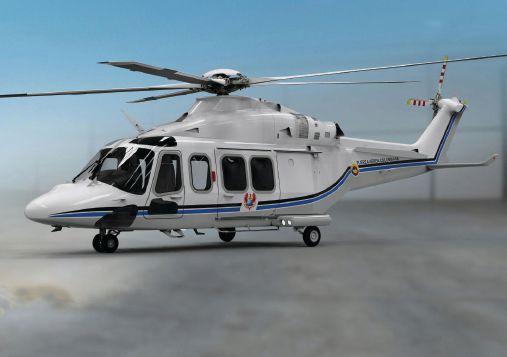
The AW139 has orders for nearly 1,200 units in over 70 countries, placed by more than 280 customers, with nearly 1,100 helicopters in service. (Photo: Leonardo)
With more than 400 civil and military helicopters in service in Latin America today, Leonardo is a major force in the rotorcraft sector across the region.
RETURN UNDELIVERABLE CANADIAN ADDRESSES TO ANNEX PUBLISHING & PRINTING INC., 111 Gordon Baker Rd., Suite 400, Toronto ON M2H 3R1
email: subscribe@helicoptersmagazine.com
Published four times a year by Annex Publishing & Printing Inc.
Printed in Canada ISSN 0227-3161
SUBSCRIPTION RATES
Canada - 1 year $31.50
USA- 1 year $74.00 CDN funds Foreign - 1 year $82.00 CDN funds plus applicable taxes www.helicoptersmagzine.com/subscribe
Annex Privacy Officer
Privacy@annexbusinessmedia.com Tel: 800-668-2384
Occasionally, Helicopters magazine will mail information on behalf of industry-related groups whose products and services we believe may be of interest to you. If you prefer not to receive this information, please contact our circulation department in any of the four ways listed above.
No part of the editorial content of this publication may be reprinted without the publisher’s written permission ©2021 Annex Publishing & Printing Inc. All rights reserved. Opinions expressed in this magazine are not necessarily those of the editor or the publisher. No liability is assumed for errors or omissions. All advertising is subject to the publisher’s approval. Such approval does not imply any endorsement of the products or services advertised. Publisher reserves the right to refuse advertising that does not meet the standards of the publication.
Helicopters is an associate member of the following Canadian aviation associations:


The first of 12 NH90 NFH naval helicopters and the first of 16 NH90 TTH overland variant took to the air from Leonardo’s Venice Tessera facility and Airbus Helicopters’ Marignane sites. Leonardo is responsible for the final assembly and delivery of the 12 NH90 NFH helicopters from its Venice Tessera facility, as well as acting as prime contractor for the overall program. The company is also providing a support and training services package for crews and maintenance technicians.
Acceptance of the first batch of NH90s by the Qatar Emiri Air Force is scheduled to start before the end of 2021, with the last helicopter planned to be delivered in 2025. Managed through the NHIndustries joint venture, the NH90 is the largest military helicopter program in Europe. Around 430 units are in service worldwide and the platform has logged over 270,000 flight hours in a range of weather and environmental conditions, over land and sea.
The Qatar Emiri Air Force’s

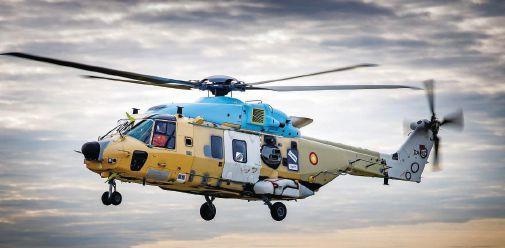
NH90 helicopter program marked a major milestone at the end of 2020 with first flights performed in Italy and France. The first NH90 NATO frigate helicopter (NFH), assembled at Leonardo’s Venice facility, and the
first tactical troop transport (TTH) over-land aircraft, assembled at Airbus’ Marignane site, both took to the air in mid December. The flights allowed crews to evaluate general handling and basic systems.
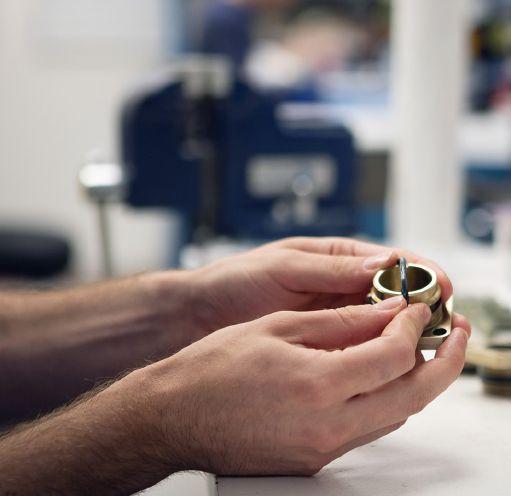
Bell has delivered more than 1,100 412 helicopters across the globe, logging over 6.5 million flight hours. Since the introduction of the Bell 412 in 1981, Bell has developed 11 different variants, the latest being the recently unveiled Subaru Bell 412 EPX. Bell explains the evolution of the 412 is a testament to the incredible flexibility and durability of the aircraft, a utility helicopter with designs originating from the Huey.
Bell explains the 412 platform today carries operators through parapublic, offshore, emergency medical and VIP missions every day, from moving employees to oil rig sites off the coast of Africa, to fighting fires in Australia, to presidential duties in Asia.
The most advanced version of the platform, the Subaru Bell 412EPX, now has an increased maximum internal weight of 12,200 pounds, and an external weight of 13,000 pounds and can carry up to 5,000 pounds of goods with a cargo hook. Having the widest loading door in its class enables quick unloading and loading into a cabin that seats 14 passengers. As a joint partnership between Bell and Subaru to support the Japan Ground Self Defense Force, the Subaru Bell 412 EPX benefits from a more robust main rotor gearbox that has 11 per cent more horsepower capability. It has been certified to run without oil (run dry) for up to 30 minutes for improved safety along with other evolutionary features.

Airbus Helicopters Canada delivered two new twinengine H145 helicopters to STARS, the physician-driven non-profit helicopter air ambulance organization serving Western Canada. The deliveries are part of STARS’ multi-year fleet renewal program for nine new helicopters. The four remaining helicopters to be delivered will arrive in the new five-bladed configuration, beginning later this year.
STARS’ H145 helicopters, fitted with helicopter emergency medical service (HEMS) interiors, will support operations by providing a safe, rapid, highly specialized emergency medical transport for the critically ill and injured, many of which are located in rural areas. The H145 was chosen following an extensive competitive process, explains
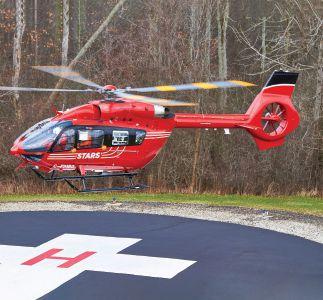
Helicopters Canada delivers two new twinengine H145 helicopters to STARS.
Airbus, based on its advanced technology, safety features, and strong HEMS heritage. Offering the largest cabin in its class and payload, Airbus explains the H145 is well suited for STARS’ mission requirements. | H

GUY GRATTON
Charles “Chuck” Yeager, who has died aged 97, epitomized the test pilot of the 1940s and 1950s. A fighter pilot hero of the Second World War and later Korea, he was dashing, loyal and supremely skilled. Yeager – along with his friend Bob Hoover – was one of the last of a generation of larger-than-life test pilots, usually former fighter pilots, who traded on their bravery and skill, rather than perhaps their scientific knowledge and teamwork.
It was a risky job and many died. British pilot Geoffrey de Havilland Jr. died when testing his father’s company’s tailless DH 108 Swallow in September 1946, after it went out of control and broke up over the Thames Estuary. Valentine Baker died in 1942 testing his company’s MB3 aircraft, leading his business partner, Sir James Martin, to refocus on making ejection seats.
But the next generation of test pilots were different. Almost always university graduates, they worked in increasingly large and complex teams, generally alongside a much less well known but equally important flight test engineer, with many moving between these two pivotal roles. The first of these were typified by two contemporaries: American Neil Armstrong, who became the first man to walk on the Moon; and Briton Eric Brown, who was the first pilot to take off and land from a carrier in a jet aircraft. He conducted 2,407 aircraft carrier landings and flew 487 types of aeroplane – more than any other pilot to date. One of the post-war greats was John Farley. An engineering apprentice turned fighter pilot and later test pilot, he led much of the test flying of the
This means flying precise conditions and taking measurements and observations of everything from speed and altitude to the behaviour of complex internal systems. They might be doing that on their own, or in conjunction with a crew, both on board and on the ground with instruments connected to the aircraft by telemetry.
When Chuck Yeager flew the Bell X-1 in 1947, the whole program was owned by the engineers. The test pilot would be brought in very late in the process, when the aircraft was nearly ready to fly. Today, the role is very different, with test pilots often involved in planning flights from the early stage, influencing cockpit and procedure design, and testing prototypes in flight simulators long before a physical aircraft takes to the skies.
That might sound as if they could go years without actually flying, but test pilots will work across multiple programs, some totally new, some more mature. This is why test pilots must maintain the expertise required to understand and pilot not one but many aircraft.
Yeager and his contemporaries would have been very familiar with that. Then, as now, most pilots qualified on very few types of aircraft. But a test pilot needs a wide range of experience to be able to provide their skills to different research programs, and to offer insights from comparison between them.
When Chuck Yeager flew the Bell X-1, the whole program was owned by the engineers.
UK’s successful Hawk and Harrier aircraft, and performed flying displays at Farnborough which are still legendary.
Many others are relatively anonymous. Few outside of the industry have heard of Canadian test pilot Billie Flynn, but he has test flown and often displayed almost every major fighter of the last 30 years.
First and foremost these men and women are pilots, capable of flying new, modified and often not yet fully understood aircraft. They must also be research engineers, because while flying that aeroplane (or helicopter, airship or spacecraft) they must be able to conduct experiments with it.
How does somebody become a test pilot today? Not starting as a fighter pilot, but typically as an aerospace, electronic or mechanical engineer. Those who will become the most senior test pilots are then likely to join one of the military services, commanding several aircraft types and rated as highly skilled fliers. They are then eligible to apply for a place at one of the world’s eight test pilot schools, for which they’ll need their government’s generous funding – fees for the one-year course are at least US$1 million. Here they learn the fundamental skills and theory of test flying on a dozen or more aircraft types and, after graduating, go to work at a national military flight test centre.
The test pilot role has changed since Yeager set stunning records in the 1940s, but it has also stayed the same. Every new or modified aircraft or spacecraft will require pilots to first take to the skies and often take considerable risks, so that flight crews and their passengers never need to. | H
This column was originally published by The Conversation. A Chartered Aeronautical Engineer, Guy Gratton is Visiting Senior Research Fellow, Brunel University London.

KKAY WACKWITZ
ay Wackwitz, CEO and co-founder of DRONEII, outlines 10 of the most-important developments to take place in the global commercial drone industry in 2020 (shared here in part). An aeronautical engineer with more than 19 years of experience in manned and unmanned aviation, Wackwitz’s full report can be found at Droneii.com
1. Cyber vulnerabilities – Starting in 2017, drones from Chinese manufacturers were banned from U.S. government departments like the DoD for potential cyber vulnerabilities. In January of 2020, the U.S. Interior Department grounded its entire fleet of more than 800 drones based on the fact that most, if not all, of the drones contained Chineseowned components. Whether the Chinese drone ban will be lifted completely or to a certain degree in 2021 under the Biden administration is unknown at this point.
2. Fighting the Coronavirus – Drones supported efforts to curb the spread of the coronavirus, including the use of spraying drones to disinfect highly populated areas in cities. Drones were also used to enforce quarantine/social distancing via built-in speakers. Drone delivery picked up massively, delivering tests or medical devices... The technology proved capable, the regulators proved to be permissive, and citizens proved to be open-minded.
3. Record Funding – Despite all the turbulences in 2020, the trust in the drone market continues to grow. Another record year in terms of Venture Capital investments and programs proofed that unmanned technology is making an impact and – most notably – is here to stay. In
entered into a definitive agreement to acquire FLIR in transaction valued at approximately US$8 billion.)
5. Indoor Surveillance – Amazon subsidiary Ring announced in October that it will offer a flying indoor security drone in 2021. Users will be able to program the system to make frequent checks or control it manually. It will have night vision for poor light conditions and will fully integrate with Ring’s existing security systems like door alarms.
6. Payload 2.0 – Today, multi-sensor payloads are quite common to the commercial drone market (e.g. E/O+IR sensors) but combining a LiDAR scanner and an optical camera in a very small and very light payload is a remarkable step forward. In October 2020, DJI presented the Zenmuse L1 sensor for their Matrice and Terra platform.
7. Disruption Squared – In September 2020, Equinor reported, that in a one-hour flight from Mongstad base to the Troll A off-shore oil platform in the North Sea, an additively manufactured spare part was delivered by a Camcopter S-100. What’s amazing about this incident? A spare part no longer manufactured was replicated and transported along a dangerous shipping route at a small ecological footprint and at a very high speed.
8. Standards and Regulations Improved – In general, it can be said that most countries have established a solid regulatory framework for drones. However, interpreting and ensuring compliance with these rules is a challenge for companies using drones. New standards representing an “applicable means of compliance” were introduced in 2020 to help overcome these hurdles. Standardization bodies like ASTM, EUROCAE and ISO should be mentioned in this context, which published both technical and procedural standards.
The technology proved capable, the regulators proved permissive, and citizens proved to be open-minded.
2020 alone, passenger drone manufacturer Joby Aviation raised US$665M in two rounds, Skydio raised US$100M, delivery drone manufacturer and service provider Volansi raised US$50M, drone service provider Sensyn Robotics raised US$20.5M, and drone software company Propeller Aero raised US$18M in a Series B funding round.
4. Strategic Acquisition of FLIR Systems – The U.S. drone maker Altavian was acquired by thermal camera giant FLIR Systems in Dec. 2020 for an undisclosed amount. Altavian is one of the five drone manufacturers approved by the U.S. Department of Defense under the Blue sUAS program. (In January 2021, Teledyne Technologies then
9. UTM Partnerships – UTM software companies have fought for their clients for many years now. The lack of drone space regulation was the main reasons that made it difficult for them to have market access. In 2020, however, many National Aviation Authorities (like the Australian CASA, U.S. FAA, Poland ULC and Singapore CAAS) have partnered with private UTM companies to improve this situation. A highlight in this context is Switzerland which has a very advanced solution for future UAM traffic management..
10. Lightshows and fireworks – We saw a lot of activity in the drone-show sector, including 104 drones touring with Celine Dion, a Guinness World Record with 3051 drones in China and salutes to frontline COVID-19 workers, among others. Drone entertainment is clearly growing into a profitable business. | H
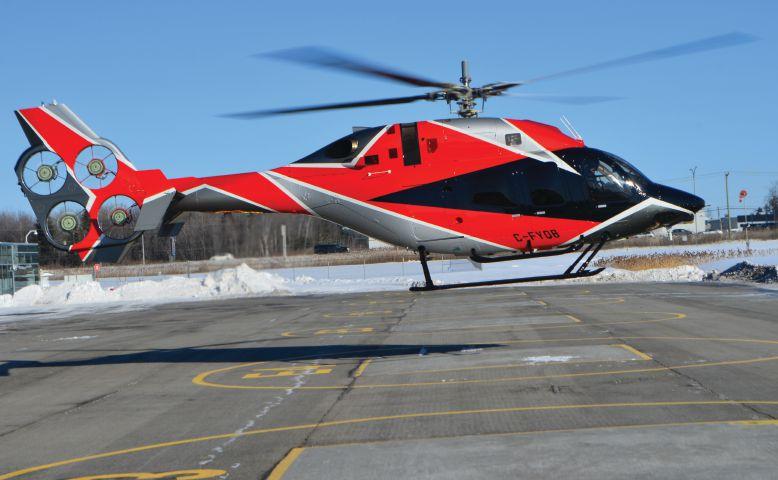
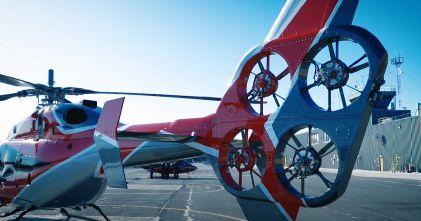
Featured on a 429 testbed, Bell’s Electrically Distributed AntiTorque system is composed of four small fans within a tail rotor shroud in an offset two-by-two pattern. (Photos: Bell)
BY JON ROBINSON
Bell Textron Canada at the virtual International Aerospace Innovation Forum, hosted by Aéro Montreal on December 14, 2020, held the first public display of its Electrically Distributed Anti-Torque system – “an unconventional tail rotor with innumerable opportunities.” A pathway to future hybrid or fully electric technologies for commercial rotorcraft, the system is being developed in Mirabel, Quebec, and is now fully integrated into a twin-engine 429 testbed.
The Electrically Distributed Anti-torque (EDAT) system is one shining result of a $49.5 million investment program initiated by the Government of Canada’s Ministry of Innovation, Science and Industry in mid-2018, through the Strategic Innovation Fund. The funding provided a consortium of 18 industry and academic partners, led by Bell Textron Canada, with means to develop energy-progressive technologies. The collaboration, at the time, was projected to create or maintain more than 300 jobs in Canada and contribute almost $178 million to Canada’s GDP over the next five years.
“EDAT represents what is possible with a shared private-public focus on innovation and green technology, and such investments reinforce Canada’s position as a global aerospace leader,” said Steeve Lavoie, president of Bell Textron Canada, during the December 14 virtual presentation. The company expects the technology will be commercialized in some form over the next five to 10 years, as it prepares to move EDAT from a demonstration phase into an optimization phase.
EDAT is composed of four small fans within a tail rotor shroud in an offset two-by-two pattern. Each of the rotors contains four blades, explains Bell, which are powered by four separate motors with the electrical energy provided through generators driven by turbine engines. Bell explains this design effectively reduces noise and offers lower operational and maintenance costs when compared to an aircraft with a conventional tail rotor. In terms of maintenance ease, cables replace the usual driveshaft and gearbox assembly, reducing complexity.
“It's not always about blockbuster innovation, but also incremental innovations that improve customer experience,” said Lavoie, hinting at Bell’s potential to leverage the EDAT program for other aspects of the vertical lift sector. The EDAT timeline has been relatively quickly, with testing on the system beginning by mid-2019, about a year after the government’s funding commitment.
“The goal of the project was to mobilize a strong Canadian Innovation Network to focus on five key emerging technologies: Alternate propulsion, autonomy and situational awareness, low-cost fly-by-wire, energy management and advanced anti-torque,” said Michael Thacker, executive vice president of innovation and commercial business at Bell, who also took part in the Aéro Montreal forum. He explained Bell has made progress in all of these areas, particularly testing technologies to support unmanned logistics operations for commercial applications, even as EDAT is the clear testbed highlight.
“EDAT explores electrically powered technology for traditional
rotorcraft and offers a glimpse into the future of rotorcraft,” said Thacker. “The results of this hybrid-electric aircraft have proven to decrease maintenance, and operating costs, enhance on-the-ground safety, minimize carbon emissions and reduce noise pollution.”
Bell notes EDAT throughout 2020 garnered interest as the first technology of its kind in the rotorcraft industry, challenging industry norms. During Aéro Montreal, Thuva Senthilnathan, Bell Canada’s program manager for commercial development programs, provided a technical overview of the EDAT demonstrator, as he stood in front of the testbed in Mirabel. “As many of you know, on a conventional helicopter, the tail rotor serves to counterbalance the force of the main rotor to provide directional stability to the aircraft on a conventional helicopter, as well,” he explained. “Pilots use their pedals to change the pitch of the blades in the back but can’t change the force applied. Well, EDAT controls work much in the same way. However, instead of changing blade pitch, the pedal position now controls the speed at which the fans are spinning, which in turn changes the thrust applied.”
Senthilnathan continued to describe many potential advantages of commercializing the EDAT system, pointing first and foremost to improved safety, particularly on the ground. “EDAT can be shut off while the main rotor is spinning on the ground, while you’re loading and unloading passengers,” he said. “In addition, you have a certain level of redundancy in the air – if one of the fans malfunctions, you still have the other three to take over.”
Senthilnathan also described the reasons why EDAT presents a lower noise signature when compared to a conventional tail rotor, particularly in forward flight with the fans spinning at lower RPM. “We worked with partners from around the world for the development of this project, from right here in Canada to the U.S. to all the way in Europe with Safran,” he said, describing how the project came to life so quickly and successfully. “Our teams worked extremely hard to go from a paper sketch all the way to a flying aircraft within a year. This type of effort really highlights the innovative spirit that is part of Bell’s culture.”
Development of the EDAT system with flight-test activities and envelope expansion are currently taking place at Bell’s facility in Mirabel, as the company looks to optimize the technology for commercial use. Bell explains it is dedicated to incorporating greener technologies for customers under the parameters of the Strategic Innovation Fund support. The Mirabel facility now stands as
one of the vertical-lift industry’s leading operations focused on electric and hybrid-electric capabilities. EDAT will remain at the forefront of these efforts as the company continues to measure its full potential and viable application for future commercial platforms.
“I think it has potential to potentially replace [traditional tail rotors]… There are benefits to the system that the conventional system just does not have innately,” said Eric Sinuas, Bell’s program director for light air-
craft, during a November 2020 webinar with Vertical Flight Society. He noted many conventional systems have reached maturity and new disruptive technologies are needed.
“We can successfully say that we have proven the concept. It works,” explained Sinuas. “And now we’re into the phase of optimization, and we’re fine tuning the performance characteristics, pushing the envelope further and really continuing to optimize the system.” | H



BY PHIL LIGHTSTONE
The primary purpose of an aviation Emergency Locator Transmitter (ELT) is to locate any aircraft in distress. In Canada, the process to manage a distress call was executed 1,032 times in 2017, saving 49 lives. In 2017, roughly seven per cent of the ELT activations were real.
In 2009 the international Cospas/Sarsat system abandoned monitoring beacons on 121.5 MHz, in favour of 406 MHz beacons.
Initiating the search and rescue (SAR) process occurs when one or many events occur, a flight plan is not closed, ATC or a high flyer hears a 121.5 MHz beacon, a 406 MHz beacon is seen by the satellites, or a Personal Locating Device (PLD) service provider contacts SAR. A study conducted by Defence Research and Development Canada reports that the search area of a 121.5 and 406 MHz ELT is 1,260 km and 13 km, respectively. Transport Canada reports that approximately 13,000 Canadian aircraft have legacy 121.5 MHz ELTs, but this number is decreasing slowly each year.
On May 31, 2013, a Sikorsky S-76A helicopter departed at night from the Moosonee, Ont., airport crashing less than a minute later. The Cospas/Sarsat system did not detect the helicopter’s ELT, however, as the on-board satellite tracking system recorded the departure and then went inactive. This prompted a search and rescue event, with SAR personnel finding the aircraft roughly five hours after the crash.
One of the TSB’s recommendations to Transport Canada was “the Department of Transport require all Canadian-registered and foreign aircraft operating in Canada, that require the installation of an emergency locator transmitter (ELT), to be equipped with a 406 MHz ELT in accordance with International Civil Aviation Organization standards (TSB A16-01).”
In November 2020, Transport Canada amended the CARs (605.38) mandating that 406 MHz ELTs be installed in all aircraft operating in Canadian airspace. The amendments apply to Canadian and foreignregistered aircraft operated in Canada, with a few exceptions.
Transport states the new, strengthened requirements will: Improve passenger safety by increasing the likelihood that the distress signals will be received; Enhance the efficiency of SAR operations by providing rapid and accurate position information; Reduce false alarms and the unnecessary deployment of search and rescue resources; Harmonize emergency locator transmitter requirements with international standards; and Respond to the TSB recommendation.
This set of strengthened measures requires Canadian commercial and business aviation to have one or more fixed ELT’s which transmits simultaneously on 406 MHz and 121.5 MHz installed no later than November 25, 2021 and all other in scope aircraft no later than November 25, 2025. 406 ELTs must be registered with the Canadian Beacon Registry (CBR). There are a number of exemptions: gliders; balloons; airships; ultra-light aeroplanes; gyroplanes; flight school aircraft do not require an ELT if their aircraft operate within 25 nm of the departure aerodrome; and skydiving operations when conducting parachute activities within 25 nm of the departure aerodrome.
There are a number of other exceptions, typically focusing on flight testing and new aircraft. Foreign registered aircraft operating in Canadian airspace must have either a 406 MHz ELT or portable 406 MHz beacon onboard by November 25, 2021. Penalties for non-compliance range from $1,000 to $15,000.
ELTs are designed to be independent of the aircraft’s systems, including the electrical system. ELTs have an internal battery, fixed antenna mounted on the top of the aircraft, coax cable between the ELT and antenna, a manual activation switch and a G activation switch (plus a 5 axis G switch for helicopters).
Options include a remote activation switch (typically installed in the cockpit), portable ELT antenna, internal GPS, combination GPS/ ELT antenna, and external GPS integration. Some ELTs with portable antennas are designed to be removed from the aircraft, activated and used as a survival ELT.
Most 406 ELTs either have an onboard GPS receiver or can be hardwired into an existing panel mounted GPS navigator. ELTs without GPS will deliver location accuracy to three kilometres within three hours,
while a 406 MHz ELT with GPS will deliver 100 metre accuracy within one minute.
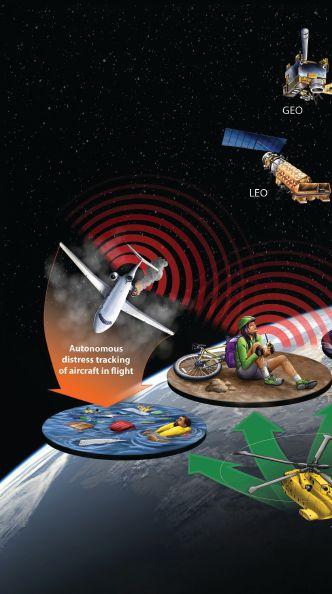
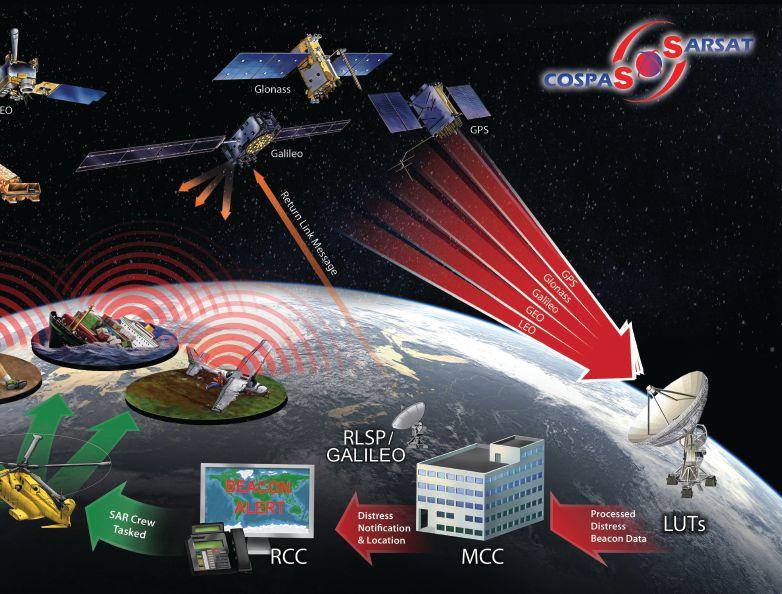
The Cospas/Sarsat system has three types of satellites (low, medium and high earth orbit), all receiving 406 MHz ELT signals. The new MEOSAR satellites will receive a 406 data burst and within minutes have a location fix to within 100 metres. The Cospas/Sarsat system has many layers of redundancy. If a mountain or bluff is blocking your view to the GEOs, then the MEOs and LEOs still have you covered. If a LEO isn’t directly overhead, the GEOs and MEOs have you covered.
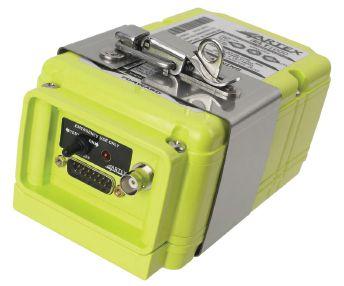
Manufactures like Artex, Kannad, ACK Technologies, Pointer, and Emergency Beacon Corp, produce 406 ELTs built to support the Canadian technical service orders. Artex have a number of ELTs designed specifically for helicopters (any model with a HM postfix).
Marc Medeiros, Vice President, Artex reports, “Helicopters are normally equipped with higher specification rod antennas, which can increase the cost of installations when compared to GA fixed wing aircraft that can be equipped with low-cost whip antennas.”
Further, helicopter ELTs differ from fixed wing ELTs in that they have a 5 axis G-switch, in addition to the single axis G-switch.
Helicopter 406 ELTs costs start at $3,500 (plus taxes and shipping) with installation taking a few hours (or more) of shop time depending upon the options and installation
complexity. For an average helicopter, a budget of $4,500 (plus taxes) would be a good start. Typical 406 ELT batteries require replacement every five years (versus two years on legacy 121.5 ELT batteries), which may vary based upon manufacturer.
Typical cost of battery replacement and testing is roughly $500, depending upon the manufacturer and the avionics shop. Interestingly, Artex will replace your Artex ELT if you ever use it in an emergency.
Effective August 1, 2019, testing requirements changed, requiring a performance test every two years and an operational test every 12 months. Two-year performance testing must be conducted by an avionics shop that has the proper ELT testing equipment. The annual operations test can be completed by the pilot/owner. During the first five minutes of any hour, press the ELT’s activation switch for no more than five seconds.
If your ELT is registered with the CBR, you will receive an email documenting the test. Don’t forget to place the test results into your technical logs and journey logbook. If you inadvertently activate your ELT, contact SAR or ATC as soon as possible.
Artex has Web-based testing tools, which allows avionics shops to test and record Artex ELTs (www.406Test.com) and a pilot/owner tool (www.406Link.com). The Transport Safety Board reports that they have found at crash sites, ELTs which were not properly installed. Adding a review of the ELT’s installation and an ELT test during the annual
LEFT: Canada is one of four founding nations, alongside 40 participating nations, leading the satellite-aided SAR system known as COSPAS-SARSAT. (Image: RCAF))
ABOVE: One of the newest ELTs from Artex, which provides Web-based tranining.
inspection would ensure that this valuable lifesaving technology is working properly.
Personal Locating Beacons (PLBs) utilize 121.5/406 MHz frequencies to communicate with the Cospas/Sarsat system and are registered with the CBR. PLBs are easily attached to your flight suite or belt, and remains off until required to summon SAR. As with an ELT, the on-board battery has a specific lifespan and must be replaced, typically every seven years.
The Artex PLB is about the size of a hockey puck, has an onboard GPS, 121.5/406 beacons, high intensity LED strobe light, waterproof to 15 meters and will operate for more than 24 hours when activated. This is a great “belts and suspenders” approach. Retail price is $406 (plus tax and shipping).
Beacon information held in the CBR is maintained by the National Search and Rescue Secretariat. Online access to the registry allows owners to register new beacons or update their information. You can add or update your information on-line, mailing or faxing a completed registration form or calling the CBR. The registration information must be updated annually or when the aircraft ownership changes.
Flight is an activity which balances risk, expertise, weather and hardware to deliver a successful flight. Affordable technology allows a well equipped helicopter and pilot to turn a SAR event into a positive outcome. Understanding the technology and ensuring that your ELT is properly installed and tested, backed up by secondary technology is not only good airmanship but fulfills the pilot’s responsibility to passengers, crew and their families. | H
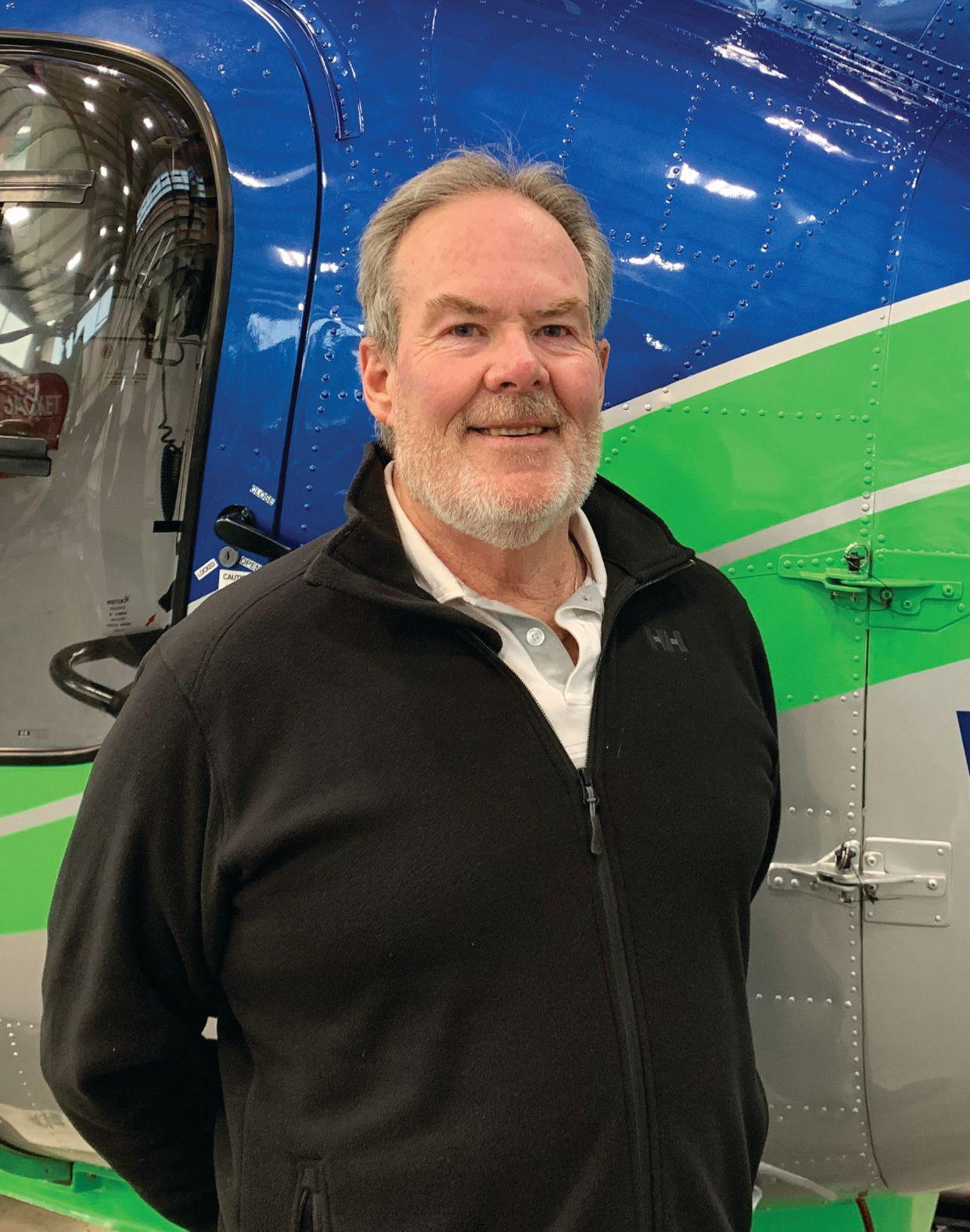
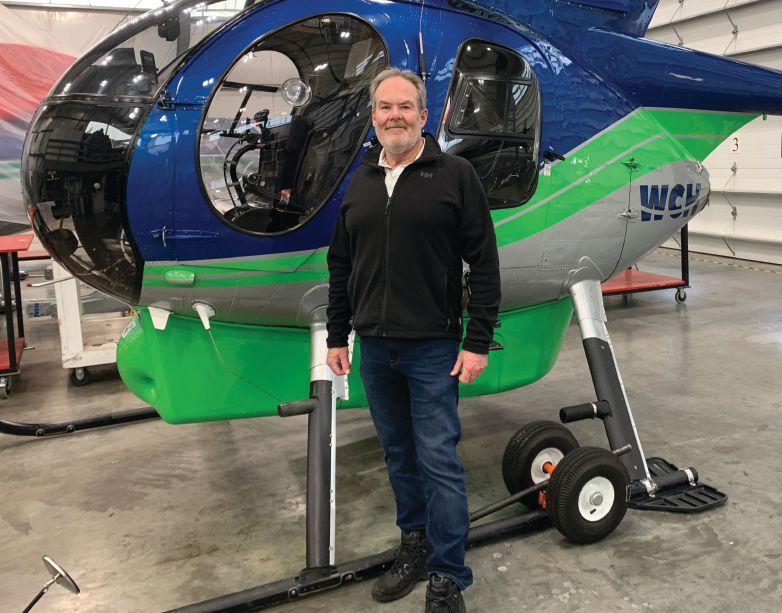
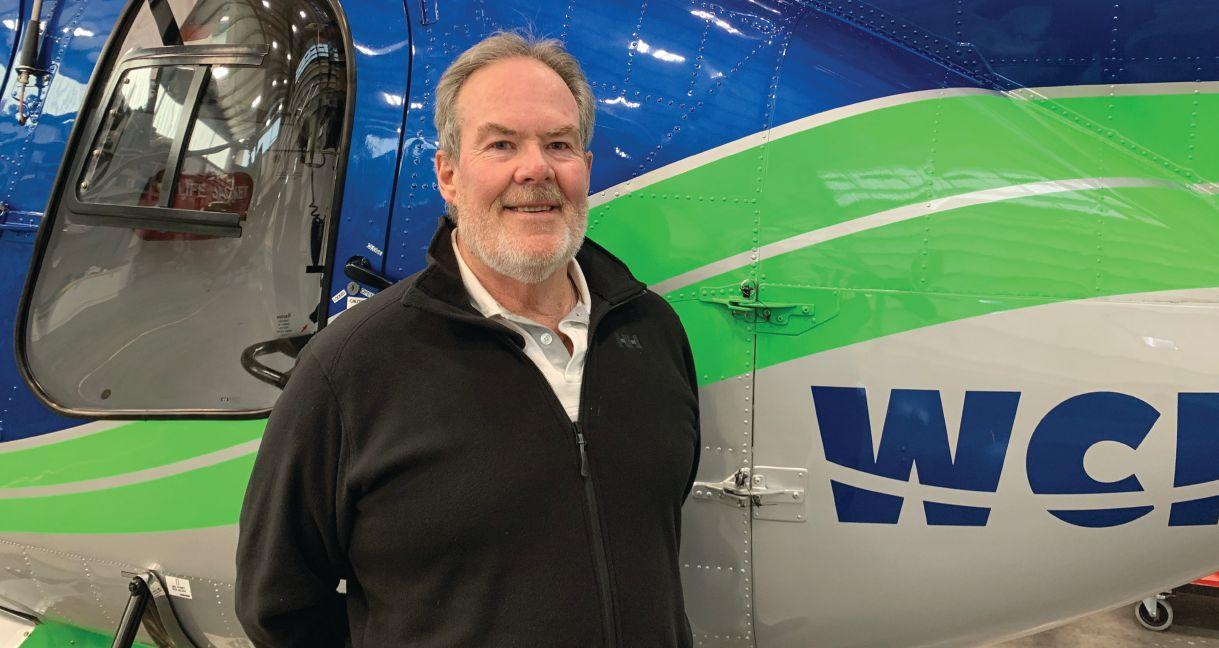
Mike Aldersey, the Port McNeill base manager for West Coast Helicopters, received the prestigious Agar Stringer Award by the Helicopter Association of Canada. (Photo: Kevin Kutzner
BY BINNY PAUL, LOCAL JOURNALISM INITIATIVE REPORTER, CAMPBELL RIVER MIRROR
t West Coast Helicopters’ office in Port McNeill, Mike
Aldersey and his team are excited. Aldersey has been named as the recipient of the Agar/Stringer Award – a coveted award bestowed by the Helicopter Association of Canada on select few Canadians for their outstanding contribution to the industry.
In his 42-year long career, Aldersey holds an impeccable record of over 30,000 accident-free-hours as pilot in command. But that didn’t stop him from being “shocked” when he found out he was getting an award.
“I didn’t even know I was nominated,” said the 65-year-old pilot, who lives in Courtenay, BC, when he is not at his Port McNeill office. “The past recipients of this award are some pretty impressive people in the Canadian helicopter industry so I feel quite humbled and quite proud to be considered to be in that league.”
But even for an industry giant like Aldersey, excitement comes along with existential troubles that online conventions bring along. As he prepared to accept his award – which was presented virtually on Dec. 1 – he had a few lingering questions.
“How are they going to do this online? Will they just announce my name? Do they expect a speech from me? I don’t know.” Either way, the 65-year-old kept a speech ready, just in case.
Aldersey grew up with aircraft zooming overhead in Trenton, Ontario. Living near an air force base was a strong influence on him as a 10-year-old boy. Even then, Aldersey knew that he wanted to fly in a bush environment as opposed to airline routes. And he got his wish. Aldersey has flown for air ambulance services, forest firefighting across the country, logging industry operations, tourism charters and heli-skiing adrenaline junkies.
He’s been a part of many exciting journeys, including wildlife surveys in the high Arctic, rescue missions, and medical evacuations among others. But forest firefighting is an experience that has been the closest to his heart.
“Supporting the forest firefighting industry is one aspect that I have quite enjoyed in my career,” he said.
That’s also because he can put to good use his specialty in vertical referencing – also called long-line work, which includes slinging loaded 50- to 200-foot length long lines from place to place.
Two trail blazing icons, founders of Okanagan Helicopters, inspired the creation of the Carl Agar/Alf Stringer Award for outstanding contribution to the Canadian Helicopter Industry. From time to time HAC bestows that Award upon someone who has followed their lead, including this year’s three recipients.
Mike Aldersey graduated from Canadore College in 1978, and started his career with Ontario Helicopters in Thompson Manitoba. Since then, he worked with Northern Mountain, Prism, Lakelse, and most recently with West Coast Helicopters. In 2020, he passed 30,000 accident-free hours. He has extensive long-line experience, mostly in the mining and logging industries, but he also has experience in the heli-skiing and forest protections sectors.
Tony Walker has provided safety awareness courses through his career on his own to important helicopter users. He trained as an AME at BCIT in 1987 and apprenticed with Delta. He learned to fly at Alpine with Jim Davies and started his flying career with Canadian. He’s flown in a variety of places including the Arctic, BC, Kuwait, and Iraq after the Gulf War. But most of his career was spent in BC’s coastal mountains. Walker was inspired him to start his own business and he designed a program to transfer safety knowledge between adults to teach recurring helicopter passengers the fundamentals of Crew Resource Management. He still flies as a contract pilot for CHL, but is primarily involved with his own company called Advanced Crew Solutions.
Terry Dixon started his helicopter career in the 1970s as a flight instructor before joining Okanagan, CHL, Western and Frontier, focusing on heli-logging, firefighting, heli-skiing, aerial construction. In 1984 he received the prestigious Start of Courage Award for conspicuous courage during the helicopter rescue of the survivors of a plane crash near Chilliwack, BC. Today, Dixon runs his own successful independent safety consulting service primarily for the BC and Alberta governments. He has now accumulated roughly 11,000 hours.
In 1978 he got his helicopter license from Canadore College in North Bay, Ont., and since then he has had the opportunity to work across provinces. But that also meant remote locations and 16 years of being away from home for almost 240 days a year.
His wife Paula was “extremely supportive,” and Aldersey makes it clear that without her, they wouldn’t have gotten far in his career at all.
Their family of five moved to Vancouver Island in 1993 and since then Aldersey has been the Port McNeill base manager with Prism and West Coast Helicopters. “I was able to spend more time with my family.”
Now, apart from being home, BC’s coast has become the most soothing sight from up above for Aldersey. With bases in Port McNeill, Campbell River, Nanaimo and Bella Coola, he gets to see a lot of the coastline.
“I never get tired of the B.C. coast. It’s pretty spectacular and although it’s my daily routine, I still have to pinch myself sometimes.”
Along with mind-blowing hawk-eye views from the sky, his career also gifted him some of the most “interesting experiences.”
Aldersey has had the opportunity to meet
and work with various people who do different types of profound work.
“With this type of work – helicopter support – you’re transporting a lot of different industries and people. And it’s like my career, I mean, I’m involved in many many other different careers,” he said.
“That’s the beauty of it! It’s a fairly exciting job because you get to see and experience a lot of different jobs along with your own.”
A lot has changed in the past 42 years –Aldersey is a grandfather to five, his favourite chopper Hughes 500 is now an MD 500D and the helicopter industry reflects the passage of time, too.
But even then the adrenaline rush that floods him when he powers his MD 500D for a take-off is still the same. And that’s a feeling that Aldersey is not yet ready to hang up.
“Flying has been my passion for 42 years, I still quite enjoy it and I don’t have plans on retiring anytime soon, he said. “We’ll see how much longer I can keep up it.” | H
Binny Paul writes for the Campbell River Mirror. Her reporting is funded by the Canadian government through its Local Journalism Initiative.

BY JON ROBINSON
In mid-October, Wings and Helicopters held the inaugural Aerial Firefighting Virtual Symposium, designed to provide rotary- and fixed-wing operators, as well as their clients and fire agencies, with critical business information about the sector. The 4-hour online event, produced in partnership with sponsors Conair, Viking, Babcock, Sikorsky, Executive Flight Centre, Cascade Aerospace and Bell, featured five live sessions.
Speakers at the Aerial Firefighting Virtual Symposium (AFVS) included: Christian Bergeron, Global Sales Director, Aerial Firefighting Aircraft, Viking Air; Matt Bradley, president and COO of Conair Group, as well as its Director of Business Development, Jeff Berry; Mario Ferrante, Director of Flight Operations, Babcock MCS Italia; Mike Sagely, Senior Pilot, Air Operations, Los Angeles County Fire Department; and Fred Jones; president and CEO of the Helicopter Association of Canada (HAC). To access their presentations and all of the AFVS content visit Wingsmagazine.com under the Events tab.
Before the arrival of COVID-19, the AFVS event was scheduled to take place over two days at the beginning of April at Abbotsford International Airport, YXX, which had one of Canada’s fastest growing airports as measured by percentage increase of passenger volume year over year. YXX in 2019 reached the one-million passenger milestone after reporting 127,134 aircraft movements the previous year. In addition to its internationally known airshow, which began back in 1962, the airport’s connection to the global aviation industry is well established through two of its tenants, Cascade Aerospace and Conair Group, which, along with Babcock and Viking Air, featured prominently in the fixed-wing sessions of the ASVE event.

Fred Jones, who has led HAC for more than a decade, provided a range of insight into the current state of the Canadian rotary-wing industry in relation to the aerial firefighting sector during AFVS. He paired his discussion with the reality of how COVID-19 is impacting helicopter operators during a 2020 season when Canada saw such low levels of wildfire activity.
In the Fall 2020 issue of Helicopters magazine, Jones explains Canada has already seen a number of helicopter business failures. From mid-March until September, Jones notes 20 helicopter air
operators have surrendered their CTA licenses or had them suspended for a failure to meet the conditions of issuance because they were not able to maintain the required liability insurance, or had their licences cancelled. The wet 2020 season in Canada has complicated the issue with lower revenue. Jones points to Alberta figures in 2019, for example, when aerial firefighting services were provided by 71 different helicopter operators from across the country. He notes roughly 90 per cent of those helicopters were on a call-when-needed basis, which complicates resource allocation during a wet season.
Jones points to national statistics available on the Canadian Interagency Forest Fire Fighting Centre’s (CIFFC) website, noting year-over-year statistics between 2019 and 2020 indicate a 90 per cent drop in the National Area Burned statistics. When you consider the national five-year average statistics, 2020 looks even less active. “HAC is concerned that the combination of a slow summer firefighting season and the effects of Covid-19, which are not yet behind us, will result in more helicopter air operators not being available to carry out our important work,” wrote Jones.
In the south, however, helicopter operators were dealing with some of the most devastating wildfires that the United States has ever seen. During AFVS, LA County senior pilot Mike Sagely shared insight into this year’s season and one of the most-advanced rotarywing platforms in the sector, the Sikorsky Firehawk S-70i. (See Helicopters April 2020 issue for more on flying the Firehawk.)
Based on the UH-60 Black Hawk platform, the modified Sikorsky Firehawk has been in operation for the past 20 years, first as the S-70A and now the S-70i. On October 3, 2020, the first FAA evaluation flight of the S-70M Black Hawk took place at Sikorsky’s facility in West Palm Beach. Sikorsky was working with the FAA to receive Flight Standardization certification for S-70M by the end of 2020 in accordance with the Type Certificate Data Sheet for Restricted Category clearance. This would allow commercial operators to acquire a new production Black Hawk directly from Sikorsky for the first time in the helicopter’s storied 42-year history.
Based on the third generation UH-60M Black Hawk, which entered service with U.S. Army in 2005 and now has more than 1,300 deliveries, the S-70M was granted Restricted Category certification by the FAA in February 2019. This allowed Sikorsky to request FAA authorization to produce the S-70M for special purpose operations
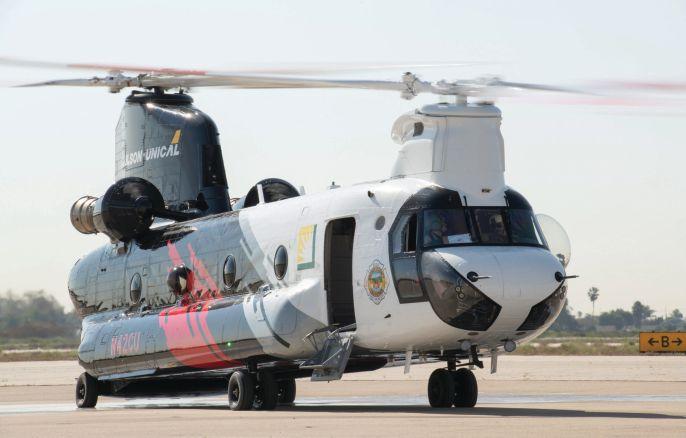
within the civil market, including external cargo, agriculture operations, and forest and wildlife conservation. Within the conservation application, Restricted Category aircraft are able drop water as part of an aerial firefighting operation.
Sikorsky one year ago had initial discussions with Transport Canada about bringing the S-70M up north under a Restricted Category certification. The Black Hawk has never been operated by the Canadian military, however, making it ineligible for the same Restricted Category clearance as in the U.S. Transport Canada will need to accept the S-70M Firehawk before Canadian commercial operators can buy the soughtafter multi-purpose platform.
In an ASVE session called Continually Raising the Bar, Bradley and Berry worked with the Conair team to produce a 20-miute exclusive video to walk attendees through their facilities. This included an overview of significant investments made to Conair’s unique training centre and also time on the ramp to review highlights of the mighty Avro RJ85 AT airtanker.
With more than 70 aircraft, Conair operates the largest, privately owned, dedicated fleet of fixed-wing firefighting aircraft in the world – covering initial attack, amphibious and landbased needs. The company has modified more than 175 individual aircraft across 15 aircraft
types for conversion to aerial firefighting, including its pioneering efforts on jet aircraft. Conair’s operations extend across North America, Europe and Australia.
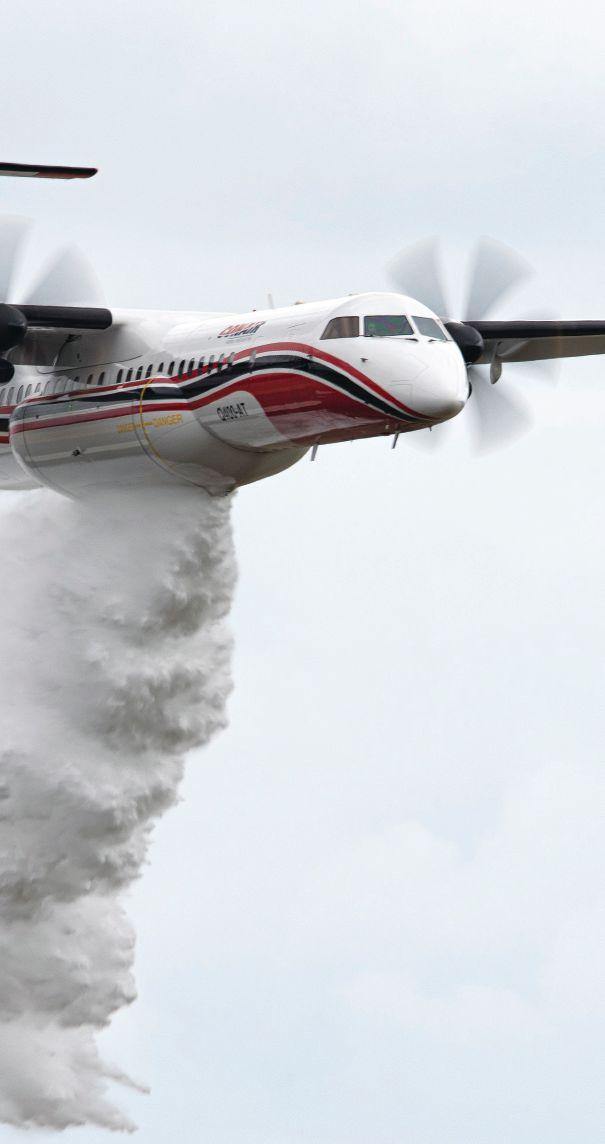
Just weeks before AFVS began, in late September, Conair’s first Q400AT, engineered specifically for aerial firefighting, touched down at Bundaberg Airport in Australia. The specialized airtanker is on contract with Queensland Fire and Emergency Services to help contain wildfires. In January, Conair purchased 11 Dash 8 Q400 aircraft for conversion to the Q400AT, continuing its commitment to the platform.
vides composite propulsion with advanced swept blade propeller design, efficient lift systems, effective aerodynamics, and a light but robust frame, which, explains Conair, contribute to lower emissions, fuel burn and noise.














In addition to the Q400AT’s enhanced fire suppression capabilities, which includes the aerial dispersion of retardant, suppressant, or gel products, Conair points to its environmental performance in terms of setting a standard for future next-generation aircraft. The newest generation of the de Havilland Q400 turboprop pro-
Conair explains its specialized Q400 airtanker produces 30 per cent less emissions than aircraft of similar size, exceeding current environmental standards for carbon dioxide (CO2), hydrocarbon, nitrous oxide and smoke emissions. With results that are below levels mandated by the International Civil Aviation Organization (ICAO), the aircraft also offers the lowest fuel burn per litre hauled. The Q400AT uses only 58 per cent of the fuel, while carrying 88 per cent of the load of a typical Type I airtanker, according to Conair, resulting in less CO2 emissions into the atmosphere.
Conair explains the aircraft’s sustainable features do not come at a cost to aerial firefighting performance, pointing to
the Q400AT being outfitted with a custom, purpose-built tank. The team of engineers at Conair designed the tank to deliver a 10,000-litre payload at any Interagency Airtanker Board coverage level, using an advanced, proprietary constant flow Retardant Delivery System (RDS). The tank is equipped with a standard single point filling receptacle on both sides of the tank allowing for a 2,250 litre per minute fill rate from either side of the aircraft. With a loaded cruise speed of 360 knots at up to 18,000 feet, Conair notes the Q400 is the holder of three climb-totime turbo-prop records. The company explains this fast climb to cruise time results in reduced block time from base to fire and return. The aircraft is designed for both Initial Attack as well as Support Actions, offering tactical flexibility, with a take-off run requirement of 1,396 metres when loaded, regardless of density altitude. Conair also points to the
Q400AT’s turboprop speed control, capable of consistent drop speeds even in steep, rugged terrain and diverse geography. To enhance its firefighting performance, the Q400AT flight deck is equipped with a Conair-developed and Transport Canadacertified Flight Envelope Awareness System, which provides pilots with enhanced safety information, such as instantaneous G-Loading, slow-speed awareness and angle of attack detail, along with flap configuration over-speed awareness.
Berry explains the company evaluated 29 aircraft before selecting the Q400 for modification into an aerial firefighting asset, describing it as “an airtanker pilot’s airplane.” One of the Captain’s flying the Conair Q400AT in Queensland, Australia, has more than 15,000 hours of flying experience with around 7,000 hours on the Dash 8 and 2,500 hours in aerial firefighting. At Conair, to become a Captain of a large airtanker, pilots must have a minimum of 4,000 hours with 1,000 hours of firefighting experience.
Conair’s land-based airtanker fleet also includes the Avro RJ85 AT, Convair CV580, and Air Tractor AT 802. Bradley during the AFVS event spent time on Conair’s ramp describing the unique tanking system of the four-engine RJ85 AT. In addition to its strong short field performance, the RJ85 features dispatch speeds in excess of 380 knots and a Maximum Take-off Weight of 97,000 lbs and a Maximum Tank Capacity of 11,355 litres (3,000 US gallons). The aircraft holds a drop speed at 120 knots.
The other key tenant at YXX, Cascade Aerospace, an operating unit of IMP Aerospace & Defence, shares similar qualities of Conair in terms of being a global leader in the modification of specialized aircraft. While not exclusive to aerial firefighting like Conair, Cascade in late-2018 became the homegrown choice of Longview Aviation to serve as the initial conversion lead for its Viking CL-415EAF Enhanced Aerial Firefighter program.
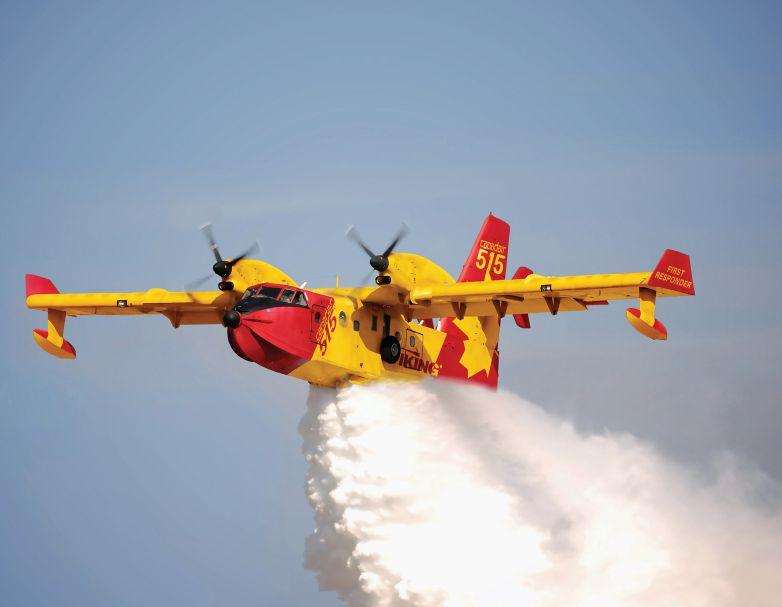
Longview describes the CL-415EAF as the next generation of the world’s only purpose-built aerial firefighter and multi-mission amphibious platform. (See Wings magazine May/June 2020 for more on the CL-415EAF program and its CL-515 platform scheduled for first delivery in 2024). Longview with its subsidiary Viking Air based in Victoria, BC, in April 2020 delivered the first CL-415EAF to Bridger Bridger Aerospace Group in Bozeman, Montana, in advance of the 2020 North American wildfire season. Bridger signed a purchase agreement – valued at $204 million – for six such aircraft back in May of 2018. | H



FRED JONES
ven in the face of all the other challenges our industry is confronted with, it’s hard not to write an article on any subject without confronting the impact that COVID-19 has on the commercial aviation community. While CEWS and CEBA have provided some limited relief to the community, the devastating impact of the pandemic is undeniable. The entire spectrum of the commercial aviation community has been pressuring the Federal government for aviation-specific relief, without success. Air operators; airports; NAV CANADA; the OEMs and other industry suppliers – no one is safe from the effects of the pandemic.
For Canadian commercial helicopter operators, couple this with the slowest fire season in Canadian history, and it’s hard not to consider that the summer of 2020 was a perfect storm. In 2021, summer projects continue to be delayed and cancelled. The 20202021 heli-ski season was crippled. Cross-border travel continues to be constrained by closed land-crossings and most recently by new travel restrictions imposed on inbound travelers to Canada arriving by air. Even the essential nature of much of the work that Canada’s helicopter operators carry out was not enough to encourage many helicopter operators in the face of an uncertain 2021 season.
Canadian helicopter operators have always been adaptable – I have argued, chameleon-like – in terms of their ability to expand into
Another lean summer awaits operators, as virus vaccinations slow and mutations grow
potential; their fatality rate; and the ability of the currently available vaccines to protect the immunized from infection.
Already we have seen variants of the disease that are 70 per cent more infectious. While the currently available vaccines still appear to offer protection from the new mutated strains, the slow rollout of the vaccines and the uncertainty around future mutations has given rise to some considerable doubt that a return to normal business is likely to occur this spring or summer. In short, all indications are that essential services will continue to be provided, but masks, social distancing, and lockdowns will remain part of our day-to-day operations for some time, yet.
The damper that the virus has placed on business generally – and particularly on the commercial helicopter community – will prevail at least through this summer’s operating season. Many operators are hoping that there will be some fire activity, at the very least. Another wet summer could spell disaster for more operators. As it was, there were a number of operators who failed altogether, or at least suspended operations and laid up their aircraft for the winter of 2020.
I have often said, “As the industry, goes – so goes it’s industry association”. HAC is also struggling with the uncertain status of membership renewals and the shape of its 2021 convention – faceto-face, virtual, or some hybrid model. Our Operator-members and Associates are anxious to get back to business, but our convention model in the Fall of 2021 will naturally be driven by public health and safety concerns. In the meantime, HAC is cutting costs and adapting to the changing landscape in the commercial helicopter community – just like its members.
In the ordinarily uncertain helicopter world, there is considerably more uncertainty, now. ‘‘ ’’
new, promising fields of operation and withdraw quickly from other less-promising areas.
Even as the COVID-19 vaccines slowly start to roll-out in Canada, the arrival of new mutated strains of the virus have dampened some optimism around the future of the summer of 2021 operating season. “The only certain thing is uncertainty” we often say, but in the ordinarily uncertain helicopter world, there is considerably more uncertainty, now.
The medical community talks about the three legs of the stool, where the new mutated viruses are concerned: their transmissive
We are continuing to provide strong representation for the Canadian commercial helicopter community on a broad variety of technical and regulatory issues here in Ottawa, and working with government to mitigate the impact of the pandemic on commercial air operators. From flight training operators, aerial work, and charter operations – no one has been unaffected by COVID-19. While, I think that there is every reason to be optimistic for the future, we aren’t out of the woods yet, and this summer promises to be another lean season for the commercial helicopter community as we adapt to the constantly evolving shape of the pandemic. | H
Fred Jones is president and CEO of the Helicopter Association of Canada.

Your source for comprehensive, tip-to-tail aftermarket support
WE DELIVER on what you value most. For over a century, the helicopter industry has relied on StandardAero to provide best-in-class rotary wing support with excellent operational efficiency and custom MRO solutions. Through our innovative, safety driven approach, comprehensive helicopter support capabilities and reliable service provided by our expert technicians, it’s no wonder why we are the trusted service partner.
Engines
• GE T700/CT7
• Pratt & Whitney Canada PT6T
• Rolls-Royce M250 and RR300
• Safran Arriel 1 & 2
Airframes
• Airbus H125/AS350, H130/EC130, H135 and H225/AS332
• Bell 204/205, 206, 212/412, 222, 230, 407, 427 and 430
• Sikorsky S-76, S-92 and S-61
www.StandardAero.com Helicopters@StandardAero.com +1.204.318.7544