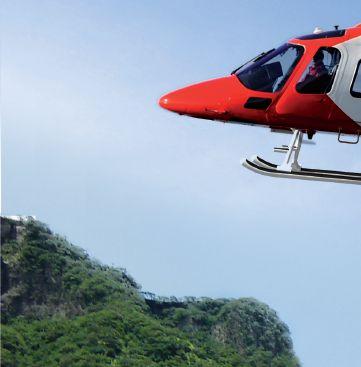
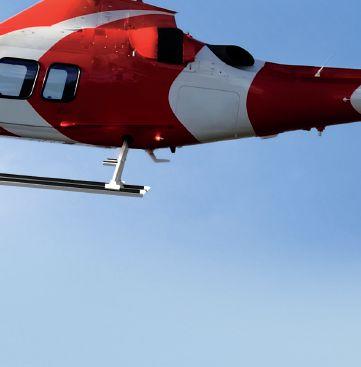
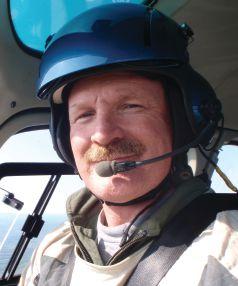
A conversation with Ornge COO Rob Giguere by Matt Nicholls
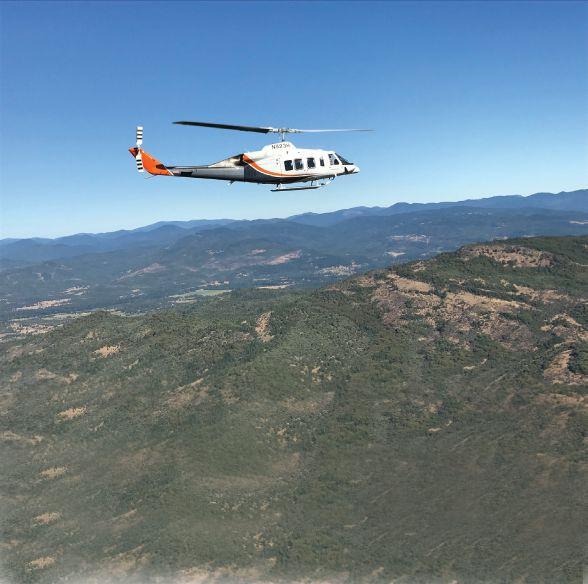
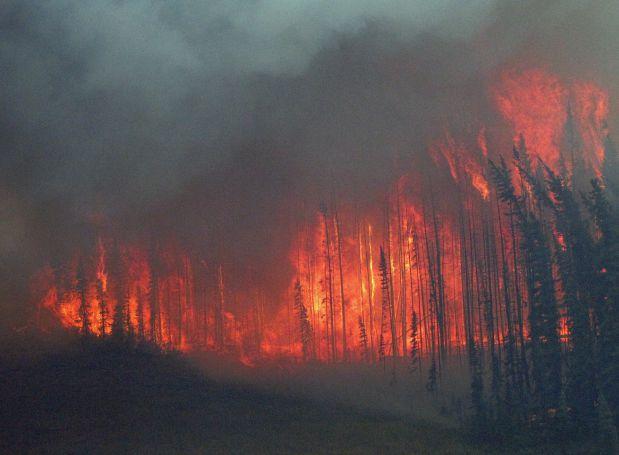
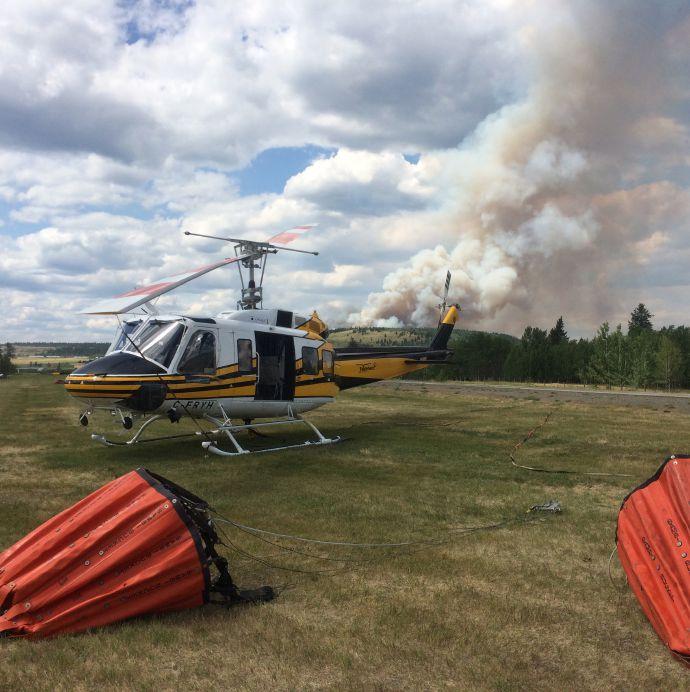
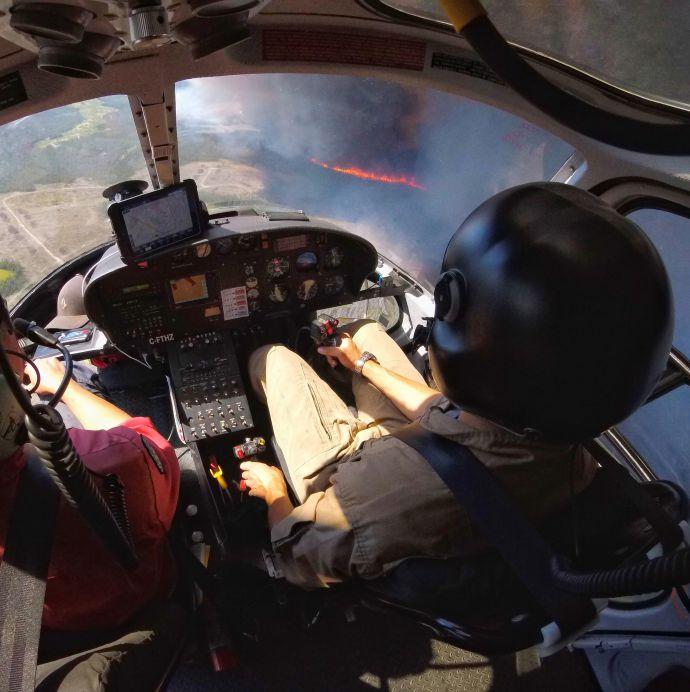
A wild fire season in B.C. tests the capabilities of provincial fire services
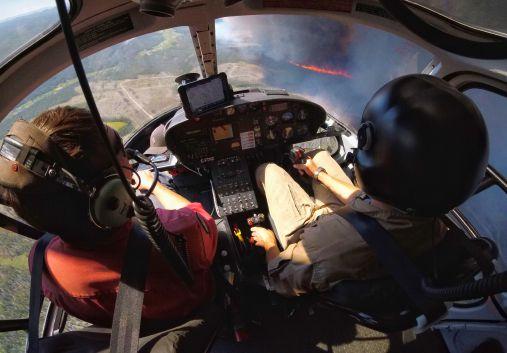
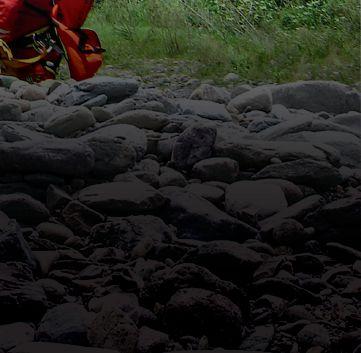
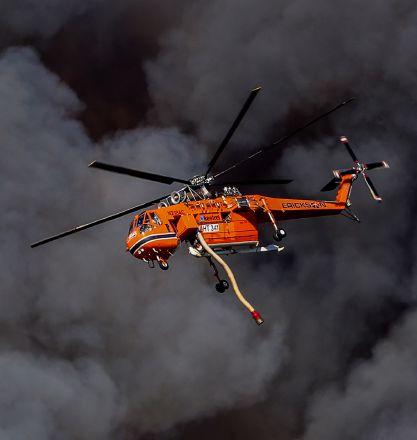
(Photo courtesy B.C. Wildfire Service)
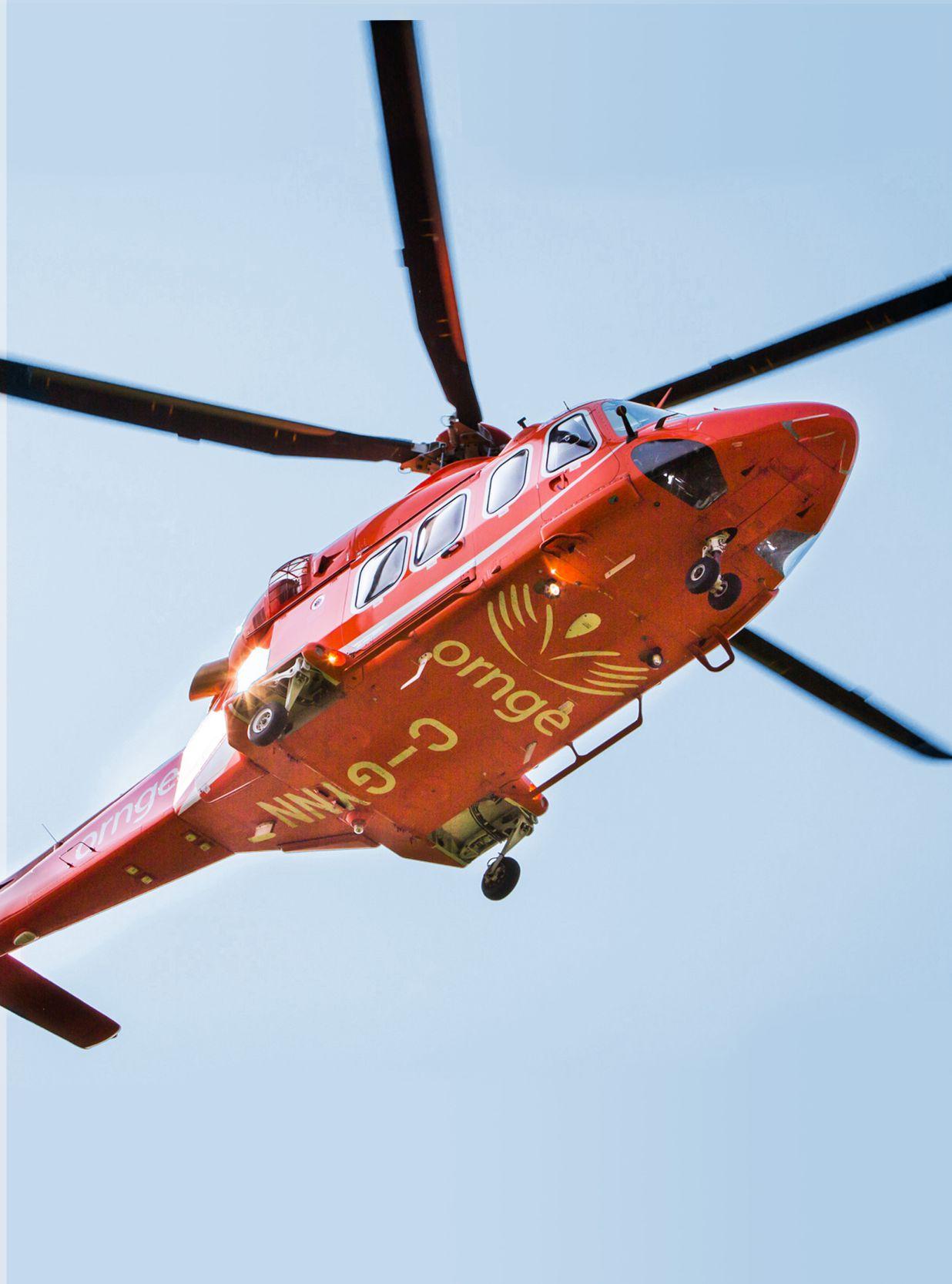
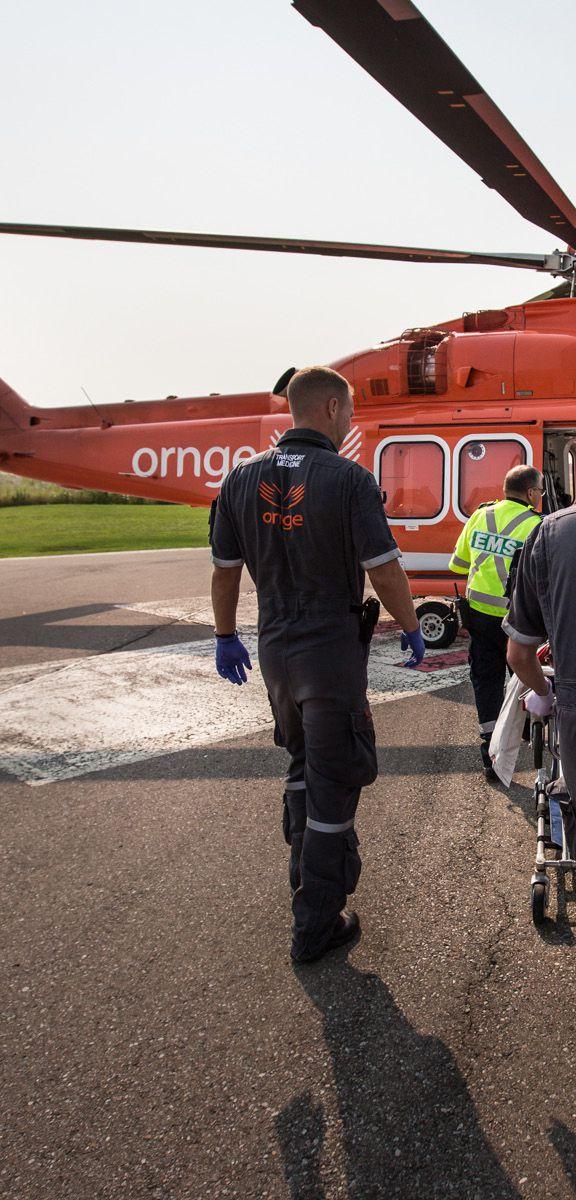
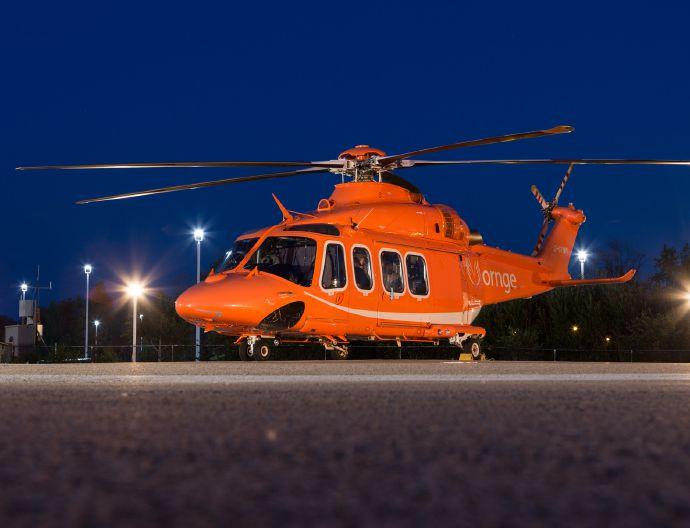
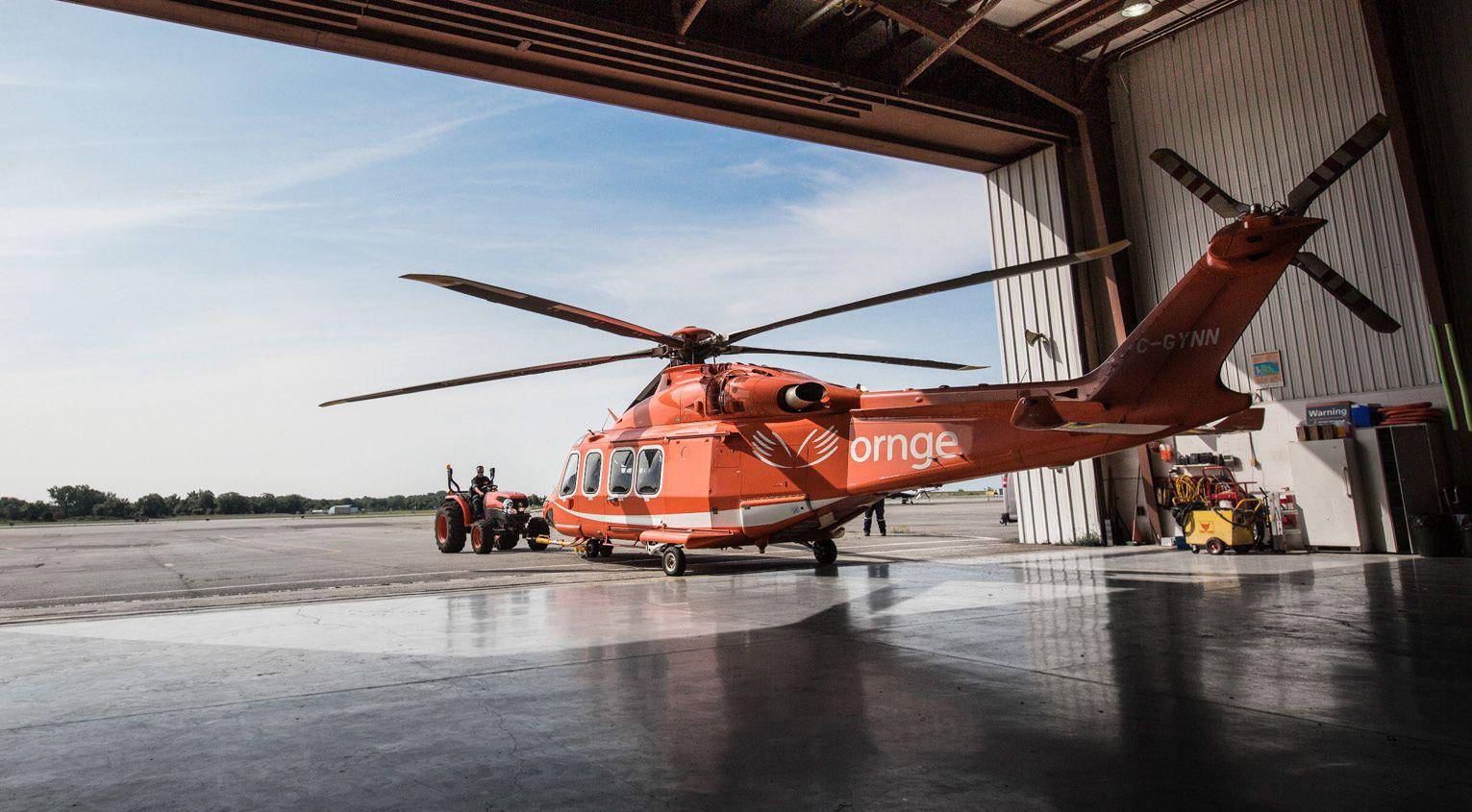
Ornge continues to innovate in the pursuit of safe operations.
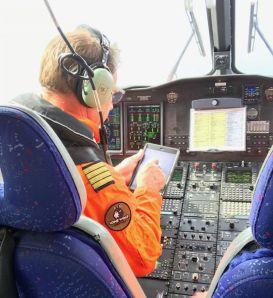
(Photo by Tor Carter)
MATT NICHOLLS is editor of Helicopters
inding solutions to growing the pilot shortage in Canada is one of the most pressing issues facing the Canadian aviation industry – and it’s a challenge that affects all segments, from large commercial operations to northern operators, the military and rotary-wing operators from coast to coast.
The numbers are indeed staggering. The Canadian Council for Aviation and Aerospace (CCAA) estimates that Canada will experience a pilot shortage of some 6,000 pilots over the next 20 years with annual pilot shortfall of some 200 pilots. It’s an issue that’s also not unique to Canada. In its 2017 Airline Pilot Demand Forecast released at last year’s Paris Air Show, Montreal-based training and development company CAE revealed that the global demand for pilots over the next 20 years will reach 255,000, with some 85,000 of those jobs based in the Americas. The CAE report concludes that many of these pilots have not even commenced their training yet.
Recent studies by Airbus (more than a million pilots and technicians by 2036), Boeing (1.2 million pilots and technicians by 2036) and the International Civil Aviation Organization (15,000 new pilots globally over the next two decades) outline the scope of the global demand. Many of these new positions will be filled by pilots being trained in Canada, as a large contingent of students training at Canadian flight schools currently are foreign students. Canadian flight schools offer extremely high-training standards and graduates
Replenishing the pipeline
Uniting forces to solve pilot shortage issues
leadership role in the development of such solutions to the industry shortfall with the formation of its Pilot Shortage Discussion Panel last May. As ATAC president John McKenna reported in the July/ August 2017 issue of Wings, the symposium brought together the CCAA, the College of Professional Pilots of Canada and operators including Sunwing, WestJet, Air Georgian, Jazz and Porter Airlines to share experiences and seek to find solutions.
Much of the group’s progress was shared at the ATAC conference Nov. 6-9 in Montreal, as the task force described how it plans to unite as an industry, raise awareness about the profession, seek government support to help students with high training costs and look for tangible ways to help feed the pipeline and entice a new generations of pilots and aviation professionals.
Wings and Helicopters magazines are doing their part to help guide and educate younger generations with the development of our Careers in Education Guide (see pages, C1-CXX) and the continued growth of our Careers in Aviation Expos. Both products aim to provide more information about a wide cross-section of aviation professions, offering necessary career advice, future career options and much more.
This year’s CIA Expos – Saturday, April 28 at the Jazz Aviation hangar in Toronto and Saturday, May 12 at the Aurora Jet Partners fixed based operation in Edmonton – will give aspiring aviators a chance to rub shoulders with a wide cross-section of aviation and aerospace professionals, presenting an opportunity to gain insightful information what to expect in their desired career path.
Canada will experience a pilot shortage of some 6,000 pilots over the next 20 years.
are highly sought after for positions abroad; as the numbers reveal, the opportunities are certainly there.
The diminishing talent base in Canada is not unique to professionals flying the aircraft, either. The shortfall starts with qualified flight instructors at Canadian flight schools and is affecting other aviation professions such as retiring airport professionals, flight attendants and more.
The Air Transport Association of Canada (ATAC) has taken a
Building on some of the efforts outlined by the ATAC Pilot Recruitment working group to attract more aviation cadets to educational career development events, Wings is working with the Air Cadet League of Canada and industry partners to find ways to bring more cadets to the Toronto Expo, including offering the first 100 cadets through the door free of charge. See (see http://www.careersinaviation.ca/expo/) to register.
Creating important educational tools will not solve the critical aviation and aerospace talent shortage over night, but it will help build on the collective efforts of industry associations, operators, flight schools and national carriers who have made it one of their main priorities to continue to develop generation next and help develop the industry.
Rugged and Reliable
Leonardo Helicopters are renowned for performance, versatility and safety.
The AW109 Trekker - an evolution of the proven AW109 platform - is the newest light twin, designed for demanding utility and aerial work operations.
Equipped with robust skid landing gear, a latest-generation glass cockpit and advanced avionics, the Trekker provides the excellent handling qualities, high productivity and operational flexibility you demand.
Inspired by the vision, curiosity and creativity of the great master inventorLeonardo is designing the technology of tomorrow.
Murray takes Innovation in Safety Award
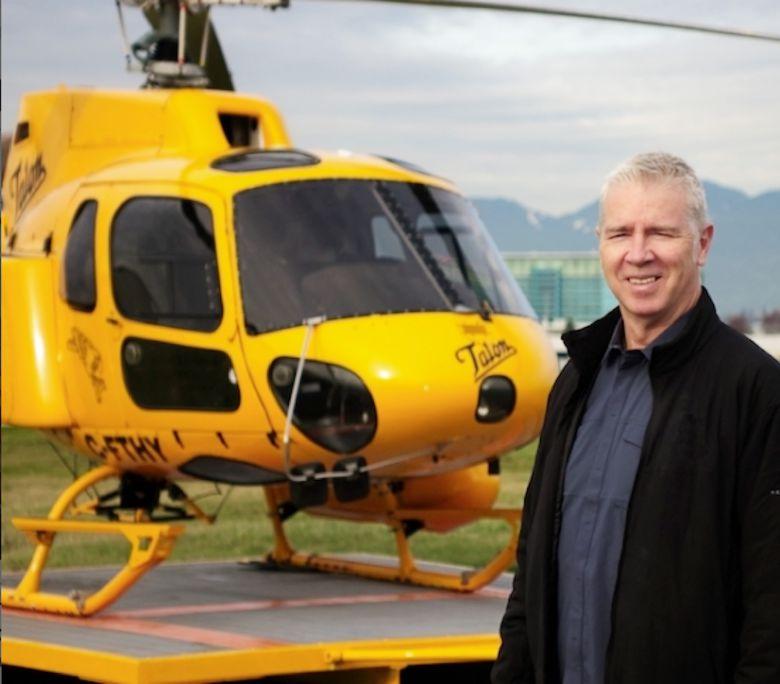
Peter Murray, founder and operations manager of Talon Helicopters, has been awarded Airbus Helicopters Canada’s 2017 Innovation in Safety Award. Murray is being honoured for his longstanding commitment to safety and for activities in the SAR community including rescues, training and dedication to safe longline SAR operations, where Talon has continually worked to enhance the safety of human external cargo operations.
“Safety is fundamental to everything we do at Airbus. To foster a culture of aviation safety we must recognize those whose innovations and exceptional dedication to safe flying practices keep our industry moving forward,” said Romain Trapp, president of Airbus Helicopters Canada and COO of Airbus
Helicopters North America.
In addition to specializing in aerial film work, utility work, tour operations and electronic news-gathering, Murray ensures Talon Helicopters maintains a 24/7 SAR response position
Airbus sells Vector to StandardAero
StandardAero Aviation and Airbus SE have announced that they have finalized the acquisition by StandardAero of Vector Aerospace Holding SAS from Airbus. Vector is a global aerospace maintenance, repair and overhaul company, providing responsive, quality support for turbine engines, components, fixed- and rotary-wing aircraft. It generated revenues of over US$700 million in 2016 and employs approximately 2,200 people in 22 locations. The newly combined company, which will maintain the name of StandardAero, expects annual revenues of approximately US$3 billion.
answering the call to assist with more than 100 rescue operations annually throughout the Lower Mainland of British Colombia. Murray is an expert in safe longline rescue operations and has carried out many successful rescues in hard-toreach remote areas. Furthermore, Murray has worked with Vancouver-based Boost Systems, developing its new Human External Cargo (HEC) System.
“I am honoured to have been chosen to receive this award,” said Murray. “I accept this award on behalf of our entire Talon Team. I’m extremely proud of our crew for making safety the primary focus of all of vour operations, without compromise. To lead such a tight, dynamic and professional
group has been very rewarding for me. It’s due to our teams absolute dedication to safety that Talon Helicopters has maintained an accident- and incident-free 20 years of flight operations.”
This award is presented yearly. The winner, determined by an award selection committee, receives a $10,000 prize. Members of the Innovation and Safety Award selection committee include Robert Erdos, chief experimental test pilot for the National Research Council of Canada; Fred Jones, president and CEO of the Helicopter Association of Canada; Matt Nicholls, editor of Helicopters and Wings magazines; and Mike Reyno, photojournalist and group publisher at MHM Publishing.
Peter Murray of Talon Helicopters has been honoured by Airbus for his commitment to safety.
EDITOR MATT NICHOLLS email: mnicholls@annexweb.com 416-725-5637
MEDIA DESIGNER BROOKE SHAW
CONTRIBUTING WRITERS
SkyTrac offers an extensive suite of data management products.
ACR Electronics has confirmed Drew Marine UK Holdings has signed an agreement to acquire SkyTrac, a full-service, data-driven solutions provider for the global aviation industry. SkyTrac will report into ACR Electronics. The alignment of these two leading companies will create a comprehensive product line and service offering for the aviation marketplace, to include the ACR Electronics Artex portfolio of survival products and the SkyTrac range of innovative business solutions from data acquisition hardware and analytics software through program design and support. Headquartered in Canada, SkyTrac offers a one-stop response for reliable and secure data management solutions. Its data acquisition hardware is installed by fixed and rotary wing clients worldwide and its SkyWeb data management system has been selected by thousands of users. SkyTrac will continue to operate as an independent subsidiary, retaining existing products, brand, locations, engineering capabilities and sales. The entire team, including executive management, will continue on with the new ownership.
“We are excited to join forces with SkyTrac because it will expand our aviation footprint and add a proven solutions-based team into our organization,” said Gerry Angeli, president of ACR Electronics. “Our complementary products and technology can provide our customers with an expanded and comprehensive suite of aviation data, tracking, distress alerting, communications and operational integrations.”
ACR Electronics is a leading provider of safety and survival equipment to the aviation market for general, business, commercial and military applications. Suitable for every type of fixed wing and rotorcraft aircraft, the Artex brand of emergency locator transmitters (ELTs) are selected by the majority of aircraft manufacturers around the world. ACR and Artex design and manufacture a complete portfolio of survival products for the aviation industry including ELTs, personal locator beacons, iridium tracking and communication distress beacons, megaphones and distress lighting.
SkyTrac president Malachi Nordine said, "SkyTrac and ACR share a mission to help aviation operators improve safety and efficiency. Supported by ACR, SkyTrac will continue with the strong customer support and technology leadership that is in our DNA and that has cemented our position in the aviation industry. I am excited to work with our new ACR partners through SkyTrac's next growth phase as we continue to execute our strategy and find cooperative commercial opportunities like GADSS."
SkyTrac is a Transport Canada certified DAO, AMO and an Approved Manufacturing Organization, with management systems registered to ISO 9001/AS9100C. Financial terms of the acquisition will not be released.
A new tune to HUM
HeliOffshore has published an updated version of its Best Practice Guidelines for Health and Usage Monitoring Systems (HUMS). The latest version includes two new annexes developed by the association’s HUMS working group, which consists of representatives from operators, OEMs and other industry experts. A subgroup under the leadership of Jason Alamond, HUMS program manager with Era Helicopters, has produced an annex defining the ideal HUM system. The group drew up a list of features that it considered to be useful in a HUM system, as well as those it felt
should be eliminated or modified because they are unnecessary or burdensome to users. The first three sections of the report describe features that the subgroup felt should be included in modern HUM systems. The fourth section of the report turned its attention to ideas for developing a future HUM system, without what the group called “the constraints of current terminology, architecture or technology.” Meanwhile, another subgroup has developed a framework of key performance indicators (KPIs) to assess the effectiveness of inservice HUMS. This new annex gives operators a proposed
framework for assessing the performance of systems. The list of 16 KPIs includes different levels of alert and alarm, as well as false alarms, close monitoring initiated events, failures, diagnostic and support system requests and HUMS deferred defects. The HUMS KPI subgroup was led by Andy Evans, a director with Aerossurance. He and others on the subgroup envision the HUMS KPI document as laying the groundwork for operators to be able to share and benchmark HUMS data. The HUMS working group is part of HeliOffshore’s System Reliability and Resilience work stream.
RICK ADAMS, DAVID CARR, BRIAN DUNN, PAUL DIXON, WALTER HENEGHAN, FRED JONES, JAMES MARASA, CARROLL MCCORMICK, COREY TAYLOR
NATIONAL ADVERTISING MANAGER MENA MIU email: mmiu@annexweb.com 416-510-6749
GROUP PUBLISHER MARTIN MCANULTY email: mmcanulty@annexweb.com
COO TED MARKLE EMAIL: tmarkle@annexweb.com
PRESIDENT & CEO Mike Fredericks
RETURN UNDELIVERABLE CANADIAN ADDRESSES TO ANNEX PUBLISHING & PRINTING INC., P.O. BOX 530, SIMCOE, ON N3Y 4N5 CANADA. email: subscribe@helicoptersmagazine.com
Published five times a year by Annex Publishing & Printing Inc.
Printed in Canada ISSN 0227-3161
CIRCULATION
Email:apotal@annexbizmedia.com
Tel: 416-510-5113
Mail: c/o Circulation, 80 Valleybrook Dr. Toronto, ON M3B 2S9
SUBSCRIPTION RATES Canada - 1 year $29.95 USA- 1 year $54.50 Foreign - 1 year 60.00 plus applicable taxes www.helicoptersmagzine.com/subscribe
Occasionally, Helicopters magazine will mail information on behalf of industry-related groups whose products and services we believe may be of interest to you. If you prefer not to receive this information, please contact our circulation department in any of the four ways listed above.
Helicopters Magazine is an associate member of the following Canadian aviation associations:
Airbus hits 150 deliveries of the H145
Airbus Helicopters recently celebrated the 150th delivery of the H145, the newest member of the BK117/ EC145 family. In October 2017, Helicopter Travel Munich (HTM) received the 150th H145 helicopter from Airbus, to be used for offshore hoist operations and the transfer of service personnel working in the wind turbine industry. The H145 (formerly EC145 T2) is a member of the EC145 and BK117 family, more than 1,400 aircraft of which have been delivered to date, notching up over 4.8 million flight hours in some 21 countries worldwide. Used mainly for EMS, air rescue, law enforcement and aerial work, the BK117/EC145 family
has also been successful with military utility operations and training, with over 400 Lakota UH-72s delivered to the U.S. Army. The H145 version was conceived as a platform with unparalleled mission abilities, a high level of flight safety, economic operating costs, and a tailored support and service package, while incorporating Airbus innovations. In 2014, the first H145 entered operation with the German air rescue company, DRF Luftrettung. Its enhancements included two powerful Safran Arriel 2E engines with dual-channel full authority digital engine control, an upgraded main gearbox and a new antitorque system with Fenestron. The cockpit, too,
underwent changes, incorporating Airbus’ innovative Helionix avionics suite with a 4-axis autopilot. The result: a helicopter able to deliver exceptional performance in a diverse range of roles. In law enforcement, customers like the police of Baden-Württemberg have dedicated their H145 fleet to their most challenging missions. The H145 does duty both day and night with a night vision goggle-compatible cockpit, while its advanced mission management system, together with high-end police equipment, defines a new standard in airborne law enforcement. While the H145 has become a mainstay with police forces, it also made its mark in the offshore
industry. In March 2017, the European Airworthiness Safety Agency certified Airbus’ upgrade of the H145’s singleengine performance, increasing its hover power in one-engineinoperative mode within the two-minute power rating by adding 230 kg useful load in operations with human external cargo. Today, the H145 has achieved 80,000 flight hours since entry-into-service. Among customers of the “ready for duty” four-tonne helicopter, the Babcock Group is its largest operator, with a fleet of 27 H145s, while Germany – where the H145 found its first and now, its 150th, home – is its largest market, with 30 H145s in operation.
AIAC reaches Summit
The Aerospace Industry of Canada’s 2017 Aerospace Summit took place Nov. 7 and 8 in downtown Ottawa, and this year’s event more than lived up to its billing as one of Canada’s must-attend events. Highlights from the first day included an eye-opening discussion from retired major general Robert E. Wheeler on cyber terrorism and its potential negative impacts in the aerospace industry. Another key session detailed how Canadian OEM CAE has transformed its business model from being solely a simulation developer to becoming a leading training partner in global commercial aviation. There was also a lively panel from small business leaders in Canadian aerospace highlighting the challenges they face in growing their businesses both here and abroad. At the annual aerospace dinner that evening, Pratt and Whitney Canada’s
Benoit Beaudoin and its operations team were named the 2017 recipient of the James C. Floyd Award for aerospace achievement.
Day Two of the program highlighted overcoming challenges in the face of a potential downturn – a return-to-strategy emphasis for corporations having to deal with issues such as geopolitical conflict, digitization and keeping up with the “deliver, deliver, deliver” realities of the business. Highlights included an excellent leadership panel with Jonathan Lee Obst, managing director of Rockwell Collins; Charles Bouchard, chief executive at Lockheed Martin Canada; Bell Helicopter Textron Canada president Cynthia Garneau; and David Curtis, president and CEO of Viking Air. Earlier in the conference, Garneau was named the new AIAC chair succeeding IMP Aerospace and
Defence president David Gossen, and she encouraged industry to leverage the talents of all Canadians to overcome future challenges. As Garneau says, “it's all about being fearless – failing fast and fixing fast” in all realms. Show favourite, Manfred Hader, senior partner at Roland Berger, was back by popular demand and he shared his perspectives on
the future of the market, detailing how the reversal of globalization will present challenging times ahead for all OEMs in the global aerospace industry. The event wrapped up with a TSNsports-desk-style interview by AIAC president and CEO Jim Quick of the Honourable Navdeep Bains, minister of innovation, science and economic development.
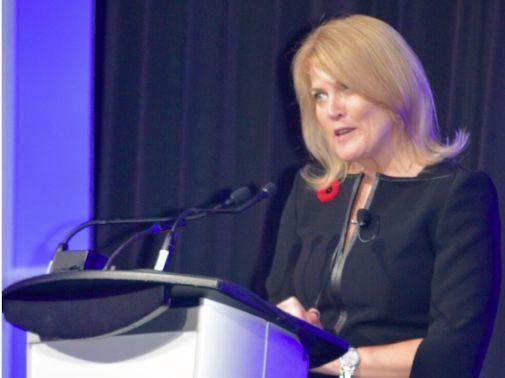
Cynthia Garneau, Bell Helicopter Textron Canada president
A Healthy Perspective
Fit-to-Fly Realities Key to Establishing Strong Safety
m I fit to fly? There has been a considerable volume of debate over the past five years or so about Transport Canada’s move towards harmonizing the Canadian regulatory framework with the rest of the world. But what does all this mean to those of us “at the coal face”? What can I and what must I do to stay safe?
Well let’s start with the notice posted to the Canada Gazette earlier this summer. The proposed amendments to the Canadian Aviation regulations offer a new definition for the concept “fit for duty “It reads “. . . in respect of a person, means that their ability to act as a flight crew member of an aircraft is not impaired by fatigue, the consumption of alcohol or drugs or any mental or physical condition . . . ”
Simple enough, yes? Not so fast. In fact, this definition builds on the existing regulations detailed in Part VI of the CARs – prohibiting reckless or negligent operation of an aircraft that endangers life, operating aircraft while fatigued or under the influence of drugs or alcohol, or otherwise unfit to be a crew member. These duties are clear: don’t operate an aircraft if you are unfit to do so. The rub? Who decides “fitness”?
Much of the recent discussion in the Canadian helicopter industry has centered on flight duty time. I will not attempt to address those issues in any depth; others more versed on the topic are arguing this point. Suffice to say, the big air carriers are pushing much more restrictive and proscriptive solutions and the heart and soul of
necessary to be part of a successful business. However, I posit that neither the companies nor the pilot are the best people to determine fitness for duty. This is simply due to the fact that each has vested, subjective interests and cannot separate these biases from safe decision-making.
Consider emergency checklists. In the calm detached setting of the manufacturer’s flight test facility, emergency procedures are developed that consider the best flow of actions in the event of, say, an engine failure. These steps are tested, refined, tested some more and then codified in the checklist or Quick Reference Handbook (QRH). They are then taught and practiced until mastered.
This process has been accepted for decades, yet when it comes to determining fitness for duty, objective measurements are cast aside for either operational pressures or checking with pilots to ask – are you OK to fly? Why would we design a system that accepts such subjective inputs into such a safety critical decision-making process?
In the past three years, the number of reported impaired pilot-inthe-cockpit events has increased. This may be due to increased vigilance and reporting or it may be due to other factors in play.
But what is clear, however, is that whatever system was in place at the time, the pilot made a subjective decision, just prior to the start of his duty period, to go to work. In addition, there have been several close calls and actual accidents recently whereby the pilot either reported that he did not feel competent to accept the tasking or was on standby and felt too tired to accept the duty assignment, yet reported to duty anyway. In these cases it needs to be asked: did production pressures win the day or was it the sole responsibility of the pilot?
Companies want to maximize the use of their staff, to get the best bang for their dollar.
Canadian aviation – the smaller carriers and the helicopter companies are looking for a fit-for-purpose industry friendly response. (For more, see, “A Dire Course, October Helicopters pg. 34). From my perspective and experience, we also need to do some soul searching. There will always be a tension between the operations/production managers and the operators/producers (read pilots and AMEs). Companies want to maximize the use of their staff, to get the best bang for their dollar. And for the most part, pilots and AMEs are willing participants in this dance. Most aviators I know and have worked with are fully prepared to work hard and to put in the hours
In any event, the system failed to protect the travelling public. This is why fitness for duty questions need to be answered well in advance, using research and science and completed with the collaboration of the operations managers, CEOs, pilot and AMEs. Asking a pilot – are you good to go – can no longer be an acceptable checklist item.
Walter Heneghan is an experienced and well-travelled pilot who has served as the top safety professional at Canadian Helicopters and Summit Aviation. He is currently working with CHC Helicopter in Kazakhstan as an SMS development specialist. He is a regular contributor to Helicopters and Wings magazines.
WALTER HENEGHAN
A fiery relationship Time for High-Level Thinking About Wildfire Control
Events of the last couple of years – Fort McMurray in 2016 and British Columbia’s 2017 season of disaster –are a hint from Mother Nature that we need to rethink our relationship with forests, especially the part about what happens when things catch on fire. We love our forests and they have been an economic powerhouse for communities across the country. We love our forests so much that we live close to them, or increasingly right in the forests as towns and cities expand into what we call the interface. We love our forests so much that we build our homes from wood products.
Wildfire is nothing new to Canada, as fires were burning unchecked long before the first humans appeared on the scene. As much as the First Nations may have feared uncontrolled wildfires, they also realized there was a beneficial side to them. In the mid1800s, as the first Europeans explored the vast, open prairie, they failed to realize that the vast landscape of grasslands and forests they encountered existed as the product of wildfire. To the Europeans, fire was bad; a threat to the settlements and infrastructure forming the keystone of the “civilization” they felt they were introducing.
Canada has been at the forefront of aerial firefighting from the very beginning and helicopters have been involved in every facet of firefighting in one way or another from the moment they were first introduced.Jim Grady of Okanagan Helicopters and Henry Stevenson have been recognized as the creators of the first water bucket. Twenty years after their Monsoon Bucket was introduced in 1962, Don Arney was inspired to repurpose some underwater airbags he was
There have been significant changes in fires in recent years. The Fort McMurray fire of 2016 was followed by monster fires in July and August in B.C., which in turn set the stage for a raging monster in September that swept out of southeastern BC and through Waterton Park in Alberta. As as our world changes around us, the question is this: are these fires anomalies or are they the new normal? Firefighting is a sexy business, no two ways about it. It’s hard, dirty work for everyone who’s involved out there and they’re worth every cent. But we need to so some serious thinking about what the future looks like, both in terms of what Mother Nature has in store for us and how we are going to react. If we continue to see the warming and drying trends of recent years, coupled with the strong winds that propelled these monster fires, then we need to reassess the what and when of how we address wildfire.
One operator I spoke to recently offered the opinion that these fires are too big to fight once they reach a critical mass. It’s not a matter of trying to beat them head-on, but rather trying to deflect them or nibble at the edges. Other operators see a change from the all-in mentality of only a few years ago, with officials taking a more waitand-see approach to new fires. The concern here is that if the fire does develop it is already to big to attack head-on. There’s no question that the people wearing the red shirts are doing their jobs and doing them well, but the policy decisions come from the political masters and these are the people who have some tough decisions to make.
We need to reassess the what and when of how we address wildfire.
testing and thus the Bambi Bucket was born. Today, SEI, the company that Arney founded, has 95 per cent of the helicopter water bucket business. Specialized programs in B.C., such as Rappatack and Initial Attack, see helicopters transport initial attack crews into remote areas not easily accessed overland, where crews are either landed or rappel down in areas where landing is impossible. The helicopter is then able to support the ground crews by delivering water either by bucket or belly tank in a coordinated, multi-prong attack. For many years, the philosophy was to get on the fire as quickly as possible with a goal of extinguishing it within 24 hours.
The first decision government has to make is to support their wildland firefighting program with a more robust budget. As of the end of November, the bill for the 2017 fire season in B.C. was rapidly approaching $600 million, against a budget of $63 million. One of the benefits of a more robust budget might be more contracted helicopters. The province of B.C. has six helicopters on long-term contract, which leaves everyone else either sitting by the phone or taking their aircraft where the work is in other parts of the world. It’s nice that B.C. helicopters are in such demand around the world, but it might be nice to put some of them to work where they live, so to speak.
The world is changing around us and we have to change with it. It is so important that we get out in front of these changes instead of trying to play catch up.
Paul Dixon is a freelance writer and photojournalist living in Vancouver.
PAUL DIXON
PROFILE
ROOM TO GROW AT ERICKSON
Erickson Inc.’s Andy Mills Analyzes 2017 and the Road Ahead
BY RICK ADAMS
Erickson Incorporated, builder and primary operator of the unique Sikorsky S-64 Aircrane heavy lift helicopter, successfully emerged from Chapter 11 in late April 2017 after filing for bankruptcy protection from creditors in November 2016.
The U.S. Bankruptcy Court for the Northern District of Texas authorized Portland, Ore.-headquartered Erickson to “rationalize” its aircraft fleet and shed more than US$400 million in debt. The new private shareholder group includes former bondholders.
Erickson’s court protection strategy was not a surprise. It had struggled since ill-advised acquisitions of Air Amazonia and Evergreen in 2013. Evergreen had substantial contracts with the U.S. Department of Defense in support of operations in Afghanistan and Iraq, as well as an offshore energy business.
But the U.S. began drawing down troop levels in the Middle East and oil prices plummeted. A lawsuit alleged that Erickson leadership, “violated their fiduciary duties by using Erickson for their own personal benefit to the detriment of Erickson’s minority stockholders.” The suit settled out of court.
Aviation industry veteran Jeff Roberts was brought in to replace Udo Rieder as CEO in April 2015. Roberts had been civil aviation group president of Montreal-based simulation and training company CAE for 11 years and previously CEO of SimuFlite. Attempting to resurrect Erickson through cost-cutting means (such as reducing the workforce from a peak of 950 to the current 700) proved insurmountable, so Roberts guided the company into the court reorganization.
Within days after announcing the emergence from Chapter 11, Roberts exited Erickson, returning to his consultancy, JG Roberts and Associates.
The new Erickson board installed Andrew Mills as interim CEO. Mills had rejoined Erickson in 2012, and was serving as general manager of aircrane operations and director of aerial services sales and marketing. He has a quarter-century of experience in helicopter operations and contracting, including general manager of Carson
Helicopters and director of operations for Swanson Group Aviation.
Mills began his career in the field of geophysics, specializing in frontier exploration utilizing helicopter-supported tools. He has worked in more than 20 countries. Mills is a past chairman of the Oregon Heavylift Helicopter Consortium, and current vice chairman of the HAI government resources/firefighting committee.
In August 2017, Mills had shifted to his role of president of commercial aviation when Erickson hired merger and acquisition specialist Doug Kitani as CEO. Helicopters’ Rick Adams spoke with Mills at Erickson’s MRO and maintenance facility in Central Point, southern Oregon (close to Medford).
How has the company changed over the past year?
AM: Overall, I’m very optimistic about Erickson’s future now. We have a very manageable ledger sheet. We de-leveraged the company in terms of its debt to earnings by almost five to one. We’re probably healthier than we’ve been in several years financially. We have excellent liquidity now. We’ve gotten away from the things that were essentially dragging the company down.
We’ve obviously gone through a lot of turbulence in the past two years. But we have emerged from the bankruptcy, I think, much, much stronger. The bankruptcy itself went about as well as it could go. We were in and out of bankruptcy in five months, which by U.S. standards for a company of this size is pretty darn fast.
When we went into bankruptcy we were carrying a huge amount of debt and we had a lot of onerous aircraft leases on light and medium aircraft. Some of those aircraft did not even fly and we were paying lease payments on them. A lot of that came from the former Evergreen. And a lot of our markets had taken a downturn. Oil and gas was down. We were down some in U.S. firefighting. So, it was an unhappy confluence of a lot of our markets taking a large downward turn and the large amount of debt and aircraft leases we had to constantly pay out on.
Now that we’ve emerged from bankruptcy, we have shed the large majority of that debt, over US$400 million. We dropped all of those
What are your primary markets and key customers?
AM: Our company operates in three major business segments. One is civil aviation where we do firefighting, logging, power line construction work, precision placement. The other flight portion of our business is government services, flying in support of various government contracts. The third major segment of our business is our MRO group. We have existing contracts in Australia for firefighting. We have six Aircranes on contract every year for firefighting with the NAFC (National Aerial Firefighting Centre). NAFC renewed the two option years of our contract at the beginning of last year; they stuck with us. We have contracts with the NSPA (NATO Support and Procurement Agency), which is the civilian contracting arm for firefighting in Greece. We have three aircraft in Greece. They have also renewed our contract.
aircraft leases that were not good for us. We are out from under that. Or we have renegotiated with some of the lease companies, some of whom have been really good to deal with.
One thing that I’m particularly proud of: everybody at Erickson worked very hard during the bankruptcy. We lost very few people; very few left us. And of all our major customer base, we did not lose any of them; they all stayed with us. We did not lose any existing contracts. We’re still servicing all of those contracts. They basically had faith that we would come out of this thing intact and in better shape and we have.
Erickson now has a fleet of a little less than 50 aircraft, and all the aircraft we have are operational or trainers and flying on contracts; that is a change from where we were a year ago. We’re much leaner.
We’ve centred our rotorcraft fleet around the Aircrane platform and a couple of medium platforms, the Bell 214ST and the Puma 330J. And we have a small number of fixed wings, a CASA 212 and Beech 1900D, that we use in support of some of our government contracts.
We have Canadian logging customers that have stuck with us. We have aircraft operating up there now. During the course of the year, we have two to four aircranes working in Canada. We have some longstanding heli-logging contracts. We do timber harvesting from the air, mostly in B.C. We do work for Western Forest Products, which is a very large Canadian timber company. Also HeliFor, a Canadian heavy lift company, pretty much year round.
In the last couple of years, we’ve seen a steady uptick in precision power line construction. We build the power line towers from the air for these larger-scale power line projects in northern Canada. That work is done for a multitude of different contractors. We’re probably going to do more of that work this year than we have in the past several years.
What is the nature of some of your government support services contracts?
AM: We fly humanitarian and personnel and supply missions in support of U.S. government contracts in several different parts of the world.
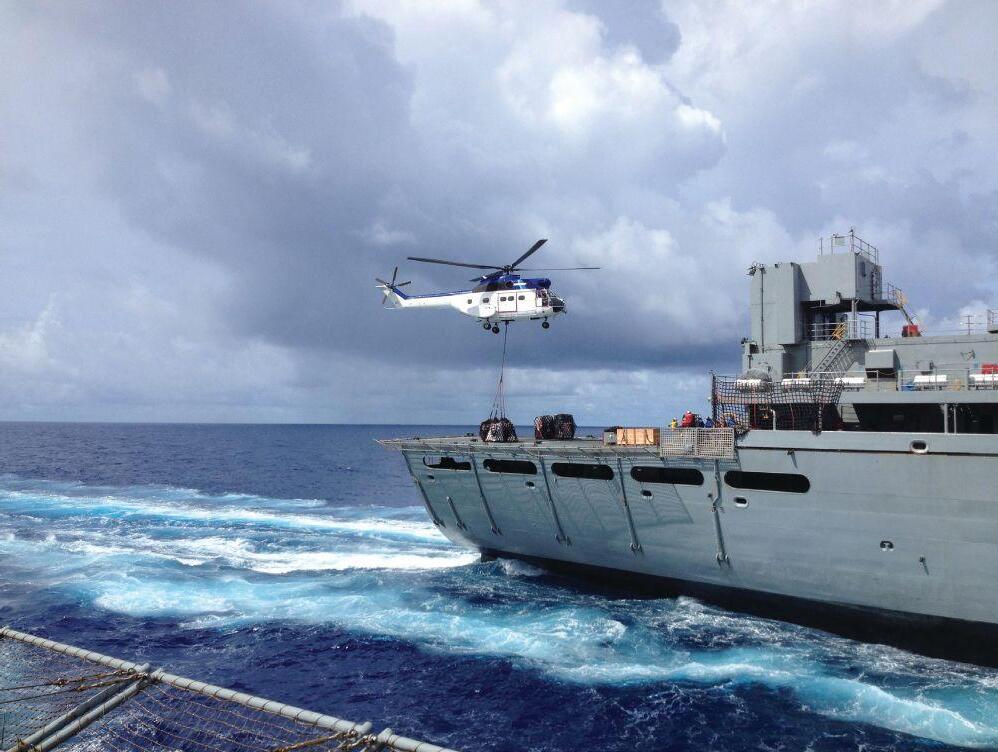
We also have the U.S. Navy VERTREP (Vertical Replenishment) contract. We have three detachments of the Navy VERTREP program; essentially, they use our Puma 330J helicopters to transfer supplies to and from ships via helicopter. They do it at sea while they’re underway, so it’s very efficient. (In June 2016, Erickson announced the award of two, five-year term agreements to provide vertical replenishment and other rotary-wing logistic services to Military Sealift Command for support of the Navy’s 5th and 7th Fleets. Erickson has performed VERTREP operations for the U.S. Navy since 2004.)
Each of those government contracts requires certain levels of recurrent training and we have a couple aircraft that we keep cycling on a regular basis for that.
And you’re still building new Aircranes?
AM: We are the type certificate holder for both the airframe and the powerplant. We bought the engine type certificate from Pratt and Whitney a few years ago. We are also the Bell Service Centre for the Bell 214ST, and we have our own fleet of those aircraft. So we do a
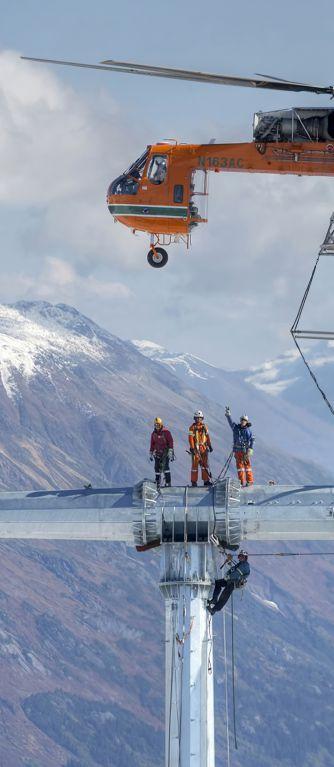
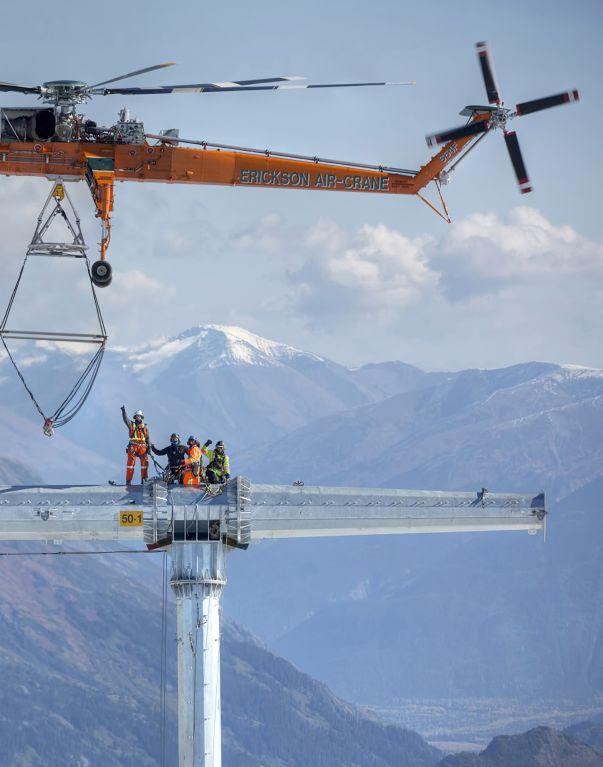
LEFT: Operating in remote areas is Erickson's speciality.
RIGHT: Having emerged from Chapter 11 earlier this year, Erickson looks to be out of the fire and flying free.
lot of our own fleet heavy maintenance and we build components for those aircraft. In addition, we do outside work for other Aircrane/ Skycrane customers and Bell customers, and refurbishment for U.S. government customers on heavy helicopter platforms.
We are currently building a new S-64E Aircrane for the Korean Forest Service; that aircraft is well underway. It is a replacement aircraft for them. We have built four for them in the past, and they really like this aircraft. They like the performance.
There are about 40 total Aircranes and Skycranes flying in the world; we have 20. Ours are all called the Aircrane. We bought the type certificate from Sikorsky in the ’90s. The Erickson product is a standard civilian category Aircrane. The aircraft we build for other customers are all standard civilian category Aircranes.
There are other operators that are still flying the military surplus restricted category Skycrane. The Skycrane are the original Sikorsky products. Performance-wise, they are the same aircraft.
How has Erickson improved on the original S-64?
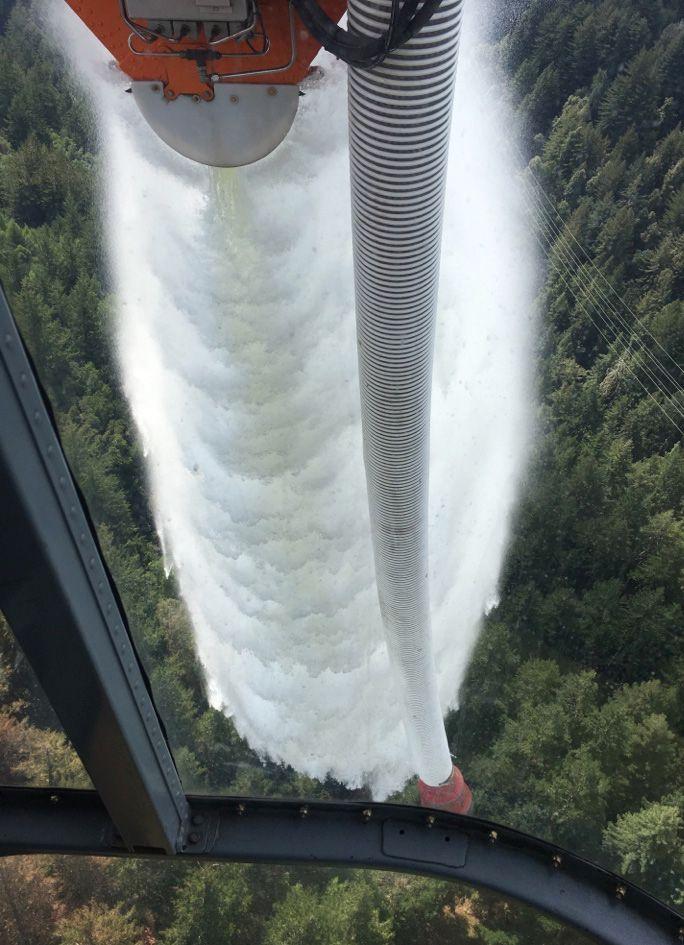
AM: We’ve engineered a lot of improvements to the Aircrane. Because we have our own operating fleet of these aircraft and we fly more Aircrane hours than anybody in the world, we are constantly improving and upgrading them. We developed the first large helicopter firefighting water drop tank-and-snorkel system, and we think it’s still the best. You fill the water with a hydraulic snorkel into a tank that has computer-controlled coverage drop levels. And it has proven itself over and over again all around the world.
Then we developed the sea snorkel, which allows us to fill the tank in 30 seconds from saltwater environments at 50 knots of forward airspeed. We’ve upgraded the cockpit avionics over the years.
We are also nearing the final stages of a composite blade rotor program for the Aircrane. We started the program several years ago, and we’re very close to certification of the blades. We expect to really enhance the performance and operating maintenance costs on the Aircrane. We’ve engineered it so it is exactly the same weight as the existing blades. That solves a lot of the harmonic issues. It will be a retrofit bolt-on to the existing fleet. We’ve done most of the flight testing and expect to have the blades FAA-certified by the end of the year.
We’ve done close to 200 improvements to this aircraft.
The previous Erickson leadership were criticized, even sued, for questionable decisions such as Evergreen. What’s the makeup of the new owners and board?
AM: We have a diverse group of new owners, private ownership. Several of them are former bondholders. Erickson had a lot of debt.
The board has given me full authority to run the company and we are in the process of making a lot of constructive changes.
Where does Erickson go from here?
AM: We want to grow our footprint in our existing markets. We think there’s room for some more growth in the places where we do our best work, which includes firefighting and power line. Historically we’ve done a bit of oil and gas work, moving heli-portable drill rigs in remote areas. That market has been way down because of the drop in oil and gas. We still do some of that in South America. I think in the next couple of years that will start to slowly uptick again. We fully intend to grow that market.
“
One thing that I’m particularly proud of: everybody at Erickson worked very hard during the bankruptcy.
When they bought the former Evergreen, they borrowed a lot of money, a lot of it through bonds. Some of our current owners are former bondholders. The transition, as we came out of bankruptcy, was actually relatively smooth because several of them were already with the company.
We have a completely new board, a mix of industry professionals and some high-level business folks from outside the aviation industry. The former ownership and shareholders are all gone. No one associated with the acquisitions that led to the difficulties is involved in the company.
We have quite a bit of room for growth in our government services side. We are very highly rated by the government contracting agencies for our performance in the field. We think there’s room for growth in that market in support of government contracts and UN relief work.
Erickson’s forte, what we do best, is operating in very remote, difficult environments, and keeping the aircraft and the crews safe and up and flying. Our operational readiness rates are among the best in the industry – in very difficult places. Not all operators have that capability; that’s what we specialize in.
And I see a fair bit of room for growth in our MRO group. We have some unique capabilities. Because we had to develop a lot of engineering
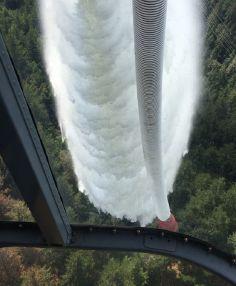
Water drops over wildfires are a strong application for the Aircrane. Erickson's snorkel technology is computer-controlled. (Photo credit: Tor Carter)
capability, machining capability, and speciality one-off capability – just to keep our Aircrane fleet current – we’re now branching out into some other legacy platforms to offer MRO services and to do speciality work for major OEMs like Bell and Sikorsky. It’s the small, individual engineering or machine projects that they don’t really want to deal with. It’s for somebody who needs 10 of
something, not 1,000 of something. Or they need a speciality part machined for an aircraft they still service but they’ve moved on. They contract us to do things like that.
The best example is that the U.S. military wants to keep their current MH and CH53E Super Sea Stallion fleet operational; it’s going to be awhile before they get the K model (with a program-of-record require-
ment for 200 CH-53Ks, the Marine Corps is targeted initial operations of the K model in 2019). They have contracted a few different providers to refurbish those aircraft and we are one of the contracted parties. We build the tail boom for that aircraft from scratch under contract from Sikorsky.
Erickson has been a mainstay in the rotorcraft industry for 40-years plus, and I’m feeling about as good about the company as I have in a long time. We are financially strong now. We have owners that want to see us grow. We have good liquidity. We’ve been able to keep our workforce and our customer base intact through the tough times. I really feel like we’re on the other side of that now.
A lot of times in these processes companies get broken up, portions of them get sold off, they emerge from this process a significantly different company than they were before. For us, the message is we have retained all our strengths. We have retained our manufacturing capability. We’ve retained our maintenance capability. We now have the ability to enhance what we do, to grow our markets, and throughout this process we have kept our safety records at the highest levels; that’s one thing we’ve never sacrificed no matter what. And I think we are safer, leaner, and stronger than we’ve been in several years.
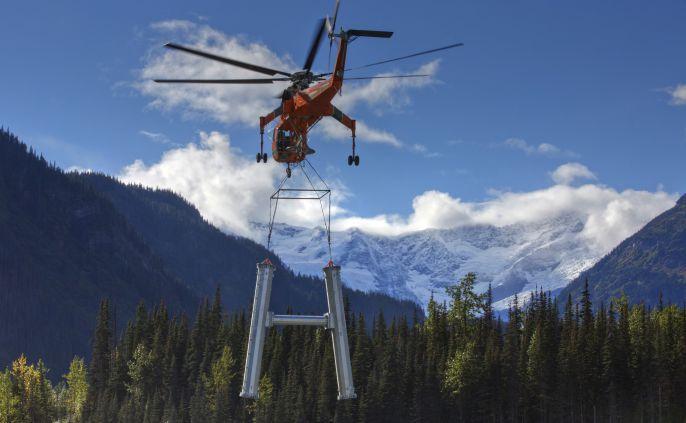
The Aircrane proves its worth in remote infrastructure work. Here, part of a pylon for a power tower is flown into place. (photo credit: Bryan Dudas)
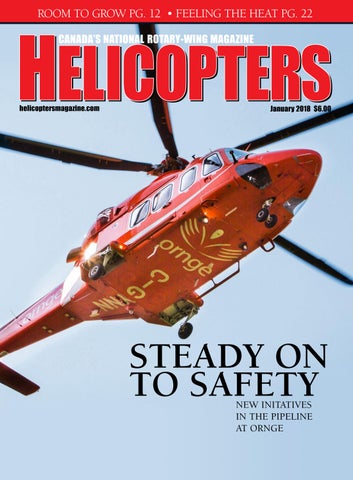
COVER STORY SAFETY STEADY ON TO
A conversation with Ornge COO Rob Giguere
BY MATT NICOLLS
The second annual All Canada Aeromedical Transport Safety conference took place Nov. 21 to 23 at the Ornge headquarters in Mississauga, Ont. The event entertained 56 attendees from 21 organizations – a nice uptick from the 37 attendees last year.
More than 40 medical professionals from various backgrounds were on hand to share solutions to common safety issues and discuss potential solutions.
Sponsored by Leonardo Helicopters and global insurance firm Willis Towers Watson, the event explored topics including the development of Ornge’s new Aeromedical Resource Management (known as AMRM) Standards program; fatigue management realities and their affects on pilot and crew performance; disaster recovery strategies; and more.
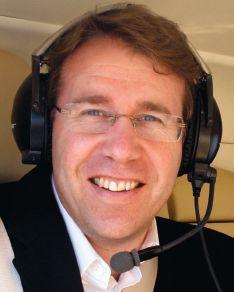
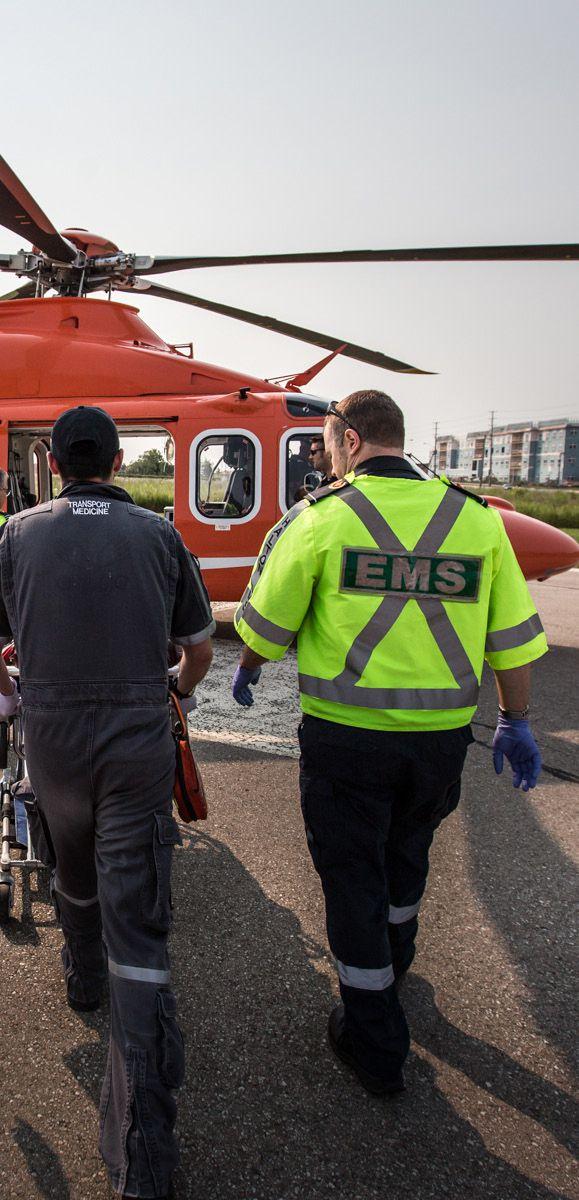
Ornge COO Rob Giguere said the conference enabled attendees to share best practices in a Canadian environment, which is different from the United States. Helicopters' had a chance to sit down with Giguere and talk about the one-of-a-kind event.
Q. Rob, I had the opportunity to sit in on some of the second annual ACAT Safety conference today. Impressive. What are your thoughts on the importance of this event for the air medical community and how has it grown in its second year?
A. David Huntzinger [Ornge’s Director of Aviation Safety] is very well known in the U.S. and has had some very significant safety roles in various organizations besides his extensive background with Navy training and EMS. Dave came to me with the idea of a conference. We are members of HAI [Helicopter Association International], we go to the AMTC [Air Medical Transport Conference]. We have been sharing discussions with other operators in the U.S., and these events are always U.S.-focused. We talked to some of the Canadian operators – B.C. Ambulance, STARs, etc. – and the consequence was, we
should get together. So I said to Dave, “away we go.”
We’ve got a great safety team which put the conference together. We didn’t do much advertising and people started hearing about it and came to us at the end of last year’s event to see if they could come and join us. We had a diverse, larger audience this year.
The information itself that we provided was very well received. But there are other important reasons for the conference. The sharing of best practices and safety initiatives…you learn an awful lot in your environment. The Canadian market has different challenges than the U.S. and we operate in different environments across the country.
Another reason is this gives us a common voice, a common platform for the group. If the group decides something needs to be done,
CAREERS IN AVIATION & AEROSPACE 2018
EDUCATION, TRAINING, JOB
PROSPECTS IN CANADA’S AVIATION AND AEROSPACE SECTOR
CAREERS IN AVIATION:
A SCHOOL FOR EVERY JOB
Aviation and aerospace are complex, high-tech industries rooted in education and the pursuit of excellence. Canada’s flight schools, training colleges and universities are the essential pivot between raw talent and enthusiasm, and tomorrow’s pilots, technicians and air transport and aerospace leaders. It’s a huge responsibility, ensuring there is a school and classroom for every job, and a job for every school to keep the pipeline flowing with exciting new talent.
Canada is home to the world’s fifth largest aerospace industry, and is supported by a dynamic air transport sector. How big is that? The Aerospace Industries Association of Canada (AIAC) reports the sector employs about 87,000 Canadians and generates $27 billion in revenues each year in aerospace manufacturing and MRO activities. Recent surveys suggest about 15,000 pilots and flight engineers. There are skill shortages popping up everywhere, meaning there are job opportunities for qualified new graduates in almost all sectors.
“Educational outreach and career pipeline programs will be essential to inspiring the next generation of pilots, technicians and cabin crew,” Boeing concludes in its 2017 Pilot & Technician Outlook, a respected industry forecast of personnel demand in the global air transport sector. “As personnel demand increases over the next two decades, the aviation industry will need to find innovative solutions to keep pace with training requirements.” Boeing projects global demand for two million commercial airling pilots, maintenance technicians and cabin crew between now and 2036: 637,000 pilots, 648,000 technicians and 839,000 cabin crew. There's no field with more opportunity.
And while a shortage of pilots tends to grab the headlines, the story runs much deeper. Up to 800 engineers are reported to retire every year between now and 2024, according to Canadian Business, while the rate of new hires is expected to outpace retirements as demand for Canadian aerospace products grows. And not just among large companies such as Bombardier, Pratt & Whitney Canada and Boeing – but also medium and small high-tech firms that feed the global supply chain.
According to the Aerospace Industries Association of Canada (AIAC), the share of supply chain exports stamped “made in Canada” increased by 20 per cent over the last 15 years, and now accounts for more than 60 per cent of Canadian aerospace product exports.
Canada’s academic infrastructure appears ready to meet the challenge of feeding the Canadian aerospace and air transport sector’s appetite for innovative and new graduates with full-time, parttime and learn-at-your-own-pace courses, and opportunities to upgrade academic skills such as partnerships between flight schools and flight colleges.
Major industry players are helping academia develop course curriculum, and mentoring programs are springing up between operators, colleges, universities and flight schools to provide mentorship and career pathways for aspiring pilots.
Still, the learning experience should not be limited to the walls and runways of flight schools and academia, especially in the early days when a student is considering career options in aviation.
But a learning experience should not be limited to the walls and runways of academia, especially in the early days when a student is setting a career course. There are many industry associations in Canada ready to help you make career choices, and many enthusiastic people in this industry who enjoy sharing their experiences.
The 2018 edition of Wings and Helicopters Careers in Aviation (CIA) guide is an introduction to a variety of careers in aviation and aerospace. It provides listings, helpful tips for choosing a flight school, and sets expectations for new graduates breaking into the industry.
Whether you are looking to fly fixedwing airplanes or helicopters. Launch a career in the sky with an airline or corporate operator, or keep your feet planted firmly on the ground in manufacturing and maintenance or industry support, this is an invaluable starting point.
Good luck on your journey!
TAP THESE RESOURCES
Aviation and aerospace leaders at various associations can aid in your career search
• B.C. Aviation Council www.bcaviationcouncil.org/about-thebcac
• Canadian Business Aviation Association www.cbaa-acaa.ca
• Canadian Council for Aviation and Aerospace www.avaerocouncil.ca
• Canadian Owners and Pilots Association www.copanational.org
• National Airlines Council of Canada www.airlinecouncil.ca
• Helicopter Association of Canada www.h-a-c.ca
To find out more about Wings and Helicopters Careers in Aviation Expos, go to www.wingsmagazine and www.helicoptersmagazine.com
CIA2018
PART 1: FLYING THE AIRCRAFT COCKPITS ARE CALLING
by David Carr
An industry-wide demand for new pilots continues unabated, with shortages impacting even flight schools that are on the lookout for instructors. There are an estimated 36,000 registered aircraft in Canada (both fixed-wing and rotary), that are calling for crews.
The 2017 Boeing & Technician Outlook, a respected industry forecast of personnel demand, projects that North America will need 117,000 new pilots over the next 20 years, to support industry growth. That is for commercial aviation alone and doesn’t include backfilling positions of retiring pilots heading for the exits.
Transport Canada estimates there are over 800 “on-demand” aviation service providers such as charter operators, law enforcement and emergency medical services, and helicopters supporting Canada’s resources industry and a growing demand for rotary business aircraft. Approximately 26 per cent of Canada’s business aviation fleet are helicopters.
“Airlines across the globe are expanding their fleets and flight schedules to satisfy demand generated by global economic expansion,” the report notes. “The aviation industry continues to address these challenges by creating balanced, sustainable solutions to fill future pilot pipelines.”
The Jazz Aviation Pathways Program, for example, has agreements with 15 aviation colleges, flight schools and universities across Canada, including Seneca College, to create a streamlined career path for pilots. Jazz is Canada’s third largest airline. Thirdyear Seneca Bachelor of Aviation Technology students are eligible for the Jazz cadet program that includes direct entry into the airline’s hiring pool.
It is all about giving low-time pilot graduates a ticket to develop their skills and enter the cockpit. Earlier this year, Air Georgian – with bases in Calgary and Toronto – launched SOAR – Sharing Opportunities for Advancement and Reward – mentorship program in partnership with Ottawa Aviation Services (OAS), a flight school. Flight instructors are given the opportunity for employment at Air Georgian.
Air Georgian recently added Ornge, Ontario’s air ambulance operator with its fleet of fixed wing and rotary aircraft, to the
SOAR operator partnerships. The partnership provides a career pathway for pilots at Ornge to become first officers with Air Georgian. Watch programs like Jazz Aviation Pathways and SOAR grow as operators look to fill cockpit seats and flight schools look for incentives to attract qualified instructors.
Flight schools sign a small number of graduates as instructors. It is a stepping stone where recruits build up necessary hours. An increased demand for pilots, especially at the regional level, means that the turnover of instructors is higher; a good opportunity for students entering the industry. Other entry-level opportunities to build up hours include air taxi operator or general aviation pilot.
Canada’s thriving corporate aviation sector should not be overlooked. Business aviation accounts for five per cent of registered airplanes in Canada, about 50 per cent of the fleet based in Ontario and Alberta. Modern corporate jets are every bit as sophisticated as today’s airlines, and the requirements to fly these airplanes is often equivalent and sometimes greater than what is required in the airline business.
Canada also has the second largest fleet of helicopters in the world. The backbone of the sector remains resource-based, although opportunities in the executive sector are available around major urban centres.
Boeing notes that regional markets that have relied heavily on recruiting pilots from outside their home locations are increasingly seeking to recruit, train and develop locally sourced pilots. Local aviation and aerospace expos such as the Wings and Helicopters Careers in Aviation Expos – this year in Toronto and Edmonton – certain help in this regard.
In Ontario, Ready Set Fly (RSF) is a notfor-profit organization specializing in educating high school students about aviation careers, including highlighting the skills and education needed to achieve a specific career. RSF is building an industry network to connect students and aviation organizations.
SELECTING A FLIGHT SCHOOL
If you have little or no aviation experience, selecting a flying school can be overwhelming and is best not done on impulse. Many questions go into selecting a flight school, beginning with identifying your flight goals. What province do you want to learn in,
the type of airplane you want to learn on (fixed-wing, dual engine, helicopter, turbine engine) and whether you prefer to train fulltime or part-time. Learning to fly is time consuming and expensive.
Students who train part-time typically do so to build flying lessons into a busy schedule that often includes a job, or to spread the cost over a longer period. Depending on the length of break between lessons, part-time will cost more because the student often has to relearn lessons. For those planning a career in aviation, full-time lessons are recommended.
There are two parts to learning how to fly; flight training and ground school. Ground school is classroom instruction where students learn the principles of flight, pilot decision-making, navigation and prepare for the written examination. Many flight schools offer ground school courses online. Transport Canada requires 40 hours of ground school instruction for a commercial pilot licence, so a flight schools approach to classroom instruction should not be overlooked.
Transport Canada has an online Flight Training Units Search tool to help find schools that offer the precise type of training a student is looking for. The search page includes drop-down menus that allow potential students to specific the type of training and type of aircraft to be used in training.
Canada’s aviation regulator does not rank flight schools or flying colleges, so an online search should be considered a starting point. Industry professionals agree that when picking the right flight school or graduating up to a flight college (see separate article), be prepared to ask a lot of questions. Don’t be timid. For example, ask about the number of hours it takes for students to complete a course. This number may vary from instructor to instructor. Don’t be afraid to walk away if a flight school does not answer all your questions.
What about the accessibility of the instructors, the number and types of training aircraft available and the quality of maintenance? An unwritten industry rule is one training aircraft for every four or five fulltime students, although that ratio changes with part-timers. Training aircraft clock a lot of hours and are put through tough paces. Maintenance is an important consideration for both safety and scheduling.
THE SKY IS LITERALLY THE LIMIT. AEROSPACE FOR A COMPLEX WORLD.
BCIT offers one of the largest aviation training facilities in Canada. Attend an info session or spend a day on campus to explore the Aircraft Gas Turbine Technician, Aircraft Maintenance, Avionics, Airport Operations or Commercial Pilot (Rotary or Fixed-Wing) programs. Learn how BCIT gives students the best opportunity to launch their careers at bcit.ca/aerospace
FLIGHT SCHOOLS
TOP OPTIONS FOR PILOT DEVELOPMENT AND TRAINING
YUKON
Alkan Air | Whitehorse
Alkan Air flight training is partnered with Yukon College to offer a two-year Aviation Management Diploma program. Whitehorse is an excellent place to learn to fly. It offers unique experiences and challenges that are not found elsewhere in Canada. Students not only experience flying at an international airport with traffic including large airliners, but also fly to gravel strips in more remote areas of the territory. Learn more: ftu@alkanair.com
BRITISH COLUMBIA
Canadian Flight Centre | Boundary Bay & Kamloops B.C.
Canadian Flight Centre (CFC) opened in 1979 at B.C.’s Boundary Bay Airport, near Vancouver, and became one of the first flight schools to specialize in instrument flying and other advanced training. For students looking to sharpen their flying skills, tail wheel and aerobatic training is one of CFC’s specialties. Kamloops proximity to the mountains also allows pilots the opportunity for mountain checkouts. Learn more: flying@cfc.aero
Chinook Helicopters | Abbotsford, B.C.
Chinook Helicopters began training operations in 1982 at the Abbotsford Airport. The Abbotsford area is ideal for yearround helicopter training. Chinook utilizes the expansive Fraser Valley for all initial flight exercises, and the Coastal Mountain Range for intermediate and advanced exercises. Due to the extensive commercial helicopter activity in southwestern British Columbia, most approaches and landings are to actual industry helipads. Learn more: training@chinookhelicopters.com
Coastal Pacific Aviation | Abbotsford International Airport, Abbotsford, B.C. Coastal Pacific Aviation (CPA) started operations in 1973. CPA’s main business is a University Aviation Program in partnership with the University of the Fraser Valley. Offerings include a one and two-year
by David Carr
Diploma, or a choice of a four-year Business (Aviation) Degree, or a General Studies Degree. CPA also offers non-university training for students who wish to complete their career flight training in fast paced year long program or self-paced flying for fun.
Learn more: info@coastalpacific.com
Glacier Air | Squamish Municipal Airport, B.C.
Glacier Air has experience along the Sea- to- Sky corridor from Vancouver to Whistler. Glacier Air specializes in mountain flight training for fixed wing and rotary aircraft. Given the terrain, Glacier Air also offers survival ground school, which includes studies in weather, flight techniques, effects of density altitude, emergencies, route planning and aircraft preparation, and survival gear.
Learn more: glacier.com
Ocean
Air Floatplanes | Victoria, B.C.
Seaplanes are a way of life along coastal Canada. Coastal jobs require high levels of experience because of the many challenges that the coast offers. Ocean Air Training specializes in seaplanes. The company’s beautiful Gulf Island’s setting just outside Victoria and close proximity to Vancouver, creates a perfect training environment for learning to be an experienced bush/urban Seaplane pilot.
Learn more: info@oceanair.ca
Okanagan Mountain Helicopters | Kelowna, B.C.
Okanagan Mountain Helicopters started as a helicopter flight training school in 2003. Training in the Okanagan area provides the variety of terrain and weather that exposes a student to new challenges while under the supervision of skilled instructors. The training facility at Kelowna International Airport – the tenth busiest in Canada – introduces students to fully controlled radio procedures, multiple training locations for confined areas and mountain flying introduction within a control zone, and the best blend of controlled and uncontrolled practice areas.
Learn more: okheli.ca/flight-training
Pacific Flying Club | Boundary Bay, B.C.
The Pacific Flying Club (PFC) was formed in 1965 as the Canadian Pacific Airlines Employees Flying Club. It remains one of the premier flight training and general aviation centres in Western Canada. Students train at Boundary Bay Airport, one of the busiest general aviation airports in Canada. PFC is also partnered with the British Columbia Institute of Technology, and together offers the diploma course, Airline & Flight Operations.
Learn more: info@pacificflying.com
Southern Interior Flight Centre |
Kelowna, B.C.
Southern Interior Flight Centre (SIFC) is located at Kelowna International Airport in the heart of the Okanagan Valley, where students spend time flying in mountain valleys, visiting the Rocky Mountains, travelling out over the Canadian prairies and exploring the coast of British Columbia running along the Pacific Ocean. The area is also surrounded by many small air strips, which allow for exposure to every level of controlled and uncontrolled environments a pilot might encounter.
Learn more: info@flysifc.ca
Victoria Flying Club | Victoria, B.C.
The Victoria Flying Club (VFC) has been training professional pilots since 1946. Located at the Victoria International Airport, one of Canada’s busiest airports, VFC specializes in mountain flying. In the Pacific Region, the combined effect of the great mountain system and adjacent Pacific Ocean lead to some extremely changeable flying conditions. VFC has partnered with the University of Victoria to offer a Diploma in Business Administration – Aviation Option program.
Absolute Aviation is a flight training and aircraft maintenance facility, largely serving students from Edmonton and central Alberta. Absolute operates out of
Wetaskiwin, Alta., with close proximity and access to major airports such as Edmonton International. The school operates in both uncontrolled and controlled airspace, eliminating costly ferrying time to training areas.
Learn more: info@absoluteaviation.ca
Calgary Flight Training Centre | Olds-Disdury Airport
The Calgary Flight Training Centre (CFTC) provides training for professional pilots and enthusiasts alike. Olds-Disdury Airport is uncontrolled airspace. There is no waiting for air traffic controllers to clear students’ take-offs and landings. Students are also able to start up the aircraft, taxi directly to the runway and takeoff when safe to do so.
Learn more: info@calgaryflight.com
Canadian Centre for Unmanned Vehicle Systems | Medicine Hat, Alta.
The Canadian Centre for Unmanned Vehicle Systems (CCUVS) offers a 1.5 day condensed Unmanned Vehicle Systems (UAS) ground school course to both civil and commercial operators, covering a range of topics including, aerodynamics, air law and regulations, weather, basic UAS 101, and aviation chart and flight supplements. Students also receive instruction for an Industry Canada Restricted Radio Operators License (Air). CCUVS also offers UAS training in Ontario and B.C.
Learn more: info@ccuvs.com
Centennial Flight Centre | Edmonton
Centennial Flight Centre has been operating since 1967. Located at Villeneuve Airport, approximately 25-kilometres northwest of Edmonton, Centennial offers a full range of training including a Recreational Pilot Permit, Private Pilot Licence, Commercial Pilot Licence, Multi-Engine and Instrument Rating. Villeneuve Airport has 3500-foot and 5,000-foot runways with approach lighting which are perfect for night flight training. Learn more: info@centennial.ca
Mountain View Helicopters | Springbank, Alta.
Mountain View Helicopters (MVH) has been training pilots for commercial or private helicopter licences for over 15 years. The training facility is located near Calgary International Airport, providing several advantages such as exceptional flying weather found on the prairies, close proximity to the mountains for use as a valuable training tool and the experience gained through frequent contact with air traffic controllers operating out of one of
Canada’s busiest airports.
Learn more: info@mvheli.com
SASKATCHEWAN
Mitchinson Flight Centre | Saskatoon, Sask.
Since 1946, Mitchinson Flight Centre has been one of Saskatchewan’s leading flight training schools. The school is located in its own hangar at the Saskatoon John G. Diefenbaker International Airport. Students learning to fly with Mitchinson train in an ATC controlled environment, providing experience for flying in larger centres, but without the traffic delays and congestion of a larger airport. Mitchinson is owned by professional airline pilots who have trained at the school and know what it takes to get ahead in today’s competitive aviation industry.
Contact: info@flymitchinson.com
MANITOBA
Brandon Flight Academy | Brandon, Man.
Brandon Flight Academy has been placing qualified pilots in cockpits since 1936. Located at Brandon Municipal Airport, just outside of Winnipeg, Brandon Flight Academy offers one-stop training in a multitude of courses. Southern Manitoba has excellent weather and terrain for conducting visual flight rules (VFR) flight training. Brandon offers students a varied flight experience with the practice facilities close by and no delays on the ground or in the air, students experience an efficient and educational learning environment.
Learn more: cfi@brandonflightcentre.com
Harv’s Air | Winnipeg
Manitoba’s extreme four seasons allow pilots to experience all types of flying conditions from cold air performance to hot summer day. Harv’s Air is a family owned training operator with locations near Steinbach and St. Andrews, Man., both in the Winnipeg area. In business since 1973, the company offers comprehensive courses for both recreational flying and those seeking a career in aviation. Learn more: www.harvsair.com
Prairie Helicopters | Gimli Airport Prairie Helicopters is a leading custom charter helicopter service and Manitoba’s only turbine helicopter flight school. Low traffic volume at the world-famous Gimli Airport – 45 minutes north of Winnipeg – provides ideal conditions for students to acquire radio communication skills pilots require throughout their careers.
Real life bush flying is only minutes away. Learn more: prairiehelicopters.com
Winnipeg Aviation | St. Andrews Airport
Winnipeg Aviation has been a leading trainer of pilots for over 20 years. The school’s base at St. Andrews Airport, 15 kilometres outside of the Manitoba capital offers three runways to maximize your training with and without cross winds. Instructors take students into Winnipeg International Airport to get first-hand experience to mix it up with the big players, while also flying to small short, uncontrolled grass strips to learn procedures.
Learn more: winnipegaviation.com
ONTARIO
Brampton Flight Centre | Brampton-Caledon Airport, Ont.
The Brampton Flight Centre (BFC) has been conducting flight training for more than 70 years. Located just northwest of Toronto’s Pearson International Airport, BFC teaches students to fly in a variety of airspace classifications, experiencing both controlled and uncontrolled environments. BFC is owned and operated by the Brampton Flying Club, and owns its airport. The centre has a tie-in with Sheridan College’s Bachelor of Business in Global Business Management, a strong fit for an ambitious professional pilot. Learn more: www.bramptonflightcentre.com
Diamond Flight Centre | London, Ont.
The Diamond Flight Centre (DFC) in London is part of a network of Diamond flight training schools in North America, and provides high-quality, flight training using Diamond aircraft and Diamondspecific flight training simulators. DFC London is located at the London International Airport. The airport is busy enough that students acquire experience with traffic, yet is generally quiet enough so that students can practice in a relaxed atmosphere, without long waits for clearance. Learn more: info@dfclondon.com
Durham Flight Centre | Oshawa, Ont. Durham Flight Centre (DFC) has been training aspiring pilots for 20 years. Located in the Enterprise Airlines hanger buildings on the grounds of Oshawa Municipal Airport, DFC charges competitive prices for ground training, instructor time and airplane rentals. There are major advantages to the Oshawa airport for flight training, including virtually no congestion, 24-hour operation, an air traffic control tower and modern navigational aids, extensive airport based facilities and more. From the Oshawa airport to nearly
Brampton Flight College (BFC) is recognized as one of the top-flight training schools in Canada.
The IATPL program is designed specifically to provide students with the skills required by today’s airlines. It includes over 1000 hours of ground school, flight and simulator instruction, covering basic skills to highly advanced training.
Integrated Airline Transport Pilot Licence (IATPL)18-20 month program
• Focused on advanced airline operational knowledge
• Experience in a full motion simulator used by airlines
• Includes training by industry experts from AeroCourse
At BFC, we are dedicated to produce qualified pilots, job-ready and familiar with current industry expectations.
Students graduating from the IATPL program are eligible to apply to several career programs like destination:porter, The Porter Pilot Mentoring Program and SOAR Mentoring Program with Air Georgian open to flight instructors.
practice airspace the flight time is only about 10 minutes, which means less time and money spent travelling and more on training. Learn more: info@durhamflightcentre.com
Essential
Helicopters | North Bay, Ont.
Essential Helicopters is a leader in helicopter charters and flight training. Essential has developed an efficient model for providing all levels of service and specialization within the helicopter industry. Students participate in strenuous physical activities such as helicopter log pad construction, chain saw operation, underwater egress training, winter survival program and winter helicopter operations. Essential Helicopters is also aligned with the Canadore College Commercial Helicopter Pilot Licence and Pilot Preparedness program. Learn more: info@essentialhelicopters.com
Genesis Flight College | Collingwood, Ont.
Genesis Flight College is a registered private career college located at the Collingwood Regional Airport. Through its affiliated holding company, Genesis owns the real estate and all the buildings on the field in which it operates. its students expect knowledgeable, highly trained professionals, premium training facilities, and an array of amenities. The facilities, flight training professionals and equipment at Genesis offer a breadth of services to students in the GTA and Georgian Bay region. A significant advantage of our program is that 100% of the flying is in advanced aircraft (DA40 and DA42). The program is designed to prepare students for direct entry into a commercial flying job with expert-level knowledge of the advanced systems of the DA40 and DA42 platform. Collingwood and Blue Mountain is a resort town and there are many accommodation options in the area. Students who like skiing or enjoy water sports will find lots of extracurricular opportunities. Genesis also has new accommodations being built at the airport, which will be ready in the summer of 2018. Services include commercial flight training, a college diploma program, private pilot training, instrument rating, multi-engine rating, instructor rating, sightseeing flights, and air taxi services. Learn more: flygenesis.ca
Great Lakes Helicopter | Waterloo, Ont.
Great Lakes Helicopter offers helicopter flight training and charters. The operation is based at the Region of Waterloo International Airport, one of the best training
airports in Canada. The region offers a unique blend of modern, energetic urban centres and scenic, rural landscapes creating diverse experiences for helicopter flight training. The training school also has a partnership with Conestoga College to provide a two-year Commercial Helicopter Pilot General Art and Science diploma program.
Learn more:
info@greatlakeshelicopter.ca
Helicopters Canada | North Bay, Ont. Helicopters Canada trains students from across the country and around the world from its training facility at Jack Garland Airport in North Bay. Just minutes north of the airport are heavily forested areas that contain multitudes of lakes and rivers, providing the ideal location for helicopter training to prepare a student pilot for real life helicopter industry experiences.
Learn more:
info@helicopterscanada.com
Ottawa Aviation Services | Ottawa
Ottawa Aviation Services (OAS) is a professional flight training and maintenance operation based out of Ottawa International Airport. OAS provides aviation professionals and enthusiasts with aviation services based on the values of the “golden age” of flight. The school specializes in designing customized, pay-as-you-go flight training programs that accommodate each student’s pace. Learn more: info@ottawaaviationservices.com
Ottawa Flight College | Ottawa
The Ottawa Flying Club, operating as the Ottawa Flight College (OFC) has been training pilots since 1928, and is Canada’s oldest flight training college. The school provides float and instructor ratings, and supports a large number of recreational pilots who fly for fun. Located at Ottawa International Airport, students learn to interact with a control tower and operate in an airport control zone as part of their training. The school’s practice area is minutes away from the airport.
Learn more: dispatch@ofc.ca
St. Thomas Flight Centre | St. Thomas, Ont.
Established in 1996, the St. Thomas Flight Centre has a flight training program customized to suite budgets and schedules. The school operates out of St. Thomas Airport in an uncongested flight training environment. School offices are located in the main terminal building and ground school classes are held on site. The Flight Centre has two additional satellite locations at Chatham airport and London airport. Email: learntofly@learntofly.on.ca
Spectrum Airways | Burlington, Ont. Spectrum Airways has been teaching students how to fly for over 40 years. The training facility is at the heart of Burlington Executive Airport, one of the busiest airparks in Ontario. Burlington Executive Airport averages 30 flights on weekdays and many more on weekends, and has become an exciting centre for general aviation enthusiasts. Learn more: info@spectrumairways.com
Waterloo Wellington Flight Centre | Waterloo, Ont.
The Waterloo Wellington Flight Centre (WWFC) is located at the Region of Waterloo International Airport and is one of the largest and most experienced flight training centres in Canada. WWFC is partnered with Conestoga College and the University of Waterloo to offer diploma and degree programs. WWFC also has a well-developed network among entrylevel aviation employers across the country. The centre also offers a UAV course designed to introduce people to the range of scope of the two categories of UAV’s (under 2 kg or from 2-25 kg).
Learn more: info@wwfc.ca
QUEBEC
Air Richelieu (Montreal Flying Club) |
Montreal
Air Richelieu is an accredited flight training centre that delivers both Canadian and American licences at the same time, and under the same roof. The school is located at St-Hubert Airport, approximately 20 minutes from Montreal. The airport provides a busy environment for training, but without the inconvenience of dense air traffic.
Learn more: info@airrichelieu.com
CQFA Aviation Industry Training | Montreal
The CQFA overs more than 50 courses, including a light unmanned aerial vehicle (UAV) professional pilot course, which has been offered since 2007. The 140hour, light UAV training covers the regulations, aerodynamics, flight discipline and human factors for operating a light UAV aircraft. The course covers all phase of a drone mission within the framework of a commercial or public safety operation. All the theory necessary for the operation of a light drone for the purpose of a commercial or public security flight is presented and learned prior to practical flight.
Learn more: info@cqfa.ca
Dorval Aviation | Montreal
Dorval Aviation is the only flight training centre located at the Montreal Trudeau International Airport, Canada’s third busiest, and at the heart of one of the country’s main
aviation centres. This strategic location provides all experiences required for successful training within controlled airspace. Dorval offers bilingual services and a complete selection of courses from a simple introduction to aviation to a commercial pilot licence. Learn more: info@dorvalaviation.com
Laurentide Aviation | Greater Montreal Area
Laurentide Aviation has been providing professional flight training since 1946. Based at Les Cedres Aerodrome, approximately 25 kilometres west of Montreal, Laurentide offers bilingual inflight and ground school instruction to suit any style of learning. The flight school is located at an uncontrolled airport, allowing students to get in the air and into the practice area quickly, reducing the cost and amount of time spent on the ground taxing and waiting for clearance at busy controlled airports. Learn more: info@laurentideaviation.com
Quebec City Flight School | Quebec City
Quebec City Flight School is a Canadian Helicopters’ flight school offering training to students and company pilots. Canadian
Helicopters is Canada’s largest helicopter transport services company. The school offers introductory and recurrent training. Instructors are operationally experienced in a broad variety of fields, including air ambulance, offshore, mining, firefighting, aerial construction and spraying. Instruction can be provided in French and English. Learn more: www.canadianhelicopters.com/services/flight-training
NOVA SCOTIA
Debert Flight Centre | Truro, N.S.
Debert Flight Centre, part of the Truro Flying Club (TFC), operates out of one of the best facilities in Atlantic Canada for flight training. Students learn in uncontrolled airspace that is not crowded with commercial jets and other air traffic. Debert is a compact airport offering students less than five minute from flight to the training areas. Ground school is held at Debert Airport and Halifax. Learn more: fly@flytfc.ca
Greenwood Flight Centre | Annapolis Valley, N.S.
The Greenwood Flight Centre (GFC) is located in Nova Scotia’s Annapolis Valley,
approximately one hour’s drive west of Halifax. Greenwood Flight Centre has been training pilots since 1958. Students often gain subsequent employment with the GFC. In addition to Kings County Municipal Airport, the school operates two satellite sites at Digby Municipal Airport and Yarmouth Airport in south-west Nova Scotia. Learn more: mail@flyfc.com
NEWFOUNDLAND
GFT
Aerospace | Gander, N.L.
GFT Aerospace has been offering elite flight training in Canada since 1992, and prepares pilots for the real work of aviation from its state-of-the-art training facility. Located in Gander Newfoundland, GFT proves to be beneficial because students experience real world weather conditions. GFT’s sister company, EVAS Air, is a local airline for Air Canada. Because of this, GTF has established its Career Progression Program, which is open to all students at no additional cost.
Learn more: admin@gft.com
PART II: DESIGNING AND MAINTAINING AIRCRAFT A LAND OF OPPORTUNITY
CANADA’S VIBRANT AEROSPACE AND MRO INDUSTRIES PROVIDE GREAT OPTIONS
Aerospace jobs in Canada are nationwide, meaning there are excellent job opportunities coast-to-coast for graduates of colleges with aviation technician programs. Students interested in manufacturing will largely be based in Quebec and Ontario, which account for 80 per cent of manufacturing (55 per cent and 25 per cent respectfully).
For MRO students, Western and Atlantic Canada remain strong, capturing almost 60 per cent of the sector. According to Boeing, global fleet growth will continue to drive a strong demand for technicians to repair and maintain the airplanes. Boeing predicts that North America will need 118,000 new technicians to support airline growth alone. Airplanes are very mobile. While many basic MRO functions have been exported to lower wage countries, Canada remains a global player in higher end and more sophisticated MRO.
There are manufacturing opportunities in Western Canada also. For example, Winnipeg is home to Boeing Canada, which operates the country’s third-largest aerospace manufacturing facility (Canada is Boeing’s second-largest international supplier network, working with more than 560 suppliers across the country).
There are good jobs available for graduates interested in both fixed wing and rotary aircraft and propulsion systems. Canada ranks in the top three worldwide in terms of civil airplanes (No. 2 in business aircraft production and #3 in regional aircraft), helicopters (No. 3 in helicopter production) and aircraft engines (No.1 in turboprop and helicopter engine production). Canada also ranks fourth worldwide in turbofan production and large jet production.
Like other sectors in Canada’s manufacturing industry, aerospace is scrambling to close a skills gap. According to a 2015 labour market report by the Canadian Council for Aviation and Aerospace (CCAA), 83 per cent of Canadian aviation and aerospace companies expect to continue to grow. Another driver for
by David Carr
hiring will be retirements. As the Canadian workforce ages, demand for younger workers – and workers with skills to apply to new and emerging technologies in aviation, is expected to also grow.
The CCAA study noted an imbalance in skills needed and those that are available, something students should research carefully when selecting an aviation technician program. Boeing notes that as operators continue to take delivery of new airplanes, advances in airplane technology will drive an increased need for technicians skilled in avionics, composites and digital troubleshooting.
AVIATION TECHNICIAN COLLEGES
BRITISH COLUMBIA
British Columbia Institute of Technology | Vancouver
The British Columbia Institute of Technology (BCIT) School of Transportation is a North American leader in transport training and producing high-quality, job-ready graduates in demand by the aerospace sector. The School of Transportation delivers accredited and globally recognized programs tailored to meet the human capital needs of the transport industry. The school’s aerospace facility is the largest provider of skilled graduates to the aviation industry in British Columbia, and offers accredited programs that prepare graduates for careers as Aircraft Maintenance Engineers (avionics and maintenance), and Gas Turbine/Jet Engine Technicians. The Aerospace Technology Campus is conveniently located at the Vancouver International Airport and features a dramatic 40,000 square foot hangar at the centre for BCIT’s fleet of light piston, turboprop, corporate and jet transport aircraft, and light and medium helicopters. Learn more: www.bcit.ca/about/aerospace
Northern Lights College | Dawson Creek
Northern Lights College (NLC) opened in 1975. It is known as B.C.’s Energy College, serving northern British Columbia in an area covering more than 324,000 square kilometres. NLC’s Aerospace Centre of Excellence opened in 1981, at the college’s Dawson Creek Campus. Aspiring students and current aircraft maintenance engineers receive hands-on training in a hangar that houses 13 aircraft, including a Robinson R44, Airbus AS350D and Bell 205 and 206 helicopters, a Cessna 180, Beechcraft King Air, Piper Aztec and British Aerospace Jetstream 31, turboprop airliner.
Learn more: www.nlc.bc.ca
ALBERTA
SAIT Polytechnic | Calgary
The Southern Alberta Institute of Technology (SAIT) Polytechnic is a member of Polytechnics Canada, a national alliance of leading research-intensive colleges and institutes of technology. SAIT’s School of Transportation, provides hands-on, practical education for the aviation, heavy equipment and rail sectors. The school offers full-time training in aircraft maintenance engineering, aircraft structures and avionics technology. All programs are taught at the state-of-the-art Art Smith Aero Centre for Training and Technology, located at the Calgary Airport. Learn more: transportationinfo@sait.ca
SASKATCHEWAN
The Saskatchewan Indian Institute of Technologies | Saskatoon
The Saskatchewan Indian Institute of Technologies (SIIT) was created in response to the need for quality, post-secondary education for First Nations people. The Saskatchewan Aviation Learning Centre at Saskatoon’s Diefenbaker International Airport is a joint effort of SIIT, the government of Canada, province of Saskatchewan and the Saskatoon Airport Authority. The SIIT Aircraft Maintenance Engineer program is open to First Nation and non-First
LEARN MORE fanshawec.ca/aviation
START SEPTEMBER. APPLY TODAY!
Transport Canada-approved aviation programming in: Diplomas
• Aviation Technician –
Aircraft Maintenance
• Aviation Technician –
Avionics Maintenance
CO-OP OPTIONS AVAILABLE!
Delivering skills-oriented aviation programs for over 85 years in Canada’s most comprehensive training facility, the Art Smith Aero Centre.
Industry-experienced instructors and a hands-on, practical education. And with an 87% employment rate, our graduates are in demand.
Aircraft Maintenance Engineers Technology
Aircraft Structures Technician
Avionics Technology
LEARN MORE AT SAIT.ca
CIA2018
Nation students, and delivers the knowledge and skills required for eligibility to apply as an apprentice in the aircraft maintenance industry. Graduates are credited with 18 months toward the current four-year industry requirement to obtain a licence.
Learn more: www.siit.ca
MANITOBA
Red River College | Winnipeg
Red River College (RRC) offers training in all aspects of the aviation and aerospace sector. RRC’s Aircraft Maintenance Engineer program is designed to develop the knowledge and skills in maintenance of both large and small airplanes and helicopters. This program has been accredited by the Canadian Forces for their Non-Commissioned Member Subsidized Education Plan. RDC also offers programs for careers as an Aircraft Structures Technician, Aircraft Gas Turbine Engine Repair and Overhaul Technician.
Learn more: www.rrc.ca
ONTARIO
Algonquin College | Ottawa
Algonquin College’s School of Advanced Technology of a broad range of programs including Transportation Technology departments. Programs are created with the needs of industry sectors in mind, with skills that are transferable around the world. The Aircraft Maintenance Technician program teaches students the knowledge and skills required to equip themselves for work in the aircraft maintenance industry.
Learn more: www.algonquincollege.com
Canadore College | North Bay, Ont.
Canadore has been a leader in aviation training for more than 40 years. The School of Aviation is a dedicated aviation training facility and courses are delivered at the college’s Aviation Campus at Jack Garland Airport. The campus includes prime training space, and is filled to capacity with fixed and rotary wing aircraft for students to work hands-on. A New Advanced Composites, Fabrication, Repair and Test Centre is a recent addition to the campus and supports innovative technologies, applied research, materials testing opportunities and customized training programs. The college offers three basic training programs; the Aircraft Maintenance (AMT) and the Avionics Maintenance (AVN) program, and a Structural Repair (ASR) Technician program. In addition there are advanced aviation technology programs.
Learn more: www.canadorecollege.ca
Centennial College | Toronto
Centennial College’s School of Transportation is Canada’s transport training hub. The faculty are among the most highly skilled in the industry, and training equipment is state-of-the-art, including a fully equipped hangar for aerospace and avionics students. Programs are supported and reviewed by industry representatives to ensure they are of the highest quality.
Aircraft Maintenance and Avionics Maintenance are the two Aviation Technician programs offered within the school.
The Aviation Technician – Aircraft Maintenance program is for students who are more interested in the airplane than the trip. It provides the opportunity to master mechanical, electrical, electronic and other science skills related to aircraft maintenance. The program emphasizes the repair of electrical and mechanical systems within the aircraft. Students will study hydraulics, fuels, environmental systems, engines, flight controls, landing gear system and airframes and structure.
The Aviation Technician – Avionics Maintenance program provides students with the knowledge and skills to launch a career as an aircraft maintenance technician in avionics, which covers a wide-range of the aviation and aerospace sectors that work together to keep aircraft safe and airworthy.
A large portion of this program focuses on aviation maintenance practices, procedures and Canadian aviation regulation requirements through hands-on practice in labs.
Avionics Maintenance courses are designed to teach students how to perform tasks and activities associated with the maintenance and repair of aircraft communications, navigation and data systems, and inspection and troubleshooting of basic electronics circuits to sophisticated avionics systems found in modern aircraft.
In this program, a significant portion of time is spent on practical applications in labs. Training focused on the aircraft’s various electronic systems – electrical power distribution and control, navigation, flight instrumentation, communication and radar. Students are also prepared to be a bench technician for avionic-approved shops and aircraft manufacturing companies. The course material is very technical and comprehensive, and to achieve success, students should be prepared to invest extra time on study, mandatory project completion and exam preparation.
Centennial College’s Ashontbee Campus’ airplane hangar provides a learning environment that conforms to industry standards. Students will learn about routine maintenance, servicing, inspection, diagnostics and repair, as well as performing flight-line duties.
In the fall of 2018, Centennial College will open its Centre for Aerospace and Aviation, now under construction at Toronto’s Downsview Park. The project includes a hangar, which is large enough to accommodate today’s commercial jets, as well as new classrooms, laboratory space, workshops, offices, a library and, for the first time, access to working runways.
Learn more: www.centennialcollege.ca
STEP 1: LEARN TO FLY
Get your commercial pilot licence with one of our flight school partners. Upon graduation continue to build your hours as an instructor or apply to one of our SOAR mentorship pilot opportunities. For a full list of our partners, visit airgeorgian.ca.
STEP 2: FLY WITH AIR GEORGIAN
Do you have 800 hours of flying time? You’re ready to start your career with Air Georgian flying as an Air Canada Express First Officer! Gain airline experience and take advantage of quick upgrades, training department opportunities and fleet transfers.
STEP 3: INTERVIEW WITH AIR CANADA
Have you dreamed of flying for Air Canada? We can help you achieve your dreams. As a pilot flying for Air Georgian you are guaranteed an interview with Air Canada once you meet their minimum hiring requirements.
INTERESTED IN LEARNING MORE?
Visit airgeorgian.ca/soar for program details
CIA2018
Confederation College | Thunder Bay, Ont.
Confederation College offers several aerospace and aviation technician courses at its Aviation Centre of Excellence (ACE) at Thunder Bay International Airport, Ontario’s third busiest. For example, Students learn about composites and how these materials make a difference in flight. Programs were developed in partnership with some of Canada’s leading aerospace companies including Bombardier and Magellan, and ACE has a sizeable fleet of non-flying aircraft for students to work on. Learn more: confederationcollege.ca
Fanshawe College | London, Ont.
Fanshawe College is one of the largest colleges in Ontario. The school’s Aviation Technician – Avionic Maintenance program covers all aspects of aircraft avionics systems used in general aviation, corporate, charter transport category aircraft and helicopters. The course provides students with the knowledge and skills needed for servicing, repair and maintenance of aircraft electrical and electronics systems.
Learn more: www.fanshawec.ca
St. Clair College | Windsor, Ont.
St. Clair College delivers a customized training program to train aircraft maintenance and repair workers in partnership with Quebec-based Premier Aviation at its Windsor maintenance, repair and overhaul (MRO) facility. The course will future classroom and hands-on study. Premier Aviation’s Windsor MRO facility is capable of handling all types of aircraft, including the Boeing 747.
Learn more: www.stclaircollege.ca
NOVA SCOTIA
Nova Scotia Community College | Dartmouth, N.S.
The Nova Scotia Community College’s (NSCC) Aviation Institute provides students with the opportunity to build their skills using the latest technology, and to apply learning to real aircraft. The Aviation Institute is housed in a modern, 43,000 square-foot training facility. Students will learn from faculty who bring a passion for their work, valued experience and strong industry connections. NSCC offers three aircraft maintenance engineer programs at the Aviation Institute; structures, mechanical and avionics. Learn more: www.nscc.ca
PRINCE EDWARD ISLAND
Holland College | Summerside, P.E.I. The Holland College Aircraft Gas Turbine Engine Repair and Overhaul Technology program works closely with PEI’s growing aerospace industry. In this 10-month program, students will learn the techniques, procedures and the documentation requirements necessary to perform the disassembly, inspection, repair, reassembly and testing of the turbine engines used to power today’s aircraft. The program consists of approximately 60 per cent practical and 40 per cent theory. Hands-on, practical training is carried out on a variety of turbine engines. Learn more: info@hollandcollege.com
NEWFOUNDLAND
College of the North Atlantic | Gander, N.L.
The College of the North Atlantic (CNA) is part of the Lufthansa Technical Training network of approved schools. The Aviation division of the College of the North Atlantic delivers several aerospace programs at its Gander, Newfoundland campus, including Aircraft Maintenance Engineering Technology and Aircraft Structural Repair Technician. Learn more: www.cna.nl.ca
Earn a Master’s Degree in Aviation with an additional 1 ½ years of study Georgian’s Aviation Management program is the only 3 year program in Canada that allows students to progress directly into Griffith University’s Masters in Aviation Management degree program.
With only 1 additional year of study our grads also have a choice to complete one of two Bachelor of Science degrees with Embry-Riddle Aeronautical University
April 28, 2018 // Mississauga, ON May 12, 2018 // Edmonton, AB
WHO SHOULD ATTEND:
• High school students
• Air Cadets
• Post-Secondary students
• Flight school students
• Anyone looking for a career change!
WHY SHOULD YOU ATTEND:
• Network with industry professionals
• Meet a mentor or future employer
• Learn about educational requirements
• Discover new options to get your flight hours
• Have fun, take a tour, and win prizes!
PREMIER SPONSOR
PREMIER SPONSOR
MOVING TO A HIGHER PLANE: THE UNIVERSITY EDGE
by David Carr
UNIVERSITY STREAMS OFFER VALUE
Aerospace is a research-driven industry, and Canada needs a steady supply of sharp and disciplined minds to maintain its innovative edge and push forward in aircraft design and productions, composites, integration, artificial intelligence and advanced propulsion systems. This is where universities come in.
The Canadian aerospace industry invests almost $2 billion annually in R&D, and is the number one investor in research and development compared with all other Canadian manufacturing sectors. Aerospace manufacturers also partner more with academia, government and others more than any other manufacturer.
As a student in a university with an aerospace diploma program you will work hands on alongside creative thinkers and designers to research and develop the products that will enter the global supply chain, while building a path to excel and position yourself as a leader in this exciting industry.
But it’s not just aerospace. A university degree is also regarded as a valuable asset by the airline industry when hiring pilots with the potential to transition from the flight deck to executive management. Many excellent Canadian universities have aerospace engineering and other programs at the undergraduate, graduate and PhD levels to support great careers in the aerospace and air transport sectors.
BRITISH COLUMBIA
Fraser Valley University | Fraser Valley, B.C.
Fraser Valley University (UFV), in partnership with Coastal Pacific Aviation, a renowned flight training company located at Abbotsford International offers a Bachelor of Business Administration (Aviation) degree to equip you with the flight and business skills you need to succeed in the aviation industry.
Graduates not only have the potential to become flight captains, they can also assume management responsibilities for an airline or airport.
Learn more: www.ufv.ca.
ALBERTA
MacEwan University | Edmonton
MacEwan’s Business Management Aviation Major is a unique partnership between MacEwan University and Transport Canada-approved training centres. The Aviation Major provides a mix of skills that prepares students for the business of flight. Five courses from the Business Management diploma are replaced with aviation training, leaving students with instruction in many core business skills, including accounting, marketing and strategic management.
Learn more: www.macewan.ca
Mount Royal University | Calgary
Mount Royal University’s Aviation Diploma program combines flight training with an academic diploma, preparing students to handle the role of a pilot both in the air and on the ground. Students will receive more than 420 hours of aviation education and will have a foundation in aviation-related studies including, aviation economics and management, safety management systems, aircraft systems, advanced meteorology, and GPS and crew management. Practical flying experience is accumulated on Mount Royal’s fleet of four, single-engine aircraft and three multi-engine aircraft. The fleet is equipped with the latest GPS avionics, and is located at the Mount Royal Hanger at Springbank Airport just west of Calgary. While making flights across Western Canada, students will earn more than 200 hours of total flying experience. In addition to the Commercial Aviation Diploma, Mount Royal also offers Private Pilot Licence training.
ONTARIO
Carleton University | Ottawa
Carleton Aerospace is an organized research group concentrating many researchers at Carleton University to encompass the full breadth and depth of aerospace and aeronautics. It features one of the largest groups of professors conducting aerospace research in the country. Aerospace Engineering students at Carleton actively participate in design projects.
Carleton is a long-time leader in aerospace and has chalked up a number of impressive firsts, including introducing the First Bachelor of Aerospace Engineering program in Canada, in 1988, and first undergraduate course on rotorcraft in Canada. The university has one of the largest undergraduate aerospace programs in Canada, and one of the largest graduate aerospace populations. Learn more: aerospace@carleton.ca.
Ryerson University | Toronto
The mission of Ryerson University’s Aerospace Engineering graduate program is a combination of several interconnected objectives: to provide an excellent academic experience for graduate students within the realm of aerospace engineering that will better enable them to realize their potential upon graduation; to bring relevance to the program through strong interaction with the aerospace industry as it related to both education and research; and to conduct innovative, internationally recognized research across a spectrum of key areas that are of significant to the Canadian and global aerospace industries. Learn more: www.ryerson.ca
University of Toronto | Toronto
The University of Toronto Institute for Aerospace Studies (UTIAS) offer many exciting research activities for prospective undergraduate and graduate students. The undergraduate program is offered through the Engineering Science Program. At the graduate level, UTIAS offers research-intensive programs leading to MASc and PhD degrees, and a professionally-oriented
A World Leader In Innovative Aircraft Modifications
Challenging work
Rewarding environment
Continuous learning & development
Dynamic & growing operations
program leading to the MEng degree. The scope of research includes aeronautical engineering (aircraft flight systems, propulsion, aerodynamics, computational fluid dynamics and structural mechanics) and space systems engineering (spacecraft dynamics and control, space robotics and mechatronics, and microsatellite technology). Learn more: www.utias.utoronto.ca
University of Waterloo | Waterloo
The University of Waterloo’s Bachelor of Environmental Studies (BES) and Bachelor of Science (BSc) programs have been designed to provide a strong base for careers in a diverse array of aviation and aerospace industries. Through a strong partnership with the Waterloo-Wellington Flight Centre, students will complete a Professional Pilot Program where courses are offered over a period of six academic terms, beginning in second semester. Overall, the flight-training component is offered concurrently with the courses. Learn more: www.uwaterloo/aviation
University of Windsor | Windsor
The University of Windsor’s Aeronautics Leadership program provides students with a unique opportunity to combine a university education with flight training. Students take classes on the University of Windsor campus in areas of Arts, Humanities, Social Sciences, Business, Science and Engineering.
The Aeronautics Leadership curriculum is diverse and flexible, giving students the chance to explore various areas of study. This education is coupled with commercial flight training, which is run by Journey Air at the Windsor International Airport.
Learn more: www.uwindsor.ca
Western University | London, Ont.
The Commercial Aviation Management (CAM) program at the Western University is a stepping stone to a career in aviation. CAM students graduate with a Bachelor’s degree in Management and Organizational Studies (BMOS), with specialized courses in aviation management. Western is the first Canadian university to offer an aviation management program, and the only university to offer a four-year university degree in Aviation Management. The CAM program was developed in response to the changing Canadian aviation industry, which is increasingly requiring a university degree.
Learn more: www.welcome.uwo.ca
QUEBEC
Concordia University | Montreal
For graduates with longer-term executive career ambitions in aviation and aerospace, the Aviation Management Institute (AIM) at Concordia University offers courses in aviation management and leadership development. Part of Concordia’s
CIA2018
John Molson School of Business, AMI has established partnerships with leading universities and international aviation organizations. It has developed e-learning programs for the International Aviation Organization (ICAO) and Airports Council International (ACI).
AMI offers online programs such as the Aviation Security (AVSEC) Professional Management Certificate (PMC). Created in partnership with ICAO, this is the first and only certificate of its kind in the world, designed to provide specialized training focused on the evolving and critical area of aviation security. AMI’s Airport Executive Leadership program helps to develop airport industry leaders and advance the professionalism of airport management practices.
Learn more: www.concordia.ca
Ecole Polytechnique de Montreal | Montreal
The master’s program in Aerospace Engineering aims to broaden candidates’ technological and scientific knowledge of aerospace engineering and to train highly specialized engineers. The program is offered in conjunction with McGill and Concordia universities, Ecole de Technologie Supérieure, Université Laval, Université de Sherbrooke and a number of aerospace companies in the Montreal region. Students must follow at least two specialization courses (with the exclusion of case studies) given by the other participating institutions. Candidates who successfully complete the professional master’s in Aerospace Engineering program obtain a Master of Engineering (MEng) degree.
Learn more: www.polymtl.ca
ONE YEAR DIPLOMA PROGRAM
Genesis Flight College is a private career college offering specialized flight training programs which expose students to the most advanced equipment available in the industry Graduates of the one year program achieve a COMMERCIAL PILOT DIPLOMA and have the credentials required to begin flying as a career immediately
McGill University | Montreal
McGill University offers an Air and Space Law LL.M. with Thesis or Non-Thesis. A Master’s Thesis is a 30,000-word project. It should constitute a sustained analytical contribution to an ongoing academic discussion or to developing concepts and practices. Non-Thesis 15,000-word Supervised Research Project. The paper constitutes a substantial piece of critical writing, of publishable length and quality that elucidates particular ideas or problems within an area of law. The Thesis program is suited to students who wish to focus on original scholarly research and writing under the supervision of a law professor. In turn, the Non-Thesis program is suited to students who wish to gain a wide exposure to a range of taught courses within, and related to, the domain of Air and Space Law.
Learn more: www.mcgill.ca/law
NEW BRUNSWICK
Mount Allison University | Moncton, N.B.
Offered in partnership with the Moncton Flight College, Mount Allison’s aviation program allows students to earn an undergraduate degree incorporating flight and ground school training. The major is an interdisciplinary science program, featuring study in depth of subject that are relevant to aviation. Before graduation, students must complete over 200 hours of flying, hundreds of hours of ground training and hold a Commercial Pilot Licence with multi-engine and instrument ratings.
Learn more: www.mgta.ca/aviation
Learn more: www.mtroyal.ca
PART III: SPECIALIZE AVIATION SUPPORT SERVICES READY AND ABLE
by David Carr
SPECIALIZED PROFESSIONALS IN AIRCRAFT MOVING
Aviation relies on a vast and complex network to dispatch airplanes, turn aircraft around at a local airport, guide flights across the sky and safely back to the ground, finance equipment and maintain the regulatory framework that keeps aviation and aerospace turning over. There are literally thousands of jobs for recruits who want to keep their feet on the ground, and those who want to work in the air in a different capacity – flight attendants. Careers in Aviation provides a sampling of some of these opportunities.
Aircraft maintenance crew
Depending on the size of airplane, a team of up to 35 ramp attendants will offload an arriving flight and ready the airplane to receive a new load of passengers. An aircraft maintenance crew will marshal aircraft to and from the gate, manoeuvre the air bridge, operate a fleet of vehicles including tow trucks and catering trucks, attach nozzles to the aircraft to pump lavatory waste out, unload hundreds of passenger bags and tonnes of air freight, refuel and clean the cabin.
There is more to the job than meets the eye. Each aircraft is different, and the weight of an aircraft changes daily. Airlines, third-party air service providers or airport authorities employ most ramp attendants. It is demanding physical work and airlines typically have standards on how much a candidate is able to lift on a regular basis.
Flight operations dispatch
A flight dispatcher is like a ground captain, except where the captain is operating a single aircraft, an airline dispatcher can be responsible for up to 50 aircraft during a single shift, including charting routes and alternates, calculating fuel loads and aircraft weight, monitoring flights (known as “flight watch”) and making decisions whether to divert or cancel flights if an aircraft cannot continue to operate safely. A dispatcher is also plugged into air traffic control to ensure the most efficient routings and minimize costly air traffic control delays.
An airline dispatcher makes joint decisions with the flight captain to ensure a safe and
efficient flight, including giving the crew a situational update prior to departure, including aircraft activity and weather information and feeding data to the flight deck en route
A commercial pilot licence, flight services specialist experience, air traffic control experience or related experience within a flight operations centre can improve career prospects, especially with the larger air carriers.
EDUCATIONAL OPPORTUNITIES
AIR NAVIGATION, NAV CANADA (internal)
Before controlling, directing and advising aircraft in Canadian air space, air traffic controllers and flight service specialists go through intensive training programs that last anywhere between one- and two-anda-half hours. The curriculum and duration of NAV CANADA’s training programs depend on the stream a student is selected for. All streams require focus, hard work and commitment. Training is delivered on a full-time basis. Class times vary by location, but they are typically eight hours a day. Students can also expect to put in additional study and simulator time to prepare for next day’s classes. Expect to invest a further two to three hours after class hours to succeed. Learn more: takecharge.navcanada.ca
AIRPORT OPERATIONS, BCIT,
(Vancouver)
The award-winning BCIT diploma program in Airport Operations is designed to meet the demands of today’s unique and dynamic global airport operation environment. The 16-month Airport Operations is supported and approved by the aviation industry and provides students with a comprehensive, interdisciplinary program of study. This is the only program of its type in Western Canada. BCIT also offers an online Airport Operations Part-time studies Associate Certificate.
AVIATION MANAGEMENT, Concordia University (Montreal)
Concordia’s John Molson School of
Business offers non-credit courses in leadership development and aviation management to partners in the aviation industry. Concordia’s Aviation Management Institute (AMI) has partnerships with many universities and international organizations, and has developed blended learning programs for both the International Civil Aviation Organization and Airports Council International. AMI initiatives include on-line programs such as the AVSEC Security Professional Management Course and the Airport Executive Leadership Program, as well as organization-specific executive programs. These programs are offered at Concordia, international training centres or on-site at the client’s home offices.
AVIATION MANAGEMENT, Georgian College (Barrie, Ont.)
The Canadian Aviation Institute (CAvI) at Georgian College is a national centre of aviation management training and education. Graduates of CAvI work in a variety of aviation fields including airport management, aviation operations, airport planning and air traffic control. Commercial pilots, flight dispatch, flight services specialists and many other aviation-related occupations have benefited from this additional enhancement to their chosen career field. Located in Barrie, Ont., the three-year Aviation Management diploma program provides students with a solid understanding of the aviation industry.
FLIGHT SERVICES, Seneca College (Toronto)
The Flight Services program encourages students to develop career-related skills, knowledge and behaviours to effectively perform a variety of functions required in providing exceptional passenger service. As a Flight Services graduate students may find employment as a passenger service representative, check-in agent or reservation agent.
The Operations and Cabin Management diploma program encourages students to develop career-related skills, knowledge and behaviours to effectively perform a variety of functions required in providing passenger safety and customer service in the airline industry.
FLIGHT COLLEGES SURGING FORWARD
Even in a tight labour market, unlocking the door for the chosen career is going to be tough. Education will always be the key. Recruiters are more likely to put candidates with a college degree or university closer to the top of the list, especially if the post-secondary program includes studies in fields linked with aviation. Indeed, it is estimated that up to 95 per cent of pilots hired by commercial operators also have a college degree.
Canadian colleges with aviation programs teach essential skills not always found at flight schools, something else to consider when selecting a flight school. These skills include a deeper understanding of the technical aspects of the industry, critical decision-making and so-called “soft skills” such as effective communication; an important consideration on the flight deck, or flying for a corporate charter provider where the client base is often top executives of some of Canada’s largest corporations.
The one-two punch of a pilot’s licence and college degree is also smart career planning for the student that wants to consider transitioning into an executive position for an airline, airport or aerospace company.
Not everything taught in a college setting will be connected with aviation, and students with broader career ambitions outside of a long-term career in aviation may want to consider flying school while taking a degree program not so closely tied in with the aviation and aerospace industry. Although this may limit your potential within the airline sector.
Aviation is also an assessment-based and cyclical business. Think of a degree as an insurance policy against an unexpected failed health check or layoff. Finally, the subject matter for many aviation-related college courses is set and taught by industry professionals, and offer students greater opportunities to build a network to land secure that critical first job.
YUKON
Yukon College | Whitehorse
The Aviation Management Diploma at Yukon College trains in a unique northern climate that offers variable topography and an increased number of acceptable flying day. Part of the School of Business and
by David Carr
Leadership, the diploma comprises a block transfer of pilot training credentials earned at Alkan Air (or other recognized flight schools) that equals one year or 30 credits and an additional 30 credits earned at Yukon College. Students are expected to earn a commercial pilot licence while concurrently earning academic credits. However, students may enter the program with some pilot training (a private pilot licence for example) or a completed commercial licence. Learn more: sbl@yukoncollege.yk.ca
BRITISH COLUMBIA
British Columbia Institute of Technology
The British Columbia Institute of Technology (BCIT) is Canada’s largest English-language aviation training school. The Institute has paired with Pacific Flying Club, one of Western Canada’s premier flight-training schools to provide an opportunity for students who wish to become airlines pilots with a strong skill set of aviation industry knowledge. It is a fully integrated program that combines flight training with industry focused academic training. Flight training is conducted at Pacific Sky Aviation’s flight school at Boundary Bay Airport, outside of Vancouver. Learn more: www.bcit.ca
College of New Caledonia
The College of New Caledonia operates an Aviation Business Diploma program in conjunction with Guardian Aerospace Holdings, a Canadian licensed flight training and air taxi operator. The program is designed to provide highly trained single engine VFR pilots for entry level pilot in command positions with Canada’s northern air carriers and with similar air taxi companies operating in difficult conditions around the world. Learn more: www.cnc.bc.ca
Douglas College | New Westminster, B.C.
Douglas College’s Associate of Arts Degree for Future Professional Pilots is a program for students who wish to continue to a career in the aviation industry. This program is jointly offered with Professional Flight Centre, located at Boundary Bay Airport. Douglas College provides the academic instruction leading to the Associate of Arts
Degree, and Professional Flight Centre provides the ground and flying instruction. These two distinct and separate components together provide students with the foundation needed in the aviation industry. Learn more: www.douglascollege.ca
Okanagan College | Kelowna
The Commercial Aviation diploma program at Okanagan College consists of two distinct and separate areas of study: flight training and business studies. The business portion is completed at Okanagan College and normally consists of two business courses per semester for a total of eight courses over two years. The flight-training portion taken with Southern Interior Flight Centre, out of Kelowna Airport, and consists of flight training, theory and exams. Southern Interior Flight School offers graduating students the opportunity to become flight school instructors.
Learn more: www.okanagan.bc.ca and info@flysifc.ca
ALBERTA
Red Deer College
Red Deer College’s (RDC) partnership with Sky Wings Aviation Academy combines a foundation in business with hands-on flight training. The college provides high-quality academics that are critical to the credibility of the Aviation Diploma Program. This two-year course enables students to earn a certificate in Business Management while obtaining an Aviation Diploma. Flight training is provided approximately ten minutes from the RDC campus at Red Deer Regional Airport. Sky Wings Aviation Academy has providing flight training since 1982. Highlights of the Aviation Diploma Program include a trans-continental flight crossing the Canadian/U.S. border, familiarization training for a regional or national airline and crew resource management. Most RDC courses are university transferable.
Learn more: www.rdc.ab.ca and info@skywings.com
SASKATCHEWAN
Saskatchewan Polytechnic
The Saskatchewan Polytechnic is a member of Polytechnics Canada, an alliance of 11
research-intensive, industry-responsive post-secondary institutions. The Polytechnic’s Commercial Pilot program is offered in partnership with the Saskatchewan Aviation Council, a membership-based association. The Commercial Pilot diploma program provides a strong foundation in the basic principles of aviation. Students study aviation-related topics such as the theory of flight, advanced aircraft systems and flight. Flight training takes place at a student’s home flying school. Learn more: www.saskpolytech.ca
ONTARIO
Algonquin College | Ottawa
Algonquin College’s Aviation Management program is a starting point to launch a career in aviation. This two-year course is designed to provide students with the knowledge and skills required to become a commercial pilot. Through a series of classroombased courses and hands-on practical labs, students are provided the opportunity to develop the required level of proficiency. Algonquin has contracted the Ottawa Flying Club and Ottawa Aviation Services to provide up to 250 hours of flight time experience. Learn more: www.algonguincollege.com/sat/program/ aviation-management-general-arts-and-science
Conestoga College | Kitchener, Ont.
Conestoga pathways enable students to build on their academic achievements in order to earn a degree or additional credentials. Pathways are formed through agreements between Conestoga and partner institutions. The Aviation – General Arts and Science program is a collaboration between Conestoga and the Waterloo Wellington Flight Centre (WWFC) and Great Lakes Helicopters
(GLH). Students in this program will take classes at the college and flight training with WWFC or GLH, depending on whether they have chosen the fixed-wing or rotary-wing option. Training takes place at the Region of Waterloo International Airport. Learn more: www.wwfc.ca/fly-professional or www.greatlakeshelicopter.ca
Confederation College | Thunder Bay, Ont.
The Aviation Flight Management program at Confederation College combines business, management and flight training into one program. The program has been running at Confederation since 1973 and is a demanding academic program with rigorous flight standards. The business and management training provide students with background knowledge to complete a detailed and comprehensive understanding of today’s aviation industry. The college operates its owns aircraft and flight simulators at its Aviation Centre of Excellence hanger at Thunder Bay International Airport. Learn more: www.confederationc.on.ca/flight-mgmt
Georgian College | Barrie, Ont.
The Georgian College Aviation Management program gives students knowledge and hands-on experience in Aviation and Management as well as provides co-operative work within the aviation industry. A variety of aviation courses provide students with a solid understanding of the aviation industry in Canada and around the world. Georgian has contracted with Future Air to provide Flight Labs that offer practical training required by its Aviation Program students. Future Air gives students a structured foundation in an aircraft cockpit and operating within an airport environment as part of the learning process. Learn more: www.georgiancollege.ca
Sault College | Sault Ste. Marie, Ont.
Sault College has been training and graduating professional pilots since 1974. Sault’s three-year Aviation Technology Flight program includes on-campus classroom and simulator room facilities. Students gain hands-on training with a fleet of aircraft. Flight training is conducted at the Sault College hangar at the Sault Ste. Marie International Airport, just 15 minutes from the college. The surrounding landscape provides a safe backdrop to learn the art of flying. Students may receive advanced standing from Algoma University, towards a Bachelor of Business Administration program. Learn more: www.saultcollege.ca
Seneca College | Peterborough, Ont. and Toronto
Seneca College has been a national leader in aviation education for more than 40 years, and continues to respond to emerging industry demands. The college is now educating students at the degree level. The Honours Bachelor of Aviation Technology program provides a rigorous aviation technology-based curriculum and application of this theory to aviation. Students gain the skills and knowledge to operate safely in a complex aircraft, to understand the technologies and human factors that affect the successful operation of an aircraft, and to assume the professional responsibility associated with being a commercial pilot.
Flight training and classroom instruction for students in year’s two to four of the Honours Bachelor of Aviation Technology program takes place at Seneca’s state-of-the-art Peterborough Campus. Seneca’s flight consists of 19 aircraft, including Cessna 172s (including four with Garmin G1000 glass cockpits), Beechcraft Bonanza’s and Baron’s (including one with a Garmin G1000 glass cockpit). Students begin their flight training in the single-engine Cessna 172 before moving on to the Bonanza’s. Training in the Bonanza’s includes long distance flights to places such as Burlington, Vermont, Fredericton, New Brunswick and Detroit, Mich. Students then progress to the twin-engine Beechcraft Baron.
Seneca’s Airline Pilot Operations program is the only graduate certificate program of its kind in Canada. The program delivers a comprehensive education in airline operations that includes the study of airline operations and administration as well as extensive practical training to prepare students for direct entry into a First Officer position in airline operations.
Halifax-based Jazz Aviation and Seneca College have recently enhanced its career pathway partnership for student pilot. The agreement includes a Cadet program whereby a group of top performing students are selected as Jazz Cadets following completion of the third year of their aviation
degree and evaluated on professionalism, discipline and both flight and academic performance during their fourth year. Upon completion of the degree program, the Jazz Cadets undergo a comprehensive review and simulator evaluation with Jazz, Canada’s third largest airline. The enhancements to the agreement include the addition of a flight simulator pathway and two scholarships for student pilots enrolled in Seneca’s Bachelor of Aviation Technology program. Learn more: www.senecacollege.ca
NEW BRUNSWICK
Moncton Flight College | Moncton N.B.
The Moncton Flight College (MFC) has been training pilots since 1929, and is the largest private flight school in Canada. Since its inception, MFC has taught over 20,000 pilots from around the world, with graduates holding senior positions throughout the world’s airlines, aviation authorities and companies. The college educates aviation professionals with state-of-the-art curriculum, highly qualified instructors and modern facilities and equipment. MFC’s Moncton campus benefits from efficient airport infrastructure and low commercial flight activity. There are 21 combined training areas in Moncton for local training, all within five minutes flying time from the airport. This proximity makes MFC one of the few major schools with training areas so close to its main base of operations, resulting in maximum training time on every flight. Because of its location, students benefit from four-season training, and are better equipped to safely manage different weather conditions. MFC has partnered with Mount Allison University is offer one of the few aviation programs in Canada that allows students to earn an undergraduate degree incorporating flight and ground school training. Learn more: mfc.nb.ca
UNMANNED AERIAL VEHICLES
Drones and unmanned aerial vehicles (UAVs) is a growth industry in Canada. Transport Canada regulates the use of drones and UAVs. It is important that operators understand and comply with all rules governing this sector. For example, all airports, heliports and seaplane basis should be considered “No Drone Zone” unless the operator has permission from Transport Canada (it is recommended that operators fly outside a nine kilometre radius). Canada also limits and controls the use of unmanned aircraft inside national parks.
Penalties for non-compliance are steep and can result in up to $25,000 in fines for a single violation and/or jail time.
Operators who fly a UAV for work or research – or if the UAV weighs more than 35 kilograms, a Special Flight Operations
Certificate (SFOC) is required. An SFOC outlines where and how a UAV can be operated.
Transport Canada recommends that UAV training should be similar to training taken for manned aviation since fundamental knowledge, experience and skills are basic requirements to assure a safe and effective operating environment.
Canadian Unmanned | Medicine Hat, Alta.
Canadian Unmanned Incorporated (CUI) is a highly specialized UAV/drone and support company whose objective is to generate a safe and educated culture for both civil and commercial operators throughout Canada.
CUI is the only organization of its type in Canada that offers a 2.5 day unmanned air ground school course for civil and commercial operators. This course is compliant with training requirements set out by Transport Canada for operators of small UAV’s under 25 kg. in weight for visual line of sight operations.
This course is based on the proven Canadian Centre for Unmanned Vehicle Systems (CCUVS) ground school with over eight years of serving the Canadian UAS industry. The course focuses on aviation themed instruction, including aerodynamics, air law and regulations, communications, weather and Basic UAS 101, with regular industry updates. Students receive instruction for an Industry Canada Restricted Radio Operators Licence, which will allow them to operate and monitor aviation band frequencies.
CUI has successfully trained more than 1,400 students in the past seven years, and offers its course both in house and on location as required.
Learn more: info@canadianunmanned. com or info@ccuvs.com
CQFA Aviation Industry Training | Montreal
The CQFA maintains the skills of professionals in aviation through more than 50 courses, including a light unmanned aerial vehicle (UAV) professional pilot course, which has been offered since 2007. The 140-hour, light UAV training is given by professional UAV operators and covers the regulations, aerodynamics, flight discipline and human factors for operating a light UAV aircraft.
The course covers all phase of a drone mission within the framework of a commercial or public safety operation. All the theory necessary for the operation of a light drone for the purpose of a commercial or public security flight is presented and learned prior to practical flight. The hours of supervised practice are followed by solo flying hours and culminate into a practical flight test. The student will develop the skill and ability for planning, operational risk management and the preparation and execution of actual missions. Learn more: info@cqfa.ca
We are very mindful that we lost four of our colleagues.
we can speak with a common voice. The focus is moving patients safely in aircraft, very simply put. How do we do it better in favour of the patients we serve?
Q. What did you learn at the conference?
I learned we need a bigger room! [laughs] Certainly everyone learned a great deal. The session on fatigue was interesting. It has become very topical. When you were flying as a young guy – I used to fly with Second World War captains – they managed their fatigue in different ways. There was no book on fatigue, but the world has changed. Ornge is moving into fatigue risk-management early – as a 703, 704 operator we don’t have to for some time yet – but we are moving into it early to be leaders and looking at how we can mitigate the effects of back-of-the-clock flying and long shifts, as we do both.
Q. Ornge was recently cleared of negligence by an Ontario Supreme Court judge in the 2013 Moosonee crash. Can you comment on the ruling and what it means to Ornge team?
We are very mindful that we lost four of our colleagues in that accident. It was very tragic and it took its toll on the organization and everyone here. It is still remembered as a remarkably sad day here, obviously. We have been in this process for some time and we’re respectful of the court process and the outcome. Losing four of our people – you can never forget it. We have changed one of our conference rooms here to Moosonee as a constant reminder. There is a plaque inside with the names of the two pilots and two paramedics who we lost in that accident. It’s always in our mind.
Q. How has the accident helped as a catalyst to change?
It may not be directly related but you are always conscious of it. My focus for my entire career has been, "How do we do things safely?" and "How do we do so efficiently?" and not much has changed in the way in which we approach these principles. It’s top-of-mind and we are on a steady path to innovate.
For example, several years ago we put solar lights at all of the
LEFT: Ornge is looking to get out ahead of fatigue regulations.
RIGHT: Training with night vision and changes to solar pad lighting are some of the innovations Ornge is implementing to improve safety.
unlit helipads with cones across the province. On one of my first base visits when I joined Ornge, one of our younger pilots explored the pad they go to in the Kenora region. He explained the AvLight solar lights. We started to add them in the region and had good results, so we rolled them out across the province.
Q. Can you expand on the safety enhancements you have made in the past three years to enhance the safety culture at Ornge? What are the most important enhancements?
The TSB report into the Moosonee accident was a long one, but in that report there were no recommendations for Ornge because we were pushing hard to upgrade operations. When I look back at the number of things that were initiated over the past number of years...we did the solar lights and because of the black holes common in our operation, we sent one of team members on the TERPs [Terminal Instrument Procedures] course and started building VFR approach plates for blackhole pads.
We re-introduced underwater egress training. It’s now done every year. We conduct the training around the province every year, which is very good. AMRM has been huge for us. It brings the team together, it allows each team member in the various areas of responsibility to talk about focus and what we should be doing everyday, so this aspect has been really strengthened over the last number of years.
We use the FRAT – Flight Risk
ACAT Conference
The second annual All Canada Aeromedical Transport conference (ACAT) took place in Mississauga, Ont. Nov. 21-23 and this year’s event built on the strong safety foundation set by last year’s inaugural gathering. Hosted by Ornge, Ontario’s provider of air medical transport services, the conference brought together more than 50 air medical transport professionals from across Canada for educational enhancement and training opportunities in a variety of areas unique to the aeromedical transportation environment, including night vision goggle usage in a scene flight environment, including AMRM, fatigue management, SMS, human factors, just culture, communication, emerging technologies, drones and more.
The purpose of the event was to discuss safety practices, industry trends and develop a framework to enhance and share best practices. The conference attracted delegates from more than eight fixed- and rotary-wing medical transport operators from across Canada. Event participants heard from Kenyon International Emergency Service provider CEO Robert A. Jensen, one of the key speakers at the event.
“The aeromedical community operates in some of the harshest flying conditions, providing valuable lifesaving treatment and transport. Because of the conditions they operate in, they are also one of the most safety-focused groups in aviation,” Jensen said. “I am very pleased to support Ornge and the many operators who take part in this conference by sharing experience and lessons learned about how to manage the very rare times when things don’t work. Sharing lessons learned is not only valuable for prevention but also in managing responses so that the people and families directly affected in incidents are taken care of.”
A not-for-profit organization, Ornge co-ordinates all aspects of Ontario’s medical system, the critical care land transport program, paediatric transport program and the authorization or air and land ambulance between hospitals. Ornge performs some 18,000 patient related transports in Ontario each year.
Assessment Tool –in fixed wing and rotor wing operations. The pilots complete that before their shift depending on the mission.
FDM [Flight Data Monitoring] in the AW139 – not all of the aircraft have been modified, but we are starting this in all of
the aircraft now. This year, we will do so in the PC-12, which is kind of a first for EMS operators.
ACAT is an industry event, but it gives everyone in the building some renewed focus. We need people to understand that
although we are aviators who move patients every day, there is a safety component in every single thing we do.
When you have a good idea, you try it and you find out if it is a good idea. For example, we introduced something called a “QT” or QuickTurn. When something interesting happens – something safety-related that everyone can learn from – within 24 hours we put out a company-wide bulletin via email providing factual details – literally, a ‘quick’ turn!
It was amazing how this fixed wing, rotary wing and maintenance tool caught the eye of the paramedics. They said, "What about the things that go on in paramedicine?" Then on the operational side, our control centre and dispatchers said "Shouldn’t we have this too?" Now we have QuickTurns across the company. And they are a discus-
people to understand. For example, it could be going into an airport they changed an approach on. It’s just one more piece of information they can use.
Q. Ornge was up for the Airbus Innovation in Safety Award this year, and though it didn’t win, it is a testament to the steps you have taken to redefine processes there. Can you comment on how you feel Ornge is innovating in the safety realm?
We are looking at everything that we can do to move the bar up. I take the long view on things – let’s solve the immediate problems and then look at the long term. Do we have to put FDM on our fixed and rotary wing aircraft? No we do not. There is no regulation or requirement. It’s expensive, but if we want a best practice, we need to analyze what we are doing out there.
tool caught the eye of the paramedics. “ “
It was amazing how our Quick
Turn
sion point for AMRM everyday as well.
An advantage of a QT is that everyone gets the same information on the same issue. It informs and quells rumours by getting out accurate information. Recently we have introduced a “QT2” which is the follow-up. This provides further information about what has happened and how we addressed it. Also, these are carried in Ornge’s “Aviation 360”, our monthly publication on safety. Quick Turns are discussed at morning and evening AMRMs. It's more information for
Q. What other strategic changes would like to implement at Ornge to help enhance aviation safety? What are your greatest challenges and possible solutions?
We would like to change to strengthen the organization. In the North, we are sometimes the only service in town. First Nations communities in the North and South, some are better supported than others in terms of aviation infrastructure, which is not always ideal. But improving the infrastructure in the North at the airports would be a goal.
There are great opportunities to improve our organization and operation, and other opportunities in terms of approved approaches, lighting and de-icing. You are always looking at improving the system.
COREY TAYLOR
hy do some movies end happily, with the appropriate music playing as the credits roll, because only the pilot died? There are so many to choose from where the pilot is introduced, often becoming more than a peripheral character, yet departs early and often gruesomely. It seems he or she is only there to deliver the main characters, after which it’s best to reduce complication while adding some action, at the expense of the ill-fated driver. Unfortunately, even in real life the pilots in our industry are often underappreciated, with their injury or demise going unrecognized by the public we serve. Contrast this with police officers, who, when tragically lost on the job, receive nationwide coverage and thousands of attendees at their funerals. The number of police dwarfs the number of pilots, highlighting the risk differential, yet the public reaction to a pilot death seems to indicate a lesser societal contribution – or something akin to that.
Does the apparent glamour of our industry (very debatable to those in it) somehow imply we are risk takers with little apparent public benefit? Pilots are paid far less than police by unit of time, while taking on a much greater risk. Our pilots also serve the public good, but does our commercial status somehow make us less worthy than police? Police get very generous overtime payouts while pilots spend months away from home in cabins and tents, without the slightest chance of a pension like police receive, after what we would consider a short career.
Fatigue stumbles
Why the Flawed Flight and Duty Regulations Will Damage Industry
horse can be so characterized) with Transport Canada (TC) around the new flight and duty regime, now referred to as “fatigue management.”
This nuanced change puts those in opposition to the new regs at a disadvantage, since instead of opposing changes to law, we ostensibly oppose something intended to benefit us. The media, not the best at sorting through nuances when sensationalism is so much easier to sell, will no doubt keep repeating those (false) sound bites about all the latest science supporting the changes, while our Sisyphean march continues.
A change in tack did seem to develop during the conference, when it was noted that the new rules would not apply to aerial work (702). The focus, according to TC, was always about “the traveling public.” Once again, we’re in the realm of the pilot not mattering, if this really is about safety and not about TC trying to justify the fundamentally flawed process that was used to craft (copy from Europe) the new rules. “If these rules won’t apply to 702,” exclaimed some, “then maybe we can take things that we thought of as 703 and try and run under 702 as much as possible!”
While I think it’s good that some small progress has been made, operators trying to work to a “lesser” standard in order to circumvent flawed regulations isn’t the best answer, surely?
The most disappointing part of the exchange with TC (and we are still thankful for the opportunity) occurred when the current pilot shortage was mentioned. TC stated the new regs and the pilot shortage were separate issues and unrelated. Reference was even made to the Colgan Air accident, which is beyond mystifying. Anyone who read the Colgan accident report, and didn’t get their information from the television, can tell you that fatigue was only considered as a “possible” contributing cause of the accident.
Unfortunately, even in real life the pilots in our industry are often underappreciated. ‘‘ ’’
It is not my intent to disparage the law enforcement community, but to point out the different reaction when helicopter pilots are injured or killed, yet the duties of the job, and the commensurate risks, are not altogether different.
When we suffer a loss, with little public interest, outside the proximal impact, it falls to us, their peers, to be sure they are recognized for their achievement and sacrifice, often every bit as accomplished as Capt. Sully, just without the Hudson River to land in.
At the recent Helicopter Association of Canada (HAC) conference in Ottawa, there was the perennial discussion (if flogging a skeletal
That conclusion was reached mostly due to the reported schedule of the crew and the incomprehensible actions they took with a perfectly good airplane. Reading the captain’s history solves most of that mystery, his failed check rides just part of the story. This comes full circle to the pilot shortage, since I would posit that the Colgan pilot would not have been employed at the front of that Q400 if not for the shortage to start with! So, now we are facing a current pilot shortage and are marching full steam ahead into regulations that will further reduce supply. Interesting times ahead.
Corey Taylor is the vice-president of business development for Newfoundland’s Universal Helicopters.
RICK ADAMS
Canadian forces, NATO forces from Germany, Denmark, and Norway, the U.S. Navy SEALS, and other military and law enforcement operations may be looking for a new place to train advanced helicopter mountain flying and rescue skills after April. And the South Okanagan area of British Columbia could be in danger of losing Penticton airport and its limited commercial airline service.
Why? The resurrection of a 15-year-old proposal to create a more than 650-square-kilometre National Park Reserve in the South Okanagan and Lower Similkameen valleys threatens to oust or restrict the long-time activities of cattle ranchers, hunters, other recreational and commercial users of the targeted land, and HNZ Topflight, formerly known as the Canadian Helicopters School of Advanced Flight Training, which has operated there since 1951.
HNZ’s permit to operate on public lands, through the provincial government, expires on May 1. But the permit renewal process just got far more complicated in October when the federal and B.C. environment ministers, together with local First Nations chiefs, announced the re-opening of talks – dormant for the past five years – to create a park plan within the next two years.
Richard Cannings, Member of Parliament for South OkanaganWest Kootenay, called HNZ Topflight “a significant economic driver in the south Okanagan,” adding, “They now operate under permit with B.C. Parks and would have to obtain a similar permit from Parks Canada when a new park is established.”
Federal Minister of Environment Catherine McKenna reportedly
Parking the aviation drivers
Plans for a national park may endanger a flight school and airport
Park. A 2010 draft park concept encompassed about 20 per cent of HNZ landing zones, significant enough to eliminate whole modules of the specialized three-week training course. “These traditional training areas of ours are crucial,” said Schwartzenberger. “Basically, 80 per cent of our business relies on these training areas. We feel our business is in jeopardy without very clear commitments.”
“We provide life-saving training to our Canada Forces and we have contracts with the German army, German air force, the Danish air force, the Norwegian air force. There is a reason they come to Penticton. They have lots of mountains in Europe, but they come here because of our expertise and our history and what we can provide them.”
“I can’t move ahead with providing this training and promising that we’re going to do this for five- or 10-year contracts, knowing that the government has a permit where everything is in their favour and they can call me in and shut down operations at any given time,” he said. “If we didn’t get the permit we’d be out of business. We’d be looking for substantial compensation from government for the loss of business.”
Greg Norton, a spokesman for the Grassland Park Review Coalition of ranchers and outdoor enthusiasts, which has opposed the new national park idea since its inception, warns that “HNZ accounts for 65 per cent of activity at the Penticton Airport. Helicopter training isn’t allowed in national parks. They will move.” If the airport loses such an important customer, Norton speculated, Transport Canada could close it. The airport has only four daily commercial flights, three to Vancouver via Air Canada Express and one to Calgary by WestJet Encore.
The "trust us" approach is just not acceptable.
assured HNZ that the helicopter training will be grandfathered into the plan. However, commercial helicopter operations are not permitted in other Canadian national parks, and HNZ general manager Dave Schwarzenberger is concerned that Parks Canada could arbitrarily pull the mountains out from under the training operation or reduce the areas in which they operate. “The ‘trust us’ approach is just not acceptable; we need to see something in writing,” he emphasized.
Topflight is currently permitted to use several protected areas for training, including Vaseux and White Lake Grasslands, Mount Kobau and Snowy Mountain, as well as Cathedral Lake Provincial
“We’re kind of the main reason this airport is viable and has been for the last 66 years,” said Schwartzenberger. In 2012, HNZ built a new $5-million facility at the airport.
The anti-park Coalition states: “The National Park Act is too blunt. While the Act does allow for special provision for non-traditional uses in a national park, it also empowers Parks Canada to withdraw those provisions at any time.”
Norton said government officials sounded sincere. “They made lots of promises about having input and transparency. We’re very skeptical. Parks Canada is an entity unto itself, so time will tell.”
Rick Adams is chief perspective officer of AeroPerspectives, an aviation communications consultancy in the south of France, and is the editor of ICAO Journal.
FEELING THE HEAT OF B.C.'S FIRES
B.C. fire services stretch but don't break in a record-setting wildfire season.
BY PAUL DIXON
It was a record year for wildfires in British Columbia in 2017 and many operators, which was good news for helicopter operators in the province engaged in aerial firefighting.
By mid-August, 2017 was being described as the worst year on record and the season was a long way from being over. More than 1.2 million hectares burned, surpassing the previous record of 855,000 hectares in 1958, by almost 50 per cent.
There have been other notable fire seasons in B.C in recent memory, as well. In 2003, for example, there were major interface fires in Kelowna and the McLure/Barriere region, from two separate fires that totaled some 26,000 hectares each. The Okanagan Mountain
Park fire destroyed 238 homes and forced the evacuation of more than 33,000 residents. In 2009, the more than 3,000 wildfires in B.C. (consuming 66,000 hectares) cost the province some $297 million.
Direct costs from the B.C. fires in 2017 exceed $500 million (and counting). Three fires in particular set this year apart with their sheer size and destructive force. The Plateau Fire saw 19 separate fires converge into one giant fire that was estimated in excess of 521,000 hectares. The Hanceville-Riske Creek fire was estimated at 240,000 hectares and the Elephant Hill Fire at more than 192,000 hectares.
With each of these fires, a combination of pre-existing conditions on the ground coupled with high temperatures and strong winds produced a recipe for the perfect firestorm. Many local governments (municipalities and regional districts) declared states of emergency and, in an unprecedented move, the provincial government declared a state of emergency that lasted from the first week of July through the middle of September. Evacuation centres were opened in communities across the province to accommodate the more than 55,000 people forced from their homes by evacuation orders.
A declaration of a state of emergency by a local authority (municipality or regional district) gives certain powers to that entity as well as allowing it to receive financial support from the provincial government. When the province declares a state of emergency, this in turn allows the province to receive financial assistance from the federal government, as well as assistance from the Canadian military and other federal agencies.
With the exception of the military, which is generally highly visible, most federal assistance is at the senior management and policy level and not readily discernible. The Canadian Armed Forces describes its role as providing highly-trained personnel and unique resources tailored to the situation at hand. For the aviation role in this year’s fire assault, the Royal Canadian Air Force (RCAF) deployed one C-17 Globemaster, a C-130J Hercules, two CH-147 Chinooks and three CH-146 Griffons to B.C. The aviation assets did not replace civilian assets, but augmented emergency operations.
We typically never give all our fleet to firefighting. ‘‘ ’’
our long-time customers.”
Over at Blackcomb Helicopters, Andrew Bradley told Helicopters, 2017 turned out to be their second busiest fire season in his 15 years with the company. “Most of our clients still work in the bush, but when they’re not allowed to access the bush, we dispatch our helicopters to the fire regions. It works out well for us.”
STAYING ON THE HOT SEAT
So, how busy was 2017 for the rotary-wing community? Leanne Ingham, B.C. Wildfire’s superintendent of aviation management, notes more than 39,000 hours were flown by rotary operators and another 10,000 hours were spent on standby. On August 9, the peak of helicopter activity, some 200 helicopters were fighting fires throughout the province.
Ingham characterized 2017 as a “challenging year” but challenging in different ways depending which side of the coin you live on – wildfire agency or helicopter operator. Challenging translated as busy for many operators this year, but there was the question of the impact the fires had on other sectors of the economy that helicopter operators would normally rely on for their summer business – tourism, forestry, oil and gas, and mineral exploration to name a few –either because of the actual threat of fire, widespread forest closures or the number of helicopters working on the fires.
For Brad Fandrich at Valley Helicopters out of Hope and Merritt, B.C., the extensive fire season turned out to have little impact on their operation in terms customer inconvenience, but it did provide a nice jolt in the operational bottom line.
“For the most part, it caused just a slight impact on their other customers, as most of them put off what they needed until later in the year,” Fandrich says. “We’re back to doing some things that we would have done in the summer, but they got put off by the fires – by the smoke in most cases. We typically never give all our fleet to firefighting; instead we hold back one or two helicopters to take care of
Vancouver’s Talon Helicopters also had a busy season, as founder/operations manager Peter Murray explained. “We’re a base operation. We’re happy to do some firefighting and we do it if we’re needed, but we maintain the base for search-and-rescue and our other local customers. Summer’s always a busy season and we balance the workload around with what we had available.” One of those other jobs for Talon was flying a British documentary crew and filming fire activity.
A CHANGING LANDSCAPE
Peter Barratt at West Coast Helicopters can look back over 42 years in the commercial helicopter business and while he’s definitely seen a change in the B.C. firefighting business over time, there has also been a shift in the whole business universe.
“We used to count on a really good fire season about once every seven years, but we’ve seen that change drastically,” Barratt says. “Whether it’s one every two years or three years, I don’t know, but there’s no doubt it’s changed. To cope with that, our business model has diversified. We used to be about 90 per cent forestry, but now it’s about one-third forestry, one-third tourism and one-third miscellaneous and the variety of things we do in that miscellaneous third is huge. I do think diversification is the key to survival in this business.”
Another prominent B.C. operator who wished to remain anonymous told Helicopters that his company has noticed a definite shift in the aerial firefighting business in B.C. As he explained, there are far more challenges now for some operators trying to keep up in acquiring shifts.
“It used to be, 30 years ago, that a company could put a Jet Ranger into a small community for the summer and bank on a certain level of business through the fire season,” he said. “But that’s not the case now. When you add in the other hours from a diverse mix of local businesses, back country operators and with firefighting as the foundation, a lot of those 10- and 20-hour segments would make the base work and an operator could get between 300 or 400 hours out of the operation. Today, the Jet Ranger is no longer the helicopter
LEFT: A Yellowhead Bell 208 lifts off with a drip-torch. (credit: Yellowhead Helicopters)
RIGHT:Three weeks after it started, the Elephant Hill fire advanced across a wide front, creating its own weather in the column of smoke rising above it. (credit: B.C. Wildfire Service)
of choice and, given the costs of operating new intermediates, the business case just doesn’t make sense.”
PROVIDING THE RIGHT SUPPORT
For the first couple of months of the 2017 fire season, personnel from B.C. Wildfire were heavily involved in flood support work. But on the heels of widespread flooding in B.C.’s interior, temperatures spiked, the winds grew and a rash of dry thunderstorms in the first week of July literally ignited a firestorm.
The Plateau, Hanceville-Riske Creek and Elephant Hills fires started in a window in early July, primarily the 6, 7 and 8. Like all fires they started small, but given that combination of dry fuel, hot dry weather and strong winds they were doubling in size in hours and just simply kept growing and growing. It’s not unusual to see fires grow this quickly, but usually there is a break in the weather or at least a reprieve that gives firefighters a chance to get ahead of the fire. This year, that break didn’t come. The weather was hot, humidity was low and winds were high.
Fortunately, B.C. Wildfire has plenty of resources at its disposal to deal with the challenges. As Ingham notes, the province has a list of more than 140 helicopter operators on file, representing a potential pool of more than a 1,000 helicopters.
“We need all the support we can,” she says, "with the realization that this is made up from operators from across the country. Hopefully we never have a year where multiple provinces are having a bad season at the same time, because that could lead to some problems with aircraft.”
With the sudden onset of fires that first week in July, Ingham and her staff had to be prepared for the next big thing. “We kept aircraft on standby, waiting for the next big lightning bust to through and we never really got one,” she said. “That’s unusual for two months of extreme fires. We try to be as ready as we can (for what might happen next), but we were already busy enough. We were doing well for aircraft, but we were thinking that if we got an interface fire in Kelowna or Penticton or Lillooet it would draw a lot of resources. We had to be aware of that possibility, which we thought would be inevitable, but it didn’t happen.”
Another challenge Ingham encountered this year came from the need to release helicopters to help out in the forest industry. “We have great support from the forest industry but as the season dragged on it really was having an impact on their ability to get timber supply into the mills. With some negotiation, we released some heavy helicopters we work with under contract to
TOP: Yellowhead Bell 212 with Bambi Buckets. BOTTOM: Operators put up an impressive safety record this season despite challenges.
Rotary operators flew more than 39,000 hours. “ “
keep the mills open. It’s not something you would have to consider in an average year.”
CHALLENGES IN THE AIR
It’s always important to have a diverse selection of aerial firefighting assets at your disposal when faced with the complexities presented during the 2017 fire season. But as Ingham notes, the availability of fixedwing assets from other provinces – CL-215s and CL-415s – also created unique challenges as some helicopters and scoopers had to be kept apart.
“It was quite hard to plan for that,” Ingham said, “because the fixed-wing aircraft are not assigned to a specific fire as most helicopters are. They are a provincial asset and get assigned every day, depending on the need and prioritization. There were times this year where we would have 20 helicopters on a fire and the CL-415s would show up and that would limit the need for buckets on the fire. We would end up with
unflown hours that day, but the next day, the CL-415s weren’t available so the helicopters would go back to work.”
CONTINUED SAFETY COMMITMENT
Given the complexities presented by the 2017 B.C. fire season, Ingham notes that she is pleased with the final safety performance of all operators involved.
“We only had one accident all year [an EC-130 crashed on July 15 in the Alexis Creek area], which is remarkable considering some of the difficult conditions they were flying in. We work with a great team of pilots and companies. We’re really proud of our safety record.”
Which leads into the discussion at this year’s Helicopter Association of Canada Conference this November in Ottawa with Transport Canada (TC) governor generals Denis Guindon and Aaron McCrorie regarding new flight and duty time regulations, which could severely limit firefighting
operations for operators and provincial firefighting agencies.
“I support anything that addresses aviation safety,” Ingham said. “More specifically, we are trying to keep a high standard of pilot and if the available amount of pilots is reduced by them needing more time off for fatigue regulations, then it’s a concern for us.”
The new TC regulations will impact the availability of resources when the agency is busiest, Ingham said. “And that’s a real concern for us. If we don’t have enough aircraft to do the job, then that’s a concern.” What complicates this is the reality that many operations in firefighting are conducted as both 702 and 703 on the same mission.
HAC and the eight other Canadian aviation associations continue to fight the new regulations in the run-up to the consultation deadline between their publication in Canada Gazette I and Canada Gazette. “We continue to support HAC’s position on what the impact of this is on the industry,” Ingham said. "This year we had enough aircraft to do what we needed to do, but a few times this year we had companies that had to turn down contracts because they couldn’t stop an aircraft. Will the fatigue regulations increase safety the way Transport Canada is saying they will?
Reason for Optimism
HAC president/CEO Talks TC, Fatigue Management and More
MATT NICHOLLS
red Jones, president/CEO of the Helicopter Association of Canada (HAC) took some time to chat with Helicopters leading up to the HAC convention and trade show and discuss some of the issues facing the industry, what to expect at the big event, future market outlook and more.
What feedback have you received regarding the 2017 operating season from operators and how does this position the industry for 2018? Are there signs of optimism?
In some ways yes. You never know what will happen with the fire season, but fortunately, this was a very busy fire season for many of our members. It was a shot in the arm for the industry. There has also been more exploration going on, some mining companies have renewed their exploration deals, so we have seen pockets of activity on that front.
We have a long list of challenges as an industry, some of which are growing challenges, the arrival and exponential use of UAVs, the prospect of more conservative fatigue management regulations . . . and while they are a few years down the road, we try to be proactive about working to oppose them. They are so restrictive that they could cause – and in their current form will cause – significant hardship for the helicopter industry. And we feel they will not improve safety.
What is the latest on the fatigue management draft regulations? Can you give us an update?
The most offensive elements are the cumulative duty hours – they are going to make life most difficult for operators, followed closely behind by the removal of the zeroing provisions and the significantly more conservative flight time limits that have been imposed (for more, see “A Dire Course, page 34, Oct. Helicopters). There are other irritants, but they are less significant than those three items I would argue.
The current status of it is, the comment period closed on Sept. 29 and HAC made a submission as part of the association coalition (nine Canadian associations) that is
opposing the draft regulations. We also made a submission on our own, as did some of the other associations. The comment period is closed, written submissions are in, TC is in the process of completing their analysis of comments, which is where they go through them all, item by item, and decide if it’s a valid concern. Then they make an amendment or they dismiss the concern and provide some rational for it and refuse to change that part.
We are scheduled to go to Gazette 2 in the spring 2018, but we are continuing to argue that the consultation process was incomplete and the conclusion is misguided and won’t improve safety. What also offends HAC significantly is the cabinet directive of regulatory management has been violated in many ways. There has never been a risk amendment conducted, this regulation is not proportional to the risk management regulations present, and it is misguided in many ways.
What trends are you watching for industry heading into 2018?
We have seen some real advancement in technologies over the past few months such as equipment and training for human external
loads. This is an area I expect will advance in Canada with the technologies that have been introduced.
Diversification is certainly not a new phenomenon and the larger, more mature operators – and even some of the smaller ones – are diversifying as a hedge against the boom-and-bust nature of the business, the seasonal realities of the industry. So, operators are adapting to new realities. The more mature companies are looking to specialize in aerial photography or wind power generation, de-icing, or different niche operations.
On the helicopter operations side, there was a time not too long ago where some operators were expecting to see an increase in the use of multi-engine aircraft. But the challenge has always been the cost of these aircraft. Even though customers may have been interested in using them, they also put a much larger dent in a budget than a singleengine aircraft, which have been traditionally quite safe even for long-line operations Other than that, I really don’t see major changes coming for 2018. For most operators and OEMs, it’s just business as usual. Yes, back to busy, bustling times for all.
Fred Jones sees hard work ahead for HAC to get the association's voice heard in TC's updates to fatigue regulations.
Abraham Lincoln once said, “Give me six hours to chop down a tree, and I will spend the first four hours sharpening my axe.”
At the risk of dating myself, I remember flying in our industry in the days before GPS – and before LORAN C – when we had to rely on hard-copy maps in order to find our way from A to B. I remember the days before satellite phones, when we had to rely upon HF radios to communicate with the base. Sometimes we didn’t even have HF. I also remember when chip lights were a much more commonplace event in our industry. Now, virtually all aircraft have at least one GPS and one sat phone, satellite tracking, and chip lights are relatively rare. In light of all this wonderful technology, it is easy to forget Mr. Murphy. I can’t tell you how many times I was thankful that I had my tool kit with me to top up the tail rotor gear box, or check a chip plug. On some tours I never used it, but I never neglected to bring it. How frustrating would it be if you had been trained to carry out these elementary tasks in the field but were not equipped to carry them out?
Things can - and still do - occasionally go wrong in our industry, and it pays not to rely too heavily on that wonderful technology. Do you have more than one source for map data? You may have a GPS, but do you have a second, independent source for map data? That could mean ForeFlight, or hard-copy maps, for example. Do you have a basic set of tools to use out in the field? If a chip light comes on, do you have the ability (and the training) to remove the plug and
Contingencies are the Keys
All the technology in the world can't keep Mr. Murphy away
by wolves? One thing that makes it possible to be an optimist is having a contingency plan for when all hell breaks loose. There are a lot of things I don't worry about because I have a plan in place if they do.”
The nature of our work is unpredictable enough without leaving anything more to chance. Do you have a redundant means to communicate with your base? Many operators have a satellite phone incorporated in their tracking system (or a mechanism to text using the system), in addition to a phone in a Pelican case in the back of the aircraft. With winter upon us, do you have your aircraft covers with you? In today’s tracking culture, we are unlikely to go unnoticed for very long if we have a problem. However, encourage your passengers to dress for a seasonal overnight stay outdoors and encourage them to wear footwear that will allow them to take a walk in the woods (or muskeg), at least. Prepare for the worst and hope for the best, as they say.
Another author, Allan Armstrong, once said: “Champions do not become champions when they win the event but in the hours, weeks, months and years they spend preparing for it. The victorious performance itself is merely the demonstration of their championship character.”
While we are quoting famous quotes about preparation, here is another: "In preparing for battle, I have always found that plans are useless, but planning is indispensable." That's Dwight Eisenhower. As we become more experienced, we can start to feel like we have the expertise to deal with any situation that will arise. But as the commander of Allied forces in Europe in WWII points out, your reactions are only ever as good as the preparation work you put in beforehand.
Problems are most likely to arise while you are most vulnerable.
inspect it? Mr. Murphy can impose himself on any flight at any time, but we all know that problems are most likely to arise while you are most vulnerable: over inhospitable terrain or water; or in deteriorating weather; or at the limits of your fuel; or as darkness approaches, just to name a few. Murphy has no pride, or honour.
An author, Randy Pausch, once said: “Another way to be prepared is to think negatively. Yes, I'm a great optimist but when trying to make a decision I often think of the worst case scenario. I call it 'the eaten by wolves factor.' If I do something (or did not do something), what's the most terrible thing that could happen? Would I be eaten
If there was ever an industry where planning and preparation pays off it is ours, from the selection of the aircraft and its equipment to maintenance procedures, pre-flight preparation, go-no-go decisions, exercise of best judgement during the flight’s execution through shut-down. Truly, preparation and planning are the keys to a safe and successful mission. Today’s high falootin' technology is no reason to become complacent. Planning and preparation have always been the keys to success in our business. And if it can go wrong, anyway, it probably will.
Fred Jones is the president/CEO of the Helicopter Association of Canada and a regular contributor to Helicopters magazine.
Continuous customer feedback means we’re able to constantly re-engineer and improve our service. It’s just one of the reasons we’re the helicopter industry’s biggest service network, providing 24/7 assistance to 150 countries around the world.