hen Centennial College broke ground on its new aerospace campus at the Downsview Airport in Toronto in late 2016, it marked the culmination of a vision that was years in the making. It also marked a brand new era for the future of aerospace in Ontario.
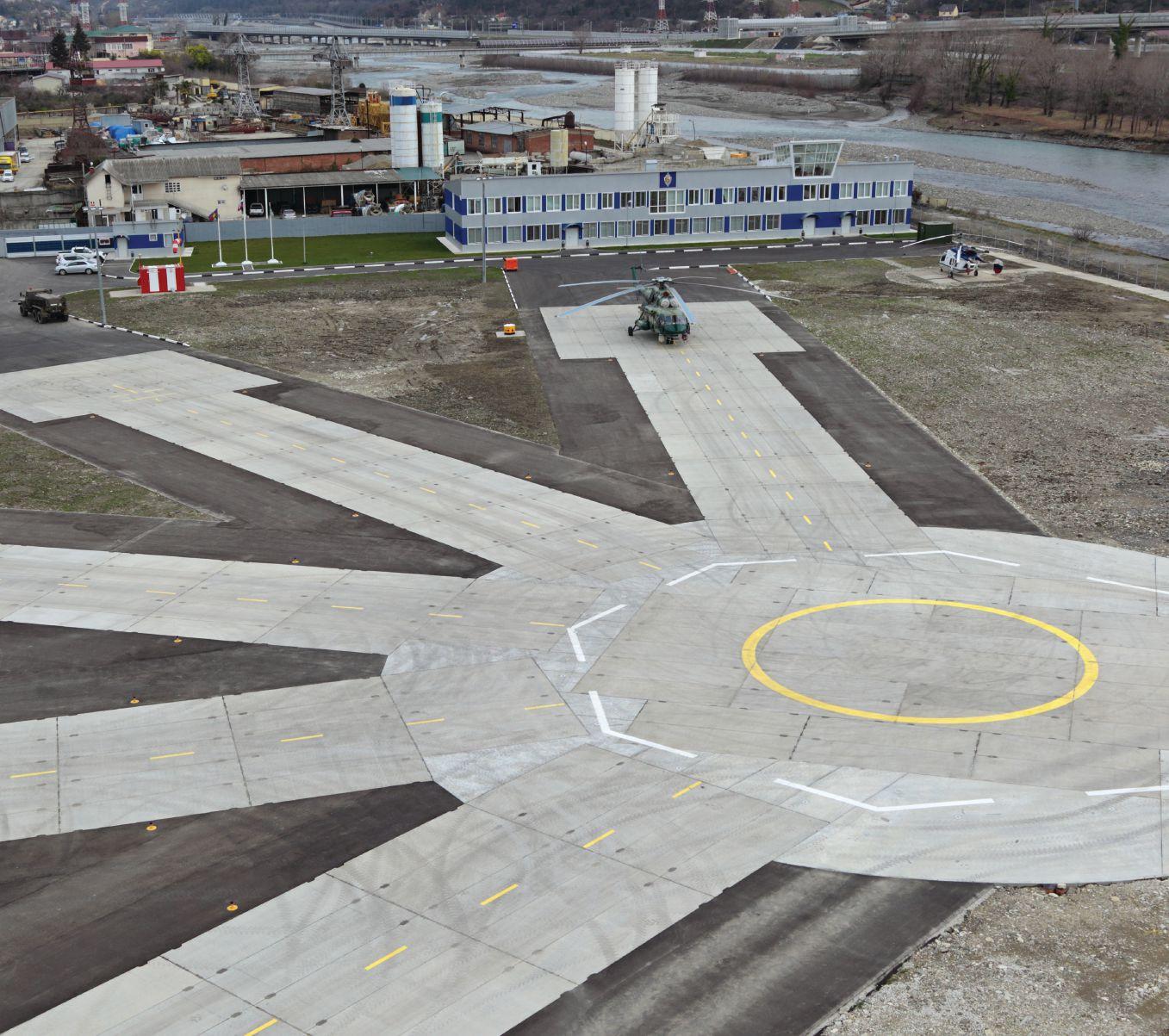
The $72 million project at the former Downsview air force base will be the new home of Centennial’s aerospace technology programs. Located in one of the nation’s historic aerospace jewels – de Havilland of Canada – the campus will be a site to behold, sporting a sparkling new hangar large enough to accommodate a variety of modern aircraft.
Close to Toronto with easy access to public transportation, the influence of Canadian aerospace leader Bombardier and much more, it’s the perfect location for the development of an academic and industry hub of aerospace excellence.
Centennial currently trains some 300 aircraft technicians and avionics technicians annually at its Ashtonbee Campus in Scarborough. When the campus opens its doors in 2018, the new space will serve as a dynamic centre of innovation and research and development excellence, bringing industry and academia together to devise cutting-edge products, technologies and solutions.
Academic partners and industry leaders including the University of Toronto Institute for Aerospace Studies (UTIAS), Ryerson
Laying the Foundation
Working to Drive the Future of Aviation, Aerospace
industry – and operators of all types – must consider in order to remain competitive. The benefits of the DAIR project – and aviation and aerospace initiatives nationwide that unite academia and industry to create new aviation products, processes and services – are critical to Canada’s future success.
The economic ramifications in maintaining a strong aerospace footprint are significant. According to “The State of the Aerospace Industry: 2016 Report” released last year by the Aerospace Industries of Canada (AIAC) in concert with Innovation, Science and Economic Development Canada, the Canadian aerospace industry in 2015 contributed more than $28 billion to the GDP and generated some 211,000 jobs in the Canadian economy. Yet innovation can only occur through the development of a pipeline of talented, dynamic young leaders. Filling that talent gap in all facets of aviation remains a critical challenge for industry going forward.
Working to ignite the passions of future aviators and aerospace professionals is the goal of Wings and Helicopters annual Careers in Aviation Expos – grass roots initiatives to help maintain a strong pipeline of aviation and aerospace talent. These events give young adults a chance to rub shoulders with industry leaders to learn more about the state of the industry, career options and future trends. Educational presentations, networking opportunities, tours of aviation and aerospace work sites – it’s an invaluable opportunity to learn from professionals in the know.
If we’re going to punch above our weight, we’re going to have to innovate. ‘‘ ’’
University, York University and Bombardier will anchor the Downsview Aerospace Innovation and Research (DAIR) cluster. The DAIR consortium also includes industry players such as Honeywell, SAFRAN, United Technologies, Flight Safety International and MDA.
“If we’re going to punch above our weight, we’re going to have to innovate,” noted Ontario Premier Kathleen Wynne at the groundbreaking event. “It will incubate and grow well-paying professionally rewarding jobs.”
Wynne’s remarks are precisely what the Canadian aerospace
This year’s events – Saturday, April 22 at the Jazz Aviation hangar at Toronto’s Pearson International Airport and Saturday, May 6 at the Westjet Campus in Calgary – showcase dynamic companies, flight schools and educational institutions doing their best to lay the foundation for industry growth. Find at more at www.careersinaviation.ca/expo/.
Careers in Aviation and Aerospace 2017 in this issue is a tool that does precisely the same thing. It serves to help ignite the passions of young aviation and aerospace professionals, setting them on the right path for future success.
As industry partners, we can all “punch above our weight” and help in the process of educating the next generation of aviation and aerospace leaders. Challenging economic realities notwithstanding, innovation and an eye to the future remain paramount; the future success of our industry depends on it.
CHC works to rebound
The CHC Group is hoping for better things in 2017 on several fronts after a difficult 2016. The company took the first steps on its road to financial recovery, announcing in late 2016 that it had filed a proposed chapter 11 reorganization plan and Disclosure Statement with the U.S Bankruptcy Court for the Northern District of Texas.
Under the terms of the agreement, the CHC Group completed a comprehensive recapitalization that would inject some $450 million in new capital into the organization. Much of the capital comes from the restructuring of aircraft leases as well as $150 million from the Milestone Aviation Group and its affiliates.
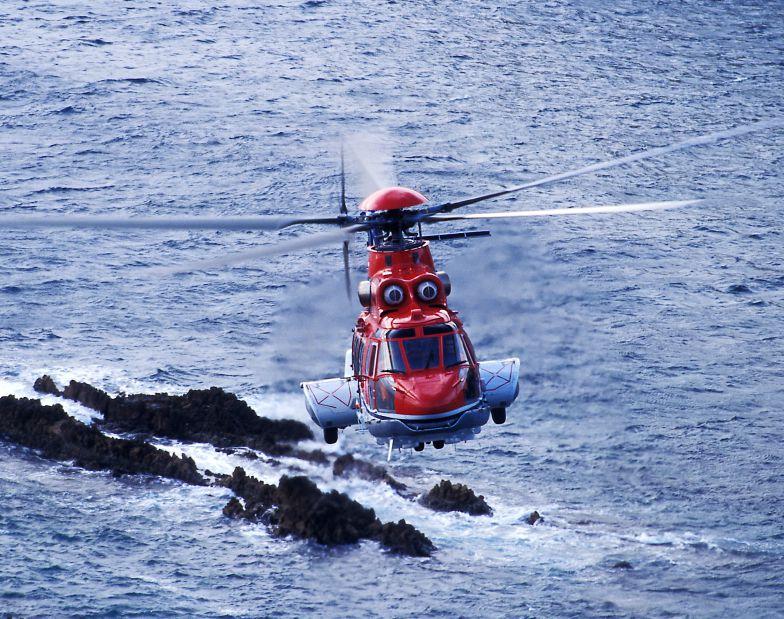
CHC suffered several setbacks in 2016, including filing for Chapter 11 protection and recovering from a tragic accident in April 29, when an Airbus H225 Super Puma carrying 13 crew and passengers from the Gullfaks B platform in the North Sea crashed on the Norwegian coast.
Karl Fessenden, president and chief executive of the CHC Group, said he is optimistic the new financial plan will help produce a strong and competitive financial model to ensure the company’s continued success going forward in the competitive oil and gas market, one hit hard by the worldwide economic slowdown.
“We are confident that this
plan will enhance our financial flexibility and establish a sustainable capital structure that enables CHC to invest in and grow the business over the longterm,” Fessenden said. “We
appreciate the support of our lenders, which we believe reflects their confidence in CHC’s future. As always, we remain committed to maintaining our position as a world class helicopter service provider and continuing to set the standard for safety, customer service and value across the industry.”
In other CHC news, the company is making a formal call out for papers for its popular 2017 CHC Safety & Quality Summit, focusing on the theme, “Can we truly manage all of the risk: what if the barriers are not
This year’s Summit takes place Sept. 27-29 at the Gaylord Texan Resort and Convention Center, located near Dallas, Tx., a change from the usual spring timeframe. The Summit annually attracts hundreds of attendees who gather to hear speakers including experts from the aviation, oil and gas and safety industries. Speakers share best practices and present on topics with an aim toward making helicopter transport and aviation industry better through promoting excellence in safety and human factors, and maintaining a robust safety environment.
Some potential topics of interest include:
• Integrity and management
• Compliance monitoring
• Technology and safety methods of training
• Crisis management
• Organizational leadership and viability
• Fatigue risk management
• Human factors
• Risk assessment and hazard management
• Human error management
• Flight data monitoring
• HUMS
• Organizational causes of accidents
• Sustaining and improving industry safety
• Management system for reducing safety risk and business risk
• Safety management tools
• Crew resource management Submissions can be made via email to summit@chc.ca.
as robust as we think?”
The CHC Group hopes its new financial model will transform the company. (Photo courtesy of CHC)
CCG gets first two Bell 412 EPIs
The Canadian Coast Guard (CCG) accepted its first two mediumlift helicopters late in 2016, a further success for the revived Bell Helicopter location in Mirabel, Que.
These are the first of seven new medium-lift helicopters being constructed by Bell Helicopter Textron Canada Ltd. as part of the Coast Guard’s Fleet Renewal Plan. The helicopters will help support the government of Canada’s Oceans Protection Plan by enhancing the CCG’s capability to contribute to marine safety and environmental response across the country.
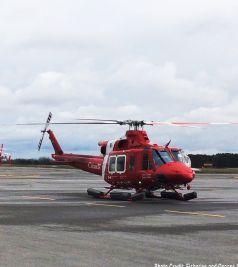
The Canadian Coast Guard’s fleet renewal is in full force, with the addition of new Bell 412 EPIs. (Courtesy of the Canadian Coast Guard)
The 412s will help the CCG deliver a number of services, including ensuring the safety of marine traffic, performing icebreaking reconnaissance, maintaining aids to navigation and marine communications equipment, science and fisheries enforcement, and transporting personnel and cargo between ship and shore.
The CCGs seven new Bell 412 EPIs will replace five Bell 212 helicopters currently in service. Under the Canadian Coast Guard Fleet Renewal Plan, the Government of Canada has already received and deployed 15 light-lift helicopters (Bell 429s) and contracted for a helicopter simulator.
Top award for HNZ Topflight, Don Wall
Don Wall and the HNZ Topflight team from the HNZ Group received an important and very deserved honour in November 2016 at the HAC's annual convention and tradeshow.
Wall and Topflight captured the 2016 Airbus Helicopters Canada Innovation in Safety Award, an honour handed out to a deserving individual or team of individuals who have made a significant contribution to improving safety standards and heightening the safety in Canada through innovative processes or
Handing
a groundbreaking approach.
Since its origin in 1951, HNZ Topflight, formerly known as the Canadian Helicopters School of Advanced Flight Training, has established a reputation for the calibre of its training programs and has help shape industry standards in specialized and altitude flying. The techniques developed by HNZ Topflight are known as the gold standard industry wide. Over the past 60-plus years, the school has trained thousands of military, police, corporate and civilian pilots
Sfrom all over North America and around the world. Clients include the RCAF, the United States Navy Special Forces, the Royal Canadian Mounted Police and more.
HNZ has also recently introduced a new training device at the Edmonton International Airport. (For more, see “In the Name of Safety,” page 10.
“Safety in a fundmental thing that we do at NHZ and we are strongly committed to developing technologies to improve it,” noted Wall.
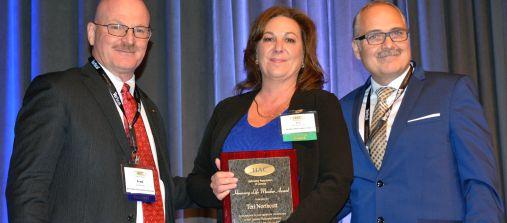
kyline Helicopters’ Teri Northcott has dedicated a very large portion of her life to ensuring the Canadian helicopter industry is as safe as it possibly can be, working on a variety of best practices for various operations. At the 2016 Helicopter Association of Canada (HAC) convention and tradeshow in Edmonton this past November, she was recognize for her contributions.
Northcott was given a HAC honourary life member award by her peers, recognizing a lifetime of industry involvement, commitment and dedication.
HAC also honoured longtime helicopter industry professional Randy Simonneau as an honourary life member, and recognized the Transportation Safety Board’s Bill Yearwood and Delta Helicopters’ Donald Stubbs as Agar Stringer Award winnners.
HELICOPTERS MAGAZINE P.O. Box 530 105 Donly Drive South Simcoe ON N3Y 4N5 Tel.: 519-428-3471 Fax: 519-429-3094
GROUP PUBLISHER MARTIN MCANULTY email: mmcanulty@annexweb.com
DIRECTOR OF SOUL/COO SUE FREDERICKS
RETURN UNDELIVERABLE CANADIAN ADDRESSES TO ANNEX PUBLISHING & PRINTING INC., P.O. BOX 530, SIMCOE, ON N3Y 4N5 CANADA. email: subscribe@helicoptersmagazine.com
Published five times a year by Annex Publishing & Printing Inc.
Printed in Canada ISSN 0227-3161
CIRCULATION
Email:apotal@annexbizmedia.com Tel: 416-510-5113
Mail: c/o Circulation, 80 Valleybrook Dr. Toronto, ON M3B 2S9
SUBSCRIPTION RATES Canada - 1 year $29.95 USA- 1 year $54.50 Foreign - 1 year 60.00 plus applicable taxes www.helicoptersmagzine.com/subscribe
Occasionally, Helicopters magazine will mail information on behalf of industry-related groups whose products and services we believe may be of interest to you. If you prefer not to receive this information, please contact our circulation department in any of the four ways listed above.
Helicopters Magazine is an associate member of the following Canadian aviation associations:
Skyline’s Teri Northcott accepts her award from HAC president Fred Jones and HAC chairman Sylvain Seguin. (Photo by Matt Nicholls)
COLUMN
Focusing the Safety Lens
The
Commitment to Safety Should Start Early in Your Career
arlier in 2016, I listened to an inspiring interview with David Gregory, the former host of NBC News’ “Meet the Press” that truly informs this column. He was speaking of his time with the show and in the discussion he quoted the Book of Proverbs – “Ponder the path of your feet; then all your ways will be true.”
My column in this issue of Helicopters has inspired me to veer from my normal path of ranting about safety to a more genteel perspective of contemplating a career oriented towards safety. Every now and then, I am actually asked about a career path into the safety world by people who want to be involved from the outlook of their careers in building the requisite skill set for that path. One could suggest – the path of their feet.
Most folks I know who fill safety manager roles “fell” into those roles, as did I. Some have been “voluntold” which in my view is a terrible solution, regardless of the needs of the company. Then there are pilots (mainly) who fill the safety shoes as a means to stay employed when their medicals expire – again not necessarily the best result. So, for a career in safety – how does wonder ponder the path? There is some formal safety training integrated into many of the more than 20 college programs offered around the country – BCIT, Mount Royal, Canadore, Seneca, Centennial and Georgian Colleges are some that come to mind. In addition, there are some top formal training safety specific programs.
The Viterbi School of Engineering at the University of Southern
basis in safety and risk management.
Now, as part of the formal and ongoing training that occurs annually, pilots and AMEs receive Crew Resource Management (CRM) and Human Factors (HF) courses. Too many of these courses are taught (delivered is a better phrase), by uninterested and barely qualified presenters. Formal training as an adult educator and formal certification in these areas of knowledge should be necessary precursors for teaching these topics. Any of you who wish to pursue a career in “safety,” should strive to be as well read and expert in these areas as possible.
One area that is often left for safety managers to learn, often through the fiery lens of a Labour Canada inspection, are the basic safety requirements for running and maintaining an effective occupational health and safety program. This should not be the case. There are lots of formal programs available – many very good online options – and of course part time and full time education options. Frankly, as I wrote in a previous piece, too many companies are vulnerable in this area and unnecessarily expose their employees to risk and their operations to regulatory scrutiny. Anyone of you with a foot in the OSH world is well on your way.
And finally, but really, firstly there is your own formal training as a dispatcher, ATC controller, airport operations specialist, flight attendant, aircraft mechanic or pilot. So much information is sent in your direction during your basic and advanced training that you necessarily need to concentrate on being as expert and knowledgeable as possible. But think about this – follow your training in your chosen trade with a perspective on safety. Learn what you are being taught thinking of safety. Take your new skills and fresh perspectives and apply them in a safe manner, everyday, every time. Enhance your competency through continuous improvement.
Take your new skills and fresh perspectives and apply them in a safe manner, everyday, every time.
California offers an Aviation Safety & Security Certificate and System Safety Certificate; the Southern California Safety Institute (SCSI) offers a full slate of education including human factors, accident, flight data analysis and other safety specific training, and of course, for those of you with some industry experience, you may want to pursue higher level education via the masters program in human factors and system safety offered at Lund University in Sweden. Beyond these comprehensive formal degree or certificate courses, one can take safety manager’s courses at the Helicopter Association of Canada (HAC) or Helicopter Association International (HAI) conventions, which also provide a solid
Be engaged in your personal behaviour, in all aspects of your life, with safety in mind. Turn away from unsafe practices. Correct unsafe practice and behaviours in others. Build companies that thrive on safe values, safe behaviour, safe practices. Do these things, Ponder these paths – then all your ways will be true. To safety.
Helicopters safety expert Walter Heneghan was employed by Canadian Helicopters Limited from 2001 until 2014 and worked in a number of positions including a line pilot based in Moosonee, Ont. safety manager for its EMS Division and as vice-president of safety for the company. The opinions expressed in this piece are his alone and are not representative of any company, former or current employer, or this publication.
WALTER HENEGHAN
COLUMN
PAUL DIXON
f the past decade hasn’t been proof of the old adage about living in exciting times, things promise to get a little more interesting in the future based on recent world events.
To follow commercial airline safety protocol, you might want to ensure your seat is locked and in an upright position and your seatbelt is securely fastened at all times.
In my brief exposure to the helicopter universe, I’ve noticed that as a general statement, it’s not an easy way to make a living at any level of the business.
I’ve been privileged to meet a wide range of people over the past decade and there’s a commonality in all of them. It’s the same commonality you find in many businesses outside of the mainstream 9 to 5 world. Musicians have it.
Spend time in a big-city hospital in the middle of the night and watch the interaction between the doctors and nurses along with the paramedics and police officers that come through on a regular basis and you get the point.
For the most part, these pros communicate on a higher level, one very much in line with the rotary-wing community.
The helicopter business can be a tough one to break into and thrive in forever. I’ve met a few folks who give up and get on with their lives, because they realize they can’t chase a dream forever.
Establishing the Right Niche
home pond, but they’re swimming in the shallow end when out in the broader community. CHC is a case in point.
The early years of CHC don’t bear retelling here, but the past few years have been interesting in their own right – and maybe there is a cautionary tale.
Several years ago, the decision was made to take CHC public through an offering on the New York Stock Exchange. I had invested some time in putting together an article on how a CHC S-76 was moved by flatbed truck from Delta, B.C. to New York City to magically appear in front of 11 Wall Street on the morning the stock was launched.
That truck driver was one of those special people as noted above, making his way through lower Manhattan in the wee small hours, at one point having to back in a block-and-a-half because there was no way to turn around. A video was made of the trip and was to be the opening feature at that year’s Safety & Quality Summit. The stock didn’t do too well and the video never saw the light of day.
Move ahead to the 2016 Safety & Quality Summit. The lack of CHC employees at this year’s event was obvious – and the venue wasn’t quite as congested as previous years. The penny dropped a week or so later when it was announced the company was moving into Chapter 11 as it fought to reinvent itself in a world that had become increasingly hostile.
The recent announcement that the CHC Safety & Quality Summit would be moving to Dallas in 2017, brings the company another step away from its Canadian roots.
Even the largest operators on the global scene are very small when compared to the Fortune 500 index.
The people who built the helicopter business in Canada were dreamers and they had the energy, drive and native ability to build their businesses, meeting challenges along the way with great gusto, with an “is that the best you can do?” type attitude.
Most helicopter companies fit the definition of a small business, which can be good and not so good. It’s good in terms of the personal span of control and decision-making, but perhaps not so good in terms of the depth and breadth of leadership.
Even the largest operators on the global scene are small when compared to the Fortune 500 index. They may be big fish in their
The announcement came at roughly the same time another large operator with Canadian ties, Erickson Inc., sought Chapter 11 in its own fight for survival. It’s sobering to say the least.
Perhaps the people running the companies aren’t the people with the common qualities – I don’t know.
I do know, however, that it’s nice to be able to find your own niche and stay there, but that’s not always possible.
We live in a world where all too often the expectation is that the business has to keep growing and expanding, which as we all realize isn’t possible.
Everybody loves you when the rocket’s going up, but when the lights go out it gets awfully lonely in a hurry.
Paul Dixon is a freelance writer and photojournalist living in Vancouver.
COLUMN
RICK ADAMS
When pilots of the Airbus Helicopter AS350 train in the new HNZ Topflight simulator at the Alberta Aerospace Training Centre in Edmonton, they may literally come to “the end of their rope.”
The device includes a unique “cargo mirror,” a flat screen monitor which enables the pilot-in-training to look backward under the simulated aircraft to view the skids and cargo hook. However, if the pilot forgets he or she is still hooked, the SIM will only allow them to fly about 15 feet – for example, the end of the long line, before the visual system turns into the “red screen of death.”
“These helicopters do multi-role missions: one mission they’re slinging, the next they’re moving passengers,” explained Mark Olson, FTD manager for HNZ. “There have been aircraft incidents where guys have taken off and the long line has still been attached. They have literally forgotten they were slinging in the chaos of changing the role.”
In the SIM, the instructor can toggle the long line capability on and off, and Olson said, “We brief them (pilots) on it, but in the heat of the moment when they’re doing multiple takeoffs, it’s like real life – you get distracted by what’s going on around you and haven’t seen that the long line is still attached to the cargo hook.”
Developed by Frasca International, the device is the first Level 7 helicopter FTD physically in the Dominion to be approved by Transport Canada (TC). “Working with the folks in Ottawa, we got a
In the Name of Safety
Canadian Helicopters Introduces Dynamic New SIM
authorities to warrant taking that first step.”
The FTD is convertible within 60 to 90 minutes between three different configurations of the aircraft, including the “steam-powered” AS350B2 analog model, AS350B2 VEMD (Vehicle and Engine Multifunction Display), and AS350B3e VEMD, (which Airbus now labels the H125). Reconfiguration involves instrumental panels, switch consoles, flight controls such as the collective, overhead console and rotor brake. HNZ has more than 60 AS350 helicopters in Canada and 200 pilots.
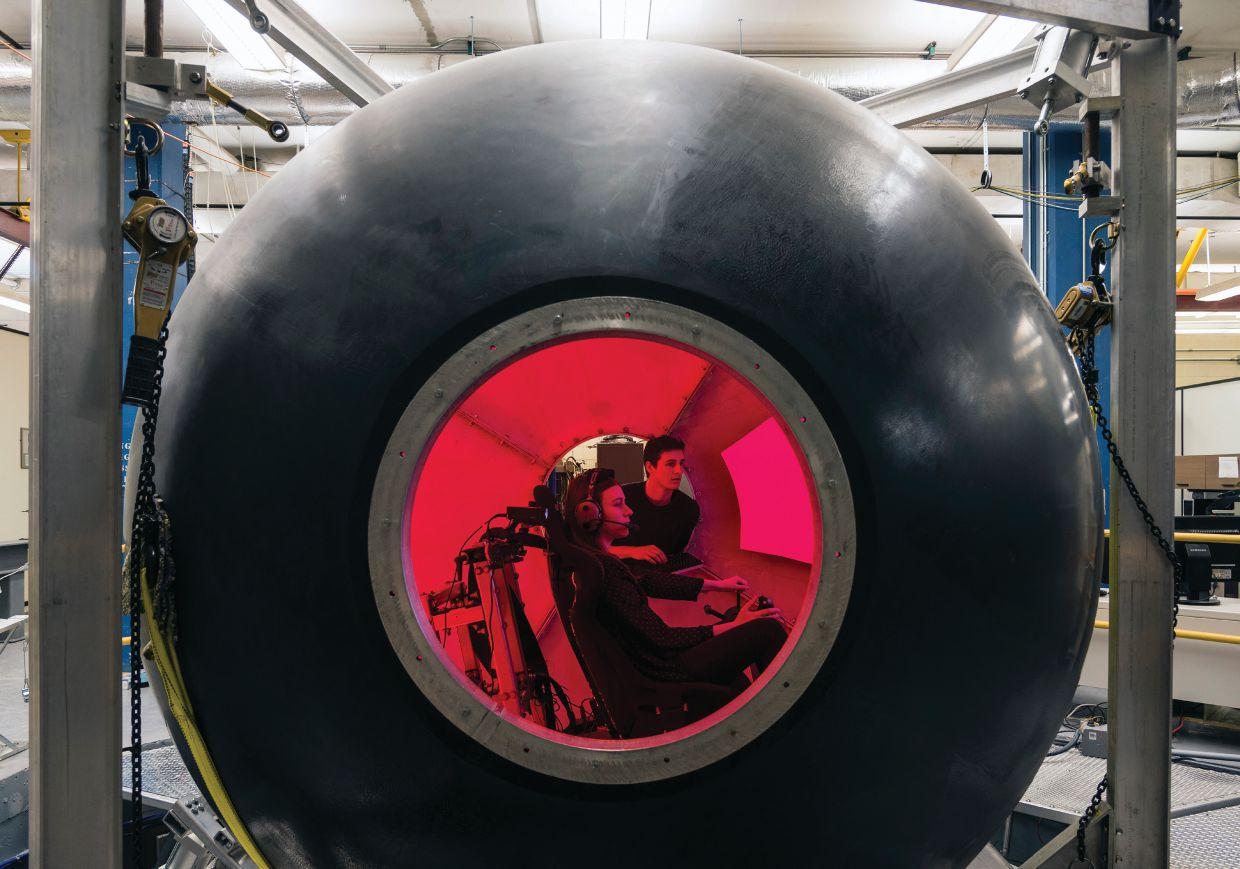
The high-resolution Frasca TruVision Global eight-channel visual system features a 200-degree horizontal by 70-degree vertical field of view in an enclosed spherical screen. There’s a detailed database of the Edmonton area, which could be used for law enforcement and emergency medical training scenarios, as well as databases of coastal, artic, and other airports that HNZ flies into.
The most detailed gaming area depicts large parts of the U.S. state of Oregon, a Frasca standard offer. It features a variety of terrain types, from ocean shores to forested mountains, as well as rivers, power lines and towers. Olson calls it “a really good operational area for a VFR pilot,” which he says is more applicable to single-engine operations. “Guys fly helicopters into places they have no business being, so we want to try to influence the decision-making aspects of piloting an aircraft.”
The new $3.5 million simulator has been attracting considerable public interest since it’s located in the Edmonton International Airport’s main terminal building on the mezzanine level above security check-in for departures. Visitors to the observation deck can’t miss the large dome and racks of computers.
We want to try to influence the decision-making aspects of piloting an aircraft. ‘‘ ’’
regulatory exemption that allows flight credits to be taken for use inside an approved training program,” Olson noted.
Simulator operators and manufacturers will welcome this decision; until now, high-end FTDs have typically been granted credits similar to lower-level devices by most regulatory agencies. “Now that the devices are out there, the FAA, Transport Canada and others will see the capabilities, and they’re going to start saying, ‘Yes, we can give you this, and yes, we can give you that,’ ” said John Frasca, president and CEO of the Champaign, Ill.-based company. “But the operator has to be the one making the request. HNZ saw enough openness in the
Another advantage of the airport location is that pilots can fly in and be at the simulator within 15 minutes of landing. If an overnight stay is appropriate, there’s a hotel there, too. HNZ also has AS350 trainer aircraft and a dedicated training area on the airport property.
“We want to give all pilots an opportunity to take advantage this great new training device,” noted Sylvain Seguin, vice president and chief operating officer at Canadian Helicopters, an HNZ company. “Whenever we have an opportunity to enhance safety in helicopter operations, we will strive to do so.”
Rick Adams is chief perspective officer of AeroPerspectives, an aviation communications consultancy in the south of France, and is the editor of ICAO Journal.
COLUMN
A Hint of Optimism
A Turn in Trudeau’s Perspective Spells Hope
t’s said the only certainty in business is uncertainty, and we seem to be well over chest deep in the latter with the level rising daily.
I wrote this column while reeling from my postTrumpian shock, themed around the inability of the federal government to grasp its role in fomenting a business friendly environment, that can live in parallel, and even thrive, alongside the seeming obsession with the environment itself.
Justin Trudeau, last January, stated his job was not to be a “cheerleader for such projects,” referring to pipelines and other national energy projects, that would certainly require helicopter support and therefore of great interest to us. Instead, he said his job included such noble causes as “creating a better future” and “bringing people together.”
These may be within his purview but how they are achieved and what priority is placed on revenue generation to pay for everything is what separates aspirations from reality. David Suzuki sits in a $10 million mansion in Vancouver criticizing loggers and oilmen, while basking in the glow of the products that would not be possible without them.
Cadres of his followers sit in Starbucks talking about the world’s problems, never realizing where they sit was once pristine forest until urbanization and agriculture erased the trees in favour of human creations and constructs, heaping opprobrium on those whose livelihoods (and lives) also depend on the healthy environment they are accused of negatively impacting. I think it’s a safe bet that nobody who
even those who fight against it, and helicopters are essential for the safe and efficient development our society deserves. This is particularly true now that our neighbours south of the border are putting themselves first in discussions of trade; we need to reduce our dependence on that gargantuan market and free our stranded resources. Nothing would change the face of our country more than casting off the yoke of indentured servitude we find ourselves in, regardless of whether we recognize the true nature of our relationship with our brethren below us on the map. To do this, we need pipelines to the coast. Any coast.
This past November, I was stunned to see Trudeau face the cameras and come out in favour of one of the most contentious pipelines of all, the Trans Mountain expansion. This is great news for our country and our industry, although there are many steps and hurdles still to overcome.
For Trudeau to take this stand now, after his year of shirt off photo ops, seems to indicate he’s maturing as a leader and is willing to face down many of the people who elected him in service of a holistic attempt for the greater good, recognized or not by the leftiest among us. Large scale hemp cultivation and wind power are not going to solve our problems in this century, but responsibly developing our abundant natural gas reserves can certainly light the way.
Responsible and strategic development is essential for our country to thrive in the modern world.
’’
frequents Starbucks voted Trump on the other hand!
A large sector of the helicopter industry depends on the exploration for, and the development of, natural resources. Responsible and strategic development is essential for our country to thrive in the modern world, and we should not view ourselves as selling off our children’s legacy in the mold of a banana republic, nor should we embrace Neo-Luddism through a misguided notion that our children will inherit a better world if we use less of the technology that is giving us longer and healthier lives.
The kind of progress we need in our country benefits all of us,
It’s a truism, contradictory or not, that fossil fuels are what enable us to develop renewables, from the materials themselves to the funds required for the vast amount of R & D required. Just as war produces research that benefits us during peacetime (ensuring the sacrifices of our veterans are not in vain), exploiting the finite bounty of fossil fuels enables us to envision and make manifest the New World of clean air and water we all, in our hearts, seek. While exploration expenditures are less than a third of what they were five years ago, the indicators are starting to show a change in the direction of the wind. Now that our PM has put on his cheerleading skirt and is out shaking the pom poms, I am feeling bullish about the next few years. The U.S. presidential election did not bode well for the Pax Americana, but could be the best thing to happen to Canada since Bill Shatner conned the Enterprise!
Corey Taylor began his aviation career in 1989 and has flown helicopters in some 20 countries while holding almost every position required by the regulations – and some no one has ever heard of.
oney doesn’t make everything perfect, but a lack of financial resources certainly does make things more difficult. And as Canada enters its sesquicentennial year, economic prospects appear gloomy.
Finance Canada told business leaders in late 2016 to expect weak annual growth of 1.8 per cent on average for the next dozen years. Growth in 2016 was a tepid 1.4 per cent, contracting in the second quarter after wildfires disrupted energy production in the nation’s oil sands region, bouncing back in Q3, but leveling off again by year-end. Energy-sector investment is in deep decline, productivity is slowing, and consumer debt is at record levels.
David Doyle of Macquarie Capital Markets Canada says interest rates and the price of oil are going to conspire to drag the value of the loonie to a low of around 65 cents U.S. in the next 12 months. Five years ago, the Canadian dollar was at about parity with the U.S. greenback.
“I think it's important for people to understand the situation that we’re in, and the low-growth environment that we’ve had for the last decade, when we're making budget decisions,” said Daniel Lauzon, spokesman for Finance Minister Bill Morneau.
One ripple effect of the current economic malaise is reduced resources for regulatory agencies such as Transport Canada (TC), which had its budget cut by 21 per cent for 2016-17. Moreover, TC was placed under “special oversight” by a Treasury Board envoy
because they overspent their 2015 funding, which Transport Minister Marc Garneau blamed on the previous Conservative government. “It’s a difficult financial situation,” Garneau said, but he insisted, “It’s not going to have any impact whatsoever with respect to safety and security.”
That may be the perspective from TC’s fearless leader, but diminishing service levels and an overall frustration with the capacity of TC to work with the industry on a variety of issues was raised by several operators at the Helicopter Association of Canada’s annual tradeshow and convention in Edmonton.
“Transport Canada has no people and they have no money,” lamented Paul Spring, president of Phoenix Heli-Flight, a charter helicopter operator based in Fort McMurray, Alta. Spring noted that the funding problem is “systemic” and is delaying action on issues such as helipads and night vision goggles. For example, “The guy in charge of writing the new regulations for NVGs for commercial operators isn’t allowed to travel outside Ottawa because they won’t pay for it.”
And with the oil-and-gas sector accounting for about one-quarter of the global helicopter fleet, the energy downturn has created a huge surplus of aircraft. Roughly 20 per cent of the 1,900 helicopters worldwide serving the oil-and-gas industry are idle or underemployed.
Two of the most visible industry casualties have been CHC Group, formerly Canadian Helicopter Company, and Erickson AirCrane. CHC filed for Chapter 11 bankruptcy protection in November and plans to reduce its fleet of about 230 helicopters down to 75. Erickson, based in Oregon, also filed for bankruptcy in November. Former CAE civil simulator executive Jeff Roberts has been attempting to rescue the iconic heavy-lift helicopter manufacturer following his predecessor’s ill-timed acquisitions in 2013 of Evergreen Helicopters and Air Amazonia.
TOO MANY AIRCRAFT?
Given the number of operators in Canada and the diminishing amount of contracts available, it’s quite possible 2017 will see more consolidation and a general paring down of total numbers. It’s a situation many operators have been predicting for years.
“The problem with the Canadian industry in general is there are too many helicopters and too many mom-and-pop outfits who are willing to cut prices, cut corners, and not upgrade their aircraft, not
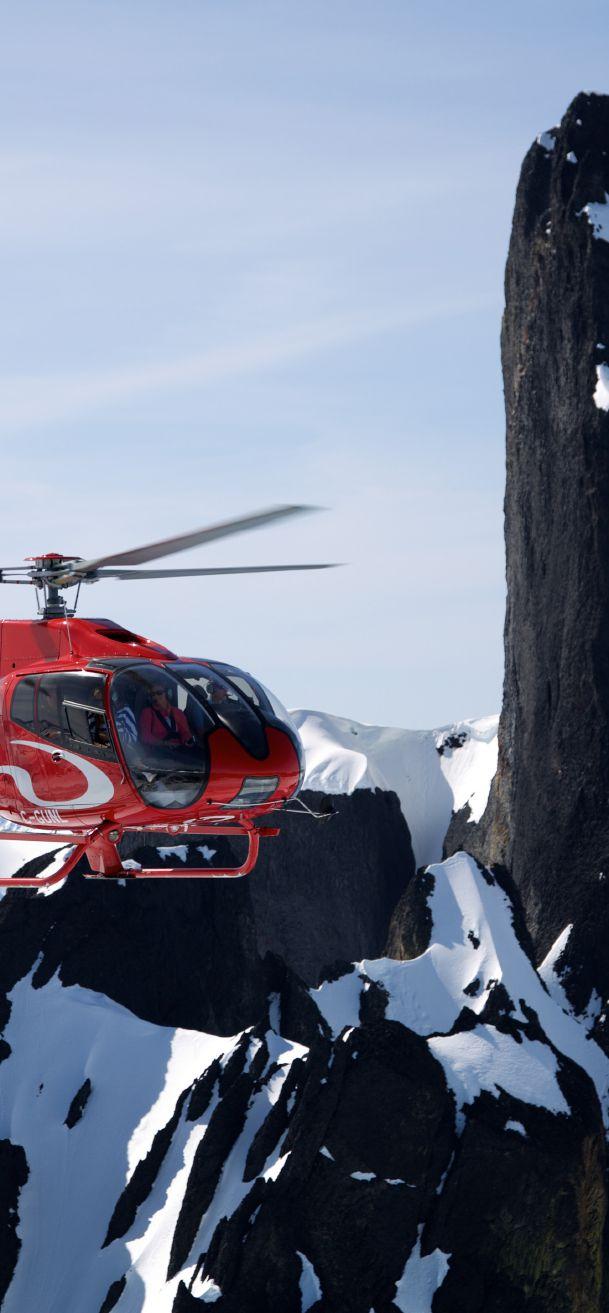
MAIN: Harsh economic realities are making life difficult for operators. (Photo courtesy of Airbus Helicopters)
BELOW: Transport Canada’s Aaron McCorie maintains new flight and duty regulations will not apply to many operators, though that is very much in debate. (Photo courtesy of Transport Canada)
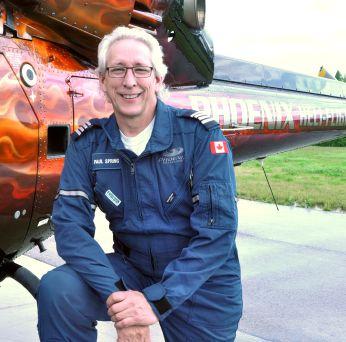
BOTTOM LEFT: Paul Spring of Phoenix-Heliflight contends good times will not return until the resource sector kicks into high gear. (Photo courtesy of Phoenix-Heliflight)
upgrade their avionics, just run the same tired 40-year-old equipment and keep bringing the price down,” noted Spring. “For example, we’re still polluted with helicopters in Fort McMurray. The people who haven’t been here as long and don’t have an established customer base are trying to grab customers by price, pricing machines at 40 per cent discount. It seems like every time one of the marginal companies goes out of business, the machines go up for sale at a super cheap price and then somebody buys one and starts another company.”
Spring predicted, “I don’t see the helicopter industry recovering until the resource sector in Canada rebounds in a major way from coast to coast and we get some major projects going and start getting the economy firing on all cylinders again.”
In the first nine months of 2016 (the latest figures available as this was written), rotorcraft shipments globally declined 16.0 per cent to 615 units compared to 732 units in the same period last year, according to the General Aviation Manufacturers Association (GAMA).
In their annual forecast of global civilianuse helicopter purchases, Honeywell Aerospace has reduced its estimate by nearly 10 per cent from the previous year. They now predict that between 4,300 and 4,800 rotorcraft will be delivered in the five-year period from 2016-2020, compared with a prediction of 4,750-5,250 a year ago.
Mike Madsen, president, Defense and Space, Honeywell Aerospace, stated: “Purchase interest for helicopters in training, tourism, firefighting and law enforcement categories is trending up, influenced by increased utilization rates and helicopter replacement cycles. Interest across these mission sectors is helping to sustain near-term demand. Looking ahead, several new platforms are scheduled to enter service over the next few years, also bolstering overall helicopter demand.”
One of the bright spots in the Canadian helicopter outlook is that Bell Helicopter, a division of U.S.-based Textron, is relocating production of its new 505 Jet Ranger X light single-engine to Mirabel, Que. The company has orders for about 400 aircraft, meaning 100 new jobs, with deliveries beginning this year. Transport Canada (TC) certified the 505 in December. (For more, see "Keying in on Innovation," pg. 16)
FIGHTING FATIGUE
In addition to current woes, helicopter operators are concerned about a “time bomb” which TC is expected to drop this spring in the form of proposed new fatigue management regulations. The issue has been kicked around since 2010, and implementation for helicopter operators is not expected until 2021-22.
We can anticipate déjà vu this spring, when the proposed revised regulations are expected to be published, of the reaction by the helicopter community to TC’s original Notice of Proposed Amendment (NPA) three years ago. Industry associations representing aerial work, air taxi and commuter operators vociferously dissented, labeling the recommendations as a “one-size-fits-all” approach with the potential to cripple sectors of the Canadian aviation industry.
Transport Canada director general, civil aviation, Aaron McCrorie described the 2014 NPA as “broad brush strokes how we intend to operate,” and acknowledged that it “generated a fair degree of reaction from industry.”
McCrorie said, “We subsequently worked with operators to better understand their concerns. We’ve made some changes to the proposed regulations that we’re working on now.” TC expects to publish the revision in Canada Gazette Part 1 in “early mid 2017” and then in Part 2 “later in 2017.” In between, there would be a comment period and evaluation of the input. CAR 705 “air carriers will have one year to comply with the new regulation. Helicopter operators under parts 703 and 704, if they’re carrying passengers, will have up to four years to comply.” McCrorie noted, “Most helicopter operations take place in part 702, which is aerial work – the new regulations will not apply to them.”
Spring told Helicopters, “It doesn’t matter when it does hit, it’s still going to be devastating. They’re hoping they can pass the legislation, saying it won’t hit you for four or five years, don’t worry about it, then everybody will go to sleep. When it comes along, it’ll kill us.”
Fred Jones, president and CEO of the Helicopter Association of Canada (HAC), said, “If they move forward in their current form, the regulations will be quite oppressive for the helicopter industry. Everybody’s going to be hurt buy this."
Jones said Transport Canada conducted a survey of operators, “but I would argue that it made matters worse, not better, because the survey was confusing and complicated and ambiguous. So, I don’t think it can be used in support of any regulatory proposal on this subject.”
Among the provisions is a reduction in the maximum length of a flight duty period; a significant reduction in the maximum tour length, which includes the time it takes to move crews to and from a job site; and removal of the “zeroing” provisions in current regulations (the ability to reset a pilot’s accumulated consecutive day flight times to zero after five consecutive days free of duty).
Jones said, “The upshot is that the latest draft of the regulation would still require
double crewing during the summer months, primarily because to staff a full day you’re going to need two crews or you’re going to time out very quickly, even where the number of hours is very low.”
Spring predicted, “You’ll have less competent pilots who are off longer, more guys working shorter days.”
“They’re cherry picking data,” he alleged. “It’s been a flawed process with lack of meaningful consultation. They’ve drawn conclusions that 85 per cent of crashes happen in 702 and 703 operations, therefore fatigue is present. The 702 and 703 pilots land in wavy oceans and unprepared landing
areas. They sling air conditioners on rooftops and fight forest fires. It’s not the same to compare that group with a major airline that’s landing at an airport where the surface is prepared, the charts are written, everything’s been tested; it’s optimized for success. Whereas the guys who are operating in the other part of the industry have to figure it out that moment as they’re about to land.” Whether it’s the inevitable changes prompted by the new flight and duty regulations or uncertainty about difficult economic conditions, 2017 promises to be another challenging one for the Canadian helicopter industry.
FEATURE
Keying in on Innovation
Market Conditions Are Indeed Slow, But Major OEMs Forge On
BY MATT NICHOLLS
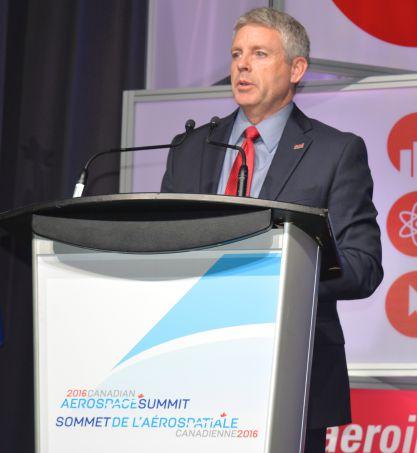
When Mitch Snyder took the podium to address attendees at the Aerospace Industries of Canada (AIAC) 2016 Canadian Aerospace Summit in Ottawa this past November, the president and CEO of Bell Helicopter could easily have delivered a talk about how a sluggish global economy was hindering operations, or how a “take it slow” approach was prudent given difficult market conditions.
Instead, Snyder delivered a backdoor curveball that was anything but. And while he did stress it’s important to remain responsible and strategic in uncertain economic times, his message was refreshingly robust. Bell is not sitting on its laurels and holding back in terms of innovation and product development, Snyder stressed, quite the contrary. The company is forging ahead with several key programs and choosing to meet challenging times head on.
“As leaders, many of us have felt the pain of reducing our employee base. And while we know it is best for our company’s long-term health, it doesn’t make it any easier,” Snyder noted, referring to staff cutbacks in 2016 due to stagnating market realities brought on by challenges in natural resource sectors such as oil and gas. “Based with tough economic conditions you can hunker down and ride out the storm, or you can pull back expenses across the board. But we are choosing to go another route – we are continuing to invest in our key programs such as the Bell 525 Relentless, the 505 Jet Ranger X and the V280 Valor, our NextGen tilt rotor aircraft. The key to our growth will be to have competitive products when our customers are ready.”
Bell is also aggressively trying to make a splash in the unmanned aircraft space with the introduction in September 2016 of its V-247 Vigilant, an unmanned aerial system (UAS) that combines the vertical lift capability of a rotary-wing aircraft with the speed and range of a conventional fixed-wing aircraft.
The V-247 has a variety of uses in both military and civilian
maritime applications.
Bell’s proactive approach to product development means big things for Bell Helicopter Textron Canada’s manufacturing plant in Mirabel, Que.
Bell announced in May 2016 that it was relocating its final assembly line for the 505 Jet Ranger program from Lafayette, La., providing a significant boost to its northern facility that has experienced instability and staff cutbacks over the past few years.
The Mirabel facility is certainly an important one for Bell. In addition to the 505, Mirabel employees are working hard to modernize and develop the Canadian Coast Guard fleet with its new Bell 429 and 412 EPI helicopters. It also continues to support the Royal Canadian Air Force’s (RCAF) Griffon program.
Snyder offered more good news in his address. “We are also laying the groundwork for a new commercial aircraft beyond the 505 and 525 to modernize our entire product line,” he said. “I have committed that Mirabel will be the home for flight test, certification and final assembly for our new next helicopter program.”
Snyder noted that the addition of a new helicopter program in Canada is sure to develop an even stronger supply chain. He specifically made reference to the support he has received from both the provincial and federal governments – relationships he hopes will foster future aerospace growth north of the border.
“I appreciate the support to this sector on both the federal and provincial levels as well as the strategic mindset in terms of global relationships,” he said. “It was personal meetings with Minister Navdeep Bains in Ottawa and Quebec minister Dominique Anglade to make it possible for us to move our 505 production line from the U.S. to Mirabel and secure the long-term future of the plant. That future will be charted for a new focus on innovative solutions and technologies.”
Cynthia Garneau, who replaced Raymond Leduc as Bell Helicopter Canada Textron president in late January of last year,
following its own unique strategy to remain competitive, productive and innovative in the throes of the current downturn.
Airbus booked eight new helicopters in Canada in 2016, with two new bookings on the horizon, which is on par with 2015.
Romain Trapp, president Canada and COO, North America for Airbus Helicopters, told Helicopters that the 2016 sales docket was much more diverse than in previous years – a trend that may just continue.
“What was very interesting about 2016 is the market breakdown,” Trapp noted. “There are a few operators who are indeed focusing on fleet replacement, but it is not as critical as you might think. We received orders from corporate individuals, parapublic and law enforcement. The client base was very diverse and I am expecting 2017 to follow a similar trend.
is excited about the developments at the Mirabel site and is confident about future prospects. The Mirabel team has been worked diligently over the last few months to make significant changes to operations to accommodate the new programs.
“The 505 program has its own visionary element and this has been transferred to us,” Garneau told Helicopters at the Helicopter of Association of Canada (HAC) convention and trade show in November 2016. “We have made improvements like the LED lights, custom work stations and work benches – we now have a line with a “world class look.” What is good about the way we are looking at the market, is we are continuing to invest in innovation.”
Bell’s Anthony Moreland, managing director for commercial aircraft in North America, added that while the 505 is a logical fit for the Canadian market, the enhanced northern commitment is as much about the product choice as its history of excellence and prominence in the Canadian market.
“Yes, this aircraft is a solid fit for this market, but I also think it’s the understanding that Mirabel has always been a wonderful facility for us,” Moreland said. “It just make sense from an engineering and manufacturing point of view.”
EXPANDING THE PRODUCT BASE
While Bell Helicopter Textron Canada is forging ahead with a bevy of programs to be on point with customers when the market warms up, Fort Erie, Ont.-based Airbus Helicopters Canada is
“In terms of innovation, it is important to remember that while it is more difficult to finance innovate in a downturn market, but it’s also absolutely critical. If you don’t innovate, your leadership is gone. So for us, the H160 program fits this bill; it is just one area of innovation. The program continues to develop with cold-weather testing in Canada in early 2017.
“We are also working on our next generation aircraft, and working to develop an unmanned aerial system based on small helicopters – we see many opportunities for this role, especially for Navy application.”
In addition, Airbus Helicopters Canada made a splash in 2016 with the announcement that it is expanding its facility, adding 5,000 sq. ft. or a 65 per cent boost in space for its expanded maintenance repair and overall (MRO) business, particularly on the popular H125 aircraft.
With a significant increase in both domestic and international MRO demand over the past number of years, Airbus Helicopters Canada is responding to customer demand and altering aspects of its business model.
It is also poised to step up operations in non-helicopter related composite manufacturing, bringing its aerospace quality of manufacturing and ingenuity to other sectors.
“Despite the slow market, the expansion of our facility in Fort Erie last year was a great achievement,” Trapp said. “When I look back three years ago, we have the same number of employees today as we did then – that is an accomplishment in this market. We have been able to achieve this by capturing new business and leveraging the competency of our Fort Erie site to diversify the business on the export side. In the past, we had some 85 per cent of our employees focusing on the Canadian market. Today, it’s close to an even split – 50 per cent on the Canadian market, 50 per cent on the international market.
"We have expanded services for the H125 and also our composite development side of the business. As the New Year develops, we will have even more employees focusing on our diversified business projects. It is a way to grow the business – it's a
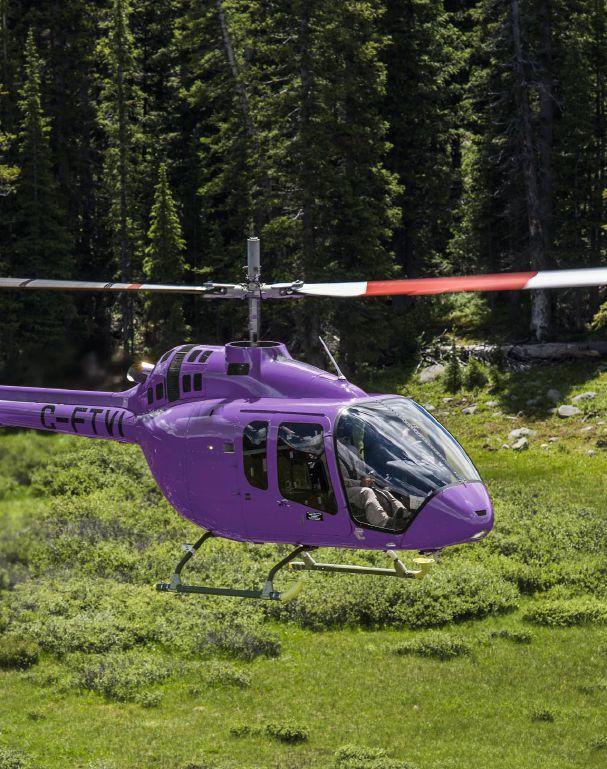
TOP: The Bell 505 Jet Ranger is one of four active programs Bell is currently developing. (Photo courtesy of Bell Helicopter)
RIGHT: Bell Helicopter president and CEO Mitch Snyder talks innovation at the AIAC Aerospace Summit in Ottawa. (Photo by Matt Nicholls)
strategy that just makes sense."
And while Trapp is confident market conditions will rebound and return to a more robust state eventually, he isn’t convinced it will be any time soon. It’s not just unique to Canada, either; markets are slow for all OEMs in North America, South America, Europe – with only a few bright sports like China.
“When you look into the future, I don’t see a recovery in the market for at least two years, Trapp said. “We may see some small steps in recovery, but it is very difficult to assess. The main drivers to help create market recovery just aren’t there. The utility market, which is the main driver of commodities, is very low, and oil and gas is sluggish. On the positive side, however, we do see some movement in the EMS markets. But realistically, we are not in a growth market, we are in a replacement situation.”
THE “MAYTAG REPAIRMAN” PHILOSOPHY
There’s a popular television commercial that made the rounds in the mid- to late 2000s where a Maytag appliance repairman never gets to work on the appliances because they just keep going and going and going.
Much the same situation exists with the Canadian helicopter fleet. It indeed keeps going and going and going, mostly due to the proficiency and resourcefulness of operators to extend the life of aircraft through astute modifications, enhancements and constant improvments.
This resourceful perspective illustrates the ingenuity and creativity of Canadian operators, yes, but it does make it hard on OEMs trying to sell new, state-of-the-art aircraft. Add in the ever prevalent “reluctant to change” philosophy and it makes it hard to gain ground in tough market conditions.
“I don’t think the Canadian market is different than anywhere else,” suggested Enrico Canal, head of region (civil and government) for Leonardo Helicopters. “The operators in Canada are so competitive about what they do, they are so good at enhancing their aircraft and find ways to extend the life of their machines, that it makes it difficult to change attitudes.
“I have also seen a lot of operators take their older aircraft and make them look brand new with a new engine, avionics etc. This is cost effective but not necessarily the best way forward.”
On a global scale, Leonardo is riding the success of its AW family and particularly the AW139, an aircraft of choice for emergency medical, law enforcement and security operators. In 2016, Ontario medical services provider, ORNGE, took possession of an additional AW139 aircraft, boosting the fleet to 20 in Canada.
“The AW139 is a popular product for a lot of companies worldwide and in Canada, where the market requires it to be justified against operational requirements and affordability,” he noted. “It’s a uniquely capable and safe aircraft and this comes at a cost and requires access for operators to appropriate contracts in terms of budget availability and long-term commitment, which is often lacking in Canada, more than in other places. Partially this can be explained by the fact that the Canadian market is primarily a utility market – a single engine market. Most of the contracts are seasonal, so as an operation, you need to have some certainty about what you can do with the aircraft if you are able to invest in this aircraft in the first place.”
With Transport Canada H1 and H2 heliport requirements stating multi-engine aircraft are required, Canal is optimistic Leonardo’s AW139, AW169 and new AW109 Trekker are suitable choices for more EMS providers, or those interested in expanding into the space.
“The AW139 is a trusted machine worldwide, but I have a lot of hope for both the AW109 Trekker, the first AW109 on skids, and the AW009, our newly rebranded light-single engine helicopter introduced at HELI EXPO in 2016. I have had a lot of interest
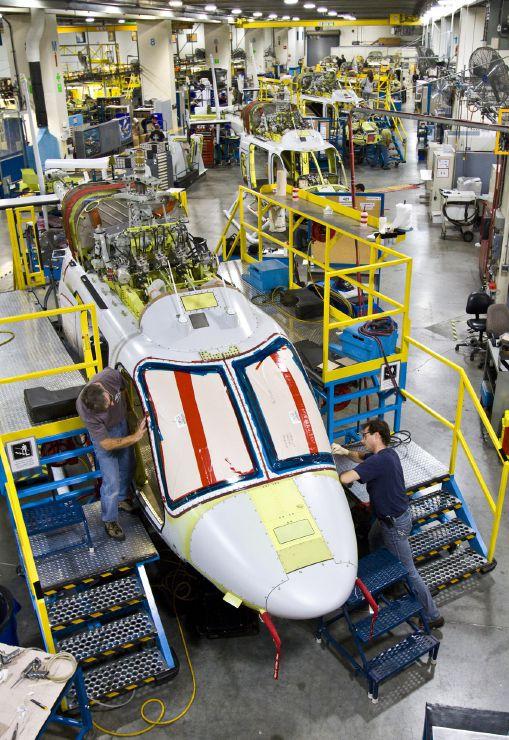
The Mirabel facility has been revamped to accommodate the latest Bell products. (Photo courtesy of Bell Helicopter)
from operators about what they can do. Skids are an important element for the utility element in the Canadian market. It’s all about trying to meet the needs of operators and deliver capable, safe and reliable machines they can depend on.”
SAFETY NO MATTER WHAT
As the 2017 operating season looms, Leonardo like other OEMs will continue to remain competitive and innovate in challenging times, while continuing to focus on their collective number 1 goal – deliver the safest operating environment possible.
“I believe there is a lot of room to improve on the safety premise in Canada,” Canal said. “And this does relate to new equipment, because this tends to enhance standards. Think about a well-maintained 30-year-old car and an equivalent brand new one. Both can get you from A to B, but on which one would you prefer your kids to have a ride on? We as OEMs are all working towards that. For example, our latest AW139 and AW169 have HUMS, ADS-B, the latest FAR29 bird strike requirements and more as standards features. We are not going to give you the chance to say no to safety. And there’s a lot more to it than pieces of equipment. There’s an entire new design system and integration. It is on us as OEMs and operators to work to the next level. We can educate customers about the importance of a high safety envelope in addition to higher asset capabilities.
Bell's Snyder concurs and highlighted at the AIAC conference more positive steps his company is making to ensure innovation, particularly when it comes to enhancing safety, remains paramount.
He also touched on the need for industry to educate the next generation of helicopter professionals to solve the most pressing
challenges all operators and OEMs will face.
“Innovative leaders that solve their customers toughest challenges ultimately not only solve their own bottom line, but those of the Canadian economy, and the families and communities throughout the country,” he said. “We are proud to be part of the aerospace fabric in Canada and are committed to the long haul growth despite the current market conditions.”
Airbus Helicopters Canada president and CEO Romain Trapp is optimistic about his company’s long-term future prospects. (Photo courtesy of Airbus Helicopters Canada)
FEATURE
Working to Raise the Bar
Quebec’s Diverse Aerospace Players Continue to Impress
BY BRIAN DUNN
There are thousands of players in the Canadian aerospace industry, most of them flying under the radar as they try to build a solid client base along with a reputation as a reliable supplier. Many of these firms reside in Quebec, where more than 200 aerospace companies generated more than $15.5 billion in sales in 2015.
And while much of the aerospace attention in Quebec is garnered by major aerospace leaders such as Bombardier Aerospace, Pratt & Whitney Canada, Bell Helicopter Textron Canada and CAE, the world’s third-largest cluster is driven by some 40,000 employees who create some of the most diverse and cutting edge aerospace products in the world.
To highlight the province’s aerospace depth and influence, Helicopters has identified a selection of small but potent aerospace firms making noise here and on the global stage.
KEEPING ALL PROCESSES IN CHECK
L-3 MAS, Montreal L-3 MAS is Canada’s leading In-Service Support (ISS) integrator and recently celebrated its 30th anniversary. The company provides innovative and integrated solutions, spanning fleet and life-cycle management, Electronic Information Environment (EIE) applications, systems engineering, maintenance, material management, publications and data management and the full spectrum of ISS solutions, to maximize customer platform effectiveness.
It also offers turnkey solutions for the design, prototyping, manufacture, repair and overhaul and certification of aerospace components.
The company, originally known as Canadair Defence Services,
was formed in October, 1986 after winning the Government of Canada’s long-term maintenance contract for the CF-18 Hornet. After being acquired by Bombardier and then sold to L-3 in 2003, the company now operates under the name L-3 MAS.
Over the years, the company has differentiated itself from its competitors by expanding its range of services and becoming the leading ISS integrator in Canada. The business has also been recognized worldwide for its competencies in repair and maintenance of F/A-18 Hornet fighter jets. The strength of the Quebec aeronautical engineering community has contributed to its ability to develop innovative solutions, both for Canada’s Department of National Defence and for international F/A-18 operators. Its customers include Australia, Switzerland, Finland, Spain and the United States.
Building on those strengths, L-3 MAS will benefit from the Federal government’s announcement to purchase 18 new Super Hornets to augment the RCAF’s aging CF-18 fleet. Boeing signed a memorandum of understanding (MoU) with L-3 MAS in late November under which the companies will collaborate on production and support of the new Super Hornet fleet.
“These achievements were made possible by a historic decision by the Government of Canada to purchase the data rights of the CF-18 fighter jet aircraft,” said Jacques Comtois, vice-president and general manager of L-3 MAS. “This initiative not only allowed us to develop our competencies and solve structural problems encountered on the Canadian CF-18 fleet with innovative solutions, but to export our knowledge to other operators and expand our service offerings to capture new markets. Today, we are proud to be the premier ISS integrator in Canada and to offer a full line of products and services, including engineering,
L-3 MAS helps keep the Boeing CH-147 in fighting shape with its ISS solutions. (Photos courtesy of RCAF)
plifies the inventory management of components used in business aircraft maintenance. It is also actively trying to grow it's rotary-wing business.
IMM improves aircraft maintenance work flow by simplifying the creation of purchase orders, accelerating the receipt of new parts and providing superior transparency of inventory status across multiple locations. Fully integrated with TRAXXALL’s aircraft maintenance tracking system, IMM allows operators to reduce aircraft downtimes during scheduled maintenance milestones.
“Over the past few years, we have paid close attention to feedback from business aircraft operators, specifically directors of maintenance and parts managers,” said Mark Steinbeck, president, TRAXXALL. “We have learned that inventory management is one of the weak links in legacy maintenance tracking systems. This is a major issue because the availability of replacement parts is often the most important factor in getting an aircraft back into service.”
integration of special-mission equipment, component repair and overhaul, fleet management, prototyping and testing, and technical publications. Over time, we have won major ISS contracts on fleets of CC-150 Polaris tanker aircraft, CH-148 Cyclone maritime helicopters, CT-114 Tutor trainer aircraft and CH-147F Chinook transport helicopters.”
Based at Mirabel International Airport, L-3 MAS employs more than 700 people across Canada and has operating centres in several cities across Canada, including Bagotville, Cold Lake, Trenton, Petawawa, Ottawa and Shearwater.
PROVIDING INNOVATION IN MAINTENANCE
TRAXXALL Technologies, Montreal TRAXXALL executives maintain the firm delivers the most innovative aircraft maintenance tracking system on the market today – and they just might be right. Founded in 2013, TRAXXALL has sales and support staff across the U.S., and a sales office in London, serving Europe, Middle East, Asia and Africa.
It launched its new Inventory Management Module (IMM) at the 2016 NBAA Business Aviation Convention & Exhibition in Orlando this past November. The product modernizes and sim -
TRAXXALL developed its cloud-based IMM which requires a password to access an operator’s data and uses the information to track and better plan their maintenance, explained Steinbeck who works out of Denver.
“It could be used by airlines. In fact, we have a couple of Boeings that are privately owned, but large airlines like Air Canada have larger programs that handle things like catering and scheduling in addition to maintenance.”
With some 500 aircraft customers, including helicopters, TRAXXALL is relatively small compared to 40-year-old leader Camp Systems with 18,000 aircraft and 12-year-old Flightdocs with 2,000 aircraft. But it’s adding about 25 aircraft a month to its client list.
“Fixed wing represents about 80 per cent of our business, because they’re accustomed to full service maintenance tracking providers, whereas rotary traditionally uses spread sheets. Helicopter operators really like our system, but some operators find the annual subscription of $2,000 cost prohibitive.”
FOCUSING ON THE ENVIRONMENT
TeraXion, Quebec City TeraXion designs, manufactures and markets best-in-class photonic products to selected emerging markets including high-speed fiber-optic transmission networks, fibre lasers and optical sensing applications.
It has diversified into the aerospace and military markets and is one of five companies selected by the Quebec government to participate in the second phase of an initiative called the Greener Aircraft Mobilizing Project or SA2GE. The company joins a list of heavy hitters, namely Bombardier, CAE, Esterline CMC
TOP: L-3 MAS has a number of projects with Royal Canadian Air Force (RCAF), including the CH-148 Cyclone.
RIGHT: Montreal’s
Electronics and Thales Canada.
The five selected participants will harness the resources of small and medium-size enterprises (SME) in Quebec’s aerospace sector, as well as universities and research centres, to develop innovative technological solutions. The work will focus, among others, on manufacturing, avionics, optics and analyzing big data. The commercialization of products and services that will result from these technologies will facilitate adaptation to new environmental standards and a reduction in greenhouse gas (GHG) emissions in aerospace, in Quebec and internationally.
TeraXion will develop an integrated photonic radio frequency (RF) module for airborne systems of communication. It can transmit, receive or convert RF signals by using Optics. Apart from expanding the bandwidth limits of RF systems, the module will replace coaxial cables in aircraft by much lighter optical fibres.
In addition, TeraXion will develop an integrated multifrequency laser source for a next-generation navigation system. This will significantly reduce the weight of the gyroscope.
“The potential for these innovations is very important, particularly in terms of reducing greenhouse gas emissions. We are confident of the success of TeraXion as it has more than fifteen years of experience in designing and manufacturing high
Forging ahead
TeraXion, based in Quebec City, continues to specialize in avionics, optics and analyzing big data. (Photo courtesy of TeraXion)
The development of innovative products and processes continues to shape the aerospace industry in Quebec. Here are seven companies hitting about their weight in the development of new and unique aerospace initiatives.
1. Abipa Canada offers high-precision machining, mechanical assembly and kitting of engine, landing gear and structural components in complex steel alloys such as aluminum, titanium, inconel and steel. Its customers consist of OEMs, equipment manufacturers and integrators.
2. Groupe DCM is one of the main designers and manufacturers of aircraft maintenance tooling and ground support equipment for commercial and military aviation in North America. It is an authorized manufacturer for Bombardier Aerospace and Boeing Commercial Airplanes and maker of spare parts, various components and sub-assemblies for aerospace, transportation and other international industries.
3. Groupe Meloche specializes in precision machining, surface treatment, painting and assembly and manufacturing engineering for the aerospace and defence industries. In 2015, it signed a 10-year agreement worth up to U.S. $30 million with Pratt & Whitney to supply oil nozzles and pump plates for the company’s next-generation PurePower PW1000G engines. Like Nétur, it was awarded “Supplier Gold” certification from United Technologies Corporation.
4. Nétur is a tier one manufacturer of jet engine components and assemblies with commercial and defense customers globally. It is a vertically-integrated manufacturer with in-house capabilities for machining, processing and assembly. The company’s main activity is the machining and manufacture of mechanical parts and sets for the aeronautics industry. Nétur was recently awarded Supplier Gold status by United Technologies Corporation.
5. Optimum Canada specializes in designing, manufacturing and sharpening of cutting tools used for high precision machining of various metals and composites for the aeronautics industry. It also provides a coating service that creates a harder surface to increase the durability and extend the lifespan of cutting tools.
6. RTI Claro was recently purchased by Alcoa Titanium and Engineered Products. The company produces and integrates aluminum, steel and titanium machined components and complex mechanical and electrical assemblies for the aerospace and transportation sectors. The components are used in structures, hydraulic systems and pilot flight controls.
7. Thermetco specializes in heat-treating throughout the metallurgical industry. Treatments for the aerospace sector include quenching and tempering, cryogenics, nitriding, annealing and carburizing and carbonitriding. In addition to heat-treating, it offers services in non-destructive testing, metallurgical testing and consulting services and training. In 2016, the company received a “Grande Mention” in the independent SME category for quality in the Grands Prix québécois competition.
performance photonic modules for the telecommunications, fibre laser and remote sensing markets,” said SA2GE director Dominique Sauvé.
The SA2GE project is part of so-called “mobilizing” projects for Quebec. It was established in 2010 by the government as part of the Quebec Research and Innovation Strategy (QRIS). The first phase involved six large companies, 28 SMEs, and 16 universities and research centres in Quebec. The economic impact will be significant because in 10 years’ time, the commercialization of the technologies developed through Phase 1 is expected to generate the equivalent of 6,000 job years for a total of $2.8 billion in sales in Quebec.
Manitoba Aviation Symposium 2017
Join us as we celebrate our 4th Annual Symposium 2017, featuring over 30 exhibits, networking events, educational sessions, guest speakers, banquet dinner, and AME Skills Competition
The convention is an annual event planned jointly by the Central AME Association (CAMEA) and Manitoba Aviation Council (MAC). This convention is the largest event of its kind between Toronto and Calgary and brings together participants from Northwestern Ontario, Saskatchewan and Manitoba
Register today at:
www manitobaaviationcouncil net or www.camea.ca
March 1 & 2, 2017
Victoria
The TRAXXALL Technologies executive team (from left): Mark Steinbeck, president; Scott Henderson, CEO; Vittorio Armenti, vice president, operations; Aviv Ohayon, director, system and product development; Giovanni Montanaro, director, operations. (Photo courtesy TRAXXALL Technologies)
Pump it Up!
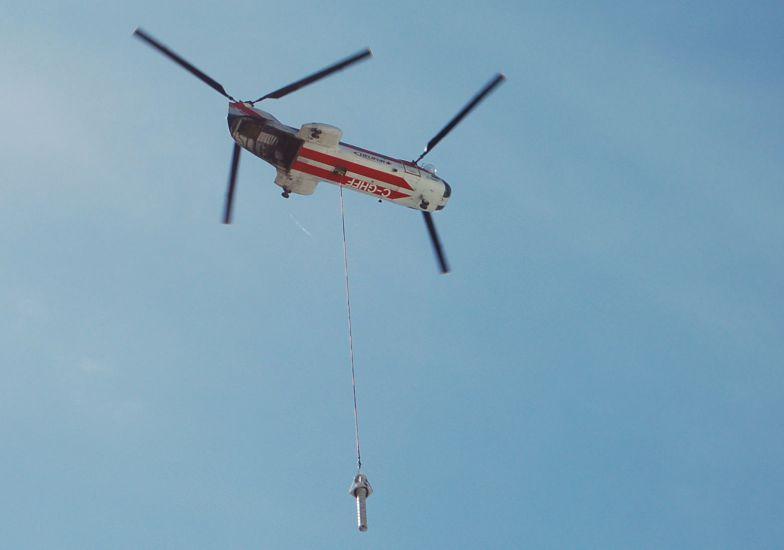
LEFT: A Helifor Boeing BV 107 II helicopter delivers a pump to a well site using a long-line.
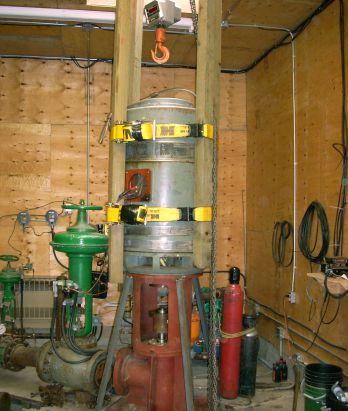
BELOW: It’s important – and a huge time-saver – to prepare before the flight when using helicopters on a job, say Mike Lamont of Precision Service & Pumps. (Photos courtesy Precision Service & Pumps)
This B.C. Pump Company has Found Many Applications for Helicopters
BY COLLEEN CROSS
Who says installing pumps can’t look like Mission Impossible? From a young age, helicopters were a passion Mike Lamont didn’t want to give up. By thinking outside the box – or pump housing –Lamont used his passion and knowledge of these airborne workhorses to differentiate his pump service and supply business.
The affable owner of Precision Service & Pumps in Abbotsford, B.C., who is trained in helicopter mechanics and maintenance, recently shared with Helicopters stories of how the company puts these beauties to work delivering and helping install pumps and equipment in remote areas of the province. Colleague and special projects manager Ron Nelson, who first put us on to the company’s adventures, also chimed in.
“Helicopters help you get to remote places you couldn’t otherwise reach,” Nelson says. But it’s not all about location: in some cases, using a helicopter can save you precious time and, by extension, money. It also means freedom when you don’t have to wait until spring for the snow to melt, he says. It’s a matter of using helicopters where it makes sense, Lamont says. “It’s not cheap, but sometimes it’s the right tool for the job,” Nelson adds. The Precision team of some 25 staff specializing in municipal and industrial work in B.C., the Yukon, Alberta and overseas locations, has done about 20 projects over the years.
The team contracts outside helicopter companies. “Different machines are right for different jobs, and the key is to fit the machine to the job,” Lamont says.
The company once used a helicopter to decommission a 200-foot water well hidden inside a hard-to-reach quad area of an Aldergrove high school. Once the parts, including pallets of bentonite on skids, were picked up and moved into place, the job didn’t take that long, Nelson says. In another case, they pulled a pump and 20-foot lengths of pipe out of a customer’s 270-foot-deep well made virtually inaccessible by a swimming pool and an overhead loft. Using a chopper meant the difference between a customer having water the next day or waiting several days.
Lamont says he is happy to offer the benefit of his experience and invites anyone thinking of getting into this type of work to give him a call. “Safety is always the biggest aspect,” he says. To this end, he recommends having all lifts with pumps and pipes ready in advance and cordoning off a huge emergency space. “Things can go bad really fast. You need a boat and a rescue boat. You need backup for everything.”
Liability for insurance is an important consideration. “Make sure your insurance contract covers this work,” he stresses.
Done right, working with helicopters can be efficient and fun, Lamont says. “Helicopters are useful for a whole variety of tasks.”
CAREERS IN AVIATION & AEROSPACE 2017
EDUCATION, TRAINING, JOB
PROSPECTS IN CANADA’S AVIATION AND AEROSPACE SECTOR
Our Aviation programs can help you take flight.
With more than 45 years of aviation training experience, Centennial College’s School of Transportation’s Aviation Technician programs provide students with the opportunity to learn the mechanical, electrical, electronic and other science skills related to aircraft and avionics maintenance. The Aviation Technician programs place an emphasis on various aspects of electrical and mechanical systems within the aircraft.
In option M (maintenance), students study hydraulics, fuels, engines, flight controls, landing gear systems, airframes and structures. In option E (avionics) students perform tasks associated with the maintenance and repair of aircraft communication, navigation and data systems. A large portion of the programs emphasize aviation maintenance practices, procedures and Canadian aviation regulation requirements through hands-on practice in labs at the campus airplane hangar and avionics labs.
Students meeting the Transport Canada (TC) accreditation requirements receive 18 month credit towards the experience requirements for issue of an Aircraft Maintenance Engineer (AME) Licence (M or E rating), and TC technical examination credit. The programs are also accredited by The Canadian Council for Aviation and Aerospace (CCAA) as meeting the national occupational standards for aircraft/avionics maintenance training.
For more information contact: Coordinator, Aviation Programs, Jim Passant 416-289-5000, ext. 7510 jpassant@centennialcollege.ca
Centennial College’s Downsview Park Aerospace Campus.
See where experience takes you. centennialcollege.ca/transportation
CAREERS IN AVIATION: MORE THAN JUST PILOTS
It can be said that the dullest day in aviation still tops the most interesting day in almost any other industry. There is something about the business of flight. It gets in your blood, and once there it does not leave. The 2017 edition of Wings and Helicopters Careers in Aviation (CIA) guide offers an introduction to a variety of careers in aviation and aerospace. It provides helpful tips for choosing a flight school, and sets expectations for new graduates breaking into the industry.
Canada has one of the most dynamic and diverse aviation and aerospace industries in the world, including a strong airline industry, corporate aviation prospects, the second largest helicopter fleet in the world, and Montreal – the hub of the world’s fifth largest aerospace industry. It is but one of several dynamic aerospace hubs across the country, all offering a variety of maintenance, avionics, software and engineering opportunities in a variety of exciting disciplines.
Canada also has hundreds of first-rate flight schools, colleges (flight and maintenance) and university programs to maintain and support industry growth and help potential new graduates chart a course along one of the many career paths available.
A Canadian licence, trade certificate or diploma also helps punch the ticket for many graduates to work almost anywhere in the world. So, it is sometimes good to take a global perspective when looking at demand for skills. According to the Boeing Airplane Company, the world’s commercial airline industry will need 617,000 new commercial pilots over the next 20 years. That represents approximately 31,000 new pilots a year, not including filling demand for corporate jets, helicopters, military and law enforcement and emergency services. Demand for pilots always grabs the headlines, but it does not tell the entire story. The Aerospace Industries Association of Canada (AIAC) estimates that some 400 aerospace firms employ more than 80,000 Canadians across the country. And while many basic aircraft maintenance, repair and overhaul (MRO) functions have peeled away to lower wage countries, Canada remains a global player in higher end and more sophisticated MRO, with job
opportunities spread across the country. Indeed, the same Boeing survey reports that 679,000 new commercial airline maintenance technicians and 814,000 new cabin crew will be needed by 2035 to keep the airplanes flying and supporting passenger growth. Demand for maintenance technicians has grown 11.3 per cent over the last year. These numbers add up to strong demand for pilots and other skilled professionals in Canada’s aviation and aerospace industry.
Still, while the jobs are available or will be opening up in the near future as older pilots exit the flight deck and technicians lay down their tools, aviation remains a complex and competitive business. Flight school on its own may no longer be sufficient, and a pilot’s licence might need to be linked with a college degree or university diploma.
The 2017 edition of Careers in Aviation is presented in three sections:
• Flying the aircraft (including flight schools, flight colleges and schools that specialize in unmanned aerial vehicles, or UAVs)
• Designing, building and maintaining the aircraft (including maintenance colleges and universities that offer aviation programs)
• Supporting the aircraft, which is an introduction to careers in airport operations, air traffic control and flight services.
The listings directory covering each section are intended as an introductory snapshot of the types of flight schools, colleges (flying and aviation technician) and universities and is by no means a comprehensive list. This guide is meant to be a jumping off point for your research, so please dive in once your path is more focused.
Whether you are looking to fly fixedwing airplanes or helicopters, launch a career in the sky with an airline or corporate operators, or keep your feet planted firmly on the ground in manufacturing and maintenance or industry support, CIA 2017 is an excellent opening reference point. Good luck on your journey!
HEAD OF THE CLASS
Industry associations are ready to aid in your career search
• AeroMontréal www.aeromontreal.ca
• Aerospace Industries Association of Canada www.aiac.ca
• Air Transport Association of Canada www.atac
• Air Line Pilots Association www.alpa.org
• AME Canada www.ame.org
• B.C. Aviation Council www.bcaviationcouncil.org
• Canadian Business Aviation Association www.cbaa-acaa.ca
• Canadian Council for Aviation and Aerospace www.avaerocouncil.ca
• Canadian Owners and Pilots Association www.copanational.org
• National Airlines Council of Canada www.airlinecouncil.org
• Helicopter Association of Canada www.h-a-c.ca
• Unmanned Systems Canada www.unmannedsystems.ca
For expanded listings and career options – and to find out more about Wings and Helicopters 2017 Careers in Aviation Expos – go to www.careersinaviation.ca
PART 1: FLYING THE AIRCRAFT
VARIETY IS THE SPICE OF LIFE FOR ROTARY- AND FIXED-WING PILOTS
Your mind is made up; you have decided to become a pilot. Congratulations, the industry needs you. The next thing you need to think of, even before deciding on a flight training school, is what kind of pilot do you want to be. It is a question that goes deeper than choosing between fixed-wing airplanes or helicopters, although that is also an important consideration.
There are many exciting career options for licenced pilots in Canada outside of the high profile flying for a national or regional airline. Ultra-low cost carriers (ULCC) have the potential to be a high-growth sector for Canadian air transport over the next five years. Students need to first determine what their final career position will be.
Transport Canada estimates there are more than 800 “on-demand” aviation service providers such as charter operators, law enforcement and emergency medical services, and helicopters supporting Canada’s resource industry and engaged in fire suppression. This is a less predictable career than scheduled flying, and often involves being able to fly on short notice. And, of course, there’s also the military option with the Royal Canadian Air Force (RCAF).
While your passion may lean toward piloting the larger commercial jets, Canada’s thriving corporate aviation sector should not be overlooked. Modern corporate jets are every bit as sophisticated as today’s airlines, and the requirement to fly these airplanes is often equivalent and sometimes greater than what is required in the airline business. Corporate aviation is largely “on demand” flying, although there is stability in the flight departments of some companies, especially in the resource sector, which can operate like a regional airline. The corporate sector may also offer greater diversity, with pilots jumping from intercontinental to remote flying.
With approximately 1,700 registered rotary-wing aircraft, Canada has the second largest fleet of helicopters in the world. The backbone of the sector remains resourcebased, although opportunities in the executive sector are available around major urban centres. Helicopter flying can be more physically intense, especially for pilot flying out of
camps in the Canadian north. Still, helicopter pilots are less likely to swap the “handson” flying for a fixed-wing airplane.
In all cases, aviation is a “pay your dues” industry with a large gap between the 100to 200-hours accumulated during flight training, and the 1,000 to 1,500 hours needed to become a commercial helicopter pilot or to earn an Airline Transport Pilot Licence. Most graduates build up time with entrylevel positions such as flight instructor, air taxi operator or general aviation pilot. This route is something else to consider when picking a flight school.
STEP 2: PICKING A FLIGHT SCHOOL
Learning to fly is expensive, so matching a flight school to a potential career as a professional pilot will help reduce the margin for error of starting out on the wrong foot, and may even lower the cost of training overall. This is because Canada’s aviation industry is so diverse, with so many varying job opportunities in both airplanes and helicopters. Canada also has many excellent flying schools and colleges, many of which specialize in specific types of flying. Floatplanes versus a private jet, or turbine-powered rather than piston-driven helicopters, are two extreme examples.
If you have little or no aviation experience, selecting a flying school can be overwhelming and is best not done on impulse, Transport Canada cautions. Canada’s aviation regulator does not rank flight schools or flying colleges, but there are specific steps a student should take to make the right determination.
Start by plotting out a career path, which is not to say there can’t be a detour or two along the way. A switch from airplanes to helicopters, is one example. Industry professionals tend to agree, that when picking the right flight school or graduating up to a flight college, be prepared to ask a lot of questions.
Many factors should go into determining a flight school and program, including location of the school and condition of the facilities, accessibility of the instructors, the number and types of training aircraft available and the quality of maintenance.
An unwritten industry rule is one training aircraft for every four or five full-time students, although that ratio changes with parttimers. These airplanes clock a lot of hours and are often put through tough paces. Maintenance is an important consideration for both safety and scheduling, and who is on the hook financially if maintenance problems (or weather) cancel a flying lesson.
Flight school is divided between handson airplane training and ground school, where students learn such things as the principles of flight, pilot decision-making, navigation, etc. It might not be the sexiest part of learning to fly, but it is essential and a school’s approach to ground school should not be overlooked.
Nor should other operational issues such as does the school offer progressive flight checks to monitor a student’s progress, how are flight lessons scheduled, what is the insurance coverage of a student pilot (how does the deductible work in case of an accident) and who is responsible for keeping a student’s flight records? Remember, detailed records are a passport to that first job.
STEP 3: COSTS AND FINANCING
Cost will always be a determining factor in picking a flight school. Schools in Canada are cost competitive, but the final bill will depend on what you want to get out of your training. And don’t forget to factor in transport, accommodation and meals when assessing the cost of learning how to fly. Once a flight school has been selected, it is up to the student to make secure a written agreement outlining all costs and payment procedures.
At the very least, picking the right school will help students build up the necessary hours while sticking to a budget. For example, airplanes rent by the hour. Learning to fly in uncontrolled airspace will reduce the amount of time spent on the ground taxiing or idling for takeoff. But students who want to fly for an airline also need to build up the experience of slotting in and out of a controlled airport. Likewise, pre-paying for lessons in “block-time” can reduce costs, but students should be wary of flight schools that insist on covering the cost of the full course upfront.
Most schools are “pay as you go” and some offer financing or have links to financial institutions that offer loans for flight training.
Take the Next Step
Through tireless work and sacrifice, you’re ready to take the next step. A step where time and efficiency are even more important to your success. At Levaero Aviation we understand that a corporate aircraft may be that next step in your evolution.
Whether you are interested in new or pre-owned aircraft, or have a specific interest in the Pilatus PC-12 NG or the new Pilatus PC-24 Super Versatile Jet, our mission is helping you find the right aircraft for your needs. What’s next? Give us a call.
FLIGHT SCHOOLS
SOME TOP OPTIONS TO CONSIDER FOR PILOT TRAINING AND DEVELOPMENT
YUKON
Alkan Air | Whitehorse, Yukon
Alkan Air has been providing charter service throughout the Yukon since 1977. The company has now added professional pilot training to its list of transport and logistic solutions. The flight instructing team has flown many different types of aircraft with collective flight instructing time exceeding 5,000 hours and total flight experience over 10,000 hours.
Whitehorse is an excellent place to learn to fly. It offers unique experiences and challenges that are not found elsewhere in Canada. Students not only experience flying at an international airport with traffic including large airliners, but also fly to gravel strips in more remote areas of the territory.
Alkan Air flight training is also partnered with Yukon College to offer a twoyear Aviation Management diploma program.
Equipment: Cessna 172s and a Piper Seneca multi-engine aircraft
Learn more: alkanair.com
BRITISH COLUMBIA
Glacier Air | Squamish Municipal Airport, B.C.
Located in the beautiful and challenging British Columbia coastal mountain range, Glacier Air describes itself as a mountain flying adventure company with a long history of pioneering the mountain flying experience along the Sea-to-Sky corridor from Vancouver to Whistler.
Glacier Air’s location and facilities provide an exceptional training environment. Their instructors are also active charter pilots, so they are very familiar with “real world” flying outside the training environment. The school offers a wide variety of specialty flight training including aerobatics and mountain flying to understand winds, density altitude, rapidly changing weather and other outside factors to be considered when flying around rugged peaks.
Equipment: Cessna 172, Cessna 206, Bell 206 JetRanger.
Learn more: glacierair.com
Okanagan Mountain Helicopters | Kelowna, B.C.
Okanagan Mountain Helicopters started as a helicopter flight training school in 2003. The company has grown to serve many clients in the energy, agriculture and forestry sectors, as well as continuing to train helicopter pilots from launching their careers to advanced training and recurrent skills review.
Okanagan Mountain Helicopters tailors its course to meet the needs and demands of commercial helicopter companies in Canada, with a focus on developing the best possible flying skills and airmanship, and an introduction to the various types of operational flying that a pilot might encounter.
The training facility at Kelowna International Airport – the 10th busiest in Canada – introduces students to fully controlled radio procedures, multiple training locations for confined areas and mountain flying introduction within a control zone, and the best blend of controlled and uncontrolled practice areas.
Equipment: Primary training aircraft are Robinson R22 and Robinson R44 helicopters. Optional training is available on a Bell 206 JetRanger.
Learn more: okheli.ca
Pacific Flying Club | Boundary Bay, B.C.
The Pacific Flying Club (PFC) was formed in 1965 as the Canadian Pacific Airlines Employees Flying Club. It remains one of the premier flight training and general aviation centres in Western Canada. PFC’s instructors, engineers and administrative staff are committed to ensuring students receive the highest level of customer service and instruction possible.
The club is a not-for-profit organization and is continuously upgrading facilities and equipment. It is accredited by the Private Career Training Institutions Agency of British Columbia, and was the first training centre in Vancouver to hold this distinction.
Students train at Boundary Bay Airport, one of the busiest general aviation airports in Canada. PFC is also partnered with the British Columbia Institute of Technology (BCIT), and together offers the diploma
course, Airline & Flight Operations.
Equipment: PFC’s fleet of 27 aircraft includes Cessna 152s, 172s and Piper Seneca multi-engine airplanes. The club also offers the most simulator options of any school in the province.
Learn more: www.pacificflying.com
Southern Interior Flight Centre | Kelowna, B.C.
Southern Interior Flight Centre’s (SIFC) training courses are delivered by industryexperienced instructors who not only ensure students learn the basics, but are also flying in the “real world” of aviation. Located at Kelowna International Airport in the heart of the Okanagan Valley, students spend time flying in mountain valleys, visiting the Rocky Mountains, travelling out over the Canadian prairies and exploring the coast of British Columbia running along the Pacific Ocean.
SIFC’s programs help to steer training towards the needs of both the pilot and the industry. Many of the courses are supplied or augmented by aviation companies, employers and industry pilots.
Kelowna International Airport is busy enough to challenge students and let them become used to a controlled airport with many different operations and aircraft, but quiet enough to prevent training delays. SIFC recently signed a new deal with Jazz Aviation LP that could spell more career opportunities for pilots graduating from Okanagan College’s Commercial Aviation diploma program. The Jazz Aviation Pathways Program (APP) serves as a fast track for the OC pilots to land flying careers with the national airline.
Equipment: Cessna 152, 172s and a Beechcraft Duchess BE-76 multi-engine aircraft.
Absolute Aviation is a flight training and aircraft maintenance facility, largely serving students from Edmonton and central Alberta. The school offers flexible schedules
Brampton Flight College (BFC) is recognized as one of the top-flight training schools in Canada. The IATPL program is designed specifically to provide students with the skills required by today’s airlines. It includes over 1000 hours of ground school, flight and simulator instruction, covering basic skills to highly advanced training.
Integrated Airline Transport Pilot Licence (IATPL)18-month program
• Focused on advanced airline operational knowledge
• Experience in a full motion simulator used by airlines
• Includes training by industry experts from AeroCourse
At BFC, we are dedicated to produce qualified pilots, job-ready and familiar with current industry expectations.
Students graduating from the IATPL program are eligible to apply to destination:porter, The Porter Pilot Mentoring Program.
For More Information: Call 905-838-1400 ext 248 admissions@bramfly.com bramptonflightcentre.com
CIA2017
to accommodate various student lifestyles. Ground school can be taken in regular weekly scheduled classes, through an accelerated pace on weekends and even online. Absolute operates out of Wetaskiwin, Alta., with close proximity and access to major airports such as Edmonton International. The school operates in both uncontrolled and controlled airspace, eliminating costly ferrying time to training areas.
Equipment: five Cessna 172Ms, one Piper Twin Comanche and one Piper Aerostar.
Learn more: www.absoluteaviation.ca
Calgary Flight Training Centre | Olds-Disdury Airport, Alta. The Calgary Flight Training Centre (CFTC) is inside hangar 15 of the OldsDisdury Airport, between the cities of Calgary and Red Deer. The school provides training for professional pilots and enthusiasts alike.
Olds-Disdury Airport is uncontrolled airspace. There is no waiting for air traffic controllers to clear students’ take-offs and landings. Students are also able to start up the aircraft, taxi directly to the runway and take-off when safe to do so.
West central Alberta is a great location to learn to fly for a number of reasons,
including flat lands for training, mountains to gain mountain experience and close proximity to Calgary International Airport, Canada’s fourth busiest.
Equipment: A fleet of Diamond DA20 Eclipse aircraft, a DA40 XLS and Piper PA-30 Twin Comanche multi-engine trainers. The company also offers simulator training.
Learn more: www.calgaryflight.com
SASKATCHEWAN
Mitchinson Flying Service| Saskatoon, Sask.
Since 1946, the Mitchinson Flight Centre has been one of Saskatchewan’s leading flight training schools, and has a long history of guiding pilots to their desired careers in aviation. The school is located in its own hangar at the Saskatoon John G. Diefenbaker International Airport. Students learning to fly with Mitchinson train in an ATC controlled environment, providing experience for flying in larger centres, but without the traffic delays and congestion of a larger airport.
Professional airline pilots who have trained at the school and know what it takes to get ahead in today’s competitive aviation industry own Mitchinson. The
ground school classroom is comfortable and equipped with the latest technologies, including SMART board and Apple TV. For students who need greater flexibility, Mitchinson offers ground school DVDs. Mitchinson’s fleet of 13 aircraft are equipped with modern Garmin avionics.
Equipment: Cessna 152s, 172s, 182s, a 185 floatplane, two Cessna 182s and two Cessna 310 multi-engine aircraft. The company also offers simulator training. Learn more: www.mitchinsonflyingservice.com
MANITOBA
Winnipeg Aviation | St. Andrews Airport, Man.
Winnipeg Aviation has been a leading trainer of pilots for more than 20 years. The school’s base at St. Andrews Airport, 15 kilometres outside of the Manitoba capital, offers three runways to maximize training with and without cross winds. The airport has a student-friendly control tower to give learners the valuable experience needed to work and communicate within a busy air traffic control system. Instructors take students into Winnipeg International Airport to get first-hand experience to mix it up with the big players,
YOUR CAREER FROM A NEW PERSPECTIVE
Air Georgian offers the brightest young minds in aviation the opportunity to grow their careers in one of the most hands-on, experience-focused working environments in the Canadian aviation industry.
We look for people that reflect the Air Georgian approach –Innovative, Adaptable And Passionate In Everything We Do.
CIA2017
while also flying to small short, uncontrolled grass strips to learn procedures.
Equipment: Cessna 152s, 172s, 182, Piper 28s and a 34 multi-engine trainer
Learn more: www.winnipegaviation. com
ONTARIO
Brampton Flight Centre | Brampton/Caledon, Ont.
The Brampton Flight Centre (BFC) celebrated its 70th anniversary in 2016, and is recognized as one of Canada’s top-flight training schools. Owned and operated by the membership-based Brampton Flying Club, BFC is located close to Toronto’s Pearson International Airport – Canada’s busiest – and offers students a variety of airspace classifications, experiencing both controlled and uncontrolled environments.
BFC is also the only flying club in Canada to own an airport. This offers students many advantages, including quick access to the student pilot practice area, providing ample opportunity for training. Its winning record in the Webster Memorial Competition exemplifies the excellence of BFC’s training for top amateur pilot in Canada. BFC has produced the winner for
three consecutive years.
Equipment: BFC operates a fleet of 22 aircraft including Cessna 152s, 172s and Piper Seneca multi-engine trainers.
Learn more: www.bramptonflightcentre.com
Central North Airways Limited | North Bay and Sudbury, Ont.
Central North Airways provides flight training and ground school at three locations in Ontario’s north: Coniston (20 minutes from downtown Sudbury), North Bay and the Greater Sudbury Airport. This enables Central North to offer greater flexibility in meeting its students diverse needs.
The private aerodrome in Coniston is an ideal location for flight training. Situated just outside the Greater Sudbury Airport control zone so students do not have to waste precious flying time waiting for aircraft traffic or flying to the practice area. Coniston’s short runways can be difficult, so students complete their licences with the ability to handle almost any takeoff or landing conditions.
Operations are transferred to the Greater Sudbury Airport during winter months. The flight school also frequently flies from the Coniston aerodrome to the
Sudbury airport year-round for practice on longer runways or when busier airspace will be beneficial to students.
The Diamond family of aircraft are easy to learn to fly, have an excellent safety record in the industry and utilize the latest technology for students to get the most out of their training. The Diamond Flight Centre (DFC) in London is part of a network of Diamond flight training schools in North America and provides high-quality flight training using Diamond aircraft and Diamond-specific flight training simulators.
DFC is located at the London International Airport. The airport is busy enough that students acquire experience with traffic, yet is generally quiet enough so that students can practice in a relaxed atmosphere without long waits for clearance.
Equipment: Diamond C1, DA40 and DA42 aircraft. Advanced simulator training is also available.
Learn more: www.dfclondon.com/
Essential Helicopters | North Bay, Ont.
Essential Helicopters is a leader in helicopter charters and flight training. Essential has developed an efficient model for providing all levels of service and specialization within the helicopter industry. The school’s flight training and ground school are designed to provide graduates with the skills, knowledge and attitude necessary to operate helicopters efficiently and safely under various flight conditions and remote geographic locations.
Students will be involved in the multiple daily tasks plus all other aspects pertaining to the duties of a pilot, as well as benefiting from the highest level of training delivered by qualified and experienced instructors who have accumulated thousands of flying hours all across Canada. Expect to also participate in strenuous physical activities such as helicopter log pad construction, chain saw operation, underwater egress training, winter survival program and winter helicopter operations.
Essential Helicopters is also aligned with the Canadore College Commercial Helicopter Pilot Licence and Pilot Preparedness program.
Equipment: Robinson R22, R44 and Bell 206 JetRanger turbine helicopters.
Learn more: www.essentialhelicopters. com
Great Lakes Helicopter | Waterloo, Ont.
Great Lakes Helicopter offers both helicopter flight training and charters. The operation is based at the Region of Waterloo International Airport, one of the best training airports in Canada. The region offers a unique blend of modern, energetic urban centres and scenic, rural landscapes creating diverse experiences for helicopter flight training.
Great Lakes offers 3P – a pilot proficiency program – that is the first program of its kind in Canada. 3P is for pilots possessing a valid Private Pilot licence or better, to further advance competence and skillfulness of the fundamentals of helicopter flight deriving from practice and familiarity.
The training school also has a partnership with Conestoga College to provide a two-year Commercial Helicopter Pilot General Art and Science diploma program.
Equipment: Robinson R22, R44 and Bell 206 JetRanger turbine helicopter.
Learn more: www.greatlakeshelicopter.ca
Aircraft
National Helicopters | Bolton, Ont.
National Helicopters is a full-time private career college and one of Canada’s premier helicopter flight training schools. Located just north of Toronto, National has trained and employed commercial helicopters students, including flying for its extensive tourist operation to Niagara Falls. National’s training program guarantees top-level education with both structured classroom and individual sessions. Students will obtain the necessary guidance and education to ensure preparedness for both written and flight exams. National’s operation – including a large staff and training aircraft – with onsite flight test examinations, ensures maximum availability to each student.
Equipment: Primary training is conducted on a fleet of Robinson R22 helicopters. A Bell 206 JetRanger is used for turbine training.
Learn more: www.nationalhelicopters.com
Ottawa Flight College |
Ottawa, Ont.
The Ottawa Flying Club, operating as the Ottawa Flight College (OFC), has been training pilots since 1928, and is
CIA2017
Canada’s oldest flight training college. OFC offers a diverse number of professional pilot training programs aimed at preparing pilots to fly for the airlines. The school also provides float and instructor ratings, and supports a large number of recreational pilots who fly for fun.
OFC provides a unique training environment. Located at Ottawa International Airport, students learn to interact with a control tower and operate in an airport control zone as part of their
training. The school’s practice area is minutes away from the airport.
Training programs are flexible and can be tailored to a student’s schedule and skill levels. Students who wish to achieve a diploma along with their flight training can enrol in the Algonquin College Aviation Management program.
Equipment: Eight Cessna 150s, five 172s and a Beechcraft Duchess BE-76
Maintenance & Engineering
Spectrum Airways | Burlington, Ont.
Spectrum Airways has been teaching students how to fly for more than 40 years, and has a multitude of training programs. The training facility is at the heart of Burlington Executive Airport, one of the busiest airparks in Ontario. Burlington Executive Airport averages 30 flights on weekdays and many more on weekends. The facility has become an exciting centre for general aviation enthusiasts. Spectrum also offers advanced training, including glass cockpit procedures.
A fleet of 18 aircraft; Cessna 152s, 172s, 172SP featuring a Garmin G1000 glass cockpit, Piper Warrior, Super Cub and Seneca multiengine aircraft. Advanced simulator training is also available. www.spectrumairways.
Toronto Airways/Canadian Flight Oshawa, Ont.
Toronto Airways has moved out of Buttonville Airport. Toronto Airways and its sister flight school, the Canadian Flight Academy, have consolidated operations out of the Oshawa Executive Airport. The combined operation is one of Canada’s largest flight schools, and offers eight distinct aviation-training programs from learning to fly for fun to launching a pilot career with a professional pilot program. The flight school also offers a number of shorter-term programs.
Oshawa is a busy regional airport that handles flight training, air ambulance, passenger charter services, freight services and aerial police operations. The Canadian Flight Academy is currently renovating its hangar as part of a $7 million expansion program.
A fleet of 45 aircraft made up of Cessna 172s (including one with a Garmin G1000 glass cockpit, Piper Archer II, Warrior II and Seminole multiengine airplane. Advanced simulator training is available.
Learn more: www.torontoairways.
Waterloo Wellington Flight Centre | Waterloo, Ont.
The Waterloo Wellington Flight Centre (WWFC) has been in the business of training pilots since 1932. Located at the Regional of Waterloo International Airport, WWFC is one of Canada’s five largest flight schools. WWFC maintains its own aircraft, and the centre’s new facility offers plenty of classroom space, instruction aids and briefing/study areas.
The Waterloo International Airport is a controlled facility surrounded by airspace that supports a variety of flying
CIA2017
experiences. For undecided students who would like to first experience piloting an aircraft, WWFC offers a special “test the skies,” 30-minute introductory flight in a Cessna 152 or 172 with one of the school’s qualified instructors.
WWFC also offers an unmanned aerial vehicle (UAV) course. This course is designed to introduce people to the range of scope of the two categories of UAV’s (under two kilograms from two to 25 kg.). It will provide participants with sufficient knowledge and resources to operate safely and comply with Transport Canada requirements.
The flight centre has also been offering post-secondary programs for more than a decade, and is partnered with Conestoga College and the University of Waterloo.
Equipment: Six Cessna 152s, 12 172s, one Diamond DA40 and two Piper Seminole multi-engine aircraft.
Learn more: www.wwfc.ca
QUEBEC
Dorval Aviation | Montreal, Que.
Dorval Aviation is the only flight training centre located at the Montreal-Trudeau International Airport, Canada’s third busiest, and at the heart of one of the
country’s main aviation centres. This strategic location provides all experiences required for successful training within controlled airspace.
Dorval offers bilingual services and a complete selection of courses from a simple introduction to aviation to a commercial pilot licence. Specialized recurrent training is also provided. Seaplane instruction is also available during the summer months. Students also have the opportunity to build up real operational experience through the schools Internship program.
Equipment: Cessna 172, 172 float and Piper Navajo multi-engine aircraft.
Learn more: www.dorvalaviation.com
Laurentide Aviation | Greater Montreal Area, Que.
Laurentide Aviation is a family business that has been providing professional flight training for 70 years. Based at Les Cedres Aerodrome, approximately 25 kilometres west of Montreal, Laurentide offers bilingual inflight and ground school instruction to suit any style of learning. The flight school is located at an uncontrolled airport, allowing students to get in the air and into the practice area quickly, reducing the cost and amount
of time spent on the ground taxiing and waiting for clearance at busy controlled airports.
Laurentide is located close to two major Canadian airports, including Montreal-Trudeau to ensure that students receive experience in controlled air space. The large classroom provides an excellent learning environment, including hands on teaching aids and visuals.
Equipment: Cessna 152s, a 172 and a Grumman GA-7 Cougar.
Learn more: laurentideaviation.com
NOVA SCOTIA
Debert Flight Centre | Truro, N.S.
Debert Flight Centre, part of the Truro Flying Club (TFC), operates out of one of the best facilities in Atlantic Canada for flight training. Students learn in uncontrolled airspace that is not crowded with commercial jets and other air traffic. Debert is a compact airport offering students less than five minutes from flight to the training areas. Ground school is held at Debert Airport and Halifax.
Equipment: Cessna 152, 172s. Simulator instruction is also available.
Learn more: www.flytfc.ca
Delivering skills-oriented aviation programs for over 85 years in Canada’s most comprehensive training facility, the Art Smith Aero Centre.
And with a 93% employment rate, our graduates are in demand.
Learn more at sait.ca
NEWFOUNDLAND
GFT Aerospace | Gander, N.L.
GFT Aerospace has been offering elite flight training in Canada since 1992, and prepares pilots for the real work of aviation from its state-of-the-art training facility. Located in Gander, N.L., GFT proves to be beneficial because students experience real world weather conditions.
GFT’s sister company, EVAS Air, is a local airline for Air Canada. Because of this, GTF has established its Career Progression program, which is open to all students at no additional cost. The program provides students with the opportunity to advance directly into an airline position without ever leaving GTF. Several pilots with Air Canada and Air Canada Jazz provide advanced instruction and conduct flight tests at GFT Aerospace College. The experience and expertise of these active industry pilots provide students with exposure to the airline industry, while motivating them toward success.
Equipment: Three Cessna 150s, nine Cessna 152s, four Cessna 172s (including one with a Garmin G1000 glass cockpit) and one Piper Seminole multiengine aircraft. Simulator instruction
is also available. Learn more: www.evasair.com/gft/
UNMANNED AERIAL VEHICLES
Canadian Unmanned | Medicine Hat, Alta.
Canadian Unmanned Incorporated (CUI) is a highly specialized UAV/drone and support company whose objective is to generate a safe and educated culture for both civil and commercial operators throughout Canada.
CUI is the only organization of its type in Canada that offers a 2.5 day unmanned air ground school course for civil and commercial operators. This course is compliant with training requirements set out by Transport Canada for operators of small UAVs under 25 kg. in weight for visual line of sight operations.
This course is based on the proven Canadian Centre for Unmanned Vehicle Systems (CCUVS) ground school with more than eight years of serving the Canadian UAS industry. The course focuses on aviation themed instruction, including aerodynamics, air law and regulations, communications, weather and Basic UAS 101, with regular industry updates.
Students receive instruction for an Industry Canada Restricted Radio Operators Licence, which will allow them to operate and monitor aviation band frequencies.
Learn more: www.canadianunmanned.com
CQFA Aviation Industry Training | Montreal, Que.
The CQFA maintains the skills of professionals in aviation through more than 50 courses, including a light unmanned aerial vehicle (UAV) professional pilot course, which has been offered since 2007. The 140-hour, light UAV training is given by professional UAV operators and covers the regulations, aerodynamics, flight discipline and human factors for operating a light UAV aircraft.
The course covers all phases of a drone mission within the framework of a commercial or public safety operation. All the theory necessary for the operation of a light drone for the purpose of a commercial or public security flight is presented and learned prior to practical flight. The hours of supervised practice are followed by solo flying hours and culminate into a practical flight test.
Learn more: www.cqfa.ca/public/accueil.html
Go first-class
As Western Canada’s largest aviation training facility, BCIT prepares students to meet industry demands.
You have just graduated flight school and have earned your commercial pilot’s licence. What’s next?
As noted earlier in the 2017 CIA Guide, Canada is home to many excellent flight schools that concentrate on ground school and learning to fly exclusively. However, except in the rarest circumstances, a stand-alone licence – even after building up the prerequisite hours to qualify as a first officer – may not be enough to land that coveted job with an airline or corporate flight department (to name just two).
Even in a tight labour market, unlocking the door for the chosen career is going to be tough; education will always be the key. Recruiters are more likely to put candidates with a college degree or university closer to the top of the list, especially if the post-secondary program includes studies in fields linked with aviation. Indeed, it is estimated that up to 95 per cent of pilots hired by commercial operators also have a college degree.
Canadian colleges with aviation programs teach essential skills not always found at flight schools, something else to consider when selecting a flight school. These skills include a deeper understanding of the technical aspects of the industry, critical decision-making and so-called “soft skills” such as effective communication – an important consideration on the flight deck – or flying for a corporate charter provider where the client base is often top executives of some of Canada’s largest corporations.
The one-two punch of a pilot’s licence and college degree is also smart career planning for the student that wants to consider transitioning into an executive position for an airline, airport or aerospace company.
YUKON
Yukon College | Whitehorse, Yukon
The Aviation Management diploma at Yukon College trains in a unique northern climate that offers variable topography
and an increased number of acceptable flying days. Part of the School of Business and Leadership, the diploma comprises a block transfer of pilot training credentials earned at Alkan Air (or other recognized flight schools) that equals one year or 30 credits and an additional 30 credits earned at Yukon College. Students are expected to earn a commercial pilot licence while concurrently earning academic credits. However, students may enter the program with some pilot training (a private pilot licence for example) or a completed commercial licence. Students may complete the ground school and flight training component of the Aviation Management diploma in a flexible manner. The majority of ground school courses will occur during the evening at Alkan Air and training must take place during daylight hours, except for nighttime flight training.
Learn more: www.yukoncollege.yk.ca
BRITISH COLUMBIA
Douglas College |
New Westminster, B.C.
The Associate of Arts Degree for Future Professional Pilots is a program for students who wish to continue to a career in the aviation industry. This program is jointly offered with Professional Flight Centre, located at Boundary Bay Airport. Douglas College provides the academic instruction leading to the Associate of Arts Degree, and Professional Flight Centre, a recognized leader in flight training provides the ground and flying instruction with enough flight experience to obtain a Commercial Pilot Licence and Multi-engine Instrument Rating. These two distinct and separate components together provide students with the foundation needed in the aviation industry. The Associate of Arts portion at Douglas College consists of 60 credits of university transfer courses, which are mainly offered within the Faculty of Humanities and Social Sciences. The recommended courses have relevance to the aviation industry. The program includes geography courses
relating to climate and weather, as well as psychology courses and up to three related business courses. Students need to apply to both Douglas College and the Professional Flight Centre.
Learn more: www.douglascollege.ca
Okanagan College | Kelowna, B.C.
The Commercial Aviation diploma program at Okanagan College consists of two distinct and separate areas of study: flight training and business studies. The business portion is completed at Okanagan College and normally consists of two business courses per semester for a total of eight courses over two years. The flight training portion is taken with Southern Interior Flight Centre out of Kelowna Airport and consists of flight training, theory and exams. Southern Interior Flight School offers graduating students the opportunity to become flight school instructors. Notwithstanding general policies of Okanagan College, the business and elective courses must be completed while concurrently enrolled in the Flight Portion of the Commercial Aviation program. Interested students should contact the Southern Interior Flight School directly.
Learn more: www.okanagan.bc.ca
ALBERTA
Red Deer College | Red Deer, Alta.
Red Deer College (RDC) is one of Canada’s premier community colleges. RDC’s partnership with Sky Wings Aviation Academy combines a foundation in business with hands-on flight training. The college provides high-quality academics that are critical to the credibility of the Aviation diploma program. This two-year course enables students to earn a certificate in business management while obtaining an aviation diploma. Flight training is provided approximately 10 minutes from the RDC campus at Red Deer Regional Airport. Sky Wings Aviation Academy has providing flight training since 1982, and operates a fleet of Cessna 172s, a twin-engine Piper Seneca and Navajo.
Achieve New Career Heights with Alkan Air
Stay ahead of the curve and do your training in Whitehorse Yukon, capital of the north’s most beautiful and diverse territory. Fly in the mountains, in remote areas and to gravel runways but be based out of a controlled International Airport – the best of both worlds.
Alkan Air has proudly served Canada for 40 years and offers the following professional pilot training courses to give your career wings:
• Private Pilot License
• Commercial Pilot License
• Multi-Engine Rating
• Instrument Rating
• Night Rating
• VFR Over the Top
• Professional Pilot Course
The Yukon also boasts the north’s ONLY Two-year Aviation Management Diploma in partnership with Yukon College that allows you to earn your Private Pilot License and Commercial Pilot License and develop practical business skills to support your flying career and increase opportunities for employment.
Flight training with Alkan Air allows you to learn in a unique northern climate, while business courses at Yukon College can open up a world of opportunities in the aviation industry and beyond.
Our fleet includes Cessna 172 Skyhawk and Piper Seneca aircraft.
CIA2017
Ground training is conducted in a large, multi-media classroom. Multi-engine preparatory training is provided on an ALSIM 200 Flight Simulator. Highlights of the Aviation diploma program include a trans-continental flight crossing the Canadian/U.S. border, familiarization training for a regional or national airline and crew resource management. Most RDC courses are university transferable.
Learn more: www.rdc.ab.ca and info@skywings.com
ONTARIO
Confederation College | Thunder Bay, Ont.
The Aviation Flight Management program at Confederation College combines business, management and flight training into one unique program. The program has been running since 1973 and is both demanding on the educational front with rigorous flight standards throughout. From “bush”-type flying to IFR, the college provides students with the skills they need to land their first entry-level job. The business and management training gives students background knowledge to form a detailed and comprehensive understanding of today’s aviation industry. The college owns a selection of Cessna aircraft and two advanced flight simulators at its Aviation Centre of Excellence hangar at the Thunder Bay International Airport. Confederation graduates are in high demand and have found success in locating positions across a diverse selection of aviation and aerospace professions.
Learn more: www.confederationcollege.ca
Conestoga College | Kitchener, Ont.
Conestoga is one of Ontario’s fastest growing colleges. Aviation – General Arts and Science is the only pilot training diploma program that offers students a choice between flying airplanes at the Waterloo Wellington Flight Centre or flying helicopters at Great Lakes Helicopter. Through pilot training at one of the flight centres and classes, Conestoga College students can complete this program in only two years as well as the pilot training to allow students to take the Transport Canada commercial pilot licence testing. The ratio of students to instructors is low, providing a personalized and collaborative approach to training. Instructors are part of a Program Advisory Committee (PAC) made up of industry professionals, alumni, academic advisers and student representatives, keeping the program in
line with air transport industry needs and expectations.
Learn more: www.conestogac.on.ca
Sault College | Sault Ste. Marie, Ont.
Sault College has been training and graduating professional pilots since 1974. The college’s three-year Aviation Technology – Flight program includes quality oncampus classroom and simulator room facilities at the Sault College hangar, located next to the Sault Ste. Marie International Airport. The surrounding landscape provides a safe backdrop to learn the art of flying. Flight instructors prepare students to become professional pilots with commercial licences endorsed with multi-engine instrument ratings. Students train in a fleet of immaculately maintained Zlin 242L and Piper Seminole multi-engine aircraft. Each aircraft has advanced radio navigation systems and real-time aircraft tracking systems.
Learn more: www.saultcollege.ca
Seneca College | Toronto and Peterborough, Ont.
Seneca College has been a national leader in aviation education for more than 40 years, and continues to respond to emerging industry demands. The college is now educating students at the degree level. The Honours Bachelor of Aviation Technology program provides a rigorous aviation technology-based curriculum and application of this theory to aviation. Students gain the skills and knowledge to operate safely in a complex aircraft, to understand the technologies and human factors that affect the successful operation of an aircraft, and to assume the professional responsibility associated with being a commercial pilot. Flight training and classroom instruction for students in year’s two to four of the Honours Bachelor of Aviation Technology program takes place at Seneca’s state-of-the-art Peterborough Campus. Seneca’s flight consists of 19 aircraft, including Cessna 172s (including four with Garmin G1000 glass cockpits), Beechcraft Bonanza’s and Baron’s (including one with a Garmin G1000 glass cockpit). Students begin their flight training in the single-engine Cessna 172 before moving on to the Bonanza’s. Training in the Bonanza’s includes long-distance flights to places such as Burlington, Vermont, Fredericton, New Brunswick and Detroit, Michigan. Students then progress to the twin-engine Beechcraft Baron. Seneca’s Airline Pilot Operations program is the only graduate certificate program of its kind in Canada. The program delivers a
comprehensive education in airline operations that includes the study of airline operations and administration as well as extensive practical training to prepare students for direct entry into a First Officer position in airline operations. Halifax-based Jazz Aviation and Seneca College have recently enhanced its career pathway partnership for student pilots. The agreement includes a cadet program whereby a group of top performing students are selected as Jazz Cadets following completion of the third year of their aviation degree and are evaluated are on professionalism, discipline and both flight and academic performance during their fourth year. Upon completion of the degree program, the Jazz Cadets undergo a comprehensive review and simulator evaluation with Jazz, Canada’s third largest airline.
Learn more: www.senecacollege.ca
NEW BRUNSWICK
Moncton Flight College | Moncton, N.B.
The Moncton Flight College (MFC) has been training pilots since 1929 and is the largest private flight school in Canada. Since its inception, MFC has taught more than 20,000 pilots from around the world, with graduates holding senior positions throughout the world’s airlines, aviation authorities and companies. The college educates aviation professionals with state-of-the-art curriculum, highly qualified instructors and modern facilities and equipment. MFC’s Moncton campus benefits from efficient airport infrastructure and low commercial flight activity. There are 21 combined training areas in Moncton for local training, all within five minutes flying time from the airport. This proximity makes MFC one of the few major schools with training areas so close to its main base of operations, resulting in maximum training time on every flight. Because of its location, students benefit from four-season training, and are better equipped to safely manage different weather conditions. A staff of aircraft maintenance engineers, which allows for minimal downtime and maximum efficiency, maintains all MFC aircraft. MFC’s 46 aircraft include Beechcraft King Air’s, Cessna 172s, Diamond DA20 Eclipse and Piper Seminoles. Extensive simulator training is also available. MFC has partnered with Mount Allison University to offer one of the few aviation programs in Canada that allows students to earn an undergraduate degree incorporating flight and ground school training.
Learn more: www.mfc.nb.ca
Photo by Mike Reyno
PART II: DESIGNING, BUILDING AND MAINTAINING THE AIRCRAFT
AVIATION TECHNICIANS ARE THE BACKBONE OF THE CANADIAN AVIATION AND AEROSPACE INDUSTRIES
Canada’s aerospace manufacturing and maintenance, repair and overhaul (MRO) sectors have been on a strong growth trajectorytt and are the source of many highly-skilled and well-paying jobs. According to a labour market report by the Canadian Council for Aviation and Aerospace (CCAA), 83 per cent of Canadian aviation and aerospace companies expect to grow over the next five years. Another driver for hiring will be retirements. As the Canadian workforce ages, demand for younger workers – and workers with skills to apply to new and emerging technologies in aviation – is expected to grow rapidly.
The highest demand over the next few years appears to be for AMEs, aircraft mechanics and aircraft inspectors. Rapidly changing advancements in software development, avionics and data management (particularly on the unmanned systems arena) also present opportunities. Here are some top eductional institutions to drive next gen leaders.
AVIATION TECHNICIAN COLLEGES
BRITISH COLUMBIA
British Columbia Institute of Technology | Vancouver, B.C.
The British Columbia Institute of Technology (BCIT) School of Transportation is a North American leader in transport training and producing high-quality, job-ready graduates in demand by the
aerospace sector. The School of Transportation delivers accredited and globally recognized programs tailored to meet the human capital needs of the transport industry. The school’s aerospace facility is the largest provider of skilled graduates to the aviation industry in British Columbia, and offers accredited programs that prepare graduates for careers as Aircraft Maintenance Engineers (avionics and maintenance), and Gas Turbine/Jet Engine Technicians. The 285,000 foot Aerospace Technology Campus is conveniently located at the Vancouver International Airport and features a dramatic 40,000 square foot hangar at the centre for BCIT’s fleet of light piston, turboprop, corporate and jet transport aircraft, and light and medium helicopters. BCIT’s new Aviation Maintenance Technician – Avionics program consists of 68 weeks of full-time studies. Approximately 50 per cent of the day is spent on theory in a classroom setting, followed by hands-on practical training in the shops and hangar located at the Aerospace Technology Campus. The Aircraft Gas Turbine Technician program consists of 38 weeks of full-time studies, and includes access to a wide variety of gas turbine engines and extensive use of specialized engine tooling.
Learn more: www.bcit.ca
Northern Lights College | Dawson Creek, B.C.
Northern Lights College (NLC) opened in 1975. It is known as B.C.’s Energy College , serving northern British Columbia in an area covering more than 324,000 square kilometres. NLC’s Aerospace Centre of Excellence opened in 1981, at the college’s Dawson Creek Campus.
Aspiring students and current aircraft maintenance engineers receive handson training in a 26,000 square foot hangar that houses 13 aircraft, including a Robinson R44, Airbus AS350D and Bell 205 and 206 helicopters, a Cessna 180, Beechcraft King Air, Piper Aztec and British Aerospace Jetstream 31, turboprop airliner. NLC offers two types of Aircraft Maintenance Engineer training: Basic Training and Type Training. The 15-month Basic Training program is designed to train individuals wanting to work in the aerospace industry.
Learn more: www.nlc.bc.ca
ALBERTA
SAIT Polytechnic | Calgary, Alta.
The Southern Alberta Institute of Technology (SAIT) Polytechnic is a member of Polytechnics Canada, a national alliance of leading research-intensive colleges and institutes of technology. SAIT’s School of Transportation provides handson, practical education for the aviation, heavy equipment and rail sectors. The school offers full-time training in aircraft maintenance engineering, aircraft structures and avionics technology. All programs are taught at the state-of-the-art Art Smith Aero Centre for Training and Technology, located at the Calgary Airport. The two-year Aircraft Maintenance Engineers Technology program trains an aircraft maintenance technician to be responsible for the service and repair of all types of helicopters and airplanes. Aircraft Structures Technician is a one-year program that teaches the modification and repair of aircraft, helicopters and their structural components. Avionics Technology is a two-year program where students learn to repair and maintain the electrical and electronic systems in all types of airplanes and helicopters.
Learn more: www.sait.ca
CIA2017
SASKATCHEWAN
The Saskatchewan Indian Institute of Technologies | Saskatoon, Sask.
The Saskatchewan Indian Institute of Technologies (SIIT) was created in response to the need for quality, post-secondary education for First Nations people. The Saskatchewan Aviation Learning Centre at Saskatoon’s Diefenbaker International Airport is a joint effort of SIIT, the Government of Canada, Province of Saskatchewan and the Saskatoon Airport Authority. The SIIT Aircraft Maintenance Engineer program is open to First Nation and non-First Nation students and delivers the knowledge and skills required for eligibility to apply as an apprentice in the aircraft maintenance industry. Graduates are credited with 18 months toward the current four-year industry requirement to obtain a licence.
Learn more: www.siit.ca
MANITOBA
Red River College | Winnipeg, Man. Red River College (RRC) offers training in all aspects of the aviation and aerospace sectors. RRC’s Aircraft Maintenance Engineer program is designed to develop the knowledge and skills in maintenance of both large and small airplanes and helicopters. Aircraft Engineer Maintenance uses a combination of classroom and practical training on a fleet of fixedand rotary-wing aircraft to provide the necessary foundation for entry-level positions in the aircraft maintenance industry.
The diploma program is designed to develop the knowledge and skills in maintenance of both large and small airplanes and helicopters. Time is split between the study of aircraft maintenance theory and practical projects. Upon graduation, students receive an experience credit of one month for every 100 hours of training and will have completed all the necessary exams with the exception of the Transport Canada administered Canadian Aviation Regulations (CARs) exam. This program has been accredited by the Canadian Forces for their Non-Commissioned Member Subsidized Education Plan. RDC also offers programs for careers as an Aircraft Structures Technician, Aircraft Gas Turbine Engine Repair and Overhaul Technician.
Learn more: www.rrc.ca
ONTARIO
Canadore College | North Bay, Ont.
Canadore has been a leader in aviation training for more than 40 years. The School of Aviation is a dedicated aviation training facility with approximately 30 employees assigned to the Aircraft Maintenance, Avionics Maintenance and Aircraft Structural Repair programs. Courses are delivered at the college’s Aviation Campus at Jack Garland Airport. The 87,000 square foot campus includes 17,000 square feet of prime training space and is filled to capacity with fixed- and rotary-wing aircraft for students to work hands-on. A new Advanced Composites, Fabrication, Repair and Test Centre is a recent addition to the campus and supports innovative technologies, applied research, materials testing opportunities and customized training programs. The college offers three basic training programs: the Aircraft Maintenance (AMT), Avionics Maintenance (AVN) and Structural Repair (ASR) programs.
Learn more: www.canadorecollege.ca
Centennial College | Toronto, Ont.
Centennial College’s School of Transportation is Canada’s transport training hub. The faculty are among the most highly-skilled in the industry and training equipment is stateof-the-art, including a fully equipped hangar for aerospace and avionics students. Programs are supported and reviewed by industry representatives to ensure they are of the highest quality. Aircraft Maintenance and Avionics Maintenance are the two Aviation Technician programs offered within the school. The Aviation Technician – Aircraft Maintenance program is for students who are more interested in the airplane than the trip. It provides the opportunity to master mechanical, electrical, electronic and other science skills related to aircraft maintenance. The Aviation Technician – Avionics Maintenance program provides students with the knowledge and skills to launch a career as an aircraft maintenance technician in avionics, which covers a wide-range of the aviation and aerospace sectors that work together to keep aircraft safe and airworthy. Avionics Maintenance courses are designed to teach students how to perform tasks and activities associated with the maintenance and repair of aircraft communications, navigation and data systems and inspection and troubleshooting of basic electronics circuits to sophisticated avionics systems found in modern aircraft. Centennial College’s Ashontbee Campus’ airplane hangar provides a learning environment that conforms to industry standards. Students learn about routine maintenance, servicing, inspection, diagnostics and repair, as well as performing flight-line duties.
Learn more: www.centennialcollege.ca
dan.uwo.ca/undergraduate/cam
www.dfclondon.com
www.diamondaircraft.ca
STEP UP TO THE PLATE: UNIVERSITIES THAT HAVE AVIATION STREAMS
AVIATION AND AEROSPACE OPTIONS IN A HIGHER LEARNING ENVIRONMENT
Research and development (R&D) in Canadian aerospace manufacturing is estimated to be five times greater than Canada’s total manufacturing average. The industry invests $1.9 billion in R&D annually according to the Aerospace Industries Association of Canada (AIAC). Increasingly, Canada’s aerospace companies are relying on the university sector to help maintain the industry’s position as a global aerospace leader.
A university degree is also regarded as a valuable asset by the airline industry when hiring pilots with the potential to transition from the flight deck to executive management. Many excellent Canadian universities have aerospace engineering and other programs at the undergraduate, graduate and PhD levels to support the aerospace and aviation sectors.
BRITISH COLUMBIA
University of Fraser Valley | Fraser Valley, B.C.
University of Fraser Valley (UFV), in partnership with Coastal Pacific Aviation, a renowned flight training company located at Abbotsford International Airport, offers a Bachelor of Business Administration (Aviation) degree to provide the flight and business skills needed to succeed in the aviation industry. Graduates not only have the potential to become outstanding fixedwing captains, they can also assume management responsibilities for an airline or airport. Graduates leave with a university degree, as well as private and commercial pilot licences. In the fourth year, students have the option to specialize in either heavy jet transport operations or professional flight instruction. As part of the aviation
degree, students experience 200 hours of flight training in Cessna single engine and Piper multi-engine aircraft, as well as up to 175 hours of simulator training. In the classroom, students gain all the knowledge necessary to pass Transport Canada examinations, cover human factors affecting pilot decision-making and learn how to be a valuable member of an airline crew.
Learn more: www.ufv.ca
ALBERTA
Mount Royal University | Calgary, Alta. Mount Royal University’s Aviation Diploma program combines flight training with an academic diploma, preparing students to handle the role of a pilot both in the air and on the ground. Students receive more than 420 hours of aviation education and will have a foundation in aviation-related studies including aviation economics and management, safety management systems, aircraft systems, advanced meteorology and GPS and crew management. Practical flying experience is accumulated on Mount Royal’s fleet of four, single-engine aircraft and three multi-engine aircraft. The fleet is equipped with the latest GPS avionics and is located at the Mount Royal Hanger at Springbank Airport just west of Calgary. While making flights across Western Canada, students earn more than 200 hours of total flying experience. In addition to the Commercial Aviation Diploma, Mount Royal also offers Private Pilot Licence training
Learn more: www.mtroyal.ca
ONTARIO
Carleton University | Ottawa, Ont. Carleton Aerospace is an organized
research group concentrating many researchers at Carleton University to encompass the full breadth and depth of aerospace and aeronautics. It features one of the largest groups of professors conducting aerospace research in the country. Aerospace engineering students at Carleton actively participate in design projects. Carleton is a long-time leader in aerospace and has chalked up a number of impressive firsts, including introducing the first Bachelor of Aerospace Engineering program in Canada, in 1988, and first undergraduate course on rotorcraft in Canada. The university has one of the largest undergraduate aerospace programs in Canada and one of the largest graduate aerospace populations. The university’s aerospace engineering program emphasis the development of analytical, computational and hands-on engineering and design skills related to the aerospace field. The broad range of topics and applications included in this discipline are covered in four main streams: Aerodynamics (aerospace propulsion and atmospheric flight); Aerospace Structures (lightweight vehicles for flight and space travel); Aerospace Electronics and Systems (aircraft control, communication and navigation systems) and Space Systems Design (astronautics and space/satellite technology). All four streams emphasize the development of practical and problem-solving skills based on hands-on laboratory and design work.
Learn more: www.carleton.ca
Ryerson University | Toronto, Ont. The mission of Ryerson University’s Aerospace Engineering graduate program is a combination of several interconnected objectives: to provide an excellent academic experience for graduate students within the realm of aerospace engineering that will better enable them to realize their potential upon graduation; to bring relevance
to the program through strong interaction with the aerospace industry as it related to both education and research; and to conduct innovative, internationally recognized research across a spectrum of key areas that are of significant to the Canadian and global aerospace industries. This program focuses on the intellectual development of graduate students within the field of aerospace engineering. Students further develop critical and independent thinking throughout the wide spectrum of graduate courses offered. Located in the George Vari Engineering and Computing Centre, a state-of-the-art building in the heart of downtown Toronto, the Department of Aerospace Engineering has garnered an esteemed reputation, due in part to its partnerships with industry and its contribution to the development of strategic plans for promoting the growth of the aerospace industry on provincial, national and international levels.
Learn more: www.ryerson.ca
University of Toronto (UTIAS) | Toronto, Ont.
The University of Toronto Institute for Aerospace Studies (UTIAS) offers many exciting research activities for prospective undergraduate and graduate students. The undergraduate program is offered through the Engineering Science program. At the graduate level, UTIAS offers research-intensive programs leading to MASc and PhD degrees and a professionally-oriented program leading to the MEng degree. The scope of research includes aeronautical engineering (aircraft flight systems, propulsion, aerodynamics, computational fluid dynamics and structural mechanics) and space systems engineering (spacecraft dynamics and control, space robotics and mechatronics and microsatellite technology).
Learn more: www.utias.utoronto.ca
University of Waterloo | Waterloo, Ont.
The University of Waterloo’s Bachelor of Environmental Studies (BES) and Bachelor of Science (BSc) programs have been designed to provide a strong base for careers in a diverse array of aviation and aerospace industries. Through a strong partnership with the Waterloo-Wellington Flight Centre (WWFC), students complete a Professional Pilot program where courses are offered over a period of six academic terms, beginning in second semester. Overall, the flight-training component is offered concurrently with the courses. These programs provide students with a solid and comprehensive grounding in aviation-related subjects such as geomatics, climatology, cartography and remote sensing. The BSc degree additionally
provides candidates with a strong science and technology base while the BES provides expertise in areas such as tourism and geomatics. For students interested in combining a passion for flying with a love for the environment, Waterloo’s Geography and Aviation program takes a different approach to aviation studies. Instead of looking at the industry as a business, students explore it from the perspective of a geographer and pilot. In the Faculty of Environment classes, students will learn to interpret weather patterns, identify land formations, read multi-layer maps and use tools such as geographic information systems and remote sensing.
Learn more: www.uwaterloo/aviation
Western University | London, Ont. The Commercial Aviation Management (CAM) program at Western University is a stepping-stone to a career in aviation. CAM students graduate with a Bachelor’s degree in Management and Organizational Studies (BMOS), with specialized courses in aviation management. Western is the first Canadian university to offer an aviation management program and the only university to offer a four-year university degree in Aviation Management. The CAM program was developed in response to the changing Canadian aviation industry, which is increasingly requiring a university degree. Small aviation management class sizes (usually around 35) allow students to receive individual attention from distinguished aviation professors. Those in the flight option, with flight training provided by neighbouring Diamond Flight Centre, will additionally be licenced to commercially fly aircraft.
Learn more: www.welcome.uwo.ca
University of Windsor | Windsor, Ont.
The University of Windsor’s Aeronautics Leadership program provides students with a unique opportunity to combine a university education with flight training. Students take classes on the University of Windsor campus in areas of arts, humanities, social sciences, business, science and engineering. The Aeronautics Leadership curriculum is diverse and flexible, giving students the chance to explore various areas of study. This education is coupled with commercial flight training, which is run by Journey Air at the Windsor International Airport.
Journey Air’s Professional Pilot Training program accepts students with little or no flight experience and provides them with the knowledge and training required to become a licenced commercial pilot with a multi-engine instrument rating within the first three years of
study. Aeronautics Leadership students have 24-hour, seven day a week access to Journey Air’s modern facilities at the Windsor International Airport. This hands-on program and curriculum are fully integrated and ensure that each student receives the training required in a logical and efficient manner.
Learn more: www.uwindsor.ca
QUEBEC
Concordia University | Montreal, Que.
For graduates with longer-term executive career ambitions in aviation and aerospace, the Aviation Management Institute (AMI) at Concordia University offers courses in aviation management and leadership development. Part of Concordia’s John Molson School of Business, AMI has established partnerships with leading universities and international aviation organizations. It has developed e-learning programs for the International Civil Aviation Organization (ICAO) and Airports Council International (ACI).
AMI offers online programs such as the Aviation Security (AVSEC) Professional Management Certificate (PMC). Created in partnership with ICAO, this is the first and only certificate of its kind in the world, designed to provide specialized training focused on the evolving and critical area of aviation security. AMI’s Airport Executive Leadership program helps to develop airport industry leaders and advance the professionalism of airport management practices.
Learn more: www.concordia.ca
McGill University | Montreal, Que. Since 1951, McGill University’s Institute of Air and Space Law (IASL) has been devoted to the highest level of education, public service and scholarship in the field of air and space law. The ISAL’s educational program is unique in the world as it covers both the breadth and depth of air and space law governing the ever-expanding range of aviation and space activities at both national and international levels. Students are encouraged to actively engage in international and national, public and private, legal and regulatory challenges related to the conduct of aviation and space operations. The ISAL’s courses are taught by some of the world’s most accomplished experts mostly holding doctoral degrees in law and having extensive practical experience. In recognition of the Institute’s ground-breaking achievements in air law education and research, the IASL is the only institution to have been awarded the prestigious Edward Warner Award by ICAO.
PART III: SUPPORTING THE AIRCRAFT
MORE VARIED OPTIONS FOR QUALIFIED AVIATION PROFESSIONALS
For those looking for a career in aviation but are not interested in become a pilot or involved in aircraft development or maintenance, connected industries offer many worthwhile careers, such as airport management, ramp support and flight dispatch. Here are a sampling of vocations and educational opportunities to consider.
Aircraft maintenance crew
Depending on the size of airplane, a team of up to 35 ramp attendants will offload an arriving flight and ready the airplane to receive a new load of passengers. An aircraft maintenance crew will marshal aircraft to and from the gate, manoeuvre the air bridge, operate a fleet of vehicles including tow trucks and catering trucks, attach nozzles to the aircraft to pump lavatory waste out, unload hundreds of passenger bags and tonnes of air freight, refuel and clean the cabin.
Airlines, third-party air service providers or airport authorities employ most ramp attendants. It is demanding physical work and airlines typically have standards on how much a candidate is able to lift on a regular basis.
Flight operations dispatch
A flight dispatcher is like a ground captain, except where the captain is operating a single aircraft. An airline dispatcher can be responsible for up to 50 aircraft during a single shift, including charting routes and alternates, calculating fuel loads and aircraft weight, monitoring flights (known as “flight watch”) and making decisions whether to divert or cancel flights if an aircraft cannot continue to operate safely. A dispatcher is also plugged into air traffic control to ensure the most efficient routings and minimize air traffic control delays.
Air navigation
The airport control tower is the most visible piece of air navigation infrastructure, but is just the tip of the iceberg. NAV CANADA is the country’s private sector
civil air navigation service provider with operations from coast to coast to coast. NAV CANADA manages 18 million square kilometres of domestic and international airspace assigned to Canadian control through a network of air traffic control towers, area control centres, flight information centres, flight service stations and maintenance centres. With 12 million aircraft movements annually, NAV CANADA is the second largest air navigation service worldwide by traffic volume.
Air navigation employees provide air traffic control, flight information, weather briefings, aeronautical information services, airport advisory services and electronic aids to navigation. NAV CANADA also has a demand for technologists and engineers. NAVCANatm, a systems management subsidiary, has sold and installed Canadian made air navigation systems technology around the world. Area air traffic controllers coordinate the safe, efficient and orderly flow of air traffic from seven Area Control Centres across Canada. Airport air traffic controllers operate from one of 41 air traffic control towers at airports across the country, keeping an eye over every approach, departure and taxiway.
EDUCATIONAL AND TRAINING OPPORTUNITIES
AIR NAVIGATION: NAV CANADA (internal)
Before controlling, directing and advising aircraft in Canadian air space, air traffic controllers and flight service specialists go through intensive training programs that last anywhere between one- and two-anda-half years. The curriculum and duration of NAV CANADA’s training programs depend on the stream a student is selected for. All streams require focus, hard work and commitment. Training is delivered on a full-time basis. Class times vary by
location, but they are typically eight hours a day. Students can also expect to put in additional study and simulator time to prepare for next day’s classes.
Learn more: takecharge.navcanada.ca
AIRPORT OPERATIONS, BCIT, Vancouver B.C.
The award-winning BCIT diploma program in airport operations is designed to meet the demands of today’s unique global airport operation environment. The 16-month Airport Operations program is supported and approved by the aviation industry and provides students with a comprehensive, interdisciplinary program of study. This is the only program of its type in Western Canada. BCIT also offers an online Airport Operations part-time studies Association Certificate.
Learn more: www.bcit.ca
AVIATION MANAGEMENT, Georgian College, Barrie, Ont.
The Canadian Aviation Institute (CAvI) at Georgian College is a national centre of aviation management training and education. Graduates of CAvI work in a variety of aviation fields including airport management, aviation operations, airport planning and air traffic control. Commercial pilots, flight dispatch, flight services specialists and many other aviation-related occupations have benefited from this additional enhancement to their chosen career field. Located in Barrie, Ont., the three-year Aviation Management diploma program provides students with a solid understanding of the aviation industry.
Learn more: www.georgiancollege.ca
FLIGHT SERVICES,
Seneca College, Toronto, Ont.
The Flight Services program encourages students to develop career-related skills, knowledge and behaviours to effectively perform a variety of functions required in providing exceptional passenger service representative, check-in agent or reservation agent roles. The Operations and Cabin Management diploma program also encourages students to develop career-related skills, knowledge and sound safety for a variety of positions in the airline industry.
Study Engineering at Carleton University
The research-intensive Faculty of Engineering and Design at Carleton is recognized as one of Canada’s leading institutions in the study and research of engineering. Continued investment in state-of-the-art labs and research facilities provides our students with a hands-on education that has real-world application.
Carleton’s comprehensive Aerospace Engineering programs emphasize the development of analytical, computational, and practical engineering and design skills.
We offer a wide array of programs that are essential to the evolution of aerospace design and operation, including communications, electrical, software, and computer systems engineering.
carleton.ca/engineering-design/
The unique spherical design of the Carleton University Simulator Project (CUSP).
2017 PLANNED PILOT GROUND SCHOOL AT AIR CANADA
Seneca and Jazz Aviation are proud partners in producing industry leading professional pilots.
Seneca graduates are industry-ready and prepared for direct entry to a First O fficer Pilot position through the Jazz Seneca Cadet program.
Find out more about this unique program. senecacollege.ca/aviation CAPTAIN ERIN GRANT,
Heli-Marketplace.indd 1
Field Maintenance for Bell 206, 206L, 205, 212, 412 and Robinson R22 and R44.
Dynamic and hydraulic component overhaul and part sales for the Bell 204, 205, 206, 206L, 212, 407 and 412.
Structural Repairs Fixtures for Bell 206, 206L, 407, 205, 212, 412.
Approved Woodward HRT Licensed Repair Service Facility Approved Bell Helicopter Customer Service Facility
Transport Canada Approval # 3/86 EASA Approval Number 145.7106
Head Office: 18 Terry Fox Dr., Vankleek Hill, ON, K0B 1R0
Alberta Facility: Site 5, Box 7, RR2, Airdrie, AB, T4B 2A4 T: 403.912.4658 F: 403.948.6475 info@helitradesab.com
Ontario Facility: 4536 Side Rd 10, New Tecumseth, ON L9R 1V4 Phone: (705) 435-4031 Gerry@helitradesinc.com
HELICOPTER
PRINCIPLES OF FLIGHT
This book tackles the understanding of Rotary-Wing aerodynamics with contributing text on the subject of Physics for Safer Flying in a helicopter.
While the differences between flying fixed wing and helis may seem obvious at first, there are numerous helicopter-flight scenarios where taking the seemingly logical course of corrective action will only make things worse.
Arm yourself with the information contained in this book for a safer and smarter helicopter flying experience.
Contains:
• Newton’s laws of motion and their relevancy to helicopter flight
• How airflow dictates the function and design of aerofoils, rotor blades and flight controls
• All the lift and drag “forces in flight” you’ll encounter while flying and how to respond safely
• Types of stability, ground effect, translational lift, tail rotor drift and correcting them effectively
• A study of demanding scenarios, such as auto-rotations, vortrex ring and dynamic rollover
• How types of power and aircraft and load weight and balance effect all of the above plus much more
COLUMN
FRED JONES
consider myself an optimist. The glass is always half full – and it can always get worse.
Honestly, I must confess that I tend to remember the best and most positive experiences in our industry as I look back on my 30 years of flying helicopters. They say, “Unless you have bad times, you can’t propoerly appreciate the good times.”
Maybe the best experiences assume a heightened significance when they are considered against a few bad ones.
I remember back in the late ’90s, I took a couple of years off while my daughters were young, and I had to decide whether to go back to flying, or to turn that page in my life.
I decided to go back, but I left it to the last minute to try to find some contract work, so I ended up having to take what was left over in the fall. It was September, and I ended up working for a junior mining exploration company in northern Quebec.
The camp consisted of eight samplers, and a camp geologist, who was also given the role of camp cook. Lets just say, that he should have stayed with geology.
I had no engineer with me on the Long Ranger that I was operating, which obviously made things challenging enough. The nearest engineer was in another camp, 60 miles away.
The weather was also in a word, terrible. It rained every day – all day. My daily inspections were conducted every night in the rain
The Eternal Optimist
Reflections on the Best – and Worst – in our Industry
ended up getting sprayed, themselves, and managed to get burns on their arms in the process.
Most nights, in the wee hours of the morning, black bears would make their way into camp, and our sleep would be broken by the camp geologist firing the rifle to scare them off – but ony, temporarily.
Each night I wondered if his shooting was really any better than his cooking. These were the days before satellite phones. We had an HF radio, but if we took a four-wheeler, and drove 45 minutes through a labyrinth of trails to the top of a nearby mountain. Here, we could occasionally find a cell signal, but there were certainly no certainties with this plan.
I can remember asking myself, “Was coming back to the industry a big mistake?”
Although admittedly, I should have spoken up at the time, I didn’t. In fact, I would argue that there are times when you must speak up. It was an accumulation of many small issues – any one of which could have been resolved reasonably easily.
The fact that the customer was underfunded, and the accumulation of those factors made the scenario seem overwhelming, and it became actively hazardous for us all.
If something had really gone seriously wrong on that job – someone got left out overnight, or a weather-related accident – I would have been held responsible for not having done something about it in advance.
I can remember asking myself,
“Was coming back to the industry a big mistake?” ‘‘ ’’
with a headlamp; it was northern Quebec’s prelude to winter.
The samplers went out every morning in the rain, and after putting them out, I returned to camp each day wondering if I would be able to pick them up at dinner time.
To make matters worse, they didn’t have survival bags – just rain gear, which served to intensify the pressure on me to retrieve them at the end of the day.
To make things even more unpleasant, there was always something going wrong in camp. One day, in the field, a couple of the samplers decided to “practice with their bear spray,” and somehow
The camp was a case study in human factor accident causes. A corollary to my, “It can always be worse.” Mantra, is “It often does get worse.”
For example, human factors problems tend to stack up, making the next, related problem even more likely.
It was unfortunate that the first-job-back after my break was so absolutely dismal, but that job was the low-water mark for me. It was never as bad before – or since.
We all need to have the courage to speak with the customer to resolve the issues, and if they go unaddressed, then call the base and ask the company to contact the customer. Most importantly as professionals, we need to stop flying when any one item or an accumulation of items, starts to make us feel uncomfortable.
Fred Jones is the president/CEO of the Helicopter Association of Canada and a regular contributor to Helicopters magazine.