I like to stay ahead of my aircraft. So if I’m 40 miles out with weather rolling in, I’m listening to what’s happening in front of me. AWOS. Pilot chatter. A quick check with flight service. Sometimes, there’s a lot to decipher. But I need to hear it clearly. Because when I do, I feel confident. Prepared. In the moment. And that allows me to just
Better sound can make all the difference, especially where you go. Which is why, with 30% greater noise reduction than conventional noise reducing aviation headsets, the A20 headset lets you hear more of what you need to hear. While proprietary cushions and minimal clamping force let you fly comfortably for hours. Meets or exceeds TSO standards. Take them for a 30-day, risk-free Test Flight.
MATT NICHOLLS is editor of Helicopters
t’s that time of year again – a time to evaluate all the things we were going to achieve over the past 365 days, realize that we haven’t achieved any of them (or maybe just a select few), and boldly commit to a list of New Year’s resolutions that we can absolutely try to achieve in the year ahead.
Some of you probably don’t take part in this annual self-evaluation (self loathing?) process, but I think it’s a wonderful exercise. It’s a great opportunity to quickly take stock of what is working in our worlds, assess what needs amending and figure out what strategies and goals we need to set in order to make it all happen.
A study from Franklin Covey noted that 80 per cent of resolutions never come to fruition, but there is a much greater chance of success if five key rules are followed: set realistic goals; make sure they are specific; walk before you run; make sure the goals are public; and visual your ultimate success. Sounds simple right?
Applying this to the Canadian helicopter industry, I thought it might be fun to come up with my own very short (and hopefully perfectly attainable) list of resolutions for the New Year that just might make things more palatable for the industry as a whole in 2015.
Unite to fight proposed flight and duty time amendments. – If there’s one issue on the horizon that has the potential to cripple the economic fortunes of Canadian helicopter operators, this has to be it. Fred Jones, president and CEO of the Helicopter Association of
The Time is Now
My New Year’s Wish List For the Industry
Join forces in the spirit of safety. – Enhancing safety and quality in all operational and manufacturing processes is bandied about ad nauseam by not only columnists of this and other industry magazines but in virtually every session at helicopter conferences across the globe. Why? It’s the No. 1 issue facing the global helicopter industry. It’s also the responsibility of all industry players to work to achieve the highest safety standards possible. Why not make your personal resolution to evaluate your own safety commitment and see how you can make it better – not only for your organization’s sake but for that of the industry as a whole.
Play in the sandbox fairly – and safely. – In a competitive marketplace, its not unusual to see operators cutting rates to win contracts, often to the point of seriously compromising competitors –and safety as well. Does such behaviour really help your organization in the long run? Are taking such extreme chances worth the potential hazards for both you and the industry as a whole? The answers of course are no, so here’s hoping all operators compete fairly and honourably in the months ahead.
Keep refining new policies to create a more cohesive playing field. – When Transport Canada announced new regulations for UAV and UAS use in Canada this past November, it sent a clear message that the country’s regulating body, though under scrutiny for many other issues, is at least taking a leadership role in this realm. Such commitment is paramount in this rapidly evolving part of the aviation landscape and hopefully will continue.
“ With a federal election looming, the time is now for industry to unite. ‘‘ ’’
Canada (HAC), is leading the charge on this sensitive issue, and has worked tirelessly over the past two years (along with a select number of Canadian operators) as part of the Flight Crew Management Working Group to ensure the needs of helicopter operators are met. What has been proposed in the Notice of Proposed amendments (NPAs), however, is highly limiting for the helicopter industry and is clearly aimed at fulfilling the needs of the commercial airline industry. With a federal election looming, the time is now for industry to unite – and that means all affected operators – to ensure the blades keep turning.
So, there you have, some clear, concise and, for the most part, attainable resolutions for the Canadian helicopter industry in 2015. All the best for a safe and prosperous year.
Helicopters has added a new columnist to the fold. Corey Taylor, VP, Global Business and Product Development for Great Slave Helicopters, is a passionate safety advocate for the Canadian helicopter industry and an active participant at many national and international events. His inaugural column can be found on page 10. We would also like to thank columnist Michael Bellamy for his contributions over the years. The recently retired Bellamy was also a strong advocate for safety and quality control – his contributions will be missed.
West Coast ascends, acquires Peak Helicopters
West Coast Helicopters Maintenance and Contracting Ltd. has purchased Peak Helicopters based in Parksville, B.C. in a deal that includes all, inventory, personnel and existing businesses, including Peak’s fleet of two Bell 206 BIII and 206 LR helicopters.
Under the terms of the agreement, Peak owner, Derek Flug, will stay on with West Coast for a limited time as the lead pilot and customer liaison with Peak’s client base to ensure a smooth transition. Flug has experience with the West Coast team, having worked at the company previously for two years.
Peter Barratt, vice president of West Coast, said the deal is a positive one for both companies on several levels. West Coast was looking to acquire light machines to add to its fleet, while Flug and his wife, Laverna, were seeking to get out of the helicopter operations side of the business and pursue other ventures.
“We we have been looking at how we can get back into the light market without going out there and trying to compete. Derek is a great guy, he’s super friendly with the customers – he does the job. He also has secured other types of work that didn’t compete with us. So, he built a great business
up which gives us an entirely new revenue stream.”
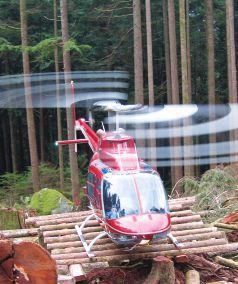
Peak helicopters specializes in infrared scanning, logging support and more. “Others do logging support as well,”
Barratt notes, “but not as effective as Peak. This also gives us the Jet Rangers we wanted as well as the revenue stream to pay for the cost.”
Flug had been operating on the B.C. coast for more than 20 years and has been battling intense competition for some time. Peak has been able to work in a number of niche markets, developing mapping procedures and infrared scanning techniques that were in demand from its customers –customers he considers friends. Ensuring those relationships remain solid is a key consideration going forward.
“It’s been a nice little run and there are a lot of people starting to get back into the light market at the moment,”
Flug said. “I know Peter was concerned that West Coast had left a hole in their company by exiting that market and concentrating on the intermediates for so long.”
Flug started Peak Helicopters in 2006 and tried to work with one customer on Vancouver Island for his mapping services. But he admitted, “It just doesn’t work that way. If you are not going forward in the helicopter industry it’s the same as going backwards. You can’t survive with one customer.” Flug agreed that West Coast and Peak have had a great working relationship for years, so the deal just makes sense.
“They were very happy to know I would sell. I was going to have to put a bigger infrastructure in if I was going to continue, expanding, taking on more staff, and I mentioned this to Laine (Laine Valentine who has succeeded Barratt as
ops manager at West Coast) and he suggested I just sell to West Coast. I agreed. We spent a few months putting it together . . . and now I am in full panic mode,” Flug said laughing.
“Seriously, we are very comfortable with it. It takes a lot of effort to run something yourself. I enjoyed it, but I also like to make changes and do different things.”
Flug and his wife plan to pursue some aviation-related ventures in the helicopter sector as well as other investment opportunities outside aviation.
“It’s a very competitive industry. If I didn’t have the niche markets I did, I wouldn’t go head to head with any other companies. I just wouldn’t. It reminds me of a seagull at a McDonald’s parking lot.
Someone throws a French fry on the ground and all the seagulls go at it. They all get a whack at it but none of them get full.”
West Coast Helicopters and Peak Helicopters have joined forces. (Photo courtesy of West Coast Helicopters)
Helijet helping in the prostate cancer fight
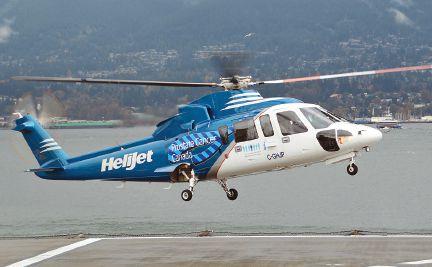
A pale November sun broke through the clouds over Vancouver long enough to illuminate Helijet’s partnership with Prostate Cancer Canada (PCC).
Sporting the colours of PCC, the S-76 will operate on the scheduled VancouverVictoria route. For Helijet President and CEO Danny Sitnam, realizing that many of their passengers are in the key 40s to 60s demographic, it provides a constant reminder of the potential dangers of the disease.
For PPC, the partnership provides another avenue to get the message out, both to passengers on Helijet and to those who see the aircraft in operation. The message is clear that “early detection saves lives.” It is expected that almost 24,000 Canadian men will be diagnosed with prostate cancer this year and 4,000 will die. With early detection and treatment, the survival rate is more than 90 per cent.
– Paul Dixon
HAC: ready for flight and duty battle
When the Helicopter Association of Canada wrapped up its 19th annual convention and trade show in Montreal in November, there was little doubt that the most captivating take away from the event was how the industry is set to deal with potential regulation changes to flight and duty time requirements in their operations.
As HAC president and CEO Fred Jones stressed on several occasions, this is a “highly charged” issue one that will have “huge reverberations” throughout the industry. The proposed regulation changes could seriously alter operator costs, crew deployment processes, hiring policies, pilot and crew lifestyle decisions, operational logistics and most importantly, safety.
“This is just a mess and the time to keep our powder dry has passed,” Jones noted. “We cannot let this go to Gazette One, it would certainly be a catastrophe for the industry.”
HAC has been immersed in this issue for more than two years. The Association, key
Canadian operators and The Flight Crew Fatigue Management Working Group met for 43 days over the course of 18 months to develop a workable set of flight and duty regulations that would work for all stakeholders.
However when the draft notices of proposed amendments (NPAs) were tabled –following two years of silence from Transport Canada (TC) –they were done so in the absence of the Working Group dialogue and industry stakeholders.
Much of the information contained in the NPAs is not only misleading, Jones noted,
Canada – 1 Year - $25.00 (all taxes included) USA – 1 Year $35.00 Foreign – 1 Year $45.00
but is highly ambiguous when it comes to fatigue-related science. Much of it is also only applicable to the airline operating community, completely ignoring the needs of the helicopter industry.
The proposed amendments will have a serious affect on CAR 702 and 703 operators, but they will also affect almost all aviation partners.
HAC is stepping up its advocacy efforts in light of these circumstances and, with its allied associations, will embark on an advocacy campaign if Transport Canada continues to promote the regulations in their current form.
Helicopters Magazine is an associate member of the following Canadian aviation associations:
B.C.’s Helijet has joined forces with Prostate Cancer Canada (PCC) to help fight the crippling disease. (Photo by Paul Dixon)
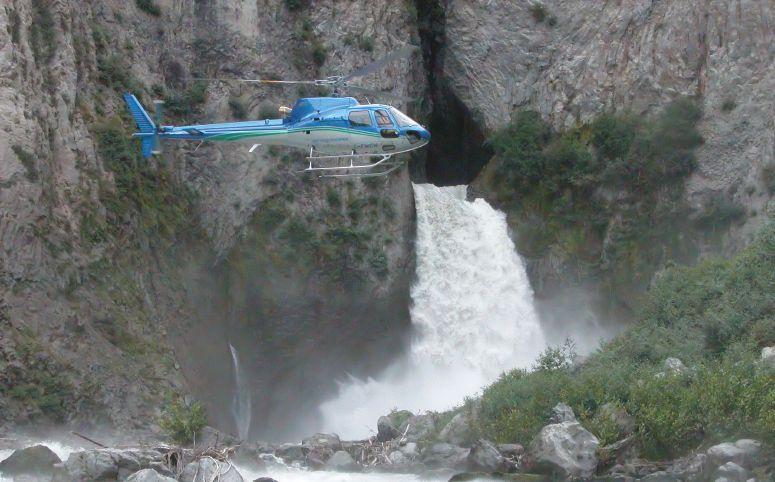
The proposed flight and duty regulations would be dire for the Canadian helicopter industry. (Photo courtesy of Wildcat Helicopters)
COLUMN
The mid-20th century scientist, M.J. Moroney, once wrote that, “A statistical analysis, properly conducted, is a delicate dissection of uncertainties, a surgery of suppositions.”
This is a lovely sentiment and sets the tone for this month’s column – that the statistics provided to the helicopter community by Transport Canada (TC) and the Transportation Safety Board (TSB) are an important adjunct to how we manage risk in our operation, lest we fail even this small test of being a delicate dissection of uncertainties.
A commonly used adage for good management practice and quality control is the statement that “You cannot manage what you do not measure.” Many companies track a variety of Key Performance Indicators (KPIs) but the standard in our industry is the accident rate/major incident rate. These rates are often tracked as accidents per 100,000 hours. Other elements of the Canadian aviation marketplace mark the rate per million passenger miles flown or accident rate per million “movements.”
For our purposes, we will stick to the per 100,000 hour standard. Recently, at the Helicopter Association of Canada’s (HAC) annual conference, representatives from the TSB presented data about the industry. The presentation included data showing a downward trend in the accident rate from about 8 per 100,000 hours in 2003 to slightly more than 5.5 per 100,000 hours in 2012. This chart seemed to indicate a good trend in managing risk in our industry.
Great news, right? This data would be a good backdrop for individual
Changing the Process
Industry-Shared Safety Database Would Reduce Accidents
the snapshot for total hours flown in the industry. This information provides the cornerstone for data collection, yet the data is strangely hidden from view. The fact that data is embargoed is frankly typical of most government agencies, but for aviation safety purposes, I find the outcome difficult to fathom. This is mirrored in some extent as well in how the TSB reports and publishes its data. Our community deserves better; so in fact, we should create better data.
I propose that the helicopter industry in Canada remove itself from the vagaries of government processes and start collecting its own data. I also think that the HAC is the prime candidate to facilitate this process by engaging its member companies to commit to full and open participation. We would need to come to consensus about how operations are classified, and have a neutral “gate-keeper” for collecting, collating and publishing the information. There would be no need to collect registration information on activities although general geographical area would be instructive. The industry itself could begin this process first by collecting annual usage data and then on a “go forward” basis, start an incident/occurrence/close call/hazard-reporting database.
Many unique operators would feed the database and then be able to access the collective, accumulated data, by region, by time of year, by type, by operation – the sky is the limit really. The annual convention could then add an additional dimension by enjoining a conversation about our activities as an industry, manifested from data that we have provided for our own purposes and from our own operational activities. This would be a fantastic outcome.
It would yield tremendous results that may even provide gems of insight that could improve our industry. ‘‘ ’’
companies to measure their own performance except for one small point. Access to this data is spotty and difficult and needs to be much more transparent. This situation mirrors the issue that the International Helicopter Safety Team (IHST) encountered when it began its analysis of industry data back in 2006 and was a sore point of Dr. Ira Blumen’s team in that they were forced to extrapolate data in order to generate meaningful statistics and thus measurable goals.
TC requires that companies report actual hours flown on their aircraft on an annual basis through the filing of the Annual Airworthiness Information Report (AAIR). This data presumably is then collated to feed
Too often, we find ourselves beholden to the regulatory agencies and this proposal would completely remove TC from this critical aspect of how we all manage risk in our safety management processes. As an industry collective we would own the data and, I sense, we would see it yield tremendous results that may even provide unforeseen gems of insight that could improve our industry, and assist in the development of best practices in those areas that are highlighted.
In order to see the real benefits of Deming’s axiom, then let’s conduct the measurement of our activities ourselves so that we can benefit from the information to produce a more mature safety management solution. It will help us manage risk better – and save lives.
Walter Heneghan is the Vice President for Health, Safety and Environmental Protection with the Summit Air Group of Companies, Ledcor Resources and Transportation, based in Edmonton and throughout Western Canada.
WALTER HENEGHAN
PAUL DIXON
his past October, I had the opportunity to sit in on an intriguing presentation called, “Post Accident Life Cycle” in Vancouver. Organized by the British Columbia Aviation Council (BCAC), this one-day workshop illustrated the response side of what happens following an aviation accident, from the moment of realization through the first 24-hours and into the days and weeks that follow.
The day was broken up into four presentation blocks that grouped agencies based on where they would show up on the time line. Where the incident happens and when it happens is a huge factor in how the response effort looks, but the responsibilities never change. NAV CANADA is front and centre in most cases, and if the crash happens at, or near an airport or heliport, they must deal with other traffic using the facility.
If the accident occurs in an urban area, the Joint Rescue Coordination Centre (JRCC) is notified. They are responsible for aviation accidents under their search and rescue (SAR) mandate. One phone call may be the first and last involvement they have, but they need to know.
At the actual scene, the police force of jurisdiction initially treats the area as a potential crime scene. Once any lifesaving or firefighting efforts are completed, the police secure the scene. While the police have initial responsibility, RCMP Sgt. Cam Kowalski pointed out that the scene will fall under a multi-jurisdictional mandate once the
Riding Out the Storm
Creating a Sound Emergency Management Plan
The Transportation Safety Board’s (TSB) Glen Friesen said the TSB is a primary responder given the time it may take investigators to reach the scene. The TSB takes over control of the site when the coroner has concluded its work. The TSB’s senior investigator is in charge and will determine who will be allowed onto the site. Friesen notes it’s not uncommon for many people to show up at the site, but those allowed to enter are those who can assistance with the investigation. Often operators stay as far away from the TSB as possible, but Friesen strongly suggests they “take the opportunity” to participate in the investigation and learn as much as possible.
Communications in the aftermath of a crash are critical, both internal and external. Alyn Edwards of Peak Communications has a long background in the media. Edwards aptly points out that having the correct information is essential as mistakes have consequences. In the 24/7 world of non-stop information, the public and the media are hungry for information on anything that happens. Edwards suggests operators need to have a media plan in place to eliminate mistakes.
“If you shoot from the lip, you’ll be hung by the tongue,” he said. “You have to get your message out and you have to get it out there before someone else gets it wrong. Once the horse is out of the barn it’s difficult to corral. As important as it is to get your message out to the big, bad world, it’s just as important that your own people know what is going on. Be consistent in what you say and tell a story that’s based on fact, not wishes or suppositions. Have a crisis communications plan that can be applied to a wide range of circumstances and train members of your staff and then exercise the plan.”
The event brought up many salient points: key information operators need on a regular basis.
police make a determination of any criminal involvement. In cases where deaths have occurred, the coroners’ office takes over responsibility for the investigation.
It’s worth nothing that in B.C., police officers are also delegated authority under the Coroner’s Act, allowing them to act on behalf of the coroner until the coroner arrives. Vince Stancato of the B.C. Coroner’s Office noted that his job is nothing like the ones portrayed on TV. A coroner in B.C. acts on behalf of the deceased and attempts to answer the question, “why am I dead?” Coroners determine facts and do not find fault.
The event brought up many salient points: key information operators need to review on a regular basis. Are you prepared to provide support to your staff? If a fatal crash includes employees of your company, do you have a support plan in place for family members and co-workers? Are you able to provide a safe haven and counseling for those who need it?
Aviation operators must work within the premise that an accident may occur – an event that could threaten their very future. The time to implement – and practice – emergency management measures is now. The emergency management office I worked at used to have a sign on the wall that said, “it wasn’t raining when Noah started building the Ark.” It most certainly was not – and there is always time to prepare for the storm.
Paul Dixon is freelance writer and photojournalist living in Vancouver.
A Misguided Approach
Flight and Duty Changes Shortsighted, Compromise Safety
was told an inaugural address, even in the form of a magazine column, should reflect issues of current debate and discussion to set the tone for future columns and their potential impact on the readership. With that in mind, I know of no issue with a greater potential to shake the helicopter industry than the current Notice of Proposed Amendment regarding changes to Canada’s regulations around Flight and Duty periods (FDT). Not even the current malaise seeming to affect a large portion of the helicopter industry has garnered as much attention and controversy as this potential new law.
Having attended a couple of the meetings of the Working Group formed to study and address the FDT rules in Canada, I feel close to the issue, but not so close as to lack objectivity. The stated goals of the undertaking were seemingly acceptable to all parties at the start of the exercise, so how did it go so far off the rails from the perspective of the helicopter industry? There are many reasons, but I believe that the heart of the issue can be found in one of the opening paragraphs, in section 1.2 entitled “Principles”:
Intrinsic to this Working Group Report is the principle that fatigue affects all flight crew. As such, the Working Group Chairs were given direction from the Canadian Aviation Regulatory Committee (CARC) that, to the extent possible, the proposals should apply to all flight crew members and air operators.
This innocent sounding statement trapped the participants into
of how much fatigue a helicopter pilot might feel at the end of a day spent hanging out the bubble window, pulling redline torque while moving drills in the mountains, or putting water on fires, ever took place or was even contemplated.
One of the items with perhaps the greatest potential to impact the helicopter industry was the discussion around Duty vs. Flight Time with regard to fatigue. A large portion of the discussion was spent determining that Duty Time was just as fatiguing as Flight Time. I thought this was obvious for an airline pilot and find it unfathomable that anyone could argue. Sitting in a cockpit is fatiguing regardless of whether the aircraft is on the ground or at 35,000 feet. There’s the rub. When a helicopter pilot is on duty (generally – I know differences exist within our industry as well) he or she does not sit in the helicopter for the full period waiting on the client. I learned to flyfish (poorly) while on duty, but got pretty good with a bull whip in the highlands of Ethiopia!
The problem is that no attempt was made to understand the roles and responsibilities.
almost a year-and-a-half of acrimony and frustration that may take longer yet to sort to some degree of widespread satisfaction. The problem is that no attempt was made to understand the roles and responsibilities, not to mention the work schedules and tasks, of any of the people whose lives were being discussed. As the airlines dominated the discussions, it was simply a given that all pilots face roughly the same schedules and fatigue inducing events. So much time was spent discussing “Sectors” and their effect on fatigue, I found myself embarrassed that I had no idea what a Sector was (it’s a takeoff and landing in fixed wing, big iron jargon). No discussion
Without getting into the fine detail of the NPA, it is glaringly clear that the process was flawed, at least from the perspective of the helicopter and small airplane industries. I have seen comments in the media from operators and others that state we won’t have enough pilots or we won’t be able to afford the new rules, but I make a point of avoiding all of those “commercial” arguments. The fact is, it makes little sense to adopt big airplane, scheduled flight, airport-to-airport operational rules for small operator, air taxi, aerial work type of operations. I believe the closest analogy that exists is the difference between taxicabs and long haul truckers. Their work is similar, they drive vehicles on the same roads but their rules are vastly different. I know helicopter pilots will sometimes get insulted when they’re compared to a taxi driver, but the fact is, what we do is very close to that. Of course, with some crane and excavator operating thrown in for good measure!
The only real solution to this seeming dilemma is for another working group to convene – one that will determine what it is that people do and consider what the fatigue impacts are. To have a discussion where we simply debate whether, “Duty” is fatiguing without ever attempting to define and understand what Duty is – and whether it’s the same for all parties – is a glaring failure of the Working Group to fulfill its mandate, at least if that mandate was about safety.
Corey Taylor is VP, Global Business and Product Development for Great Slave Helicopters. This is his inaugural column for Helicopters
COREY TAYLOR
Safety is not a “competitive differentiator.” Helicopter operators should not trumpet that they have a better safety record than a competitor, even if they do, because safety in the public consciousness is a collective industry record. Any accident, especially a fatal accident, ripples through the reputation of every operator.
The five large global operators who created the new HeliOffshore organization – Avincis (Bond), Bristow, CHC, Era, and PHI – recognize that sharing safety best practices is good for each of them and for the industry as a whole.
HeliOffshore is an outgrowth of a joint review initiated by the “A-B-C” operators following the 2013 “CAP 1145” review of North Sea helicopter accidents between 1992 and 2013 by the UK Civil Aviation Authority (CAA), Norway CAA, and European Aviation Safety Agency (EASA).
Quite simply, the experience of the joint review triggered a desire to keep talking on an ongoing basis. And not only talking, but throwing significant senior executive weight behind the group’s recommendations. “One of the things that came out very strongly was a genuine commitment from the very senior stakeholders to work on this together and to see it through,” HeliOffshore CEO Gretchen Haskins said. The chairman of the new independent organization is William Chiles, CEO emeritus of Bristow Group. Other board members include William Amelio, CHC President and CEO; James Drummond, former Group CEO of Avincis; Christopher S. Bradshaw, Era Chief
Perfomance Based Safety
Offshore Operators Seek Safety Through Collaboration
In an October workshop immediately after HeliOffshore was created, the 70 assembled stakeholders (operators, helicopter manufacturers, training organizations, regulators, pilot and passenger groups) opted to focus initially on six areas: automation, pilot monitoring, stabilized approaches, health and usage monitoring, oil and gas customer requirements, and information sharing. “The idea is to get all the stakeholders talking and working together about what are the safety priorities, what are the actions that will make a difference, how do we work together to implement them,” Haskins said.
In the area of automation, for example, the emphasis is not simply on a pilot’s understanding of cockpit automation features. HeliOffshore intends to influence automation system design and regulation, push for standardization of operating principles and consistent training, and coalesce data on failures and other feedback.
This stems from the “performance-based” trend in aviation: performance-based regulation, performance-based training, etc., which is where Haskins’ background is an excellent fit. Prior to joining HeliOffshore, she ran a consulting company called Informed Performance Ltd., based on her experience with the UK CAA, UK air navigation services provider NATS, and commercial aerospace firms such as GEC Marconi.
“The common thread in my CV is human performance. Gradually through my career, I progressed from how do you get one person to use a system to how do you get a team of people to use a system to how do you get a whole organization to work together to use the set of systems it needs, including the equipment, training, procedures, culture, data.
The experience of the joint review triggered a desire to keep talking on an ongoing basis. ‘‘ ’’
Financial Officer and acting CEO; and Al A. Gonsoulin, Chairman and CEO of PHI.
Haskins says HeliOffshore’s approach will be to have “clear resource plans with milestones and deliverables.” She said there’s “a lot of great work being done in safety by people who are doing it almost over and above their day job.” But the directors have emphasized that, within their operations, “they will make improvement activity a clearly defined part of peoples’ day jobs and put the resources to it in a very clear way so it will be something that has to be done by a specific date and time. There will be governance,” Haskins explained.
“If you give people the right information, training, tools, and support to do their job, and then you give them feedback on how they’re doing, they’ll make decisions that help optimize their performance.”
Membership in HeliOffshore (www.helioffshore.org), as the name implies, is open to anyone operating a helicopter in the offshore environment. “Alliance members” can be anyone who has a stake in the offshore helicopter industry.
Rick Adams is Chief Perspectives Officer of AeroPerspectives, an aviation communications consultancy based in the south of France, and is Editor of ICAO Journal. He has been writing about technology and training for 30 years.
RICK ADAMS
COVER STORY
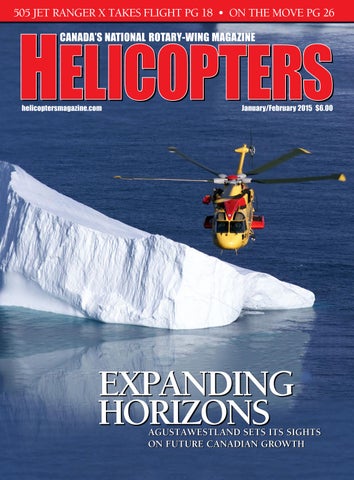
Expanding
Horizons
AgustaWestland Sets Sights on Canadian Growth
BY MATT NICHOLLS
Establishing your brand and rising to a position of influence in a competitive marketplace is challenging indeed and for helicopter manufacturer AgustaWestland (AW), the journey to make its mark in the Canadian marketplace can best be described as a solid work in progress – with definite successes along the way.
With well established competing OEMs including Bell Helicopter and Airbus Helicopters offering a diverse selection of aircraft tailored to the specific demands of the Canadian military and civilian markets, the competition is indeed tough, but AW is not without its own potent lineup. Its AW Family of the AW139, AW149, AW169, AW189 and the new AW109 utility version Trekker – introduced with much pomp and circumstance at HeliExpo last year – offers its own attributes, stacking up nicely in a number of key market segments.
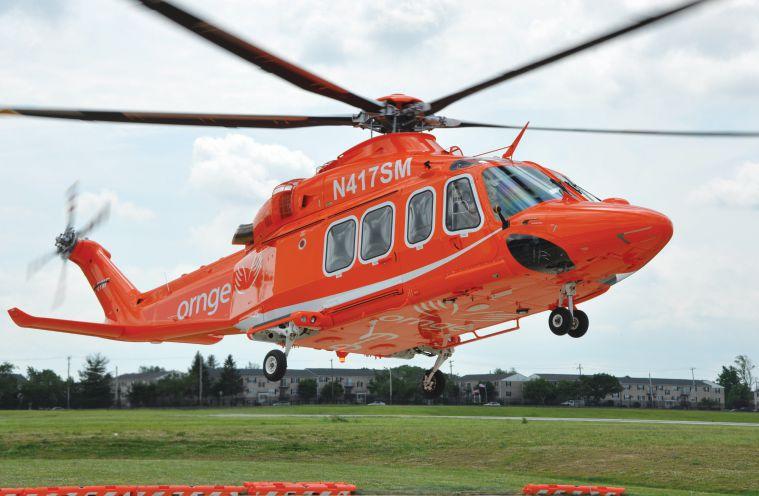
To date, AW has achieved solid global success with more than 4,900 helicopters in service, and some 90 commercial and military helicopters sold in Canada. The company has made a strong push on the helicopter emergency medical services segment (HEMS) with both STARS (western Canadian air medical transport provider) and ORNGE (Ontario’s air medical transport provider) using the AW139. And on the military side, the medium-lift CH-149 Cormorant remains the backbone of Royal Canadian Air Forces (SAR) search and rescue (SAR) teams.
Helicopters sat down with Enrico Canal, Head of Region for the Canadian commercial helicopter market (civil and public utility applications) and Jeremy Tracy (government/military) to get a better understanding of AW’s plans for 2015 and beyond, its future targets in the Canadian market, the commitment to safety and more. If one thing resonated clearly from the discussions, both are very optimistic about market potential and the prospects for future growth.
Helicopters: What area’s offer the most potential for AW in Canada in both the civil and military markets over the next few years?
EC: AW has enhanced its Canadian fleet significantly, with Helicopter Emergency Medical Service (HEMS) applications being the bright star. Still, as far as the civil market is concerned, looking at the presently flying fleet and the relevant market share, Canada still represents huge potential. And while four AW models are already flying in HEMS operations in four Canadian provinces, this segment also presents room for growth. We feel the AW product range very well fits the high safety and performance standards required in this kind of operation.
It’s also impossible not to consider the utility and aerial work
Expanding
segment as an opportunity in Canada. The introduction of the AW109 utility version, the Trekker – featuring skid landing gear and a new integrated modular avionic suite – will allow AW to offer a dedicated rugged light twin engine.
JT: In the military market, AW hopes to conclude the conversion of the VH-71s for added SAR capability for the RCAF and the Mid-life Update (MLU) of the current 14 Cormorant to give Canada a unified fleet of 21 all weather SAR helicopters.
Helicopters: In terms of product development, the aging Canadian fleet offers real opportunity for AgustaWestland. Which aircraft will best suit the needs of Canadian operators now and in the future?
EC: I can see the Trekker as a great asset to address a role that AW in the past could only marginally address, as we lacked a lighttwin skidded platform. Although slowly, we have started seeing more and more requirements that used to be for the single engine platform, now shifted to light twins aimed at enhancing safety. The AW109 Trekker seems to match this Canadian market tendency.
I also expect the AW169 to be very successful in Canada. It’s the only new generation light intermediate helicopter in development in 40 years and it’s getting close to certification.
JT: We see opportunities in the future replacement of the Griffon in the early 2020s. We have briefed DND on the AW169M, AW139M and AW149 to give them a range of possible capabilities they may wish to consider. Additionally, as the DND is looking at
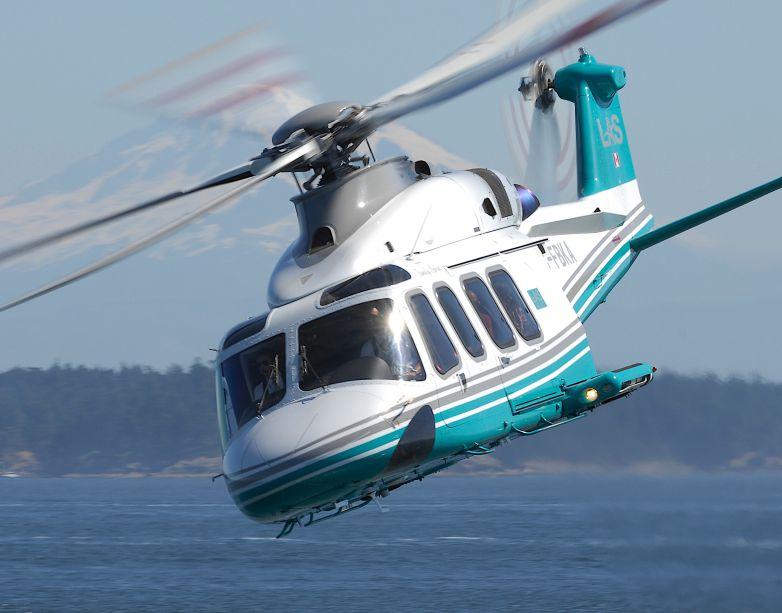
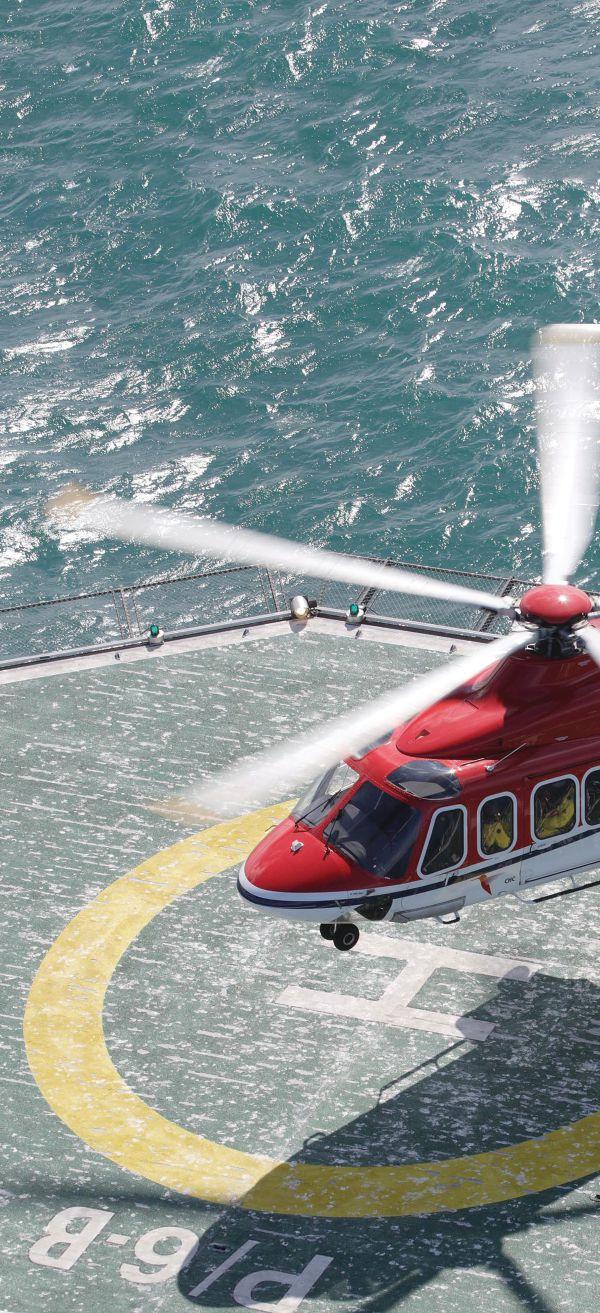
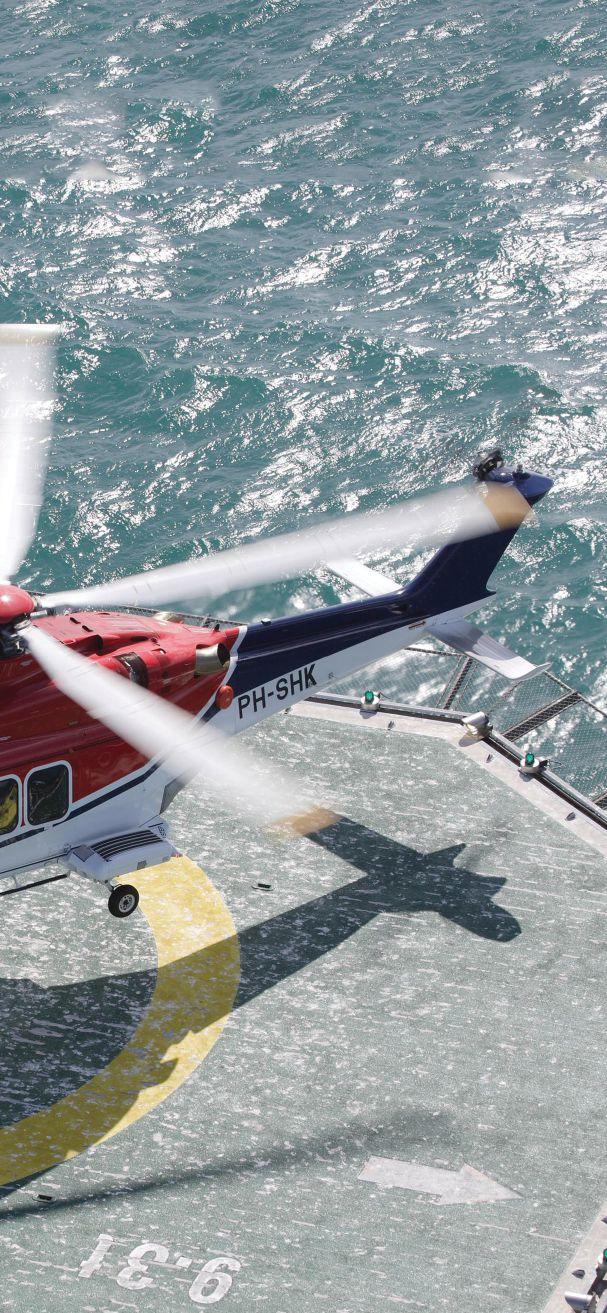
LEFT: Offshore oil leader CHC utilizes the AW139 for many of its oil and gas operations. (Photo courtesy of AgustaWestland)
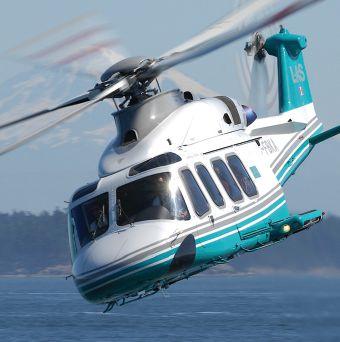
BELOW LEFT: The AW139 is an intrinsic part of London Air’s business model. (Photo courtesy of AgustaWestland)
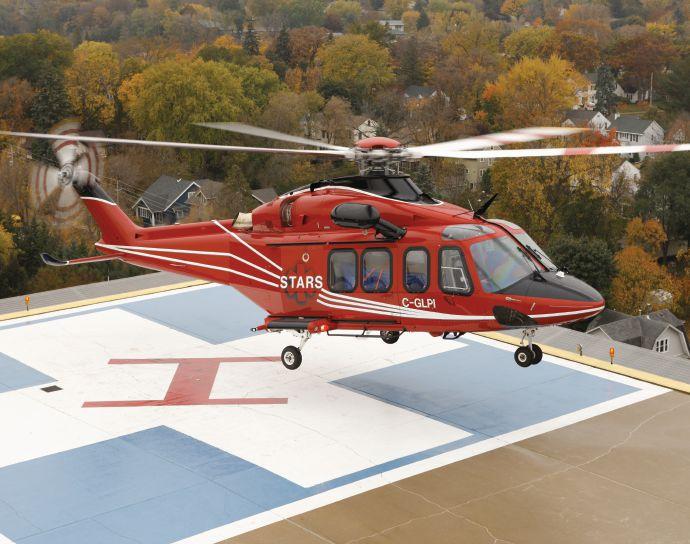
BELOW: AgustaWestland has made considerable strides in the Canadian market, particularly in the HEMs segment. (Photo courtesy of STARS)
future pilot training, the AW has a range of products that fill that niche market, depending on the line the RCAF wishes to go. And with regard to the Polar helicopter for the Canadian Coast Guard, AW has the civil certified AW139 and the AW189 as possibilities depending upon the Coast Guard requirements.
Helicopters: Are there other voids in the market that you can see AgustaWestland targeting in the next few years? More emphasis on the civil market? Military?
EC: The VIP and corporate market has always been an AW strength. The typical streamed-line fuselage, design interior, inherent safety and high performance make the AW models of great attraction to this market segment. And while quite a few AW helicopters are already flying in Canada as VIP or corporate (Grand and Grand New and AW139), I trust we could greatly enlarge its share in this market. As well, the introduction of the AW169 will nicely fill the gap between the successful AW109 legacy of light twins and the AW139.
JT: AW has discussed the viability of introducing the AW609 tiltrotor for longrange operations into the Arctic and in an air ambulance role to some of the remote areas of the North. The aircraft looks to be certified in 2017 and will be a rapid response vehicle for the areas in the Northern latitudes where airfields are not accessible.
Helicopters: Following up with operators is a great way to find out their perceptions of product, their needs etc. What feedback have you received from operators about your products? Any areas you’d like to improve?
EC: Willingness to improve is a mindset, as nothing is perfect and everything can be improved. AW has developed its legacy products, upgrades and design choices as a driver and baseline with operator’s inputs.
There are many examples of this approach. For example, we received indication that there’s potential for an AW109 with skids and we started proper surveys and arranged dedicated customer panels during its development. The AW139 has achieved great maturity also thanks to customer feedback. The AW189 and AW169 have been designed with the customer in mind and taking into account their specific requirements: long range/high capacity and maximized flexibility.
When I started looking after the Canadian market a year ago, one feedback I heard over and over again ever since has been: skids. “We need skids . . We want skids.” There’s no doubt that a large por-
tion of helicopter operations in Canada require skids, although there are still some cases where this same requirement belongs to what operators are used to more than to the strict necessity of it. Fixed wheeled landing gear with bear paws or snow skids, in some cases, can be as efficient as skids, but retaining the advantage of allowing taxiing the helicopter around. The AW109 Trekker is an example of how crucial operator’s feedback has been for us.
JT: AW remains fully engaged with its customers and Canada is no exception. We strive to improve our service to each and every operator. The DND is fully involved in direct meetings with the AW every six months and then in User Groups, along with other AW101 operators, every six months. We also take part in an annual Operations and Safety conference every December. Canada successfully achieves its
‘‘ ’’ If you never change, you will never get to know if there is something better. Many have done that already, very few have gone back.
LEFT: The new AW109 Trekker should appeal to the Canadian market. (Photo courtesy of AgustaWestland)
BELOW LEFT: Ontario medical transport provider ORNGE has a fleet of AW139s. (Photo courtesy of AgustaWestland)
annual yearly flying rate through the service offered by the ISS supplier IMP Aerospace and Defence.
Helicopters: What are some of the differences in market demand in Canada versus those in the U.S. and Europe? What makes the Canadian market unique?
EC: Every market place is different, but Canada, if possible, is “more different” than others. I see two main aspects that drive the Canadian Helicopter market today: it is highly influenced by Canada’s unique territory dimension, varied landscape and harsh environment (cold weather and proximity to the Arctic Circle). This typically requires most operations to be carried out only in the hot season, meaning plenty of short-term contracts (seasonal). It makes it difficult for operators to invest in their assets (new machines, the latest technology).
The main helicopter activity in Canada is and has always been linked to utility operations (aerial work, forestry, long line, etc.) with single-engines helicopters representing the vast majority of the helicopter fleet and VFR operations being the standard. There are very few capable IFR operators and operations performed in Canada, where in Europe, it’s the opposite. In the U.S., IFR is already more of a standard.
This explains the current Canadian fleet (highly populated by single engines and a quite high average age) and helicopter utilization and market requirements, that is looked at, only in terms of “how much it can lift for what cost.”
From another perspective, Canada’s technical expertise (pilots and technicians) is one of the best in the world. Pilots fly in extreme conditions while maintenance technicians need to design specific solutions during winters.
Helicopters: Working to create the safest helicopter environment possible is a top priority for operators and OEMs alike. How is AgustaWestland working to ensure the Canadian operating environment is as safe as possible?
EC: Safety is not and cannot be one party interest: OEM’s, operators, final customers, local aeronautical authority. It is, and has to be, everybody’s ultimate goal. We have to work together to achieve that. There is a need to improve the perception of helicopters as
capable pieces of high technology with high safety embedded. A clear example, is the huge difference in terms of safety standards between the oil and gas sector – offshore operations and onshore ops. The safety envelope is not always the same. Why are the standards (passengers, crew) flying onshore different than those flying offshore? This doesn’t provide a fertile soil to enhance assets and services taking advantage of what technology has made available. Of course there are others aspects like infrastructure availability (heli-
AW has invested in safety and Canada can benefit from it. The AW Family concept training approach offers unique commonalities to move from one type of aircraft to another. Systems such as the LiDAR, the AW189 50 min run-dry MGB, the icing protection systems, NVG and TCAS give great enhancements.
JT: I agree that safety is a culture inbred into the workforce and ethics of an organization. The Cormorant with its three engines, has demonstrated run dry capability, excellent autopilot, redundant systems and all weather capability. It was a step forward in safety and still to this day is recognized for its attention to safety and smoothness.
Helicopters: How can AgustaWestland remain competitive in the Canadian marketplace going forward against stiff competition from Airbus Helicopters, Bell Helicopter, Sikorsky and other OEMs?
pads, approach paths certification, navigation) that are also requisite for moving to the next step. This is amply discussed in the community, for example within the Helicopter Association of Canada (HAC). Some (very few) operators have tried to offer a different approach that, until now, has been pushed back by a “cheaper offer.” Until all of players in the community agree that it’s time to change, there will always be a push back. I think that the industry is ready to make it happen, and for sure AW is.
EC: AW has to become more competitive for sure. It’s just a matter of fact that our competitors have established themselves in Canada, far before us, and their local market share is self-explanatory. This is clearly a competitive advantage, having a big fleet already flying around with both operators and final users being used to their assets and services. To change requires an extra effort, but if you never change, you will never get to know if there is something better. Many have done that already, very few have gone back.
We need to keep listening to the unique requirements of this market and further customize our products on top of the multi-purpose design
of our models and the many options already available on each one of them. We also need to make support and services more accessible to customers and meet their expressed needs.
JT: AW continues to win orders across both civil and military markets due to the careful development of products to suit market demands. The development of the all-weather AW139, AW149 and AW189 are particularly suited to both the civil and military markets. The new AW169 brings new vision to the light intermediate twin and sits in between the intermediate AW139 and the light AW109 and AW119.
Helicopters: Many corporate leaders I have spoken with speak of finding the right talent to drive their operations in the future. How do you create a corporate environment at AgustaWestland that establishes trust and promotes growth, development and initiative?
EC: Heritage and established excellence are crucial to strengthen community identity. Also, the combination of innovation and involvement of the younger generation is key to our success. Approximately 32 per cent of our employees out of a total of more than 13,000 are under 35. We invest an average of 12 per cent of our yearly revenues into R&D and young employees are deeply involved in it. We also work with a number of with universities and research centres in the development of new technology programs to give young people new opportunities.
Helicopters: The AgustaWestland Family of aircraft is quite diverse and have many qualities that would suit the Canadian market. Some operators are using the AW139 in a number of capacities. What other opportunities are out there?
EC: The AW139 has been an unprecedented success, with more than 700 units delivered and more than 800 sold in nine years. The AW189,
launched in summer 2011, has accumulated more than 130 sales, including framework contracts and options, to date and was certified in early 2014 with the first batch of aircraft already in service globally now. The AW169 has accumulated more than 120 sales, including framework contracts and options, and is about to be certified. Considering the appetite that the market has been showing towards new technology, AW is well positioned, if not the best positioned, to capture most of this market.
Helicopters: Do you feel AgustaWestland is doing enough to grow its position in Canada?
EC: We want to be “synonymous with vertical lift” and we are in many places around the world, but not yet to the extent we aim at in Canada. Most operators know the brand, some know our products, few have experienced them.
I’m convinced that there is plenty of room for AW in Canada, but it is paramount that operators and final users get to try what our helicopters and services are about.
We have a lot to do and it starts with making sure our customers and prospects know what we have to offer. Of course, it cannot happen overnight, it will require time and a constant effort from our side.
JT: AW has to grow in an affordable way, and consequently with the attention devoted to meeting the current requirements, we are well placed. As to the future, if some of the contracts come to fruition, AW will grow its offices and its commitment to Canadian Industry through the Industrial Technical Benefits it is able to offer. AW has been a very good partner to Canadian industry in the past and has always met its obligations to the Canadian Government. With the current range of aircraft the company builds, we are well placed to grow both the civil and military market quite significantly.
MOBILE REFUELING
Changing the Game
Bell’s New 505 Jet Ranger X Takes to the Skies
BY MATT NICHOLLS
When Bell Helicopter president and CEO John Garrison took the podium and introduced the new 505 Jet Ranger X amid much pomp and circumstance at last year’s Heli-Expo in Anaheim, Calif., the stately Bell chief executive enthused about the light-single helicopter’s technological advancements and versatile place in the marketplace.
Powered by the new Turbomeca Arrius 2R engine and sporting some impressive bells and whistles such as the new Garmin G1000H Integrated Avionics suite, a flexible, five-forward seat interior with excellent visibility and plenty of flight deck space and much more, the new 505 Jet Ranger X with its economically price point of approximately $1 million, is an accessible option for Canadian operators in a variety of sectors including utility, training, tourism, and electronic news gathering (ENG).
The 505 Jet Ranger X was designed based on extensive input provided by those in the field – the Bell team worked closely with a Customer Advisory Council (CAC) to help create a machine that lives up to the highest operator demands. So, when the aircraft
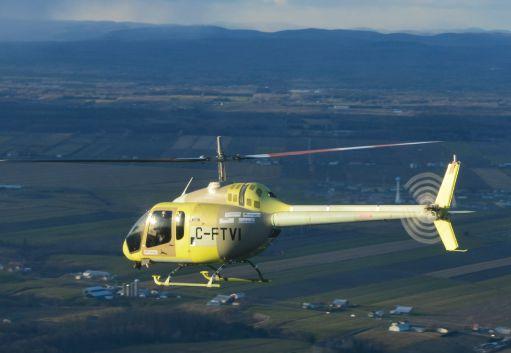
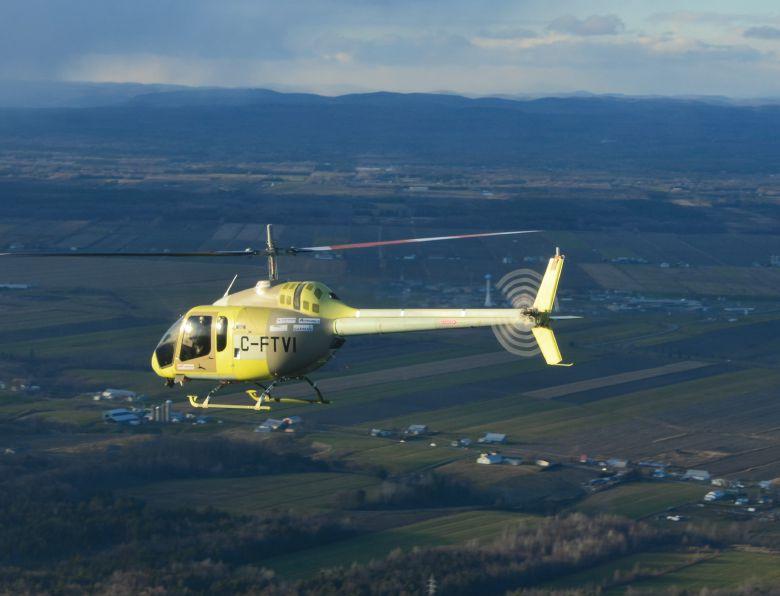
LEFT: We have lift off: the new Bell 505 Jet Ranger X on its inaugural flight. (Photo courtesy of Bell Helicopter)
BELOW: The Bell 505 Jet Ranger X team in the early stages of assembly. (Photo courtesy of Bell Helicopter)
powered into the sky at the company’s Mirabel, Que. test facility for the aircraft’s inaugural flight in early November with Bell test pilots Yann Lavelle (senior test pilot) and Eric Emblin in the flight deck, it marked a new era in Bell’s history.
“The aircraft performed exactly as anticipated today,” Lavelle enthused, after taking the helicopter for a 30-minute flight over Mirabel. It performed two laps flanked by a Bell 429 and also hovered. “I was excited to be part of the history of the Jet Ranger 505 X legacy today, an aircraft that has defined the market nearly 50 years ago.”
Added Emblin: “We hovered in the aircraft, performed a lowspeed controllability assessment and flew two laps in the local traffic pattern. Our top speed today was 60 knots.”
One of three new aircraft currently under development by Bell – including the 525 Relentless and the V-280 Valor tilt rotor for the U.S. Department of Defense – the 505 Jet Ranger should be a strong player in the single-engine turbine market. It’s one 505 Jet Ranger X Program Manager David Smith knows has plenty of potential. And with the first flight now in the books, the program is
Careers in aviation WINGS 2015
Education, training and job prospects in Canada’s aviation and aerospace sector
Preparing for an E xCI t ING av I at I o N Car EE r
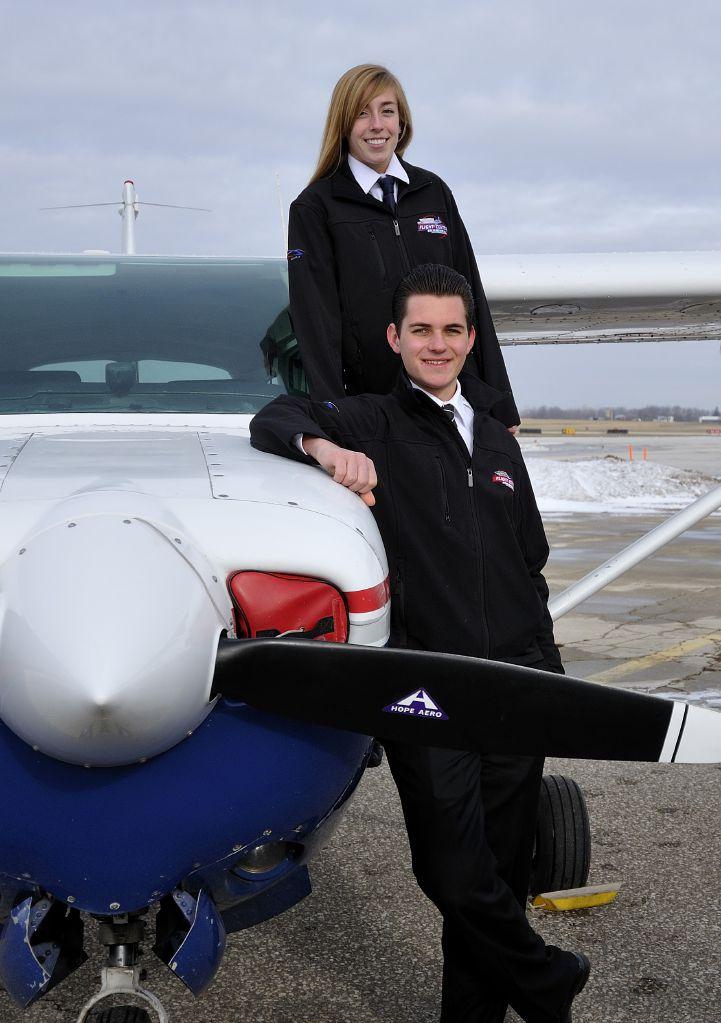
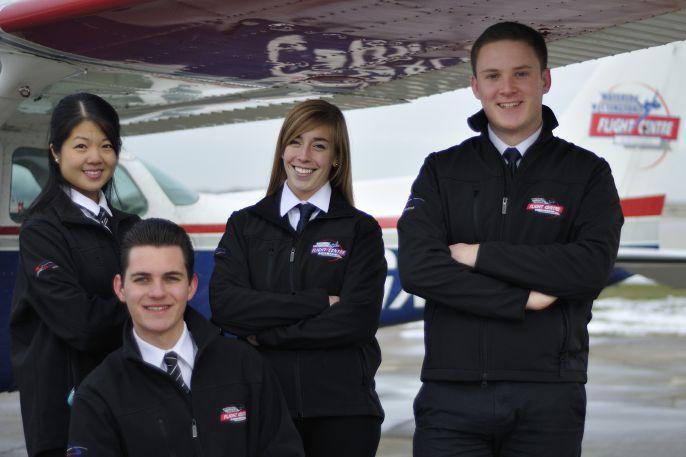
The Waterloo Wellington Flight Centre is one of the largest flight schools in Canada, ranking in the top 5 nationally in experience and industry reputation. WWFC is partnered with both the University of Waterloo and Conestoga College, providing students a choice between an aviation degree or diploma.
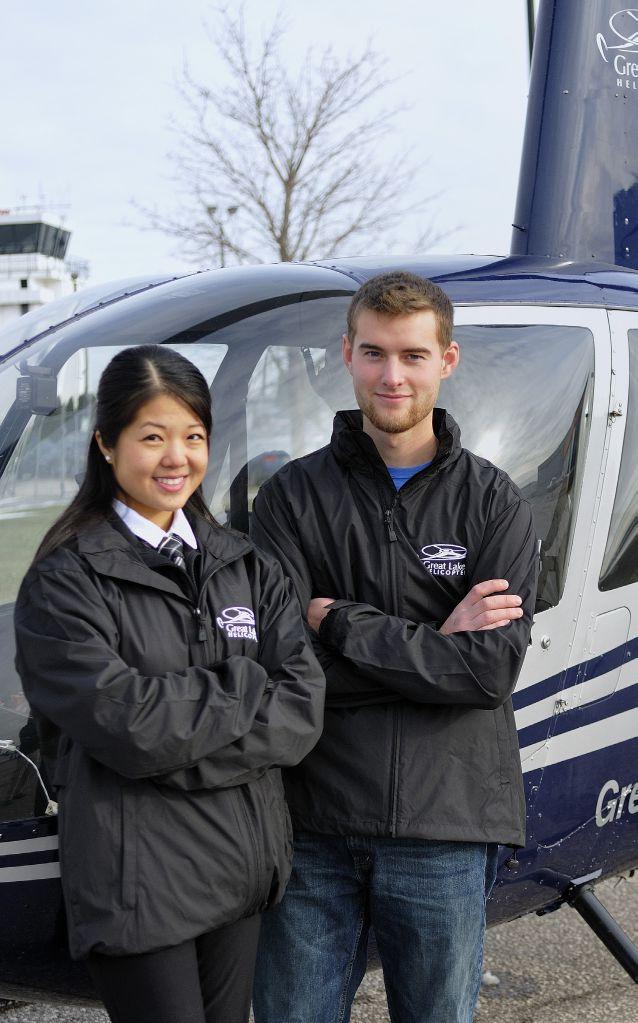
Great Lakes Helicopter Great Lakes Helicopter is an Ontario registered Private Career College, offering a range of Helicopter Flight Training options and charters from the Region of Waterloo Airport. GLH is partnered with Conestoga College offering a 2-Year Diploma in Aviation Arts and Science. This is the only program of its kind in Canada.
In the competitive world of aviation a post-secondary education gives students the edge they need to stand out in the industry
Graduates from the Waterloo Wellington Flight Centre and Great Lakes Helicopter leave ready to work coast-to-coast in entry level flying positions.
CIA2015
caReeRs in aviaTion 2015 on the Cutting edge
Sometime in the next 12 to 15 months, Bombardier’s CSeries is expected to enter revenue service. The CSeries is one of the world’s most technologically advanced airliners, and it is Canada’s entry into the large jet market. The airplane also reflects Canada’s aviation and aerospace industry, an ambitious and hi-tech global business, built up, maintained and managed by women and men at the top of their game.
Canada has one of the largest aerospace and most diverse air transport industries in the world, with opportunities spread out across the country. This adds up to strong demand for skilled professionals to keep the airplanes flying and maintaining Canada’s position as a leading global manufacturer and exporter of state-of-the-art airplanes, aero-engines, flight simulator and components.
Training is long and hard and, in the case of pilots, can be expensive. But the rewards are just as great as the industry expands and older workers exit the cockpits and put away the tool boxes.
Wings and Helicopters Careers in Aviation 2015, is a one-stop resource to landing an exciting career in aviation. It contains brief descriptions of several leading aviation and aerospace sectors, as well as valuable
information on education and training. The country’s flight schools, colleges and universities offer excellent programs to help chart a course along one of the hundreds of career paths available, both in the air, on the ground, in air traffic control or with one of the major OEMs (original equipment manufacturers) or MRO (maintenance repair and overhaul) organizations. The listings are intended as an introductory snapshot of the types of flight schools, colleges and universities, and professional training options that are available. But it by no means is a comprehensive list; the best advice is to use this guide as a starting point for your research.
The 2015 edition of Careers in Aviation envelops airplanes and helicopters in three sections: Flying the Aircraft; Designing, Building, Repairing and Maintaining the Aircraft; and Supporting the Aircraft, which is an introduction to careers in airport operations, air traffic control and flight dispatch.
As a research document, Careers in Aviation 2015 is an excellent starting point, but it only scratches the surface and has left out other rewarding careers in areas such as advanced aerospace engineering, marketing, cabin interiors, aviation law, flight attendants – even magazine publishing.
For those who have decided on a career in aviation – along with those who are still
considering career options or even a midcareer reboot – research is always your best tool. Industry associations such as the Canadian Business Aviation Association (CBAA), the Helicopter Association of Canada (HAC), the Aerospace Industries Association of Canada (AIAC) and the Canadian Council for Aviation and Aerospace (CCAA) are excellent resources for information on education, training and job prospects (see, “The Name Game," page 6). Interested students should talk to as many people as they can. One of the great things about this industry is many aviation professionals are more than happy to discuss their career paths and share educational options – there is a collective passion that unites the industry nationwide so use as many sources as possible to seek out and make key connections. And remember one thing: never be afraid to ask questions and seek more advice. A proactive approach gets you noticed – it also helps you stand out in a crowd.
And if you are in the Calgary, Ottawa and Toronto area in February and April, please check out Wings and Helicopters 2015 Careers in Aviation Expos (www.careersinaviation.ca). Essentially a live version of this guide, the CIA Expos and are great place to meet industry professionals, visit recruiters and get career advice from the experts.
voiCes oF reason
Wings and Helicopters CIa eventS draw rave revIewS
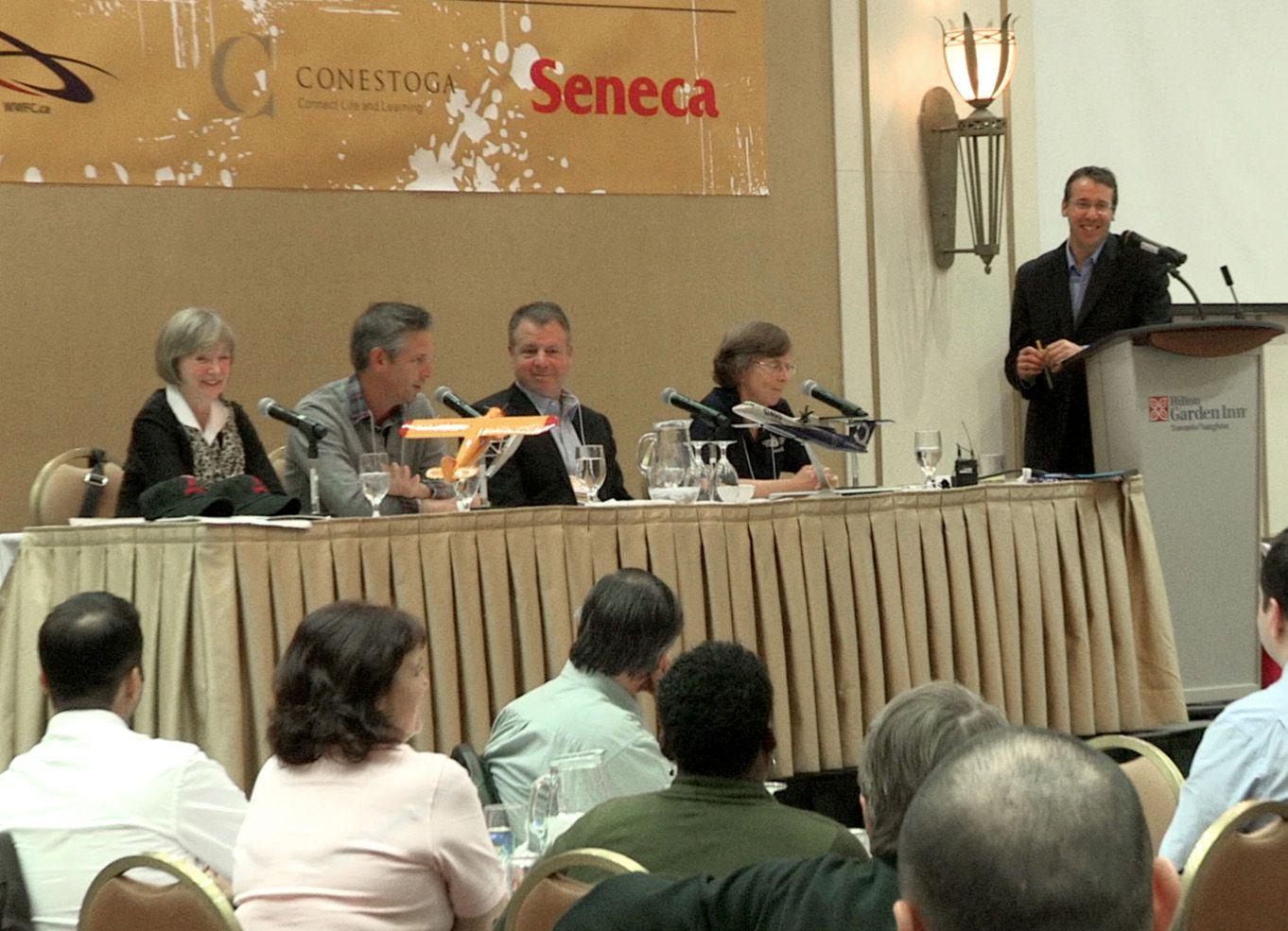
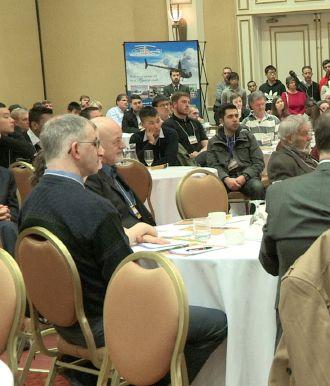
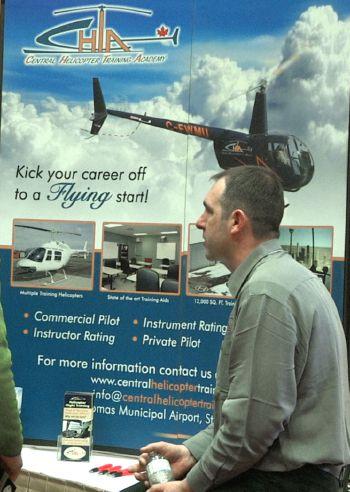
Put some of the leading aviation and aerospace leaders in a room for a full business day and some special things are bound to happen. And that’s precisely what occurs at Wings and Helicopters Careers in Aviation (CIA) Expos.
The CIA program started two years ago with our inaugural event in Toronto. Last year, we added a western presence in Calgary, and in 2015, we’re expanding again with the addition of an Ottawa event. For more information on dates, planning and program updates go to www.careersinaviation.ca
Designed as a live version of the Careers in Aviation print guide that runs in the January/February issues of Wings and Helicopters, CIA events present a tremendous opportunity for developing students interested in aviation and aerospace careers to rub shoulders with industry leaders from
a variety of sectors. Special presentations and panel sessions cover a broad spectrum of pertinent topics including flight operations/pilots; varied aviation professions such as air navigation, TSB investigation, business operations, what it’s like to be a flight attendant, the life of an aviation museum curator and more; aircraft maintenance and engineering/aircraft completions; and what information to ask aviation educators/professionals at the many flight schools, colleges and universities that dot the nation.
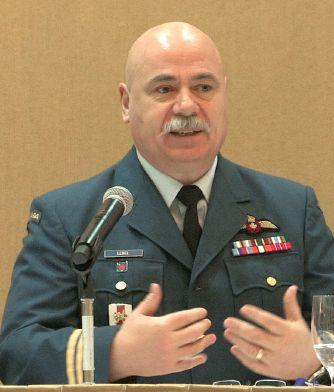
“The sad reality is there really aren’t a lot of grassroots career initiatives in our industry that can prepare aspiring students for a career journey in aviation or aerospace,” said Glen Lynch, president and CEO of GAL Aerospace, one of last year’s panellists in both Calgary and Toronto. “The CIA events are invaluable in providing young people with the tools they
need in making appropriate career choices – and all of it is in one room on one day. The talent in the room during these events is impressive indeed – it’s a wonderful opportunity for aspiring aviation professionals to interact with industry leaders.”
Lynch was just one of several key speakers that participated last year, an impressive roster that included aerospace and aviation leaders from a broad cross section of industry sectors on both the rotary- and fixed-wing sides of the equation. Some of the panellists on the docket for this year include:
• Fred Jones President/CEO, Helicopter Association of Canada
• Captain Peter Black, Chair, President’s Committee for Remote Operations, Air Pilots Association of Canada
• Contessa Bishop, Pilot-First Officer, Jazz Aviation LLP
• Stephen Farnsworth, AME & A&P,
www.pilatus-aircraft.com
Regional Director, AME Association of Ontario
• Sam Longo, AME & A&P, VP, AME Association of Ontario
• Walter Heneghan, VP Health, Safety and Environment Protection, Summit Air Group of Companies
• Kathy Fox, Transportation Safety Board of Canada, Ottawa Rockcliffe
Flight Instructor
• Bob Connors, General Manager, Waterloo Wellington Flight Centre
• Mike Whitter, Professor, Aircraft Maintenance, Canadore College
“I can’t think of a better way for young people to start their career search,” said Jones. “If you are serious about your career path, need more information about the industry – this is a wonderful opportunity to do so.”
Added Heneghan: “What is impressive about these events is its not just about pilots – there are so many opportunities out there. I think the CIA team does a great job of highlighting the possibilities in all aviation disciplines.”
Cia2015: For more information on the CIa Expos: www.careersinaviation.ca/expo
Key aviation and aerospaCe assoCiations to help you in your Career searCh
B.C. aviation Council www. bcaviationcouncil.org/ about-the-bcac/
Canadian Business aviation association www.cbaa-acaa.ca/
Canadian Council for aviation and aerospace www.avaerocouncil. ca/
Canadian owners and Pilots association www.copanational. org/
National airlines Council of Canada www.airlinecouncil.ca/
Helicopter association of Canada www.h-a-c.ca
International association of airport Executives Canada www. iaaecanada.org/
Manitoba aerospace association http://mbaerospace.ca/
ontario aerospace Council www.theoac.ca/
part one: Flying the airCraFt taKing to the sKies
deCIdIng whether to be an aIrPlane PIlot or a helICoPter PIlot IS juSt the begInnIng
It is estimated that on average, the Canadian airline industry will need to hire approximately 350 new pilots every year until at least 2030 – but this statistic only tells a small part of the story. Although flying for one of Canada’s major airlines might be the “sweet spot” for some, the job is not for everybody. Which is good, because the airline industry is not the only aviation sector with pilot (and co-pilot) seats that will need filling over the next 15 years.
A healthy private aviation sector, the world’s second biggest fleet of helicopters, Canada’s diverse geography and resourcebased economy and a growing air transport industry means that the sky is literally the limit for ambitious students who want a career flying, and are prepared to work hard to fulfil that goal.
On the fixed-wing side, there are exciting opportunities to pilot floatplanes along the British Columbia coast, zip into remote mining towns in the north, flying military recon, combat or humanitarian flights, or taking controls of a next generation corporate jet. The bulk of Canada’s rotary-wing operations may be resource-based, yet here again there are a multitude of options open to helicopter pilots including, exploration, heli-logging and fire suppression. There is also growing demand in speciality services for fixed- and rotary-wing pilots such as law enforcement and air medical transport.
Future pilots should enter flight school with a sense of where they want their career to go. For students who have not chartered a career path yet, they should consider talking to a flight school or college that also provides career counselling services. An important consideration will always be lifestyle. There is routine, for
example, when flying for a scheduled operator compared with being a pilot for a charter operator that often involves flying on short notice.
The “red meat” of Canada’s helicopter sector continues to support Canada’s resource-based economy, which makes work cyclical. As a result, helicopter pilots often find themselves “on the road” or camped in remote locations given the limited range of the machines they fly. Another important thing to consider is that aviation remains a highly technical and safety-driven industry that puts experience and the right skills set for the mission, ahead of all else. This also makes aviation a “pay or dues” industry.
Most fixed-wing pilots work toward the 1,500 hours flying time necessary for an Airline Transport Pilot Licence, which means there is a lot of time to fill from the less than 200 hours that the average flying school students graduates with. Entry-level jobs at this stage would include flight instructor, air taxi pilot or general aviation pilot as you build up the time.
For rotary-wing pilots, there is a similar gap between the 100 flying hours they will graduate with to the 1,000 plus hours many operators are on the hunt for. Career-minded rotor rookies bridging the ‘900-hour gap” are likely to travel large-distance for short-term jobs, low pay and long stints away from home. Even with these hardships, helicopter pilots are less likely to swap the “handson” flying for a fixed-wing airplane. Both Canada’s fixed-wing and rotarywing sectors are facing a looming pilot shortage so there are real opportunities for ambitious and resourceful graduates who can build up their hours.
Picking a flight school: research first
The first step in any research endeavour should always start with a list – and perhaps several to identify different aspects of the school. Canada has many excellent flight training schools to support this country’s diverse aviation sector, but landing on a particular school that best supports your own flying goals is going to take some research.
Industry experts recommend potential students first map out their career objectives and then carefully consider the facilities of schools and the quality of training. For example, students considering a career with a major airline will want to consider flight schools with links to colleges that offer diploma programs, although this can sometimes be misleading. Depending on the availability of new recruits, some operators will put a higher value on flying hours than other skills. A rotary-wing student who eventually wants to work in Canada’s resource-based industries will need to ensure they are trained to operate turbine-powered helicopters. Does a school offer additional training to broaden your experience?
Many factors go into determining a training school and program, including location of the school, facilities, the number of training aircraft available and the quality of maintenance. An unwritten industry standard is one training aircraft for every four or five full-time students, although that ratio changes with part-time students. These airplanes clock a lot of hours and are often put through tough paces. Maintenance is an important consideration for both safety and scheduling.
Cia2015
A good plan is to start compiling a list of potential schools and visit as many as you can. Transport Canada has a helpful webpage, How to Select a Flying School (https://www.tc.gc.ca/eng/civilaviation/ standards/general-flttrain-selectftumenu-3410.htm) to help you get started. If you can, visit as many schools on your list as possible. Meet the flight instructors and students and do not be nervous about engaging them in questions about the school such as its approach to training, how student records are maintained and its success rate.
Flight school is divided between hands-on airplane training and ground school, where students learn such things as the principles of flight, pilot decisionmaking, navigation, etc. It’s also important to ask about a school’s approach to ground school.
Finally, in addition to plotting out a career objective and picking a school, students must also write up a financing plan. Flight training may be an investment in your career, but it is still very expensive, which makes selecting the right flight school that much more important.
Most flight schools in Canada are cost competitive, but the final bill will depend on what you want to get out of your training. Aircraft rental and instructor time, for example, is typically based on when the airplane is running and not just in the air. Some schools offer “block-time” prices by paying in advance for a certain amount of training or flight time. This can often result in substantial savings. Many offer simulator training to build up skills without the constant cost of renting an aircraft. Some flight schools may charge for specific instructors. Most schools are “pay as you go” and some offer financing or have links to financial institutions that offer loans for flight training. And don’t forget to factor in transport, accommodation and meals when assessing the cost of learning how to fly.
There is also the military option. Flying for the Royal Canadian Air Force (RCAF) is one of the most demanding careers in aviation, including fighter pilots, search and rescue (SAR), military helicopters and flying heavy-lift transports into some of the world’s toughest airports. With the right background, the RCAF will train students with no previous flight school experience. Flying with the RCAF, though intense, may offer the right candidate immense rewards, as you see some remote and far-flung parts of the globe few may ever see.
Flight sChools
brItISh ColuMbIa
Coastal Pacific aviation | abbotsford International airport, abbotsford, b.C.
Coastal Pacific Aviation (CPA) started operations in 1973 and now has an experienced staff of instructors training approximately 100 students. CPA’s main business is a University Aviation Program in partnership with the University of the Fraser Valley. Offerings include a one- and two-year Diploma, or a choice of a four-year Business (Aviation) Degree, or a General Studies Degree. CPA also offers non-university training for students who wish to complete their career flight training in fast paced yearlong program or self-paced flying for fun. CPA teaches to an ATPL level and students get added benefits such as Navajo, King Air and Boeing simulator flying experience. To discover if you have what it takes to be an airline pilot, CPA offers an introductory simulated flight on its Boeing 747 simulator or in a Cessna 172. CPA offers career counselling for potential students.
Need to know: CPA’s specialty is training students to become airline captains. CP Advanced Flight is CPA’s industry training division. Its operations are primarily business-to-business and involve customized training programs.
Equipment: 11 Cessna 172s, three
Piper PA-30s and six flight simulators. CP Advanced Flight operates a Beech King Air and Boeing 747 Classic flight simulators.
Learn more: www.coastalpacific.com
Pacific Sky aviation | victoria, b.C. Pacific Sky Aviation’s Training and Simulation division has been in the business of flight training in Victoria for more than 25 years. Pacific Sky offers a full range of flight training options, including Transport Canada licences and ratings. The company has introduced new training technologies that have greatly enhanced the training experience. The use of iPhone and iPad applications help students see how they are progressing in their skills. Flight training programs are tailored to a student’s schedule and budget. Staff members are full-time employees and have a depth of experience in private, commercial float and Twin Otter training. Facilities are open seven days a week.
Need to know: Pacific Sky will extend training capabilities to include Type Initial and Recurrent courses for the Twin Otter as well as seaplane training. In 2014, Pacific Sky and Viking Air Limited contracted TRU Simulation + Training of Montreal to develop the world’s first full flight simulator to feature a seaplane configuration. The simulator will be ready for training in early 2016, and
Cia2015
will be incorporated into a new 13,000 square foot training facility to be constructed adjacent to Viking’s corporate headquarters.
Equipment: Pacific boasts a modern fleet of Cessna 172 aircraft and a Twin Otter SIM coming soon
Learn more: www.pacificsky.ca
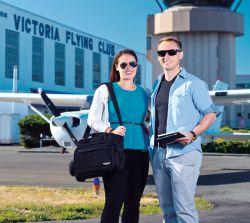
victoria Flying Club | victoria, b.C.
The Victoria Flying Club has been training world-class professional pilots since 1946. Local and international students benefit from a standardized fleet of Cessna 172 S model aircraft and a full motion Redbird simulator located at one of Canada’s busiest airports. The temperate climate allows an unsurpassed level of year-round training. Students train out of a 20,000 square-foot facility complete with numerous classrooms, briefing rooms and a student lounge.
Need to know: VFC works hard to produce top quality graduates and VFC alumni are successfully flying for a wide range of national and international airlines.
Equipment: Standardized fleet of Cessna 172S model aircraft, Redbird SIM
Learn more: www.flyvfc.com
okanagan Mountain helicopters | Kelowna, b.C.
Okanagan Mountain Helicopters has operated a flight training school since 2003, and its students have gone onto flying careers in the energy, mining, agriculture and forestry sectors. The helicopter flight training school offers a comprehensive pilot training program. Training in the Okanagan area provides a variety of terrain and weather that exposes a student to new challenges while under the supervision of a skilled instructor. The dynamic and challenging environment includes, low-lying open areas used for basic training as well as for emergency and advanced exercises, heavily forested areas throughout a wide variation of elevation changes and mountainous terrain with peaks up to 9,000 feet. The area also includes several uncontrolled airports in close proximity to Kelowna, used for cross-country navigation, flight training, radio and emergency procedures. The program and environment enable students to acquire the skills to be a well-trained commercial helicopter pilot. The flight school has only six to eight students per class, with not more than three to four students per instructor to maximize individual attention for each student.
Need to know: Okanagan Mountain Helicopters is the only helicopter training school in Western Canada to offer
a realistic bush camp experience in the curriculum, including remote, rustic accommodations at the foot of Monashee Mountains, mountain work at 9,000 feet, hover exit training, winter operations and fueling from barrels.
Equipment: Robinson R22, Robinson R44, Bell 206 and a FRASCA 131 flight simulator.
Learn more: www.okhelicopters.com
alberta
Centennial Flight Centre | edmonton, alta.
Centennial Flight Centre has been operating since 1967. Located at Villeneuve Airport, approximately 25 kilometres northwest of Edmonton, Centennial offers a full range of training including a Recreational Pilot Permit, Private Pilot Licence, Commercial Pilot Licence, Multi-Engine and Instrument Rating. The school features a structured, consistent training syllabus developed and refined, including the introduction of new technology and techniques to its programs. Villeneuve Airport has 3,500 foot and 5,000 foot runways with approach lighting, which are perfect for night flight training. Centennial also offers ground schools for the Private, Commercial and Instrument Flight Rating (IFR) courses. It has one of the highest percentage pass rates in Western Canada for the Private, Commercial and IFR written exams and IFR flight tests. Centennial offers a Discovery Flight to provide a sense of what a student would experience. This mini-flight lesson is comprised of all aspects of a regular flight lesson.
Need to know: Centennial Flight Centre has Edmonton’s only Redbird FMX motion simulator integrated into its IFR training syllabus to offer IFR renewals completely in the simulator, including flight testing. It is a cost effective approach to complete an IFR renewal.
Equipment: one Cessna 152, four 172Ms, one 172S, one Piper Arrow and one Seneca
Learn more: www.centennial.ca
SaSKatChewan
Mitchinson Flying Service | Saskatoon, Sask.
Mitchinson Flying Service has been training people to fly since 1946 and is Saskatchewan’s largest flight school. The school offers recreational and professional pilot training on single- and twin-engine aircraft. The company also operates an approved maintenance facility. In October, the company was sold to five Canadian airline pilots who learned to fly with
Mitchinson Flying Service.
Need to know: Mitchinson Flying Service is associated with Saskatchewan Polytechnic Commercial Pilot Diploma Program. The program is a partnership between Saskatchewan Polytechnic and the Saskatchewan Aviation Council.
Equipment: Cessna 310, 152 and 172 aircraft, and an Elite 1000 flight simulator
Learn more: www.mitchinsonflyingservice.com
ManItoba
brandon Flight academy | brandon, Man.
The Brandon Flight Academy has been training pilots since 1936. The training division of the Brandon Flight Centre (formerly known as the Brandon Flying Club), the Flight Academy offers a continuous regular ground school, recreational, private and commercial courses. Brandon offers students a varied flight experience with light aircraft, commuter twins, military trainers, commercial jets and helicopters using the airport daily. With the practice facilities close by and no delays on the ground or in the air, students experience an efficient and educational learning environment.
Need to know: Transport Canada written recreation, private, ultra-light and helicopters exams can be completed at the Brandon Flight Academy.
Learn more: www.brandonflightcentre.com
Canada wings | Southport, Man.
Serving as a pilot in the Royal Canadian Air Force (RCAF) is a very demanding yet rewarding career. Training to become an Air Force pilot takes place in two locations in Canada – the Canada Wings Aviation Training Centre at Southport (Portage la Prairie), Man. and Canadian Forces Base at Moose Jaw, Sask. All pilots-to-be start their training with the Primary Flight Training (PFT) program on the Grob 120A aircraft at Southport. This is roughly 20 hours of flying plus five hours on a sophisticated Flight Training Device (FTD). The program is designed to introduce candidates to military flying and training procedures as well as assessing their ability to succeed. On successful completion of PFT, student pilots proceed to Moose Jaw for the Basic Flying Training (BFT) program on the Raytheon T-6A turbo prop aircraft. BFT is approximately 70 hours of flying and 30 hours of simulation. On successful completion of BFT, the student pilots are streamed into jet, multi-engine or rotary wing programs. Multi-engine and rotary wing candidates return to Canada
Your Career On Wings
Wings for advanced flight training on their respective aircraft, either the Beechcraft C-90B or the Bell 206 and the Bell 412. The training facility operates in the wide-open airspace west of Winnipeg but with access to higher density air traffic as required for training. Wings employ roughly 200 personnel to provide all ground-based and simulator instruction, Grob 120A in-flight instruction, administrative support including housing and feeding, all aircraft maintenance and repair as well as all services associated with the operation and maintenance of the airfield. RCAF pilots perform all in-flight instruction on the multi-engine and rotary wing aircraft.
Need to know: Allied Wings Flight Training Services is a consortium of aerospace contractors headed up by Kelowna Flightcraft but with major contributions from Canadian Helicopters, Bluedrop Performance Learning and Canadian based operators. RCAF pilots perform all in-flight instruction on the multi-engine and rotary wing aircraft.
Equipment: A fleet of 39 fixed- and rotary-wing aircraft consist of Grob G120A and Beech King Air C-90 aircraft, and Bell 206 and 412 helicopters.
Learn more: www.alliedwings.ca
ontarIo
brampton Flight Centre | brampton, ont.
The Brampton Flight Centre (BFC) has been conducting flight training since 1946. Located just northwest of Toronto’s Pearson International Airport, BFC teaches students to fly in a variety of airspace classifications, experiencing both controlled
and uncontrolled environments. BFC is owned and operated by the Brampton Flying Club (which also owns the Guelph Flight Centre) and is the only training school in Canada to own its own airport. With a staff of more than 30 instructors, BFC offers a broad base of courses from recreational flying up to commercial career starters. Top graduates in each class are offered jobs with BFC as instructors.
Need to know: Brampton Flight Centre has a tie-in with Sheridan College’s Bachelor of Business in Global Business Management, described as a strong fit for an ambitious professional pilot. College flight and ground school instruction is primarily provided by aviation college graduates, supported by active airline pilots for Advanced Airline Training Courses.
Equipment: Cessna 172 and Piper Seminole aircraft.
Learn more: www.bramptonflightcentre.com
great lakes helicopter Flight training School | waterloo, ont.
Great Lakes Helicopters is an Ontario Private Career College Flight School offering helicopter flight training. Its operation is based at the Region of Waterloo International Airport, close to Toronto, and is considered one of the best training airports in Canada. Great Lakes Helicopter offers year-round training for Commercial and Private Helicopter licences. The school also offers specialty training programs and courses, on the ground and in the air. Great Lakes Helicopters offers a two-year Commercial Helicopter Pilot General Arts and Science Diploma in collaboration with Conestoga College.
Need to know: Students in this program will take classes at the college and flight school. Graduates will acquire a commercial helicopter pilot’s licence as well as a diploma in General Arts and Science.
Equipment: Robinson R22, R44 and Bell 206B Jet Ranger aircraft.
Learn more: www.greatlakeshelicopter.ca
toronto airways | toronto, ont.
Toronto Airways has been training pilots since 1963, and offers both full-time and part-time programs. Students train out of Oshawa and Buttonville Airport, a busy multi-service general aviation airport owned by Toronto Airways. The flight-training department has 50 instructors and offers eight distinct aviation-training programs from learning to fly for fun to launching a pilot career with a professional pilot program. Toronto Airways Integrated Air Transport Pilot Licence (IATPL) program, for example, was designed in consultation with industry experts to produce the highest quality graduates ready for the challenges of airline operations. With more than 900 hours of theoretical ground school training, an Airbus A320 systems course, the IATPL program bridges the gap between the typical commercial pilot graduate and an airline environment ready co-pilot candidate.
Need to know: Toronto Airways has trained more than 10,000 pilots since 1963. The school recently invested $2 million in state-of-the-art, full motion flight training devices (FTDs).
Equipment: A fleet of 45 training aircraft and five FTDs.
Learn more: www.torontoairways.com
St. thomas Flight Centre | St. thomas, ont.
Established in 1996, the St. Thomas Flight Centre offers flight training from the Recreational Pilot Permit through to Commercial Pilot Licence and Multi-Engine Instrument Ratings. Whether a student is interesting in flying recreationally or chooses aviation as a career, the Flight Centre has a
•
•
•
Cia2015
flight-training program customized to suit budgets and schedules. The school operates out of St. Thomas Airport in an uncongested flight-training environment. School offices are located in the main terminal building and ground school classes are held on site.
Need to know: The Flight Centre has been granted “Private Career College” status by the Ontario Ministry of Training, Colleges and Universities, providing complete training of Commercial Pilots and Flight Instructors.
Equipment: two Cessna 152 II, three 172 Skyhawk’s and one Piper PA-23.
Learn more: www.learntofly.on.ca
waterloo wellington Flight Centre | waterloo, ont.
The Waterloo Wellington Flight Centre (WWFC) is located at the Region of Waterloo International Airport and is one of the largest flight training centres in Canada. WWFC is a not-for-profit operation with facilities that are ideal for both the general aviation enthusiast and careerminded aviation students. WWFC has more than 20 flight instructors on staff, with several Class 1 or Class 2. For potential students who would like to first experience piloting an aircraft, WWFC offers a special “test the skies” Introductory Flight, a 30-minute flight experience where you get to take a Cessna 152 or 172 aircraft with one of the centre’s qualified instructors.
Need to know: WWFC is partnered with Conestoga College and the University of Waterloo to offer diploma and degree programs in combination with a Commercial Pilot Licence and MultiEngine Instrument Rating. It also offers a Fast Track Professional Pilot program for students who already have postsecondary education. WWFC has a welldeveloped network among entry-level aviation employers across the country.
Equipment: Cessna 152, 172N 172S, 172RG Cutlass, Diamond DA 40, and Piper PA44 Seminole
Learn more: www.wwflightcentre. com
QuebeC
air richelieu (Montreal Flying Club) | Montreal, Que.
Air Richelieu is an accredited flighttraining centre that delivers both Canadian and American licences at the same time and under the same roof. The school is located at St-Hubert Airport, approximately 20 minutes from Montreal. The airport provides a busy environment for training, but without the inconvenience
of dense air traffic. Air Richelieu trains more than 150 students annually and has supplied pilots for the RCAF, Government of Quebec and the Canadian Space Agency.
Need to know: A graduate student, now a commercial pilot, has the option to take additional Flight Instructor training in order to work at Air Richelieu as an instructor. This is a traditional way of building up experience to ultimately be recruited by airlines and other operators.
Equipment:: Cessna 150, 172N, 172R, 172S, Cirrus SR20, SR22, King Air, Piper PA-44 and Piper Warrior.
Learn more: www.airrichelieu.com
Quebec City Flight School | Quebec City, Que.
Quebec City Flight School is a Canadian Helicopters’ flight school offering training to students and company pilots. Canadian Helicopters is Canada’s largest helicopter transport services company with a network of 26 bases providing operations in every geographical region in the country. Quebec City Flight School is recognized around the world a top helicopter flight training centre based on training quality, job placement and instructor experience. The school offers introductory and recurrent training. All Canadian Helicopters flight instructors have a minimum of 2,000 hours and are operationally experienced in a broad variety of fields, including air ambulance, offshore, mining, firefighting, aerial construction and spraying.
Need to know: Instruction can be provided in French and English. The Quebec City Flight School is a four-time recipient of the Roland Simard Trophy, awarded by the Association Quebecoise du Transport Aerien. Canadian Helicopters also operates HNZ Topflight training school in B.C. (formerly the Canadian Helicopters School of Advanced Flight Training), offering advanced and mountain flight training.
Equipment: Robinson R22, R44, Bell 206 Jet Ranger and Eurocopter AS350 Learn more: www.canadianhelicopters.com/services/flight-training
nova SCotIa
greenwood Flight Centre | annapolis valley, n.S.
The Greenwood Flight Centre (GFC) is located in Nova Scotia’s Annapolis Valley, approximately one hour’s drive west of Halifax. Greenwood Flight Centre has been training pilots since 1958, and offers courses from Recreational Permits
to Multi-engine/Instrument Flight Rules Rating, including integrated programs.
Need to know: Students often gain subsequent employment with the GFC. In addition to Kings County Municipal Airport, the school operates two satellite sites at Digby Municipal Airport and Yarmouth Airport in southwest Nova Scotia.
Equipment: Four Cessna Skyhawks and a Piper Seneca Learn more: www.flyfc.com
Broadening the sCope
FlIght CollegeS brIng added beneFItS to a PIlot lICenCe
In building a career in aviation, there is no such thing as too much education. Canadian colleges with aviation programs teach essential skills not always found at flight school. Why is this important? Aviation is an increasingly complex and high-tech driven industry. Which why many of the larger schools are associated with colleges to give students a better rounded education and make them more attractive candidates for recruiters. Several colleges offer in-house flight training programs.
Depending on the availability of pilots in any given year, the biggest advantage will continue to be the number of flight hours a qualified candidate holds. At the very least, however, a diploma or degree will expedite the handling. That is because college offers students a deeper understanding of the technical aspects of the industry, teaches critical decisionmaking and communications skills that are essential when working with crews on the flight deck and on the ground.
Take Flight…
Have you always wanted to be an airline pilot? Now is the time. At Brampton Flight Centre we have Flight programs that will start you on your career as a professional pilot.
Brampton Flight College is dedicated to producing qualified pilots, job-ready and familiar with current industry expectations. Call today to discover which of our programs fits your career goals:
• IATPL – Integrated Airline Transport Pilot Licence –Newly created 16-month program specifically designed to provide students with advanced operational knowledge including multi-crew experience in a Q400 simulator, necessary for airline jobs. Includes airline pilot instruction by AeroCourse.
• Flight College Diploma Program – a comprehensive one-year Professional Pilot Diploma Program with over 900 hours of ground school and flight training.
• Also available is a four-year degree program offered in collaboration with Sheridan College.
Cia2015
Aviation colleges help to shape the raw pilot into an industry professional. They also offer career counselling and link students to broader networks so it is easier to make the right connections to land that critical first job.
FlIght CollegeS
okanagan College | Kelowna, b.C
Okanagan College’s Commercial Aviation diploma program provides students with business experience along with aviation training. In addition to receiving aviation experience, graduates are prepared to enter into the field of commercial aviation. The program consists of two distinct and separate areas of study; flight training and business studies. The business portion is completed at Okanagan College and normally consists of three business courses per semester over two-years. The flighttraining portion is conducted with Southern Interior Flight Centre out of Kelowna International Airport. The flight-training portion includes a Commercial Pilot Licence, VFR Over-the-Top Night Rating, Multi Engine Rating, Instrument Rating, IATRA and preparation for the Airline Transport Rating exams.
Need to know: Kelowna is at the centre of the Okanagan Valley. The different geographical areas provide for some of the most unique training available in North America. Students will spend time flying in mountain valleys, travelling out over the Canadian Prairies and along the B.C. coast. Kelowna International Airport is busy enough to challenge students and let them become used to a controlled airport with many different operations and aircraft.
Equipment: Cessna 152, 172 and Beechcraft Duchess (BE-76). Frasca 131 single engine and 142 multi-engine, multi-crew simulators
Learn more: www.okanagan.bc.ca
red deer College | red deer, alta. Red Deer College offers an Aviation Diploma Program in partnership with Sky Wings Aviation Academy. Red Deer College was established in 1964, and has developed into one of the premier community colleges in Canada. The college provides high-quality academics that are critical to the credibility of the Aviation Diploma Program. This two-year course of studies enables students to earn a certificate in Business Management while obtaining an Aviation Diploma. The campus is located 10 minutes from Sky Wings Aviation base at the Red Deer Regional Airport. Highlights of
the Aviation Diploma Program include: a tour of an Air Traffic Control Centre, a cross-country flight crossing the Canadian/U.S. border, familiarization training for a regional or national airline and crew resource management. Ground training is conducted in Sky Wings large, multi-media classroom.
Need to know: Most Red Deer College courses are university transferable, which gives students the ability to move up in a chosen career.
Sault College has been training and graduating professional pilots since 1974. Sault’s premiere three-year Aviation Technology (Flight) program includes quality on-campus classroom and simulator room facilities. Flight instructors prepare students to become professional pilots with commercial licences endorsed with multi-engine instrument ratings. Individuals with previous flight training start with a modified flighttraining program, however, all students reach the same level by second year. Flight training is conducted at the Sault College hanger at the Sault Ste. Marie International Airport, just 15 minutes from the college. The surrounding landscape provides a safe backdrop to learn the art of flying.
Need to know: Sault College offers a comprehensive set of aviation and air transport programs, including airline operations, airport administration and services, and flight attendants.
Equipment: Two Piper Seminole and nine Zlin trainers
Learn more: www.saultcollege.ca
georgian College | barrie, ont.
The Georgian College Aviation Management program is designed to give students knowledge and hands-on experience in Aviation and Management as well as provide co-operative work within the aviation industry. A variety of aviation courses provide students with a solid understanding of the aviation industry in Canada and around the world. Management courses are designed to give students an understanding of management practices and procedures in order to be prepared for future promotional opportunities. Georgian has contracted with Future Air to provide Flight Labs that are practical training required by its Aviation Program students. Future
Air gives students a structured foundation in an aircraft cockpit and operating within an airport environment as part of the learning process.
Need to know: For Aviation students who wish to further their studies, Georgian has popular University articulation agreements. Students can earn their Masters degree in Aviation Management in three additional semesters of study either online or at Griffith University in Australia or in as little as one year, earn a Bachelors degree (BSc) in Aeronautics or Technical Management with Embry-Riddle Aeronautical University, the world’s largest, fully accredited university specializing in aviation and aerospace. Students can also earn a degree at Davenport University, the University of Lethbridge and the University of Ontario Institute of Technology.
Learn more: www.georgiancollege.ca
Seneca College | toronto, Peterborough, ont.
Seneca’s Bachelor of Aviation Technology program is the only aviation technologybased degree program in Canada. The program provides a rigorous aviation technology-based curriculum and the application of this theory to aviation. The breadth of knowledge and skills prepares students to operate safely in a complex aircraft, to understand the technologies and human factors that affect the successful operation of an aircraft and to assume the professional responsibility associated with being a commercial pilot. Fight training and classroom instruction for years two to four of the Bachelor of Aviation Technology program take place at the college’s new Peterborough, Ont. campus.
Need to know: Seneca’s Bachelor of Aviation Technology program is the only aviation technology-based degree program in Canada. Third-year students are eligible for the Jazz cadet program that includes direct entry into the airline’s hiring pool. Successful candidates can become Jazz/Seneca cadets in their fourth year.
Equipmen: Eight Cessna 172s, 4 G1000 (glass cockpit) 172s, four Beechcraft Bonanzas, two Beechcraft Barons and one Beechcraft G1000 (glass cockpit) Baron
Learn more: www.senecac.on.ca/ school/aviation
Conestoga College | Kitchener, ont. Conestoga College’s Aviation – General Arts and Science is a two-year Ontario College Diploma program in
Our leading-edge programs in Aircraft Maintenance and Avionics Maintenance are taught at one of the largest aircraft maintenance training facilities in Canada; offering an intense mix of theoretical learning and hands-on training that will get you career ready. Students meeting the Transport Canada (TC) accreditation requirements receive 18 months credit towards the experience requirements for issue of an Aircraft Maintenance Engineer (AME) licence (M or E), and TC AME licensing technical exam credit. The programs are also accredited by the Canadian Council of Aviation & Aerospace (CCAA) as meeting the national occupational standards for aircraft and/or avionics maintenance training.
For more information contact: Coordinator, Aviation Programs, Jim Passant 416-289-5000, ext. 7510 jpassant@cetennialcollege.ca or visit us at centennialcollege.ca/transportation
AIRCRAFT MAINTENANCE PROGRAMS
• Train to be an Aircraft Maintenance Engineer in Newfoundland and Labrador with our very low tuition rates.
• We are the only college in Canada that offers Aircraft Maintenance Engineering Technician grads 21 months experience credit towards both the “M1/M2” and the “E ” licenses in a two year program!
• Aircraft Structural Repair graduates receive 10 months experience credit towards the “S” license; that’s credit for every month in school!
• Now a European Aviation Safety Agency part 147 approved training organization.
www.cna.nl.ca
Victoria Flying Club
Cia2015
collaboration with the Waterloo Wellington Flight Centre and Great Lakes Helicopter. Students in this program will take classes at the Doon Campus of Conestoga College in Kitchener as well as at the Waterloo Wellington Flight Centre or Great Lakes Helicopters, depending on whether they have chosen the fixedwing or rotary-wing option. Students must be available during the summer between first and second year to complete their flying hours. The program enables students to develop communication competence to a level sought by the aviation and air transport industries, demonstrate skills as a commercial pilot and in the area of multi-engine instrument rating (fixed-wing option only).
Need to know: Conestoga’s Pathways and Transfer Credit enables students to build on their academic achievements in order to earn a degree or additional credential. Pathways are formed through agreements between Conestoga programs or partner institutions.
R44, Bell 206 (Great Lakes Helicopters). Learn more: www.conestoga.on.ca
Moncton Flight College | Moncton and Fredericton, n.b. Established in 1929, the Moncton Flight College (MFC) is the oldest and one of the largest flight schools in Canada, offering a broad range of aviation courses. As an industry leader, MFC educates and develops aviation professionals with state-of-the-art curriculum, highly qualified instructors and modern facilities and equipment. MFC offers a Modular Pilot Training Program that is structured to meet the needs of students wishing to extend their pilot training or complete one or more licences or ratings at their own pace, especially convenient for students who may hold a full-time job and require a flexible studying schedule. The college also offers a four year B.Sc. (Aviation) program in partnership with Mount Allison University for students wishing to obtain a university degree while preparing for a career in the aviation industry, a two year Diploma in Aviation Technology, perfect for students fresh out of high
school who may not want a university degree, as well as a one year integrated program for those who already have significant post secondary education or doing a career change later in life. MFC hires many of its own graduates that have completed the flight instructors rating at the college. The college hires many instructors each year, so it’s a great way to get started building their hours towards the airlines and the next stage jobs.
Need to know: MFC has launched a cadet program in partnership with Provincial Airlines (PAL). The PAL Cadet Program at MFC encourages a close working relationship between PAL and MFC managers as well a defined career path opportunity for MFC graduates.
Equipment: MFC’s fleet of 39 aircraft and eight simulators consists of: one Cessna 172 M/N, two 172 S, 28 Diamond DA20-C1 Eclipse, two King Air C90B, six Piper Seminole PA44-180. Three ATC810 Level 2 FTDs, one DA40 Level 5 FTD, one Elite Level 2 FTD, two King Air 200 Level 5 FTD and nine SAT (Situational Awareness Trainers).
Learn more: www.mfc.nb.ca
part tWo: designing, repairing and Maintaining the airCraFt
deSIgnIng and CreatIng aIrCraFt – and KeePIng theM In the aIr – IS an art In ItSelF
Canada has the world’s fifth largest aerospace industry, and a vibrant MRO (maintenance, repair and overhaul) sector.
According to the Aerospace Industries Association of Canada (AIAC), the industry is made up of more than 700 companies of all sizes, with nearly 80 per cent of manufacturing headed for export. Canada ranks third in terms of global civil aircraft production revenues and growth is expected to outpace the global market over the next seven years as new platforms such as the Bombardier CSeries enter the market place. The industry is also a world leader in civil and defence simulations systems, and has a global presence in satellite operations and value-added applications.
In a 2014 State of the Canadian Aerospace Industry report, AIAC and Industry Canada note that 70 per cent
of industry activity (based on GDP) is dedicated to manufacturing while MRO represents 30 per cent, with the entire industry active across the country:
• Central Canada accounts for the majority of the manufacturing industry (Quebec, 56 per cent, Ontario 23 per cent)
• Western Canada plays a dominant role in terms of MRO (41 per cent)
• Atlantic Canada was the fastest growing region in aerospace manufacturing during the 2008-2013 period. And aerospace manufacturers are expanding their production and innovation capacity in Canada. In addition, every aircraft is supported by teams of technicians and mechanics who maintain and overhaul aircraft structures, repair engines, install and maintain various
complex aircraft computers and subsystems including, “fly by wire,” global positioning, monitoring and cabin in-flight entertainment systems. And not just for modern aircraft. There is demand for retrofitting so-called legacy airplanes with modern avionics and systems.
New generation aircraft, carbon composites and more complex systems will require sophisticated skills sets and more education than once was the case. More than two-thirds of the total aerospace industry is qualified as skilled labour. Aviation technical personnel will be expected to come to the table with a strong knowledge of aircraft systems, aerodynamics and aircraft structures along with a clear understanding of the inter-relationship between components on an aircraft.
Qualified Aircraft Maintenance Technicians have found challenging careers in all avenues of Canada’s airline and aerospace sectors. What follows is a sample of colleges that offer licence courses in aircraft maintenance and avionics. Some of the colleges listed here offer programs in more than one discipline.
SaIt Polytechnic | Calgary, alta. SAIT Polytechnic is a member of Polytechnics Canada, a national alliance of leading research-intensive colleges and institutes of technology. An Aircraft Maintenance Technician/Engineer is responsible for the servicing and repair of aircraft and aircraft components. The program covers all aspects of aircraft maintenance including, general aviation, corporate, charter, transport category aircraft and helicopters. This is a two-year diploma program and all classes are scheduled at the Art Smith Aero Centre for Training and Technology, located at the Calgary International Airport. Some of the courses in this program are web-based and will require students to access information from the Internet.
Learn more: www.sait.ca
Saskatchewan Indian Institute of technologies (SIIt) | Saskatoon, Sask
SIIT is governed by Saskatchewan’s First Nation, but also operates within the Saskatchewan provincial post-secondary system. Students enrolled in the Aircraft Maintenance Engineer Training Program will benefit from SIIT’s Boeing Aerospace, Rockwell Collins and Lockheed Martin aerospace and defense companies. Students will develop the knowledge and skills required to complete the approved training necessary to
be eligible to apply as an apprentice in the aircraft maintenance industry. Graduates will be credited with 18 months toward the current 48 months of industry experience required to obtain a licence.
Manitoba is home to the third largest aerospace sector in Canada. RCC offers
training in all aspects of the aviation and aerospace sector. RRC has a number of courses that can lead to careers in overhauling aircraft engines, maintaining aircraft, building components or management positions. Introduction to Aircraft Engineer Maintenance uses a combination of classroom and practical training on a fleet of fixed and rotary wing aircraft to provide the necessary foundation for entry-level positions in the aircraft maintenance industry. The
Cia2015
diploma program is designed to develop the knowledge and skills in maintenance of both large and small airplanes and helicopters, with time split between the study of aircraft maintenance theory and practical projects.
Learn more: www.rrc.ca
Confederation College | thunder bay, ont.
The Confederation College School of Aviation is located at Thunder Bay International Airport. The college has a well-established Aviation Technician – Maintenance Program designed and developed in consultation with the industry and Transport Canada. Confederation College also offers Aerospace Manufacturing Engineering Technology and Technician programs at its Aviation Centre of Excellence. The centre has a sizeable fleet of non-flying, fixed-wing and rotary-wing aircraft, including a McDonnell Douglas DC9, Cessnas, and Bell 47 and 206 helicopters.
Canadore College | north bay, ont. Canadore College, School of Aviation is located at the Jack Garland Airport in the City of North Bay, Ont. The Aviation Campus is a dedicated aviation training facility with approximately 30 employees assigned to the Aircraft Maintenance, Avionics Maintenance and Aircraft Structural Repair programs. The college offers three basic training programs. Two, two-year, four-semester training programs, the Aircraft Maintenance (AMT) and the Avionics Maintenance (AVN) program, and a one-year, two semester Aircraft Structural Repair (ASR) Technician program. In addition there are two three-year advanced aviation technology programs offered, which include advanced level avionics or advanced level structural repair courses. All of these programs have been designed to prepare graduates for entry into the aircraft maintenance industry. Canadore is able to graduate highlyskilled professionals sought by the marketplace here in Canada and around the globe. Canadore College trains people through applied learning, leadership and innovation for employment in an ever-changing world.
Centennial College | toronto, ont. With more than 45 years aviation training experience, Centennial College’s
School of Transportation’s Aviation Technician programs provide students with the opportunity to learn the mechanical, electrical, electronic and other science skills related to aircraft and avionics maintenance. These programs, known as Options M or E, place an emphasis on various aspects of electrical and mechanical systems within the aircraft. In option M (maintenance), students will study hydraulics, fuels, engines, flight controls, landing gear systems, airframes and structures. In option E (avionics) students will perform tasks/activities associated with the maintenance and repair of aircraft communication, navigation and data systems. A large portion of the programs emphasize aviation maintenance practices, procedures and Canadian aviation regulation requirements through hands-on practice in labs at the campus airplane hangar and avionics labs. Both programs hold Canadian Council for Aviation and Aerospace (CCAA) accreditation and are Transport Canada accredited for experience and technical examination credit towards the issue of a Canadian Aircraft Maintenance Engineer Licence. Centennial College also offers a Structural (aircraft) Assembly training program in partnership with Bombardier Aerospace. Learn more: www.centennialcollege.ca
Mohawk College | hamilton, ont Mohawk’s two-year program offers students an excellent balance of theoretical knowledge and practical application. Students have an opportunity to work on a variety of aircraft including, a helicopter, vintage aircraft and heavy jet transports. In addition, Kelowna Flight Craft recently donated a Boeing 727-100 for the Aviation Technician program, bringing the fleet up to 13. The Mohawk program is a living laboratory that focuses on developing key skills students will need to maintain aging aircraft as well as understand rapidly changing technologies.
algonquin College | ottawa, ont. The Aviation Techniques – Aircraft Maintenance program at Algonquin College is offered in partnership with Centennial College in Toronto. Classes take place at Algonquin’s School of Advanced Technology in Ottawa. The program teaches students the knowledge and skills required to equip themselves for work in the aircraft maintenance industry. Through a series of classroom-based courses and practical labs, students in this one-year program, learn to repair and maintain electrical and mechanical
systems within an aircraft – hydraulics, fuels, environmental systems, engines, surface controls and undercarriage systems, and the aircraft’s frame and external skin. The curriculum also covers aviation maintenance servicing practices, and procedures and aviation regulation requirements. Graduates of the certificate program are encouraged to continue their studies in the second year at Centennial College in either the Aviation Technician-Avionics Maintenance program or the Aviation Technician –Aircraft Maintenance program.
Learn more: www.algonquincollege.com
College of the north atlantic | gander, nfld.
The College of the North Atlantic (CNA) is one of the largest post-secondary educational and skills training centres in Atlantic Canada. CNA is part of the Lufthansa Technical Training network of approved schools. Aviation programs are conducted at the college’s Gander campus. CNA’s Aircraft Structural Repair Technician program is a 37-week offering designed to provide an entry point into the aircraft repair industry. The emphasis is on the structure of various aircraft and how to assess corrosion and other damage, and repair or replace various components. This involves using specialized equipment and techniques, and becoming familiar with a variety of materials used in the construction of aircraft (wood, fabric, sheet metal and composite materials). The two-year Aircraft Maintenance Engineering Technician program can earn both North American and European certification and can attend the Institute of Technology in Carlow, Ireland to earn an undergraduate degree in Aircraft Systems Maintenance in only one additional year.
Learn more: www.cna.nl.ca
holland College | Summerside, P.e.I.
The Holland College Aircraft Gas Turbine Engine Repair and Overhaul Technology program works closely with P.E.I.’s growing aerospace industry. In this 10-month program, students will learn the techniques, procedures and the documentation requirements necessary to perform the disassembly, inspection, repair, reassembly and testing of the turbine engines used to power today’s aircraft. The program consists of approximately 60 per cent practical and 40 per cent theory. Hands-on, practical training is carried out on a variety of turbine engines, including the Pratt & Whitney Canada (P&WC) PW100 series
turbine engine used on the de Havilland Dash 8 legacy aircraft, P&WC PT6 and Rolls Royce 250 engines.
the british Columbia Institution of technology (bCIt) | vancouver, b.C. BCIT’s Aerospace facility is Canada’s largest aerospace technology school. The school offers accredited programs that prepare graduates for careers in many disciplines including commercial pilot, gas turbine/jet engine technicians and avionics. BCIT’s Aviation Maintenance Technician – Avionics program consists of 68-weeks of full-time studies. Approximately 50 per cent of the day is spent on theory in a classroom setting, followed by hands-on practical training in the shops and hangar located at BCIT’s Aerospace Technology Campus.
Learn more: www.bcit.ca/study/ programs/aerospace
Fanshawe College | london, ont. Fanshawe College is one of the largest colleges in Ontario. The school’s Aviation Technician-Avionic Maintenance program covers all aspects of aircraft avionics systems used in general aviation, corporate, charter transport category aircraft and helicopters. The courses provide students with the knowledge and skills needed for servicing, repair and maintenance of aircraft electrical and electronics systems. The program also provides the Approved Basic Training credit required to obtain a Transport Canada Aircraft Maintenance Engineer (AME) license in the “E” Category. In January, Fanshawe will open its new Jazz Aviation Centre located at the London International Airport (CYXU) which will initially be home to approximately 200 students in the Aviation Technician Programs.
MarryIng PraCtICal PreCISIon wIth theoretICal InSIght to Innovate and StIMulate growth
aerospace manufacturing is one of the most R&D (research and development) intensive sectors in the Canadian economy according to the Aerospace Industries Association of Canada (AIAC). Transport Canada estimates that Canada produces more than 1,400 new aviation components a year, many using the latest technologies and materials.
Complex aircraft and aviation systems researched at the university level and integrated into aircraft designs demand specialized skills to comprehend them. In addition, a university degree is regarded as a valuable asset by the airline industry when hiring pilots with the potential to transition from the flight deck to the executive suite.
Many excellent Canadian universities have Aerospace Engineering and other programs at the undergraduate, graduate and PhD levels to support the aerospace and air transport sectors.
nova Scotia Community College (nSCC) | dartmouth, n.S.
NCSS’s Aviation Institute, located at the Akerley Campus in Dartmouth, is a modern, 3,995 square metre training facility where students build their skills using the latest technology applied to real aircraft. The institute’s Aircraft Maintenance Engineer (Avionics) program provides the skills needed to service, maintain, repair, overhaul, inspect and test aircraft systems. Systems may include electrical power distribution, communication, navigation, data, autopilot and various instrumentation systems. Students learn the safe use and maintenance of hand tools as well as sophisticated and specialized tools and equipment.
Learn more: www.nscc.ca
university of the Fraser valley, bachelor of business administration (aviation) (abbotsford, b.C.)
The University of the Fraser Valley (UFV), in cooperation with Coast Pacific Aviation flight school, offers one-, two- and four-year aviation training programs. The one- and two-year diploma programs consist of training for the commercial license followed by advanced training generally including multi-engine and instrument training, but with an optional flight instructor rating. The four-year degree program takes students through the private license, commercial license and advanced training, and meets the academic requirements for the UFV Bachelor of Business Administration. Coast Pacific instructors teach aviation subjects and instructors at the UFV Abbotsford campus teach academic courses. Students who successfully complete the four-year program will receive a joint degree from UFV and Coastal Pacific Aviation.
Learn more: www.ufv.ca/busadmin or www.coastalpacific.com
Macewan university, aviation Major (edmonton)
MacEwan’s Business Management Aviation Major is a unique partnership between MacEwan University and Transport Canada-approved training centres. The Aviation Major provides a mix of skills that prepares students for the business of flight. Five courses from the Business Management diploma are replaced with aviation training, leaving students with instruction in many core business skills, including accounting, marketing and strategic management.
Learn more:www.macewan.ca
university of toronto, Institute for aerospace Studies (utIaS) (toronto)
UTIAS is a graduate studies and research institute, forming part of the Faculty of Applied Science and Engineering at the
University of Toronto. In addition to its responsibilities as the Graduate Department of Aerospace Science and Engineering, institute staff provides undergraduate teaching in aerospace studies through the Aerospace Option of the Engineering Science program. The academic program in aerospace science and engineering at UTIAS includes undergraduate and graduate studies. The program is offered through the Engineering Science Program. At the graduate level UTIAS offers researchintensive programs leading to MASc and PhD degrees, and a professionally-oriented program leading to the MEng degree. The scope of research includes aeronautical engineering (aircraft flight systems, propulsion, aerodynamics, computational fluid dynamics and structural mechanics) and space systems engineering (spacecraft dynamics and control, space robotics and mechatronics and microsatellite technology).
Learn more: www.utias.utoronto.ca
university of waterloo (waterloo, ont.)
The University of Waterloo’s Bachelor of Environmental Studies (BES) and Bachelor of Science (BSc) programs have been designed to provide a strong base for careers in a diverse array of aviation and aerospace industries. The programs provide students with a solid and comprehensive grounding in aviation-relevant subjects such as geomatics, climatology, cartography and remote sensing. The BSc degree additionally provides candidates with a strong science and technology base, while the BES provides expertise in areas such as tourism and geomatics.
Learn more: uwaterloo.ca/aviation
university of western ontario Commercial aviation Management (CaM) (london, ont.)
Commercial Aviation Management (CAM) at the University of Western Ontario (UWO) was launched in 1999. Within the CAM program, students have the option of combining their four-year bachelor’s degree with professional pilot flight training. CAM students graduating with the flight option would receive a bachelor’s degree in Management and Organizational Studies and a Transport Canada approved Integrated Commercial Pilot’s Licence with MultiEngine and Instrument Ratings. Students in the commercial aviation stream pursue courses in human factors in aviation, aviation law, airport planning and management, and more. A non-flight option of this degree is also offered. Flight training for the program takes place at the Diamond Flight Centre at the London International Airport, a short drive from the airport. The
facility is equipped with classroom space and individual briefing rooms, all with computers and Internet access. These areas allow trainees to participate in both group and individual instruction before and after flight lessons with DFC London instructors. The London Flight Information Centre (FIC) is located upstairs. This facility, operated by NAV CANADA, provides flight planning and weather information services to Ontario and western Quebec.
Learn more: http://dan.uwo.ca/ undergraduate/cam/
university of windsor aeronautics leadership Program (windsor, ont.)
The University of Windsor Aeronautics Leadership Program is a four-year Bachelor of Arts Honours and Commercial Flight Training. The program is based on the main campus of the university and at Windsor International Airport. The program is integrated and concurrent. In the Flight Option, students are jointly enrolled in the Bachelor of Arts Honours Degree in Liberal and Professional Studies and in the Journey Air flight training school. Journey Air’s Professional Pilot Training Program, coordinated with Liberal and Professional Studies, is designed to enrol a student, with little or no experience, and provide them with the knowledge and training required to become a licensed commercial pilot with a multi-engine instrument rating, following three years of study.
Learn more: uwindsor.ca/aeronautics
Carleton university, aerospace engineering Program (ottawa)
Carleton University’s Aerospace Engineering program emphasizes the development of analytical, computational and hands-on engineering and design skills related to the aerospace field. The broad range of topics and applications included in this discipline are covered in four main streams: Aerodynamics (aerospace propulsion and atmospheric flight); Aerospace Structures (lightweight vehicles for flight and space travel); Aerospace Electronics and Systems (aircraft control, communication and navigation systems); and Space Systems Design (astronautics and space/satellite technology). All four streams emphasize the development of practical and problem-solving skills based on hands-on laboratory and design work.
Concordia university, aviation Management Institute (Montreal)
Concordia’s John Molson School of Business offers non-credit courses in leadership
development and aviation management to partners in the aviation industry. Concordia’s Aviation Management Institute (AMI) has partnerships with many universities and international organizations, and has developed blended learning programs for both the International Civil Aviation Organization and Airports Council International. AMI initiatives include online programs such as the AVSEC Security Professional Management Course and the Airport Executive Leadership Program, as well as organization-specific executive programs. These programs are offered at Concordia, international training centers or on-site at the client’s home offices.
ecole Polytechnique de Montreal, Master in aerospace engineering (Montreal)
The master’s program in Aerospace Engineering aims to broaden candidates’ technological and scientific knowledge of aerospace engineering and to train highly specialized engineers. The program is offered in conjunction with McGill and Concordia universities, Ecole de Technologie Supérieure, Université Laval, Université de Sherbrooke and a number of aerospace companies in the Montreal region. Students must follow at least two specialization courses (with the exclusion of case studies) given by the other participating institutions. Candidates who successfully complete the professional master’s in Aerospace Engineering program obtain a Master of Engineering (MEng) degree.
Learn more: www.polymtl.ca
Mcgill university, air and Space law ll.M. (Montreal)
McGill University offers an Air and Space Law LL.M. with Thesis or Non-Thesis. A Master’s Thesis is a 30,000-word project. It should constitute a sustained analytical contribution to an ongoing academic discussion or to developing concepts and practices. The paper constitutes a substantial piece of critical writing, of publishable length and quality that elucidates particular ideas or problems within an area of law. The Thesis program is suited to students who wish to focus on original scholarly research and writing under the supervision of a law professor. In turn, the Non-Thesis program is suited to students who wish to gain a wide exposure to a range of taught courses within, and related to, the domain of Air and Space Law.
Learn more:: www.mcgill.ca/law
part three: supporting the airCraFt
CoordInatIng all aSPeCtS oF
Canada’s airports are hubs of aviation activity and an essential support system to keep the airplanes and helicopters flying. Here, thousands of men and women ensure that aircraft are maintained, prepared for flight, dispatched and guided safely to their destination. Since 1992, Canada’s largest airports have been transferred to local operating authorities, which has opened the door to new skills in management and operations. Canada also has a strong international presence in airport design and development, and management of foreign airports.
For those looking for a career in aviation but not interesting in become a pilot or involved in aircraft development or maintenance, airport, the ramp, flight dispatch and connected industries such as air navigation offer many worthwhile career opportunities. Here are some of the more popular choices for aspiring aviation students.
aircraft Maintenance Crew
Depending on the size of airplane, a team of up to 35 ramp attendants will offload an arriving flight and ready the airplane to receive a new load of passengers. An aircraft maintenance crew will marshal aircraft to and from the gate, manoeuvre the air bridge, operate a fleet of vehicles including tow trucks and catering trucks, attach nozzles to the aircraft to pump lavatory waste out, unload hundreds of passenger bags and tonnes of air freight, refuel and clean the cabin.
The computerized bar codes that are placed on a bag at check-in are scanned and the bag deployed to its next destination, whether that is the luggage carousel in the terminal building or to a connecting flight.
There is more to the job than meets the eye. Each aircraft is different, and the weight of an aircraft changes daily. The way freight and baggage is distributed will have a direct effect on aircraft
performance and fuel consumption. For this reason, the attendant must keep in close communication with the aircraft dispatcher (see Flight Operations Dispatch), who will have already calculated how much weight can be placed in the hold.
Airlines, third-party air service providers or airport authorities employ most ramp attendants. It is demanding physical work and airlines typically have standards on how much a candidate is able to lift on a regular basis.
Flight operations dispatch
A flight dispatcher is like a ground captain, except where the captain is operating a single aircraft, an airline dispatcher can be responsible for up to 50 aircraft during a single shift, including charting routes and alternates, calculating fuel loads and aircraft weight, monitoring flights (known as “flight watch”) and making decisions whether to divert or cancel flights if an aircraft cannot continue to operate safely. A dispatcher is also plugged into air traffic control to ensure the most efficient routings and minimize costly air traffic control delays.
An airline dispatcher makes joint decisions with the flight captain to ensure a safe and efficient flight, including giving the crew a situational update prior to departure, including aircraft activity and weather information and feeding data to the flight deck en route. A commercial pilot licence, flight services specialist experience, air traffic control experience or related experience within a flight operations centre can improve career prospects, especially with the larger air carriers.
air navigation
The airport control tower is the most visible piece of air navigation infrastructure, but is just the tip of the iceberg. NAV CANADA is the country’s private sector civil air navigation service
provider with operations from coast to coast to coast. NAV CANADA manages 18 million square kilometres of domestic and international airspace assigned to Canadian control through a network of air traffic control towers, area control centres, flight information centres, flight service stations and maintenance centres. With 12-million aircraft movements annually, NAV CANADA is the second largest air navigation service worldwide by traffic volume.
Air navigation employees provide air traffic control, flight information, weather briefings, aeronautical information services, airport advisory services and electronic aids to navigation. NAV CANADA also has a demand for technologists and engineers. NAVCANatm, a technology sales division has sold and installed Canadian-made air traffic management systems around the world.
Area air traffic controllers coordinate the safe, efficient and orderly flow of air traffic in terminal and enroute sectors from seven Area Control Centres across Canada.
Airport air traffic controllers operate from one of 41 air traffic control towers at airports across the country, directing every approach and departure within the control zone.
Flight service specialists provide reliable, dependable and up-to-date information to pilots, which includes passing traffic information, providing weather briefings and flight planning services, controlling vehicles on the ground as well as delivering airport advisory services.
Candidates for air traffic and flight service positions do not need aviationrelated experience, but will be subject to an intense and comprehensive screening process. Training for a career in air traffic services takes eight months to two-and-a-half years, depending on the career. Depending on the specialization, air traffic services professionals may be
posted to remote facilities.
NAV CANADA also supports youth enrolled in academic programs by offering work experience through a Summer Student Enrolment Program.
british Columbia institute of technology (bCit) | airport operations (vancouver, b.C.)
The award-winning BCIT diploma program in Airport Operations is designed to meet the demands of today ’s unique and dynamic global airport operation environment. The 16-month Airport Operations is supported and approved by the aviation industry and provides students with a comprehensive, interdisciplinary program of study. This is the only program of its type in Western Canada. BCIT also offers an online Airport Operations Part-time studies Associate Certificate.
georgian College | aviation management (barrie, ont.)
The Canadian Aviation Institute (CAvI) at Georgian College is a national centre of aviation management training and education. Graduates of CAvI work in a variety of aviation fields including
airport management, aviation operations, airport planning and air traffic control. Commercial pilots, flight
dispatch, flight ser vices specialists and many other aviation-related occupations have benefited from this additional enhancement to their chosen career field. Located in Barrie, Ont., the three-year Aviation Management diploma program provides students with a solid understanding of the aviation industry.
world Class training @ nav CanaDa (internal)
Before controlling, directing and advising aircraft in Canadian air space, air traffic controllers and flight ser vice specialists go through intensive training programs that last anywhere between one- and two-and-a-half years. The curriculum and duration of NAV CANADA’s training programs depend on the stream a student is selected for. All streams require focus, hard work and commitment. Training is delivered on a full-time basis. Class times vary by location, but they are typically eight hours a day. Students can also expect to put in additional study and simulator time to prepare for next day’s classes. Expect to invest a further two to three hours after class hours to succeed. Learn more: www.takecharge.navcanada.ca
‘‘ ’’
I love where it is going, I love the team that I have, which is probably the single best part of this job.
definitely on target to meet all objectives.
“When we went to market, we felt pretty confident that we could meet the expectations outlined by John Garrison at HeliExpo,” Smith told Helicopters. “The discussions around it were a late 2014 first flight and the internal objectives were to accelerate that for prudence mostly, for getting ourselves in a position where we can get early learning from our flight-test pilots. A lot of things you learn just as soon as you get it off the ground, flight dynamics and structural dynamics. We wanted to get in the air quickly for the learning opportunity, but there is also a compelling opportunity to get the aircraft to market just a little bit faster. At this point we are well on track to meet our objectives.”
Bell’s intent is to certify the aircraft early in 2016 and offer, as quickly as possible for the markets that accept it, to have Transport Canada certify it. Bell is also working with EASA and the FAA to ensure it has seamless validations of the type design.
“We will begin deliveries in 2016 in earnest, but it will really depend on how fast we can work through the validations for the other nations that are wanting the aircraft,” Smith said. “In this case, we have a very global customer base so we have a lot of validations to go through. So, 2016 is the year.”
Smith was pleasantly surprised after evaluating the aircraft following the first flight. A lot of time was spent on minute details and just getting a sense of the aircraft itself – how it responds, the general feeling out the controls and more.
“We got a lot of confidence very quickly,” Smith said. “The first flight did not intend necessarily to get to the high speeds that we
The later flight time enabled pilots to make additional tests on the 505 Jet Ranger X. (Photo courtesy of Bell Helicopter)
got to, but we did some up-and-away flying towards the end of the pilot’s card. We got a very good sense of the way the aircraft handles – it is very stable in flight.”
A lot of time was also spent on the accessory systems, Smith added. “For the test flight, it got a little bit darker outside than we are used to with a lot of first test flights,” he said. “We usually do our first test flights earlier in the day, the weather is clearer which makes it easier to fly, but we flew later that day then originally intended. So, we actually tried out the landing lights, the landing light location etc. And we have to do some tweaking because it didn’t quite get the distribution that we need, the overall spread in terms of distance. Those are small details but there are things that you like to find now, so that you can go and quickly fix them rather than go through a full flight test program. That’s the kind of thing we saw with the first flight.”
The test team also spent plenty of time evaluating the instrumentation. “When you have a complicated instrumentation package, in many ways, it can be more complicated than the aircraft it self,” Smith said. “That can cause teething pains when you get in the air, making sure all the signals work consistently with the variety of things that can cause them to go array.”
THE BIG PICTURE
Ask Smith to get out his crystal ball and hypothesize about where he sees the market going for the 505 Jet Ranger X, and it doesn’t take him take him long to dive right in. The most important market is general utility. Bell’s research teams have spent countless hours studying this market segment and much of that expertise comes from experiences with older Jet Rangers in service today.
“A lot of what those aircraft are used for is carrying items that conventional transportation methods just don’t do adequately –
large objects such as Christmas trees, utility structures, carrying survey equipment, many of those things with a hoist or a lower belly hook,” Smith said. “In our case, the solution we are offering is a 1,500-pound belly hook that meets utility requirements, situational awareness and safety requirements that are very central to the high hours, high flight time and high volume aircraft in this market. It’s all about moving people around, moving things around at an hourly rate.”
The Canadian market with its multiple resource-based industries is obviously a fit, and both Bell test pilots should be familiar with this type of flying – both have countless hours flying utility missions. “The pilots that we use for the experimental program have spent a lot of their lives flying here, doing utility work and more. Their feedback has been instrumental in determining the small things that really make the aircraft a utility pleaser. But we will also extend this aircraft in some other areas such as air tourism, which is a market that has shown growth for us. With all five forward facing seats, large glass aperture windows, really it’s just a great view for an aircraft of its price point.”
Electronic News Gathering (ENG) is another strong application, Smith maintains. When you factor in the price point, size of the cabin and the comfort, as well as viewing capabilities in trying to visualize an accident scene or a car chase, it’s easy to see this aircraft as a logical fit.
“It is a very accessible machine for a lot of operators,” Smith said. “I think our main competitor right now would be Robinson’s R-66. Robinson has done a great job of identifying that there is a market for valuepriced, entry-level turbine aircraft, so this is a huge opportunity for us to go and pursue this market. It was one of things that we considered early in program development. There are other strong competitors in this class and we focused on our knowledge internally of this customer segment through the Jet Ranger fleet. We fully expect we will have a strong opportunity for replacement in this segment with other Jet Rangers as they reach the useful end of their lives.”
And with more than 240 letters of intent just prior the New Year, operators are obviously taking note. “The feedback we have had from a number of our customers is helping us understand the segment, particularly in austere environments like the far north
Canada,” Smith said. “We also have quite a number of customers in Australia who are very interested in this product for its ruggedness in terms of its ability to do things others can’t. This aircraft should be a real confidence booster for those rugged, austere operators.”
THE ROAD AHEAD
Testing for the Bell 505 Jet Ranger X is ongoing and will ramp up early in the New Year, which will help with the envelope expansion, expanding the speed and altitude, weight and CG combinations, confidence in the flight handling qualities and flight dynamic.
“As we get the aircraft in the air, we will also make preparations for one of our most important flight test events, which is our low level flight survey where we gather calibrated variables, very high fidelity, reams and reams of data on the lows of the aircraft during specific calibrated manoeuvres so we understand how the aircraft responds,” Smith said. “This will form the basis of the certification of the structure of the aircraft which will happen in the first several months of 2015.” A third prototype aircraft will also be taking to the skies in early 2015. This aircraft’s future will focus on the integration of kits and certification that doesn’t require instrumentation.
This aircraft should be a real confidence booster for those rugged, austere operators. ‘‘ ’’
“As the summer rolls around and as we work towards the end of 2016, we will be working heavily on implementing different products into the airframe,” he said. “The suppliers we have are doing an outstanding job coming up to speed on the very large volume we expect to produce early in this program. That work will be going on in the latter part of 2016 as well.”
Currently, the 505 Jet Ranger X team is
working in different camps, with the flight testing team at the Mirabel, Que. facility doing flight testing; a team in Texas doing production and design release and supplier coordination before ramping into production; and a third team doing construction on the facility in Lafayette, La.
THE FINAL WORD
Ask Smith about the future of the program and the role he plays in its ultimate success, and he simply can’t stop beaming. It’s
a special product and he is honoured to be part of the development of such a versatile aircraft – one that will make a definite impact in the marketplace.
“I have the best job in the company for sure,” Smith said. “The job I had before this was probably the second best job – I was the lead engineer for the 505 program. So, my blood is fully infused in this product. I love where it is going, I love the team I have, which is probably the single best part of this job. It truly is an exciting time to be part of Bell.”
KEEPING OUR CUSTOMERS SAFELY FLYING
Bell Helicopter has approved HNZ Topflight as a Flight Training Center to offer Mountain Flight Training Courses on Bell Helicopter models. The collaboration between these two reputable organizations ensures you receive advanced mountain flight training techniques supported by the world-class standards set by the Bell Helicopter Training Academy.
FEATURE
Winds of Change
Chinook Helicopters Looks to Grow the Family Business
BY PAUL DIXON
Cathy Press certainly remembers her first inclination that a career in aviation just might be in her future.
The CEO and owner of Abbotsford, B.C.-based Chinook Helicopters was three years old, sitting on her father’s knee. Today, more than 13,000 flying hours later, she heads the largest helicopter flight training school in Canada. In August, Press stood centre stage at the 2014 Aerospace, Defence and Security EXPO in Abbotsford before a full house of industry insiders and a straight flush of federal and provincial cabinet ministers to announce that Chinook had signed a MOU with Chinese Aviation Industrial Base (CAIB), located in Xian China to provide training and further support. It was a bold move and looks to add to the company’s growing footprint in the helicopter training business.
Press will tell you that she indeed grew up in the aviation business, as Chinook was founded by her parents. “I went solo on my 16th birthday,” she notes proudly. “And on my 17th birthday, I had the helicopter and aircraft license issued to me. On my 18th birthday, I got my commercial airplane and helicopter licenses.” By the age of 21, Press had her airline transport license and the hours for an airline job, but she decided to stay put.
Today, she is a FAA CFI, a Class 1 helicopter instructor, and holds Transport Canada Pilot Examiner status for both fixed-wing aircraft and helicopters. At the same time, the business has grown from the original two Bell 47s in 1988 to today’s fleet of five Bell 47s, three R44s and three Jet Rangers. Not content to coast, Press is looking ahead to new markets.
“I’ve been driving to the Abbotsford airport every day for almost 30 years,” she says proudly. “I’ve faced tremendous challenges and still face challenges because there have been so many changes in this industry over that time, but I feel younger for it and I enjoy that. In the past couple of years, I have found myself saying, “what’s next?”
The what’s next for Chinook is in motion – an expansion of its existing programs and a move towards foreign markets, including its
foray into China. “It’s enjoyable to see where this business can go,” Press notes. “We’re looking at where we can go forward. I’m enjoying having a path that is not so clearly defined and I’m really enjoying the business right now.”
It’s not just the choice of aircraft that give Chinook an advantage, it’s also the wide range of training options and the depth of experience in their instructors. “I’ve been in countries around the world and I’ve seen brochures and marketing materials from people saying what they have in terms of training and then you realize they only have one helicopter,” Press says. “We really are able to do what we say.”
Chinook offers basic flight training and a broad spectrum of advanced training – mountain course, instrument rating, foreign license conversion, helicopter conversion, FAA conversion, night rating as well as a pilot proficiency check and ATPL exam preparation. The company’s 22,000 square foot facility houses the corporate offices, classrooms, simulator rooms as well as providing hangar and maintenance space for its fleet. Located in the shadow of the tower at YXX, the diversity of the regional geography provides challenges for every level of student, from the table-top flat of the Sumas Prairie to the rugged mountains of the Coast Range.
This diversity of training options and the quality of the instruction attracts students from across Canada and around the world. About one-third of Chinook’s students are from outside Canada, attracted by training opportunities that aren’t available in other regions. As one of the instructors at Chinook, Press’s husband, Clayton Reid, talks about the degree of care that goes into selecting the instructors.
“We are very particular, this is a busy place with lots of diversity, and the instructors need to be able to deliver safe, efficient training,” he says. “We’re very finicky on who we hire. Every one of our instructors is an operational pilot. When you look at our pool of pilots on paper it looks quite impressive, but it has to be this way. Helicopters are a very unforgiving business. It’s really easy to have
an accident or incident during training.”
The MOU with CAIB has great potential, but it’s far from Chinook’s first exposure to working with foreign students. Thai Air Services (TAS) has been sending students to Chinook for several years, 35 at last count. Reid explains, “we take them to a commercial licence, then do a night rating with them and an instrument rating. That takes about six to eight months and they leave with a full commercial licence, night and instrument rating. They can go straight to a company simulator such as an S-76 and then they do their company training and they are on the flight line. We have a model and it’s worked well for the past 12 years.”
A conversation with two current students and a recent grad underscored the attraction Chinook has for budding pilots. Michael Veruzza, 23, graduated last year, while George Camarmile, 25, and Nick Herbert, 30, are just finishing their program. Camarmile, left Manchester, England to follow a girl and ended up in Whistler, while Herbert claims Vancouver as home, but isn’t that long removed from the U.K., either. The three may have taken very different paths to find their way to Chinook, but once they arrived, they knew it was the place for them. After seeing the variety of equipment, the simulators and meeting the staff, they knew they had made the right decision.
They also understand the biggest challenge just might be getting their foot in the door when the training is over. Veruzza chuckles now when he recalls being warned that getting a job would be the hardest part, but it’s true.
“I drove around for two months solid, all over B.C. and Alberta, knocking on doors and talking to people,” he says. Nothing. Everybody he talked to knew about Chinook and had nice things to say, but no one had room for a low-hour pilot. Veruzza called Reid from a stop in northern Alberta just to say “hi” and learned another important lesson about Chinook – everybody in the business knows about Chinook and Chinook knows just about everybody in the business. An operator in northern B.C. had called Reid to ask if he had anyone he could recommend the same day Veruzza called.
“If you are a decent student, you do good work and you’re serious about it, they can see that and they can give you a good reference,” Veruzza says. “That’s what happened, it was by knowing somebody.” After his first year on the job, he’s asked how much flying time he’s had and with a 100-watt smile answers, “zero point seven hours and it’s all in my log book!!!” It’s not lost on Camarmile and Herbert, who both have firm notions of where they hope to be in 10 years. They understand, however, that there are a lot of helicopters to be washed before they get there.
SIMS ON THE HORIZON
Simulator training is a growth area for Chinook. Reid discusses the evolution of the company’s simulators. “We started working with
ABOVE: Happy fellas! Chinook students (left to right) Mike Veruzza, Nick Herbert and George Camarmile with the Bell 47. (Photo by Paul Dixon)
RIGHT: A Chinook Jet Ranger in the big timber. (Photo courtesy of Chinook Helicopters) BELOW: Cathy Press is the passionate leader of Chinook Helicopters. (Photo by Paul Dixon)
flight simulators about six or seven years ago,” he says. “Not so much for the Canadian market, but for the off-shore and international market where instrument ratings are mandatory. A lot of the training can be done on simulators, but the problem for helicopter pilots was that much of the training available was being done on airplane simulators which don’t offer the best experience.
“We have a fellow who trained with us as a helicopter pilot, but he’s really a computer techie. We came up with a simulator based on an existing flight simulator pro-
gram, with three big-screen monitors. It worked pretty darned good and I did my own instrument rating on it. People get better training on it because it’s specifically helicopter related, with helicopter controls and then we have the IFR Jet Ranger and 2 IFR R44s [for the required air time].”
The next step in the SIM design was to add an instructor console to the simulator, which allows for two crew. The design is based on a Jet Ranger panel, so it’s not a twin-engine aircraft, but at this level of training you don’t need a twin-engine, you
just need the procedures, Reid notes. Two people can be trained in the SIM and it works as a two crew environment, even though it’s only single engine model. Everything is dual control and you get excellent IFR training in-house, where it can be controlled.
“Then when they go the actual helicopter, where most of the cost is, the simulator has them prepped for the helicopter,” Reid says. “We have one instructor who does just the IFR training now. We’ve had very positive feedback from the industry on our simulator, from chief pilots and experienced off-shore people. The next step is the development of a twin-engine simulator, based on a Bell 412 with a glass cockpit. The oil industry off-shore is glass cockpit and as everybody goes glass cockpit, we need to keep up in the training environment. As more of the off-shore and oil companies want more training, it’s not economically feasible to do it in the aircraft. Certain things need to be done, but a lot of it can be simulator. That’s where we’re trying to be proactive.”
The diversity of the regional geography provides challenges for every level of student. ‘‘ ’’
Reid and several other instructors are approved check pilots (ACP) on a wide range of helicopters, giving Chinook another competitive advantage. “It’s part of the diversity of this school, the operational backgrounds of our instructors, they’ve worked in the industry and people want to come to deal with us for that reason,” Reid adds.
It’s an old cliché that nothing breed success like success, but it’s true for Chinook. The August announcement of the MOU with CAIB brought interest from another Chinese organization that will likely lead to another MOU and Press was
in China in November with a Canadian trade delegation to participate in a large aviation trade show.
The MOU that Chinook signed with CAIB provides a framework for helicopter pilot training in Canada and then helicopter-related support and assistance to the emerging helicopter market in China. Press is quick to credit the support Chinook has received from the international trade sections of both the federal and British Columbia governments, at home and abroad and points out that what Chinook offers is a perfect fit with what the federal government has identified as two key areas where Canada can be a leader in the AsiaPacific region – training and aviation.
China is a massive market, with little if any existing infrastructure. Chinook would train Chinese pilots in Canada, following the program they have established with Thai Air Services, for reasons that Reid explains. “We’ve put 35 people through the program (for TAS), they are all working as pilots and half of them are now captains, which speaks to the success of the program,” he says.
As Chinook maintains its domestic student base, expands the SIM programs and
looks to attract clients from overseas, they have also taken another big step by becoming a Robinson dealer for the R44. It’s a natural fit as they already operate three R44s and service the R22, R44 and R66 models. As the company grows and operations expand,
Press and Reid will tell you they are helicopter pilots through and through and will never get away from their roots. “We’re helicopter pilots. It’s what we do, we enjoy it and it shows. It may the largest helicopter school in Canada, but there’s still a family feel.”
Easy does it! A student gingerly makes her approach in a Bell 47. (Photo courtesy of Chinook Helicopters)
FEATURE
On the Road Again
The Trials of Shipping Precious Aircraft
BY PAUL DIXON
In a business environment where global operations have become a necessary fact of life, how does a helicopter operator survive in an environment where costs are high and margins can be frustratingly slim? It takes the support of a remarkably small core of professionals, who take on challenges others decline, to move helicopters around the world from where they are today to where they will be needed tomorrow – keeping them flying while they are on the job and bringing them back when it’s all over.
With headquarters in Basel, Switzerland, the Panalpina Group is one of the world’s largest freight-forwarding and logistics companies, employing more than 16,000 in some 500 offices on six continents. Panalpina has divisions that specialize in taking on the difficult jobs and managing them from start to finish. From an office at Vancouver International Airport, a team of five coordinates the transportation of helicopters.
As well, Panalpina’s global airfreight division expedites shipment of spare parts and just about everything needed to support helicopter operations in the far-flung corners of the world.
International Machine Transportation (IMT), located in Abbotsford B.C., also serves the North American aerospace industry with custom-built trailers and drivers that are specifically trained for the loads they carry. While World Courier specializes in providing time-critical services to world’s leading biopharmaceutical companies, researchers and labs, the high-level performance allows them to provide urgent delivery of mission-critical components when the “usual” isn’t good enough.
At the YVR office, Juerg Boschung, head of Panalpina’s helicopter shipping division, describes how the relationship with the helicopter industry has matured over the past 30 years. “This is a small part of the Panalpina’s overall business, but it has been my focus,” he says. “Out of our 16,000 people worldwide, only relatively few in key locations around the globe are involved in shipping helicopters. The company is on the top tier of freight forwarders and now we have
this niche for helicopters. It makes us unique and that’s why people come to us.”
Boschung notes that while it is important to know how to ship goods around the world by air or by sea, it’s equally important to understand the helicopter business and know everything there is to know about individual helicopters.
“If you ask our customers what the difference is between Panalpina and 99 per cent of the other freight forwarding companies, they will tell you that we speak their language,” he says. “We know the helicopters, the dimensions and such. We’ve developed our own database and information over the years and this makes it easy for people. We have the big companies that ship with us on a regular basis, but we also have the small operators, someone who buys a helicopter in New Zealand, for example and then wonders how they are going to get it home to Canada. When they ask around, they get referred to us. We can help them prepare their helicopter for shipping, even supply a photo to show them how.”
When IMT started 23 years ago, president Mark Sorrey didn’t have helicopters on his radar. “We started off with a focus on offering something really different in the market, answering the need for special handling in different sectors,” Sorrey says. “Aerospace was one, pulp and paper was another. Initially it was the airlines and general aerospace vendors and that’s where we built our nucleus. We started by transporting aircraft engines, aircraft components and small aircraft.”
It was only eight years ago when IMT transported its first helicopter. “It took us a while to be accepted by the helicopter industry,” Sorrey says, “but we developed a reputation of knowing how to handle helicopters. We looked at it from a truckers’ point of view and transportation providers’ point of view and got together with aircraft maintenance engineers and aviation industry insiders, to work with them and develop methods for shipping. We broke through with certain operators who saw that trucking it was a viable option to flying a helicopter. People realized that sometimes it can
actually be faster and certainly more cost effective.” Over the past eight years, IMT has moved more than 450 helicopters by truck, from a few kilometres across town to thousands of kilometres across the continent.
For Paul Leonidasxz, a manager with Global Courier’s Vancouver office, every package they take has a special urgency that the mainstream courier companies can’t satisfy. The bulk of the business is related to the medical and biopharmaceutical industries with timesensitive materials that have to arrive on time, every time. When a helicopter operator has an aircraft on the ground and the critical part(s) are on the other side of the world, it’s a job for World Courier.
For example, Leonidaszx describes the urgency in getting a GPS unit from Vancouver to a base off the beaten track in Africa. This type of operator simply can’t afford to have its aircraft out of service one minute longer than absolutely necessary. These jobs require a human courier to take the package as carry-on baggage and personally deliver it to the operator’s employee waiting for them at the airport.
And using a human courier is more than just finding someone with a valid passport and a yen to travel. It’s a matter of having the right person available, which in many cases means someone who speaks the language of the country – and perhaps understands the cultural background – which can be important in navigating one’s way through customs and immigration in a country that’s far from the usual tourist track. It’s very important to send the parcel with the human courier, because a package travelling the normal package route can easily languish in customs for days or weeks before officials process it.
Looking at the business from their client’s perspective is how Panalpina and IMT deliver a top service instead of simply offering a point-to-point alternative. They understand that time is money and that can make or break an operator.
“Helicopters cost a lot of money,” says Boschung, “and even if you own the machine you don’t want your multi-million dollar asset
TOP: Almost there. A CHC helicopter en route to the New York Stock Exchange rests on the Brooklyn waterfront with One World Trade Centre as the backdrop. (Photo courtesy of IMT)
ABOVE: An S-92 about to embark on a trip to Europe on a Roll On, Roll Off (RORO) ship. (Photo courtesy of Panalpina Inc.)
sitting there not doing anything. If you are paying a leasing company, that’s a lot of money every month.”
Sorrey concurs, adding, “a helicopter is not just an expensive asset. It’s their livelihood, their means of generating revenue and fulfilling their contracts and obligations. We take it very seriously. We understand the consequences of not doing it right.”
WHEN FAILURE ISN’T AN OPTION
The consequences of not doing things right were painfully obvious to one firm that thought it could save some money bringing its helicopter back to Canada from the other side of the world if it managed the job themselves. The trip was going smoothly until just outside Vancouver when the truck driver the company had hired misjudged the clearance requirements while motoring down the highway. Overpass versus a helicopter? The result wasn’t pretty.
Boschung and Sorrey are quick to point out that their companies had nothing to do with this escapade, and both are intimately aware of the incident. Sorrey notes, that in 23 years, IMT has never had an insurance claim. It takes significant work to understand how to get a helicopter from point A
to point B, while doing it safely in the most cost-effective way possible based on a client’s schedule.
One way to ensure a smooth trip, Boschung notes, is to work closely with clients in the initial bidding process. “They need a move cost, which can include various items. The ferry flight, the actual shipping, insurance, customs overseas and the ferry flight to the final destination from the port or airport – there are many things to consider.”
While it generally takes a few days for Boschung’s team to consider all the variables and put a proposal together, it’s not unusual to get an urgent call. “In fact, we got a call this morning and were told that we had to get it (the move) done today. We draw on our historical information in a case like this and normally we can be very close, close enough for them to put in their bid.”
Time is a critical determinate in how a helicopter gets shipped around the world, whether it goes by sea or by air. Shipping by sea is less expensive, but it takes much longer. Another consideration is how many helicopters can be shipped at the same time. An Antonov-124 can carry three heavy helicopters at once, with a delivery time measured in hours instead of weeks, minimiz-
ing the loss of revenue hours
If you can put three heavy 20 MIO helicopters on an Antonov-124 for delivery to the same destination. This can be just as cost effective when taking into account all factors, with a timeline measured in days instead of weeks.
Boschung gives an example of how a potential job evolves. “A client has a helicopter at some place in Canada and they have a job in Brunei,” he says. “We work out the best way to handle the job. It might be best to ship it from Houston, depending on the service to Singapore. Then, we determine if it is best to ferry it from Canada to the port or truck it there, depending on the type of helicopter. We ship it to Singapore and the customer reassembles it there, because we know there is no suitable sea service from Singapore to Brunei. Nothing works within that time frame. So, we propose a route depending on where the aircraft is and where it needs to end up and the time frame. Based on that analysis, we put together a package and a routing.”
Boschung adds that depending on where the helicopter is going from and to, it may be quicker to simply fly it all the way based on a lack of shipping options or if there is any kid of bureaucracy in that corner of the
BE PART OF A TEAM THAT’S WORLDS APART.
A career with Canadian Helicopters will give you the opportunity to participate in activities across Canada and get an insider’s view of our international operations and affiliates. We are actively looking for Pilots & AME’s to help us operate our growing fleet of domestic VFR and IFR aircraft including AS350, AS355 / B206L, B212, B412 / EC145, EC225, BK117 / S-76, S-92 and AW139 helicopters. Are you up for the challenge? Wor lds apart.
world. “When helicopters arrive at the port in some countries, it can be a big problem to get cleared, but if they fly in to an airport, it’s often more straightforward,” he says. “We will tell the client how it is, even if it means we don’t get this job. We want them to come back to us in the future.”
OTHER KEY LOGISTICAL REALITIES
Understanding the cost and time factors associated with each mode of transportation is only part of the picture.
“There’s also the dismantling, preparation and crating,” Boschung notes. “It may not fit in a container, but it can still go on a container ship.” Often, it’s possible to accommodate large helicopters below deck on container vessels, by making special arrangements.
“We have brought S-61s back from Australia like this, then it takes a few days to put it back together,” he says. “It can be a lot cheaper than shipping on a RORO vessel with only the blades removed. You have to have containers for the removed components and the blades. You have to be set up to do that.” Next, it’s a matter of knowing which shipping companies are willing to accommodate the special handling requirements for transporting helicopters that will accommodate multiple container spaces in a hold to avoid salt-water contamination.
Even though Vancouver is a major seaport and processes millions of containers a year, depending on the origin or destination of the shipment, the more direct route may be through the Port of Tacoma or another U.S. port. Boschung describes the uses of trucks as a relatively recent choice for some types of helicopters.
“It used to be that with the heavy aircraft, S-92, S-61, 225s, Pumas, etc., people preferred to ferry them to and from the port,” Boschung says. “Take the blades off, we supply the cranes and support. Then it’s on to the ship, reassembled on the other side and they fly it away. It still often happens now, but sometimes an aircraft may be unserviceable or there may be a shortage of crew, so it may be necessary or more convenient, though it’s a lot of money, to truck a large helicopter from port of arrival to destination hangar. It’s a big load, you need a lot of permits and it’s actually at the maximum of what you can truck over the road. We work with IMT here and we have a very good trucking partner in the U.K. that specializes in trucking helicopters.”
Sorrey agrees, adding, “People are getting over their reservations about putting it (the aircraft) on a truck once they see how it can be done and the specialized equipment involved. There are times where the aircraft really does need to be flown, but there are
times where it doesn’t make sense. We’ve proven that it can be a very economical way of deploying aircraft and we’re hoping that more operators will see it that way.”
Panalpina, IMT and Global Courier have grown with their clients, mainly by placing an emphasis on understanding their needs from their perspectives. Boschung has invested more than 30 years in developing this highly specialized niche, the past 20 with his team for Panalpina. Sorrey has put 23 years into creating a service that adds value to his customer’s
businesses.
In the beginning, aerospace was a small part of IMT’s business; today it makes up 70 per cent and helicopters are a large part of that. For Leonidasxz at Global Courier, working effectively with clients is simply a matter of total empathy – and having a worldwide network that caters to their every need. None of these services are the least expensive option, but for a client who understands the true costs of doing business in today’s world there are large savings to be had.
Photo by Bill Campbell
COLUMN
FRED JONES
Be careful, son. Fly low and slow.” Allegedly, a mother to her son who was learning to fly fixed-wing aircraft said this. I have always understood that it was predicated on the mistaken assumption by Mom that if things ever started to go wrong, that you could always get out and walk – or at the very least, you wouldn’t fall so far, and hurt yourself.
Anyone who operates airplanes, understands just how wrong Mom was. In an airplane, at low altitude and airspeed, you are most vulnerable to encountering an unrecoverable stall or the dreaded stall-spin scenario that is so common among airplane drivers – but does the low-slow scenario present a risk to helicopter operations?
I recall this debate from my early years in the industry. The argument was either, “If something goes wrong at low altitude, you can get the aircraft on the ground in a hurry – and before it gets worse” or “The higher you are, the more time you have to deal with the problem, and select a suitable emergency landing area.” I didn’t know who to believe.
It is clear that even though as helicopter pilots we need less real estate to land on, the lower we are, the fewer landing areas that we have to choose from. What’s more, fixed-wing operators don’t have the Height-Velocity curve to contend with, so if we are low and slow,
How Technology, Common Sense Can Help Mitigate Risks Awareness Factor
is there any reason to be operating at tree-top, or does it make more sense to fly at two or three thousand feet? I can also personally vouch for a higher bird-density at low altitudes. Having said that, many helicopter pilots still get a nose-bleed above 3,000 feet, and climbing to 8,000 feet for a one-hour flight may not make sense, so lets not get too carried-away…
In spite of my efforts to be disciplined, the reliability of modern civilian turbine helicopters can make us all lazy and complacent unless we are constantly vigilant to the potential of a problem. It was drilled into me during my ab initio training that even a whisper of a wind can make the difference in an autorotation scenario or in an emergency landing, for example. We need to constantly be alive to the potential for a problem. It could be a bird-strike or a hydraulic failure or any one of a dozen other problems.
I appreciate that there may be some scenarios where you may want to “get on the ground” as soon as possible, but it would be my own personal assessment in-the-balance, that I would prefer to have more-time-and-altitude than less-time-and-altitude to correctly assess the nature of the emergency – and the appropriate response – rather than leap to any hasty conclusions.
In spite of my efforts to be disciplined, the reliability of modern civilian turbine helicopters can make us all lazy. ‘‘ ’’
we could be even worse off than our seized-wing brethren. What has also become clear over the years, is that we are often called upon to fly “in the curve” by the demands of the operation. What we can do is to mitigate that risk but choosing not to operate there unless operational circumstances require it, and to mitigate that risk when it is required by operating in-to-wind or by paying special attention to engine-parameters, or by maximizing access to emergency landing areas, for example.
If you are operating the aircraft cross-country at cruising speeds,
Through Helicopter Flight Data Monitoring (HFDM) programs, some operators are becoming more aware of the manner in which their aircraft are being operated, and setting operational policy with resect to acceptable cruising altitudes, angles of bank, or descentrates on the approach, for example – particularly in single-pilot operations. This is not generally implemented with a view to punishing a pilot for exceedances of these parameters, or to implement a “big brother is watching” policy, but to ensure that pilots are aware of the unnecessary risks that they may be habitually exposing themselves and their passengers to.
I have often thought how a warning-gong or chime to alert me to an approaching limit made me a more cautious and careful pilot –not just because any exceedance was going to be digitally recorded for the world, but because my professional pride would be wounded. In some ways, I have often thought that HFDM is the next evolution of “First Limit Indicators.” It’s not even a limit the way that operating outside the FOM is a limit – but it is additional risk – and we should be aware of that risk, even if we choose to take it.
MARCH 23RD – 25TH 2015
Westin Bayshore Resort & Marina
Vancouver, BC, Canada
Theme: Integrated Safety Management Systems: Access All Areas
“How to get engagement across all areas and make the SMS truly integrated”
YOU FLY. WE SUPPORT.
Customer satisfaction is a top priority of Airbus Helicopters.
With over 30 years’ of experience, supporting rotary wing aircraft Benoit Marcoux heads a dedicated team of licensed Technical Experts, Customer Service Representatives and MRO specialists all committed to guaranteeing you have the level of service you should expect from an Airbus Helicopters customer center.
Airbus Helicopters Canada is fully committed to ensuring the technical expertise, parts and full spectrum of services are in place to support all your missions.