

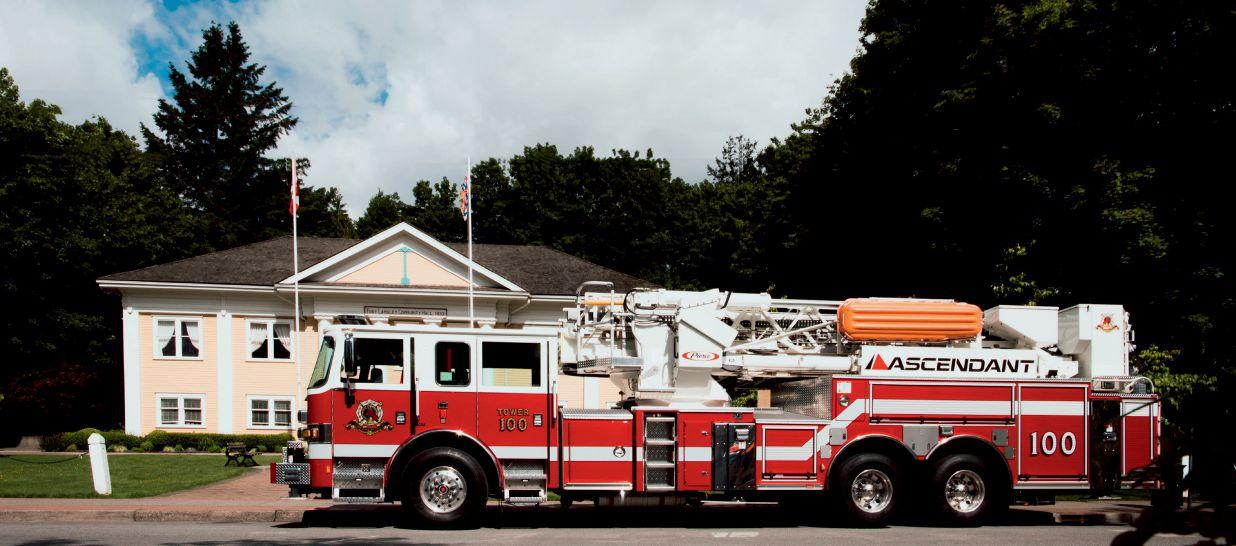


8 LOOKING AHEAD
The fire industry is rolling out plenty of innovations. Where are we headed? By Laura Aiken
20 USE DATA TO DRIVE DECISION-MAKING VFRS partnered on an enterprising data project. By
Deryn Rizzi
24 TRAIN SAFELY TO AVOID PAIN
Prepare your body for the specific demands of fire fighting. By Chris Semenuk
36 DIGGING DEEPER ON DEPRESSION
Here’s a look at recent research on depression in volunteer firefighters. By Judy Moench and Ceri Moore
48 SENIORS AT RISK
There is a need to ensure better safety in seniors’ homes. Here’s why. By Len Garis and Kevin Diakiw
52 FOCUS ON FIREFIGHTER HEALTH
Learn about a unique collaboration in Ontario that improved wellness for the firefighters. By Nicole Veenema

BY LAURA AIKEN Editor laiken@annexbusinessmedia.com
don’t know what’s going to happen tomorrow. I can make a good guess barring the unforeseen, but the unforeseen has an unruly habit of happening all the time. Long-term direction seems easier to navigate than the ups and downs of dayto-day. And lacking a crystal ball prevents no one from making educated and often accurate predictions about the blank that is tomorrow’s morrow. For this year’s cover story, I asked some experienced minds on the industry side how they envision the future of apparatus. The innovations of today set the stage for long-term evolution. The fire service has an inner circle reputation for being resistant to change, but change it does, even if the pace is tentative. Look no further than current sentiments around mental health, cancer, women firefighters and diversity. Conversations are progressive. In the long run, the stage for change has been set and so it can be said for technology.
one of the challenges facing the drivers of fire trucks today and certainly for the future, namely, navigating the roads of the community it serves. The fire truck has to get on scene fast. The logistics of this have changed dramatically over the last 100 years. Will they be as big one century forth?
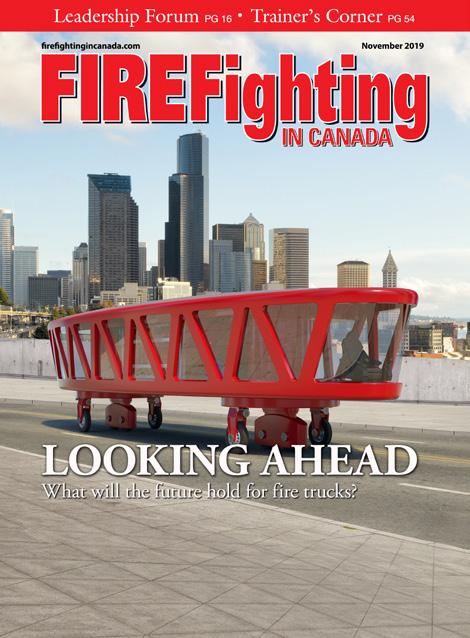
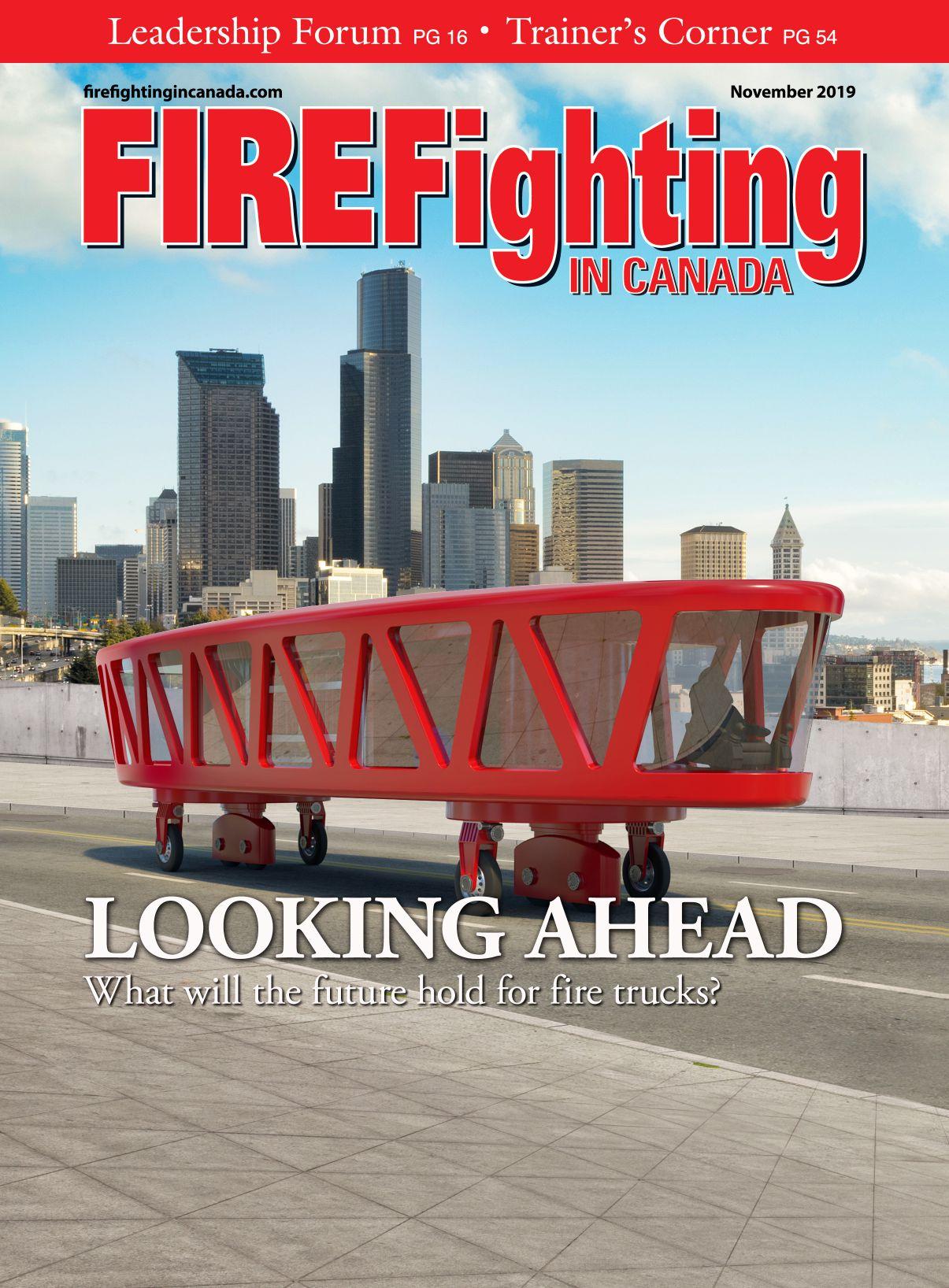
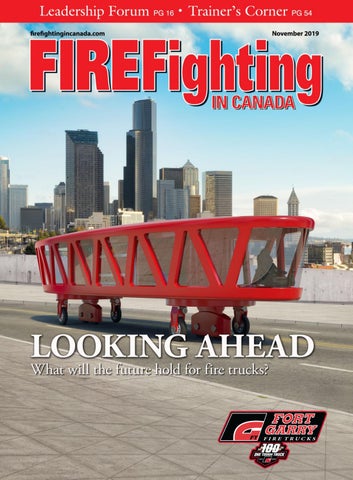
This gyroscopic concept fire truck was designed by Dahir Semenov, a Russian engineer. For more on the future of apparatus, see page 8.
The wildly imaginative cover image we chose for this edition is conceptual and reminds us of the air of possibility the future holds. Dahir Semenov, a Russian engineer who founded the Istanbul-based firm Dahir Insaat, shared his gyroscopic fire truck with us. You can search for the YouTube demonstration that shows how the truck navigates unwieldly traffic and reaches high-rises with ease via telescopic legs. Semenov’s company is known for his futuristic designs. The man is definitely inventive, but also thinking about
External problems drive internal innovation for industry and departments. How to manage on scene gross decon as part of cancer mitigation was a large contingent of the fire chief panel’s discussion at the recent FAMA/FEMSA apparatus and equipment conference in Toronto. What role will the fire truck and equipment play, and how will the service adopt decontamination holistically?
As the world changes, so will the fire truck. Though you can count on change with the certainty of death and taxes, some challenges remain stubbornly steadfast. Maintenance and service alongside cost are issues that will probably always be there in some form or another. The electronics on apparatus are becoming more complex and this creates new challenges in repair.
I hope you enjoy this edition’s discussion on the future of apparatus and it gives you something to consider in your preparation of days to come.

ESTABLISHED 1957 NOVEMBER 2019 VOL. 63 NO. 7
EDITOR LAURA AIKEN laiken@annexbusinessmedia.com 416-522-1595
ASSOCIATE EDITOR MORIAH CAMPBELL mcampbell@annexbusinessmedia.com 416-510-5233
ASSOCIATE PUBLISHER ADAM SZPAKOWSKI aszpakowski@annexbusinessmedia.com 289-221-6605
ACCOUNT COORDINATOR ALLYSON ARITCHETA aaritcheta@annexbusinessmedia.com 416-510-5232
MEDIA DESIGNER BROOKE SHAW bshaw@annexbusinessmedia.com
GROUP PUBLISHER/VP SALES MARTIN MCANULTY fire@annexbusinessmedia.com
COO SCOTT JAMIESON sjamieson@annexbusinessmedia.com
PUBLICATION MAIL AGREEMENT #40065710 RETURN UNDELIVERABLE CANADIAN ADDRESSES TO CIRCULATION DEPT.
P.O. Box 530, SIMCOE, ON N3Y 4N5 e-mail: subscribe@firefightingincanada.com
Printed in Canada ISSN 0015–2595
CIRCULATION e-mail: bolechnowicz@annexbusinessmedia.com
Tel: 416-442-5600 ext. 3543
Fax: 416-510-6875 or 416-442-2191
Mail: 111 Gordon Baker Rd., Suite 400, Toronto, ON M2H 3R1
SUBSCRIPTION RATES
Canada – 1 Year - $25.50 (GST - #867172652RT0001)
USA – 1 Year $45.00 USD
Annex Privacy Officer Privacy@annexbusinessmedia.com Tel: 800-668-2374
Occasionally, Fire Fighting in Canada will mail information on behalf of industry-related groups whose products and services we believe may be of interest to you. If you prefer not to receive this information, please contact our circulation department in any of the four ways listed above.
No part of the editorial content of this publication may be reprinted without the publisher’s written permission ©2019 Annex Publishing and Printing Inc. All rights reserved. Opinions expressed in this magazine are not necessarily those of the editor or the publisher. No liability is assumed for errors or omissions.
All advertising is subject to the publisher’s approval. Such approval does not imply any endorsement of the products or services advertised. Publisher reserves the right to refuse advertising that does not meet the standards of the publication. www.firefightingincanada.com

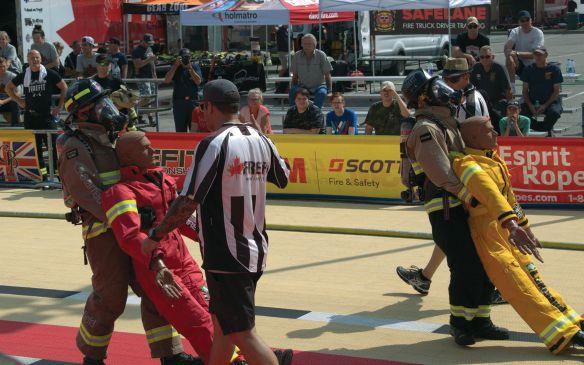
FireFit competitors tackle the final task in which they must drag the 165 lb dummy backward
A number of new records were set at this year’s FireFit World and Canadian National Championships in Oshawa, Ont., at the Delpark Homes Centre.
From Sept. 11-15, regional FireFit finalists from around the world came to compete in what has been coined by FireFit as ‘the toughest two minutes in sport’.
“It’s a mental game,” said first-time FireFit competitor Emily Leung. “You have to get comfortable with being uncomfortable.”
While dressed in full turnout gear, athletes compete individually and in teams through a succession of six fire fighting tasks. These include climbing up six flights of stairs carrying a 42 lb hose, advancing a fully charged hose line and carrying a 165 lb dummy to
VINCENT CONRAD was promoted to division chief of professional development training with Halifax Regional Fire and Emergency in July. Conrad has worked 28 years in the fire service and has spent the last 12 specializing in the training division. He is a past board
member of ISFSI and TERC Canada and is now a member of the Canadian Fire Knowledge to Practice curriculum team and the director of FDIC Atlantic. Conrad worked on the first strategy and tactics book from IFSTA and is presently serving as an alternate for NFPA 1700 committee.
LARRY THOMAS was promoted to fire chief for B.C.’s Surrey Fire Service in early July. Thomas’
safety.
Hilary McRoberts, FireFit executive vice president of operations, said the 2019 national championships was one of their largest yet, with 184 athletes racing on the final day.
There are nine individual categories, and 14 team and relay categories that divide competitors up by gender and age. To compete at the national level, firefighters must meet the minimum qualifying time for their category at a regional competition.
“Coming to nationals is a really great experience for our competitors,” said McRoberts. “The athletes learn all sorts of different techniques like ways to train, how to eat and how to warm up properly.”
This year, Sarnia Fire Rescue’s Ian Van Reenen set a new men’s record with a time of 1:10:02. Katherine Ross from Brampton Fire and Emergency Services set the bar higher with a new women’s record of 01:51:77. Mississauga Fire and Emergency Services was represented by Vanessa Gilbert, who became the first woman in the over 40 category to finish with a sub two minute time of 1:59:25.
Team winners get their names etched on a hand carved trophy and medals are given out to all competitors that place in their category. Keltie-May Nicoll of Grand Prairie Fire Department in Alberta, a six-time FireFit competitor, placed sixth in the women’s division with a time of 2:39:48. She said being on the course is the best way to improve your run.
“The course always feels a little different because of the grade of the ground you’re on,” said Nicoll. “I recommend getting out on the course as much as you can when it’s here to get your muscle memory on it.”
The tentative schedule for 2020 competitions can be found at FireFit.com.
distinguished career with the Surrey Fire Service spans 30 years. Within the organization, Thomas has served as a longtime member of the senior management administrative team. In addition, he serves as the lower mainland zone director for the Fire Chiefs’ Association of British Columbia and is the vice president of the
Greater Vancouver Fire Chiefs’ Association. Thomas also holds a chief fire officer designation from the Canadian Association of Fire Chiefs.
In early September NICK RULLER was promoted to fire chief of Niagara-on-the-Lake (NOTL) Fire and Emergency Services. Ruller began his career in the fire sector working in the operations division of Toronto
Following the announcement for the creation of an Indigenous Fire Marshal Office (IFMO), the IFMO project team has been meeting with communities to better understand their needs.
In August, the Government of Canada announced $9.97 million in funding over three years to support the creation of the IFMO. The funding will support Indigenous partners in establishing the new IFMO, including how the office will be structured and governed, its mandate and any associated legislation.
Arnold Lazare, president of the Aboriginal Firefighters’ Association of Canada (AFAC), is the IFMO project lead. He said the Canadian fire service community has been very supportive of the project.
“The Canadian Association of Fire Chiefs, the Council of Canadian Fire Marshals and Fire Commissioners and the Canadian Fallen Firefighters Foundation have all expressed their support,” said Lazare. “We greatly appreciate that all three organizations continue to make efforts towards reconciliation.”
Over the summer, the IFMO project team held
Fire Services for 16 years. He then joined NOTL at Station 1 as a firefighter from 1999 to 2003. In 2014 he returned to the service as a lieutenant and was promoted to deputy fire chief in March 2017.
LEN GARIS retired from B.C.’s Surrey Fire Service in June. Garis began
five technical engagement sessions across Canada with established First Nations support organizations within the fire industry. Lazare said the sessions help determine the specific needs of the communities.
A report on the outcomes of the sessions was released in early October on ifmo.ca. The report stated that a total of 172 individuals, communities and organizations attended the technical sessions.
The day-long sessions were a combination of presentations, facilitated discussions and breakout groups.
The participants of the sessions provided input on
how the impending IFMO should be governed in regards to defining standards and codes, data collection, training, community advocacy and fire prevention programs.
Among other take-aways, the report concludes with a discussion of plans to establish a First Nations Fire Service Training College that will take a culturally and linguistically appropriate approach to providing certified training.
The findings of the technical sessions will be discussed this fall in eight community sessions that will be held with community chiefs and leaders throughout the country.
Once all sessions are
his 39 years in the fire service as a volunteer firefighter with the District of Pitt Meadows in 1980, serving as their fire chief from 1984 to 1998. He was then recruited to the Surrey Fire Service as an assistant fire chief and later promoted to fire chief in 2001. His passion for the well-being of his staff, the fire service community and the citizens of Surrey inspired him to enact change. Garis
applied his creative approach to initiatives such as the award winning HomeSafe Program, firefighter cancer research, the Surrey Electrical Fire Safety Inspection team, and most recently his efforts with the opioid crisis. Garis also served as the president of the Fire Chiefs’ Association of British Columbia for two years and is now an adjunct professor in the school of Criminology and
complete, Lazare said the IFMO will begin implementing proof-ofconcept fire prevention programs across Canada.
“These are not pilot programs,” said Lazare. “We hope to take programs that are already successful in one area of the country and apply them to other areas.”
An Indigenous Advisory Committee (IAC) is also being established to support the IFMO project to help develop its roles and responsibilities.
The first community session will be held in Moncton, N.B., on Oct. 17. For the entire list of fall sessions visit, ifmo.ca.
Criminal Justice and associate to the Centre for Social Research at the University of the Fraser Valley.
FRED ‘ROGERS’ NICKERSON passed away in the presence of his loving family on August 27 at the age of 86. Nickerson was a founding member and the first fire chief of the Woods Harbour Volunteer Fire Department.
What will the fire truck of the future look like?
By LAURA AIKEN
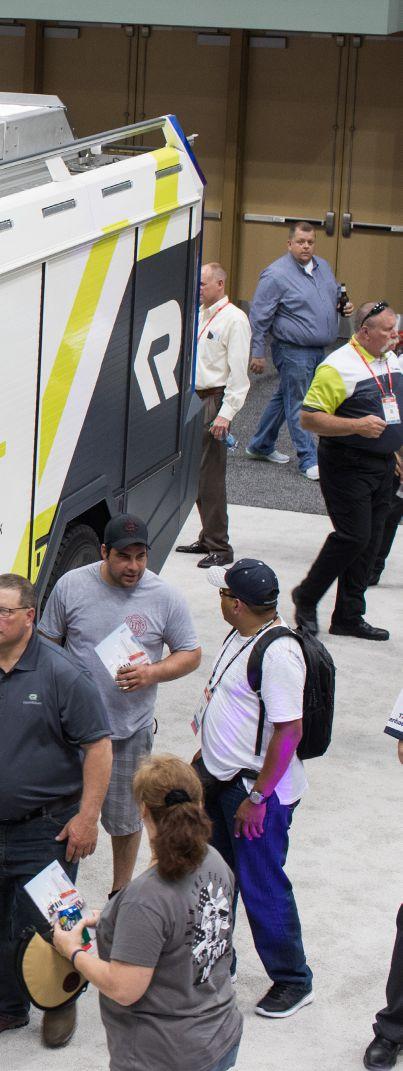
Close your eyes and picture…wait – don’t do that. How can you see the rest of this article with your eyes closed? And you’re going to want to read the rest of this. Let me start again. Keep your eyes open, and picture your fantasy fire truck 50 years down the road. What has it morphed into? Is it flying or rising up out of traffic on spidery legs of steel? Is it self-driving? Does it run on compost and float in an indestructible bubble? The future is fun to imagine, and that cognitive projection drives us here, there and everywhere until we figure out where we are going. This brings us to the crux of our story: Where are the innovations in fire apparatus today taking us in the not too distant tomorrow?
There’s a familiar adage spun a million ways; it’s essence being to know where you are going, you need to know where you have been. Let’s take a very short peek at the days of yore before hearing from a wealth of industry experience on where fire truck technology looks to be headed.
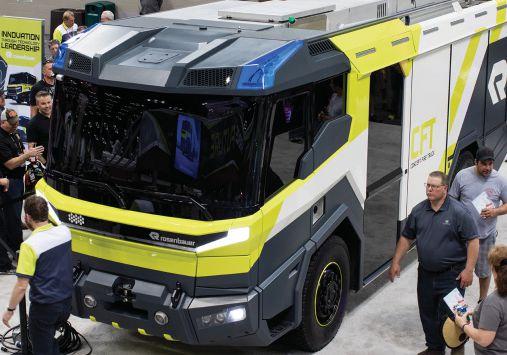
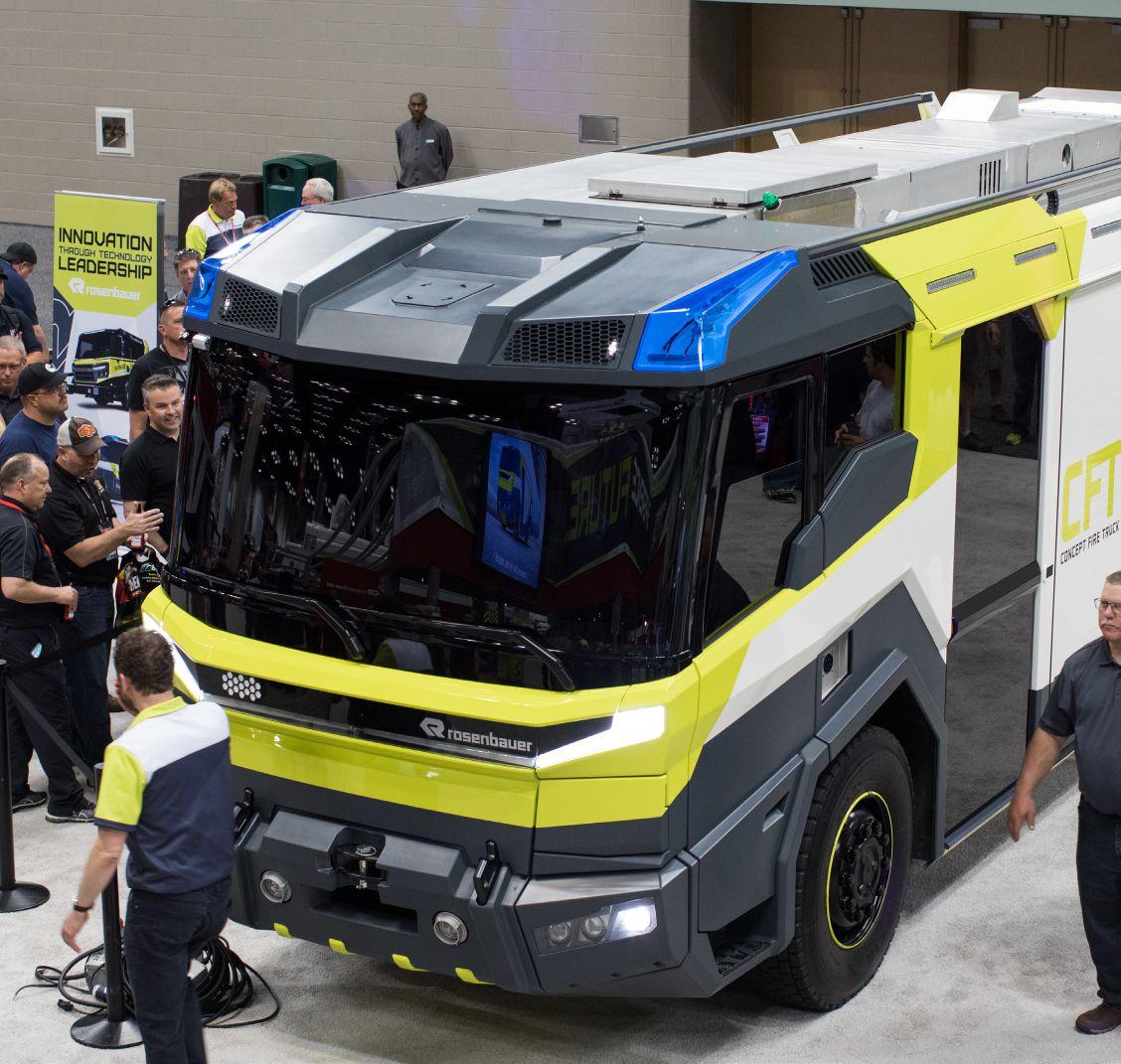
LEFT Rosenbauer will be showcasing its electric prototype in 2020.
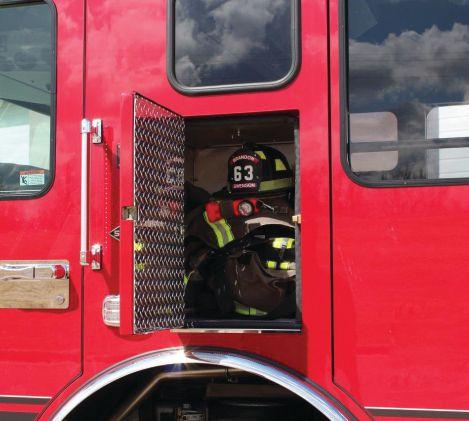
ABOVE Exterior storage components like this Clean Cab option delivered through Safetek are a big part of the discussion on how to better prevent cancer in firefighters.
Richard Newsham, a button maker from London, made a big improvement to the fire engine with his design that was awarded a patent in 1721, stated the Colonial Williamsburg Museum website. Newsham’s hand pump fire engine could pump water in a continuous stream, draw from a reservoir, was operated by hand or foot and could spray water at 125 gallons per minute (picture on page 12).
The suction engine was introduced in 1822, cited the Pioneer Auto Museum. The suction engine gave firefighters the ability to take water from a concentrated area. This preceded the addition of horses to pull the engine, which drastically improved response times when they came along.
Apparatus made strides upward when
Daniel Hayes invented the aerial ladder fire truck in or around 1868, as reported by The Virtual Museum of the City of San Francisco. The San Francisco Fire Department was the first to put it into use and purchased it for $3,000 USD.
That’s the short peek; just a smidgen of history to show a few highlights of the pace at which apparatus progressed up to the Industrial Revolution and onwards. In short, fire trucks have come a long way from the horse drawn days! We’ll now look ahead by hearing from the minds of three industry veterans on where the technology is headed and the current and evolving challenges from their perspective.
Brad Petrie, the internal sales manager at Fort Garry Fire Trucks, just marked his 20th year with the company. In his role, he sees all the bids nationwide, all the trucks people are tendering and is involved in every step with Fort Garry’s customers, from conception to delivery.
Petrie named finances first as one of the ongoing challenges for fire departments in apparatus procurement, as there are many volunteer departments and it will always be tricky getting funding in place for an apparatus ranging from as low as about $350,000 to as high as $900,000, depending on what they need. As far as those needs go, in the past five years, Petrie said he’s seen a lot more awareness of firefighter safety.
“In the last few years, they are asking for clean cabs in fire trucks; a spot to put their turnout gear after it gets covered in all the soot and all the bad chemicals. They don’t want it affecting a firefighter’s health.”
Looking ahead, perhaps another 20 or 30 years, Petrie said hybrid fire trucks or maybe even autonomous fire trucks could be on the road. Technology is changing, but he doesn’t think we’ll do away with aerial devices in our lifetime he said, in referencing recent news of a team of Southern Alberta Institute of Technology (SAIT) students who developed the concept for Skywalker, an aerial emergency rescue operation vehicle. That being said,
he noted that looking to the future, you never know.
What Petrie is surer of is the SAM system or others like it taking off. SAM manages the pump waterflow from a touchscreen, freeing up a person for other tasks. The system integrates all of the pump controls, replacing the pressure governor and opening and closing valves based on settings. It’s also designed to get the water moving fast.
As touchscreens continue to touch down in myriad industries, green initiatives also continue to dominate. Petrie said electric fire trucks will take off eventually.
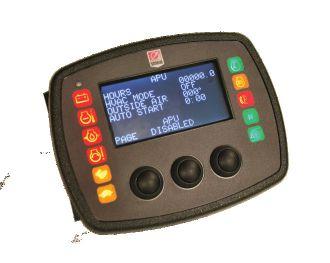
Auxillary power units, like ones powered by this monitor provided by Safetek, are providing anti-idle technology as green initiatives come to the fore.
“Not soon, but the whole industry in vehicles — you can see it’s all shifting to that and quickly.”
Fort Garry’s technical director Gordan Draskovic is interested in a co-op to build an electric fire truck, Petrie said and he has been prodding the sales team to talk to their customers about them. He sees Draskovic’s direction as a large indicator of things to come. The battery innovation will need to catch up to make it a reality, as currently it’s a challenge to have the power to drive the pump as well as drive the truck. Petrie remarked there is testing on electric heavy duty trucks going on in Europe that is also indicative of the direction things are headed.
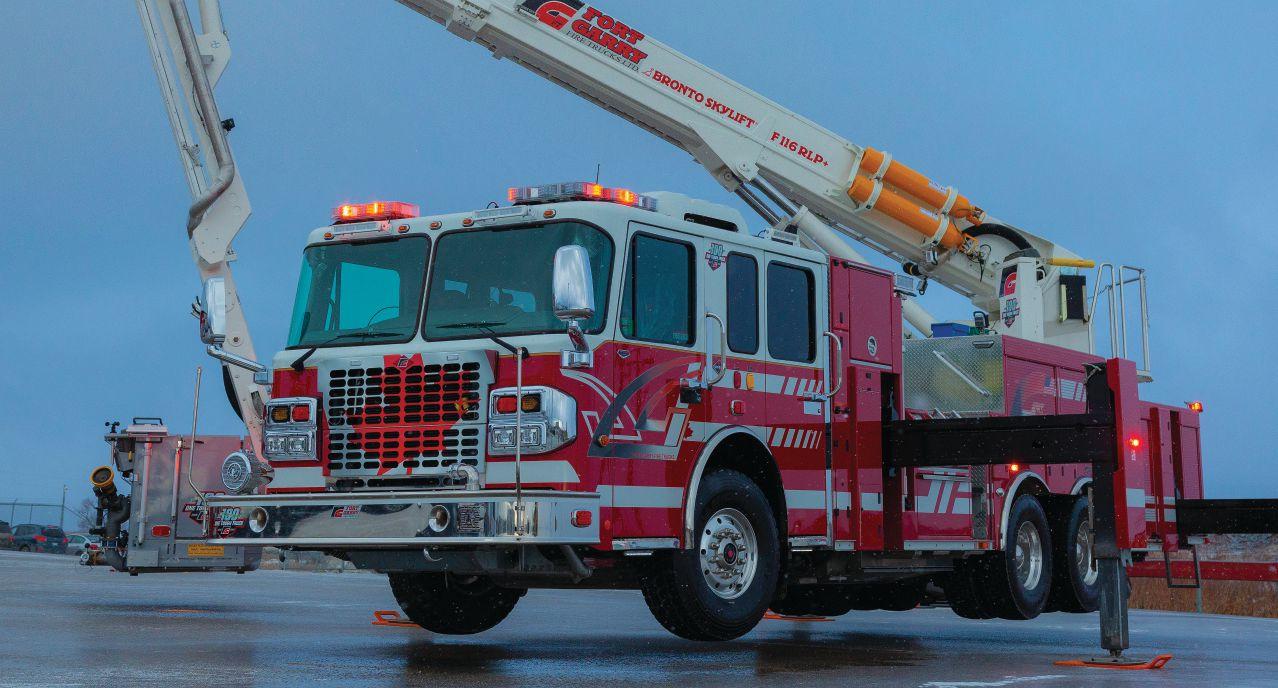
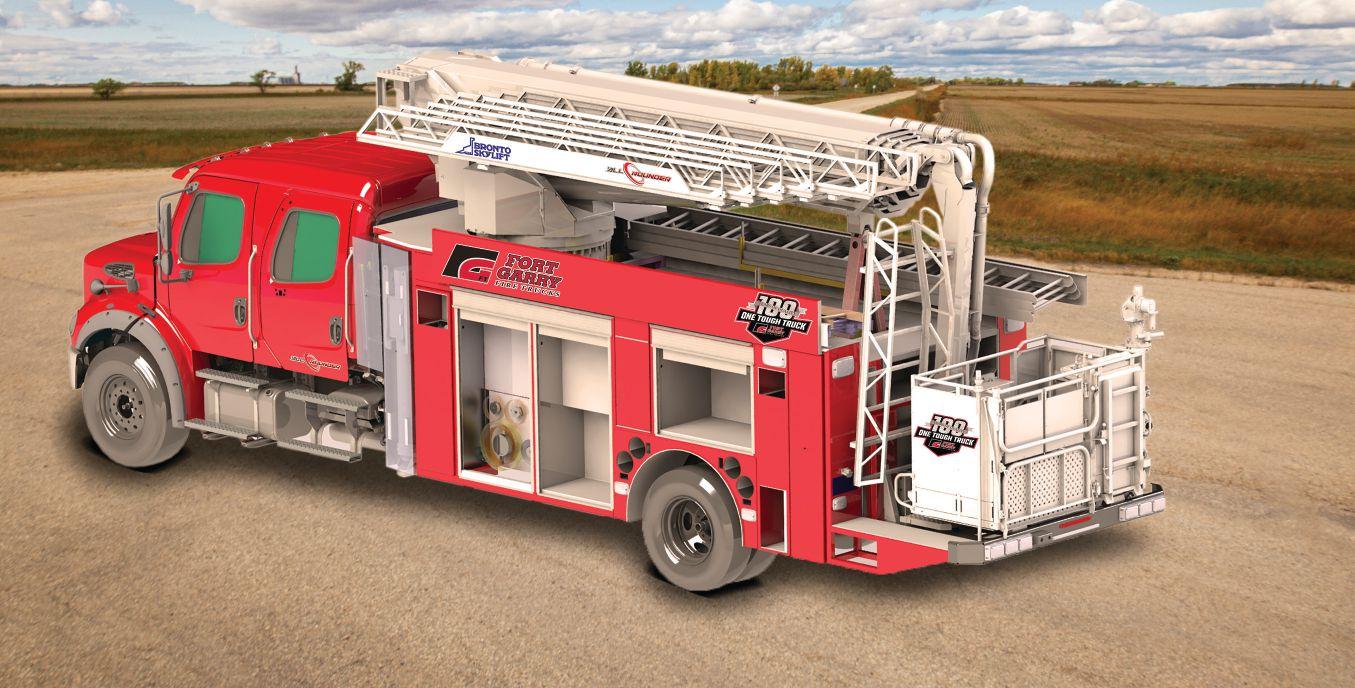
Fort Garry’s latest innovation addresses that big fundamental question of finances. The company is introducing its Bronto All Rounder at FDIC in Indianapolis in 2020. Fort Garry’s goal was to take an articulating aerial device by Bronto that would normally run about $2 million and bring the price down to about $1 million by creating an economical version. The truck is built on a commercial instead of custom chassis to help reduce the price, and is also built on a single axle to keep it maneuverable for small towns and the northern areas, said Petrie. Fort Garry will also be partnering with someone to produce a SAM demo truck for FDIC and the rest of the 2020 trade show circuit.
Petrie is also seeing innovation and changes in warning and LED lights. Now that Ontario has opened up blue and red warning lights to the fire service, Fort Garry is seeing an uptick in requests for these colours for fire. For 2020, Petrie said to watch out for lights with dimming features to catch a lot of buzz. As an example, he mentioned Whelen’s situational adjustment lighting systems that automatically dim or brighten as needed in day or night. This option will keep firefighters and civilians safer because sometimes the lights on a truck are too bright and blinding to those coming on to the scene.
John Witt began his nearly 40-year career in 1980 with Pierreville Fire Trucks in Quebec, and brought Bronto Skylift to the North American market in 1985. After leaving Bronto, he started Safetek Emergency Vehicles Ltd. in 1993, the exclusive Spartan ER dealer in Canada. Over this almost four-decade span, Witt said fire apparatus have become much more complicated, sophisticated and reliant on
electronics. Fire apparatus design is being challenged by property developers and municipal planners who want narrower roadways to make room for higher density building footprints, which puts restrictions on the size and turning radius of apparatus. In addition, departments are specifying more compact Quick Response (medical) and Special Operations units that can serve multiple purposes and reduce the wear and tear on the larger apparatus.
On the subject of electrically driven fire trucks, he said Safetek has been asked about them. Cost and a battery technology remain stalwart impediments in the march towards widespread electric fire truck adoption, but he pointed to the fact that one of Australia’s larger departments is planning on testing a hybrid electric apparatus in 2020.
On the green front, Safetek’s current environmental initiative is its Green Power auxiliary power unit (APU). This anti-idle technology runs similar to a diesel generator and shuts down the main engine while idling. The APU has an independent alternator to operate all low voltage electronics and a parallel HVAC system. Witt said the APU feature is becoming more popular and Safetek has delivered over 100 Green Power fire apparatus across Canada to both large and medium sized fire departments that saves diesel fuel consumption, GHG emissions, noise and engine hours on the prime mover engine. Safetek’s next step for Green Power is introducing a lithium ion battery system for a zero-idle feature. (Of note on the subject of lithium batteries: this year’s Nobel Prize in Chemistry rewarded the development of the lithium-ion battery by recognizing John B. Goodenough, M. Stanley Whittingham and Akira Yoshino).
In terms of the hot topic of cleaner cab design and firefighter cancer prevention, this is something Safetek has been promoting. Witt said some departments have already designed their new apparatus with this feature and many more are now are looking at it, but it will take the stakeholders to adopt a whole package of behaviours that must be followed to keep not only the firefighters, but mechanics and anyone else around a fire truck free from contaminants.
“I don’t think anybody’s got it all figured out yet — how to do it. It’s a trend and we’re acknowledging it and we’re working with several FD’s looking at it for their next order of trucks, but we have other FD’s that aren’t and are asking how much does it cost; is it worth it?”
Spartan chassis, for example, introduced a number of cleaner cab features including storage for SCBAs, Ease To Clean cab interior surfaces and an advanced filtration system incorporating a HEPA high efficiency integration system to mitigate cab toxins.
Cab safety is also a priority now and for the future. Witt said the Spartan chassis offers an Advanced Protection System that provides frontal and side impact air bag protection. The 360-degree camera with blind spot detection has been a boon for firefighter safety and liability by providing the driver with a complete view of the apparatus.



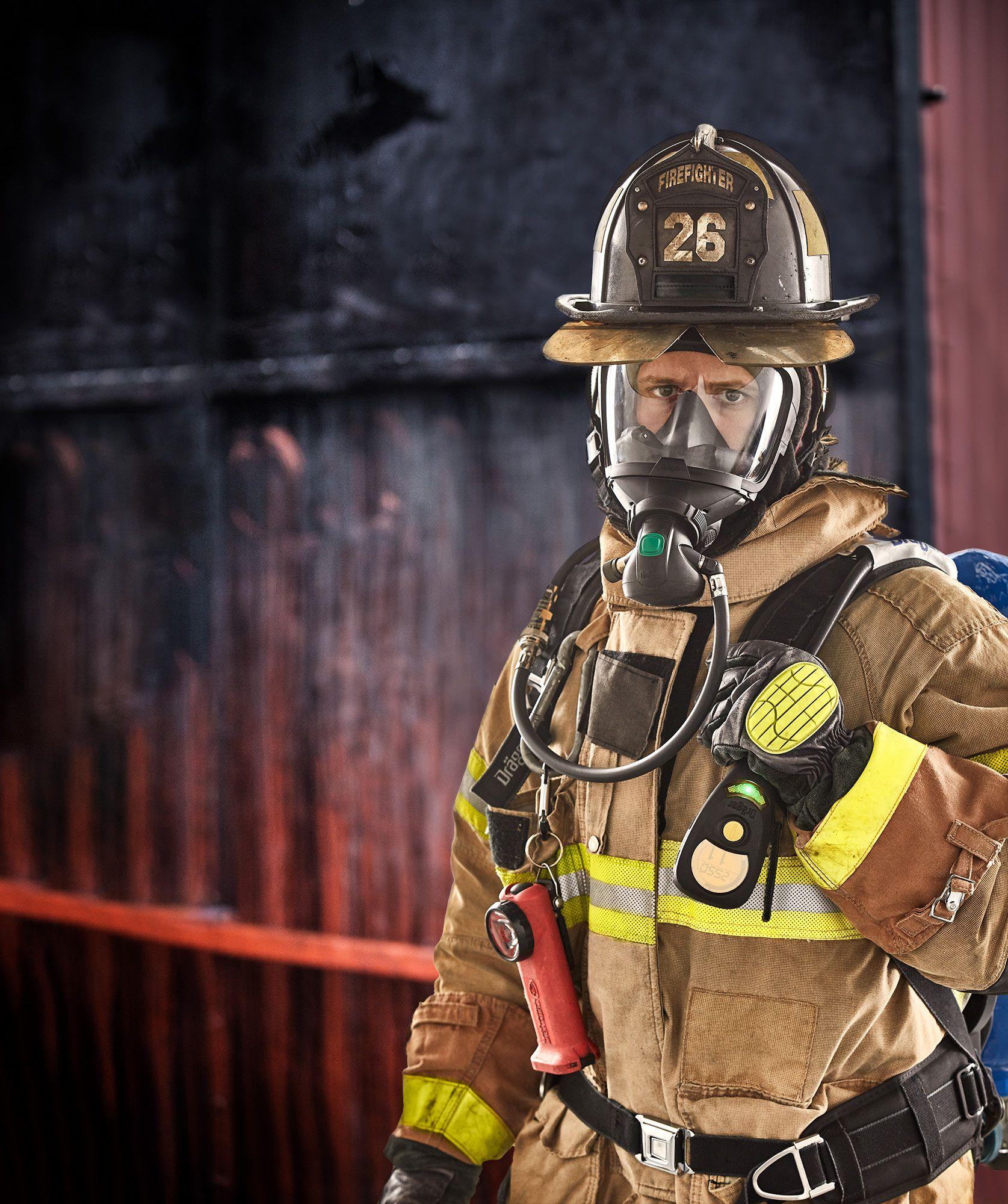
Unpredictability is the only thing that all fires have in common. Dräger is committed to protecting every firefighter in volatile environments with proven gear like SCBAs, portable gas detectors, communications, and more. To prepare for these challenges, nothing beats a live fire for learning about fire behavior and how best to fight them. Dräger offers a wide variety of training props, Swede systems, mobile live-fire training units, and SCBA maze confidence systems.


And what does Witt see for the future? Keep and eye out for high-tech. Manufacturers are already offering systems that not only control the pump panel from a tablet, but offer parallel systems that can diagnose and manage breakdowns remotely.
“Fire departments unfortunately don’t have that redundancy benefit that you see in commercial aircraft, so firefighters want the ability to troubleshoot and fix an apparatus on scene. This is why we see some resistance to these sorts of innovations, but with the level of investment manufacturers are putting in and a new generation of firefighter, we don’t see this trend going away any time soon.”
He said that GPS and in-truck Wi-Fi connections are becoming popular as well as traffic light controllers and systems that use popular apps such as Waze to notify motorists of nearby emergency vehicles.
He said he also sees more higher reaching yet compact aerial devices to reach upper floors of buildings that go beyond the traditional 30M as a future trend, and “not just vertically, but articulating to provide up and over reach. These types of trucks also offer more maneuverability in tighter city streets versus a straight stick offering the same length.”
In the business of buying and selling, he said he is experiencing more single-source multi-year agreements to allow departments to “standardize” their fleet for not only maintenance but training and use of same.
“Our customers are also looking for full service local dealers with comprehensive 24/7 parts and service support, something that will be of increasing importance as the apparatus becomes more complicated and electronic. Downtime is the enemy of the modern FD fleet, and they are looking for a “partner” to keep that truck in service from delivery to retirement.”
■ SCOTT OYEN, CEO OF ROSENBAUER SOUTH DAKOTA
Scott Oyen started in the industry with Rosenbauer in 1991, and worked multiple facets of the business over his nearly 30-year career. As CEO of Rosenbauer South Dakota, he described the same increasing complexity of trucks seen by Witt at Safetek. The options for custom-
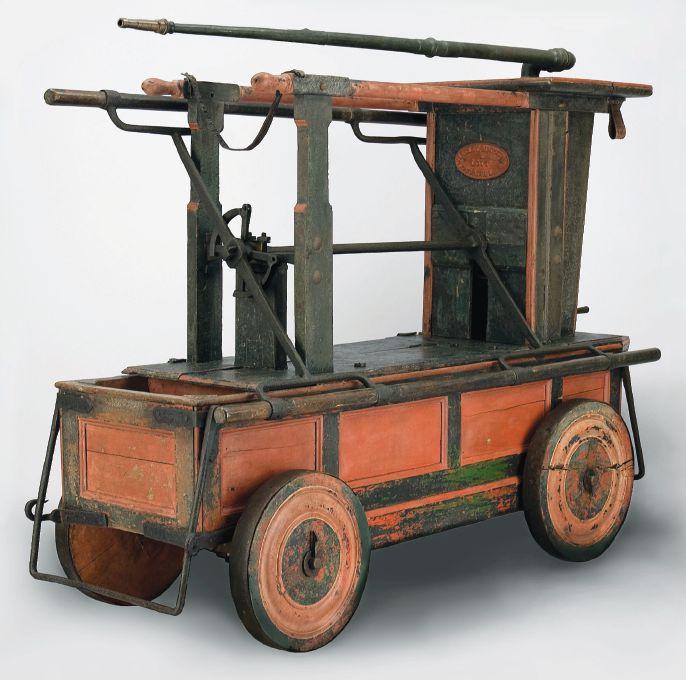
We’ve come a long way! Richard Newsham’s hand pump fire engine was patented in 1721.
ization are ever-increasing and how that technology is integrated — how that complexity is managed — is an evolving challenge for the fire industry and departments in respect to service and option content.
Going forward, Oyen said he sees opportunity in green initiatives. There is a demand coming for electrically powered vehicles, he said, and how that technology is adapted to suit the fire service will be challenging.
“For a completely electric driven truck, how do we get enough battery reserve power to power a pump while fighting a fire, for example, or how do we work aerial ladder devices with electric power? There’s a finite amount of electrical power there, how do we manage that without running out on scene?”
Oyen said electrical power will be an innovation that takes off. Rosenbauer is demonstrating a prototype throughout North America in 2020. Right now, electric is certainly more expensive, but he said the cost will come down with demand. However, the electronic options that have been introduced in recent years are part of driving up the cost of fire trucks today considerably. Smaller departments will likely need to keep their option content to the basic needs to stay in budget.
Cancer is also a high priority for Rosenbauer to address now and down the road, he said, indicating that keeping the cab clean of carcinogens will be a major issue going forward. At the 2019 FDIC show in Indianapolis, Rosenbauer exhibited a new cab filtration system and Oyen said there’s been a lot of interest in that, and that the company can retrofit existing pumpers with the technology. He said he believes that clean cab technology will be accessible to all departments in the future.
“It’s new enough that there’s really no standard set by the industry, so the standard we designed to meet is actually in a different industry where clean air is required. I see eventually someone developing a standard for fire service. Most departments now launder bunker gear after each fire scene, and they are also doing a gross decon on scene, then washing the bunker gear after the call is over, so practices are changing at a widespread level.”
Well, our words here are done. You can close your eyes now and imagine your fantasy future fire truck. I’d love to hear what you see! Send me an email at laiken@ annexbusinessmedia.com if you want to share your thoughts.
Whatever your business needs from a vehicle, Ford F-Series trucks have what it takes. Take the 2019 Super Duty®, it has class-exclusive‡ driver-assist technologies and military-grade† aluminum-alloy body. It can help take your business to the next level.
• Max. payload of 7,640 lbs
• Max. towing of 35,000 lbs
• 450 diesel horsepower
• 935 lb-ft of diesel torque


■
GfG Instrumentation released the G460. The G460 is designed for simultaneous detection of up to six gases, including infrared for the detection of CO2 and PID for the detection of VOCs. The monitor is concussion proof as well as dust and water resistant.
The G460 features automatic calibration, data logging capabilities, one-button operation, top mounted display and interchangeable battery packs for up to 25 hours of operation. The rechargeable NiMH battery pack can be equipped with optional flashlight LEDs. There is a lifetime warranty on the electronics; a full three-year warranty on the most commonly used sensors and five years on the oxygen sensor. goodforgas.com
The Micro IV is a compact portable single gas monitor, designed to be used in harsh environments. The monitor comes with a set of rubber boots to withstand knocks and drops. Most day-to-day functions are controlled with one button, and calibration is automatic. The monitor delivers up to 3,000 hours of operation from one AA alkaline battery.
The Micro IV carries a lifetime warranty on non-consumable components and two or more years of warranty on most sensors. Select sensors such as O2, H2S and CO carry a full three-year warranty. goodforgas.com
TargetSolutions has made its new workforce management software is available for public safety agencies in Canada.
TargetSolutions Scheduling, powered by CrewSense, is supported by AWS infrastructure technology, which allows Vector Solutions to store Canadian customers’ data locally in the Canada. The network architecture is built to meet Canada’s Personal Information Protection and Electronic Documents Act.
The scheduling system uses rules-based decision-making to automate responsibilities, including staffing shifts and executing emergency call backs. Predetermined qualifiers are designed to help agencies oversee these processes and ensure appropriate coverage without manually contacting personnel. Automation and self-service tools were designed to eliminate scheduling grievances among personnel and save agencies time and effort.
In addition to automating how agencies coordinate shifts, TargetSolutions Scheduling intends to simplify how shift trades and time-off requests are managed. targetsolutions.com
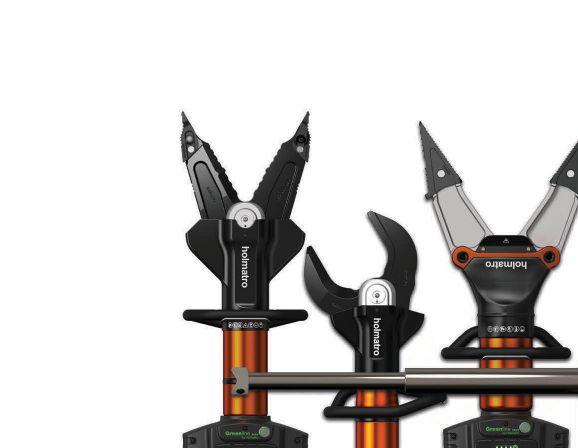
HURST Jaws of Life expanded its battery powered rescue tool line with the addition of the R 422E2 Ram, whose 59.1-inch length gives first responders the longest extension in the industry, reports the company. The tool has claws at both ends that provide gripping power and rotate 360 degrees for use in complicated rescues. The design is intended to offer easy maneuverability with an ergonomically designed star-grip. The tool is NFPA 1936 2015 compliant and has an IP rating of IP54. It comes with two rechargeable batteries and one charger. jawsoflife.com

BY MATT PEGG Fire Chief Toronto Fire Services
e live in an increasingly connected world where social media apps dominate the communication landscape.
Social media has and will continue to change the fire service culture. While I am active on social media, I am far from being someone who would be considered a Twitter influencer nor an Instagram personality. I use these platforms as tools to connect with our residents, members of our fire service team and with those who have an interest in our service. Without any doubt, social media can be a powerful tool when we need to connect with residents during major emergencies. During a major six-alarm fire in 2017, a single tweet that I sent during the course of the emergency reached more than 300,000 people in an astonishingly short amount of time. There is no doubt that social media is a powerful tool; the dominant reality of today and for the foreseeable future.
However, I find it ironic that social media users with high follower counts are referred to as influencers. In what is now being described by Success, Forbes and Entrepreneur as the YouEconomy, people are ranked on the basis of the number of followers they have on any given social media platform. A recent issue of Success magazine included their engagement based Platinum Influence List (success.com/platinum-influence-list/). The list is divided into personal development, entrepreneurship and business, entertainment and culture, spirituality and mindset, money and health.
There are names on this list who have absolutely made a positive impact as authors, teachers and thought leaders in my personal and professional development. I am a fan of social media, and I believe that it is a tool that every fire chief should be using as part of their communications tool inventory. However, there is a problem emerging for leaders. Leadership isn’t about you and there is no YouEconomy for leaders. Leadership is about those we serve.
face to face with the members of my team. I could tweet all day, every day and not influence or assist one member of our team in the way that a single, two-minute face to face conversation can. It is those exchanges that yield the best results and are the most enjoyable and satisfying for both.
Sharing thought provoking quotes and advice with others via social media can be valuable and worthwhile. However, tweeting, retweeting, sharing and liking posts about leadership does not make someone a leader.
Leadership is hard work today and always has been. It requires courage, competence, honesty, commitment, self-awareness and the dedication of often extraordinary amounts of personal time. Leadership, by its very definition, is not about you. True leadership happens when we are focused on the development, success and abilities of other people.
Our effectiveness and success as leaders will never be quantified, measured, judged or determined by the number of social media followers that we have achieved. Likewise, our leadership performance and competency will never be influenced by the number of likes, shares and retweets that we achieve.
In a world increasingly focused on amassing followers, we need leaders who are actually committed to developing new leaders. ‘‘ ’’
In a world increasingly focused on amassing followers, we need leaders who are actually committed to developing new leaders.
Regardless of the leadership position you hold today, or aspire to hold in the future, leadership is about influencing and enabling the people around you to become better and to achieve more than they do today.
While I enjoy and embrace social media in my role as a fire chief, there is no forum more valuable, impactful or powerful than being
Matthew Pegg is the chief with Toronto Fire Services, having previously served in Georgina, Ajax and Brampton, Ont. Contact Matthew at matthew.pegg@toronto.ca and follow him on Twitter at @ ChiefPeggTFS.
Donning a gold stripe-adorned tunic doesn’t make someone a leader any more than wearing high-end running shoes makes someone a marathon runner. As leaders, we will be judged on our visibly demonstrated competence, on the basis of the difference we made in people’s lives, on the extent to which we leave the organization better than we found it and on the basis of how many leaders we helped to develop and support.
Perhaps we should all take the next 10 minutes to close our social media apps. Let’s think about the names of people, this week, that we can honestly say that we have helped to grow and achieve their own leadership results through influence.
That is the list worth pursuing and adding to as leaders. Our follower counts can wait.
























By DERYN RIZZI
Some of the most important tools for fighting fires include advanced protective gear and state-of-the-art suppression equipment. But, in an age of growing communities, density issues and complex urban and rural landscapes, one of the most valuable tools in fire fighting is data.
Based in the city of Vaughan, Ont., with a population of more than 335,000, Vaughan Fire and Rescue Service (VFRS) strives to operate as efficiently and effectively as possible while maintaining what is most important: the safety of firefighters and those who live in, work in and visit the city.
As a leader in the industry, it is our responsibility to enhance our understanding of the needs of our growing city. We seek forward-looking analytic techniques to create greater value for citizens and the community through data-driven decision-making.
■
In May 2019, VFRS developed a Master Fire Plan to set the direction of the service for the next 10 years. The detailed plan contains maps, charts and data; however, there were some gaps in using the data to fully understand the future development of the city and the resources required to keep pace. This problem indicated a need to develop tools that could properly determine and forecast operational capacity.
To address this issue, VFRS partnered with York Region, York University, the University of Calabria, Universidad Autónoma del Estado de México, and the University of Genoa to undertake a project in innovation that would:
• Use shared data to create community profiles to understand risks within the city and the vulnerability index.
• Map a future state of the municipality and current resources to develop predictive analytics.
• Model and simulate VFRS’s response to emergencies to gain an in-depth analysis of response times and other key performance indicators.
• Use data-driven, evidence-based decision-making to determine fire station locations and allocation of resources.
■
VFRS worked with its municipal partner, York Region, to learn about the techniques and tools that could drive insight from data. The team looked at historical response-time data, building permits, population data, present road networks and planned road extensions. From there, travel-time models for each fire station were generated using different scenarios. The response coverage for each scenario factored in the
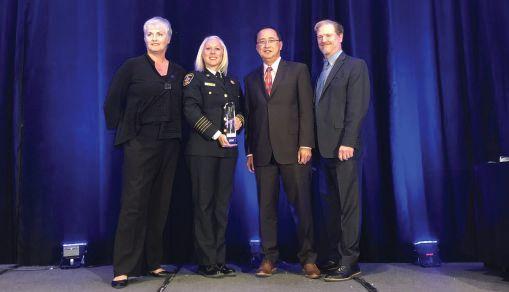
The completed project, titled Igniting Insight: Using Geographic Information Systems (GIS) and Analytics in the Fire Service, received the bronze 2019 Innovative Management Award from the National Institute of Public Administration of Canada (IPAC). From left to right: Beth Bell (IBM Canada, vice-president, enterprise and commercial Canada), Chief Deryn Rizzi (Vaughan Fire & Rescue Service), Professor Adriano O. Solis (York University) and Scott Thompson (CEO, Institute of Public Administration of Canada)
number of properties and population that could be reached as well as other key criteria, including vulnerable populations and areas that have been identified as difficult to access. Ultimately, an interactive decision support tool was created. The tool helps VFRS make decisions about station placement, resource allocation and road network improvements.
To undertake the second part of their project, VFRS partnered with York University’s Advanced Disaster, Emergency and Rapid Response Simulation (ADERSIM) team in the School of Administrative Studies, in collaboration with the Modelling and Simulation CenterLaboratory of Enterprise Solutions (MSC-LES) of the University of Calabria. This part was two-fold: to conduct a statistical analysis of the VFRS incident database (covering records since January 2009), and to undertake modelling and simulation of VFRS’s response to emergencies. VFRS sought to answer these questions:
• Is the current assignment of apparatus/crews operationally adequate and efficient?
• Is there a need to increase responding units at any station or to reallocate existing ones to other stations?
• Would it be appropriate for VFRS to consider building additional fire stations?
It’s the feeling you have when you can trust your protective equipment to perform day in and day out—and it’s what you can expect from 3M™ Scott™ Fire & Safety Products. We are improving and innovating new ways to help protect you, so you can get the job done and help get everyone home safely.


Be more than ready.

The modelling has allowed VFRS to determine optimal unit availability and ideal station and truck placement to have a positive impact on response times, which can ultimately reduce property damage and save lives.
The modelling and simulation framework involved two different simulation models running on separate platforms. The Incident Generation Engine simulates the arrival to emergency incidents. The Response Simulation Model is an agent-based simulation model that receives inputs from the first model.
The objective was to use modelling and simulation technology to evaluate the expected operating performance and efficiency of the VFRS system (stations, vehicles and fire fighting crews), taking into consideration the uncertainties of emergencies (e.g. time and geographic location of the event, type of incident, alarm processing, vehicle turnout time and on-scene time, among other relevant variables).
For 18 months, VFRS worked with York University on the modelling and simulation. VFRS provided historical data and operational procedures/protocols, as well as reviewed the simulation model and preliminary results with the researchers and offered input into required adjustments. In particular, VFRS validated some of the basic assumptions made in the model and the initial simulation results. This enabled the researchers to better identify statistics and operational parameters to build and refine the model as needed.
Interpreting and using data is necessary for fire service management. Decisions on a wide range of critical issues, such as funding, apparatus purchases, station placement, and staffing, are validated using data obtained from a wide variety of sources. We have developed predictive, spatial and prescriptive methods to segregate, organize and model the data to draw conclusions and identify patterns. We used math, statistics and modelling along with creativity and skepticism to ask the right questions, explore data and distill it down to insights that support our most critical decisions while reducing costs, improving efficiencies and mitigating risks.
The modelling and simulation tool was used to examine response performance. Results from the simulation have led VFRS to better evaluate community risks and consider improvements in its operations. The modelling has allowed VFRS to determine optimal unit availability and ideal station and truck placement to have a positive impact on response times, which can ultimately reduce property damage and save lives.
The completed project, titled Igniting Insight: Using Geographic Information Systems (GIS) and Analytics in the Fire Service, received the bronze 2019 Innovative Management Award from the National Institute of Public Administration of Canada (IPAC). Launched in 1990, the Innovative Management Award recognizes government organizations that have shown exceptional innovations that address the wide variety of issues facing society today. It celebrates the ability of public servants across the country to transform public administration, advance knowledge of management systems and structures, and improve transparency, accountability and responsiveness while increasing public participation.
VFRS’s use of data and smart technology aligns with the City of Vaughan’s overall commitment to innovation and continuous improvement. In January 2016, Vaughan became the second municipality in Canada to be World Council on City Data ISO 37120 Platinum Certified and will be the first city to pilot the new Smart Cities standard ISO 37122.
“Vaughan continues to elevate its reputation as a trusted and sought-after Smart City technology leader. We remain committed to working with Vaughan Fire and Rescue Service to develop innovative solutions that ultimately improve the human condition for all people,” said Maurizio Bevilacqua, mayor for the City of Vaughan.
The success of this project lies in the ability of VFRS to use data to identify the impact of any resource allocation or infrastructure change on performance and response times – two factors that are paramount when responding to an emergency. This will help ensure the fire service is strong, resilient and well-positioned for the future.
Deryn Rizzi is the fire chief of the Vaughan Fire and Rescue Service. Chief Rizzi completed a Bachelor of Education and Bachelor of Arts from Queen’s University. She graduated from York University with a Masters of Arts (Disaster and Emergency), holds a Masters Certificate in Municipal Leadership from the Schulich School of Business and is completing a PhD at York University. Contact Deryn at deryn.rizzi@ vaughan.ca or follow her on Twitter at @derynrizzi.
BY VFRS
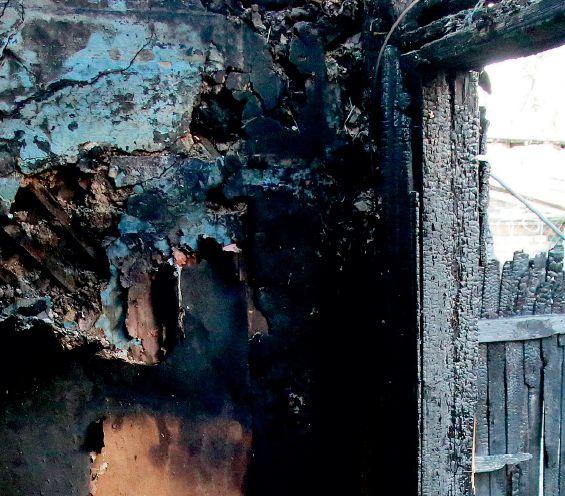

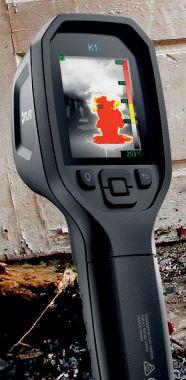
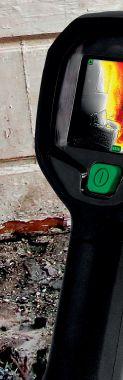
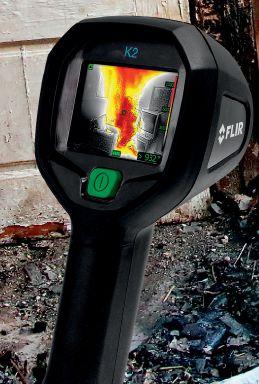
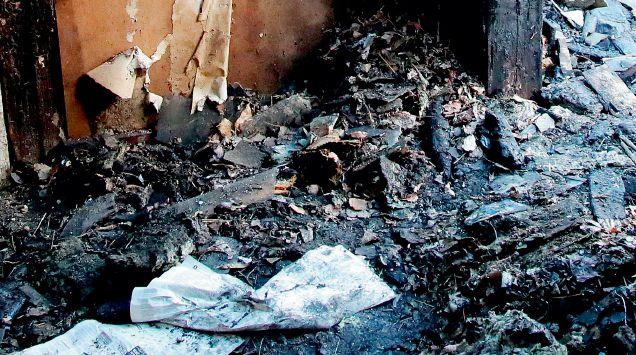

Built rugged and compact, the FLIR K1 acts as your second set of eyes. The pocket-portable instrument can complete a 360o assessment of the overhaul even through the thickest smoke and under total darkness
Providing capability, ruggedness, and reliability at an affordable price, the FLIR K2 saves much more than lives. With easy-to-use buttons and operability in temperatures up to 500oF, the K2 is a small investment that can save lives, protect property, and ensure firefighter safety.
If you’re leading a crew through an investigation, the FLIR K1 and FLIR K2 are the truest way to leave nothing undetected To learn more visit FLIR.ca/fire
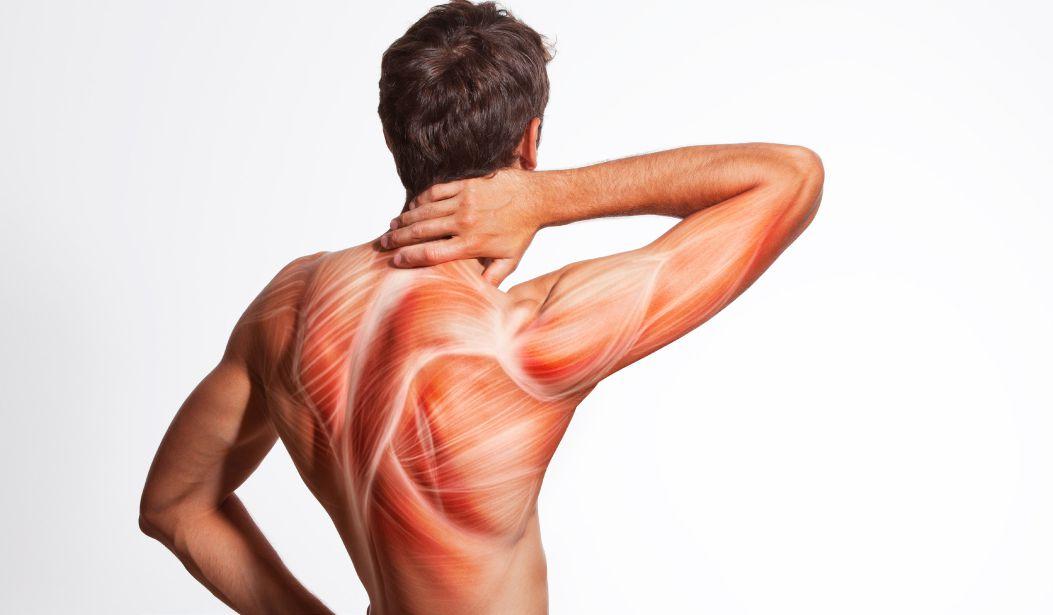
Firefighters need to be aware of the particular areas that are prone to injury in fire fighting.
By CHRIS SEMENUK
TOP Recent research shows rotator cuff injury is most common amongst young firefighters, and more likely to be the first injury to occur.
In a December 2017 study from Western and McMaster universities of 294 active-duty firefighters in Hamilton, Ont., it was determined that 70 per cent experience pain or injury of some kind. Researchers also found that, over the age of 42, the chances of neck or limb pain double, and neck pain quadruples. The study, titled Prevalence and distribution of musculoskeletal disorders in firefighters are influenced by age and length of service, states that rotator cuff injury is the most common in younger firefighters (making it more likely to be the first of the injuries experienced).
This likely does not come as a surprise to anyone who lives with these aches/pains/ injuries. What do we need to do to look at preventing these from occurring, or reducing their intensity/prevalence? As both a univer-
sity level track and field coach and registered massage therapist, I approach this from a unique position.
Since 2001, I have been helping track and field and cross-country teams at Western University figure out ways to keep our injuries down and our performances high. I look towards the athlete’s future, meaning that I actually want them to have a future that does not include taking aches and pains with them from their time in university athletics.The training, the recovery, and the personal care need to be balanced. These principles also apply well to physical jobs like fire fighting. The first concept that I try to instill to ensure balance is that rest and sleep are very important to maintaining health. The rest/ digest phase of training is an integral part of training, indicates research in an article called Recovery in Training: The essential ingredient
BY
published by Jonathan N. Mike and Len Kravitz. Good sleep is one part of it, but so is taking actual downtime. The key to this concept is to realize that resting one’s conscious brain/body increases the activities of repair. This means that all the activity that we put our bodies through to get stronger requires the rest phase to actually repair the micro-damages done.
This applies to firefighters as they are continuously putting their bodies through significant strain. It’s important that firefighters train regularly to safely perform the specific tasks that they will have to do in the course of their job. When organizing a training week for athletes, we alternate “hard” and “light” days, which can help decrease risk of injury. The hard days are when we hit the gym and the track. The light days involve slowing it down so that the long runs are slow enough to carry on a conversation without effort.
We also do mobility drills that move the joints with very little effort to maintain and promote their overall health. This focus is designed to help prevent injuries and pain by allowing the body to have a rest while maintaining some form of activity as well. It is important that the training that occurs on the hard days is tailored to your needs. Aim for a level and intensity that will help you maintain your physical health and prepare you for the stresses of your job.
In the case of firefighters, better preparation for activities like twisting, pulling, turning, and particularly completing these activities with heavy gear on, is needed. Firefighters do these activities frequently, and doing them without preparation is far more likely to lead to injury. Jumping into heavy gear and expecting to functionally carry, lift, pull, twist, run and turn without injury is not realistic. The body needs to be prepared for these activities specifically.
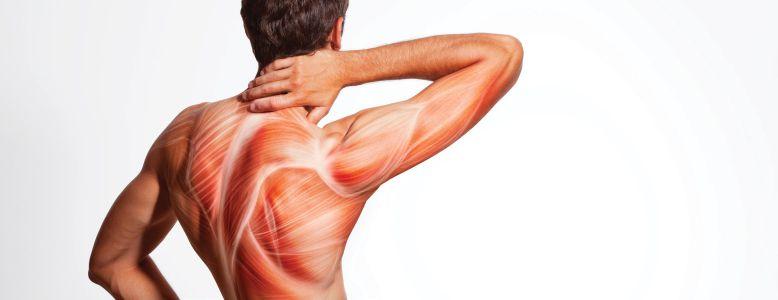
The rotator cuff and the neck have been identified as the top two areas where issues manifest in firefighters. Both these structures are closely related to each other, meaning that when you care for one, you care for both.
The four muscles of the rotator cuff all come from the shoulder blade and insert into the upper arm. This makes them the primary movers of the shoulder joint in all directions. This means that to try to prevent aches and injury to the rotator cuff, it’s important to be mindful of shoulder movements. The supporting structures should be engaged to help with these movements.
Pulling anything towards you with your arm(s) should involve a full rowing motion. This motion involves pulling your shoulder blades together, or towards the spine, at the back. Too often people will just rotate their shoulder joints and not actually engage the help of the other muscles (rhomboids) to add strength and reduce stress on the joint. Spreading out the amount of force needed through the greatest number of muscles reduces the stress sustained by any single muscle.
Both in the gym, and in the field, one should be ready to use his or her full body to create the greatest use of strength and range of motion, while also lessening the chance of injury. Combine this more appropriate movement with a trunk twist in the field, and the injury prevention capacity can become even greater.
Massage, and/or lacrosse ball rolling (against the wall or on the floor), for the rotator cuff and surrounding muscles can serve to keep them healthier longer. The lacrosse ball is great to use on your own, and massage therapy is great when the aches feel harder to get at or will not subside. Take care of the aches before they reach painful lev-
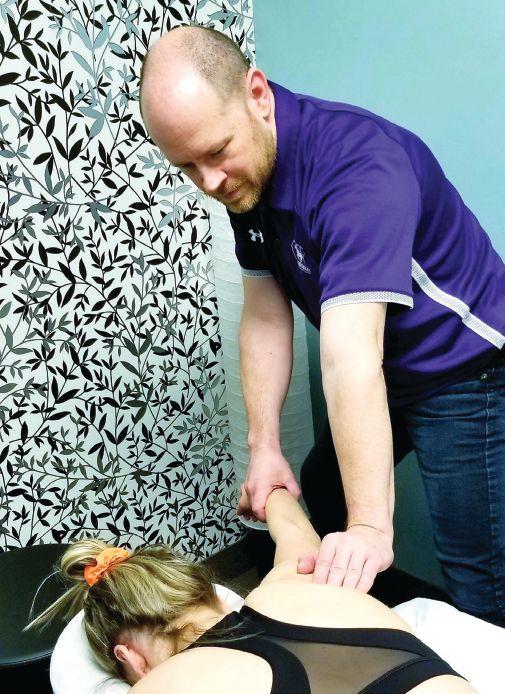
firefighters.
els to ensure the greatest length of pain-free career and retirement.
I tell my athletes, “I am the one you complain to.” By this, I mean that because I am the medical professional, any aches/pains/other concerns that come up should be shared with me fully and right away. My job to evaluate what is needed to keep them healthy. I want to hear about it all so I can paint the best picture possible.
People can be their own worst doctors when it comes to effective personal care. Do not hold onto the idea that you know what needs to be done all the time. When anything presents, get it looked at immediately by a health care professional who is an expert in muscle and joint care. This is important because the Western/McMaster study suggests that it is the cumulative effect (many small things added up) that has the biggest impact on long-term health, rather than one particular incident.
Just like you are the expert in fire control and do not expect a homeowner to battle a blaze that is out of his or her scope, let an expert in health care be the one who deals with your pain assessment and recovery. There are, of course, ways you can contribute to your own health and train your body to avoid many common injuries. If you are told to take downtime, do it. This is how the body repairs best.
Chris Semenuk has been an Ontario registered massage therapist (RMT) since 2001. He is a Canadian Certified Club Coach (formerly known as NCCP level 3) and is head RMT and coach for Western University track and field and cross-country programs (men and women).
BY SUE DAWSON Deputy Fire Chief Barrie Fire and Emergency Service, Ontario
e have talked about the changes coming with Next Generation (NG) 911. If you haven’t had a chance to look at NFPA 1221 standard for the installation, maintenance, and use of emergency services communications systems, 2019 edition, you might want to check it out.
Call processing time is defined as the time from call answer to initial notification of the responding emergency response units. Emergency alarm processing now looks at the timing for the highest prioritization level of emergencies, including medical events such as trauma, cardiac-related events and patients not breathing to name a few.
Also, the following types of calls where significant property loss/ damage is likely or actively occurring will be included in the highest prioritization level:
• Fire involving or potentially extending to a structure(s)
• Explosion
• Other calls as determined by the AHJ
Now come the exemptions. As before, they have included hazardous materials incidents and technical rescue events. But the 2019 edition goes on to say the following types of mitigating circumstances shall be exempted from the requirements:
• Language translation
• TTY/TDD
• Incomplete location
• SMS message to 911
• Calls received from outside the normal area of responsibility and or service area
• Calls requiring use of a PSAP registry or similar tool to determine the appropriate PSAP and/or transfer location
consider being the highest prioritization level of emergency events. Consider what your updated operating guidelines will look like going forward and consider the upcoming changes when text to 911 becomes a reality. What guidelines and procedures will you need to cover these non-voice events?
You will have to consider your current quality assurance programs. Do you refer to any NFPA standards in your program? We use it for one of our key performance indicators for our statistics. As a provider of dispatching service, we also use it as a benchmark that we report to our customers. With all the changes and exemptions in the 2019 edition, we will have to review our measurement tools and make some adjustments.
911 is changing and I believe Canada is doing a good job at trying to make this change a more consistent roll-out for our customers who dial 911.
There are roadmaps available and we are all waiting to hear results of the trials that are taking place. It will be an interesting time going
911 is changing and I believe Canada is doing a good job at trying to make this change a more consistent roll-out for our customers who dial 911.
• Calls received during a significant disaster that severely and significantly deplete available resources, impact local infrastructure, and could result in changes to normal dispatcher procedures (disaster mode)
Section 7.4.15 lists standard operating procedures that shall be included within your communications centre. The change here relating to NG 911 is the inclusion for procedures for handling non-voice events.
Each authority having jurisdiction should be looking at what they
Sue Dawson has been with Barrie Fire and Emergency Service in Ontario in the communications field for more than 30 years. She is the deputy chief of communications and business services. Contact Sue at sue.dawson@barrie.ca.
forward – one with many more questions and not a ton of firm answers or solutions. Yet, sticking with the NENA i3 standard seems to be a consistent message. A new version is out for comment as we speak.
Budgeting for all of this technology with so many moving pieces is difficult.
Another consideration are the discussions taking place on Public Broadband Networks (PSBN) and what they will bring to NG 911. Remembering that there are many facets to NG 911 is the key, the (PSBN) should not be confused as a tool that will assist the process from when the caller dials 911, until it reaches a primary and secondary answering point at a dispatching centre. Continue to follow the great work being done by the Emergency Services Working Group to stay informed from a primary and secondary PSAP perspective.




















A true game-changer. The eDRAULIC® Watertight Extrication Tools (EWXT) are the first of their kind. They allow rescuers to operate submerged in fresh water up to 11 feet, unencumbered by hoses or power units. And they’ve been thoroughly tested and proven, because trouble doesn’t just stay above water. THE EWXT, PROVEN FOR UNDERWATER RESCUES




















BY ELIAS MARKOU Chief Medical Officer
Hills Fire Department, Ontario
hen I decided to write about meditation, I wasn’t sure how this topic would go over with firefighters. As I waded through the mounds of research, I quickly realized every firefighter should hear this story.
Meditation is a body and mind skillset and practice that has long been used in history to increase physical relaxation, calmness and improve overall well-being and health.
A 2017 National Health Interview Survey (NHIS) found that the use of meditation by American adults tripled from 2012 to 2017. The idea of carving out some time to sit and meditate may sound crazy and counterintuitive in our fast-paced world, but study after study confirms that a few minutes twice daily can make it easier to manage life’s challenges.
There are many styles of meditation and, just like anything, you will have to explore what works best for you and implement that into your life. I am sure you can find all this information on the internet and, more specifically, on YouTube, but I highly recommend you start by finding a meditation teacher or a course close to home.
Every meditation has four common elements. The first element is a quiet place with no distractions. Second, choose a posture such as sitting on the floor, sitting on a chair, moving or standing. Thirdly, focus your attention on a chosen word, phrase or simply your breath. And finally, have an open mind with no judgement. Let your thoughts in and let your thoughts leave your mind effortlessly.
Take a minute, just one minute, and consider these five reasons you, as a firefighter, should consider adding meditation into your life:
March 2018. Author of the study, Anthony Zanesco, said, “Intensive continued meditation practice is associated with improvements in attention, concentration and decreased cognitive decline.”
3. Improve circulation and cardiovascular system: The fire service has long known that there is a high incidence of cardiovascular disease among firefighters. A 2017 paper published in the journal of the The American Heart Association had experts agreeing that meditation may help lower blood pressure, reduce mortality risk from heart disease and improve arteries and blood flowing to the heart. The study went on to say high risk behaviours like smoking and drinking alcohol, often linked to heart disease, can be aided and reduced using meditation.
4. Reduce and manage pain: Dr. Fadel Zeidan, assistant professor of neurobiology and anatomy at the University of California San Diego and lead author of a study in investigating meditation and pain, found that participants who meditated during pain medication administration had significantly lower pain intensity and unpleasant-
A 2017 National Health Interview Survey (NHIS) found that the use of meditation by American adults tripled from 2012 to 2017. ‘‘ ’’
1. Reduce stress: A literature review in 2014 of 47 scientifically-conducted meditation trials involving 3,600 participants suggested that a daily meditation practice showed significant evidence of improving anxiety and depression.
2. Improve concentration and focus: The most comprehensive study that looked at improving concentration and increasing mental focus was done by the psychology department of the University of Miami and published in the Journal of Cognitive Enhancement in
Dr. Elias Markou is one very busy naturopathic doctor. He is in private practice in Mississauga, Ont., and is the chief medical officer for the Halton Hills Fire Department. Dr. Markou was a firefighter for six years; he is a firefighter health expert and blogger who is regularly featured on television and radio and in print. Contact him at drmarkou@mypurebalance.ca
ness than that of the control group. Pain ratings of participants were reduced by 25 per cent from the baseline group. This is just one study showing that meditation relives chronic pain in combination with pain medication. There are a number of studies that show meditation alone can also help reduce pain in patients.
5. Cultivate inner peace and increases appreciation for life: Jon Kabat-Zinn, professor emeritus of medicine, author and famous Zen meditation practitioner, was made famous by showing people in the West that meditation can be used to cultivate inner peace and love of life. He was able to demonstrate that meditation expands our awareness and opens our minds to new things around us.
Scientists have discovered that this ancient tool, once considered done, is new again. The resurgence of meditation can only be considered one of the best 21st century life savers. Give it a try.



BY SHAYNE MINTZ Canadian Regional Director NFPA
t’s November in Canada, the perfect time to think about spring wildfire preparedness. The NFPA and its Wildfire Community Preparedness Day (May 2) partners encourage you to find time between now and Jan. 31 to apply for funding to help you help your communities prepare.
Traditionally, wildfire management has been in the scope of provincial ministries that deal with Natural Resources Canada and the Canadian Council of Forest Ministers. However, there is a growing expectation that municipal structural firefighters should be trained and prepared to respond to and extinguish wildland fires that may impact homes and structures belonging to local taxpayers.
That paradigm shift presents a great opportunity for local fire services to take the lead and participate in the sixth annual national Wildfire Community Preparedness Day on May 2.
Partners in Protection Association, the non-profit parent of FireSmart Canada, with support from the NFPA, the Co-operators Group Insurance, the Institute for Catastrophic Loss Reduction, and provincial natural resources ministries, have pooled resources to provide stipends to communities that take on Wildfire Community Preparedness Day activities. In 2018, more than 120 communities across Canada received $500 to raise awareness of the benefits of wildfire preparedness through community clean ups or awareness events.
Between Nov. 1 and Jan.31, anyone 19 years or older – or any community group or association – can apply for a $500 stipend to conduct wildfire-preparedness activities or events. For instructions on how to enter, and a list of ideas, visit firesmartcanada.ca.
May 2 is the official Wildfire Community Preparedness Day, events can be held on dates that work for the hosting group and the community.
I know it seems odd that a discussion about wildland fire should be starting in the late fall, but very quickly winter turns to spring, and spring to summer, and if the proper conditions develop that means wildland fire season in many places across Canada.
Natural Resources Canada reports that since 1990, wildland fire has consumed an average of 2.5 million hectares per year and causes millions of dollars in damage, not just to the forest industry but also, to residential and community properties.
In a recent conversation with Laura Stewart, president of Partners in Protection at NFPA’s annual conference, she said unless Canadian communities take action, the threat of wildfires will only become worse.
“Wildfires have always been a natural process in Canada’s forests,” Stewart said. “However, as we have experienced in recent years, a changing climate, increasingly greater fire activity and growing development trends into the wildland urban interface create a serious threat throughout Canada – putting the public, neighbourhoods,
‘‘ ’’
Successful applications should focus on reducing the risk of wildfire in a community through education, hazard reduction or preparedness activities.
Successful applications should focus on reducing the risk of wildfire in a community through education, hazard reduction or preparedness activities. Potential projects include working with neighbours to clear leaves and other combustible debris from gutters of homes and buildings, raking leaves and combustible debris from under decks, moving woodpiles away from buildings, using a chipper service to dispose of slash or winterkill or distributing wildfire-safety information.
While many Canadian communities may still have snow on the ground on May 2, that shouldn’t deter participation. And although
Shayne Mintz has more than 35 years of experience in the fire service, having completed his career as chief of the Burlington Fire Department in Ontario. He is now the Canadian regional director for the National Fire Protection Association (NFPA). Contact Shayne at smintz@nfpa.org, and follow him on Twitter at @ShayneMintz.
communities, firefighter and other first responders safety at risk every year.”
Wildfires are a part of natural ecosystems; however, interface situations can occur in all but the heaviest of urban environments. It’s important that fire services and their communities recognize that wildfire isn’t just limited to municipalities or towns built within or close to heavy or dense forests. Wildland interface exists in many more settings, such as urban forests, municipal green spaces, farms and recreational areas such as cottage or camp communities.
Fire departments can also use the day to engage with their provincial natural resources partners; it’s a chance to build relationships. It’s often been said that an emergency site is not the place to start exchanging business cards.
To learn more and apply for funding, visit firesmartcanada.
Contact your local dealer for more information, or visit
e-one.com/innovation

Cab structure can withstand over 5X the static roof load and over 2X the frontal impact • Exceeds NFPA aerial structural safety factor of 2 to 1 by 25% • Contributes to E-ONE’s proven safety record for over 30 years
5X STATIC ROOF LOAD AND 25% STRONGER AERIAL
Gross decon pump panel outlet with heated water
HEPA air filtration unit in the crew area
• Easy to clean vinyl or anti-microbial seat upholstery • Non-SCBA seats to help prevent contamination from air packs • SCBAs stored in exterior cab or body compartments

Results in less frequent DPF regenerations due to reduced idling
Requires no routine maintenance
Eliminates emissions, fuel usage, engine noise and exhaust heat during operation
ZERORPM IDLE MITIGATION SYSTEM
Access specific truck documentation
Secure remote user interface
Trouble-shoot and support with updates to assigned individuals
Assess vehicle health with real-time status of critical components
Improve uptime
AND
As an industry leader, we focus on delivering solutions to meet your needs.
AXIS TM SMART TRUCK TECHNOLOGY
Alot of information documenting the characteristics and experiences of first responders such as police and paramedics has accumulated. While some research efforts have also been directed towards professional firefighters, not as much is known about volunteer firefighters. They are an interesting group as they come from a variety of personal and professional backgrounds with little to no training prior to joining the crew.
This raises questions about their unique vulnerabilities with respect to facing danger and recovering from potentially traumatic experiences. We did a study on rural volunteer firefighters as a means of deepening our understanding about their needs. We wanted to learn more about their experiences with symptoms of depression and post-traumatic stress. In addition to their needs, we wanted to shed light on how firefighters may experience growth and healing following a potentially traumatic event. In doing so, we hope our findings may assist in developing improved clinical interventions.
We collected demographic information on 35 part-time, rural volunteer firefighters. Demographic variables included years of service, position, gender, level of education, and marital status. We also measured depressive and post-traumatic stress disorder (PTSD) symptoms along with other health-related indicators, such as sleep.
Thirty-two of the firefighters were male and three were female. Their level of experience ranged from one month to 30 years, with the majority (76 per cent) at the operational level. Eighty-eight per cent of participants rated their level of physical activity in the past month as ranging from average to good. One quarter of the firefighters were physically active in their paid jobs. Finally, all firefighters rated their overall health as being average to good.
Study shows higher
By JUDY MOENCH AND CERI MOORE
Fourteen per cent of firefighters reported symptoms in the clinically significant range on the depression scale. The Mood Disorder Society of Canada reports that eight per cent of Canadians will experience major depression in their lifetime. Our sample showed close to double that percentage.
Eleven per cent of firefighters reported symptoms in the clinically significant range on the PTSD scale. This rate is considerably higher than the national average of 9.2 per cent in the general population.
Based on these findings, it seems warranted to consider providing support, monitoring and further intervention, including education and treatment, for volunteer members. The following information explores the correlation between the demographic variables measured and symptoms of depression and PTSD
in our participants. It should be noted that a correlation indicates the presence of a relationship, as well as the strength and direction of that relationship. However, it does not establish a causal link.
Our results showed a strong correlation between level of physical activity and severity of depressive symptoms. In other words, members who reported being more physically active were less likely to report symptoms of depression. There was also a moderately strong correlation between reported levels of overall health and severity of depressive symptoms. Members who were healthier overall reported fewer symptoms of depression. There did not appear to be a relationship between depression and the other demographic variables measured.
■
Our data suggested a strong correlation between levels of physical activity and post-traumatic symptoms. This suggests that as the level of physical activity increases, PTSD symptoms decrease. There was also a moderately strong correlation between the physical activity level in a paid job and the severity of post traumatic symptoms. There did not appear to be a relationship between the other demographic variables measured and severity of post traumatic symptoms. Based on these results and existing research evidence, increasing physical activity will likely result in decreased depressive and post traumatic symptoms.
It should be kept in mind that there may be other variables that affect symptoms of depression and post-traumatic stress that we did not study. We also did not study the effects of any specific psychotherapy treatments on symptoms. Furthermore, a larger sample size would be needed to estimate rates of depressive symptoms and PTSD symptoms in rural, volunteer firefighters with a higher level of confidence. Nonetheless, the rates presented here are representative of the members that participated in this particular study.
Although there are risks in fire fighting, there are also important opportunities for the prevention of symptoms and the amelioration of adverse outcomes. A pyramid of intervention can be helpful in furthering our understanding of how this may be achieved. This pyramid reflects some of the strategies firefighters in our sample suggested as being important for their wellness, but it can be easily modified to meet the needs of individual teams.
At the first tier/base of the pyramid sits a universal system where supportive environments promote mental health for all firefighters and their families. This includes ensuring a welcoming and respectful work environment. The focus could be providing information sessions on trauma and stress, peer support, opportunities for physical activity, and ensuring access to family and employee assistance programs.
The second tier could be a more targeted and focused short-term support system that includes evidence-based interventions that would allow members involved in a potentially traumatic incident to process their emotional response as a small group.
Fourteen per cent of firefighters reported symptoms in the clinically significant range on the depression scale.
Finally, the third tier would include more specialized intensive treatment (one-to-one assistance) as needed.
Let’s now consider examples of the types of intervention at each of the tiers above.
One example of an intervention at the base of the pyramid is physical activity. Physical activity has a demonstrated beneficial effect on symptoms of insomnia, hypersomnia, fatigue, excessive or irrational guilt, suicidality and indecisiveness.
As an intervention, physical activity may lend itself to the fire fighting context since it may help re-establish a healthy sense of personal control or self-efficacy, which may be fractured by traumatic events. The beneficial impact physical activity has on symptoms of depression and PTSD may be due to how it effects the brain. Cognition and brain functioning at the molecular, cellular, systemic and behavioural levels are positively influenced by aerobic exercise.
Furthermore, based on their review of the literature, Thomas, Dennis, Bandettini and Johansen-Berg (2012) concluded in The effects of aerobic activity on brain structure that aerobic exercise increases gray matter density in the frontal, temporal and cingulate regions of the brain. The frontal lobe houses the prefrontal cortex, which is responsible for activities such as self-awareness, executive functioning, memory and attention.
Since PTSD reduces activity in the medial prefrontal cortex, this suggests that it may compromise a person’s ability to execute these skills. Along with the prefrontal cortex, the temporal lobe of the cerebral cortex is also implicated in memory. Because some symptoms of PTSD involve memory disturbances such as flashbacks or dissociative amnesia, again it seems warranted to engage in exercise that can bolster the functioning of this brain region.
Traumatic events not only hold the potential to harm, but also to generate growth. Posttraumatic growth (PTG) refers to positive changes that stem from facing intensely diffi-
’’
cult life circumstances.
Research evidence on first responders is shedding light on some of the benefits that may be gained following a traumatic event. In a study of individuals employed in ambulance services, 98.6 per cent of respondents experienced one or more positive changes as a result of a work-related critical incident. These results begin to normalize the possibility of PTG and highlight the need for therapeutic interventions and debriefings to address this topic. In a study on 1,916 firefighters who faced a critical incident, results indicated that 51.7 per cent of firefighters achieved some level of positive growth.
Eye Movement Desensitization and Reprocessing (EMDR) is an example of an intervention that may be offered on the third tier. EMDR therapy is an eight-phase treatment approach that uses bilateral stimulation, including eye movements, to work with clients who have been exposed to traumatic events. By targeting cognitions, images, feelings and body sensations, EMDR assists clients in reprocessing such events so that a more adaptive perspective on them is facilitated.
EMDR is garnering research support and is recommended by the World Health Organization as a treatment for trauma. Despite the limitations of our study, the results may begin to facilitate a better understanding of the needs of rural volunteer firefighters in Canada. Canadian volunteer firefighters are a population that warrant further study.
Dr. Judy Moench is a registered psychologist in Edmonton. She is also an adjunct professor at the University of Alberta and president of EMDR Canada and co-ordinates the Disaster Response Network for the Psychologists Association of Alberta. Ceri Moore is a registered psychologist in Newfoundland and Labrador. She has been involved in several research projects examining recovery from trauma, some of which have focused specifically on the needs of first responders.


BY DAVE BALDING Fire Chief
Golden Fire Department, British Columbia
recently, with immense pride and no small amount of humility, marked the beginning of my 35th year in our fire service. Reflecting on this milestone is especially poignant for me at this juncture in my career. I have learned much over these years about the profession I treasure. Enhancing our operational skills, both tactical and strategic continues – something I embrace. Moreover, the learning includes what were considered ancillary skills such as looking after our most valued resource, our members. Leadership and all its facets (passions of mine) are so very essential at every level in every department. Looking after each other and ourselves is gaining awareness and importance as another critical fundamental. Thankfully, elements such as hypertension, cardiac health, physical conditioning, obesity, substance abuse, cancer prevention and adequate rest are now front and centre. These are interconnected with another piece of the wellness equation — mental health. Education and awareness are working to erase the stigma around the effects some of us endure as a result of our chosen profession. Mental wellness is beginning to garner the attention it deserves.
We in the fire service are doing a better job today of looking after our own than we ever have. We inherently watch out for each other on and off the fire ground. We watch for trends in our colleagues’ moods and take notice of decaying attitudes and performance. We are keenly aware of changes in social behavior. Dependent on circumstances, we may check in with our peer or exercise some other form of support. In short, we have each other’s backs.
result has been a trend that has impacted my fire department and colleagues, my family and me, in short everyone close to me. There is good news; it’s never too late to grow inwards as well as outwards by cultivating self-awareness. Tools such as counselling and practicing mindfulness continue to help. I view this much like a significant fire event, rather than go it alone, I called for mutual aid – quite a set of resources. The pre-flight safety briefing that I pay attention to whenever I fly comes to mind as passengers are instructed to don their own oxygen mask before assisting others. This example is analogous to taking care of ourselves first to be the best fire service leaders possible. While it may sound self-serving, ‘it begins with me’ truly is a necessity to ensure a foundation from which we can be our absolute best in all respects. The notion of ‘I’m a firefighter, I don’t have feelings’ is and always has been out of touch. In fact, a well known therapist, Virginia Satir, proposes our actions and behaviours are predicated on our feelings, perceptions, expectations and yearnings.
Our ability to perform to our utmost abilities at emergency
While it may sound self-serving, ‘it begins with me’ truly is a necessity to ensure a foundation from which we can be our absolute best in all respects. ‘‘ ’’
If there’s such a thing as a gradual epiphany, I’m having one. It is around checking in with ourselves, more specifically myself. This may be old hat to some and a new notion to others; after all we are firefighters to help other people. We are inclined to become absorbed by what we do very well; helping others in their worst hour and our peers on an ongoing basis. The importance of being self-aware and doing in-depth self-check-ins regularly is coming home to me. It may also be one of the most challenging concepts as I take time to learn about me. Sure, I paid attention to fitness, diet and other superficial aspects of my health but there were areas left unaddressed until very recently. Perhaps a part of why is the ‘it won’t happen to me’ attitude that I sport. Another part is certainly a lack of connectivity with self. The
Dave Balding joined the fire service in 1985 and is now fire chief in Golden, B.C. Contact Dave at david.balding@golden.ca and follow him on Twitter at @FireChiefDaveB.
scenes in order to help the public we serve and continue being a reliable and vital part of our department is contingent on our taking responsibility for a number of self care and wellness elements. We as humans are incredibly resilient – to a point. Carrying on oblivious to challenges in our lives isn’t a successful long-term strategy. We’re fortunate to have those around us to illuminate our blind spots and bring noticed concerns to our attention — don’t ignore them. An ‘I got this’ approach is a disservice to everyone beginning with ourselves. The goal of wellness has several dimensions; intellectual, emotional and physical are prime among them. It is considered a state of well-being to address all these aspects, far above and beyond the simple absence of maladies or infirmity.
Look after yourself, in every respect. You and those around you depend on it.
As the official Canadian dealer, we distribute genuine Spartan parts as well as replacement parts for all brands of fire-rescue vehicles.
In most cases, our knowledgeable parts team can supply you with the part you need within 48 hours 90% of the time.

BY TINA SARYEDDINE Executive Director
Canadian Association of Fire Chiefs
xxperts contend that there is a relationship between leadership and lifelong learning. Even after leaders achieve a top position, they stay curious. They test and refine their skills, they look for peer support and they keep growing.
This is true for the chief fire officers in Canada. Many commit to continuous learning and training of all sorts. The Executive Chief Fire Officer (EFCO) program if one of the ways in which they do as it allows chief fire officers to demonstrate their competencies in 30 key areas. The beauty of this program is that it is designed for portability across municipalities and provinces, allowing for a national standard of practice.
“This has advantages for recruitment and mobility,” said Phil Lemire, fire chief in White Rock B.C., president of the Fire Chiefs’ Association of British Columbia and Chair of the ECFO Council.
The ECFO Council sets the curriculum and provides assessments for the candidates. To date, there are over 100 executive fire officers in Canada.
This year, to encourage more diversity in the ECFO candidate programs, the ECFO Council, in collaboration with the diversity and inclusion committee of the CAFC, awarded bursaries to individuals who have the ability to increase diversity in the program.
The bursaries went to Nina McCarthy, deputy fire chief in Fredericton, Jeremy Parkin, deputy fire chief of Rama Fire Rescue Service in Chippewas of Rama First Nation, Ontario and Judy Unsworth, deputy fire chief in Strathmore, Alta.
In addition, Debora Bergeson, assistant deputy fire chief at the Calgary Fire Department, received a bursary for the ECFO Candidate program.
of the CAFC. Planning for the sustainability of the fire sector is as important as addressing the needs of the day. The ECFO Candidate program allows all of our departments to begin grooming our next generation of leaders by allowing them to develop and test in 22 of the 30 ECFO competencies.
The curriculum and technology for the ECFO program was made possible through a 2016 grant from the Motorola Solutions Foundation, which allowed the CAFC to restructure and modernized the former Chief Fire Officer program. Those holding the former CFO designation have until December 2019 to transition. The transition process involves a review of the current status of the CFO holder, a commitment to the maintenance of certification requirements and taking the new oath.
All candidates holding the ECFO candidate program will begin their maintenance of certification in the next year. The maintenance of certification process involves demonstrating a minimum of 25 hours in various competencies. This must be completed every two years.
The CAFC wishes to congratulate the following individuals for their new ECFO designations: Daniel Atkinson, deputy
Planning for the sustainability of the fire sector is as important as addressing the needs of the day.
The ECFO Candidate program, not to be confused with candidates of the ECFO program, is a sister program to that of the ECFO that allows those not yet in chief officer positions to try their hand at a subset of associated competencies.
“The ECFO Candidate program is as important to the CAFC as the ECFO program”, said Ken Block, Canadian Association of Fire Chiefs (CAFC) president and Edmonton’s fire chief. In the view of the CAFC board of directors and the National Advisory Council
Tina Saryeddine, PhD, MHA, CHE, is the executive director of the CAFC.
fire chief, Victoria Fire Department; Michael Boyle, division chief, Kennebecasis Valley Fire Department (New Brunswick); Jason De Roy, assistant fire chief, North Vancouver City Fire Department; Brian Hutchinson, fire chief, District of North Vancouver Fire and Rescue Services; Wayne Kennedy, deputy fire chief, District of North Vancouver; Chris Royle, deputy fire chief, Victoria Fire Department; Dan Wood, deputy fire chief, Saanich Fire Department (British Columbia).
If you are interested in the ECFO or the ECFO Candidate program please reach out to the CAFC’s manager of membership services Anabel Therrien at atherrien@cafc.ca. Or check out our website at www.cafc.ca.




BY MARK VAN DER FEYST
Avery common problem in the fire service is our communications. Whether it be with the infrastructure of the system, the type of portable radios that we use, or other aspects, it always seems to be a never-ending problem.
In any LODD report issued by NIOSH, a common suggestion listed to avoid repeat instances is to address, fix or revise the communications system that was being used. Sometimes the system is too overburdened for the department – too many radios in use at once for multiple calls and too few channels available for dispatch. Sometimes the system is too antiquated and requires an overhaul from top to bottom.
One main component of the whole communication system is with the end user – there are consistent issues with the end user that can be easily corrected with proper training and practice. These issues are what lead to a systematic breakdown of communications on the fire ground.
After a while of being exposed to these issues, the firefighter can begin to view their poor communication behavior as normal. The firefighter becomes desensitized to the proper ways of communicating and sticks with the bad habits that prevail and contribute to these systematic failures.
One problem area is our listening skills. Active listening is a skill that needs to be exercised when using any type or brand of portable radio. There is much chatter that takes place over the portable radio and sometimes people miss key information or being called by someone else. Distractions can certainly occur on the fire ground which will cause a person to not be listening actively.
When the Incident Commander is bombarded with calls on the radio as well as firefighters wanting face-to-face time, it’s very easy to miss some of the radio chatter. On the flip side, when the firefighter or officer is intently focused on a certain task or issue, they tend to block out or not hear the radio and will miss key information or being called by Command.
Active listening requires intently listening to the radio – it is devoting your full attention to hearing what is being transmitted over the airwaves. Officers assigned to a crew, accountability officers/ISO and RIT teams need to be actively listening to the radio, as well as pump operators/drivers, so that they can support interior crews with things they need before it is asked for by Command.
Missing information is another area that creates challenges. This is where the user transmits a message but does not include all the information. This can be due to not thinking about what needs to be said prior to transmitting, or from improper keying of the radio
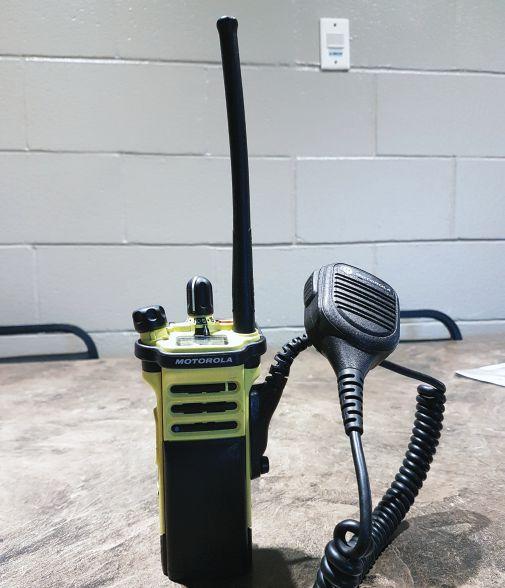
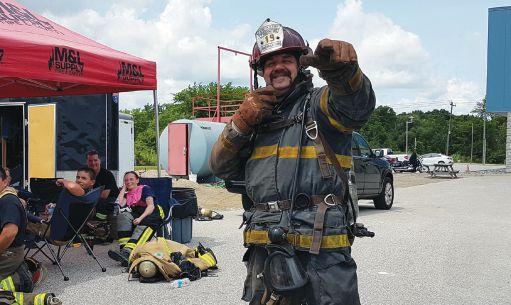
which cuts out parts of the message. The latter is the more common mistake made by most users – they start speaking too quickly before keying the mic or they cut themselves off before finishing.
A good rule to remember is key 1-23; key the mic, then count 1-2-3, then start speaking. This will ensure that the entire message will be captured and transmitted.
Excess chatter on the radio contributes to problems. There are individuals who love to talk on the portable radio. Every chance they get, they will key the mic and send a message across. Sometimes the message they are sending is not that urgent, important or relevant to the situation. Yet the message gets transmitted anyhow, tying up the radio from others who need to send an urgent message or request.
There needs to be restraint when it comes to using the portable radio. Firefighters and officers need to learn that the portable radio is not a personal DJ radio mic; it is a lifeline for each person who has one with them.
For those people who are prone to abuse the portable radio, perhaps removing the device from them is the best solution – it will show them that they need to exercise restraint when using the radio while at the same time freeing up the air time for the remaining members who need it.
The last problem area is lack of control while using the portable radio. Unlike the previous point above, this has to do with the practical operation of the portable radio. There are certain ways that we need to hold and use the portable radio and mic in order to transmit properly. Doing so allows the message to come across clearly so that it can be understood by everybody.
Whenever the radio and mic are not held in the right position, the message becomes distorted. Distortion can occur when the mic is held in front of the regulator on the SCBA, when it is held directly in front of the person’s mouth and their lips are touching the mic and when the person is yelling into the mic at high volumes.
The proper use of a portable radio mic is to hold the device at a slight angle away from your mouth about two
inches – this will allow for clear and concise communications. If the firefighter is wearing a SCBA face piece, he should place the radio mic directly on the lens of the SCBA to transmit the message. It will come across very clear on the other end. Some SCBA manufactures will have integrated communication systems for the portable radio, but when they fail, you will need to default back to the basics.

Mark van der Feyst has been a member of the fire service since 1999 and is a full-time firefighter in Ontario. Mark teaches in Canada, United States and India, and is a FDIC instructor. He is the lead author of the Residential Fire Rescue book. ContactMark at Mark@ FireStarTraining.com.
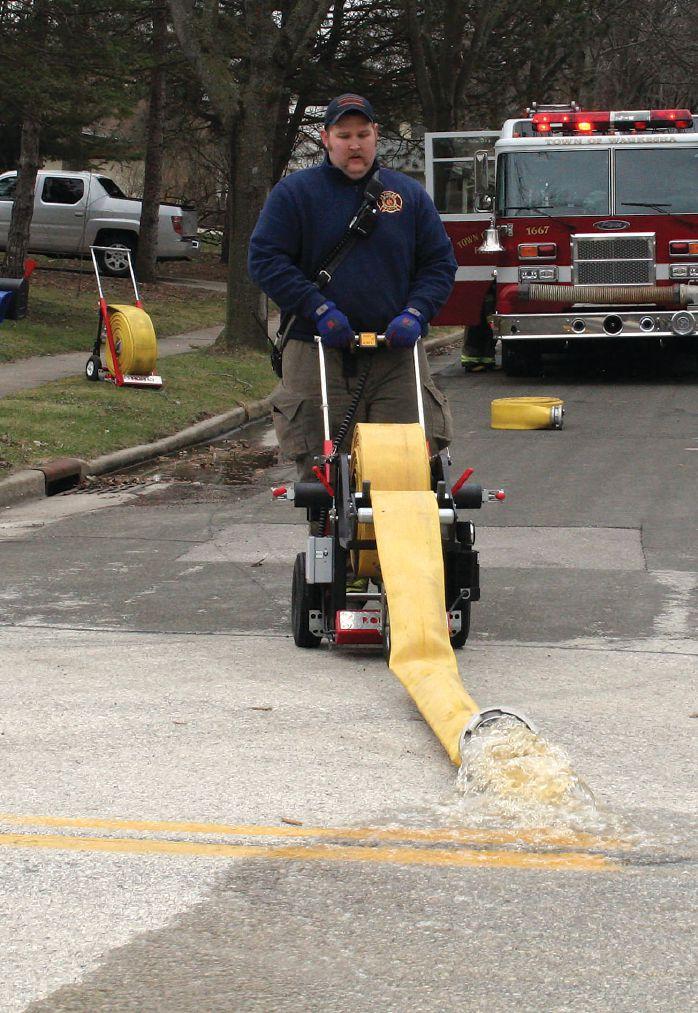
Canadian seniors are two and a half times more likely to die in a structure fire than their younger counterparts. And those who are 85 and older, are 3.4 times more likely to perish in a blaze than non-seniors, indicates a recent study.
Fire Risk in Senior Population, by Len Garis and Chris Biantoro, University of the Fraser Valley (UFV), uncovered troubling trends.
The study drew from data collected over 10 years (2005 to 2014) from the National Fire Information Database (NFID). There was a lack of data respecting seniors’ fire casualties from the Office of the Fire Marshals and Fire Commissioners annual publications. Using the NFID, the authors were able to track 436,256 fire incidents over the 10 years.
The research prepared in the UFV study explored risks of fatalities and injuries as a functions operation of life safety systems, the ages where they are most likely to occur and the causes. It also examines a forecasted growth in fatalities among seniors and recommended ways of mitigating that casualty rate.
Over the 10 years of the study, there has been a reduction in fatalities across all age groups. However, starting in 2009, the casualty rates of the senior population rose above its younger counterparts. This may be a matter of global demographics.
“Fire fatalities among seniors are expected to increase as the baby-boom population enters its senior years,” the study states. “Currently, there are approximately 50 fire-related deaths per year occurring in our senior population.”
This is almost one-third the amount of fire-related deaths in Canada, despite seniors being only about 14 per cent of the population.
“Without a focused effort to ensure senior residents have the appropriate operational safety equipment, the annual fire-related death rate of seniors is expected to
Measures need to be taken to ensure better safety in seniors’ homes. Here’s why.
By LEN GARIS AND KEVIN DIAKIW
Canadian seniors are significantly more likely to perish in a fire than younger people. A University of Fraser Valley study looked at the data and how to mitigate the risk.
climb to between 90 and 140 fatalities in the next 25 years,” the study says.
A vast majority of those fatalities and injuries occurred in structure fires, the bulk of which were in residential buildings.
Of the provinces examined in a regional tally between 2012 and 2016, British Columbia had the highest percentage of senior fatalities (43 per cent), as opposed to Quebec and Ontario, which both reported 40 per cent of the deaths were seniors.
“The provincial and territorial annual reports demonstrate that the fatalities for the population 65 or above is overrepresented among deaths,” the study reported.
The greatest causes for death for seniors during a fire was entering or remaining in the building for fire fighting and being injured during an attempt to escape the fire. A somewhat distant third-rate cause
for fatality was a loss of judgment or panic. Much lesser causes were entering to save property, or for rescue purposes, heart attack or delayed warning.
In nine times out of 10, the fatalities occurred when there was no physical or mental impairment, or while they were bedridden or asleep. The causes were similar both in cases where there was a working smoke alarm or not.
In the homes with smoke alarms, survival rates increased for people of all age groups. This finding is consistent with determinations made in previous studies.
“From the calculation of relative risk, those seniors living at homes without working smoke alarm seemed to be 1.9 times more likely to die than those with working smoke alarms,” the UFV study found. “Furthermore, among the senior population
living at homes with working smoke alarm, the trend of fatality rates shows a decline since 2007, whereas for those living without working smoke alarm, the declining trend started in 2010.”
The concern of senior fatalities in fires grows as their population does. In 2013, Canada had 5.4 million seniors, triple that of 50 years prior.
In 2063, it’s expected that the population of seniors will at least double again, to between 11.1 million and 15.1 million.
Using an average weighted fatality rate as a baseline, analysis shows that fire fatalities among seniors will reach between 130 and 146 by the year 2040.
“In 2063, the fire fatalities could reach over 2.5 times the fatalities of 2014, ranging from 142 and 194 fatalities per year… ,” the study said. As has been discovered in previous analysis, an effective way of reducing fatalities in all age groups is to ensure homes have functioning smoke alarms.
“The previous analysis showed that seniors living at homes with smoke alarms have a 55 per cent less likelihood of dying at the event of a residential structure fire,” the study stated. Operating on the assumption that all seniors would be living in homes with functioning smoke alarms, the research shows fatality rates would be significantly impacted.
“The impact would be the reduction of expected fatalities to between 50 and 60 expected fire fatalities per year among seniors in 2040, compared with 84 and 94 per year for the same period if there were no further efforts in reducing fatality rates. In 2063, the expected fire fatalities would be reduced to 58 to 79 per year compared with 92 and 125 fatalities per year if there are not changes to the system.”
The study offers a conservative projection at the overall deaths of seniors in residential structure fires in the years to come. Given the vast overrepresentation of seniors dying in fires, further examination is necessary, particularly given the high percentages (40 per cent) of fatalities recorded in the “unknown” age group category.
“Without any further interventions in reducing the fatality rates among seniors, we can expect approximately 90 fire fatalities among seniors annually in the next 25 years. The projections made here highlight the importance of life saving mechanisms for this vulnerable populations as other studies have articulated.”
The study showed the impact of increasing awareness of the presence and ongoing smoke alarm maintenance after the education program.
The study recommended emphasizing the importance of life-saving mechanisms and prevention strategies for seniors, but also providing awareness to policy makers to improve access to those services for this vulnerable population.
Len Garis: was the Fire Chief (ret) for the City of Surrey, British Columbia, Associate Scientist Emeritus, BC Injury research and Prevention Unit , an Adjunct Professor in the School of Criminology and Criminal Justice & Associate to the Centre for Social Research at the University of the Fraser Valley (UFV), a member of the Affiliated Research Faculty at John Jay College of Criminal Justice in New York, and a faculty member of the Institute of Canadian Urban Research Studies at Simon Fraser University. Contact him at len.garis@ufv.ca.
Kevin Diakiw: is a journalist and founder of Still Here Mindfulness, resiliency training for first responders and other high-risk professions. He is also certified in trauma response from the Justice Institute of British Columbia and a Qualified MBSR Teacher through University of Massachusetts Medical School.




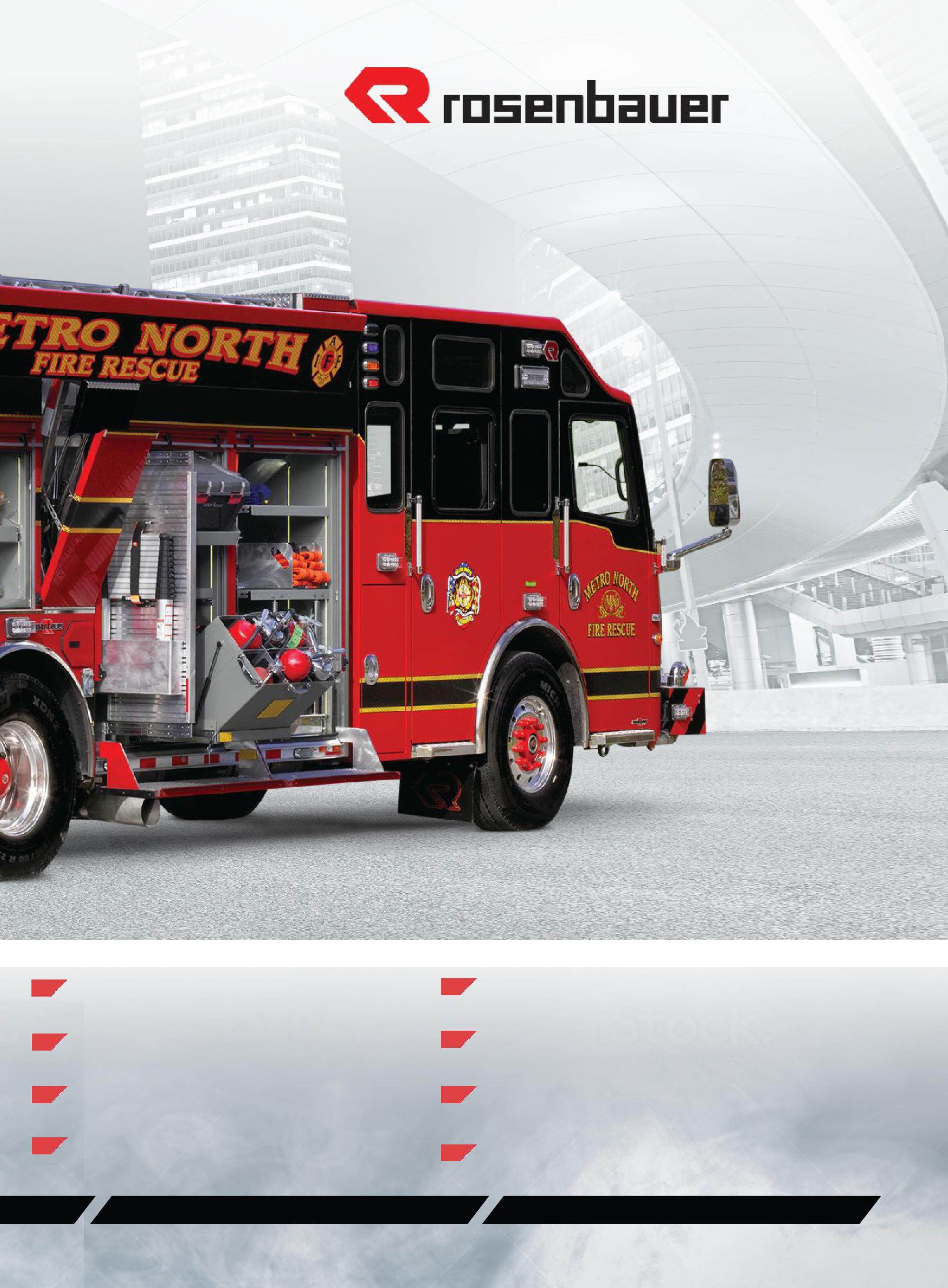
By NICOLE VEENEMA
When Jay Arns became chief of Petrolia and North Enniskillen Fire Department in Ontario, he said he was determined to focus on health and wellness initiatives for the volunteer firefighters. He’d worked in a fire department in a large city and had seen the benefits that such initiatives brought to full-time firefighters.
“I wanted to take care of our most important asset – our people,” said Arns.
His team approached Central Lambton Family Health Team (FHT), located in Petrolia, and met with executive director Sarah Milner. She and her team welcomed the opportunity to collaborate.
“We quickly realized that most of the department’s firefighters were already our patients – although some didn’t see their doctor very often,” Milner said.
The initiative was launched with a barbecue attended by firefighters, their families and members of the family health team. The fire department brought all of its trucks and fire gear. It was all part of an effort to help each group understand the perspective of the other and begin building relationships. It was also useful in generating positive community exposure. The firefighters and family health team are respected in Petrolia and it is a source of community pride that they look out for each other and the town itself.
Milner said there was some initial hesitancy on the part of some firefighters.
“There may have been a concern that we were going to find a reason they couldn’t continue as a firefighter.”
However, Arns said the work establishing trust paid off.
“Everyone understands we’re doing this so that they can continue doing this work as long as possible, and have peace of mind that they will be there for their families too.”
Arns wasn’t able to find a standard wellness program for volunteer fire departments, so he and Deputy Chief Brian Clark had to create their own. The starting point was the Wellness Fitness Initiative from the International Association of Firefighters, which was adapted with input from the FHT.
They discussed matters such as chest x-rays, which are required for full-time firefighters. As members of the volunteer department are engaged in fire fighting activities less frequently, the two partners engaged in discussions over the risks and benefits to arrive at timing they felt was best for their team.
The adapted program includes fitness, medical monitoring,
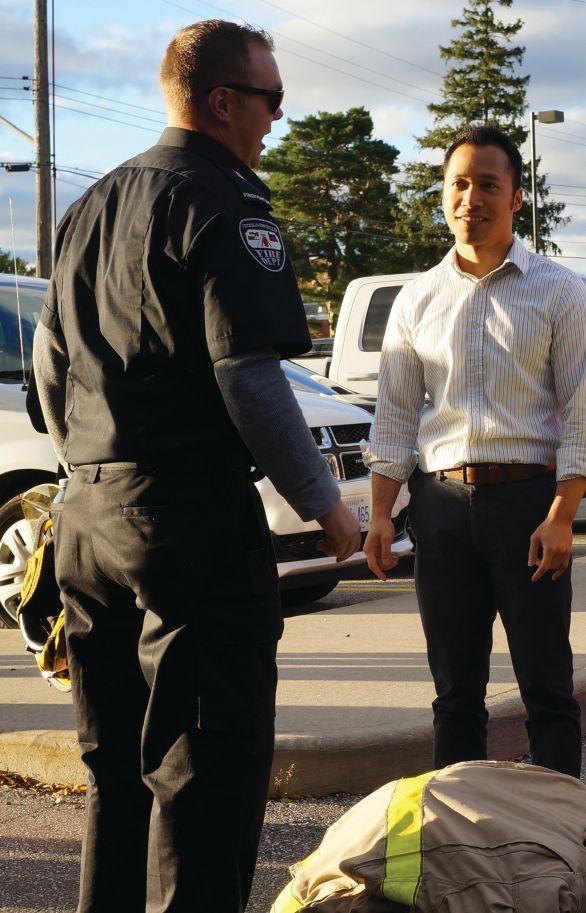
mental health and early detection of illness through developing baseline physical and medical factors. A fitness club membership is provided free to firefighters, including fitness consultations.
One of the fire chief’s first concerns was to get adequate base-
lines of the firefighters’ health, key to tracking changes in health, and especially important considering the elevated health risks the firefighters face. Of related concern, physical exams were not taking place on a regular basis.
Today, Central Lambton FHT’s health promoter maintains a schedule for annual physicals and will proactively call firefighters in when needed. Vaccinations are up-to-date, as well as annual flu shots.
Arns noted that most firefighters spend only five per cent of their working time in fire suppression. Some of their time is spent responding to medical emergencies and it’s vital that they remain protected and not expose community members to additional infections. At the same time, they are exposed to bodily fluids, so additional vaccinations are recommended. To make it easier to get
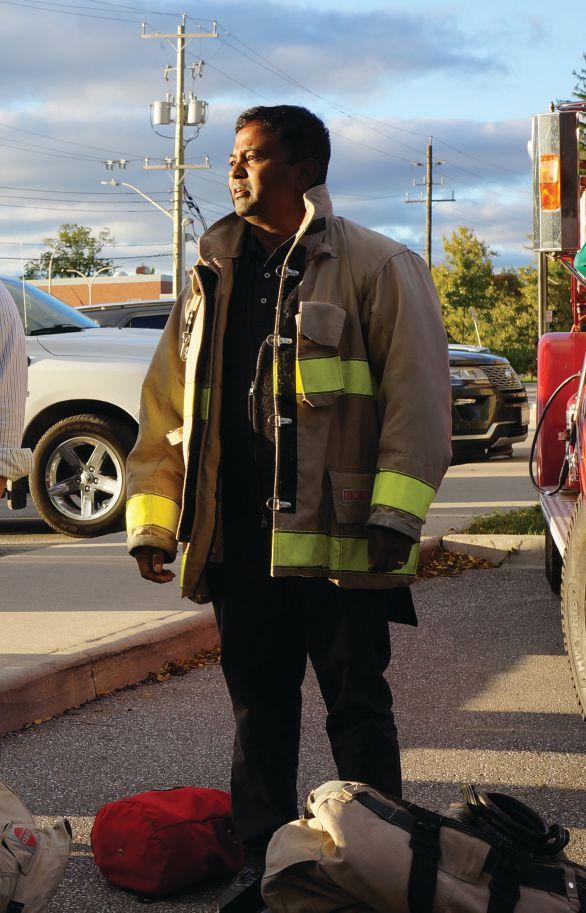
Everyone understands we’re doing this so that they can continue doing this work as long as possible. - Jay Arns
everyone vaccinated, onsite clinics have been held, as well as information sessions.
FHT staff hold regular educational sessions at the fire hall, addressing health and wellness issues for the department members, as well as those they may encounter in the community. As the opioid epidemic reaches into rural Canada, FHT members have educated members about recognizing and treating opioid overdoses they may encounter.
The FHT’s electronic patient record now notes those patients who are volunteer firefighters, important information for a primary care provider when an individual presents with certain symptoms like a cough, which may not cause concern for a member of the public, but in a volunteer firefighter may suggest follow-up is needed.
The program has already identified two members with hypertension. They have received treatment and, as a result, are able to remain on active duty. The outcome might have been different without early detection and treatment.
Another key component of the program is the rehabilitation taking place on-scene during training and incidents. Information is collected and placed in the firefighter’s file with the FHT to help establish baseline health indicators.
As mental health is increasingly recognized as an issue for first responders, Central Lambton FHT has given on-site information sessions on the topic. Meeting with members of the FHT more regularly and establishing trust has allowed some firefighters to start conversations about mental-health concerns, which may or may not stem from work-related stresses or experiences.
When a work-related crisis occurs, Arns said his department is proactive, bringing in a critical incident team to debrief and support those involved.
The two organizations are pleased with the collaboration and its success.
“If I had written down what my imagined best-case scenario would be, this has exceeded it,” said Arns. “I’m actually surprised at the ease with which it has occurred.”
Both partners have been open to suggestions and ideas. Arns said the two teams have a lot in common. They are committed to helping people and share the mindset of preferring to emphasize education and prevention over responding to a crisis.
Milner credits success of the program to the consistent and explicit messaging from Petrolia and North Enniskillen Fire Department’s leaders that health and wellness is important.
Both Milner and Arns are enthusiastic about helping others learn from their success and have given talks at neighbouring fire departments.
BY DAWSON CURRIE
“Petrolia is a small town, but it’s growing, it’s active and it’s progressive,” said Arns.
He said the two partners have proven that a wellness program can and does work in a small fire service, and it can be adapted to any small fire service.
Arns said it doesn’t matter the size of the fire department and that trust in leadership is key.
“They see that leadership puts an emphasis on the health of the members. They feel protected, respected and highly valued for all they do to protect our communities.”
Nicole Veenema, RPN, is Health Promoter, Central Lambton Family Health Team
By ED BROUWER
Over the last two months our training focus has been on the role of the Incident Commander. The Incident Commander (IC) is responsible for all aspects of the incident response, ensuring that operations are conducted safely.
Following the Incident Command System (ICS) they are responsible for communications, incident objectives, management of resources and all persons involved.
The Incident Command System (ICS) is a standardized on-site management system designed to enable effective, efficient incident management by integrating a combination of facilities, equipment, personnel, procedures, and communications operating within a common organizational structure.
The ICS is used to manage an incident or a non-emergency event and can be used equally well for both small and large situations. For more info see icscanada.ca.
The IC is usually the first qualified person on scene, although there are times when the role of Incident Commander may be handed off to a higher-ranking officer.
I chose five members from among the responders who are consistently responding to calls during the day as candidates for our new IC Training program. We are going to spend the next few months developing their skill sets as incident commanders.
In order to build their confidence in decision making, I found a donor vehicle we could use as a prop. I set up a vehicle fire scenario and had each of the IC candidates perform the role of IC. We got everyone engaged in these exercises. Over the course of four weeks we role played using this old car. The IC candidates were expected to interact with dispatch (me on our Tac Channel). They notified me as they left the fire hall, and when they arrived on scene they were expected to give an Arrival Report.
Arrival Reports had to include on scene confirmation, incident location, building construction, fire conditions, establishment of command and critical safety information.
The IC also has the option of changing the response mode of responding resources. It may help to let dispatch and the other responders know your initial operational mode; offensive, defensive, investigative or rescue. The Arrival Report is also an opportunity to request help right away—for second/third page, mutual aid, hazmat, forestry, RCMP, EHS or utilities for example—and to warn of dangers such as downed power lines.
Answer these simple questions: Who are you? Where are you? What do you see? What do you need? What are you going to do? This short and sweet 30-second report paints a clear picture for incoming units.
Unfortunately, on scene communications are never without their issues. I realize radio protocol is elementary, but many firefighters still struggle with handling the radio with gloves on. I also
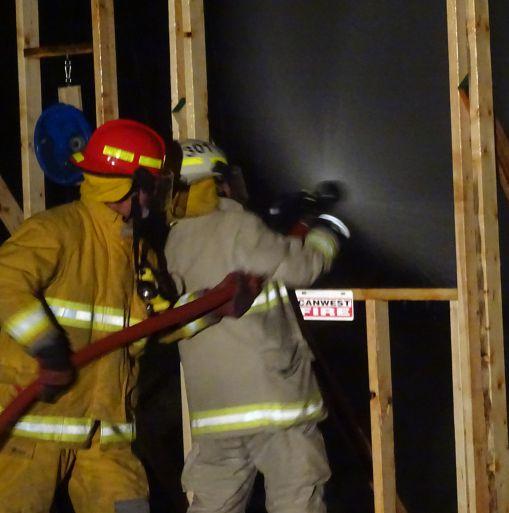
As part of my Incident Commander training, I built an inexpensive prop with the objective of providing targets for the hose team and a window opening for “Hitting it Hard” from the yard.
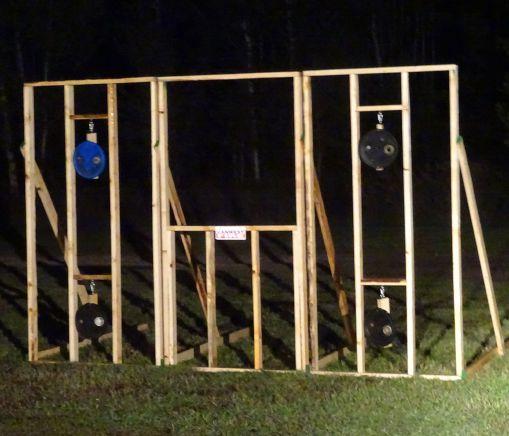
witnessed firefighters not using the clip-on mic/speakers provided, choosing rather for some unknown reason to struggle getting their radio in and out of their bunker gear pockets.
Just a reminder to use the word “From” — “Attack Team from IC” NOT “IC to Attack Team”. Always call out who you want to communicate to first. As well, wait until you are acknowledged by the unit you are calling before going on with your message. Wait for the go ahead. Once you have been given the go ahead, clearly and precisely communicate your message.
Playing it out as a full-blown scenario / evolution engaged all of our members. Everyone was involved in the fireground operations; scene safety, accountability, stabilization, communication, suppression, hose lays, fire streams, pump operations, scene lighting, staging, etc.
Halfway through the scenario I had the IC transfer command to another IC candidate. That new IC would continue with the scenario and then wrap things up and return to the fire hall. This was all done to build confidence in radio communications and scene management.
In order to further develop our IC candidates and provide opportunities for our firefighters to handle hose lines and water streams I built an inexpensive prop. It is built out of 26 2x4 (92”)
SPF studs, four used pail lids, eight 2 5/8 eye hooks and four 1/4 safety snaps and a handful of three-inch wood screws (approximately 50). Any time you can build a reusable prop that engages your firefighters for under $100, it’s a winning situation.
It loads easily in the back of a pick-up truck and takes only a few minutes to set up and take down (as long as the battery in your screw gun doesn’t die). The objective was to provide targets for the hose team and a window opening for “Hitting it Hard” from the yard. I didn’t fill in the wall sections with plywood fearing the stream pressures would knock the prop around. The open studs worked great.
One night we set up the prop and assigned an IC, pump operator and two-person hose team. Our IC candidates took turns ordering hose teams to hit two targets (one target at a time) and then they were to approach the window and apply a fog pattern through the window in a circular motion (mimicking cooling down an interior fire from outside the building).
The IC chose two targets out of the four, (Upper Alpha Bravo, Lower Alpha Bravo, Upper Alpha Delta and Lower Alpha Delta). Then they requested the hose team to hit the chosen targets one at a time. The hose team advanced the hand-lines to approximately 50 to 60 feet from the prop wall. Once they completed the first target, they were assigned the second. They then repositioned the hand-lines and performed that required task. They were then asked to advance the hand-line to the window portion of the prop. A firefighter was called by the IC to break the glass (pretend using pike pole or axe). Have FF follow your department’s operational guidelines, keeping it as realistic as possible. Once the window is broken, the attack team will be requested to perform an interior cool down from outside. Each request was done using our radio protocols.
IC: “Hose Team from IC”
Hose Team: “Go ahead IC”
IC: “Hit target Upper Alpha Bravo”
Hose Team: “Copy that, hitting target Upper Alpha Bravo”
Pretty simple really, but I find these repetitive small steps will help build confidence and improve radio communication skills.
While I was busy with this group my assistant taught hydrant basics to the remainder of the members. This kept everyone busy and engaged. By the end of the night every member attending practice had hands on. Note: I chose not to use BA during this scenario/evolution in order to get each of our members on the hand lines.
If you would like more info on the prop just drop me a line. I hope this article will give you some more ideas for your department’s future ICs.
Please remember to train like lives depend on it, because the certainly do. Stay safe. Ed.

Ed Brouwer is the chief instructor for Canwest Fire in Osoyoos, B.C., deputy chief training officer for Greenwood Fire and Rescue, a fire warden, wildland urban interface fire-suppression instructor and ordained disaster-response chaplain. Contact Ed at aka-opa@hotmail.com.
A.J. STONE COMPANY LTD.
62 Bradwick Dr. Vaughan, ON, L4K 1K8
Tel: 416-785-3752
Fax: 416-781-2827
Toll-Free: 1-800-205-3473
order@ajstone.com www.ajstone.com
Joyce, Lindsay
A.J. Stone has proudly served the needs of the First Responder Services of Ontario since 1972 by featuring quality products, knowledgeable sales team, and training support.
A.J. Stone supplies equipment from MSA, Genesis Rescue Systems, BullEx/Lion Protects, Task Force Tips, Paratech Rescue, Fireade, Enforcer, Streamlight, Innotex Bunker Gear, ProTech Gloves, Safe-T-System, CET and much more!
We service what we sell!
AIR TECHNOLOGY SOLUTIONS CANADA INC.
251 Queen St. S., Ste. 512 Mississauga, ON, L5M 1L7
Tel: 905-826-6682
Fax: 866-511-6904
Toll-Free: 1-866-735-1480 info@airmation.ca www.airmation.ca
Randall Weber, VP Marketing & Sales, Canada Air Technology Solutions is dedicated to our Clients, offering updated, timely, full service Indoor Air Quality (IAQ) solutions. Air quality concerns are mitigated using a unique combination of professional indoor air quality assessment coupled with solutions. Off the shelf or customized site specific air cleaning equipment is available to resolve IAQ issues. Our technical experts review client requirements and budgetary availability. The finest appropriate air cleaning systems are provided. Air Technology Solutions is a leader in Diesel Exhaust Remediation and is the ONLY environmental tested and proven filtration system to exceed standards: NFPA, NIOSH, OSHA and ASHRAE. Building and facility managers, business owners, contractors, architects, and engineers have been working with Air Technology Solutions since 1986 to resolve IAQ needs. Employee and personnel safety and health are key issues. Breathing safe air in the workplace is of utmost importance. We provide global customized solutions to control contaminants, pollutants and odours in your facility. We look forward to servicing your requirements.
AIR VACUUM CORPORATION
PO Box 517, Dover, NH, 03821
Tel: 603-743-4332
Fax: 603-743-3111
Toll-Free: 1-800-540-7264
sales@airvacuumcorporation.com www.airvac911.com
Thomas Vitko, John Koris, Regional Sales Managers
Breathe Clean Air with AIRVAC 911®
Control the spread of hazardous contaminants in your station. The AIRVAC 911® Engine Exhaust Removal System protects 100% of the bay area by constantly monitoring and removing exhaust and particulate matter from your station without interfering with daily operations. No hoses, hook-ups or vehicle connections. No building modifications, no ducting and no outside exhausting. AIRVAC 911® is 100% automatic and specifically designed to:
• Address Hot Zones within your station
• Remove off-gassing of turnout gear, hoses and parked vehicles
• Counter off-gassing of secondary pollutants
• Remove engine exhaust that re-enters the building
• Half the cost of hose systems
• Energy efficient LEED/green design
• NFPA 1500/OSHA/GSA compliant
For a free quote: www.airvac911.com
sales@airvacuumcorporation.com 800-540-7264
111 Gordon Baker Road, Suite 400 Toronto, ON, M2H 3R1
Tel: 416-442-5600
Fax: 1-866-810-8111
Toll-Free: 1-800-265-2827
aaritcheta@annexbusinessmedia.com www.becomingafirefighter.com
Allyson Aritcheta, Account Coordinator
2465 Cawthra Rd., Unit 114 Mississauga, ON, L5A 3P2
Tel: 905-949-2741
Fax: 905-272-1866
Toll-Free: 1-800-265-0182
ross@cdnsafety.com www.cdnsafety.com
Ross Humphry, Scott Gamble, John Donovan, Nick Desmier, Andrew Yach
We supply Industrial and Fire, SCBA’s, Thermal Cameras, Auto Extrication, CAF Systems, Fall Protection, Bunker Gear, Fire Hose, Communications Equipment, Nozzles, Fittings, Hazmat Suits, Ventilation Fans, Gas Detectors, Confined Space Rescue Equipment, High Angle Rescue Equipment, Boots and Gloves. Everything for Fire Fighting, EMS, Law Enforcement, Industrial and Municipal Safety and Lone Worker Protection systems.





38 Thibault street, Box 540 Pierreville, QC, J0G 1J0
Tel: 450-568-7020
Fax: 450-568-3049
info@thibaultfiretrucks.com thibaultfiretrucks.com
Carl Thibault Emergency Vehicles is a Canadian company that manufactures a full line of fire apparatus which includes aerial ladders, pumpers, tankers, rescue units and vacuum tankers. We provide parts and other related products. Built on values, powered by integrity, and driven by a relentless commitment to quality products and service, we are proud to have Westvac Industrial as our exclusive distributor of Carl Thibault Emergency Vehicles in Western Canada.
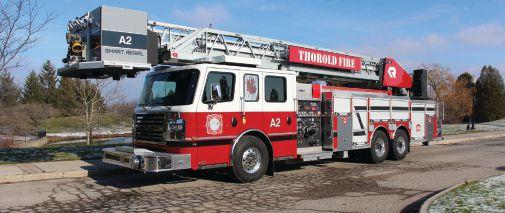
Built on a Commander 4000 chassis with a flat roof and 60” cab; powered by a Cummins ISX 500 HP engine and Allison EVS 4000 transmission, this Rosenbauer FX body has Waterous 2000 GPM pump, FRC TGA 300 pressure governor, 500 g tank, FoamPro 1600 system, 30 g foam tank, 8KW Onan generator and 101 ft three section platform and galvanized frame outriggers, torque box, aerial and basket.
DEPARTMENT: Thorold Fire & Emergency Services, Ontario
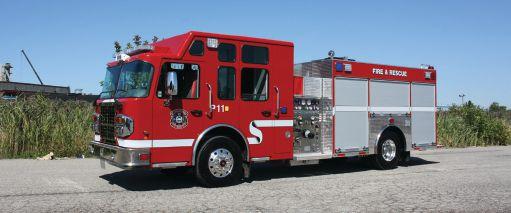
This pumper has a Spartan Metro Star ELFD 20” raised roof cab/chassis with a Cummins L9 380 HP engine. The truck is equipped with Hale QFlo 5000 LPM pump, FoamPro 2001 foam system and 1000 USG ProPoly water tank with 30 USG foam cell. The aluminum body was built in Ontario, and features Amdor roll-up doors and enclosed ladder and suction hose storage and Whelen scene and warning equipment.
DEPARTMENT: Erin Fire & Emergency Services, Ontario
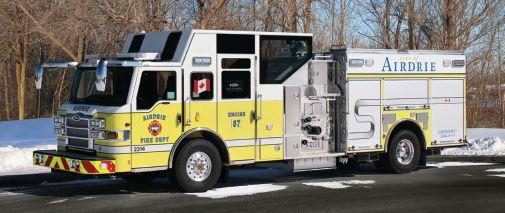
This unit is built on the Pierce Mfg. Velocity chassis, which offers a cathedral feel ceiling with increased frontal visibility and more configurable space. This unit is powered by a Cummins L9 450 HP engine with 1250 lb per ft torque and features the Oshkosh TAK-4 independent suspension and a 640 USG New York Style water tank, Waterous CSU 2000 GPM pump and Husky 12 foam system.
DEPARTMENT: Airdrie Fire Department, Alberta
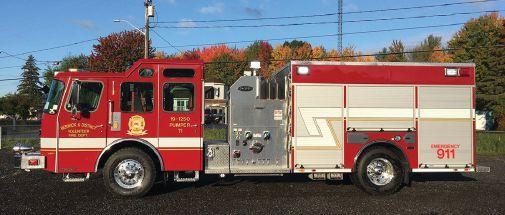
Built on an E-ONE Typhoon chassis and powered by a Cummins L9 450 HP engine and Allison EVS 3000 transmission, this truck features a stainless steel body, Hale QMAX 6000 LPM single stage pump, 1000 gallon “L” shaped water tank and 30 g tank for Class A foam. This truck also comes equipped with AXIS Smart Truck technology.
DEPARTMENT: Berwick & District Volunteer Fire Department, Nova Scotia
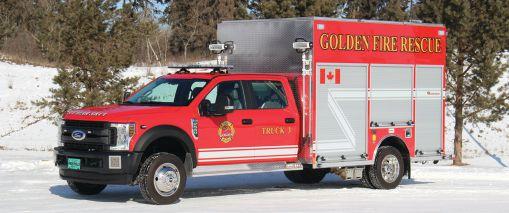
Built on a Ford F550 chassis with a 4x4 Super Duty crew cab and powered by a Triton 288 HP 6.8L SOHC V-10 engine with a 6-speed automatic transmission, the Rosenbauer 1/8” formed aluminum body has extensive compartment provisions with roll out trays, Whelen LED emergency lighting/siren package and 12V Extenda-Lite Push Up telescoping lights, 12V body mounted scene lights and rear body Federal Signal LED traffic advisor.
DEPARTMENT: Golden Fire Department, British Columbia
|
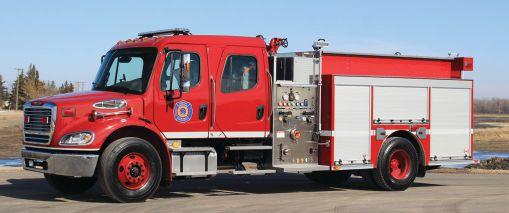
This crusader is built on a Freightliner M2 chassis and is powered by an Allison 410 HP engine. This aluminum unit features a Hale midship DSD 1250 pump, co-poly 1000 USG tank, and a FoamPro 2001 class A foam proportioning and foam refill system.
DEPARTMENT: Bomberos De El Salvador, El Salvador
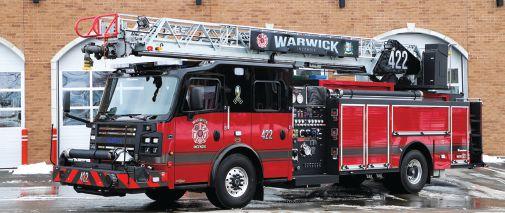
Built on a Commander 6008 chassis and powered by a Cummins L9 450 HP diesel engine with an Allison transmission, this Rosenbauer 3/16” FX aluminum body is equipped with Onspot tire chains, Darley EM2000 single stage pump, 78’ Smart aerial ladder, FoamPro 2002 foam system, 600 g water tank and an easy load hose bed.
DEPARTMENT: Warwick Fire & Rescue, Ontario
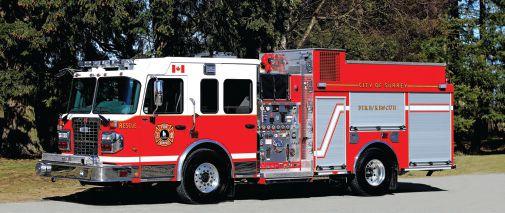
Built on Spartan Metro Star chassis and powered by Cummins L9 450 HP engines and Allison EVS 3000 transmissions, these Smeal units are equipped with Waterous CSUC20 2250 GPM pumps rated to 7000 LPM, 500 IG water tanks, 20 IG foam tanks and FoamPro 2002. Extras include Green Power SG-09 auxiliary power units and V-MUX peer-to-peer advanced electronics.
DEPARTMENT: Surrey Fire Service, British Columbia

D&R ELECTRONICS CO. LTD.
COMMERCIAL EMERGENCY EQUIPMENT CO.
591 Chester Road
Delta, BC, V3M 6G7
Tel: 604-526-6126
Toll-Free: 1-800-665-6126
24/7 service: 1-877-443-2626
cfeduniw@comtruck.ca
www.comemerg.ca
Carey Feduniw, General Sales Manager
Commercial Emergency Equipment Co. is Canada’s largest dealer for Pierce Manufacturing Inc. and MAXI Fire. We provide sales, parts, service of all makes of fire trucks, and support to our customers through five sales/ service locations across Canada.
Commercial Emergency Equipment Co. strives to exceed customer expectation in everything we deliver. With over 70 years in the truck equipment industry, we take pride in a proven track-record of providing expert truck equipment solutions, top quality products and firstclass service to our customers.
We are a sole-source service provider with mobile EVT’s, on call 24/7, throughout our nationwide branch network. We offer inspections, preventative maintenance, mobile pump testing and foam system calibration, as well as comprehensive apparatus training on operation and maintenance.
We inventory an extensive stock of OEM and aftermarket parts, tools and equipment ensuring quick delivery and reduced downtime to our customers. Our service technicians undergo continuous training and testing to ensure that the latest technology and innovation is applied to the service of your equipment. When you need prompt, honest, and reliable service, you can count on us to support you. Our EVT’s are on call to provide 24-hour emergency service.
CSE INCENDIE ET SÉCURITÉ INC.
5651 Chemin St-Francois
St. Laurent, QC, H4S 1W6
Tel: 514-737-2280
Fax: 514-737-2751
Toll-Free: 1-266-737-2293
www.cseis.com
Richard Abraham, Pat Herring, Sylvain Paulus, Genevieve Pointer
We supply Industrial and Fire, SCBA’S, Thermal Cameras, Auto Extrication, CAF Systems, Fall Protection, Bunker Gear, Fire Hose, Communications Equipment, Nozzles, Fittings, Hazmat Suits, Ventilation Fans, Gas Detectors, Confined Space Rescue Equipment, High Angle Rescue Equipment, Boots and Gloves and Pacific Helmets. Everything for Fire Fighting, EMS, Law Enforcement, Industrial and Municipal Safety and Lone Worker Protection Systems.
8820 George Bolton Parkway Bolton, ON, L7E 2Y4
Tel: 905-951-9997
Fax: 905-951-0019
Toll-Free: 1-800-538-7338
michael@dandrelectronics.com www.dandrelectronics.com
Michael Lucarelli, Colin Bennett
D&R Electronics is an ISO 9001:2015 Registered Canadian Designer/Manufacturer of SWITCHRITE Vehicle Equipment Consoles, In-Vehicle Computer/ Printer Mounting solutions and the TRUCK-STOR line of Custom Vehicle Equipment Storage Systems. D&R Electronics is a Panasonic Canada Approved designer/ manufacturer of In-Vehicle Mounting Solutions for the TOUGHBOOK and TOUCHPAD product line.
D&R Electronics also Designs and Manufactures a complete line of SAE Certified/NFPA Compliant LED Emergency/Safety Lighting as well as Basic Switch Panels, Microprocessor Based Electronic Light Control Systems and Full Feature Siren/Light Control Systems. D&R Electronics has been employing Canadians and manufacturing quality Canadian made products for the emergency service industry since 1976.

DARCH FIRE - 1200°
9-402 Harmony RD
Ayr, ON, N0B 1E0
Tel: 800-254-2049
Fax: 519-622-7705
Toll-Free: 800-254-2049
info@1200-degrees.com
www.1200-degrees.com
1200˚ sets itself apart by the level of customer care it provides. We take care of our clients throughout the sales process and beyond. We provide expert advice during the buying process, the customer is presented with quality products and our customer care is second to none. Working with 1200˚ means having a single point of contact in case of a problem, we take care of everything else for our clients.
DEPENDABLE EMERGENCY VEHICLES
275 Clarence St. Brampton, ON, L6W 3R3
Tel: 905-453-6724
Fax: 905-456-0871
Toll-Free: 1-800-268-0871
sales@dependable.ca www.dependable.ca
Pino Natale
Dependable Emergency Vehicles is a custom manufacturing facility that specializes in Pumpers, Rescues, Tankers, Hazmat, Command units and much more. Our on-site full body and paint shop combined with design and fabrication expertise make us capable to complete a wide range of manufacturing and repairs, specializing in custom fabricating. Canadian HME Ahrens-Fox dealer. We build on Spartan Chassis, Freightliner, International, Kenworth and Ford. Sales, service and parts for Hale, Darley and Waterous pumps. Extensive parts inventory. Sales and repairs of all makes of Emergency lighting, hoses, nozzles and fire related equipment. RELIABLE, TOUGH, PROVEN SINCE 1975
DRAEGER SAFETY CANADA LTD.
2425 Skymark Ave., Unit 1 Mississauga, ON, L4W 4Y6
Tel: 905-212-6600
Fax: 905-212-6602
Toll-Free: 1-877-372-4371
sandi.davisjohn@draeger.com www.draeger.ca
Sandi Davis-John
Call 1-877-Draeger1 to arrange for service of your SCBA and gas detection at your local Draeger Service Center. Contact us for fixed flame & as detection, personal gas monitoring, drugs & alcohol testing, SCBA, thermal imaging cameras, live fire training systems and the rest of our portfolio.
Visit www.draeger.com for more info.
FIRE FIGHTING IN CANADA/CANADIAN FIREFIGHTER
PO Box 530, 105 Donly Dr. S. Simcoe, ON, N3Y 4N5
Tel: 1-800-265-2827
Fax: 888-404-1129
Toll-Free: 1-888-599-2228, ext. 252 mmcanulty@annexbusinessmedia.com www.firefightingincanada.com
Martin McAnulty
Canada’s National Fire Publication since 1957.
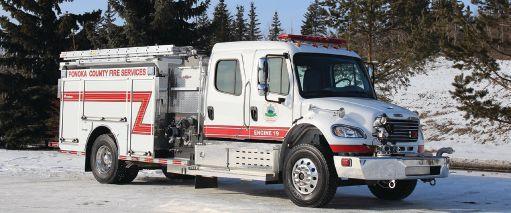
Built on a Freightliner M2 106 chassis with a Cummins L9 330 HP engine and Allison 3500 EVS automatic transmission, this pumper features a Waterous CXVK single stage fire pump 1050 IGPM, PTO drive pump, 900 IG water tank and 20 IG foam tank and a FoamPro 1600 class “A” system. Extras include a remote-control bumper turret and an electric rewind booster hose reel.
DEPARTMENT: Ponoka County Regional Fire Services, Alberta
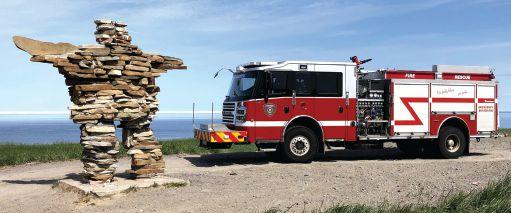
Built on a Commander 4X4 chassis and powered by a Cummins L9 450 HP diesel engine with an Allison transmission, this Rosenbauer 3/16” modular aluminum body is equipped with Onspot tire chains, Rosenbauer NH pump, front bumper booster reel for hi-pressure pump, Fix Mix foam system, 1250 IG water tank and a ladder mounting hydraulic rack.
DEPARTMENT: Cree Nation of Whapmagoostui, Quebec
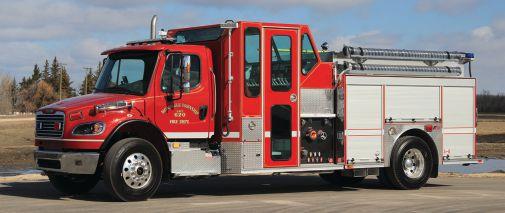
This MXV 4-man crown is built on a Freightliner M2-106 chassis that is powered by a Cummins L9 330 HP diesel engine and an Allison 3000 EVS transmission. This marine grade aluminum unit features a Hale midship DSD1250 pump, 1000 IG water tank, and a FoamPro 2001 class A foam proportioning and foam refill system.
DEPARTMENT: Montague Township Fire Department, Ontario
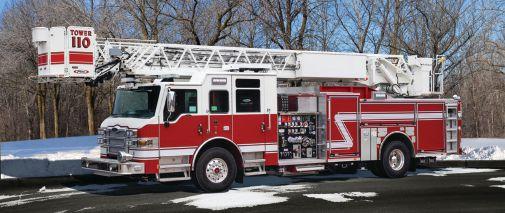
Built on a Pierce Mfg. Impel single axle chassis with a raised roof, this Ascendant 110” platform is designed to withstand winds up to 35 MPH and ¼” of ice with a 750/500 tip load. This unit is powered by a Cummins L9 450 HP engine and features a 500 USG water tank, Waterous CSU 2000 GPM pump and Husky 3 foam system.
DEPARTMENT: Arnprior Fire Department, Ontario
This tanker has a Spartan Metro Star MFD 10” raised roof cab/chassis with a Cummins L9 450 HP engine. The truck has a Hale QMax 1750 USGPM pump, 3000 USG ProPoly water tank and A.H. Stock dump valve. The aluminum body was built in Ontario, and features Amdor painted roll-up doors, enclosed ladder, suction hose and portable tank water storage and Whelen scene and warning equipment.
DEPARTMENT: Pickering Fire Services, Ontario
Built on Spartan Gladiator chassis and powered by Cummins L9 450 HP engines and Allison EVPR 3000 transmissions, these Smeal units have Darley EM two-Stage 2000 GPM pumps, 400 IG water tanks, 40 IG foam tanks and FoamPro 2002. Extras include Green Power SG-09 APUs, V-MUX peer-to-peer advanced electronics and advanced occupant protection and Knight Series — KL415AFS light towers.
DEPARTMENT: Edmonton Fire Rescue Services, Alberta
on a Commander 4000 chassis with an 8” raised roof and 70”
by a Cummins ISX 500 HP engine and Allison EVS 4000 transmission, this
FX body has a Waterous 2000 GPM pump, FRC PumpBoss 400 pressure governor, 400 g tank, FoamPro 2002 system, 30 g foam tank, 10KW Smart Power generator and 101 ft three section platform and galvanized frame outriggers, torque box, aerial and basket.
DEPARTMENT: Waterloo Fire Rescue, Ontario
with a
PO Box 530, 105 Donly Drive S. Simcoe, ON, N3Y 4N5
Tel: 1-877-267-3473
Fax: 1-877-624-1940
info@firehallbookstore.com
www.firehallbookstore.com
Jennifer Ludwig
The Firehall Bookstore provides training & public education materials to the Canadian Fire Service industry and its professionals. A one-stop-shop for books, DVDs, codes and standards, and fire prevention and education materials for community outreach. Product lines include NFPA, IFSTA, PennWell, Action Training Systems, Jones & Bartlett, Brady, and Emergency Film Group.
RR 2, 53 Bergen Cutoff Rd. Winnipeg, MB, R3C 2E6
Tel: 204-594-3473
Fax: 204-694-3230
Toll-Free: 1-800-565-3473
Brian Nash, bnash@fgft.ca
www.fgft.com
Fort Garry Fire Trucks is Canada’s oldest and largest manufacturer of high-quality fire apparatus offering a complete line of quality pumpers, tankers, rescues, aerial devices, and custom designed and engineered specialized units. With headquarters based in Winnipeg, Manitoba, Canada, our customers emanate from cities, towns, and municipalities throughout Canada, the U.S., and abroad with the harshest weather, climates, and terrain. We boast one of the largest fire apparatus engineering departments amongst our competitors, devoted to the design and production of equipment for the most extreme conditions in the world. We are a Bronto Skylift articulated aerial platform dealer, as well as the exclusive Canadian distributor of Sutphen Corporation aerial ladders and platforms. We truly build “One Tough Truck” and boast over 100 years of quality. COAST TO COAST SALES AND SERVICE NETWORK:
PO Box 530, 105 Donly Dr. S. Simcoe, ON, N3Y 4N5
Tel: 888-599-2228, ext. 253
Fax: 888-404-1129
aszpakowski@annexweb.com www.firehall.com
Adam Szpakowski, Associate Publisher Firehall.com provides an excellent forum for exchange among firefighters and others involved in the fire service. Advertising options include banner ads and e-blasts and offer extensive exposure to the rank and file.
3430 South Service Road, Suite 103 Burlington, ON, L7N 3T9
1-800-613-0507
www.flir.ca/fire
A thermal imaging camera (TIC) is indispensable. These vital tools help you see through smoke and monitor the fire’s spread, so you can quickly visualize your plan of attack, locate hot spots, and save lives. FLIR’s lineup of TICs gives you the most comprehensive view of the scene—from inside, outside, and above the fire. This is about more than seeing through a smokefilled room: by viewing the entire scene from multiple viewpoints, incident commanders can make better decisions when directing resources. And, since FLIR TICs clearly visualize heat sources, they’re an important tool for hazmat and search and rescue operations.
• Brian Nash — Vice President – Sales – bnash@fgft.ca Toll-Free: 1-800-565-3473 (ext. 3471)
Cell: 204-981-7845
• Ron Lavallee – Service Manager – rlavallee@fgft.ca Toll-Free: 1-800-565-3473 (ext. 3478)
Cell: 204-791-1167
REGIONAL SALES REPRESENTATIVES:
• Atlantic Canada – Adam Baldwin – abaldwin@fgft.ca
Toll-Free: 1-800-565-3473 (ext. 2006)
Cell: 902-888-9806
• Eastern Ontario – Peter Somerton – psomerton@fgft.ca Toll-Free: 1-800-565-3473 (ext. 2005) Cell: 613-859-5747
• Central Ontario – Chris Pilek – cpilek@fgft.ca Toll-Free: 1-800-565-3473 (ext. 3481) Cell: 204-296-1915
• Northern Ontario – Bob Lock – block@fgft.ca Toll-Free: 1-800-565-3473 (ext. 2004) Cell: 705-665-2195
• Manitoba & Saskatchewan – Lance Spencer lspencer@fgft.ca
Toll-Free: 1-800-565-3473 (ext. 3475) Cell: 204-995-3895
• Alberta – Taylor Young – tyoung@fgft.ca Toll-Free: 1-800-565-3473 (ext. 3466) Cell: 204-298-9923
• British Columbia – Al Anderson & Bryan Anderson – Fire Power Emergency Apparatus –alan@firepowerplus.com or bryan@firepowerplus.com; Phone: 1-250-668-2673 or 1-250-327-1904
• Canadian Northern Territories – Rick Penner rpenner@fgft.ca
Toll-Free: 1-800-565-3473 (ext. 2024)
Cell: 204-594-1300
• United States & International – Steve Suché ssuche@fgft.ca
Toll-Free: 1-800-565-3473 (ext. 3472) Cell: 204-799-4451
HIGHWATER HOSE INC.
12 rue Willard
East Angus, QC, J0B 1R0
Tel: 1-888-832-4310
Fax: 819-832-4340
Toll-Free: 1-888-832-4310 almacrae@mercedestextiles.com www.highwaterhose.com
Allan MacRae, General Sales Manager; Claude Berube, Canadian Sales/Quebec and Maritimes
Worldwide supplier of a wide range of rubber covered and lightweight, layflat fire and industrial hoses.
A NEW EVOLUTION IN FIRE FIGHTING:
• Deluge™ - Designed for high volume water supply where excellent friction loss, packability and cold temperature flexibility are critical.
• X-Stream® Plus - Designed for aggressive interior attack where excellent abrasion and cut resistance are essential and where color-coded attack lines are crucial.
• Available with iReflect®, WAYOUT® Couplings and iDentify® Coding System
• OUR CANADIAN DISTRIBUTORS
• www.martinsfiresafety.com - NL
• www.cumings.ca - NS,NB,PEI
• www.larsenal.ca - QC
• www.municipalequipment.ca - S./S.E. ONT
• www.transcanadasafety.ca - N./N.C. ONT
• www.soucisalosafety.com – N./N.C. ONT
• www.spi-s.com - N./N.W. ONT
• www.realsafety.ca - MB
• www.wfrfire.com - BC,AB,SK,YT,NWT
INDUSTRIES LAFLEUR INC.
2359, Boul. Fiset
Sorel-Tracy, QC, J3P 5K2
Tel: 450-743-3918, ext. 226 Fax: 450-743-3906 pierrethibault@industrieslafleur.com www.industrieslafleur.com
Rescue units (walk-in and non walk-in rescue trucks)
Custom truck bodies
Since 1969

INNOTEX®
275 Gouin St. Richmond, QC, J0B 2H0
Tel: 819-826-5971
Fax: 819-826-5195
Toll-Free: 1-888-821-3121
info@innotexprotection.com www.innotexprotection.com
INNOTEX® is a premier manufacturer of Fire Fighter Turnout Gear, Gloves and Hoods sold via quality Distribution Partners worldwide.
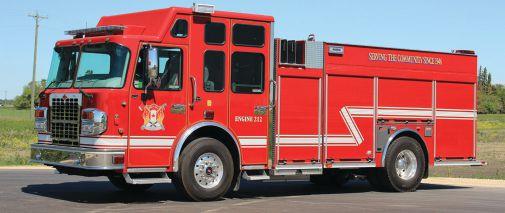
This emergency rescue pumper is built on a Spartan Metro Star MFD raised roof chassis that is powered by a Cummins L9 400 HP diesel engine and an Allison 3000 EVS transmission. This 5083 salt water marine grade aluminum unit features a Waterous midship CX1250 pump and a poly 1000 IG tank.
DEPARTMENT: Bible Hill Fire Brigade, Nova Scotia
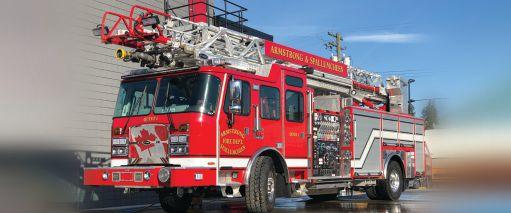
Built on an E-ONE Typhoon chassis and powered by a Cummins L9 450 HP engine with EVS 3000 transmission, this HP 78’ aerial ladder truck features an extruded aluminum body, 500 g “T” water tank, Hale QMAX 1500 GPM single stage pump and a welded extruded aluminum ladder with 2.5 to 1 structural safety factor.
DEPARTMENT: Armstrong Spallumcheen Fire Department, British Columbia
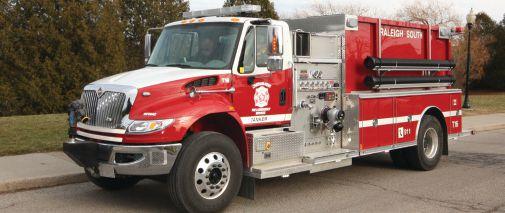
Built on an International 4400 2-door chassis with a Cummins L9 330 HP engine and Allison EVS 3000 transmission, this Rosenbauer FX body has a Rosenbauer 1050 IGPM NH pump, FRC TGA 300 pressure governor, 1500 IG water tank, Whelen M9 scene lighting, Elkhart sidewinder EXM front bumper monitor with in-cab controls and Innovative Controls water tank level display with Monster Slave display.
DEPARTMENT: Chatham-Kent Fire & Emergency Services, Ontario
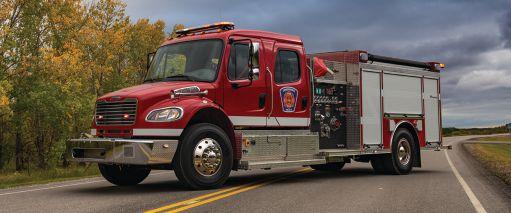
Built on a Freightliner M2 106 4-door cab and chassis, this pumper is powered by a Cummins ISL 9L 300 HP / 860lb-ft torque engine and Allison 3000 EVS automatic transmission. Additional features include a pump-and-roll capable Darley PSP 1250 GPM PTO drive fire pump, 1000 g water tank and a Whelen LED light package.
DEPARTMENT: Churchbridge Fire Rescue, Saskatchewan
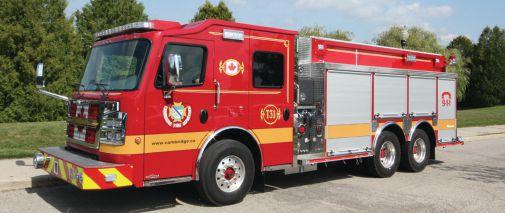
Built on a Commander 4000 chassis and powered by a Cummins L9 450 HP engine and Allison EVS 3000 transmission, this Rosenbauer FX body is equipped with Waterous CXVK 1250 GPM pump, FRC TGA 400 pressure governor, 2500 g water tank, Whelen Pioneer scene lighting, Whelen PS water tank level display and stainless steel Newton swivel dump, enclosed suction hose storage and hydraulically operated folding tank carrier.
DEPARTMENT: Cambridge Fire Department, Ontario
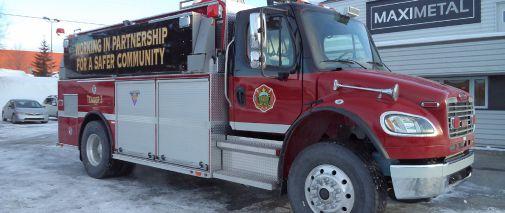
This Maximetal tanker sits on a Freightliner M2-106 chassis and is powered by a Cummins L9 350 HP engine. The Hale MBP750 pump is driven by a Chelsea 870 Series PTO, drawing from a 2000 g booster tank, which is completely removable without disassembling or dismounting the apparatus body structure.
DEPARTMENT: Black Diamond Fire Department, Alberta
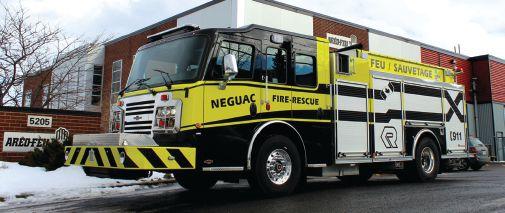
Built on a Rosenbauer Warrior 54” chassis with a 4-door cab, 8” raised roof, and powered by a Cummins 400 HP engine complete with an Allison EVS 3000 transmission, this pumper has a front axle capacity of 18,000 lbs with parabolic suspension and rear axle capacity of 31,500 lbs. Extras include a Rosenbauer combined high volume – high pressure NH55 1250 IPGM and a 1500 IG poly water tank.
DEPARTMENT: Neguac Fire Department, New Brunswick
PUMPER TANKER | FORT GARRY FIRE TRUCKS TANKER | RESQTECH/ROSENBAUER TANKER | COMMERCIAL EMERGENCY EQUIPMENT CO.
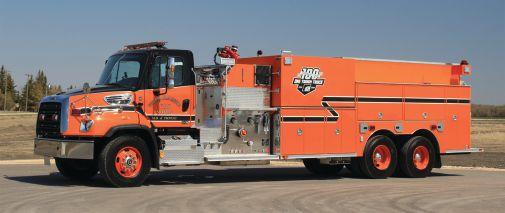
This pumper tanker is built on a Freightliner 114 SD regular cab chassis that is powered by a Detroit DD13 450 HP diesel engine and an Allison 4500 EVS transmission. This marine grade aluminum unit features a Darley LDM 1750 midship pump, 3000 IG poly tank, 30 IG FRC internal foam tank class A, and a
tank class B.
DEPARTMENT: West End Fire Services, Alberta
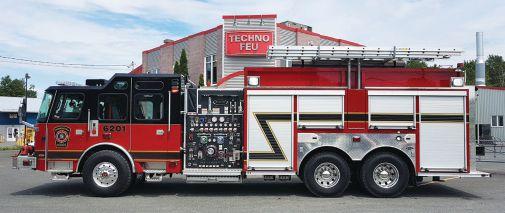
This E-ONE Typhoon pumper tanker is powered by a Cummins L9 450 HP engine and an Allison EVS 3000 transmission. Its aluminum extruded body is equipped with Hale QMAX 6000 LPM, FoamPro 3012, 2530 USG water tank and a 50 USG integral foam cell.
DEPARTMENT: Service des Incendies de Drummondville, Quebec
This E-ONE Freightliner M2-112 commercial industrial pumper is powered by a Detroit DD13 505 HP engine and an Allison EVS 4000 transmission. Its aluminum extruded body has a Hale 8FG 12,000 LPM, 1280 USG B foam tank, Hot Shot II foam system and Dual TFT Monsoon 2000 GPM monitors.
DEPARTMENT: Nanticoke Imperial Oil Refinery, Ontario
This E-ONE Typhoon HP75 quint aerial is powered by a Cummins L9 450 HP engine and an Allison EVS 3000 transmission. Its extruded aluminum SideStacker body is equipped with Waterous CSU 1500 USGPM, 500 USG water tank and an E-ONE HP75 aerial device.
DEPARTMENT: St-Marys Fire Department, Ontario
This E-ONE Typhoon HP75 quint aerial is powered by a Cummins L9 450 HP engine and an Allison EVS 3000 transmission. Its extruded aluminum SideStacker body is equipped with a Hale QMAX 6000 LPM and a 500 USG water tank. This unit also has 4x4 capabilities and is the first aerial apparatus to sport the EZ-TRAC front axle system.
Waskaganish Fire Department, Eeyou Istchee territory (Quebec)
These E-ONE Cyclone II 110 aerials are powered by Cummins X12 500 HP engines and Allison EVS 4000 transmissions. The Truck Company aluminum extruded bodies are equipped with E-ONE model 110 extruded aluminum aerial devices. Techno Feu has delivered seven pumpers to the city of Laval over the last three years.
DEPARTMENT: Service de Sécurité Incendie de Laval, Quebec
This E-ONE Cyclone II 95 platform is powered by a Cummins X12 500 HP engine and an Allison EVS 4000 transmission. This extruded aluminum SideStacker body is equipped with E-ONE model 95 extruded aluminum aerial platform, Hale QMAX 6000 LPM and 300 USG water tank. This unit was delivered along with a pumper in the summer of 2019.
DEPARTMENT: Régie Intermunicipale des Monts, Quebec
This E-ONE Cyclone II HP100 platform is powered by a Cummins ISX12 500 HP engine and an Allison EVS 4000 transmission. Its extruded aluminum SideStacker body is equipped with an E-ONE HP100 extruded aluminum aerial platform, Hale QMAX 2000 USGPM and a 300 USG water tank.
DEPARTMENT: Tillsonburg Fire and Emergency Service, Ontario
and
DEPARTMENT: Wolfville Fire Department, Nova Scotia
and

MERCEDES TEXTILES LTD.
5838 Cypihot
St. Laurent, QC, H4S 1Y5
Tel: 514-335-4337
Fax: 514-335-9633
almacrae@mercedestextiles.com
www.mercedestextiles.com
Allan MacRae, General Sales Manager; Claude Berube, Canadian Sales/Quebec and Maritimes
For over 40 years, Mercedes Textiles is proud to have delivered the most innovative and reliable water delivery systems to the firefighting community. No matter if it is fire hoses, portable fire pumps, hose couplings, or entire water delivery systems, we have one driving force in mind - engineer the best and safest products for the brave firefighters who rush into danger every day. We don’t settle for second best and we never will. When a firefighter carries Mercedes Textiles products, he carries the 40 years of trust that goes with it. We are innovators. We are trailblazers.
FIRE HOSE:
• KrakenEXO® - The most advanced attack fire hose on the market - weighs less, kinks less, flows more water
• WAYOUT® Couplings - Designed for improved “firefighter safety” during interior suppression
• iDentify® Coding System - Recessed zone on hose couplings designed to receive and protect identification markings and decals from abrasion damage
• iReflect® - Innovative lock lever Storz couplings, designed to greatly assist firefighters during LDH deployment and retrieval applications
• Unique Mertex lining yields an extremely low friction loss, for maximum flow and superior adhesion for long life
• Most products feature our 2-10-L warranty (“2 year All Hazards”, “10 year against manufacturing defects” and “Lifetime against delamination”)
PORTABLE FIRE PUMPS:
We are a leading manufacturer of high pressure, lightweight, portable fire pumps for forestry and municipal fire department applications.
OUR CANADIAN DISTRIBUTORS:
• www.martinsfiresafety.com - NL
• www.cumings.ca - NS,NB,PEI
• www.larsenal.ca - QC
• www.municipalequipment.ca - S/S.E. ONT
• www.transcanadasafety.ca - N./N.C. ONT
• www.soucisalosafety.com - N./N.C. ONT
• www.spi-s.com - N/N.W.ONT
• www.realsafety.ca - MB
• www.wfrfire.com - BC,AB,SK,YT,NWT

847 Central St. Centreville, NB, E7K 2E8
Tel: 506-276-4551
Fax: 506-276-3648
Toll-Free: 1-800-561-0012
info@metalfabfiretrucks.com www.metalfabfiretrucks.com
Ryan A. Stacey, Sales & Marketing Manager
Metalfab is a Canadian Manufacturer of customized Fire Apparatus. Our product line includes Pumpers, Tankers, Walk in Rescues, Walk Around Rescues, Mini Pumpers and other Fire Department Vehicles.
METZ FIRE AND RESCUE
3-304 Stone Rd. W. Guelph, ON, N1G 4W4
Tel: 519-829-9149
Fax: 519-763-6682
john@metzfirerescue.com
www.metzfirerescue.com
John Metz
Canadian dealer for KME Fire Apparatus. Specializing in custom and commercial pumpers, aerial, rescue, tankers and wildland units.
PIERCE MANUFACTURING INC.
PO Box 2017
Appleton, WI, 54912-2017
Tel: 920-832-3231
Fax: 920-832-3084
www.piercemfg.com
Pierce Manufacturing Inc., an Oshkosh Corporation [NYSE: OSK] company, is the leading North American manufacturer of custom fire apparatus. Products include custom and commercial pumpers, aerials, rescue trucks, wildland trucks, mini pumpers, elliptical tankers, and homeland security apparatus. In addition, Pierce designs its own foam systems and was the first company to introduce frontal airbags and the Side Roll Protection system to fire apparatus. To learn more about Pierce, visit www.piercemfg.com.
NFPA
c/o Firehall Bookstore, PO Box 530, 105 Donly Dr. S., Simcoe, ON, N3Y 4N5
Tel: 1-877-267-3473
Fax: 1-877-624-1940
info@firehallbookstore.com www.firehallbookstore.com
Canadian distributor for NFPA products.
189 Bysham Park Dr. Woodstock, ON, N4T 1P1
Tel: 519-539-0645
Fax: 519-539-0646
Toll-Free: 1-800-363-7370
resqtech@resqtech.com www.resqtech.com
Kyle Innis
ResQtech Systems, Inc. has served the fire industry since 1985 and is dedicated to providing firefighters with innovative products and solutions. ResQtech Systems is the exclusive fire apparatus dealer for Rosenbauer and Hackney emergency vehicles in Ontario and offer a full line of emergency equipment which includes the Rosenbauer Heros-Titan Helmet, Junkyard Dogg Struts, Interspiro Breathing Apparatus, Phos-Chek Firefighting Foam, Vindicator Nozzles and much more. In addition to the extensive product line, ResQtech has service technicians for your apparatus and emergency equipment needs, available at our in house facilities or on the road.
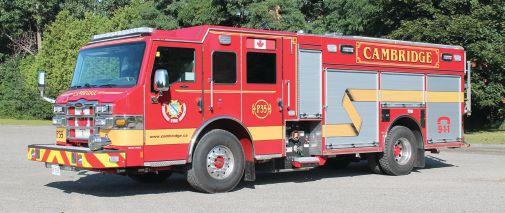
This PUC pumper is built on the Pierce Mfg. Impel chassis with full height doors and a 4-door cab with side roll and frontal impact protection. The Cummins L9 450 HP engine powers with 1250 lb per ft torque. The unit features a Pierce 1500 GPM PUC and a Husky 3 foam system.
DEPARTMENT: Cambridge Fire Department, Ontario
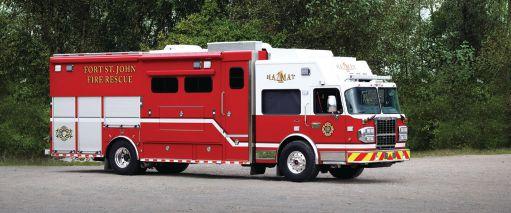
Built on a Spartan Metro Star chassis and powered by a Cummins L9 450 HP engine and an Allison EVS 3000 transmission, this SVI Trucks unit has V-MUX peer-to-peer advanced electronics, advanced occupant protection and a KL series light tower. Extras include Smart Board interactive LCD flat screen, AMX Modero touch panel controls and Orion vehicle-mounted weather station and a Bosch 36X optic zoom lens camera system.
DEPARTMENT: Fort St. John Fire Department, British Columbia
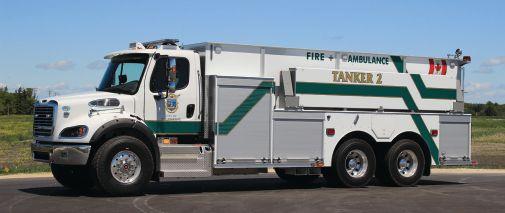
This pumper tanker is built on a Freightliner M2 112 chassis that is powered by a Cummins L9 400 HP diesel engine and an Allison 3000 EVS transmission. This marine grade aluminum tanker features a Darley PTO HM 500 pump, and 3000 IG poly tank.
DEPARTMENT: Yellowknife Fire Division, Northwest Territories
This aerial platform
an
DEPARTMENT:
AF-1 MFDxl
Built on an E-ONE Cyclone chassis and powered by a Cummins ISX12 engine and EVS 4000 transmission, this custom pumper features an extruded aluminum body and cab, 780 g water tank and a Hale QMax 7000 LPM single stage pump.
DEPARTMENT: Service de Sécurité Incendie de Laval, Quebec
|
Built on a Freightliner M2-106 2-door chassis and powered by a Cummins L9 350 HP engine and Allison EVS 3000 transmission, this Rosenbauer FX body has a Rosenbauer 1050 IGPM N pump, FRC TGA 300 pressure governor, 2000 g water tank, Whelen M9 scene lighting, TFT Tornado electric monitor with in-cab controls, Innovative Controls water tank level display with Monster Slave display and a hydraulically operated folding tank carrier.
DEPARTMENT: North Middlesex Fire Department, Ontario
Built on a 2019 Freightliner M2 106 4-door 4x4 cab and chassis with a Cummins 350 L9 and Allison 3000 EVS automatic transmission, this Rosenbauer 12-ft extruded aluminum rescue body is equipped with a Rosenbauer ultra high pressure system, 850 L water tank and a 61 m high pressure hose reel and nozzle. A 12V Command Light LED is also included.
DEPARTMENT: Burns Lake Fire Department, British Columbia
and chassis with a 12”
HP engine, and HME
Built on a Commander 4000 chassis with a 24” raised roof and 70” cab, this Rescue is powered by a Cummins L9 380 HP engine and Allison EVS 3000 transmission. The truck is equipped with a 3600 W inverter, 12V LED light tower – 80,000 Lumens and breathing air cylinder storage and fill system.
DEPARTMENT: St. Thomas Fire Department, Ontario

ROCKY MOUNTAIN PHOENIX
Head Office: 6415 Golden West Ave.
Red Deer, AB, T4P 3X2
Tel: 403-347-7045
Fax: 403-347-7049
Toll-Free: 1-800-494-4210
info@rockymountainphoenix.com www.rockymountainphoenix.com
BRANCHES:
103-2285 Queen St.
Abbotsford, BC, V2T 6T3
Tel: 604-864-7303 | Fax: 604-864-4938
Toll Free: 1-888-815-0500
320 Logan Rd. Bridgewater, NS, B4V 3J8
Tel: 902-298-0415 | Toll Free: 1-844-530-4003
Rocky Mountain Phoenix is a leader in the supply of vehicle solutions, products and services to the emergency response and fire combat industry. Your complete source for MSA SCBA, Thermal Imaging, Protective Clothing, Suppression Tools and Equipment. Visit our online catalogue at www. rockymountainphoenix.com
1800 Bonhill Road
Mississauga, ON, L5T 1C8
Tel: 905-364-5843
Fax: 905-364-7822
seatsinfo@seatscanada.com www.seatscanada.com
Hasan Mohammed
We offer a complete line of quality Emergency Vehicle seating for driver, officer, crew, wall mount and jump seats. Engineered for comfort and safety, these seats have easy exit flip-up split headrest and are manufactured in a wide variety of covering material.

111 Spartan Cr.
Pointe Clair, QC, H9R 3R4
Tel: 514-630-8931
Fax: 514-630-8931
info@portable-fire-pumps.com
www.portable-fire-pumps.com
SAFETEK EMERGENCY VEHICLES LTD.
parts@firetrucks.ca | sales@firetrucks.ca service@firetrucks.ca
WESTERN CANADA
30686-A Matsqui Place
Abbotsford, B.C. V2T 6L4
Tel: 604-504-4590
Fax: 604-504-2415
Toll Free: 1-866-723-3835
EASTERN CANADA
1775 Meyerside Drive, Unit 11-12
Mississauga, ON L5T 1E2
Tel: 905-564-7900
Fax: 905-564-7904
Toll Free: 1-877-572-0040
Safetek Emergency Vehicles is Canada’s exclusive dealer for Spartan Emergency Response ®, Smeal Fire Apparatus ®, SVI Trucks & EVI Emergency Vehicles. We offer the industry’s largest portfolio of fire-rescue vehicles and we stock over $2 million in parts from 300 OEM approved vendors from our locations in Ontario, Alberta and British Columbia. In most cases, we can provide “The Part You Need When You Need It within 48 hours”. Our certified EVT’s are also available to provide “Service Anywhere, Anytime” at a location that’s most convenient for you.
To learn more about the Safetek Advantage, contact us at sales@firetrucks.ca or www.firetrucks.ca.
We offer a complete line of reliable high volume high performance reliable Rabbit portable pumps with over 8 models including water-cooled and air-cooled systems. To insure the best quality, our pumps undergo extensive testing before leaving the production facilities. Also, the inspection and maintenance process are quick and easy due to a one-touch removable outer cover.

100 Courtland Ave.
Concord, ON, L4K 3T6
Tel: 866-660-2282, ext. 251
Fax: 905-660-2268
Toll-Free: 1-866-660-2282, ext. 251 brucem@sparklesolutions.ca www.sparklesolutions.ca
Bruce Miller
We are the industry leader in supplying Complete Laundering Solutions for personal protection equipment. Complete firefighter protection: Turn Out Gear extractors , dryers plus Gear cleaning detergents.
When our Ram ExpressDry Gear Dryers and our Continental ExpressWash Gear extractors, are combined with our ALL IN ONE gear detergent your firefighters can feel secure knowing they are able to properly clean and dry their equipment. Also available through AJ Stone.
STARFIELD LION
23 Benton Road
Toronto, ON, M6M 3G2
Tel: 416-789-4354
Fax: 416-789-5475
Toll-Free: 1-800-473-5553
infostarfield-lion@lionprotects.com www.starfieldlion.com
Rob Hosselet, Distribution Sales Manager – Canada
George Hajnasr, Metro Accounts Manager
Starfield Lion has a legacy and ongoing vision of introducing PPE that is designed to ensure the health, safety and performance of the first responders who serve our communities. Your safety is our top priority. Your needs drive our innovations, we listen and develop the solution.
SUTPHEN FIRE TRUCKS
6450 Eiterman Rd.
Dublin, OH, 43016
Tel: 614-296-5090
Fax: 614-889-0874
Toll-Free: 1-800-848-5860
djs@sutphencorp.com
www.sutphen.com
Daniel J. Sutphen

TECHNO FEU - 1200°
105 Route Marie-Victorin
Saint-François-du-Lac, QC, J0G 1M0
Tel: 450-568-2777
Fax: 450-658-0211
Toll-Free: 888-568-2777
info@1200-degres.com www.1200-degres.com
Distributors of E-ONE fire trucks for Eastern Ontario, Quebec and Atlantic Canada, Techno Feu enjoys a reputation that goes beyond the brand it sells.
Our experienced sales team is able to understand our clients’ needs and guide them towards their best possible option.
Our service center is the largest in Eastern Canada and our parts department stocks over $1M in inventory, meaning that your truck is out of our repair shop and back in service faster.
We provide peace of mind so you can focus on doing your job: saving lives.
Built on a Freightliner M2 106 chassis, this 4 passenger, 4-door cab is powered by a Cummins 350 HP engine with an Allison transmission, this pumper has front axle capacity of 14,000 lbs and rear axle capacity of 26,000 lbs. Extras include: Rosenbauer bronze NH 55 pump, 1250 IGPM (ULC at 840 IGPM), 625 IG poly water tank and a foam system Fix Mix c/w one 30 g foam tank.
DEPARTMENT: Sainte-Catherine-de-la-Jacques-Cartier, Quebec
Built on a Freightliner M2-106 chassis 4-door and powered by a Cummins L9 350 HP engine and Allison EVS 3000 transmission, this truck is equipped with a breathing air cylinder storage and fill system, customized interior/exterior storage and a 12V electric awning.
DEPARTMENT: Brighton Fire Rescue, Ontario
Built on a 2018 International DuraStar 4400 cab and chassis, and powered by a Cummins L9 350 HP engine and Allison 3000 EVS automatic transmission, this pumper includes a Rosenbauer N 1250 IGPM PTO driven pump, 900 IG water tank, 20 IG class “A” foam tank, a FoamPro 2001 foam system and a Hale EZ-Fill foam tank refill system.
DEPARTMENT: Kamsack Fire Department, Saskatchewan
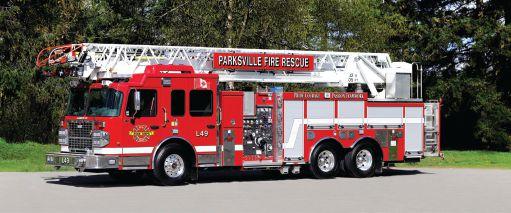
Built on a Spartan Gladiator chassis and powered by a Cummins X15 505 HP engine and an Allison EVS 4000 transmission, this Smeal unit has Waterous CSUC20 2250 GPM pump, 360 IG water tank, 25 IG foam tank and FoamPro 2001. Extras include: Standard turntable ladder, Smeal ergonomic hose load, V-MUX peer-to-peer electronics and advanced occupant protection and a Smart Power 8 KW/ HR-8 generator.
DEPARTMENT: Parksville Fire Department, British Columbia
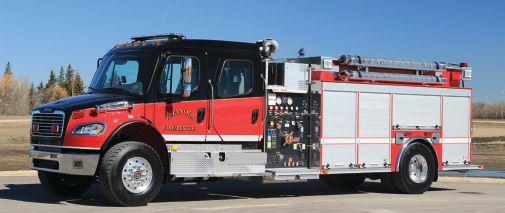
This pumper tanker is built on a Freightliner M2
4x2 chassis with a Cummins
diesel engine and an Allison 3000 EVS transmission. This 5083 salt-water marine grade aluminum unit features a Hale midship DSD1500 pump, 1500 IG water tank, and a FoamPro 2001 25 IG class A and B foam injection system.
DEPARTMENT: Espanola Fire & Rescue, Ontario
|
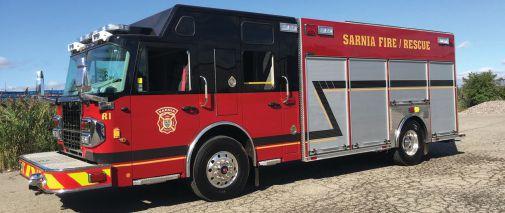
This rescue has a Spartan Metro Star LFD 20” raised roof cab/chassis with a Cummins L9 450 HP engine. The aluminum body was built in Ontario, and features Amdor roll-up doors, an open-concept rescue interior layout, walk-up rear access with roof coffin-compartment storage, shelving, trays and tool-boards, Whelen scene and warning equipment and a Smart Power generator.
DEPARTMENT:
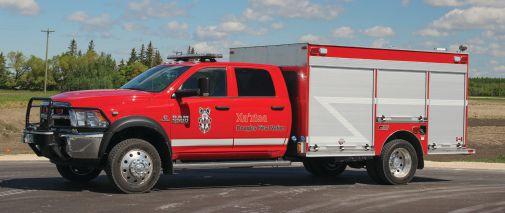
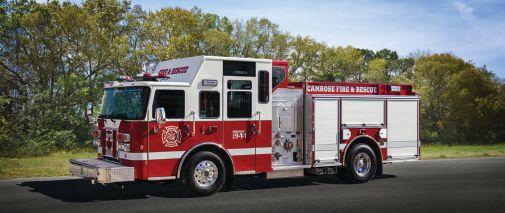

TOA CANADA CORPORATION
3670 Odyssey Drive, Unit 1
Mississauga, ON, L5M 0Y9
Tel: 1-800-263-7639
Fax: 1-800-463-3569
marketing@toacanada.com
www.TOAcanada.com
TOA Canada Corporation is dedicated to the development, manufacturing and distribution of premier commercial audio and security products. TOA products range from digital amplifiers and speakers, to mixers, wireless microphone systems, and digital processors used in sound reinforcement. Integrated VOIP intercom along with SIP systems and emergency paging and voice evacuation systems for security and communications.
TOA Corporation was founded in Kobe, Japan over 80 years ago. TOA operates in over 100 countries worldwide, with manufacturing facilities found in nearly every major market area. These facilities have a reputation for precision design and fabrication, resulting in a proven track record of TOA product reliability.
WATERAX INC.
6635 Henri-Bourassa W.
Montreal, QC, H4R 1E1
Tel: 514-637-1818
Toll-Free: 1-855-616-1818
info@waterax.com
www.waterax.com
Gabriella Gerbasi
Trusted by wildland firefighters around the world, WATERAX sets the industry standard by developing innovative, portable fire pumps and water-handling equipment designed to withstand demanding applications and rugged environments. With a timetested legacy of reliability, WATERAX carries on its mission to place powerful, precision engineered pumps into the hands of the men and women who need to move water to protect our forests and most cherished natural resources from the ravages of wildfires!

WATEROUS COMPANY
125 Hardman Ave. S.
South St. Paul, MN, 55075
Tel: 651-450-5000
Fax: 651-450-5090
info@waterousco.com
www.waterousco.com
Gregg Geske – Director of Sales, USA and Canada
Since 1886 Waterous Company has been manufacturing fire pumps and accessories in the USA. WaterousThen, Now, Always, Made in America.

ZIAMATIC CORP. (ZICO)
10 West College Ave., PO Box 337
Yardley, PA, 19067-8337
Tel: 215-493-3618
Fax: 866-493-1401
Toll-Free: 1-800-711-3473
sales@ziamatic.com
www.ziamatic.com
Mike Adams, Vice President – Sales
Ziamatic Corp. (ZICO) was founded in 1958 with the intention of providing the men and women of the fire services industry with products that make their profession safer and easier. Over 50 years later those
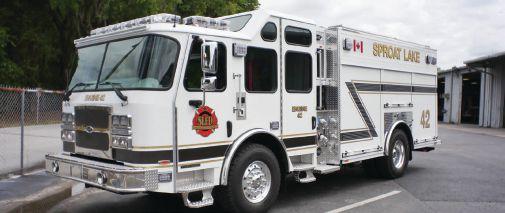
Built on an E-ONE Typhoon chassis and featuring the redesigned Typhoon cab, this eMAX rescue pumper is powered by a Cummins L9 450 HP engine and an Allison EVS 3000 transmission. This extruded aluminum body features a 1250 g UPF poly III water tank and 30 g foam cell. Extras include: eMAX 1500 GPM low profile split shaft pump and an enclosed pump operator’s panel.
DEPARTMENT: Sproat Lake Fire Department, British Columbia
This Ford F150 XLT 4x4 SuperCrew was upfitted by Commercial Emergency Equipment Co. The upgrade includes a 2.25” lift kit and a Leer DDC commercial canopy with full rear doors, side toolboxes, and interior LED lights. The rear 1000 lb.100% extension slide tray with custom storage organizer makes for quick and safe access to equipment.
DEPARTMENT: Carstairs Fire Department, Alberta
This MXV rescue pumper is built on a Metro Star MFD raised roof chassis with a Cummins L9 EPA 400 HP diesel engine and an Allison 3000 EVS transmission. This 5083 salt water marine grade aluminum MXV features a Hale midship QMax 1500 pump, 800 IG water tank, and a FoamPro 2001 class A foam system with a 25 IG foam tank.
DEPARTMENT: Cold Lake Fire Rescue, Alberta
Built on a Ford F- 4-door chassis and powered by a 6.8l V10 410 HP engine and 6-speed transmission, this Rosenbauer FX body has a Whelen LED emergency warning package and scene lighting as well as an HiViz LED brow light and an Onan 10Kw PTO generator.
DEPARTMENT: Kingston Fire & Rescue, Ontario
Built on an E-ONE Typhoon chassis and powered by a Cummins L9 450 HP engine and EVS 3000 transmission, this non-walk-in heavy rescue features a 400 g “R” water tank, a 500 GPM Waterous CL PTO driven pump, an Onan 15KW PTO generator with electric cord reels, a Command Light light tower, and rescue rear body staircase compartments with 10” deep steps.
DEPARTMENT: Steinbach Fire Department, Manitoba
| ROCKY MOUNTAIN
Built on a Rosenbauer Commander with an 11” raised roof, 70” cab and a 99” wide body cab that seats eight, this pumper is powered by a Cummins ISL 9L 450 HP engine and an Allison EVS 3000 automatic transmission. Extras include a Rosenbauer N pump, 1250 IGPM, UPF Polypropylene, 1000 IG water tank and a Rosenbauer hydraulic ladder rack.
DEPARTMENT: O’Leary Volunteer Fire Department, Prince Edward Island
Mfg. Saber chassis powered by a Cummins L9 380 HP engine. The fully enclosed tilt cab is all-welded aluminum with a 10” raised roof and seating for six. The water tank is a 1000 g T-shaped with a 25 g integral foam cell.
DEPARTMENT: Chatham-Kent Fire & Emergency Services, Ontario
Built on a Freightliner 114 SD cab and chassis and powered by a Cummins L9 450 HP engine and an Allison 3000 EVS automatic transmission, this tanker features a Hale RSDPTO driven fire pump with pump-and-roll capabilities, and 625 IGPM with a 3500 g water tank. The
a
DEPARTMENT: Foothills Fire Department, Alberta
a
All information contained in this apparatus directory, both product and company listings, is for the exclusive use of the purchaser and is to be used solely by the purchaser. None of the information included in this directory may be used to create, in whole or in part, any mailing list or other data compilation, in written or electronic form, that is to be sold or otherwise distributed to any third party. The purchaser may not include directory information as part of their own marketing materials. Failure to comply with these restrictions will constitute violations both of this agreement and the copyright laws of Canada. Purchase and use of this directory constitute acceptance of the restrictions set forth herein.
Although Fire Fighting In Canada magazine makes every effort to ensure the accuracy of information contained in this directory, it must rely on others over whom it has no control for certain information. Purchaser acknowledges that Fire Fighting In Canada magazine and its publishers cannot and do not guarantee or warrant that the information in the directory is complete, correct or current. Additions or corrections are invited at any time.
For more information on appearing in a future edition of the directory, please contact the publisher at 1-888-599-2228 ext. 252
ADAPTERS
Canadian Safety Eqpt.
Carl Thibault Fire Trucks
Commercial Emergency Eqpt.
CSE Incendie et Sécurité
Dependable Emergency Vehicles
Fort Garry Fire Trucks
Mercedes Textiles
Metz Fire And Rescue
ResQtech Systems
Rocky Mountain Phoenix
Safetek Emergency Vehicles
Techno Feu - 1200°
AERIAL REPAIRS
Carl Thibault Fire Trucks
Commercial Emergency Eqpt.
Darch Fire - 1200°
Dependable Emergency Vehicles
Fort Garry Fire Trucks
Metz Fire And Rescue
ResQtech Systems
Rocky Mountain Phoenix
Safetek Emergency Vehicles
Sutphen Fire Trucks
Techno Feu - 1200°
AERIAL TESTING
Carl Thibault Fire Trucks
Commercial Emergency Eqpt.
Darch Fire - 1200°
Dependable Emergency Vehicles
Fort Garry Fire Trucks
Metz Fire And Rescue
Rocky Mountain Phoenix
Safetek Emergency Vehicles
Techno Feu - 1200°
AERIALS
Carl Thibault Fire Trucks
Commercial Emergency Eqpt.
Darch Fire - 1200°
Dependable Emergency Vehicles
Fort Garry Fire Trucks
Metz Fire And Rescue
Pierce Manufacturing
ResQtech Systems
Rocky Mountain Phoenix
Safetek Emergency Vehicles
Sutphen Fire Trucks
Techno Feu - 1200°
AIRBAGS
Canadian Safety Eqpt.
Commercial Emergency Eqpt.
CSE Incendie et Sécurité
Darch Fire - 1200°
Safetek Emergency Vehicles
Techno Feu - 1200°
AIRPORT CRASH TRUCKS
Commercial Emergency Eqpt.
Darch Fire - 1200°
Dependable Emergency Vehicles
Fort Garry Fire Trucks
Metz Fire And Rescue
ResQtech Systems
Rocky Mountain Phoenix
Safetek Emergency Vehicles
Techno Feu - 1200°
ALTERNATORS
Rocky Mountain Phoenix
Safetek Emergency Vehicles
Techno Feu - 1200°
AMBULANCES
Dependable Emergency Vehicles
Rocky Mountain Phoenix
Ziamatic Corp. (Zico)
AXLES
Commercial Emergency Eqpt.
Darch Fire - 1200°
Dependable Emergency Vehicles
Fort Garry Fire Trucks
Rocky Mountain Phoenix
Safetek Emergency Vehicles
BACK-UP ALARMS
Carl Thibault Fire Trucks
Commercial Emergency Eqpt.
CSE Incendie et Sécurité
D&R Electronics Co.
Darch Fire - 1200°
Dependable Emergency Vehicles
Fort Garry Fire Trucks
Metalfab
Rocky Mountain Phoenix
Safetek Emergency Vehicles
Techno Feu - 1200°
BATTERIES
Commercial Emergency Eqpt.
D&R Electronics Co.
Darch Fire - 1200°
Safetek Emergency Vehicles
Techno Feu - 1200°
BELLS
Darch Fire - 1200°
Dependable Emergency Vehicles
Fort Garry Fire Trucks
Metalfab
ResQtech Systems
Rocky Mountain Phoenix
Techno Feu - 1200°
BOATS
A.J. Stone Company
Canadian Safety Eqpt.
Commercial Emergency Eqpt.
CSE Incendie et Sécurité
Rocky Mountain Phoenix
Darch Fire - 1200°
Dependable Emergency Vehicles
Fort Garry Fire Trucks
ResQtech Systems
Safetek Emergency Vehicles
Techno Feu - 1200°
A.J. Stone Company
Commercial Emergency Eqpt.
Darch Fire - 1200°
Dependable Emergency Vehicles
Fort Garry Fire Trucks
Metalfab
Metz Fire And Rescue
Pierce Manufacturing
ResQtech Systems
Rocky Mountain Phoenix
Safetek Emergency Vehicles
Techno Feu - 1200°
Ziamatic Corp. (Zico)
Carl Thibault Fire Trucks
Commercial Emergency Eqpt.
D&R Electronics Co.
Darch Fire - 1200°
Rocky Mountain Phoenix
Safetek Emergency Vehicles
Techno Feu - 1200°
CASES - WATERPROOF
A.J. Stone Company
Canadian Safety Eqpt.
CSE Incendie et Sécurité
Rocky Mountain Phoenix
Commercial Emergency Eqpt.
Darch Fire - 1200°
Dependable Emergency Vehicles
Fort Garry Fire Trucks
Metalfab
ResQtech Systems
Rocky Mountain Phoenix
Safetek Emergency Vehicles
Sutphen Fire Trucks
Techno Feu - 1200°
CO2 SYSTEMS
Commercial Emergency Eqpt.
COMMAND POSTS (MOBILE)
A.J. Stone Company
Canadian Safety Eqpt.
Carl Thibault Fire Trucks
Commercial Emergency Eqpt.
CSE Incendie et Sécurité
D&R Electronics Co.
Darch Fire - 1200°
Dependable Emergency Vehicles
Fort Garry Fire Trucks
Industries Lafleur
Metalfab
Metz Fire And Rescue
ResQtech Systems
Rocky Mountain Phoenix
Safetek Emergency Vehicles
Sutphen Fire Trucks
Techno Feu - 1200°
COMMUNICATIONS
EQUIPMENT (ON-BOARD)
Canadian Safety Eqpt.
Commercial Emergency Eqpt.
CSE Incendie et Sécurité
Metalfab
Rocky Mountain Phoenix
Safetek Emergency Vehicles
TOA Canada Corporation
COMPARTMENT DOORS
Carl Thibault Fire Trucks
Commercial Emergency Eqpt.
D&R Electronics Co.
Darch Fire - 1200°
Dependable Emergency Vehicles
Fort Garry Fire Trucks
Metalfab
ResQtech Systems
Rocky Mountain Phoenix
Safetek Emergency Vehicles
Techno Feu - 1200°
COMPARTMENT FLOORING
Carl Thibault Fire Trucks
Commercial Emergency Eqpt.
D&R Electronics Co.
Darch Fire - 1200°
Dependable Emergency Vehicles
Fort Garry Fire Trucks
Metalfab
ResQtech Systems
Rocky Mountain Phoenix
Safetek Emergency Vehicles
Techno Feu - 1200°
COMPARTMENT LIGHTING
Carl Thibault Fire Trucks
Commercial Emergency Eqpt.
D&R Electronics Co.
Darch Fire - 1200°
Dependable Emergency Vehicles
Fort Garry Fire Trucks
Metz Fire And Rescue
Rocky Mountain Phoenix
Safetek Emergency Vehicles
Techno Feu - 1200°
COMPRESSED AIR FOAM
SYSTEMS
A.J. Stone Company
Canadian Safety Eqpt.
Carl Thibault Fire Trucks
Commercial Emergency Eqpt.
CSE Incendie et Sécurité
Darch Fire - 1200°
Dependable Emergency Vehicles
Fort Garry Fire Trucks
Metalfab
Metz Fire And Rescue
Rocky Mountain Phoenix
Safetek Emergency Vehicles
Sutphen Fire Trucks
Techno Feu - 1200°
Waterous Company
COMPRESSORS
A.J. Stone Company
Canadian Safety Eqpt.
Commercial Emergency Eqpt.
CSE Incendie et Sécurité
Darch Fire - 1200°
Dependable Emergency Vehicles
Draeger Safety Canada
Fort Garry Fire Trucks
Metalfab
Rocky Mountain Phoenix
Safetek Emergency Vehicles
Sutphen Fire Trucks
Techno Feu - 1200°
COMPUTER MOUNTS
Commercial Emergency Eqpt.
D&R Electronics Co.
Darch Fire - 1200°
Dependable Emergency Vehicles
Metalfab
ResQtech Systems
Rocky Mountain Phoenix
Safetek Emergency Vehicles
Techno Feu - 1200°
COMPUTER SOFTWARE
Commercial Emergency Eqpt.
FLIR Systems
Safetek Emergency Vehicles
COMPUTERS (APPARATUS MOUNTED)
Commercial Emergency Eqpt.
D&R Electronics Co.
Rocky Mountain Phoenix
Safetek Emergency Vehicles
CONSULTING - VEHICLE INSPECTION
Commercial Emergency Eqpt.
Darch Fire - 1200°
Metalfab
Rocky Mountain Phoenix
Safetek Emergency Vehicles
Techno Feu - 1200°
CORROSION CONTROL
Commercial Emergency Eqpt.
Darch Fire - 1200°
Built on Commander 60” cabs and 4000 chassis, these trucks are powered by Cummins ISX 500 HP engines and Allison EVS 4000 transmissions. These Rosenbauer EXT bodies are equipped with Hale 8FGR 2000 GPM pumps, FRC TGA 400 pressure governors, 300 g water tanks, automatic aerial technology, outrigger and aerial screens and Akron Streammater II monitors.
DEPARTMENT: Canadian Forces Base Borden, Ontario
Built on a Rosenbauer Commander chassis with 11” raised roof and 60” cab with a Cummins L9 450 HP engine and Allison 3000 EVS automatic transmission, this truck features a Weldon V-MUX electrical system, Dual Vista screens, a Rosenbauer Midship fire pump 1250 IGPM PTO drive, “Hot Shift” pump-and-roll, 500 IG water tank with a 50 IG foam tank and a wireless remote deck gun.
DEPARTMENT: Whistler Fire Rescue, British Columbia
Built on a Pierce Mfg. Enforcer single-axle chassis, this PUC pumper is powered by a Cummins L9 450 HP engine. The 4-door, raised roof cab seats five; driver’s and officer’s seats are both air ride, high back for additional comfort. The unit features a 600 USG water tank, the Husky 12 foam system, and Pierce 1500 GPM pump.
DEPARTMENT: Chilliwack Fire Department, B.C.
This 20 ft walk-in command rescue is built on an International HV607, regular cab, 4x2 chassis with a Cummins L9 300 HP diesel engine and an Allison 3000 EVS transmission. This 5083 salt water marine grade aluminum rescue features a Whelen emergency and scene light package, an internal refrigerator, and ample compartment space.
DEPARTMENT: Hanover Fire Rescue, Manitoba
Built on a Spartan Metro Star chassis and powered by a Cummins ISL9 400 HP engine and an Allison EVS 3000 transmission, this Smeal unit has Waterous CSUC20 1750 GPM pump, 540 IG water tank, 30 IG foam tank, FoamPro 2001 and a FoamPro power fill system. Extras include: V-MUX peer-to-peer advanced electronics, advanced occupant protection and an Akron Deck Master electric monitor.
DEPARTMENT: Brantford Fire Service, Ontario
|
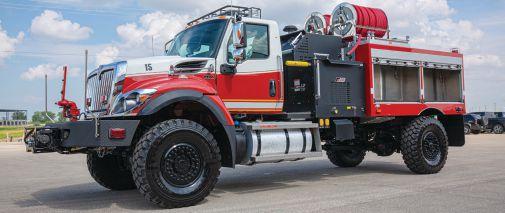
This range firefighting pumper is built on an International HV507 SFA regular cab 4x4 chassis with a Cummins L9 330 HP diesel engine and an Allison 3000 EVS transmission. This aluminum body unit features a Waterous pump and CAFS system driven by a 75 HP Kohler diesel engine. Extras include a 1000 IG galvanized tank and a Waterous Aquis 1.5 Foam proportioner system with a 20 IG external foam tank.
DEPARTMENT: Department of National Defence Fire Service, Canada
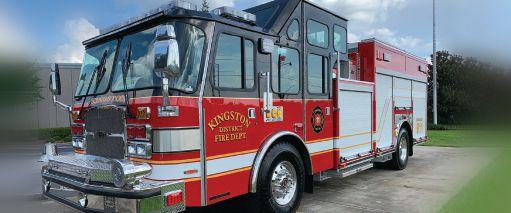
an E-ONE
30 g class A foam cell and an 8000 LPM Hale QMax pump.
DEPARTMENT: Kingston Fire Commission, Nova Scotia

and
Fort Garry Fire Trucks
Metalfab
Techno Feu - 1200°
CRIBBING
A.J. Stone Company
Carl Thibault Fire Trucks
Commercial Emergency Eqpt.
Dependable Emergency Vehicles
Metalfab
ResQtech Systems
Rocky Mountain Phoenix
Safetek Emergency Vehicles
DECK MATTING
A.J. Stone Company
Carl Thibault Fire Trucks
Commercial Emergency Eqpt.
Darch Fire - 1200°
Dependable Emergency Vehicles
Fort Garry Fire Trucks
Rocky Mountain Phoenix
Safetek Emergency Vehicles
Techno Feu - 1200°
DECK MONITORS
A.J. Stone Company
Canadian Safety Eqpt.
Carl Thibault Fire Trucks
Commercial Emergency Eqpt.
CSE Incendie et Sécurité
Darch Fire - 1200°
Dependable Emergency Vehicles
Fort Garry Fire Trucks
Metalfab
ResQtech Systems
Rocky Mountain Phoenix
Safetek Emergency Vehicles
Techno Feu - 1200°
DECONTAMINATION
SYSTEMS
A.J. Stone Company
Canadian Safety Eqpt.
CSE Incendie et Sécurité
Darch Fire - 1200°
Rocky Mountain Phoenix
Techno Feu - 1200°
DETECTION SYSTEMS
Canadian Safety Eqpt.
CSE Incendie et Sécurité
Draeger Safety Canada FLIR Systems
DOCK LIGHTS
A.J. Stone Company
Darch Fire - 1200°
Fort Garry Fire Trucks
Safetek Emergency Vehicles
DRY CHEMICAL SYSTEMS
A.J. Stone Company
Darch Fire - 1200°
Fort Garry Fire Trucks
Metalfab
Rocky Mountain Phoenix
DUMP VALVES
A.J. Stone Company
Canadian Safety Eqpt.
Carl Thibault Fire Trucks
Commercial Emergency Eqpt.
CSE Incendie et Sécurité
Darch Fire - 1200°
Dependable Emergency Vehicles
Fort Garry Fire Trucks
Metalfab
Metz Fire And Rescue
ResQtech Systems
Rocky Mountain Phoenix
Safetek Emergency Vehicles
Techno Feu - 1200°
Ziamatic Corp. (Zico)
ELECTRIC THROTTLES
Carl Thibault Fire Trucks
Commercial Emergency Eqpt.
Darch Fire - 1200°
Dependable Emergency Vehicles
Fort Garry Fire Trucks
Metalfab
Metz Fire And Rescue
Rocky Mountain Phoenix
Safetek Emergency Vehicles
Techno Feu - 1200°
ELECTRICAL SERVICE/ REPAIR
Carl Thibault Fire Trucks
Commercial Emergency Eqpt.
Darch Fire - 1200°
Dependable Emergency Vehicles
Fort Garry Fire Trucks
Metalfab
Metz Fire And Rescue
Rocky Mountain Phoenix
Safetek Emergency Vehicles
Techno Feu - 1200°
ENGINE BRAKE
Commercial Emergency Eqpt.
Darch Fire - 1200°
Techno Feu - 1200°
ENGINE GOVERNOR SYSTEMS
Carl Thibault Fire Trucks
Commercial Emergency Eqpt.
Darch Fire - 1200°
Fort Garry Fire Trucks
Metalfab
ResQtech Systems
Rocky Mountain Phoenix
Safetek Emergency Vehicles
Techno Feu - 1200°
ENGINES
Darch Fire - 1200°
Metalfab
ResQtech Systems
Techno Feu - 1200°
EXHAUST EXTRACTION
Air Technology Solutions
Canada
Air Vacuum Corporation
Darch Fire - 1200°
FITTINGS
A.J. Stone Company
Canadian Safety Eqpt.
Carl Thibault Fire Trucks
Commercial Emergency Eqpt.
CSE Incendie et Sécurité
Dependable Emergency Vehicles
Fort Garry Fire Trucks
Metalfab
ResQtech Systems
Rocky Mountain Phoenix
Safetek Emergency Vehicles
Techno Feu - 1200°
FLOORING (NON-SKID)
A.J. Stone Company
Commercial Emergency Eqpt.
Darch Fire - 1200°
Dependable Emergency
Vehicles
Safetek Emergency Vehicles
Techno Feu - 1200°
FLOWMETERS
A.J. Stone Company
Canadian Safety Eqpt.
Carl Thibault Fire Trucks
Commercial Emergency Eqpt.
CSE Incendie et Sécurité
Darch Fire - 1200°
Dependable Emergency Vehicles
Fort Garry Fire Trucks
Metalfab
ResQtech Systems
Rocky Mountain Phoenix
Safetek Emergency Vehicles
Techno Feu - 1200°
FOAM SYSTEMS
A.J. Stone Company
Canadian Safety Eqpt.
Carl Thibault Fire Trucks
Commercial Emergency Eqpt.
CSE Incendie et Sécurité
Darch Fire - 1200°
Dependable Emergency
Vehicles
Fort Garry Fire Trucks
Mercedes Textiles
Metalfab
Pierce Manufacturing
ResQtech Systems
Rocky Mountain Phoenix
Safetek Emergency Vehicles
Techno Feu - 1200°
Waterous Company
FRAME REPAIRS
Carl Thibault Fire Trucks
Commercial Emergency Eqpt.
Dependable Emergency
Vehicles
Fort Garry Fire Trucks
Techno Feu - 1200°
FUEL ADDITIVES
Commercial Emergency Eqpt.
GENERATOR GOVERNOR
SYSTEMS
Commercial Emergency Eqpt.
Darch Fire - 1200°
Techno Feu - 1200°
GENERATORS
A.J. Stone Company
Carl Thibault Fire Trucks
Commercial Emergency Eqpt.
Darch Fire - 1200°
Dependable Emergency
Vehicles
Fort Garry Fire Trucks
ResQtech Systems
Rocky Mountain Phoenix
Safetek Emergency Vehicles
Sutphen Fire Trucks
Techno Feu - 1200°
GROUND LADDER
INSPECTIONS
Commercial Emergency Eqpt.
Metalfab
Rocky Mountain Phoenix
Safetek Emergency Vehicles
HAZARDOUS MATERIALS UNITS
Canadian Safety Eqpt.
Carl Thibault Fire Trucks
CSE Incendie et Sécurité
Darch Fire - 1200°
Metalfab
Metz Fire And Rescue
Rocky Mountain Phoenix
Safetek Emergency Vehicles
Techno Feu - 1200°
HEADSETS
A.J. Stone Company
Canadian Safety Eqpt.
CSE Incendie et Sécurité
Darch Fire - 1200°
Fort Garry Fire Trucks
Metalfab
ResQtech Systems
Rocky Mountain Phoenix
Safetek Emergency Vehicles
Techno Feu - 1200°
HELICOPTER FIRE
FIGHTING SYSTEMS
Commercial Emergency Eqpt.
HORNS
A.J. Stone Company
Canadian Safety Eqpt.
Carl Thibault Fire Trucks
Commercial Emergency Eqpt.
CSE Incendie et Sécurité
D&R Electronics Co.
Dependable Emergency Vehicles
Fort Garry Fire Trucks
Metalfab
ResQtech Systems
Rocky Mountain Phoenix
Safetek Emergency Vehicles
Techno Feu - 1200°
HOSES & ACCESSORIES
A.J. Stone Company
Canadian Safety Eqpt.
Carl Thibault Fire Trucks
Commercial Emergency Eqpt.
CSE Incendie et Sécurité
Dependable Emergency Vehicles
Fort Garry Fire Trucks
Highwater Hose
Mercedes Textiles
Metalfab
ResQtech Systems
Rocky Mountain Phoenix
Safetek Emergency Vehicles
Ziamatic Corp. (Zico)
INDUSTRIAL TRUCKS
(IN-PLANT)
Commercial Emergency Eqpt.
Darch Fire - 1200°
Dependable Emergency
Vehicles
Industries Lafleur
Metalfab
Pierce Manufacturing
Rocky Mountain Phoenix
Safetek Emergency Vehicles
Sutphen Fire Trucks
Techno Feu - 1200°
INSTRUMENT PANELS
Canadian Safety Eqpt.
Carl Thibault Fire Trucks
Commercial Emergency Eqpt.
CSE Incendie et Sécurité
Darch Fire - 1200°
Metalfab
Rocky Mountain Phoenix
Safetek Emergency Vehicles
INTERCOMS
A.J. Stone Company
Carl Thibault Fire Trucks
Commercial Emergency Eqpt.
D&R Electronics Co.
Fort Garry Fire Trucks
Metalfab
Rocky Mountain Phoenix
Safetek Emergency Vehicles
Techno Feu - 1200°
INTERFACE VEHICLES
Commercial Emergency Eqpt.
Darch Fire - 1200°
Fort Garry Fire Trucks
Rocky Mountain Phoenix
Safetek Emergency Vehicles
Techno Feu - 1200°
LADDER ACCESS SYSTEM
A.J. Stone Company
Canadian Safety Eqpt.
Carl Thibault Fire Trucks
Commercial Emergency Eqpt.
CSE Incendie et Sécurité
Dependable Emergency
Vehicles
Fort Garry Fire Trucks
Metalfab
Safetek Emergency Vehicles
Techno Feu - 1200°
Ziamatic Corp. (Zico)
LDH HARDWARE
A.J. Stone Company
Commercial Emergency Eqpt.
Fort Garry Fire Trucks
Mercedes Textiles
Metalfab
Metz Fire And Rescue
Rocky Mountain Phoenix
Safetek Emergency Vehicles
LEASE/PURCHASE FINANCING
A.J. Stone Company
Commercial Emergency Eqpt.
Dependable Emergency
Vehicles
Fort Garry Fire Trucks
Rocky Mountain Phoenix
Safetek Emergency Vehicles
LIGHT CONTROL SYSTEMS
A.J. Stone Company
Carl Thibault Fire Trucks
Commercial Emergency Eqpt.
D&R Electronics Co.
BRONTO ALL-ROUNDER | FORT GARRY FIRE TRUCKS
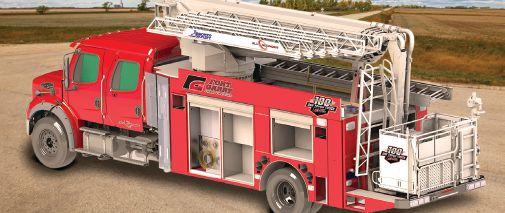
The brand new Bronto All-Rounder—coming in Spring 2020—will feature a 92 ft articulated ladder platform (image shown is a 3D rendering, actual vehicle may differ) built on a Freightliner M2-106 4-Door chassis with a Detroit DD13 12.8L 450 HP diesel engine and an Allison 4000 EVS transmission. This demo model will feature a 1250 USGPM pump with a 300 USG poly tank and a foam system.
DEMO RELEASE DATE: Spring 2020
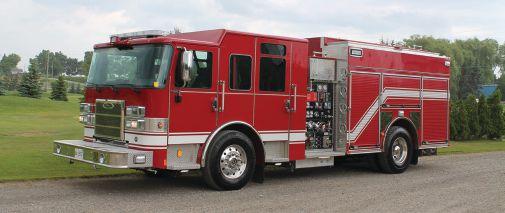
Built on a Pierce Mfg. Saber single axle chassis, the cab on this pumper has half-height doors and a raised roof with seating for six. The Cummins L9 450 HP engine powers this unit with 1250 lb per ft torque. It features a 750 USG water tank, Waterous C20 Series 1500 GPM pump, and Husky 3 foam system.
DEPARTMENT: Gananoque Fire Department, Ontario
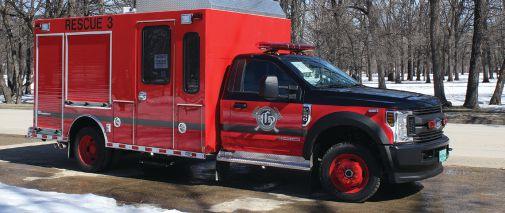
Built on a 2018 Ford F550 4x4 chassis with a power stroke 330 HP diesel engine, this Rosenbauer FX formed and extruded aluminum body includes Bostrom ABTS SCBA seats with Secure-All brackets. Extras include an Onan 6 kw PTO generator, six FRC LED SPA 900 scene lights, a 200” cord reel, Command Light Knight 2-light tower and extensive compartment provisions with roll out trays.
DEPARTMENT: Gillam Fire Department, Manitoba
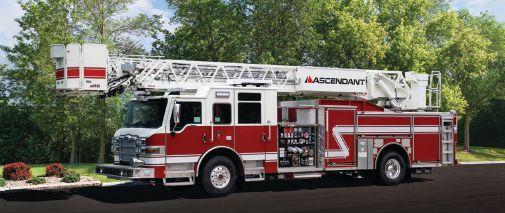
This Pierce Mfg. Ascendant 100’ single axle platform is ideal for Chief Lemire’s team to navigate the narrow hills of White Rock. This truck is built on the Velocity chassis with the Oshkosh TAK-4 independent suspension and is powered by Detroit Diesel DD13, 525 HP engine. The aerial is built to withstand winds up to 35 MPH and has a 750 dry/500 wet payload capacity.
DEPARTMENT: White Rock Fire Rescue, B.C.
32M/105’ AERIAL LADDER (MULTI UNIT) | SAFETEK
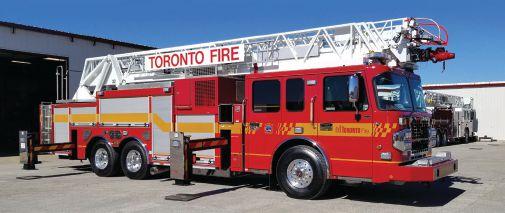
Built on Spartan Gladiator chassis and powered by Cummins X15 505 HP engines and Allison EVS 4000 transmissions, these Smeal units have Waterous CSUC20 2250 GPM pumps, 500 USG water tanks, Green Power SG-09 auxiliary power units and V-MUX peer-topeer advanced electronics. Extras include: Smeal ergonomic hose load, advanced occupant protection, Akron StreamMaster 3580 monitors and Akron SabreMaster 1578 deck guns.
DEPARTMENT: Toronto Fire Services, Ontario
RESCUE/PUMPER | SAFETEK
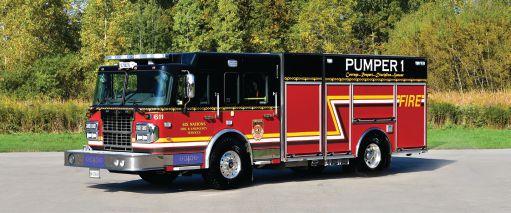
Built on a Spartan Metro Star chassis and powered by a Cummins L9 450 HP engine and an Allison EVS 3000 transmission, this Spartan Emergency Response unit has Waterous CSUC20 2000 GPM, 800 IG water tank, 20 IG foam tank and FoamPro 2001. Extras include: V-MUX peer-to-peer advanced electronics, advanced occupant protection and KL-415D Command Light light tower.
DEPARTMENT: Six Nations Fire & Emergency Services, Six Nations of the Grand River

This emergency rescue is built on a Freightliner M2 106 regular cab 4x4 chassis with a Cummins L9 330 HP diesel engine and an Allison 3000 EVS transmission. This 5083 salt water marine grade aluminum pumper features a Hale Midship DSD1250 pump, 800 IG water tank, and a FoamPro 1600 class A 25 IG single internal foam tank.
DEPARTMENT: New Denver & Area Volunteer Fire Department, British Columbia
Built on Freightliner M2 106 2WD crew cab chassis with Cummins L9 350 HP engines and Allison 3000 EVS automatic transmissions, these pumpers feature Waterous CXVK single stage fire pumps, 1050 IGPM - PTO pump-and-roll, 1000 IG water tanks, FRC three camera systems for back-up and sides, Fire-Com 5100D wireless intercom systems and hydraulic ladder racks.
DEAPRTMENT: Bonnyville Regional Fire Authority, Alberta
Darch Fire - 1200°
Dependable Emergency Vehicles
Fort Garry Fire Trucks
Metalfab
ResQtech Systems
Rocky Mountain Phoenix
Safetek Emergency Vehicles
Techno Feu - 1200°
LIGHTS - BARS/STROBES
A.J. Stone Company
Canadian Safety Eqpt.
Carl Thibault Fire Trucks
Commercial Emergency Eqpt.
CSE Incendie et Sécurité
D&R Electronics Co.
Darch Fire - 1200°
Dependable Emergency Vehicles
Fort Garry Fire Trucks
Metalfab
ResQtech Systems
Rocky Mountain Phoenix
Safetek Emergency Vehicles
Techno Feu - 1200°
LIGHTS - FLOOD
A.J. Stone Company
Canadian Safety Eqpt.
Carl Thibault Fire Trucks
Commercial Emergency Eqpt.
CSE Incendie et Sécurité
D&R Electronics Co.
Darch Fire - 1200°
Dependable Emergency
Vehicles
Fort Garry Fire Trucks
Metalfab
ResQtech Systems
Rocky Mountain Phoenix
Safetek Emergency Vehicles
Techno Feu - 1200°
LIGHTS - WARNING
A.J. Stone Company
Canadian Safety Eqpt.
Carl Thibault Fire Trucks
Commercial Emergency Eqpt.
CSE Incendie et Sécurité
D&R Electronics Co.
Darch Fire - 1200°
Dependable Emergency Vehicles
Fort Garry Fire Trucks
Metalfab
ResQtech Systems
Rocky Mountain Phoenix
Safetek Emergency Vehicles
Techno Feu - 1200°
MASTS, TELESCOPING
A.J. Stone Company
Canadian Safety Eqpt.
Carl Thibault Fire Trucks
Commercial Emergency Eqpt.
CSE Incendie et Sécurité
D&R Electronics Co.
Darch Fire - 1200°
Dependable Emergency Vehicles
Fort Garry Fire Trucks
ResQtech Systems
Rocky Mountain Phoenix
Safetek Emergency Vehicles
Techno Feu - 1200°
MINI-PUMPERS
A.J. Stone Company
Carl Thibault Fire Trucks
Commercial Emergency Eqpt.
Darch Fire - 1200°
Dependable Emergency Vehicles
Fort Garry Fire Trucks
Metalfab
Metz Fire And Rescue
Pierce Manufacturing
ResQtech Systems
Rocky Mountain Phoenix
Safetek Emergency Vehicles
Sutphen Fire Trucks
Techno Feu - 1200°
A.J. Stone Company
Canadian Safety Eqpt.
Carl Thibault Fire Trucks
Commercial Emergency Eqpt.
CSE Incendie et Sécurité
Darch Fire - 1200°
Dependable Emergency Vehicles
Fort Garry Fire Trucks
ResQtech Systems
Rocky Mountain Phoenix
Safetek Emergency Vehicles
Techno Feu - 1200°
N.D.T. INSPECTIONS
Carl Thibault Fire Trucks
Commercial Emergency Eqpt.
Darch Fire - 1200°
Rocky Mountain Phoenix
Safetek Emergency Vehicles
PEDESTALS - COMPUTER & RADIO
Commercial Emergency Eqpt.
D&R Electronics Co.
Metalfab
Rocky Mountain Phoenix
Safetek Emergency Vehicles
Techno Feu - 1200°
PIPED-IN WATERWAYS
Carl Thibault Fire Trucks
Commercial Emergency Eqpt.
Dependable Emergency Vehicles
Fort Garry Fire Trucks
Rocky Mountain Phoenix
Safetek Emergency Vehicles
PORTABLE EXTINGUISHERS
A.J. Stone Company
Canadian Safety Eqpt.
Carl Thibault Fire Trucks
Commercial Emergency Eqpt.
CSE Incendie et Sécurité
Dependable Emergency Vehicles
Fort Garry Fire Trucks
Metalfab
ResQtech Systems
Rocky Mountain Phoenix
Safetek Emergency Vehicles
PORTABLE FOAM UNITS
Commercial Emergency Eqpt.
Rocky Mountain Phoenix
PORTABLE MONITORS
A.J. Stone Company
Canadian Safety Eqpt.
Carl Thibault Fire Trucks
CSE Incendie et Sécurité
Dependable Emergency Vehicles
Draeger Safety Canada
Fort Garry Fire Trucks
ResQtech Systems
Rocky Mountain Phoenix
Safetek Emergency Vehicles
PUMP ACCESSORIES
A.J. Stone Company
Canadian Safety Eqpt.
Carl Thibault Fire Trucks
Commercial Emergency Eqpt.
CSE Incendie et Sécurité
Darch Fire - 1200°
Dependable Emergency Vehicles
Fort Garry Fire Trucks
Metalfab
Metz Fire And Rescue
Rocky Mountain Phoenix
Safetek Emergency Vehicles
Sutphen Fire Trucks
Techno Feu - 1200°
Waterax
Waterous Company
PUMP SERVICE & TESTING
Carl Thibault Fire Trucks
Commercial Emergency Eqpt.
Darch Fire - 1200°
Dependable Emergency Vehicles
Fort Garry Fire Trucks
Metalfab
Metz Fire And Rescue
Rocky Mountain Phoenix
Safetek Emergency Vehicles
Techno Feu - 1200°
PUMPERS
A.J. Stone Company
Carl Thibault Fire Trucks
Commercial Emergency Eqpt.
Darch Fire - 1200°
Dependable Emergency Vehicles
Fort Garry Fire Trucks
Metalfab
Pierce Manufacturing
ResQtech Systems
Rocky Mountain Phoenix
Safetek Emergency Vehicles
Sutphen Fire Trucks
Techno Feu - 1200°
PUMPS
A.J. Stone Company
Canadian Safety Eqpt.
Carl Thibault Fire Trucks
Commercial Emergency Eqpt.
CSE Incendie et Sécurité
Darch Fire - 1200°
Dependable Emergency Vehicles
Fort Garry Fire Trucks
Metalfab
ResQtech Systems
Rocky Mountain Phoenix
Safetek Emergency Vehicles
Sutphen Fire Trucks
Waterax
Waterous Company
PUMPS, PORTABLE
A.J. Stone Company
Canadian Safety Eqpt.
Carl Thibault Fire Trucks
Commercial Emergency Eqpt.
CSE Incendie et Sécurité
Dependable Emergency Vehicles
Fort Garry Fire Trucks
Mercedes Textiles
Metz Fire And Rescue
ResQtech Systems
Rocky Mountain Phoenix
Shibaura Portable Fire Pumps
Techno Feu - 1200°
Waterax
Waterous Company
RAILWAY TRAC-PANS
Commercial Emergency Eqpt.
REELS, ELECTRICAL
A.J. Stone Company
Canadian Safety Eqpt.
Carl Thibault Fire Trucks
Commercial Emergency Eqpt.
CSE Incendie et Sécurité
Darch Fire - 1200°
Dependable Emergency Vehicles
Fort Garry Fire Trucks
Metalfab
Metz Fire And Rescue
ResQtech Systems
Rocky Mountain Phoenix
Safetek Emergency Vehicles
Techno Feu - 1200°
REELS, HOSE
A.J. Stone Company
Canadian Safety Eqpt.
Carl Thibault Fire Trucks
Commercial Emergency Eqpt.
CSE Incendie et Sécurité
Darch Fire - 1200°
Dependable Emergency Vehicles
Fort Garry Fire Trucks
Mercedes Textiles
Metalfab
Metz Fire And Rescue
ResQtech Systems
Rocky Mountain Phoenix
Safetek Emergency Vehicles
Techno Feu - 1200°
REFLECTIVE TAPE & MARKINGS
A.J. Stone Company
Carl Thibault Fire Trucks
Commercial Emergency Eqpt.
D&R Electronics Co.
Darch Fire - 1200°
Dependable Emergency Vehicles
Fort Garry Fire Trucks
Metalfab
ResQtech Systems
Rocky Mountain Phoenix
Safetek Emergency Vehicles
REFURBISHING
Carl Thibault Fire Trucks
Darch Fire - 1200°
Dependable Emergency Vehicles
Fort Garry Fire Trucks
Metalfab
ResQtech Systems
Rocky Mountain Phoenix
Safetek Emergency Vehicles
Techno Feu - 1200°
RESCUES
A.J. Stone Company
Carl Thibault Fire Trucks
Commercial Emergency Eqpt.
Darch Fire - 1200°
Dependable Emergency Vehicles
Fort Garry Fire Trucks
Industries Lafleur
Metalfab
Metz Fire And Rescue
Pierce Manufacturing
ResQtech Systems
Rocky Mountain Phoenix
Safetek Emergency Vehicles
Sutphen Fire Trucks
Techno Feu - 1200°
ROLL-UP DOORS
Carl Thibault Fire Trucks
Commercial Emergency Eqpt.
D&R Electronics Co.
Darch Fire - 1200°
Dependable Emergency Vehicles
Fort Garry Fire Trucks
Metalfab
Metz Fire And Rescue
ResQtech Systems
Rocky Mountain Phoenix
Safetek Emergency Vehicles
Techno Feu - 1200°
ROLLOVER PROTECTION
Commercial Emergency Eqpt.
Darch Fire - 1200°
SALVAGE TRUCKS
Commercial Emergency Eqpt.
Darch Fire - 1200°
Dependable Emergency Vehicles
Fort Garry Fire Trucks
Metalfab
Rocky Mountain Phoenix
Safetek Emergency Vehicles
Techno Feu - 1200°
SCBA BRACKETS
A.J. Stone Company
Canadian Safety Eqpt.
Carl Thibault Fire Trucks
Commercial Emergency Eqpt.
CSE Incendie et Sécurité
Darch Fire - 1200°
Dependable Emergency Vehicles
Draeger Safety Canada
Fort Garry Fire Trucks
Metz Fire And Rescue
ResQtech Systems
Rocky Mountain Phoenix
Safetek Emergency Vehicles
Techno Feu - 1200°
Ziamatic Corp. (Zico)
Techno Feu - 1200°
Commercial Emergency Eqpt.
|
Built on Spartan Metro Star chassis and powered by Cummins L9 450 HP engines and Allison 3000 EVS transmissions with retarders, these Smeal units have Waterous CSUC20 2250 GPM pumps with 7000 LMP, 500 IG water tanks and Advantus 3.0 foam systems. Extras include: Green Power SG-09 auxiliary power units, Smeal ergonomic hose load and V-MUX peer-to-peer advanced electronics.
DEPARTMENT: Vaughan Fire And Rescue Service, Ontario
AERIAL COBRA PLATFORM | ROCKY MOUNTAIN PHOENIX
Built on a Rosenbauer custom Commander chassis with an 8” raised roof and 60” cab, this truck is powered by a Cummins ISX 12L 500 HP engine and Allison 4000 EVS automatic transmission. The platform features a Weldon V-MUX electrical system, Waterous S100C20 single stage fire pump 7000 LPM, 1957 l water tank, Whelen LED warning light package, Whelen TAL65 and 12V cab and body scene lights.
DEPARTMENT: Banff Fire and Rescue, British Columbia
This Sutphen aerial TS90 is built on a Sutphen 62” cab/10” RR TSAL4K chassis with a Cummins ISL9/450 HP engine and an Allison EVS 3000 transmission. This stainless-steel aerial features a Hale QMax 1500 GPM/1250 IGPM pump, and co-poly 300 USG/240 IG tank.
DEPARTMENT: Kenora Fire & Emergency Services, Ontario
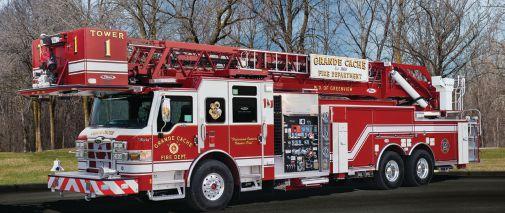
Chief Brian Lott and his team are keeping their community safe with this 100’ platform on the Velocity tandem axle chassis with the Oshkosh TAK-4 independent front suspension. It has a 50 MPH wind rating and a 150 lb tip load allowance. The unit is powered by a DD13 525 HP engine and features a Waterous C20 Series 2000 GPM pump and Husky 12 foam system.
DEPARTMENT: Grande Cache Fire Department, Alberta
AND PUMPER | COMMERCIAL EMERGENCY EQUIPMENT CO.
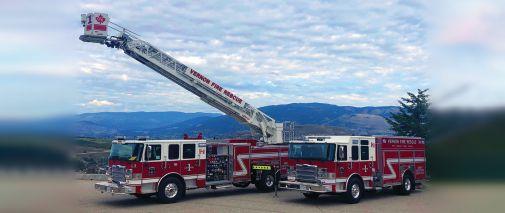
Built on the Enforcer single-axle chassis, the Pierce Mfg. Ascendant 110’ platform and pumper are equipped with Oshkosh TAK-4 independent front suspension. The platform has a Cummins L9 450 HP engine and a Waterous C20 Series 2000 GPM pump. The pumper has a Detroit Diesel DD13 525 HP engine and a Pierce 1500 GPM pump.
DEPARTMENT: Vernon Fire Rescue, British Columbia
| ROCKY MOUNTAIN PHOENIX
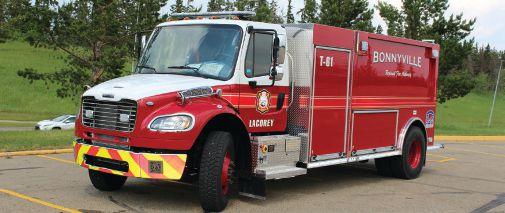
Built on a Freightliner M2 106 2WD regular cab chassis and powered by a Cummins ISL 9L 350 HP engine and Allison 3000 EVS automatic transmission, this tanker features a Hale 2000 l PTO driven fire pump (pump-and-roll), 2000 g water tank, one 2.5” Fireman’s Friend direct tank fill, two 1.5” Speedlays one 65mm discharge driver’s pump panel and one 65mm discharge officer’s pump panel.
DEPARTMENT: Bonnyville Regional Fire Authority, Alberta
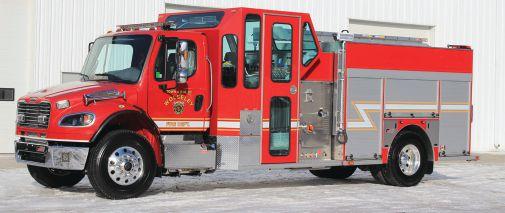
This MXV 4-man crown is built on a Freightliner M2 106 regular cab chassis with a Cummins L9 350 HP diesel engine and an Allison 3000 EVS transmission. This 5083 salt water marine grade aluminum MXV features a Darley PTO PSP1250 pump, and a 1000 IG water tank.
DEPARTMENT: Town & R.M. of Wolseley Fire Department, Saskatchewan
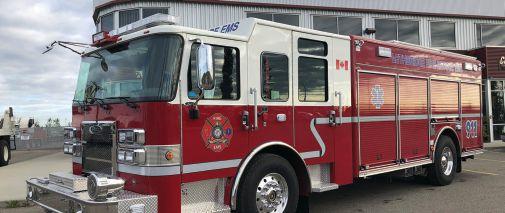
and frontal impact protection and a raised roof with seating for four. The truck is loaded with compartment space, for all the necessary tools and equipment, and an electric awning.
DEPARTMENT: Lethbridge Fire Department, Alberta
SEATING
A.J. Stone Company
Carl Thibault Fire Trucks
Commercial Emergency Eqpt.
Darch Fire - 1200°
Fort Garry Fire Trucks
Metalfab
Rocky Mountain Phoenix
Safetek Emergency Vehicles
Seats Canada
Techno Feu - 1200°
Ziamatic Corp. (Zico)
SIRENS
A.J. Stone Company
Canadian Safety Eqpt.
Carl Thibault Fire Trucks
Commercial Emergency Eqpt.
CSE Incendie et Sécurité
D&R Electronics Co.
Darch Fire - 1200°
Dependable Emergency Vehicles
Fort Garry Fire Trucks
Metalfab
ResQtech Systems
Rocky Mountain Phoenix
Safetek Emergency Vehicles
Techno Feu - 1200°
SKID UNITS
A.J. Stone Company
Canadian Safety Eqpt.
Carl Thibault Fire Trucks
Commercial Emergency Eqpt.
CSE Incendie et Sécurité
Dependable Emergency Vehicles
Fort Garry Fire Trucks
Metalfab
Metz Fire And Rescue
ResQtech Systems
Rocky Mountain Phoenix
Safetek Emergency Vehicles
Techno Feu - 1200°
SPEAKERS
A.J. Stone Company
Carl Thibault Fire Trucks
D&R Electronics Co.
Darch Fire - 1200°
Dependable Emergency
Vehicles
Fort Garry Fire Trucks
Metalfab
ResQtech Systems
Rocky Mountain Phoenix
Safetek Emergency Vehicles
Techno Feu - 1200°
SPEAKERS - EARLY
WARNING SYSTEMS
ResQtech Systems
Rocky Mountain Phoenix
STEP CHOCKS
A.J. Stone Company
Canadian Safety Eqpt.
Carl Thibault Fire Trucks
Commercial Emergency Eqpt.
CSE Incendie et Sécurité
Darch Fire - 1200°
Dependable Emergency Vehicles
Fort Garry Fire Trucks
Metalfab
ResQtech Systems
Rocky Mountain Phoenix
Techno Feu - 1200°
STOP & GO LIGHTS
Carl Thibault Fire Trucks
Commercial Emergency Eqpt.
Dependable Emergency Vehicles
Rocky Mountain Phoenix
Safetek Emergency Vehicles
STRAINERS
A.J. Stone Company
Canadian Safety Eqpt.
Carl Thibault Fire Trucks
Commercial Emergency Eqpt.
CSE Incendie et Sécurité
Dependable Emergency Vehicles
Fort Garry Fire Trucks
Metalfab
ResQtech Systems
Rocky Mountain Phoenix
Safetek Emergency Vehicles
Ziamatic Corp. (Zico)
SUSPENSION SYSTEMS
Commercial Emergency Eqpt.
Darch Fire - 1200°
Safetek Emergency Vehicles
TANKERS
A.J. Stone Company
Carl Thibault Fire Trucks
Commercial Emergency Eqpt.
Darch Fire - 1200°
Dependable Emergency Vehicles
Fort Garry Fire Trucks
Metalfab
Pierce Manufacturing
ResQtech Systems
Rocky Mountain Phoenix
Safetek Emergency Vehicles
Sutphen Fire Trucks
Techno Feu - 1200°
TANKS
A.J. Stone Company
Carl Thibault Fire Trucks
Commercial Emergency Eqpt.
Dependable Emergency Vehicles
Fort Garry Fire Trucks
Metalfab
ResQtech Systems
Rocky Mountain Phoenix
Sutphen Fire Trucks
TIRE CHAINS - AUTOMATIC
Carl Thibault Fire Trucks
Commercial Emergency Eqpt.
Darch Fire - 1200°
Dependable Emergency
Vehicles
Fort Garry Fire Trucks
Metalfab
ResQtech Systems
Rocky Mountain Phoenix
Safetek Emergency Vehicles
Techno Feu - 1200°
TIRES
ResQtech Systems
Techno Feu - 1200°
TOOL MOUNTS
Commercial Emergency Eqpt.
Darch Fire - 1200°
Techno Feu - 1200°
TRAILERS
Commercial Emergency Eqpt.
Dependable Emergency Vehicles
Metalfab
Rocky Mountain Phoenix
Safetek Emergency Vehicles
TRANSMISSIONS
Darch Fire - 1200°
ResQtech Systems
Techno Feu - 1200°
TRUCK FINISHES (PAINTS)
Commercial Emergency Eqpt.
Darch Fire - 1200°
Dependable Emergency Vehicles
Metalfab
ResQtech Systems
Safetek Emergency Vehicles
Techno Feu - 1200°
TRUCK SERVICE & REPAIR
Carl Thibault Fire Trucks
Commercial Emergency Eqpt.
Darch Fire - 1200°
Dependable Emergency Vehicles
Fort Garry Fire Trucks
Metalfab
Rocky Mountain Phoenix
Safetek Emergency Vehicles
Sutphen Fire Trucks
Techno Feu - 1200°
TURRETS - BUMPER
A.J. Stone Company
Commercial Emergency Eqpt.
Darch Fire - 1200°
Fort Garry Fire Trucks
Metalfab
ResQtech Systems
Rocky Mountain Phoenix
Safetek Emergency Vehicles
Techno Feu - 1200°
TURRETS - ROOF
A.J. Stone Company
Commercial Emergency Eqpt.
Darch Fire - 1200°
Fort Garry Fire Trucks
Metalfab
ResQtech Systems
Rocky Mountain Phoenix
Safetek Emergency Vehicles
USED APPARATUS
A.J. Stone Company
Commercial Emergency Eqpt.
Darch Fire - 1200°
Dependable Emergency Vehicles
Fort Garry Fire Trucks
Metalfab
ResQtech Systems
Rocky Mountain Phoenix
Safetek Emergency Vehicles
Sutphen Fire Trucks
Techno Feu - 1200°
VALVES
A.J. Stone Company
Canadian Safety Eqpt.
Carl Thibault Fire Trucks
Commercial Emergency Eqpt.
CSE Incendie et Sécurité
Darch Fire - 1200°
Dependable Emergency Vehicles
Fort Garry Fire Trucks
Metalfab
Rocky Mountain Phoenix
Safetek Emergency Vehicles
Techno Feu - 1200°
Waterous Company
VEHICLE ACCESSORIES
A.J. Stone Company
Carl Thibault Fire Trucks
Commercial Emergency Eqpt.
D&R Electronics Co.
Darch Fire - 1200°
Dependable Emergency Vehicles
FLIR Systems
Fort Garry Fire Trucks
Metalfab
Rocky Mountain Phoenix
Safetek Emergency Vehicles
Techno Feu - 1200°
Ziamatic Corp. (Zico)
VEHICLE CONSOLES
Carl Thibault Fire Trucks
Commercial Emergency Eqpt.
D&R Electronics Co.
Dependable Emergency Vehicles
Fort Garry Fire Trucks
Metalfab
Rocky Mountain Phoenix
Safetek Emergency Vehicles
Techno Feu - 1200°
VEHICLE UPFITTING
Commercial Emergency Eqpt.
D&R Electronics Co.
Dependable Emergency Vehicles
Metalfab
Rocky Mountain Phoenix
Safetek Emergency Vehicles
WATER/FOAM AIRCRAFT
Commercial Emergency Eqpt.
Darch Fire - 1200°
Dependable Emergency Vehicles
ResQtech Systems
Rocky Mountain Phoenix
Safetek Emergency Vehicles
Waterous Company
WELDERS
Carl Thibault Fire Trucks
Commercial Emergency Eqpt.
Metalfab
WHEEL CHOCKS
A.J. Stone Company
Canadian Safety Eqpt.
Carl Thibault Fire Trucks
Commercial Emergency Eqpt.
CSE Incendie et Sécurité
Darch Fire - 1200°
Dependable Emergency Vehicles
Fort Garry Fire Trucks
Metalfab
ResQtech Systems
Rocky Mountain Phoenix
Safetek Emergency Vehicles
Techno Feu - 1200°
Ziamatic Corp. (Zico)
WINCHES
A.J. Stone Company
Canadian Safety Eqpt.
Carl Thibault Fire Trucks
Commercial Emergency Eqpt.
CSE Incendie et Sécurité
D&R Electronics Co.
Dependable Emergency Vehicles
Fort Garry Fire Trucks
Metalfab
ResQtech Systems
Rocky Mountain Phoenix
Safetek Emergency Vehicles
TANKER | ROCKY MOUNTAIN PHOENIX

This emergency rescue pumper is built on the Spartan Metro Star ELFD 20” raised roof chassis with a Cummins L9 EPA 2017 400 HP diesel engine and an Allison EVS transmission. This 5083 salt water marine grade aluminum emergency rescue pumper features a Hale DSD 1250 Midship pump, a 600 IG water tank, and a FoamPro 1600 class A foam system with a 25 IG single internal foam tank.
DEPARTMENT: Minto Fire Department, Ontario
AERIALS AND PUMPERS | COMMERCIAL EMERGENCY EQUIPMENT CO. EMERGENCY RESCUE PUMPER | FORT GARRY FIRE TRUCKS
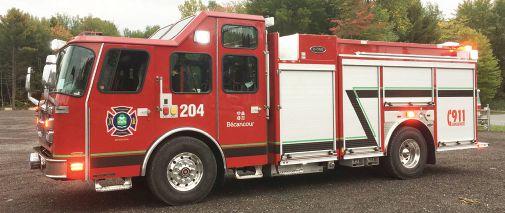
Built on an E-ONE Typhoon chassis and powered by a Cummins L9 400 HP engine and EVS 3000 transmission, this custom rescue pumper features a 5000 LPM Hale QMax pump, 3785 L water tank, 113 L tank for integral class A foam and a full height rear compartment with officer side storage tunnel.
DEPARTMENT: SSI Bécancour, Quebec
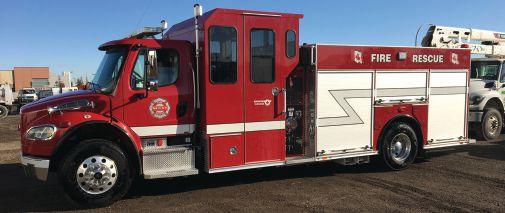
Built on a Freightliner M2 106 chassis, this MaxiFire pumper is powered by a Cummins L9 350 HP engine. The unit features a narrow 26” wide pumphouse with four seats and approximately 25 ft of storage space on each side. It has a Hale RDS-J-125 1250 GPM pump, a 1000 USG water tank, and a 30 USG foam polypropylene tank.
DEPARTMENT: Nairn & Hyman Fire Department, Ontario
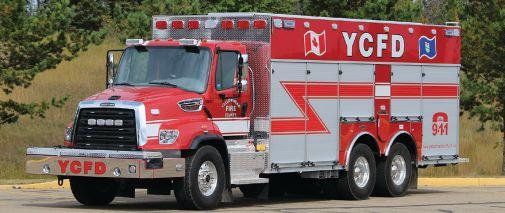
Built on a Freightliner 114SD chassis and powered by a DD 13 505 HP engine paired with an Allison 4500 EVS automatic transmission, this tanker features a Hale rear mounted fire pump 1500 IGPM, 3000 IG water tank, 30 IG foam tank and a FoamPro 2002 foam system. Lighting features include a Whelen LED light package and a traffic advisor with side body mounted light heads.
DEPARTMENT: Yellowhead County Fire Department, Alberta
DEPARTMENT: Teck Coal Greenhills Operations, British Columbia RESCUE PUMPER |
| FORT GARRY FIRE TRUCKS
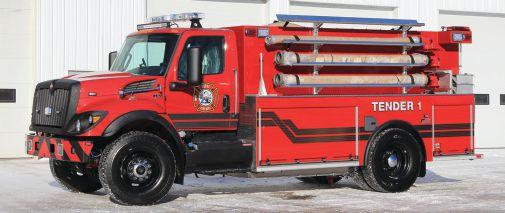
This tanker is built on an International HV607 SBA regular cab chassis with a Cummins L9 380, EPA 2017 380 HP diesel engine and an Allison 3000 EVS transmission. This marine grade aluminum tanker features a Hale Sidekick 500GPM pump and a 1750 IG poly water tank.
DEPARTMENT: Sooke Fire Department, British Columbia
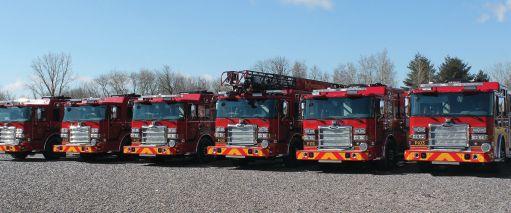
Assistant Chief Jamie Zimmerman and his crews can confidently serve their communities with their new fleet of Pierce Mfg. aerials (75’ HD Ladder, 107’ HD Ladder, 100’ aerial platform) and pumpers. All deliveries are built on the Enforcer chassis and powered by the Detroit Diesel DD13 470 HP engine. The trucks all feature the Husky 3 foam system and Hale QMAX-200 2000 GPM pump.
DEPARTMENT: Mississauga Fire & Emergency Services, Ontario
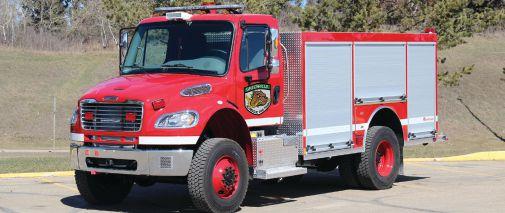
Built on a Freightliner M2 106 chassis with a Cummins L9- 330 HP engine and Allison 3000 EVS automatic transmission W/PTO provision, this Rosenbauer extruded and formed aluminum body has Air Ride seating with seat belt sensors, 15 KW PTO driven ONAN generator, Whelen LED light package, roll-out/tilt down trays, tool boards, SCBA storage, air bag storage and front and rear receivers with 12V winch power.
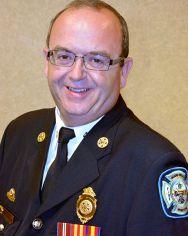
BY VINCE MACKENZIE Fire Chief
Grand Falls-Windsor Fire Department, Newfoundland
n the volunteer fire service, as a chief officer, it is common to incur a personal cost when expanding your professional development and leadership skills. More than in career services, many small-town fire chiefs have developed administrative skills on their own, or at the very least, in their daytime jobs. Their abilities spill into their role as a volunteer fire officer.
I have had the great fortune, as a career chief of a volunteer fire department, to benefit from many training and professional development opportunities over my 15 plus years. Those opportunities have positively shaped my career and department. My town has been very supportive and I feel I am indeed blessed. I have also had the good experience of voluntarily serving on fire service associations that have helped benefit the community I serve.
In attending a couple of fire service conferences for work in the past few months, I had the opportunity to engage with several hundred fire service leaders from across the country. While I am a paid chief, my employer affords me the time to work at these conferences. Unfortunately, in many cases, when volunteer fire chiefs want to attend conferences they must use personal vacation days from their daytime jobs. Rarely will the daytime employer of a volunteer fire chief allow extra time off for such professional development. So this becomes personal cost number one.
Attending professional development conferences and training events are not free. Registration fees, travel and accommodation cost the fire department valuable training funds. Some departments survive on fundraising to operate, and scarce training funds are usually allocated for more bread and butter operations like fire suppression. Rarely are these funds used to send chiefs off for skill enhancement in administration and leadership. So, therefore, it becomes cost number two.
the thinking in investing in leadership development.
I know that volunteer departments struggle to fund personal development for leadership positions, but rarely do I meet someone who has paid their entire way out of pocket as I recently did. Leaders of volunteer departments do this just to be able to sit in the conference room with their colleagues and learn. This was personal cost number three.
Smaller fire departments need leaders with strong leadership skills and fire service experience more than ever. Many fire departments and their governments fail to realize that it is the smaller fire departments that need to connect and network with other colleagues facing similar challenges. Peer leadership support gets established when these leaders go home with a pocket full of business cards, contacts and ability to call on that same person yearround for advice and assistance.
From coast to coast it seems there is a major lack of participation from volunteer organizations at fire service leadership and training conferences. It is important for volunteer chiefs to familiarize themselves with their colleagues in the career and volunteer sectors. It can be somewhat intimidating for a small town chief
If we are to truly grow and unite our fire services nationwide, we need more professional development for volunteer leaders. ‘‘ ’’
To spend all the training funds on the needed firefighter task training could be counterproductive. Many times, we don’t recognize good leadership skills and ability until it’s not there. It becomes apparent when unnecessary problems arise in your department. The formal soft skills of leadership are likely lacking in many volunteer departments and we need to find a way to change
Vince MacKenzie is the fire chief in Grand Falls-Windsor, Nfld. He is an executive member of the Canadian Association of Fire Chiefs and the past president of the Newfoundland and Labrador Association of Fire Services. Email Vince at firechief@townofgfw.com and follow him on Twitter at @FirechiefVince.
to be at a large gathering with bigger departments and career fire services. Listening to large fire departments talk about their woes can seem a little overbearing. Sometimes we sit there and wish we could be a branch on their tree.
Every fire department has their own methods and procedures. As vast and diverse as our communities are, our fire services must be as vast and diverse as well. Our fire service leaders, volunteer or career, must be equally vast and diverse. We need common networking with our peers. It is also beneficial for chiefs of larger departments to be exposed to small departments as well.
If we are to truly grow and unite our fire services nationwide, we need more professional development for volunteer leaders. Otherwise the escalating challenges that volunteer and composite departments face will be all the more difficult to overcome.