The Commercial Emergency Equipment team will be exhibiting across Canada this year at major tradeshows and expos. Come visit our Apparatus Specialists at the following shows & events:
ONTARIO ASSOCIATION OF FIRE CHIEFS TORONTO, ON | MAY 1 - 3
ALBERTA FIRE CHIEFS ASSOCIATION CALGARY, AB | MAY 25 - 28 BC FIRE EXPO (FCABC) PENTICTON, BC | JUNE 8 - 12
SASKATCHEWAN ASSOCIATION OF RURAL MUNICIPALITIES SASKATOON, SK | MARCH 11 - 13 MANITOBA ASSOCIATION OF FIRE CHIEFS BRANDON, MB | SEPTEMBER 3 - 6
NORTHEASTERN FIRE EDUCATION CONFERENCE HUNTSVILLE, ON | MARCH 27 - 30
FIRE DEPARTMENT INSTRUCTORS CONFERENCE INDIANAPOLIS, IN | APRIL 7 - 12
CANADIAN ASSOCIATION OF FIRE CHIEFS WINNIPEG, MB | SEPTEMBER 21 - 24
A.I.F.E.M.A. CALGARY, AB SEPTEMBER 9 - 11
SASKATCHEWAN URBAN MUNICIPALITIES ASSOCIATION SASKATOON, SK | APRIL 13 - 16 FIRECON 2025 THUNDER BAY, ON | SEPTEMBER 11 - 12
ASSOCIATION OF MANITOBA MUNICIPALITIES (SPRING) WINNIPEG, MB | APRIL 14 - 16
BC FIRE TRAINING OFFICER’S ASSOCIATION CONFERENCE PENTICTON, BC | MAY 13 - 14
CAMA CONFERENCE AND TRADESHOW MONT-TREMBLANT, QC | MAY 26 - 28
CANADIAN WILDFIRE CONFERENCE KELOWNA, BC OCTOBER 1 - 2
AMCO CONVENTION AND TRADESHOW SUDBURY, ON | OCTOBER 5 - 8
ALBERTA FIRE TRAINING CONFERENCE LETHBRIDGE, AB | OCTOBER 16 - 18
ASSOCIATION OF ONTARIO ROAD SUPERVISORS WOODSTOCK, ON | JUNE 4 - 5 INDIGENOUS PUBLIC SAFETY CONFERENCE 2025 CALGARY, AB | OCTOBER 23 - 24
SASKATCHEWAN ASSOCIATION OF FIRE CHIEFS KINDERSLY, SK | JUNE 5 - 7
NORTHERN H.E.A.T. PEACE RIVER, AB | JUNE 2025
RMA FALL CONVENTION AND TRADESHOW TBD, AB | NOVEMBER 17 - 20
ASSOCIATION OF MANITOBA MUNICIPALITIES (FALL) BRANDON, MB | NOVEMBER 25 - 27
INSIDE
Aiken
By Brittani Schroeder
Brittani Schroeder
By James Rychard
Into thick air
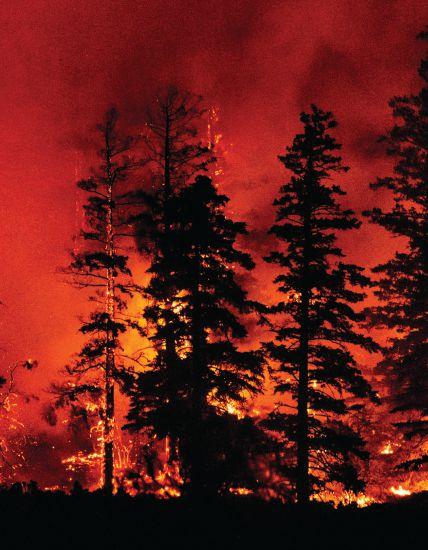
I recall the air smelling like an ashtray. Not a richly pungent cigar ashtray either. Acrid. Repugnant. This was 2023 when Quebec’s wildfire smoke made a tour de force through southern Ontario and into the U.S., shuttering children inside and hazing the gaze of those of us in disbelief that a fire so far from home could disrupt life like this. It was an eye opener to experience wildfire smoke travelling thousands of kilometres. Wildfire smoke isn’t just campfire wood…it’s the smoke of whatever’s been burnt up, including materials from structures and gases.
By May 13 of 2024, nearly 150 wildfires had triggered air quality alerts in western Canada and several U.S. states, with the CIFFC deeming 40 of 146 out of control, as reported by News Nation. Prairie wildfire smoke prompted air quality alerts in Northern Ontario in August. Calgary experienced wildfire smoke triggered air quality advisories last year as well, just to round up a few examples.
The health risks of wildfire smoke affect
areas where the risk of actual fire is low. The City of Mississauga in Ontario issued a press release to the public on June 5, 2024, warning that while the chance of a wildfire happening right in the city remained low, the municipality was concerned about the increasing implications of travelling smoke and listed a number of ways the public can become aware and protect themselves.
Pollution is already a significant global air quality problem. The 2024 World Air Quality Report by IQAir showed only 17 per cent of cities in the world meet World Health Organization pollution guidelines. Seven countries met the WHO annual average PM2.5 guideline of 5 μg/m3: Australia, Bahamas, Barbados, Estonia, Grenada, Iceland, and New Zealand. Canada, notably, is not amongst them. One can purport that increasing wildfires will only lead to more poor air quality.
Mitigating hazardous exposures for firefighters is a hot and ongoing issue reflected by ongoing evolutions in cancer prevention, the
conversation around PFAS and various technologies that reduce pollutants.
Wildland firefighters are equipped differently and the long-term effects and risks of wildfire smoke exposure are not well understood, but it can be inferred that is not great.
There is an opportunity for manufacturers to innovate and introduce wildland PPE that is higher performing and better tailored across various sized firefighters. There is work to be done on improving the respiratory protection products available. What firefighters have currently for protection won’t be as good as what they will have in the future, if history is any guide. As more and more firefighters are needed for the wildland fight, more and more research, funding and innovation needs to go into addressing the unique safety needs for the conditions they face.
LAURA AIKEN Editor laiken@annexbusinessmedia.com
Health Canada reports up to 240 deaths each year are caused by due short-term exposure to wildfire smoke.
THERE WERE $8.5 BILLION in insured losses due to severe weather in 2024, the costliest year in Canadian history, the Insurance Bureau of Canada reported.
Statistics Canada said First Nations are approximately 10 times more likely to die in a fire than non-First Nations persons.
EVERY $1 INVESTED in long-term wildfire programs saves, on average, $6 during response and recovery, Public Safety Canada found. Wildfires caused by lightning strikes account for over
81 % of area burned, according to Canada Wildfire.
STATION TO STATION
mayor of Halifax.
The group began their conversation almost 20 years in the past, examining the Snowstorm of the Century which took place in British Columbia at the end of 1996 and into 1997.
panel, titled “Training Challenges and Solutions in Responding to Extreme Weather Events and Climate Change”, began, moderated by Fire Fighting in Canada editor Laura Aiken.
FEBRUARY 25, 2025 AT 11:00AM ET
ADAPTING TO THE NEW NORMAL: EQUIPPING FIRE SERVICES FOR A FUTURE OF CLIMATE EXTREMES
Panelists recounted their responsibilities to educate members of their communities as over 120 cm of snow fell on cities across the province, highlighting the importance radio broadcasters once had in supporting emergency response during a climate event.
services are increasingly challenged by climate change-related emergencies, wildfires, floods and tornadoes. This necessitates improved emergency
encompassing budgeting, equipment, and training.
Virtual Summit 2025 examined preparing for and responding to climate changerelated emergencies
The panel featured Dave Gillespie, chief training officer for Peterborough Fire Services, Tyler Pelke, deputy chief of emergency services with the city of Red Deer, Alta., and Stephen Hilton, a firefighter and training instructor with Firestar Services.
Fire Fighting in Canada hosted a virtual summit on Feb. 25 themed around the climate change-related emergencies facing Canada’s fire service, the challenges they present and how departments can better prepare themselves and their communities for these.
As social media and alerting applications have become more popular and commercial stations have begun to consume smaller community broadcasts, that level of reliance is no longer present.
Fire Fighting in Canada Virtual Summit will address these issues, focusing on practices and shared challenges among fire departments nationwide. The summit’s cover both preparedness and response strategies, prioritizing crew well-being decision-making during prolonged emergencies. Ultimately, the goal is to capacity of fire services to handle the escalating impacts of climate change.
The summit, which had 131 registrants, began with “Will radio be there for us when we need it?”, hosted by (Ret.) Fire Chief Tom DeSorcy, host of Fire Fighting in Canada: The Podcast and a former radio broadcaster.
The cross-country panel looked at the history of radio and its collaboration with emergency services during times of crisis, examined its current place in the media landscape and provided suggestions to re-emphasize its importance in emergency response.
Joining DeSorcy were former and current members of the radio broadcasting industry, including Barry Rooke, executive director of National Campus/Community Radio Association, Drew Snider, a consultant, broadcaster and media advisor, Ken Hardie, member of the House of Commons for the Fleetwood – Port Kells riding and former producer, and Lisa Blackburn, a 25-year veteran of the media industry and former deputy
“Many commercial broadcasters, including the CBC, just do not have the capacity to be there live to respond,” said Rooke, a sentiment echoed by all panelists present.
The CBC was a recurring player throughout the panel’s conversation. Hardie, in what he called his, “one and only partisan shot,” said this is a horrible time for anyone to be talking about defunding the CBC. The group provided a number of suggestions to start to rebuild that public trust and reliance on radio, including transitioning away from larger conglomerates back to smaller, local stations who are in touch with the needs of their communities and can speak more directly to citizens.
They also highlighted the importance for emergency response personnel to build a partnership with these networks, going to the programming director and establishing a dialogue so, in the case of an emergency, a clear line of communication has already been put in place.
“Reach out and make those contacts with local radio stations,” said Blackburn. “Find out what their limitations are and establish a plan.”
After a short break, the second
The conversation focused on the four core challenges departments face when attempting to train for climate-change caused emergencies: the unpredictability and variability of the events, the resource management required for departments to perform this additional training, the ability to improve interagency coordination to ensure full coverage in the face of these emergencies and preparing the community to respond.
The panelists examined these four core issues from the differing perspectives of career and volunteer departments across the country, examining how each must respond differently to these pressures.
In addition, there was a focus on the use of technology to address these challenges, including the current use of virtual reality to facilitate training opportunities and the possibility of incorporating artificial intelligence in the future.
The overarching sentiment of the panel was one of collaboration, on both a micro level with the participants building on each other’s answers, and in the macro sense, with Gillespie consistently reminding viewers of the importance of partnerships in emergency response and training, particularly if your department is in the responding area of an Indigenous community.
“Whether that’s Northern Ontario, B.C., Manitoba or The Rock, we have to be able to acknowledge that they will bring other skillsets to the table and they will have different equipment,”
Gillespie said. “If you have a neighbouring jurisdiction and you might be working with them, you need to make that call.”
Cree Nation and Ontario fire departments launch Fire Prevention Officer
Mentorship Program
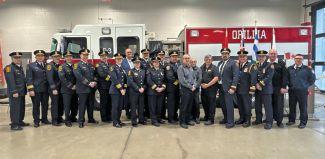
The Ontario Association of Fire Chiefs (OAFC) and the Cree Nation are partnering to launch the Fire Prevention Officer (FPO) Mentorship Program, bringing together fire services from across Ontario and the Cree Nation communities of northern Quebec.
The FPO Mentorship Program will allow participants to bring back valuable fire safety knowledge and experience to their community.
The FPO Mentorship Program is the first of its kind in Canada and will see 10 FPOs from the Cree Nations of northern Quebec traveling to southern Ontario to work in conjunction with 11 fire departments, gaining experience to establish their own programs at home. The program will see each FPO partner with an Ontario fire department for one month, the OAFC reported in a press release.
“Fire prevention is so vital for our communities, especially with the unique challenges we face,” said Grand Chief Mandy Gull-Masty, Grand Council of the Crees (Eeyou Istche)/Cree Nation Government, in a media statement.
The Ontario participants are Kawartha Lakes Fire Rescue Service, King Fire and Emergency Services, Kingston Fire and Rescue, Kitchener Fire Department, Oakville Fire Department, Orillia Fire Department, Rama Fire Rescue Service, Richmond Hill Fire and Emergency Services, Sarnia Fire Rescue Services, St. Catharines Fire Services and Windsor Fire and Rescue Services.
THE FIRE HALL BULLETIN
PROMOTIONS & APPOINTMENTS
The town of Deseronto in Ontario named DUNCAN MCILVANEY as their full-time fire chief, removing the interim status he has held since July 2024. McIlvaney has been a member of the department for 23 years and has experience in fire service operations, training and emergency response.
BILL HEESING was selected to fill the role of fire chief for the Lloydminster Fire Department in Alberta. Heesing has been a member of the fire service for over 35 years, joining the Lloydminster department in 2018 as an assistant chief.
The city of Port Colborne in Ontario promoted STAN DOUBLE to fire chief. Double has been serving as the interim fire chief since December 2024. He previously worked with the Hamilton Fire Department for 30 years.
ROBERT GARLAND has been appointed to the role of deputy fire chief for Markham Fire and Emergency Services in Ontario. Garland has been a member of the department for nearly 20 years, recently completing an 11-month secondment as deputy fire chief.
View Royal Fire Rescue in B.C. appointed KRIS MALINOSKY as its new assistant fire chief. Malinosky has over 25 years of fire fighting experience, most recently holding the role of assistant fire chief with Oak Bay Fire. He previously worked with View Royal Fire Rescue from 1997 to 2002.
ASHLEY NOGANOSH has been welcomed as the new deputy fire chief for the Orillia Fire Department in Ontario. Noganosh has 23 years of experience with the Rama Fire Department and is the first women and first Indigenous person to hold the role of deputy chief with the city of Orillia.
The town of Tillsonburg in Ontario named SCOTT TEGLER as their interim fire chief. Tegler previously served as fire chief and community emergency management coordinator with the city of Woodstock.
Greater Napanee council in Ontario as removed the acting tag from full-time fire chief
SHAWN ARMSTRONG
Armstrong joined the department in 2024, previously serving as fire chief for the city of Guelph and the city of Kingston.
The city of Chestermere in Alberta has appointed CODY ZEBEDEE as their new fire chief. Zebedee brings over 24 years of experience in fire service leadership, safety codes and fire investigation. He began his career as a firefighter with the town of High River in 1997, working his way to captain from 2005 to 2018 before being named fire chief in 2019.
BRAD SMITH has been selected as the new deputy fire chief for South Frontenac Fire and Rescue Services in Ontario. Smith has 23 years of fire fighting experience, having served as both a firefighter and captain with South Frontenac for nine years and spending 13 years with Kingston Fire and Rescue.
RETIREMENTS
Deputy Fire Chief DARYL BRODHAECKER retired from Mapleton Fire Rescue in Ontario. Brodhaechker has been a member of the department for 35 years and was named deputy chief in 2015.
LAST ALARM
Fire Chief MICHAEL WALTON passed away on February 24 at the age of 68. Walton became a member of the Hartland Fire Department in New Brunswick in 1975, stepping into the position of acting fire chief in 1982. He was the president of the Central Valley Fire Fighters Association and a past president of the New Brunswick Association of Fire Chiefs.
STATION TO STATION
CLOCKWISE:
Simpcw First Nation in B.C., Forty Mile County in Alberta, Regional District of Nanaimo in B.C., Tay Township in Ont., Langley in B.C., Mayne Island in B.C.
SIMPCW VOLUNTEER FIRE DEPARTMENT
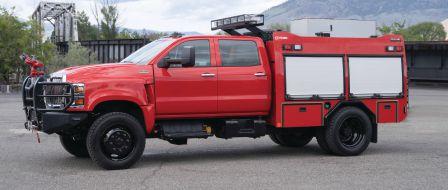
Simpcw First Nation in B.C. took delivery of a Wildland 3 MAX from Safetek Profire. Built on an International CV 515 crew cab 4X4, this wildland truck is equipped with an International 6.6 L 350HP engine and an Allison 2750 transmission. Additional features include a Darley HM350 pump, Darley 1.5 AGE 10YD auxiliary pump, 500 IG water tank, Trident Format ATP foam system, Elkhart Brushhawk monitor and Whelen LED emergency lighting.
COUNTY OF FORTY MILE FIRE DEPARTMENT
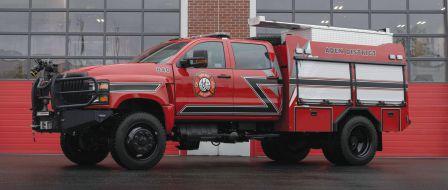
Safetek Profire delivered a Wildland 5 MAX to Forty Mile County in Alberta. Manufactured on an International CV 515 crew cab 4X4, the Wildland 5 is fitted with an International 6.6 L 350 HP engine and an Allison 2750 transmission. Additional features include a Waterax BB-4 21H 4 stage high pressure pump, 500 IG water tank, 100’ 1” hose reel, Scotty ATP 12 IG foam system and Whelen LED emergency lighting.
NANOOSE VOLUNTEER FIRE DEPARTMENT
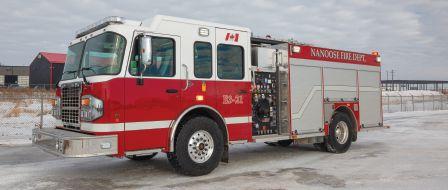
The Regional District of Nanaimo in British Columbia has taken delivery of a pumper from Fort Garry Fire Trucks. Built on a Spartan Metro Start 10” RR chassis, the apparatus is outfitted with a Cummins L9 380 HP engine and an Allison 3000 EVS transmission. The pump is a Hale DSD1500, the tank is made of Co Poly with a capacity of 800 IG and it is equipped with a FoamPro 2001 Class A foam system.
TAY TOWNSHIP FIRE DEPARTMENT
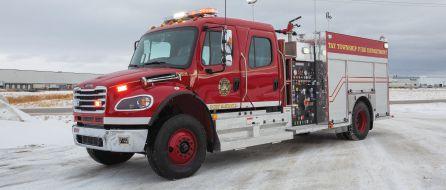
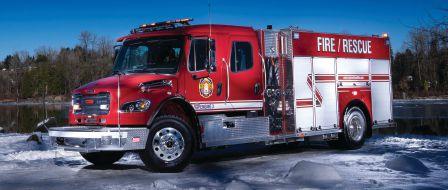
Fort Garry Fire Trucks delivered a side control ER pumper to Tay Township in Ontario. Built on a Freightliner M2-106 four door chassis, the pumper has a DD8 7.7 375 HP engine and an Allison 3000 EVS transmission. The apparatus is equipped with a Waterous CSU 1500 pump, a Co Poly 800 IG tank and a FoamPro 1600 Class A foam system.
MIDLAND FIRE DEPARTMENT
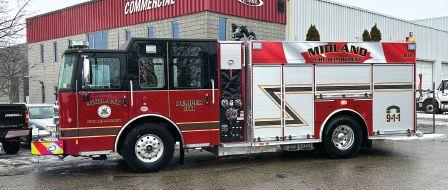
Midland Fire Department in Ontario took delivery of a Maximetal MaxiSaber Paragon pumper from Commercial Emergency Equipment. The apparatus is powered by a 450 HP Cummins L9 engine and is equipped with a 1200 G water tank, Waterous CX 1500 GPM pump, Husky 3 foam system and features Whelen emergency lighting.
MAYNE ISLAND FIRE RESCUE
Commercial Emergency Equipment delivered Mayne Island Fire Rescue in B.C. its first new apparatus in over 10 years. The MaxiMetal engine was built on a Freightliner M2 chassis and equipped with a Detroit DD8 engine. The truck has a Paragon pumphouse configuration, Waterous CX 1500 GPM pump, 1200G tank, a 30G foam tank and a Whelen and Fire Research Corporation lighting package.
DELIVERING STRENGTH THROUGH EXCELLENCE
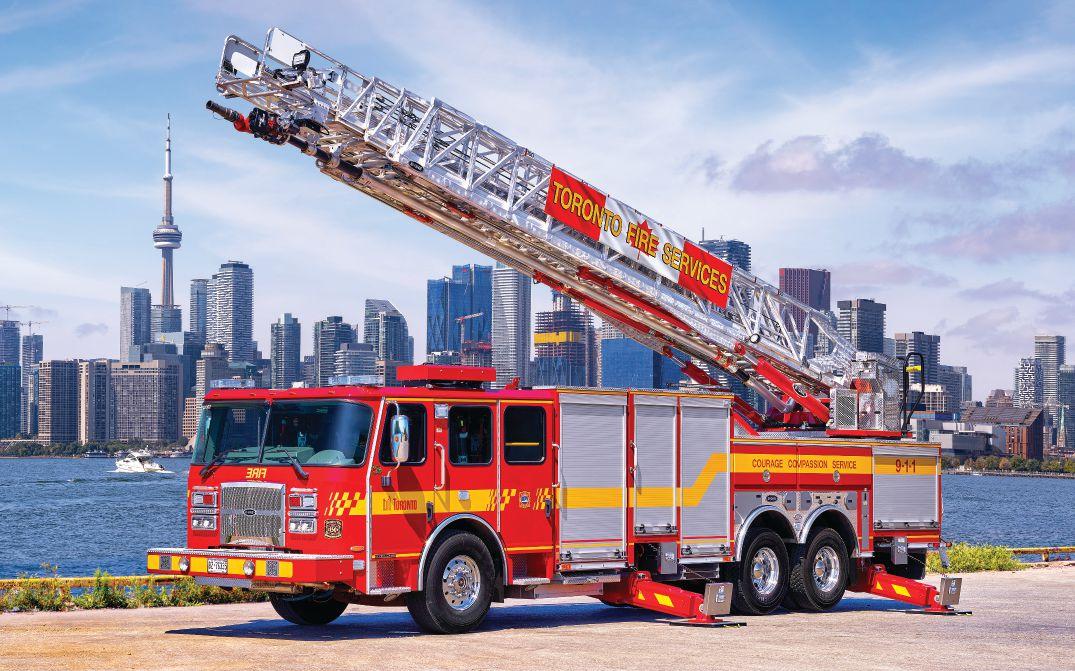
Since 1974, E-ONE, a full-spectrum builder of fire apparatus, continues to be the pioneer and recognized leader in extruded aluminum and stainless steel construction. With their advanced engineering, fully integrated manufacturing and experienced, professional dealer network, the customer-focused E-ONE team delivers strength through excellence to fit your specific department needs.
Discover E-ONE – the global supplier of Pumpers, Tankers, Aerial Ladders and Platforms, Rescues, Industrials and ARFFs. We’re proud to partner with our dedicated dealer network to serve the Canadian firefighting community. Contact your local E-ONE dealer, or visit e-one.com.
By Laura Aiken
WILDFIRES IN CANADA: A 2024 round-up
burned. This includes fires that were still active from record-breaker 2023, when the total hectares burned was over 16 million. This degree of fire activity taxed the system of response significantly in 2024.
season
A look at a less devastating than 2023 but ultimately challenging wildfire
By the numbers, Canada’s 2024 wildfire season was tamer than 2023, but it was still wildly devastating on a number of fronts.
The Canadian Interagency Forest Fire Centre’s (CIFFC) final situation report of the year, published in September, documented a total of 5,363 fires and 5,321,091.1 hectares
The CIFFC’s national preparedness level considers “availability and demand for firefighters or equipment, current environmental conditions, potential for new wildland fires and current active wildland fires.” Canada spent 39 days at a Level 5, all in July and August, meaning wildfire activity was significant in one or more areas and firefighters/equipment in every region of Canada were mobilized and international help was requested. The country spent 13 days at Level 4, indicating wildfires were notable in at least one jurisdiction and the demand for resources and firefighters from other regions was high. Comparatively, Canada experienced 119 days at level 5 in 2023, none in 2022, 50 days in 2021 and none in 2020 or 2019.
Because 2023 was a particularly long wildfire season, with fires burning well into autumn, a number of them smouldered and reignited in February, making 2024 an extension of the historic preceding year. But 2024 held some records of its own.
LEFT At 1,687, B.C. experienced the highest number of fires amongst provinces at territories.
MARITIMES: RECORDS AND REPRIEVE
On July 12, a rapid moving wildfire forced the evacuation of over 9600 people in Labrador City. The fire had quickly ballooned to 35,000 acres and spread to within four kilometres of the community. This is the largest evacuation in Newfoundland and Labrador history. The provincial government issued $3.5 million in disaster relief. This was the second evacuation for the Labrador community, as Churchill Falls residents were ordered to leave on June 19 due to forest fires. In the fall, the N.L. government announced $32 million for a wildfire centre located at Gander International Airport. The cost will be shared with Natural Resources Canada. The funds will directly support equipment acquisition and repair as well as firefighter training.
In P.E.I., July saw the announcement of a joint provincial and federal investment of $3 million in wildfire preparedness, to be dispersed over four years through the Fighting and Managing Wildfires in a Changing Climate Program (FMWCC) — Equipment Fund. P.E.I. averages seven wildfires a year on the small island. Ninety per cent of it wildfires are human caused, reported the provincial government, and this year recorded zero hectares burned.
Nova Scotia experienced a wildfire reprieve after its devastating 2023 season in which 60 homes were destroyed in the Barrington Lake fire that burned 23,379 hectares. That the largest fire size-wise in the province’s recorded history. The 2023 Tantallon fire, which was burning at the same time as Barrington Lake, burned down 151 homes and consumed 969 hectares. This year there was 83 wildfires as of late October that burned about 47.5 hectares. The 10-year average is 185.4 wildfires and 3,277 hectares of land annually, reported the Department of Natural Resources and Renewables. A CBC report indicated that a better public awareness of burning hazards, particularly after the devastating 2023 season, helped keep this wildfire season in check.
New Brunswick had recorded 257 fires for 2024 by the CIFFC’s September situation report, with 272 reported in the media by late October. One hundred and ninety-seven hectares burned. New Brunswick’s 10-year average is 246 fire per year, with 450 hectares of forest burned. Last year 857 hectares burned, which included 500 lost in the Stein Lake fire. The New Brunswick government reports that 202 of the 209 fires in 2023 were caused by humans, just seven caused by lightening, and issued prevention tips in the spring of last year to help address this. New Brunswick saw more small fires with bouts of rain in 2024.
Quebec saw 466 fires and 249,649 hectares burned in 2024 compared to 688 fires and 5,218,388 hectares in 2023.
The 25-year average is 595 fires, and 417,292 hectares burned, showed the CIFFC. Preparations for difficult seasons to come remain vigilant. In January, the federal and Quebec government announced a joint investment of $32 million to buy new or used equipment and also for the hiring of new forest firefighters and for training and development. Quebec’s first wildfire ignited mid-March, the fourth earliest since 1973 according to the National Forestry Database.
ONTARIO EASTWARDS: CHALLENGING TIMES
Ontario had 419 fires that burned 86,657 hectares, compared to 726 fires and 429,772 hectares lost in 2023, as reported by the CIFFC. Ontario’s 25-year average is 898 fires and 156,414 hectares burned. Ontario had a below average season helped by a decent amount of rain. It was a wet spring with over 300 mm of rain from May to July.
In Manitoba, there were 305 wildfires as of late October. Of the total fires in 2024, 112 were deemed human caused and 193 were naturally instigated. At 266,000 hectares, Manitoba lost about 60,000 more than 2023. Manitoba’s season started on the early side in 2024 with the first wildfire sparking April 8. One of the province’s larger fires, a 37,000 hectare blaze near Cranberry Portage, broke out in May. May also saw the province’s first evacuation order. By late August, Manitoba was continuing to receive assistance from other jurisdictions in Canada alongside 11 personnel from Minnesota. August, evacuations and rapidly spreading fire in remote areas of Manitoba caused a formal request for federal assistance in the form of the Canadian Armed Forces airlift resources to assist evacuation efforts.
Saskatchewan saw 555 blazes that burned 905,485 hectares in 2024, with its first evacuation happening in May. In 2023, 1,819,848 hectares were lost in 449 fires. In August, the province was forecasted to have higher than usual activity for the remainder of a challenging season. A joint provincial and federal investment of $44.8 million through the FMWCC - Equipment Fund will support Saskatchewan’s efforts to purchase wildland fire fighting equipment such as handheld two-way radios, protection sprinklers and hoses, and flotation and protection pumps and pump kits.
RAGING BLAZES IN THE ROCKIES
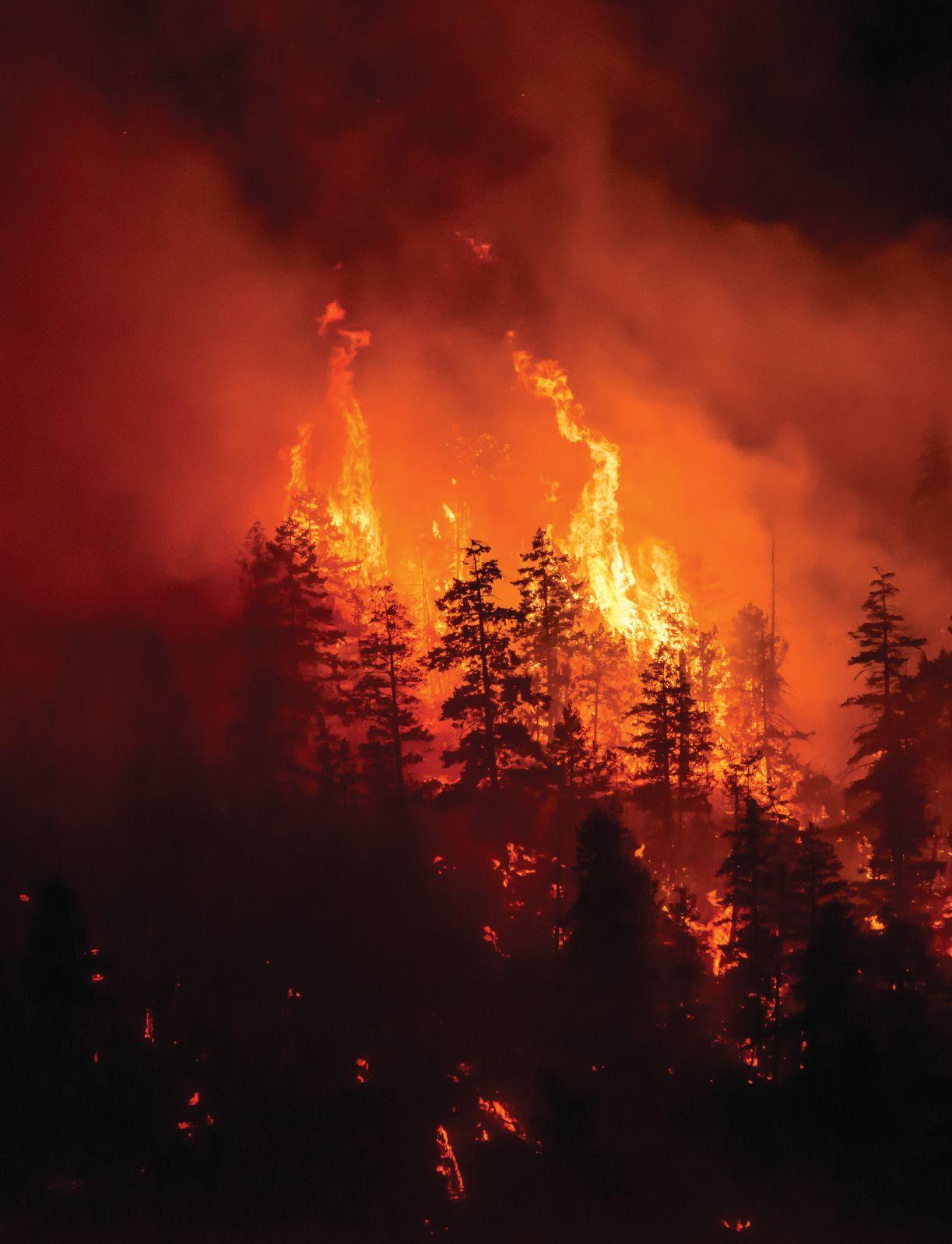
Alberta, which declared an early start to the season in February due to warm dry weather, saw 1184 fires in 2024 and 708, 528 hectares burned. Alberta experienced Canada’s most notorious fire of 2024 in what became known as the Jasper Wildfire Complex that began on July 22 with reports of a blaze near Jasper Transfer Station. Just 30 minutes later another wildfire was called in near Kerkeslin Campground. Ten minutes later, two more fires were reported near campgrounds, and then wild wind gusts kicked up to merge the three fires together, they grew to over 6,000 hectares in a few hours. The town of Jasper and Jasper National Park were quickly evacuated. Eventually hundreds of firefighters and resources from across Canada were onsite. “The full scale of this wildfire is still being assessed, but no wildfire recorded in the Rocky Mountains of Alberta or British Columbia has grown as large, as quickly, or with such intensity as this wildfire did between July 22 and 24, 2024,” reported Parks Canada.
A 24-year-old firefighter from Calgary, Morgan Kitchen, died fighting the Jasper fire after being struck by a falling tree on Aug. 3.
A total of 358 structures in the town of Jasper were destroyed, roughly 30 per cent of its buildings, and the community has embarked on five phase rebuilding and recovery program. These structures contained 800 housing units. The wildfire was declared under control Sept. 7.
In Alberta, 50 per cent of the fires are thought to have been human caused in 2024, with 47 per cent due to lightening and three per cent under investigation. The total support staff from around the world numbered 1,320, with 680 being from Canada and the rest international, including America (23), South Africa (215), Australia (188), Mexico (102), Costa Rica (91) and New Zealand (21). In 2023, total support from the around world numbered 4,038.
B.C. had the highest number of fires in 2024 with 1,687 reported CIFFC figures. About a million hectares were lost. Canada’s first significant wildfire happened in B.C. Reported on May 9, the Fort Nelson fire forced the evacuation of thousands.
The B.C. government attributed over 70 per cent of last year’s wildfires to lightning strikes. Wildfires triggered 51 evacuation orders impacting 4100 properties.
“Wildfires in 2023 and 2024 within the Prince George Fire Centre have burned 10 per cent of the land base in the region, which is more than the previous 60 years combined. As of Nov. 1, the estimated cost of wildfire suppression was $621 million,” reported the B.C. government.
Unprecedented drought compounded problems early in the season by allowing around 80 fires to have overwintered and remain active from 2023. The government listed 26 notable wildfires for 2024, the largest of which was the 508,453 hectare Nogah Creek fire in the Prince George Fire Centre. This was B.C.’s fourth worst season on record.
INFERNOS IN THE NORTH
The Yukon tallied up 150 wildfires, 206,201 hectares burned and 58 of those wildfires requiring a full response. Yukon News reported government officials as describing the season as normal with intense periods when compared to years gone by. Part of the intense periods aspect could be attributed to a lot of lightning strikes in a short period of time. Yukon and the federal government announced a joint investment of $21 million over five years through the Government of Canada’s Fighting and Managing Wildfires in a Changing Climate Program (FMWCC) – Equipment Fund.
The Northwest Territories experienced a pretty active season with just under 1.7 million hectares burned via 172 fires. The Fort Good Hope fire forced the evacuation of 220 people for three weeks.
Helicopter pilot Tom Frith died on June 28 after his aircraft crashed fighting the fire threatening this community.
There were no reports of significance for 2024 in Nunuvet, but wildfires in northern Quebec caused eight Nunavik communities to fall under a poor air quality advisory in August. Like other northern areas, lack of precipitation and
and drought conditions are causing increased concern for wildfire activity. In July, firefighters from several Nunavik communities received wildfire training to face this growing threat in the North after significant fires in 2023. Nunavut saw 150 acres of tundra burn in the Bahthurst Inlet area in 2023, which required the evacuation of about 14 people.
This wasn’t the worst season in Canada on record, but it was the sixth worst. A reprieve from 2023, does not mean a return to old means of normalcy. Like the post-pandemic era of life, there are new normals to continually adapt to.
ABOVE About 50 per cent of Alberta’s wildfires were deemed human caused in 2024.
BEYOND EXPECTATIONS
47.5’
A low center of gravity, all-wheel drive, available all-wheel steer with 47.5’ turning circle, and a 92.5” overall width creates peak maneuverability.
A 10” cab entry height, nearly silent drivetrain, shadowless scene lighting, and easy equipment access in all compartments create improved ergonomics.
Experience the Rosenbauer RTX at FDIC 2025.
April 10TH - 12TH | Indiana Convention Center Booth #3413
Contact your local Rosenbauer dealer.
New Brunswick, Newfoundland and Labrador, Quebec
Alberta, British Columbia, Manitoba, Northwest Territories, Nova Scotia, Nunavut, Prince Edward Island, Saskatchewan, Yukon Ontario
By Jared Dodds
Q&A: Amy ChristiansonCardinal
Understanding Indigenous fire management and practices.
Fire Fighting in Canada associate editor Jared Dodds spoke with Amy Cardinal Christianson to learn more about Indigenous fire management practices and how to incorporate them into current fire prevention strategies.
Cardinal Christianson is Métis and grew up in Treaty 8 Territory in northern Alberta. She is a member of the Indigenous Leadership Initiative and previously worked as a research scientist with the Canadian Forest Service and an Indigenous fire specialist in the National Fire Management division of Parks Canada.
Q: How did you initially become involved with the fire service?
A: I grew up in northern Alberta, so I was around fire and firefighters all the time. My extended family on one side is from the Fort McMurray area, so a lot of them worked in fire, including manning lookout towers and fire fighting. So, I guess I was always involved in the fire suppression industry, and now my husband is a wildland firefighter.
When I started to get older, I started talking more to Elders, and then working more in my communities, and I started to hear all about this idea of cleaning the land, which I had never really heard of up until that point.
My family, like many Indigenous families, was kind of disconnected from the land and from our cultural styles of land management. So, for me, it was a quite interesting and, as my
Elders talked about it more frequently, I started getting more and more interested in what that actually meant. This interest led to me learning much more about the concept of Indigenous fire stewardship and Indigenous people asserting their rights through fire management. That includes the use of cultural fire practices, rather than just responding to fires, actively putting fires on the land to reduce risk.
Q: What do you mean by cleaning the land?
A: When settlers came to Canada they brought with them European styles of fire exclusion policies, where fire was seen as bad for the land. They saw it as destroying timber, potentially impacting water resources – basically they saw dollar signs burning up.
They identified they needed to protect against this and created these fire exclusion policies. At the time, they really looked over
the Indigenous knowledge around fire, and that Canadian forests are fire dependent; they need fire to be healthy.
Indigenous people, because they’ve been here much longer, had developed a really good relationship with using fire to promote the health of the forest. The concept started with Indigenous people who, through their history of living with the land, saw lightning start forest fires. They decided to, paraphrasing a Steven Pine quote, replace “fires of chance with fires of choice.”
They would use fire at times of the year like early spring or late fall, when the fires were much easier to control, to achieve different cultural objectives. For example, one of the most common uses is burning dead grass so you can get new grass in much earlier. You can imagine when the snow is melting and you have all that dried, cured grass, kind of brown, and, in some places, it has grown super deep. If you go through and you burn that, it changes the land to black and starts to help melt some of the frost from the ground because the black absorbs the sun. This leads to a longer growing season, new grass that attracts deer and moose making hunting easier, improves berries growth, all through introducing fire to the landscape.
The concept of good fire is you’re putting fire on the land, almost like a system of pruning, using fire to prune hundreds of plants at the same time.
Q: How do these practices differ from the prescribed burning currently taking place?
A: I think that the main purpose for burning is the cultural reasons with a side benefit that it also reduces risk by eliminating the amount of vegetation, or what we call fuel, that’s available to burn.
With the type of burning that we do, is it, it
ABOVE Amy Cardinal Christianson is an Indigenous fire specialist in the National Fire Management division of Parks Canada.
creates mosaics on the landscape, increasing the amount of biodiversity around your area. When you think about what areas look like right now, you see green conifer, spruce pine dominated forest, as far as your eye can see.
For Indigenous people, when they look at that forest, it’s what we call hungry forest, because you would have to go so far to be able to get different types of cultural resources. You might be able to easily find spruce roots, lavender tea and a few other things, but what we really need around our communities is that diversity, the ability to gather a lot of cultural resources with as little travel and energy output as possible. We want to see meadows, we want to see early succession forest, and we also want to have the old growth forest all together.
Q: What Indigenous practices do you think are the most important to incorporate into fire response?
A: We spend a lot of money on response and in training, both of which are vital. We need similar increases in the prevention and mitigation side
of things, and then the restoration after fires have gone through to make forests more adaptable to future fire events. That’s one thing we don’t see currently — someone sharing how they’re going to spend money on making lands healthier.
Most people don’t understand the knowledge Indigenous people have about fire. I often hear, “those practices were fine 100 years ago, but in this day and age we can’t just put that knowledge on the ground.” Indigenous people have been here this whole time, living on these lands, and are now the ones who see the impacts of climate change. We need to bring that knowledge forward and then adapt it to the current environment, integrating them into modern day practices.
When I speak to Elders, they recognize that before we re-introduce cultural burning, we need to have these large, prescribed fires, we need to have mechanical thinning that occurs in these areas to remove some of this fuel load. Once that initial cleaning or restoring of the forest is done, then that’s when cultural fire practice can really come back.
Q: What do you think is stopping Indigenous practices from being incorporated into fire response?
A: To be honest, a lot of racist regulations and laws are in our ways. Currently, in order to burn, you have to do burn prescriptions or plans that are written up, you need a specialized contractor. They’re very Western science based, and most communities have a very difficult time. Once you have those they have to be approved by the local member of government. It can take years.
Q: How do you see the collaboration between Indigenous people and the fire service evolving moving forward?
A: I think that the future is in Guardianship and Indigenous leadership, having people employed on their land in year-round positions where they can really make fundamental differences and changes.
This article has been edited and condensed.
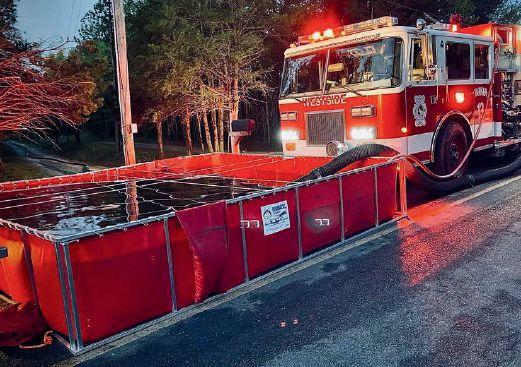
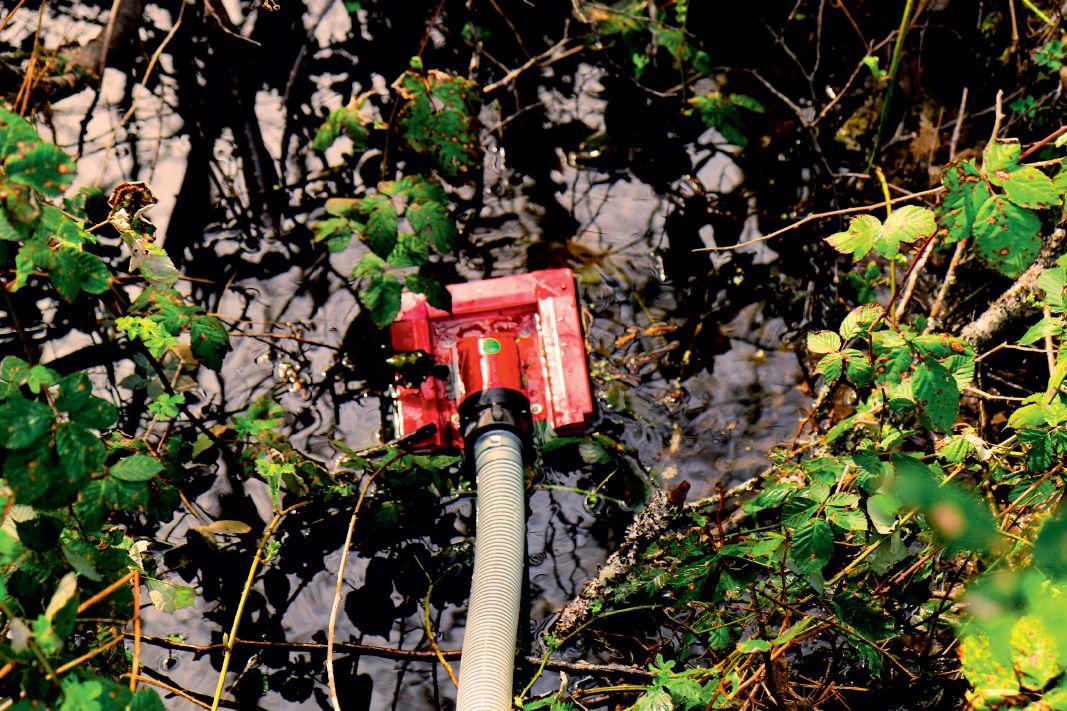
Wildfire Warriors Deserve The Best Drafting Equipment Available
in shallow water, leaving firefighters parators become reliable fire hydrants in deep, with weeds, sand, & debris.
anywhere, draft from any natural water dewatering. and, pebbles, or debris ingested. pump instantly – no suspension or livery times: Every minute counts
LEADERSHIP FORUM
Chris Harrow, Director of Fire Services, Town of Minto and Township of Wellington North, Ontario
Hiring the right one
Hiring the correct individuals for the right positions is crucial to ensuring that all team members possess a variety of skills that complement each other. This approach enhances operational efficiency and fosters a collaborative and resilient team dynamic.
Many times, the personnel who don’t have the fire fighting background can bring a different perspective that can change a conversation and be effective in thinking outside of the box.
The first step in hiring the right people for your department is to thoroughly understand the specific requirements of each position. Fire fighting is quickly becoming a multifaceted profession that demands a variety of skill sets. Managing the fire department is becoming more and more like a business each year, which makes sense. We are running multi-million-dollar corporations and managing a variety of personnel with vastly different skills. Consider the technical expertise of fire prevention staff and the fleet people who fix highly million-dollar apparatus.
These are just a few of the operational based roles a management team needs to prepare to supervise, not to mention the business-oriented personnel required to handle the budgeting and policies. Identifying the technical skills needed for each position helps in selecting effective candidates.
One of the main skills any potential management team member needs to possess is effective communication. Clear, concise and continuous information flow can mean the difference between success and failure for a management team. A significant aspect of the hiring process should be assessing communication skills through interviews and group exercises to provide insight into their ability to convey information accurately and efficiently.
Once the requirements of each posi-
tion are established, the focus shifts to building a team with complementary skills.
IDENTIFYING CORE COMPETENCIES
Core competencies such as leadership, teamwork, and adaptability are part of all roles in the fire service. However, specific competencies may be more relevant to certain positions. For example, a public information officer should have a solid communications background and a complete understanding of social media, no fire fighting experience is necessarily needed. An administrative deputy chief again does not necessarily need fire fighting experience but can offer skills in accounting and business acumen. Identifying and prioritize competencies to onboard unique strengths.
ENCOURAGING SPECIALIZATION
Specialization of management team members can create a complementary skill set for the management team and a high functioning department. Even for a volunteer/paid-on-call department, this can be extremely beneficial. If you are lucky enough to have more than one or two full time employees, ensure that each position has a specialty and limit the similar skill sets of each position. This approach ensures that the fire service can respond effectively to a wide range of situations that may come up on the management side.
FOSTERING A COLLABORATIVE ENVIRONMENT
A fire chief needs to create an environment that fosters collaboration and
Chris Harrow is the director of fire services for the Town of Minto and Township of Wellington North in Ontario. He can be reached at c.harrow@mintofiredept.on.ca.
teamwork. Encouraging everyone to ask questions of each other and work on large projects together can all help. Many times, the personnel who don’t have the fire fighting background can bring a different perspective and be effective in thinking outside of the box.
One of the keys to this successful organization is the individuals at the top of the organization cannot be intimidated working with people who have knowledge in an area not familiar to them. For example, a fire chief who come up through the ranks and does not have advanced knowledge in the business side of the department hires a deputy who has an extensive knowledge in this particular area. The fire chief needs to be able to admit their weaknesses and let this individual work in this area with little impedance. In fact, the fire chief can take this a learning opportunity to make themselves better and make them a better manager.
Encourage open communication and feedback to create a positive and supportive work environment. Using a variety of techniques like regular meetings, education sessions, briefings or whatever works for your team. It will also foster a culture of transparency and continuous improvement.
Leaders must demonstrate the values and behaviours they expect from their team. This includes maintaining high standards of professionalism, honesty, and integrity, including never failing to admit when they are wrong.
Acknowledge and value the contributions of each team member whenever a milestone is met or a successful project comes to fruition. It shows others in the department that if you do a good job, no one higher up is going to take all of the credit.
Hiring the right people for the fire service involves understanding the specific requirements of each position, building a team with complementary skills, and fostering a collaborative team environment. Strong leadership plays a pivotal role in guiding the team towards a bright future for the fire service.
BACK TO BASICS
By Mark van der Feyst
Mark van der Feyst is a battalion chief, firefighter, EMT and international instructor teaching in Canada, the United States, FDIC, Africa, and India. He can be contacted at Mark@FireStar-Services.com.
Big weapons for offensive and defensive fire fighting
Most engines and pumpers are equipped with a deck gun and/or a ground monitor for defensive operations. A defensive operation occurs when significant fire is present within a structure, making any interior operations impossible. In such cases, water is applied from the exterior in a defensive or distanced position.
When taking a defensive position, large amounts of water must be discharged from the nozzles of a deck gun or ground monitor. This same large amount of water, starting at 500 gallons per minute, can also be utilized for interior operations when mounting an offensive attack. Discharging large volumes of water will assist with interior operations when faced with high or large fire loads or deep-seated fires in large areas.
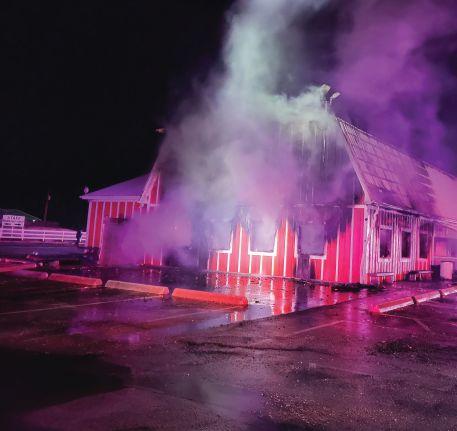
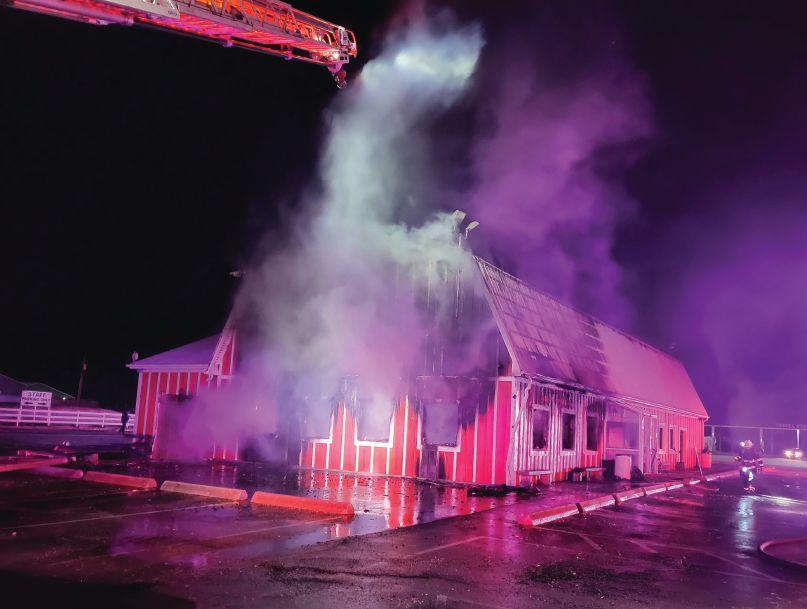
In Photo 1, we can see a commercial building with a fire burning both inside and outside. The large fire volume was significant enough to declare a defensive operation upon arrival. Once the fire was knocked down and suppressed enough, an interior operation took place to continue suppressing it. A switch to an offensive mode was indicated, and crews entered to continue knocking down the fire.
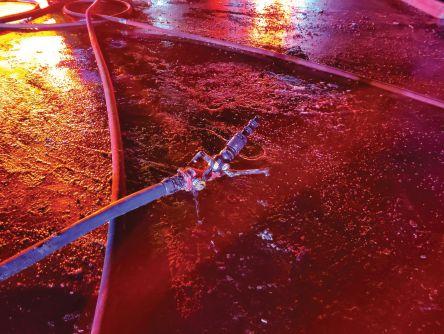
The crews were ordered to take in a 45mm handline along with the 65mm supplied rapid attack ground monitor. The monitor, pictured in Photo 2, is reserved for defensive operations and can also be used for offensive operations. It is very versatile, allowing one or two firefighters to advance it inside a structure and deliver large volumes of water.
One advantage of the rapid attack monitor is that it rests on the ground when water is flowing. To position
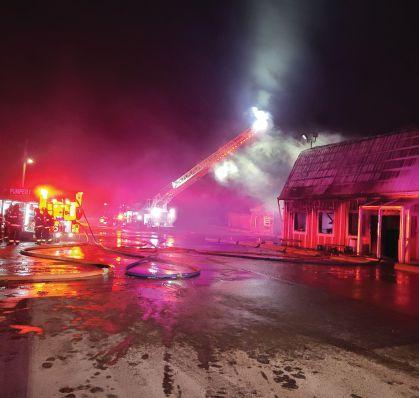
it, the firefighter must lift and move it, potentially with the assistance of another firefighter managing the hose, or they can collapse the support legs, turn the monitor on its side, and drag it by the strap. Once in position, the legs can be extended again, placed on the ground, opened, and water can flow – as shown in Photo 3 (inside the
The size of the fire was large enough to declare a defensive operation on arrival.
structure).
With the rapid attack monitor on the ground, the nozzle reaction produced will not be directed against the firefighter but rather to the ground. This allows one firefighter to be both effective and efficient with a large caliber stream.
Another advantage of the rapid attack monitor is the reach of the stream. Inside a building, the stream’s reach allows for deep penetration of water to the fire, significant cooling of the surfaces, and ample water for fire suppression. If there is a need to clear drop ceiling tiles to check above the fire room, the stream’s power can easily blow away the tiles and expose the upper ceiling area.
Photo 1
Photo 2
The rapid attack monitor, which is typically reserved for defensive operations, can also be used for offensive operations.
Once in position, the monitor legs can be extended again, placed on the groumd, opened, and water can flow.
The rapid attack monitor also allows for the extension of the hose line to a smaller or equally sized hose. The nozzle tips can be removed along with the stream shaper, with either an adaptor screwed on to reduce to a 38mm hose coupling or a gated wye attached to accommodate two hose lines, or additional sections of 65mm hose can be threaded on to extend the operation if necessary. The rapid attack monitor will then function as a gate valve or control valve; once the valve is opened and water is flowing, it will not shut off unless manually closed by a firefighter. The advantage of this tactic is that the initial water supply never needs to be turned off in order to extend the hose lines.
When the monitor detects any movement, the nozzle is directed upward to direct the nozzle reaction forces down to the monitor body. The forces are then transmitted to the ground, keeping the monitor in place. This allows the ground monitor to be unmanned if necessary.
For these types of monitors to be utilized in offensive or defensive operations with quick deployment, they must be set up on the engine or pumper with convenient access for the firefighter, pre-connected to the pump discharge with sufficient supply hose attached for at least 30m. If additional supply line is required, extra sections can be added to the initial deployment before the
ground monitor is charged with water.
The rapid attack monitor can be mounted to the outside of the fire truck’s body or placed on top of the hose bed, which is sitting on top of the supply hose it needs. The downside to this option is that the height of the hose bed will either make it easy or difficult to garb and pull down. The spikes on the support legs can also puncture the hose it is
sitting on.
Audit the engine or pumper in your station to see if it is set up and combat-ready for rapid deployment of ground monitors like the one pictured in Photo 2. If it is, then train on deploying the monitor with one firefighter. If it is not set up for quick deployment, do what you can to educate for the change.
Photo 3
GUEST COLUM
By Shelley Langille
Shelley (Shell)
PCC, spent over 15 years working with fire and first responders before launching SeeShell Consulting (SSC) and the International Coach Coalition (ICC). Reach Shell at Shell@SeeShellConsulting.com.
Having conversationsdifficult
Difficult conversations are a part of life, especially in environments like the fire service where trust, collaboration, and high performance are essential. Although they may feel uncomfortable or intimidating, these discussions are invaluable opportunities for growth, understanding, and resolution.
When approached with care, difficult conversations build trust through transparency. Addressing issues openly shows integrity and respect while strengthening relationships and reinforcing credibility. Moreover, these conversations enhance team dynamics by preventing confusion and misalignment while fostering accountability and fairness. Proactively tackling sensitive topics prevents small issues from escalating and demonstrates a commitment to equity and high standards.
While they may never be easy, difficult conversations are opportunities to lead with empathy, drive meaningful change, and strengthen bonds within teams and organizations.
FOUR-STEP FRAMEWORK FOR DIFFICULT CONVERSATIONS
Difficult conversations can be challenging, but a structured framework can help ensure they are productive, respectful, and focused on achieving a positive outcome. The following four-step process—Prepare, Deliver, Listen,
and Follow-Up—provides a clear roadmap to navigate these conversations with confidence and professionalism.
PREPARE
The purpose is to set the foundation for a productive conversation. Clarify your intent:
Identify the purpose of the conversation and the outcome you want to achieve. Ask yourself: What is the issue? Why is this conversation necessary? What is my desired resolution?
Gather facts: Collect relevant information, examples, and context to ensure the conversation is grounded in facts, not assumptions or emotions.
Anticipate reactions: Consider how the other person might react. Prepare for potential defensiveness, questions, or emotional responses.
Practice empathy: Reflect on their perspective and how they might perceive the situation. This will help you approach the conversation with understanding.
Choose the right time and place: Select a private, neutral setting free from distractions to foster an open and respectful dialogue.
DELIVER
The purpose is to communicate your message with clarity and respect.
Open the conversation: Start with a neutral and non-judgmen-
tal statement to set the tone (“I’d like to discuss something important with you because I value our working relationship.”) State the purpose of the conversation clearly.
Be specific and direct: Describe the issue using specific examples (“I noticed that the report was submitted two days late, which caused delays in the project timeline.”) Focus on behaviours or actions, not the person.
Use “I” statements: Express how the issue affects you, the team, or the situation (“I felt concerned because…”)
Be respectful: Avoid blame or accusations. Use a calm and composed tone to foster a constructive discussion.
LISTEN
The purpose is to understand the other person’s perspective and build trust.
Invite their input: Ask open-ended questions (“How do you see this situation?” or “Can you share your perspective on what happened?”)
Practice active listening: Give them your full attention, and notice non-verbal communication. Acknowledge their feelings and validate their perspective, even if you don’t agree.
Clarify and summarize: Paraphrase their responses to confirm your understanding (“What I’m hearing is that you
felt overwhelmed with competing deadlines. Is that correct?”)
Stay calm and open: Avoid becoming defensive, and manage your emotions if the conversation becomes tense.
FOLLOW-UP
The purpose is to ensure accountability, alignment, and progress after the conversation.
Summarize key points: Recap the main points of the discussion and any agreements reached.
Set clear next steps: Outline actionable steps, responsibilities, and timelines (“Let’s agree that the next report will be submitted by the 15th, and I’ll check in a week before to see if you need any support.”)
Provide support: Offer resources, guidance, or help to support improvement or resolution, if needed.
Check back: Follow up at an appropriate time to review progress and reinforce trust (“I noticed the report was submitted on time this month—great work on making that adjustment!”)
WHY THIS FRAMEWORK WORKS
This four-step process ensures that difficult conversations are respectful, collaborative, and goal-oriented. It emphasizes preparation, clear communication, mutual understanding, and accountability, creating positive outcomes even in challenging situations.
Langille, CEC,
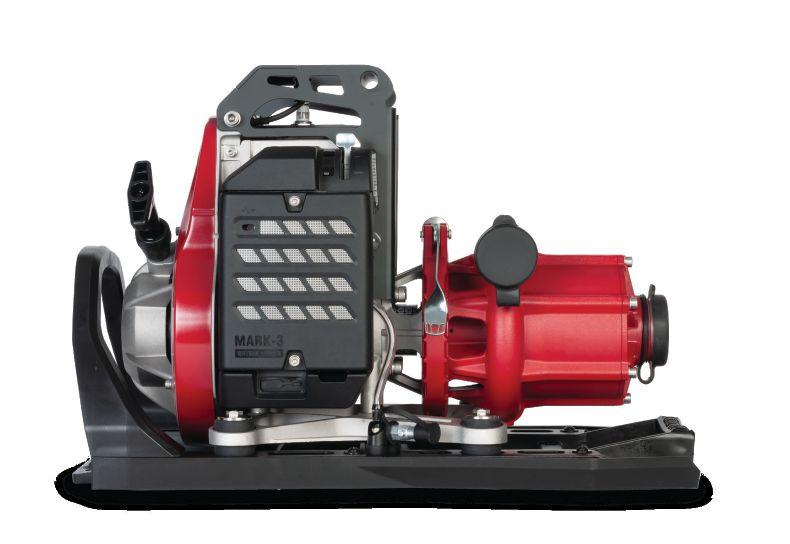
The MARK-3® Watson Edition honors the time-tested reliability of the original MARK-3® high-pressure pump while incorporating advanced technology to meet today’s demands. Lightweight, powerful, and dependable, it’s the pump that firefighters trust to perform when it matters most. The legacy continues with innovation that sets new standards in wildland firefighting.
waterax.com
By Brittani Schroeder
THE JASPER WILDFIRE
How preparedness saved lives
It was late afternoon, approaching early evening on July 22, 2024, and members of the Jasper Fire Department (JFD) were returning home after their shift. They were starting to unwind, but it wasn’t long before they learned their day wasn’t over quite yet.
Calls came in that a fire had been reported on the northeast side of town near the Jasper Transfer Station. Parks Canada was already responding but called the JFD for assistance. They responded with Type 6 engines and additional personnel, believing it was a typical brush fire.
A game plan was implemented to action the fire towards the north. Visibility was worsening; the highway was closed due to the smoke, and personnel were pulled back to the road as the fire grew. A helicopter was at the scene, dropping buckets of water on the spreading blaze.
As a new plan was being created, news came across the Parks Canada radio system that another fire—possibly more than one—was spotted south of Jasper. An additional helicopter was sent south to get eyes on the situation.
“It was a bit of a shock learning from the chopper that there were multiple fire starts south of town,” said Fire Chief Mathew Conte. The JFD and Parks Canada teams continued fighting the north fire while also making moves to evacuate the Snaring Campground.
The south fires were growing at an alarming rate—up to 100 hectares in under one hour. Pushed on by 20- to 30-kilometre wind gusts, the three fires combined to create one giant inferno.
BELOW The Jasper wildfire broke out late afernoon, July 22.
At this point, Conte pulled his units back to the JFD station to prepare the town for what would soon be known as the Jasper Wildfire Complex while Parks Canada continued attacking the north and south fires.
As his team got organized, Conte, who also serves as Jasper’s director of emergency management, moved to the Parks Canada compound to meet with senior Parks Canada fire and administration officials and Jasper’s director of protective and legislative services. The incident management team (IMT) held crucial conversations about intel on the growing fires, resource availability, and the state of local emergency declarations. Evacuation alerts were initiated immediately.
“The quick actions taken by incident management staff on July 22 helped save lives,” said Parks Canada.1
The JFD consists of three full-time members—including Fire Chief Mathew Conte and Deputy Fire Chief Don Smith—along with a contracted captain of training and fire prevention, Kelly Dawson, and 25 volunteer firefighters. These members immediately began working on the town, strengthening and protecting Jasper’s critical infrastructure, including the cell tower, fire station, hospital, wastewater treatment plant, and more. At the same time, evacuation alerts went out, followed quickly by evacuation orders.
This is when they encountered another challenge. Highway 16 East
and Highway 93 South were closed due to the fires surrounding Jasper, so the only option for evacuation was into British Columbia.
By July 27, approximately 250 wildland structural personnel from across Alberta had arrived in Jasper, and hundreds more from across Canada, Australia and South Africa arrived on July 28 to help fight the fires.
PREPARATION PAYS OFF
When attacking the Jasper Wildfire Complex, the JFD utilized its structural protection unit trailers to protect the town’s critical infrastructure through sprinkler systems. In addition, six skid packages are installed year-round on the department’s pickup trucks to convert them into Type 6 engines. When needed, the department has spare packages loaded into the back of municipal trucks in the operation department.
When Conte became chief in 2021, one of his main objectives was to review all the plans in place and update them where needed, with the help of key stakeholders and partners. The evacuation routes, the Emergency Support Services and the Municipal Emergency plans were updated in 2022, greatly aiding members during this incident. One of JFD’s projects in 2023 was working with a consultant to review and update the department’s tactical wildfire plan. The team started implementing some of the changes in Spring 2024.
“One of the key changes was to look at wet lines around the town’s perimeter. Phase one included purchasing almost a kilometre of hose
and other appliances like high-volume sprinklers. We had just finished converting a trailer to a sprinkler/wetline protection trailer in April and started training our members on how to use it. So, by the time the wildfire started in July, we could immediately implement this new part of our tactical wildfire plan,” shared Conte.
Additional areas for improvement were the town’s use of cedar shake roofs—the standard when Jasper was initially built—new water supply stations, and the resources required for sprinkler protection and tactical patrols in the town’s five zones.
A project that has been worked on since the early 2000s was the fuel management and reduction program. Working in collaboration with Parks Canada, JFD is actively identifying areas around the municipality where fuel loads can be lightened by removing pine and spruce trees. This way, a barrier and fire break lay between the forest and the town.
“Forest management is an expensive process, so it’s important for all levels of government to help with funding to better protect and prepare communities,” said Conte.
THE MENTAL TOLL
Wildfires were ravaging California at the time of this interview, which evoked many thoughts and memories of what happened in Jasper last summer.
“What happened in California was a triggering event for our members, incident management team and residents. We know what they
Mobile solutions for wildfires
Stop wildfires before they spread
Every second counts in wildfire control.
Hytrans’ advanced mobile water transport systems are operational within hours and can deliver up to 45,000 lpm, ensuring rapid response and maximum impact. Act fast, minimize damage and protect communities.
With Hytrans, you’re equipped to respond swiftly and minimizing damage when every second counts.
were going through,” shared Conte. “Mental health takes a pretty big toll; it did last summer, and it still does today.”
In a devastating addition to the events of the Jasper Wildfire Complex, a member of the Alberta Wildfire team, Morgan Kitchen, was killed by a falling tree on Aug. 3.
Throughout the event, everyone from the JFD to the IMT, Alberta Wildfire, and Parks Canada had access to mental health professionals from Health Canada and other local therapists and organizations.
“To this day, we’re supporting our members and trying to promote a better recovery for their mental health,” said Conte.
MOVING FORWARD
The Town of Jasper was officially reopened to tourists in Sep. 2024. “Tourism is such a large part of our community. Even though we were still grieving the loss of parts of our town and efforts to put it back together are still ongoing, we needed to bring everyone back in,” shared Conte. He felt the same about his members and moving forward with training and planning for whatever comes next. “We don’t have the luxury of stopping.”
Though the after-action process is ongoing, an initial takeaway is that early resourcing and fire prediction and modelling data should be updated. Conte hopes to examine the resource ordering system and how the JFD integrates with the province through its wildland urban interface deployment program.
Other key lessons include training. “We spend a lot of time with our crews on wildland urban interface training through the province and in-house, but there is definitely room to grow in those areas. We need to focus on that more in the future,” Conte explained.
Regarding emergency management, the JFD is in constant communication with Parks Canada to ensure everyone is better prepared for the next emergency. This includes joint training exercises and mock scenarios so that all crews are on the same page. He also wants all JFD members to be familiar with the emergency plans. By knowing the plans inside and out, backwards and forwards, members can operate without delay in implementing them and share them with extra personnel who come in to help from other communities.
The JFD continues to work with a consultant to develop the wildfire mitigation strategy further. This strategy focuses on the fuel reduction and maintenance schedule for those areas and should be in place by the summer of 2025. It also includes rolling out phase two of the sprinkler and wetland protection plan.
The department is also hiring a fourth full-time position—a captain focusing on fire prevention. This will increase the JFD’s capacity to go out into the community and work with residents to better prepare and be fire smart.
Conte concluded, “Every year, the forest is a hazard, and we just have to keep moving forward. There will always be something to learn from these kinds of events that will help us change and adapt for the future.”
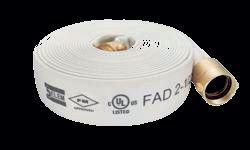
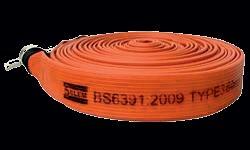
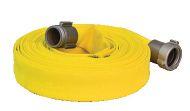
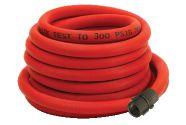
ECONOMICAL HIGH QUALITY ATTACK HOSE
• FM 2111 and UL 19 approved
• Meets or exceeds NFPA 1961
• Within ISO-9001 quality management system
• Meets or exceeds UL 19 AND BS 6391
• Within ISO
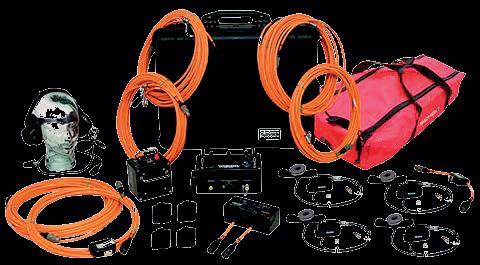
Savox Hardline Rescue Kit 1 with Power Talk Box is our best selling technical rescue confined space kit It is designed for simultaneous, twoway voice communications between the rescuers and the victim Rescuers use it where traditional radios fail or when hands-free, secured communications are required
Attendants communicate with entrants and monitor their safety The backup team can also listen to the entrants’ rescue and be ready to relieve them
The power talk box is a portable intercom system that is dropped down the hole before entry to determine a victim’s condition
The whole system and accessories are waterproof The rugged molded fiberglass enclosures, all external knobs, and signal cables with their military connectors are impervious to a wide range of acids, alkalis, fuels, and other corrosive chemicals including Skydrol All of the above coupled with a highest level of intrinsic safe approval is why you can trust them with your life
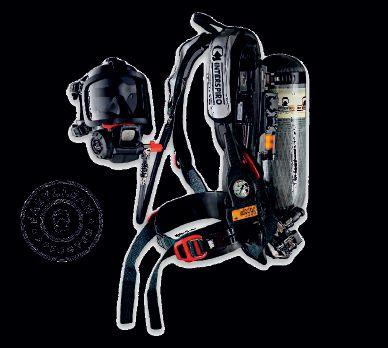
CANADIAN SAFETY EQUIPMENT IS PROUD TO BE A DISTRIBUTOR FOR THE INTERSPIRO RESPIRATORY PROTECTION LINE. THEIR STATE OF THE ART S9 INCURVE IS ONE OF THE MOST COMFORTABLE SCBAs YOU WILL EVER WEAR. THE INCURVE HAS A UNIQUE EASY TO CLEAN HARNESS FOR EASY DECON
GIVE US A CALL AT 0182 OR EMAIL US AT INFO@CDNSAFETY. COM
No company has a richer history in respiratory protection than Interspiro. Their innovations have become industry standards, time and time again.
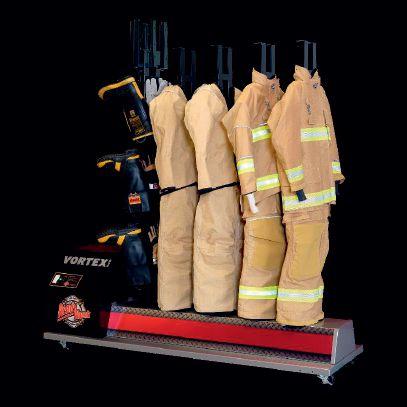
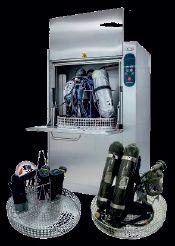
The Solo SCBA Decon/Washing machine was designed and built for one purpose only…to protect Fire Fighters from Cancer causing agents found in the Smoke and residue left on their SCBAs. As an added bonus it can clean Gloves, Boots and Helmets In addition, it substantially lowers the time spent decontaminating firefighter equipment.
The SOLO is the only SCBA decon machine that meets both NFPA and CSA standards.
✓ REDUCED HEALTH RISK
✓ SAVES TIME 2/PKS IN 8 MIN ✓ EASY TO USE
Qualified by MSA, SCOTT, DRAEGER & INTERSPIRO for cleaning their SCBAs.
WASH/DECON TWO SCBAs
In 8 minutes. Also cleans, boots, gloves and helmets.
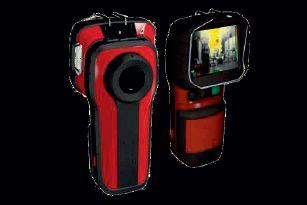
The most advanced thermal for firefighting
Larger 3 5″ display for a clearer the fire scene and lightweight 830g (1 8Ibs)
Extended dynamic temperature to 1100˚C (2000˚F) for greater detail in larger, hotter fire scenarios
Enhanced feature set including pointer to aid communication, electronic compass for greater scene awareness and heat/cold seeker technology NFPA approved
By Christopher Heaton Leach
THE SILENT COST of hazing harassmentand
Creating a safer workplace and culture
Let’s paint a scenario. Imagine you have just joined a department as fire chief. You have been briefed on everyone’s backgrounds, and among the leadership team was a member, let’s call him Steve, who did just enough to avoid discipline and skate by unnoticed. He has a reputation as a “garden snake”—someone who slithered through the ranks by avoiding responsibility while taking credit for others’ hard work.
One afternoon, a young firefighter — just a few months out of the academy — knocks on your office door. He is exhausted and reluctant, but he has a story he needs to share. He explains how he has been hazed and harassed by his fellow crew members. But the most alarming part of his story isn’t just the bullying — it’s the culture that allowed it to happen. An environment where fear ruled, and standing up to the leader wasn’t an option. The young firefighter had been subjected to cruel “jokes”, berated for minor mistakes, and forced into the most degrading tasks, all under the guise of toughening him up. Steve’s approach wasn’t just about pushing boundaries; it was about asserting dominance, ensuring that everyone understood who was in control. What was even more troubling was that the rest of the crew, though uncomfortable, went along with it. They feared that speaking up would make them the next target.
Reflective questions
How well-defined are your department’s policies regarding bullying and harassment?
Where might you need to make improvements?
What leadership practices can you implement to model respect and teamwork?
How can you ensure that every member of your team feels empowered to report unethical behavior without fear?
By taking these first steps, you can begin to foster a work culture that will empower your team and improve the effectiveness of your department. It’s time for us to lead by example and make real change in our departments.
This wasn’t just hazing—it was a culture of intimidation, one that undermined the morale and well-being of the entire team. It becomes clear to you that you have to take immediate action to address this toxic environment and reset your leadership culture.
DEVELOPING COMPREHENSIVE POLICIES: A NEW FOUNDATION FOR RESPECT
Hearing this young firefighter’s story leaves one undeniable conclusion: department’s policies weren’t enough. The department needed something that clearly defined acceptable behavior, set standards for respect, and enforced accountability. Work closely with HR, the union, and other department leaders to draft a comprehensive anti-bullying and anti-harassment policy. This policy specifically addressed hazing, intimidation, and the abuse of authority, all issues that had been allowed to fester under the radar. Once the policy is ready, make it clear that this is a zero-tolerance approach, applicable from the newest recruit to the most senior captain. No one, not even Steve, would be able to claim ignorance, and the entire department will understand the new standard you will enforce.
TRAINING AND AWARENESS PROGRAMS: BREAKING THE CYCLE OF FEAR
Having the policy on paper is an important first step, but changing culture requires more than just rules, it requires an effort to change minds and hearts. Develop training programs that included real-life scenarios, such as the anonymous story the young firefighter shared. The goal is to show everyone the true cost of hazing and intimidation, not only on the individual but on the team’s cohesion, morale, and effectiveness. During the sessions, emphasize that following along with toxic behaviour out of fear or peer pressure was not a justification for abusive conduct. Remind everyone that leadership is about lifting others up, not tearing them down. As you work through the case studies, it may become clear that Steve is beginning to feel the weight of his actions. The days of hiding behind the authority of seniority or group mentality were over.
ESTABLISHING A REPORTING MECHANISM:
ENSURE A SAFE WAY TO SPEAK UP
A key element of this cultural shift was ensuring that everyone, regardless
of rank or seniority, had a safe and confidential way to report issues. Implement an anonymous reporting system that allows individuals to report harassment, intimidation, or unethical behaviour without fear of retaliation. This system should be separate from the chain of command and provide a direct line to leadership. Make it clear that every report would be treated seriously and investigated thoroughly.
The first reports that came in may be eye-opening. Not only may they corroborate the young firefighter’s experience, but they could reveal a widespread climate of fear within Steve’s crew because his team felt trapped, unable to speak out for fear of retaliation. Anonymous reports are invaluable—they provided concrete evidence of the toxic culture and give you the data you need to address the situation head-on.
MONITORING AND EVALUATION: TRACK PROGRESS AND ACCOUNTABILITY
Once the policies, training, and reporting systems are in place, you need to keep track of progress. Regular evaluations are essential to determine whether your interventions are making a real difference. Conduct quarterly reviews, gather anonymous feedback from the team and hold group discussions to gauge department morale and assess the effectiveness of our new strategies. This process ensures accountability, making it difficult for issues to remain hidden.
As these evaluations unfold, you may notice a slow but steady change in Steve’s behaviour as he starts to understand the consequences of his actions, and for the first time, his authority being challenged. The department will feel the shift, and Steve’s former control over his crew will weaken. The atmosphere will begin to change from one of fear to one of open dialogue and mutual respect.
Real, lasting change has to come from the top. Make it a priority to reinforce that respect, support, and teamwork are non-negotiable values in your department. Celebrate and reward those who embody these principles, especially those who had the courage to stand up for their peers in the face of adversity. By leading by example, you help to establish a culture where leadership isn’t about domination; it’s about mentorship, guidance, and empowering others to succeed.
Actionable takeaways
Define respect: Ensure your department has clear, comprehensive anti-bullying and harassment policies that set boundaries for behavior at all levels of the organization.
Leadership development: Use real-life examples in training to teach the impact of bullying and harassment, and emphasize leadership as mentorship, not domination.
Reporting system:
Implement an anonymous, confidential reporting mechanism to ensure team members can raise concerns without fear of retaliation.
Monitor progress: Regularly evaluate the effectiveness of your policies, training, and overall department morale to ensure continuous improvement.
Lead by example: Create a supportive environment where leadership is based on respect and mentorship, setting the standard for your team to follow.
True leadership isn’t about control
As time goes on, Steve’s authority will no longer go unquestioned. His actions will no longer be tolerated without scrutiny, and his crew, who had once lived under the shadow of fear, will begin to flourish. The team dynamic slowly transforms from one of intimidation to one of collaboration. Steve, though resistant at first, eventually sees that the new culture was one where leadership was respected not for its power, but for its ability to support and elevate others.
As leaders in the fire service, it is our responsibility to foster an environment where every individual feels respected, valued, and empowered to perform at their best. The steps you take in addressing hazing, bullying, and intimidation within your department are necessary to shift the culture, but this process requires constant vigilance and leadership. By establishing clear policies, implementing effective training, creating safe reporting mechanisms, and leading by example, we can begin to transform toxic environments into ones where collaboration, trust, and respect thrive.
True leadership isn’t about control. It’s about creating an environment where people feel safe,
supported, and motivated to give their best. I urge you to take these lessons and apply them in your own department. Stand up to toxic behaviour, create clear lines of accountability, and always lead with integrity. The culture we build today will shape the fire service of tomorrow, and it’s up to us to make sure it’s one rooted in respect, trust, and leadership by example. Confronting the kind of culture a “Steve” creates isn’t easy, but it is necessary. As fire chief, leadership means protecting our team, not only from the fires we fight but from the conflicts that can burn us from within. The department isn’t just a collection of skilled individuals; it’s a unit built on trust, respect, and shared purpose. We cannot allow harassment, hazing, or intimidation to undermine that foundation. Through clear policies, training, safe reporting, and a commitment to accountability, we began the process of restoring respect and camaraderie in our department. In doing so, we not only created a healthier work environment but also strengthened our readiness to serve the community. Let’s commit to making our departments places where every firefighter feels safe, valued, and empowered to contribute.
By Brittani Schroeder
Q&A: TONY MEAKINGS, fire service wildfire instructor
Training innovations and tips for teachinng volunteer firefighters
Canadian Firefighter magazine editor Brittani Schroeder spoke with Tony Meakings, a fire service training instructor and volunteer firefighter for the Bear Lake Volunteer Fire Department, to speak about what he’s seen change in firefighter training over his career and where he’d like to see training go next.
Q: Can you tell our readers a little about yourself?
Tony Meakings: My first introduction to the fire service was when I was eight years old and saw my neighbour’s house on fire. I ran in to let them know and helped get them out. I’m now 67 years old, and I’ve been in the fire service for over 30 years.
I’ve fought wildfires and structural fires for the past 27 years as a member of the Bear Lake Volunteer Fire Department (VFD) and have been a fire warden and instructor for over 25 years. I originally became an instructor
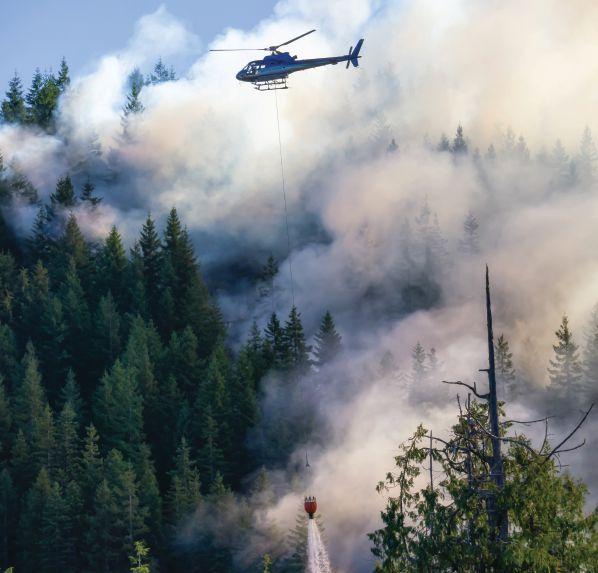
RIGHT Helicopters in B.C. have gone from day to dark as night vision operations got underway in 2024.
because our volunteer fire department didn’t have one. I had taken courses through the Justice Institute before, so I looked there for guidance. With our community being surrounded by forest areas, it made the most sense to train on wildfires and urban interface fires.
A short while ago, I was informed that I’m just a few points shy of achieving a Bachelor of Fire Science
degree from the Justice Institute of British Columbia.
Q: What would you say are some of the top innovations in wildfire training over the past few years?
Meakings: The three innovations I have seen concerning wildfires are:
1. The use of night vision in helicopters, which allows for night patrols.
2. BC Wildfire Service firefighters
work year-round. They do not wait for wildfires to start before activating their teams. They have their teams out cleaning ground fuels and dangerous trees, prepping just in case.
3. The promotion of wildfire education to the public and communities. No matter your age, being FireSmart, having go bags ready, and prepping your house and property in case of an emergency evacuation helps.
Q: What are some of the challenges you encounter when providing training?
Meakings: I’ll be honest: electronic technology is one of my main challenges while teaching. Asking the firefighters to turn off their cellphones and muting smartwatches is a good first step. These are not just a distraction to the one person but the entire class; we’re dealing with some serious
content.
That being said, technology has also advanced training, and I look forward to what technology has in store for the future.
Q: What is one lesson you’ve learned while teaching?
Meakings: I think the most important thing to realize is that each person you teach is unique. People have different ways of learning; some learn by reading, others by viewing on a big screen and others by hands-on. Try to use all the methods of learning in your institutions. Watch your class—if they are restless, it’s time for a break. Don’t forget to make yourself available to answer one-on-one questions.
Q: What would you like to see in the future for firefighter training?
Meakings: I would like to see more cross-training between wildfire ser-
When the Wild Calls
Electronic technology is one of the main challenges while teaching.
vices and local volunteer fire departments in their own halls and on their own equipment.
I would want smaller volunteer fire departments, such as our small community in Bear Lake, to be able to continue, even if they don’t meet certain province requirements.
It would also be beneficial to recognize that volunteers work weird shifts. They require family time. Departments should adjust their training to suit the volunteers’ needs; they cannot adjust their families and work to suit the department.
I hold two training sessions every week: one on a weeknight and one on a weekend afternoon. If they were working in camp, their class time and tests could be done online.
I hope this helps and that we can create good teamwork between small communities and regional, provincial and federal governments.
STOPBAD
By Gord Schreiner, Fire Chief, Comox, British Columbia
Gord Schreiner is the fire chief in Comox, B.C. and manages the Comox Fire Training Centre. He has spent 48 years in the fire service and delivered presentations all over Canada. For more info, contact: firehall@comox.ca.
REHAB YOUR FIREFIGHTERS
In April 2006, a visiting 52-year-old firefighter suffered a fatal heart attack while attending a live fire training exercise at our fire training centre. For us in Comox, this event changed everything.
Before this tragic event we treated our firefighters as other fire departments might. We work them and give them water breaks.
Now we have a very formal firefighter rehab policy. At our training centre, students are assessed before they start training and if they don’t meet some very strict medical protocols, they are not allowed to participate in the training. We have been finding that about one in 10 students do not meet the accepted medical standards. During their training day the students are constantly assessed and if they fall outside of acceptable limits their training would end at that time, for that day. Also, every one of our Comox firefighters have their blood pressure checked before our weekly training sessions. Anyone with a pressure above our acceptable standard (160/100) does not participate in strenuous physical activities.
On our firegrounds we have adopted a similar approach where after about 30 minutes of strenuous work the firefighters are sent to a rehab area and rehabilitated and assessed. If they fall outside of these acceptable limits they are not allowed to continue with their strenuous duties (regardless of how bad the fire is). Rehab is now a function of every emergency and training incident we run.
We researched what others were
We have seen some of our firefighters change their diets and increase their fitness because they want to ensure they can pass the rehab protocols and, more importantly, stay alive.
doing and put together a rehab program that would work for us. Our program includes the basics like hydration and food, and includes medical monitoring of pulse, blood pressure, temperature, oxygen and carbon monoxide saturations. Added equipment includes misting fans, rehab chairs, core cooler vests, automatic blood pressure cuffs, CO/Ox meters, coolers, towels and more drinks and food on the fire apparatus.
We have added water bottles in the cab of our fire apparatus so our firefighters can hydrate on the way to an incident as well as during and after. This simple little step can greatly increase your firefighters’ safety. A complete rehab program should include medical monitoring during all incidents. This is a function we have taken on at the fire department operational level. Many fire departments use their local EMS service to provide this function, but we wanted to take our program to the next level. Because we are a small community, we cannot always get EMS to attend our incidents and if we do, they might leave with a patient from the incident, leave with a firefighter needing advance medical attention or leave for another incident. They often leave while we are still doing mop-up or salvage, while this is just as important a time to ensure the rehab function is present and active. So, we include this very important function with our staging area and management. It’s run by firefighters, for firefighters, that way we control it. However we still request EMS to standby in case a firefighter needs to
go for more advance treatment.
This takes additional resources which could be provided using mutual aid or other members who may no longer be fit enough to provide suppression duties.
We have also added a whole new focus to firefighter fitness. Not only do our firefighters and their families get free fitness passes at our community fitness centre but we have also added a firefighter-only fitness centre at our fire station accessible 24 hours per day. We have also added fitness to our regular practice schedule where an entire company of firefighters can go to the fitness centre during a practice session.
We have seen some of our firefighters change their diets and increase their fitness because they want to ensure they can pass the rehab protocols and, more importantly, stay alive.
Fire fighting is an extremely challenging job. Firefighters (including chief officers) need to be in very good physical and mental condition to perform their duties.
We are happy to share all of the rehab stuff that we have put together (P.S., this 67-year-old chief is heading to the gym right now).
Firefighter safety is our No. 1 job. Do your part to improve firefighter safety!
For more information please contact: Fire Chief Gord Schreiner, firehall@comox.ca
Gord has 50 years in the fire service and has delivered countless presentations all over Canada. He is available to assist your department in many areas.
By James Rychard and Rob Adams
The origin of high performance teams
What does it mean to be an SI leader?
Are you interested in building a high-performance team? To build one, regardless of industry/sector, takes a lot of work. People are the essence of any organization and how they get along, or don’t, will influence the results achieved. Regardless of the organizational competencies, having a collaborative team with strong interpersonal communication is fundamental to organizational success.
For the public sector, how we relate to one another can be vital to how and/or whether projects, goals and initiatives get done effectively and efficiently. In fact, when it comes time to creating a healthy organization, the first and most important principle is alignment at the top. The key to providing responsive services to the community is integrating council and staff, including the fire services, into a high-performance team, and it begins with a socially intelligent leader.
BELOW Social intelligence means how we relate and the biology behind it.
In 1920, Columbia University psychologist, Edward Thorndike, first professed the importance of studying a person’s ability to understand and manage men and women effectively. He conceptualized the first iteration of a discipline called “Social Intelligence” (SI), and it goes beyond how emotions affect our relationships with other people as well as ourselves. It’s about how we relate to one another and the biology behind it. Thorndike stated that “the best mechanic in a factory, may fail as a foreman for lack of social intelligence.” Yet, SI was dismissed as not important because it involved social situations.
On the other hand, in the early 2000s the VIA Institute on Character did a three-year study, which involved 55 distinguished scientists, examined positive traits of character, and listed SI as one of 24 key traits that makes a person morally good. SI was deemed an important characteristic of humanity next to kindness and love (valuing others). It’s these soft attributes that not only makes a person a good leader they are becoming critical for high-performance teams.
When seeking notable examples of SI leaders, ones who are morally good, yet who have also built successful high-performance teams in their organizations, there’s one individual who stands above anyone else; former Buddhist Monk turned CEO, Kazuo Inamori. Inamori was renowned for saving Japan’s flagship airline carrier Japan Airlines (JAL) from going bust in the 2000s.
JAL, once an international juggernaut amongst all airlines, had lost its way. The result? JAL was on its way to bankruptcy and the country of Japan was losing its stake in international travel.
Kazuo Inamori was a different type of leader. He valued people over profits, and recognized that employees were unfortunately forgotten about during JAL’s lavish expenditures over the years — a process he needed to correct.
In response, JAL’s new CEO and chairman had a turn-around plan. First was to build the team up and create an esprit du corps to help get the employees excited about the new JAL. He believed placing wellbeing and livelihood of all his employees and their families first while creating an organization where employees felt happy to be a part of it was key to getting them excited. Second was introducing his management philosophy called “Amoeba Management”, a philosophy endemic of a high-performance team.
Amoeba Management was a method that gave voice to those on-the ground who were all supervised by lower-level managers. Instead of every decision coming from the top and handed down, now the workers were split into small units. Those units were led via a leader with an extraordinary degree of decision-making power, who reported to upper
HOLMATRO T1
T1: ALL-IN-ONE FORCIBLE ENTRY TOOL
Whether it’s breaching doors, cutting locks, or lifting heavy materials; with the T1, you always have the right tool for the job.
MULTIFUNCTIONAL TOOL
T1 is the only tool that can hammer, cut, spread, lift, wedge and ram.
OPTIMIZED CUTTING BLADES AND JAW DESIGN
T1 can easily cut rebar, chain and padlock; easily replace the cutting blades when they are damaged.
SPREADING TIPS
Load-holding function makes the tool suitable for (progressive) lifting.
TWO-STAGE PUMP
High power transmission gives you a maximum cutting force of 14,2 ton/31 248 lbf and a maximum spreading force of 3,4 ton/7 419 lbf.
management for approvals. Every worker from pilots to custodians felt that they had something to contribute to the company’s success, feeling freedom and support to share their respective contributions.
In a municipality, corporations do everything through their people. They are the largest part of the budget and the most important asset. Regardless of rank or role, people are the essence of any organization.
At a recent Association of Municipal Managers, Clerks and Treasurers of Ontario (AMCTO) leadership conference, Rob Adams (co-author on this column) witnessed a discussion focused on the lack of harmony between council and staff. To his surprise, this included issues of growing concern about council members behaving badly. The audience comprised of chief administrative officers (CAOs), executive directors, and directors were all asked, “How many of you conduct values, leadership and team training with your senior leadership?” All the hands in the room went up. Interestingly, the same group was asked, “How many do the same training with their council members?” A single hand went up.
We can’t expect our council members at the top of the organization to lead and work as a cohesive team, with good values, without investing in their development. While many municipal staff may have education and training on these subjects, it’s common to have inexperienced or first-time council members elected to office. Choosing to provide these council members with the correct toolbox is integral for cohesive success and sets the tone for the corporation and its operations.
Sometimes we do not have to look far to seek “tools” for our toolbox to find solutions to our problems, we only need successful management models that can be mirrored as “what to do”. Having a toolbox filled with “soft skills”, such as the virtue
of humanity, kindness, valuing others (love) and SI is critical for team success. When coupled with political and business acumen, these skills can go a long way to building value for municipal staff and taxpayers delivering responsive services. When considering building a high-performance team within your organization, albeit council, staff, or a fire service leadership team, having SI leaders is critical for success. Leadership of both staff and council need to create a culture of psychological safety if we aspire to build up voice, diversity and contribution.
Research validates that fostering an environment where members are proud, excited, and feel as though they can contribute impactfully, has proven to have incredible outcomes. This begins with a socially intelligent leader. A leader who understands the importance of employees, their needs, and how their contributions result in the success of the organization. For the public sector, profits don’t factor into the equation; however, people do. When council and staff act with SI and focus on building high-performance teams throughout the organization, the outcome is high value. Working in local government is a noble calling for those who care about their community and want to make a difference. Being socially intelligent and building a high-performance team is not only essential, but also a duty to tax-paying citizens.
EXPERT SOLUTIONS FOR FIRE & EMERGENCY SERVICES
With 32+ years of experience, we help municipalities and corporations enhance fire safety, efficiency, and preparedness through Community Risk Assessments, Master Fire Plans, and Fire Department Training - All tailored to your needs.
empower communities with informed decisions and strategic fire safety solutions
Wildfire Arson Prevention Guide
$86.00 | Item #: 1032405940
This book provides fire investigators, law enforcement and land management and with frameworks, strategies and tactics—that can be adopted to address deliberate wildfire ignitions in their jurisdiction. Often this crime is automatically given to law enforcement agencies to solve in isolation, whereas a collaborative approach across key agencies has proven essential in apprehending offenders. This valuable guidebook fills a void in the literature, detailing a collaborative approach through the adoption of successful best practice investigation techniques.
The Nontraditional Truck Company
$71.05 | Item #: 1593706012
This all-inclusive truck company operations guide will help truck-deficient departments achieve a safe, effective, and efficient coordinated fire attack. This book illustrates the importance of truck company operations facilitating and supporting coordinated fire attacks and lifesaving operations. Rooted in the core principle that “circumstances dictate action on the fireground,” this book empowers agencies to overcome challenges posed by limited staffing or resources.
Fireground Strategies, 4th Edition
$138.75 | Item 1593705121
So you want to be an Incident Commander? This is the book for you! Chief Anthony Avillo’s Fireground Strategies remains an invaluable resource for fire officers striving to master the art and science of firefighting strategy. This fourth edition incorporates the ever-evolving information that every firefighter and department needs, with case studies, real-world examples, and actionable insights to equip fire officers with the tools to identify strategies, develop action plans, and implement effective tactics to achieve fireground objectives.
VOLUNTEER VISION
By Vince MacKenzie, Fire Chief, Grand Falls-Windsor, Newfoundland and Labrador
Facing the can’t calls
We want to always be there to assist and help during times of crisis, but sometimes we can’t because there is that call that goes beyond our training, capabilities, or legal obligations.
When you stepped up to volunteer and join the fire department, you undoubtedly came through the door with high expectations that you can do good for the community. Like you, we all became motivated to enhance the protection of the communities we live in. We volunteered to be the first one in during crisis and to help fix the challenges of fires and other emergencies for our towns and villages. We diligently trained for the protection of our citizens and colleagues as we should.
Over your time as a firefighter, all training and experience lead to a level of competency that steadily grows. Confidence is built in our ability to step up to most every challenge.
Routine calls become the bread and butter of what we do. Then there are the big ones, significant events that you will remember forever. This could be for great outcomes, or it could be for the tragic loss. We want to always be there to assist and help during times of crisis, but sometimes we can’t because there is that call that goes beyond our training, capabilities, or legal obligations.
In just about everyone’s career, we are sometimes called upon to respond to a specialized response that would require a higher degree of training. Obviously, the fire department is one of the first agencies dispatched when the 911 call comes in or we may be called by another agency to assist. While we are always motivated to help and will, care must be taken to protect our members while trying to weigh risk and probability of successful outcomes. Above all, our safety is paramount.
Sometimes, these calls come when
there are no specialized teams nearby and therefore the fire department feels obligated to do something.
The never-ending dilemma facing the incident commander could certainly be a test of humanity. Engaging in a specialized rescue that the team is not properly trained for can lead to tragic outcomes. Of course, it’s okay if the incident goes well and a successful outcome happens. These incidents make the newscasts and the firefighters are heroes. But what if it doesn’t go well? Would we feel the same if one of our members were seriously injured or worse? The responsibility is great when deciding whether to “go or no go”, to overstep our lack of training to save a life in the heat of the moment. Should we just do something when everyone has turned to us?
The short answer is no. Never engage in a task where your people are not adequately trained or equipped. We must understand that sometimes we simply cannot be everything to everyone all the time. Many fire departments will answer just about any type of call for help in their respective towns. The real test will be one of those calls that overstep our declared service beyond our capabilities to the public.
Television shows of firefighters and their heroics have led to a level of expectation from the public that could place a department in precarious situations in the eyes of the public. When trained firefighters watch these Hollywood shows of fire fighting and rescue, I’m sure it leaves many shaking their head at the over-emphasized drama and unsafe deeds when training or equipment is not available.
Vince MacKenzie is the fire chief in Grand Falls-Windsor, N.L. He is an executive member of the CAFC and current president of the Maritime Fire Chiefs Association. Email Vince at firechief@townofgfw.com.
Unfortunately, this is possibly your public’s perception and expectation of your fire department in your town.
Many of those TV shows and movies are sometimes the motivation for people to decide to volunteer in their local fire department in the first place. Managing their expectations when they join is paramount to their safe career and success.
While fire fighting comes with inherent risks in volunteer and career departments, we all train for that, and the ability to know when we cannot go further is important. When called for a rescue or situation that we are not trained for, we don’t have that extra knowledge of not knowing what we don’t know because of our training.
Legal requirements and sensible occupational health and safety concerns force us to stay in our lane on the tasks that we train to accomplish. Contrary to what many probably believed when they joined the fire department, we cannot fix everything all the time without proper training or equipment. We can only perform tasks that our personnel are properly trained and equipped to do. Now more than ever our fire service needs to realize that.
Helping is something most, if not all of us are programmed to do. Therefore, saying no or holding back when the danger is too great may be a skill that many find difficult. And certainly, the possible guilt of the Monday morning quarterbacking is real. If you find yourself in a once in a lifetime operation outside of the normal response that you are not equipped or trained properly to do, be ready to accept the fact and call for assistance. Realizing that we need to get outside help may be your only option, no matter how long it takes to get that help on scene.
You can’t be everything to everyone all the time. Training for a once in a lifetime can be difficult, as it consumes training time that we need for our routine and expected operations. Finding the right mixture is important so we don’t jeopardize all of our operations.
INNOTEX is the o only Canadian-owned company that designs and manufactures protective gear for firefighters and first responders. For more than 25 years, we’ve been committed to protecting the men and women who protect us every day with innovative gear built to the highest standards of quality. Proudly made in Canada, for Canadian firefighters and first responders.