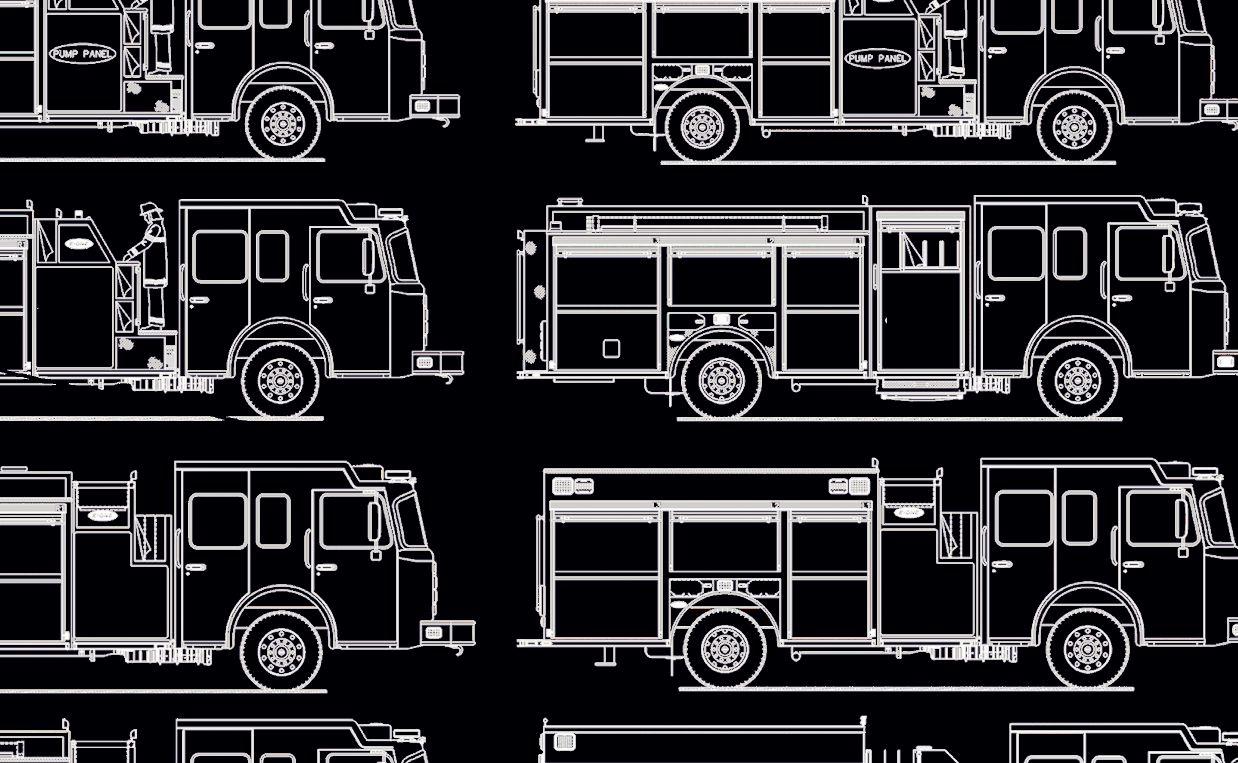
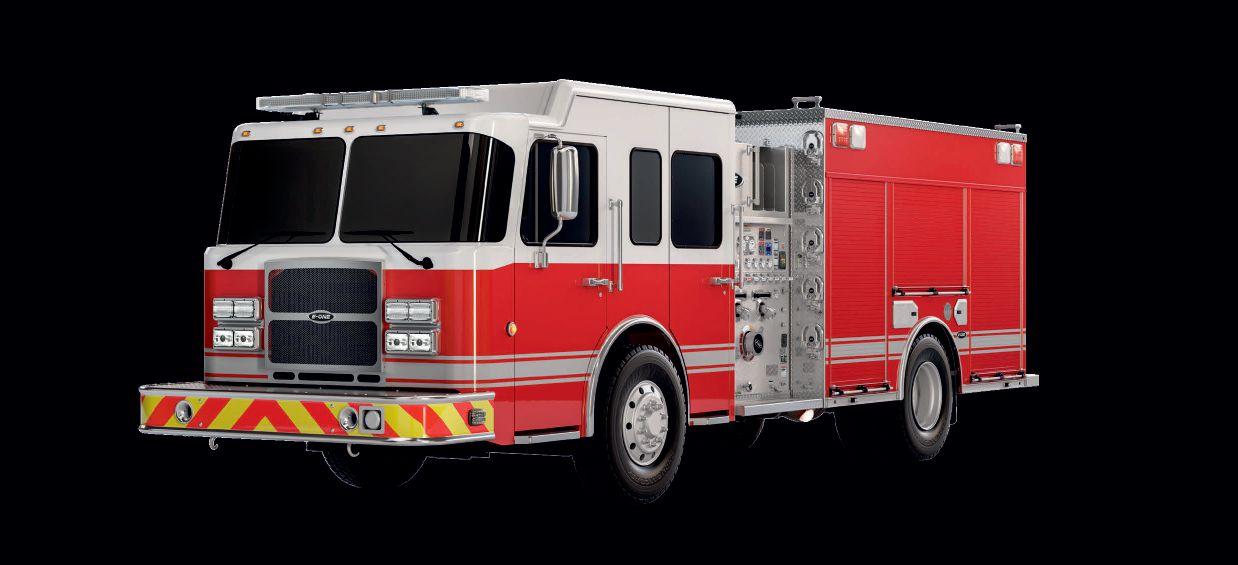
Every department deserves the most capable and reliable fire trucks for a job that is complex, challenging and unpredictable. The new E-ONE AFT Custom Pumper is a smart solution that is designed to deliver performance, simplify the purchase process and get you the custom pumper needed on time and within budget.
With over 10 models available in stainless steel or aluminum and thousands of options, we make customization simple.




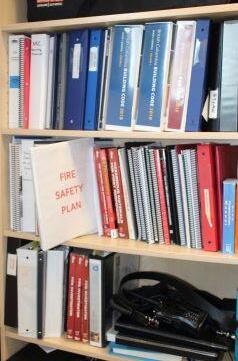
Buildings must have fire safety plans and they can be cumbersome and complex. There are ways to simplify.
By Paul Johnson
THERMAL IMAGING
QUICK TIPS: PART 2
The second article in this eight part series offers several training exercises to help you become more skilled with a thermal imager.
By Manfred Kihn

BY LAURA AIKEN Editor laiken@annexbusinessmedia.com
elcome to March!
The promise of spring and all its crocus shoots and teasingly warmer temperatures has arrived. Time for blooms and...binge cleaning? With all the sanitation and disinfencting efforts that have gone along with COVID-19, you might be wondering, what on Earth needs its annual spring clean. I’m betting disinfection has taken on a whole new meaning this year.
Spring cleaning is not just about wiping down any neglected corners. Spring cleaning is not just about lamenting the sorry state of the home garage (and suffice to say, I’ll admit mine’s pretty sorry). Spring is the traditional season to expunge. Out with the old and dirty, in with the new and tidy. At least until the universe’s ordinance of entropy comes and ensures disorder the eventual victor again. Thankfully, there’ll be another spring cleaning.
Spring cleaning means taking the opportunity to rearrange a piece of havoc wreaked by the last year into a new, more pleasing and efficient order. This is true of any year, and is made particularly pertinent by the ongoing pandemic, whose dwindling seems finally in sight (though the view is still obscured by hills and coming in a bit foggy).
Taking the cumbersome and making it concise — simplifying fire safety plans can be a beautifully efficient thing. See story on page 10.
Spring cleaning is a state of mind that ought to be embraced in some measure for the benefit of not only renewal but the prevention of unfortunate outcomes.
In this edition’s Truck Tech, Chris Dennis shares how an aerial truck missing its spring cleaning contributed to an eventual part failure. This is a good reminder that there is a reason for our seasonal habits, our anchors of annual order.
On a more abstract note, spring and its promise of renewal means it’s a good time to critique what is working and what is not, or what can be simplified, as Paul Johnson shares in this month’s cover story on fire safety plans.
The need for renewal now may come from within the fire service itself as the vaccines are here, the first responders who choose to be are being inoculated and there is a propensity to beging weighing the gravity of changes the pandemic has brought. In the Volunteer Vision column, Fire Chief Tom DeSorcy tackles this subject by asking readers to consider how their attitude has evolved with the pandemic and what this means for the volunteer service.
COVID-19 ripped up ‘the way things were always done’ like it was some kind of bad cheque. Some things will go back to the way they were before and some won’t. But it’s an opportunity to begin to choose the path forward again, a rebirth. That’s the promise of spring.

ESTABLISHED 1957
MARCH 2021 VOL. 65 NO. 2
Reader Service
Print and digital subscription inquires or changes, please contact Beata Olechnowicz, Audience Development Manager Tel: (416) 510-5182
Fax: (416) 510-6875
Email: bolechnowicz@annexbusinessmedia.com
Mail: 111 Gordon Baker Rd., Suite 400, Toronto, ON M2H 3R1
EDITOR LAURA AIKEN laiken@annexbusinessmedia.com 416-522-1595
PUBLISHER ADAM SZPAKOWSKI aszpakowski@annexbusinessmedia.com 289-221-6605
ACCOUNT COORDINATOR CATHERINE GILES cgiles@annexbusinessmedia.com 416-510-5232
MEDIA DESIGNER EMILY SUN esun@annexbusinessmedia.com
GROUP PUBLISHER/VP SALES MARTIN MCANULTY fire@annexbusinessmedia.com
COO SCOTT JAMIESON sjamieson@annexbusinessmedia.com
PUBLICATION MAIL AGREEMENT #40065710 RETURN UNDELIVERABLE CANADIAN ADDRESSES TO CIRCULATION DEPT. P.O. Box 530, SIMCOE, ON N3Y 4N5 e-mail: subscribe@firefightingincanada.com
Printed in Canada ISSN 0015–2595
SUBSCRIPTION RATES Canada – 1 Year - $25.50 (GST - #867172652RT0001) USA – 1 Year $58.50 (CDN)
Annex Privacy Officer Privacy@annexbusinessmedia.com Tel: 800-668-2374
Occasionally, Fire Fighting in Canada will mail information on behalf of industry-related groups whose products and services we believe may be of interest to you. If you prefer not to receive this information, please contact our circulation department in any of the four ways listed above.
No part of the editorial content of this publication may be reprinted without the publisher’s written permission ©2021 Annex Publishing and Printing Inc. All rights reserved. Opinions expressed in this magazine are not necessarily those of the editor or the publisher. No liability is assumed for errors or omissions.
All advertising is subject to the publisher’s approval. Such approval does not imply any endorsement of the products or services advertised. Publisher reserves the right to refuse advertising that does not meet the standards of the publication.
www.firefightingincanada.com

For over 30 years, Bell has been a trusted partner for countless first responder organizations all across Canada, providing the two-way communication and support needed to ensure that every first response is set up for success. With secure and dependable solutions like Mobile Broadband for First Responders, as well as Public Safety Land Mobile Radio, Bell helps keep first responders connected when it matters most.
Learn more about our Public Safety solutions at bell.ca/publicsafety
public safety just got better
New study finds 99 per cent of fluorine found in fire station dust came from unknown PFAS
A new study looked at firefighters’ exposure to the fluorinated “forever chemicals” known as PFAS. Nearly 99 percent of the fluorine found in tests of dust from inside fire stations likely came from unknown PFAS chemicals that could not be identified as ones that researchers had tested for.
The study by researchers from Notre Dame and Harvard, published in the peerreviewed Journal of Exposure Science & Environmental Epidemiology, measured 24 PFAS and total fluorine in dust from 15 fire stations. About 60 percent of the stations no longer used PFAS-based fire fighting foam, also known as aqueous film-forming foam, or AFFF. The others used AFFF very rarely.
The findings raise concerning questions, said David Andrews, Ph.D., a senior scientist at the Environmental Working Group, in a press statement.
“What are these unknown PFAS? Why were the levels higher in the firefighters’ gear lockers and apparatus bays? The turnout gear used by firefighters may be a more important source of PFAS exposure for firefighters than previously known.”
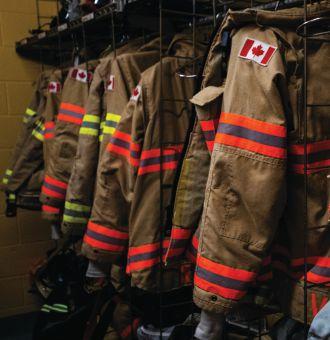
Turnout gear might be a signficant source of PFAS exposure, suggests new research.
Some of these “forever chemicals” have been linked to serious health hazards, including cancer.
The researchers vacuumed floor dust samples of various rooms in 15 fire stations in eastern Massachusetts and measured levels of PFAS in 39 dust samples. They also measured PFAS in six wipe samples of turnout gear.
The dust samples from turnout gear locker areas had higher levels of several PFAS than the dust from the station living
Promotions & appointments
SHAWN POLLEY became the fire chief for Alberta’s Cochrane Fire Services after starting with the Town as deputy fire chief in 2017. He brings almost three decades of emergency service leadership experience to his role at the helm. His previous posts include serving as fire chief for the Tsuut’ina Nation
Fire Rescue Service and managing Kananaskis Emergency Services for the government of Alberta.

DERYN RIZZI became the fire chief and director of emergency management for Mississauga, Ont., in February. She replaces Time Beckett, who retired in 2020. Chief Rizzi
areas, and those PFAS were also detected on the turnout gear, based on the wipe samples.
The findings reinforce an earlier study by researchers from Notre Dame University that found PFAS used to treat a firefighter’s gear could pose a threat to their health.
“If they touch the gear, it gets on their hands, and if they go fight a fire and they put the gear on and take it off and then go eat and don’t wash hands, it could transfer hand to mouth,” researcher Graham Peaslee, Ph.D., a professor of physics at the University of Notre Dame, said in a news release on the earlier study. “And if you’re sweating and you have sweat pores, could some of these chemicals come off on the thermal layer and get into the skin? The answer is probably.”
A study by the National Institute for Occupational Safety and Health, completed in 2015, found “evidence that firefighters are at increased risk of certain types of cancer as a result of occupational exposure.”
Although the study did not look at PFAS specifically, other studies have linked these compounds to increased cancer risk.
has over 20 years of experience in the fire service. She began her career in Vaughan, Ont., where she was most recently fire chief. Her work in Vaughan helped earned many awards for the City and her career highlights include working in the Provincial Emergency Operations Centre in the Office of the Fire Marshal and Emergency Management where she provided leadership and guidance on operations, education and training related to emergencies.
STEVE ROBINSON is the new fire chief for Kamloops Fire Rescue (KFR) in British Columbia. He has been in leadership with KFR since 2016, when he moved from Surrey Fire Service to Kamloops as an assistant chief. In his role overseeing Surrey’s Fire Prevention
New survey results show 72 per cent of Canadians don’t know the minimum ice thickness considered safe. These figures represent a big gap in the knowledge and confidence of Canadians who partake in winter activities on frozen water.
The survey was conducted by VodaSafe, the water rescue and recovery technology company behind AquaEye, a hand-held scanning sonar device for water-based search and rescue. The results of their survey also showed Canadians plan to spend more time outdoors than previous years yet lack awareness of ice safety.
The survey shows that one in three Canadians plan to spend more time outdoors this winter than in previous years through the ongoing COVID-19 pandemic and its resulting widespread travel and indoor gathering restrictions. As fluctuating temperatures have impacted this season across the country, police, fire, and search and rescue departments have been warning Canadians to be wary of unstable ice conditions before participating in activities like skating, hockey, snowmobiling, and ice fishing
“Sadly, we anticipate seeing ice related fatalities continue to trend upwards in Canada,” said Carlyn Loncaric, CEO of Vodasafe, in a news release. “Not only is greater education and awareness on the contributing factors and safety measures so critical, but we also need to ensure our regional police and fire departments are equipped with advanced technology that helps them respond quickly and efficiently to search and rescue calls.”
This is exacerbated by the education

A recent poll suggest roughly three quarters of Canadians don’t know how thick is safe when it comes to ice.
gap this survey showed as nearly three quarters (72 per cent) of Canadians do not know the minimum ice thickness for a frozen lake or pond to be safe enough to skate. At the same time, just over half (57 per cent) of people who participate in activities on frozen lakes or ponds feel confident determining whether it is safe or not. However, among this group, less than one third (29 per cent) correctly identified the minimum thickness to safely skate on a frozen lake or pond as at least 20 centimeters.
Other highlights from the survey include:
• 21 per cent of Canadians believe that dangerously thin ice (1-10 centimeters) is safe for skating.
• Manitobans (25 per cent) and Albertans (17 per cent) are more likely than the
national average (11 per cent) to plan to spend more time on frozen lakes and ponds this winter than in previous years. These provinces are also more likely to report feeling secure in determining the safety of ice.
• Respondents ages 18 to 34 are the most likely to report they feel secure taking part in activities/sports on frozen lakes or ponds (76 per cent), despite research pointing to this age group as one of the highest-risk of ice fatalities and are more likely to engage in riskier behaviour. Confidence levels vary among genders, with less than half of women who participate in activities on frozen lakes or ponds reporting that they feel confident in determining whether ice is safe (46 per cent), compared with 68 per cent of men.
Office, he was involved with creating a HomeSafe program that focused on increasing the number of homes protected by working smoke alarms. That program was so successful that it is now being used by fire departments across Canada, including KFR.
Congratulations are in order

for Fire Chief
DAVE SUTTON on a successful 35-year career serving his community. Chief Sutton has been a member of the LaSalle Fire Service in Ontario since 1986 and has moved through the ranks starting as a volunteer firefighter, full-time firefighter, training instructor, deputy chief and fire chief.
GLEN PEACE, former fire chief and city manager for Hamilton, passed away Jan. 9. Peace was born and raised in Hamilton and joined its fire department in 1971. He served as the fire chief in neighbouring Burlington, Ont., then returned to serve as Hamilton’s fire chief in 1999, eventually serving as city manager for the
last five years of his municipal career.
JIM KEAY fire chief of the Nipigon Volunteer Fire Department in Ontario, died in January. He was a dedicated leader in the northwestern Ontario fire service, and became fire chief for the Township of Nipigon in 2011.
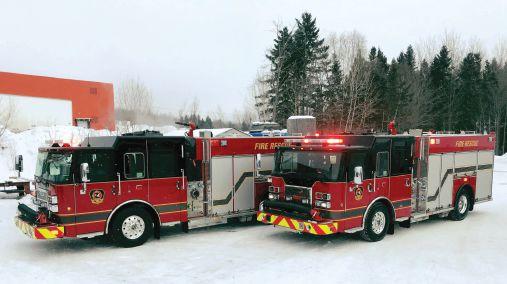
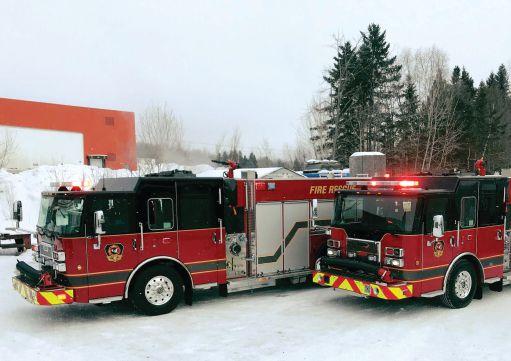
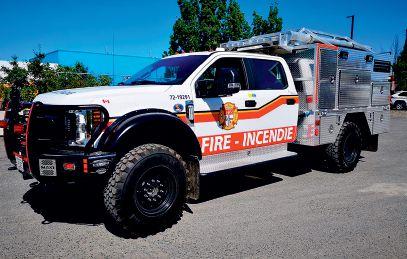
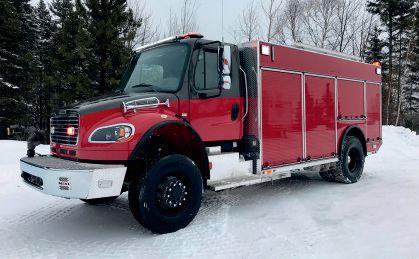
Grande Prairie County in Alberta took delivery of two pumpers from Commercial Emergency Equipment. This unit runs on a Cummins L9, 450 HP engine and sits on a Pierce Saber chassis. It is equipped with a Husky 3, Single Agent foam system, a Hale DSD, 1,500 GPM pump and a 1000 USG + 50 USG foam tank.
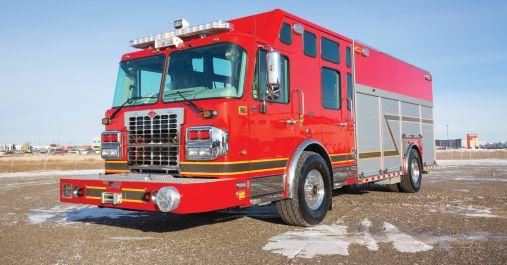
Esquimalt Fire Department in British Columbia received this 18 Walk Around Rescue, rescue truck from Fort Garry. This truck is powered by a Cummins L9 450 HP engine and an Allison 3000 EVS transmission. It sits on a Spartan Metro Star chassis.
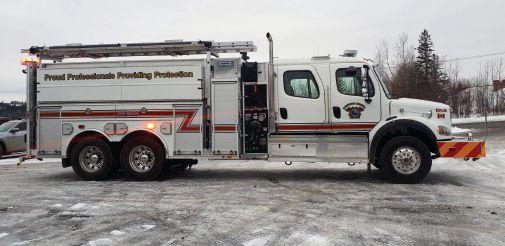
Clearwater County in Alberta took delivery of this apparatus from Commercial Emergency Equipment. Manufactured by Pierce Manufacturing, it runs on a DDC DD13, 505 HP engine and sits on a Pierce Arrow XT chassis and has an Ascendant 100’ Aerial Tower body. It is also equipped a Waterous S100, 2,000 GPM pump and holds 300 gallons. Clearwater County also took delivery of a TME Maximetal TME Pumper engine.
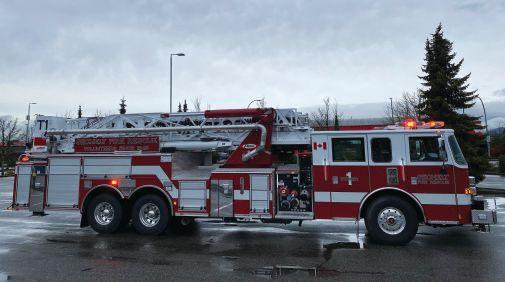
This pumper was delivered by Commercial Emergency Equipment to the Sechelt Fire Department in British Columbia. With an Ascendant 100’ Aerial Tower body, this apparatus is powered by a DDC DD13, 505 HP engine and sits on a Pierce Arrow XT chassis. It is equipped with a Waterous S100, 2,000 GPM pump and holds a 300 Gallons.
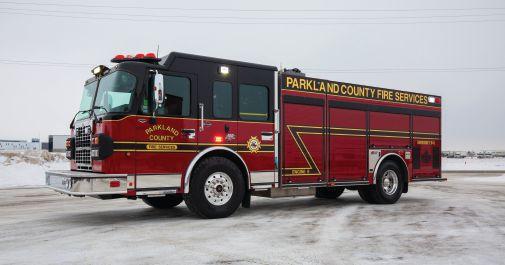
The Parkland County Fire Department in Alberta took delivery of this pumper from Fort Garry Fire Trucks. This unit sit on a Spartan Metro Star chassis and runs on a Cummins L9 380 HP engine. It has an Allison 3000EVS transmission and is equipped with a hale QMAX XS 1500 pump and 800 IG co-poly water tank.
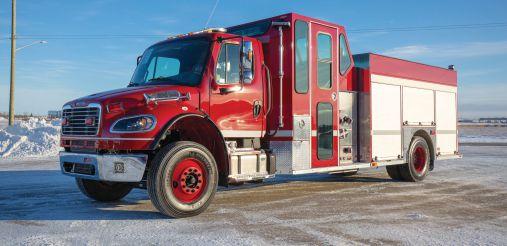
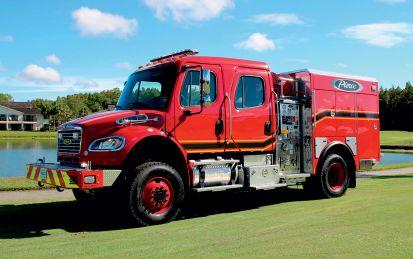
Mosaic Belle Plaine ERT in Saskatchewan was delivered this pumper from Fort Garry Fire Trucks. The apparatus sits on a Freightliner M2-106 chassis and runs on Cummins L9 3,000 HP engine. With an Allison 3000 EVS automatic transmission, the apparatus is also equipped with a Waterous PTO CSPA1500 pump and a 600-co-poly foam system.
By PAUL JOHNSON
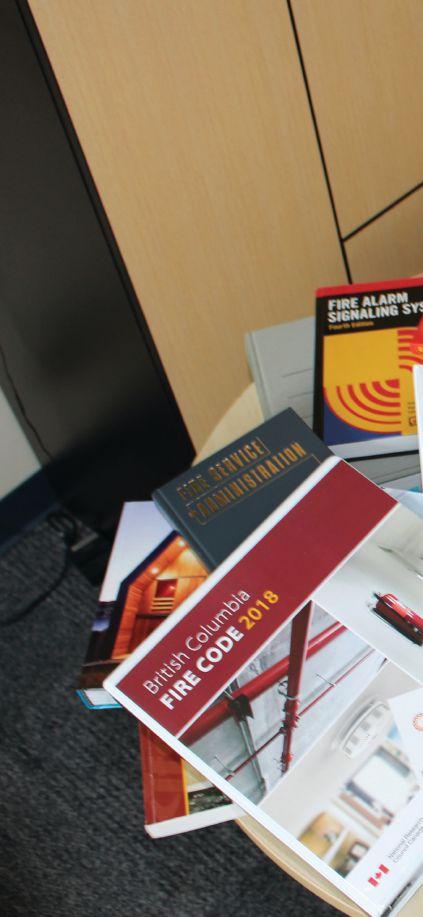
The BC Fire Code sets out the minimum life safety requirements for buildings within the province of British Columbia.
Section 2.8, Division B of the BC Fire Code discusses emergency planning and applies to buildings with assembly, care, treatment or detention classifications. Emergency planning is legally required in buildings with fire alarm systems and required for construction and demolition sites. Emergency planning is required for storage areas, hazardous operations and for areas where flammable liquids are stored or handled. In my role as the fire prevention officer for the Kelowna Fire Department and as 3rd vice-president of the Fire Prevention Officers Association of BC as well as NRC Codes Standing Committee member on fire protection, I have become particularly familiar with the ins and outs of fire codes and emergency planning.
Arguably, the most important component of emergency planning is the creation of a fire safety plan. The BC Fire Code lists clause (a) through (g) which identifies seven criteria that must be provided within the fire safety plan. The plan shall identify procedures to be used in a fire, the appointment of supervisory staff as well as the training of staff and occupants. The plan is required to include documents showing
type, location and operation of the building fire emergency systems. Furthermore, it discusses fire drills, the control of fire hazards in a building and the inspection/maintenance of building facilities provided for the safety of occupants. Specific buildings or operations have additional requirements, such as assembly occupancies, hazardous operations and care/treatment or detention occupancies.
The BC Fire Code has had the requirement for emergency planning since its inception. The code states “a fire safety plan conforming to this section shall be prepared in cooperation with the fire department and other applicable regulatory authorities.” Even with a statement like that, many departments will not “accept” a submitted fire safety plan, they will only review it. There is a concern with the fact that the department would be accepting liability for their respective municipality. But doesn’t our code state “in cooperation?” We are required to assist them with the plans, but have we essentially farmed out the entire industry to contractors?
The inspection branch of the fire service has allowed contractors to take the seven criteria listed in the BC Fire Code and create a niche in the fire life safety industry. A business/building owner can typically pay in excess of $1500 for a cookie cutter tem-
No wonder we are having a tough time gaining compliance when we make the “person in care and control” of a building study a book where there is no exam at the end.
’’
The fire safety plan is arguably the most important component of emergency planning for buildings.
plate fire safety plan. The contractors then add a copyright warning onto their plan. The information is essentially all the same; it’s just laid out in a different format from the other contractor.
The fire safety plan is a document for the owners. The fire service will extrapolate information from the plan to help create our pre-plans but for the most part it is an owners document. I have “reviewed” plans containing well over a hundred pages. Some plans have taken the wording from the code and rewritten it for the building. No wonder we are having a tough time gaining compliance when we make the “person in care and control” of a building study a book where there is no exam at the end. Why would I want to read 85 pages when I could read 10 pages?
Recently, our office received a fire safety plan that was submitted to our department
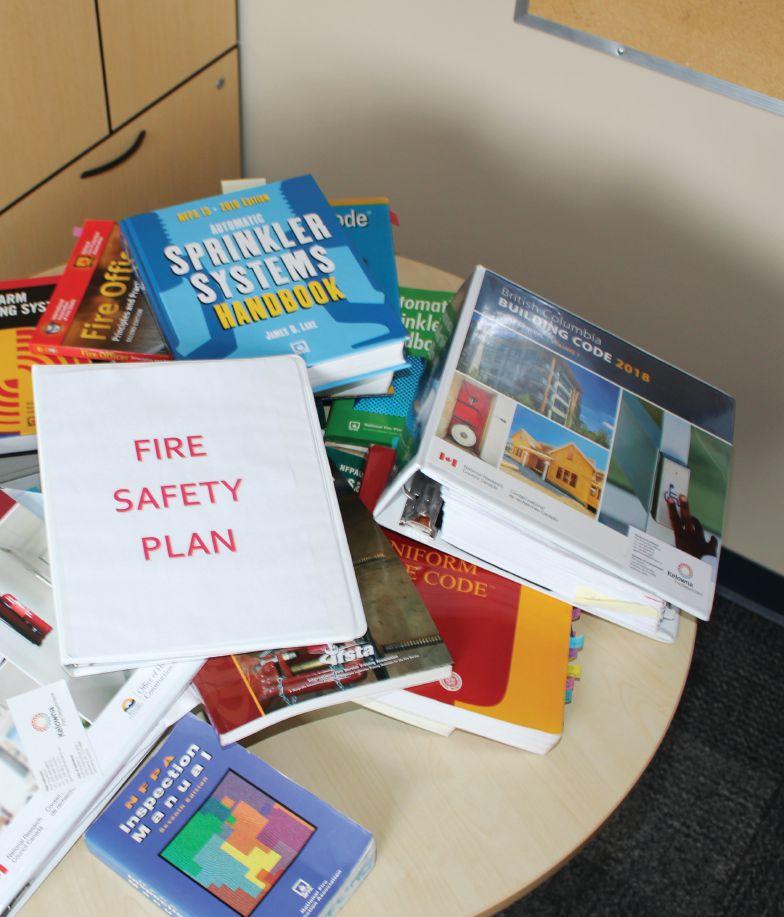
for review. The plan contained 190 pages of information. In fairness to the creator of that plan, they had enclosed alternative solutions (building code equivalencies) which had been accepted by the building branch. It had 90 pages of the alternative solution with 100 pages of the seven requirements listed in the Fire Code. This one of the most thorough plans we have ever seen for a building. The irony is that when our inspector conducted an inspection of this property a year later, no maintenance had been done. Upon further discussion with the property maintenance manager, he said he didn’t know what he had to do. He didn’t have the ability to leaf through a document that would quickly tell him what he had to do as the building manager.
The average layman struggles to determine what his or her obligations are as the building manager. An example of excessive information within a plan would be for the water-based protection systems. Section 6.4 of the BC Fire Code states: “Water-based fire protection systems shall
be inspected, tested and maintained in conformance with NFPA 25. Inspection, Testing and Maintenance of Water-Based Protection Systems.” I have reviewed several plans which list the sequential testing requirements for the system. Ultimately, we are not trying to educate the property representative on being a fire sprinkler technician. All we are doing is advising the property representative what their respective role is regarding the maintenance of the system. The property representative must be able to pick up the fire safety plan, open it to the maintenance section and see what the maintenance obligations are for that month. If the plan says retain a contractor to conduct the service requirements, then it should be stated in the plan so that the property representative can hire an approved contractor.
We must ask ourselves if the pendulum has swung too far. In our desire to improve life safety within the province we have essentially allowed contractors to create a book that in all likelihood no one will
typically read. In competitive industry, contractors try to create a better product than their competitors, consequently excessive information is added to the plan. A thicker fire safety plan does not necessarily mean it is a better product. It does mean there is more information in it that the reader may not read or understand. A concise plan that contains less material written in an easy to read format is worth considering. It is more user friendly and would be better understood by the customer.
The Fire Prevention Officers Association offers a free template available on the association’s website. The Fire Inspection and Prevention Initiative (FIPI) is currently available for property owners to download the information and essentially fill in the blanks. The City of Halifax has also incorporated a free downloadable fire safety plan, which is more in line with the requirements of the code. In a quick online search, I was able to find several generic fire safety plans which could be downloaded and used for their building at no cost. The plans are available for small buildings, high buildings, single stage alarms and two stage alarms, etc.
Many fire safety plans can be created from the free downloadable templates. Ultimately, it is a business decision to hire a contractor. However, the more complicated plans such as hospitals, storage areas, hazardous operations or buildings which have been constructed using alternative solutions should continue to have the plans created by contractors. At times, customers are not made aware of the templates and are consequently saddled with a bill for a product that very well may closely resemble their neighbour’s fire safety plan.
Fire safety plans are a legal requirement for business, buildings and industry and are required to teach the building/business representative the emergency planning requirements for their specific building. I feel the content of the plans which we are reviewing as the ‘authority having jurisdiction’ should be limited in the hopes that the property representative will use the plan and understand the plan. ››››››››Ultimately, our goal is to promote life safety and limit fires. Perhaps we can do more with less.
Paul Johnson is the fire prevention officer for the Kelowna Fire Department, 3rd vice-president of the Fire Prevention Officers Association of BC and an NRC Codes Standing Committee member on Fire Protection.
■
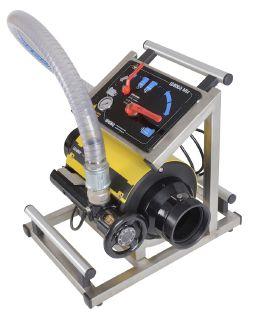
A new autonomous foam proportioner with even larger flow ranges is now available from LEADER.
The LEADER MIX 2000 has a unique dosing system that is designed to be very easy to use, install and to maintain. LEADER MIX 2000 is a completely mechanical foam eductor that operates without electronics. LEADER MIX 2000 adjusts itself in accordance with nozzle or monitor flow variation.
The unit is small and compact, and LEADER also offers a portable version that can be used on the ground. Its versatility contributes to a lowered operational cost. Leader-group.company
■
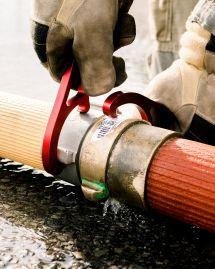
The Motis Mini Spanner is an ultra lightweight tool, weighing in at just 2.5 oz each. The Canadian made Motis Mini Spanner is designed to easily fit in bunker gear pockets as a go-to product to carry at all times. The double tip design lets firefighters use the spanner in a multitude of ways. The spanners come in twopacks with a colour choice of black, blue or red. Motisfirerescue.com
■
Perimeter Solutions introduced a new line of fluorine-free fire fighting foam concentrates for general purpose use. The line, called SOLBERG VERSAGARD, debuts with SOLBERG VERSAGARD AS-100. This multi-purpose 3 x 3 fluorine-free foam concentrate is an alcohol resistant pseudoplastic foam technology designed for extinguishing and securing both Class B (hydrocarbon and polar solvent liquid fuel) and deep-seated Class A fires. The biodegradable and non-persistent concentrate is made with no siloxanes and is a combination of hydrocarbon surfactants and additives that are designed to deliver excellent foaming, vapor sealing, extinguishment and burnback properties using fresh, sea or brackish water. perimeter-solutions.com


• Integrated systems communications • Charge 3 battery banks • Built-in touch display • Parasitic Load Compensation • 3 step or float charging
• Pump Plus feature included
• Accommodates most battery chemistries • Optional remote control touch display available

BY CHRIS HARROW Director of Fire Services

ecently, I was discussing leadership with my teenage son. He was filling out a questionnaire for his college application that asked what he had done to demonstrate leadership qualities that made him a good candidate for this program. Panic set in: How am I going to help him answer this question when he is a quiet teenager who prefers to hide in the background of social situations?
After a brief pause, and an attempt to hide my panicked facial expression, we began discussing leadership traits. I recalled many different leaders I have encountered throughout my career who lead quietly, but very effectively, for inspiration. Boisterous does not equal good leadership. Strong leadership comes from making others around you successful. Good leaders enjoys the most success when others around them are achieving their goals.
My son, this quiet young man, has not always been the best player in sports, but he has realized a lot of team success with provincial championships in both baseball and hockey. This got me thinking about how his team success relates to his own leadership traits in a way he can talk about on his application.
In hockey, he is the goaltender and the catcher in baseball. Both positions play key roles on the team and require effective leadership and communication in order for the team to play well together. The catcher in baseball has a vantage point of seeing the entire field. The catcher not only calls the pitches, but also signals plays on the bases and positions of the other players. Many times the catcher is also the calming voice when the team starts to unravel on the field.
career I related to, it showed me how he could be deemed a leader. Successful teams always have that quiet leader on the field or in the dressing room. There is always a person who relishes in watching others be successful and seeing the overall team winning. This is the player who does not need the spotlight but without them the team would not move forward. The player that speaks when necessary and speaks only what is necessary.
My son was not the most talented player on his teams. In fact, we used to tease him that he had a successful game when he managed to foul one pitch off. Looking back though, his steady role as a solid catcher and his ability to take teammates poking fun at him was a huge part of their success. He is the kid that was always steady and knew how to talk to different personalities whenever the need arose. Again, a difficult thing to put on an application, but definitely a huge attribute of being a leader.
I relate this to the fire service. Looking at the dynamics of the departments I have been involved in, we have always had that steady person in the background, the quiet leader that knows how to speak to different firefighters, young and old. The person who attends all of
In times of adversity, it is only natural for people seek out the steady influencer of the group.
’’
The goalie in hockey is similar in seeing the entire ice surface and often directing the team in their defensive end by talking to the defence and letting them know options or players coming at them. The goalie needs to have a good, respected relationship with all of the team and is an important part of any successful team.
An individual who gravitates towards playing these positions in sports has to have some leadership traits. As outlined above, you need to be a leader of some sort to play those positions effectively.
In considering my quiet and reserved oldest child: How does he gravitate towards these positions being the personality he is? Again, reflecting back to my experience with so many quiet leaders over my
Chris Harrow is the director of fire services for the Town of Minto and Township of Wellington North in Ontario. He is a graduate from fire programs at Lakeland College and Dalhousie University and holds a graduate certificate in Advanced Care Paramedics from Conestoga College. He can be reached at c.harrow@mintofiredept.on.ca.
the training sessions, all of the social events and is just there whenever needed. The firefighter who does not seek the limelight or encourage drama when change is occurring. They will speak up when necessary, but most of the time it is in a positive way giving feedback that is appropriate to the situation.
Volunteer fire departments run with these types of leaders. Many times, you don’t realize how much you need a leader like this until they are gone. You just hope that someone was groomed to slide right into that spot. It’s really something to see when incidents get tough or there has been a bad call — firefighters just naturally gravitate to these types of leaders. In times of adversity, it is only natural for people seek out the steady influencer of the group. It makes them feel secure and calms their fears. These qualities are what makes this type of leader in our stations so vital to their operation.
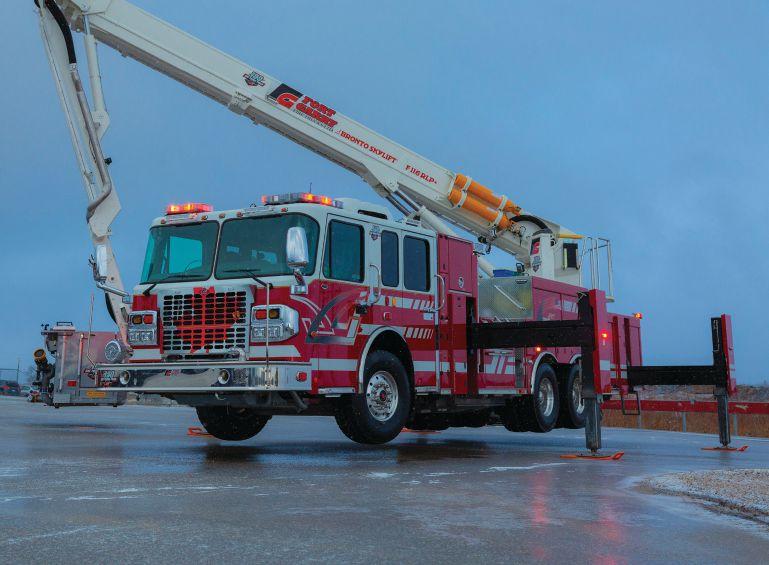




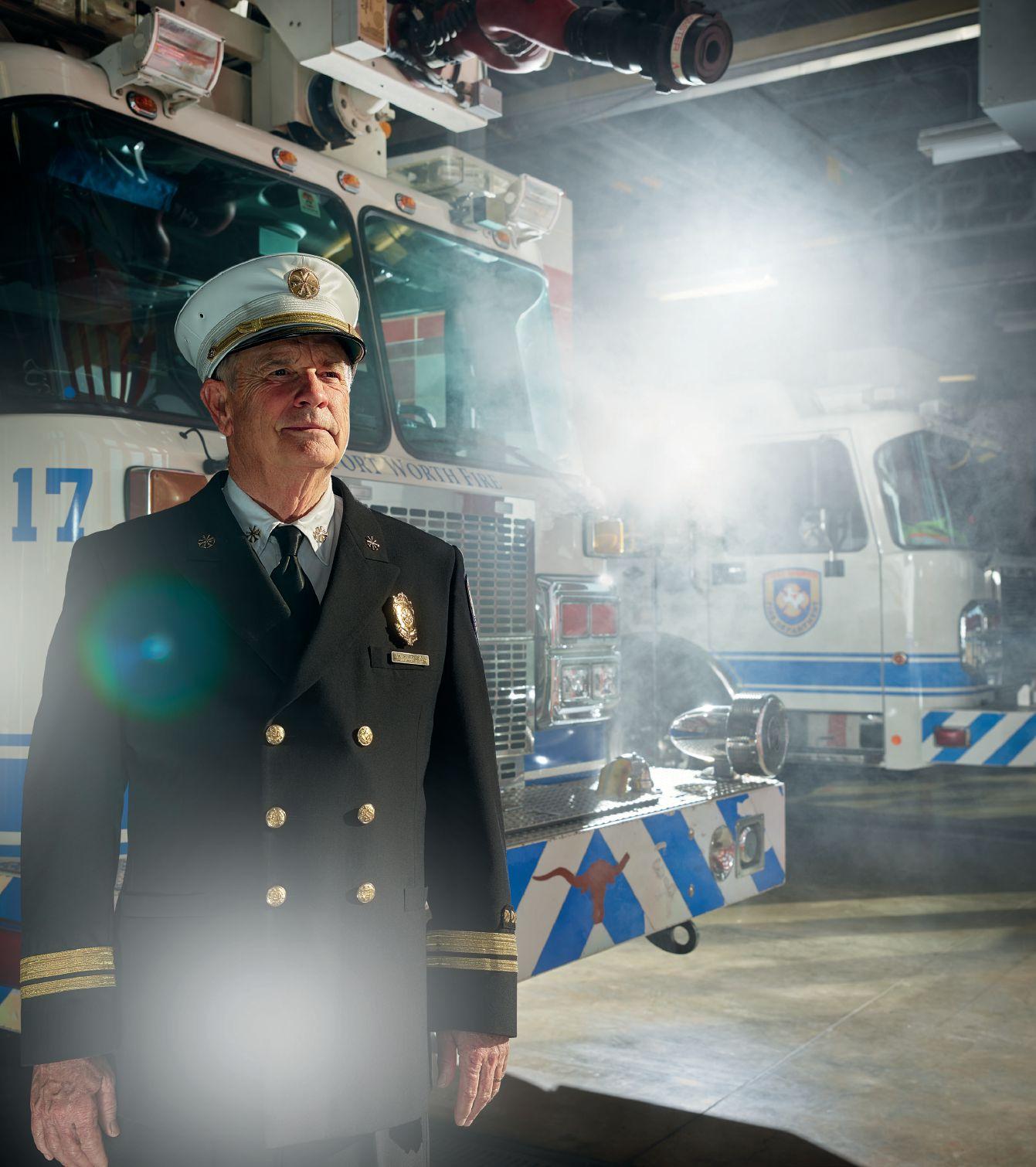
Fort Garry Fire Trucks is the largest fire apparatus manufacturer in Canada and are proud builders of fire trucks, custom-built pumpers, aerial ladders, and related fire-fighting equipment. Our customers emanate from cities, towns, and municipalities throughout Canada, the U.S., and abroad with the harshest weather, climates, and terrain—which is why we design “One Tough Truck.”
We are a proud distributor of sales, service, and parts for the versatile Bronto Skylift aerial platforms, and we currently have two units available for immediate possession. Fight fire at any height with our Bronto Skylift F116RLP. This 116-foot articulated ladder platform incorporates global market-leading technology and fire fighting devices with the industry-leading custom fire apparatus cab and chassis, the Spartan Gladiator. Our brand new Bronto All-Rounder is also available! It’s the first articulated aerial ladder platform built on a single axle commercial chassis in North America and proudly manufactured in Canada.
By MANFRED KIHN
At a recent training event, students participated in a session on primary search with a thermal imager (TI). The session did not include live fire, so everything was the same temperature. To provide “energy” to the “victims,” hand/toe warmers were used and taped to mannequins. This simple technique helped to highlight the “victims” against the cool room. Keep in mind when using this technique, that if this had been a real fire, the victim may not be the warmest object in the room.
I’m familiar with a fire department that is very proactive when it comes to their TI training. They are so proactive, that they have created “a sauna for dummies” to experience the realism of conducting search and rescue and victim location training. This month, for your in-house fire department training, if you do not have access to a heated room or sauna then get some hand/ toe warmers and practice searching for a “victim”. Tape a hand warmer to a small mannequin or a couple of the warmers to a larger “victim”. Hide the “victims” around a dark room like the bunkroom and use some blankets to partially cover your victim(s). The goal here is to add as much realism as possible. Have members take turns using the TI to perform a primary search.
Another good TI training drill is called a coordination exercise. With the aid of a smoke machine, smoke up a room, but before you do, be sure to place an axe and halligan bar somewhere in the room. Then you and/or your partner can locate the victims using the TI. Now that you have found the victims, simulate opening a door by striking the halligan bar five times with the axe using the TI as your eyes. How coordinated are you? Have both you and your partner practice this technique before rotating to the other members. Is it a puddle of cold water on the floor
or is it an actual hole in the floor? What is your TI telling you? There are one of two things I can see happening with this scenario. First, you’re going to get your boots wet or second, it is going to hurt like heck when you land on the basement floor because what you were looking at but didn’t understand, is a “black hole”. During my trainings, what works very well to help firefighters identify a black hole is using an old metal road sign or a thin sheet of plywood. Be sure the metal sign or plywood is at least 24 x 24 inches and it is a different temperature when placed on the floor where you are going to run some TI drills. See who takes notice and walks on it or stops and goes no further. This is a great way to help firefighters avoid possible injuries when using a TI when responding to a live fire call.
Did you know that we do not have depth perception when we use a TI? Yes, we do have some limitations using thermal imagers which I will talk more about in another article. Try navigating up and down stairs when using a TI because although this sounds simple it takes practice. Use your basic-fundamental techniques to navigate up and down flights of stairs as walking is not an option if you do not have visibility.
How about grabbing a couple of 5-gallon pails and partially filling them with hot and cold water or using some fuel jerry cans and placing them into your TI drill area. Simulate some hazmat scenarios by trying to determine liquid levels in the containers and even check out the propane level on the BBQ.
Here are a few other techniques we can work on. Walk around the station and look through the lens of the TI at the obvious electrical equipment such as computers, TVs, etc. The more time you spend behind the lens of your TI, the better you will be at understanding image interpretation.
All TIs will display advanced fire fighting colourization at a higher temperature, but for right now we want to work only with black and white as 95 per cent of the time that is what you will be working in. Black and white are two out of the three basic shades of colourization that your TI will display. White indicates objects that are hot or warmer, while black indicates objects that are cold or cooler, and everything else in between is shades of grey.
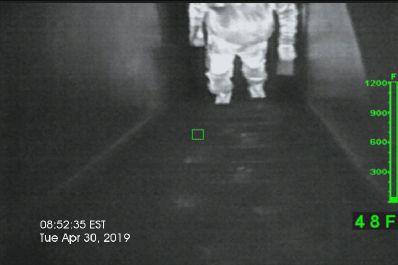
Take a look at this TI photo. It would be difficult to see the stairs if it wasn’t for someone walking up them, which changed the temperature contrast. Use your basic fire fighting skills by always sounding the floor in front of you. A TI is a great addition to our arsenal of tools, but like all equipment, it takes practice, practice and more practice to develop the skill of using the TI effectively. Stay safe and practice often.
Manfred Kihn is a 19-year veteran of the fire service, having served as an ambulance officer, emergency services specialist, firefighter, captain and fire chief. A member of Bullard’s Emergency Responder team since 2005, he is the company’s fire training specialist for thermal imaging technology. He is certified through the Law Enforcement Thermographers’ Association (LETA) as a thermal imaging instructor and is a recipient of the Ontario Medal for Firefighters Bravery. If you have questions about thermal imaging, you can e-mail him at manfred_ kihn@bullard.com.

By ED BROUWER
Effective training officers are always looking for ways to improve their communication skills. They partake in instruction techniques courses, read piles of training material and network with other instructors. In this issue, I would like to turn your focus an ancient yet vital skill that can all but overlooked by many instructors these days. That skill is listening.
Some background: Over the last three decades I have witnessed the evolution of the trainer’s “toolbox”. Overhead projectors and slide projectors were replaced with power screens, video projectors and PowerPoint presentations. Shelves of VHS tapes were replaced with a few DVDs, which in turn were transferred to a 1 TB USB drive. Photocopiers have come miles since the early Xerox machines. Now with full colour copying, and even 3D scanning, prototyping, and printing, we no longer need to spend hundreds of hours researching through textbooks and then writing out copious notes. Now it is a quick search on Google, then “cut and paste” all before our coffee is done.
The internet has changed forever how we research and instruct in the fire service. For the most part I am grateful, until I hear that lazy rookie, standing at the back of the room, boastfully yell out the answer to a question I just posed to the class — and I know he just looked it up on his phone.
Everything seems to be done at break-neck speed. Any question, no matter how difficult, is answered within a second. A simple click on a keyboard and immediately references fill your screen. Personal messages are sent so fast you rarely get time to consider the impact of your comments.
In our world of texting, our listening has been reduced to reading, and that robs us of the ability to really hear what the other person is trying to convey. No matter how many emojis you add to your text, nothing measures up to making eye contact.
Could it be that the blinding speed at which we receive and impart information has deafened us to the ancient art of listening?
Listening, like communicating, is a skill to be honed. Being an active listener incredibly important in today’s day and age. Whether on the fireground or in your circle of life, miscommunications can have devastating results. You need only read one fatality report to understand that poor communications negatively affect situational awareness, which is a major contributing factor for firefighter injuries and fatalities.
Often, our biggest problem is we are too quick to speak. I am still learning this one.
Perhaps one of the hardest skills to master is the ability to harness

our desire to speak.
I have an amazing skill set that is both a blessing and a curse, a quick wit and I am prone to sarcasm. I have bit my lip more than once and often find my self reciting some “cowboy wisdom” in the form of you don’t have to say everything you think. Easier said than done, to be sure.
But if we are doing all the talking and none of the listening people will begin to tune us out.
Talking too much can also get us in trouble. If you find yourself in a discussion that is not going anywhere, stop! The old adage “if you find yourself in a hole, stop digging,” comes to mind.
Watch out for the traps of interruption and assumption. My wife gets upset when I interrupt her because she fears she will forget what she was wanting to share with me. I am still learning after 46 years. Yes, it is true, effective listening involves asking questions. It shows that you are interested in what is being said. However, let them complete their thoughts before responding.
Interruptions are often an outward manifestation of the inner conversation we are having with ourselves. Rather than listening to what is being said, we watch for the speaker to take a breath and we jump in with our story.
Then there are times we are not paying attention, lost in our own thoughts. Catching ourselves, we then interrupt the speaker by asking them to repeat what they had just said.
When I fall into the assumption trap, I begin to formulate my response (words of wisdom to be sure) but because I really was not listening my advice is way off. Too often we listen to the words being said without really understanding their meaning.
Years ago, I attended a morning church service, and was greeted, along with the other attendees, by the pastor. He shook my hand and asked how I was doing. I replied, “Not well, my wife is home
with our kids who are ill.” His reply was, “That is great, Praise the Lord.” As he said that he was already reaching for someone else’s hand. I confronted him right then and there. He felt so bad he got everyone’s attention and publicly apologized to me.
We are all guilty of not really listening to others. How often have you asked someone how they were, while not really looking for an answer? Our default answer 99 per cent of the time seems to be, “Good and you?”
I try to make eye contact. Looking directly at the person who is talking with you clearly shows you are paying attention to them. Looking away, even if you are still listening, will make it seem like you are distracted or not interested.
It is important to acknowledge that you have heard what was being said. On the radio we say things like “copy” or “roger” but that is not sufficient. Firefighters should be taught to repeat part of the message back to the speaker. Example: “Engine One from Attack One”, “Go Ahead Attack One”, “We need 100 psi on line one”, “Roger that, 100 psi line one”. By repeating the request any chance for miscommunication is nipped in the bud. Doing this consistently during practice scenarios, fireground incidents and mop up, it will become second nature.
This next point may sound strange, but it is important to be “present” (being at hand or in attendance) when someone is talking with you. Look into the eyes of the person speaking with you, watch for nonverbal cues.
Personal messages are sent so fast you rarely get time to consider the impact of your comments. ‘‘ ’’
■ OBSERVATION IS GREATER THAN SEEING AND LISTENING IS GREATER THAN HEARING.
I believe we have two ears and one mouth because we are to listen twice as much as we speak.
St. Francis of Assisi said, “Seek to understand before seeking to be understood”. In other words, listen with the intent to understand not the intent to reply.
Listening is one of the most powerful skill sets you can have as a fire service officer and one of the most valuable lessons to be taught to your members. Hopefully, this article has helped you build on your skill sets, enabling you to become known in your department as someone willing to really listen.
May you never stop striving to improve your communication and listening skills.
I hope there is someone you can trust when you yourself need to talk. Please feel free to drop me a line if you don’t.
With deep respect I thank you for the effort you put in each week. Please stay safe out there remembering always to train like lives depend on it…. because they do.
Ed Brouwer is the chief instructor for Canwest Fire in Osoyoos, B.C., retired deputy chief training officer for Greenwood Fire and Rescue, a fire warden, wildland urban interface fire-suppression instructor and ordained disaster-response chaplain. Contact Ed at aka-opa@ hotmail.com.














BY SEAN TRACEY Chair HFSC Canada
am a recently retired deputy chief from Ottawa, and before Shayne Mintz, I was the NFPA Canadian regional director. In retirement, I became chair of the Home Fire Sprinkler Coalition (HFSC) in Canada to help chief fire officials understand what they can do to encourage home buyers, builders, and municipal leaders to embrace residential fire sprinklers. Those who understand the benefits of home fire sprinklers need to shed greater light on these essential life-saving systems to prevent injuries, fatalities, and property loss.
The biggest challenge to the fire service in seeing greater acceptance of residential fire sprinklers has been education – education of all players: builders; home buyers; and even our own colleagues. This lack of education about the benefits of home fire sprinklers, and even how sprinkler systems function, continues to stymie us, and we continue to see the proliferation of myths and misconceptions.
One major misconception that I want to shatter is that fire chiefs are unable to require residential fire sprinklers in their areas. Fire chiefs often cite provincial regulations prohibiting bylaws. This is simply not true. Although in Ontario and Alberta provincial regulations prohibit a municipality from adopting a sprinkler bylaw, they do not stop any fire service from requiring sprinklers in individual developments if there are challenges to the fire department’s response capabilities. Any fire department in Canada can require sprinklers as a condition of development if fire protection standards cannot be met. Fire chiefs must, however, be engaged by reviewing all new building developments in their communities to catch these shortfalls and ensure that these developments are adequately protected.
municipality’s approved standard of cover). Additional provisions could involve doubling the separations between houses or requiring sprinklers.
Residential fire sprinklers can also be considered by the local fire service in other cases as a trade-off or equivalencies under the codes. Areas with water-supply or fire fighting challenges, or with limited access routes, could address these deficiencies using sprinklers. Fire chiefs can require sprinklers as an offset, but this can be done only if they are engaged in the earliest stages of development approval.
As our communities expand outward, the developers’ rate of building can outstrip the ability of the municipalities to finance, build, and then resource fire halls. This leaves these new homes at a greater risk, as response-time objectives cannot be met. It can be several years until new firehalls are built. Rather than curbing development, mandating residential fire sprinklers can be an essential stopgap measure until the new fire hall is provided.
The Livingston community, Calgary’s 2020 Community of The Year, is a case in point. The developer has opted to install fire sprinklers in all buildings, including 15,000 new single-family homes, a
The biggest challenge to the fire service in seeing greater acceptance of residential fire sprinklers has been education. ‘‘ ’’
Provisions in the national and provincial building codes assume there is an adequate fire service response. More stringent requirements than what are stated in the codes can be demanded anywhere the municipal fire service is inadequate. However, the codes are silent on what an adequate fire department is; they leave this to the local authorities (in my interpretation, solely the fire chief) to determine what is adequate. Anywhere that response times cannot be met with an effective response force (EFR) in a reasonable time and with adequate water supply should require additional building-code measures. (An EFR is not defined in the codes but the best model for this in NFPA 1710 or your
Sean Tracey is the chair of the Home Fire Sprinkler Coalition Canada. He is a former deputy chief with Ottawa Fire, and former NFPA regional director, Canada. Contact Sean at Stracey1683@gmail.com. Follow HFSC Canada on Twitter at @HFSCinCanada
positive feature for marketing the homes as “one of the most firesafe communities in Canada.” Development was approved ahead of fire hall construction as the homes were all sprinkler protected. Livingston is the perfect example of co-operation among a developer, its builder partners, the City of Calgary, and a contractor.
Now is an ideal time to revitalize a national push for residential fire sprinklers. Research and fire-loss experience support the wider acceptance of home fire sprinklers. Acceptance does, however, require fire-service leaders to encourage installation these essential life-saving systems by educating the public and engaging with builders.The HFSC Canada website (homefiresprinklercanada.ca) has resources to support fire chiefs and fire departments in these efforts. By addressing education, we can increase awareness of the benefits of home-fire sprinklers and increase their acceptance.


By CHRIS DENNIS
Hello all! With all the negativity and bad news we have had to bear already in 2021, let’s all hope that it does not last much past the cold months and we can enjoy family friends and fun in an up-close and personal fashion again instead of at a distance or via electronic solutions.
My article for this month is something I have written about before and need to circle back and go into some more detail. I have discussed preventative maintenance; how it helps to prevent early failures and also prepares us for future issues or impending failures. I always speak to subjects I have personally been involved with and this is definitely one of them.
We own a 100-foot custom steel mid-mount platform. The truck is a monster and so well suited for the job it performs. Like all trucks in any fleet, maintenance is key. But like all departments, we get busy. Sometimes the feeling of “it’s okay now I will get to it” went from one or two days day to a week or two months.
Your department may have specialized trucks like this one or maybe just one truck and you can’t afford to take it out of service for a small thing at this time, so you keep thinking, it will be ok we will get to it. Well, in our case something as simple as a dirty aerial ladder was more of a visual distraction than a function. Side note: Vaughan Fire Rescue suppression operations staff are our boots on the ground at the station level. Hopefully your department does daily truck checks. If it’s not a busy station you should be doing this biweekly. If so, well done. Whether full-time or volunteer, if it does not look or sound right, the odds are somebody needs to know what you know now. You can them discuss and determine a course of action.
A few weeks back a station, a captain called me to report a U-clamp that helps to support the water way was loose and hanging down. We did a face time and a video chat to get a feel for what was being described to me. This made the description process much easier to understand. With what I saw it was best to have it come in. When it got here the U clamp was an easy fix. One of our technicians noticed a cable sheave roller no longer running straight in line of load with cable. Further investigation proved the bushing the pin rides in was worn. It was bad enough we had to take the truck out of service. Once out of service, the sheave bushing and pin where destroyed. The pin had not been allowing grease to get to the bushing.
Let’s break down the complaint-cause-correction. The complaint: cable sheave not strait and beginning to rub through guide bracket. The cause: sheave pin not taking grease to the bushing. Destroyed pin, bushing, and sheave roller. The correction: inspect and replace all sheaves, sheave pins and bushings and grease fittings.
Why did this happen? We had performed a non-destructive ladder test (NDLT) in the spring of 2020 and it passed. The aerial was degreased and washed prior to the NDLT. Minor repairs where
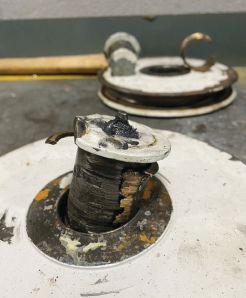
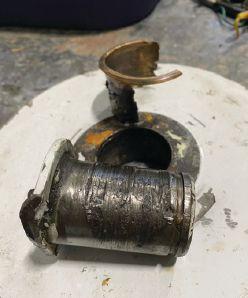
need and adjustments made at that time. It was back in service. We had seen the truck on and off throughout the balance of the year. Nothing serious. Then this: we discover that the grease is not getting through the pin.
Failure analysis proved a couple of things. These pins and grease fittings (certs) are the originals from 2009. Over years of servicing, the grease fittings have become plugged with road dirt and paint chips. The certs are all capped prior to factory painting but as time goes on and plastic cert covers fall off, the grease fitting is exposed to road dirt. As well, when greased, the paint chips that transfer from one grease fitting to another get pushed into the next grease fitting then pumped down into the pin. These findings over time allowed not just for one but two sheaves and bushings to be dam-

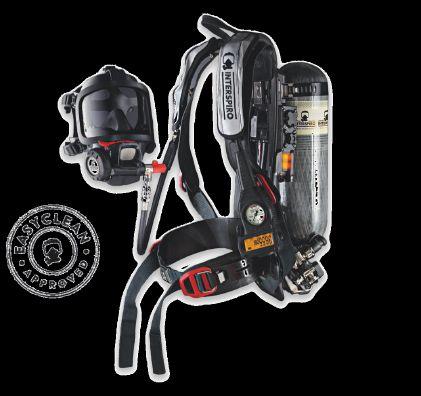

CANADIAN SAFETY EQUIPMENT IS PROUD TO BE A DISTRIBUTOR FOR THE INTERSPIRO RESPIRATORY PROTECTION LINE. THEIR STATE OF THE ART S9 S ONE OF THE MOST COMFORTABLE SCBAs YOU WILL EVER WEAR.
GIVE US A CALL AT 0182 OR EMAIL US AT INFO@CDNSAFETY.
No company has a richer history in respiratory protection than innovations have time and


MORE COMPACT MORE COMFORT BETTER PROTECTION

ü KEVLAR REINFORCED SHELL
ü Extremely comfortable
ü Lightweight and Compact
ü Internal drop down eye protection
ü External detachable face shield
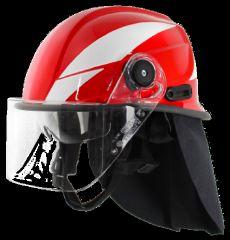
ü Optional Earmuff clips and earmuffs
ü Custom logo available
ü Also suitable for Auto Extrication, Confined space, High
ü Angle Rescue, etc.
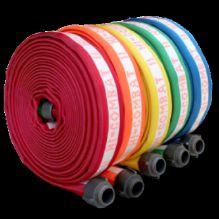
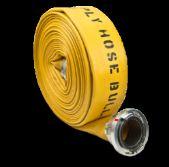
BullDog Hose Company (formerly ANGUS hose) proudly designs and manufactures industry-leading firehoses that are unmatched in quality and performance. Hundreds of North American fire departments depend on BullDog to get the job done safely and efficiently.
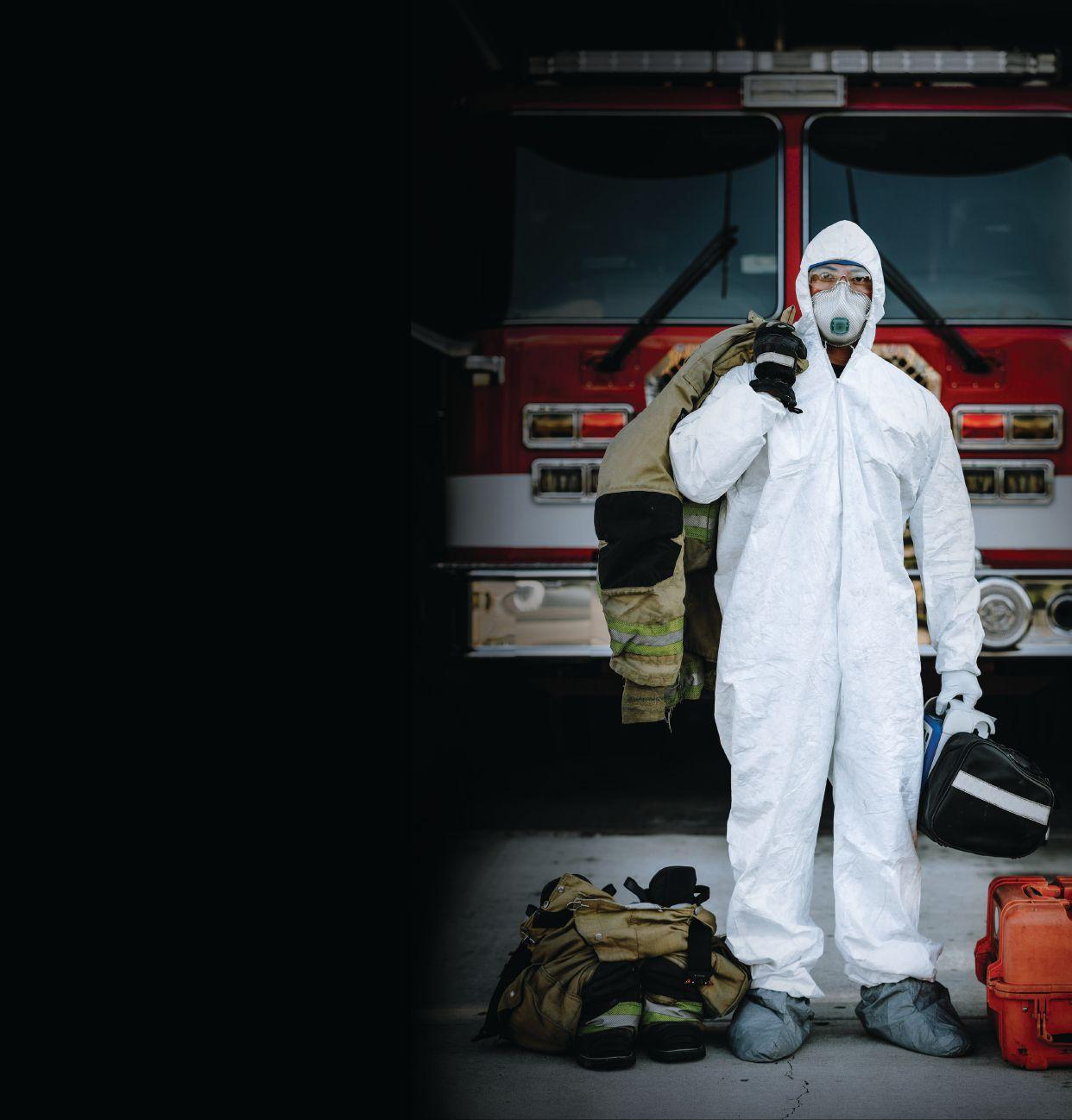
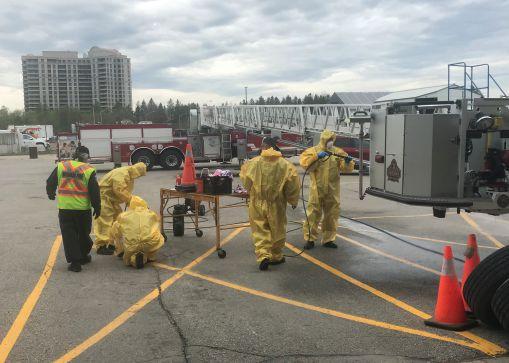
Using a Solo Rescue® heavy duty SCBA washing machine helps avoid exposing the crew to combustion gases, soot particles, toxins and carcinogens released in the maintenance and hand cleaning processes and also substantially lowers the time spent decontaminating firefighter equipment

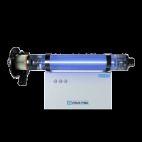
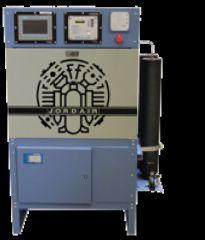
The new JORDAIR BVIRUS FREE™ breathing air filtration system (patent-pending) inactivates up to 99.9% of viruses including corona viruses, bacteria and molds at the air intake section of your JORDAIR breathing-aircompressor.
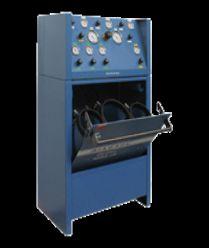
A COMPRESSOR FOR EVERY FIRE, BREATHING AIR and INDUSTRIAL APPLICATION


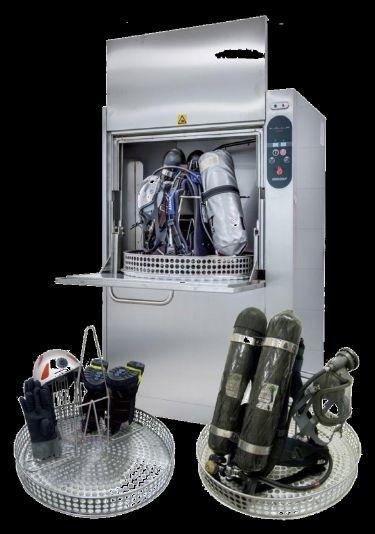
IN ONE HOUR YOU CAN CLEAN/DECON:
-14 SCBAs W/MASKS and CYLINDERS
ü REDUCED HEALTH RISK
ü SAVES TIME 2/PKS IN 8 MIN
ü EASY TO USE
WASH/DECON TWO SCBAs IN 8 minutes


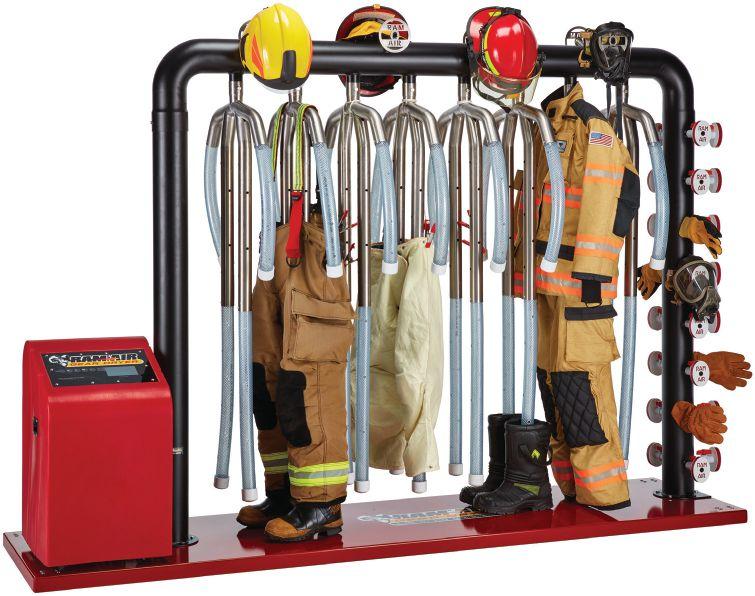
IN ONE HOUR YOU CAN CLEAN/DECON:
• 30 HELMETS
• 60 PAIRS OF GOVES
• 20 PAIRS OF BOOTS
• Double the above numbers with a second rack
aged. Inspection of all proved no other extensive failures but grease was not getting into places it should effectively. We contacted our parts dealer and ordered all new pins and sheaves. The pins came painted to match as well with new grease nipples. Only the grease fittings were painted over. As a technician, I knew painted grease fittings where going to be the beginning of the end of all these parts as well. We had to replace the painted fittings. Had we left them in, the new pins we would have been pushing paint into the grease fitting the first time we lubed the pin. Over time, the paint chips and grease would eventually block off or restrict the pin bushing from being lubricated and fail it again.
Whether it be a grease fitting on an aerial device or a grease fitting on anything else, be sure to clean the fitting first. If painted remove the paint. Be sure once greased the grease went where it was supposed to go. Over time check these greaseable parts to make sure they are functioning as designed.
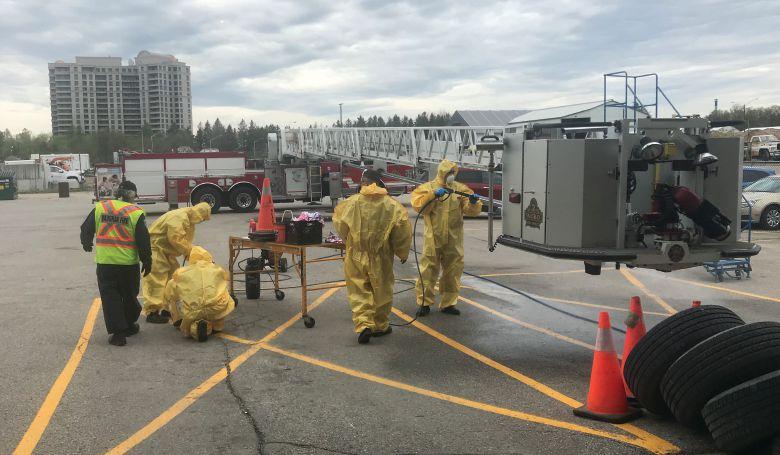
The next item to address on this platform was dirt. I have included a picture of wash day. Spring is the time we do this, for the most part. The apparatus is always kept clean at station level, but the aerials are not that easy to wash. Therefore, we dedicate a time in the spring for every elevated device to come in and with a technician’s help degrease and re-lube the ladder. This is done with good grade degreaser as well as wash brushes. This has been what we have always done. Well this platform, in service since 2009, and missing a wash day, turned out to also be a contributing factor over time.
A licensed fire truck technician (EVT) has a solid working knowledge of how the aerial mechanics and components work. This is because this is what we are trained to do. Like a suppression firefighter sounds a floor in a burning building as they are trained to do. We are trained on specialty items in the mechanical world of vehicle repair. This also holds true for a general truck repair tech. Unless they were familiar with aerial devices and how the mechanics behind it work, they too would miss things. The dirt build up as well as de-icing agents had made their way into spots we had not encountered before. This assisted with the grim failure of pins and bushings. The entire aerial and platform were hand washed with special attention to mechanical items that in the past would stand the test of time. Lesson learned moving forward: We will be paying closer attention during spring clean-up. Washing an aerial by hand is long and tedious but at the end of the day the liability for failure is not an option. The OEM of all ladder makes has suggested maintenance intervals. We use this a guide to help us as create a solid history in the event it needs to be looked at. Take these lessons learned and share them with other fire departments and with your fire truck builder as well.
A partial digression — I have never been a Facebook guy. I recently became one as I had to know what my family was up to and how they were doing during these unprecedented times. I discovered fire apparatus repair groups that you can join and found it’s always interesting to get a different spin on repairs or troubleshooting or just find some plain entertainment. Well, that’s it for now. Be safe. Be healthy. Be careful. Rubber side down my friends.
Chris Dennis is the chief mechanical officer for Vaughan Fire & Rescue Service in Ontario. He can be reached at Chris.Dennis@vaughan.ca.
BY MARK VAN DER FEYST
Last edition we looked at working on the ground ladder and some of the other options that are available to use in place of the traditional leg lock. For this article, we are going to focus on getting on and off the ladder. Our study so far has been with the ground ladder, but we are going to include the aerial ladder in our topic this time as it’s very applicable to both.
The most common operation with a ground or aerial ladder that involves getting on and off is with ventilation or gaining access to the roof of a building. Firefighters have fallen off the roof of a building when transitioning from the ladder to the roof. On Oct. 15, 2018, an FDNY firefighter was seriously injured when he fell 30 feet after he lost his footing when getting onto the roof from the ladder. In April 2017, another FDNY firefighter fell when he was going from the roof to the aerial platform. In this situation, the aerial ladder jerked suddenly right before he was getting on, causing him to lose his balance and fall five stories to his death.
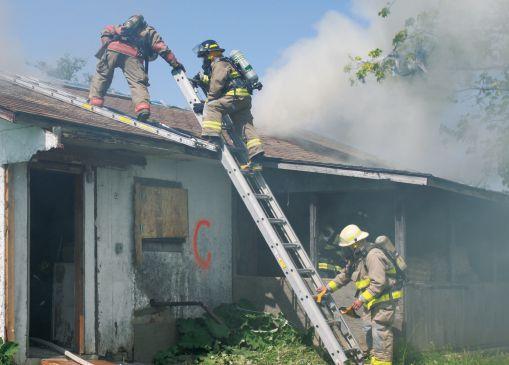
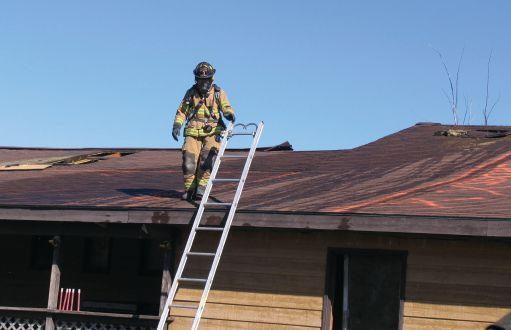
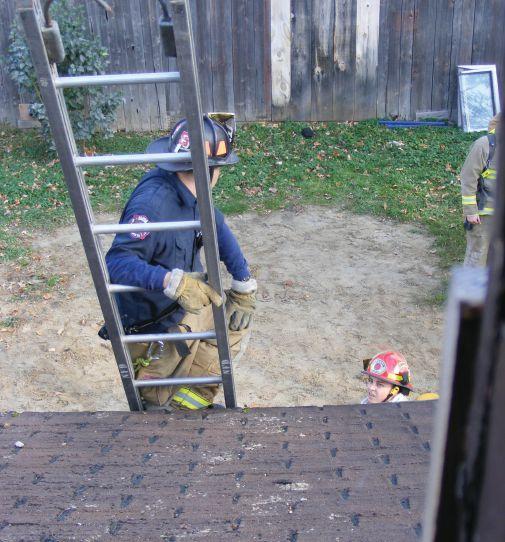
So, let’s start with the ground ladder as it is raised to the roof for roof operations. In basic training we are taught to raise the ground ladder so there is between three to five rungs above the roof line. This is done to make it easier for the firefighter to get on and off the roof, as well as make it visible to know where the ladder is. In Photo 1 the ground ladder has four rungs above the roof line. In Photo 2, the ground ladder has six rungs above the roof line. If the ladder was raised with only three rungs showing above the roof line, it reduces the ladder’s profile for the firefighter to grab onto. Notice how the two ladders pictured are providing waist to shoulder height access for the firefighter to place their hands on for control of the ladder and their transition.
When a ground ladder is less than three rungs above the roof line, it forces the firefighter to have to bend down to grab the ladder when transitioning onto it. This is not an ergonomic position to be in when getting onto a ladder. It lends into loss of balance with the bulk of the weight on the firefighter’s upper torso (SCBA and gear) being pulled toward the ground by being bent over. In Photo 3, note how the firefighter is able to stand upright while getting off the ladder because there are four rungs above the roof line.
The other aspect is the pivot point of the ground ladder when there are three to five or more rungs above the roof line. Pivot point is the point on the ground ladder where the ladder can kick out easily when rested against an object. The resting spot will be the roof line and depending upon the height of the ladder rungs above the roof line, the ground ladder can kick out when the weight is counter balanced above the pivot point.

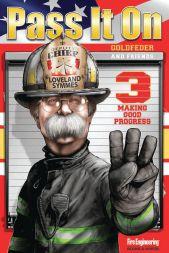
Pass it On 3: Making Good Progress
Item #: 1593704360
In Pass It On 3: Making Good Progress, Chief Billy Goldfeder has once again gathered leading firefighters, fire officers and chiefs from all over the country to share their wisdom and insight through short personal stories, life experiences and anecdotes. Including more than 80 contributors, Making Good Progress delivers tactics, operations, tragedy, humor, knowledge, and personal perspectives from a very wide range of extremely diverse personalities. Anyone from rookie to chief (and anyone who knows or plans to be a firefighter) will find loads of great stuff in this book.
Barn Boss Leadership Item #: 1546701927
Barn Boss Leadership is a unique blend of fire, science, psychology and fire service history provided by a author who has worked for the largest of metropolitan to the smallest of volunteer departments. True leaders develop their power long before they receive a promotion.This text is designed to provide a guide and self-awareness gut check for individuals of all ranks. However, the emphasis of this text is for the informal leader in the organization, who is the catalyst for action.
Leadership Prescribed 2.0 –A Handbook for Fire Service Leaders
Item #: 1775130406
Fire service leadership is a journey and you need to start here. Written by Chief Les Karpluk and former Chief Lyle Quan, this book provides existing leaders and those aspiring to be leaders the tools to become more effective.
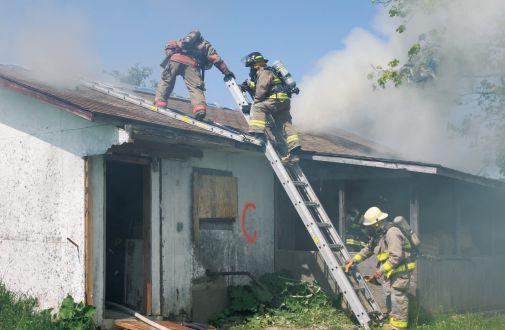
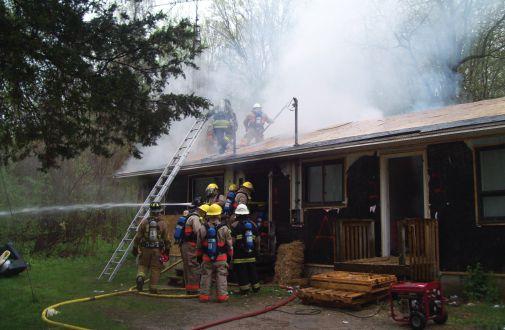
This can occur when the firefighter climbs up the ladder and continues climbing up the ladder above the roof line. In Photo 2, if the firefighter were to keep climbing up the ladder and stand on the fourth or fifth rung from the top, the ladder becomes unstable and the weight of the firefighter will cause a counter balance making it pivot like a teeter totter. This can be avoided by not stepping above the roof line on the rung. Step onto the rung below the roof line when getting back on the ladder like you see in Photo 3.
The angle of the ladder against the building can also assist with the ladder kicking out due to the pivot point. In Photo 4 the ladder angle is a gentle angle, probably around 60 degrees as compared to the traditional 70 to 75 degrees. With the ladder having five rungs above the roof line, the chances of the ladder kicking out are enhanced should the firefighter step onto the rungs above the roof line. What will prevent this is to have a person heel the ladder from below before a firefighter steps onto the ladder from the roof and

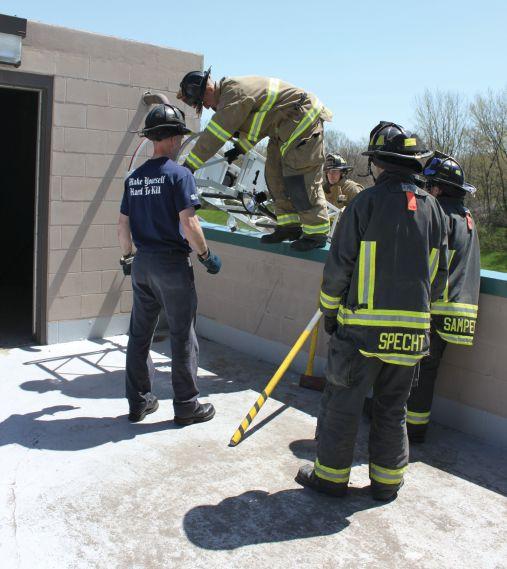
when the firefighter is going to step onto the roof from the ladder. The key point here is that the heeling firefighter needs to heel the ladder until the firefighter is off or on the ladder. If they leave to soon, the ladder will kick out.

When getting off or on the ladder, the firefighter needs to have and maintain positive control the entire time. This means being aware of your surroundings while at the same time having physical control of both your body and the ladder when getting on or off. In Photo 3, one firefighter has both feet on the roof ladder with one hand on the ground ladder still while the second firefighter has both hands and feet in contact with the ladder and the building.
The same is seen with the aerial ladder. In Photo 5 the firefighter has both hands on the aerial ladder beam and both feet on a solid part of the roof. He is still holding onto the ladder while standing on the roof and will transition onto the roof top in the same manner. When the firefighter goes to get off the roof, the opposite will be done in order to have and maintain positive control. Doing this helps the firefighter to avoid losing their footing or losing their balance.
During the next training session with your crew or station, practice getting off and on the ladder while maintaining positive control. Doing this will increase your skill proficiency and confidence to work with ladders.
Mark van der Feyst has been in the fire service since 1999 and is currently a firefighter with the FGFD. He is an international instructor teaching in Canada, the United States, FDIC and India. He is a local level suppression instructor for the Pennsylvania State Fire Academy and the lead author of Fire Engineering’s Residential Fire Rescue book and other DVDs. He can be contacted at Mark@FireStarTraining. com.

BY TOM DESORCY Fire Chief Hope British Columbia
as your attitude changed? In the last five years? How about in the last year? There it is — the elephant in the room — what has, or more importantly how can, the past year change you?
Are you familiar with the term ‘a tiger cannot change its stripes’? It’s the definition of a person’s true character. No matter what a person may project on the outside, they will always have an underlying attitude that is often hard to change. The past year we’ve been through might just alter that. I mean, if you wanted to work remotely from home, say two years ago, or conduct all your meetings online, someone might have called you lazy. Today, that’s all changed.
Saying that you’re changing just because you were forced to do so can often be considered an excuse. If you realize that circumstances beyond your control gave you an opportunity to justify change, you will be among the strong that emerge from a crisis situation.
I think this is what sets the fire service or first responders in general, apart from others. Yes, we have the tools, some more than others, but every call, every response, may require us to use those tools in a way they weren’t initially intended. Or the tool we really need, we simply don’t have. In a case such as this do you actually say to yourself “it’s time to adapt” or do you just do it? Fitting into the situation at hand comes second nature for the fire service. If they “zig” we “zag”? No, we “zig” along.
What interests me in the year ahead is those that have taken advantage of the situation in terms of the opportunity to change, and not just temporarily, but permanently. Perhaps this is just the beginning of change as we have been forced to demonstrate the need. Again, positively take this as an advantage or an admission if you will, that something before wasn’t quite working and now we may have a better and more efficient way of doing certain things.
the fire service, this may just be the case. More and more providers are offering virtual conference platforms and many may see this as a viable opportunity moving forward into the future.
To say this concerns me would be an understatement. Look at the volunteer fire departments across Canada and ask how much not seeing everyone on a social basis has impacted their membership or their sense of belonging in the organization. We owe it to our members to not only build this back, but build it back better.
I stress to all that we should not always try to replicate what we used to do, but accomplish our goals in a different manner. The next step would be to take these changes and see how we could integrate these virtual tools, for example, into what we used to do. This is what excites me for the future of conferences, education and training.
Underlying attitudes are getting quite a beating right now and this has to be a good thing. People don’t change easily until it’s forced upon them. Quite often that is met with objection and in the past 12 months it’s not realistic to think otherwise. The volunteer fire service was having a tough time to begin with. You thought
‘‘ ’’
If you realize that circumstances beyond your control gave you an opportunity to justify change, you will be among the strong that emerge from a crisis situation.
Our biggest hurdle by far in the future will be our lack of human contact. If you’ve heard the phrase, “I’ll never get that time back”, then this is exactly what it means. Did you ever think the last conference or education summit you attended will be in fact just that, your last? For those nearing the end of their tenure, their career in
Tom DeSorcy became the first paid firefighter in his hometown of Hope, B.C., when he became fire chief in 2000. Originally a radio broadcaster, Tom’s voice could be heard in the early 1990s across Canada as one of the hosts of Country Coast to Coast. Tom is very active with the Fire Chiefs’ Association of British Columbia as communications director and conference committee chair. Contact Tom at TDeSorcy@hope.ca and follow him on Twitter at @HopeFireDept.
recruitment was tough in 2019? It just got tougher. Or did it? Will we see a resurgence of that “get involved” attitude again? Will that tiger’s stripes shine through?
I use the term “now” normal as opposed to “new” normal. It’s all a part of acceptance as by now most of us have stopped holding our breath and waiting for the nightmare to end. The impact to society has occurred. The tiny stream of life has altered its course and, like any waterway, the destination remains the same. It just may take a little longer to get there. Now is our chance to leap into action. We’ve demonstrated our ability to pivot in difficult times. Now, more than ever, we can make ourselves attractive to those that wish to continue and enhance our legacy of service to our communities. Change has been forced upon us and we’ve all been able to demonstrate that change is okay. Resist the urge to go back and do it the old way. Embrace the future because it’s here.





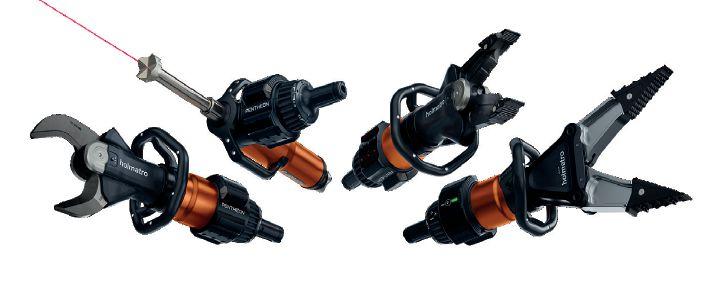
Working under pressure, in a race against the clock, first responders need equipment they can fully rely on. It is for these men and women that we have developed our new Pentheon Series: High-tech rescue tools that are miles ahead of all other equipment on the market, cordless and hose tools alike.
Only the Holmatro Pentheon Series offers you the unrestrained performance, unparalleled speed and ultimate control you’ve never experienced before.