Oventus Medical Limited, with sleep partners in Ontario and Alberta, are helping first responders in Canada suffering with obstructive sleep apnea (OSA) to sleep better during the COVID-19 pandemic.
In April, firefighters across Ontario were told not to use their Continuous Positive Airway Pressure (CPAP) machines on overnight shifts due to concerns it may contribute to the spread of the COVID-19 virus through the distribution of respiratory droplets.
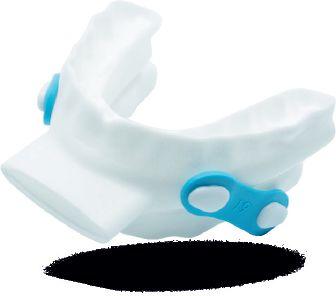
Thanks to Oventus Medical providers, firefighters are now accessing the O2Vent Optima® oral appliance to treat their sleep apnea in a safe and efficient manner. Since April, Oventus Medical has focused on helping get firefighters the much-needed sleep they need to perform their duties.
The American Academy of Sleep Medicine (AASM) have confirmed that although CPAP is the current standard of care for OSA, data has emerged that it may contribute to COVID-19 spread1,2
The O2Vent Optima is a lightweight, comfortable treatment that is customized to each individual. It does not generate aerosol spray or require any masks, hoses or machines. Made of durable 3D printed medicalgrade nylon, it is the only oral appliance to incorporate an airway to provide uninterrupted therapy during sleep.
Sleep apnea treatment without masks, hoses or machines
• No device generated aerosol spray
• 3D printed with medical grade nylon
• Lightweight, comfortable, easy to use and maintain
• Most insurances accepted
FEATURE
SHIELDING YOUR AIRWAY
by Nathan Pocock
In our self-rescue and RIT training, we must talk of a time, unfortunately, when all our options run out and our best chance is to sit sheltered in place, make our bottle last as long as we can, while we await assistance from our RIT. But, what happens when this wait is longer than we want and we run out of air in our tanks?
If we find ourselves out of air, best efforts should be made to shield our airway. The following methods are our last-ditch efforts to stay alive in our self-rescue attempt. We must do our best with air management to avoid these situations. When we find ourselves in a mayday situation, the decision must be made based on condition and circumstance; whether or not you have the energy and/or air to self-rescue or whether you are best to shelter in place and conserve air to give RIT and yourselves the best chance of a rescue.
“DYING” IN YOUR MASK
I have met many who were taught if they ran out of air to just stay in their mask and go unconscious. The idea behind this is that you will not expose your lungs to super heated gases and thus be easier brought back to life. The problem this can raise is unrealistic training to fire ground expectations.
It is easy to say, “die in your mask.” It can easily be falsely trained to turn off an unsuspecting student’s bottle and watch them squirm as we remind them constantly “don’t remove your mask.” Once we are satisfied with their squirming, we reach down turn the bottle back on and say, “good job.”
We never let the student stay in their mask until they are unconscious and we certainly don’t do it consistently enough to make people comfortable enough to just voluntarily suffocate themselves during a life-threatening situation on the fire ground.
As humans—like any animal—we have base instincts for survival and our bodies will do their best to keep us that way. We must teach methods that direct this instinct in a constructive way instead of directly working against it. Would you ever ask a firefighter to perform a task on the fire ground they have never performed in training before?
REALITY
We must train our members to be able to use techniques that can be trained—both for ease of retention and realistic application on the fire ground. The following techniques are designed to give you a chance for success keeping these things in mind.
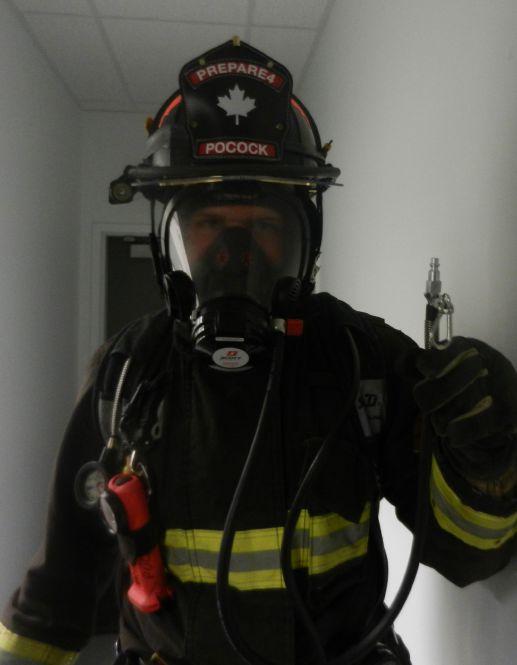
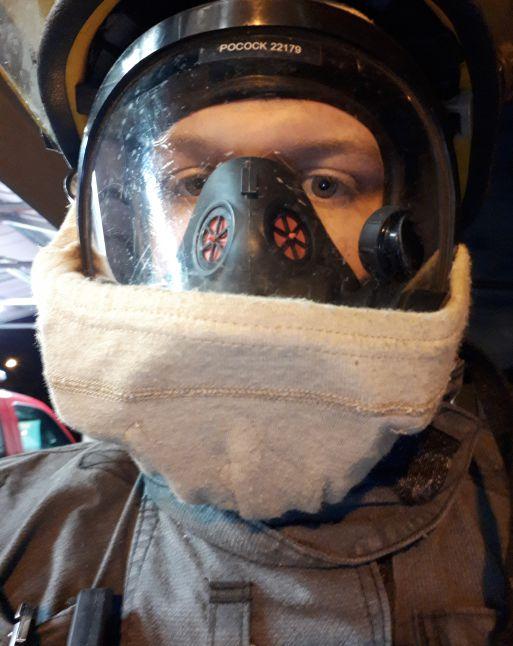
The easiest method of shielding the airway is to simply remove your regulator from your face piece to allow air to pass in and out of the mask. To provide extra protection, we can take our balaclava from below our chin and pull it up and over our regulatory port in the face piece. Bringing the balaclava up will provide one more layer of filtration to the air coming in. It will not cool it or filter it completely, but we are not working in ideals at this point and time.
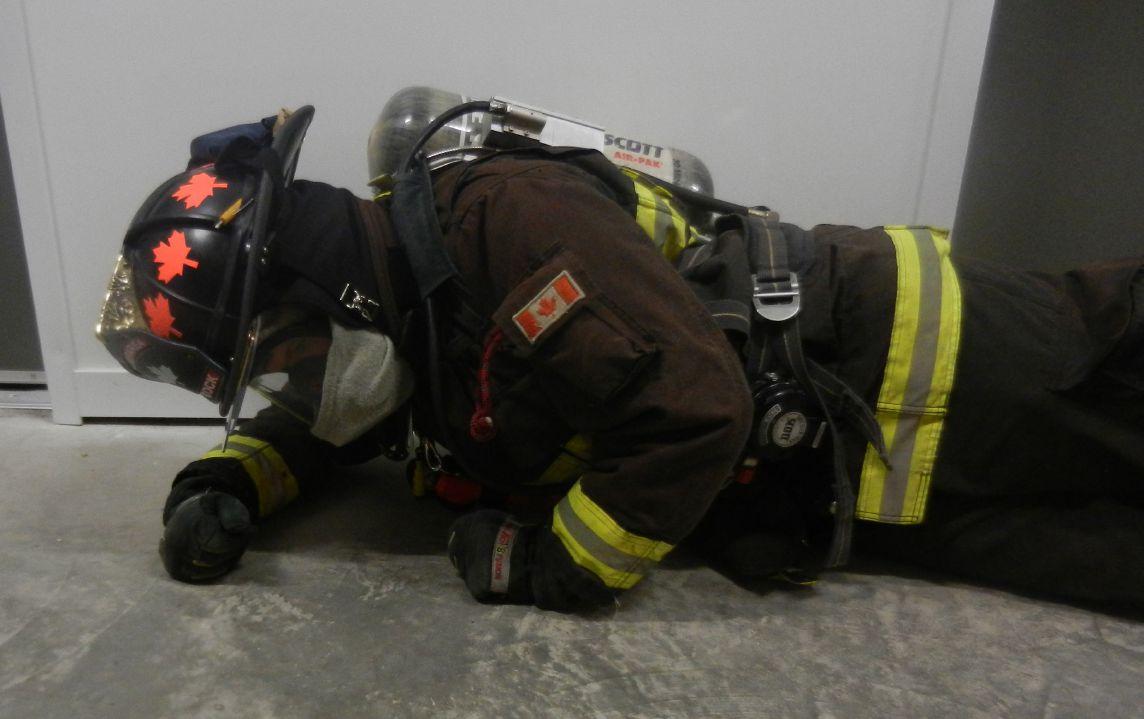
Now that we have air being filtered as best we can, we must seek out the coolest and cleanest air by getting low to the ground and working
our way away to cooler and fresher areas on the fire ground. We break a hole low on a wall away from the fire room(s) and seal our mask up against the hole using our gloved hands to further seal the hole in order to breath air from this void space that will hopefully be free of fire and fire gases.
Another option we can have is to disconnect our mask mounted regulator (MMR) from the pack on our shoulder (if your SCBA has this feature). This line can then be inserted into a similar wall void as used in the technique above or if present it can be put down a plumbing drain, dryer vent, washer drain, etc. and we can breathe air from these void spaces and pipes.
I have tested the air quality inside many the pluming stacks inside my fire hall and some gear washer vents and drains in other halls with four gas detectors and have yet to find anything other than breathable room air inside these spaces.
An advantage/disadvantage to disconnecting the MMR and breathing in these spaces is, if in the event you fall unconscious, the effort it takes to suck open the on-demand valve through the MMR is so high. I doubt an unconscious person would be able to inhale hard enough to open the valve, allowing you to “die in your mask” and reducing further exposure. The disadvantage of this technique is it does take a
An option for preserving air is disconnecting your mask mounted regulator (MMR) from the pack on our shoulder.
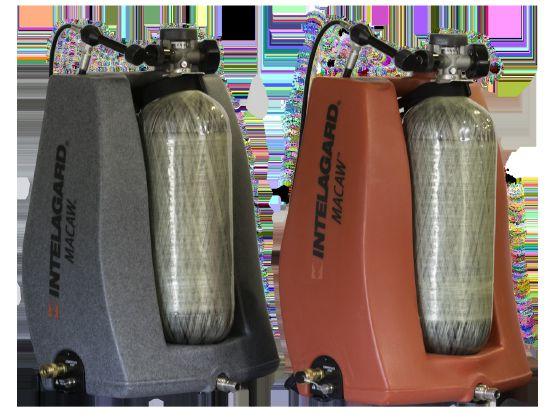
For over two decades, Intelagard has manufactured tactical, multipurpose compressed air foam systems for first responders, military, industry, homeland security and domestic preparedness personnel. Intelagard systems are designed for rapid multi-hazard response. The same unit can be used for chemical and biological decontamination, fire suppression, hazardous material clean-up, crowd control and vapor suppression – all by simply changing the chemical solution utilized for each situation.
— Mike Gardner, Owner BD1 Manitoba
Why Intelagard CAFS?
Compressed Air Foam Systems (CAFS) are better than the more common, air aspirated foam systems. CAFS propel foam farther than other systems and provide a superior bubble structure and thus a ‘better’ foam. Intelagard CAFS are unique within this category, using Intelagard’s proprietary Enviroshield® Technology. In addition, Intelagard CAFS:
• Do not have engine driven pumps, eliminating a common failure point
• Use self-priming pumps
• Have up to 20 ft. vertical lift
• Have liquid storage tanks that are never under pressure. This means that they can be completely emptied and/or refilled while the system is running.
• Can draft directly from external fluid systems
Foam is also proven to be more effective than liquid in areas such as hazmat clean-up and decontamination. Check out the benefits.
Foam maintains a longer wet contact time than liquid, a feature very beneficial when dealing with fire fuels and chemical/biological threats where extended ‘dwell time’ of decontaminants and disinfectants is critical. Other important benefits of foam include:
• Foam adheres to vertical and inverted surfaces
• Foam creates an insulating barrier against vapours, flame and heat
• Foam is lighter than liquid, resulting in less weight burden for firefighters and longer throw distances
• Foam provides a clear visual indicator of which areas have been treated
• Foam creates a blanket that covers, cools and secures the target
• Foam uses less water, resulting in more efficient use of resources and less water damage
• Foam moistens fuels to prevent re-ignition
Intelagard CAFS are durable, efficient, and easy to use and maintain. They can deploy a variety of different foams and formulations, maximizing the return on your investment.
good amount of effort to get each breath and being well trained in this process would be a must so you expect this difficulty when initiating this self-rescue task without increasing or creating panic.
If your department does not have the quick release option, this
technique could also be done by cutting the air line high on your shoulder. Caution must be taken both if you chose to cut the line or if you disconnect. It is adamant that you communicate you have or are about to perform this technique with incoming RIT. The incoming team needs to know when they get to you their air supply options, also you speed up their evaluation in which technique they will use to supply your air. Imagine if you cut this line and a RIT comes, notices your bottle’s empty, and uses the UAC connection to equalize bottles. In this instance the UAC would simply waste air out of the cut airline until disconnected. If the MMR has simply been disconnected and we charge the UAC, we will need to recognize this because no air will be getting to our downed firefighter until we reconnect the MMR back into the pack, where it was first disconnected.
Throughout any mayday, we need to keep RIT informed as to our self-rescue efforts to better coordinate the successful rescue and none of this is changed with any of the techniques discussed above.
I want to know as an air firefighter on a RIT that I have a balaclava in the way of the SCBA face piece that needs to be removed before I can install the new one from my air bag. Likewise, I want to know if I can hook a disconnected MMR into my buddy breathing line off my air bag, whether I’m going to need to do a full MMR swap, the list goes on.
The same principle applies here as a mayday firefighter converting their own SCBA while awaiting rescue. Keep RIT informed of your selfrescue attempts to ensure you don’t hinder your own rescue through lack of communication.
Nathan Pocock is a career firefighter in British Columbia and a member of the technical rescue team and Canada task force one HUSAR team. He is the owner and operator of Prepare4, a fire fighting training company based in Vancouver that specializes in forcible entry and rapid intervention training as well as several other areas of the fire service. He is a husband and father of two.
Seek out the coolest and cleanest air by getting low to the ground and working our way away to cooler and fresher areas on the fire ground.
Firefighters must be trained to use techniques both for ease of retention and realistic application on the fire ground.
LONG CALLS AND LONG HAULS
The Evolution of the “Go Bag/Box” and Being Prepared for Extended Scenes
by Kirk Hughes
Picture this: it’s almost noon, your stomach is starting to get a bit growly and you wish you had grabbed something on the way out of the house to a call, which came in at just past 3 a.m. Then, suddenly, the rehab unit arrives on-scene to deliver some lunch. It’s pizza. Problem is, you’re lactose intolerant and didn’t bring your medication. Now, you’re hungry and grumpy and the high noon sun is really starting to bother your eyes. If only you had your sunglasses. Sound familiar?
With larger response districts, longer drives to calls and an increase in call severity, it has become necessity to be prepared for “the long haul”. The need for firefighters to be somewhat self-sufficient for a few hours at a call isn’t a new concept, but it certainly has grown in acceptance over the last dozen on or so years. Being self-reliant often takes the form of a piece of kit, mostly personal purchase, called a “Go Bag” or “Go Box”.
“Go Box” is a term taken from the prepper world meaning a piece of kit that is portable, contains basic essentials and is small enough in stature to be tucked away in an apparatus without taking up too much space. Some firefighters have opted for the small cloth knapsacks they can easily stow under their feet.
Some firefighters in Canada’s harsh arctic region use of durable plastic “ammo boxes”—a nod, no doubt, to the fact most northern firefighters do double duty as Canadian Rangers (a subcomponent of the Canadian Armed Forces Reserves). This has also grown in popularity down south. “Ammo boxes” are small in size, have a carrying handle and three separate compartments for storage.
Regardless of which method a firefighter chooses (bag or box), having some basic items nearby—not stuffed into your bunker coat pockets—makes good sense and provides minor comfort on those long calls. Items contained in a “Go Box” are personalized, with some obvious non-critical firefighter equipment scattered in. The common item categories can be broken down into three components: personalized, seasonal and work related.
Personalized items are just that: personal for that firefighter. That said, there are many similarities in kit that firefighters will store in a “Go Box”; the most common being any prescription medication for allergies and lactose intolerance, to name a few. Over the counter medication can also be included.
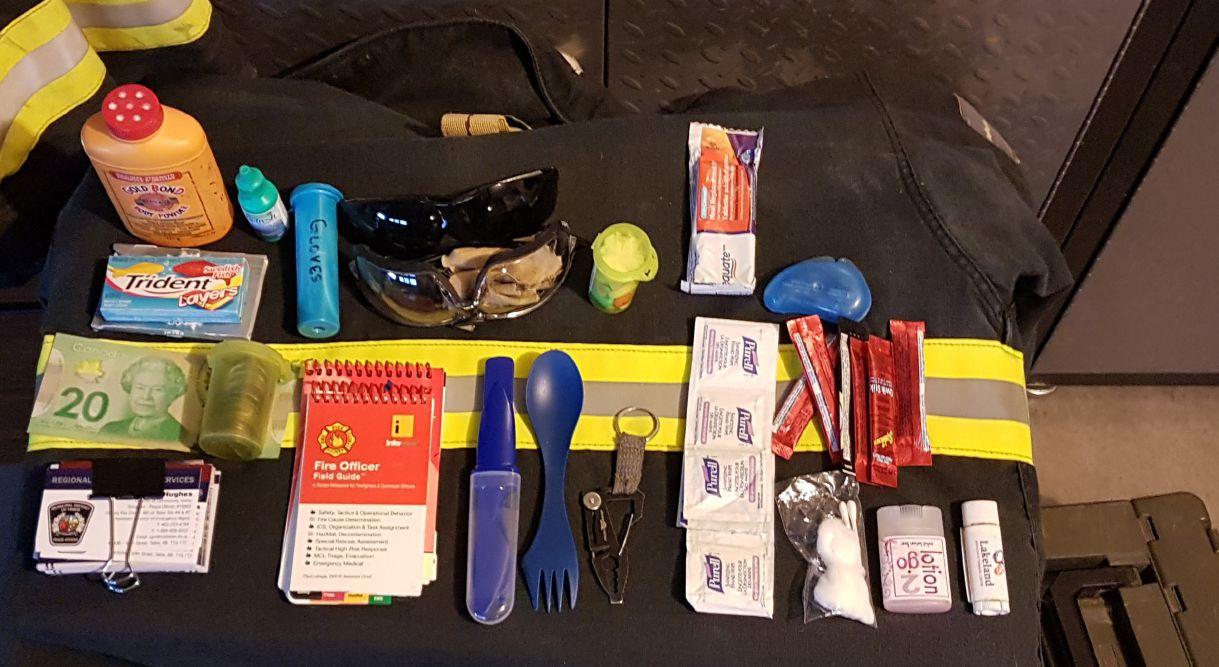
If you’re a fire officer, perhaps including some known medications in your box, in case your firefighters forget, is good leadership. A good thing to carry in the box is some saline eye solution. Even if you don’t wear corrective lenses, there are few annoyances worse than dry
eyes after a grassfire or that gritty feeling that a piece of ash is lodged inside your eyelid and its cooling and refreshing feeling helps.
Sunscreen, bug repellent and chapstick are luxuries when you don’t have them, and sunburns and chapped lips are the scourge of those long hot days standing on pavement at a motor vehicle collision. Purchase the small packages at a drug store, although not the most economical, compact size is preferable in this case. After a fire, the returning apparatus may routinely stop for a beverage at a coffee shop or grab some food from a fast food restaurant. You’ll probably need some cash so having a few bills and a container full of coins for those purposes is a handy thing to have in a kit box.
Often, squirrelled away with the cash is some business cards, kid’s stickers and, of course, handy single packaged sanitizer wipes to combat any germs mulling around; it’s also preferable to have clean hands if eating a hamburger or slice of pizza. If the looks to go the distance, and no rehab unit is coming, a good pick up could be a candy bar, usually paired up with a can of soda or energy drink (substitute coffee for those really early call-outs). Of course, with all the talk of early morning calls and food, no “Go Box” would be complete without a package of chewing gum to hide the morning pasty or post-rehab food breath.
Each firefighter will have their own items to add to their list, and as time goes on, some items will disappear for lack of use or be added when a firefighter has one of those “I wish I had this with me right now” moments. A fine example is Chief Officers and food. Long ago, I realized any type of orange sauce is automatically attracted to a white dress shirt; guaranteed to land, splatter and stain that very shirt. A personalized item now found in a “Go Box” for a Fire Chief is a stain remover pen. Those are the kinds of things that are added, not only out of necessity, but from experience.
Dividing the items into categories can be tricky because some items can fall into many groups. For instance, small package of baby wipes are lifesavers at a fire call. They can be used to wipe down grime that has landed on a piece of kit, wash hands, face and neck after fighting a fire to remove carcinogens or be used post-bathroom when there is no toilet paper. A multi-functional piece of kit but also a necessity for any “Go Box”. Same with sunglasses. A sturdy pair of safety sunglasses can be personal until it is a bright day and you need them while driving. Keeping a pair of safety glasses, sun and clear, inside a “Go Box” is good practice since digging for scratched and scuffed eye protection at a scene takes precious time. Having personal eye protection within reach saves time as there are in one place, saves frustration since they are well cared for and avoids going without,
The future of modern ice rescue
SAFER DIST
A safer distance, a smaller team
The Two Responder Trial
In January 2019, Sodus Point Fire Department purchased a MARSARS Ice Rescue Safety Sled (IRSS) kit. Upon receipt of this order, Fire Chief Mark Jones Jr. and Deputy Chief Chuck Sargent were eager to assess the sled’s safer-distance ice rescue capability. The officers brought the equipment down to the partially ice-covered Sodus Bay in New York. Upon arrival, the deputy chief assumed the role of rescue technician, traversed outbound over the ice, and entered open water. Switching to the role of victim/patient, he placed both forearms through the sled’s forearm sling. When signaled, and through the aid of the sled’s unique 4:1 ratio pulley system, Chief Jones, by himself, weighing only 165 pounds, effortlessly hauled his 240-pound deputy aboard the sled, onto the ice shelf and back to shore.
This trial proved to the department that only two ice rescuers are initially needed to quickly deploy, extract, and recover a patient. Nationwide, with fire departments challenged by limited numbers of first responders, this simple to operate device has become a real game changer.
Subsequent Rescue with Minimal Responders
On March 14, 2019, Sodus Point FD received a call concerning a four-wheeler with two men that had fallen through the ice 1,000 yards (914 meters) from shore. The department’s air boat was dispatched. After numerous ice fisherman were found to be fishing in the vicinity of the launch ramp, the air boat was aborted. Without delay, Chief Jones Jr. alongside an ice rescue technician and safety observer then responded. When the three responders arrived on scene they found that one of the victims had self-rescued. The weight of the other still immersed victim was estimated to be 350 pounds. With an empty IRSS Sled extended, and the patient’s forearms through the forearm sling, the Chief extracted the large patient atop the sled, and brought the sled with patient onto the ice shelf by himself.
The Two-Victim Rescue Trial
The IRSS sled is wide enough to rescue two side-by-side patients at one time. This past winter, a test was conducted by the Caledon Fire & Emergency Service in Ontario to evaluate the IRSS Sled’s two-victim rescue capability. To understand this technique, picture yourself standing on safe ice behind both side-by-side victims. You are now facing their backs. To their front, the rescuer has stopped one sled-length away. The size-up determined they both possess the ability to assist in their own rescue. As a reaching device, the empty IRSS Sled was extended to them. Your victim to the right was instructed to insert his right forearm through the sled’s forearm sling. The victim to the left inserted his left forearm. Now both patients were facing one another and told to hold on to each other with their free arm. Only one line tender responder was needed to load both adult males onto the sled and secure them atop firm ice.
The Rescue and Recovery Incident
In the Great Lakes, the MARSARS Ice Rescue Safety Sled is carried aboard U.S. Coast Guard airboats. On January 29, 2015, U.S. Coast Guard Station Saginaw River in Essexville, Michigan, responded to a report that two men fell through the ice near a powerplant. Station Saginaw River crew responded aboard a 20-foot airboat, arrived on-scene, quickly located and rescued by IRSS Sled then transported the first individual. The crew was informed during transport that a second snowmobile operator had fallen through and died. Returning to the scene after transfer, the gloved hand of the second victim was observed protruding from the icy water. A quick and physically effortless extraction was made by inserting one forearm through the sled’s sling and holding the unresponsive victim’s wrist.
These four incidents show how versatile and efficient modern ice rescue can be with the MARSARS Ice Rescue Safety Sled kit. The technology is truly a game changer.
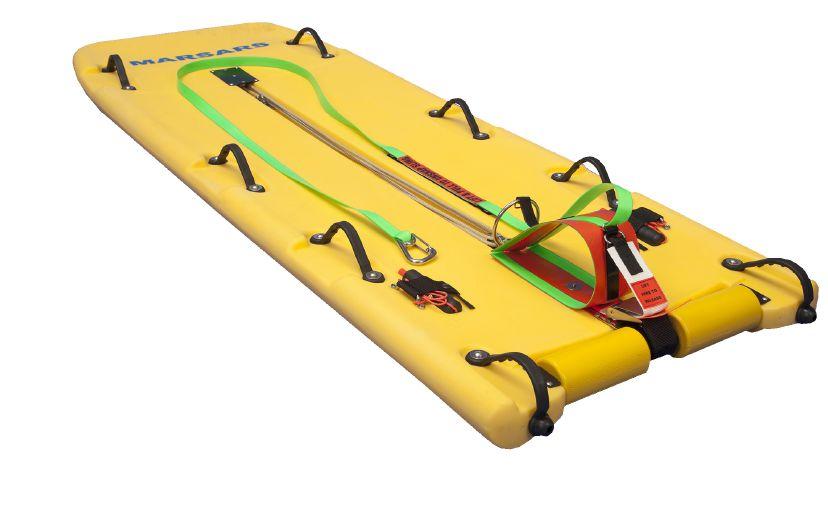
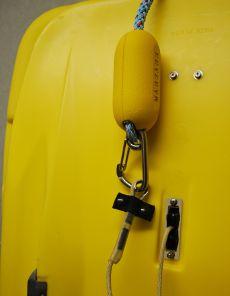
Ice Rescue Safety Sled
DIST ANGE ICE RESCUE
Ice Rescue Safety Sled
Carry Handles Victim Forearm
77” length x 27” width x 7” height, 35 lbs. weight Foam filled Hull
ICE RESCUE SAFETY SLED FEATURES:
Rescuer’s Tether Strap
Cold Water Rescue Sling Connection Ring
Rescue Grip Awls
Many consider the use of this unique rescue from a safer distance device as a “best practice” that avoids risk of injury to both rescuer and patient
Victim Forearm Sling (VFS)
Built-in Body Rollers
Outbound Rescue End
Many consider the use of this unique rescue from a safer distance device as a real game changer that minimizes the risk of injury to the patient as well as risk of viral exposure to the rescuer
• All MARSARS® sled kits are one-person portable
• Initially, a minimum of two first responders are needed for rescue
• The Sled is pre-rigged ready for instant use within seconds
• All MARSARS® IRSS sled kits (sled, tether reel and sling) are one-person portable
• On-scene, rescuer remains atop ice one sled-length away from the victim
• The sled is pre-rigged ready for instant use within seconds
• Empty sled is extended as a “reaching device” for the victims “self-rescue attempt”
• Only one out-bound ice rescue technician is required
• Most conscious and alert victims can insert forearms through forearm sling
Many consider the use of this unique rescue from a safer distance device as a “best practice” that avoids risk of injury to both rescuer and patient
• Rescuer remains safe on-scene, one sled-length away from the victim
• Only one shore-based responder is needed to extricate the patient from water
• For size-up, victim is asked to lift and lower one arm.
• IRSS Sled is capable of extracting two patients at one time
• Empty sled is extended as a “REACHING DEVICE” for the victim’s “SELF-RESCUE ATTEMPT”
• Patient is gently handled from ice to ambulance
• On-scene, rescuer remains atop ice one sled-length away from the victim
• Only one responder is needed to extricate the patient
• Most conscious and alert victims can insert their forearms through the sled’s forearm sling
• Empty sled is extended as a “reaching device” for the victims “self-rescue attempt”
• IRSS Sled can extricate two patients at one time
• Most conscious and alert victims can insert forearms through forearm sling
• Patient is gently handled and transported from ice to ambulance
• Only one shore-based responder is needed to extricate the patient from water
• IRSS Sled is capable of extracting two patients at one time
• Patient is gently handled from ice to ambulance
MARSARS WATER RESCUE
ICE
Forearm
Sling
Brake
Sling (VFS)
Forearm Sling Brake
Rescuer’s Tether Strap
Built-in Body Rollers
Cold Water Rescue Sling Connection Ring Outbound Rescue End
Rescue Grip Awls
Tunnel Shaped Hull
especially if the dispatch (medical, car accident, etc.) reminds you they may be needed.
No kit is complete without talcum powder. Not only for tired feet but also after a hot, sweaty fire, powder is a perfect substitute to help mend any heat rashes, blisters or skin spots until such time as a full shower can be had.
Arctic firefighters customize the contents based on the season, with content for summer and winter calls. The rationale is that some items are more useful at -30 degrees and in the dark than at 22 degrees in the sun. Even in southern departments, checking over a “Go Box” and setting it up for the season is smart.
In winter, “Go Boxes” should have items related to keeping warm and protecting skin from frostbite. Toques, extra thick socks, thin thermal glove liners and hot packs are a few items found in “Go Boxes” in the Deline Fire Department. Often fighting fires in temperatures hovering around -30 degrees Celsius, keeping warm is not about comfort; it could be a matter of survival. Northern firefighters won’t don this gear while responding, since a toque isn’t something worn for structural firefighting, but the items come out while performing other jobs on the fire ground.
Adopting this protocol in cold weather is smart policy. Having these items in a “Go Box” that can be switched up after sweating to prevent frostbite or put on while directing traffic at the side of a windy highway, can makes a difference. If not directly involved in firefighting, items such as wool balaclavas and thick leather mittens are easy carries, even if a tad bulky. Keeping with the idea of colder weather challenges, firefighters should consider adding some extra batteries to the “Go Box” for flashlights and some USB chargers for cellphones. A dead cellphone is problematic for any firefighter, but certainly one stuck at a scene for several hours and can’t text their anxious family to tell them they are okay. Chargers and batteries are good to have yearround, but definitely in colder, battery-draining weather.
Summer heralds the start of wildfire season. Dry, hot, humid days are a vacationer’s dream, but a prelude to a day spent battling grass-
fires for a firefighter. With those scorching temperatures brings some unique challenges: smoke, ash and dehydration. Summer “Go Boxes” should include cooling and hydrating items, like a bandana, instant cool packs and electrolyte infused drink mix. Most fire apparatus have drinking bottles on board, but few have sports drinks that are needed to replace lost salts, so having that mix to add to bottled water really aids in preventing dehydration. “Work” category items include goggles and particle filter masks are smart additions. Even leaving a spare N95 or a half-piece respirator in the “Go Box” and donning them where appropriate, cuts down on exposure and prevents that dry hacking post-fire smoke irritant cough. This is especially true when involved in the investigational side of wildfires.
Fire trucks are large, moving toolboxes—that’s the idea anyway. But there are times when a tool is needed and isn’t readily available on a type of apparatus or simply isn’t deemed a department tool but rather a personal tool. Examples include: fire alarm screwdrivers, window punches and writing utensils. Some firefighters will add folding hose wrenches to their kit box, moving them to their bunker pockets if toned out for an alarm or working fire. Having those items within easy reach is the whole purpose of “Go Boxes”.
Fire alarms are a common call for most fire departments in Canada, and certainly resetting a fire alarm pull station is problematic when no one can locate that long flat-headed screwdriver needed. Having that exact tool within reach, but not jammed in a radio pocket to poke you in the face, is heaven sent. The tool is cheap and doesn’t take up much room. A perfect addition to any “Go Box”. Barring that, a good disposable pair of ear plugs can also come in handy. Writing utensils, especially white board markers for accountability boards, are priceless. Having a few of them, with some pens, highlighters and pencils, allows a firefighter to do so much without having to tear in the inside of a cab about looking for a pen, that, let’s be honest, likely doesn’t work anyway. In the Behchoko Fire Service, these items are kept in the little side flap of the ammo can, since it doesn’t reasonable hold much else, and locating them in the dark of winter is easier than
Here’s an example of a “Go-Box” for firefighters. Remember to incorporate the right mix of personal and work supplies to have on hand.
LONGTIME U.S. RESCUE STRUT MANUFACTURER
NOW SERVING CANADA
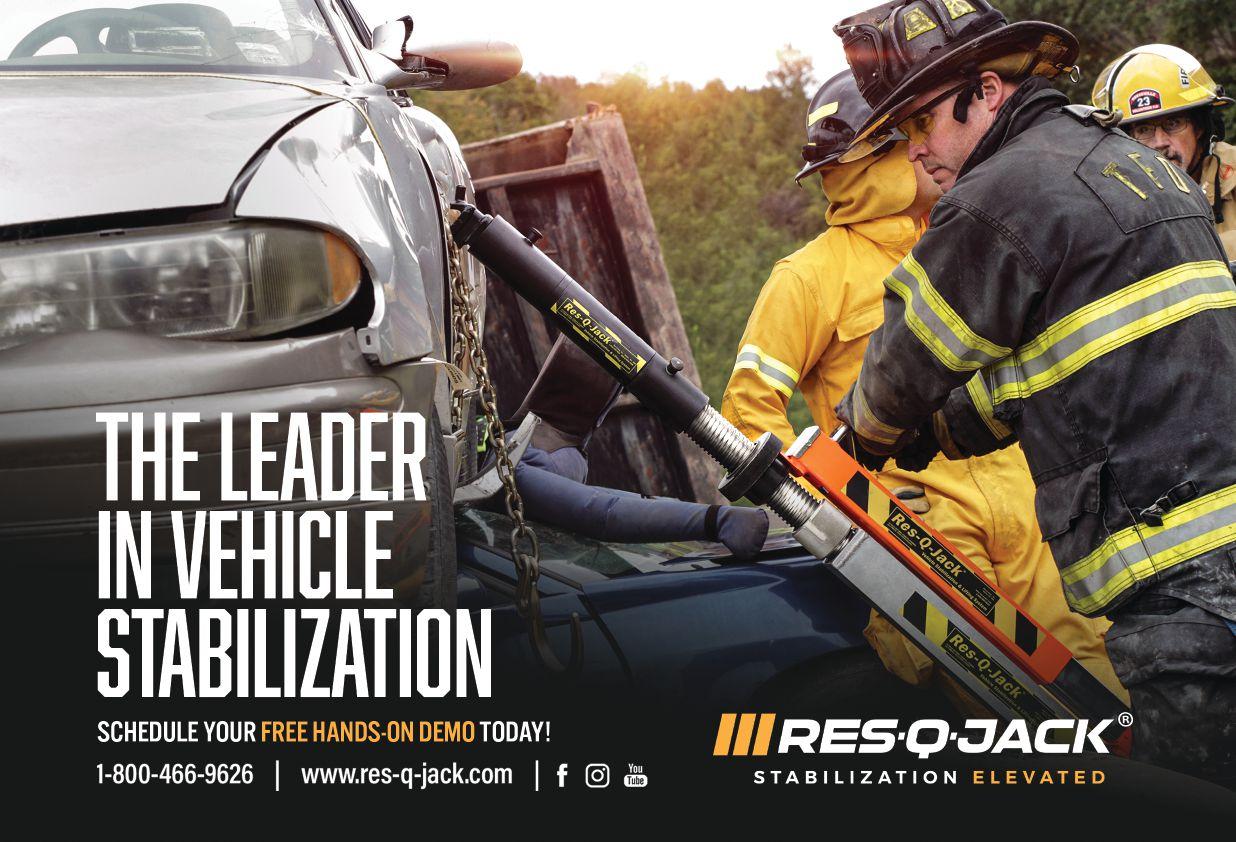
For more than 25 years, one name has been synon ymous with stabilization and lifting in the US: Res-Q-Jack. Now, Res-Q-Jack is pleased to announce they are providing Canada with the same proven performance, reliability and user-friendly operation that comes with their rescue struts.
Res-Q-Jack struts were born through first-hand experience in the emergency services field and have been continually refined to suit the needs of today’s responders through field testing and communication with departments around the world.
From hand-welds to high-end machining, Res-Q-Jack struts are built with care, inspected
and tested to ensure years of reliable and effective performance in the field. Res-Q-Jack builds each rescue strut by hand in their shop from proven and predictable materials, and distributes them globally through a network of authorized dealers.
While Res-Q-Jack struts are intuitive by design, they also believe a great rescue tool is only as good as the training behind it. That’s why when your department purchases from Res-Q-Jack, they’ll provide free in-service training, at your facility, on both equipment and techniques Res-Q-Jack is excited to be a part of Canadian rescue operations, and would love to show you how their tools work.
The Sutphen Experience What to Expect When You Buy a Sutphen
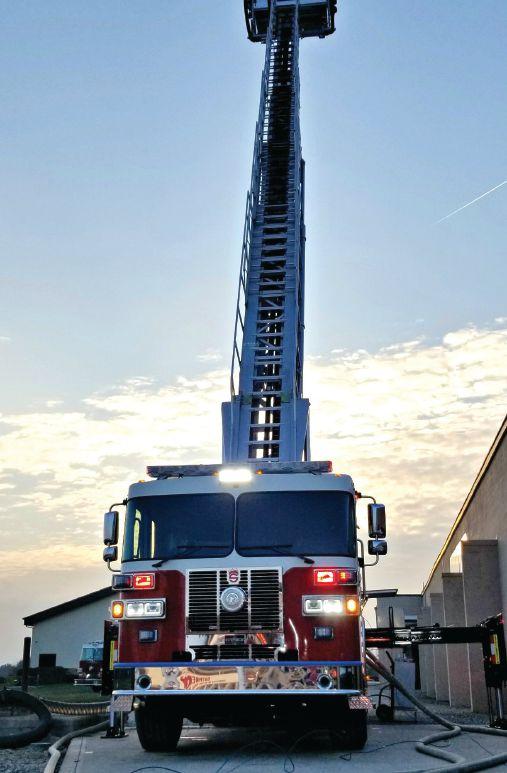
The act of purchasing a fire apparatus is more than a mundane business transaction. Budget preparation, equipment specifications and truck layout all require one thing, time. At Sutphen, we value the substantial commitment your department makes when embarking on such an endeavor, and that’s why we focus on one element often overlooked by other manufacturers, the Experience.
Sutphen has compiled an unmatched staff of expert sales professionals, cutting-edge engineers and skilled craftspeople, whose tenure is unmatched in our industry.
Our team utilizes its unparalleled knowledge base to give our customers an unforgettable experience, one that only a family-owned company can provide. This unrivaled experience creates an intense loyalty between customers and Sutphen.
Since 1890, Sutphen Corporation has been globally recognized as an extreme-duty builder and groundbreaking pioneer in fire industry innovation, new technology and customer experience. We believe that engineering a precise piece of fire equipment is truly a collaborative effort between the customer and Sutphen representatives. From the moment the idea beings to formulate at your department, to the day you back the truck into the station, and throughout the life of your truck, Sutphen is here for you. Beyond doubt, the entire process is a journey in creativity and problem solving through which relationships are fostered and loyalty to each other is developed.
Sutphen is proud to be a true single source manufacturer. To you, this means your needs after the sale will be fulfilled with just one call to a Sutphen representative for training, parts, service or warranty items. To us, it means having the honor to work with you every step of the way.
The Experience does not end when your truck leaves our Sutphen facility – it continues with you beyond our doors and into your community. This hands-on, member-of-the-family approach distinguishes us as the industry leader for customers after the sale. We are the apparatus manufacturer that can guarantee a superior vehicle exactly to specification, an expedient delivery process and an unequaled warranty management.
We offer you a professional partnership that will endure the life of your career and ours. After all, it’s 130 years later and you can still speak with a Sutphen. Join our family today.
digging through the entire can. Another smart tip, is to include an inexpensive glow stick in with the writing utensils. Not only can it be used to provide some low-level light when monitoring a clipboard, it can also be clipped on to a radio mike holster to aid in locating it in poor weather conditions or on the front of a bunker coat when operating on a dark, rainy highway. Advice from Chief Rene Camsell (Behchoko Fire Service – NWT) is to include a pencil with the writing materials, since pens and markers can freeze, a pencil can be used to write notes in sub-zero freezing conditions.
As a firefighter progresses up the ranks, it becomes increasingly important to have information available at scenes, of particular note is having a tactical fire ground guide. This flip style tabbed book provides on-scene commanders with advice on dozens of different and unique situations that could be faced by first responders. Having this guide accessible when pulling up on a scene could be life-saving. An example of this is rail incidents. Not an everyday occurrence for most fire departments, but when they are encountered special care must be taken in dealing with the incident. As an experienced firefighter or officer, reaching for that guide relieves a lot of stress and ensures the right steps are taken to mitigate the disaster. It is strongly recommended to have these types of tactical guides safely stored somewhere handy and what better place than the safe confines of a “Go Box”. Storing work related tools in a personal “Go Box” allows a firefighter access to particular tools without resorting to stumbling around looking for little pieces of kit. Remember, a good rule is: if a “Go Box” contains more than 30 per cent work related tools, a firefighter should revisit what items are
vital and what items should be found on an apparatus. There is a fine line between personal use tools and improperly equipped trucks.
Lastly, with the popularity of “Go Boxes” in the fire service, it becomes necessary to distinguish whose box belongs to which firefighter. This is modestly achieved by adding some flare. Clearly, placing a name on the box is the first step. Other firefighters have added stickers, department patches, badge numbers just to name a few, to the outside of the boxes to personalize them and bring a little amusement to an otherwise tough job.
As demands continue to increase for fire services across the country and tightening economic conditions make response districts larger, calls further away and changing conditions make calls more severe in nature, it’ll be up to the individual firefighter to be prepared for those additional time restraints by having basic items available to alleviate the discomforts posed by the scene. Employing the use of a “Go Box” to carry personal, seasonal and marginal work-related kit eases the discomfort on prolonged scenes and protracted fires and provides the firefighter with morale improving conveniences that increase their abilities at those very calls.
Kirk Hughes is the deputy fire chief of the M.D. of Taber Regional Fire Department in Alberta. A veteran of the Royal Canadian Mounted Police, Kirk has served with the Burlington, Ont., Portage la Prairie, Man., Deline, N.W.T., Fort Providence, N.W.T., and Behchoko, N.W.T., fire departments before taking a position with the M.D. of Taber as director of community safety. He can be reached at khughes@ mdtaber.ab.ca.
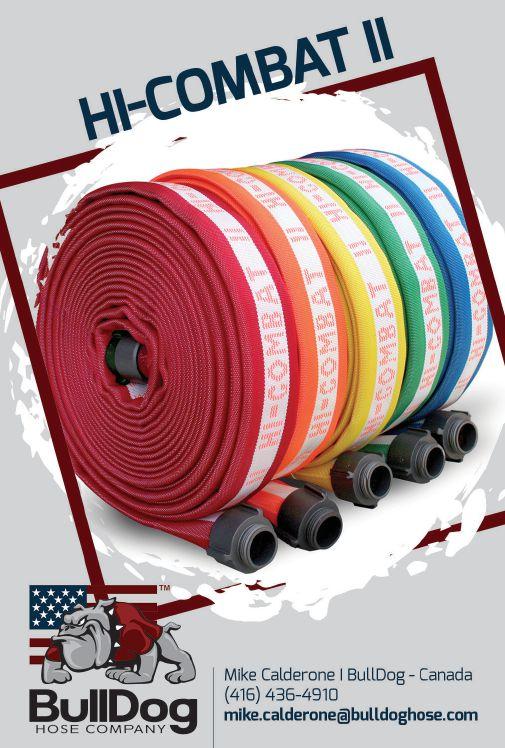
BullDog Hose Company proudly designs and manufactures premier fire and industrial equipment that are unmatched in quality and performance. Hundreds of North American fire departments depend on BullDog to get the job done safely and efficiently.
In 2018, BullDog Hose Company purchased assets from Angus Fire US, a hose manufacturing plant with equipment and product lines based in Angier, North Carolina. We are excited to continue the tradition of offering premium products, such as the Hi-Combat® attack hose, Hi-Vol® supply hose and Armour Guard™ industrial hose to customers across the United States and Canada.
No matter the scenario, when the call goes out, BullDog’s attack, supply, and general fire hose are ready to respond. Our durable, American-made hoses are depended on by fire departments of all sizes across North America. BullDog Hose Company provides top-tier firefighting solutions for departments of any size.