


In this edition’s cover story, our associate editor Jared Dodds outlines recent research on well-known lifestyle factors correlated with increased cancer risk. You know the traditional bugaboos: tobacco, alcohol, excessively tasty yet horrendously unhealthy food and its implications for your waistline, to name a few. For many of us, it’s a list of life’s fun vices that are also largely part of standard social mores.
Cigarettes may be falling by the wayside, comparative to days of yore, but the luxury cigar market has been growing by about five per cent a year for the past decade. Vaping is a growing favourite of the youth. Government data show alcohol sales by litre seem to be declining slightly. Litre sales do not capture the full picture of consumption when you consider cross-border purchases or the illegal market. The federal and provincial haul was $13.6 billion in 2023, making it a profitable cultural phenomenon.
Cancer, multifactorially triggered, strikes amid a collision of circumstances, some
beyond our control and some we may influence over, like how we care for our bodies through diet, exercise, and moderation of substances. These are changeable behaviours — they change alright. When a person feels unhealthy stress, they may engage in more destructive behaviours to cope. It is well known that firefighters often face beyond a bad day and experience occupational stress injuries due to traumatic exposures. A 2021 study titled Canadian Career Firefighters’ Mental Health Impacts and Priorities found that “64 per cent of career firefighters had been exposed to a death in the line of duty in the past year, with 14 per cent of these cases involving the death of a child.”
Mental health and cancer are often dovetailed as two top issues of concern in the fire service. They are discussed, studied and quantified separately, as they need to be. But, there is also room to discuss their connections when you consider the physical toll of unhealthy stress and the associated behaviours that can indirectly contribute to cancer development.

The number of presumptive cancers now recognized in Canada range from 10 in New Brunswick to 20 in Alberta, reported the IAFF. The government of Quebec recently proposed ADDING 6 CANCERS as presumed occupational diseases for firefighters, increasing the total to 15.
21%

Firefighters are 9% more likely to receive a cancer diagnosis and
14%
more likely to die from cancer, reported a 2014 multi-year study on firefighters.
The Canadian Cancer Society educates that alongside unhealthy behaviours, stress can change hormone levels and weaken your immune system, factors which also increase cancer risk. There is no confirmed cause and effect relationship between stress and cancer, notes the Society, but common sense can infer that a complex relationship likely exists.
Healthier firefighters start with mentally healthy firefighters. Resilience Divisions like the one at Calgary Fire Department detailed in “Back in Action” on page 16 illustrate success stories and proactive measures. Resilience, as regular contributor and psychotherapist Nick Halmasy wrote this year, is also a difficult term to define. But when it comes to mitigating cancer risk, it seems logical that building resilience and managing stress could only be of benefit in protecting firefighters.
LAURA AIKEN Editor laiken@annexbusinessmedia.com


69 % of firefighters reported less than ideal sleep quality and
21 % screened positive for clinical insomnia: Canadian mental health survey
Cancer accounts for more than 85 per cent of DUTY-FATALITY CLAIMS among Canadian firefighters, based on worker’s compensation data claims, showed an analysis of WCB and WorkSafeBC claims. of departments in Canada do not have a dedicated washing machine for turn-out gear, an industrial washing machine, or a personal protective equipment extractor, the CAFC reported.
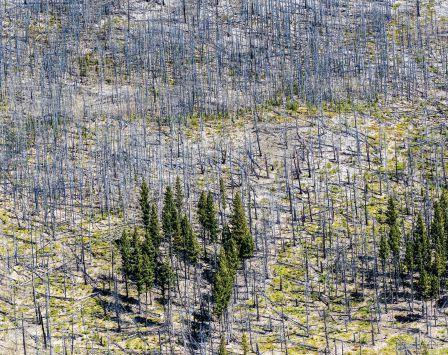
Researchers have made a direct link between climate change and the increasing frequency and intensity of wildfires around the world, while also linking it to thousands of smokerelated deaths over the last several decades.
In two separate papers, research teams from Dalhousie University, Belgium, the United Kingdom and Japan studied the extent of wildfires and their effect on human health, finding worsening outcomes for both, Dalhousie University reported in a press statement.
The team estimates there were fewer than 669 wildfire smoke-related deaths annually from 1960 to 1970, but that rose to 12,566 a year from 2010 to 2020.
One study, published in Nature Climate Change, compared wildfire models with and without the effects of climate change, and showed an increase in the occurrence and strength of wildfires in many regions, including sensitive ecosystems in African savannas, Australia and Siberia.
In Africa, where up to 70 per cent of the global burnt area is located, the
was a marked decline in wildfires due to increase human activity and land fragmentation, whereas in forested areas the number of fires is increasing due to longer periods of drought and higher temperatures linked to climate change.
fire impacts on lives, livelihoods and ecosystems,” the paper stated.
Simulations have shown climate change increased global burned area by almost 16 per cent from 2003 to 2019.
“The study is important because it shows and quantifies the influence of climate change on increasing wildfires worldwide, especially given the impacts of wildfire on society and its feedback to climate change,” said Sian Kou-Giesbrecht, an associate professor in Dalhousie’s department of earth and environmental sciences, in a media statement.
The team used models that considered various factors such as climate, vegetation and population density.
The researchers stressed that while human activities such as fire suppression and landscape management can have a dampening effect, this is often not enough to fully counteract the impact of climate change, especially in years with extreme weather.
“What is striking is that in periods with low to moderate numbers of fires, direct human interventions have a large effect,” said Seppe Lampe, a climate scientist and one of the lead authors of the study, in a press release. “However, in periods with many fires, the effect of climate change dominates, meaning that in these cases we lose control.”
The simulations show climate change increased global burned area by almost 16 per cent for 2003 to 2019 and increased the probability of experiencing months with above-average global burned area by 22 per cent. Moreover, the contribution of climate change to burned area increased by 0.22 per cent per year globally, with the largest increase in Central Australia.
“Our results highlight the importance of immediate, drastic and sustained greenhouse gas emission reductions along with landscape and fire management strategies to stabilise
A separate paper, also published in Nature Climate Change, found that climate change may have increased the proportion of wildfire smokerelated deaths tenfold over roughly five decades, a phenomenon that had been largely unquantified.
Researchers, including those from the National Institute for Environmental Studies in Japan, used fire-vegetation models in combination with a chemical transport model and health risk assessment framework to attribute global human mortality from fire fine particulate matter emissions to climate change between 1960 and 2019.
They found that between one and three per cent of fire deaths in the 1960s were attributable to climate change, while up to 28 per cent were in the 2010s depending on the model used. South America, Australia, Europe and the boreal forests of Asia had the highest levels of mortality.
Kou-Giesbrecht said that if the current pace of climate change continues, the area of burnt land and associated health impacts will increase significantly in the coming decades.
The government of Canada and the Federation of Canadian Municipalities (FCM) are investing $8.05 million to construct a net-zero fire hall in Canmore, Alta.
The investment, announced October 4 by Minister of Energy and Natural Resources Jonathan Wilkinson and President of the FCM Geoff Stewart, is being made through the Green Municipal Fund and amounts to a $1.05 million grant and $7 million in loans.
The new fire hall will replace the existing facility and will include energy-saving measures, including the installation of solar panels that are
projected to generate up to 185,000 kilowatthours per year once fully operational, the FCM reported in a press release.
The building will also be constructed from locally sourced wood and other recycled materials, reducing its environmental footprint.
The facility is designed to improve first response time and serve as an emergency public shelter during critical events like forest fires.
“Albertans understand the push to lower emissions, combat climate change and build future-proof communities across our province. So does our government. That’s why, today, we’re investing $8.05 million in Canmore to build a new fire hall,” said Randy Boissonnault, minister of employment, workforce development and official languages, in a press statement.
“This will reduce costs, cut emissions, improve response times, and add another trusted public shelter to the town’s repertoire.”
The honorarium for volunteer firefighters in unincorporated communities across the Yukon has increased to $30.74 per hour, up from $22 per hour.
Volunteer firefighters will receive the honorarium for each hour responding to calls as well as each hour spent on fire service training, the government reported. This is the first honorarium increase in the territory since 2009 and is subject to legislative approval.
The roughly 160 volunteer firefighters across the Yukon logged more than 8500 hours of training and incident response time in the first seven months of 2024, responding to about 123 calls.
Increasing remuneration for volunteer firefighters was a recommendation in the 2021 Review of the Yukon Fire Marshal’s Office Fire Suppression and Rescue Resources Distribution and part of Richard Mostyn’s, the minister of community services, 2021 mandate letter.

Canmore Fire Rescue in British Columbia welcomed TED RUITER as its new fire chief. Ruiter has been a member of the fire service for over 30 years, serving as the fire chief for Sooke Fire Rescue since 2021. He has also held positions in Fernie, B.C. and southern Ontario.

DAVID PRATT was selected to fill the top job for the Shelburne and District Fire Department in Ontario. Pratt is a 26-year veteran of the fire service, beginning his career in 1998 with Halton Hills Fire Department. He has also held positions in Saskatchewan and Nunavut during his career.

The City of Burnaby in British Columbia has named MILES RITCHIE its new fire chief. Ritchie began his career with the department in 1993, and has held various roles including lieutenant, captain, and training captain before becoming deputy fire chief in 2020.

JAMIE WAFFLE is the next fire chief for Windsor Fire and Rescue Services in Ontario. Waffle has been a member of the department for 27 years, spending the last six as deputy chief of operations and training. He has been a training officer, acting district chief and acting assistant chief throughout his tenure.

JULIE MACHADO is the next fire chief for Lac La Hache Volunteer Fire Department in British Columbia. Machado has worked in the fire service for eight years, serving in the role of captain before the promotion.

The township of Scugog in Ontario named MIKE MATTHEWS as their next fire chief. Matthews began his career in 1991 as a volunteer firefighter in
Whitby, working his way up to deputy fire chief over his 31 years with the department. He also served as deputy fire chief for Kawartha Lakes Fire Rescue Service.

ASHLEY WOHLGEMUTH has retired from her position of fire chief for the Barriere Volunteer Fire Department in British Columbia. Wohlgemuth accumulated 26 years of service after joining the department as a junior in 1998, remaining a staple until her retirement this September.

Fire Chief RON WHITE retired from Shaunavon District Fire and Rescue in Saskatchewan. White has been a member of the fire service for 14 years, about half of which were spent as deputy fire chief.

Fire Chief BOB GRAHAM is retiring from the Oliver Fire Department in British Columbia at the end of this year. Graham spent 33 years with the department, previously serving as deputy fire chief, and has been the chief since 2017.

CLIFF VETTER has retired as fire chief of the Enderby and District Fire Department in British Columbia. Vetter has been a member of the fire chief for 30 years after joining as a volunteer, and was promoted to fire chief in 2017.

Retired Fire Chief JOHN “JACK” MACINTOSH passed away on Oct. 1 after a long health battle at the age of 76. MacIntosh began his career with the fire service in Fort McMurray, Alta., before transitioning to serve as the deputy fire chief for the Banff Fire Department. He was the fire chief for the Town of Olds, as well as coming out of retirement to rejoin the Banff department as fire chief.
By Chris Harrow, Director of Fire Services for the Town of Minto and Township of Wellington North
Many times over a person’s career they will look to secure a promotion that moves their way through their organization and provides themselves with a new challenge. They will go through the process of applying, testing, interviewing and whatever else the organization uses to come up with their ideal candidate. However, the process that many people forget about is the continuous job interview that occurs every day at work. This may be the most important part of a job competition that an employer will use to find their successful candidate.
One of the most valuable pieces of information I receive when looking to promote from within the department is how the performance of the candidate has been over the course of their employment. In a volunteer department, performance appraisals are not usually completed for every firefighter, even at the captain level. However, there is always an ongoing review of performance and it is never a secret of who is performing well and who is not. The firefighters will always talk amongst themselves and give you constant feedback about a person’s ability to perform their tasks or their inability to work well with others in the department.
The key for a manager is sorting out real feedback from rumour. The use of social media has taken the rumour mill to a whole new level. Management needs to do their own investigations to find out the truth about a candidate. When done properly, the information gained can be a valuable resource for whether the candidate is a good promotion.
Management needs to do their own investigations to find out the truth about a candiate
Over the years, I have had the opportunity to work with many people who are seeking promotions or wanting to progress their career in the future. One of the first things I talk about is that every shift or time at the station is an ongoing job interview. Their behaviour, work ethic and attitude, amongst many other things, are always being noticed. If they can keep that in mind over their career, it will pay off in the future when they are looking at climbing the ladder.
I understand there are contractual obligations for promotions in larger departments and the interview process is not as relevant. However, in the paid on-call environment, the interview and the history of the employee’s conduct can go a long way in the process. A known disruptor on the floor or someone who has not dealt well with issues in the past will have to demonstrate in the interview how they have improved themselves.
The candidates who have been overachievers or done their job extremely well will tend to have a leg up. They have demonstrated their behaviour and shown naturally how they will lead in all situations.
The ability to show this is sometimes more important than being able to answer questions in an interview with textbook answers. It definitely makes the interviewer’s choice a little bit easier when selecting the successful candidate.
The second point I make to the candidates is to listen all of the time. A person cannot go into the workplace talking all of the time and not be an active listener. Being an active listener
will allow the candidate to pick up on plenty of themes and learn a ton of good lessons and methods for dealing with people. By actively listening, they will also be able to observe and learn methods on how not to do things from people who are bad leaders. All of this will lead to the candidate being able to demonstrate good behaviour in the workplace that will get them noticed. It never ceases to amaze me when I have this conversation with newer hires: they never thought of that. In their words, they think management is in their offices or doing their managing tasks and not paying attention to what happens on the floor. They don’t think their behaviour, good or bad, would ever get noticed. After a little bit of a chuckle, I assure them that any good manager will always be aware of what’s going on and be keeping their finger on the pulse of the department. If they get behind, they will do their research and speak to the people they trust to find information about any candidate. It’s similar to posting stuff on social media: it never really disappears, so remember your behaviour matters.
The benefit of promoting from within is the ongoing job interview. It is a tool we use often in our department. It gives a fantastic example of real-life behaviours and even can give you a glimpse of how a candidate will behave in stressful situations. Anyone looking to progress should keep that in mind whenever they are able to. A simple way to remember is the value, “treat everyone the way you would want to be treated.” Remembering that can greatly assist you in your career as well as your life.
By Jared Dodds
Cancer prevention is a recurring conversation in the fire service, both as a topic referenced at numerous conferences and as the focus of multiple association working groups. This status is fatally earned: a report Canadian Firefighter Fatality and Injury published by the University of Fraser Valley found that 90 per cent of firefighter deaths in Canada are attributable to cancer.
The federal government is taking steps towards addressing the issue. On Oct. 7, federal Minister of Health Mark Holland introduced the National Framework on Cancers linked to
Firefighting in Parliament and announced a $12.29 million investment to advance firefighter health and safety.
The framework was constructed based on stakeholder engagement and input from provincial and territorial representatives responsible for health and labour. The framework defined six pillars to focus on, each identified as an area of interest by firefighters, in order to support the approximate 126,000 members of the fire service across Canada.
The pillars included increased research on cancers linked to fire fighting, cancer prevention and data collection, enhanced training and education in health care settings, improved diagnostic testing for firefighters, more expansive information and knowledge sharing between stakeholders and more standardization for both health and safety and workers’ compensation.
Firefighters face a nine per cent higher risk of a cancer diagnosis than the expected population rates and a 14 per cent higher chance of a cancer-related death, found the 2014 paper Firefighter Cancer Rates: The Facts from NIOSH Research
Part of the action taken to protect firefighters includes cancer prevention efforts. Exposure to carcinogens is a contributing factor, but it is not the only
ABOVE Firefighters must address modifiable cancer risk factors to account for the additional exposure to carcinogens.
piece of the puzzle. There are lifestyle factors that firefighters can consider to help reduce their risk. Cancer Care Ontario identified five key modifiable risk factors associated with the risk of developing cancer and other chronic diseases, including tobacco use, alcohol consumption, excess body weight, physical activity, and healthy eating.
Each has their own distinct area of influence when it comes to cancer development. Let’s review recent research on cancer and lifestyle factors.
A 2022 study examining the trends of cigarette smoking and smokeless tobacco (SLT) use among U.S. firefighters and law enforcement personnel from 1992 to 2019 found that while smoking prevalence has declined overall across all adults, SLT use prevalence may be increasing among firefighters, even as it drops for adults in non-first-responder occupations.
This acceptance of SLT usage as a replacement for traditional tobacco consumption is further supported by a qualitative study of SLT use among U.S. firefighters published in 2020, which included a quote from an unnamed battalion chief interviewed for the study highlighting the prevalence of vapes and other similar products.
“I would say it’s part of our culture. There are individuals, including myself, that actually utilize smokeless tobacco while working, on-the-job, all the time. I think there’s a couple of components to this. One, it’s just in the culture and it’s accepted. There hasn’t been a lot of initiative or campaigning against it, especially on a large scale when it comes to our sector or industry,” the battalion chief said in Cancer Perceptions Among Smokeless Tobacco Users: A Qualitative Study of US Firefighters.
Smokeless tobacco contains more than 3000 chemicals, including 28 of which can cause cancer, reported the Canadian Cancer Society. Tobacco use remains the leading preventable cause of premature death in Canada.
Despite many departments having tobacco policies in place requiring no tobacco use in the firehouse or no tobacco use by firefighters at all, one study found the departments either did not have a policy in place for SLT or it was not enforced.
One chief interviewed for the study said their base still allowed smoking 10 feet away from the buildings in certified smoking areas, but there was no enforcement policy for smokeless tobacco.
The 2022 study Norms about Alcohol Use among US Firefighters found that firefighters on average suggested a higher acceptable level of alcohol consumption than recommended by health guidelines, and roughly half of career and volunteer firefighters believed that under some circumstances drinking until intoxicated was normative.
Further, a 2016 study funded by the Federal Emergency Management Agency’s Research and Development grant found that of the 85 per cent of firefighters who drank alcohol in the 30 days prior to being contacted, approximately half reported binge drinking in that same time period, which is defined as bringing your blood alcohol concentration of 0.08 per cent, typically achieved by a man having five or more drinks within a two hour period or a women having four or more drinks in the same period.
The Canadian Cancer Society’s website notes that drinking about 3.5 drinks a day doubles or even triples your risk of developing some cancers.
A 2022 publication titled Alcohol use in firefighters: A network model of behaviour and transdiagnostic risk found that alcohol use by members of the fire service may be linked to depression and PTSD symptoms, and intervention strategies should target factors found to be more central to a network of symptoms, including alcohol abuse.
Firefighter Injuries Relative to Fire Response Characteristics published by Firewell and researched by the University of Fraser Valley and Lakehead University found that 75 per cent of the injured firefighters they surveyed were considered overweight or obese.
The International Agency for Research on Cancer Working Group “concluded that there is consistent evidence that higher amounts of body fat are associated with an increased risk of a number of cancers.” Obesity also increases the risk of cardiovascular disease, another leading cause of death among firefighters.
Diet is something firefighters seem keen to address, with Cancer and Potential Prevention with Lifestyle among Career Firefighters: A Narrative Review reporting that 68 per cent of career firefighters feel they receive insufficient nutrition information and 75 per cent said they are interested in learning more about healthy eating. Firefighters often rated the Mediterranean diet as their favourite, which focuses on the consumption of fruits, vegetables, fish and seafood, while limiting red meat and sweets and eliminating processed foods, refined sugars, refined grains and trans fats. This diet has been linked to decreased cancer risks and a 14 per cent overall decrease in cancer mortality, found the study.
Though not included in the list of modifiable risk factors by Cancer Care Ontario, there is research linking poor sleep hygiene to an increased risk of cancer.
A study by the Public Health Agency of Canada found night shift work was “associated with an increased risk of prostate cancer due to the suppression of melatonin synthesis.”
A separate study titled Sleep quality and risk of cancer: Findings from the English longitudinal study of aging concluded that poor sleep quality was positively associated with the long-term risk of developing cancer.
Firefighters are no strangers to sleep issues. A 2014 study published in the Journal of Clinical Sleep Medicine found that of the 7000 firefighters the Brigham and Women’s Hospital interviewed, 37 per cent of them had an undiagnosed sleep disorder.
This area of improvement is so important that the paper Cancer Prevention Among Firefighters: Examining Lifestyle, Screening Behavior, and Beliefs which surveyed career firefighters in a medium-sized U.S. city, identified sleep, mental health/wellbeing, and work-life balance as the most important topics to address in the fire service, more so than reducing occupational exposures.
As the fire service continues to emphasize the importance of cancer prevention, these modifiable behaviours represent additional opportunities to improve firefighter health outcomes.
By Mark van der Feyst
Mark van der Feyst has been in the fire service since 1999 and is currently a battalion chief with the Six Nations Fire & Emergency Services as well as a part-time firefighter with the Fort Gratiot Fire Department. Mark is an international instructor teaching in Canada, the United States, FDIC, Africa, and India. He is the lead author of Fire Engineering’s Residential Fire Rescue & Tactical Firefighter books. He can be contacted at Mark@FireStar-Services.com.
Not every fire department will have an aerial ladder truck, but they will have access to one through mutual aid or automatic aid agreements. The main thought of how an aerial ladder can be used on scene is for defensive fire fighting by elevating the master stream and applying water from above.
There are many uses and applications that aerial ladders are beneficial for besides elevated master streams. One of those added applications is using the aerial stream to apply water from the inside when fighting a defensive fire at a large commercial building. To use this tactic, there are a few items to consider with set up and positioning.
Why would this tactic be used? In a commercial or industrial building fire, they are going to be large box style buildings. Within them will be large open spaces with high ceilings – packed with differing fuel loads. When there is a fire inside one of these styles of buildings, depending upon the fuel load and fire conditions, making entry for offensive operations may not be possible. The roof of the building will still be standing and intact along with the walls, but the fire will be stubborn and large enough to prevent interior operations.
The aerial ladder can be used to deliver water inside the building without committing personnel inside, taking advantage of the reach of the stream and amount of water flowing to knock down the fire.
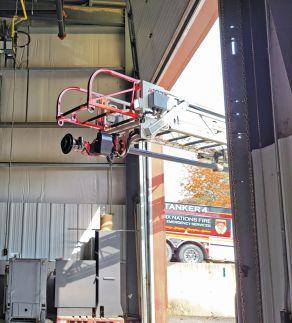
Rescue versus attack mode: As you will see in Photo 1, many aerial ladders have the option to be in rescue mode or attack mode. Rescue mode keeps the nozzle one ladder section back from the tip so that the aerial tip can be brought very close to a windowsill, balcony rail or roof edge close enough to make it easier for a pick
Photo 1 Many aerial ladders have the option to be in either rescue or attack mode.
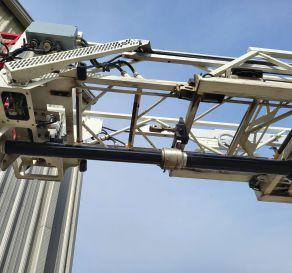
Photo 2 It is essential the selector lever for the aerial tip latching system be firmly set in either rescue or attach mode.
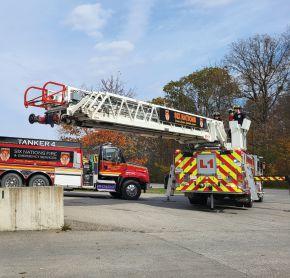
Photo 3 This is a rear-mount, straight stick aerial device in position with the rear of the truck facing the building.
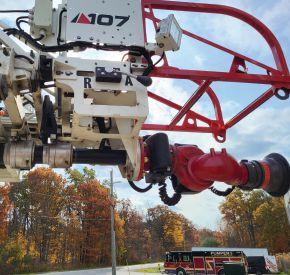
off. In attack mode, the nozzle will be secured to the tip of the ladder to be used for water application.
In Photo 2, you can see one example of the latching system for the aerial tip to be in either rescue or attack mode. It is imperative that the selector lever be completely in one or the other mode. Sometimes, it may appear that one mode has been selected, but the latching mechanism is not securely attached or in place to operate in that
mode. This can be dangerous when flowing water as the pipe can become a projectile if the nozzle section is not secured to the ladder. An example of this occurred on April 8, 2008, when a section of water pipe was launched from the elevated ladder while flowing water. Refer to NIOSH report F200812 for more information.
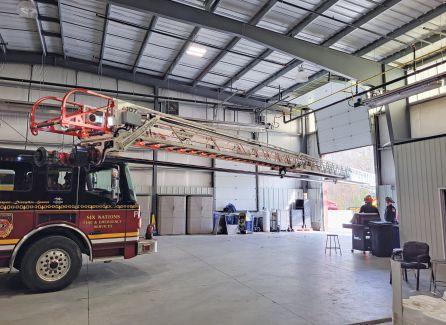
Positioning: The aerial ladder will be positioned based upon the type of device it is. There are options such as rearmount and mid-mount with the aerial device being a straight stick, a platform, a telescoping boom and an articulating boom. In Photo 3 you are seeing a rearmount, straight stick aerial device in position with the rear of the truck facing the building. Doing this provides for better access to the building, longer reach of the aerial ladder and, if needed to move away from the structure, it is positioned in the right direction.
Notice also how far away from the building the aerial truck is positioned. Three things to consider here: first, there needs to be enough space between the building and the ladder truck to provide for the scrub swing of the ladder. This is the total length of the aerial device when it is fully bedded. There needs to be enough space provide so that the aerial ladder can be raised up out of the cradle, then swing around towards the building.
Secondly, the potential for collapse. If the building is going to collapse, the aerial ladder truck needs to be far enough away (1.5 times the height of the building) so as to not be caught in the collapse zone.
Thirdly, depending upon where the fire is inside the building, the angle of the ladder truck will assist with getting better access to it. As you will see in Photo 3, the ladder truck is located
4 This position may be all that is needed to deliver large volumes of water to a fire inside the building. Photo 5 If the ladder device
inside the building it will require some coordination from a spotter on the ground and the operator on the turn table. Photo 6 Taking advantage
garage door allows for a better angle for water distribution.
on the corner of the building, angled towards the garage door opening. The corner of the building provides better collapse zone protection while also providing better access inside the building to the fire.
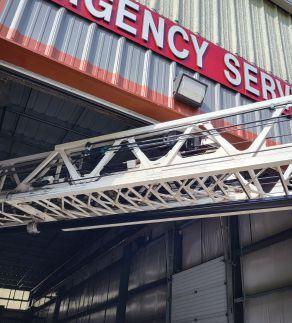
Placing the aerial ladder: In photo 4, you will see the tip of the aerial ladder just inside the garage door. This position may be all that is needed to deliver large volumes of water to suppress the fire. The ladder device may need to be
dination from a spotter on the ground just by the garage door and the operator on the turn table. By going deeper inside the building, the water delivered will hit the intended target easier.
Height of the door opening: In Photo 6, you will see the aerial ladder raised just high enough to not touch the top of the garage door opening. By taking advantage of the height of the garage door, it will allow the aerial ladder to be higher, making the nozzle higher in
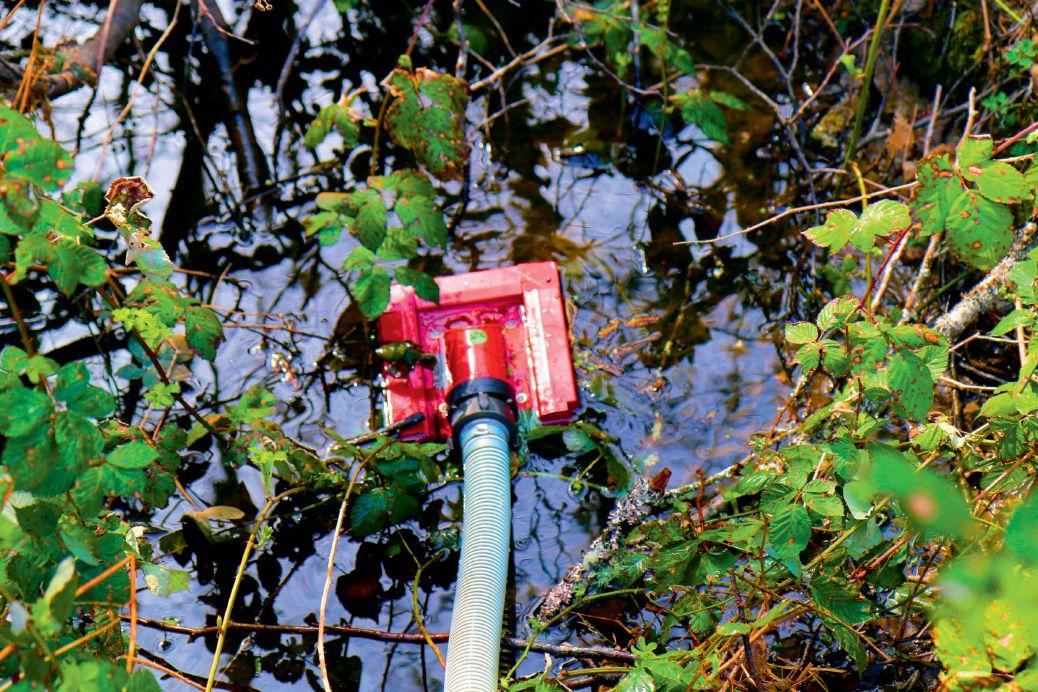
Nozzle operation: With the nozzle inside the building, it may be more advantageous to turn the nozzle sideways and operate it in that position to gain better sweeping with the water. By putting the nozzle sideways, the “up and down” function now allows the nozzle to move left to right. This may give a larger sweeping area for water distribution.
If you have access to a large commercial building and an aerial ladder truck, try this tactic out at a training session to see how effective it may be


By Gord Schreiner, Fire Chief, Comox, B.C.
What makes us firefighters? Well, it is not our cool hats and t-shirts, our uniforms or personal protective clothing. It’s not our fancy rigs or bumper stickers, nor our expensive equipment. It’s not our fire stations and badges. It’s our TRAINING!
Remember, if it is predictable, it should be preventable.
Without training a firefighter is just another civilian dressed up to look like a firefighter. Great fire departments are training all the time. Firefighters are happier and safer when training. Departments that don’t train much often have discord in their ranks. Give your firefighters meaningful training and they will be happier.
In all my travels, I have yet to meet a single firefighter who does not agree that training is probably the most important thing we do. I have also met quite a few that talk the talk but don’t walk the walk; quick with lots of excuses as to why they or their departments do not train much. Small budget, too cold, too wet, not enough time, or they “already know everything.” I have heard them all. These excuses just do not cut it. Get out and train like lives depend on you getting it right, because they do.
Training resources are abundant. The internet is full of fire service lesson plans, training props and scenarios. In my department you will find training going on almost every day. We have added some training components to our on-board iPads, so each rig and officer has our latest lesson plans complete with photos
and videos. We have built our own training centre which includes dozens and dozens of props. I challenge my firefighters to keep thinking up new ideas which are practical and don’t cost a lot.
We have drastically changed our weekly training schedule to accommodate more training and more flexibility for our members. We split our department into two separate platoons with each practicing on a different night. Members now have a choice on which night works better for them. Also, if they missed a training session they could come on the other night (with notification to their platoon officer). We have also added a Friday morning session to give our members another option for a weekly training opportunity. In addition to this we do driver training one night a week and a manage a junior firefighter program on another night, giving our members even more options to train. We have training going on at our fire station four nights per week. We insist that our members make 40 training sessions a year. We feel this allows for enough training time to keep them (and us) safe.
Make your training sessions interesting and valuable. We have dozens of training sessions in written formats (Response Ready, Seconds Count, Rapid Independent Drills), so they are easy to follow. No excuses!
Add some training props to be more creative. Here is a hot idea: we added a sauna for dummies. We heat
Gord Schreiner is the fire chief in Comox, B.C. and also manages the Comox Fire Training Centre. He has spent of 49 years in the fire service and delivers presentations all over Canada. For more info contact firehall@comox.ca.
up our rescue dummies with an infrared heater and then place them in a cooler room where we can search for them in artificial smoke using thermal imaging cameras (TIC). The hot dummies look real as they provide a great thermal signature. We have used several other props like this just for TIC training.
What’s wrong with hitting a hydrant, stretching a line, donning SCBAs and throwing a ladder on a false alarm run? If your firefighters are on the rig, why not ask them to practice one of their common procedures to ensure they are not getting rusty. It only takes a few minutes to stretch that pre-connect, show water and put it back in place for the next call. That next run might involve a child trapped where precious seconds will make a difference. Wouldn’t it be great to get it right?
Once you have the basics nailed down, you can then expand to other techniques, including vent, enter, isolate, search and more.
Our firefighters love to train, and I am proud that they are very well trained. However, we are not stopping, and we are continuing to make our team even stronger by providing more great training. I know we can be called upon at any time to deliver an excellent response to an emergency.
Good training pays off its terms of successful incidents. Victims are rescued, fires go out quicker and our most importantly our firefighters are safer. After some of our recent fires, some of our firefighters commented the incident was very much like a recent training scenario. We train like we play, and we train like lives depend on it, because they do. We keep our training challenging and exciting. I find that reminding our firefighters that lives depend on us getting it right helps to keep them motivated. Get out and push your department to train more!
Remember, if it is predictable, it should be preventable.

By Dave Gillespie and Willy Burnett
Meet Sam, Alex, and Pat.
These three real firefighters (names changed) experienced anxiety when preparing for the next call, or returning to their next shift, or returning after extended time off, and each faced the option of not returning at all. But they all did. They are back in action.
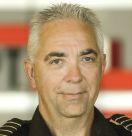
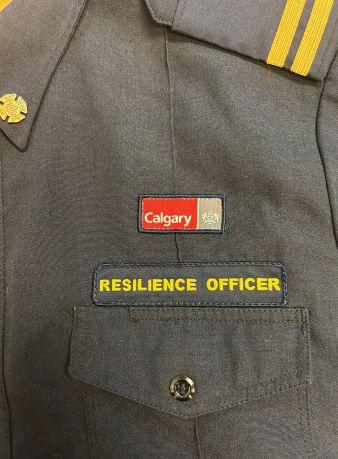
We will profile the leading-edge practices used by Calgary Fire Department’s (CFD) Resilience Division. The division is staffed by two firefighters, resilience officers Willy Burnett and Lorne Miller, who conduct daily and weekly sessions around proactive mental health.
They also show fireground instructors how to enhance training on performance tactics during fireground exercises, and run company officer development sessions, as well as consult with clinicians and therapists. One of their most valuable components is their Reintegration Program for personnel who were once on long term disability and are now coming back to CFD.
Calgary Fire is one of Canada’s larger departments, serving a community of 1.3 million citizens. Their suppression staffing comprises 1415 personnel, with an additional 182 in fire prevention, training, administration and support. Their 2023 Annual Report states their call volume was 92,900 calls across their 43 stations. Perhaps this department is different than your department, but their people are just like your people.
Just like Calgary, most fire services draw a wide variety of skilled people. Across the industry we tend to attract successful hard-driving people who have high expectations of them-
BELOW The Calgary department has a Resilience Division staffed by two firefighters who hold regular sessions on mental health.
selves and their team. Fire fighting and rescue operations are considered a high-risk, high-consequence occupation similar to policing, military special operations, paramedicine, surgeons, and professional athletes.
We all learn how to take advantage of the human stress response and its hormone dump of adrenaline and cortisol that sharpens our focus, empowers us with a faster heart rate, more blood flow to major muscles, a dilated windpipe, and breathing changes so that we perform better.
When this sympathetic nervous system (SNS) response is constantly under stress, and we can’t get off the roller coaster, even the top performers can get weighed down.
Traumatic situations such as a child fatality, a car accident, a drowning, a house fire, or other events can trigger responders. The sights, sounds, and smells of trauma, often as minor as wearing their bunker gear and donning a SCBA facemask, can generate a flood of stress responses and release the same adrenaline and cortisol.
Even pulling into the station parking lot, hearing the station tones and pager, or driving by that one particular house can call up emotions and activate our SNS, giving the gift of an adrenaline/cortisol bump into our blood stream.
These SNS triggers, when not managed, produce an internal response which can include heart pounding in the chest, shallow breathing, eyes darting, queasy stomach, bowel pressure, sleepless nights, panic attacks, distracted focus, cognitive impairment, impact on decision-making, and heightened inner dialogue in one’s own head.
These signs and symptoms, as well as degrees of hyper-vigilance or hyper-sensitivity, make it difficult to go back to a job in emergency service — unless there is a plan or program for how to manage and get our firefighters, dispatchers, and members back on their game.
Calgary Fire’s Resilience Division has a program with several on-duty and return-towork successes. Here are Sam, Alex and Pat’s stories.
SAM
Sam, a 40-year-old firefighter with six years of service, was struggling with severe anxiety, occasional panic attacks, and suicidal ideation. Sam was on-regular shifts, in therapy, and con-





















➵➸➺➻➼➽➾➚➚➺➪➶➹➺➘➪➴➺➶➾➾➷➘➸➬➮➺➬➘➱➬➹➶✃➬➘➸❐➾➬➹✃➶➸➬➶❒➹➾➮❮✃➺➘➴❒❰➶➾❰➶➸➺❰➱❮➚➴➶➺ ➺➺✃❐➬➪ ➾➚➶➸➺ ➶➾➾➷➘➘➶➬➶➴➘ ➚✃ ➸➺➚➪➾➚➚➺➪➶➺✃➶➾ ❮❰










templating taking leave. The resilience officers began working closely with Sam’s clinician, and together they identified specific exposures that could help address unresolved trauma, such as visits to the emergency room at the local children’s hospital. Burnett and Miller arranged for three exposure sessions in different wards.
On regular duty, the three sessions involved Sam practicing pediatric CPR in a simulation lab. He then progressed to the ambulance bay and, finally, the code room. This is where Sam confronted a particularly distressing pediatric call that had significantly contributed to the Occupational Stress Injury (OSI). It was a breakthrough.
Resilience officer Burnett witnessed Sam’s growth firsthand.
“Sam’s transformation from a place of deep fear to one of renewed confidence was incredibly moving,” said Burnett. Today, Sam is back to work full-time as a frontline Calgary firefighter, experiencing much less anxiety and managing very effectively.
ALEX
Alex’s reintegration process was more extended due to the complexity of compounded trauma. Despite nearly 16 years of service, Alex struggled with confidence. Miller began with basic firefighter actions, such as simply wearing the uniform and gear.
Then they involved Alex in a recruit class. To maintain confidentiality, Alex participated as a member of the training staff and blended in as an observer occasionally offering input.
By observing and engaging in training exercises alongside recruits, Alex was able to practice skills and run scenarios in a supportive environment. He also travelled to different fire halls, using various equipment for enhanced exposure therapy. Through these experiences and the application of arousal management techniques, Alex successfully rebuilt confidence and resumed operational duties as a frontline firefighter.
Pat had been on modified work duty before taking an extended parental leave, which meant not driving a fire engine for nearly four years. Although there was a standard return-to-work process, Pat asked for customized training to regain confidence in specific operational fireground tasks. The team
provided focused training in areas such as search and rescue, and ladders, which boosted Pat’s confidence and operational competence after just one week of preparation.
What Sam, Alex and Pat experienced is normal for emergency responders who exceed their resilience capacity. We all experience SNS responses every day, and at some points in our life, we can reach overload. Think of your first major call. That’s what we are talking about. It’s like riding a roller coaster – it works for us, but when too excessive, not balanced with recovery, and not processed by the body, then we have trouble getting off the ride.
Implementing a return-to-work is not a cost item. It is an extension of the department’s initial investment. Think of it as cultivating your ROI – return on investment.
Sam had 16 years of salary and experience. Alex had six years. Pat had 10 years. Adding salaries, benefits, and experience, CFD’s initial investment totals of these three cases are 32 years at $100,000 a year, which can equal $3 to $4 million. Additional costs such as the overtime needed to replace them on a fire truck are above that.
All might have been lost if the multiple CFD had not been proactive in this initiative for resilience training.
When a chief looks at their personnel as an investment, someone leaving their organization is more than a financial loss. The expertise, the enthusiasm, the camaraderie is lost, and worst case, if someone dies by suicide, then the wake of their death reverberates throughout the organization. The statistics of untreated PTSD speak for themselves.
If the person is still alive, there is always potential. With professional care, they have the potential to become a better spouse, a better parent, a healthier friend, and possibly return to fire services.
With time and therapy, some may be able to return as a healthier firefighter or dispatcher. It is our priority to maximize our investment from their years of service to evolve into a healthier life.
Back in action, whatever form that takes.
While this article is not a comprehensive
return-to-work plan, it does highlight how a Canadian fire department took proactive steps to collaborate closely with clinicians, therapists, and occupational therapists. Some work can be done prior to trauma that may even lessen the impact and provide pathways for resilience.
Resilience is like a muscle. Hit the gym, exercise it, and it will grow. Ignore it and it becomes weak. As a company officer, training officer, instructor, district chief or fire chief, it is a priority to help exercise one’s own resilience and that of your crew. It needs attention each day.
On a weekly basis, these CFD resilience officers coach instructors at the Recruit Academy how to use Cognitive-Behavioural Therapy (CBT) in their instruction, and how to coach others to perform when under stress. The resilience officers also meet various firefighters at substations for checkins, and they consult with a clinician of off-duty personnel coming back from LTD. Being subject matter experts within their agency, they also help others integrate various stress management actions and CBT into their daily routine.
CBT is defined a form of psych0therapy using talking and thinking strategies to overcome mental and emotional obstacles. It has been proven to be highly effective in human performance realms such as extreme sports, aviation and elite military units.
Like CFD, police tactical teams, military special operations, surgeons and professional athletes, we can all integrate CBT in various levels of on-the-job training.
These are some simple daily exercises many firefighters have likely done using CBT without knowing it was CBT:
1. Rehearsed for their job interview.
2. Stood by the pump panel and visualized what levers to pull, adjusting the pressure relief valve to water supply/demand — with the truck turned off.
3. Worked the Jaws at an MVC using instructional self-talk like “lift the tool – insert in door jam – twist grip - spread the Nader bolt.”
4. Adding in breathwork, like three to five pattern recovery breath, to slow down the effects of adrenaline. Breathe in for three seconds and out for five seconds slowly. This helps engage the parasympathetic nervous system to counter balance the SNS. Essentially it is applying the brakes to the speeding roller coaster.
SCBA and FaceMask CBT exercise: Without wearing the SCBA, ask the rookie to don an imaginary backpack and facemask, attach the regulator and turn it on. You will notice a sequence of hand movements, all based on the motor cortex patterning in the brain. Do it enough times, and the brain’s “neurons that fire together – wire together,” as is commonly said.
Add in breathwork (for example, recovery breathing of in for three seconds and out for five to seven seconds). Add a stopwatch and it increases perceived stress of being timed. Practice it to build resilience.
Command Skills CBT exercise: Design a practical exercise where they watch a fire video clip on YouTube. Search using the term “pre-arrival fire attack” to find dozens of scenarios. Get the IC-in-training to practice breathwork. For example, triangle breathwork where you breathe in for four seconds, hold for seven seconds, and out for eight seconds.
Have them hold a mock radio or cellphone and recite their Initial Arrival Report. With volume low, play out simple radio communications in an expected sequence. This is about priming them with scenarios they can anticipate within a high probability. This builds resilience and adaptability. This isn’t rocket science. It’s neuroscience.
Start incorporating resilience elements like visualization, mental rehearsal, and tactical breathwork (another example is box breathing: four seconds in, hold four seconds, out four seconds, hold four seconds). Segmenting or breaking down to next physical task, or constructive self-talk can make a significant improvement to performance and adapting. To learn more, check out the YouTube channel “Tactical Resilience” or search “tactical breathwork for firefighters”.
By integrating these practices into daily fire training, you’ll gradually embed CBT-based resilience concepts throughout your department. These incremental additions will build
up over time, leading to a more resilient and supportive environment for all fire department employees.
These return-to-work strategies built a stronger bridge for Sam, Alex, and Pat to cross when returning to the fire service.
Learn more about these strategies and the financial case in Part 2 of the “Back in Action” series.
Dave Gillespie is a chief training officer in Peterborough, Ont. He authored the book Developing Firefighter Resiliency and runs 24 hour classes for Tactical Resiliency Training across the U.S. He writes for FFIC and is presenting at FDIC 2025. Contact him at david.gillespie.fire@gmail.com
Willy Burnett works as a resilience officer for Calgary Fire Department. His background as a nationally ranked athlete and his experience returning to work helped develop the CFD program within a team. This is his first article for FFIC. Contact him at wilson.burnett@calgary.ca.
24_010911_Firefighting_In_Canada_DEC_CN Mod: October 17, 2024 2:56 PM Print: 10/28/24 2:33:35 PM page 1 v7
By Laura Paris, Associate Lawyer and Team Lead at Shulman & Partners LLP in Toronto
Shulman & Partners LLP (shulman.ca) is a Family Law practice based in Toronto with an office also in Ottawa. The firm leverages 15 years of experience in all aspects of Family Law to ensure successful results for their clients.

At first glance, first responders, pilots and flight attendants may not seem to have much in common. However, aside from working 24/7 shifts and ever changing work schedules, they also face much higher divorce rates compared to other Canadians working in different industries.
In a recent Reddit post, pilots and flight attendants discussed ‘Aviation Induced Divorce Syndrome’, examining the issues faced by those working shift work who spend large amounts of time away from home; who work shifts that leave them tired when at home; and, who are stressed from dealing with an increasingly antagonistic general public.
It’s well known that many firefighters often work overtime as it can be lucrative and make a positive impact on lifestyle. This sets up a work schedule that becomes even more demanding, but pays extra, with the end result of spending less time with family.
First responders’ top concerns usually include unpredictable scheduling and maintaining healthy relationships while spending large amounts of time at work and away from home.
We know that Canadians working these jobs face unique challenges. They are dealing with a lot of time apart from their families, and a limited amount of time with their partner – this can sometimes lead to drifting apart and living separate lives.
Often, we hear how the relationship faced a ‘slow burn’ that then led to many issues ultimately leading to divorce.
And, if the marriage ends and divorce proceedings begin, this is also difficult due to the shift work and one person’s lack of availability and slow response in dealing with issues.
According to a 2023 Forbes Advisor survey, career choice was the number one source of conflict among divorced couples (46 per cent), followed by parenting differences (43 per cent) and division of household labour (43 per cent), relationship with family (39 per cent), relationship with friends (35 per cent), finances (28 per cent), and health choices (9 per cent).
These statistics and the prevalence of divorce in these careers is not surprising and consistent with what we see with our clients at Shulman and Partners LLP.
More specifically, we recognize on a day to day basis how career choices impact relationships, can lead to the breakdown of relationships and how those issues can even spill into a divorce.
For example, we have noticed that shift work can put a lot of pressure on a relationship, often leaving the non-shift working spouse carrying the domestic duties while the other is at work. These issues continue into the divorce particularly when there are children involved and parenting schedules to be determined.
The challenges include structuring a schedule around shift work, and resistance to shared parenting schedules - which typically result in less support payable – due to the non shift work parent having to pick up the other’s slack due to their irregular work commitments.
At Shulman and Partners, we’ve found a good way to deal with co-parenting and shift work is to have agreement on the format. For example, if both parents can agree that the person working shifts cares for the children twice per month, four days at a time, then the exact timelines can be adjusted on a month-to-month basis.
How the days are split are dealt with on an ongoing basis as the schedule changes. This structure can create a schedule that suits the children’s interests and supports a successful co-parenting relationship.
That said, these types of schedules require flexibility and cooperation, typically from the non-shift work spouse. If not dealt with effectively, one parent can feel resentment for having to constantly adjust their schedule.
Moreover, often times shift workers will depend on grandparents to help with their children’s care to avoid back and forth with the other spouse. This, however, is not a simple solution and is something that should be agreed upon by both parents.
We often find the status of the relationship between the spouse
and their in-laws during the relationship tends to influence how grandparents may factor into such a schedule. In dealing with these challenges we often ask - at what point is the grandparent standing in the place of a primary parent? Are the grandparents acting as caregivers or are they taking on responsibilities that ought to be the parents – which, if so, could present a problem.
It is important to remember grandparents should be helping on an ‘as needed’ basis depending on the ages of the children and should not be a replacement for a parent. If a parent is not able to regularly meet their parental duties, this should be considered in crafting a schedule, rather than those duties being passed on to someone else.
Ultimately, a child’s development and well-being is enhanced by knowing where they will be on a week-to-week basis. Successful co-parenting thrives when two parents are willing to be reasonable and work together.
These jobs place a lot of strain on a relationship. And, usually, the dynamic doesn’t get any easier during the divorce process. But there is light at the end of the tunnel for anyone going through this scenario. It takes more patience than any other divorce and an understanding of the process and why delayed responses are almost always due to work schedules.
By Sam Shalabi and Jason Reid
The increasing presence of lithium-ion batteries in our daily lives—from electric vehicles (EVs) to consumer electronics—has brought substantial benefits but also significant safety challenges, particularly in confined environments like parking garages. With risks like thermal runaway, fires, the release of toxic gases, and at times explosion hazards, understanding battery safety is essential for all building owners, property managers, facility managers and health and safety teams alike, not to mention the communities in which they are located in.
Below, we delve into some key areas of focus, providing a snapshot of recent incidents and consistent lessons learned, to shed light on the critical need for robust battery safety programs.
Lithium-ion batteries are praised for their high energy density and durability, but these features can also contribute to fire hazards. Thermal runaway, a state where internal battery temperatures spike uncontrollably, can lead to fires, explosions, and toxic gas emissions, such as hydrogen fluoride and carbon monoxide, among others.
These compounds pose direct threats to occupants, first responders and surrounding communities. As these batteries become increasingly integrated into residential and commercial buildings and every workplace, it’s crucial to adopt fire prevention and mitigation measures tailored to these unique risks.
Lithium battery-related fires are not limited to
BELOW While air transport has stringent state of charge limits, road and sea transport often lack consistent enforcement of similar regulations
EVs but are present across various transport and storage applications. For example:
• Montreal shipping container fire (2024): In September, a fire broke out in a shipping container holding 15,000 kilograms of lithium batteries. The incident required specialized fire fighting support and triggered toxic smoke alerts, evacuations and significant community emergency response.
• California highway incident (2024): A truck transporting lithium batteries caught fire on a California highway in July, releasing dangerous gases and causing widespread disruption.
It’s important to note that these incidents don’t just impact the building and or the occupants within that building, it impacts the community, impacting first responders, forcing evacuations, and larger facilities to “Defend In Place” – creating other challenges to community safety. For the transportation of lithium batteries, Transport Canada enforces regulations for safe handling, labeling, and packaging to prevent fire risks during transit. The Canadian Electrical Code (CEC) addresses electrical safety for transporting battery-powered devices. In the U.S., the Department of Transportation (DOT) enforces hazardous materials regulations, which categorize lithium batteries under Class 9 hazardous materials. Internationally, IATA and ICAO outline stringent guidelines for air transport of lithium batteries, while the IMDG code mandates fire-resistant packaging for sea transport.

Battery fires present a heightened risk in confined spaces like parking garages, where ventilation is limited, and toxic smoke can accumulate rapidly. Several high-profile incidents highlight these unique challenges:
• Incheon, South Korea (2024): An EV fire in an Incheon parking garage prompted the South Korean government to explore better fire fighting strategies around EV charging areas in enclosed spaces.
• Munich, Germany (2021): A fire in an underground parking garage, triggered by an EV battery, revealed the complications of containing flames in confined, poorly ventilated areas, raising awareness around EV battery safety in shared spaces.
• Seoul, South Korea (2023): An EV fire that damaged over 100 vehicles in Seoul led officials to review safety policies, ultimately resulting in new regulations for EV parking in closed environments.
Recently, State Farm, a global leader in risk management, announced it would be removing EV chargers from internal parking areas in its headquarters and across major U.S. hubs. This move underscores a growing concern that fire risks in enclosed spaces may outweigh current mitigation options, or that available mitigation options were unfeasible due to the current building infrastructure.
In Canada, parking garage fires involving EVs are regulated by the National Building Code (NBC) and the National Fire Code (NFC), which set stringent safety requirements for parking structures, including ventilation and EV charging system protocols.
The Canadian Standards Association (CSA) provides guidelines for safe electrical installations in these facilities, while Underwriters Laboratories of Canada (ULC) sets standards like ULC S1001 for integrated fire protection systems and ULC 9540A for thermal runaway testing.
Additionally, NFPA 88A outlines fire safety measures for parking structures, ensuring robust protocols for fire mitigation. Internationally, the International Building Code (IBC) and the International Fire Code (IFC) also cover parking structure safety with provisions for EV-specific concerns, while NFPA 70 (National Electrical Code) offers best practices for EV charging station installations.
As Energy Storage Systems (ESS) facilities increase in scale and number, so too do the associated fire risks. Here’s an overview of notable ESS incidents that emphasize the need for robust fire safety measures at both the site – and for the community.
• Critical mineral recovery facility (2024): In October, a fire broke out at one of the world’s largest battery processing facilities. The event required community evacuations, underscoring that lithium-ion fires can cause severe impacts not only within facilities but also in the broader community.
• Moss landing energy storage facility, California (2022): Moss Landing, one of the world’s largest ESS facilities, experienced a significant fire in 2022. Although no injuries were reported, the incident caused substantial damage and underscored the vulnerability of large-scale battery installations. The fire led to a thorough examination of battery cooling and containment measures at the facility, as well as improved protocols to prevent thermal runaway.
• Arizona Public Service (APS), Surprise, Arizona (2019): A serious
explosion at APS’s ESS facility injured four first responders. The explosion was traced back to a chain reaction and a violent release of energy. This incident prompted Arizona to overhaul safety standards focusing on ventilation, real-time monitoring, and training protocols for emergency responders.
• Beijing, China (2021): An ESS fire at a grid storage site in Beijing required extensive fire fighting efforts. This incident highlighted the challenges of integrating large-scale ESS installations in urban, densely populated areas. The ESS site’s proximity to residential areas raised public concerns and encouraged stricter regulatory scrutiny on site selection, battery type, and fire suppression capabilities for ESS projects within city limits.
ESS are another critical focus area, with ULC 9540 and ULC 9540A providing guidelines for safe installation and thermal runaway testing in Canada. NFPA 855 is the key standard for ESS installation and fire safety, addressing potential hazards and providing comprehensive safety measures. Internationally, NFPA 70E applies to workplace safety involving ESS, while IEC 62619 and IEC 62133 offer safety standards for lithium batteries in industrial storage applications.
The UL Fire Safety Research Institute (FSRI) publishes guides such as Mitigating LithiumIon Battery Energy Storage Systems Hazards to provide industry insights.
Recent reports highlight a concerning rise in fires caused by lithium-ion batteries in e-bikes and e-scooters, particularly in New York City. In 2023, the city saw a marked increase in such incidents, with 267 fires resulting in 18 fatalities and over 150 injuries. In response, New York City implemented a lithium-ion battery safety package in early 2023, aiming to mitigate these risks. By mid-2024, these measures had led to a significant drop in fatalities by 92 per cent and injuries by 40 per cent compared to the same period in the previous year, underscoring the effectiveness of enhanced safety regulations.
For Canada, where e-bikes and e-scooters are widely used, these developments highlight the need for similar preventive measures. Canadian municipalities could benefit from adopting proactive safety standards, regular inspections, and increased public awareness to mitigate the risks associated with lithium-ion battery
fires. Learning from New York City’s approach provides a model for Canadian cities to enhance their own safety protocols and prevent incidents related to these batteries.
In Vancouver, battery fire safety challenges are also being experienced with Vancouver Fire Rescue Service highlighting in their recent annual report that lithium ion batteries are among the biggest challenges facing firefighters.
Both Toronto and Vancouver Fire Services have significantly increased public safety messaging around proper handling, storage, and charging of these devices, urging users to use manufacturer-recommended batteries and chargers to reduce risks. In addition, they have released a vast array of educational materials to further enhance awareness in the community.
In Toronto, similar incidents with e-scooter and e-bike batteries have occurred, albeit on a much smaller scale than New York.
• Toronto underground parking fire, 2024: On October 21, a three alarm fire saw firefighters dealing with blackout visibility due to what initial reports identify as 20 e-bikes on fire. One person was injured, and the cause of the fire remains unknown.
• TTC subway fire, January 2024: An e-bike battery caught fire on a Toronto subway car, resulting in rapid flames and smoke. Fortunately, the fire was quickly contained, but one passenger suffered non-life-threatening injuries. This incident led to increased safety concerns and discussions on e-bike transit usage and fire response measures on public transportation.
• Residential building fire, October 2023: A fire attributed to an e-bike battery severely damaged a residential building in Toronto. The intense flames and rapid spread highlighted the challenges in controlling lithium-ion battery fires in enclosed residential spaces, drawing attention to the need for fire-safe storage and charging practices in high-density areas.
E-bikes and e-scooters are regulated in Canada by Health Canada and CSA standards, adhering to CAN/ULC 2272 and CAN/UL 2849 for fire safety during use and charging. The National Fire Code (NFC) ensures compliance for safe storage and battery charging practices. Internationally, NFPA 1 (Fire Code) outlines safety practices for storing and using e-bikes and e-scooters. Standards such as UL 2272 and
UL 2849 set safety benchmarks for e-scooter and e-bike electrical systems. The IMDG code also includes specific packaging and handling protocols to prevent fire hazards during the transport of these devices by sea.
Despite the strong regulatory framework and standards governing EV parking and land transportation, some specific areas would benefit from further enhancement to address the evolving needs associated with electric vehicles and lithium-ion battery technology. Fire suppression systems, for instance, are well-established for traditional vehicle hazards, but standards like NFPA 88A and ULC S1001 could be further optimized to address the particular challenges of lithium-ion batteries, such as thermal runaway and associated heat. Current ventilation codes, like those in the National Building Code (NBC) and National Fire Code (NFC), could also benefit from targeted updates to manage the unique gases emitted during EV battery incidents, especially in enclosed or underground spaces where containment is critical.
Training and resources for first responders are another area with potential for growth. Expanded, specialized training focused on EV fires can empower fire services to handle these incidents even more effectively, leveraging their expertise with added insights into EV-specific scenarios. Emergency access infrastructure, meanwhile, could be adapted in certain cases to facilitate faster responses in EV incidents, supporting firefighters in delivering efficient operations when seconds count.
High-density EV charging stations, as found in some modern parking facilities, also introduce unique considerations for safety layout and charging station spacing. Updated guidelines here could offer additional assurance, helping prevent cascading failures and ensuring robust fire barrier protocols. The Canadian Electrical Code (CEC) has thorough standards for EV infrastructure installation, but regular inspection and maintenance protocols could enhance long-term safety, ensuring equipment stays within compliance over time.
The fire risks associated with these areas include rapid fire propagation from thermal runaway in lithium-ion batteries, potential toxic gas buildup, and the importance of maintaining well-functioning ventilation in enclosed spaces.
High-density charging areas pose an additional risk of simultaneous malfunctions, which can place pressure on fire suppression systems. Enhanced emergency access and ventilation standards will support both first responders and structural integrity, creating safer outcomes for all stakeholders involved.
Parking garage fires involving EVs introduce unique challenges due to the specific hazards associated with EV charging and storage. Imagine an underground parking garage beneath a 42-story high-rise, equipped with 100 EV chargers in simultaneous operation. Vehicles are parked roughly 1.5 feet apart, often next to load-bearing columns. In the event of an EV fire, temperatures can rapidly exceed 1,000 C (1,832 F) within minutes, leading to rapid fire spread, toxic smoke accumulation, and zero visibility. Such extreme conditions could compromise the structural integrity of the building, posing significant risks to both occupants and emergency responders. It should also be considered that most building’s access the building’s to critical infrastructure is through the parking garage – often on the P1 level, like sprinkler rooms, fire pump rooms and main electrical isolation rooms. Having zero visibility and intense heat will undoubtedly provide challenges to the emergency response.
Responding to EV fires in confined underground parking garages presents several challenges for firefighters:
• High temperatures: EV battery fires can reach extreme temperatures, rendering conventional fire fighting methods less effective and requiring specialized equipment.
• Toxic smoke and limited visibility: The quick production of dense, toxic smoke severely impedes visibility, complicating navigation and search-and-rescue efforts.
• Complex suppression requirements: Lithium-ion batteries have a tendency to reignite, necessitating advanced suppression techniques.
• Access and egress: The layout of underground parking garages often restricts access, making it challenging for firefighters to reach
the source of the fire and safely exit if conditions deteriorate.
The intense heat from EV fires can compromise nearby structural elements, particularly load-bearing columns and beams. Prolonged exposure to such high temperatures can weaken the structural integrity of concrete and steel,
endangering the stability of the high-rise above. This risk persists even after the fire is extinguished, often requiring thorough structural assessments and potentially costly repairs.
The zero-visibility environment created by thick, toxic smoke poses a serious threat to both firefighters and individuals attempting
to evacuate. Smoke from burning lithium-ion batteries contains harmful chemicals, escalating health risks and complicating standard evacuation procedures. Limited visibility can disorient emergency responders and hinder their communication.
Under Ontario’s Occupiers’ Liability Act, property owners have a duty to maintain a reasonably safe environment for occupants and visitors. The presence of EV chargers and the associated fire risks necessitate robust safety protocols and regular maintenance. Noncompliance can expose property owners to significant liability. Additionally, the Occupational Health and Safety Act (H&S Act) mandates that employers provide a safe working environment. The risks posed by EV fires, including exposure to extreme temperatures and toxic smoke, place heightened demands on ensuring the safety of both employers operating within the scenario – building staff and firefighters, demanding
specific awareness in EV-specific hazards.
1. Rapid fire spread: The potential for fast ignition and flame spread poses containment challenges.
2. Structural integrity: Heat-induced damage to critical structural elements can affect overall building stability.
3. Health risks: Toxic smoke exposure presents immediate and long-term health concerns.
4. Limited egress and accessibility: Complicated access for fire fighting teams due to garage layout.
5. Legal liability: Potential breaches under the Ontario Occupiers’ Liability Act and increased occupational risks under the H&S Act. EV fires in parking garages represent multifaceted risks impacting firefighter safety, building integrity, and legal obligations. Addressing these challenges requires comprehensive planning, adherence to updated fire codes, and regular training for emergency personnel to
effectively manage EV-related incidents.
For the expanded version of this article, please visit firefightingincanada.com.
Dr. Shalabi is an international fire & explosion expert with over 20 years of engineering experience. He holds a Ph.D. in Fire Safety Engineering from Carleton University, as well as a Master of Engineering Management from the University of Ottawa, a Master of Fire Safety Engineering from Carleton University, a Certificate in Fire Code Administration from Algonquin College, and a Bachelor of Chemical Engineering from the University of Ottawa.
Jason Reid specializes in the integration of Fire Code, Safety & Emergency Management in both critical infrastructure facilities and high-rise buildings. He is an active educator and industry specialist, active industry volunteer and recipient of the Government of Canada’s Queen’s Platinum Jubilee Award and the Ontario Volunteer Service Award.
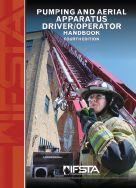


IFSTA’s Pumping and Aerial Apparatus Driver/Operator Handbook, 4th Edition, is a comprehensive source for fire service driver/operator training content. With a focus on safety and efficiency, it encompasses everything needed to educate personnel who are responsible for operating all types of fire department apparatus. This manual aids driver/operators in meeting the job performance requirements (JPRs) in NFPA 1010, Standard on Professional Qualifications for Firefighters, 2024 Edition. This new edition focuses on the knowledge and skills necessary to safely operate different types of fire department apparatus, addresses visual/operational checks and proper maintenance, as well as pumping apparatus, with content on general principles of pump operations, pressure calculations, flow rates, and fireground operations. Aerial apparatus is addressed with content on properly positioning, stabilizing, and operating the apparatus. The edition also covers fireground strategies and tactics for aerial devices.
$150.70 | Item 36630
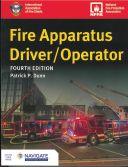
Brought to you in partnership with the National Fire Protection Association (NFPA) and the International Association of Fire Chiefs (IAFC), Fire Apparatus Driver/Operator, Fourth Edition is a complete print and digital training solution that addresses preventive maintenance, pump operations, safe driving techniques, tiller and aerial apparatus operations, and mobile water supply considerations. From basic apparatus maintenance to fire pump theory to advanced hydraulic calculations, this single manual covers everything a fire service driver/operator needs to know. This edition meets and exceeds the job performance requirements (JPRs) Chapters 11: Apparatus-General Requirements (NFPA 1002), 12: Apparatus-Pumper (NFPA 1002), 13: Apparatus-Aerial Device (NFPA 1002), 14: Apparatus-Tiller (NFPA 1002), and 17: Apparatus-Mobile Water Supply (NFPA 1002) of the 2024 Edition of NFPA 1010.
$142.45 | Item 1284286519
TECH TALK
By Chris Dennis
Well, the holiday season is in the air, wishes of nothing but health and happiness for the future. Recently, I have found myself looking the through the eyes of a seasoned person. One of the things I see more often is the skill set of knowing the fire truck: the rig, the aerial, the tanker; the apparatus you are assigned to when you are called to duty.
When I was a volunteer firefighter, we would respond directly to station, not to the scene. Once in the station, the first officer in would know who was coming and give those personnel placement commands. Every department manages it their own way, I am sure. In a full-time environment, such as the city of Vaughan, every firefighter hired must have a DZ licence. This shows the hiring fire department that the new hire knows the basics of at least air brakes and something bigger than a Prius or pickup truck. Eventually, every firefighter hired will be driving. However, they are not in that seat util they have performed a number of tasks. These are all in the form as sign-offs. The Training Division has certified MTO driving instructors. The training they provide, as well as input from the Mechanical Division, prepares the new driver for driving.
Firefighters are every Mechanical Division’s boots on the ground. But if they are not trained on how you want the trucks to be driven or checked, then the fire department must depend on an outside repair facility. You can have knowledgeable firefighters or wait until it breaks then address it. I have seen so many videos on firefighterclosecalls. com and other social media, and I often wonder how the department’s chief can allow the trucks to be driven like that. Consider the rate of speed the truck is responding at, lights and siren blaring down a residential or downtown street. There is a lot of faith and trust being put into the citizen to stay put or move
RIGHT Every truck should have a notebook or logbook that can be used as a check list that acts as a the day-to-day record management system for driver and truck.
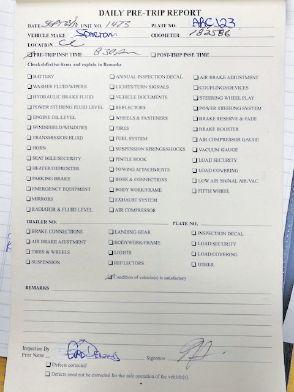
over, and equal faith in knowing that the truck was inspected prior to the call with good brakes, tires and steering by the driver. The driver is responsible, so they better do a truck check correctly before they hammer down and figure it’s going to stop when they want it to.

With the advancement of technology that is being added to the rigs, the chance of forgetting or being unsure how to operate a part on the truck should be taken into consideration.
This article is going to speak to the driver safety. Once the driver safety is acknowledged, then the worry of who is beside or behind the driver is secondary. This is because the driver has been engaged and understands their role.
Accidents, just as the word says, are not intentional. There are going to be accidents, avoidable and unavoidable. When we respond exceeding the speed limit twice over or more, we are setting ourselves up for failure.
The bright lights, bright paint and sirens blaring does not necessarily advise the driver in the vehicles ahead that we are driving through red lights and traveling at much higher speeds. Next time you respond with two trucks do your own test. One truck follows the rules of the road as posted as well as stopping for every red light or traffic signal, then proceeds with caution. The other truck does the opposite — with caution, please. It has been proven that the fire truck engineer or driver
operating the rules of the road rig will arrive within 30 to 60 seconds after the truck who operated under their own driving rules. Just because they are big and shiny with loud lights and sounds does not make them visible. I have seen many studies done on lights, paint colour, sounds, dimming features, and reflective graphics, but really it all comes back to the driver and level of driver training they have had.
How many firefighter drivers have you come across where the biggest thing they drove was a small car and they are now driving over 40,000 lbs of moving metal and expect it to react the same as car? Let’s take these drivers and train them not only to be the best firefighter they can be but the best firefighter driver as well. It starts with truck checks. If you’re not doing it, this is a must. If you are unsure if there is a correct way or a wrong way, I am going to help with that.
The first step is to have a procedure. If unsure, no matter what province you are in, contact your local Ministry of Transport office (MTO) or search online for a Schedule 1 truck inspection. Unlike the over the road highway truck, we in the fire service are not mandated to carry a logbook. However, every truck should have a notebook in it, or the actual logbook. This checklist can then be the day-to-day record management system for driver and truck. Every driver should be reevaluated on the truck check process annually. Having this logbook in the truck will assist if something unforeseen such as an accident should occur.
The firefighter required an air brake endorsement to get on the job as well a designated heavy truck certificate of some kind based on the province. Volunteer departments like the one I was on followed these processes to make sure nothing is forgotten. Like
By Chris Dennis
training to cut off a roof, venting a building or upgrading your medical skills, the driver should also be updated and tested on their ability to operate the rigs correctly and safely.
I feel there is something to be said about a dedicated driver-chauffer-engineer, and I am sure some departments do that. I can only speak of my own at this time, that when you’re hired, you will be driving. I see some fault in that. If you drive the same car all the time you know when something is not the same or correct. This holds true with the firefighter driver as well. The 24-hour shift puts the driver in the seat for seven days or less out of the month. In those seven days, they may be rotated out so the driver may only be behind the wheel a couple of times. If your department is like this, a driver refresher or a monthly driver training drill or road test should be done.
If we get a report that the truck has an audible air leak, this is an automatic out-of-service threshold until inspected. This is not just for fire department, but any over the road vehicle with air brakes in Canada. Once established or isolated, the driver who has an air brake endorsement should know what he or she is looking at and determine if the truck is in or out of service. They did the air brakes course. You’re not a mechanic, you’re a truck driver, and under the Highway Traffic Act you should be trained. A refresher will plant that seed a bit deeper. Should there ever be an accident investigation and the training records show consistent driver training and a reevaluation timeline
(yearly, bi-monthly, etc.), odds are it will be to your benefit as a department because the driver knows and is re-trained, just like operations.
There is another side to driver training. With the advancement of technology that is being added to the rigs, the chance of forgetting or being unsure how to operate a part on the truck should be taken into consideration. In this case, standardizing the fleet would help. Shift change firefighters and volunteer departments can see several different trucks to drive with things as simple as creature comforts in different places. Pump shift control locations, siren control location, air horns, air brake release, simple seat set up, can prove to be challenging. Now add environmentally friendly green eco hybrid systems, electric fire trucks, Sam pump panel control systems , a tablet, V-max controls and then the pucker factor when responding, are all a task on the driver they must be ready for and understand.
Requalify your drivers at least two times a year — a full sign-off. The cost of an electronic Ramco mirror is $1500. Knowing how wide your truck is as and feeling how wide your truck is will tell you if you make it between these two vehicles without concern. With the high cost of repairs and downtime, a $1500 mirror matters. Spend more time behind the wheel and test your drivers more often. The cost saving in vehicle repairs or avoiding a possible accident is well worth it.
Well, that’s it for now. Season’s Greetings everyone! Thanks for good year. Rubber side down my friends.





By Tom DeSorcy, Ret. Fire Chief, Hope, B.C.
Tom DeSorcy joined the fire service in 1983 and became the first paid firefighter in his hometown of Hope, B.C., when he became fire chief in 2000, retiring in 2023. E-mail Tom at tdesorcy@telus.net media.
As a volunteer firefighter, you can be focused on one thing in your life, only to be interrupted, shift gears, and hit the ground running like an uncoiled spring jumping into action. It’s a hallmark of what we do in the fire service. Play the game under extreme pressure only to try and shut it off to go back to what we think is normal. To do this and perform at your best, we’re no different than a professional athlete needing to step up under extreme and daunting circumstances to win or simply not to lose.
Readers of this column are used to my analogies, and this is no exception. If you’re like me and a follower of sports in particular, you’ve likely heard the phrase “ice in your veins.” Does it sound familiar? It refers to a player that’s standing over a championship putt for example, or the field goal kicker that stares down the uprights facing a game winning kick. You can name the sport and you’ll find a player that faces a stressful situation.
So where does the ice reference come from? Is it simply a reference to being cool under pressure? Ice doesn’t last forever — it melts. As it gets hotter it melts faster and how do you develop and replace what you use? Still, the ice reference makes me wonder if there is a correlation between mental health and remaining cool in the moment? And how do you save that cool to draw upon it when you
need it?
Most of us are familiar with the comparison of mental well-being to that of wearing a backpack. In times of stress or trauma, you add another rock to your backpack. Every new stressor adds another rock. Another challenge increases the load. The more you add, the more the load accumulates, and, if you fail to remove any, you can become overwhelmed. A common response is to constantly empty the backpack and lighten the load to try and maintain a balance but is there something else?
Let’s shift gears and consider an ice maker in a fridge. That’s right, take off the backpack and turn to the freezer. The ice maker has a container or hopper that maintains a supply. Opposite from the backpack, there will be a supply to draw from, to replenish the ice that was in your veins so to speak. Under stress the ice maintains your cool until it melts and needs to be replenished. However, even in times of extreme need, it needs time to recover. The faster it melts the quicker it needs to be replaced. We are no different in this regard.
Imagine the ice you need to maintain your stress levels. There will be times when things start to heat up, and you’ll eventually run out, leading to overheating and a longer time to replenish and recover. This analogy serves as a compelling metaphor for maintaining our mental well-being and managing stress effectively.
Just as an ice maker constantly replenishes its supply, we must find ways to restore our mental resources to stay resilient in the face of challenges.
Consider activities that promote relaxation and rejuvenation, such as meditation, exercise, and hobbies that can act as mental refrigeration, keeping your stress levels manageable. Just as an ice maker needs a steady supply of water to produce ice, individuals require a network of supportive relationships to sustain their mental well-being. Leaning on friends, family, and your team in the fire department during stressful times can provide that much-needed emotional replenishment.
The world is ever-changing and the volunteer fire service is no exception. Both leaders and firefighters must be prepared to evolve with it. Do what you can to stay informed and open to new ideas. This will better anticipate challenges and respond to them with a cool head. Being able to adapt and adjust keeps your mental ice from melting under pressure.
This takes us back to the discussion of regular maintenance. Like the backpack removing the rocks is the analogy to maintaining control. Just like any other machine, our mental ice maker requires regular maintenance. This means recognizing the signs of stress and taking proactive steps to address them before they become overwhelming. Regular
mental health check-ins, professional counseling, and mindfulness practices can all contribute to keeping your mental ice maker in top condition.
Furthermore, understanding your limits and setting boundaries is key. Overworking and constant exposure to high-stress environments can deplete your mental ice reserves. Your ice machine simply won’t be able to keep pace. It’s important to take breaks and ensure you’re not overextending yourself, allowing your mental ice to replenish.
The analogy of ice in your veins is far from clinical but if it forces us to put things into perspective, then it fits the bill. Clearly, having ice in your veins is an invaluable asset for crisis situations. It allows for clear, decisive action in the face of uncertainty, inspiring confidence and trust among your team. As we continue to face often unprecedented challenges and situations where we need to remain composed under pressure, the need for those who can stay cool has never been greater.
Many will cultivate this trait, thus being better able to navigate crises effectively and perform under pressure. We can certainly count on things around the fire hall to heat up and the pressures of life outside of the department don’t help any. Understand that the ice will melt. It’s how we go about replenishing and replacing it that makes all the difference.