





WE INNOVATE EVERY DAY. e-one.com
WE INNOVATE EVERY DAY. e-one.com

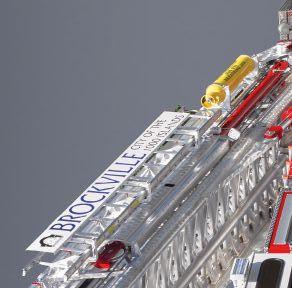
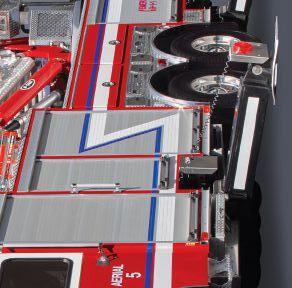
The E-ONE HP 100 Platform looks like a rock solid beast. And it acts like one too. This aerial, with a 2.5 to 1 structural safety factor is 25% stronger than NFPA requires. But this rig isn’t just a powerhouse, it’s also versatile. With crisscross under-slung outriggers that deploy to a tight 15’6” spread, the HP 100 Platform can go where other aerials can’t. Whatever the job calls for, the E-ONE HP 100 Platform is up to the task!
For more info, please visit: e-one-aerials.com/hp-100-platform-truck


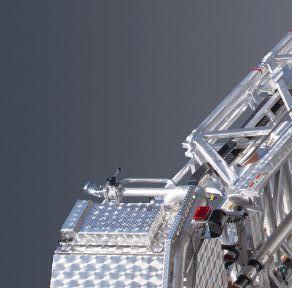

2.5 TO 1 STRUCTURAL SAFETY FACTOR CRISSCROSS UNDER-SLUNG OUTRIGGERS DEPLOY IN UNDER 45 SECONDS







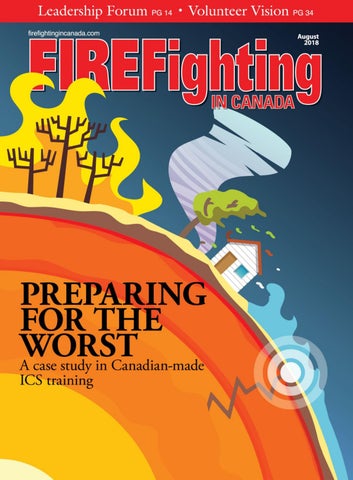
When it comes to responding to emergencies such as fires, floods, earthquakes and others, the more individuals trained on Incident Command System (ICS) response the better. An Edmonton training academy has put forward ICS Canada position-specific courses.
In the final installment of a fivepart series looking at Oak Bay fire Department’s holistic health and wellness program, Sara Wegwitz, RN, and Fire Chief Dave Cockle share strategies on how to sustain a program once it has been established.
26
Not too many departments get the chance to work with air ambulance very often, so when they do it is often a new thing for them. Firefighter Mark van der Feyst shares what he says is the safest way to carry yourself around a helicopter in an emergency situation.

BY LAURA AIKEN Editor laiken@annexbusinessmedia.com
ime passes, but where does it go? This element is a much pondered but muddily understood concept. And yet, everything is about time; the time it takes to arrive on scene, to suppress the fire, to save a life. The time you work, the time you play. Time far surpasses money on the wish list of that for which we want more; at least for many of us in the West. Unlike money, we can never earn more time and we never know how much of it we ultimately have.
Time is on my mind a lot these days, as I write this in mid-June preparing to go on maternity leave in early July. Our associate editor Jayson Koblun is the best initial point of contact until the interim editor is transitioned in. He can be reached at jkoblun@annexbusinessmedia. com or 519-410-0600.










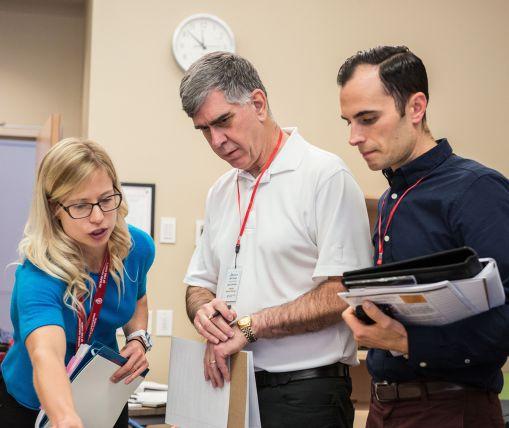
Knowing how to respond to an incident or emergency is key.
See how an Edmonton incident management team took measures to meet ICS standards. Story on page 10.
I will be returning in July 2019 and look forward to re-joining the team at Fire Fighting in Canada and reconnecting with you, our audience. A year sounds long or fast, depending on your stage of life (why do the years go faster as we age?). This is my third child and I know how speedy a maternity leave flies while you attempt to savour all the rapidly changing days of life with young children and babies.
Thus far, I haven’t said anything particularly revelatory about time. Let me make an attempt here. We are all aware that we feel time in different ways, depending on what we are doing. But why? Author Marc Wittmann looks for potential answers in his book Felt Time, published in 2017. Of
particular interest to the fire service, he discusses the slow-motion effect, where people in dangerous situations describe the strange way that events seem to unfold at a lessened pace that seemed to allow for greater reaction time. Researchers are trying various experiments to prove this slow-motion perception using tactics that try to replicate the excitability of danger in a lab setting. The theory that most seem to be hinging on suggests that when in events of extreme adrenaline, your brain processes speed up with the rest of your body, which perceptually translates to a slower experience of time. One experiment suggested that the brain does not speed up, but rather it is hindsight in explanation that people tend to overestimate the duration of the event. Wittmann notes that a number of lab tests have proved the existence of over-evaluation, where highly emotional images are rated as lasting longer when appeared to the viewer than they actually do. Objections have been raised to some of the testing conditions in the search for the rhythm of the brain generally, so it remains unclear whether the brain actually speeds up or not, but it is clearly a fascinating area of research for first responders who regularly experience an adrenaline rush.

ESTABLISHED 1957 AUGUST 2018 VOL. 62 NO. 5
EDITOR LAURA AIKEN laiken@annexbusinessmedia.com 416-522-1595
ASSOCIATE EDITOR JAYSON KOBLUN jkoblun@annexbusinessmedia.com 519-410-0600
ASSOCIATE PUBLISHER ADAM SZPAKOWSKI aszpakowski@annexbusinessmedia.com 289-221-6605
SALES KORY PEARN kpearn@annexweb.com 519-902-8574
ACCOUNT COORDINATOR WENDY SERRAO wserrao@annexbusinessmedia.com 416-510-5232
MEDIA DESIGNER EMILY SUN esun@annexweb.com
GROUP PUBLISHER MARTIN MCANULTY fire@annexbusinessmedia.com
PRESIDENT & CEO MIKE FREDERICKS
PUBLICATION MAIL AGREEMENT #40065710 RETURN UNDELIVERABLE CANADIAN ADDRESSES TO CIRCULATION DEPT.
P.O. Box 530, SIMCOE, ON N3Y 4N5 e-mail: subscribe@firefightingincanada.com Printed in Canada ISSN 0015–2595
CIRCULATION e-mail: bolechnowicz@annexbusinessmedia.com
Tel: 416-442-5600 ext. 3543 Fax: 416-510-6875 or 416-442-2191
Mail: 111 Gordon Baker Rd., Suite 400, Toronto, ON M2H 3R1
SUBSCRIPTION RATES
Canada – 1 Year - $25.00
(GST - #867172652RT0001) USA – 1 Year $44.00 USD
Annex Privacy Officer Privacy@annexbusinessmedia.com Tel: 800-668-2374
Occasionally, Fire Fighting in Canada will mail information on behalf of industry-related groups whose products and services we believe may be of interest to you. If you prefer not to receive this information, please contact our circulation department in any of the four ways listed above.
No part of the editorial content of this publication may be reprinted without the publisher’s written permission ©2018 Annex Publishing and Printing Inc. All rights reserved. Opinions expressed in this magazine are not necessarily those of the editor or the publisher. No liability is assumed for errors or omissions.
All advertising is subject to the publisher’s approval. Such approval does not imply any endorsement of the products or services advertised. Publisher reserves the right to refuse advertising that does not meet the standards of the publication. www.firefightingincanada.com @fireincanada












Access basket from the ground with aerial fully retracted and only a 20’







Toronto Fire Services says two companies that provide fire inspection services in the city are facing charges under the Ontario Fire Code for allegedly failing to inspect, test and repair fire systems when they were contracted to do so.
In a news conference on May 31, 2018, deputy fire chief Jim Jessop said the charges relate to alleged violations at a commercial building and two condominiums.
Jessop says Toronto Fire Services learned of the alleged violations about a year ago when conducting routine inspections at the buildings, adding that the investigation was the most “laborious” he has ever been involved in.
He says investigators are confident that the building owners hired the companies “with the best of intentions” and were unaware that the fire systems were not being properly serviced.
Fire inspectors have been working with the owners of affected buildings, he says, to make sure there are no fire risks there.
Jessop says Toronto Fire investigators are now looking into other buildings in the city where the accused companies may have been contracted.
“We are looking back as far as we can on buildings, and we are also tracing back
Promotions & appointments

After an extensive recruitment process DERYN RIZZI was announced as the new chief of Vaughan Fire and Rescue Service (VFRS) in Ontario. Chief Rizzi succeeds former fire chief Larry Bentley, who retired from VFRS in May 2018 following 38 years of

other companies that may be affiliated with these companies,” he said. “The message the chief and I want to send out today is this—we will be watching and we will be looking.”
Jessop said Toronto Fire Services does not have the authority to shutter the accused companies, even temporarily, as the investigation continues.
“All we can do is swear charges under the Ontario Fire Code,” he said, adding that the Office of the Ontario Fire Marshal
distinguished public service. Chief Rizzi will be a member of the corporation’s senior management team and serve on the Emergency Management Program Committee. Chief Rizzi is the first woman to serve as chief of VFRS. The appointment was effective June 1.

The Fredericton Fire Department in New Brunswick has appointed
has been notified.
Advanced Detection Technologies Corp. and individuals James Singer, Rauf Ahmad and Jamia Talimul have all been charged in relation to the alleged fire code violations at the commercial building 1100 Birchmount Rd.
York Fire Protection and individuals Keyong Tao Bushra Rauf, Maf-Bar Consell Ltee., Dave Daniels and Rauf Ahmad have been charged with four offences relating to alleged violations at the condominium.
DWAYNE KILLINGBECK as deputy fire chief. He began his new role on May 14, 2018. The department hired Killingbeck as a firefighter in September 1996 and he was appointed through the ranks, to lieutenant, captain, and finally, platoon captain. Killingbeck is trained in all aspects of emergency response including Fire Suppression, Motor Vehicle Extraction, Water Rescue, Ice Rescue, Medical First Responder, and Hazardous Materials and Incident Command.

DARREN MCCLELLAND has been appointed fire chief of the City of Swift Current, Sask. McClelland started his career in 1995 as an EMT with the local ambulance service and in 1997 started as an auxiliary firefighter with SCFD. In 1997 he was
Volunteer firefighters in Newfoundland and Labrador may soon be able to put a courtesy green-flashing light on their personal vehicles when responding to an emergency.
Wayne Deaves, Deputy Fire Chief for Port au Port Fire Department in N.L. said he first got the idea of starting a courtesy green light program in the province from some of the fire fighters in his department back in 2016.
“I had seen this program being utilized in other provinces, but Newfoundland didn’t have it,” said Deaves. “I started researching and decided to put a proposal to the Newfoundland Fire Association and see if we could get green lights in our

Several provinces already have a system in place which allows volunteer firefighters to attach courtesy lights to their personal vehicles and fire chiefs in Newfoundland and Labrador are seeking a program of their own.
department. They had a lot of questions—we answered them but nothing really happened until this year.”
He said it looks like thing are finally starting to move forward, although not sure how long it may take from
here on out to have the system implemented across the province.
Deaves said green courtesy lights are used by volunteer fire fighters to help them get to an emergency quicker and said the reason the system
The National Fire Protection Association released profiles on Canadian fire departments. The report includes statistics from 2014 to 2016 on the departments and firefighters as well as information on the numbers of fire stations, pumps, ladders and more that each department has access to.
• There were 152,650 career and volunteer firefighters in Canada from 2014 to 2016.
• 26,000 career firefighters in this period represent an increase of 1.8 per cent from the previous period (2013 to 2015).
• 126,650 volunteer
firefighters in this period is a decrease of 12.2 per cent from the previous period.
• Most of the career firefighters in Canada are in departments that protect communities with 50,000 or more population.
• Most of the volunteer firefighters in Canada are in departments that protect
is necessary is because the general public already knows that they have to stop and pull over for an emergency vehicle such as a fire truck, police car or ambulance. But because volunteer firefighters are using their personal vehicles, the public has no way of knowing that the driver of the vehicle behind them is responding to an emergency and they have no way to identify themselves. Implementing any form of new program has the potential to confuse the public. If approved Deaves is prepared to begin educating the community on the green light courtesy system in his department and will do what he can to help the rest of the province.
communities with fewer than 50,000 population.
• Canadian median rates for career firefighters per 1,000 people are lower than their U.S. counterparts by community size, except in the larger metropolitan fire departments where the median rates are comparable.
hired to a full-time position and was appointed deputy chief of operations in 2013. Darren has various certificates from JIBC and Dalhousie University.
The City of St. John’s has announced its new fire chief, and for the first time in the city’s history a woman will hold the position.
SHERRY COLFORD who has been with St. John’s Regional Fire Department for the last 15 years
and recently was the manager of 911 service and fire prevention for the province, took over as new fire chief on June 4, 2018.

Swift Current, Sask., Fire Chief DENIS PILON ECFO, has retired after 35 years in the fire service. He served as fire
chief in Melville, Weyburn, and Swift Current, and was an active member of the SAFC, CAFC, and IAFC serving as a director or on various committees in these associations. Denis has been a regular contributor to Fire Fighting in Canada magazine over his career.
FRED B. KENNEDY of Blackville, N.B., passed away on Friday April,
27, 2018 at the age of 75. He was a member of the Blackville Fire Department for 41 years, former chief for 34 years, past president of the New Brunswick Association of Fire Chiefs (19831985), (1997-1999) and again (20052007). He was president of the Maritime Fire Chiefs Association (1994-1996) and national president of the Canada Volunteer Fire Services Association (CVFSA) (2007-2008).
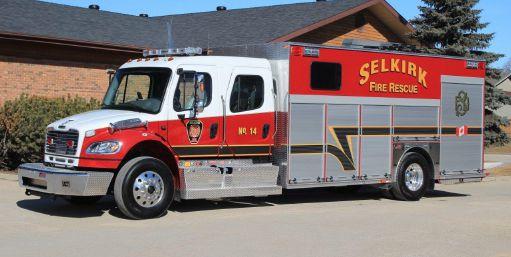
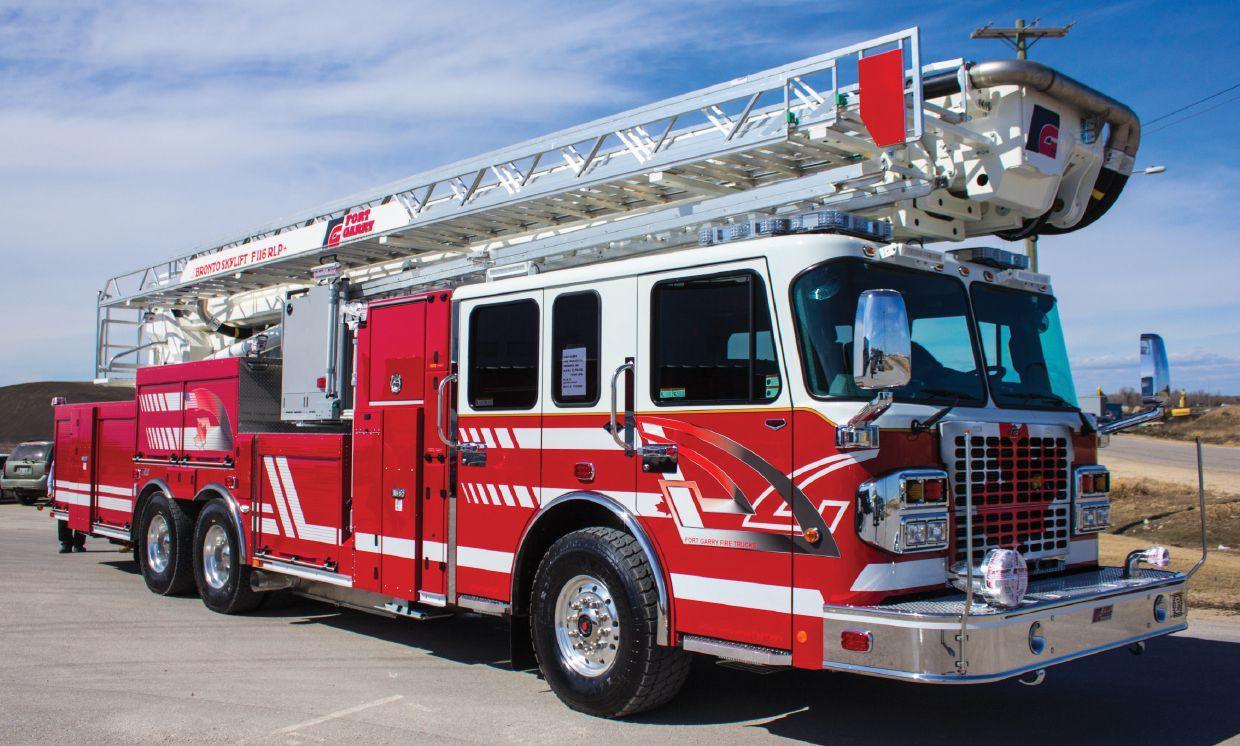
Selkirk Fire and Rescue in Manitoba recently received a new 20-foot Walk in Command Rescue truck. The vehicle sits on a Freightliner M2-106 chassis and has four doors. It has a Cummins L9 300-hp engine and an Allison 3000E VS transmission. It is made out of 5083 salt water grade aluminum and comes with a Whelen Emergency and Zone Defence back up camera with side cameras. It also comes with a Pac Track mounting system, SlideMaster tip down and pull out trays and more.
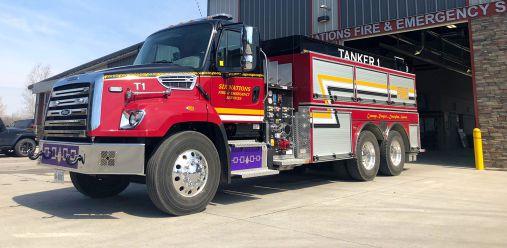
Six Nations Fire Department on the Six Nations of the Grand River Territory in Ontario received a new tanker at the end of April. The new 2017 Pierce FXP 3000 Gallon Freightliner went into service in the middle of May after the team had been trained to operate it. The purple Hiawatha belt represents the nations of their Confederacy and their agreement to live together in peace.
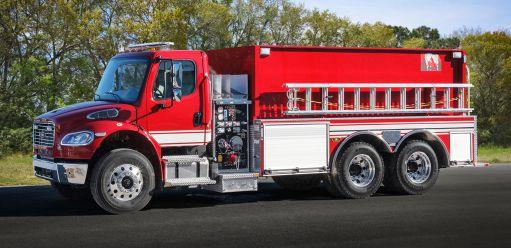
fire department in
took delivery of a
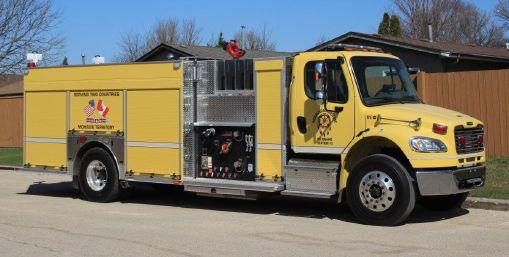
Akwesasne Fire Department in Quebec took delivery of a new Pumper ER from Fort Garry Fire Trucks. The pumper is built on a Freightliner M2 106 chassis and has a Cummins L9 350-hp engine with an Allison 3000 EVS transmission. It is made out of 5083 salt water marine grade aluminum. The tank material is polypropylene and has an 800 Ig tank. Its foam type is Foam Pro 2001–Class A and the colour of the truck is yellow. The truck also features Amdor roll up doors and a TFT Crossfire monitor.
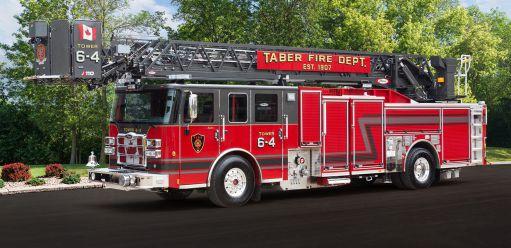
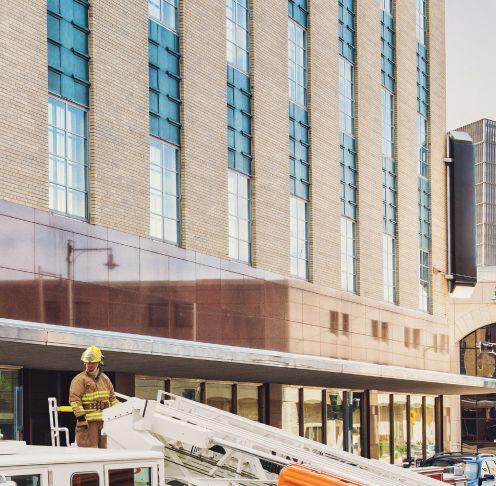
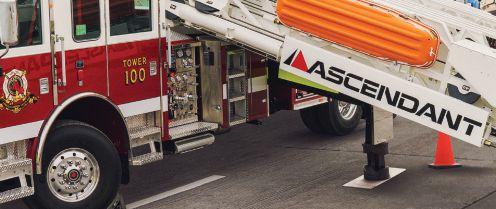
A new unit was delivered to Taber Fire Department in Alberta earlier this year. The unit is from Pierce MFG and sits on an Enforcer chassis and has a 110’ Ascendant Heavy-Duty Platform body. It has a Pierce PUC 1500 gpm pump and has a Husky 3 foam system. It also features a 500-gallon tank, Harrison Hydraulic generator and 450 hp.
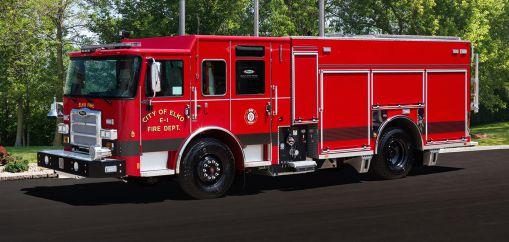
Elko City Fire Department in the Northwest Territories received delivery of a new Pumper from Pierce MFG. The pumper sits on an Enforcer chassis and has a Cummins L9 engine with 450 hp. It has a Husky 3 foam system and a Pierce PUC pump as well as 1500 gpm and a 500gallon tank.

BY SHAYNE MINTZ NFPA Canadian regional director
his past June 14 marked the first anniversary of the Grenfell Tower fire in London, England, that blaze was one of the most tragic fires in the history of the modern United Kingdom. Seventy-two people died and more than 70 were injured.
Since the 1980s, innovative exterior wall facade systems have been developed to enhance building appearance and improve overall performance. In recent times, an increasing number of fast-moving fires involving combustible exterior cladding have occurred on high-rise buildings, including structures in Dubai, UAE, Shanghai, France, Korea and the U.S.
With an ever-aging building stock and the constant pursuit of innovative designs, there will be more and more of these types of retrofit exterior cladding applications found or being considered. As ever, vigilance is needed on the part of fire authorities to avoid falling victim to contractors or building owners who may or may not knowingly try to cut corners (and costs) to be more competitive.
In response, the National Fire Protection Association (NFPA) and the Fire Protection and Research Foundation (FPRF) have created a report titled “Fire Hazards of Exterior Wall Assemblies Containing Combustible Components”. To go even further the NFPA has established a website dedicated to sharing information that will increase awareness about these hazards and the codes that may address them. The latest research and reports that relate to these topics are posted at www.nfpa.org/exteriorwalls.
The research and the resources derived from the report are intended to help building owners and enforcement authorities assess the fire risk of existing high-rise buildings, as well as identify what fire test procedures apply when designing new buildings.
The tool details how AHJs can conduct initial fire risk assessments and identify buildings that should have the highest priority for remediation and follow-up inspection. In addition the tool is also designed to help architects and engineers identify what fire test procedures are mandated when new wall systems or assemblies are being designed. In essence it serves as a means of decoding exterior wall requirements. It helps navigate the code requirements that apply to exterior walls containing combustible components and it also helps determine when those requirements require testing to whichever code or standard that applies to the local jurisdiction. In Canada the national model building code refers to CAN/ULC-S134, “Fire Test of Exterior Wall Assemblies” as the accepted test method.
There are however some limitations – it evaluates a building on its completed state and not on components of it. The tool does not address ‘temporary risks’ that may arise as a result of construction work or partial completion and occupation, and in the interest of fire and life safety it is considered to be conservative and widely applicable.
The methodology used in the EFFECT tool relies on a two-tier process. Tier 1, basically consists of a desktop study of a communities
The methodology used in the Exterior Facade Fire Evaluation and Comparison Tool relies on a two-tier process. ‘‘ ’’
NFPA has also created a free, interactive tool to help navigate the code requirements that apply to exterior walls of high-rise buildings with combustible components. The tool, named the Exterior Facade Fire Evaluation & Comparison Tool (EFFECT), takes into account both existing and new structures and is intended to help building owners, facility managers, and authorities having jurisdiction (AHJ) identify, evaluate, and address hazards in high-rise buildings under retrofit that may have combustible exterior wall components.
Shayne Mintz has more than 35 years of experience in the fire service, having completed his career as chief of the Burlington Fire Department in Ontario. He is now the Canadian regional director for the National Fire Protection Association (NFPA). Contact Shayne at canada@nfpa.org, and follow him on Twitter at @ShayneMintz
portfolio of building stock to establish a priority ranking for further assessment. Tier 2 undertakes a more detailed assessment based on the outcomes and ranking of tier 1. In this step such details consider the need for on-site inspections, review of ‘as built’ information, building maintenance records and evidence gathering that all component materials are tested as ‘assemblies’ and not as separate elements.
By going through a series of questions related to the exterior condition of a building; a profile of the building stock will emerge. The general outcomes from this profile will be, a building is compliant and no further action is required, mitigation or remediation measures are needed, or, a detailed assessment by a qualified team of facade and fire engineers is required.
For more information on the EFFECT tool and the research and methodology behind the system, contact me at Canada@nfpa.org or visit www.nfpa.org/exteriorwalls, and check it out.
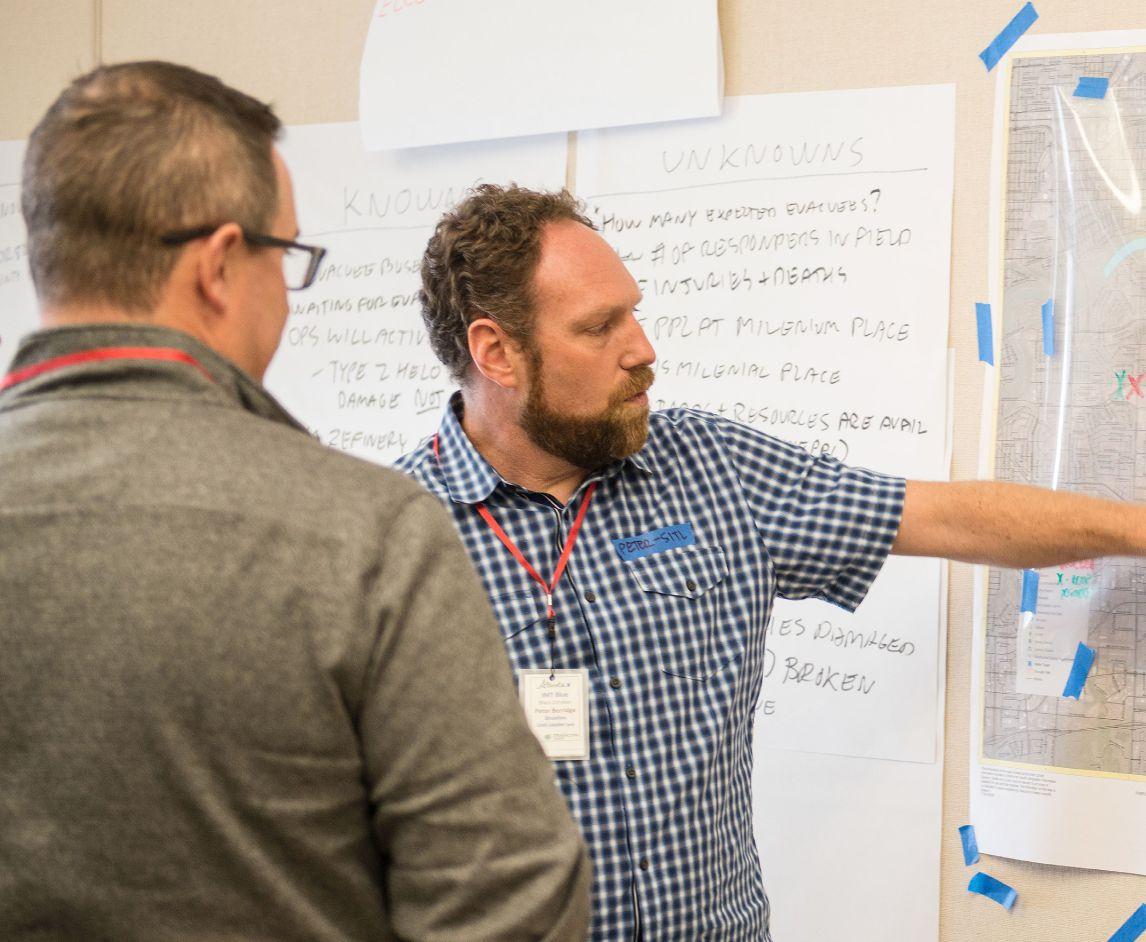
A training academy in Alberta has put forward Incident Command System (ICS) Canada position-specific courses.
By JASON GREIDANUS
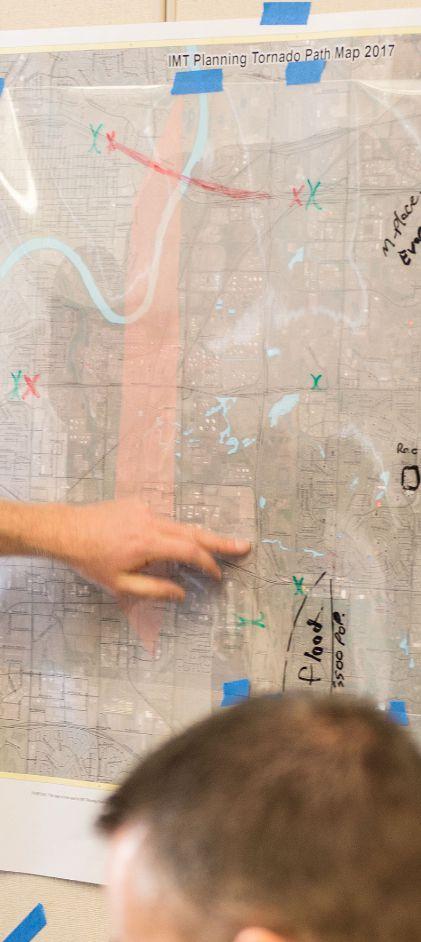
Imagine a remote, medium-sized city in a forested region in Canada. It’s only late April and you’re well into a dry, hot fire season. Coupled with a mild winter that saw little precipitation, and you’re already dealing with a number of small fires within your vast fire service area.
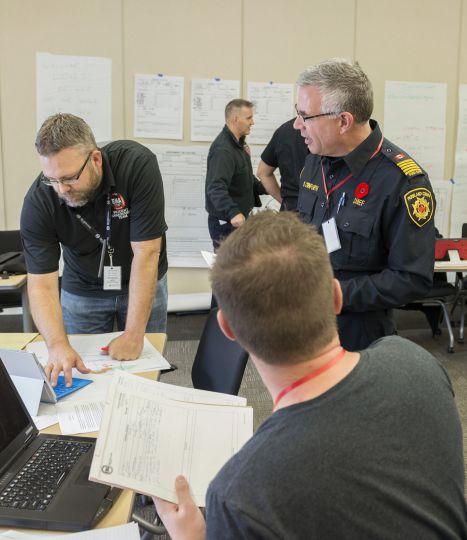
LEFT Maintaining a common understanding of the current situation can be done through traditional maps, diagrams, and technologies like GIS.
ABOVE Collaboration is key with people trained and knowledgeable in clearly defined roles.
Before you know it, one of those fires has turned into the Big One, and your Emergency Operations Center (EOC) has stood up to manage fire response operations and evacuation of the population. Too late you’ve realized that your team hasn’t had enough training or experience to manage the scope of these problems, and the call out to your neighbouring municipalities has yielded some people with Incident Command System (ICS) training but little experience in the EOC support functions. Added to that is the fact that these well-intentioned responders have never worked together as a cohesive team before; in fact, most of these people are just meeting each other for the first time. Not a hard stretch of the imagination, considering the magnitude and frequency of weather-related disasters in Canada recently. The size and severity of winter storms, wildfires and flooding impacting regions rather than individual communities, has stretched the abilities of organizations to respond quickly and appropriately. Regional response at an EOC level with multiple agencies working together is becoming the norm. While higher levels of ICS training and experience (up to the 400 level), are becoming more common in Canada and encouraging agencies to become interoperable in these situations, there’s still a gap when it comes to ICS position-specific training and working together as a cohesive team in an EOC.
Experiences in Slave Lake wildfire (2011), High River flood (2013), and the Regional Municipality of Wood Buffalo wildfire (2016) brought the reality home, shaping the discussions between the
Alberta Emergency Management Agency (AEMA) and municipalities within the province. The specialized municipality of Strathcona County, situated just east of Edmonton, contributed members of an Incident Management Team (IMT) to all three of those events and learned firsthand the need for training and experience prior to large-scale disasters. Unfortunately, the only option was sending people to the United States for ICS position-specific training, which was cost-prohibitive and resulted in only small numbers of qualified staff. The need for a “made-in-Canada” solution was becoming more and more evident.
In 2017, thanks to a partnership between AEMA and Strathcona County, the Edmonton-region hosted the first Incident Management Team Academy of its kind in Alberta. The concept was simple: offer a number of ICS position-specific courses such as Planning Section Chief, Logistics Section Chief, Finance/Admin Section Chief, Resource Unit Leader, and Situation Unit Leader courses, combined with a capstone exercise at the end to practice the skills, all meeting ICS Canada curriculum standards.
AEMA grant funding and support was key to putting this event on, as was Northern Alberta Institute of Technology (NAIT) resource support from EM diploma students helping to conduct the exercise, ICS Canada for developing the curriculum for the courses in time for the event, and staff from across Strathcona County who helped plan and execute the Academy.
It seemed fitting that the approach to planning this week-long ICS training should align with ICS principles, and so the whole event was put together through the use of ICS. An assembled team of ICS-trained staff, over the course of the year leading up to the Academy, developed priorities, problems, objectives, strategies, and tactics. Operational periods of several weeks were designated in order to achieve the planning milestones necessary to organize the courses, catering, accommodation, instructors, and tuition fees. These plans were captured ultimately in Incident Action Plans (IAPs) that directed the staff and students throughout the event.
ICS Canada played a big role in ensuring that the curriculum for the five courses was approved in time for the event, but that left the question of finding qualified, experienced instructors to deliver the content.
Finding 10 instructors that were qualified to teach the five courses and had experience with an IMT Academy-type event was challenging to say the least. To answer this need we turned to our partners in the United States, namely the Utah Department of Public Safety, which had previously run a number of these events. Through them we arranged to have a cadre of instructors join us to teach the material.
The instructor team from Emergency Training Group (ETG) based in Utah demonstrated this experience in a number of ways; not least of which by having a scenario developed for the students to apply to the classroom material. To reinforce the Planning P process, students led the meetings and briefings in the daily operational routine, such as the command, planning, and tactics meetings, plus giving the operational period briefing at the end of each day. In the classroom, the instructor team brought firsthand experience with ICS as applied in a number of high-profile US-based disasters. It can’t be emphasized enough how the instructors from ETG contributed to the success of the event.
The daily IAP and reinforcement of the
Planning P across the courses left students well-prepared for the capstone exercise on the final day. The scenario was built around the 1987 Edmonton tornado, including current development and infrastructure, which resulted in far more significant impacts to communities in its path. The students were divided into four Type 2 IMTs of approximately 25 members each and placed in the roles they had learned that week, augmented by EM practitioners from across the region to round out the teams. In addition to the Command and General Staff ICS positions, there were Emergency Social Services (ESS) representatives placed into the Operations Section in order to focus the efforts on human impacts.
The scenario commenced with an Agency Brief given by the Authority Having Jurisdiction, outlining the expectations of the team. The teams then split off into their respective spaces to commence the Planning P and IAP creation. In order to simulate the concept of an IMT giving EOC support to a jurisdiction affected by disaster, the EOCs were simply classrooms in the local community centre. The IMTs had to apply ICS principles using materials, forms, and a space
that they could acquire on short notice, much like an EOC in a disaster zone might need to do after relocation.
The exercise director ran the scenario with the assistance of the NAIT EM diploma students in a simulation cell, with the instructors offering coaching and mentoring to the IMTs. At the end of a busy day each team had created an IAP for directing operations on the following day, the students had gained an appreciation of how to support an EOC using the IAP and ICS principles.
For the first time in Alberta, a training academy had brought together ICS Canada position-specific courses, culminating in a capstone exercise, focusing on inter-organization collaboration. There is now a viable network of qualified and experienced emergency management professionals that can more effectively come together as an IMT during any regional disaster.
Jason Greidanus is the deputy director of Emergency Management for Strathcona County, Alta. He is also a program advisor to the Northern Alberta Institute of Technology IMT Academy taking place in Edmonton from Nov. 5-9, 2018.
Through the International Association of Fire Fighters’ Canadian Haz-Mat and CBRNE Training Initiative
Your department can receive a recognized level of Haz-Mat and CBRNE response training using the IAFF curriculum thanks to funding from the Government of Canada
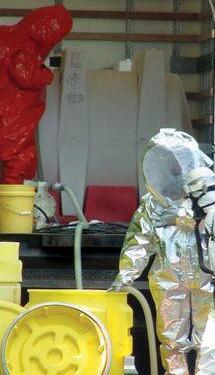
For information about how to receive free Haz-Mat and CBRNE Training through the IAFF, e-mail canada@iaff.org
Par l’entremise de l’initiative de formation en matières dangereuses et CBRNE de l’Association internationale des pompiers
Votre ser vice de protection incendie peut recevoir de la formation à un niveau reconnu en matières dangereuses et CBRNE grâce au curriculum de l’Association internationale des pompiers et un financement du gouvernement du Canada
Pour savoir comment recevoir de la formation gratuite en matières dangereuses et CBRNE par l’entremise de l’Association internationale des pompiers, écrivez-nous au canada@iaff.org
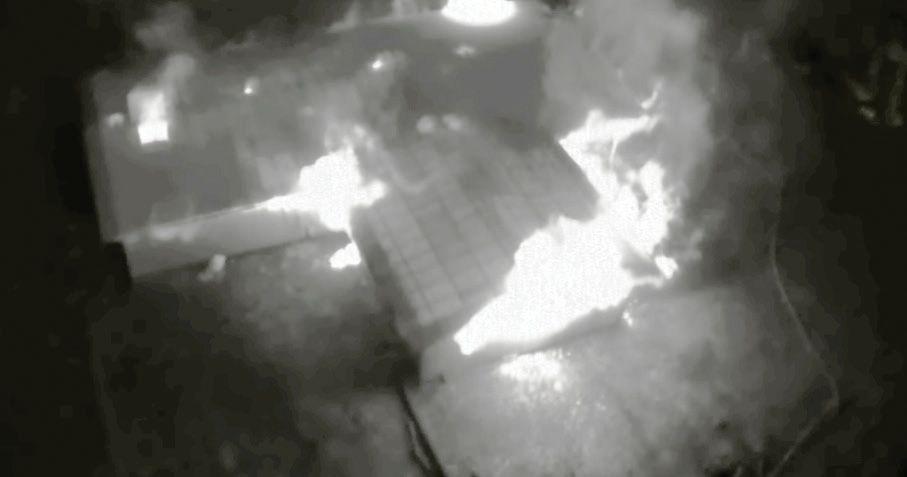
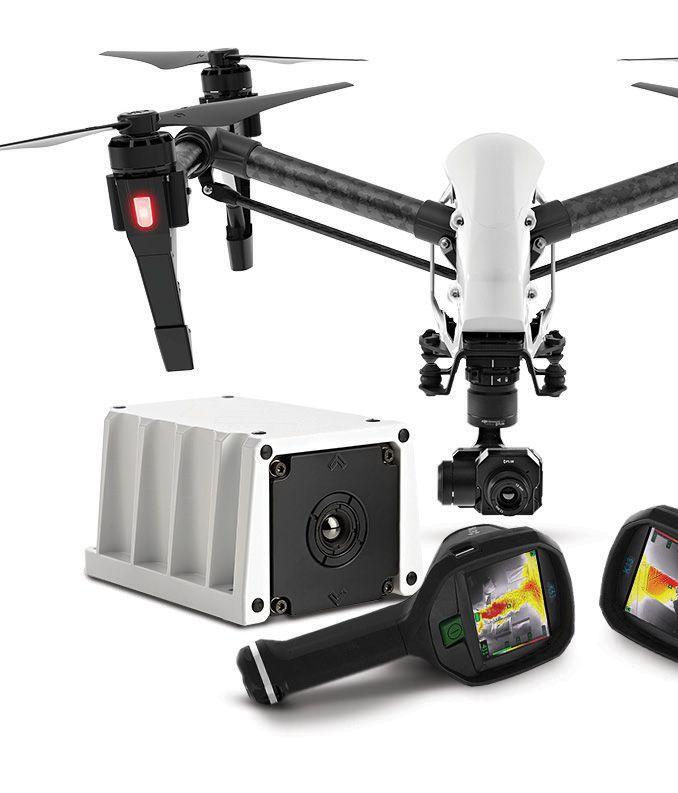
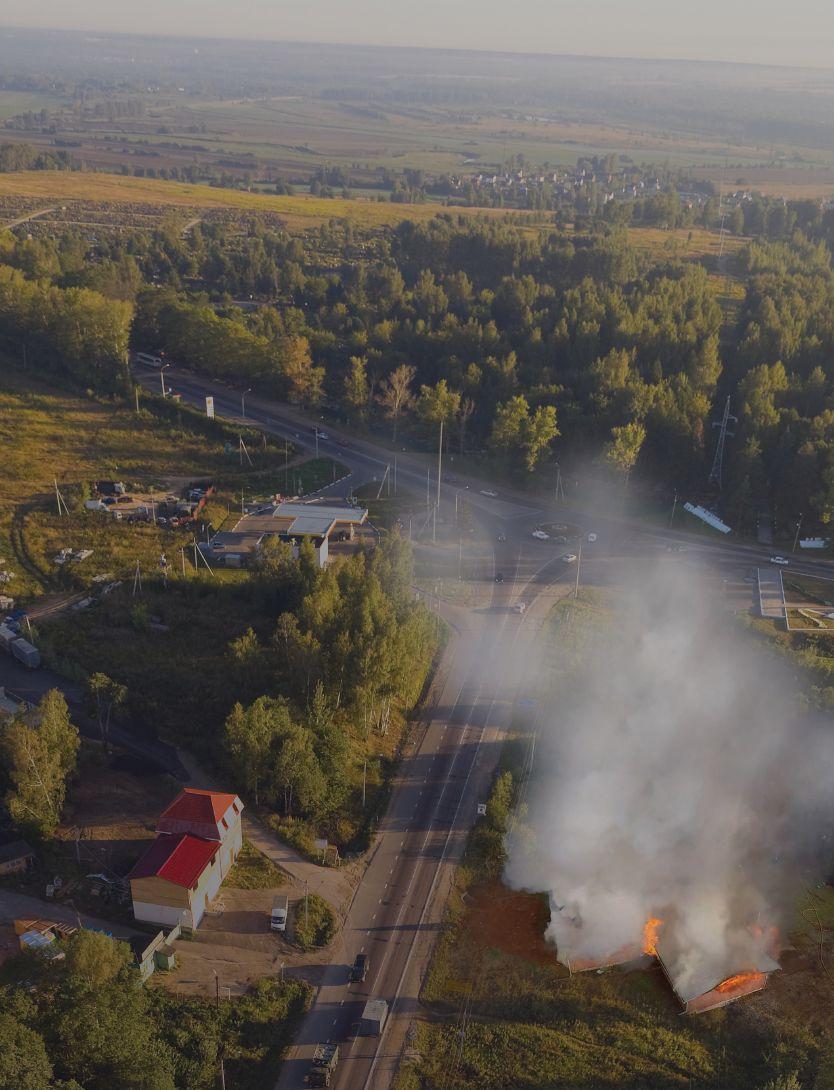
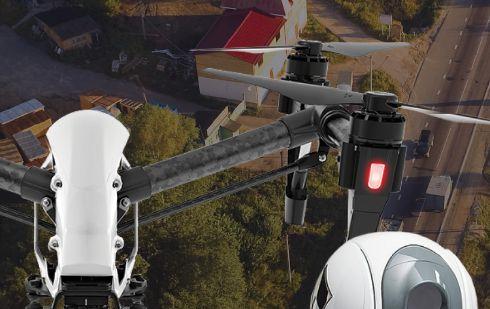
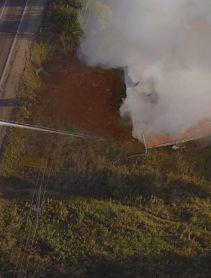
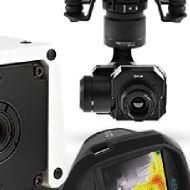
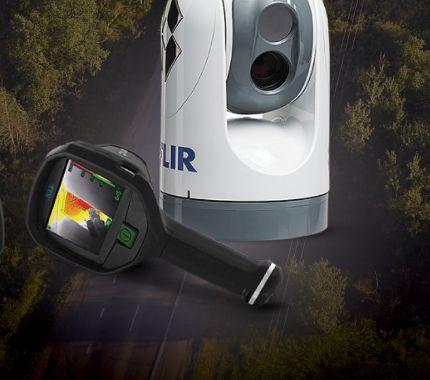
FLIR’s wide range of TICs can help you identify hot spots from a variety of distances – making safety the top priority. Learn more at FLIR.c /fire
GOT YOUR BACK. .








®




FEATURED PRODUCTS:
· FLIR K2 THERMAL IMAGING CAMERA
· FLIR K33 & 53 THERMAL IMAGING CAMERA
· FLIR KF6 AERIAL APPARATUS FIXEDMOUNTED THERMAL IMAGING CAMERAS
· FLIR M-SERIES PAN-TILT-ZOOM TICs FOR ARFF, HAZMAT & ALL EMERGENCY VEHICLES
· FLIR AERIAL FIRST RESPONDER KITS



BY CHRIS HARROW Fire chief Minto, Ont.
e have all felt the overwhelming crush of email abundance that comes each and every day. We have all felt the sense of defeat when trying to organize and answer all of the correspondence coming through your inbox. Emails have become a daily grind for many leaders, but at present time, a necessity of the workday.
Have you ever stopped to think the importance of the email coming through the inbox and how vital a leadership and communication tool it actually is? Do you consider about how destructive or how rewarding a reply to an email can be? The importance of how you respond to an email or other electronic platform, especially to the personnel you lead, is drastically underappreciated in today’s workplace. A good leader will take the time to respond to an email; a great leader will put the proper thought and effort into the response.
I know emails are overwhelming, especially after returning from a much-deserved vacation and facing an inbox with hundreds of emails. However, similar to the lost art of writing a letter, someone has taken the time to send you an email, and most of the time, deserve a proper response. Emails, text messages or snaps (if I can ever figure the Snapchat app out!) are the new norm on how firefighters correspond with leadership in the department. Now, hardly anyone has a face-to-face conversation unless it’s absolutely necessary. If this is the primary method of communication with your staff, do you put the proper amount of effort into it?
One of my biggest pet peeves is seeing emails sent by staff that have had a great deal of effort put into them only to receive a highly impersonal response back. It is like having someone take the time to come and speak with you and then you shut the door in their face. A good leader is able to realize when to send back a well thought out response appropriate for the original message. One word or even worse one letter replies will often not cut it.
10 different interpretations of what the sender was intending to say. A good leader will always keep this in mind when sending a message. How will your reply be interpreted by the recipient? What is the tone of your email? All of this needs to be considered when sending an email.
Sometimes what works for me is to put myself in the sender’s shoes. What are they asking for in the email? Is it someone venting over an ongoing issue or is it a genuine request/idea they have for the department? Many times, the individuals who are chronically voicing their displeasure to you can be dealt with in a simple well worded reply. If anything, you are acknowledging their concern and thanking them for bringing it forward.
When composing an email, take some time to consider your wording to the individual you are sending it to. Do you close off the email properly by saying a simple thank you for taking the time to read the message? Or, acknowledging their original email and appreciating all of their work on the particular issue? Including words of encouragement and gratitude can go a long way in an email to working with the staff. Consistently sending vague and non-personal emails to staff can have the exact opposite effect. It can encourage the recipient to
Putting the same effort into your electronic messages as you would a face-to-face conversation is important for the leaders of any organization. ‘‘ ’’
not read the message thoroughly and put little time into the requests involved in the message.
A firefighter sends you an email addressing a concern they have with a particular aspect of the department. If they get a reply of “K thanks”, what are the firefighter’s immediate thoughts of the leader? I can tell you they probably don’t have much faith the issue will be looked into, let alone dealt with.
So many messages can be interpreted from an email or a response to an email. Ten different people can read an email and come up with
Chris Harrow is the fire chief in Minto, Ont. He is a graduate from fire programs at Lakeland College and Dalhousie University and he holds a graduate certificate in advanced care paramedics from Conestoga College. He can be reached at c.harrow@mintofiredept.on.ca.
In the electronic era we are working in, messaging is here to stay and arguably will only get worse. Putting the same effort into your electronic messages as you would a face-to-face conversation is important for the leaders of any organization. There are many leaders who would never ignore someone in a face-to-face conversation or not give the individual the proper time listening time. Emails should be no different; the receiver should give the proper time and consideration to the message and/or reply.
We talk about the ability of people to hide behind their computer and send messages or say stuff they would usually not say. A good leader will see this as an opportunity to communicate with their staff and be able to engage them in meaningful conversation. Good communication and great leadership encompasses all forms of messages.
By ED BROUWER
My wife and I own and operate a horse ranch in Southern B.C..
We raise Foundation Quarter Horses as well as managing an equine retirement, rescue and rehoming program. I mention that part of our life as a bit of background to this column.
Our rural area is deeply involved with a wonderful youth organization, the 4-H program. For more than 100 years, 4-H Canada has been one of the most highly respected youth organizations in Canada with more than 25,000 members, aged six to 25, and 7,700 volunteers.
Recently I was asked to judge our local 4-H Demonstrations and Illustrated talks. These 10-minute demos were very well done. And I was again reminded how effective these methods of presenting information are.
I thought about the role of the fire service training officer. Each week across this land we prove that people learn faster and remember longer if they see as well as hear. However, I think the greatest value of demonstrations and illustrated talks, is to the person who plans, prepares and presents.
I know this is true in my case as I am sure it is in yours. When I was asked to be a training officer almost 30 years ago, I was just a rookie with no fire or instructor background. Brother, I read a lot of books, watched a truck load of VHS tapes (I know I’m old) and attended my fair share of seminars. But it was in the researching, preparing and the presenting of our Monday night practices that I grew in both knowledge and confidence.
So, what if we got our members to prepare lessons to be presented on our practice nights? With that in mind I combined the 4-H Demonstration (doing) and Illustrated

Talks (telling how with the aid of visuals) idea to be another tool in our department’s training program.
I hope to make it mandatory for each of our members to participate in at least one “Learned Skill Demonstration” annually.
I asked our members to pair up with someone they were prepared to work with. I handed out a signup sheet asking each team to choose a fire service topic (preferably one that interested them) and write it down by their names. I did not allow duplicates, thereby avoiding eight lessons on Knots.
Once a topic was chosen they were given time that night to begin planning and preparing their presentations. The actual presentations would be spread out over the upcoming months, with one or at the most two per practice. They were to let
me know once they had completed their research and felt prepared to present their 10 to 12-minute firefighting skill demo. I would then schedule them in on a regular training night.
This was not an overnight homework assignment, in fact they were given several months to prepare.
I gave out handouts explaining the following criteria:
Introduction: appropriate intro that catches the audience’s attention.
Subject: information must be accurate - must show evidence of thorough study / research.
NFPA: must have appropriate NFPA reference numbers
Presentation: you will be judged on your enthusiasm, confidence and interest shown for your demonstration.
Workmanship: demonstrators should share equally in speech, and work. Demo should be well organized and presented in a logical manner. Equipment and visual aids should be used effectively.
Summary: Closing comment impact—summary should have an effective impact. Be prepared to answer questions, you should repeat the question asked by the audience so that all can hear. Answer to the best of your ability and honestly.
General: Time should be 10-12 minutes (question time extra)
Several points to remind your members of:
1. With a time limit it is good to remind your members to emphasize the essentials.
2. People learn in different ways, so the presentation should include both verbal and visual information. (Please do not just read from a book)
3. Plan illustrations – you will need to practice.
4. Present material in a logical sequence.
5. Talk to, not at, the audience.
6. There is power in a good summarization. A good summary is short, concise and pertinent.
When I judged for the 4-H I noticed that at the end of a presentation the 4-H members asked the audience if there were any questions. Questions clarify points not covered or those someone in the audience failed to hear.
The 4-H member who was answering questions repeated the question in case all the audience did not hear it and I thought that was helpful. Remind your members to give only correct answers. And if they do not know the answer, admit it and offer to find the information.
One last important addition, after the question time if the subject allows, get everyone involved in a hands on manner. Example if the topic is the use of fire extinguishers, get each member to effectively use an extinguisher.
It has been well said; I hear I forget, I see I remember, I do I understand. We are spreading these demos out over the course of the year. At this point we have had two LSDs (oops, didn’t think that acronym through); Fire Extinguishers and Spontaneous Combustion. Both had some issues, which we reviewed, but were for the most part well done. One team researched their subject well, but unfortunately read their information, and forego using any visuals. They did however end up with a hands on demo.
The other team put great effort into their topic and combined it with some comic relief. It was wonderful, except they decided to use a green board and white chalk (very difficult to read). But here as well we are learning better ways to communicate our message.
I realize this is a bit different than our usual column, but I see great value in getting our department members actively involved in the training program. Who knows, you may discover your future training officer.
Stay safe out there, and as always remember to train as if lives depend on it, because we know it does.

Ed Brouwer is the chief instructor for Canwest Fire in Osoyoos, B.C., deputy chief training officer for Greenwood Fire and Rescue, a fire warden, wildland urban interface fire-suppression instructor and ordained disaster-response chaplain. Contact Ed at aka-opa@hotmail.com.


BY DENIS PILON Fire Chief
Swift Current, Sask.
was sitting at my desk on a Friday morning in January eight years ago, just turning on my computer and getting ready for the day’s work, when the fire chief walked into his office, in civilian clothes, threw his keys on his desk and said “I’m retired”. Although we all knew he could go, he gave no indication he had made a decision or picked a date. In fact, up until the day before, he was still controlling everything with an iron fist and ensuring we made no decisions without his approval.
Well, now it is my time, and I am doing things a little different. Personally, I am going through all the same issues that everyone facing retirement goes through. I’m not sure I can survive on my pension income. I wonder what I will do every day. I wonder how I will care for my wife and family and how we will get along full time. And of course—worried about having to decide what to wear every day after wearing uniforms for close to 50 years.
What about the fire department? Will it survive after I leave? Have I set it up for success or failure? Do I have deputies and assistants that are trained and qualified? Have I given them the tools to survive? Have I developed long term planning, master planning, and operational planning that is laid out in a format that is useable into the future?
To start with, if the answer to any one of the questions above is yes—then the real answer is no. The entire previous paragraph was written in the first person. I didn’t need to do any of this, but ‘we’ needed to do it all. First, about a year ago I let everyone know that I was ready for retirement and would be leaving in the summer of 2018. I didn’t give an exact date, but that doesn’t matter, everyone knew there was a deadline.
includes formal education plus opportunities to act in higher positions. This helps ensure that others are ready to move up, not just to the chief’s position but also to deputy chief, or captain, and includes the recruit hiring process. Throughout the past eight years, we have developed a master plan, a succession plan, a business continuity plan, an emergency plan, and other plans and procedures. Although I may have led many of these projects and did a large amount of the work, they were all developed as a team, and are in writing and usable after I leave. They are also very easy to edit, update, and change to meet the needs of a growing, responsive department.
So, what’s in the works for the last six months of my career? I would be thrilled beyond belief to see the transfer to a new chief be done in a seamless manner. I have talked with the City CAO to discuss my replacement process and, hopefully, my successor will be named before I go so I can work with that person to transfer my knowledge. Confidential files will need to be destroyed or handed over to my successor. This is a tough job as some of these files may be of use to my successor, but others were for my use only and will serve no purpose to my successor so I will have to spend time going through them all.
We have started a number of projects I will never see to completion,
Part of preparing for retirement is to train others in your responsibilities. ‘‘ ’’
Part of preparing for retirement is to train others in your responsibilities. That doesn’t mean you stop working and download your work to others, it means you give them the opportunity and responsibility and allow them to learn what you do. Our budget process has always been a team project with each of the deputies responsible for the portions in their portfolio. This last year, they developed the portions that were my responsibility and learned how I have done it in the past. The teamwork has ensured that I am replaceable.
Over the past few years, we have developed a succession plan that
Denis Pilon ECFO, has retired after 35 years in the fire service. He served as fire chief in Melville, Weyburn, and Swift Current, Sask., and was an active member of the SAFC, CAFC, and IAFC serving as a director or on various committees in these associations. Denis has been a regular contributor to Fire Fighting in Canada magazine over his career and can be reached by email at dlpilon@icloud.com.
the main one being the construction of a new fire hall. From day one, this project was a team effort with the deputies and committee members from the firefighters as well as input from all members. My role has been to lead the process and keep it going in the right direction as well as ensuring every possible scenario was open for discussion. The schematic phase is now complete and in January, we will start on the formal construction drawings. I need to ensure the team is following a proper process but they need to make all final decisions. As much as I want to be part of this project, I will never work in the new building so I need to step back and let those that will work in it make the decisions.
Indeed the time has come. I have shared my knowledge and we have built a department and system that will continue to thrive, grow and succeed long after I am gone. It has been a wild ride, we have a great team, and I have loved every minute of it.


BY TINA SARYEDDINE Executive director, Canadian Association of Fire Chiefs
nless it’s on fire or in need of rescue, individuals in the fire service may not always be thinking about the nearest research department. However, here may be increasing reasons to believe that the fire service would benefit from a robust research ecosystem.
The most obvious reason is that science impacts the future of firefighting. We need and want the best equipment to be safe, fast, and efficient. We want to understand the physical, chemical and structural properties of what we’re called to address. Researchers are helping to make safer products and technologies.
They are helping the fire service identify health risks, tailored treatments and prevention measures. Others are generating better understanding of economic, managerial and social issues that affect our practice. We all know this.
The less obvious reason is that researchers can bring human, economic and social resources to our sector. Consider that organizations like the Canadian Institute for Public Safety Research and Treatment will be receiving close to $30 million from the federal budget. If appropriately directed, this can have important impacts, such as helping to spread the Return to Mental Health Readiness program to our departments. Similarly, consider that the federal granting councils distribute more than $2.5 billion to Canadian scientists each year. Eligibility is only through accredited facilities, like universities and research hospitals, but we can work with those researchers to identify and achieve shared goals.
While we praise the role of research, evidence informed practice can also have a dark side. It can often take a long time to spread research findings.
firsthand what needs to be fixed—whether or not they currently have the research to prove it.
This happens unintentionally in our building codes processes, where with all good intention, the process is set to require research grade evidence of both the problem to be addressed and the solution that is proposed.
It’s a principled approach that mitigates the risks of undue influence by special interests. In other words, no one can really buy or lobby their changes into the code. They need to show the data.
The problem however is that the fire service is not resourced to conduct research studies. This means that our current building code applications may not stand up against those organizations with the means for research like academia and industry.
How do we get around this? There are a few solutions. The Canadian Association of Fire Chiefs (CAFC) is on the record with a request for a $50 million research fund request to help level the playing field on building code issues.
The next is partnership. Researchers need and want to engage individuals with experience in their research and this can be of ben-
‘‘ ’’
While we praise the role of research, evidence informed practice can also have a darkside. It can take a long time to spread research findings.
Worse, sometimes, traditionally accepted evidence informed processes can undermine the value of the lived experiences of those who are willing to respond in emergencies and can describe
Tina Saryeddine, PhD, MHA, CHE, is the executive director of the Canadians Association of Fire Chiefs and an Adjunct Faculty Member at the Telfer school of Management at the University of Ottawa. She brings 20 years of experience with membership driven organizations and extensive experience on the policy, research innovation and advocacy fronts. For more information on how you can join the conversation, email info@cafc.ca or call 1-800-775-5189.
efit to the fire service. Increasingly, granting councils are looking for the presence of decision makers on research teams. The third is awareness.
To this end, CAFC’s new Fire Research Roster, invites Canadian researchers to self-identify if they are interested in partnering with or sharing their research interests and knowledge with the fire sector.
Using a five-minute form, researchers are asked to self-identify, describe their research in 50 words, and select other descriptors and categories. Departments can then browse the names and profiles of available researchers and potentially set up a conversation to discuss areas of interest. Researchers can fill a profile at www.cafc.ca.





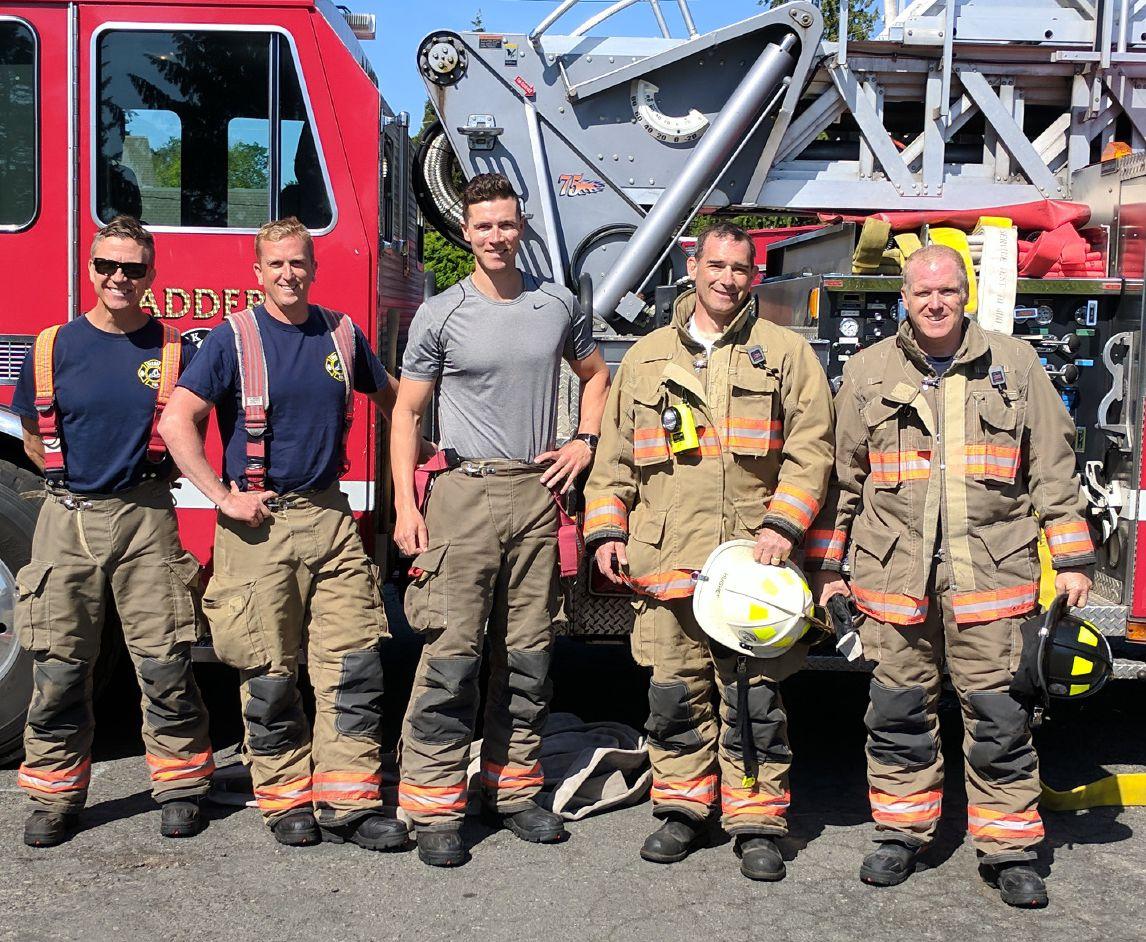
Keeping your Health and Wellness Program alive and well doesn’t have to be complicated if you have a full team of support behind you
By Fire Chief DAVE COCKLE and SARA WEGWITZ, Registered Nurse
You have established a health and wellness program in your department. Now what? How do you ensure its viability over the long term? How do you continue to support your firefighters in maintaining their overall health and wellbeing? These important questions shift focus towards the long-term vision, goals, and sustainability of the program, including budget considerations.
The fire department, through the municipality or regional district, should be committed to enhancing the health, productivity, and quality of life for firefighters and first responders. This level of commitment to invest in our people will assist with the maintenance of the health and wellness program (and with the development of a cutting-edge program). We recognize and acknowledge that the challenges presented to our firefighters are complex and demand that we be open to creative strategies to meet our goal of building a sustainable program.
Business management in the fire department is based upon regulations, standards, council strategic priorities and people. Government agencies continually manage competing priorities and funding to support our programs within our departments. We know that through a well-managed holistic health and wellness program, our firefighters are physically, mentally, and spiritually healthy and thus more productive. Healthy, productive employees are essential to success in all organizations and especially in protective services where the physical and mental demands are so high.
Your health and wellness program should be managed strategically as a core value of your organization and included in the overall strategic planning for your department. To be truly sustainable we must not manage the well-being of our responders solely for risk management; rather our program
should be rooted in the core of what we do as firefighters and as an organization. Understanding how our people eat, move, think, and sleep enables leaders to create program that fashions an organization in which employees are valued, recognized by cultural differences, and supported in developing and maintaining healthy choices and lifestyles. Challenge yourself and the health and wellness committee to change the department culture and embrace the correlation of employee well-being with productivity achieved through a properly managed wellness program.
Your program should be subject to the same sustainability test as any other goals and objectives of the department.
Sustainability of the health and wellness program begins with good governance by having some terms of reference in place and using a committee model that provides for input to the process for planning and implementation. Sustainable programs are not managed from the side of the desk. Doing so will doom them to failure. Good terms of reference will go a long way to building the relationships and supporting the actions of the committee in making change.
The program will face challenges when it comes to implementing and sustaining your program. To alleviate some of the negativity we meet as a committee on a regular basis to address those concerns and build on the opportunities that are presented. The department has a health and wellness team leader on each crew who has the responsibility to manage the health and wellness objectives on that crew. They are also responsible for bringing forward the concerns of, and suggestions from, the crew to enhance the program. The team leader is normally the junior member of the department which helps to build the team aspect of the crews. There are two exempt fire department staff on the committee representing management who work collaboratively with the members to adapt and shape the program.
To be successful, our health and wellness team takes a solutions-based approach to setting goals and objectives. Here are some basic principles to guide the planning for a sustainable wellness program and workplace strategy that have worked for us.
Determine realistic outcomes, long-
term and short-term goals, where to start, and what to focus on. These are key principles for our program’s long-term sustainability. It’s not realistic to have a team of Olympic athletes over a 30-year career in the fire service, but it is achievable to have a culture of healthy habits and lifestyle choices accountable by the employer and employees. We started with a plan that included a briefing to council for funding to support the project including an annual reporting structure on achievements and challenges. We developed a two-year
plan to start, reviewed annually, and we use baseline testing to understand current health and fitness levels of our responders. Our goal was to create a holistic approach to firefighter well-being and improve their quality of life throughout their career.
Program scheduling must be flexible enough to address the shift pattern and daily schedule of the responders. This is an area of significance with our department and speaks to changing the culture of the department. We are five years in and we are continuing to maintain the “buy-in” for
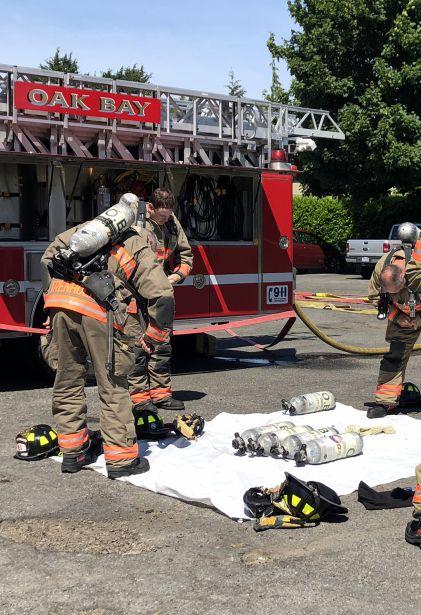
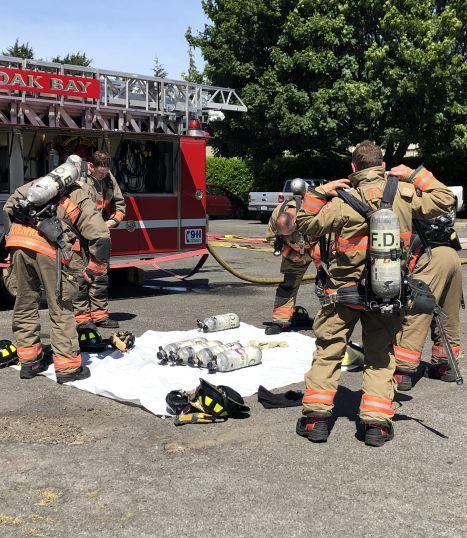
the program by our management staff and members by addressing scheduling. The department had a regimented daily schedule that had been in place for 50 years. Labour and management agreed to go away from that schedule to allow for health and wellness time while still ensuring that the daily routine was completed. Your team will need to be flexible. Be realistic with the time commitment of the department and ensure that members understand that there will be days that allow for health and wellness and days, due to work commitments, that do not. Finding a balance in your department schedule to ensure time is allocated is paramount to a successful program. Limit the barriers to providing the allotted time in your work schedule for health and wellness. There are only positives in this step by recognizing what the priorities are for the day and focusing on creating opportunities for success as an organization with your program.
The program must be inclusive of all your employee groups. The program will be challenged if only the suppression divisions are participating. Supervisors and officers need to be committed to building employee engagement through practical ideas. One positive of creating a culture of wellness is building strength in your team. In our department every staff member, firefighter or not, is included in the health and wellness plan and is encouraged to participate.
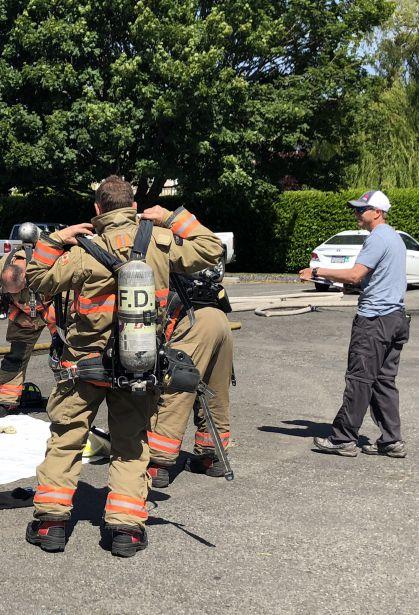
Sustainability is about being inclusive and adaptable.
Funding support must match the goals of the program. An underfunded program with unrealistic goals is unsustainable. It is imperative to have good analytics and reporting of your health and wellness program. From a financial position the program must be subject to the same sustainability test as the other goals and objectives of the department. Wellness opportunities are also good news stories. Take the opportunity to promote your program through your local reporter and your social media outlets. Share your findings within the organization to other departments and externally with business organizations. Councils support projects that put them in a positive light and that they can rally behind. If you provide them the benefits versus the risk for the cost of your program, it will sell itself. Councils also support cutting-edge projects with minimal downsides.
Create a work environment that supports holistic, healthy living. Make business decisions that support the goals and objectives of your health and wellness program fostering support throughout the department. Embrace creative strategies that speak to the culture of the organization in improving health and well-being. The benefits will include reduced sick time and a positive work environment.
Account for and report on results, meet outcome targets aligned with budget and ensure accountability at all levels of the organization for the program. By documenting and reporting results you can
continue to develop and adapt the health and wellness program to meet your goals and objectives. Good documentation provides accountability to the program creating opportunities for review and growth.
Our firefighters and support staff are our greatest assets we must ensure operational readiness when the bells ring. Creating a sustainable health and wellness program to support them will benefit the members and the community. A sustainable health and wellness program starts with leadership taking the first steps to change the department

culture and provide the key tools to our responders, so they can thrive and survive in the fire service.
Chief Dave Cockle has been a career firefighter with the Oak Bay Fire Department for 30 years. Contact him at dcockle@ oakbay.ca. Sara Wegwitz is a registered nurse who specializes in mental fitness and resilience training. She is the primary facilitator of the Oak Bay Fire Department’s wellness program. Contact her at sara@ tailormakinghealth.ca.










BY MARK VAN DER FEYST
Not too many departments get the chance to work with air ambulance very often, so when they do it is often a new thing for them. This article was written right after an incident occurred which required air ambulance to attend. It was a diversion from the basics of firefighting but highlighted some of the important safety factors that they needed to be aware of.
In February, around 10:30 a.m., the author responded to a call for a vehicle accident. Updated information given on route told us that the vehicle had collided with a train at a land railway crossing. On arrival, we confirmed a single vehicle involved with a train. The vehicle had been hit very hard and the collision caused it to bounce off a few rail cars, travelling down the rail line about 40 feet. The vehicle rested on the rail line embankment with a portion under the rail car.
Inside the vehicle was a lone occupant in the driver’s seat sustaining visual facial and head trauma. Initial reports indicated that the driver was trapped with his feet and legs pinned under the dash. Upon initial survey of the vehicle, it was discovered that the driver’s legs were not pinned and were able to move freely out of the vehicle. A hoseline was pulled off the apparatus and charged to provide water protection for the responding crew members. Any vehicle accident will have fluids leaking from the vehicles involved and can lead to a fire being created from sparks or another ignition source. This vehicle accident had plenty of gasoline, diesel and other car fluids on the ground around where personnel were working. Extrication equipment was also removed from the apparatus and placed at a staging area near the vehicle.
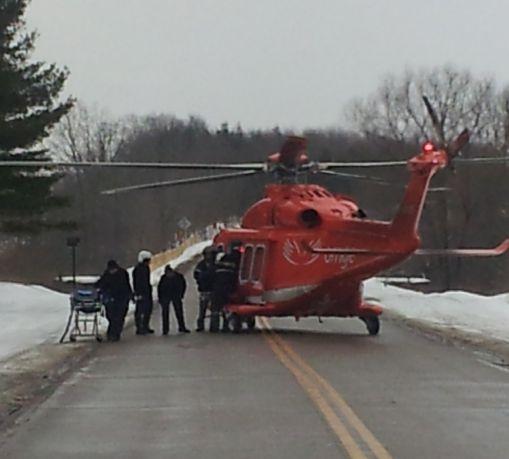
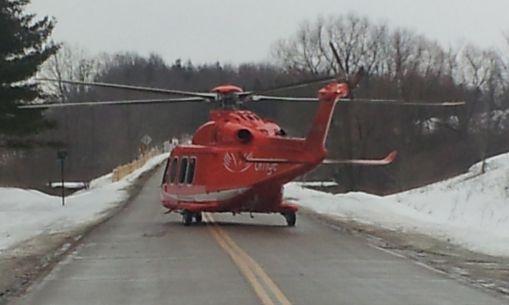
Upon arrival of EMS, an assessment was conducted by the paramedics and site supervisor to determine the extent and nature of the injuries. Seeing as the vehicle collided with a train at a high rate of speed, serious internal injuries were suspected. This prompted EMS to request an air ambulance to respond to the scene. See photo 1.
No matter where you are located in Canada, or what type and size fire department you work for, there is a good chance you may have to deal with an air ambulance responding to your scene and land. When this occurs, there are some important safety factors that need to be remembered and implemented in order to keep everyone on scene safe. The air ambulance service trains regularly with the fire service to ensure personnel are familiar with the protocols for landing and working around an air ambulance. It might be a good idea to contact them to set up a training time as part of a yearly training plan.
When the air ambulance arrives near the scene, they will conduct a scene survey of their own. This will involve a low circular flight pattern over the incident scene. This is done to determine if the
The pilot will be in constant communication with a landing zone officer prior to landing. ‘‘ ’’
landing zone is the appropriate size, if there are no immediate hazards in the vicinity (such as electrical wires) and also to let everybody on scene know that they are coming down soon. An appropriate landing zone is recommended to be 150 feet by 150 feet. This size of landing zone allows for a large helicopter to land safely. The ground needs to be solid, such as asphalt pavement or concrete roadways, so that the helicopter will not sink into it when it lands. If the pilot determines that the landing zone is not adequate, they will choose one of their liking.
The pilot will be in constant communication with a landing zone officer prior to landing. This person can be any firefighter, police or EMS personnel. If chosen for this task, be sure to communicate clearly and effectively with the pilot. You will need to identify yourself as the landing zone officer to the pilot so that they know who they are speaking with. Give precise directions of the landing zone and observations to the pilot as they are landing so that they know exactly what they are dealing with on the ground. Observations can include landmarks around the landing area, overhead hazards and wind direction.
Prior to the helicopter landing, all loose debris needs to be picked up and secured or else it becomes a projectile. This includes an uncharged hoseline, equipment from the fire apparatus lying on the ground, and any objects that are small. Any projectile can easily cause injuries to responding personnel on scene as well as cause mechanical damage to the helicopter’s engines when the debris is sucked into the engine intakes.
When the helicopter is landing, there will be a production of downwash from the rotors. The downwash produced can be as fast as 100 miles per hour or 160 kilometres per hour, blowing anything in its path. Protection of the eyes needs to take place with either wearing safety glasses or turning away until the helicopter has landed. At our accident scene, when the helicopter was landing, snow was being blown around producing a whiteout condition. All personnel had to turn away momentarily to prevent flying snow particles from entering their eyes. The same is true when it comes time for the helicopter to take off.
Another safety factor to implement is remaining a safe distance away from the helicopter. When the helicopter is landing and on the ground, a safe distance of 200 feet is recommended for all personnel and 150 feet for vehicles. This safe distance needs to be maintained until you are directed to approach the helicopter by the pilot or a crew member. If you need to approach the helicopter, always have direct line of sight with the pilot and make sure that he or she sees you.
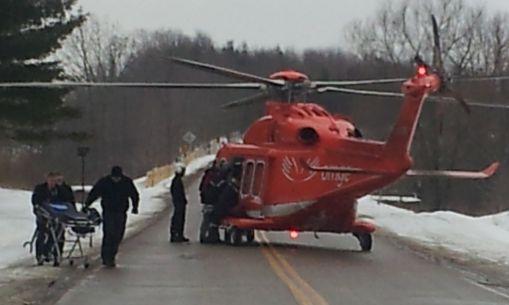
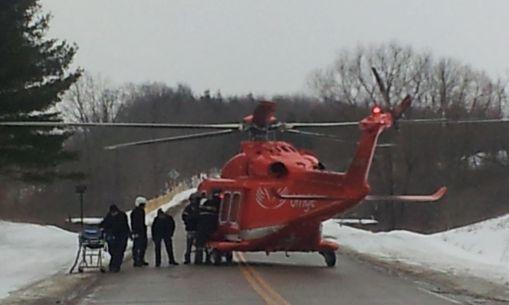
If you are assisting EMS with patient transfer to the helicopter, a crew member will escort you to the helicopter. In photo 2, you can see the crew member in the white flight helmet. They will ensure that it is safe to approach, escort you to the helicopter and then direct you away from the helicopter when it comes time to leave.
In photo 3, you can see two EMS personnel departing away from
the helicopter. Notice how they are positioned. They are hunched down while walking under the canopy of the rotating blades. The blades of the helicopter are the most dangerous part for any personnel approaching. As they spin, they look invisible but are very real and present. Walking upright will only expose your head to the blades which will only produce bad results for you.
Once on the ground, the helicopter will sometimes keep the engine running and the blades spinning at idle speed so that a quick departure can be accomplished. When this is the case, you will need to protect your head, literally by staying low when approaching the helicopter.
Always approach the helicopter from the sides directly and not along the tail portion. The rear and front areas are the more dangerous zones because the pilot cannot see you in the rear and the blades are tilted forward in the front leaving not much room to approach. There is also a spinning tail rotor in the rear.
More information about helicopter safety can be obtained from your local provider of air ambulance. They will sometimes even offer practical training to personnel so that they become comfortable and confident with working around a helicopter.

Mark van der Feyst has been a member of the fire service since 1999 and is a full-time firefighter in Ontario. Mark teaches in Canada, United States and India, and is a FDIC Instructor. He is the lead author of the Residential Fire Rescue book. Email Mark at Mark@FireStarTraining.com.
Fire Fighting in Canada’s editor and associate editor give a round up of the B.C. Fire Expo and OAFC Trade show
By LAURA AIKEN and JAYSON KOBLUN
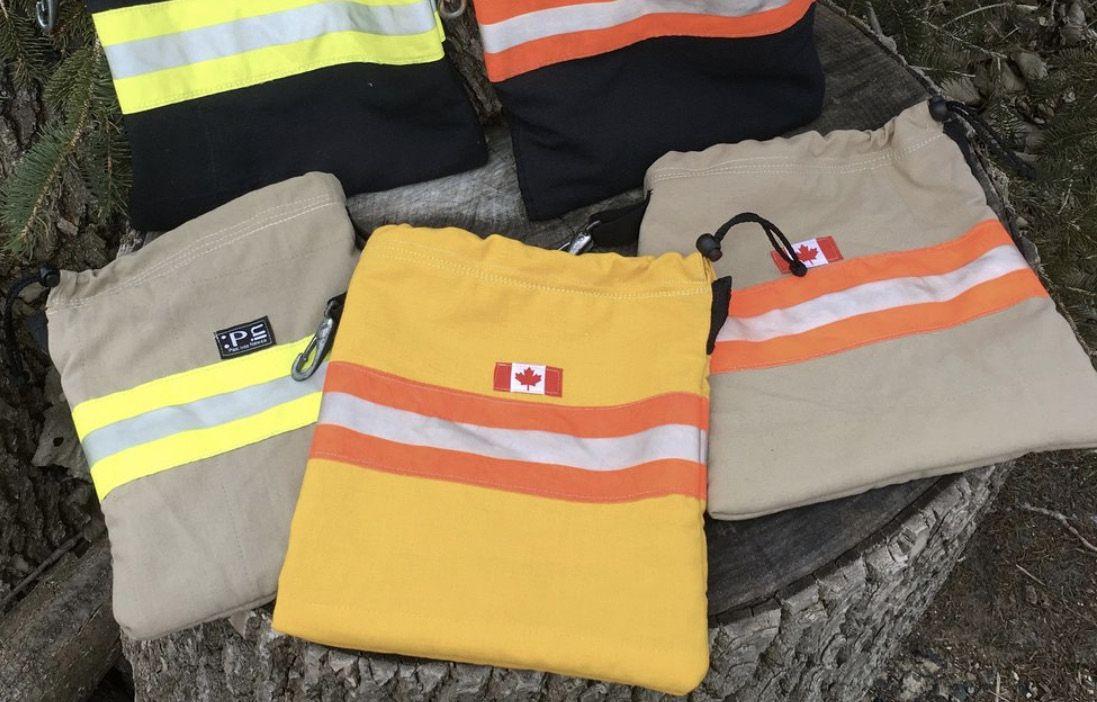
TOP Past Into New is an Ontariobased clothing and accessories brand that makes one of a kind creations from recycled firefighter gear and hose.
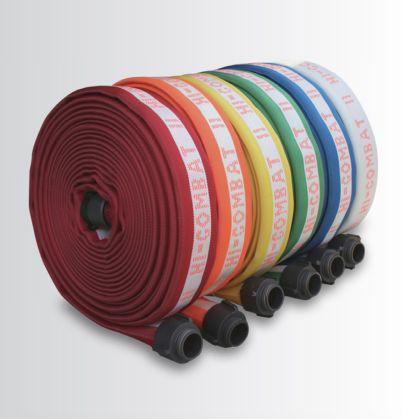
RIGHT BullDog Hose Company is a newly rebranded hose company that made its fire industry debut at this year’s Fire Department Instructor’s Conference (FDIC) in May and also set up a booth at this year’s OAFC trade show looking to make connections.
Fire chiefs in Ontario and B.C. gathered in May and June for annual association trade show and conferences — and of course much networking and socializing to boot. Fire Fighting in Canada touched down in Toronto and Victoria to round-up some of the key highlights and product buzz.
The Ontario Association of Fire Chiefs (OAFC) hosted OAFC 2018 from May 3 to 6 in a new duo-location format. The Delta Hotels Toronto Airport & Conference Centre housed the educational component, and the nearby International Centre showcased the trade show (May 4-5). The four-
day event included a networking “FUN” Raising Night for the Canadian Fallen Firefighters Foundation sponsored by A.J. Stone and Safetek (which rallied to carry on despite a windstorm induced power outage in the hotel), and a memorial service to recognize and honour chiefs who have died since the last conference.
The educational component was comprehensive and divided into several streams such as suburban/rural chief officers, urban chief officers, public educators, fire communicators, training officers, etc. Fire Fighting in Canada took seats in a few hot topics, including recruitment/retention and psychological screening.
The “Leading in Transition” seminar for the suburban/rural track was delivered by Steven Knight of U.S.-based Fitch & Associates (who provide consultancy for emergency services) and Division Chief Ian Womack of the St. Petersburg Fire Rescue in Florida. The key takeaway from this session revolved around how the fire service delivers its messaging in the recruitment process. Currently, becoming a firefighter invokes emotions of heroism, trust, fear excitement, comradery, pride and sacrifice, shared the presenters. But the build-up of excitement may lead to disappointment when the actual day-in-the-life isn’t always jam packed with adrenaline inducing calls and actual fire suppression is becoming less and less of the job. Rethinking the messaging to put life safety and prevention at the core of the mission will help set expectations and attract people who will stick around long term. Recruitment efforts should put the emphasis on community service, rather than excitement.
Part of the urban chief program, “Psychological Screening in the Fire and Emergency Services” was led by Dr. Lori Gray of Frontline Resilience. Gray defined
psychological testing as it pertained to her seminar as a method of screening for psychological ability for the role at the current time to determine if the candidate is well matched for the stressors experienced on the job. Psychological screening is not recommended as a tool for making the final decision she said, but it is one of several puzzle pieces that can inform in making a selection.
Psychological screening is useful for identifying traits that are a poor fit for trauma exposure, such as personality issues regarding anger/rage. Most departments are more interested in sussing out the contraindications that seeking positive traits, she said, although the screening can produce results for both. The testing can be beneficial at three stages: as primary prevention before employment, as secondary prevention to assist someone after trauma or in the case of consideration for promotion or a high-risk unit, and tertiary prevention to determine access to programs such as WSIB for when a person is not doing well after a tragic experience. Screening is done by qualified clinicians and there are different levels with different price points including individual and group testing (most cost effective).
She recommends sending more people than you need for screening, because issues come up and you shouldn’t have a 100 per cent pass rate. She also recommends withholding results from candidates because people could come back next year with a strategy to produce different ones.
Gray spent some of the session speaking on resilience, which she posited as one’s journey through adversity. Resilience displays humour and an ability to take things in stride. She pointed out that living a “charmed life” doesn’t mean a person is resilient — maybe they have not been tested that much by life yet and that is something to consider in hiring. It is good to look for someone with a proven ability to cope.
From apparatus demos in the parking lot that hoisted folks high into the air, to buzzing energy between attendees and vendors indoors, the International Centre housed a great display of fire service equipment. Here are a few finds from the show floor.
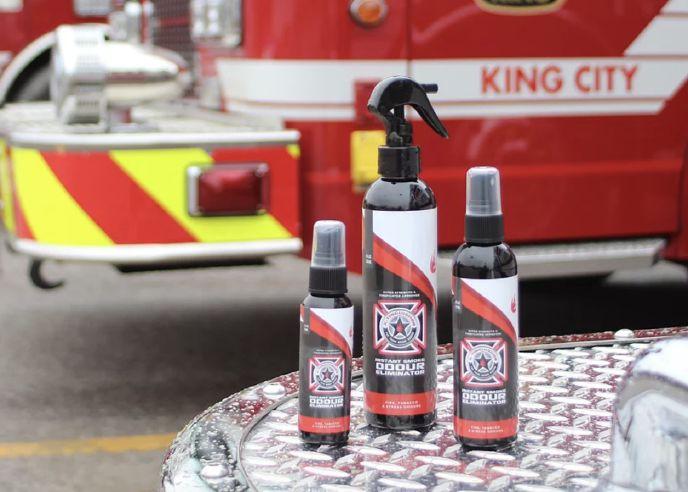
• Get the odour out: X-TINGUISHER is a line of cleaning products developed for firefighters who are exposed to heavy
toxic smoke that is 99.9 per cent organic. The line includes odour elimination spray, concentrated laundry liquid, smoke odour elimination non-toxic cleaner, body wash, an odour elimination kit for wardrobe stylists and people who dance, workout and cheerlead.
• Data driven: ESO showed off their updated software and easy-to-use applications that fire departments, EMS agencies and hospitals use to improve community health and safety. ESO Solutions uses the power of data to improve community health and safety and is constantly seeking ways to improve their software and add to their services.
• New in hoses: BullDog Hose Company is a newly rebranded hose company that made its fire industry debut at this year’s Fire Department Instructor’s Conference (FDIC) in May and also set up a booth at this year’s OAFC trade show looking to make connections. They are a hose supplier for fire departments throughout the U.S. and Canada and showed off their new hose lines: Hi-Combat, Hi-Vol and Firepower II. BullDog products offer abrasion resistance, improved ease of drag and anti-kink, and a tough protective coating.
• Reinventing old gear: Past Into New is an Ontario-based clothing and accessories brand that makes one of a kind creations from recycled firefighter gear and hose. This was the company’s debut year at the OAFC trade show where they showed off their classic and new pieces including; SCBA mask bag designs, shaving tool kits and leashes and more.
The 2018 B.C. Fire Expo took place in Victoria from June 3 to 7 and included the Fire Chiefs’ Association of B.C. Annual Conference, Education Summit and trade show. Trade show and a lot of the networking took place from June 3 to 4 while the educational component took place from June 5 to 7 at the Delta Ocean Pointe Hotel downtown Victoria.
Topics covered varied greatly including talks about communication, wildfire response, how to lead in complex times, using drones during a fire, how to battle apartment fire and more. Each information session was geared towards chiefs and how to better their departments. Three heavily attended sessions were “A Fire Chief’s Guide to Media”, “How to Build your Fire Chief Brand” and “How to Battle Flat Roof/Apartment Fires”.
“A Fire Chief’s Guide to Media” and “How to Build your Fire Chief Brand” were taught by Karen Gordon, communications strategist and principal of Gordon Strategy. Gordon spoke in a humorous and light-hearted manner on ways for fire chiefs to learn how to navigate and use social media and the Internet more efficiently for their departments, communities and their own personal brand.
Three takeaways from Gordon’s guide to media were 1. A better understanding of media and social media and its role in the fire service. 2. A lesson on developing talking points and key messages and 3. How to maximize your time in front of the camera. Gordon taught chiefs things they should never say in front of the camera at a press conference, reminded chiefs to carry themselves as chiefs at all times and warned chiefs that everything they post online, whether on a personal or work account, is public the second they hit post.
Gordon spoke on building a brand for yourself later in the afternoon on the same day. This session focused on how a chief can start using the Internet to brand himself and that the things he does and says in public or online are important factors when his personal brand is being developed. Gordon kicked off the session by mentioning several names of high-status individuals and celebrities and asked the chiefs in the audience to describe each individuals brand. When she mentioned famous golf player Tiger Woods, most chiefs picked up on his infidelity to his wife before they spoke to his skills as a golf player. The activity highlighted Gordon’s point of there being good or bad ways to brand yourself as either a trustworthy and reliable fire chief in a community or a rude
and unrelatable one.
Three takeaways from Gordon’s “How to Build your Fire Chief Brand” were 1. Understanding what a brand is and why you need one. 2. Key considerations to building your fire chief brand and 3. How to build your own fire chief brand.
“How to Battle Flat Roof/Apartment Fires” was taught by John Macdonald. Macdonald started his firefighting career as a volunteer in 1992 and worked his way up to his most recent position as assistant chief of training at Coquitlam Fire Rescue in B.C. Macdonald shared what he said he has learned over years were best-practices for dealing with, suppressing and putting out fires in buildings with flat roofs and apartment buildings. He focused on:
• Building construction
• Reviewing the command sequence
• Water supply
• Exterior attack
• Interior attack
• Whether you approach the fire offensively or defensively
• Time and co-ordination
• Building an operational guideline for your department
Macdonald closed his presentation with some videos and a case study. Takeaways from his session were 1. Improved construction knowledge through pre-incident planning. 2. Increased knowledge of strategies and tactics around apartment fires. 3. Improved firefighter and occupant safety and 4. Better understanding of the challenges that incident commanders, officers and firefighters face at these types of incidents.
The association’s Annual General Meetings were held during the expo as well.
By LEN GARIS and JOE CLARE
A911 call comes in and soon police, fire and ambulance services are independently speeding to the scene of a major car crash. Is this the best use of these expensive and limited emergency resources? This is the very question raised by a new study published by Oxford University Press that analyzed more than 100,000 calls for service over a threeyear period for emergency service providers in British Columbia. This article’s authors plus Michael Townsley and Daniel J. Birks of Australia found a measurable overlap in police, fire and medical calls in their 2017 study Patterns of Police, Fire, and Ambulance Calls-for-service: Scanning the Spatio-Temporal Intersection of Emergency Service Problems.
Using call data from 2011 to 2013 in the City of Surrey (a community of 500,000 in Metro Vancouver), the study found marked similarities in not only the types of problems approached by the three responders, but in their locations and time.
This bolsters previous research showing that much of what the police deals with is not crime, much of what the fire service deals with is not fires, and that paramedics deal with a wide variety of call types. Further, police, fire and ambulance calls tend to cluster in meaningful ways with respect to time, location, income levels and other factors, and research has shown that targeted interventions based on recognized hot spots can be effective in reducing crime, fires and medical incidents.
“This study underscores what Canadians can see for themselves: that there is a general lack of coordination between the police, fire and ambulance services in our communities,” said Paul Maxim, a Wilfrid
A recent study has called for greater collaboration between emergency services.
Laurier University professor known for his criminology research. “As demand for emergency services continues to rise, it is more important than ever that we pay attention to research that shows us how we can better use our existing resources.”
The findings suggest that Canadian decision-makers have something to learn from other nations that have moved towards a more unified approach to emergency services. Christchurch, New Zealand, for example, has a co-located police-fire-ambulance service. The United Kingdom took the concept further with its 2017 Policing and Crime Act, which enables police and crime commissioners to take over governance of fire and rescue services, and introduced a duty on emergency services to collaborate to improve efficiency and effectiveness.
The researchers, who hail from Murdoch University and Griffith University in Australia and B.C.’s University of the Fraser Valley, used three core data sets related to police, fire and ambulance calls for service in the period between 2011 and 2013 in Surrey.
The police data related to recorded volume crime (residential and non-residential burglaries, shoplifting, and theft of and from motor vehicles) and vehicle collisions from Surrey’s detachment of the Royal Canadian
Mounted Police (RCMP). Both fire and ambulance data came from Surrey Fire Services’ (SFS) calls-for-service during the same timeframe, with calls grouped into fires, alarms, gas leaks, assistance and medical calls (the largest response category). SFS, which attends all 911 medical calls, also records incidents co-attended by the BC Ambulance Service, which provided the third data set. After eliminating data-entry errors, the data sets contained approximately 50,000 crime incidents, 28,000 medical incidents and 26,000 fire incidents. All three data sets included incident type, time and location information, which was applied to varying scales to identify major patterns of service-demand intensity (time and place), as well as agency overlap. Preliminary analysis showed that one-third of the geographic area of the city experienced almost three-quarters of the incidents responded to over the three-year period.
Targeted analysis of this high-density area was undertaken. Using a series of spatial lattices (varying in size from 250m, 500m, and 1,000m) and considering calls for service across three time windows (the full threeyear period, annual counts, and monthly counts), call densities across the three services were analyzed to look for convergence in time and space. A consistent pattern emerged across all of these time-space grids
showing that police, fire and ambulance incidents were concentrated both in time and location, with the top 10 per cent of calls accounting for almost 50 per cent of incidents across all three services. In addition to this, there was a large degree of convergence in the top 10 per cent of cells across the calls responded to by the three services.
The interagency analysis provided by the study is also consistent with established methods that help police forces implement targeted problem-prevention strategies based on known hot spots (commonly known as problem-oriented policing, or POP). POP can be implemented through the SARA model, which involves Scanning (identifying and prioritizing potential jurisdictional problems), Analysis (examining the problem using all available data), Response (designing and implementing creative, targeted, problem-specific interventions that build on interagency strengths and capabilities), and Assessment (evaluating the process and impact of the response).
In particular, the study techniques align with SARA’s scanning phase, and would be an efficient means for agencies to work together to identify and characterize hot spots for collaborative problem intervention. Such a collaboration could leverage existing infrastructure to address common problems that fall beyond the purview of single agencies operating in isolation, and would be more insightful and efficient than independent analysis by the agencies.
It should be noted that there were limitations to the study’s approach, based on the data sources (e.g., the use of only publicly-available RCMP statistics, as well as SFS statistics to represent the medical data set).
That being said, the methods do not diminish one of the key

takeaways from the research: the factors that contribute to problems – and in turn, service demand – are somewhat consistent regardless of incident type (crime, fire or medical). This could be a starting point for identifying the prolific consumers of emergency responder resources and working collaboratively on inter-agency solutions.
Prior to the study, little published work existed that confirmed the overlap in time and location for calls-for-service between the various emergency service providers. The authors hope the findings serve to further the discussion in Canada about ways to increase the collaboration between emergency responders, and lead to solutions that improve the efficiency and effectiveness of both the responses and the use of this valuable resource.
To view the study in full, visit Policing: a Journal of Policy and Practice https://doi.org/10.1093/police/pax038
Len Garis is the fire chief for the City of Surrey, B.C. and an adjunct professor in the School of Criminology and Criminal Justice at the University of the Fraser Valley, Affiliated Research Faculty at John Jay College of Criminal Justice, New York, and a faculty member of the Institute of Canadian Urban Research Studies, Simon Fraser University. Contact him at LWGaris@surrey.ca. Dr. Joseph Clare was the strategic planning analyst for the Surrey Fire Service between 2010 and 2013. He is currently a senior lecturer in Criminology at Murdoch University, Western Australia and holds adjunct positions with the School of Law, University of Western Australia, and the Institute of Canadian Urban Research Studies (ICURS), Simon Fraser University. Contact him at j.clare@murdoch.edu.au.


BY ELIAS MARKOU Naturopathic Doctor Mississauga, Ont.
all it what you want — pot, dope, weed, hash, joint or marijuana — the Canadian federal government has decided to legalize cannabis in 2018. In recent media releases and interviews, Prime Minister Justin Trudeau has said legalization is still on track. However, assuming BiIl C-45, the Cannabis Act is approved and passed by the senate and sent for royal assent by June 7, it will take two to three more months before cannabis can be legally purchased for all types of use.
As the senate takes a moment to give cannabis use in Canada a “sober second thought”, governments, retailers, manufacturers, and growers are gearing up for what is forecasted to be a multi-billion dollar industry. This has left communities, universities, municipalities and workplaces scrambling to create policies and standards for cannabis use on the job.
Most of the provincial governments across Canada passed new laws after extensive public and stakeholder consultation as to how, where and who can buy and use cannabis in the province. Recreational cannabis will have very similar regulations as alcohol and tobacco, with some differences from province to province. Medicinal cannabis will be subject to completely different regulations from recreational cannabis use.
Now, let us insert fire fighting and the firefighter into this equation. Please pay attention, firefighters, captains, chiefs, municipalities, unions and other stakeholders like insurance companies, medical professionals and more. The list goes on and on, and we can already assume that cannabis use will have a great impact that will change the landscape of the firefighter workplace forever. I will try to unpack this Pandora’s box the best I can. As a medical practitioner, I can see both the risks and benefits of cannabis.
a fire truck. I am sure fire departments will be coming out very shortly with cannabis SOP in the coming weeks and months.
Academics and researchers agree a one-time user will show positive TCH/cannabinoid readings for up to five days. To clarify, users are people who consume all products made from cannabis whether they smoke it, infuse it or eat it. Frequent users, meaning people consuming cannabis every night, will show positive THC/cannabinoid readings for up to 15 days. A heavy cannabis user, meaning two to three times a day, will show positive THC/cannabinoid readings for up to 30 days. Cleaning cannabis out of your system is a slow process because THC and cannabinoids are fat soluble. Firefighter users will have active cannabis ingredients in their body days after usage. A pressing question for all firefighters remains, are there moments where the active cannabis ingredients are still in the body while they are on the job? Depending on the timeline mentioned above, yes there can be moments where THC and cannabinoids are still in the body. Firefighters need to be diligent as to when cannabis is used in relationship to their shifts.
Consuming recreational cannabis in the workplace is illegal and will continue to be after legalization. The fire service, as an employ-
Will firefighters consuming recreational cannabis be affected on the job?
’’
There are two key areas where fire fighting and cannabis needs to be looked at. The first involves recreational use. The new cannabis legislation explicitly outlines that with cannabis in your system it is illegal to drive drug-impaired; academics and lawmakers say it is just as dangerous as driving drunk. The legislation is strict for recreational cannabis, there will be zero tolerance for commercial drivers and those operating class A-F drivers licences, this does also apply to all firefighters operating
Dr. Elias Markou is one very busy naturopathic doctor. He is in private practice in Mississauga, Ont., and is the chief medical officer for the Halton Hills Fire Department. Dr. Markou was a firefighter for six years; he is a firefighter health expert and blogger who is regularly featured on television and radio and in print. Contact him at drmarkou@mypurebalance.ca
er, will know the rules for medical cannabis and will be required to address workplace hazards, under the Occupational Health and Safety Act (OHSA). Firefighters on the other hand need to be aware of work place safety and the hazard cannabis user can be to themselves or to others in the workplace.
What is even more interesting in the emergency services and the firefighting profession is the growing awareness of mental health and Post Traumatic Stress Disorder (PTSD). Emerging new medical strategies for treatment of PTSD in the military, emergency services and the fire service include the use of cannabis to treat symptoms and conditions.
We know cannabis is here to stay, and for some in the fire service it will be a life-saving treatment. For others, it will be trying to find the balance of work and recreational use of cannabis.

BY VINCE MACKENZIE Fire chief
Falls - Windsor, N.L.
ecruitment. It seems to be a topic of discussion a lot lately. Fire chiefs and officers are telling me that not only is it getting harder to recruit volunteer fire fighters these days, but when we do, some of the successful hires leave in a few short years for fulltime fire fighting jobs.
Many volunteer departments experience significant turnover in personnel. The seemingly constant revolving door of personnel is one of the characteristics of today’s smaller community fire departments.
When recruiting, fire departments ideally want a younger candidate to join the fire department and start the journey of training early in life. More time can be afforded to training opportunities when a person is generally younger and not time committed to a young family or other obligations as we age. We also like it when the firefighter candidate can get quickly trained. So many fire departments put extensive effort into orientation and rookie training. The hope is with that training and along with practical experience they reach their 30s well trained and well experienced, and physically able to perform labour intensive fire fighting. As their career progresses, they use their practical experience to become good fire officers, eventually supervising the firefighter ranks.
Firefighters leave their respective departments for many reasons, be it busy fire department workload, non-commitment, or genuine non-interest. Some leave because of poor leadership, and some leave for family or work commitments. There are a multitude of reasons, but I would like to focus this column on one of the trends that has been happening for a while now.
the grief is that usually their training is conducted by other volunteers who give freely of their time to train recruits. I get it, frustration levels can be very demoralizing. Especially after all the time and energy is expended only for the firefighter to leave the department in search of a career.
Recruitment is a process that all fire chiefs must embrace. I have said it before, I don’t consider recruitment and retention as a problem in the volunteer fire service, it is merely another process that we must learn to manage successfully.
Recruitment and retention, ironically, is a not a problem for career departments. There is usually a line up of candidates eagerly answering job postings nationwide. Their challenge is in narrowing the list and selecting the best candidates from exponential numbers of applicants—some of which may be your firefighters. What a great position to be in as a fire chief of career services. Many of those applicants come from existing volunteer firefighters who were trained by volunteer fire departments. Their gain becomes our loss.
So, if your fire department is experiencing the trend of personnel leaving to find careers with their training you have provided, so be it.
It is better to train a firefighter and have them leave, than it is to not train them and have them stay. ‘‘ ’’
Many recruits join volunteer fire departments with the hopes and dreams of using their training and experience to garner a position on a full-time fire department and have firefighting as a paid career. Many times, this is never disclosed to the recruiters. The volunteer fire department accepts them into their membership and starts training them as recruits. As the training progresses, it usually gets revealed that the candidate has intention to move on. This can be somewhat frustrating and even offending to many of the chiefs I have spoken to. They feel much time and energy are committed by their department to training recruit volunteer firefighters only for them to leave at their peak potential. Adding to
Vince MacKenzie is the fire chief in Grand Falls-Windsor, N.L. He is an executive member of the Canadian Association of Fire Chiefs and the past president of the Newfoundland and Labrador Association of Fire Services. Email him at firechief@townofgfw.com and follow him on Twitter at @FirechiefVince
While firefighters leave for many reasons, if they leave to join other departments as a career, celebrate their success because some of that success is because of you.
I have always said it is better to train a firefighter and have them leave, than it is to not train them and have them stay! If a fire department does relax their training program because they fear some of their folks will leave, what happens when they stay.
As a final note there is one advantage though, as I said earlier volunteer firefighters leave departments for many reasons. If one of these reasons is to relocate for better employment of their daytime job or their partners daytime job, typically these folk apply to their new towns volunteer fire dept. We all know that once a true fire fighter it’s a rewarding and difficult profession to give up despite the challenges sometimes. So, on a positive note, the training we provide benefits the other volunteer department too.