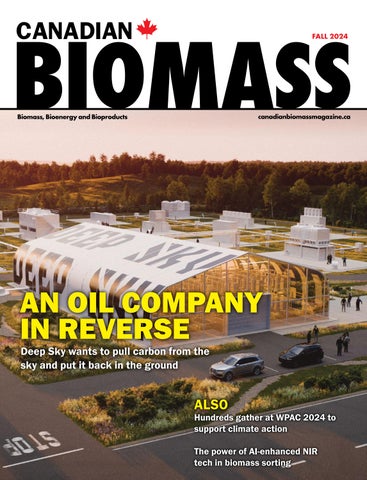
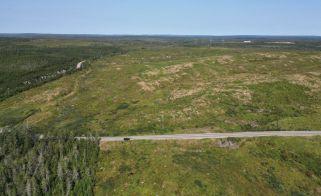
Deep Sky wants to pull carbon from the sky and put it back in the ground
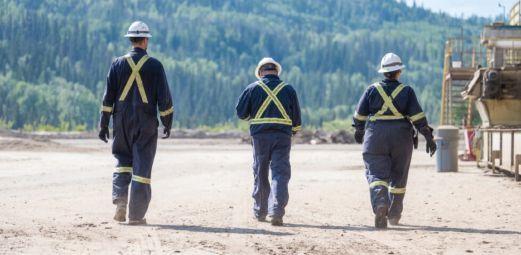
Hundreds gather at WPAC 2024 to support climate action
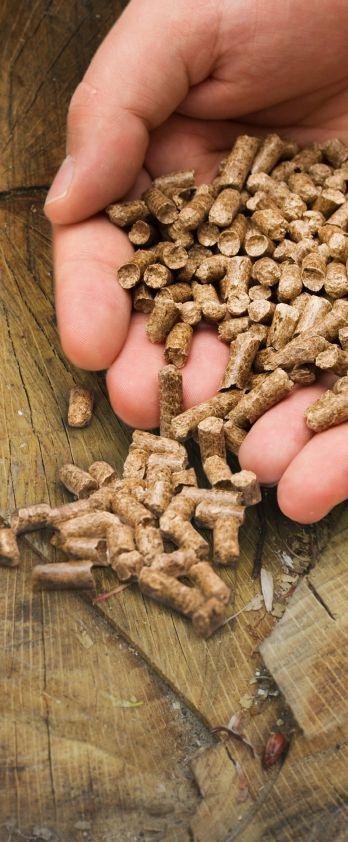
The power of AI-enhanced NIR tech in biomass sorting
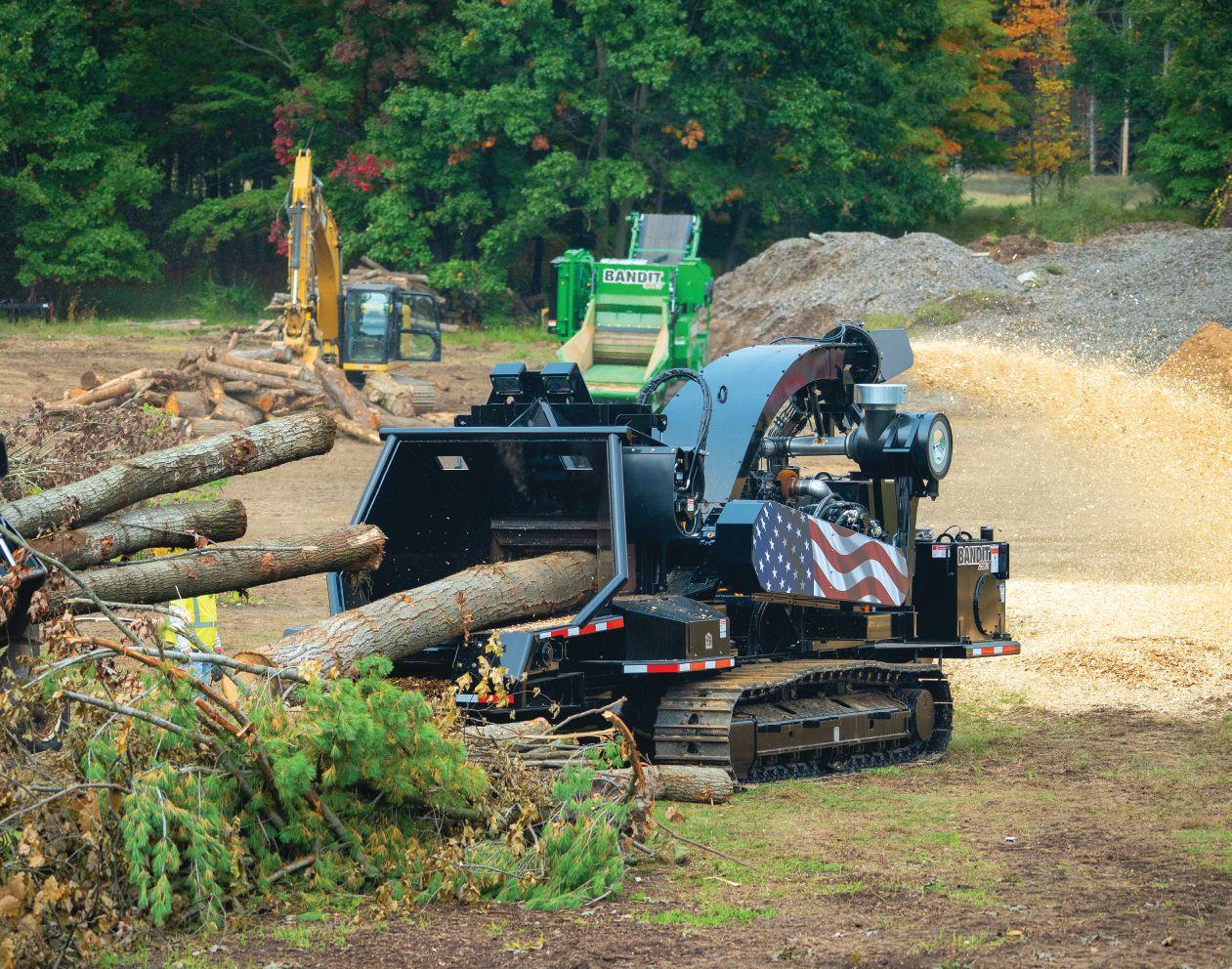
Why are Bandit chippers the preferred solution?
» Pack chip vans to their maximum capacity
» Chip material requiring less horsepower and fuel
» Proven slide box feed system pulls and compresses material (drum-style chippers only)
» Cab and loader options are available on select models
» Unmatched dealer support
If you haven’t tried a Bandit unit for your operation, please contact a local Bandit dealer, email marketing@banditchippers.com or visit our website www.banditchippers.com and we will be happy to assist you!
10 AN OIL COMPANY IN REVERSE
13 The carbon tax is dead
The likely impending doom of the carbon tax opens the door for better policy, BECCS
New reports say Canada may need to do more than reduce emissions to meet ambitious climate targets
20 Exploring the benefits of RNG in Canada
The biogas and renewable natural gas landscape in Canada has enormous potential
22 Canada sleeping on $4-tillion bioeconomy
Canada lags its G7 partners, competitors in establishing a clear path for bioeconomic growth
Hello, bonjour, howdy.
Let’s Dig In
By Sarah Sobanski New editor takes helm
Anyone got a good wood pellet joke? Or for that matter, any corn, wheat straw, organic waste jokes?
What about anaerobic digestion, pyrolysis, ethanol, renewable natural gas, sustainable aviation fuel, carbon capture and storage, biogas, biofuels, biochar, biocarbon or biomass jokes?
Wow, there is a lot to know in this bioenergy sector.
I suppose it’s unlikely I’ll find one all-encompassing icebreaker that’ll resonate with each of you loyal Canadian Biomass Magazine readers.
Ont., and then a chance to lead a City Hall desk in Nova Scotia. Over a decade I fell in love with discovering new people, sectors and telling their stories.
In the few short months since taking on this role — now back in Toronto — I’ve spoken with people from each of the aforementioned sectors.
I’ll skip right along then and introduce myself as your new editor.
Originally from Ontario, I took my first real journalism gig across the country in Northern Alberta. For those fimiliar with the area, it was a little newspaper in Bonnyville, about three hours north of Edmonton and four hours south of Fort McMurray.
I had already worked a TV internship in Calgary, so I thought, How cold could it really be?
Our team was shortstaffed — to put it mildly — and needed a municipal reporter. I took one too many philosophy classes while getting my journalism degree, and didn’t really have a choice, so started my foray into political journalism.
When the snow still wasn’t off the ground in June, I packed up my things and drove to an editor job in Bancroft, Ont.
Then came a few gigs in Peterbourgh,
There are folks just starting in the sector, excited about bold new ideas, such as Montreal, Que.-based carbon removal project developer, Deep Sky.
There are folks who’ve been in the sector for decades, trying to take an industry forever on the cusp of trillion-dollar greatness over the edge, such as Jeff Passmore, head of Ottawa, Ont.-based Passmore Group.
Don’t forget the folks and organizations who’ve been trying to get the word out that solutions for low-carbon energy, in a world desperate to stop climate change, already exist, such as Gordon Murray, executive director of the Revelstoke, B.C.based Wood Pellet Association of Canada.
I attended my first WPAC conference last month and came home with a fist full of business cards from people who are working in this sector and have stories to tell.
You’ll find each of these stories in this issue, but I have an inkling I’ve just brushed the surface.
With that in mind, please reach out. I want to know why you’re in this sector, your challenges and opportunities, and dig into the stories that matter. •
Volume 24 No. 4
Reader Service Print and digital subscription inquiries or changes, please contact Angelita Potal, Customer Service Ph: (416) 510-5113 Fax: (416) 510-6875 Email: apotal@annexbusinessmedia.com Mail: 111 Gordon Baker Rd., Suite 400 Toronto, ON M2H 3R1
Editor - Sarah Sobanski Ph: (416) 510-5239 ssobanski@annexbusinessmedia.com
Contributors - Gordon Murray, J.P. Antonacci, Joel E. Dulin and Ian Thomson
Group Publisher - Anne Beswick Ph: (416) 510-5248 Mobile: 416-277-8428 abeswick@annexbusinessmedia.com
Western Sales Manager - Tim Shaddick twshaddick@gmail.com Ph: (604) 264-1158 Fax: (604) 264-1367
Audience Development Manager - Serina Dingeldein Ph: (416) 510-5124 sdingeldein@annexbusinessmedia.com
Media Designer - Lisa Zambri
CEO - Scott Jamieson
Canadian Biomass is published four times a year: Winter, Spring, Summer and Fall. Published and printed by Annex Business Media.
Publication Mail Agreement # 40065710
Printed in Canada ISSN 2290-3097
Subscription Rates: Canada - 1 Yr $58.14; 2 Yr $104.04 Single Copy - $9.00 (Canadian prices do not include applicable taxes) USA – 1 Yr $123.93 CDN; Foreign – 1 Yr $140.76 CDN
All advertising is subject to the publisher’s approval. Such approval does not imply any endorsement of the products or services advertised. Publisher reserves the right to refuse advertising that does not meet the standards of the publication. www.canadianbiomassmagazine.ca
NEW STUDY QUANTIFIES DRAX CONTRIBUTION TO CANADIAN ECONOMY
A new economic analysis by Calgary, Alta.-based accountancy, MNP, has found Drax Group, a major consumer and producer of Canadian biomass, contributed $1 billion towards the country’s economy and supported more than 3,000 jobs in 2023.
The study measured the economic impact of Drax’s Canadian operations, which includes 10 pellet plants across British Columbia and Alberta, producing sustainable biomass wood pellets to generate renewable power in the U.K. and Asia.
The report showed Drax sourced nearly 75% of its goods and services from those based within the respective province of their operations. Of purchases made from suppliers outside of the province, more than 90% are from Canadian businesses.
Drax operations supported 3,101 jobs including high-skilled manufacturing of industrial components, engineering and technical machinery and transportation, many of which are in rural communities.
In the Entwistle, Alta., and Burns Lake, B.C., where Drax’s pellet plants are located, Drax provides 26% and 18% of total employment income.
Companies such as local sawmills rely on Drax to purchase their residuals and by-products. The use of these materials by
Drax also keeps them out of landfills and off forest floors, where they can become fuel for wildfires. The timber, forest and furniture industries, among many others, have been key collaborators in sourcing residuals and waste products for beneficial reuse by Drax.
“Our research demonstrates the economic impact that Drax Group has made to the Canadian economy, with their operations in Canada generating $372 million in GDP in 2023,” said Susan Mowbray, MNP partner, in a release.
“We also found that the economic activity generated by Drax’s pellet plants, port terminals and corporate offices, has a positive impact on local communities across Canada.” •
SUSTAINABLE AVIATION FUEL HUB COMING TO NOVA SCOTIA
Simply Blue Group, an Ireland-based clean energy project developer, will launch a sustainable aviation (SAF) fuels hub in Atlantic Canada as the company moves to expand into North America.
Simply Blue Group has secured about 755 acres of contiguous municipal and private land in Goldboro, N.S., for the hub — formerly proposed for the Goldboro Liquified Natural Gas Project.
The project will use renewable electricity generated from the company’s solar and wind farms in the Municipality of the District of St. Mary’s via a dedicated transmission line.
Simply Blue’s renewable energy, along with the province’s sustainable biomass and water resources, will help produce approximately 150,000 tonnes of SAF per year.
“This industry will help us, and our global partners fight climate change, and it will grow our green economy in
Nova Scotia with benefits for generations to come,” said Tory Rushton, provincial Minister of Natural Resources and Renewables, in a press release.
“(Simply Blue Group is) going to make a big difference in the transportation sector with aviation and marine fuel. And as a new market for our low-grade wood fibre, they will help our forestry sector be healthy and strong.”
Nova Scotia has an abundance of residual biomass: a renewable organic material
that comes from plants. It contains carbon and hydrogen – both of which are required to make sustainable aviation fuel.
“By providing a stable, long-term market for residual biomass, Simply Blue Group is allowing Nova Scotian woodlot owners the ability to manage their woodlots better, making them healthier and more resilient to wildfires and other disasters brought on by our changing climate,” said Todd Burgess, interim executive director at Forest Nova Scotia.
“The sustainable aviation fuel that we will produce there will play an essential part in reducing dependence on fossil fuels and combating climate change,” said Hugh Kelly, CEO of Simply Blue Group.
“SAF is a drop-in fuel that matches the performance of conventional jet fuel while reducing greenhouse gas emissions by approximately 90% compared to conventional jet fuel.” •
Photo: Drax Group
Goldboro, Nova Scotia | Photo: Simply Blue Group
GEOCYCLE AND LAFARGE CANADA OPEN LOW-CARBON FUEL PLANT IN NOVA SCOTIA
Lafarge Canada, a major cement manufacturer, and Geocycle Canada, specialized in large-scale recovery and recycling projects for industry reliant on fossil fuels, have cut the ribbon on a more than $10-million low-carbon fuel plant in Atlantic Canada.
The Geocycle plant, at Lafarge’s Brookfield Cement Plant in Nova Scotia, will divert approximately 14,000 tonnes of waste away from landfills annually once it’s fully up and running. That waste will be pre-processed into low-carbon fuel, minimizing Brookfield’s reliance on traditional fossil fuels.
Waste diversion is expected to reduce carbon emissions at the plant by more than 12,000 tonnes per year; equivalent to taking 13,480 passenger vehicles off the road.
Lafarge Canada and Geocycle, both members of Holcim Group, said in a press release the project represents one of the most transformative initiatives in the 50year history of the cement plant. It was partially funded with $3.53 million from the federal government’s Energy Innovation Program (EIP), created to advance
clean energy technologies to support Canada’s transition to a low-carbon economy.
“Cement is a vital component of infrastructure projects that contribute to economic growth. By implementing sustainable and innovative solutions to reduce our environmental impact, we’re serving the needs of our customers and the communities in which we operate both now and in the future,” said David Redfern, president of Lafarge Canada East, in the release.
The low-carbon fuel plant — the first of its kind by Geocycle in the country — will take waste products like non-recyclable plastics, and, eventually, construction and demolition waste materials from local sources, and turn it into low carbon fuels to make cement and concrete for new construction projects in the area.
“At Geocycle, our solutions are circular by design,” said Sophie Wu, head of Geocycle North America.
“We are happy to take another significant step in our ongoing partnership with Lafarge Canada. This is a great example
of our work toward the decarbonization of the construction industry in Canada.”
Plant work started in June 2024 when the Lafarge and Geocycle began collecting waste from local manufacturers and materials recovery facilities for pre-processing at the new facility.
The companies said they’re both working toward finding solutions to decarbonize the construction industry.
In May, the companies announced the completion of a pilot project to produce high-quality clinker made of recycled materials recovered from waste sources. Clinker is the main ingredient in cement –the active ingredient in concrete. •
Ørsted, a Denmark-based renewable energy company, will sell carbon credits worth 330,000 tonnes of CO2 to Norwegian petroleum refining company, Equinor, in a new 10-year deal to help finance its incoming biomass-based carbon capture and storage project.
HEADING GOES HERE
ed’s biomass-fired combined heat and power plants.
The Ontario government on March 28 announced a $682,529 investment in six economic development projects in Hearst, Ont., including $35,808 for wood pellet producer I.C.S. (Lacroix) Lumber.
The Equinor deal comes alongside the company’s “realisation... biomass-based carbon capture and storage is still at an early stage of development and associated with high costs,” according to a release.
Ørsted is a major consumer of Canadian wood pellets. The two plants linked to the hub are Ørsted’s wood chip-fired Asnæs Power Station in Kalundborg, western Zealand, and its Avedøre Power Station’s straw-fired boiler in the Greater Copenhagen area.
The funds will help I.C.S. (Lacroix) purchase new equipment that will help it increase its production capacity and expand operations.
It said the sale of carbon dioxide removal (CDR) credits, and support from the Danish Energy Agency, have been “crucial” to financing its Kalundborg CO2 Hub.
The CO2 captured will come from sustainable biomass and will be permanently stored under the North Sea seabed. In this way, CO2 will be removed from the atmosphere and is expected to contribute to negative emissions.
The company has launched similar deals with major carbon emitting companies in the past, including tech giant Microsoft.
“Through the collaborative partnerships we are announcing today, our government is ensuring Hearst’s economy continues to grow,” said Greg Rickford, Ontario Minister of Northern Development, Mines, Natural Resources and Forestry, in a statement. “By investing in projects from varied sectors, we are promoting a more diverse, dynamic and innovative economic climate.”
“Equinor shares Ørsted’s commitment to maturing carbon capture and storage technologies. We already have a partnership with Equinor and Nordsøfonden (Danish-state subsurface resource company) to explore the possibility of storing CO2 in the subsurface, and we’re pleased to expand the collaboration through this agreement on the sale of CDR credits,” said Ole Thomsen, head of Ørsted’s bioenergy business, in the release.
Equinor is looking to reduce its net scope 1 and 2 greenhouse gas emissions by 50% by the end of 2030, compared to 2015 levels. A maximum of 10% can come from CDR credits, the remainder has to come from must absolute reductions.
I.C.S. (Lacroix) produces premium wood pellets under the LacWood brand.
The hub, slated to open in 2026, is expected to capture 430,000 tonnes of biogenic CO2 annually from two of Ørst-
“We both share the belief that building markets enabling the physical reduction and removal of carbon will play a role in reducing emissions,” said said Svein Skeie, senior VP of business development at Equinor. •
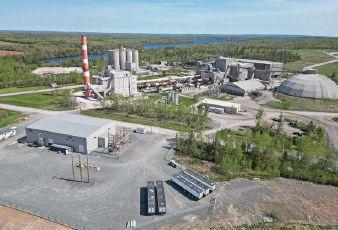
Geocycle Canada Low-carbon Fuel Plant located at the Lafarge Brookfield Cement Plant (NS). | Photo CNW Group/Lafarge Canada Inc.
RNG COALITION REPORTS RAPID GROWTH IN NORTH AMERICAN BIOGAS
New stats by the Coalition for Renewable Natural Gas suggest more than 433 renewable natural gas facilities are up and running in North America — a figure it expects will double.
The RNG Coalition, a trade association based in Sacramento, Calif., reports 433 renewable natural gas facilities are operational in the region, up 44% from 300 facilities last year.
Of the more than 400 facilties, 26 are in Canada.
In addition to facilities currently online, the coalition says there’s a “robust pipeline of forthcoming projects” with another 436 facilities in various stages of planning or construction.
“We are proud of what our organization and industry have accomplished together, but we are focused on the next benchmark, and on even broader energy sector adoption of RNG as a critical component in our society’s transition to a cleaner,
more sustainable future,” said coalition founder and CEO Johannes Escudero in a press release.
While technological advancements and increasing demand for low-carbon energy solutions have factored into the recent surge, the RNG Coalition said expanding policy support remains a top industry priority as it aims for 500 facilities by 2025, 1,000 by 2030 and 5,000 by 2040.
It says New Mexico’s recently launched Clean Fuel Standard program, which aims to reduce the carbon intensity of transportation fuels, was an example of encouraging policy growth.
The program follows similar programs implemented successfully in California, Oregon, and Washington, providing a framework for RNG projects to thrive by creating market incentives for low-carbon fuels that displace diesel and other fossil fuels.
Dairy farm-to-RNG projects repre-
sent another key driver of recent facility growth.
Agricultural waste now represents 24% of all feedstocks deployed toward RNG production, marking a new all-time high and an increase from 17% of all feedstocks just a year ago.
With ongoing collaboration between the public and private sectors, and between legislative and regulatory bodies, the coalition says it envisions an even more significant role for RNG and other renewable gases as the region works toward cleaner air and energy for current and future generations. •
TSI BUILDS MACHINERY FOR THE BIOMASS INDUSTRY
Complete Dryer and Torrefaction systems including Heat Energy and Pollution Control equipment in one integrated solution for plants from 50,000 tons/year to 500,000 + tons/year.
Photo: Annex Business Media
An oil company in reverse: Canada’s first DAC hub
Montreal-based carbon project developer wants to pull carbon out of the air and put it back in the ground
By Sarah Sobanski, editor
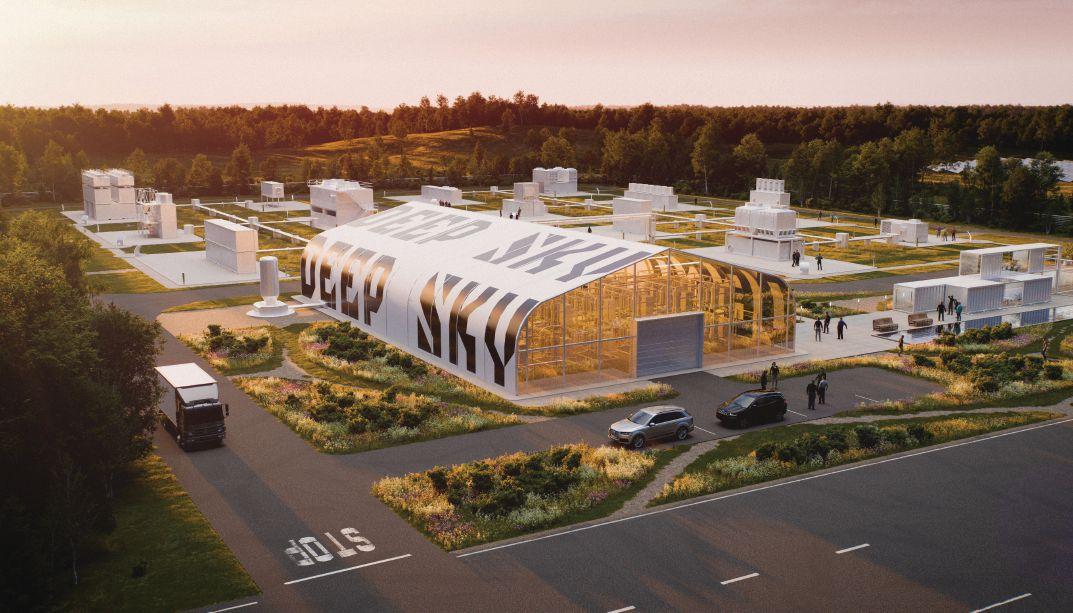
Deep Sky, a Montreal-based carbon removal project developer, is launching a $50-million carbon removal innovation and commercialization centre in Western Canada.
Deep Sky Labs, planned for Innisfail, Alta., represents an industry first for the private development of scalable carbon dioxide removal (CDR) and the first commercial direct air capture (DAC) project in Canada.
“Imagine the atmosphere is a bathtub overflowing with water. CO2 (carbon di-
oxide emissions) is the water,” said Phil De Luna, chief carbon scientist and head of engineering with Deep Sky.
“When your bathtub overflows you can do two things, you can turn off the tap… or you can pull the plug.
“Emissions reductions, point-source carbon capture… biofuels, clean energy, electrification; all of it is turning off the tap. It’s reducing the flow of water into the bathtub.
“But your bathtub’s already overflowing. You have to drain it at the same time.”
Deep Sky’s goal is to accelerate the path to low-cost, low-energy intensity and highly scalable CDR to produce high integrity carbon credits — which other companies can use to offset emissions and meet their decarbonization commitments.
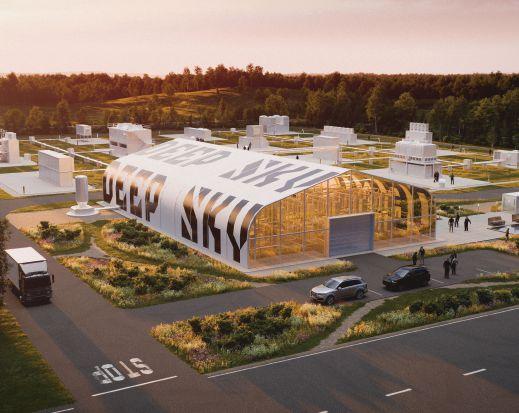
Its estimated $50-million centre, on a 50-acre site, will look to get up and running this winter and can test up to 14 different DAC technologies. It’s expected to have the capacity to capture 3,000 tonnes of CO2 per year and operate for two decades.
Deep Sky Labs will test up to 14 different DAC technologies and look to capture 3,000 tonnes of CO2 per year. | Photo: Deep Sky
Airhive, Avnos, Phlair (formerly Carbon Atlantis), Greenlyte Carbon Technologies, Mission Zero, NEG8 Carbon, Skyrenu, and Skytree are eight tech firms from around the world that have already been selected for the project.
“It’s a new space. There are these different kinds of technologies that are being commercialized. They all say they’re the best, but no one has tried them side-byside,” said De Luna.
“Before we build a large-scale commercial facility, we want to try before we buy.”
De Luna said Deep Sky would build commercial facilities for each DAC startup if they all worked, but the likelihood of that is very low.
The best tech will be chosen for a proposed $100-million facility aiming to pull 50,000 to 200,000 tonnes of CO2 from the air annually. Deep Sky is currently sourcing locations in proximity to places it can safely store carbon.
The Innisfail facility, for example, will store the carbon it pulls out of the air at the Meadowbrook Carbon Storage Hub,
north of Edmonton. Deep Sky’s storage partner, Bison Low Carbon Ventures, is moving the hub through the province’s regulatory approval process.
Deep Sky is also looking at its own storage projects, including investigating situ mineralization at Thetford Mines and sedimentary storage in Bécancour, Que.
“The idea is that we’re going to build DAC facilities right on top of the storage so that we no longer have to transport it,” said De Luna.
“We literally suck it out of the air and pump it into the ground in the exact same place.”
Deep Sky wants to reach a commercial agreement for the $100-million facility as soon as possible, he said. Construction is targeted for 2027 and operations for 2028.
“We hope to be able to have enough facilities that we’re removing 1 million tonnes of CO2 out of the atmosphere by 2030,” said De Luna.
Scaling up from capturing and storing up to 3,000 tonnes of CO2 per year, to 1 million tonnes of CO2 per year, in a little more than six years, is a massive under-
taking, but De Luna said the world can’t afford to wait.
“There’s a delay in when temperature occurs from when CO2 is emitted. Even if we were to completely turn off the tap today, we would still have 10 to 20 years of warming baked in.
“So we have to take care of the CO2 that’s already in the atmosphere. We’re at this temperature now with this amount of CO2, and it’s already getting really bad.”
Climate science agencies estimate up to 10 billion tonnes of CO2 must be removed from the atmosphere annually to keep global warming below the 1.5 C target set in the Paris Agreement.
A late 2023 report by multi-national consultancy, McKinsey and Company, says, “CDR could play a vital role in neutralizing residual emissions” and is likely needed to meet the Paris Agreement’s net-zero goal by mid-century.
Here at home, Canada is emitting about 700 million tonnes of carbon dioxide annually.
“(CDR) is not a silver bullet, this is just part of an approach that we need to take in
order to reduce emissions,” said De Luna.
“As we continue as a species and we fail at reducing emissions fast enough — every single climate accord from Paris to Kiyoto has not met its targets — the role of direct air carbon capture becomes more and more important.
“This is our insurance policy. This is our backstop.
“If we don’t start developing this technology now, and we don’t scale it to where it needs to be, we won’t have it when we need it the most.”
CDR also has the potential to be highly lucrative.
In its report McKinsey estimates, “A CDR industry capable of delivering gigaton-scale removals at net-zero levels could be worth up to $1.2 trillion by 2050.”
Deep Sky co-founders Joost Ouwerkerk, Fred Lalonde and Laurence Tosi are no strangers to growing new tech from the
ground up.
Ouwerkerk and Lalonde co-founded Canadian travel app, Hopper, just shy of two decades ago. Today, it’s the No.1 travel app in more than 70 countries and sells billions of dollars of travel worldwide.
Tosi, managing partner and founder of investment firm, WestCap, is the former chief financial officer of short-term rental giant Airbnb, out of the United States. The multi-billion-dollar company has listings in more than 220 countries and regions.
De Luna said Ouwerkerk and Lalonde started planting trees to offset their tech operations emissions a few years ago.
Big tech companies, such as Amazon, Google and Meta, have large carbon footprints. Powering data centres, incoming artificial intelligence, and other new tech require an enormous amount of electricity and that’s only going to grow, presenting a
“If we don’t start developing this technology now, and we don’t scale it to where it needs to be, we won’t have it when we need it the most.” - Phil De Luna
HOW DOES IT WORK?
Phil De Luna explained the process for direct air capture works in three steps:
First, fans pull in air.
Second, CO2 emissions are captured in something absorbent, such as a filter.
Third, the filter is regenerated or cleaned.
“You have to apply energy to your filter to clean it,” he said. “There are all these different variations of chemicals and absorbent materials — that filter can look different.
“The actual process could be different, the way that you move the air can be different.
“What seems simple intuitively — take carbon out of the air and put it underground — when you get down to the engineering there are hundreds, if not thousands of ways to do this.
“Finding the right combination to make it cost effective, efficient and easy to operate; that’s what all these different companies are doing.”
risk to global climate goals.
Ouwerkerk and Lalonde planted about 30 million trees in three years, De Luna said. That started them on their “climate journey,” along which they realised the world’s climate change models are likely “wrong” and global warming is happening faster than anyone expects.
“We got into this mess by taking carbon out of the ground and putting it into the air. We have to reverse that and take it out of the air and put it into the ground,” said De Luna.
“We’re an oil and gas company in reverse.”
De Luna said Deep Sky intends to sell its CDR credits to Fortune 500 companies, such as those big tech companies struggling to meet their climate goals.
Since starting about two years ago, Deep Sky has grown to about 30 people and raised more than $75 million in funding, including from Crown corporations. •
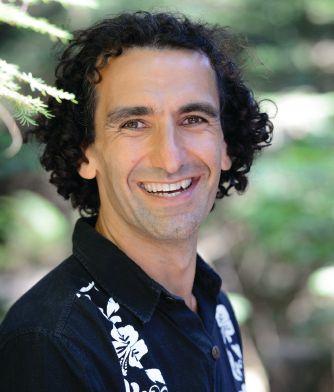
Phil De Luna, PhD, chief carbon scientist and head of engineering with Deep Sky.
The carbon tax is dead
The likely impending doom of the carbon tax opens the door for better policy, BECCS
By Jamie Stephen, PhD, managing director for TorchLight Bioresources
It’s clear the majority of Canadians have soured on Canada’s consumer-based fuel charge, more commonly known as the carbon tax.
Conservative leader Pierre Poilievre is calling for a “carbon tax election” — assured his aim to abolish the controversial policy will secure him as the country’s next prime minister.
The tax was promoted by the federal Liberals and many economists as a mechanism to shift markets, eliciting a behavioral change in Canadians and commercial and small-emitter businesses.
But with the Conservatives far ahead in the polls, and provincial governments across the country lining up against consumer carbon pricing, it looks like the days of the carbon tax — a significant driver for switching from fossil fuels to bioenergy, in particular, from “natural” fossil gas, propane, and heating oil to solid biomass for building heating — are numbered.
Does the end of the carbon tax mean efforts to decarbonize buildings and transportation, the primary consumer and commercial sources of greenhouse gas emissions (GHG), are also done? Not so fast.
ENERGY INFRASTRUCTURE HAS ITS OWN MARKET
Carbon pricing is favoured by many economists as the most economically efficient means of reducing emissions.
If that’s the case, why are so many Canadians enthusiastically calling for the end of the carbon tax?
What many economists haven’t recognized is that a lot of energy infrastructure, particularly for building heating in most areas of Canada, is not a part of a competitive, free market. There is competition in energy products, but not necessarily in
energy infrastructure.
Canadians are served by monopoly energy companies providing one of two products: fossil gas and electricity. The principles of the free market generally don’t apply to linear infrastructure because it’s a “natural monopoly.”
Running two competing fossil gas lines down the same street makes no economic sense, so there really isn’t a choice on the actual infrastructure.
If the answer to the carbon tax is that everyone should switch from fossil gas to heat pumps, supplied by the other linear infrastructure monopoly, electricity, think again.
Many buildings are not good candidates for heat pumps due to heat distribution temperature requirements. Think homes with radiators and multi-storey buildings with heat distribution temperatures over 85 C.
Economists evangelizing the carbon tax don’t seem to understand that for many small emitters, there is no available alter-
native to fossil fuels, regardless of price.
Where are all the zero carbon combine harvesters? Or timber harvesters and feller bunchers? Or long-distance freight locomotives?
There are no commercially-viable, large-scale alternatives to diesel for this equipment. Other than reducing operations, there is no way to avoid paying it and paying it makes Canadian companies less competitive.
For the record, there is no meaningful reduction in GHG emissions without a commercially-viable alternative. It simply ends up being a cash transfer from export-focused businesses to urban residents. Or a shift from operations in Canada to outside of Canada. That’s what really chafes.
CANADA GETS REALLY, REALLY COLD
Relying on electricity to decarbonize also isn’t a solution because Canada gets cold. Really cold.
Heat pumps can “work” at -40 C, but their efficiency drops to near that of electric baseboard.
From an energy systems perspective, heat pumps absolutely reduce the amount of energy required over the year, compared to fossil gas furnaces or electric baseboard, but they do little for the peak heating load and lead to even larger electricity demand spikes than electric baseboard.
When it gets cold, more heat is needed at the exact same time the efficiency of heat supply drops. The electricity grid must have the capacity to meet that extreme peak in demand.
Ensuring dispatchable electricity capacity is available when required costs money. Currently, electricity only accounts for 17% of Canada’s energy consumption.
Jamie Stephen, PhD, managing director for TorchLight Bioresources | Photo: TorchLight
In Alberta, it is only 7%.
In Alberta, heating buildings alone consumes almost twice as much energy as electricity and the peak heat load is several times higher than current installed electricity capacity. It is simply not reasonable to develop electricity capacity required to meet the extremely high demands of bitter-cold days in Canada. Yes, it can “work” for some buildings, but the system-wide numbers don’t add up.
Even if capacity to meet peak demand was developed, it’s highly likely fossil gas would be the generating source. No one has ever made it through a winter in Saskatchewan without burning something.
IF NOT ELECTRIC HEAT, THAN WHAT?
How does an existing 40-storey commercial building in downtown Edmonton avoid paying the carbon tax?
Even if it could get the capacity, an electric boiler would be completely uneconomical and would actually increase GHG emissions given the carbon intensity of the marginal electricity supply.
A biomass boiler is an option, but are we really going to deliver wood chips or wood pellets to every urban building?
The renewable natural gas (RNG or biomethane) crowd will make that case, but multiple studies have shown the maximum potential volume for conventional RNG in Canada is 3% to 4% of current fossil gas consumption. It’s several times more expensive.
The proven approach, as implemented across other northern countries, is district heating.
District heating consists of a network of underground hot water pipes connecting central energy facilities to hundreds, thousands, or even hundreds-of-thousands of residences and commercial buildings.
In most other northern countries, 55% to 95% of the population is connected to district heating systems, with solid biomass — wood chips — by far the most common fuel in low carbon systems.
The lowest carbon, greenest cities, like Stockholm in Sweden, and Copenhagen in Denmark, are heated with wood.
Almost every town and city in Sweden is heated with biomass and/or solid waste, and district heating. If Canada wants to decarbonize urban areas, district heating with
biomass is not only the proven approach, it is the economically viable approach for many towns and cities.
Unfortunately in Canada, governments have completely and utterly failed to develop the necessary widespread infrastructure — district heating systems — to allow building owners to avoid the carbon tax economically.
PLACING THE ONUS ON THE PUBLIC WON’T WORK
Governments must be involved in district heating system development. Cities didn’t get water and sewer systems by telling everyone to install a pipe in front of their home.
Governments have installed linear infrastructure and connected buildings in the past. Putting all the responsibility for decarbonization on individuals is not only inefficient, it just won’t work.
Most of the heat networks in the Nordics are not-for-profit and/or owned by municipalities.
If municipalities can be in the water and sewer business, why can’t they be in the heat-supply business? It is just another two pipes — and the network is much simpler than water and sewer because it is a closed loop, requiring no water extraction or treatment.
The reality is that in most cases, there is no choice when it comes to linear infrastructure. Citizens aren’t allowed to have their own well or septic tank in most urban areas in Canada.
People don’t call that socialism, like they do the carbon tax. They call that urban planning. Why should heat be any different than water or sewer?
Even if we do want to retain choice on heat supply, it is entirely reasonable to charge people a carbon tax if they choose not to connect to an available heat network. Until that choice is actually available however, it’s hard to justify a carbon tax on building heat.
Sweden already has a carbon tax equivalent to C$170 per tonne of CO2 emitted — the price planned for 2030 in Canada — but there a very few carbon tax complaints related to building heat because barely anyone pays it. The majority of people are connected to district heating systems fuelled by sustainable biomass.
TAKE IT ONE STEP FURTHER WITH BECCS
OK. So if district heating can address building heat emissions, what do we do about transportation emissions, the other primary source of consumer and commercial emissions? Bioenergy with carbon capture and storage, or BECCS, is the only technology that supplies both energy and permanently removes carbon dioxide from the atmosphere.
It generates carbon dioxide removal (CDR) while simultaneously supplying heat and power to reduce fossil fuel use. In other words, the biomass combined heat and power plants decarbonizing cities can also decarbonize consumer transportation.
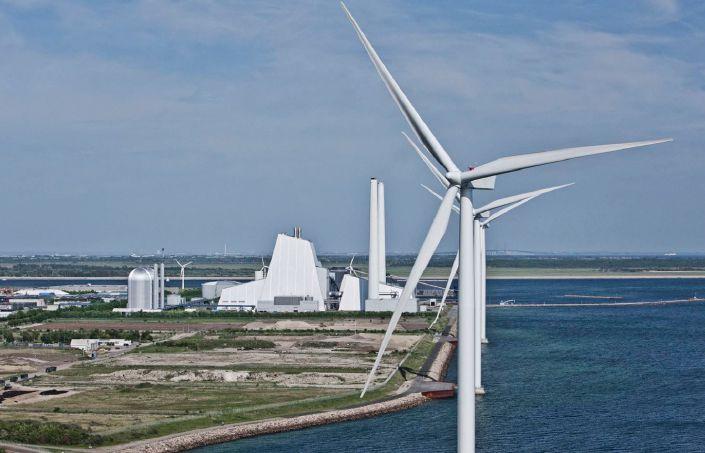
Avedøre Power Station | Photo: Ørsted
It harnesses the awesome power of plants — principally trees — to store both solar energy and carbon.
By adding carbon capture and storage to biomass combined heat and power plants, heating (via district heating) and supplying electricity to urban areas, energy supply becomes negative carbon.
Is heating cities with wood chips, transported from rural areas, and then capturing the CO2 and transporting it for storage 2- to 3 kilometres below the surface of the Earth, too complicated to be implemented?
In the Nordics urban biomass combined heat and power plants already exist, and capture additions are in construction.
In Copenhagen, tech giant Microsoft has entered into a purchase agreement with renewable energy company, Ørsted, for a large portion of its incoming carbon dioxide removal credits through a BECCS project attached to its Avedøre Power Station. Microsoft is targeting zero carbon for its entire history.
CO2 will be liquefied and shipped by marine tanker to the North Sea for permanent storage below the seabed. Through the sale of CDRs, the local cost of heat and power can actually become lower due to the additional revenue – and income –from CDRs. (See related news Page 8).
GOODBYE CARBON TAX, HELLO CARBON REMOVAL CHARGE
Canadians must come to grips with the notion meeting climate goals will have costs, but higher energy costs are OK if we also have higher income and per capita GDP.
Canada can be the world leader in BECCS due to its abundant biomass resources, attractive onshore CO2 storage geology, and climate regulations with rule of law.
By becoming a BECCS carbon dioxide removal exporter, we can grow the Canadian economy and lower the carbon intensity of our economically-critical exports of oil, gas, and derivatives.
A Canadian BECCS industry must start with the home market, and beyond provincial industrial carbon markets, there must be a source of funds to purchase CDRs.
Canada needs a Carbon Removal Charge on consumer fossil fuels as a realistic and impactful alternative to the carbon tax.
The charge would initially target trans-
portation fuels, such as gasoline sold in urban areas where there is a viable commercial alternative to gasoline-fuelled internal combustion engine vehicles, such as light-duty electric vehicles.
Unlike the carbon tax, which applies to all fuels but does not necessarily lead to a GHG reduction, a Carbon Removal Charge would only be charged in proportion to the GHG emissions actually removed via BECCS.
Ultimately, the CDR industry — as well as the broader carbon capture and storage industry — must be viewed as a garbage disposal service.
Paying for garbage removal is something the public understands. It fits with the North American world view of choice, but paying for the consequences. It’s also in stark contrast to policies designed to manipulate behaviour without actually reducing emissions.
By having a source of revenue for the CO2 (garbage) removal, the BECCS industry can grow.
It will be small at first. A microscopic Carbon Removal Charge per litre of gaso-
line, because another major problem with the current carbon tax policy design is its rapid pace.
Carbon price increases have not been consistent with the rate of vehicle and heating system turnover. Abandoning a three-year-old fossil gas furnace or minivan is not a realistic option for most Canadians.
A Carbon Removal Charge, linked to growth of the domestic BECCS industry, would inherently rise more slowly than the current carbon tax has done and better align with the turnover of vehicles.
A Carbon Removal Charge is not a get out of jail free card. It is an economically-efficient means of reducing national fossil fuel emissions while providing critical revenue for biomass combined heat and power plants and linked district heating infrastructure.
It would also provide an essential, valuable market for the low-grade biomass generated by Climate Smart Forestry, active forest management operations necessary to reduce our nation’s largest source of GHG emissions: wildfires. •
Combustible Dust Specialists
WPAC 2024: Biomass in electrification
Back
to basics
with the health of Canada’s forests and climate-friendly action
Can Canada’s forest sector — from its woodlot owners to pellet producers, and the consumers in between — get back to being proud of what it does?
It’s a question hundreds of forest sector insiders considered as they gathered for the Wood Pellet Association of Canada’s much-loved annual conference mid-September in Victoria, B.C.
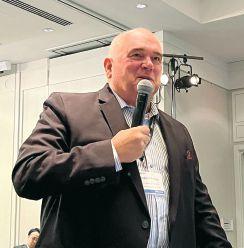
Industry drivers, such as Drax’s Vaughan Basset, equipment leaders, such as David Dubios of Fink Machine Inc., and top market analysts, such as FutureMetrics’s Bill Strauss, and Argus Media’s Robbie Webster Junior and Hannah Adler, came together to discuss what’s next for the industry.
“All forest fiber is important, and we shouldn’t waste it,” said WPAC head Gordon Murray as the conference kicked off.
While the conference’s major goal set to outline the future role of biomass in electrification, attendees also seemed keen to come together and reaffirm their commitment to the health of Canada’s forests and climate-friendly action.
“When I first started in the forest sector it was a source of pride. I bragged about being in forestry,” said Joe Nemeth, GM for the B.C. Pulp and Paper Coalition, speaking to public opinion the sector is bad for Canada’s forests.
Nemeth shared details of his recent twoweek trip to Finland, spent learning how the country handles and thinks about its forests.
He said Finland is focused on “offence, not defense.”
The country’s foresters actively manage their forests before harvest by removing brush, to reduce wildfire risk, and thinning weak and dead trees, to promote best growth, create regular biomass supply, and
By Sarah Sobanski, editor
ensure sustainable economic value.
“They truly actively manage their forests and it’s very successful,” said Nemeth, adding the country claims 100%-forest use, including wood chips and bark heading to pulp and paper mills, and pellet plants, but also to biomass-fired energy systems “in every single town.”
Reestablishing pride, garnering public and government support, synergising policy locally and internationally, and fostering a better understanding the role active forest management, and by extension bioenergy, can play in mitigating the climate crisis were key takeaways from the conference.
Bill Strauss, president and founder of FutureMetrics, kicked off his presentation with a nod to the reason the biomass industry exists; rising global carbon emissions and climate change.
He said fossil fuels won’t last forever, and the need for electricity is increasing. The world needs to transition to decarbonized electricity now, but energy storage capacity to support variable wind and solar
energy is decades away.
That’s where sustainably sourced biomass comes in to support baseload and load-following power generation by replacing coal power plants.
Janet Annesley, chief sustainability officer with energy transition company Kiwetinohk Energy Corporation, and fellow for the Public Policy Forum, said here at home Canada has to grow its clean electricity grid by two to three times.
“We have a lot of the technical solutions… In the immediate time we can reduce emissions because there’s a lot of safe bets, and wood pellets are one of them,” said Annesley.
David Dubois, business development manager for Fink Machine Inc., spoke to the applications of biomass boilers in remote communities, not just for the larger grid.
Read Canadian Biomass’s full report on WPAC 2024, and FutureMetrics’s white paper on declining fossil fuel capacity, at www.canadianbiomassmagazine.ca. •
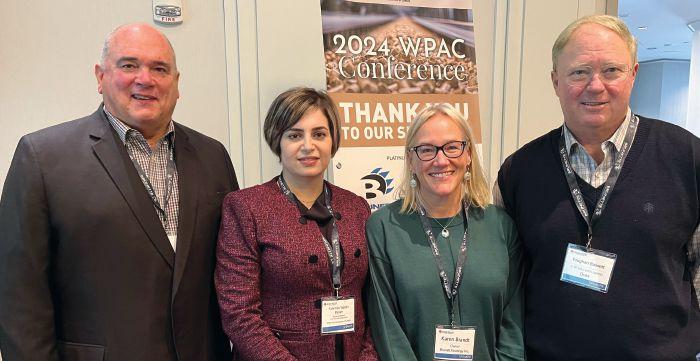
WPAC’s Gordon Murray and Dr. Fahimeh Yazdan Panah, Brandt Strategy Inc.’s Karen Brandt, and Vaughan Bassett, senior VP for Drax biomass sales | Photo: Sarah Sobanski
In-woods grinding above board, cost effective
By Gordon Murray, executive director for the Wood Pellet Association of Canada
The Wood Pellet Association of Canada, in collaboration with BioPower Sustainable Energy Corporation, has completed a study that outlines the feasibility and economic implications of inwoods grinding to process forest biomass for wood pelletization in Ontario.
The study, led by Dr. Fahimeh Yazdan Panah, WPAC’s director of research, highlights that forest biomass, when processed with the right technology, such as in-woods grinding, can serve as an economically viable feedstock for wood pellet production in Ontario.
The study was funded by the Ontario Forest Biomass Program, which supports the objectives set out in Ontario’s Forest Sector Strategy and Forest Biomass Action Plan. It helps fund initiatives that secure and increase long-term wood utilization, including biomass.
SOLVING CONTAMINATION AND HIGHER MOISTURE AND ASH CONTENT IN THE WOODS
Ontario’s forests contain vast amounts of biomass, including treetops, branches, low-quality logs, and fire-damaged timber, traditionally left behind or burned after logging. However, forest biomass is often contaminated with soil and other debris. It also tends to have higher moisture and ash content, complicating the pelletization process.
In the study, a Peterson 4710B grinder was used at the logging site to process forest residues into uniform feedstock suitable for pelletization. This approach reduces the volume of material transported, which can significantly lower transportation costs—a crucial factor in remote forest locations.
The study found ground material produced through in-woods grinding, after ap-
propriate drying and cleaning, could meet international standards for wood pellet production, including ISO 17225-2.
LARGE OPERATIONS SHOULD OWN, SMALL-MEDIUM SHOULD OUTSOURCE
The study evaluated the economic implications of two different operational models:
In Scenerio 1, the pellet plant owns and operates all necessary equipment, including the Peterson 4710B grinder, trucks and loaders. The study found this approach could be cost-effective for large-scale operations with consistent biomass availability.
The cost per tonne in this scenario ranged from $41.68 to $52.46 per tonne, depending on factors such as the type of transportation and operational fees. While ownership requires a significant upfront capital investment, it offers the potential for long-term cost savings and greater control over the entire supply chain.
In Scenerio 2, outsourcing grinding and transportation to a third-party provider offered financial predictability and reduced operational complexity for small companies without the capital to invest in heavy equipment, or those dealing with inconsistent biomass availability. The study found that outsourcing results in a fixed cost of
$44 to $49 per tonne. However, it introduces dependency on external suppliers, which could lead to challenges if there are disruptions in the supply chain.
IN-WOODS GRINDING ECONOMICALLY FEASIBLE
By adopting advanced techniques and carefully weighing the benefits of owning versus outsourcing equipment, pellet producers can enhance operational efficiency and significantly reduce costs. Moreover, integrating forest biomass into production can contribute to improving forest health, reducing wildfire risks, and advancing climate action by utilizing a renewable energy source and offsetting the use of fossil fuels.
Operationally, in-woods grinding improves the efficiency of biomass transportation by reducing the volume of material that needs to be moved, which can lower greenhouse gas emissions associated with transportation. The ground biomass can be further refined and pelletized, creating a product that complies with stringent international standards, ensuring that Ontario’s wood pellet industry can compete in the global market.
Link to the report on www.canadianbiomassmagazine.com. •
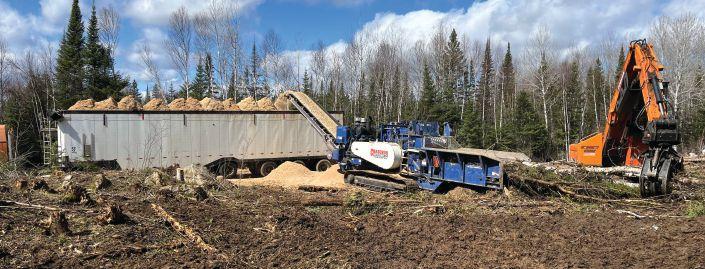
Forest residue grinding using Peterson 4710B | Photo: WPAC/BioPower.
Unlocking AI-enhanced NIR tech for biomass sorting
Tool could significantly improve the efficiency of biomass sorting, leading to higher-quality pellets and reduced operational costs
By Fahimeh Yazdan Panah, PhD, WPAC director research and technical development
With the growing global demand for renewable energy and the increased use of forest residues left behind or burned after harvesting, the wood pellet industry is looking into optimizing feedstock. While using forest biomass holds great promise, it also brings challenges such as contamination, ash and moisture content variability and higher processing costs.
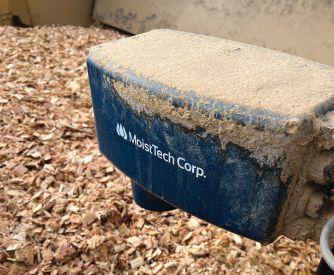
The Wood Pellet Association of Canada (WPAC) and the University of British Columbia’s Biomass and Bioenergy Research Group (BBRG) are developing artificial intelligence-assisted near-infrared (NIR) technology specifically for use in the wood pellet sector. This tool could significantly improve the efficiency of biomass sorting, leading to higher-quality pellets and reduced operational costs.
BIOMASS SORTING CHALLENGES
Biomass feedstock comes from diverse sources, including forest residues, recycled wood and agricultural waste. Each source presents challenges, ranging from inconsistent moisture levels and particle size variations to chemical contaminants. These factors can negatively impact combustion efficiency, pellet durability and product quality.
Current methods for sorting and blending biomass often do not account for these variations in real-time, resulting in inefficiencies, higher energy consumption and greater wear and tear on equipment.
HOW AI-ENHANCED NIR TECH WORKS
NIR technology operates by shining near-infrared light on biomass feedstock and analyzing the light reflected to deter-
mine molecular composition. This allows real-time measurement of key properties, including moisture content, chemical composition, particle size, contaminants and impurities.
The integration of AI algorithms enhances the precision of NIR technology by providing advanced data interpretation, real-time decision-making and automatic adjustments to the feedstock blend. This ensures biomass entering a pellet plant meets stringent quality requirements, such as those outlined in ISO 17225-2.
BENEFITS FOR PELLET PRODUCTION
• Improved Feedstock Quality: By rapidly assessing and adjusting the biomass blend, NIR tech ensures moisture and chemical composition uniformity, leading to higher-quality pellets.
• Increased Production Efficiency: AI-driven real-time monitoring minimizes the need for manual adjustments, reducing waste and optimizing energy consumption.
• Expanded Biomass Utilization: NIR tech allows pellet plants to efficiently process a broader range of underuti-
lized materials, such as burnt wood, forest residues and recycled wood fibre.
• Reduced Maintenance Costs: The ability to detect impurities early prevents damage to equipment, extending the life of machinery and minimizing downtime.
• Cost Savings: Enhanced sorting accuracy reduces material waste and energy consumption, translating to significant cost reductions over time.
REAL-WORLD APPLICATIONS AND FUTURE POTENTIAL
The AI-assisted NIR system currently under development by WPAC and BBRG will be tested through pilot programs at WPAC members’ pellet plants to evaluate its effectiveness in improving feedstock sorting and plant efficiency. Following these pilots’ success, this technology’s deployment will be scaled up across operations. By integrating AI-enhanced NIR systems into the pellet production process, the aim is to boost efficiency, enhance product consistency, and maintain competitiveness in the evolving biomass industry. Looking ahead, AI-NIR’s potential extends beyond pellet production. Its adaptability makes it applicable in other sectors of the biomass industry, such as biofuel production and biochemical processing.
A NEW ERA FOR BIOMASS
AI-enhanced NIR technology represents a pivotal shift in how biomass feedstock could be managed. Providing a fast, reliable method for sorting and blending biomass offers a clear path toward greater efficiency, sustainability and profitability in pellet production. •
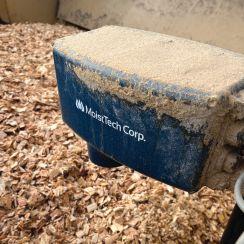
Moisture sensor | Photo: MoistTech
Canada’s Net-Zero Advisory Board recognizes BECCS
New reports say Canada may need to do more than reduce emissions to meet targets
By Sarah Sobanski, editor
Canada’s Net-Zero Advisory Body says carbon capture and storage — both with direct air capture and bioenergy capture — could be key to hitting emissions reduction targets.
The advisory board, tasked with advising the country’s Environment Minister on climate goals, has released two new reports urging the federal government to think outside the box and enact its current climate policies.
Amid the two companion reports, the board advises Canada to find new ways to address its “excess emissions” and recommends a carbon reduction target of 50% to 55% for 2035, compared to 2005 levels.
Excess emissions are the gap between what’s fair to expect in emissions reduction targets and what’s targeted, said Simon Donner, advisory board co-chair.
While typically emissions targets are tied to 2030 (40% to 45%), and 2050 (reaching net-zero), as per the Paris Agreement, the federal government is required to set interim targets in its Canadian Net-Zero Emissions Accountability Act (2021).
“It is ambitious,” said Donner, adding the federal government has to set its next target by December. “There’s a case that we may need to consider measures that remove carbon dioxide from the atmosphere or trade carbon credits.”
Donner, who’s also a climate scientist and professor for the University of British Columbia, clarified the country’s focus should be on reducing emissions, but the advisory board intends to investigate “the ‘net’ part of net-zero” in the coming year.
Net-zero refers to the balance between the amount of greenhouse gas that’s pro-
duced and the amount that’s removed from the atmosphere.
In the report Climate’s Bottom Line: Carbon Budgeting and Canada’s 2035 Target, the advisory board says Canada may need to address its “excess emissions” with negative emissions tech, such as bioenergy with carbon capture, nature-based solutions, such as planting trees, and international trade, such as with carbon credits.
Donner said technology that removes emissions from the atmosphere also comes into play with the advisory board’s recommendation that the country install a carbon budget.
“Think of the total sum of emissions we can add to the atmosphere over time,” he said. “We talk about looking at what we’re going to use over the decades, and how you could address that.”
The report says carbon budgets are
used by other countries to better track the effect of policy decisions on the climate and the consequences of delaying action.
BIOMASS TAX CREDITS
The advisory board says the country can achieve its 2030 target by hammering out existing policy measures, such as clean economy investment tax credits.
Donner said the lattest available data suggests Canada’s emissions are around 8% below 2005 levels. He said that’s an achievement — considering the growth of the country, they should be going up — but there’s still “a long way to go” to get to 40%.
The second report, Closing the Gap: Reaching Canada’s 2030 Emissions Target, says credits for carbon capture, utilization and storage, and clean technology were passed in the summer with the 2024 Budget Implementation Act, but credits, such as for clean hydrogen and biomass, remain up in the air.
Donner said he’s hearing from government that the additional credits are “pretty close.”
The report highlights a need for the government to address negative interactions between policies, strengthen industrial carbon pricing, secure additional reductions from the oil and gas sector, and pursue “high-impact” actions, such as phasing out the sale of new and replacement fossil fuel heating and cooling devices.
“We are one of the top 10 emitters both per person, and in the world,” said Donner, adding the government needs to signal to industry it plans to invest in climate action. •
Simon Donner, Canada Net-Zero Advisory Body co-chair and climate scientist | PHOTO: NZAB
Exploring the benefits of RNG in Canada
Biogas and renewable natural gas (RNG) landscape in Canada has enormous potential
By Sarah Stadnky, director of policy and communications at Canadian Biogas Association
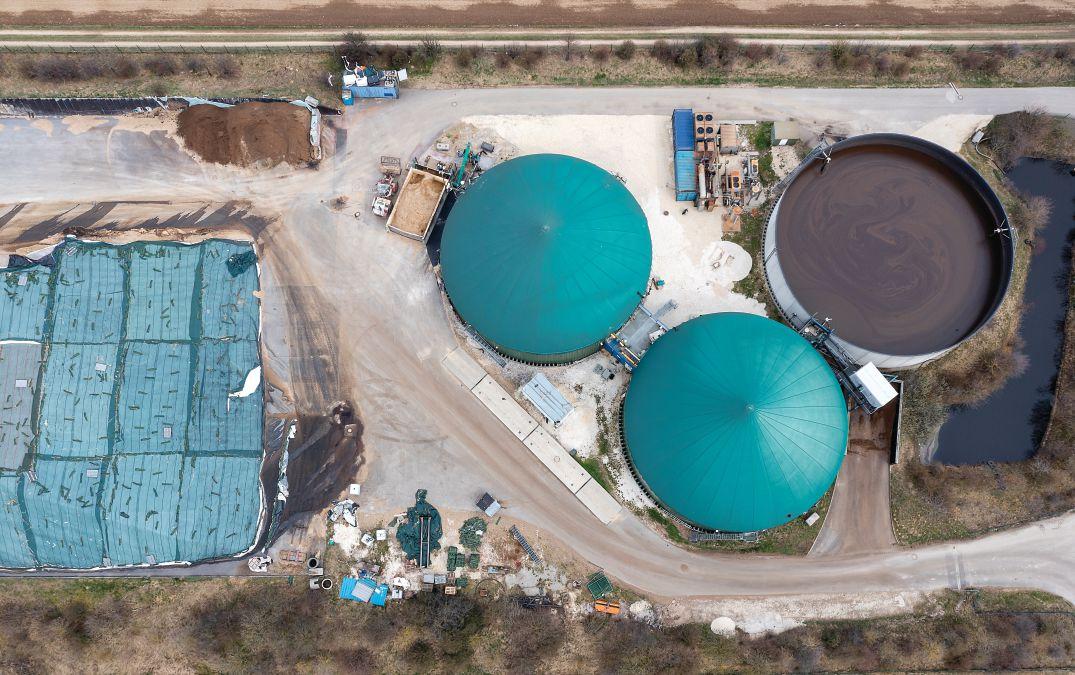
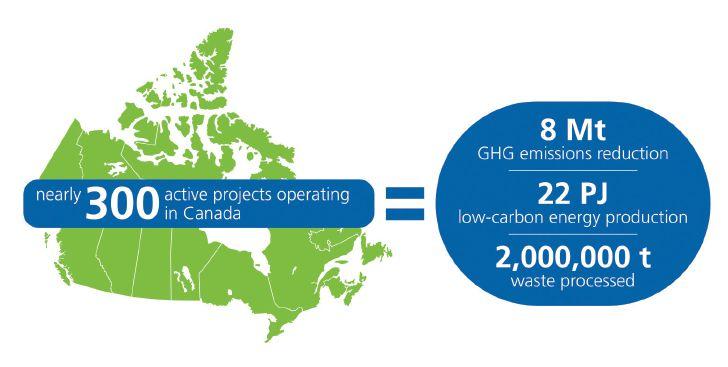
The biogas and renewable natural gas (RNG) landscape in Canada has enormous potential and an experienced, accomplished suite of companies developing and operating projects. Today, there are close to 300 operating biogas projects, which provide 198 megawatts of clean electricity capacity, 6 petajoules of RNG, and 130 million cubic metres of biogas for heat and direct use.
Thanks to a growing global awareness
of climate change, an urgency to reduce greenhouse gas (GHG) emissions, and the demand for more sustainable waste management practices and energy systems, biogas production is a growing industry in Canada. Development is primarily provincially driven where favourable regulations, programs, and funding exist.
Ontario, for example, has the highest number of biogas facilities due in part to
its Feed-In Tariff Program for electricity from 2006 to 2016.
Still, only 14% of the potential feedstock for biogas is used in Canada. More needs to be done to raise awareness about its benefits and the role it plays in Canada’s low-carbon economy.
RNG PART OF THE CLIMATE SOLUTION Implications of Policy Driven Electrifi-
Photo: Bim / E+ / Getty Images
cation in Canada, a 2019 study by U.S.based consultancy ICF, says it’s not currently feasible for the country to switch entirely to electricity in the near-term. RNG can play a vital role in helping Canada reach its climate goals and has a double benefit for emissions reductions.
More than 80% of Canadian residential GHG emissions coming from heating. Injecting RNG into the natural gas grid can directly reduce those emissions and captures methane from waste materials such as food scraps, animal manure, and landfills to turn it into energy. RNG is one of the few potentially carbon-negative fuels in the world because it captures methane which would otherwise enter the atmosphere.
A Canadian Biogas Association (CBA) report estimates RNG could reduce GHG emissions by 26.7 megatonnes by 2030. These reductions could help fulfill 55% of Canada’s methane pledge and play a major role in meeting Canada’s climate targets.
RNG UNTAPPED
Canada is sitting on a huge opportunity to transform organic waste into clean energy. Some of the largest underutilized sources include agricultural waste, such as manure and crop residues, food waste from households, restaurants, supermarkets and food processing facilities, and methane already being emitted from landfills.
Organic waste is ever present in our society and will continue to be generated. With the right policies, incentives, and investments, Canada can capture energy from this waste and position RNG as a
Only 14% of the potential feedstock for biogas is used in Canada. – Canadian Biogas Association
key player in Canada’s renewable energy landscape.
More than 40 RNG projects are under development in Canada. The market is projected to grow four-fold in the next few years compared to 2021.
RNG IS A PART OF THE CIRCULAR ECONOMY
RNG is more than just gas; it’s part of the circular economy.
By converting organic waste into clean energy, RNG creates a circular loop that brings multiple benefits to our environment and economy. The process not only produces clean energy, but also the nutrient-rich by-product, digestate which enriches soil and boosts crop growth, reducing the need for synthetic fertilizers.
Plus, RNG supports job growth across multiple sectors, from construction and engineering to agriculture, logistics, and research.
Canadian biogas and RNG projects, are developed by farmers, municipalities and the commercial private sector, varying in size and type and predominately located in British Columbia, Alberta, Ontario and Québec.
Building, maintaining, and operating RNG facilities creates local jobs and new revenue streams while farmers benefit
from innovation, diversified income and the increased demand for feedstock.
RNG: A PROVEN SOLUTION
The exciting news about RNG is that it isn’t just a concept, it’s a here and now solution.
This proven technology is already making a difference in our communities. As of today, Canada boasts 33 facilities actively producing RNG, and, as mentioned before, more than 40 projects on the way and about 300 biogas plants already operational.
It is easy to blend RNG with natural gas. No new equipment is needed. The country has the technology, infrastructure and workforce in place to significantly scale up RNG production.
RNG CAN BE AN AFFORDABLE ENERGY SOLUTION
It’s not fair to compare the price of RNG to fossil natural gas.
RNG delivers more value than just energy, it reduces methane emissions from growing waste sources in society, that would otherwise be sent into the atmosphere, and creates energy.
RNG leverages existing natural gas pipelines and storage capacity, providing a way to deliver renewable energy without building new infrastructure. It can also be used directly with equipment that uses natural gas, such as home appliances or industrial boilers, without a need for costly upgrades.
The CBA is raising awareness about the value of RNG, hoping to foster understanding and empower stakeholders to confidently talk about the benefits of RNG. There is a lot of confusion and misunderstanding about the benefits of RNG, but it’s more than just gas. It’s a part of the climate solution and provides many inherent benefits. •
Canada sleeping on $4-tillion bioeconomy
Canada lags its G7 partners, competitors in establishing a clear path for bioeconomic growth
By Sarah Sobanski, editor
Jeff Passmore, founder and chair of Scaling Up, is still waiting for Canada to develop an actionable national bioeconomy strategy after more than three decades in the renewable energy sector.
“It’s counterintuitive that Canada would not have a bioeconomy strategy,” said Passmore, noting the country’s massive forests, which need to be better managed to mitigate wildfire risk, its expansive agriculture lands, which produce crop residues, and municipalities, which are landfilling waste when that organic material could also be used as a feedstock.
Passmore, also CEO for Passmore Group, a consultancy focused on helping clients rapidly develop projects in the bioeconomy and cleantech space, is preparing to host the ninth edition of his influential conference this November.
It brings together leaders from across the country and bioeconomy to discuss how to propel the sector forward.
“Canada has this huge blind spot where the bioeconomy is concerned,” he said.
To be fair, Passmore clarified the federal government does have a Forest Bioeconomy Framework, but it doesn’t mention bioenergy outside of the forest sector and leaves something to be desired when it comes to concrete action.
The same can be said for Canada’s Bioeconomy Strategy, which the federal government spent $200,000 to help Bioindustrial Innovation Canada develop in consultation with more than 400 industry representatives in 2019.
The report recommends creating new regulation and policy, including developing a national strategy to fully advance Canada’s bioeconomy.
“Certainty is the mother of investment,” said Passmore. He said companies are advancing Canadian bio-projects, but the sector won’t attract foreign investment without the country sending a “clear signal” to market it’s “serious” about the bioeconomy.
Concrete action and clear signals look like actioning programs similar to the United States’s BioPreferred Program.
Created in 2002, the BioPreferred Program mandates federal departments to buy biobased products, and includes a voluntary certification program for businesses to label their biobased products so consumers can make informed purchases.
Passmore said most of Canada’s G7 partners and competitors have national bioeconomy strategies. He said it’s sleeping on the opportunity the market presents.
A 2020 report by multi-national consul-
tancy, McKinsey and Company, suggests the “bio-revolution,” including innovation in health, food, consumer products, materials, chemicals and energy, could have a direct economic impact of US$2- to $4 trillion globally per year by mid-century.
Bio-materials, -chemicals and -energy, could have a global impact between US$200- to $300-billion annually in the next two decades.
“Four-trillion-dollars a year — that’s twice the size of Canada’s GDP. Canada’s GDP was (around) US$2 trillion a year,” said Passmore. He said there’s no reason Canada couldn’t secure a sizable slice of the bioeconomy with its resources. He added sources today estimate the potential of the bioeconomy at closer to US$30 trillion a year.
“I think we are spoiled by the vast natural resources we have,” said Passmore. “We are so blessed… we’ve been able to rest on our laurels and the Canadian economy has been driven in large part by oil and gas revenues.”
Passmore said the bioeconomy touches on so many departments, from forestry to agriculture to health and more. Government needs to get behind a strategy that brings together all its departments.
“We have to get out of those silos,” he said.
Scaling Up Bio 2024 kicks off in Ottawa, Ont. from Nov. 25 to 27.
“One of the reasons for the conference is we are trying to help solve this problem… move the bioeconomy in Canada forward further and faster,” said Passmore. “And if we don’t go faster and further we will certainly not meet our net-zero targets.” •
Jeff Passmore, founder of Scaling Up and CEO of Passmore Group
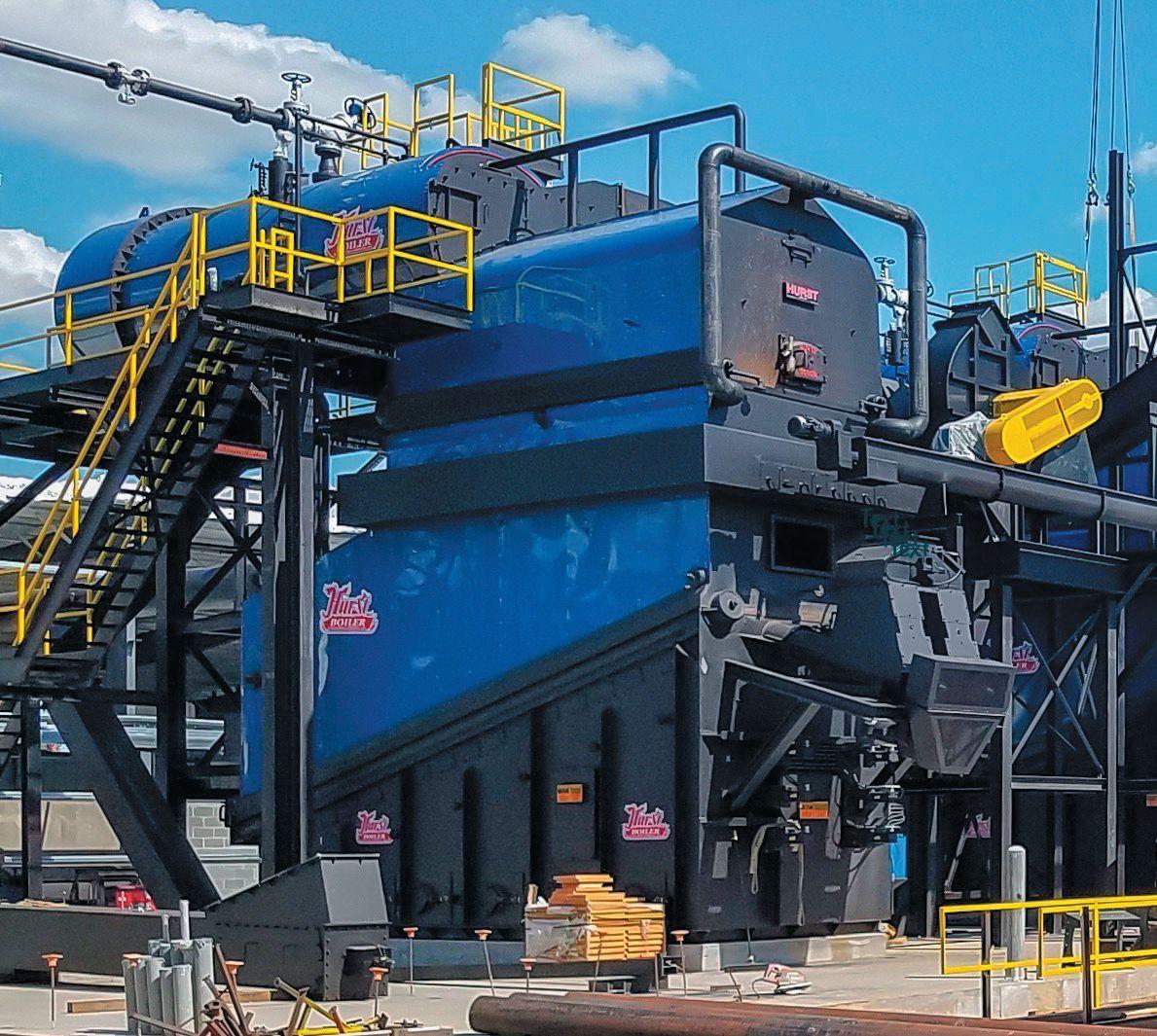
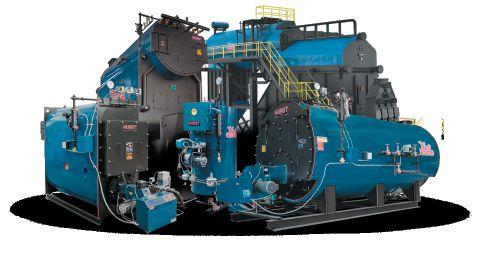
Hurst biomass systems lead the alternative energy boiler market with innovative solid-fuel-combustion design
Hurst is a custom manufacturer of engineered packaged steam and hot water boilers and integrated boiler systems, renewable fuel fired gasification/ combustion/heat recovery systems, biomass & hybrid boiler systems, CHP/ co-generation systems, PLC-integrated boiler controls, parts & boiler room accessories. Fire-tube, water-tube & feedwater equipment for all industrial heating & process applications. Low NOx modular boilers & burners available.
Hurst Biomass Systems lead the alternative energy boiler market with innovative solid-fuel-combustion design.
Complete modular construction for easy low cost installation.
Hurst has specialized in custom design of biomass steam plants and cogeneration systems since 1967.
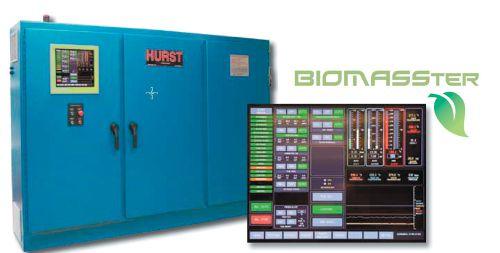
High Efficiency Integrated Control Systems
Offering integration and scalability, the new, high efficiency Integrated Control Systems from Hurst Boiler for boiler room monitoring and communications provide advanced supervisory boiler controls for all new and legacy Hurst products.