Account Coordinator | Mary Burnie mburnie@annexbusinessmedia.com
Audience Development Manager | Anita Madden amadden@annexbusinessmedia.com 416.510.5183
Media Designer | Curtis Martin cmartin@annexbusinessmedia.com
Group Publisher | Michelle Bertholet mbertholet@annexbusinessmedia.com
President/COO | Scott Jamieson sjamieson@annexbusinessmedia.com
Printed in Canada ISSN 1488-4305
Publications Mail Agreement #40065710
Subscription rates:
From time to time, we at Drainage Contractor make our subscription list available to reputable companies and organizations whose products and services we believe may be of interest to you. If you do not want your name to be made available, contact our circulation department in any of the four ways listed above.
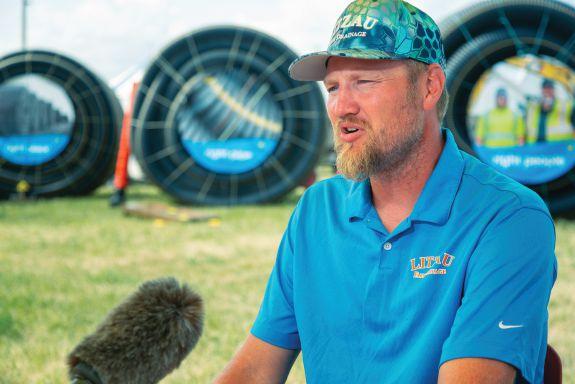
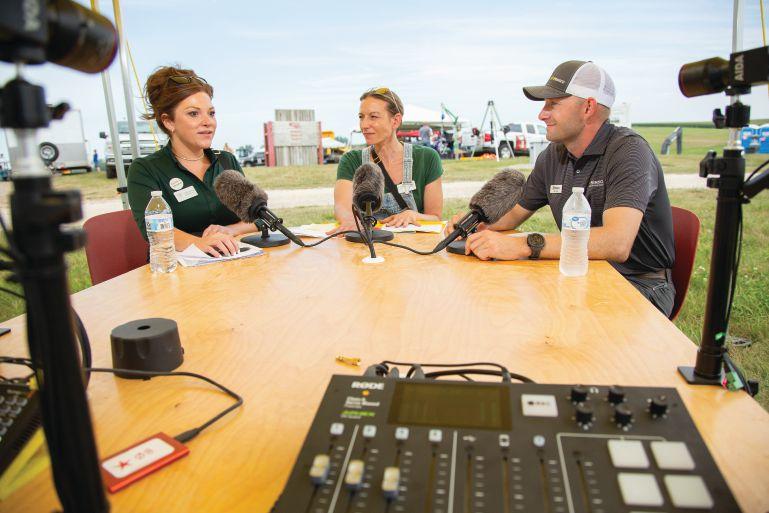
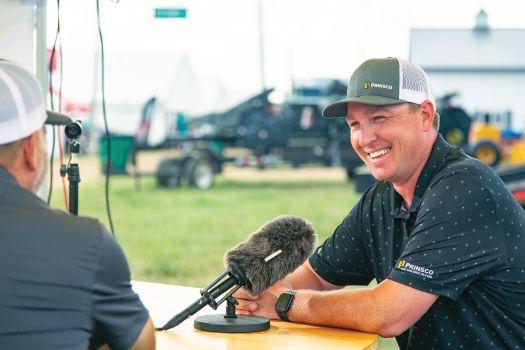
In our May 2023 issue, you got to meet this year's GroundBreakers. Now, you can hear them tell their stories in their own words. GroundBreakers podcasts are available under "Features." November 2023
CONTEST
Contractors and readers show how they spent their summers.
How a farmer-run Saskatchewan drainage district blossomed into a high-functioning organization.
A new project seeks to go where no researcher has gone before –mapping tile drainage.
CONTRACTOR AT WORK
How a Southern Ontario contractor built his business while introducing drainage to the local market.
Dreding ditch drains for topsoil has its advantages.
Drainage Innovation Webinars now online
Our 2022-23 Drainage Innovation Webinars – featuring discussions on how nutrients move, phosphorus removal structures and tile material –are now archived online. You can find this on the Drainage Contractor website under the "Webinars" tab.
GroundBreakers podcasts
Growing smarter
The industry is going to bold new places – it's important for us to encourage that.
by Bree Rody
Igrew up in Northeastern Ontario on the Great Clay Belt – in the town of Kapuskasing, to be exact. In its early days, its leaders envisioned “Kap” as a thriving agricultural community. Under the Returned Soldiers and Sailors Act of 1917, the Kapuskasing Soldier Colony was established, with those soldiers given homesteads, grants and loans to stimulate this growing colony. Within only a few years, more than 90 percent of the settlers had fled. One testimony in the resulting enquiry commission read: “There are seven months of snow, two months of rain and the remainder, mosquitos and blackflies.” Seventy years later, during my childhood, it still was not known as a hub for agricultural activity and growth – even hobby gardening was difficult.
Studies show that land that is adequately drained produces better growth.
However, recent activity in the surrounding regions indicate that would-be growers are finally seeing potential of these wide-open spaces. We’ve always known the land up there is cheap compared to its neighbors to the south, but more are seeing its potential productivity. As such, governments and agencies are responding with funding. The Northern Ontario Heritage fund is providing funding for 50 percent of tile drainage contractor costs to a maximum of $500 per acre and 100 percent of the project management/ administration fees of the service provider (calculated at 10 percent of the contractor costs to a max of $100 per acre).
All that said, my hometown isn’t featured in this issue of Drainage Contractor. But I’ve been thinking lately about the growth of drainage – it’s modest, but it’s there. For the 50 years we’ve been publishing Drainage Contractor, a good chunk of our content has focused on the Midwest. And why wouldn’t it? Ohio, Iowa, Michigan, the Dakotas… these are all places known for having a lot of water that needs to be drained from the
land. But as the weather, the needs of farmers, the demands of consumers and our understanding of water changes, we are starting to see the craft expand into newer regions: the Midsouth, Western Canada and, yes, my home region.
Not all agricultural land has the same drainage needs. However, some jurisdictions that were previously thought to never have excessively wet growing seasons have just that. And studies show that land that has its water adequately drained tends to produce better growth than land that is not. Does that mean everyone needs the same system? Absolutely not. But it does mean there lies potential for drainage to make its way into places where it wasn’t previously popular.
And the best part about drainage expanding into newer jurisdictions is that it allows contractors to install smarter systems – whether that’s installing saturated buffers as a standard practice, being able to space and lay tile out more intelligently or adding in controlled drainage system.
Our brand is all about encouraging the growth of the drainage industry – and yes, we mean literal growth, as in expansion of the market. But we also mean growth.
That’s why this year, we're introducing our firstever live event: the North American Drainage Conference on March 5 in Grand Rapids, MI –bringing the best minds in drainage together to provide an experience for contractors unlike any other, with speakers including Eileen Kladivko, Matt Helmers and more. We’re also pleased to bring back another year of the Drainage Innovation Webinars – look for more information on our website this winter.
Although “happy growing” might not be the best send-off for November, the coming “quiet” months are also crucial for growth – just a different kind. DC
NEXT ISSUE: Our next issue will be delivered in May 2024 and will include highlights from the first-ever North American Drainage Conference.
INDUSTRY NEWS
PENN STATE TEAM TO STUDY RIPARIAN BUFFER PERFORMANCE
A multidisciplinary research team at Penn State University will study whether the agricultural pollution-prevention devices known as riparian buffers are working properly.
The three-year project is funded by a $750,000 grant from the USDA’s National Institute of Food and Agriculture. The study will evaluate the role that concentrated flow pathways play in undermining the ability of riparian buffers to mitigate excess nutrients, sediments and pesticides, while developing solutions for restoring and maintaining buffer integrity.
According to the team, questions have emerged about the capabilities of existing buffers, noting that some were found to be underperforming by as much as 78 percent.
NEXTGEN DRAINAGE OWNER’S ABSENCE ‘FELT DEEPLY’
Brett Sheffield, founder and owner of Manitoba-based NextGen Drainage Solutions, passed away in August 2023.
Sheffield, 38, died following what the company described as a ‘random act of violence’ in Toronto. He is survived by his parents, his two siblings, his partner Kali and their two children.
In addition to NextGen, Sheffield was also the owner and operator of Sheffield Farms and Stay Fit Health Club. He was known throughout his community of Pilot Mount, MB for his philanthropy and love of adventure.
Sheffield, who grew up farming, founded NextGen in 2011. The company grew from two employees two two dozen in a few short years and was named one of Canada’s fastest-growing companies by Canadian Business. In 2022, he was named to Drainage Contractor’s inaugural class of GroundBreakers.
Speaking with Drainage Contractor in 2022, Sheffield said his mentors, including Minnesota-based Roger Ellingson and Indiana-based Bob Clark II, taught him the importance of high-quality service. “The main thing they showed me is how important the quality of work was and how important installing things right the first time is. These products have to go in and last for decades.”
Sheffield’s life was celebrated in Pilot Mound on Sept. 19. NextGen Drainage wrote on Facebook, “His absence is felt deeply across the community, our company and his vast network of friends and colleagues…. Brett’s passion for helping every person feel valued and cared for will continue to motivate us. We are finding comfort in our shared commitment to ensuring Brett’s legacy thrives.”
OHIO FARM BUREAU UPDATES LANDOWNER TOOLKIT
The Ohio Farm Bureau has recently updated the Landowner Toolkit, an online resource that helps landowners navigate through common responsibilities pertaining to their land.
The Toolkit includes answers to common questions unique to property owners on topics such as property rights, zoning and more. While the original toolkit is not specific to drainage, the recent updates include additional information about drainage and water and Ohio’s Agricultural Districts.
The updated Toolkit is available for download on the Ohio Farm Bureau website, ofbf.org.
CANADA APPOINTS NEW FEDERAL AG MINISTER
The latest federal cabinet shuffle in Canada has seen longtime minister Marie-Claude Bibeau leave her post as minister of agriculture and agri-food, a file she has held since 2019.
Bibeau, the MP for ComptonStansead, is now Canada’s minister of national revenue. Assuming the agriculture and agri-food portfolio is Cardigan MP Laurence MacAulay –no stranger to the ag file himself.
MacAulay, who has served as an MP since 1988 and counts himself among some of the country’s longest-serving MPs (as well as the longest-serving MP from Prince Edward Island) held the role of minister of agriculture from 2015 to 2019. Since then, he has also served as associate minister of national defence and minister of veteran’s affairs.
Despite his years of experience on the file, MacAulay assumes the position at a time of significant challenge for the country’s agriculture industry – particularly in his home province of P.E.I.
The province spent the better part of last year engaged in a trade dispute with the U.S. following the discovery of potato wart in two P.E.I. fields – a dispute which still affects seed potato exports.
Photo: jackienix
CONSERVATION FARM FAMILY AWARDS ANNOUNCED
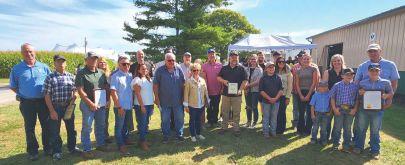
The Ohio Department of Agriculture recognized five families as winners of the 2023 Conservation Farm Family Awards at the recent Farm Science Review in London, OH.
Of the five families honored, several were specifically recognized for engaging in drainage water management practice that have a positive impact on their land and surrounding land.
“Conservation of our soil and water resources is paramount to the future of agriculture and all the benefits it provides to every Ohioan,” said Ohio Department of Agriculture director Brian Baldridge.
The five families honored were: the Rethmel family (Defiance County), Todd and Melissa Miller (Columbiana County), Julius (Jules) and Jodee Verhovec (Jefferson County), Brent and Jenna Clark (Miami County) and the Wickerham family (Adams County).
“For farm families, many traditions are passed on from generation to generation. Few as important as conservation,” said Adam Sharp, EVP of Ohio Farm Bureau Federation. “We congratulate these amazing families for their steadfast work of conservation that has direct impacts on their individual farms, their communities and for all of Ohio agriculture. They are an example of what every farmer across the state strives for to ensure a balance between healthy soils and a vibrant Ohio food system.”
The Rethmel family, Todd and Melissa Miller, and Brent and Jenna Clark were all cited as using drainage water management as part of their conservation techniques, with some using additional measures like riparian buffers and strips.
“Ohio’s farmers are on the front lines conserving the state’s natural resources,” said John Wilson, Ohio Natural Resources Conservation Service state conservationist. “We applaud these families who have gone above and beyond in incorporating conservation planning and implementation, demonstrating the benefits of good stewardship.”
The families each receive $400 from the Ohio Fam Bureau Federation and are featured in the September issue of Ohio Farmer magazine.
MICHIGAN RESEARCHER AWARDED $1.2M FOR WATER QUALITY RESEARCH
Michigan State University’s Ehsan Ghane and his research team have been awarded a $1.2M grant from MDARD to continue their research on investigating the effectiveness of conservation drainage practices. Specifically, the research looks at saturated buffers and their impacts on phosphorus.
“There is good understanding and best management practices around addressing the movement of surface runoff from farmland, but this is not so true for water moving [through] tile lines,” said MDARD environmental stewardship division director James Johnson. “The research… is helping us better understand tile-line movement of nutrients.”
The information gleaned from the study will develop farmer education to better control nutrient and water releases in the short term. The grant will also go toward continued data collections through three partner farms in the River Raisin Watershed area.
ADMC, ISAP SEEK DRAINAGE PROJECT SITES
The Agricultural Drainage Management Coalition (ADMC) and partners from the Illinois Sustainable Ag Partnership (ISAP) have been selected by the Fishers and Farmers Partnership (FFP) 2023 Aquatic Habitat Program to receive funding to “jumpstart” conservation drainage in Illinois.
The groups seek to expand the institutional knowledge to deliver conservation drainage practices among conservation practitioners in Illinois by providing coordination and financial assistance for three to five practice installations. The FFP funding will make it possible for farmers and landowners to participate with no out of pocket expenses. ISAP partners are currently looking for suitable practice sites where there is local interest in gaining hands-on experience with the evaluation, design, and installation steps associated with conservation drainage practices.
“As practitioners the last thing we want is for there to be an increase in funding and demand for conservation drainage practices only to have sites sit on the shelf for an extended period because we do not have the capacity to move designs through the approval process,” said ADMC executive director and project lead Keegan Kult (pictured left). “Without experience, it is difficult to deliver these practices in a timely manner."
HOW I SPENT MY SUMMER
DC readers showcase their passion through pictures.
by BREE RODY
This year, Drainage Contractor decided to embark on its first photo contest since 2019.
The move was inspired by the recent growth of the drainage industry –contractors are busier than ever and installing complex, challenging systems. However, contractors are often so busy – particularly during the summer – that they rarely take time to brag about their own work.
After a call for submissions in June, more than 30 images were submitted from contractors and drainage companies from around the continent – from the Carolinas to Ontario and, of course, plenty of entries from Iowa. Content included everything from trenching and excavating to unique installations, like golf course drainage.
The editorial and publishing team at Drainage Contractor graded the images not only on the physical quality of the images but also in how well they represented the world of drainage – what kind of work was being captured? What sort of action did we get to see? What does the image say about the kind of work being done in the field (the figurative field and the literal field)?
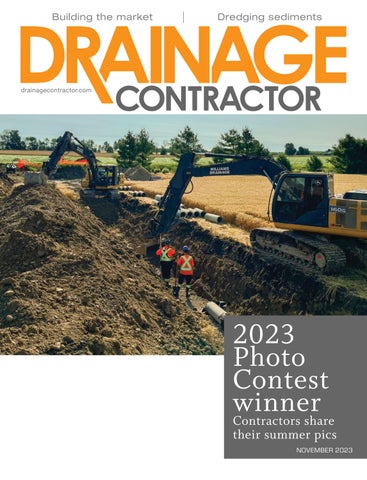
The winning entry was immortalized on this issue’s cover, but this gallery also highlights the other outstanding submissions. More will be available online. Thank you, Drainage Contractor readers, for your pictures! DC
GRAND PRIZE
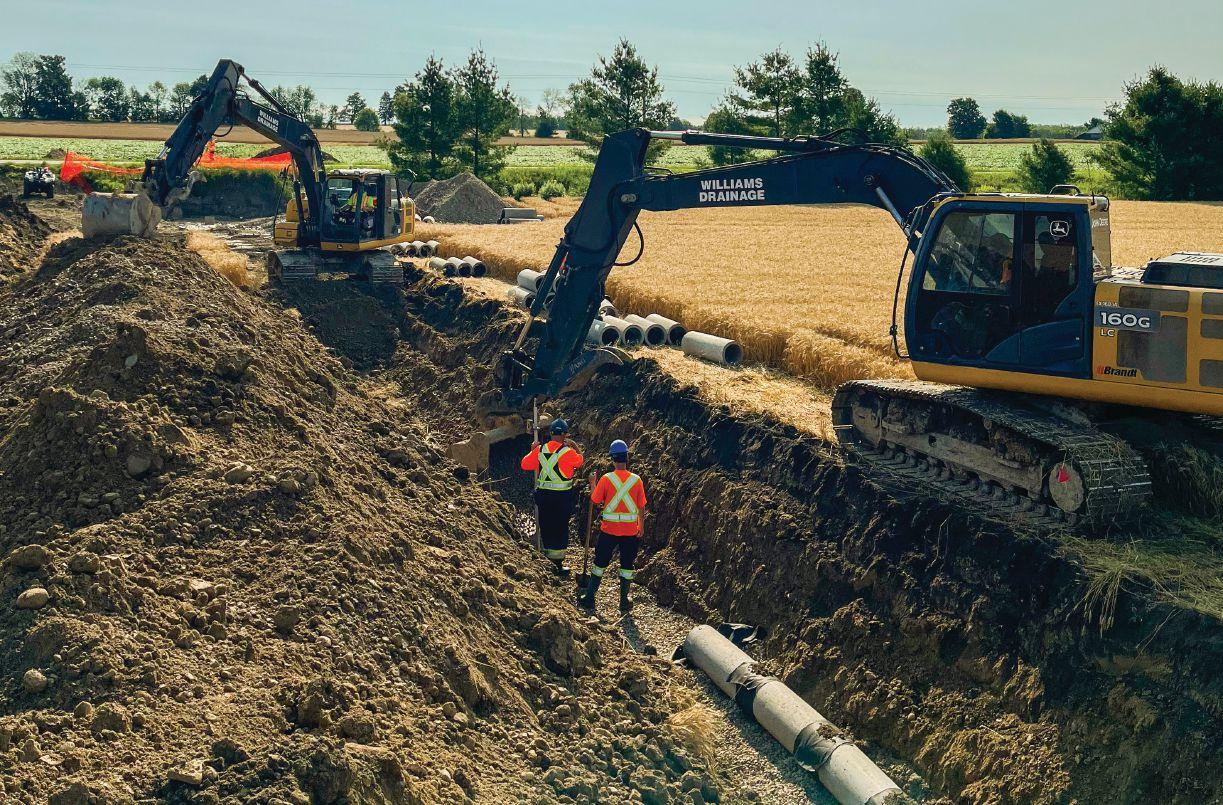
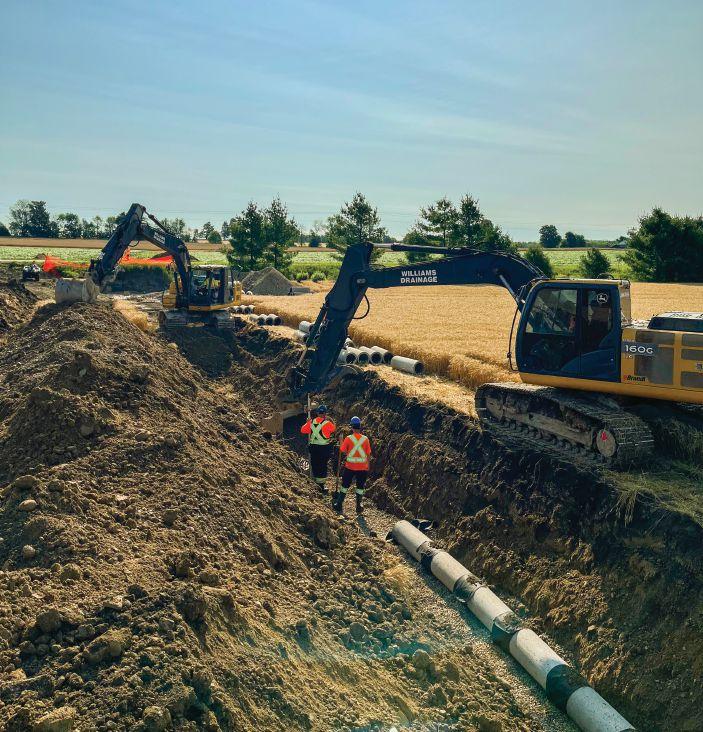
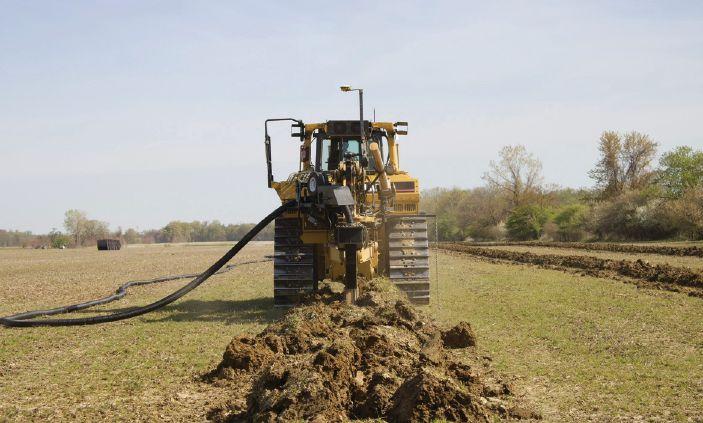
Ashley Broughton, office manager at Williams Drainage, submitted this along with two other images depicting a typical day in the life of contractors at Williams Drainage. Captioned “double trouble,” this image captures the intense productivity required to get tile in the ground and keep progress moving.
Submitted by: Ashley Broughton Listowell, ON
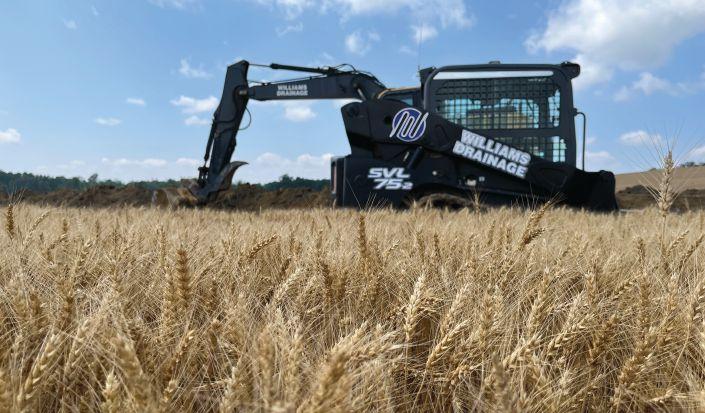
The second image shared by Williams Drainage’s Ashley Broughton, this image captures Williams’ branded equipment in a sea of golden wheat in the southwestern Ontario area served by the company.
Submitted by: Ashley Broughton Listowell, ON
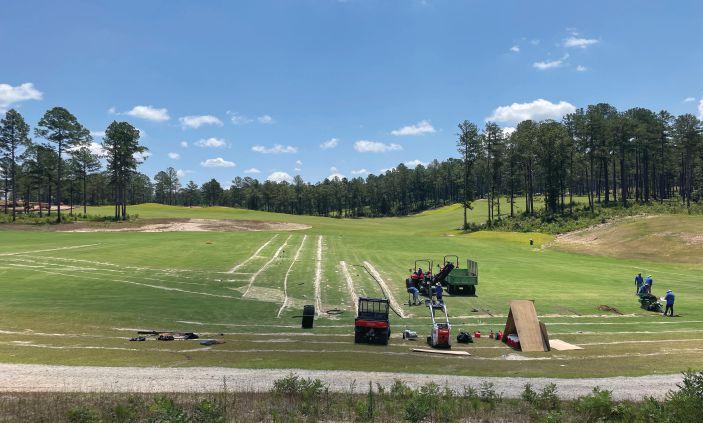
Mark Luckhardt, partner with Turf Rehab, submitted a series of action shots of the team at Turf Rehab installing a second slit drainage system at The Tree Farm Golf Club in Aiken, SC. Slit drainage systems use a network of trenches using smallerdiameter perforated pipes and sand to drain excess water and is common in turf and sport fields.
Submitted by: Mark Luckhardt Aiken, SC
Our top entries are rounded out by this submission from Reid Drainage’s Isaak Sawatzky. Located near the WindsorDetroit border that separates the U.S. and Canada, Reid Drainage’s submissions depicted drainage in action – focused on productivity, enjoying the ride and, of course, smelling the fresh dirt.
Submitted by: Isaak Sawatzky Staples, ON
NEW PRODUCTS
JCB INTRODUCES HYDROGEN COMBUSTION ENGINE
Earlier this year, JCB publicly unveiled a new hydrogen combustion engine, part of the company’s zero-emission solution for both construction and ag equipment. The company is investing the equivalent of more than $100 million USD in the project to produce more efficient engines. More than 50 prototypes were designed and manufactured at JCB’s U.K. engine plant, although it was unveiled and
showcased in the U.S.
“The unique combustion properties of hydrogen enable the hydrogen engine to deliver the same power, torque and efficiency that powers JCB machines today, but in a zero-carbon way,” said JCB chairman Anthony Bamford in a statement. “Hydrogen combustion engines also offer other significant benefits… they do not require rare earth elements and critically, combustion technology is already well proven on construction and agricultural equipment.”
FRATCO UPDATES DISTRIBUTION MODEL
Drainage specialists Fratco, which recently celebrated 100 years as a company, has updated its distribution
model. In mid-2022, Fratco began a “deep dive” into the distribution process at the plant, focusing on improving order accuracy, increasing loading speed and enhancing shipping efficiencies.
The effort led to a significant overhaul of the distribution model at its Francessville plant, which includes designated account managers to handle order management, the creation of a new shipping department with its own management team, enhanced yard team structure and a new driver training gprogram to refine the loading and delivery process.
The company says these changes are due to Fratco’s recent growth, and notes that the new distribution model is an ongoing process.
NOKIAN EXPANDS SIZE AVAILABILITY OF HAKKAPELIITTA TRI
Nokian Tyres is offering two new sizes of its Hakkapeliitta TRI, a block-patterned M+S tire. The tire is known for its winter performance, but is marketed for year-round use.
The range of available Takkapeliitta TRI sizes is now up to 30 sizes. The two latest additions are 400/70R18, which is common in compact loaders, and 250/80R16, which is typical compact tractor front tire size.
Strategies for reducing phosphorus loss
There are four key strategies to address both water quality and crop production needs.
by Ehsan Ghane, Michigan State University
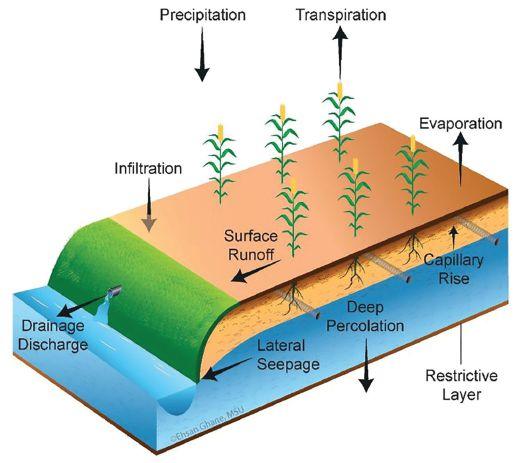
Phosphorus (P) is mainly lost from subsurface-drained farms through two primary pathways of surface runoff and drainage discharge. Surface runoff mainly moves particulate P (soil-attached P) and drainage discharge mainly moves soluble P. The soilattached P can become soluble by detaching from the soil particle. When too much P enters surface water bodies like Lake Erie and Saginaw Bay, it causes algal blooms. In this article, we discuss four strategies for reducing P loss from subsurface-drained farms.
The substantial contribution of event flows to P loss during the non-growing season calls for a system of stacked practices to reduce P loss from both surface runoff and drainage discharge. Generally, there are four strategies to address both water quality and crop production needs:
• Reduce surface runoff leaving the field by improving soil health.
• Reduce the soil test P and apply fertilizer as needed with 4R (right source, right rate, right time and right place) nutrient management.
• Reduce the amount of water leaving the field with water management.
• Capture phosphorus leaving the field with a phosphorus removal structure.
REDUCE SURFACE RUNOFF BY IMPROVING SOIL HEALTH
Implement minimum or no soil disturbance, permanent cover crop and diverse crop rotation. There are resources that can help you plan and implement these practices, such as One Good Idea, Soil Health Nexus and Midwest Cover Crops Council. These practices help build soil organic matter, thereby improving soil structure. The better soil structure increases infiltration and leads to a better performing tile drainage system, thereby reducing surface runoff and particulate P
loss. The buildup of organic matter helps protect against drought by keeping more moisture in the soil, according to Bagnall et al. 2022.
REDUCE THE SOIL TEST P AND APPLY FERTILIZER AS NEEDED WITH 4R NUTRIENT MANAGEMENT
Implement the 4R nutrient management approach (right source, right rate, right time and right place). Reduce the excess soil test P by performing soil testing and only applying as needed to maintain a soil test P as low as possible, according to Osmond et al. 2019. Go with subsurface placement (subsurface banding, injection) of fertilizer instead of surface broadcasting to reduce P loss. If subsurface placement is unfeasible, incorporate the fertilizer after surface broadcast. Check the weather forecast to put as much time as possible between the time of fertilizer application and rainfall.
REDUCE DRAINAGE DISCHARGE WITH WATER MANAGEMENT
Implement water management practices to reduce the drainage discharge leaving the field, thereby reducing the soluble P loss. Examples of these practices are controlled drainage, saturated buffer and drainage water recycling. Even with those conservation drainage practices, some of the water reaches the ditch. That’s where ditches are useful because they have potential to reduce P loss from the stream flow.
Controlled drainage and saturated buffers allow for water management. These two practices reduce drainage discharge by managing the outlet pipe of the drainage system. When water removal is needed for spring planting and fall harvest, these two practices allow for temporary free drainage to provide field trafficability. Drainage water recycling also allows water management by capturing drainage discharge in an on-farm reservoir, then using the water for irrigation during the growing season.
GUEST COLUMN
SURFACE RUNOFF WITH WATER MANAGEMENT
Implement conservation practices to minimize water movement on the soil surface (that is, reduce surface runoff), thereby reducing particulate P loss. Buffer strips, terraces and grassed waterways are
water management practices targeting surface runoff because they intercept the water moving on the soil surface. Reducing surface runoff reduces the loss of particulate P (soil-attached P).
CAPTURE PHOSPHORUS WITH A PHOSPHORUS REMOVAL STRUCTURE
Even with nutrient and water management practices, some fields can have high P loss. In that case, a P removal structure can be used to capture the excess P in drainage discharge using a P sorption material, according to Penn et al. 2020. Because event flows dominate P loss (89 percent in our study at Michigan State University Extension), P structures should be designed to capture as much P as possible from event flows.
When a P removal structure is coupled with controlled drainage, the control structure dampens the peak flow and temporarily stores water in the field, thereby treating more water and capturing more P from the large event flows. Like in a controlled drainage system, dampening the peak flow can be achieved during most of the year except for when the system needs to be under free drainage for spring planting and fall harvest. Overall, stacking of practices can reduce more P loss than a single practice alone. DC
For more information about water management and drainage, visit the MSU Extension Drainage website.
HIGH-FUNCTIONING, FARMER-RUN
Lessons learned from the Tetlock Conservation and Development Area Authority.
The Tetlock Conservation and Development Area Authority (Tetlock C&D) has a major claim to fame: it’s a drainage management network in Canada cooperatively run by landowners – and it has operated for nearly seven decades.
by JULIENNE ISAACS
The Tetlock C&D operates on 64 quarters of land near Grenfell, SK, where Three Mile Creek discharges into Ekapo Creek and finally the Qu’Appelle River. It’s an area with very slight elevation that, in the 1950s, was very wet, says Ryan Maurer, a partner at Land and Sky Grains and a landowner in the network.
That’s when the Saskatchewan Department of Highways identified the need for drainage in the area. The original drainage ditches were constructed with dynamite in the 1950s. But by the 1970s, the department had asked local landowners to form a board to maintain the ditches, or they’d close the project. The farmers agreed: the value of drainage to their land was already clear. Over the years, they’ve maintained
and improved the existing network and added more land and ditches–investments totalling roughly 3.5 to four million dollars, says Maurer.
The network now includes 13 landowners and 10 yard sites, six of them at very high risk of spring flooding. But the impacts of the C&D are felt beyond these 64 quarters, says Maurer.
“To the best of our knowledge, no road within our boundary has ever been washed out. It is benefiting all those around,” he says.
The Tetlock C&D makes use of control gates, culvert sizing to reduce and slow down spring flow, some tile piping and hold-back ponds, which have been key to the project’s success, he adds. Snow also acts as a control structure in the ditches until it melts out in spring.
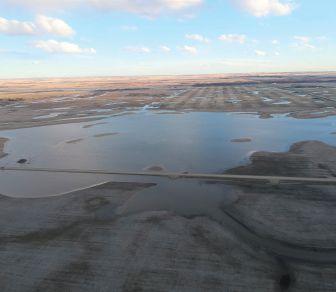
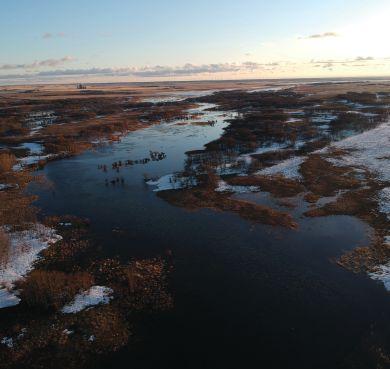
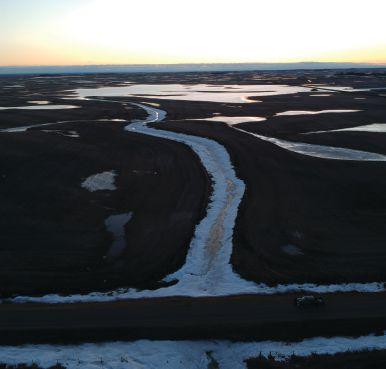
LEFT: Three Mile Creek's spring flooding had begun to recede when pictured on April 6, 2022.
RIGHT: The Tetlock C&D was still frozen over on April 6, 2022.
The purpose of the hold-back ponds, which range in size from 20 to 150 acres and are connected to the network via control gates, is to hold back the flow of water until spring runoff has mostly been expended, says Maurer. Not all the holding ponds are fully drained; a few are purposely left below grade to function as a seasonal wetland and habitat area.
“[The system] provides controlled, timely
release of this water. Not only does it hold back the water that has been drained, it holds back all the water–the natural water that would be entering the system is being held back also,” he explains.
“These retention areas or hold-back ponds hold water temporarily in the spring or during an extreme weather event in season, and that’s at the expense of farmers in the area willing to provide
flood control,” adds Candace Mitschke, executive director of the Saskatchewan Farm Stewardship Association (SaskFSA). SaskFSA works closely with the Tetlock C&D, says Mitschke, thanks to its unique mandate. “SaskFSA was formed for farmers to have a voice when it came to managing land and water,” says Mitschke. “It is producer-led. No other province has an association like this. Often policy is made from the desk, [but] our job is to ensure that it is practical from the progressive farm business perspective.”
FLOOD CONTROL
In the spring, a massive amount of flow goes through the area’s arteries to Three Mile Creek and eventually the Qu’Appelle river. “In spring when all the natural runs are flowing, that’s when the problems start downstream because there’s no control on those natural arteries,” says Maurer.
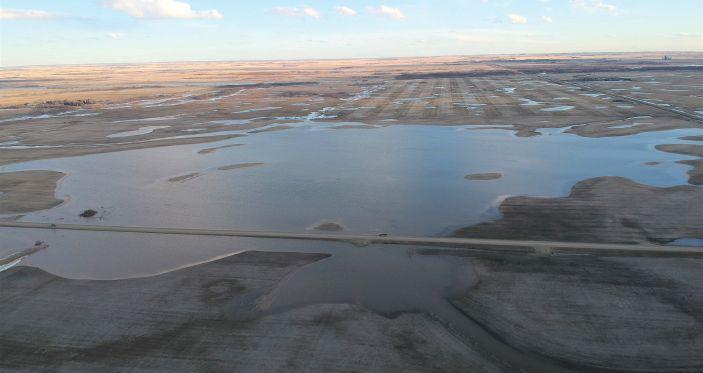
It’s hard to see how it all works from ground-level, but the system’s effectiveness can be seen from the air, and over the last few years the network has worked hard to capture drone footage documenting the
DRAINAGE INNOVATIONS webinar series
Stay tuned for the winter webinar series with Drainage Contractor.
Leading industry experts will share insights on identifying and correcting drainage under-performance issues, drainage and soil health and more, and allow you to ask questions in this interactive webinar format.
Hosted by
To view last year’s recordings, please visit DrainageContractor.com/webinars
Owen's holding pond picture on April 10, 2022. Two days later, the C&D was opened with a digger.
BUSINESS MATTERS
flow of water through the area and the efficacy of the hold-back ponds. The community has occasionally questioned whether flooding in the area is at least partly the fault of the C&D.
“But it’s all natural,” says Maurer. In spring, the creek overflows its banks with natural snowmelt long before snow has melted in the C&D channels. By summer, the creek’s flow is well within its banks.
Drone footage from one holding pond, which sits on C&D member Owen Pekrul’s land, illustrates the point: in 2022, Three Mile Creek started to flow on March 24; the flow was receding by April 6, and by mid-April, Three Mile Creek showed low flow. The C&D discharge only opened on April 16, and Owen’s holding pond still hadn’t emptied by April 25, showing that drainage did not contribute to peak flow.
In fact, on April 12 that year, the main control ditch at Owen’s holding pond was still clogged with ice and had to be opened with a trackhoe–a very rare occurrence, says Maurer.
“I’m always amazed by the amount of time that goes into monitoring these drainage networks– [the farmers] don't just establish them and walk away from them. The behind-thescenes maintenance that goes on is not always appreciated the way it should be,” says Mitschke.
The network’s farmers pay a levy to Tetlock C&D of roughly $2.50 per acre to help with maintenance costs.
It’s worth it for the area’s farmers, says Maurer, particularly
On-Board Reels and Disc Closers
Service on Drainage Equipment
Line Boring and Welding *NEW*
when land is heavily potholed. And devoting land to holding ponds is also worth the cost of seeding toward the end of the planting window. “I have seen Owen Pekrul seed that land a week to 10 days after everybody else has planted their crops–but if it wasn’t for that ditch in there, he wouldn’t be seeding that at all, because it’s a low, flat area vulnerable to holding water some years, [as well as being vulnerable to] weeds, mud, salinity and crop loss,” says Maurer.
“In some of those high rainfall years they would have lost a lot of acres with rainfall anyway. It takes the right people to understand they're getting a benefit.”
After drainage, Maurer adds, the approximate increase in land value is $50,000 per quarter, and an additional $195 per quarter paid to the local rural municipality.
LESSONS
After nearly 70 years of maintaining and growing the Tetlock C&D, the area’s farmers have learned too many lessons to recount.
But one significant lesson, says Maurer, is the importance of working with your neighbors.
One big example happened in 2015. In the 1990's, the land where the ditch ended was sold to a nearby First Nations band, Mitschke explains. In 2015, when a government rule was instituted on point of adequate outlet (POA), the landowners discovered that the last 100 metres did not have an easement to the C&D and no longer qualified as POA. The solution: the provincial Water Security Agency and the C&D worked with the band to secure the sale of those 100 metres back to the Crown.
“They helped us work through that dilemma,” says Maurer. After several years of negotiations, the final 100 metres of the drainage ditch were kept under the purview of the C&D through a legal subdivision in the name of the Crown.
“This is a prime example of how important it is to have a farmer voice when building water management policy,” Mitschke adds.
Speaking up about the value of water management systems can make a big difference within the community.
“I sit on the local RM council to be part of the solution and have come to realise there is a lot of misinformation within the RM regarding water management,” says Maurer. “The word ‘drainage’ can be negative, so [instead] we say, ‘Through drainage we are managing our water quantity and flow.’
If you can take the time to explain the difference between uncontrolled drainage and responsible drainage (or water management) with someone who is willing to listen and learn, they walk away with a whole new view,” he says.
This past April, SaskFSA held a Water Management Day at the Maurers’ farm. At least 150 people were in attendance–some of whom had driven for more than two hours to attend. It’s not always comfortable for farmers to speak up, says Maurer–but working together to spread their message can be just as effective as working together to mitigate flood risk.
“Farmers are notorious for putting their heads down to work–we’re not lobbyists. But by working together with a common goal, it’s working well, it’s taken off,” he says. DC
Trimble WM Drain GPS Machine Control
BRON Drainage Equipment
LAYING THE GROUNDWORK
Your reputation is on the line with every job you do. For 100 years, we’ve held ourselves to the same standard.
When your tomorrow depends on a pipe you can trust, count on Fratco for the quality drainage products you need.
CONTRACTOR AT WORK
BUILDING THE BUSINESS, BUILDING THE MARKET
Ontario contractor Ken Watkins on establishing drainage in an underserved area.
Ken Watkins’ pride in his work is similar to that of a sculptor or architect. On every drainage project the Ontario-based contractor embarks, Watkins loves to document the process, share images and videos and take in the good work he’s done.
Besides the standard feeling of pride and accomplishment from a job well done, he’s also proud that not long ago, much of the region in which he works was swamp-covered.
A HUMBLE BEGINNING
Watkins Drainage boasts a small team, and thus Watkins still spends considerable time in the machines himself. The process gives Watkins a thrill. But it wasn’t long ago Watkins made his living as a hog farmer.
Although, he admits that “made his living” is not indicative of how the experience really was.
“Pig farming in Ontario is very financially and personally demanding,” says Watkins. “It doesn't reward your efforts very well.”
Watkins had grown the family farm significantly, and was struggling – he says at times, he felt destitute. As many thrifty farmers tend to do, Watkins began draining his own land, running laser on
a small tile plow. Having amassed some gear, including a Trimble auto-steer, Watkins was becoming increasingly curious about the potential of the machines to do more. “I’d always be asking the dealer, ‘what else can this Trimble gear do?’ I was trying to find more applications of this GPS gear to broaden my spectrum.”
Around 2012, his equipment dealer eventually pointed him to a drainage seminar at a local co-op, which allowed Watkins to view a drainage plow up close. His response to the opportunity? An emphatic “hell yeah!”
After attending the seminar, Watkins went home and bought the system that night to install on his plow. “I took it out, ran it for three hours and literally called the trucker that night and told him to liquidate the herd.”
A UNIQUE MARKET
Watkins had spent his entire life in the area of Cayuga, part of Haldimand
by BREE RODY
County. Nestled in southern Ontario about a 15-minute drive inland from Lake Erie and an hour from the border into the U.S., Haldimand and its neighboring county of Norfolk are known almost exclusively as agricultural communities.
And yet, Watkins observed, one area in which Haldimand was lacking was drainage. “I recognized that drainage needed to be done, and no one in my area was doing it.”
And that doesn’t mean there were no local contractors – he means there was no draining of the land at all. Admittedly out of character for southern Ontario, where drainage is an already established practice, Watkins found from drainage maps at the time that Haldimand seriously under-indexed. “Ontario is 90 percent tile-drained,” he explains. “But Haldimand County was five percent drained at the time.”
He says Haldimand was often regarded as “the last bastion of cheap land in Ontario,” so for farmers, the outlook had
often been “why waste time draining land when I could just buy more land?”
But land is finite, and Watkins knew that once landowners saw the benefits of drainage, they wouldn’t go back. He secured the necessary licenses, took the necessary courses, made his investments and tiled his way around the county. He had a unique challenge at the time, he says, noting “I had to build the market at the same time as I was building the business.”
Now, after 10 years, Watkins has seen the market grow, but never forgets where the area came from.
“What I enjoy most about this work is driving around the back roads, looking at farms that used to be swamp-covered, and now they’re not,” he says. “There used to be just oceans of water covering them.”
Although Haldimand and Norfolk are often grouped together – its citizens often hop from one county to the other for work and recreation – and Watkins indeed serves both as a contractor (as well as the nearby Brant County and Niagara Region), it poses unique geographic challenges.
Haldimand, once a densely forested
area that invited a thriving forestry industry in the 1800s, has a very different soil profile from its neighbor to the west.
“Haldimand is reputed for what they call Haldimand Clay,” explains Watkins. “It’s particularly nasty, heavy clay, and doesn’t drain well.” He adds that a contractor used to working with sand won’t have any luck using the same approaches for clay. In fact,
there is a large segment of the local farm community that believes tile doesn’t work around there, because of work performed by contractors visiting from sandier soils. That clay means Watkins regularly does a mix of surface and subsurface drainage. “We use tons of gravel and tons of surface [drainage]. Putting pipe in the ground is only five percent of the project… getting
Haldimand County, where Watkins is based, is known for heavy clay soils.
Image
courtesy of Ken Watkins
CONTRACTOR AT WORK
the water into the pipe is the other part.”
For their gear, Watkins Drainage is currently on its fourth tile plow, a Bron self-propelled plow. “That Bron plow has been a big boost to my business. The ability to put pipe in the ground is unbelievable.” The four-man team currently runs three complete GPS systems in the plow, the survey vehicle and excavator. They also use locating equipment, and laser-based trenching equipment.
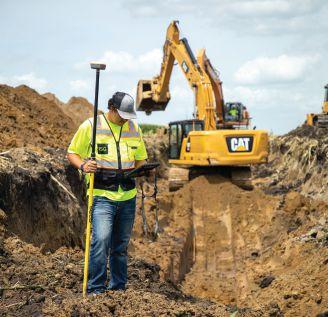
Beyond that, Watkins says he relies on his local CAT dealer. “We’re pretty much CAT across the board. They’ve got in-office systems, maintenance systems, access to all sorts of customer support.”
AN EYE ON THE FUTURE
There are currently a lot of demands on drainage contractors. Gone are the days of old when contractors didn’t have to be concerned about the environmental implications of the work they do; they’re expected to have working knowledge of soil and water science, all while handling their machinery and equipment expertly.
But for Watkins, being keenly aware of economics is another must-have skill for contractors. Knowing what’s got farmers concerned – which often boils down to money – dictates what Watkins’ projects are going to look like.
“What landowners are concerned about right now is interest rates,” he says. “Everybody’s coming to grips with this new reality. So recently, the scale of projects has gotten smaller. Guys are doing smaller jobs.”
Because the very nature of farming often means a landowner holds multiple mortgages at once, the bigger farmers are in what Watkins says is a “constant state of renewing mortgages.”
“I’ve had guys who tell me, ‘last year, my mortgage was $50,000, now it’s $100,000.’”
That doesn’t mean drainage work has – no pun intended – dried up, but it does mean systems are not as grand or complex as they may have been even a few years ago, when interest rates were blessedly low.
In fact, Watkins says landowners are
more cognizant of the need to drain the land, especially with wetter wet seasons. While belief in climate change used to be divided along political lines, Watkins says he now sees the sentiment from people of all walks of lines. “People are looking at the weather and going, ‘things are not like they used to be.’ Call it what you want, everybody’s saddled with it.”
But despite unpredictability from yearto-year, Watkins says his clients are seeing predictable results, which is what matters.
“You can see it with your eyes,” he says. “The question is always, ‘what happens on the dry years?’ After 10 years, they’re seeing… On the dry years, the tiled ground out-produces the untiled ground. On the wet years, the same thing: tiled ground out-produces untiled ground.”
That’s not to say everyone is “jumping on the bandwagon,” says Watkins, but little by little, as the market builds and years of data and anecdotes prove the effectiveness of drainage, Watkins says there’s still potential for even more work to be done.
But when asked what he hopes to achieve in the future, Watkins is less focused on the technical aspects of drainage and more on the business aspects. Namely, having a succession plan in place is a major area of focus. He also is dedicated to making sure the young workers on his team understand that they, too, have the potential to establish their own businesses in agriculture.
“I don’t have children myself, but I hire all young guys. I put them through the ‘Ken Watkins heavy equipment operator school.’ I run young guys for one to two years, team ‘em how to run the equipment, and then they go off to the city, get the big money jobs.”
He says given the cost of living and the cost of housing, he wants young equipment operators to dream big and consider their potential to be more than just an equipment operator and thrive as a business owner. “I went from farming to tiling – abject poverty, almost, to being more comfortable… I constantly tell these guys, ‘you think you can’t run your own business, but you can. I’ll show you how.’ The machines will pay for themselves. The tile will pay for itself. I’m trying to encourage some of them to join with me and get into the business.”
Ken Watkins is a firm believer in empowering his young employees to see their potential in business.
ENVIRONMENT
MAPPING TILE DRAINAGE
How maps could address runoff and contractor planning.
For years, fertilizer runoff from Midwestern farms has flowed into the Mississippi Watershed. When nutrients such as nitrogen and phosphorus reach the Gulf of Mexico they are consumed by algae, resulting in massive algae blooms. These blooms consume oxygen in the water, killing marine life and creating what’s known as dead zones.
by JAMES CARELESS
Tesearchers are trying to find ways to reduce these pollution levels, which includes mapping their origin in farmers’ fields. But this task isn’t easy: although drainage ditches are visible from the air, the tile drainage systems are buried underground. This makes it difficult to map these systems or calculate their impacts.
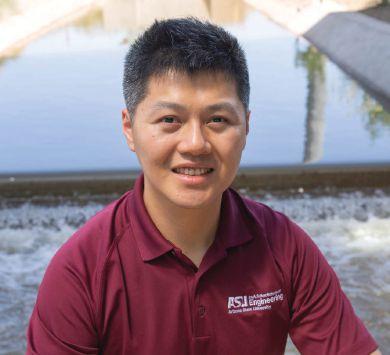
Finding better ways to map these systems is the mission of Ruijie Zeng, assistant professor in the School of Sustainable Engineering and the Built Environment at Arizona State University. Using the proceeds from a 2023 National Science Foundation Faculty Early Career Development Program (CAREER) Award, Zeng and fellow researcher Chuncheng Yao (a civil, environmental and sustainable engineering doctoral student) are using drone
footage, computer vision algorithms and soil moisture simulation models to improve the mapping of agricultural drainage networks and natural rivers. Unfortunately, little data exists on the layouts and positions of systems.
"CHASING THE STORM"
It is practically and economically impossible to map the total tile drainage system flowing into the Mississippi Watershed. But it is possible to map large parts of it, and then use that data to create a reasonably accurate model of this system. Such a model can be very useful for identifying pollution pathways related to tile drainage systems and devising ways to mitigate their runoff’s impact on the Gulf of Mexico.
To make this happen, Zeng and Yao are using drones to map farm drainage networks through multi-spectral imagery. By using drone-based cameras that operate where human eyes cannot see, the team can detect a field’s soil moisture patterns to determine where and how water drainage is occurring. In this way, they can accurately deduce the location of underground drainage systems without doing any digging. This approach works because soil closer to a tile drain dries out faster than soil that is far from it. “So from this surface pattern, we can infer what is buried under the ground and detect the drains,” says Zeng. Finding these pathways can be tricky since these patterns usually happen after heavy
RIGHT: Ruijie Zeng, assistant professor at the School of Sustainable Engineering and the Built Environment at Arizona State University, says little data exists on the layouts of drainage systems.
rainfalls. If a drone is sent up too soon after a downpour, the field will be saturated with water for patterns to occur. Too long afterwards, and the field will have dried out. Timing is everything, which is why Zeng and Yao refer to their research approach as “chasing the storm”. That’s not all: The team is also mapping drainage ditches and other above-ground features using drone-based LIDAR (Light Detection and Ranging) sensors. “LIDAR provides us with half a meter resolution, allowing us to tell where the land surface is lower than others,” says Zeng. “So we can identify the ditches and map them.”
With this data, Zeng and Yao can process it to simulate runoff patterns, allowing them to map the entire drainage system within the areas surveyed. They have already conducted drone-based research in Illinois, and are heading next to Indiana and Iowa to gather more data.
PROMISING RESULTS
It will take a while for Zeng and his colleague to compile sufficient scientific data to flesh out a comprehensive field drainage mapping model. Still, their
initial results are promising, because their drone-based research approach is working as well as they had hoped.
“With just one flight, we were able to detect the subsurface drainage pattern in the area we overflew,” says Zeng. “We’re still exploring how to scale this up, but I think the main goal of our research is to develop these methods and provide some tools for others to increase their successful management of their own drainage systems.” He imagines a future where each farmer can monitor their field drainage patterns using drones and the analytical software tools he is currently developing.
BIG POSSIBILITIES
Helping farmers monitor and manage their drainage systems is only the beginning. On a larger scale, one of the main applications of this mapping will be the integration of agriculture drainage infrastructure data into the hydrological models of the Mississippi Watershed.
“With this critical information, we can incorporate the drainage networks into the natural river networks and simulation
SMALL COMPANY.
models so we can see where the ‘hot spots’ are, and where the impact of runoff is most significant.”
Currently, Zeng and Yao are working on drone-based farm subsurface surveys. “This is the detection part, and I think we will have some results in 2024,” says Zeng. “The modelling part comes after the detection phase, and will be finished in the latter two years of the project.”
Once this work is done, “we'll provide scientific support for the stakeholders, including farmers, the local conservation agencies, and regulation agencies like the [USDA] to assess the impact of drainage systems on water quality,” he says.
“There are many conservation programs that promote more adaptive drainage systems where they can control the water table with some new devices. Now there are some studies looking at the impact of these systems at the local farm scale impact, but the regional and the watershed scales are still being missed.”
One thing is certain: The research being done by Zeng and Yao will assist the development of more accurate and complete drainage mapping systems. DC
BIG IDEAS.
PLOW & WHEEL TRENCHERS
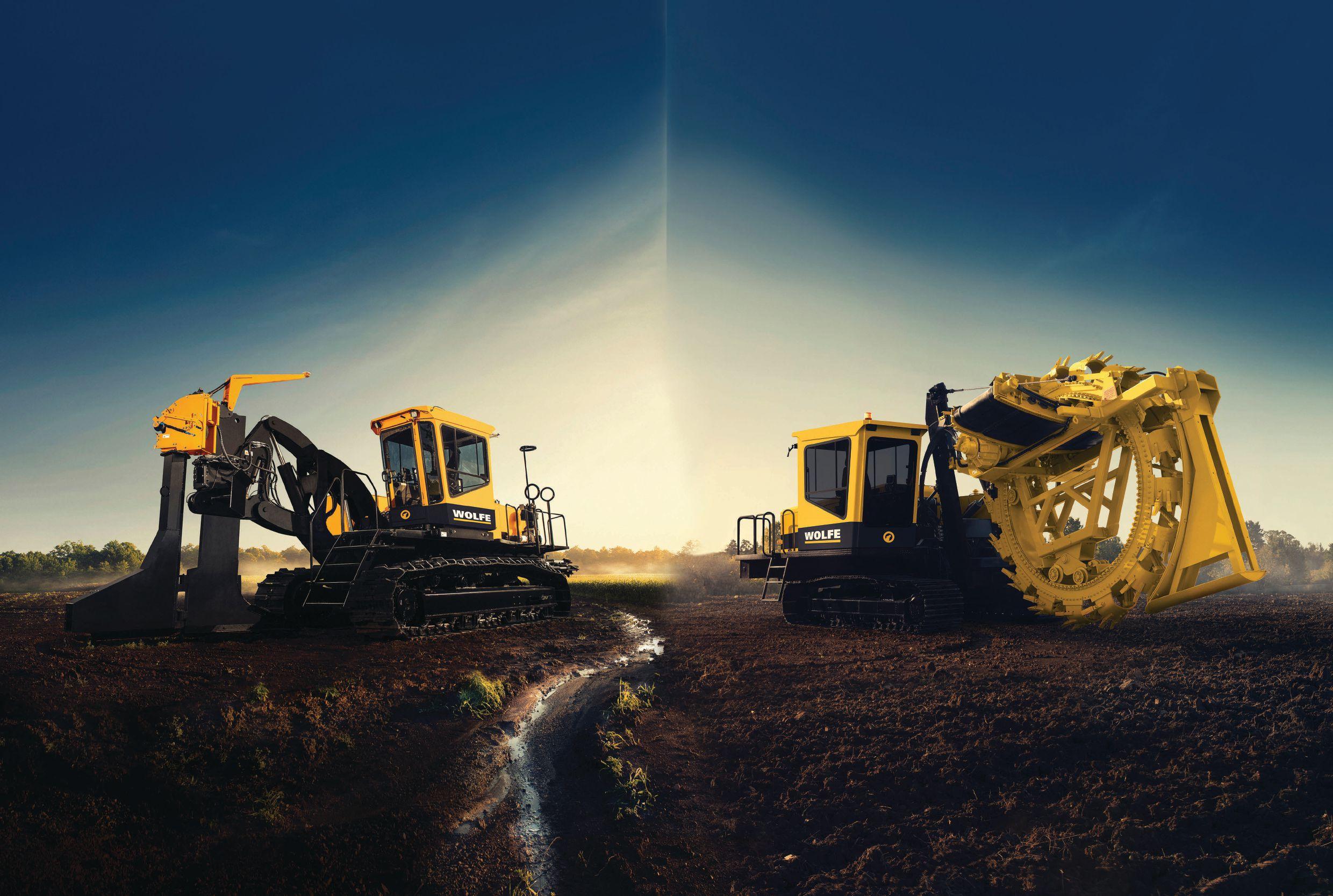
Wolfe Heavy Equipment continues to set the tone for powerful agricultural and commercial trenching equipment. Wolfe’s versatility, superior manufacturing and expert service along with reduced fuel consumption provides increased profitability.
DRAINAGE MANAGEMENT SYSTEMS
DON’T DITCH THE TOPSOIL!
Spreading soil dredged from ditches back onto farmland.
Agricultural ditches go hand-in-hand with subsurface tile drains. You can’t have one without the other, which is why we see both throughout parts of the Midwestern United States where poorly drained soils are the norm.
by JACK KAZMIERSKI
Over time, however, these man-made ditches tend to fill up with sediment, and they need to be dredged as part of a regular ditch maintenance program. “Silt tends to build up, and it blocks the tile outlet,” explains Jonathan Witter, associate professor, agricultural and engineering technologies, Ohio State Agricultural Technical Institute Wooster.
In order to deal with the silt issue, the farmers themselves, or the drainage contractors they hire remove the silt, and pile it up on land nearby. How often a ditch needs to be dredged varies. “I've worked in places where they were dredging every one to two years,” says Witter.
“Most of our drainage maintenance programs are between five and 10 years, but some ditches may not have been cleaned out for many decades. So it's highly variable.”
Although piling the silt onto the field at the top of the ditch is the easiest and most economical solution, it comes with a price: Placing all that soil at the top of the ditch can impede surface drainage, which in turn can negatively impact crop growth. Over time, that pile of earth can simply fall back into the ditch, filling it up again.
NUTRIENT RICH SOIL
That’s why Witter, along with a group of researchers, is looking into another solution to the dredging issue. Instead of putting the silt into a pile near the top of the ditch, he and his team wondered if there’s a better way to deal with the problem.
“You have to keep in mind that this is nutrient-rich topsoil,” he explains. “So, what
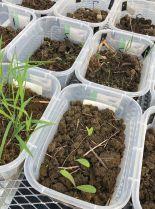
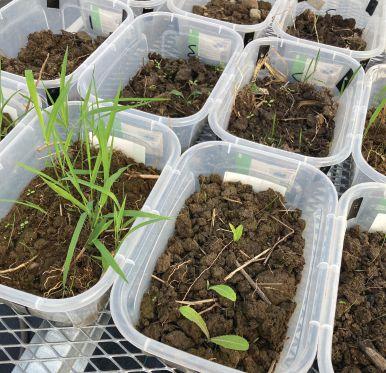
LEFT: Greenhouse experiment to germinate the weed seed bank from dredged soil and sediments from nine ditches in Ohio.
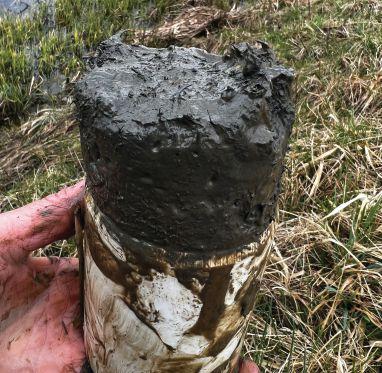
RIGHT: Sediment extracted from a conservation ditch design constructed in northern Ohio is 2012.
Image courtesy of Dan Mecklenburg
Image courtesy of Jonathan Witter
GEO-KNIT ® - Drainage Filter
Syfilco is a manufacturer of circular knit drainage filter. Contact us today for more information on our GEO-KNIT ® product line.
SyfilcoLTD.
we’re looking at is whether we can use it as a soil amendment or as an alternative to fertilizer.”
Witter believes that the value of this dredged nutrient-rich soil can be leveraged in order to improve the overall quality of the soil within a given field. “If there are areas in a field that have been negatively impacted because of erosion, for example, can we improve those areas?” he asks. “We've done a lot of work to determine how valuable that dredged soil is, and discovered that it’s packed with a lot of nutrients.”
ECONOMIC SENSE
One of the other questions Witter and his team want to answer is whether this practice makes economic sense. “We’re looking at whether we can use drainage contractors, who are already doing ditch maintenance, to take that soil from the edge of the field and spread it out in a nearby field,” Witter explains. “We’re not asking them to transport dredged soil from far away. It’s just going from the edge of the field onto other parts of the field.”
The costs associated with spreading dredged soil onto a field could be offset, at least in part, by the value of that soil, Witter believes. “When fertilizer prices were fairly high, we found that every cubic yard of dredged soil had about $8 worth of nutrients in it. So that’s real value, and it’s a fertilizer alternative.”
PROMISING RESULTS
So far, the results from the research look promising, although Witter is quick to stress that these are just preliminary findings and that a lot more research still has to be completed.
“In the small plot of land where we did our research, we found that there was no significant difference between chemical fertilizers and simply applying the sediment to the field,” he says. “Actually, we found that the part of the field where we applied the sediment had a higher crop yield.”
The experiment was conducted in a field with corn/soybean rotations. “We found that the sediment-amended plots of land had a significantly higher soybean yield,” adds Witter, “to the tune of about eight bushels per acre, versus our control field, where we used chemical fertilizers.”
The question now is whether the added cost of spreading the dredged soil onto a field is worth it. “There is an additional cost to this... we’re now doing an economic analysis.”
So the now: which option makes more sense financially. On the one hand, there’s the cost of the fertilizer and applying it. On the other hand, dredged soil is free, and it results in a larger crop yield, but there’s a cost associated with spreading it, as well.
It’s too early to tell which option is best, warns Witter, simply because the research isn’t finished. “We’re going to collect this year’s harvest data to see if there was a yield benefit again. If there is, we’ll probably do it for another year to see the results.”
Witter has an open mind about the research and understands the need to study this question in other areas as well. “The benefits could be greater at another site, or they may be inconsequential at another site,” he explains. “That's why we need to expand out and apply this to different places to see if we get the same results.”
Replicated field experiment with control field conditions and various plots amended with ditch soil, dairy manure solids, or ditch subsoil. Half of the plots received chemical fertilizers at standard agronomic rates. Yield response was measured over a two-year corn-soybean rotation.
OTHER BENEFITS
Beyond costs and crop yield, Witter says that there’s a potential that this practice could also improve the quality of the soil overall. “The sediment in the ditch is high in organic matter,” he explains, “so there seems to be a real benefit to the health of the soil, but we haven’t analyzed that in detail yet.”
Another potential benefit is that the runoff from this dredged soil won’t trickle down into nearby waterways if the soil is removed and placed on the field. “Instead, we’re capturing, harvesting and reusing some of the best topsoil and nutrients that were lost from the fields, and we’re putting them back where they can be put to good use again,” he says.
Witter stresses that the practice of reapplying topsoil to the field makes sense for a variety of reasons. “This is our last opportunity to stop those sediment nutrients from going downstream to impact algae blooms and lakes,” he says. “And we have a whole industry of drainage contractors that are really skilled at working in drainage ditches, so we have a ready-made industry to help keep this flow of sediment nutrients from going downstream.”
DEALING WITH WEEDS
Although dredged soil may be packed with nutrients, it can also be full of weed seeds. That’s why Witter and his team looked at the weed issue to see if it might be a deal-breaker for farmers.
“We germinated weed seed banks to see what was in the soil,” he explains, “And basically, it’s the same weeds that farmers are already dealing with, and that are already being managed by the herbicides they have on hand. There’s nothing weird or exotic about these weeds.”
To be frank, Witter and his research team are not trying to reinvent the wheel. In fact, Witter says that there’s plenty of anecdotal evidence to support the benefits of this practice.
“We didn't come up with this idea,” admits Witter. “Farmers told us that they were dredging their ditches, and that when they were putting that soil out in their fields, maybe to fill in a low area. Our goal is to do the science, observe the results and collect the data so that we can say with certainty whether this is a viable practice.”
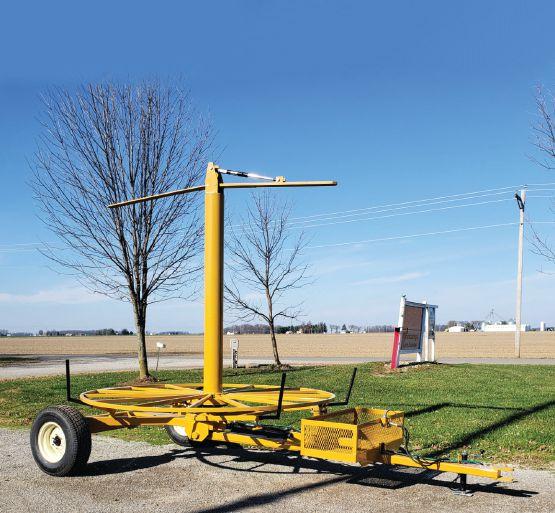
TILE TRAILER
with Automatic Hat
Heavy-duty frame with 9 ½' table
Automatic hat – stay in the tractor for loading/unloading
Recoiler Power unit
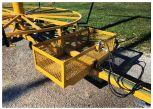
Large basket for fittings
Image courtesy of Jonathan Witter
A drain done differently
by Mel Luymes
After decades of drainage issues, public input meetings, engineer reports and various Drainage Act appeals, excavators have rolled through most of the South Innisfil Creek Drain (SICD) and famers finally have the drainage they need. But, to an average passerby, the drain may look more like a beautiful creek that had always been that way. In this case, the drain is being restored and upgraded using innovative natural techniques that were designed to improve drainage, while also addressing water quality and enhancing aquatic habitat.
The Innisfil area is home to both intensive farming and development. The main drain is over six miles long, was first constructed in 1903 and drains more than 20,000 acres before emptying into the Innisfil Creek, the Nottawasaga River and finally Georgian Bay and the Great Lakes.
Jeff Dickson (P.Eng. drainage), Chris Pfohl (CET, EP, sr. aquatic ecologist) and the team at R.J. Burnside & Associates Limited worked on the SICD with Jeremy Nyenhuis, Drainage Superintendent for the Town of Innisfil, in cooperation with the Department of Fisheries and Oceans Canada (DFO) and the Nottawasaga Valley Conservation Authority (NVCA). The contract went to R&D Excavating LTD, and construction began in 2021. Much of the project
is expected to be completed by the end of 2024.
Because the SICD is classified as fish habitat, improvements were especially tricky. It is often said that necessity is the mother of invention and, in this case, the drainage requirements as well as the environmental restrictions challenged the design team to take drainage to a whole new level.
The most noticeable design innovation is the nearly three miles of two-stage drain. Drainage tiles outlet onto the upper vegetated bench where sediments and nutrients are deposited. This improves water quality, meaning drain cleanouts will be needed less frequently.
The bench of the main drain was vegetated with sod mats that were sourced on-site. The drain was widened by approximately 25 feet, and the native grasses with their root systems intact were carefully removed in mats that were six to 12 inches thick and three to five feet long. The mats were placed onto the bench of the drain once it was constructed to elevation and width; after placement, the sod mats were watered, instantly revegetating the drain. Within weeks, the job site looked completely naturalized.
Many of the materials used to stabilize the sections of degraded drain bank were also found on site. Trees or woody material (primarily cedar) and root wads, which were cut, salvaged, and removed prior to or during excavation, were anchored or
pinned into and along the drain banks and combined with live stakes such as dogwood or willow, effectively stabilizing quite a few eroding outside bends. A French drain was also made of logs at the bottom end of an oxbow which was re-purposed as a wetland to provide additional water holding capacity during larger flows as well as habitat for green frogs, turtles and birds. Another noticeable feature is a Barefoot Box Culvert that replaced two corrugated steel pipes running under the 4th Line in the upper reach of the watershed. It is an eightfoot high by 20-foot wide precast concrete
structure with perforations in the bottom designed to promote and allow groundwater upwelling to support fish habitat. Designed by Burnside’s Pfohl, the capacity of this culvert allows for high flows to pass safely under the roadway, and contributes cooler, fresher water into the drain.
Just downstream of this culvert, various sizes of stone substrate were added to the bottom of the drain to enhance existing fish spawning areas, and a number of riffle-pool sequences were created to boost water quality and provide habitat. A riffle is a shallow gravel area that produces a
BUSINESS DIRECTORY AD INDEX
BUSINESS DIRECTORY AD INDEX
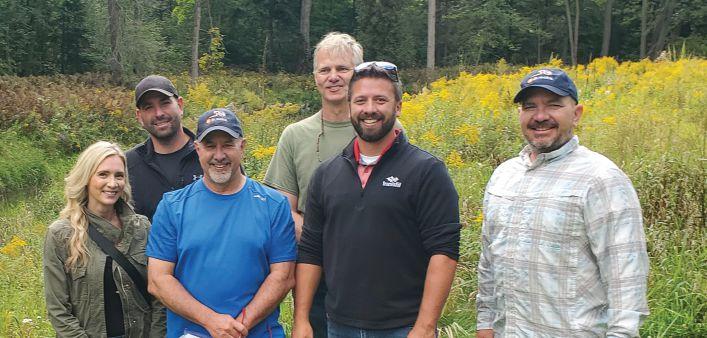
Members of the project team at a twostage drain (L-R) Julia and Dan Rice (R&D Excavating Ltd), Jeff Dickson (Burnside), Fred Dobbs (NVCA), Jeremy Nyenhuis (Town of Innisfil) and Chris Pfohl (Burnside)
steeper gradient change in the drain bottom followed by a pool where fish species can rest and find refuge when flows are low.
Dan and Julia Rice of R&D Excavating worked closely with the Burnside Team to bring the engineering drawings to life. They had worked on similar projects, but never one of this size and complexity.
Many of the drain’s features will be described in an upcoming video and are detailed in two bulletins in Burnside’s series Drains Done Differently, available on their website. The team has hosted tours for stakeholders to demonstrate how drainage and habitat can co-exist.
As we look to the future and weirder weather in the forecast for farmers, along with a growing concern for water quality and our natural environment, the South Innisfil Creek Drain demonstrates that drains can be done differently and that both needs can be met. DC
A proud tradition
by David Gallahan, LICA National president MY STORY
Growing up in Purcellville, VA, my father worked as an excavating contractor. When he first got out of the service, he worked for a tire recapping company, then went on to work for a local farm tractor dealership, where he was soon to be shop foreman. During the war, he was a heavy equipment mechanic and was very good at what he did – he even taught German prisoners how to work on tanks. Once my sister and I were born, he decided to get into excavating and paving. He started off doing pond work for local farmers on our area.
By the time I was eight years old, he had me running a steel wheel roller, rolling the tar and chip roads he did for the township. As I got older, I graduated to heavy equipment. Everything I did was related to drainage and erosion. When grading roads, I would follow my dad on the grader with a shovel to throw out rocks and clean culvert ends he couldn’t reach with a grader blade.
One day, I asked, “when do I get to run the grader?” With his gentle smile, he would say, “Just pat attention to what I do.
“When grading the roads, you look at the material on hand that you’ll be pulling from the filled ditches to make a crowd in the middle of the road to run the water runoff. Then, you’ll be defining the ditches for the runoff. But here’s the trick: always try to get the water away as soon as possible so as to not wash out properties or return to road. The quicker you can get the water away, the less chance it has to build up volume and wash everything away.”
When my opportunity finally came to run the grader, I was as excited as a boy in an ice cream shop – and it was all free. My first job was for Sam, a good friend of my dad’s. I’d earned my time on the shovel, and was determined to grade this road like there was no tomorrow. Two weeks later, we received a letter along with the check from Sam, saying, “Fred, why have you waited so long to let David grade my road? It’s the best I’ve ever seen done.” From that day forward, I graded all the roads.
A NETWORK OF TRUSTED COLLEAGUES
In the LICA organization, you’ll hear stories like this all the time. Most construction companies are family-owned and trained. If you look at our LICA family, you will realize the talent and love for the
work is something you can’t buy over the counter. LICA supports all of its members with training and communication to all of our state chapters. If you’re working on a job in Virginia and remember a conversation with a contractor in Nebraska about a similar job, you can pick up the phone and talk to them about how they solved that same problem. LICA members are the best in the world about sharing information that helps someone else. My dad always told me: if you learn something but never share it, you didn’t learn anything at all.
LICA is an organization of the most dedicated contractors and farmers in the U.S. Our contracters perform drainage, irrigation, erosion control, earth-moving, septic system… the list goes on. Our directors work across the country to help their chapters in any way at any time. You can find them in Arkansas, Florida, Illinois, Indiana, Iowa, Kansas, Michigan, Pennsylvania, South Dakota, Virginia, Minnesota, Missouri, Nebraska, New York, New Jersey, North Dakota, Ohio and Wisconsin.
INVESTING IN THE FUTURE
LICA CEO Jerry Biuso sees the need for equipment operators and has started the LICA Education Foundation for Veterans. The Foundation seeks to solve two problems: workforce shortages in the construction industry, and staggering veteran unemployment. No veteran should struggle to find work after serving our country, so we aim to give them the advantage they need to find a well-paying job, provide for their families and live the American dream. You can find out more and help us with this amazing journey: LICAveteransfoundation.org. LICA also have chapters that award scholarships to high school graduates to learn how to work in construction and heavy equipment operation.
We would love to have you as a member of this great organization. Visit our national website, LICAnational.org, to see all the exciting things LICA offers. No matter how large or small your operation, man or woman, if you are a contractor, you will be a great fit in LICA. You can also meet members from around the country at our LICA Winter Convention Feb. 13 to 17. Enjoy seminars, tours and enjoy the fellowship of great friends. DC
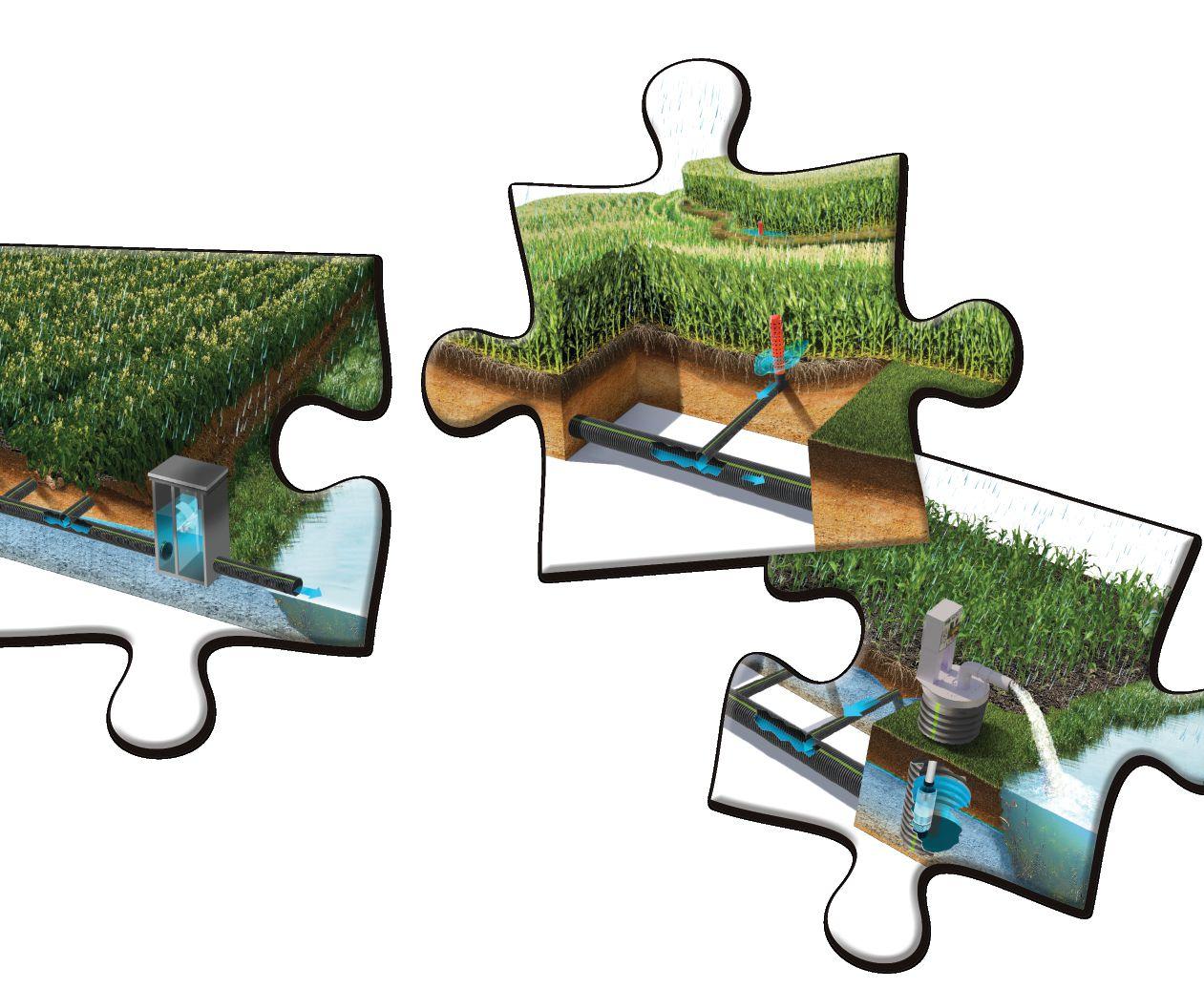
management puzzle.
We don’t believe in a one-size-fits-all approach to water management because no soil type or farm is alike. At ADS Agriculture, we tailor solutions to maximize the benefit of your water management system based on your farm’s needs. From subsurface irrigation to automated lift stations and control structures, we have the total water management solutions to improve yields, increase farmable acres and raise the value of your land.