When you need the best pipe for the job, when there’s no room for error on your timeline and when there’s a challenge out in the field, make Fratco your first call.
Account Coordinator | Mary Burnie mburnie@annexbusinessmedia.com
Audience Development Manager | Anita Madden amadden@annexbusinessmedia.com 416.510.5183
Media Designer | Curtis Martin cmartin@annexbusinessmedia.com
Group Publisher | Michelle Bertholet mbertholet@annexbusinessmedia.com
COO | Scott Jamieson sjamieson@annexbusinessmedia.com
Printed in Canada ISSN 1488-4305
Publications Mail Agreement #40065710
Subscription rates:
Canada – 1 yr $17.50 CDN
USA – 1 yr $34.50 CDN
Foreign – 1 yr $46.50 CDN
From time to time, we at Drainage Contractor make our subscription list available to reputable companies and organizations whose products and services we believe may be of interest to you. If you do not want your name to be made available, contact our circulation department in any of the four ways listed above.
All advertising is subject to the publisher’s approval. Such approval does not imply any endorsement of the products or services advertised. Publisher reserves the right to refuse advertising that does not meet the standards of the publication.
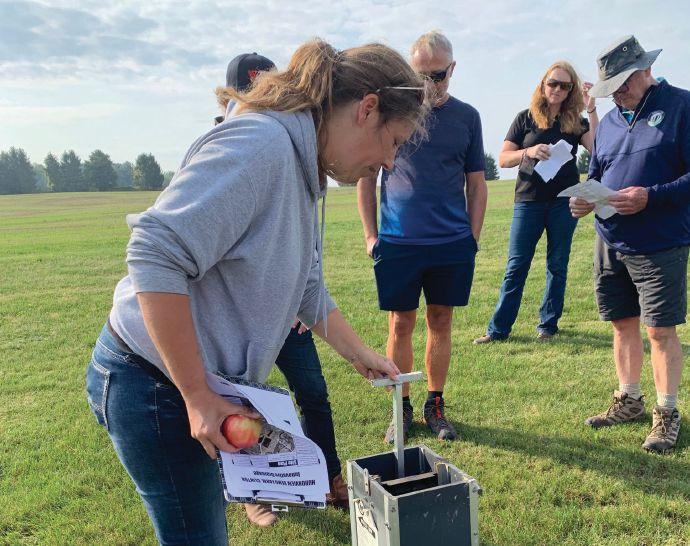
A new multi-year, multi-site study looks at how to balance high yield with low impact.
12 DRAINAGE MANAGEMENT SYSTEMS
Yield, slopes and cost: Focus on the logistics of controlled drainage.
18
CONTRACTOR AT WORK
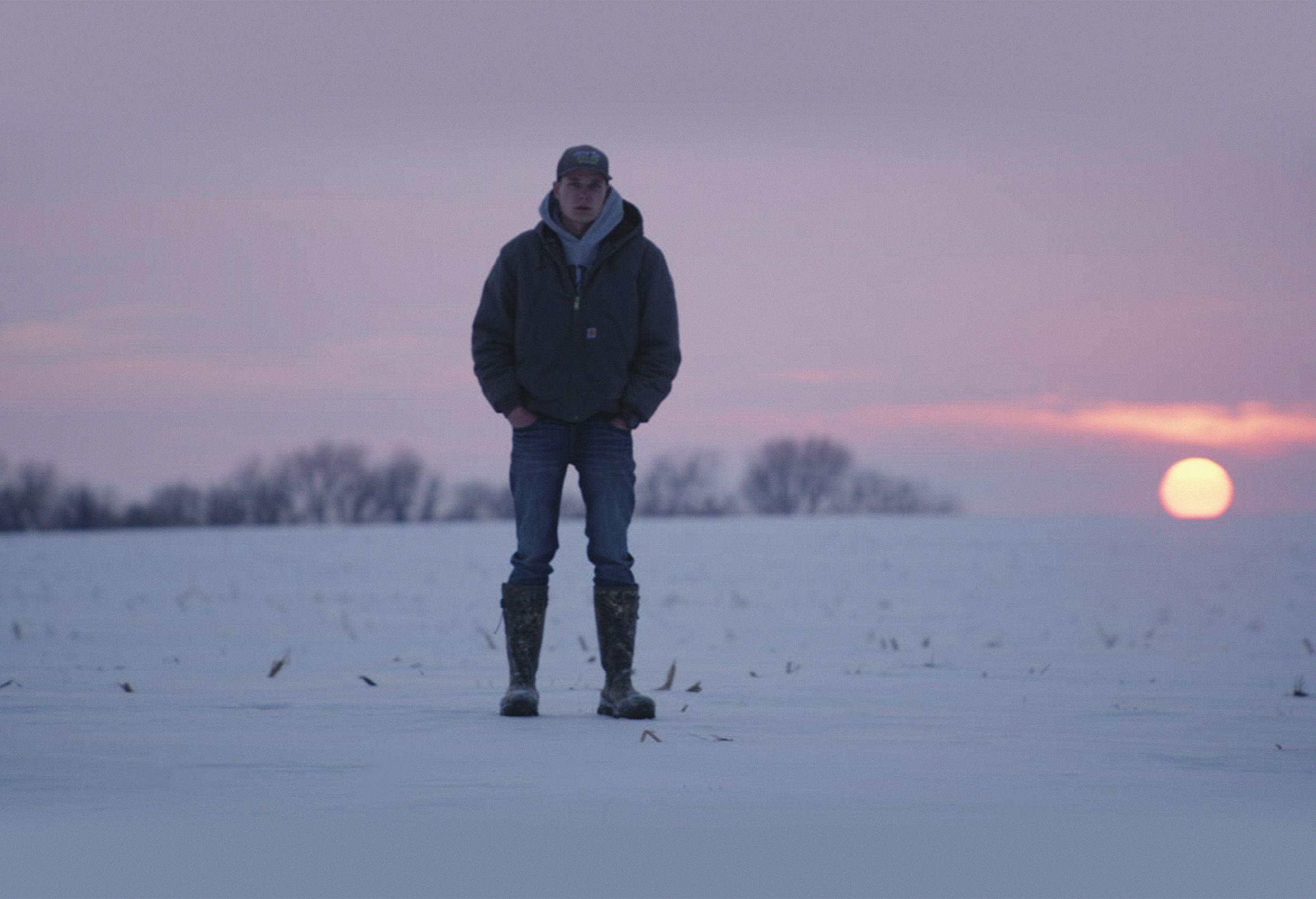
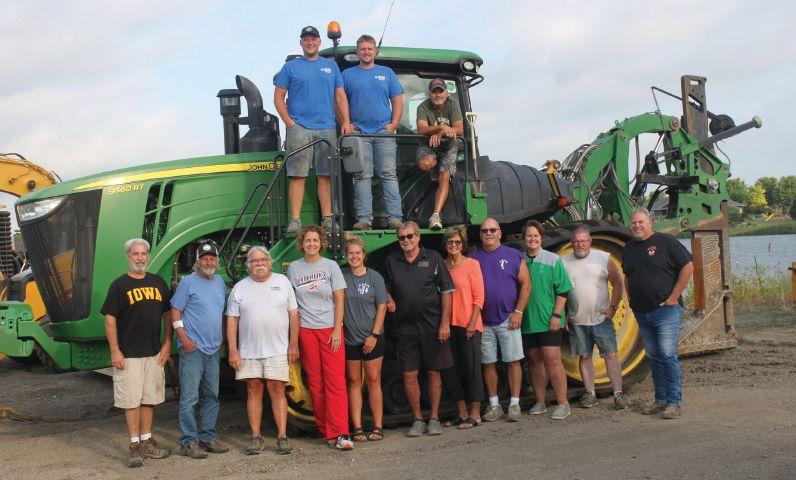
After 50 years, Jim Blood's company, Iowa Drainage, has tiled "around the world."
32 BUSINESS MATTERS
New opportunities and challenges await in the Rainy River distict.
38 GUEST COLUMN
Material matters.
ON THE WEB:
Never miss an eNews issue
Get the latest in drainage and water management news. Our eNewsletter arrives in inboxes every two weeks on Tuesdays, delivering the latest in funding, research and more.
Stay in touch on social Connect with Drainage Contractor and other land improvement professionals on our Facebook page (facebook.com/ drainagecontmag), Twitter (@drainagecontmag) and LinkedIn (Linkedin.com/company/drainage-contractor).
Somehow, we manage
Tile installation is at the heart of drainage, but the industry – and this issue – is about much more.
by Bree Rody
On a crisp, late summer day, I was out for lunch with the director of an industry organization. We discussed farming, drainage, conferences, supply chains, education and everything in between. During that lunch, an interesting topic arose. My lunch date mentioned that increasingly, the industry is embracing the term “water management” rather than simply “drainage.” And why is that?
Well, because drainage is just one aspect of the very important role that water management plays within the agriculture industry.
As contractors, it is likely that the majority of your work still consists of laying tile underground. But not all tile jobs are the same – and neither are all drainage systems. Some systems combine subsurface drainage with surface drainage. Some incorporate controlled drainage, subirrigation and drainage water recycling –allowing drainage to multitask by putting water back into crops as well as removing it from crops.
Today's drainage contractor understands soil, yield, infrastructure and beyond.
And, while drainage has been under scrutiny for years due to the issue of excess nutrients leaching into waterways, increasing research has shown that the solution is not to eliminate drainage (just ask any grower who’s experienced a wet summer how important it is to remove excess moisture) but to improve drainage. Mitigation efforts, whether that’s through saturated buffers or edge-of-field practices, help make drainage effective for farmers while reducing adverse effects on the environment.
Now, that’s not to say that “drainage” is a dirty word, or that the “drainage industry” does not exist. It’s more to say that the industry understands far more than just drainage. For contractors, engineers and designers, that means the required knowledge base becomes about
more than just the pipes in the ground. Ergo, “water management” is a great catch-all term to describe what drainage contractors do.
In the last year, we’ve tried some new things at Drainage Contractor, mostly focused on education. In late 2021 and early 2022, we launched the Drainage Innovation Webinar series, bringing together contractors, researchers, government and extension to discuss highly technical concepts such as spacing, layout and controlled drainage. These roundtable-style discussions proved just how much the industry is pushing itself to test new concepts and be active stewards to the land. We also interviewed and profiled our first class of GroundBreakers, whose stories showed that drainage is more than just trenches and pipes. Today's contractor understands soil, yield, infrastructure and beyond.
This issue focuses largely on those “big picture” issues. From Jack Kazmierski’s dive into how enhancements to drainage issues can mitigate nutrient loss (page 8) to Robyn Roste’s primer on controlled drainage (page 12), we wanted to highlight all the ways in which drainage is becoming a holistic industry founded in the principles of water management. We also have a profile on longtime contractor Jim Blood (page 18), whose half-century in the industry has been successful because of Blood’s abilities to adapt and evolve. And speaking of adaptation, on page 32, Julienne Isaacs looks at the unique challenges of tiling – and growing – in the up-and-coming region of Northern Ontario.
In honor of all those contractors who keep rising to the challenge, changing their perspectives and keeping their knowledge current, we've brought back our GroundBreakers recognition program for 2023 – applications open online Nov. 1.
NEXT ISSUE: Our next print issue will bring you features, columns and more in May 2023. In the meantime, you can find news, webinars and more at drainagecontractor.com @DrainageContMag
EQUIPMENT
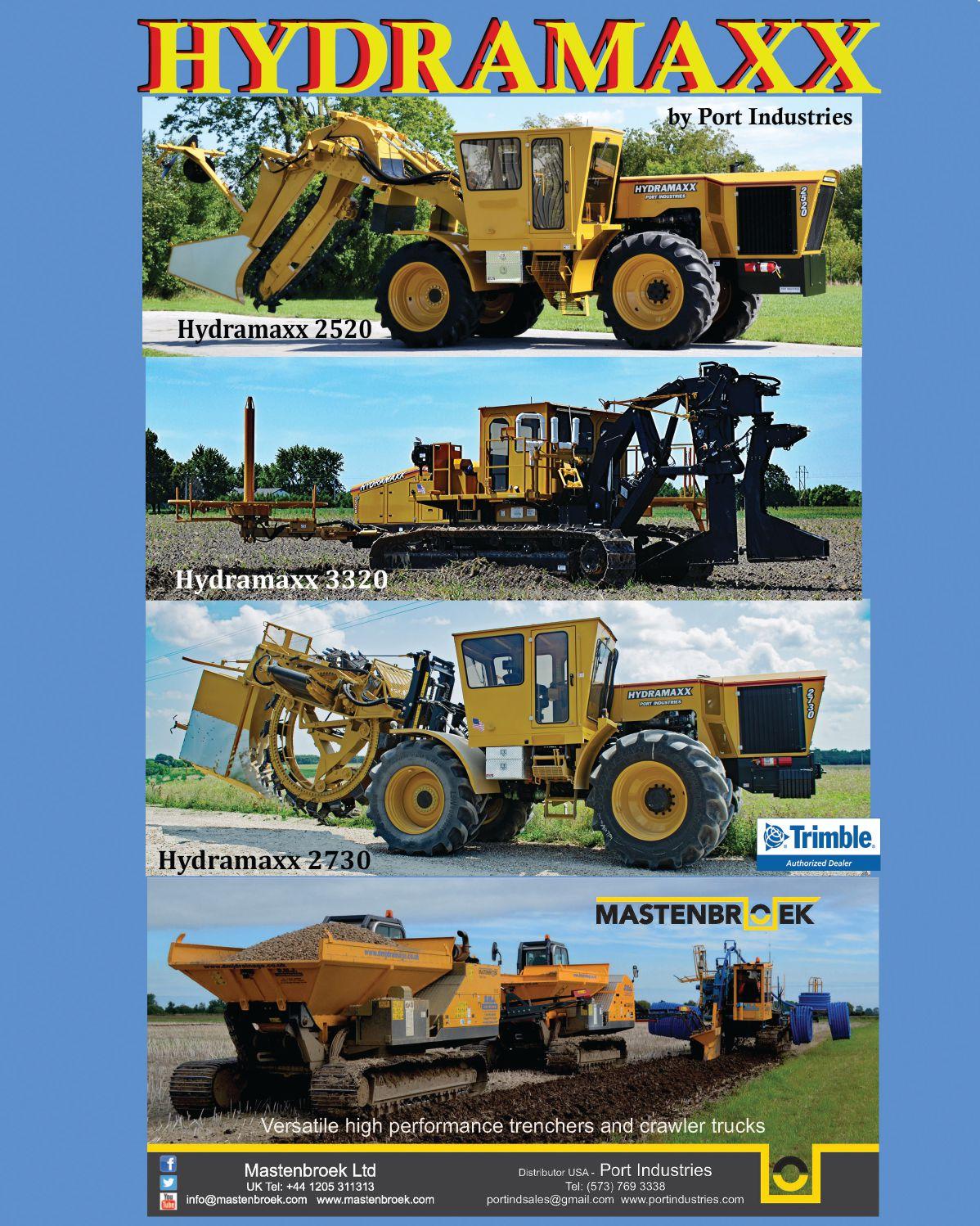
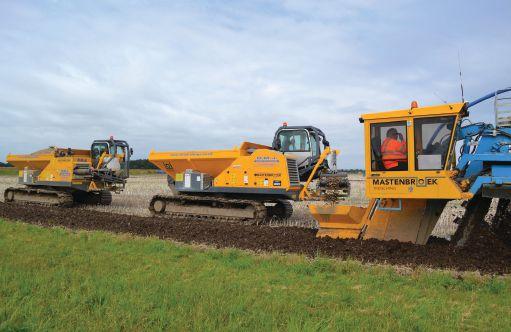
MASTENBROEK CELEBRATES A MILESTONE, GOES BIG AT BAUMA
On Oct. 30, the Mastenbroek CT12 crawler officially turned 40. Mastenbroek spent the crawler’s “birthday week” showcasing the machine at Bauma '22 in Munich. The truck, which features a fullwidth tipping hopper and 180-degree swing conveyor, has been highly popular with pipeline and cable contractors since it was designed in 1982, and since the first machine was sold in 1983. Since then, Mastenbroek has made several refinements, most recently in June this year, when it incorporated a larger, full-width tipping hopper which reduces spillages when loading. The hopper is fully visible when the operator cabin is raised to its highest position, and its variable speed conveyor provides a free flow discharge for aggregates of varying viscosity. As well as allowing the operator to place materials into trenches accurately, the hopper means the CT12 can be used as a dump truck to, for example, haul aggregate along pipeline rights of way.
And the company continues to update the crawler. With colder days in mind, Mastenbroek is now fitting heated windows to the front
and right-hand side.
The 2022 CT12 can also be specified with a 360-degree camera system to provide the operator with complete visibility of their surroundings.
A critical part of Mastenbroek’s most recent design upgrade is operator and service engineer access to the machine. A new frontmounted ladder provides easy access to radiator levels, with side-mounted wideopening doors facilitating access to the CT12’s 248hp Volvo Penta D8 eight-liter, six-cylinder Stage 5 emission engine. Mastenbroek has now mounted the hydraulic oil cooler independently to the engine radiator, and both have opening grills for easy access and cleaning. A new central greasing system has been developed.
“Since we designed the CT12 40 years ago, it has become one of our most popular machines, especially with companies laying pipelines and renewable cables,” said Christopher Pett, Mastenbroek’s commercial director, in a statement. “We will continue to embrace advances in technology and always strive to provide our customers with the best possible machines to make their jobs as easy as possible. This is clear to see in the latest
version of our CT12, which has attracted significant interest since it was introduced in the summer. We are very much looking forward to introducing people from across the world to the machine at Bauma.”
Also at Bauma, Mastenbroek unveiled its new 1600hp 160/18 trencher, its largest machine yet. At 33 meters in length and weighing more than 100 tonnes, the new trencher is twice the size and weight of the company’s previous largest machine, the 70/80. The 160/18 is capable of soil mixing to a depth of 18 meters and dewatering to nine meters. Pett described the product as “a monster of a machine.” It will be available for purchase in Europe, Australia and North America.
GROWING TRACTOR SALES ‘INDICATE POSITIVE OUTLOOKS’ FOR AG INDUSTRY
The latest data from the Association of Equipment Manufacturers (AEM) shows total tractor sales fell throughout the U.S., but grew in Canada during the month of August. Overall, U.S. ag equipment unit sales rose above the five-year average for the first time since April 2022, even though tractor sales fell by 11.7 per cent compared to August 2021. Mid-range tractors between 40 and 100 HP were down 7.2 percent, and the sub-40hp segment led segment losses, down 16 per cent.
In Canada, growth in all segments led Canadian unit sales to its first positive yearover-year month in unit sales since January 2022. Overall unit sales in tractors were up 7.2 percent. All tractor segments grew, most notably
4WD units, up 326.7 per cent to 64 tractors sold. Unit sales in 2WD segments grew by 4.9 percent, led by 100+hp unit growth of 43.9 percent.
“Demand for everything other than the smallest units remains positive,” said Curt Blades, SVP, industry sectors and product leadership at AEM in a statement. “But supply chain difficulties remain in the way of the supply side market.”
He added, “Despite concerns around input costs for farmers, we are still seeing the larger units, harvesters and heavy-duty tractors, lead sales trends, indicating positive outlooks.”
ADS ACQUIRES JET POLYMER AND CULTEC
Water management specialists Advanced Drainage Systems (ADS) have made two recent acquisitions in the latter half of 2022. The company acquired Jet Polymer Recycling (also known as Jet), a privately owned recycling company located in the southeast U.S. The acquisition, according to the company, is part of ADS’ goals to expand the ADS Recycling capabilities and support future growth. Jet is currently the largest supplier of recycled polypropylene plastic for Infiltrator Water Technologies, a subsidiary of ADS.
Shortly after, ADS also acquired Cultec.
Cultec, based in Connecticut, was founded in 1986 and aims to provide technology and engineering expertise in the field of water management. The company designs plastic chambers and related products in both stormwater and site-specific markets.
ENVIRONMENT
A ROBUST DATASET FOR DRAINAGE
Best practices, fueled by data, can improve yield while protecting land and water.
Subsurface drainage is a must for many growers who need to remove excess water from their lands in order to ensure suitable crop growth conditions.
In some cases, however, subsurface drainage can lead to serious problems. In the U.S. Midwest, for instance, some drainage practices provide a pathway for nitrogen and phosphorus loss into waterways, which can create environmental problems as far away as the Gulf of Mexico.
A database, published in the journal Scientific Data in July 2022 provides the data needed in order for researchers to examine subsurface drainage practices in order to determine which methods benefit both the grower and the environment.
A MULTI-STATE EFFORT
Data was collected from 39 research sites located in seven Midwest states (Indiana, Iowa, Minnesota, Missouri, North Dakota, Ohio, South Dakota), and North Carolina. In some locations, the data collection period was as long as 17 years.
Nineteen of the sites employed controlled drainage systems that hold water in the field with a water control structure that raises the water level when drainage is not needed. Seven sites employed drainage water recycling systems that store subsurface
drainage water nearby in ponds or reservoirs until that water is needed for irrigation, thereby reducing nutrient outflow. Eight sites used saturated buffers to divert some of the drain flow through riparian buffers in order to reduce the amount of nitrate that would end up in surface water.
“For many of us, this the first time we published in this particular journal, which is designed to make major data sets available to the public,” explains Jane Frankenberger, professor of agricultural and biological engineering at Purdue University. “This is a data set that represents research related to three practices that's taken place in recent decades, all put together in one format.”
Frankenberger says that the data she and her colleagues have compiled can be used by other researchers in order to better understand drainage challenges, and come up with solutions. “Many people don’t have their own data set,” she explains. “So this way, you can download the complete data set, and use it for your own needs.”
Researchers haven’t always made their raw data available in the past, she explains, but in this case, all the data is available to view
by JACK KAZMIERSKI
and download from the National Agricultural Library, as well as from the website: drainagedata.org. “And it’s not completely raw data,” adds Frankenberger. “It has been cleaned up.” Besides the actual data, she says both of the above-mentioned sources have also published maps, a fact sheet on each of the 39 sites, plus a summary of what was learned at each individual site.
BUILDING A USEFUL DATABASE
Thanks to this vast database, a number of papers have already been published. Frankenberger says the database is also useful for drainage engineers and managers.
“Let's say you're a drainage engineer, you’re new to the Midwest, and you’re used to working somewhere where you weren't used to having drainage, because it's quite unique to our area,” explains Frankenberger. “So how would you get the typical values? This data set can give you the numbers you would need in order to do your work.”
One of the researchers who has used the data set effectively is Matthew Helmers, professor of agriculture and biosystems engineering at Iowa State University, and
Director of the Iowa Nutrient Research Centre.
“One of the aspects I was most involved with was related to controlled drainage, sometimes called drainage water management, where we manage the outflow with a control structure and plate,” he explains.
The goal was to manage the outflow of the water from the fields during certain times of the year, and to see which approach to drainage water management would prove to be better. “We looked at the water quality,” explains Helmers, “taking into account both the drainage volume (how much water exited the drain), and the nitrate loss that was associated with it.”
Helmers says all the sites he analyzed were managed similarly. “In the spring and in the fall, we would not have any control on the drainage system. It would be like a normal free drainage system,” he explains. “In the summer and winter months, we would manage that outflow, maybe up to within two feet of the ground surface in the summer, and 18 inches or 12 inches of the ground surface during the winter.”
By analyzing the robust data set, Helmers and his team were able to determine that although there were some commonalities across the board at all the sites, some regional differences exist, which means that growers would have to adapt their drainage strategies, depending on their geographic location.
“What we found is that across the whole region, we really did see a reduction in the amount of drain flow when we applied this controlled drainage,” explains Helmers. However, “in parts of Iowa, Minnesota and South Dakota—what we might say is the northwest part of the corn belt—more of our drainage and nitrate loss comes in the spring in the April, May and June period. Whereas if we look at the eastern part of the corn belt— Indiana and Ohio—more of their drainage and nitrate loss comes in the late fall and winter period.”
WET YEARS VS. DRY YEARS
As might be expected Helmers came to the conclusion that controlled drainage is an effective strategy. “We saw a reduction in drain flow and nitrate loss across the whole region,” he adds. “The annual reduction in drain flow was pretty consistent, and an absolute value—how many inches or millimetres of reduction—was pretty similar when we compared a wet, a dry and a normal year.”
Helmers notes that in a wet year, the percent reduction was less, but that the
absolute amounts were similar. “In fact,” he says, “we saw about a four-inch, or a little over 100-millimetre reduction in drain flow consistently across the dry, normal and wet years.” He concludes, “We don't get a disproportionate benefit in a wet year, but we also don’t get a big decrease, at least in the absolute volume of drain-flow reduction or nitrate-loss reduction.” (For more on the mechanics, limitatoins and costs of controlled drainage, see our feature on Page 12).
NITRATE CONCENTRATIONS
Controlled drainage was not the only solution studied, nor was it a catch-all for reducing all nutrient loss. One of the other main findings, Helmers explains, “is that we did not see a reduction in the concentration of nitrate. I think that’s important, because if you are looking for a practice that decreases nitrate concentration on what's delivered to the stream, then controlled drainage is not your practice.”
Instead, Helmers recommends looking at other solutions like wetlands, saturated buffers, cover crops and infield nutrient management.
“I think this is important because depending on whether you're concerned about, the concentration getting to the stream, or the load getting to the stream, controlled drainage may help us with that load reduction, because it's reducing water volume. And if we reduce water volume and have the same nitrate concentration, it's reducing load, but it's not decreasing that concentration.”
This was one of the first studies that was able to look at the performance of controlled
drainage over such a large geographic region. “Despite maybe not always managing to maximize holding water back, we still saw a pretty substantial reduction in drain flow and nitrate loss across the whole region.”
SURPRISE FINDINGS AND BEST PRACTICES
Helmers says that he was surprised to discover that the data set pointed to similar findings across all the locations. “I expected that perhaps we would see greater performance in the eastern part of the corn belt, where more of that drain flow is in the winter,” he says. “I was a little surprised that it performed so similarly across this geographic region.”
While the data and the findings are useful for growers in the parts of North America where artificial subsurface drainage is used, Helmers says that some exceptions should be noted.
“It applies throughout the U.S. corn belt, and probably some part of Canada into Ontario,” Helmers notes. “There’s a lot of applicability in the heavily-tiled drained areas of North America, at least rain-fed tile drainage areas. It probably wouldn't be as applicable as we get into the west, where maybe they're using drainage more for salinity control, rather than specifically for the removal of excess water and reduction in waterlogged soils.”
Now that the data has been published, along with conclusions from each of the 39 sites, it will be up to others to analyze the findings and turn them into practica, applicablel advice. “We want to turn this into best practices, answering the questions, ‘What can we take from this?’ But we’re not there yet.” DC
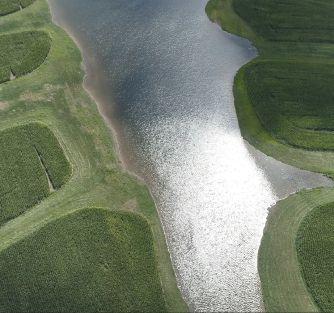
Aerial view of a reservoire and landscape in Missouri.
Image courtesy of Purdue University.
YIELDS, SLOPES AND COST
Many experts agree that controlled drainage has many benefits. But how do you know if it's right for your farm?
With mounting pressure to increase crop yields and protect the environment and following best management practices, controlled drainage may provide the best of both worlds.
by ROBYN ROSTE
Laura Christiansen, associate professor and faculty extension specialist at University of Illinois’ crop sciences department, once described controlled drainage as “one of the few water quality drainage practices that we promote that has the potential to provide a yield benefit.”
Considered a cost-effective water management tool, controlled drainage allows crop producers with tile drain systems to keep subsurface water in the soil during critical seasons through a series of control structures.
The idea behind controlled drainage is similar to controlled irrigation systems. By
regulating the water table level, this keeps the water table at a depth most favorable for crop growth throughout the season. This helps mitigate water issues many growers face –having too much water at certain times of year, and not enough at other times.
“Drainage is a best management practice until it’s not. That’s why we want to have a tap, essentially, to turn it on and off,” says Mel Luymes, executive director of Land Improvement Contractors of Ontario (LICO).
Controlled drainage provides a way to store water in the ground for crop use in dry periods, while still allowing for excess water to be
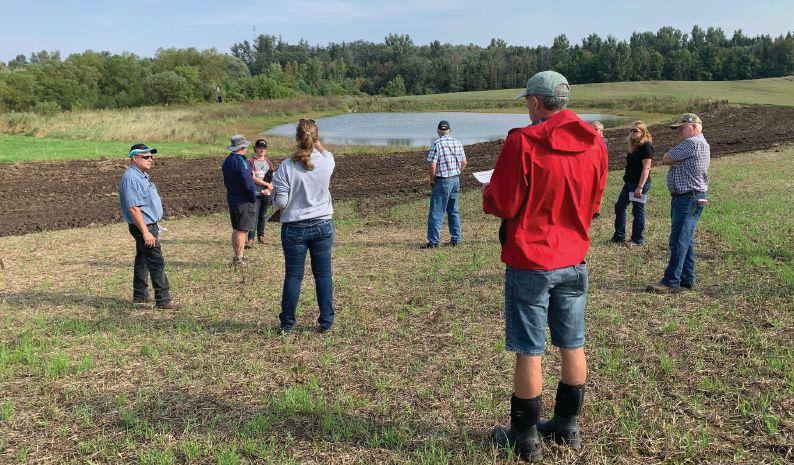
RIGHT:The Huronview Demo Farm is the site of a project studying controlled drainage on three-to-nine percent slopes.
removed through subsurface drainage. It’s achieved when a flow-restricting device is placed inline with tile drainage pipes. These control structures are strategically placed and regulated by controlling the level of water at the outlet – either full, partial or no drainage.
There are different types of control structures, but the two main types are open-ditch flashboard riser structures or inline control structures.
The open-ditch structure is used either in ditches for small area control or at a drainage outlet. Inline control structures are attached to subsurface drainage pipes, and can either control the flow from individual pipes or on a subsurface outlet drain.
The control structure is often a square drain box with the top above ground. It’s installed to intersect with the subsurface drain tile and a stop log is added to or removed from inside the control structure.
The stop log is usually a composite or aluminum board set at about 50 to 60 centimeters below the surface inside the control structure. These are also called flashboard risers, plates, mini-check dams or control gates.
Since the 1980s, controlled drainage has been applied to reduce nutrient losses in North America. Yet as of 2022, the practice hasn’t been widely adopted. The first iteration of the technology was considered cumbersome, and the wood used to dam the drainage water tended to swell, making the boards difficult to move.
However, new technology has refined the system, making controlled drainage a viable option for many landowners and crop producers who farm on fields with slopes less than 0.5 percent. Smart technology offers further enhancements, such as notifications to raise or lower the boards based on weather forecasts and automated systems.
“Slopes are the challenge. In Ontario, only two percent of land is flat enough to do regular controlled drainage. Unless we can figure out how to do it on a slope, it’s not going to be something we can really look at in Ontario at least,” says Luymes. Before she was at LICO, Luymes coordinated the Huronview Demo Farm in Clinton, ON, which is studying controlled drainage on three to
DRAINAGE MANAGEMENT SYSTEMS
nine percent slopes.
In addition to being limited to the flattest fields, controlled drainage works better on new drainage systems rather than existing tile. Plastic tile drains can be retrofitted, but clay tile will not work.
In a recent webinar for Drainage Contractor titled, “Controlled drainage and sub-irrigation: Drainage…for the control freak,” Gerald Neeb, owner of Roth Drainage Limited, said when he installs controlled drainage into a field with existing clay tiles, he tries to plow them out since the old systems don’t function well when under stress, and they’re usually drained by either the width or length of the farm.
“I’m trying to get 80 percent, and then going diagonal will finish it off. We’re having good success with that,” he said.
It’s difficult to put a fixed cost on installing a controlled drainage system, because there are so many variables such as slope, hydrology, number of gates, adding sub-mains to create water management zones, multiple in-line stop log structures, field elevation, engineering design, soil type, soil variability, drainage intensity and more.
Purdue Agriculture estimates initial costs to range between $20 and $110 per acre. Luymes says, from her experience,
installing controlled drainage costs about 15 percent more than a conventional system would.
“You need to make it curvy and then whatever you choose to be your control gate can blow your costs out of the water,” she says.
The most suitable and cost-effective installations are on flat fields with a pattern drainage system, so one control structure can manage the water table within two feet without affecting adjacent landowners. In general, controlled drainage requires one control structure for every two feet of elevation change in a field.
There have been extensive studies in the U.S. on controlled drainage, with a focus on corn and soybean crops. However, there is no research indicating which crop varieties respond best to controlled drainage. NC State Extension reports that for the past 20 years, North Carolina has documented the benefits to yield from controlled drainage. Generally, corn and soybean yields are increased by an average of 10 percent and up to 20 percent.
Also in the Drainage Contractor webinar, which was moderated by Luymes, Will and Rick Woodworth of Flying W Farms in West Virginia
shared their experiences. The first field in which they attempted controlled drainage was previously a poorly-drained field, which produced typically between 160 to 180 bushels of corn. After adding controlled drainage, they had an increase of 90 to 110 bushels, with an average of 270, and decreased water runoff.
Despite positive indications on the yield increases from controlled drainage, yield research is still limited or inconclusive and most studies focus on nitrate reduction benefits. While exact figues are not yet widely agreed upon, general sentiment shows that controlled drainage has a positive effect in this area. In an article for the Environmental Defense Fund, Maggie Monast, senior director of climate-smart agriculture, finance and markets, reported that “controlled drainage is one of the most effective ways to minimize nitrogen loss from croplands.”
Christiansen says controlled drainage can reduce nitrate loss by at least 30 percent each year. This is because holding the water back in drains or ditches allows the nutrients to stay in the soil. The exact amount of annual nitrate load reduction in drain flow varies based on location, climate, soil type, cropping practice and the time of year drainage takes place.
NC State Extension has also said losses of N and P in drainage water can be substantially reduced by controlling drainage outlets during both the growing season and the winter months. According to a primer article by the Extension department, "Multi-year experiments on a wide range of soils on both farmer-operated systems and on experiment stations in North Carolina showed that CD reduced N losses to surface waters by over 40 percent and P losses by about 25 percent compared to conventional uncontrolled."
Controlled drainage can both improve yields and profitability while also benefitting the environment by reducing nutrient runoff. And while it may not be available for every field at present, research is moving forward to determine how to best add this BMP to fields with elevation or existing tile drain systems. DC
Mel Luymes, LICO executive director, explains controlled drainage at Huronview.
draintilesafety.org
by BREE RODY
JIT’S IN THE BLOOD
Jim Blood celebrates 50 years of tiling
im Blood has tiled around the world. No, he’s never created a trench in Taiwan or dug a ditch in Duesseldorf, but after 50 years, Blood’s company, Iowa Drainage, has laid approximately 177,983,955 feet of tile – enough to stretch around the world and then some.
Blood first hit that milestone in 2009 when his company, Iowa Drainage Shop, hit 131,482,560 feet, and the company has remained ambitious since then.
As he reflects on his 50 years in the business, Blood is filled with gratitude for the influences that pushed him into tiling, for his customers and for his family. When asked about tiling, his face lights up and he speaks about tiling less like a job and more like it’s a member of his family. “I love it. I’ve loved it for my whole life,” says Blood. He’s still in the office every day, doing what he describes as “a little bit of everything.” Business isn’t slowing down, says Blood, so neither is he.
IN THE BEGINNING
Blood first set up shop when ABBA’s “Mamma Mia” was on the charts and the video game Pong debuted. “In July of 1972, a contractor was retiring from the tiling business, and that business had come up for sale,” Blood explains. “I bought the business; [the seller’s] brother-inlaw came along with the business and taught me the ropes.” Jim's wife, Diana, also became an owner of the business, and has been his right-hand woman from the start.
Originally from Sheffield, IA, Blood’s father worked as a superintendent at Sheffield Brick and Tile Company for years. “I’d worked there off and on when I was in high school and
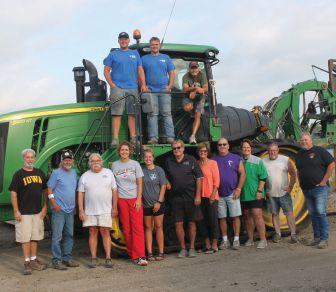
RIGHT: Jim and Diana Blood (front row, center) and their daughter Tracy Sheckengorst (third from right) consider the crew at Iowa Drainage a part of their family.
CONTRACTOR AT WORK
Diana, Shreckengost and 11 other employees, plus two extra helpers during the busy season. Among those 11 employees is Shreckengost’s daughter, Sydney, making Iowa Drainage Inc. an official “three-generation” family business.
Operations have expanded over the years. In 1982, Blood added Minnesota Drainage to the portfolio, setting up a satellite office and a sizeable crew out of LeRoy, MN. Later, he added another office in Fort Atkinson, WI. At one time, there were three different crews tiling. Since then, he has sold the Minnesota business, but the Fort Atkinson operation remains. Throughout the years, there have been challenges – as well as innovations that have made tiling significantly easier.
Blood and Sheckengorst agree that the biggest challenge is the weather – unsurprising in the notoriously precipitous Iowa. Between the rain and the snow – which Sheckengorst says can sometimes last until mid-April – she describes the window of opportunity for tiling as very small.
“The farmers are pretty much right behind you trying to get their seeds in the ground," says Sheckengorst. “So our window will always be pretty small for that.”
Those seasons can be stressful, but Blood smiles and says, “You gotta do what you gotta do – you gotta get that tile in before it freezes up.”
More recently, says Sheckengorst, product has been one of the biggest challenges. The agriculture manufacturing industry has been hit hard by the notorious supply chain disruptions exacerbated by COVID, labor costs and other factors. One fall, Sheckengorst says it was so bad, one manufacturer the company was working with was running out of tile.
“We try to plan ahead and have a lot of that tile stockpiled,” she says. She notes that things appear to be on the upswing, and somewhat better than a few years ago in terms of having enough supply to meet the demand. Nevertheless, Sheckengorst says the lesson the company has taken away is to strike when the iron is hot with pre-orders. Summer specials are a great opportunity for pre-ordering, she says.
Blood’s kept his knowledge current by attending a number of extension-run drainage schools over the decades, and has taken on some more diverse projects recently, such as a project that incorporated irrigation. He’s also embraced the advent of
technology such as GPS – which he says has been a “life-saver” and made life much easier.
Yield monitors have also been a game changer, particularly in the state of Iowa. Blood says prior to the advent of yield monitors, most sites would have clay tile placed every 100 feet. After yield monitors became commonplace and landowers began demanding more tile, Iowa Drainage would be charged with placing tile closer than every 100 feet.
“We’ve gone in between jobs and done tiles every 50 feet,” says Shreckengost. Depending on the soil, some tiles have been placed even closer. One job, she says, required tile every 15 feet. “You should have seen that tile map,” she says, laughing. “It was like a blob of ink.”
THE PRESENT (AND FUTURE)
While Blood is appreciative of all the technological advances of the last few decades, he still has a special talent for being able to locate tile without much help from a computer. Sheckengorst says she’s watched Blood with awe at times.
“Jim would come [to a site] and we’d drive around, and we’d try to figure out where we’d find an outlet. Nine out of 10 times, he’d put a flag down, and the guys would dig and surely, there would be tile there.” Considering the near-118 million feet of tile laid, Sheckengorst chalks Blood’s uncanny ability up to simply having put the time in. “He just has the lay of the land.”
But it’s not just about the tile. Blood’s favorite part of the job has always been, and remains, the people. Much of his current duties involve meeting with his farmer clients to understand their needs and lay out the jobs, as well as doing all preconstruction work.
“I love the people,” says Blood. “The people, the planning… making satisfied customers.” He says he still gets cards and letters from happy clients that remind him of the value of his work. But he also has advice for the next generation of tiling business owners: focus on not only the people outside your business, but also on those inside your business.
“If you take care of your employees and treat them well, they’re going to reciprocate that,” he says. “They’ll be ready to roll with the weather and all those situations where you’re tiling outside the elements.” DC
L-R: Iowa Drainage staffers David Siskow, Jim Blood, Jim Rooney and Dale Brayton celebrating the milestone.
The staff at Iowa Drainage celebrated their "Around the World" milestone in 2009.
FlexCorr dual-wall pipe installs 2x faster than traditional dual-wall sticks. Fewer connections and easy plow installation means more opportunity for your business.
PLOW & WHEEL TRENCHERS
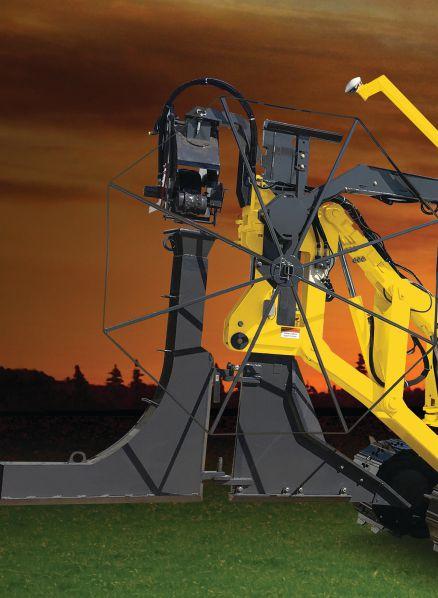
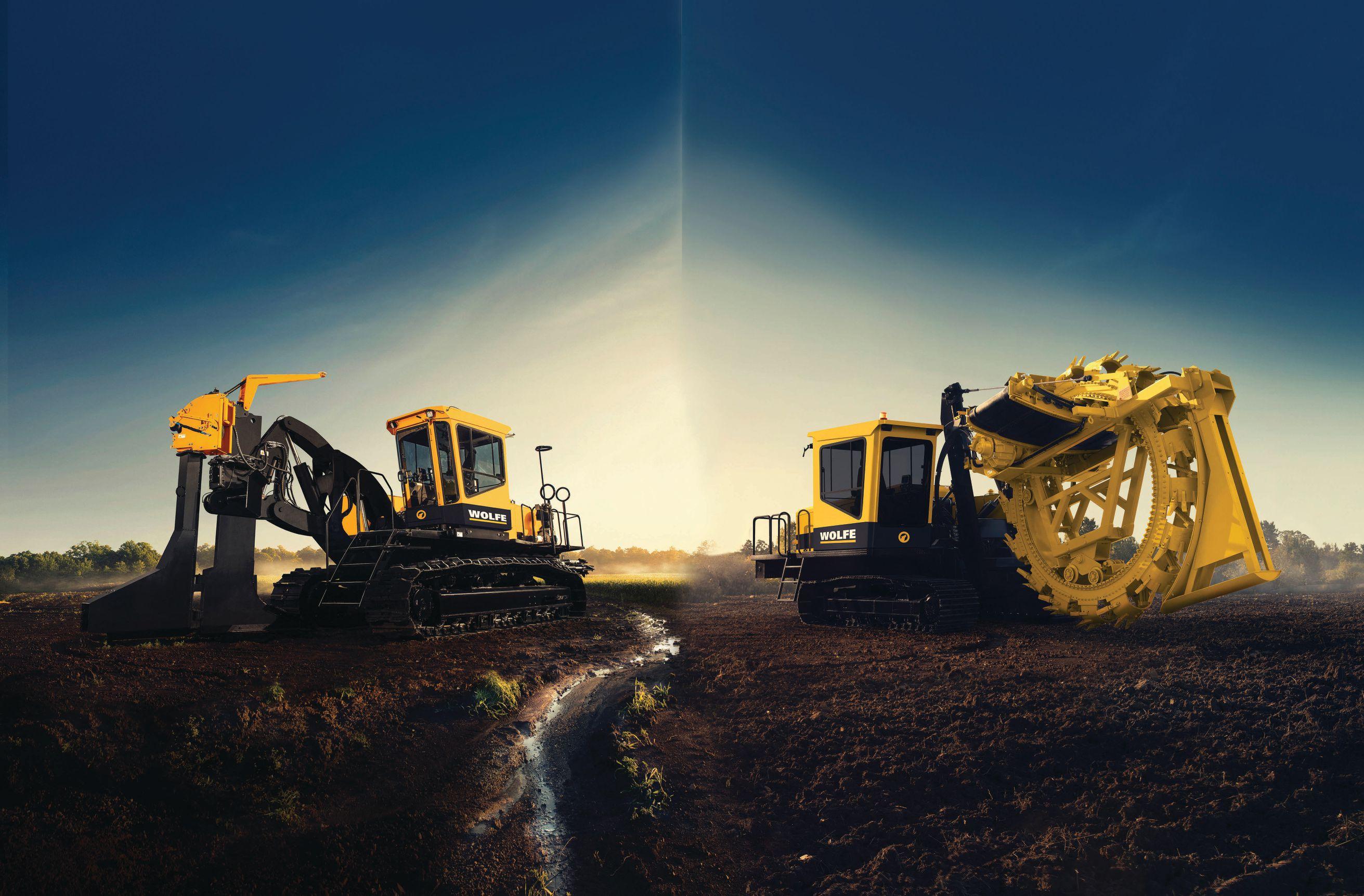
Wolfe Heavy Equipment continues to set the tone for powerful agricultural and commercial trenching equipment. Wolfe’s versatility, superior manufacturing and expert service along with reduced fuel consumption provides increased profitability.
The stage is set
by Keegan Kult
Engagement on the importance of water management has never been higher.
The investment by the drainage industry in the Agricultural Drainage Management Coalition (ADMC) has led to new partnerships, completed pilot projects resulting in a scalable amount of practices on the ground, trained a new cohort of contractors and agency personnel on how to design drainage water management systems and perhaps most importantly have raised the industry’s presence among agencies and researchers.
ADMC president, Kent Rodelius, who is Prinsco’s ag market relationship manager, said it best at the recent International Drainage Symposium when he said while there have been large gains in the past couple of years on the advancement of conservation drainage practices, it feels like we are now on the cusp of seeing exponential growth of practice adoption. Why all this enthusiasm? The need to improve current water management is certainly there. Eric Snodgrass, Nutrien Ag Solutions principal atmospheric scientist, presented at an ADMCsponsored webinar to the Conservation Drainage Network Growth Committee earlier in the
summer about the changing rainfall dynamics. In the Midwest, there are now four to five fewer workable spring field days than in prior years due to an increase in heavy rainfall events. This is somewhat offset by advancements in equipment technology, but there are also additional time demands with the management of practices such as cover crops. We are also experiencing more high intensity rainfall events in the summer often followed by longer dry spells. Not only is there an increased need for water management, but more work has also been done to improve the demand for and delivery of conservation drainage practices.
Advances in automated drainage water management will create demand for the practice by reducing the barriers to adoption of controlled drainage for farmers by eliminating extra trips to the field to manage structures. In addition to eliminating trips to the field, automated drainage water management can provide a portal to track valuable water level data for the farmers. Demand for the practice will truly increase with research that can show consistent yield gains or a reduction in yield variability. There is new research in Ohio to look at historic controlled
Bioreactors and saturated buffers are a useful tool in the removal of excess nutrients from waterways.
Image courtesy of the ADMC.
FROM THE ADMC
drainage sites from an early 2000s ADMC Conservation Innovation Grant (CIG). Ecosystem Services Exchange and Ohio State University will update a portion of the previous CIG sites with automated structures to evaluate the yield response to a more adaptive management approach compared to manual structures and conventional drainage systems. Research is also starting to come out to show the important role conservation drainage systems can play in reducing agriculture’s carbon footprint. Michael Castellano of Iowa State University presented to an ADMC sponsored Conservation Drainage Network Growth Committee webinar on the role drainage and especially conservation drainage can play in
the overall balance of greenhouse gas (GHG) emissions for agriculture. Nitrogen fertilizer production is the most energy intensive part of row crop agriculture, and N2O emissions within the field can be the largest drivers on the carbon balance sheet. Being able to determine an economic and agronomical optimum nitrogen rate is difficult as the agronomical optimum nitrogen rate may vary by nearly 100lb N ac-1 from year to year. Drainage can reduce this uncertainty and reduce the overapplication of N by farmers by giving them the confidence to accurately predict the amount of N needed. In fact, research has shown that controlled drainage can reduce the annual variability of the agronomic optimum nitrogen rate for a corn soybean rotation by 75 percent compared to an undrained site. When paired with an edge of field practice such as a saturated buffer, denitrifying bioreactor, or treatment wetland the entire system will become less leaky and more efficient.
The timely research is incredibly important as the United States Department of Agriculture (USDA) is investing heavily in agriculture. The USDA has recently announced nearly $3 billion worth of funding for climate smart partnerships. There will also be an increase in funding for traditional financial assistance programs such as EQIP and CSP. It is up to those involved with drainage to step up and deliver on practices and programs and show that the industry can be part of the solution.
Thanks to the investment in ADMC by its members, there is an open dialogue with USDA agency leaders about what is needed to get more practices on the ground. Additionally, the connection to the university researchers is at an all-time high through ADMC’s participation with the Conservation Drainage Network (CDN). ADMC utilizes the research provided by the CDN members to show leadership the importance of the practices. Contracted work on pilot projects such as the Polk County Saturated Buffer project have also provided the blueprint on how alternative practice delivery can lead to scalable implementation of the practices as more than 100 saturated buffers and bioreactors have been installed the past two years in central Iowa. It is incredibly important to show that these solutions are scalable and that with adequate funding and the right delivery mechanisms will be utilized. DC
To learn about opportunities near you or if you are interested in developing a project please reach out to Keegan Kult, Executive Director of ADMC, at kkult@admcoalition.com
Image courtesy of the ADMC.
Adoption and understanding is on the rise for conservation drainage practices.
Nominations open Nov. 1 at DrainageContractor.com/groundbreakers
The search is underway for the 2023 GroundBreakers! We’re looking for drainage contractors, designers and other water management professionals actively involved in the industry who are embracing innovation, demonstrating leadership, and taking drainage to new heights.
Remembering John Wolfe
by Mel Luymes
John Wolfe Sr. is the name behind the eponymous Wolfe plows and was one of LICO’s first honorary life members to be inducted. He was well-known and respected among farmers and contractors across North America because his plows were strong and dependable, and he offered exceptional service.
John passed away on Aug. 9, 2022, in his ninetieth year.
Doug Inglis, a retired contractor from Earlton, ON, remembers Wolfe fondly. His father, Rod Inglis, met John in the 1950s at a drainage meeting when they were both young men starting into drainage contracting, and they both ran Buckeye 301 ditchers. John farmed and installed field tile with his brother Grant, but he always liked the machinery side of the business. He started manufacturing parts for drainage equipment in his shop, quickly developing a good reputation amongst Ontario contractors for great service.
In 1967, he launched Wolfe Equipment and eventually sold trenchers and plows as well. He was featured in Drainage Contractor magazine in a 1978 article titled ‘Service is the Salesman’ and at that time he was manufacturing parts for
Buckeye, Barth and others, as well as selling their trenchers and plows. The article concludes that Wolfe “will surely continue to be a leader in Canadian land drainage in the years ahead.”
In fact, he would go on to be a global leader. In the late 1970s, he bought a plow design from Advanced Drainage Systems (ADS) and reworked it into the Wolfe single parallel link machine. He kept the design simple and overbuilt the components, so the unit was heavy and never short of horsepower.
Ken McCutcheon, a drainage contractor near Thorndale, ON, bought one of the first five plows that came out of Wolfe’s shop in 1981. “John built them tough and simple,” says McCutcheon, “There wasn’t a thing on that plow I couldn’t fix myself.” Doug Inglis bought a Wolfe plow in 1982 and it is still going, he says.
“They just worked,” says Bob Manske of A&E Construction Supply, who sold the majority of Wolfe plows in the U.S., more than 200 plows and power units. “They would go years without seeing a warrantee claim,” he adds, and Manske says 20-year-old plows are still selling for the same amount they were bought.
Manske met Wolfe in 1983, and that year he
Image courtesy of Jim Wolfe.
LICO UPDATE
did nine demos and sold eight Wolfe machines. Thus began a long friendship and strong working relationship between the two.
In the early 1990s, they began co-manufacturing ‘Wolfe-Man’ trenchers and got away on several fishing trips over the years.
“I’ve never met a man with more integrity and honesty. He was strong in his beliefs,” says Manske, who considers Wolfe his mentor, and together they helped to build the American market for plows. According to Peter Darbishire, former editor of Drainage Contractor, there had been a lot of resistance to adopting the plow in the U.S. in those early days, with claims that the plow caused soil smearing that impeded drainage. But over time, the increased speed and reduced cost of plow installation won farmers and contractors over.
As for service, McCutcheon says there was countless times he stopped by the shop after hours for parts. Even for Inglis, Wolfe would get parts to him on the next bus to New Liskeard, ON. “John always answered his phone,” McCutcheon adds, noting that Wolfe dealt directly with Ontario contractors himself and never missed a drainage conference. Wolfe was genuine, friendly, well-connected to his customers and helped several young contractors into the business by financing their plows himself. He built trust and his handshake was as good as gold.
Both McCutcheon and Inglis worked with Wolfe to get his trenchers going in Egypt. They worked with the Canadian
International Development Agency (CIDA) around 1990 to bring seven Wolfe trenchers to the Nile Delta. The goal was to reduce salinization that was impacting farmland up to 30 miles inland from the Mediterranean Sea. McCutcheon went back and forth five times doing performance testing and Inglis ran a five-week training course for local operators. Drainage was successful there and a 30 percent increase in yields was measured in the first year alone.
Ron Schlatter, who deals for Wolfe from Indiana, adds that there were many sides to John Wolfe and a number of personal tragedies that his family faced. “I wish everyone could see the side of him that I knew,” says Schlatter, who swapped books and phone calls with him for years, even after the business was sold.
“John Wolfe brought the plow into the twentieth century, but not into the twenty-first,” says Schlatter.
“They were simple and durable, but John wasn’t about the bells and whistles.” Wolfe worked with his children for several years before they sold the company to the Veeke family in June 2012, and the new owners added the technology built into today’s Wolfe plows.
John Wolfe Sr. was one of many extraordinary individuals who built and supported the drainage industry to what it is today. He will be remembered by many. DC
A DIFFERENT LANDSCAPE
Growing (and draining) is a different challenge up north
Ontario is a land of contrasts. When you’re carving grain land from flat scrubland and forest, growing grain and laying tile isn't exactly a cakewalk, especially compared to the landscape down south.
by JULIENNE ISAACS
RIGHT: Rainy River, a small Canadian town located close to the OntarioMinnesota border, is relatively new territory when it comes to grain farming. But economic inventives have brought more farming – and more tiling – to the area. But conditions aren't as straightforward as they are in areas like Sourthern Ontario, Michigan or Iowa.
Grain farmers are still the minority in the Rainy River district of northwestern Ontario,. but these farmers have learned the value of tile. Most of them have have to inevitably tile all of their acres.
Timo Brielmann is one such farmer.
Over the last 10 years, the Brielmanns have transformed their family cattle operation into a 8,800 acre grain farm. Some of this land is owned by a neighbor for whom the Brielmanns do custom work. Some of it is rented under long-term leases with neighbors. Most of the acres, whether owned, rented or custom farmed by the Brielmanns, have been carved
directly from the bush.
Transitioning from cattle to grain had been the senior Brielmann’s goal for a long time. “Dad always had a fantasy of having a grain farm,” says Brielmann. In 2012, cattle prices were good, he had just returned from University, and the family saw their opportunity. The family sold their cattle. Soon afterward, they started tiling the neighbors’ operation at their request.
Eventually, with the help of the Northern Ontario Heritage Fund Corporation (NOHFC)’s Regional Tile Drainage Initiative, which conditionally covers up to $500 per
acre, they tiled the rest of their acres as well. Just 300 acres of rented land aren’t yet tiled, says Brielmann. More recently contractor Jesse Tait has started putting it in for Brielmann.
Tait, of Tait Brothers Contracting, knows firsthand of the problem-solving opportunity up north. Tait lives in the Rainy River District three seasons of the year. In recent years, his family's company has expanded from southern Ontario to Thunder Bay, then Algoma and Rainy River Districts.
Tait has enough drainage design challenges to keep him hopping.
Tile is following grain farmers’ expansion into areas traditionally dominated by dairy or cattle operations, or used by no one: marginal land, scrubby or soggy and prone to ponding under heavy rain. According to Tait, Rainy River lives up to its name.
“They have excessive rains in the Rainy River District,” says Tait. “We get rain down south, and I’m only 40, but I’ve seen rain here like I’ve never seen anywhere else.
Sometimes they’ll have a half inch of rain every day for a week.
“[But] they can grow really good crops up here, and they’re taking advantage of so many underused acres. You needed tile drainage to get the crops off on time because of the shorter growing season,” he adds.
LANDSCAPE CHALLENGES
The Brielmann operation is located at the westernmost end of the district, where Ontario meets Manitoba and Minnesota. From their binyard, says Brielmann, you can see into the States.
The land there has a lot of unique features. “When you walk toward the river, the land goes up, so it’s hard to drain into the river. These massive natural ravines take ditchwater to the river,” he says. “We have big, flat fields and they take really big, flat-grade tile. We have sand, too, so filters have to go in. It takes a lot of design and a lot of care. In some areas there’s bedrock too.”
Untiled land in the district gets extremely wet in the spring, and farmers are forced to seed a week or two after their neighbors.
“That’s huge in this area. Say you went to Southern Minnesota – a week or two might not be the biggest deal. A day waiting on corn planting is a bushel an acre [per day down there], but here, if you don’t seed at the right time, it doesn’t work. The winter comes so fast,” says Brielmann. The area typically sees its first frost by the beginning to middle of September; snow starts flying in October.
Tait says the advantages of water management in areas like this are “second to none.”
“You get more bushels per acre. It reduces salinity in soil. It helps dry out the ground and warm it up,” he says, adding that some studies have found a three degree temperature increase in tile drained versus non-tiled ground.
But there are many challenges. One is the proximity to tile suppliers. In Thunder Bay, Algoma and Rainy River
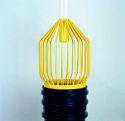
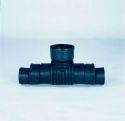
Full Line of Surface Water Intakes
• 8” & 10” riser with patented 8” & 10” combination Tees. Also 6” round riser with patented reducing Tee.
• Constructed of heavy-weight, high-density polyethlene.
• Parts highly adjustable & interchangeable with others on the market.
• Orifice plate placed at tee level or at ground level.
• Exclusive locking device on each part.
• User friendly-priced effectively.
• Adaptor available to repair old metal or broken intakes.
districts, tile has to be trucked in quite a distance, says Tait, which means his company sometimes resorts to building its own equipment, including plows.
DESIGN CHALLENGES
Perhaps the greater challenge, though, is designing drainage systems that can compensate for Northern Ontario’s unique landscape features.
“When we first came up here, we were going with a lot of minimums for cash crops, and that coefficient is half an inch. We realized that it wasn’t enough,” says Tait.
“We tiled a few thousand acres and then realized we needed three quarters or sometimes an inch in 24 hours, so that made the increase in price for tile very expensive, especially when you have flat grades.” In one field, he put in 30 rolls of 12-inch tile.
Tait Brothers has also gone to closer spacings, he says, to compensate for ponding issues.
“There are some ponding issues. The soil is quite soluble. It’s very different ground,” says Tait. They’ve seen fields with half-acre ponds after heavy rains.
It’s a constant battle, he says, especially with the added problem of compaction, which is fairly common in the area due to wet soils.
Brielmann remembers seeing adjacent canola fields in the area after a heavy rain in 2019: one was tile-drained, the other wasn’t.
There was no ditch between the fields, he says, and you could see a clear line between the two fields – one flooded, the other drained. For the two farmers, he estimates, it was a difference between 10 and 50 bushels per acre.
That year, everyone struggled to get the crop off; at one point the Brielmanns were combining in 15 inches of water. Tile is an investment against this kind of extreme.
There isn’t much time each year to put in tile, either; the Taits are usually battling mud and getting stuck.
“I used to help tile, and the dozer was there because the tiling plow was getting stuck,” Brielmann says. “You’d drag the tractor and tiling cart through the mud.”
The challenges aren’t all related to the landscape and the weather. They’re social, too. For some in the community, it can be shocking to see grain land emerging from landscape that used to be forested, and pipes draining into waterways.
“I think the biggest issues now is the community looks at the trees disappearing and the water going into outlets and there are people that don’t like change and they’re against it,” says Brielmann.
“People stop at the side of the road and yell at you, ‘All you guys do is rip up the trees.’ You just smile and wave at them. They’re upset about the sprayer driving across the field and they think all we do is dump chemicals [on our fields. But] every move is calculated. It’s a business,” he says. “That community perception is the biggest thing.”
Grain farming – and tile drainage – is still new to the area, and represents a learning curve for everyone. Not least, says Tait, the contractors doing the work.
“We’re always learning, we can’t say we know everything,” he says. DC
Remembering our roots while moving forward
by Chris Wagner
Eighty-one years ago, a group of drainage contractors from Missouri formed the first Land Improvement Contractor chapter. Since that time, we have grown to thousands of contractor members and 24 state chapters. Tiling remains a critical part of many of the chapters, not only to perform the work but also aiding in research and development while partnering with various colleges, communitiess and agencies.
In August, Kansas LICA worked with Service Member Agricultural Vocation Education to work on their SAVE Farm. Associates provided equipment while LICA contractors installed tiling and constructed a terrace.
Missouri LICA partnered with the University of Missouri Extension to establish the drainage water recycling project in the state. They hosted a sevenday and nine-day Conservation Expo to install multiple test plots, Missouri’s
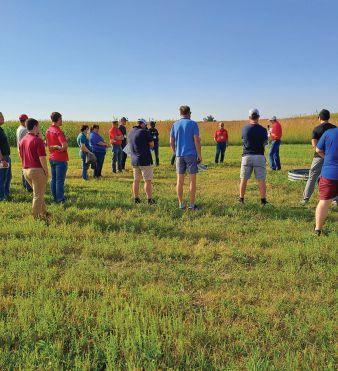
first known saturated buffer, its second bioreactor, a retention pond and a wet well. It works with NRCS and the University Extension to provide Drainage Contractor Workshops and Landowner Drainage short courses.
Ohio LICA held a field day in conjunction with OSU’s Farm Science Review. Forty thousand feet of tile was installed.
Illinois and the University of Illinois Extension hosted a three-day drainage design workshop. On an annual basis they demonstrate bioreactor, saturated buffer and wetland construction at events. Indiana regularly holds field days open to the public and has done two-stage ditch projects and installed a bioreactor. Their yearly meetings, also open to the public, feature speakers from NRCS and ADMC. They have successfully petitioned the state to have sales tax removed from drainage tile. They offer TSP training and certifications as well as numerous other
training and certification courses.
Michigan LICA recently partnered with Ehsan Ghane of MSU Extension on a field day. Demonstrations included: saturated buffer installation, installation of a water control structure and demonstration of a water-gate valve. Speakers discussed soil health, cover crops, nutrient placement, saturated buffers and controlled drainage. These are just a few of LICA’s commitments to drainage, its contractors and associates, but LICA has diversified through the years and drainage can take on different meanings as chapters expand away from the Midwest. Come east, where I am from, and say “tiling” and most of us still think of kitchens, bathrooms and mudrooms. Yet, drainage has become a critical issue as development increases. The need to get water in the ground or divert it to reservoirs may well become the future of drainage outside agriculture, and LICA contractors will continue to be at the forefront of that work. DC
U.K. UPDATE
A fresh perspective
by Rob Burtonshaw
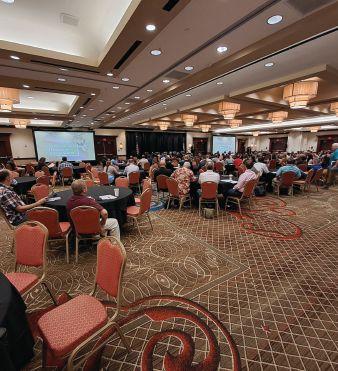
Itype this on my return from Des Moines, IA having attended the eleventh International Drainage Symposium. It was great to hear the presentations and listen to the latest research, it is a rare event where drainage is the central topic rather than just an add on and as such it makes the event very valuable to the industry. I have no data to prove it, but I suspect that for a few days the Marriott Hotel in downtown Des Moines was the site of the greatest concentration of drainages geeks in the world.
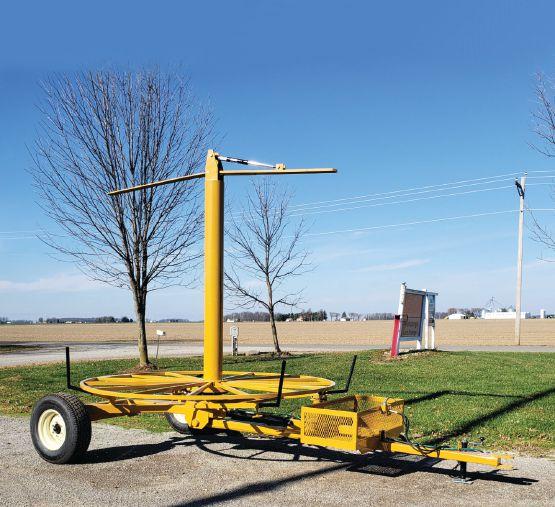
TILE TRAILER
Although dominated by the Midwest, it was a truly international event with attendees from 11 different countries present, each with slightly different opinions, experiences and techniques. With such a wealth of knowledge it is hardly surprising that I felt that I was constantly learning and having new perspectives thrown at me.
However, the event also accomplished something else, which is perhaps less obvious: I came back feeling confident and energized, keen to push on and move my business forward. Of course, the jet lag and the mundane details of life do their best to drag you back down, but nothing can dampen the boost.
I would argue that it would be hard for anyone involved in the industry not to have such a reaction. It's not just that new ideas are being floated but that concepts which were still in their infancy a few years ago are now being refined and actually put into practice.
Take de-nitrifying bioreactors, for example: when I first heard and saw them, more than 10 years ago, the ideas and the theories were already accepted and well-known, with many experiments ongoing. Now designs are standardized and they are being installed in ever increasing numbers and not as research but as actual solutions being paid for by local municipalities.
The same would be true of saturated buffers. On the Symposium’s field day we were taken to see the first saturated buffer ever installed, and (without wishing to offend anyone) to be frank, the control structure looked its age. Don’t get me wrong: this should be celebrated! It shows how far this technology has come. And in the future other ideas – perhaps recycled drainage or subirrigation – will be the next to move from an idea to being in the field. This process is exciting to see firsthand and points to a positive future for the industry.
The ideas and research is great to see but I’m sure the greater reason for feeling renewed enthusiasm is simply meeting people. I fear that this is a reoccurring theme and some reading this might be bored of hearing it, but the more experience I gain the more I believe it. Speaking to others in the industry, whether academics, manufacturers or contractors, is one of the most useful and helpful things you can do. It is easy to focus on the differences and the undeniable truth other contractors could be potential rivals, rather than on what unites us. We need to remember that we are trying to achieve the same results in approximately the same way. Drainage works. It increases yield considerably using a renewable energy source (gravity). It is a great product, but one which we can and should try to improve.
We have so much to gain in this endeavor by sharing
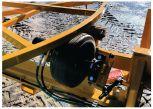
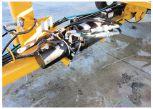
Recoiler Power unit
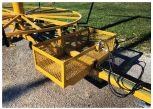
Large basket for fittings
knowledge and having open conversations about what works and does not work. We face the same problems, and one contractor’s solution can be better than the next. Another pair of eyes can often be a vital insight. In addition, we are a small industry which often struggles to be heard and to tell our story, thus allowing others to dominate the agenda. To gain influence we must join together and share resources and knowledge, a high tide raises all boats.
I would therefore encourage anyone reading this to give serious thought to joining their local contractors organization,
whether that is LICA or the NAAC. My experience of both has been 100 percent positive. I would also suggest that attending the twelfth International Drainage Symposium would be an excellent idea wherever that may be held. Although personally, I would not like to be the person/persons who have to live up to the standard set by co-chairs Chris Hay and Matt Helmers. Organizing more than one hundred presentations, a couple of hundred delegates, field days and a couple of formal dinners is no easy task, yet the whole event was faultlessly smooth. Great job to all involved. DC
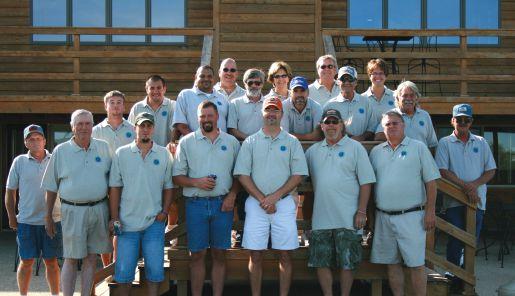
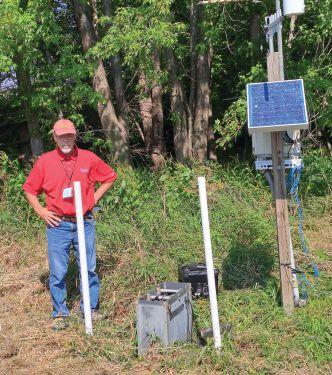
Field demonstrations, education sessions and social events at the recent International Drainage Symposium in Des Moines.
All images courtesy of Rob Burtonshaw.
Material matters: Water quality performance
The chances are good that you regularly crunch the numbers and eliminate profit.
by Ehsan Ghane, Michigan State University Extension
When designing a conservation drainage practice, did you know that you can improve its water quality performance by picking a certain pipe material?
Saturated buffers, woodchip denitrifying bioreactors and phosphorus removal structures are conservation drainage practices aimed at reducing nutrient concentration in subsurface drainage discharge. One way to improve the performance of these practices is to treat a higher volume of drainage water by picking a certain pipe material.
To explain which pipe material improves the performance of conservation drainage practices, let us start with an example that resembles water entry into the pipe. Imagine fans entering a football stadium with only one entrance gate. Because there is only one gate, the fans must stand in long lines and enter the stadium very slowly. If that stadium had 10 entrance gates, the fans would be able to enter the stadium much quicker. In this example, the stadium resembles the pipe, the entrance gates resemble the pipe openings, and the fans resemble water entering the pipe. The higher number of stadium gates (that is, the number of pipe openings) allows for faster entry of fans (that is, water) into the stadium (that is, the pipe). The same example applies to when water exits the pipe; the higher number of stadium gates allows for faster exiting of fans out of the stadium.
The message from the above example is that a pipe with a greater subdivision of openings (that is, a higher number of stadium gates) allows for faster water movement into and out of the pipe. Suppose you have two pipes with equal water inlet area per foot. In that case, the pipe with a greater number of smaller openings allows faster water movement into and out of the pipe than the pipe with fewer number of larger openings. Now that we know the importance of greater
subdivision of openings, how do we pick a pipe with faster water movement into and out of the pipe?
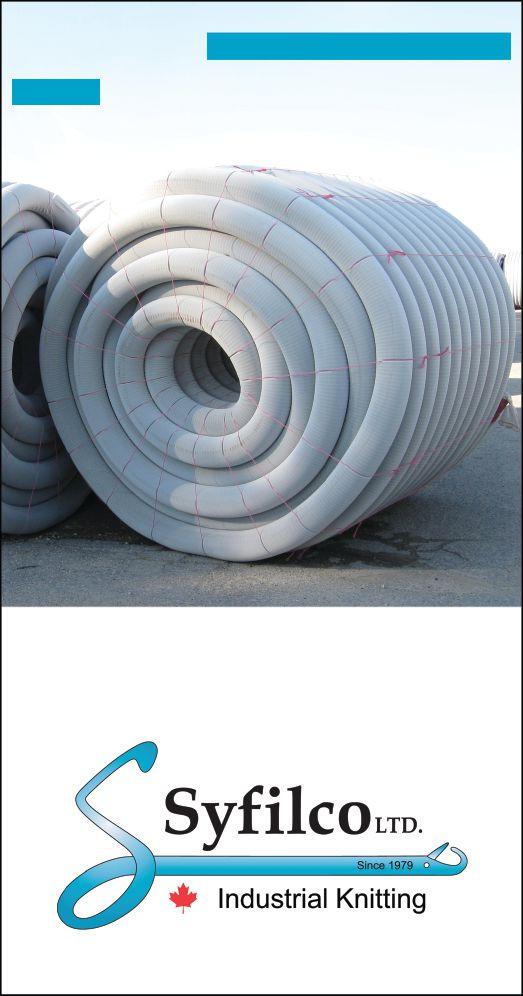
Tip: The easiest way to choose the pipe with the quickest water movement into and out of a pipe is to go for an eight-row pipe rather than a four-row pipe. An even faster option is a sock-wrapped pipe that allows quicker water movement than an eightrow pipe.
A sock-wrapped pipe resembles a football stadium without any walls, and the entire boundary of the stadium is open for entry or exit. The fans can enter or exit the stadium without delay. This is because the sock-wrapped pipe has the maximum subdivision of openings. Consequently, a knitted-sock envelope maximizes water movement into and out of the pipe because it functions as a completely open conduit without walls, like mole drains. As a result, the sock-wrapped pipe allows faster water movement into and out of the pipe than an eight-row pipe.
In a saturated buffer, woodchip bioreactor, and phosphorus removal structure, drainage water exists the pipe and enters a porous media. Water needs to re-enter the pipe after being treated in the bioreactor and P-structure. If the designer of the conservation drainage practice wants to improve its performance, they should use either an eight-row pipe or a sock-wrapped pipe to treat a higher volume of drainage water. For more information about pipe materials, visit MSU Drainage Website (https://www. egr.msu.edu/bae/water/drainage/choice-pipematerial). DC
For more information about pipe materials, visit MSU Drainage Website www.egr.msu.edu/bae/water/ drainage/choice-pipe-material
We keep business flowing.
It only takes one look at a yield map to see the immense benefits you bring your customers through tiling. Together with drainage contractors across the country, ADS is proud to provide products and solutions to help farmers improve yields, increase farmable acres and create sustainable water management solutions to ensure the long-term success of their operations.
See our commitment to contractors and water management solutions at adspipe.com/markets/agriculture.