Account Coordinator | Mary Burnie mburnie@annexbusinessmedia.com
Media Designer | Curtis Martin cmartin@annexbusinessmedia.com
Group Publisher | Michelle Allison mallison@annexbusinessmedia.com
COO | Scott Jamieson sjamieson@annexbusinessmedia.com
Printed in Canada ISSN 1488-4305
Publications Mail Agreement #40065710
Subscription rates:
Canada – 1 yr $17.50 CDN
USA – 1 yr $34.50 CDN
Foreign – 1 yr $46.50 CDN
From time to time, we at Drainage Contractor make our subscription list available to reputable companies and organizations whose products and services we believe may be of interest to you. If you do not want your name to be made available, contact our circulation department in any of the four ways listed above.
All advertising is subject to the publisher’s approval. Such approval does not imply any endorsement of the products or services advertised. Publisher reserves the right to refuse advertising that does not meet the standards of the publication.
ON THE WEB:
Stay in touch on social Connect with Drainage
Changing times call for GroundBreakers
Drainage is innovative – let's recognize those who help make it that way.
by Bree Rody
It’s a phrase we’ve all heard since childhood: when it rains, it pours.
In the drainage industry, it’s a phrase that both applies literally and metaphorically. In some geographies, “when it rains, it pours” quite literally refers to water – especially this year. In August, Hurricane Henri wrought havoc on parts of New York, New Jersey and Pennsylvania – with five to nine inches of water in many areas. Other states also saw higher-than-average precipitation throughout August. At the exact same time, others experienced a devastating drought – according to the National Oceanic and Atmospheric Administration, on Aug. 31, 47 percent of the continental U.S. was experiencing drought conditions, an increase from the beginning of August. Impacts on producers have been significant. Portions of herds have been sold, plans have been derailed and some governing bodies have had to offer subsidies and assistance.
Tile installation may be a tried and true practice, but let's not discount the ways the industry moves forward every day.
So in that case, “when it rains, it pours” remains metaphorical: when it rains bad news, it pours. Applying drain tile to fields is a centuries-old practice that, in many cases, has not required much innovation. Yes, the tile has changed from clay to polyethylene, and precision ag tech has enhanced much of the equipment, but nevertheless, the beauty of agricultural drainage installation is that it’s tried, tested and true. Still, that doesn’t mean there aren’t many researchers, innovators and contractors who are working behind the scenes to perfect new ways to do things and cope with our ever-changing world. Take, for example, the practice of drainage water recycling
(page 28). The economic and environmental benefits of saving water for a not-so-rainy day are now well-known, but increased research shows how subirrigation using DWR can improve yields and quality.
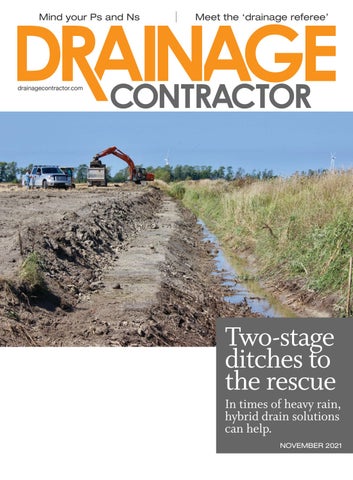
As for extra rainy environments, sometimes subsurface drainage solutions alone are not the right fit – sometimes, a creative combination of subsurface and surface drainage is the most efficient way to drain a farm. Surface solutions like two-stage ditches could help combat a summertime deluge and save crops.
In times of big change, big thinkers should be rewarded. That’s why we’ve launched our GroundBreakers program, which aims to recognize innovative and creative drainage contractors and other professionals. This is not a “Top X Under X” program – nominees can be of any age – but aims to recognize those who are keeping an eye on the future, demonstrating leadership, engaging in lifelong learning and collaborating effectively with stakeholders. Nominees must currently be working as a drainage or land improvement contractor or actively involved in the sector as an industry expert. You can check out more details on our website.
Tile installation may be a tried and true practice, but let’s not discount the many ways in which the industry moves forward every day. DC
NEXT ISSUE: Watch for more industry news, research updates and featured guest columns in the May 2022 issue of Drainage Contractor @DrainageContMag
INDUSTRY NEWS
NORTH DAKOTA DRAINAGE BILL ENACTED
A North Dakota bill to streamline the state’s drainage process officially passed recently, with an aim to cut down on red tape going forward.
The bill, first reported on by Drainage Contractor online, was introduced by state representative Cynthia Schreiber-Beck. A collaborative effort between industry, government representatives and water resource districts, the bill aimed to streamline the bureaucratic process for land drainage applications by removing what SchreiberBeck described as “cumbersome” requirements.
For example, the bill sees ownership of property identified only by the tax roll, which is information obtained by the county. Under the previous rules, Schreiber-Beck said, applicants might be required to provide all the names and addresses for every person on the land deed. “You might have third-generation family members who owned that land who were listed on the trust,” she explained. “It’s become somewhat difficult [to obtain] that.” She said in some cases, by the time the deed goes to a water board to be certified, notification would be required for “anywhere from no people to 30 or 40 people.”
She said the proposed changes – as well as many thing unchanged from previous iterations – remain in the spirit of “being decent to downstream landowners” and added, “Approval of a permit under this section does not prohibit a downstream party unreasonably damaged by the discharge of water from a subsurface water management system from seeking damages in a civil action.”
IRELAND’S AMBITIOUS WATER MANAGEMENT PLAN ZEROES IN ON AG DRAINAGE
In late September, Ireland set out on an ambitious mission. The River Basin Management Plan for Ireland 2022-2027 officially opened in its first phase (public consultation). The plan aims to address water quality in the country, including wastewater infrastructure and improving biodiversity. Of the more than 100 measures identified, addressing the impact of agriculture is key.
Of the nearly 5,000 water bodies identified, only 41 percent are identified as “not at risk” – the remaining are either “in review” or “at risk.” The draft notes that agricultural pressures have increased significantly. As such, the report says key measures must include reducing the loss of fertilizers and soil from farmland into water, as well as reducing the physical impacts on water bodies caused by the drainage of lands and rivers and the presence of barriers.
“The number of waterbodies that have been significantly altered in physical character as a result of arterial drainage schemes is significant,” the draft stated. Pollutants identified as coming from drainage include phosphorus, pathogens and silt, and drainage has also been identified as having an effect on biodiversity.
However, the draft and its recommendations focus not on elimination, but regulation of land drainage systems. It also acknowledges the positive impacts of projects such as buffers, which can reduce the seeping of certain nutrients into waterways.
NORTHWESTERN ONTARIO GETS $1.3 MILLION FOR AG DRAINAGE
The province of Ontario is investing more than $1.3 million toward agricultural drainage in the province’s northwestern region. The Northern Ontario Heritage Fund Corp. will invest $1 million in the Rainy River Future Development Corporation to implement a two-year tile drainage program, which will support the installation of tile across nearly 2,000 acres of land, affecting 10 farmers in the area. An additional $374833 will go to Tait Bros. Contracting to purchase equipment and expand its tile installation business and establish an office in Rainy River, a community along the Canada-U.S. border.
ONTARIO UPDATES DRAINAGE REGULATIONS
This summer, the Ontario Ministry of Agriculture, Food and Rural Affairs (OMAFRA) approved an amendment to Reg. 18, a move that was first proposed in early 2021. For landowners and contractors, this means a cutdown on some smaller fees throughout the bureaucratic process.
As of July 1, all fees of $50 or less have been eliminated – which could result in savings of up to $12,6000 per year. Fees removed include the operation license fee ($50); a fee for the operator to change or upgrade their license class ($5); operator examination fee ($5); machine license fee ($50); machine license transfer fee ($5); and a machine license fee for machines used for demonstration purposes only ($10).
There are an estimated 519 entities in Ontario that specialize in the business of drainage systems installation, maintenance and repair, all of which will be affected by the change. According to OMAFRA, the average cost savings as a result of the change will be $126,000 over 10 years.
INDUSTRY NEWS
USASK PHD CANDIDATE AIMS FOR BETTER DESIGNED DRAINAGE
Holly Annand, a PhD candidate at the department of geography and planning at the University of Saskatchewan’s College of Arts and Science, says extreme weather isn’t likely to die down anytime soon. In the wake of significant wetland loss in the Prairies, Annand is conducting her doctoral research on how to design drainage systems better to cope with such extreme events.
Under the supervision of John Pomeroy (PhD), a faculty member in the department and the director of the school’s Centre for Hydrology, Annand’s dissertation is titled, “The Influence of Climate Change and Wetland Management on Prairie Hydrology.”
Annand said in a statement that prior to beginning her PhD program, she worked with farmers in Saskatchewan on drainage projects. “I wanted to gain the necessary skills to better design agricultural drainage projects in the face of more extreme precipitation events.” She is particularly interested in the Aspen Parkland ecoregion, which spans Saskatchewan, Manitoba and Alberta and, as a transitional zone between the boreal forest and the southern grasslands, tends to be more wet than dry.
ONTARIO TO INVEST $7 MILLION IN PROJECTS INCLUDING SATURATED BUFFERS
The province of Ontario is investing $7 million in agri-food research projects to support more environmentally friendly practices. While the projects cover livestock health and welfare and other agriculture concerns, one of the research projects focuses specifically on evaluating the ability of natural buffer strips to reduce the impact of agricultural practices on freshwater ecosystems.
Other research topics include pests, diseases and weeds, animal illness and more. In total, 49 projects will receive support. BY THE NUMBERS:
10-50
Estimated dollars, per linear foot, to install a two-stage drainage ditch.1
24
With two-stage ditches, reach-scale nitrogen removal increased as much as 24-fold when benches flooded.1
DRAINAGE COULD BENEFIT ATLANTIC CANADIAN POTATO FARMERS
A new study out of Canada’s Prince Edward Islandfound that potato farmers in the Atlantic province would need to very carefully consider the cost of a supplementary irrigation system – and that most years, the cost benefit would not outweigh the cost of installation. Tile drainage, however, might be a worthy investment for spud-growers.
The study, Characterizing potato yield responses to water supply in Atlantic Canada’s humid climate using historical yield data and water data: Implications for supplemental irrigation analyzes weather and yield data as far back as 2000. It found that 90 percent of seasons indicated that irrigation systems would not be worth the cost. Despite this, the research did find that too much rain was a common factor in reduceingyields – which is where tile drainage could come into play. Drainage can bring the added benefit of allowing excess water to drain from the fields – which can also yield the longer-term benefit of allowing fields to dry more quickly, allowing for earlier spring planting. The 2018 season was a particularly wet season in the area.
However, farmers in the area would also have to consider the slope of their field to know if drainage is right for them, according to the study.
30
Recommended number of inches for optimal coverage for drainage in southern Ontario. 2
48
Number of hours it should take for a drainage system to lower the water table from surface to one foot depth. 2
PHOTO
Working to improve practice delivery
by Keegan Kult
The success of the Polk County Saturated Buffer project has shown that there is potential to deliver edge-of-field conservation practices at a scale and pace significant enough to have an impact on water quality by improving upon traditional practice delivery methods. The pilot project has increased the number of bioreactors and saturated buffers installed in Iowa to 166 from 115. and did so in a cost-effective manner. The use of a fiscal agent to group sites into larger bid packages removed landowner burdens, attracted quality contractors and saved money.
The idea behind the project was to accelerate adoption of saturated buffers and bioreactors by addressing as many barriers to adoption as possible while working in the confines of existing financial and technical assistance programs. The project team, consisting of the Agricultural Drainage Management Coalition (ADMC), Iowa Department of Agriculture and Land Stewardship (IDALS), the Natural Resources Conservation Service, Polk County, and the Polk Soil and Water Conservation District (SWCD), developed a framework that reimagined the delivery model of these two practices and resulted in the overwhelming success. The team realized that to be successful the barriers to adoption of all stakeholders needed to be addressed not just those of the landowners. Previous projects had focused on landowner barriers but did not consider the difficulties that stakeholders like technical service providers, conservation agencies, and the drainage contractors faced.
The team theorized that they could develop economies of scale by putting in place a framework that would generate interest from landowners. THis helped us overcome barriers for service providers and agencies by being able to justify dedicating resources to the project. The team also made use of a fiscal agent. The agent was a central hub that had agreements in place with the landowners, funding agencies and contractors. The fiscal agent was then able to incentivize landowners to participate by offering a temporary construction easement payment. The temporary
construction easement allowed a contractor managed by the public fiscal agent to access the private property for practice construction. Not only did the landowner receive a small incentive payment, but the agent also removed the obligation of the landowner to hire and pay a contractor while awaiting reimbursement. Historically saturated buffers only cost about $3,000 to $5,000 to install. Taking time for these smaller projects often came at an opportunity cost to the contractor or at the very least the project was not high on the priority list while larger jobs were available. Previous projects had seen interest from landowners, only to be delayed trying to get on a contractor’s busy construction schedule.
The results of the project were that a total of 51 practices, which is by far the largest grouping of saturated buffers and bioreactors nationwide, were installed in the summer of 2021. The sites were divided into three bid packages, with a single contractor winning all three bids. This way, it was worthwhile for the contractor to begin work shortly after finalizing the bids, instead of waiting to fit construction in between projects.
Moving forward, the Iowa Department of Agriculture and Land Stewardship is looking to recreate the efforts as a Polk County 2.0 project is looking to install upwards of 100 sites in 2022. IDALS is looking to utilize the fiscal agent model in other pockets of the state as well. ADMC believes the Polk County Project followed by Polk County 2.0 will provide proof of concept that this framework and fiscal agent model can be replicated and will work in places besides Iowa to deliver conservation drainage at scale. Structural conservation drainage practices can deliver consistent benefits for timeframes of a decade plus. By showing scaled-up implementation in a cost effective, timely fashion is possible, more funding sources and investors will come to the table. ADMC is excited for the expansion of the model and the role that drainage contractors will play in delivering cost effective solutions. For more information about the Polk County Project and its framework, contact Keegan Kult at kkult@ admcoalition.com. DC
1 0 2
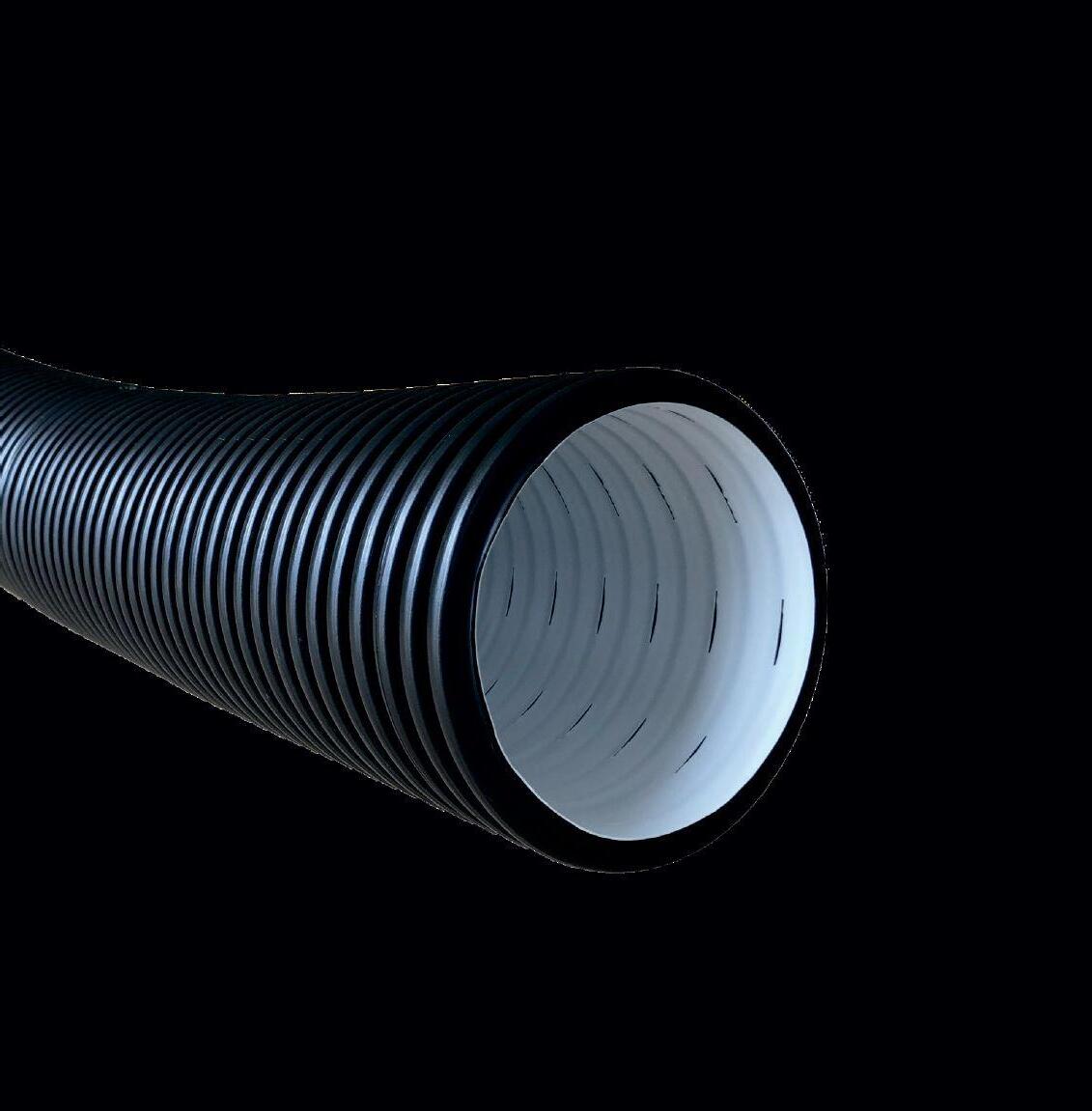
There is a simple reason our competitors won’t publish their flow rating: They can’t beat ours. FlexCorr is the only flexible dual-wall pipe proven to have a Manning’s N-value better than .012. Which makes us wonder... Should we even consider them competition?
THIRD PARTY TESTED
HOW A ‘DRAINAGE REFEREE’ EARNED HIS STRIPES
Del O’Brien on the evolution of drainage in Ontario.
by ROBYN ROSTE
At a ceremony held on June 13, Delbert "Del" O'Brien officially became one of the 2021 inductees to the Ontario Agriculture Hall of Fame (OAHF).
O'Brien, a long-admired member of the legal, political, business and agricultural community in the Ottawa Valley, always advocated for rural Ontario – across the highly varied disciplines of his career.
O'Brien has made many diverse contributions to the community throughout his life, but his nomination for the OAHF centered on his agricultural contributions in general, and specifically for his work establishing the province’s Drainage Tribunal, which mitigated disputes regarding water management on farmland.
Born in 1935 and raised on a mixed farm
in Ontario, O'Brien received a doctor of jurisprudence from the University of Toronto before beginning a law practice focusing on agriculture in his hometown of Pembroke. In 1975, O'Brien was appointed to the Drainage Tribunal during a time when drainage disputes were handled by the courts and the province was trying to implement the new Drainage Act.
Under O'Brien's leadership, the hearings gained a reputation for being efficient and fair, and he helped provide meaningful interpretations and understandings of Ontario's Drainage Act to individuals, contractors and
LEFT: Delbert O'Brien's storied career includes work as a lawyer, farmer and spearheading the creation of the Pembroke and Pembroke Area airport.
RIGHT: As Ontario's "Drainage Referee," O'Brien's job was to make the Ontario Drainage Act understandable to landowners and contractors.
SKETCH
BY JANICE MACDONALD.
As a longtime resident of the Ottawa Valley, O'Brien believed it was important that hearings take place in local municipalities, not big cities.
municipalities.
"I met Del in 1972, when he was running for elected office for Canadian Parliament," says John Yakabuski, member of provincial parliament for Renfrew-Nipissing-Pembroke. "I so respected the work he did, both his work on drainage and different tribunals after that. The government continued to call on him to use his expertise not only as a lawyer but for his love of agriculture. That speaks to a part of Del's life, [but] his life was so much broader. Community involvement, beginning and running an airline and all of this going on simultaneously with his law practice."
REPRESENTING RURAL
While O'Brien was in university, he learned about tribunals from a visiting professor on exchange from Columbia University in New York City, Albert Abel.
"He had strong views and I agreed with them," says O'Brien. "I learned about tribunals and how they're set up. Before then, the county court judges had jurisdiction to hear drainage disputes, but farmers were uncomfortable going to court in the city, some distance away."
O'Brien recognized that tribunals should operate differently from court cases and opted to run the Drainage Tribunal in a split between Guelph and Pembroke.
"I was a bit [of a] revolutionary,
mandating that I not have any offices in Toronto," he said. "Hearings should not be in a courthouse but in the local municipality where every owner feels
comfortable."
When he was called by the minister of agriculture to set up the Drainage Tribunal, O'Brien was already familiar with the drainage issues from both the farmer's perspective and from a legal perspective.
"Having been raised on a farm, and having a large farm that had been tile drained, they knew I knew the subject matter fully. That relieved them," he says.
In addition to the government's confidence, O'Brien also had the trust of the farmers and drainage engineers with whom he worked.
"When he was involved in politics, Del was one of the people that I called upon and I still use. I see him as a person of mentorship and guidance," says Yakabuski. "I was so thrilled when he was inducted into the Agricultural Hall of Fame. Most people wouldn't identify Del immediately with the word 'farmer,' because his public persona was a very accomplished and respected lawyer. This is just me saying that Del in his heart of hearts has always been and will always be a farmer, even though his
career branched out in so many ways. An accomplished lawyer, entrepreneur, community leader [and] business leader."
UNDERSTANDING THE ACT
When he was first appointed to establish the Drainage Tribunal, O'Brien dedicated himself to studying the Drainage Act until he had it memorized. He also studied applicable material in the common law and was a regular guest speaker at drainage conferences.
Hearings regarding drainage issues were held in local municipalities. Those sitting on the tribunal were experts in the subject matter and, as a result, there were very few appeals once a decision was made.
"I always had two farmers and one drainage engineer with me – we were a panel of four. Generally we were able to conduct a hearing in one day. We were very efficient from that point of view," he says.
Serving on the Drainage Tribunal from 1975 until 1988, O'Brien chaired or conducted more than 1,300 hearings. Although they welcomed lawyers, most of the time individuals represented themselves and felt comfortable doing so.
"The hearings required a lawyer [me] to make the decisions. You have to apply the law. I was gentle and even though I allowed hearsay as a rule of evidence, I was very reluctant to allow it to be a major part in any way. You can't crossexamine hearsay," he says.
The minister of agriculture told O'Brien the Drainage Tribunal relieved the ministry of many problems and even saved it 20 percent of its budget.
"I enjoyed every minute of it and travelled across the province. I had my own airline and that helped very much, and saved a lot of money. I would take the four members of the tribunal to places cheaper than going another route commercially," says O'Brien.
O'Brien's nomination to the OAHF was supported by all three of the organizations representing Renfrew County farmers, The Ontario Federation of Agriculture (OFA), the National
Farmers' Union (NFU) and the Christian Farmers' Federation of Ontario (CFFO).
Gerry Rook of the RenfrewLanark chapter of the CFFO said his organization was supportive of the nomination because of O'Brien's work in dealing with the legal aspects of how drainage disputes were resolved in Ontario.
"He was instrumental in the coordination of the Drainage Tribunal and really upgraded the whole tribunal process, making it less litigious," says Rook.
Donna Campbell, secretary for the Renfrew County Federation of Agriculture of the OFA, says O'Brien has been so proactive in helping farmers with their drainage issues that acknowledging his contribution in this way was inevitable and she's glad to see him honored for it.
"If any of us had drainage issues, Del seemed to be the go-to," says Campbell. "Keeping your land drained helps your crops. If you have wet crops you have nothing, especially if it's a really rainy season."
Marshall Buchanan, president of the Renfrew County Local 330, submitted a letter supporting the nomination on behalf of the NFU.
"Del has accomplished a lot of things in his life and he's got a lot of talent," says Buchanan. "At a community level it seems to matter if the right person is at the right place at the right time, otherwise things fumble along until the stars align and that happens."
AG EXPERTISE
In addition to the Drainage Tribunal, O'Brien was called on many times to assist in provincial agriculture matters, everything from becoming the founding chairman of the Ontario Agriculture Advisory Council to being appointed in 1994 by the NDP government at the time to act as the official Drainage Referee in superior court.
In 1990, O'Brien was tasked by both the federal and provincial governments with setting up a tribunal in the Niagara Region to hear appeals under the
newly-created Grape Transition Program. At the time, there was a lot of frustration and difficulty as growers worked to remove traditional grape varieties and plant new modern varieties within a five-year deadline. In an effort to improve industry competitiveness, the government provided grants to assist the growers. Although the transition was both extensive and complex, O'Brien conducted 50 hearings during this time without a single appeal filed.
Committed to agriculture in Ontario, O'Brien has always made a point to speak publicly about rural matters and to promote rural Ontario. He believes there's a big future in water management because there will always be water runoff and a need for improvements—the technology is getting better all the time.
"I have great admiration for the profession of drainage engineers. They have made a great contribution to society through the improvement of crops," he says. "I have high regard and high respect for them, and have made a lot of friends."
Now retired, O'Brien is still a passionate advocate for rural Ontario and the agriculture communities of the province. He says it troubles him to see what he calls a lack of acknowledgement for the contribution the generations of agriculture workers had on making the province a great producer,
But at the same time, O'Brien says he is also encouraged to see more families moving away from cities and back to the country. Although he is retired on paper, he says his current focus is on working to improve infrastructure and help urban planners understand the unique needs of rural areas.
"I'm delighted to see there's a reversal of a trend that we suffered for 100 years when people left the country life to go and work in the city," he says. "Now I believe it is reversing. People are leaving the cities to go and work in the country, enabled by the Internet.
"It's a great renaissance for rural Ontario and I wish to continue to participate in that exercise with great enjoyment," he says. DC
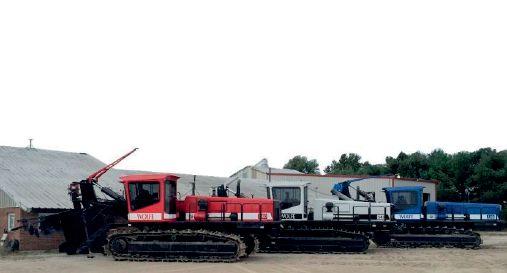
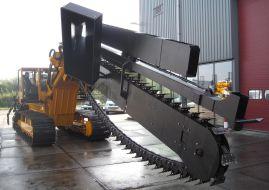
PLOW & WHEEL TRENCHERS
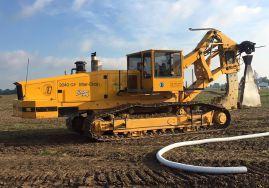
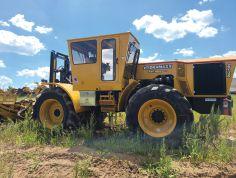
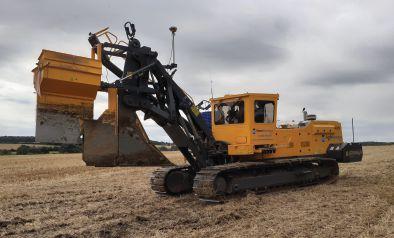
Wolfe Heavy Equipment continues to set the tone for powerful agricultural and commercial trenching equipment. Wolfe’s versatility, superior manufacturing and expert service along with reduced fuel consumption provides increased profitability.
ALWAYS MIND YOUR P AND N
Checking in on Iowa's statewide Nutrient Reduction Strategy
Iowa began a renewed focus on nutrient reduction about 10 years ago, and in 2013 finalized the Iowa Nutrient Reduction Strategy (INRS).
by DONNA FLEURY
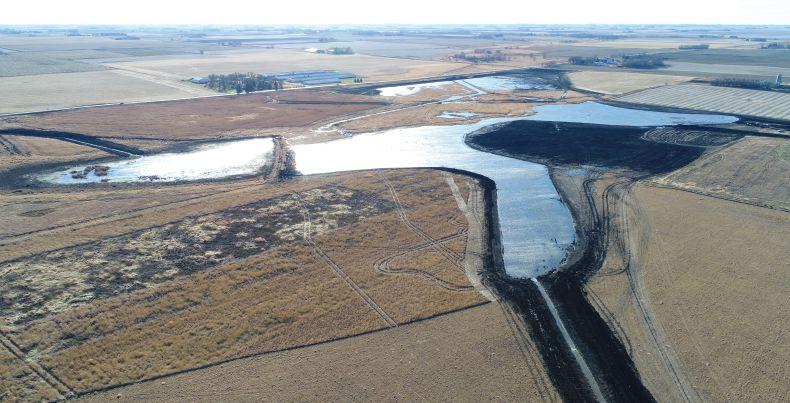
A restored wetland is an edge-of-field practice with great potential for nitrateN reduction and water quality benefits.
State strategies to reduce nutrients were an outgrowth of the work of the Mississippi River/ Gulf of Mexico Hypoxia Task Force. Co-chaired by the United States Environmental Protection Agency (EPA) and Iowa's Department of Agriculture and Land Stewardship (IDALS), with representatives from 12 states, the task force developed a framework for states to begin to achieve nutrient reductions, with a goal of reducing nitrogen (N) and phosphorus (P) by 45 percent across the 1980-96 baseline.
"The Department of Natural Resources (DNR) was initially focused on what we had
authorization to deal with, principally city and industrial wastewater treatment plants that discharge N and P," explains Adam Schnieders, water quality resource coordinator with Iowa DNR. "Once the EPA finalized the nutrient reduction frameworks, leaders in the state of Iowa came together to build the INRS to achieve the reductions."
The Iowa DNR combined their efforts and focus on point sources with the Iowa IDALS efforts focused on non-point sources and agriculture landscapes, and Iowa State University (ISU) took the lead on science
coordination. The INRS is a science- and technology-based approach that outlines voluntary efforts to reduce nutrients in surface water from both point sources, such as wastewater treatment plants and industrial facilities, and nonpoint sources, including farm fields and urban areas, in a scientific, reasonable and cost effective manner.
"The task force members recognized the magnitude of the problem and each state has developed their own policies and programs to help achieve the goal of reducing the N and P load," says Schnieders. "There are lots of different policy approaches being used to reduce nutrients across the country as every state is different, they have different landscapes and different balances between point source and nonpoint contributions to nutrients in surface water. We built policy around what actions we can take now to try to achieve these goals in Iowa. We recognize it is a significant long-term effort to get to the goals, but it is technically possible and implementation requires persistence.
"We are building on the legacy of the
priorities focused on soil conservation over the last few decades and the significant improvements through documented shifts in conservation tillage, improved fertilizer management and structural practices to assist in reducing soil erosion and P losses to streams," explains Matt Lechtenberg, water quality coordinator, Iowa IDALS. "Now under this new strategy, there is more of an emphasis on N and together with the introduction of new technology, there are greater opportunities to focus on reducing N losses. Although P losses are largely managed through practices that reduce soil erosion and surface runoff into streams, they are not solutions for N subsurface losses. Other in-field practices are needed for managing N such as cover crops, fine-tuning fertilizer application rates and timing, in combination with new edge-of-field technologies that intercept, capture and treat subsurface drainage water before it goes into Iowa rivers and streams such as saturated buffers, bioreactors, oxbows and wetlands."
In August 2021, the INRS launched a
new web-based dashboard that includes more visual reporting tools to improve the reporting process. Regular updates will focus on 'measurable indicators of desirable change' – inputs, human, land and water – that guide the Nutrient Reduction Strategy. A 2020 land update was included and shows some progress made toward the strategy goals. Along with increases in cover crops and no-till acreage that have reduced annual N and P losses, new edge-of-field installations include at least 27 bioreactors and 13 saturated buffers in Iowa. The report shows that 86 nitrate removal wetlands had been constructed with another 30 under development. (https://nrstracking. cals.iastate.edu/tracking-iowa-nutrientreduction-strategy)
"The strategy has now been in place for a little over eight years and although getting practices implemented takes time, we are starting to see acceleration of projects," says Matthew Helmers, director, Iowa Nutrient Research Center at ISU. "Although P has had a dedicated
Continued on page 34
What are we learning from Huronview?
by Mel Luymes
Growing concerns for water quality and quantity have both drainage and agricultural stakeholders alike investing in drainage innovation and research.
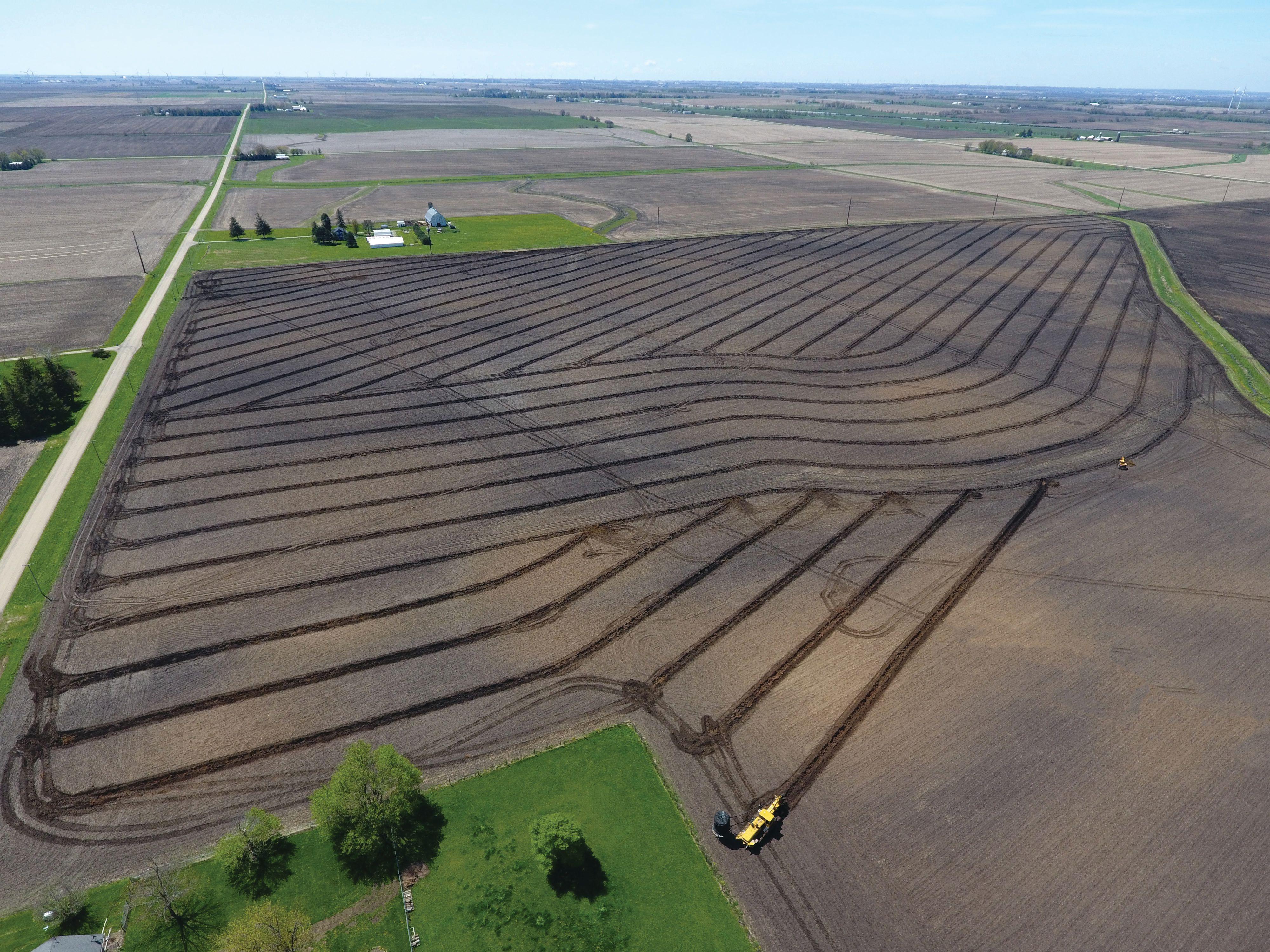
So, there are a lot of eyes on the Huronview Demo Farm, just south of Clinton, ON. The 47-acre silt loam field is owned by the County of Huron and, since 2015, it has been farmed by the Huron County Soil & Crop Improvement Association (HCSCIA) to demonstrate no-till and cover cropping in a corn, soy and wheat rotation. In 2019, drainage systems were installed by Land Improvement Contractors of Ontario (LICO) contractors, designed by Jeremy Meiners (AGREM). The field has several sub-watershed areas within it that research and demonstrate various types of drainage innovations.
These include:
• Controlled drainage systems;
• Combination systems; and
• Spacing and layout.
The installation was supported by federal and provincial funding, with financial and “in-kind” contributions from the project partners and sponsorship from the drainage and agricultural industries. However, the most significant and ongoing investment is towards the field and water quality monitoring, which is being undertaken by the Ausable Bayfield Conservation Authority (ABCA) with both private and public support, including provincial ONFARM research funding. Both tile and surface water in the south field are being measured for flow and quality, along with flow from the tile layouts in the upstream fields and water levels and quality monitoring of the two wetlands. Water levels in the soil are being monitored through piezometers installed between laterals and soil moisture probes used at the plant root zone. A weather monitor, soil testing and yield mapping also help to tell the complete story.
The control structures have remained open for the first two years as the ABCA calibrates the baseflows of each sub-watershed area
The original project team continues to meet, discussing field management, research, communications and ongoing funding for monitoring. Last winter, they surveyed about 60
Ontario farmers about their attitudes towards drainage and water quality, along with their thoughts on the Huronview project.
Respondents were interested in the costs of controlled drainage systems and whether they would increase yields and improve water quality. Many of these questions will take several years to answer, but the installation costs were shared in a report that is now available at the project website (www.huronview.net). The report estimates that contoured drainage costs approximately 15 percent more than conventional, and that the additional cost of control gates would depend on the style of gate and the topography of the field. At Huronview, the steepest slope was installed with a gate on each lateral, 21 control gates in total, which added costs of around $1200 CAD per acre.
Yields improved significantly since the installation. However, production on the untiled portion of the field rose in the same proportion, and the HCSCIA farmers noted that the springs and ponding were no longer concerns there-.
Production, however, lags in small areas at the contoured swales in the northern field, due largely to compaction from 2019. While these terraces might be more commonplace south of the border, they are relatively novel in Ontario with its often-shallow topsoil. At Huronview, the base of the primary swale was shaped from the spoil of the tile outlet wetland that was dug, while the smaller bottom swales were shaped from the soil that was there. Ongoing reports will be added to Huronview.net, along with LICO’s new website at drainage.org. DC
DOING
It doesn’t come easy for everyone. But at Fratco, it’s what has made us a leader in the drainage industry for almost 100 years. From precise manufacturing processes to high-quality products, top-notch customer service and everything in between, we prioritize making things right. Because to us, there’s no other option.
IF IT HAS TO BE RIGHT, IT HAS TO BE FRATCO.
Tile Safety Coalition // Photo Credit: Bob Clark, Clark Farm Drainage
Each drain tile project is as unique as the land itself. Don’t be surprised by an underground pipeline or utility. Call 811 or visit www.clickbeforeyoudig.com in the planning process to identify the location of underground pipelines. It’s a free service and only takes about three days.
The search is underway for North America’s next game-changing drainage and land improvement contractors. From young contractors doing business in new ways to those embracing innovative tech and the contractors who are rethinking drainage management systems, we’re recognizing the talent and ideas of those taking drainage to new heights.
We’re looking for nominees who demonstrate a strong work ethic, leadership and initiative, lifelong learning and/or active participation in the industry. There is no age limit.
Nominations open Nov.1 through Jan. 14, 2022, 11:59pm ET.
DRAINAGE MANAGEMENT SYSTEMS
“Growers are doing their best to manage these extremes with tile drainage,” Johnson adds. But besides building new subsurface tiled systems, these farmers are tweaking the systems already in place by reducing spacing (distance between tiles), increasing drainage coefficient when designing and considering contour drainage and control structures.
CHOOSING THE RIGHT DEPTH
Making the right drainage decisions is a challenge for any farmer, because there is no one-size-fits-all solution for dealing with intermittent extreme water flows.
For instance, when it comes to the question, “what is the ideal depth for subsurface drain tile installation?” the answer “is entirely dependent upon the soil type and water tables,” says Haley Zynda, agriculture and natural resources educator in Wayne County, Ohio. “Soil with a greater concentration of clay will have a lesser depth than sandier soils.” (In Ontario, Johnson says “we believe aiming for 30 inches of cover is the optimum depth for our environment”).
Ghane agrees with Zynda’s assessment. “Generally, drain depth differs based on the soil,” he says. “When a shallow, permeable upper soil layer (less than three-foot depth) sits on top of an impermeable restrictive layer (such as a clay pan), one should install 2.5- to three-foot depth shallow drains while
maintaining a minimum two-foot pipe cover. On the other hand, when the permeable upper soil layer is very deep (greater than three-foot depth), deep drains can be installed at three- to fivefoot depth for reducing the initial cost of the drainage system by achieving wider drain spacings. In that case, 2.5- to threefoot shallow drains can also be installed.”
FUNCTION MATTERS
Just as subsurface drainage depth is affected by soil type, so too is the primary function envisioned for the drain. “If quicker lowering of the water table after heavy rainfall is the goal, use shallow drains with depths of 71 centimetres to 91 centimetres,” says Ghane.
Such shallow drains also reduce nitrate loss, he noted. “Stacking practices such as shallow drains with soil-health improving practices (reduced tillage, cover crops, diverse rotations, and manure or composting) and edgeof-field practices (filter strip, riparian buffer, and controlled drainage) can reduce phosphorus loss as well.”
Worth knowing: shallow drains require narrower spacing. As a result, shallow drains lower the water table more quickly.
KEEP EXPECTATIONS REALISTIC
No matter how well-built and properly selected a drainage system may be, there are still limits to how much it can do
in extreme precipitation situations. So user expectations need to be realistic: no drainage system can handle a flood of Biblical proportions.
So what should they expect? “If a drainage system is designed and installed properly, it should perform well and lower the water table from the soil surface to [one foot] in less than 48 hours before the crop gets damaged,” says Ghane. “Typically, the amount of water that the system is designed to remove can vary from 0.2 to one inch per day, depending on site-specific conditions.” So some truly torrential downpours may overwhelm even the best-designed drainage system from time to time.”
RETURN ON INVESTMENT
For landowners who are considering investing in subsurface drainage, two money questions have to be answered before proceeding with such projects. First, how quickly will they see a return on that investment? Second, what will that return look like?
"Most drainage systems will pay for themselves within 10 years," says Johnson. "Besides, there is an old saying: ‘You pay for drainage whether you have it or not.' That means that without drainage, you will have lower yields and more field challenges at planting and harvest, so you might as well drain the land."
"Subsurface drainage has clear economic advantages," says Ghane, endorsing Johnson's answer to the second question. "It pays really well due to increased crop yield, compared to an undrained field. When it comes to adding subsurface field drainage, the benefit-cost ratio ranges from 5:1 to 38:1, with an average of 15:1.
"This means that for every $1 invested in the drainage system, the farmer would gain $15 on average, which shows that subsurface drainage pays really well," explains Ghane. He is more optimistic than Johnson when it comes to the timeline for return on investment. "The payback period ranges from 0.4 to three years, depending on the economics, drainage design and soil conditions," he says.
Zynda is more cautious in her ROI assessment. "This is entirely dependent
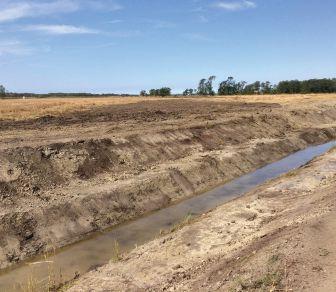
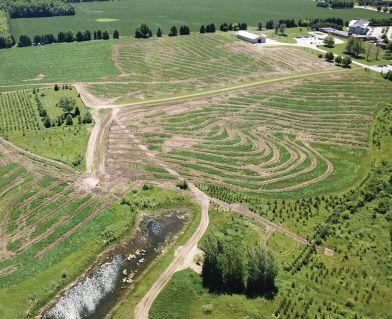
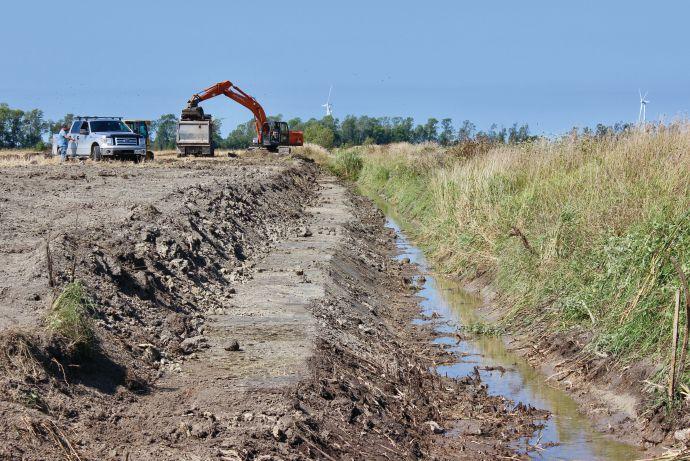
Construction of another two-stage ditch on the Ferndale flats.
PHOTO BY NEILS MUNK, BRUCE PENINSULA BIOSPHERE ASSOCIATION.
on how much drainage tile is installed and what the purpose is," she noted. "Commodity or product price will determine how quickly the investment can be paid for, i.e., soybeans vs pasture or hay fields."
IMPROVING THE ODDS
Adding surface drains to speed water removal can improve the odds for preventing field flooding and erosion. In fact, “combining subsurface drainage with surface drainage is the solution to dealing with extreme heavy rainfall,” says Ghane. “This is done in North Carolina where they get more rainfall than what the subsurface drainage system can handle, so they have surface drainage to deal with the extra water. In our region, we need to combine surface drainage with subsurface drainage as way to combat heavy rainfall.”
The same goes for Ontario. “When water volume gets too large, open ditches are the only option,” says Johnson.
In areas where surface drainage is
employed, two-stage ditches can help deal with extreme water flows. A twostage ditch has a bottom channel for regular flows, bracketed by ‘grass steps’ that extend back to stepped-back upper ditch walls to create a much larger channel for heavy water events.
Thanks to the extra space provided by this design, two-stage ditches can “reduce flooding by reducing the peak flow,” says Ghane. At the same time, “they reduce nutrient and sediment loss to downstream water bodies” by slowing the speed of the draining water.
“A two-stage ditch will slow water flow through the ditch,” adds Zynda. “The vegetation on the multiple steps helps to capture nutrients that would typically be washed away.”
A DEMAND FOR MORE DRAINAGE
Clearly, there are a number of drainage options open to farmers. Which ones they choose will depend on the amount of rainfall they want to remove from their fields and how much they are willing to pay for it.
In these days of climate change,
demand for these drainage solutions is strong and steady. “Undrained fields suffer more with heavy rainfall, so more producers want to install subsurface drainage,” says Ghane.
“Tile drainage contractors in Ontario are working flat-out and booked well in advance,” adds Johnson.
ADVICE TO CONTRACTORS
Clearly, the farming industry’s demand for enhanced field drainage is good news for constructors. The challenge is to profit from this demand while fulfilling customer needs in a time of pandemicconstricted supply chains.
For contractors to meet this challenge, “It is important to properly design and install the system for best performance,” says Ghane. “Consider designing laterals on the contours for future implementation of controlled drainage.”
As for coping with COVID-induced supply issues? “Having an excellent relationship with the tile manufacturer is a key component of being able to secure a consistent supply of drainage pipe,” says Johnson. DC
…AND PREPARE FOR DRY
While some are experiencing too much water, some don’t have enough. Has drainage water recycling advanced enough to become a game-changer?
It’s no secret that this past summer was one of the driest on record in many parts of the U.S. and Canada. No one felt the impact of the sustained heat and drought that blanketed much of North America more than the farmers who had to scramble to ensure their fields had enough moisture to sustain crops.
by JIM TIMLICK
Although irrigation remained an option for some, it wasn’t feasible for others in regions where the traditional water sources that are typically tapped into had literally dried up as a result of extreme heat and lack of precipitation. Perhaps that’s why talk of applying drainage water recycling as a form of subirrigation on farms has been ramping up among some members of the agricultural community. It doesn’t come as a surprise to Kelly Nelson, research agronomist and professor in the division of plant sciences at the University of Missouri. Nelson has studied the impacts of
subsurface drainage in fields for more than 20 years. While the environmental benefits of drainage water recycling have been known for years, Nelson believes extreme weather conditions could prompt some growers to take an even closer look at these systems. “The more extreme conditions you get, the more interest there is going to be,” says Nelson. “It doesn’t surprise me. It’s good to be proactive.”
THE ADVANTAGES OF RECYCLING WATER
In essence, it’s the practice of capturing excess water that’s drained from fields, storing that
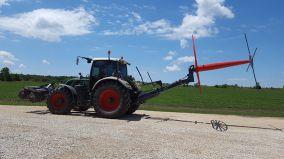
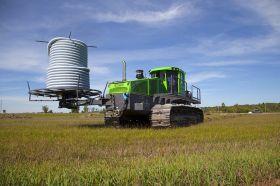
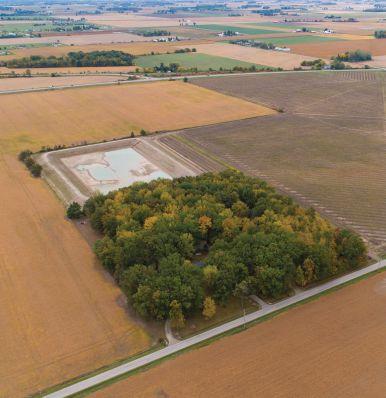
LEFT: A subirrigation system powered by recycled drainage water.
RIGHT: An aerial view of a drainage water recycling system.
PHOTO COURTESY OF EHSAN GHANE.
DRAINAGE MANAGEMENT SYSTEMS
drained water in a pond or reservoir and then using it to irrigate crops when there is a water deficit.
Nelson says there are two primary benefits to using recycled drainage water for irrigation. First, it takes excess moisture away from the roots of plants and allows them to grow or develop better which in turn can result in increased yields.
“The subsurface drainage component helps remove excess water in a timely fashion. It’s basically lowering the water table in the springtime. You can get better crop establishment and you get good aeration of the soil. The workability of the soil at that time is really important.” The other advantage to using recycled drainage water is that it can promote improved water quality downstream. If drainage water has high nitrate levels, using recycled water means most of those nitrates will remain in the field rather than draining into a nearby river or stream. Nelson says to think of it as a closed-loop system that keeps water on the farm and reutilizes it.
Nelson is part of the Transforming Drainage initiative (transformingdrainage.org), an eight-state project spearheaded by a group of 15 leading agronomists, agricultural engineers, soil scientists, social scientists and geographic information systems (GIS) specialists. The group’s purpose is to transform the way drainage is implemented on farms across the American midwest.
Nelson points out that a recycled water irrigation system may not be suitable in every field. First of all, the field has to be the correct drainage class with the right soil profile that
Streamline Your Tiling Projects with the WM-Drain® Farm Drainage Solution
Our integrated subsurface drainage toolset provides concept to completion coverage for every step of the tiling process: survey, analysis, design, install and mapping.
The WM-Drain solution ensures optimal 3D drain placement, which improves crop yields by lowering water tables, optimizing root depth, maximizing planting and harvest seasons, and minimizing nutrient loss.
Learn more at ag.trimble.com/ wm-grower-solutions
includes an impermeable layer below the surface that limits or slows water movement. Since conditions can vary greatly from field to field, Transforming Drainage developed an online tool to help farmers in the midwest identify if a field might be suitable for subirrigation.
Another factor to consider is the topography of a field. The more slope, the less likely it is to be suitable for subirrigation.
WHAT IRRIGATION SYSTEMS ARE BEST?
To date, the Transforming Drainage working group has studied both sprinkler and drip irrigation systems using reclaimed subsurface drainage.
The Transforming Drainage team has investigated the use of recycled subirrigation drainage on several different crop types including corn and soybeans. The results with corn have been particularly encouraging. In one study, corn yield variability was reduced by 28 percent using a drainage water recycling system.
Nelson believes there could be opportunities to use such a system with high-value crops. The intensity of the system would need to be greater with high-value crops, but the payback would likely be faster.
Farmers aren’t the only ones who could potentially benefit from the increased attention being paid to the use of recycled drainage water. Nelson suggests it could also be a good opportunity for drainage contractors who do regular business with the agricultural community.
“It’s one more tool in their toolbox,” he says.
His advice to contractors is to stress to farm customers that they don’t need to decide on incorporating recycled drainage water into their irrigation system immediately. In most cases, a straight drainage system can be retrofitted down the road to accommodate recycled subirrigation as long as it is designed with drainage water recycling in mind.
“You want to give them the flexibility [to add to it later on]. With GPS systems and being able to document where the tiles or pipes are it’s easy now to go back and add things to it,” he explained.
Incorporating recycled drainage water into a farm’s irrigation plan isn’t cheap. However, Nelson says there are ways of making the cost more manageable.
He suggests designing a new drainage system so it requires fewer connections and making it flexible so that it can be retrofitted at some point in the future if you don’t wish to use recycled drainage water immediately. Farmers may also want to consider staggering the work over several years and targeting fields where the payback is going to be greatest as the top priority.
Another important consideration when it comes to choosing the right drainage system is what size of pipe or tile to incorporate into that system. Three- and four-inch diameter pipes and tiles are the two most commonly used sizes.
The size of pipe used depends largely on the area that is being drained, according to Nelson, and whether or not it will be adequate for the location where it is being installed. The biggest difference between the two sizes, he notes, is the quality of the installation. A four-inch pipe offers a little more “wiggle room” compared to its three-inch counterpart in cases where there are slight changes in elevation. DC
Back on track
by Bob Clark, II
The Land Improvement Contractors of America (LICA) held its first in-person convention in almost a year and a half this past July in Niagara Falls. It was very well attended. NYLICA did an excellent job in hosting the event with great tours and educational seminars.
Sadly, the only real restriction due to COVID was that we were not able to cross the Canadian border to see the locks at the Welland Canal. Still, there is nothing quite like Niagara Falls. As always, I had a great time with the good friends I have been able to make over the years through National LICA.
LENDING A HELPING HAND
In future-looking news, LICA has just announced its new initiative, the LICA Educational Foundation for Veterans. Through the foundation, we will train veterans, initially at our national headquarters in Lyle, IL starting next year. We are currently in the process of setting up the training program now. We are also in the process of raising funds for the foundation and just recently initiated a GoFundMe site on our social media platforms. The foundation’s mission is to train military veterans to become highly skilled operators and, hopefully, an employment
resource for many LICA contractors who are always looking for equipment operators.
STRENGTHENING RELATIONSHIPS
LICA is continuing to expand and strengthen its relationships with key organizations including the NRCS, NACD and ADMC. These working relationships, codified by MOUs, continue to help our industry improve the efficiency with which we can deliver conservation practices aimed at reducing erosion, improving rural water quality outcomes and production agriculture simultaneously. Working together for the benefit of all always makes sense at LICA. Some of the most important steps in the process will need to start at the state chapter level with the NRCS state technical committees. LICA and NRCS have outlined and agreed that having a LICA contractor on the committee will help prioritize the practices that need the most attention.
Another important aspect of the MOU with LICA and the NRCS involves the sharing of technology with each other. The pace of technical change is relentless. It can be challenging to keep up with the rapid rate of change.
RTK GPS systems can be installed on many machines, like plows, trenchers, dozers and excavators. Educating both parties on
the application of these technologies improves the rate at which conservation can be constructed. Working together and educating both parties is key to improving conservation program outputs. Everybody wants to track key performance indicators (KPIs).
STAYING CONNECTED
Membership is another important part of the LICA mission. It has been, in recent years, challenging to engage with prospective members as we once did, and so we have modified our approach, using social media as much as possible. Take a minute to check out our social media for the most accurate information available. The national staff works hard to secure the best benefits possible for its members. For more information visit the LICA website at www.licanational.com.
It was great to get together in Niagara Falls. Our winter convention will be held in San Antonio, TX, Feb. 15-19, 2022. It’s an awesome venue and I look forward to seeing many of my LICA friends and family there. Please make plans to join us in San Antonio – you won’t regret it! DC
More on the LICA Educational Foundation for Veterans “Years ago, when the Vietnam war was raging, I didn’t get drafted because I had a wife and two children,” said national LICA CEO Jerry Biuso, Sr in a statement. “A lot of my buddies went, and not all of them came back. If I’d gone, I probably wouldn’t have come back either. I don’t know the business end of a gun.” Biuso describes the establishment of the foundation as “a revelation.” Helping veterans get jobs, access training and make a good living was a way of thanking them for their service, he adds.
The
curriculum
The first training event, held in early 2022, will introduce participants to heavy equipment including: bulldozers, excavators, backhoes, skid steers, motor graders, wheel loaders and dump trucks. Computer simulators will be used to teach attendees the fundamentals. After two weeks in the classroom, participants will spend four weeks working in the field.
The
team
Longtime LICA leaders governing the foundation include Biuso and Clark as well as: Harry Hauschild (Nebraska), Don Loken (Minnesota), Eddy Mayen (Washington, DC), John Peterson (Virginia), John Weatherhead (Florida) and Merlin Welch (California). Eileen Levy will serve as treasurer, and Allison Hack is director of communications.
Supporting the foundation
LICA has ambitious plans for the future of the foundation – those interested in supporting its growth can do so at: https://gofund.me//85aaele3
Agricultural Drain Systems
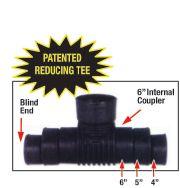
• 8” & 10” riser with patented 8" & 10" combination Tees. Also 6” square & round risers with patented reducing Tee.
• Constructed of heavy-weight, high-density polyethylene.
• Parts highly adjustable & interchangeable with others on the market
• Orifice plate placed at tee level or at ground level.
• Exclusive locking device on each part. • User Friendly-Priced effectively.
• Adaptor available to repair old metal or broken intakes.
ENVIRONMENT
Continued from page 19
focus for the last 30 years, the focus on N reduction is more recent. Many of our N reduction practices are a bit newer and some of the technologies such as saturated buffers didn't even exist in 2013. We are seeing continual new technology development and new methods for implementing practices, and there is real recognition that for us to make progress on reducing nitrate load we have to greatly accelerate the rate at which these practices are adopted. It is really important right now that the agriculture community and drainage contractor community be proactive about increasing the number of practices going in on the landscape."
Helmers notes that the INRS includes a listing of practices, and it is important for farmers and contractors to look at the landscape and evaluate which practices might work best for individual field and farm situations. "The timelines for planning, design, approvals and implementation will vary depending on the practice and will take commitment from the farmer, contractor and engineer to see the process through. For example, saturated buffers or bioreactors may take six to 12 months, while a wetland may take 18 to 24 months because of some permitting requirements. For some practices, at least in Iowa, a professional engineer is required to design the practice. It is not just about money and practices, it is also the need to have appropriate human capital to scale up."
Although many projects are initiated and implemented by individual farmers, the success of a recent larger scale, partnership model in Polk County could become a model for others. In this saturated buffer project, several urban and agriculture partners came together to tackle one larger project including several different farmers and field sites and one construction contract. "This is an innovative concept and took a lot of back and forth to develop a process to make this work through a variety of partners and landowners. This model has the potential to be much more efficient and streamlined compared to traditional processes," says Lechtenberg. "The project added 40 saturated buffers and 11 bioreactors to farm fields, involving multiple landowners but only one contract for construction. A second phase for another 100 sites is being considered. This is a shift from our traditional process and allows us to align funding and push the envelope on certain projects to help increase the scale and pace of getting projects implemented."
WHAT PART CAN CONTRACTORS PLAY?
Drainage contractors are important partners in these projects. "There are lots of training opportunities to learn about these practices and design considerations in Iowa, across the midwest and into Canada," says Helmers. "A number of drainage contractors have been very involved in helping install some of the processes in our research and we encourage others who are interested to contact their land grant university to learn more about the research and how they might lend their expertise."
"With aging drainage infrastructure, contractors can consider opportunities to add edge-of-field practices to
Wetlands is an edge-of-field practice show great potential for nitrate-N reduction and water quality benefits.
planned retiling projects," says Schnieders. "There are several cost-share programs available for those practices to ensure that if new or replacement drainage work is occurring, additional practices are implemented to treat the water before it leaves the field and enters rivers and streams to achieve the water quality goals for local watersheds, the state and the Gulf." Lechtenberg adds, "by aligning systems and programs, we can make it more streamlined to bolt-on an edge-of-field practice at the same time as a large tiling job is underway rather than coming back later. However, in some cases standalone bolt-on edge-of field practices may be the most practical."
With more state and federal funding and new technologies and proven practices available, the INRS partners are reaching out to more farmers and contractors to ramp up the scale and pace of implementation and adoption to meet the N and P nutrient reductions.
Helmers and his team are leading research on these practices to prove their performance, solve challenges, find ways to increase performance and trial new technologies and practices as they are introduced. In some cases, partners support monitoring that helps with research and gives farmers and landowners the assurance the practice will do what it is expected to do.
"Some of the solutions do so much more than nutrient reductions, including bringing together partners from federal, state, county and city governments, farmers, clean water organizations and industry organizations," says Schnieders. "For example, implementing a wetland project for nutrient reduction, depending on the design, can absorb and slow down water, help alleviate flooding, improve habitat for pollinators and wildlife, provide carbon benefits and protect drinking water sources. We recognize everyone wants this to go more quickly and it's always great to hear from people who have ideas or want to talk about different approaches to keep things going. It is an exciting time and we now have the opportunity to accelerate the level of adoption to help meet the N and P nutrient reduction goals at that same time as bringing other benefits to water quality, the landscape and the environment." DC
PHOTO CREDIT COURTESY OF MATTHEW HELMERS.
NEW PRODUCTS
PORT INDUSTRIES INTRODUCES NEW TRENCHER MODEL
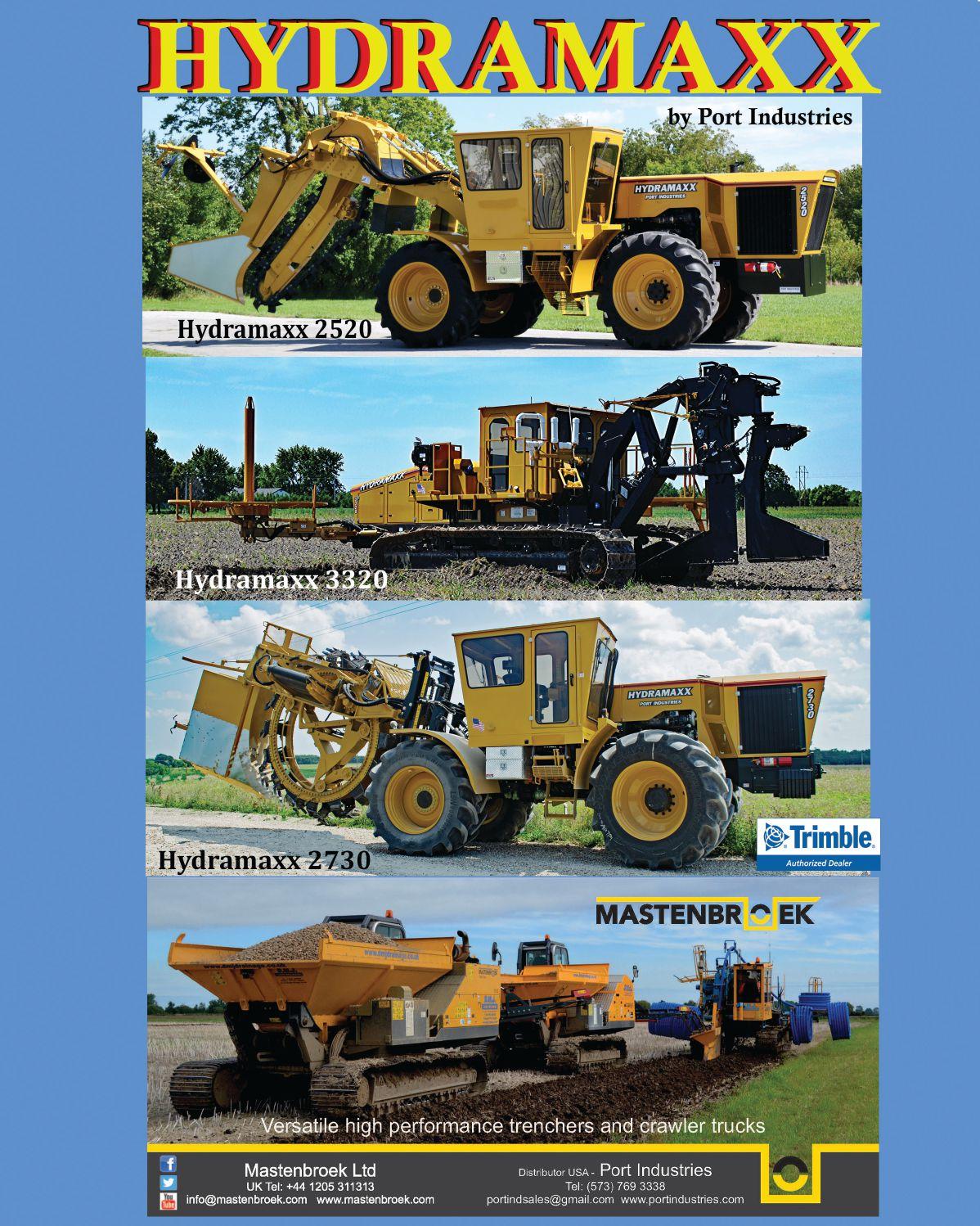
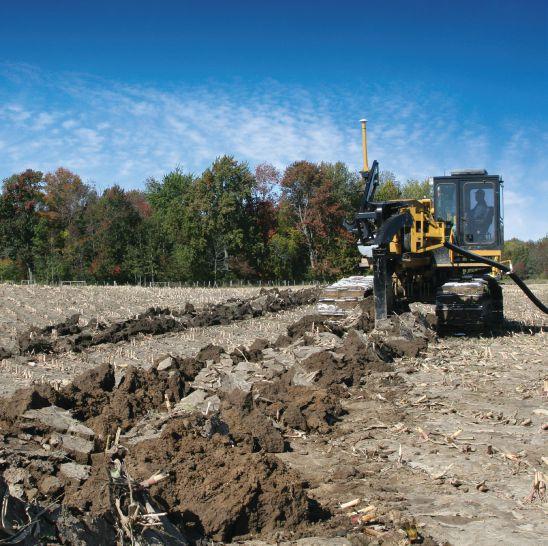
This past summer, Port Industries unveiled its newest model of the Hydramaxx trencher, the Hydramaxx 2730 Rubber Tire Wheel Trencher.
The main differentiation between the 2730 and other models is a heavier front axle, as well as 900/50R42 high flotation tires. The machine features a Cummins Tier IV Final Engine (430 HP), double-entry cab, auto leveling, a digging depth of 7’3”, 16” buckets (20” or 26” option), digging widths of 22” to 50”, and a conveyor measuring 36” wide, 8’ long, 10’ option. It is available with a tractor unit or digging wheel.
NOKIAN UPGRADES CT TRAILER TIR
Nokian Tyres created the Nokian CT trailer tire in response to a need for strong, yet comfortable tires to handle heavy loads while being economical. Now, it’s further developed the CT tire’s 600/55R26.5 size even further.
Under maximum operating pressure, the new version can carry up to 6.5
tons on the top speed of 65 km/h. The load capacity at a slightly lower speed – 50 km per hour – is 7.9 tons. Tero Saari, product manager at Nokian Tyres, said in a statement that this means in a tandem axle configuration, “You may be able to carry up to two cubic meters more soil or sand.”
The ultimate goal is to move high loads safely and economically. The new version will officially replace the old version.
BKT UNVEILS NEW MULTIMAX MP 569
Tire manufacturer BKT has added a new tire to its lineup: the Multimax MP 569.
The tire is part of the Multimax line of products, which includes tires that are optimized for agroindustrial activities in use at high speeds with heavy loads. The Multimax MP 569 specifically targets a range of applications for agro trucks as well as mixed-use vehicles which are deployed when road movements are also necessary. This includes vehicles used to transport raw material.
DIGS ASSOCIATES STRIKES TWO MAJOR PARTNERSHIPS
Illinois-based DIGS Associates has struck two significant partnerships focused mainly on meeting increasingly complex engineering needs.
This past July, it partnered with Martin Engineering Company (MEC) to focus on the development of drainage solutions.
Both companies possess expertise in agricultural drainage. DIGS primarily serves as a third-party consultancy for landowners, utilities, investors, contractors and more while MEC specializes in professional civil engineering and land surveying services. Together, the two companies plan to provide drainage, irrigation and nutrient loss reduction solutions at the field and watershed level. In addition, necessary permits from regulatory authorities will be addressed directly by the partnership.
“From our standpoint, this is a win-win,” said MEC president, Phil Martin, in a statement. “We are teaming with experienced, professional, good guys that have been servicing the agricultural drainage industry for over 25 years.”
In September, DIGS struck a subsequent partnership with software solutions provider ProfitLayers powered by Ag-Analytics in order to help Landowners and land improvement professionals maximize their drainage and water management investments.
The two joined forces to make it easier to both explore and commission professional engineering consultation services online.
BUSINESS DIRECTORY
Using the ProfitLayers online ordering system, customers can select their field on a map to order services and inspect additional field information. ProfitLayers then uses profit mapping and analysis to put precision ag data to use. It integrates harvest, seeding application and tillage maps with product prices to generate geospatial maps of profit on a field. Customers placing an engineering service order through the online portal can quickly select or draw their field boundary on a map. No payment is due at the time of order, and all results, maps and reports will be distributed digitally through the ProfitLayers site.
VANTAGE CANADA ACQUIRES TRIMBLE DEALERSHIP RIGHTS
Vantage Canada has acquired Trimble dealership rights and assets. This move is the completes Vantage’s nationwide portfolio in its efforts to position the new Vantage Canada entity, with its headquarters located in Calgary.
Customers will continue to have access to Trimble’s suite of precision ag and water management solutions, as well as Trimble’s team of experts. Vantage Canada will provide technical expertise, agronomy services, field data solutions, water management and support capabilities for farm and tile drainage operations.
AD INDEX
It’s better to be busy
by Rob Burtonshaw
Wow, we are busy.
Two wet winters, old drainage schemes failing and jobs which were delayed due to pandemic panic have resulted in a glut this year.
To be honest, if we are not busy straight after harvest then we might not be trading next year. But even so, this year has been exceptional. Slowly, interest and demand for land drainage has increased in the U.K. Who knows if this will last – but right now, soils are in fashion and our order book is full. We have in the past turned away work, but I have never previously turned away good, large profitable work because we simply can’t fit it all in.
Like most contractors we have a short season: fields are normally harvested in late July or early August and by mid-October the weather is turning. Rain starts to fall and most soils which need draining are too wet to travel on. I love the simplicity of the post-harvest rush. There is no time for planning or tackling those thorny long-term problems. The marketing strategy can wait, so too can new plant purchases and those awkward repairs which are a pain but you can live with. The cold, wet months of winter can be filled with those tasks, but right now the focus is on putting pipe in the ground quickly (and accurately), double-checking the plans and the levels, making sure everything is right. I’m always amazed about how much time can be lost waiting for the last load of gravel or checking the grade after making alterations to the proposal plan. And the same is true with a team which knows the job and works well together. The extra two or three hundred metres each day that a team working well can produce soon adds up and makes a massive difference to the bottom line. Keeping staff happy and motivated is key.
Now, to almost contradict what I have just written: we had the August bank holiday off. The bank holiday is traditionally a time for British summer holiday, normally marked by traffic jams and bad weather. We had the whole weekend and Monday off work. It may sound muddled, and the argument to work through the holiday
is compelling but experience tells us not to. We had all worked long hours in the summer, and fall would bring more of the same. We have already worked many weekends. This is not a one hundred-metre sprint, but a middle-distance race. And we need to finish strong.
Working flat-out for one month won’t get the job done. We have learned from experience that working week after week and through the weekends and holidays without any breaks results in less productivity, less profit and less total metres in the ground. At first glance working less and having holidays may sound soft but really is cold hearted logic, a pause now will be good for the bottom line not bad. An extra two or three hundred metres each day quickly adds up to more than an extra days production. People need time to forget about work and spend time with their families – I certainly do. People want to be considered and work better when they are there, taking the holiday is good for everyone.
The excitement of post-harvest work is strong at the moment, as you can probably tell from this column, but the pattern of the year will also dominate. By the end of the season it will turn wet and cold, production will fall and jobs will become harder, naturally our enthusiasm will wane. Then the ground will be too wet and the work will run dry, this change will be greeted will relief and finally some of those jobs which have been put off will have a chance to be sorted out. Come January and February we will be looking back fondly at the time we were previously glad to see the back off. The changing of the seasons is a wonderful thing. DC
DRAINAGE INNOVATION webinar series
Join us for three live webinars with industry experts reviewing the latest in Drainage Innovation and on-going projects.
Stay tuned for more details, speaker announcements and free registration by visiting DrainageContractor.com/webinars or subscribing to Drainage Contractor’s eNewsletter.
DECEMBER
Combination Systems
Hosted by
JANUARY
Tile layout and spacing
FEBRUARY
Controlled drainage and sub-irrigation
Thirsty for Knowledge?
A Prinsco Education Initiative
Your work is critical to the success of agriculture, and we’d like to say thank you. To do that, we’ve built one of the world’s most extensive, inclusive, online educational resources about agricultural water management. It’s designed to be a tool for drainage contractors and their customers to learn more about important topics such as sustainable best practices, innovative new products and challenges facing our industry, such as resin shortages.
The Water Table website is a Prinsco Educational Initiative dedicated to giving back and telling the agricultural water management story. Visit and share today!