Clear skies and a murky middle
Survey says contractors feel positive about the industry, but some reservations on the horizon
by Bree Rody
Reader surveys are common in media. Every few years, you’ve gotten a chance to tell us who you are, where you’re based, what you like about our magazine, etc.
But we wanted to go beyond that info for our first-ever Drainage Challenges and Opportunities survey. Drainage Contractor wanted to know what’s keeping contractors up at night – either literally or figuratively. Why? Well, because on the one hand, it's common to hear about all the positive directions in which the industry is heading. And yes, there are many positives –contractors are as busy as they are ambitious. They actively seek out learning opportunities through extension, associations, field days and more. There’s an apparent increase in the appetite to earn about soil and water sciences, and contractors are rising to the challenge of making systems more efficient without sacrificing water quality, such as through changing up tile spacing. Go to any drainage or contracting conference and sessions on soil health, compaction and other environmental issues are sometimes standing-room-only. Innovative contractors push the envelope, and researchers are leading the way on key developments in game-changers – like controlled drainage, drainage water recycling, advanced knowledge on tile material and more.
But just because an industry is booming doesn’t mean everything is painless. In fact, rapid growth is oftentimes the biggest source of pressure – hence the term “growing pains.” For example, many contractors have
expressed for years a difficulty in finding, and more importantly maintaining, a strong team of dependable talent. Others have expressed frustration when it comes to jurisdictional conflicts and/or red tape, which they see as slowing down jobs and progress.
And, with looming economic troubles, it’s a stark reminder that the drainage industry’s growth and health is directly tied to that of the agricultural industry. And so, knowing those perceived trouble spots within the industry – such as the number of contractors who don’t have a set-in-stone retirement or succession plan – might become even more crucial as contractors and farmers look to batten down the hatches.
On the other hand, understanding the modern contractor – what motivates them, where their knowledge comes from, what’s important to them – also helps us understand what makes the industry strong and resilient. And, knowing they they’re prioritizing, how they set themselves apart from competition (and even how they view their competition) helps everyone, whether it’s extension schools, trade organizations or trade media (yes, like us) understand what we should be doing more of – and less of.
ABOUT THE SURVEY
The survey launched into the market in January of 2025. It was promoted primarily through digital advertising including our eBlasts, social media channels, website and biweekly eNewsletter. The survey was incentivized with a chance to win gift cards for fuel, for those who left (optional) contact
information. The survey was free to take, and was in the market for two months.
The survey was filled out by just under 50 individuals. Most identified as drainage contractors; some also identified as designers, engineers, suppliers, etc. Demographic data was collected on general region, team size and time in the business. Demographic data was not collected on age, gender or other aspects of identity such as education or family status.
Editor’s note: Readers should note that because the survey was live from mid-January until mid-March. Some answers on the future, economics and supply availability, may have been given in circumstances that were different from those at the end of the survey period. For example, concerns over input costs and the general future of agricultural economies may have changed following key announcements on tariffs on Canadian imports to the U.S., and counter-tariffs on U.S. goods coning into Canada, which took place in early February, mid-February and early March, as well as sweeping reciprocal tariffs announced April 2 that have affected the U.S. dollar.
Following the completion of the survey, results and additional extrapolations were shared with a select few outside commentators who provided insights from their unique industry POVs. What you’re about to read is the complete data, as well as additional commentary.
In cases where data adds up to more than 100 percent, these are questions where respondents could choose more than one response.
Survey respondents by
THE PANEL
PETER DARBISHIRE
Who he is: Drainage Contractor founding editor, honorary lifetime LICO member.
Why his take matters:As the founder of Drainage Contractor Darbishire has had a front-row seat to the development of the North American drainage industry over the last half-century, witnessing changes in technology and the equipment scene, and hearing directly from contractors.
VINAYAK SHEDEKAR
Who he is: Assistant professor of agricultural water management at The Ohio State University, director of the International Program for Water Management in Agriculture and the Overholt Drainage Education and Research Program (ODERP). Why his take matters: Shedekar’s experience and expertise is applied in both research and extension, meaning his insights come just as much from the lab as they come from conversations with drainage contractors at the annual Drainage School and around the state.
STEVE GERTEN
Who he is: The owner of Inbody Drainage for more than 50 years, Gerten was the 2024 recipient of LICA’s Contractor of the Year award and is a past president of Ohio LICA, among many other achievements and titles. Why his take matters: To say Gerten is prolific and respected in the industry is an understatement. He’s the type of contractor who never stops working (he was quite literally cutting tile during his interview) or learning, being an active participant in the Overholt Drainage School and supporter of the Farm Science Review.
Midsouth and South 6% U.S. West and Southwest 4%
Unsurprisingly, most of the respondents of the survey were based in the U.S. Midwest, with Eastern Canada (Ontario to Atlantic) coming in a distant second. This tracks with years of data that shows subsurface drainage is most prominent in the U.S. cornbelt, as well as Canadian data that shows Ontario and Quebec account for the vast majority of the country’s subsurfacedrained agricultural land. Other areas such as Western Canada, and the U.S. Midsouth/South have reported recent growth, but these regions are still not close to comparing to the dominant ones.
Most respondents have been in the game for quite some time, with nearly 41 percent working for a business of more than three decades. Only 13 percent of respondents’ businesses have been around for five years or fewer.
Peter Darbishire, Drainage Contractor’s founding editor and original owner and lifetime honorary member of the Land Improvement Contractors of Ontario (LICO) observed that the amount of well-
established businesses indicated that these businesses “likely [span] more than one generation.”
Most of those businesses run lean, with an average of five employees or fewer year-round, although nearly half say their business expands to 11 or more employees during peak season.
When asked about the amount of tile they installed per year in acres, responses varied wildly – with a mean (average) of 31,206, but a median amount of 1,000, indicating a very large number of smaller jobs, but a small number of very large jobs.
Darbishire, however, points out that if the question had been asked differently –posed in terms of feet of tile – results might have been different or more telling.
“Tile spacing and whether this relates to areas where they are splitting existing tile lines would be significant factors,” says Darbishire.
U.S. Midwest 66%
Canada East
(Ontario to Atlantic) 13%
Canada West (Manitoba to B.C.) 9%
U.S.
EPISODES INCLUDE:
• Contractor perspectives with Jesse Tait
• Drainage in Manitoba with Mitchell Timmerman
• Water management and collaboration with Keegan Kult
• Drainage water recycling with Chris Hay
THE MODERN CONTRACTOR
It’s been well-known for decades that even for the most passionate and prolific drainage contractors, drainage is rarely their sole line of work. This is due primarily to the highly seasonal nature of the job, although the work is still physically demanding. So, it was fairly unsurprising that only 28 percent of respondents said drainage was their sole job. Of those who said they had another job, roughly four out of five said drainage represents most of their time and/or income.
What was, perhaps, more surprising was that many of those who had jobs outside of drainage reported not working in ag, 59 percent said they had no nondrainage work in the ag field at all. Of the 41 percent who did work in ag on top of drainage, primary agricultural production/farm ownership was the most common line of work.
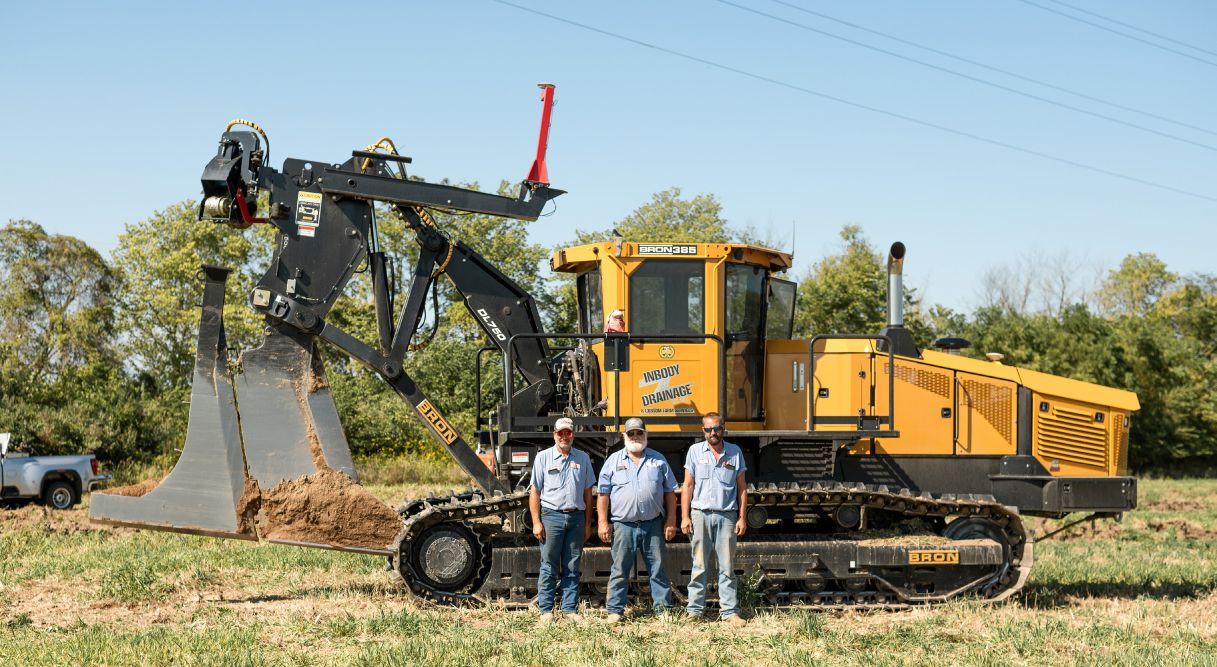
Among the cohort that said they have a job that takes up more time and effort than drainage, more than half said that other job was farm ownership/production, and in this group, only a single respondent reported heavy equipment operation as their primary role outside of contracting. For Steve Gerten, owner of the Ohio-based Inbody Drainage and a contractor for more than 50 years, a farming background has been one of his greatest assets. “We’re still farming,” says Gerten. “Between our drainage business and the farm operation, it goes hand-in-hand. I can directly relate to a customer when it comes to drainage issues as far as to make recommendations, answer questions, [understand] the timing aspects. We can explain things to farmers and make recommendations on whether we should even be out there doing the work, or wait ‘til the ground conditions change.”
Just under 16 percent of survey respondents did not identify as contractors. Of those who did not identify as contractors, most identified as consultants, designers and/or engineers, although some identified as agronomists and/or farmers, and most identified as business owners.
Vinayak Shedekar, assistant professor of agricultural water management at The Ohio State University, says this could be a demographic to look out for. Through
his observations facilitating the Overholt Drainage School every year, Shedekar has found himself using the language of “installer” more often these days, adding, “Not all installers are contractors.”
“There’s an uptick in farmers and people wanting to install their own drain tile, who are not a typical or conventional contractor,” Shedekar explains. Particularly in the United States, which has fewer regulations around tile installations compared to Canada, says Shedekar, it’s sometimes easier for a farmer to take a DIY approach rather than hiring a contractor, especially with more educational opportunities and some cheaper access to equipment such as selfpropelled drainage plows.
Additionally, 31 percent of respondents identified as contractors, but not business owners. Of that cohort, less than onethird said drainage is their sole full-time job, though most said drainage takes up most of their time and effort.
Non-owner contractors with other jobs were more likely to have another job outside of ag, or in heavy equipment operation, than in roles like primary production or agri-contracting. By contrast, just over 53 percent of respondents identified as both contractors and owners. Perhaps surprisingly, the contractor-owner cohort was just as likely – or rather, unlikely – as the non-owner cohort to report that drainage as their sole job.
Heavy equipment operation is also a popular side gig among contracting business owners, although this group is more likely to work in primary production or other facets of agriculture such as agricontracting or business development than those who don’t own their own business.
Darbishire found it interesting how common it was for respondents to have jobs outside of drainage and pondered if there may be a correlation between this and time spent in the business
(Editor’s note: Darbishire is onto something. Although it’s still common for respondents who have been in the industry for many years to have another job, respondents who have been in business more than 10 years were three times more likely than those with less than a decade’s experience to report that drainage was their sole job).
JOB CONDITIONS (PHYSICAL AND OTHERWISE)
Drainage isn’t exactly known as a cushy job. It’s physically demanding, requires a good degree of concentration and focus, and requires constant learning to stay on top of things. With the landscape changing constantly, this lends itself to a few key trends among respondents – larger, more complex jobs, some difficulty attracting and retaining a young and capable workforce and more. With more than 60 percent of respondents saying jobs are more complex and challenging than they were five years ago and an additional 38 percent saying they’re doing more work on preexisting systems, Shedekar points to the trend of the rise of noncontractor installers, and ponders a potential correlation – at least with certain kinds of jobs.
“Farmers are more interested in installing laterals,” he explains. “And they call in a drainage contractor to install a main. It’s kind of a win-win, because contractors are not out there digging holes –they’re in and out in a shorter amount of time.”
Darbishire also notes that nearly half (44 percent) of respondents saying jobs are larger than five years ago makes sense given general agricultural trends. “Modern farm operations buying new land parcels most often opt to tile the whole parcel [at once],” he explains.
Still less common, though, are instances of contractors installing or incorporating innovative new practices and systems such as saturated buffers or controlled drainage structures. Shedekar, who has heavily researched and advocated for controlled drainage, isn’t necessarily surprised, and says it ultimately comes down to farmers
Most common hybrids
Contractor/owner
Contractor/owner/designer
Designer/consultant
Other roles identified: Farmers,
not seeing the benefit. “These practices are ecologically sound and have tremendous water quality benefits,” he says. “But these practices pretty much do nothing for profitability.” He adds that if contractors could somehow be incentivized to promote the practice, that may change things. “The contractor is usually the first person [the landowner] talks to.”
For competition, most respondents note a “moderate” amount of competition in their area and either no change or only a slight increase in competition in the last five years. Gerten notes that the nature of the industry – an extremely friendly and communityoriented one, he says – means contractors tend to perceive competition differently than people in other industries. “I don’t look at these guys as my competitors,” says Gerten. “I look at them as my best friends. I feel that I’ve learned more just from the camaraderie, having the ability to talk to someone doing similar work, and see how they resolve an issue, see how they operate or make connections.”
When it comes to setting oneself apart from competition, it’s all about offering
what others can’t. For most (65percent) that means upgraded equipment stack (Darbishire adds that this may come with pressure for greater returns: “If a contractor upgrades their equipment stack, would they need to begin encroaching on competitors’ territory to justify the outlay?”); additionally, more than half of respondents say they set themselves apart by specializing in complex and niche systems, and increased knowledge of hydrology, soil health and other earth/water sciences.
For Gerten, one thing he’s done to set himself apart from competitors – or, as he’d say, friends – is to offer key services in-house, like engineering and design work. Service and organization is also a top priority, he says. “We always make records of maps of everything we do,” he says, adding that besides the farmer’s copy, his company keeps a permanent record. “Ninety percent of our work is repeat customers, so we can pull that information up and incorporate that.”
Shedekar adds that at Overholt, some of the most common knowledge gaps reported by attendees are in the legal aspect of
drainage, as well as an increased interest in drainage design software in the advent of GPS technology. “That has been something for us to implement in our drainage school education,” he says. “[Some] are already using those, but they’re struggling because they might not be as good as they would have been wiht laser technology. There’s a learning curve, and we’re seeing that.”
The most common thing most struggle with is talent. More than two-thirds of respondents said they are understaffed for their current workload, and 41 percent said the biggest thing that would improve their business instantly is access to a large pool of able-bodied talent – well ahead of other boosts like brand-new equipment or more (and free) continuing education opportunities.
Gerten says it’s a tale as old as time. Even with his business consisting mostly of family, “I would still like to find one or two more employees to help with the business... It’s hard to find people who want to do that type of thing. Anything that’s more physical labor, in today’s society, people don’t really want to do.”
TO OUR ATTENDEES, SPEAKERS AND SPONSORS
SILVER SPONSORS
BRONZE SPONSORS
Growing competition
Canadian respondents almost all indicate an increase in competition, with those in central/ Eastern Canada saying they face more significant competition close to home.
Setting yourself apart
Business owners who have been in the game for 10 years or fewer were less likely than their older counterparts to report setting themselves apart from competition through competitive pricing, upgraded equipment or geographic expansion.
How do jobs compare to five years ago?
More complex/challenging jobs
Larger jobs
More work on pre-existing systems
Smaller jobs
Harder working conditions
Little change
New elements such as bioreactors/ controlled drainage structures
Midwestern contractors largely report moderate to significant competition, but are most likely to say there’s been no change in competition in the last five years.
Respondents in the Midsouth, South and Southwest were more likely to report little to no competition in their area, but all report increases in competition in the last five years.
Key trends among groups
Midwest contractors are the likeliest group to report more complex jobs.
Eastern Canadian contractors are most likely to say they’re doing more work on pre-existing systems.
Veteran contractors (20+ years’ experience) are likeliest to report working in harsher conditions.
CANADA
SOUTHERN
BEYOND THE BUSINESS
Gerten and Darbishire, both having been involved in various industry organizations throughout the years, understand that drainage often feels more like a community than an industry.
Similarly, Shedekar has his own perspective on this as someone who facilitates a drainage education initiative, where he says just as many valuable lessons are learned in one-on-one conversations outside the classroom – or in the pub after a lesson – as they are within it.
But being a member of an association – like the Land Improvement Contractors of America, or the Ontario Concrete and Drain Contractors Association – isn’t always a given.
Just over half (53 percent) of respondents said they were currently members of a trade association; of the remaining respondents who were not, about a quarter said they didn’t plan on joining one, and the other three quarters said they were considering joining one.
There was no real consensus among non-members around what was stopping them from joining; cost/dues was the least of their worries, with only 25 percent citing that as a factor; more
common were the charges that they could not find an organization that matched their values, or that they simply did not see the benefit. A good number of respondents, quite simply, said they just weren’t sure.
But for members, the key benefits have always been clear. More than three quarters put access to key industry information and updates in their topthree benefits of association membership; two thirds added that social and networking benefits were among the top. Two thirds also cited education, training and networking as a top advantage.
But Gerten hopes those considering association membership will also consider the potential benefits in terms of insurance savings.
“One of the most beneficial things with LICA has been the insurance,” he says. “Through LICA, it allows you to get a discount on insurance for equipment and so forth. For me, that’s been adventitious.”
Fewer than 20 percent of respondents cited insurance savings as a top benefit. More experienced respondents were more likely to site associated reputation benefits as a major reason for being a member, whereas respondents who
were newer to the business were less likely to care about the social aspects. Additionally, this group was more likely to site cost/dues as a reason for not joining.
Working in education, Shedekar has seen the various ways in which associations like LICA have been valuable partners.
“There are many examples where people are willing to help,” he says, siting acts such as associated companies donating materials or subsidizing material costs on drainage installations and organizing field days around such installations.
He adds that the Ohio state LICA chapter got creative by offering a rebate program – attendees at Overholt Drainage School who decided at the school that they wanted to join LICA would be given a rebate on their registration fee. If other chapters could replicate this by partnering with institutions or educational organizations, he says, this could not only attract more members but also underscore organizations' commitment to education. In some cases, it can be a case of simply needing to get in front of contractors who are on the face – since
41.67 percent admitted they "weren't sure" why they weren't members.
One of the matters one can learn about through associations is future planning –something Gerten admits some business owners aren’t always keen to talk about, although he’s had a plan for some time. Just over a third (38 percent), like Gerten, half a succession plan, although some of those with a plan say things have already deviated from the plan. Of the 62 percent who don’t have a plan, many have “a general idea” of how things will go, but others say they have no plan whatsoever.
For Gerten, actively gifting shares of stock in the company to eager employees has been the starting point. That might not be the path for everyone, he says, but “my recommendation as far as anybody goes would be to look at that possibility – if they have an employee who wants to take over the business, the present owner aught to consider helping that employee.”
Darbishire echoes Gerten’s sureness on the matter: “To those who answered ‘no’ or ‘no plan,’ I ask, why not get on with it?” he says.
Especially important with the North American and global economic outlook unclear in its current state. While most respondents feel neutral to positive on the growth of the industry and their own businesses (although respondents were more likely feel positive about the growth of the industry overall than their own businesses), given the timing of the survey, answers might not be the same today. In fact, even in January and February, at the time the survey was taken, the biggest concern for the future (34 percent) was general economic trends and potential downturns.
With machinery often being imported or manufactured from imported parts, and agricultural markets highly dependent on free trade agreements, Gerten says it’s a mistake to think you’re immune from the effects of tariffs.
“I don’t care if you’re a young contractor or one that’s been in the business a while,” he says. “With all that’s stemmed here within the last six weeks, that is definitely an issue. The costs to get a piece of equipment that’s made outside of the U.S., it’s going to get more expensive.”
... but things have deviated.
... and things are going to plan.
... none at all. 40% ... but I have a general idea.
Social priorities:
Less experienced respondents were no more or less likely to report being members of an association, but more experienced contractors were more likely to state that social aspects were the biggest benefit.
Associations and
Respondents who weren't members of an association were distinctly more likely to report not having a formal succession plan than members. They were also much likelier to state that they weren't sure what to do with their business when they retired.
What are the plans after you retire?