resistance, electrical resistance, and great shelf-life reliability. All of these ma ke it a good fit for injection molded pa r ts for products used in industries such as medical, automotive, food, appliances, textiles, and consumer goods.”
Silcotech’s qua lit y system cer tif ications include ISO 90 01, ISO 13485, ISO 140 01, and TS 16949. “We’re also registered with U S Food and Dr ug Administration standards and Health Canada standards,” Chauhan said. And the company encou rages employe e engagement to improve processes and technologies, with considerable help from Boettger’s educational background. “Because of my traini ng as a teacher, I enjoy helpi ng ou r employees develop their skill sets to bring out the best in them, and we’ve been particula rly successf ul with the st a ff that have been with us for many years because we get to know what their strengths are and what jobs are best suited for them,” she said “These effor ts have enhanced employee satisfaction and resulted in ver y low tur nover ”
Boettger a nd the rest of Silcotech’s management team are also com mitted to advancing women within the company. “We’ve had some real success stories in this area – the cur rent head of our packaging and final inspection depar tment is a lady originally from India who has risen th rough our ran ks th rough hard work and natural ability, which we were able to foster,” Boettger said “We have more women in the company now than ever before, and we’re hoping to add more on the technical
side going forward ”
Machiner y-wise, the fir m relies exclusively on A rburg injection presses, and recently bought two new A rburg machines – an all-electric 110 ton Allrounder 470 A 10 0 0 -29 0 Com for t, a nd a n a ll- elect r ic 220 ton A ll rounder 570 A 20 0 0 - 4 0 0 Com for t, both with LIM / LSR molding options and ther moplastic molding capabilities – for a total of 29 presses, with clamps from 25 to 250 tons “The two new machines are sizes where increased capacity is needed and were added to handle growing business volume,” Chauhan said.
A rburg was chosen as the supplier of all Silcotech’s machines because of their long h ist or y of suc c ess p r ov id i ng machines for LSR applications, Maloney said “A rburg and Engel are the only two significant OEMs offering LSR options for their machines, and A rburg’s presses feature a sound mechanical design and a ver y progressive control system,” he said “Other brands play in the LSR space, but they don’t have the experience to deliver ” For co-injection of silicone onto a ther mopla st ic sub st r a t e, sp e c i f ic mold i ng mach i nes a re identi f ied i n t he f i r m’s enter prise resource planning (ERP) system to keep them separate from presses that only mold silicone r ubber.
Silcotech’s Bolton headqua r ters currently has 22, 50 0 square feet of space, and t he compa ny a lso occupies a nea rby 10,0 0 0 -squa re-foot wa rehouse for extra storage “We a lso ow n t he prop er t y behind our plant for future expansion, if
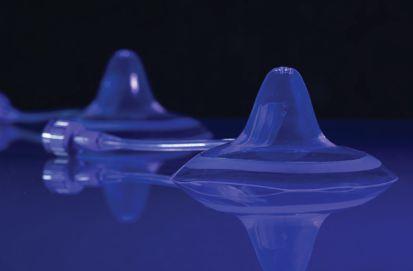
necessar y,” Maloney said Silcotech does a “small amount” of automotive work at the Tier 3 level, Maloney continued, but it’s not something the company is actively pursuing. “We tend to limit automotive work to less than five per cent of our total sales,” Maloney said “Eighty per cent of ou r molding is medica l or hea lthca re, including breast pumps, hearing protection devices, and respirator y care products ”
CHX OPNIDBSR
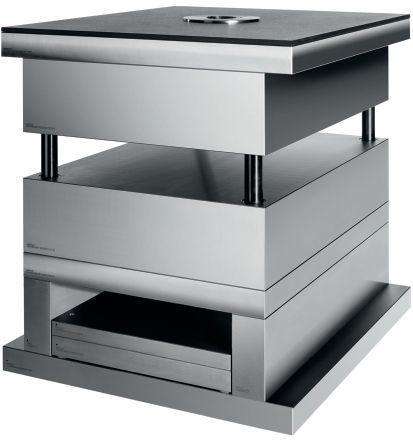
In addition to its exper tise in LSR molding, Maloney credits Silcotech’s emphasis on tooling as key to meeting LSR molding challenges “We design our own tooling and build some of it, because LSR tooling is ver y specialized – the molds need to conduct heat ver y well, so they tend to not be stainless steel in the areas of the heated tool area,” he said. “That aside, we use H13 tool steel ”
And the fir m is also becoming an automation designer and developer, as more and more of its customers are requesting post-molding par t assembly “Most silicone r ubb er pa r ts a re assemble d or attached to something – either a metal par t or another plastic par t – and we can create multiple components in a single mold shot, pull out the components, and then do in-line assembly with our own automation,” Maloney said As a welcome side effect, Maloney continued, this production style reduces overall costs “Most t raditional injection molders spend the most money on getting the par t together
inventor ying the individual elements of a par t and then reorganizing them into a st at us where you ca n act ua lly do t he assembly – and not on molding it,” he sa id. “But we avoid that, because ou r multi-shot solutions give us the ability to create multiple r un nerless components within a single tool, with the advantage that we understand the registration and location of those par ts, so if they need to go together, we can discretely mold individual elements, understand their registration, pick them up, and assemble them upon removal It adds a level of complexity to the manufacturing process, but it reduces a huge amount of cost in inventor y and supply chain management ”
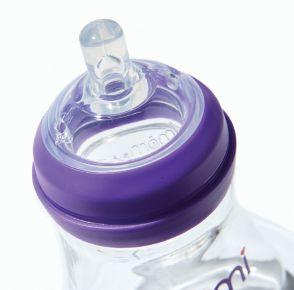
Another quirk of LSR molding revolves a r o u n d t h e m a t e r i a l s t h e m s elve s. “Because silicone has active chemistr y, it has limited shelf-life – typically between 12 to 18 months – which can be fur ther cut shor t by temperature f luctuations in the plant, so it has to be stored carefully in a cool environment and used before either its expir y or best-before date,” Maloney said W hich caused a problem for some LSR molders during the COVID-19 pandemic, he added. “Some shops bought too much material at the outset, only to have it expire – and then get th rown out, unused – when orders slowed down a nd they couldn’t mold with it quick ly enough,” Maloney said “And then they ran low in the long r un. So, for the good of the LSR industr y, we sold some of our own mater ial to competitors that had r un shor t, which was an interesting dynamic.”
A nd somet i mes t h is c omp et it ion doesn’t come just from other dedicated LSR molders. “We do encounter some la rge plastic custom molders that have added a bit of silicone to some par ts in order to get into this space – and we do ver y well against them, because incor porating silicone isn’t as easy as they thin k,” Maloney said
EHU D,X D : P OK : M
Going for wa rd, Ma loney a nd Boet tger have a plan for Silcotech that includes both continuous improvement and fur ther expansion “A few years ago, we decided to improve our tur naround time on quotes for new business, and we set a goal then of getting a quote out within 24 hours, and
we can usually do it now – but we want to do it with ever y quote, bar ring an unusual circumstance,” Maloney said “Our philosophy is, if you don’t set a target, you don’t meet a target.”
The company also wants to double the size of its business within the next five years “We’ve seen growth in the 15 to 20 per cent per year range over the past two years and keeping that pace is going to require staffing up and also adding more
dqdlT-bnl
Mdawaihmf lRaghmdr sdagmninfhdr Rmc chfhsRi rnitshnmr epnl AMAE. fhud oiRrsha R mdv ihed :wbid Tesdq bwbid. Tmnsgdq ihed- Fgdw sqTmrenql yvTrsdfi hmsn T uTitTaid qdrntqbd- Cmdqfw rTuhmf de“bhdms Tmc rlTqs- Eqnl vTrsd sn uTitd- Eqnl sqTrg sn sqdTrtqd- Enq qdbwbidc odiidsr ne rsTaid Tmc qdihTaid ptTihsw- Enq T bhqbtiTq dbnmnlw sgTs hr rtrsThmTaid Tmc. oqn“sTaid enq wntUFOFS TO :S7 EN y MoiWlan BinohaW IWt 4 0- 1-12 Annrd V 2260
automation, but we’re com mitted,” Maloney said. “We want to keep our customers more competitive, wh ich mea ns being more efficient in ter ms of the overall process, using more value-added additions like assembly, and doing less touching of par ts We believe we were ahead of our time in the early days in developing LSR mold i ng appl icat ions t hat most L SR molders wouldn’t ta ke on, and we’re not slowing down now ” B O K
lZmteZbstqhmf Zmc hmrsZkkZ shnm ne bghkkdqr- Vghbg ldZmr sgZ s dptholdms lZjdqr Zmc okZrshbr oqnbdrrnqr gZ ud cdbhrhnmr sn lZjd-
Ax LZqj R sdogdm* dchsnq
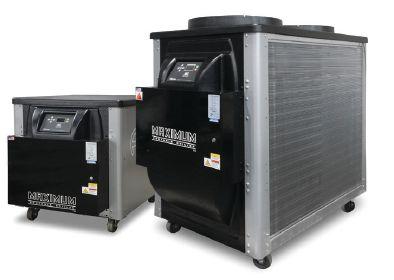
Fothing is more powerful than an idea whose time has come, French author Victor Hugo wrote in the 1870s. Fast forward about 150 years and the quote feels applicable to what’s going on with industrial chillers – specifically, to the new regulations limiting Global War ming Potential (GW P) that are driving changes to the manufacturing and installation of these refrigeration systems
Behind this push is the increasing concer n about the effect that refrigerants are having on our planet by potentially trapping heat in the atmosphere, a process com mon ly k nown as t he G reen house Effect. To address these concer ns, gover nments a round the world a re implementing regulations to phase out refrigerants they believe pose too much risk to global war ming To do this they use a rating system which assigns an all-important GW P number to refrigerants.
GW P represents the capacity of a pollutant to har m the environment, and is measured by how much more damaging the emission of one unit of a gas is compared with the emission of one unit of carbon dioxide (CO2), which has a GW P number of one. To put that in perspective against the two cur rent standard refrigerants used for industrial chillers, R-134a –which is generally used in centrifugal and screw compressors – has a GW P of 1,430, and the more com mon R- 410A – which is used in scroll and rotar y compressors –has a GW P of a whopping 2,088
KNB:SHNM’ KNB:SHNM’ KNB:SHNM
Many new chiller refrigerant regulations coming into effect from the Environmen-
tal Protection Agency (EPA) in the U S and various Canadian agencies have mandated a GW P of 750 or less, and in both the U S and Canada this is driving major i nvestments to develop new f luids as alter natives both to R- 410A and R-134a and to refrigerant components
In the U S , 12 states have enacted refrigerant bans based either in whole or in pa r t on the EPA’s Sign if ica nt New Alter natives Policy (SNAP) 21 program, which targeted f luids designated as having a h igh GW P. Developed in 2016, SNAP 21 was ultimately vacated by the cou r ts – a lt hough some U. S. st ates, including Califor nia, adopted the entire standard anyway – and so, in 2021, the EPA replaced it with a “Technology Transition Rule,” which took effect in December 2023, and which requires new chillers to use refrigerants below 70 0 GW P beginning on Jan. 1, 2026.
For t hese 12 st ates, t he ma nd ates already prohibit plastics processors from purchasing new chillers that don’t use low- GW P refrigerants, but than ks to a grandfather clause, cur rent cooling equipment based on previously legal refrigerants can be used th rough the remainder of its life cycle
The consensus is that the U S is further along than Canada in the process of replacing refrigerants In Canada at present, different provinces have different requirements, but the U.S.’s edge won’t last for long “In Canada, Environment Canada and the Ministr y of the Environment, the Fight against Climate Change, Wildlife and Parks will prohibit, as of Jan. 1, 2025, all chillers using refrigerants hav-
ing a GW P of more than 750 that are manufactured, distributed, or installed,” said Daniel Rober t, senior vice president, special projects with Kolostat-K rome.
NT S VHSG NCO
In a good news/ bad news situation, equipment manufacturers have found that newly required refrigerants provide comparable cooling capacity as those being banned, but t hat some ca n be f la m mable a nd therefore slightly dangerous “ASHR A E has developed Standard 34, which classifies many available refrigerants consideri ng t hei r Ozone D eplet i ng Pot ent ia l [ODP], their GW P, their toxicity, and their f lam mability,” Rober t continued. “Lowor non-toxic refrigerants belong to Class A, while those which prove to be toxic fall into Class B. To classify refrigerant f lammability, ASHR A E has divided them into categories 1, 2, 2L or 3; those of Categor y 1 being non-f lam mable and those of Categor y 3 being h igh ly f la m mable For example, propane is classified as an A3 refrigerant.”
Si nce t hese new ref r igera nts a ren’t perfect, the industr y has had to compromise on alter natives to meet global war ming reduction goals and replace R- 410A a nd R-134a ref r igera nts “T h ree low-
GW P ref r igera nts have emerged as prom inent replacement choices: R-513A, R-32, and R- 454B,” said Mike Shupe, product manager at Ther mal Care, which is par t of the Piovan Group “For larger systems for merly utilizing R-134a, the direct replacement is R-513A, which has a GW P of 570 and nearly identical ther modynamic proper ties ” In general, Shupe said, no components need to change when switching from R-134a to R-513A, which ma kes it a ver y easy transition. “For R- 410A, the two widely available replacement options are R-32 and R- 454B,” Shupe continued “R-32 has higher cooling efficiency, but due to this difference almost all major components will either need to be replaced or resized ” Finally, he said, while R- 454B may exhibit a negligible decrease in efficiency compared to R- 410A, it maintains ver y similar pressure and mass f low characteristics, ma king the transition significantly easier. “There are potentially more replacement refr igerants beyond these th ree, but they haven’t been fully explored yet due to the shor t timeframe given to manufacturers to adapt,” Shupe said.
According to Roger La mber t, president of Temperat u re Cor p , most chiller ma kers are opting for R- 454B “It’s similar to R- 410A in the operating pressures, but has slightly less capacity, although not enough to wor r y about,” he said
PDCDRHFMR’ MNS PDSPNEHSR
For chiller ma kers, the new r ules necessitate equipment rede-
signs, from the ground up, to ma ke new compressors and other components compatible with low- GW P refrigerants, which all have different ther modynamic proper ties and potential for f lammability. “Retrofitting an older chiller to ma ke it compatible with low-GW P mandates isn’t an option, unfor tunately, since low-GW P refrigerants aren’t available as drop-in replacements for high-GW P refrigerants,” said Jon Gunderson, president of Advantage Engineering.
Many manufacturers are already implementing their transition “Conair is utilizing a new compressor and other inter nal components to ma ke ou r ch illers compatible with multiple refrigerants,” said A J Zambanini, director of product management with Conair Group “If you order a Conair chiller today, it comes with a compressor that can use either traditional refrigerants or refrigerants for the new low- GW P standards, so it’s ready for any location across Nor th America ”
According to Mark Johansen, vice president of marketing with ACS Group, one upgrade can include simplified designs that can improve access to chiller components, thereby eliminating ser vice difficulty, maintenance time, and upkeep costs “Another upgrade is improved design geometries that can reduce chiller propor tions, perhaps even reducing excessive shipping costs and ma king these units easier to install,” Johansen said Spea king of new chiller installation, the customer must be aware of the subtleties of regulations dealing with new refrigerants Some U S states and Canadian provinces may have their own regulations in addition to, or different from, EPA or Environment Canada r ules. “In some cases, these requirements are in actual conf lict with each other,” said A J Zambanini
The pioneer of mouldmaking for 10 0 years
One grey area, for example, is the f lam mability of next-generation ref r igera nts. “With the push for low- GW P options, ASHR A E created a new safety class, which is A2L,” said Mike Shupe “The difference between the f lam mability of A1 and A2L f luids is so minor that most people wouldn’t notice. But OSHA and other gover ning bodies haven’t yet adapted to the new A2L class, so they still classify these refrigerants the same as other, more f lam mable substances like acetylene and nitrogen, and this can cause problems with local fire and building codes ”
Another consideration for units using R- 454B refrigerant –which is classified as an A2L refrigerant, meaning that it’s defined as slightly f lam mable but nontoxic – is to ma ke sure both the chillers and the areas where they’re being used are equipped with A2L lea k detectors “Also, follow the proper safety procedures, including operating these chillers with good ventilation,” said Mark Johansen
There may be other component and operational differences between chillers with the older refrigerants and those with new low-GW P f luids “All the plastic components in the control must have a fire rating under the new U L-94 code,” said Roger Lamber t. “Also, the wire used in the control panel has to have a fire rating of V W-1 or F T-1, as well as a U L rating; and the liquidtight conduit that the wire is r un in also has to have a fire rating ” A nd the ch illers themselves will need to be in a sepa rate mechanical room with no open f lame, Lamber t continued, and will require an exhaust fan to the outside of the building, and a
ORL ANDO, AT L AST
I TR S SGD E9B S R
V GDM L Zx 5 0/* 1 / 13
V GDPD Nq Zmfd B ntms x B nmudmshnm B dmsdq ’N B B B (* NqkZmcn* E kZ -
GNV L TBG T o tmshk L Zx 4* sgd D won O Z r r hr
T R !064* sgd D won Oktr hr T R ! 214* Zmc sgd
D won O qdlhdq hr T R ! 414- Nm rhsd* D won O Z r r
hr T R ! 1 / /* D won Oktr hr T R ! 3 / /* Zmc D won O qdlhdq hr T R ! 5 / /-
V DA v v v lod npe
Sgd sqhdmmhZk MOD dudms vZr bZmbdkkdc ctd sn sgd BNUHC,07 oZmcdlhb hm 1/10* Zmc dwbhsdldms hr athkchmf enq 1/13* vhsg lnqd sgZm 44*/// uhrhsnqr dwodbsdc Z s sgd NqZmfd Bntmsx Bnmudmshnm Bdmsdq-
Ax LZqj R sdogdm* dchsnq
Rix yea rs is a long time – long enough to go th rough medica l school, a nd a lot longer tha n most celebr it y ma rr iages. A f ter a six-yea r h iat us, the la rgest plastics t rade show in the A mer icas is prepa r ing for a big ret u r n. N PE2024 will t a ke pla c e May 6 -10 at t he O r a nge County Convention Center in O rla ndo, F la , th ree yea rs a f ter COV I D -19 forced the ca ncellation of the t r ien n ia l show’s 2021 event
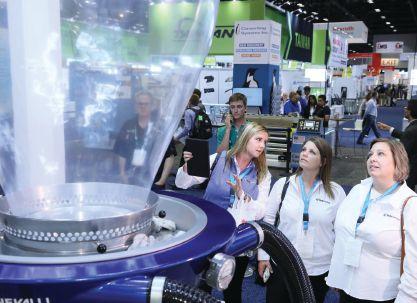
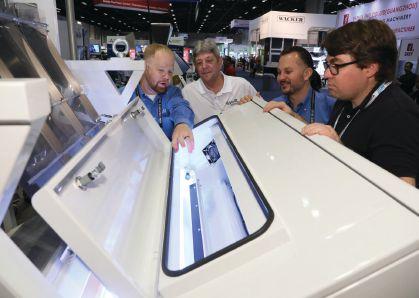
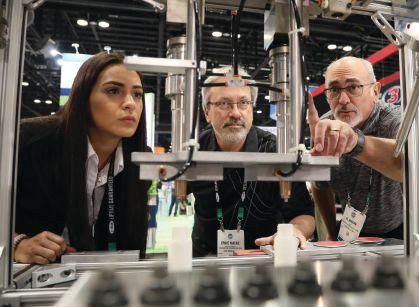
But t he show’s orga n i z er s haven’t been sit ting on thei r ha nds a ll th is time. I nstead, they’ve made some additions to lead at tendees on what they ca ll a “a new im mersive lea r n ing jou r ney on key topics in the plastics indust r y.” Fi rst, a nd as usua l at N PE, there will be tons – litera lly – of the latest mach iner y r un n ing on the show f loor du r ing the f ive- day event, cra n k ing out a wide ra nge of new pa r ts a nd complete products for at tendees to see, touch, a nd inspect. T he ex h ibit f loor is, i n fa ct, sold out, w it h a r e c ord 1, 024,462 squa re feet of ex h ibit space b ei ng o c cupie d by mor e t ha n 2, 0 0 0 ex h ibitors, topping the previous record set by N PE2 018 T he lat est a dva nc ements in products a nd ser vices will be h ig h l ig ht e d i n si x t e ch nolog y z ones,
FD S S HMF SGDPD
MOD 1/13 Zs sdmcddr bZm ekx hmsn dhsgdq ne sgd NqkZmcn ZqdZ&r s vn Zhqonq sr- NqkZmcn HmsdqmZ shnmZk ? hqonq s knbZsdc Zants 1/ jhknldsdqr eqnl sgd NB B B rdq uhbdr lnrs lZinq Zhqkhmdr* hmbktchmf ? hq BZmZcZ Zmc Onq sdq ? hqkhmdrNqkZmcn RZmenqc HmsdqmZshnmZk ? hqonq s hr knbZsdc Zants 5 4 jhknldsdqr eqnl sgd NB B B* Zmc rdq uhbdr cnldrshb ekhfgsr eqnl rlZkkdq Zhqonq srAnsg gZud rgts skdr* sZ whr* Zmc qdmsZk bZqr ZuZhk Zakd sn fds xnt sn sgd rgnv nm shld-
i nclud i ng a n a dva nc e d m a nu fa ct u r i ng zone, a bot tle zone, a mater ia ls science zone, a moldma k ing zone, a recycling a nd sust a inability zone, a nd a packaging zone
Se c ond, a nd i n ke epi ng w it h t he show’s theme “Made for You,” the 2024 edition will offer the expected 55, 0 0 0 or so at tendees the usua l oppor t un ities to network with indust r y exper ts a nd collaborate a round some of the biggest cha llenges facing ou r sector
T h i r d, show orga n i z e r s h ave put t oget he r a r obust t e ch n ica l p r og r a m hosted by plastics exper ts f rom a round the world. As Mat t Sea holm, the president a nd CEO of N PE producer Plastics I ndust r y Association, put it: “With more tha n 10 0 sessions in tot a l a nd 6 0 indust r y spea kers present at N PE, at tendees will lea r n about t he f ut u re of plast ics, t he impor ta nt pa r t they play in ou r evolving indust r y, a nd how plastics cont r ibute to ou r da ily lives a nd ou r ci rcula r economy ”
A nd for the f i rst time, N PE will be offer ing a n Expo Pass regist ration that will give at tendees access to more tha n 75 e ducat ion sessions lo cat e d on t he show f loor in the a ll-new “Spa rk Stages.” Sessions wi l l h igh l ight topics such as a r t i f icia l i nt el l igenc e appl icat ions, t he f ut u re of plastics, business productivity a n d p r o f i t a b i l i t y, s u s t a i n a b i l i t y a nd adva ncement of the ci rcula r economy, a nd more. At tendees a re encou raged to ta ilor thei r education schedules to meet thei r persona l business needs T he th ree Spa rk Stages a re:
• Bottling Stage: At tendees will discover adva ncements i n tech nologies for t he beverage a nd non-food segments.
• Innovation Stage: Sponsored by the
Plastics Ha ll of Fa me, at tendees will hea r present ations on the latest in elect r if ication in automotive, adva ncements in I ndust r y 4 0, mater ia l science, a nd more
• Sustainability Stage: Sponsored by Ca nada’s Nova Chem ica ls Cor p., at tendees will lea r n how the enti re plastics supply cha in is developing solutions to improve eff iciency, reduce mater ia l loss, use less power, a nd more
Off the show f loor, a nd for the f i rst time in its h istor y, N PE2024 will a lso give Expo Pass at tendees access to indust r y br ief ings f rom thought leaders representing the major end ma rkets for plastics automotive, building a nd const r uction, consumer goods, a nd medica l a nd packaging.
T here will a lso be comprehensive indust r y br ief ings that offer insights a nd business updates f rom ever y ma rket segment, including globa l insights on the econom ic impact of plastics, ma rket t rends, f ut u re forecasts on recycling, a nd a review of the Globa l Plastics Treaty. Plus, there will be ma rket t rends sessions with insights into the Nor th A mer ica n recycled plastics indust r y, the f ut u re of polyethylene a nd polypropylene, a nd other leading topics.
Susta inability has been a buzzword in the sector for yea rs now, a nd it’s a nother focus of N PE2024 – not least in clea n ing up a f ter itself T he show is expected to produce ma ny tons of plastic as pa r t of the ex h ibitions, a nd a tea m of compa n ies that includes Com mercia l Plastics Recycling I nc , Erema Nor th A mer ica, a nd Cona i r G roup will be ha ndling the recycling duties, with the a mbitious goa l of recover ing 10 0 per cent of the waste, wh ich would improve on the 89 per cent that was recycled in 2018 B O K
LMPD OPMCTA S
MOD 1 . 1 3 E D :S TP DR E HPR S,D U DP VNLDM
A new feat u re of N PE2024 is the f i rst- ever Women in Plastics Brea k fast, for women in the plastics indust r y, a nd Kerr ie G re en felder, eng i ne er i ng di rector for Bu r ns & McDonnell’s Water Division, in Ka nsas City, Mo , has been na med as the keynote spea ker.
G reen felder’s session is entitled Sorr y, I’m Not Sorr y (A Tale of Un apologetic A m bition)
G reen felder holds a bachelor of science in chem ica l engineer ing, with a n emphasis on environ menta l engineer ing, f rom the Un iversity of Ka nsas. She has a lso held multiple positions with in the Society of Women Engineers a nd the K a n sa s So c iet y of P r ofe ssiona l E ng i ne e r s
G reen felder is a licensed professiona l engineer i n I l l i nois, L ou isia na, Nebr a sk a, Ok la hom a, New Mexico, Ka nsas, a nd M issou r i
T he Women in Plastics Brea k fast will be held on Tues., May 7, f rom 7:30 a m-9:0 0 a m.
.O
EqtrsqYsdc vhsg oqn–sr adhmf knrs sn tmmdbdrr Yqw rbqYo bnrsr3
:Tuc T aeTs vhse tr2 MOB 1-13 NoiTmcn EF LTv 5 0- 8nnrg P26--4
Hltae
Jdqq x F qddmedkcdq
RNTSGDPM BNLENPS
Dwsqtrhnm oqnbdrrnqr mddc lnqd ne dudq xsghmf sn
bnlodsd mn vZcZxr- Sgd fnnc mdvr hr sgZ s
rtookhdqr vhkk qdronmc hm enqbd Z s sgd tobnlhmf
MOD1/13 cn vm rntsg hm NqkZmcn-
Ax LZqj R sdogdm* dchsnq
Dxtr usion sometimes f lies under the radar, especially at a massive trade show with thousands of moving par ts like N PE.
Multi-storey blown film machines have the height to impress and fast-cycling injection molding machines tend to get the lineups. But don’t be fooled – there’s real innovation ta king place in extr usion if you stop and look
Versatility, responsiveness, quick changeovers, high output –across these and other extr usion categories, machine builders have been responding to processors’ needs by developing products and programs that meet these requirements And you can ta ke it to the ban k that these will be among the themes of new technology being brought to market by extr usion exhibitors during the N PE2024 show in Orlando Here’s a quick look at some of what’s being publicized during the buildup to the show
K : ANP :SNPX L :BGHMDR : MC LNPD
Coperion will show its redesigned ZSK 18 MEGAlab laborator y extr uder – which has a screw diameter of 18 millimeters (m m) and is well-suited for small production batches and numerous recipe changes – which has new functions that focus on f lexible and intuitive handling. Pluggable car tridge heaters instead of hard-wired ones now allow for rapid bar rel reconfiguration as well as straightforward car tridge heater exchange An electrica l ly secu rable ma i ntena nce door on t he gea rbox la nter n increases operational safety and at the same time provides quick access, reducing downtimes for screw changes and system maintenance Moreover, feeders for this laborator y machine can now be placed on a newly developed patent-pending feeding platfor m which allows up to four feeders to be ar ranged with maximum f lexibility for adding ingredients And as par t of the ZSK 18 MEGAlab redesign, Coperion separated the mechanical and electrical machine components and mounted the control cabinet laterally onto the base frame, allowing for mechanical maintenance tasks on the base frame without the need for an electrician. Davis-Standard is heading to Orlando having just expanded its ser vice and suppor t capabilities to deliver better line efficiency
K dhr sqhs y&r X R D 16 L ? W W bn qns Zshmf s vhm rbqdv dw sqtcdq edZstqdr Z pthbj bgZmfd ekZmfdkdr r aZqqdk cdrhfm enq Zbbdkdq Zsdc aZqqdk qdbnmehf tq Zshnm-
and lower operating costs for customers. The company has invested in its global ser vice team, critical spare par ts inventor y, new ser vice products, and advanced digital infrastr ucture to address customers’ needs for speed, uptime, f lexibility, cost savings, and quality. These enhanced capabilities are designed to suppor t all equipment manufactured by Davis-Standard and its subsidiaries, including Maillefer First, the fir m has expanded its network of exper t ser vice technicians to ensure localized suppor t for customers, with the goal – at least for U S -based clients – of having a Davis-Standard-cer tified technician within a th reehour radius of customer sites, ensuring faster resolution of customer issues. Second, the company now stocks more than 1,0 0 0 critical spare par ts in its VIP program, to help ensure 24 -hour pa r t ava i labi l it y at predict able costs T h i rd, to m i n i m ize u npla n ned downt i me a nd i ncrease l i ne p er for ma nce a nd th roughput, Davis-Standard has f lexible preventive maintenance programs that customers can choose from, including rebuild and repair programs. Lastly, the company has significantly invested in a Ser vice Cloud, advanced data analytics, and remote monitoring/Inter net of Things (IoT) capabilities – coupled with the digital transfor mation, the increase in sustaining innovations, such as product upgrades, ensures the complete lifecycle of the equipment is optimized, company officials said
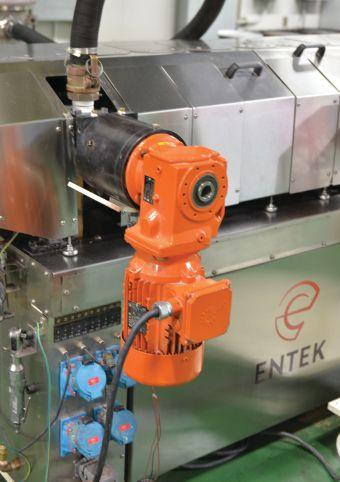
Entek Manufacturing will present new twin-screw technology, wear par ts, and material handling equipment. The development of another new Entek twin-screw extr uder, the HT 92, will
a lso b e a n nou nc e d. T he t w i n-s c r ew mach i ner y t e ch nolog y d isplays at t he compa ny’s ex h ibit b o ot h wi l l i nclude vent f low sensor tech nology mounted on a 103-m m twin-screw ext r uder ba r rel; V F T twin-screw mach iner y compounding tech nology for increased out put a nd i mp rove d p ro duct qu a l it y; a nd Ent ek twin-screw ext r uder mach iner y cont rols I n addition, the compa ny will display a 37-m m QC3 st uffer with a mounting a r m a nd 4 -by- 43 -m m t wi n-sc rew ext r uder ba r rels to show f lexibilit y a nd ease of switch ing between a vacuum st uffer a nd side fe e der. A nd Ent ek’s repla c ement we a r pa r t s bu si ne ss for t w i n - s c r ew ext r uders continues to g row following the launch of a wea r pa r ts division in Feb r u a r y 2 0 2 3 T h e c o m p a ny h a s increased its offer ings, added ma nufact u r i ng sh i f t s, st o cke d i nvent or y, a nd reduced deliver y ti mes of Entek wea r pa r ts, wh ich a re g ua ra nteed for OEM compatibility. At N PE2024, the replacement wea r pa r ts on display at the Entek b o ot h wi l l i nclude new feat u res a nd demonst rations of the Version 2.0 screw layout prog ra m, in addition to 162- a nd 250 -m m screws, 27- a nd 133-m m screw sets on sha f ts, 82-m m round ba r rels, a nd 16 0 -m m ba r rel holders.
PD : CX ENP PDBXBKHMF
Gneuss will show a complete Omni recy-
cling machine at its booth, featuring the MRS 130 extr uder, a water ring pump vacuum system, an RSFgenius 150 automatic melt filtration system, and an online viscometer. According to Monika Gneuss, the company’s vice president of sales and marketing, the Omni offers f lexibility and a compact design, and energy used in the extr usion process can be used in the next process step, reducing gas and elect r icit y usage. O r igina lly developed for pro cessi ng p olyet hylene t erepht ha lat e (PET) – and especially suited for recycling hygroscopic polymers a nd resins that require a high degree of devolatilization – the MRS extr uder is based on conventional single-screw technology but is equipped with a multiple screw section for devolatilization to enable efficient and gentle decontam ination of the polymer melt. “The satellite screws rotate in the opposite di rection to t he ma i n screw, wh ich dispropor tionately increases t he surface exchange of the polymer melt,” Monika Gneuss said “In a single, simple extr usion step, har mful contaminants can be removed so thoroughly that the resulting recycled pellets are safe for use in food contact applications ” In addition, she said, the MRS extr uder per mits the pro c essi ng of re cycle d PET (rPET ) directly into end products such as packaging sheet, st rapping tape, or f ila ments without pre-dr ying by using a simple and r ugged vacuum system The MRS 130 is designed for the processing of up to 1,0 0 0 kilograms (kg) per hour, or 2, 20 0 pounds per hour, of rPET and 750 kg per hour, or 1,70 0 pounds per hour, of polystyrene or polypropylene reclaim, she added, and the line on display in Orlando will be shipped to an rPET ther mofor mer in Per u after the show
K raussMa ffei will tout the updated design of its ZE 28 BP extr uder, which can be used for small-volume production or laborator y lines. It has a free volume out er- d ia met er-to -i n ner- d ia met er (OD/ ID) ratio of 1 65, a length /diameter (L/D) ratio ranging from 32:1 to 64:1, and can add up to th ree side feeders New features include a n i mproved head design t hat offers better protection of electrical par ts and simplifies cleaning, as well as a separated control cabinet that improves pro-
tection of the electrical equipment. The st a nda rd version a lso adds two more optional positions for the operator panel, allowing the machine to be operated from the lef t or r ight side. T he mach ine is equipped wit h K raussMa ffei’s pioneer processControl HMI software, which can provide step-by-step instr uctions for procedures such as star ting the production line or shutting it down In addition, common upstream and downstream systems can be integrated into the new control system
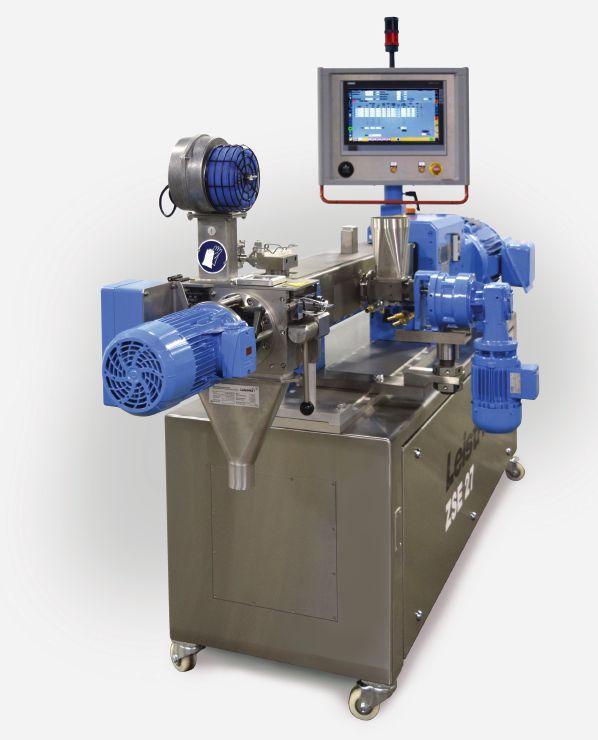
Leistritz will display a wide range of twin-screw extr uders and auxiliar y equipment, including the ZSE- 60 MA XX corotating twin-screw machine, which features a modular design for bar rels and screws that are rated for 425° C, or 80 0° F, operation, and which will be integrated with an LSB side stuffer for downstream introduction of fillers into the process section and an LSA swing gate strand die with provision for filtration; a ZSE- 40 MA XX co-rotating twin-screw extr uder, said to be well-suited for colour concentrates and production of small batches, wh ich will be integ rated wit h a n AC water- cooled motor i nto t he mach i ne design, which operates more quietly than a i r- c o ole d mo t o r s, a nd el i m i n a t
unwanted air f lows in the plant; a ZSE-27 MA XX co-rotating twin-screw extr uder, which features a quick-change f langeless bar rel design for accelerated bar rel reconfiguration, and a gearbox attached to a dovetail mounting plate that allows the gea rbox to be quick ly repositioned to facilitate different L/D ratios testing; a ZSE-18 twin-screw extr uder, said to be ideal for research and development, with a base-mounted LSB side stuffer that allows downstream introduction of fillers, fibres, and shear-sensitive materials into a process melt stream; and a ZSE-12 twinscrew model, suited for continuous operation and designed for processing small batches, and with a process section that can be configured for liquid injection and multi-stage devolatilization.
RHLTK :SHNM RNE S V: PD
On the software side, Plastic Flow will be showcasing Version 4.2 of its polyXtr ue 3D simulation software, which helps users
PRISTINE GR APHENE
Snqnmsn aZrdc GxcqnFqZ og BkdZm
On vdq hr nmd ne sgd vnqkc&r otqdrs oqnctbdqr ne fqZ ogdmd* Zm hmbqdchakx khfgs* rsqnmf* Zmc ctqZakd lZ sdqhZk- ?mc sgd bnloZm x hr mn v trhmf sgd rtarsZmbd sn hloqnud odqenqlZmbd Zmc qdctbd lZ sdqhZk trZ fd hm okZrshbr-
Wou can be forgiven if you don’t k now much about graphene – it’s only been a round since 20 04, when two Br itish scientists at the University of Manchester created the world’s first single-layer graphene f la kes by peeling a sheet of mater ial from a graphite pencil tip using only sticky tape
It may have been an inauspicious, lowtech star t, but graphene more than ma kes up for this by vir tue of its unparalleled perfor mance. Indeed, it’s a tr ue super material, right out of science fiction – a oneatom-thick layer of carbon atoms bonded together in a hexagonal lattice, the subst a nce is 20 0 ti mes st ronger t ha n a n equally thin piece of steel and yet 1,0 0 0 times lighter than paper, harder than diamond, more conductive than copper, holds together at temperatures of up to 70 0°C or 1,30 0°F, and can withstand acids
So, it’s no wonder resea rchers a round the world have been studying ways that graphene can advance mater ial science and technology, especially as a replacement mater ial for ca rbon fibre and other ca rbon f illers, the uses of wh ich have
stalled because of high costs and availability. But the results have been sketchy so fa r: After 20 yea rs, graphene is only just st a r ti ng to be used i n rea l-world applications, due mainly to the fact that it’s difficult and expensive to manufacture at com mercial scale
S DRSHMF’ S DRSHMFy
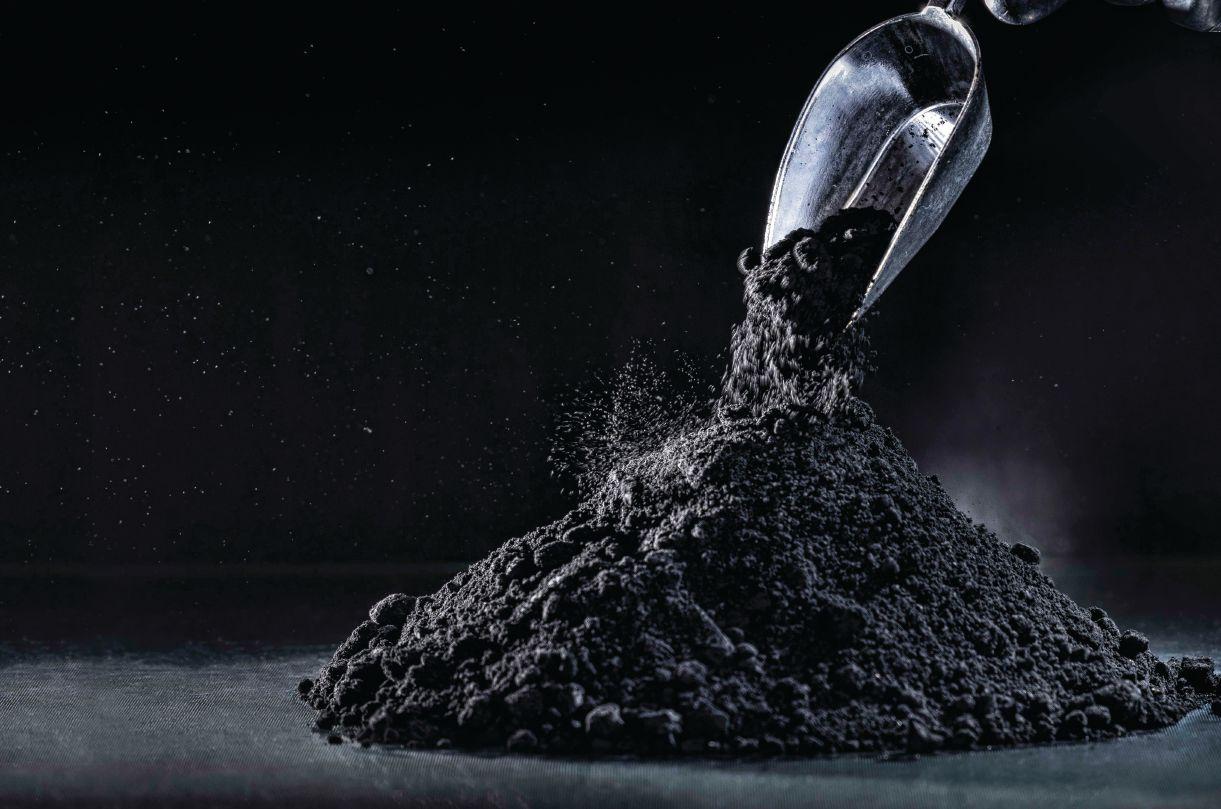
But a Canadian graphene manufacturer is aim ing to change this, and is proving it, in pa r t, by combining the substance with polyethylene terephthalate (PET) in blow molded bottles to improve the plastic’s per for mance and reduce mater ial in the bottles by up to 15 per cent. HydroGraph Clea n Power I nc , hea dqu a r t ere d i n Toronto, is one of only five cer tified graphene ma kers in the world, and recently finished testing to assess if its 99 8 per cent pure ca rbon content fractal graphene – ca lled FGA-1 – would en ha nce t he mechanical proper ties of PET “Testing was done at the Graphene Engineer ing Innovation Centre [GEIC] at the University of Manchester, which specializes in the rapid development and scale-up of
graphene and other 2D mater ials applications,” said Ranjith Divigalpitiya, HydroG raph’s ch ief science off icer. “Tensile testing showed an increased elasticity of 22 per cent at 0 5 per cent g raphene weight, increased strength at brea k ing by 114 p er cent f rom vi rg i n PET, a nd increased strength at yield of between 13 to 15 per cent.” And by having less mater ial in the bottles overall, he continued, manufacturers will also save on energy from reducing the need to heat and cool the mater ial.
And as new as graphene is, HydroGraph’s graphene is even newer, due to being produced using the company’s patented Hyper ion controlled-explosion system at its production facility in Manhatt a n, Ka n. “Trad itiona l mass g raphene m a nu fa ct u r i ng uses m i ne d g r aph it e, which is energy-intensive, expensive, and results in a ver y impure type of graphitic mater ia l t hat’s made at a ver y sma l l sca le,” Diviga lpitiya sa id By cont rast, HydroGraph’s Hyper ion gas-based detonation process works by filling the unit’s chamber with acetylene and oxygen and