VICE PRESIDENT Tim Dimopoulos • tdimopoulos@annexbizmedia.com
PRESIDENT & CEO Mike Fredericks
ANNEX BUSINESS MEDIA
80 Valleybrook Drive, North York, ON, M3B 2S9; Tel: (416) 510-5198; Fax (416) 510-5140.
Packaging, established 1947, is published 10 times per year except for occasional combined, expanded or premium issues, which count as two subscription issues.
PRINTED IN CANADA
ISSN 008-4654 (PRINT), ISSN 1929-6592 (ONLINE)
PUBLICATIONS MAIL AGREEMENT NO. 40065710
CIRCULATION
e-mail: rthava@annexbizmedia.com
Tel: (416) 442-5600 ext 3555
Fax: (416) 510-5170
Mail: 80 Valleybrook Drive, Toronto, ON M3B 2S9
SUBSCRIPTION PRICE PER YEAR (INCLUDING ANNUAL BUYERS’ GUIDE): Canada $74.50 per year, USA $130.95 US per year, Outside Canada $149.00 US per year, Single Copy Canada $10.00, Outside Canada $27.10.
From time to time Canadian Packaging will mail information on behalf of industry-related groups whose products and services we believe may be of interest to you. If you prefer not to receive this information, please contact our circulation department in any of the four ways listed above.
from time to time. Canadian Packaging, its affiliates and assignees may use, reproduce, publish, republish, distribute, store and archive such unsolicited submissions in whole or in part in any form or medium whatsoever, without compensation of any sort.
We acknowledge the [financial] support of the Government of Canada
BRAND LOYALTY A PRIVLEGE, NOT A RIGHT
No modern-day national consumer brand worth its salt can expect to stick around for long without building up and maintaining a loyal brand following among its target audience, and it’s probably fair to say that losing that loyalty is infinitely easier than either building or regaining the consumers’ trust and devotion.
The recent firestorm over the self-combustible Galaxy Note 7 brand smartphones will no doubt leave its South Korean brand-owner Samsung Electronics with plenty of damage control work in months ahead if it intends to regain the trust and goodwill of the spooked general public, and it’s far from certain that it will do so with enough aplomb to regain the lost ground, let alone recoup the estimated US$17 billion that the botched product recall wiped off the company’s market value in almost a blink of an eye.
Luckily for the Galaxy brand, the Samsung Group “chaebol” conglomerate, which accounts for an astounding 2.5 percent of South Korea’s gross domestic product, has deep-enough pockets to try to wipe the slate clean in coming years, but it’s still an extraordinarily expensive lesson in mea culpa humility.
The vast majority of consumer brands, however, do not get the luxury of a second chance when things go horribly wrong for whatever reason.
This is especially true in the unforgiving North American grocery retail marketplace, where consumers are more spoiled for choice than they have ever been in the past.
To a large extent, this abundance of choice has much to do with the relentless gains in market share by the private-label store brands, which nowadays seem to be a basic pre-requisite for doing business for any retailer seeking to ensure meaningful long-term growth.
Competitively priced and decently packaged, today’s leading store brands are a far cry from yesteryear’s early ‘no name’ offerings evoking ridicule or empathy from consumers with enough purchasing power to resist the primary lure of lower price points.
The thing is, such consumers are becoming an increasingly rare species in a North American economy still struggling to adjust to the post-Great Recession’s new normal.
The rapid proliferation of dollar-stores in recent years speaks volumes about the new consumer realities that many national brands can only ignore at their considerable peril.
According to a major study released by the Private Label Manufacturers Association (PLMA) last year, many U.S. consumers who were forced to switch to cheaper store brands during the recession for primarily economic reasons have been reluctant to return to their previous free-spending ways, even if their own economic lot improved in the meantime.
And it’s not just about saving a few pennies here and there, The Rise of Loyal Shoppers report points out.
“During the recession, price was likely the foremost reason consumers passed on their favorite national brand for the first time and instead tried the store brand,” the PLMA study observes.
“But in the post-recession era, it can be reasonably asserted that the drivers of trial may also include prior favorable trial with a store brand in another category, store brand product innovation, the introduction of a store brand for the first time in the category, and even the delisting of a favorite national brand.”
Which is all to say that if you’re a national brand that is largely sitting still, you’re actually falling behind whether you know it or not.
And good luck with that: You will need it.
George Guidoni
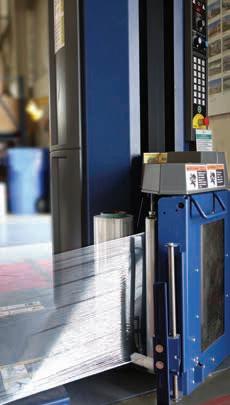
helps venerable supplier of kitchen sinks and faucets lighten the load at its shipping docks.
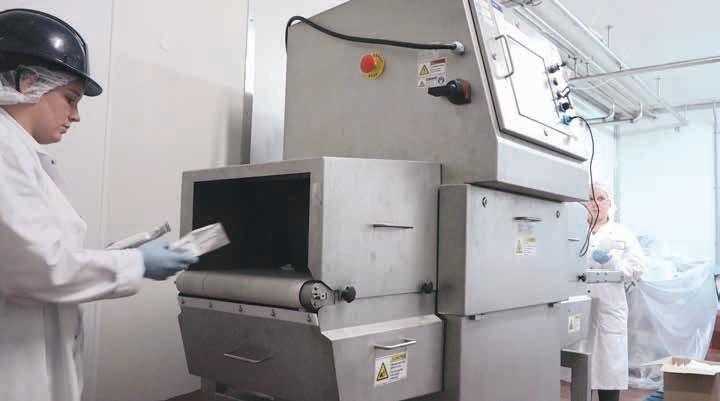
product inspection technology helps East Coast ice-cream producer optimize product safety and quality assurance.
NEWSPACK
BALLUFF CANADA’S NEW HOME DIGS A FITTING BACKDROP FOR SOME FESTIVE CHEER
While turning 18 is a monumental coming-ofage for teenagers the world over, there is no reason for companies like Balluff Canada Inc. not to celebrate such a special occasion with some extra youthful flair and exuberance.
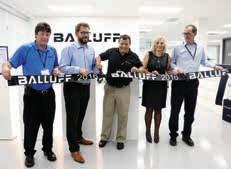
Which is exactly what the fast-growing industrial automation supplier did last month at its new Canadian headquarters in Mississauga, Ont.— opening its doors to customers for an official ribboncutting ceremony in celebration of the company’s updated branding logo and identity.
Originally established in 1998 as a subsidiary of the Florence, Ky.-based Balluff Inc.—itself the North American subsidiary of Balluff GmbH of Neuhausen, Germany—Balluff Canada has grown in leaps and bounds from a one-person operation headed by president Norm Clarke.
Having evolved into a flourishing entity in the Canadian market for industrial automation, the company today employs 28 full-time staff at the 15,000-square-foot building.
“We are very proud of our new facility,” said Clarke. “This investment by out parent company clearly reflects our organization’s commitment to the Canadian market and reinforces our promise of global support for our customers around the world.”
To mark the occasion, the parent company’s fourth-generation current chief executive officer Florian Hermle introduced the company’s updated brand logo and unveiled the company’s direction for upcoming years.
“Steady progress in the interests of the customers is name-of-the-game for our family-run company,”
ORGANIC SNACKS PRODUCER READY TO LAUNCH HEALTHY INDULGENCE WITH INNOVATIVE PRODUCT AND PACKAGING
Born in 2005 out of love for natural food and a belief that it can fuel an appetite for life, PRANA BioVegan Inc. takes a lot of pride in offering Canadians a wide range of wholesome organic snack products such as nuts, seeds, dried fruits, trail mixes and socalled ‘superfoods’ retailed across Canada at major grocery store chains and independent retailers.
Nowadays employing over 70 people at a state-of-the-art production facility in Montreal, the company also takes a lot of pride in the way it packages its premium-quality products, including the soon-to-be-launched Chocolate Bark line of fair-trade chocolate thins infused with a delightful mix of nuts, seeds and fruit.
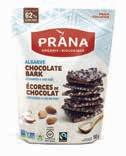
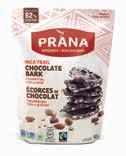
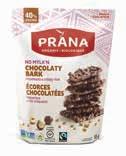
Set for the national launch in January of 2017, the organic Chocolate Bark will be offered in four unique non-dairy formulations—including PRANA Algarve (almonds and sea salt), Caraze (caramelized nuts with sea salt), Inca Trail (cranberries, nuts and seeds), and the all-vegan No Mylk’n (hazelnuts and crispy rice)—that are “as delicious as they are nutritious,” according to the company.
“It’s a wholesome indulgence,” explains company co-founder MarieJosée Richer, citing 62-percent dark cocoa content for three of the brand’s flavors and 40-percent for the Hazelnut and Crispy Rice Chocolaty Bark, which
is made with dehydrated rice syrup to provide a rich, creamy texture and a color similar to milk chocolate.
Offering one-year shelf-life, the new chocolate treats are packaged in resealable, 100-gram stand-up pouches (95-gram for No Mylk’n) decorated with vivid graphics and product images designed by the Montreal office of leading package design services provider Pigeon Brands.
“We are very happy with the way Pigeon updated our logo and developed such attention-grabbing an innovative presentation for our highly innovative new chocolate products,” Richer told Canadian Packaging.
“Because we are competing in the organic sector, it is important for us to provide Canadians with attractive and practical packaging that makes consumers take our product seriously, not just as some hippie granola experiment,” says Richer, adding the company sold an estimated 1.5 million kilograms of organic, fair-tade, non-GMO products in the last year.
“We are all really excited about our upcoming product launch because it took as nearly a full year of continuous trial-and-error work to develop and refine the perfect taste, texture and consistency,” Richer adds.
“It is an ideal snack for satisfying the chocolate cravings for all the healthy indulgers out there.”
said Hermle, citing the new “innovating automation” brand slogan as a fitting visual communicator.
“Modern, dynamic and clearly-structured, the Balluff brand represents the company as being open, modern and future-oriented,” he explained.
“The new logo and slogan systematically reflect the deep corporate commitment to our core values of openness, progress, sustainability, reliability and quality.”
With an established presence in the Canadian automotive industry, Balluff Canada is working hard to increase its presence in the consumer goods industry by addressing the automation needs of the country’s packaging, pharmaceutical and food-andbeverage industries,” added Clarke.
“We are actively engaged in partnering with packaging suppliers to develop innovative new solutions to improve manufacturing and packaging automation,” he said, “to allow them to implement their quality objectives, as well as those of their customers.
“A new customer-centric facility, a modernized brand, and a global promise of being a leader in innovative automation will greatly support our Canadian team in meeting the needs of our marketplace. “
FOR THE RECORD
Please note that a Newspack section story appearing in the October 2016 issue of Canadian Packaging about the new limited-time Steam Whistle Brewing packaging on Page 6 inadvertently contained inaccurate information about the origin of some of the secondary packaging supplied to the brewery.
For the record, the lunch-box wrap and the six-pack wrap inside Retro Lunch Box gift-pack were both manufactured by Jones Packaging Inc. of London, Ont., with Concord, Ont.-based Packaging Technologies Inc. (PTI) supplying the mother tray and structured inserts.
The Canadian Packaging magazine regrets the inaccuracy.
From Left: Head of logistics Mike Moore, chief executive officer Florian Hermle, Canadian president Norm Clarke, head of administration Sophie Beckford, and director of field sales Kevin Sargeson cut the ceremonial ribbon at Balluff Canada’s open-house event last month.
NOTES & QUOTES
n Montreal-headquartered Transcontinental Inc. has completed the acquisition of Flexstar Packaging Inc., Richmond, B.C.-based flexible packaging supplier specializing in converting high-barrier plastic film— including printing, lamination and pouchmaking—for the cereal, confectionery, snack, frozen food and coffee markets. Employing more than 120 people, Flexstar Packaging generated about $36 million in revenues for the last 12 months ending in July 2016. “I
am proud of this latest acquisition in our strategy to grow our flexible packaging network as it is our first in Canada,” says TC Transcontinental president and chief executive officer François Olivier. “Flexstar enables us to extend our footprint to the West Coast, providing us a coast-to-coast platform to better optimize our production. In addition, it brings us new manufacturing capabilities with film extrusion, a complementary sales force and the ability to generate synergies.”
n Dartmouth, N.S.-based Farnell Packaging has completed the sale of all its label-making assets and equipment to the Amherst, N.S.-based label manufacturer Access Labels, leaving it free to focus on its higher-growth bagmaking and polyethylene packaging films business. “It’s a strategic move,” says Farnell’s chief financial officer Bill Morash. “Labels have always been a small portion of our business, most recently accounting for about three per cent of our revenues.” Under the
terms of the deal, Access Labels will take ownership of the eight-color label printing press used to make the ‘decal’ labels attached onto milk jugs and other common grocery items. “In choosing to partner with Access Labels, we believe that we are consolidating our label business with the most reputable and responsive competitor in the region,” says Morash. “We have every confidence that Access Labels will do their very best to professionally service and supply all pressure-sensitive label needs in the months and years ahead.”
n Cincinnati, Ohio-headquartered packaging equipment group Pro Mach, Inc. has completed the acquisition of Pacific Packaging Machinery, Inc., San Clemente, Ca.based manufacturer of high-speed rotary and inline liquid filling and capping equipment for leading manufacturers of food, pharmaceutical, personal-care, home-care and chemical products. “We look forward to working with the Pacific team to create new opportunities to grow our business and serve our customers around the world,” says Doug Stambaugh, vice-president of Pro Mach’s Bottling & Capping Group. “Pacific substantially broadens our filling capabilities with their strong presence and expertise in the food and consumer care sectors, [and] combined with our already strong market presence in beverage, dairy, and pharmaceutical segments, we now have a truly complete line of global filling and capping solutions.”
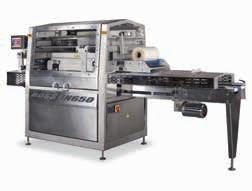
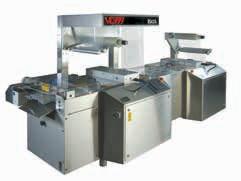
Nothing keeps your product fresher than MAP packaging produced on a Ross IN inline tray sealer.
n Produces MAP packages using preformed trays of almost any size or shape –easily packages your entire product line.
n Consistently produces packages with reliable, high-quality seals that extend shelf-life.
n Fast, highly flexible, and extremely easy to operate.
n Innovative tool/storage cart allows rapid, tool-less changeovers between tray sizes in 10 minutes or less.
n Stainless steel washdown construction and IP67 components.
n Compact footprint allows it to fit into tight areas.
n Test the Ross IN for yourself. Contact us to set up
n Decorative labeling manufacturer Fort Dearborn Company of Elk Gove, Ill., has completed the acquisition of SleeveCo, a supplier of shrink and stretch sleeve labels employing about 125 people at a label production facility in Dawsonville, Ga. “The acquisition further reinforces our leadership position in the prime label marketplace by strengthening our shrinksleeve offering and expanding our product line to include stretch sleeve label capabilities and application equipment,” says Fort Dearborn president and chief executive officer Jeff Brezek. “With the addition of SleeveCo, we will have increased capacity as well as enhanced capabilities to provide our customers more production options and increased flexibility.” Including the Dawsonville plant, Ford Dearborn now employs over 1,600 people at 15 manufacturing operations across North America to offer a comprehensive range of labeling solutions—including cut-and-stack, pressure-sensitive, rollfed and full-body shrinksleeve labels—across multiple printing technologies including digital, lithographic, flexographic, and rotogravure.
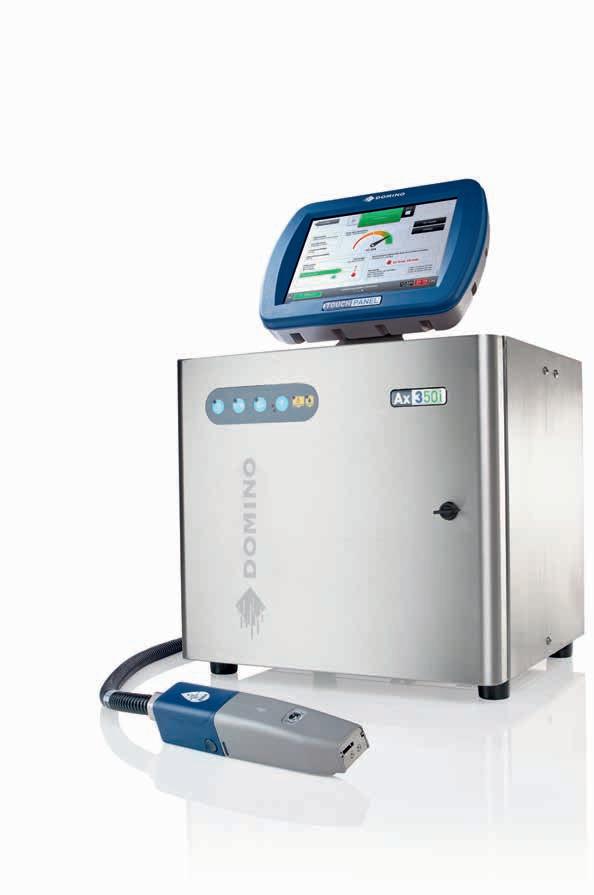
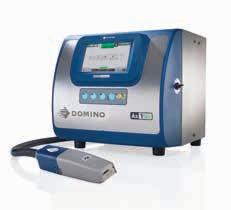
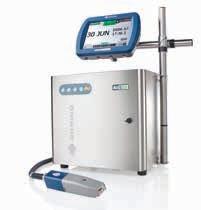
Domino Ax-Series: Coding Without Compromise
Rethinking Ink Jet
Rethinking Print Quality
• Variable droplets
• Clean, crisp codes
• Enhanced for human and machine readability
Rethinking Performance
• Large volumes of data
• Highest throughput
• Flexible deployment
• Complies with all standards
Rethinking Value
• Fast changeover and start-up
• Service-free
• Optimum ink usage, life and yield
Designed by Customers, Engineered by Domino
The way we think about it, if you want to improve your products, listen to your customers. So we did. We learned from your coding experiences and studied the regulatory, environmental and supply chain pressures you face.
And then we deconstructed Continuous Ink Jet as we’ve known it for the past four decades – before rebuilding it as a better, faster, more responsive and cost effective process. Experience the Domino Ax-Series and rethink Continuous Ink Jet.
To find out more or to book a demo visit www.ax-series.com
FIRST GLANCE
COVER YOUR TRAX
Developed by the Allpax division of Pro Mach, Inc. as a reliable basket tracing system for nonautomated retort rooms, the new AllTrax is a barcode-based system for tracing cans, jars, trays and pouches by basket through each critical checkpoint in the retort room and tagging those packages to verified processing by an individual retort. Designed to improve security within the retort room and to lower the risk of product retort bypass, AllTrax can be easily integrated into virtually every non-automated retort operation, according to the company. In operation, each basket is tagged with a human-readable and a machinereadable number, both in laser-etched stainless steel, for scanning each basket as it moves between loading, retorting, and unloading zones of the retort room, with each positive identification instantly cross-checked and verified by a software-based tracking system. All the nonconforming actions—such as a
failure of a basket to enter a retort or entering the wrong retort—trigger an alarm to alert the operator. Each basket scan prompts the tracking system to transfer a basket’s identity from one logical set of basket positions (zones) to the next, with basket checkpoints located at each loader, retort, and unloader system in the retort room.
Allpax
THE RIGHT PROFILE
401
The new Profile Advantage metal detector from Mettler Toledo Safeline incorporates multi-simultaneous frequency technology to analyze product signal data captured across a wide spectrum of frequencies simultaneously to deliver superior levels of detection sensiFrom food to pharmaceuticals, Heat and Control supports you with efficient and reliable equipment for weighing, container filling, conveying, packaging, and inspection. With more technicians in more locations, we also offer the industry’s most responsive technical support. Visit one of our demonstration centers today
info@heatandcontrol.com www.heatandcontrol.com
tivity. According to the company, the Profile Advantage detector is especially well-suited for high-accuracy inspection of as meat, dairy, bakery and other products that contain a high degree of moisture, which is often a big source of ‘false rejects” for less robust conventional metal detectors. By using the company’s proprietary 3S software algorithm in real time, Profile Advantage is said to obtain 30- to 50-percent higher sensitivity levels than many competing systems, with its Product Signal Suppression capability virtually eliminating the incidence of false alarms triggering by suppressing the active and unwanted ‘Product Effect’ signals generated by the products themselves, particularly high-moisture products. Moreover, the Profile Advantage metal detectors incorporate advanced Condition Monitoring technology to assess the performance and operation of key detector components and circuitry to identify any adverse trends or changes in performance that can potentially cause system downtime—giving operators advanced warning before a problem occurs.
Mettler Toledo Safeline 402
BLOWING HOT AND COLD
MAKING IT COUNT
Deitz Company’s new model TC3 automatic tablet counter, which automatically counts tablets, capsules, caplets, soft-gels, lozenges and other solid oral dose products —including opaque, translucent, or transparent—with 99.95-percent accuracy at extremely high throughput speeds of up to 2,500 products per minutes. Developed for high-speed, high-accuracy applications in the nutraceutical, pharmaceutical and cosmeceutical applications, the TC3 electronic tablet counter features fully PLC-controlled operation with no product change parts for easy set-up, usage and breakdown without tools—enabling very quick product changeovers in less than five minutes. Requiring only 36 inches of conveyor line, the mobile TC3 automatic pill counter may be rolled up to a companion Pharmafill conveyor or to an existing conveyor and easily positioned for smooth integration, with its integral lift platform allowing the versatile counter to be raised or lowered by hand-crank or by an optional motorized system to suit the height of the bottle and the conveyor.
Deitz Company 404
COMING CLEAN
The new Process Pilot automated blowmolder management system from Agr International, Inc. is designed to help PET (polyethylene terephthalate) bottle manufacturers measure, control and optimize their bottle blowing process by interfacing with the blowmolder to provide precise material thickness distribution on a per-bottle basis, while managing the blowmolder to eliminate the effect of process and environmental variables that impact bottle material distribution throughout the production cycle. When working in conjunction with the company’s CrystalView material optimization system—designed to provide PET bottle producers with automatic management of material orientation and crystallinity—the software helps to simultaneously manage material distribution and optimize material orientation over the entire bottle at the coldest practical processing temperature.
Agr International, Inc. 403
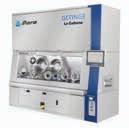
Designed for high-speed filling of pharmaceutical liquids and powders into vials, syringes and cartridges at speeds of up to 100 units per minute, the new Dara Moduline Model NFL filling solution NJM Packaging, a division of Pro Mach, Inc., covers the full range of dosing volumes from 0.1ml to 100-ml for liquids and from two to 1,500-mg for powders at accuracy levels of +/- 0.5 per cent. Controlled by an Allen-Bradley series PLC (programmable logic controller) from Rockwell Automation, the Dara Moduline Model NFL combines a decontamination module, which accommodates nests or trays of prepackaged RTU (readyto-use) vials, with a vial filling/stoppering/capping module in a compact, ergonomically-enhanced design outfitted with a single front window with automatic opening and closing.
NJM Packaging
FIRST GLANCE
OPTIMA SATISACTION
The new OptiPouch system from OPTIMA Packaging Group
GmbH combines a new rotary filling machine with a rotary closing machine to create a complete continuous process capable of processing up to 600 spouted pouches per minute, according to the company. Requiring only one operator to feed the machine with pre-fabricated pouches, the OptiPouch system can process many various pouch types and sizes ranging from 50- ml to 500- ml without the need to change size parts on the machine.
OPTIMA Packaging Group GmbH 406
THE PERFECT 10
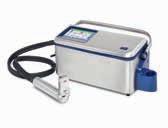
The new model Linx 10 continuous inkjet (CIJ) printer from Linx Printing Technologies is a compact, fully-portable entry-level CIJ printer designed primarily for smaller businesses that need to code products for the first time, as well as for use as a back-up machine for experienced CIJ users, which can quickly be moved and set up wherever required. With about half the weight and footprint of many conventional CIJ printers, the Linx 10 can be easily transported via its built-in carry handle to wherever it is needed to be mounted directly onto a conveyor or plugged into a production line, with its printhead dock helping to ensure accidentfree transfer. Despite its smallish dimensions, the Linx 10 incorporates robust value-added features, such as fast and easy, error-free message setup via a color touchscreen; the ability for users to service the printer themselves; and an integrated automatic line speed sensor to ensure consistent code quality regardless of how often the coder is moved between locations.
Linx Printing Technologies 407
YOUR BEST BET
The new Model 81 continuous inkjet system from BestCode —available in Canada from Weber Marking Systems —is targeted at the basic, entry-level marking and coding applications requiring the printing of one or two lines of text, barcodes or graphics on a wide range of substrates, including plastic, glass, paper and more. Featuring BestCode’s proprietary CleanStart technology that automatically cleans the system be -
fore startup, the Model 81 can print images ranging from two- to 12- mm in height—including ‘Best By,’ ‘Lot Code,’ ‘Sell By’ and ‘Expiration’ codes—at speeds of up to 190 meters (600 feet) per minute, with its standard 10.4-inch color touchscreen providing a vivid display with large intuitive buttons and status indicators for optimal user-friendly operation in all sorts of wet, dry, dusty, hot or cold workplace environments. Weber Marking Systems 409
Decorate your customers’ glass and ceramic containers with bright, vibrant effects that really liven up the shelf. With Sun Chemical, you get a complete line of UV, LED and thermally cured organic inks, coatings and sprays — all from a single source. That includes everything from metallics to foil adhesives, which are backed by our global expertise and world-class service and support. Request your copy of Glass Decorating Innovation Concepts at www.sunchemical.com/glassdecorating or call 1-708-236-3798.
84879_SunChemical_ GlassDeco Ad -Canadian Packaging
CANADIAN BIOTECH ENLISTS GREEN SOLUTION FOR ITS WAR ON WASTE
For companies whose very purpose in life is to help keep the planet clean, using sustainable packaging for its products comes naturally.
Founded in 1996, Quebec-based Bionetix International Inc. produces a broad range of biological waste treatment products found in countless food preparation and processing locations in North America, Europe, South America and Asia. The company’s biological digestants are composed of 100-percent naturally occurring, non-pathogenic
microorganisms that have been specifically selected for their abilities to degrade target substances without the use of chemicals.
About a year ago, the company placed its first order for the new EcoSol brand of a water-soluble, biodegradable, polyvinyl alcohol (PVOH) film manufactured by the St. Paul, Minn.-based Cortec Corporation
Developed specifically for packaging applications required where dissolvability and biodegradability, products packaged in EcoSol film can be thrown
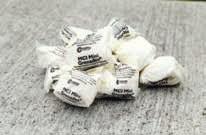
industry, Cortec’s MCI Grenades consist of migrating corrosion inhibitors (MCIs) packaged in EcoSol water-soluble PVA bags, which quickly dissolve upon contact with water in the concrete mix.
directly into the treatment area without removing the film, according to Cortec. After a few minutes of immersion in water at the right temperature, EcoSol will dissolve into a harmless, non-toxic aqueous solution of polyvinyl alcohol, releasing the packaged product to do its work. The film’s polyvinyl alcohol byproduct will further degrade into simple carbon dioxide and water about 30 days after being exposed to common microorganisms found in water-treatment plants.
Using the EcoSol film for different Bionetix biotechnology products for natural cleaning, waste and agricultural treatment has left Bionetix production manager Walter Luis impressed.
“The Cortec film is a better and superior film to what we were using before,” says Luis, who now uses it to package all Bionetix products of a certain size.
While the EcoSol film is not a core business for Cortec—whose primary focus is to formulate corrosion-resistant coatings and other surfacepreparation products—producing it in-house has been helpful.
“It’s beneficial because we have full control over the quality control here and are never really held hostage by other people,” says Tim Bliss, manager at the Cortec Advanced Films Division (CAFD) business unit.
Bliss says the CAFD has been making the film for about 10 years and has been using it in various Cortec products, such as the innovative Boiler Lizard and MCI Grenades powder-packs.
However, the dissolvable characteristic brings its own challenges to producing EcoSol film.
“It’s very moisture-sensitive, so it has to be kept in barrier bags so that the moisture can’t get to it,” says Bliss, adding that EcoSol provides up to two-year shelf-life if the barrier film is kept intact and the product is kept in dry storage at room temperature.
Designed for dry lay-up of boilers, Cortec’s Boiler Lizard contains vapor phase corrosion inhibitor powder in an EcoSol water-soluble PVA bag.
Designed to protect steel and other metals used in the construction
Important Dates
Early Bird Date – November 30, 2016
Entry Deadline Date – January 30, 2017
Package submissions to judging site – February 2, 2017
Finalists Announced – February 21, 2017
Winners celebrated at Awards Gala on May 2, 2017
MEAT BEAT MASTERCLASS
Toronto frozen meat products pioneer celebrates past glories by building firm foundations for a prosperous future
BY GEORGE GUIDONI, EDITOR PHOTOS BY COLE GARSIDE
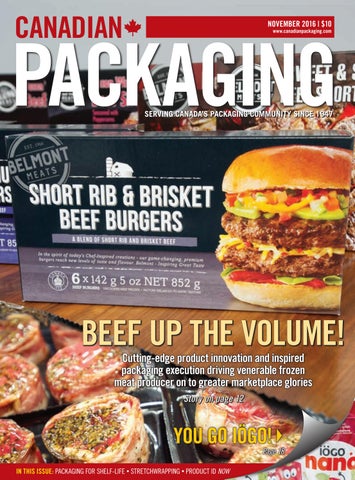
Grilled, braised, griddled, roasted, barbecued or fried, an expertly cooked serving of tasty quality beef is a powerful culinary tour de force of many of the world’s more popular cuisines and dining rituals, with Canada no exception to mankind’s timeless and widespread affection for beef in all its many varieties and incarnations. But simply being one of the world’s most prized and nutritious sources of animal protein is no guarantee of success in today’s fiercely competitive global beef industry, where value-added product innovation is just one of many key pre-requisites for continuous growth and prosperity for meat processors chasing higher market share and brand loyalty in retail and foodservice markets at home and abroad.
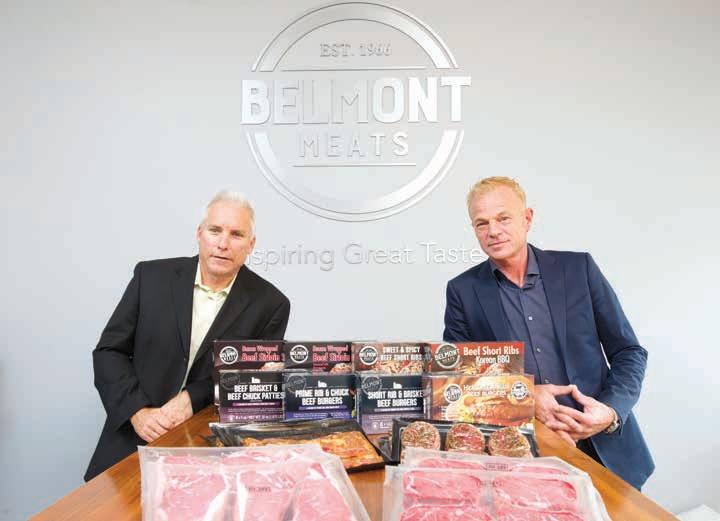
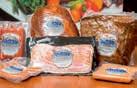
Belmont Meats president and chief executive officer Paul Roach (left) and vice-president of operations Eric Van Zyl pose with some of the premium-quality frozen meat products produced at the company’s busy 50,000-square-foot processing facility in north Toronto, which processes an average of 1.3 million pounds of meat per week for retail and foodservice customers.
Belmont Meats’ award-winning retail packaging is manufactured in Toronto by GoldRich Printpack Inc.
Happily for folks at the Belmont Meats frozen meat processing and packaging plant in north Toronto, continuous innovation and improvement are all part and parcel of the company’s hard-working team spirit and ethic that has enabled it to maintain a steady upwardly growth curve from the get-go some five decades ago.
Celebrating its 50th anniversary this year, Belmont Meats is a proud daily practitioner of the company’s firm belief in the virtue of “making safe, affordable, great-tasting food choice available to everyone and to inspire others with the same beliefs.”
CLEAN OPERATOR
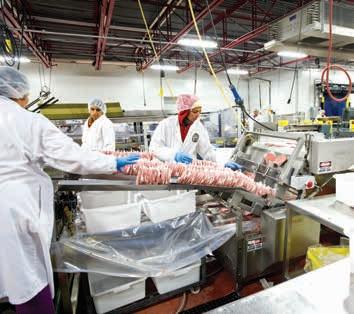
Employing about 160 people at a spanking-clean, 50,000-square-foot production facility housing five production lines, including a segregated allergenfree production line and a steak portioning line, the federally-inspected Belmont Meats facility excels in the production of “made to specification” beef products retailing across North America and select international markets as private-label offerings and as Belmont-branded meal solutions, along with supplying a broad range of foodservice customers in QSR (quick-service restaurant), casual and fastdining, and institutional market segments.
B oasting internationally-recognized HACCP (Hazardous Analysis Critical Control Points) and SQF
(Safe Quality Food Institute) certifications for food safety assurance, the busy plant turns out well over 200 different SKUs (stock-keeping units) for a diverse list of loyal customers, including many of the top retailers and restaurant chains in Canada .
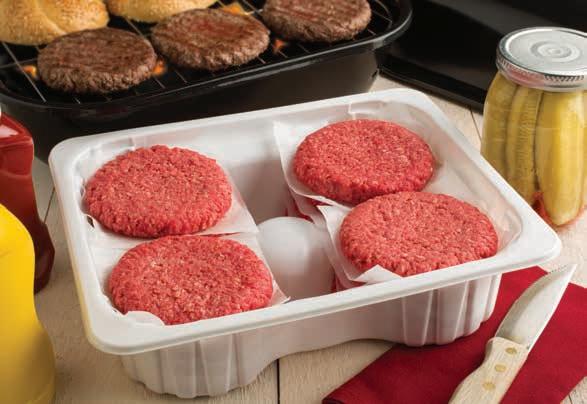
W hile traditional, pure-beef and source-ground frozen burger patties account for well over 80 per cent of the plant’s weekly processing output of about 1.3 million pounds of meat, Belmont Meats has made great strides to diversify its product portfolio in recent years, particularly on the retail side of the business, with exciting new products that nowadays comprise portioned and/or marinated steaks, primal cuts and roasts, as well as made-to-order
custom-butchered beef cuts.
Even among the seemingly straightforward frozen burger and patty offerings, Belmont Meats produces a remarkably broad variety of products covering the full gamut of mouthwatering recipes from 100-percent sirloin and Angus beef to prime rib, chuck, brisket and sirloin grinds.
According to vice-president of operations Eric Van Zyl, being able to offer Canadian consumers such a diverse range of premium-quality products made from the finest cuts of beef sourced across Canada and worldwide—along with some processed pork and poultry—is playing a big role in the current market success of the company’s flagship Belmont
Installed at the Belmont Meats plant by Reiser (Canada) Ltd., the Repak horizontal form/fill/seal machine is a highspeed workhorse with plenty of operational flexibility.
The Belmont Meats facility specializes in producing “made to specification” burgers for some of North America’s leading fastfood restaurants and reatilers in strict accordance with the clients’ recipes, using the highest-quality meat and ingredients.
Installed at the end of the Repak horizontal bagging line inside the allergen-free packaging room, the Koch Matrix Labelers from Koch Equipment LLC are used for precise placement of product labels onto the plastic bags of frozen burger patties.
brand of boxed frozen meat products.
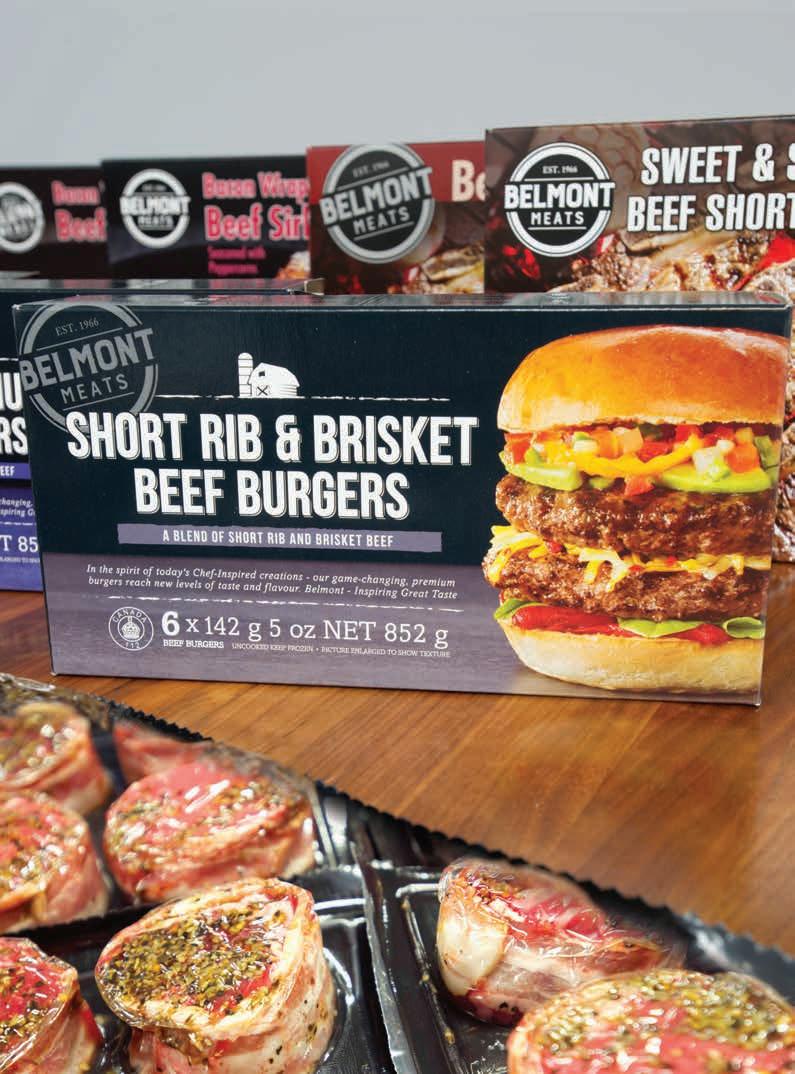
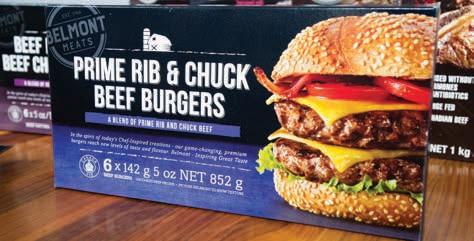
Beefed up with this fall’s successful market launch of new high-end Prime Rib/Chuck, Short Rib/ Brisket and Brisket/Chuck grinds—along with Sweet and Spicy Short Ribs, Tuscan Short Ribs, Korean Short Ribs and hormone- and gluten-free Angus Beef Burgers —the Belmont brand is performing “exceptionally well” in the supermarket frozen food aisles across the country, according to Van Zyl.
“There is no doubt that the beautiful and highly distinctive packaging designed for our branded products is a major driver in the success that we are enjoying in the market and the great feedback we are getting from our retail customers,” Van Zyl told Canadian Packaging on a recent visit to the well-equipped factory humming with fastpaced production activity and running largely with clockwork precision, despite not being a highly automated operation in the packaging area of the production floor.
NEW AND IMPROVED
“We are all very proud of our new packaging,” says Van Zyl, pointing to the gorgeous, larger-than-life, close-up product photography displayed against a classy black background of the litho-printed paperboard boxes containing the delicious meat products bagged inside.
Created by the Toronto-based branding services agency Raining Creative and converted by GoldRich Printpack Inc., also of Toronto, the visually stunning, award-winning folding cartons perfectly reflect the company’s deep-rooted commitment to quality and innovation.
Van Zyl says the attractive packaging does due justice to the high-end process used to make the premium-quality Belmont brand burgers.
“We use home-style technology that produces a fluffier, looser ‘low-pressure’ burger, which looks like a smashed home-made burger that in the old days your mom would make by slapping it together from one hand to the other,” he reveals.
“We also use a lot of unique spice blends to achieve a distinctively high-end taste profile,” he adds.
“As a burger manufacturer, you are very much limited to the conventional bag-in-a-box format that dominates this industry segment,” says Van Zyl, a lifelong meat industry professional who joined Belmont
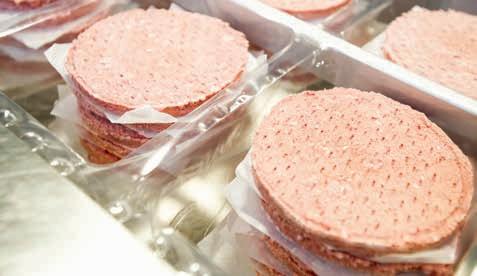
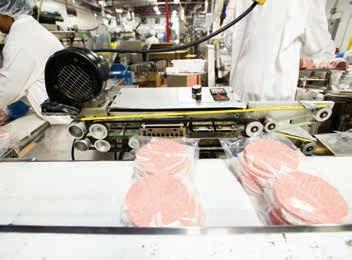
After being visually inspected and manually inserted with paper partitions inside the plastic bags by line operators, the stacked rows of frozen burger patties are reliably side-sealed by an Emplex bag sealer at one end prior to being placed inside the paperboard cartons.
Meats 16 years ago to help steer the company into the upper ranks of the Canadian meat-processing business.
“So if you want to innovate in this space, you either develop a better box or better bags to stand out in the crowd, and I think we did both very well on both fronts,” Van Zyl relates.
“Raining Creative did a terrific job with developing the engaging artwork and with updating our company logo on the new boxes to really connect with consumers on the emotional level,” Van Zyl extols.
“We have also invested heavily in some highperformance bagging and vacuum-sealing equipment over the years to enable our products to achieve up to one-year shelf-life,” Van Zyl points out, citing the company’s proud record of proactive R&D investment to nurture continuous “game-changing” innovation.
“We push for innovation on a daily basis with the help of our outside business partners,” Van Zyl proclaims.
“We continuously strive to be a leader and innovator on all fronts, including full transparency and engagement with all our customers as well as all suppliers.
“Critically, we also engage our employees in all our innovation efforts,” says Van Zyl, praising the plant’s highly dedicated and motivated workforce boasting exceptionally high retention rate and long average length of service.
“We have one plant-floor operator who has now been with the company for 40 years,” Van Zyl remarks, “which is in fact when this facility first opened up back in 1976.
“Our people are undoubtedly our biggest asset,” he states. “You can have the best machinery in the world, but it is just a pile of metal unless you have your people actively engaged in doing the best job they can with that equipment on a daily basis.
“We would not be where we are today if it wasn’t for our people’s total buy-in into what we are trying to achieve as a company.”
The Belmont Meats factory is largely an aroundthe-clock operation that runs two daily production shifts, six day per week week, with a third shift set aside for rigorous cleaning and sanitation of the entire facility and equipment—all designed to withstand
high-pressure washdown procedures mandated by the Canadian Food Inspection Agency (CFIA) regulations.
Van Zyl says the plant offers its employees continuous skill training with the intent of maintaining a highly flexible, cross-trained staff capable of stepping into whatever role they need to fill on the plant floor— especially during the peak season typically lasting from December to the end of August.
W hile the company’s early focus was devoted primarily to supplying steak and other primal cuts to the foodservice sector, the onset of the well-evidenced burger renaissance of recent years prompted it to enter the fast-growing burger segment in a significant way, Van Zyl relates, by adding a new burger production line in 2008 and another one in 2013.
About a year ago, the plant has implemented a robust, plant-wide product traceability system that enables it “to track everything from raw materials coming in right up to the shipping stages.
“It was amazing to see our employees step up to the plate the way they did to make the traceability system work so efficiently,” Van Zyl recalls.
“ They achieved within weeks what I would have thought require d many months: I am really proud of them.
“Most of our plant employees have iPad tablets on the floor with them at all times to record whatever raw material seasoning is added to the meat during the processing stages, as well as the all the important product info like weight, line speeds, yields and other key data in real time,” Van Zyl explains.
“It works so well that I can actually sit at home with my iPad and see how the lines are running at the factory,” says Van Zyl, noting such capabilities are for the large part still a rarity in today’s meat industry.
“All the raw product that comes in has a lot code number assigned to it, telling us when it was received, how much weight is on the skid, where the product came from, and how many cases of it went into any particular batch for processing,” he explains.
The traceability system is a very handy tool in helping the plant to uphold “the highest food safety standards at all times, even to exceed them as much as we can,” Van Zyl states.
“Food safety is always a top priority for everyone at Belmont: from top-level managers right through the plant floor,” says Van Zyl, saying the plant employs
one easily-integrated station could divert, transfer, and sort?
The MODSORT station is an innovative low-noise, low voltage modular transfer and diverter station. It can easily integrate with new or existing material handling systems, eliminating the need for a lift, pneumatics, or Z-direction position feedback devices, and can help achieve energy savings from 50-60% when integrated with a motorized roller-based system.
MODSORT utilizes System Plast™ 2253RT Roller Top Belt featuring a 1-inch on-center sphere array, allowing very small packages to be moved. Motorized Drive Rollers and controls allow flexibility in wiring, the ability to move everything from exceptionally small polybags to boxes, and safe, efficient, quiet and low-maintenance operation.
For more information, visit www.RegalPTS.com/MatlHandling
COVER STORY
many robust product inspection technologies— including metal detectors, bone collectors and fat analysis testing systems—to ensure optimal quality control and product consistency.
“We all strive for the same goals here to facilitate full transparency and employee engagement, which are key to our ongoing success,” he asserts.
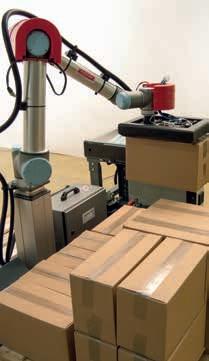
W hile Van Zyl acknowledges that the factory’s packaging lines are “not heavily automated” at the moment—still using manual labor to insert the product inside the boxes, stack them onto the skids and stretchwrap the finished loads—they are as automated as they need to be to suit the plant’s current needs, as well as floorspace constraints.
“Each one of our production lines can run every single product we make here, which gives us tremendous flexibility in terms of executing
extremely fast product changeovers,” he says, noting that it takes an average of 30 to 45 minutes for a cut of raw beef to be transformed into a finished product ready to be bagged and boxed.
“Our state -of-the-art tempering, grinding, forming, freezing and primary packaging equipment can accommodate many various burger shapes and sizes in very efficient manner,” Van Zyl states.
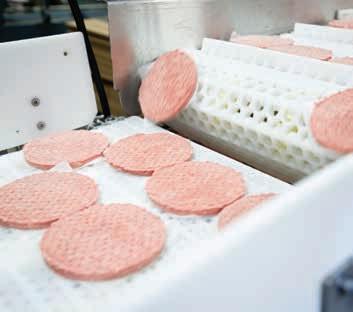
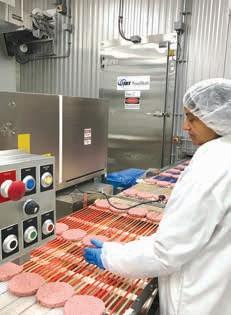
“After about 15 minutes of preparing the batch, including blending, the meat then gets formed at speeds of over 500 patties per minute in the freezer, and transferred by conveyor straight down to the assigned packaging station.”
At that point, the finished frozen patties go through a metal detector just before being bagged and packed on an automated Nordale cartoner machine and mastered ready for shipment.
A keen observer of consumer trends, Belmont Meats has made significant investment to expand its range of allergen-free products—installing a fullysegregated packaging line to process and package on a Repak horizontal form/fill/seal (HFFS) machine.
D istributed in Canada by Burlington, Ont.based Reiser (Canada) Ltd., the Repak machine is equipped with robust gas-flushing capabilities for vacuum-sealing products requiring extended shelf-life, if and when required by customer.
“We are widely acknowledged to be one of the most efficient and productive burger plants in North America,” says Belmont’s president and chief executive officer Paul Roach, “and we are actively looking expand into other promising categories, as well as opening up new U.S. markets.
“We are already shipping product into the
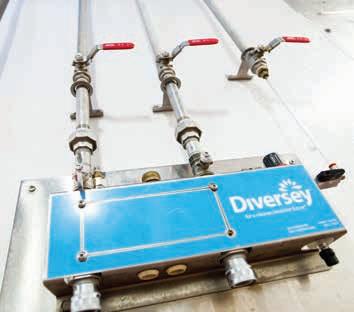
The Belmont Meats plant makes extensive use of Sealed Air Diversey Care’s sanitation systems and products to maintain a highly hygienic working environment in all production areas.
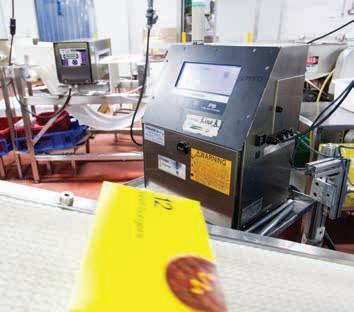
A filled box of store-brand burgers passes by the Hitachi PB model inkjet printer, supplied by Harlund Industries, for application of all the pertinent product code data onto the side panel.
Rows of frozen burger patties coming out of an RMF burger-stacker are immediately stood upright and separated into the required quantities prior to being inserted inside the bags.
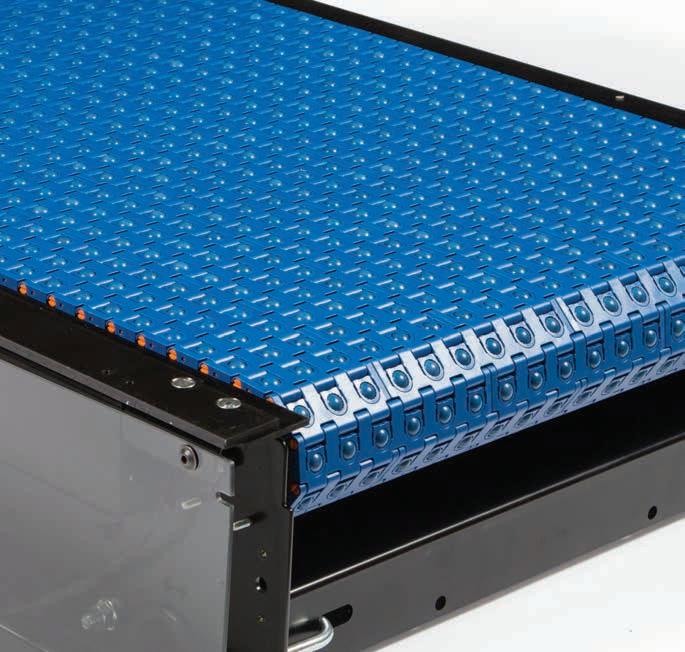
All the meat products processed at the highly-hygienic Belmont Meats plant are transferred through their packaging stages on food-grade plastic conveyors made by Hager Industries.
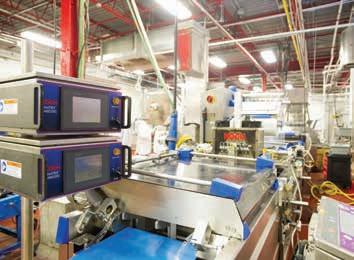
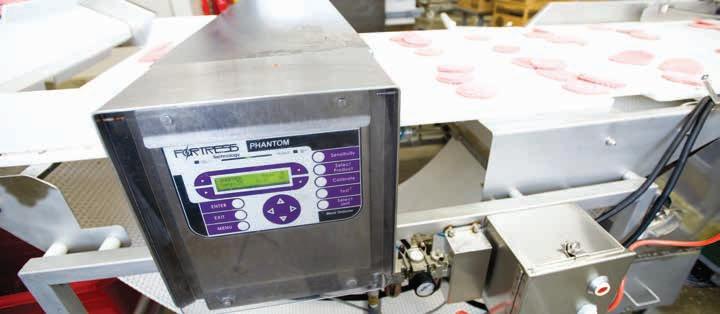
of several robust product inspection systems deployed throughout the Belmont Meat facility, the Phantom series metal detector, manufactured by the Toronto-based Fortress Technology, uses advanced digital signal processing (DSP) technology to ensure reliable high-speed detection of the tiniest metal particles to provide optimal quality assurance and product safety.
New York market and will soon be shipping to the Chicago area , and given the massive size of the market south of the border, we’re really just getting started.
“ The idea is to build up our presence in some strategic regional U.S. markets and eventually expand our scope nationwide,” says Roach, who joined the company in January of 2015.
“Another key growth area for us is the foodservice market,” Roach adds, “and we can leverage our strengths in the burger and steak segments to make deeper inroads there.”
L ike Van Zyl, Roach says he is highly encouraged by the overwhelmingly positive consumer feedback to the new-look Belmont brand packaging.
“ Building on the Belmont brand is a key part of our growth platform both in Canada and the U.S.,”
he states, “and we are delighted by the consumers’ enthusiastic response to our new packaging in both countries.
“Our packaging is our message board to our consumers—a communications vehicle to encourage consumers to give us a try,” says Roach, adding the company is quickly accelerating its new product development, citing creation of a new senior Innovation Leadership role to oversee the efforts.
“We are fully prepared and eager to keep pushing the envelope in order to build on the amazing foundation this company has established over the last 50 years,” Roach concludes.
“For an innovative company like ourselves, there has never been a better time than now to be in the beef business.”
One
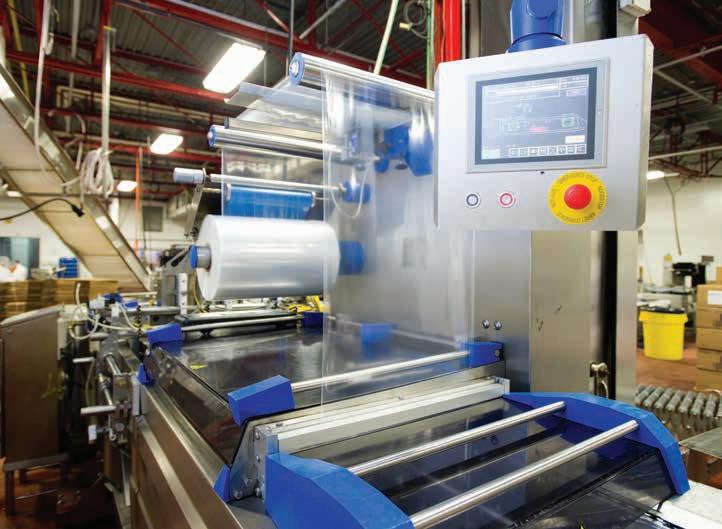
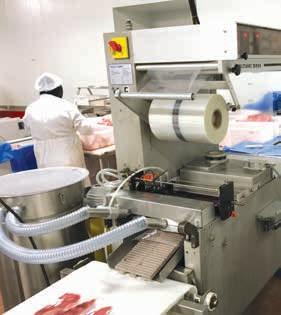
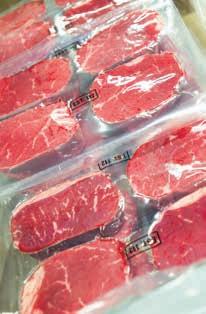
One of several Multivac M855 thermoforming machines used at the Belmont Meats factory to vacuum-pack various primal cuts of premium-quality beef (inset) inside high-barrier rollstock film supplied to the plant by Packall Packaging Inc.
Fresh burger patties pressed into shape on the Formax Forming machine make their way to the JBT FoodTech spiral freezer conveyor to be frozen solid prior to packaging.
PACKAGING FOR FRESHNESS
ULTIMATE REWARDS
Yogurt trailblazer formulates a solid path to future growth with pioneering product development and breakthrough packaging brilliance
BY GEORGE GUIDONI, EDITOR PHOTOS BY COLE GARSIDE
Given its rarified status as one of the world’s oldest and most-consumed fermented foods, it may seem odd that yogurt had to wait until the 21st century to earn long-overdue mainstream acclaim and mass appeal among North American consumers.
But as an epic feat of making up for lost time through brilliant marketing, packaging and manufacturing innovation, yogurt’s meteoric rise as runaway “category of the decade” in the dairy industry in the past 10 years has had a deeply profound positive impact on companies like Ultima Foods and its many Canadian stakeholders.
Operated as a joint venture of Quebec-based dairy co-op Agropur and its West Coast counterpart Agrifoods International Cooperative Limited, Ultima certainly put the past 10 years of continuous double-digit category growth to great use by establishing itself as a major player in a more mature, but still highly dynamic and innovation-driven market for highquality yogurt products.
With keen primary focus on marketing its two bestselling yogurt megabrands Olympic and IÖGO produced in British Columbia and Quebec, respectively—the proudly Canadian company is constantly pushing the technological envelope of new product development and packaging excellence to retain its marketplace prominence.
“Not only is Olympic Organic the Number One brand of organic yogurt in Canada, the Olympic product line has been the fastest-growing brand in the entire product category for the last two years,” says Ultima’s vice-president of marketing Simon Small, who joined the company a year-and-a-half ago after a well-traveled series of senior postings at major multinational food companies.
“Having been around for about 25 years, Olympic has always been an exceptionally strong brand in British
Columbia,” Small relates, “and it is our job now to match that growth in the rest of Canada, to grow it from a regional to a national brand.”
Offered in a growing range of flavors and recipe formulations, the Olympic brand of Balkan-style set yogurts is a popular choice for health-conscious consumers placing high value on all-natural ingredients and product purity and authenticity, according to Small, a proud native of Leicester, England, still enjoying the afterglow of his hometown football team’s historic win of the English Premier League title last spring.
For its part, the two-year old IÖGO brand of stirred yogurts has been nothing short of a national product sensation since its initial launch in the Canadian marketplace in early 2014.
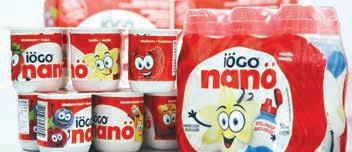
With a cheeky brand name and engaging, family-friendly consumer graphics splashed on the brand’s diverse array of colorful packaging—now ranging from traditional plastic tubs to bottled ‘drinkables,’ squeeze-tubes and spouted stand-up pouches of vegetablefortified yogurt purées—IÖGO’s extraordinary quick market share gains are well complemented by the product’s crossgenerational appeal to all key demographic target groups.
As Small explains, “IÖGO is a very diverse brand that reaches across all the consumer segments with more than 70 different SKUs (stock-keeping units) in its product portfolio.
“As such, the brand is a Number One player in Canada in conventional stirred yogurts; Number Two in light and diet yogurts; and Number Two in probiotic yogurts,” Small relates, acknowledging the vital role played by the company’s packaging design partners in the brand’s phenomenal market share gains to date.
Originally working Bo Branding & Design for the initial product launch four years ago, Ultima has more recently secured the services of Mississauga, Ont.-based branding specialists Davis
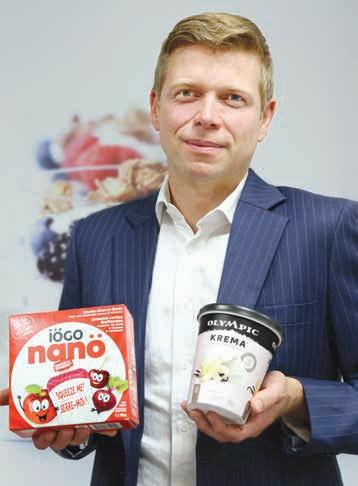
Ultiima Foods vice-president of marketing Simon Small holds up samples of the bestselling IÖGO and Olympic yogurt brands accounting for the lion’s share of the company’s business.
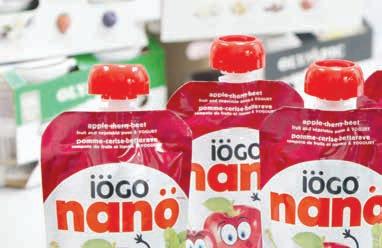
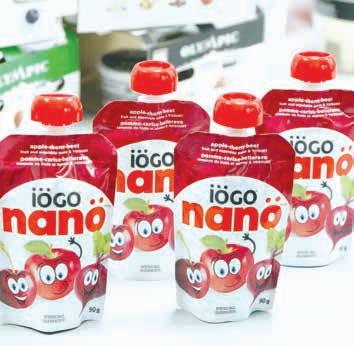
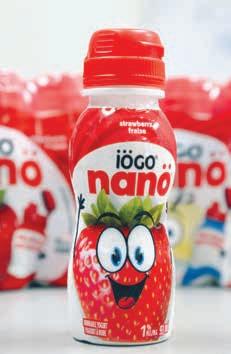
Featuring colorful new decorative graphics created by Davis Design, the IÖGO nano brand of yogurts is available in an expanded range of convenient single-serving packaging formats.
Transparent packaging is one of the hottest trends in retail sales today. With the drive toward wholesome foods, showcasing appealing products through crystal clear packaging is a natural next step in marketing.
Mintel, a leading industry research firm in its recent Food Packaging Trends report found that more than half of shoppers agree it’s important to see a product through its packaging.” Mintel Consumer Trends Analyst Stacy Glasgow says, “As sales results from products that have switched to see-through packaging suggest, consumers feel more confident seeing clear, on-shelf evidence that a product not only appears as it should, but that it looks appetizing as well.”
The trend toward transparent packaging is just as strong in the dairy and dessert industry as in other retail segments. Dairy Foods magazine Managing Editor Sarah Kenney reported in the June 2015 issue of the magazine, “Dessert processors are taking a cue from gelato and dessert shops and releasing clear packaging that shows off every swirl, chunk, and color in their products. Even one new cottage cheese product sports an innovative see-through container.”
If transparent packaging is such a potent trend, why haven’t more of the dairy and dessert companies who use highly efficient “form, fill, and seal” (FFS) packaging processes made the switch? The most commonly applied material in the form-fill-seal process today is opaque or semi-transparent, high impact polystyrene (HIPS). While a modifier such as styrene block copolymer can be used to increase transparency, this adds packaging cost. And, while producers have worked to modify well known transparent materials such as PET and clarified PP to satisfy the stringent performance demands of the FFS process and package, the resulting modified resins have not so far, maintained the transparency for which these plastics are normally known.
PACKAGING MATERIALS INNOVATION
MAKES TRANSPARENT DAIRY AND DESSERT PACKAGING AFFORDABLE AND PRACTICAL
SOLVING THE COST AND PERFORMANCE ISSUE FOR TRANSPARENCY
First introduced commercially to the plastics and packaging markets by producer NatureWorks in 2003, Ingeo gained immediate interest as a new-to-the-world material offering a distinct set of functional material properties, while sourced from renewable materials. Today, there is a mature, thriving Ingeo ecosystem made up of compounders and blends suppliers, equipment manufacturers, distributors, researchers, and consumer and industrial companies applying this naturally advanced plastic in unique and cost effective ways. In the last decade, NatureWorks has shipped more than 1.3 billion pounds of Ingeo, and worked closely with the packaging industry to understand the packaging fit for its functional materials. What’s become clear is that in FFS packaging, Ingeo provides a competitively priced, improved performance, and transparent biobased alternative to FFS incumbent styrenic plastics like HIPS.
EXAMINING INGEO AS AN ALTERNATIVE TO HIPS
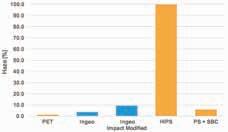
The Ingeo grades optimized for dairy and dessert packaging include both conventional and high impact options. Both offer a crystal-clear transparency rivaling unmodified PET. Figure 1 shows the wide gap in transparency between Ingeo and HIPS. PS modified with styrene block copolymer (“SBC”) additive is comparable in terms of clarity, but brings cost and performance ramifications.
COST IS ON EVERYONE’S MIND IN PACKAGING
One of the facts that most surprise packaging specifiers considering Ingeo for a material substitution is that the cost of Ingeo is competitive with HIPS. The perception is that a relatively new plastic must be more expensive. With over a billion pounds sold and an efficient, maturing sales channel in place, the economies of scale make this innovative plastic a candidate for substitution where it exceeds incumbents in terms of performance. In addition, because Ingeo is renewably sourced, it is not subject to the wide price swings of the global petroleum market and offers significantly lower price volatility than fossil derived plastics. Companies can hedge their purchases over a prolonged time period and lock in favorable pricing.
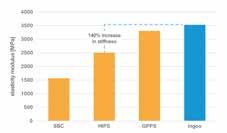
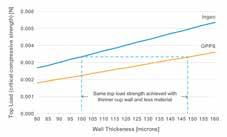
France-based Synerlink, a worldwide leader in integrated packaging equipment with its Arcil brand form-fill-seal lines, has thoroughly assessed the performance of Ingeo on its equipment. Ingeo is an inherently stiff plastic, with stiffness 140 percent that of HIPS. This translates directly into package light weighting and cost savings compared to HIPS, GPPS, SBC, PET (Figure 2). Calculations on this high stiffness indicate that approximately 20 to 30 percent less wall thickness is needed for Ingeo compared to HIPS at equivalent top load strength (Figure 3). For the consumer, the stiffness of Ingeo also inherently makes for excellent snap-apart characteristics in multipack cups.
KEEPING
PRODUCTS FRESH AND APPEALING
CARBON FOOTPRINT LOWER THAN FOSSIL CARBON PLASTICS
According to Clear Lam Packaging, a developer and manufacturer of innovative flexible and rigid packaging materials used for foods, Ingeo sheet has ideal performance for form-fill-seal applications – the most cost effective packaging for single serve and multipack cups.
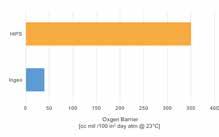
Extensive testing of the flavor and aroma barrier properties of Ingeo showed that permeation was too low to measure for two common aroma and flavor tests in the packaging industry – the pineapple odor of ethyl butyrate and the citrus odor of d-limonene. And, as Figure 4 indicates, Ingeo packaging has a superior oxygen barrier as compared to HIPS for longer term freshness.
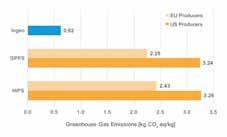
Replacing a plastic made with fossil carbon with a biobased functional material provides another compelling reason to make the substitution in the dairy and dessert industry. Many consumers today prefer less processed and more natural products and packaging. Furthermore, the energy consumed and the greenhouse gases emitted while manufacturing Ingeo are lower than petroleum-based plastics as Figure 5 shows.
In terms of the ability to utilize packaging to improve sales, materials science in the form of a relatively new plastic, Ingeo, has come to the aid of marketers at the correct time, cost, performance, and carbon footprint.
Figure 1. Ingeo provides clarity on par with PET and PS with SBC.
Figure 2. Ingeo’s inherent stiffness compared to GPPS & HIPS allows for cost-saving downgauging.
Figure 3. To achieve similar top load strength, Ingeo cups can be made with walls 20-30% thinner than GPPS.
Figure 4. Ingeo’s excellent oxygen barrier can enhance longer term product freshness.
Figure 5. Producing Ingeo creates half the greenhouse gases compared to GPPS and HIPS.
PACKAGING FOR FRESHNESS
Launched in time for the back-to-school season, the 90-gram spouted stand-up pouches of IÖGO nano yogurts contain a well-balanced mix of fruit and vegetable purées to offer Canadian parents a healthy and highly convenient snacking option to pack for their kids’ lunch.
In food processing there are plenty of things to worry about. Your product coding equipment shouldn’t be one of them.
Hitachi Continuous Inkjet Printers have set the standard for reliable, user friendly, and cost effective product coding and marking for more than 35 years. With a reputation for relentless reliability and up to 50% less fluid consumption than other brands, our printers keep your uptime up and your operating costs down. Call us at 1-866-583-0048 or visit us Online at www.hitachi-america.us/ice/inkjetprinters/.
Design for a comprhensive rebranding of the entire IÖGO line, which included elevating the IÖGO Nano subrand of single-serving yogurts to become a clear leading choice for Canadian parents of three- to seven-year-old children.
Comprising 18 different SKUs, the IÖGO Nano sub-brand is “the fastest-growing brand with kids,” according to Small, citing an exceptionally successful back-toschool launch of several new products infused with both fruits and some select vegetables such as beets, squash and carrots.
“Adding vegetables to yogurt has already been a trend in other parts of the world,” says Small, “and with Canadians generally being quite open to trying new things, we saw a real opportunity to connect with Canadian moms and parents concerned with making healthy food choices in their busy daily lives.”
Says Small:“Young children trying yogurt for the first time have already consumed a fair bit of baby-food, which is essentially fruits and vegetables mixed together, so it made sense for us to help parents introduce their children to vegetables in a fun way.
“It’s hard for parents to force a serving of vegetable on their kids by feeding them kale and Brussels sprouts,” he chuckles, “but a 60-gram serving of drinkable yogurt,or a 95-gram pouch of squeezable tasty purée, is a fun way to introduce beetroot into their diets at an early age.
“We had the largest Canadian-based product development team in the dairy category do a tremendous job of pairing up the right vegetables with the right fruit, so that a young child gets first exposed to vegetables in an extremely tasty and convenient way,” Small relates.
“It’s been very well-accepted by the parents and by our retail partners as well,” Small points out, citing the product’s high value-added content and dazzling packaging ingenuity, such as the spillproof caps incorporated into the closures of the drinkable 60-gram mini-bottles, which employ a built-in, sports-cap-type mechanism to minimize any spillage to a drop or two in case of the container being tipped over.
In Canada contact: www.harlund.com 1-877-427-5863
“Ths’s just part of the brand DNA that makes it fit so well with busy Canadian
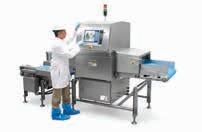
Plan Automation can help with our X-ray
We supply the latest Eagle PI X-ray technology to your site, operated by our certified Plan Automation Product Inspection technicians.
Our technology & support services will quickly help you inspect and reclaim your nished goods
INSPECT YOUR FINISHED GOODS, CASE OR PRIMARY PACKAGE:
• Food & Beverage
• Meat & Poultry
• Cosmetics & Pharmaceutical
• Consumer goods
• Industrial We also sell new equipment and offer lease to own or long term rentals.
Hitachi Industrial Equipment
Hitachi Industrial Equipment Systems Co., Ltd.
Hitachi America, Ltd.
PACKAGING FOR FRESHNESS
families,” he notes.
Likewise, the newly-launched 90-gram spouted stand-up pouches are fully resealable, Small explains, so that the child does not have to consume the entire serving all at once.
“Moreover, being fully freezable allows the pouch to act like an ice-pack inside the kid’s lunchbags to keep the other contents from getting too warm,” Small notes.
“We were able to reach Number One market share with IÖGO Nano during the last back-to-school period in early fall,” says Small, complimenting the bright, cartoonish graphics of smiling fruit, berries and veggies decorating the different IÖGO Nano containers.
“Canadian parents are not necessarily looking for Disney characters to be on every pack,” he acknowledges, “but it is important to project a fun image for a product aiming to fit into people’s lives in a fun and convenient way.
“Packaging is undoubtedly our Number One touchpoint for reaching out to consumers,” Small proclaims. “After all is said and done, the real moment of truth happens inside the store based on what the package looks like.
“It has to be attractive,” he states, “but it also has to be shoppable in terms of helping the retailers draw consumers to the dairy section, to navigate the dairy section, and to entice them to spend more time there than they would otherwise.”
In this light, Small says he’s also very happy with the recent package redesign for the Olympic brand executed by talented graphic artists at the Montreal-based LG2 Boutique—resulting in a clean, streamlined packaging presentation effectively projecting the product’s wholesome appeal, product purity, and the and the high degree of patient, artisanal craftsmanship involved in the yogurt’s manufacturing process.
“Whereas in the past our packaging used to scream that the product was organic, probiotic, this and that with multiple colors and different designs for the
different flavors, the new graphics have simplified the whole presentation with a look that projects calm cleanliness, naturalness and simplicity.
“We definitely have a good story to tell about the product if you take the time to read about it in small print,” says Small, “but for those who need to know the important stuff right away, the packaging immediately informs them that it is a beautiful, natural product with three-percent milk fat content, for example, and all the other healthy benefits that yogurt provides, such as being a good source of Vitamin D, calcium and high nutritional density overall.”
Says Small: “Yogurt was the category of the decade because of the nutritional value and the way it fits into people’s lives, but when all is said and done, it’s actually quite yummy, which is not what you often get with the ‘good-for-you’ products.”
Nowadays offering extended product shelf-life of 42 to 45 days, Ultima’s yogurt products are one of the Canadian food industry’s more compelling success stories of recent years, according to Small.
“Being so highly connected to Canadian farms by virtue of actually being owned by Canadian farmers through their co-ops means that the vast majority of all our ingredients are Canadian-sourced,” he explains, “resulting in all kinds of positive economic spinoffs.
“Even for the products that can’t be sourced in Canada because we simply cannot grow coconuts and bananas up here, we make it a point to work with other Canadian companies to source those raw materials for us.
“Canadian consumers increasingly want to make healthy choices without compromising on value and taste, and our product portfolio of over 70 different SKUs offers them a broad choice of tasty and convenient ways to eat nutritionally-dense products in quick and convenient ways, especially at that allimportant breakfast time,” Small elaborates.
“If you take cereal, for example, there is always some assembly required with getting a bowl, filling it, adding milk, toppings and so on, whereas with yogurt you just
help yourself to a few spoonfulls, or a single-serving package, and away you go!
“With a healthy boost of Vitamin D, calcium, solid protein and some sugar naturally derived from the fructose of the added fruit, this is a close to being a true ‘superfood’ as it gets,” Small asserts.
While Ultima Foods may not be the country’s largest yogurt producer by volume at this point in time, Small says that being able to focus exclusively on developing new yogurt ptailored for Canadians gives Ultima an important edge over foreign-owned multinational dairy giants for whom yogurt is just one of many other product lines.
“I believe we have a nicely balanced portfolio with two strong brands with very complementary regional strengths and core product attributes,” Small says.“While IÖGO was developed to fit into the fastpaced modern life, the Olympic’s appeal is in being able to enjoy the slower and more leisurely side of life.
“So whereas the IÖGO brand is manufactured via a fairly mechanized process, the Olympic product is more hand-crafted, which many Canadian consumers greatly appreciate in the way that they appreciate craft breweries, craft bakeries and other crafted products.
“So all in all, we have many good reasons to be optimistic about our future growth prospects, despite the fact that the category growth overall is not as rapid as it was a couple of years ago,” Small concludes.
“Having strengthened our branding infrastructure with the attractive new packaging,” he concludes, “Canadian consumers increasingly see our brands as being natural, innovative and Canadian—all the things that really resonate with Canadians now and will continue to do well into the future.”
Vice-president of marketing Simon Small demonstrates the functionality of the spillproof caps used to top off the drinkable IÖGO nano yogurt bottles to avoid accidental spills.
Comprising two fully-recyclable plastic packaging components, the 97-ml bottles of IÖGO nano drinkable yogurts provide kids with a healthy boost of calcium and Vitamin D.
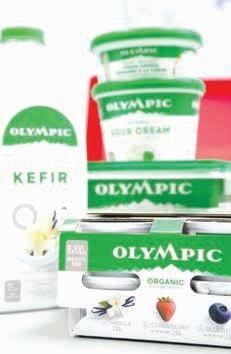
Created by LG2 Boutique, the new packaging graphics for the Olympic set yogurts project a more streamlined and clean product image befitting the product’s natural purity.
STRETCHWRAPPING
SINK AND SWIM
New stretchwrapping system helps Canadian sink and faucet manufacturer boost end-of-line packaging productivity
BY ANDREW JOSEPH, FEATURES EDITOR PHOTOS BY NAOMI HILTZ
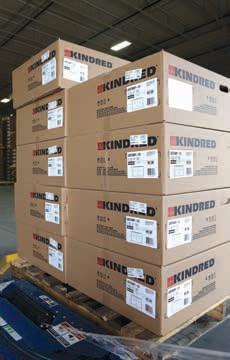
Throwing everything and a kitchen sink at something may be a clever euphemism for a last-ditch desperate attempt to remedy an unfavorable set of circumstances, but the notion of mishandling one of the most important pieces of equipment in a modern kitchen is anything but a joke for folks at Franke Kindred Canada Limited, a prominent designer and manufacturer of stainlesssteel sinks based in Midland, Ont.
Operating as a wholly-owned subsidiary of the renowned Swiss-based kitchen systems manufacturer Franke, Franke Kindred Canada is a widelyrenowned pioneer in the design and manufacture of kitchen sinks in North America and the largest producer of stainless-steel sinks in Canada—operating a 120,000-square-foot manufacturing facility in Midland and a 70,000-square-foot distribution center in nearby Barrie.
Originally founded in 1946 under the Kitchen Installation Ltd. banner, the company started out as a manufacturer of a wide range of aluminum and stainless-steel equipment for the hotel, restaurant and industrial markets, with some of its more notable past accomplishments including the introduction of the first self-rimming sinks in the North American market.
LOOKING GOOD
Following its 1998 acquisition by Franke, the Midland company has steadily expanded and diversified its product range to move into a number of new, lucrative, higher value-added market segments.
“We currently produce and distribute a wide range of luxurious kitchen, bar, laundry, vanity and utility sinks for the home, as well as a full line-up of
commercial products for public-use buildings, such as schools and hospitals,” Franke Kindred Canada project engineer Doug Elford told Canadian Packaging on a recent visit to the Barrie warehouse.
“We distribute products for residential, commercial and industrial usage, with 85 percent of our shipment accounted for sinks, 10 percent faucets, and five percent other products,” Elford acknowledges.
“It’s a very aggressive environment from both domestic and import competitors,” says Elford, noting that the company’s many customers invest a lot of faith and trust in Franke Kindred to make sure their sinks arrive at their destinations in pristine condition.
To make sure it happens on a regular basis, the Barrie warehouse recently purchased a new Q-300XT stretchwrapping system manufactured by
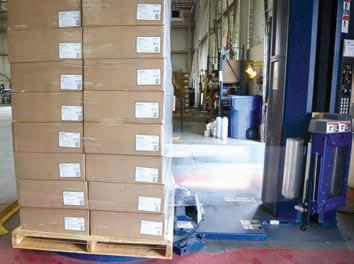
Franke Kindred Canada Limited shipping supervisor Shane Macneall (left) and Veritiv equipment specialist for packaging solutions Jean Bélair strike a pose in the foreground of the Lantech model Q-300XT semi-automatic stretchwrapping system installed last spring at the company’s distribution center and warehousing facility in Barrie, Ont.
the Louisville, Ky.-based Lantech, and represented in Canada by the Mississauga, Ont.-based strategic distribution company, Veritiv Canada.
“We actually had a stretchwrapping machine to bind the load to the pallet,” explains Elford, “but it was 20 years old, and well past its prime.
“It simply wore out from use,” says Elford, noting the Barrie facility makes extensive use of both wooden and plastic skids to transport its loads, in several pallet dimensions.
“We installed the Q-300XT system with extended wrap height capacity at Franke Kindred Canada’s Barrie facility in May of 2016,” recalls Veritiv equipment specialist of packaging solutions Jean Bélair.
“We had a previous relationship with Franke Kindred Canada,” adds Bélair, “whereby we had sold them a case sealer for their Midland facility.
“The service we were able to provide for that case sealer obviously was a leg-up for us when Franke was looking to add a new stretchwrapper at the Barrie plant.”
UNDER WRAPS
As Franke Kindred shipping supervisor Shane Macneall recalls, “We purchased this machine from Veritiv because they were our preferred choice to work with when we needed a new stretchwrapper, before.
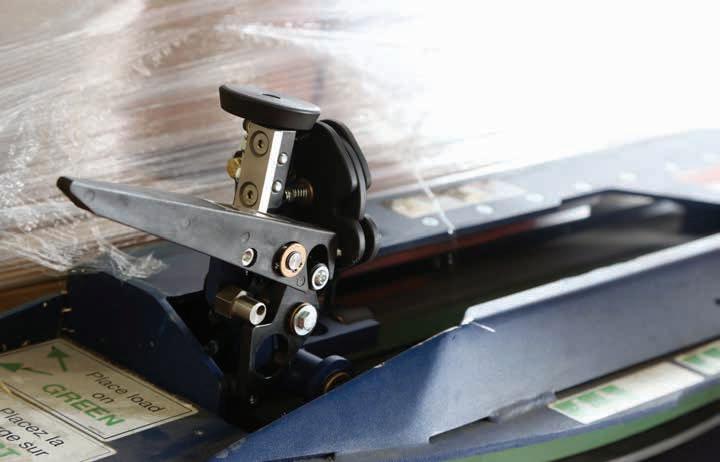
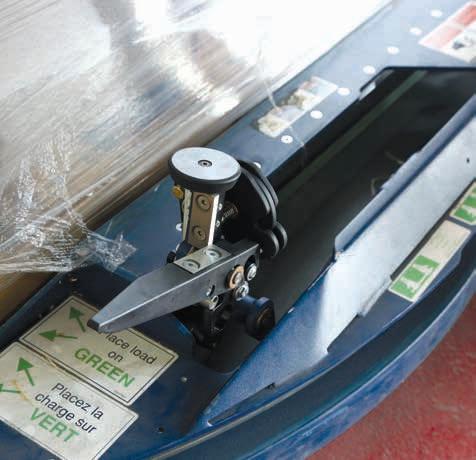
“The best part of the machine is the patented XT Cut and Clamp®, which ensures our fork lift drivers moving the pallet loads to the stretchwrapper don’t have to get off and on their lift-truck anymore.
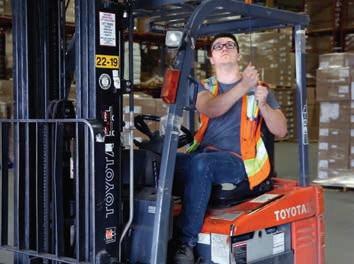
“The Q-300XT is a much quicker and more efficient machine than what we had before,” says Macneall. “The drivers fork the pallet onto the stretchwrapper’s turntable, the operator pulls an overhead pull cord to automatically start the wrapping operation—all without having to leave the forklift’s driver’s seat.”
As part of the installation, Veritiv supplied the ceiling-mounted lanyard for operators to interact with while still seated on the forklift to initialize the Q-300XT’s stretchwrapping operation.
Once the operation begins, the Q-300XT’s film delivery system moves up and down the product load, applying stretchfilm.
STRETCHWRAPPING
To prevent accidental damage from a fork lift entering or exiting the pallet, the Q-300XT stretchwrapper drives the film cable 1.5-inches below the top board.
According to Veritiv, the machine’s patented XT Cut and Clamp® cuts the film at the end of the wrap cycle—a simple solution that saves an additional two minutes of fork lift driver labor per load.
“Not having to get off and on the forklift to start and stop the stretchwrapper and to attach and cut the film saves us at least eight hours a week in labor,” Macneall explains.
“The stretchwrapper’s fully-protected mechanical cut and clamp has really made a noticeable improvement in eliminating worker ‘runaround’,which our warehouse staff appreciate as well.”
Another of the impressive benefits of the new Q-300XT semi-automatic stretchwrapper, according to Macneall, is the fact it uses about 30
percent less stretchwrap film relative to the system previously in place.
The Q-300XT semi-automatic stretchwrapper comes with Lantech’s patented XT Cut and Clamp® that automatically captures the stretch film, and cuts it at the end of the wrap cycle.
“The Q-300XT stretchwrapper also applies a high stretch torque on the plastic film,” relates Macneall. “This, combined with use of a film that allows and accommodates a higher stretch factor reduces film consumption per pallet.”
Because the old stretchwrapper was no longer operating at optimal performance, Macneall acknowledges that they were not able to properly use the pre-stretch, though the Q-300XT now provides them with excellent cost-savings.
“Because we only installed the unit in May, it is too soon to confirm the 30 percent film reduction, but based on our film usage rate to date, 30 percent reduction is expected,” Macneall enthuses.
He adds that by reducing film usage, “thanks to the pre-stretch, it actually helps us reduce our environmental footprint.”
HIGH MAST
Macneall points out that other benefits contributing to the purchase of the Q-300XT include its nonuse of compressed air to operate which provides cost savings, plus the fact that it was available with a 110-inch mast, meaning pallet loads could be constructed up to 110-inches in height to maximize the storage cube capacity of the shipping trucks.
“Having taller skids holding more product, we can maximize the cube space in the trailer,” says Macneall. “Most trucking companies will not charge for loads up to 96-inches or the top of the trailer, so we load as high as the trailer allows.
“We save about 10 percent on transportation costs now over the old stretchwrapping system by maximizing the cube space,” Macneall says, adding that fewer trucks on the road helps reduce the company’s overall carbon footprint.
Lantech’s patented Pallet Grip® is a value-added option that Franke Kindred Canada uses to prevent loads from sliding or shifting off the pallet, Macneall points out.
“This is an important feature, because even with
A Franke Kindred Canada fork lift operator uses a ceiling-mounted lanyard to automatically start the Q-300XT stretchwrapping operation.
After being placed onto the Q-300XT turntable by a fork lift, and without the operator having to leave the truck’s seat, the wrapping system is remote-started to stretch wrap pallet loads up to a height of 110-inches to better maximize cube space in transport trucks.
STRETCHWRAPPING
semi-automatic stretchwrapper uses the XT Cut and Clamp® that attaches the film to the pallet at the beginning of the wrap cycle and cuts it at the end.
the protective packaging inside product corrugated cartons,” he says, “we do not want our high-quality sinks or faucets shifting during transport and ending up damaged.”
The Pallet Grip rolls between four- and six-inches of the film web into a tight, high strength, durable film cable, and then places the film cable around the shipping pallet essentially locking the load to the pallet.
The Q-300XT drives the film cable down onto the pallet to approximately 1.5-inches below the top board to prevent it from being accidentally damaged by the lift truck’s fork entry or exit.
HIGH AND MIGHTY
According to Veritiv, the Lantech Q-300XT semiautomatic stretchwrapper offers a top peak speed of 30 to 40 loads per hour, depending on the height of the load, with a variable turntable speed up to a very quick 12 revolutions per minute.
As far as load sizes, along with the 110-inch wrap height of the Q-300XT, the machine can accomodate up to 69-inch load diagonals weighing up to 4,000-pounds.
The stretchwrapper is also available with the optional EZ Weigh™ integrated scale so every load can be weighed for quality and to manage freight cost. The weigh system is fully integrated into the turntable, keeping the system low-profile.
Veritiv also offers a Click-n-Go™ option that eliminates the need to install a ceiling-mounted lanyard. This option utilizes a remote control with infrared technology to operate the stretchwrapper.
“The way we see it, the ROI (return on investment) will allow us to pay for the Q-300XT system within just 12 months—just savings alone from the film wrap we are no longer using,” Macneall notes, adding that he and Franke Kindred Canada are very happy with the machine purchased from Veritiv, and with the top-notch service provided.
“Veritiv has been and continues to be an excellent partner to Franke Kindred Canada,” says Elford.
“We insist on our equipment being safe as well as providing a greener distribution center and, yes, save us on costs too,” says Elford, noting that its proactive safety program has enabled the facility to record 3.5 million consecutive man-hours without an LTA (Long Time Accident) incident.
When it comes to being green, Franke Kindred Canada staff are proud of achieving substantial energy reductions and consumable reductions, like the stretchwrap film reduction made possible by their new stretchwrapper.
“Our new Q-300XT semi-automatic stretchwrapper purchased from Veritiv may not seem like a sexy purchase, but the environmental savings and production efficiencies sure are.”
Says Elford: “While people know that Franke has excellent products across a wide spectrum of choices, here in our distribution warehouse in Barrie, we also have to be competitive to work within the overall Franke philosophy.”
All day long, trucks enter and exit the Barrie distribution center dropping off pallet loads of kitchen or bathroom products from their Midland plant, and its global manufacturing operations,
Veritiv’s Lantech Q-300XT
Featuring a 110-inch high masthead, Franke Kindred Canada’s Q-300XT stretchwrapper uses film from Veritiv.
Along with the lanyard system to start the Q-300XT stretchwrapper, the automatic XT Cut and Clamp® provides enhanced end-of-line efficiencies that help the Franke Kindred warehouse save an estimated eight man-hours of labor per week.
picking up specific product-picked pallet loads to be distributed across Canada and the U.S. Originally starting out in Switzerland back in 1911 as a sheet metal business, producing its first sink in 1925, Franke currently employs approximately 9,000 people at 75 plants and 45 distribution centers on five continents.
Exporting to over 100 countries, Franke is owned by the Swiss-based venture capital group Artemis Holding AG, today comprising four distinct global business units that include:
• Franke Foodservice Systems—a global leader in comprehensive systems and services for the interantional global
• Franke Coffee Systems—a leading provider of professional coffee machines operated in coffee shops, and cafés, as well as in the systems-based catering industry;
• Franke Water Systems—a leading provider of intelligent systems for semi- and publicwashrooms and of taps for residential kitchens and bathrooms, and;
• Franke Kitchen Systems the world’s leading provider of intelligent systems for domestic kitchens.
Since coming to Midland back in 1962, the company has supported numerous community projects and activities that has made it a highly valued corporate contributor to the local community. Marketing its products under the Kindred, Franke,
and Franke Commercial brand names, the company offers an expansive range of material choices for sinks and other related products— from handcrafted commercial grade stainless steel, granite and fireclay sinks—as well as for custom-fit accessories, faucets and other auxiliary products.
“Franke Kindred was founded upon traditions of intelligent product design, superior products and a lifetime warranty, and that’s something we take to heart each and every day,” says Elford.
He adds that these traditions will continue to shape and define the company’s future as it adds more value to the products with faucets and water filtration systems, in-sink accessories, products with optional techniques for installation, and newgeneration materials that address health, hygiene and convenience within the home.
Easy palletizing - a collaborative robot solution
Compact, quick to install and easy to configure, the new standardised palletizing cell from FlexLink mean operators can safely work side-by-side with the robot, without the need for a fence or cage. Call us on +1 6109738200 or email us at info.us@flexlink. com for further information.
flexlink.com
FOOD SAFETY
BREAKING THE ICE
Leading East Coast ice cream producer makes good use of emergency product inspection equipment rental services to keep production running on time
BY ANDREW JOSEPH, FEATURES EDITOR
PHOTOS BY TIM REEVES-HORTON
Even with an ice cream headache a possible outcome, everyone knows we all scream for ice cream because it’s one of those irresistable treats you can enjoy on year-round basis.
And while it is important to ensure production keeps up with demand, ice cream producers must also always ensure their product is safe to eat.
Granted, there’s not much they can do regarding the perils of eating ice cream too fast to triggers the so-called ‘ice cream headache’ most of us encountered now and then, but for one renowned East Coast ice cream producer, making sure that’s the worst that can ever happen with its product is an everyday imperative of highest importance.
Based in Truro, N.S., Scotsburn Ice Cream Company is widealy recognized in the industry as Atlantic Canada’s leading manufacturer of ice cream, frozen yogurt and frozen novelties.
The company owes its origins to an amalgama -
A partial bird’s-eye view of the Scotsburn Ice Cream Company’s busy 200,000-square-foot production facility in Truro, N.S.
Scotsburn Ice Cream production operators Sam Peters (left) and Victoria Shipley put the packaged product through the high-speed Eagle Pack 430 X-Ray system, supplied by leading automated packaging equipment distributor PLAN Automation, to ensure optimal product quality and safety by automatically detecting any sources of potential product contamination.
FOOD SAFETY
Producing over 400 SKUs (stock-keeping units) of different products under its own brand and for private-label customers, Scotsburn Ice Cream Company is well-acknowledged among its industry peers as being Atlantic Canada’s leading manufacturer of ice cream, frozen yogurt (photo below) and many other frozen novelties.
tion of local farmers, who back in 1900 banded together to construct the Scotsburn Creamery to process cream into butter and sell it.
Incorporated in 1972 as the Scotsburn Cooperative Services Ltd. , it had a peak of about 100 dairy farmers as its members, who are nowadays comprised mainly of dairy farmers operating in Nova Scotia and Newfoundland.
ICE CAPADES
A few years back, the co-op sold its fluid milk processing plants to concentrate on producing a higher-end ice-cream line, under its own Scotsburn Premium brand, as well performing private-label processing and packaging for customers in Canada and the U.S.
The 200,000-square-foot Truro facility was constructed in 2001 with many additions and expansions performed on it over the ensuing years.
“Scotsburn has certainly changed and evolved quite a bit since its humble origins,” Scotsburn Ice Cream Company director of manufacturing and quality assurance Charles Maxner told Canadian Packaging during a recent interview.
“Along with our lead status in the Atlantic provinces, we are also a leading manufacturer throughout Canada,” Maxner notes, “with the company taking in a few industry awards for the frozen treats.”
Scotsbury Ice Cream Company has actually garnered its fair share of kudos for its innovation and excellence in producing quality products—a fact its consumers and customers have taken heed of.
“The recognition has been large here in the Atlantic Provinces, to be sure,” says Maxner, “but it has also helped us become sought-after as a pri -
vate-label producer of ice cream and frozen novelty products for other brands all over Canada and the U.S.”
Maxner notes that private-label work accounts forabout 65 per cent of Scotsburn’s production volumes.
“These companies work with us because of the experience and knowledge we bring to the industry. We create innovative, quality products that they are proud to put their name on,” Maxner relates.
“They know that our staff will go above and beyond to provide excellent service that will ensure
their company’s success—from product development and package design to production, quality assessment and shipping, our private-label partners rely on us to deliver.”
Scotsburn produces a wide range of dairy and water ice desserts (popsicles) from a peanut-free facility in Quebec, including novelties with frozen dairy as the base, while its Truro plant creates dairy-based treats such as ice cream, frozen yogurt, and sherbet at various ranges from economy to premium for its own brands, as well as for private-label.
“Our products might be as simple as a single fla -
FOOD SAFETY
vor as chocolate or vanilla up to a complexity of a three-flavor, a ripple and inclusion, as in many of our products,” says Maxner, adding that product lines can be higher in fat, lower in fat or even sugar-free, or peanut-free if from one of its designated facilities. “We can work with customers to create whatever product they want, whether it’s a healthier alternative, organic, or a recipe that includes probiotics, omega-3, and fruit or vegetable purées.”
Under its own brands, Scotsburn produces ice cream treats and flavors under the highend Scotsburn Premium label and economy Family Favorites line, with other products produced in multi-pack cartons and single serve formats, including:
• Classic novelties such as cream pops, ice cream sandwiches and chocolate-coated nutty cones;
• Frozen Yogurt in Original style that is 97 percent fat-free, offers a source of calcium and 120 calories or fewer per serving for the nine different taste sensations; and a Greek-style which is also 97 percent fat-free, but along with being a good source of calcium, also provides a big kick of protein;
• Special seasonal flavors such as Candy Cane are
produced in tub and ice cream bar format, while Fruit and Nut Ice Cream and the mysterious Melted Snowman flavors come in tubs.
Regarding its two production rooms at the Truro facility, Maxner says the tub room, which consists of four lines, is for “ice cream capable of packaging containers sizes ranging in size from 500- ml to 11.4 liters, while the second production room is used to produce its novelty line of ice cream treats such as the ice cream-on-a-stick varieties.”
The Truro facility makes over 400 SKUs (stockkeeping units) in its ice cream/tub room and over 60 SKUs on its novelty line.
“Our tub line has a capacity of approximately 38 million liters annually,” says Maxner, “while our novelty line can produce approximately six million dozen.”
“Scotsburn is quite proud of the fact that we only use 100 per cent Canadian milk, cream and butter to produce our ice cream bases,” says Maxner.
“Because provincial standards state that there not be any antibiotics in the milk, all milk in Canada is tested before being accepted by any production facility, including here at Scotsburn,” Maxner adds. “It’s worth noting that unlike the U.S., Canadian
dairy farmers are not allowed to use growth hormones or steroids to stimulate milk production in the herd, so consumers can be assured that our 100 percent Canadian milk-processed ice cream products really are good, clean fun.”
He says that because of the demand for Scotsburn products, the ice cream manufacturer now has to look outside of its local shareholder/dairy producer sources in the Atlantic region, but “even though the majority of milk still comes from the local area, when demand is high we may have to source from as far as Quebec and Ontario—sources we can trust have gone through rigorous testing before being included at our production facility.”
While flavor favorites continue to be the old standby of Vanilla and Chocolate , Maxner says Scotsburn is achieving great success with its newer flavors such as the intriguingly named Hoof Prints , a rich, creamy toffee-flavored light ice cream swirled with a chocolate fudge ripple containing chocolatey caramel cups; and Udderly Divine , a light vanilla ice cream smothered with chewy chocolate fudge and inclusions of chocolate peanut-butter cups.
While the majority of products produced by Scotsburn are for the retail sector, it also co-packs for independent scoop shops.
“The paper ice cream tubs and lids we use are produced by our suppliers from a poly-coated paperboard,” offers Maxner,” which is the same as what you find with standard milk cartons.”
The boxes used by Scotsburn Ice Cream for its retail novelty packs are made of 100 per cent recycled paperboard and feature a minimum 35 percent post-consumer content, and are recycled wherever recycling programs are available.
The opalite plastic film used to flowwrap the individual novelty products should be disposed of in the garbage, while the wooden sticks should be able to be recycled.
SAFETY FIRST
Taking its food safety extremely seriously, Maxner notes that the company is HACCP (hazard analysis and critical control points)-certified and SQF (Safe Quality Food) Level 2 -certified, a Global Food Safety Initiative.
“Our company and our people are very committed to producing safe, quality food,” he says, noting that the ice cream industry is highly competitive. “The keys to our success include the high-performance of our employees and the quality of the product they produce, as well as the equipment we use to make our tasty ice cream treats.”
Within the production facility, Scotsburn takes its quality assurance very seriously, and utilizes an in-line metal detection system.
However, it also purchased an Eagle Product Inspection Pack 430 Pro X-Ray unit from PLAN Automation
“The X-Ray machine was purchased for the purpose of providing us with an extra level of confidence in our food safety checks,” explains Maxner. “In the event we experience an issue with our inline detection system, we immediately use our X-Ray system to confirm that our product exceeds the required food safety checks.”
According to Maxner, in June of 2016, Scotsburn had a project that required them to X-Ray a large volume of product, but the single X-Ray machine they owned would not be enough to ensure
Production operator Victoria Shipley keeping a close eye on the ice cream packages coming off the conveyor belt after passing through the comprehensive quality assurance test performed by Eagle Pack 430 Pro X-Ray product inspection system.
The state-of-the-art Truro production facility manufactures over 400 different varities of ice cram in its tub room, with capacity to produce over 38 million liters of the tasty frozen treat per year.
the company hit the pre-established customer delivery deadline.
“Needing help, we contacted PLAN Automation,” explains Maxner.
EMERGENCY PLAN
Originally established as Smiths Detection in 1998, Eagle was born after Smiths was sold in 2011, with the company renamed after the original X-Ray detection range produced by Smiths.
While the Florida-headquartered company has experienced solid growth since 2011, with global expansion thanks to Eagle locations in Singapore, U.K. China and Mexico, it has an excellent working relationship with PLAN Automation who represent and service Eagle Product Inspection equipment across Canada.
Scotsburn was provided with a complete solution by PLAN Automation via its Emergency Reclaim Inspection Services program, which helped the ice cream company meet its targeted deadline.
“Simply put,” says Maxner, “Scotsburn needed an X-Ray machine; PLAN Automation delivered one and trained our staff to use it safely; and ice cream aficionados everywhere were happy.”
The Emergency Reclaim Inspection Services from PLAN Automation is not just a Canadian service, as it is offered across North America, according to PLAN Automation vicepresident and product inspection and food safety expert Mat Bedard.
“We offer metal detection and XRay technology to customers that need it quickly,” say Bedard. “We can either quickly train production staff, or we can run the products through with our own technicians in place either at the customer’s site or at one of our designated locations,” relates Bedard.
“The Emergency Reclaim Inspection Services plan helps inspect, certify and reclaim your production, helping manufacturers avoid lost production while keeping customers happy and safe,” Bedard adds.
The plan offers:
• Shor t-term rentals of X-Ray and metal detection systems from one to multiple days;
• Medium-ter m rentals of one to multiple weeks;
• Long-ter m rental consisting of multiple months.
In addition to the rental options, PLAN Automation also provides lease-to-own options.
The X-Ray system rented by Scotsburn Ice Cream Company was the Eagle Product Inspection model Eagle Pack 550 Pro , which Maxner says his employees enjoyed operating thanks to its ease-of-use.
“Scotsburn opted to have the Eagle Pack 550 Pro X-Ray system used at their facility by their own operators, though we did supply an operator initially to help train them and to run the inspection equipment,” says Bedard.
Bedard notes that PLAN Automation has many clients like Scotsburn
FOOD SAFETY
Scotsburn production supervisor Jayson Pearce reviewing the process of setting up the Eagle Pack 430 Pro X-Ray unit for his staff on the production floor of the Truro facility.
A close-up view of ice cream product being placed inside the Eagle Pack 430 Pro X-Ray unit at the Scotsburn Ice Cream plant to perform highly reliable product quality and safety tests.
FOOD SAFETY
who have taken advantage of the Emergency Reclaim Inspection Services plan, having “reclaimed over 2.5 million products so far in 2016.”
He adds that PLAN Automation has been offering the service right from the inception of the company in 2009.
“However, thanks to the increase in demand,” begins Bedard, “PLAN Automation has acquired a multitude of new inspection systems over the past few years, which we did to provide proper client support, as we believe in providing the right solution for the client’s application.”
Bedard says that there are “some copycats out there, but none of the competition offers a true turnkey product as complete as ours.
“We don’t just offer X-Ray or metal detectors,” he notes, “we offer a true turnkey reclaim solution that is fully-integrated to each client’s food safety itinerary like a HACCPcertification program.”
According to Bedard, when the emergency service is no longer required, or when it is requested, PLAN Automation supplies the client with all requisite documentation, reports and traceability packages needed to justify and validate the product reclaims.
“The X-Ray machine PLAN Automation sent our way was the Eagle Pack 550 Pro X-Ray, and it per -
formed admirably for us over the three- to four-week period we required it,” notes Maxner.
Adds Bedard, “We typically can get an X-Ray or metal detection machine out to a customer in 24 hours or less, but thanks to the longer shelf-life of the Scotsburn product, it wasn’t a typical emergency.
“What is also important, is the fact that when we need to install a machine at a customer’s facility, we don’t just rush a machine to a customer,” begins Bedard.
“For example, for this project, we sent a senior service technician — as we always do—to their facility, where he trained their employees on the safety and operation of the Eagle Pack 550 Pro X-Ray system we provided for this project.
“After that, we went back to their facility often to ensure things were operating smoothly,” Bedard relates.
THE EAGLE EYE
Bedard notes that the Pack 550 Pro system is perfectly fine for inspection of packaged products using foil or metalized film in plastic containers, cartons and boxes, pouches, bags and sacks, trays and tubes, providing precise detection and automatic rejection of contaminants such as:
• glass shards—including glass contamination within glass containers;
• metal fragments—including met -
al within foil and metalized film packaging;
• mineral stone;
• some plastic and r ubber compounds.
• calcified bone, including beef, pork and chicken.
“PLAN Automation only provides state-of-the-art metal detection and X-Ray equipment,” relates Bedard, adding that his company has over 30 employees across the country who can help with any customer’s metal detection or X-Ray requirements.
“In fact, we rotate our equipment every year to ensure customers only get the best available technology for their specific needs.”
For Maxner and the cool folks at Scotsburn Ice Cream Company, the help they received from PLAN Automation was phenomenal.
“Once our specific Emergency Reclaim Inspection Services plan was developed and agreed upon, PLAN Automation worked very closely with us to help execute,” relates Maxner.
“It involved lots of on-site training and continual follow-up to address our concerns and questions.
“But what was extremely helpful, was the fact that the Emergency Reclaim Inspection Services plan helped ensure we maintained our HACCP- and SQF Level 2 compliance,” Maxner points out.
“In doing so, it enables us to ensure that our products continue to be safe for customers and consumers to eat and enjoy.
“In that respect,” Maner concludes, “we can be sure that there are no ice cream headaches for us here.”
Scotsburn Ice Cream Company director of manufacturing and qualkity assurance Charles Maxner oversees multiple ice cream manufacturing facilities, and was instrumental in the company’s involvement in The Emergency Reclaim Inspection Service plan, created by PLAN Automation, which provides X-Ray systems for set periods of emergency service.
GOOD TO THE BONE! PACKAGING FOR FRESHNESS
Pet treat pioneer serves up a healthy take on packaging design excellence
Being “a dog’s best friend” comes naturally for responsible and well-informed dog-owners who truly appreciate the importance of sound health for their four-legged companions.
For them, visiting a pet shop means looking beyond the busy aisles of dog toys and treats, with customers finding an ever-expanding variety of options to enhance their pet’s health.
Not surprisingly, dental health is quickly emerging as a primary concern for pet owners.
In fact, last February was designated as National Pet Dental Health Month in the U.S. by the American Veterinary Medical Association (AVMA) to stress the importance of good dental hygiene for dogs, cats and other domestic animals.
To keep up with the demands of enthusiastic pet owners, many leading brands have introduced various edible dog treats formulated specifically as an effective dental health aid.
Based in San Francisco, Ca., Big Heart Pet Brands is well-known for its iconic line of Milk-Bone biscuit treats, made famous in part with the marketing impact of easily identifiable red-box packaging.
Always at the forefront of animal care innovation, the company recently reasserted its pioneering credentials with a successful 2014 launch of the MilkBone Brushing Chews.
Marketed as a dog treat that “tastes like a treat and cleans like a toothbrush,” the new product had to be packaged in a novel way to create meaningful shelf-differentiation, while staying true to the brand’s authenticity and consumer loyalty.
Since four out of five pet-store shoppers (82 per cent) make their purchasing decisions spontaneously at the store level, according to a Mass Merchant Shopper Engagement Survey of POPAI, The Global Association for Marketing at Retail, executing eye-catching packaging designs can either make or break a brand in those few critical minutes or seconds.
To develop a creative new packaging approach that would give the doggie dental treat a competitive edge, Big Heart Pet Brands entrusted the job to its senior manager of packaging R&D projects Paul Baker.
Drawing on more than 15 years of package design experience with leading pet-food companies such as Mars , Baker leveraged his background to form an ingenious package resembling a human toothpaste carton.
“We wanted to focus on the dental aspect of these chews,” Baker explains. “The goal was to have the customer instantly associate the products as being beneficial to a dog’s dental health.
“After careful consideration, we came up with the idea to create a package similar to the traditional toothpaste carton, making it recognizable and different from the stand-up pouch used by most manufacturers.”
The launch of the new Milk-Bone Brushing Chews involved some highly creative packaging design work and a finely-tuned packaging line process to bring it to life on shelf level.
company’s extensive portfolio offered machines with the flexibility to produce both the necessary doy and gusseted bags.
After listening to Big Heart Pet’s needs, Bosch recommended the SVI4020WR vertical bagger, citing the system’s flexibility in handling a varying range of bag styles—from pillow to block-bottom and corner seal—including the gusseted and doy-style bag selected for the Brushing Chews brand. Since Big Heart Pet wanted a unique reclosable bag, Bosch customized the SVI4020WR WR bagging system to adhere a Velcro brand zipper instead of the common string zipper—enhancing the ease-of-use for the dog-owners.
Unlike other variations of the Milk-Bone dog treat, the Milk-Bone Brushing Chews are packaged in a sealed bag with a reclosable feature to ensure freshness and maintain product quality, with the individual finished bags inserted inside the toothpaste box.
To offer its customers value options, Big Heart needed three different carton sizes and two pouch styles, which would accommodate different volumes of brushing chews contained in each package.
A doy-style pouch was needed to fit the smallest container, while a side-gusseted pouch would be used for the two larger carton sizes.
To account for the individual feeding demands, the three volume options hold either mini-sized bones for toy-size dog breeds weighing from 2.5 to 12 kilograms, or small- and medium-sized bones for small and midsize dogs weighing between 12.5 and 37 kilos.
To ensure that the innovative design could be realized on a high-speed packaging line, Big Heart Pet began the search for reputable suppliers with the ability to customize a turnkey solution.
Soon after attending the PACK EXPO International 2012 packaging technologies trade-show in Chicago, Baker drew up a list of potential manufacturers to bring the package to life despite its fair share of challenges, including applying a Velcro closure on the doy bag and running film with a pre-applied closure to form the side-gusseted stand-up bag.
The flexibility to cater to the three carton sizes and two bag styles was the key to the design’s feasibility, according to Baker.
For the interior bag, Big Heart Pet Brands researched multiple bagging equipment suppliers— ultimately selecting Bosch Packaging Technology to take care of its packaging needs.
As Baker recalls, Bosch’s reputation as a single source solutions provider for various packaging equipment ensured Big Heart Pet Brands that they would be getting a quality solution. Moreover, the
“The level of service and machine quality we have seen from our experience with the company over the last 20 years made us feel very comfortable choosing Bosch,” says Baker. “The range of solutions and ability to customize and easily upgrade technologies will give us the flexibility to expand production as the brand grows, while meeting current business goals.”
In addition to selecting the vertical form/fill/seal (VFFS) bagger from Bosch, Big Heart Pet Brands also chose Ishida Co, Ltd. for a multihead weigher and Kliklock Woodman for the toothpaste-like carton erecting and closing.
The three companies collaborated at Bosch’s facility in New Richmond, Wis., to design a line that would provide a continuous flow from start to finish.
Such an intricate packaging design required precise dosing in the bag to prevent line stoppages and maximize uptime.
Using its broad experience in the field, Bosch worked together with Ishida to meticulously test and adjust the multihead weigher and bagger with a series of rigorous testing methods and video monitoring to make sure every detail fit the exact measurements of what was needed.
After more than a full month of research and testing, the bagging concept was finalized, with Big Heart Pet left highly impressed with the service coming from the Bosch project manager handling the project and the service technicians who trained the operators on the high-performance VFFS machine.
“The Bosch team was very thorough making sure the equipment was suited to fit our needs and training our team to use the new bagger to its greatest capacity,” says Baker, noting that the new packaging line design was recognized with the Packaging Line of theYear award of PMMI, The Association for Packaging and Processing Technologies, in November of 2014.
“Through the series of training and factory acceptance testing,” Baker concludes, “we were able to learn quite a bit about what to expect from the vertical bagger when it came to our product.”
PRODUCT ID NOW
HIGHER CODE OF CONDUCT
Domino sets out to rewrite the rules on continuous inkjet printing with a milestone new product launch driven by cutting-edge innovation
BY GEORGE GUIDONI, EDITOR
Adot is just a dot to the naked human eye—a tiny punctuation mark used to end sentences or, more recently, to direct Internet users on to their chosen websites.
W hich is why it’s unthinkable to trust human eyes to track and verify the quality and integrity of billions of machine-readable product codes, text, graphics, logos and other critical variable product information produced by continuous inkjet (CIJ) printers for countless food-and-beverage, pharmaceutical, personal-care and other CPG (consumer packaged goods) industries all over the world.
A lso referred to as small-character inkjet coders, CIJ technology deploys a quick-drying, non-contact process—whereby the printhead is separated from the surface anywhere between five to 25-mm—to propel electrically-charged ink drops onto the item’s surface to create a sequence of rounded dots that form a dot matrix code, among many other types of machine-readable text.
Introduced in the 1950s, CIJ printers continue to dominate the product identification market to this day despite considerable advances in other product marking technologies, such as laser and thermal transfer, by providing a relatively low-cost means of high-speed product coding, in multiple orientations, onto almost any surface.
Originally used to code primarily onto metal, glass, cans, porous or semi-porous cardboard and paper, CIJ system manufacturers have improved the quality of their printing inks to extend the technology’s application range to include flexible packaging, plastic bottles and containers, plastic moldings and coatings.
With CIJ inks nowadays available in many colors for almost every product and substrate—including specialty inks that can cope with tough processes such as retort and flash freezing—CIJ coders are currently being used to mark an estimated 65 per cent of all the primary packaging produced worldwide.
That said, the core ink depositing and dispensing technology used to apply the tiny ink droplets onto the surface has remained largely unchanged over the past couple of decades, just as the manufacturing industries using them have radically transformed the way they do business.
This apparent gap has cast some doubt on the CIJ systems’ ability to keep up with today’s increasing demand for higher-quality, longer-life product codes that underpin the effectiveness of sophisticated new product traceability initiatives and complex supply chain operations relying on 100-percent coding accuracy and quality to make all their advanced ERP (Enterprise Resource Planning) and MES (Manufacturing Execution Systems) enterprise software to run like clockwork.
Domino Printing Sciences employees at the company’s manufacturing facility in Cambridge, U.K., assembling the new AxSeries line continuous inkjet coding systems, which were officially launched worldwide earlier this month as a replacement for the older A-Series CIJ coders to provide manufacturing end-users with much more reliable, user-friendlier and higher-quality printing of barcodes, text, logos and other machine-readable variable product information required for today’s demanding product traceability initiatives and complex supply chain operations.
Unveiled after four years of capital-intensive R&D efforts, the new Ax-Series line of continuous inkjet coders from Domino includes the entry-level Ax-150i model (left) and the high-end Ax-550i model with a marine-grade stainless-steel cabinet.
According to a recent white paper published by the Cambridge, U.K.-headquartered product coding technologies group Domino Printing Sciences, “The continuous inkjet industry has arguably failed to keep pace with the industries it supplies.
“While CIJ printing has earned its place and longevity as the favorite coding technology, it has not
been the focus of significant technological innovation,” notes the report, titled Rewriting the Rules: How Continuous Inkjet is Changing to Meet the Future Needs of Manufacturing
“Meanwhile, technological advances in manufacturing environments have delivered significant improvements in production techniques, speed and
product lines,” the study points out. “Likewise, digital developments have resulted in improved traceability and customers expect and demand more information to be made available on their products.”
A s the Domino report points out, “The importance of consistent, high-quality coding on packaging or labeling cannot be overstated.
“Increased globalization has changed the way many businesses operate and organizations are functioning in highly complex supply chains, where misleading information or poor quality codes can have detrimental effects, both for consumers and for organizations.
“The correct information must be coded onto the right product with 100-percent accuracy.”
Given that the CIJ-generated codes can only be as perfect as the tiny dots propelled from the printheads’ nozzles, Domino’s R&D staff have spent the better part of the four years developing the so-called “perfect drop” technology that would enable the company’s manufacturing clients to meet all their new and future production challenges with the company’s new-generation Ax-Series of CIJ printers.
Formally launched early this month at the PACK EXPO International 2016 exhibition in Chicago and a week later at the ALL4PACK Paris expo, the Ax-Series systems are Domino’s first all-new line of CIJ printers since it 1998 introduction of the popular A-Series CIJ printers that the new coders are intended to replace.
Nowadays operating as an autonomous subsidiary of the Japanese-based multinational electronics and electrical equipment conglomerate Brother Industries, Ltd., Domino carried out a series of extensive capital upgrades at its Cambridge manufacturing facility to pave the way for production of the new Ax-Series coders.
The comprehensive upgrades included installation of a new dedicated assembly line—featuring cutting-edge testing and instrumentation technologies to ensure efficient, error-free manufacturing process—and intensive skill training for all staff operating the new line.
“The A x-Series is our most exciting new product in a decade,” said Domino’s group sales director Ben Rock, who joined the company back in 1991 to embark on a series of senior management roles at its various global operations, including a four-year posting as country manager in Japan.
“Our customers around the world told us that they want the highest-quality codes possible and truly error-free coding,” Rock told a group of international packaging industry press flown in to Cambridge last month from around the world by Domino for an exclusive pre-launch product preview.
“The cost of having incorrectly coded products is very significant in the retail industry, running into billions of dollars, not only due to retailers fining their product suppliers but also accounting for the cost of rework and lost productivity.
“Our customers also told us they wanted easy integration and connectivity for their factories of the future,” Rock added, “and to be virtually service-free.
“The last thing that a big food manufacturer
PRODUCT ID NOW
The newly-opened Maxwell Centre at the University of Cambridge (left) was the host venue for Domino’s first public unveiling of the new Ax-Series of continuous inkjet coders.
needs in the middle of a night-shift is having to stop the production line unexpectedly to replace the consumables (ink) or to service the printer,” he said.
According to Domino’s group product director David Bywater, the company’s R&D team revisited the science behind the so-called Plateau-Reyleigh Instability phenomenon—first explored by the Nobel Prize-winning physicist Lord Rayleigh in late 19th Century— explaining why and how a falling stream of fluid breaks up into smaller packets with the same volume but less surface area.
“Having the benefit of the latest technology to analyze and understand exactly what happens when an ink drop is generated enabled us to use Lord Raleigh’s theories to reinvent continuous inkjet printing,” Bywater related.
“We arrived at a conclusion that the best, most reliable, most consistent and highest-quality codes rely on the ‘per-
fect drop,’ which for its part relies on a perfect drop generator, with all the variables removed.”
With the Ax-Series printers, “We are rewriting the rules on inkjet drop generation,” Bywater asserted, crediting a multinational team of scientists and technical experts assembled by Domino for developing the new and unique frequency-matched i-Pulse printhead design to facilitate consistent “perfect drop” execution.
According to Domino, the i-Pulse design “controls individual ink drop formation to create the perfect drop every time, delivering significant advances in droplet accuracy, placement and ink usage for reliable, high- speed and consistent code quality.”
For its part, the new nozzle-sealed printhead vastly improves print capability, readability, resolution and high-speed generation of multiple lines of text and data, according to Domino, making all the barcodes—includ-
ing the QR (quick response) codes and other two-dimensional symbologies— easily scanable by most commonly used MRC (machine readable codes) and OCR (optical character recognition) systems around the world.
This worldwide system compatibility is especially critical for Domino, Rock explained, because more than 93 per cent of the company’s sales and installations take place outside of Britain.
Of all the new innovations featured on the Ax-Series printers, one of the most significant is the placement of the ink dispensing nozzle closer to the printhead’s dispensing hole—reducing the inkjet’s traveling distance and facilitating the “perfect drop” dot formation, without forming unwanted ‘satellite’ mini-dots that can compromise code integrity.
In practice, this novel modification enables the new Ax-Series printers to deposit 85,000 drops per second— compared to 64,000 with the previous
nozzle-mount positioning—resulting in a 30-percent faster throughput.
In addition to conducting well over 100,000 hours of rigorous testing of the new printhead, according to Bywater, Domino also developed a new range of i-Pulse inks to “optimize” the printhead’s performance, while also extending the system’s use into many exceptionally harsh industrial environments, including retort (sterilization) processes, frozen-food applications, and returnable glass bottle processes.
Formulated and manufactured at Domino’s ink factory in Liverpool, the new i-Pulse inks also include new fastdrying, ketone-free inks for flexible food packaging applications, meeting all the internationally-recognized food safety standards.
A s the third pillar of innovation driving the Ax-Series development, the new i-Techx electronics and software platform was designed to take the coder’s user-friendliness to “system usability scores that are comparable to smartphones,” according to Domino.
“Designed from the ground up to be Industry 4.0-ready, the Ax-Series not only integrates into existing production lines, but also supports a variety of standard factory automation communication protocols,” Domino explains, including PACK-ML and OPC-UA protocols.
“Through use of the latest user experience (UX) development techniques, the redesigned user interfaces are intuitive to use, and also include language and character options that enable operators to customize the touchscreen format and ensure easy operation,
“Meanwhile, the high-speed electronics enable serialization and other unique item coding applications on the fastest production lines.”
Available in the Ax150i, Ax350i and Ax550i models, each of the AxSeries CIJ printers is a showcase of the company’s holistic Domino Design approach developed to streamline the machines by reducing the number of
A Cambridge plant employee carrying out quality assurance tests on the i-Pulse printhead.
The new i-Pulse printhead design (right) positions the dispensing nozzle right at exit point.
parts and components, while minimizing the need for operator intervention.
W hile providing IP66 -rated sealed electronics enclosure and a marinegrade stainless-steel cabinet for the Ax550i to handle the harshest production environment, the Domino Design team managed to produce new printers with a 20-percent smaller footprint than the legacy A-Series printers they replace, while cutting the weight of a basic printer model from 33 to 22 kilograms.
“Constant automatic monitoring and control of the ink condition through the unique Quality Management Module (QMM) ensures the ink is always optimized, and the traditional ink shelf-life is significantly extended,” Domino adds.
“The three-stage solvent recovery system with active gutter control minimizes solvent consumption,” according to Domino, “while the thermally-engineered cabinet reduces heat build-up, extending component life [and] measurably reducing cost of ownership.”
With an estimated installed base of 150,0 00 A-Series CIJ printers already in operation worldwide, Domino is confident that the growing demand for more reliable and better-quality product will drive robust switchover to the new Ax-Series printers among existing and future customers.
Some of the key markets drivers for better-quality coding include:
• Globalization driving increased need for traceability and anticounterfeiting.
“In globalized industries where millions of products are moved every year with implications for the health and safety of trillions of consumers worldwide, poor-quality coding has many significant potential ramifications,” Domino points out in its Rewriting the Future report.
• Consumer expectations and legislation are increasing demand for more detailed product information to be displayed on packaging.
“Many consumer goods must now display allergen and product origination data, requiring more information to be printed clearly and legibly onto a small printable area,” Domino states.
“On-shelf promotion is a grow-
ing area of brand marketing, often as part of closely integrated multichannel campaigns that make use of variable 2D matrix codes (QR) to drive consumers to campaign-specific web landing pages,” the report adds.
“These codes require a level of precision that can be read by a smartphone camera, historically a challenge for CIJ technology.”
• Counterfeit goods proliferation has led to more stringent legislation requiring full product traceability.
• H igh-speed production environments.
“Thanks to advances in technology, production lines are moving more quickly than ever, producing higher numbers of products which all need to be coded,” the Domino report states.
“For example, a contemporary canning line coding soft-drinks produces 6,000 cans every minute, or 100 cans of product per second, so CIJ printers must be able to keep pace with the fastest production lines.
“Technological advances also mean that products may be manufactured in extreme conditions, for example going through retort and snap freezing, as well as being exposed to prolonged periods in damp or dusty production facilities.”
• Code placement accuracy in new applications.
“In some industries, there is a particular need for ultra-accurate coding placement,” Domino notes. “For example, electronics products are increasingly miniaturized, meaning that codes too must become smaller and more precise, with every component of a product individually coded.
“For instance, there are 1,200 parts in a typical mobile phone, each one with its own individual code so that they can all be traced back to manufacture.”
A ll in all, Domino expects the next five years to be a critical stage in speeding up the technological progress and marketplace adoption of new-generation CIJ technology worldwide, with the company now exceptionally wellpositioned to lead the charge.
“In developing the new series,” the study proclaims, “Domino has rewritten the rules of coding and marking by revisiting the underlying science behind CIJ and introducing innovations in three key areas.
“This has resulted in a comprehen sive re-engineering of CIJ technology that will reset customer expectations of productivity, quality and the costof-ownership.”
Nov. 30 – Dec. 1
Montreal: Advanced Design & Manufacturing (ADM) Expo, multishow event by UBM comprising PACKEX Montreal, Expoplast, Automation Technology Expo (ATX), Design & Manufacturing and Powder & Bulk Solids expos. All at Palais des congrès de Montréal. To register, go to: www.admmontreal.com
Dec. 5-7
Nairobi, Kenya: Food Processing & Packaging Exposium, regional processing and packaging technologies exhibition by by Messe Düsseldorf North America. At Kenyatta International Conference Center. To register, please go to: www.fppe-ke.com
Dec. 15-17
Mumbai, India: International Packtech India/FoodPex India , packaging and food processing exhibitions by Messe Düsseldorf. At Bombay Convention & Exhibition Centre. In Canada, contact Messe Düsseldorf (Canada) at (416) 598-1524; or go to: www.mdna.com
2017
Jan. 23-25
Tokyo, Japan: COSME Tech 2017, international cosmetics development exhibition by Reed Exhibitions Japan Ltd. At Tokyo Big Sight. To register, go to: www.cosme-i.jp/en
Jan. 24-27
Moscow, Russia: Upakovka 2017, international processing and packaging technologies trade fair by Messe Düsseldorf Moscow. Concurrently with the Interplastica 2017 plastics and rubber trade fair. Both at Expocentre. In Canada, contact Messe Düsseldorf (Canada) at (416) 598-1524; or go to: www.mdna.com
Jan. 25
Bonita Springs, Fla.: Package Design
EVENTS
Matters, conference by PAC, Packaging Consortium, including the PAC 2017 Global Leadership Awards ceremony. At Hyatt Regency Coconut Point Resort & Spa. To register, please go to: www.packagedesignmatters.com
Feb. 27 - March 1
Philadelphia, Pa.: PACK EXPO East, packaging technologies exhibition by PMMI-The Association for Packaging and Processing Technologies. At Pennsylvania Convention Center. To register, go to: www.packexpoeast.com
March 1-2
Mississauga, Ont.: Future World, conference and tabletop fair of AICC Canada-The Independent Packaging Association and CCCA (Canadian Corrugated and Containerboard Association). At Mississauga Convention Centre. Contact Jana Marmei at (905) 727-9405; or go to: www.aiccbox.can or www.cccabox.org
March 1-3
Guangzhou, China: Sino-Pack 2017, international exhibition of packaging machinery and materials by Adsale Exhibition Services Ltd. Concurrently with Packinno 2017 exhibition of packaging products. Both at China Import and Export Fair Complex. To register, please go to: www.chinasinopack.com or www.packinno.com
March 21-23
Munich, Germany: ICE Europe 2017, international converting technologies exhibition by Mack Brooks Exhibitions Ltd. At Munich Trade Fair Center. To register, go to: www.ice-x.com/europe
March 21-23
Muscat, Oman: Oman Plast 2017, international plastics, rubber, chemicals, printing and packaging exhibition by Silver Star Corporation. At Oman Convention & Exhibition Centre. To register, go to: www.silverstaroman.com
Standard features:
Domino group sales director Ben Rock. Domino group product director David Bywater.
CHECKOUT
RACHEL HORVATH
TASTY PACKAGING A TAILGATING WIN-WIN
Late fall is one of my favourite times of the year. With leaves turning golden and red, temperatures starting to cool down, and live football back on television all weekend long, every weekend, I get all worked up about my annual pilgrimage down south to South Bend, Ind., to cheer on my beloved Fighting Irish of the University of Notre Dame, despite this already turning into one of their worst seasons on record. While Canadian fans of the National Football League have at least passing knowledge of the great American pre-game tradition called tailgating, they may be less familiar with the U.S. college football tailgating rituals, which are every bit as intense, memorable and over-the-top. By continually refining my own tailgating game over the years, I have gradually developed a deep appreciation for coming across various new packaging innovations that help make my journey to South Bend a more enjoyable road trip each time out.
guilt factor, the brand cleverly repositions the snack as a science-based health food by using a stylized logo of an athlete in motion, supported by other quirky illustrations and cheeky slogans such as “Like trail mix, only meatier” and “Carnivores have more fun.” Couldn’t have said it better myself!
loo, Ont.-based Canada Dry Mott’s Inc. No such problem with the new 222-ml mini-cans of the iconic brand, still sporting the distinct yellow brand colors that make it so easy to pick out from the sea of softdrink options crowding the supermarket shelves these days. The smaller, more slender can design is not only a great space-saver, but is also easier to grip and provides a sensible portion control option for people consuming a lot of soft-drinks over the course of a day.
by Rachel
As many a trucker worth his salt will tell you, no road trip is complete without beef jerky—a handy, tasty, lightweight snack that is easy to munch on while driving and keeping focused on the road ahead. As one of my recent roadside discoveries, the KRAVE brand meat jerkies really propel the dehydrated meat chunk to a whole new level of snacking indulgence. Produced for KRAVE Pure Foods, Inc. of Sonoma, Ca., these tasty bits of meaty chewy perfection eschew the traditional cowboy western-themed jerky packaging for sophisticated, stylized fonts that match the company’s novel new take on flavors with some distinctly offbeat packaging colors. Hence, lime green for the resealable 75-gram plastic pouch of the Chile Lime Beef flavor (see picture), a purple hue for the Black Cherry Barbeque Pork, and so on. In a commendable effort to lighten up on the
Dill pickles are a great tailgate lunch addition, but making room in the cooler for a big jar of pickles isn’t easy, and carting an open, half-empty jar back home across the U.S.-Canada border is an invitation to trouble with picky border-crossing officials who may have their own interpretations of what constitutes a proper legal definition of a vegetable. So many cheers then to the Waterloo, Wis.-based Van Holten Foods for making dill pickles a portable single-serving traveling companion by packing a single large pickle into a easy-to-tear, clear standup pouch with just enough brine in it to cover the product without making a mess of things. Requiring no refrigeration, the pouches are rigid enough to avoid accidental punctures and leaks, making them a great option to throw into the kids’ lunch bags on their way to school. Jerky and pickles: the gluten-free, low-fat snacks of the champions!
Ltd. 1032
12035
1045
1067
11525
11320
11010
The extra space freed up in my cooler by the aforementioned pickle packages has actually enabled me to throw in a perfectly-sized six-pack of mix to enable me to enjoy a perfectly balanced gin-and-tonic, or three, just prior to kickoff. As a purist who insists on a classic “one part gin, three parts tonic” recipe, I often used to end up with a fair bit of tonic water going to waste with the traditional 355-ml cans of the Schweppes Tonic Water brand marketed by the Water-
College football aside, one of the late fall’s other great pleasures is the opportunity to settle into slow cooked comfort food dinners. One of my favourite indulgences is risotto, but I often have trouble getting the ingredient proportions just right. So I was pleased to find the Sarafino Porcini Mushroom Risotto brand sidedish, authentically produced in Italy by Elgaviva di Monsini Valeria. Offered in several flavor varieties containing just the right amounts of rice and seasoning, one only needs to add the required amount of stock to create an upscale risotto dish that hits all the right notes on a cold crisp evening at dinner time. As a vocal critic of overpackaging things just for the sake of it, I also appreciate the use of a peg-holed cardboard sleeve that doubles as a product label and as a sturdy, standup overwrap to provide sufficient protection for the 216-gram bags of ingredients contained within the panels. Elegant in its rustic simplicity, the front panel’s muted colours and illustrated crest logo strongly evoke the Old World Italy by aesthetically mirroring the hearty, simple ingredients of the product, while the straightforward, easy-to-follow instructions printed on the back make this product a trusty staple of my late fall seasonal dinner planning.
Rachel Horvath is senior vice-president of television production at Lone Eagle Entertainment Ltd., a Toronto-based company currently producing the hit Food Network Canada show You Gotta Eat Here!
PRODUCT INFORMATION
Photos
Horvath
Maximize Your Compliance With Test Samples and Weights
Having the correct pieces to conduct testing ensures you are regulatory-compliant and meeting due diligence obligations. METTLER TOLEDO can provide you with certified test samples in a selection of materials, sizes and carriers.
To download the testing solutions catalogue and learn more, visit www.mt.com/ca-testingsolutions