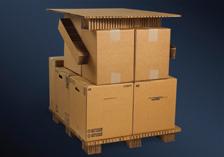
So, if you want more than a box, come and see what Atlantic can do for you.
NOVEMBER 2012
VOLUME 65, NO. 11
SENIOR PUBLISHER
Stephen Dean • (416) 510-5198
SDean@canadianpackaging.com
EDITOR
George Guidoni • (416) 510-5227
GGuidoni@canadianpackaging.com
FEATURES EDITOR
Andrew Joseph • (416) 510-5228
AJoseph@canadianpackaging.com
ART DIRECTOR
Stewart Thomas • (416) 442-5600 x3212
SThomas@bizinfogroup.ca
PRODUCTION MANAGER
Cathy Li • (416) 510-5150 CLi@bizinfogroup.ca
CIRCULATION MANAGER
Diane Rakoff • (416) 510-5216
DRakoff@bizinfogroup.ca
EDITORIAL DIRECTOR
Lisa Wichmann • (416) 442-5600 x5101 LWichmann@canadianmanufacturing.com
EXECUTIVE PUBLISHER
Tim Dimopoulos • (416) 510-5100 TDimopoulos@bizinfogroup.ca
BIG MAGAZINES LP
Vice-President of Canadian Publishing • Alex Papanou
President of Business Information Group • Bruce Creighton
WHEN PATIENCE IS VIRTUE
Patience is a rare virtue in an industry increasingly dominated by large, multinational conglomerates obsessed with latest quarterly earning reports and financial statements, but for the many long-suffering North American manufacturers of packaging machinery and equipment, the long-anticipated coming rewards of a CPG (consumer packaged good) marketplace finally finding its bearings will be all the sweeter for it in the end.
While the current calendar year has delivered more than a heavy share of downcast economic doom-and-gloom of Mayan proportions—from euro zone meltdowns to apocalyptic proclamations of a “fiscal cliff” plunge into financial abyss—there is now some real statistical evidence emerging in recent weeks to lend numerical legitimacy to the North American packaging industry’s unfolding turnaround in its financial fortunes.
According to the latest annual Shipments Study released by the Reston, Va.-based industry group PMMI (formerly Packaging Machinery Manufacturers Institute) last month, U.S.based manufacturers of packaging machinery saw their shipments soar by 19 per cent last year from 2010 levels to reach US$7.7 billion, with the industry’s backlog order estimated at an additional US$2.3 billion.
It was certainly out there in plain view for all to see and enjoy during last month’s upbeat, highenergy PACK EXPO International 2012 trade show at Chicago’s sprawling McCormick Place exhibition complex, which drew record numbers of show visitors and exhibitors to see the latest packaging machinery, material, processing, design, integration, sustainability and other diverse innovations that make the packaging sector such a good crystal-ball indicator of near-term economic prospects and conditions.
Not even around-the-clock news coverage of unfolding Hurricane Sandy superstorm fury unleashed on the eastern U.S. during the four-day event could put too much of a damper on a stellar benchmark edition of the biggest packaging exhibition of 2012 worldwide.
Recording total attendance of 67,355 people—the highest total since the show’s 2006 edition—and drawing a record-setting total of 1,965 exhibitors, the biennial Chicago show offered an impressive testament to the inherent resilience and innovative resourcefulness of an industry that for the most part, alas, does not always get the public recognition that it often deserves but, in true understated fashion, rarely craves solely for its own sake.
EDITORIAL AND ADVERTISING OFFICES:
Valleybrook Drive, North York, ON, M3B 2S9; Tel: (416) 442-5600; Fax (416) 510-5140.
SUBSCRIBER SERVICES: To subscribe, renew your subscription or to change your address or information, contact us at 416-442-5600 or 1-800-387-0273 ext. 3555.
SUBSCRIPTION PRICE PER YEAR (INCLUDING ANNUAL BUYERS’ GUIDE): Canada $72.95 per year, Outside Canada $118.95 US per year, Single Copy Canada $10.00, Outside Canada $27.10. Canadian Packaging is published 11 times per year except for occasional combined, expanded or premium issues, which count as two subscription issues.
DISCLAIMER: This publication is for informational purposes only. The content and “expert” advice presented are not intended as a substitute for informed professional engineering advice. You should not act on information contained in this publication without seeking speci c advice from quali ed engineering professionals. Canadian Packaging accepts no responsibility or liability for claims made for any product or service reported or advertised in this issue. Canadian Packaging receives unsolicited materials, (including letters to the editor, press releases, promotional items and images) from time to time. Canadian Packaging, its af liates and assignees may use, reproduce, publish, republish, distribute, store and archive such unsolicited submissions in whole or in part in any form or medium whatsoever, without compensation of any sort.
PRIVACY NOTICE: From time to time we make our subscription list available to select companies and organizations whose product or service may interest you. If you do not wish your contact information to be made available, please contact us via one of the following methods: Phone: 1-800-668-2374 Fax: 416-442-2191 Email: privacyof cer@businessinformationgroup.ca Mail to: Privacy Of ce, 80 Valleybrook Drive, North York, ON M3B 2S9
We acknowledge the nancial support of the Government of Canada through the Canada Periodical Fund (CPF) for our publishing activities. Canadian Packaging is indexed in the Canadian Magazine Index by Micromedia Limited. Back copies are available in microform from Macromedia Ltd., 158 Pearl St., Toronto, ON M5H 1L3
“Positive growth is always good news,” says PMMI’s vice-president of market development Jorge Izquierdo, citing robust export growth of 16 per cent in 2011 from the year before, complimented by a nice US$500-million jump in the sales of imported packaging machinery.
While such double-digit growth numbers are in some way indicative of how deeply the industry’s fortunes plunged during the worst of the Great Recession, there is no denying their timeliness or profound economic impact throughout the entire CPG industry packaging value chain in coming months.
Says PMMI chief executive Charles Yuska: “The increase in exhibitors speaks to the quality of business done at PACK EXPO, and while we fully expected to surpass our attendance goals, the storm’s effect on East Coast travel prohibited many from making the show, but it was definitely a success.
“The floor traffic was strong despite the storm, and the exhibitors I spoke with were very pleased with the number and quality of leads they received,” Yuska asserts. “The thing to remember is that all these exhibiting companies have invested significant time and resources to attend because they clearly believe they are going to get a return on that investment.”
One that hopefully will turn out to be well worth the wait.
DEPARTMENTS & COLUMNS
27
22
THE
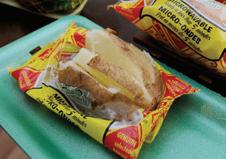
POTATO By Andrew Joseph Toronto produce processor nds a novel way to deliver the wholesome nutrition of baked potatoes onto the dinner plates in minutes at.
Plank By George Guidoni
ICONIC CANADIAN SODA BRAND POPS BACK TO LIFE WITH SLEEK METAL CANS
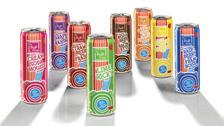
Everybody enjoys a good, against-all-odds comeback story, and Canadian soda lovers can look to plenty of beverage enjoyment in coming months thanks to some exciting new product launches from the reborn Canadian soda icon The PoP Shoppe (Canada), which has recently relaunched eight of its most popular bold flavors in sleek, 355-ml aluminum cans to complement the iconic “stubby” glass bottles that made it one of the most successful independent soft-drink franchises back in the 1970s. Launched in late summer under an exclusive distribution arrangement with Toronto-headquartered private-label bottling group Cott Beverages Corporation, the four colorful new flavors— Psychadelic Strawberry, Big Time Banana, Omazing Orange n’ Cream and Got the Blues Raspberry —are packed in slim-profile ‘retro-cool’ cans, manufactured by Rexam Containers, boasting witty product graphics and imagery designed by Torontobased branding consultants AmoebaCorp
Now retailing across grocery and convenience stores across Canada in single-serve cans and fourpacks, each of the canned PoP Shoppe flavors—also including the classic Lime Ricky, Radical Root Beer, Groovin’ Grape and Crazy Cream Soda —is cleverly color-coded with a whimsical graphic design paying homage to the brand’s original red-and-white striped logo motif on both the cans and the fourpack paperboxes manufactured by MeadWestvaco Packaging Systems, LLC
“We are thrilled to partner with such an iconic Canadian brand, and to introduce an exciting, new range of PoP Shoppe products to a new generation of flavor-seeking Canadians,” says Cott Canada’s general manager Dave Stewart.
Produced and canned at Cott’s bottling facility in Mississauga, Ont., the new cans were launched to respond to consumer demand for a lighter-weight alternative to the stubby glass bottles, according to Sabrina Gonzales, media director at The PoP Shoppe’s Canadian headquarters in Burlington, Ont.
“While the cans are a complement to our classic stubbies, Canada is really a can market—a higher volume share of all soda beverages in Canada are sold in cans,” says Gonzalez.
“Most Canadian consumers prefer cans because they chill faster, they are portable, and are also highly recyclable when compared to other formats,” she adds.
“The PoP Shoppe has enjoyed a very successful
return after a long absence, and we are thrilled that Cott is launching our first-ever can line,” says PoP Shoppe’s chief executive officer Brian Alger, who purchased the trademark for his favorite childhood soda in 2002 and relaunched The PoP Shoppe brand in 2005.
Today ranking among Canada’s top-selling premium soft drinks, The PoP Shoppe brand is expected to build up on its marketplace progress thanks to its partnership with Cott, which employs about 4,000 people at facilities across North America to produce more than 200 retailer and licensed brands of beverages and concentrates in over 50 different countries.
“The PoP Shoppe fans will really appreciate the design of these cans, as well as enjoy the refreshing taste of our new flavors,” Alger asserts.
Originally founded in 1969 by two young entrepreneurs, The PoP Shoppe reached its glory days during the 1970s—operating a network of over 1,000 independent retail outlets selling its unique variety of flavors in stubby glass bottles, while also offering full bottle refunds to customers returning their empties in the one-of-a-kind red PoP Shoppebranded crates.
Despite eventually reaching daily sales of over one million bottles by mid-1980s, the sudden emergence of private-label store brands and other dramatic marketplace changes ultimately led to the company’s demise, until being resurrected by Alger in 2005.
UPDATED COOKIE BOXES A TELLING GRAPHIC STATEMENT FOR GIRL POWER
Like all great causes and institutions, the Girl Guides of Canada-Guides du Canada knows the importance of changing and evolving with the times, having just redesigned the packaging for the group’s iconic Girl Guide Cookies to add some new zip and energy in the movement’s annual fundraising efforts.
As the official fundraiser for Canada’s largest organization for girls and women—counting over 90,000 members nationwide—the Girl Guide Cookies been one of the group’s best-known trademarks, with millions of cookie boxes sold across the country each year to fund its program, which provides opportunities for girls to discover, explore, be adventurous and make a difference, while building the leadership and life skills that increase their confidence and self-esteem.
Guide activities, community service projects and international adventures,” Pause states.
“The Girl Guides cookie box is the most powerful way for us to communicate directly with consumers,” says Pause, “and the new images on the cookie boxes reinforce not just the promise of opportunity, but character building
Canada to create a stronger bond.
“The new design works to create a compelling on-pack path to tell the Girl Guides story,” says Oakley, complementing New York City-based illustrator Marcos Chin for rising to the occasion to “stylistically interpret this journey in a contemporary and engaging way.”
Adds Pause: “Packaging development stakeholders everywhere know that the integration between the development of packaging and its deployment to shelf is a complex equation, but the tight inte-
Operating under the principle of challenging its members to enrich their personal development and empower them to become responsible citizens, the venerable nationwide movement—celebrating its 100th anniversary in 2010—has recently teamed up with package design specialists at Anthem Worldwide Canadian office in Mississauga, Ont., to update the cookie packages with more contemporary and higherimpact brand messaging through more engaging and informative graphics.
Starting with the Chocolatey Mint Cookies recipe traditionally sold across Canada throughout the month of October, the new boxes designed by Anthem Worldwide, the brand development arm of the Chicagoheadquartered marketing services group Schawk, Inc., will also be used to package the Classic Chocolate and Vanilla Sandwich recipe cookies that will be sold nationwide starting in April of 2013.
According to Dave Pause, business manager for Girl Guide Cookies, the new boxes were designed to celebrate and inspire the sense of ‘Girl Greatness’ among its membership.
“While most Canadian consumers are familiar with our cookies, we wanted to bring greater awareness to Girl Guides of Canada and the exciting opportunities our organization offers girls,” Pause explains.
“With more than 2.4 million cookie boxes expected to be sold in October, we have 2.4 million opportunities to communicate our message at the point-of-purchase.
“We believe the new package design will achieve this by speaking directly to the idea of ‘Girl Greatness’ and what that means by highlighting Girl
When you talk financing with Farm Credit Canada, we’ll listen Ready to expand your business? We’re ready to help. We get to know you and your business. Once we learn how you want to grow, we’ll create a financing package that helps you do it. Work with the leading lender to agriculture, agribusiness and agri-food in Canada. Let’s talk business. www.fccfinancing.ca
U.S. CRAFT BREWERS EMBRACING HIGH-END METAL CAN PACKAGING
While many large beermakers are struggling to grow their business in the mature, slow-growth North American markets, many small-sized microbrewers across the continent are experiencing sizzling growth in demand for their craft beer brands in recent years—often relying on high-impact metal can packaging to make a meaningful and enduring connection with ther consumers.
At last month’s annual Great American Beer Festival in Denver, Colo., local-area Oskar Blues Brewery of Longmont used the occasion to mark its signature Dale’s Pale Ale brand’s 10th anniversary by repackaging it in supersized 568-ml Royal Pint cans manufactured exclusively by the Broomfield, Colo.-based Ball Corporation
recyclable aluminum cans in North America,” says Oscar Blues marketing director Chad Miles.
“This year marks the tenth anniversary of the debut of Dale’s Pale Ale as the first craft beer available in
“We wanted to go big with our anniversary celebration and launching Dale’s in Ball’s new Royal Pint size is another first for Oskar Blues.”
Measuring approximately the height of a 24-ounce can and the diameter of a 16-ounce can, the sleek container is emblazoned with special-edition graphics celebrating the canned brand’s anniversary, which will later be updated with the same signature graphics as the regular 12-ounce cans of Dale’s Pale Ale
“The 568-ml can offers our North American customers a new
option to differentiate their brands and to appeal to more consumers,” says Robert Miles, senior vice-president of sales for Ball’s metal beverage packaging division for the Americas region.
“Can size is an important element of branding, and it is fitting that Oskar Blues is commemorating this special anniversary in a can size that is new to North America,” says Miles, adding the stackable, fully-recyclable 568-ml can boasts the highest recycled content of any existing beverage package in North America.
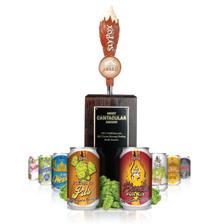
Also last month, Philadelphia, Pa. headquartered canmaker Crown Beverage Packaging North America was honored with the 2012 Most Cantacular Award from Sly Fox Brewing Co. of Pottstown, Pa., during the company’s annual Can Jam festival.
Good
“As craft brewing continues to expand in the U.S., so do the opportunities brands have to use packaging to stand out on the shelf,” says Sly Fox Brewing’s brewmaster Brian O’Reilly.
“Cans enhance the quality of beer, and they give brewers a chance to differentiate their brand through packaging.
“Crown has consistently demonstrated enthusiasm and professionalism when it comes to helping breweries convert to cans and leverage the format to create new drinking occasions and help grow sales,” says O’Reilly, whose company became the first craft brewery in the Mid-Atlantic U.S. region to package its beer in cans in 2006, with its Sly Fox Pikeland Pilsner brand picking up a Gold Medal prize at the Great American Beer Festival in Denver in 2007.
“At Crown, we’ve actively supported the adoption of aluminum beverage cans by the craft beer industry, committing ourselves to the best technical and customer service possible, and working with brewers right from the onset of the canning process,” says Neill Mitchell, vicepresident of marketing and strategic development at Crown Beverage Packaging North America, pointing out that the cans’ shatter-proof construction provides better physical and flavor protection for craft beers, compared to bottles, by not allowing any light or air to enter the package.
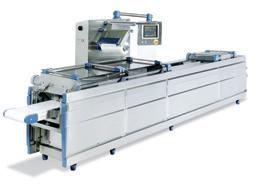
Repak horizontal form-fill-seal packaging machines from Reiser offer the best sealing integrity in the industry. Only Repak machines are constructed with two 4-point lifting stations, which can generate up to five metric tons of closing pressure for reliable sealing and more uniform forming. No matter how complicated your package, Repak will produce it perfectly. For more information, contact Reiser today at (905) 631-6611
“In addition to helping protect the integrity of the brand, the stackable cans are also easy to pack and take up less space than packaging alternatives,” adds Mitchell, “while environmentally-conscious shoppers can rest easy knowing that the metal is 100-percent and infinitely recyclable.”
States Mitchell: “With a strong team of experts to provide advice on canning and seaming, we work closely with brewers new to beverage cans to help them understand the filling and packaging equipment they will be using, and how to use it properly.”
igear
DecentralizeD DriVe systems
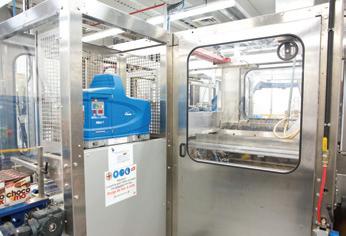
Movigear® is distinguished by its high level of system efficiency, a significant factor in reducing energy costs. The integration and coordination of all the drive components lead to a long service life and system availability. Movigear® is an intelligent system with its own control concept. Its high-quality networking helps reduce startup time and supports monitoring and maintenance tasks. When combined with a functional user software, drive tasks can be solved as quickly and easily as possible.
moV itrac ® lte B
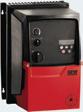
The range of functions provided by MOVITRAC® LTE B is particularly well adapted to less complicated applications. Its user-friendly design makes integration quick and easy, it also meets the high quality requirements of everyday requirements. The Movitrac® LTE B is also available in IP66/NEMA 4k making it suitable for special ambient conditions. These frequency inverters operate reliably and flexibly even when exposed to dust or water.
P sc
Planetary servo gear units
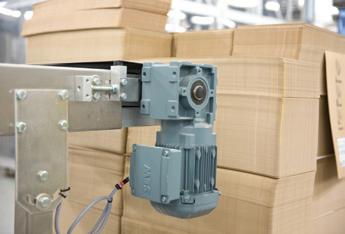
The low backlash PSC planetary servo gear units are designed for torque classes from 30 to 305 Nm. They are designed to offer the greatest possible flexibility and ROI, as not every application demands machines designed for maximum performance. These planetary servo gear units are the basis for versatile, dynamic, and above all cost optimized drive solutions.
moV itrac ® ltx
Simple, fast and diverse: as part of the Smart Servo Package, SEW-Eurodrive offers the new Movitrac® LTX servo inverter for universal use. It stands out with advantages such as ease of operation, short startup times as well as optimized costs. Available in two sizes and covers a power range from 750W to 5.5 kW. The Movitrac® LTX is particularly suitable for use in applications such as secondary packaging, handling, and logistics.
D D
ri V e systems
In many industries and applications, implementing economical automation concepts means utilizing decentralized systems throughout. Long rows of control cabinets with complex wiring, expansive space requirements and long distances between control cabinet and motors are too rigid and not very economical. Only the combination of flexible, versatile, economic and target-oriented modules will provide an efficient solution. This is the reason why system operators opting for decentralized drive systems from SEW-Eurodrive are always ahead of the game.
our Drive solution Pyramid.
The demands on material handling systems today have never been more wide ranging or more challenging. That’s why SEW-Eurodrive offers drive solutions for every kind of industry application. From the simple to the sophisticated, our pyramid of solutions allow you to control costs and limit complexity by giving you the ability to tailor our products to the exact intelligence and performance specs you require. Reducing energy consumption is also an important imperative today for the modern production line. Just ask Coca-Cola, who achieved a sensational 75% reduction in energy consumption by incorporating 40 of SEW-Eurodrives’s revolutionary decentralized MOVIgEAR® units in a recent overhaul of a European bottling plant transport line.
SEW’s customer resource portal for expert consultation, information and services.
VFDs: reliaBle, comPact & Versatile
SerVo PacKaGe: simPle, fast & DiVerse
CHICAGO SHOW-STOPPERS
Brief recap of new product launches at the PACK EXPO International 2012 show
BUILDING THE FREEDOM ALLIANCE
In one of the show’s biggest announcements, global adhesive technology giants Henkel and Nordson Corporation officially entered into a worldwide strategic alliance under which Henkel’s newlydeveloped Technomelt range of polymer adhesives will be used for the brand new Freedom Series hotmelt dispensing equipment developed by Nordson as a highly-mobile, compact, and environmentallyfriendlier alternative to the traditional hot-melt tanks requiring significant floorspace allocation— scheduled for a full commercial launch in the first quarter of 2013. According to both partners, the new integrated solution will provide end-users with enhanced reliability and process efficiency, while reducing costs and increasing customer profitability by lowering their adhesive consumption through better bead-pattern application to minimize material waste. Says Nordson president Michael Hilton: “The new Freedom System is one of the many ways our combined efforts will benefit our common customers worldwide by increasing packaging efficiency and reducing cost per package sealed.” According to Hilton, the Freedom brand name perfectly reflects its purposeful intent to provide hot-melt end-users with “six degree of freedom” from raw materials supply risk; downtime; machine complexity; material waste and operator inaction; along with more freedom to mount their Freedom Series dispensers virtually anywhere along the packaging machine, line or workcell where it’s needed. “We are excited about the incomparable benefits the new alliance will be able to deliver to our customers,” says Henkel Adhesive Technologies executive vice-president Jan-Dirk Auris. “One critical issue facing the packaging industry has been the short supply of some traditional petrochemical-based raw materials used in the manufacture of hot-melt adhesives, due to the increasing demand for these raw materials for other end products worldwide, but this integrated design effort between Henkel and Nordson effectively matches next-generation, highperformance hot-melt adhesives and advanced dispensing equipment to help meet such challenges.”
Launched right on the PACK EXPO show floor, the new M-2iA/3SL Genkotsu robot from FANUC Robotics America —designed for a broad variety of picking and handling applications—is available in two new models to provide three-kilogram payload and four axes of motion with a single-axis rotation, with the M-2iA/3SL long-arm model offering a larger motion range. Equipped with the company’s proprietary iRVision machine vision technology, the M-2iA/3SL f our-axis robot displayed at the show (see picture) is capable of line tracking picks of ran-
domly-placed mint containers from an infeed conveyor at rates of 182 parts per minute, orienting the parts, and placing them on the outfeed conveyor in required sequence. “The M-2iA is ideal for applications requiring high-speed and accurate handling of electronics, medical devices, pharmaceuticals, cosmetics, office supplies, consumer products and many other products,” says FANUC Robotics product engineer Jessica Beltran. Offering speeds of up to 3,500 degrees per second to execute a broad range of high-speed picking and assembly applications, the M-2iA operates with FANUC’s latest R-30iB controller with integrated intelligent functions such as iRVision , Force Sensing, Robot Link and Collision Guard to ensure optimal thoughput productivity, uptime and workplace safety.
FANUC Robotics America 403
THE UNFOLDING EVOLUTION
FULL-BLOWN FILM STARDOM
The Dow Chemical Company has used the occasion to add two new experimental resins to its proprietary DOWLEX range of LLDPE (linear low-density polyethylene) films—including the XUS 61530.501 and XUS 61530.502 resins—to address the packaging industry’s growing need for fasterrunning LLDPE resins for blown film.
According to the company, both new resins have been engineered to provide faster processing, equivalent physical properties, and a lower or equivalent coefficient-of-friction (COF) for applications currently utilizing DOWLEX 2056G and/or DOWLEX 2045G resins, while offering an estimated five- to 10-percent increase in blown film output to suit a broad range of highthroughput, high-performance structural and sealant requirements across a diverse range of food and medical packaging, heavy-duty shipping sacks, industrial and consumer films, liners, and other blown film or extrusion applications.
Dow Chemical Company 405
UNRAVELING TALE OF THE TAPE
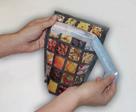
With its use previously limited to pegboard display of shredded cheese products, the Cryovac Division of Sealed Air Corporation has expanded its Multi-Seal FoldLOK resealable packaging format to accommodate a much broader variety of center-store products with a new, gusseted-bottom design that facilitates stand-up display of additional bulky snack-foods such as nuts, candies and dried fruit pieces, along with various types of pet treats. “With the extension of this reclosable package to new product markets, we are continuing to develop innovative packaging solutions that add value to a variety of food products,” says Sealed Air’s marketing director for Cryovac markets Kari Dawson-Ekeland. “Reclosable packaging for products such as snack foods and pet treats can be particularly convenient for consumers by allowing for easier portioning and portability,” shes says, adding the absence of any zippers or other mechanical closures makes it easier to use for elderly consumers, while providing a much better material reduction compared to using zipper-type enclosures. To open the Multi-Seal FoldLOK pack, consumers completely peel off a perforated strip to reveal the opening across the top of the package, and then simply fold the top of the bag to let the specialty food-grade adhesive reseal the remaining contents.
Cryovac (div. of Sealed Air Corp.) 404
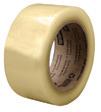
Widely renowned for its innovative technologies, the venerable 3M Company used the show to expand its famed Scotch brand of recycled corrugate tapes to provided customers with a cost-effective solution for taping corrugated shipping boxes. Offering a range of new tape versions to accommodate different requirements for tape weight and backing strength, the enhanced tapes are designed specifically for use with recycled corrugated boxes that are more difficult to seal because of shorter, flatter fibers and a less smooth surface area—offering up to 10 times the tack of conventional boxsealing tapes. “Nearly all of the products being shipped today use corrugated cardboard and with upwards of 85 percent of it being recovered, the majority of boxes contain some recycled content,” says U.S. marketing manager Brian Kenady. “With so much variation, it is important that companies are equipped with sealing tape that doesn’t require multiple applications in order to keep the products secure. It makes sense not only from an environmental footprint perspective, but also from the bottom line.”
Recently enabling a leading apparel manufacturer to realize significant cost-savings by using only a single strip of tape on its boxes to replace multiple strips, all of the company’s Scotch Recycled Corrugate Tapes can be applied with a handheld tape dispenser for low-volume packaging applications, or via the company’s 3M-Matic Case Sealer in highspeed packaging environments.
3M Company
406
A STEADY RISE IN U.S. PLASTIC BOTTLE RECYCLING
U.S. consumers are continuing to warm up to the notion of recycling their empty plastic bottles and jars, according to a new industry report showing them collecting 45 million more pounds of the rigid-plastic containers for recycling last year than in 2010—a 1.7-percent increase—to reach over 2.6 billion pounds.
And although the increase only translates into a 0.1-percent improvement in the overall recycling rate for plastic bottles in the U.S.—reaching 28.9 per cent for 2011—the total tonnage of used bottles collected for recycling in the U.S. has grown in every single year since the industry began keeping track of these statistics in 1990.
With PET (polyethylene terephthtalate) and HDPE (high-density polyethylene) bottles currently accounting for over 96 per cent of the U.S. market for plastic bottles, domestic processing of all recycled plastic containers—including imported materials—rose by 89 million pounds from 2010, according to the 22nd annual National Post-Consumer Plastics Bottle Recycling Report unveiled jointly last month by the Association of Postconsumer Plastic Recyclers (APR) and the American Chemistry Council (ACC)
“With reduced exports and increased imports of recovered bottles, plastic bottle recycling continues to be an international business, with domestic companies competing effectively,” says APR’s executive director Steve Alexander.
“Being diligent about recycling your plastic bottles is a simple way to strengthen our domestic plastics recycling industry, while doing something good for the planet,” says Alexander, pointing out that recyclable plastic continues to be a highly sought-after commodity.
“Even with increased collection, demand for recycled plastics far outpaces supply,” says ACC’s
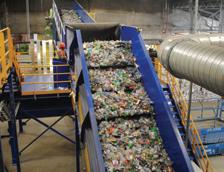
A Rumpke Consolidated Companies recyling plant in Columbus, Ohio, processes 30 to 40 tonnes of recyclable materials per hour.
vice-president of plastics Steve Russell, adding that the study—based on a survey of U.S. recyclers conducted by Moore Recycling Associates, Inc.—validates the so-called ‘single-stream collection,’ whereby all recycled materials are placed in a single bin, as an effective way to boost household participation rates.
“We need everyone to do their part to get more plastics into the bin,” says Russell, “and the good news is that with so many communities adopting single-stream recycling, it has never been easier to recycle so many types of plastics.”
While the growing demand by major retailers and CPG (consumer packaged goods) manufacturers for more lighter-weight packaging has helped grow the use of plastics in new bottle applications, the report notes, “market growth was largely offset by trends toward smaller bottles (e.g. concentrated detergents), lighter bottles and the sluggish economy.”
FLIGHT OF FANCY FOR NEW COMPOSTABLE BOXES
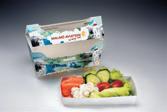
If breakfast really is the most important meal of the day, then Swedish airline Malmö Aviation is certainly well aware of the importance of sustainability in the air travel business— having recently launched new paperboard breakfast boxes made entirely of compostable and biodegradeable materials manufactured by Iggesund Paperboard
Jointly developed by the airline, its catering supplier Picknick and Jönköping-based foldingcarton converter Omikron, the new boxes were designed to combine packaging functionality, user-friendliness and shelf-life optimization with simplified handling and a lower environmental impact than their plastic predecessors, says Malmö Aviation’s project leader Annika Melin, calling the new breakfast boxes “the result of a long development process.”
Melin explains: “The outer shell of the box is made of ordinary Invercote board, the inside is a serving tray made of Invercote Bio to hold the fresh food, and the tray is in turn flow-packed with a modified-atmosphere flush to increase the food’s shelf-life and to help prevent fogging.
“The ingenious feature of Invercote Bio is that it is coated with a bioplastic material,” says Melin. “This means that the tray can go into the same wastestream as the food scraps—to be sent directly to an anaerobic digestion plant to produce biogas without the need for prior sorting.”
According to Jonas Adler, commercial manager of the Invercote Bio products, “The combination of paperboard and bioplastic, which are both certified as compostable to European standards, means that the new box functions well in today’s recycling systems and will continue to do so in future systems.”
In addition to being compostable, the new two-part paperbox design has also resulted in welcome space savings on-board, according to Malmö Aviation’s inflight and lounge manager Malin Olin.
“Because the new breakfast boxes are smaller than what we used before,” Olin points out, “we can load far more meals onto each serving trolley—saving both weight and space onboard, while also doing our part to help the environment.”
WALMART WELCOMES SLIDING PILL PACKS
Given that few retailers know the intricate ins and outs of packaging sustainability as well as the Bentonville, Ark.-headquartered Walmart Stores, Inc., the folks at the Newark, N.J.based paperboard packaging products manufacturer Keystone Folding Box Co. have good reason to feel upbeat about the company’s newly-launched Ecoslide-RX pharmaceutical compliance package that will soon be popping up at Walmart’s pharmacies across the U.S. Designed as a senior-friendly package that also ensures the highest-possible child-resistance properties of an F=1 safety rating, the Ecoslide-RX is touted as a perfect solution for a myriad of prescription products, physician’s samples and clinical trial materials, according to the company, offering large, easy-to-read type on all sides and clear, simple opening instructions.
“At Walmart, we are dedicated to quality patient care and have proven that adherence packaging assists in these endeavors,” says Walmart’s vice-president of pharmacy merchandising Sandy Kinsey.
According to Keystone, which introduced the Ecoslide RX package in late 2011, a recent independent survey of pharmacists and consumers gave Ecoslide-RX high marks when graded against competing blister-packs and traditional amber vials.
In addition to the lack of associated “landfill guilt,” Keystone says both surveyed groups were impressed with several other benefits, including:
• Ease-of-Opening. Large, clear directions show users how to unlock the simple childresistant (CR) locking mechanism, which opens with surprisingly little force by a thumb press on a release button located on the corner of the carton’s front panel. Inside the outer carton is a film/foil, push-through blister card that slides out when the CR lock is released, yet remaining connected to the carton at all times.
• Compliance/Safety. The Ecoslide-RX pack offers a full range of heightened compliance and safety benefits, including a greatly diminished risk of contamination from dropping, spilling or moisture; increased compliance via a pill reminder/weekly calendar; and additional package printing space for large, bold labeling to help visually challenged consumers.
• Easy Storage/Transport. Compared to amber vials, Ecoslide-RX is far more convenient for carrying around in purses and briefcases, while providing a more discrete appearance.
NOTES & QUOTES
German-based industrial sensing, safety, machine vision and automatic identification (Auto ID) technologies manufacturer SICK AG has completed the move of its Canadian subsidiary SICK Ltd. to a new and bigger facility just north of Toronto in Richmond Hill, Ont., to accommodate increased demand for its products and services in Canada— especially among customers in the processing, raw materials and energy sectors. “Our primary goal is to be able to directly offer our customers in Canada the SICK Group’s complete program of products and services,” says SICK Ltd. president Craig Smith. “Additionally, SICK’s worldwide expertise, firstclass application knowledge, and after-sales service are now more readily available, including on-site system technology and software integration for all SICK’s products.” Tel. (905) 771-1444.
Buffalo Grove, Ill.-headquartered Hexacomb, manufacturer of paper-based packaging and graphic display boards, has announced plans to open up a new manufacturing facility in central Mexico to meet growing demand for its protective packaging products there. To be located in the state of Querétaro, the new facility—scheduled for operational startup
cushioning, blocking and bracing properties for a wide range of protective packaging applications.
in the third quarter of 2013—will manufacture the company’s full line of honeycomb-design protective packaging products, including sheets, runners, and edge and corner protectors, according to Honeycomb, which already operates one Mexican-based manufacturing facility in Monterrey. “Our customers, who range from large multinational corporations to smaller regional companies, want to make sure their products are well-protected during shipment, and over the next year, we expect to grow our business in the central region even further—driving the need for additional manufacturing capacity in the Querétaro area.” According to Daniel, the company is currently looking for a suitable facility that will be able to house both core- and panel-making equipment, with capacity to produce up to 90 million square feet of product annually. “We believe the increased demand for our products is due to their superior construction and performance compared to other honeycomb options, and it is also important to locate a manufacturing facility in close proximity to our customers, which has a positive impact on both speed-ofdelivery and freight costs, while keeping with the environmentally-responsible nature of our product line.”
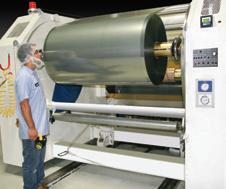
Flexible packaging materials manufacturer Clear Lam Packaging, Inc. has completed a US$2-million expansion of its Forming Films Division business a the company’s central manufacturing facility in Elk Grove Village, Ill., significantly increasing its manufacturing capacity for rigid plastic rollstock— including PET (polyethylene terephthalate), rPET (recycled polyethylene terephthalate), PLA (polylactic acid) and BioPET (biopolyethylene terephthalate) rollstock—used by thermoforming companies operating vertical form/fill/seal equipment to produce a broad range of consumer packaging for prepared foods, fresh produce, meats, cheeses, dairy products and nonfood items. “Clear Lam is committed to growing its Forming Films business through our investment in new technologies and equipment representing the latest co-extrusion advancements,” says Clear Lam president and chief executive officer James Sanfilippo, adding the upgrade included installation of a new sheet extruder (see picture) that will provide additional annual capacity of about 15 million pounds. “With new polymer technologies and our continued innovation in the development of new sustainable packaging formats, we see rigid rollstock as a growth area—especially in the food and personal healthcare segments,” Sanfilippo adds.
Green Bay, Wis.-based package and label converter WS Packaging Group, Inc. has completed the acquisition of Business Graphics Printing Inc., Knoxville, Tenn.-based offset
printer of inserts and instructional and product literature booklets used primarily in the pharmaceutical, appliance and outdoor equipment markets. Currently employing 22 people at a modern, 13,500-square-foot production facility, “Business Graphics Printing has established itself in a leadership position on the basis of its overall technical competence and capabilities in offset printing of booklets and multifold inserts,” says WS Packaging’s chief executive officer Rex Lane. “They have a partnership mentality that has allowed them to continue to grow and deliver expanded capabilities, while their innovative solutions create value and are further defined by an ongoing commitment to well-established lean manufacturing processes.”
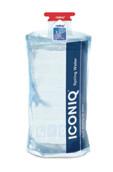
Zurich, Switzerland-headquartered Amcor Flexibles Europe & Americas has been award the top Best Packaging Innovation prize at last month’s international Water Innovation Awards 2012 ceremony in Barcelona, Spain, held during the course of the ninth annual Global Bottled Water Congress exhibition and conference. An operating subsidiary of the Melbourne, Australiaheadquartered packaging products group Amcor Limited, Amcor Flexibles picked up the top prize for the company’s recentlydeveloped AquaFlexCan beverage pouch—initially targeting running enthusiasts and other endurance athletes—which was used by the Welsh water-bottler Iconiq Drinks to introduce the package (see picture) over the course of several high-profile marathon races taking place in the U.K. in the past year “Since first introducing AquaFlexCan, we worked hard to improve the quality of the pouch, are delighted that Iconiq Drinks has recognized the benefits of this innovative product and has engaged to market it under their main brand,” says Amcor Flexibles marketing manager Giorgio Dini. “Iconiq Drinks is a dynamic and active company that is fully aligned with our approach of constantly looking for smart ideas.”
Gerald and Ralf Schubert
named Chief
Executive
Officers, ensuring Schubert’s future as a family business
When Gerhard Schubert presented his first hot-melt box erecting and gluing machine to the public 46 years ago, his sons Gerald and Ralf were only two and five years old, respectively.
It was the beginning of a success story in many ways. That box erecting and gluing machine was followed by a series of technical highlights including the world’s first packaging robot, Schubert’s own packaging machine control unit, the first F44 picker line and the TLM – the world’s first top-loading packaging machine installed on an assembly line. This trend has continued up to the TLM transmodule, the world’s first transport robot.
Even today, Gerhard Schubert remains a tireless and imperturbably independent pioneer. These characteristics of its founder have made Gerhard Schubert GmbH the recognised global market leader in its field. Those humble beginnings have resulted in a group of companies with more than 900 employees worldwide.
But Gerhard Schubert can be particularly proud of another achievement. His sons have been shaped by their father’s genes and have been active within the company for more than 20 years. Gerhard Schubert has now appointed them Chief Executive Officers.
Gerald Schubert (48) is a father of two children with a degree in mechanical engineering. He headed up the Schubert subsidiary IPS (International Packaging Systems) before assuming the role of Schubert Sales Division Manager. Ralf Schubert (51), a father of three children, graduated in computer sciences and leads the Technical Office and Assembly Division.
This proven management team is completed by Peter Gabriel (Dipl. oec. univ.) as Commercial Director and Peter Schneider (Dipl.-Ing./FH) as the head of the Materials Management Division. Gerhard Schubert will retain his overall management role and continue to devote himself to the Marketing Department.
Made from renewable bers and engineered into a proprietary honeycomb con guration, Hexacomb products offer superior strength,
ZERO SUM GAINS
Industry-led sustainability coalition targets outright elimination of all packaging waste
While setting high goals always carries the risk of the disappointment of falling short, when it comes to matters of utmost urgency, such as global packaging sustainability and the industry’s carbon footprint reduction, there is really no such thing as aiming too high.
So while the explicit promise of “a world without packaging waste” may seem a little idealistic for now, setting the right set of wheels in motion to getting there is at least a timely and vitally important start out of the gate, according to the chairman of the newly-formed PAC NEXT working group mandated to explore and develop practical end-of-life packaging solutions to head off a widely anticipated regulatory onslaught of tougher and more costly EPR (extended producer responsibility) measures that the recession-weary CPG (consumer packaged goods) industry can ill afford in the current economic climate.
Started up in August of 2011 under the guidance of Jim Downham, president of the Toronto-based PAC-The Packaging Association, the fledgling multistakeholder group—comprising packaging suppliers, retailers, manufacturers, waste management experts, municipalities, and other industry associations—has already attracted 110 members within its first year, and based on the enthusiastic feedback to the group’s inaugural Creating Next Life Solutions national conference a few weeks ago in Ottawa, those membership numbers are very likely to swell in upcoming months.
All for One
According to PAC NEXT chairman Alan Blake, “What makes our group unique is that we take a packaging-neutral approach that allows its members to work in an inclusive and collaborative manner across the entire packaging value chain to actively explore, develop and pilot economical end-of-life packaging solutions for all packaging materials.”
Complimenting PAC’s 60-plus years of experience in championing the Canadian packaging industry’s interests on all legislative levels, “The PAC has expanded its boundaries to serve all of North America without leaving its Canadian roots, and this rebranding will help it bring along the benefit of insightful first hand-experience of EPR impact on the industry, along with invaluable knowledge on best practices and pitfalls that will help to optimize and harmonize EPR in Canada, while supporting an industry-led alternative to EPR in the U.S.,” Blake explains.
According to Blake, who recently retired from Procter & Gamble Inc. (P&G) after a distinguished 30-year career with the Cincinnati, Ohioheadquartered CPG giant—last serving as associate director of its Global Packaging Development team—the PAC NEXT group’s diverse membership composition makes it uniquely qualified
to reach out to the consumers, who ultimately hold the key to successful and aggressive global waste reduction efforts because there is a definite limit to what the industry can achieve on its own cost-effectively.
“Packaging sustainability is now top of mind for the industry, and it is starting to become an integral and systemic element of the way packaging work is done,” Blake told the Canadian Packaging magazine in a recent interview.
“And while it is also becoming of greater importance to consumers, since after all it’s the first thing they see when buying a product and the last thing they see when disposing of the empty pack, North American consumers are generally not yet ready to make any compromises on value and performance for the sake of sustainability,” points out Blake.
• Material optimization to improve recovery rates for high-impact materials;
• Simulate further consumer engagement to understand the drivers that influence consumer actions and purchasing decisions;
• To operate an authoritative Sustainable Innovation Center of Excellence to match best practices with emerging trends;
• Encouraging the use of the group’s recentlylaunched Sustainable Packaging Design Guide online evaluation tool metrics to reduce packaging’s environmental footprints early in the game.
“These projects will identify solutions that ensure economical recovery that will lead to improved packaging reduction, recycling, reuse, upcycling, composting, energy-from-waste and other emerging technologies, says Blake, “to form the basis for industry making progress on the journey to the ‘Zero Waste’ goal.”
Full Toolkit
“So there is still plenty of work needed to get to a place where all packaging materials can be recovered economically via an integrated set of end-of-life solutions that include reduction, recycling, reuse, upcycling, composting, waste-toenergy and emerging technologies,” Blake relates.
“This is crucial, as there is still way too much valuable packaging ending up in landfill,” asserts Blake.
In fact, PAC NEXT estimates the value of landfilled packaging in Canada at $11.4 billion and the current costs of collection and recovery of landfill-bound used packaging at $1 billion—resulting in recovery and reuse of about $1.1 billion worth of materials.
With the U.S. numbers roughly 10 times higher for each of the similar estimates, PAC NEXT is gravely concerned that regulatory powers in both Canada and the U.S. will try to fund future waste-reduction efforts by imposing a disproportional burden of waste collection and recovery costs through higher ERP levies onto the CPG brand-owners and manufacturers, rather than help the industry to develop a market-based approach that will attract adequate consumer engagement to make it viable.
“This will require practical and creative collaboration to unite leading organizations across the North American packaging value chain to explore, evaluate and mobilize innovative packaging end-of-life solutions,” says Blake, explaining the fledgling’s group strategy of establishing several dedicated “project-based committees” focusing a different but highly interlinked goals, including development of:
• Policy best practices that support harmonization;
• System optimization to better understand and optimize current material recovery;
Having developed its interactive Sustainable Packaging Design Guide tool in collaboration with the U.S.-based Sustainable Packaging Coalition (SPC) and Quebec-based Eco Enterprises Quebec (EEQ), the PAC NEXT group will be actively working in coming months across North America to encourage greater consumer involvement through education, according to Blake.
“The goal is to identify the key drivers and barriers that influence consumer actions when purchasing and discarding packaging material, says Blake, “and there has already been excellent progress made in several important areas.
“We are actively engaged with Metro Vancouver and The Federation of Canadian Municipalities in developing a consistent national consumer communications plan, and we are also tracking consumer habits and practices—from purchase to disposal—for pilot programs that add new materials into the recycle stream, such as hot beverage carton cups, for example.
“We are also assessing with the SPC the opportunities of bringing the ‘How2Recycle’ on-pack label to Canada.”
“Our midterm focus will be on growth—actively engaging more players across the packaging value chain in both Canada and the U.S. to join PAC NEXT and work corroboratively within the member-led projects to share the knowledge and expertise that will help us to mitigate costs, maximize recovery, harmonize EPR in Canada, and offer a viable industry alternative to EPR in the U.S.,” Blake adds.
“In the longer term, we will be aiming to operate as a global resource for knowledge and expertise on best practices to deliver economical end-of-life solutions for all packaging.
“There is definitely a mandate for the packaging industry to have a voice in this important process,” Blake concludes, “and PAC NEXT provides a perfect vehicle for this voice to be heard.”
For further additional information on PAC NEXT activities and membership servces, go to: www.pac.ca
James Downham, President & CEO, PAC-The Packaging Association
Alan Blake, Chairman, PAC NEXT
Doug
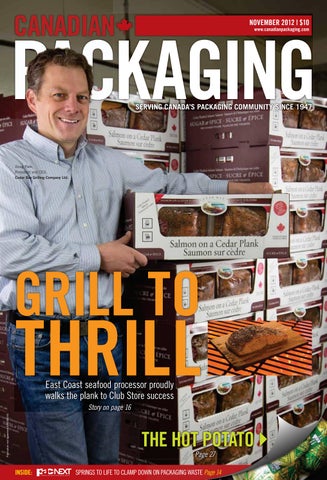
Park, President and CEO, Cedar Bay Gilling Company Ltd.
Grand Prix Award competition of the Canadian Council of Grocers and Distributors
WALKING THE PLANK
Upstart Nova Scotia seafood processor making big waves in the salmon market segment with innovative packaging and a truly unique product offering
BY GEORGE GUIDONI, EDITOR
PHOTOS BY DARRYL MUNRO
Justbecause you may be a small fish in a big pond doesn’t mean you can’t reel in some bigname heavyweight customers to help your business grow and proper—so long as you have an outstanding innovative product to sell and a perfect package to market and merchandise it for maximum shelf impact.
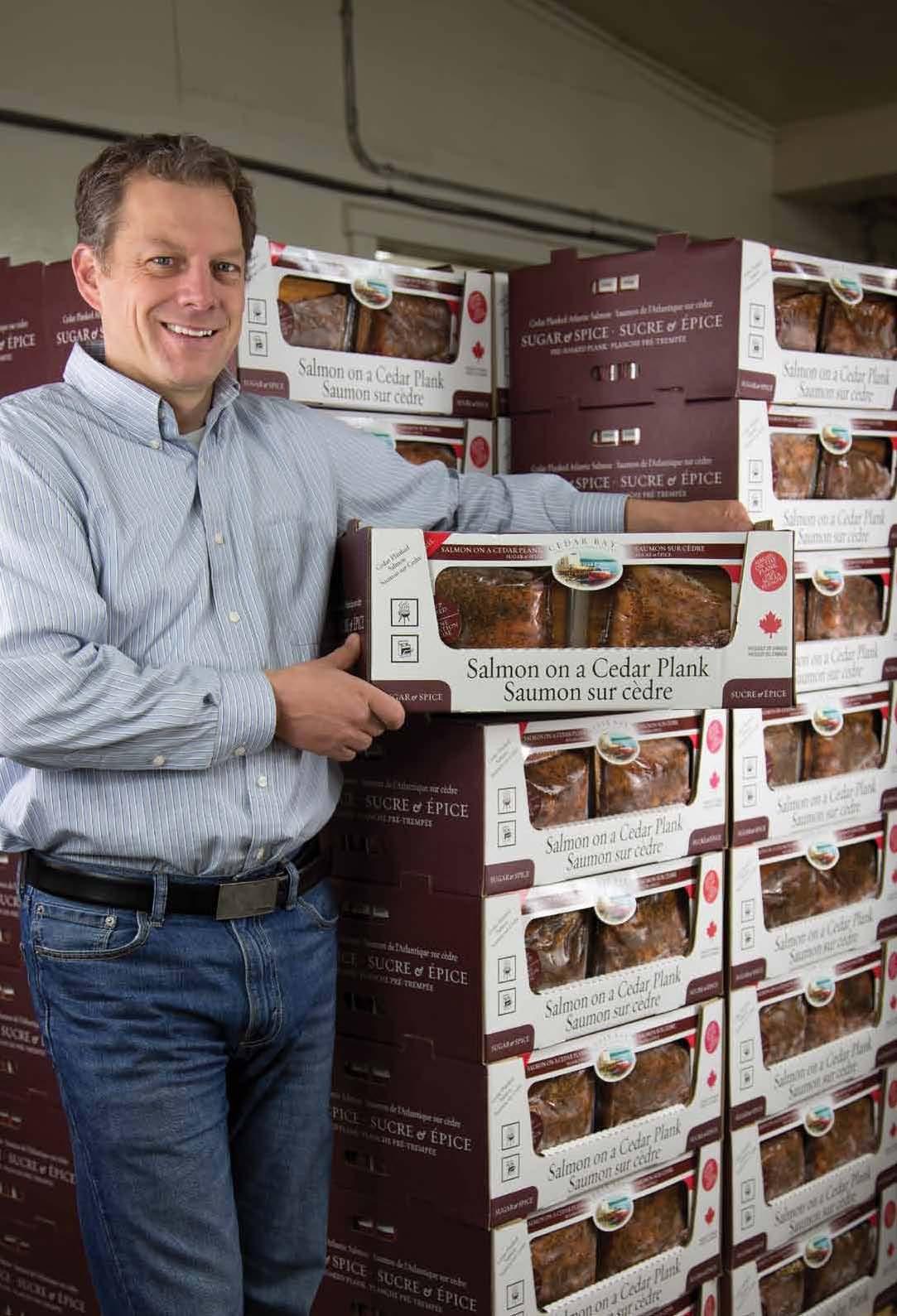
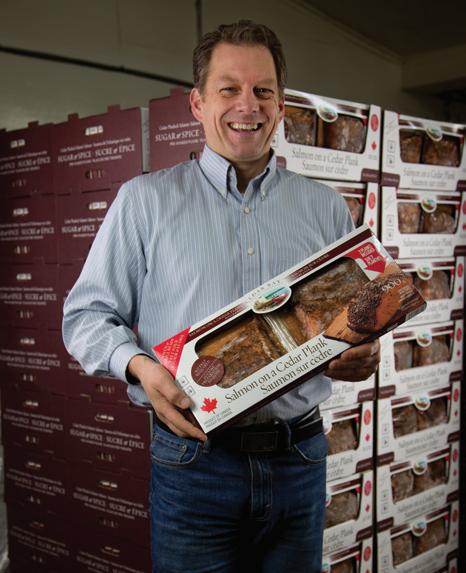
Which is exactly what Doug Park, a 44-year-old co-founder, president and chief executive officer of the Blandford, N.S.-based seafood processor Cedar Bay Grilling Company Ltd. has been doing for the past four years with a unique line of frozen-salmon products packaged in high-quality, ready-to-grill portion packs that enable consumers to prepare mouthwatering and highly nutritious meals without having to handle or touch the fish until it’s actually ready to eat and enjoy.
Based on an ancient ‘planking’ techniques perfected by native North Americans long before the
white man’s arrival onto the continent, the company’s Cedar Bay Planked Atlantic Salmon packages have been literally flying off the shelves of a fastgrowing list of high-profile food retailing customers like Costco, Loblaws, Metro and Sobeys, as more Canadian seafood lovers continue to discover the exceptional culinary excellence delivered in convenient, eye-catching, consumer-friendly packaging that has already earned widespread industry praise far exceeding the fairly modest size of a 20-employee operation tucked away in a tiny South Shore hamlet and fishing village lying about a onehour drive south from Halifax.
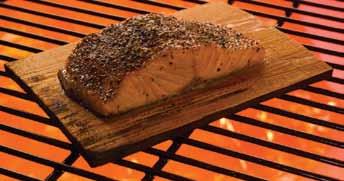
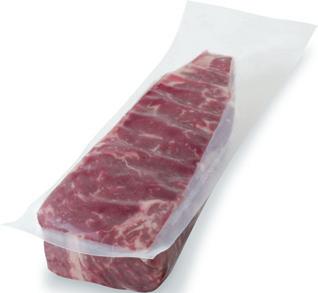
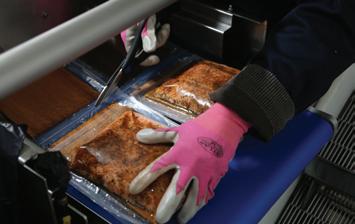
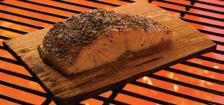
Packaged in airtight plastic film vacuum-packs containing both the cut salmon fillets and the pre-treated cedar planks on which the salmon pieces are cooked in about 15-20 minutes on a barbeque grill or inside the oven, the Cedar Bay Planked Atlantic Salmon has earned the company three top honors—including Best in Seafood and Deli, Most Innovative and Original Product, and Most Healthy Innovation awards—in the 2009 national
A year later, the upstart salmon processor managed to eclipse its rookie-year hat-trick by scooping up the coveted Best New Retail award at the world-renowned Boston International Seafood Show exhibition by being selected as the most innovative product of 2010. (Pictures Above)
“That’s pretty much the seafood industry’s equivalent of winning the Super Bowl,” Doug Park told the Canadian Packaging magazine in a recent interview relating the four-year-old upstart’s meteoric rise up the ranks of Canada’s highly-competitive fish-processing industry traditionally dominated by long-established mass producers with vastly deeper financial resources and market clout.
Top Skillset
Having honed his business skills in various sales and marketing positions with the Canadian frozenfoods giant McCain Foods (Canada) —including six years as president and chief operating officer of its Charcuterie La Tour Eiffel deli meat-processing business in Quebec—Park says that product and packaging innovation are requisite core competencies for any aspiring entrepreneur hoping to make waves in a well-established marketplace landscape.
“In the deli meats industry, if you don’t innovate you die, and it’s just the same in the seafood industry, if not even more so,” says Park, relating that running his own business is something he always wanted to pursue, with Nova Scotia seeming like a natural setting for realizing his entrepreneurial ambitions.
“I spent my high-school years in Nova, so moving here was very much like coming home,” says the avid fishing enthusiast and fish-lover born and raised in the natural outdoor ruggedness of the upper reaches of Northern Ontario.
With fishing being a natural recreational and commercial past-times for many local residents, Park says he was introduced to the unique ‘planking’ method of outdoor salmon grilling early in life—laying foundations for a successful realization of a long-harbored business vision that is now playing out to perfection in both Canadian and northeastern U.S. retail markets.
According to Park, the plank-grilled technique produces an intensely smoky taste profile and fla-
vor that can’t be replicated with other forms of preparation, and requiring hours of chef preparation to execute properly from scratch.
And seemingly with no one in the marketplace to offer consumers a convenient, pre-packaged, allin-one method of making cedar-grilled salmon at home without the mess and hassle of handling raw fish, Park says he saw a great niche market opportunity for a healthy, easy-to-prepare fish product that was just waiting to be invented.
Nowadays running a busy, five-days-a-week production schedule at a 16,000-square-foot facility housing three production lines and two large freezers, the company’s illustrious entry into the marketplace has been suitably matched with overwhelmingly enthusiastic consumer feedback and speedy market penetration fueled by a fast-growing U.S. and Canadian client list, along with a recently-concluded distribution deal with a leading U.K. retailer.
Local Pride
Sourcing its salmon exclusively from responsible and reputable fish-farm operators, Park says the physical attributes of locally-harvested Atlantic salmon—including an exceptionally high content of the ‘good-for-you’ Omega 3 and Omega 6 fatty acids—make it an ideally well-suited option for plank cooking both outdoors and at home.
The fact the Cedar Bay Planked Atlantic Salmon brand is enjoying brisk sales growth in western Canada—home to one of the world’s biggest and most renowned salmon industries in its own right— is a clear validation of the company’s product and packaging innovation skills and mindset, asserts Park, relating that he initially bought the longdisused fish-processing plant in Blandford, along with his father Arnold, because he was attracted by its still highly-functional freezer warehousing.
“We were originally thinking of running a seafood distribution operation from this location,” recounts Park, “but the deal I was working on at the time fell through.
“So in this moment of desperation, I came up with this idea of doing planked salmon, just like I used to do it at home all those years ago,” he recalls, “and I then spent the next two months working out how to bring this idea to life.
“It turned out looking pretty good in the end, and after I took it to our local Sobeys stores and saw that they loved the innovation that went into this prototype package, we proceeded to launch the product in June of 2009,” he recalls.
With “nothing similar in the marketplace at the time we earned quick early success,” Park recalls, citing the product’s inherent convenience and affordability, enhanced by simple preparation procedures essentially boiling down to letting the frozen product to thaw for a few minutes and putting the plank on the grill.
“One thing about consumers, including real fishlovers, is that most of them don’t really ever want to touch the fish, if they can help it,” Park explains, “and that is more or less the primary idea behind this product.
“The plank is already in there, the fish is on it, it’s all spiced and ready-to-go, and all the consumer has to do is take it home, thaw it out it, and throw it on the barbeque or into the oven,” he states.
“The other thing about consumers is that for the most part they really don’t know what to do with the fish, or what to put on it, except to place inside tinfoil and squeeze some lemon on it before putting it on the barbie.
“Nothing wrong with that in itself, but with everyone doing essentially the same thing, we felt that it was the right time to give consumers a different methodology for cooking salmon, while making it much easier for them to prepare delicious salmon entrees that will make their guests go ‘Wow!’
“A lot of people are naturally scared of making a mess of an expensive piece of fish,” Park expands, “and our product not only takes that fear away, but actually enables them to earn a lot of personal praise and credit for their cooking skills, even if there aren’t any.
“Essentially, it is what I call plank salmon with training wheels,” Park chuckles. “I wouldn’t necessarily call it an exotic meal, but it offers consumers a real interesting and original salmon meal option with a whole new way of cooking a delicious product that Atlantic salmon is.”
Pre-soaked in fresh water for 24 hours to achieve proper moisture content, the cedar wood planks included underneath every piece of salmon vacuumpacked in the pre-printed sleeves “essentially come for free with the product,” according to Park, who points out the brand is “very cost-competitive” with the bulk of traditionally-packaged Atlantic salmon
products across Canada and the U.S. despite the inclusion of an extra value-added packaging component. “We know that consumers are price-sensitive and we make sure that consumers get a good price-point with our product,” states Park, “along with all the convenience of being pre-spiced and easy to make.”
Size Matters
Packaged in four different sizes—including 141gram single-serve, 275-gram, full-fillet 760-gram, and two-piece, two-board 900-gram packages developed specifically for Costco outlets in Canada and the U.S.—the retail packages of Cedar Planked Atlantic Salmon are offered in four different flavors, including:
The original Sugar & Spice recipe—developed by Park “before we started the business”—which is the company’s bestselling product in Canada.
The popular Applewood with Orange & Ginger recipe, which Park says is the company’s Number One selling brand in the U.S., and incidentally the winning entry at the 2010 Boston Seafood exhibition. The Maple & Smoked Pepper and Carmelized Onion varieties, with the latter sold exclusively in the U.S. markets.
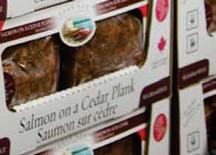
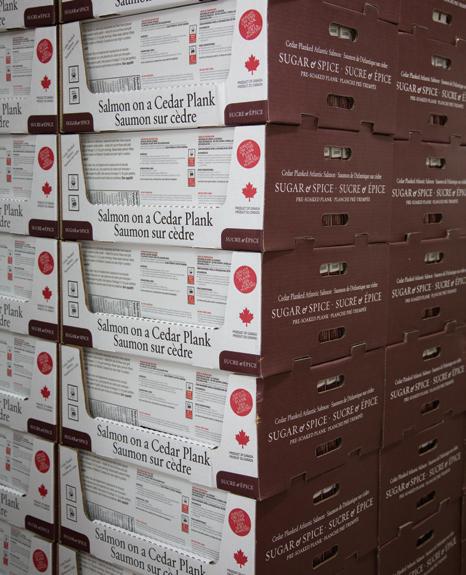
Shipped from the Dartmouth facility of Unisource Canada in timely on-demand deliveries, the Kitting secondary packaging solution supplied to the Cedar Bay plant includes the pre-printed paperboard sleeves and pre-assembled, stackable corrugated master cases that are quickly lled with salmon llet vacuum-packs and stacked 50 cases per pallet.
“We also do the straightforward Salt-and-Pepper and Lemon-and-Dill recipes for all the purists out there,” says Park, adding all the fresh product shipped to the facility daily is processed and packaged within a day of arrival to ensure optimal product freshness and shelf-life.
“The straightforward vacuum-sealing process we use gives the product a very good, mimimal shelf-life of at least a year,” relates Park, “while the film we use to package the salmon also provides very good product protection to prevent ‘freezer-burn’ damage.”
Shipped in bulk full-fillet size, the fresh salmon is cut to size by a fully-automated, cutting-edge proprietary slicing system designed and manufactured specifically for salmon cutting applications, Park reveals.
“It has a laser-eye that instantly measures the topography of the fish and cuts it right to our requested specifications,” says Park.
“We used to do all the cutting to size manually by hand,” he recalls, “but investing into such a system became a necessity for us to be able to serve our growing customers and to boost our manufacturing capacity and distribution capabilities.”
Likewise, the company has also made a significant investment into the comprehensive “Kitting” secondary packaging systems and services provided by the Darthmouth-based branch of leading packaging supplies and services provider Unisource Canada Inc., which has completely eliminated the time-consuming, manual boxforming and box assembly that prevented the operation from reach-
ing its full production and operational efficiencies.
As Park relates, this particular upgrade was initially prompted by the request from one of the company’s bigger clients to begin shipping its product to the retailer’s Club Store outlets in the so-called Retail Ready Packaging (aka shelf-ready packaging) format that minimizes the manual shelf-stocking and other inventory-related functions that we traditionally performed by in-house staff, while also minimizing the overall packaging footprint throughout the supply chain.
This is typically achieved by using pre-assembled merchandising displays that are pre-loaded with packages and delivered right into the store on pallets and placed right onto their preassigned retail space, with consumers simply picking off the packages from the open-face boxes stacked onto the skid in neat rows.
Far & Wide
Park recalls that after searching far and wide for a suitable and cost-effective solution to meet the retailer’s request with little success, he was eventually referred to Unisource as the right company to meet his needs.
“I was initially a little reluctant because I didn’t know anything about Unisource, and I didn’t really understand their business model even after learning about them,” recalls Park, “but after having sat down with them a few times and listening to how they were going to save me money in terms of eliminating manual handling, providing extra floor space by reducing my inventory, and shipping me the display boxes in true on-demand fashion, I was convinced to give it a try.
“I am glad that I did—it has worked out even better than I ever anticipated,” Park extols, crediting Unisource’s regional sales manager Robert Moore for the exceptional customer service throughout the implementation of the company’s comprehensive “kitting” services that pretty much take care of all of the processor’s secondary packaging needs by shipping all the pre-assembled, pre-printed corrugated display cases—manufactured by the Dartmouth-based
corrugated producer Maritime Paper Products Ltd.—right to the plant floor on just-in-time basis to accommodate all its Club Store shipments.
“We were also able to provide Cedar Bay with further cost-savings by supplying them with both the paperboard sleeves holding the vacuum packs and the rollstock plastic film used to make them,” says Moore, who began working on the project in the summer of 2011.
“Whereas before the plant employees had to assemble the boxes by hand before filling them with packaged sleeves, all they have to do now is simply pick up the sleeves from the line and place them into the master cartons in their proper slots at an ergonomically correct height and with minimal physical efforts,” explains Moore.
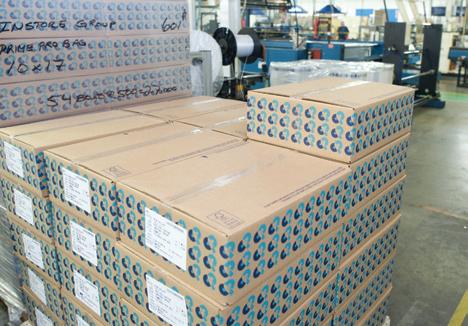
Featuring various interlocking structural design features to ensure optimal stackability and load stability, the master cartons are stacked onto the skid in neat rows containing a total of 50 boxes, with the resulting configuration not even requiring the traditional application of stretchwrap film to maintain load stability during transit, according to Moore.
“It’s just another benefit of Retail Ready Packaging that I’m sure their customer really appreciates,” he says. “Most retailers out there want have as little to do with packaging disposal as possible for the sake of greater cost efficiencies, and these fully-recyclable boxes provide a perfect, environmentally-friendly and highly practical solution to achieve those objectives.
Says Moore: “From personal and professional standpoint, it is a pure pleasure to work with a client like Cedar Bay Grilling because they have the same innovation mindset that drives the Unisource business.
“They have achieved phenomenal success in the marketplace by creating and offering a truly unique, one-of-kind new product that consumers can’t get enough of,” he states, “and we are proud to be involved in helping them build on that success.”
Adds Park: “We are certainly aiming to grow our business significantly in the U.S., Canada and other new markets in coming years, and having a reliable and highly professional business partner like Unisource will go a long way in helping us realize our goals and vision.”
Doug Park joins his father and the company’s co-founder Arnold Park (center ) and operations manager Chris Gregan in front of Cedar Bay’s seaside 16,000-square-foot salmon processing and packaging facility tucked away in the quiet and scenic South Shore hamlet of Blandford.
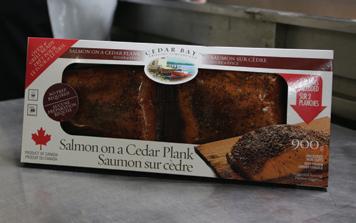
The innovative and attractive 900-gram, two-serving, double-board retail package offers consumers the convenience of purchasing two llets of pre-seasoned Atlantic salmon placed on top of cedar planks used both as grilling utensils and serving plates to enable consumers to experience the distinctly rich smoky taste of high-quality Atlantic salmon (see below) without having to touch the sh before eating, and enjoying it again at their leisure later, thanks to an airtight vacuum-pack ensuring at least one-year shelf-life for the remaining portion.
ANDREW JOSEPH, FEATURES EDITOR PHOTOS BY COLE GARSIDE
If there is such a thing as safety in numbers, then Chantler Packaging Inc. has certainly found it after becoming one of the first flexible packaging manufacturers in North America to receive certification from the notoriously rigorous ISO 22000/PAS 223 food safety standard.
Along with that prestigious designation, Chantler is continuing its efforts to not only preserve the shelf-life of food in the grocery stores, but to extend it even further at the home of the consumer—an important consideration considering North Americans tend to throw away a good deal of food to spoilage.
Family Values
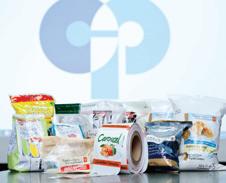
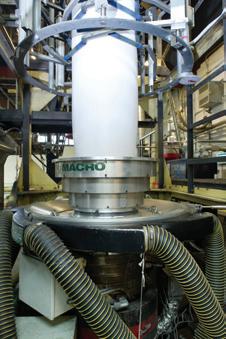
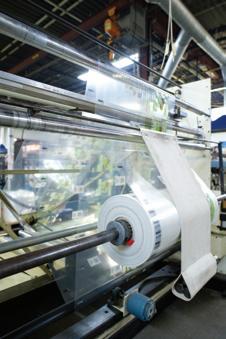
Situated in Mississauga, Ont., the fourth generation, family-owned business is a leading manufacturer of linear low-density and high-density polyethylene films and a converter of various specialty films—such as polyester, nylon, BOPP (bi-axially oriented polypropylene), CPP (casting polypropylene) and MAP (modified-atmosphere packaging)—for the custom requirements of the food processing industry.
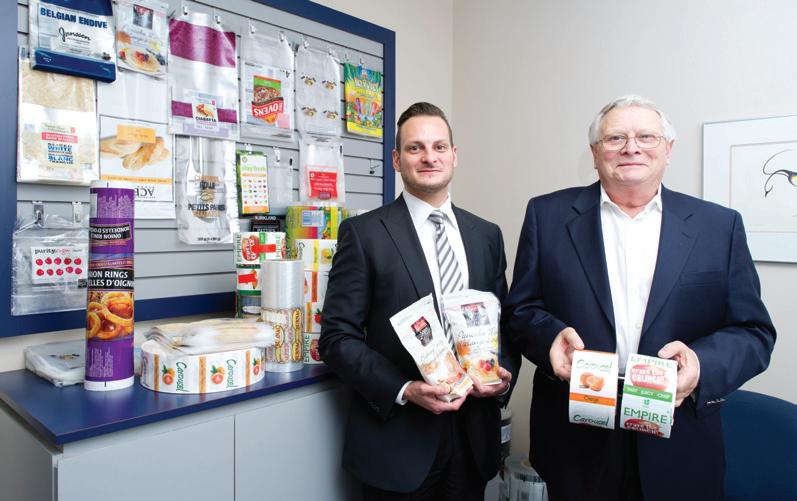
“Our customers are global food brands and Canadian food processors,” Chantler director of sales Grant Ferguson explained to Canadian Packaging magazine during a recent visit to the company’s tidy, 20,000-square-foot facility employing 38 people.
Along with Ferguson, the family-run company features his brother Ian, the company vicepresident; their chief executive officer father Roy and their mother Bev Ferguson, whose grandfather was one of the company founders back in 1930.
Founded as Chantler and Chantler Ltd. by brothers John A. and Ernest, the company started
FLEXIBLE PACKAGING
Grant Ferguson, Director of Sales, Chantler Packaging Inc.
Roy Ferguson, Chief Executive Of cer
KEEPING IT UNDER WRAPS
Toronto area exible packaging manufacturer earns its stripes with stringent food safety certi cations
out as Canadian agents for imported German and American celluloid, casein for the manufacture of buttons, styrene and other resins.
“Before fate brought them together, the brothers were rivals in the same field selling plastics for things like piano keys and corset stays,” says Roy Ferguson, adding that John Chantler was actually the first to introduce an injection-molding machine into Canada.
“But when their principal suppliers in Germany merged, the brothers did likewise.”
Although the company got out of the injection molding business in the 1950s, it got into the actual manufacture of film: first representing Reynold’s Plastics and soon after starting to convert its own plastic film products.
“Nowadays, Chantler Packaging is a fully integrated manufacturer of food packaging solutions with a plethora of high-tech equipment to fully service our customers from concept to launch,” explains Grant Ferguson.
After Bev and Roy Ferguson purchased the company in 1977, they immediately began to modernize it—with an eye to taking the company into the food packaging market.
“We guessed correctly that the food packaging market would be recession proof, and so we concentrated our wares on providing plastic packaging for food processors involved in the fruit and vegetable segments,” notes Roy Ferguson.
However, the next generation realized there was ample room for improvement within the company.
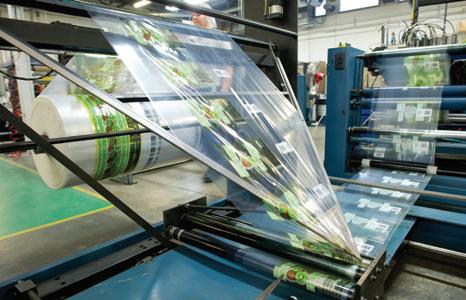
A customized wicketing machine at the Chantler plant in Mississauga converts printed lm into bags.
FLEXIBLE PACKAGING
“When Ian and I joined the company within the past 10 years, we wanted to advance Chantler’s role with food companies and quickly became involved with a national food retailer,” recalls Grant Ferguson.
As more food retailers followed, so too did the demands from customers requesting flexible packaging with greater food safety attributes, which in turn led to the company having to earn its stripes with a stringent certification process specific to safety requirements within the food industry.
Common Interest
“Everyone is concerned with food safety—from the retailer to consumers and to media,” he states.
“How could we, as a converter, not be as well?
“Our customers are global food brands and Canadian food processors, and as our customers improved their food safety programs, we could see their attention was turning to the next step in the chain—the packaging they use.”
Chantler undertook the challenge of acquiring certification via a two-pronged single system—both the ISO 22000 and the PAS 223 —that is compliant with the Global Food Safety Initiative program requiring the continuous improvement of food safety management systems to ensure confidence in the delivery of safe food to consumers worldwide.
The International Organization of Standardization (ISO) created the ISO 9001 quality management system now used by over 700,000 companies globally, and began developing a food safety management system that incorporates HACCP (Hazard Analysis Critical Control Points) principles and criteria, adds in hygiene measures, and utilizes management systems of ISO 9001
Grant explains: “The ISO 22000 is not a food safety system, but rather more of a way to build a food safety system that works best for a particular industry using food safety programs with management to create a harmonious balance.”
The PAS 223 is a pre-requisite program that helped Chantler examine how to guard against the risks to food safety, while looking at how to pre-
vent problems at the food packaging plant.
“For us, that meant maintaining strict cleaning schedules, ensuring high levels of employee health and hygiene and providing excellent building security,” explains Ian Ferguson.
“Together, the ISO 22000 and PAS 223 certifications help form a very stringent system for food safety in packaging manufacturing.”
The company says it chose the ISO 22000 and PAS 223 certifications after looking at all of the systems being utilized in the global packaging industry. According to Chantler, it chose these standardized programs because of the stringency of the system, its growing international recognition, and its compatibility with foodservice quality control systems used by Chantler’s customers.
“Food-borne illnesses are constantly in the media, making consumers more aware than ever of food safety issues,” expresses Grant Ferguson.
High Exposure
“It only makes sense for all packaging manufacturers to look into protecting the consumer and customer with having a proper food safety system in place,” he says, describing the Chantler facility as being more akin to a plant that processes food, rather than packaging film.
“Our approach is that the machines we use in the manufacture of the rolls of film should always be as clean as a dinner plate,” he says.
“We don’t make food here, but our packaging touches the food consumers eat, so we have to take care with what we do.”
Along with maximizing food safety, Chantler has been examining ways to extend product shelf-life of vegetables and fruits—both on the retail shelves and in the home of the consumer.
“Produce retailing is always a race against time,” says Grant Ferguson.
“Shippers of fruits and vegetables need to maximize the amount of product sold at peak freshness and quality to remain profitable.
“In the U.S., retail stores threw out some 5.1
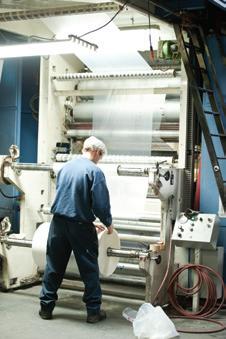
Preparing the eight-color Bonardi Mira press for graphic imaging, a Chantler press operator carefully loads a roll of plain lm onto the unwind section.
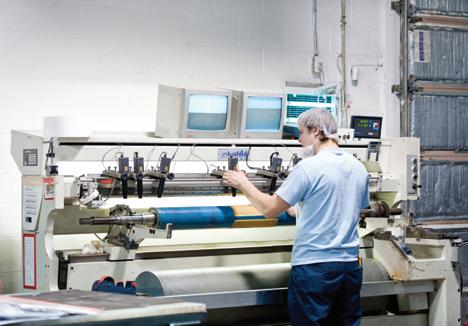
Photopolymer plates being placed atop sleeves for Chantler’s printing press cylinders via a JM Heaford mounter.
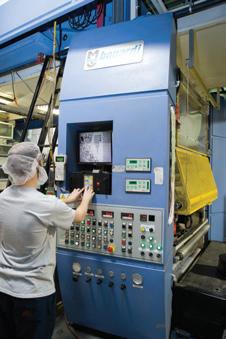
A Chantler Packaging employee monitors the eight-color central-impression Mira press used to print colorful graphics onto rolls of converted lm.
Along with producing rollstock lm, Chantler also converts lm into nished bags for use in the food processing industry.
billion pounds of fresh vegetables and 4.2 billion pounds of fresh fruit in 2008.”
According to a recent study by the University of Guelph ’s George Morris Centre, 32 per cent of all produce waste in Canada occurs between the farm gate and the consumer; three per cent during transport and distribution; 18 per cent during the processing and packaging stages; and 11 per cent at the retail level.
These results suggest that the remaining 68 per cent of product spoilage stems from food going bad in the hands of the consumer.
Designed by Chantler, the propriety PrimePro packaging film was developed specifically to extend the shelf life of fresh fruits and vegetables by removing ethylene gas—a plant hormone that is released by the produce during ripening and decay.
The PrimePro film is available as a custom-sized carton liner, sheets, pallet covers, form/fill/seal rollstock and bags for retail packaging—all protecting the produce for the maximum length of time from the packaging facility to the consumer fridge. In addition, Chantler also offers a PrimePro bag for consumers that they can use to further extend the life of the fruits and veggies at home.
“The benefits of our PrimePro technology are incredible,” extols Ian Ferguson. “Along with maintaining appearance, texture, flavor, nutritional value and food safety, sea or truck freight can be used in place of the more expensive but quicker air freight.”
Caught On Film
Roy Ferguson says that Chantler purchases only the plastic resins that meet a particular food-grade standard, which must be certified by the CFIA (Canadian Food Inspection Agency), and be absent of any controlled materials.
“We certainly can’t switch grades and go lower to save a few dollars,” admits Roy Ferguson. “We have a responsibility to our customers, and hence to their customers as well.”
After the plastic resins are heated and placed under pressure, they extrude it through one of Chantler’s two extruders equipped with Macro
FLEXIBLE PACKAGING
Engineering air rings, which the company has upgraded consistently over the years to make them completely computerized.
When the extruding process is complete, a thin film emerges as the end product, which, depending on customer need, is sent to Chantler’s inside printing department. There, a Mira eight-color flexographic press from Bonardi utilizes solvent-based inks from Sun Chemical to add further value to the film.
Says Grant Ferguson: “At each and every single step of the converting process, we provide a quality assurance product inspection to ensure consistency.
“All production information is then entered into our computer systems at our facility, so that we can track the progress of any item manufactured here,” he explains.
Larger rolls of film are slit via a Deacro E1 slitter rewinder or stored as rollstock, with the slit film then sent to converters to be processed into a broad variety of bags, with zippers added as required.
“We actually add our own informational code to the films—it’s our own way to trace our films,” admits Grant Ferguson.
“With this code, we can quickly trace back the original resin sources, as well as the original inks and solvents or rolls used, and can easily identify our product in the case of an emergency food recall.”
Some of Chantler’s most important purchasing partners and suppliers include:
• Atlantic Packaging Products Ltd., which supplies corrugated cartons to store and ship finished bag products;
• H.B. Fuller Company, global supplier of hotmelt adhesives;
• mounting equipment manufactured by JM Heaford,
• a Fin-Kon wicketer
“We’re a small company, but we have a great multi-generational reputation to maintain,” says Ian Ferguson.
“A key for continued Chantler success is to keep on innovating like we have done with the PrimePro.
“We have taken a product initially designed for shippers and growers and expanded its focus to now make it available for consumers usage at home,” he sums up.
“We have a legacy to live up to, and we aim to create the same for the future.”
For More Information:
Corrugated cartons converted by Atlantic Packaging are used by Chantler to ship lm product to its customers.
After the resin is melted, a blown lm extruder uses Macro air rings to stretch and form thin plastic lm.
Chantler Packaging utilizes a high-speed Fin-Kon Poly Bag Systems wicketer to convert lm to plastic bags.
PACKAGING FOR FRESHNESS
ROLLING IN THE DOUGH
Venerable Quebec cookie and snack maker keeps ahead of the competition with its high-tech robotic production line
In Canada, one person’s cookie may be another person biscuit, but such simple generalizations are of little use to the folks running Group Biscuits Leclerc Inc., a Quebec-based familyowned baked goods manufacturer who have a long, proud history of producing high-quality biscuits and granola snack products.
Launched in 1905 by François Leclerc, Biscuits Leclerc is still owned and operated by the founding family, baking and packaging the Leclerc label’s seven different cookie brands: Celebration, Praeventia, Vital, Choco, Quattro, Tradition 1905 and Momento, along with three additinal snack brands: Essensia, Praeventia and Chocomax. Each cookie and snack product provides multiple flavor varieties.
The company’s reputation as a leader in the Canadian baked goods industry, along with the company’s humble origins—with the business originally run from out of the back of the family home in Quebec City—keeps the current management team firmly rooted to the ground and in touch with the changing tastes of its consumer base.
“Our origins may be humble, but the freshness—and especially the great taste of the prod-
ucts—quickly had people clamoring for more,” vice-president of engineering Réjean Lepage told Canadian Packaging during a recent interview.
“Right from the beginning, though, Biscuits Leclerc has always sought to diversify its products,” explains Lepage, “by packing the cookies in decorated tin containers, and even supplying general stores with dispenser boxes so that people could purchase the cookies individually, if they wished.”
After a fire destroyed the first facility in 1931, the company quickly rebuilt in a local three-story building and created its first real assembly line. By the 1980s, Leclerc needed a larger facility to meet growing demand moving in 1986 to its current digs: a 700,000-square-foot HACCP (Hazard Analysis Critical Control Points) -certified facility in St-Augustin-de-Desmaures on the outskirts of Quebec City. Soon after, Biscuits Leclerc opened up another facility in Hawkesbury, Ont., along
ANDREW JOSEPH, FEATURES EDITOR PHOTOS BY CLAUDE MATHIEU
Eric Roy, Plant Manager, Group Biscuits Leclerc Inc.
Rejean Lepage, Vice-President of Engineering
A suction cup arm on the ABB IRB 340 Flexpicker robot can pick up 16 snack bars at a time and swiftly load them into cases.
Freshly-made snack bars at the Biscuit Leclerc plant in Quebec head towards a owwrapper for packaging.
with a second plant near the Quebec headquarters to produce snack bars. More recently, it acquired a pair of U.S.-based plants in Montgomery, Penn. in 2002 and Kingsport, Tenn. in 2008.
Today employing over 700 people across the five facilities, Biscuits Leclerc is headed by its thirdgeneration of family: chairman of the board JeanRobert Leclerc, and his son and chief executive officer, Denis Leclerc.
Not only has the Leclerc family managed to create a loyal cadre of customers clamoring for its baked goodness—four of its top five best-selling brands are from the Celebration cookie series—but it has also managed to build one of the largest agrifood warehouses in Canada and create one of the most highly robotized facilities in the Quebec agrifood sector.
“Biscuits Leclerc generally operates with two shifts a day and five days a week,” says Lepage, “but, depending on the time of year, we can ramp things up to work 24-hour days.”
Along with its own flagship brand of Biscuits Leclerc products, the majority of its business is derived from third-party contracting for a number of national retail chains, such as Loblaw, Costco and others, to bake and pack cookies for their no-name brands, helping the still-growing company pull in a sales volume of about $280-million annually.
In fact, Biscuits Leclerc is the largest co-packer of granola bars and baked cereal bars in Canada.
Lepage says: “While the company has always done well, getting involved with the third-party contracting business has greatly helped our sales and further increased our good reputation in the industry.”
Perhaps because birds of a feather flock together, Biscuits Leclerc is the type of company that expects great things from its employees and from its suppliers, noting that it prefers to hire only workers who have invested in themselves with post-secondary education.
Lepage says that Biscuits Leclerc is always keen on utilizing the services of an equipment manufacturer who can supply them with cutting-edge technology that works for them, which is why Biscuits Leclerc has developed a keen bond with Propack Processing & Packaging Systems Inc., a Beamsville, Ont. developer and manufacturer of high-speed collation and robotic loading of wrapped products into trays, cartons or multipacks.
“We’re not a cookie-cutter outfit with cheap equipment,” proclaims Propack president Chris Follows. “We pride ourselves on building a high-quality machine utilizing high-quality components that not only meets a customers current expectations, but future ones as well.”
Lepage says the Propack-Leclerc business relationship is not based solely on loyalty to an existing client, but rather built on Propack’s dependability to consistently manufacture quality equipment.
As a trusted supplier, Follows says that Propack has provided a whole slew of equipment to four of the five plants:
• two LJ TRT loaders to the Hawkesbury facility for packing breakfast bars into cartons;
• two LJ TRT robotic loaders—one dual- and one single-feed—to the Quebec City cookies plant packing cookies into a 200-count carton for commercial supply, and an eightcount carton for retail;
PACKAGING FOR FRESHNESS
A LJ-TRT robotic cell manufactured by Propack features an ABB IRB
340 FlexPicker that loads granola snack bars into open corrugated cartons for further secondary packaging downstream.
PACKAGING FOR FRESHNESS
• one dual high-speed TRT/TRT robotic product collator and loader for the Quebec City snack bars plant for moving Leclerc granola bars at speeds up to 650 bars per minute;
• one single-feed SRT robotic top-loader, shipped to the Montgomery facility packing snack mixes into cartons.
According to Follows, his customers have rated his LJ robotic loaders as requiring the least amount of maintenance due to its rugged construction.
“Our machines are designed to run at a highspeed rate, 24-hours-a-day,” states Follows. “We even have equipment in the confectionary bar sector that continues to run at a rate of 800 bars per minute, three shifts per day, for the past 11 years.”
Says Lepage, “Despite the complexity of the robotics projects, working with Chris Follows has always been a very good experience for us.
“Whenever we wanted to install a new Propack robotic system, we would first meet with Chris at the specific site and then we would analyze our needs, taking into account such things like the feed-rate, layout of the plant, size of the products and cartons, and indexing time.
“Next, Propack’s engineering department would talk with the Biscuits Leclerc project manager to ensure we understand the complete line and all of the conditions we need the machine to perform in order to be successful. We also look at speed and product tolerance and discuss any variance in products.”
Lepage says that because Biscuits Leclerc required a lot of technical support for the startup, Propack
would always offer to come to the factories— ensuring that training was provided in the French language for the Quebec facilities—to train the mechanics and equipment operators.
“At the same time, Propack would help us set the equipment parameters, fine-tune the robotics and provide any and all assistance as required,” notes Lepage. “It was and continues to be an exceptional partnership with them.”
Follows says that collaboration and communication between his company and customers like Biscuits Leclerc is critical.
“We want them to know that we will always be there for them, and all they have to do is call us at any time of the day or night, and they can talk either to myself or to another technician, and that we’ll resolve it over the telephone or onsite if necessary.”
When the Biscuits Leclerc snack bars facility in Quebec decided to replace a key piece of packaging equipment in its bakery in 2011 by adding a new robotic loading device, Propack again was there to make it happen.
“We were looking to purchase a dual input unit to ensure a prompt release after bars were placed into a corrugated carton, because we wanted to avoid an existing problem on the line that was causing a bottleneck,” explains Lepage.
According to Biscuits Leclerc’s Eric Roy, the engineer responsible for the integration of the new equipment, “We were quite excited by the possibilities offered by the Propack LJ TRT/TRT, because we found that this machine offered us technology not generally found on the market.”
Installed back on March 2011, Roy says the LJ TRT/TRT has an advanced laser bar inspection and reject system that enables Biscuits Leclerc to use many different types of reflective foil film without requiring any readjustments during a changeover. Roy also cites the cell’s ability to process WIP (work in progress) as required from the flowwrapper, so that it can be repackaged automatically on the second feed of the dual robot without the need for additional labor.
While high on the virtues of the machinery produced by Propack and their long relationship, Roy says that he and the rest of Biscuits Leclerc are still very demanding customers.
“When it comes to electronics, we only want to purchase equipment that is itself equipped with components from reputable manufacturers,” he says.
Roy says the system’s design benefits from having all of the electronics in this LJ TRT/TRT consist of Rockwell Automation’s Allen-Bradley brand components, including a PanelView Plus 1000 HMI (human-machine interface) with two languages.
The control system consists of a PLC (programmable logic controller), while the motion controller and servomotors, also from Rockwell, provide the equipment with long-term reliability and easy troubleshooting.
Situated within a compact footprint of 118 x 60 inches, the LJ TRT robotic cell consists of a robotic product collator and loader—an ABB IRB 360 FlexPicker that employs articulated arms ending with a suction block.
Depending on the characteristics of the product,
A Domino laser coder applies lot code data onto a roll of Chocomax snack bars. A continuous owwrap machine manufactured by SIG and supplied via Charles Downer & Co.
Advanced pneumatic controls manufactured by Festo help operate the Propack robotic workcell’s automatic product defect detection and rejection system.
A Domino laser coder is used on the Leclerc snack line to apply permanent product code information onto each passing package.
Propack says the cell can handle up to 900 products per minute.
The flexible robotic system can receive output from medium to high-speed wrappers, collate the product, and then load it into cartons or trays. The robot incorporates advanced design electronic motion control technology using servomotors and drives on all key functions.
Because the system has the capability to save production line recipes, accurate repeatable size changeovers can be achieved quickly, saving Biscuits Leclerc valuable production time and costs.
The 360 FlexPicker utilized in the Biscuits Leclerc facility can quickly and gently pick up 21 individual packaged snack bars at a time and move them to a second conveyor containing boxes that can hold between six and 30 individual bars, depending on the product.
“We have a total of eight box formats, all being packed at an average rate of 500 bars per minute for twenty hours a day, five days a week,” says Lepage.
While Biscuits Leclerc certainly has a need for speed, Lepage says it was not the only important factor considered when purchasing.
“Given the volume of production in question, we did need some especially high performance equipment,” he says. “But of what use is speed if there is no efficiency? Efficiency is very important to us, and Propack has repeatedly proven to us that we made the correct choice, as the effectiveness of the robotic system is close to 100 per cent.”
Other equipment in the Quebec City snack bar facility includes:
PACKAGING FOR FRESHNESS
• an Anritsu X-Ray inspection system;
• a Loma Systems LCW 3000 checkweigher;
• a Domino S-Series Plus high-performance scribing laser coder;
• a ProBlue 7 hot-melt adhesive application system from Nordson to seal snack box paperboard packs;
• a Meca-Pac case former utilizing SEWEurodrive motors;
• a continuous flowwrapping machine from SIG
and a Sapal wrapper, supplied by Charles Downer & Co.;
• a cartoner from Bradman Lake;
• a Fanuc palletizing robot featuring Festo pneumatics;
• ABF conveyors;
• corrugated cartons converted by Norampac and supplied by Ling Quebec;
• flexible foil film from Printpack, for individually
Biscuits Leclerc utilizes an X-Ray product inspection system manufactured by Anritsu for optimal quality control, sold by Abbey Packaging.
A Meca-Pac case former utilizing a ProBlue 7 adhesive application system from Nordson.
A SEW-Eurodrive motor provides proper power distribution for the Meca-Pac.
PACKAGING FOR FRESHNESS
wrapping flowwrapped granola bars; • cookie trays supplied by Tilton and flowwrapped with clear film from Multi-Plastics
“I’ve been working with Biscuits Leclerc since 1997,” relates Follows. “In fact, I sold them my first ever robotic system, a dual cell system that worked at a speed of 400 packs per minute at the Hawkesbury facility.”
The increase in production line efficiency from the new robotic cell installed at the Biscuits Leclerc Quebec snack bar plant—along with the other efficiencies gained at the other plants have shown Lepage that Propack is a supplier that can be trusted to provide the right equipment for the right job.
“For us, it’s not just about utilizing equipment that will help us now; it’s about also helping us for future growth,” sums up Lepage. “We feel that we are now perfectly positioned to increase our output as the need requires.
“And with our cookies and snack bars selling very well indeed around the world, we feel we are really ready to handle the increased demand.”
For More Information:
Leclerc uses a Loma Systems LCW 3000 checkweigher to ensure optimal product accuracy. A Bradman Lake cartoner forms the carton lid around loaded packs of granola snack bars.
ANDREW JOSEPH, FEATURES EDITOR PHOTOS BY COLE GARSIDE
Regardless if you say ‘potaytoe’ or if you say ‘potahtoe’, the folks over at Caledonia Produce Distributors have found a new way to package the humble spud to provide a tasty and supremely convenient product that raises the art of making a perfect baked-potato the essence of simplicity for the consumer in a manner not widely seen.
Operating a 14,000-square-foot facility tucked away in the west-end of Toronto, Caledonia is a family-run business that imports, packs and supplies high-quality produce—coconuts, baking potatoes and red, white, Spanish and sweet onions—to retailers and wholesalers throughout Ontario, Quebec and New Brunswick.
“Every week, we import 150,000 kilograms of vegetables and 45,000 kilograms of coconuts into our facility,” Caledonia Produce office manager Lisa Wood told Canadian Packaging magazine on a recent visit to the 30-employee plant.
While its foil-wrapped baking potato is by far its best seller, with over six-million sold per year, Caledonia also imports a plethora of Asian veggies for sale to large retailers like Metro, Sobeys and Loblaws, to smaller chain grocers and independents, and also to restaurants and other wholesalers.
Although Caledonia first opened its doors back in 1958, the family involvement in the produce business goes back quite a bit further.
When current owner Joe Polito’s grandfather, Giuseppe arrived in Canada at the turn of the 20th century, he began selling fresh fruits on the Toronto streets.
“Giuseppe took a lot of pride in his work, he wanted to provide quality produce at a good price, and he eventually ended up opening up his own grocery store in Toronto,” explains Wood.
“He was so successful that he transitioned from retail to wholesale in the hope he could supply Canadians with more fresh fruits and vegetables.”
Wood says Giuseppe’s son Rocco successfully grew the Polito family business—making it the
FLEXIBLE PACKAGING
JUGGLING THE HOT POTATO
Innovative produce company puts a new spin on the timeless dinner staple
third-largest importer of California wine grapes in Canada. But with wine grapes being a seasonal product, in 1958 Rocco incorporated Caledonia as a company, with the GreenGrocer brand supplying produce year-round across Canada.
“Like most businesses, it was slow going at first,” says Wood. “He only sold 490 crates of baking potatoes that first year, but it did pick up steam.”
That blast of energy was provided by the leadership of Rocco’s son Joe, who along with being the current Caledonia president is also Wood’s spouse.
“Along with offering a quality product at an excellent price-point, Caledonia also looked at how the product was presented to the customer and began developing packaging for them,” says Wood. “The addition of packaging definitely has made us more successful.”
Safe Supply
With coconuts and veggies arriving at the facility from the Caribbean and the south and southwestern parts of the U.S., Caledonia wanted to assure its customers that the products they purchased were safe and traceable.
“At Caledonia, food safety is a priority, which is why we package our products even while others feel it is unnecessary,” says Caledonia Produce general manager Bryon Sargeant.
Noting that fresh produce at grocery stores is often left unpackaged, Caledonia’s efforts to provide food traceability should alleviate some concerns in the case of a product recall, explains Sargeant.
“In the event of a food recall involving unpackaged vegetables or fruits, every single piece of particular product is now subject to the recall,” offers Sargeant. “That’s potentially a disaster in the grocery business.
“Now, because many products don’t lend themselves well to the addition of a barcode featuring lot number and other product data, Caledonia provides a means to the way by having packaging that allows traceability tags to be added.”
Wood says that Caledonia was the first to develop a filmwrapped tray of baking potatoes back in
1970, while citing the company’s recent innovative developments of individually plastic-wrapped, heat-shrunk coconuts and the flowwrapped, microwavable baked potato as innovative forms of packaged foods that are propelling the way Caledonia does business.
Says Wood: “A lot of thought went into choosing our products, ensuring we know where and how they are grown, when and where they are packed, where they are shipped from, and how they are shipped.”
Sargeant says all Caledonia growers are HACCP (Hazard Analysis and Critical Control Points) -certified and they strictly adhere to the Good Agricultural Practices as defined by the Food and Agriculture Organization (FAO) of the United Nations As for Caledonia itself, the company is a member of the Ontario Produce Marketing Association , Canadian Produce Association , and is also certified by the Guelph Food and Technology Center (GFTC)
“We are currently following GFTC guidelines as we look to become a HACCP-approved facility ourselves,” acknowledges Wood.
To keep its packaging constantly evolving, Caledonia often works closely with Canpaco Inc., located just north of Toronto in Woodbridge, to supply its plastic film requirements, providing a clear
Continues on page 21
Caledonia Produce general manager Bryon Sargeant (left) and of ce manager Lisa Wood pose alongside Canpaco’s technical sales representative Michael Gordon in front of the Pearl owwrapping system manufactured by PFM Packaging Machinery.
Supplied by packaging machinery and materials distributor Canpaco, the Pearl owwrapper applies micro-perforated propylene lm to turn baking potatoes into a nutritious, easy-to-prepare, microwavable side dish.
Manufactured by Bemis Company, the Clysar pre-printed shrink lm supplied by Canpaco is used to make tightlysealed tray-packs of potatoes displaying full product traceability information on the front of the pack.
JUGGLING THE HOT POTATO
Continued from page 19
FLEXIBLE PACKAGING
film for its baked potatoes including the printed films for the microwavable baked potato and coconuts.
According to Canpaco technical sales representative Michael Gordon, the Clysar printed shrink film produced by Bemis, Inc. is used for the baked potatoes and coconuts, while Canpaco provides a specialty pre-printed film for the microwavable baked potatoes.
Operating as a vertically integrated converter and printer of specialty films for the food and pharmaceutical industries, Crystal Poly is Canpaco’s subsidiary specializing in food-grade film.
“Canpaco has an expertise in films, print technology and automation,” says Sargeant, “as well as a just-in-time inventory management system that provides us with the magic formula for success.”
A couple of years ago, Polito saw a microwavable potato pack, but thought that while the concept was great, the end result was not.
Contacting Gordon at Canpaco, with whom he had been dealing with for over 10 years, he asked for help to build a better package for his product that would help Caledonia capture new markets through packaging innovation.
According to Gordon, Polito wanted a pre-washed and pre-packed potato product, “and was adamant that a customer would be able to safely cook an ordinary baking potato in the packaging film, while still maintaining proper moisture and barrier properties.”
Gordon says that Canpaco and Caledonia went through a lot of potatoes and films during testing for ideal temperature and cooking times, and even in determining the number of perforations required in the proprietary film that allows the right amount of heat and moisture transfer while possessing the ability to keep the potato fresh.
They also utilized the services of the GFTC to ensure it met safety requirements, Gordon relates.
“We now have a solution enabling Caledonia to take a potato, wrap it in a high-speed format with a printed film that allows it to cook—in fact, allowing the unopened pack to maintain its heat for up to an hour—without wrinkling or drying out the product,” mentions Gordon.
Woods adds: “The convenience of the microwavable potato pack is stunning. Whether it’s for the busy family on the go, or for single-serve snacks, this healthy, all natural product—no matter how you slice it—is an affordable, tasty potato ready in minutes.”
Despite the innovative work done by Caledonia, it was only 10 years ago that the company first got serious about automating its processes.
Seeing the need to progress from the effective, but labor-intensive four, manual bar-sealers used to shrinkwrap its product, Caledonia has since purchased three semi-automated packaging lines that have enabled it grow its production volumes while providing a better and safer package.
Caledonia’s coconut line utilizes a Shrink Tech Systems STS-17 film wrapper to wrap coconuts at speeds up to 32 per minute.
The intermittent-motion machine uses a sideseal system handling any length of product—so it can wrap a cornucopia of veggies if desired.
The STS-17 is also able to run print registered film, and comes with a closing conveyor for products to bridge any gaps, featuring an infeed system designed by Canpaco to specifically handle the unique and unusual shape of coconuts.
After traveling through an RBS Equipment
Designs Ltd. model AST 148DC heat tunnel that forms a tight skin around the product, a Videojet 1510 small-character single-head continuous inkprinter adds barcode data to the surface of the film.
“The STS-17 machines have wrapped over seven million coconuts, and about the same number of baked potatoes—all with minimal downtime,” mentions Caledonia warehouse manager Dave Turner. “It’s a pretty robust line.”
Caledonia’s baked potato packaging line is virtually identical to the coconut line, but with a few notable differences.
Select potatoes are handwrapped in a foil paper supplied by Deluxe Paper Products suitable for baking. These potatoes are then placed on a #2 foam tray manufactured by CKF Inc., and moved along a conveyor system, powered by a Leeson Speedmaster motion control, over to a STS-17 film wrapper, which covers the tray with a printed Bemis Clysar HPGT film before moving through an AST 148DC heat tunnel to shrink the film around the tray.
After moving past a Label Systems LS-100 that places a product label atop the film, a MarkemImaje Markem 9064 inkjet coder applies lot data onto the label, before the trays are hand-packed into corrugated cases manufactured by Royal Container Ltd.
Caledonia’s third packaging line is used for its microwavable potatoes.
Running at speeds up to 80 packs per minute, the PFM Packaging Machinery Corp. Pearl flowwrapper supplied by Canpaco uses a printed perforated propylene blended film to seal the potato in a protective sleeve with the GreenGrocer logo clearly visible on the pack.
The Pearl machine facilitates full-servo horizontal pillow pack-wrapping via a flat reel of sealable materials such as polyethylene; heat-shrinkable materials with trimmed seals; and laminated, bonded or micro-perforated polypropylene film.
According to PFM, the Pearl is a fast-changeover machine, capable of set-up in about three minutes.
Says Gordon, “The folks at Caledonia quickly realized the labor saving benefits of owning a single automated line and came back to us quickly with a request for a second and then a third.”
Adds Wood: “We have enjoyed a very successful partnership with Canpaco.
“They have worked with us in developing packaging lines that make sense for us, and in product development of the microwavable baked potato.
“Canpaco’s expertise in films, automation and print technology is a harmonious match with our knowledge in fresh produce, and finding innovative ways to pack it,” she concludes.
“Plus we really like the fact that Canpaco goes out of its way to keep us happy.”
For More Information:
A model 1510 small-character continuous inkjet printer from Videjet Technologies cleanly applies barcoded data onto whole coconuts shrinkwrapped in pre-printed Clysar lm.
A plant worker keeps a wtchful eye on the trays of baking potatoes making their way from the model STS-17 lm wrapper from Shrink Tech Systems into the SST 148DC heat tunnel, made by RBS Equipment Designs, which produces a tight protective seal for each tray package.
Caledonia’s innovative GreenGrocer brand microwavable baking potato is cooked within an unopened pack, made from a special proprietary pre-perforated lm supplied that maintains optimal moisture and barrier properties.
Product labels applied to onto the lm-wrapped potato trays by a model LS-100 label printer-appicator manufactured by Label Systems.
Jan. 21-24
Chicago: Automate 2013 and ProMat 2013, colocated automation technologies and material handling exhibitions by Automation Technologies Council (ATC) and the Material Handling Industry of America (MHIA) respectively At McCormick Place. Contact Jeff Burnstein of ATC at (734) 9946088, or via email jburnstein@robotics.org; Carol Miller of MHIA at 704-676-1190; or go to: www.ProMatShow.com
Jan. 29-31
Atlanta, Ga.: IPPO 2013 ( International Production & Processing Expo), joint exhibition by the U.S. Poultry & Egg Association (USPOULTRY), American Feed Industry Association (AFIA) and American Meat Institute (AMI). At Georgia World Congress Center. To register, go to: wwww.uspoultry.org
Jan. 29 - Oct. 1
Moscow, Russia: Upakopvka/Upak Italia 2013,
international fair for packaging machinery, production and materials by Messe Düsseldorf GmbH. Contact Contact Messe Düsseldorf North America at (312) 781-5180; or go to: www.mdna.com
Feb. 6-7
Paris, France: Aerosol & Dispensing Forum 2013, aerosol & dispensing technologies exhibition by ORIEX Communication. Concurrently with PCD (Perfumes Packaging, Cosmetics & Design) 2013 conference. Both at the Espace Champerret. To register, go to: www.aerosl-forum.com
Feb. 13-14
Paris, France: Pharmapack Europe, pharmaceutial and medical device packaging exhibition by UBM Canon. At Grande Halle de la Villette. To register, go to: www.pharmapack.fr
March 19-21
Munich, Germany: CCE International, corrugated
and carton industries exposition by Mack Brooks Exhibitions. Concurrently with the ICE Europe international converting exhibition. Both at the New Munich Trade Fair Centre. To register, go to: www.mackbrooks.com
April 9-11
Orlando, Fla.: ICE USA 2013, International Converting Exposition (ICE) by Mack Brooks Exhibitions. At the Orange County Convention Center. To register, go to: www.ice-x-usa.com
April 23-25
Cologne, Germany: Plastic Closure Innovations 2013, conference for the plasic caps and closures manufacturing industry by Applied Market Information Ltd (AMI). At Maritim Hotel. To register, go to: www.amiplastics.com
April 30 - May 2
Toronto: SIAL Canada 2013, North American food marketplace exhibition by Comexposium. Concurrently with the SET 2013 foodservice and food retailing equipment and techologies exhibition. Both at the Direct Energy Centre. Contact Magalie Moreau at (514) 2899669, ext. 2222; vial email magalie. moreau@compexposium.com ; or go to: www.sialcanada.com
May 14-16
Toronto: PACKEX Toronto 2013, packaging technologies exhibition by UBM Canon. Concurrently with PLAST-EX, ATX Automation Technology Expo Canada, Design & Manufacturing Canada, Powder & Bulk Solids and Sustainability in Manufacturing. All at the Toronto Congress Centre. To register, go to: www.canontradeshows.com
Aug. 28-31
Bangkok, Thailand: Pack Print International 2013, packaging and printing exhibition for Asia by Messe Düsseldorf GmbH. Contact Contact Messe Düsseldorf North America at (312) 781-5180; or go to: www.mdna.com
Andreas Sobotta joins Davis Controls Ltd.
Andreas Sobotta joins Davis Controls Ltd, a national distributor of process controls and industrial instrumentation, as National Sales Manager. Andreas brings a very strong Management background in sales and marketing and has an impressive history of experience in the Canadian Industrial Control and Instrumentation market. Andreas has been the Vice President – Marketing with Festo Inc., the Business Unit Manager - Low Voltage Controls & Distribution with Siemens Canada and the Director of Sales & Marketing with Phoenix Contact in Mississauga.
Davis Controls is excited to have someone with Andreas’ strong credentials on staff as they look forward to significant growth in the months and years ahead.
Davis Controls Ltd., Oakville, Ont.-based distributor and integrator of process controls and industrial instrumentation technologies, has appointed Andreas Sobotta as national sales manager.
Australian-owned food packaging and processing systems manufacturer TNA has appointed Teri Jonson as the West Coast regional sales manager for the company’s Dallas, Tex.-based TNA North America Inc. subsidiary, responsible for a territory comprised of western Canada and the U.S. states of Washington, Oregon, California, Idaho, Utah, Nevada, Montana, Wyoming and Colorado.
Laminations, Appleton, Wis.-based manufacturer of paperboard edge protectors and other laminated paper-based protective packaging solutions for shipping, packing and warehousing applications, has appointed Valorie Courtney as inside sales and accounting services representative for the U.S. northeast region.
St. Louis, Mo.-headquartered plastic rigid packaging products manufacturer TricorBraun has added two senior executives to the company’s newly-formed Global Business Development Group, including Becky Donner—to be based in Chicago— and Giuseppe Mazzilli, who operate out of the company’s U.K. office.
DavisStandard, LLC , Pawcatuck, Conn.headquartered designer and manufacturer of extrusion systems, feedscrews, barrels and process controls for the flexible web converting, plastics processing and rubber industries, has appointed Chetan Balsara as vice-president and chief information officer; Sekaran Murugaiah as vicepresident of business development for Asia-Pacific region; and Todd Pearson as vice-president of global operational excellence.
Ball Packaging Europe, European subsidiary of Broomfield, Colo.headquartered beverage can manufacturer Ball Corporation, has appointed Benoit Hirszowski as marketing director, to be based at the subsidiary’s headquarters in Zurich, Switzerland.
Material handling systems manufacturer and integrator Intelligrated has appointed Paul Hensley as senior sales engineer for the company’s central regional operations in Cincinnati, Ohio; and Tracy Perdue as senior sales engineer for the company’s southern regional operations.
Southern Lithoplate, Inc., Wake Forest, N.C.-based manufacturer of digital printing plates, has appointed Joe Lillo as vice-president of commercial sales.
Hartsville, S.C.-headquartered packaging products manufacturing group Sonoco has appointed
Marty Pignone as vice-president for the company’s Paper North America business unit.
Prominent German packaging systems manufacturer Gerhard Schubert GmbH has appointed brothers Gerald Schubert (left) and Ralf Schubert— both sons of the family-owned, Crailsheim-based company’s founder Gerhard Schubert—as its joint chief executive officers.
Elsner Engineering Works, Inc., Hanover, Pa.headquartered manufacturer of rewinding, folding and overwrapping machinery has appointed Bert Elsner II as chief executive officer, president and treasurer.
Balsara
Murugaiah
Pearson
Sobotta
Courtney
Hensley
Schubert
Schubert
Perdue
READY-TO-GO PACKAGING STUDENT’S BEST FRIEND
Being a full-time university student presents all sorts of shopping challenges to accommodate the perennial chaos unleashed by term papers and mid-term exams, as well as countless hours spent at the campus library. While price is always a factor to most students, it is also important not to shortchange yourself in product quality and built-in packaging convenience of various innovative consumer products out there helping me get through my hectic days intact.
Introduced to Canadian grocery stores earlier this year, the new iögo nomad (pronounced yo-go) brand yogurt from Ultima Foods Inc. is a refreshing, smooth-tasting, drinkable alternative to traditional yogurts requiring a spoon to consume them. Part of the company’s expansive new iögo product family comprising over 40 flavors and seven different product recipes, the drinkable nomad yogurt offers terrific on-the-go convenience with an easy-twistoff, resealable lid for the 300- ml PET (polyethylene terephthalate) plastic containers decorated with simple but engaging graphics virtually bursting with the natural flavors of the fruit-infused beverage inside. Consumed at once or enjoyed while scrambling to make it on time to my many morning classes, this travel-friendly container—filled with a delicious, all-natural, made-in-Canada smoothie certainly seems to have found a nice market niche for itself with these healthy, nutritious and convenient liquid breakfast options.
Packaging pods are not entirely new to CPG (consumer packaged foods) industry, but the onfolding trend to extend the format’s use to more everyday products is a welcome development that I wish more brands would follow—especially since my recent discovery of the unit-dose Tide Pods laundry detergent packs from Procter & Gamble Inc. Living in crammed quarters on the top floor of a five-storey building with no elevator has always made the dreaded laundry day a tedious manual ordeal—exacerbated by having to drag the separate packages of laundry detergent, fabric softener and stain remover along for the haul. And while walking the stairs is still part of the drill, these new, all-in-one Tide Pods—separately containing the detergent, stain-remover and brightener all in one ingenious, three-chamber dissolvable pod—are helping to make it notably more tolerable.
Packing 57 of these pocketsized cleaners inside a sleek, bright and compact rigid-plastic container, the Tide Pods are also saving me a fair bit of space in my storage closet by dispensing with the need to stock all those different laundry products I needed before.
This inherent convenience of pod packaging is faithfully replicated with the miniature mini olivia salad dressing pods imported here from Spain by the Canadian grocery chain Sobeys, and retailed in the fresh-produce aisles of its supermarkets. For someone who prefers to bring my own lunch to the campus, especially when spending a full day there, packing a heathy salad was always a case of choosing from two bad options: pack the salad dressing separately at the risk of it leaking inside the back-pack all over my notes; or pour the dress-
ing on at home and end up with a soggy-looking, unappetizing meal a few hours later. Thankfully, these miniature, leakproof single-serving dressing pods—containing 70-percent extra virgin olive and 30-percent vinegar—have made my lunch preparation a more hassle-free task, enhanced with the ultimate reward of a healthy, filling and fresh-tasting lunch. Another pod-perfect example of on-the-go convenience and portability helping out mobile busy consumers in their constant race against time.
Living on a student budget inevitably means that some things, like home decor, tend to get sacrificed or overlooked for the cause of higher good. But thanks to the highly decorative boxes of Kleenex Expressions paper tissues from Kimberly-Clark Inc., adding a little style and color to your everyday surroundings is not a creative mission impossible. While I never thought it was possible to receive compliments on something seemingly as trivial as a box of facial tissues, the broad range of bright and bold design patterns offered by the Kleenex Expressions brand of high-quality, highly-absorbent tissues allows consumers to make a pretty bold statement about their personal taste and style without necessarily breaking the bank.
Megan Moffat is in the fourth and final year of completing her double major in Honours English and Film Studies programs at Wilfrid Laurier University in Waterloo, Ont.
Photos by Megan Moffat
Fit for difference
Muller Martini VSOP Variable Sleeve Offset Printing
For every demand the right application
The technology of VSOP web offset press provides the capability to take advantage of many market trends in packaging: exible packaging, labels (shrink-sleeve, self-adhesive labels, wet glue labels, IML, wrap-around), folding carton and liquid packaging.
Muller Martini VSOP runs up to 365m/ min (1200ft/min) and produce the complete size ranges (381-762mm/15-30” by using lightweight print sleeves.
With its hybrid applications, along with offset printing technology, Muller Martini VSOP offers a range of other printing processes, including: exo, screen, gravure and digital printing as well as nishing processes such as laminating.
Muller Martini VSOP web offset press is available with electron beam, UV and hot air drying technologies which provide an optimum exibility in the printing process.
Great packaging doesn’t just contain. It sells.
Unisource Engineered Solutions ’ team of structural engineers and creative designers offers expertise in sustainable packaging. We bring material-neutral design, advanced engineering, in-house testing and the latest graphics and printing technology to enhance our customers’ brands.
The result: leading-edge, environmentally friendly solutions that not only protect and secure your product, but help you stand out from your competitors.
Contact Unisource Canada’s Packaging Solutions Experts to learn how we can deliver the right packaging for your products.