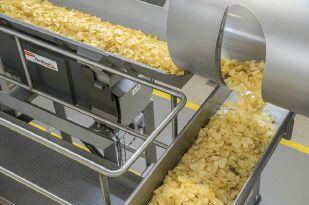
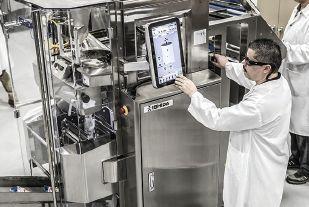
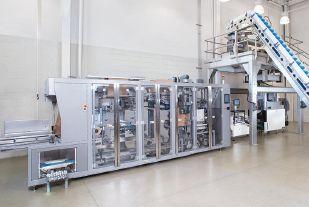
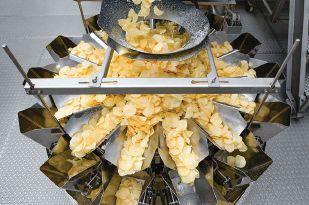
With Heat and Control, you have a partner with the scale to support your success, the innovation to advance your operations, and a commitment to quality that will help you offer better products for consumers.
COMPLETE SNACK PACKAGING SOLUTIONS
• Accumulation
• Horizontal motion conveying
• Incline, belt and bucket conveyors
• Filling and multihead weighing
• Bagmaking and casepacking
• Checkweighing and seal checking
• Foreign object and defect inspection
• Controls and information systems
We are successful when you are successful. That’s why we apply creativity, engineering excellence, and determined perseverance to every project to help our customers get the performance their business demands—whether measured by flavor, efficiencies, sustainability, improvement, or innovation.
116 17
17 THE LONG RUN
Leading Canadian distributor of fresh fruits and vegetables reveals the secrets of the company’s remarkable longevity and industry prominence.
FEATURES
23 Stalk in Trade
Tough
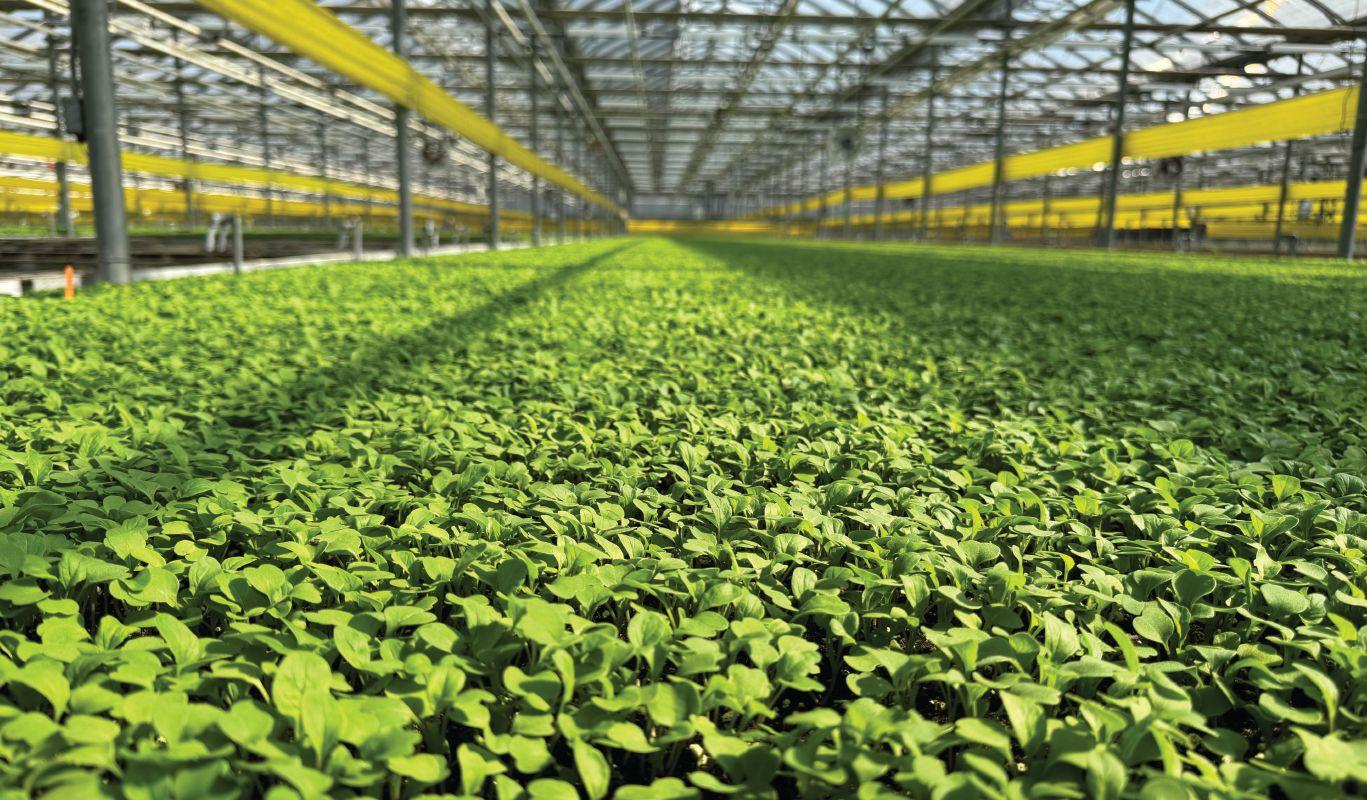
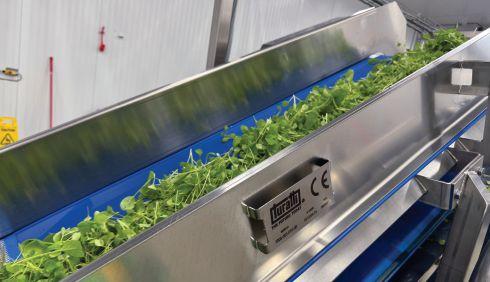
Montreal-based fruit and veggie processor’s knack for product innovation a perfect match for strong packaging competencies. 29
Better with Age
The upcoming CPMA Annual Convention & Trade Show a ‘must-attend’ event for produce industry stakeholders.
Turn of the Century
CPMA president Ron Lemaire opens up on the U.S. trade tariffs 33
Simply Irresistible
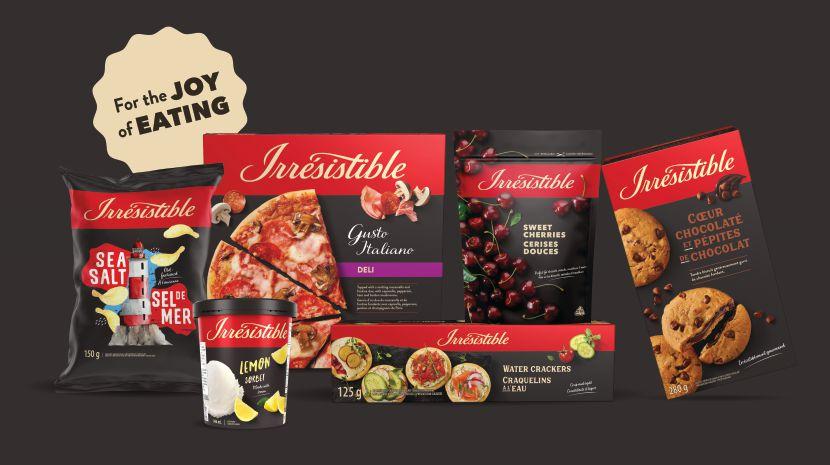
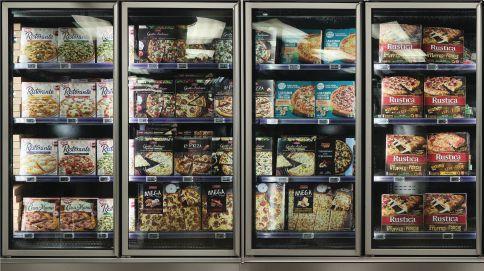
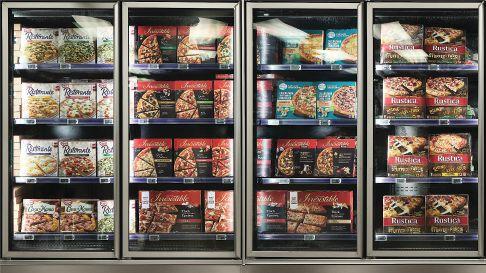
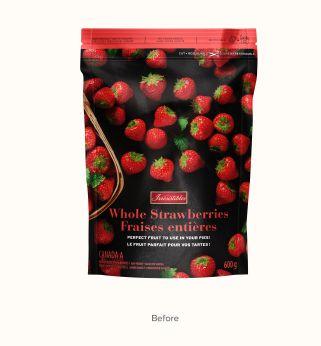
Leading grocery retailer’ stunning packaging refresh raises the bar for private-label design excellence. 36
Sticking to the Plan
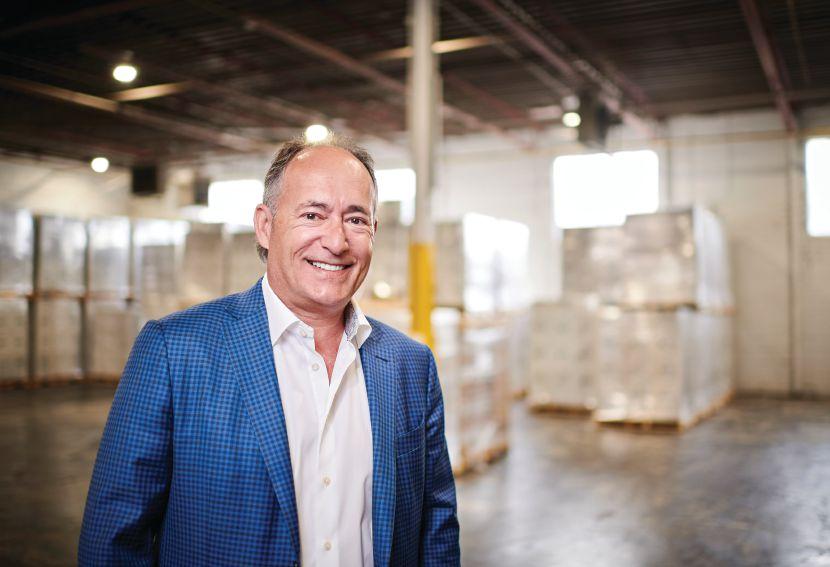
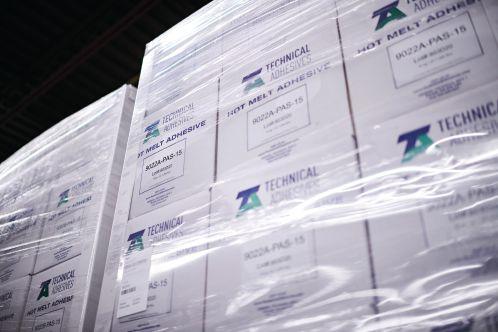
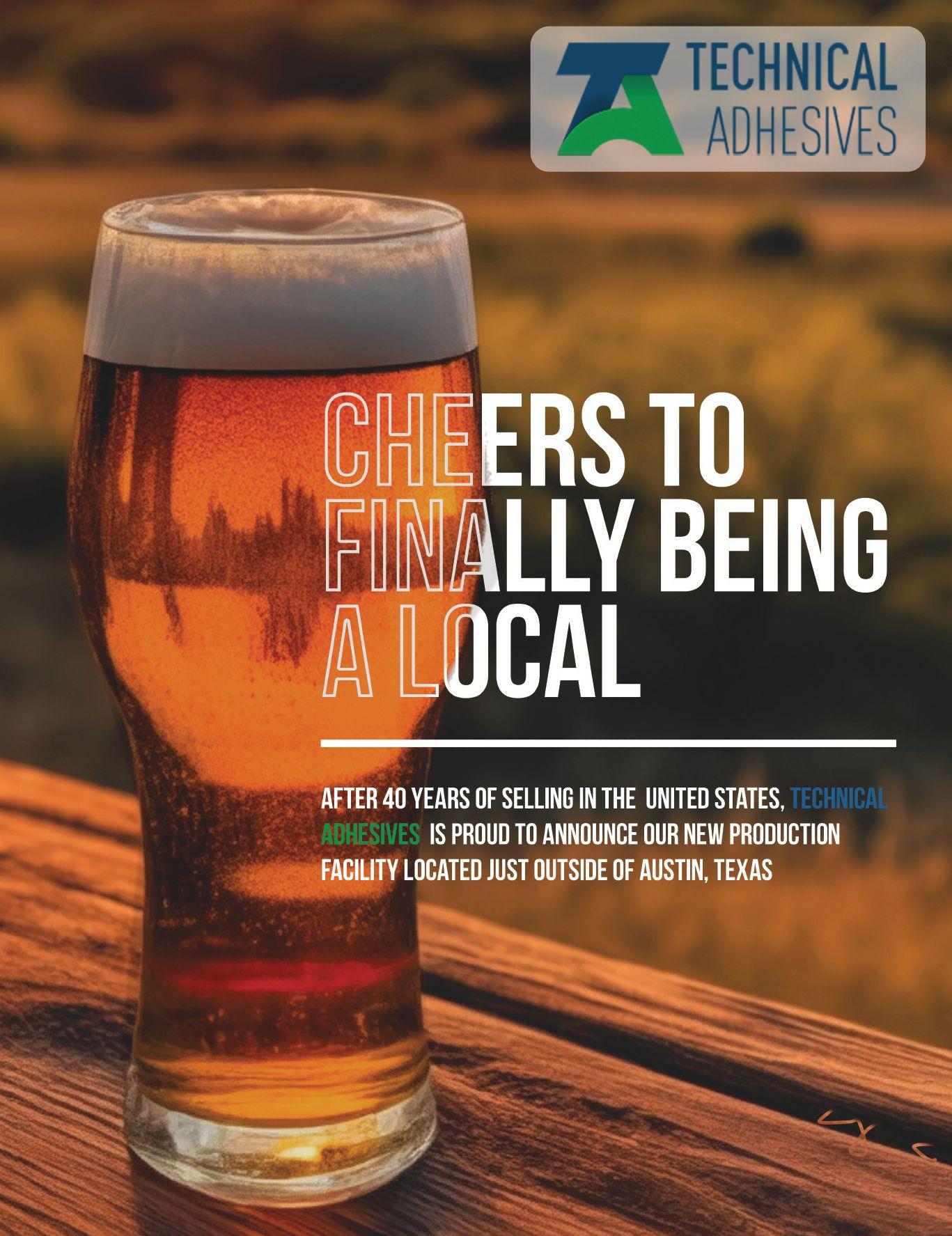
Canadian manufacturer of packaging adhesives spreading its wings in Texas.
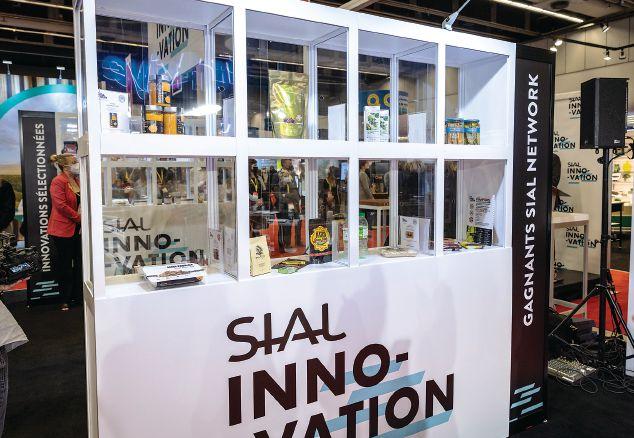
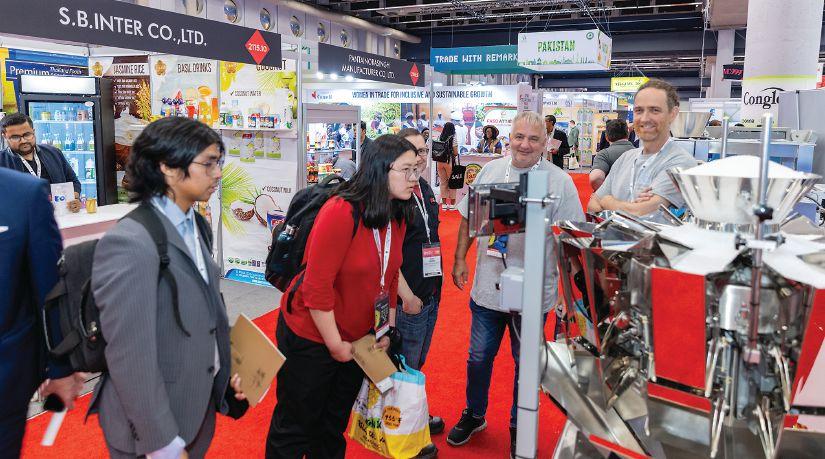
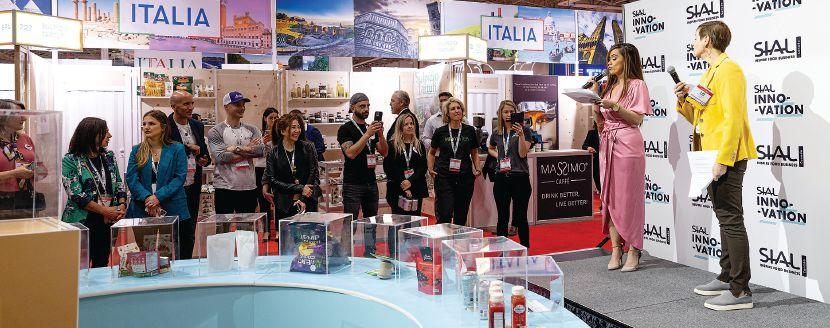
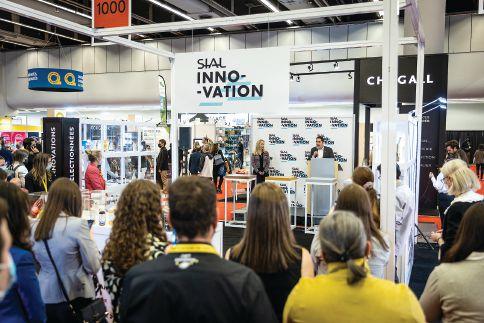
The SIAL Canada 2025 to deliver dazzling food packaging innovation.
Response
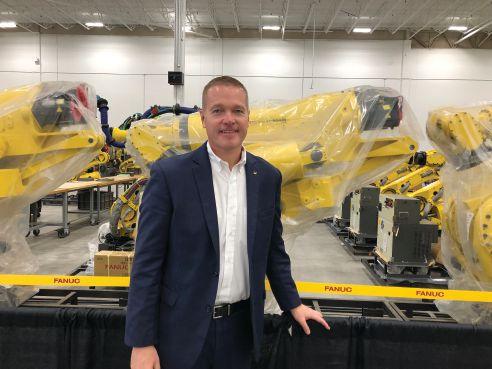
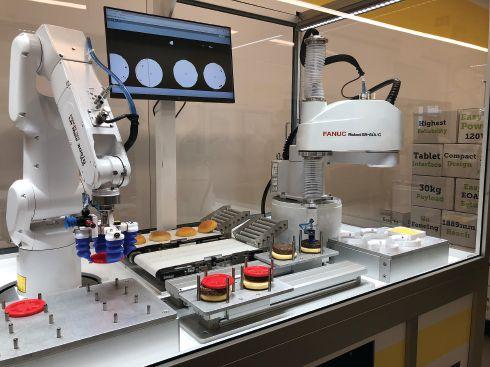
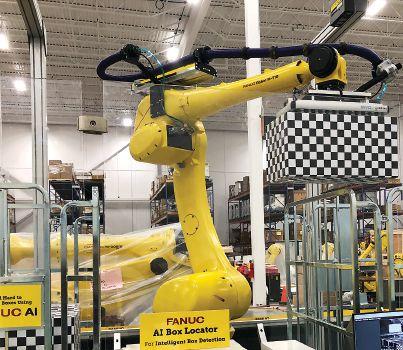
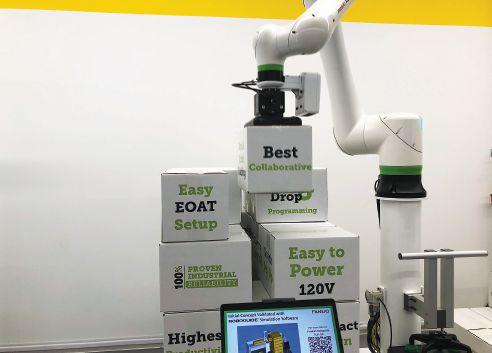
FANUC America’s president pledges long-term commitment to the Canadian market.
Fresh produce sector
Whatever happens with the U.S. tariffs on Canadian goods between the time of this writing and when this issue of Canadian Packaging mails out, much of the damage to what was just recently the model trade partnership envied by the rest of the world has already been done.
labor disruptions in the U.S. due to immigration enforcement actions by the U.S. Immigration and Customs Enforcement (ICE),” Lemaire confides.
MARCH 2025 | VOLUME 78, NO. 2
Reader Service
Print and digital subscription inquires or changes, please contact Angelita Potal, Customer Service Tel: 416-510-5113 apotal@annexbusinessmedia.com
Mail: 111 Gordon Baker Rd., Suite 400, Toronto, ON M2H 3R1
Senior Publisher Stephen Dean | (416) 510-5198 SDean@canadianpackaging.com
$10B
Total annual Canadian labor income driven by the fresh produce sector
Only time will tell how permanent and irreversible that damage will be, but the sudden erosion of goodwill and trust between the world’s biggest trade partners is a highly troubling development with no historical point of reference since the Great Depression of the 1930s. And while the pain will be shared across most goods-producing Canadian industries, it’s hard to overstate the negative impact it will have on the Canadian fresh produce sector and the country’s consumers.
The Canadian Produce Industry Marketing Association (CPMA) ’s president Ron Lemaire nails it perfectly when he prclaims that, “Fresh produce is a necessity, not a luxury.”
But this sentiment can become a hard sell for Canadian consumers in weeks and months ahead, if the historically high prices of fresh fruits and vegetables rise by another eye-popping 25 per cent—making them prohibitively expensive for a significant portion of the Canadian population. Not only would this be a devastating blow to Canadian produce growers, processors and distributors, but it would also have a highly detrimental impact on many of their allied industries and suppliers to spark an economically disastrous chain reaction.
As Lemaire points out, “The fresh produce industry generates considerable spinoff economic benefits.
“In 2022 the sector, including its supply chain and the induced economic activity from employees’ spending, contributed nearly $4.1 billion in government revenues,” Lemaire notes.“Additionally, total labor income resulting from the industry’s economic activities amounted to nearly $10 billion, reflecting the broader economic influence of our sector.”
And it’s not just about tariffs in isolation. There are other disruptive new U.S. policy developments with potential to make an already unfortunate situation even worse, according to Lemaire, notably on the import side of the cross-border trade equation.
“We are also deeply concerned about
“The fear of workplace raids and deportations has the potential to lead to a shrinking labor pool, with many farm workers—who are essential to the U.S. agricultural sector—avoiding work or leaving the industry altogether.
“Since Canada depends on U.S. farms for a significant portion of its fresh produce supply, any labor shortages south of the border could directly impact Canadian food availability and pricing,” Lemaire warns.
As for sustainability, the new administrations disdain and indifference to most environmental and carbon-footprint reduction efforts can also put the industry in a serious bind.
“A shift away from environmental policies in the U.S. could create regulatory misalignment if Canada moves forward in an aggressive manner,” Lemaire points out, “making it more difficult for Canadian businesses to navigate cross-border trade and sustainability standards.”
For all that, the Canadian produce industry should have enough resilience to get through the worst of the looming crisis, but it may need a lot more government help to dodge an epic contraction.
For one thing, more rapid investment on R&D is critical to sccelerating product and process innovation.
“Innovation remains a cornerstone of our industry’s success,” Lemaire asserts. “In 2024, Ontario invested $7.2 million in 44 agri-food research and innovation projects through the Ontario Agri-Food Innovation Alliance.
“These projects focus on protecting plant health, strengthening production systems, increasing environmental sustainability, and bolstering productivity and growth,” Lemaire extols.
While a $7.2-million investment may sound like the proverbial small potatoes in the context of a multibillion-dollar industry, it is a laudable step in the right direction for developing the new core competencies vital to ensuring our produce sector’s long-term prosperity.
GEORGE GUIDONI, editor GGuidoni@canadianpackaging.com
Editor George Guidoni | (416) 510-5227 GGuidoni@canadianpackaging.com
Audience Development Manager Barbara Adelt | (416) 510-5184 Fax: (416) 510-6875 badelt@annexbusinessmedia.com
Media Designer Alison Keba | (519) 429-5181 akeba@annexbusinessmedia.com
CEO Scott Jamieson SJamieson@annexbusinessmedia.com
Annex Business Media 111 Gordon Baker Rd., Suite 400, Toronto, ON M2H 3R1; Tel: 416-442-5600.
Canadian Packaging, established 1947, is published 10 times per year except for occasional combined, expanded or premium issues, which count as two subscription issues.
PRINTED IN CANADA ISSN 008-4654 (PRINT), ISSN 1929-6592 (ONLINE)
PUBLICATIONS MAIL AGREEMENT NO. 40065710
SUBSCRIPTION PRICE PER YEAR (INCLUDING ANNUAL BUYERS’ GUIDE: Canada $80.07 per year,USA $183.09 (CDN) per year, Outside Canada $207.57 (CDN) per year, Single Copy Canada $10.00.
From time to time Canadian Packaging will mail information on behalf of industry-related groups whose products and services we believe may be of interest to you. If you prefer not to receive this information, please contact our circulation department in any of the four ways listed above.
We acknowledge the [financial] support of the Government of Canada
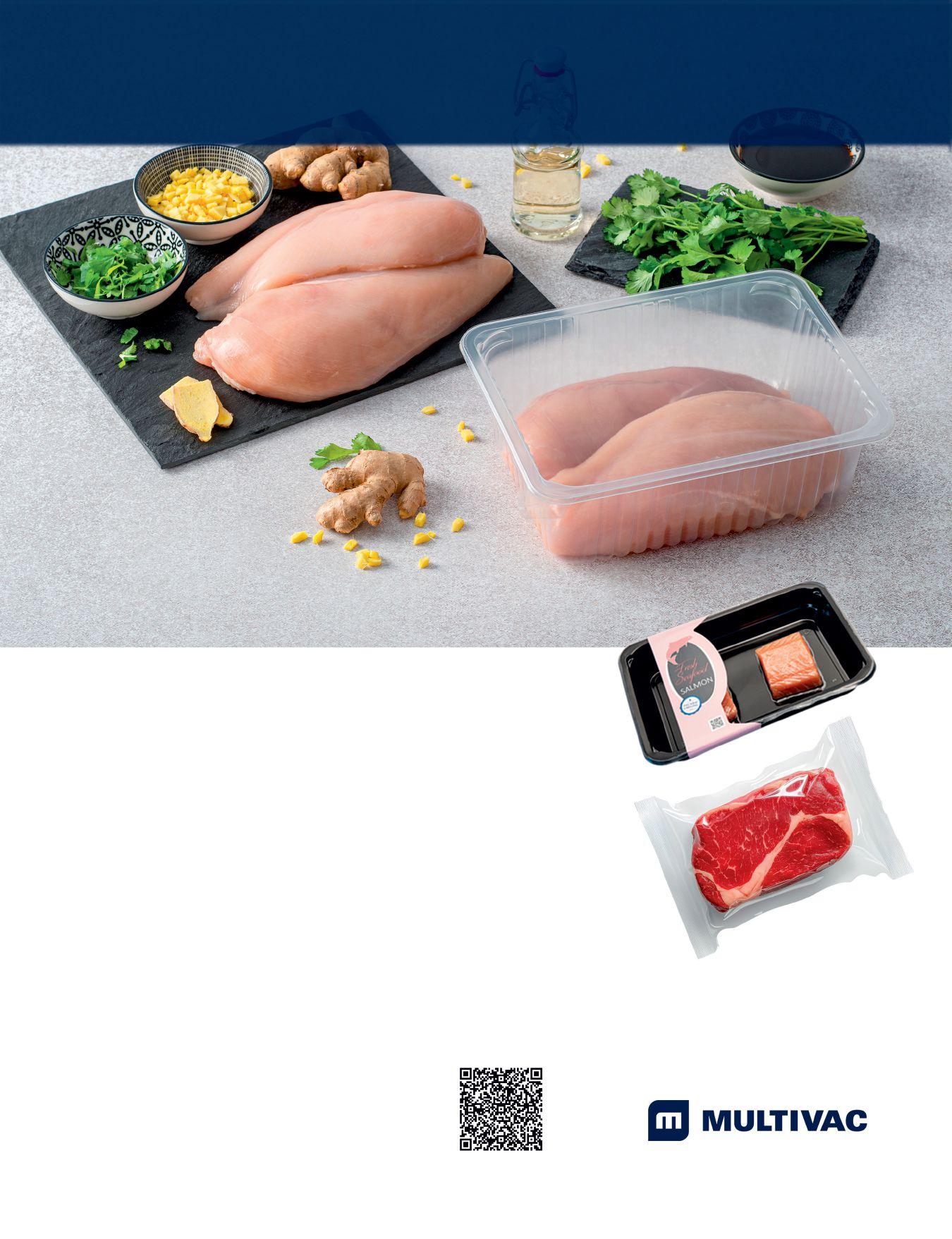
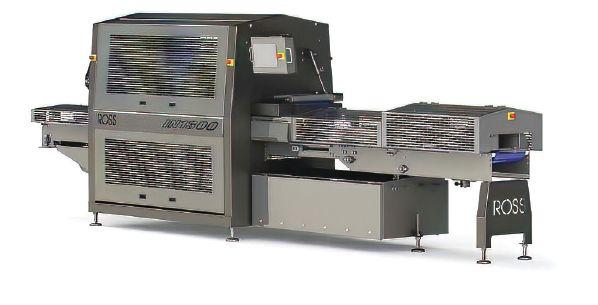
Ross Tray Sealers
n Flexible system produces high-quality modified atmosphere (MAP), vacuum skin (VSP), and lid-only packages
n Fully automatic, high-speed production
n Uses preformed trays of almost any size or shape
n Superior package seals eliminate leakers and returns
Iconic cookie brand breaking the ice with new soft-baked snacks
Few things bring Canadians closer together than a good old hockey game, as vividly underscored by more than 10 million Canadian viewers erupting in pure joy over Tam Canada’s overtime heroics to win the inaugural 4 Nations Face-off tournament last month.
And such unrivalled collective passion for the game certainly bodes well for the recent Canadian launch of the Oreo Cakesters brand—an inspired new twist on the iconic Oreo brand of cookies manufactured by Mondelez International, Inc.
Making their Canadian debut literally steps aways from the Scotiabank Arena in downtown Toronto—home to the storied Toronto Maple Leafs franchise— the soft-baked treats offer the Oreo brand’s legions of loyal fans a smooth way to enjoy the one-of-akind creme filling sandwiched between two soft-baked cakes.
As part of the brand’s multiyear partnership with the club,
announced in September 2024, Mondelez teamed up with the Maples Leafs’ star forward William Nylander to be the brand’s ambassador during the formal product unveiling at the Willy Good Cake Shop, located inside the city’s landmark Union Station building.
“OREO fans have patiently waited for OREO Cakesters to come to Canada, and we’re so excited to finally bring this indulgent soft-baked experience to Canadians,” says Chantal Butler, vice-president of marketing for Mondelēz Canada
“The playful connection between the deliciously soft OREO Cakesters in partnership with ‘soft hands’ William Nylander to bring to life Willy Good Cake Shop made this launch truly special.”
Now available at retailers across Canada, each box of OREO Cakesters contains five 57-gram packs of two cakes—offered in Original and Golden flavor varieties—making them an easy-to-pack snack that’s fun to share for home or on-the-go enjoyment.
The high shelf-impact boxes— adorned playful graphics—designed by The Marks Agency in Toronto—feature a pair of puck-shaped Cakesters seemingly floating through the air to reinforce the product’s soft-baked texture and recipe.
As Butler relates, “The OREO Cakesters are already a fan favourite in the U.S., and we’ve seen growing demand from Canadians to bring them to our market.
“We’re excited to see how OREO fans in Canada enjoy OREO Cakesters’ deliciously soft texture and indulgent creme filling—a new variety to the category that we know Canadians will love.”
Strategically positions in the cookie aisles of participating retailers right next to the classic Oreo cookie brand, “We are aiming to tap into the dedicated hockey fanbase in addition to our passionate OREO cookie-lovers,” Butler adds.
“The Maple Leafs and OREO partnership is rooted in creating unique experiences for fans and consumers, so we were thrilled to introduce the first-of-its-kind cake shop to the city, giving Torontonians the opportunity to engage with two fan-favorite brands in a special way just steps away from the home of the Maple Leafs.”
25_000560_Canadian_Packaging_Mar_Apr_CN Mod: January 29, 2025 8:58 AM Print: 02/17/25 page 1 v2.5
BUILT IN CANADA FOR THE WORLD
• Minimal operator requirement with optimal efficiency.
• Unique bag-top tension fingers and V-infeed bars.
• Ensures precise bag positioning and feeding for optimal seal strength and visual appeal.
• Automatic alerts to speed, temperature and pressure deviations.
• Can incorporate vacuum and/or gas flush capabilities with NEMA 4 washdown. Move
Coca-Cola doubling down on new product innovation
Thirst knows no season, according to one of Coca-Cola’s oldest brand slogans that sheds a bright light on the brand’s relentless product innovation efforts, highlighted by two major Canadian product launches in the last couple of months.
In January, the soft-drink giant relaunched a
X-Ray On-Hold Finished Goods
Xray Reclaim Div. provides emergency x-ray inspection services directly to your food or beverage processing facility to quickly inspect and clear inventory safely.
Our service delivers food safety validated results and provides full traceability reporting with guaranteed 2-sigma inspection using photon counting 3rd generation x-ray technology.
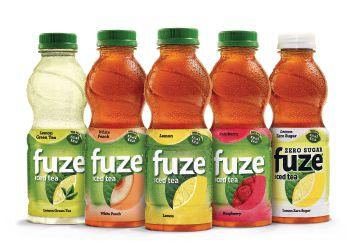
name, hitting the shelves in catchy new packaging and five flavors that include Lemon, Lemon Zero Sugar, Raspberry, White Peach and Lemon Green Tea
Sold at major retailers, convenience stores and foodservice locations across Canada, the Tea beverage are made, merchandistributed and sold in Canada in partnership with Coca-Cola Canada Bottling Limited, using use the same recipe, ingredients and suppliers that made the original a perennial bestseller.
“The iconic iced tea flavor that Canadians have enjoyed for years is here to stay,” says Jacques Blanchet, director of integrated marketing for Coca-Cola Canada
“Our FUZE Iced Tea is made using the same recipe, with the same ingredients sourced from the same suppliers, at the same Canadian facilities where we have made iced tea for say Blanchet, noting the renamed beverage is already one of the fastest-growing brands in the company’s history.
In addition to expanded flavor varieties, FUZE Iced tea will also be offered in multiple packaging options, including 341-ml cans, and 1.89-liter bottles, 1.75-liter chilled cartons and 200-ml drink boxes.
“The package design for FUZE Iced Tea was created to be approachable, fresh, bright, featuring unique brand elements that complement the familiar bottle design,” Blanchet relates. “The realistic fruit and leaf imagery set against a distinctive green background evoke a sense of freshness, visually emphasizing the brand’s real tea and natural credentials.
Last month also saw the eagerly anticipated debut of the new Coca-Cola Orange Cream marketed as a tasty, modern twist on the iconic drink with a and the nostalgic, vanilla-accented Orange Cream flavor originally created in 1905.
Also available in Zero Sugar version, “Orange Cream is a cultural force [that] has seen a renaissance, with interest growing incrementally over the last 10 years,” says Coca-Cola Canada’s integrated marketing manager Solange Grimard.
Available in 355-ml cans and 500-ml recycled plastic (rPET) bottles, the new flavor is expected to resonate strongly with the younger Gen Z and Millennial demographics.
“The target audience for Coca-Cola Orange Cream are those that are all about switching it up by drinking whatever sparks joy in the moment—be it a novel innovation or a timeless Grimard notes.
As for the new flavor’s distinctive new look, “The packaging maintains the classic Coke trademark red,” Grimard concludes, “but with a citrus-inspired twist to reflect the orange cream flavor ”
Proco Machinery Inc., a leading manufacturer of automation systems for the blowmolding industry, has formed a new sister company specializing advanced automation solutions utilizing collaborative robots tailored to meet the diverse needs of small- and medium-sized businesses. Based in Mississauga, Ont., Cobots Inc. will focus on the development of collaborative robot solutions that streamline processes, improve efficiency, and elevate workplace safety, according to Cobots director John McCormick. “These systems are being designed in such a way that they complement the production line and provide simplified operation, a smaller footprint, and enhanced efficiencies,” says McCormick, adding the company’s “cutting-edge” solutions will enable end-users in the plastics, pharmaceuticals and other
manufacturing industries to achieve ROI (return-on-investment) in less than a year. “Our mission is to redefine the way industries operate by providing cutting-edge cobot solutions,” McCormick states. “Our team is passionate about delivering tailored automation solutions that will drive sustainable growth and success for our clients.”
Trivium Packaging, leading global supplier of metal packaging products has been awarded the Best in Class recognition in the Sustainable Package Design category of the annual PAC Global Awards competition of PAC Global for the company’s Conejo Verde aluminum wine bottle. The prestigious award is a triumphant follow-up to the bottle’s recent win at the International Metal Decorating & Packaging Association (IMDPA) annual conference, where it received the Award of Excellence. Manufactured for the Argentinian market, the lightweight, durable and reclosable bottle—made from infinitely recyclable aluminum—includes a stunning, detailed print that
Welcome to The Rychiger team, Jon!
enhances shelf presence, while container’s monomaterial construction simplifies the recycling process by eliminating the need for separation to facilitate efficient material recovery. Moreover, the bottle includes recycled content and is produced in a facility with a continuous environmental improvement program. “We’re proud to see our partnership with Conejo Verde earn recognition at the PAC Global Awards,” says Trivium Packaging’s chief executive officer Michael Mapes. “This bottle represents more than just innovative design: it’s a prime example of how sustainable materials can redefine
luxury, proving that environmental stewardship and creativity can go hand-in-hand.”
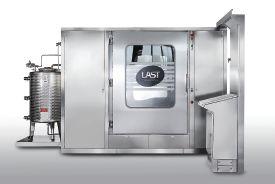
MG America, Fairfield, N.J.-based subsidiary of the Italian packaging and processing machinery manufacturing group MG2, has been appointed as the exclusive North American distributor for two prominent Italy-based manufacturers of pharmaceutical equipment solutions. On the processing side, MG America now represents Last Technology, a specialist in clean pharma production practices, whose portfolio includes sophisticated equipment for washing, disinfection, sterilization, depyrogenation and drying. In the packaging sphere, MG America now handles all North American sales and service initiatives
WELCOME
We are pleased to announce that Jon Fowkes has joined the Rychiger Canada as new CEO, effective February 3, 2025.
Jon brings over 25 years of leadership experience in the manufacturing and industrial sectors. He has successfully led organizations through significant transformations and growth, having held key positions such as President & General Manager at Rotork and Signode, and most recently, as President & CEO at NWI Precision.
Throughout his career, Jon has focused on driving operational excellence, fostering innovation, and building strong, collaborative teams. He is passionate about creating an environment where ideas and teamwork thrive, and he is eager to continue driving Rychiger Canada’s success.
for FamarTec, whose equipment range includes solutions for both primary and secondary packaging–from blister-packaging to casepacking. “The premium equipment supplied by both Last Technology and FamarTec broadens and complements our existing portfolio of machinery solutions,” says MG America president Claudio Radossi. “Our customers will benefit from an even greater selection of state-ofthe-art processing and packaging equipment.
FASTEN Packaging, an IBG (Innovative Beauty Group) subsidiary based in The Netherlands, has picked up a prestigious Gold Pentaward award for the design excellence of its packaging concept ONE, which seamlessly integrates design and sustainability while pushing the boundaries of beauty
packaging design. Developed as an eco-conscious option for the global beauty and cosmetics industries, ONE eliminates the need for separate parts, like caps, and reduces material waste by utilizing a single monomaterial PP (polypropylene) structure for easy recycling. With the option for direct printing and a universal shape that’s ready for market, ONE offers brands the flexibility to showcase their identity while emphasizing their environmental commitment, according to the company. Says FASTEN Packaging’s managing director Ilja Zutt: “ONE is a perfect example of how innovation can simplify processes, reduce environmental impact, and still deliver an aesthetically pleasing design that meets the needs of today’s customers.”
Tacoma, Wash.-headquartered Alliance Machine Systems International, leading manufacturer of corrugated boxmaking equipment, has completed the acquisition of JD Engineers, a prominent Dutch manufacturer of specialty folder-gluers for the corrugated board and folding carton industries. “After more than 10 years of successful collaboration in Europe, Alliance and JD Engineers have decided to become part of the same business structure,” explains Alliance Machine Systems International President Marius Batrin. “Over the last 25 years, JD Engineers has established itself as a strong, reliable, innovative and dynamic company thanks to the enthusiasm and hard work of the entire team, as well as the constant focus on innovation and quality.”
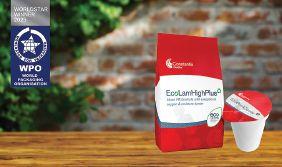
Constantia Flexibles, the world third-largest flexible packaging manufacturer headquartered in Vienna, Austria, has picked up two prestigious WorldStar Global Packaging Awards 2025 for its proprietary EcoPeelCover and
CCCA APPOINTS SERGE DESGAGNÉS AS EXECUTIVE DIRECTOR
The Canadian Corrugated & Containerboard Association announces the appointment of Serge Desgagnés as the new Executive Director. Serge has a long-standing history with the CCCA, having served as a board member for many years, representing Kruger Packaging L.P.
Serge brings considerable insight to the sector through his distinguished career spanning 45 years. The majority of his career was built at Kruger in varying roles. Most recently, he was Vice-President of Sales and Marketing at Kruger. He has a degree in Marketing and Sales from The University of Montreal.
Serge served for many years on the boards of the CCCA, Paper & Paperboard Packaging Environmental Council (PPEC) and the International Corrugated Case Association (ICCA). His national and international industry experience will bring a strong knowledge and insight to the association.
The Canadian Corrugated and Containerboard Association (CCCA) is the national voice of the corrugated industry. CCCA members include containerboard mills, corrugator plants, and related organizations from coast-to-coast who turn to CCCA for value-add support, resources, and education. CCCA is committed to supporting and advancing the industry and showcasing the reliable, recyclable, and innovative benefits of corrugated packaging to all Canadians. For more information, visit Canadian Corrugated Containerboard Association | Canada’s National Voice for Corrugated Packaging .
EcoLamHighPlus substrates in the Packaging Materials and Components category of the World Packaging Organisation (WPO)’s annual competition in recognition of the company’s leadership in more sustainable, innovative flexible packaging. Featuring ultra-thin aluminum and co-extruded polypropylene (PP) layers, the EcoPeelCover lidding’s lightweight structure delivers superior performance in peelability, corrosion protection, and puncture resistance with barrier protection for dairy products. For its part, EcoLamHighPlus is a lightweight mono-polyethylene (PE) laminate combining robust oxygen and structure combining superior moisture barrier properties with lap-seal technology for long-term product protection.
HYGIENE PRODUCTS FOR THE FOOD INDUSTRY
Shawpak Passion For Hygiene
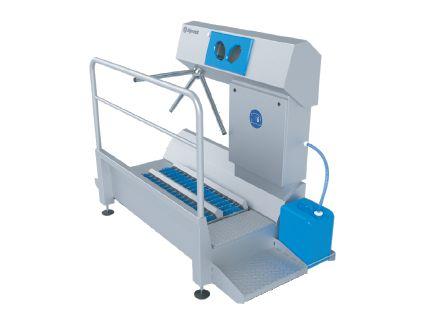
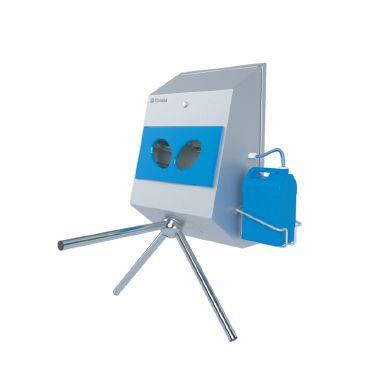
HYGIENIC ENTRANCE WITH SOLE CLEANING AND HAND DISINFECTION
When the hands are inserted into the cylinders, sensors activate the dispensing of disinfectant or soap. After this, the turnstile is released and the user can proceed to the next step in the hygienic process
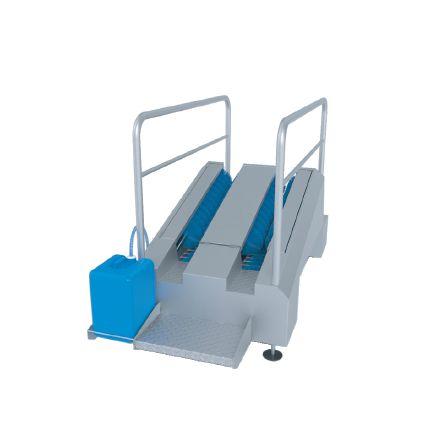
WALKTHROUGH SOLE AND SHAFT CLEANER
Upon entering the unit, sensors automatically activate the rotation of the brushes and your soles and shafts are cleaned. This installation is ideally suited for the cleaning and disinfection of heavily soiled boots
CHEMICAL DISPENSER WITH TURNSTILE
When the hands are inserted into the cylinders, sensors activate the dispensing of disinfectant or soap. After this, the turnstile is released and the user can proceed to the next step in the hygienic process
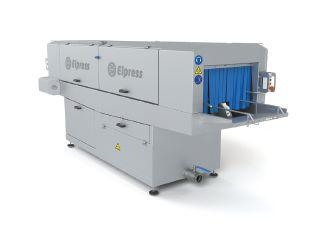
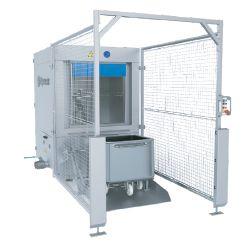
INDUSTRIAL WASHING SYSTEMS FOR AL YOUR LOAD CARRIERS
Our industrial washing systems clean load carriers, crates, pallets or boxes. The systems are thrifty with water, energy and cleaning agents, without making concessions to the cleaning itself. Our systems utilize a precisely tailored combination of temperature, chemical agents, time, and mechanical force, ensuring optimal cleaning results are always achieved.
PICK AND CHOOSE
Combining high speed and precision for demanding industrial pick-andplace applications, the new DR1000 four-axis delta robot from igus GmbH boasts a 1,000-mm working diameter and an additional rotary axis that provides four degrees of freedom robots to seamlessly grip and orient components at speeds of up to 96 pick per minute. Featuring a modular design for easy integration into existing automation systems, the versatile unit can also be equipped with a gripper or suction cup to execute complex tasks and can be customized to meet hard-to-satisfy requirements in a wide range of end-of-line pick-and-place operations, as well picking or stacking tasks in three-dimensional spaces. Integrated into the control system, the license-free optional Robot
Control (iRC) software features an intuitive interface and a uniform operating concept that reduces planning time and speeds up commissioning.
Igus, Inc.
JUST FILLING IN
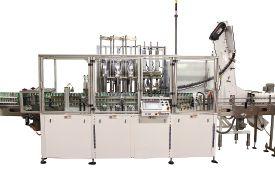
Designed for highly precise and repeatable dispensing of sealants, adhesives, and lubricants across a broad range of packaging and other industrial applications, the highspeed automatic inline (IN) series cartridge filling systems from ProSys Fill, LLC features horizontal or optional vertical load and unload, volumetric product metering, and cartridge lift mechanisms for a vertical, air-free bottom-up fill. Able to operate with 10.5-, 14- and 30-ounce fiber or plastic cartridges,
the three-head cartridge filling and closing system significantly system enhances production speed and throughput, while increasing operational flexibility and efficiency. Offered in models capable of filling up to 110 cartridges per minute, the series offers multiple performance attributes, including:
• Standard reject with optional checkweighing;
• Plunger Insertion with air release system;
• Standard stainless-steel product contact parts;
• Ability to work with viscous products up to three million centipoise (cps) +/0.1-percent by volume;
• Positive displacement metering;
• Innovative “Snuff-Back” material cutoff;
• Pump or press feeding;
• Vacuum filling.
ProSys Fill, LLC
DANCING ON THE CEILING
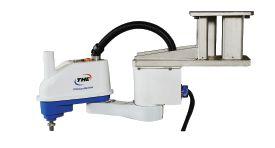
Distributed by TM Robotics, the new ceiling-mounted THE series SCARA robots manufactured by Shibaura Machine are designed to offer users
a highly effective solution for maximizing space in constrained production environments. By positioning the robot on the ceiling, manufacturers can free up valuable floor space, allowing other equipment to be accommodated in the same area. This can be particularly beneficial in facilities with limited space and for manufacturers looking to create more streamlined production layouts. Moreover, ceiling-mounted configurations also help to reduce potential obstructions and improve operator safety in busy environments. Renowned for speed, precision and flexibility across a diverse range of for assembly, pick-and-place tasks, material handling and inspection processes, Shibaura Machine’s THE series of ceiling-mounted SCARA robots are available in four models, including:
• The compact THE400 robot with
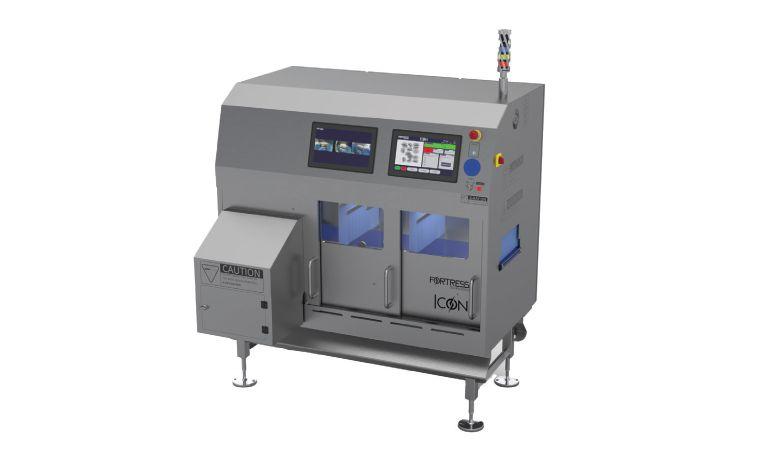
FORTRESS TECHNOLOGY WELCOMES NEW QUEBEC REPRESENTATIVE
WAEL ABOU HAMAD
Fortress Technology is pleased to announce that Wael Abou Hamad has taken on the role of Sales and Service Representative for Quebec. Having been a valued Service Technician with Fortress for several years, Wael brings extensive hands-on product expertise to his new sales role. With a strong focus on supporting food manufacturers and providing customized product inspection solutions, Wael will work closely with producers across the region to enhance their food safety programs.
PLANNING TO ATTEND BAKERY SHOWCASE IN MONTREAL THIS APRIL14-15?
Be sure to meet Wael and his team member, Victor John Cartujano, in person at the show from April 14-15, 2025, and discover how Fortress Technology’s inspection systems can help protect your products and processes from physical contaminants and enhance quality assurance.
five-kilogram maxim payload;
• THE600 robot offering 12-kg maximum payload;
• THE800 robot with 20-kg payload and high-speed cycle time for fast throughput in demanding inspection applications;
• The heavy-duty THE1000 robot, offering 20-kg payload capacity and 100-mm arm reach.
TM Robotics
LIGHTS OUT
Developed as an effective light-blocking technology for monolayer PET bottles, the ColorMatrix Lactra LX additive from Avient Corporation provides extended shelf-life and freshness for liquid dairy product packaged in single-layer containers. According to the company, the new technology from is suitable for use in packaging for products such as ultra-high temperature (UHT) liquid dairy beverages, which have longer shelf-life requirements and are often stored under ambient conditions. Moreover, the Lactra LX additive also offers the advantage of high versatility in terms of container
designs, sizes and shapes, allowing for superior product differentiation over other rigid packaging solutions and enhancing consumer convenience with easy-to-pour options.
Avient Corporation
NO NEED TO FUME OVER IT
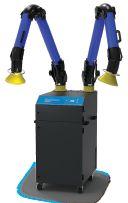
Donaldson BOFA has launched a new mobile fume extraction system with articulated arms for effective filtering emissions associated with heavy-duty laser processes, soldering and organic solvents. The new AD 1500 iQ Dual Arms system offers a functional reach of over six feet to ensure high precision and operational flexibility in removing potentially harmful airborne contaminants on larger-scale projects. The system also includes an integrated spark arrestor to reduce
PILZ AUTOMATION SAFETY CANADA L.P.
is pleased to announce the promotion of
the risk of thermal events by capturing hot embers before they can enter the extraction system.
The AD 1500 iQ Dual Arms comes with the embedded Intelligent Operating System (iQ) software providing access to real-time airflow readings, filter condition monitoring and remote diagnostics.
Donaldson BOFA
STILL THE ONE
The StarLITE-R STILL from Sidel is a new bottle base that employs the company’s patented technology to ensure 100-percent recycled PET (rPET) integration, lightweighting, and high-speed production for water, juices, milk, and edible oils from 0.25- to 2.5-liter sizes. While balancing production speed, material type, and bottle weight presents a complex challenge for manufacturers in maintaining high performance, the StarLITE-R STILL is designed to overcome these obstacles with
MARCUS GRAHAM
to the role of National Channel Manager
Marcus will continue his role as Senior Technical Sales Representative for the Southwestern Ontario region, while also taking on the responsibility of overseeing nationwide partnerships with distributors and integrators. In this expanded role, Marcus will not only drive sales in Southwestern Ontario but also strengthen relationships with our valued partners across Canada.
“Marcus is the ideal person to further improve our relationship with our partners, he accumulated a lot of experience as well as worked for distributors in his previous life. I am confident that he will drive our distribution business to the next level. My double role as CEO of Pilz Canada and Regional VP of South and North America left me with little time to nurture our partnerships in the past year”, says Andreas Sobotta.
“I am thrilled to take on this responsibility and further strengthen our relationships with our valued channel partners. Distribution will be crucial to our future growth, and by working together, we can offer our customers the best value possible,” says Marcus Graham.
Marcus joined Pilz Canada in 2017. Since then, he has become an indispensable team member, significantly boosting regional sales and contributing to the overall growth of the company.
Pilz is a global expert in industrial safety & security for human, machine and the environment. Supported by our corporate headquarters in Ostfildern, Germany, Pilz Canada has provided customer-oriented automation solutions since 2013.
precise bottle base shaping and efficient material distribution. The innovative design can also be seamlessly retrofitted onto existing production lines for optimal versatility, while requiring low blowing pressure. The mold base’s rounded-edge design makes it easier to shape during blowmolding, which increases the bottle base resistance to defects such as bursts during the blowing process. This feature is particularly important for lightweighted bottles prone to such issues due to use of thinner material. With a high base clearance, the structural design effectively prevents deformation to ensure optimal functionality and stability even in high-temperature conditions.
Sidel
Cascades ruling the roost again inglobalsustainabilityrankings
Cascades Inc. , leading Canadian producer of corrugated packaging and tissue products, has achieved a top 100 ranking in the annual list of the world’s most sustainable corporation compiled by the Corporate Knights organization for the sixth year in a row.
Headquartered in Kingsey Falls, Que., Cascades was awarded the top position among surveyed organizations in the Containers and Packaging sector, in addition to being ranked 59th worldwide from a total of 8,359 companies with annual revenues exceeding one billion dollars.
Among the factors assessed by Corporate Knights, Cascades stood out for its high percentage of sustainable revenue attributable to products
made from recycled or certified fibers, and sustainable investments in capital expenditures and R&D.
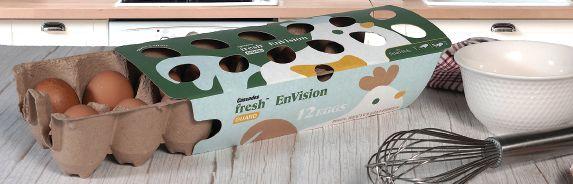
In addition, the company has also picked up two prestigious international awards for its innovative sustainable FRESHGUARD EnVision egg packaging solution, including:
• The GOOD DESIGN Award
2024 from The Chicago Athenaeum Museum;
• The BIC Innovation Award 2025 of the U.S.-based Business Intelligence Group (BIG) Made from 100-percent recycled fibers, the patented retail
egg cartons made from molded fibers with cardboard top.
Featuring die-cut openings in the litho-printed sliding wraparound protective outer sleeve to let consumers see the eggs without opening the package, the attractive package is also claimed to offer up to 95-percent higher brand visibility over traditional cartons.
“We are honored to make the Global 100 ranking of the world’s 100 most sustainable corporations for the sixth year in a row,” says Cascades president and chief executive officer Hugues Simon. “In addition, we are very proud to retain the Silver Parity Certification from Women in Governance and
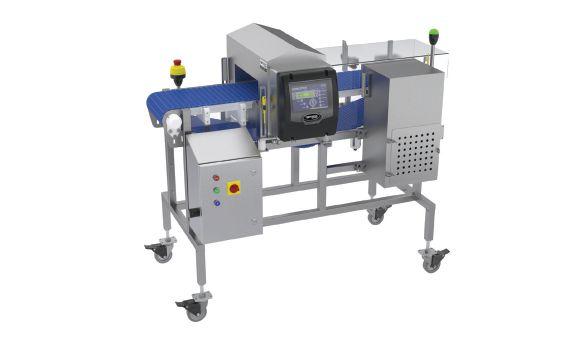
Total Detection for Reliable Safety
Redefine product safety with the combined power of Metal Detection and X-ray systems. Together, they deliver unmatched contaminant detection, safeguarding your bakery production from foreign material risks.
The multiple award-winning Cascades FRESHGUARD Envision egg packaging solution made from 100-percent recovered fibers.
NEW WEBSITE LAUNCH NEW WEBSITE LAUNCH PAC Global’s
75th Anniversary
Discover a fresh, user-friendly experience with enhanced features, streamlined navigation, and exclusive industry insights. Stay connected to global packaging leaders, the latest in innovation, sustainability and accessibility packaging, competitions, events, and networking opportunities. Visit pac.global now and explore the future of packaging!
Join PAC CONNECT, the premier digital platform showcasing PAC Global members products & services.
Features PAC Global Awards winners as case studies across multiple categories. Most Valuable Partner (MVP) Option: Spotlight your capabilities and innovations. Option for marketing and advertising packages, hosted webinars, and features in newsletters and promotional materials.
Join the PAC Global family today and position your business at the forefront of packaging innovation, sustainable and accessible best practices. Contact James D. Downham at jdd@leaderlinx.com for more information.
IN THE LONG RUN
Venerable Quebec produce distributor keeps getting better with age with pioneering innovation and continuous capital investment to maintain its strong competitive edge
By George Guidoni, Editor
Product quality and innovation go hand-in-hand in any line of work, often with spectacular payoffs and rewards for companies that get it right.
Founded in 1918, Anjou, Que.-headquartered fresh produce distribution powerhouse Courchesne Larose has been getting it right for 108 years on its continuous long upwardly journey to establish itself among Canadian fresh produce industry’s elite.
Starting out as a small fruit importer in downtown Montreal, the company
now ranks as the second-largest privately-owned distributor of fresh fruit and vegetables in Canada—servicing customer s in the retail, foodservice, processing and institutional sectors with exemplary service and reliability.
With a vast market reach from Ontario though Quebec and all of Atlantic Canada, the tightly-integrated Groupe Courchesne Larose company employs over 1,000 people across several operating divisions that include:
• KROPS, in charge of overseeing the import and distribution of top-quality products from abroad.
• Les Aliments Bercy inc., specializing in the distribution of organic fruit and vegetables, along with the pro-
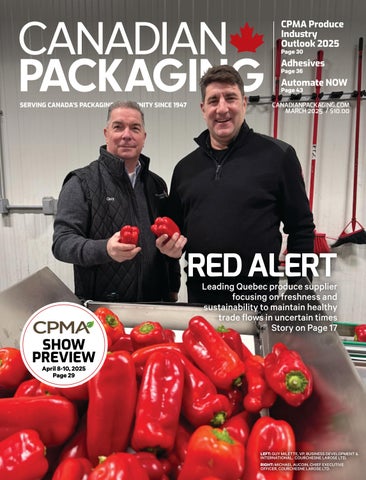
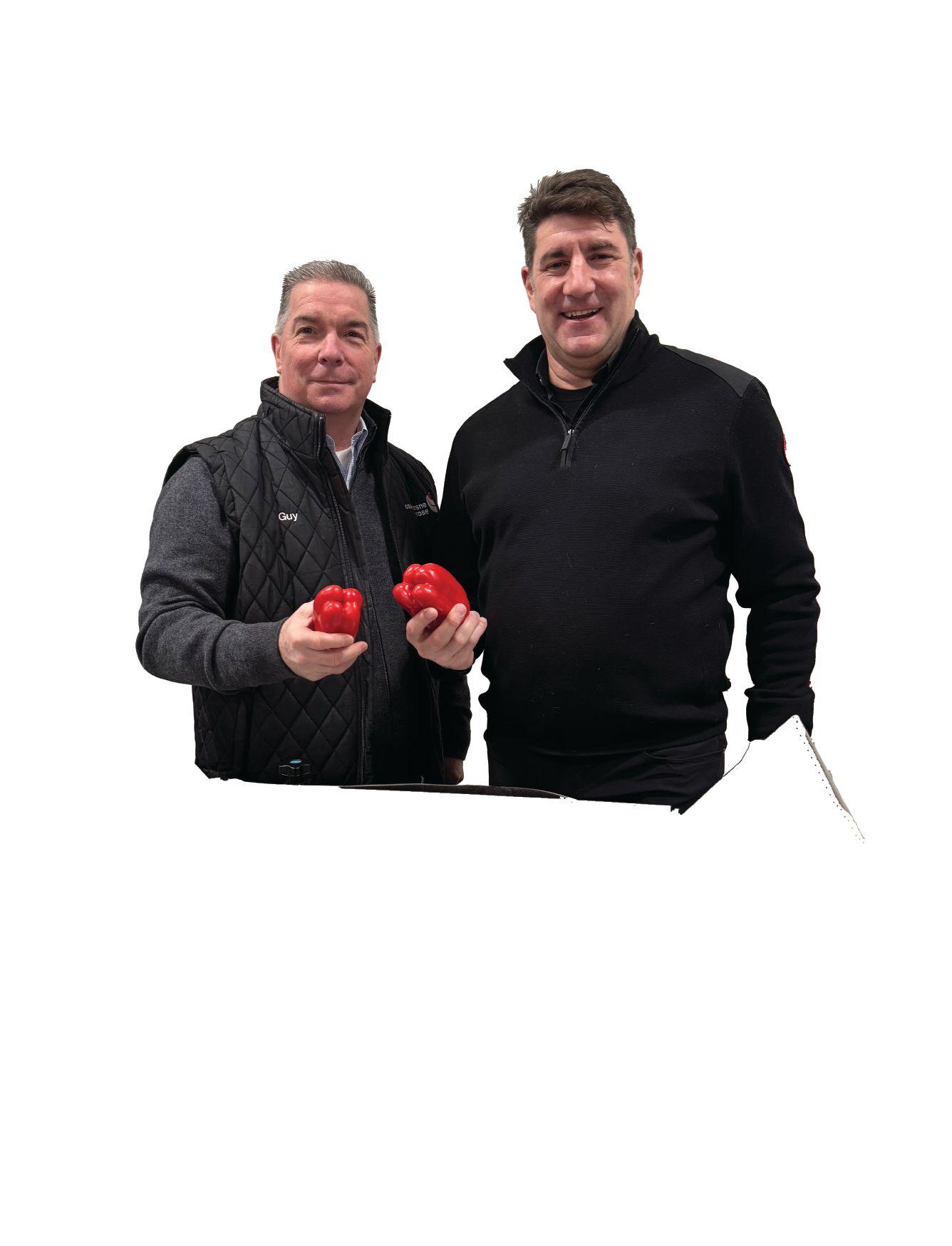
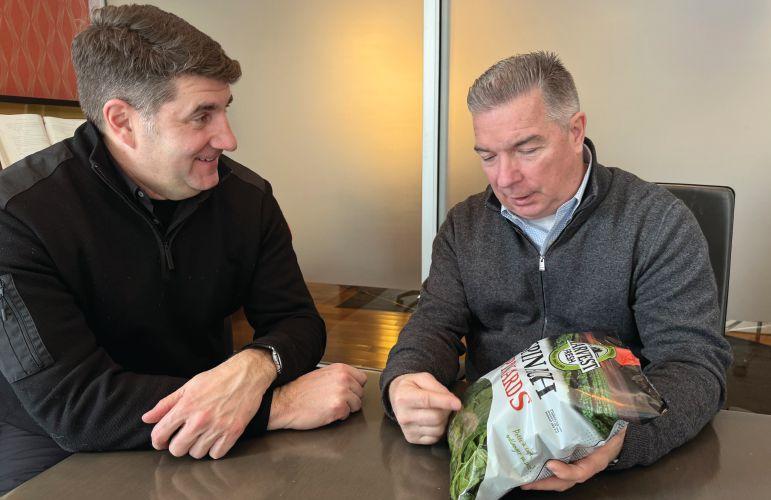
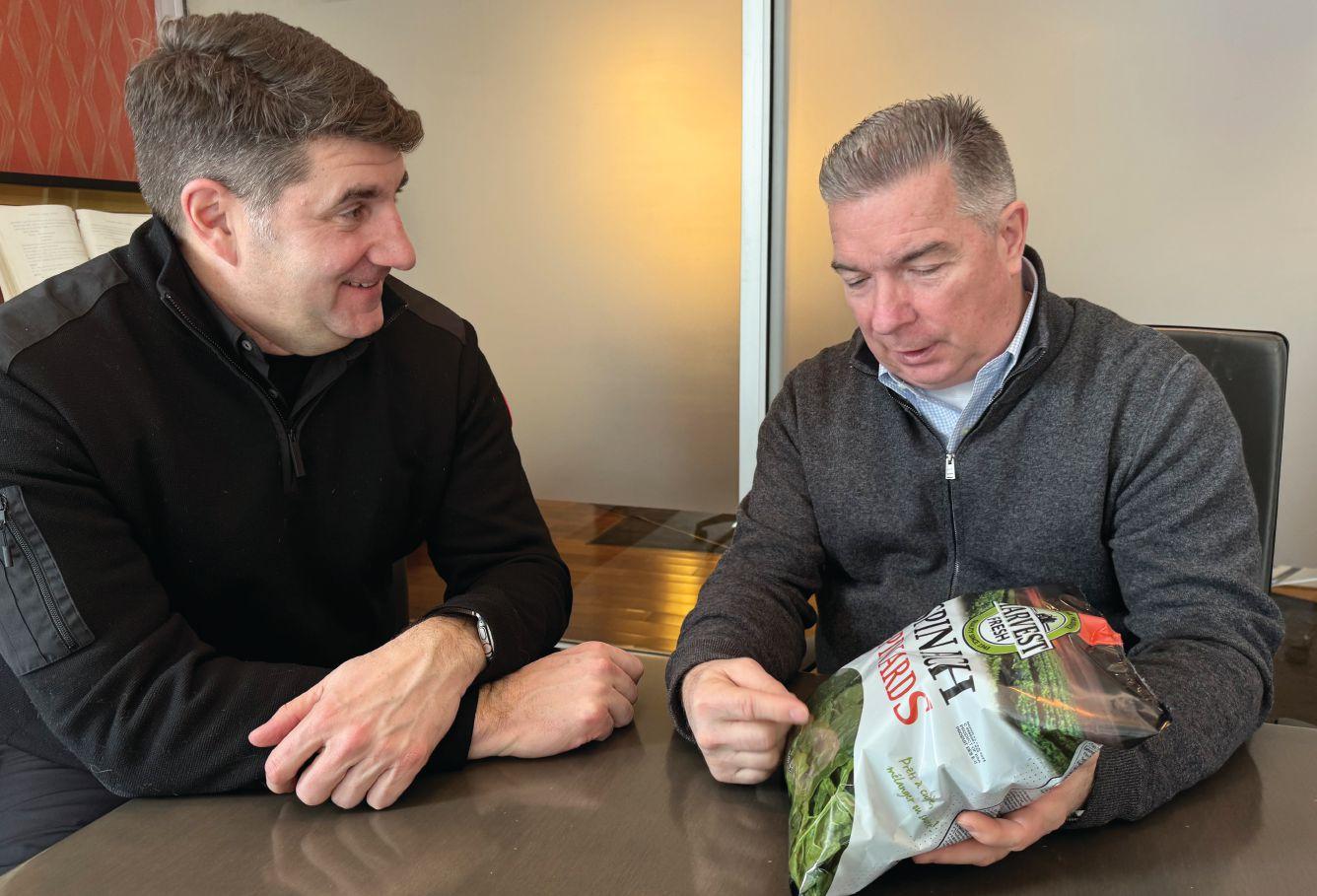
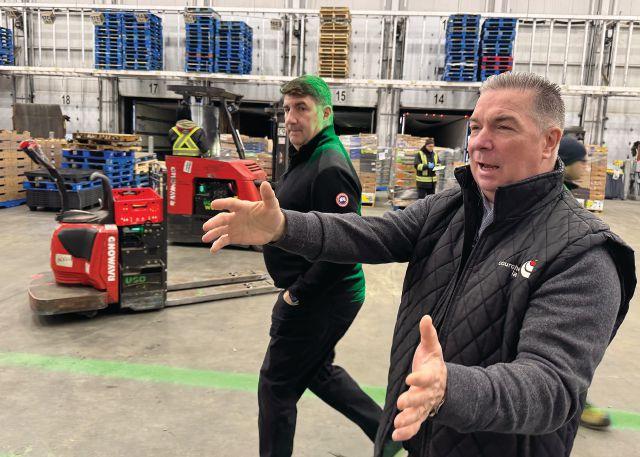
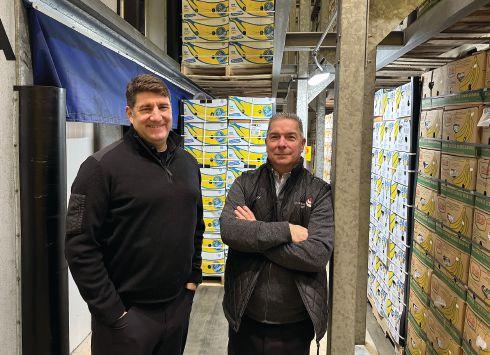
Courchesne Larose chief executive officer Michael Aucoin (left) and executive vice-president Guy Milette having a light moment with a bag of fresh spinach in a meeting room of the Anjou distribution center.
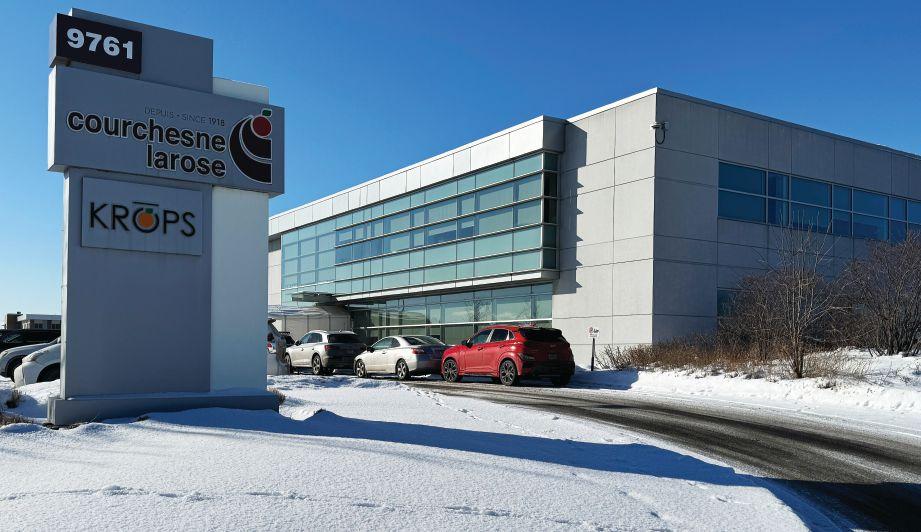
The company’s 174,000-squarefoot building in Anjou(above) is the biggest DC operation in Canada used exclusively for fresh produce.
Guy Milette and Michael Aucoin on the way to cold-storage rooms.
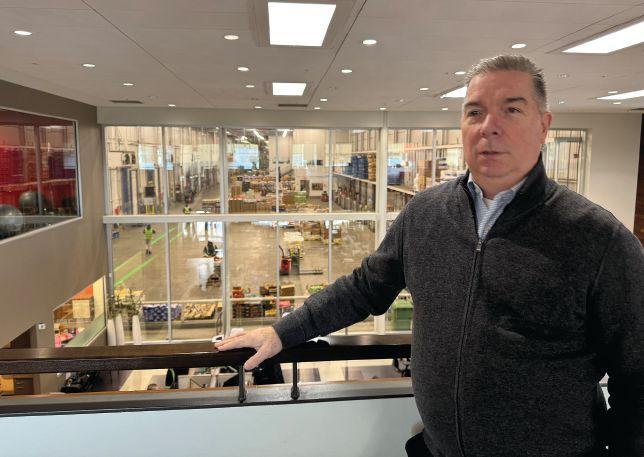
Guy Milette is a well-known figure in the Canadian produce industry community through his active participation in CPMA activities.
cessing and packing of value-added products.
• Founded in 1998, La Paysanne is a fruit and vegetable wholesaler, specializing in emergency supplies for grocery stores.
• Founded in 2003, Dynapro Trans-
technologies to maintain optimal product freshness and shelf-life during transport.
• Marcan Packaging, specializing in the subcontracting of packaging, sorting, warehousing and value-added handling of food products.
• Founded in 19 83, Veg-Pak Produce is a leading Ontario-based value-added wholesaler and processor of fresh produce.
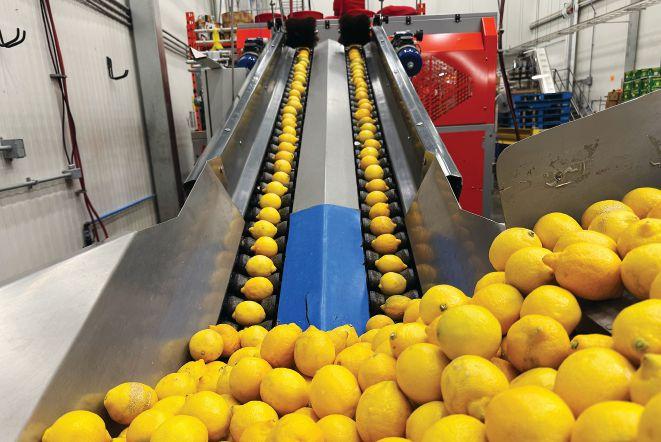
Distributing well over 30 different fruit, vegetable and berry varieties throughout they year—from root and green vegetable to apples, strawberries and citrus products—Courchesne Larose first gained true national fame as an industry pioneer back in the early 1970s by introducing Morocco-grown clementines into the Canadian market.
“There was actually no such thing as clementines in North American market back then; it was a brand new fruit grown exclusively in the Morocco kingdom’s Maghreb region,” the company’s executive vice-president Guy Milette told Canadian Packaging in a recent interview.
“The clementines remained pretty much exclusive to Morocco for nearly 20 years,” Milette recalls, “and we secured an exclusive distribution deal with the royal family to be their representative for clementines in Canada.
“That exclusivity lasted about 25 years,” Milette says, citing the product’s fast-growing popularity with Canadian consumers right from the outset.
“Today, of course, there are more than 80 varieties of clementines grown across Morocco, Spain and other Mediterranean countries, South Africa, and South American nations like Chile, Peru, Argentina and Brazil,” Milette relates.
“Interestingly, clementines were not even grown in the U.S. until about 15 years ago, in California,” notes Milette, who began his career in the produce business with Courchesne Larose back in 2001.
In addition to working his way up to the company’s senior management ranks, Milette also became a wellknown ambassador for the Canadian produce industry through his volunteer work for the Ottawa-based Canadian Produce Marketing Association (CPMA) , where he served as the group’s chair of the board during the 2021-2022 term.
port is the parent company’s transportation and logistics arm offering professional, efficient and dynamic capabilities in the transport of fruits, vegetables and dry goods with a fleet of about 175 trailer-trucks outfitted with advanced temperature-control
Today, Milette continues his active involvement by serving as chairman of CPMA’s Member Services committee.
“Having been involved with the association for more than 20 years, a better part of my working life, has been an invaluable experience both personally and being the ambassador Courchesne
Larose as well,” Milette says, “insofar as expanding our circle of influence to the highest levels of governmental policy-making on national level.
“For some smaller companies, it may be hard to see what’s going on behind the scenes in the industry if they are not participating in the CPMA,” Milette points out. “But being a national organization covering all provinces makes it an invaluable resource for industry contacts, networking and uncovering new business opportunities.”
Michel Aucoin, who joined Courchesne Larose two years ago as the company’s new chief executive officer, fully concurs, saying CPMA’s high-level contacts and solid relationships with its counterpart U.S. industry groups will become critically important assets in coming months, as the industry grapples with the punishing new tariffs on Canadian imports to the U.S. With no specific exemptions for fresh produce announced yet, the troubling development is a profound industry-wide threat.
“While we do have one of our divisions selling directly to a couple of U.S. cus-
tomers, we are primarily a Canadian business, with about 97 to 98 per cent of our output distributed in Canada,” Aucoin relates.
“The retaliatory U.S. tariffs will undoubtedly impact some of the product that we import from there,” Aucoin acknowledges, “but because out imports are sourced from about 100 countries around the world, we have more flexibility, agility and the scale to minimize those impacts, compared to some of our large competitors.
“Because we are dealing primarily with pure commodities with no fixed price, since it fluctuates on almost daily basis, we should be able to come up with some nimble response strategies to minimize the tariffs’ impact on our own business,” Aucoin continues.
“Nevertheless, because we pay for all out imported commodities in U.S. dollars, the prospect of a Canadian dollar weakening further is bound to have a macroeconomic impact on the Canadian food industry in general in terms of further exacerbating the lingering food inflation.”
Even if the Canadian economy slides into a recession due to the looming trade war with the U.S., Aucoin thinks Courchesne Larose has enough “recession resiliency” built into its business model to overcome whatever challenges come its way because of the tariffs.
“People will still need to eat, recession or not,” he says, “so what usually happens during the economic downturns is the consumers start spending less going out to restaurants and making more trips to the grocery stores.
“Because this trend works in reverse in stronger economic times, having a large customer base in both retail and foodservice industries enables us to adjust to whatever demand fluctuations we need to address to remain a competitive and reliable business partner to all our customers,” Aucoin asserts.
As Aucoin relates, Courchesne Larose has made intensive efforts in recent years to diversify its offerings to create a “more balanced” product portfolio.
Whereas the company used to be primarily associated with imported fruit products, more than 40 per cent of its output is now accounted for by vegetables, according to Aucoin.
“We go through an average of about 500 trailer-loads of produce per week,”
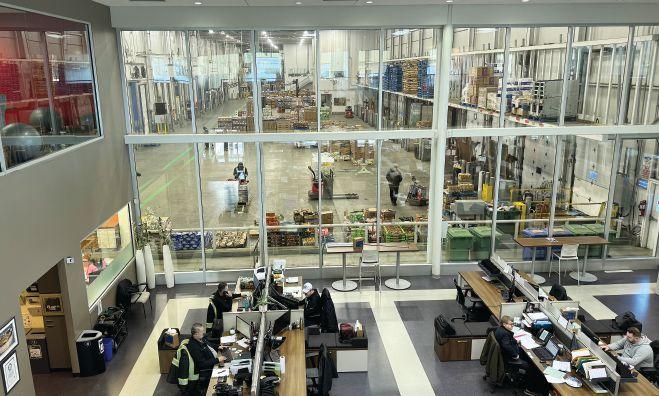
Upper-level view of the plant’s office space, complete with the seethrough glass wall for an unobstructed view of the plant floor activity right next to it.
Clockwise from to left
Clockwise from above
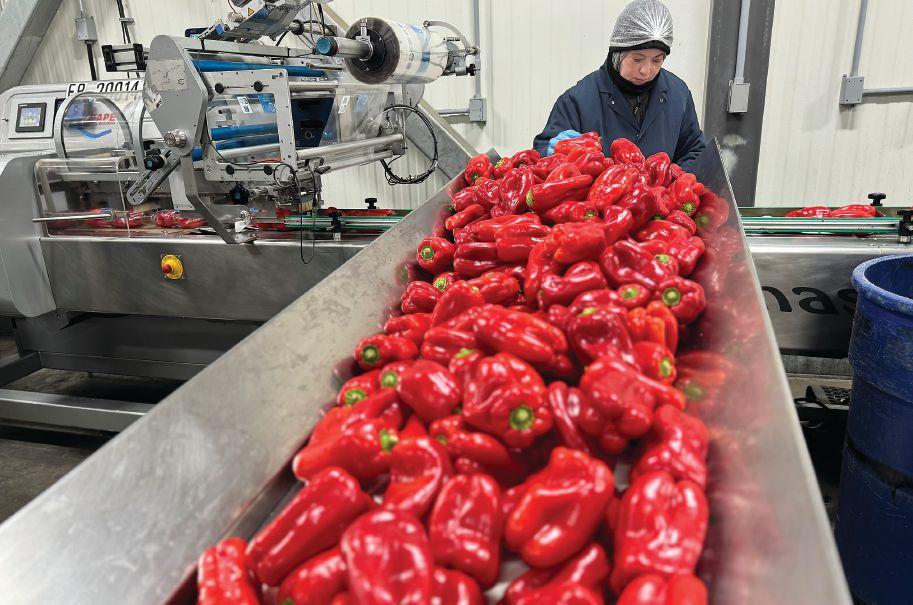
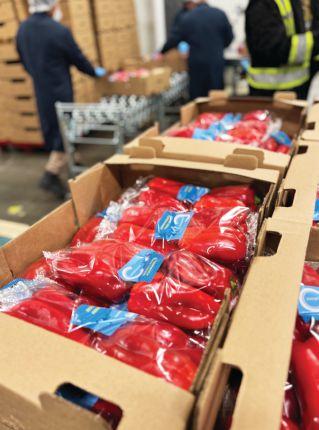
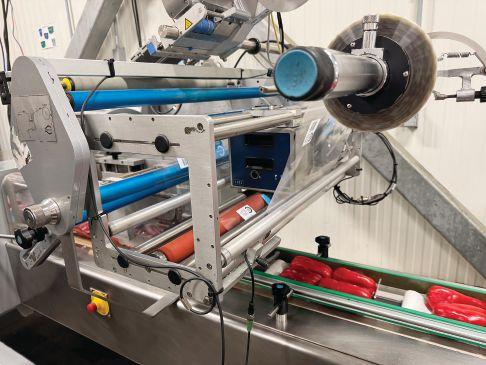
Flow-wrapped four-piece packs of red peppers packed inside corrugate trays, Red peppers being packed into clear film on a highspeed flow-wrapping machine.
Michael Acuoin and Guy Milette proudly show off what the claim to be most technologically leading-edge banana rooms in Canada.
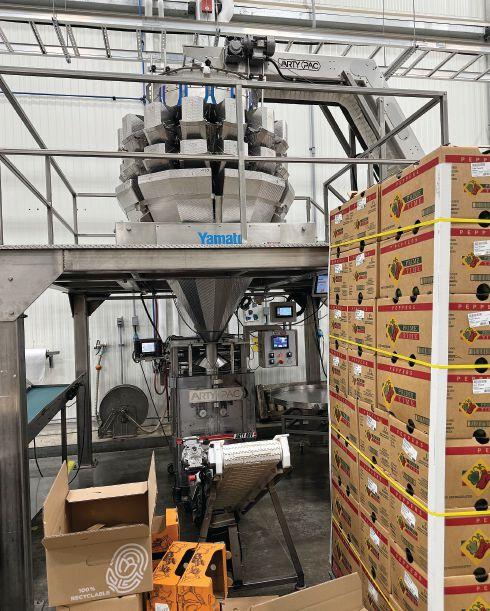
The fully-automatic Yamato multihead weighscales used to dispense precision-weighed quantities of product to the ArtyPac bagging machine below.
Aucoin relates.
“This is quite a large, high-volume number,” Aucoin says, “and it covers pretty much just about every major produce variety in the world that Canadian consumers want to buy: the full produce basket, if you will.”
To keep up with growing volumes, Courchesne Larose has carried out a number of significant, capital-intensive facility and equipment upgrades at many of its operations—particularly at the company’s state-of-the-art central distribution facility in the Montreal suburb of Anjou, which also serves as the company’s headquarters.
Built in two phases (2012 and 2017), the 174,000-squarefoot facility houses 17 climate-controlled storage rooms and 33 other separate enclosed rooms for ripening bananas, avocados and pears.
The company also operates another 92,000-square foot Marché Central facility—located within Montreal’s city limits—housing 18 refrigerated rooms and 26 banana rooms, primarily operating as a hub for the retail sale of fruits and
vegetable by local food merchants.
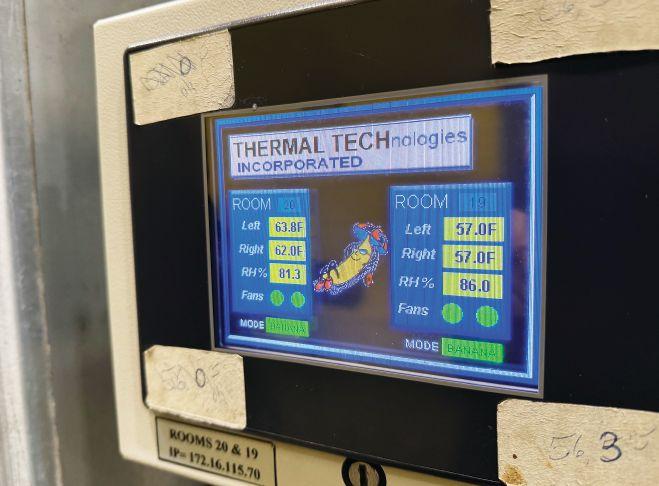
All the products stored at the two facilities are kept under optimal storage conditions that are meticulously maintained by a state-of-the-art refrigeration system, with the temperature and humidity levels constantly computer-calibrated to ensure an ideal environment for the products inside.
Employing advanced sophisticated temperature, moisture and other critical climate control and monitoring technologies for optimal product protection and shelf-life, both facilities boast three critically important global certifications, including:
• The SQF Level 2 food safety certification from Global Food Safety Initiative (GFSI);
• The Ecoresponsible Level 2Performance certification for
sustainable development;
• The Fairtrade certification for sustainable and ethical sourcing practices worldwide, with provisions for ensuring fair prices for the farmers, as well as decent working conditions.
“We are the only produce distributor in Quebec to have obtained the SQF Level 2 certification,” says Aucoin, citing significant expenses involved in maintaining it.
“With each climate-controlled room subjected to its own periodic third-party certification auditing process each year, it all adds up to a considerable financial outlay.
“The SQF Level is a very strong certification,” Aucoin comments, “but it is also a very expensive one to maintain.
“The banana room alone costs as about $200,000 per year to carry out three audits annually,” Aucoin reveals, “and there are many other specialty storage rooms requiring multiple audits throughout the years, each costing anywhere from $2,000 to $2,500 per audit.
“But that’s just the reality of ensuring food safety these days,” says Aucoin, “and we are happy to be an active part of it.”
Despite the extra costs, the certifications serve as valuable marketing tools for expanding the company’s business reach and customer base, Aucoin points out.
“Our banana rooms, for example, feature advanced forced air circulation systems that provide the bananas here with two to three extra days of shelf-life at the retailer’s end,” he says, “and that’s a huge competitive advantage for this particular product.”
O ther notable technology investment carried out by Courchesne Larose in recent years include:
• The AiroCide air purification system.
Developed by NASA (National Aeronautics and Space Administration) specifically to eliminate mold, fungus, airborne bacteria and volatile organic matter such as ethylene, AiroCide technology provides the required levels of protection to ensure the stored fruits and vegetables do not ripen prematurely and enjoy a longer life-span.
• State-of-the-art Roadnet delivery tracking system that enables the distributor to optimize its transportation routes.
• Custom-designed loading docks that allow for the truck doors to be opened inside the warehouse, thereby ensuring that the cold chain is never interrupted, and that the products are consistently stored at their ideal temperatures.
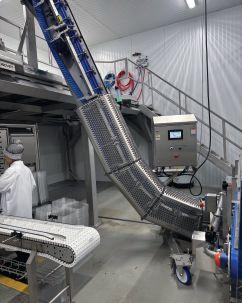
Aucoin adds that Courchesne Larose has also made considerable investments into automated packaging equipment for its Anjou facility—including optical sorters, flow-wrappers, baggers, top-sealing equipment, etc.—to carry out some rudimentary packaging tasks for some raw products on-site.
“So if a customer asks for his red peppers to be shipped in packs of three, for example, we can easily run that on our flow-wrapper to the specified quantity,” Aucoin explains.
“We do some value-added “transformation” work here at Anjou,” Aucoin notes, “but only for the smaller, short-run jobs typically.
“We have our other sister-companies, like VegPak and Bercy, to look after the large-volume transformation stuff for the bulk of the product shipped to Anjou,” says Aucoin, adding the Anjou center operates on 24/7 basis throughout the year, closing only for the Christmas Day and Saint-Jean-Baptiste Day holidays.
“It is the biggest distribution center in Canada dedicated exclusively to fresh fruits and vegetables,” Aucoin proclaims, adding the company’s industry-wide reputation for customer service, product quality and innovation that perfectly position it to continue on its solid growth projectory well into the future.
“We really work hard to make sure our customers get the product they need, when they need it, and in the condition they need it to be,” Aucoin asserts.
“Quality is always a huge issue in the produce business, so we continually invest in the latest inspection and track-andtrace capabilities to ensure optimal quality levels throughout the value chain,” he adds.
“And we tailor all our services to meet our customers’ exact needs,” Aucoin states.
“We deal with the largest retailers in Canada, who are some of the best, most sophisticated retailers in the world,” Aucoin point out, “but we also cater to the small retailers, as well as the smaller distributors who don’t have the scale to procure on a global basis like we can.”
“It all comes down to carrying out or duty of care to increase the value of our produce throughout the supply chain,” Aucoin concludes, “to deliver the best value proposition to the consumers, our customers and our vendors on a daily basis.”
From left
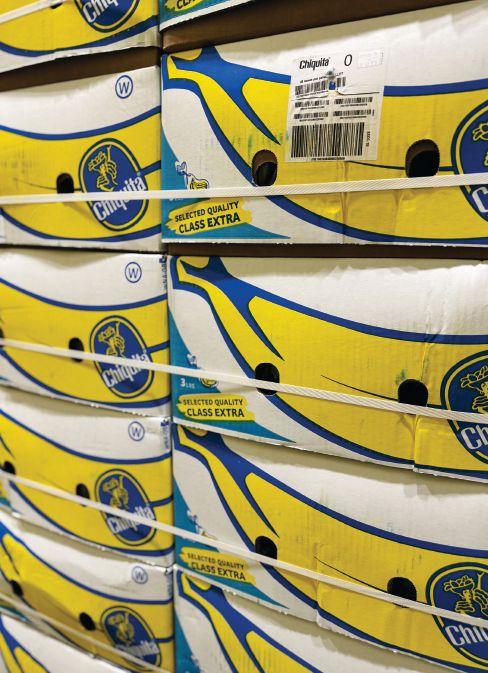
The imported bananas stord at the Anjou facility’s high-tech cold rooms are claimed to provide two to three dasy of extra product shelf-life inside retail stores.
Close-up of the touch-scree HMI (human machine interface) panels for operator-friendly temperature, humidity and other key setting adjustments.
STALK IN TRADE
Prominent Quebec fruit and veggies processor leverages innovation and corporate synergies to cut down on operating costs and food waste
By Andrew Snook
Nestled in the north end of Montreal lies Les Aliments Bercy Foods, a processor and packager of fruits and vegetables serving the retail grocery markets and food services sectors across Quebec, Ontario and Atlantic Canada.
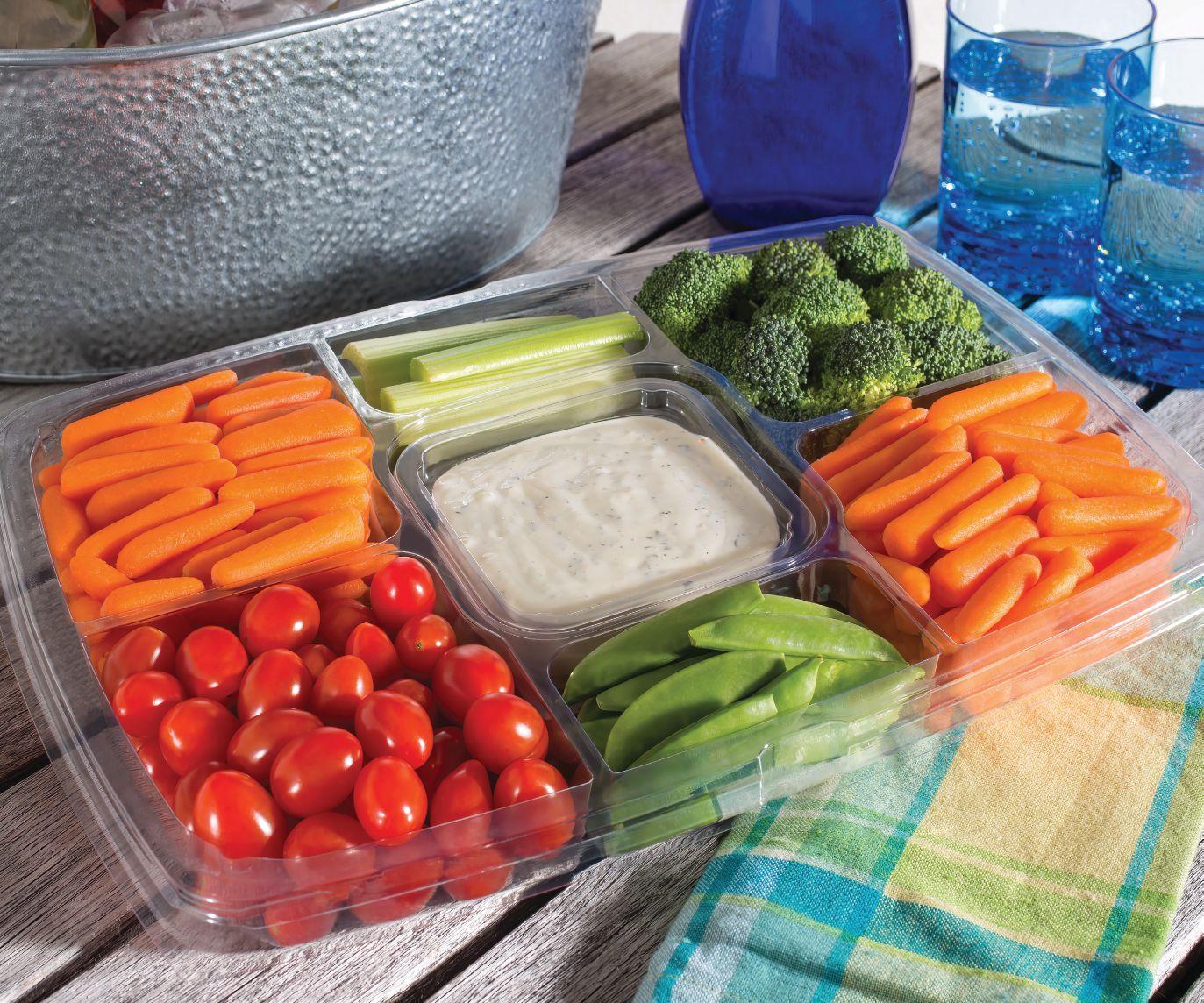
The company’s primary service is the processing of fresh fruits and vegetable, with a focus on broccoli and cauliflower florets, as well as sliced and diced melons and pineapples, Brussels sprouts, and vegetable and fruit platters.
It also provides a variety of packaging services based on customer needs.
“Broccoli & Cauliflower florets are our biggest seller, and we also do quite a bit of pineapple, either through spears, decoring them, or in cubes.
“Those are the commodities with the biggest demand,” says Patrick Gauthier, director of sales and special projects, at Les Aliments Bercy Foods.
The company processes approximately nine million pounds of broccoli and pineapple annually, keeping the 40,000-square-foot facility busy yearround.
“I think that because we have a diverse portfolio of items, we’re always busy,” Gauthier says.
“Our party trays, for example, are steady week to week, except for those holiday months.
“But then we’ve got our broccoli to keep us busy, pineapple to keeps us busy, our Brussels sprouts … we’re diversified in that sense,” Gauthier relates.
“We’re always busy at our plant; we don’t really have downtime.”
To process their pineapple products, the company uses an ABL machine, which peels and decores the pineapples before cutting them into spears or other sizes and specs, depending on their clients’ requirements. The company also processes melons on this production line.
The broccoli also goes through an
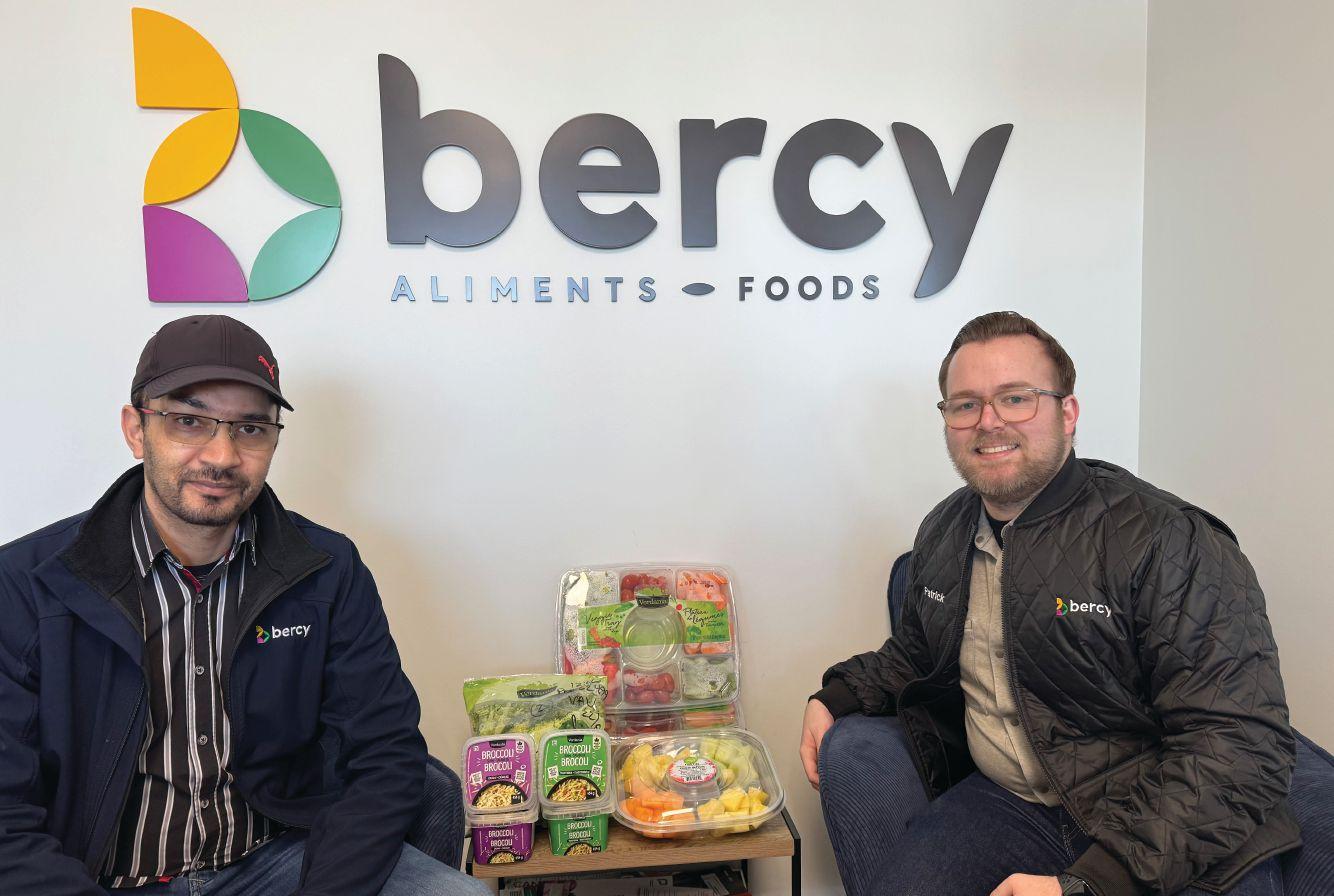
Bercy Foods director of operations Khaled Zehouane (left) and Patrick Gauthier, director of sales and special projects, proudly display the variety of value-added product produced the company’s Montreal facility.
Aitenet processing machine, before being transferred via conveyor to a hand-cutting line for the florets. This processing line is also used for producing cauliflower florets and Brussels sprouts.
To meet their packaging needs for the larger grocery retail customers, the company uses a variety of flexible bags and pouches.
“We mostly use pillow-pack corrugated plastic bags for our florets and our Brussels sprouts,” Gauthier says. “We primarily use those for the bulk of our items that we’re bagging.
“We’ll also use some plastic trays and
clamshells for our pineapple spears and our vegetable trays.”
For the pillow-packs, most of the packaging is done via WeighPack/ Paxiom automated bagging machines, while the party trays and clamshells are manually packed by staff at the end of the packaging lines.
According to Gauthier, the company tries to opt for local suppliers for its machines and packaging supplies whenever possible.
“If we need service, it’s much easier to deal with someone that’s local, rather than not, because then who knows when
you’re getting service,” Gauthier says.
“Having a machine down costs a lot of money and it just throws everything off from what you were planning for production that day,” Gauthier states.
“As a result, you’ve got to retake and reschedule everything.”
Gauthier says the rising inflation that has affected grocery prices in recent years has had a pronounced impact on the buying habits of consumers—softening the market slightly for value-added products like the ones his company produces.
However, he believes that trend is beginning to change, noting the demand for the types of customized to-go products that Les Aliments Bercy Foods produces is rising again.
“I think we’re starting to see a reversal of customers coming back into the segment,” he says.
“I know a lot of our customers have opened up new stores, and we’re ready to service the needs of those customers that are looking for convenience and value.”
One regular trend that Gauthier has observed playing out over the years is how eating habits change every year in specific months.
“We do celery sticks, for example. From Christmas it’s really busy, and then in January it still stays very strong for the
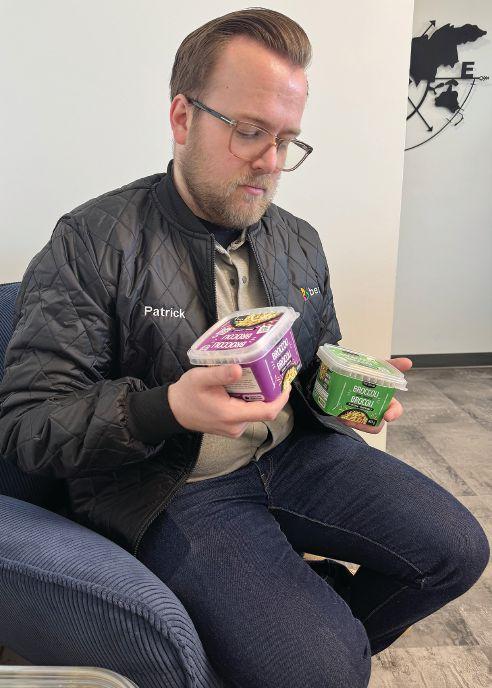
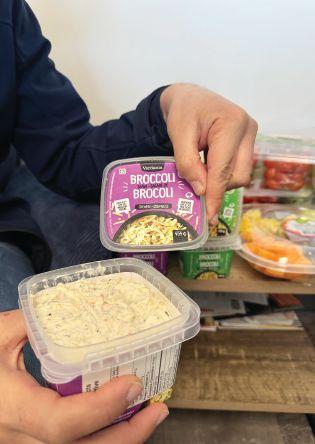
Patrick Gauthier shows off the rigid plastic packaging used for the company’s innovative new Broccoli Slaw salad mix made from fresh broccoli stalks.
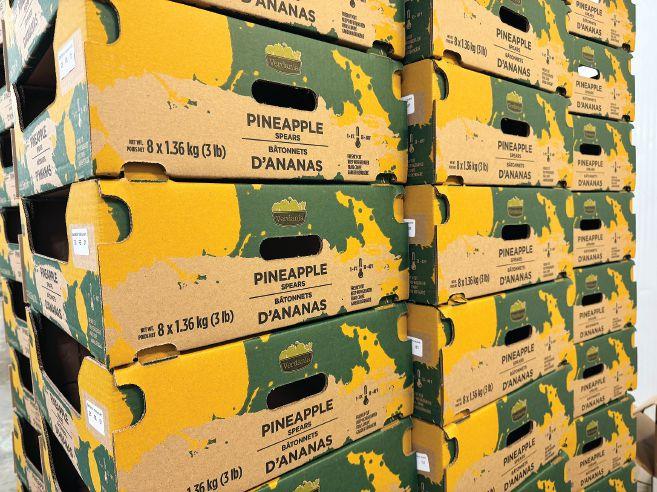
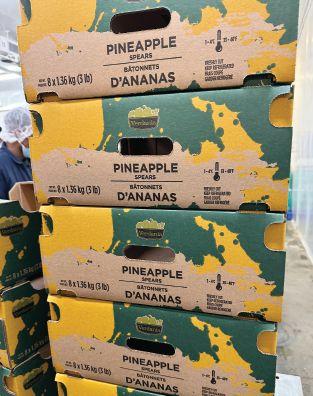
Manufactured by the renowned corrugated packaging products producer Cascades, the double-wall corrugated trays provide an effective means for the transport and distribution of bulk quantities of pineapple products.
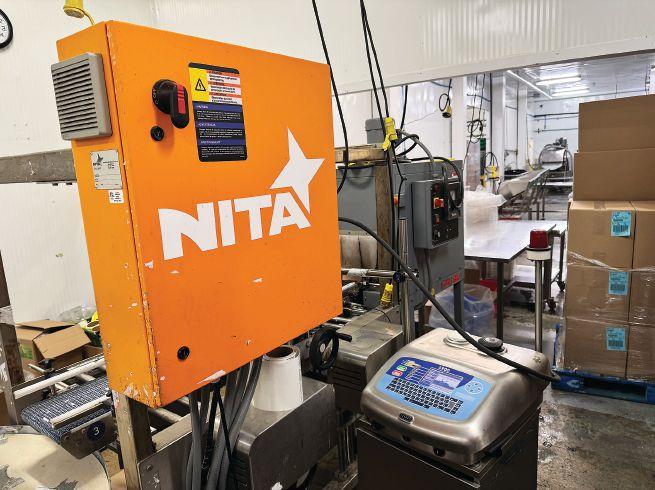
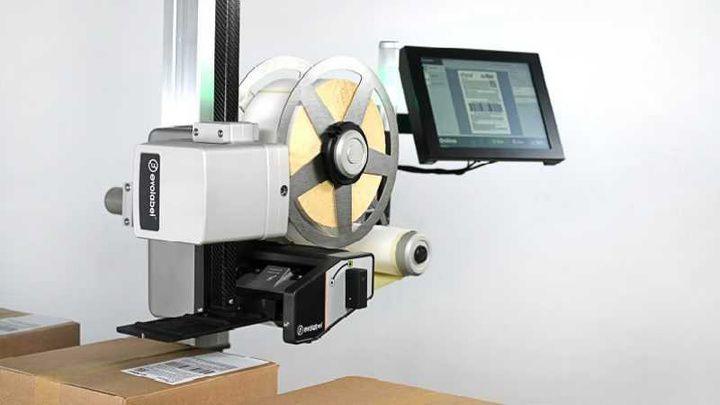
A stand-alone Nita wipe-on product labeler is used to attach product labels onto the front-facing panels of corrugated boxes used to transport the finished product.
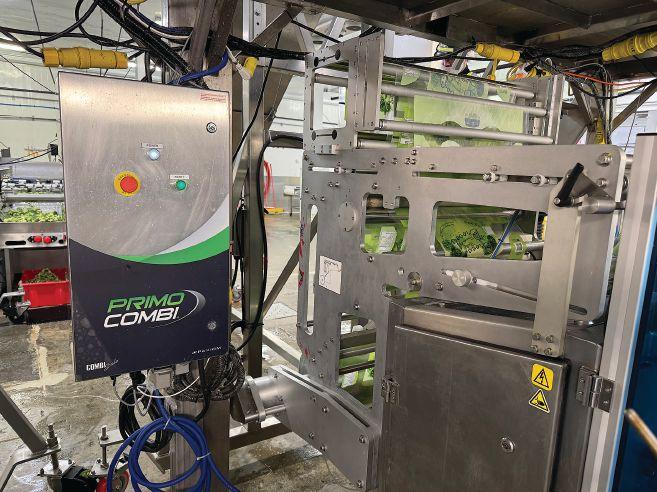
Bottom: Manufactured by Paxiom, the multihead PrimoCombi automatic weighscales play a central role in the Bercy plant’s efficient production process.
New Year’s resolutions, with people resolving to eat healthier.
“Now I’m expecting it to kind of peter out, as the healthy eating starts to slow down a little bit,” he says.
“It’s always ebbs and flows with people trying to eat better or not,” Gauthier reflects.
“As you get closer to the summer, people begin to drink and eat better as well, so there’s a lot of seasonality in it.”
With such a large number of broccoli florets being processed and packaged, there is a massive number of stalks being piled up each day.
Seeking to reduce waste within the
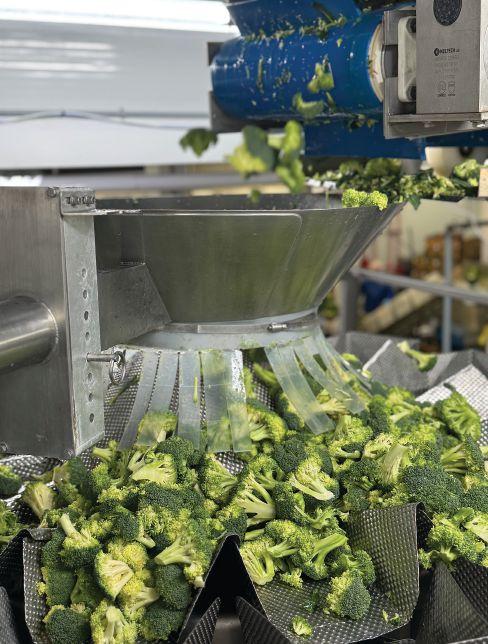
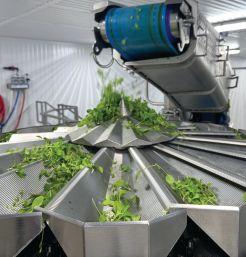
Top: Close-up picture of fresh broccoli florets being dispensed in precise quantities by the stainless-steel buckets of the PrimoCombi mutihead weigher into a bagging machine below.
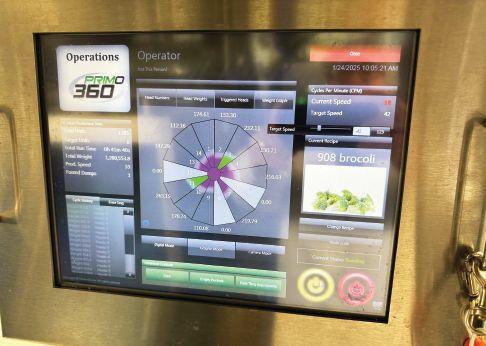
Bottom: Close-up of the PrimCombi weigher’s HMI terminal driven by a powerful, user-friendly Primo 360 operating system.
operation, the Bercy Foods plant decided to start using the stalks for a new product offering for its grocery retail clients this past December.
“We just launched a broccoli slaw,” Gauthier says. “Basically, we’re repurposing the stems from our floret business, because when we cut the florets, there’s the stems that are left over.
“The broccoli slaw was the Number One new product that came to our minds,” he explains, “because we get all those stems at the end of the day, and there’s a home you can find for them in different avenues.
“You get the same nutrients out of the
stems,” he points out, “so it’s better to have that put back into products, and reduce food waste as well.”
Gauthier says the company is also looking into other products that can be produced through the repurposing of some other commodity items.
“I think that as we do other commodities, we are always trying to think outside the box,” he says.
“Now that we successfully launched this broccoli slaw, we are constantly thinking of how we can do things differently.”
As Gauthier points out, pressures from consumers and various levels of govern-
Top:
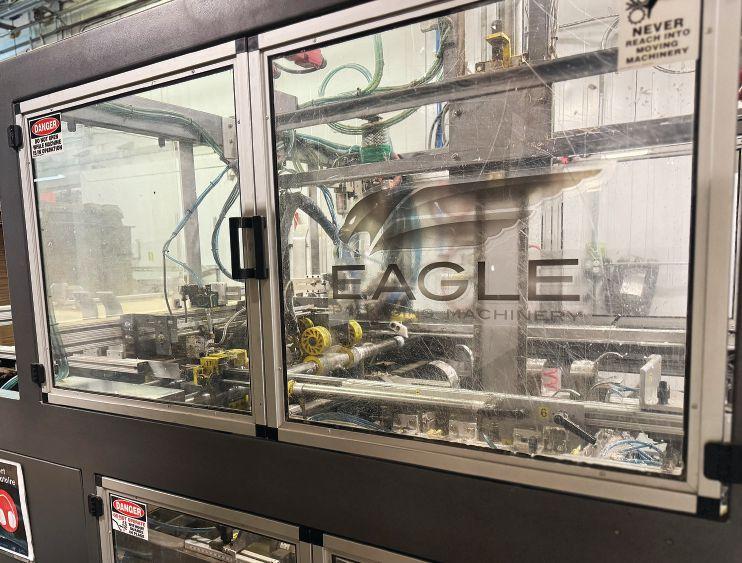
A high-performance case-erecting system manufactured by Eagle Machinery, a Paxiom Group company, used to form ready-to-fill corrugated trays and boxes with packages of finished product.
ments are forcing companies everywhere to find ways to make their operations more sustainable.
For companies that need to offer significant shelf-life for their products, this is always a big challenge.
“It’s funny because there’s a fine line,” says Gauthier.
“Everyone wants more shelf-life on things, but with less packaging,” he says.
“I think that as an industry, and with the government as well, we’ve got to find solutions that makes sense,” Gauthier asserts.
“On the government side, how things actually get recycled is a challenge,”
Gauthier points out.
“Different municipalities all recycle differently, so to find a one-size-fits-all for everyone doesn’t really work,” Gauthier notes. “And that’s the pressure we’re always under.
“So we try and do the best we can, and get the most sustainable packaging we can, without compromising quality and shelf-life for our customers.”
As Gauthier relates, finding and retaining enough staff to keep up with customer demands can be difficult.
“We’ve got a great team that works on our production line, but there’s always a need for more—especially during busy
“There are always things we’re working on within the larger group to make sense, so that it works for everyone.”
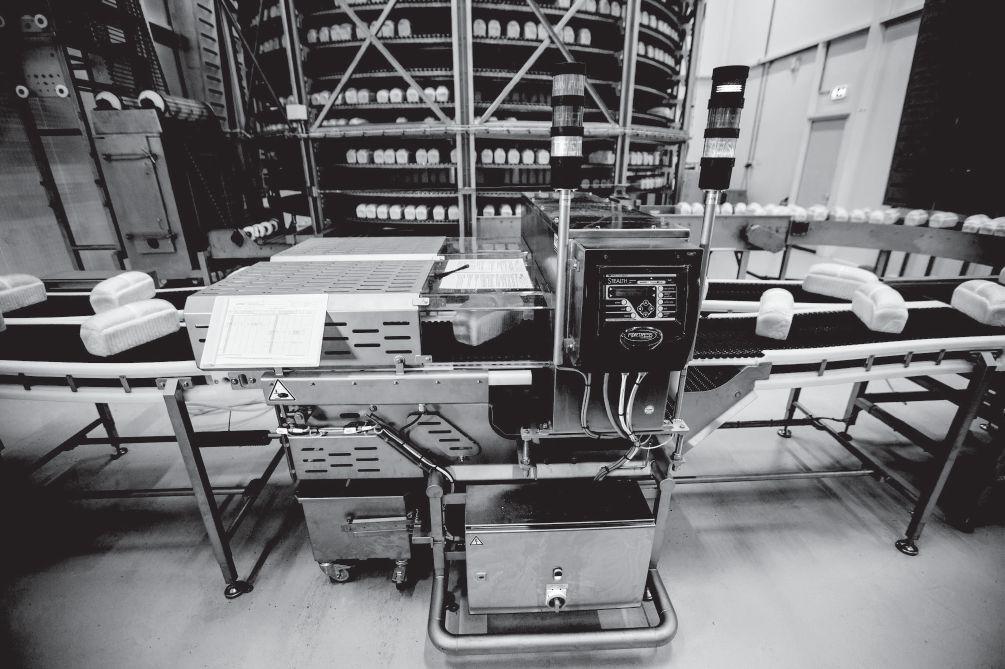
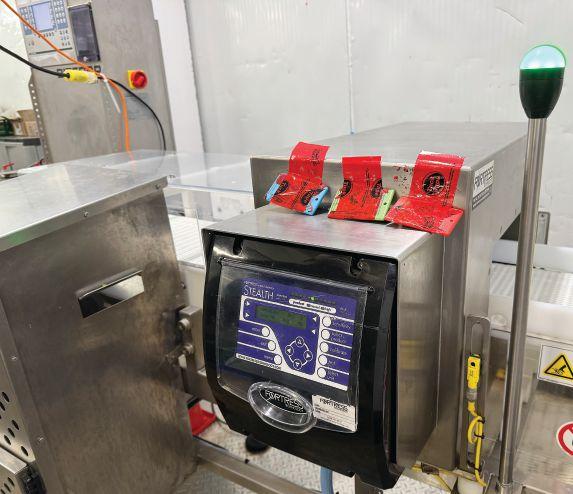
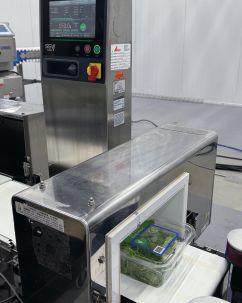
A Stealth series metal detection system manufactured by the Toronto-based Fortress Technology is deployed at the end of the line to provide final quality assurance for the outgoing bagged products.
times for us, like those holidays, for entertaining,” Gauthier says.
“It is a difficult job to be in a coldroom for this many hours a day, doing the same thing,” he acknowledges.
“So it can be hard to find the right people and to retain them.”
Another challenging aspect of the operation is ensuing there is always an adequate supply of raw materials, at the quality levels required to fulfill customers’ needs.
Getting the right product quality and
ensuring there are all always enough sources to fill orders is challenging, Gauthier says, especially with all the changing weather patterns.
Les Aliments Bercy Foods operates as part of Courchesne Larose Ltd., which has been a major wholesaler of fruit and vegetables in the Canadian market for more than a century.
As such, the Bercy production plant tries to take advantage of collaborations with the larger company whenever possible—particularly with the parent
company’s processing facility in the Toronto area.
“They do a lot of processing similar to us in the Ontario market, so we try and collaborate with them,” Gauthier says.
“It’s about working with the group as a whole to find solutions, whereby different parts of the group might be able to help with our sustainability efforts,” he relates.
“That is something, as a group, we’re always striving to do.
“We all do different parts of the busi-
Clockwise from left
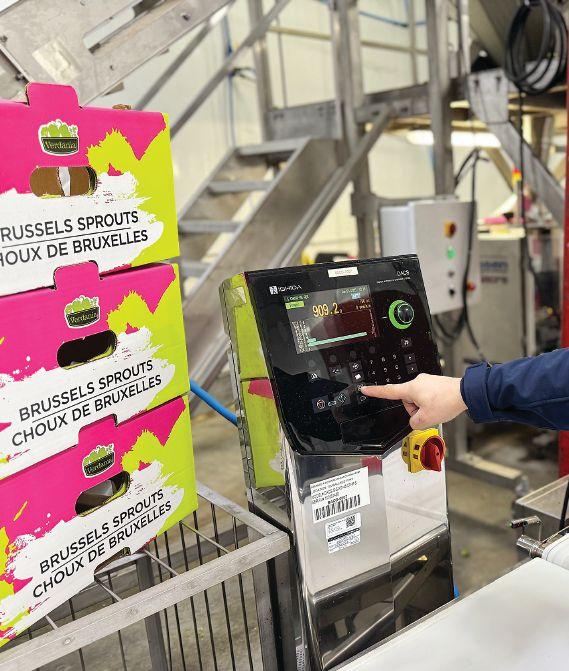
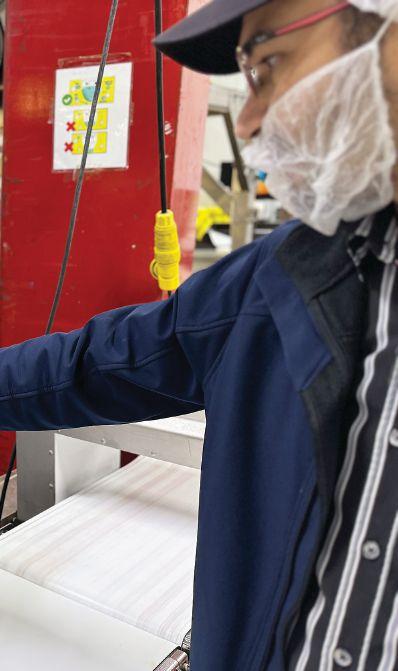
Patrick Gauthier adjusts the settings on the Ishida checkweigher supplied by Heat and Control.
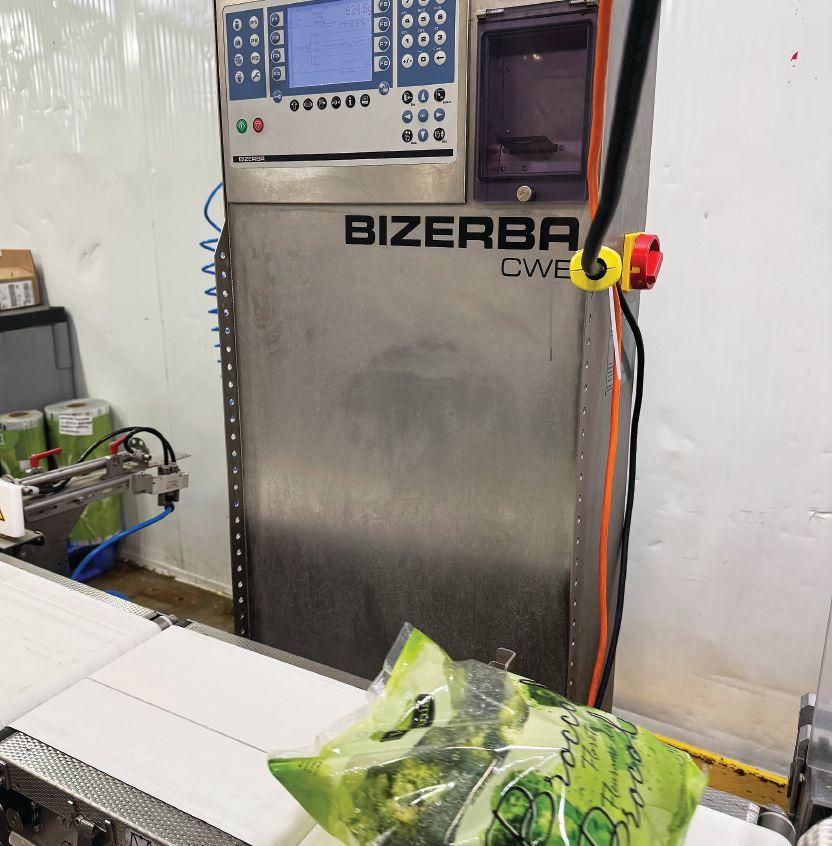
A pillow-pack of loose broccoli florets passes in front of the high-speed Bizerba model CWE checkweigher.
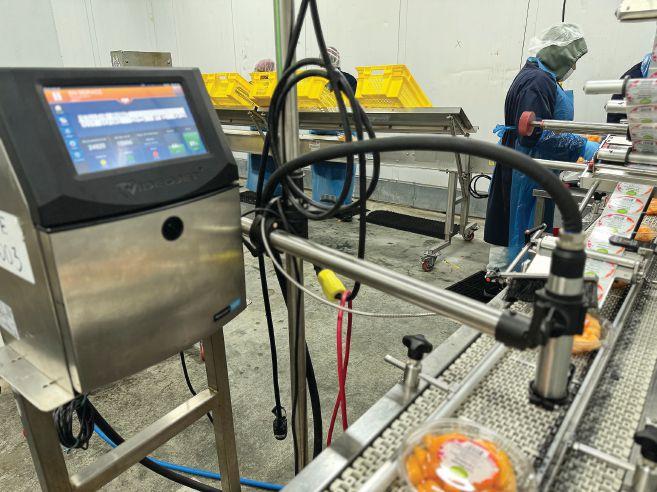
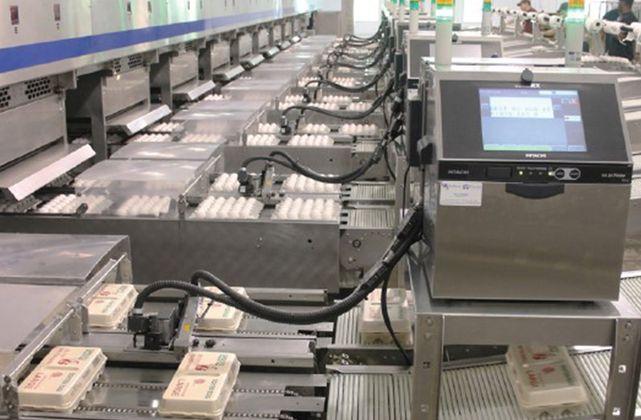
A Videojet 1580 small-character inkjet printer used to apply product and lot codes onto the passing clamshells filled with freshly cut produce.
ness, so how do we just leverage that to make ourselves stronger and more sustainable at the end of the day?” he notes.
But being able to share products is only one of many advantages of being part of a larger group, according to Gauthier.
“It’s great to be part of a larger group from every aspect, because not only are we able to share knowledge between the divisions, but we’re also able to leverage buying power,” Gauthier explains.
“Depending on what they’re buying, maybe I only need small quantities of something one week, but they (other divisions) could use more, so we can be efficient by maximizing trucks to fill them out, thereby really driving those costs out as much as we can.”
Gauthier also lauds the working environment at Courchesne Larose, which fosters collaboration between the different divisions.
“We all try and help each other out as much as possible, because it helps drive all of our costs down,” he says. “Otherwise, doing all this by ourselves, it would be very challenging logistically.
“Likewise, we may be able to process all of one product out of one facility to meet Ontario’s demand,” he says, “and vice-versa from the other facility, to gain further efficiencies that way.
“There are always things we’re working on within the larger group to make sense,” Gauthier concludes, “so that it works for everyone.”
BREATHE EASY with P-Plus® films for fresh produce
Customized for your product’s optimal oxygen transmission rate (OTR)
• Broad portfolio of film structures
•Crystal clear antifog technology
• Matte and gloss finishing
• Reclosability features
• Steamable and microwavable options
Scan here to learn more about our full range of fresh produce packaging
BETTER WITH AGE
CPMA’s upcoming annual Trade Show & Convention arrives at a pivotal moment in the industry’s evolution
Aging well rarely happens by happy accident, and neither does being able to celebrate 100th anniversary with the well-earned, confidence, vigor and thought leadership that have been the CPMA (Canadian Produce Marketing Association)’s hallmarks defining the Ottawa-based organization’s rich history of inspired industry advocacy and stewardship.
For CPMA member-companies and other businesses and organizations tirelessly working to grow Canada’s vitally important fresh fruits and vegetables industry, the upcoming CPMA Annual Convention and Trade Show in Montreal—April 8-10, 2025, at the Palais des congrès de Montréal—will provide a perfect forum to honor the association’s past accomplishments, while exploring new opportunities for future growth.
As the largest fresh produce event in the Canadian industry, the CPMA Convention and Trade Show regularly attracts key decision-makers and customers from all segments of the fresh produce supply chain, including industry executives, category managers, government representatives, and countless other notable staff employed in the Canadian fresh fruit and vegetable sector.
This year’s show will feature 690 booths representing over 300 exhibiting companies from around the world—including major growers, importers, exporters, suppliers and all other key links in the industry’s vast value chain.
“The upcoming CPMA Conference & Trade Show in Montreal couldn’t come at a more critical time for our industry,” says CPMA president Ron Lemaire.
“In the face of ongoing economic pressures, supply chain challenges, shifting trade policies and evolving consumer demands, this event provides an unparal-
lelled opportunity for the fresh produce community to come together, share insights, and strengthen relationships,” Lemaire states.
“Ours is a business built on trust, collaboration and personal connections,” Lemaire points out, “so being present in Montreal is more important than ever as we navigate these turbulent times.
As Lemaire explains, the trade show part of the event will enable exhibitors to showcase their products, innovations, and services to key decision-makers across the supply chain.
As such, it’s a priceless opportunity to reinforce existing partnerships and forge new ones with retailers, wholesalers, foodservice operators, and industry leaders from Canada and beyond.
For visitors, the event offers invaluable networking, learning, and business development opportunities—allowing them to stay ahead of trends, explore new solutions, and gain insights from thought leaders on the most pressing issues facing the sector.
“The trade show floor will highlight the latest innovations in packaging, technology and product development, reflecting the continued evolution of our sector,” Lemaire states.
On the conference side, this year’s program will feature a dynamic line-up of education sessions, panel discussions, and networking events designed to address key challenges and opportunities shaping the future of fresh produce.
Featuring a keynote address by Geoff Molson, president and chief executive of Groupe CH , Quebec’s premier sports and entertainment
conglomerate, the event will feature exciting award competitions, panel discussions, learning lounges, workshops, and various social and networking opportunities for industry professionals to enhance their knowledge and understanding of key issues and challenges facing the industry.
“Sustainability, labor, supply chain resilience, and the impact of geopolitical and economic shifts on our industry will all be front and center,” Lemaire states.
To register for the event online, go to convention.cpma.
“The core message of this year’s event is clear: collaboration and adaptability are key to success.”
Says Lemaire: “As we celebrate CPMA’s 100th anniversary, the Montreal show will serve as a reminder of the strength and resilience of our industry.
“Now, more than ever, it’s essential for industry professionals to be present, engaged, and ready to shape the future of fresh produce in Canada,” Lemaire concludes. “I look forward to welcoming our members, the global community, and all other partners to Montreal for what promises to be a pivotal and inspiring event.”
A street-level view of the architecturally stunning exterior of the Palais des congrès de Montréal building, the host venue for next month’s CPMA Annual Convention and Trade Show.
A panoramic view of the busy show-floor activity from last year’s CPMA Annual Convention and Trade Show.
TURN OF THE CENTURY
CPMA president reflects on 100-year legacy of inspired industry leadership and facing up to the formidable new challenges ahead
As one of the country’s leading business groups, the Canadian Produce Marketing Association (CPMA) has many reasons to be proud of its rich legacy of looking after the produce industry’s best interests.
But having evolved into a vitally important economic sector making significant daily contribution to the country’s well-being and prosperity, the fresh produce sector is facing unprecedented new geopolitical and regulatory challenges on many fronts.
With this in mind, the Canadian Packaging magazine recently reached out to CPMA president Ron Lemaire to help provide some context to how well the industry is prepared to address them.
QPlease provide a brief summary of the Canadian fresh produce industry’s well-being and importance to the Canadian economy.
AOur sector continues to be a vital contributor to the nation’s economy, demonstrating resilience and growth across various metrics.
In 2022, the fresh produce industry in Canada reached an economic impact of nearly $15 billion, up from $13.9 billion in 2016. This growth reflects our industry’s robust performance and its essential role in the national economy.
Farm-gate sales for vegetables rose by 11.2 per cent to nearly $1.6 billion, while fruit sales increased by 15.3 per cent to $1.4 billion in 2022, compared to 2021.
Our sector supports a significant portion of the Canadian workforce. In 2022, the produce industry was responsible for 185,400 direct, indirect and induced jobs—a notable increase from 147,000 in 2013.
This employment growth underscores our commitment to providing stable jobs in both rural and urban communities across the country.
The agriculture and agri-food system, encompassing the produce sector, contributes approximately seven per cent to Canada’s GDP, equating to about $150 billion. This substantial contribution highlights the importance of our industry in sustaining economic prosperity and food security for Canadians.
QHow much of an impact will the U.S. tariffs have on the Canadian produce industry, and how can CPMA help companies weather the storm in worst-case scenario?
AThe sudden focus on U.S. trade tariffs is certainly concerning for Canada’s fresh food sector. The Canadian produce industry is deeply integrated with the U.S. market, both as a key supplier and as a buyer.
Any disruption, especially in the form of tariffs, could have serious consequences—raising costs for businesses, reducing competitiveness, and ultimately increasing prices for the Canadian consumers.
Fresh produce is a necessity, not a luxury, so any additional costs will directly impact household grocery bills and food security.
The CPMA has been engaged with Canadian and U.S. decision makers to navigate through these turbulent times. We have engaged our volunteer network, and we are working with former leading negotiators from all three countries to understand the impacts to our members.
Our advocacy efforts focus on securing fair trade policies that protect the flow of fresh produce across the border. We are also working to provide our members with the latest intelligence on potential policy changes, equipping them with the
A bird’s eye view of the vast conveyor network running through the Rotkäppchen-Mumm Enology Competence Center facility in Eltville, carrying thousands of bottles of filled sparking wine products sold across Germany and in many other international markets in continuous two-shift operation.
tools to navigate an uncertain trade environment.
For companies in the sector, preparation is key. Businesses should explore diversification strategies, including new import or export markets beyond the U.S., strengthening supply chain resilience, and evaluating cost efficiencies.
Due to proximity, the U.S. will always remain a key market, so it is critical to maintain strong relationships with our U.S. partners to weather these challenges. Additionally we will need to stay informed on any potential exemptions or policy adjustments.
While we hope that the U.S. tariffs on fresh produce do not last too long, CPMA remains committed to advocating for a stable, predictable, and fair trade environment for the Canadian fresh produce industry.
QAs a labor-intensive industry, how is the produce industry coping with labor shortages, skill gaps and other labor issues?
ALabor remains one of the most pressing challenges in the fresh produce industry, impacting every stage of the supply chain—from farm to retail.
The sector relies heavily on a skilled and stable workforce, and ongoing labor shortages create significant disruptions, affecting both productivity and the availability of fresh produce for consumers.
When farms and packing facilities struggle to find workers, it leads to higher operational costs, reduced output and, in some cases, crops left unharvested.
This directly affects the affordability and accessibility of fresh produce in Canada, as labor shortages drive up prices and limit supply.
Consumers ultimately bear the burden through increased grocery costs, while businesses face uncertainty in maintaining consistent production and meet-
ing demand.
Addressing this issue requires a multi-faceted approach. The CPMA continues to advocate for major improvements to Canada’s Temporary Foreign Worker (TFW) and Seasonal Agricultural Worker Program (SAWP) to ensure a reliable labor supply.
However, long-term solutions must also include investments in automation and innovation, streamlining pathways for permanent residency for agricultural workers, and enhancing training programs to attract more domestic workers to the industry.
QWith the pace of inflation slowing, why are the retail prices of fresh fruits and vegetables still so high?
AWhile inflation has declined, we are still seeing the lingering impacts on fresh produce. Price inflation in the fresh produce sector remains a significant challenge, driven by a combination of global and domestic factors that continue to put pressure on the entire supply chain.
Rising supply chain costs are at the heart of this issue—everything from transportation and fuel prices to packaging and labor expenses has seen significant increases. These costs are passed down through the supply chain, ultimately affecting retailers and, most importantly, consumers.
Labor shortages, both in Canada and the U.S., further complicate the situation by limiting production capacity and increasing wages to attract and retain workers.
Additionally, ongoing disruptions in global shipping and logistics, including port congestion and geopolitical instability, have made it more expensive and unpredictable to move fresh produce efficiently.
Climate-related challenges, such as extreme weather events and water shortages, have also played a role in limiting supply and driving up costs.
The impact on consumers is clear— higher prices at the grocery store make it more difficult for Canadian families to access fresh fruits and vegetables, which are essential to a healthy diet.
QTariffs aside, what are some of the major global developments currently impacting the Canadian fresh produce industry?
ABeyond tariffs, several global and domestic factors are significantly impacting the Canadian fresh produce sector, including extreme weather events, shifts in Canada’s political environment, evolving sustainability regulations, and other trade barriers.
Extreme weather events are becoming more frequent and severe, disrupting
agricultural production worldwide. Droughts in key growing regions, such as California and Mexico, are reducing crop yields, while hurricanes and wildfires are damaging infrastructure and delaying shipments.
In Canada, unpredictable weather patterns, including early frosts and flooding, are affecting local production and increasing reliance on imports, which are already undermined by major supply chain pressures.
Domestically, Canada’s evolving political landscape is impacting the fresh produce industry in various ways.
CPMA president Ron Lemaire has been at the helm of the Ottawa-based Canadian Produce Association since 2011, helping to guided the Canadian fresh produce sector’s major regulatory and competitive challenges through vocal and effective industry advocacy.
As government policies on labor, trade, and sustainability, to name a few, continue to shape the operating environment, it is vital that shifting trade priorities and regulatory requirements do not adversely affect market access and competitiveness.
QHow is the industry responding to the climate change crisis?
AGovernments around the world, including Canada, are introducing more stringent sustainability policies aimed at reducing environmental impacts.
While the industry is committed to sustainability, compliance with new packaging restrictions, carbon reduction targets, and waste management regulations adds a lot of complexity and costs to produce operations.
The challenge lies in balancing environmental responsibility with economic viability, particularly as regulations differ across regions—creating inconsistencies in implementation.
QWith plastic pollution often portrayed as one of the industry’s weak points, what is the sector doing to address this alleged shortcoming?
ASustainability in packaging remains a critical focus for the fresh produce sector, particularly as the phaseout of single-use plastics continues to evolve globally. Companies across the industry are actively working to reduce their environmental footprint by exploring alternative materials, optimizing packaging designs, and investing in Circular Economy solutions.
However, the complexity of transitioning away from plastics while maintaining food safety, shelf-life and affordability presents ongoing challenges.
Many companies are investigating recyclable, compostable and biodegradable packaging, as well as reducing overall packaging weight to minimize waste. Efforts to increase the use of recycled content and to improve the recyclability of packaging materials are also gaining momentum.
However, challenges remain, including inconsistencies in recycling infrastructure across Canada, supply chain
costs, and the need for clearer regulatory guidelines.
Further progress will require collaboration across industry, government, and consumers to align sustainability goals with practical, scalable solutions.
At CPMA, we continue to advocate for science-based, practical solutions that balance sustainability with the operational realities of the fresh produce sector.
We are committed to working with industry partners and policy-makers to ensure that packaging regulations support environmental goals while maintaining food safety, reducing food waste, and protecting the affordability and accessibility of fresh fruits and vegetables for Canadians.
QAs CPMA celebrates its 100th anniversary this year, please reflect on the association’s remarkable longevity and staying power.
AOur 100th anniversary is a testament to the strength, resilience, and deep-rooted commitment of our members, volunteers, staff, and the entire produce community. Reaching this milestone is not just about longevity— it’s about the impact we’ve had over the past century in shaping Canada’s fresh produce industry and ensuring its continued success.
Our association’s staying power comes from our ability to evolve, remain relevant, and bring people together to tackle industry challenges, while fostering innovation and growth. At the heart of CPMA’s success is our strong membership base, which spans the entire supply chain— from growers and shippers to retailers and foodservice providers.
CPMA’s influence and relevance have always been tied to our ability to adapt. Over the decades, we’ve navigated shifting consumer trends, economic pressures, regulatory changes and global disruptions—all while staying true to our mission of driving produce consumption and industry success.
Whether it’s leading sustainability initiatives, tackling supply chain challenges, or fostering strong relationships between industry and government, CPMA continues to be a driving force in the sector. Celebrating 100 years is not just about looking back—it’s more about about looking ahead to the future. As we mark this milestone, we recognize the collective efforts of everyone who has contributed to our success and reaffirm our commitment to supporting the industry for the next century and beyond.
The strength of CPMA lies in the people who make up this incredible community, and together we will continue to ensure a thriving, resilient and innovative fresh produce sector in Canada.
WE RIGHT-SIZE AND BRAND YOUR PACKAGING TO FIT YOUR NEEDS.
Packaging based on what you need to put inside, that protects it on its way to its destination. No over-packaging. No one-size-fits-all. Durable. Customizable. Sustainable.
Learn more about Canada’s corrugated industry at cccabox.org
SIMPLY IRRESISTIBLE
Leading grocery chain operator continues to raise the bar for retail packaging excellence with comprehensive design refresh for its flagship store brand
As private brands continue to gain prominence in the Canadian food retail landscape, Montreal-headquartered grocery retail giant METRO Inc. has unveiled a bold redesign of its flagship Irrésistible store brand.
This ambitious transformation enhances its impact and recognition both in-store and in promotional materials, aligning with consumer expectations while elevating the shopping experience.
With a portfolio of over 1,335 products, Irrésistible already enjoys considerable success as the most awarded private-label brand (PLB) in Canada, while outpacing industry growth.
Yet, according to Annie St-Laurent, senior director of private brands at METRO, there remained significant growth potential.
“This repositioning presented a unique opportunity to further strengthen our presence in the market,” St-Laurent explains.
“And with 350 new products across 240 categories that we launched last year alone, we are poised to provide the best value to consumers.”
This transformation comes at a pivotal moment, as Canada’s new Front-of-Pack (FOP) regulations—impacting almost all SKUs (stock-keeping units)—created the perfect timely opportunity to reinvest in the Irrésistible brand.
These regulations require clear nutritional labeling on the front of food packaging, which presents both challenges and opportunities for brand storytelling and visibility.
Private labels in Canada are no longer limited to value-based offerings; many now compete in the premium category.
Brands like METRO’s Irrésistible have
redefined the perception of private labels by focusing on high-quality products paired with aesthetically pleasing packaging to offer another cost-efficient option to consumers.
These efforts not only enhance the customer experience, but also enable private labels to appeal to discerning consumers.
The shift toward premiumization is a key element of the Irrésistible transformation, showcasing METRO’s ability to deliver not just affordability, but also indulgence, sophistication and quality, through its private-label offerings.
The Before and After comparison of the billboard effect impact generated by the old (top picture) and new Irrésistible pizza packaging displayed inside a METRO store’s frozen pizza freezer.
A sampling of some of the popular Irrésistible private label brand of
“Packaging is the medium that consumers interact with the most, making it a critical focus for the revitalization of Irrésistible,” explains Anick Chartrand, design, packaging, and brand director at METRO.
“To achieve this, we began by crystallizing our brand strategy, ensuring the new brand ecosystem reflected our promise,” Chartrand relates.
“The design had to convey the high quality of our products while remaining approachable, achieved through a carefully crafted visual language and compelling storytelling.”
To achieve these aims, METRO once again turned to the renowned packaging design experts at Pigeon Brands to work their magic.
According to Pigeon’s vice-president of accounts service Armelle Dubourg, “The redesign of Irrésistible’s packaging and identity focused on rejuvenating the brand while preserving its equity.
“The goal was to foster deeper engagement and encourage customers not only to choose individual products, but to identify with and trust the brand as a whole,” Dubourg explains.
“The re-imagined identity emphasizes the joy of eating and indulgence, informed by research, market truths, cultural trends, and consumer expectations,” she adds.
“We aimed to rejuvenate the brand
leading grocery retail chain METRO adorned with classy new packaging designed by the branding services provider Pigeon Brands.
“Abbey’s level of expertise & knowledge in packing salad greens is the
Ian Adamson, Founder, Greenbelt Greenhouse
Greenbelt Greenhouse operates a vast indoor growing operation that delivers leafy greens directly to Canada’s leading grocers, eliminating days of shipping and storage associated with bringing product up from south of the border.
“We grow our greens in organic soil that delivers longer lasting and tastier greens,” says Adamson. “Our process from taking product from harvest to the end of our packaging line is just four minutes.”
Greenbelt turned to Abbey Equipment to integrate the full packaging line.
“We have a very complex line . Integrating all those systems and the technical expertise provided by the Abbey team has been an incredible experience.”
Looking for someone to build the ideal produce packing line? Trust the company recommend by industry leaders.
Turatti C-Force conveyor with patented dual vibrating belt.
Liftvrac inclined conveyor gently transports loose lettuce to the bagger weighscales on mezzanine level.
A clamshell of lettuce passes through a combo Anritsu metal detector and checkweigher system.
identity and packaging platform to reflect the true essence of Irrésistible, create high shelf impact, and make it a proud brand,” adds Olivier Chevillot, executive creative director at Pigeon.
“Our goal was to integrate recognition and belonging to all METRO banners— including Metro, Super C, Food Basics, Marché Richelieu, Jean Coutu and Brunet—while fostering customer engagement across all SKUs.
“People were already choosing the products; now we wanted them to choose the brand and feel a genuine connection to it,” Chevillot states.
“To achieve this,” adds Dubourg, “we prioritized brand recognition during shopping by leveraging visual contrast at the shelf level to create a cohesive brand-blocking effect.
“This approach helps consumers immediately understand the product, its variety, its benefits and its reason-tobuy,” Dubourg explains.
“By simplifying and enhancing the consumer experience, we have crafted a
proud identity that not only resonates emotionally, but also maintains the heritage and equity that make Irrésistible unique.”
The rollout of the new packaging also included the launch of the a new Festive Collection of products to add a little touch of holiday magic, according to Dubourg.
“At the heart of this creation is a striking teal background,” Dubourg comments, “offering a refreshing departure from traditional seasonal aesthetics ,while creating an impactful tandem with the red brand mark—complimented by a delicate snowflake pattern to capture the festive spirit.”
The expansive and comprehensive METRO’s private-label portfolio—also including the Sélection, Mieux-être, and Personnelle labels—continues to capture consumer loyalty with innovative offerings, diverse product lines, and competitive pricing.
With over 4,500 private-label products, METRO’s brands are growing
Some Before and After pictures of METRO’s bestselling Irrésistible brand SKUs featuring subtle but highly impactful packaging design upgrades and enhanced aesthetics skillfully executed by the Pigeon Brands agency.
faster than national brands, securing the second position among private-label retailers in Canada.
The recent surge in private-label popularity is further fueled by inflation and rising food costs, with private brands emerging as a go-to option for Canadian shoppers eager to balance quality with affordability.
According to METRO’s market research, the key factors driving repeat purchases are product quality, taste and variety. Even as the inflation stabilizes, consumer loyalty towards private brands remains robust.
As such, the relaunch of Irrésistible reflects METRO’s understanding of evolving consumer habits and preferences by investing in distinctive packaging, superior product quality, and a diversified portfolio to strengthen its position as a leader in private brands.
Moreover, the premiumization of Irrésistible and the alignment with the looming FOP regulations vividly showcase METRO’s ability to adapt and thrive in a competitive market—setting a new benchmark for private labels in Canada.
“The redesign of Irrésistible is a testament to METRO’s innovative vision and dedication to its customers,” St-Laurent states.
“In a competitive and cost-sensitive market, the brand demonstrates how private labels can combine affordability, premium quality and design to redefine the shopping experience.
Designed by Pigeon Brands, the packaging for new Festive Collection sub-brand of the Irrésistible private-label brand product family, is distinguished with eye-catching, holiday-themed graphics and product imagery set against a pleasant teal background.
“This repositioning provides us with a unique opportunity to strengthen our position in the market,” says St-Laurent, noting that the grocer adds an average of about 100 new products to the Irrésistible brand each year.
“Consumers typically spend an average of three seconds choosing a product from a grocery shelf,” St-Laurent relates. “With that in mind, we focused on four key elements in our approach: visibility, attractiveness, desirability and ease-of-use.
“Our goal is to encourage consumers not just to choose our products, but also to prefer our brand,” she concludes.
For Pigeon Brands president and chief executive officer Elyse Boulet, the project’s success is a compelling validation of the company’s formidable design competencies.
“Our rebranding of the Irresistible line, the result of 10 years of collaboration, is rooted in a deep understanding of METRO, market realities, cultural trends and consumer expectations,” Boulet states.
“This ambitious project, which involved designing hundreds of packages and launching the brand internally at all levels, will allow the Irresistible brand to proudly take flight.”
STICKING WITH THE PLAN
Leading
Canadian
adhesives
manufacturer opens up a new chapter with a well-timed U.S. manufacturing expansion
Founded in 1961 in Mississauga, Ont., Technical Adhesives has worked tirelessly to establish itself as real industry leader, distributing its high-quality water-based and hot-melt adhesives to customers across Canada, Mexico and the U.S.
Serving a diverse range of industries including consumer packaging, automotive, paper converting and woodworking, among others, the privately-owned company is more than just a supplier.
It is in fact a full-service organization that takes great pride in taking care of the entire value chain—from product development and testing procedures to manufacturing, sales and shipping, connecting with its customers every step of the way through superior service and keen attention to detail.
A couple of years ago, the company formulated a bold new plan to establish an additional manufacturing base in the lucrative U.S. market, which it executed to perfection earlier this year with the opening of a new adhesive manufacturing plant in Bastrop, Tex.
To learn more about this exciting new venture, the Canadian Packaging magazine reached out to the company’s president, Conrad Maziarczyk, to explain its significance.
QCan you please update us on how your business is doing in Canada these days?
AToday, we are the largest Canadian-owned adhesives manufacturer of adhesives operating in Canada. We’re certainly not the size of the leading multinational giants, but those have closed down their manufacturing facilities here years ago, so we are now the
largest by default in a sense.
But a lot of it also has to do with our own business growth over the years. We are still operating from our original, 25,000-square foot manufacturing facility in Mississauga, along with two nearby warehouses totalling another 20,000 square feet, employing 50 people on a two-shift schedule, seven-days-a week, to produce high-quality waterbased adhesives and hot-melt.
We had also invested in an additional manufacturing operation in Montreal, currently employing five people there.
Our sales reached $50 million last year, which is a big milestone for us, with rough a 50-50 split between waterbased and hot-melt products.
QPlease tell us about your recent expansion into the U.S., which sounds like another major milestone for Technical Adhesives.
A This is really huge for us: it’s what we always wanted. We have actually tried several times over the years to acquire some smaller adhesive companies in the U.S. that were put up for sale.
In fact, we came very close to clinching a deal for one such manufacturer in the Chicago area, but I believe we got outbid at the last moment by a large U.S. competitor. So after that, we decided to take a different route to penetrate the U.S. market by building our own manufac-
Technical Adhesives president Conrad Maziarczyk strikes a cheerful pose inside the company’s new manufacturing facility in Bastrop, Tex., which has just produced its first batch of products a few weeks ago.
Stretchwrapped pallet loads of Technical Adhesives products manufactured at the company’s new production facility in Bastrop awaiting shipment to customers.
turing operation there.
QAnd what led you to do that in Texas?
AFortunately for us, we came across a nice seven-acre parcel of land in the town of Bastrop, a 20-minute drive from Austin, about three-and-a-half years ago, where we proceeded to put up a new facility—with all-new equipment—which had just produced its first batches of product a few weeks ago.
As I discovered, Texas has a great business-friendly, low-tax environment, and the folks at the Bastrop Economic Development Council were absolutely fantastic to deal with to look after all our needs.
On a personal note, I also love the community’s proximity to Austin, which is arguably the real live music capital of
the U.S.
QSo how pleased are you with the Bastrop facility’s operational start-up?
AEverything is running great so far. We decided to start off with waterbased glues at first, but we have also ordered some hot-melt making equipment as well, as we see great opportunities for both products in that location.
The great thing about the Bastrop facility is that it has an on-site wastewater treatment plant, which to the best of my knowledge is the only adhesive manufacturing site in the U.S. to do so.
The other big thing for us, of course, is the fact that it puts us close to our key suppliers, as well as the end-use customers.
Many of our suppliers are based in Texas and Louisiana, so there are a lot of transportation costs that we can save.
Our biggest customer in Texas right now is the big Canadian ice-cream packaging manufacturer Stanpac, who actually started their own U.S. operations in Texas about 10 years ago, and there are many more large food-and-beverage, pharmaceutical and other consumer goods companies close by who are also major users of glue.
QMust be a great feeling to see a plan come together so well, and just at the right time.
AOur original motivation was to make our supply chain more efficient, as it was really tricky for us to get our truck load of product and supplies across the U.S. border during the COVID pandemic.
But even after the pandemic ended, we were experiencing major supply chain disruptions, which is when figured that we really needed to have a plant in the U.S. to protect us from such things happening to us ever again.
QGiven the current situation with the U.S. tariffs against Can-
adian-made products, the timing of this Bastrop plant coming online seems rather brilliant.
AYes, it does offer us a certain degree of protection that way, but to be honest I don’t think that the tariffs are going to last all that long.
The last time the Trump administration did this in 2018, they soon realized that the U.S. was losing more jobs than it was gaining, which is why they eventually agreed to redo the existing NAFTA agreement between Canada, US and Mexico.
So it is my hope that the same thing will happen again, probably in nine or 10 months’ time.
QLet’s hope you are right, because I’m sure that life with tariffs is going to be pretty hard on some of your long-time Canadian customers.
AWe do a lot of business with the automotive industry, so cities like Windsor and Oshawa will definitely feel the pain, along with some of our customers in the packaging and converting industries.
That said, a lot our big-name customers in the food and beverage sectors have large operations in the U.S., to enable them to conform to the ‘Buy American’ mood of the times. So this expansion will definitely be helpful to us even after the tariffs issue is eventually resolved.
And if and when the tariffs are rescinded, I really think the Canadian economy will be well-positioned to grow strongly again.
If there is a bright side to the tariffs, it’s the fact that the provinces are finally getting rid of the provincial barriers to trade.
I personally love a lot of wines produced in British Columbia, for example, but I can’t buy them in Ontario. Conversely, a lot of the great wines produced in the Niagara region currently can’t be sold out west.
So I’m really hoping that taking down those provincial barriers will enable
Canadians right across the country to buy all sorts of wonderful products made in Canada, which will be of great help to the Canadian economy as a whole.
QAs the sustainability movement gathers steam around the world, how has the adhesives industry responded in terms of minimizing its carbon footprint?
AThere haven’t been a lot of, let’s say, new game-changing adhesive breakthroughs, but what we’re trying to do is to enable the companies using three or four different glues to replace them with one glue formulation.
Technical Adhesives has made significant capital investments into the new Bastrop manufacturing facility to equip it with state-of-theart production capabilities and an on-site wastewater treatment plant.
We have gained a lot of new customers in the last couple of years who are major glue users by pursuing this strategy.
Rather than stocking and warehousing six or seven different glue formulation to cover every possible application, they only need to have one product— making them more efficient and also more sustainable.
The adhesive industry is still trying to come up with a way to put the hot-melt on a cereal box directly into in recycling stream, but up to this point, no one has really come up with one.
There is an adhesive company in Europe that says they have one, but it’s priced so high that virtually no one buying it.
That said, a lot of companies are working on developing a truly recyclable hot-melt; it’s just that but no one has come up with one yet at a reasonable price-point.
QIs there any sort of secret ingredient behind your company’s success in the adhesives business?
AAn outside view of the new Technical Adhesives manufacturing facility in Bastorp.
The main way we get new business is still through have a team of salesmen that pound the pavement, phone customers up, set up face-to-face appointments, drive out to knock on doors, get into the plants, talk to the maintenance guys, show them how to clean out their hot melt units, and so on. These are all things that you can’t replicate with a cellphone or a computer.
Q So with all this said, how does the future look for Technical Adhesives?
A It looks very promising. We are excited about having this new facility in Texas, because really a lot of our growth is coming from the U.S. Also, shifting
o some of our production there will enable us to replace a lot of our aging equipment in Mississauga with brand new machinery, which is also very exciting. We have done a good job of increasing our presence north of the border so far, and we are determined to follow up on that success down in the U.S.
THE FULL PACKAGE
Why SIAL Canada 2025 is the perfect launching pad for leading the packaging revolution
By Julianne Pilon
Packaging is no longer just about wrapping food—it’s about solving some of the most pressing challenges in the food industry today.
From sustainability and food safety to convenience and traceability, packaging innovations are shaping the way products move from manufacturers to consumers.
As the demand for eco-friendly solutions and intelligent packaging grows, the upcoming SIAL Canada 2025 —taking place at Toronto’s Enercare Cantre, April 29 to May 1, 2025— is set to be the premier stage for groundbreaking advancements in the food packaging sector this year.
With packaging consistently ranking as one of the top five areas of interest among SIAL Canad a’s 23,000-plus professional visitors, the show serves as an essential platform for packaging suppliers, food brands, and logistics experts.
As regulatory frameworks tighten and consumers become more conscious of their environmental footprint, the packaging industry is responding with cutting-edge solutions that blend innovation with responsibility.
One such innovation made its mark at SIAL Canada 2024 , where ABC Emballuxe Inc. took home the prestigious SIAL Innovation Special Packaging Award for its reusable pizza box.
Designed to accommodate three different pizza sizes, the box stood out for its functional, waste-reducing design and sustainable attributes.
Reflecting on this achievement, ABC Emballuxe emphasized its commitment to pushing the industry forward: “The Packaging Award received at SIAL 2024 makes us proud of our values and commitment to providing ecological and innovative solutions for
a sustainable future.”
These are precisely the kinds of advancements that make SIAL Canada ’s packaging exhibits a hub of transformation.
Beyond showcasing award-winning designs, the event serves as a knowledge-sharing arena where industry leaders can discuss the future of packaging materials, Circular Economy strategies, and the growing role of AI (artificial intelligence) and blockchain in packaging traceability.
This year Andrew Macdonald, the PAC Next program director from PAC Global , will join SIAL Canada as the designated SIAL Expert in Packaging, moderating a panel on reusable packaging as part of the Packaging Track discussion, taking place on Thursday, May 1, from 10:30 a.m. to 12:15 p.m.
Other key topics, including the Golden Design Rules and smart packaging technologies, will also be discussed, providing attendees with valuable insights into the most pressing challenges and innovations shaping the future of packaging.
Through educational sessions and expert panels, participants will gain
Regularly attracting well over 20,000 visitors and 1,000 exhibitors, the annual SIAL Canada trade show and conference, produced by Expo Canada France Inc., offers a remarkably comprehensive showcase platform for the latest food and beverage packaging innovations.
first-hand knowledge of regulatory developments, market trends and emerging technologies driving packaging innovation worldwide.
Among the many packaging trends on display, sustainability continues to dominate many industry conversations.
This includes flexible packaging, now one of the most rapidly expanding segments, where growth is driven by the format’s lightweight, cost-effective, and resource-efficient properties.
Meanwhile, smart packaging solutions, integrating features such as QR (quick response) codes, NFC (nearfield communication) chips, and blockchain-enabled tracking are transforming how brands engage with consumers and enhance food safety.
For packaging professionals, SIAL Canada 2025 is not just another trade show—it’s a marketplace of ideas, opportunities and connections.
The event offers a rare chance to network with key buyers from major retailers like Walmar t, Loblaws and Costco , as well as foodservice giants such as McDonald’s Canada and MTY Group . With over 1,000 buyers actively seeking bold new packaging and logis -
tics solutions, exhibitors will have an unparallelled opportunity to showcase their latest innovations to the attending decision-makers shaping the industry’s future.
As the packaging sector continues its rapid evolution, SIAL Canada is proud to remain the go-to platform for discovering next-generation materials, smarter labeling solutions, and breakthrough sustainability initiatives.
Whether you’re a manufacturer looking to expand your market reach, a brand seeking sustainable alternatives, or a food producer in search of efficiency-driven solutions, SIAL Canada 2025 is the event that will define the future of food packaging.
With anticipation already building and booth spaces filling fast, the time to be part of this packaging revolution is now.
The SEAL Canada team is eager to connect show visitors with top packaging innovators —including Emballages STOCK Packaging Canad a, VC999 Canada Ltd. , TricorBraun, TALTHI INC, Conglom, Pack 3000, A BC Emballuxe Inc. and many others—to discover sustainable, efficient and cutting-edge packaging solutions that are transforming the industry.
Given that packaging is one of the show’s largest sectors—as confirmed by sold-out spaces and a long waiting list—it will play a pivotal role in the overall success of the show.
A bird’s eye view of the vast conveyor network running through the Rotkäppchen-Mumm Enology Competence Center facility in Eltville, carrying thousands of bottles of filled sparking wine products sold across Germany and in many other international markets in continuous two-shift operation.
Packaging solutions for fruits and vegetables
Given its importance in providing essential solutions and innovations that facilitate and enhance the presentation, and preservation of food products, the show’s packaging exhibitors will meet the many evolving needs of both other exhibitors and the attendees.
As a crucial aspect of the food industry, the packaging sector continues to make invaluable contributions to enhancing product visibility, ensuring food safety and driving consumer engagement— making it an integral part of the SIAL 2025 exhibition.
By any measure, the event will provide a truly unique platform for packaging professionals to connect with industry peers, potential clients, and suppliers—fostering valuable networking opportunities. To that end, SIAL Canada 2025 will showcase the many latest trends, technologies, and innovations in the packaging industry— offering professional insights into emerging developments and future directions.
In addition, our event will feature highly informative educational sessions, workshops, and seminars—providing attendees with
valuable knowledge and insights to stay abreast of industry trends, regulations, and best practices.
Moreover, attending SIAL Canada 2025 will enable packaging professionals to gain valuable market intelligence—including consumer preferences competitive insights and market trends—helping them make informed business decisions.
All in all, taking part in SIAL Canada 2025 offers packaging industry professionals an exceptionally comprehensive platform to enhance their professional development, expand their business network, and stay ahead in an ever-evolving industry landscape.
As the premier agri-food business accelerator in North America, SIAL Canada serves as a gateway to the vibrant and diverse North American food market. Its strategic location and regional focus distinguish it from other SIAL shows, attracting a unique mix of exhibitors and attendees from across the continent and beyond.
While focusing on the North American market, SIAL Canada consistently maintains a global perspective to attract exhibitors, buyers, and industry professionals from around the world.
The annual SIAL Canada trade show is renowned for a meticulous sector-specific approach to address the unique requirements of the retail, foodservice,and food processing sectors, enabling the event to attract a highly global audience of food industry professionals and decision-makers, with this year’s edition already projected to welcome visitors and exhibitors from 77 countries around the world.
“Attending SIAL Canada 2025 will enable packaging professionals to gain valuable market intelligence, helping them make informed business decisions.”
Our international reputation and reach make SIAL Canada 2025 a truly global event—facilitating international trade, networking and knowledge exchange on a global scale—with unparallelled opportunities for networking, business development and industry intelligence.
Register at www.sialcanada.com today to be a part of the future of food packaging!
JULIANNE PILON is the communications and partnerships manager at SIAL Canada/Expo Canada France Inc.
ROBOTIC RESPONSE
The world’s leading industrial robotics manufacturer makes telling statement with solid investment in Canadian operations
Having recently built its one millionth industrial robot last year, FANUC Corporation is the undisputed global leader in the manufacturing of high-quality industrial robots for the automotive, CPG manufacturing, pharmaceutical, packaging, material handling and many other industrial applications benefiting from the obvious productivity and process efficiency gains they yield for their end-users.
Over the last five years, the Japanese-headquartered company has vastly expanded its North American footprint with a series of major expansions of its U.S. and Canadian operations, capped off with the grand opening of the new brand new, 73,000-square-foot FANUC Canada headquarters facility in Mississauga, Ont., last December.
During the event, the Canadian Packaging magazine caught up with FANUC America Corp. ’s president Michael Cicco to discuss the company’s massive $262-million investment in the North American market over the last five years, and what it means for the future of its Canadian business.
QCongratulations on the opening of FANUC’s new Canadian headquarters, alongside your other major recent investments. Is this a sign of a company’s confidence in continued growth in demand for industrial robotics going forward?
AOur new Canadian center is a huge upgrade from our previous location down the road, housing dedicated training and customer demonstration areas, a customer cafeteria, vast space to retrofit and to refurbish robots, and a much larger inventory space.
It’s all really driven by our business growth in Canada and by our customers here, and it stands as a testament to our
commitment to our Canadian customers and the Canadian market as a whole.
QHow do you explain FANUC’s continuous and consistent growth in the Canadian market so far?
AWe have had a great team in Canada from the beginning, and that team continues to grow and grow. A lot of people know us for our signature yellow robots, but what we actually do is solve problems—real world technology problems. Our employees, both here in Canada and around the world, are problem-solvers, whether it’s streamlining someone’s production process, improving efficiency, tackling complex manufacturing hurdles … we’re in the business of making things work.
So we are not a pure selling organization: we’re a problem-solving organization. For us, it’s about being problem-solvers, much more than just about selling.
I really feel like robotics and automation are going to be at the forefront of a really strong growth area in Canada, and it’s hard to think of a better place to be to benefit from that growth.
QPlease assess the strategic importance of the packaging automation market in terms of future growth opportunities for your company and its competitors.
AFrom an automation perspective, we really handle virtually every market that strives to automate.
Currently, or business is evenly split between automotive and non-automotive markets. That non-automotive half is also divvied up in a number of different pieces, but packaging probably represents the largest piece of that business, particularly in the consumer products space.
There are just so many different growing areas in packaging today. We’ve been in the palletizing space for a long time, same for secondary packing and packaging, and now we are getting deep into the primary packaging with robotics that can handle and touch raw food like meat, poultry, cheese and many other types of food products.
With our new stainless-steel foodgrade Delta robots now in the market, we are already seeing very robust growth in this area.
QAside from speed and throughput, what is driving demand for
A pair of new FANUC food-grade robots demonstrate their sped and flexibility in a simulated burger assembly process during the grand opening of the new FANUC Canada headquarters.
these primary packaging robotics?
AThe biggest drive is the increased attention being paid to consumer health and safety. From a food perspective, we see a growing trend in automation in this area to try to reduce the amount of contamination that happens with manual handling of primary food products, and the resulting product recalls. Being able to control and the amount of handling primary foods will definitely help enhance food safety.
QYour company was very quick to respond to the fast growth in market demand for collaborative robotics (cobots) by launching a very comprehensive cobot product family. How do you see the market for industrial cobots play out in the coming years?
FANUC America’s president Michael Cicco strikes a pose in front of multiple rows of the company’s heavy-duty, high-payload robots stocked at FANUC Canada’s new headquarters facility in Mississauga, Ont.
AWhen you look at the growth patterns for robotics in the automation world, it’s clear that cobots are going to continue to grow briskly for a lot of different reasons.
Number one: it can be used in a very small space, without and special fencing around it.
Secondly, it can be safely used around people, making it a very good fit from an equipment safety perspective.
It also turns out that this type of robot can be programmed very easily, with the workers making all the necessary changes themselves.
And finally, being so lightweight and portable makes it very mobile, so that you can physically move the cobot around the plant to whatever area requires a little more automation at any one time, and quickly reprogram it on the spot to do that job.
As a result, there is a fast-growing number of opportunities to employ cobots.
This is especially true in packaging, due to the diversity of all the tasks involved in the process. One day you may be using it to place secondary-packaged food items into a box; the next day you may reprogram it to do something completely different.
QWhy do you think the cobots have become so quickly embraced in the industry?
AI think that because the industrial robots have been around since the 1980s, people have had more than 40 years to becoming accustomed to what an industrial robot can do for them.
So given the additional space and safety advantages that the cobots offer, as well as the ease of programming, the adoption curve has unfolded fairly quickly.
This was not the case when industrial robots first arrived: that was a whole new revolution that would naturally take some time to catch on.
What makes cobots an attractive option is that a cobot is generally more
affordable than an industrial robot, more accessible, requires less space and accessory equipment around it, and is less intimidating for humans to work with because of all the built-in safety features located in the robotic arm.
QSo how is FANUC’s cobot business doing in the marketplace at the moment?
AQuite good so far. It is still not as big as our industrial robots business, but it is the fastest-growing part of our business—doing very well in a surprisingly wide range of applications.
It is certainly becoming more commonplace in packaging and palletizing, but we are also developing collaborative robots for arc welding, painting, assembly, general material handling and other applications that traditionally relied on industrial robots.
QWhat does the rapid growth in AI (artificial intelligence) technology across most of the end-use industries you serve mean for the future development of next-generation robotic technologies?
AIt means enabling robots to do more complicated things. For example, if you take a robot that has to sort chicken breasts on a packing line, it may be hard for them to understand whether an individual chicken breast has its skin on top of the meat or underneath, like humans can do very easily.
So working with our partners, we have been able to develop a specialized AI vision system that can determine whether a chicken breast is facing up or down. It actually takes a lot of AI to make it happen.
Generally, AI is a big broad term meaning many different things to different people, but for us it’s all about making complicated things easy for our end-users.
In distribution and warehousing applications , for example, it used to be hard for robots to build a pallet of boxes that were stacked very closely together,
Above Left
The FANUC model M-710iD/50M palletizing robot features embedded AI Box Locator technology that enables it to differentiate between the multiple tightly-stacked boxes bearing the same complex and uniform checkered graphic patterns.
Middle
The FANUC model CRX-25iA cobot offers robust 30-kg payload capacity to enable its use in growing number of palletizing applications.
Right
A desktop FANUC pick-and-place cobot demonstrating its precision and repeatability during a simulated medical device kit assembly process.
or pre-printed boxes with very uniform and/or complicated graphic patterns printed on the surface.
So we developed a special generative AI (artificial intelligence) algorithm to enable robots to tell the difference between the boxes, even those not picked up by human eye, as well as detect the separation between the boxes, so that it can safely handle them one at a time.
QAnd just how far can you go with that technology in the future?
AI really think the sky’s the limit, because the amount of processing power that exists on the robots is continuing to grow.
A lot of the AI today is driven either by giving the robots a better sense of sight, so integrating a camera and then using the AI model to make the robot be able to perceive things better, or by using a camera to guide the robot through a complicated task for training.
You can also use AI sensors to determine if the packaging is too tight, too light or too heavy by enabling robots to see and feel thing that way that a human would. These are just some of the new things that will enable the users to focus on improving their overall packaging processes as well.
Q
For a company with such a large global market share, size and reach, what is so special about the Canadian market that justifies such significant capital investment?
ACanada continues to be an important market because of the significant manufacturing activity taking place in this country, as also due to the fact that Canada has a big number of important corporate customers that install FANUC systems all over the world as part of their own product offerings.
That is why our new Canadian headquarters has such a big area dedicated to training—so that we can help them continue to succeed globally by leveraging out world-class robotic technologies well into the future.
YOU TRANSFORM WE FINANCE
Our nationwide network of financing experts is helping you transform the Canadian food and beverage value chain. If you process it, produce it, pack it or move it, we can help your food and beverage business start strong or take the next step.
fcc.ca/Food
MARCH 10-12
Atlanta, Ga.: Pack Expo Southeast, packaging and processing exhibition by PMMI, The Association for Packaging and Processing Technologies. At Georgia World Congress Center. To register, go to: www.packexposoutheast.com
MARCH 16-18
Boston, Ma.: Seafood Expo North America and Seafood Processing North America, by Diversified Communications. Both at the Boston Convention & Exhibition Center. To register, go to: www.seafoodexpo.com
MARCH 17-20
Chicago: ProMat 2025, material handling and logistics technologies exhibition by MHI. At McCormick Place. To register, go to: www.promatshow.com
MARCH 27-30
Milan, Italy: IPAK-IMA 2025, packaging and processing technologies exhibition by UCIMA and Fiero Milano. At Fiera Milano. To register, go to: www.ipackima.it
APRIL 1-3
Guadalajara, Mexico: Labelexpo Mexico 2025, label and package printing technologies exhibition by Infoma PLC. To register, go to: www.labelexpo-mexico.com
APRIL 8-10
Montreal: 2025 CPMA Annual convention and Trade Show, by the Canadian Produce Marketing Association (CPMA). At Palais des Congrès de Montréal. To register, go to: www.cpma.ca
APRIL 30 – MAY 1
Boston, Ma.: Robotics Summit & Expo, by WTWH Medica, LLC. At Boston Convention and Exhibition Center. To register, go to: www.web.cvent.com
APRIL 30 – MAY 2
Miami, Fla.: IMFA Annual Conference, the International Molded Fiber Association (IMFA). To register, go to: www.imfa.org
MAY 12-15
Detroit, Mi.: Automate 2025, automation technologies exhibition by Association for Advancing Automation (A3). At Huntington Place. To register, go to: www.automate.org
JUNE 10-12
The Canadian Corrugated & Containerboard Association (CCCA) has appointed Serge Desgagnés—a long-time former senior executive at Kruger Packaging L.P. and a well-known veteran of the Canadian corrugated industry—as the group’s new executive director.
tems based in South Chesterfield, Va., has appointed Bill Browne as vice-president of sales and marketing.
Mississauga, Ont.based Krones Machinery Co. Ltd. , Canadian subsidiary of global beverage processing and packaging systems manufacturer Krones AG, has appointed Adam Gores as managing director and vice-president of sales.
Syntegon Group, global manufacturer of packaging equipment for the food and pharmaceutical industries headquartered in Waiblingen, Germany, has Eros Carletti as the new chief financial officer.
Yoran Imaging, Israeli-based manufacturer of thermal imaging systems used in the heat-sealing systems on packaging lines, has appointed Ben Szarzynski as the company’s director of sales for the U.S. market, to be based in Wilmington, De.
BluePrint Automation (BPA ), supplier of secondary packaging automation sys-
nutraceutical, animal health, medical device and consumer goods industries, has appointed Jim Hahn as the director of sales.
Maruho Machinery Solutions (MMS), Erie, Co.based supplier of blister packaging machinery for the pharmaceutical and consumer goods industries, has appointed Tomoki Kishi as general manager and Joel Thielen as the company’s new business development representative.
Motion Industries, Inc., Birmingham, Ala.-headquartered distributor of industrial maintenance, repair and operation replacement parts, has appoint
Guadalajara, Mexico: EXPO PACK Guadalajara 2025 , packaging and processing exhibition by PMMI, The Association for Packaging and Processing Technologies. At Expo Guadalajara. To register, go to: www.expopackguadalajara.com.mx
Pretty little packaging to put a smile on a pretty face / Shannon Kaupp
Shopping with a teenager leads to all kinds of new packaging discoveries. The mall is a necessary place to visit for most teens, whether for shopping or socializing, and there is always something to buy. The aisles at the Sephora beauty product boutiques, for example, are always stocked to the brim, with cosmetic companies vying for your spending dollars by using pretty packaging to help pretty your face.
Made by Rare Beauty, the Soft Pinch Liquid Blush is an American make-up brand based in California and manufactured in South Korea. Designed to be easy to use, both the formula and the bottle it comes in, the product is capped off with a shiny gold finish that instantly draws one’s attention on a shelf, while the clear matte construction enables quick verification of the color of the contents inside. With all the different shades and colors in finding your perfect fit. The product comes in a tight little white box to make sure the bottle doesn’t slide around, and the box is clearly labeled with the matching name and shade. For its part, the flat circular cap allows for an easy opening and closing without struggle or slipping. The 7.5-ml bottle is perfectly sized to provide a comfortable hold of the product while applying the blush.
Manufactured by Future Beauty Labs of Glasgow, Scotland, the Byoma skincare brand is packed in 100-percent recyclable monomaterial plastic that checks all the Circular Economy boxes for sustainable packaging. The Byoma Balancing Face Mist comes in a tall 100-ml peach-colored bottle with blue writing, perfectly suited for the product’s minimalist and user-friendly design, and the rectangular-shaped bottle’s large spray ensures come with a large spray nozzle facilitates quick an even distribution of a generous amount of product for optimal results. The Face Mist bottle itself is one of many different types of packaging and products comprising the Byoma brand range. For example, the Byoma De-Puff
Clockwise from left
The Soft Pinch Liquid Blush from Rare Beauty features distinct, high-impact packaging design to stand out on the retail shelf.
The Byoma Balancing Face Mist and Byoma De-Puff and Brighten Eye Gel developed by Future Beauty Labs.
The luxurious, upscale packing design for the WinkyLux cosmetics and skin-care brand.
The signature puck-shaped, hard-shell plastic container used for the packaging of the Ice Breakers brand of chewing gum and mints, produced by The Hershey Company in China.
and Brighten Eye Gel comes in a small 20-ml pink rectangular bottle with a short pump to dispense just the right small deposit of the solution to your under-eyes, so as to not waste money or product. The brand’s bright packaging colors really do a great job in catching the eye of the passersby with compelling shelf impact. Cleverly, all the ingredients and instructions for use are listed on the sides of peelable labels, in both English and French, to maximize the use of limited packaging real estate.
Founded by Natalie Mackay and Nate Newman, the Winky Lux cosmetics and skin-are brand features outstanding packaging presentation to fill consumers with the joyful feeling of buying a true luxury item. In fact, the packaging is almost too pretty to use. The pale, pink-colored box is tastefully sprinkled with eye-pleasing flower sketches, with the die-cut plastic see-through window in the top panel allowing shoppers to fully examine the product. Nestled inside of a half-gold, half-clear globe-shaped orb, the vibrant cream blush inside is sculpted in the shape of a flower in the middle of the orb, with the rose being one of four available shapes and shades—each coming with their own highlighter. The flower shape of the product makes it seem glamorous and also very easy to use. The rounded shape on the bottom makes it easy to hold while applying. and the container easily flips open and snaps back securely into place after closing to make sure the contents will not dry out prematurely.
Manufactured in China by The Hershey Company, the Ice Breakers brand of
chewing gum and mints—acquired by Hershey in 2000 from LifeSavers for nearly $135 million—the brand’s products come in signature 42-gram circular puck-shaped containers that have been the product’s hallmark since its original launch back in 1996. Made from rigid polypropylene, the hard outer shell does a superb job of protecting the contents inside a purse or a backpack, and the average pack comes with 52 individual pieces of candy. The pocket-sized container is outfitted with easy-flip openings tabs, with one side also featuring a smaller extra opening for grabbing or sharing just one or two candy pieces at a time. Each different flavor comes in a different color-matching container to project the flavor variety, with the top circle-shaped label incorporating a colorful image of the fruit used to make whatever flavor you choose.
SHANNON KAUPP is a licensed naturopathic doctor and health and nutrition consultant living in Halifax.