Rémillard, Purchasing and Packaging Manager, MEGA Brands Inc.
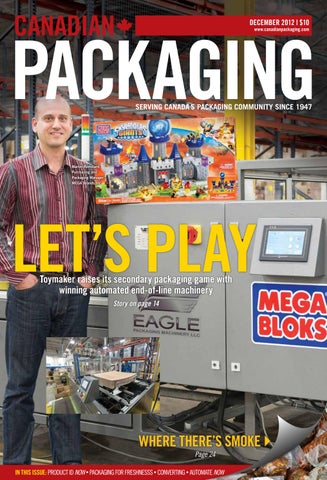
toymaker raises its secondary packaging game with winning automated end-of-line machinery
Story on page 14
Martin
They say you shouldn’t judge a book by its cover...
DRESS UP YOUR PRODUCTS WITH IMS SHRINK SLEEVE LABELS
ELEGANT
Fits all your containers like a glove BOUNDLESS 360-degree printable area
RESISTANT
No match for rubbing, scratching or wear and tear
VERSATILE Can be used as a tamper-evident seal
DECEMBER 2012
VOLUME 65, NO. 12
SENIOR PUBLISHER
Stephen Dean • (416) 510-5198
SDean@canadianpackaging.com
EDITOR
George Guidoni • (416) 510-5227
GGuidoni@canadianpackaging.com
FEATURES EDITOR
Andrew Joseph • (416) 510-5228
AJoseph@canadianpackaging.com
ART DIRECTOR
Stewart Thomas • (416) 442-5600 x3212
SThomas@bizinfogroup.ca
PRODUCTION MANAGER
Cathy Li • (416) 510-5150 CLi@bizinfogroup.ca
CIRCULATION MANAGER
Diane Rakoff • (416) 510-5216
DRakoff@bizinfogroup.ca
EDITORIAL DIRECTOR
Lisa Wichmann • (416) 442-5600 x5101 LWichmann@canadianmanufacturing.com
EXECUTIVE PUBLISHER
Tim Dimopoulos • (416) 510-5100 TDimopoulos@bizinfogroup.ca
BIG MAGAZINES
Vice-President of Canadian Publishing • Alex Papanou
President of Business Information Group • Bruce Creighton
THEM KIDS ARE ALRIGHT!
It is safe say that few students wake up one day with a sudden burning desire to become a career package design professional, of all things, but it’s also fair to suggest that those who ultimately choose this field for their professional calling will be rewarded in time with an intellectually stimulating and gratifying line of work.
So anything the industry can do to help the academic world relate the many career opportunities often go begging to potential future talent merits full support and encouragement—not just as the right thing to do, but also as a matter of the industry’s larger strategic self-interest.
Headquartered in Memphis, Tenn., leading gabletop drink-carton manufacturer Evergreen Packaging is certainly doing its part in nurturing the development of future packaging talent by generously sponsoring and stewarding the two-month Project Carton: The Carton Design Competition project, conducted earlier this fall at the New York City’s renowned Fashion Institute of Technology (FIT)
exhibition in Chicago, the finalists’ package prototypes left little to choose between them in terms of skill proficiency and technical execution—ultimately leaving it to the contest’s 19-year-old winner Jennifer Ahern (see picture) to claim the top prize on account of her design’s highlyartistic interpretation of the essence of contemporary, consumer-friendly, and eco-sensitive gabletop packaging.
“I was inspired by the edgy drawings of Picasso and I wanted to design something that the customer would be attracted to,” said Ahern. “Our generation can be careless, but more people are starting to pay attention to the green movement, so sustainability programs like the one Evergreen promotes are very important to the future.”
Added Evergreen Packaging marketing manager Erin Reynolds: “From a design perspective, paperboard packaging provides an excellent cost-effective platform for branding.
EDITORIAL
442-5600; Fax (416) 510-5140.
SUBSCRIBER SERVICES: To subscribe, renew your subscription or to change your address or information, contact us at 416-442-5600 or 1-800-387-0273 ext. 3555.
SUBSCRIPTION PRICE PER YEAR (INCLUDING ANNUAL BUYERS’ GUIDE): Canada $72.95 per year, Outside Canada $118.95 US per year, Single Copy Canada $10.00, Outside Canada $27.10. Canadian Packaging is published 11 times per year except for occasional combined, expanded or premium issues, which count as two subscription issues.
DISCLAIMER: This publication is for informational purposes only. The content and “expert” advice presented are not intended as a substitute for informed professional engineering advice. You should not act on information contained in this publication without seeking speci c advice from quali ed engineering professionals. Canadian Packaging accepts no responsibility or liability for claims made for any product or service reported or advertised in this issue. Canadian Packaging receives unsolicited materials, (including letters to the editor, press releases, promotional items and images) from time to time. Canadian Packaging, its af liates and assignees may use, reproduce, publish, republish, distribute, store and archive such unsolicited submissions in whole or in part in any form or medium whatsoever, without compensation of any sort. PRIVACY NOTICE: From time to time we make our subscription list available to select companies and organizations whose product or service may interest you. If you do not wish your contact information to be made available, please contact us via one of the following methods: Phone: 1-800-668-2374 Fax: 416-442-2191 Email: privacyof cer@businessinformationgroup.ca
As the only U.S. school offering a full-fledged Packaging Design BFA (bachelor of fine arts) degree, FIT provided an eager talent pool of 24 aspiring undergraduate students to design unique package prototypes for gabletop cartons for juice, milk and other related products with compelling brand distinction, connection with the target audience, shelf impact, innovation, and execution of detail. Well, no one said packaging is supposed to be easy, right?
Fittingly displayed at a special gala ceremony held during the recent PACK EXPO International 2012
“Cartons offer the perfect canvas to tell a compelling brand story and provide the information content consumers want,” said Reynolds, underlining the Evergreen cartons’ sustainability attributes such as at least 70-percent renewable content, and a unique manufacturing process using biomass for over 50 per cent of its energy needs.
So maybe the old notion of the biggest tragedy of youth being the fact that it’s wasted on young people really is a notion well past its natural shelflife, at least in light of exceptional creative talent untapped by the Project Carton competition. Based on that evidence alone: the future is youth, the future is green, the future is bright, and the future is now. Happy Holidays!
DEPARTMENTS & COLUMNS
27
Press Play By Andrew Joseph Stalwart Montreal toymaker maintains
photography by Pierre Longtin.
FESTIVE GLASS WATER BOTTLES MAKE A CLASSY YEAR-END FASHION STATEMENT
Glass and class tend to go together well in the world of consumer packaging—especially around the festive season. And although it’s been done before, the annual launch of a new limited-edition glass bottle of evian Natural Spring Water just in time for upcoming holidays is a special packaging treat that seems destined to never fall out of fashion.
Designed this year by the acclaimed BelgianAmerican fashion designer Diane von Furstenberg—best-known for her iconic wrap dress first introduced in the mid-1970s—the new 750-ml glass bottles are decorated with a playful nod to the fashion icon’s mantra by stylizing her signature “Water is Life is Love is Life is Water is ...” catchphrase on the glass in her distinct handwriting.
The result is a unique design that combines evian’s commitment to purity and youth with the designer’s own youthful and optimistic philosophy, according to evian Canada
“We are thrilled to launch our 2013 limited edition bottle designed by the iconic Diane von Furstenberg,” states senior brand manager Barak Orenstein. “Not only is she a globally-recognized pioneer in the fashion industry, but her youthful mindset and inspirational way of life parallel the concepts and values that evian firmly believes in.”
Orenstein points out that von Furstenberg is the first American and female designer to be appointed
for the company’s annual bottle design collaboration with some of the world’s most esteemed designers, which in the past featured the likes of Issey Miyake, Paul Smith, Jean Paul Gaultier, Christian Lacroix and Courrèges.
Owned by the French-headquartered foodand-beverage multinational Danone and ranking as the world’s bestselling brand of premium natural mineral water, the evian Natural Spring Water brand estimates to have sold more that 10 million limited-edition bottles worldwide since launching the collaboration in 2008.
“We are proud of this year’s creation and cannot wait to share it with Canada,” says Orenstein, noting that the 100-percent recyclable bottle is sealed with evian’s new screwcap design and surface-printed in organic ink to display the designer’s ubiquitous heartshaped logo in a special, one-off hue of red.
“To me, it is all about living life to the fullest, and I am so proud to work with evian to spread such an important message,” says von Furstenberg, who received the Lifetime Achievement Award from the Council of Fashion Designers of America (CFDA) in 2005, a year before being elected as the council’s president.
Says Furstenberg: “I am so excited about this collaboration because I have always loved evian, and I think drinking water is one of the most important things we can do to love ourselves—and love is life!”
FLEXIBLE STAND-UP PACKAGING HELPS B.C. JUICEMAKER GROW ITS SOUP LINE
If happiness is a state of mind, then the minds behind Happy Planet Foods, Inc. certainly have their hearts in the right place in terms of giving Canadian consumers delicious organic food-andbeverage alternatives boasting innovative product diversity, healthy nutrition and inspired, contemporary packaging designed for optimal consumer convenience and product protection.
Having already established itself as one of Canada’s leading producers of organic fresh-fruit juices and smoothies, the Buranby, B.C.-based company is currently trying to replicate that success in the fresh soup product category by adding two new globallyinspired recipes to its fast-growing line of freshmade soups now retailing in the refrigerated sections of major grocery stores nationwide.
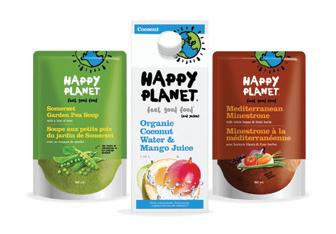
Packaged in sturdy, reclosable 650-ml stand-up plastic pouches produced by the Richmond, B.C.based packaging converter Flexstar Packaging Inc., the new Mediterranean Minestrone and Somerset Garden Pea fresh soups provide a good reflection of the company’s self-styled philosophy of making Canadians feel good about building a ‘Happy Planet’ by offering them the world’s most popular flavors with all-natural, made-in-Canada products, according to Happy Planet co-founder Randal Ius.
“Creating a fresh and happy experience was topof-mind for us when developing our new look,” says Ius, complimenting package design services of the Auckland, New Zealand-based branding consultants Apropos Ltd for developing the attractive stand-up pouches for the company’s entire range of all-natural, gluten-free fresh soups.
“We apply the same philosophy when developing new products like our new soups,” says Ius. “We see great value in garnering inspiration from around the globe.”
In addition to the new soup recipes, Happy Planet has also expanded its range of fresh organic juices with the new Organic Coconut Water & Mango Juice beverage, which Ius says is the first organic coconut water anywhere to combine the natural hydrating benefits of coconut water with delicious flavors of mango puree in one low-calorie, thirstquenching drink.
“We wanted our Organic Coconut Water & Mango Juice to taste the way life should be—simple and a little sweet,” says Ius. “The finished product is all that and more: refreshing, healthy, organic and great-tasting.
“This is a coconut water that everyone can enjoy,” says Ius, who co-founded the Happy Planet in 1984 along with childhood friend Gregor Robertson, whose family farm outside of Vancouver grew organic carrots that the two pals used to mix in a big blender with other locally-grown fruits and berries—ultimately selling the all-natural juices and smoothies “to give city people a taste of the country.”
bite is taken with the eye,’” Klein told Canadian Packaging in a recent interview.
“So with that in mind, and knowing that the consumers’ first interaction with our brand is mainly through our packaging at the store level, it is critical that our brand essence of being fresh, natural, organic, healthy and environmentally-aware, is effectively communicated on a visceral level in that moment.
“Our Happy Planet soups are fresh, local, natural and organic products kettlecooked in small batches,” Klein explains, “and so we wanted our packaging to be just as unique at the point-of-sale.
“Our whole approach to the soup category is based on ensuring that our packaging will effectively differentiate us from how other soups are marketed,” Klein confides.
Containing no artificial colors, flavors, preservatives or added sugar, the Organic Coconut Water & Mango Juice retails in the dairy sections of most major supermarkets in family-sized, 1.89-liter gabletop paperboard cartons manufactured by Evergreen Packaging, and also designed by Apropos.
According to Happy Planet’s brand manager Ursula Klein, “Packaging is a key medium for us to convey that we are a premium-quality brand that produces amazing-tasting products.
“We have a saying at Happy Planet that ‘the first
“Being a fresh product requiring refrigeration, we needed a container that could maintain both the flavor and freshness of our authentic recipes, and this stand-up packaging was the best option currently available to us,” says Klein, citing the packaging’s inherent consumer convenience.
“By choosing to purchase our soup in this innovative clear pouch, consumers can see the richness of the product and see exactly what will be served in their bowl at home,” says Klein. “Moreover, the top zipper-closure on these pouches provides additional convenience for those consumers who may want to save some of the product for later.
“We use only premium ingredients and our packaging needs to speak to this: If the cake is good, the icing better look great!”
Fashion world pioneer Diane von Furstenberg holding the new limited-edition glass bottle of evian Natural Spring water she helped to design for this year’s holiday season to reinforce the brand’s commitment to product purity and youthful optimism for the future.
CAMPBELL BEEFING UP ITS STOCK WITH ATTRACTIVE ASEPTIC PACKAGING
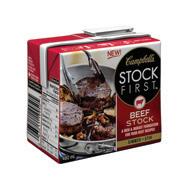
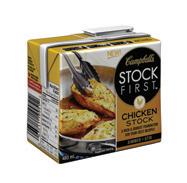
It is often the little things that separate ordinary weeknight home meals from inspired culinary masterpieces, and the new 480-ml aseptic packages of Stock First brand of beef, chicken and cream stocks from leading soupmaker Campbell Company of Canada just may be the perfect ingredient for helping aspiring Canadian home chefs raise their cooking skills and flair to a whole new level of excellence.
Formulated to eliminate the time-consuming process of making stock or béchamel from scratch, the Stock First line of high-quality, shelf-stable stocks—boasting one-year shelflife—are claimed to be the ideal ingredient for all home chefs wishing to significantly enhance the flavors of their meat, fish, pasta and vegetable dishes with delicious sauces containing no artificial flavors or coloring.
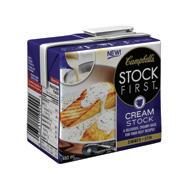
Having developed more than 35 delicious suggested meal recipes utilizing one of the three First Stock stock products—packaged in aseptic brickshaped paperboard packages produced by SIG Combibloc and decorated with attractive graphics designed by Chicago-based branding consultants Soulsight North America —Campbell Canada is especially upbeat on the brand’s brand new one-of-a-kind Cream Stock, which contains 83 per cent less fat and 78 per cent fewer calories that the comparable amount of traditional 35-percent whipping cream.
Manufactured and packaged at Campbell Canada’s Toronto manufacturing facility along with the Beef and Chicken flavors, “The new Stock First Cream stock has a velvety smooth, creamy base which will never curdle, scorch or burn in cooking,” explains Campbell Canada’s corporate chef Suman Roy. “Unlike anything currently available, this great shelf-stable alternative to cream can be used to create a white sauce or add a thicker creaminess to other sauces, soups and more.
“Not only is it gluten-free and vegetarian-friendly, but it contains no artificial colors or flavors,” Roy adds.
“Our new Cream stock allows home-chefs to quickly and confidently create beautiful dishes that would traditionally start with a white sauce recipe like pork chops with caramelized apple cream sauce—the kind you usually have to wait for the weekend to make,” says Roy, adding that all the suggested recipes developed for the First Stock brand products can be found online at www.cookwithcampbells.com
“With the new Chicken and Beef stock varieties, whether you are deglazing, braising or making sauces, these rich, meaty stocks will bring out the robust notes and deli-
cious flavors of even your most gourmet recipes,” states Roy.
“At Campbell we are always working to develop new versatile ingredients and meal solutions that meet Canadians’ taste, culinary and dietary needs,” says Campbell Canada’s senior director of research and development Arlene Karan.
“Our new Stock First stock line is a great example of us taking a close look at the ingredients our consumers are using and the caliber of meals they are creating at home,” Karan explains.
“We realized there was an opportunity to expand our current products to offer Canadians a new solution, particularly with an ingredient like Cream stock, which is unique in the marketplace.”
About 80 per cent of all of the company’s broth products sold in Canada are packaged in aseptic paper boxes, points out Karan, “So it was a natural evolution in the development and launch of our new Stocks to use these reclosable shelf-stable paperboxes providing at least oneyear product shelf-life.”
NEWSPACK
WALMART CANADA GETS FINE AND DANDY WITH SEASONAL PRODUCT LINE EXPANSION
Paying a higher price for finer things in life is all partand-parcel of traditional holiday season splurging for many Canadian consumers caught up in the annual year-end shopping craze, but blowing the budget on fine food and drink is not really an issue this year at Walmart Canada’s Supercentre stores— thanks to the retailer’s limited-time expansion of its Our Finest store brand of food and beverage products.
Launched last month across Canada, the nearly 60 new products comprising the new Our Finest Holiday Collection product family—ranging from crackers, cookies and appetizers through desserts and candies to whole turkeys and smoked hams—will be sold at Walmart stores until the end of December, although some of the better-selling items may well become year-round offerings, according to Sandra Farwell, Walmart Canada’s vice-president of brand management and privatelabel products.
“A year ago we launched 18 new appetizers originally intended just for the holiday season,” she says, “but they sold so well that we have kept them
as year-round products in our Our Finest range.
“So it would not surprise me if some of our new products in this year’s collection also repeat that success,” she says.
“This whole brand is all about offering Canadians great quality and great taste at unbelievable prices,” says Farwell, citing an average of 15-percent price savings for Our Finest products compared to similar national brands.
Launched about a year-and-a-half ago across more than 300 Supercentre stores operated by Walmart Canada nationwide, the Our Finest store brand has since grown to comprise over 200 SKUs (stockkeeping unit), according to Farwell, adding that the brand’s success is being closely watched by the U.S.based parent company Walmart Stores Inc. of Bentonville, Ark., with good possibility of some of these products being brought south of the border.
“This store brand is unique for all Walmart operations worldwide,” she says. “We are very proud that almost all of the product range, with some imported exceptions like Belgian chocolates and Scottish shortbread cookies, was developed in Canada and made in Canada by our Canadian vendors.”
The lion’s share of the packaging used for the Our Finest Holiday Collection was also sourced in Canada, with the Mississauga, Ont.-based Bridgemark Branding & Design Inc. providing the graphics and creative services for the products, with leading
packaging converters such as Boehmer Box , Goldrich Print Pack and Cascades Boxboard supplying the vast majority of the folding cartons used for the various appetizers, pies, desserts, cookies and confectioneries.
Other prominent Canadian packaging suppliers contributing to the Holiday Collection launch include The Central Group (display and retailready packaging); Pearce Wellwood (display and retail-ready packaging); Master Packaging (folding cartons, corrugated boxes and retail-ready packaging); Orbis Menasha Canada (display and retail-ready packaging) and Cascades (corrugated boxes and display and retailready packaging).
“Like all products retailed by Walmart Canada, the Our Finest Holiday Collection products underwent the rigorous scrutiny and evaluation of our Packaging Scorecard metrics to meet its standards and guidelines for packaging and environmental sustainability,” according to brand manager Brian Ettkin.
“We take packaging very seriously in everything we do at Walmart,” Ettkin says, “which meant working exclusively with packaging manufacturers and printers who have a proven track record of meeting our high standards of environmental responsibility.”
“It is very important for a company like MEGA that our supplier understand our unique circumstances and collaborate to solve any issues along the path. Eagle always listens and brainstorms with us to come with solutions that meet our requirements. They say what they will deliver and they will deliver what they say…in the cost and time schedule, as planned day one.”
- Dominic Prevost, MEGA Brands Automation & Maintenance Manager (PackExpo Show Daily 2012)
NEW SEASONING MIXES FOR INSPIRED EASY-TO-MAKE CHICKEN DISHES
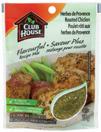
While chicken may generally not be the most inspiring dinner option for the hard-core carnivore meat-loving crowd, a little culinary intervention with two new seasoning mixes launched a few weeks ago by the London, Ont.-based spice producer McCormick Canada Inc. can help any aspiring home chef turn it into a memorable dining occasion.
Containing no artificial colors or flavors, the new Creamy Parmesan Chicken Penne and Herbes de Provence Roasted Chicken seasoning mixes are the venerable spice-maker’s latest additions to its bestselling, transfat-free Club House Flavourful recipe mixes—part of the Club House brand of premium spice that ranks as the 62nd-largest consumer brand in Canada, according to consumer research specialists Nielsen Canada
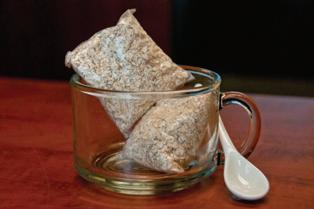
Packaged in the brand’s familiar clear-plastic pouches featuring engaging graphic design created
by the Toronto-based branding specialists Forthought Design Inc.—with Mississauga, Ont.-based Acorn Packaging Inc. providing the printing and Novellus Graphics Resources Inc. of Toronto supplying all the prepress services—the two new mixes were formulated as highly versatile blends that can also be used in several other trendy recipes in addition to their signature dishes, according to McCormick.
For example, the Creamy Parmesan Chicken Penne Flavourful Recipe Mix can also be used to make Chicken Parmesan, Vegetarian Lasagna, Shrimp with Creamy Wild Mushroom Sauce, Tomato Sauce, and Parmesan Bruschetta, while the Herbes de Provence Roasted Chicken Flavourful Recipe Mix can be used as a key ingredient in dishes like Herbes de Provence Chicken with Apple Cider, Chicken and Mussel Bouillabaisse, Herbes de
Provence Stuffed Leg of Lamb, Yorkshire Pudding with Herbes de Provence, and Herbes de Provence Focaccia Bread.
“The premise for this product range is that consumers are looking for easy, healthy, on-trend flavors that allow them to easily add a flavorful twist to an everyday meal,” explains McCormick Canada’s product manager Linda Stiles.
“With fresh and authentic ingredients in the coarse blend with large particulates, this product range delivers on these aspects, and has the added benefit of the cutout window on the package allowing consumers to see the seasoning blend.
“The two new flavors add great variety to the range,” says Stiles, adding consumers can find a broad variety of tasty alternate Club House recipes for these products online at www.clubhouse.ca
TETRA PAK UNLEASHES THE ONLINE POWER OF SHELF-STABLE MILK
While most Canadian parents know all about the many health benefits of making sure their children drink enough milk, delivering those benefits throughout the day is a challenge for many active, busy mothers who can’t be with their children on around-the-clock basis.
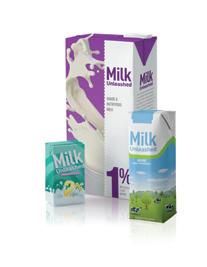
But it’s a challenge that can be easily met with a growing and diverse range of shelf-stable milk products packaged in aseptic drink cartons and available in a multitude of shapes and sizes to suit any occasion, according to a new multifaceted online marketing and education campaign launched last month by the world’s leading aseptic processing and packaging group Tetra Pak
Focusing on active moms with young children under 12, the Milk Unleashed campaign (www. milkunleashed.ca) was designed primarily to convey the message that shelf-safe milk enables them to have a healthier beverage choice for their kids and themselves—even with their busy, onthe-go lifestyle—since the milk in Tetra Pak shelf-safe cartons doesn’t require refrigeration until
the container is opened.
“Our research shows that for this target, it’s all about convenience, which is why we are letting them know that they can safely provide real milk to their children anytime and anywhere,” explains Carla Fantoni, Tetra Pak’s vice-president of communications for Canada and the U.S.
“Moms can easily toss the recyclable cartons into lunch boxes, picnic baskets, diaper bags, beach coolers and sports bags,” says Fantoni, adding that the online campaign is packed with tips for ‘moms on the go,’ including nutritional information about milk, ideas for increasing milk in their families’ diets, and promotions, contests and information about the various brands of shelf-safe milk and where to buy them.
According to Tetra Pak, the key core message of the campaign is that shelf-safe milk is real milk that just happens to be processed and packaged in a different way to “offer new opportunities for milk consumption.”
Because Tetra Pak’s shelf-safe milk boxes enable the product to retain its quality without refrigeration or
A SKINNY NEW LOOK FOR A GIRLY DRINK
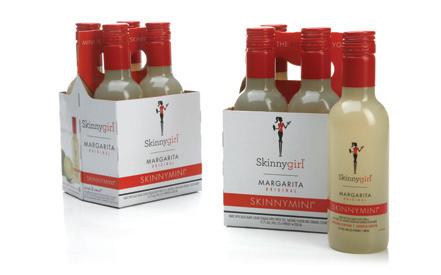
Dieting is rarely a piece of cake for anyone, but a new Skinnyminis Margarita line of low-calorie, ready-to-serve cocktails from renowned spirits producer Beam Inc. can make it just a little more fun for women trying to have a good time at backyard barbecues, picnics, concert arenas and other outdoor venues without worrying about a caloric overkill.
Originally retailing only in 750-ml glass bottles, the popular Skinnygirl Margarita drink—one of the Skinnygirl brand’s several low-calorie wine- and liquor-based beverages—has recently been converted to the new Skinnyminis four-pack offering of the tequila-based cocktails bottled in sleeklooking, 200-ml barrier PET (polyethylene terephthalate) plastic containers manufactured by Ann Arbor, Mich.-based Amcor Rigid Plastics
According to Beam’s brand director Megan Frank, the move to single-serve container sizes was prompted by strong consumer feedback and the promise of new point-of-sale opportunities offered by the unbreakable and fully-recyclable packaging.
“For us, the size extension made sense due to PET’s value and because consumers asked for the product,” said Frank.
“The single-serve size, unbreakable and portable PET bottles provide us with an entry into new venues that do not allow glass because of the potential for breakage, opening up new sales opportunities,” says Frank, adding that the Skinnyminis have been sold all season at Yankee Stadium in New York City, as well as at other similar type venues hosting including sporting events and music concerts.
“We just wouldn’t be able to get there with glass,” states Frank.
The attractive, custom-made container also represents one of the first 200-ml barrier PET bottles made specifically for the spirits industry, according to Amcor, which uses a special barrier PET resin with an oxygen scavenger to protect contents from oxygen ingress and extend product shelf-life.
preservatives for several months from its production date, consumers can choose to purchase large quantities of the products and to store it safely in their pantry until they are ready to chill before opening, if they like.
“Our dairy customers have joined the cause and we will cross-promote this with their marketing efforts and product launches,” says Fantoni, adding the campaign will incorporate novel marketing techniques such as outreaching to mom bloggers, sampling, search engine marketing and online public relations.
“We educate consumers so that they understand the benefits carton packages can bring, which in this case is all about enabling moms to increase their kids’ milk intake safely and conveniently,” Fantoni states.
“That’s because we understand that our customers’ success is our success.”
“These single-serve PET bottles also enable Beam to realize significant key sustainability benefits,” Graybill says. “They are one-sixth the weight of glass bottles, unbreakable, less wasteful, and recyclable.
Also incorporating a special UV additive for the bottle to shield the product from ultraviolet light and preserve its color, the slender, long-neck 200ml PET bottles effectively preserve the brand image and premium look of the 750-ml glass containers, according to Amcor Rigid Plastics project manager Myles Graybill.
“The plastic bottles also result in significantly reduced transportation costs and other supply-chain efficiencies,” says Graybill, adding that the surprisingly durable bottles are capped with ROPP (roll-on, pilfer-proof) premium aluminum screw-top closures, manufactured by Amcor Flexible Capsules, requiring 200 pounds of top-load force to apply securely.
DecentralizeD DriVe systems
igear
Movigear® is distinguished by its high level of system efficiency, a significant factor in reducing energy costs. The integration and coordination of all the drive components lead to a long service life and system availability. Movigear® is an intelligent system with its own control concept. Its high-quality networking helps reduce startup time and supports monitoring and maintenance tasks. When combined with a functional user software, drive tasks can be solved as quickly and easily as possible.
moV itrac ® lte B
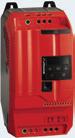
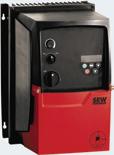
The range of functions provided by MOVITRAC® LTE B is particularly well adapted to less complicated applications. Its user-friendly design makes integration quick and easy, it also meets the high quality requirements of everyday requirements. The Movitrac® LTE B is also available in IP66/NEMA 4k making it suitable for special ambient conditions. These frequency inverters operate reliably and flexibly even when exposed to dust or water.
P sc
Planetary servo gear units
The low backlash PSC planetary servo gear units are designed for torque classes from 30 to 305 Nm. They are designed to offer the greatest possible flexibility and ROI, as not every application demands machines designed for maximum performance. These planetary servo gear units are the basis for versatile, dynamic, and above all cost optimized drive solutions.
moV itrac ® ltx
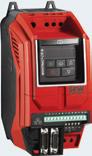
Simple, fast and diverse: as part of the Smart Servo Package, SEW-Eurodrive offers the new Movitrac® LTX servo inverter for universal use. It stands out with advantages such as ease of operation, short startup times as well as optimized costs. Available in two sizes and covers a power range from 750W to 5.5 kW. The Movitrac® LTX is particularly suitable for use in applications such as secondary packaging, handling, and logistics.
D D
ri V e systems
In many industries and applications, implementing economical automation concepts means utilizing decentralized systems throughout. Long rows of control cabinets with complex wiring, expansive space requirements and long distances between control cabinet and motors are too rigid and not very economical. Only the combination of flexible, versatile, economic and target-oriented modules will provide an efficient solution. This is the reason why system operators opting for decentralized drive systems from SEW-Eurodrive are always ahead of the game.
our Drive solution Pyramid.
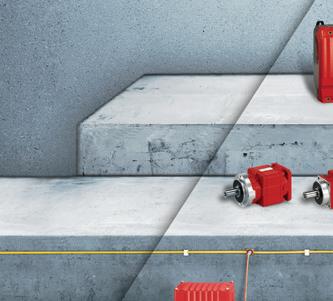
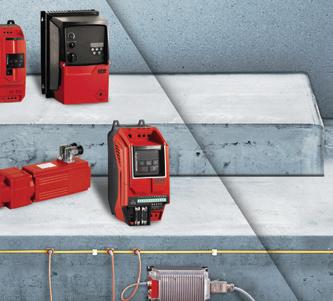
The demands on material handling systems today have never been more wide ranging or more challenging. That’s why SEW-Eurodrive offers drive solutions for every kind of industry application. From the simple to the sophisticated, our pyramid of solutions allow you to control costs and limit complexity by giving you the ability to tailor our products to the exact intelligence and performance specs you require. Reducing energy consumption is also an important imperative today for the modern production line. Just ask Coca-Cola, who achieved a sensational 75% reduction in energy consumption by incorporating 40 of SEW-Eurodrives’s revolutionary decentralized MOVIgEAR® units in a recent overhaul of a European bottling plant transport line.
SEW’s customer resource portal for expert consultation, information and services.
VFDs: reliaBle, comPact & Versatile
SerVo PacKaGe: simPle, fast & DiVerse
CHICAGO CROWD-PLEASERS
One more recap of PACK EXPO International 2012 show-floor innovations
ROBOTS AT YOUR SERVICE
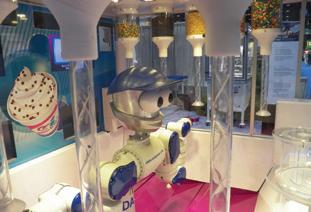
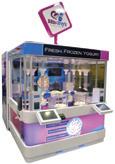
Industrial robotics manufacturer Yaskawa Motoman made a big impression at this year’s show with an over-the-top exhibit highlighting the “human-like” flexibility of movement of the company’s the Motoman SDA (slim dual-arm) series robots—designed to provide the required reach, payload, speed, performance and flexibility attributes to enable them to perform a myriad of packaging, assembly, handling, machine-tending and part-transfer applications normally requiring people to execute properly. Featuring a total of 15 axes of motion—seven axes per arm plus a single axis for base rotation— the SDA robots showcased their flexibility to maximum effect at the onsite Reis and Irvy’s Frozen Yogurt Factory kiosk, developed in partnership with leading designer of interactive robotic retail kiosks Robofusion, Inc. Said to be the world’s first and only robotic frozen yogurt kiosk line, the interactive display wowed the show visitors by letting them select up to two flavors of yogurt and two toppings—from a choice of four yogurt flavors and 10 toppings— by choosing a robotic character and watching the SDA5 robot, nicknamed ‘Cid,’ artfully deliver the order in a souvenir cup. “We have been working with Yaskawa Motoman for months to make the Reis and Irvy’s Frozen Yogurt Factory a reality,” says Robofusion’s co-founder Allan Jones, “and utilizing Motoman’s state-of-the-art SDA5 robot allowed us to jointly create one of the most fascinating robotic kiosks ever built.”
Yaskawa Motoman 401
SETTING THE BAR EVER HIGHER
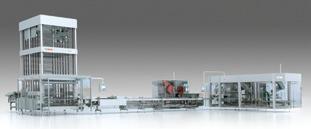
The sprawling exhibit of Bosch Packaging Technology provided an impressive backdrop for the company’s North American launch of its new, highly-integrated bar packaging line—designed as a high-performance, seamless system rather than a chain of stand-alone machines—for highspeed primary and secondary packaging of nutrition bars and other similar bar-shaped products.
Comprising the Sigpack DCI distribution station, the Sigpack HRM flowwrapping machine with a high-performance splicer, and a Sigpack TTM top-loader, the Sigpack Barline offers output capacity of more than 1,000 bars and up 150 cartons per minute, while perfect balancing all of the different machines’ speeds to achieve a reliable and optimized production flow with no bottlenecks and minimal downtime, as well as significantly reducing the risk of operator errors that can cause lengthy and costly production stoppages. “With the new bar packaging line, Bosch has designed a system with the operator in mind that reduces the potential for errors,” says Bosch’s product manager Philipp Schenker. “In addition to high equipment availability, the system also addresses the present and future flexibility requirements so that packaging formats and styles can be changed as needed, as well allowing the line to be modified for cold-, heat- and even ultrasonic sealing.”
Bosch Packaging Technology
EVERYTHING UNDER CONTROL
402
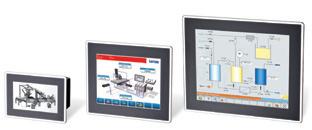
Leading manufacturer of electrical and mechanical drives, motion control and automation technology Lenze Americas used the show to launch a powerful new hardware platform for machine-oriented visualization and control applications—combining logic, motion and visualization in a smart integrated device for machine-oriented applications. Based on the proven architecture of the company’s controller 3200 C, the new panel controller p500 is available in three convenient screen sizes—seven-, 10.4- and 15-inch—with each model equipped with a touchsensitive TFT (thin-film transistor) display.
“Designed for virtually all modern automation systems, the all-in-one panel controller p500 offers an ideal solution for easy deployment in both centralized and decentralized architectures,” states Lenze Americas’ automation product leader Craig Dahlquist. “The maintenance-free p500 delivers top performance in the smallest of spaces with no forced cooling or moving parts. It is the perfect combination of logic (PLC), motion and visualization in a single device,” says Dahlquist, explaining that high computing capacity of the panel controller p500 is ensured via the powerful 1.6 GHz Intel AtomT processor.
Lenze Americas 403
GOING RIGHT TO THE TOP
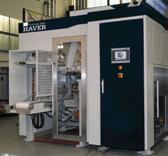
Designed for use by manufacturers of granulated products such as pet-food, fertilizer or rice, the new compact TOPLINE 2000 bag-filling machine from Haver Filling Systems, Inc.—capable of achieving speeds of up to 30 bags per minute with one filling spout—can be equipped with either a vertical empty bag magazine for tight spaces or a horizontal empty bag magazine suitable for higher storage
capacities, with both options easily refillable inline without interruption to the filling process. Capable of filling both paper and plastic bags, the versatile TOPLINE 2000 filler can also be outfitted with one of four optional closing systems—sewing, taping, hot-melt activating or heat-sealing—to suit a broad range of application requirements. According to the company, the fully-automated TOPLINE 2000 is engineered for consistent, fast and clean production, whereby the bag is securely transported by a servo-driven bag-handling unit during the filling cycle, while a special device pulls empty bags from the magazine and accurately hands them to the filling spout. As the spout fills the bag, a vibratory unit compacts the filled bag for a tight fit. Once filled, the bag is sealed using one of the four available methods.
Haver Filling Systems, Inc.
THE SWEET TASTE OF HONEY
404
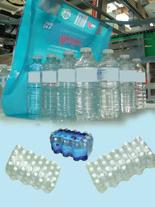
Leading French end-of-line packaging machinebuilder Cermex showcased the company’s new automated solution for collating bottled products on its shrink-wrappers in order to create honeycombed packs. According to the company, these staggered bottle configurations offer many advantages for both bottlers and their customers in terms of packaging stability, originality and automation, as well as the accrued economic and ecological benefits, including:
• Original pack concept and multiple configurations offering great opportunities in terms of design and promotional marketing—thanks to the multitude of possible pack shapes and more original pack displays on the shelf level.
• Improved pack stability and rigidity, as honeycombed packs can be adapted to all types of cylindrical products from 0.25- to 1.5-liter requiring large product collations, such as water, soft-drinks, juices and some food products.
• Eliminating the need for corrugated support packaging. The superior pack rigidity enabled by the honeycombed process makes it simple to do away with the traditional corrugate trays, pads, U-boards and other support packaging typically required for the traditional packs—resulting in significant material savings.
• Improved pallet optimization and consolidation by accommodating to 20-percent more bottles per layer, depending on the patterns, to reduce the cost of pallet storage.
Cermex
405
COMPOSTABLE COFFEE BAGS A CROSSBORDER HIT
Coffee brand-owners are always seeking new ways to stand out from their rivals in the fiercely competitive marketplace, but some of North America’s leading ‘fair trade’ coffeemakers are starting to find some welcome common ground when it comes to their product packaging— thanks to the NatureFlex brand of compostable cellulose-based films manufactured by the U.K.based Innovia Films Group
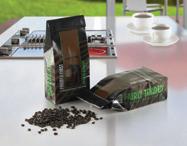
Earlier this fall, leading Canadian organic coffee roaster Pistol & Burnes switched the packaging for the company’s Farmer
First brand of ‘fair trade’ coffee to paperbags laminated to the transparent NatureFlex film— manufactured from wood pulp sourced from managed plantations—that is engineered to break down at the end of its lifecycle either in a home compost bin or in industrial compost environment within a matter of weeks.
Pistol & Burnes for several reasons,” recalls Genpak’s technical manager Bill Reilly. “First and foremost, the film performs very well technically.
“Having high-barrier properties and good seal integrity that enhance shelf-life, while keeping oxygen out and aroma in, is a very important attribute for packaging coffee.
“Secondly, NatureFlex is perfectly aligned with the ethos of their fair-trade organic Farmer First brand,” Reilly states.
“Continued success with partners such as Genpak and Pistol & Burnes means that our NatureFlex films are wellpositioned to provide solutions to progressive converters and brandowners,” adds Innovia Films Americas president Joe Piccione.
Certified to meet the U.S. ASTM D6400, European EN13432 and Australian AS4736 standards for compostable packaging and boasting about 95-percent renewable bio-based content, the NatureFlex film—also claimed to be wellsuited for emerging ‘waste to energy’ techniques such as anaerobic digestion—offers packagers and converters a broad range of performance benefits, according to Innovia, including inherent deadfold and anti-static properties, high gloss and resistance to grease and oil, good barrier to gases, aromas and mineral oils, and a wide heat-seal range.
Developed by the Specialty Packaging Group of the Aurora, Ont.-based flexible packaging converter Genpak LP, the new bags provide a perfect way for Pistol & Burnes of Delta, B.C., to assert the product’s organic and fair trade credentials, according to coffeemakers’s president Roy Hardy.
“Most roasted coffee sold in the world is packaged in either foil bags coated in plastic, or in paper bags with a plastic liner,” says Hardy, “and these packages usually end up going straight to landfill because they often prove to be too difficult to recycle.
“However our enviro–friendly coffee bag can be organically recycled, which means it breaks down in a home compost bin,” Hardy adds.
“We originally recommended NatureFlex to
“This is especially true for those seeking to meet the growing consumer demand for packaging made from renewable resources.”
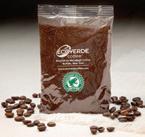
This growing demand was also behind the recent decision by Buffalo, N.Y.-based McCullagh Coffee to follow suit with last month’s launch of its own compostable packs for the company’s Ecoverde Coffee brand of Rainforest Alliance -certified coffee distributed across the U.S. via leading retailers and foodservice operators.
Constructed with the transparent, heat-sealable NatureFlex NE brand film and surface-printed with a Videojet Technologies product marking system, the cellulose-based film was selected from among many options primarily because of its environmental attributes, according to McCullagh’s vice-president of sales and marketing Warren Emblidge.
“We were looking for a partner with a commitment to developing cutting-edge compostable packaging to support our sustainability initiatives, and Innovia was a great match,” Emblidge states.
Adds Innovia Films Americas account executive Christopher Tom: “In applications such as this, where fast product turnover requires much shorter shelf-life, a single monoweb structure is one option, but we would recommend coffee producers requiring very long shelf-life to use high-barrier tri-laminate type structures.
“Whatever the case, our NatureFlex portfolio offers a broad variety of solutions to create highbarrier laminate structures.”
EDIBLE FILM WRAP A CLEAN ACT TO FOLLOW
A food package that completely disappears with the product it packs may seem like a far-out notion, but scientists at the specialty films producer MonoSol, LLC are closer to achieving that feat than many people may think—if the Merrillville, Ind.-based company’s newlydeveloped Vivos Edible Delivery Systems are anything to go by.
According to the company, a division of Japan-headquartered global specialty chemicals producer Kuraray Co., Ltd., the new watersoluble, edible pouches made from Vivos films are specially formulated to disappear and release their contents when exposed to hot or cold liquids, with the dissolved film—composed of a proprietary blend of food-grade ingredients—safely consumed along with the food.
Claimed to offer a good oxygen barrier and robust mechanical properties that enable realworld use with various foods and forming of bags/pouches using existing converting technologies, the patent-pending transparent film has no smell or taste when consumed, according to the company, while leaving nothing in its wake to dispose of.
“Consumers will benefit from on-the-go convenience in addition to portion control and sustainability, in terms of not having to throw away the package,” the company says.
“Foodservice kitchens and food manufacturers using pre-measured quantities in mixing and batching operations can improve the accuracy of the operation, while also saving production time and processing costs.
“Specific examples include fruit drinks, workout supplements, instant teas and coffees, gravies, soups, hot chocolate, pasta, cooking aids, dyes, enzymes, vitamin fortifiers and yeasts, to mention a few.”
CORRUGATED PRODUCER GIVES IDLED NEWSPRINT MILL A SECOND CHANCE AT LIFE
Leading Canadian corrugated producer Atlantic Packaging Products Ltd. has announced plans to reopen an idled mill in Whitby, Ont., in March of 2013 following a capital upgrade to replace the former newsprint mill to produce 100 per cent recycled lightweight paper for manufacturing high-performance corrugated packaging products.
“In North America, the term ‘lightweight’ has been primarily used in reference to the basis weight of the paper, with little or no emphasis on strength, but what we’re talking about is a disruptive technology that is capable of producing low basis weights (lighter paper)—with sustainability and strength
characteristics unlike anything in corrugated packaging today,” says Atlantic Packaging president Dave Boles.
States Boles: “Sustainability objectives from large retailers are driving the industry forward, and soon Atlantic Packaging will be in a position to provide our customers with the most sustainable corrugated packaging option available in North America.”
Boasting annual production capacity of 150,000 tonnes of recycled newsprint, the Whitby mill was originally idled by Atlantic in March of 2010 in response to declining North American demand for
newsprint, according to the company, but the planned investment is expected to turn the operation into one of North America’s leading producers of a new lightweight paper product range with higher strength properties and manufactured using significancy less fibers.
The Whitby mill be the second new mill to be opened by Atlantic Packaging over the last six years, which in 2006 opened up the New Forest Mill in Toronto as part of a joint venture with the Saint-Laurent, Que.-based corrugated packaging producer Mitchel-Lincoln
SOFT-DRINK GIANT EARNS EARNEST ACCOLADES FOR ITS SUSTAINABILITY EFFORTS
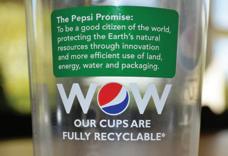
If consistency is a required ingredient for sustainability, then soft-drink giant PepsiCo, Inc. has many reasons to be duly proud of its widelyacclaimed and highly-lauded global environmental efforts of recent years, with the Purchase, N.Y.headquartered company receiving official recognition by both the Dow Jones Sustainability Index (DJSI) and the Carbon Disclosure Project (CDP) for its leadership in promoting sustainable business practices.
In fact, this year marks the seventh time that PepsiCo has now been named a member of the Dow Jones Sustainability North America Index and sixth time in the World Index list of DJSI, which was launched in 1999 as the first global investment index tracking the financial performance of leading sustainability-
driven companies worldwide.
Specifically, the DJSI World Index identifies companies that exemplify leadership in sustainability among the leading 10 per cent of the world’s top 2,500 companies in the Dow Jones Global Total Stock Market Index in terms of economic, environmental and social criteria, while the DJSI North America Index covers the leading 20 per cent in terms of sustainability of the 600 biggest North American companies.
ness growth,” says PepsiCo’s chief executive officer Indra Nooyi, noting this year also marks the second consecutive year that the company was included in the CDP Global and S&P 500 Leadership indices.
“PepsiCo’s Performance with Purpose strategy is built on sustainable business practices that optimize our near-term operating efficiency and profitability, while ensuring that we are well-positioned to deliver long-term busi-
Used to provide a global system for companies and cities to measure, disclose, manage and share vital environmental information, the not-for-profit CPD also serves as a working guide for 655 institutional investors—with estimated assets of US$78 trillion—to provide up-to-date information from companies on their GHG (greenhouse gas) emissions, along with the assessment of climate change and water usage risk and opportunity.
Good seal.Pe rf ectseal.
Says CDP’s chief executive officer Paul Simpson: “Companies that make the Carbon Disclosure Leadership Index are giving clear consideration to the business issues related to climate change and their exposure to climaterelated risks and opportunities.
“This is vital to realizing greater efficiencies, protecting the business from risk and capitalizing on opportunities,” Simpson states.
Some of PepsiCo’s recent major achievements in environmental sustainability include:
• A more than 20-percent improvement per unit of production in global water use efficiency from 2006 levels— resulting in over $45 million related cost-savings in water and energy use—achieved four years ahead of the original schedule;
Repak horizontal form-fill-seal packaging machines from Reiser offer the best sealing integrity in the industry. Only Repak machines are constructed with two 4-point lifting stations, which can generate up to five metric tons of closing pressure for reliable sealing and more uniform forming. No matter how complicated your package, Repak will produce it perfectly. For more information, contact Reiser today at (905) 631-6611
• Saving about 200,000 gallons of diesel fuel by utilizing a fleet of all-electric trucks recently introduced by Pepsi-Co’s Frito-Lay North America snack-foods division, which has already surpassed one million driven miles;
• Teaming up with Cambridge University to introduce mobile technology to crop planting with a new smartphone app that will help farmers predict future harvests. According to PepsiCo, the initial trials of the innovative i-crop technology have enabled a 13-percent increase in crop yield and an eight-percent reduction in water consumption across the 46 potato farms that it operates in the U.K.
January 1, 2013
Introducing Precisely Packaging Program On-Line Courses
Reduce your WSIB costs by joining nowdeadline for 2013 membership December 31, 2012
PAC Safety Group returns over $5,704,275 to its members
PAC Safety Group receives honours safety report card by reducing claims 31% while clawing back 5.7% of 2011 premiums
These exceptional safety record achievements have been rewarded a collective real dollar rebate of $655,317 for 2011. Since the inception of the program the PAC Safety Group has returned $5,704,275 to its members.
Join our winning team by contacting Larry Dworkin, Director, Government Relations PAC, at 416.645.3282 or larrywdworkin@gmail.com or by contacting Evan Anthony at 647.918.4123 or evan_anthony@rogers.com.
for additional courses Q2, 2013
Important dates
•December 14, 2012 - early bird deadline for all entries
Visit pac.ca for details on all 13 Competition categories
BUILDING ON SUCCESS
Leading construction toys manufacturer employs high-tech boxforming machinery to raise its manufacturing and packaging game
BY ANDREW JOSEPH, FEATURES EDITOR PHOTOS BY PIERRE LONGTIN
When building a strong company, you need a strong foundation and a whole lot of bricks. Fortunately for MEGA Brands Inc., it has a plentiful abundance of both. Headquartered in Montreal, the globally-operat-
ing company is widely acknowledged as one of the world’s leading toymakers today, boasting a host of popular leading brands in the construction toys, arts-and-crafts, presentation boards and puzzles product categories.
The company’s roots trace back to the 1967 startup of the former Ritvik Toys, Inc. Founded by Victor and Rita Bertrand, Ritvik went on to
become Canada’s largest toy distributor, but after having developed and starting to market its firstgeneration toy construction blocks under the MEGA BLOKS brand in 1985, the company commenced its next chapter of corporate existence under the Mega Bloks, Inc. banner.
Following more than 10 years of sustained growth, the founders eventually partnered with the prominent U.S.-based asset management and financial investment conglomerate Blackstone Group L.P., with accelerating sales growth in the ensuing years finally leading to an initial public offering in 2002.
By 2005, the renamed MEGA Brands had successfully expanded into the arts-and-crafts and board categories via the acquisition of two U.S.-based Rose Art Industries and Board Dudes to continue its formidable market growth and expansion. Nowadays boasting an impressive portfolio of licensed products to complement the company’s own in-house innovations—including current licenses of iconic toy brands like Dora the Explorer ( Nickelodeon), Hot Wheels, Barbie and Thomas & Friends (Mattel), Hello Kitty (Sanrio), Halo (Microsoft), Need for Speed ( Electronic Arts), Skylanders (Activision) and World of WarCraft ( Blizzard Entertainment) and Disney brand puzzles—the toymaker is today a true global player,
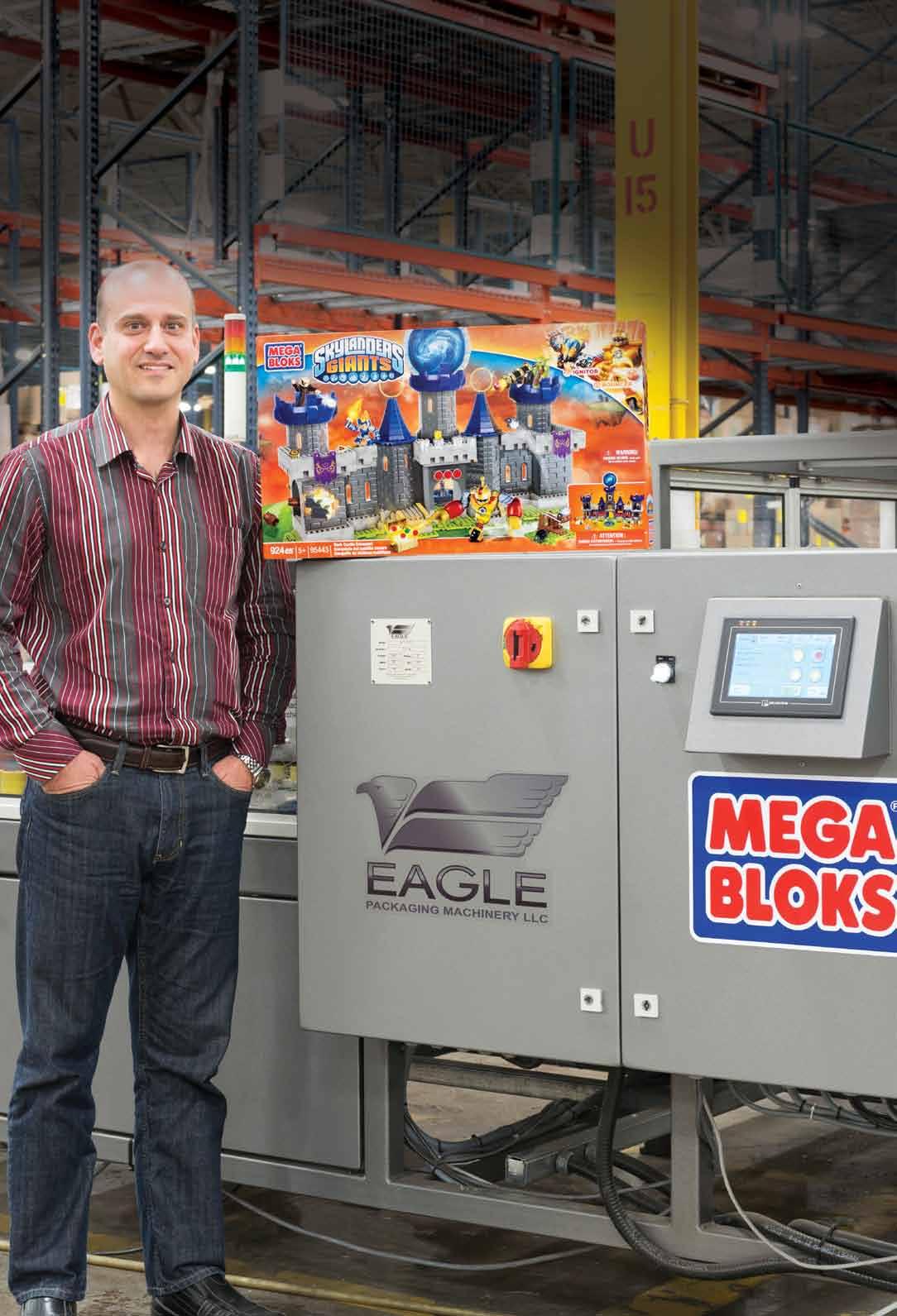
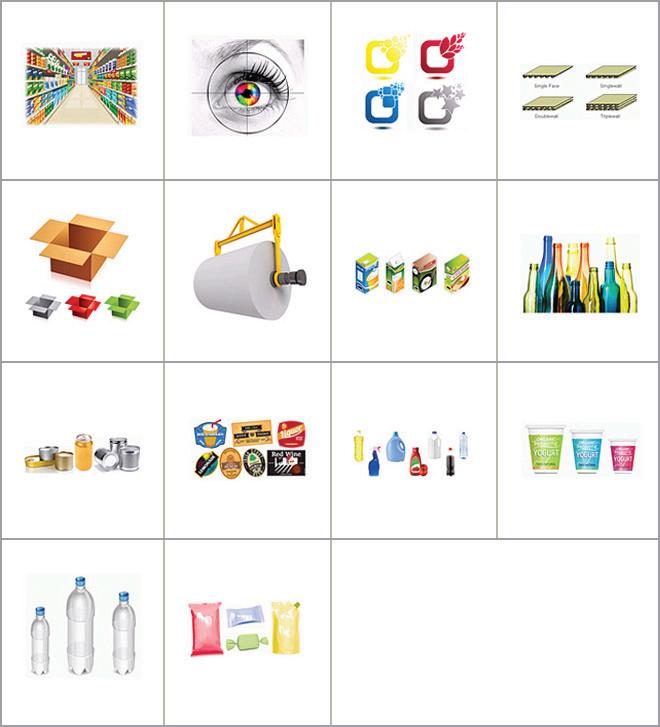
Martin Rémillard, Purchasing and Packaging Manager, MEGA Brands Inc.
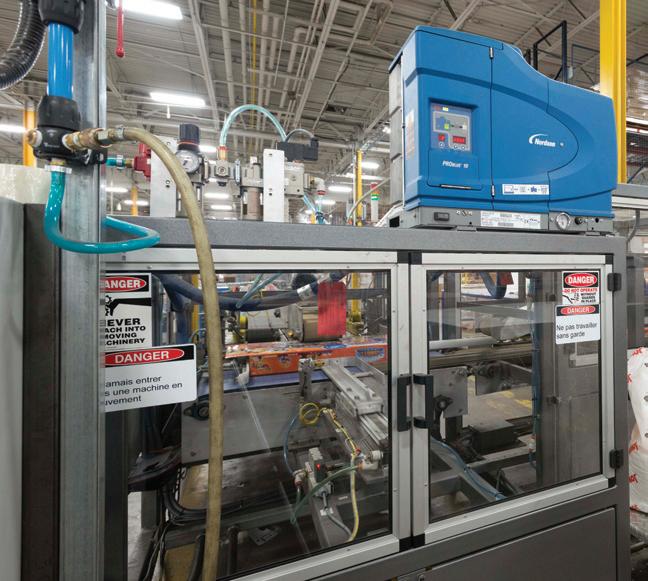
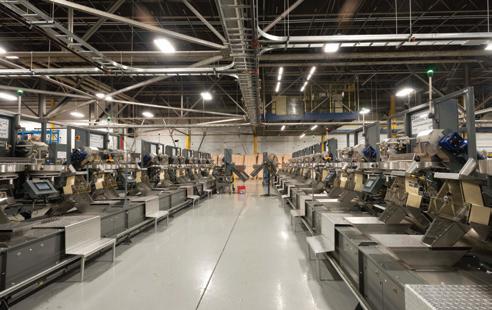
The MEGA Brands toy manufacturing and distribution facility in Montreal employs three trayformers from Eagle Packaging Machinery to maintain optimal secondary-packaging operations.
operating distribution centers and/or manufacturing facilities in 14 different countries, and selling to over 100 international markets. Despite its global clout and reach, it continues to remain a proud Canadian enterprise, with over 75 per cent of its global workforce of about 1,400 employees based in Montreal, where its global headquarters facility also houses one of North America’s largest toy manufacturing centers employing approximately 700 year-round permanent employees—doubling it payroll during the peak production periods.
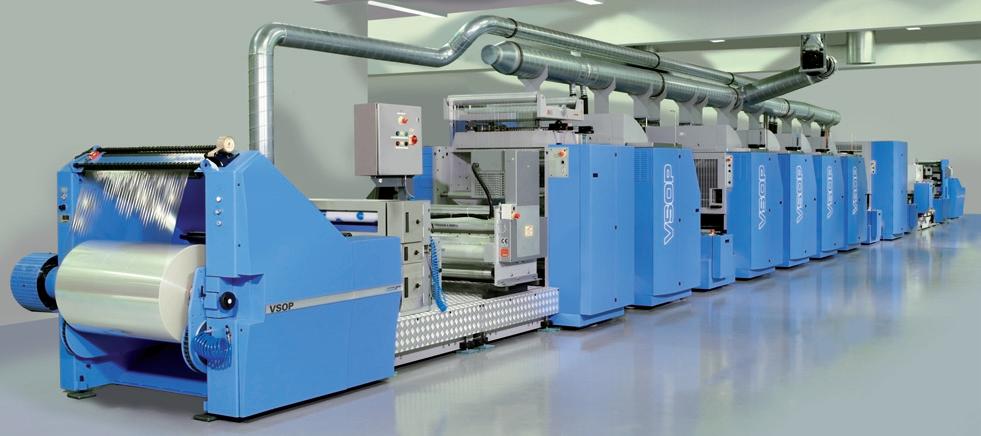
Always on the lookout to ensure its Montreal production line operations run as efficiently as possible, in 2010 it purchased a new tray former and sealer from Eagle Packaging Machinery, a Miami, Fla.-based manufacturer of automated secondary packaging solutions such as case and tray packers, formers, automatic loaders, pick-andplace systems, and box-sealers.
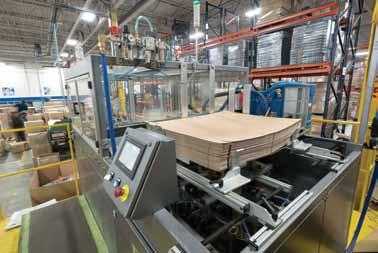
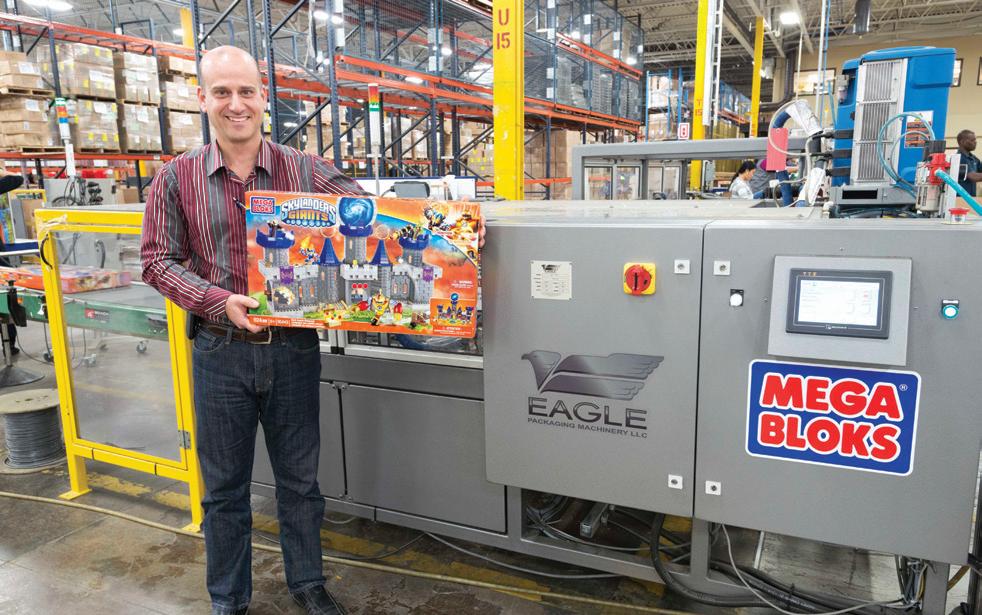
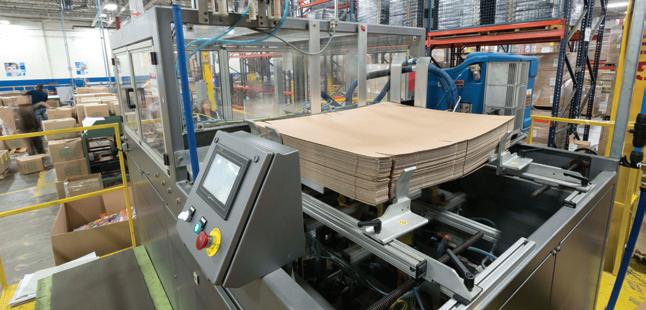
Designed to handle micro-fluted, bowed corrugated flats, the all-mechanical Vassoyo automatic tray-former is a high-speed, heavy-duty machine that MEGA Brands uses to form what Eagle Packaging sales executive Anthony Del Viscio calls a “reusable box,” or clamshell-style with the lid open.
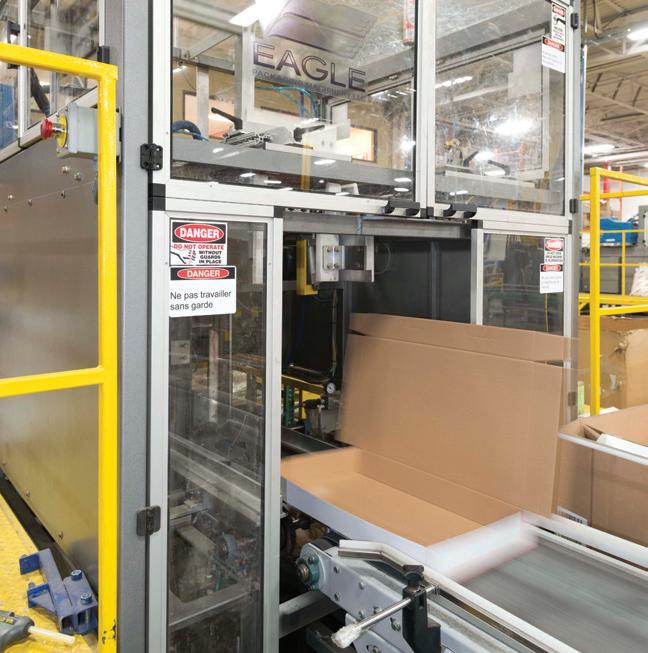
The Vassoyo takes corrugated flats from the hopper one-at-a-time using Venturi vacuum technology and feed them under the glue-guns for adhesive application to the tray’s minor flaps before it travels under the ram mandrel forcing it down through corner folders to form the base of the tray.
Standard partners for Eagle Packaging Machinery products include industrial controls manufacturer Omron, who supply the PLC (programmable logic controller), and Nordson Corporation, whose PROBlue 10 adhesive dispensing system is used to apply hot-melt glue to hold the package together.
“We actually took a base model Vassoyo and designed it specifically for MEGA Brands trays to have it better suit their operations,” notes Del Viscio, adding that the Vassoyo is engineered to provide a consistent square cornering on the formed trays.
“For MEGA Brands, we are keenly aware that the product and the package go hand-in-hand in helping the customer make a decision to purchase at the retail level.
“Not only does a package with good-quality graphic images on it draw a customer, but so too does the quality of the actual package,” adds Del Viscio.
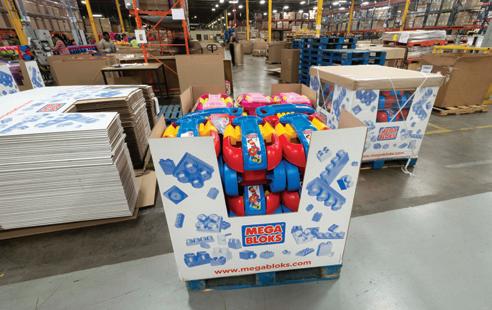
After the tray is formed and filled with MEGA BLOKS components such as bricks and instruction manuals, it travels through to the second part of the Vassoyo —the sealer—to close, fold the lid, and fully seal the carton with an adhesive on three sides.
According to MEGA Brands purchasing and packaging manager Martin Rémillard, a few months of operating the new Vassoyo, combined with the ongoing technical support provided by Eagle Packaging Machinery, prompted MEGA Brands to order a second Vassoyo in 2011 and a third one in 2012.
“Eagle Packaging Machinery has proven to be a good partner of MEGA Brands,” acknowledges Rémillard.
“Along with its ability to handle a variety of box sizes, this machine allows a quick-change functionality, notably reducing the downtime period.
“The Vassoyo machinery has doubled our efficiency,” he reveals. “Anytime the package can look better on the shelf, it’s better for MEGA Brands.”
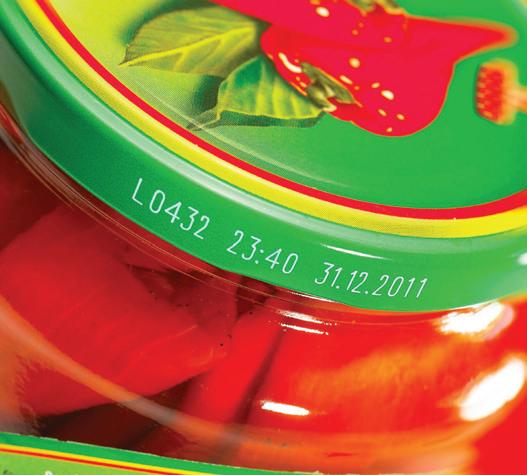
After all the required lot code data is applied, the construction toy packs are then readied for ship-
Manufactured by Eagle Packaging Machinery, fully-automated Vassoyo tray-erector forms a clamshell-style corrugated case at MEGA Brands’ production facility in Montreal.
Positioned just above the Vassoyo tray-erector, the signature blue ProBlue 10 hot-melt adhesive applicating system from Nordson Corporation helps ensure perfect corners for MEGA Brands construction toy packaging.
ment to customers by placing packs into a larger master case.
While Eagle Packaging Machinery does manufacture equipment that can quickly and efficiently erect trays with glue, as it does for MEGA Brands in Montreal, it also specializes in ‘fold-and-tuck’ type trays erectors, called POPLOK , that do not use glue at all, according to the company.
Del Viscio says that MEGA Brands has been a dream client to work with: “There is good communication between us, and we’ve become good partners.”
For his part, Rémillard says he likes the fact that MEGA Brands continues to improve the Montreal facility with new equipment including the machines from Eagle Packaging
“I think all of us are very happy to see that MEGA Brands continues to invest in the Montreal facility—that we are increasing the production level,” he says.
“The employees here are all proud to work for a company that grows, innovates and invests locally.”
BEE’S KNEES VISION SYSTEM
Data Matrix code identi cations on honey bees using the pictor smart camera
Long considered an important constant in the ecosystem, the bee plays an important role in the pollination of flowering plants and the production of honey, with some 20,000 known species spread out over every continent except for Antarctica.
Sweet honey goodness notwithstanding, scientists the world over are keen to ensure the overall health and welfare of the bee remains healthy, as it is estimated that about one-third of human food supply is actually dependent on insect pollination. In fact, most pollination is accomplished by bees, notably the domesticated European honey bee.
The chief concern for scientists is the concept of colony collapse disorder (CCD), in which something internally or externally introduced to the hive causes the extinction of the entire hive colony.
With possible survival of the human species at stake, scientists are taking a closer look to see if pesticides are playing a role in the destruction of the bee.
To accomplish that, scientists need to be able to track the bees better, and given the fact that one bee looks identical to any other bee in the hive, it’s a difficult proposition at best.
Despite the daunting proposition, there is a buzz of activity at the University of Würzburg, in Würzburg, Germany, where researchers at the BEEgroup are getting a closer look at the biology of the European honey bee—thanks to some cutting edge high technology.
Realizing that the best way to learn how to protect bees is first to discover where and what they are doing, BEEgroup founder Jürgen Tautz has attempted to catalogue a wide-ranging bee inventory.
To differentiate between the bees in the hive, Tautz, along with technical implementation speciality Hartut Vierle, began attaching—with a safe shellac adhesive—a small, lightweight Data Matrix RFID (radio frequency identification) code to the back of honey bees, which could be scanned and read when they passed in front of a smart camera attached to the inside of the beehive.
Because of the delicate nature of the procedure, the bees were immobilized by being placed on ice before having the Data Matrix code applied. Desite the relative size of the code, bees are strong insects—able to lift the code and a load of pollen with ease.
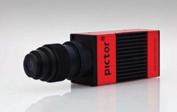
Unlike a standard cameras, the pictore M1617E series of smart camera is not being used to snap your usual photograph.
Manufactured in Germany by Vision & Control GmbH and further modified by EIDECON automation GmbH with a new lens and some additional lighting systems, HOBOS uses the pictore M1617E smart camera to take a snapshot of the bee as it flies within the camera’s range so that it can record exactly which bee it is and note when it left as well as when it returned.
Because the range of the Data Matrix code was only 0.10-inches, the hives were constructed with narrow openings to ensure the codes attached to the honey bees would be able to be read by the M1617E smart camera.
While it is still early in the research, and no theories have been postulated as to how to better protect the bee, scientists at HOBOS have learned that bees actually spend more of their life inside the hive than out, meaning the social skills required for a hive to thrive are even more important than previously thought.
The RFID codes on the bees are read by the (inset ) pictore M1617E smart camera from Vision & Control.
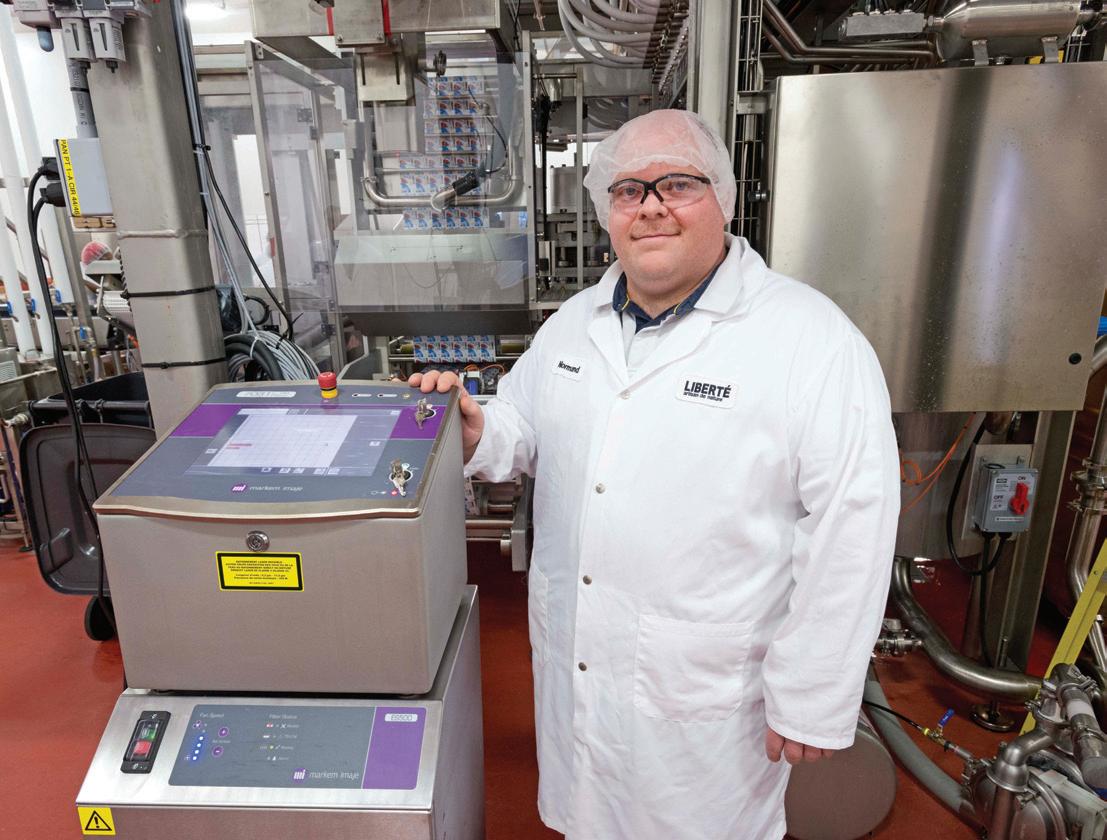
Liberté Brand Products Co. St. Hyacinthe Plant Manager Normand Champagne poses alongside a Markem-Imaje model 7031 HD laser coder linked up to the ES500 fume extractor, which instantly eliminates the tiny fumes and particles generated by laser beam burning through the top surface layer to create permanent marks and product codes.
LIBERTÉ FOR ALL
Quebec yogurt producer quick off the mark to update its product coding and packaging competencies with laser product-coding technology and high-speed industrial automation
Anyone who has recently glanced at the dairy aisle of a grocery store would be hardpressed not to have noticed that the yogurt section has more or less taken over as the aisle’s new dominant bestseller seemingly overnight. Which in retrospect seems only inevitable— thanks to the product’s inherent and virtually unrivaled ability to combine an inexpensive, delicious and nutritious taste experience in small, single-serve plastic cups that provide a delicious ‘good-for-you’ snack or meal-time option both at home and on-the-go.
And while yogurt has been on mankind’s menu in one form or another for an estimated 4,500 years, its long-awaited embrace by western consumer societies as a highly functional and superhealthy product is a fairly recent development. But better late than never.
Loaded with the so-called ‘good bacteria’
required for maintaining a healthy digestive tract, modern-day yogurt is truly a unique dairy staple that packs a formidable mix of the muchneeded proteins, calcium, vitamins B-2 and B-12, potassium and magnesium that are considered to be essential ingredients for maintaining a healthy body and appearance.
In fact, some yogurt a cionados have been known to apply it to their skin to achieve smoother texture, as well using it as polish for candlesticks.
So all in all, it’s fair to say that there has never been a better time to be in the yogurt business for the St. Hubert, Que.-headquartered Liberté Brand Products Co. than now.
Founded in 1936, the company manufactures a broad range of delicious all-natural, organic and specialty dairy products—specializing in the many varieties and avors of yogurt created in an artisan-like fashion.
Operating distribution centers in St. Hubert, Brampton, Ont., and Richmond, B.C., as well as two large production facilities in Toronto and St.
Hyacinthe, Que., the company is also a highlyreputed producer of cream cheese and cottage cheese originally developed speci cally to serve the dietary needs of the large Jewish community in the Montreal area, according to Normand Champagne, plant manager of the 120,000-squarefoot, 160-employee St. Hyacinthe facility.
“Liberté was formed by a family of Russian Jews eeing persecution at home who rst arrived New York City, where they were deeply inspired by the majesty of the Statue of Liberty,” Champagne told Canadian Packaging in a recent interview.
“So after moving to Canada to start their dairy business, producing cream cheese and cottage cheese, they named it after the iconic statue of freedom.”
After gaining a solid reputation and renown as a top-notch traditional and artisan manufacturer of dairy products, the company eventually relocated to a bigger premises in Brossard, Que., continuing to produce its popular cream cheese but also adding yogurt to the menu, Champagne relates.
And while the company still strictly adheres to
ANDREW JOSEPH, FEATURES EDITOR PHOTOS BY PIERRE LONGTIN
its original artisan roots and traditional craftsmanship stressing product quality and purity above all else, the sheer volume of yogurt it produces and markets nowadays is quite simply breathtaking— driven by the phenomenal market success achieved in recent years by its popular Méditerranée and Greek yogurt brands.
“Our St. Hyacinthe plant produces over onemillion kilograms of yogurt every week,” states Champagne.
“In fact, we are a national leader in the production and sale of Greek-style yogurts made at our HACCP (Hazard Analysis Critical Control Points)-certified St. Hyacinthe plant,” which was originally a 30,000-square-foot facility acquired by Liberté in its 2008 acquisition of the Kooll Desserts company.
“Having the production facility in such an important food-industry city like St. Hyacinthe is very important, as we were able to vastly expand our business potential,” says Champagne, explaining the quadrupling of the plant’s original size in just four years.
“Because Liberté had a sound plan in place, we
were able to make substantial capital investments in the facility while expanding and upgrading it to its current size,” Champagne explains.
Naturally, the company’s impressive growth and potential has attracted a number of deep-pocketed suitors over the years, with French-headquartered dairy powerhouse Yoplait acquiring it in 2010 and, a few months later, the international division of General Mills taking over ownership in January of 2011.
Despite the impressive recent upgrades to the facility size, and technologies and strategic importance, Liberté firmly remains in no rush to alter its hard-earned artisan image, asserts Champagne, citing the company’s strong community roots and CRS (corporate social responsibility) credentials displayed by the company’s ongoing support for further development of organic products and farms, implementing more sustainable work methods, and participating in many local-level community ‘green’ projects and programs.
“But above all that, the people who work at Liberté still consider themselves to be artisans producing high-quality artisan products,” explains
Champagne, pointing out that unlike most of the competing mass-produced yogurt products in the marketplace, Liberté’s yogurts do not contain any starches or thickening agents—letting the products’ all-natural composition and appearance to speak for itself.
Says Champagne: “We are very proud to have made our place of business less about solely being a factory, but more about creating a business with a real purpose to it.”
According to Champagne, that puprose is now exeptionally well-served on a daily basis with the plant’s brand new Erca filling line used to produce multipack single-serve yogurt in a swift, operatorfrinedly process, whereby the Erca form/fill/seal machine quickly heats a plastic sheet, forms it into a plastic cup shape base, cools the plastic, and then fills it four at a time with up to four different flavors of fruit-in-bottom or stirred-fruit yogurt varieties.
“After filling the individual cups, the Erca adds lidding, applies wallpapers (wraparound brand graphics) and heat-seals it,” Champagne explains.
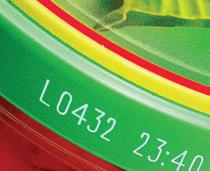
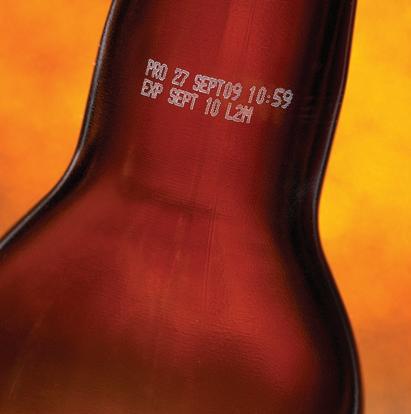
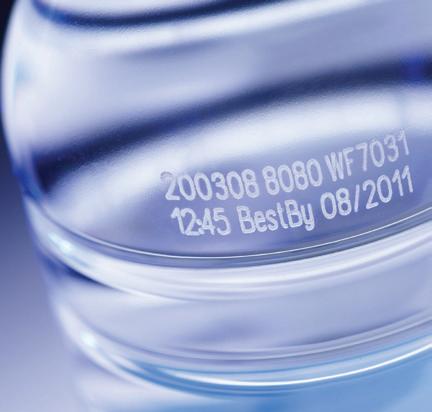
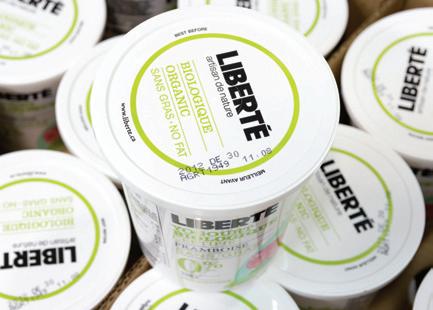
After the lidding is done, the packs are swiftly conveyed for lot-code and best-before date application now handled by the plant’s brand new, state-ofthe-art laser coding system.
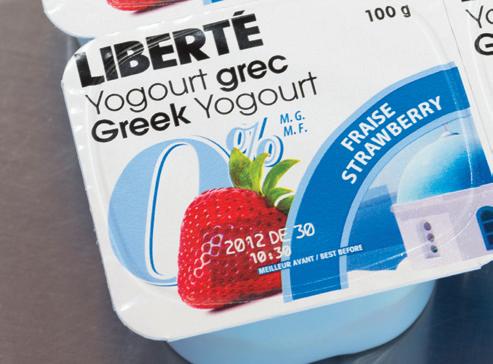
Manufactured by Markem-Imaje, the 7031 HD (high-definition) laser coder is able to mark the tops of 24 yogurt cups per cycle at such a high rate of coding speed, it enables Liberté to reduce its operating expenses—Markem-Imaje told Liberté that in order to perform the same job, six standard continuous inkjet coders would be required.
“We also save on production line downtime because, as with all laser systems, no time is spent adding inks to the machine,” says Champagne.
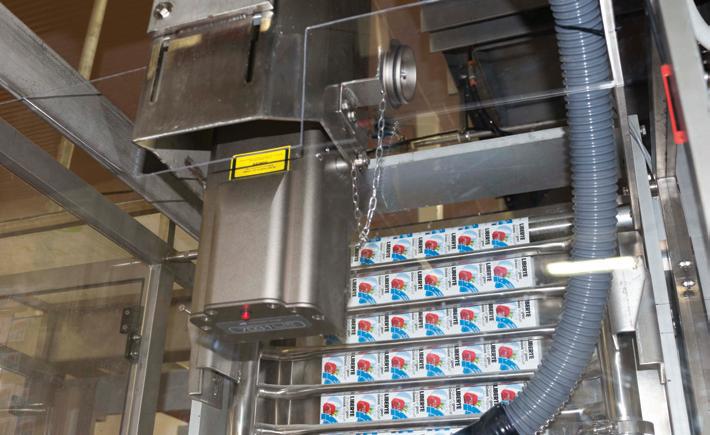
According to Markem-Imaje national sales manager Tony Stryker, “The laser system actually removes a layer of ink from the top surface of the seal without compromising the product seal while adding 24 codes to the yogurt packs in less than one second.”
For Liberté, the Markem-Imaje 7031 HD can print over a large area: up to 16x16-inches with a single head. With a higher energy output and smaller footprint than other competing laser coders on the market, the 7031 HD is easily integrated while using less power which helps extend the life of the laser head to over 30,000 hours of operating time.
Liberté has long been familiar with the excellent
A Markem-Imaje 7031 HD laser coder safely marks the tops of 24 yogurt lids in less than one second on the Erca lling line.
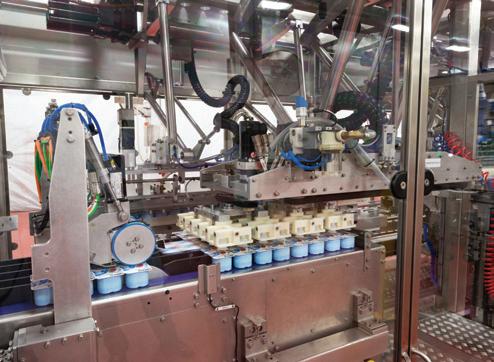
The CPS 50 complete robotic packaging station built by Automation Robotic Packaging automatically moves multipacks of yogurt products onto the paperboard sleeve assembly unit.
A Markem-Imaje 7031 HD laser coder adds permanent coding by removing a layer of ink from the sealed surface to apply best-before dates and time of packaging information.
marking qualities of Markem-Imaje equipment, having rst purchased multiple continuous inkjet coders from the equipment manufacturer seven years previous.
within the ARP includes: a Schneider Electric’s Magelis touchscreen operator panel, s’redienhcS morf srotom ovres
And when Liberté was looking for an additional solution, it was just icing on the cake for Champagne when he discovered that parent-company Yoplait also had a very strong global partnership with Markem-Imaje.
Elau Packaging Solutions; derutcafunam dna dengised metsys royevnoc a by FlexLink that guides materials through each stage of the station; derutcafunam srotom
After the lling and coding, the yogurt multipacks travel through a Safeline industrial metal detection system manufactured by Mettler-Toledo International Inc. before moving through a custom-manufactured CPS 50 compact robotic packaging station designed and built by the French-based Automation Robotic Packaging (ARP)
Key performance features of the CPS 50 robotic packaging station include: quick format changeover; easy accessibility and superior ergonomics for operators; robust stainless-steel construction; highperformance components and parts for reduced and simpli ed maintenance.
Some of the important components utilized
SEW-Eurodrive and Festo pneumatics providing power to the conveyor.
The easy-to-operate ARP is able to pick up multipacks of four, six, eight, 12 or 16, rotate it 90-degrees and place it atop a paperboard blank provided by St. Hyacinthe’s Groupe Ecco. The paperboard blank has a jet of hot glue supplied by Technical Adhesives applied via a Nordson ProBlue7 adhesive application system as the paperboard is folded around the yogurt pack to form a sleeve.
The ARP then picks up the sleeved yogurt pack, rotates it another 90 degrees and places it atop a larger corrugated tray blank made by Norampac,
THE HIGHEST READ RATES EVER
WHAT WOULD HIGHER BARCODE READ RATES MEAN TO YOU?
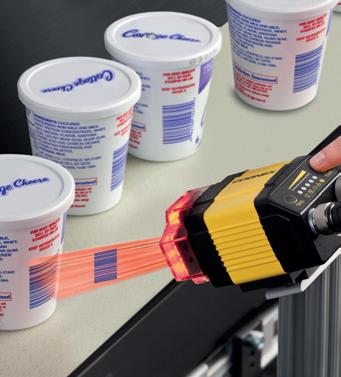
High read rates help you increase efficiency, lower costs, and control traceability. With the new DataMan® 300 image-based barcode reader, even higher read rates can now be achieved:
Intelligent Tuning automatically adjusts lighting, focus and exposure to optimize code reading, with a single button press.
1DMax+ with ‘Hotbars’ technology reads 1-D barcodes faster and more reliably, even if damaged or badly printed.
2DMax+ reads any 2-D code, no matter the printing method, the surface it is marked on, or the code quality.
To get the benefit of the highest read rates ever, visit:
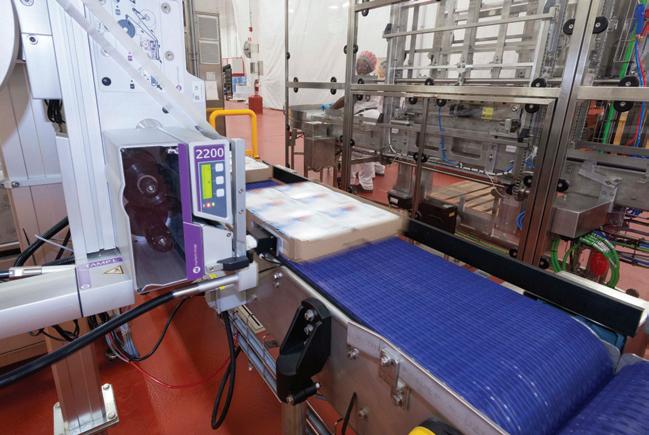
A Markem-Imaje 2200 print-and-apply labeler quickly attaching a thermal-transfer label containing product
When you talk financing with Farm Credit Canada, we’ll listen Ready to expand your business? We’re ready to help. We get to know you and your business. Once we learn how you want to grow, we’ll create a financing package that helps you do it. Work with the leading lender to agriculture, agribusiness and agri-food in Canada. Let’s talk business. www.fccfinancing.ca
a division of Cascades. After enough sleeved packs are placed onto the corrugated blank, the ARP folds the blank forming a tray at a high rate of speed before stacking it.
Contained within the ARP, a Markem-Imaje 2200 print-and-apply labeler creates a white adhesive thermal transfer containing manufacturing date, expiry date and product barcode data and quickly applies the label to a sidewall of the newly formed trays.
According to Stryker, the 2200 can print and apply labels at rates of up to 125 packs per minute, adding it is designed to offer flexibility as a single standard printer but with many label applicator options such as side-, top-, front-, front and side-, corner wrap and more.
While containing robust components, Stryker says that for parts that typically see more wear during prolonged operation—like the print head and roller—it can be easily replaced without the use of tools, ensuring minimal downtime. As well, to avoid unnecessary production stoppages, is designed to match both label stock and ribbon at 560 meters to assure both are replenished at the same time.
“Label images can be stored on the printer and downloaded via USB or Ethernet connection,” continues Stryker. “Labels can also be stored on a server and sent to the printer at the time of production.”
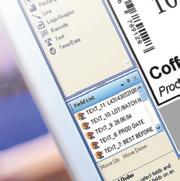
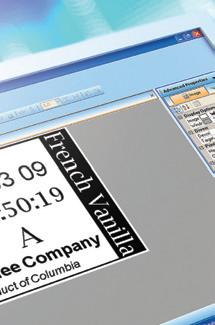
Another recent purchase for Liberté, is a Markem-Imaje CoLOS Create Pro software tool that provides the yogurt manufacturer with the ability to create label images including text, bar codes, logos, time and date fields, counters, automatic date offsets and more. Although available separately, this tool is part of the CoLOS Enterprise network version that allows for two-way communication with an unlimited number of printers.
“Every printer on a factory floor can be connected to a single com-
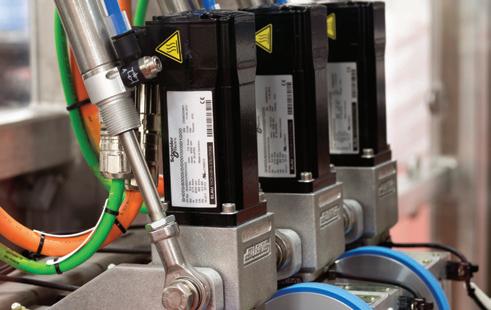
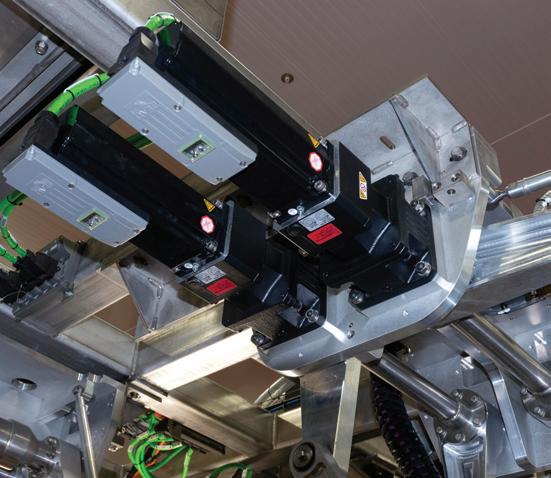
A trio of Schneider Electric’s Elau Packaging Solutions SH-055 AC servomotors used to power the ARP robotic packaging station.
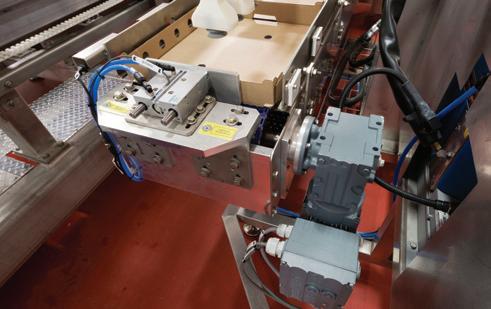
Robust SEW-Eurodrive AC motors and precisiosn Festo pneumatics enable the ARP robotic packaging station to form corrugated trays for multipacks of yogurt at high speeds.
puter where all of the printer data is stored and maintained centrally,” explains Stryker adding that CoLOS Enterprise provides real-time printer status information alerting the operator if a printer is getting low on supplies or has a fault condition.
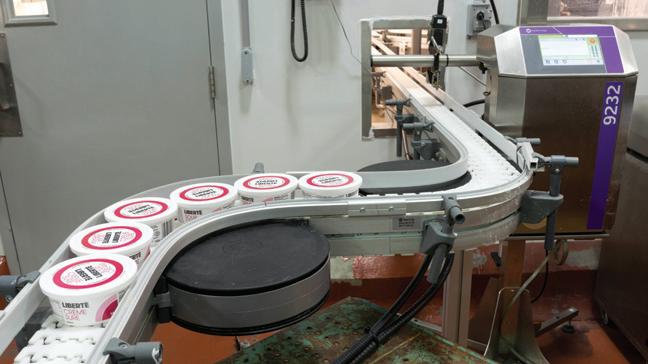
Other Markem-Imaje inkjet coding equipment at the Liberté St. Hyacinthe facility includes two Model 9232 ’s, three Model 9020/9030 ’s, one 9040, and five additional model 2200 print-and-apply machines.
“The dairy industry—and the yogurt industry especially—is a very competitive segment within the food-processing sector,” explains Champagne. “It is important for us to be considered a leader within the yogurt-manufacturing industry, and not to be satisfied in merely following others.
“Liberté is aware that the Greek and Mediterranean yogurts are currently a hot commodity for consumers, and we have to keep our competitive edge through constant innovation,” sums up Champagne, “and that includes the way we operate our production line.
“We are always looking for great new equipment, like the MarkemImaje 7031 HD laser coder and the ARP and Erca equipment, to give us a competitive edge to help us maintain our leadership in the yogurt processing market well into the future.”
OEM replacement parts
The CPS 50 robotic packaging station uses high-performance servomotors, manufactured by Schneider Electric’s Elau Packaging Solutions business, for optimal power distribution and ef ciency.
LINKS TO SUCCESS
Ontario meat processor strives to maintain harmonious balance between authentic tradition and modern technology
ANDREW JOSEPH, FEATURES EDITOR
PHOTOS BY COLE GARSIDE
Having established itself as a successful processor of smoked meats in southwestern Ontario long ago, Sikorski Sausages Co. Ltd. has also long been aware of the constant need to keep improving its daily business in order to remain a key player in the fiercely competitive meat processing industry and a hotly-contested regional market.
And over the years, the London, Ont.-based family business has come a long way from being exclusively a niche smoked-meats processor specializing in pork to diversify into various turkey, chicken, beef and veal products to keep up with the constant shifts in consumers tastes in timely fashion.
But while this naturally involved many changes to the way the 29-year-old company manufactured its products with continuous investment
in the latest-generation processing and packaging technologies—it remained faithfully committed to maintaining the same traditional, authentic Old World cooking recipes that have made it such a well-respected brand name in the first place.
In fact, it didn’t take the company all that long to quickly find its business niche by supplying its flavorful and smoky deli meats and sausages to the well-established Polish and other central and eastern European communities in the region, faithfully replicating many beloved old-school recipes of long and short sausages, wieners, deli meats, coldcuts, patés and head cheeses, along with a healthy range of muscled hams, loins, roasts and bacon.
The warm marketplace response to its products so soon after startup prompted it to form a sister retail company under the Starsky Foods banner— today operating three strategic retail locations in the nearby densely-populated Ontario cities of Hamilton, Mississauga and Oakville.
Along with shipping its meats to Starsky Foods and about 400 smaller mom-and-pop retailers catering to the European ethnic communities, Sikorski Sausages today also supplies the deli counters of large grocery retail chains like Loblaws, Fortinos, Zehrs, Longo’s, Highland Farms, Commisso’s Fresh Foods and Sobeys capping off three years of rapid growth that has its chief executive officer Peter Sikorski highly upbeat about the company’s growth potential.
Leading Edge
“Although the Sikorski family was comfortable with the success and growth of the company, I looked at it and thought that if we don’t modernize our facility and food safety procedures, the company would lose its competitive edge in a year or two,” recalls Peter, the eldest son of company founder Marek Sikorski who joined the family business five years ago after completing his business degree at the University of Toronto “I really wanted to apply my energy and the business acumen I had acquired in school to take my family business up to the next level,” Sikorski told Canadian Packaging on a recent visit to the company’s modern,
Peter Sikorski, Chief Executive Of cer, Sikorski Sausages Co. Ltd.
Sikorski Sausages purchased a new Multivac R535 thermoformer (inset above) to perform MAP and vacuum-packing of the company’s diverse bacons, hams and sausages.
ultra-clean London facility.
After receiving due guidance and advice from his father, Sikorski launched a five-year plan that would not only ensure the company’s survival, he expains, but help propel it to the very forefront of European-style meat processing in Ontario—a plan that involved taking the small, family-owned business into a new state-of-the-art facility where food safety would be of the utmost importance.
Size Matters
When the company doors had first opened in 1983, it was a mere 1,500-square-foot shop located in one of four units of a multi-use business complex, but between 1985 and 1995 it acquired and equipped the three remaining units to expand production.
In 1995, Sikorski Sausages coordinated a major expansion and retrofit of the 10,000-square-foot plant to facilitate higher food safety standards and production levels, enabling it to finally become a player of note in the Ontario meat-processing world.
By 2008, Sikorski says that although the brand had developed great customer loyalty by effectively differentiating itself from the competition, he felt that future product demand was still being constrained by limited and aging production space, along with increasing sanitation and food safety regulations.
“The goal was to retrofit the existing facility and to build a 15,000-squarefoot addition that would update Sikorski Sausages with the latest in food safety systems, while also creating a space that would allow us to triple our production capacity,” states Sikorski.
Sikorski recalls he spent a year designing the new facility with the help of plant managers, to ensure that rooms were built to meet their specific purpose, a modular design that would allow for future expansion at the lowest possible future costs.
Along with Krzysztof Doniec, the company’s chief mechanic, Sikorski opted to
PACKAGING FOR FRESHNESS
manage the construction personally, rather than hire a general contractor.
Breaking ground in 2009, the project was completed by the end of 2011, with the company continuing its day-to-day business while the expansion went on around it.
“Although the old 10,000-square-foot facility was nothing to sneeze at, nowadays we process some 140 SKUs (stock-keeping units) of smoked meats in a state-of-the-art, 25,000-square-foot plant with 48 dedicated employees,” relates Sikorski, recalling the comprehensive $4.5-million modernization project.
Sikorski says that upon completion of the upgrade, the company was only running four days of production a week.
“But that didn’t last too long,” he notes. “To facilitate growth, we knew we would need a larger sales force, new marketing strategies, and a plan to introduce our products to whole new market segments.”
Robotic Tool Changers increase flexibility and productivity.
Along with capacity expansion, Sikorski Sausages also had to make the necessary capital investments in top-of-the-line packaging equipment in order to protect its products from contamination after they leave the processing facility.
One of those investments was a brand new Multivac R535 thermoformer capable of performing both MAP (modified-atmosphere packaging) and vacuum-packing for bulkier products as bacon, hams and sausages.
Along with being a high-speed, high-output machine, Sikorski is keen to point out that the R535 helps ensure a consistent hygiene cycle as this packaging solution exceeds international safety requirements.
“And it also provides us with a very smooth packaging process,” mentions Sikorski, “with greater efficiency that helps us save time and resources.”
According to Multivac, the R535 is designed for easy comprehensive cleaning—both inside
• Increase the flexibility of your robots by adding the ability to use more than one end-effector in an application.
• Production line tooling changed in seconds for maximum flexibility.
• Change tools in seconds for maintenance and repair.
• Increase operator safety by changing tools automatically.
• Million-cycle tested for reliability.
Superior Fail-Safe—springless design maintains lock position in event of air pressure loss
Locking Balls—Low-friction locking balls extend the life of the unit
Specially Tapered Cam—second taper produces high locking strength
Lock Ring—Wide footprint of lock ring creates high moment capacity in locking mechanism
ROBOTIC END EFFECTORS
• Food-handling models available.
After placing links of smoked sausages into a deep lm tray, a line worker prepares the Multivac 535 thermoformer to package bulk sausages in MAP packs.
Using MAP gas-mix supplied by Air Liquide, the R535 thermoformer from Multivac provides a clean and clear high-barier lm package.
Packed in plastic lm supplied by Winpack, smoked meats await order-picking inside the ShuttleBin 330 folding containers manufactured by Macro Plastics.
PACKAGING FOR FRESHNESS
and out—with modifications to the film transport chain guide, chain design, lifting mechanisms, motors, valves and mechanical elements, and an easy-to-open frame profile for cleaning and maintenance.
Sikorski says he really appreciates the R535 system’s smooth slanted surfaces—without a single edge or corner—so drainage after cleaning ensures that no residual dirt remains on the surface of the machine.
“We also like the fact that we can quickly and easily change tooling on the R535, thanks to its side extraction mechanism,” admits Sikorski. “It has a simple drawer action that we can use without having to take apart the hot tool surface.”
Sikorski says the plant’s R535 uses a large 660-millimeter die that helps form deep drawn packages to seal in the freshness of bulk meats. Aside from the obvious benefit that MAP process
provides to meat processors, Sikorski says that ultimately he chose to use the system to better protect the product during the rigors of the shipping process.
“At this point, shelf-life becomes a non-issue for us,” he explains. “Part of our philosophy is that we treat our product like fresh bread.
“We deliver fresh product to each of our 400plus stores at least once per week and impress on the deli manager to order only as much product as they feel they will sell before the next shipment,” he explains.
In essence, Sikorski says he prefers to think of the R535 machine “like a dust cover: to protect it from airborne pathogens and to get it safely from our facility to the customer’s meat counter.”
For MAP sealing, Sikorski Sausages utilizes a gas mix of 25-per-cent carbon-dioxide and 75-per-cent nitrogen supplied by Air Liquide, a leading global
manufacturer in the supply of industrial gases. Sikorski recalls: “I had been familiar with Multivac and their wide range of products for quite some time before we purchased one. For me, I really like the fact that Multivac was known for their superior level of construction and quality.
“No processor wants downtime, and with Multivac, we knew the robustness of the R535 was exactly what we required as our company continues to grow,” he states.
Along with a Beckhoff 12-inch touchscreen HMI (human-machine interface) ELO Accutouch terminal, the machine utilizes the high-performance Busch R5 pumps and Norgren pneumatics, while its control panel incorporates Siemens Sitop power supplies, ABB circuit-breakers, and a SEW-Eurodrive Movitrac frequency inverter.
On another production line, after manually loading a temperature sensitive film vacuum bag with a meat portion, workers place the packs into a VC999 07P vacuum-packing machine, which seals the meat within the bags by applying pressure and heat.
The sealed bags are then placed onto a conveyor and moved into a VC999 85.47i shrink-tank, which uses hot water to further shrink the bag film around the meat product to produce a perfectlooking final package.
After the packaging is done, Sikorski Sausages stores the product within collapsible, reusable polypropylene plastic ShuttleBin 330 folding containers manufactured by Macro Plastics Inc.
The product is then picked and hand-packed into corrugated cartons supplied by Rock-Tenn, which are then weighed and have an adhesive label printed by an Ishida pre-pack scale printer.
With the company currently in the process of achieving federal certification, Sikorski says he is pleased with his new facility and its new high levels of hygiene and food safety.
“I am very proud to have a state-of-the-art facility where our food safety is paramount,” extols Sikorski.
“We placed all conduits away from the walls to make them easier to clean behind; we created curved edges along all wall corners; the floors are at a two-percent slope to accommodate better drainage, and are coated with a polyurethane epoxy finish for better cleanability; and we utilize a rack-type refrigeration system that sends me an email if the temperature of any room deviates from set thresholds.”
States Sikorski: “The upgraded facility, the fantastic new thermoformer, and all of the safety protocols we have initiated have all helped Sikorski Sausages grow these past three years, but more importantly, they have also helped us prepare for the future as well.”
For More Information:
The plant’s second packaging line employs a VC999 07P vacuum-packer and a 85.47i hot-water shrink tank.
A sampling of many Sikorski Sausages smoked meat products packaged by the the VC999 07P vacuum-packer.
The Multivac R535 thermoformer incorporates an SEWEurodrive Movitrac frequency inverter inside the control panel for smooth power distribution.
A product- lled corrugated carton from Rock-Tenn makes a stop to be weighed and have a shipping label, made by an Ishida pre-pack scale printer, applied to the top panel.
CANADIAN CONVERTING
GETTING FIT TO PRINT
Seismic marketplace shifts and rapid technological evolution rede ning the global package printing industry
BY GEORGE GUIDONI, EDITOR
Marketing printing services and technologies in the brave new digital world may seem like trying to sell whips and horsebuggies in the early days of the mass automobile production a century ago, but contrary to popular belief, history does not necessarily always repeat itself.
While there’s no denying or understating the profound permanent impact of digital online publishing on the traditional global commercial printing markets—as any major newspaper publisher of note will sadly confirm—the widely-held popular belief that “Print is Dead” has little relevance in today’s global market for package printing and converting technologies.
According to the leading packaging industry group PMMI of Reston, Va., sales or packaging and converting equipment accounted for a 10 per cent share of the US$7.7 billion worth of packing machinery shipped by all U.S.-based packaging equipment manufacturers of packaging machinery—hardly a tell-tale sign of an industry in permanent decline and acute distress.
global economy.
According to the U.S.based market researchers Global Print, the global market for all print products is expected to reach an estimated US$724 billion by 2014, with the package printing segment accounting for US$202.1 billion of the projected total, and related prepress systems and services for another US$18.1 billion.
Conversely, the global commercial printing market (excluding newspapers) is expected to decline from US$366 billion in 2008 to $358.9 billion by 2014, according to the Global Print’s forecast, which also expects Asia to replace North America as the biggest regional market for print products and technologies during the forecast period with a nearly 35-percent global market share.
Designed speci cally for short-run folding-carton printing application, the new state-of-the-art Xerox Automated Packaging Solution (XAPS) was used to produce the paperboard boxes featured on this page.
Not surprisingly, many major commercial printers who have seen the writing on the wall early enough have been stepping up their efforts to find new customers in the package printing and converting markets by investing in new-generation printing technologies able to accommodate costefficient production of various types of product labeling and selective pre-printed packaging products—albeit with various degrees of success.
And even more remarkably, leading brand names traditionally associated with office and other commercial printing technologies are also belatedly following suit—as evidenced by the rapid proliferation and popularity of the Hewlett-Packard (HP)’s famed Indigo series of all-digital label printing systems and, more recently, the grand entry of office photocopier giant Xerox into the package-printing marketplace that is starting to show its limits against the backdrop of a faltering
That said, the U.S. will still be the runaway biggest single market for print in 2014 at $185.9 billion, with Canada slipping from eighth to 10th place at US$18.9 billion, being surpassed by the fast-growing print demand in the BRIC economies of India and Brazil.
With more commercial and general printers turning to the packaging markets to maintain and grow their business, the last few years have witnessed a rapid acceleration in the development of more digital on-demand printing technologies and software to enable them to compete with the more established players, according to some prominent industry insiders.
“Just a little over 10 years ago, the graphic community was a ‘fat’ society,” says Larry Moore, director of Software Services North America for the leading global graphic arts prepress systems developer Esko Group, Belgianbased prepress hardware and software manufacturer operating five production facilities in Europe, along with factories in the U.S., China and India.
“For the most part, business was pretty good—until new market influences, namely the Internet and the post-9/11 economic conditions made the global print community much more cautious about its future prospects.
“In addition, short-run production from digital (presses) had not come of age yet,” Moore told Canadian Packaging in a recent interview. “For example, HP’s Indigo press was still early in its infancy.
“While product development was already becoming pretty advanced,” Moore relates, “it was just not as sophisticated as it is now—with very well-defined, targeted consumer product industry customers who are now even more focused on developing more product varieties and brand extensions than they ever used to be.”
Says Moore: “Many commercial printers who traditionally focused on publishing are starting to look at brand management/packaging and sign/display print applications, and are also trying to get involved in label or folding carton printing.
CANADIAN CONVERTING
“Not only are these the new growth printing areas, but they would also involve a lot of the same equipment they used for their commercial printing work—thereby requiring less investment in new capital equipment.
“If they are successful, they could create a lot of competition for companies who have gotten used to competing on price, which could erode profits for everyone.
“The big challenge to existing companies that have always been involved in packaging is to offer services that exceed what others are doing,” Moore asserts.
“This could involve providing better collaboration tools, faster prepress delivery with new technologies, use of 3D proofing, etc.
“But while the intrusion of commercial printers into packaging could threaten existing business status quo, it could well turn out to be a good thing for the industry in the long run,” Moore expands.
“There is still extra capacity for smaller companies to get involved in smaller projects—for example, producing 200 pieces of packaging for some special widgets, which could help some smaller consumer product compan-
ies get off the ground.
“The biggest threat to our industry is complacency,” Moore proclaims. “Companies have to accept technology as it is introduced.”
Office printing systems supplier Xerox certainly appears to be anticipating CPG companies to do just that—having recently introduced the company’s state-of-the-art Xerox Automated Packaging Solution System (XAPS) to the global graphic arts community, which is now available in North America after a series of successful startups in Europe, according to the company.
headquartered Xerox Canada Ltd. subsidiary.
Described as the world’s first and only fully-integrated, inline digital solution for package printing applications, the XAPS system features a leadingedge iGe4 digital press designed primarily for shortrun color printing at speeds of up to 110 packs per minute in one smooth, integrated process that also incorporates a Stora Enso Gallup buffering stacker, the Epic CT1-635 inline coater, and a Stora Enso Gallup DC 58 die-cutter to take care of the entire folding-carton production process.
“Xerox has been in the business of providing our (XAPS) solution for folding-carton producers in the European market for the last two to three years, and we are proud to have made this solution available in North America over the last 12 months,” says Chris Connor, Canadian director of highend solution at the company’s Toronto-
“This technology is the logical evolution of our proprietary iGen Platform technology that we have already been marketing to the commercial print market for the past 10 years,” Connor relates.
According to Connor, it would have been unthinkable 10 years ago to adapt the iGen technology for packaging applications, “because none of the key technologies to make it happen existed yet.”
But that has all changed since then, according to Connor, thanks to important technological breakthroughs in digital printing capabilities, including:
• Improvements in image quality, up to 2,400x2,400- dpi (dots per inch);
• Increases in sheet size, up to 14.33”x26”;
• Increases in paper weights to facilitate the printing of SBS (solid bleached sulphate) paperboard grades;
• Development of flexible inline coaters and die-cutters;
• Rapid evolution of automated packaging workflow systems and processes.
Says Connor: “The iGen Platform was designed by Xerox over 10 years ago with the intention to evolve it over time, with new capabilities and technological developments that would enable new industry applications in new segments such as the folding-carton market.”
Connor says that there have already been more than 30 successful XAPS system installations and startups, citing several notable examples such as:
The VSOP range of offset web presses manufactured by Müller Martini is designed to ensure fast changeover and lead times to facilitate cost-competitive printing of labels and exible packaging products with superior print quality.
• Dublin, Ireland-based Mediaware Digital producing boxes for the Microsoft Windows 7 software products;
• Production of personalized chocolate boxes via a high-tech process whereby clients are able to upload pictures and text from a website to print directly onto the boxes;
• Similar web-enable production of customized chewing gum containers, whereby clients can also upload pictures, text, names and colors to print onto the box covers;
• Production of pharmaceutical boxes with advanced security features that could one day replace the need for traditional instructions inserts by printing all the required text on the inside panels of the boxes.
“There are many key benefits of the XAPS systems that end-users can optimize to their advantage,” says Connor. “For example, the overall supply chain process associated with the way that Microsoft used to process new orders for Windows 7 boxes versus the way they do it in Europe, Asia and Africa has been radically enhanced by moving from print-to-inventory to print-in-demand methodology.
“You have the benefits of elimination of inventory and associated obsolescence, substantial reduction in the cost of production, substantial reduction in the turnaround time for box production, and the flexibility of allowing Microsoft purchasing agents to place their orders ‘on-demand’ for specific stores, in specific regions, on strictly as-needed basis,” states Connor.
He continues: “I really believe that Xerox is at the leading edge of rapid technology advances in digital printing with the XAPS technology, which already has proven to have great applicability and viability today to address the fast-changing requirements in the folding-carton industry, as Xerox continues to make the required R&D technology investments to keep us at the forefront of future technology advancements.
“Our belief at Xerox is that the size of the folding-carton market overall is going to be maintained over the course of the next 10 years,” Connor says.
“That said, the fast-changing market requirements—shorter runs, security features, environmental expectations, personalization, QR Codes, special marketing needs, and faster turnaround times etc.—will help ensure a significant increase in demand for short-run digital solutions in this market for the next 10 years—providing us with a significant growth opportunity.
Wolfgang Ruoff, product manager of printing presses with the leading German offset printing presses manufacturer
CANADIAN CONVERTING
Designed for handling a wide variety of materials, the new Kongsberg XN range of nishing tables from Esko features a modular tabletop industrial design, a choice of seven sizes and four different toolhead designs, and innovative insert tools such as solid board v-notching insert, a corrugated paper-core board v-notching insert, and a Braille tool insert.
Müller Martini Druckmaschinen GmbH, says that while changing CPG customer requirements will provide promising growth opportunities for suppliers of digital package printing, this trend does not mean inevitable obsolescence for the more traditional offset press technology that has also gone through a rigorous technological evolution in the last decade—enabling it to become a highly costeffective solution for printing flexible packaging as well as folding cartons.
“We began printing film with offset machines about eight to 10 years ago to serve our traditional customers printing forms and direct mail products looking to move into new markets, as well as the traditional flexographic Rotogravure printers who needed new solutions for making them more costcompetitive for shorter-run applications, with higher print quality,” Ruoff recalls.
According to Ruoff, the company has installed over 120 model Alprinta V and VSOP (Variable Sleeve Offset Printing) web offset presses worldwide for end-users looking to obtain such benefits in their label and film printing applications, with the popular Bolthouse energy beverages and Welch’s grape jelly brand using VSOP offest presses to print their branded shrinksleeves.
printing with exceptional print fidelity,” he says.
“In the old days, you would use rotogravure for high-quality printing and flexo for lower-quality printing,” says Ruoff, “but with shorter-run production, rotogravure is often just too expensive, whereas flexo is still not good enough, in some cases, to meet the higher-quality requirements for better shelf impact.
“With the frequently changing designs requested by the multinational brand-owners, there are really no repeat jobs any more,” says Ruoff, noting that a growing number of private-label and store brands are becoming increasing more demanding in their expectations of high print quality.
“Package design in general is moving up the corporate ladder and goes well beyond just graphics and up the corporate ladder,” he states. “The numbers of SKUs (stock-keeping units) are up significantly for just about every product category, as multinational brand-owners want to be in every price point up and down the shelf.
Designed primarily for exographic printing of exible packaging and folding cartons, the model CDI Spark 4260 imager from Esko is designed to provide fully-automatic plate loading and unloading for maximum throughput and minimum operator intervention.
“Utilizing our presses enables them to do that cost-effectively by offering them the benefits of best printing quality, shortest lead-times for printing new jobs, the industry’s lowest image-carrier costs, fast changeover times, the option to build customized hybrid presses with integrated flexo or rotogravure units, and inline converting processes such as diecutting and lamination of self-adhesive labels.”
“We are the only company who can offer reliable and proven solutions for infinitely-variable offset solutions for both label and flexible packaging
industry and are supported by a comprehensive sales, customer service and distribution network. Contact us today to find out how we can help eliminate packaging bottlenecks and improve productivity.
AUTOMATE NOW
SWEET HOME AND DRY
Going dry may sound like an odd proposition for one of the world’s largest wine producers, but a new dry-running conveying line installed less than a year ago at the Quebec-based bottling operations of Constellation Brands Inc. (formerly Vincor Canada Inc.) in Rougemont, Que., is certainly doing its part to give the term “dry wine” a whole new meaning by completely eliminating the time-consuming soap-and-water cleaning, lubrication and preventive maintenance that have long constrained the plant from realizing its full productivity potential.
Manufactured by the Power Transmission Solutions unit of the St. Louis, Mo.-based industrial equipment group Emerson Industrial Automation, the plant’s newly-acquired Plast NG conveyor chain and Nolu-S wear track have in fact already paid for themselves just in terms of increased production alone, according to plant maintenance manager Jorge Larraguilbel, who also cites other key benefits such as improved sanitation, reduced maintenance costs, greater system reliability and reduced noise levels.
“By eliminating the risk of soap build-up that can potentially breed bacteria, we also facilitated our HACCP (Hazard Analysis Critical Control Points) certification, while enjoying many intangible improvements such as lower noise levels in the plant, reduced slip hazards and improved cleanliness,” Larraguilbel explains.
“All these improvements have been noticed by everyone involved with this plant: from top management to the people working on the line.
“We call the new chain the ‘Green Carpet’ at our plant,” says Larraguilbel, who is in charge of maintaining the plant’s 200-foot-long bottling line— running at an average of 40 feet per minute over a two-shift schedule—in prime working condition.
Home Sweet Home
As Canada’s largest producer and marketer of wine and related products and one of eight wineries operated worldwide by Constellations Brands—currently ranking as North America’s fourth-largest and the world’s eighth-largest wine distributor by revenue—the Quebec plant is home to some of the company’s renowned premium brands such as Inniskillin, Jackson-Triggs, Toasted Head, Sawmill Creek, Amberley, Sumac Ridge, Hawthorne Mountain, Kim Crawford and Kumala Ancient Coast, as well as many popular value-priced wines and related beverages.
With production output capacity of about 86,000 bottles per shift, maintaining the line in peak condition—especially its three-year-old LF (lowfriction) acetal conveyor chain—was becoming an increasingly labor-intensive proposition with time, according to Larraguilbel, citing the growing costs of soap used to clean up after continuous high-speed application of mostly wet wine-bottle labels, as well as excessive noise caused by the line’s poorly-designed 90-degree turns and curves. Larraguilbel says the poor design caused the chain to wear out prematurely by making it prone to jump out of the track during line restarts—due to the curves not having enough magnets to hold the chain in place as it was being pulled around a curve.
Says Larraguilbel: “The soap and water used to lubricate the acetal conveyor chain sometimes saturated the bottle labels in the accumulation section—costing hundreds of dollars per year for labels and reprocessing the bottles.
“It also increased costs for preventive maintenance and spare drive components that degraded prematurely from constant exposure to soap and water,” Larraguilbel notes, adding that the costs of soap and water alone added about $3,400 to the line’s annual operating costs.
After plant management approved the proposed line upgrade, Larraguilbel contacted Carl Killingbeck of Merley Chains Ltd., Emerson’s master distributor in Milton, Ont., who diagnosed the problem and recommended double-magnet curves made of ultra-low-friction Nolu-S as part of a complete changeover to a dry-running operation with the System Plast NG chain.
Made of high-performance PBT (polybutylene terephthalate) thermoplastic with the lowest coefficient of friction in its range, the System Plast NG is engineered to deliver medium-strength optimal wear resistance, reduced plate wear and reduced pitch elongation, according to Emerson, making the flat conveyor chain well-suited for high-speed and dry-running applications with reduced power consumption requirements and noise.
Designed to increase the belt fatigue factor by up to 60 per cent, according to Emerson, it fully complies with the Code of Federal Regulation of the U.S. Food & Drug Administration (FDA)’s Directive 202/72/CE for materials coming into direct contact with food.
Also designed to reduce lubrication requirements in high-speed conveying applications, the FDAapproved Nolu-S wear strips and guide are made of a specialty compound of UHMW-PE (Ultrahigh-molecular-weight polyethylene) with a solid lubricant in a unique design which dramatically reduces the coefficient of friction, maintains UHMW characteristics, and has higher thermal conductivity.
Double the Joy
“The double-magnet curves and reduced frictional resistance in the curves eliminated the problem of the chain jumping out of the track,” states Larraguilbel.
“As a result, in the first six months after the changeover our production increased nearly two percent—adding about $26,000 to our output.
“This alone more than paid for the cost of the new chain,” says Larraguilbel, while giving a big thumbs-up to the new system’s contribution to making the entire bottling plant a cleaner, safer, quieter, and a more energy-efficient operation.
Larraguilbel points out that line operators are still required to clean the conveyor when processing high-sugar-content wines because sugary wine spillage sometimes acts as an adhesive if the conveyor is stopped for an extended period, which can result in a chain break when the conveyor belt is restarted.
“But this is a minor issue compared to having soapy water everywhere,” he says, “and easily justified to maintain a much higher level of operational efficiency, safety and sanitation.”
Designed for high-speed and dry-running applications, the System Plast at conveyor chain installed at Constellation’s bottling facility in Quebec enabled the plant to achieve a two-percent increase in its production output levels.
The double-magnet curves and System Plast’s reduced frictional resistance in the curves help prevent the conveyor chain from jumping out of the track.
Jan. 21-24
Chicago: Automate 2013 and ProMat 2013, colocated automation technologies and material handling exhibitions by Automation Technologies Council (ATC) and the Material Handling Industry of America (MHIA) respectively At McCormick Place. Contact Jeff Burnstein of ATC at (734) 9946088, or via email jburnstein@robotics.org; Carol Miller of MHIA at (704) 676-1190; or go to: www.ProMatShow.com
Jan. 22-23
San Francisco, Ca.: Sustainable Foods Summit, by Organic Monitor. At The Ritz-Carlton. To register, go to: www.sustainablefoodssummit.com
Jan. 29-31
Atlanta, Ga.: IPPO 2013 ( International Production & Processing Expo), joint exhibition by the U.S. Poultry & Egg Association (USPOULTRY), American Feed Industry Association (AFIA) and American Meat Institute (AMI). At Georgia World Congress Center. To register, go to: www.uspoultry.org
Jan. 29 - Feb. 1
Moscow, Russia: Upakovka/Upak Italia 2013, international fair for packaging machinery, production and materials by Messe Düsseldorf GmbH. Contact Messe Düsseldorf North America at (312) 781-5180; or go to: www.mdna.com
Feb. 6-7
Paris, France: Aerosol & Dispensing Forum 2013, aerosol & dispensing technologies exhibition by ORIEX Communication. Concurrently with PCD (Perfumes Packaging, Cosmetics & Design) 2013 conference. Both at the Espace Champerret. To register, go to: www.aerosol-forum.com
Feb. 13-14
Paris, France: Pharmapack Europe, pharmaceutical and medical device packaging exhibition by UBM Canon. At Grande Halle de la Villette. To register, go to: www.pharmapack.fr
March 20-21
Denver, Co.: Global Release Liner Conference & Exhibition, by AWA Conferences & Events. At Grand Hyatt Denver Hotel. To register, go to: www.awa-bv.com
March 19-21
Munich, Germany: CCE International, corrugated and carton industries exposition by Mack Brooks Exhibitions. Concurrently with the ICE Europe international converting exhibition. Both at the New Munich Trade Fair Centre. To register, go to: www.mackbrooks.com
April 9-11
Orlando, Fla.: ICE USA 2013, International Converting Exposition
(ICE) by Mack Brooks Exhibitions. At the Orange County Convention Center. To register, go to: www.ice-x-usa.com
April 23-25
Cologne, Germany: Plastic Closure Innovations 2013, conference for the plastic caps and closures manufacturing industry by Applied Market Information Ltd. (AMI). At Maritim Hotel. To register, go to: www.amiplastics.com
April 30 - May 2
Toronto: SIAL Canada 2013, North American food marketplace exhibition by Comexposium. Concurrently with the SET 2013 foodservice and food retailing equipment and technologies exhibition. Both at the Direct Energy Centre. Contact Magalie Moreau at (514) 289-9669, ext. 2222; via email magalie.moreau@compexposium.com ; or go to: www.sialcanada.com
May 14-16
Toronto: PACKEX Toronto, packaging technologies exhibition by UBM Canon. Concurrently with PLAST-EX, ATX Automation Technology Expo Canada, Design & Manufacturing Canada, Powder & Bulk Solids and Sustainability in Manufacturing All at the Toronto Congress Centre. To register, go to: www.canontradeshows.com
Sept. 8-12
Chicago: PRINT 13 exhibition and conference by the Graphic Arts Show Company (GASC), jointly with the CPP (Converting & Package Printing) EXPO by H.A. Bruno, LLC. Both at the McCormick Place. Contact H.A. Bruno at (201) 881-1632, or the Graphic Arts Show Company at (703) 264-7200.
TRUE PACKAGING TALES FROM THE BAR SIDE
The restaurant business is not an occupation for anyone who fears or resists change, which is unfolding in the modern foodservice industry at continuously accelerating pace. The menu products we offer at our 15-year-old establishment that used to change from year to year are nowadays changing month-to-month and week-to-week to keep up with all the new foodie trends and ideas, and good packaging plays a vital role in helping us execute those changes on a dime—which is paramount for anyone in our pennies business.
with ready-to-cook packaging convenience and easy inventory control.
Because cleaning and portioning fresh fish is a daunting task for anyone not well-trained enough to do it right, many local restaurants simply opt to hold fish dishes off their menus. There’s nothing like poor knife skills to ruin not only the fish’s appearance and portion consistency, but also waste a lot of edible product in the process. When it comes to fish, significant size variances can easy lead to undercooked or overcooked fish arriving at the dining table to disappointed customers. Fortunately, we have resolved that dilemma for ourselves by purchasing the convenient vacuum-packs of perfectly pre-packed, six-and eight-ounce portions of fish that are flash-frozen right out at sea soon after being hauled aboard the boat. At the moment, the vacuum-packed, frozen pre-portioned Tuna Steaks supplied to us by Gordon Food Service are our undisputable crowd favorites, which also keeps our kitchen staff happy
Green peppercorns are all the rage in the foodie crowd theses days. I know that just by virtue of placing more and more orders for containers of the Madagascar Green Peppercorns, imported from the French spice producer Moulin. Offered to restaurants in two convenient sizes to fit the job at hand to a tee with minimal food waste, this uniquelyflavored ingredient is perfect for creating many memorable special dishes or sauces, or least that’s what our customers seem to be telling us lately. I’m also impressed by the generous amount of product information displayed on the highly-decorative tins, especially the clear and legible display of both metric and imperial measurements for total and drained net weights.
While making the Screwdriver cocktail may sound simple enough, it’s never really that simple for a busy bartender pouring orange juice into the glass with one hand at the same time as pouring vodka with the other. But while it is an acquired skill, it can be acquired much quicker by using the 1.75liter gabletop cartons of the all-natural, not-from concentrate Tropicana Pure Premium orange juice from the famed Bradenton, Fla.based juicemaker Tropicana
Products. The reclosable pour spout built into one of the two top-side panels allows the bartenders to have quick access to this premium beverage at all times, while saving us countless hours of juicing fresh oranges or watering down OJ concentrate shipped in awkward bag-in-box packaging. Sometimes there’s nothing like the real thing!!
Speaking of vodka, due praise and credit to the premium (Belvedere) Red Vodka Special Edition brand for joining forces with the international (RED) foundation to market a seasonal product in a fundraising drive whereby the Polish distiller will donate 50 per cent of all profits from Red Vodka sales to help fight the spread of HIV/AIDS in Africa. Full credit also to the Polish package designers Dekorglass for artfully replacing the brand’s signature frosted-white bottle with a reflective, metallic red, semi-transparent glass bottle that looks like a charming Christmas Tree ornament, if not for its 750-ml size. Full kudos also to the Mill St. Brewery’s 10th Anniversary Seasonal Sampler pack—offering a six-beer selection of high-quality brews carefully crafted by one of Toronto’s biggest microbrewers. Featuring the Paradise IPA and Dopple Pils beer recipes developed exclusively for this commemoration, the sturdy paperboard box boasts an innovative fold-lock design that maintains its structural integrity throughout its bar duty.
Dopple Pils
Jeff May is the owner and proprietor of Scallywags Bar & Restaurant, a popular sports pub and eatery in midtown Toronto.
by
Photos
Jeff May
Fit for difference
Muller Martini VSOP Variable Sleeve Offset Printing
For every demand the right application
The technology of VSOP web offset press provides the capability to take advantage of many market trends in packaging: exible packaging, labels (shrink-sleeve, self-adhesive labels, wet glue labels, IML, wrap-around), folding carton and liquid packaging.
Muller Martini VSOP runs up to 365m/ min (1200ft/min) and produce the complete size ranges (381-762mm/15-30” by using lightweight print sleeves.
With its hybrid applications, along with offset printing technology, Muller Martini VSOP offers a range of other printing processes, including: exo, screen, gravure and digital printing as well as nishing processes such as laminating.
Muller Martini VSOP web offset press is available with electron beam, UV and hot air drying technologies which provide an optimum exibility in the printing process.
Results from Rexroth: Increase productivity, save energy, grow faster
Successful food and packaging operations need to maximize flexibility without sacrificing productivity or increasing costs. Innovative Rexroth drive and control technology helped Paper Machinery Corporation launch the first all servo-driven paper cup forming machine, enabling faster changeovers while cutting both energy use and machine development time. Only a technology leader like Rexroth can help its customers, and theirs, create and sustain that kind of competitive advantage. The Drive & Control Company
Results from Rexroth: Increase productivity, save energy, grow faster
Successful food and packaging operations need to maximize flexibility without sacrificing productivity or increasing costs. Innovative Rexroth drive and control technology helped Paper Machinery Corporation launch the first all servo-driven paper cup forming machine, enabling faster changeovers while cutting both energy use and machine development time. Only a technology leader like Rexroth can help its customers, and theirs, create and sustain that kind of competitive advantage. The Drive