DIGITAL SUPPLEMENT FOR FOOD & DRUG PACKAGERS AND THEIR OEM’S
Toronto machine-builder leverages continuous innovation to grow business in leaps and bounds
Scalable automation a perfect-sized solution for Toronto snack-food stalwart
Rugged pneumatics provide a smooth finishing stretch New products
$ 4.0 MILLION FOR HUMBER 4.0
SEW-EURODRIVE INVESTS IN Industry 4.0 Live Laboratory in the Barrett CTI
THE RIGHT ROUTE TO SUCCESS
Made-in-Canada CNC router technology provides foam packaging products supplier with real cutting edge technology
Tempe, Az.-based Foam Packaging Specialties, LLC (FPS) has been providing protective foam packaging products to customers in a wide variety of industries for more than 40 years—specializing the design and custom manufacturing of tight-fitting packaging solutions to keep sensitive and/or fragile products like electronic and medical devices safe and sound throughout their distribution cycle.
Employing 20 full-time people at a 52,000-square-foot plant a short drive outside of Phoenix, the company produces a wide variety of foam, boxes and materials suitable for diverse applications.
While most of its products arte made with polyethylene foam, the company is also very proficient working with low-density foams, high density-foams, anti-static foams, recycled foam, polyurethane foams, and high-density EVA (ethylene vinyl acetate) foams for reusable applications in the automotive and military industries, available in many colors and grades.
But while the company is happy to be serving a growing market— Ohio-based market researchers Freedonia Group predicts the protective packaging market in U.S. to grow by five per cent to exceed US$6.5 billion next year—it is a market increasingly driven by customers’ growing demand for short lead-times and just-intime deliveries.
Over time, company president Christopher Perry came to acknowledge that the
company’s current technical capabilities just weren’t up to the level demanded by its customers, with frequent time delays in creating prototypes and models threatening to result in lost business down the line.
“Until recently we were doing this ‘old school,’ so that a typical sample could take hours to make,” says Perry.
“That time frame became unacceptable for us,” Perry states, “as some of our competitors were capable of producing a prototype and model in considerably less time.
“Our customers expect models that fit their needs and are delivered quickly,” he says, “and we needed to find a way to do that.”
To prevent the problem from worsening, Perry began to examine several router vendors to see if any had a CNC router that would better meet his needs and create an advantage for a competitive and demanding marketplace.
Perry recognized that choosing the right machine to streamline the process was a crucial decision that would impact his company’s future production, growth and bottom line.
To that end, he researched the routers of six different companies with the goal of finding the right product that would “at least put me on a par with competitors and get me up to speed.”
Perry contacted most of the six vendors, but ultimately he was really impressed by what he learned about AXYZ International, a leading global manufacturer of CNC routing systems and CNC knife systems based in Burlington, Ont.
With more than 25 years’ experience in machine building and technical support, AXYZ has manufactured, installed and supported more than 10,500 machines worldwide.
Maintaining state-of-the-art application development centers in Canada, U.S., U.K, Poland and India, the company’s vast repertoire of skills and competencies made a big impression on Perry.
“Even their competitors had nothing but good things to say about AXYZ,” Perry extols.
During his extensive research, Perry discovered that AXYZ was holding an open house not too far away at the Southern California office, and Perry sent a representative to investigate.
After the representative came back and elaborated on the AXYZ’s knowledge about the protective packaging industry and the quality of the equipment, Perry’s decision had been made.
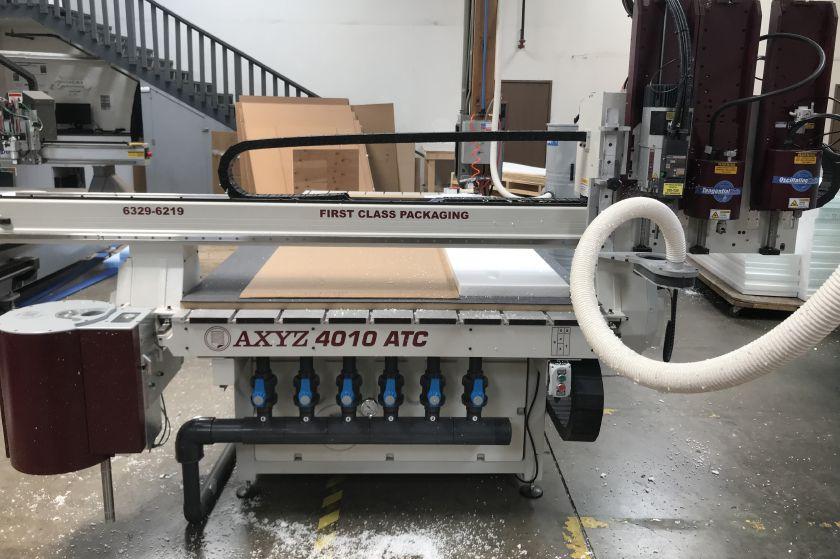
“It was top-notch, all the way around,” says Perry, lavishing praise on the purchased AXYZ 4008 Series CNC table router, capable of producing models for customers in minutes, instead of hours.
“Up to then, they (FPS) were doing everything manually and outsourcing,” recalls Larry Daignault, AXYZ
International’s regional sales manager for southwestern U.S.
“Due to the growth of their business, they realized they needed to automate the process in house,” says Daignault, crediting FPS for their due diligence in identifying the right solution for their needs.
“They were well prepared and really did their homework,” he recalls.
Ultimately, FPS settled the AXYZ 4008 Series CNC Table Router machine featuring a dual digital processing system, along with multiple cutting tool options for cutting diverse types of foam such as closed-cell polyethylene, open-cell polyurethane and reticulated foam.
The router comes in a range of five base sizes and different process lengths, and after examining the numerous options and the best use of those applications, the company’s router was equipped with a 5 HP spindle and an oscillating knife capable of working in tandem.
In operation, the spindle can produce a smoothedged inlay cut, while the knife can easily cut foam material with a thickness up to four inches.
For its part, the router consistently delivers precise foam pocketing, while the knife accurately performs finite profile cuts and creates outlines for cuts and inserts.
“I can add cutting heads when and if I need them,” says Perry, adding the router has helped his firm cut operating costs, while producing diverse and creative models that have been praised by customers.
All the FPS employees were trained by a certified technician on-site—within the scope of real-world production—to learn how to accurately estimate the amount of time required to create files, select the right toolpath job to be sent to the machine, and to estimat-
ed the time for the process of off-loading and installing new material.
“They have really been able to improve product quality and increase production through the application of this technology,” says Daignault.
To say the router has fulfilled Perry’s expectations is an understatement.
“The router has substantially reduced the time it takes to develop the model for the customer,” Perry states.
“It takes my sample time down to two hours,” says Perry, “which is an incredible improvement from what had been anywhere from 10 to 20 hours.
Since coming online, Perry says that the router has proven its reliability and capability on an everyday basis. He is also enthusiastic about the other options the table router gives him with current customers and future prospects.
“Everything we produce looks professional and projects our full professionalism,” says Perry, adding he is very happy about having established a good working relationship with AXYZ.
“You have to be completely transparent in what you expect the machine to do, and they were just as transparent in showing how the machine will meet my expectations,” says Perry.
“This machine has really delivered outstanding results for us,” sums up Perry. “In hindsight, I should have done this 15 years ago.”
THE MANY SILVER LININGS
Canadian cap lining equipment manufacturer using innovative automation technologies to give its specialty machinery an extra cutting edge in the global markets
BY: GEORGE GUIDONI
PHOTOS BY PIERRE LONGTIN
With the global market for caps and closures estimated to become a US$58-billion business by the end of next year, companies supplying into this vibrant, fast-growing segment of the global packaging industry owe it to themselves to raise their game in order to take full advantage of that brisk growth.
For companies like the Laval, Que.-based MMC Packaging Equipment Ltd., manufacturer of state-of-the-art cap lining/wadding machines and other postmolding automation systems for the caps and closures industry, anticipating and meeting market needs ahead of the competition has been a key core competency helping the company achieve remarkable success in many of the world’s fastest-growing markets for these essential packaging products and components.
Founded by John McNally in 1968 as a tool-and-dye maker under the origi-
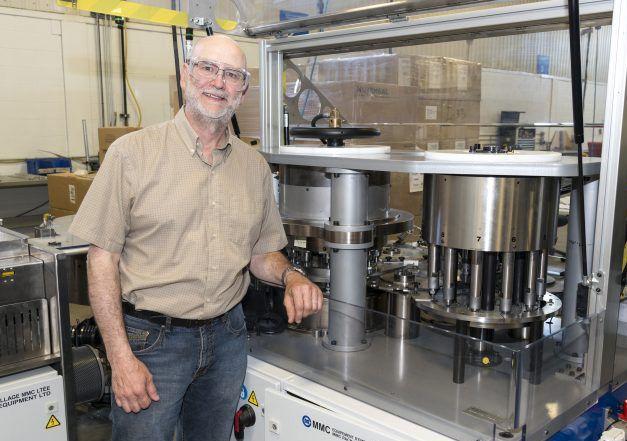
MMC Packaging Equipment technical director and company co-owner Marcel Bélanger strikes a pose in front of a new high-speed slitting and band folding machine being assembled the company’s Laval facility, which will operated at breathtakingly fast speeds of 2,400 caps per hour for the 28-mm tamper-evident enclosure.
nal Montreal Milling Cutter Co. Inc. corporate banner, the company developed its first cap lining/wadding machine in 1978—four years before the infamous “Tylenol Scare” in Chicago shocked pharmaceutical companies worldwide into beginning to insert tamper-evident liners on their products to regain the public’s trust. With this practice quickly being adopted into the foodand-beverage and other CPG (consumer packaged goods) industries, the company quickly built up the manufacturing capabilities to produce more advanced cap lining systems and related systems for an ever-growing array of packaging applications.
So much so, in fact, that in 1991 current president Phillipe McNally, son of the founder, renamed the company to its MMC Packaging moniker to better reflect the company’s growth and a more defined strategic focus on the caps and closures business.
Since moving its new state-of-the-art engineering and manufacturing facility in Laval, the company has steadily diversified its product portfolio with new innovative systems for cap closing, slitting, banding other elated applications, while its 2008 acquisition of machine vision and imaging specialists EOSAI elevated MMC up to a whole new level of technological competence and sophistication.
In 2015, the company reached a major milestone with the installation of its 1,000th machine, according to director of sales and marketing Anthi Balafoutis, who credits the firm’s genuine commitment to innovation and continuous improvement for its excellence in the export markets.
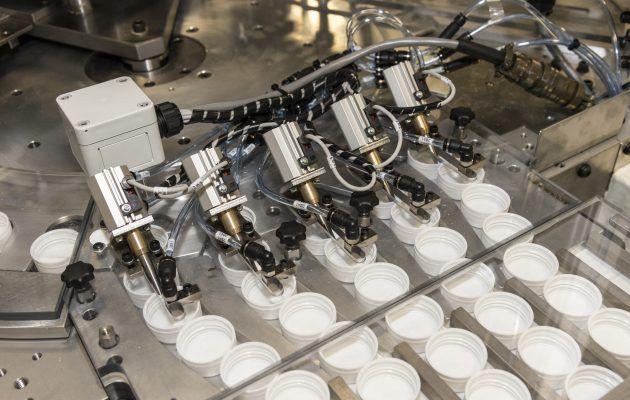
A close-up of the plastic twist-off screw caps used for pharmaceutical products that are lined and wadded with special lining materials on MMC Packaging Equipment’s’ high-performance cap lining machinery for ensuring optimal tamper evidence and product protection.
“Over 90 per cent of our equipment is exported into international markets,” says Balafoutis. “Our primary markets currently are is the U.S. and Mexico, but we would like to focus our future efforts more on Europe, as we see odd growth opportunities there.
“Until recently, we didn’t realize just how many different companies out there are involved in the creation of something as simple as a cap or closure.”
Employing over 70 full-time specialists, the lively Laval facility is in many ways a model corporate citizen, having been named to the prestigious Deloitte & Touche list of Canada’s Best Managed Companies for the last two years running.
The model LM-270 cap lining machine manufactured by MMC Packaging is the company’s best selling machine, which uses a variety of Beckhoff Automation components and a PC-based control system to enable complete automation of all the machine functions, including feeding, mounting and cutting of the liner, along with inspection and reject confirmation.
As acknowledged by company president McNally, “This award recognizes our ability to adapt to a changing marketplace, comparable to the best companies in the country in terms of product development, business development, and organizational excellence.
“I consider that our success is due to the commitment and efforts of all employees and I am very proud of our team,” McNally says.
“Our constant drive towards recognition as the sector reference and benchmark for product and service quality worldwide is spearheaded by a sharp needs-oriented focus, and the credibility we foster with our partners customers
through the consistency and reliability of both our people and products,” he states.
“In a market that is constantly looking for innovative caps and specialty closures, the dynamic MMC team takes the time needed to understand each individual cap manufacturer’s special machinery requirements,” adds Balafoutis.
“That’s why MMC Packaging is not only a reference point for post-molding automation equipment, but also an authoritative source of expertise in providing services related to the manufacturability of new closure designs.”
With the company’s growing global customer base now extending across food-and-beverage, personal care, pharmaceutical, home-care, and chemical and industrial sectors, MMC Packaging has naturally developed a lot of equipment customization capabilities that enables it to introduce new value-added features on its standard equipment on a regular basis, according to Balafoutis.
“We have acquired a lot of experience when it comes to customization because there really is a lot of difference in the size and the geometry of the caps and closures used in the different sectors,” she states.
“And as one can imagine, there are a lot of very intricate closure designs on the market that require some type of automation to optimize their feasibility.”
To answer those clients’ automation needs, MMC Packaging offers a comprehensive range or equipment comprising:
• Cap lining machines, high-efficiency systems capa-
ble of stamping out and installing liner disks inside the caps at rates of up to 1,200 caps perminute.
• Cap slitting and band folding machines. As Balafoutis explains,“We design and manufacture cap slitting and band folding that score the sidewall of plastic closures either with an arched slitting blade, or a cut-topost technology, for creating tamper-evident closures.
• Cap assembly machines, designed to assemble multipiece closures at high throughput rates.
• Cap closing machines. “This type of equipment is designed to reliably perform and repeat highly efficient and intricate closing functions for closure styles with various hinge and latching features,” Balafoutis explains.
• Vision inspection. “We have a dedicated in-house team of vision specialists and software engineers that design vision systems uses to capture all sorts of closure defects at high processing rates,” according to Balafoutis.
• Because automated machinery is ultimately as good all the components, devices and systems that go into its design and construction, MMC Packaging makes it a point to partner up with the best industrial automation suppliers in the business—such as Germany-headquartered Beckhoff Automation GmbH & Co. KG. With a strong North American presence—underscored by the company’s Beckhoff Automation Canada Ltd. office in Mississauga, Ont. and its parent Beckhoff Automation LLC subsidiary just outside of Minneapolis in Savage, Minn.—the company is a renowned expert in open
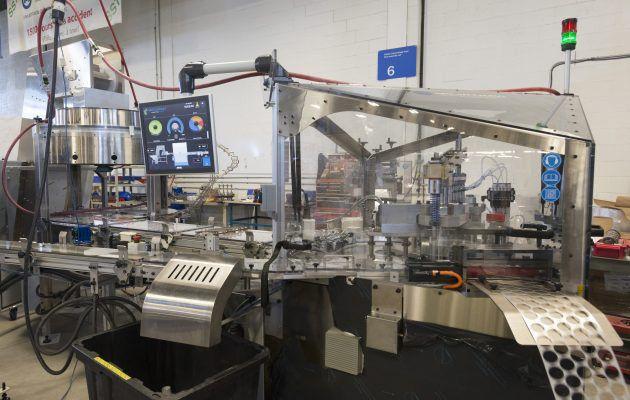
MMC Packaging Equipment automation specialist Oliver Turcot refers to the vivid graphic display of the proprietary ICON human-machine interface software running on the custom 18.5-inch control panel terminals manufactured by Beckhoff Automation.
PC-based automation technologies, supplying a broad range of industrial PCs, controllers, control panels, input/ output products, servo drives and motors, and automation software to industrial OEMs (original equipment manufacturers) worldwide.
“Our collaboration with Beckhoff Automation started in 2013, when MMC decided to lead the way of post-molding automation equipment built on PC-based controls system,” Balafoutis relates.
“Ever since, the partnership between MMC and Beckhoff has been growing stronger and stronger.
“As far as we are concerned, PC-based technology offers not only enhanced performance compared to traditional
PLC (programmable logic controller) technology,” Balafoutis states, “but also new capabilities such as remote access and control, integrated multifunctional control and data reporting, and structured text programming that is easier to tailor, deploy and maintain.”
Naturally, such ringing endorsement is sweet music to the ears of Ted Sarazin, Beckhoff Automation’s regional sales manager for Eastern Canada.
“The relationship between MMC and Beckhoff has been extraordinary on every level for many years now,” Sarazin states.
“Their management team are always eager for innovation,” he says, “which is very much in line with the Beckhoff ’s philosophical foundation.
“Moreover, they have a very high skilled engineering team who are always curious for new technology, which is why they have incorporated many of our technologies into their systems.”
Specifically, the Beckhoff automation products deployed on much of the MMC-made equipment include:
• The customized 18.5-inch CP39xx multitouch control panel, with extension pushbuttons, to provide optimal display and functionality for MMC’ proprietary ICON human-machine interface (HMI) software. Designed for both control cabinet and mounting-arm installation options, the panels offer all-around IP 65 level protection, and they can be operated at up to 100 meters away from the industrial PC with Beckhoff ’s
CP-Link 4 one-cable display links.
• The compact and powerful CX2040 four-core CPU (central processing unit) with an i7 processor to connect up to four modules to the scalable PC, with option to add extra PCIe ports for any additional required applications.
• The CX5140 family modular CPUs combining PC technology and modular I/O (input/output) level on a DIN rail unit in the control cabinet to offer a spacesaving solution for various logic and motion control applications. Says Balafoutis: “The Beckhoff I/O is modular and easily adapts to our needs to enable us to connect all the sensors, valves, E-stops and security connections. “It also makes it easier for us to add new sensors without additional wiring just by adding the required communications cards.
• The AM8000 synchronous servomotors, deigned to provide high power density to achieve precise control of angular position, acceleration and velocity. Featuring small end turns and a fully potted stator to ensure perfect thermal contact between the stator and the motor housing, the high-performance servomotors— available in five sizes and three length dimensions for each size— are engineered for superior durability and robustness, with guaranteed service life of 30,000 hours for the wearing parts such as ball bearings.
The AM8100 series servomotors for OCT (one-cable technology) servo terminal, featuring an integrated absolute
encoder for high-speed digital data transfer—eliminating the need for homing by combining power and feedback within a single cable.
According to Beckhoff, “The high dynamics of these servomotors open up a multitude of possible application in industrial robots for pick-and-place applications, for example, or for general mechanical engineering applications requiring compact design and high positioning accuracy.”
All in all, using Beckhoff automation solutions has enabled MMC to develop better, faster and more flexible caps and closures processing machines for its customers, Balafoutis agrees.
“It helps us execute our vision of being a ‘one-stop shop’ for all post molding-automation solutions—including peripherals, vision and inspection systems—to offer our customers a most comprehensive product offering in the market,” Balafoutis sums up.
“Thanks to our recognized expertise, MMC Packaging is committed to ensuring the complete satisfaction of its customers by offering integrated, automated and innovative products for the post-molding process of the closure industry; by providing an efficient after-sales service; by constantly ensuring the quality and reliability of our solutions, and by distinguishing ourselves with fast and ‘on-time’ leadtimes.”
LET’S GET CRACKING
Canadian case-packing machinery manufacturer keeps rising through industry ranks with exemplary work ethic and relentless continuous improvement
BY: GEORGE GUIDONI
Packaging machines are undoubtedly the unsung heroes of the modern packaging business—a critical necessity but far removed from everyday consumer scrutiny, shelf impact and product marketing battles played out in the modern consumer retail marketplace.
For most people making this machinery, though, such behind-the-scenes anonymity does not lessen the professional pride and gratification derived from designing, assembling and launching new-generation technologies to produce an ever-growing array of packaging formats and structures with new levels of speed, efficiency and reliability to help keep the wheels of the global CPG (consumer packaged goods) industries spinning in full motion.
Such pride and sense of self-fulfillment are rarely in short supply at Nuspark Inc.’s lively 46,000-square-foot manufacturing facility in northern Toronto. Opened up a little over a year ago as the privately-owned company’s new headquarters and production operations, the airy, high-ceiling factory employs
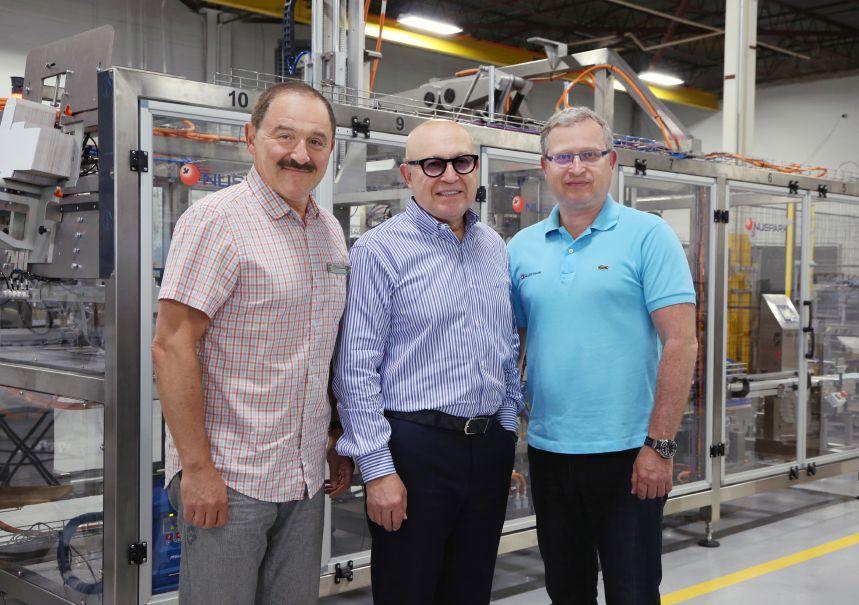
Nuspark’s founding partners (from left) Valeri Bialler, Michael ELent and Felix Elent strike a pose in front of a fully-automatic packaging workcell, custom-designed for a U.S.-based nut processor, being tested at the company’s production facility in north Toronto prior to its shipment to the customer.
about 60 full-time people—including several fully-accredited professional engineers—to produce a steadily expanding range of automatic, high-performance case- and tray-packers; vertical and horizontal cartoners; case erectors and trayformers; and full turnkey line solutions for high-throughput applications in the food-and-beverage, pharmaceutical and personal-care industries.
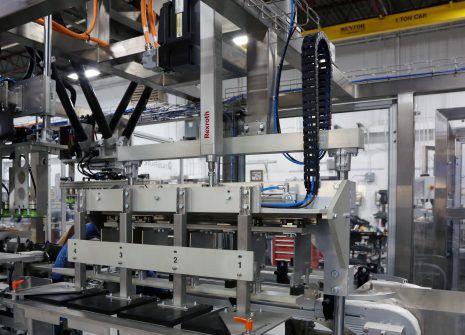
A high-speed cartoning machine custom-designed for the packaging of single-serve coffee pods incorporates a Bosch Rexroth servo motor/drive control system and aluminum structural framing and linear guides to ensure consistently high performance levels with superior precision and repeatability.
Founded in 1999 by a closely-knit three-person team comprising Michael Elent and his younger brother Felix, along with long-time family friend and colleague Valeri Bialler, Nuspark has grown in impressive leaps and bounds during its relatively brief time in the Canadian packaging machinery.
Since starting out with a staff of four people, Nuspark proceeded to grow at a brisk rate of over 20 per cent annually right up until the onset of the Great Recession in 2008, with a downward spiral in the automotive sector temporarily stopping that growth in its tracks.
Since the following economic recovery, Nuspark quickly got back to its earlier fastgrowing ways, while impressively boosting its packaging industry portfolio—now accounting for about 70 per cent of the company’s total revenues.
“We have seen about 15-percent annual growth since 2011,” co-founder Felix Elent told Canadian Packaging on a recent visit to the plant during a busy summer stretch requiring frequent overtime and Saturday shifts to keep up with seasonal work influx.
“Summers tend to be a busy time for us because that’s when a lot of new customer orders are actually finalized and approved for delivery,” explains Nuspark’s general manager Boris Motskin, adding the new plant currently has capacity to produce over 70 machines per year, in a broad array of designs and configurations to suit the end-users’ specific application requirements.
“All the electrical assembly and wiring is done right here at the factory, and all the machine frames are also fabricated in-house,” says Motskin, who joined Nuspark a few years after graduating with a degree in aerospace engineering from Ryerson University in Toronto in 2008.
“Doing a lot of business in the food industry, we often get asked by clients about how they (frames) are welded, if they are fully welded, if they’re washdown-ready and so on,”
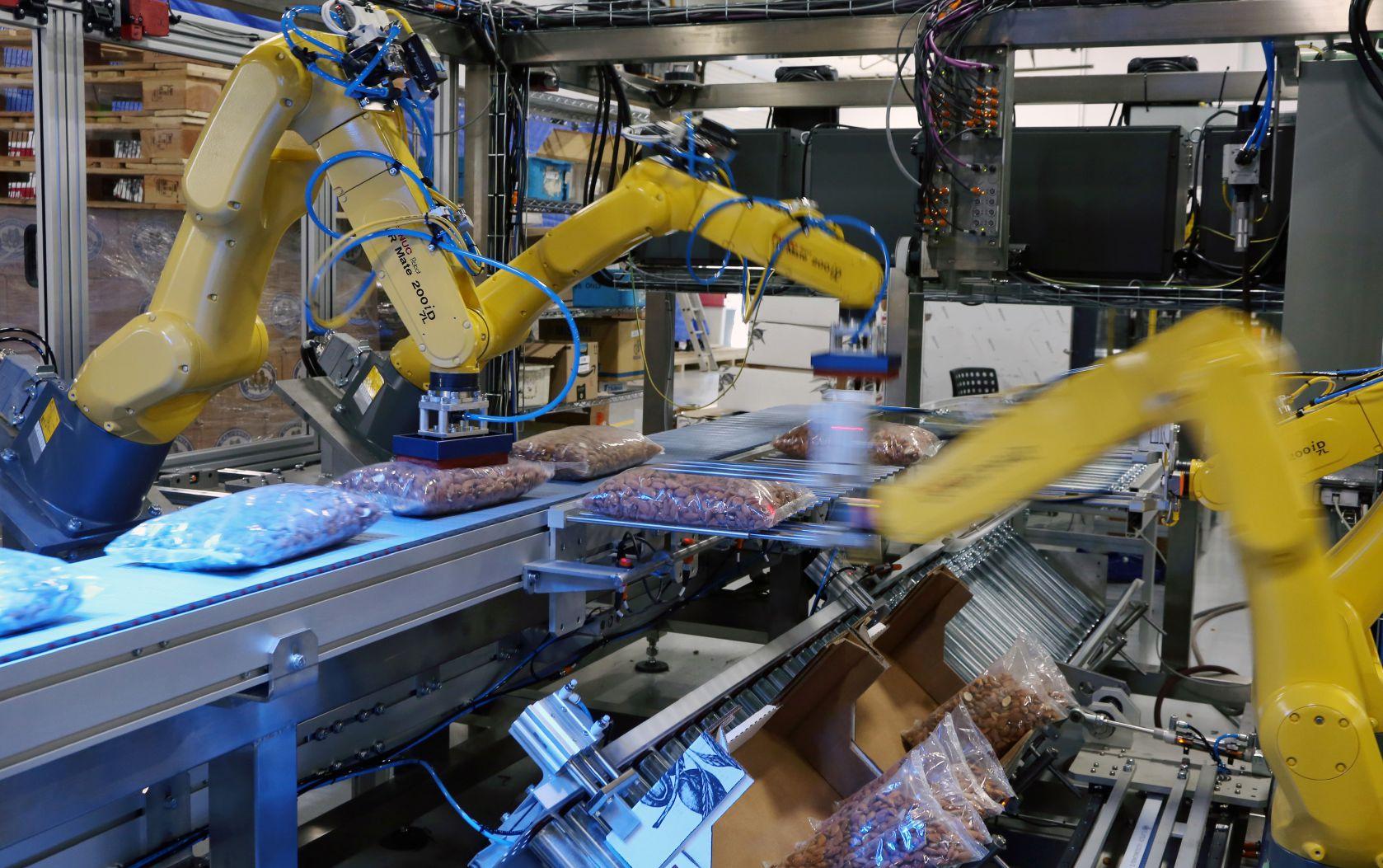
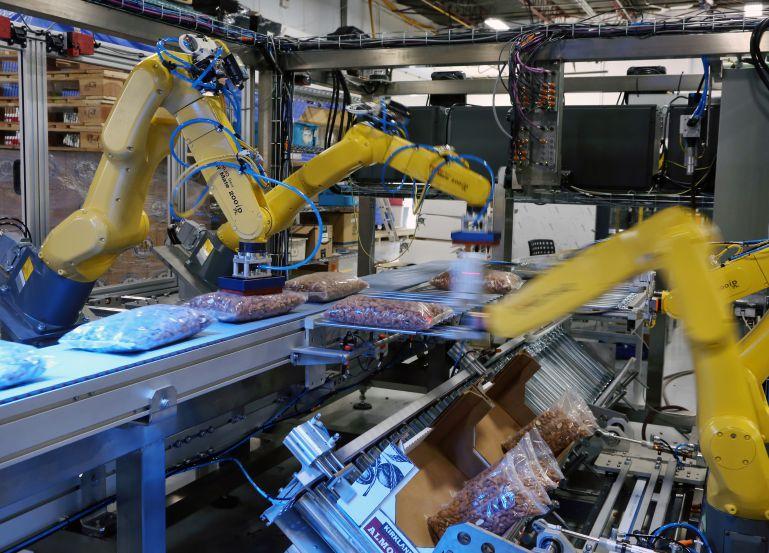
A custom-designed packaging workcell employs two highspeed Fanuc pick-and-place robots for automatic loading of large plastic bags of almonds inside corrugated trays formed inside the same workcell.
Motskin relates.
“We have decided to make this function an internal process to give our customers a peace-of-mind about all these issues by welding, cleaning and polishing all the frames ourselves,” says Motskin, noting the vast majority of the frames are constructed of high-grade stainless steel to ensure optimal hygienic standards.
Motskin explains that Nuspark has built up a solid network of manufacturing vendors and service providers in the GTA (Greater Toronto Area) region to produce about 80 to 90 per cent of the custom-designed parts and subassemblies that go into each machine, using advanced CNC machining, 3D printing, laser- and waterjet-cutting, and other advanced manufacturing technologies.
The rest of the machine contents and related equipment accessories comprise an impressive assortment of best-of-breed automation components and systems supplied from elite global industrial automation manufactures such as Bosch Rexroth (programmable logic controllers and drives); FANUC (robotics); Schneider Electric (electrical components and relays); B&R Industrial Automation (human-machine interface terminals and distributed I/Os), SMC Pneumatics and Festo (pneumatic components and controls); Omron (safety curtains) and other leading automation specialists.
“Being in Toronto puts us within easy reach of the best
available technologies in the market,” Motskin says, “and we have established some very good relationship with many reputable technology vendors to make sure we assemble the highest-quality machines we can for our customers.”
Moreover, Motskin notes that virtually every machine shipped by Nuspark these days comes standard with all the required DNP circuitry and wiring to enable remote machine troubleshooting and diagnostics from virtually any place with an Internet connection.
Some of the company’s bestselling equipment brands include:
• Model NTL-50 top-loading case-packer, featuring a delta-style two-axis robot to perform up to 50 repeatable, high-precision picks per minute;
• Model NTF-25 servo-driven tray-former, equipped with an active blank magazine and an on-board Nordson adhesive applicating system to form up to 25 trays per minute, with higher-speed variants available to handle over 60 trays per minute.
• Model NP-15 Polaris palletizer, outfitted with a four-axis robotic arm, single or dual-head dispenser, a powered discharge conveyor and other valueadded features enabling it to perform up to 15 pick per minute in continuous operation, enhanced with 10-pallet magazine capacity.
• Model VRC-60 vertical rotary cartoner, featuring an innovative vacuum nest design to ensure delicate
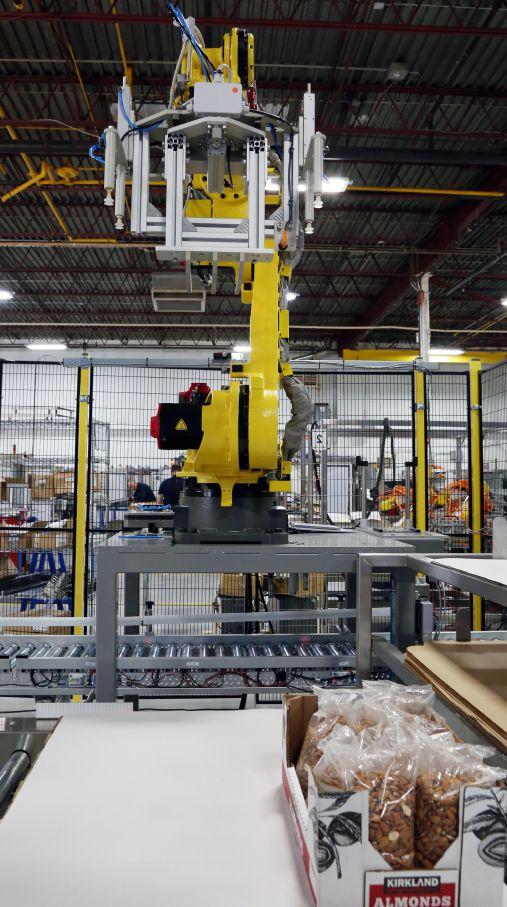
A high-payload palletizing robot manufactured by Fanuc Robotics is used for high-peed stacking of corrugated trays filled with large bags of almonds retailed by a leading Club Store chain.
carton handling at speeds of up to 60 cartons per minute.
• Model NRCP-5 robotic case-packer, featuring an integrated FANUC six-axis robot with a multipurpose gripper that can both erect and load corrugated cases at up to five various-sized corrugated cases per minute.
As Motskin relates, the company’s familiarity and comfort levels with new generation automation technologies is rooted in the extensive combined engineering knowledge shared by the company’s founding partners—acquired at leading technical institutes and academies of the former Soviet Union—who all moved abroad soon after the country’s 1991 break-up and the outset of a chaotic transition to a market economy.
Adds Michel Elent: “We are rather blessed in having so much engineering know how at our disposal.Whereas the industry norm is having about 10 per cent of the workforces as engineers, our 16 engineers account for 25 per cent of our staff.
“Having such a strong engineering team gives us a competitive advantage in respect to speedy product development and further refinement of the high-quality case-packers, cartoners, tray-packers and many types of custom products we produce here,” Motskin proclaims.
With the U.S. market accounting for about half of Nuspark’s annual revenues, Elent says he is hopeful that the existing NAFTA (North American Free Trade Agreement) framework remains largely in place in spite of the recent trade tensions between the U.S. and Canada, but adds that the company is well-prepared to weather whatever comes next.
“There is no sense in worrying about something that we cannot control,” he acknowledges. “What we can control is the quality of the machines we make, and we believe that best-built machines will succeed in any market, even under difficult conditions.”
A high-payload palletizing robot manufactured by Fanuc Robotics is used for highpeed stacking of corrugated trays filled with large bags of almonds retailed by a leading Club Store chain.
To date, Motskin relates, Nuspark has performed machine installations in 14 countries around the world, including China, India, England, Germany and Israel, with a new in-
A high-speed cartoning machine custom-designed for the packaging of single-serve coffee pods incorporates a Bosch Rexroth servo motor/drive control system and aluminum structural framing and linear guides to ensure consistently high performance levels with superior precision and repeatability.
stallation in Russia scheduled for startup later this year.
“One of the things our customers everywhere seem to appreciate about our machines is the aesthetics factor,” Motskin relates.
“With most of our customers being smaller or medium- sized businesses, at some point they will have to show the machine in action to their own customers, and that
first impression can be very important for their business relationship from that point on.
“With our equipment design, there is literally nothing to hide.
“Also, the fact that our equipment comes standard with stainless-steel frames really resonates with our customers,” Motskin adds.
Beyond the machinery’s clean streamlined appearance, “The simplicity of use is another key selling point,” he states.
“The way we conceptualize and configure all the automation components in the machine is all geared toward optimal operator-friendliness and elimination of manual steps from the process to achieve greater productivity.
“Our equipment is fundamentally very simple,” Motskin states, “because it has to be.
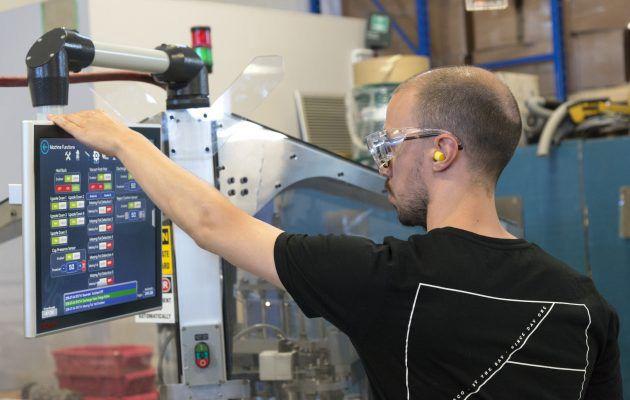
“For about 90 per cent of the machines we build, the operator will use only one screen to monitor the full process, so it’s not even a full-time job for them.”
To use an example, Motskin cites a U.S.-based national cream cheese processor who installed a turnkey case-packing solution form Nuspark, comprising two lines, that is capably overseen by a single operator per shift, compared to the four people required to do the job before.
A custom-designed packaging workcell employs two highspeed Fanuc pick-and-place robots for automatic loading of large plastic bags of almonds inside corrugated trays formed inside the same workcell.
Always keen to stay on top of industry trends, Nuspark is also enhancing its machines with the requisite data sourcing and mining capabilities needed for successful Industry 4.0 methodology implementation, which is being increasingly adopted in the industrial machinery markets.
“This is one of the reasons we decided to standardize all our machines with the B&R industrial PC-based HMIs (human-machine interfaces,” Motskin explains.
“It gives users the flexibility to install any auxiliary software they need to upgrade their systems management, be it to implement a new diagnostics software, to hook up to a database, or to process and analyze incoming machine information.
“The thing about Industry 4.0 is that it all comes down to the user—whether or not they see value in having access to all that information,” Motskin opines.
“On our end, our job is to enable them to have that access should they choose to go that route, and we are doing just that with our industrial PC standardization.
“Naturally, it costs us money to build in this extra level of intelligence into our equipment,” he says, “so it becomes important for us to make sure that the customer sees the value in this upgrade, rather than just as another added cost.
“Manufacturers in many industries can achieve good results from obtaining useful real-time machinery data that will maximize their equipment uptime,” says Motskin, “and what we do is facilitate
the effective machine interconnectivity they will need to make it happen.”
This machine interconnectivity becomes an even more important consideration as the company moves to provide more customized turnkey solution incorporating machines and subsystems from other manufacturers and vendors.
“Our company is built on a tradition tradition of continuous improvement and product innovation,” Motskin sums up, “and with the motivated, highly talented workforce at our disposal, there is really no limit to what we can achieve in coming years.
“We have already achieved a lot in a fairly brief time,” he concludes, “but for all intents and purposes we’re really just getting started.”
Please see Nuspark’s packaging machinery and customintegrated packaging lines in operation on Canadian Packaging TV at www.canadianpackaging.com.
Nuspark Inc.
SUPPLIERS
GOOD THINGS MADE BETTER
A scalable automated solution provides Canadian granola bar producer with a solid packaging platform for managing brisk future growth
Founded in 2013, Riverside Natural Foods is a true snack-foods industry innovator guided by a principled passion for creating greattasting snacks made from entirely organic ingredients and free from the most common allergens.
Operating just north of Toronto in Vaughan, Ont., the company produces a variety of granola bars and bite-sized granola balls (minis) the flagship MadeGood brand.
Offered in five different flavors—chocolate chips, mixed berries, apple cinnamon, chocolate banana and strawberry—the healthy and nutritious snacks are now sold in over 8,000 stores in Canada and the U.S.
With sales of the MadeGood brand growing at a breathtaking pace in the last couple of years, the company recently found itself in urgent need of a fullyautomated alternative to its original semi-automatic methods used to handle the secondary packaging operations for its MadeGood minis products.
After closely evaluating several options, Riverside eventually decided to go with the high-performance TLM (top-loading machine) packaging line technology developed by a well-respected German packaging machinery builder Gerhard Schubert GmbH.
Founded over 50 years ago, the family-owned company has become a major player in the global packaging automation business in large part by the success-
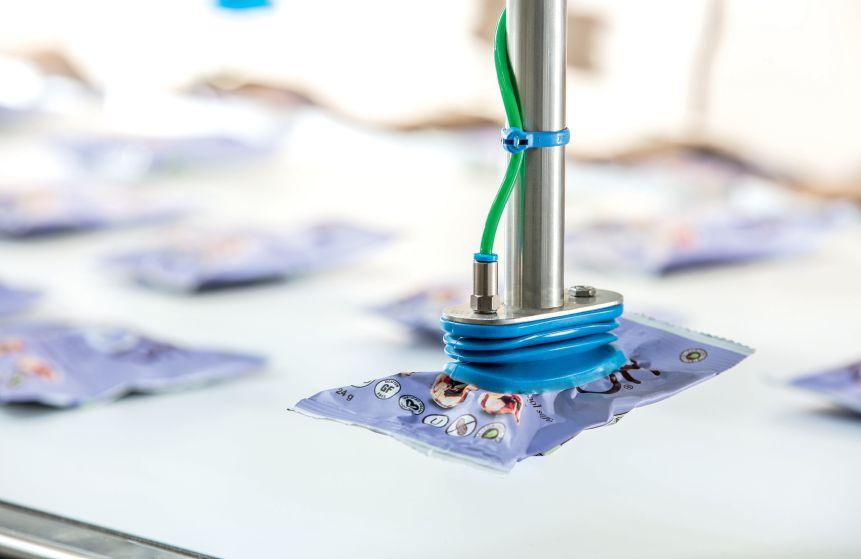
A robot places the Granola Minis snack-packs in boxes of four and five items per box, as well as in much larger packages holding 28 products.
ful commercialization of its scalable, modular TLM systems widely lauded for their robust high-speed performance, user-friendly operation and exceptional flexibility.
American subsidiary in Charlotte, N.C., and Dallas, Tex., along with the Canadian operation in Mississauga.
With the company’s Schubert Packaging Automation Inc. subsidiary located just a half-hour drive from the Riverside plant in Mississauga, Ont., Riverside staff were quick to learn and appreciate some of the key benefits offered by TLM technology—including compact machine size and quick format change, among others.
“Local support and service were definitely an important decision factor,” says Nima Fotovat, president of Riverside Natural Foods.
While Shubert’s TLM technology has been growing in North American installation base significantly over the last decade, in 2015 it made a full-fledged commitment to this “important growth market” by opening up a North
With each location staffed by highly competent professionals, “The company can ensure the best possible service to customers throughout North America,” according to Schubert.
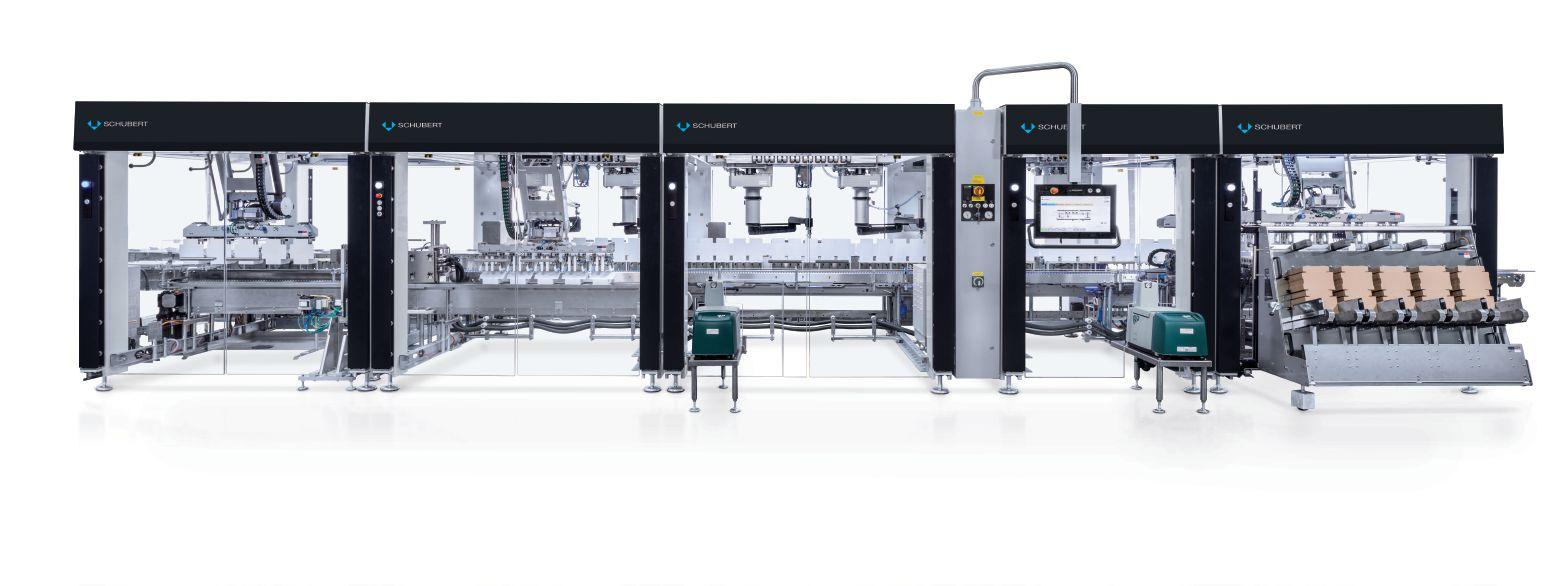
Following a thorough discussion of Riverside’s application requirements, Riverside proceeded to order a TLM picking line comprise of five machines to perform the for the final packaging of flow-wrapped granola minis with packages of different flavors into a variety of carton sizes and in special bag formats.
As per customer specifications, Schubert developed various packaging sizes, which were created in close collaboration with Riverside in terms of packaging design and ideal machine operation.
Programmed to pack the five different flavors in four-,
five and 28-bag boxes—each in one chosen flavor—the TLM line employs five identical pick-and-place robots to box 400 bags of MadeGood snack pouches per minute.
According to Schubert, the five different flavors can be intelligently pre-grouped—with the help of Schubert’s Transmodul transport robot and an inline image recognition system—so that the granola minis can either be automatically packed on the TLM machine or, as an option, manually packed in large bags of 20 products each.
The products themselves, for their part, are fed by three identical vertical TNA flowwrapping machines with a capacity of up to 150 bags per minute.
For packaging in cartons, the products of one flavor are fed along up to three of the system’s continuously running conveyor belts.
At the same time, the different carton blanks are automatically taken out of the magazine, quickly erected by an
Comprising five submachines, the highly automated TLM packaging line from Gerhard Schubert has been operating at the Riverside Natural Foods production facility in Vaughan since March.
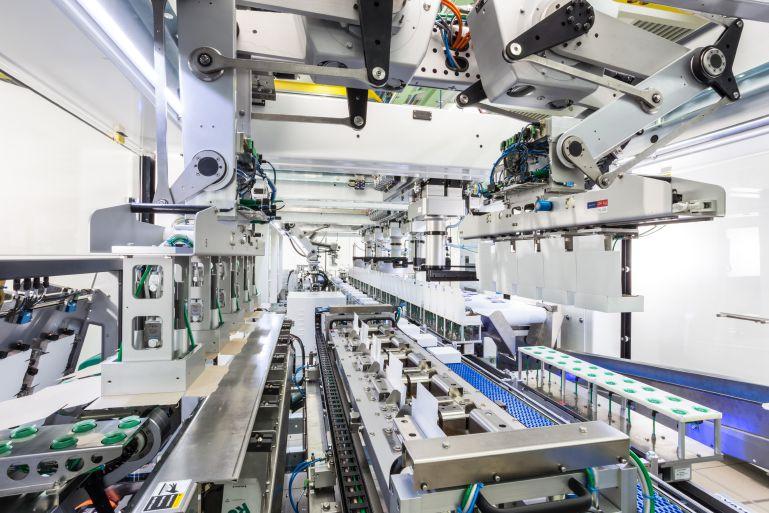
The new system is equipped with a Transmodul track, which links the processes within the machine without interfaces, with the F2 robots handling the conveying and closing of the boxes.
F2 robot and glued together.
The Transmoduls then swiftly transport the boxes to the next station, where five F4 pick-and-place robots fill them with the products.
Two TLM line is equipped with high-accuracy scanners that detect the orientation and position of the flowpacks over a width of 600 millimetres.
This information is transmitted to the F4 pick-and-place robots for the correct pickup and placement of the flowpacks in the boxes. The filled boxes are then transferred by a first F2 robot to a vacuum conveyor, and there closed by a second F2 robot in one step and placed on the outlet conveyor.
For the special format packaging of the flowpacks into larger pouches, the scanner also
recognizes the flavor based on product color.
This enables the intelligent pre-grouping of granola minis with different flavors, which are supplied unsorted on the product belt. The flowpacks are then pre-grouped into groups of four—each with two flavors—on the Transmoduls and transferred to the output conveyor by means of an F2 robot for further processing by Riverside.
While the color recognition function for the pre-grouping of different flavors was not originally part of the machine order, Schubert was subsequently able to integrate this capability on-site in time to put the system into operation.
Because the Schubert machines’ modular TLM technology offers high-level scalability and flexibility, Riverside’s continued volume growth can now continue unimpeded well into the future.
As Schubert Packaging Automation’s sales representative Giorgio Calorio explains, “Expansion of either the product range or performance can be implemented quickly through additional modules or robot tools.
“Our space-saving systems, which can be expanded flexibly as production increases or as formats and product combinations vary, ensure maximum flexibility and efficiency,” Calorio states.
“This allows our customers to respond quickly to changing requirements without their having to invest in a new line.”
For his part, Riverside Fotovat says he’s very pleased with the company’s decision to invest in Shubert’s TLM technology.
“We look to Schubert to deliver superior engineering, efficiency and flexibility, while maximizing floor space optimization,” he says, “and that’s exactly what we got.
“We are very optimistic that this solution will help us with our continued growth well into the future.”
SUPPLIERS
Schubert North America
LINEAR ORIENTATION
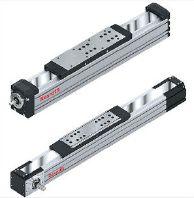
The third generation of MKK and MKR Linear Modules from Bosch Rexroth Canada provides a considerably expanded range of equipment options for the familiar space-saving dimensions of the previous series, according to the company, with ready-to-install linear axes designed to be easily connected to one-point lubrication systems. In the corrosion-resistant versions, the hard chrome-plated ball screw drives and ball rails help ensure a high resistance to chemicals.
The Linear Modules consist of an anodized aluminum profile body with integrated ball rails and the option of a ball screw drive or a belt drive. As ready-to-install assemblies, Linear Modules reduce the construction and installation effort in all types of machines and systems, with the one-point lubrication system connectivity helping achieve a longer service life of the axes. For their part, the corresponding components, ball screw drives and runner blocks are also ready for one-point lubrication with liquid grease or oil. The ball screw drive variant of the Linear Module is offered in lengths up to 5,400-mm, while Linear Modules with belt drives are available in lengths up to 9,400-mm. Also, a new switch concept simplifies assembly and saves time because the magnetic field sensors for limit switches fit directly into the profile frame without additional mounting accessories, while the two carriages with variable centerline-to-centerline distance accommodate larger attachments with enhanced system rigidity. Bosch Rexroth Canada
EASIER HYGIENE
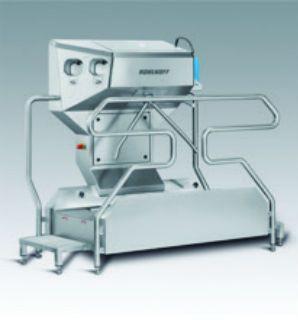
Distributed and serviced in Canada by Shawpak Systems Ltd., the new DLSOHD + EK1600 ERGOLINE hygiene station from German-based Kohlhoff Hygiene Technology comprises a the pass-through sole cleaning machine DLSO-HD and the motor-driven entry control device EK 1600 with a tamperproof, two-hand disinfection stage connected to an unlocked turnstile. Featuring a multifunctional LED light to display updated user information about the level of disinfectant or to convey fault messages, the EX 1600 ERGOLINE boasts a highly ergonomic design that is said to reduce physical exertions by the users’ upper body by about 50 per cent, according to the company, due to the optimally positioned two-hand disinfection assembly that is pointed just under 45 degrees to the direction of movement.
Shawpak Systems Ltd.
PUSHING THE RIGHT BUTTONS
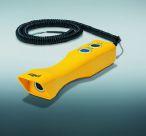
Designed for manual control of critical machine functions by hand while the safety gate is opened, the new PITjog control unit from Pilz Canada features ergonomically molded plastic housing for comfortable operation with three pushbuttons—including two pushbuttons for two-hand function and one pushbutton for the reset function. Well-suited for a broad range of industrial environments, the device’s coiled cable provides a large operating range across a broad range of applications—including machine setup, servicing work, process monitoring and test operations.
Pilz Canada
NO MARGIN FOR ERROR
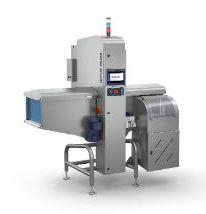
Designed for error-free product inspection with improved detection sensitivity to iden -
tify even the smallest contaminants quicker and more reliably, the model X34 X-ray inspection system from Mettler Toledo Safeline features advanced software that enables automated product setup—dramatically decreasing the chance of human error and greatly reducing the number of false rejects. Engineered for high-speed inspection of a wide range of small and medium-sized packaged products, the single-lane system is equipped with a 100-W Optimum Power generator that automatically maximizes detection sensitivity, complemented by a 0.4-mm detector for highly accurate detection of very small contaminants. Programmed with the advanced ContamPlus inspection software to further enhance detection capabilities and enable manufacturers achieve zero FFR (false reject rate) performance, the model X-34 X-Ray inspection system can also be equipped with the advanced ProdX data management tool software that can store the images of foreign body contamination for remote viewing and analysis. Mettler Toledo Safeline